I worked on several meerschaum pipes last summer. I wanted to improve my skill set by branching out from briar pipe. They were fun and produced some fine smoking pipes. You may be familiar with the saying, “use it or lose it”. I felt the need to work with meerschaum again. I am more than certain that what I know about the mineral would hardly fill a tobacco chamber so when I saw this lovely carved meer I had to bid. Winning it for under $17 was a bonus I hadn’t planned for. The pipe headed south from Cokato, Minnesota to the tropics of southeast Nebraska where the current temperature is 14° F (-10 c). I am sure it’s warmer here than in Cokato as they are about 350 miles north. The pipe was free of any markings or stamps. The style and early stages of coloring indicate that this is a Turkish made meerschaum pipe. The photos below show the pipe as it appeared before any work.
The pipe was in very good condition. It had been smoked but not a great deal. There was a light cake built up in the tobacco chamber and there were telltale signs of smoking residue and tar in the stem. There was a small crack along the back side of the bowl but this did not appear to be anything more than superficial. The pipe had begun to color something that I hoped to work on developing. The beeswax coating on the pipe was in good condition and there did not appear to be any “dry” looking spots to the meerschaum.
Background
I have pretty much told you all that I know about this pipe and I admit that a good deal of that is hypothetical. I think this is a Turkish made meerschaum pipe made from Turkish meerschaum. That sounds like there may be a woodchuck chucking nearby. Turkish meerschaum is known to be the best quality meerschaum and Turkish craftsmen have honed their skills well. According to Google’s Artificial Intelligence (AI)I when posed with the question “where is the highest quality meerschaum mined?”, “The highest quality meerschaum is mined in the region around Eskisehir, Turkey. This is considered the only place in the world where the purest and best quality meerschaum blocks are found, primarily in the Sarisu mines located within Eskisehir.” The below map was screenshot with a search asking for “sarisu meerschaum mines eskisehir turkey”. Thank you AI. I am trying to be nice and polite to the AI as I hope it will remember those who were kind to it when it unleashes the Terminators.
As usual I began with a cleanish piece of denim on the workbench.
The reaming tools were just scrapers and sandpaper on a stick as I did not want to cause any additional torsion to the reaming process with a reading tool.
The Scraping did a good job of removing the cake deposits.
Below is a photo of the tobacco chamber after being sanded. No interior damage was observed.
The ri had some lava which was removed with 95% ethyl alcohol on cotton swabs.
The stem was gunked up much worse than I originally thought. This required a good deal of scraping with the dental pick and numerous alcohol dipped cotton swabs.
A shank brush with alcohol was also used with numerous bristle pipe cleaners.
To improve the polish of the airway and remove the traces of dark tar I used a churchwarden pipe cleaner and some whitening toothpaste. The toothpaste was applied to the pipe cleaner.
One end was clamped into a tabletop vice. The stem was then threaded onto the pipe cleaner. The stem was moved up and down the length of the pipe cleaner allowing the toothpaste to scrub the airway.
The stummel was then taken to the sink for a scrub with warm water, no soap, and a nylon scrub brush. The stummel was dried with a cotton hand towel.
Back and the workbench the airway of the stummel was cleaned using a number of bristle pipe cleaners dipped in 95% ethyl alcohol. At one point I thought that the airway was too constricted so I used a 532 inch drill bit, by hand, through the nylon tenon and into the meerschaum. I blew out the meerschaum dust and continued cleaning.
When the airway was finally clean I bega heating the beeswax in a small glass jelly jar. I placed the jar into water in a pan. This allowed the beeswax to melt in the jar using the hot water to melt it. This serves a couple of purposes; one, the hot water keeps the wax hot longer than hot wax alone and two, it keeps the wax from vaporizing. Vaporizing wax over a propane stove burner sounds like a bad idea to me.
Below is what I call the beeswaxing kit: A heat gun, an aluminum catch tin to collect dripping beeswax, the always needed paper towels and the pipe.
The stummel was heated with the heat gun prior to brushing on the liquid beeswax. Once hot, I started applying the beeswax starting at the shankend. The stummel was constantly moved around heating it from all sides. Excess melted wax accumulated in the catch tin.
Once I finished applying the beeswax I continued to move the stummel around in the hot air stream until it quit dripping. I put on a glove to protect my hand and wiped the surface of the pipe with a paper towel. The pipe was returned to the workbench and allowed to cool.
The stem on this pipe looked good so no sanding was done. I did give it a light buffing with white buffing compound with the white flannel wheel. The stem also received several coats of carnauba wax from the buffer. The stummel did not receive any carnauba due it having just gotten a nes coat of beeswax. The entire pipe was hand buffed with a microfiber polishing cloth to rain the shine.
Well there it is another learning experience of working with meerschaum and completing a lovely Carved Meerschaum Apple. I am still learning camera settings and photo editing for the white background. Feel free to comment on background preferences. As for the pipe, I think it turned out nicely. I can report that it is a fine smoking pipe. I am generally not a fan of carved pipes but the grapes, leaves and vines gave this piece a feel of the Mediterranean and seemed quite fitting. Besides, I am a sucker for a nice apple shape. The pipe looks very good with the new beeswax and it did seem to draw out more color. The pipe feels great in hand and is my perfect size chamber. The crack in the meerschaum does not appear to be an issue so I did nothing with it. If it fails in the future then I will have gained even more knowledge about meerschaums. The dimensions of the Carved Meerschaum Apple areas follows:
Length: 6.22 in./ 158.00 mm.
Weight: 1.44 oz./ 40.80 g.
Bowl Height: 1.88 in./ 47.75 mm.
Chamber Depth: 1.65 in./ 41.91 mm.
Chamber Diameter: 0.78 in./ 19.81 mm.
Outside Diameter: 1.60 in./ 40.64 mm.
I do hope that you have found something here useful to your own pipe care, maintenance or restorations. If you like this sort of thing, please click the like and subscribe buttons. Thank you for reading the ramblings of an old pipe lover.
Loading…
Below are some photos of the finished Carved Meerschaum Apple.
I have always thought that rooting for the underdog was an American characteristic. This is probably a very flawed thought as I am an American and the vast majority of my life experiences are with other Americans. Given, I taught English as a Second Language (ESL) science in a large urban school and had students from many different countries. The fact remains that most of my life was spent with American culture and Americans. Well, it turns out that psychologists have studied this rooting for the underdog and actually have theories for it. One article I read, Decision Affect Theory: Emotional Reactions to the Outcomes of Risky Options, by Barbara A. Mellers, Alan Schwartz, Katty Ho and Ilana Ritov found that;
“Emotional responses also depend on probabilities and unobtained outcomes. Unexpected outcomes have greater emotional impact than expected outcomes” (https://www.jstor.org/stable/40063228). So what does all this nonsense have to do with a pipe? The subject of this restoration is a terribly beaten up Peterson Donegal Rocky which I thought to be barely salvageable. In other words, this poor Pete was a major underdog. Below are some photos of the Donegal Rocky prior to work done:
I think you can see what I mean by an underdog. This pipe was a mess. The rim was severely charred and had extensive lava deposits on the remaining rim. There also appeared to be lava on the mortise. The rustications were filled with dirt and grime. The tobacco chamber still had tobacco in its cake constricted chamber. The stem was oxidized, calcium deposited and chewed on. The stem also wouldn’t correctly seat. All of these factors made me consider just depositing the old pipe in the trash then I thought why not root for the underdog and see what I could do with what I had.
Background
In a previous restoration blog I used the following: “As much as I love the history of the Kapp and Peterson company and Peterson pipes, I will not get into that other than give you resources to read the history for yourself. I will delve into the Dunmore, or Dunmoor line of pipes at greater depth.
For a great history Mark Irwin and Gary Marlburg’s book is a must read for a Pete Geek.
Now to the stuff regarding this pipe: A Peterson Dunmore. I refer to Mark Irwin again here and his blog, Peterson Pipe Notes. I can wholeheartedly recommend the free at
https://petersonpipenotes.org/ Yes, you will get emails but only for things like the weekly blog post and occasional Peterson pipe drops (like the Peterson Pipe Notes Pipe of the Year) or offers for cool Pete Geek merchandise.
I recently acquired for study an amazing NOS (new/old stock) Donegal Rocky 01s with its box, sleeve and brochure. Hallmarked with a Celtic lower-case n for 1979, it’s a first-year release of this marvelous ‘short dutch’ bowl shape and convenient reason to take a look back at the long history of Peterson’s iconic “Donegal Rocky” line.
The “Donegal Rocky” (in quotation marks), released in 1945 or so, was Kapp & Peterson’s first rusticated line. Not that K&P hadn’t rusticated pipes previously, they just that they hadn’t devoted an entire line to rustication. And they were apparently proud of it, because they gave it a sterling mount along with a black finish and white-stamped P on the mouthpiece.
It was part of K&P’s “Product Line,” what I call gateway pipes and others might call an entry-level pipe, as you can see in this shape chart from the 1945 catalog. Like the Shamrock (European version) and “K,” it was originally a fishtail line.
For nearly thirty years, from 1947 until 1975, the line continued uninterrupted, black rusticated finish with fishtail mouthpiece and sterling band.
from the 1976 Associated Imports Point-of-Sale Brochure
Then in 1976, just a year out from their Centennial celebration, Peterson (in an expansive mood) pushed the Donegal up a notch, giving the line a P-Lip. The 1976 engraving doesn’t show it, but you can just glimpse a new, deeper rustication in the (still black) 1978 Associated Imports chart:
This rustication was done by a carver in Dublin, Paddy Larrigan told me this past June in Sallynoggin. The artisan did all of Peterson’s fantastic rustications from the period: the classic “Pebble Rustics,” the early Sherlock Holmes rustics, the Bond Street of Oxford Premier Systems, and the sterling-band P-Lip Donegals.
And that’s where this 1979 01s comes in handy, because we can see with much greater clarity the rustication as well as the details of a “Donegal Rocky” at its pinnacle of engineering and finish:
It’s worth remarking concerning the removable stinger. This spike-ended aluminum tube is easily removed, leaving the P-Lip mouthpiece strictly a graduated-bore regulation affair.
If I were more dedicated, I’d smoke this pipe a few dozen times with and without the stinger and give you a report on what purpose it serves. I wonder if the craftsmen at the factory installed the stinger to approximate the effect of the older bone tenon extensions routinely attached to Classic Range Dublin & London, Classic and Premier lines? With or without the stinger, the pipe smoker should enjoy the benefits of the “Sub-System,” which I talk about at length in The Peterson Pipe. As it is, I’ll leave that to someone else, and happily report their findings.*
Here’s the COM stamp, showing Peterson’s love of quotation marks (seen also in the “SPORTS” line) as well as a closer look at the stain and rustication technique:
Sometime between 1978 and 1980 the sterling band was dropped to a nickel band and the P-Lip abandoned in favor of the Donegal’s traditional fishtail, all of which may (or may not) indicate a lessening in the quality of the rustication.
Seen above from the 1981 Mark Twain brochure, the sterling band resurfaced, this time with the line’s first change in stain color to what some of us have in our rotations or remember: the contrast brown over black (seen in the dutch 339 hallmarked for ’81 below). The catalogs indicate some fluctuation from sterling to nickel bands on through the Late Republic era (1969-90) into the Dublin era (1991-2018), with the sterling being used (as happens so often with Peterson lines) in conjunction with a P-Lip in the 1997 catalog, but also in that year available with a nickel band and fishtail.
The dublin 120 seen above is from ’94, and as you can see, while the rustication technique is nearly identical to that of the ’81 dutch billiard, the stain color has changed for a third time to burgundy-over-black, which seems to have been the standard during most of the early Dublin era.
Sometime near the beginning of this century the Donegal was down-graded again to its original “Product” or gateway status by a nickel band and fishtail mouthpiece as seen in this B7, and while the stain remains the same, it looks less craggy:
Things would grow steadily worse in the following years, however, as the gawdawful pineapple rustication took hold, so that by around 2010 the Donegal was reduced to the etchings seen on this B39:
With the return of in-house rustication earlier this year, things are looking up for the Donegal, at least just a little, as you can see in this current 80s:
The finish and the rustication are, so nearly as I can tell, identical with that used on current rusticated SH pipes, so that’s something, right? I don’t think I’d call it a Rocky anymore, but at least it still has a vulcanite mouthpiece, a plus.
As for the future of the line—or the name—I couldn’t hazard any guesses. In the ideal Peterson of my imagination, the line would assume the craggiest crags, sharp textures and brilliant obsidian finish of the last batch of Rosslare Rusticated pipes, along with—of course—a vulcanite P-Lip. In the meantime, just to have it around, as one of the bedrock Peterson lines for almost 75 years, will do.
Thanks go out to Mark again. Now, as for this Donegal Rock; the rustication and the color fit the late 1990s-2010, pre-”gawdawful pineapple” phase. The quote describing it best is “Sometime near the beginning of this century the Donegal was down-graded again to its original “Product” or gateway status by a nickel band and fishtail mouthpiece as seen in this B7, and while the stain remains the same, it looks less craggy:” This included the burgundy-over-black dye, the nickel band and the fishtail mouthpiece. The rustication is difficult to describe due to the worn nature of the pipe but it is definitely of a hand carved nature and not that of machine made look. Overall, I guesstimate this pipe to be from the 1990s-early 2000s. This makes it a more recent pipe but one that has seen a great amount of use and abuse.
The Restoration
Vivid mental images of how this pipe might turn out filled my head as I placed it on the clean denim piece.
I began with an initial sanding of the stem to remove the surface oxidation. TO maintain the crisp edges of the stem I wanted to keep it attached so the shank was wrapped in masking tape, protecting it from the sanding.
Once sanded, I removed the stem and examined the tenon. The below photo doesn’t do the layer of grime justice. The tenon was encrusted with smoking residue and tar.
I used a sharp pocket knife to scrape the end of the tenon and started cleaning it with a 95% ethyl alcohol dipped bristle pipe cleaner.
Several additional alcohol dipped pipe cleaners and a good deal of nylon brush scrubbing the stem airway was clean.
A pipe cleaner was inserted into the tenon to act as a hanger suspending the stem in Before and After Extra Strength Deoxidizer (lovingly referred to as deox).
The edge of the mortise was as crusty as the tenon had been. I have seen thick lava deposits on a rim but not on a rim this bad before. I softened the crust with saliva and let it soak for a couple of minutes and scraped the surface with a sharp pocket knife.
I gathered the reaming kit; PipNet, Smokingpipes Low Country Reamer and General triangular scraper.
I initially thought that one the #2 and #3 blades of the PipNet would be needed. Wrong. The #4 blade was also put to work.
After the #4 blade there was still scraping to be done with the General.
The tobacco chamber was sanded with 220 sandpaper to bare briar. There was some slight charring of the interior of the chamber. This was not severe and I thought that a bowl coating would suffice to protect the briar.
Next came the shank cleaning. I began with scraping the walls of the mortise with a dental scraper. The scrapings were thick and filled with cotton fluff from pipe cleaners. Well, I assumed that was the source of the cotton even though this pipe looked like it had never seen a cleaning nor a pipe cleaner.
The stummel was taken to the sink for a scrub with undiluted Murphy Oil Soap and a nylon scrub brush. The amount of grime scrubbed from the stummel was impressive. The soap was rinsed with warm water and the stumel dried with a cotton hand towel.
Looking at the freshly scrubbed and dried stummel I could see quite a bit of grime remaining on the mortise, within the rustications and on the rim. Another scrubbing was done with undiluted Murphy’s and a brass brush. The rinsing and drying were done as before.
Back at the workbench the stummel was wiped with a make-up pad dipped in 95% ethyl alcohol. The alcohol lifted a red dye from the briar.
The scrubbing revealed the damage to the rim much more clearly.
Possible remedies came to mind. Plan A – was to cut a wedge of briar from another pipe. I had one of nearly equal chamber diameter.
This idea would glue the edge onto the existing rim, fill the seams with cyanoacrylate and briar dust, shape the wedge to match the lines of the 999 shape, carve the new briar to match the pattern of the existing briar then dye the stummel. This plan would produce a finished product that was a true restoration. The plan was also drought with issues. My greatest concern was with the gluing of new briar to the old briar. I thought that I could pin this briar patch in place to make it more secure. This plan sounded like it would take many hours of tedious work, though fun.
Plan B – cut the rim on both sides to match. This would give the stummel a forward canted look. The new rim would require re-texturing. This plan also completely changes the original shape of the pipe and would make this a salvage rather than a restoration. This plan would only take a fraction of the time of the previous plan as well.
I went with Plan B. If this worked it would produce a fine working pipe, one that would be perfect for knocking around while changing the oil in the truck, fishing or doing yard work and I’m lazy.
I used a Dremel with an abrasive sided cutoff wheel to cut the non-charred side of the stummel.
I tried to match both sides and used the abrasive side of the wheel to flatten the rim.
This did accentuate the out-of-round tobacco chamber. I then started cleaning the shank with numerous cotton swabs dipped in ethyl alcohol and more scraping with the dental scraper.
The draft hole was scrubbed with a nylon brush and numerous bristle pipe cleaners.
The tars of the airway were persistent and I thought maybe an alcohol cotton treatment would better soften and remove them. The tobacco chamber and shank were stuffed with cotton and 95% ethyl alcohol was added with a pipette until the cotton was saturated.
Below is a photo of the saturated cotton. This was allowed to evaporate overnight. As the alcohol evaporated it would hopefully dissolve some of the tar and deposit it into the cotton thus removing it from the walls of the airway.
The stem sat in deox for 4 hours. I removed the stem and allowed it to drip some of the excess solution back into the jar.
Below you can see the stem on a coarse cotton shop rag.
The shop rag was used to vigorously rub the remaining solution from the stem. This rubbing removed the solution and a good deal of oxidized vulcanite.
I then scrubbed the stem with several cotton make-up pads sprinkled with Soft Scrub cleanser. The below photo shows a general progression of reduced oxidized rubber removal. The stem looked much better. I had talked to Doug Bisbee of dk Metal Pipes (https://www.dkmetalpipes.com/dkmetalpipe) earlier in the week. Doug does amazing work restoring Kirsten pipes. We discussed how he restores the vulcanite stems using only a buffer rather than the sanding and micro-meshing that I had always used. I thought this would be a good time to attempt a similar technique with my existing equipment. Doug uses Airway buffing wheels rather than the felt wheels I have. I have not invested in these wheels yet but am considering trying them out. An issue is that I would need to get a new ¾-1 horsepower variable speed buffer as well as the wheels to properly use them.
Using what I already have I worked the stem with my buffer and the red abrasive.
I followed this with the white compound on the dedicated white wheel and produced a nice finish on the stem.
The next morning I returned to the stummel. The cotton was stained with smoking residue removed from the briar.
The cotton was removed and I continued cleaning the airway/mortise with alcohol dipped cotton swabs. This process started out similarly to the day before but quickly improved dramatically. The discoloration of the cotton swabs below show that the remaining tars were much more easily removed after the alcohol and cotton treatment.
The bristle pipe cleaners in the draft hole showed a similar result.
I used a couple different carving bits in the Dremel rotary tool to get the texture to match the Donegal Rocky rustication.
It was time to try matching the Peterson dye. I thought that I would start with a black undercoat topped with a dark red. Fiebing’s Leather Dye was the product of choice. Folded pipe cleaners acted as my applicators while a wine cork wrapped in several coats of masking tape provided a plug to keep the dye from the tobacco chamber and a handle.
The black Fiebing’s was applied and flamed with a lighter.
The black was wiped with a paper towel and allowed to dry for about 10 minutes. It was then taken to the buffer and buffed from the highspots.
The remaining buffing compound was wiped from the stummel using an alcohol wetted make-up pad. Below is a photo of the black dyed , buffed and wiped stummel.
Next, the stummel was dyed with the dark red Fiebing’s.
This was flamed and allowed to dry for an hour.
The pipe was starting to look more finished.
I wrapped the shank with masking tape to protect it during the nickel band polishing. The band was polished at the buffer with white compound.
The stem looked good but I wanted it to really look good. I hand buffed it with Before and After Fine Polish on a soft cotton rag.
The Fine Polish was followed by the Before and After Extra Fine Polish buffed by hand with the same but a clean spot with the same soft cotton cloth.
For the bowl coating I used maple syrup applied with my fingertip to the interior of the bowl. Before starting a thick pipe cleaner was inserted into the draft hole to keep the syrup and carbon out of the hole. Once the syrup was applied I opened a capsule of carbon powder and dumped it into the bowl. The bowl was covered with a 2 inch wide piece of painters tape and shaken vigorously for several seconds to distribute the carbon powder.
The tape was removed and the remaining powder dumped. Below is a photo of the new bowl coating.
The bowl coating would take a couple days to dry completely. The rustications of this pipe were worn fairly smooth with use. This allowed me to use the buffer to apply several coats of carnauba wax to the stummel and to the stem. The final step was to hand buff the pipe with a microfiber polishing cloth.
This is not my first Peterson Donegal Rocky restoration but it was the first time I attempted a white background for the before and after photos. I am still learning camera settings and photo editing for the white. Feel free to comment on background preferences. As for the pipe, I think it turned out about as well as it could have. I like the craggy appearance and feel of the pipe and the rim re-rustication. The 999 shape is a favorite of mine. The burgundy and black contrast stain does come close to matching the original dye and I think it still works . I was quite happy with the oxidation removal from the stem and the black vulcanite polished up nicely. The nickel band looks bright and well polished. I am sure this will be a great smoking pipe but will have to wait a couple of days for the coat coating to thoroughly dry. The dimensions of the Peterson Donegal Rocky 999 areas follows:
Length: 5.66 in./ 143.76 mm.
Weight: 1.58 oz./ 44.79 g.
Bowl Height: 1.42 in./ 36.07 mm.
Chamber Depth: 1.17 in./ 29.72 mm.
Chamber Diameter: 0.90 in./ 22.86 mm.
Outside Diameter: 1.65 in./ 41.91 mm.
I do hope that you have found something here useful to your own pipe care, maintenance or restorations. If you like this sort of thing, please click the like and subscribe buttons. Thank you for reading the ramblings of an old pipe lover.
Loading…
Below are some photos of the finished Peterson Donegal Rocky 999.
When naming this restoration I nearly called it a “A No Name Rusticated Pot Pipe”. I did not want to be considered a drug paraphernalia marketeer thus, the word “Pot” was eliminated from the title. The complete lack of any stampings makes me question the origins of this pipe. More on that in the “Background” section to the . The pipe has a very nice shape and size to it and though I prefer a tapered stem this saddle fishtail is a nice touch. Below are some photographs taken of the pipe before I started work on it.
Background
I know this is not a Custom-Built pipe but it has the characteristics of a Custom-built and is most likely a copied version of one Now Custom-Belts were first made in the mid 1930 by Tracy mMincer. They gained renown and popularity and this popularity most likely created a market for imitators.When I was a kid most knock-offs, as we called them, came from Taiwan and Japan Over the years those two countries greatly improved their quality control and craftsmanship and today are known to produce high quality products. After World War Two (WWII) There was a flood of cheaper made pipes entering the United States. The Tariff Act of 1930 had made an attempt to force countries to mark or stamp the country of origin on the products but this was not always as successful or regulated but usually it was. Enforcement after the early 1950s was much better and in 1963 new regulations specifically addressed pipes. (https://www.usitc.gov/publications/tariff_affairs/pub103s.pdf, p.533) Thus we see ENGLAND, FRANCE or ITALY stamped on lower quality or “basket pipes”. If a pipe has no Country of Manufacture (COM) stamp, that is an indicator that it was made in the USA.
During WWII the supply of briar wood was greatly limited. Various alternatives like Mountain Laurel, mainly from North Carolina, and Mission Briar, from California, were used. Neither wood was successfully adopted by pipe smokers. After the war the supply of briar was again accessible and most makers stamped their pipes stressing that they were indeed made from genuine briar. Thus we see stamps like IMPORTED BRIAR, REAL BRIAR, GENUINE BRIAR etc… What does this have to do with the pipe in hand? Since there is no COM I assume it was made in the US. Due to the lack of stamping about the origin of the wood, I questioned whether it is made of briar. Jumping ahead, after the restoration I was able to get a good look at the wood along the smooth surfaces and it is definitely briar. No other wood has the grain and bird’s eyes like briar. The heavily carved surface of this pipe and the large areas of fills, that you can see in the photos during the restoration, led me to hypothesize that this was a pipe made after Mincer’s Custom-Bolts had become popular. The briar is of lower quality requiring the heavy use of rusticated carving and fill/putty, again indicating war years. Could this have been a second of Custom-Bilt? Possible but I could not find any examples of a real Custom-Bilt pipe with a pronounced fish tail stem in William E. Unger’s book, Individual as a Thumbprint The Custom-Bilt Story. I also couldn’t recall any mention of “seconds” from the book.
The Restoration
I normally photograph a pipe on a cleaned denim patch at the beginning of a restoration. I did that this time also but completely failed to get a decent focus. Well, I can’t go back so here is another in the long list of documented mistakes.
This pipe did not need a reaming as the tobacco chamber had been recently done. It did need a date with a scrub brush and some Murphy Oil Soap. The soap was rinsed with warm water and the stummel dried with a cotton hand towel.
The pipe kind of looked cleaner but there were strange dark patches present all over the stummel. I used make-up pads wetted with 95% ethyl alcohol to wipe the exterior of the stummel. The pads were quickly stained with stain.
This got rid of some of the dark patches but not all. The below two photos show the patches. They appeared to be made of a fill material applied after the carvings then stained. The stain seemed to have penetrated easily and produced the dark patches.
At the front of the pipe the patch had a hole in it. This looked like the patch here was shoddily applied to cover a larger hole or pit in the briar.
I dipped a brass brush into the alcohol and worked the patch area in an attempt to get rid of the fills. The patches were again wiped with an alcohol wetted make-up pad.
This helped but did not remove the filler completely. I figured a longer soaking in ethyl alcohol may be required to soften the old filler.
The tobacco chamber looked good. I lightly sanded the interior with 220 sandpaper and inspected the chamber for any heat damage.
Everything in the chamber looked fine with no sign of damage.
No damage here either.
I checked the cleanliness of the shank.It was far from the level of clean that the tobacco chamber was. I ran the Kleen-Reem shank drill through the draft hole, did some scraping and swabbed the airway with cotton swabs. It was quite tar filled.
The shank would also benefit from an extended soaking in ethyl alcohol.
The jar of 95% ethyl alcohol was topped off with fresh alcohol and the pipe started it’s bath.
The stummel was in the bath overnight. Whe it emerged the fills were much softer.
I worked them again with a brass brush and they just disappeared leaving slight depressions.
These depressions were nothing that I felt obligated to refill.
Well, the obligation to fill did arrive when I looked at the front hole. This one would need to be refilled.
The airway of the shank was far easier to clean after the alcohol bath as well.
The hole in the front of the stummel was filled with brown cyanoacrylate (CA, super glue) applied with a fly tying bodkin. While the CA was wet briar dust was pressed into the wet CA. This was allowed to cure Then was roughed up with 220 sandpaper.
The stem was lightly sanded with 320 and 400 sanding sponges to remove the worst of the oxidation.
The stem was then vigorously rubbed with Soft Scrub cleanser on a make-up pad. This was done mainly to assess the level of oxidation.
The stem was severely oxidized enough that I thought a bath in Before and After Extra Strength Deoxidizer (deox) was in order. A pipe cleaner was inserted into the tenon to act as a hanger. The stem was in deox for 4 hours.
Upon removal from deox, I let the stem drip excess solution back into the jar for a few minutes.
I used a coarse shop rag to energetically rub the remaining solution and some of the oxidized rubber from the stem.
Below you can see some of the oxidation which came off on the shop rag.
I wanted to sand the stem in place on the stummel to avoid rounding the joint where the two pieces meet. The stem was sanded with a series of sanding sponges frome 320-3500 grit. The smooth sections of the stummel were simultaneously sanded. The stummel was wiped with a make-up pad moistened with alcohol between sponges while the stem was rubbed with mineral oil and wiped with a dry paper towel between sponges.
Normally I would have switched over to micro-mesh pads for the fine sanding but I wanted to try buffing the stem and stummel with rouge compound on the buffing wheel. That worked well and the finnish seemed adequate. The buffing compound was wiped from the pipe with make-up pads dipped in ethyl alcohol. The stummel then received a coating of Before and After Restoration Balm. The balm was allowed to sit and do it’s magic for 20 minutes.
The remaining Restoration Balm was wiped from the stummel using an inside out athletic sock.
I decided to use Renaissance Micro-Crystalline Wax as the finish for the stummel. I applied this with a baby toothbrush working it into the carvings. The product was allowed to dry for an hour then was buffed with a clean buffing wheel. The stem received several coats of carnauba wax also at the buffer.
The final step was a hand buffing with a microfiber polishing cloth.
I am quite pleased with how this No Name Rusticated Pot turned out. The briar is very lightweight and the shape feels amazingly good in hand. The stem polished up nicely with little indication of the previous oxidation. Saddle stems are not my favorite stem shape to restore as they are difficult to sand and polish. The area where the old fills were spread on so thick are noticeable under scrutiny but with a casual glance they appear to be just part of the rustication. I know they were there to cover for poor quality briar but the issues with quality are cosmetic, the structural integrity of the pipe is quite sound and I am sure this pipe will continue to serve me for many years. This gives me a “Custon-Bilt” like pipe for a fraction of the current market price of such a pipe. The Dimensions of the No Name Rusticated Pot are:
Length: 6.08 in./ 154.32 mm.
Weight: 1.67 oz./ 437.35 g.
Bowl Height: 1.69 in./ 4.93 mm.
Chamber Depth: 1.36 in./ 34.54 mm.
Chamber Diameter: 0.85 in./ 21.59 mm. (Conically bored diameter is at the top)
Outside Diameter: 1.75 in./ 44.45 mm.
I do hope that you have found something here useful to your own pipe care, maintenance or restorations. If you like this sort of thing, please click the like and subscribe buttons. Thank you for reading the ramblings of an old pipe lover.
Loading…
Below are some photos of the completed No Name Rusticated Pot.
Yeah, it’s another Denicotea. I Completely blame Sascha Mertens for the accumulation of Denicotea pipes over the past year. Sascha is a German pipeman and restorer who is actually a great guy and has led to my delinquency and departure from focusing on my beloved Peterson and Marxman pipes. Okay, that’s not quite fair, I also really like old Yello-Boles, Kaywoodies and Linkman’s Dr Grabow pipes. Come to think of it, I also have a fondness for the pipes of the 1930s-and 1940s and then there’s weird ones. Oh, and the metal pipes, I can’t leave those out. Wow, Maybe it’s not Sascha that is to blame. Maybe it is the raging attention deficit disorder? No, I’d rather blame Sascha.
Anyway, the subject of this restoration is a very lengthy named Denicotea. This pipe came to me all the way from “Vilnius, default, Lithuania”. That is what the location on eBay said, “default”. That rates right up there with the “Slow Child” caution signs. How’d you like to grow up with one of those signs in your front yard telling every motorist passing by that you are “Slow” or mentally handicapped. Cruel, I say. Wow, this blog is full of mental detours today. Back to the pipe. It came from Lithuania and was stamped with the following: DENICOTEA arched over a straight DURABEL. I think Denicotea had to make this pipe with a diamond shank to allow for all the Stamings. On the adjacent side, there is a stamp, GOLF over BRUYRER EXTRA. Adjacent to that is a 710, which I assume to be the shape number. The stem sports a stamped logo of an encircled D, which is a bit faint and lacking any paint. Below are some photos of the pipe before work was done to it.
The pipe was in great shape and the Lithuanian seller was a very good pipe cleaner. This made my job easy but I have to admit a touch of disappointment in having such an easy restoration. I still wanted to remove whatever clear coat was present and maybe touch up the fills.
Background
In a previous blog I wrote about the history about what little I found about Denicotea, I will link that post here, and include the information below:
“Pipedia.org has a short article on Denicotea. I will include it here in its entirety:
“Willy Heineberg founded the company Denicotea in 1932 and began manufacturing and selling smoking accessories such as filters, filter inserts, cigarette holders and pipes.[1] The company headquarters was initially in Cologne, but was relocated to Bergisch Gladbach after the Second World War.[2]
Denicotea is actually the name of a silica gel filter, cigarette holders and care products for pipes and cigarette holders.
I still find it a bit confusing as Denicotea seems to be a company[3] and a brand as well which is operated by COMPOSING-STUDIO GmbH[4].
Brands
Adsorba
Adsorba is a fantasy series of pipes produced by Luigi Crugnola for the German market.
Aldo Morelli
Aldo Morelli is a fictional name. The brand Aldo Morelli has been registered for Denicotea on February 26th, 1992.[5]
Stefan Petzuch points out this brand appears to have similarities to the Mauro Cateni pipe brand, in particular they are both fictional Italian brands by German companies, and both have the “HAND CUT” imprint on the stem as seen bellow. This may connect the Aldo Morelli brand to Gebr. Heinemann KG in Hamburg, who had registered the Mauro Cateni brand. Or perhaps there is a connection between Denicotea and Gebr. Heinemann KG, or perhaps these pipe brands simply used “Hand Cut” stems from the same source.” (Denicotea – Pipedia)
Interesting and weird are the two qualifiers that come to mind in reading that. The four makers mentioned in the article; Luigi Crgnola, Cesare Barontini, Gig and Molina are all Italian pipe manufacturers. Where does the MADE IN ENGLAND stamp on the example on pipephil.eu or the stamp on the pipe I purchased come in, I cannot say. I can say that I am not the first person to have little success researching the origins of Denicotea pipes. Dal Stanton, who is far more diligent in his background research than I, had a French made Denicotea. He traced its origins to the St. Claude area but not to a specific maker. Dal’s blog was posted on Steve Laug’s rebornpipes.com site. Here is the link to Dal Stanton’s blog post: https://rebornpipes.com/2016/09/29/nice-find-in-plovdiv-bulgaria-denicotea-deluxe-curling-bruyere-extra/”
This Denicotea has neither the Country of Manufacture (COM) stamps of England nor France. It does have a shape number 710 which I could find no corresponding match with brands associated with Denicotea. This pipe’s heritage appears to remain a mystery.
The Restoration
I found myself feeling dishonest when I called this a restoration. It started out as more of a cleaning or refreshening.
I did want to get rid of whatever clear coat had been applied to the briar so, I guess that does make this a restoration. I first tried 95% ethyl alcohol on a cotton swab to test the finish removal. The swab was quickly stained red.
Seeing that ethyl alcohol worked, I decided on a bath of ethyl for a couple of hours. EtOH was the abbreviation for ethyl alcohol for a biochemistry lab I worked in, if you are wondering.
The stummel was submerged in the alcohol and the lid screwed back on tight. This alcohol had been used several times previously thus the very dark color.
The stem was very clean and my application of alcohol dipped cotton swabs and a pipe cleaner proved a bit unnecessary.
After the alcohol bath time, the stummel was removed and the briar vigorously rubbed with make-up pads. There still appeared to be some “shiny” to the stummel.
I lightly sanded the stummel with a 400 grit sanding sponge and wiped the surface with make-up pads wetted with acetone. This got rid of the shine that remained after the ethanol bath.
The tobacco chamber did not need a reaming so I just sanded it with 220 sandpaper wrapped around a wood dowel. The chamber showed no evidence of any damage.
The stem was not oxidized and I suspected it was made of acrylic rather than vulcanite. I masked over the stamps with masking tape and began sanding with sanding sponges. This was done to better see the old fills. I wanted to pick the old fill material out and replace it with cyanoacrylate (CA, super glue) and briar dust.
There were several old fills. I used a fly tying bodkin to pick the old filler out. The ethanol bath had softened the old fills nicely. The pits were then given a small drop of brown CA and had briar dust pressed into the wet CA.
The new fills were filed smooth with a small flat file then the whole pipe was sanded with a sequence of sanding sponges from 400-3500. The stummel was wiped with an alcohol wetted make-up pad between each sanding sponge while the stem was rubbed with mineral oil and wiped with a paper towel.
The masking tape was removed and the adhesive cleaned away with ethyl alcohol. The pipe was then worked with micro-mesh pads 4000-12000. The stummel and stem wiping was done as with the sanding sponges.
I applied a coating of Before and After Restoration Balm on the entire pipe and set a timer for 30 minutes.
The excess Restoration Balm was wiped off with an inside out athletic sock.
The pipe looked wonderful after the Restoration Balm did whatever magic it does.
I Painted the stem logo with white acrylic paint and allowed it to dry for a few minutes. Using a plastic card, I scraped off the excess pain and neglected to photograph any of it. The pipe was then taken to the buffer where it received several coats of carnauba wax. The final step was a hand buffing with a microfiber polishing cloth.
This Deincotea Golf turned out very nicely. I admit that I have already smoked it one time and that was with an actual Denicotea crystal filled pipe filter. Sascha Mertens sent me a package of ten filters when we were exchanging care packages a while back. Thank you Sascha. I am not usually a filter pipe smoker but it seemed appropriate for the maiden voyage. The feel and look of the pipe are very excellent, as are the smoking characteristics. I like the slightly longer stems of the Denicoteas that I have added to my personal collection. They do require a bit of awareness at first though. This pipe is a touch too long to make for a comfortable clencher though it is a wonderful pipe for the contemplation of life. The dimensions of the Denicotea Durabel Gold Bruyere Extra 710 are:
Length: 6.04 in./ 153.42 mm.
Weight: 1.55 oz./ 43.94 g.
Bowl Height: 1.90 in./ 48.26 mm.
Chamber Depth: 1.41 in./ 35.81 mm.
Chamber Diameter: 0.75 in./ 19.05 mm. (Conically bored diameter is at the top)
Outside Diameter: 1.60 in./ 40.64 mm.
I do hope that you have found something here useful to your own pipe care, maintenance or restorations. If you like this sort of thing, please click the like and subscribe buttons. Thank you for reading the ramblings of an old pipe lover.
Loading…
Below are some photos of the completed Denicotea Durabel Gold Bruyere Extra 710 (that’s still a lot of words).
This is one of those pipes that I had always wanted to lay my hands on and restore. The novelty of these pipes are whimsical and a bit dark at the same time. I mean, who really wants to put the barrel of a pistol in their mouth? While at the same time they are fun looking and sure to draw comments from folks who observe them. A Facebook friend, Stacy Reddig, posted that he had picked up a pair of pistol pipes at a local antique shop and included photos. Once again, I was immediately jealous as I have only found two pipes at my local antique shops that were slightly interesting. Anyway, I commented that I’d always wanted to do a restoration on one of those. A couple of weeks later a package arrived. Inside was one of the two pistol pipes. Oh, this was a surprise and the highlight of my day. The pipe had only one identifying stamp, Italy. Below are some photos of the pipe prior to any work done.
I was not sure what material the pipe was made from. I had read of gutta-percha and Bakelite and knew both materials had histories in pipe making. The moldings of the pipe were of impressive intricate detail and appeared to be in great condition. There was some discoloration towards brown from what I assumed was an original black. The briar was of lesser quality judging from the number of pits and fills. The drillings were a bit irregular and out of round. The stem/button area had a few tooth marks from having been clenched. The pipe also showed typical signs of age and accumulated dirt and grime from its assumed 100’ish years on this planet. Alltold, this was going to be fun.
Background
Surprisingly little information could be found on the Italian Revolver pipe. Oh, there were plenty of revolver type marijuana or “weed” pipes as evidenced in the photo below.
I also found historic evidence of a revolver pipe similar to the pipe in hand on pipedia.org. This example was French made by the Colossus Pipe Factory. The information on Colossus is included below in its entirety:
“There is not much known about the Colossus Pipe Factory. By the mid 1890’s it was owned by Kaufmann Bros. & Bondy. Bill Feuerbach has an old invoice from KB&B dated 1898 that has “C.P.F.” in the upper corner, with Trademark underneath. So they owned the brand by then. It could have been a company that was acquired by KB&B or possibly even founded by them.
Bill is a VP at S. M. Frank & Co. (Kaywoodie) and has also provided the evidence to the name Colossus below.
I have always been under the impression that the intials C.P.F. stood for Consolidated Pipe Factory. Many pipe collectors that I know believe the same thing. However only this week I had that cleared up. A pipe collector friend in Seattle emailed a scan of a page from a trade magazine called “The Jeweler’s Circular”, dated August 23, 1899. A reader wrote in the following question, “Please inform us who manufactures briar pipes with trademark, C.P.F.?” The answer was, “These letters stand for Colossus Pipe Factory, the business being conducted by Kaufmann Bros. & Bondy, 129 Grand Street, New York.”
I have seen pipes with both the C.P.F. logo and KB&B logo on them that date to pre-1900. This may have been a way to let the public now that the companies were affiliated. As far as I can tell, the C.P.F. brand was discontinued sometime in the 1910-1920 range.
It has been said that imitation is the sincerest form of flattery. The thing that many people do not realize is that that saying is incomplete. The entire quote is often attributed to Oscar Wilde and should read, “Imitation is the sincerest form of flattery that mediocrity can pay to greatness”. There is quite a bit of discussion about the origins of this quote and that it is not due to Oscar Wilde. If you would like to read about that, I included the link to a blog by Terence Eden, here. Whomever first said it, matters little to me. The point I’ll emphasize is the mediocrity of the imitation solely, based on the quality of the briar. Now this could also be the case where the Italian maker was indeed the first and CPF merely imitated their original. Without any documentation proving otherwise I’ll have to consider CPF as the originator and the poor little Italian Revolver as the imitator. As for the date of production, I would hazard a guess to the later 1920s-1940s.
The final question I had was,”what is the body of the pipe made of?” Materials of the era would have most likely been gutta-percha or Bakelite. Gutta-percha was an older latex derived early plastic which was used from the 1840s-early 1900s (gutta-percha history). According to wikipedia, “Bakelite was one of the first plastic-like materials to be introduced into the modern world and was popular because it could be moulded and then hardened into any shape.” (https://en.wikipedia.org/wiki/Bakelite). An easy test to see if a plastic is Bakelite is to slightly moisten a cotton swab with water and touch it to baking soda, rubbing this on the surface of Bakelite will produce a yellow or brownish-yellow smudge on the cotton swab. I tried this and the cotton was indeed yellow-brown. Positive test? Yes. Positive identification of Bakelite? No, but quite probable.
The Restoration
As usual I started with a cleaned denim piece to protect the work surface.
Reaming the tobacco chamber was the first job undertaken. The PipNet blades #1 and #2 did the job nicely.
The interior of the chamber was sanded with 220 sandpaper wrapped around a wood dowel. There was no indication of any damage to the chamber.
Unscrewing the bowl from the body of the pipe revealed a piece of fabric. Under this fabric were several pieces of what looked like charcoal.
The fabric and charcoal were removed.
The airway was cleaned with bristle pipe cleaners dipped in 95% ethyl alcohol.
The pipe was then taken to the sink for a scrubbing with a nylon brush and undiluted Murphy Oil Soap. The soap was rinsed with warm water and the pipe dried with a cotton hand towel.
Back at the workbench the pipe looked clean but now had a dry, oxidized appearance to the Bakelite.
I tried to clean the surface of the pipe with a cotton swab wetted with ethyl alcohol.
To get in the smaller crevasses I also used a bristle pipe cleaner.
The molding seams or ridges were filed with a small rat tail file to make them less noticeable. These were sanded with a 400 grit sanding sponge to further smooth the surfaces.
The old fills were soft and very light colored. I picked the old fill material out with a fly tying bodkin.
New fills would be done with brown cyanoacrylate (CA, super glue) and briar dust.
The fly tying bodkin was used to apply a small drop of CA to the pit. Briar dust was then piled onto the wet CA and pressed into the pit.
The cured CA/briar dust fill was then filed with a small flat file and sanded with a 400 grit sanding sponge. For deeper fills I used a second application of CA and briar dust.
The new fills were hard and secure but do stand out as dark spots on the stummel.
The bowl was then sanded with a series of sanding sponges from 600-3500 grits. Between each sponge I wiped the bowl with a make-up pad wetted with alcohol.
The button and mouthpiece area were sanded with a series of sanding sponges from 600-3500 grits, to remove the tooth chatter and to smooth the stem. I did not want to sand the other surfaces of the Bakelite in fear of rounding the edges.
The bowl and mouthpiece area were worked with micro-mesh pads 4000-12000. Between pads I wiped the bowl with an alcohol wetted make-up pad. The Bakelite was wiped with a paper towel between pads to remove debris. I did use the micro-mesh pads on the flat surface of the barrel and the top of the pistol.
I used Before and After Fine Polish, which is a fine abrasive buffing polish on a cotton swab to polish the surfaces of the Bakelite. I could have sworn that I photographed this but could find no photos as I transferred the photos to the computer. Darn old people or gremlins…
The entire pipe was given a coating of Before and After Restoration Balm and allowed to sit for an hour.
The remaining Restoration Balm was hand buffed from the pipe with an inside out athletic sock. The pipe was then taken to the buffer where several coats of carnauba wax were applied to the bowl. The pipe was hand buffed with a microfiber polishing cloth as a final step.
Overall I am happy with how this pipe cleaned-up. The bowl looks much better. I cannot say that I am pleased with the brownish looking pistol parts of the pipe. I am uncertain how to clean and polish Bakelite without damaging the detail of the piece. I thought about using a buffing wheel with a buffing compound on the Dremel rotary tool but again feared that I would inadvertently remove detail from the molding. If this were my own pipe, I might have taken more risks with the material. It was a fun little project and another pipe which I can remove from the list of “pipes I want to restore”. The dimensions of the Italian Revolver pipe are:
Length: 5.09 in./ 140.46 mm.
Weight: 1.57 oz./ 44.51 g.
Bowl Height: 1.58 in./ 40.13 mm. (bowl only) 2.75 in./ 69.85 mm (connected)
Chamber Depth: 1.08 in./ 27.43 mm.
Chamber Diameter: 0.74 in./ 18.80 mm. (Conically bored diameter is at the top)
Outside Diameter: 1.22 in./ 30.99 mm.
I do hope that you have found something here useful to your own pipe care, maintenance or restorations. If you like this sort of thing, please click the like and subscribe buttons. Thank you for reading the ramblings of an old pipe lover.
Loading…
Below are some photos of the completed Italian Revolver pipe.
This slightly brutalized bent beauty was part of an estate lot of 13 pipes from Germany. I was interested in getting some pipes less common in the United States. The first from this lot that drew my attention was this rusticated bent pipe with a unique briar ring adorning the stem. The pipe was marked with what appeared to be a signature though I had trouble making out the name. The only other markings on the pipe were a 5 digit number around the bottom of the shank. Below are some photos of the pipe prior to being worked on.
Based on previous experience a heavily smoked pipe is frequently a very good smoking pipe. Then again it could just be a heavily smoked pipe by a slob. The rim was heavily layered in lava, the tobacco chamber well caked and the shank to stem joint looked like it had issues retaining a tight seal. When I pulled the stem from the stummel I saw a replaceable filter which someone must have thought to be irreplaceable. The briar ring on the stem appeared to have been a two piece ring glued together and since separated slightly. The most redeeming quantity was that the stem did not appear to be chewed on. My vivid mental image of the previous owner was a German tweed jacket wearing man with a bottomless tobacco pouch and no teeth. Well, this was going to be an interesting restoration.
Background
For researching this pipe, the first place I visited was pipephil.eu. Not sure how to proceed without a logo, name or country of manufacturer (COM), I started with a hunch, Germany. I had no evidence that this pipe had a German provenance but I had to start somewhere and the pipe did come to me from Germany. I clicked the German flag in the section that read “Search by country”.
Denicotea? Barontini? Molina? I have the song Synchronicity by the Police blaring in my head after I read those three names. I had just recently restored a Barontini pipe, and last Saturday I received a brand new Molina pipe and the next pipe in the restoration queue is a Denicotea. Good thing I like the Police, the genius of Sting, the amazing guitar work by Andy Summers and the incredible drumming by Stuart Copeland – what’s not to love.
Back to the pipe, I continued to pipedia and searched Aldo Morelli. Here I found the following:
“Aldo Morelli is a fictional name. The brand Aldo Morelli has been registered for Denicotea on February 26th, 1992.[5]
Stefan Petzuch points out this brand appears to have similarities to the Mauro Cateni pipe brand, in particular they are both fictional Italian brands by German companies, and both have the “HAND CUT” imprint on the stem as seen below. This may connect the Aldo Morelli brand to Gebr. Heinemann KG in Hamburg, who had registered the Mauro Cateni brand. Or perhaps there is a connection between Denicotea and Gebr. Heinemann KG, or perhaps these pipe brands simply used “Hand Cut” stems from the same source.” (Denicotea – Pipedia)
Like I said earlier, “this was going to be an interesting restoration”. I now had an imaginary signature on an imaginary brand for an Italian made German pipe. All I could think was, “What the heck?” Continuing down this rabbit hole, I typed in “Denicotea” into pipedia.org and was rewarded with,
“Willy Heineberg founded the company Denicotea in 1932 and began manufacturing and selling smoking accessories such as filters, filter inserts, cigarette holders and pipes.[1] The company headquarters was initially in Cologne, but was relocated to Bergisch Gladbach after the Second World War.[2]
Denicotea is actually the name of a silica gel filter, cigarette holders and care products for pipes and cigarette holders.
I still find it a bit confusing as Denicotea seems to be a company[3] and a brand as well which is operated by COMPOSING-STUDIO GmbH[4].” (Denicotea – Pipedia)
This brought me back to the whole musical synchronicity idea, a composing studio, really? Just when you think that reality can’t match fiction something like this smacks you in the head. Anyway, this pipe is likely to have been made in the 1990s in Italy by Cesare Barontini, Gigi or Molina Pipe for Denicotea Gebr. Heinemann KG in Hamburg. Confused? I was.
The Restoration
The pipe was taken to the workbench where a cleaned denim piece was laid to protect the work surface.
The poorly fitting stem made me think that was where I should begin. The tenon and stem face were heavily fouled with smoking residue. Thinking back to the disgusting filter from the “before” images, I thought that a saturated filter would allow moisture and dissolved yuck to seep around the tenon. This also made me wonder about the condition of the airway.
The tenon was far more dirty than one would expect.
And, the separating briar band would have allied more seepage of smoking residues.
I started cleaning the stem with 95% ethyl alcohol,cotton swabs and bristle pipe cleaners. The tenon was as dirty inside as outside.
I tried to lightly sand the stem face but this seemed like a bad idea since I was sure that I could not keep from sanding one side more than the other and affecting the overall fit of the stem to the shank.
My home-grown solution was to drill a 10 mm hole in a hardwood block of wood. This would fit the tenon snugly. And keep the stem perpendicular to the stem face.
The fit was good.
I then placed a piece of sandpaper over the block and used a cork hole borer to cut a hole in the sandpaper.
The problem of sanding unevenly was solved.
I carefully topped the shank face with a piece of sand paper laid flat on a countertop.
The subsequent fit of the mortise and tenon was restored and the fit was good.
The stem cleaning continued with a lot of 95% ethyl alcohol, cotton swabs and bristle pipe cleaners.
The fit and briar ring itself needed a bit of polyvinyl acrylate (CA, super glue) to help make them look finished. I used brown CA to fill in the gaps in the briar ring and black CA to fill the area between the acrylic stem and the briar ring. I first applied a layer of transparent tape to the stem. Then cleaned out the gap with alcohol and a cotton swab. Using a fly tying bodkin I applied brown CA to the briar ring on both gaps. This was then spritzed with a CA drying accelerator.
The gap between the stem and the briar ring was then filled with black CA again using the fly tying bodkin. This too was spitzed with a CA drying accelerator.
While the CA was still soft, I removed the tape. The black CA that lay outside of the gap on the tape peeled off with the tape, limiting the sanding I would have to do to the stem.
With the stem now looking much better, I turned my attention to the stummel. The reaming kit was gathered.
The PipNet did most of the work here.
The Smokingpipes Low Country Reamer and the General triangular scraper finished the scraping of the tobacco chamber. The chamber was then sanded with 220 sandpaper wrapped around a wood dowel. The below photo shows a strange step at the bottom of the tobacco chamber.
Looking at the opposite side, there is no step but a patch of slight charring was evident.
The rim also appeared charred.
The stummel was taken to the sink for a scrubbing with a nylon brush and undiluted Murphy Oil Soap. The color of the nylon brush indicates how dirty the stummel was. The sap was rinsed with warm water and the stummel dried with a cotton hand towel.
A second scrubbing of the stummel was done using the same process. The nylon brush was less colored this time indicating progress.
Back at the workbench the stummel looked much better but the rim damage could also be clearly seen.
The rim was charred. This changed my vivid mental image again, now the previous owner was a German tweed jacket wearing man with a bottomless tobacco pouch and no teeth and clutched a torch lighter.
I lightly topped the rim on a piece of 220 sandpaper laid flat then started the shank cleaning. Both removed a lot of black material from the stummel. The airway of the shank was very encrusted with tar and required significant scraping with the dental scraper.
The topping of the rim with sandpaper was insufficient to redeem it. I used a couple of files to remove the charred briar. The bevel of the inside rim was gained using a 2 inch PVC pipe cap wrapped in sandpaper.
In an attempt to lighten or bleach the darkened briar I applied a saturated solution of oxalic acid by cotton swab.
I wetted the rim with several applications of the oxalic acid solution and let it sit for 45 minutes. The solution was then scrubbed and rinsed with copious amounts of tap water.
There remained a darkening which I did not like. I thought back to several conversations with Sascha Mertens about removing charred wood. Sascha is a German pipe restorer and all around great guy. Although he may start charging me consultant fees as he is becoming more well known here in the States and Canada and has helped big name restorers like Steve Laug recently. Anyway, He frequently uses a technique where petroleum jelly is applied to the charred area and allowed to sit. The charred area is then carefully scraped with a sharp knife to remove the char.
I did all of the above and as can be seen below it did indeed remove more of the darkened briar.
I finally gave up on trying to make the rim look pristine. The darkened briar would have to be worn as a mark of honor signifying the scars of previous battles. Next I wanted to further clean out any remaining residues from the bowl and shank so I packed both with cotton and saturated the cotton with 95% ethyl alcohol. While this was sitting, I also coated the briar of the stummel and stem ring with a layer of Before and After Restoration Balm. These were allowed to sit overnight.
The following day the cotton showed signs that additional tars had been liberated from the briar and deposited in the cotton.
The cotton was removed and the bowl and shank were cleaned again with alcohol dipped cotton swabs and pipe cleaners.
The remaining Restoration Balm was hand buffed from the stummel using an inside out athletic sock.
The stem pipe was taken to the buffer where I buffed the stem with white jewelers rouge. The pip then received several coats of carnauba wax applied with the buffer. The final step was a hand buffing of the pipe with a microfiber polishing cloth.
This pipe turned out pretty well overall. I am still thinking about what to do about the interior of the tobacco chamber. That step in the drilling bothers me perhaps, a sanding or maybe filling the step with JB Weld? If someone wants to adopt this pipe, I will let them decide. The small spot of charred briar would be taken care of with a bowl coating of a light layer of maple syrup and carbon powder. No sense in applying a bowl coating though before the step is addressed. The pipe feels wonderful in hand. The heavy shank fit for a 9mm pipe filter gives the piece a substantial heft. The rusticated finish is very pretty and is well accentuated by the smooth panel with the Aldo Morelli signature, the briar ring and the glossy black acrylic stem. The dimensions of the Aldo Morelli Bent pipe are:
Length: 5.53 in./ 140.46 mm.
Weight: 2.36 oz./ 66.91 g.
Bowl Height: 1.99 in./ 50.55 mm.
Chamber Depth: 1.68 in./ 41.91 mm.
Chamber Diameter: 0.80 in./ 20.32 mm. (Conically bored diameter is at the top)
Outside Diameter: 1.57 in./ 39.88 mm.
I do hope that you have found something here useful to your own pipe care, or restorations. If you like this sort of thing, please click the like and subscribe buttons. Thank you for reading the ramblings of an old pipe lover.
Loading…
Below are some photos of the completed Aldo Morelli Bent pipe.
A volcano in Nebraska? Well the Lewis and Clark Expeditiondid come across a portion of a bluff along the Missouri River which had volcanic-like characteristics,
“On August 24, 1804, Clark explored a distinctive “180 or 190 feet high” bluff along the side of the Missouri River. He wrote, “Those Bluffs appear to have been laterly on fire, and at this time is too hot for a man to bear his hand in the earth at any debth, gret appearance of Coal. An emence quantity of Cabalt or a Cristolised Substance which answers its discription is on the face of the Bluff.” Ordway further elaborated that the bluff “had a Sulpheras Smell”.
Following Lewis and Clark, later fur traders and travelers frequently noticed dense smoke and fire in this region. In 1839, French explorer J. N. Nicollet attempted to prove that these phenomena were not of volcanic origin. He theorized that the decomposition of beds of iron pyrites in contact with water resulted in a heat capable of igniting other combustible materials. Still, by the late 1800s the bluff was known as the Ionia Volcano. It was named after the nearby town of Ionia, established in 1856. In 1878, a flooded Missouri River undermined the bluffs and a large section of the “volcano” fell into the river. The same flood heavily damaged the town of Ionia, which was later completely abandoned.” (https://www.nps.gov/places/ionia-volcano.htm)
This pipe also appears to have volcano-like characteristics and judging by its condition, it may be better tossed into a volcano as a sacrifice. But wait, I can make it usable. This pipe came as part of an estate lot from a ways south of here in Falls City, Nebraska.
The pipes were all in pretty rough condition and looked like they had spent considerable time in some barn of storage shed. Below are some photos of the Stone Age Volcano as it looked upon arrival.
The pipe stem was severely oxidized, to the point where I wondered if it could be salvaged. The stummel had a thick clear coating that was fading in places and would have to be removed. The briar itself, showed little grain or character and was a sickly yellow-tan. I thought, “well, it must have been a pretty good smoking pipe since it looked quite well used.”
Background
A search of both pipephil.eu and pipedia.org turned up nothing for Stone Age. I thought this strange because when you search for Stone Age on eBay there were five listed. Of the few that I looked at, a couple had stamps like this pipe, below is one.
All of them seemed to be Danish inspired freehands. This led me to believe that they were likely imported by the likes of a Mastercraft or Wally Frank. Importers that historically do not have good records. They were also likely to have been made during the heyday of pipe smoking and modeled after the Danish styling and produced for the 1970s American market. Given the above is all conjecture on my part and does not intend to speak ill of any carver or importer of these pipes.
The Restoration
This sun bleached oxidized volcano started with a clean denim piece to protect the work surface from the horrors sure to come.
I started with the stem as it looks like it would require a prolonged stay in the deox hotel, also known as Before and After Extra Strength Deoxidizer. In preparation of the deox, I first sanded and steel wooled the stem to remove the worst of the surface oxidation.
Next I cleaned the airway with bristle pipe cleaners dipped in 95% ethyl alcohol.
The stem then made its entrance into the Before and After Extra Strength Deoxidizer. A pipe cleaner was inserted into the tenon to act as a hanger, suspending the stem in the solution.
Back at the workbench the tobacco chamber was reamed to remove the accumulated cake.
The PipNet did most of the work removing the cake. The Smokingpipes Low Country Reamer and the General triangular scraper saw some and the chamber was sanded with 220 sandpaper wrapped around a wood dowel. The chamber appeared free of any damage.
The shank airway was fairly dirty and was cleaned out with a Kleen-Reem shank drill, dental scraper, folded bristle pipe cleaners and cotton swabs along with a good amount of 95% ethyl alcohol.
The stummel was taken to the sink for a scrubbing with undiluted Murphy Oil Soap and a nylon brush. The soap was rinsed with warm water and the stummel dried with a cotton hand towel.
At the workbench the stummel was wiped with a make-up pad dipped in 95% ethyl alcohol. The alcohol had little to no effect on the clear coat finish. I then tried acetone, this too met with little result but the finish was softened by the acetone. I submerged the stummel into a jar of acetone topping the jar off with fresh acetone and let the stummel sit in there for an hour.
After the hour, the stummel was removed and rubbed with acetone soaked make-up pads. Apologies for neglecting to photograph this part. The clear coat was very stubborn and difficult to remove even after the hour long acetone bath. I eventually resorted to a coarse sanding sponge/block.
The next day the stem was removed from deox and allowed to drip excess solution back into the jar.
It appeared much better than when it entered.
Vigorous rubbing with a cotton rag removed the remaining solution and some of the surface oxidation.
Back at the benchI sanded the stem with a series of sanding sponges in grits of 400-3500. Between each sponge I rubbed mineral oil onto the stem and wiped it with a paper towel. I then used several applications of Before and After Fine Polish on a soft cotton cloth. This seemed to have removed the last of the oxidation.
The stummel had been sanded with 220-400 grit sanding sponges, maily to remove the finish but also removing scratches. I didn’t want to sand any finer as dye is not absorbed as well with very fine sanding. I decided to try to use a contrast dye to bring out the briar grain better. I wanted to use a black dye as the base. I prepped the area by covering it with a paper towel. Fiebing’s black Leather Dye would be the dye. A cork was used to pluck the tobacco chamber. A folded pipe cleaner would be my applicator and a lighter would be used to flame the wet dye, burning off the alcohol solvent and setting the dye into the briar.
Below is a poorly focused photo of the stummel with its new black coating.
After it had dried for about 30 minutes I took the stummel to the buffer and used rouge compound to buff away the black dyed outer surface.
This left me with a stummel which was still too dark for the look I wanted. I returned to the workbench and sanded away the outer surface. The black dye penetrated the softer grain more deeply than the harder grain. By sanding the outer surface I accentuated the grain leaving the softer wood darker than the harder wood.
Next came a second round of dye, this time with a diluted Mahogany. The Mahogany dye was diluted by about ½ with 99% isopropyl alcohol. The dye was applied with a cotton swab and flamed as before with the black dye.
The resulting dye-ed stummel was allowed to dry for about an hour then sanded with a series of sanding sponges from 400-3500 grit. Between each sponge the stummel was wiped with an alcohol dampened make-up pad. After the sanding the stummel received a coating of Before and After Restoration Balm and allowed to sit for 20 minutes.
The stummel was wiped with an inside out athletic sock to remove any remaining Restoration Balm.
The pipe was then taken to the buffer where several coats of carnauba wax were applied to the stem and stummel. The final step was a hand buffing with a microfiber polishing cloth.
I have to admit that I am not a fan of the volcano shape nor do I like fancy stems. I do like a plateau top and shank end but I doubt these are actual plateau, merely carved versions. I can say that I was quite pleased with the results of the contrast dying. That brought out grain that I never thought would have been possible with this pipe. The stem did polish up nicely and does look good with this volcano. Overall it is a great improvement of how the pipe appeared before and I hope that it will bring someone hours of enjoyment in the future. The dimensions of the Stone Age Volcano are:
Length: 5.33 in./ 135.38 mm.
Weight: 1.10 oz./ 31.19 g.
Bowl Height: 1.43 in./ 36.32 mm.
Chamber Depth: 1.08 in./ 27.43 mm.
Chamber Diameter: 0.60 in./ 17.53 mm. (Conically bored diameter is at the top)
Outside Diameter: 1.32 in./ 33.53 mm.
I do hope that you have found something here useful to your own pipe care, maintenance or restorations. If you like this sort of thing, please click the like and subscribe buttons. Thank you for reading the ramblings of an old pipe lover.
Loading…
Below are some photos of the finished Stone Age Volcano pipe.
Christmas is in the rearview mirror and fading away quickly. This pipe made me think of the 1964 Rudolph the Red-Nosed Reindeer and the Isle of Misfit Toys or, in this case Misfit Pipes. I couldn’t tell for sure what the model was because it had been, shortened? The size was smaller in shape, more like a Peterson System Standard 314 or 317. Looking at the stampings I was a bit surprised to see a faint PETERSON’s arched over an even more faint DUBLIN with a definitive 3. The opposite side had the real flummoxer: There, a 3000 appeared to be stamped.
Below are some photos of the Peterson 3000 before work was done. There are more than usual to document the poor condition.
“Doctor Young to the ER stat!” Wait a minute, I have no cool title like that and can’t claim one. My dad had a PhD, not me. “Medic!”, okay, I can work with that. This pipe was certainly in need of some kind of intervention. The oxidation on the stem looked terminal. The stummel looked as if it had been shortened with a chainsaw or some other homicidal garden implement. The shank had two cracks under the ferrule that small children could fall into. The cake in the bowl would be enough to serve a medium sized wedding party. The lava flow on the rim made Mount Kilauea look wimpy. Even without all my excessively dramatic exaggeration, the pipe was one hurting unit. This would not be one of those relaxing restorations.
Background
For those who would like more information on Peterson pipes, I’ll start with a bit I have said before:
“For a great history Mark Irwin and Gary Marlburg’s book is a must read for a Pete Geek.
Now for the pipe in hand. PETERSON over Dublin 3 indicates this is an older pipe. According to Irwin,
“3RD Quality or Third Grade (the later Standard System) was issued with a “3” stamped under the Patent stampand a domed-nickel mount. Like the 2nd Quality, it was only available with the AB- or A-molded mouthpieces.
The numbers on the 2nd and 3rd Quality pipes would appear either within a small circle or not, and would continue well into the 1930s.” (Irwin, Mark and Malmberg, Gary (2018). The Peterson Pipe The Story of Kapp & Peterson, First edition, second printing 2021. Briar Books Press, Canada. p. 119).
In a personal email with Mark Irwin concerning this pipe, I sent him these three photos and asked him “What have I got?”
His response was the following: “Doesn’t that 2nd number look like an “8” to you? But a “3800”? Nothing I can think of. Notice it’s a Grade 3—after the “Peterson’s /over/Dublin3”. That in itself is unusual, along with the nickel-mount marks. Notice also how very long the ferrule is. And the “B” or tapered stem. The Grade 3 in that “Dublin3” with everything else leads me to believe this is a very early pipe—easily IFS or maybe EIRE.” (Irwin, personal communication).
To clarify some of the Pete Geek-speak:
*Mouthpiece or stem staples of Peterson pipes as from the 1937 catalog. I believe Mark meant the AB stem.
*IFS stands for Irish Free State. This was a country of manufacture (COM) stamp used from 1922-1937.
*ERIE was a COM stamp used from 1938-1948.
Staying with the stem in an attempt to gain a better grasp of the approximate date of manufacture I focused on the tenon. Notice in the photo from the 1937 catalog, above, that the end of the tenon has a distinct taper. This was a feature of Charles Peterson’s initial design.
Irwin states the following in the same Peterson Pipe Notes entry with photos, “The first change in the molded vulcanite System mouthpieces apparently occurred later on in the Éire era, as documented by this unsmoked mouthpiece which can be accurately dated to 1937–45:”
(https://petersonpipenotes.org/tag/peterson-system-mouthpiece/). Notice the distinct step down from the push fit taper to the end of the tenon. The taper is no longer present. This is the same style of tenon as the Peterson Dublin 3 3000 pipe in hand. The below photo is of the 3000’s tenon.
Using the dates from the stem information the pipe could be dated from 1938 to present. Considering the stamping information stating that the Dublin 3 was used “Well into the 30s” that would eliminate from 1940-present. These two pieces together make for an argument that the pip is from the late 1930s. It also would coincide with Mark Irwin’s observation, “easily IFS or maybe EIRE.”
The 3000 worn by this pipe is an anomaly. Even if my interpretation were to be changed to Mark Irwin’s observation of a 3800, it would still not match any pipe in Peterson’s production history. When comparing this pipe to contemporary Petersons in my collection the much narrower shank of the 3000 is obvious.
Above are a COM England 317 (top left), a System 0 (top right)with no shape number but it’s a 317 and the 3000.
Above are a Peterson System 0 and the 3000. Notice the narrow shank of the 3000.
The bowl dimensions are nearly identical to the 317 or a 12 ½ that I have. The shank is narrow to the point that it would be nigh impossible for this pipe to have been drilled as a System pipe at all.
Guess what. It is not drilled as a System pipe. That does explain the absence of the PATENT under the PETERSON’S stamp, doesn’t it?
So, there we have it. An 87 year old Mysterious Peterson Dublin 3000. I wish I could say, “I’m glad that’s settled”. I can’t nor can I explain why the top quarter inch was cut from the stummel. At least that one I can imagine was due to a severely charred top. The shape, however, is a mystery.
The Restoration
The beginning is always so easy. Lay down a freshly laundered piece of denim. That was about the last easy thing that this pipe allowed for.
Okay, another exaggeration, the collar came off pretty easily.
The collar was placed in a medicine cup and covered with 95% ethyl alcohol. The airway of the stem then received numerous tapered bristle pipe cleaners dipped in the alcohol. The photo shows a nice progression from not-so-clean to much better.
The exterior of the stem was then worked over with 0000 steel wool in preparation of the imminent deoxidation bath.
I used Before and After Extra Strength Deoxidizer (deox) to soften the oxidized exterior of the stem. A Pipe cleaner was inserted into the tenon to act as a hanger to suspend the stem in the solution.
For the condition of this stem, I thought that 4 hours, minimum, would be required.
The collar was removed from the ethyl alcohol. I tried to clean the hardened glue with a cotton swab from the inside of the collar. I think the alcohol just made the glue angry. I then placed it into another cup and covered it with acetone.
The stummel was next up. The reaming tools were assembled. The PipNet, General triangular scraper, Smokingpipes Low Country Reamer and the 220 sandpaper wrapped wood dowel were readied.
The PipNet with #2 blades did the majority of the work.
The bowl, however, was the sizes of the 2 and 3 blades. The #2 blades did great until it couldn’t reach across the bowl. The #3 was just too big.
This required scraping with the General and Smokingpipes blades.
The tobacco chamber was sanded with the 220 sandpaper on a stick. The chamber appeared free of any damage. This surprised me a bit. I thought that surely a pipe used as much as this would have some damage.
It did have plenty of over damage though. I moistened the lava with saliva, Then scraped some of the glue from the shank end while the saliva soaked a bit. The rim was then scraped with a sharp pocket knife.
I tried running the Kleen-Reem shank drill through the draft hole from the shank into the tobacco chamber but it was too large in diameter. Instead I used a 3/32 inch drill bit. This removed some of the accumulated smoking residue. While looking down the mortise I was struck by the complete lack of a reservoir. This was certainly not drilled as a Peterson System pipe.
I used several tapered bristle pipe cleaners to further clean the draft hole first the narrow tips then the thicker ends. The shank itself was not cleaned at this time. All that was just from the draft hole leading to the wider bored shank/mortise.
I took the stummel to the sink for a scrub with undiluted Murphy Oil Soap and a nylon brush. In the photo below the filthy nature of the stummel came bee gauged. The soap was rinsed with warm water and the stummel dried with a cotton hand towel.
A second scrubbing with undiluted Murphy’s and the nylon brush were done and still more grime was removed. The stummel was rinsed and dried a second time. Notice the brush color in the two photos – it is the same brush.
Back at the workbench the stummel was looking clearer. I wiped it with a make-up pad dipped in 95% ethyl alcohol.
The glue on the shank end resisted the alcohol so a second make-up pad was wetted with acetone. The stummel was wiped and additional time spent on cleaning the shank end.
It was time to work on the shank, proper. “Yikes!”, came to mind after the first couple of cotton swabs dipped in alcohol. The shank was scraped with a dental scraper and scrubbed with more cotton swabs. I concluded with, “this shank is going to need a cotton and alcohol treatment” to help soften the smoking residues in there.
I switched gears and started to file the rim top to minimize the cut-off marks where the bowl top had been removed. A large and small file were used to accomplish this. I stopped at about where the below photo shows out of not wanting to remove any more bowl height.
To address the shank cracks, I knew I needed to drill holes at their terminal end to keep the cracks from progressing. I used a 2 mm drill bit for this.
Terminal hole one.
Terminal hole 2.
I needed a medicine cup to set the stummel on while the cotton alcohol treatment was doing its thing so, I removed the collar from its cup. The acetone had softened the remaining glue nicely.
The tobacco chamber, draft hole and shank were stuffed with cotton. I used a disposable pipette to add about 10 ml of 95% ethyl alcohol to the bowl and shank.
Alcohol was added until the cotton was saturated. The alcohol would evaporate overnight and hopefully pull a large amount of the smoking resiue with it depositing it into the cotton.
After about 4 hours the stem was removed from the Before and After deox and allowed to drip excess solution back into the jar.
I used a coarse shop rag to vigorously rub the stem, absorbing the remaining solution and removing some of the oxidized vulcanite.
At the workbench the stem was further scrubbed with several make-up pds sprinkled with Soft Scrub cleanser. The amount of oxidized material they were removing was amazing.
Even after all the scrubbing and cleanser, the stem looked as if little had been done to it. Back into deox. I left the stem in there overnight
The following day, I again removed the stem from deox. Back onto the coarse shop rag.
More vigorous rubbing produced a stained shop rag. Well the oxidized material is coming off, I thought.
At the workbench another round of Soft Scrub drizzled make-up pads did their thing and removed more of the oxidized vulcanite.
The cramping hands needed a break so I removed the cotton from the stummel. It came out stained with tar and yuck.
The cleaning of the shank went much better after the cotton and alcohol treatment.
It was time to reconstruct, fill the cracks and re-glue the collar. I opted to use JB Weld 2 part epoxy for this task. The epoxy was mixed according to product directions. The glue was applied to the crack filling them then additional glue spread around the shank end. The collar was slipped into position. Acetone dipped cotton swabs were used to wipe away any excess epoxy.
To keep the epoxy in the cracks I applied a thin coating of petroleum jelly to the tenon. This was inserted into the mortise and forced the epoxy to stay where I wanted it.
After about 30 minutes of curingI began to work on filling the flaws or pits on the stummel. Along the rim, I used brown cyanoacrylate (CA, super glue) to fill the shallow depressions. This was spritzed with a CA drying accelerator.
The pits on the stummel were deeper and required CA and briar dust. The CA was applied into the pit with a fly tying bodkin and briar dust was pressed into the wet CA. The fills were then filed with a small flat file then sanded with a 400 grit sanding sponge.
The stamps on both sides of the stummel were covered with masking tape to protect them from sanding. The stem and stummel were sanded with a sequence of sanding sponges from 400-3500. Between each sponge I wiped the stummel with a make-up pad dampened with alcohol. The stem was rubbed with mineral oil and wiped with a paper towel.
The stem and stummel were then worked with micro-mesh pads in grits of 4000-12000. Again the stummel was wiped with an alcohol wetted make-up pad between micro-mesh pads while the stem was rubbed with Obsidian Oil and wiped with a paper towel.
The stem was then polished with Before and After Fine and Extra Fine Polish on a soft cotton cloth.
The stummel was coated with Before and After Restoration Balm and allowed to sit overnight. This is longer than I would normally allow but it was time for bed.
The next day, the Restoration Balm was wiped from the stummel using an inside out athletic sock.
The pipe was taken to the buffer for several coats of carnauba wax.
After waxing the pipe was hand polished with a microfiber polishing cloth.
I still do not know what to think of this Peterson Dublin 3 3000. I Feel funny calling it a 3000 as that never appears to be something that Peterson made yet, here is it. It is not a System pipe though it’s shaped like one and has a P-lip yet, here it is. It is not intact, as it is missing what I think is about ¼ inch of top yet, here it is. It has a collar like nothing I’ve ever seen yet, here it is. I can say that it is a pretty little pipe and I much prefer the AB taper stem over the saddle. I guess I’ll just have to keep it and take it fishing once global warming eliminates the hard water situation brought on by winter.
The dimensions of the Peterson 3000 (?) are:
Length: 5.33 in./ 135.38 mm.
Weight: 1.10 oz./ 31.19 g.
Bowl Height: 1.43 in./ 36.32 mm.
Chamber Depth: 1.08 in./ 27.43 mm.
Chamber Diameter: 0.60 in./ 17.53 mm. (Conically bored diameter is at the top)
Outside Diameter: 1.32 in./ 33.53 mm.
I do hope that you have found something here useful to your own pipe care, maintenance or restorations. If you like this sort of thing, please click the like and subscribe buttons. Thank you for reading the ramblings of an old pipe lover.
Loading…
Below are some photos of the finished Peterson 3000 (if that is what it really is) pipe.
I was not really pleased with the level of polish on the collar so it went back under the buffer with some white jeweler’s rouge, which is really a silly name as it is white not rouge. Anyway here is what it looked like after the extra buffing:
I have been wanting to practice my skills with horn and bone lately. Unfortunately, both materials are slightly more difficult to find nowadays. How could I resist this Mokin prince that popped up on eBay in early December of 2023? I saw the seller was from France and wondered how in the heck shipping was only $6? When the auction was won with only a $7 dollar bid I felt like I’d like a jackpot. A weird aluminum stinger (I like weird), horn stem, pretty grain, great shape, unfamiliar maker, great price, what wasn’t to like? Well, it took a couple of weeks to arrive, got to love the delayed gratification but, arrive it did. The pipe was stamped MOKIN within a circle over RESERVE on the left shank. The right shank had the number 7706. The stem was stamped with a white painted MOKIN circled. This stem logo looked to be embedded into the horn and painted. I found that interesting, not knowing much about the properties of horn. Here are some photographs of the pipe as it appeared before any work:
Now, I cannot say that I am a “green” or “sustainability” minded guy though, I have kept an active compost pile since 1998. That is more due to me being too cheap to buy someone else’s dirt for the garden. I find the idea of natural-ish materials for pipes is interesting. This pipe did not look like it would require a tremendous amount of work. Sure, a good cleaning, reaming, stem restoration but, overall it looked good.
Background
I have restored a couple of French pipes with similar aluminum tenons over the past year: A Country Panel Bent Rhodesian Restoration and A Super Majestic System V.D. Billiard Restoration. All three of these pipes have a cork lined mortise. I pondered the reasoning behind such a mortise and tenon. All I could come up with is that the heating and cooling of the aluminum tenon created greater expansion than the expansion of the shank’s briar. To allow for this the maker used a cork liner to absorb the aluminum expanding without stressing the briar. Well, that is thought anyway. For whatever reason it would certainly have been a labor intensive structure and was surely more costly than just a standard mortise and tenon. After thinking about this I turned to researching the maker – Mokin.
I began with a search for Mokin at pipephil.eu, the usual stop for all things logos. Here I found the following:
(Ml-Moq — Pipes: Logos & Markings). That diagram really made me want to find a “Neverbreak” pipe and restore it. Refocusing on the pipe at hand and attempting to subdue my attention deficit hyperactivity disorder (ADHD) I thought back to the other French makers who employed the cork lined mortise. The small French flag, in the upper right, helped confirm my French connection but was far from definitive.
Next, I turned to pipedia.org and searched Mokin. No results came up. I tried “Neverbreak”, “HPF”, “Brevete” and “SGDG”. Only Brevete returned a lead.
well, it was not much to go on and it looked like a stretch but, follow it, I did. The link was to a French pipe maker LMB. The only text was the following and it appears roughly translated from French to English: “From Les Pipiers Français — Histoire et Tradition. Gilbert Guyot
LMB in 1911, rue du Mont-Thabor, assures that “his systeme is recommend by the Medical profession, the efficient only one positively imbouchable, condensing 38 % of nicotine, getting clean avtomatiquement, and approve by the Societe d’ Hygiene of France”. He adapts the conduit in plexiglass transparent has the modern pipe by 1960.” (LMB – Pipedia). The photos from the pipedia.org site were interesting and the brochure dates were from the correct era, whichI suspected the pipe was made (1911-1930s). I will include some of these images below.
Above images of brochures and pipe are from (LMB – Pipedia).
Nothing from the LMB information looked like it pertained to this pipe other than the intricate nature of the aluminum stinger.
The research on this pipe was looking to be limited. I tried a general Google search for “Mokin tobacco pipes” and came across a listing from a Worthpoint auction with no photographs and one restoration of a Mokin Corsair pipe by Anthony Cook on Steve Laug’s rebornpipes.com (https://rebornpipes.com/tag/mokin-corsaire-pipe/). The restoration by Mr. Cook was nice but lacked any historical information on the maker. It did however show a photograph of the logo for affirmation of the logos and stampings of the pipe. The Corsair pipe also sported a bone stem and had a 4 digit number.
All of this leads me to the conclusion that this lovely Mokin prince was the product of a French maker prior to World War Two. If you have any additional information pertaining to the brand please feel free to include it in the comments.
The Restoration
This little round bottomed mademoiselle made her way to the bench and received a cleaned denim piece.
The first task was relieving the stem of its stinger. I quickly discovered that it was threaded. The threads were held fairly tightly with smoking residue and aluminum oxidation.
The stinger was placed in a medicine cup with 1bout 10 ml of ethyl alcohol. The alcohol was also used to dip bristle pipe cleaners for cleaning the stem airway.
After cleaning the interior of the stem I started to removed the tooth chatter with a small flat file. This slightly reduced the horn around the dents.
The same process was repeated on both top and bottom.
The filed areas were lightly sanded with 320 and 400 grit sanding sponges and the aluminum stinger was cleaned.
I used brown cyanoacrylate (CA, super glue) to fill the dents in the horn stem. The drying.curing of the CA was sped up with the use of a CA accelerator. The spots were filed and sanded smooth with a 400 sanding sponge
I then turned my attention to the reaming of the tobacco chamber. The PipNet, Smokingpipes Low Country Reamer and General triangular scraper were used to remove the light cake from the chamber.
The chamber appeared free of any damage due to heat.
The stummel was then taken to the sink for a scrubbing with undiluted Murphy Oil Soap and a nylon scrub brush. The soap was rinsed with warm water and the stummel dried with a cotton hand towel.
Returning to the workbench, the stummel was wiped with a make-up pad wetted with 95% ethyl alcohol. Little color came off on the pad. There did appear to be some type of finish remaining on the stummel.
I wetted another make-up pad with acetone and repeated the wiping. This time more color was removed.
A light sanding of the stummel and another wipe with acetone removed the remaining finish.
The only remaining finish was around the stamping. I avoided this area with the sanding but you can see it in the photo below.
Next came the removal of the old fills. There were a few scattered around the stummel.
The old fills were picked out using a fly tying bodkin.
The plan was to apply a small drop of brown CA with the bodkin, press sone briar dust into the wet CAthe sand the new fill with a sanding sponge. Topping of the new fill would be done with another dab of CA, if needed.
Below is a photo of the new fill prior to sanding.
With the fills redone, I taped over the stamps on both sides of the shank and the stem with masking tape. I wanted a tape that was thinner than painter’s tape and tried to cut it as close to the stampings as possible.
Before sanding I wanted to clean the stummel airway. I started with cotton swabs dipped in 95% ethyl alcohol , bristle pipe cleaners and a shank brush..
The cork shank liner made accessing the airway slightly problematic. I did not want to get too aggressive with the cleaning in fear of damaging the cork. I have successfully replaced a cork lining but it is a rather tedious process which I hoped to avoid.
I thought that a cotton alcohol treatment would be a less vigorous way to soften and remove the smoking residues from the airway. Instead of packing the airway with cotton I folded a fluffy pipe cleaner 3 times. This filled the airway nicely.
The bowl was stuffed with cotton as usual.
Using a pipette, I saturated the cotton and pipe cleaner with 95% ethyl alcohol.
A little bit of overflow showed that the cotton was saturated. The alcohol was allowed to sit and evaporate overnight.
The next day the alcohol had dissolved the smoking residues which inturn had migrated into the cotton/pipe cleaner as the alcohol evaporated.
The cotton and pipe cleaner were removed.
The cleaning proceeded while the residues were hopefully still softened by the presence of the alcohol. There was still a good deal of yuck (that is the highly technical term for accumulated smoking residue used by highly trained pipe restorers) remaining in the airway. Many cotton swabs, some scraping with a dental scraper, some scrubbing with a folded bristle pipe cleaner, some more scrubbing with a shank brush… Well, you get the idea.
With all the scrubbing I feared that the cork lining may have suffered some catastrophic trauma. I tried to seat the stem and assess the damage. It fit fairly tight and sealed well. Yay, no sign of impending cork replacement was needed.
The sanding of the stem and stummel together proceeded. A sequence of sanding sponges in grits from 400-3500 was done with the pipe wiped with a make-up pad wetted with alcohol between each sponge to remove sanding debris.
The pipe was then worked with a sequence of micro-mesh pads 4000-12000. The wiping between pads was done as with the sanding sponges.
The pipe, both stem and stummel, were then coated with Before and After Restoration Balm and let alone for about 8 hours. Normally I only leave them for 20 minutes or so but I had errands and stuff to do.
Upon returning to the workbench, I wiped the pipe with an inside out athletic sock to remove the remaining Restoration Balm.
The stem was then polished using Before and After Fine and Extra Fine Polish. The polish was applied and hand rubbed with a soft cotton cloth.
The last steps were to apply several coats of carnauba wax with the buffer followed by a hand buffing with a microfiber cloth.
I was very pleased with how well this restoration went. The shape is becoming a favorite and the horn stem just makes it more attractive. Kind of like this was the original cumberland before the Dunhill boys made a synthetic version. The briar grain is attractive and the stem is both visually attractive and feels great while clenching. The pipe smokes very well, yeah, I think I’ll keep this one in the collection unless someone else really wants it. Don’t worry, I’ll clean it up again for you. The dimensions of the Alpha Calabash are:
Length: 5.47 in./ 138.94 mm.
Weight: 1.29 oz./ 36.57 g.
Bowl Height: 1.37 in./ 34.80 mm.
Chamber Depth: 1.20 in./ 30.48 mm.
Chamber Diameter: 0.69 in./ 17.53 mm. (Conically bored diameter is at the top)
Outside Diameter: 1.57 in./ 39.88 mm.
I do hope that you have found something here useful to your own pipe care, maintenance or restorations. If you like this sort of thing, please click the like and subscribe buttons. Thank you for reading the ramblings of an old pipe lover.
This is only the second Alpha pipe that I had laid hands on. Oh wow, that sounds like some religious experience. Let me rephrase that, this is the second Alph pipe that I had ever worked on. Whew, much less responsibility, there. Although, this pipe may need a miracle to save it. The first Alpha was many years ago and I still see it when I visit a buddy at his farm a couple miles south of here. It was a sandblast Dublin which became his birthday present and still sees its share of tobacco. This pipe may make it his way as this year’s birthday present and to keep the other Alpha company. Don’t tell him, okay? The Alpha was part of an estate lot from only a few miles away, Falls City, Nebraska. Falls City is also the hometown of Larry the Cable Guy. Well, the pipes were in rough shape but, I figured I would support a local antique dealer. The below photo is of the lot.
I did the math and it was cheaper to actually have the pipes delivered than to make the drive in my 20 year old pickup. A short time later the dilapidated darlings arrived. This Alpha was stamped ALPHA over GALAXY on the left shank. The GALAXY was hard to make out as it looked like the stamper was only applying pressure to the top of the stamp during the stamping. The A logo on the stem was clear but light and appeared to be more paint than a true stamp. No other marking could be discerned. Below are some photographs of the Alpha Galaxy before work had begun.
It was safe to say that this was someone’s favorite pipe judging by the wear on the blast pattern. Perhaps a local farmer who frequently had extra grit on his hands of gloves to abrade the pipe surface. The pipe had seen a good deal of use as evidenced by the wear, cake, lava on the rim, stem oxidation, tooth chatter and general brokenness. Yeah, that would probably have to be dealt with too, the broken stem, that is. I bet a new Delrin tenon would work. This was not going to be an “easy button” restoration.
Background
I started researching Alpha with a look on pipephil.eu. This is my go to site for logos and often a first step in seeking answers to pipeological questions. The screenshot below shows two country of manufacture (COM) flags. That usually indicates a more convoluted history. The A on the pipe’s stem was a match with two of the photos.
Next I turned to pipedia.org and a search of Alpha. Here I found the following information:
“Alpha was originally a brand of the Shalom Pipe Factory in Israel, owned by Bernard Hochstein, former CEO of Mastercraft. The Alpha line was made exclusively for export to the United States. They were made in Israel from the 1970s into the 1980s, at which point the name was sold to Mastercraft, and later to Lane, Ltd., who produced very few Lane Alpha pipes at the end of the 1990’s. Lane Alphas were sold in five finishes, each denoted with a Greek letter. After Lane, Mastercraft again marketed the Alpha, under the name Alpha USA, with finishes named Sierra, Delta, Mark V, Blue Ridge, Sabre, and Big Boy, some of which were not stamped with the Alpha name.
Alpha Citation, shape 2535
Among others, the Israeli made Alpha pipes were available in a line marketed as “Citation”.” (Alpha – Pipedia)
I thought that it made sense that Israel would be a pipe producing country due to their Mediterranean geography which would place them in the natural range of briar (Erica Arborea). Well in looking up the range of Erica Arborea, I was surprised to see that it does not encircle the Mediterranean. Poor Israel seemed to have an abundance of enemies and a dirge of briar. The world not making sense returned to normal and I continued my research.
Within the first pipedia.org article there was a link to the Shalom Pipe Company. I followed this and was rewarded with the following:
“Not much is known about Israel’s sole pipe factory though it’s reported to have operated quite successfully on international markets.
Shalom Flyer, courtesy Doug Valitchka
Beside the brand “Shalom” the mainstay brand was Alpha – especially well known in the USA. Alpha was popular for a range of fresh and unusual shapes. Series (afaik): Caprice (s), Citation (s), Classic (b), Pedestal (s), Regent, Region (b), Rex (s). (1)
(1) (b) = blasted, (s) = smooth
Alpha also produced at least one of its Citation forms for Carey’s “Magic Inch” series.
Mentioned in context with Shalom Pipe Factory was a Danish pipemaker named ‘Muki Liebermann’, who later lived and worked in the USA. Muki is known for his unique briar bending technique and his original shapes that gave inspiration to many of the most praised Danish pipemakers.
Shalom was taken over by Robert L. Marx of New York City, later Sparta, NC, then of Mastercraft. Mastercraft continued the Alpha pipes introducing new lines.
Other brands from Israel:
Andersen
Burl King (Best known for their Danish-looking “thumbhole” pipes with plateau tops.)
Fader (Presumably for Fader’s Tobacco Shop, Baltimore. Also known: Fader – Made In Denmark.)
Interesting information but lacking the details, such as dates of purchase or sale. These details might be helpful in narrowing the dates of origin of this pipe. I knew that Robert Marx started Marxman Pipes in 1939 and sold it to Mastercraft in 1953. This made the initial dates given in the pipedia.org article confusing. It states that, “They were made in Israel from the 1970s into the 1980s”. Israel was formed May 14, 1948. It is very doubtful that any COM would predate that. With no other information I will defer to the 1970s-1980s quote as the probable date of manufacture. Pipedia.org did have a few photos of the Alpha Galaxy which appears to be a smooth twin to the Alpha Galaxy in hand.
(Alpha – Pipedia). The purchase of Alpha by Mastercraft appears to have come with changes to the stem logo. I use that bit of evidence to be the upper limit of production for this pre-Mastercraft Alpha.
The Restoration
The broken beauty, well potential beauty, received a cleaned denim piece on the workbench.
The first task was to free that broken tenon from the mortise. I used a disposable pipette to drip some 95% ethyl alcohol onto the seam of the mortise/tenon. Then screwed a drywall screw into the airway.
It took some wiggling and tapping but the broken tenon came loose.
Next came the reaming of the tobacco chamber. This was done with the PipNet, General triangular scraper and Smokingpipes Low Country Reamer.
The PipNet was used with the #2 and #3 blades.
The chamber looked good for a pipe used as much as this one had been.
The lave on the rim was further evidence of the use this pipe received.
The rim and chamber were brushed with a brass shotgun bore brush. On the rim I wetted the surface with alcohol and wiped it with a paper towel, after brushing.
The tobacco chamber was sanded both with the sandpaper wrapped wood dowel as well as by hand. Wide diameter bowls make this a much easier task.
The shank airway was cleaned out first by running the Cleen-Reem tool’s shank drill through. This required several starts/clean the tar from the dril/restarts. Bristle pipe cleaners folded and dipped in 95% ethyl alcohol and a nylon shank brush were used to clear the airway.
The stummel was then taken to the sink for a scrub with undiluted Murphy Oil Soap and a nylon scrub brush. Thesoap was rinsed with warm water and the stummel dried with a cotton hand towel.
Back at the workbench the stumble was wiped with a make-up pad dipped in 95% ethyl alcohol. The lack of color on the pad indicated that the stummel was clean and free of any finish.
I cannot say how or why I neglected to photograph the treatment of the stem before going into the Before and After Extra Strength Deoxidizer (deox) other than perhaps I was thinking that the entire stem may have to be replaced if the attempts at restoring it failed. After having soaked for several hours in the solution I removed the stem and allowed it to drip excess solution back into the jar.
The stem was then vigorously rubbed with a coarse shop rag to remove the remaining solution and some of the loosened oxidation.
I cleaned the airway with bristle pipe cleaners dipped in 95% ethyl alcohol.
The surface of the stem was scrubbed with Soft Scrub cleanser applied to make-up pads.
The remaining tenon was filed with a flat file. I did not want to get too close and risk filing the shoulder of the stem thus rounding it and making the shank to stem joint look ill fit.
The plan was to use increasingly large drill bits to enlarge the draft hole until I could insert a replacement Delrin tenon. Delrin is the preferred material for replacement tenons. According to the Great Google AI: “Delrin is a high-performance, semi-crystalline thermoplastic that’s a popular choice for engineering applications:
Properties Delrin is known for its high strength, stiffness, dimensional stability, and low moisture absorption. It’s also chemically resistant to solvents, hydrocarbons, and neutral chemicals.”
That and it’s what the replacement tenons from Tim West (https://jhlowe.com/) are made of. He sells various sizes and styles of tenon material and is a pleasure to work with.
Back to the subject at hand. To center the drill bits as best I could using hand tools, I chose to chamfer the existing hole using a countersink bit. Yeah, I know, I need a drill press.
I used tape to mark each bit to the depth that I desired , about 5 mm. In the photo below you can see the replacement tenon immediately above the drill bits. This tenon was 5/16 inch (0.31in. or 8 mm) in diameter.
I stepped up the hole size with increasingly large bits until I got to a size where I no longer felt comfortable drilling by hand. I was afraid I’d break the stem.
I used the tenon cutting tool from the boys at Vermont Freehand (https://vermontfreehand.com/)to cut one end of the tenon to fit the hole.
I left the surface of the cut purposefully rough to allow the epoxy greater surface area to adhere to. I tested the fit and depth. The fit was good but the length was too long. That was an easy fix – shorten it.
Using a Dremel tool and cut-off bit I trimmed the tenon.
There, I had a nice fit. The tenon itself was far too long but that was another trim from the opposite end.
Below, you can see the final fit of the stem with the replacement tenon.
Glueing was done with 2 part JB Weld epoxy.
The mixed epoxy was applied to both the stem and the replacement tenon using a fly tying bodkin.
The replacement tenon was inserted into the stem then a pipe cleaner dipped in acetone was run through the airway several times to clear it of any overflow epoxy. The stem was interested in the shank and wrapped tightly with painters tape. This project then was set aside for a couple of days to allow the epoxy to set and cure.
After curing, the joint between the stem and shank was filed for a perfect fit/seam. I wrapped the shank slightly below the shoulder with painters tape to protect the stampings but allowed the briar to be sanded with the stem to further reduce the seam. The stem was sanded from 400-3500 grit sanding sponges. Between each sponge the stem was rubbed with mineral oil and wiped with a paper towel. After the curing period I placed the pipe in a 220°F (104 c) oven for 8 minutes then bent the stem to shape. Personally, I prefer to use the oven over a heat gun for shaping stems. Besides, I was going to be using the oven anyway.
The tape was removed and the stem worked with 4000-12000 micro-mesh pads. I rubbed the stem with Obsidian Oil and wiped it with a paper towel between each micro-mesh pad.
The stummel was coated with Before and After Restoration Balm and allowed to sit for 20 minutes.
The remaining balm was hand buffed with an inside out athletic sock to remove the balm.
There remained a stubborn patch of brown oxidation on the stem right at the joint where it connected to the shank. I hoped that the Before and After Fine Polish would work at removing this. The stem was polished using a soft cotton cloth and the Fine Polish.
The Fine Polish was followed by the Extra Fine Polish. The brown spot was eliminated.
I gave the stummel an overnight treatment of cotton and alcohol to rid it of the slight Old tobacco smell. Cotto was stuffed into the bowl and airway and approximately 10 ml of ethyl alcohol was added via pipette.
The next day, I removed the cotton and ran alcohol dipped pipe cleaners through the airway again as well as a couple of dipped cotton swabs around the bowl.
The pip was then taken to the buffer for several coats of carnauba wax. The sandblast of this pipe was not very deep and I thought that applying carnauba would work with the texture.
Overall I am quite pleased with how well this restoration turned out. The worn sandblast has a wonderfully comfortable feel in the hand and makes you think that this pipe has been yours for many years. The vulcanite took quite a bit of extra effort to get to look good, unfortunately at the cost of the stem logo. The logo is barely observable but you can still see it. The pipe has a lovely set of curves and is equally comfortable to clench. The dimensions of the Alpha Calabash are:
Length: 5.43 in./ 137.92 mm.
Weight: 1.22 oz./ 34.59 g.
Bowl Height: 1.06 in./ 26.92 mm.
Chamber Depth: 0.85 in./ 21.59 mm.
Chamber Diameter: 0.80 in./ 20.32 mm. (Conically bored diameter is at the top)
Outside Diameter: 1.48 in./ 37.59 mm.
I do hope that you have found something here useful to your own pipe care, maintenance or restorations. If you like this sort of thing, please click the like and subscribe buttons. Thank you for reading the ramblings of an old pipe lover.
Loading…
Below are some photos of the completed Alpha Calabash pipe.


 The “Donegal Rocky” (in quotation marks), released in 1945 or so, was Kapp & Peterson’s first rusticated line. Not that K&P hadn’t rusticated pipes previously, they just that they hadn’t devoted an entire line to rustication. And they were apparently proud of it, because they gave it a sterling mount along with a black finish and white-stamped P on the mouthpiece.
 It was part of K&P’s “Product Line,” what I call gateway pipes and others might call an entry-level pipe, as you can see in this shape chart from the 1945 catalog. Like the Shamrock (European version) and “K,” it was originally a fishtail line.

 It’s worth remarking concerning the removable stinger. This spike-ended aluminum tube is easily removed, leaving the P-Lip mouthpiece strictly a graduated-bore regulation affair.


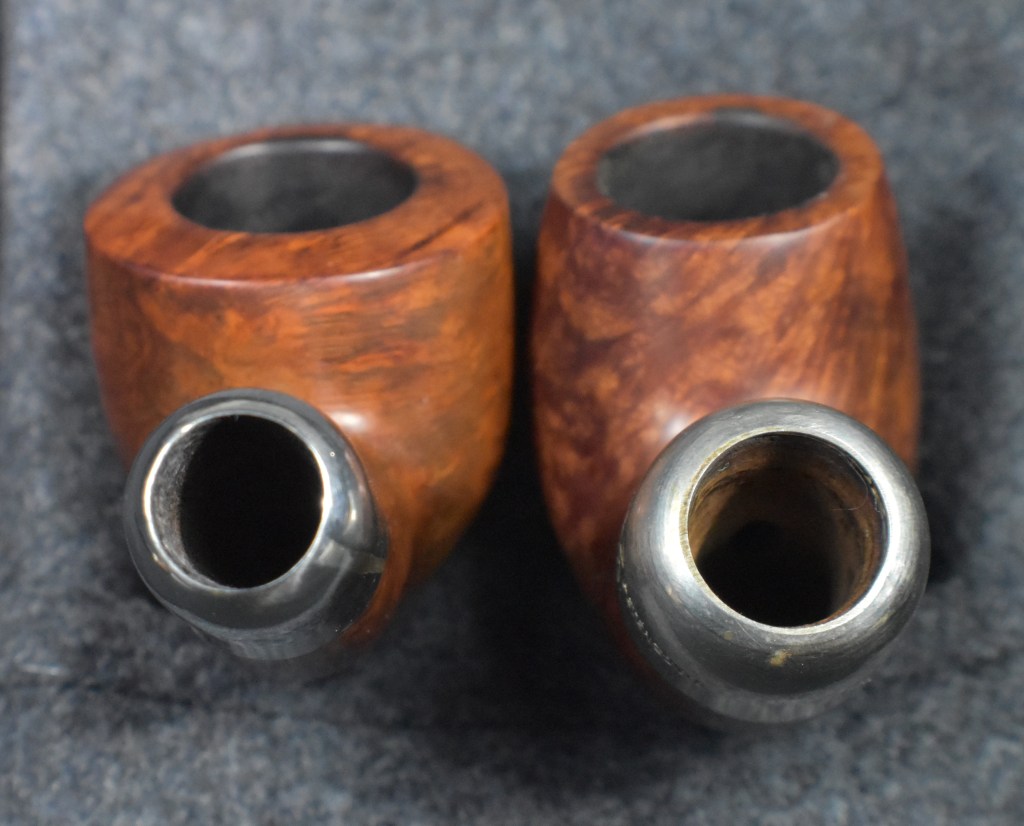


 well, it was not much to go on and it looked like a stretch but, follow it, I did. The link was to a French pipe maker LMB. The only text was the following and it appears roughly translated from French to English: “From Les Pipiers Français — Histoire et Tradition. Gilbert Guyot


 (
(


Leave a Reply