Skip to content
    • About

NebraskaPeteGeek

  • American Pipe Makers
  • British pipe Makers
  • Danish pipe Makers
  • French Pipe Makers
  • German Pipe Makers
  • Irish Pipe Makers
  • Italian Pipe Makers
  • Others or Unknown Pipe Makers
  • Restorations
  • A Medico Gold Crest Meerschaum Apple Restoration

    November 28th, 2024

    Photographed and written by 

    John M. Young

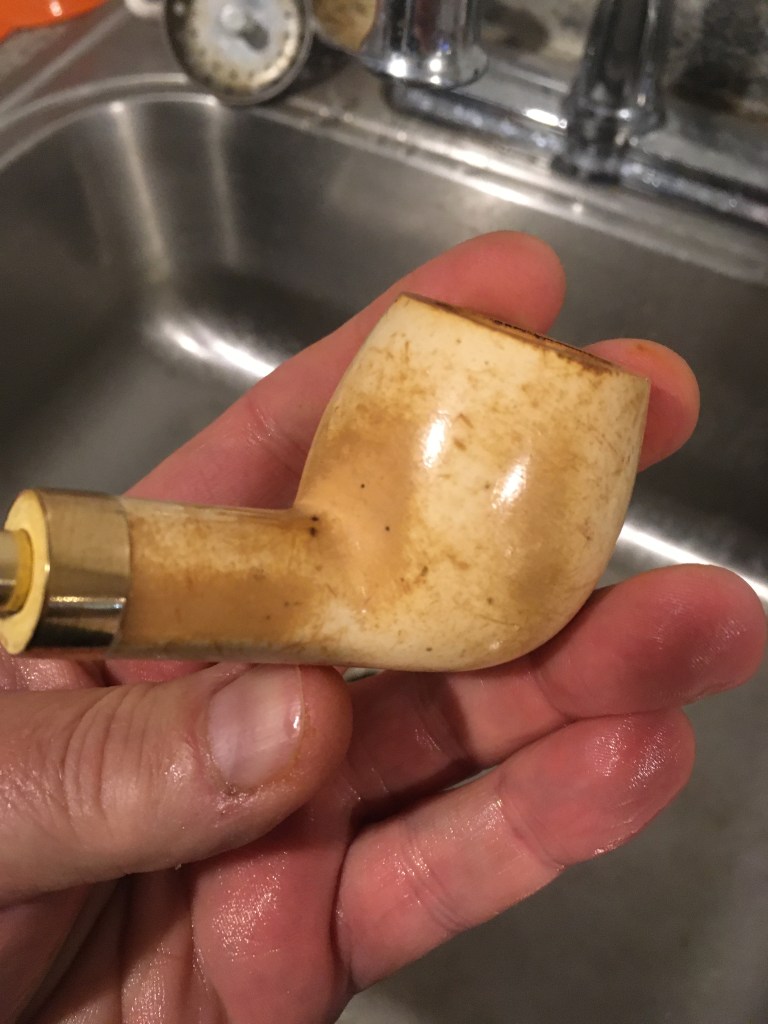
    The quest to improve my skills of restoring meerschaum pipes continued with this Medico Gold Crest meerschaum apple.   Medico is one of those American classic brands which many people look at like they do codger blends – those were cheap drugstore pipes for grandads.  Well, maybe grandpa was right.  I can’t imagine that they sold millions of pipes merely because they were cheap.  I’ve restored a good number of Medico pipes though mostly prior to my blogging.  Over the last year I can only think of three:  A Frank Dublin, Medico Jet Stream and a Medico Guardsman.  That is only three of the 139 blogs (thus far published) so they are not what I’d consider a target species.  This one called out to me, perhaps it was the apple shape or the Austrian made meerschaum or that adorable gold band.  Whatever the reason, The auction was won and the pipe was mine.  The initial examination of the pipe revealed that the only marking proclaiming its origin was the Crest enclosed M on the stem and the stamping on the band:  MEDICO over 1/20 14K G.F. over MADE IN AUSTRIA. Below are some photos of the pipe as it appeared upon arrival.

    The Medico was used, though not abused.  There were some scratches on the meerschaum and some bite marks on the stem.  The bowl looked pretty good even with the lava flowing over the rim.  I thought that this looked like a nice relaxing restoration.

    Background

    According to TobaccoPipes.com,

    “When you trace the Medico tobacco pipes history, you have to trace it back to the origins of the company that created it. The company that originated the Medico brand is the S.M Frank & Co. This company dates back to the year 1900. In that year, a man named Sam Frank began selling pipes and related tobacco products. Eventually, the company began making its own line of pipes. With the help of an experienced pipe manufacturer, Ferdinand Feuerbach, the company produced the popular Royal DeMuth and Hesson Guard Milano tobacco pipes. The company continued to grow well into the early part of the 1930s.

    Medico History

    So, where did Medico pipes come into the picture?

    By the early 1930s, there were some concerns about the tars and nicotine found in tobacco smoke. In order to mellow out the flavor of hot tobacco smoke as well as to capture the tars and nicotine, the S.M. Frank & Co. introduced the Medico pipe filter. This is an absorbent paper filter that many people still use to this day. In order to accommodate the new filter, the company developed an accompanying brand of pipes known as Medico. That line of pipes continues in production today.

    The company ended up buying some of their main competition in 1955. That year the Kaywoodie brands came under the S.M. Frank Company. The Medico brand continued production through this transition without many changes. The next big change for the brand came in the late 1960s. In 1966, the company developed a synthetic material that combined the traditional briar wood with resins. It is known as Brylon. At that time, all Medico pipes were made from imported briar wood. In order to keep production costs down, the company began offering some lines with Brylon. Today, that is still true.

    Today, the Medico brand of pipes is still a top selling one for the S.M Frank & Co. This line of pipes comes in thirteen different finishes with five made of briar wood and the rest from Brylon. All come with the push bit with a filter inside. The filter is easily changed out when the smoker desires. In the briar wood finishes, this line includes the Silver Crest, Premier, Bold Rebel, Kensington, and Windsor. In the Brylon, the line includes the Lancer, Apollo, Standard, Varsity, Conqueror, Medalist, Cavalier, and V.E.Q. As far as price, the briar wood pipes tend to be higher in cost that the Brylon ones.” (Medico Pipes History | TobaccoPipes.com)

    I was unable to precisely identify the years in which the Gold Crest line was made.  I did find a couple of print advertisements from 1958 and 1966, at least that is what the eBay sellers were claiming.  The first ad is from 1958 and shows a Gold Crest with a list price of $5.  The ad says “NEW! See the 1958 series of MEDICO Crest”.   This could be read as meaning that the Crest line changed from year to year or that 1958 was the first year of the line.

    (1958 Medico Pipes Ad Filter Pipes Crest | eBay)

    The second ad looks quite “1966” but it doesn’t mention the Gold Crest pipe.  Neither advertisement had the M within the crest as with the Medico Gold Crest in hand. 

    (1966 Medico Gold Crest Pipe Art Illustration Photo Vintage Magazine Print Ad | eBay)

    Looking at just those two advertisements I would feel comfortable saying that this pipe is from around 1960.

    The Restoration

    As usual the restoration began with a clean denim piece.  Now, I have received slight criticism for the apparent boring appearance of the work surface covers.  Perhaps I will look into alternative fabric choices.  Maybe Sascha Mertens would prefer something in a paisley? 

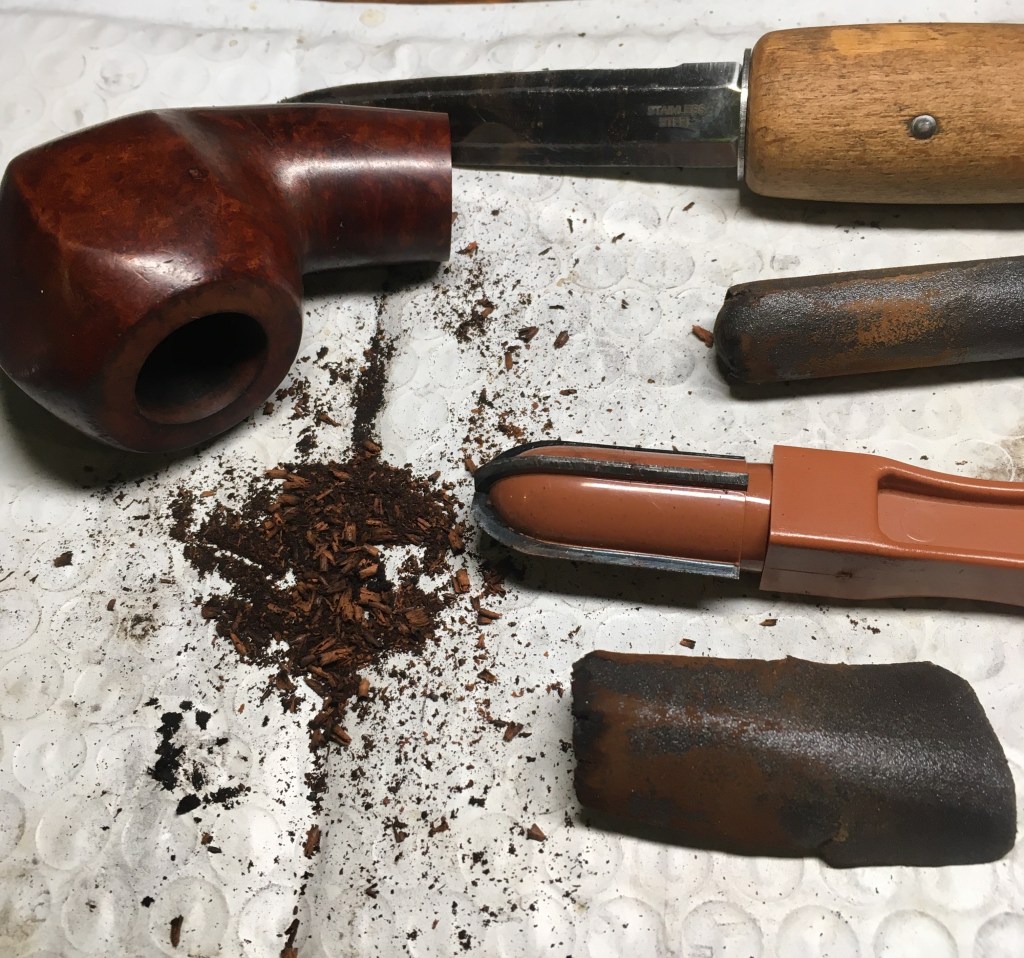
    Due to the more fragile nature of meerschaum, the PipNet reamer remains in its case allowing the Smokingpipes Low Country reamer and the General triangular scraper (with the tip ground round) to take center stage.  The wood dowel wrapped in 220 sandpaper also was used after the scraping.

    The bowl was not terribly caked and was cleaned out quickly.

    The bowl was free of any gouging from previous reamings.  The grate at the bottom of the bowl can readily be seen in the photo below.  In the Medico Guardsman restoration I discovered how to remove the grate.  This pipe was slightly different in design and I was not able to remove the grate for cleaning.

    The next step was to clean the airway of the shank.  95% ethyl alcohol, cotton swabs, bristle pipe cleaners, a nylon shank brush, and a small rat tail file with a paper towel wrapped around it.

    After the airway cleaning I turned my attention to the rim.  One of the great benefits of meerschaum is the immunity of the mineral to charring.

    The rim was moistened with saliva and carefully scraped with a sharp pocket knife. 

    The stummel was taken to the sink for a scrub.  This scrub was done with warm tap water and a nylon scrub brush.  The stummel darkened with the scrubbing.  I assumed this would be a temporary condition that drying would eliminate.

    The darkening seemed to be associated with areas which received greater wear.  I assumed that this was due to the wearing away of the beeswax coating.

    The next phase of the restoration was to micro-mesh the meerschaum.  I wanted to make sure that the micro-mesh pads were clear and would not be transferring any vulcanite dust to the slight grooves and scratches in the meerschaum.  To do this I washed the pads with a small amount of Dawn dish soap and a nylon scrub brush.  Each pad was scrubbed, rinsed and dried.

    The cleaned pads looked much better than they looked before.

    I wrapped the gold band with painters tape to protect it from the micro-meshing of the stummel.

    The stummel was worked with each pad in succession.  Between each pad I wiped the stummel with a make-up pad moistened with 95% ethyl alcohol.  I did not try to completely remove all of the scratches as I thought they added a bit of character to the pipe. 

    The next step was to apply a fresh coat of beeswax.  I like to use a pan of water to heat a jar filled with beeswax.  The hot water melts and allows the wax to remain molten for longer periods of time as well as not getting the wax too hot.  Achieving the vaporization point of wax is not a great idea when heating with the open flame from natural gas.  I plugged the bowl with a wine bottle cork wrapped with several layers of masking tape.

    While the wax was melting I heated the meerschaum with a heat gun.  This allows the molten beeswax to better penetrate the pores of the meerschaum.

    Once the max was melted and the stummel heated, I held the stummel by the cork and painted the wax onto the meerschaum.  Even with all of the heating the wax cools and builds up quickly.  I rotated the coated stummel under the heat from the heat gun.  Any wax that was not absorbed by the meerschaum was caught in a tin, which can be seen in the above photo.  The below photo shows the newly waxed stummel cooling back on the workbench.

    As the stummel was cooling, I began work on cleaning the stem.  Again, 95% ethyl alcohol, cotton swabs and bristle pipe cleaners were used for this.

    The stem of this pipe was made of nylon.  Nylon is harder than the plastic of a Missouri Meerschaum pipe stem but softer than a traditional vulcanite.  It is also more resilient to abrasion from sanding and filing.  This makes smoothing out imperfections on a nylon stem a bit more difficult and time consuming than vulcanite.  I filed the tooth chatter smooth using a small flat file.

    Some of the marks in the nylon just refused to be removed.  I continued on with the sanding telling myself that perfection is not needed for a pipe I planned on keeping and using for myself.  The stem was sanded with a series of sanding sponges from 320-3500 grit.  Between each sponge the stem was wiped with a paper towel lightly moistened with alcohol.

    The gold band was taped over with masking tape and the stem log taped over with Scotch tape to protect them from the buffer and tripoli buffing compound.  I took the pipe to the buffer and buffed the stem. 

    The Scotch tape was removed to repaint the stem logo gold.  I used a modeling acrylic paint applied with a wooden skewer. 

    The gold paint was allowed to mostly dry then I scraped away the paint from outside the stamp.

    Below is the mostly cleaned newly repaired logo.  The tripoli compound can still be seen on the masking tape.

    The gold band was cleared of masking tape and the band polished with a Cape Cod Polishing cloth.

    The pipe was then returned to the buffer for several final coats of carnauba wax to the band and the stem.  The stummel was not waxed with carnauba as it just had fresh beeswax.

    The final step was hand buffing with a microfiber polishing cloth.

    I think this Medico Gold Crest meerschaum apple turned out beautifully.  I love the apple shape and think the scratches and scars add to the character of the pipe.   The  beeswax brought out a slightly more buttery look to the meerschaum which is accentuated by the glossy black of the nylon stem.  Though not perfect the stem is far far smoother than it was originally.  The pipe will surely bring enjoyment for another 60 years.  Probably not for me but I hope that it will be passed down to the next generation of grandpas who can appreciate the pipe’s heritage and utility.  The dimensions of this Medico Gold Crest meerschaum apple are: 

    • Length:  5.90 in./ 149.86 mm.
    • Weight:  1.65 oz./ 46.78 g.
    • Bowl Height:  1.78 in./  45.21 mm.
    • Chamber Depth:  1.30  in./ 33.02 mm.
    • Chamber Diameter:  0.82 in./ 20.83 mm.
    • Outside Diameter:  1.59 in./ 40.39 mm.

    I do hope that you have found something here useful to your own pipe care, maintenance or restorations.  If you like this sort of thing, please click the like and subscribe buttons.  Thank you for reading the ramblings of an old pipe lover.

    Loading…

    Below are some photos of the finished Medico Gold Crest meerschaum apple.

  • A Country Panel Bent Rhodesian Restoration

    November 26th, 2024

    Photographed and written by

    John M. Young

    This beaten and battered chubby panel Rhodesian didn’t just speak to me when I first saw it, it yelled.  I couldn’t resist the shape and had to bid.  The fact that I won such a chunky piece of briar for such a small price made the bidding even more rewarding.  The only stamp indicating any maker is the word COUNTRY within a rectangle on the left shank.  No country of manufacture, though for some reason it strikes me as French though the stockiness of the shank would make any Peterson a bit jealous.  The pipe came from Israel and was apparently shipped via sailing ship to the US or perhaps by row boat as the shipping time allowed my beard to grow significantly longer during its voyage.  Below are some photos of the ppe upon arrival.

    Definitely some very interesting features here.  The sheer number of fills to be picked and refilled was a bit daunting.  The removal of the old finish was a must.  The corked mortise might be salvageable.  The stem was heavily oxidized and would need significant time in an authorized deox facility, Is the Betty Ford Center still operating?  This looked to be a fun restoration.

    Background

    The “go to” sources at the start of researching a pipe are pipephil.eu and pipedia.org.  Both sites had no information on the COUNTRY.  Disappointed but not defeated, I tried searching through Comoy’s, Chacom and GBD shape charts for a matching shape.  Again, disappointment.  Still undeterred, I tried a Google search of “Chubby panel Rhodesian pipe”.  I scanned through the images which resulted and came across one from a restoration Dal Stanton did “Recommissioning a Classic Pocket Pipe:  A Fun Sport Horn Stem Sculpted Stubby Paneled Tomato” (https://rebornpipes.com/2019/07/30/recommissioning-a-classic-pocket-pipe-a-fun-sport-horn-stem-sculpted-stubby-paneled-tomato/).  This blog was posted on Steve Laug’s https://rebornpipes.com/ site.  Now, the pipe which Dal worked on had a similar shape. It was a far different pipe; in scale, texture, stem material, banding and it was stamped which allowed him some idea of the maker.  The one think that caught my eye was the tenon: 

    (Photo used with permission of the author – personal communication.  Originally published at(https://rebornpipes.com/2019/07/30/recommissioning-a-classic-pocket-pipe-a-fun-sport-horn-stem-sculpted-stubby-paneled-tomato/))

    The tenon of my Country had the tenon’s stinger intact, Dal’s version was stinger-less.  Nonetheless the similarities of the aluminum tenon were undeniable.  There was one other significant similarity between these two pipes – the cork mortise.  Unfortunately Dal was unable to determine the maker of his pipe and he is a far better and more diligent researcher than I.  He did conclude that his pipe was of French origin.  This conclusion reaffirmed my feeling about the origin of the Country in hand.

    I was now less undeterred (is that deterred or de turd?  It is a French pipe after all).  I reached out to Steve Laug who is always helpful with his vast experience and encyclopedic memory.  I sent him some photos and asked if he could tell me anything about pipes with similar shapes or with tenons like this.  Steve mentioned that he too thought the Country looked like a GBD or a Comoy’s product.  He then sent me a link to one of his blogs:  Reuniting an older Ropp Panel 062 Rhodesian with its original stem

    (https://rebornpipes.com/2021/10/16/reuniting-an-older-ropp-panel-062-rhodesian-with-its-original-stem/?fbclid=IwY2xjawGg2JtleHRuA2FlbQIxMAABHZQRWucpsG3aeTcXahiWJgFm7E_1D4CtWDBYz_F2J_9YlmXg7h6xA0JDKQ_aem_qQs4f3WxgbgUf1LL3z1TCQ).

    I will include a photo of Steve’s Ropp Panel 062 Rhodesian.

    (https://rebornpipes.com/2021/10/16/reuniting-an-older-ropp-panel-062-rhodesian-with-its-original-stem/?fbclid=IwY2xjawGg2JtleHRuA2FlbQIxMAABHZQRWucpsG3aeTcXahiWJgFm7E_1D4CtWDBYz_F2J_9YlmXg7h6xA0JDKQ_aem_qQs4f3WxgbgUf1LL3z1TCQ)

    Now, if you use your imagination and give that shank a bend it would be a near perfect match for the Country.  I’m sure that your inquiring mind wanted to know what the tenon of this Ropp pipe looked like.  

    (https://rebornpipes.com/2021/10/16/reuniting-an-older-ropp-panel-062-rhodesian-with-its-original-stem/?fbclid=IwY2xjawGg2JtleHRuA2FlbQIxMAABHZQRWucpsG3aeTcXahiWJgFm7E_1D4CtWDBYz_F2J_9YlmXg7h6xA0JDKQ_aem_qQs4f3WxgbgUf1LL3z1TCQ)

    Similar to the Country but not as close of a match as the tenon from the Dal Stanton pipe.

    And that, dear reader, is where I left the background for this pipe.  It is a chubby panel bent Rhodesian.  Likely made in France quite a while ago, judging by the level of oxidation of the stem and the aluminum stinger which pretty much went out of style by the 1970s.  Dal Stanton implies that these pipes may be older than what I think, “The presence of the cork could possibly add more weight to this Sport having some vintage to it.  Cork was often used on older pipes to grip the tenon” (Stanton, Dal. https://rebornpipes.com/2019/07/30/recommissioning-a-classic-pocket-pipe-a-fun-sport-horn-stem-sculpted-stubby-paneled-tomato/).

    The Restoration

    The below two photos show the Country intact and with the stem removed on her new temporary denim bed.

    You may notice that I obtained a replacement for my PipNet.  I finally found an older version with the opaque plastic rather than the newer version with the transparent amber plastic.  I once again have all four blade sizes for my PipNet.  The PipNet was joined by the Smokingpipes Low Country Reamer, General triangular scraper and wooden dowel wrapped in 220 sandpaper.  Also known as the Ream Team.

    The PipNet did most of the work in removing the cake as well as removing a bit of briar from the tobacco chamber.  I did not examine or feel the inside of the chamber, prior to the reaming, for rough surfaces from a poorly drilled chamber.

    After the reaming and sanding the interior of the tobacco chamber was bare briar and free of any heat damage.

    I started cleaning the shank airway.  As you can see by the very darkly stained cotton swabs in the photo the shank was quite filthy.  I used 95% ethyl alcohol and dipped the swabs in the alcohol.  I examined the mortise and found the cork “gasket” for lack of a better term had a worn front edge and looked ragged.  

    I continued trying to clean behind the cork and scrape the tars from the airway using a dental scraper.  3-4 ml of ethyl alcohol were poured into the tobacco chamber and the airway was scrubbed with a nylon shank brush.  The excess alcohol was then poured into a medicine cup.  The airway was then scrubbed with alcohol dipped cotton swabs. 

    This cycle of scraping, alcohol scrubbing, cotton swab scrubbing was repeated.  I seemed to be making little progress.

    Avoiding the cork was making the whole airway cleaning more difficult.  I started to experiment with making a new cork gasket.  I was thinkin that I could remove the old beat-up cork, clean the airway then insert the new cork.  I found a suitable cork from an assortment of corks that I had.  I drilled a 3 mm hole through the center of the cork. 

    I gradually used larger bits to enlarge the hole.

    Once it was large enough for the aluminum tenon I started thinking about how to cut the excess cork away.

    Razor blades seemed like the best answer.  The first couple of slices thinning the cork went well.  My fingers were cramping a bit so I decided to remove the old cork and give my fingers a rest from holding the cork and the razor blade.

    The old cork was scraped from the shank and the mortise was sanded with 320 sand paper wrapped around a rat tail file.

    I returned to cleaning or attempting to clean the airway.  It was much easier to do without having to work around the cork.

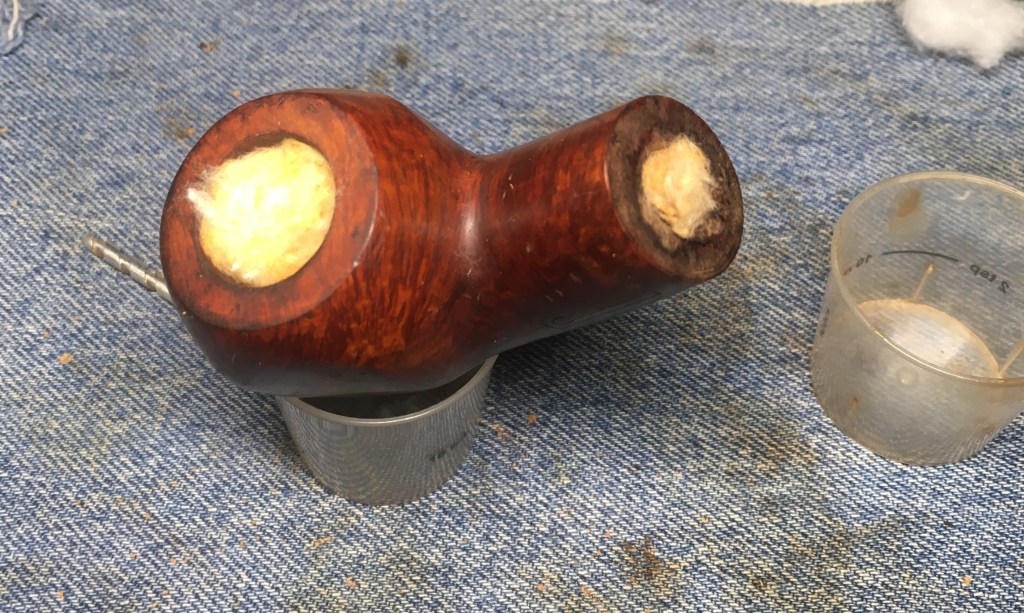
    I thought that a cotton alcohol treatment would do this pipe a world of good.  I packed the tobacco chamber and the airway with cotton.

    I then added 95% ethyl alcohol via a disposable pipette until the cotton was saturated.  The stummel was placed on a medicine cup at an angle which allowed the alcohol level of both ends to be level.  The alcohol would evaporate overnight and pull the tars from the briar depositing them in the cotton as it evaporated.

    I then began cleaning the stem airway.  This too was a filthy tar ridden mess.  Numerous bristle pipe cleaners dipped in ethyl alcohol were used. 

    Once cleaned, I took the stem to the jar full of Before and after Extra Strength Deoxidizer or as I like to call it – deox.  The stem had a pipe cleaner inserted into the tenon.  I did not want the aluminum to be submerged into the solution and the pipe cleaner acted as a hanger.  I planned on leaving the stem in deox overnight.

    The next day both the stem and stummel were waiting and ready for more restorative love. 

    I started with the stummel by removing the cotton then cleaning the airway with alcohol dipped cotton swabs.  The results were great, only taking a few swabs to clear the remaining tar.

    Next, the stem was removed from deox and allowed to drip off the excess solution.

    I placed the still damp stem on a coarse shop rag to absorb and hand buff some of the loosened oxidation from the vulcanite.

    The below photo shows the results of the hand buffing with the coarse rag.

    The stem was returned to the workbench looking much better without the oxidized rubber.

    I then proceeded to scrub the stem with several make-up pads drizzled with Soft Scrub cleanser.  This slightly abrasive cleanser removes the oxidized rubber.  As the oxidation is removed the color of the pads indicate when the has been removed. 

    I then took the stummel to the sink for a scrub with undiluted Murphy Oil Soap and a nylon scrub brush.  The soap was rinsed with warm water and the stummel dried with a cotton hand towel.

    The stummel looked much better but this clean briar showed the large number of fill which would require attention.

    I wanted to remove the existing finish from the briar.  I first tried 95% ethyl alcohol on a make-up pad to dissolve the finish.  It kind of worked but not very well.

    Next, I tried acetone on a make-up pad.  That worked better but still the results were very slow and elbow grease intensive.

    I placed the stummel into a jar filled with acetone and let the solvent work on the finish for 30 minutes.

    30 Minutes later the stummel was again wiped with an acetone dipped make-up pad.  This time the finish and stain were being removed.

    There remained a few shiny spots where the finish was not completely removed.  I planned on dealing with them as the stummel was sanded.  TO sand the stummel I wanted the stem and stummel to be connected to avoid the rounding of the joints between the two pieces.  I had not returned to the cork mortise so instead I wrapped the aluminum tenon with masking tape to thicken it and secure a tight fit of the stem to the stummel.

    The area around the stam was very carefully sanded to avoid the stamp.  The old fills were made even more obvious as I did the initial sanding.  The old fill material was picked out using a fly tying bodkin and a dental scraper.

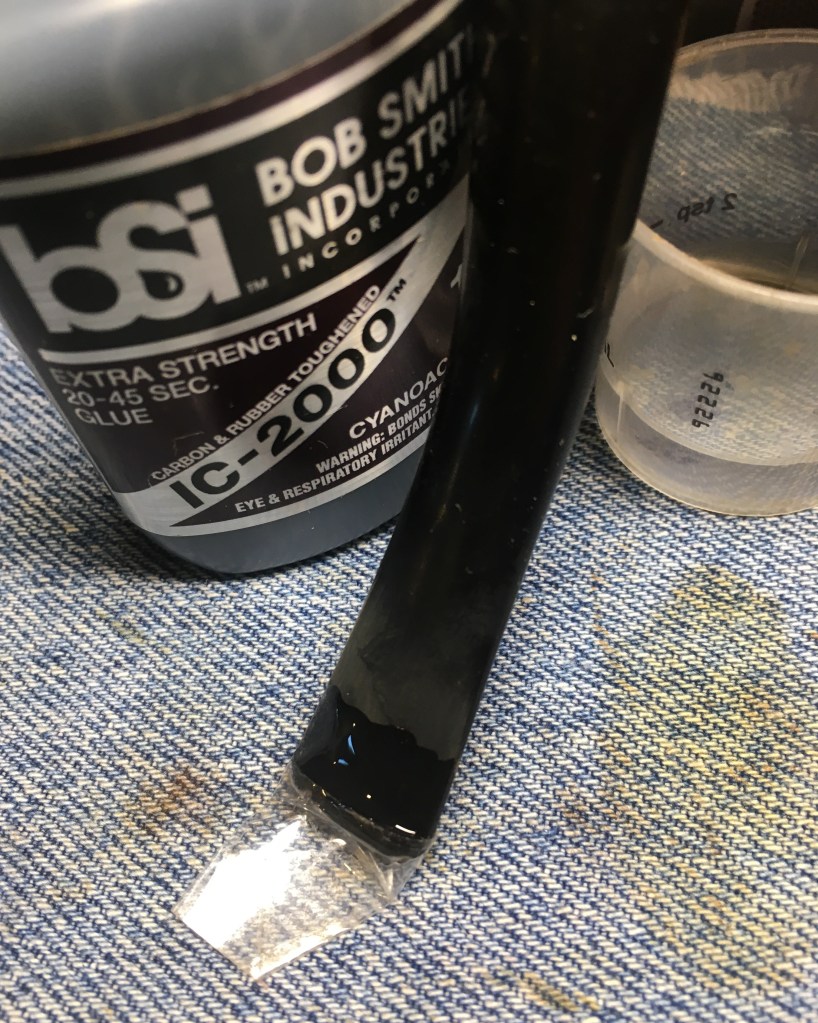
    The plan was to place a drop of brown cyanoacrylate (CA, super glue) into the pit then add briar dust to the pit and press the dust into the CA with the back of the dental scraper.  The CA and the dust would compine filling the pit and curing quickly.

    In the photo below you can see the new fills looking like scabs.  The briar dust that comes in contact with the CA takes on a very dark color while the non-CA-contact dust remains light.

    The light spots were filed smooth using a small flat file.  The resulting dark spots indicate new fills of the old pits.

    I was not happy with the fit of the masking taped tenon and feared that I would round the edges of the joints.  It was time to finish the cork work.  First I tried to unscrew the aluminum tenon from the stem.  I was not sure if it was threaded or if it was glued.  I turned without much trouble using a channel lock pliers with the jaws well covered in painters tape.  Once freed the filthy threads were cleaned with a rather large number of cotton swabs dipped in 95% ethyl alcohol.

    The next few photos illustrate how reality attacks my well made plans quickly rendering them into refuse.  

    Plan #1 Use an existing small cork, drill out a hole for the aluminum tenon and trim the sides of the cork leaving a hollow cylinder, tube of cork, which would be inserted into the mortise.  This plan met with FAILURE several times as I could not cut the cork thin enough with a razor blade to make the cork tube.

    Plan #2 Use a set of cork hole borers (seen below) to cut the cylinder of cork.  FAILURE

    Plan #3 Use the cork hole borers to cut a cylinder of synthetic “cork”. FAILURE

    Finally, I thought to keep things simple.  Use the razor blade and carefully slice a thin piece of natural cork, measure the length of the cork rolled into a cylinder and trim it to length.  Insert this into the mortise.  If it works, glue it in place.

    It worked.  Below you can see the results before the cork was glued in place or the end trimmed.

    Once it was trimmed and glued (and allowed to dry) into place the stem was inserted and tah-da.  The tenon compressed the cork and the fit was nice and snug.

    Below is a photo of the trimmed and glued cork.

    That done, I could finally get to sanding the stem and stummel together.  Before I could do that I had a couple of fills which needed a finesse touch around the stamping.  This was done with careful application of CA and briar dust. And even more careful filing and sanding.

    The pipe was finally sanded with a series of sanding sponges from 320-3500 grit.  Between each sponge the stummel was wiped with a make-up pad moistened with alcohol to remove sanding debris.  The stem was rubbed with mineral oil and wiped with a dry paper towel. 

    The pipe was then worked with 4000-12000 micro-mesh pads.  Between each pad the stummel was wiped with a make-up pad moistened with alcohol while the stem was rubbed with Obsidian Oil and wiped with a paper towel.

    The pipe was then given liberal coating of Before and After Restoration Balm.  This product is amazing at rejuvenating the briar and makes the vulcanite look great too.

    The Restoration Balm was allowed to sit and work its magic for 20 minutes.  After the timer beeped, the excess balm was wiped off using an inside out athletic sock.

    The pipe was then taken to the buffer for a polishing with Blue Diamond  buffing compound.  The residual compound was wiped off with a paper towel lightly wetted with 99% Isopropyl alcohol then the pipe received several coats of carnauba wax. 

    The final steps were to take the pipe to the buffer where the stem and stummel were buffed with Blue Diamond compound.  The pipe then received several coats of carnauba wax and a final hand buffing with a microfiber polishing cloth.

    I think this Country Panel Bent Rhodesian restored beautifully.  I still love the shape even with all of its fills and blemishes.  The pipe clenches well and feels much lighter than the over 2 ounces (62 g) that it actually weighs in at.  The stem is still a bit thick feeling in the mouth but filing down would have altered the shape too much, in my opinion.  The original stain was preserved and reminds me of an antique gun stock.  The vulcanite deoxidized amazingly well and stands out gloriously as a contrast to the briar.  Overall, I am very happy with this mysterious beauty.

    The dimensions of this Country Panel Bent Rhodesian are: 

    • Length:  4.96 in./ 125.98 mm.
    • Weight:  2.19 oz./ 62.09 g.
    • Bowl Height:  1.70 in./  43.18 mm.
    • Chamber Depth:  1.24  in./ 31.50 mm.
    • Chamber Diameter:  0.71 in./ 18.03 mm.
    • Outside Diameter:  1.54 in./ 39.12 mm.

    I do hope that you have found something here useful to your own pipe care, maintenance or restorations.  If you like this sort of thing, please click the like and subscribe buttons.  Thank you for reading the ramblings of an old pipe lover.

    Loading…

    Below are some photos of the finished Country Panel Bent Rhodesian.

  • The Breaking and Repairing of an Austrian Meerschaum Pipe

    November 21st, 2024

    Photographed and written by 

    John M. Young

    I did not set out to break this cute little meerschaum pipe.  If the title of the blog insinuates that, I apologize.  During the summer, I decided it was time to learn more about meerschaum pipes and techniques for the restoration of meers.  I had worked on a few this year and had found them intimidating at first.  That was mainly just due to my inexperience with sepiolite or meerschaum.  Risking the proverb, “familiarity breeds contempt”, I continued to pick up various meerschaum pipes as I came across them, mainly through auctions.  That is where this little pipe enters the scene.  I was intrigued by it for a few reasons; it was unsmoked, made in Austria, looked to be a rather modular construct and it looked very light weight.  Oh, and it was under $20, yeah I’m cheap.  

    The little darling or kleiner Liebling, in German, made the journey to southeast Nebraska from Ormond Beach, Florida.  The only markings on the pipe was an adhesive sticker which read, “AUSTRIA”.  No stampings on the base, meerschaum bowl nor stem.  Below are some photos of the pipe after its arrival.

    Since this was not a restoration I had nothing to do to the pipe other than to fill it with tobacco and give it a smoke.  That is what I did and that is where the trouble began.

    Background

    Again, I stress my ignorance of most things, meerschaum.  I knew that prior to the discovery of briar, meerschaum was a widely used material for pipe making.  The cost of a meerschaum pipe was likely reserved for the upper classes, socio-economically speaking.  Folks of less disposable income likey smoked their tobacco with a clay pipe.  I also knew that artisans in London and Vienna had grand reputations for fine meerschaum pipes.  This little fact was the spark that fueled the intrigue regarding the AUSTRIA label.  

    I turned to the internet for a general search on meerschaum pipes.  There was a very informative article on tobaccopipes.com:  Meerschaum Pipes: The Complete Overview

    (https://www.tobaccopipes.com/blog/meerschaum-pipes-the-complete-overview/). 

    Regarding this Austrian meerschaum. I had little information to go on.  I messaged Facebook friend and fellow pipeman, Sascha Mertens.  Sascha is my German connection and provides a wealth of knowledge regarding everything from restoration tips to background on European pipe makers and tobacco.  I sent him photos of the little Austrian meer and asked what he could tell me about it.  From Sascha I learned the easiest way to tell if a meerschaum is a block or made of pressed meerschaum is to lick it.  He said that my tongue would stick to block and not pressed.  Hmm, could this be some strange German example of hijinx?  I tried it. 

    No striking on either the tobacco chamber nor the outside of the stummel.  Verdict – pressed meerschaum.

    I thought that I had better test a known block meerschaum for comparison.  I grabbed a Kiko Caveman and  – YIKES!  The anhydrous nature of the meerschaum pulled the water in saliva into the mineral at the speed of light.  To be honest I had done this kind of test many times.  I spent the first four years of undergraduate college as a Physical Geography major.  I had taken many physical geography and geology courses and had licked my share of minerals and this is indeed a field test for anhydrous minerals.  The feeling is still always a bit of a shock though.

    So, Now I knew that this little meer was a “cheap” meerschaum pipe made in Austria.  Hmm, that might explain the <$20.  Sascha said that the Turkish meers were never cheap.  Still no other information concerning the date of production  or the maker was to be had.  I guess I’ll just have to enjoy smoking the little cutie.

    The Break

    As you have probably surmised, smoking the Austrian meerschaum did not go as well as I had envisioned.  During the first bowl of tobacco the glue holding the bowl to the base failed and left me with a lap full of smoldering tobacco, a stem clenched between my teeth and a bowl rolling on the floor.  Hmm, I heard the voice of someone saying, “you get what you pay for.”  Stupid voices.

    Below are a couple of photos of the separated bowl and base. 

    There is no need to further describe the separation.  I am sure that your imagination can provide both the visual hilarity and the auditory barrage that ensued.  Please feel free to enjoy those imagined scenes.

    The Repair

    The planning of a repair is often my favorite part of a restoration.  If you have read a few of my previous blogs you may recall that I come up with a plan then attempt to execute said plan.  The execution occasionally goes along with the plan.  More often than not the execution has to deal with something called “reality” which cares little for my careful well thought out planning.

    The plan for this repair was to strengthen the joint securing the meerschaum bowl to the acrylic base.  To do this I came up with the following plan:

    1. Sand the surface of the bowl and the base.  This would remove the inadequate glue and roughen the surfaces allowing greater surface area for the new glue.
    2. Drill 4mm hole 2.5 mm deep into  the existing draft hole from the bottom of the bole up and from the top of the base down.
    3. Cut a 5 mm piece of stainless steel tubing, with an outside diameter of 4mm. This stainless steel tube would be the connector between the bowl and the base.
    4. Drill  2 small holes into both the bottom of the bowl and the top of the base to further add surfaces for the new glue to adhere to.
    5. Use a two part epoxy as the new glue.
    6. Clamp the bowl and base together and allow to cure for 24 hours.

    That seemed like a good plan.  Okay reality, what are you going to do to foil that?

    Step 1) The bottom of the bowl and the top of the base were sanded with 220 sandpaper laid flat on the countertop.

    I had 4 mm outside diameter (OD) stainless steel tubing from a previous restoration.  

    Step 2) I marked with a Sharpie 2.5 mm on the 4 mm drill bit and drilled out the draft hole at the top of the base.

    Still step 2)  This draft hole drilling was repeated for the bottom of the bowl.

    Steps 3 and 4)  The short piece of stainless steel tube was placed into the hole to check for fit.  Also in the photo below I circled four additional spots where I drilled indentations on the gluing surfaces of the bowl and the base.  This was done in an attempt to add surface area for the epoxy to adhere to (step 

    Step 5)  The stainless steel tube was a perfect fit for both the base and the bowl.  I proceeded to mix the epoxy.

    Some more step 5 and step 6)  The stainless tube, the base and the bowl were lightly coated with epoxy and clamped together.  The joints were wiped with a cotton swab dipped in acetone to remove any excess epoxy while the draft hole was cleared with a pipe cleaner dipped in acetone.  These pieces were allowed to cure for 24 hours.

    Tah-Dah!  

    The little Austrian meerschaum pipe was repaired.  I did not go back and shoot a series of photos since I did not do anything to the surface of the pipe.  The only noticeable difference is that the tobacco chamber is no longer unsmoked.  The repair seems to be holding very well.  I have smoked the pipe numerous times and have had no other lap fulls of smoldering tobacco nor has the epoxy separated.  Special thanks to Sascha Mertens for helping with the research and the plan development.  The little meer is a delightful working pipe that can join other favorites as outdoor work pipes and fishing buddies.

    The dimensions of the Austrian meerschaum pipe are:

    • Length:  6.08 in./ 154.43 mm.
    • Weight:  3.12 oz./ 88.45 g.
    • Bowl Height:  1.74 in./  44.20 mm. (including the base)
    • Chamber Depth:  0.99  in./ 25.15 mm.
    • Chamber Diameter:  0.74 in./ 18.80 mm.
    • Outside Diameter:  1.36 in./ 34.54 mm.

    I do hope that you have found something here useful to your own pipe care, maintenance or restorations.  If you like this sort of thing, please click the like and subscribe buttons.  Thank you for reading the ramblings of an old pipe lover.

    Loading…

  • A Corn Cob Meerschaum Restoration?

    November 19th, 2024

    Photographed and written by 

    John M. Young

    As a nearly lifelong Nebraskan and alumni of the University of Nebraska system, I do have an affinity towards corn as a symbol, a food stuff and a good old corn cob pipe.  My heart goes out to every youngster who is missing front teeth during sweet corn season and life goal is to never be more than 30 feet from a cob pipe.  

    The University of Nebraska Lincoln (UNL) football team has been known as the Cornhuskers since the 1900 season.  Prior to that they were known as the Bugeaters, Old Gold Knights, Antelopes and my favorite Rattlesnake Boys. For a very nice history of the Cornhusker name I will refer you to this site:  https://huskers.com/news/2017/7/24/origin-of-the-cornhusker-nickname. And by the way, Bugeater refers to the Nighthawk (Chordeiles minor) not to some prairie culinary experience.

    So, needless to say when I came across this ear of corn figural meerschaum pipe I had to bid.  

    The auction was won and the pipe liberated from the great state of California and brought to a state where it would certainly be more welcomed.

    The pipe arrived the day before I had to go out with a crew from UNL for 5 days of Prairie Rattlesnake research.  Now you see why I really liked the Rattlesnake Boys name.  As typical with a hand carved meerschaum pipe there were no markings on the pipe indicating the provenance.  And this pipe lacked a custom fit case which may have once had an indication of the maker.  The stem also lacked any markings but it did sport the orific button drilling indicative of pipes made before 1920.  The last thing to mention prior to showing the “before” photos is the sheer siE of the pipe.  It was large.  I photographed it with a standard size Kaywoodie Dublin for reference as I was preparing to give the corn meer a fresh beeswaxing..

    Okay, below are some photos of the corn meerschaum prior to being worked on but post harvest (corny joke).

    Background

    I have nothing for this pipe, no country of manufacture, no company, no clue.  As for the age, I can make some guesses.  Again, nothing definitive but a reasonable hypothesis.  Judging by the orific style button, I would think this pipe was from before 1920.  In a great blog written by Steve Laug concerning the history of the orific button, he states that the pipe in his collection “come from the mid to late 1800s and the early 1900s, literally another time and place. For some of them I can identify the time period they were manufactured and for some I have only the faintest idea of the era. The earliest datable pipe I have is from 1912 – this is knowable from the hallmarks on the silver band on the shank of the pipe. The earliest ones in my collection appear to come from the 1850s and possibly earlier as far as I can tell.” (Whatever Happened to the Orific Button? | rebornpipes).  From my personal experience I am unfamiliar with pipes made after the early 1920s with orific style buttons.

    Another contributing piece of data supporting this claim is the material of the stem.  It is a phenol-formaldehyde resin, also known as Bakelite.  When sanding and polishing the stem the unmistakable aroma of formaldehyde was present.

    Bakelite was invented by Leo Hendrick Baekeland (1863-1944) with the first of 400 Bakelite patents being granted in 1906.  According to the American Chemical Society,

    “Bakelite was also particularly suitable for the emerging electrical and automobile industries because of its extraordinarily high resistance (not only to electricity, but to heat and chemical action as well). It was soon used for all non-conducting parts of radios and other electrical devices, such as bases and sockets for light bulbs and electron tubes, supports for any type of electrical components, automobile distributor caps and other insulators.

    Along with its electrical uses, molded Bakelite found a place in almost every area of modern life. From novelty jewelry and iron handles to telephones and washing-machines impellers, Bakelite was seen everywhere and was a constant presence in the technological infrastructure. The Bakelite Corporation adopted as its logo the mathematical symbol for infinity and the slogan, “The Material of a Thousand Uses,” but they recognized no boundaries for their material.

    The Achilles heel was color. The pure Bakelite resin was lovely amber, and it could take other colors as well.” (https://www.acs.org/education/whatischemistry/landmarks/bakelite.html#properties-and-uses-of-bakelite)

    Using Bakelite as a guide I estimate the age of this pipe to be from 1906 (origin of Bakelite)-early 1920s.

    The Restoration

    In my excitement to begin this restoration I apparently failed to photograph the pipe on a clean denim piece.  Fear not, if you look closely there is a raggedy piece of denim underneath the white plastic envelope.  The reaming was done with the Smokingpipes Low Country Reamer, General triangular scraper and 220 sandpaper wrapped around a wood dowel.

    There was some cake removed though not a tremendous amount.

    The interior of the tobacco chamber was carbon coated and I attempted to remove the carbon cake without damaging the meerschaum.

    The rim of the pipe did not have a noticeable layer of lava.  Like Forrest Gump said, “One less thing to worry about”.

    The airway of the shank was cleaned with bristle pipe cleaners dipped in 95% ethyl alcohol and was quite clean.

    The interior of the stem was cleaned with bristle pipe cleaners and ethyl alcohol and was also relatively clean.  The cotton swabs were used to clean out the threads of the mortise.

    The stummel was scrubbed with warm water and a nylon scrub brush.  The stummel was dried with a cotton hand towel after being rinsed.

    Back at the workbench the stummel looked better without the years of grime.

    The scrubbed rim was markedly cleaner than before.

    The next phase of this restoration was to apply fresh beeswax to the stummel.  I have a kitchenette in the basement close at hand to the workbench.  On the stovetop I heated a pan with water.  Inside the pan I placed a small canning jar wil solid beeswax.  The water is heated by the stove and melts the beeswax.  This also allows me to turn off the flame and the hot water keeps the wax molten for a longer period of time.  With a large stummel like this, extra time is a benefit.  The tobacco chamber was plugged with a wine bottle cork to keep wax from entering the chamber.  While the wax was melting I used a heat gun to heat the stummel.

    As I was heating the shank I was a good deal of beeswax melt and pool in the carvings.  I had not seen excess wax like this before on a meerschaum pipe.  This indicated that the stummel had likely been waxed sometime after its initial carving.

    The molten beeswax was “painted” on using a paintbrush dipped in the molten was and applied to the hot meerschaum.  This was difficult to photograph as both of my hands were busy with either the paintbrush, stummel or heat gun.  Several coats were applied and the pipe moved around in the heat to allow the molten wax to evenly be absorbed by the meerschaum.  I waxed the Kaywoodie meerschaum also while I had the wax heated.  The below photo shows both pipes are cooling.

    Back at the workbench the stummel was looking very nice withit’s new wax.  The color had deepened and assumed a very appropriate yellow gold.

    The Bakelite stem had a couple of small tooth dents on both top and bottom.  The button end of the stem was sanded with a 40 grit sanding sponge to allow the cyanoacrylate (CA, super glue) additional surface area to bond to.  I planned on using clear thin CA to fill the dents.

    I “painted” the CA over a wider area than I needed to fill so that the CA could be blended during the sanding.  The CA was allowed to cure on its own as I did not know how the CA drying accelerator would affect the Bakelite.

    Below, you can see a couple of CA fill on the underside of the stem.

    Once cured the CA was filed smooth then sanded.  The entire stem was sanded with a series of sanding sponges 350-3500.  Between each sponge I rubbed the stem with Obsidian Oil and wiped it with a paper towel.

    The stem was then worked with 4000-12000 micro-mesh pads.  Again between each pad the sem was rubbed with Obsidian Oil and wiped with a paper towel.

    The stem was polished with Before and After Fine Polish followed by the Before and After Extra Fine Polish.  

    The final steps were to take the pipe to the buffer where the stem was buffed with Blue Diamond compound.  The stem then received several coats of carnauba wax and a final hand buffing with a microfiber polishing cloth.

    I think this Corn Meerschaum is a wonderfully carved piece of work.  The graceful curves of the stem with its translucent deep red Bakelite and amber-like fitting to the shank accentuate the earthy image of nature’s bounty. The beeswax deepened the color of the stummel to a very fitting shade.  The pipe is large and smoking it would be a long term commitment, perhaps perfect for watching a football game.  I do wish that I knew more about the country of manufacture or the carver but that is likely lost to time.  As for the present I am looking forward to smoking this pipe and imagining the journey it has taken to reach southeast Nebraska.

    The dimensions of this meerschaum pipe are: 

    • Length:  7.55 in./ 191.77 mm.
    • Weight:  3.12 oz./ 88.45 g.
    • Bowl Height:  3.43 in./  87.12 mm.
    • Chamber Depth:  1.81  in./ 45.97 mm.
    • Chamber Diameter:  0.83 in./ 21.08 mm.
    • Outside Diameter:  1.75 in./ 44.45 mm.

    I do hope that you have found something here useful to your own pipe care, maintenance or restorations.  If you like this sort of thing, please click the like and subscribe buttons.  Thank you for reading the ramblings of an old pipe lover.

    Loading…

    Below are some photos of the finished Corn figural meerschaum pipe.

  • Masta 45F Patent Standard Bent

    November 14th, 2024

    Photographed and written by

    John M. Young

    For the pipe connoisseurs out there the name Dunhill evokes strong feelings, rightfully so, of quality and workmanship.  I have yet to have the honor of restoring or smoking a Dunhill pipe so I feel inadequate to describe them.  I can say that there are a few brands owned by Dunhill which I have had the pleasure of restoring: These include Hardcastle, Parker and now Masta.  Yes, I know this does not make a Masta a Dunhill any more than a Mazda car was a Ford due to Ford’s ownership of a large amount of Mazda’s shares.  The fact remains that so far, this is as close as I have gotten to an actual Dunhill.  This Masta was purchased via eBay from a seller in Vilnius, Lithuania and thus took considerably longer to ship than a typical State side transport.  I think it was worth the wait.  The pipe arrived and was photographed as it appeared after the unboxing.  It is stamped MASTA over PATENT over STANDARD with 45F left of the stamping on the left shank of the pipe.  On the right shank is MADE IN LONDON over ENGLAND.

    The pipe appeared to have been cleaned though not restored .  This made for what looked like an easy relaxing restoration.  The tobacco chamber was mostly clean.  The Stem had some oxidation and a single bite mark on the bottom of the button. There were no serious dents or scars on the briar.

    Background

    As said earlier, I’d not be a good pipe snob, never having laid hands on a Dunhill.  When asked what my favorite pipe is, I’ve been known to reply, “The one between my teeth.”  When asked about my favorite tobacco, the reply is similarly “The one in my pipe.”  I have found that I prefer some pipes, tobaccos and people over others.  Generally, the rule is that I favor those which agree with me.  Aesthetically this Masta agrees with me.  Historically, I find the lack of information about Masta disagreeable.  Pipephil.eu has a few photos of stamping which verify this pipe is indeed a Masta but little else.   

    (Mas — Pipes: Logos & Markings)

    Turning to pipedia.org, I found a short blurb followed by a longer blurb.  The first is included below:

    “Masta was a brand founded around 1900. When Parker Hardcastle Limited was formed in 1967, they also incorporated the Masta Patent Pipe Company. From this point this was a Dunhill / Parker / Hardcastle offshoot, primarily for the scandinavian market. The brand no longer appears to exist. Masta was at the end rarely the equal of a Parker.” (Masta – Pipedia)

    Wow, so between 1900 and 1967 Masta apparently did nothing.  They were then taken over by Dunhill, along with Parker and Hardcastle, where they produced sub-Parker quality pipes for some “scandanavian”s who couldn’t even afford to capitalize Scandinavia.  Hmm, not too impressive  thus far.

    The second blurb appeared to have been taken from another source and was footnoted in the “References” at the bottom of the pipedia.org page.  Wanting the original source so, I followed the link to the below quote:

    “Produced in London by Masta ( Dunhill ). Masta Patent Pipes Company was founded around 1900 to London. The firm suffered numerous adversities (the factory was destroyed by a bombardment in 1941, during the second world war). the mark Masta was acquired in 1946 by Parker Pipes Co. (Dunhill) and the production continued in the establishment Parker-Hardcastle, next to St. Andrews Road. What the pipes Masta (how Hardcastle and Parker ) can be considered “second lines” of Dunhill (or exemplary not perfect, with defects that cannot be signed from the mother house) is common and very diffused opinion. To this opinion I habitually conform me. It is necessary to specify however that this hypothesis is controversial and it has never been confirmed. The only certainty seems to be that Parker , Hardcastle and Masta belong to Dunhill and the pipes they are produced in the establishment Parker-Hardcastle . Parker and Masta have in common usually forms and numbers of shape.” (Masta (Dunhill) Patent Standard – Very nice English briar pipe – No Reserve | #292597597)

    Well, that was better than the first blurb even with the apparent use of Google translate to convert it to English.  There were discrepancies among the dates, 1946 and 1967 for the purchasing of Masta by Parker and or Dunhill.  This still was a more objective version of Masta history. 

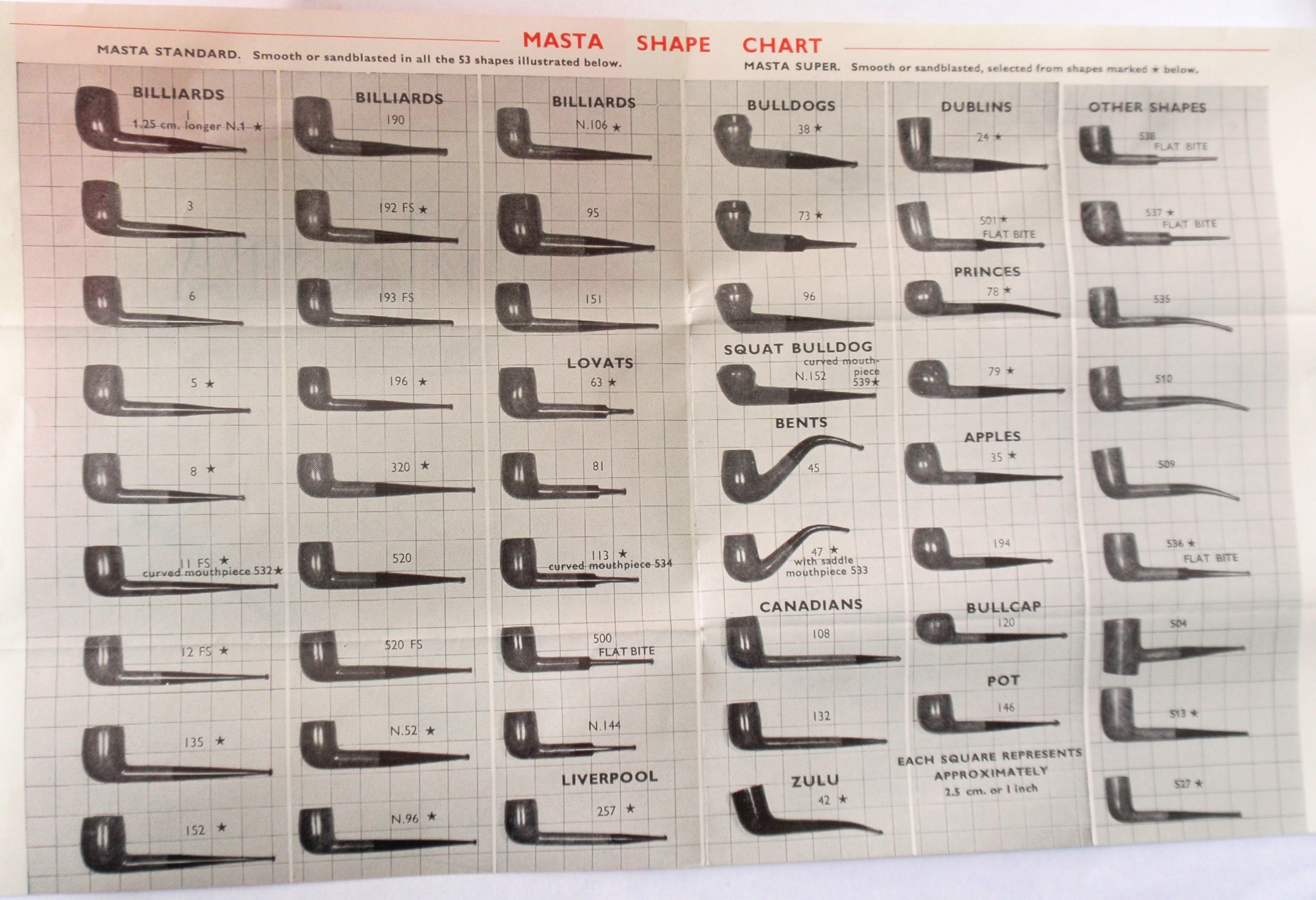
    Pipedia.org also has a nice Masta shape chart:

    (C_2-1.jpg (3574×2443))

    I still had trouble with the whole notion of a company as illustrious as Dunhill having to wage economic warfare on companies producing far lower quality products.  I couldn’t imagine many Dunhill aficionados ever hearing the announcement, “Attention K-mart shoppers…” during their pipe shopping excursions.  

    It was in a blog on Steve Laug’s Rebornpipe.com that I came across Robert M. Boughton’s blog “Identifying, Categorizing and Refurbishing a Masta Diplomat” (Identifying, Categorizing and Refurbishing a Masta Diplomat | rebornpipes).  Robert did a wonderful job explaining the history of Mast in a reasonable way which I found enthralling.  I highly recommend that blog as a read if you are interested in the history of the Masta Patent Pipe Company.  With that I felt like I now had a functional knowledge of the brand and turned to the restoration.

    The Restoration

    As usual I began with a clean denim piece to protect the work surface.

    The team was assembled; the PipNet with #2 blades, Smokingpipes Low Country Reamer, General triangular scraper (with the tip ground round) and 220 sandpaper wrapped around a wood dowel (AKA a 20 gauge shotgun magazine plug).

    The PipNet was used predominantly for the reaming with the other two scrapers just to clean off stubborn spots.

    The completed reaming showed slight damage to the rim.

    Once reamed the chamber was sanded with the 220 sandpaper.  No damage from heat was observed .

    The stummel was taken to the sink for a scrub with a nylon scrub brush and undiluted Murphy Oil Soap.  The soap was rinsed with warm water and the stummel dried with a cotton hand towel.

    Back at the workbench the stummel was wiped with a make-up pad dipped in 95% ethyl alcohol.  Very little color, existing finish, came off.  The grain patterns could be seen much better at this time and looked very nice.  I was very tempted to contrast stain the stummel here but thought that that would not hold true to the nature of this pipe.

    The shank airway was filthy and full of accumulated tar.  After numerous alcohol dipped cotton swabs, I decided to try a cottom/alcohol soaking to remove the tars.  The tobacco chamber and shank were stuffed with cotton and 95% ethyl alcohol was added to the cotton filled passages with a disposable pipette to the point of saturation.  The alcohol was allowed to work on dissolving the tars overnight.

    The next day the cotton had absorbed much of the tars liberated from the briar by the alcohol as it evaporated.

    The cotton was removed and the cleaning resumed and went at a much faster rate.

    The surface of the stem was scrubbed with Soft Scrub cleanser on a make-up pad.

    This produced very little discoloration on the pad indicating that the stem was not heavily oxidized.

    The button needed a little bit of reconstructive work.  I used cheap transparent tape to cover the button proper and confine the black cyanoacrylate (CA, super glue) to the stem where I wanted to fill the dent.  I prefer the cheap tape as the more expensive 3M brand Scotch tape softens and dissolves with exposure to CA drying accelerator.

    Black CA was applied to the area to be filled with a wide zone for blending. 

    The black CA was spritzed with a CA drying accelerator and filed smooth.

    The taping was reversed – covering the new patch and leaving the area to be filled uncovered.

    The black CA was applied to the dented spot on the button, building up the area.  This was then spritzed with a CA drying accelerator.  The tape was removed and the fill filed smooth and the button reshaped.

    The newly repaired button was sanded smooth and inspected to see if additional CA would be required.

    The stummel was very clean and free of any flaws except for one small pit.  This was filled with brown CA and allowed to sure on its own.  The stamps had been taped with painters tape to preserve them during the upcoming sanding.

    The stem and stummel were sanded with a series of sanding sponges from 600-3500 grit.  Between each sponge the stummel was wiped with a make-up pad wetted with alcohol.  The stem was rubbed with mineral oil and wiped with a paper towel between sanding sponges.

    After the final wipe downs from sanding the pipe was worked with micro-mesh pads from 4000-12000 grit.  Between sponges the stummel was again wiped with the alcohol wetted make-up pads while the stem now received a rubbing with Obsidian Oil and a wipe with a paper towel.

    The pipe was given a coat of Before and After Restoration Balm and allowed to sit for 30 minutes.

    With the balm doing the magic that it does for 30 minutes the remaining mysterious elixir was wiped from the pipe with an inside out athletic sock.

    The final steps were to take the pipe to the buffer for several coats of carnauba wax and a final hand buffing with a microfiber polishing cloth.

    I have to say that I think this Masta Patent Standard 45F is a beautiful specimen.  The graceful curves are well proportioned and elegant.  It appears to be a well crafted pipe with only one noticeable pit in the briar.  If this is what a Dunhill “second” looks like, I am going to be very impressed if I ever get to work on a Dunhill.  I retained the natural finish of the briar and it is quite lovely with attractive bird’s eyes and a nice flame grain on the front.  The stem polished up well and the high gloss black is a pretty contrast to the natural briar.  I am sure that this pipe will be a grand smoker and bring someone many years of enjoyment.  

    The dimensions of this Masta 45F Patent Standard Bent Billiard are: 

    • Length:  5.63 in./ 143.11 mm.
    • Weight:  1.49 oz./ 42.40 g.
    • Bowl Height:  1.79 in./  45.47 mm.
    • Chamber Depth:  1.60  in./ 40.64 mm.
    • Chamber Diameter:  0.70 in./ 17.78 mm.
    • Outside Diameter:  1.42 in./ 36.07 mm.

    I do hope that you have found something here useful to your own pipe care, maintenance or restorations.  If you like this sort of thing, please click the like and subscribe buttons.  Thank you for reading the ramblings of an old pipe lover.

    Loading…

    Below are some photos of the finished Masta Patent Standard 45F.

  • A Marxman Four Hundred Restoration

    November 12th, 2024

    Photographed and written by 

    John M. Young

    There it is, the apex of the Marxman line.  Well in this case what is left of the apex.  All that remains of this Four Hundred is the stummel.  The 14 karat gold band and original stem have been lost to the ravages of time.  The briar lives on clinging to her past glory.  I am going to do my best to restore this former queen to her proud majesty.

    Over the past three years I have only seen 3 Marxman Four Hundreds come to auction.  There was one on Etsy a couple of years ago and I still kick myself for not buying it.  This one and another on eBay listing for north of $200, if I recall correctly. 

    This pipe wears the stamp “The Four Hundred” in an Old English script on the bottom of the pipe, also on the bottom is “E152”.  On the left shank is stamped MARXMAN within the arrow above IMPORTED BRIAR.  As previously mentioned the gold band and original stem are missing.  The replacement stem is stamped FRANCE around the tenon end.  Below are some photos of the Marxman Four Hundred before I had done any work to the pipe.

    The pipe was quite dirty with years of grime on the stummel.  The rim had a significant lava deposit.  There was a slight superficial crack running along the front of the briar.  The tobacco chamber had a substantial cake build up present and of course the ill fitting replacement stem would have to be worked on.  My Four Hundred was in need of a good deal of work.

    Background

    According to pipedia.org:  “The Four Hundred was Marxman’s best series, characterized by very large pipes. Similarly famous was the Marxman Heirloom Pipes series, with around 80 pieces produced by well-known North American sculptors, such as Jo Davidson, Cecil Howard, Charles Kopp, and RD Lewis, contracted by Bob in 1947. Today these pipes are genuine collector’s items. The series included animal and human figures, selling at extremely high prices for the time.” (https://pipedia.org/wiki/Marxman)

    I have restored and blogged about several Marxman pipes over the past year.  I will include a few of them here if you are interested in more of the history of the brand.

    • Camel figural https://wordpress.com/post/scimansays1787.com/7445
    • Jumbo C https://wordpress.com/post/scimansays1787.com/7197
    • Jumbo Dublin https://wordpress.com/post/scimansays1787.com/3071
    • Mel~O pear https://wordpress.com/post/scimansays1787.com/6995

    The Restoration

    This restoration began on September 29, 2024.  It is now October 29, 2024.  Thank goodness for time stamps on photos.  I remember the process and with the correct sequence of photos describe the restoration in detail.  As usual the pipe got a clean denim piece as a work surface.

    Next, the ream team was assembled.  This tobacco chamber was large enough to require the large, size #4 PipNet blades along with the General triangular scraper, the Smokingpipes Low Country Reaming Knife.

    I started with the PipNet and the #2 blades.

    Progressing through the blades, #3 was next up.

    The #4 blade was the last of the progression.

    The chamber was reamed but still required sanding.  This was done with 220 sandpaper wrapped around a wood dowel.  You can also see from the photo below the extent of the lava on the rim.

    The chamber was looking far better and showed no damage from excessive heat from smoking.  This surprised me, in a good way.

    The mountainous pile of cake is not done justice by the below photo.  

    To provide a better representation of the cake it was placed into an empty snus can.

    The snus can was then dumped in preparation of it’s next task – to hold some undiluted Murphy Oil Soap.

    Tha stummel was placed rim down in contact with the Murphy’s to soften the lava while preserving the rim from an accidental heavy handed scraping.

    After about 30 minutes I checked the condition of the lava.  It had softened dramatically and was scraped away with a very light scraping with a sharp pocket knife.

    The stummel was then taken to the sink for a scrubbing with undiluted Murphy Oil Soap and a nylon scrub brush.   The soap was rinsed with warm water and the stummel dried with a cotton hand towel.

    Back at the workbench the stummel was beginning to show the previous glory which it had been robbed of.

    The rim, now cleaned of most of the lava, did not have any damage from doddle knocking.  I had feared what was under the lava.  Relief.

    I used the shank boring drill from the Kleen-Reem  tool to drill out the airway of the shank.

    The shank was quite filthy and drilling it out helped remove a good deal of the accumulated tar.

    The shank cleaning proceeded with drilling, scraping with a dental scraper and many alcohol dipped pipe cleaners.

    The cotton swab brigade also came around with 95% ethyl alcohol to further clear out the shank.

    The stem was filed to a much better fit.  This took considerable time and removed the FRANCE stamping completely.

    The airway of the stem was surprisingly clean.  Apparently the previous owner was aware of pipe cleaners and stems at least or, the old stem was just thrown out due to being as filthy as the shank.

    The stem was lightly buffed with 0000 steel wool in preparation of the Before and After Extra Strength Deoxidizer bath.

    Below you can see the stem entering the Before and After Extra Strength Deoxidizer bath. 

    The stem was allowed to soak in the deoxidizer solution for four hours.

    Once removed from the solution I allowed it to drip excess solution back into the jar for several minutes using the patented Drip-O-Matic.  Available at fine retailers near you.

    The stem was then rubbed with a coarse shop rag to remove the remaining solution and to abrade more of the surface oxidation which the solution had loosened.

    The stem was returned to the workbench for a scrubbing with make-up pads and Soft Scrub cleanser.

    At this point I paused the restoration of the Marxman for several days.  I needed to find a replacement gold band.  The original was a 14 karat gold band not plated, filed nor rolled but true 14K gold.  With the current price of gold and over $2700/ounce I opted against this option.  I reached out and called Tim West at J. H. Lowe & Co (https://jhlowe.com/).  Tim is always very helpful with products and advice for restorations.  He did not have anything in the 16 mm diameter that I needed.  He did suggest Vermont Freehand (https://vermontfreehand.com/).  Steve Norse at Vermont Freehand was very helpful and through a series of emails I was steered to their gold plated 16 mm band.  Now we come to another problem with restoring pipes in October – The Las Vega Pipe Show.  The entire Vermont crew was apparently in attendance at the Las Vegas show and the order had to wait until they returned back to work.  Also during this break in working on the Marxman, I restored several other pipes.  In the process I neglected to photograph the sanding and polishing of the Marxman stem and stummel.  I normally do not like to work on more than one pipe at a time for this very reason.  I am very easily distracted, undiagnosed Attention-deficit/hyperactivity disorder (ADHD) can play havoc with my ability to remain on task if allowed.  And this break not only allowed it but promoted it.  Long story short, The band arrived from The Vermont boys and work resumed.

    The below photo shows that the original band was about 4 mm thick and the new band 7 mm.  I thought about cutting the new band down but thought I should try it on first.

    I immediately liked the way the wider band looked.  The reshaped stem was a pretty good match of the original saddle stem.  I admit to assuming the original stem was a saddle as many of the photos of other Four Hundreds appear with saddle stems.  I have a couple of tapered stems of proper size, maybe someday I’ll be good enough at cutting a tenon to try making one for this pipe.

    The gold band was affixed using white all purpose glue.  Vermont and I had equally accurate measurements for this band making for a fit which was snug enough that I did not have to heat the band and force a fit. 

    The pipe was given a coating of Before and After Restoration Balm.  The Balm was applied with a baby toothbrush to work the stuff and it’s magic into the carvings.  It was allowed to sit for 30 minutes.

    The brush was cleaned with dips into 95% ethyl alcohol and rubbing the bristles on the denim a couple of times.

    After 30 minutes, the Restoration Bal was wiped from the pipe with an inside out athletic sock.

    The pipe was taken to the buffer for several coats of carnauba wax.  The rustications were wide and shallow enough that I felt comfortable using carnauba wax on them.  It took considerably longer working the wheel edge into the carvings but the result looked great.

    The final step was to hand buff the pipe with a microfiber polishing cloth to further raise the shine.

    The dimensions of this Marxman Four Hundred are: 

    • Length:  7.36 in./ 186.94 mm.
    • Weight:  2.48 oz./ 70.30g.
    • Bowl Height:  2.21 in./  56.13 mm.
    • Chamber Depth:  1.77 in./ 44.96 mm.
    • Chamber Diameter:  0.82 in./ 20,82 mm.
    • Outside Diameter:  1.80 in./ 446.37 mm.

    I do hope that you have found something here useful to your own pipe care, maintenance or restorations.  If you like this sort of thing, please click the like and subscribe buttons.  Thank you for reading the ramblings of an old pipe lover.

    Loading…

    Below are some photos of the finished Marxman Four Hundred.

  • Kiko Caveman Chimney Restoration 

    November 7th, 2024

    Photographed and written by 

    John M. Young

    “Another Kiko Caveman?”, you ask.  I reply. “YES!”  These pipes are so interesting, not just to look at but to hold.  The feel in the hand is remarkable.  The first thing that strikes me is how lightweight they are especially for a hunk of rock.  Second, is the sheer idea of the age of the mineral itself.  One source dates this Amboseli sepiolite (meerschaum) to the Late Pleistocene to Holocene age so, approximately 12,000-10,000 years ago (https://www.sciencedirect.com/science/article/abs/pii/S007045710870027X).  This is interesting since several pipes advertise “century old” briar.  How many can claim to be 100 centuries old?  Anyway, this Kiko came from an eBay auction and has a much less interesting acquisition story than the first Kiko Caveman.  Meerschaum is a hydrophilic mineral, meaning water loving.  A few weeks ago I was chatting with Sascha Mertens, a pipeman from Germany, he was explaining how to tell a block meer from a pressed meerschaum.  You need only to place your tongue on the meerschaum.  It will stick to a block meerschaum and not with a pressed.  This reminded me of testing minerals as a geologist.  The same thing would occur with anhydrous hydrophilic minerals.  Well, my tongue stuck most uncomfortably to the Kiko.  It was in need of a fresh coat of beeswax.

    The stem is the only part of the pipe that is stamped with any identifiers.  Here we can see the elephant logo on the left side of the shank and TANGANYIKA on the bottom surface.  

    The Meerschaum was in good shape and the tobacco chamber was mostly clean, no cake to speak of.  It looked like this restoration would be mostly stem work and of course a fresh beeswaxing.

    Background

    I did a restoration of another Kiko Caveman a couple of weeks ago.  I will include a link here to that restoration.  I will also use the background of the previous restoration here as both pipes are similar.

    The first step that I took in researching this pipe was to look up the logo at pipephil.eu.  There I found the following:

    (Ki-Km — Pipes : Logos & Markings (pipephil.eu))

    Turning to pipedi.org for some history of Kiko led to the following entry:

    “Kiko, meaning “pipe” in Swahili-Kiswahili to English translation, is probably the best known of the various brands listed below. In East Africa Meerschaum is found in Tanganyika, once known as German East Africa, and since 1964 part of the United Republic of Tanzania. The main deposit comes from the Amboseli basin surrounding the Lake Amboseli. Tanganyika Meerschaum is normally stained in shades of brown, black and yellow, and is considered to be inferior to Meerschaum from Turkey. Eventhough, the raw material is mined by the Tanganyika Meerschaum Corporation and to a large extent used for pipemaking. Uncounted pipemakers throughout the world were supplied with Amboseli Meerschaum, preferentially used for Meerschaum lined briars or leather-clad pipes. In Tanganyika the Kilimanjaro Pipe Company Ltd.” (Kiko – Pipedia) 

    And, more specifically the Caveman line of Kiko pipes.

    • “Caveman Fashioned from a piece of natural meerschaum.Every pipe is unique and – is in fact a geological specimen over a million years old.Attractively boxed.” (Kiko – Pipedia)

    A second entry at pipedia.org discusses the Tanganyika Meerschaum Corporation in greater detail. 

    “From Pipes, Artisans and Trademarks, by José Manuel Lopes

    Tanganyika Meerschaum Corporation is a company that formed in 1955 by Kenyan businessmen from Nairobi after the discovery of a meerschaum mine relatively close to the surface on Kilimanjaro. The meerschaum is tougher, less porous, and cheaper than the Turkish variety. Another mine was soon discovered in Sinya, in the famous Amboseli Game Park.

    The company, previously based in Arusha (Tanzania), became an associate of a Belgium firm, but closed some years after. It produced the Caveman, Countryman, Kiko, Killimanjaro, Sportsman, Townsman, and Wiga brands. It maintained a link with GBD for the making of the GBD Block Meerschaum series, and after its closure, the English firms, London Meerschaum and Manx Pipes (Manx Meerschaum) continued producing with African meerschaum.” (Tanganyika Meerschaum Corporation – Pipedia)

    To give more depth to the meerschaum story here is a quick lesson in geography.  

    Lake Amboseli is a rainy season body of water along the shared border of Kenya and Tanzania, northwest of Mount Kilimanjaro.  The straight white line on the image below is that border.  Sinya refers to the Sinya Mine (https://www.mindat.org/loc-266724.html).

    (https://www.google.com/maps/@-2.7763709,37.2580582,99656m/data=!3m1!1e3!5m1!1e4?entry=ttu&g_ep=EgoyMDI0MDkyMy4wIKXMDSoASAFQAw%3D%3D)

    Zooming in on the south western shore of the temporary Lake Amboseli you can actually make out the excavations of the old mining activities.  On the below image from google maps; pits, tailing piles, roads etc… can be discerned.

    (https://www.google.com/maps/@-2.7763709,37.2580582,99656m/data=!3m1!1e3!5m1!1e4?entry=ttu&g_ep=EgoyMDI0MDkyMy4wIKXMDSoASAFQAw%3D%3D)

    It appears that little to no mining is done at the site today.  Several sources say that the meerschaum deposit were close to the surface, not very large and were played out 

    Super fast history lesson:

    Before World War I, Tanganyika formed part of the German colony of German East Africa. It was gradually occupied by forces from the British Empire and Belgian Congo during the East Africa Campaign, although German resistance continued until 1918. After this, the League of Nations formalised control of the area by the UK, who renamed it “Tanganyika”. The UK held Tanganyika as a League of Nations mandate until the end of World War II after which it was held as a United Nations trust territory. In 1961, Tanganyika gained its independence from the UK as Tanganyika, joining the Commonwealth. It became a republic a year later. Tanganyika now forms part of the modern-day sovereign state of Tanzania. (https://en.wikipedia.org/wiki/Tanganyika_Territory)

    With all of that information in mind and assuming that the TANGANYIKA stamp on the stem is referring to the country of manufacture (COM) this pipe was made not after 1962.  

    The Restoration

    After getting a clean denim piece this pipe needed to have the stem freed from the tenon.  It was firmly attached firmly, as if someone appeared to have glued the stem in place.

    I wrapped the stem with several wraps of masking tape to protect the stem from the channellock pliers.  A twist and turn later the stem was freed.

    The tenon appeared to be aluminum as it was not attracted to a magnet and glued in place in the meerschaum.  When inserted completely the stem was loose but if backed out about 2 mm it was a perfect fit.  I decided that a cork washer would be the easiest fix for this situation.

    The photo below shows the light cake deposits in the bowl were removed with 220 sandpaper wrapped around a wood dowel.

    The stem was cleaned with bristle pipe cleaners dipped in 95% ethyl alcohol.  The stem was then placed into a jar with Before and After Extra Strength Deoxidizer.  The jar needed to be propped at an angle due to the length of the stem.

    The stummel was cleaned with warm tap water and a nylon scrub brush.

    Fresh beeswax was melted in a small glass canning jar placed in a pan of boiling water.  The surrounding water keeps the wax molten for longer enabling me to have more time with the molten wax.

    The heat gun was set up in proximity.

    I did not have a cork of suitable size to plug the tobacco chamber so through the power of adaptation I discovered a 20 gauge shotgun shell was the perfect diameter.  The shotgun shell was my plug and handle for the heating of the meerschaum with the heat gun.

    The molten beeswax was brushed onto the stummel and the meerschaum was heated with the heat gun.  The aluminum lid acted as a wax drop catch pan.  Several coats of beeswax were brushed onto the meerschaum.

    Below you can see the meerschaum was set aside to cool.

    After four hours the stem was removed from the Before and After Extra Strength Deoxidizer and it was allowed to drip excess solution back into the jar.

    The stem was hand rubbed/buffed with a coarse shop rag to absorb the remaining solution and abrade the softened oxidized vulcanite.

    The below photo is blurry but does show the oxidized rubber left behind on the rag.

    The stem was rubbed with mineral oil to prevent new oxidation.

    My masking tape protective layer was not quite adequate to protect the stem during the freeing from the stummel.  Doh!  That would need to be repaired with an application of black cyanoacrylate (CA, super glue).  Well, now you know that I make mistakes.  A lot of them…  The stem stamping and logo were covered with painters tape to protect them during the sanding.

    The dent was filled with black CA and allowed to dry/cure on its own.

    Once cured the repair was filed with a small flat file.  The stem was then sanded with a series of sanding sponges from 600-3500 grit.  Between sponges the stem was rubbed with mineral oil and wiped with a paper towel.

    The elephant logo area was cleaned with a cotton swab and ethyl alcohol to remove sanding debris and mineral oil in preparation of a new paint job.  White acrylic modeling paint was used.

    The paint was applied using a bamboo skewer.

    When dried the paint outside of the depressed logo was removed during the micro-meshing.  This was done with 4000-12000 micro-mesh pads.  Between each pad the stem was rubbed with Obsidian Oil and wiped with a paper towel.

    The stem was taken to the buffer where it was polished with Blue Diamond compound .  The stem then received several coats of carnauba wax.  The stummel, having just received fresh beeswax, did not have any carnauba wax applied.

    I am very pleased with how well this Kiko Caveman turned out.  I could not find any information concerning the shapes that the makers tried to carve for.  This pipe was very different in regards to the tobacco chamber drilling than the previously restored Kiko Caveman.  This pipe has a narrow 16.26 mm bore while the other Kiko has an 18.29 mm bore.  I tried the narrow bore with Carolina Red Flake virginia blend and it smoked very nicely.  The stem of this pipe polished nicely and the glossy black vulcanite accents the lighter meerschaum well.  The long stem does not make for a very comfortable clenching pipe but the “hand feel” makes up for that.  Besides, the flat bottom of this pipe provides a perfect and stable sitting base.  The dimensions of the Kiko Caveman Chimney are: 

    • Length:  6.85 in./ 173.99 mm.
    • Weight:  1.92 oz./ 54.43 g.
    • Bowl Height:  3.02 in./  76.71 mm.
    • Chamber Depth:  1.69 in./ 42.93 mm.
    • Chamber Diameter:  0.64 in./ 16.26 mm.
    • Outside Diameter:  1.92 in./ 39.88 mm. In line with the stem

     1.47 in./ 37.34 mm.  Perpendicular to the stem

    I do hope that you have found something here useful to your own pipe care, maintenance or restorations.  If you like this sort of thing, please click the like and subscribe buttons.  Thank you for reading the ramblings of an old pipe lover.

    Loading…

    Below are some photos of the finished Kiko Caveman Chimney.

  • A Denicotea Deluxe Hockey Restoration

    November 5th, 2024

    Photographed and written by 

    John M. Young

    DENICOTEA arched over DELUXE on the left shank with HOCKEY over BRUYERE EXTRA on the right.  741L on the underside of the shank next to  the stem.

    Background

    In a previous blog I wrote about the history about what little I found about Denicotea, I will link that post here, and  include the information below:

    “Pipedia.org has a short article on Denicotea.  I will include it here in its entirety:

    “Willy Heineberg founded the company Denicotea in 1932 and began manufacturing and selling smoking accessories such as filters, filter inserts, cigarette holders and pipes.[1] The company headquarters was initially in Cologne, but was relocated to Bergisch Gladbach after the Second World War.[2]

    Denicotea is actually the name of a silica gel filter, cigarette holders and care products for pipes and cigarette holders.

    I still find it a bit confusing as Denicotea seems to be a company[3] and a brand as well which is operated by COMPOSING-STUDIO GmbH[4].

    Brands

    Adsorba

    Adsorba is a fantasy series of pipes produced by Luigi Crugnola for the German market.

    Aldo Morelli

    Aldo Morelli is a fictional name. The brand Aldo Morelli has been registered for Denicotea on February 26th, 1992.[5]

    Depending on the different lines the pipes are made by Cesare Barontini, Gigi or Molina Pipe for Denicotea GmbH.

    Stefan Petzuch points out this brand appears to have similarities to the Mauro Cateni pipe brand, in particular they are both fictional Italian brands by German companies, and both have the “HAND CUT” imprint on the stem as seen bellow. This may connect the Aldo Morelli brand to Gebr. Heinemann KG in Hamburg, who had registered the Mauro Cateni brand. Or perhaps there is a connection between Denicotea and Gebr. Heinemann KG, or perhaps these pipe brands simply used “Hand Cut” stems from the same source.” (Denicotea – Pipedia)

    Interesting and weird are the two qualifiers that come to mind in reading that.  The four makers mentioned in the article; Luigi Crgnola, Cesare Barontini, Gig and Molina are all Italian pipe manufacturers.  Where does the MADE IN ENGLAND stamp on the example on pipephil.eu or the stamp on the pipe I purchased come in, I cannot say.  I can say that I am not the first person to have little success researching the origins of Denicotea pipes.  Dal Stanton, who is far more diligent in his background research than I, had a French made Denicotea.  He traced its origins to the St. Claude area but not to a specific maker.  Dal’s blog was posted on Steve Laug’s rebornpipes.com site.  Here is the link to Dal Stanton’s blog post:  https://rebornpipes.com/2016/09/29/nice-find-in-plovdiv-bulgaria-denicotea-deluxe-curling-bruyere-extra/”

    This Denicotea has neither the Country of Manufacture (COM) stamps of England nor France.  It does have a shape number 147L which I could find no corresponding match  with brands associated with Denicotea.  This pipe’s heritage appears to remain a mystery.

    The Restoration

    The restoration began with the reaming of the tobacco chamber.  There was little cake to remove indicating that the pipe had not been used heavily.  This premise was later shattered.  The chamber was rather narrow making me use the Kleen-Reem, General triangular scraper and the smokingpipes Low Country reaming knife to clear the cake.  

    The below photo illustrates the very small amount of cake present.  The bowl was sanded with 220 sandpaper wrapped around a wood dowel and no evidence of heat damage was observed on the bare briar.

    The rim had no lava deposits again indicating that the pipe had not been smoked too heavily.

    The stummel was taken to the sink and scrubbed with undiluted Murphy Oil Soap and a nylon scrub brush.

    Next came the cleaning of the shank.  This is where I realized that this pipe had indeed been smoked a good deal.  For all the maintenance that the bowl had received the shank had been severely neglected.  It was very full of tar and smoking residue, also known as yuck.  Now, to cut the previous owner some slack, the shank was not easy to clean as the airway appeared to be bored at 9.5 mm.  The plastic tenon was inserted into this bore and left with a step.  There was another step at the bowl end of the airway where the drilling draft hole went from a normal small hole to the 9.5 mm.  These two steps had accumulated a great deal of yuck and could not be reached with dental scrapers to help clear the yuck.  Numerous cotton swabs dipped in 95% ethyl alcohol were used along with a nylon shank brush.  I seemed to make little progress as the cotton swabs continued to emerge heavily stained with yuck.  I then decided to try stuffing the tobacco chamber and the shank with cotton, filling them with 95% ethyl alcohol and allowing them to sit overnight.

    The stem was not much better than the shank.  I plugged the button end with my finger and poured some ethyl alcohol into the airway.  Here I scrubbed with a nylon shank brush.

    The alcohol was allowed to drain into the sink.  It was full of yuck.

    The stem was designed for use with 9 mm filters and judging by the accumulated yuck, they had not been used as I don’t think a filter could have been inserted with all of the residue in the stem.

    I alternated between using Castile soap and 95% ethyl alcohol hoping that one of the two would help reduce the yuck.

    It was about here that I noticed the fine scratched immediately above the button.  

    The scratches were present on both the top and bottom sides of the stem.

    The stem was returned to the workbench where I continued cleaning the stem with more traditional methods.  Bristle pipe cleaners and cotton swabs  dipped in alcohol were used.  I also wrapped small 5 cm square pieces of paper towel around a rat tail file and scrubbed the airway with these dipped in alcohol.   Eventually I was victorious and the stem cleaned.

    To address the scratches I sanded the button end of the stem with 400, 600 and 1000 grit sanding sponges.  I used a small circular pattern while sanding.  This eliminated the scratches.

    While the stummel was still soaking with the cotton and alcohol I picked the old fill from the briar.  There were two big fills on the left.

    One large fill and one smaller fill on the right.

    And two larger fills on the rim which were picked free of old fill material.

    The whole stem was sanded with a series of sanding sponges from 400-3500 grits.  Between each sponge I rubbed the stem with mineral oil and wiped it with a paper towel.

    This is where day one ended.  The pipe was to sit overnight  allowing the alcohol to soften and dissolve the yuck in the airway.

    The next day I returned to find the cotton, as expected, quite stained with removed yuck.

    The cotton was removed and I tried cleaning the airway with cotton swabs and the 5 mm paper towel pieces wrapped around the rattail file.  

    The cotton alcohol had worked but not to the extent I had hoped for.  Many more cotton swabs and scrubbings with alcohol yielded nothing but more stained swabs.

    This prompted me to repack the bowl and shank with cotton and repeat the overnight soaking.

    Since the cotton helb the alcohol in contact with the walls of the airway and was not dripping alcohol I went ahead with the filling of the pits.  For this I used brown cyanoacrylate (CA, super glue) and briar dust.  I applied the CA into the pit and then pressed some briar dust into the wet CA.  These cured almost immediately.  The subsequent fill was filed with a small flat file and smoothed with a 400 grit sanding sponge.  The three photos below show the first application of CA/briar dust.

    The filling process was repeated for each of the fills.

    Where needed the brown CA was added a third time without briar dust and allowed to cure.  The pipe was again allowed to sit overnight enabling the alcohol to further dissolve and remove the yuck.

    The next day, I revisited the pipe.

    The cotton was again stained with removed yuck.  I removed the cotton.

    The staining was far less than the previous attempt.  I started cleaning with alcohol dipped cotton swabs.  At first I thought that no progress had been made then suddenly the swabs began to come out with less staining.  I had finally removed the yuck.

    The stamps were covered with painters tape to protect them during the sanding.  The stummel and stem junction was sanded with sanding sponges 400-3500.  Between each sponge the stummel was wiped with a make-up pad moistened with 95% ethyl alcohol.

    The pipe was then worked with micro-mesh pads from 4000-12000.  The stummel was again wiped with a make-up pad dipped in alcohol.  The stem was rubbed with Obsidian Oil and wiped with a paper towel between micro-mesh pads.

    The pipe was taken to the buffer where I buffed the entire pipe with Blue DIamond on a clean wheel.  After the buffing compound was thoroughly wiped off the pipe received several coats of carnauba wax.  The final step was a hand buffing with a microfiber polishing cloth.

    This pipe is a perfect example of how my prejudice led me to inaccurate conclusions.  Yeah, the tobacco chamber looked clean and there was no lava on the rim, both indicating a little used pipe, only to discover a heavily tarred mess of an airway.  Overall I am pleased with the finished restoration.  The briar grain is nice, the new fills are a bit too noticeable.  In hindsight, I am thinking that a contrast dye of black would have concealed them and accentuated the briar grain.  That might be another project for this winter when I am hunkered down avoiding the cold and snow.  The stem polished up very nicely.  The long sleek glossy black vulcanite is a great contrast with the briar.  I do really like this shape, though it doesn’t quite fit a cutty nor a zulu.  I guess that’s why it is called a Hockey.  The dimensions of the Denicotea Deluxe Hockey are: 

    • Length:  6.66 in./ 169.16 mm.
    • Weight:  1.18 oz./ 33.70 g.
    • Bowl Height:  1.77 in./  44.96 mm.
    • Chamber Depth:  1.42 in./ 36.07 mm.
    • Chamber Diameter:  0.67 in./ 17.02 mm.
    • Outside Diameter:  1.30 in./ 33.02 mm.

    I do hope that you have found something here useful to your own pipe care, maintenance or restorations.  If you like this sort of thing, please click the like and subscribe buttons.  Thank you for reading the ramblings of an old pipe lover.

    Loading…

    Below are some photos of the finished Denicotea Deluxe Hockey.

  • A Peterson Irish Seconds Restoration

    October 31st, 2024

    Photographed and written by

    John M. Young

    It seems fitting to post this pipe today, October 31, 2024, for a few reasons.  The first of which is the name, Nebraska Pete Geek.  Secondly an Irish Seconds sounds like the pipe is being given a second chance which is exactly what restoring does for these old darlings.  Third, today is the one year anniversary of this blog.  I really didn’t think that I’d be able to successfully do this for an entire year.  As of this writing, 3133 visitors have viewed my blogs 5138 times.  I taught secondary school science for 32 years and a rough calculation had me at 3600 students over those years.  I have achieved nearly that many viewers in a single year.  All I can say is thank you all.  Your support, comments, and encouragement have been wonderful.  I know, “shut up and get on with the restoration.”

    This pipe came to me as part of an estate lot back in early July.  This pipe wears the stamp IRISH SECONDS on the left and MADE IN THE over REPUBLIC  over OF IRELAND on the right.  There is no shape number but the shape corresponds to the Peterson Classic Shape XL90 which is the same shape as the 307 Extra Large Billiard.  Below are some photographs of the pipe as it appeared prior to any work.

    The Irish Seconds looked like a very straightforward restoration.  Reaming, cleaning some scratch mitigation and deoxidizing the stem.  The rather blocky button would have to be made more comfortable, I know this is not restoring it to factory new condition but whoever gets this pipe will be quite grateful.

    Background

    I’ve said it before and here it is again:  “If you have been following this blog for a length of time you know I have done a few Peterson restorations in the past.  If you are new here, welcome and I’ve done a few Peterson restorations in the past.  I’m not going to go on and on about the history of the oldest continually operating pipe manufacturer in the world and arguably the best.  I will however lead you to The Peterson Pipe book.  Mark Irwin and Gary Marlburg’s book is a must read for a Pete Geek.

    (Available at https://www.smokingpipes.com/accessories/books/moreinfo.cfm?product_id=471478)  I am also including a couple of free sites as the book is a bit pricey,

    The first site is pipedia.org’s History of Peterson by Jim Lilley (Peterson – Pipedia)

    The second is the pipephil.eu site for all things logo:  Peterson: historical pipes — Pipes: Logos & Markings (pipephil.eu)  They also have a few other links to things like the Peterson timeline and P-lip information.”

    According to smokingpipes.eu Irish Seconds, 

    “If you’ve ever been to any kind of “outlet” store, you’re already more or less familiar with what seconds are. Products that — due to some minor cosmetic flaw — just don’t pass a manufacturer’s quality control process. When these cosmetic flaws don’t affect the function or durability, they generally get sold at a deep discount. Not ideal for the manufacturer, but it’s great news for you, the customer.

    And that’s exactly what we have here — pipes produced right here in Ireland, fully functional, eminently smokeable, and heavily discounted due to some superficial blemish. Irish Seconds are graded from 1 to 3, with 1 being the highest quality, and 3 being the deepest discount. If you’re in the market for a shop pipe, just getting into pipes, or are generally more budget minded, these are hard to go past.

    (https://www.smokingpipes.eu/pipes/new/irish-seconds/)  I have to admit that I am happy  not to be geographically closer to Dublin.  The reasons for my happiness are that I would most likely be considered furniture at the Nassua Street shop and would convert the entirety of my daughter’s inheritance to Petersons and Irish Seconds.  Though neither of these things are terrible, both would become annoying by those involved.

    In listening to my own advice I quote from Irwin’s big Peterson Pipe book:  “See Seconds” (p. 304).  Just kidding, it really does say that though.  The real information is as follows:

    “Seconds Peterson seconds are pipes of all shapes with briar flaws deemed unacceptable for ordinary models and sold at reduced prices, sometimes unstained, fit with fishtail or round button mouthpieces.  Since the early 1990s they have only been available in Ireland.  Occasionally they are described in Peterson catalogs under different names, and documented specimens have various stampings.  In roughly chronological order these include:

    Stamped arched KAPP & over straight PETERSON”S over arched DUMMIES An early specimen preserved at the Peterson museum with this stamp has a round-button mouthpiece.

    IRISH FREE STATE stamp (1922-37) COM stamp with no brand or model name.  Documented with or without nickel bands.

     System Reject (1968-)  Noted first in the Price List for January 1968 as being available in all six system shapes.  Also found in the ‘80 Peterson-Glass Price List.

    Erica System Reject (1987-98)Noted in two US distributor catalogs.  Fishtail mouthpiece, unstamped nickel band, with COM of MADE IN THE over REP. IRELAND or with no COM.

    Irish Seconds (1982-98)  Classic Range shapes stamped with no brand name , fishtail mouthpiece, in unstained, black rustic or dark brown finishes, no band.  (Irwin, Mark and Malmberg, Gary (2018). The Peterson Pipe The Story of Kapp & Peterson, First edition, second printing 2021. Briar Books Press, Canada. p312).

    The last line of the Irwin quote above describes this pipe nicely.  It is indeed not stamped with a brand, unstained, it is of the Classic Range and matches the dimensions of an XL90 (used from 1980-) and has no band.  With this information I can safely say that this pipe is a Peterson product produced between 1982-98 and though deemed unworthy of the Peterson name, it remains a fine briar pipe.

    The Restoration

    The chubby darling got a clean denim piece to sit on.

    The stem was heavily oxidized.  I lightly sanded it with a 320 sanding sponge in preparation of the Before and After Extra Strength Deoxidizer (deox) bath.

    I inserted a pipe cleaner into the button to act as a hanger, suspending the stem in the deox.

    I figured at least 4 hours in deox would be required.

    I gathered the reaming gear:  The PipNet with #2 blades, the General triangular scraper, Smokingpipes Low Country reaming knife and wood dowel wrapped with 220 sandpaper.

    The reaming went smoothly as the cake was not terribly thick.  The top of the bowl had some scratches that appeared to be from a previous owner scraping the bowl with a pocket knife.  Also the lave on the rim was not bad and did not appear to be hiding any charring of the rim.

    The interior of the bowl did not have any heat damage.

    The shank was cleaned by scraping with a dental scraper and with cotton swabs dipped in 95% ethyl alcohol.

    Folded bristle pipe cleaners, also dipped in alcohol, were also used to clean the airway.

    After 4 hours the stem was removed from the deox and allowed to drip excess solution back into the jar.

    The stem was vigorously rubbed with a coarse shop rag to remove the remaining deox solution and abbrade additional oxidized vulcanite.

    Below you can see the oxidized rubber removed by the rubbing.

    The stem was then scrubbed with several make-up pads drizzled with Soft Scrub cleanser.

    The button was reshaped to make it far more comfortable for a smoker.  A couple of flat files were used for the reshaping.

    The worst of the stummel dents were at the bottom front of the stummel.  It looked like it had been dropped on concrete.  

    The other dents and dings were less severe but were on both sides.

    I decided to try raising the dents with steam.  I set an iron to high and moistened a washcloth with tap water.  Below you can see the set up and the protective tape on the stamps in anticipation of the sanding that would follow.

    The steam did raise the dents but they would still require filling with cyanoacrylate (CA, super glue).

    Below is a close up of the dents after a couple of steaming episodes.

    The area was covered with brown CA applied with a fly tying bodkin and allowed to cure/dry without the use of a CA drying accelerator.

    Once dry, the area was filed smooth and sanded with a 400 grit sanding sponge.

    The pipe was sanded with a series of sanding sponges from 400-3500 grit.  The pipe was sanded intact to avoid the rounding of the shank/stem joint.  Between each sponge the stummel was wiped with a make-up pad moistened with ethyl alcohol.  The stem was rubbed with mineral oil and wiped with a paper towel between sponges.

    The pipe was then worked with micro-mesh pads 4000-12000.  The wiping after each pad was as above except that the mineral oil was replaced with Obsidian Oil for the stem.

    The pipe was given a coating of Before and After Restoration Balm and allowed to sit for 20 minutes.

    20 minutes later the balm had done it’s magic and the excess balm was wiped from the pie using an inside out athletic sock.

    The pipe was taken to the buffer where it received several coats of carnauba wax applied by the buffer.  The final step was a hand buffing with a microfiber polishing cloth to raise the shine.

    I think this Peterson Irish Seconds turned out very nicely.  The reservoir is drilled out in typical Peterson System fashion and though the stem lacks a tenon extension and the P-lip, I am sure that this will be a fine smoking pipe.  The briar grain is pretty with the cross-grain at the front and rear.  The bird’s eyes are small and very numerous.  I can’t help but wonder how the pipe would look with a contrast dye accentuating the briar grain.  That would violate the description of the Irish Second though.  The stem polished up very nicely revealing the glossy black vulcanite under all that oxidation.  The dimensions of the Peterson Irish Seconds are: 

    • Length:  5.18 in./ 131.57 mm.
    • Weight:  1.96 oz./ 54.88 g.
    • Bowl Height:  1.91 in./  48.51 mm.
    • Chamber Depth:  1.46 in./ 37.08 mm.
    • Chamber Diameter:  0.79 in./ 20.07 mm.
    • Outside Diameter:  1.57 in./ 39.88 mm.

    I do hope that you have found something here useful to your own pipe care, maintenance or restorations.  If you like this sort of thing, please click the like and subscribe buttons.  Thank you for reading the ramblings of an old pipe lover.

    Loading…

    Below are some photos of the finished Peterson Irish Seconds.

  • A Dr Grabow CDL Restoration

    October 29th, 2024

    Photographed and written by 

    John M. Young

    I cannot explain why but I find metal pipes fascinating.  I don’t find them particularly beautiful but more utilitarian, like a good tool.  I remember first seeing a Dr Grabow CDL online and found them to be rather disjointed in appearance.  The stems and shanks looked segmented.  Still, they intrigued me.  The advertisements spoke highly of their cool and dry smoking characteristics but then nearly all advertisements make similar claims.  I decided that I needed to find and restore one to see this for myself.  The search for a subject was not fast and easy.  For many months the auction listings were far more expensive than what I was willing to pay.  I remember thinking, “Who in their right mind would pay over $100 for a Dr. Grabow?”  The listings seemed to be of two categories; one around $30 and the other +$100.  I personally thought that both were too high, at least for a pipe to satisfy my curiosity.  Eventually, I found a likely subject for under $20.  The pipe was an eBay purchase and arrived from Reno, Nevada.  On the bottom of the stummel was stamped DR. GRABOW IMPORTED BRIAR in a circle around CDL. Below are some photos of the Dr Grabow CDL before any work was done.

    The pipe appeared to be unsmoked and there was a clean filter within the stem.  How the nylon bit became so heavily dented with what looked like tooth chatter, I couldn’t figure out.  There were a few marks on the stummel that looked like the finish had been worn away.  I wondered if the pipe had been jostled in a drawer of a vehicle glovebox, purchased but never used.  For whatever reason this pipe had gone neglected for the past 50 years and would soon be back in the game.

    Background

    Dr Grabow is perhaps one of America’s best known pipe brands.  This renown has brought with it a following of two main camps:  Those who love their Dr Grabows and those who do not.  In an attempt to remain objective, I can say that I love a couple of the Dr Grabow lines; the old 1930s Linkman pipes and the more recent Westbrooks are in my “favorites” category while many of the other lines are considered “less than” pipes.  By that I mean less than preferred.  Whatever your impression of Dr Grabow, they have a long and significant history in our hobby.  I will include a link to the history of the brand from pipedia.org for those who would like access to a more complete history here.

    As for the CDL pipes, I first turned to pipephil.eu for information.  According to this site the CDLs were manufactured for about a decade starting in 1975 and never made it past test marketing.

    (Dr Grabow — Pipes : Logos & Markings (pipephil.eu))

    Next, I found a nice restoration of a CDL by Charles Lemon of dadspipes.com.  In his blog he included an image of an ad from pipephil.eu.  I found this interesting but could not find the ad on the pipephil.eu site.  I do not know what the “Magni” implies in the ad but it certainly must be important as it is found in three of the components of the pipe.  Perhaps “magni’ficent?  The prefix comes from Latin meaning, large or great, if memory serves.

    (https://dadspipes.com/2020/10/09/a-quick-refresh-for-a-grabow-cdl/)

    Whenever I research any pipe consisting of metal parts, I turn to smokingmetal.co.uk.  This is a wonderful resource for pipes made from, you guessed it, metal.  The entry is included in its entirety. 

    “Not totally sure where this pipe fits in. Metal stem it certainly has, but unsure if bowl is meant to be detachable 6.2 inches long and the facility to take an in line filter in the stem. The stem continues right through the bowl and enables air to be drawn through from front of bowl as well as smoke from bowl

    This example thanks to John Phillips of Arkansas.

    Ed James tells me that CDL is for Cooler,Dryer,Lighter. He has a display card with this on, the pipe retailed at $4.95 at that time.

    “A couple of other things I remember about the CDL pipe. It was produced from 1975 to 1983 in limited qualities and test marketed in several U.S. cities but apparently never mass marketed” from Dave Whitney” (http://www.smokingmetal.co.uk/pipe.php?page=391)

    Another interesting link is the Dr Grabow timeline produced by Tiki Vegas.  I find this useful for dating various Dr Grabow lines.  According to Vegas, the CDLs were made starting in 1974 not 1975 as previously recorded.

    (https://www.timetoast.com/timelines/dr-grabow)

    Turning to a forum post, I found a quote from a user named theloniousmonkfish who stated:

    “Made from 75-83 and test marketed in cities across the US, never took off.

    From the former COO of Grabow, Tom Douglas

    “The predecessor of the CDL was bought in 1967 in LaGuardia airport by Paul Fish. It sat on Pauls desk until his death in 1972. It was a simple bowl and a simple metal stem with attatched bit. I’ve always speculated that it was sold by Mastercraft.

    Jack Martin became President of Sparta Pipes in 1972. The CDL sat on his (and Paul’s) desk for years.

    In about 1974 we decided to design and try the concept. Tooling for the “shank”, and the mould for the bit were EXPENSIVE, but we tried.

    Best I recall… we made 300 and sent them FREE to RJR customers who had ordered Westbrook etc. along with a survey. Knew we had pipe smokers.

    Comments were.. Coolest smoke I ever had.

    Dryest smoke I ever had.

    Lightest pipe I ever owned.

    But Invariably.. Ugliest pipe I’ve ever seen.

    Guess we should have called it CULD.

    I’m really curious about what those who have never tried a CDL will think about it. It is a wonderful smoke…. not to be seen outside with…… Td”“

    (https://pipesmagazine.com/forums/threads/need-info-on-dr-grabow-cdl.93500/)  This is interesting as it is purportedly a quote from the former COO of Dr Grabow, Tom Douglas.

    In summary, it appears that the CDLs were produced by Dr Grabow as a test to see if the product would be accepted by pipe smokers.  The pipes were manufactured in 1974 or 1975-1983.  For whatever reason the line never caught on with pipe smokers and was discontinued.  

    The Restoration

    The Dr Grabow CDL received a clean denim piece for the restoration.  Well, actually it would be more of a refreshening than a restoration.

    The first step was to clean the accumulated years worth of dirt and dust from the patient.  This was done with undiluted Murphy Oil Soap and a nylon scrub brush.  The soap was rinsed with warm water and the stummel dried with a cotton face towel.

    The pipe was already looking better.  I was not sure why there were areas within the rusticated surface which looked like scratches in the finish.

    Alos confusing was the high number of what looked like tooth chatter.

    The interior of the stem was cleaned with a cotton swab dipped in 95% ethyl alcohol.  This came back clean reaffirming my impression that the pipe had never been smoked.

    To address the damage to the stem, I filed the dented surface with a small fine file.  The nylon bit proved to be difficult to file not because it was too hard but more due to its plasticity.  The shank was wrapped in painters tape for its protection.  I then worked the stem with a series of sanding sponges from 320-3500 grit.  Occasionally I would rub the stem with mineral oil and wipe it with a paper towel.  This helped me see where I needed additional sanding.  The stem was then taken to the  buffer where I buffed it with a Red Tripoli wheel followed by a White Diamond wheel.  The finish of the stem was far better but also far from perfect.  This was, though, as good as I was going to get it.

    The worn spots on the stummel were stained using a walnut Furniture Touch-up Marker.  Below are a few before and after photos..

    I used Renaissance Micro-Crystalline Wax Polish to help preserve the rusticated briar.  This was applied with a baby toothbrush.

    The instructions said that the product “Dries hard instantly”.  I found that their definition of instantly differed from mine.  

    After the wax was applied I let it sit for 5 minutes then hand buffed it with an inside out athletic sock.

    The pipe was returned to the buffer where I applied a couple coats of carnauba wax to the stem, shank and base of the stummel.  The pipe was then hand buffed with a microfiber polishing cloth.

    I am actually smoking this pipe as I type this conclusion,  I am quite pleased at how much better the pipe looks after the restoration.  The worn surfaces are refreshed and the stem much better and  nearly chatter free.  The pipe does smoke very nicely.  I give credit to the Dr Grabow designers full credit for that.  The walls of the stummel are 0.35 inches (8.89 mm) wide.  This, the “Magni-vent” and the “Magni-chamber” do combine to make a nice cool smoking experience.  I am smoking it without a filter and will compare that to filtered smoke in the future.  The dimensions of the Dr Grabow CDL are: 

    • Length:  6.19 in./ 157.23 mm.
    • Weight:  0.99 oz./ 28.04 g.
    • Bowl Height:  1.46 in./  37.08 mm.
    • Chamber Depth:  1.24 in./ 30.73 mm.
    • Chamber Diameter:  0.78 in./ 19.81 mm.
    • Outside Diameter:  1.48 in./ 37.59 mm.

    I do hope that you have found something here useful to your own pipe care, maintenance or restorations.  If you like this sort of thing, please click the like and subscribe buttons.  Thank you for reading the ramblings of an old pipe lover.

    Loading…

    Below are some photos of the finished Dr Grabow CDL.

←Previous Page
1 … 10 11 12 13 14 … 26
Next Page→

Blog at WordPress.com.

Privacy & Cookies: This site uses cookies. By continuing to use this website, you agree to their use.
To find out more, including how to control cookies, see here: Cookie Policy

Loading Comments...

    • Subscribe Subscribed
      • NebraskaPeteGeek
      • Join 40 other subscribers
      • Already have a WordPress.com account? Log in now.
      • NebraskaPeteGeek
      • Subscribe Subscribed
      • Sign up
      • Log in
      • Report this content
      • View site in Reader
      • Manage subscriptions
      • Collapse this bar
    %d