Skip to content
    • About

NebraskaPeteGeek

  • American Pipe Makers
  • British pipe Makers
  • Danish pipe Makers
  • French Pipe Makers
  • German Pipe Makers
  • Irish Pipe Makers
  • Italian Pipe Makers
  • Others or Unknown Pipe Makers
  • Restorations
  • A Frasorteret Freehand (Preben Holmes) Restoration and Stem Replacement

    May 27th, 2025

    Photographed and written by 

    John M. Young

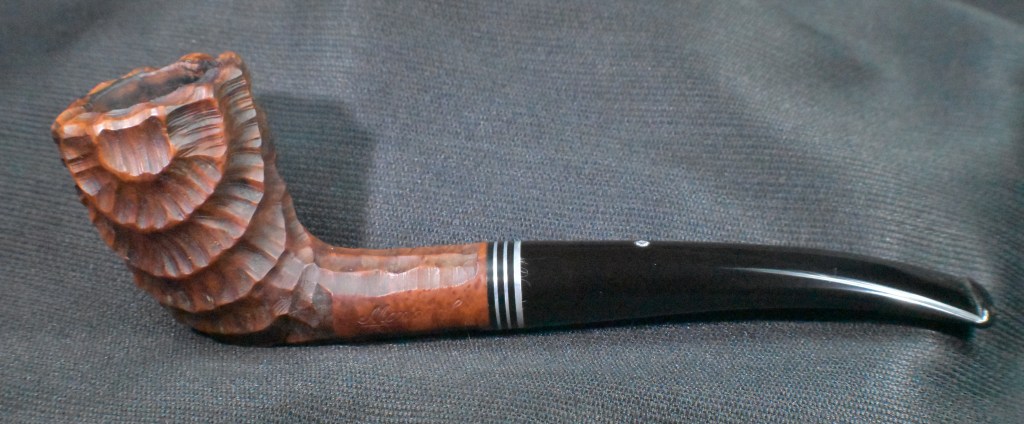
    The next contestant on the program comes to us from Denmark and goes by the name, “Frasorteret”.  This pipe was part of an estate lot that looked interesting from the initial photograph.  I picked it up back in January of this year.

    The pipes upon arrival were even more interesting than the photo indicated.  This will be the second pipe of the lot that I’ve worked on.  The first was the S. Johnson (the long shanked chimney, above) which was a very fun project.  I had done a few Danish pipes this year and this shapely Danish damselle caught my eye.  He pipe was stamped FRASORTERET over HAND MADE over IN over DENMARK over US.  Below are some photographs of the pipe prior to working on her.

    Yikes!  Well first, it seems to need a stem.  The shank spacer or ferrule is quite oxidized so that’ll require some problem solving.  Then there is that monstrous fill on the back left.  The typical reaming and cleaning will be done as well.  Not an easy restoration but it should make for an interesting pipe.

    Background

    I have restored a Frasorteret before but it was long before I started blogging about restorations.  Here are the left and right sides of that pipe:

    I thought I needed to have more than one Freehand pipe and that one struck my fancy.  Here we are 3 or more years later and again I thought I needed to have more Freehand pipes.  With the first Frasorteret I assumed the carved areas were for artistic expression and for great hand feel.  

    I researched Frasorteret first at pipephil.eu and found the following.

    (Fr-Fz — Pipes : Logos & Markings).  Preben Holm was a name that I had heard of though I admit to not being very familiar with his work or history.  The next search on Frasorteret was on pipedia.org.  I found the next sentence interesting because in my mind the Danes didn’t produce lower quality pieces of anything.

    “The Frasorteret line of pipes were made by Preben Holm and were nearly identical to his normal line of pipes but for fills and pits and the like. The pipes were stamped “Frasorteret Made in Denmark.” (Frasorteret – Pipedia)

    Hmm, apparently my preconceived notions about European craftsmanship is as flawed as this briar.  The pipe in hand certainly had “fills and pits and the like.”  Pits the size of Luxemburg.

    I continued with the pipedia.org entry and found the below in the words of Preben Holm himself, I’ll include it in its entirety. 

    “The Story of my Firm

    by Preben Holm

    Already at an early age I became interested in pipes and in pipesmoking. After school I worked as an errand-boy in my father’s shop which was a provision shop with 3 departments, one dealing with pipes and tobacco, one dealing with wine, and another one selling magazines and cigarettes etc. When starting as an errand-boy I was 12-13 years old, and it did not last any length of time before the pipe department roused my curiosity, and it was there I spent my time when there were no goods to be delivered. My father was somewhat mean, and he only paid me a sixth of what I could earn somewhere else, but this, I think, was very sound. On the other hand I earned a lot of good tips, and this money I saved carefully and deposited it in the bank. Though at that time I did not know what I should save the money for it proved to be very important later on, because this became my “initial capital” in the pipetrade.

    Early Preben Holm (Late 1960’s?) Courtesy, Dennis Dreyer Collection

    My father was altogether a very wise man, and one of the things he did, and which I appreciate to-day, was to prohibit the smoking of cigarettes, but on the other hand he did not mind my smoking the pipe already at the age of 13 – 14. When I was 14 years old I got tired of going to school, very much to everybody’s amazement, as it was considered a matter of course that I should study in order to acquire a superior education. However, I was very tired of school, and therefore I asked my father to be allowed to leave the school. No doubt he was rather disappointed, but he did not want to force me into anything, and we agreed that I should begin a commercial training in his business. It was, especially to begin with, a mixed job as some hours each day I still worked as an errand-boy at the same time receiving a good training within the retail trade. Part of that education was that I had to go to a commercial school where I, no doubt, learned things by which I benefited later on.

    The wine department I found very exciting, and I began to read thick books about wine, especially red wine, however, it was still the pipe department in which I was most interested. I was myself a very active pipesmoker, and both the pipes and the tobacco interested me very much, and it was not long before I practically was in charge of the pipe-department. I found that very exciting, and already at the age of 14 I managed the purchase of pipes and tobacco. Most likely I was not always popular with the sellers of pipes who considered me too critical, but I thought that necessary in order to live up to the confidence our customers of pipes gradually placed in me.

    I remember that my father considered me to be a bit crazy when I began to buy tobacco for myself that was three times the price of the common Danish made quality, but I really thought that it was worth the money. Before long I also made my father accept the idea to include a very large selection of the better tobaccos, most of them made in England, into our assortment, and it did not take a long time before we had one of the largest selections in Copenhagen.

    It is not allowed in Denmark to sell tobacco by weight, but I had the idea that the customers should have a chance to see what they were buying. Therefore I wrote a big book describing in it each single brand, attaching a small plastic bag of the tobacco. It was a great success. There also belonged a small repair shop to the pipe department, and very soon I took over the repairs.

    In the meantime I had grown 15 years old, and my interest in pipes increases more and more. During some time an elderly gentleman, who himself made hand-carved pipes, had visited the shop and wanted to sell the pipes. Of course I was very fascinated by him. After I had talked with him a few times he asked me whether I had any money. I had after all my saved tips-money in total 1.400,00kr., and he said that this would be sufficient to buy the necessary machinery so that I could start making my own pipes. He was very helpful with he purchase of machines, and he made also the special tools that were required. I was allowed to mount the machines in a small room in my father’s cellar.

    The room was only 1/2 m2 (13 1/2 square feet), and conditions were thus rather limited. The first Bruyere-blocks I bought from that nice gentleman, and I was now ready to start my own experiments. That was done after working-hours in my father’s shop, and I experimented in my small work-shop until 11:30 p.m. Then I had to finish, because I had to get up and open my father’s shop the next morning. On June 5th, 1963 11 days before my 16th birthday, the moment had come when I sold the first pipes to my father for sale in his shop. I then approached the big pipe shop Pipe-Dan that is situated in the city of Copenhagen, and that sells a lot to the tourists.

    PibeDan.jpg

    Pipe-Dan believed in a chance for the pipes I made, and he was prepared to buy 20 – 30 pipes each week. He was to judge the pipes and fix the prices. Now I became very busy and got some friends to come and help me in the evenings for a reasonable payment. I then taught them the more rough work so I myself got more time to occupy myself with the molding and finishing. In that way a couple of years went by, and one fine day I had finished my commercial education. I was now able to devote myself to the manufacture of pipes all day long as well as during the evenings and weekends. 18 years old I employed my first journeyman, and we made gradually 50 – 60 pipes a week which I continued mainly to sell to Pipe-Dan.

    Then came the time when I had to serve my time as a soldier. I kept my journeyman who in the meantime had become quite skilful, and for the rest I went the long way home from the barracks every time there was an opportunity. I had now got a larger and better work-shop, but that did cost money and, as already mentioned, Pipe-Dan fixed the prices of the pipes, and the tendency was, I suppose, the more pipes we made the lower the prices. One day during my military service I realized that I was unable to keep my journeyman, and therefore had to sack him. That was not very pleasant.

    One day while making the rather traditional hand-carved pipes as we had to in order to come by some money, I took a fancy to make something completely untraditional at that time. From the very beginning I had only worked with the finest Bruyere that could be provided, and on the whole it all had very pretty grain patterns, and that gave me the idea to try something novel. Contrary to what was done so far I started to form some of the pipes according to the grain pattern, and out of this I got some quite particular models. Thus having experimented a little while I had a very smart specimen, at least I thought so. At that time I received about 30,00kr. for a pipe from Pipe-Dan, and I remember that I first went and showed my father this special pipe. He was very impressed, but when I told him that I wanted to go to Pipe-Dan and ask 500,00 kr. for it he seemed not really to believe me. Anyway, I did it. Pipe-Dan studied the pipe and said. “By Jove, it is nice to see something novel”. He paid the 500,00 kr. and told me that I was welcome to make some more of them. However, there was naturally a limited market for pipes at such a price, and it was not long before he could not buy any more of them. Anyway, I continued to make them in addition to the ordinary hand-carved ones. I began also to let the raw bark-top be part of the design.

    Courtesy, Doug Valitchka

    When I was called up for military service I had 18 pieces of these pipes which I was unable to sell. Therefore I left them in my father’s shop. One day when I returned home there was big news. An American, called Lon Schwartz had been calling. Lon Schwartz was making a purchase trip for his retail shop in St. Thomas, the Virgin Islands, USA. When he saw the 18 pipes he was very enthusiastic about them and bought them on the spot, placing at the same time orders for everything I could make against being entrusted with the monopoly in the entire U.S.A. When my military service came to an end there was a lot to do. I could now afford to engage a journeyman, and very soon another one, and gradually we established quite a nice production.

    I then got the idea that it would be fun to see where all the pipes were sold, and therefore I decided to travel to St. Thomas. St.Thomas is indeed a tourist island, visited by tourists from all over America, and it was these tourists who bought my pipes in Lon Schwartz’ shop. During my first visit I stayed in the shop for 2-3 weeks and had ample opportunities of talking with pipe-smokers from everywhere in America. That really gave me a lot of impulse. Then I returned home and continued working with the new inspiration. That was repeated 3 times within the first year’s cooperation with Lon. I could simply not have had any better starting point, because the taste changes quite a lot from one place in the U.S.A. to another, but here came, as mentioned, pipe-smokers from all the States. It was wonderful to feel how something one oneself enjoyed making really was accepted.” (Holm, Preben – Pipedia)

    The Restoration

    The poor stemless stummel made its way to the workbench and a cleaned denim piece.

    The reaming tools were gathered.

    PipeNet blades #2 and #3 did most of the work with the General triangular scraper just doing a bit of clean-up.

    The reamed tobacco chamber looked good but sanding would tell the tale better.

    The sanding of the chamber showed briar in great condition and no signs of heat damage.  

    The shank cleaning was done with bristle pipe cleaners, cotton swabs and a nylon shank brush.  All of these were frequently dipped in 95% ethyl alcohol.  There was some scraping done with a dental scraper but due to the narrow draft hole this was rather ineffective.

    Once the shank was cleaned I took the stummel to the sink for a scrubbing with undiluted Murphys Oil Soap and a brass brush.  The soap was rinsed with warm water and the stummel dried with a cotton hand towel.

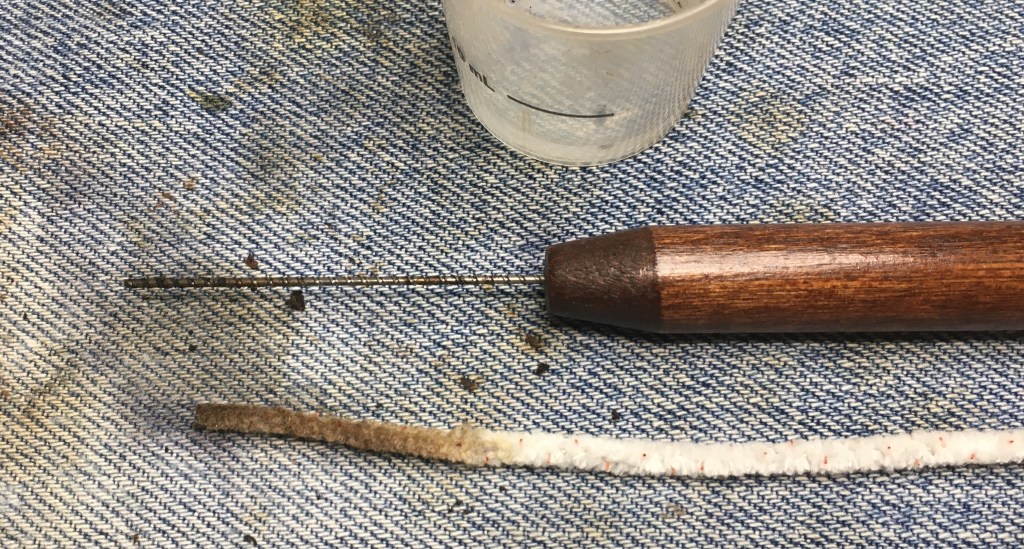
    The large fill, yeah I said LARGE, har the old fill material picked out with a fly tying bodkin.  This was the largest fill I think I had ever seen.  What to do about it filled my head.

    I thought about my other Frasorteret and the quote from pipedia.org, “but for fills and pits and the like.” (Frasorteret – Pipedia).  

    I wondered if those carvings were not just there for artistic expression but instead, there to remove flawed briar.  I thought that I could carve away the pit, smoothing the briar to make an artistic smooth thumb hold on this pipe.

    I got out a carving bit and equipped it onto the Dremel rotary tool.

    I have a whole set of the carving bits and had only used one or two of them.

    I carved and smoothed the flawed briar expanding the carving and removing the jagged edges of the pit.  I did expose more pits as I went.  You can see two more dark spots in the photo below, one high right and the other low left.

    I tried to make the carving feel good for my thumb.

    I feared that I had removed too much material but I had tried to only remove the pitted briar.

    The carfing was then smoothed with sanding sponges.  The shank extension was sanded during this time as well.  I did not think that I could not use either the Before and After Extra Strength Deoxidizer or the Briarville Pipe Stem Oxidation Remover on the vulcanite shank extension without staining the briar of the shank.  Instead I wrapped the shank briar with masking tape and sanded the vulcanite with a series of sanding sponges from 320-3500 grits.  Between each sponge the briar was wiped with an alcohol wetted make-up pad and the vulcanite was rubbed with mineral oil and wiped with a paper towel.

    I measured the mortise diameter with a micrometer.

    Looking through my stock of potential replacement stems I came across one that looked about right for this pipe.  The tenon was slightly larger than the mortise.

    I sanded with an emery board and sanding sponges to reduce the tenon diameter.

    Below you can see how the new stem looked once the tenon was fitted to the Frasorteret.

    After the shank extension was sanded and the stem fitted, I took the stummel to the buffer for a polish with rouge compound.

    The vulcanite looked pretty darn good.  I proceeded to give it a couple of coats of carnauba wax while I was at the buffer.

    I also waxed the new stem after giving it a light buff.

    The stummel received a liberal coating of Before and After Restoration Balm applied with a baby tooth brush.  The briar was allowed to sit, soaking in the goodness of the balm, for 30 minutes.

    An athletic sock, inside out, was used to remove and hand buff the excess Restoration Balm from the stummel.

    The pipe was in the home stretch and really looked good.

    I opted to go with Renaissance Micro-Crystalline Wax as the final coating for the briar as the rustications were a bit too deep for carnauba waxing.  The Renaissance wax was applied with a cleaned baby toothbrush.

    The stummel was hand buffed with a soft cotton cloth.  The waxing and hand buffing was repeated for a second coat..

    I decided to go with a bowl coating for no reason other than aesthetics and to make my fingers sticky.  I used 100% pure maple syrup to lightly coat the tobacco chamber.  

    A capsule of activated charcoal was opened and dumped into the chamber.

    I covered the opening to the chamber with painters tape and plugged the draft hole with a pipe cleaner.

    The stummel was then shaken vigorously, rotated and tapped with a wood block several times to evenly disperse the charcoal powder.  The tape was removed and the excess charcoal dumped.  I removed the pipe cleaner and gave the mouthpiece a hard blow to clear any remaining loose dust.

    The final step was a hand buffing with a microfiber polishing cloth further improving the shine.

    This Frasorteret freehand is a beautiful pipe for both the eyes and the hand.  Well left hand, anyway.  For those who hold a pipe with their right hand while smoking, sorry.  The pipe is both too heavy and too long to be a comfortable chencher.  Overall I am pleased with how my attempt to mask the heavily pitted surface turned out.  I’ll be the first to admit that I do not like thin walled pipes and I did have to thin the wall significantly to remove the enormous pit present.  The replacement stem looks like it was meant for this pipe and it matched the existing vulcanite shank extension very well.  Overall I am happy with how this one turned out especially for my first try at carving like this.  The dimensions of the Frasorteret Freehand are:

    Length:  7.15 in./ 181.61 mm.

    Weight:  2.53 oz./ 71.73 g.

    Bowl Height: 2.17 in./  55.12 mm.

    Chamber Depth: 1.95 in./ 49.53 mm.

    Chamber Diameter:  0.89 in./ 22.61 mm. 

    Outside Diameter:  2.22 in./ 56.39 mm.

    I do hope that you have found something here useful to your own pipe care, maintenance or restorations.  If you like this sort of thing, please click the like and subscribe buttons.  Thank you for reading the ramblings of an old pipe lover. 

    Loading…

    Below are some photos of the finished Frasorteret Freehand.

  • An Irish Seconds Oom Paul (Peterson 02) Restoration

    May 22nd, 2025

    Photographed and written by

    John M. Young

    I think this totally counts as a Peterson.  Given the poor darling didn’t make the quality assurance cut to the “big leagues” but the 02 shape is more of a rarity for Pete Geeks.  I remember three years ago when I started to get more serious about restoring old pipes, that you could pick up a Peterson System Standard on the estate market for around $45.  Over the past few years this has increased significantly.  Perhaps another indicator of inflation or maybe just a growing interest in our beloved hobby.  When I saw this pipe on eBay, I knew I had to try for it.  I was surprised that I won the auction and soon had the Irish Lassie in hand.  Below are a few photos or the pipe prior to any work done.

    From what I could see the issues with this pipe’s briar were only cosmetic and would be dealt with accordingly.  The pipe looked like it had only been smoked a few times.  I think I could imagine why that button was horrible.  It felt thick and chunky, like something made of Legos.  Clenching that would be like getting X-rays at the dentist.  

    Background

    I cannot begin to describe the history nor impact of the Peterson pipe company.  I can tell you what I think is the best source of information on the subjects and that is Mark Irwin and Gary Malmberg’s book,  The Peterson Pipe The Story of Kapp & Peterson.  According to the authors,Peterson’s seconds are as follows,

    “Seconds Peterson seconds are pipes of all shapes with briar flaws deemed unacceptable for ordinary models and sold at reduced prices, sometimes unstained, fit with fishtail or round button mouthpieces.  Since the early 1990s they have only been available in Ireland.  Occasionally they are described in Peterson catalogs under different names, and documented specimens have various stampings.  In roughly chronological order these include:

    Stamped arched KAPP & over straight PETERSON”S over arched DUMMIES An early specimen preserved at the Peterson museum with this stamp has a round-button mouthpiece.

    IRISH FREE STATE stamp (1922-37) COM stamp with no brand or model name.  Documented with or without nickel bands.

     System Reject (1968-)  Noted first in the Price List for January 1968 as being available in all six system shapes.  Also found in the ‘80 Peterson-Glass Price List.

    Erica System Reject (1987-98)Noted in two US distributor catalogs.  Fishtail mouthpiece, unstamped nickel band, with COM of MADE IN THE over REP. IRELAND or with no COM.

    Irish Seconds (1982-98)  Classic Range shapes stamped with no brand name , fishtail mouthpiece, in unstained, black rustic or dark brown finishes, no band.  (Irwin, Mark and Malmberg, Gary (2018). The Peterson Pipe The Story of Kapp & Peterson, First edition, second printing 2021. Briar Books Press, Canada. p312).

    Mark also writes a weekly blog titled Peterson Pipe Notes.  If you have not already subscribed I highly recommend it.  It will be one of the best $0 purchases you can make and is a vault of information on all things Peterson and various other topics.  I am not just saying that because Mark has posted a few of my restorations either.  His blog concerning the Irish Seconds is very well researched,  written and can be found here:  https://petersonpipenotes.org/tag/irish-seconds/.

    Now for the Oom Paul shape.  Here I’ll let Mark sing the praises of the history of the shape and the Peterson pipes of note:

    Oom Paul (https://petersonpipenotes.org/tag/peterson-oom-paul/)

    So, when was this particular Peterson Oon Paul made?  I really didn’t know.  The 1976 catalog mention might be useful but it precedes the use of the IRISH SECONDS stamp by 16 years.  I reached out to Mark Irwin and provided him with photos.  Here is what he had to say,  “This appears to me to be the 1988 Dublin Millennium edition. That would fit with the IRISH SECONDS stamp and the shank bend. The IS would have been sold in Ireland, almost entirely, but perhaps some escaped their island prison. We can confirm that with a quick measurement of the chamber diameter and the bowl diameter if you like, but I’m 99% positive.” (Mark Irwin, personal email).  I replied to Mark by sending him the dimensions.  His reply to those was, “That’s it!”  This concltudes the search, in my book.  THis is a 1988 Dublin Millennium edition Peterson 02 that didn’t meet the quality standards of Peterson and was thus labeled an Irish Seconds by the good folks in Dublin Ireland.

    The Restoration

    The restoration began with a clean denim piece for workbench protection.

    Augh, the terrible button would be the first issue addressed with this pipe.

    Apparently the previous owner tried to customize the button using their teeth and jaw power.

    Impressive as their chomping was, I thought a file would be a better tool than my teeth.

    I used large and small flat files to reduce the size of the button and soften the edges.

    Below are photos of the top and bottom after filing.

    An emery board, for filing fingernails was also used for more final shaping.

    The shank was then taped using panthers tape to protect it from the stem sanding.  The stem was initially sanded with a 320 grit sanding sponge.

    Airway cleaning was done with bristle pipe cleaners dipped in 95% ethyl alcohol.

    The stemm was then placed in Briarville Pipe Stem Oxidation Remover (deox) and allowed to sit overnight.

    I turned my attention to reaming the stummel.  I gathered the ream team:  PipNet with #2 blades, General triangular scraper (with the tip ground round) and the Smokingpipes Low Country reaming knife.

    This pipe had not been heavily smoked so the reaming was quickly handled.

    Below is a photo of the reamed tobacco chamber.

    The chamber was sanded with 320 sandpaper wrapped around a wood dowel.  The sanded chamber showed no signs of any damage from heat save the small charred spot on the rim.

    A better view of the sanded tobacco chamber can be seen below.

    The stummel was taken to the sink for a scrub with undiluted Murphy Oil Soap and a nylon brush.  The soap was rinsed with warm water and the stummel dried with a cotton hand towel.

    I believe this to below photo best describes why this pipe was considered to be an Irish Seconds, the number of flaws leading to fills in the briar.  I counted 11 on the left side alone.  The old fill was picked from the briar using a fly tying bodkin.

    The front only had two spots to pick then fill.

    The right side with its birdseyes also had a couple of spots.

    The rim had fills and a couple of cosmetic cracks.  These were not deep structural cracks.

    I used brown cyanoacrylate (CA, super glue) placed into the pits.  I then pressed briar dust into the wet CA.  This new fill sets up quickly.   The excess briar dust was brushed off using a wire brush.

    The same process was used on the other fills.

    Once cured the new fills were filed with a small flat file to smooth them.

    This was repeated on each side.

    The fills of the cosmetic cracks on the rim were done with brown CA alone, no briar dust though, briar dust was used in filing the pits.  The entire stummel was then lightly sanded with 320 and 400 grit sanding sponges taking care to avoid the stamps on either side of the shank.

    The next day I removed the stem from the Briarville deox.

    The Briarville solution evaporates quickly.  While still wet I vigorously rubbed the stummel with a coarse shop rag to remove some of the softened oxidized vulcanite.

    Back at the workbench the oxidized vulcanite was easily seen as a buff colored coating on the stem.

    The stem also showed another aspect of Irish Seconds that I’ve not seen in Peterson pipes, poor finish sanding of a stem.  I could still see the marks from the molding of the stem.

    The fit of the stem to shank was very good with a fine tight fit and no gaps.

    I again taped the shank, this time with masking tape.  Masking tape is thinner and is less likely to produce a step from the stem to the shank.

    The stem was sanded using a series of sanding sponges from 320-3500.  Between each sponge the stem was rubbed with mineral oil and wiped with a paper towel.

    I masked the stampings on both sides of the shank with masking tape.

    The stummel was then sanded with a series of sanding sponges from 32-3500.  Between each sponge the stummel was wiped with a make-up pad wetted with alcohol to remove sanding debris.

    The tasking tape was removed and the adhesive wiped clean with alcohol.  The pipe was then worked with micro-mesh pads 4000-12000.  Again the stummel was wiped with an alcoholic make-up pad (I think that’s funny).

    The stem was rubbed with Obsidian Oil and wiped with a paper towel between micro-mesh pads.

    I coated the stummel with Before and After Restoration Balm and allowed it to do what it does for 20 minutes.  The excess balm was wiped from the stummel using an inside out athletic sock.

    The pipe was then taken to the buffer where it received several coats of carnauba wax.

    The final step was a hand buffing with a microfiber polishing cloth further deepening the shine.

    This not so typical Peterson shape, I mean, Irish Second, turned out very nicely.  The fills are far less noticeable and the stem far more comfortable than when I started.  Weight of the pipe is inconsequential hanging from the lower jaw and it would be an exceptional clencher.  I was very happy with how well the stem turned out.  The high gloss black looks outstanding with the more natural Briar and the briar grain, though not fantastic, is quite lovely.  This old pipe may never win a beauty contest but it will serve very well as a useful pipe in someone’s rotation.  The dimensions of the Irish Seconds Oom Paul are:

    Length:  6.00 in./ 152.40 mm.

    Weight:  2.39 oz./ 67.76 g.

    Bowl Height: 2.25 in./  57.15 mm.

    Chamber Depth: 1.95 in./ 49.53 mm.

    Chamber Diameter:  0.74 in./ 18.80 mm. 

    Outside Diameter:  1.38 in./ 35.05 mm.

    I do hope that you have found something here useful to your own pipe care, maintenance or restorations.  If you like this sort of thing, please click the like and subscribe buttons.  Thank you for reading the ramblings of an old pipe lover. 

    Loading…

    Below are some photos of the finished Irish Seconds Oom Paul.

  • A Carved Monarch -20 Restoration

    May 20th, 2025

    Photographed and written by

    John M. Young

    I have issues with impulse control.  Like this one time at eBay camp…  I do hope you had a vivid mental image of Allison Hannigan, and not me, flash into your mind.  Anyway, I saw this very uniquely carved pipe which I think I can call a cutty shape.  The pipe was made by Monarch and she demanded that I buy it, she being the pipe, not Allison Hannigan.  After the obligatory waiting for its arrival, I was able to hold the charismatic carved creature.  It was better than it looked in the photos.  The pipe was stamped Monarch over PAT. 19 ilegible on the left shank and -20 on the right.  The below photos are of the Monarch prior to working on the pipe.

    The pipe had either been well cared for or cleaned up a little for the sale.  The button area had a few tooth marks and the stem was oxidized.  The strange mortise and tenon showed signs of use but was free to screw and unscrew while providing excellent alignment when screwed tight.  Overall this looked like an “easy mode” restoration.

    Background

    I first went to piedia.org for anything on Monarch.  I was surprised to find the following:

    “Monarch Pipe Co. was established in Hartford Con, most likely in the late 1930 by Fred Warnke, who obtained a patent on the system pipe on January 22 1935. The company moved to Tulsa Oklahoma at some point in the 1950s, after which Monarch Pipe Co was moved to Bristow, Oklahoma. The Monarch Pipe Co. also makes E.A.Carey Magic Inch and Duncan Hill Aerosphere Pipes.” (Monarch – Pipedia).  I said, “surprised” because there have been many lots of estate pipes where I see one pipe that jumps out at me which just looks cooler than the others.  Frequently this cool pipe is an E.A. Carey.  I cannot explain why but it’s true.  This pipe certainly lives up to that experience, it is cool looking.  The other surprise was patent information.

    (Monarch – Pipedia)

    I continued to Google Patent Search with the patent number from the pipedia.org site to find the original patent information rather than only the diagram.  Here I was able to obtain the full patent document (for those who are interested).  I will include only the diagram below.

    (US1989069A – Smoking pipe or holder – Google PatentsUS1989069A – Smoking pipe or holder – Google Patents) 

    That certainly was exactly what this pipe had internally.  I did not realize that the tenon section could be unscrewed.  I later tried to disassemble the aluminum internals.  The contraption reminded me of a Millard pipe restoration I had done previously.  In essence the smoke leaves the tobacco chamber and enters a small chamber in the stem.  This cooling chamber, within the stem, is aluminum lined and has a small aluminum lined passage to the top of the stem.  This passage allows a small amount of fresh air into the chamber.  The idea being that the cool fresh air cools the smoke and allows moisture to condense.  This condensing moisture traps tars and nicotine from the smoke and all that precipitates out of the smoke and is deposited in the stem.  The smoke then passes through another aluminum tube in the stem’s airway that leads to the smoker’s mouth.  The trapped moisture cannot get to the mouth because the second tube is centered in the airway above where the precipitates would accumulate.  I have to admit that the concept is good and scientifically reasoned.  However, the small size of the cooling chamber within the stem seems to me far too small to make a very significant impact.  Were it larger, as with a reverse calabash pipe where the cooling chamber is approximately the same size as the tobacco chamber then, I could imagine it working.  All that said, I have yet to try the pipe and should probably shut-up until I have experienced the wonders of the Monarch system.

    The next stop was to pipephil.eu for additional information.  Here I found the following:

    (Rings — Pipes : Logos & Markings).  Another little surprise, an English and a French connection.  The stem in the photo was identical to the Monarch pipe in hand as was the stamp style.  The only difference was that the pipephil.eu version must have been an older pipe from before the patent was granted as it read “PAT. PEND.”.  I quickly discounted the English and French information as irrelevant to this brand.

    So, where does this all lead?  I think this pipe was made between 1935-early 1940s.  I say that because during World War 2 the government was controlling aluminum usage very strictly.  This pipe with its highly engineered aluminum and the technically skilled craftsmen needed would most likely not have been available to craft it during the war years.  A second piece of information is the inclusion of small metal specks in the

    vulcanite.  These indicate the use of used tires as source material for vulcanite production – also frequently seen in war era pipes. 

    The Restoration 

    Things started as usual with a cleaned piece of denim on the work surface.

    I decided to work on the stem right away.  The first step was to file the most severe tooth dents and reestablish a sharper edge to the button.

    Filing of the top tooth dents proceeded.  The button would require rebuilding with cyanoacrylate (CA, super glue).

    Then the bottom of the stem was filed.

    I wrapped the shank with masking tape to protect it from sanding.  I sanded the stem with a 320 sanding sponge to remove the outer hard layer of oxidation and any wax build-up present.

    The internals of the stem was that cooling chamber. Previous experience with systems like this led me to surmise this would be tough to clean.  I started with cotton swabs dipped in 95% ethyl alcohol.these worked well for the threads and up to the inner aluminum tube.  They were too thick to get between the tube and the side walls.  I was able to get a folded bristle pipe cleaner in the space.

    The fresh air passage was completely closed off.  I found a small metal piece, the handle of a fly tying bobbin threader fit perfectly.

    Below you can see the bobbin threader in front of the aluminum draft tube.

    The spaces between the draft tube and the side walls were full of more gunk than I thought possible.  There were flecks of tobacco and dried tars and smoking residue.  This all eventually was cleared away.

    This is the main downside of a system like this.  The volume of the cooling chamber is too small to allow for effective cleaning between smokes.  Perhaps if each pipe came with a chemical wash bottle like the photo below and instructions to thoroughly rinse the chamber between smokes this would be remedied.

    (Corning wide mouth wash bottle, reusable capacity 250 mL, low-density polyethylene (LDPE), with GL-45 PP screw cap laboratory wash bottles)

    The stem was clean inside and out.  Now it was time for the Briarville Pipe Stem Oxidation Remover.  A pipe cleaner was inserted into the stem to act as a handle for easy removal from the bath.  

    I figured that I’d leave the stem in the solution overnight and continue in the morning.

    Next I gathered the reaming tools.

    The PipNNet with #2 and #3 blades did most of the work.  The General triangular scraper did a bit of clean-up where the tapered bore was missed by the PipNet blades.

    Below is a photo of the reamed tobacco chamber.

    The chamber was then sanded with 320 sandpaper wrapped around a wood dowel.  This took the chamber to bare briar and exposed no heat damage or charring.

    I cleaned the aluminum of the tenon with cotton swabs and a brass brush both dipped in 95% ethyl alcohol.  The fly tying bodkin was used to get into the corners and scrape yuck.

    The draft hole was remarkably clean, only requiring a couple of passes with alcohol dipped bristle pipe cleaners.  Those aluminum tubes are great for that.

    The stemmel was then scrubbed with Murphy Oil Soap, undiluted, and both nylon and brass brushed.  The brass was mainly used on the rim.  The Murphy Oil Soap was rinsed with warm water.  It was at this point that I noticed something odd, the depressions of the carvings were white.  I figured that it was an accumulation of wax that had settled in the depressions.  I ran the water at full “hot” and scrubbed the stummel with the nylon brush.  My hands protested.  After that there remained a bit of white in the depressions.

    I wasn’t able to capture the “white” with a photo.  It disappeared as the stummel cooled and dried.  I returned to the workbench and scrubbed the stummel with 95% ethyl alcohol and the nylon brush.  I did this several times until I felt confident that the wax deposits were gone.

    The rim looked much better.

    I applied a liberal coating of Before and After Restoration Balm to the stummel with a baby tooth brush and let it sit overnight.

    The next morning I retrieved the stem from the Briarville solution.

    After a vigorous rubbing with a coarse shop rag a little bit of the oxidation stayed on the rag and not the stem.

    The solution dried and I could see light brown residue which would have to be sanded off.I went back to cleaning the inner cooling chamber with folded pipe cleaners and cotton swabs dipped in alcohol.  They picked up either a little more old smoking residue of some of the Briarville solution with old oxidized vulcanite.

    I wiped the remaining Before and After Restoration Balm from the stummel using an inside out athletic sock and a good deal of elbow grease.

    The stummel looked great.  I wrapped the shank again with masking tape.

    The button repair would be made before the sanding.  The top is shown below.

    And the bottom.  Both sides needed additional material layered on the button proper as well as fills in the tooth dents.

    I used a black rubberized CA for both the building up and the dent filling.  Below is the building up of the top button.

    After getting a nice even layer, I spritzed the wet CA with a CA drying accelerator.

    This was repeated with the button on the bottom side.

    The dents received a small drop of CA also, the next two photos are of the top and bottom.

    These drops were also spritzed with a drying accelerator.

    The button sides were reshaped using the file.  The CA was filed smooth and sanded with a 320 sanding sponge.  

    The entire stem was then sanded with a series of sanding sponges from 320 grit through 3500 grit.  Between each sponge I rubbed the stem with mineral oil and wiped it with a paper towel to remove sanding debris.

    The stem was then micro-meshed with pads 4000-12000.  Between pads I rubbed the stem with Obsidian Oil and wiped it with a paper towel.

    I buffed the stem with blue compound on the dedicated blue compound wheel.

    The stem received several coats of carnauba wax applied with the buffer.

    The carvings of the stummel were too deep and coarse to use carnauba wax so Renaissance Micro-crystalline Wax was used.  

    This was worked into the stummel with a baby toothbrush.

    The stummel was then hand buffed with a soft cotton cloth.

    The final step was a hand buffing with a microfiber polishing cloth further deepening the shine.

    I can’t say that this Monarch is named for being an absolute ruler or a  butterfly.  I can say that it absolutely rules the playground as a great looking pipe.  The carvings add to the graceful shape and do give it an almost butterfly wing look.  The stem turned out wonderfully even with the old recycled metal inclusions.  I still have not smoked the pipe to see if the chamber and fresh air intake actually work.  I have my doubts and have tested many of the war time inventions and have been quite unimpressed.  Though the gimmicks probably sold a lot of pipes, it seems to me that the only “new ideas” that have stood the test of time have been the Peterson System, Medico’s filters, the E.A, Carey Magic Inch and Brigham Rock Maple inserts.  At least those are the only ones that come to mind.  The dimensions of the Monarch -20 are:

    Length:  6.12 in./ 155.45 mm.

    Weight:  1.19 oz./ 33.74 g.

    Bowl Height: 1.94 in./  49.28 mm.

    Chamber Depth: 1.73 in./ 43.94 mm.

    Chamber Diameter:  0.78 in./ 19.81 mm. 

    Outside Diameter:  1.36 in./ 34.54 mm.

    I do hope that you have found something here useful to your own pipe care, maintenance or restorations.  If you like this sort of thing, please click the like and subscribe buttons.  Thank you for reading the ramblings of an old pipe lover. 

    Loading…

    Below are some photos of the finished Monarch -20.

  • A Custom-Bilt Taper Stem Restoration

    May 15th, 2025

    Photographed and written by

    John M. Young

    Well here I go again on another Custom-Bilt crusade.  I’m  not sure why the Custom-Bilt pipes have such a following.  They are good smoking pipes and are uniquely carved but there has to be more to it than just that.  There were numerous pipes made during and after World War Two which are arguably better made with better quality materials.  Perhaps it is in part due to the writing of William E. Unger, Jr., Ph.D.  His well written book, “Individual as a Thumbprint” The Custom Built Pipe Story is very well researched and provides a great deal of information about the maker, Tracy Mincer  and the company Custom-Bilt.  Perhaps it is this personal history which draws collectors to the pipes setting them apart from other impersonal brands of factory made pipes.  For whatever reason, I was drawn to this Listing.  The fact that I won the auction for less than $12 had nothing to

    do with it…  Okay, that is a load of bologna sausage (BS), I’m admittedly a tightwad.  I had purchased from this seller previously and was quite happy with this purchase.  The pipe made its way from Kentville, Nova Scotia to the wilds of southeast Nebraska and into my hot little hands.  Below are some photos of the pipe before any work was done.

    The stummel looked to be in good condition.  The stem was the issue and was probably what caused the bidding to be favorable to my bidding.  It was severely oxidized and had a large hole in the button.  I remained hopeful that I could repair the stem or fit a suitable replacement. Either way this old pipe was not destined for the dustbin, it would live for another generation of pipe tobacco lovers. 

    Background

    Being a proud member of Generation X and prone to the slackard description that accompanies my generation, I will include the background from a previous Custom-Bilt restoration.  You can find that one here.  

    “The standard starting point for researching a pipe typically includes pipedia.org.  The query of Tracy Mincer, originator of Custom-Bilt, will take you to this brief entry:

    “Tracy Mincer started the original Custom-Bilt pipe company in 1934. In 1946, the name was changed to Custombilt after Mincer began an association with Eugene J. Rich, Inc. There were some big changes in advertising and distribution. The slogan “AS INDIVIDUAL AS A THUMBPRINT” began at this time as well.

    In the early 1950’s, Tracy Mincer developed severe financial problems that caused him to stop making the Custombilt, and he lost the name. n 1952, Mincer began a new pipe, The Doodler, that due to the holes in the bowl had to made primarily in a billiard type shape in three sizes. In the early 1950s, National Briar was turning the bowls for Mincer. Based upon the documentation, it appears that Mincer made the pipe until the mid 1960s, when National Briar Pipe Co., Inc. began making and selling the Doodler.

    Mincer died in 1964. Based upon the information provided, Mincer seemed to always have money, production, distribution and other problems. Mincer was probably a terrific craftsman but a very poor businessman and administrator. To me, Mincer sounds like your typical small business entrepreneur who always knew what was right and if you disagreed¼problems. Mincer always seemed to be on the brink of going out of business, not meeting payroll and so on.

    Claude Stuart purchased the Tracy Mincer Pipe Company and began making pipes using the Tracy Mincer stamp. Stuart finished nearly all the pipes produced, mostly carved and textured bowls and the occasional straight grain. Claude made the Tracy Mincer Pipe Company a moderate success. Stuart became ill and in 1990 The Tracey Mincer Pipe Company went out of business. Currently, Jim Tedesco owns the Tracy Mincer name.

    These interesting examples bellow are pipes made with the Tracy Mincer stamp. If you any additional information about these pipes, or can otherwise add to the history of this interesting pipe man, please add it here, or send it to sethile.pipes@gmail.com, and we can add it for you.” (Mincer – Pipedia).  

    There is a book written by William E. Unger, Jr.,Ph.D titled “As Individual As A Thumbprint”: The Custom-Bilt Pipe Story.  This book appears to be self published by Dr. Unger at The Graphic Touch, of Columbus, Ohio.  Printed in 2001 and bound with a black plastic spiral, the book states that the entire contents are “All rights reserved…without permission in writing from the author”.  Dr. Unger passed away January 1, 2013 (obituary:  https://www.legacy.com/us/obituaries/dispatch/name/william-unger-obituary?id=12197453) and the book is no longer in print.  This unfortunately means that I will not be including any quotes from the book.  We’ll see how I get around that, I guess.   I got lucky and purchased a copy from eBay for under $30 (with shipping) earlier this year, after watching several copies sell for what I considered astronomical prices.  The book is a remarkable piece of work and is the definitive history of the Custom-Bilt pipe.  The research that Dr. Unger put into getting the story correct is amazing.  Fortunately there were several past employees, friends and relatives associated with Tracy Miller and the company that were able to give interviews and explanations to the inner workings of the company.

    In regards to the stamps on the pipe in hand, I will speak to what I have found in Unger’s book, without quoting any of it.  The first thing that needs clarification is the Custom-Bilt vs. Custombilt name.  I’ll paraphrase William Unger here, the first stamps used by Tracy Mincer were “Custom-Bilt”.  These were used from 1938-1946 definitively and less definitively prior to 1938.  You could, perhaps, find reference to this in the book on page 91.  There, I think that should give me legitimacy and keep any lawyers at bay.  Next we examine the IMPORTED BRIAR stamp on the bottom of the pipe.  Unger states that he has inspected a large number of Custom-bilt pipes and that about ½ of them do not have this stamp.  He declares that he is at a loss to explain either their absence or presence  This lack of explanation might be seen towards the bottom of page 114.  The final stamp on this Custom-Bilt is the geometric circle stamped on the shank.  Certainly these stamps have some utilitarian meaning.  Nope.  Unger declares that he is not able to explain any system where shapes such as circles, triangles, stars, rectangles, half moons or even trapezoids have any systematic meaning.  This may or may not be seen on the top of page 114. 

    Pipephil.eu does allow quotations with proper referencing and shows nice examples of the above-mentioned geometric stamps.

    (Cos-Cz — Pipes : Logos & Markings)” (Young, John M.. https://scimansays1787.com/2025/01/02/a-custom-bilt-circle-stamped-restoration/)

    Regarding the specific pipe of this restoration, I believe it to be one of the Custom-Bilts made between 1938-46 due to the “Custom-Bilt” stamping.  I cannot discern any IMPORTED BRIAR stamp nor any geometric shape.  

    The Restoration

    As usual the pipe went from the photo table to the workbench and received a clean denim piece.

    The stem was the place where I decided to start.  Mainly because it was the part that would need the most work.  The stem was cleaned with bristle pipe cleaners dipped in 95% ethyl alcohol.

    The stem was lightly sanded with a 320 grit sanding sponge.

    Next, the stem was submerged inBriarville’s Pipe Stem Oxidation Remover.  This would be a real test for the relatively new-to-me solution.

    I placed a pipe cleaner in the tenon for easy removal.

    I left the stem in the Briarville oxidation remover overnight.  The next day the stem was removed.

    A vigorous rubbing with a coarse shop rag removed some of the oxidized vulcanite and can be seen on the rag below.

    Back at the workbench the stem looked far better.

    I wanted the stem and stummel intact during sanding to keep the joint where the two pieces met nice and unrounded.  To do this I wrapped the shank with painters tape.

    In the photo below you can see where I wiped the sanding debris from the sponge onto the denim.  Notice the color difference.  The lighter colored debris was from the stem before the Briarville solution whereas the darker debris on the sponge is from after the solution.

    I sanded the button zone with the 320 grit sponge.  This was to roughen the stem for better adhesion of the epoxy and cyanoacrylate (CA) that I planned to use to rebuild the button.

    Below is a photo of my idea:  I wanted to use the slot cutting bit with a Dremel rotary tool to cut a slot into the button.  I would then cut a piece of 2 mm brass rod/pin to span the broken piece of the stem.  This pin would be held in place by black epoxy resin.  The epoxy would also be used to fill in the void.

    Below is a slightly different view of the dremel bit.

    Below is how I imagined the placement of the pin in regards to the button.

    I used the Dremel to cut a groove in the button.

    The same cut from the side.

    The pin was cut with pliers and the ends of the pin were filed to a taper.  This pin was set into the groove.

    Below a view of the button from the front with the pin in place.  Sorry about the poor focus.

    JB Weld was the black epoxy that I used because that was the product I had on hand.

    To keep the epoxy only in the areas where I wanted it, I used a “dam”..  This dam was a piece of plastic lid cut to fit the stem.  The dam was coated with petroleum jelly to keep the epoxy from adhering to it.  I laid a bead of epoxy in the groove and placed the pin into the epoxy.  Additional epoxy was added to the top of the pin and to the hole.  The dam provided a floor for the epoxy to rest on.  The JB Weld sets up within 15 minutes so I was able to allow it to firm up and then add additional epoxy before the whole mix became unworkable.

    Below you can see the rebuild button on new epoxy, the filled hole and the incorporated pin.

    After about 30 minutes I removed the dam.  

    The pin was completely encased in epoxy.  My idea was that this would provide the rigidity needed to withstand a significant bite while retaining the correct shape.  

    The epoxy had solidified enough to hold its shape yet was soft enough to allow me to cut the excess off with a sharp knife.

    I allowed the epoxy to sit and harden for 24 hours.  I know the packaging says an hour but I wanted it hard enough to sand and work with a file.

    The top and bottom were filed.  I applied black CA to the top of the epoxy patch in an attempt to blend the repair better to the original stem and to build-up the button.  Once cured this was again filed and sanded smooth.

    Below you can see the scar from the repair during the sanding.

    Here is a view of the slot.  I used a Vermont Freehand slot tool (https://vermontfreehand.com/product/slot-funneling-tools/) to smooth the stem’s airway and sanded the airway.

    The stem was sanded with a series of sanding sponges from grits 320-3500.   Between each sponge I rubbed Obsidian Oil onto the stem and wiped it with a paper towel.

    Once sanded I took the stem to the buffer and worked it with rouge compound on the rouge wheel.

    I repeated the buffing using white buffing compound on the dedicated white wheel.

    The stem looked good in the sunlight.

    This was now two days into the restoration.  Far more than usual and I still had not started work on the stummel.  I gathered the reaming kit.

    The tobacco chamber was surprisingly well kept.  The PipNet’s #2 and #3 blades removed the majority of the cake only requiring a little bit of clean-up scraping with the General triangular scraper.

    The airway on the shank was far less well kept.  I swear the camera didn’t even want to witness the tar deposits.  Okay, I did a crappy job photographing it but you can see the amount of scraping and the yuck that was removed.

    The shank was nowhere near finished and I decided to switch gears and maybe soften things up with warm water.  The Exterior of the stummel was about as dirty as the airway.  I scrubbed the stummel with undiluted Murphy Oil Soap and a brash brush.

    The soap was rinsed with warm water and the stummel dried with a cotton hand towel.  The stummel still looked dirty, especially in the grooves.  I repeated the Murphy Oil Soap scrub 2 more times with a nylon brush.

    Back at the workbench I scrubbed the stummel again using the nylon brush and 95% ethyl alcohol then wiped the stummel with a make-up pad and more alcohol.

    Okay, back to the airway.  I wanted to see if a cotton-alcohol treatment would help dissolve some of the tar in the airway.  The bowl and shank were packed with cotton.

    About 10 ml of 95% ethyl alcohol was added to the cotton with a disposable pipette.  The cotton was saturated with alcohol.  The plan was to let this sit overnight.

    Time to go fishing.

    After fishing the cotton and alcohol had done a little bit of tar removal but things were still damp.

    I decided to apply a coating of Before and After Restoration Balm and let that sit overnight as well.

    The next morning the cotton alcohol treatment looked like the below two photos.

    The Before and After Restoration Balm was hand buffed with an inside out athletic sock.

    With the excess balm removed I next removed the cotton from the stummel.

    The cotton and alcohol had done a good job at softening and removing the tars.  I repeated some of the scraping, to little avail, and continued scrubbing with cotton swabs and a shank brush both dipped in alcohol.

    The pipe was reassembled and taken to the buffer for several coats of carnauba wax.  Because the carvings were not deep nor too jagged I thought that carnauba would not build up too badly in the grooves.

    The final step was a hand buffing with a microfiber polishing cloth further deepening the shine.

    Another Lovely thick walled Custom-Bilt is ready for many more years of use.  The rusticated briar cleaned up well and really looked good after the Before and After Restoration Balm worked its magic.  The stem repair worked quite nicely and left a hardly noticeable scar.  The oxidation removal was not perfect leaving some areas of brown smudgeness.  This can only be seen under very bright light.  I was glad that the stem was salvaged and made strong again with the brass pin incorporation. The stamping did remain legible though here a bright light is an asset, at least for my old eyes.  The old cigarette burn on the shank was left alone as I did not want to sand and alter the carvings on the shank.  This will be a battle scar or a symbol of character.  The dimensions of the Custom-Bilt Taper Stem are:

    Length:  5.99 in./ 152.15 mm.

    Weight:  1.73 oz./ 49.05 g.

    Bowl Height: 1.97 in./  50.04 mm.

    Chamber Depth: 1.59 in./ 40.39 mm.

    Chamber Diameter:  0.79 in./ 20.07 mm. 

    Outside Diameter:  1.64 in./ 41.66 mm.

    I do hope that you have found something here useful to your own pipe care, maintenance or restorations.  If you like this sort of thing, please click the like and subscribe buttons.  Thank you for reading the ramblings of an old pipe lover. 

    Loading…

    Below are some photos of the finished Custom-Bilt Taper Stem.

  • A Jirsa Danish Style Bent Egg Restoration

    May 8th, 2025

    Photographed and written by 

    John M. Young

    I’ve restored a few Danish style pipes recently and there is just something I find appealing about their curves.  Kind of like the graceful curves of a 1940 Ford Coupe.  

    (https://www.artandspeed.com/vehicles/290/1940-ford-deluxe-coupe)

    I can’t say why I find them attractive, I just do.  Well this pipe screamed out to me in a similar fashion.  A far more affordable fashion, I may add.  I saw the pipe while perusing eBay.  

    (the above three photos are from the seller’s original listing VINTAGE ESTATE PIPE | eBay)

    I have to say that I was unfamiliar with the brand and had to do some research to find out even the name.  Still this pipe was calling out.  The bidding went on and was won.  The Jirsa arrived here and was bumped to the front of the queue.  Below are some photos of the pipe upon its arrival.

    The pipe looked to be in good shape.  The stem was oxidized but not severely.  The worry there was that the stem looked like it was made of three different materials; an acrylic spacer, a briar band and the stem proper, with the stem only showing oxidation.  My worry was how the other two materials and their glue would react with the deoxidation treatment.  Otherwise the restoration looked like it should be pretty easy.

    Background

    As I said earlier, I was not familiar or even aware of Jirsa pipes.  To be honest, I didn’t even know what the logo was nor could I easily make out the stamps.  I went to pipephie.eu in search of the logo.  Starting with what I could see, a circled, “letter”?

    (Pipes : Encircled letter)

    Wow, the Jirsa logo looked the same, right down to the briar band.  Following that lead I gave it a click.  I had a match.  The JIRSA stamp on the example from pipephil.eu was even faint like the pipe in hand and a photo of the maker, Goldrich Jirsa.  

    (Je-Jn — Pipes : Logos & Markings)

    It was also the first pipe I had ever worked on from the Czech Republic.

    I next visited pipedia in search of additional information.  The information found was surprisingly detailed.  I’ll include it in its entirety:

    “Jirsa is a Czech Republic brand owned by the family company headed by the artisan Oldrich Jirsa. They use Ebonite and cumberland stems. Best Grading: SG (Grain), three stars. Symbol: stylized J coming out of an oval.[1]

    Sysop Note: Apparently Jirsa no longer uses Ebonite and Cumberland as reported above, but now makes there stems in house using a proprietary, food-safe plastic mixture, which is reported to be very bite-friendly and somewhat softer than acrylic.

    The following is an excerpt from a blog post written by Christian Probst for Cigar World:

    Jirsa pipes from the Czech Republic may have been known to some pipe smokers for several years. The pipe smokers who already know this brand value it for its excellent price-performance ratio, interesting shapes and good workmanship.

    Olda Jirsa, the company owner, writes about his company on his website :

    I have been making pipes since 1994. We are a small workshop and we have always strived for pipes with the intention of “making good pottery rather than expensive china”. A lot has happened over the years. We have moved three times and faced various crises, both privately and professionally. The world of pipes has changed, small pipe shops are disappearing and everything is shifting to the internet and social networks. The world is changing and new technologies are influencing more and more aspects of our lives, but we want to stick to traditional craftsmanship as much as possible. We use a modern CNC milling machine for standard production, but each tube is still more than 80% handcrafted. Most pipes are produced in small series, but a small part is personally and entirely handcrafted by me. But in any case, all pipes are made with an interest in them, and also in you.
    Olda Jirsa


    What can still be said is that although Jirsa is a small manufacturer, the manufacturing processes are very modern and economical. Some specialists speak of the most modern workshop equipment in a European pipe manufactory. This has a positive effect on the precision. Holes sit, transitions are right – perfect function.

    Also worth mentioning is the in-house mouthpiece production, which gives Jirsa additional flexibility in shaping the pipes. Neither acrylic nor ebonite is used here, but a proprietary, food-safe plastic mixture is used, which is very bite-friendly and somewhat softer than acrylic.

    As usual for a Central European manufacturer, they almost exclusively use pipes with a 9mm filter hole, which mostly suits German pipe smokers.

    The design language and style are also very characteristic, a unique “handwriting” is clear. Especially bulldog variants of Jirsa have numerous lovers and fans. The fact that small, light-colored acrylic applications are often used between the stem and the mouthpiece is another very attractive detail that makes a Jirsa pipe recognizable as such at first glance.

    If you take a look at our Jirsa range, you will see that we currently have predominantly rusticated pipes in the shop. The reason for this is simple – we can only upload the pipes one at a time, but smooth pipes will follow in a timely manner!

    Among other things, there will also be very beautiful, light-colored pipes made of great wood quality.

    So look forward to absolutely “cheap” pipes in the literal sense, which are worth trying out!” (Jirsa – Pipedia)

    Observations were meeting with the information on the pipe with the exception of the founder’s name, is it Oldrich Jirsa, Olda Jirsa or Goldrich Jirsa.  Personally, I think Oldrich sounds more reasonable with the “Olda” as more informal.  The shaping of the pipe definitely looked far more artisanal than factory matching the 80% handcrafted claim.  The stem material, I found very interesting and concerning.  Would my standard practices work on restoring it?  Stay tuned…

    I still wanted some first person knowledge about the company so I messaged my European Connection.  No not Gene Hackman, he passed away last February and he was only a French Connection.  The great Sascha Mertens, my German connection and European knowledge base.  I sent him a photo and asked what he knew about Jirsa pipes.  His reply was typical of the all knowing:  “Nice pipe! Have none but was told they’re pretty good!” ( Mertens, Sascha.  Personal communication).  There you have it, time to get to work.  Oh, one more thing, here is a link to the official Jirsa site:  Website for Jirsa Briar pipes.  Now I can get to work.

    The Restoration

    The pipe made its way to the workbench and a cleaned denim piece.  Have I mentioned how much I like this shape? 

    I started with the stem.  It did seem slightly different from vulcanite in the way it had oxidized.  I did not appear to react adversely to 95% ethyl alcohol during the cleaning with bristle pipe cleaners.

    Into the Briarville Pipe Stem Oxidation Remover.  I planned on leaving it overnight.

    Returning to the stummel, I gathered the reaming kit.  The #2 PipNet blades were a loose fit but the #3 seemed too tight so I grabbed the Kleen-Reem.  The Kleen-Reem also proved to be too low of a gauge.  I scraped with the General triangular scraper and found the bowl had some kind of a bowl coating.  This concoction was more paint-like though I am sure it was not a type of paint.  I tried the PipNet #3 blades again and found the bore diameter was correct.  A great deal of effort later the old bowl coating was removed.

    The interior of the tobacco chamber was in great shape, obviously well protected by that bowl coating.  The chamber was sanded with 320 sandpaper wrapped around a wood dowel.

    Next came the rim.  There was a little bit of lava deposited on the rim. 

    The rim was moistened with saliva and scraped with a sharp pocket knife.  It looked much better but unfortunately also uncovered the charring of the briar from a lighter.

    Hmm, I guess not everyone has access to soft flame pipe lighters and some poor souls have to use regular Zippos or war surplus flame throwers.

    I lightly topped the rim with 320 sand paper followed by a lighter touch with 400 grit paper.

    The rim appeared better but I did not want to alter the shape or the glorious curves of this pipe.  Have I mentioned how much I like the shape of this pipe?

    To the sink!  The stummel was scrubbed with Murphy Oil Soap, undiluted and a nylon brush.  The soap was rinsed with warm water and the stummel dried with a cotton hand towel.

    Returned to the bench the stummel was wiped with 95% ethyl alcohol on a make-up pad.  The stain color was unlike any that I’d seen before.  Apricot colored was the term that came to mind.

    There were four factory fills of briar flaws.  The color of the fills was very similar to the briar but the fill material was very hard and shiny.  The reflective spots of the next three photos are of the factory fills.  I opted not to dig them out as they all were hard and secure.

    I lightly sanded the stummel searching for additional spots which may require filling.  That is where I stopped for the night.  In the morning the stem would be ready and my eyes more awake.

    The next morning I returned to the basement to check on the stem’s progress.   “AUGH, what have I done?”  May have been heard in surrounding counties.  I removed the stem from the Briarville solution and laid it on my shop rag.  The color was a spotty olive green, very similar to what I expect the color of a ½ composted zombie would be.

    I feverishly rubbed with the coarse shop rag wanting to erase the sin of my putting the stem in that solution.  Oh, cool, it comes off with vigorous rubbing.

    Back at the workbench the solution had been wiped off or dried and what remained was a buff colored residue.  This was definitely not vulcanite now acrylic.  By George, this must be, “proprietary, food-safe plastic mixture” as stated above.  From here on I’ll use PFSPM in place of proprietary food safe plastic mixture.  The second alarming thing to note was the darkening of the briar spacer.  I had an idea for a fix for this as well. 

    I proceeded like I would with a vulcanite stem and scrubbed the surface with Soft Scrub cleanser on a make-up pad.  The buff colored residue came off with rubbing.  It did heavily foul the make-up pad as seen in the photo below.  The stem material was much softer than traditional vulcanite, perhaps from the extended time in the Briarville solution.  I decided that I would only work this PFSPM with dry methods going forward.

    I used Scotch tape to cover and protect the logo.  I thought that it already was much more faint than it was before the Briarville solution and my rubbing/scrubbing.  I did not want to further degrade it.

    I used Scotch tape on the shank stamps as well.  “Why Scotch tape?, you ask.  I wanted to sand as close as I could to the stamps and the clear tape is easy to see and trim.

    I had left the stummel lightly sanded with 320 followed by 400 sanding sponges the night before.  I continued the hunt for briar flaws with fresh eyes and found one.  It was a tiny pit requiring a small drop of brown cyanoacrylate (CA, super glue).

    Once the CA had cured it was filed with a small flit file.

    The stem and stummel were then sanded with a series of sanding sponges from 320-3500 grit.  Between sponges the stem was rubbed with mineral oil and wiped with a paper towel.  The stummel was wiped with a make-up pad wetted with alcohol.

    The sanding did not lighten the color of the briar spacer of the stem.  Plan B, using a saturated solution of oxalic acid to bleach the wood.  I carefully applied the oxalic acid solution with a cotton swab.  

    Below is a before oxalic acid photo.

    And here is an after oxalic acid photo. It worked better than I had hoped.  I had a friend who used to say, “better lucky than good, any day”.  Truer words have rarely been heard.

    Now I wanted to bring up the shine around the logo without eroding it, a tough job.  I carefully avoided the logo while buffing the stem.  

    The stem looked great and the logo was still intact.

    The original logo looked white so I tried a white acrylic paint.  This is a water based model paint for figures with fine detail for gaming.  I allowed the paint a few minutes of dry time and carefully tried scraping it from the stem while leaving paint in the depressions of the stamp.  Failure.  I tried a second time allowing additional dry time.  Another fail.  The paint was not adhering to the PFSPM.

    Hmm, silver is not white but a close second.  I tried applying Silver Leaf Rub’nBuff.  This is a solvent based wax.  I thought that maybe it would adhere better.

    Success.  You can see the area around the loge where the Scotch tape had kept the logo safe from sanding and also showed that my buffing hadn’t affected the logo much.  I hoped that the Rub’nBuff residuals would be removed with the next step.

    Next came the Before and After Fine Polish followed by the Extra Fine Polish.  Both of these were hand buffed with a soft cotton cloth (AKA t-shirt rag).  The logo looked  good and the stem looked fantastic.

    With the stem looking great it was time to see what magic the Before and After Restoration Balm would work on this lovely piece of briar.  Have I mentioned how attractive I think this pipe’s shape is? 

    The remaining Restoration Balm was wiped from the stummel with an inside out athletic sock.  The balm did whatever it did beautifully.  

    It was time for several coats of carnauba wax.  This was applied with the buffer.

    The insides of the pipe were clean, the exterior had been restored, one thing remained, a bowl coating.  I like to use pure maple syrup and carbon powder or charcoal, if you prefer.

    A cotton swab was used to apply a very thin coating of maple syrup to the interior of the tobacco chamber.  A pipe cleaner was inserted into the airway to keep carbon powder from the airway.  A capsule of activated charcoal was opened up and poured into the chamber.  The rim was sealed with a piece of painters tape.  I then vigorously shook and tapped the stemmel on my knuckles.  I rotated the stummel repeatedly and shook and tapped some more.

    The tape was removed and the remaining powder dumped.  I removed the pipe cleaner and gave the airway a couple of hard blows from my mouth.  

    Below you can see a nice even coating which would dry after a few days.

    The final step was a hand buffing with a microfiber polishing cloth further deepening the shine.

    This Jirsa Danish Style Bent Egg was a fun pipe to work on despite what appeared to be a disaster at one point.  I love how it is such a unique piece and can only imagine the craftsmanship required to make such a wonderful shape.  Most of the restoration I do are on factory made pipes this is far from that.  Though Not a piece of flawless briar I commend the folks at Jirsa for making a very nice pipe.  The drillings are spot on the fills where well done and have withstood the test of time.  The stain or dye used was very nicely done and looks more like a natural finish.  The stem polished up beautifully and though I may never know exactly what PFSPM is, I can say that it can be restored to its past glory.  It also has a very nice feel between the teeth.   The dimensions of the Jirsa Danish Style Bent Egg are:

    Length:  5.75 in./ 146.05 mm.

    Weight:  1.81 oz./ 92.88 g.

    Bowl Height: 2.26 in./  57.40 mm.

    Chamber Depth: 1.89 in./ 48.00 mm.

    Chamber Diameter:  0.78 in./ 19.81 mm. 

    Outside Diameter:  1.63 in./ 41.40 mm.

    I do hope that you have found something here useful to your own pipe care, maintenance or restorations.  If you like this sort of thing, please click the like and subscribe buttons.  Thank you for reading the ramblings of an old pipe lover. 

    Loading…

    Below are some photos of the finished Jirsa Danish Style Bent Egg. Oh, have I mentioned how attractive I find the shape of this pipe? If you are interested in having this pipe for your own please feel free to email me: scimansays1787@gmail.com.

  • Customizing the Button Zone of a Forever Stem

    May 6th, 2025

    Photographed and written by

    John M. Young

    This is a bit different from my typical restoration.  I was chatting with a fellow Vacebook group member, Cash Gillespie, the other day about how Vermont Freehand’s Forveer Stems a are beautiful but the were just a bit too thick in the button zone.  I said something like. “I frequently take a file to them and thin them a bit.”  We continued chatting and I thought maybe folks would like a bit of a tutorial on working a stem.  I’ll be doing this with a Forever Stem I picked up a while back for a Missouri Meerschaum Mark Twain.

    Let me start with the selection.  This can be overwhelming at first.  Vermont Freehand is a great crew to work with.  Now, I feel the need to warn you that the do take a week off for the Las Vegas Pipe Show so don’t expect a rapid response in October.  Other than that they are “get ‘er done” guys and quickly post orders.  Their Forever Stems page will give you the below options:

    (https://vermontfreehand.com/forever-stems/)

    Carefully select the stem for the pipe you want to customize.  From there you can select the style of stem you are interested in.

    (https://vermontfreehand.com/product/forever-stem-filtered/)

    Then comes the toughest choice, color.

    (https://vermontfreehand.com/product/forever-stem-filtered/)

    (https://vermontfreehand.com/product/forever-stem-filtered/)

    The choices will make you second guess yourself and want to buy more than one.  I am sure this is fine with the Vermont crew but at $18 each this retired pensioner has to think long and hard.

    The color I chose for th e MM Mark Twain was the Red Ambeer Tortoise.  A few days later the stems arrived.  Yeah, I said stems.  I couldn’t choose between colors and I have a lot of cobs so I figured what the heck.  Don’t judge.  Anyway, the stem arrived and the Mark Twain never looked better.  I heard the theme song to the Jeffersons playing in my head, “Movin on up”.  Placing the pipe in my mouth kind of shattered my euphoria.  It wasn’t nearly as comfortable as I’d hoped.  The thinner bit of a standard M cob wasn’t there.  The bit was wider, which I liked but it was a touch too thick.  Off with the tinfoild hat and on with the pondering cap.  I thought for a minute and decided that a custom stem might need a customization to really make it live up to the name, “custom”.  

    I examined the stem then measured it with a caliper.  It was 5.1 mm thick.  I recalled reading once that Dunhil stems were regarded by many to be the most comfortable stems and that they were close to 4 mm thick.  That would mean that I needed to take 0.5 mm from the top and 0.5 mm from the bottom of this new stem.  Hmm, do I dare file this beauty and risk marring the gorgeous finish.  Oh yes, I dare. 

    I figured that filing slowly while checking the thickness with the caliper would be the best way to proceed.  I do not have a belt sander, this tool would be a great option if available but I’d imagine that you would want to use grit like 320 or finer and take your time. 

    My Forever stem felt a bit thick at 5.1 mm.

    I used a pair of files to thin it down.  The most important part is the side of the file that hits agains the button.  Both of my files have a cuttign edge and a smooth non-cutting edge. I kept the non-cutting edge against the button as I didnt want to file that potion.

    I used the below wooden block to raise the stem up off the benchtop and allow me to file with curved strokes and rotated the stem while filing.  I frequently used the calliper to check the thickness.  My goal was to remove about 0.25 mm from the top then flip the pipe and remove 0.25 mm from the bottom.  If that felt good, great.   If not, then additional filing would be done. 

    I had filed until I got to 4.6 mm and thought that felt very nice for my bite.  Next, I sanded to remove the evidence of my filing.  I began with  320 sanding sponge.

    I moved through the series of sanding sponges working with finer and finer grit.  Between each sponge I wiped was any sanding debris with a paper towel.

    All the sanding reduced the thickness slightly more.

    Next came the micro-mesh pads.  I worked the stem with these from the 3600 grit through the 12000 grit.  Between pads I would wipe the stem with a paper towel or soft cloth rag to remove debris.

    The final polishing was done with Before and After Fine followed by the Extra Fine Polish.  These were applied with a soft cotton cloth, AKA t-shirt rag and hand buffed.

    There you have it, how I had a Forever Sten feel better for my clench.  The whole process was done without the use of any power tools.  Now, if you have access to those, things would undoubtedly go faster but for me this is a hobby of leaisure and not something I am in a hurry to complete.  Yeah, if you think that sounds like a cover for saying that I am too cheap to buy and equip the shop of my dreams you are not far from wrong.  Oh, I almost forgot, if you are interested where I got my sanding sponges and micro-mesh pads there are the links: Sanding sponges:

    Micro-mesh pads:  

    I do hope that you have found something here useful to your own pipe care, maintenance, restorations or customizations.  If you like this sort of thing, please click the like and subscribe buttons.  Thank you for reading the ramblings of an old pipe lover. 

    Loading…

    Below are some photos of the finished Forever Stem and it’s MM Mark Twian.

  • A Marxman Jumbo A Bench Made Apple Restoration

    May 1st, 2025

    Photographed and written by

    John M. Young

    If you have been following this blog for a while you know I have a love of Marxman pipes.  If you are new to the blog, welcome.  By the way, I have a love of Marxman pipes.  To be honest I am not sure when I got this pipe nor where it came from.  Record keeping is not my strong suit and I just can’t seem to find an intern to work for nothing.  Anyway, I’m pretty sure it came as part of an estate lot last summer and has been languishing in the queue since then.  The stamping on the base of the pipe read A above Jumbo (in a fancy script) over BENCH MADE.  On the underside of the shank the MARXMAN stamp, with the arrow is partially visible, over IMPORTED BRIAR, also faint.  Below are some photos taken prior to working on the pipe.

    Poorly centered draft hole.

    Overall, the pipe looked to be in pretty good shape.  The off center draft hole was not something that could be addressed.  I could make it look as it did or better when it left the Marxman factory though.  

    Background

    The Jumbo stamp on this pipe is a bit misleading.  There is nothing that I can see that would classify it as jumbo.  It is what I would call regular size, at best.  Perhaps wartime jumbo was different from non-wartime jumbo.  I am getting ahead of myself.  In previous posts I have reported on the genius of Rober Marx, the creative mind behind Marxman pipes.  Here are two links which will take you to two other Marxman Jumbos which I have restored:

    • Jumbo C https://wordpress.com/post/scimansays1787.com/7197
    • Jumbo Dublin https://wordpress.com/post/scimansays1787.com/3071

    As for the date of production for this pipe, I think it is a wartime or shortly after World War II era pipe.  My reasoning is threefold:

    1.  The flecks of metal found in the hard rubber stem material.  During the war many products were in very short supply.  Rubber was a significant one.  Old used tires were routinely recycled during this time.  Metal flecks in pipes are indicative of this recycling.
    2. The use of a brass condenser or tenon extension.  Aluminum was another product which was in very short supply during the war.  I had never seen a brass condenser before and I hypothesise that this was due to  wartime shortages of aluminum, the preferred metal for “filters” like this.
    3. The smaller size of a “Jumbo” is due to the shortages of briar due to the war in Europe.  Smaller pipes require less briar meaning that more pipes could be made by reducing the sizes of the stummels cut from a block of briar.

    The Restoration

    The good looking pipe began the restoration on a cleaned piece of denim acting as a protective cover for the workbench.

    I disassembled the pipe and thought the color of the metal stinger was off.  At the time I wrote this off as discolored by smoking residues.

    The stinger was placed in a plastic medicine cup with a few milliliters of 95% ethyl alcohol.  The stem was prepared for a several hour long bath in Briarville Pipe Stem Oxidation Remover by lightly sanding it with a 320 grit sanding sponge.

    The airway of the stem was cleaned with bristle pipe cleaners dipped in the ethyl alcohol.

    The tood chatter was filed with a small flat file.  I also added definition to the button with the edge of the file to the button.

    The stem was then suspended in the Briarville solution (referred to as deox, henceforth).

    The label instructions recommend 2-12 hours for the Briarville deox, this meant overnight.  I turned my attention to the stummel.  The ream team was gathered.

    A PipNet with #1 and #2 blades were used for the majority of the reaming.  The General triangular scraper was used for cleanup work.

    A wood dowel wrapped in 320 sandpaper was used to sand the interior of the tobacco chamber.

    DOH!  I missed the bottom of the bowl while sanding.  There, that was better.  The chamber showed no sign of heat damage though the drilling for the airway was not centered very well.  Perhaps this is another indicator of wartime production, illustrating that manufacturers had trouble retaining skilled craftsmen.

    The airway of the shank was then cleaned out using cotton swabs, a nylon shank brush, folded bristle pipe cleaners each dipped in the 95% ethyl alcohol.  Also used was a dental scraper.  The more tar I can scrape from an airway, the far  less scrubbing with the previous three it requires.

    The rim had some light lava deposits.

    These were removed by moistening with saliva and scraping with a sharp pocket knife.

    Below, the rim after the scraping.

    Next, the stummel was taken to the sink for a scrubbing with undiluted Murphy Oil Soap and a nylon scrub brush.  The soap was rinsed with warm water and the stummel dried with a cotton hand towel.

    Back at the workbench the stummel looked much better.

    I removed the stinger from its alcohol bath and was surprised to discover that it was not discolored but brass.  What?  A brass stinger?  That was the first time I had seen one of those.  Oh well, it cleaned up nicely with a bristle pipe cleaner.

    At this point I wanted to sand the stummel but I did not want to do that without the stem in place.  Hmm, it wouldn’t be ready until the morning.  I know.  I’ll epoxy these 10 popper bodies to their hooks.  That way I’ll have something to demand my attention and allow me to neglect restoring pipes, tying some more bass poppers.

    The next morning I successfully refrained from making bass lures and focused on the Marxman.  The stem was removed from deox and wiped with a coarse shop rag.  This removed some of the oxidized rubber.

    My lovely bright yellow Briarville deoxidizing solution is no longer bright yellow.

    The stem after the deox bath.

    Below is one of those metal flecks/inclusions I mentioned in the Background section.

    The stamps were covered with painters tape for their protection from the sanding.  I decided to avoid the sanding of the bottom altogether but I wanted insurance for the shank zone.

    A series of sanding sponges ingrits from 320-3500 were used in sequence for sanding the stem and stummel (sans the bottom).  Between each sponge I wiped the stummel with a make-up pad wetted with alcohol to remove sanding debris.  The stem was rubbed with mineral oil and wiped with a paper towel between sponges.

    I wrapped the shank with masking tape to protect it from the buffin that I wanted to do to the stem.  I used a rouge compound and the dedicated rouge wheel.

    The sanding and buffing worked nicely but there remained a tooth dent on the top of the stem that I did not like.

    I chose to clean the area with an alcohol dipped cotton swab and apply a dab of black cyanoacrylate (CA, super glue) to the dent.

    The CA was spritzed with a CA drying accelerator.

    This was then filed flat and sanded smooth before rebuffing the area.  That took care of the dent.

    The stem was then polished with Before and After Fine followed by Extra Fine Polish.  These wonderful polishes were applied and hand buffed with a soft cotton cloth.

    The stummel was then given a coat of Before and After Restoration Balm and allowed to sit for 30 minutes.

    Excess balm was wiped or hand buffed from the stummel with an inside out athletic sock.  The Terry cloth of the sock is a great material for getting the remaining blam from the nooks and crannies of the rustications.

    Since the carvings of the pipe were rather shallow, I thought that carnauba wax applied with the buffer would be ok and not gum-up the carvings.  Extra effort was put into making sure the grooves were worked with the edge of the wheel.

    The final step was a hand buffing with a microfiber polishing cloth further deepening the shine.

    Overall this Marxman A Jumbo Bench Made apple turned out very nicely.  The soft appearance of the briar is accented by the rustications.  The glossy black vulcanite provides a lovely contrast for both textures.  The pipe says, “I’m  Jumbo” but the size says different. Perhaps the Jumbo is just a quality claim by Marxman rather than a size claim.  Either way, it is still a pretty little pipe and will undoubtedly be a fine smoker with an old and venerable heritage.  The dimensions of the Marxman A Jumbo Bench Made apple are:

    Length:  5.61 in./ 142.49 mm.

    Weight:  1.06 oz./ 30.05 g.

    Bowl Height: 1.49 in./  37.85 mm.

    Chamber Depth: 1.16 in./ 29.46 mm.

    Chamber Diameter:  0.69 in./ 17.53 mm. 

    Outside Diameter:  1.37 in./ 34.80 mm.

    I do hope that you have found something here useful to your own pipe care, maintenance or restorations.  If you like this sort of thing, please click the like and subscribe buttons.  Thank you for reading the ramblings of an old pipe lover. 

    Loading…

    Below are some photos of the finished Marxman A Jumbo Bench Made apple.

  • LHS Sterncrest 14K 39 Billiard Restoration

    April 29th, 2025

    Photographed and written by

    John M. Young

    If Vincent van Gogh were to have been a pipe carver this pipe may have been carved to compliment his Starry Night painting.  The carved swirls remind me of van Gogh’s famous stars.  Maybe that is what struck me about this piece or maybe it was the 14 karat solid gold band.  With gold breaking $3500 per ounce, I suppose more folks are going to be hunting for the solid gold work on all kinds of old pieces.  This pipe was picked up from an antique dealer in Beverly, Massachusetts last month and got itself bumped up in the queue due it’s amazing carving.  Below are some photos of the pipe as it appeared upon arrival before work started.

    Pretty cool, right?  The bone tenon extension was a real bonus as those typically indicate a higher level of quality and workmanship.  The gold band was tarnished.  This was weird because gold doesn’t tarnish, perhaps the copper and silver which were added to the gold all settled on the surface (metallurgical humor, there).  The pipe was in very good condition and did not look like it would need much more than a thorough cleaning and a bit of stem work, tooth dent removal and better fitting of the tenon with the mortise.  Speaking of the stem, it did not appear to be vulcanite but rather a hard plastic.  Another weirdism.

    Background

    I began the research for LHS with pipephil.eu.  There I found the following short piece on the company along with many examples of stampings matching the stamping from this pipe.:

    LHS — Pipes : Logos & Markings

    The next stop on the research train was at pipedia.org.  There I found greater detail regarding the company and it’s founders, brothers Ludwig and Hugo Stern.   

    “Ludwig Stern, a successful pipe manufacturer since 1893 and closing around 1960, reorganized his company along with his brother Hugo Stern, opening a factory in 1911. They named the company L&H Stern Smoking Pipes & Holders. The newly formed company was moved into a six story building on the corner of Pearl and Waters street Brooklyn, NY.

    Notes from Geyer’s Stationer

    Thoroughly organized in all departments, and housed in a well-lighted and ventilated modern office and manufacturing building, the firm of L&H Stern Inc. is located near the first arch of the Manhattan bridge, near the river and convenient to the Brooklyn bridge, which makes it accessible from all the hotels in the metropolis for visiting buyers. The structure is six stories with a seventeen-foot basement, with light on three sides through prismatic glass windows, the first floor being seven feet above the sidewalk. Light enters the upper floors from all four sides.

    L&H Stern is known to every important wholesaler and jobber in the country. LHS manufactures a complete line of briar pipes. Ginmetto wood pipes are also made, as well as Redmanol goods, the man-made amber. The first substitute for amber. Everything, even down to the sterling silver and other metal trimmings are made under one roof.” (LHS – Pipedia).

    The pipephil.eu site did have a great set of photographs of the LHS Brooklyn factory and they can be seen below.

    (Document: L&H Stern factory — Pipes : Logos & Markings –)

    (Document: L&H Stern factory — Pipes : Logos & Markings –)

    (Document: L&H Stern factory — Pipes : Logos & Markings –)

    (Document: L&H Stern factory — Pipes : Logos & Markings –)

    I still find it hard to imagine that New York City was a manufacturing hub.  In my mind NYC is a place of offices and apartments housing people all like Jerry Seinfeld, George Costanza, Elain Benes, Cramer and Newman.  As you may have guessed, I have never been to NYC.

    This Sterncrest 14k. according to the quality guide from pipephil.eu, was LHS’s second highest quality line.

    (Document: LHS Grading — Pipes : Logos & Markings –).  What would today’s equivalent of $7.50 in 1944 money?  According to the US Bureau of Labor Statistics,

    (CPI Inflation Calculator).  A $138 pipe is not considered to be a “highend” pipe by today’s standards but more in line with a standard Savinelli or Peterson factory made base pipe.  The threaded bone tenon and sold gold band lead me to think that the Consumer Price Index may be missing exact relevance or that quality standards of today are much different than that of 1944.  If you are curious, I used http://coinapps.com/gold/gram/calculator/ to value the 0.4 g 14K gold band.  The below is a screen shot using the gold value as of 4/25/2025:

    The Restoration

    The Starry Night Sterncrest, the pipe’s new nickname (do you like it?) made it to the workbench and a cleaned denim piece.

    I disassembled the pipe.  I was slightly surprised with the ease that the bone tenon unscrewed from the stem.  Frequently these old bone tenon extensions become fused to their stems and require their destruction to remove.

    The bone goes from white to nearly black with smoking.  This one was a uniform dark brown.

    The shank cleaning was done with 95% ethyl alcohol, cotton swabs, pipe cleaners and a dental scraper.

    The reaming tools were gathered.

    The PipNet reamer and the #1 and #2 blades did most of the work removing the cake from the tobacco chamber.

    The chamber looked good and was then sanded with 220 sandpaper wrapped around a wood dowel.

    After sanding to bare briar the chamber was inspected for any damage due to heat or charring.  None was observed.

    I took the stummel to the sink for a scrubbing with undiluted Murphy Oil Soap and a nylon scrub brush.  The soap was rinsed with warm water and the stummel dried with a cotton hand towel.

    Returning to the workbench the grooves in the carvings still looked rough as if partly filled with dirt and grime.

    The rim also looked like the carvings retained some lava, smoking residue.

    The rim was scrubbed with a brass rush dipped in ethyl alcohol and wiped with a make-up pad.

    I wiped the stummel with a make-up pad dipped in 95% ethyl alcohol.  The pad picked up quite a bit of old stain.

    Since the brass brush worked well with the rim, I decided to try scrubbing the carvings with it and ethyl alcohol.  The color is not off in the photo below.  My fingers were stained with the stain from the stummel.  What I had thought was dirt and grime in the grooves was actually accumulated stain.

    The carvings looked better after being scrubbed, wiped and allowed dry.

    I turned my attention to cleaning the airway of the stem.  Again I used ethyl alcohol and bristle pipe cleaners.  The stem was surprisingly clean.

    The same was done with the bone tenon extension.

    I addressed the overly tight fit of the tenon to the mortise by sanding the tenon with a 400 grit sanding sponge.

    Once sanded I applied a light coat of petroleum jelly to the tenon and retried the fit.

    The fit was great with the appropriate tightness.

    I wanted to remove the tarnish from the 14k solid gold band.  It was thin and to reduce the risk of bending it I wanted to polish the band on the shank.  I wrapped the shank in masking tape to protect the briar from discoloration due to the polishing cloth chemicals.

    Cape Cod Metal Polishing Cloths were used to remove the tarnish from the band.  I have to comment that the smell of this metal polish is a high point of using it.  It has a wonderful aroma.

    The band after polishing was returned to a brilliant gold color.

    The shank, band included, was rewrapped with masking tape again for its protection from sanding.

    Before sanding, I wanted to remove the tooth chatter from the stem.  I was leery of using a lighter to “paint” the stem as I was unfamiliar with this type of stem material and did not know how it would react to flame.  I opted to just file the chatter with a small flat file.

    The area was sanded with 320 and 400 grit sanding sponges.

    The stem was then sanded with a series of sanding sponges from 320-350.  Between each sponge the stem was rubbed with Obsidian Oil and wiped with a paper towel.  After the sanding the stem was taken to the buffer and polished with rouge compound with the rouge wheel then white compound with the white compound wheel.

    I removed the masking tape and wiped the shank with a make-up pad dipped in alcohol to remove any traces of adhesive from the tape.  The stummel was then given a coating of Before and After Restoration Balm worked into the carvings with a soft fiber tooth brush and allowed to sit for an hour.

    The stummel was then hand buffed with an inside out athletic sock to remove excess Restoration Balm.

    I applied Before and After Hard Rubber Balm to the bone tenon extension.  I am sure that Mark Hoover didn’t intend for his balm to be used on bone but the product works amazingly well at preserving vulcanite stems and I figured that it would work equally as well on bone.  I then reassembled the stem.

    The stem and stamping surface were given several coats of carnauba wax at the buffer. Apply carnauba to the carving as they were too deep and would likely accumulate a thick wax coating which would then accumulate dirt. 

    The stummel was waxed with Renaissance Micro-Crystalline Wax with a baby tooth brush and buffed with a clean flannel buffing wheel. The edge of the wheel was used to work excess wax from the deeper carving grooves while still receiving a protective coating.  I have to say that I also love the smell of this wax.

    The final step was a hand buffing with a microfiber polishing cloth further deepening the shine.

    Personally, I think this LHS Sterncrest 14K 39 billiard, AKA: Starry Night Sterncrest, restored very nicely.  The swirling carvings are eye-catching and something not seen on modern production pipes.  The bone tenon extension is also a link to simpler days.  The stem polished up beautifully and both is set apart from the carvings and is accentuated by the gold band.  The light weight of this pipe should make it a fine clencher and the sarving are both pleasant to the eyes and provide a great feel in the hand.  The dimensions of the LHS Sterncrest 14K 39 billiard are:

    Length:  5.68 in./ 144.27 mm.

    Weight:  0.95 oz./ 26.93 g.

    Bowl Height: 1.54 in./  39.12 mm.

    Chamber Depth: 1.34 in./ 34.04 mm.

    Chamber Diameter:  0.76 in./ 17.78 mm. 

    Outside Diameter:  1.32 in./ 30.48 mm.

    I do hope that you have found something here useful to your own pipe care, maintenance or restorations.  If you like this sort of thing, please click the like and subscribe buttons.  Thank you for reading the ramblings of an old pipe lover. 

    Loading…

    Leave a comment Cancel reply

    Below are some photos of the finished LHS Sterncrest 14K 39 billiard.

  • A James J. Fox Irish Bulldog Restoration

    April 24th, 2025

    Photographed and written by

    John M. Young

    You know when you see something and the little voice in your head says, “Wait!  There’s something peculiar about that”?  That is exactly what happened when I was perusing eBay and saw this pipe.  I can’t recall if it was the photo or the header, “James J Fox Made in Dublin Ireland Pipe” that caught my eye but one of them gave me a temporary case of whiplash.  Now, we all know what a pipe made in Dublin actually means but what is this James J Fox stamp?  A distant relative of Wileward Ethelbert Coyote, perhaps?  (Wile E. Coyote for those non-cartoon-culture savvy).  Even with less than stellar photographs, I knew I had to lay hands on this lass.  The button was clicked, money sent and the pipe arrived.  Well, it was a bit slower than that but you get the idea.  Upon arrival, I got a good look at the stampings.  Top left, Fox over Special in a flowing script.  This one was faint, not worn, just faint.  The top right shank had MADE IN DUBLIN over IRELAND.  Again the stamp was faint but only in the middle top portion.  Almost as if the stamp was not flat.  The final stamp was on the lower left face of the shank and it read, JAMES J FOX over DUBLIN LONDON.  The photos below show the pipe as it appeared before any work was done.

    This looked like it would be a straightforward restoration with no real obstacles.  Yeah, the stem was oxidized and there was some weird stain on the front left of the bowl but the stem fit was great and the rim indicated that the previous owner took care of this pipe or hadn’t used it extensively.

    Background

    I went directly to the James J. Fox website as the start of the background search.  Here it states the following:

    “We have been trading in fine tobacco and smokers’ accessories from 19 St James’s Street since 1787 and our customers have included discriminating smokers from all walks of life – from commoners to kings. Among them have been Sir Winston Churchill, Oscar Wilde, British and Foreign Royalty, the officer’s mess of famous British regiments, and the leading lights of the stage, film, sport, tv, radio, music and literature.

    Our world famous tobacco business started with Robert Lewis, who began trading fine tobacco in St James’s Street in 1787. James J Fox was formed in Dublin in 1881 and opened its first tobacco shop in London in 1947. Fox acquired the business of Robert Lewis on 14 September 1992, uniting two of the most respected names in the cigar world. Both companies now trade as JJ Fox (St James’s) Ltd and run the cigar departments of Harrods and Selfridges.”  and about their founder, Frederic James Fox (1913-1990)  “Born in 1913, Frederic (Freddie) was the fourth of five children and the youngest of James Fox’s three sons.He found himself in charge of the family business, a single cigar shop on Dublin’s Grafton Street, after the untimely death of his two brothers. Stanley Fox was shot dead by armed thieves thought to be members of the IRA in 1926, while Ronald (Biffy) was missing in action over the Dutch coast in 1942 during an RAF mine laying mission. Freddie, not content with just one shop, took the business from strength to strength. He established a successful import and wholesale business in Ireland alongside the world’s first Duty Free outlet which expanded the retail cigar business into London. He developed numerous brands including Punch Nectares, Bolivar Amado, Hoyo Royal Hunt and La Corona Policromia, and established the Astor Tobacco Company. His enterprising nature also saw Freddie acquire and develop a successful import and wholesale business in the Channel Islands; and he oversaw the origin of the business’s entry into the property markets, developing several high profile office buildings in St Helier, Jersey including Sir Walter Raleigh House on the Esplanade. Freddie Fox died in 1990. He is still sorely missed by his family, friends and colleagues from the cigar industry. Were he to be asked to comment on his career achievements, he might say :

    “Not bad for a beginner.”  We would agree.” (Heritage | Welcome to the History of James J. Fox)

    For a far more complete history of the James J, Fox shops and their history I will refer to Mark Irwi’s Peterson Pipe Notes blog, 157. The James Fox – Peterson Small Batch Lines: An Interview with Yiorgos Manesis (157. The James Fox – Peterson Small Batch Lines: An Interview with Yiorgos Manesis – Peterson Pipe Notes).  Yiorgos Manesis says in Irwins blog, “They used to make their own pipes here, a small factory for a few years. It didn’t last long, and only two or three people worked there. I don’t know if they were turning bowls, or just getting bowls and finishing them here. They were involved in all parts of the tobacco business—they were making pipes, hand-blending their own pipe tobaccos. And Freddie Fox, who was Robert and Stuart Fox’s [the 5th generation owners] grandfather, was a very intelligent, savvy man.” (157. The James Fox – Peterson Small Batch Lines: An Interview with Yiorgos Manesis – Peterson Pipe Notes).  Now is this pipe one of those made by Fox?

    I sent some photos to Mark Irwin asking him what he thought of this pipe soon after it arrived.  His response was, “Boy oh boy! Isn’t this COOL?  Does it look like the Peterson 493 shape to you? It pretty much does to me.  These James Fox / Peterson pipes are really scarce. Yes, please let me know when you run the blog post, as I want to point everyone out to it as well as include at least one of these photos to help them get to your blog.” (Mark Irwin, personal email).  I cannot say that I was terribly familiar with the 493 shape so that is where I went hunting. 

    Mark’s Peterson Pipe Notes provided me with two wonderful posts describing the development of Peterson’s bulldog shapes.  Blogs 388 (1891-1919) and 390 (1920-1947) detail the development of shaps during the years in parentheses.

     “Two years after hostilities ended and bringing our survey of the IFS and Éire eras to its conclusion is the fullest flowering of bulldogs in K&P’s history, before or since: the distributor’s catalog c. 1947. Three squat bulldogs, the 493, 494 and 495, all reintroducing the “Cad” name.  The 170 / 175 and 150 /155 don’t appear to be different shapes, but merely different stems—one saddle, one bent.” 

    (https://petersonpipenotes.org/390-a-visual-history-of-petersons-bulldog-shapes-part-2-from-the-end-of-the-patent-through-the-irish-free-state-and-eire-eras/ highlight added by me).  In examining the James J. Fox and comparing it to the 493 from the diagram above the shape looked very similar.  Mark appeared correct but one thing which struck me was the saddle stem.  The 493 looks to have a saddle that tapers slightly from the shank towards the button.This narrowing is completely absent in the Fox Special, if anything the Fos pipe has a reverse taper.  Using my micrometer I checked the width at the shank, 0.72 (18.4 mm) inches and at the opposite end of the saddle, .74 inches (18.8 mm).  This is far from definitive proof that the pipe was made in the short lived James J. Fox shop but it does make me say, “Hmmm.”

    Though lacking a shape number, the Fox Special must be regarded with some suspicion.  Mark thought it looked like a Peterson 493, and I concur with estimated measurements from the shape charts the dimensions do fit nicely.  The 493 shape existed through the 1970s as evidenced in a chart and description, “This shape chart from Associated Imports point-of-sale brochure leUS pipe smokers know what shapes they might expect in non-System pipes.  Note several rare, currently sought-after shapes by collectors:  the XL02, XL999, XL493s, 124 and 120F.” on page 170 of The Peterson Pipe The Story of Kapp Peterson (Irwin, Mark and Malmberg, Gary.  Briar Works Press. 2018, First Edition, second printing 2021.  Printed in Canada).

    In 1983 Peterson published a point-of-sale catalog, the Peterson-Glass catalog.  I can find no reference to the 493 shape in this catalog, with only the 80S,150 and 999 bulldog or Rhodesian shapes remaining.  (petersonpipenotes.org/wp-content/uploads/2024/12/Peterson-Glass-Catalog-1978-79-PETERSON-PIPE-NOTES.ORG_.pdfpetersonpipenotes.org/wp-content/uploads/2024/12/Peterson-Glass-Catalog-1978-79-PETERSON-PIPE-NOTES.ORG_.pdf)

    The final thing I’ll mention here is a listing of a Peterson 493 from the Estates section of smokingpipes.com:

    (https://www.smokingpipes.com/pipes/estate/ireland/moreinfo.cfm?product_id=239789)

    So, we are left with little but supposition, assumptions and conjecture, three great words, but hardly a definitive date of birth nor maker for this lovely pipe.  Ath the end of this blog I show the measured dimensions of the Fox Special.  If you compare the dimensions of this pipe to the listing of a Peterson 493 from smokingpipes.com  there remains little doubt of this pipe’s heritage.

    The Restoration

    As usual the pipe was introduced to the workbench with a cleaned denim piece.  I say cleaned because though laundered, stains aplenty remained.

    I began with a quick prep of the stem for a bath in Briarville’s Pipe Stem Oxidation Remover. This product was sent to me by Richard Messineo of Briarville to try.  Again I wish to thank Richard for the chance to test this product.  The stem was lightly sanded with a 400 grit sanding sponge.

    I then cleaned the airway with bristle pipe cleaners dipped in 95% ethyl alcohol.

    The stem was submerged in the Briarville solution.  The label instructions say 2-24 hours.  I allowed this stem 13 hours of exposure.

    In the meantime I began reaming the tobacco chamber.The tools of choice were the PipNet, Smoingpipes Low Country Reamer and the General triangular scraper (with the tip ground round). 

    The number 3 blades of the PipNet did the lion’s share of the work with the General coming in for clean-up.

    The tobacco chamber was sanded with 220 sandpaper scraped around a wood dowel.  The chamber appeared free of any heat damage or charring.

    Next came the cleaning of the airway.  This was done with numerous cotton swabs and bristle pipe cleaners both dipped in 95% ethyl alcohol as well as some scraping with a dental scraper.

    The stummel was taken to the sink for a scrubbing with undiluted Murphy Oil Soap and a nylon brush.  The soap was rinsed with warm water and the stummel dried with a cotton hand towel.

    Back at the workbench the stummel looked better but the stain at the front right remained.

    A wipe with 95% ethyl alcohol on amake-up pad removed a bit of color, probably old wax and stain.

    The stain persisted.

    As a remede, I thought maybe oxalic acid would bleach the stain.

    I used a saturated solution of oxalic acid applied with a cotton swab on the stain.  The swab assumed an orangish color.

    After the oxalic acid had sat for 30 minutes I returned the stummel to the sink for another scrub with Murphy Oil Soap.  I figured the basic nature of the soap and copious rinsing would neutralize the acid and rinse any remnants.  Once dry the stummel appeared as below.  The stain was vanquished.

    The next day I returned to the stem.  The Briarville Pipe Stem Oxidation Remover is getting darker in color.  I am not sure how many stems this product is able to treat.  I think this was number 3 or 4.

    The stem was removed and was vigorously rubbed with a coarse shop rag.  Below you can see that some of the oxidized vulcanite was removed onto the rag.

    The stem looked much better.

    I scrubbed the stem with Soft Scrub cleanser on make-up pads to remove more of the oxidized vulcanite.

    The stem was then coated with another product, Before and After Hard Rubber Balm.  This product was sent to me from Mark Hoover to try.  Thank you, Mark. I really like this balm for treating vulcanite stems after they have been restored.  It is more viscous than Obsidian Oil and I think it lasts longer than Obsidian Oil in protecting polished stems.

    In preparing the stummel for sanding, I covered the stampings with masking tape.  I prefer to cut slightly irregular pieces of tape for this as they do not give as blocky a look to the unsanded areas under the tape.

    The stummel and stem were united during the sanding to avoid rounding the joint between the two materials at their seam.  The sanding was done with a series of sanding sponges in grits of 400-3500.  Between each sponge the briar was wiped with a make-up pad dipped in alcohol to remove sanding debris.  The stem was rubbed with mineral oil and wiped with a dry paper towel between sponges.

    The tape was removed and the pipe micro-meshed with pads 4000-12000.  The above between pad wiping was done as with the sanding except I used Obsidian Oil rather than mineral oil.

    The stem was polished with Before and After Fine followed by Extra Fine Polish.  

    Each was applied by finger then hand buffed using a soft cotton cloth.

    The stummel was then covered with a liberal coat of Before and After Restoration Balm.  I let the balm work its magic for 20 minutes.

    The excess balm was hand buffed with an inside out athletic sock to remove it and reveal the revived briar grain.

    The pipe was then taken to the buffer for several coats of carnauba wax.  I used a fly tying bodkin to remove the xa deposits from the beading around the rim.  The final step was a hand buffing with a microfiber polishing cloth further deepening the shine.

    I think this Fox Special turned out very well. This stained spot and stem were the two areas I was most concerned about, both turned out exceptionally well.  The high gloss black vulcanite really accentuates and contrasts the briar grain.  The condition of the rim makes the pipe look like it is a brand new specimen rather than a restored old beauty.  The stampings, though faint, can all be made out and add to the mystery of this pipe provenance.  Peterson product or not, it is a beautiful Irish Lass.

    The dimensions of the James J. Fox, Fox Special are:

    Length:  5.77 in./ 144.53 mm.

    Weight:  1.30 oz./ 51.60 g.

    Bowl Height: 1.55 in./  45.97 mm.

    Chamber Depth: 1.24 in./ 39.37 mm.

    Chamber Diameter:  0.73 in./ 20.32 mm. 

    Outside Diameter:  1.78 in./ 42.16 mm.

    Below is an image of a Peterson 493 estate pipe:

    (the above image is taken from https://www.smokingpipes.com/pipes/estate/ireland/moreinfo.cfm?product_id=239789).

    I do hope that you have found something here useful to your own pipe care, maintenance or restorations.  If you like this sort of thing, please click the like and subscribe buttons.  Thank you for reading the ramblings of an old pipe lover. 

    Loading…

    Below are some photos of the finished Royal Guard 522.

  • A Missouri Meerschaum Freehand Customization

    April 22nd, 2025

    Photographed and written by

    John M. Young

    In a previous blog about customizing a Missouri Meerschaum Riverboat Gambler I made the following comment, “Expecting perfection from a new corn cob pipe is kind of like expecting a perfect first date.  Sure it can happen but more often than not the pipe will have flaws typical of cobs like a first date will undoubtedly have awkward, “damn, I should never have said that” moments.” ()  As far as cobs go, this is a rather expensive one Missouri Meerschaum (MM) lists the Freehand at just north of $50 (https://corncobpipe.com/product/freehand-corn-cob-pipe/).  I have to say I was a bit disappointed when I held my new cob for the first time.  The size was impressive and the stem beautiful but the nickel collar was wonky.

    Given the wonkiness was not very much but it was enough to bother me.

    When I tried removing the stem, the shank separated from the cob.

    So now I had a new MM Freehand in two pieces, which I wanted, but not in the way I wanted.  The stem fit was very tight and I was able to liberate the stem from the shank with more force than I thought necessary.  Once separated the wonk was even more pronounced.

    Now given, it was only a couple of degrees off but it bothered me.

    To remedy the stem collar fit I first had to remove the collar.  The glue here was holding fast, unlike the shank…  I used a heat gun to heat the collar and soften the glue.

    The heat worked and the collar was removed.

    Looking at the stem, I wondered why it was so darn tight.  It had been sanded as evident by the sanding marks on the tenon.

    The one side of the tenon looked as if it had been polished to a high gloss.  Weird, is all I could think.  I sanded the tenon with a 400 grit sanding sponge until I got a tightness which I thought more appropriate.

    I looked at the collar wondering why it was not fitting the shank.  It was even in thickness.

    When placed standing upright the stem had a cant to one side.  It is hard to notice in this photo but trust me it was there and annoying.

    Upon close examination of the collar I saw the issue.  There was an inner flange to the collar which was not flush with the outer collar.  Hmm I thought, “how can this be adjusted?”

    I looked through a snuff tin of various parts and scraps from previous restorations and found a solution in true Redneck Merican fashion – a gun and a hammer.  Well not really a gun but a spent .44 Mag case which had donated much of its length for a band at some time.  I thought the brass case could be tapped with a hammer to straighten the flange of the collar.

    It worked.  Although it did take some fine tuning by flipping the collar ofer after adjusting too far.  

    The inner flange was eventually made flush with the outer edge of the collar.

    Now when pressed back onto the shank, the stem stood upright perpendicular to the benchtop.

    The collar was glued in place using brown cyanoacrylate (CA, super glue).

    Since the shank was no longer fixed to the cob, I thought that I may as well trim the inside tobacco chamber end of the shank.  I know this is not necessary but it was already apart so why not?  I marked the excess shank with a pencil.

    Below is the marked shank removed from the cob.

    I used a cutoff bit in the Dremel rotary tool to cut the end from the shank and smooth it.

    Once reinserted the shank end could be just seen.

    The shank was glued into place using Elmer’s white general purpose glue.  The glue was applied to both surfaces, pressed together tightly and allied to dry for 15 minutes.

    Below is a photo of the mounted shank as it was drying.

    Since I had a few minutes until the glue had dried, I thought, “why not use the new tapered bit from Vermont Freehand to open up the airway in the stem?”  

    I do hope that you have found something here useful to your own pipe care, maintenance, restorations or customizations.  If you like this sort of thing, please click the like and subscribe buttons.  Thank you for reading the ramblings of an old pipe lover. 

    Loading…

    Below are a couple of photos of the finished Missouri Meerschaum Freehand.

←Previous Page
1 … 5 6 7 8 9 … 26
Next Page→

Blog at WordPress.com.

Privacy & Cookies: This site uses cookies. By continuing to use this website, you agree to their use.
To find out more, including how to control cookies, see here: Cookie Policy

Loading Comments...

    • Subscribe Subscribed
      • NebraskaPeteGeek
      • Join 40 other subscribers
      • Already have a WordPress.com account? Log in now.
      • NebraskaPeteGeek
      • Subscribe Subscribed
      • Sign up
      • Log in
      • Report this content
      • View site in Reader
      • Manage subscriptions
      • Collapse this bar
    %d