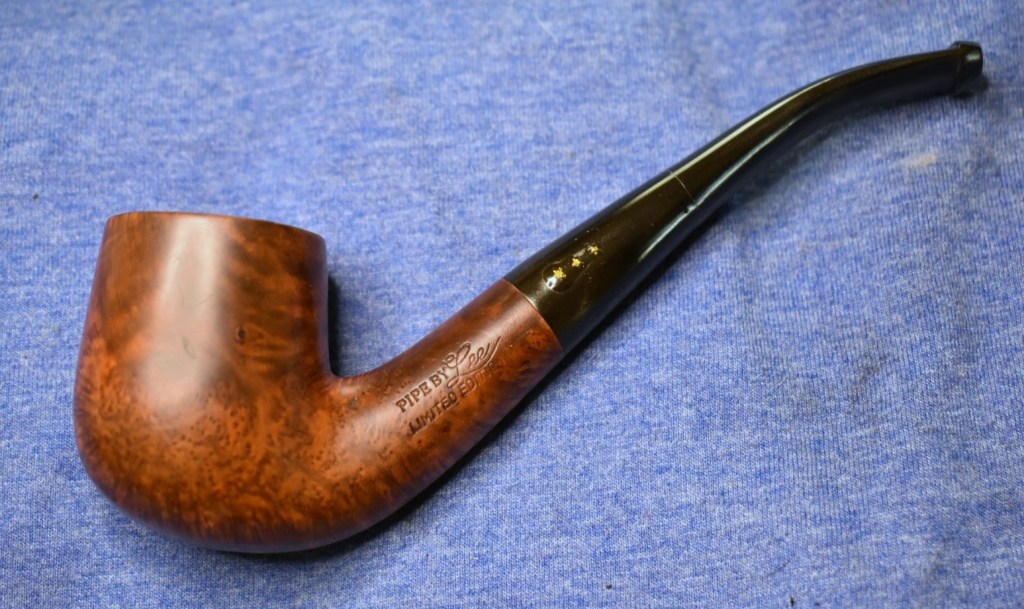
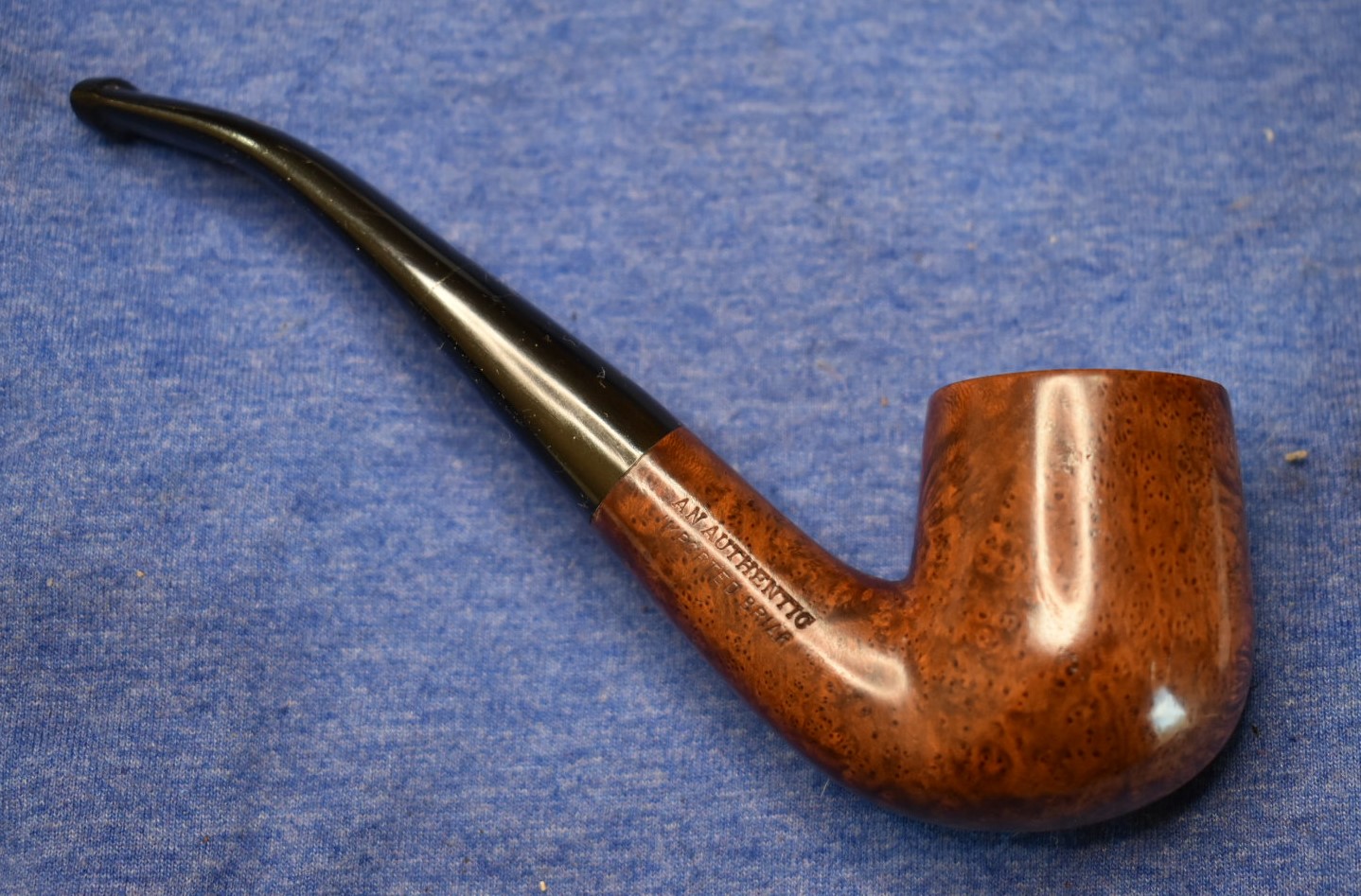
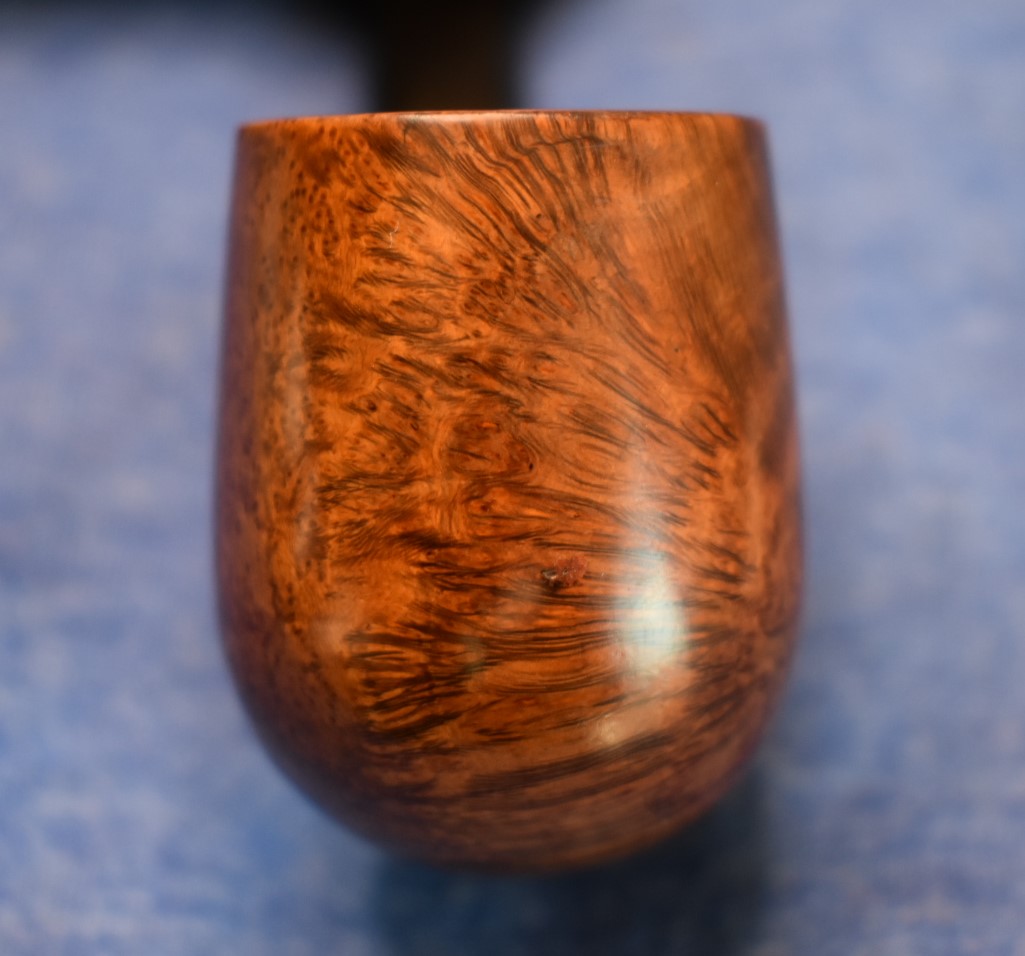
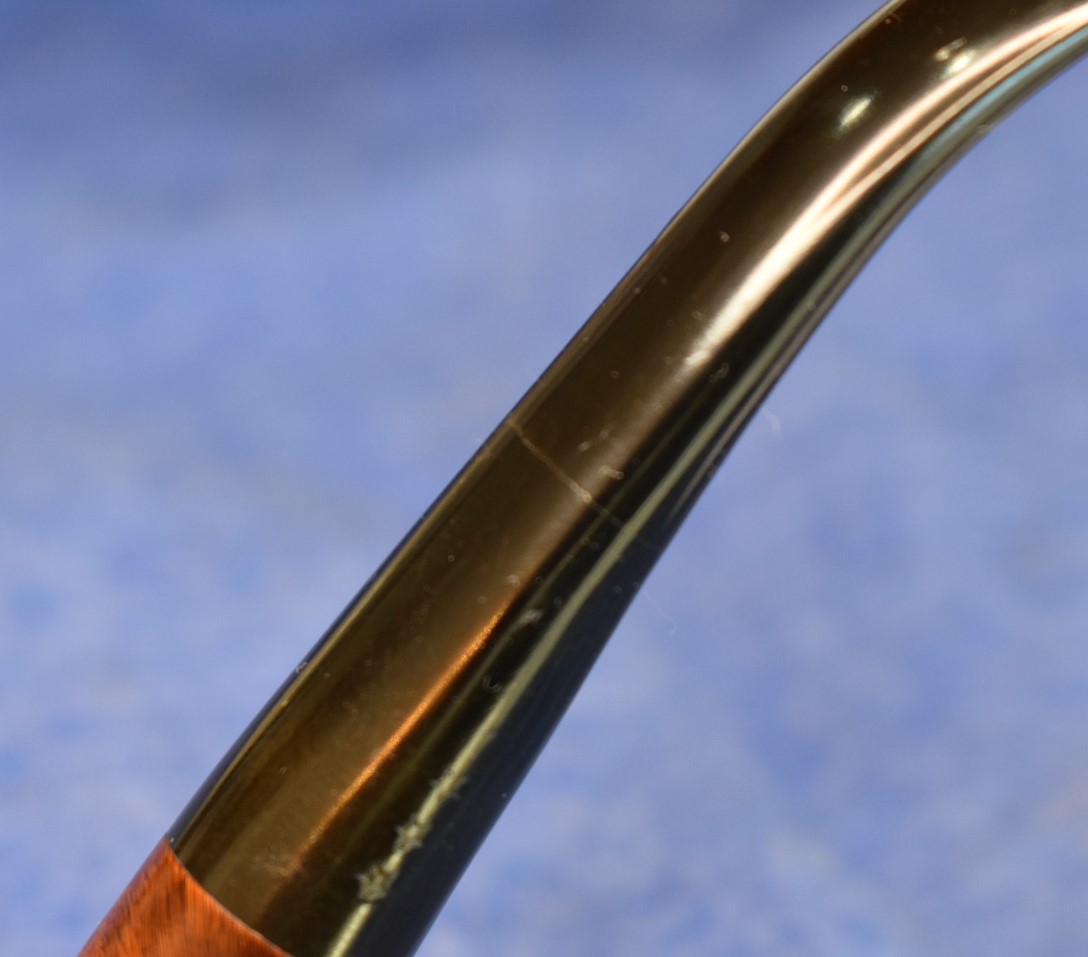
• About

NebraskaPeteGeek

  • American Pipe Makers
  • British pipe Makers
  • Danish pipe Makers
  • French Pipe Makers
  • German Pipe Makers
  • Irish Pipe Makers
  • Italian Pipe Makers
  • Others or Unknown Pipe Makers
  • Restorations
  • A Marxman Regular Apple Restoration

    November 14th, 2023

    Written and photographed by John M. Young
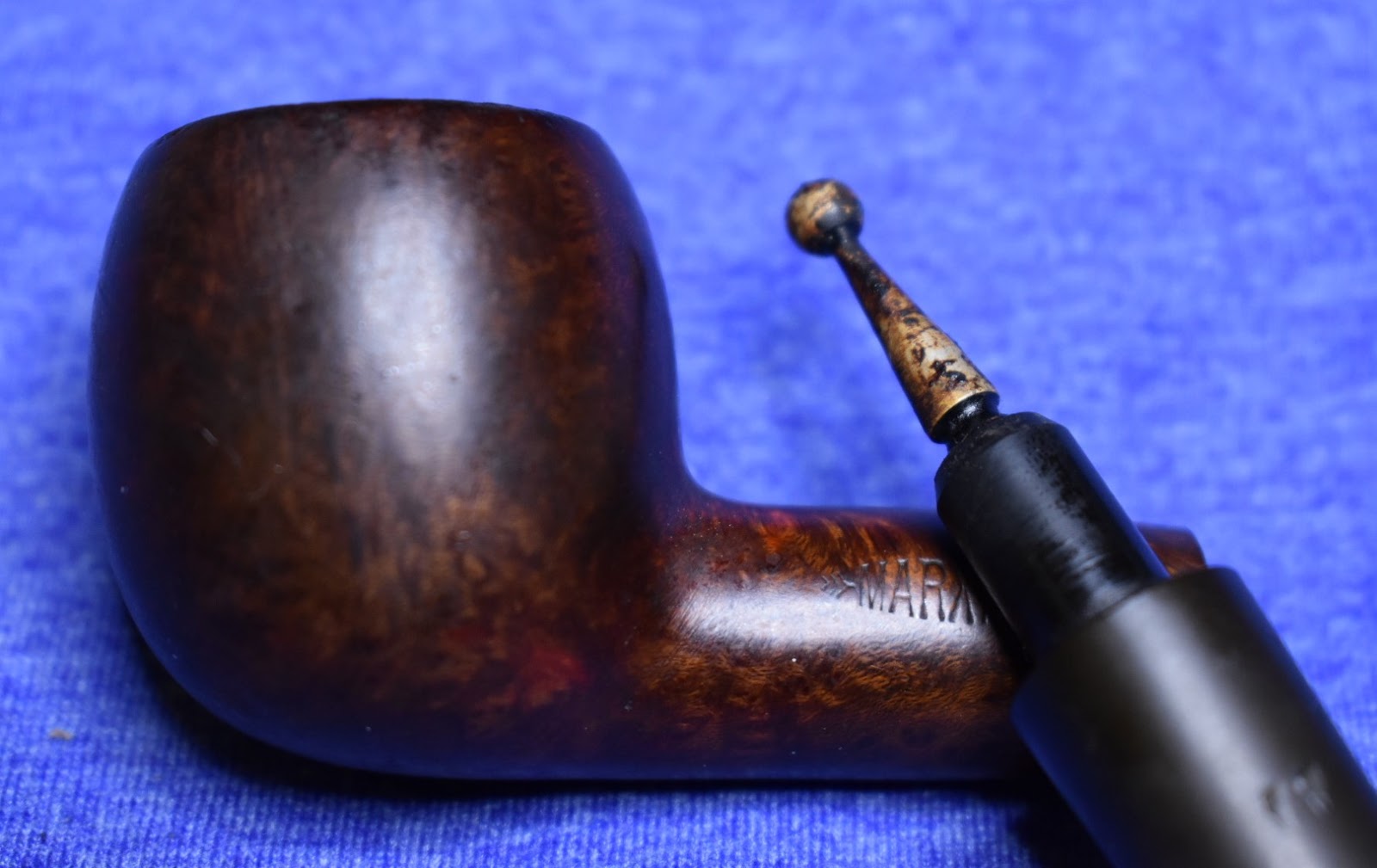
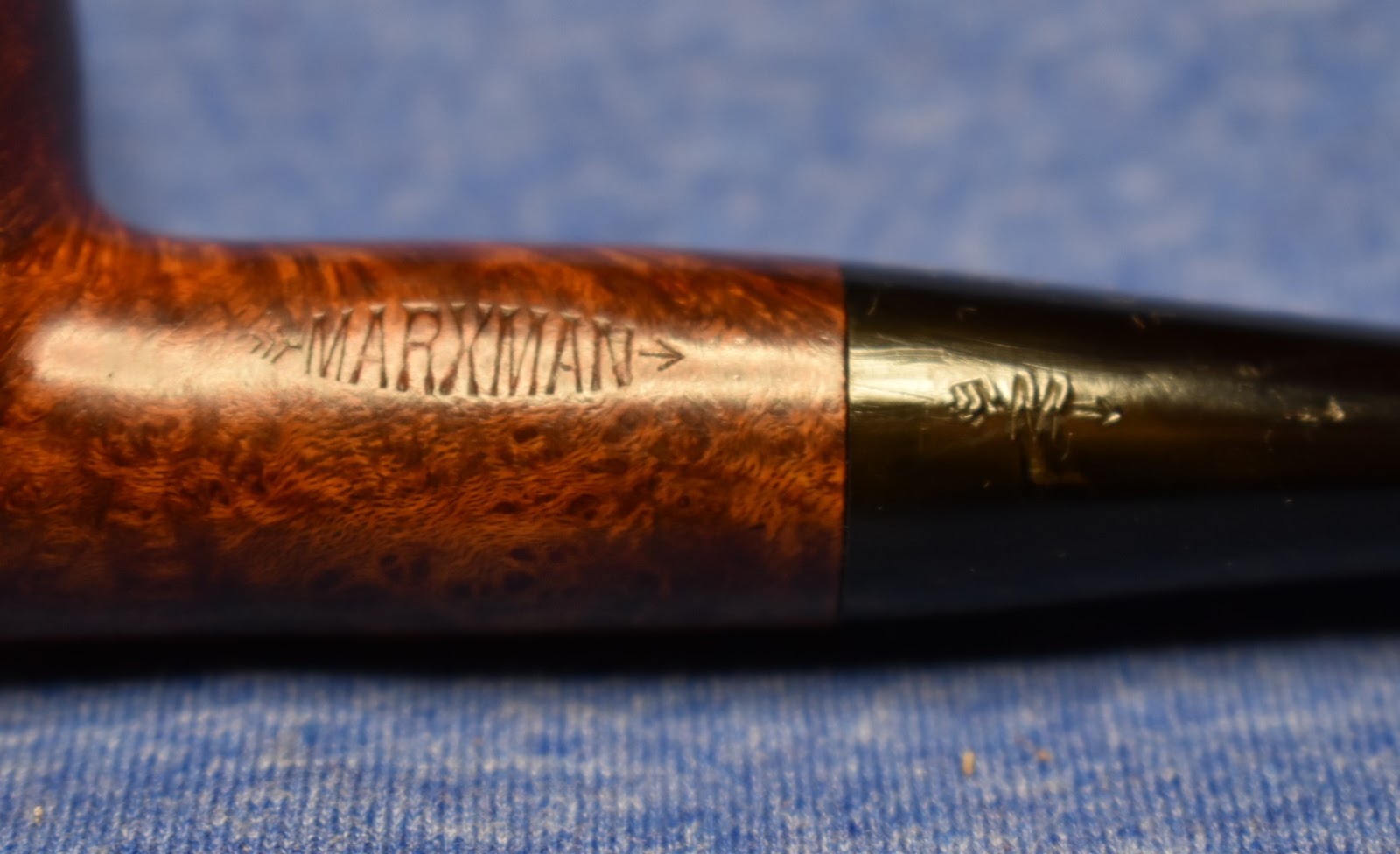
    I remember when I first started down my pipe restoration path.  I’d picked up an estate lot figuring that would be the best way to practice and hone my skills.  Within the lot there was a dark dirty poorly grained small billiard pipe.  The stamping said “MARXMAN”.  It was quite nondescript.  I immediately had an aversion to the name, as many of my generation might, Carl Marx was no hero of mine.  I started researching Marxman pipes to find out more about this company which I hadn’t heard of.  As I read, I became fascinated.  Yes, many of the Marxman pipes were filled with fills, others so ugly that they were kind of cute, and there were the carved pipes of people (effigies that today would probably get you in trouble for being racist), animals and famous celebrities as well as the traditional pipe shapes.  Indeed something for everyone.  

    The history of Robert (Bob) Marxman was also intriguing.  To start a company at 29 years old and turn it into a successful business is impressive but to do that when the world is at war and the supply of your main material, briar, is cut off due to the war is even more impressive.  Then to see the marketing;  innovative, clever, good advertising all creating success.  I saw parallels in Marxman’s business to things we do in restoration –  like making the best with what you have.  I also discovered that there is no book about the history of Marxman.  There are great books that can be used to research Falcon pipes or Peterson pipes and web sites for Dr. Grabow and Custom-bilt pipes but alas, little to go on for Marxman.  All we have for certain are the dates of a beginning in 1934 and a merger with Mastercraft in 1953.  I guess that makes dating then easy.  (https://pipedia.org/wiki/Marxman)

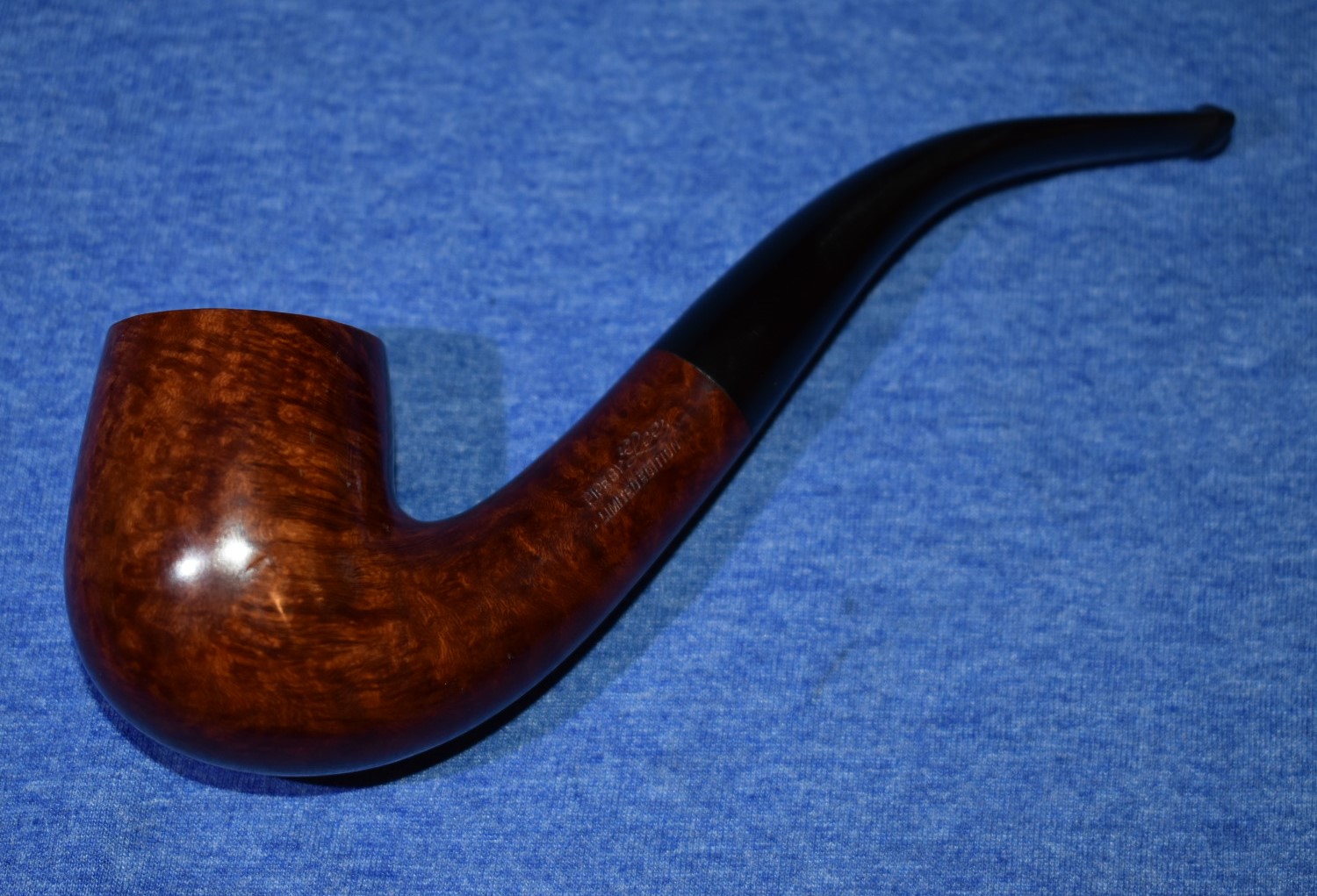
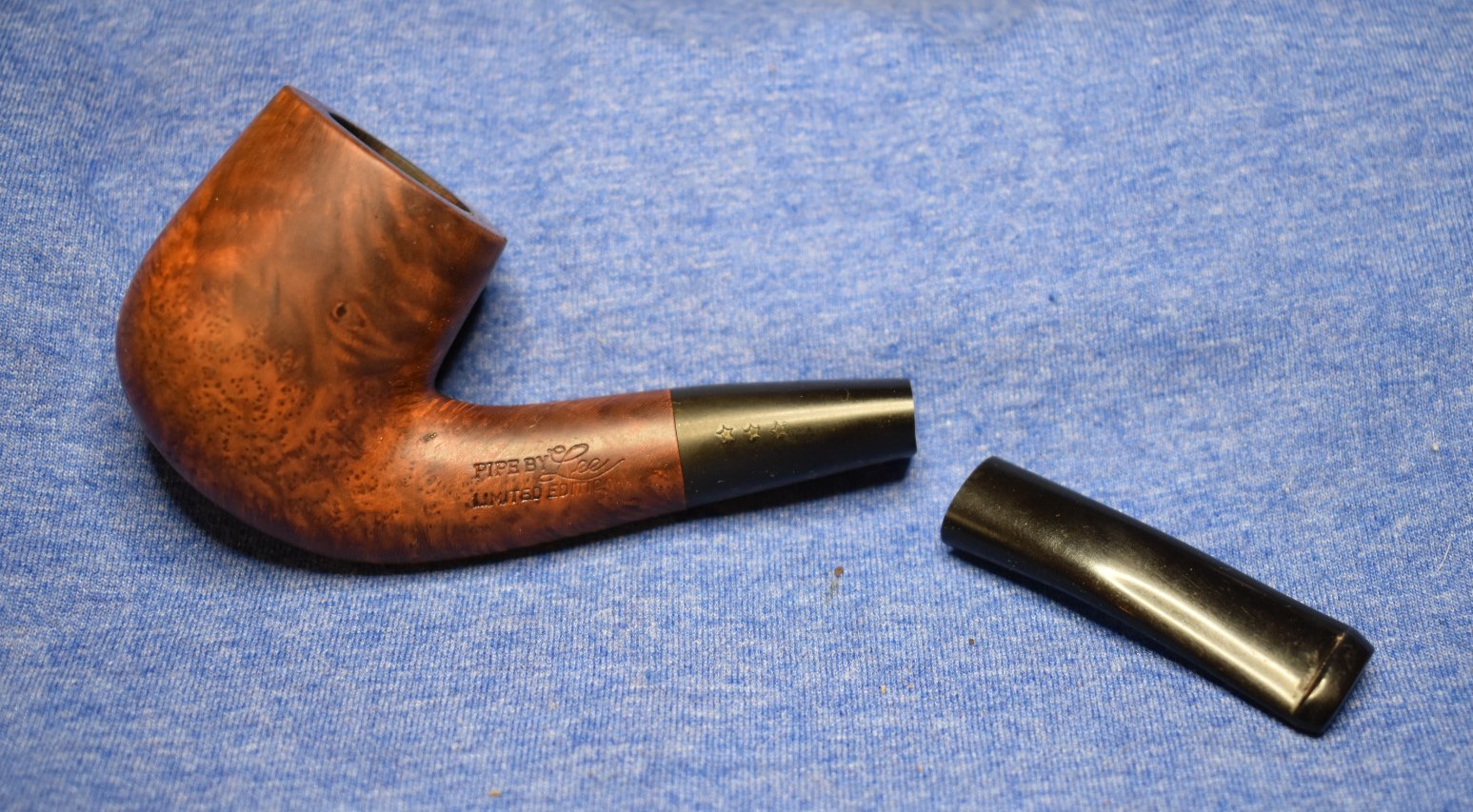
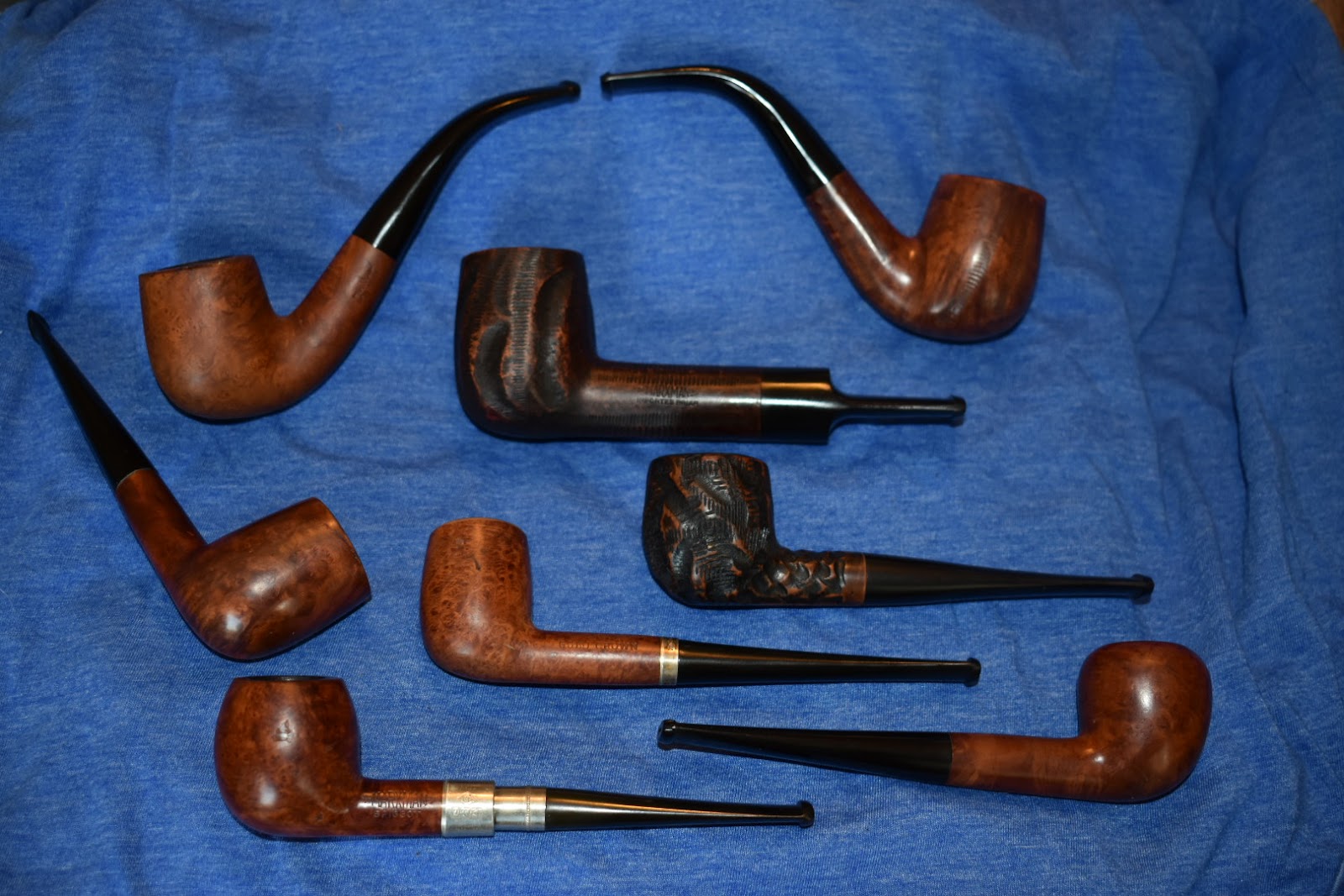
    I have restored a number of Marxman pipes and find them fun and relatively inexpensive to practice with.  At the same time some are my favorite pipes to smoke.  The spigot and the chunky lovat, to the left, are great smoking pipes.  The lovat is one that I would surely be ridiculed for if I tried entering her in a beauty contest.

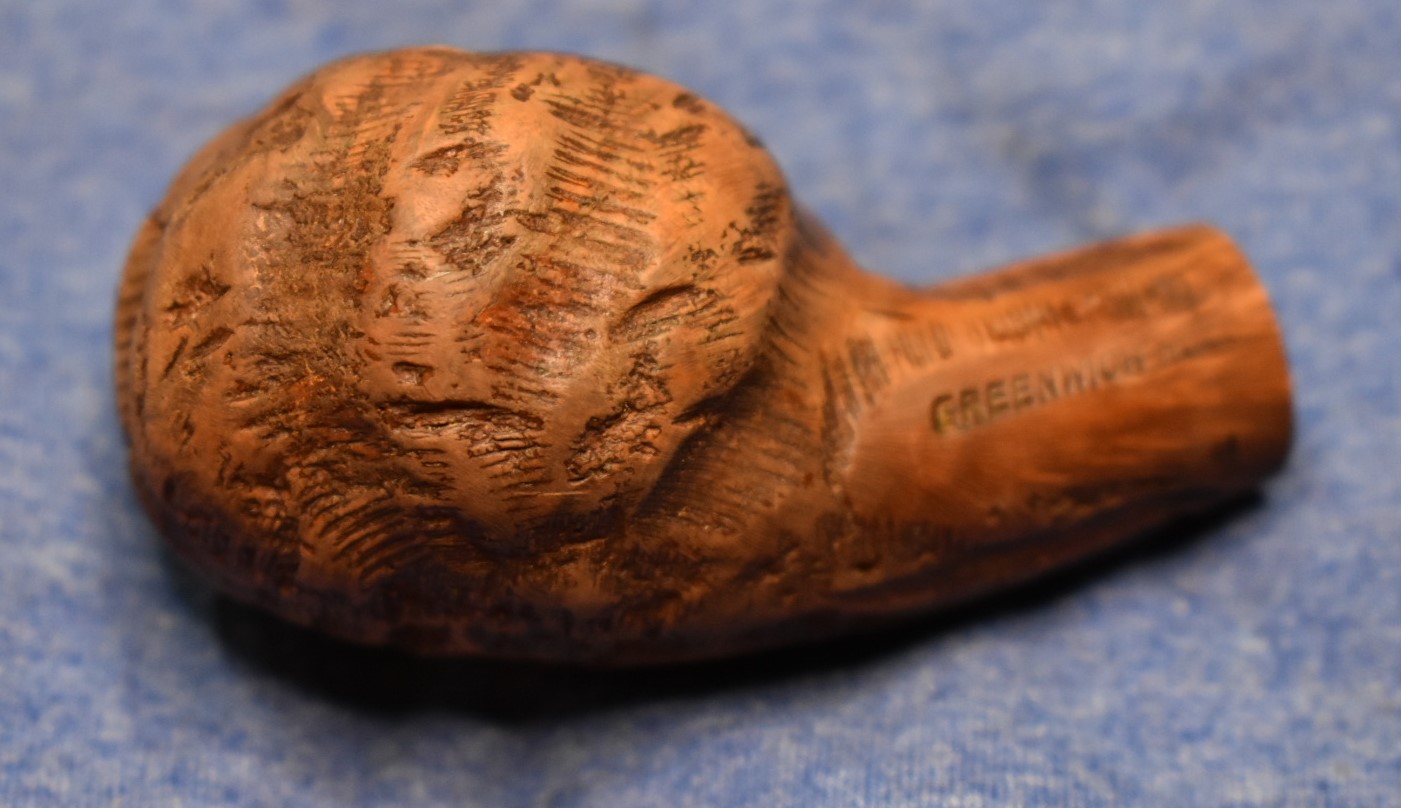
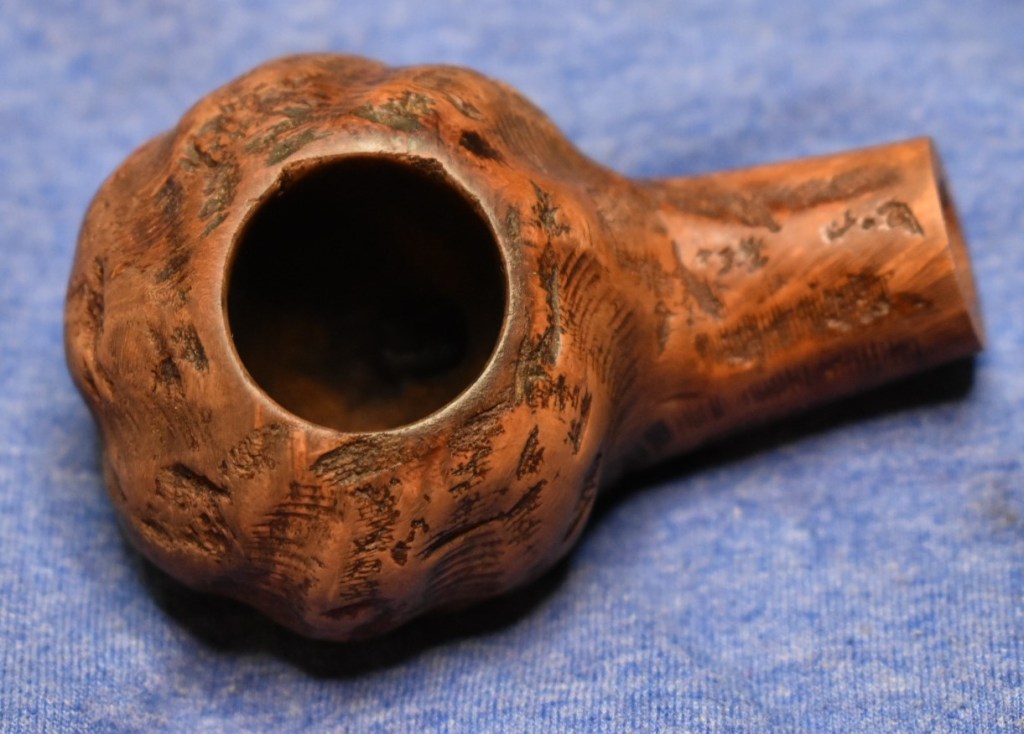
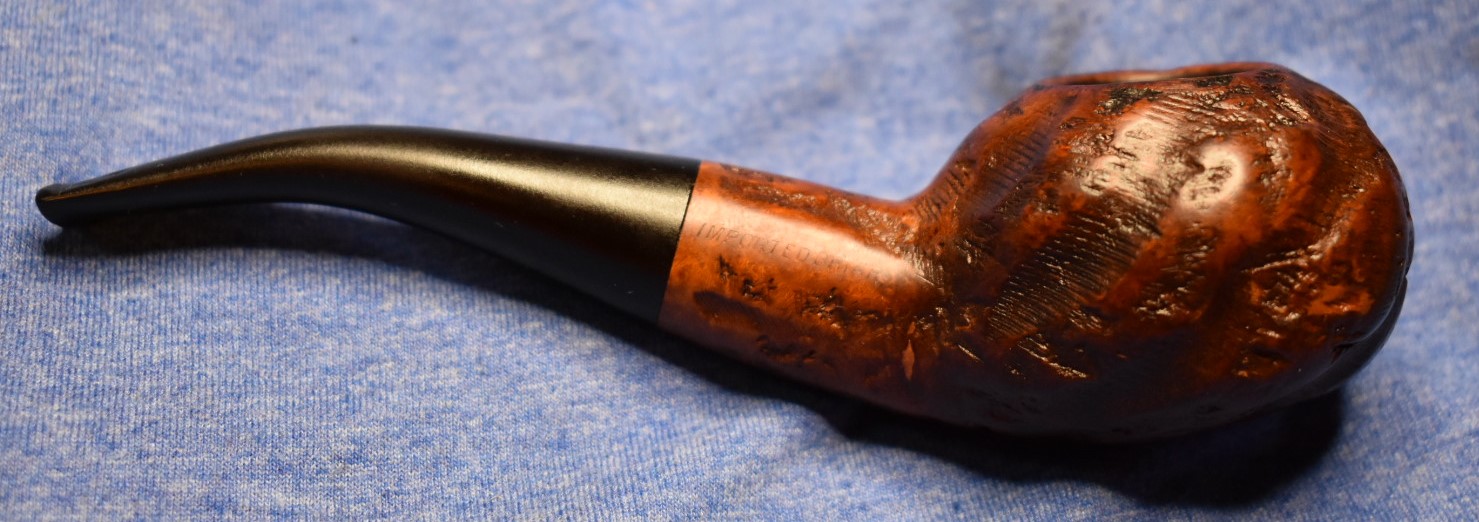
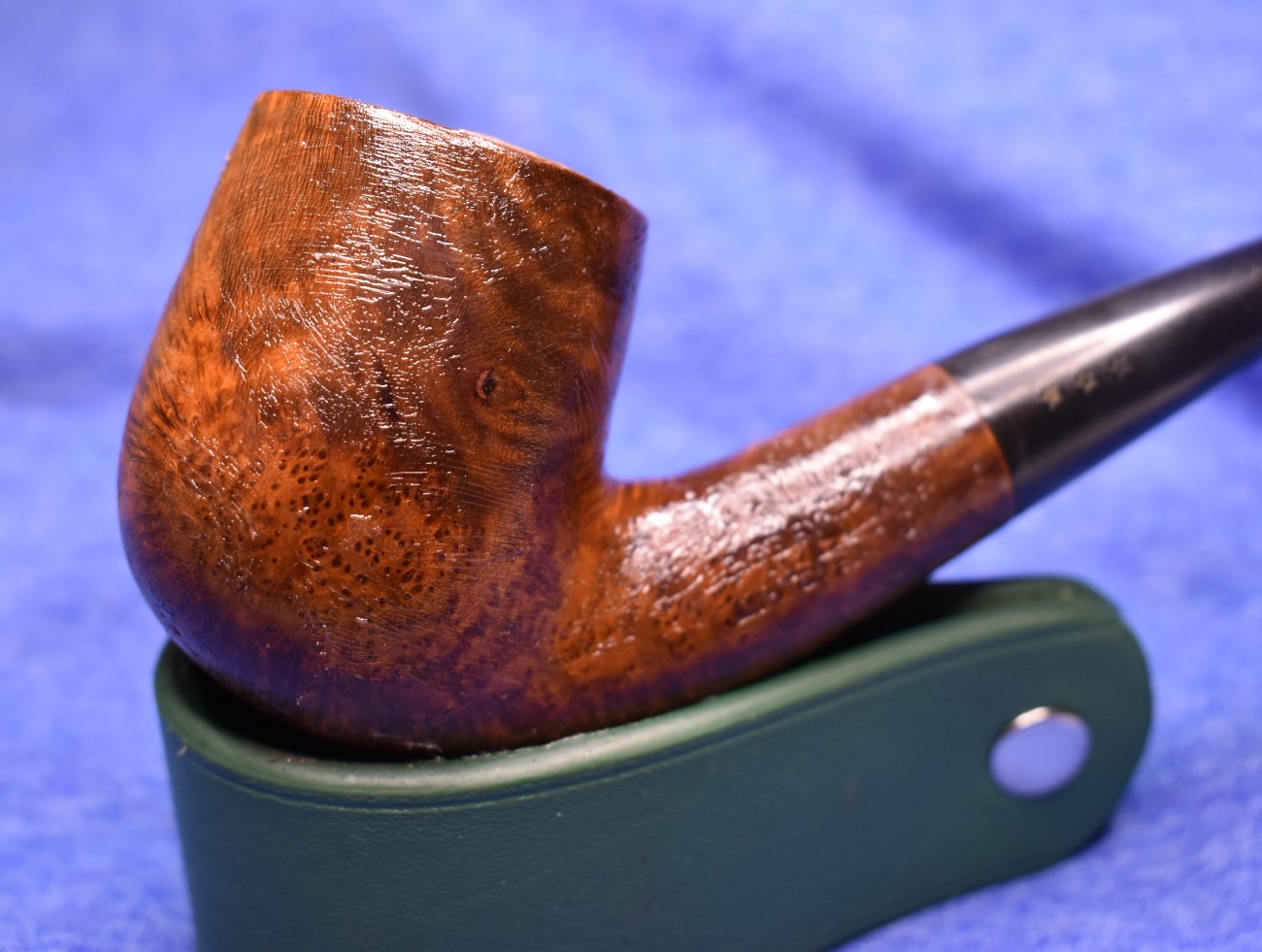
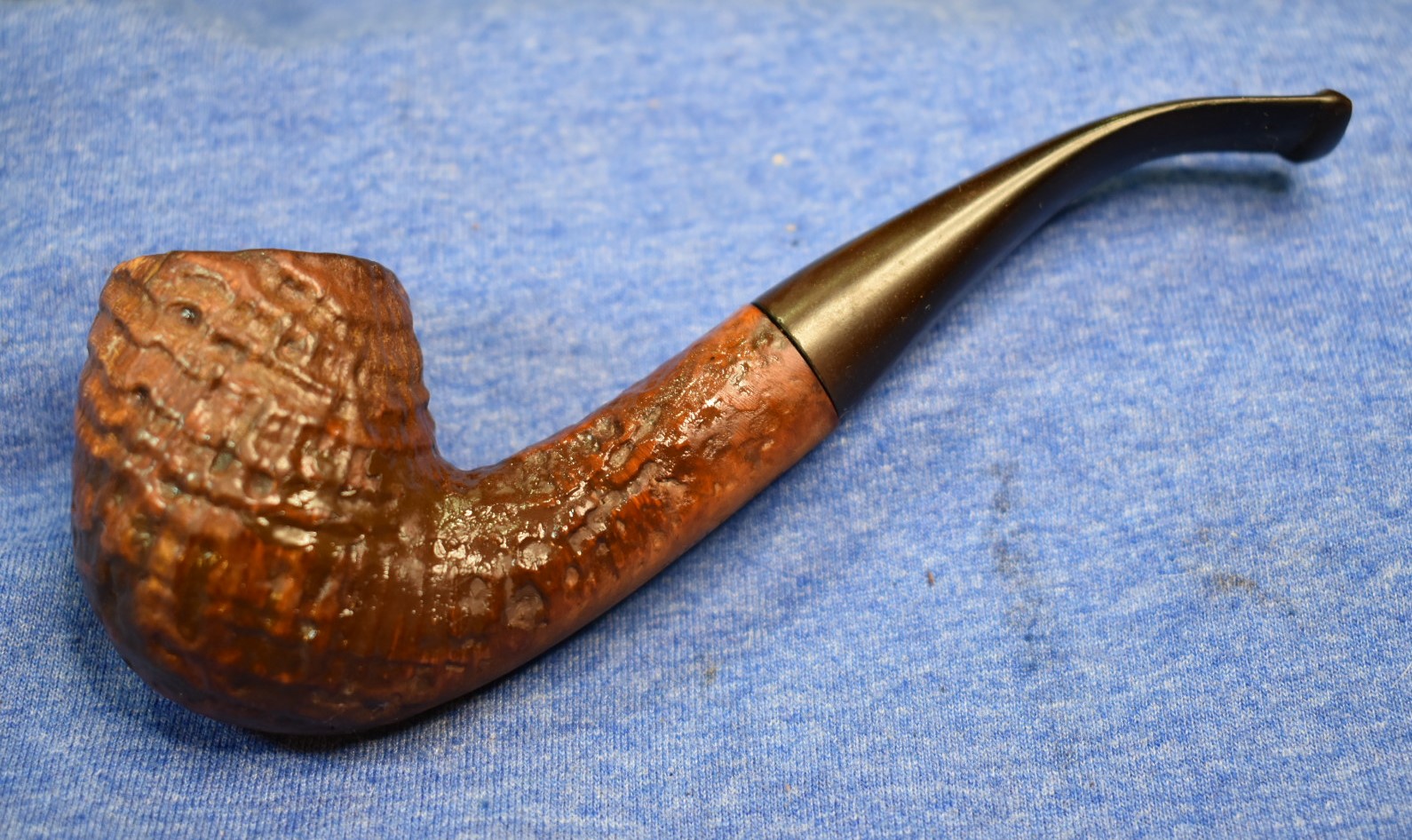
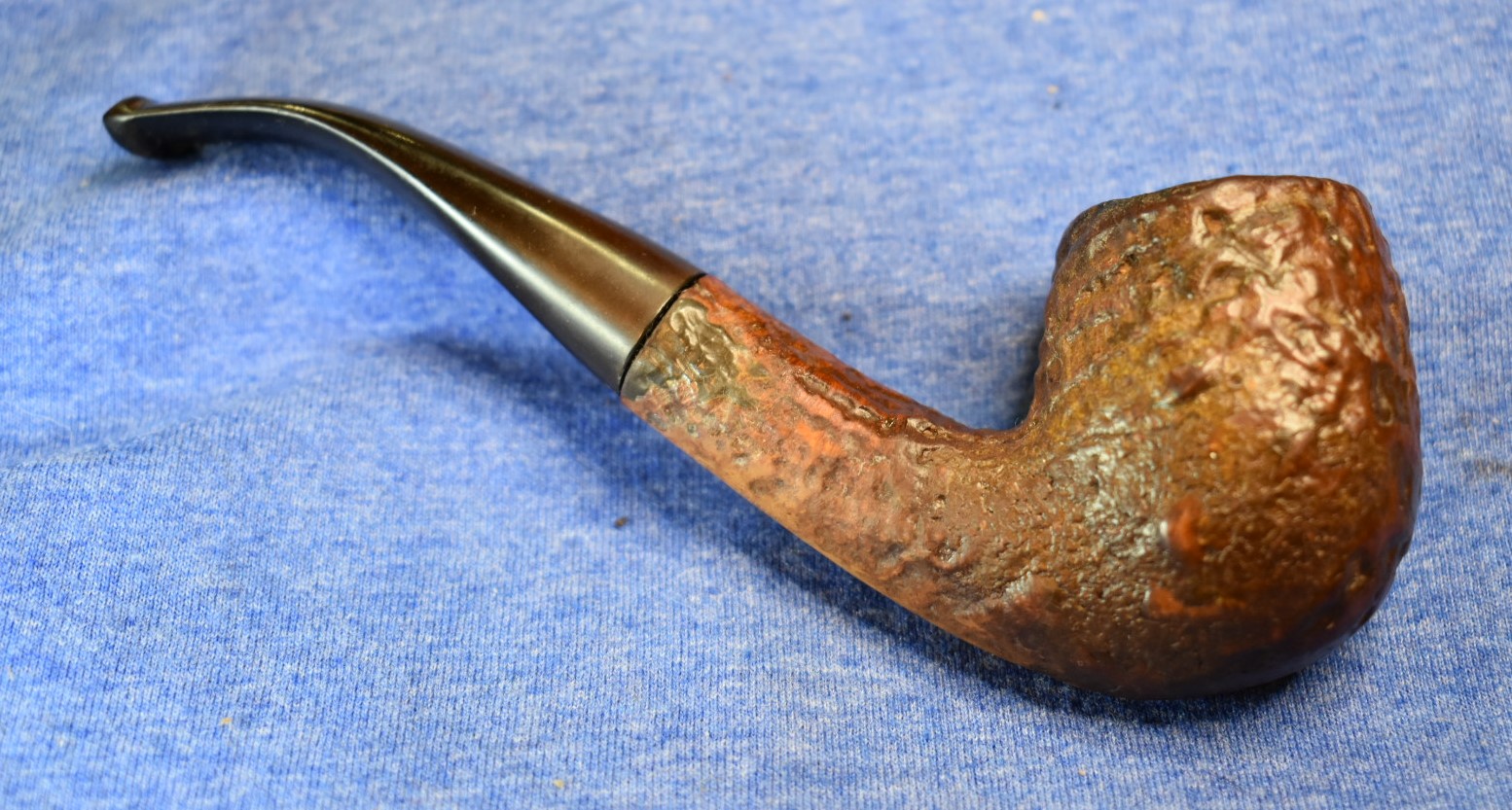
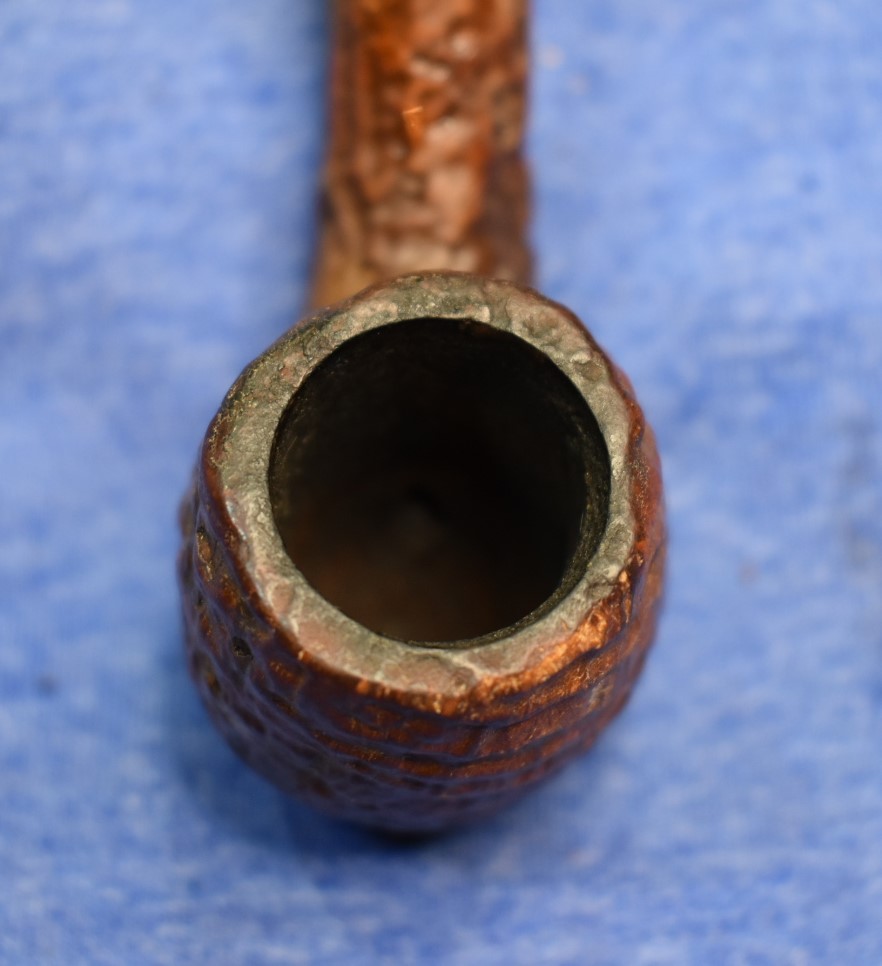
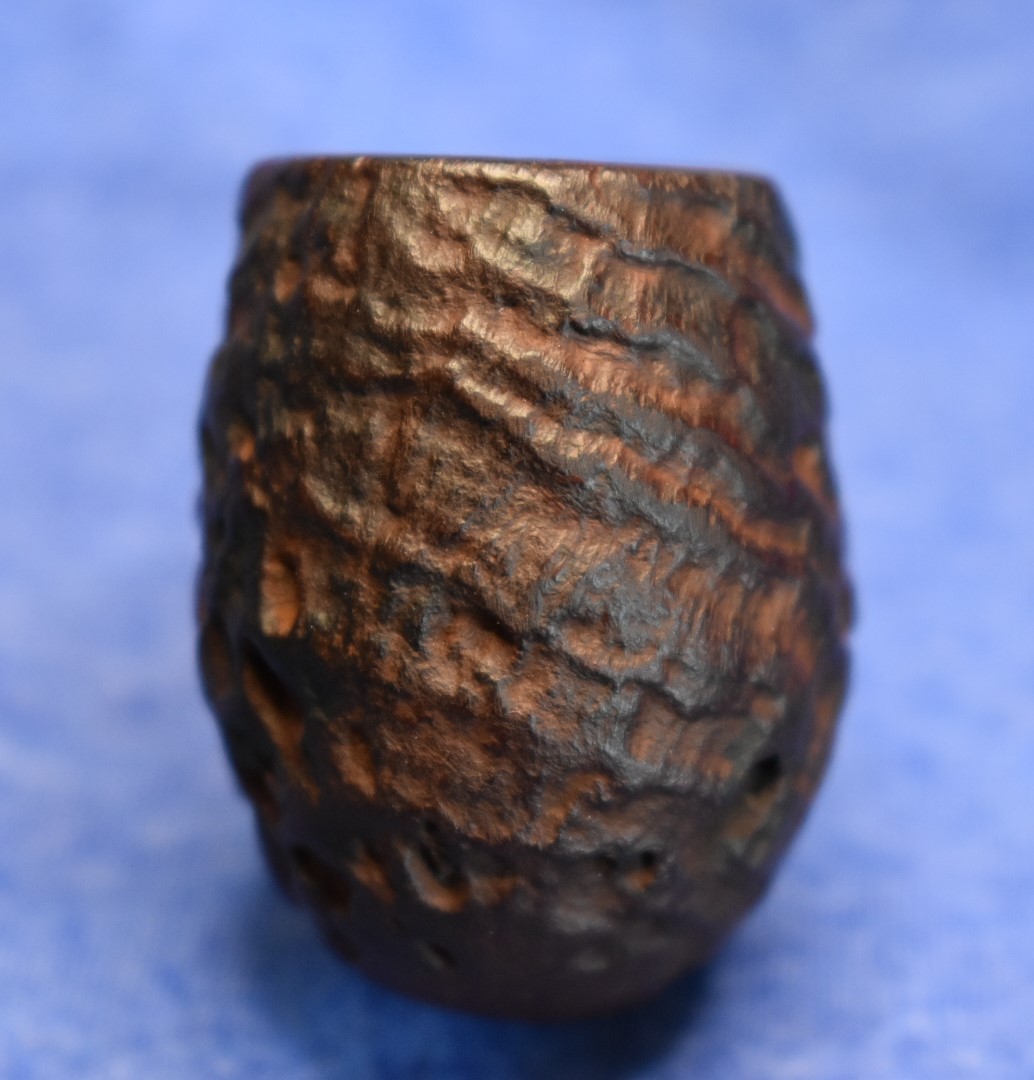
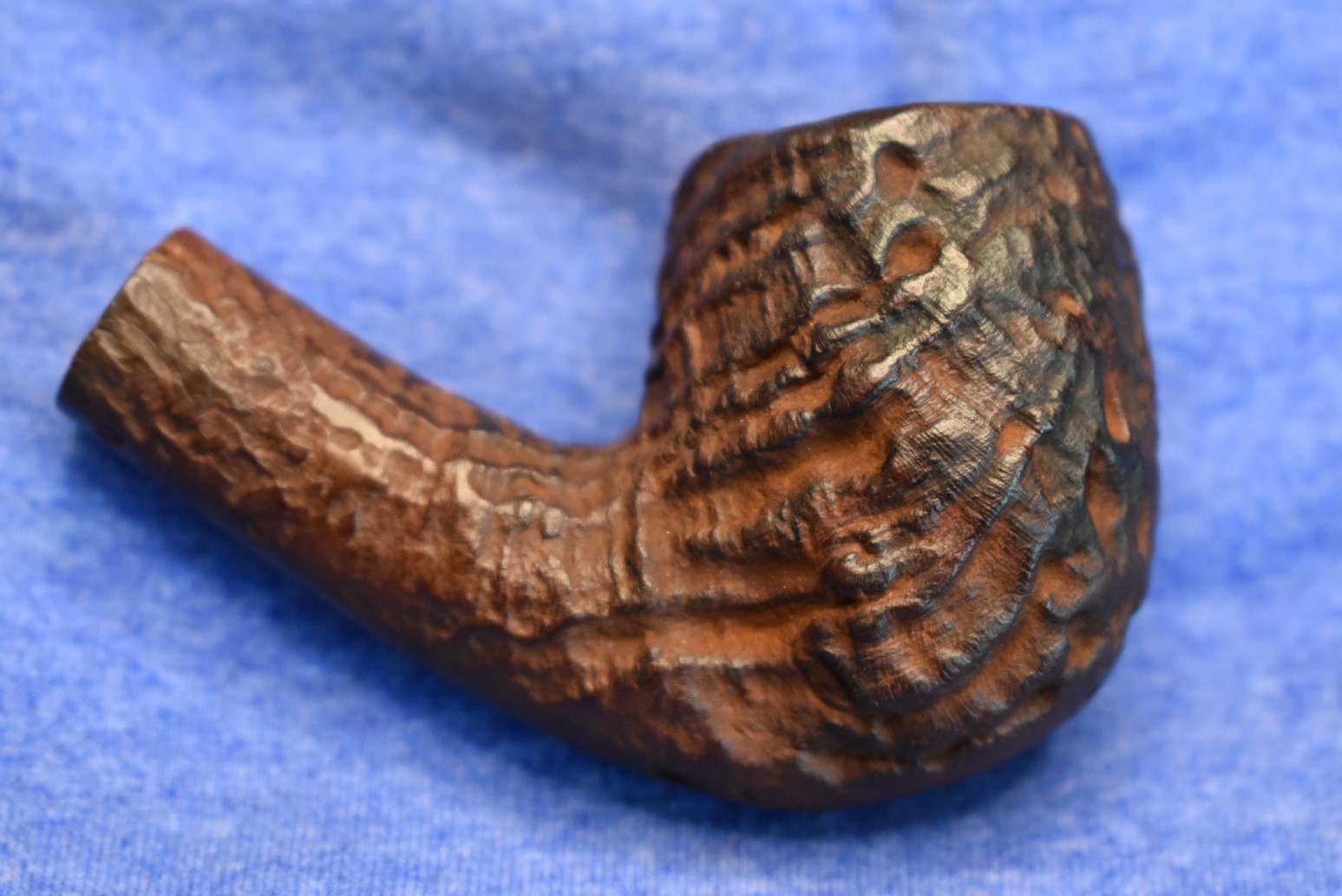
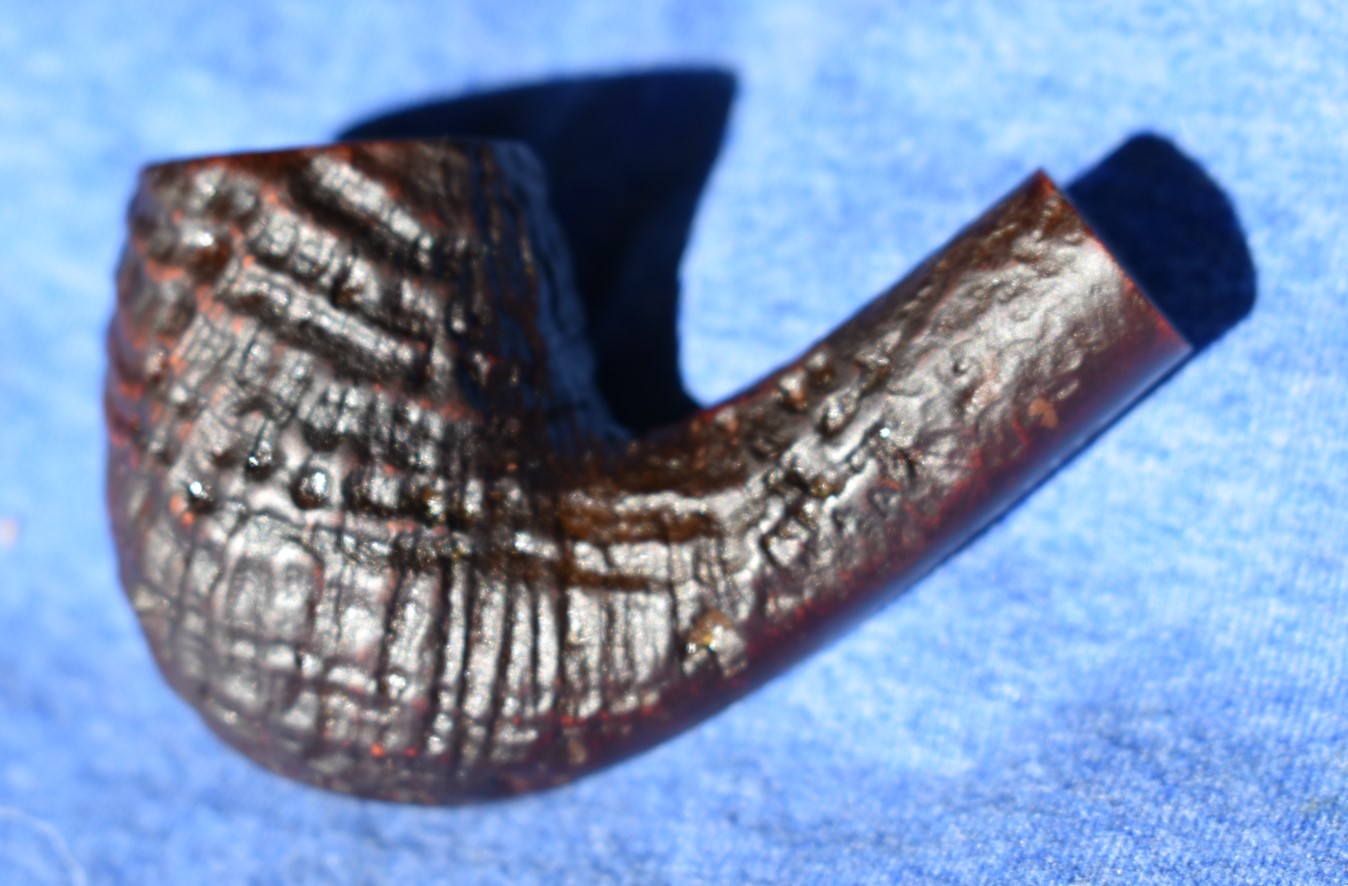
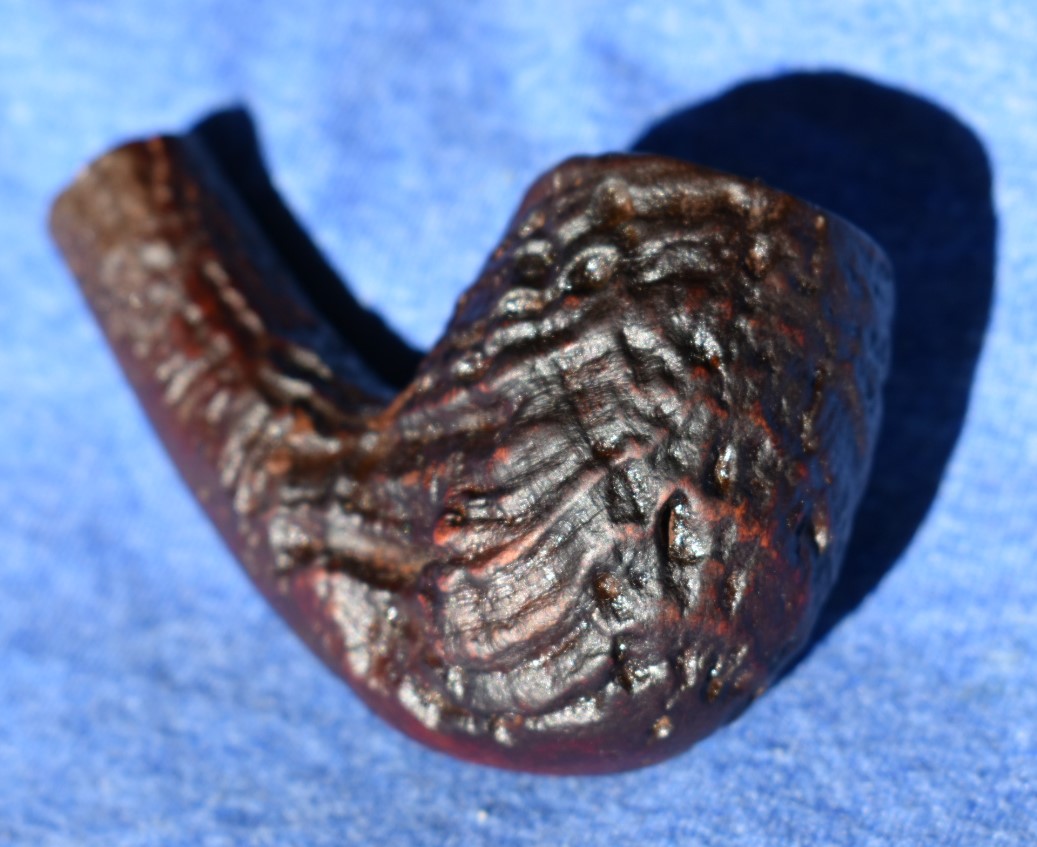
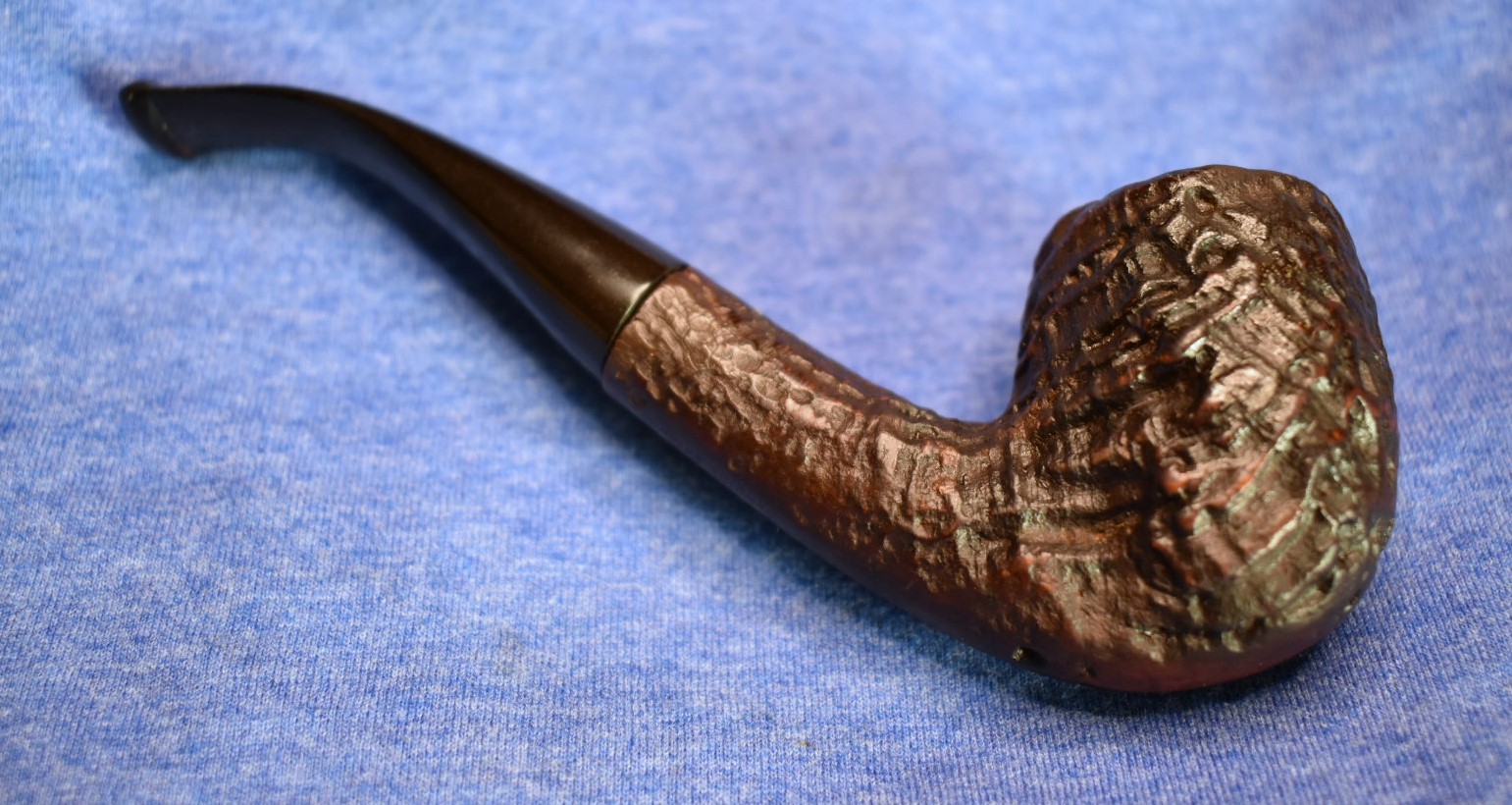
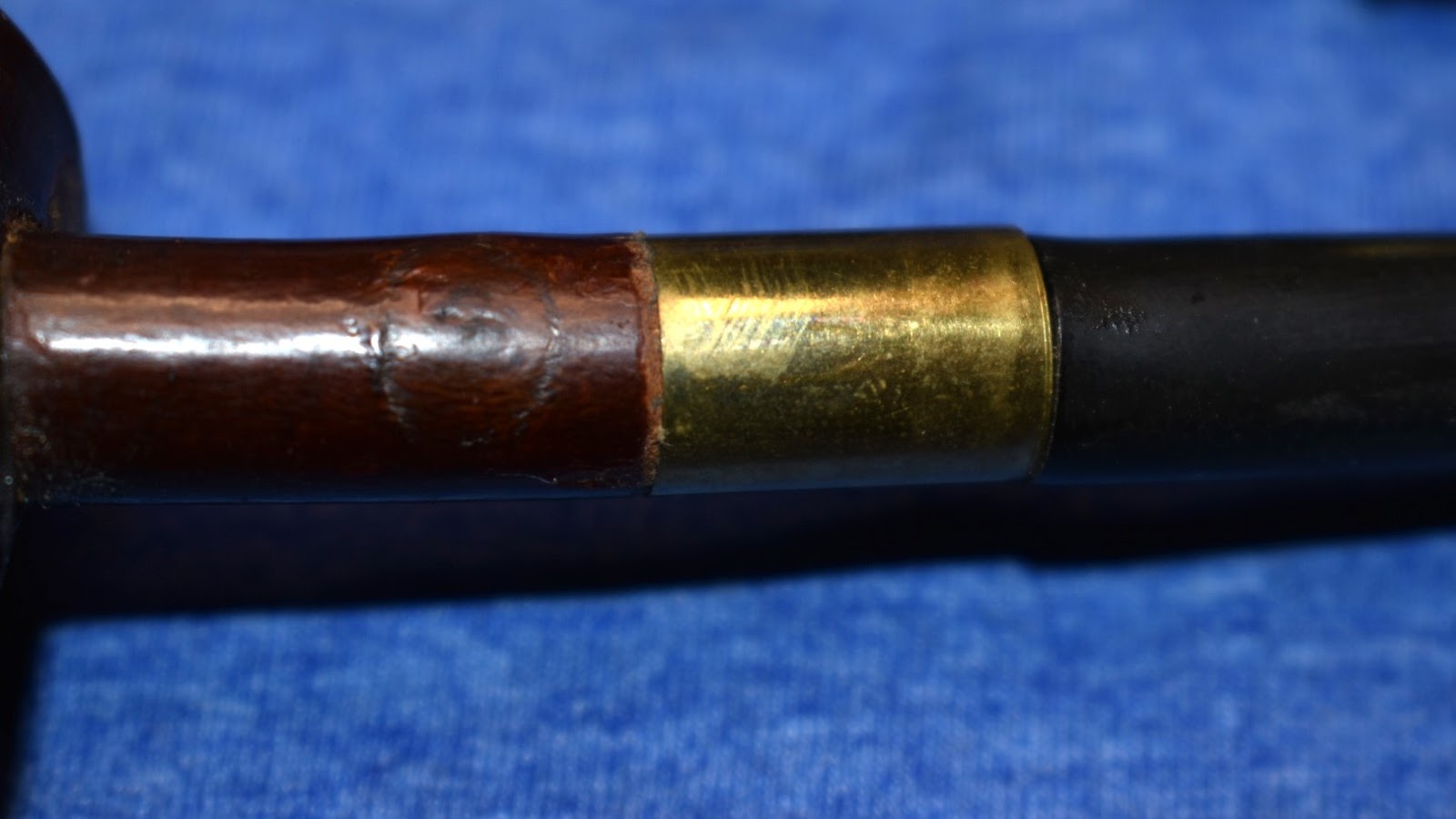
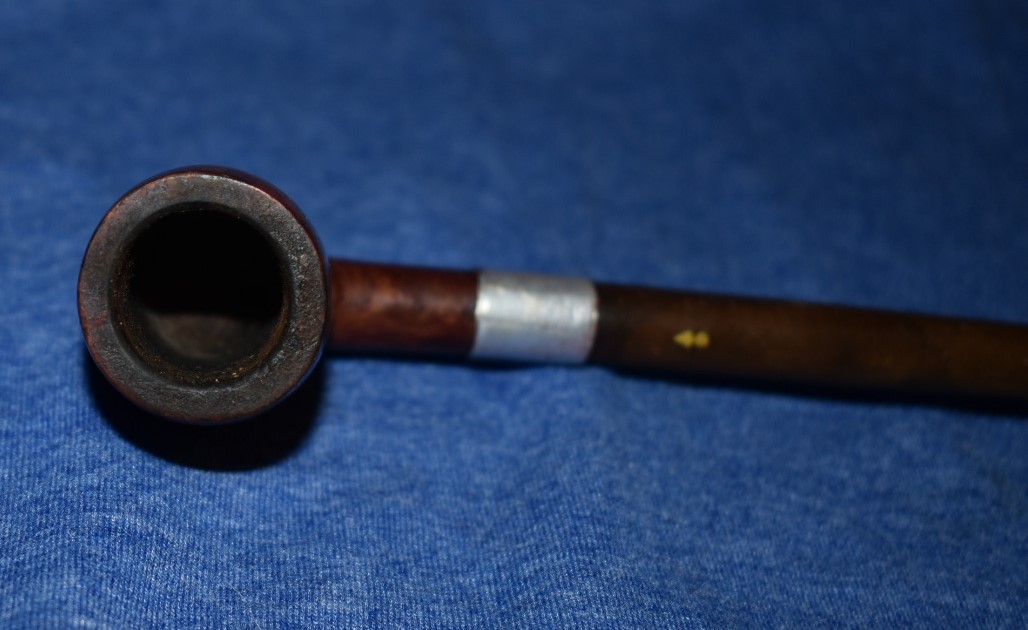
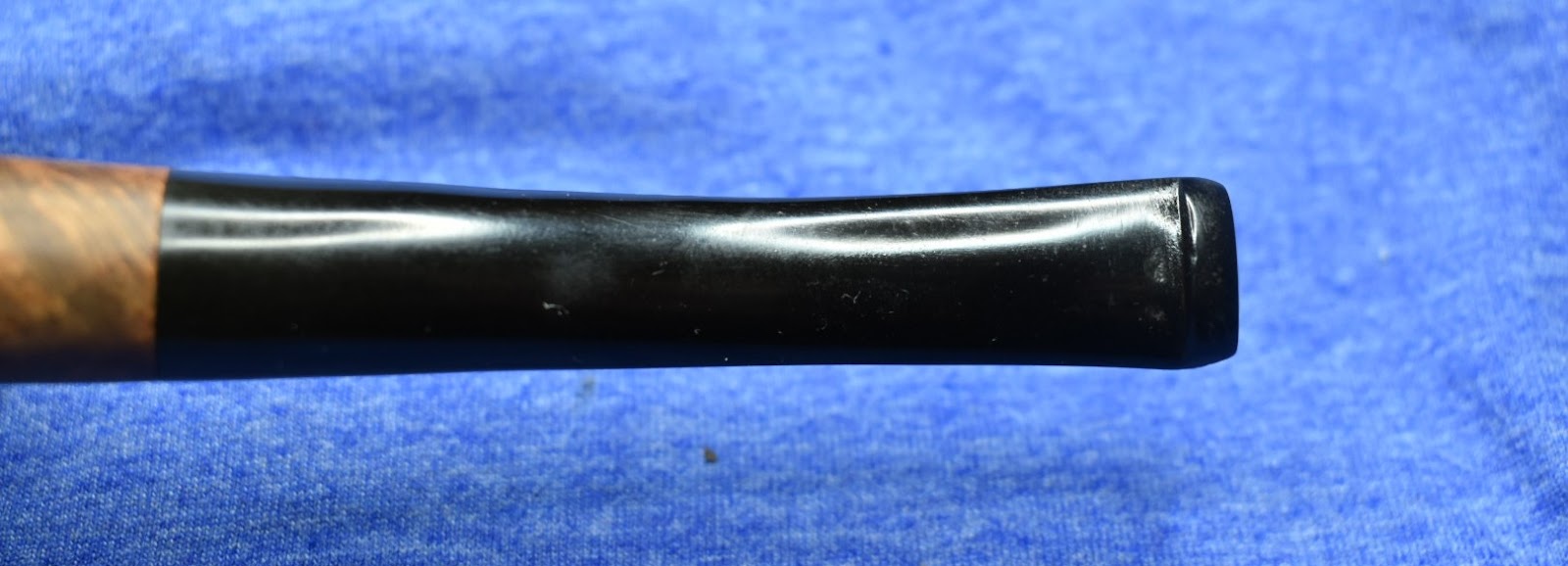
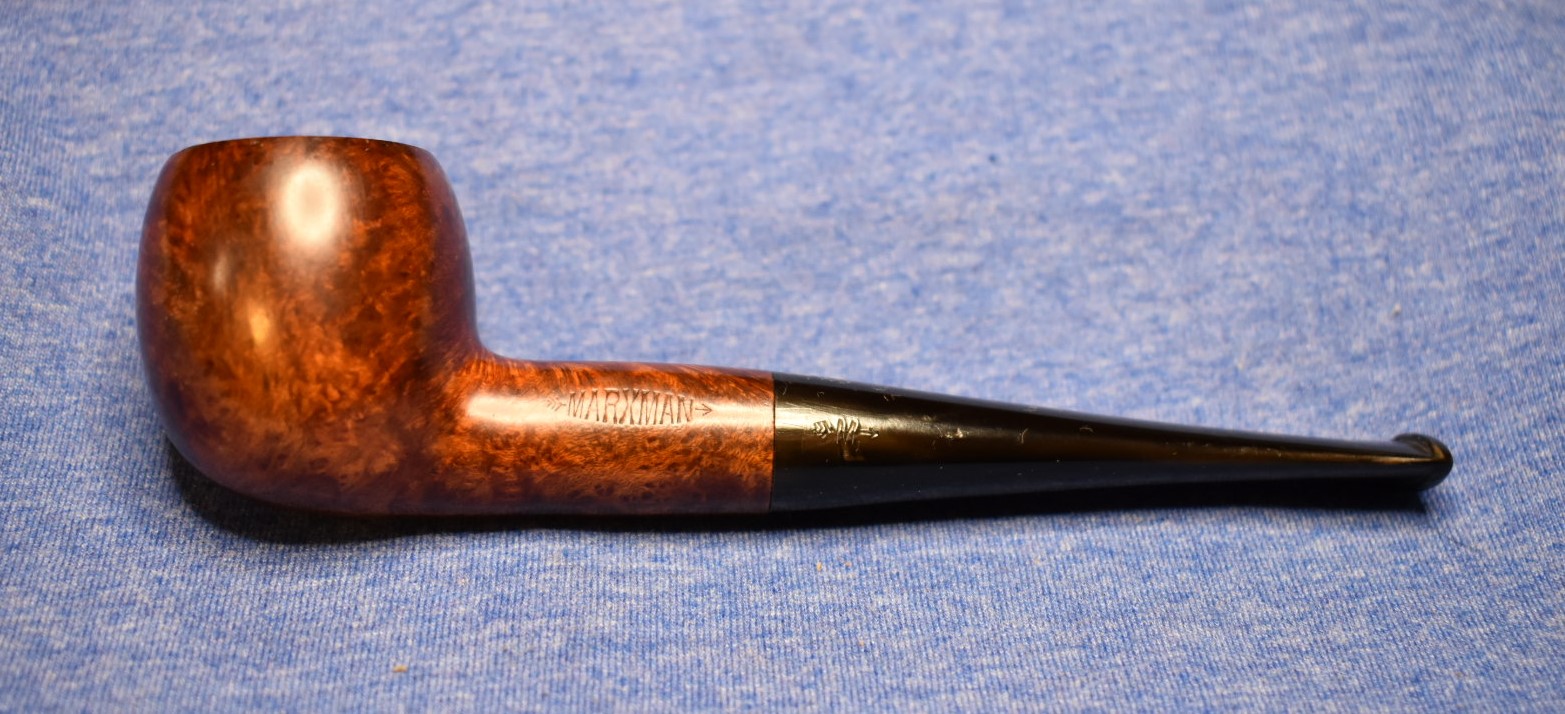
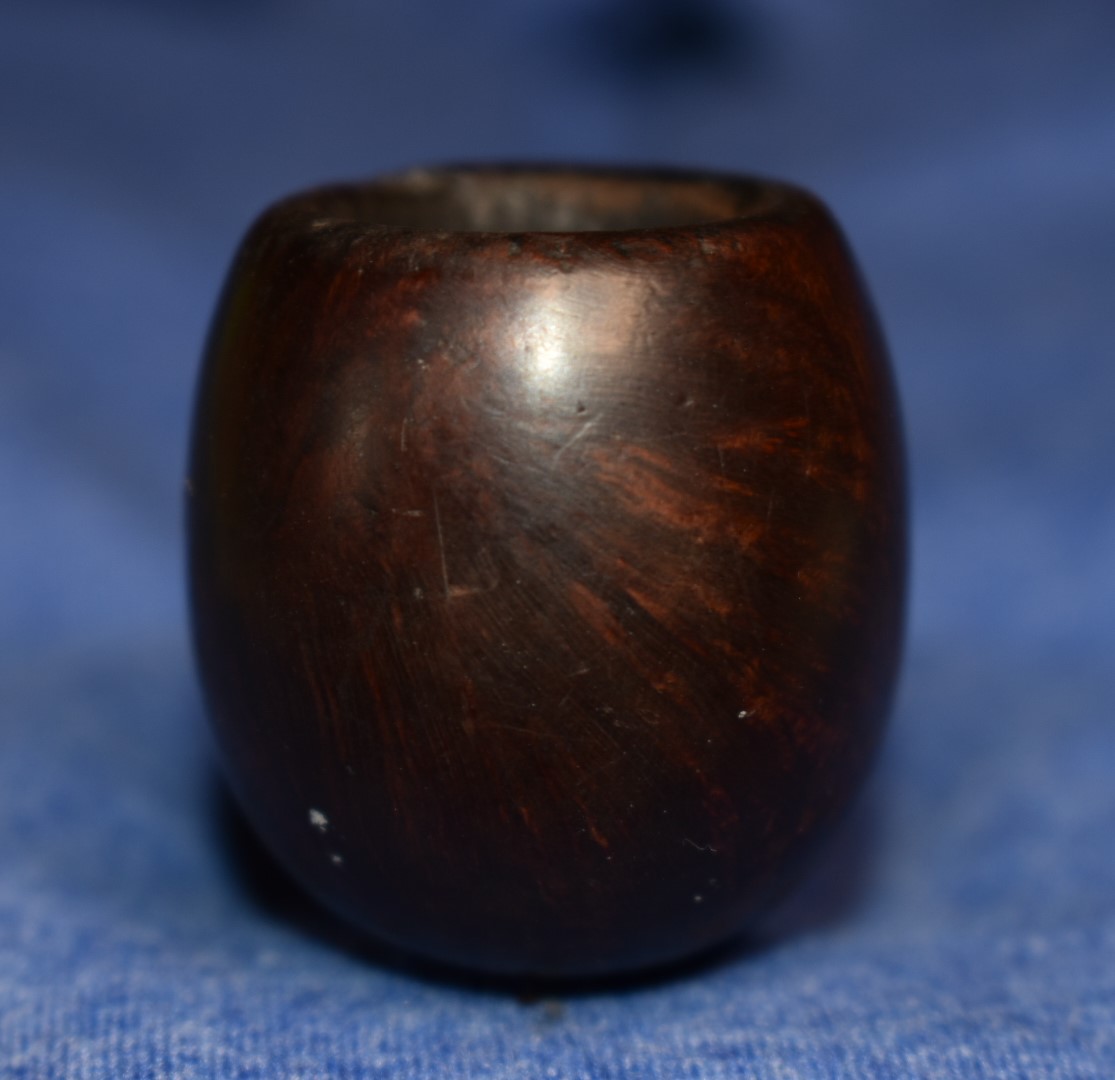
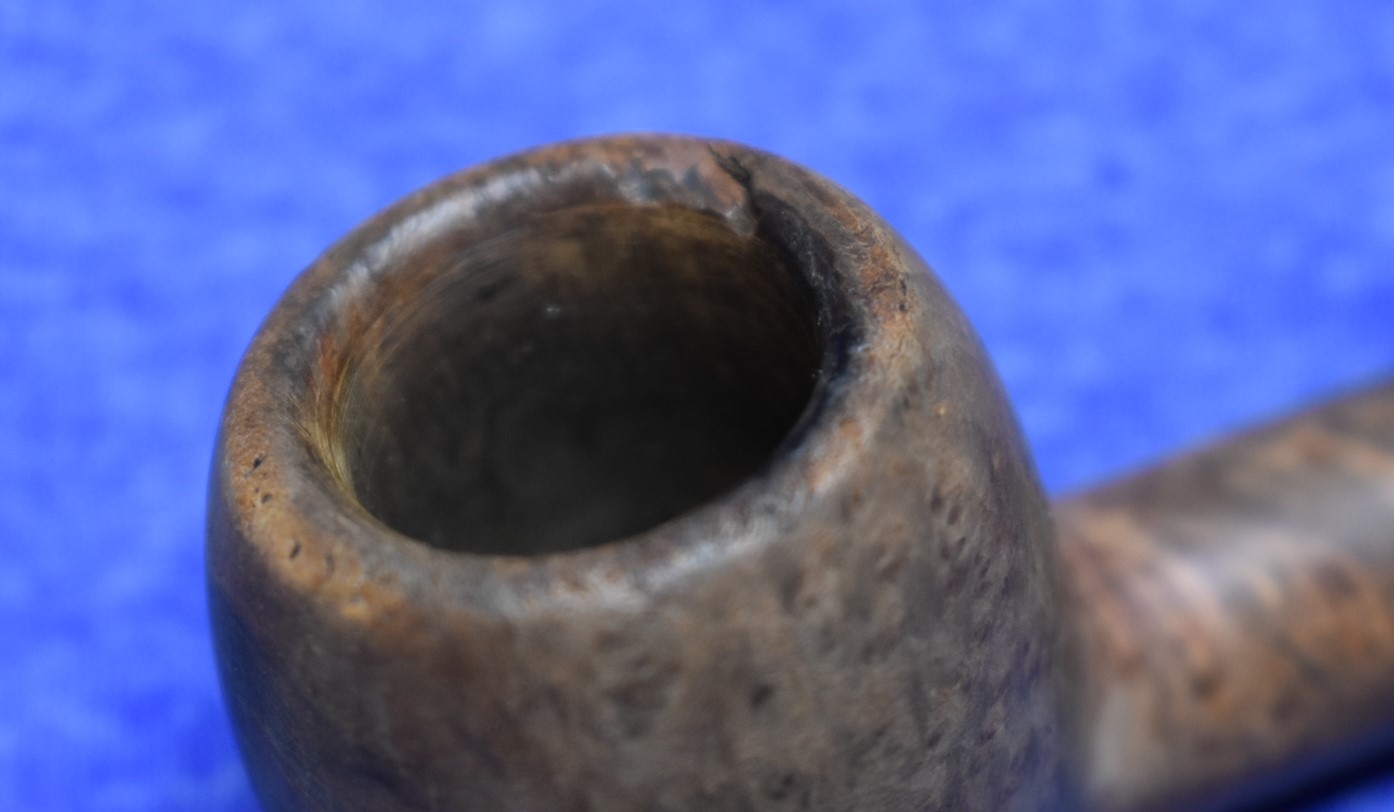
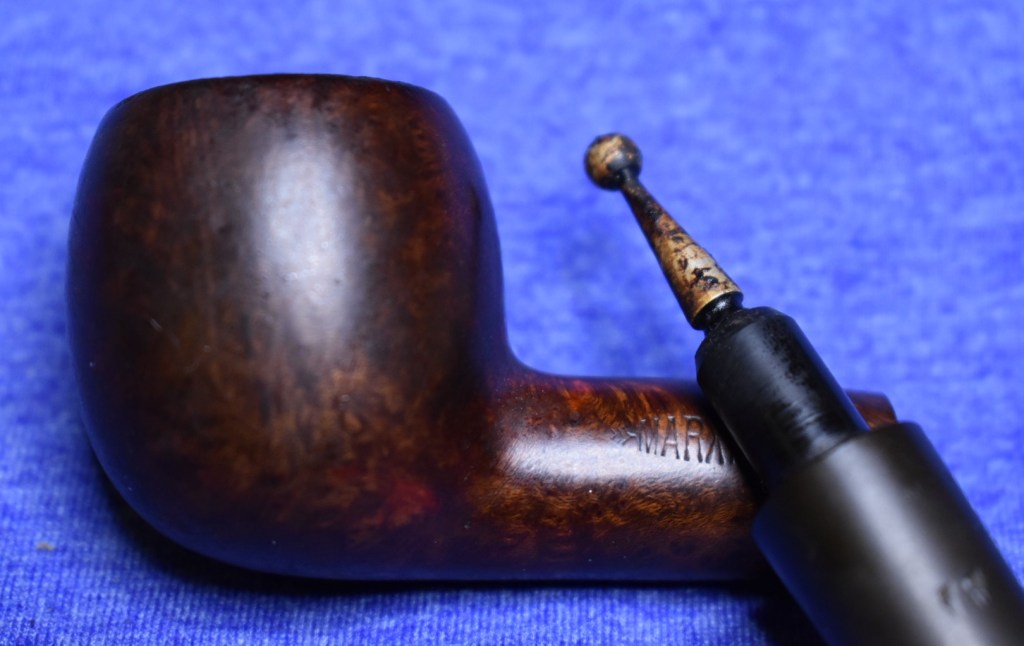
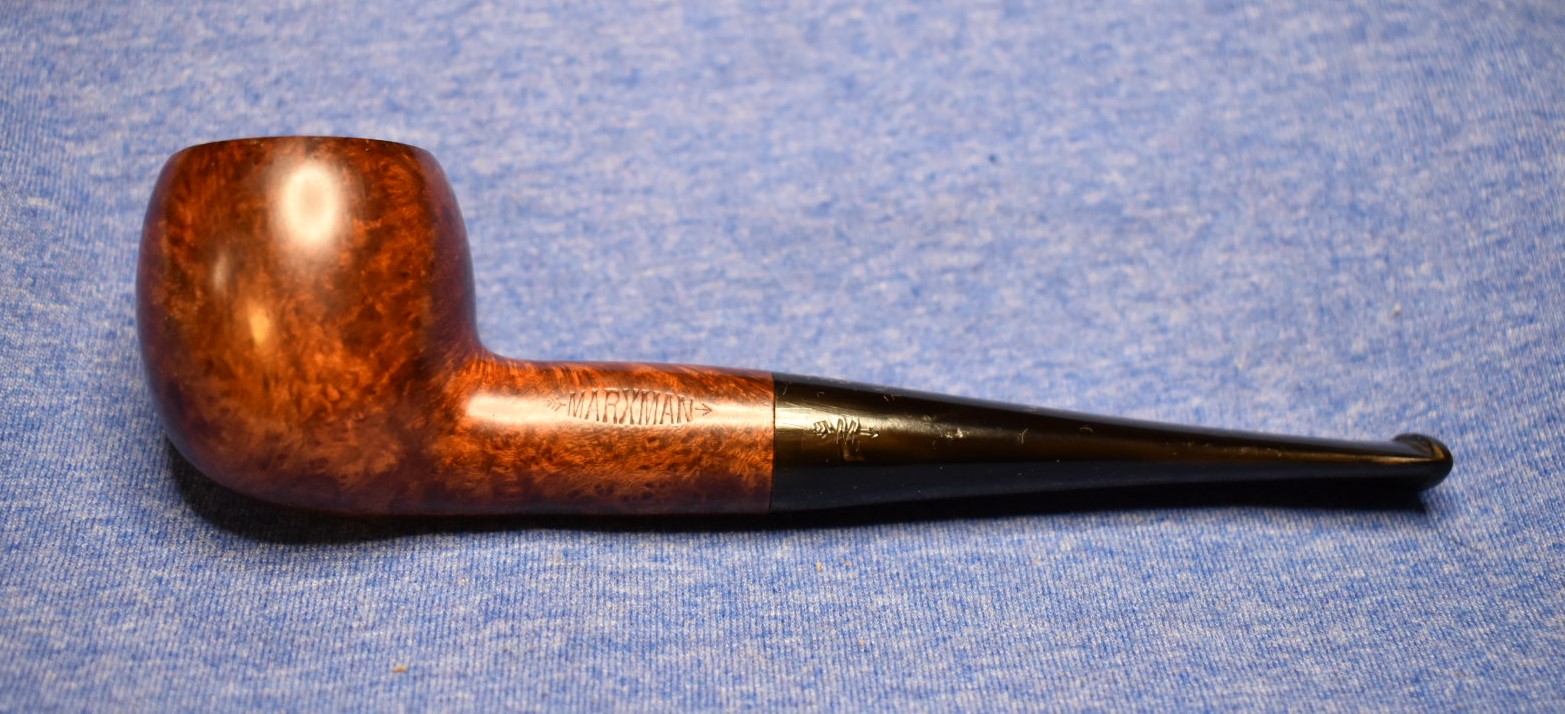
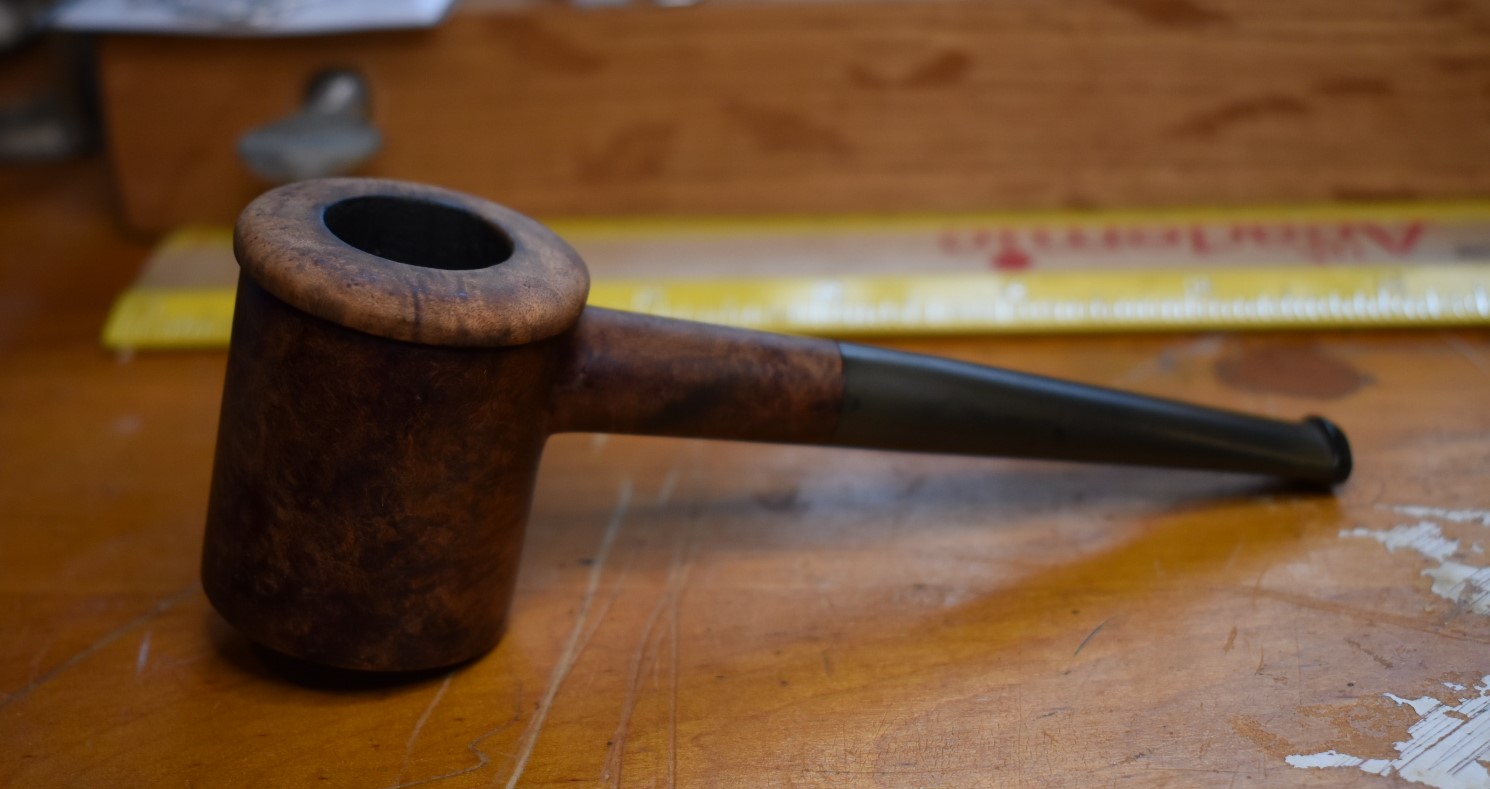
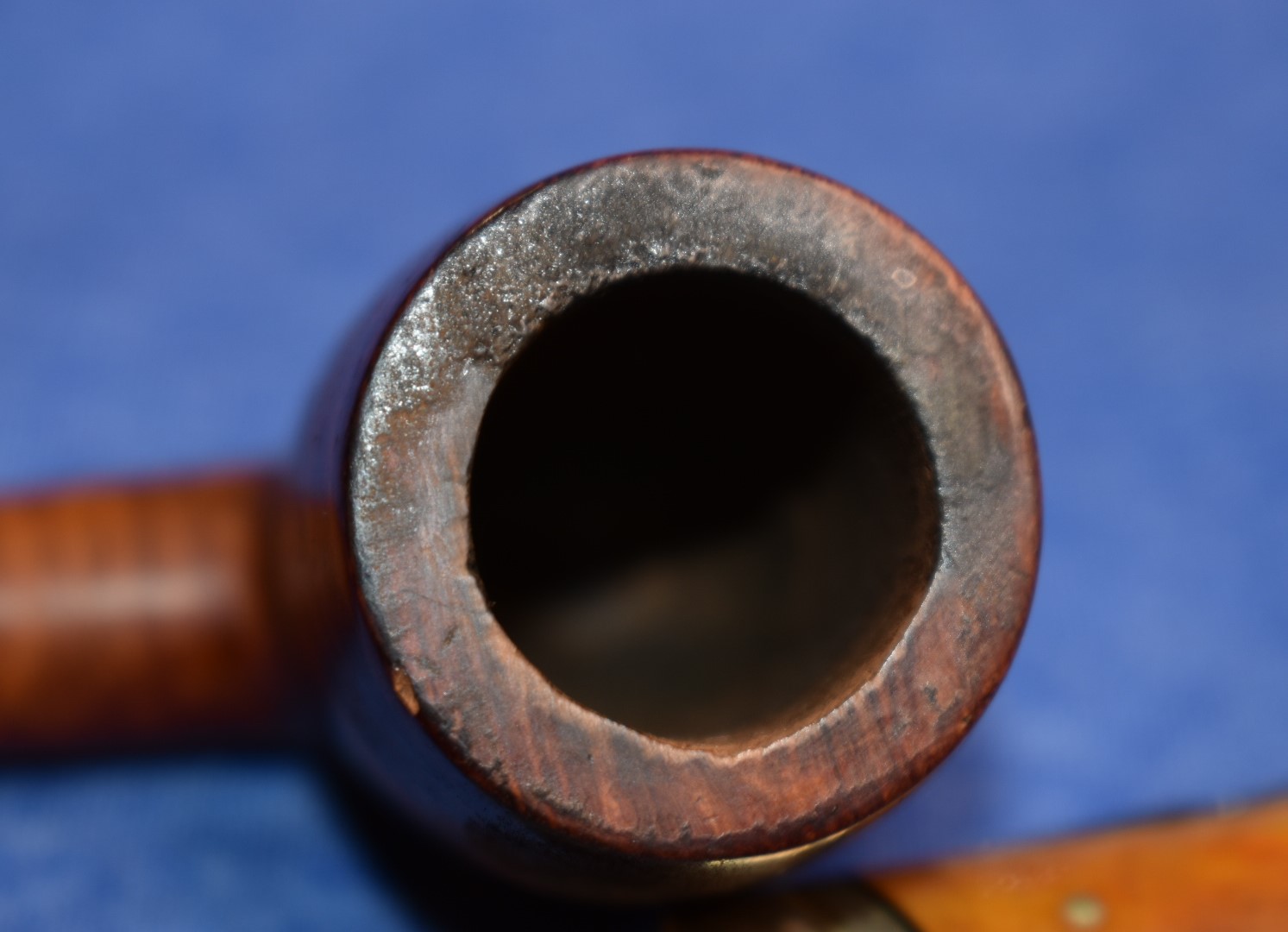
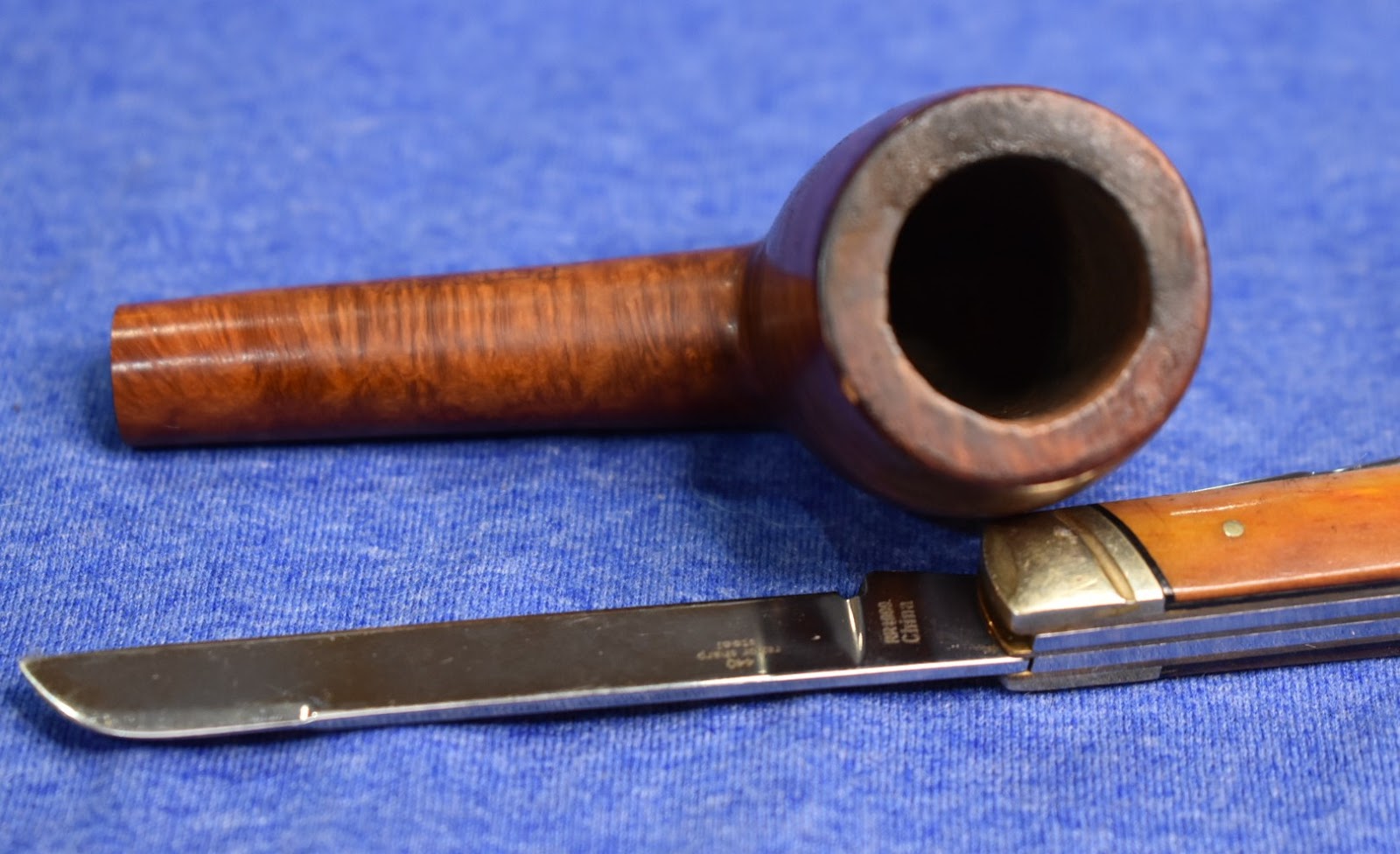
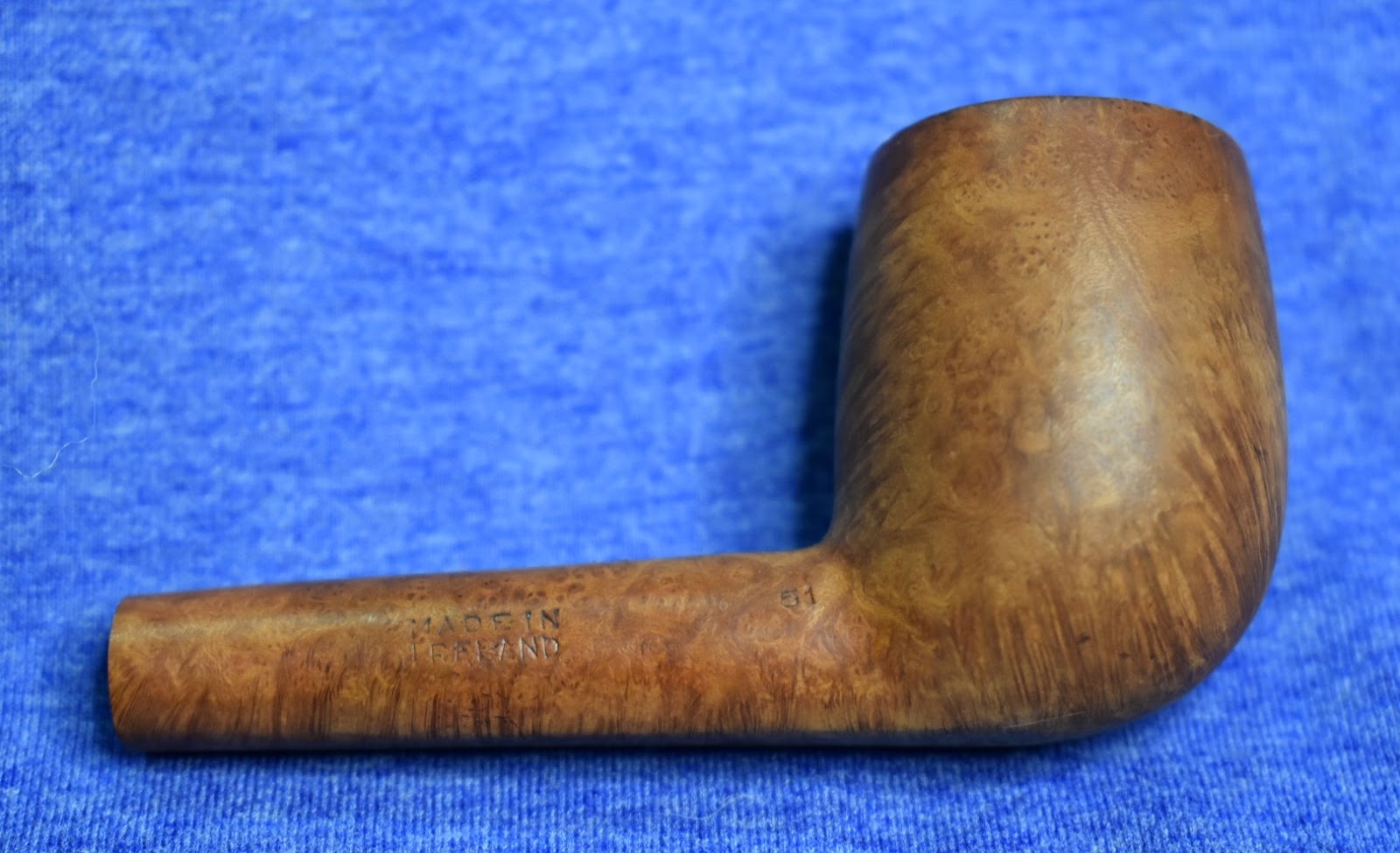
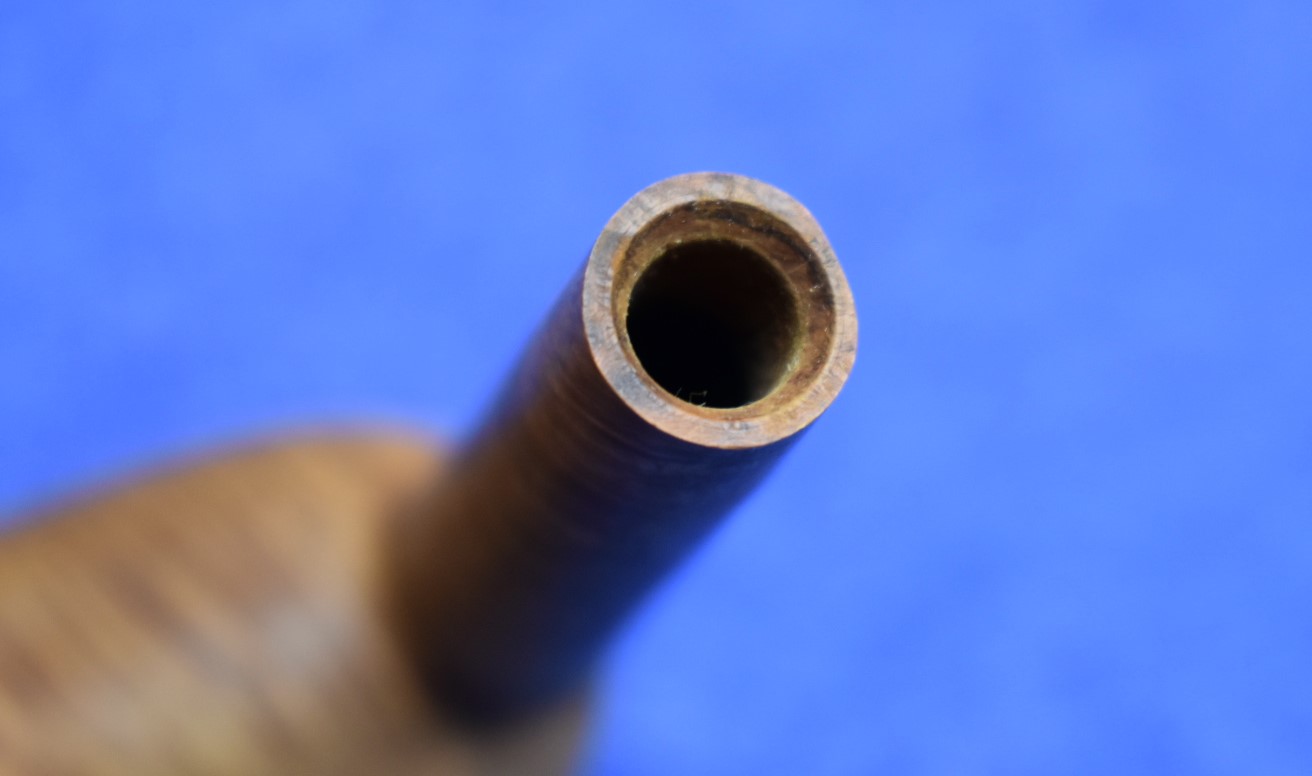
    This brings us to the Marxman Regular Apple, the topic of this restoration and the photo at the top of the page.  This little darling arrived as many Marxmans do – well used.  That is a polite way of saying beat-up and filthy.  She had a cake so thick that only a tiny bowl of tobacco could be smoked.  How she avoided a cracked bowl is amazing.  This cake was equally as thick as the briar walls of the tobacco chamber.  

    The bright lights used in these original photographs actually make her look better than the normal room lighting.  I could see very little grain of any kind.

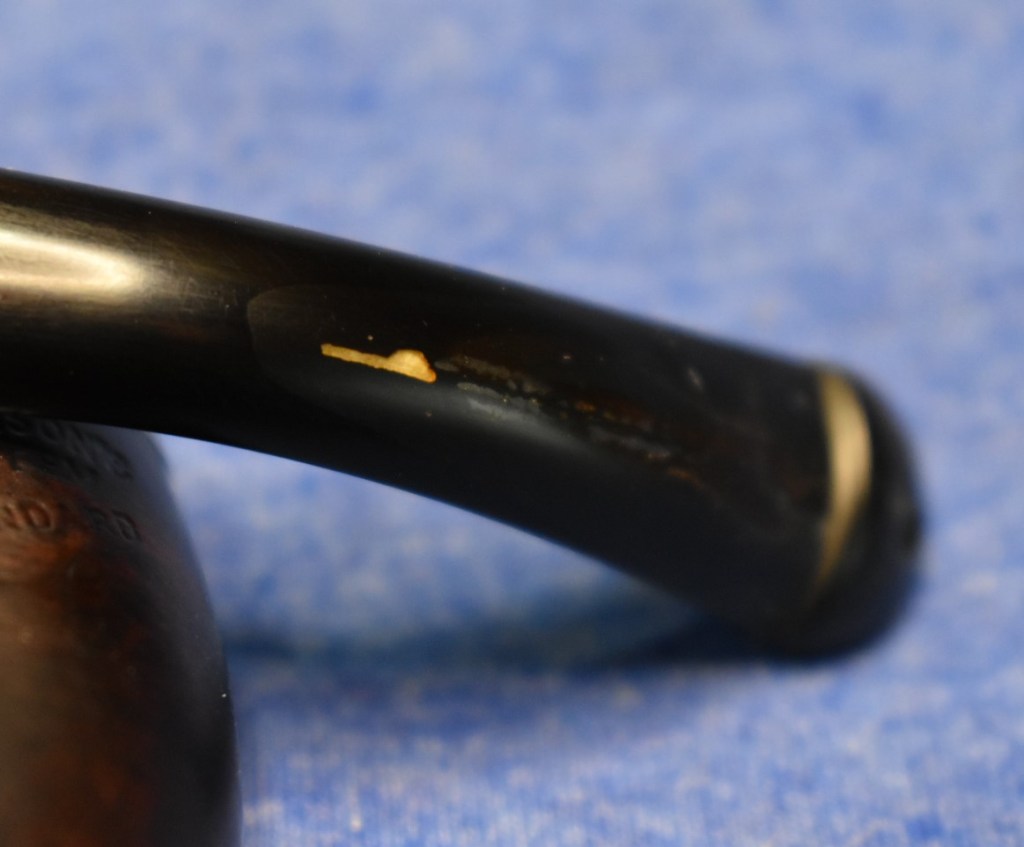
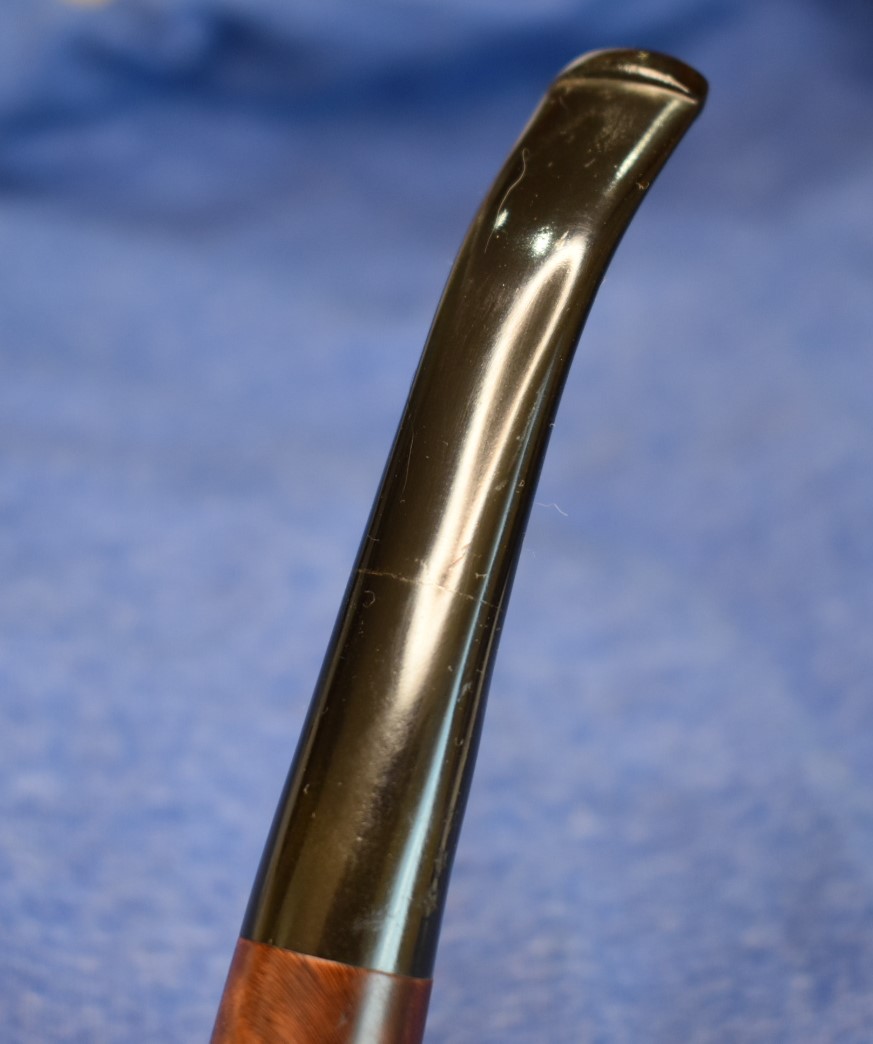
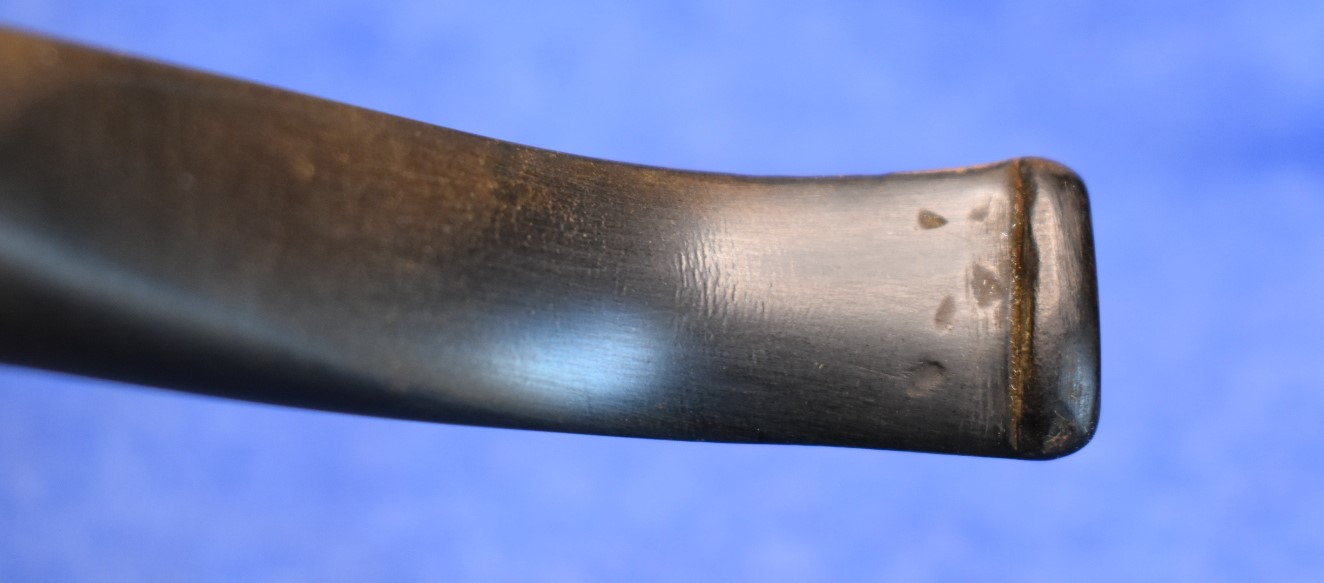
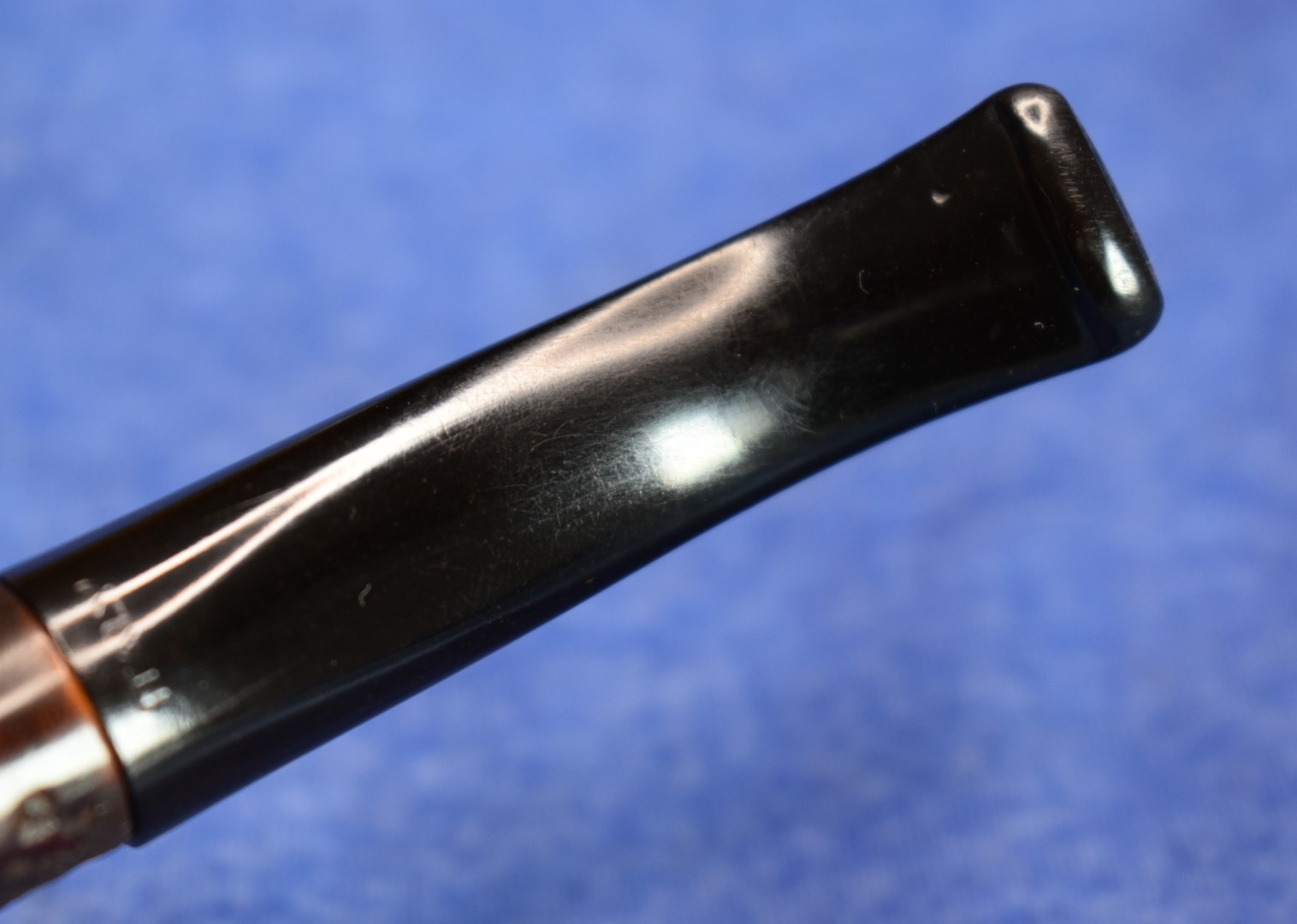
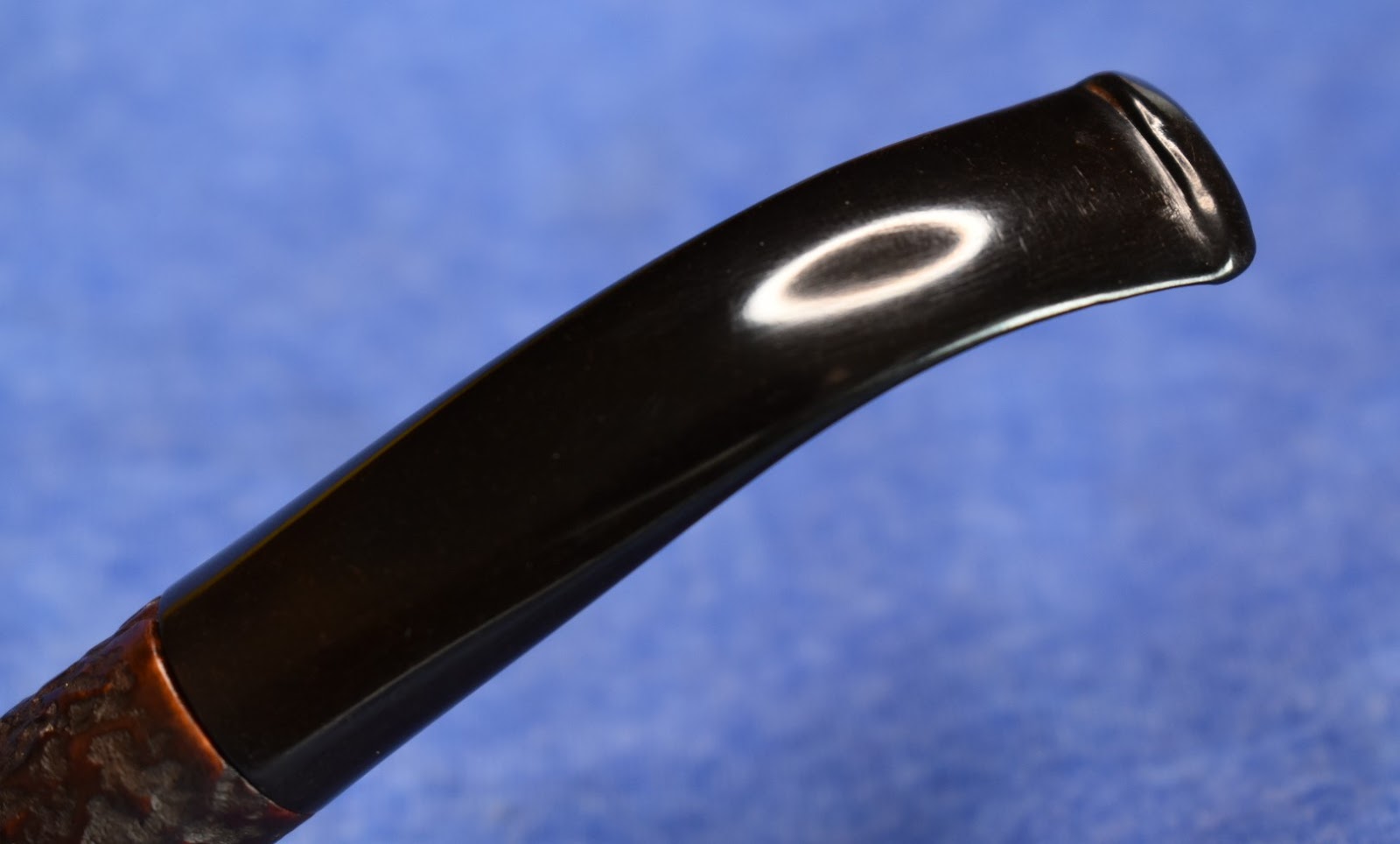
    Then there was the condition of her stem – all I could think of was that a teenager with a channel-lock had heard there was a $20 bill in the shank and he was going to be the first to retrieve it.

    Of course the internals were in a condition that is expected of a pipe in this state.  

    Other than those issues this should be fun, although fun to a restorer may not be universally accepted.  

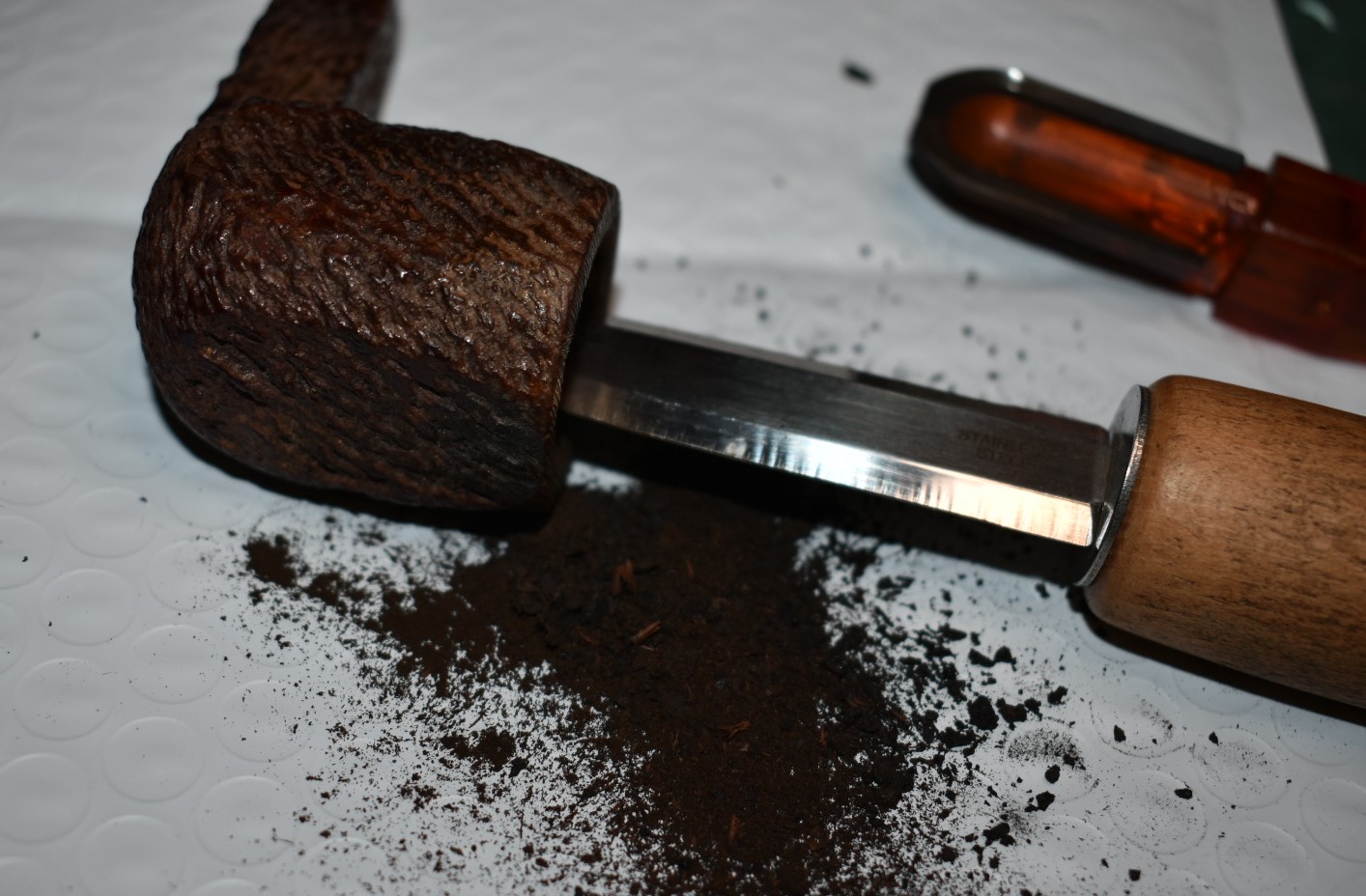
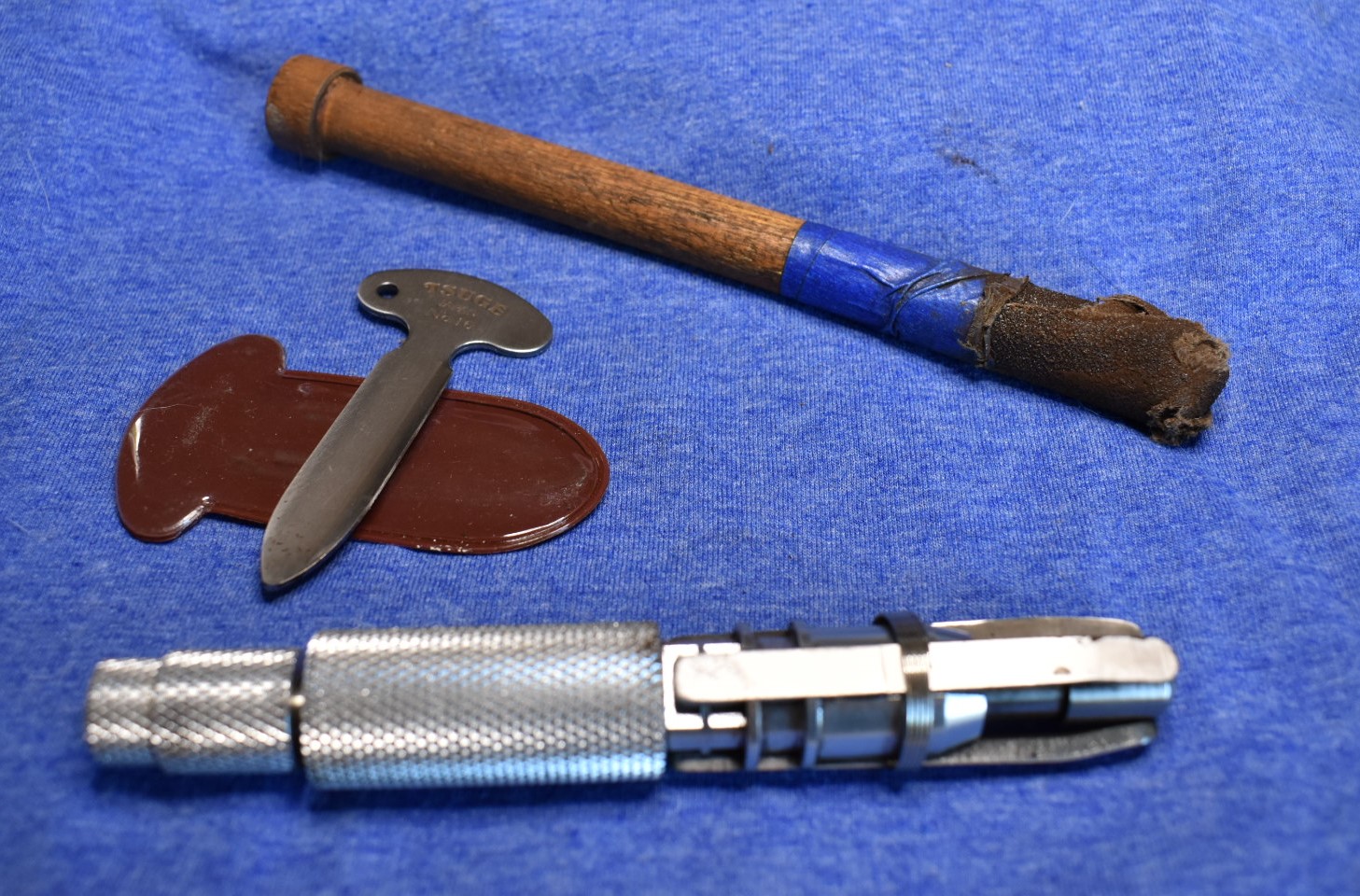
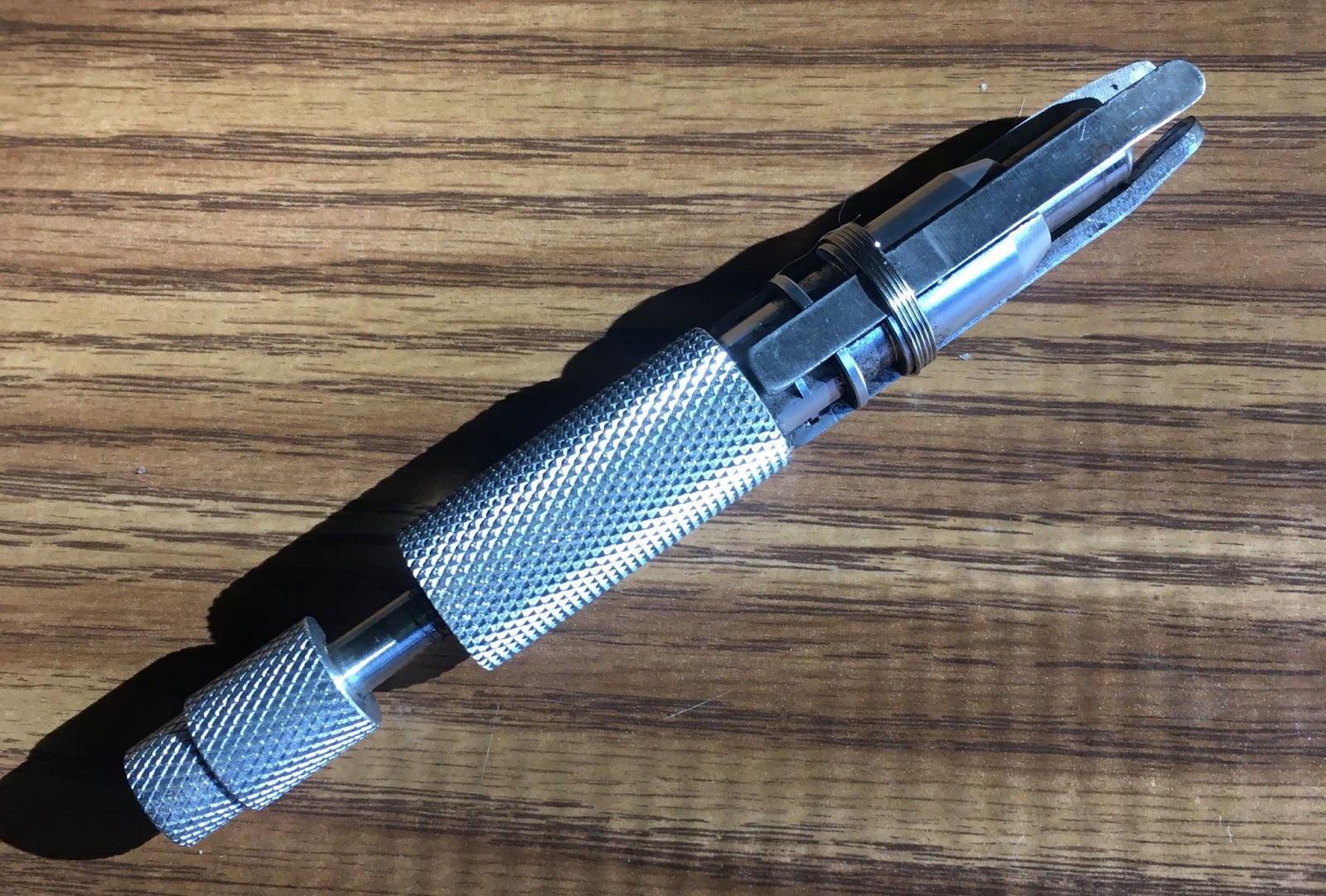
    Normally I start with a thorough cleaning of the exterior of the stummel.  This time I started with the reaming of the tobacco chamber.  I was actually afraid that it might just burst like a balloon cracking into several pieces.  Okay, slight exaggeration, there.  I began with the PipNet and the Smoking pipes knife.  I soon realized that I did not want to put that much pressure on the handle of my PipNet.  

    I got out the Tsuge reaming blade and the Scotte adjustable reamer.  I started opening up the chamber one step at a time and finished with the PipNet.  The aftermath of the reaming was a pile of carbon cake that if properly sequestered will aid with global carbon control.  The chamber was finally sanded with 220 sandpaper on a wooden dowel.  The chamber looked good with no signs of any damage from excessive heat.

    With the chamber reamed I turned my attention to reaming out the shank and draft hole.  I used the draft hole reamer from the Scotte tool to clear the airway.  It felt rather “greasy”.  I took this to mean that there was still a thick residue of tar and yuck in the shank.  I tried scraping the airway with a dental pick without much success.  

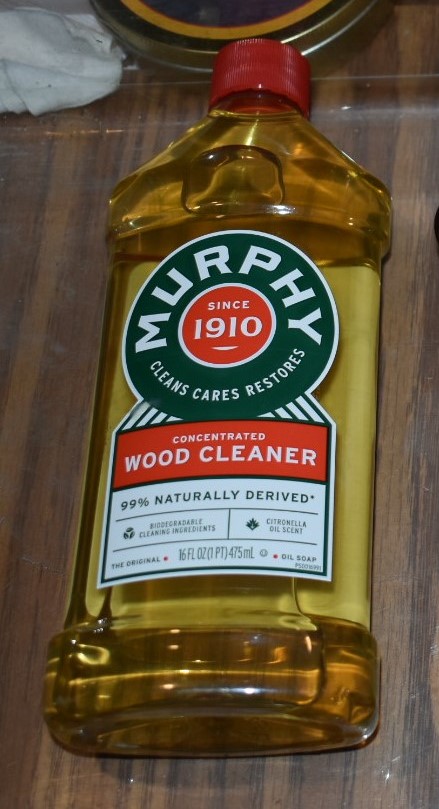
    To the sink.  I took the stummel to the sink to scrub the externals with Murphy Wood Cleaner and a medium stiff toothbrush.  Given, my hands still had carbon on them from the reaming but, wow.  The dirt and grime that came off the stummel with the soap was impressive.  It was still impressive with the second application of Murphy’s.  By the third time I removed the years of accumulated grime.  Now for the shank.  I started that with the nylon bore brush with Dawn dish soap.  The lather produced was dark brown.  This was rinsed with hot water.  The bore brushing with additional Dawn and rinsing continued several cycles.  Finally the lather was not brown.  I was sure that the entire stummel would need to be dried overnight with all of that exposure to water.  

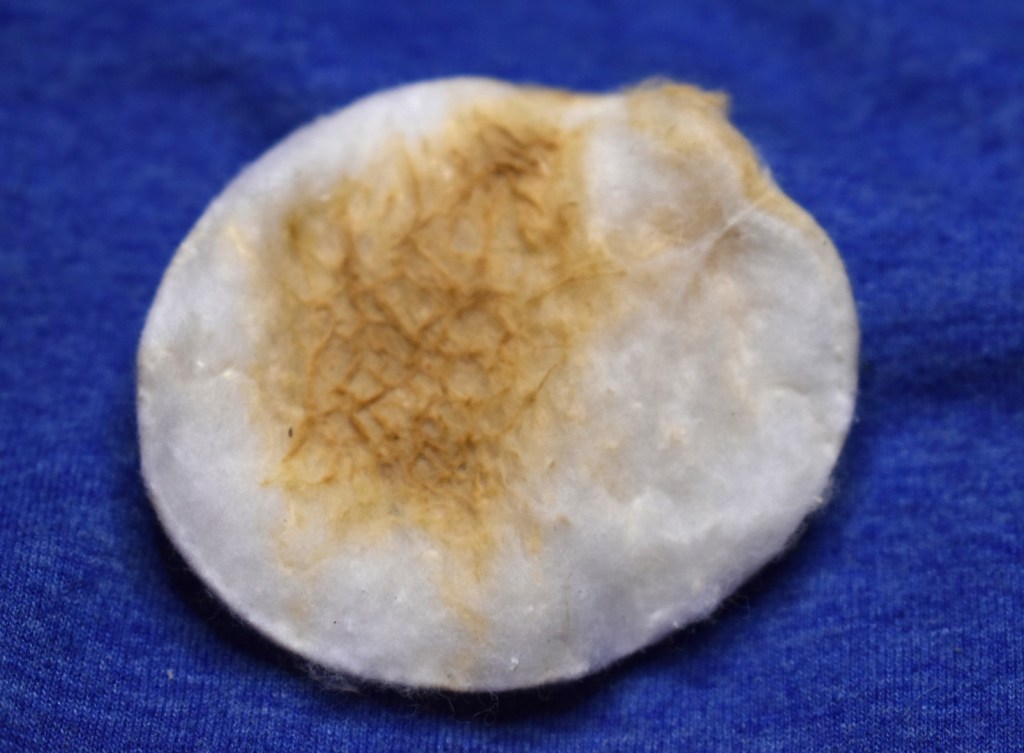
    I returned the stummel to the workbench and proceeded to wipe it down with a make-up pad soaked in 99% ethyl alcohol.  The pad removed little else from the stummel, just picking up a very slight brown tint, probably a bit of dye from the wood.  I poured a couple milliliters of alcohol into the chamber and sloshed it about and allowed it to fill the draft hole with my finger plugging the mortise end.  The alcohol will draw much of the water out of the wood as it is very hydrophilic.  I poured the remaining alcohol into a medicine cup and used a paper towel to dry the remaining alcohol from the bowl.  I then used a small round needle file to feel for tar in the shank.  The needle file came back with tar embedded in the teeth.  Hmm, lets try a little technique I came up with – wrapping/rolling a piece of paper towel around the needle file, dip the tip in alcohol and scrub the shank.  It works and it allows you to put more pressure on than you can with a cotton swab. The tip end will absorb the tars and can be unwrapped, flipped over, rerolled for a clean side.  After doing this repeatedly I finally made progress cleaning the draft hole.

    Here is what the Marxman Regular Apple looked like after the scrubbing:

    You can really see that there is some wood grain and some big dings and chips to the rim.  To the topping table.  This is actually just a new piece of 220 sandpaper laid flat on the counter. I sanded in a circular pattern until I had removed most of the dings.  I rotated the stummel in my hand several times to keep the pressure even across the entire rim.  There was still the chip.  For that I sanded until the remaining chip could be removed by beveling the inside edge of the chamber using a wooden ball wrapped in a small piece of sandpaper. After the 220 sandpaper I repeat the process with 400 sandpaper.

    The left photo is topped only while the lower photo is topped and beveled.

    The sanding of the stummel was done starting with 400 wet dry sandpaper.  I was careful of the stampings as to not remove any material from them.  After the sandpaper the stummel was

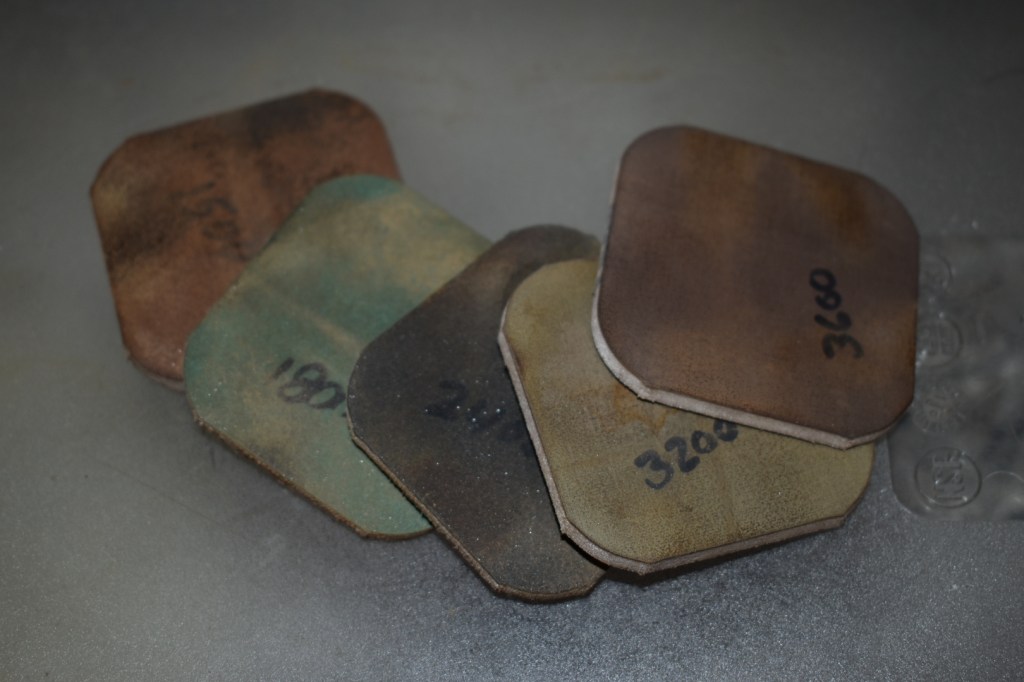
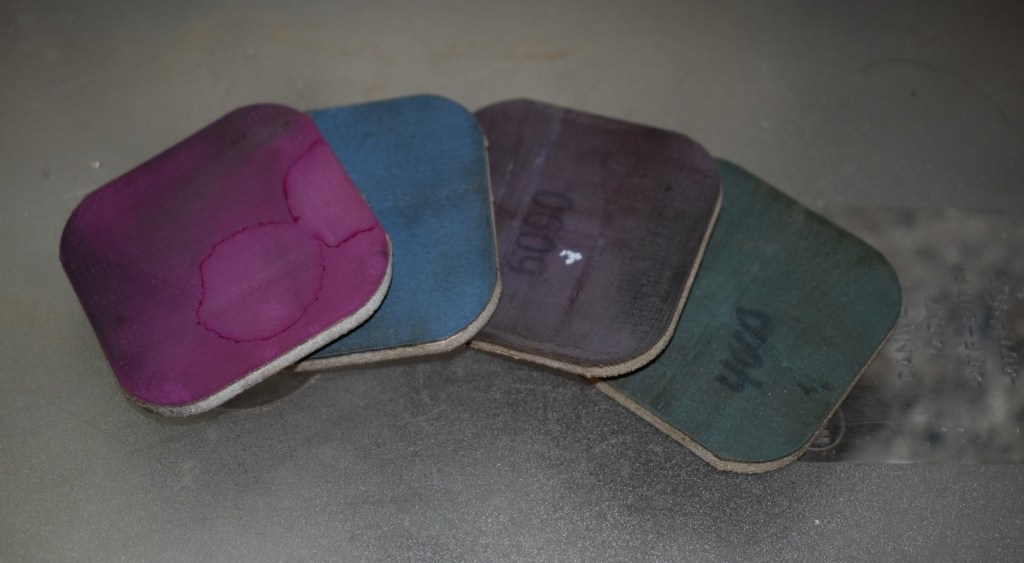
    wiped off with an alcohol soaked make-up pad.  I then began using the micro-mesh pads.  The most coarse pad I have is 1500.  This pad was used with a couple drops of water on the pad.  Between pads the stummel was wiped off with the alcohol dampened make-up pad.  After the 1500 came the 1800, also with a bit of water.  I continued up through the micro-mesh pads to 4000, wiping between each with the alcohol.

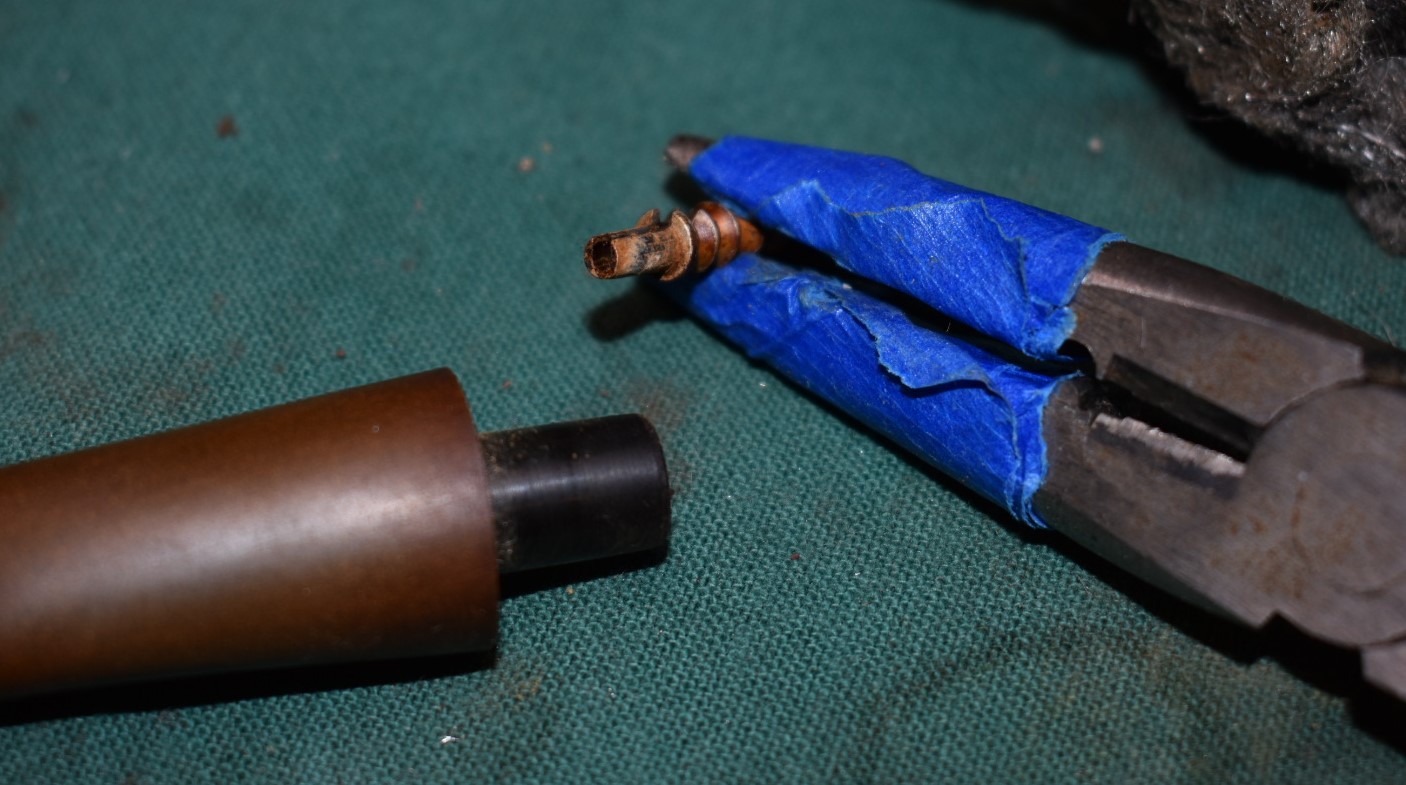
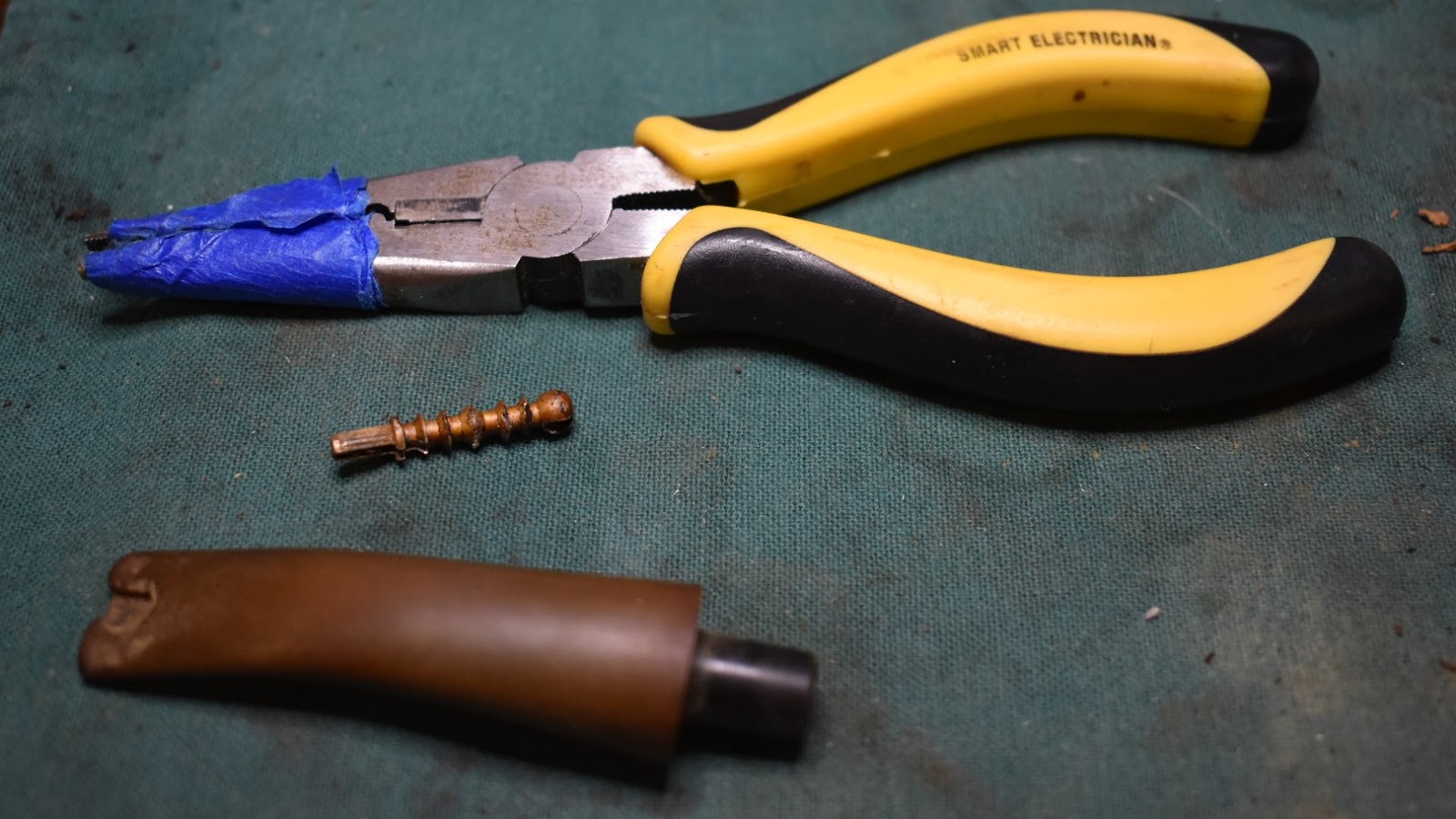
    Once the stummel had been sanded and micro-meshed I gave it a coating of Restoration Balm and allowed it to marinade in the balm while I addressed the stem.  I did not soak the stem in the Deoxidizing solution since I knew that it was going to be sanded extensively in order to remove the numerous dents and teeth marks from what appeared to be pliers.  The cleaning of the stem began with the removal of the stinger.  Stingers or “metal filters” are

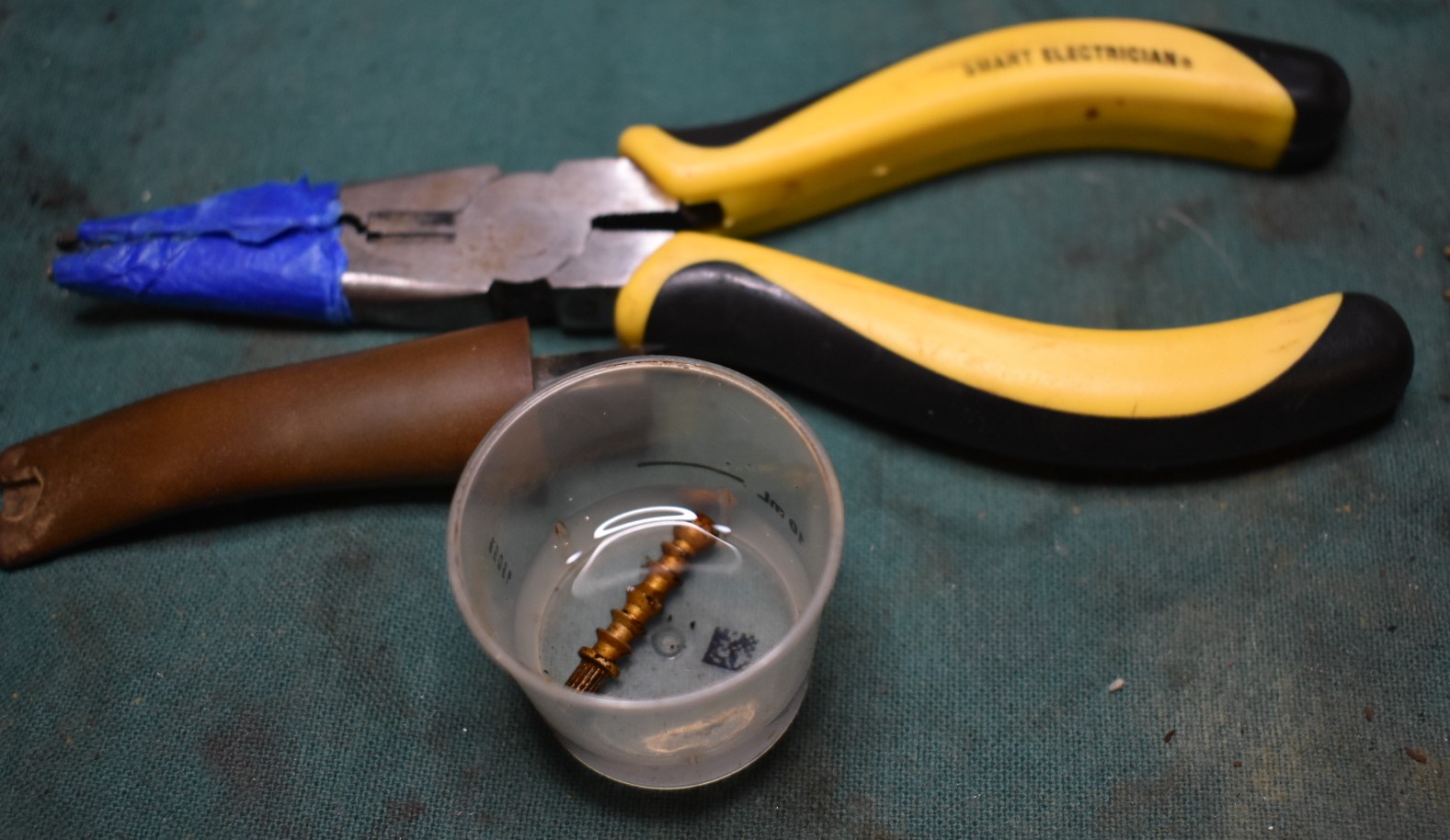
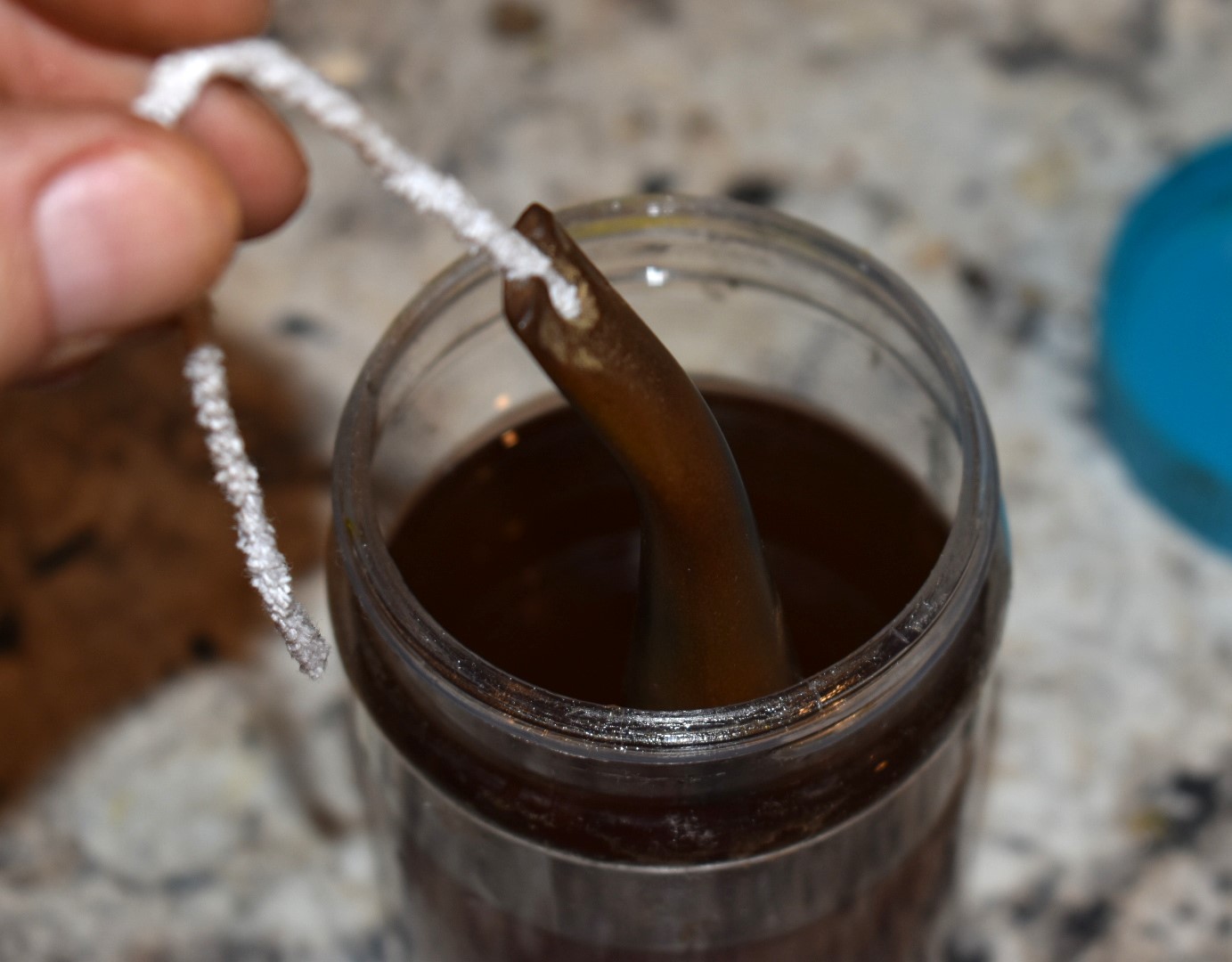
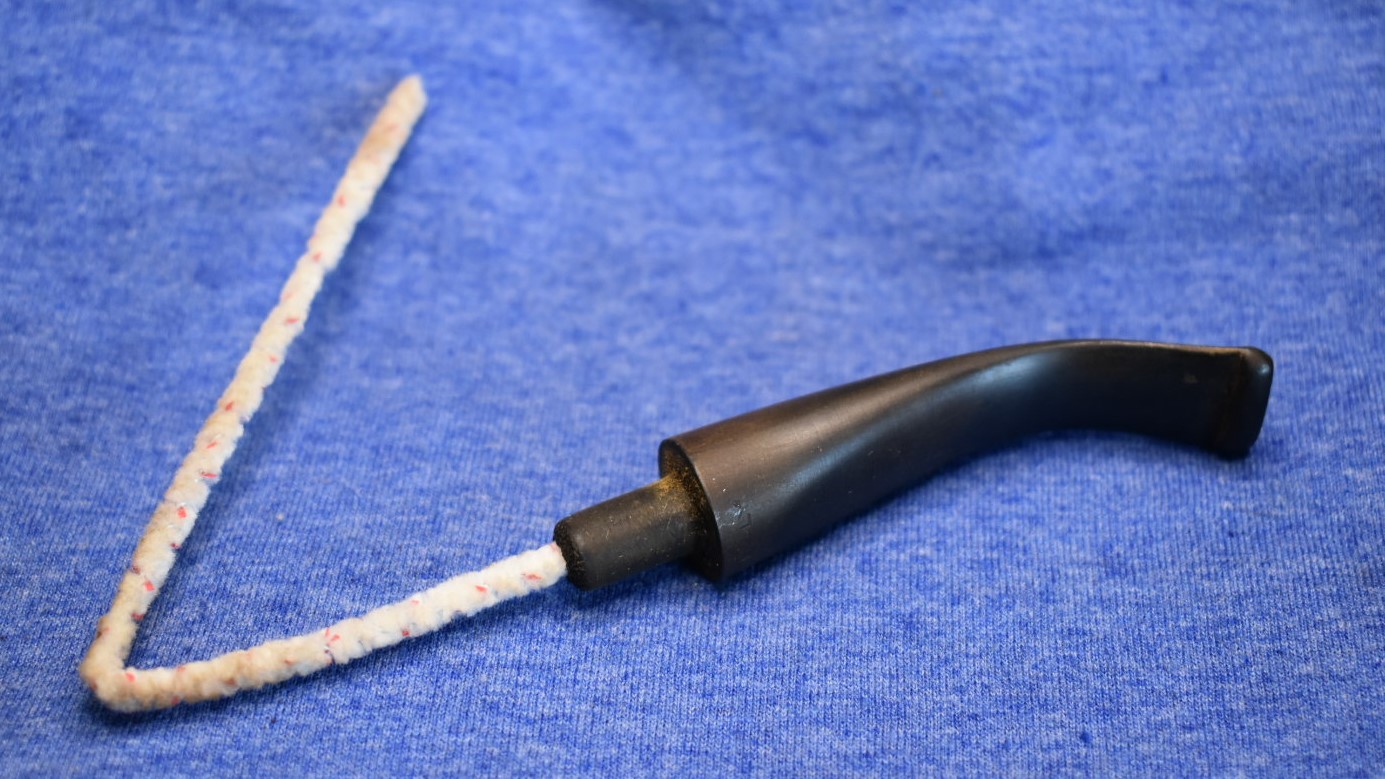
    kind of a misnomer as they hardly filter the smoke.  They most likely allow a surface onto which water can condense out of the smoke and maybe some smoking particles will absorb into this water but, filter?  They are usually press-fit into the stem.  This one was quite stuck.  I tried to soften the dried residue with alcohol and used a brass brush to clean it off.  Eventually I wrapped the stinger in a piece of denim and pulled it out with a pair of pliers.  I then dropped the stinger into a medicine cup with alcohol to soften the dried residue.  Knowing how dirty the shank had been and not wanting to use hot water on the stem and risk discoloring it.  I decided to use a technique with long churchwarden bristle pipe cleaners, a pipette with alcohol and a vice.  You clamp one end of the pipe cleaner in the vice, thread the stem onto the

    pipe cleaner, lightly moisten the pipe cleaner with alcohol (not dripping wet, just moist) then holding the free end of the pipe cleaner tight you vigorously move the stem along the full length of the long pipe cleaner.  This can be repeated as many times as needed.  After an alcohol soak the stinger cleaned easily and was re-inserted into the now cleaned stem.

    I had to be careful not to sand the tenon end of the stem as I did not want to change the shape or size of the stem to make fitting with the shank unsightly.  I used 180 sandpaper to roughly sand the problem areas.  This rough sanding was smoothed and blended by lighter sanding with 220 followed by 400 sandpaper.  This was a slow process and I was sure that the results would leave a stem that had waves along the surface where I had to remove so much material in order to erase the dents.  Eventually I got to the point where I was happy with the look of the stem.  I then proceeded to use the finer and finer grade micro-mesh pads.  The stem was wiped down with Obsidian Oil between each of the different micro-mesh pads.  When finished I could still see some of the dings from the abuse but overall I was pleased with the look of the finish. 

    With the stem in acceptable condition and the stummel well marinated, it was time to reassemble the renovated darling.  I wiped the remaining Restoration Balm off the pipe and gave it a good rub with the inside of a cotton athletic sock.  It always amazes me at how well the Restoration Balm breathes life back into a piece of dry briar.  Truly amazing stuff.  The pipe needed a few coats of carnauba wax applied via the buffer.  After the buffer waxing I hand buffed the entire pipe with a microfiber polishing cloth to add that little extra shine.

    If I were a professional restorer I would have been more inclined to strive for perfection.  The only problem there is how perfect can a well used 80 year old pipe get?  This one will most likely be either used by me as a work-in-the-yard/fishing pipe or it will be gifted to someone and I was quite pleased at the improvement.  Either way it has returned to the task that it was originally made for:  To be used to smoke tobacco and look darn good doing it.  I hope that you can use some of the techniques that you see here in your own work, were slightly entertained or both.  Thank you for reading the ramblings of an old pipe lover.

    PS:  Here are those books/websites I referred to earlier:

    Back From The Ashes: Uncovering the Lost History of G. L. Hunt and the Falcon Pipe,

    by Worth, K. A.

    Available at: https://www.amazon.com/Back-Ashes-Uncovering-History-Falcon-ebook/dp/B006VOOFNC/ref=sr_1_1?keywords=falcon+pipe+history&qid=1699996641&sr=8-1 ($2.99 digital version on Amazon)

    The Peterson Pipe: The Story of Kapp & Peterson,

    by Mark Irwin and Gary Malmburg

    Available at: https://www.smokingpipes.com/accessories/books/moreinfo.cfm?product_id=471478 (Still available from Smokingpipes.com, though not $2.99 it is a remarkable book)

    Review of:  THE CUSTOM-BILT PIPE STORY, by William E. Unger, Jr.,Ph.D

    https://pipedia.org/wiki/Custom-Bilt

    The Pipes of Sparta: Dr. Grabow, by Leigh Ann Henion https://www.ourstate.com/the-pipes-of-sparta-dr-grabow-tobacco-pipes-north-carolina/

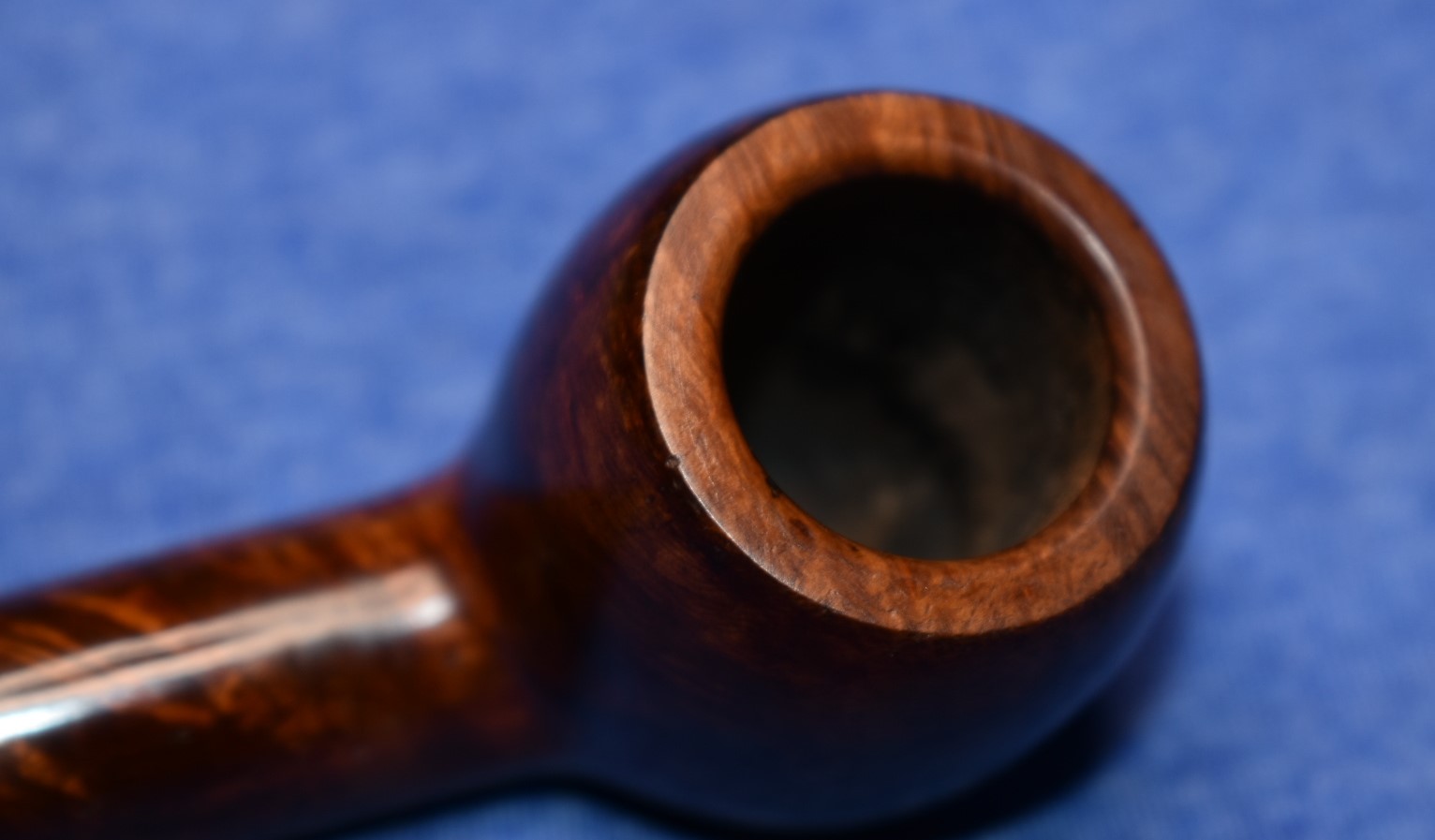
    Below are some photos of the finished Marxman Regular Apple.

  • An MLC Hell Maria Restoration

    November 11th, 2023

    Written and photographed by John M. Young

    This was what may have been my first restoration.  It contains mistakes, early photographs and is written from a less than stellar memory.  With those  qualifiers or disqualifiers, I will continue.  Upon retirement from 32 years of teaching secondary science, I concluded that I needed more activities to fill

     my increased free time.  By the way, if you ever wondered what it looks like to turn-in one’s paperwork after 32 years of teaching here is a photo.  I had smoked a pipe on and off since 1991.  None of the earliest pipes remain as they were given away or lost to the ephemera of time. 

    As part of my learning how to restore pipes I went to the internet.  I do not recall many of my original searches but I do vividly recall reading Steve Laug’s  blog posts from https://rebornpipes.com/ and thought that he was a master of restoring old pipes and communicating the steps of these restorations.  I voraciously consumed his blog posts.  I have never been a big youtube watcher and found that the written blog format better suited my learning style.  Not that there are not great restoration videos out there.  There are and I have learned a great deal from the likes of Bare Pipe.  It has been said that imitation is the greatest form of flattery.  In looking up that quote it is important to use the whole sentence rather than just the first 7 words.  Oscar Wilde’s full quote reads: “Imitation is the greatest form of flattery that mediocrity can pay to greatness”.  I model my own restoration guides on the works of Steve Laug.  I accept my mediocrity and I hope that readers will find mediocrity useful in their own restorations.

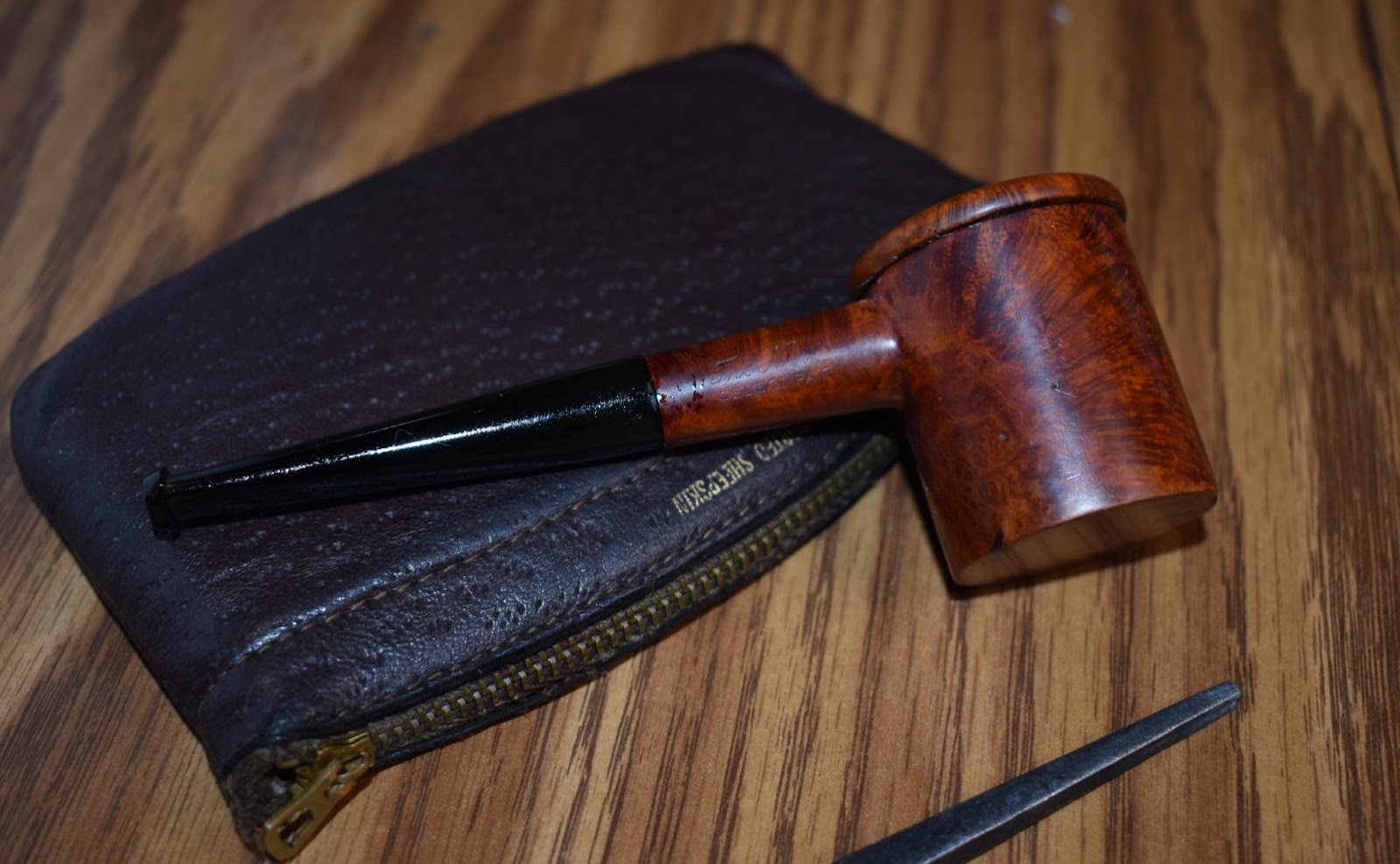
    From reading Steve’s posts I noticed that many of his old pipe finds came from antiques shops.  There are a couple of shops in a town close to home, so I thought I’d give that a try.  I was walking down Main Street in Plattsmouth Nebraska and came across one of the antiques shops.  I went in and was wandering about kind of expecting to find the Holy Grail, an original copy of the Declaration of Independence or a vintage Dunhill.  Sadly I found none of those.  I did ask the proprietor if there were any “old pipes” in the shop.  Behind the counter she pulled down two quart sized Mason jars with some assorted pipes.  Nothing really caught my eye except this one weirdly shaped filthy pipe.

    The lighting in the shop was not conducive to details nor my old eyes and I asked if I could take the pipe to the south facing window to get a better look.  I had never seen a pipe like this and wondered “how did they drill this thing?”  Then I gave the top a twist and my question was answered.  The shop keeper had no information about the pipe nor did she know how much to charge.  A quick phone call to her son set the price firmly at $20.  I was pretty sure that it was robbery but I was fascinated and decided to help out a local small business in their fleecing of a local inhabitant.

    I got the little darling home and began examining and photographing the pipe.  As a note, this is prior to me having a work bench dedicated to pipes.  My fly tying bench was kind enough to donate space for the restoration.  Below are some of the early photos.

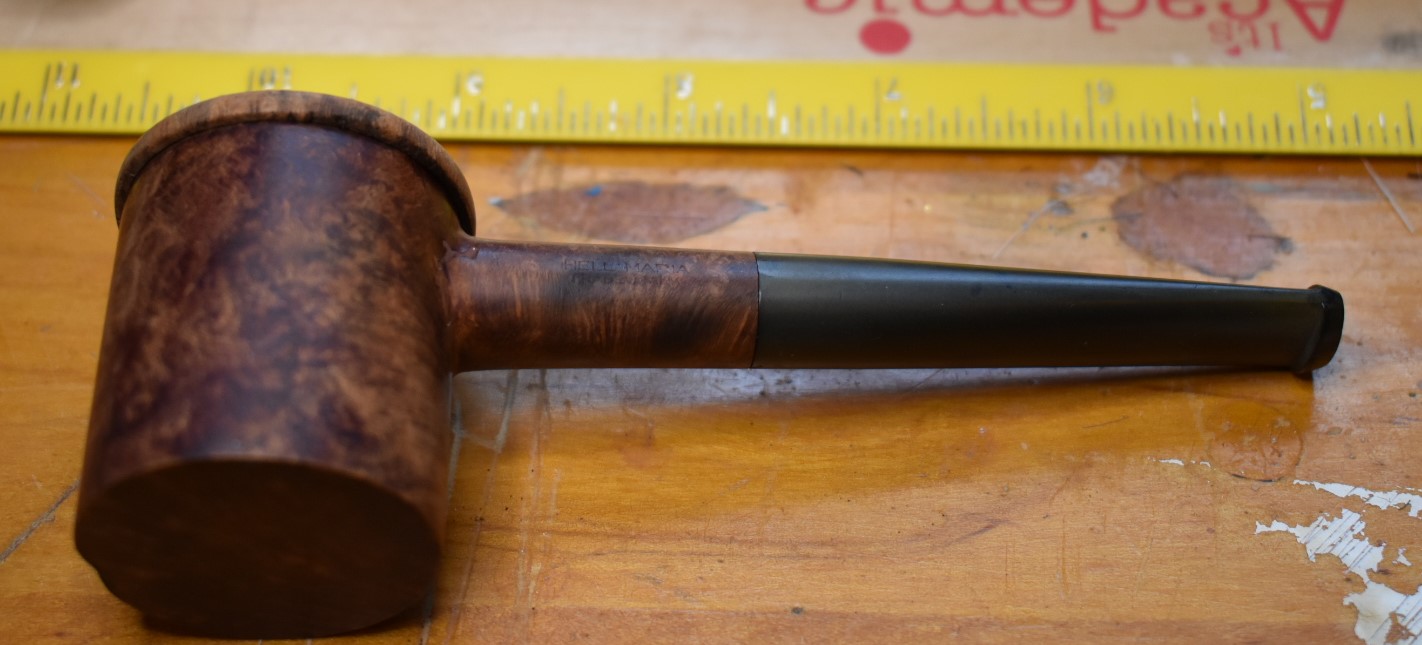
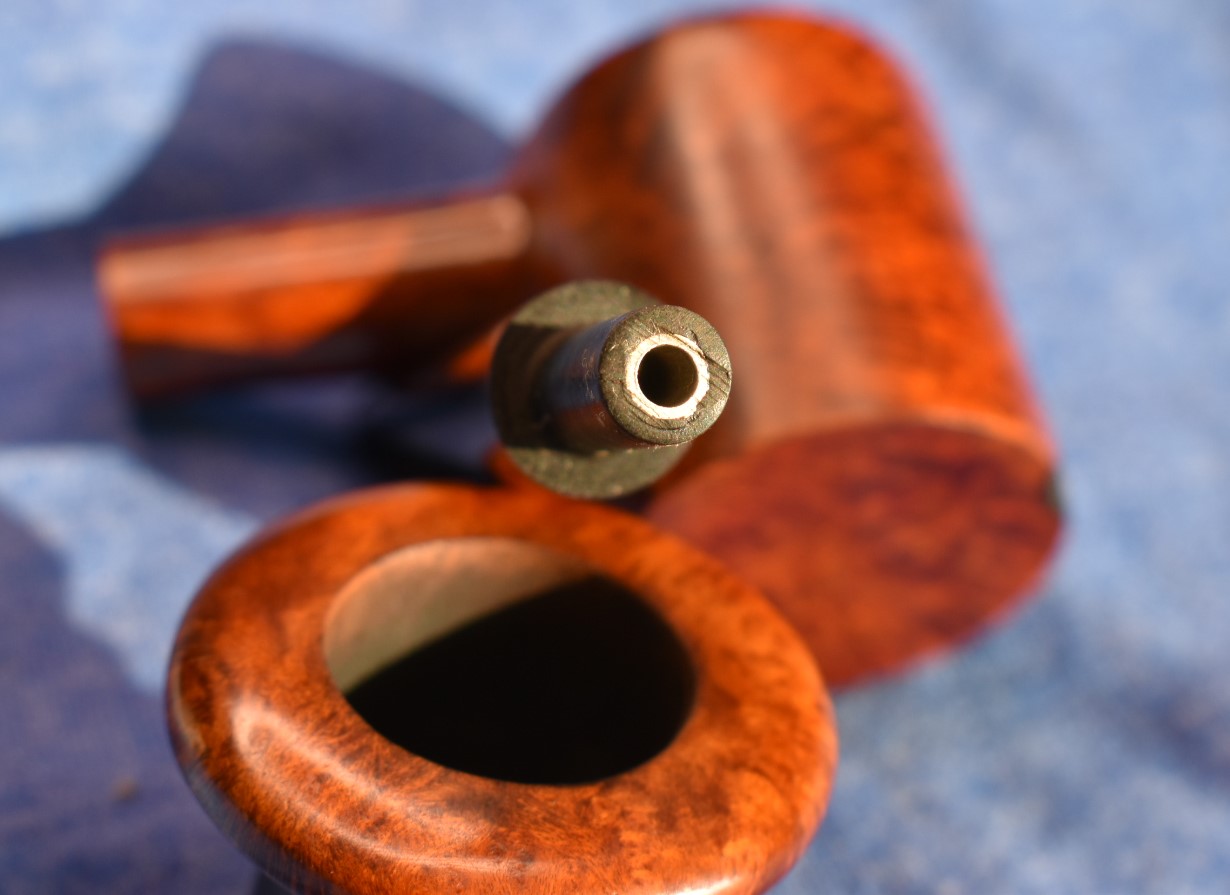
    Okay, my photos back then were not that great then again, neither was the pipe.  It was dark, dirty and just gross. In examining the pipe and its parts I was quite impressed with the delicate woodwork and the metalwork that had gone into this pipe.  The threads were cut from the briar in both the inner-bowl and the outer.  The aluminum bottom of the inner bowl and the aluminum sleeve in the stem all amazed me.  At this time I didn’t actually know there was an aluminum bottom to the inner bowl.  Below are several photos of the parts. 

    I had to find out more about this old pipe’s history.  Again turning to the internet I found a pipe that looked exactly like the pipe I was holding.  The site was http://www.smokingmetal.co.uk/pipe.php?page=520.  Since that time I have been in email contact with the proprietor of the Smoking Metal website, Tony Pringle.  In our last email he said the following:  

    “I have little with pipes for some years now, but like to keep the site going. Will sort my own out one of these days. Advancing nyears means I am currently tking steps to pass on the website to an American colleague as an insurance..so much work went into it and it seems to be used regularly still”  (personal email).  

    I do hope that Mr. Pringle continues to do well and can find a benefactor to continue the website.  The Smoking Metal site showed its Hell Maria with very clear stamps on both the left and right of the shank.  Mine was not quite as clear but obviously the same pipe.

    The stamp that I could not make out on my pipe was the MLC.  This stands for Mary Linkman & Company.  This is the same company formed by Louis B. Linkman, the originator of Dr. Grabow pipes.  In 1898 Linkman and August Fisher started a small business making pipes.  The business grew and, “in 1907 M. Linkman & Company was incorporated with Louis B. Linkman as president, August Fisher, vice-president…” (https://pipedia.org/wiki/M._Linkman_%26_Co.).  The M. Linkman & Company was a name used throughout the 1920-30s.  I remember finding a copy of a print ad from 1924, online.  It showed a drawn image of the Hell Maria but I cannot find it again.

    This clearly places the dirty and scarred Hell Maria from a shop in Plattsmouth NE to origins in the 1920s.  I was really beginning to wonder if I had bitten off more than I could chew with a pipe that old.  Then I looked at it and thought, “ I can’t make it any worse”.

    Using Steve Laug’s restoration guides as my guide I started where he usually did, with a cleaning of the pipe exterior.  I used undiluted Murphy Wood Cleaner (I remember the product being called “oil soap”)

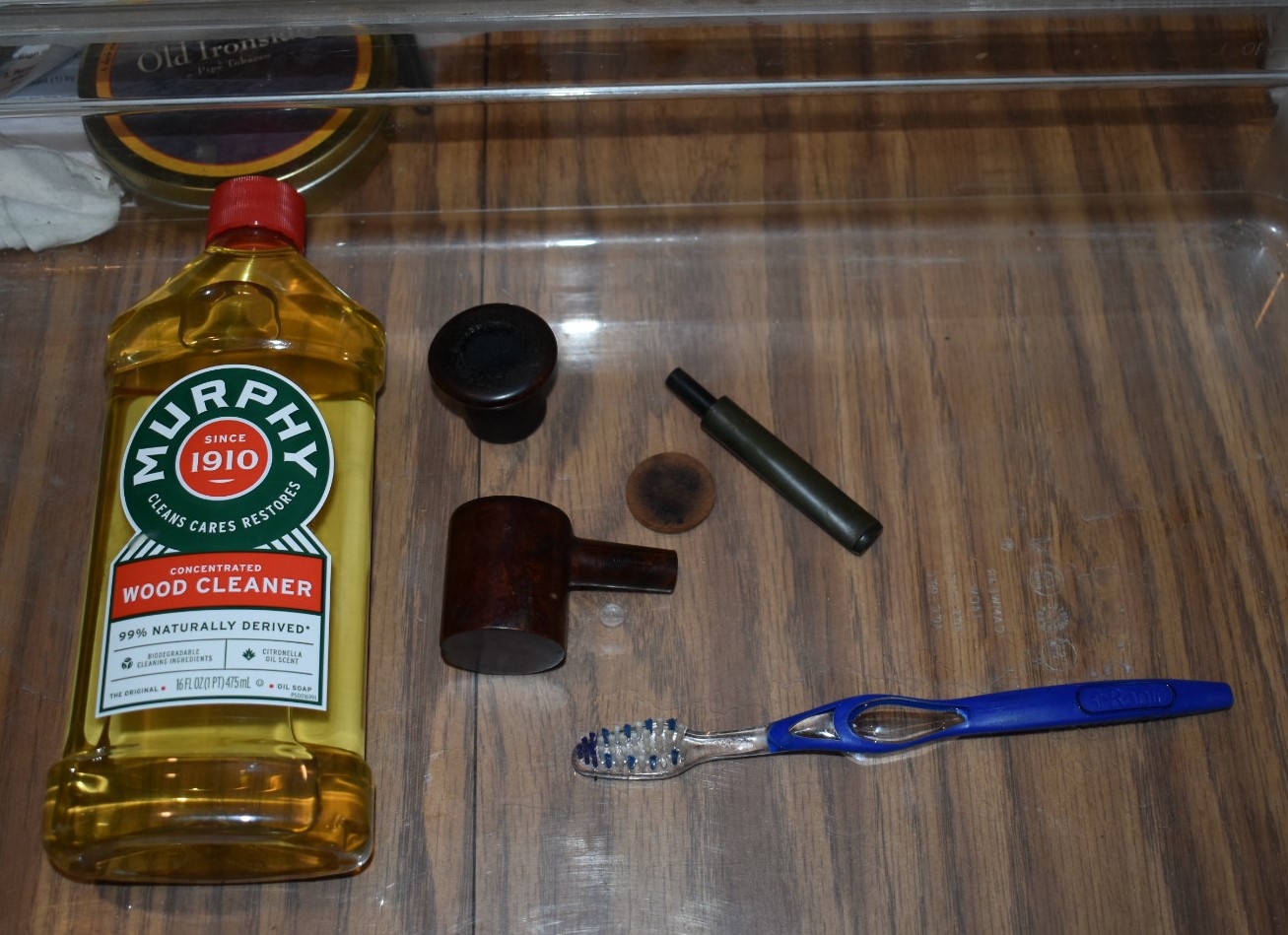
    and a medium stiff toothbrush to rid the pipe of the layers of dirt and grime.  To my amazement it worked.  The soap and scrubbing converted my uniformly brown pipe into some very pretty wood.  It also uncovered fills and cigarette burns from time in an ashtray.  The scrubbing removed the lava deposits on the rim as well.  This actually took several applications of the oil soap.  I also remember the grime having a reddish color in it.  I assumed that that was from the dye or stain used to stain the briar.  After the Murphy scrub the pipe was dried and returned to the fly tying, um restoring bench.  I wiped down the exterior of the pipe with cotton balls soaked in 99% isopropyl alcohol.  When wiping the briar with the cotton balls They turned bright red with dye.  I remembered thinking that I did not want a red dyed pipe.  I wanted a pipe that was more of an orange-brown.  I also remember that it took a long time for the orange Fiebing’s Leather Dye to arrive.  Here are a few photos of what the pipe looked like at this stage.

    After the exterior of the pipe was cleaned I turned to the interior.  The only

    pipe reamer that I had at this time was a Scotte steel expandable reaming tool.  This reamer was fine for smaller tobacco chambers.  The Hell Maria was .25 inch larger than the reamer at its widest setting. This meant that I had to use a sharp knife and a delicate touch.  I also used a dowel rod wrapped in 220 sandpaper.  The chamber got cleaned out and I discovered the aluminum bottom on top of the briar in the bottom of the chamber. 

    These two photos kind of show what I had.    I never felt comfortable enough with the knife to really scrape the thin inner bowl with much force so I did not remove the aluminum bottom.  I did try to polish the aluminum with a 0000 steel wool pad held with forceps.  I used bristle pipe cleaners soaked in alcohol to clean out the 3 draft holes in the bottom of the inner bowl.

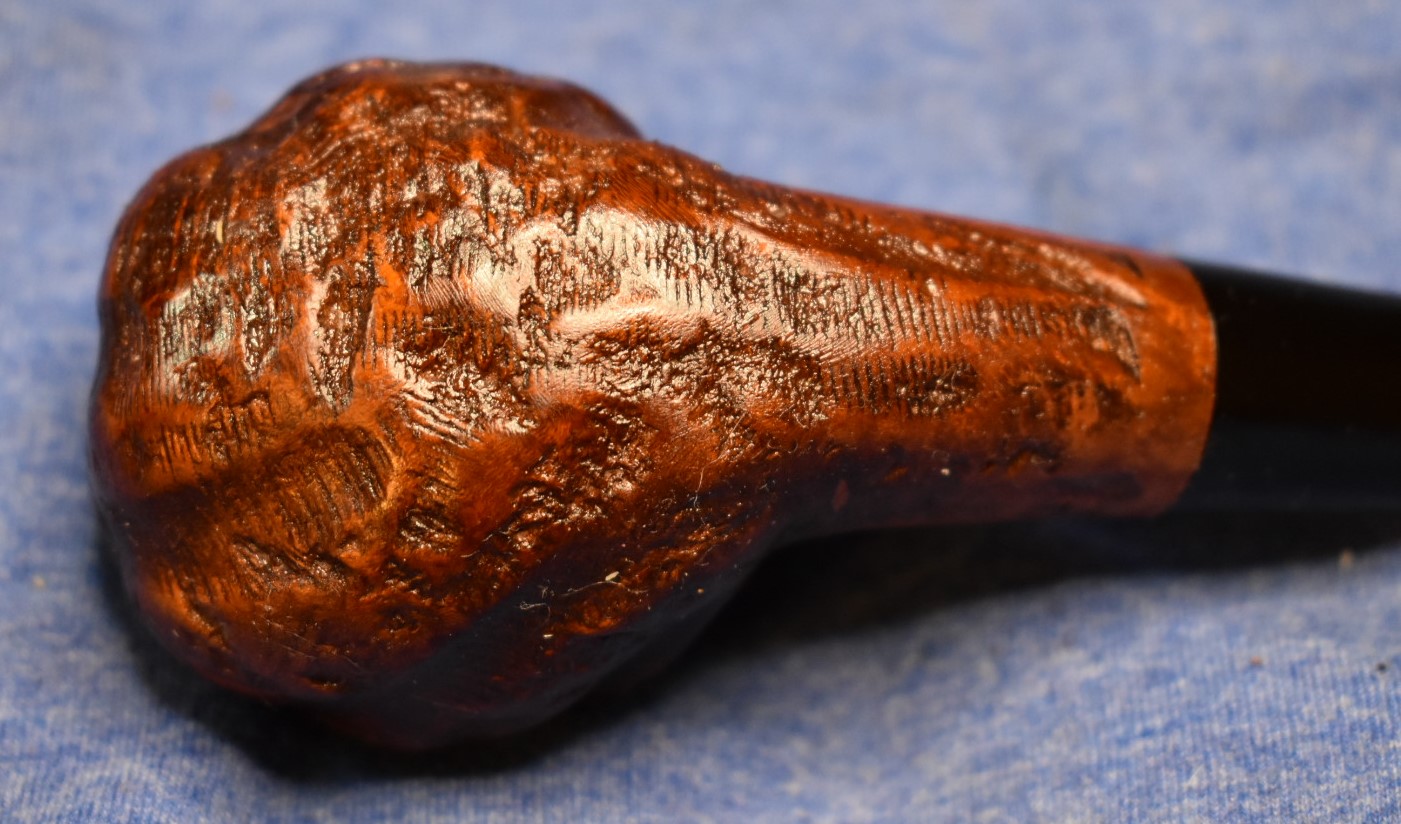
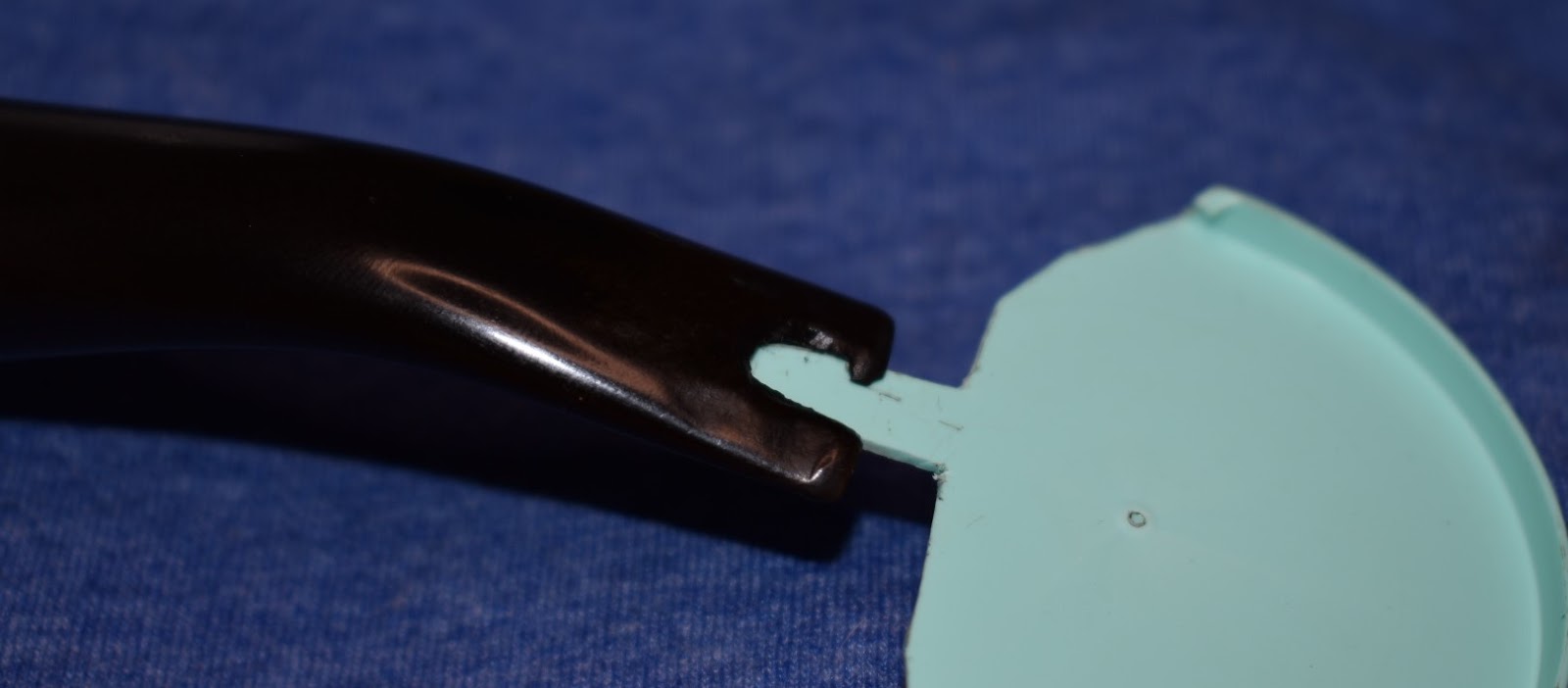
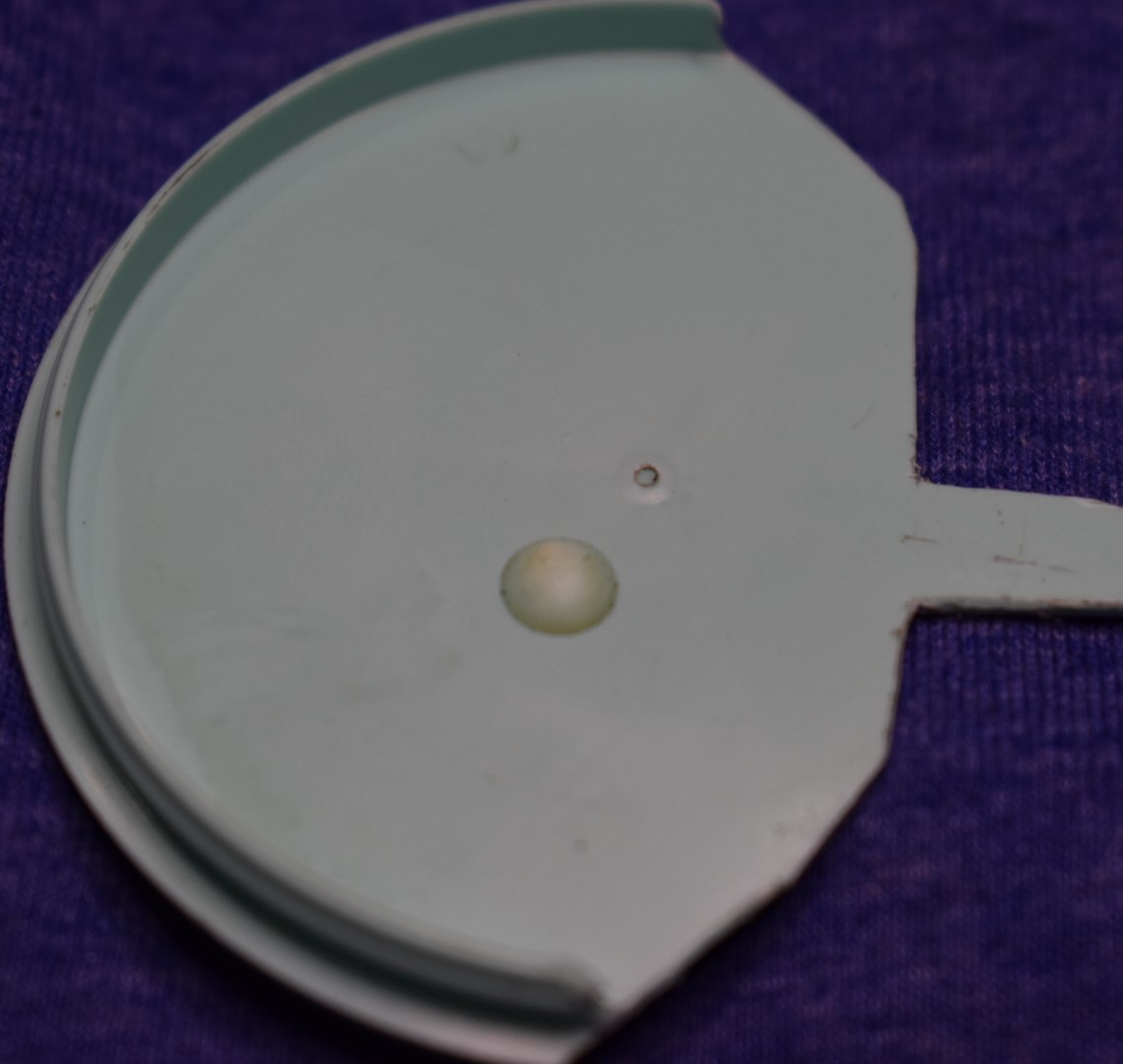
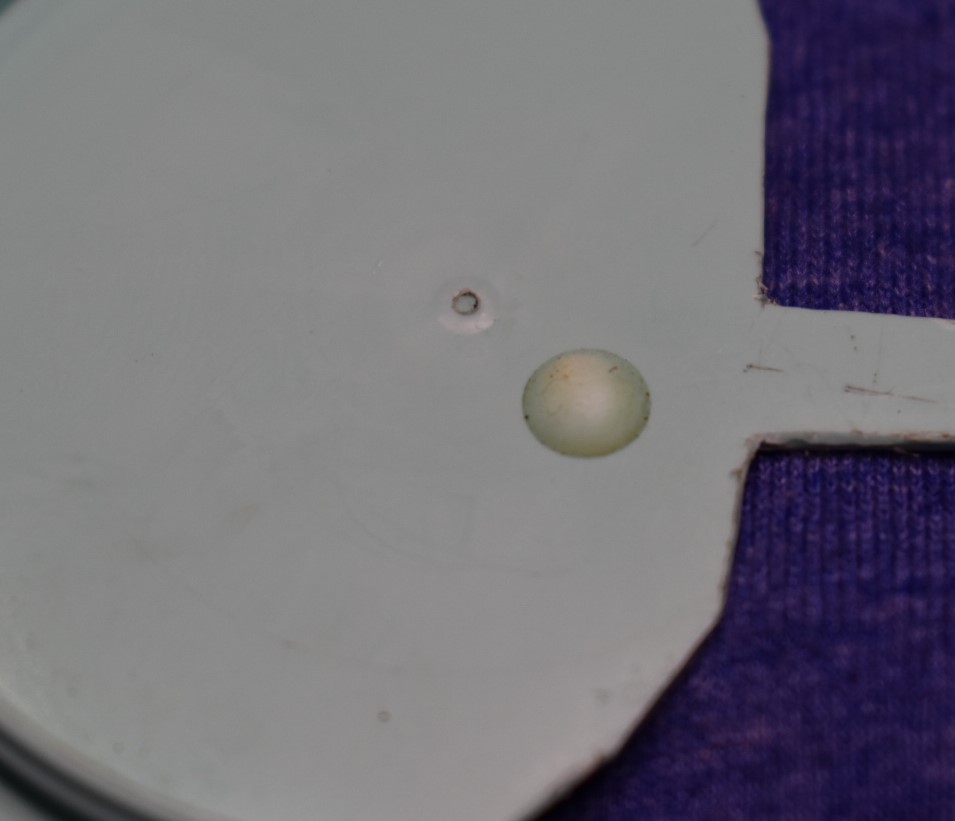
    The strange thing about a pipe like this is the number of surfaces that you have to clean.  Normally once you have cleaned the exterior and tobacco chamber you are pretty much finished.  Not with this one.  I realized that I had another outer and inner to scrub.  Back to the sink.  I again used the Murphy Oil Soap and toothbrush to scrub the inside of the exterior and the exterior of the tobacco chamber. At the bottom of the outer chamber, which is actually more like the inside of a calabash inner chamber, there was what appeared to be a cardboard-like disk.  I assumed that this disk was there to absorb condensed water from the smoke.  I kept it noting that any soap or water would likely disintegrate it.  Anyway, more scrubbing followed by wiping with alcohol soaked cotton balls.  The outside of the tobacco chamber actually did not look like wood at all.  It was black and had a very plastic-like feel.  I wondered if the makers had actually made the inner tobacco chamber as a cup of bakelite or some other 1920’s plastic and glued it to the briar rim with its threads.  Out of curiosity I started sanding the bottom of the tobacco chamber/cup.  It was infused with black smoking residue that had soaked into the briar.  Once sanded through you could see the whole piece was indeed a single machined piece of briar.  Amazing. 

    The shank was a nice straight tube with an opening at either end.  This proved quite easy to clean.  Given it had been smoked a great deal so there were a lot of cotton swabs soaked in alcohol and soaked bristle pipe cleaners but it eventually came clean.

    In the early days of my restoration hobby, pursuit, life-style(?) I had not yet purchased any deoxidizing solution.  In the early days I used a Rubbermaid tub with a solution of Oxy-Clean and water to soften the oxidation, then a liberal dose of elbow grease, Soft-Scrub and cotton balls.  The stem was in remarkably good condition making me think that it was a material other than vulcanized rubber.  Below are photos of the top and bottom of the stem.    

    I cannot remember how I cleaned the stem nor if I did actually use the Oxy water bath or not.  I also did not take any photos of this stage of the restoration.  I can say that I did use the micro-mesh pads on the stem as all of the tooth chatter was removed from the stem.  The process would have been to use 400 wet/dry sandpaper to remove the dents.  Then to start with the 1500 micro-mesh pad moistened with a drop of water.  I most likely wiped the stem with Obsidian oil and repeated with the next micro-mesh pad, 1800 (also moistened with water).  This would have been followed with the remaining pads in order of increasing fineness up to the 120000.  I did not have the  Lbepen’s Fine and Extra-Fine Polish nor did I have a buffer in those early days.  I would have been content with the final finish of the 12000 micro-mesh pad.

    I do recall that I used Fiebing’s Leather Dye to stain the stummel.  The original color must have been a dark red stain and I wanted it to be more of an antique orange-brown.  Looking back at my order history on Amazon I saw that I placed the order for the orange dye on September 15 and that it was not delivered until October 23.  As mentioned earlier, I did remember having to wait to finish this pipe, apparently about 5 weeks.  To stain with wood with the Fiebing’s Dye first the stummel would have been sanded and micro-meshed as with the stem.  With the exception of wiping between pads with an alcohol dampened cotton ball rather than Obsidian Oil.  I purposefully left a few of the scars on this old pipe.  There were cigarette burns along the shank,left side, and the front of the stummel at the base and a noticeable fill where the shank meets the vertical on the stummel.  I did not want to greatly alter the shape of the pipe with excessive sanding so these scars would be worn as signs of previous victorious battles. 

    The first step in staining is to prepare your work surface as the stain is near impossible to remove and is also near impossible to not drip.  I used cellophane food wrap to wrap a nylon cutting board.  This would be my working surface.  Nitrile gloves would be worn to keep me from matching the stummel.  I also got a disposable Bic lighter and several pipe cleaners.  I needed a way to hold the stummel and keep the dye from getting into the tobacco chamber.  Most people use a wine bottle cork to achieve this.  I don’t drink, so I had to find another material. I do quite a bit of fishing though, so I found a cork shaped styrofoam bobber and gave it a layer of duct tape.  A pipe cleaner folded in half was used as the applicator for the dye.

    With my equipment ready I proceeded to apply a coat of Fiebing’s Light Brown Leather Dye to the stummel.  It soaked into the wood and evaporated very quickly.  All of the articles I’d read and videos I’d watched said to “flame” the still wet stummel thus baking in the dye as the alcohol in the dye burned off.  There was nothing to burn off with my first application.  The second application allowed more of the liquid dye to remain and it was burned off as I had read/seen.  I have to admit it was pretty fun to see the first time.  After three applications and two successful burns I was satisfied with the staining.  I rubbed the surface with a paper towel and noticed a great deal of stain came off on the towel.  I then took the stummel to the bench where I moistened a cotton ball with alcohol and gave the stummel a rub.  More of the dye came off staining the cotton ball bright yellow brown.  This removed some of the stain but enough had penetrated the briar and had indeed stained the wood a light brown color.  I waited for what seemed like months for the orange stain to arrive.  When it did arrive I repeated the work surface preparation and gathering of equipment.  I then applied the orange dye to the stummel.  Nervously I flamed the pipe.  Upon wiping the stummel with an alcohol dampened cotton ball I saw the orange-brown I had hoped for.  The alcohol rub had blended the two dyes very nicely.   

    As stated earlier, I did not have a buffer so waxing the pipe was done with Johnson’s Paste Wax.  A coating of wax was applied and allowed to dry then was buffed off with a shoe-shine buffing brush.  This was repeated three additional times.  The final buffing was done with the inside of a cotton athletic sock.  

    Those were all of the photos that I had taken back then.  I have taken a few more recently and include them below.  I’d like to think that my restoration techniques, materials and tools used today are much better than they were when I started.  I have to add that I waited over two years before I finally smoked this old girl.  She actually smokes quite well.  Thank you for joining me and I hope that you have enjoyed reading the ramblings of an old pipe lover.

  • A Peterson Premier Selection 51 Restoration

    November 8th, 2023

    Written and photographed by John M. Young

    The below auction appeared in October of this year.  I had already exceeded the amount I budgeted for pipes but I justified it by saying, “They will be Christmas presents for someone.”  That was my story and I was sticking to it. Besides, how can I say “no” to a pair of classic Petersons who’s restoration would provide me with entertainment and a new shape for the

    collection.  Er, I mean a potential present to a loved one.  I already had a beautiful Peterson Deluxe 14S so the Kildare 14S would, most likely, become a present.  The Premier Selection 51, on the other hand, was awfully cute and a new shape for me.

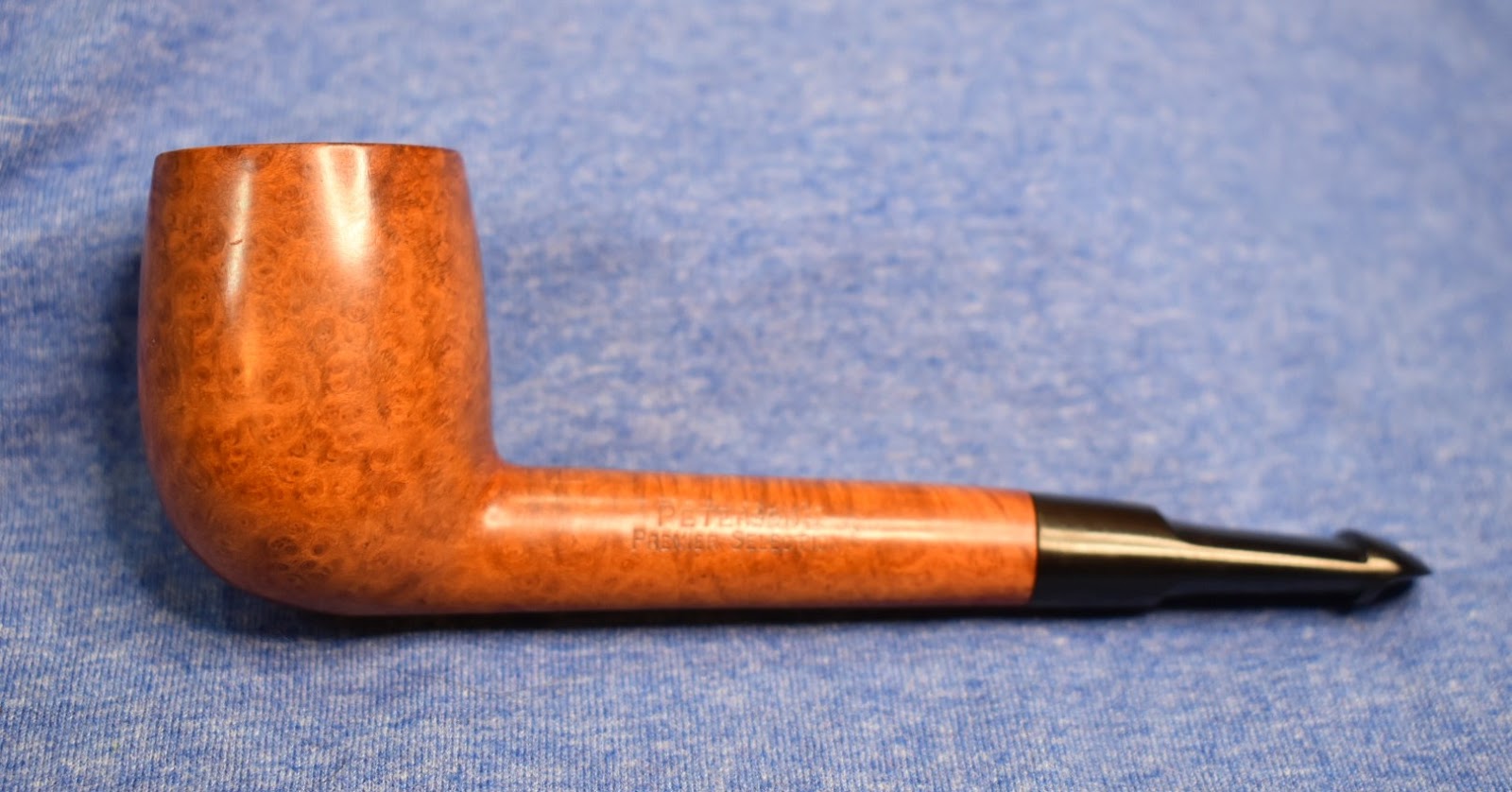
    The auction was won and the two darlings arrived in short order.  The first pipe that I began working on was the 51.  She was in very good shape with clear stampings and I wondered what her history and pedigree were.  Obviously she was a Peterson and that meant that she was made by the oldest continuously operating briar pipe company in the world.  I got out Mark Irwin’s big The Peterson Pipe book and began researching the “Premier” line.  According to Irwin, the Premiers are:

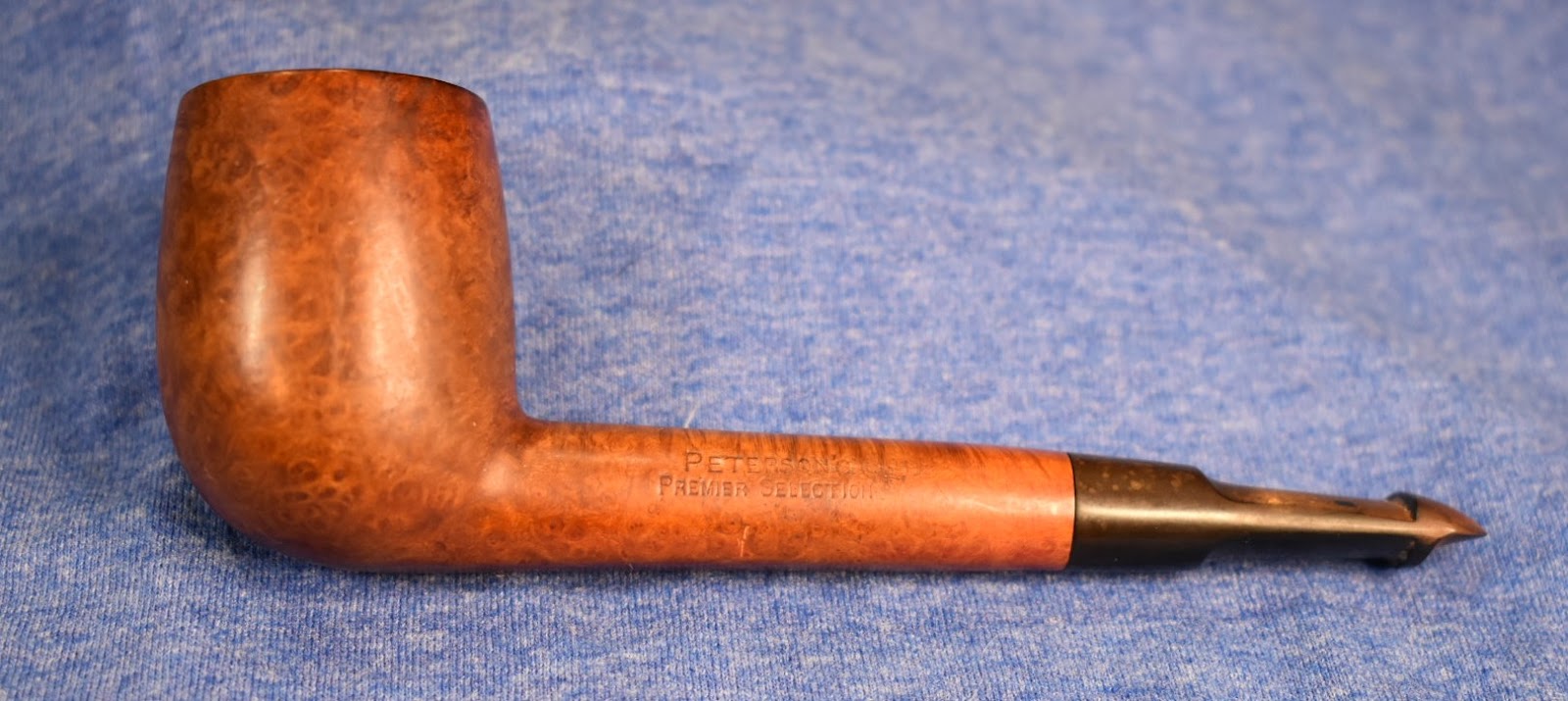
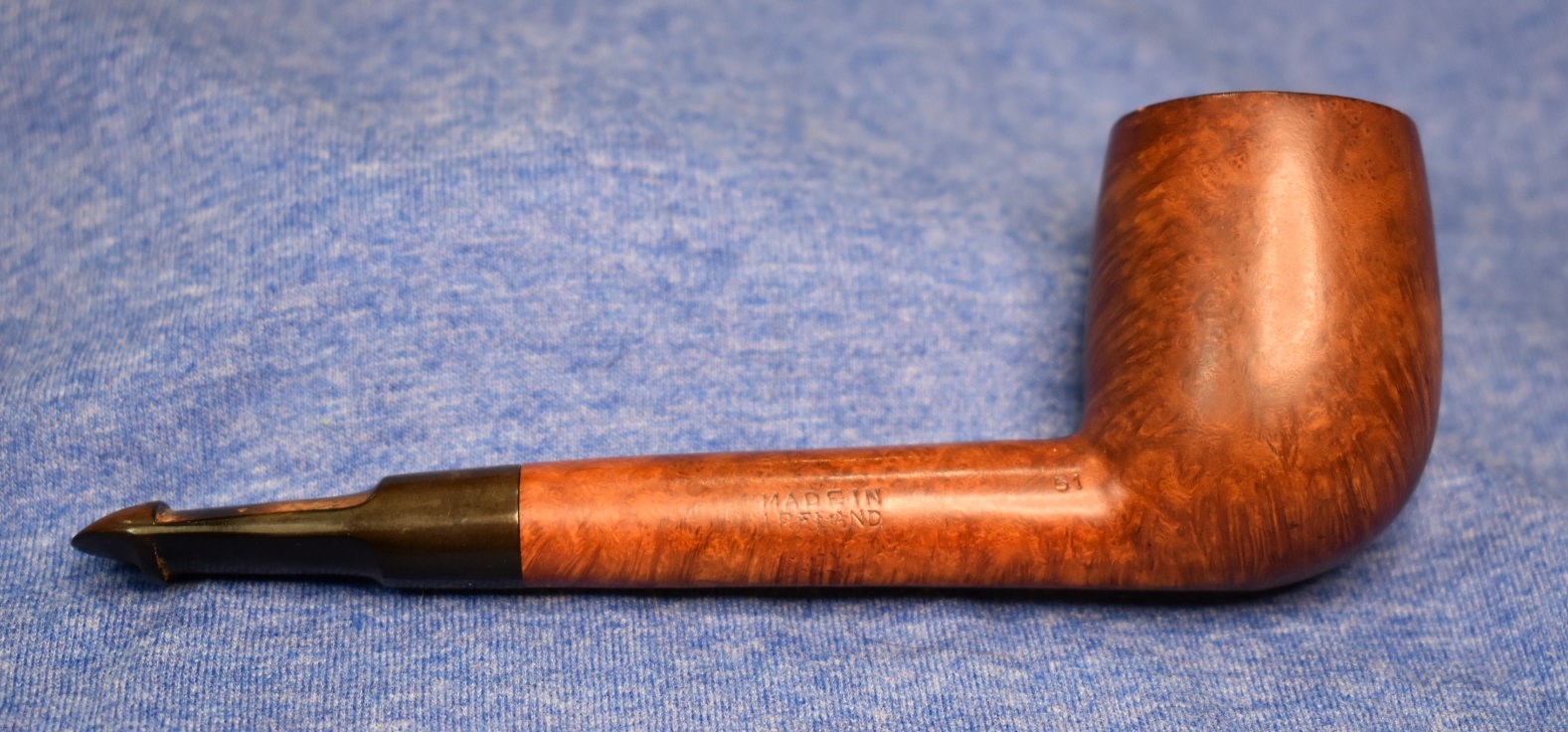
    “A high-grade line of Classic Range shapes for the US market introduced by Rogers Imports in their 1953 catalog.  Offered in smooth or sandblast finish, a P-Lip mouthpiece with an aluminum P, the first occurrence of this logo in the ephemera.  The Tan Bark Premier appeared in the ‘69 Iwan Ries catalog.  COM of MADE IN over IRELAND, A PREMIER stamp also appears over SELECTION and will be distinguished by an inset brass P on the mouthpiece.” (Irwin 310) This pipe did not have the PREMIER over SELECTION as they were stamped in line.

    The term “Classic Range” refers to pipes not of the Peterson System variety.  This also indicated that the 51 was made for the US market in the ‘50-60 and imported by either Rogers Imports or Iwan Ries.  I wanted something more specific so I did a bit of looking into the 51 shape.  This led me to marking and tagging several pages in the big book.  The 51 shape was only shown in the 1953 Rogers Imports catalog. (Irwin pp.156-157)

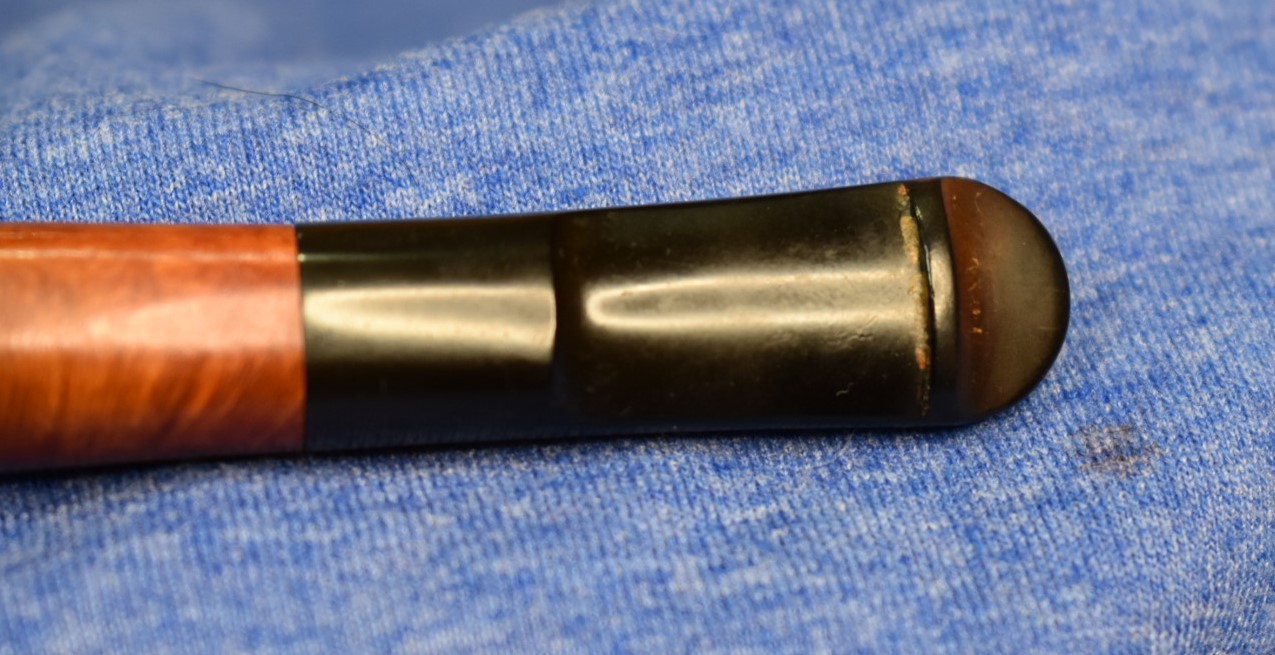
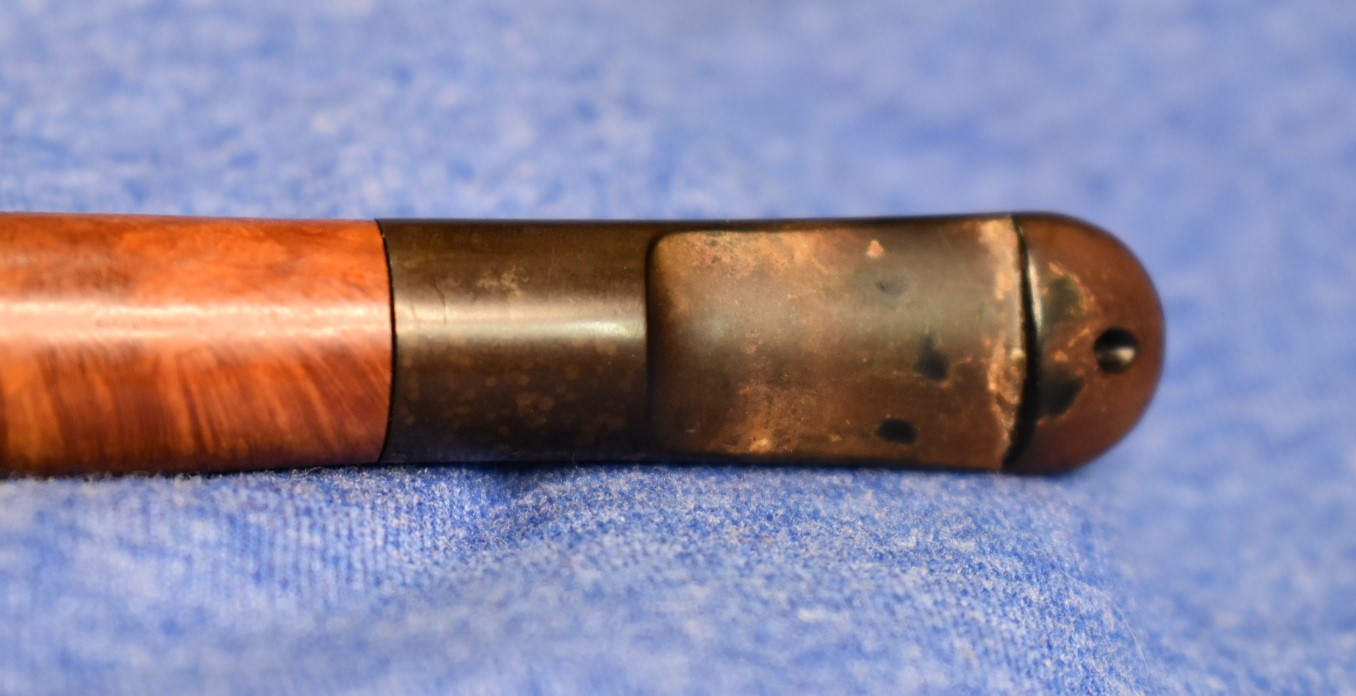
    These catalog pages also illustrate “Peterson’s Comfort Bit”  which matches the bit for my pipe in the same catalog.  The problem is that this pipe does not have the aluminum P.  Looking at the Iwan Ries catalog photos there is no mention of shape 51.  The only Lovat is called “53 Large Lovat” (Irwin p.171).  

    The next stamp to examine is the Country of Manufacture (COM) stamp. 

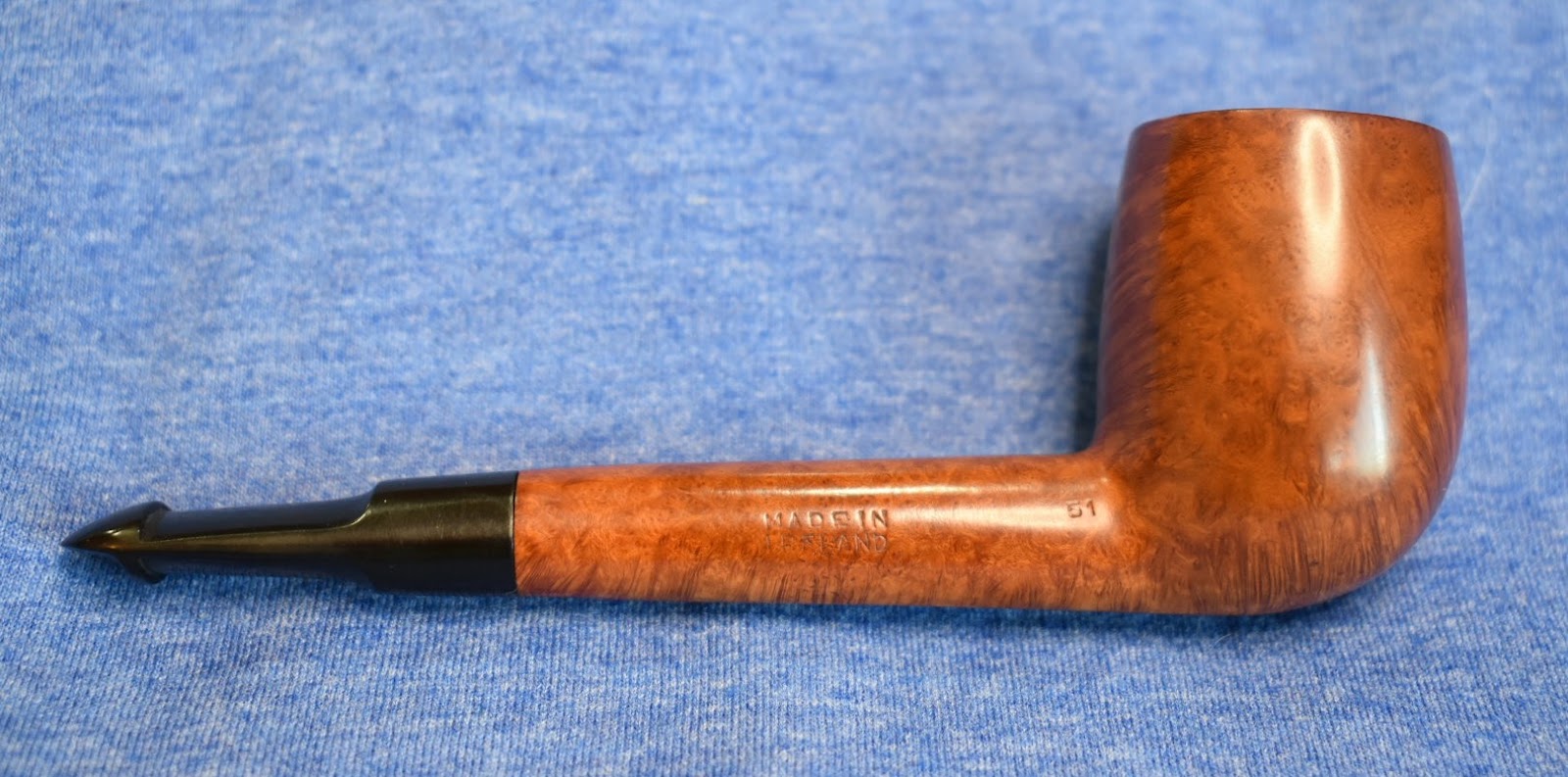
    This 51 is stamped with MADE IN over IRELAND.  Pipedia claims “At the start of the 1950s, all pipes at Kapp & Peterson were stamped with “Made in the Republic of Ireland” stamp…” (Lilley)  Yet Irwin states:  “This stamp appears on many models spanning most decades of Peterson’s history” and that “Without hallmark dates or other clues, this stamp provides no reliable indication of a pipe’s age.” (Irwin p. 296).  Further evidence is the complete lack of a shape 51 in the 1975 Peterson Catalog.  This catalog was “Peterson’s first attempt since 1906 to illustrate their complete catalog.” (Irwin 160-161) The Lovat in these illustrations is now called shape 53. 

    I take all of this to mean that the Premier Selection 51 I have is from the Rogers Import times of 1953- 1968.   Why it dos not have the aluminum P on the mouthpiece and why the PREMIER and SELECTION are stamped in line are a mystery. With that bit of history finished.  I was off to work on the pipe.

    I began with an examination and photo shoot of the pipe.  Below you can see the “before” photos of how the 51 looked upon arrival.  The briar was in good shape, the rim had a significant build-up of lava, the tobacco chamber did not have a thick cake build-up and the mouthpiece had calcium deposits and oxidation issues.  Overall, I did not think there were any issues that would require abnormal work for restoration.

    The first step of this restoration was to ream the tobacco chamber.  This was done using the PipNet reamer and a reaming knife.  There was not a great amount of cake to remove and the process went quickly.  After the cake was

    removed I sanded the chamber with 220 sandpaper on a wooden dowel.  When finished sanding I wiped the chamber with a cotton make-up removal pad moistened with 99% ethyl alcohol.  Next was the lava build up on the rim.  I moistened the lava with a bit of saliva on my finger tip.  I then carefully began scraping with the edge of a sharp knife.

    Next was the shank interior.  I start out with a dental scraping tool.  If I can scrape out a little bit, that means my scrubbing is greatly reduced.  This one didn’t give me much scrapings but, judging from the lava on the rim I knew there was a bit of residue lurking inside.  I used cotton swabs soaked in 99% ethyl alcohol.  At first I thought, “this isn’t too bad”.  Then, I realized the alcohol had to soften the tars and residues.  Black, black and black was the only word to describe the cotton swaps.  Lots of them.  After about 15 there was a bit of improvement and a color change to brown – progress.  I needed a break from the shank so I decided to take the stummel to the sink and scrub the exterior.  This was more to use some different muscles in my cramping hands than for other real reasons.  

    At the sink I used Murphy’s Oil Soap (undiluted with water) on a medium stiffness toothbrush to scrub the stummel.  The rim had come mostly clean with the scraping but there was still some residual lava present.  Even with what looks like a clean pipe the Murphy’s Oil Soap does wonders at removing dirt and grime that I didn’t even realize was there.  I’ll usually run the warm water while I scrub so I can rinse with warm water.  After the initial rinse I used the oil soap a second time focusing on the rim.  Some of the warm water was allowed into the shank as well.  I figured that it might help loosen the stubborn residue inside as well as out.  After I’d rinsed the stummel for the second time I dried it is a cotton towel.  I then used a nylon bore brush and a small amount of Dawn Dish Soap to scrub the interior of the shank.  The scrubbing produced a brown lather that showed me that it was working.  This scrubbing was rinsed with liberal amounts of warm water with and without the brush until I was certain the soap had been washed away. 

    I returned to the bench and gave the stummel a vigorous rub with a make-up pad soaked in alcohol.  I then poured about 5 ml of the alcohol into the tobacco chamber and swirled it around.  I plugged the shank with my finger and heard the pip pip pip of air bubbles being replaced by alcohol all through the shank.  The alcohol is used to pull the water out of the briar.  99% Ethyl alcohol is very hydrophilic meaning that it will pull the alcohol out of the wood and into solution with the alcohol.  The alcohol then dries quickly leaving the wood dry after a few minutes. I hoped that all of my scrubbing had removed the residues within the shank.  It helped but there were still another 15 alcohol soaked cotton swabs before I considered the shank cleaned out.

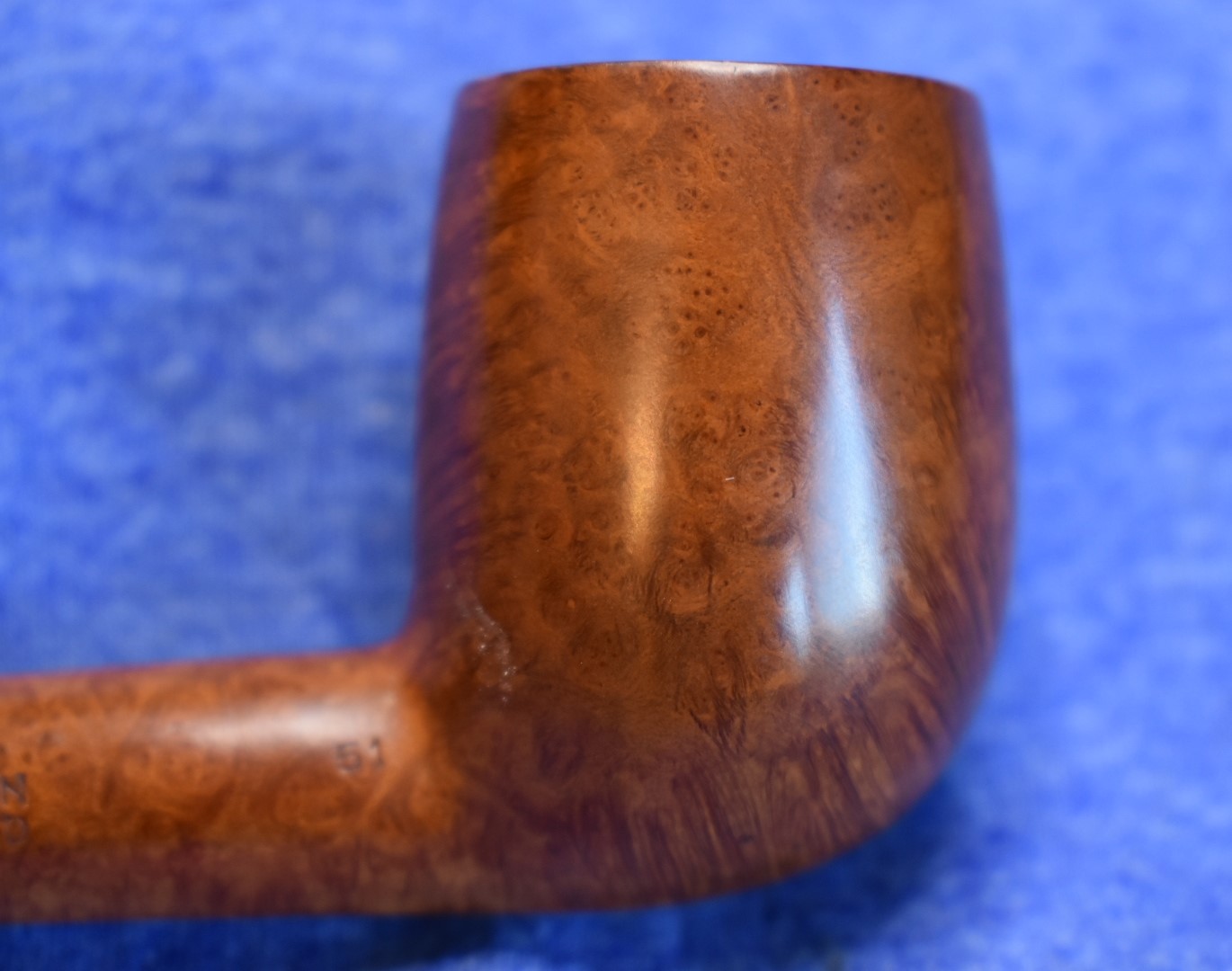
    The below photos are what the Premier 51 looked like after the scrub-fest.  There was no finish remaining, there were a few scratches that would need sanding and the rim would require a light topping to remove the dents, dings and a bit of char.  Overall she was looking good .

    Topping the stummel required a new piece of 220 sandpaper laid flat upon the counter top and a light touch.  I Help the stummel firmly yet gently and sanded in a circular motion rotating the stummel in my hand every 2 rotations.  I wanted to sand the rim as evenly as possible.  After the 220 sandpaper I repeated the whole process with a new piece of 440 sandpaper.  I did not want to change the shape of the stummel and stopped sanding after most of the blemishes where removed.  The photo, right, shows what it

    looked like when finished.    Next came the sanding of the whole stummel.  Since the pipe was in good shape I did not start with sandpaper but rather the micro-mesh pads.  The 1500 was used first dampened with a bit of water.   After micro-meshing I wiped the stummel off with a make-up pad moistened with alcohol.  I repeated the same “wet” technique with the 1800 micro-mesh pad.  After those two I proceeded to use the pads dry in order of increasing fineness, always wiping between pads with the alcohol.  When finished with the micro-mesh pads I applied a coating of Lbepen’s Restoration Balm to the stummel and allowed it to do what it does to the wood. 

    With the stummel absorbing the Restoration Balm, I turned my attention to the stem.  It had calcium deposits and oxidation on its surface.  I used 0000 steel wool to lightly buff the entire stem.  I then inserted a pipe cleaner into the stem from the shank side and dipped it into the Lbepen Deoxidizing Solution.  I place the lid on the jar using the pipe cleaner as a suspension rack to hold the stem completely under the surface of the solution.  I left the stem in the solution for approximately an hour.  Upon removing the stem from the deoxidizing solution I allowed the excess solution to drip from the stem back into the jar.  I vigorously rubbed the remaining solution from the stem using a cotton rag.  I recommend using nitrile gloves for this as does the manufacturer.  The draft hole needed to be cleared of solution also.  This was done with a couple of pipe cleaners.  Immediately after removing the deoxidizing solution I wiped down the stem with my fingers dipped in mineral oil.  I also ran a pipe cleaner dipped in mineral oil through the stem.  The oil stops the vulcanite from further oxidizing with contact with the air.

    The stem looked nice and black with no signs of oxidation.  I then used the micro-mesh pads to smooth and polish the stem.  I began with the 2400 pad and proceeded through each pad up to the 12000.  In between pads I wiped the stem off with Obsidian Oil on a make-up pad.  Once the micro-mesh pads were each used I used Lbepen’s Fine Polish and Extra-Fine Polish with a cotton cloth.  These were applied like a rubbing compound to further polish the vulcanite.  When finished with the polishing I applied a final coating of Obsidian Oil to the stem and allowed it to sit for about an hour.  I am not sure if this is necessary but I think that allowing the oil to penetrate into the vulcanite provides a bit more protection from the effects of oxygen.

    The before and after photos show the great improvement of the restoration of the stem’s vulcanite.  

    It was time to wipe the remaining Restoration Balm off the stummel and reunite the stummel and stem.  They looked great together.  The next thing to do was to take the old girl to the buffer and apply a few coats of carnauba wax.  A final hand buffing of the entire pipe was done with a microfiber polishing cloth.  This added a little more depth to the final shine of the wax.

    I am very pleased at how well this restoration went.  There were no hidden issues and everything went smoothly.  The pipe turned out very well and should be a pleasure to smoke for many more years.  Thank you for reading the ramblings of an old pipe lover.  Below are a few photos of the finished Peterson Premier 51.  

    Irwin, Mark. The Peterson Pipe The History of Kapp & Peterson. First Edition, second printing 2021 ed., Canada, Briar Books Press, 2018.

    Lilley, Jim. “Peterson.” Pipedia, 23 October 2023, https://pipedia.org/wiki/Peterson#1950_-_1989_The_Republic_Era. Accessed 7 November 2023.

  • A Brigham Restoration

    November 4th, 2023

    Written and photographed by John M. Young

    It only seems fitting to do a Brigham restoration on a Canadian shape pipe as they are a Canadian company.  I have only smoked one Brigham pipe.  It is my Brigham 5 dot Bulldog, shape 526 and it is a joy to smoke.  I knew that Brigham was an old company and that they used their proprietary rock maple insert as some kind of “filter”. I also had some inkling that the brass dots that adorned the mouthpieces is an indication of the qualify of the briar used to make their pipes. Below is my Brigham bulldog.

    When I saw the Brigham Canadian shape 5, I thought, “I like Canadians and really only have 2 or 3.  I probably need another, eh?”  Okay, the “eh?” is terribly stereotypical but it made me smile.  For less than the price of a steak dinner I had the next subject of my hobby/obsession/calling(?) In my hands.

    The pipe (henceforth she/her) looked to be in good condition.  Her stem was very oxidized to a dark beige. Her briar looked good and the stampings were clear. She did have a bit of a lava coating on the rim and what could be a clear coat finish of some kind.  I hoped that it was just a thick layer of carnauba wax but, I know better.  She still had a rock maple insert in the stem and it was not dark brown or black.  Her tobacco chamber was not caked to any noticeable thickness. The latter two observations indicated that her previous owner smoked her infrequently but in the appropriate Brigham fashion – with an appropriate insert.  Here are some photos taken upon her arrival:

    Now for a little bit of Brigham history.  Just kidding, I won’t distract you with that.  I know you are dying to get to the restoration.  However, if you are interested, here are links to Brigham’s official history and from pipedia.org:  History | Brigham Enterprises Inc (brighampipes.com),  Brigham Pipes – Pipedia.  As for this pipe, she wanted to remain a bit mysterious.  Brigham pipes are supposed to have a 3 digit shape number.  This has been the case since 1938, the end of the “Patent Era”.  Very little data apparently survived from the origin of the company in 1906 through 1937.  This according to “Charles Lemon, originally appeared on: DadsPipes.com, and is used here by permission…here in its entirety.”  (Brigham Pipes – A Closer Look at Dots, Dates and Markings – Pipedia).  Anyway, this old girl has only a single number, 5.  The other stamps which are useful are the “Brigham” above “MADE IN CANADA”.  These stamps were used between the late 1960’s-1980. (Brigham Pipes – A Closer Look at Dots, Dates and Markings – Pipedia).  That means that this slightly mysterious gal was likely made between about 1970-1980.

    On to the restoration.  Normally I start by addressing the stummel.  This pipe had such a bad case of stem oxidation that I started with that.  I removed the stem and the rock maple insert.  I used a pad of 0000 steel wool to buff off some of the oxidation.  All that did was to make the oxidation angry and a bit shiny.  I folded a pipe cleaner in half and inserted the doubled end into the aluminum stem tube. I then hung the stem in the jar of Lbepen Deoxidizing Solution (lbepen.com).  I had an appointment that would take a couple of hours so, I figured two hours was the right amount of time to leave the stem in the deoxidizing solution. 

    Since I had a few minutes before I had to leave, I worked on cleaning up the stummel.  I reamed the tobacco chamber with the third largest reamer in the PipNet set and and reaming knife. The inside of the bowl was then sanded with 220 sandpaper around a wood dowel.  There was not much cake built up and the interior briar looked good after sanding.  Next was the interior of the shank.  I used 99% ethyl alcohol soaked cotton swabs to scrub the draught hole as far as I could reach.  They came out blackened with residue.  I stopped after using 5 cotton swabs as I thought I was not making much progress. Next was the rim.  There was a coating of dried smoking residue and tar, this is often referred to as lava.  The lava was moistened with a bit of saliva and gently scraped with a sharp pocket knife.  Using care to not scratch the underlying briar I removed most of the lava and I figured the remaining bit would come off with the next step of cleaning.   Get to your appointment!

    Notice the purple ring on the make-up pad, that comes up later.

    When I returned from the appointment I continued.  To the sink.  With the tobacco chamber reamed, lava removed and internals pretty much cleaned it was time for the Murphy’s Oil Soap. I applied the oil soap to a medium stiffness toothbrush and scrubbed the externals of the stummel.  The soap was used straight and not diluted with water.  After scrubbing the soap was rinsed with warm water.  I was not completely happy with the black residue inside the shank (from earlier) so I used Dawn dish soap on a nylon bore brush to scrub the interior of the shank.  Once everything had been scrubbed, it was all thoroughly rinsed with warm water and dried with a towel. 

    Water is often considered the enemy of fine wood.  To remove the water that had soaked into the briar I liberally dampened a make-up remover pad with 99% ethyl alcohol and wiped the externals of the pipe.  I then poured about 5 ml of alcohol into the tobacco chamber and swished it around allowing the alcohol to flow into the shank as well.  I just plugged the end with my finger.  After it had sloshed about, I dumped it into a medicine cup.  The reason for the alcohol swirly is that 99% alcohol is hydrophilic (water loving).  It will pull the water out of the wood and into the alcohol.  The remaining alcohol dries very quickly.  I also used the alcohol to wipe down the entire stummel to see if there was finish that remained after the scrubbing and to removed any last bits of lava from the rim.  This is when I noticed the bright purple on the make-up pad.  I thought, “that’s weird”.  Being a retired chemistry teacher I thought, “that looks like potassium permanganate purple” and In the recesses of my memory there was something about using it to stain wood.  Sure enough, a quick internet search of potassium permanganate reveals that it is used to stain wood.

    More like 3 hours later, I removed the stem from the deoxidizing solution and allowed it to drip, the solution is not cheap but, I am so, I try to reuse as much as possible.  The oxidized aluminum bubbled up a bit, you can see it in the photo, right. The solution is very viscous that requires buffing with a rag immediately after removal and dripping of excess.  I vigorously rubbed the stem to remove the solution.  I recommend using nitrile gloves for this.  The interior of the stem also needs to be rid of the solution.  This is done with a couple of pipe cleaners run through the stem.  After the solution is thoroughly removed I wipe the stem down with mineral oil or Obsidian Oil.  I will usually allow the oil to soak into the stem while I return to work on the stummel.

    Retuning to the stummel I wiped vigorously with alcohol dampened pads to see if I was removing any of the remaining finish.  The pads had a slight yellow-brown color to them.  I took this to be a little bit of shellac that remained after the oil soap scrub.  I then used a pad moistened with acetone to see if I got any additional finish off.  It was clean.  Good, no finish remained.  Time for the mico-mesh pads.  Since this stummel was in very good shape with no areas of deep scratching I did not have to start with 220 sandpaper.  I started with a 2400 micro-mesh pad slightly moistened with water. Being careful to avoid the stamped areas I continued using each of the pads in succession up to the 12000 grit pad.  In between each pad I wiped the stummel down with a make-up pad moistened with alcohol.  The final step with the stummel is to apply Lbepen’s Restoration Balm to the briar.

    Micro-mesh pads.

    Below you can see the cleaned pre-micro-mesh rim and the Restoration Balm coated stummel.

    I will usually allow the Restoration Balm to do what it does for 20 minutes to overnight.  In this case it was on for as long as it took me to finish the work on the stem.

    Returning my attention to the stem, I was not pleased with the level of oxidation removal.  It still appeared brownish in bright light.  I rubbed the oil from the stem with a clean dry cotton rag and re-dipped it into the deoxidizing solution.  This time I let it soak for about 30 minutes.  Upon removal I repeating the same steps as earlier.  This time it came out looking better but still some oxidation remained.  I knew this was going to be the most difficult part of this restoration.  I figured I’d try to remove more of the oxidation with Soft Scrub with Oxy-Clean.  A few make-up pads with Soft Scrub and a lot of elbow grease removed most of the oxidation. 

    I figured the rest would come off with the micro-mesh pads.  As with the stummel I began with a coarse grit, this time 1500, and worked my way finer and finer.  I rubbed down the stem with Obsidian Oil between each pad.  The final step in finishing the stem was to use Before and After Fine Polish  followed by the Extra Fine Polish.

    Stem done.  Stummel needs to have the Restoration Balm wiped off then this old girl can get reassembled and waxed.  I took the pipe to the buffer and applied several coats of carnauba wax.  When that was finished I final polished the wax with a microfiber polishing cloth to give it a little more shine.

    Overall, I am quite pleased to see how this 40-50 year old Brigham canadian turned out. I’m sure she will smoke quite well and continue to for many more years.  I thank you for reading the ramblings of this old pipe lover.  Below are some photos of the finished pipe.

  • A Peterson Pipe Notes Challenge: 

    November 2nd, 2023

    Ebony Finish of a Peterson Estate Pipe using Vinegar and Iron solution

    Written and photographed by John M. Young

    On October 9, 2023 Mark Irwin posed the following challenge in his blog: 

    “I’m offering a No Prize for anyone who cares to take up the Natural Ebony DIY Challenge with me. I’ve got an estate System on hand and want to try my hand at creating a genuine “Natural Ebony” using some of Adam’s iron vinegar finish. If you want to join me, I’ll run your post separately. Here’s the idea:

    • Use an estate P-Lip System
    • Remove the old finish
    • Create your own iron vinegar finish using Adam’s instructions (no Fiebings Black Dye allowed)
    • Use danish oil or other polish to bring up the shine
    • Document your work with photographs and your procedure
    • Submit photos and write-up to receive your No Prize”

    The above graphic and text are from Mark Irwin’s blog: https://petersonpipenotes.org/2023/10/29/367-a-history-of-petersons-ebony-finish-with-help-from-sykes-wilford-and-adam-davidson/

    Challenge accepted!  Being a retired science teacher and Certified Pete Geek, I couldn’t pass on this challenge.  

    Step 1) Make the solution.  

    The basics here are to put steel wool and vinegar into a 1 quart canning jar and wait.  Never having been a follower of “Keep It Simple Students” (KISS), I had to add a step.  I applied a bit of Dawn dishwashing detergent to two pads of 0000 steel wool.  The pads were then agitated with warm water and the soap to remove any oil on the steel wool. 

    Rinsing and rinsing removed the oil and most of the water.  The 2 pads were put into a 1 quart canning jar and 800 ml of vinegar (store brand, apple cider flavored, 5% acidity) was added.  This solution was allowed to sit for 36 hours with the lid loosely fixed on top.  Keep the lid loose as the reaction produces hydrogen gas.

    Speaking of reactions, what exactly is the vinegar doing with the steel wool?

    The reaction of iron and acetic acid is:

    Fe + 2 CH3CO2H → Fe(CH3CO2)2 + H2

    Solid aqueous solution aqueous solution gas

    After 24 hours, I was curious as to the effectiveness of the solution, so I applied a little bit on an unfinished piece of quarter round oak.  I applied a wetting coat to the oak and waited.  Overnight the wood had darkened significantly.  See figure below.

    I allowed the solution to react for an additional 12 hours and filtered the solution through a coffee filter and strainer.  

    Equipment used for first filtering.

    First filtering of solution.

    Residue from first filtering.

    The solution was then filtered through a second and subsequently a third coffee filter and funnel. 

    Second and Third filtering with funnel and coffee filter.

    Step 2) Select and prepare a pipe.

    While the solution was developing I needed to find a worthy victim, I mean a worthy subject.  I have a few Peterson estate pipes so this shouldn’t be too difficult.  I settled on one of the first Peterson pipes that I purchased.  A System Standard 314 with a P-lip.  I originally won it at an auction and restored it years ago.  The stem had been cleaned with rough pipe cleaners so many times it had a very slight groove cut all the way through the stem ahead of the button.  I repaired this with cyanoacrylate.  The wood was in great shape.

    The first step here was to remove any finish from the stummel.  Originally, I had sanded this pipe all the way down to bare wood and worked it from 220 grit to 400 grit sand paper then from 1500-12000 grit micromesh pads.  The wood was then treated with Restoration Balm (Lbepen.com) and buffed with carnauba wax.  

    This finish had to be removed.  I used cotton make-up removal pads with 99% ethyl alcohol to remove the wax.  I followed this up with a vigorous rubbing of acetone on a make-up pad.  I allowed the stummel to dry overnight. 

    Step 3) Solution meet pipe.

    After the vinegar iron solution had been filtered, as described above, I set up a portable vice as a drying station.  A cutting board was used to keep any drips off the countertop.

    Time for the first application.  I decided to use a cotton swab as an applicator for the vinegar iron solution.  This also allowed me to photograph the used swab in frame to keep track of the number of applications and the corresponding photo.

    Stummel after application 1 while it is still wet.

    Stummel after application 1 had dried.

    At this point I wondered what the stummel looked like under that film that was on the stummel.  I used a cotton handkerchief and gently buffed off the film.  The stummel had darkened up a bit and showed what looked like a contrast stain.

    I then used a fresh cotton swab and reapplied the vinegar iron solution.  I allowed this to dry for 30 minutes and applied a third coat.  Below are the photos taken with each of the second and third coats.

    After application 2 wet.

    After application 2 dry.

    After application 3 wet

    After application 3 dry.

    At this time I decided to let the vinegar iron solution do what it was going to do for several hours.  Each time I applied a fresh solution the pipe appeared to have a walnut color stain.  Perhaps I needed to allow it time to oxidize or react with the wood to develop the “black” color goal.

    Four hours later I was curious about the state of the wood beneath that hazy film.  I again used a cotton handkerchief to buff away the film.  Wow, it is much darker this time.  For the Peterson aficionados out there, it looked like a Peterson Heritage finish.

    The above two photos are after 4 hours and buffed with cotton cloth.

    I applied the vinegar iron solution for the fourth time, allowed it to dry for 30 minutes and reapplied it.  This brought the total applications of solutions to five.  I decided to let the pipe sit overnight and to examine the color in the morning.  Well, that was the intent, I decided to give it one more coat before I went to bed thus, bringing the total to 6 applications.

    Now, I’ll wait till morning.

    Morning came and the Peterson 31 looked remarkably the same as it did last night.  I buffed off the hazy residue with a paper towel and the cotton handkerchief.  The color had darkened very slightly.  When examining the results in sunlight the color appears to be a very dark brown with the wood grain visible.  The below photos illustrate it nicely.

    I wondered about the sanding I had done to this stummel as part of it’s original restoration.  I had sanded all the way to a 12000 grit micro-mesh pad.  I was concerned that sanding that finely did not allow the vinegar iron solution to penetrate into the wood as well as if the stummel were only sanded to 220 grit sandpaper.  The decision I am now faced with is three-fold:

    1. Apply the Danish oil and see if it “blackens” the finish.
    2. Apply a tannin booster (strong black tea solution) then apply additional vinegar iron solution.
    3. Sand the stummel with 220 grit sandpaper, apply the vinegar iron solution then re-sand to the desired 12000 micro-mesh level of finish.

    Faced with the above dilemma, I emailed Mark Irwin and asked him the following question:  “Do you think that using a tannin booster, strong black tea solution, is breaking any of the rules of this challenge?”  He replied quickly with the following response:  “John, I think as long as you’re using the iron vinegar in the process, we will leave the rest to you.” (Mark Irwin personal response email).

    That settled it for me.  I used 8 bags of black tea with 500 ml of boiling water.  I decanted about 10 ml of the tea into a plastic bowl (green) and stirred it with a cotton swab that I touched to the tip of a liquid dish soap dispenser.  I wanted a touch of soap to break the surface tension of the water/tea.  I applied the tea solution to the stummel of the Peterson 312.  The cotton swab turned black nearly immediately.  There must have been enough residual vinegar iron solution on the stummel to trigger the bonding of the iron to the tannins of the tea.  See the below photo of the very dark cotton swab. 

    The above photo shows the stummel wet with the black tea solution.  The cotton swab at the bottom of the frame was the swab used to apply the tea.

    I allowed the black tea solution to soak in for several minutes.  I decanted about 10 ml of vinegar iron solution into a plastic bowl (blue) so as to not contaminate the jar of vinegar iron solution.  While the stummel was still damp with the black tea solution I applied a coat of the vinegar iron solution.  I allowed this to dry for one hour.

    Here you can see the two swabs used, bottom.  The left swab is the black tea on the dry stummel.  The right swab was used to apply the vinegar iron solution still damp-with-tea stummel.

    After the drying time I used the cotton handkerchief to rub away the hazy residue.  Disappointment!  The stummel was still brown.  A lovely dark shade of brown but still brown.  In the sunlight the brown was even more evident.

    Here was my thought process at this point:  

    1. I think the high level of sanding created a surface that is not allowing the infiltration of the vinegar iron solution.
    2. I don’t want to go back and sand this stummel from 220 – 12000.
    3. The black tea and the vinegar iron solution together did make the wood darker.
    4. Hot water makes wood expand.  Expanded wood would allow greater penetration of a solution into said wood.

    New procedure:

    1. Heat black tea to about 140 degrees Fahrenheit (60C).
    2. Dip the stummel into the hot tea allowing it to soak for 3-4 minutes.
    3. While it is still hot, apply vinegar iron solution.
    4. Allow to dry.
    5. Buff the hazy film off with a cotton handkerchief.

    That sounds reasonable.  It doesn’t change or break any of the agreed upon rules.  

    Okay, do it.   I did and here are the results after I had given the stummel a quick rub with Nordicare Danish Oil and allowed it to dry.

    It worked.  

    Now hopefully you have stuck with this long article and not tried to repeat everything that I have outlined above as a step by step guide.  Kind of like that test you heard about. The one where a teacher said to read every question before starting the test and then the final question says “Write your name on the space provided and turn in the test”.  Don’t do what I did.  If I were to do this whole challenge again I would treat the “estate P-Lip System” from Mark’s rules, as a pipe that you are going to restore.  I used a “estate P-Lip System” that I had restored.  I think my experiment may had been much easier if I had used a stummel which had only been sanded with 220 grit sandpaper.  I do not know this for certain but, I believe that was the cause of my difficulty.  The final 5 procedures, directly above the preceding 2 photos, are probably all that you will need.  Now, the one thing that I am not certain about is sanding the stummel after you have used the vinegar iron solution.  It may be that you sand away some of the ebonised briar leaving a stummel that looks more like a contrast stained piece.  That would require you to re-do the above procedures or, perhaps just reapply the black tea solution followed by a reapplication of the vinegar iron solution.  You may have to do some experimenting to perfect this.

    For the final finish of my 312, I wanted something softer than a high gloss carnauba wax finish.  I opted to not use the buffer; rather, I went with Renaissance Micro-crystalline Wax Polish buffed with a shoe shine brush.  I applied 3 coats of this wax buffing between coats.  It gave me the soft finish I was after while still protecting the wood.  

    I had fun messing around with this challenge.  I appreciate Mark’s posts and his timely response to my questions.  I thank you all for reading the ramblings of an old pipe lover.  If you found any of this interesting I have a few restoration guides at https://scimansays1787.wordpress.com/.  If you are reading this at the wordpress site, thank you for that.

    Finally, here are a few photos of my finished DIY Ebony Peterson System Standard 312.

  • A Peterson Deluxe 8S Restoration

    November 1st, 2023

    Written and photographed by John M. Young

    In October of 2023 I first lay eyes on this auction on eBay.  I bid and won the below Peterson 8S.  As far as restores go this one looked pretty easy and a Deluxe for under $100 is not too bad at all.  

    The photos all looked good for a pipe from the 1970s.  The one slight issue that I noticed right off was the missing aluminum chimney or stem extension.  I could see the stem was threaded and I know from experience that Peterson Deluxe pipe typically have the chimney.  I thought, “no problem.  I have a couple spare chimneys that I’d purchased from https://www.smokingpipes.eu.  The U.S. version (https://www.smokingpipes.com) is usually sold out whereas the Dublin shop usually has them in stock.  

    While waiting for the 8S to arrive I went through The Peterson Pipe (the Big Book) to refresh myself with the history and lore of the new acquisition.  The “8” is actually one of the original Peterson Patent shapes dating back to the 1896 catalog.  I went to the Peterson Pipe Notes, by Mark Irwin, for a more condensed rendering of this shape history.Inb Blog “146. A Guide to System Shapes, 1896 – 2019, Part 1 (The 300 Shape Group)” mark Irwin does a great job summarizing this original shape:  

    “313 Medium Bent Dutch. 1896-Present.
    Length: 4.94 in. / 125.48 mm.
    Weight: 1.40 oz. / 39.69 g.
    Bowl Height: 1.78 in. / 45.21 mm.
    Chamber Depth: 1.53 in. / 38.86 mm.
    Chamber Diameter: 0.70 in. / 17.78 mm.
    Outside Diameter: 1.19 in. /30.23 mm.

    The 313 is an original Patent dutch billiard bowl, pictured in the 1896 catalog as shape 8 and listed in the 1906 catalog as one of the small Patents. It was given its current shape number as a 2nd Quality pipe in the 1937 catalog, where it also appears as a 3rd Quality pipe with shape number 363. That catalog also gives shape number 8S to its De Luxe version, where it also appears as a Classic Range 2004B (K and 1st Quality) and 338 (Kapet and De Luxe). In the late 1970s it was released in the Dunmore System line as number 73.”

    Quote from: https://petersonpipenotes.org/2019/09/03/146-a-guide-to-system-shapes-1896-2019-part-1-the-300-shape-group/

    Looking at the photos from eBay, I could make out the third stamping from the hallmark as a “C”.  I think it must be a 1970 based on the size of the “c”.  The final warning came in the description and stated that the pipe had, “burnt marks around the bowl edge inside part .”  So, when it arrives we will see an old pipe that is missing a chimney, has a charred rim and worn hallmarks – sounds like fun.

    It finally did arrive and to no surprise it was an old pipe that was missing a chimney, had a charred rim and had worn hallmarks.  Here are some photos taken prior to restoration:

    As you can see the old 8S has some issues.  I began with the tobacco chamber.  It did not have a thick cake but I did want to see if the chamber had any charring issues of its own.  I used the PipNet reamer and the Smokingpipes knife to clean out the tobacco chamber (photo below).  After this was completed I sanded the interior of the tobacco chamber with 220 sandpaper on a wooden dowel.  The chamber looked good with no sign of any charring.  

    With the tobacco chamber finished I decided to clean the exterior of the stummel.  This was done using Murphy’s Oil Soap and a medium stiffness toothbrush.  The exteriors cleaned up without any issues.  The rim had some “lava”, the residue of dried tars.  However it was difficult to tell where the lava ended and the charring began.  I rinsed the exterior with warm water and used a damped finger to remove and sanding dust from the tobacco chamber.  Next was the draught hole.  I returned to the restoration bench and moistened a bristle pipe cleaner with 99% ethyl alcohol.  This was run through the draught hole to gauge how dirty it was.  The pipe cleaner came back quite blackened with tar.  Here I poured about 5 ml of alcohol down into the tobacco chamber.  Holding the stummel upright I used a small nylon brush to scrub and loosen/dissolve the old residue.  After a minute of scrubbing I would pour the alcohol into a small medicine cup and run a pipe cleaner through to check on the color of the pipe cleaner. Black = more scrubbing, brown = more scrubbing with progress, white = finished.  It was brown.  I refilled with another 5 ml of alcohol and repeated the scrubbing.  The result was cleaner than the first time.  I repeated with another 5 ml of alcohol.  Finally I started to get through the build-up of smoking residue.  I finished by using alcohol soaked bristle pipe cleaners until they cam out clean.  

    Next was the reservoir.  On a Peterson System pipe this is where the water from the smoke condenses and accumulates.  A diligent Pete smoker will twist a napkin or paper towel and dab out this condensate before dumping the ash or dottle.  All of my alcohol baths had softened the residues in the reservoir quite nicely.  I scraped with a round ended blade as much of the residue out as I could before using cotton swabs soaked in alcohol to clean out the reservoir.  After what seemed like hundreds of swabs was actually 15.  The reservoir was now clean. All of this soap, water and alcohol had taken quite a toll on the finish of the pipe.  I used a make-up removing pad dipped in alcohol to wipe away any wax that remained on the stummel.

    I decided to top the rim of the pipe using 220 wet/dry sandpaper on a countertop.  This ferrule is a little bit taller than the rim making topping a bit more difficult.  I wanted to apply a little bit more pressure to the charred areas closer to the ferrule while keeping the flat profile and altering the shape of the 8S as little as possible.  After I had sanded as much as I felt comfortable with the 220 grit I used a 400 grit paper to smooth out any scratch lines.  This left the stummel looking better but I was still not happy with the charred area.  I then used a small wood sphere wrapped in 220 sandpaper to chamfer the inside edge of the rim.  This helped but I was still not happy with the rim.  I quit worrying about it and moved on.  More on this later.

    With the finish removed it was time to start sanding the wood.  I noted exactly where the stamping were and made it a point to avoid sanding those areas.  I started with the 1500 grit micro-mesh sanding pad moistened with a few drops of water.  After sanding I wiped the stummel with a make-up pad moistened with alcohol.  I repeated the wet sanding with the 1800 grit micro-mesh pad and wiping with the make-up pad.  The subsequent micro-mesh pads were used dry with an alcohol wipe after each micro-mesh pad.  I worked up to the 12000 grit micro-mesh pad.

    The stem of this old 8S needed very little work.  First off, what is a Peterson chimney?  It is a tenon extension of the stem into the reservoir.  The tenon extension is called a chimney by employees at the Peterson factory.  They are part of Deluxe and Premier models.  Here you can see a diagram of a Peterson System pipe.  The chimney, though not labeled, is shown and I circled it in green.

    Photo from:  https://petersonpipenotes.org/2018/08/30/105-peterson-system-day-2018/

    Below are examples of Peterson System pipe chimneys.  The Straight System pipes in the 120 shape and the 31 shape also have tenon extensions, these are shown in the photos below.  Today all of the chimneys are made of aluminum.  Prior to 1960 the tenon extensions were made of bone.  I have a couple of bone chimneys on System pipes.  In each case the bone is fused to the vulcanite stem.  When these bone chimneys eventually crack or break I will have to drill them out and replace them with a new aluminum chimney.

    Top pipe is a Peterson 31 Straight System pipe.  Below is a Deluxe XL339.  Both showing aluminum chimneys.

    Top pipe is a Peterson Premier 312.  Bottom pipe is a Peterson Straight System 120.  Both pipes have bone tenon extensions.

    Okay, now that we have had our Peterson chimney primer let’s try a new Peterson chimney in the old 8S.  No luck there. The old style chimney is a slightly larger diameter than the new one.  The below photo shows the new chimney flopping about in the threads.

    Fortunately I have a friend, Christian Baxter, who is a machinist.  Normally he is building custom machines for testing prosthetics for humans.  When asked, he was glad to work on something “important” for a change.  Relativity, not just for physics.  Christian is an amazing machinist and showed me some true reality altering things that could be done with a metal lathe.  After a few minutes of work he had manufactured a very nice chimney for the 8S.

    The above two photos are Christian Baxter’s lovely work making a replacement chimney.

    The last thing that the stem needed was a good cleaning, micro-meshing and polish.  The cleaning was done with bristle pipe cleaners dipped in 99% ethyl alcohol.  These were run through the stem until the came out clean.  The micro-mesh sanding of the stem was done in the same way as with the stummel – starting with 1500-1800 (wet),  and working up to 12000.  I wiped the stem off with Obsidian Oil between each micro-mesh pad.  After the 12000 pad, I polished the stem using Fine Polish followed by the Extra Fine Polish from Lbepen.com. 

    The restoration was nearly finished.  Here are a few photos before the final buff and application of the carnauba wax.

    As previously stated, I was not happy with my attempts to repair the charred rim.  I mention this with some photos on a Facebook group that I frequent.  One gentleman there, Sascha Mertens from Germany, mentioned that he uses a technique where he applies petroleum jelly to the charred area then uses a sharp knife to very carefully scrape the charred wood leaving behind undamaged briar.  I had not heard of this technique and decided to give it a try.  My first step was to get out my old German Boker pocket knife and give it a very sharp edge.  It only seemed appropriate to use a German knife with this new German advice.

    Next, I applied the petroleum jelly and allowed it to soak the charred wood for a few minutes.  I then careful began using the edge of the knife, held vertically, to lightly scrape the charred areas.  I wiped the jelly/char off on a make-up removal pad and repeated the char scraping.  It worked just like Sascha said.  Below are the photos of the results.  

    The results were very nice.  I was at last happy with the way the rim looked.  Thank you Sascha Mertens.

    The final step was to apply a high quality carnauba wax with the buffer.  This step really made the 8S shine and returned her to the near glorious condition when she left the Peterson factory.  This project would not have been possible without the assistance of Christian Baxter, machinist extraordinaire, and Sascha Mertens.  Their advice and skills made this restoration a success.  And thank you for reading the ramblings of an old pipe lover.

    Here are some final photos of the Peterson Deluxe 8S. 

  • A Yello-Bole Aristocrat Airograte Restore

    October 30th, 2023

    Written and photographed by John M. Young

    I am not sure why I am drawn to metal pipes.  I love the all-briar classics as well as the artisanal briar and exotic material pipes that are being produced by true artists.  There is just something nostalgic about the old Falcons, Vikings, Kaywoodie Filters and this Yello-Bole that draws me in.  Perhaps it is a childhood memory of the next door neighbor, Mr. Chase as he smoked his metal pipe smelling oh so good as he worked on his yard.  

    Over the summer of 2023 I came across this Yello-Bole.  The Ebay listing showed a dull gray pipe with a nearly black bole.  The starting bid was under $10.  How could I refuse?

    Screen snip of photo taken from Ebay listing 

    The Yello-Bole Aristocrat Airograte can be seen here in an advertisement from 1966.  

    File:Yello Bole AirOGrate 1966.jpg – Pipedia

    Pipedia also states the following about Yello-Bole’s metal pipes:

    “The Yello Bole Aristocrat Airograte: An Aluminum and wood pipe with a twist. This pipe doesn’t have a bowl per say, but more a briar cylinder that screws into the base of the body. At the bottom of the bowl is a metal grate, thus allowing air to be pulled through all the tobacco and reducing any chance of clogging. The lower bowl catches all moisture and tar reducing bite. These pipes can be had in a silver/chrome finish as well as a soft gold finish. The stem of these pipes has cooling fins up each side, and can be found in a straight or bent form.”

    • Two Examples and details, courtesy Chris Rigol
    • Yello-bole 20230531 181813.jpg
    • Yello-bole 20230531 181928.jpg 
    • Yello-bole 20230531 182016.jpg 
    • Yello-bole 20230531 182029.jpg 
    • Yello-bole 20230531 182038.jpg 

    Yello-Bole – Pipedia

    I was the only bidder on this auction.  Perhaps this should have told me something.  The anticipation for the arrival of my prize was short and upon arrival I initially thought that this would be a quick and easy addition to my collection.  Sure, it was oxidized and dirty but estate pipes usually are.  Below are some photos of how the pipe appeared when it arrived.

    Nothing too bad, right?  Sure, the aluminum had oxidation, a bit of “lava” on the rim and the need for light reaming, no problem. The nylon mouthpiece looked good.  As I began closer examination of the pipe my thoughts of “quick and easy” started to dissolve.  Upon disassembly I said, “Wow, this bowl is really stuck to the aluminum.”   The bowl had enough shellac to drown an entire Erica Arborea plant and what is that build-up in the bowl?

    The gunk in the bottom of the bowl was just unsmoked tobacco.  That came out easily.  The aluminum reservoir was thickly coated in a dried smoke condensate of tar.  The screen was dirty with tobacco and a good deal of tar.  I assumed that the tar was also throughout the shank and stem as well.  This looks like a job for some 99% ethyl alcohol.  I first tried a bit of alcohol on a paper towel inside the reservoir.  This did little other than making the paper towel dirty.

    I decided that the shank/stem and aluminum screen needed to soak in the alcohol bath for an hour or so..

    While the alcohol softened and started to dissolve the tars I began working on the wooden bowl.  The bowl had a little bit of lava on the rim and a light cake build-up inside the tobacco chamber.  I used the PipNet reamer and the Smokingpipes knife to clean out the tobacco chamber.

    I then took the bowl over to the sink and used Murphy’s Oil Soap and a medium stiffness toothbrush to remove the dirt and grime from the bowl as well as the lava from the rim.  After a rinse of warm water the bowl came back to the bench.  I tried to remove the “shellac” from the bowl with a cotton boll soaked in alcohol.  What I assumed was a thick coating of shellac turned out to be some other type of clear coating as this should have readily dissolved with alcohol had it been shellac.  If alcohol doesn’t work then try acetone.  Bingo, the clear coat was not clear at all but, red.  After numerous acetone soaked cotton bolls I could see wood.

    This also revealed the fills that the finish had concealed.

    I decided to leave them for the time being and see what they looked like after the Restoration Balm did it’s magic.  

    After the aluminum shank had soaked for about an hour I removed it from the alcohol bath.  The tars had softened and dissolved quite well.  I began cleaning the reservoir with cotton bolls and cotton swabs soaked in clean alcohol to further rid the aluminum of it’s tar.   This worked quite well.  The screen was a different matter.  Upon removing it from the alcohol bath and scrubbing it with alcohol soaked cotton bolls it still remained yellow with several screen holes filled with tar.  I used the toothbrush and Dawn dish soap to scrub the screen.  This worked on getting rid of the last of the tars and yellow color but many holes remained filled.  I returned to the bench and used a fly tying bodkin to clear out the remaining “clogs”.  After needling the screen clean I rinsed it with clean alcohol.

    The draught of the pipe was remarkably clean.  Perhaps the alcohol bath had worked better there or the previous owner was not averse to running a pipe cleaner through the stem.  Either way the draught was cleaned out with bristle pipe cleaners soaked with alcohol.  

    The nylon mouthpiece was in quite good shape which was nice as nylon is not very easy to return to a pristine condition.  All that was done there was to clean it well with the toothbrush Dawn dish soap and alcohol.  

    I worked some Before & After Restoration Balm (Lbepen.com) into the wood bowl with my finger tip.  I allowed this to sit for 30 minutes.  While waiting for the Restoration balm to do its work I took the aluminum to the buffer.  I used white diamond buffing compound to clean away the oxidation from tha aluminum.  All of the corners were tedious to work through but eventually a nice bright polish was seen on the aluminum again.  After the restoration Balm had done what it does, I buffed the excess off with a cotton towel and was glad to see that the wood had some of it’s luster returned.  

    Here are some photos of the finished Yello-Bole Aristocrat Airograte:

    As you can see the old girl has returned to some semblance of her factory fresh glory.  I now understand where the term “Airograte” comes from.  The screen, or grate, allows for the airflow.  As this is a pipe that I planned to keep for my personal collection and use I did not spend time trying to make the nylon stem new again.  Overall I am very pleased by how she turned out.  Thank you for reading the ramblings of an old pipe lover.

  • A Dr. Grabow Westbrook Restoration.

    October 30th, 2023

    Written and photographed by John M. Young

    We all know of Dr. Grabow pipes and likely have our own opinions of them.  Anyway you look at it Dr. Grabow pipes are an American icon.  I do not feel the need to examine the history of the brand and am including links regarding history for those who are interested.

    History:   

    Tobacco Pipes:  https://www.tobaccopipes.com/dr-grabow-history/#:~:text=The%20famous%20smoking%20pipe%20brand,US%20patent%20number%201.896%2C800.

    Pipedia:

    https://pipedia.org/wiki/Dr._Grabow

    Pipedia timeline: 

    https://pipedia.org/wiki/Dr._Grabow_Pipe_History_Timeline

    Current Dr. Grabow:

    https://www.drgrabow.net/

    After I retired from being a high school science teacher for 32 years I started restoring estate pipes.  As part of my education in the realm of restorations I came across the blogs of Seve Laug (https://rebornpipes.com/).  I have to say how impressed I was at his knowledge and skills.  Unfortunately my own knowledge and skills were quite undeveloped.  Fortunately, ignorance is curable.  Through the avid consumption of articles and practice restoring estate pipes I developed a passable set of skills of my own. I received this Dr. Grabow Westbrook as part of a “grab bag” of pipes for restoration from Steve Laug’s partner, Kenneth Lieblich (kenneth@knightsofthepipe.com).  

    The Westbrook series began in the mid-1950’s.  I have to admit that I was drawn to them because of the orange spade.  Amazingly, my attraction to them was shared by Dr. Grabow aficionados and according to Dr. Grabow Models (Series,Line) Names Through the Years:  “WESTBROOK (c1955? to about 1985 or so) — One of the earliest RJR pipes and very sought after even today, long after the special offer program stopped.” https://pipedia.org/wiki/Dr._Grabow_Models_(Series,Line)_Names_Through_the_Years 

    So either I accidentally chose a good one or there are a lot of folks who like orange.

    This old Westbrook looked dirty and well worn or, as my father used to say “rode hard and put away wet”.  

    Upon reaming the bowl with a PIPNET I discovered that the previous owner liked to scrape the bowl with a sharp tipped knife.  There was a hole all the way through the briar.  The edges did not appear charred so I figured he was just a scraper.  The next step was to clean away the years of accumulated dirt, oils and grime.  This was done using a medium stiffness toothbrush and Murphy’s Oil Soap.  Since the pipe was rusticated I also used a brass brush, 12 gauge shotgun bore brush, with the oil soap to get the “lava” from the rustication on the rim and the deeper grooves.  The following two photos show the hole after the pipe was cleaned and reamed. 

    At this point I was faced with a decision.  Should I:

    1. Scrap the whole restoration and use the pipe as salvage/parts.
    2. Fill the bottom of the bowl with J-B Weld and top that with a “pipe mud”.
    3. Drill out a regular hole in the bowl and make a briar plug and fit it to the hole.

    I have a thing for old Dr. Grabow pipes and Westbrooks in particular, so option 1 didn’t seem very good.  I had used the J-B Weld method with pipes that had suffered the scrapings of misguided owners before and had good results but, never with a hole all the way through.  I had never tried to fashion a plug so, I went with the “let’s make a plug” method, option 3. Maybe I could also build some new skills.

    Not having access to a drill press I tried drilling out the hole by stepping up larger and larger drill bits with a hand drill.  This worked ok until I got to the final bit, ⅜  inch.  The final bit chipped the briar making the hole irregular.  Hmm, does this warrant the purchase of a drill press?  Anyway, I can always fill rough spots.

    It was time to find a suitable plug doner.  I had an old no-name bullnose that I had previously used for a piece of briar and the bottom looks to be nice and thick.  Four cuts later I had the beginnings of a plug.

    Shaping of the plug was done with small needle files of various shapes and sand paper.  This did  lead to cramping of the hands. The small notch that you can see on the second photo below was the original draught hole.  I kept it intact as a reference point to line up with the Westbrook’s draught hole.

    Eventually the plug was fit as well as I was going to get it.  I put a bead of J-B EWeld around the sides of the plug and fit it into place using the draught groove to align it to the Westbrooks draught hole.  The inside looked good.

    It turned out that the plug was not quite thick enough to completely fill the hole on the bottom of the pipe.  This led me to do some creative fill work.

    I had had enough hand cramping and fiddling with small pieces of wood.  At this point I decided to make a slurry of clear J-B Weld mixed with briar dust from other restore projects.  I filled in the remaining hole with this slurry and allowed it to dry for several days.  Eventually it became hard enough to file and sand.  

    During the drying I had plenty of time to address a very used and abused stem.  The good news with the stem was that the orange clover leaf Dr. Grabow logo lined up perfectly with the shank.

    I neglected to take pictures throughout the restoration of the stem.  I started by carefully scraping the worst of the calcium deposits and oxidation with a sharp knife.  After that I used a wet/dry 220 sandpaper with a light touch to remove the oxidation.  I then dropped the stem into Before & After Extra Strength Deoxidizer (For Sale | La Belle Epoque (lbepen.com) for about an hour. After removing the stem from the deoxidizer I let the stem drip much of the chemical back into the container.  After the drip dry, I vigorously rubbed the remaining chemical with a cotton rag and ran pipe cleaners through the draught hole.  As soon as I had removed all the deoxidizer with the rag and pipe cleaners I applied a coat of mineral oil to the stem and ran a wet-with-mineral-oil pipe cleaner through the stem.  To repair the hole chewed through the mouthpiece, I used a piece of plastic cut from a plastic container.  Here are a couple of examples with different pipe stem for scale:

    I coated the narrow part of the plastic with petroleum jelly and inserted it into the mouthpiece.  I  then used STARBOND black cyanoacrylate (super glue, abbreviated CA) to build up the missing material.  The CA does not adhere to petroleum jelly.  I will usually do a light coat of CA and spray it with STARBOND Accelerator to get it to dry almost instantly.  Repeat as necessary to fill in the missing material.  The repaired spot is then filed with a fine flat needle file and sanded with 220 then 400 grit wet/dry sandpaper.  After the sandpaper, I used micromesh pads with grits 1500-12000.  Obsidian Oil is used on a cotton cloth between each micromesh pad.  The final polishing was done with Before & After Fine Polish and Extra Fine Polish (Lbepen.com).  The finished stem looked good.

    After the J-B Weld had completely cured and hardened I was able to shape it with a file and sandpaper.  The J-B Weld/briar-dust patch was significantly darker than the existing briar..  Fortunately the rustication allowed me to conceal the patch with a few cuts made with a cut-off wheel on the Dremel MultiPro and applications of Fiebing’s Light Brown Leather Dye blended the patch fairly well.

    I admit to not being a woodcarver nor having the best tools for the job.  It did however work well enough for this old Westbrook and my approval.  Due to the rustication of the pipe there was minimal sanding to be done.  I did lightly hit the high points with the 3200 and 4000 micromesh pads.  After that light sanding I wiped the whole pipe off with 99% ethyl alcohol.  I rubbed in a liberal amount of Before & After Restoration Balm (Lbepen.com) with my fingertips and let it dry for an hour.  I Rubbed away excess balm and buffed the bowl with the inside of a cotton athletic sock.  The final treatment of the wood was a light coat of Decatur Pipe Shield No Buff Wax applied with my finger and worked into the rustication with a toothbrush.  The wax was allowed to dry for 30 minutes then was buffed off with a shoe-shine brush.

    Below are some photos of the finished pipe:

    She may not look as good as she did when she left the factory but she smokes very nicely and has many years and many bowls of tobacco in her future.  Thank you for reading the ramblings of an old pipe lover.

    John

  • A Peterson Cara 314 Restore

    October 30th, 2023

    Written and photographed by John M. Young

    In April of 2023 I came across an Ebay auction of this lovely Peterson’s Cara.  The birdseyes caught my eye and I decided that I’d give bidding a try.  The original photos showed a dark spot on the bottom of the stummel and in the description the seller mentioned that the dark spot may indicate a plug. 

    Upon winning the auction and receiving the pipe it did indeed appear that a previous owner had plugged the bottom of the stummel.  An inspection of the inside of the bowl did not immediately explain why a plug would have been necessary.  As I was cleaning the pipe I discovered that there were two draught holes.  The top one was completely choked with tar and smoking residue.  The bottom draught hole started at the bottom of the well and connected to the bottom of the tobacco chamber.  Strange, indeed.  

    I used a reaming tool to open the top draught hole.  This top hole is the correct or factory draught.  The two draught passageways ran parallel to one another together and were separated by about 1/16th an inch of briar along their lengths.  You will have to forgive the lack of photos documenting this as I do not have a camera nor lighting adequate to show what I was seeing with my eyes.  Hopefully the diagrams will clarify any confusion.  Confusion is something I had quite a bit of at this point.  Below (Figure 1) is an image of a Peterson system similar to that of the Cara (figure 1).  It is not exactly what I had to deal with but it is very similar.

    Figure 1*

    I again focused my attention to the bottom of the tobacco chamber.  The bottom of the chamber did have a hole drilled into it.  This hole was obviously not something of Peterson’s doing.  The drilled hole ran directly into the second, lower, draught hole and lined up with the hole all the way through the stummel which was not a hole as it had been plugged.

    I then began to piece together what I believe to have happened to this poor old Cara. I think that the top draught hole had become clogged with use.  The owner, not understanding the inner workings of a Peterson system, decided that a new hole was needed.  My guess is the poor fellow thought the bottom of the well was where the draught hole should be.  He then began drilling a hole to open up the airway.  Or in this case to make a new airway.  He missed the bottom of the tobacco chamber due to the angle of the ferrule, his drill bit, geometry and physics.  See figure 2.  The red lines represent the new airway that was drilled.

    Figure 2

     To solve this problem he then drilled a hole in the bottom of the tobacco chamber to connect to his new airway.  This is when he drilled all the way through the stummel.  See figure 3.  The light blue area shows the connecting hole drilled that went through the bottom of the stummel.

    Figure 3

    Upon seeing his new creation he decided to plug the hole.  This he did with a piece of briar and cyanoacrylate glue.  His plug worked well although he decided that sanding the plug smooth was an unnecessary step.  Figure 4 shows the plug in brown.

    Figure 4

    His drilling had accomplished what he wanted, an airway that connected the bottom of the tobacco chamber to the mouthpiece.  How long the previous owner used the pipe this way is unknown.  I do give the guy credit for solving the problem of a clogged airway but wish he would have had a better understanding of the Peterson system.  The Cara line of pipes originally was released in 1980, long before the availability of internet searches.  

    I figured the best way to resolve this whole two hole problem was to completely fill the second draught hole and the hole in the bottom of the tobacco chamber with J-B Weld.  I mixed the two part epoxy as per the instructions.  I then used a plastic pipette to slowly draw-up the epoxy into the pipette. I then carefully inserted the pipette into the well and slowly injected the J-B Weld into the hole.  I repeated this with the hole through the tobacco chamber.  Eventually I was able to fill the holes with the epoxy.  I have tried to show this in figure 5.  The brown section shows the plug while the green area shows the J-B Weld.

    Figure 5

    The plug scar after sanding and Restoration Balm:

    Repaired interior of well:

    It is hard to see but, the dark circle, center, is the draught hole.  The bit of reflection is light reflecting off the J-B Weld repair.

    Repaired interior of the tobacco chamber:

    The cleaning and restoration of the exterior of the Cara 314 were much more typical of any older pipe.  The first step was to ream the tobacco chamber with the PipNet reaming tool and Low Country Reamer (reaming knife from smokingpipes.com).  The interior was then sanded to inspect for interior charring, none was found.  The well and draught  were scrubbed with Dawn dish soap and appropriately sized nylon bore brushes and rinsed with warm water.  The well and draught were further cleaned with cotton swabs and pipe cleaners dipped in 99% ethyl alcohol.  The ethyl alcohol, being hydrophilic, absorbs and removes much of the water used during the previously mentioned rinsing.  

    The exterior of the stummel was scrubbed with a medium stiff toothbrush and Murphy’s Oil Soap to remove the oils and dirt from years of handling.  The top of the bowl did have some lava build up which came off nicely with the oil soap.  This revealed an area of charring at the rear of the rim.  I topped the entire stummel using gentle sanding with 220 wet/dry sandpaper on a table top.  This was followed by sanding with 400 wet/dry sandpaper also on a table top.  The rim of the pipe was then restrained using stain markers (Diaxism Total Furniture Repair System) in Cherry and Oak stains.The entire stummel was sanded with micromesh pads from 1800-6000 grit.  The wood was then rubbed with Restoration Balm and allowed to dry for 30 minutes.  The Balm was buffed with the inside of a cotton athletic sock.

    The exterior of the stem was in remarkably good condition.  Perhaps the seller of this pipe had access to a buffer and had buffed some of the oxidation off prior to posting the pipe on Ebay.  The interior of this stem was very restricted with tars and tobacco smoking residue.  I scrubbed the interior with nylon brushes and Dawn dish soap for quite some time.  Finally after numerous scrub/rinse cycles the stem was appearing cleaned.  I then ran several bristle pipe cleaners dipped in ethyl alcohol through the stem until they were clean.  The water and alcohol from all this cleaning did accentuate the oxidation on the outside of the stem.  I rubbed down the stem with 0000 steel wool and dropped it into the Before & After deoxidizing solution for about an hour.  Upon removing it I allowed the solution to drip from the stem.  Vigorous rubbing with a cotton rag removed the remaining deoxidizer.  The inside of the stem was cleaned of deoxidizer with several pipe cleaners.  Both the interior and exterior were liberally coated with mineral oil after the rubbing.  

    After the oxidation was removed I worked the stem with 1500-12000 grit micromesh pads.  I wiped the stem with Obsidian oil on a cotton make-up removal pad in between each micropad.  Finally I used Before & After Fine and Extra Fine polishes with a cotton cloth.  After the extra fine polish was removed I applied a final coat of Obsidian Oil to the stem and let it stand for 20 minutes.  

    Photos of the finished Peterson Cara:

    The old Peterson Cara 314 turned out quite nicely.  The birdseyes are numerous and very attractive.  The pipe now smokes very well and is a pleasure to add to my collection.  I have to admit that she took a lot more work and hours than I originally thought she would, however, she comes from a grand old pipemaker and has many years ahead of her.  Thank you for reading the ramblings of an old pipe lover.

    *The original Peterson system crossection diagram was taken from:  https://www.smokingpipes.com/smokingpipesblog/single.cfm/post/the-complete-guide-the-peterson-system-pipe-startling-revelations-about-charles-petersons-greatest-invention 

←Previous Page
1 … 22 23 24

Blog at WordPress.com.

Privacy & Cookies: This site uses cookies. By continuing to use this website, you agree to their use.
To find out more, including how to control cookies, see here: Cookie Policy
 

Loading Comments...
 

    • Subscribe Subscribed
      • NebraskaPeteGeek
      • Join 36 other subscribers
      • Already have a WordPress.com account? Log in now.
      • NebraskaPeteGeek
      • Subscribe Subscribed
      • Sign up
      • Log in
      • Report this content
      • View site in Reader
      • Manage subscriptions
      • Collapse this bar