• About

NebraskaPeteGeek

  • American Pipe Makers
  • British pipe Makers
  • Danish pipe Makers
  • French Pipe Makers
  • German Pipe Makers
  • Irish Pipe Makers
  • Italian Pipe Makers
  • Others or Unknown Pipe Makers
  • Restorations
  • A Peterson 417 Straight Dublin For Shannon Airport Restoration

    December 19th, 2024

    Photographed and written by

    John M. Young

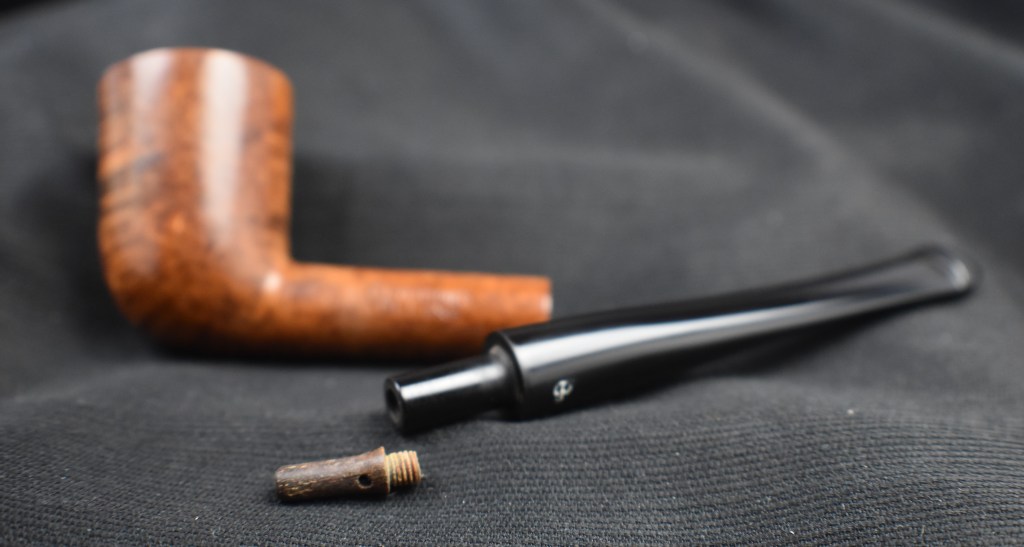
    I probably do not need to tell you that with a nickname like Nebraska Pete Geek, I have a love for Peterson pipes.  I also have a love affair with the Dublin shape in pipes.  I know, I’ve said in the past that apples are my favorite but in checking my top 3 list of favorite shapes, I noticed that there are 5 on the list.  Hmm, math was never my thing.  Anyway, this dainty darling caught my eye from the auction block as it had a definite Dublin shape but a shaper number (417) that I was unfamiliar with.  Winning the auction was surprisingly easy as I was the only person to bid.  A few days later the demure Dublin Damselle arrived here in the wilds of southeast Nebraska.  The stamps on the shank are crisp and clear except for the “1” in “417” and read as follows:  PETERSON’S over DE LUXE over FOR SHANNON AIRPORT on the left shank.  MADE IN THE over REPUBLIC  over  OF IRELAND and 417 on the right shank.  The stem had a stamped Peterson’s script P with the paint completely worn away.  Below are some photographs taken of the pipe prior to any work done.

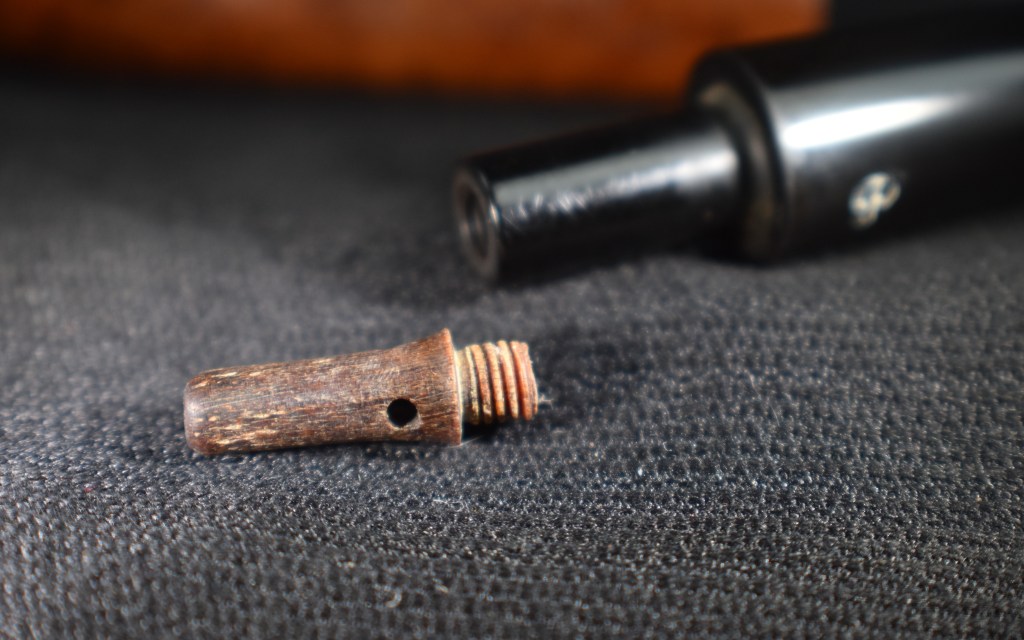
    Looking at that rim made me want to cry.  The charing was going to be a tough one to remedy.  Then there is that oh so cute bone tenon extension (chimney in Pete Geek speak).  It too would need some restorative love.  The stem was not in bad shape, old and pitted but not heavily oxidized.  The briar looked wonderful with not a fill to be seen.  This looked to be an interesting restoration.

    Background

    I have written about the restorations of several Peterson pipes over the past 13 months.  I will include here good sources of Peterson history for those who would like additional information:  

    For a great history Mark Irwin and Gary Marlburg’s book is a must read for a Pete Geek.

    (Available at https://www.smokingpipes.com/accessories/books/moreinfo.cfm?product_id=471478)  Given the price is a bit high but worth every penny for a Peterson aficionado.

    The next site is pipedia.org’s History of Peterson by Jim Lilley (Peterson – Pipedia)

    Lastly the pipephil.eu site for all things logo:  Peterson: historical pipes — Pipes: Logos & Markings (pipephil.eu)  They also have a few other links to things like the Peterson timeline and P-lip information.  

    This portion of the blog is only regarding the history of Peterson Dublins and this Peterson 417 in particular.  I began with the research of Dublin shapes by Peterson with a wonderful history in Mark Irwin’s Peterson Pipe Notes #172 titled, “A Catalog of Peterson’s Dublin Shapes, 1896–2020”.  I’ll not go into the details that Mark does due to a general lack of both knowledge and writing ability.  Combined with the fact that I am a Generation -X slacker, I’ll just give you the link and Mark all the credit for this great history lesson.  (https://petersonpipenotes.org/tag/peterson-dublin-shapes/).

    I will pick up the story of the 417 shape from within Mark’s teatease,

    “Irish Free State-Era Straight Dublins (1922-1937)

    A 120F for “Flat” with an oval shank

    The IFS-Era added two new straight dublins to the 120, 121, and 122: the 120F (“Flat” or oval shank) and slender 417. The System straights seem to have disappeared by this time. The 120 “Flat” is a natural thought in Peterson’s design language, which always comes back to comfort and practicality, and I can imagine someone in bowl-turning or even a customer thinking how great it would be to set his straight dublin down in order to emphasize a point over a pint or a cuppa.

    The first illustration of the 120F seems to be in the1937 “A Chat with the Smoker” pipe-box brochure issued not long after Peterson opened its London factory on White Lion Street. (It may well have been in production before then.) Examples of the shape appear as late as the 1965 catalog and may have been made for several years beyond that.

    A 417 Donegal Rocky Sterling Band

    The 417, a small-bowled Dublin with a long shank, first appeared in the 1937 catalog, but with two shape numbers: 417 for the Kapet and DeLuxe and 2022 for the “K” and 1st quality. The 2022 number would be dropped by 1945. Like the 120F, the last sighting of the 417 was in the 1965 catalog. The bowl seems bit more forward in its cant than the 120F.”  (https://petersonpipenotes.org/tag/peterson-dublin-shapes/)

    In the introduction of this blog I referred to this 417 as both a “dainty darling” and a “demure Dublin damselle”.  Why?, you ask.  To illustrate the size difference of the 417 and the more standard 120, I compiled the below with data From Mark Irwin’s PPN 172.  The differences, though slight, are definite.  Our darling dainty demure Dublin damselle is indeed a bit longer while a slighter in overall build than her more robust siblings.

    Shape 417 Straight Dublin.Shape 120 Patent Lip Straight Dublin.
    Years of production: 1937 – 1965Years of production: 1906 – present.
    Average Measurements:Average Measurements:
    Length: 6.21 in./157.73 mm.Length: 6.16 in./156.46 mm.
    Weight: 1.00 oz./28.35 g.Weight: 1.40 oz./39.69 g.
    Bowl Height: 1.74 in./44.20 mm.Bowl Height: 1.94 in./49.28 mm.
    Chamber Depth: 1.57 in./39.88 mm.Chamber Depth: 1.63 in./41.40 mm.
    Chamber Diameter: 0.67 in./17.02 mm.Chamber Diameter: 0.83 in./21.08 mm.
    Outside Diameter: 1.24 in./31.50 mm.Outside Diameter: 1.38 in./35.05 mm.
    P-Lip: YesP-Lip: Yes

    (https://petersonpipenotes.org/tag/peterson-dublin-shapes/)

    The date two of production for this pipe is allowed by two particular pieces of information; the FOR SHANNON AIRPORT stamp and the bone chimney.  According to Irwin in the Peterson Pipe, 

    ““FOR SHANNON AIRPORT”  (c.1947-c. 1983) Stamp on shank of pipes in several grades, indicates pipe was designated to be sold by duty free shops at Shannon Airport.” (Irwin, Mark and Malmberg, Gary (2018). The Peterson Pipe The Story of Kapp & Peterson, First edition, second printing 2021. Briar Books Press, Canada. p. 299)

    This gives a fairly definitive time period for the production of this pipe.  These dates can be further narrowed by the existence of the bone chimney or tenon extension.  Again referring to The Peterson Pipe, “Vintage De Luxe or Premier Systems, those produced before about 1960, featured a bone extension, which will be white on an unsmoked pipe and gunmetal or dark brown on a smoked one.  Nearly all of these seen on the estate market will have fused to their vulcanite stems, and many will have splits or cracks in them.” (p. 259).  This fine tuning of production dates places this pipe as a product of the Dublin factory between 1947-1960.

    The Restoration

    First off, let me thank Canada for the gift of cold air.  Yesterday’s cold front dropped the temperature 30 degrees Fahrenheit and yes, it came with 24 mile per hour winds (gusts over 40mph).  This did drive me into the basement for cover and allowed me to work on this lovely old pipe, thus the thank you.  I began with a clean denim piece to protect the work surface.

    The reaming tools came out to play.  These included the PipNet, SmokingpipesLow Country reamer, General triangular scraper (with the tip ground round) and a wood dowel wrapped in 220 sandpaper.

    Reaming round one went to the PipNet with the #1 blades.

    Round two, PipNet with #2 blades.

    The tobacco chamber was drilled with a more conical drill, as appropriate for a Dublin.  The reaming was finished with the Klee-Reem tool, for round three.  The other scrapers wrapped up the scraping with the sandpaper finishing up.  

    I used the airway drill from the Kleen-Reem to clear the airway.

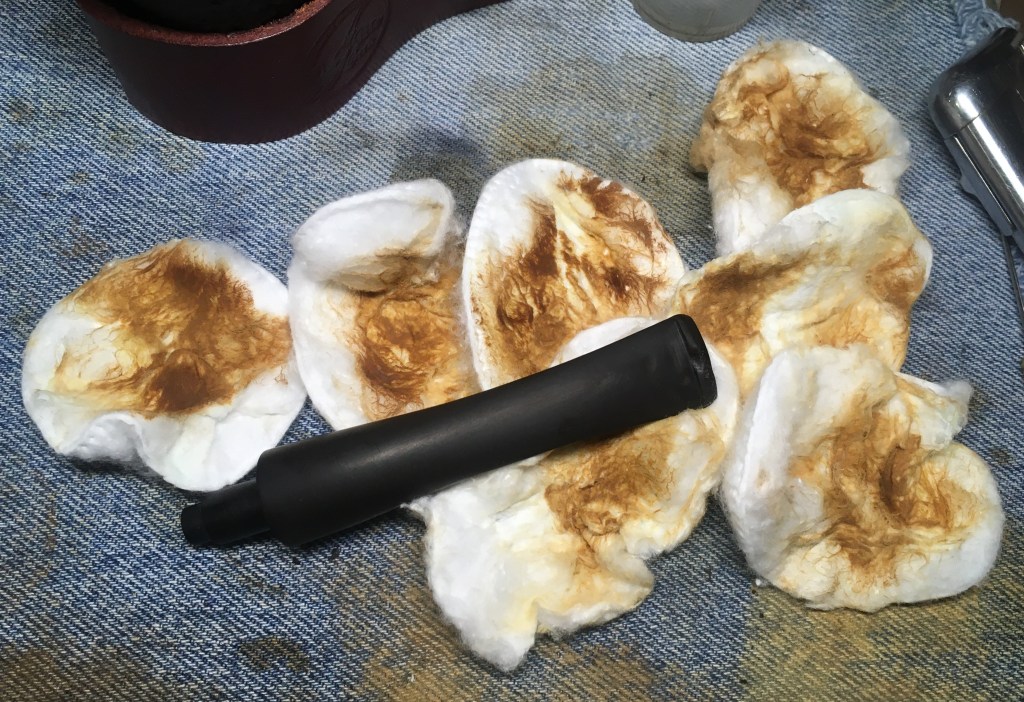
    The bowl was wiped with a paper towel and scrubbed with a few cotton swabs dipped in 95% ethyl alcohol, shown below.  No evidence of heat damage was observed within the bowl. 

    The shank cleaning went quickly after the Klee-Reem and only required a few folded bristle pipe cleaners and cotton swabs dipped in the ethyl alcohol.

    The rim received a coating of Vaseline petroleum jelly and was scraped with a sharp pocket knife to remove both lava and charred briar.

    After scraping the rim looked better but not nearly acceptable.

    Topping the rim was required.  I did this with 320 sandpaper laid flat on the countertop.  The 320 paper was followed by a sheet of 400.

    The topped rim can be seen in the photo below.  It was getting more acceptable.

    To sand and give the inner rim a bevel I used a 2 inch polyvinyl chloride (PVC) pipe cap wrapped with 320 sandpaper.  The photo below shows two of these caps, one with sandpaper the other without.

    The inner rin was sanded with the sandpaper wrapped cap, if you were wondering.  Below is the resultant bevel.

    There remained some charring on the outside rim edge.  I did not want to remove too much material during the topping and risk changing the overall shape of the pipe.  I returned to the sharp pocket knife and tried to scrape the edge and the side of the stummel to avoid a curved rim.

    By scraping along the side, I was able to retain the sharp edge of the rim while still removing some of the char.

    Next the stummel was taken to the sink for a scrub.  This was done with undiluted Murphy Oil soap and a nylon scrub brush.  The soap was rinsed with warm water and the stummel dried with a cotton hand towel.

    Back at the workbench the stummel was wiped with a make-up pad dipped in 95% ethyl alcohol.  Very little color came off the pipe and there did not appear to be any finish remaining on the briar.

    The stamps on the shank and the logo were taped with painters tape to protect them from sanding.  The pipe was then sanded with a series of sanding sponges from 320-3500 grit.  Between each sponge the stummel was wiped with a make-up pad wetted with ethyl alcohol.  The stem was rubbed with mineral oil, applied by fingertip and wiped with a paper towel.

    The pipe was then worked with micro-mesh pads 4000-12000.  The stummel and stem wiping was done as with the sanding sponges except that Obsidian Oil was used in place of mineral oil.

    I cleaned the stem logo with a cotton swab dipped in 95% ethyl alcohol to clear out debris and oil from the logo.  I then painted the logo with a water based white acrylic paint.  This paint is intended for miniatures used in gaming.  The paint dries quickly and I scraped the excess from the logo using a plastic card.  The logo surface was then lightly worked with the 8000 and 12000 micro-mesh pads.

    The stummel received a coating of Before and After Restoration Balm and was allowed to sit for 20 minutes.

    After the 20 minute timer beeped, I wiped the balm away with an inside out athletic sock.  ANd finally got a look at the glory of the briar.

    Next, I turned my attention to the bone tenon extension or as the Peterson factory folks call it, the chimney.  This 65+ year old piece of bone had the tip and a bit of the side chipped.  It also had a slight bulge at the tip back about 4 mm.  The photos don’t show either of these pre-existing conditions very well.  I decided to file it flat to remove the chipped area.  

    I used a small flat file to round the entire chimney.  I then filed the tip down a bit removing about 1 mm of material.  Instead of removing the entire chipped part and shortening the chimney, I opted to build up the tip using brown Cyanoacrylate (CA, super glue).  The glue seemed to penetrate into the pores of the bone.  I thought this would be good for strengthening the entire piece.  The CA was spritzed with a drying accelerator. Then filed.  The draft hole was opened up with a diamond needle file and the edges of the tip were slightly rounded with the flat file.   The below two photos show the finished shape of the chimney.

    I was still not happy with the dark spots on the rim of the stummel.  I thought that maybe a treatment of the spots with a saturated oxalic acid solution would effectively bleach the dark spots.  I have a jar of saturated oxalic acid which I had mixed several months ago.  

    The solution was applied with a cotton swab to the darkened areas.  It dried quickly so I continued to apply additional solution.

    More solution was added as the already applied liquid dried.  I did this several times over a span of 15 minutes.  I then allowed the oxalic acid to sit for 30 minutes. 

    After 30 minutes I took the stummel to the sink and rinsed the briar with liberal amounts of water.  I dabbed a bit of Dawn dish soap on my finger and worked that around the acid wetted areas also.  My thought here was that the basic nature of soap would neutralize any remaining acid.  The soap was also thoroughly rinsed.  The photo below shows the dried rim.  Much improved over the initial appearance.

    The pipe was taken to the buffer where it received several coats of carnauba wax.  The final step was a hand buffing with a microfiber polishing cloth.

    The Peterson De Luxe 417 Straight Dublin For Shannon Airport looks amazingly better than it did originally.  I was finally happy with how the rim repair went.  The oxalic acid treatment allowed me to remove nearly all signs of the charring without severely changing the shape of this wonderful old pipe.  The briar grain of a Peterson De Luxe is on full display with this pipe.  Beautiful bird’s eyes on both sides and lovely cross grain on the front and back.  Though the cross grain is not quite centered it remains attractive.  The stem was not severely oxidized leading me to believe this pipe was stored in a drawer and out of the light for a long time.  The vulcanite polished up very well and the gloss black accentuates the briar grain.   The dimensions of the Peterson De Luxe 417 Straight Dublin For Shannon Airport are:     

    • Length:  6.45 in./ 163.83 mm.
    • Weight:  1.11 oz./ 31.47 g.
    • Bowl Height:  1.81 in./  45.97 mm.
    • Chamber Depth:  1.54  in./ 39.12 mm.
    • Chamber Diameter:  0.72 in./ 18.29 mm.
    • Outside Diameter:  1.28 in./ 32.51 mm.

    I do hope that you have found something here useful to your own pipe care, maintenance or restorations.  If you like this sort of thing, please click the like and subscribe buttons.  Thank you for reading the ramblings of an old pipe lover.

    Loading…

    Below are some photos of the completed Peterson De Luxe 417 Straight Dublin For Shannon Airport.

  • An English Made Kaywoodie Relief Grain Quarter Bent Prince of Wales 96

    December 17th, 2024

    Photographed and written by

    John M. Young

    Just when you thought that I had turned my back on American made pipes for those fancy European floozies, I jump back into a classic American brand.  Hey, wait a minute.  What’s this, a Kaywoodie made in England?  What sorcery is this?  More on that in the “Background” section below.  This pipe came to me as the pipe from an estate lot that I really wanted.  Not that the rest of the lot were all losers just, this was the target specimen.  The lot included 5 other pipes and included a nifty rack all coming from Dunnellon, Florida.  The Kaywoodie has the following stamps on the bottom of the shank:  

    96  KAYWOODIE RELIEF GRAIN over MADE IN ENGLAND.  Below are some photographs taken of the pipe upon its arrival.

    The good:  Great shape, wonderful sandblast, clear well defined stampings and a well aligned stem are some of the better qualities of this pipe.

    The bad: A moderately caked bowl, oxidized slightly chewed stem and lava encrusted rim will need attention.

    The ugly:  The altered stinger is a disappointment, accumulation of years of dirt and grime (ugly but easy to fix) and the light tooth chatter will need to be addressed.

    Background

    The history of Kaywoodie spans from 1915 to the present with its parent company Kaufman Bros. & Bondy going back even further, to 1851.  I will not even attempt to do justice to the venerable brand with a brief history.  I will, however, give a few links to great resources for those who are interested.

    Kaywoodie History:  https://greywoodie.com/pages/kaywoodie-history, https://pipedia.org/wiki/Kaufmann_Bros._%26_Bondy, http://pipephil.eu/logos/en/logo-kaywoodie-1.html

    This section is concerned with English Kaywoodies.  The elusive and less well documented species of the Kaywoodie family tree.  Robert W. Stokes wrote a Collector’s Guide to Kaywoodie Pipes that appears on pipedia.org.  In this guide he states: 

     “English Kaywoodies. All of the catalogs reviewed in this research contained the following copyright notification: Printed in U.S.A., Kaufmann Bros. & Bondy, Inc., New York and London. Kaywoodie Pipe cases and smoker’s accessories were also marked with “New York and London”. The catalogs, however, do not present any information concerning Kaywoodie’s London operations, or how the English Kaywoodies might have differed from those manufactured and marketed in the U.S. Lowndes notes that he has several English Kaywoodies acquired in Vaduz and Zurich. English Kaywoodies are now made by Oppenheimer pipes. Lowndes notes that English Kaywoodies with the “screw-in bit” come in Ruby Grain, Custom Grain, Standard, and Relief Grain grades. The traditional push-bit models come in Continental Plain and Relief, London Made, Minaret, Airway Polished No. 707, and Lightweight grades. Prices in 1985 ranged from 9.50 (pounds) to 26.00 (pounds). Lowndes notes that the Super Star was a special edition English Kaywoodie made of finest briar with a handmade silver band. Lowndes has two: one from Zurich with a large white-outlined logo, and beautifully cased; and one in walnut finish with the black-­in-white logo. A recent catalog shows the Super Star without a band and the ordinary small white logo. A 1985 letter from Oppenheimer states that the black-in-white logo has been discontinued and only the regular white logo is now used.” (https://pipedia.org/wiki/Collector%27s_Guide_to_Kaywoodie_Pipes#NOTES_ON_%22OTHER%E2%80%9D_KAYWOODIE_PIPES).  This information places the Kaywoodie in hand as a pipe produced prior to 1985.

    To narrow the production dates I next researched the shape number, 96.  This shape number appears in the 1936 and 1947 Kaywoodie lines as the “Prince of Wales”.  In 1955 it is listed as:  “96 — Quarter Bent Apple (Prince of Wales)” (https://pipedia.org/wiki/Collector%27s_Guide_to_Kaywoodie_Pipes#NOTES_ON_%22OTHER%E2%80%9D_KAYWOODIE_PIPES).  In the 1968-69 literature it returns to being called the “Prince of Wales”  without the Quarter Bent Apple descriptor.

    The below two screen clips were from pipedia.org’s Kaywoodie Shape Number page: 

    (https://pipedia.org/wiki/Kaywoodie_Shape_Numbers).  Well, not conclusive but the above information reduces the date of production from prior to 1985 to a range from 1931-1972.

    Returning to the Kaywoodie Guide the following quote regarding the logo is slightly helpful for narrowing the production date:  “Some of the pre-1936 Kaywoodies were stamped (on the shank) with a cloverleaf around KBB. Sometime between 1936 and 1947, the better pipes were marked with a black cloverleaf inside a white dot. However, because many of the pipes in the 1968-69 catalog still show this type of logo, the black-in-white logo merely indicates a “post 1936” vintage. Current (Italian-made) Kaywoodies have the “white outline” logo.” (https://pipedia.org/wiki/Collector%27s_Guide_to_Kaywoodie_Pipes#HINTS_ON_COLLECTING,_DATING_AND_PRICING_KAYWOODIES).  Using that bit of information the production is reduced to 1936-1969.

    Hoping to find even more precise dates, I turned to pipephil.eu.  Here I found several links to Kaywoodie information but nothing to improve the previous dates.

    (Kaywoodie not made in the US — Pipes : Logos & Markings)

    In conclusion, I think it is safe to say that the disruptions caused by World War Two (WWII) would probably eliminate those years from the range.  This leads me to guesstimate the production of this pipe to post-WWII-1969 London.

    The Restoration

    The restoration began with a clean denim piece on the workbench.

    The reaming tools were gathered and included the PipNet reamer, General triangular scraper (with the tip ground round), Smokingpipes Low Country reamer and a wood dowel wrapped in 220 sandpaper.

    The #1 and #2 blades of the PipNet were used for the majority of the reaming with clean-up duties to the other tools followed by sanding.

    The sanding of the tobacco chamber revealed the original chuck marks within the chamber.  The sanding also showed that the chamber showed no signs of any heat damage.

    Next the stummel was taken to the sink for a scrub with undiluted Murphy Oil Soap and a nylon scrub brush.  The soap was rinsed with warm water and dried with a cotton hand towel.

    Back at the workbench the stem tooth chatter was filed with a fine flat file.

    The stem, below the button,  was then sanded with a 400 grit sanding sponge to eliminate the file marks.

    The screw-in tenon was cleaned with 95% ethyl alcohol and a brass .22 caliber bore brush.

    The stem was reunited with the stummel and the shank wrapped in masking tape for protection.  I then used Soft Scrub cleanser on a make-up pad to remove the oxidized vulcanite that remained after the sanding.

    A second pad with the cleanser made the stem look pretty well free of oxidation.  Further sanding and micro-meshing would get rid of the rest.

    There remained a couple of small dents near the button.  I decided that I did not like the look of these so I filled them with thin cyanoacrylate (CA, super glue).

    Below is the application of the CA.

    To speed the drying/curing of the CA, a drying accelerator was spritzed onto the wet CA.  The fill was then filed agin and smoothed with the 400 sanding sponge.

    The stem was then sanded with a series of sanding sponges from grits 400-3500.  Between each sponge the stem was rubbed with mineral oil and wiped with a paper towel.

    I removed the tape and decided to fix a few of the light spots where the stain had been worn through.

    Using a walnut stain touch-up marker I stained the slight spots.

    Ah, much better.

    I was anticipating how the stummel would look with the Before and After Restoration Balm.  My patience lost to my curiosity.  I applied a coat of the balm to the stummel and let it sit for 20 minutes.

    The balm was wiped with an inside out athletic sock revealing a lovely refreshed briar stummel. 

    I don’t know what the magic of the Restoration Balm is but it works very well.

    Okay, enough procrastinating, back to work.  I micro-meshed the stem with the 4000-12000 pads.  Between each pad I rubbed the stem with Obsidian Oil and wiped the stem with a paper towel.

    The stummel was then waxed with Renaissance Micro-crystalline Wax applied with a baby toothbrush.

    The wax was hand buffed with a soft cotton cloth then taken to the buffer.  I used a clean flannel wheel to lightly buff the Renaissance wax.  

    The stem received several coats of carnauba wax applied with the buffer.

    I tested the draw of the pipe and tasted very slight “old tobacco”.  I thought, “why didn’t I check for that before I waxed it?” An overnight cotton-alcohol treatment was ordered for the patient.  I stuffed cotton into the bowl and the shank of the stummel.  The stummel was placed on a pipe stand so both the rim and the end of the shank were at equal height.  I then used a disposable pipette to saturate the cotton with 99% isopropyl alcohol.  “Why not 95% ethyl alcohol?”, you ask.  Well, my bench bottle of ethyl ran out and I was too lazy to grab another one and there was an isopropyl bottle at hand.  The alcohol was allowed to evaporate overnight.  The next day, the cotton appeared as below.

    I removed the cotton and swabbed out the bowl and shank with cotton swabs dipped in 95% ethyl alcohol (yeah, I grabbed another bottle).

    This treatment eliminated the smell and taste of old tobacco completely.  As a final step the pipe was hand buffed with a microfiber polishing cloth.

    This English Made Kaywoodie Relief Grain Prince of Wales just looks like a classy pipe, like it is ready for a night out at the opera.  Okay, I admit I’ve not been to an opera since 8th grade German Club’s experience of Die Fledermaus.  The pipe just looks good and it feels very nice in hand as well.  The sandblast looks black at first then upon closer examination the dark burgundy reveals itself.  The high gloss stem accents the more rustic briar very elegantly.  Yeah, I think it is a darn good looking pipe.  The clipped off stinger is a disappointment and may be a deal breaker to a Kaywoodie collector but this too is part of the history of the pipe. The dimensions of the English Made Kaywoodie Relief Grain Prince of Wales 96 are:     

    • Length:  5.82 in./ 147.83 mm.
    • Weight:  1.17 oz./ 33.17 g.
    • Bowl Height:  1.41 in./  35.81 mm.
    • Chamber Depth:  1.17  in./ 29.72 mm.
    • Chamber Diameter:  0.71 in./ 17.78 mm.
    • Outside Diameter:  1.52 in./ 38.61 mm.

    I do hope that you have found something here useful to your own pipe care, maintenance or restorations.  If you like this sort of thing, please click the like and subscribe buttons.  Thank you for reading the ramblings of an old pipe lover.

    Loading…

    Below are some photos of the completed English Made Kaywoodie Relief Grain Prince of Wales 96.

  • A Man Sculpted Black Meerschaum Dublin Restoration

    December 12th, 2024

    Photographed and written by

    John M. Young

    It’s a Dublin…  It’s Poker…  It’s Super Pipe!  Yeah, it sounds way cooler in the original form – It’s a Bird… It’s a Plane… It’s Superman.  I have to admit I wasn’t quite sure what to call this Man pipe when it arrived.  I asked my German pipe expert, Sascha Mertens, via Facebook messenger what he’d call it.  His reply was classic Sascha, “Dublin, accidentally! Planned as a poker!  Nice pipe.”  He included an artistically modified photo that I sent him and even signed it:  I am not sure I want to call it an “Accidental Dublin which was supposed to be a Poker Man pipe”.  That seems even wordy, for me.  I guess, I will just call it a Man Sculpted Black Meerschaum Dublin Pipe and hope the shape critics will read this intro before criticising the name.  

    The pipe itself was part of an estate lot purchased in September from Calgary Alberta, Canada.  It included 11 other pipes I recognized this one from the photo below:

    The male symbol could even be clearly made out.  It is always fun to pick up a lot from somewhere other than the States as locally available pipes in one location are rare and exotic in another location.  This lot had a couple of pipes with Canadian country of manufacture (COM) stamps.  Stick around and I’m sure they will make appearances in upcoming blogs.  The pipe has the male symbol and ISLE OF MAN stamped on the stem.  The meerschaum remains free of any marks indicating its origin.  Below are some photographs of the pipe prior to any work done.

    This looked to be an easy relaxing restoration.  The meerschaum was in great shape. Yeah, the stem was oxidized and looked as if someone thought they might improve the appearance by trying to give it a nice suntan by storing it in direct sunlight.  Besides, I had wanted to work on a Man meerschaum for some time.

    Background

    From previous research on several European meerschaum pipes I recalled that this line was a product of Laxey Pipes.  I refreshed my memory with a revisit on pipedia.org.  Below, I have included that entry.

    “Laxey Pipes Ltd. resided in a historical 19th century four-storey Man stone building at The Quay, Old Laxey, Isle of Man, which thankfully has been preserved.

    The company specialised in the production of meerschaum pipes using the Meerschaum mined by the Tanganyika Meerschaum Corporation in the Amboseli basin in Tanganyika (since 1964 part of the United Republic of Tanzania).

    Please note: you may often find names like “Manx Pipes Ltd.”, “Man Pipe Co.” and others more, but there is no indication of another Isle of Man pipe producer other than Laxey Pipe Ltd. at any time!

    Laxey Pipes Ltd. marketed own brands like “Manxpipe”, “Manxman”, “Manxland” e.c. Names like “John Bull”, “White Knight” (unwaxed), “Domino” (black, or lined) indicated some shapes / colours of Laxey’s own series. The stems either showed the astronomical sign for “male” or “man” (circle + arrow), or the crest of the Isle of Man, the 3-legged X in a circle. Manxpipes and Laxey’s other brands were available through pipe retailers in general, but also were sold (mainly) to tourists through their own shop in Laxey.” (Laxey Pipes Ltd. – Pipedia)

    (File:Manx.jpg – Pipedia).  I love the stone work of this old building and can’t help thinking, “watch that first step, it’s a doozy”, regarding the step from the pier to the boat at low tide.

    My next search was of pipephil.eu.  Here I was able to find logos from other Man pipes, reaffirming the family heritage.

    I find it interesting that African meerschaum was used.  In a couple of previous blogs, I discussed the history of meerschaum or sepiolite mining in the Amboseli region of Tanzania (links: https://wordpress.com/post/scimansays1787.com/7350 and https://wordpress.com/post/scimansays1787.com/7485).  Meerschaum from this region is not considered to be as high quality as the meerschaum of Turkey and is usually left rusticated and frequently stained or “painted”.  I put painted in quotes as I am unsure of how or with what Laxey coated the stummels of their pipes.

    Further research came across a forum post in pipesmokersdens.com by a member named Siv.  They state the following in their post:

    “Laxey Pipes Limited was established in the mid-1960s on the Isle of Man to manufacture various decorative smoking pipes, based in a historically important 19th century four-storey building on the quay in the east coastal village of Laxey. The building was erected in 1866 by Richard Rowe (c.1823-1886), Captain of the Laxey Mines, as an additional grain store for the Laxey Glen Flour Mill. The building was also used as a storage facility for other material, such as coal and corn, and it was utilised as a base for community meetings and events. The property had several owners before the Isle of Man Government acquired it in the 1960s and leased it to the pipe factory. Other company names such as Manx Pipes Ltd and Man Pipe Co. have been noted but no other pipe producer was active during this time, thus all names must have fallen under the Laxey Pipes Ltd umbrella.

    The company specialised in the manufacturing of meerschaum pipes using the mineral meerschaum (sepiolite) mined by the Tanganyika Meerschaum Corporation, situated in the Amboseli basin, Tanganyika (now the United Republic of Tanzania). Meerschaum is a soft white clay mineral, mainly found in Turkey with large deposits also found in Tanganyika, Africa. Meerschaum is a popular material for pipes because its properties allow it to be carved into finely detailed and decorative shapes. It is also porous by nature and can draw moisture and tobacco tar into the stone. Another organic material used by Laxey Pipes Ltd for its smoking pipes was briar wood. Briar is a type of wood that is native to Africa and is abundant the Ethiopian Highlands, the Ruwenzori Mountains and the Cameroon Mountains. It is a particularly good material to use for pipes because it has a natural resistance to fire and it has an ability to absorb any moisture.

    Laxey Pipes Ltd produced and marketed their own pipe brands such as ‘Manxpipe’, ‘Manxman’ and ‘Manxland’. Other pipe names indicated various shapes and colours of the Laxey pipe series, for example ‘White Knight’ (unwaxed) and ‘Domino’ (black or lined). The Laxey brands were sold through general pipe retailers but they were also sold through the company’s shop on its Isle of Man premises. Laxey Pipes Ltd also produced meer bowls (the compartment where the tobacco goes in the pipe) for pipe brands such as Peterson, Barling and Nørding from the 1960s until 2001.

    As the company entered the 1990s and early 2000s the supply of meer from East Africa was becoming increasingly difficult; Kenya and Tanzania had been extensively mined and places like Somalia was inaccessible due to civil war. The last Laxey meers were traded in May 2001 but the company continued making briar pipes. Changing attitudes to smoking led to a general decline in popularity of pipe smoking. The company closed its doors indefinitely in June 2002.” (https://pipesmokersdens.com/threads/man-pipes-laxey-pipes-ltd-isle-of-man.17931/)

    Siv also provides photos of of their Man pipe along with photos of the brochure accompanying the pipe.

    (photos:  https://pipesmokersdens.com/threads/man-pipes-laxey-pipes-ltd-isle-of-man.17931/)

    According to Mark Irwin, “By ‘78 Peterson had bought the Isle of Man company and moved its operations to their Dublin factory.” (Irwin, Mark (2018).  The Peterson Pipe (1st ed. 2nd printing). Briar Books Press. p.308).  Using the above information, I estimate this pipe to have been made on the Isle of Man between the 1960s-1978.  Siv’s pamphlet provided great information about the shape – 62/2, unfortunately no descriptor though.  I guess I’m stuck with Sascha’s “Accidental Dublin”.

    The Restoration

    The restoration began with a clean denim piece for both the protection of the pipe and the workbench top.

    THe reaming tools included only the General triangular scraper, the Smokingpipes Low Country reamer and the 220 sandpaper wrapped dowel.  The PipNet and Kleen-Reem were not employed for fear their torque would be detrimental to the meerschaum.

    The reaming was uneventful due to the light cake build-up within the tobacco chamber.

    After a light sanding I scrubbed the chamber with a few cotton swabs dipped in 95% ethyl alcohol.

    Before cleaning the shank, I looked close at the mortise.  There appeared to be an insert of some plastic.  

    I remembered the pamphlet Siv, the pipesmokersdens.com forum contributor, provided.These little things never cease to amaze me.I had no idea that pipe makers in the 1960s-1970 were in the habit of using Delrin or Delrin-like mounts for meerschaum pipes.

    THe airway of the shank was cleaned out using alcohol dipped bristle pipe cleaners.  I think the vast majority of the black that was staining the pipe cleaners was excess black dye or stain used in the production of the pipe and not accumulated filth from smoking.

    The stem was cleaned next.  It was only slightly dirty and only required a couple of alcohol dipped pipe cleaners.   This further reaffirmed my conclusion to the black from the shank cleaning was dye.

    The stem was lightly buffed with 0000 steel wool to remove the surface oxidation in preparation for a dip in the Before and After Extra Strength Deoxidizer (lovingly referred to as deox).  A pipe cleaner was inserted into the tenon to act as a hanger while in the solution.

    I left the stem in deox overnight as it was heavily oxidized.  The next day I removed the stem and allowed it to drip excess deoxidizer back into the jar.

    After the drip dry I placed the stem on a coarse shop rag.  I like these rags because the rough texture and open weave absorb the remaining solution and lightly abrade the softened oxidized rubber from the stem.

    After hand buffing with the shop rag, you can see the amount of oxidized rubber which was removed.

    Even though the stem was looking nicely black I had the feeling that there was additional scrubbing in my future.  I used Soft Scrub on make-up pads to  further scrub and remove the oxidation.

    A lot of make-up pads.

    Eventually the color left on the pads was lightened.  I checked the condition of the logo.  Frequently in cases of severe oxidation logos can suffer or be nearly eliminated.  Yay, the loge was still there!

    The stem was oiled with mineral oil and allied to soak in the oil for a few minutes.  I am not sure if this is necessary or not but it does provide a nice little break for one to go upstairs and get some lunch.

    I covered the logo and the COM stamps with small pieces of Scotch tape to protect them from the sanding.  The stem was then sanded with a series of sanding sponges from 400-3500 grit.  Between each sponge the stem was rubbed with additional mineral oil and wiped with a paper towel.

    At this point I wanted to repaint the stem logo.  I prepped the area by cleaning it with a cotton swab dipped in alcohol.  I used a water based acrylic modeling paint for the paint.

    The paint was applied with a fly tying bodkin to the stamp.  THis paint dries quickly.

    THe surface was scraped with a rigid plastic card to remove the excess paint without cleaning out the grooves.  I could not get the paint to stay in the top left of the male symbol even after a couple more attempts.

    The stem was then worked with micro-mesh pads 4000-12000.  Between each of these pads the stem was rubbed with Obsidian Oil and wiped with a paper towel.

    THe stem was then polished with Before and After Fine followed by the Extra Fine polish.  Both were hand buffed with a soft cotton cloth.

    THe pipe was then taken to the buffer for a few coats of carnauba wax.  The final step was a hand buffing with a microfiber polishing cloth to raise the shine further.

    Overall I find this Man Sculpted Black Meerschaum Dublin to be a lovely pipe.  I continue to adore the shape. I do find that the shape is almost hard to view though.  The high gloss finish and the sculpted edges make it hard for me to accurately determine them.  Once in hand things become far more clear.  Though the handling of the pipe is intriguing in itself, the pipe is unnaturally light weight.  Almost alarmingly so.  This too could be illusionary due to the stark black color making me think that it should feel more substantial.  The removal of the oxidation revealed a very nice flat saddle stem which matches the gloss black of the pipe very well.  The dimensions of the Man Sculpted Black Meerschaum Dublin are:     

    • Length:  5.68 in./ 144.27 mm.
    • Weight:  1.20 oz./ 34.02 g.
    • Bowl Height:  1.91 in./  48.51 mm.
    • Chamber Depth:  1.47  in./ 37.34 mm.
    • Chamber Diameter:  0.75 in./ 19.05 mm.
    • Outside Diameter:  1.36 in./ 34.54 mm.

    I do hope that you have found something here useful to your own pipe care, maintenance or restorations.  If you like this sort of thing, please click the like and subscribe buttons.  Thank you for reading the ramblings of an old pipe lover.

    Loading…

    Below are some photos of the finished Man Sculpted Black Meerschaum Dublin.

  • A Golden Square Apple Restoration

    December 10th, 2024

    Photographed and written by

    John M. Young

    I really like the apple shape.  It is one of those things that I can’t explain, kind of like the inexplicable pull to pat a dog on the head even though they haven’t done anything pat worthy.  Now this pipe, through no fault of its own, has remained unrestored for quite a while due to a previous owner smoking marijuauna or some cannabis with it.  I dread working on pipes used for pot.  The resins and tars from cannabis are a pain to remove from a pipe.  Those pot-heads who say. “But, smoking weed is “natural” and way healthier than tobacco” have apparently never compared the smoking residues of the two.  Not only does the cannabis smell terrible, when exposed to ethanol it kind of dissolves then as the alcohol evaporates the remaining resins become more like a soft plastic and resist further applications of ethanol.  Okay, I am sounding whiny, so I will leave it at this: 

    Cannabis users, please just eat your cannabis – edibles do not seem to leave any residue in a pipe. I think even Jeff Spicoli would agree with that statement.

    (https://gointothestory.blcklst.com/great-character-jeff-spicoli-fast-times-at-ridgemont-high-3375d9e42a28)  

    Background

    I began researching this pipe by visiting the pipephil.eu site.  Here I found the following:

    (Go-Gq — Pipes: Logos & Markings).   John Redman, eh.  As a kid I grew up on Redman avenue.  I am going to assume that the street was named in honor of the pipemaker though in reality I know this not to be true.  Stupid reality.  This John Redman produced several very nice looking pipes in his London factory.

    (Jo-Jok — Pipes : Logos & Markings).

    Now I wanted to know more about this factory and the history of my childhood street namesake.  I turned to pipedia.org.  There the entry was what I call lacking.  Though there was a nice photograph of the factory.

    “John Redman Ltd. and British Empire Pipe Co.

    Other lines include Aristocrat, Buckingham, Buckingham Palace, Canberra, Captain Fortune, Dr John, Golden Square, Redonian, Richmond (not Sasieni), Twin Bore

    Former factory located at 3-11 Westland Place, Hackney, London N1 7LP” (John Redman Ltd./British Empire Pipe Co. – Pipedia)

    (File:John Redman Ltd.jpg – Pipedia)

    My thirst for knowledge remained unfulfilled.  I tried searching the internet without a guide and found a wonderful article by an anonymous author on the vkpipes.com site.

    “This famous picture above is perhaps the only broad known illustration to materials about John Redman LTD & British Empire Pipe Co. And the majority of sources doesn’t move usually far beyond a couple of sentenses: this company did really exist, it was located at this address and there is their former building. However…

    However, this Edwardian building on Westland Place was only an annex and no actual manufacturing was located there. The principle place of business and offices were located in Whitecross Street 123/5/7, within 15 minutes of slow walking from Westland Place. Therefore, one of their series was named Whitecross – you may find it in the catalogue below. The building on Whitecross St. still stands there and you may see it on the picture below. The crossing street is the Fortune St., so we have got an explanation of another Redman’s brand name – Captain Fortune.

    Indeed, many Redman’s brands bear such toponomical signs: the “Golden Square” series comes from the Golden Square located between the Lower John and Upper John streets, “Dr. John” is the most probably related to the abovementioned John streets. There are also Canberra road and Canberra House in London (which might inspire stamping of the famous Canberra pipes) as well as Canterbury House (Canterbury series). Burlington pipes named after the Burlington Arcade (see also H. Simmons). The majority of them are located quite close to the John Redman’s main office. No wide explanations are needed for the series Westminster and Kensington. And of course, some British imperial charm was added with names Aristocrat, Redman’s Royal, King’s Ransom.

    John Redman (as it happened later to Eric Nording) was both a carver and an owner of a business of the same name. The first pipes were born in 1934, but personal efforts appeared soon to be insufficient, what inevitably led to emerging of the name John Redman LTD. Unfortunately, we don’t have artifacts, which could be unambiguously carried to the “pre-war” period. In the WWII years the company could hardly got to the list of lucky manufacturers, who received scarce briar from the state.

    But by the end of 1950s John Redman’s firm offered a well balanced portfolio – from popular and practical “Captain Fortune”, “Dr John”, “Golden Square” to top graded Redman’s Royal made of best briar and almost without any stains (comparable to GBD Virgin, but the “Royals” were usually much larger and carved in their own unique style). And of course, we shouldn’t forget about qualitative and still affordable Redonians, Aristocrats and Canberras – a very strong middle (and upper middle) segment. More details, list of offered brands as well as presentation and gift sets can be seen in the catalogue.

    It is known that in late sixties and later a part of the production was ordered from subcontractors, for example Blakemar Briars, and since 1992 trademarks of John Redman were taken over by Gerald Grudgings of Loughborough; this company wasn’t a top manufacturer, but many sources attribute the invention of the lovat shape to it.

    As the conclusion we are proud to express our sincere and warmest thanks to Robert Deering, who worked for John Redman in 1960s and gave us a number of very important directions.

    ​Below you may enjoy the catalogue of the John Redman Ltd products approximately from the 1960s. A very rare finding!” (JOHN REDMAN Catalogue – Very Keen on Pipes)

    (JOHN REDMAN Catalogue – Very Keen on Pipes)

    The Restoration

    I did start with a clean denim piece but only photographed the stem.  I’m not sure why.  I guess I wanted to get rid of that nasty marijuana smell so bad that I wasn’t thinking straight.  I used a channel lock with the jaws wrapped in masking tape to remove the stinger from the stem.

    The stinger was placed into a medicine cup where it was submerged in 95% ethyl alcohol.

    The stem cleaning went better than I thought it would, only requiring a couple of bristle pipe cleaners dipped in 95% ethyl alcohol.

    Next came the ream team and the reaming of the tobacco chamber.

    This too went quickly with the PipNet doing most of the work.

    The Tobacco chamber was sanded with 220 sandpaper wrapped around a wood dowel.  After the sanding I scrubbed the bowl with alcohol dipped cotton swabs, hoping to get rid of the smell.  The interior showed no signs of heat damage.

    The rim was not in too bad shape requiring only a little bit of scraping with a sharp pocket knife.

    The resulting surface looked better but there were two areas of charring, fore and aft as well as the deep rim dents.

    I decided to lightly top the rim to better analyze the best way to proceed with restoring the rim.  I used 320 sand paper laid flat on a countertop and circular sanding. 

    The rim was sanded wit 400 grit paper in the same fashion as with the 320.

    The front rim looked pretty good but the rear would require some filling with cyanoacrylate (CA< super glue) and briar dust.

    Next, the stummel was taken to the sink where it received a scrubbing with undiluted Murphy Oil Soap and a nylon scrub brush.  The soap was rinsed with warm water and the stummel dried with a cotton hand towel.

    There was the shine of a clear coat present after the scrubbing.  Alcohol had no effect on it soI tried acetone on a make-up pad.  This worked but was very slow acting.

    I recently refilled my acetone jar by topping it off with fresh acetone.  I submerged the stummel in the acetone and set the timer for 30 minutes.

    30 minutes later I removed the stummel and decided to scrub the airway of the shank while the tars and smoking residue were still softened by the acetone.  The shank was filthy and reeked of non-tobacco.  Scraping with a dental scraper and numerous cotton swabs and bristle pipe cleaners seemed to do little but anger the residues.

    I continued the assault.

    That unpleasant task finished, I turned to addressing the rim damage.  I beveled the inner rim with 320 sandpaper and a wood sphere.  The outer rim, I tried to bevel it with a flat file.

    Though better, those dents had to go.  I picked out the old fills with a fly tying bodkin figuring that I may as well do all the filling at the same time.

    Since there would be a significant amount of sanding with the new fills, I finished removing all traces of the clear coat with acetone dripped make-up pads.

    I placed a small drop of brown CA onto/into each of the pits.  While it was still wet, I pressed a small scoop of briar dust into the pit.  The briar dust causes the CA to set-up and cure nearly immediately.  I used a brass brush to clear the loose dust from the area.  The photo below shows what the new fills look like at this stage.

    These new fills were filed with a small flat file to remove the excess new fill.  The light color of the fill indicates that it needs an additional application of CA and perhaps briar dust.  A completed fill appears dark.

    An additional application of CA and more briar dust was done.

    This created another round of light briar new fills to be filed.

    Eventually the new fills were smoothed with a 400 grit sanding sponge.

    At this point, I was thinking to myself, “Hey self, the name of the pipe is Golden Square.  Let’s try to lighten the briar to a more golden color.”  Self replied, “Brilliant, I’ll get the oxalic acid.”  Oxalic acid can be used as a treatment to bleach darkened or stained wood.  I had mixed this saturated solution several months ago and had used it successfully a few times.  

    I applied the solution with a cotton swab.  The effects occurred quickly.  Below is the stummel still wet with the solution.

    The solution was rinsed thoroughly then scrubbed with dish soap.  The basic nature of the soap helped neutralize any remaining acid.  The stummel was towel dried and allowed to air dry for several minutes.  The below photos show the lightened color of the briar.

    I got the stem prepped for a dip into the deox tank, that is my term for the Skippy peanut butter jar filled with Before and After Extra Strength Deoxidizer.  The stem would be spending overnight in the solution.

    While the stem was soaking I apparently thought it best to completely not photograph the sanding of the stummel with sanding sponges 400-3500 and also not to photograph the micro-meshing of the stummel with micro-mesh pads 4000-12000.  I also failed to photograph me wiping the stummel with an alcohol moistened make-up pad between each sponge and pad to remove sanding debris.  For the life of me, I cannot understand why I chose not to do any of the above.  Darn old people…

    I did however photograph the application of Before and After Restoration Balm after all the sanding and micro-meshing was completed.

    After the balm had worked it’s magic for 30 minutes the remaining elixir was wiped from the stummel using an inside out athletic sock revealing the glorious briar of this Golden Square.

    The next day, I removed the stem from deox and allowed the excess solution to drip back into the jar.

    The stem was hand rubbed with a coarse shop rag to remove the excess solution and some of the loosened oxidized vulcanite.

    Below you can see the oxidized rubber that was removed.

    I cut a small piece of Scotch tape to cover the stem logo protecting it from the sanding barrage that was coming next.

    I wanted the stem in place with the stummel for the sanding to avoid rounding the joint where the two pieces meet.  I remembered that the stinger had been soaking in alcohol since the previous day.  The medicine cup was retrieved 

    and the stinger cleaned.

    The stem was reassembled and reinserted into the shank.  Next, I wrapped the shank with painters tape to protect it from the stem sanding.  The sanding progressed from sanding sponge 400-3500.  Between sponges I rubbed the stem with mineral oil and wiped it with a paper towel.  Oh, and photographed it.

    The stem was worked with micro-mesh pads 4000-12000.  Between each pad I rubbed the stem with a light coat of Obsidian Oil and wiped it with a paper towel.  Oh, and photographed it.

    The stem was looking very good but it needed to have the gold reapplied to earn it’s title Golden Square.  I cleaned the logo area with an alcohol dipped cotton swaband fetched the Gold Leaf Rub’nBuff.

    The gold was applied to the logo with a fly tying bodkin, pressing it into the stamped logo.

    The Rub’nBuff was then rubbed and buffed to remove the gold from the high points of the logo.

    I then used Before and After Fine Polish followed by the Extra Fine Polish.  Both compounds were hand buffed with a soft cotton cloth.

    The pipe, now cleaned, still had the lingering aroma of non-tobacco – yeah pot smoke.  I decided to give it an alcohol and cotton ball overnight treatment.  I stuffed cotton into the bowl and shank of the stummel then added 95% ethyl alcohol with a disposable pipette until the cotton was saturated.  This sat overnight.  In the morning, I found the following:

    The cotton was removed and the bowl and shank were again scrubbed with alcohol dipped cotton swabs.  The Ghost of Mary Jane was gone.

    The pipe was reassembled and taken to the buffer where it received several coats of carnauba wax.

    The final step was to hand buff the pipe with a microfiber polishing cloth.

    Overall this Golden Square Apple turned out very nicely.  I love the traditional well proportioned shape.  The pipe retained some of the contrast stain, enough that I did not think additional dying was needed.  The oxalic acid treatment did a nice job at lightening the briar without diminishing the original stain too much.  I could have continued with additional bleaching but I liked where I stopped.  The vulcanite of the stem polished up nicely and accents the briar well.  The dimensions of the Golden Square Apple are:     

    • Length:  5.58 in./ 141.73 mm.
    • Weight:  1.51 oz./ 42.81 g.
    • Bowl Height:  1.68 in./  42.67 mm.
    • Chamber Depth:  1.43  in./ 36.32 mm.
    • Chamber Diameter:  0.72 in./ 18.29 mm.
    • Outside Diameter:  1.53 in./ 38.86 mm.

    I do hope that you have found something here useful to your own pipe care, maintenance or restorations.  If you like this sort of thing, please click the like and subscribe buttons.  Thank you for reading the ramblings of an old pipe lover.

    Loading…

    Below are some photos of the finished Golden Square Apple.

  • A Cesare Barontini Sultana Kuttel Selection B6 Restoration

    December 5th, 2024

    Photographed and written by

    John M. Young

    The thing that drew me to this pipe for purchase and restoration was the thick briar wall of the Dublin shape.  Recently I have become smitten by thick walled pipes.  I know that I live by the phrase, “change is evil and must be destroyed” but this is different.  I mean, thick walls are just cool, right?  Both literally and figuratively.  Well, I saw this multinational beauty, an Italian from Dublin, and had to have it.  The auction was won and the pipe made the journey from Cedar Park, Texas all the way to the Northern Time Zone of southeast Nebraska.  The stamps on this pipe read:  Barontini, in a stylized script over SULTANA on the shank to and KUTTEL over SELECTION with a slightly offset B6 on the shank’s bottom.  Below are some photos of the pipe as it appeared before any work was done.  

    The pipe looked to be in good condition with no obvious damage or evidence of mistreatment.  There was of course the expected cake within the bowl, some tooth chatter near the button and oxidation of the stem.  Other issues that appeared upon closer examination were the numerous fills and the dreaded clear coat.

    Background

    In researching the Barontini name, I first visited pipephil.eu for an affirmation of what I expected to be of Italian origin.  There was what I had expected, an Italian flag.

    (Baro-Bd — Pipes : Logos & Markings).  There was no exact match to the stampings but this was obviously the same maker.  The stylized signature script was an exact match and the fourth photo from the top had a shape number of B8 and was a very close match to this pipe and the B6 that it wears.  The fifth photo from the top middle column, alludes to a briar band and an apparent black acrylic band at the stem shank joint.  This also matched the pipe in hand.  The stem of my pipe was lacking any of the cool logos of the included Barontinis which saddened me.  None of the associated links lead to further information or similarities except for the “L’artigiana” link.  Here there was a photo of a pipe which had a similar briar band on the stem.

    (L-Lab — Pipes : Logos & Markings)

    Next, I turned to pipedia.org for a bit more history on the Barontini company.  Not much information was there to be had.  I include it here in its entirety:

    “In 1890 Turildo Barontini opened a factory for the production of briar. In 1925 his son Bruno began to produce the first pipes. Cesare Barontini, son of Bruno, started direction of the factory in 1955, and still runs it together with his daughters Barbara and Silvia.

    Sub-brands & Seconds

    • Aldo Velani
    • Cesare
    • L’artigiana
    • Stuart
    • Cortina”

    (Barontini, Cesare – Pipedia).  The “Sub-brand” Aldo Velani, did prove quite interesting:

    “”Cesare” is a second brand produced by Cesare Barontini of Livorno / Italy. Cesare Barontini headed the company from 1955 on.

    Another Barontini 2nd is named “Aldo Velani“. The name is fiction. Cesare Barontini Pipes are still relatively unknown and under appreciated here in the United States. They do however offer a value rarely matched by some of their more recognized Italian counterparts. Barontini makes very fine pipes, particularly his premium lines. They offer a fine smoking experience at quite a bargain. There are a few brands of Italian pipes on the U.S. market that are hardly known in Italy, as they are made in factories dedicated to the export trade. Aldo Velani is a line imported from Italy by Lane Limited, Dunhill’s distributor. Made mostly in Livorno by Cesare Barontini, one of the best known private-label manufacturers, Aldo Velani pipes are classic shapes with an Italian ‘twist,’ according to Frank Blews, a spokesman for Lane. “Billiards with more ‘ball,’ bulldogs with more ‘jaw,”‘ is the way he characterizes the line. A medium to large pipe specifically developed for American tastes, the finishes use the names of Italian wines – Soave, Novello, Barolo, Refosco – to suggest their colors, and there is a lot of ornamental work.” (Cesare – Pipedia).  The phrase “Aldo Velani pipes are classic shapes with an Italian ‘twist,’” strikes me as an apt description of this pipe.  I referred to it earlier as a “multinational beauty, an Italian from Dublin”.  This sounds like exactly what Barontini is making with their Aldo Velani line – a traditional shape with a signature, Italian, twist.

    I could not find any information as to Barontini employing P-lip (Peterson style) buttons on their pipes nor were any shape charts discovered.  Perhaps some things are better off left as mysteries.  This mysterious Dublin from Italy seems to be an excellent illustration of that idea.  

    The Restoration

    I broke from tradition with this one and opted to not use a stained denim piece over the stained green flannel which underlies the denim.  I thought you might like a change.  Or, I was too darn lazy to get up and get a piece of denim from 6 feet (2 m) away.  

    The new-to-me PipNet got to go to work with this one along with the rest of the ream team.

    PipNet #3 blades started the process of reaming.

    The #4 blades continued and were followed up by the Smokingpipes Low Country reamer and the General triangular scraper.  All of them were followed by the 220 sandpaper wrapped around the wood dowel.  

    The sanded tobacco chamber was taken to bare briar and appeared free of any heat damage.  A condition the interior rim was not so lucky to avoid as there was some charing around the edge.

    Another view of the interior of the tobacco chamber and the unsightly fill of the rim.  Oh, you know that has to go.

    And go it did.  The old putty was picked out using a fly tying bodkin and a dental scraper.   The old putty was surprisingly hard.

    So hard, in fact, that I could not get all of it out.  I’ll get more of it in a few minutes.

    I used saliva and light scraping with a sharp pocket knife to scrape away some of the charred briar around the rim.  That helped but the dark ring persisted.

    Moving on to cleaning out the airway of the shank was the next task.  I used a dental scraper to remove some of the tar and smoking residue then scrubbed the airway with cotton swabs and bristle pipe cleaners dipped in 95% ethyl alcohol.

    My acetone in the acetone jar was getting pretty depleted due to use and evaporation.  I unfortunately did not have more on hand.  I tried to use a make-up pad dipped in the acetone to remove the finish on the stummel.  

    The finish was old, hard and thick.  A trifecta of resistance to removal.  I lightly sanded the stummel avoiding the stampings and placed the stummel into the jar to soak. 

    I had to repeat this twice, once for each end of the stummel since I could not completely submerge it into the remaining acetone.

    After two soakings in the acetone the finish began to relent and was mostly removed with some rubbing with a make-up pad dipped in acetone.  The stampings remained finish covered due to my unwillingness to sand.  I needed fresh acetone but didn’t want to drive into town for a $1.25 bottle of the finish removing elixir.  Fortunately A buddy and his son were coming down to go fishing and I asked them to pick up a bottle for me.

    The shiny spots all indicated places with finish remaining.

    The below photo is of the stamp on the bottom of the shank.

    My delivery arrived and a quick fishing trip gave the remaining finish a short reprieve.  Later that evening armed with a fresh bottle of acetone the finish was removed.  Another benefit of the acetone was that it softened up the fills allowing me to pick the material out far more easily.

    And there were quite a few fills to remove.

    To refill the pits I used brown cyanoacrylate (CA, super glue) by itself or with briar dust.  I wanted to see if I could use layers of CA only on the rim hoping to achieve slightly transparent fills.  While on the stummel I applied the CA to the pit and pressed briar dust into the wet CA.  In both cases the CA was allowed to cure or dry then it was filed using a small flat file and smoothed with a 400 grit sanding sponge.  If needed additional applications were done.  The photo below shows application #1 to the rim.

    The rim was propped to allow the CA to level and cure on its own.

    While the CA was curing I turned my attention to the stem.  I neglected to photograph the cleaning of the stem’s airway.  This was done with several bristle pipe cleaners dipped in 95% ethyl alcohol.  Those tooth marks had to go.  I used the small flat file to filed away material and blend the surface.  This stem was rather thick feeling between my teeth and I did not feel the need to fill the dents with black CA.  After the filing the stem was sanded with a 320 sanding sponge followed by a 400 sponge.

    The CA on the rim contracted as it cured and required a 2nd application to the deepest pit.  The two smaller fills can be seen in the photo below at 2:00 and 9:00 positions.

    The big rim pit needed a third application.

    Below you can see the other fills receiving their final sanding.

    Once the fills were done, I taped the stamps and began sanding the entire pipe with a series of sanding sponges from 400-3500.  Between each sponge I wiped the stummel with a make-up pad moistened with alcohol to remove sanding debris.  The stem was rubbed with mineral oil and wiped with a paper towel.

    After the final sanding wipe I removed the painters tape and wiped the shank with alcohol to remove any remaining adhesive from the tape.  The pipe was then worked with  a series of micro-mesh pads in grits 3600-12000.  Between each pad I wiped the stummel with a make-up pad moistened with alcohol to remove debris.  The stem was rubbed with Obsidian Oil and wiped with a paper towel.

    The pipe was then given a coating of Before and After Restoration Balm and allowed to sit for 30 minutes.

    The Restoration Balm was removed with an inside out athletic sock.  Sorry, I neglected to photo-document this step.  The stem was then hand polished using Before and After Fine Polish followed by the Extra Fine Polish.  Both compounds were applied by my fingertip and rubbed with a soft cotton cloth.

    Overall this Barnotini Sultana Kuttel Selection B6 turned out very nicely.  I love the shape and the thick walls.  The pipe retained some of the contrast stain, enough that I did not think additional dying was needed.  It did lose some of the deeper reddish hues which it had originally.  I think the red and the thick clear coat were only used to hide the numerous fills and their absence added to the attractiveness of the briar.  Okay, that is pure conjecture but I still think it looks better with a more natural briar than all the red.  The vulcanite of the stem polished up nicely.  If you are wondering why I did not use any deoxidation products on the stem it is because the filing and sanding were adequate to remove the oxidation without them.  The dimensions of the Barnotini Sultana Kuttel Selection B6 are:     

    • Length:  6.04 in./ 153.42 mm.
    • Weight:  1.81 oz./ 51.31 g.
    • Bowl Height:  2.07 in./  52.58 mm.
    • Chamber Depth:  1.83  in./ 46.48 mm.
    • Chamber Diameter:  0.88 in./ 22.35 mm.
    • Outside Diameter:  1.72 in./ 43.69 mm.

    I do hope that you have found something here useful to your own pipe care, maintenance or restorations.  If you like this sort of thing, please click the like and subscribe buttons.  Thank you for reading the ramblings of an old pipe lover.

    Loading…

    Below are some photos of the finished Barnotini Sultana Kuttel Selection B6.

  • A Peterson Dunmore System 79 Rustic Restoration

    December 3rd, 2024

    Photographed and written by 

    John M. Young

    This blog was originally posted on 12/01/2024 on Mark Irwin’s Peterson Pipe Notes 432.  It is reposted here as part of my ongoing saga.  It appears here with permission of the author, me. Also, this pipe is not available for sale.

    There are a few searches that I run on eBay frequently and Peterson Dunmore pipes are one of them.  When I first saw this rusticated rascal I thought about my budget and decided to give it a go.  The recent prices for estate pipes have been volatile to say the least.  I’ve watched auctions increase in price significantly over the past several years, sometimes going for far more than what I think something is worth and other times nowhere near the item’s value, in my mind.  This one would have been a hard pass 3 years ago but with inflation it fell within acceptable limits.  Besides, it was gorgeous.  The auction was won and after a Midwest adventure from Deerfield, Illinois to the wilds of southeast Nebraska it was home.  The pipe came with what I thought was the original box and ephemera.  At least that what they looked like in the eBay listing:

    The box looked correct in style for the early 1970s.  Upon examination I saw the following:

    Well, this sure as heck is not a 313 and it certainly is not smooth.  I messaged the seller explaining my disappointment.  They sounded sincere in their explanation that the pipe arrived to them in this box and that they did not intend to mislead.  I call this a learning moment for myself  and was reminded to avoid getting caught up in emotion.  I nevertheless provided very objective and honest feedback on eBay regarding the seller’s inaccurate item description. Live and learn, I guess.

    Below are some photos of the pipe prior to doing any work on it.  I also photographed the pamphlet and pipe sock and include those below as well.

    Background

    On June 25, 2024 I posted a blog about the restoration of a Peterson Dunmore 606.  Being a proud Generation X member, also known as a total slacker, I will include the background from that post in its near entirety (Original post:  Peterson Dunmore 606 Pot).

    “As much as I love the history of the Kapp and Peterson company and Peterson pipes, I will not get into that other than give you resources to read the history for yourself.  I will delve into the Dunmore, or Dunmoor line of pipes at greater depth.

    For a great history Mark Irwin and Gary Marlburg’s book is a must read for a Pete Geek.

    (Available at https://www.smokingpipes.com/accessories/books/moreinfo.cfm?product_id=471478)  Given the price is a bit high but worth every penny for a Peterson aficionado.

    The next site is pipedia.org’s History of Peterson by Jim Lilley (Peterson – Pipedia)

    Lastly the pipephil.eu site for all things logo:  Peterson: historical pipes — Pipes: Logos & Markings (pipephil.eu)  They also have a few other links to things like the Peterson timeline and P-lip information.

    Now to the stuff regarding this pipe:  A Peterson Dunmore.  I refer to Mark Irwin again here and his blog, Peterson Pipe Notes.  I can wholeheartedly recommend the free at

    https://petersonpipenotes.org/  Yes, you will get emails but only for things like the weekly blog post and occasional Peterson pipe drops (like the Peterson Pipe Notes Pipe of the Year) or offers for cool Pete Geek merchandise.  Anyway Mark has an article on the Dunmore line that is great. https://petersonpipenotes.org/226-documenting-the-dunmore-system-and-classic-lines/

    I will include the text here in its entirety but recommend the link for the photos. This is used with permission of the author (thank you Mark).

    “226. Documenting the Dunmore System and Classic Lines

    Milos “Mike” Bera at PipesPens&More.com on eBay recently wrote me to say that he’d run across two examples of a Peterson Dunmore Classic line he’d never seen before—a higher-grade line with a briar-in-brass sandwich band. As I thought they were not only gorgeous but undocumented, the time seemed right to take a look back at the history of the Dunmore System and Classic lines.

    I’ve been a fan of the Dunmore lines since I first saw them through the case back in the late 1980s and had to have one, a fat-bottom 72 (the 302 equivalent). Like everyone else, I thought there was some kind of mistake—“Where’s the nickel mount?” I remember asking. But the Dunmore System set out to be something a little different, yet within the classic Kapp & Peterson house style.

    The line originated in collaboration with Iwan Reis in 1971. How it came about is anyone’s guess at this point. Chuck Levi, the man who more than any other was responsible for bringing the great Danish artisan pipes to the US, was working with the creative minds at K&P to bring something new to the IRC catalog, and this was one of about a dozen K&P lines that debuted as exclusives in the Iwan Reis catalogs of that era.

    The concept was to modernize the System pipe by removing what was perceived as the old-fashioned nickel mount. And old-fashioned it was—if you look at pipe catalogs from the 1940s on through most of the rest of the 20th century, nickel ferrules and even bands were almost non-existent. K&P was virtually the only hold out, using sterling bands on the Sterling Silver Classic line and on the Premier & De Luxe Systems. A bead was then carved around the stummel at the mortise end. As you can see from the IRC detail, sometimes the contrast stain made the beads stand out, and sometimes not.

    But there were two more ingredients to the original Dunmore aesthetic which can be seen the photo below. Paddy Larrigan, K&P’s master-craftsman, was always striving to push the envelope in pipe engineering, and one of the things he dearly loved was a pipe that would sit, so he shaved off the bottom of the shank to allow the Dunmore System to sit on its shank and button, which gives it its uniqueness in the catalog. The downside of this is that I am not convinced that all the Dunmore reservoirs, being slightly smaller than the traditional System, are quite as effective.

    The third distinguishing mark of the original Dunmore lines is the stem. Both the System and Classic versions utilized the wide-shoulder “Comfort Lip,” with a painted  gold P on the stem. This doubtless helps the System sit as well as giving it a more muscular visual balance, strength being a long-standing concept in the design language of the company. While it gives the illusion of being an army “push” mount, of course it isn’t, but is a traditional tenon-mortise or “navy mount” as the old hands at K&P used to call it.

    The 1971 IRC catalog description reads, “dunmoor briar IRC ’71 modern system without sterling band, natural $12.00.” This intentional misspelling of “Dunmore” would persist through subsequent IRC catalogs, the copy-writer evidently under the spell of e.e. cummings and favoring an English flavor to his pipes. The name, like almost all K&P line names, is taken from the Irish landscape, in this case the town in County Galway famous for Dunmore Castle.

    The 1975 Orange Catalog shows the initial Dunmore System release was in only seven shapes:

    This was later expanded to include both the original bent dublin shape 5 (75) and XL5 (XL75) and the replacement calabash shape 5 and XL5. The remaining “new” System shapes were also added to the Dunmore lineup, the 01 becoming the Dunmore 73, the 02 the 70 and the 03 the 76. The fact that the 304 and 306 “setters” introduced in 1984 never entered the Dunmore System lineup adds the probability that the line had been discontinued by then.

    The smooth Dunmore System features a light brown natural finish, sometimes occurring with broad flames, as can be seen in these photos of an unsmoked 77 System:

    The rusticated version of the Dunmore System seems to have been finished in at least two techniques or versions. Neither is as deep as the Pebble Rustic finish  but they still feel very therapeutic under thumb and finger.

    Even when we were beginning our research on the Peterson book (due out in reprint later this year), most Pete fans had no idea there was also a Dunmore Classics line featuring the same beading at the mortise and wide Comfort Lip mouthpiece. Documentary proof was found in the rare 1978-79 Peterson-Glass catalog:

    The Dunmore System and Classic Lines from the 1978-79 Peterson-Glass Catalog

    I don’t know whether the Dunmore Classics was a short-lived line or whether it was primarily available in Europe, but it almost never appears on the estate market here in the US. As you can see from the catalog and the 406 pictured above, the same aesthetic was followed for the Classic line—light brown, nearly natural, higher-quality smooth bowl (or dark rustic) and faux army mount with gold-painted P, wide saddle and P-Lip stem. Only the Dunmore System, as far as I have been able to document, had the flattened stummel allowing it to set.

    I have always hoped to run across an unsmoked rustic Dunmore System with the dark contrast stains seen in the Peterson-Glass catalog. I wonder if this finish actually went into production, because the ones I’ve seen all look more-or-less like the XL75 shown above.

    The original Dunmore lines seemed to have been dropped at about the time the company went through its worst redundancy in 1984, as there are no more traces of it in the company’s ephemera from 1983 on. I remember the proprietor of my B&M, Cavalier Pipe & Tobacco in Barracks Road Shopping Center in Charlottesville, telling me when I bought my shape 73 Dunmore that the line was out of production, so I’d better get it if I wanted it (don’t you miss high-pressure salesmen?)—and that would have been 1986 or ’87.

    The second iteration of the Dunmore Classics line is that recently discovered by Mike at PipesPens&More on eBay. I would tentatively date it to c. 1995, well after K&P had gotten on its feet again and was doing some new and fascinating things. It seems to belong with three other briar adornment lines from the same period: Paddy Larrigan’s Briar in a Circle Systems and the Galway and Kapp-Royal higher-grade lines with their wonderful inset briar rings.

    Mike’s Dunmore Classics line is certainly on a par, from the two examples he’s found, with the Galway and Kapp Royal briars and maybe better, although probably not as fine as the Briar in a Circle Systems. Take a closer look at this 80S, which Mike sold within 24 hours of posting it on eBay:

    The last Dunmore Classics line made a brief appearance in the Dublin era’s second decade, somewhere in the 2000s, probably around 2005 or so. Jim Lilley’s old blog site made a reference to them, and I remember seeing them for sale at internet shops.

    I know it appeared well before I got interested in writing the Peterson book, because I don’t have any internet images of it in my files. These photos of the B5 and B11 give a good idea of what the line was like, although it appears to have begun in a higher range and then slipped to a lower.

    Updated Identification Guide

    Dunmore  (1971–c. 1984; c. 1995; 2006–2010)   Appeared in 1971 as Iwan Reis & Co. exclusive line “Dunmoor,” Premier-grade unmounted System in smooth natural or rustic dark chocolate contrast in all shapes, with beading at the shank, faux wide-saddle P-Lip with gold paint P.  Documented in Associated Imports catalog from 1973. Classic Range line from 1978 with same faux army mount and finishes. Second scarce Classic Range line, c. 1990, higher-grade smooth bowl with brass sandwich and briar band, P-Lip. A third Classic Range line, 2006–2010, mid-grade, featured standard and some B shapes, with beading around bowl instead of shank-face, for European market.

    Many thanks to Mike Bera
    Photos of the Dunmore 80s and 68 courtesy Mike’s Pipes Pens & More
    Photos of the B5 and 406 Dunmore courtesy Smokingpipes.com” (https://petersonpipenotes.org/226-documenting-the-dunmore-system-and-classic-lines/)”

    (https://wordpress.com/post/scimansays1787.com/6410 referencing myself feels weird)

    From the above documentation I think that I can safely assume that this Dunsmore 79 is of the original 1971-1978 time period.

    Interesting side note here:  In the above Mark Irwin says, “I have always hoped to run across an unsmoked rustic Dunmore System with the dark contrast stains seen in the Peterson-Glass catalog. I wonder if this finish actually went into production, because the ones I’ve seen all look more-or-less like the XL75 shown above.“  I emailed Mark and asked him if the Dunmore 79 in hand was what he was looking for.  I included some of the before and after photos from this restoration.  He replied, “Yup, that’s it!!😆” (Mark Irwin, personal email).

    The Restoration

    As boringly typical of my restorations, I began with a clean denim piece to protect the work surface.  Yeah, I know, the term “clean” doesn’t really describe the stained denim.

    The new to me PipNet came out and I had high hopes that it would be useful.  The standard ream team consisting of the Smoking pipes Low Country reamer, General triangular scraper and 220 sandpaper wrapped wood dowel were along for clean-up duties.  Low and behold the Dunmore 79 had precisely the wrong size bowl for either the #1 or #2 PipNet blades.  

    With the #1 blades too small and the #2 blades too large, plan B was put in motion.  The adjustable Kleen-Reem tool was called in to remove the minimal cake in the tobacco chamber.  The other two reamers were used then the chamber was sanded with the 220 on a stick.  Once down to the bare briar I could see that there was no damage to the briar and that this pipe looked like it had only been smoked a hand-full of times.

    Next was the cleaning of the shank.  Typically with Peterson System pipes this can be a chore.  Owners frequently fail to clean out the reservoir after a smoke which creates rather difficult tar deposits.  This pipe’s tar was quickly removed and revealed the stain used at the Peterson factory.  A surprisingly reddish-pink stain at that. 

    The stummel was taken to the sink for a scrub.  Murphy Oil Soap and a nylon scrub brush were used to remove the age and grime from the stummel.  Once scrubbed the soap was rinsed with warm water and the stummel dried with a cotton hand towel.

    Back at the workbench the stummel received a wiping with a make-up pad dipped in 95% ethyl alcohol.  The alcohol removed a bit more of the reddish-pink stain

    The stem was the next victim of my cleaning activities.  I used both bristle and fluffy pipe cleaners dipped in 95% ethyl alcohol to remove the slight smoking residue in the airway.

    The stummel was given a coat of Before and After Restoration Balm and allowed to sit for about 30 minutes.

    During this time I taped over the stem logo with a piece of Scotch tape.  The stem was in very good condition and did not have a heavy layer of oxidation.  There were some tooth marks near the button and those were filed and sanded with 320 then 400 grit sanding sponges.

    The stummel was wiped with an inside out athletic sock to remove the excess Restoration Balm. 

    At this stage I couldn’t help but admire the beauty of the rustication and contrast staining of the Peterson workmen.  I wondered if Paddy Larrigan himself had a hand in the crafting of this piece.

    The stem was sanded with a series of sanding sponges in grits of 320-3500.  Between each sponge I rubbed the stem with mineral oil and wiped it with a paper towel to remove sanding debris.

    I then taped the shank with painters tape to protect it from the buffing I was about to do.  The stem was mounted to the stummel as a handle and buffed with Red Rouge compound (I remain confused as to why the product had both “Red” and “Rouge” on the label).

    The stem was then worked with micro-mesh pads in grits of 3600-12000.  Between each of the pads I rubbed the stem with Obsidian Oil and wiped it with a paper towel.

    The stem was polished with both Before and After Fine Polish and Extra Fine Polish.  These polishes were applied with a fingertip and hand buffed with a soft cotton rag.

    The next step in the stem restoration was to pick out the old gold paint and to re-do the logo with Rub’nBuff Gold Leaf.  The old gold was picked out using a fly tying bodkin then scrubbed with 95% ethyl alcohol on a cotton swab.

    The new gold leaf was applied with the tip of the bodkin and allowed to dry.

    The excess gold  was scraped from the logo with my fingernail and hand buffed with a paper towel. I applied two coats.  The photo below is after the first but before the second.

    The stummel was given a coating of Renaissance Micro-Crystalline Wax applied with a baby toothbrush.  This was allowed to dry for a few minutes then hand buffed with a clean cotton terry cloth towel.

    The stem returned to the buffer for several coats of carnauba wax.

    The final stem was to hand buff the pipe with a microfiber polishing cloth.

    This Peterson Dunmore System 79 Rustic has returned to the world in all of it’s original glory. The 309 shape, 79 in the Dunmore line, is a favorite of mine and I can’t help wondering why it was ever discontinued.  The contrast stain on this pipe is lovely with the reddish highlights and the dark brown-black in the rustications.  The stem polished up very nicely and contrasted the smooth shank-end briar in a unique and subtle way.  The flat heel of the pipe does provide it with a “sitting” platform though not a terribly stable one.  Fortunately Nebraska is not prone to earthquakes and I no longer have any little ones in the house to provide anthropogenic tremors.  The dimensions of the Dunmore 79 are:     

    • Length:  6.31 in./ 160.27 mm.
    • Weight:  1.80 oz./ 51.03 g.
    • Bowl Height:  2.09 in./  53.09 mm.
    • Chamber Depth:  1.62  in./ 41.15 mm.
    • Chamber Diameter:  0.76 in./19.30 mm.
    • Outside Diameter:  1.26 in./ 32.00 mm.

    I do hope that you have found something here useful to your own pipe care, maintenance or restorations.  If you like this sort of thing, please click the like and subscribe buttons.  Thank you for reading the ramblings of an old pipe lover.

    Loading…

    Below are some photos of the finished Peterson Dunmore System 79 Rustic.

  • A Medico Gold Crest Meerschaum Apple Restoration

    November 28th, 2024

    Photographed and written by 

    John M. Young

    The quest to improve my skills of restoring meerschaum pipes continued with this Medico Gold Crest meerschaum apple.   Medico is one of those American classic brands which many people look at like they do codger blends – those were cheap drugstore pipes for grandads.  Well, maybe grandpa was right.  I can’t imagine that they sold millions of pipes merely because they were cheap.  I’ve restored a good number of Medico pipes though mostly prior to my blogging.  Over the last year I can only think of three:  A Frank Dublin, Medico Jet Stream and a Medico Guardsman.  That is only three of the 139 blogs (thus far published) so they are not what I’d consider a target species.  This one called out to me, perhaps it was the apple shape or the Austrian made meerschaum or that adorable gold band.  Whatever the reason, The auction was won and the pipe was mine.  The initial examination of the pipe revealed that the only marking proclaiming its origin was the Crest enclosed M on the stem and the stamping on the band:  MEDICO over 1/20 14K G.F. over MADE IN AUSTRIA. Below are some photos of the pipe as it appeared upon arrival.

    The Medico was used, though not abused.  There were some scratches on the meerschaum and some bite marks on the stem.  The bowl looked pretty good even with the lava flowing over the rim.  I thought that this looked like a nice relaxing restoration.

    Background

    According to TobaccoPipes.com,

    “When you trace the Medico tobacco pipes history, you have to trace it back to the origins of the company that created it. The company that originated the Medico brand is the S.M Frank & Co. This company dates back to the year 1900. In that year, a man named Sam Frank began selling pipes and related tobacco products. Eventually, the company began making its own line of pipes. With the help of an experienced pipe manufacturer, Ferdinand Feuerbach, the company produced the popular Royal DeMuth and Hesson Guard Milano tobacco pipes. The company continued to grow well into the early part of the 1930s.

    Medico History

    So, where did Medico pipes come into the picture?

    By the early 1930s, there were some concerns about the tars and nicotine found in tobacco smoke. In order to mellow out the flavor of hot tobacco smoke as well as to capture the tars and nicotine, the S.M. Frank & Co. introduced the Medico pipe filter. This is an absorbent paper filter that many people still use to this day. In order to accommodate the new filter, the company developed an accompanying brand of pipes known as Medico. That line of pipes continues in production today.

    The company ended up buying some of their main competition in 1955. That year the Kaywoodie brands came under the S.M. Frank Company. The Medico brand continued production through this transition without many changes. The next big change for the brand came in the late 1960s. In 1966, the company developed a synthetic material that combined the traditional briar wood with resins. It is known as Brylon. At that time, all Medico pipes were made from imported briar wood. In order to keep production costs down, the company began offering some lines with Brylon. Today, that is still true.

    Today, the Medico brand of pipes is still a top selling one for the S.M Frank & Co. This line of pipes comes in thirteen different finishes with five made of briar wood and the rest from Brylon. All come with the push bit with a filter inside. The filter is easily changed out when the smoker desires. In the briar wood finishes, this line includes the Silver Crest, Premier, Bold Rebel, Kensington, and Windsor. In the Brylon, the line includes the Lancer, Apollo, Standard, Varsity, Conqueror, Medalist, Cavalier, and V.E.Q. As far as price, the briar wood pipes tend to be higher in cost that the Brylon ones.” (Medico Pipes History | TobaccoPipes.com)

    I was unable to precisely identify the years in which the Gold Crest line was made.  I did find a couple of print advertisements from 1958 and 1966, at least that is what the eBay sellers were claiming.  The first ad is from 1958 and shows a Gold Crest with a list price of $5.  The ad says “NEW! See the 1958 series of MEDICO Crest”.   This could be read as meaning that the Crest line changed from year to year or that 1958 was the first year of the line.

    (1958 Medico Pipes Ad Filter Pipes Crest | eBay)

    The second ad looks quite “1966” but it doesn’t mention the Gold Crest pipe.  Neither advertisement had the M within the crest as with the Medico Gold Crest in hand. 

    (1966 Medico Gold Crest Pipe Art Illustration Photo Vintage Magazine Print Ad | eBay)

    Looking at just those two advertisements I would feel comfortable saying that this pipe is from around 1960.

    The Restoration

    As usual the restoration began with a clean denim piece.  Now, I have received slight criticism for the apparent boring appearance of the work surface covers.  Perhaps I will look into alternative fabric choices.  Maybe Sascha Mertens would prefer something in a paisley? 

    Due to the more fragile nature of meerschaum, the PipNet reamer remains in its case allowing the Smokingpipes Low Country reamer and the General triangular scraper (with the tip ground round) to take center stage.  The wood dowel wrapped in 220 sandpaper also was used after the scraping.

    The bowl was not terribly caked and was cleaned out quickly.

    The bowl was free of any gouging from previous reamings.  The grate at the bottom of the bowl can readily be seen in the photo below.  In the Medico Guardsman restoration I discovered how to remove the grate.  This pipe was slightly different in design and I was not able to remove the grate for cleaning.

    The next step was to clean the airway of the shank.  95% ethyl alcohol, cotton swabs, bristle pipe cleaners, a nylon shank brush, and a small rat tail file with a paper towel wrapped around it.

    After the airway cleaning I turned my attention to the rim.  One of the great benefits of meerschaum is the immunity of the mineral to charring.

    The rim was moistened with saliva and carefully scraped with a sharp pocket knife. 

    The stummel was taken to the sink for a scrub.  This scrub was done with warm tap water and a nylon scrub brush.  The stummel darkened with the scrubbing.  I assumed this would be a temporary condition that drying would eliminate.

    The darkening seemed to be associated with areas which received greater wear.  I assumed that this was due to the wearing away of the beeswax coating.

    The next phase of the restoration was to micro-mesh the meerschaum.  I wanted to make sure that the micro-mesh pads were clear and would not be transferring any vulcanite dust to the slight grooves and scratches in the meerschaum.  To do this I washed the pads with a small amount of Dawn dish soap and a nylon scrub brush.  Each pad was scrubbed, rinsed and dried.

    The cleaned pads looked much better than they looked before.

    I wrapped the gold band with painters tape to protect it from the micro-meshing of the stummel.

    The stummel was worked with each pad in succession.  Between each pad I wiped the stummel with a make-up pad moistened with 95% ethyl alcohol.  I did not try to completely remove all of the scratches as I thought they added a bit of character to the pipe. 

    The next step was to apply a fresh coat of beeswax.  I like to use a pan of water to heat a jar filled with beeswax.  The hot water melts and allows the wax to remain molten for longer periods of time as well as not getting the wax too hot.  Achieving the vaporization point of wax is not a great idea when heating with the open flame from natural gas.  I plugged the bowl with a wine bottle cork wrapped with several layers of masking tape.

    While the wax was melting I heated the meerschaum with a heat gun.  This allows the molten beeswax to better penetrate the pores of the meerschaum.

    Once the max was melted and the stummel heated, I held the stummel by the cork and painted the wax onto the meerschaum.  Even with all of the heating the wax cools and builds up quickly.  I rotated the coated stummel under the heat from the heat gun.  Any wax that was not absorbed by the meerschaum was caught in a tin, which can be seen in the above photo.  The below photo shows the newly waxed stummel cooling back on the workbench.

    As the stummel was cooling, I began work on cleaning the stem.  Again, 95% ethyl alcohol, cotton swabs and bristle pipe cleaners were used for this.

    The stem of this pipe was made of nylon.  Nylon is harder than the plastic of a Missouri Meerschaum pipe stem but softer than a traditional vulcanite.  It is also more resilient to abrasion from sanding and filing.  This makes smoothing out imperfections on a nylon stem a bit more difficult and time consuming than vulcanite.  I filed the tooth chatter smooth using a small flat file.

    Some of the marks in the nylon just refused to be removed.  I continued on with the sanding telling myself that perfection is not needed for a pipe I planned on keeping and using for myself.  The stem was sanded with a series of sanding sponges from 320-3500 grit.  Between each sponge the stem was wiped with a paper towel lightly moistened with alcohol.

    The gold band was taped over with masking tape and the stem log taped over with Scotch tape to protect them from the buffer and tripoli buffing compound.  I took the pipe to the buffer and buffed the stem. 

    The Scotch tape was removed to repaint the stem logo gold.  I used a modeling acrylic paint applied with a wooden skewer. 

    The gold paint was allowed to mostly dry then I scraped away the paint from outside the stamp.

    Below is the mostly cleaned newly repaired logo.  The tripoli compound can still be seen on the masking tape.

    The gold band was cleared of masking tape and the band polished with a Cape Cod Polishing cloth.

    The pipe was then returned to the buffer for several final coats of carnauba wax to the band and the stem.  The stummel was not waxed with carnauba as it just had fresh beeswax.

    The final step was hand buffing with a microfiber polishing cloth.

    I think this Medico Gold Crest meerschaum apple turned out beautifully.  I love the apple shape and think the scratches and scars add to the character of the pipe.   The  beeswax brought out a slightly more buttery look to the meerschaum which is accentuated by the glossy black of the nylon stem.  Though not perfect the stem is far far smoother than it was originally.  The pipe will surely bring enjoyment for another 60 years.  Probably not for me but I hope that it will be passed down to the next generation of grandpas who can appreciate the pipe’s heritage and utility.  The dimensions of this Medico Gold Crest meerschaum apple are: 

    • Length:  5.90 in./ 149.86 mm.
    • Weight:  1.65 oz./ 46.78 g.
    • Bowl Height:  1.78 in./  45.21 mm.
    • Chamber Depth:  1.30  in./ 33.02 mm.
    • Chamber Diameter:  0.82 in./ 20.83 mm.
    • Outside Diameter:  1.59 in./ 40.39 mm.

    I do hope that you have found something here useful to your own pipe care, maintenance or restorations.  If you like this sort of thing, please click the like and subscribe buttons.  Thank you for reading the ramblings of an old pipe lover.

    Loading…

    Below are some photos of the finished Medico Gold Crest meerschaum apple.

  • A Country Panel Bent Rhodesian Restoration

    November 26th, 2024

    Photographed and written by

    John M. Young

    This beaten and battered chubby panel Rhodesian didn’t just speak to me when I first saw it, it yelled.  I couldn’t resist the shape and had to bid.  The fact that I won such a chunky piece of briar for such a small price made the bidding even more rewarding.  The only stamp indicating any maker is the word COUNTRY within a rectangle on the left shank.  No country of manufacture, though for some reason it strikes me as French though the stockiness of the shank would make any Peterson a bit jealous.  The pipe came from Israel and was apparently shipped via sailing ship to the US or perhaps by row boat as the shipping time allowed my beard to grow significantly longer during its voyage.  Below are some photos of the ppe upon arrival.

    Definitely some very interesting features here.  The sheer number of fills to be picked and refilled was a bit daunting.  The removal of the old finish was a must.  The corked mortise might be salvageable.  The stem was heavily oxidized and would need significant time in an authorized deox facility, Is the Betty Ford Center still operating?  This looked to be a fun restoration.

    Background

    The “go to” sources at the start of researching a pipe are pipephil.eu and pipedia.org.  Both sites had no information on the COUNTRY.  Disappointed but not defeated, I tried searching through Comoy’s, Chacom and GBD shape charts for a matching shape.  Again, disappointment.  Still undeterred, I tried a Google search of “Chubby panel Rhodesian pipe”.  I scanned through the images which resulted and came across one from a restoration Dal Stanton did “Recommissioning a Classic Pocket Pipe:  A Fun Sport Horn Stem Sculpted Stubby Paneled Tomato” (https://rebornpipes.com/2019/07/30/recommissioning-a-classic-pocket-pipe-a-fun-sport-horn-stem-sculpted-stubby-paneled-tomato/).  This blog was posted on Steve Laug’s https://rebornpipes.com/ site.  Now, the pipe which Dal worked on had a similar shape. It was a far different pipe; in scale, texture, stem material, banding and it was stamped which allowed him some idea of the maker.  The one think that caught my eye was the tenon: 

    (Photo used with permission of the author – personal communication.  Originally published at(https://rebornpipes.com/2019/07/30/recommissioning-a-classic-pocket-pipe-a-fun-sport-horn-stem-sculpted-stubby-paneled-tomato/))

    The tenon of my Country had the tenon’s stinger intact, Dal’s version was stinger-less.  Nonetheless the similarities of the aluminum tenon were undeniable.  There was one other significant similarity between these two pipes – the cork mortise.  Unfortunately Dal was unable to determine the maker of his pipe and he is a far better and more diligent researcher than I.  He did conclude that his pipe was of French origin.  This conclusion reaffirmed my feeling about the origin of the Country in hand.

    I was now less undeterred (is that deterred or de turd?  It is a French pipe after all).  I reached out to Steve Laug who is always helpful with his vast experience and encyclopedic memory.  I sent him some photos and asked if he could tell me anything about pipes with similar shapes or with tenons like this.  Steve mentioned that he too thought the Country looked like a GBD or a Comoy’s product.  He then sent me a link to one of his blogs:  Reuniting an older Ropp Panel 062 Rhodesian with its original stem

    (https://rebornpipes.com/2021/10/16/reuniting-an-older-ropp-panel-062-rhodesian-with-its-original-stem/?fbclid=IwY2xjawGg2JtleHRuA2FlbQIxMAABHZQRWucpsG3aeTcXahiWJgFm7E_1D4CtWDBYz_F2J_9YlmXg7h6xA0JDKQ_aem_qQs4f3WxgbgUf1LL3z1TCQ).

    I will include a photo of Steve’s Ropp Panel 062 Rhodesian.

    (https://rebornpipes.com/2021/10/16/reuniting-an-older-ropp-panel-062-rhodesian-with-its-original-stem/?fbclid=IwY2xjawGg2JtleHRuA2FlbQIxMAABHZQRWucpsG3aeTcXahiWJgFm7E_1D4CtWDBYz_F2J_9YlmXg7h6xA0JDKQ_aem_qQs4f3WxgbgUf1LL3z1TCQ)

    Now, if you use your imagination and give that shank a bend it would be a near perfect match for the Country.  I’m sure that your inquiring mind wanted to know what the tenon of this Ropp pipe looked like.  

    (https://rebornpipes.com/2021/10/16/reuniting-an-older-ropp-panel-062-rhodesian-with-its-original-stem/?fbclid=IwY2xjawGg2JtleHRuA2FlbQIxMAABHZQRWucpsG3aeTcXahiWJgFm7E_1D4CtWDBYz_F2J_9YlmXg7h6xA0JDKQ_aem_qQs4f3WxgbgUf1LL3z1TCQ)

    Similar to the Country but not as close of a match as the tenon from the Dal Stanton pipe.

    And that, dear reader, is where I left the background for this pipe.  It is a chubby panel bent Rhodesian.  Likely made in France quite a while ago, judging by the level of oxidation of the stem and the aluminum stinger which pretty much went out of style by the 1970s.  Dal Stanton implies that these pipes may be older than what I think, “The presence of the cork could possibly add more weight to this Sport having some vintage to it.  Cork was often used on older pipes to grip the tenon” (Stanton, Dal. https://rebornpipes.com/2019/07/30/recommissioning-a-classic-pocket-pipe-a-fun-sport-horn-stem-sculpted-stubby-paneled-tomato/).

    The Restoration

    The below two photos show the Country intact and with the stem removed on her new temporary denim bed.

    You may notice that I obtained a replacement for my PipNet.  I finally found an older version with the opaque plastic rather than the newer version with the transparent amber plastic.  I once again have all four blade sizes for my PipNet.  The PipNet was joined by the Smokingpipes Low Country Reamer, General triangular scraper and wooden dowel wrapped in 220 sandpaper.  Also known as the Ream Team.

    The PipNet did most of the work in removing the cake as well as removing a bit of briar from the tobacco chamber.  I did not examine or feel the inside of the chamber, prior to the reaming, for rough surfaces from a poorly drilled chamber.

    After the reaming and sanding the interior of the tobacco chamber was bare briar and free of any heat damage.

    I started cleaning the shank airway.  As you can see by the very darkly stained cotton swabs in the photo the shank was quite filthy.  I used 95% ethyl alcohol and dipped the swabs in the alcohol.  I examined the mortise and found the cork “gasket” for lack of a better term had a worn front edge and looked ragged.  

    I continued trying to clean behind the cork and scrape the tars from the airway using a dental scraper.  3-4 ml of ethyl alcohol were poured into the tobacco chamber and the airway was scrubbed with a nylon shank brush.  The excess alcohol was then poured into a medicine cup.  The airway was then scrubbed with alcohol dipped cotton swabs. 

    This cycle of scraping, alcohol scrubbing, cotton swab scrubbing was repeated.  I seemed to be making little progress.

    Avoiding the cork was making the whole airway cleaning more difficult.  I started to experiment with making a new cork gasket.  I was thinkin that I could remove the old beat-up cork, clean the airway then insert the new cork.  I found a suitable cork from an assortment of corks that I had.  I drilled a 3 mm hole through the center of the cork. 

    I gradually used larger bits to enlarge the hole.

    Once it was large enough for the aluminum tenon I started thinking about how to cut the excess cork away.

    Razor blades seemed like the best answer.  The first couple of slices thinning the cork went well.  My fingers were cramping a bit so I decided to remove the old cork and give my fingers a rest from holding the cork and the razor blade.

    The old cork was scraped from the shank and the mortise was sanded with 320 sand paper wrapped around a rat tail file.

    I returned to cleaning or attempting to clean the airway.  It was much easier to do without having to work around the cork.

    I thought that a cotton alcohol treatment would do this pipe a world of good.  I packed the tobacco chamber and the airway with cotton.

    I then added 95% ethyl alcohol via a disposable pipette until the cotton was saturated.  The stummel was placed on a medicine cup at an angle which allowed the alcohol level of both ends to be level.  The alcohol would evaporate overnight and pull the tars from the briar depositing them in the cotton as it evaporated.

    I then began cleaning the stem airway.  This too was a filthy tar ridden mess.  Numerous bristle pipe cleaners dipped in ethyl alcohol were used. 

    Once cleaned, I took the stem to the jar full of Before and after Extra Strength Deoxidizer or as I like to call it – deox.  The stem had a pipe cleaner inserted into the tenon.  I did not want the aluminum to be submerged into the solution and the pipe cleaner acted as a hanger.  I planned on leaving the stem in deox overnight.

    The next day both the stem and stummel were waiting and ready for more restorative love. 

    I started with the stummel by removing the cotton then cleaning the airway with alcohol dipped cotton swabs.  The results were great, only taking a few swabs to clear the remaining tar.

    Next, the stem was removed from deox and allowed to drip off the excess solution.

    I placed the still damp stem on a coarse shop rag to absorb and hand buff some of the loosened oxidation from the vulcanite.

    The below photo shows the results of the hand buffing with the coarse rag.

    The stem was returned to the workbench looking much better without the oxidized rubber.

    I then proceeded to scrub the stem with several make-up pads drizzled with Soft Scrub cleanser.  This slightly abrasive cleanser removes the oxidized rubber.  As the oxidation is removed the color of the pads indicate when the has been removed. 

    I then took the stummel to the sink for a scrub with undiluted Murphy Oil Soap and a nylon scrub brush.  The soap was rinsed with warm water and the stummel dried with a cotton hand towel.

    The stummel looked much better but this clean briar showed the large number of fill which would require attention.

    I wanted to remove the existing finish from the briar.  I first tried 95% ethyl alcohol on a make-up pad to dissolve the finish.  It kind of worked but not very well.

    Next, I tried acetone on a make-up pad.  That worked better but still the results were very slow and elbow grease intensive.

    I placed the stummel into a jar filled with acetone and let the solvent work on the finish for 30 minutes.

    30 Minutes later the stummel was again wiped with an acetone dipped make-up pad.  This time the finish and stain were being removed.

    There remained a few shiny spots where the finish was not completely removed.  I planned on dealing with them as the stummel was sanded.  TO sand the stummel I wanted the stem and stummel to be connected to avoid the rounding of the joints between the two pieces.  I had not returned to the cork mortise so instead I wrapped the aluminum tenon with masking tape to thicken it and secure a tight fit of the stem to the stummel.

    The area around the stam was very carefully sanded to avoid the stamp.  The old fills were made even more obvious as I did the initial sanding.  The old fill material was picked out using a fly tying bodkin and a dental scraper.

    The plan was to place a drop of brown cyanoacrylate (CA, super glue) into the pit then add briar dust to the pit and press the dust into the CA with the back of the dental scraper.  The CA and the dust would compine filling the pit and curing quickly.

    In the photo below you can see the new fills looking like scabs.  The briar dust that comes in contact with the CA takes on a very dark color while the non-CA-contact dust remains light.

    The light spots were filed smooth using a small flat file.  The resulting dark spots indicate new fills of the old pits.

    I was not happy with the fit of the masking taped tenon and feared that I would round the edges of the joints.  It was time to finish the cork work.  First I tried to unscrew the aluminum tenon from the stem.  I was not sure if it was threaded or if it was glued.  I turned without much trouble using a channel lock pliers with the jaws well covered in painters tape.  Once freed the filthy threads were cleaned with a rather large number of cotton swabs dipped in 95% ethyl alcohol.

    The next few photos illustrate how reality attacks my well made plans quickly rendering them into refuse.  

    Plan #1 Use an existing small cork, drill out a hole for the aluminum tenon and trim the sides of the cork leaving a hollow cylinder, tube of cork, which would be inserted into the mortise.  This plan met with FAILURE several times as I could not cut the cork thin enough with a razor blade to make the cork tube.

    Plan #2 Use a set of cork hole borers (seen below) to cut the cylinder of cork.  FAILURE

    Plan #3 Use the cork hole borers to cut a cylinder of synthetic “cork”. FAILURE

    Finally, I thought to keep things simple.  Use the razor blade and carefully slice a thin piece of natural cork, measure the length of the cork rolled into a cylinder and trim it to length.  Insert this into the mortise.  If it works, glue it in place.

    It worked.  Below you can see the results before the cork was glued in place or the end trimmed.

    Once it was trimmed and glued (and allowed to dry) into place the stem was inserted and tah-da.  The tenon compressed the cork and the fit was nice and snug.

    Below is a photo of the trimmed and glued cork.

    That done, I could finally get to sanding the stem and stummel together.  Before I could do that I had a couple of fills which needed a finesse touch around the stamping.  This was done with careful application of CA and briar dust. And even more careful filing and sanding.

    The pipe was finally sanded with a series of sanding sponges from 320-3500 grit.  Between each sponge the stummel was wiped with a make-up pad moistened with alcohol to remove sanding debris.  The stem was rubbed with mineral oil and wiped with a dry paper towel. 

    The pipe was then worked with 4000-12000 micro-mesh pads.  Between each pad the stummel was wiped with a make-up pad moistened with alcohol while the stem was rubbed with Obsidian Oil and wiped with a paper towel.

    The pipe was then given liberal coating of Before and After Restoration Balm.  This product is amazing at rejuvenating the briar and makes the vulcanite look great too.

    The Restoration Balm was allowed to sit and work its magic for 20 minutes.  After the timer beeped, the excess balm was wiped off using an inside out athletic sock.

    The pipe was then taken to the buffer for a polishing with Blue Diamond  buffing compound.  The residual compound was wiped off with a paper towel lightly wetted with 99% Isopropyl alcohol then the pipe received several coats of carnauba wax. 

    The final steps were to take the pipe to the buffer where the stem and stummel were buffed with Blue Diamond compound.  The pipe then received several coats of carnauba wax and a final hand buffing with a microfiber polishing cloth.

    I think this Country Panel Bent Rhodesian restored beautifully.  I still love the shape even with all of its fills and blemishes.  The pipe clenches well and feels much lighter than the over 2 ounces (62 g) that it actually weighs in at.  The stem is still a bit thick feeling in the mouth but filing down would have altered the shape too much, in my opinion.  The original stain was preserved and reminds me of an antique gun stock.  The vulcanite deoxidized amazingly well and stands out gloriously as a contrast to the briar.  Overall, I am very happy with this mysterious beauty.

    The dimensions of this Country Panel Bent Rhodesian are: 

    • Length:  4.96 in./ 125.98 mm.
    • Weight:  2.19 oz./ 62.09 g.
    • Bowl Height:  1.70 in./  43.18 mm.
    • Chamber Depth:  1.24  in./ 31.50 mm.
    • Chamber Diameter:  0.71 in./ 18.03 mm.
    • Outside Diameter:  1.54 in./ 39.12 mm.

    I do hope that you have found something here useful to your own pipe care, maintenance or restorations.  If you like this sort of thing, please click the like and subscribe buttons.  Thank you for reading the ramblings of an old pipe lover.

    Loading…

    Below are some photos of the finished Country Panel Bent Rhodesian.

  • The Breaking and Repairing of an Austrian Meerschaum Pipe

    November 21st, 2024

    Photographed and written by 

    John M. Young

    I did not set out to break this cute little meerschaum pipe.  If the title of the blog insinuates that, I apologize.  During the summer, I decided it was time to learn more about meerschaum pipes and techniques for the restoration of meers.  I had worked on a few this year and had found them intimidating at first.  That was mainly just due to my inexperience with sepiolite or meerschaum.  Risking the proverb, “familiarity breeds contempt”, I continued to pick up various meerschaum pipes as I came across them, mainly through auctions.  That is where this little pipe enters the scene.  I was intrigued by it for a few reasons; it was unsmoked, made in Austria, looked to be a rather modular construct and it looked very light weight.  Oh, and it was under $20, yeah I’m cheap.  

    The little darling or kleiner Liebling, in German, made the journey to southeast Nebraska from Ormond Beach, Florida.  The only markings on the pipe was an adhesive sticker which read, “AUSTRIA”.  No stampings on the base, meerschaum bowl nor stem.  Below are some photos of the pipe after its arrival.

    Since this was not a restoration I had nothing to do to the pipe other than to fill it with tobacco and give it a smoke.  That is what I did and that is where the trouble began.

    Background

    Again, I stress my ignorance of most things, meerschaum.  I knew that prior to the discovery of briar, meerschaum was a widely used material for pipe making.  The cost of a meerschaum pipe was likely reserved for the upper classes, socio-economically speaking.  Folks of less disposable income likey smoked their tobacco with a clay pipe.  I also knew that artisans in London and Vienna had grand reputations for fine meerschaum pipes.  This little fact was the spark that fueled the intrigue regarding the AUSTRIA label.  

    I turned to the internet for a general search on meerschaum pipes.  There was a very informative article on tobaccopipes.com:  Meerschaum Pipes: The Complete Overview

    (https://www.tobaccopipes.com/blog/meerschaum-pipes-the-complete-overview/). 

    Regarding this Austrian meerschaum. I had little information to go on.  I messaged Facebook friend and fellow pipeman, Sascha Mertens.  Sascha is my German connection and provides a wealth of knowledge regarding everything from restoration tips to background on European pipe makers and tobacco.  I sent him photos of the little Austrian meer and asked what he could tell me about it.  From Sascha I learned the easiest way to tell if a meerschaum is a block or made of pressed meerschaum is to lick it.  He said that my tongue would stick to block and not pressed.  Hmm, could this be some strange German example of hijinx?  I tried it. 

    No striking on either the tobacco chamber nor the outside of the stummel.  Verdict – pressed meerschaum.

    I thought that I had better test a known block meerschaum for comparison.  I grabbed a Kiko Caveman and  – YIKES!  The anhydrous nature of the meerschaum pulled the water in saliva into the mineral at the speed of light.  To be honest I had done this kind of test many times.  I spent the first four years of undergraduate college as a Physical Geography major.  I had taken many physical geography and geology courses and had licked my share of minerals and this is indeed a field test for anhydrous minerals.  The feeling is still always a bit of a shock though.

    So, Now I knew that this little meer was a “cheap” meerschaum pipe made in Austria.  Hmm, that might explain the <$20.  Sascha said that the Turkish meers were never cheap.  Still no other information concerning the date of production  or the maker was to be had.  I guess I’ll just have to enjoy smoking the little cutie.

    The Break

    As you have probably surmised, smoking the Austrian meerschaum did not go as well as I had envisioned.  During the first bowl of tobacco the glue holding the bowl to the base failed and left me with a lap full of smoldering tobacco, a stem clenched between my teeth and a bowl rolling on the floor.  Hmm, I heard the voice of someone saying, “you get what you pay for.”  Stupid voices.

    Below are a couple of photos of the separated bowl and base. 

    There is no need to further describe the separation.  I am sure that your imagination can provide both the visual hilarity and the auditory barrage that ensued.  Please feel free to enjoy those imagined scenes.

    The Repair

    The planning of a repair is often my favorite part of a restoration.  If you have read a few of my previous blogs you may recall that I come up with a plan then attempt to execute said plan.  The execution occasionally goes along with the plan.  More often than not the execution has to deal with something called “reality” which cares little for my careful well thought out planning.

    The plan for this repair was to strengthen the joint securing the meerschaum bowl to the acrylic base.  To do this I came up with the following plan:

    1. Sand the surface of the bowl and the base.  This would remove the inadequate glue and roughen the surfaces allowing greater surface area for the new glue.
    2. Drill 4mm hole 2.5 mm deep into  the existing draft hole from the bottom of the bole up and from the top of the base down.
    3. Cut a 5 mm piece of stainless steel tubing, with an outside diameter of 4mm. This stainless steel tube would be the connector between the bowl and the base.
    4. Drill  2 small holes into both the bottom of the bowl and the top of the base to further add surfaces for the new glue to adhere to.
    5. Use a two part epoxy as the new glue.
    6. Clamp the bowl and base together and allow to cure for 24 hours.

    That seemed like a good plan.  Okay reality, what are you going to do to foil that?

    Step 1) The bottom of the bowl and the top of the base were sanded with 220 sandpaper laid flat on the countertop.

    I had 4 mm outside diameter (OD) stainless steel tubing from a previous restoration.  

    Step 2) I marked with a Sharpie 2.5 mm on the 4 mm drill bit and drilled out the draft hole at the top of the base.

    Still step 2)  This draft hole drilling was repeated for the bottom of the bowl.

    Steps 3 and 4)  The short piece of stainless steel tube was placed into the hole to check for fit.  Also in the photo below I circled four additional spots where I drilled indentations on the gluing surfaces of the bowl and the base.  This was done in an attempt to add surface area for the epoxy to adhere to (step 

    Step 5)  The stainless steel tube was a perfect fit for both the base and the bowl.  I proceeded to mix the epoxy.

    Some more step 5 and step 6)  The stainless tube, the base and the bowl were lightly coated with epoxy and clamped together.  The joints were wiped with a cotton swab dipped in acetone to remove any excess epoxy while the draft hole was cleared with a pipe cleaner dipped in acetone.  These pieces were allowed to cure for 24 hours.

    Tah-Dah!  

    The little Austrian meerschaum pipe was repaired.  I did not go back and shoot a series of photos since I did not do anything to the surface of the pipe.  The only noticeable difference is that the tobacco chamber is no longer unsmoked.  The repair seems to be holding very well.  I have smoked the pipe numerous times and have had no other lap fulls of smoldering tobacco nor has the epoxy separated.  Special thanks to Sascha Mertens for helping with the research and the plan development.  The little meer is a delightful working pipe that can join other favorites as outdoor work pipes and fishing buddies.

    The dimensions of the Austrian meerschaum pipe are:

    • Length:  6.08 in./ 154.43 mm.
    • Weight:  3.12 oz./ 88.45 g.
    • Bowl Height:  1.74 in./  44.20 mm. (including the base)
    • Chamber Depth:  0.99  in./ 25.15 mm.
    • Chamber Diameter:  0.74 in./ 18.80 mm.
    • Outside Diameter:  1.36 in./ 34.54 mm.

    I do hope that you have found something here useful to your own pipe care, maintenance or restorations.  If you like this sort of thing, please click the like and subscribe buttons.  Thank you for reading the ramblings of an old pipe lover.

    Loading…

  • A Corn Cob Meerschaum Restoration?

    November 19th, 2024

    Photographed and written by 

    John M. Young

    As a nearly lifelong Nebraskan and alumni of the University of Nebraska system, I do have an affinity towards corn as a symbol, a food stuff and a good old corn cob pipe.  My heart goes out to every youngster who is missing front teeth during sweet corn season and life goal is to never be more than 30 feet from a cob pipe.  

    The University of Nebraska Lincoln (UNL) football team has been known as the Cornhuskers since the 1900 season.  Prior to that they were known as the Bugeaters, Old Gold Knights, Antelopes and my favorite Rattlesnake Boys. For a very nice history of the Cornhusker name I will refer you to this site:  https://huskers.com/news/2017/7/24/origin-of-the-cornhusker-nickname. And by the way, Bugeater refers to the Nighthawk (Chordeiles minor) not to some prairie culinary experience.

    So, needless to say when I came across this ear of corn figural meerschaum pipe I had to bid.  

    The auction was won and the pipe liberated from the great state of California and brought to a state where it would certainly be more welcomed.

    The pipe arrived the day before I had to go out with a crew from UNL for 5 days of Prairie Rattlesnake research.  Now you see why I really liked the Rattlesnake Boys name.  As typical with a hand carved meerschaum pipe there were no markings on the pipe indicating the provenance.  And this pipe lacked a custom fit case which may have once had an indication of the maker.  The stem also lacked any markings but it did sport the orific button drilling indicative of pipes made before 1920.  The last thing to mention prior to showing the “before” photos is the sheer siE of the pipe.  It was large.  I photographed it with a standard size Kaywoodie Dublin for reference as I was preparing to give the corn meer a fresh beeswaxing..

    Okay, below are some photos of the corn meerschaum prior to being worked on but post harvest (corny joke).

    Background

    I have nothing for this pipe, no country of manufacture, no company, no clue.  As for the age, I can make some guesses.  Again, nothing definitive but a reasonable hypothesis.  Judging by the orific style button, I would think this pipe was from before 1920.  In a great blog written by Steve Laug concerning the history of the orific button, he states that the pipe in his collection “come from the mid to late 1800s and the early 1900s, literally another time and place. For some of them I can identify the time period they were manufactured and for some I have only the faintest idea of the era. The earliest datable pipe I have is from 1912 – this is knowable from the hallmarks on the silver band on the shank of the pipe. The earliest ones in my collection appear to come from the 1850s and possibly earlier as far as I can tell.” (Whatever Happened to the Orific Button? | rebornpipes).  From my personal experience I am unfamiliar with pipes made after the early 1920s with orific style buttons.

    Another contributing piece of data supporting this claim is the material of the stem.  It is a phenol-formaldehyde resin, also known as Bakelite.  When sanding and polishing the stem the unmistakable aroma of formaldehyde was present.

    Bakelite was invented by Leo Hendrick Baekeland (1863-1944) with the first of 400 Bakelite patents being granted in 1906.  According to the American Chemical Society,

    “Bakelite was also particularly suitable for the emerging electrical and automobile industries because of its extraordinarily high resistance (not only to electricity, but to heat and chemical action as well). It was soon used for all non-conducting parts of radios and other electrical devices, such as bases and sockets for light bulbs and electron tubes, supports for any type of electrical components, automobile distributor caps and other insulators.

    Along with its electrical uses, molded Bakelite found a place in almost every area of modern life. From novelty jewelry and iron handles to telephones and washing-machines impellers, Bakelite was seen everywhere and was a constant presence in the technological infrastructure. The Bakelite Corporation adopted as its logo the mathematical symbol for infinity and the slogan, “The Material of a Thousand Uses,” but they recognized no boundaries for their material.

    The Achilles heel was color. The pure Bakelite resin was lovely amber, and it could take other colors as well.” (https://www.acs.org/education/whatischemistry/landmarks/bakelite.html#properties-and-uses-of-bakelite)

    Using Bakelite as a guide I estimate the age of this pipe to be from 1906 (origin of Bakelite)-early 1920s.

    The Restoration

    In my excitement to begin this restoration I apparently failed to photograph the pipe on a clean denim piece.  Fear not, if you look closely there is a raggedy piece of denim underneath the white plastic envelope.  The reaming was done with the Smokingpipes Low Country Reamer, General triangular scraper and 220 sandpaper wrapped around a wood dowel.

    There was some cake removed though not a tremendous amount.

    The interior of the tobacco chamber was carbon coated and I attempted to remove the carbon cake without damaging the meerschaum.

    The rim of the pipe did not have a noticeable layer of lava.  Like Forrest Gump said, “One less thing to worry about”.

    The airway of the shank was cleaned with bristle pipe cleaners dipped in 95% ethyl alcohol and was quite clean.

    The interior of the stem was cleaned with bristle pipe cleaners and ethyl alcohol and was also relatively clean.  The cotton swabs were used to clean out the threads of the mortise.

    The stummel was scrubbed with warm water and a nylon scrub brush.  The stummel was dried with a cotton hand towel after being rinsed.

    Back at the workbench the stummel looked better without the years of grime.

    The scrubbed rim was markedly cleaner than before.

    The next phase of this restoration was to apply fresh beeswax to the stummel.  I have a kitchenette in the basement close at hand to the workbench.  On the stovetop I heated a pan with water.  Inside the pan I placed a small canning jar wil solid beeswax.  The water is heated by the stove and melts the beeswax.  This also allows me to turn off the flame and the hot water keeps the wax molten for a longer period of time.  With a large stummel like this, extra time is a benefit.  The tobacco chamber was plugged with a wine bottle cork to keep wax from entering the chamber.  While the wax was melting I used a heat gun to heat the stummel.

    As I was heating the shank I was a good deal of beeswax melt and pool in the carvings.  I had not seen excess wax like this before on a meerschaum pipe.  This indicated that the stummel had likely been waxed sometime after its initial carving.

    The molten beeswax was “painted” on using a paintbrush dipped in the molten was and applied to the hot meerschaum.  This was difficult to photograph as both of my hands were busy with either the paintbrush, stummel or heat gun.  Several coats were applied and the pipe moved around in the heat to allow the molten wax to evenly be absorbed by the meerschaum.  I waxed the Kaywoodie meerschaum also while I had the wax heated.  The below photo shows both pipes are cooling.

    Back at the workbench the stummel was looking very nice withit’s new wax.  The color had deepened and assumed a very appropriate yellow gold.

    The Bakelite stem had a couple of small tooth dents on both top and bottom.  The button end of the stem was sanded with a 40 grit sanding sponge to allow the cyanoacrylate (CA, super glue) additional surface area to bond to.  I planned on using clear thin CA to fill the dents.

    I “painted” the CA over a wider area than I needed to fill so that the CA could be blended during the sanding.  The CA was allowed to cure on its own as I did not know how the CA drying accelerator would affect the Bakelite.

    Below, you can see a couple of CA fill on the underside of the stem.

    Once cured the CA was filed smooth then sanded.  The entire stem was sanded with a series of sanding sponges 350-3500.  Between each sponge I rubbed the stem with Obsidian Oil and wiped it with a paper towel.

    The stem was then worked with 4000-12000 micro-mesh pads.  Again between each pad the sem was rubbed with Obsidian Oil and wiped with a paper towel.

    The stem was polished with Before and After Fine Polish followed by the Before and After Extra Fine Polish.  

    The final steps were to take the pipe to the buffer where the stem was buffed with Blue Diamond compound.  The stem then received several coats of carnauba wax and a final hand buffing with a microfiber polishing cloth.

    I think this Corn Meerschaum is a wonderfully carved piece of work.  The graceful curves of the stem with its translucent deep red Bakelite and amber-like fitting to the shank accentuate the earthy image of nature’s bounty. The beeswax deepened the color of the stummel to a very fitting shade.  The pipe is large and smoking it would be a long term commitment, perhaps perfect for watching a football game.  I do wish that I knew more about the country of manufacture or the carver but that is likely lost to time.  As for the present I am looking forward to smoking this pipe and imagining the journey it has taken to reach southeast Nebraska.

    The dimensions of this meerschaum pipe are: 

    • Length:  7.55 in./ 191.77 mm.
    • Weight:  3.12 oz./ 88.45 g.
    • Bowl Height:  3.43 in./  87.12 mm.
    • Chamber Depth:  1.81  in./ 45.97 mm.
    • Chamber Diameter:  0.83 in./ 21.08 mm.
    • Outside Diameter:  1.75 in./ 44.45 mm.

    I do hope that you have found something here useful to your own pipe care, maintenance or restorations.  If you like this sort of thing, please click the like and subscribe buttons.  Thank you for reading the ramblings of an old pipe lover.

    Loading…

    Below are some photos of the finished Corn figural meerschaum pipe.

←Previous Page
1 … 8 9 10 11 12 … 24
Next Page→

Blog at WordPress.com.

Privacy & Cookies: This site uses cookies. By continuing to use this website, you agree to their use.
To find out more, including how to control cookies, see here: Cookie Policy
 

Loading Comments...
 

    • Subscribe Subscribed
      • NebraskaPeteGeek
      • Join 36 other subscribers
      • Already have a WordPress.com account? Log in now.
      • NebraskaPeteGeek
      • Subscribe Subscribed
      • Sign up
      • Log in
      • Report this content
      • View site in Reader
      • Manage subscriptions
      • Collapse this bar
    %d