• About

NebraskaPeteGeek

  • American Pipe Makers
  • British pipe Makers
  • Danish pipe Makers
  • French Pipe Makers
  • German Pipe Makers
  • Irish Pipe Makers
  • Italian Pipe Makers
  • Others or Unknown Pipe Makers
  • Restorations
  • A House of Westminster Burl Restoration

    November 5th, 2025

    Photographed and written by

    John M. Young

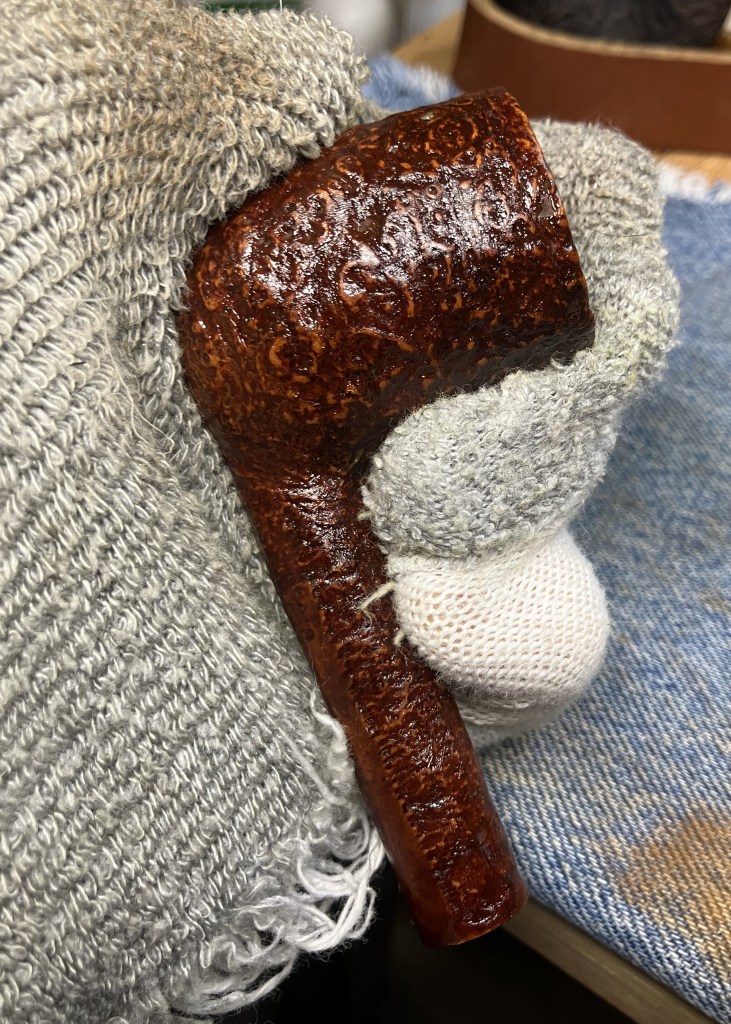
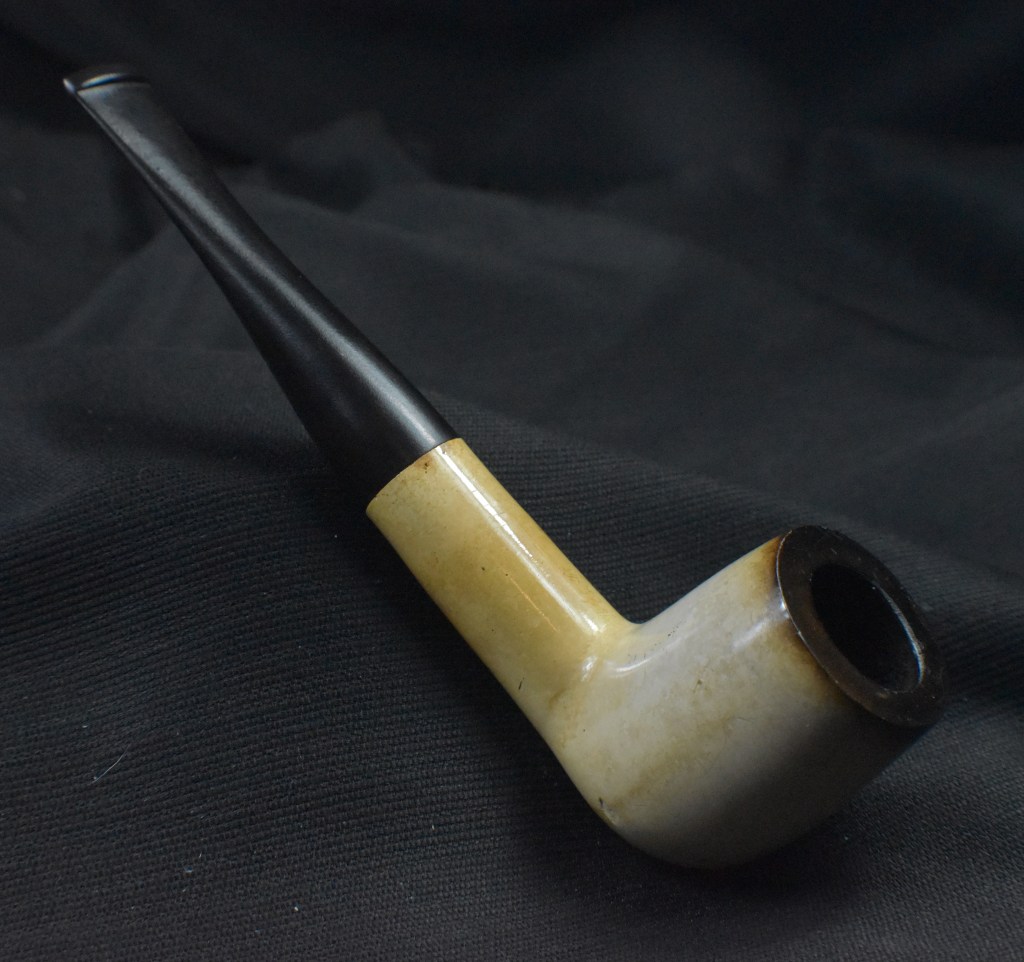
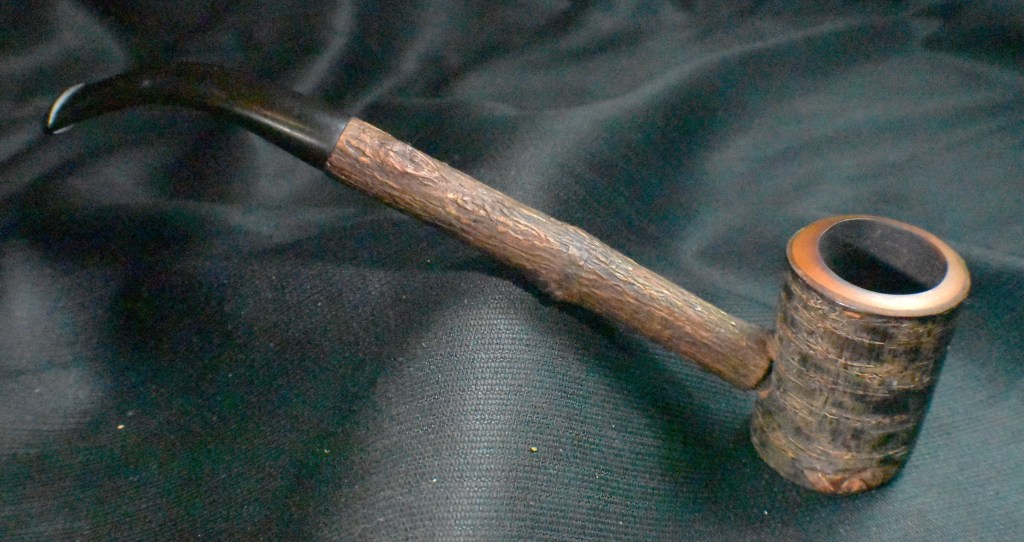
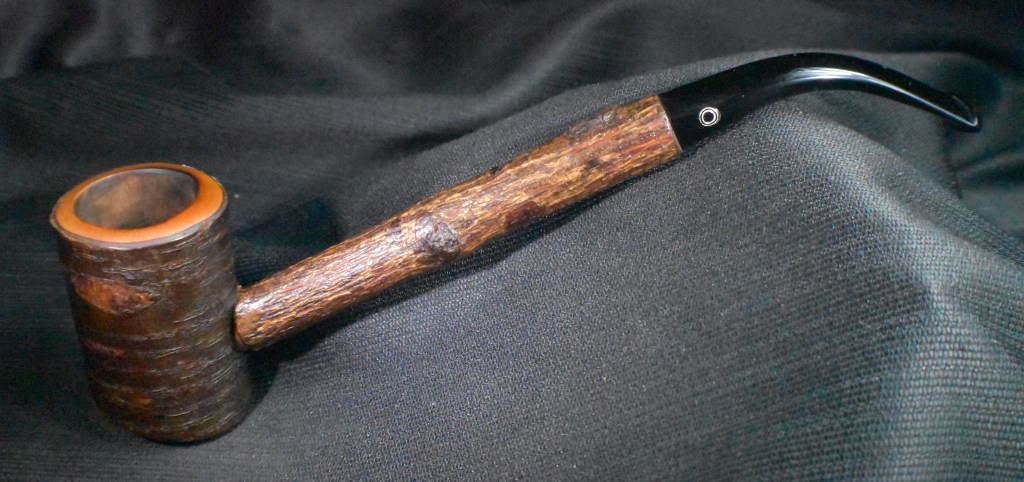
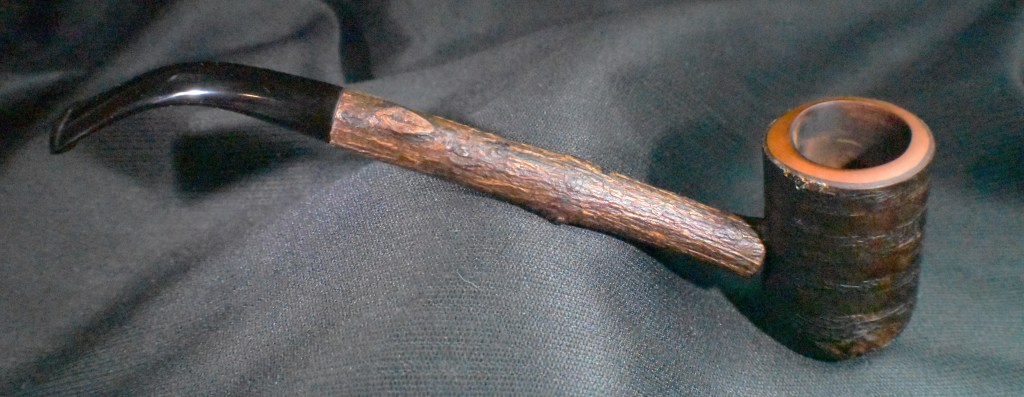
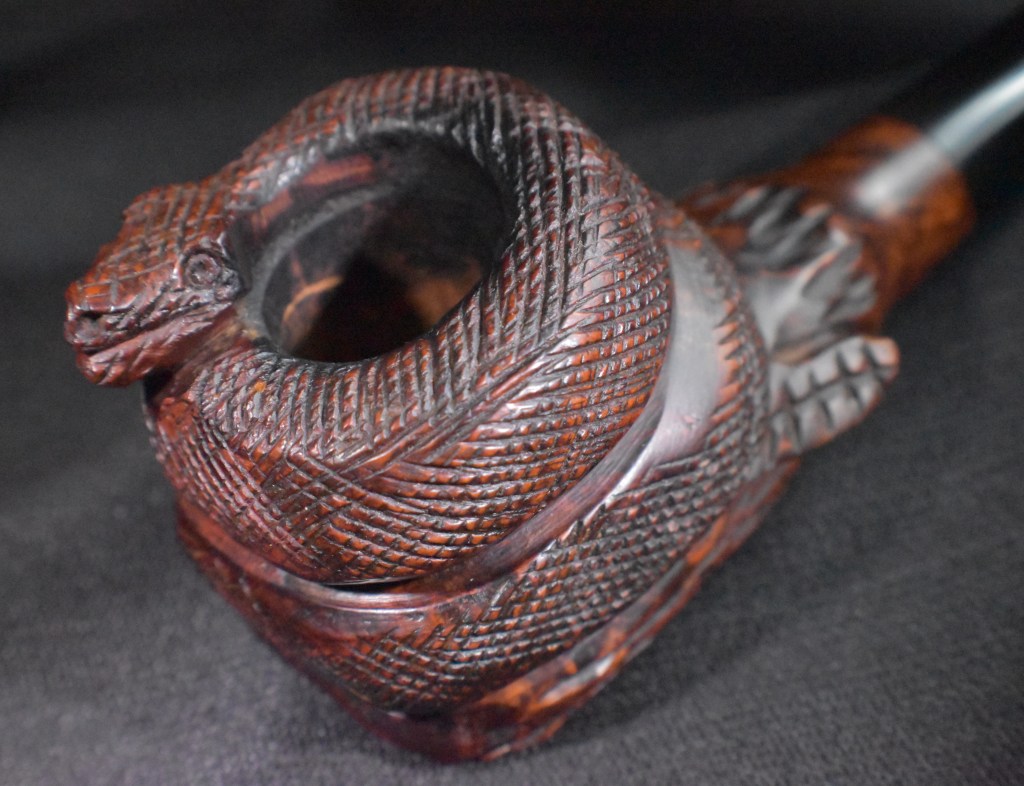
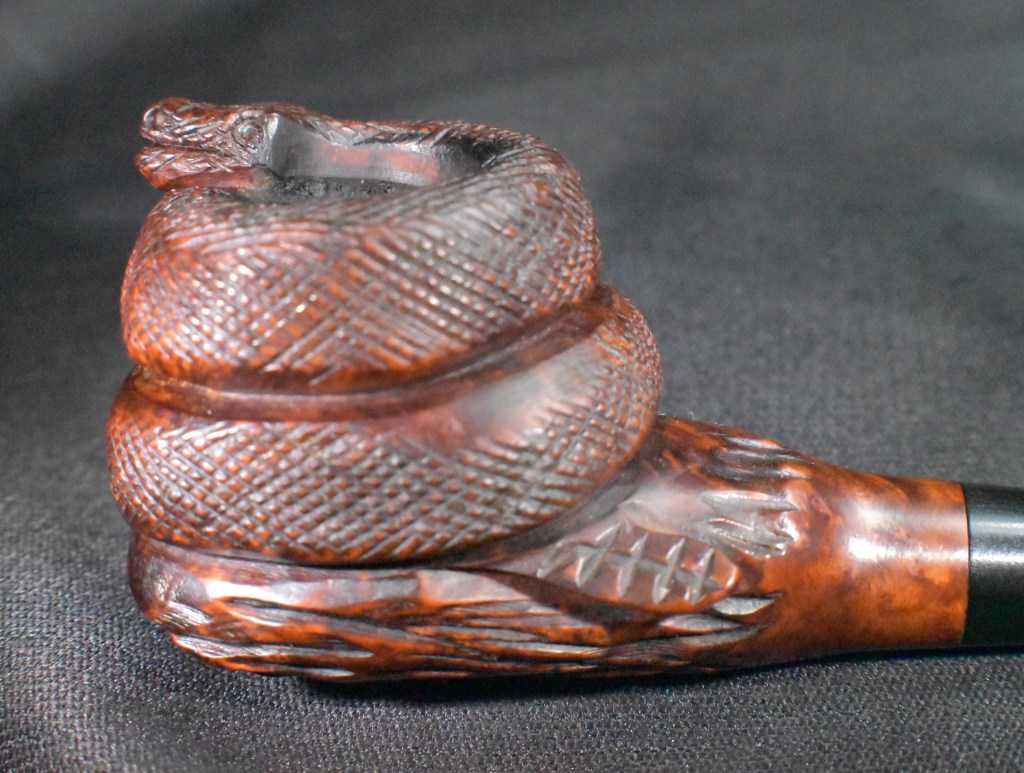
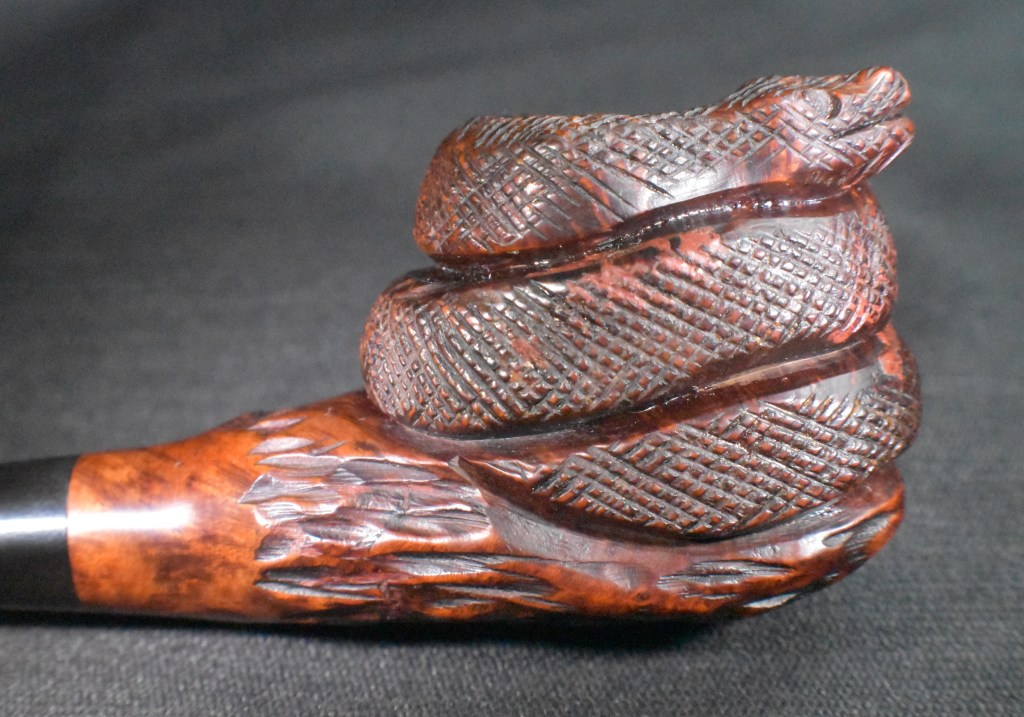
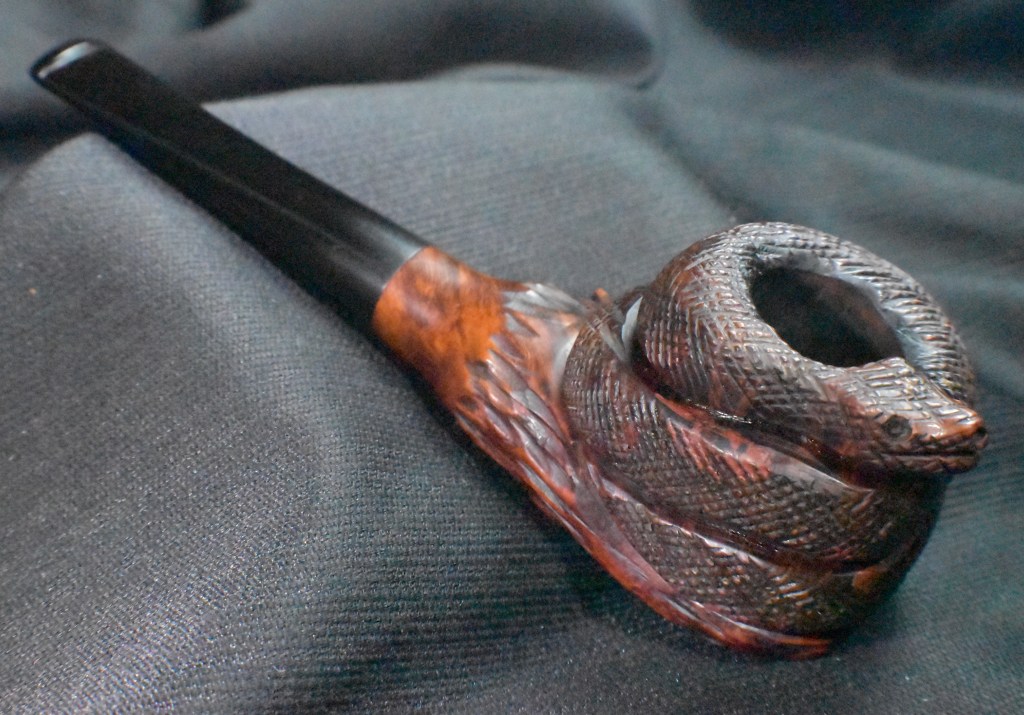
    I don’t know if freehand is the correct term for this pipe.  I’m not even sure if burl is, either.  All I know is that I came across one several years ago just as a stummel and decided that the weird little thing needed me as an owner.  I restemmed it and we have been getting along quite well.
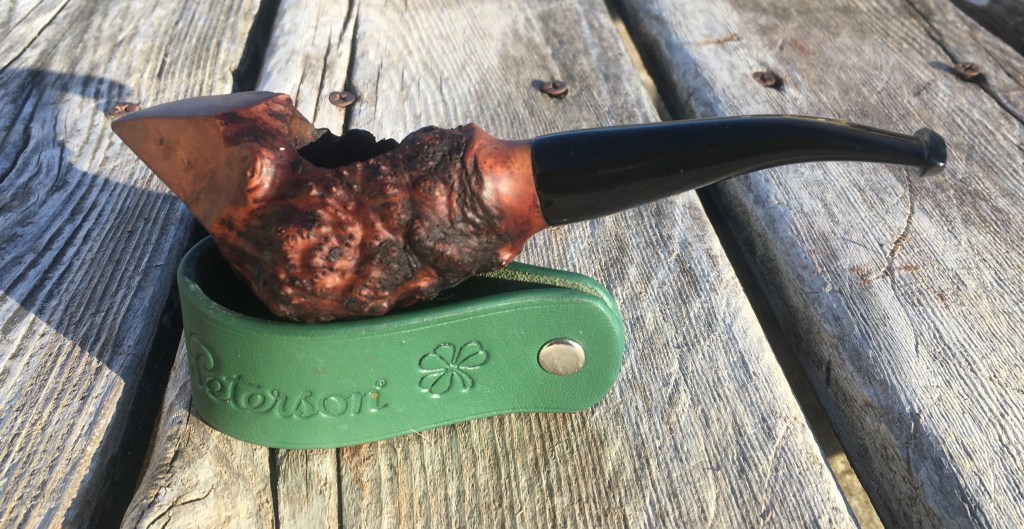
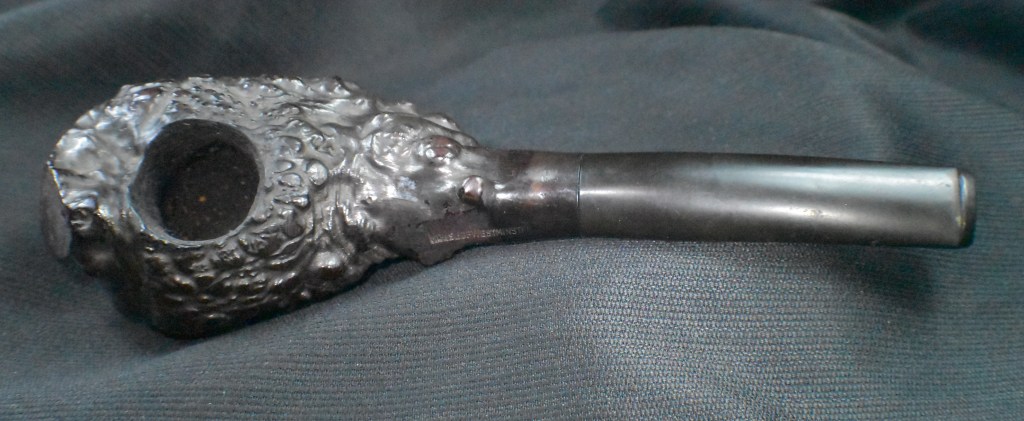
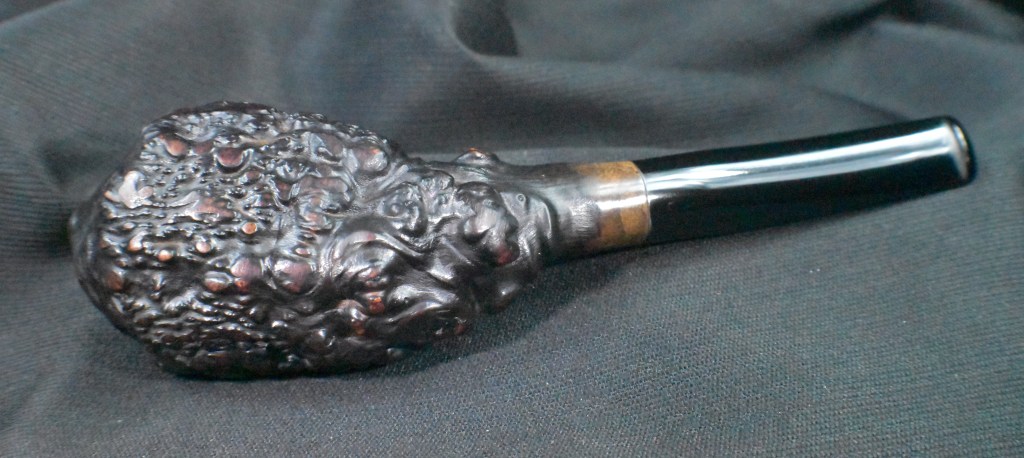
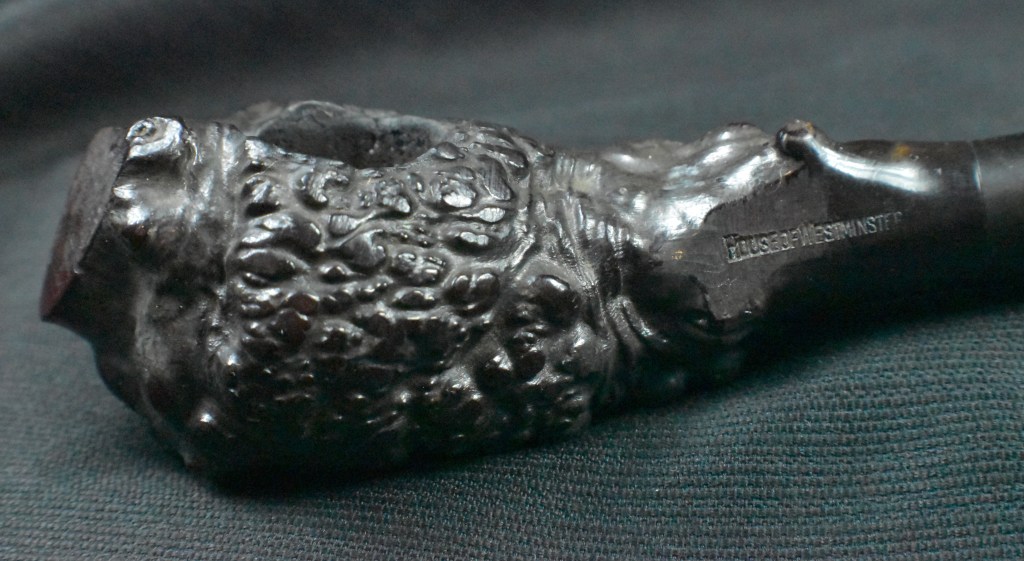
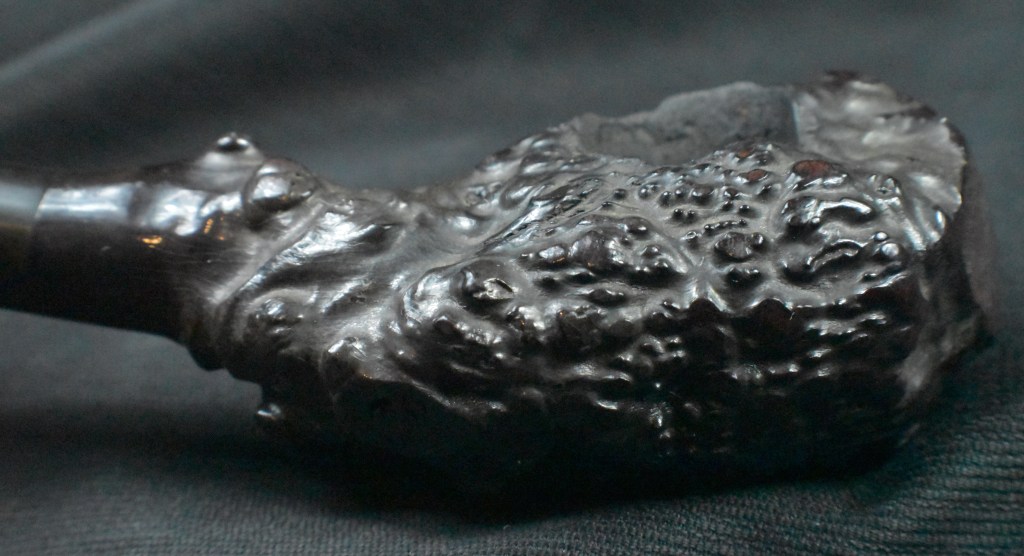
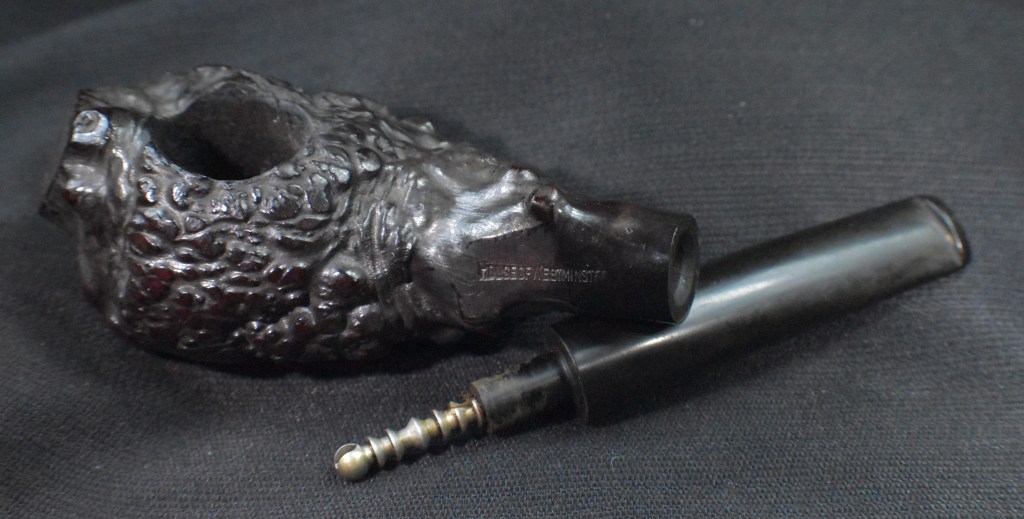
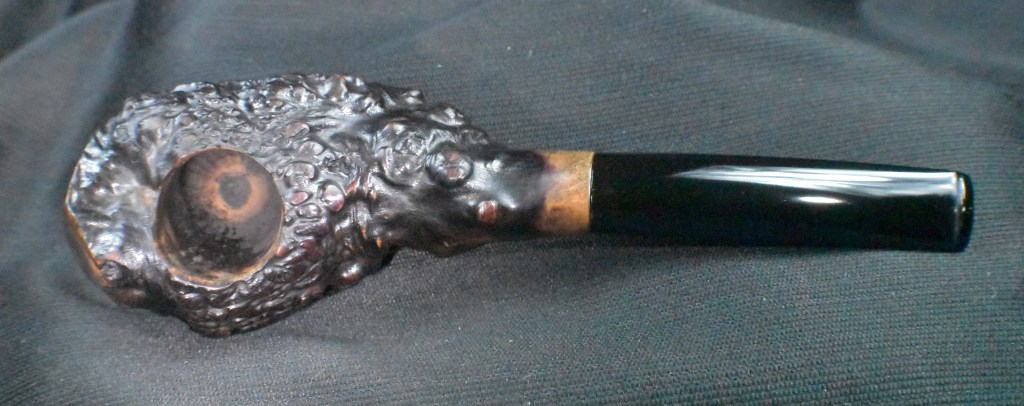
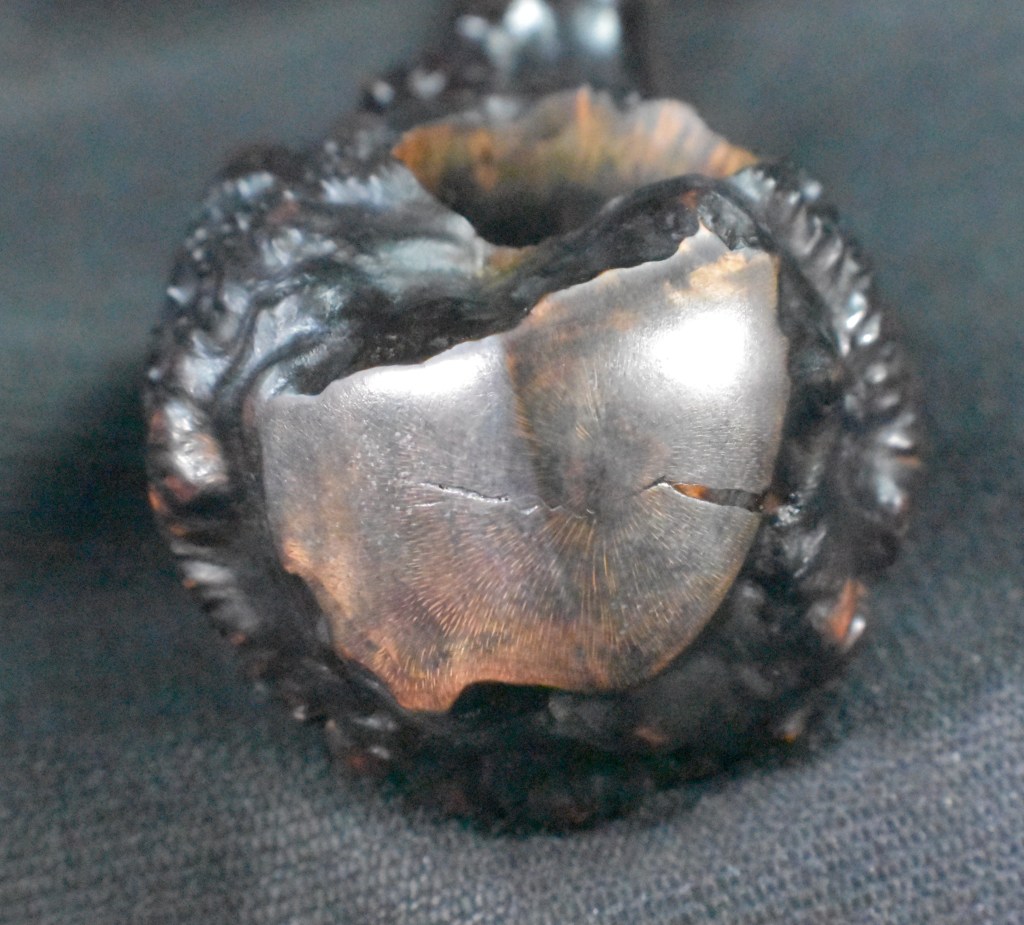
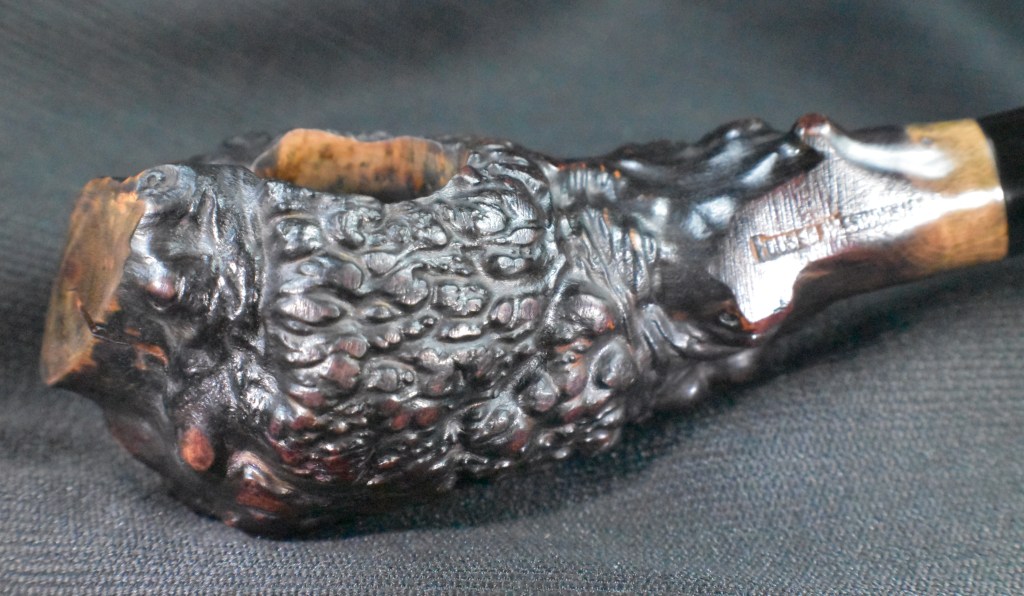
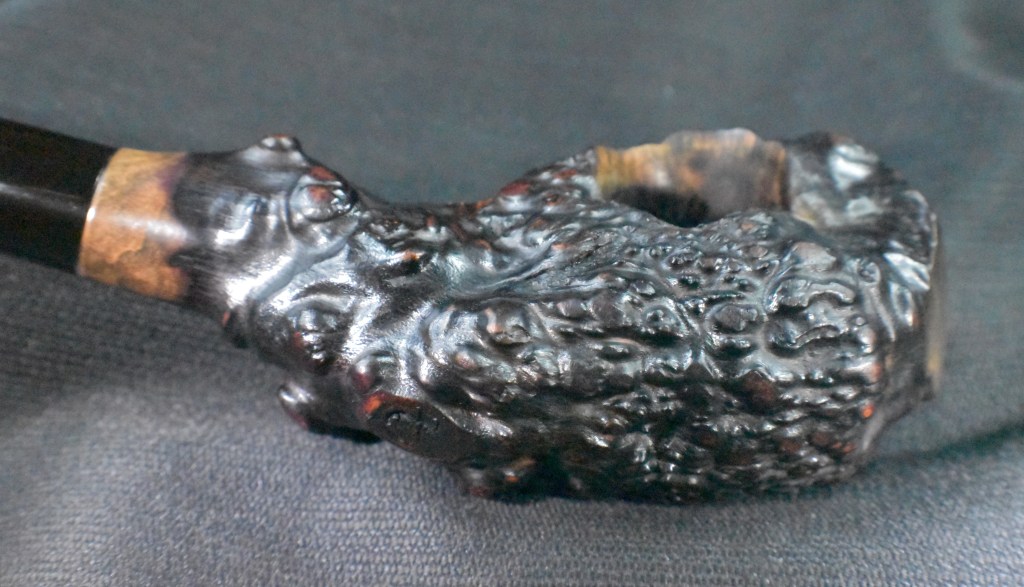
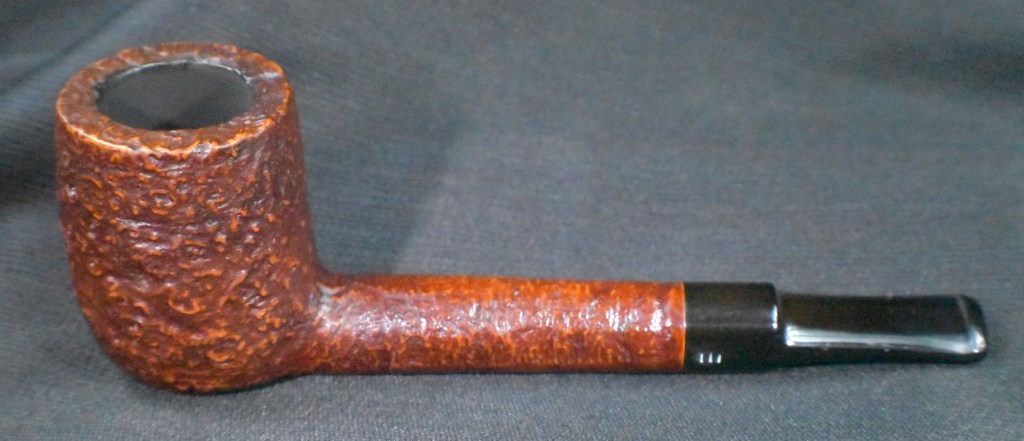
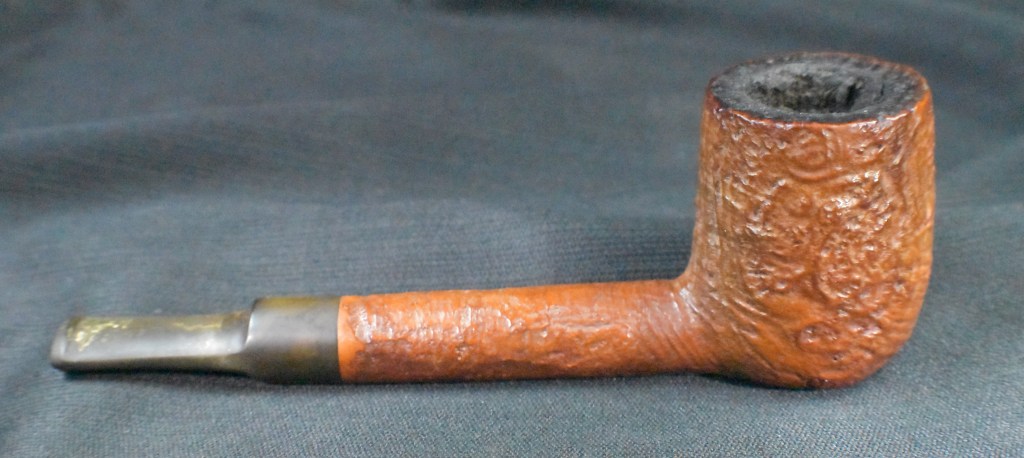
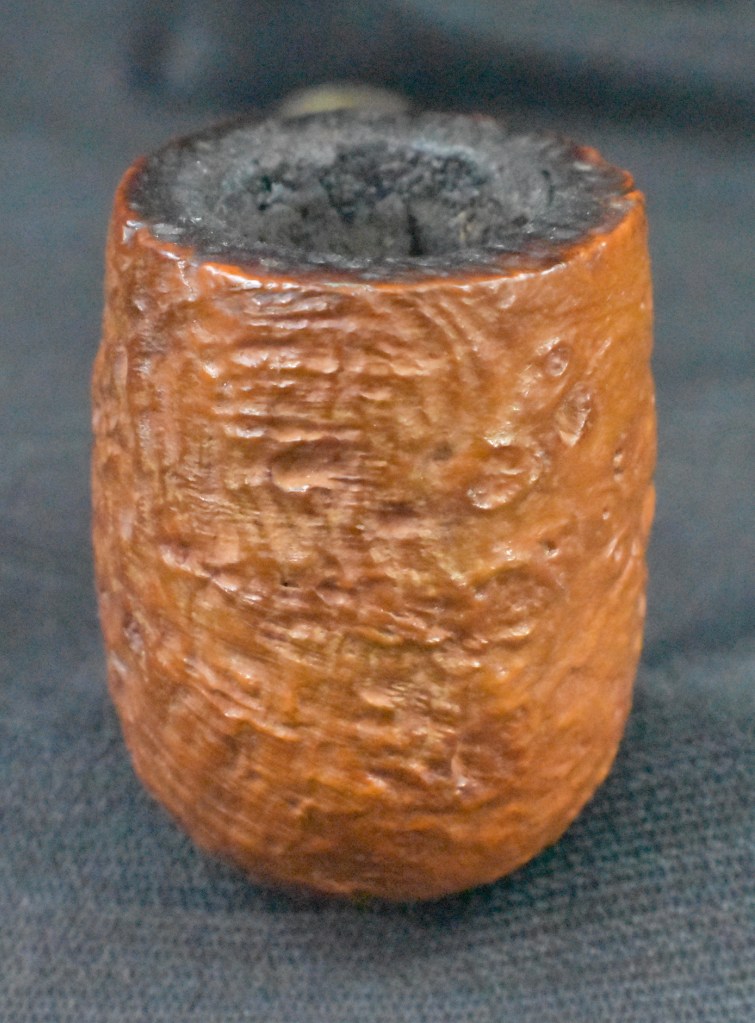
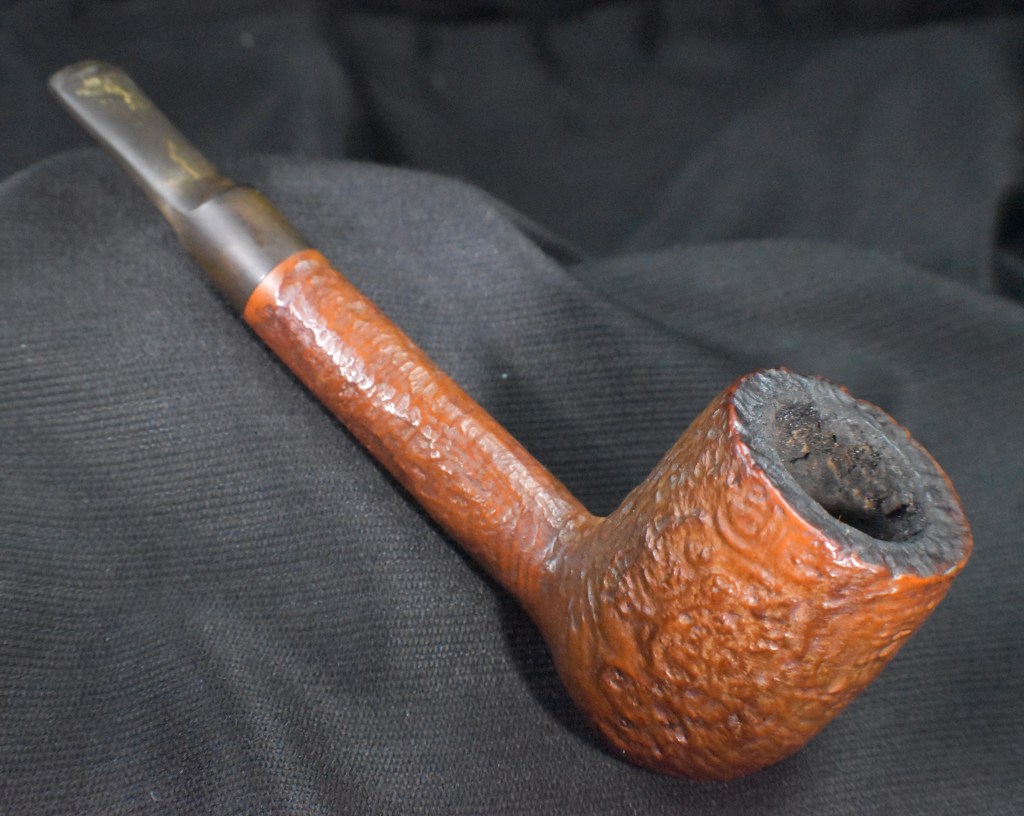
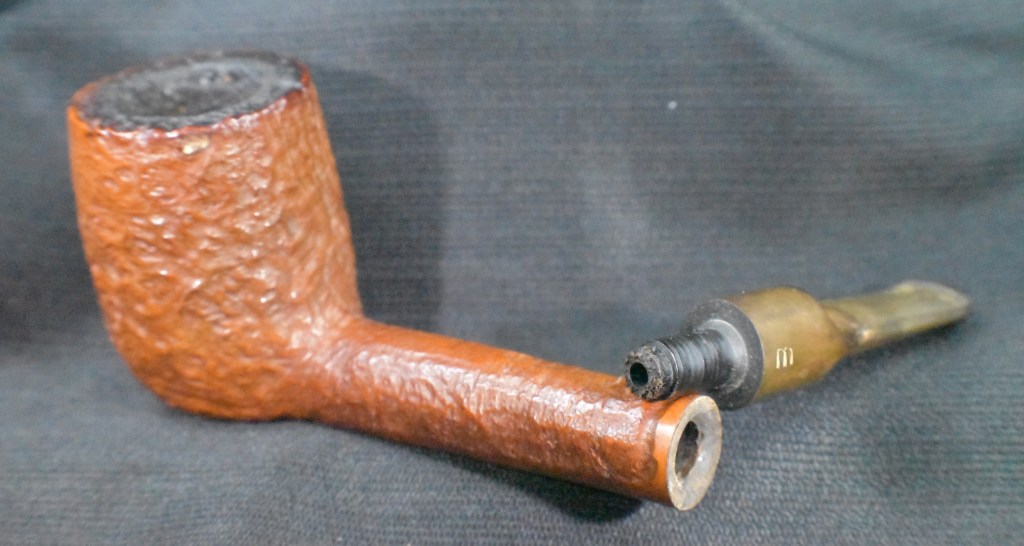
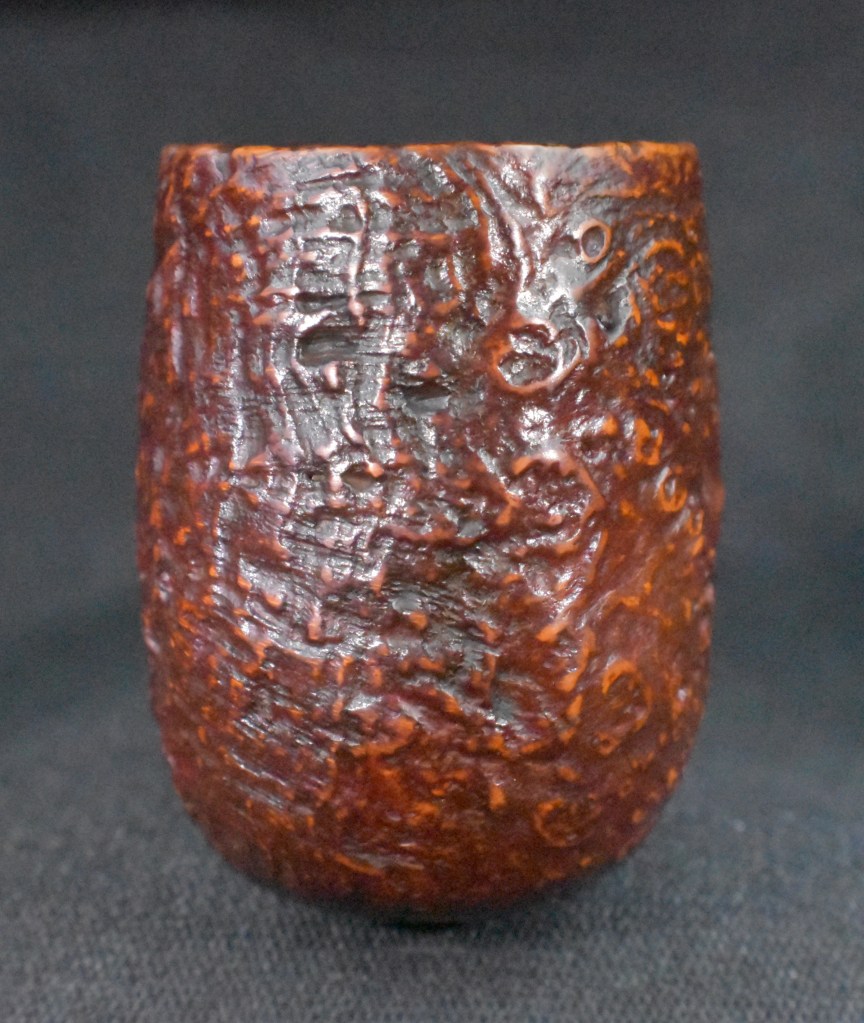
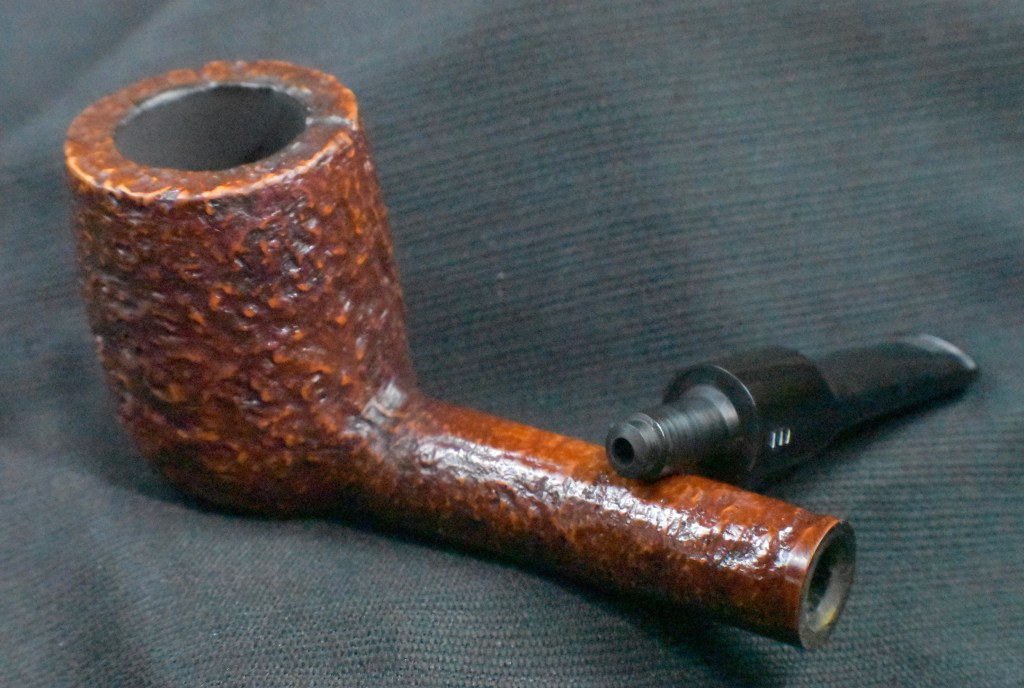
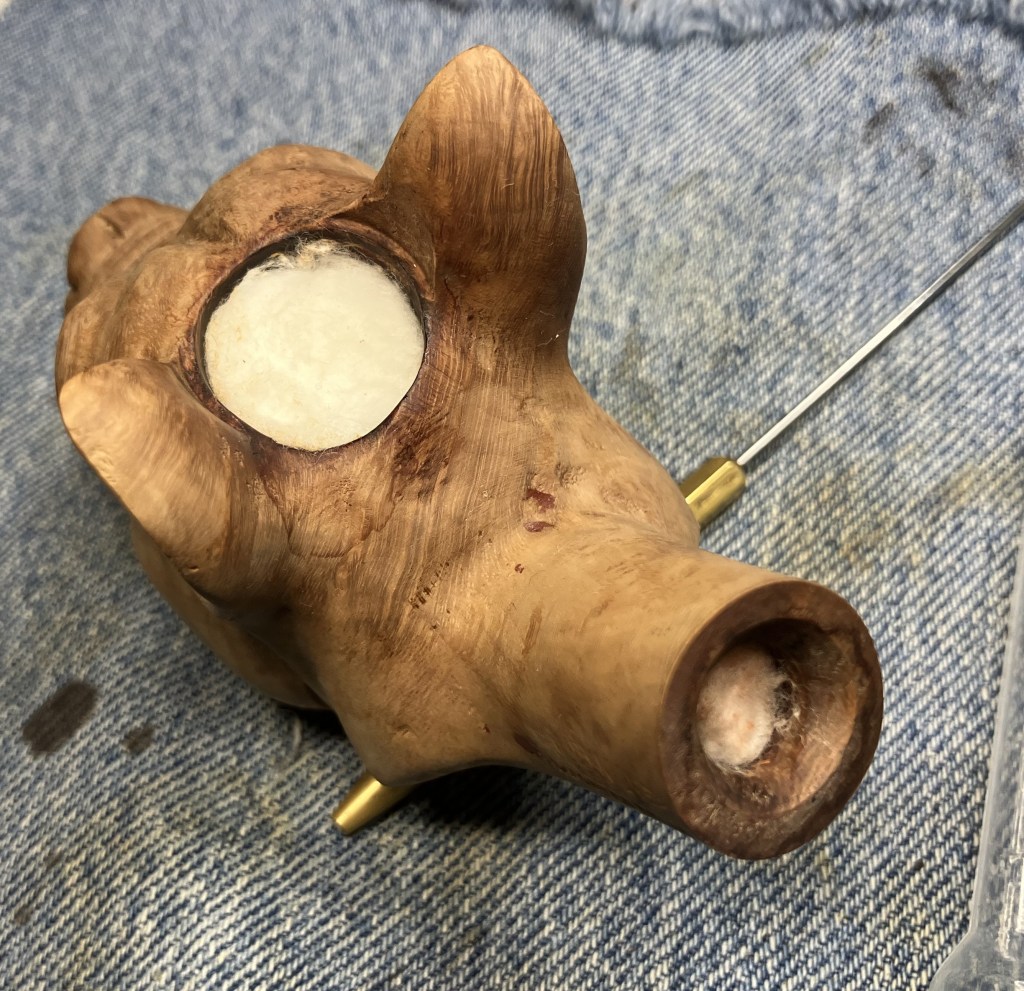
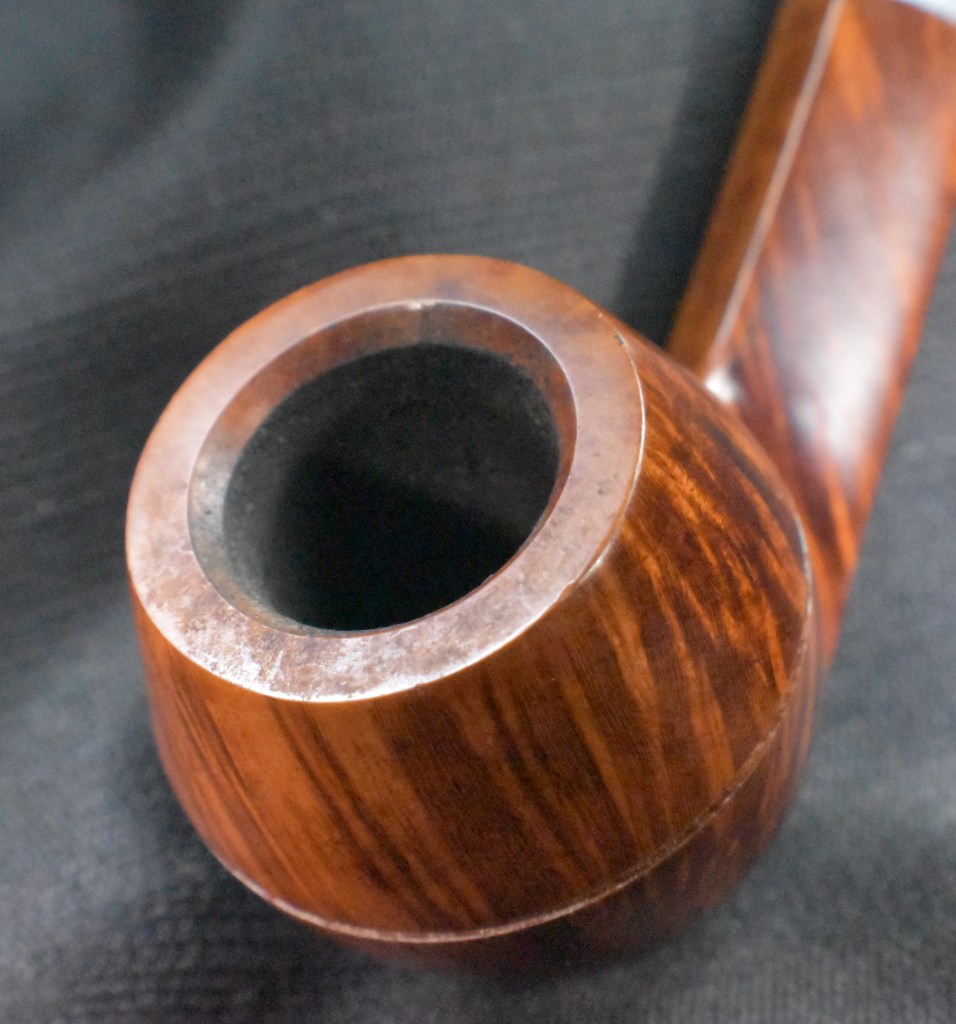
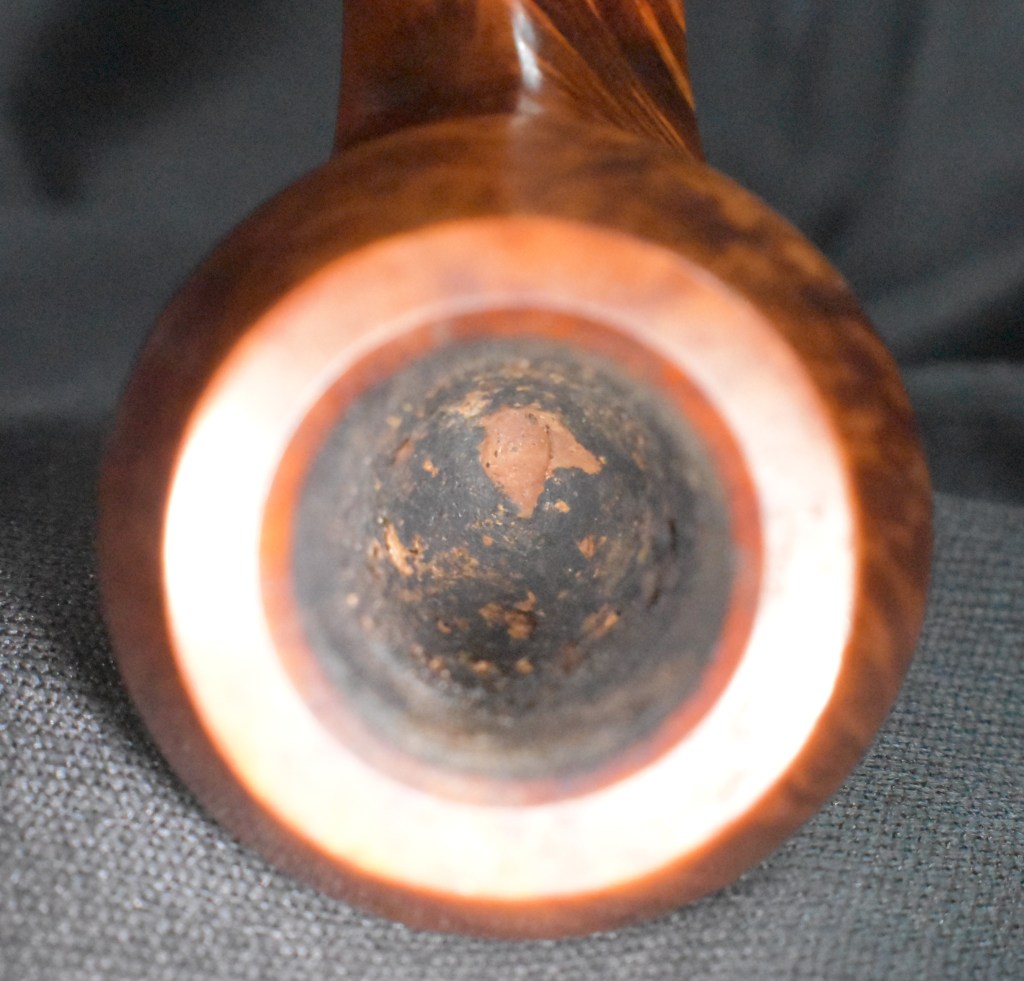
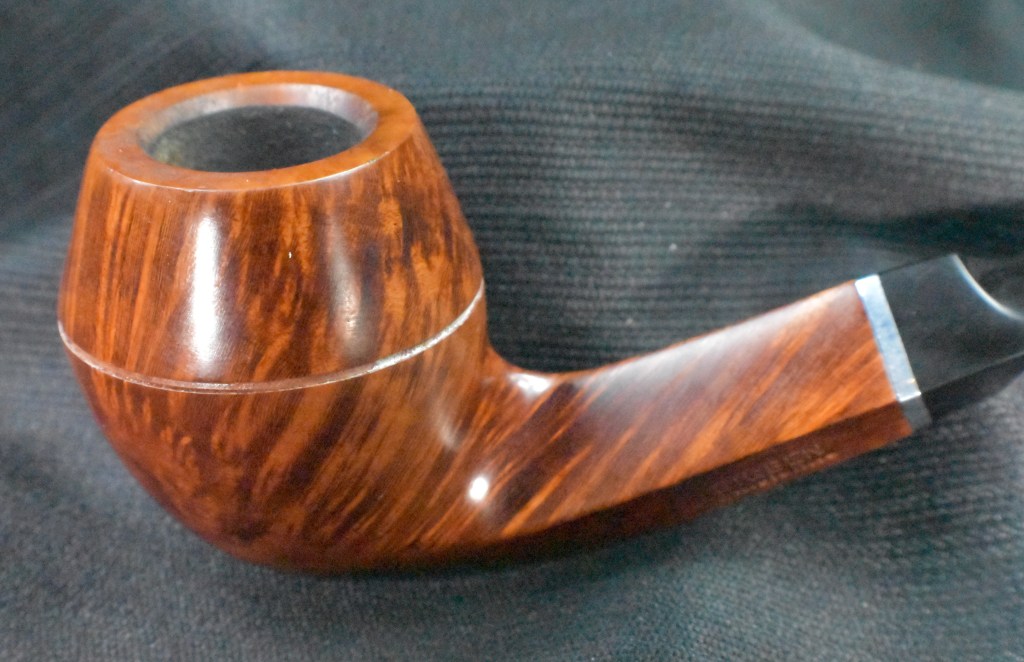
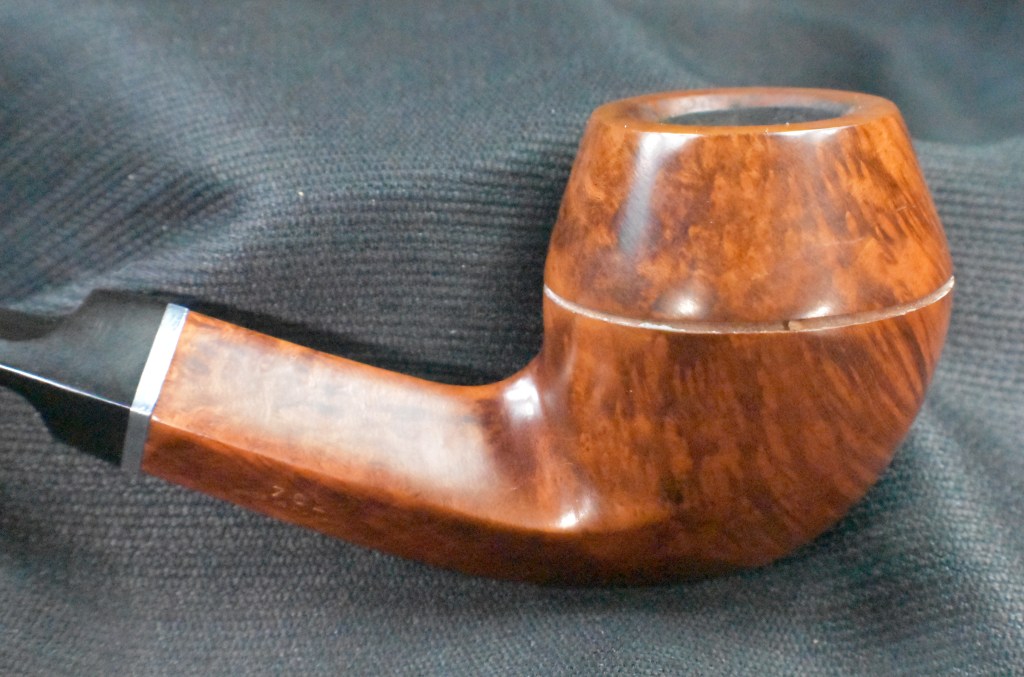
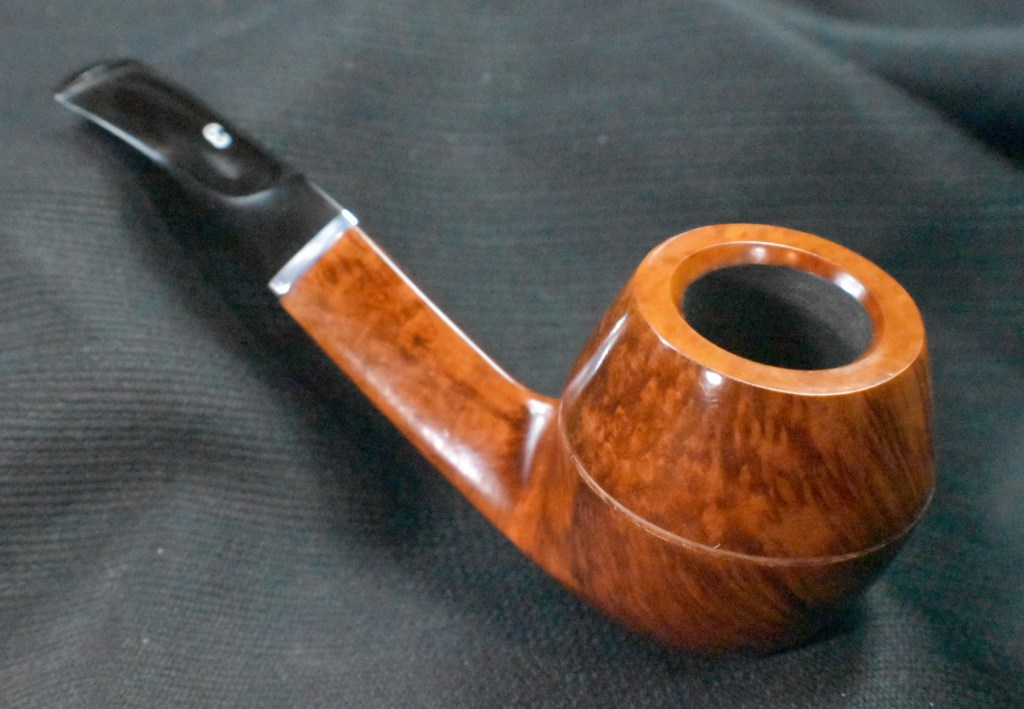
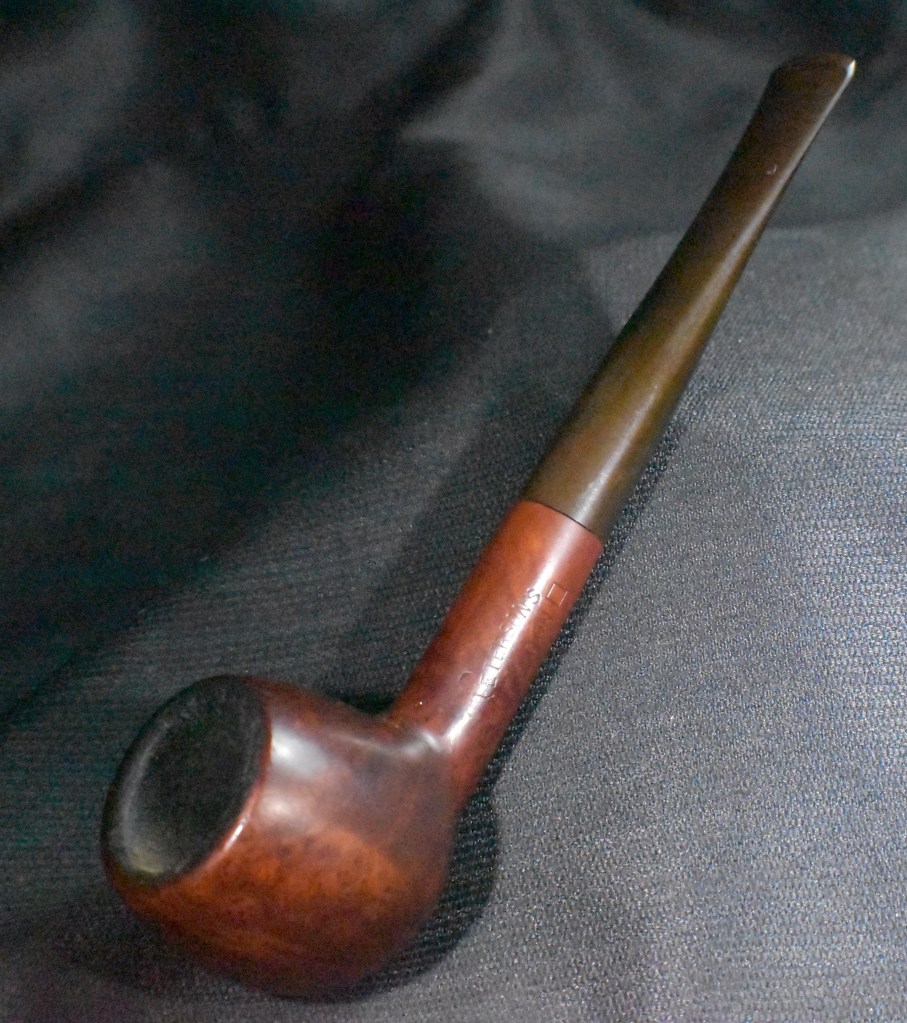
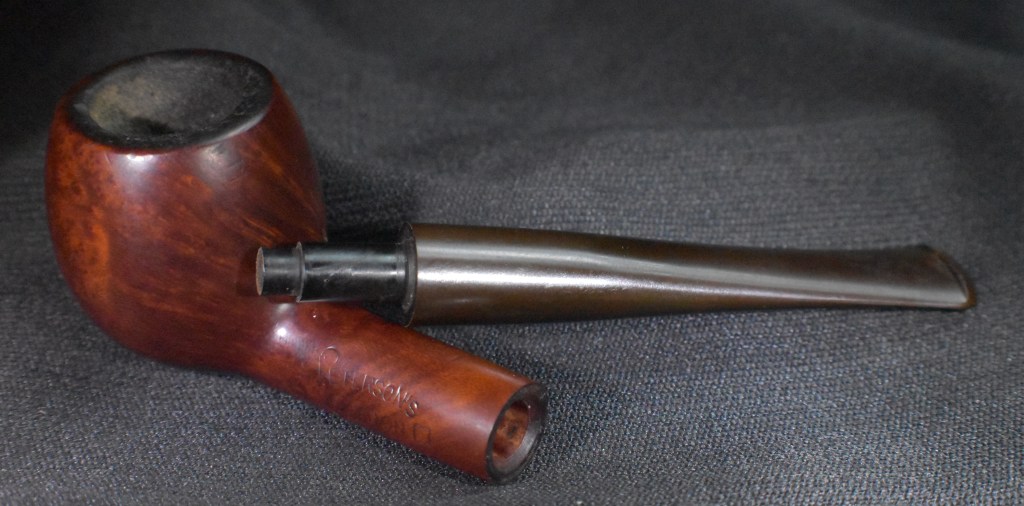
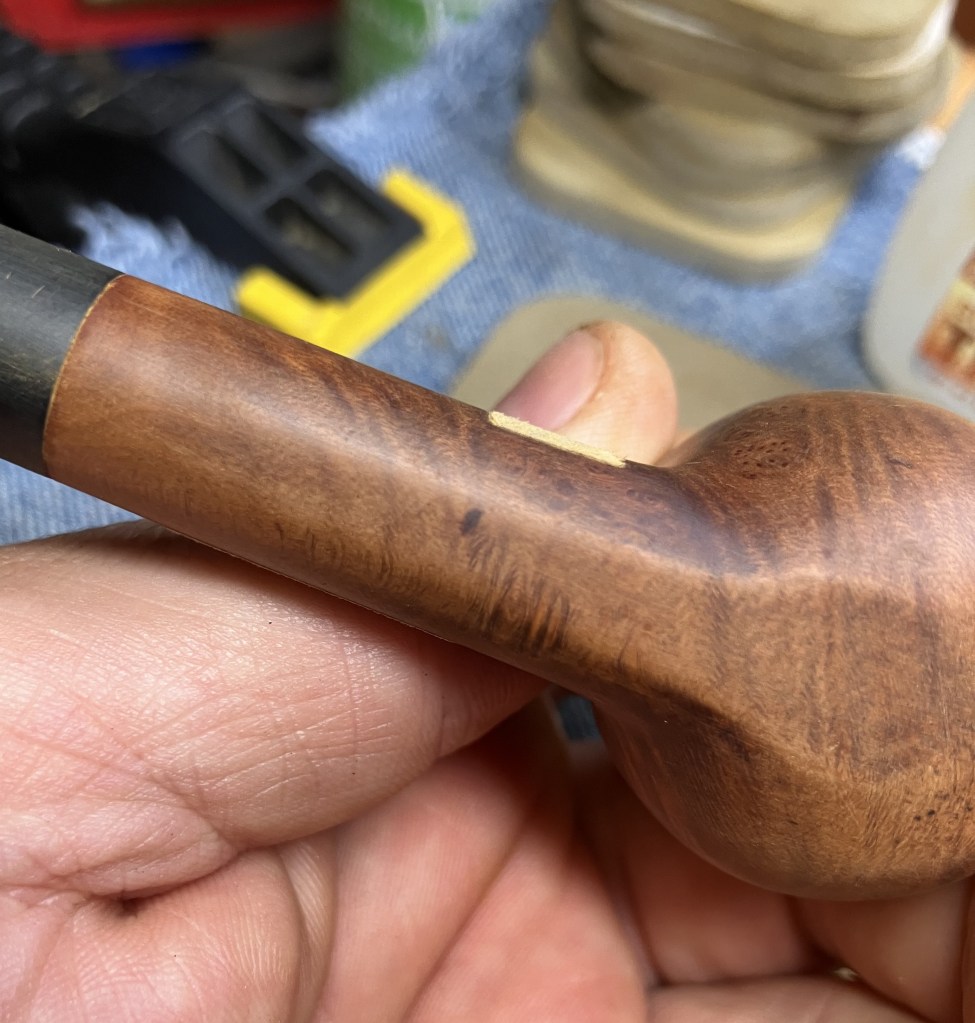
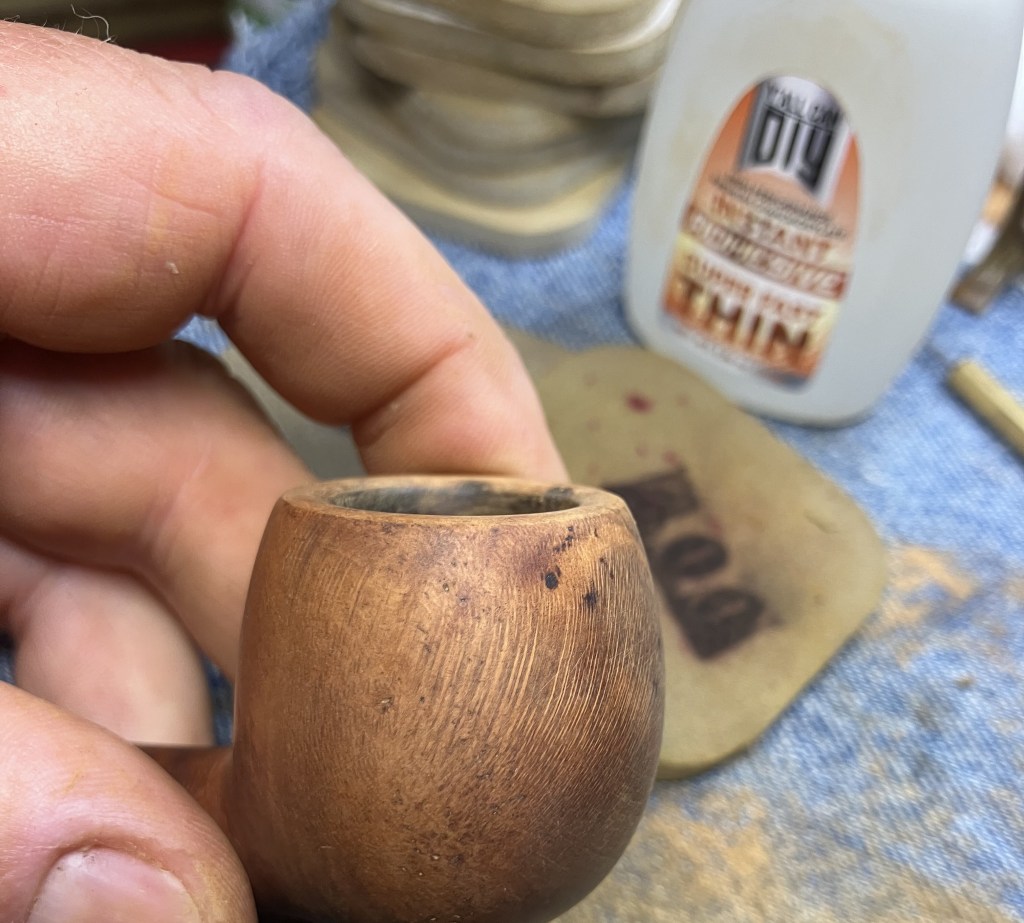
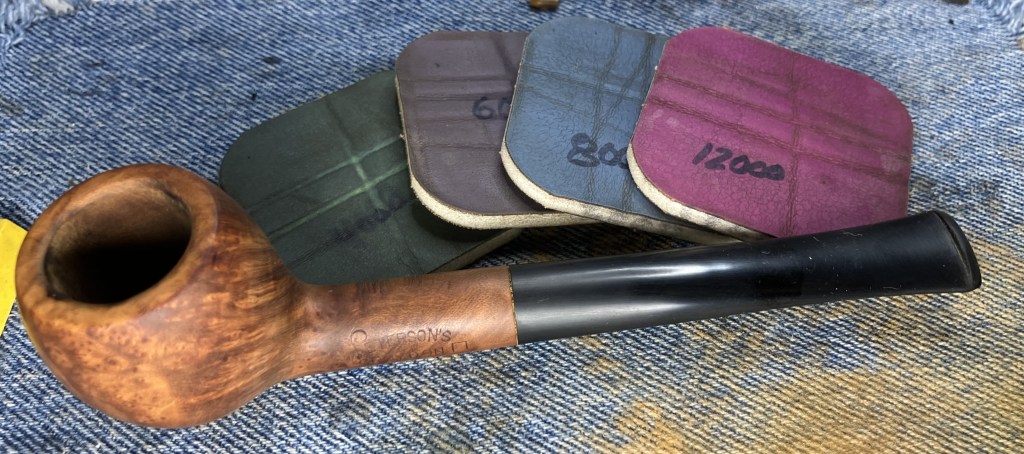
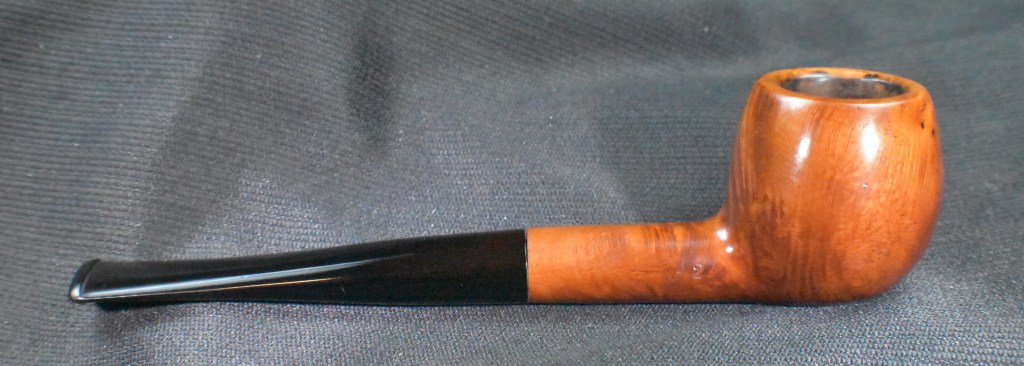
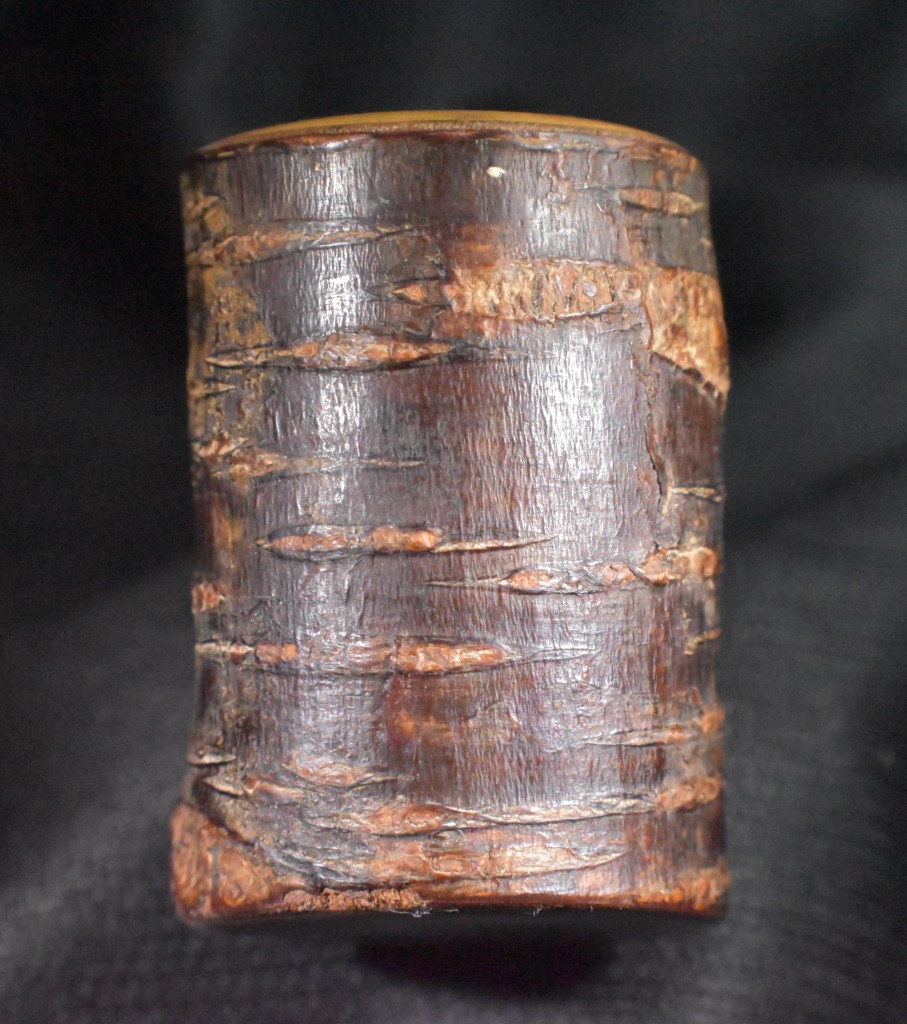
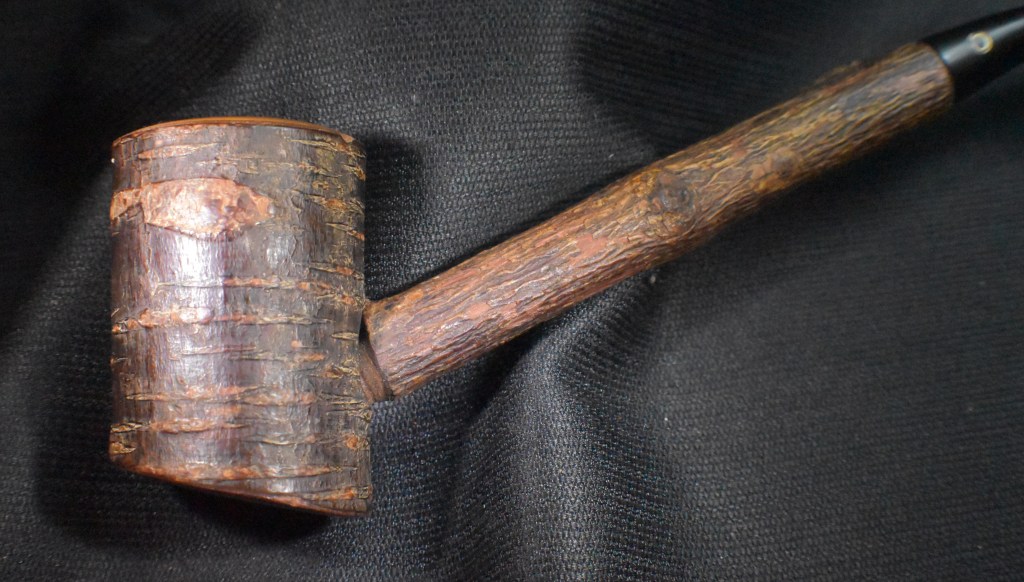
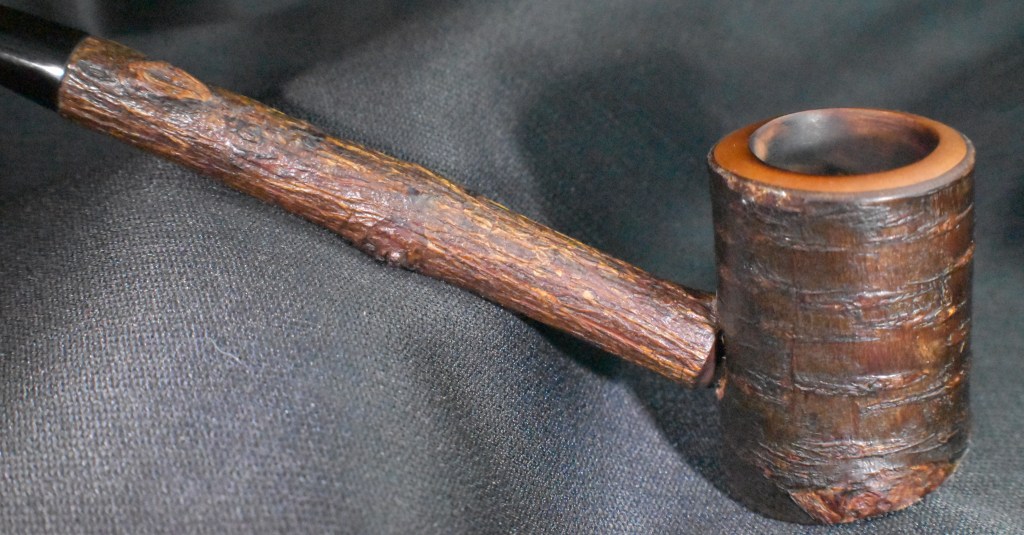
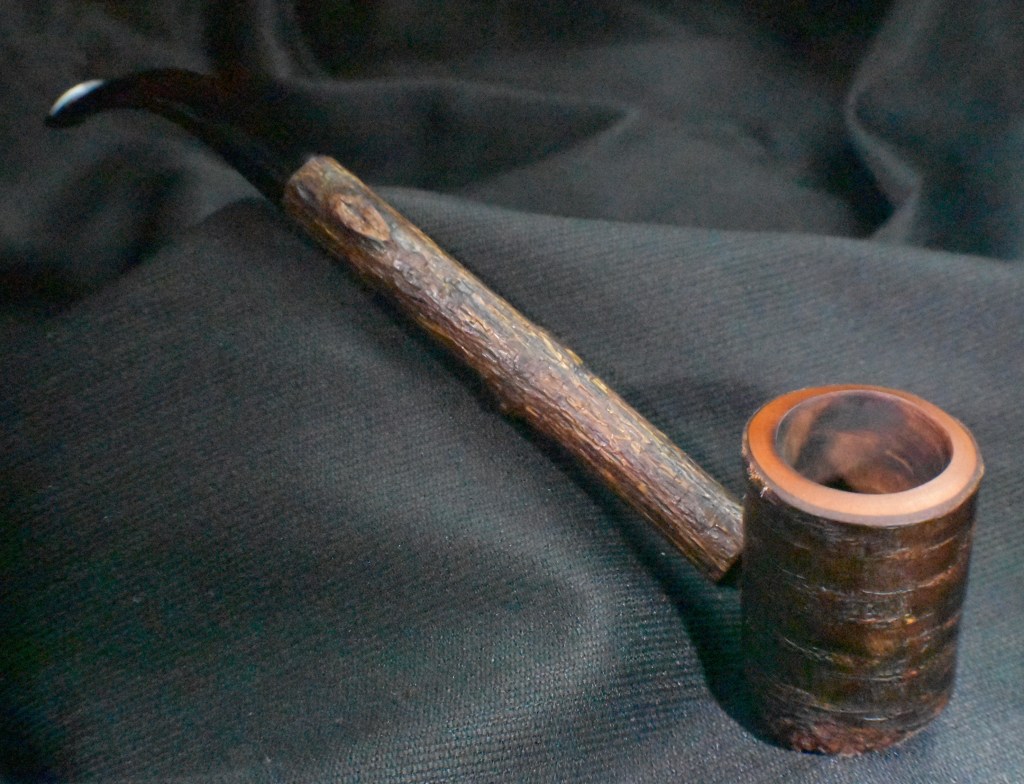
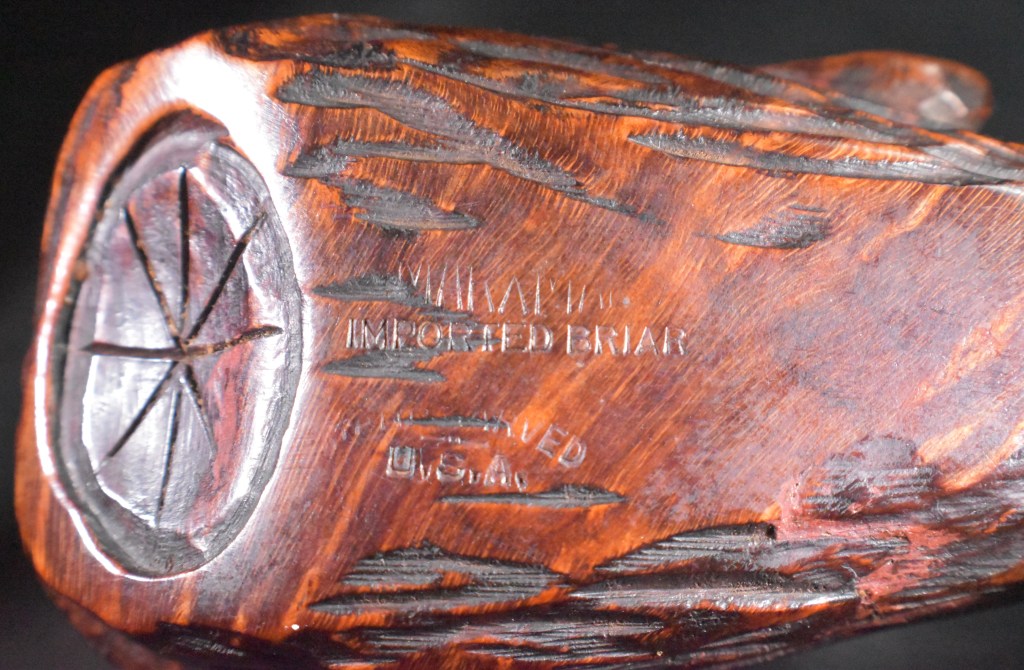
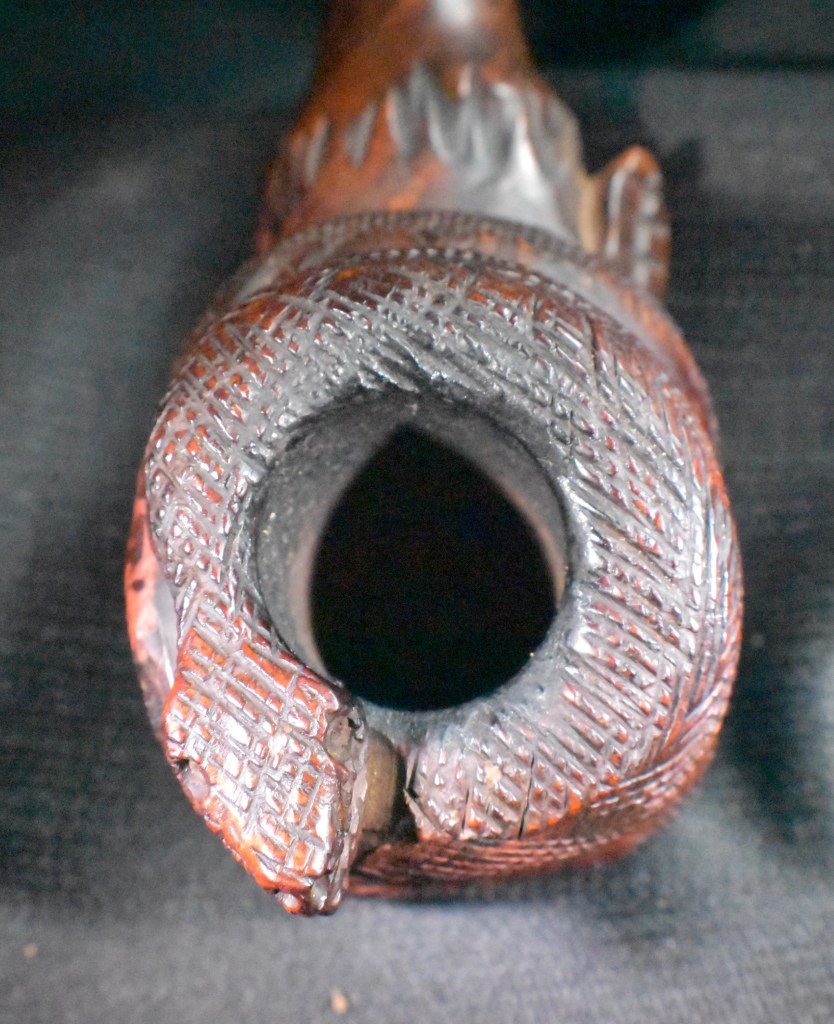
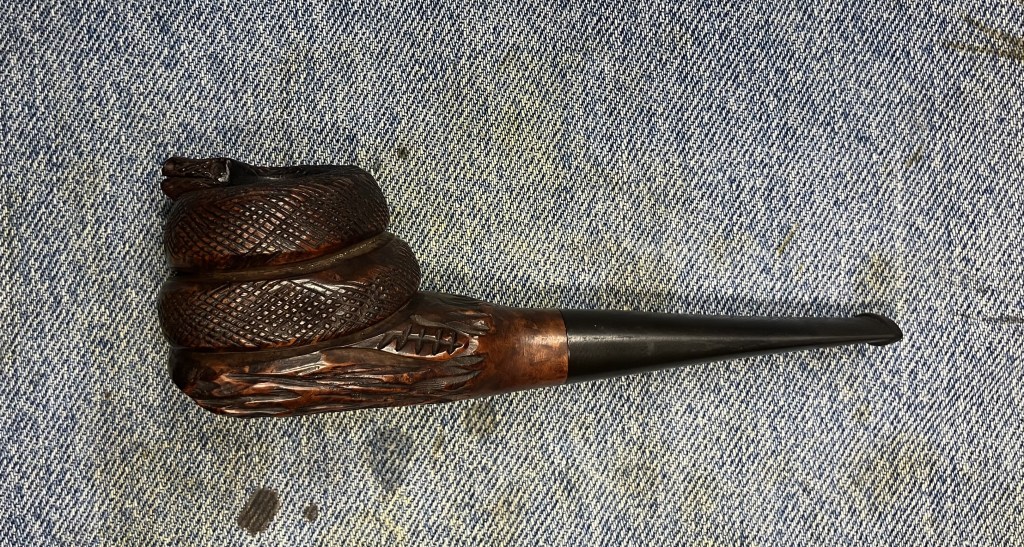
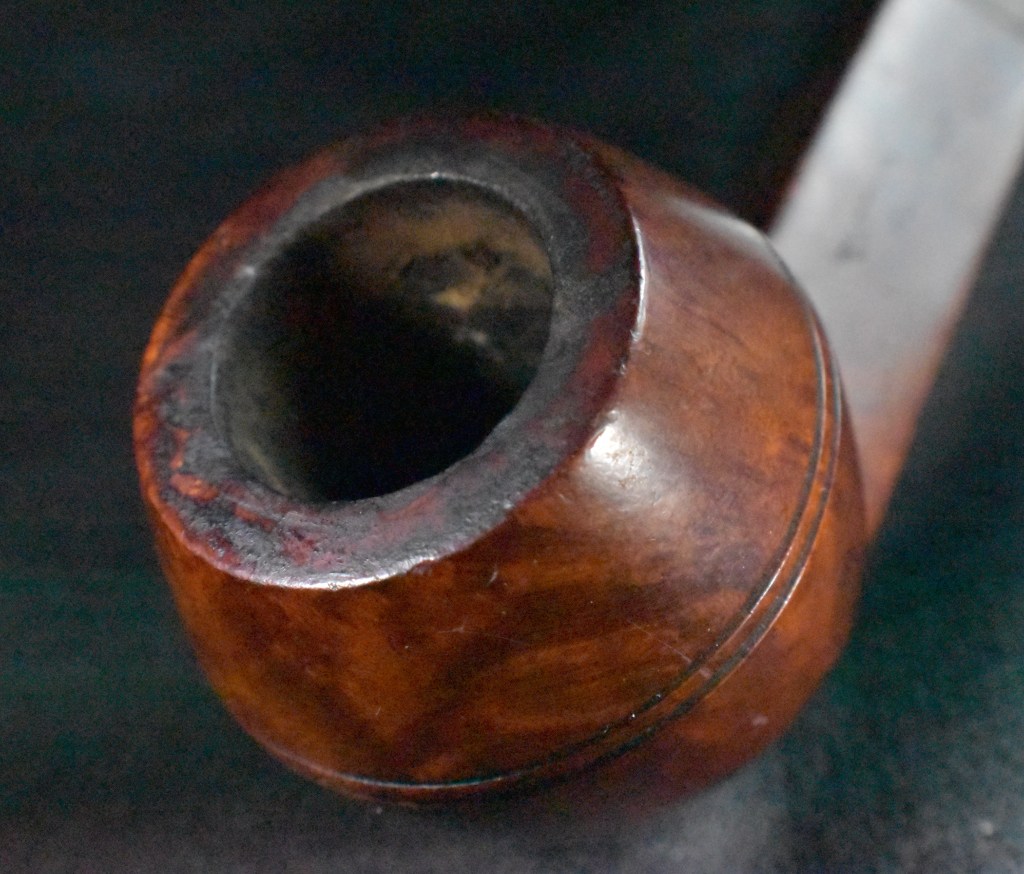
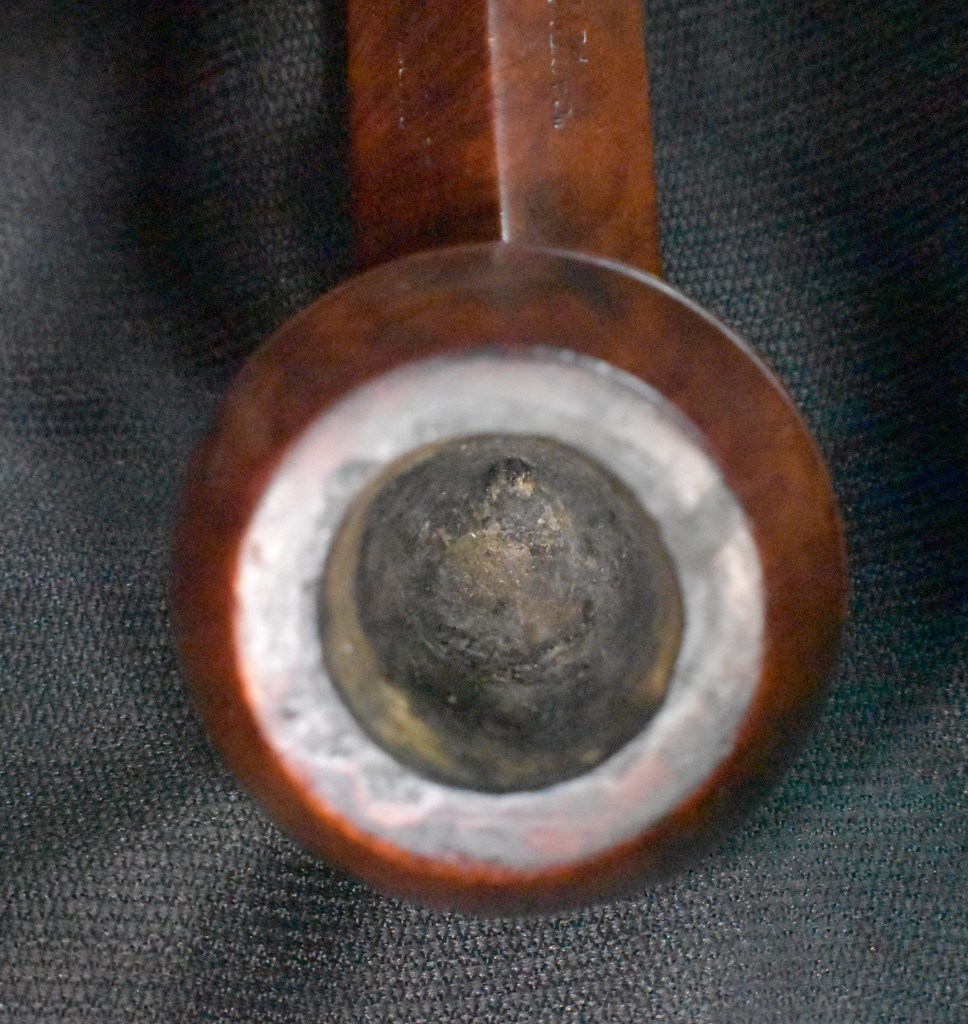
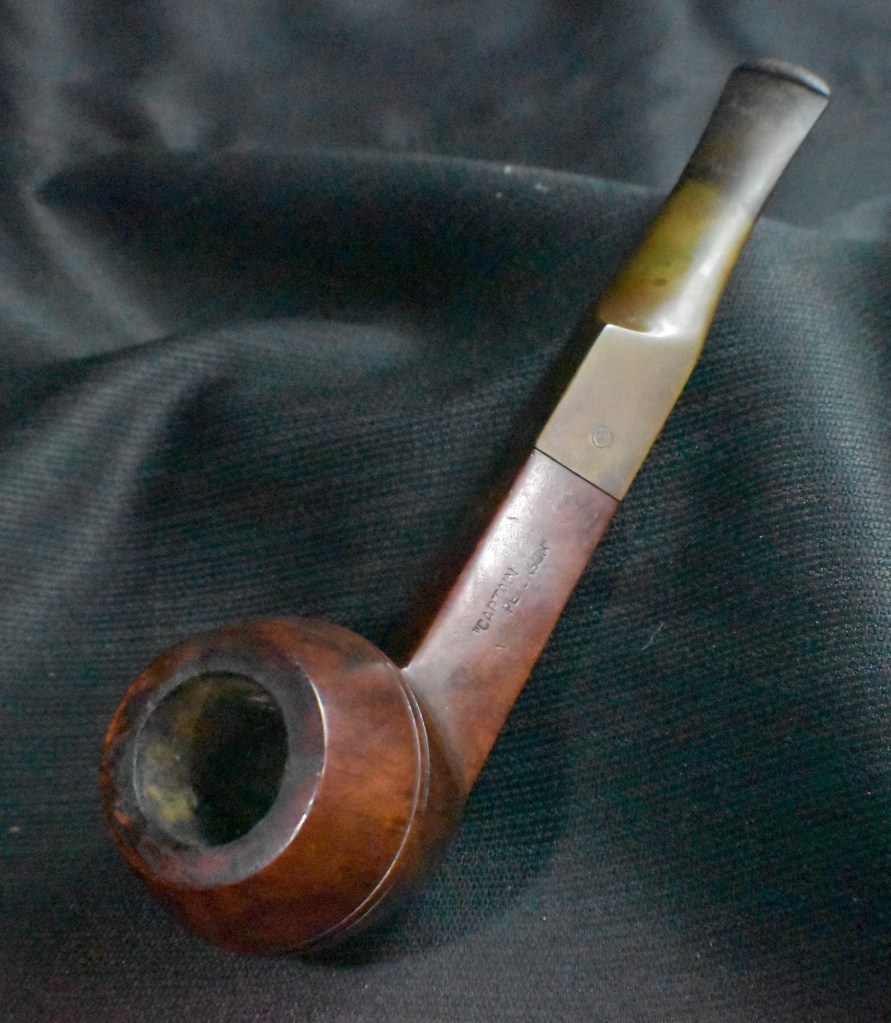
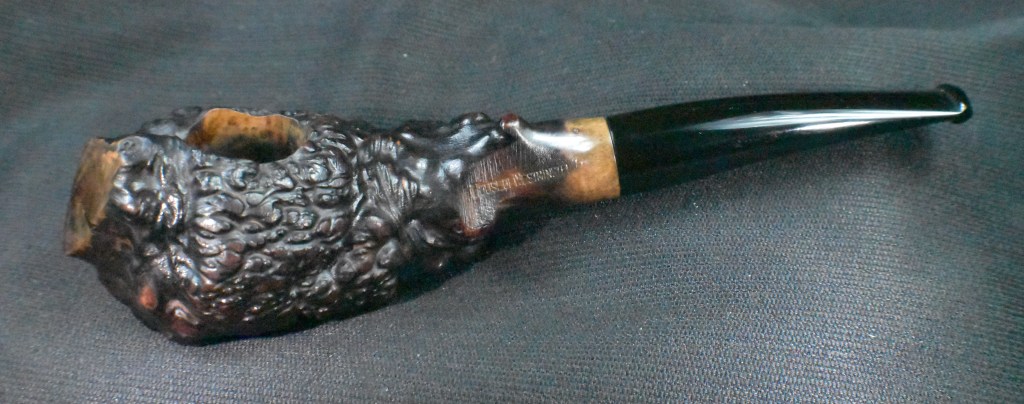
     I have seen one other pipe similar to this and it was stamped “Wally Frank”.  Of course, I didn’t collect a photo of that example.  The subject of this blog was seen on eBay back in August of 2025 and was quickly purchased.  The fact that it was from Sioux City, Iowa, a mere 125 miles from my home was interesting, support local businesses, eh?  The similarities between the two pipes was stunning.  Both were formed from what appeared to be small briar burls.  Having seen photos of briar burls which are large enough to be cut into numerous blocks for pipe making is the norm.  I wondered if these small burls were not small individual plants which were  dug up while the digger was excavating a larger “target” burl.  Both of the burl pipes had the same general shape with the shank forming the trunk of the shrub and a “V” shaped cut to remove, what I thought was, the more spindly root. The only stamping on the newly acquired pipe was HOUSE OF WESTMINSTER in a single line on a panel of the shank.  Below are some photos of the burl pipe prior to work.
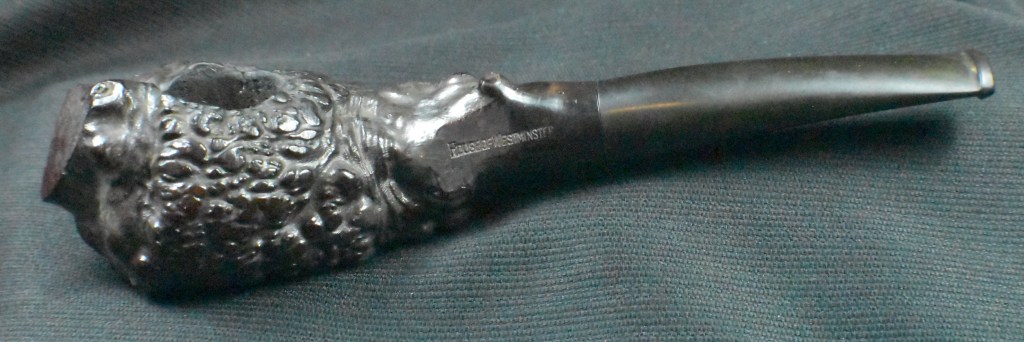
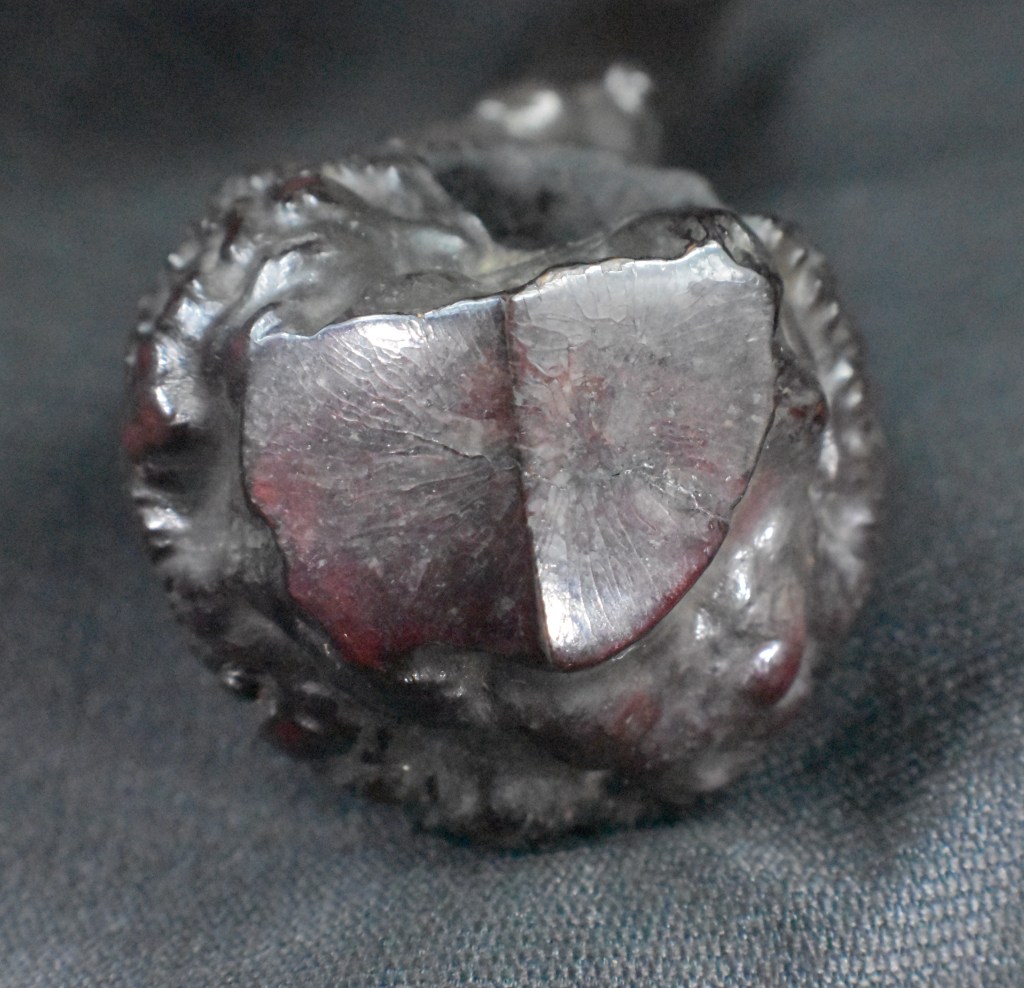
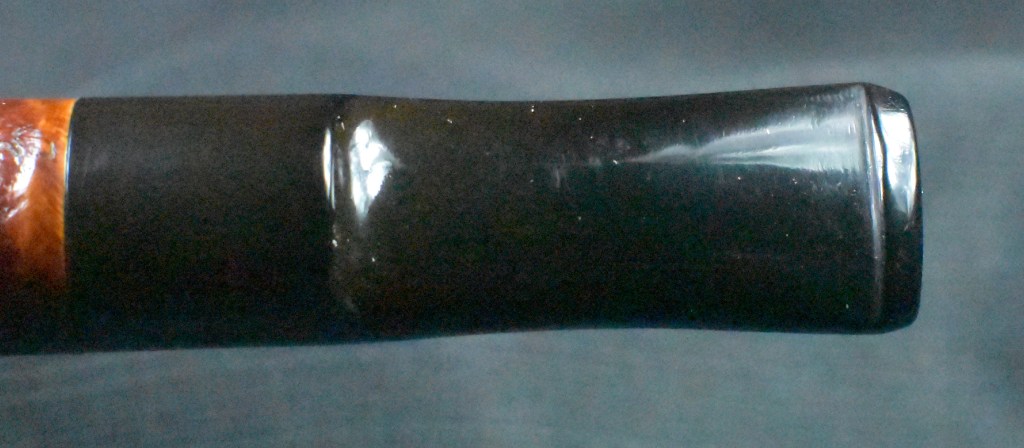
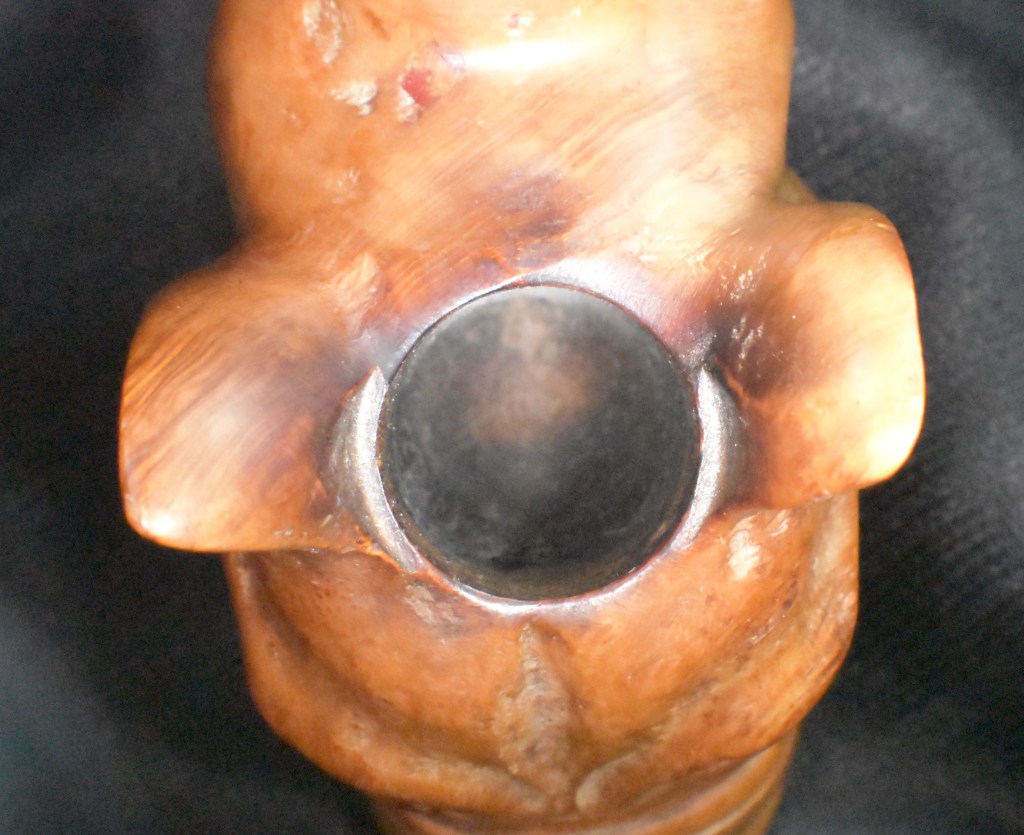
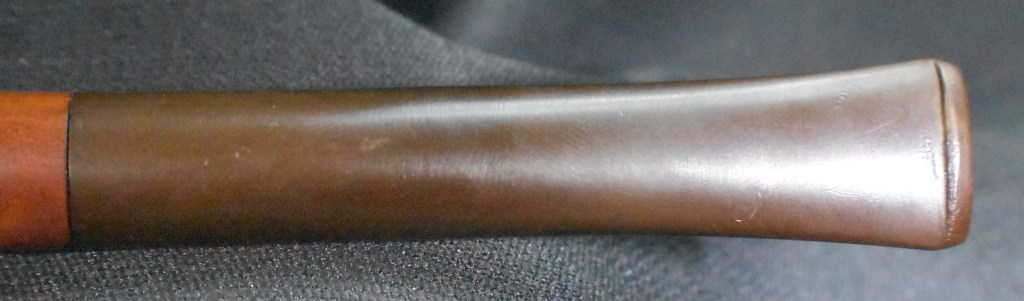
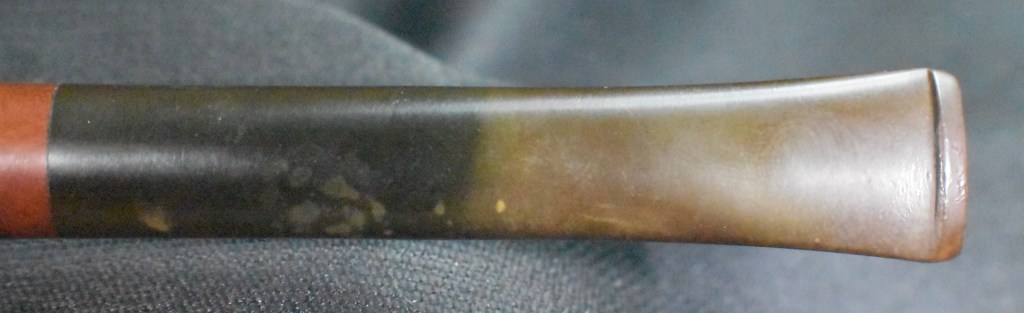
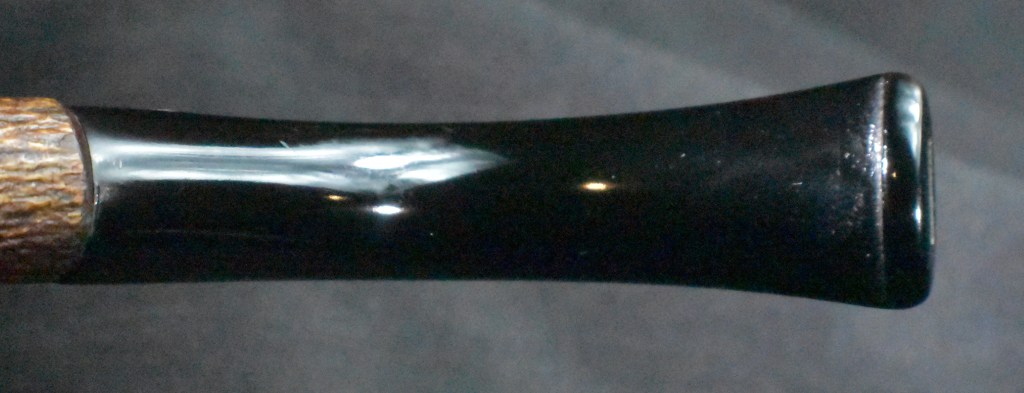
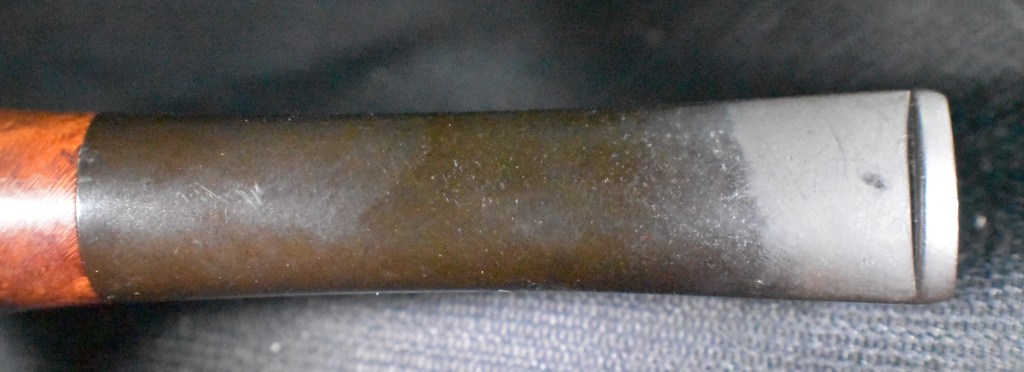
    The first thing I noticed was the thick clear coating applied to the pipe.  It looked as though it had been sprayed or dipped several times into a finish.  The briar was also heavily stained masking any of the wood’s natural color.  There was a crack on the cut V at the front of the pipe.  The stampings were crisp and well defined leading me to think the stamp was pressed prior to the application of the finish.  The stem was oxidized with some slight tooth chatter near the button.  Overall it looked to be a simple restoration.

    Background

    As I discussed earlier this appeared to be an entire, very small briar root.  Perhaps something dug-up with a larger burl.  Not wanting to waste a little bit of briar, I could imagine the diggers throwing it in with the larger burl and sending it off to the cutters for sale.  Of course this is all just conjecture but it was a fun pursuit.  Speaking of “fun”, not knowing what to call this pipe allowed me to reach out to Steve Laug (rebornpipes.com) and ask what he thought the shape might be called.  His reply was amazing, “never seen anything like it…that is wild.” (Laug, Steve.  Personal message).  I have never stumped Steve before.  With that in mind, I said that I’d call it a “Burl”.  He replied, “I think that is good”, and so it was.

    Normally a briar burl is a large mass below ground, photo below.

     (Briar root on display in Chacom museum, Saint-Claude, France. : r/PipeTobacco).  These are then cut into the blocks used by pipe carvers.I was able to find another example of a Burl pipe online:

    (Sybarite pipe).  That makes four that I recall seeing either in the flesh or online.  I am sure there are more but being lazy has its limitations.

    I next did a search of the “House of Westminster” for pipe related sites/information.  Nothing was found on the traditionally useful sites pipedia.org and pipephil.eu.   I did get a hit from WorthPoint.com of an old auction listing:

    “Gorgeous 1940s House of Westminster Ltd Real Briar Paneled Prince Tobacco pipe Made in France House of Westminster Ltd. Was a Tobacco company that sold Tobacco and tobacco Pipes from their Store in New York NY.The Use of “Real Briar” was a commonly used Nomenclature during WWII when Briar was Hard to come by and nearly impossible to import, and less desirable alternatives were often used, so to reassure the buyer that thier pipe was indeed The real deal, makers would often stamp “Real Briar”” (1940s House of Westminster Ltd. Paneled Prince Real Briar tobacco Pipe France | #4810546746).  This pipe looked nothing like the burl in hand, though.  The information included was quite vague and contained little detail.

    I then came across a discussion of the House of Westminster on the Brothers of Briar forum.  Below is the original post requesting any information on the House of Westminster and a forum member reply.

    (Pipe brand: House of Westminster | Brothers of Briar – Pipe Tobacco Forum).  L&H Stern was a name I’d heard of and had some experience with.  With this lead, I returned to pipedia.org.  According to that site:

    “Ludwig Stern, a successful pipe manufacturer since 1893 and closing around 1960, reorganized his company along with his brother Hugo Stern, opening a factory in 1911. They named the company L&H Stern Smoking Pipes & Holders. The newly formed company was moved into a six story building on the corner of Pearl and Waters street Brooklyn, NY.” (LHS – Pipedia)

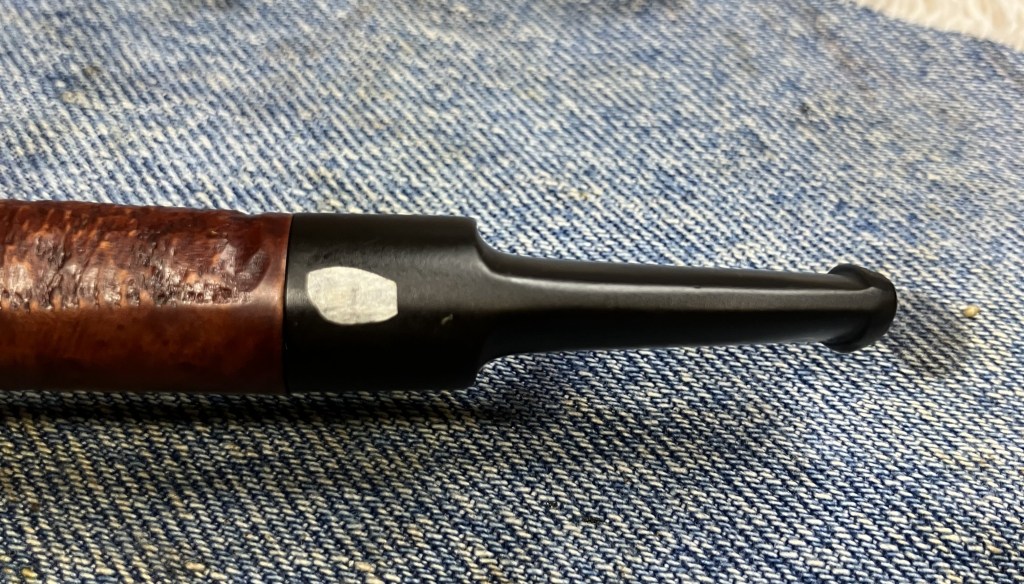
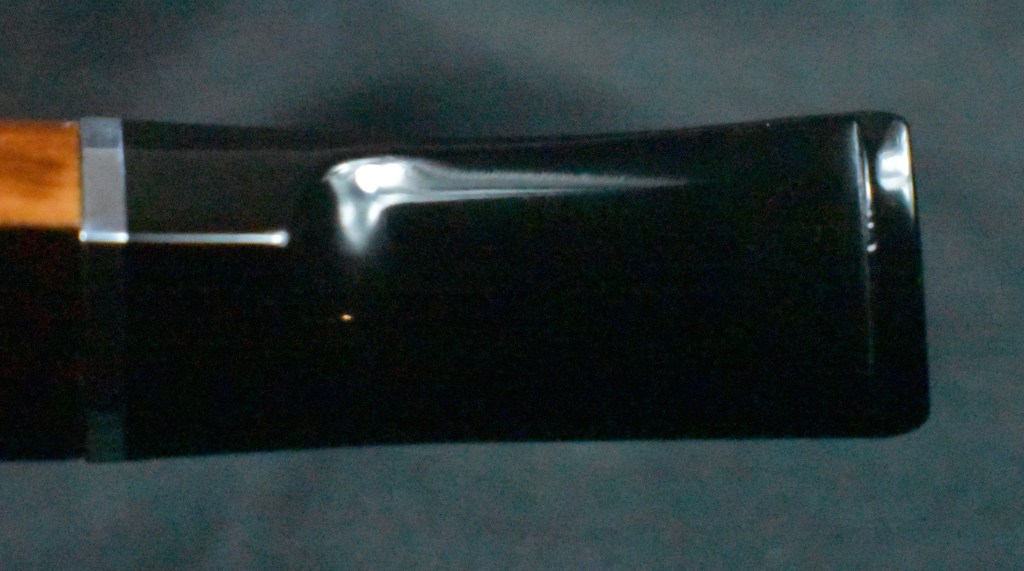
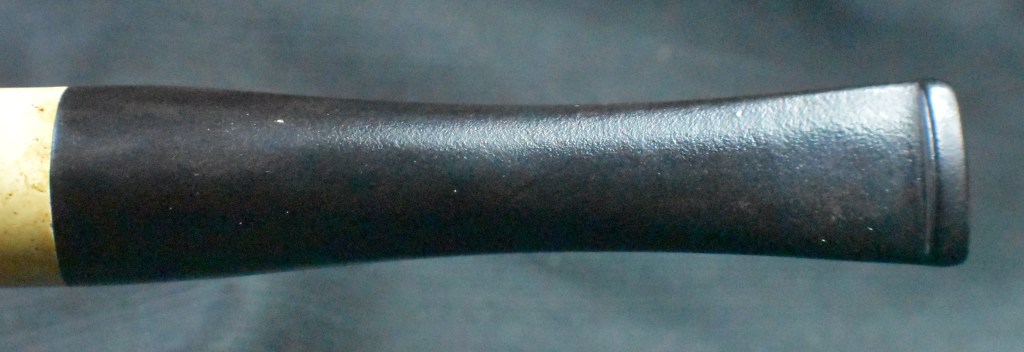
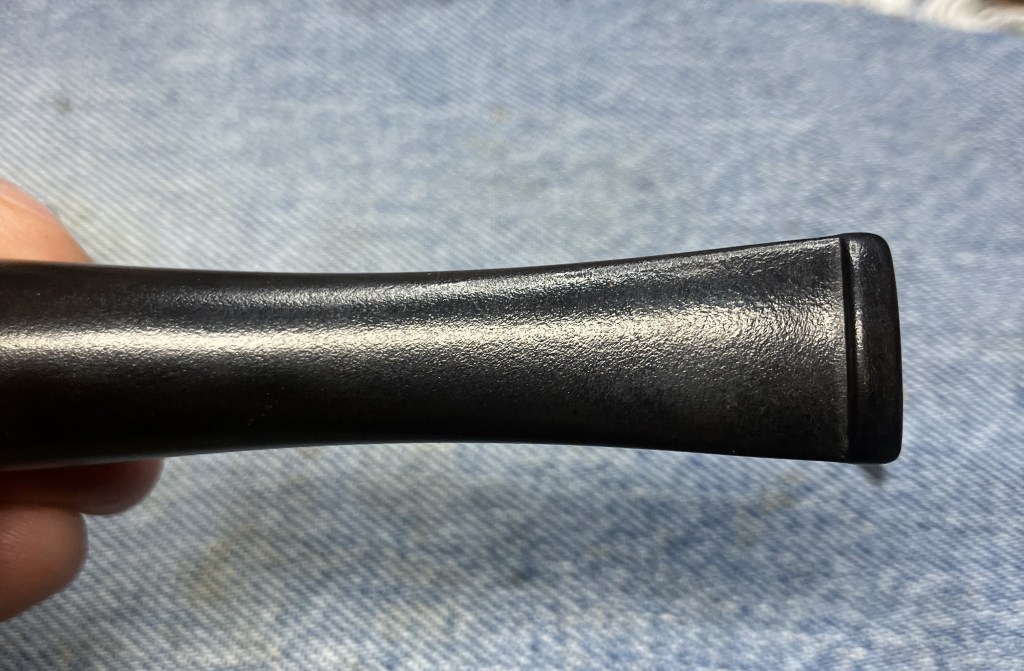
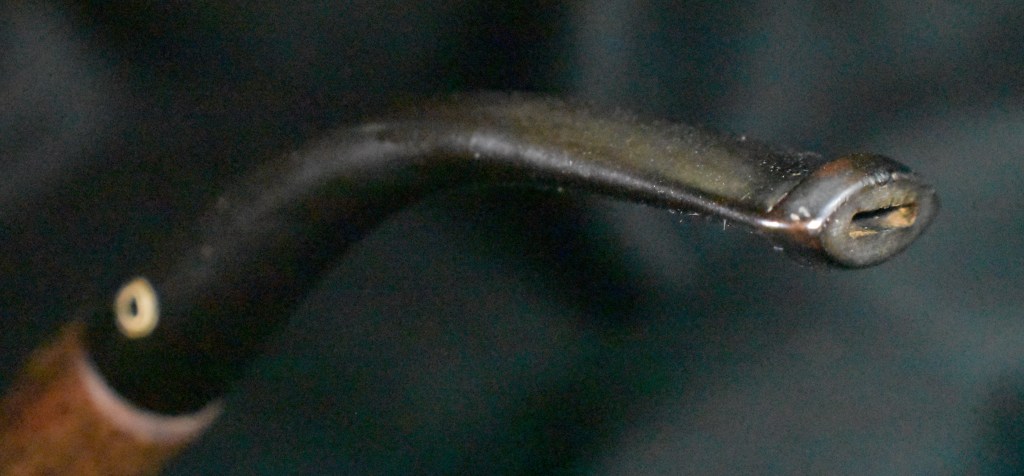
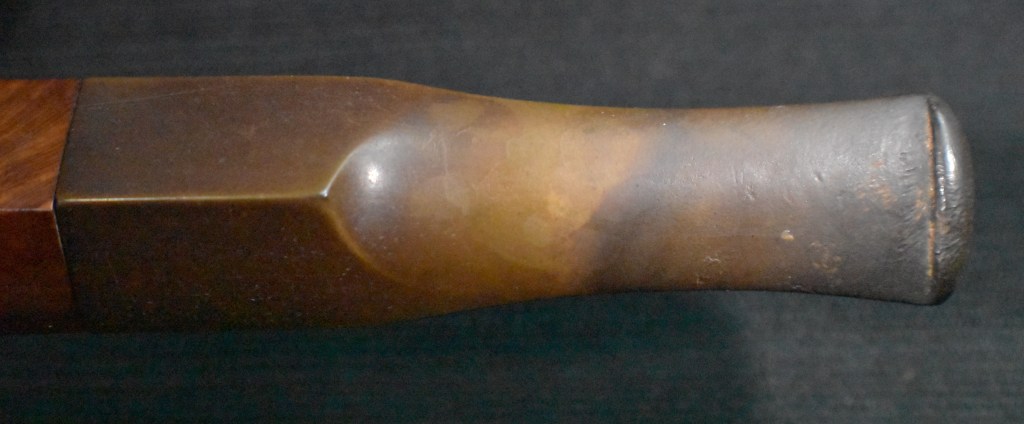
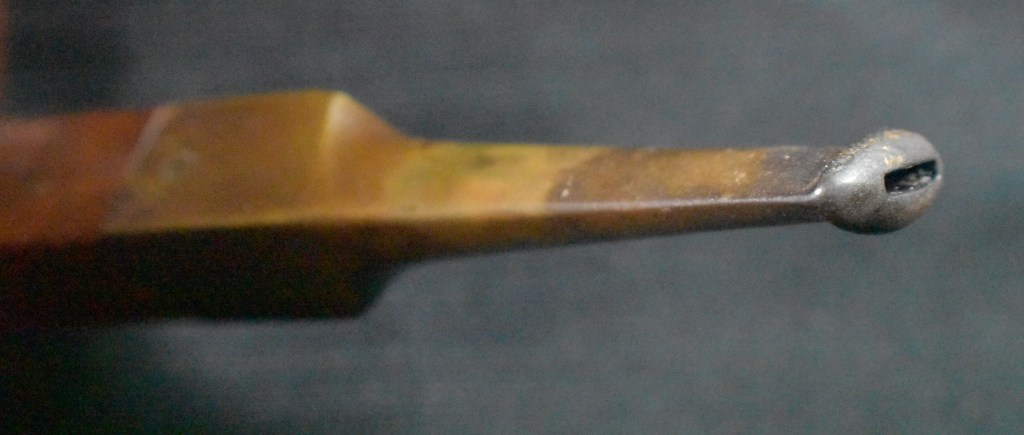
    Continuing with that lead, I searched through all of the photos on the pipedia.org LHS page.  I did not find any mentions of House of Westminster nor any photos of a burl pipe, but I did find an exact match of the stinger.  This was not some ordinary aluminum tube, it was very unique.  Below is the photo from pipedia.org:

    (LHS – Pipedia)

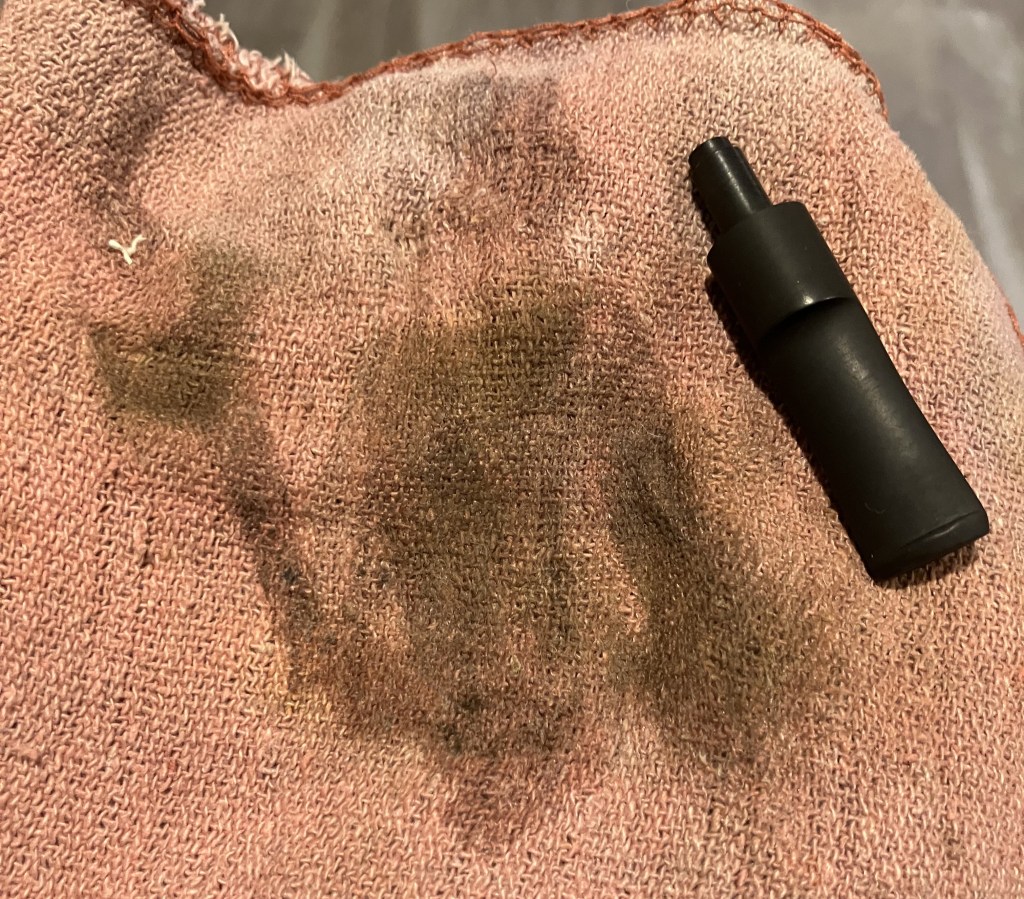
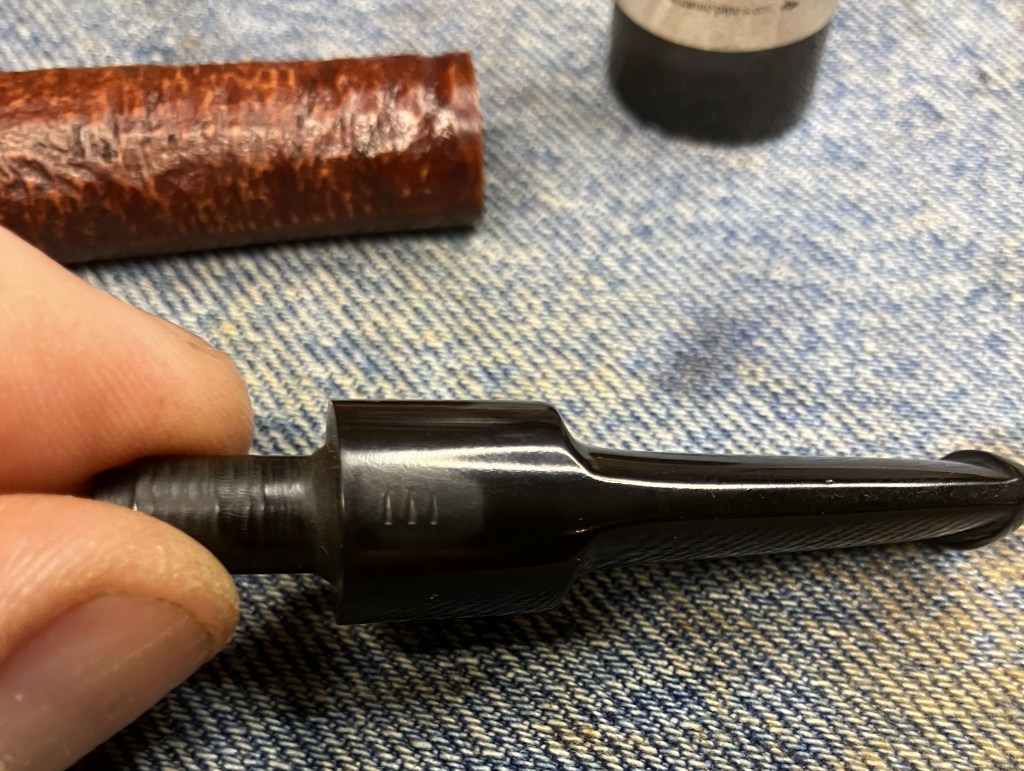
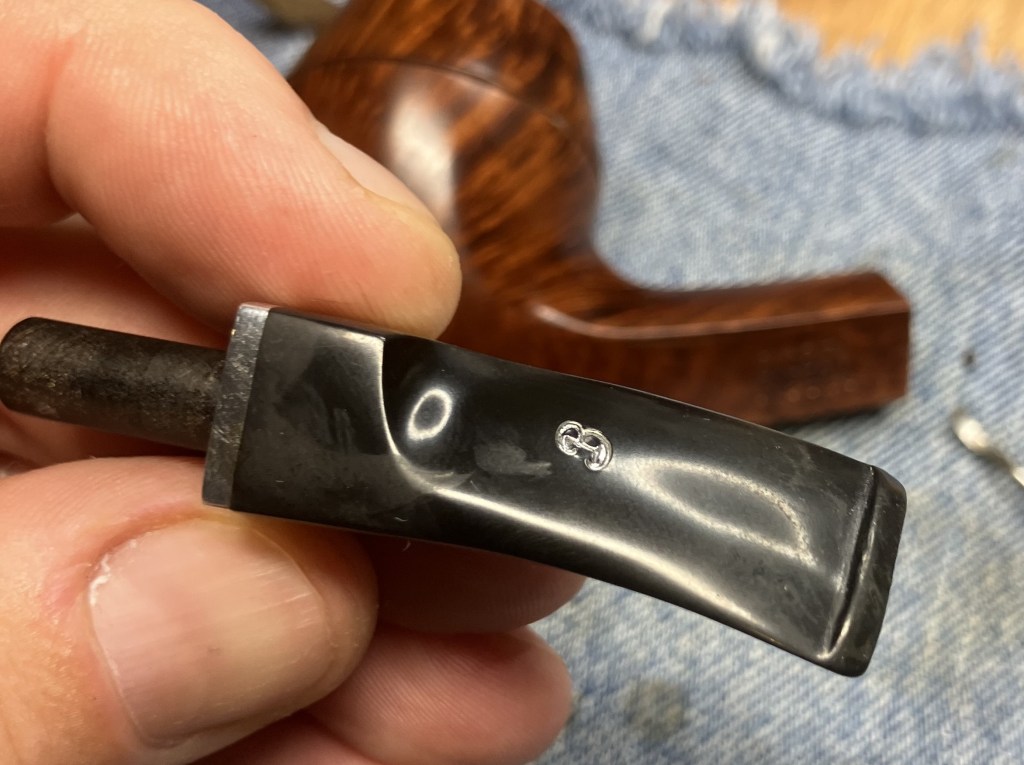
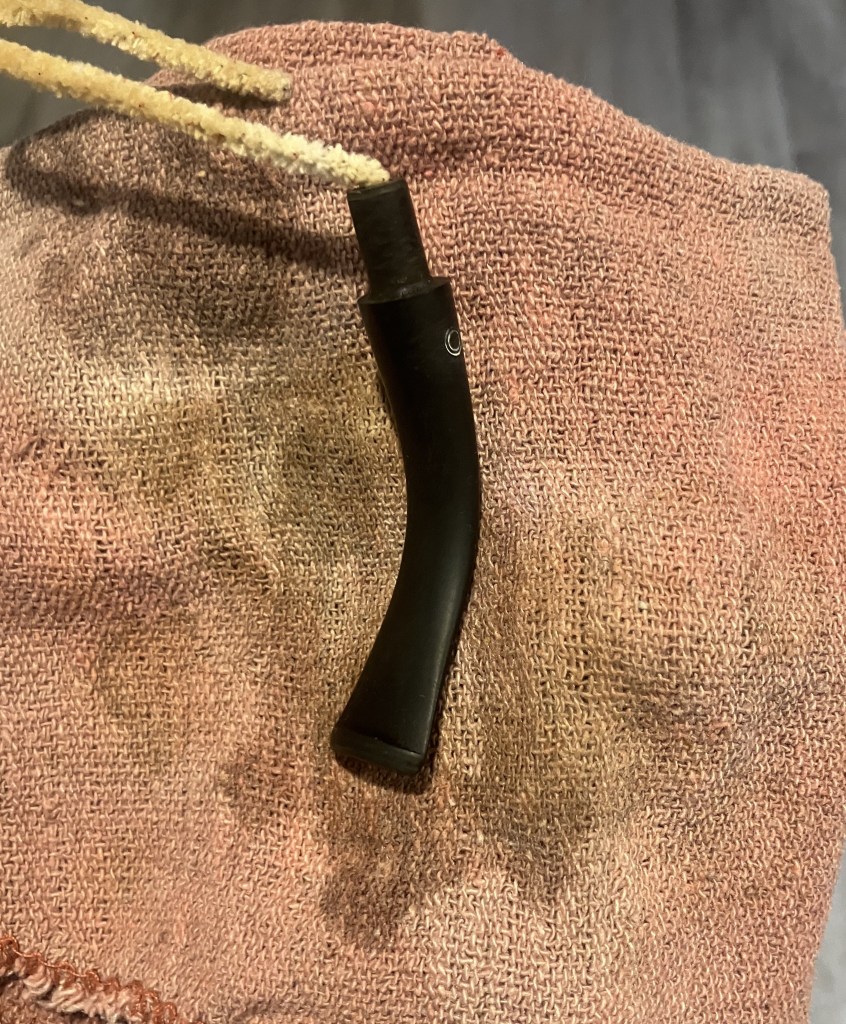
    And here is a photo of the stinger from the House of Westminster burl pipe, I tried to match the color and positioning of the burl stem to the previous photo:

    For me, that settled who the maker was.  House of Westminster was a L&H Stern product likely produced after the second world war and before the company closed down in 1960.

    The Restoration

    After the before photo shoot I took the Burl to the workbench where I placed it on a cleaned denim piece.

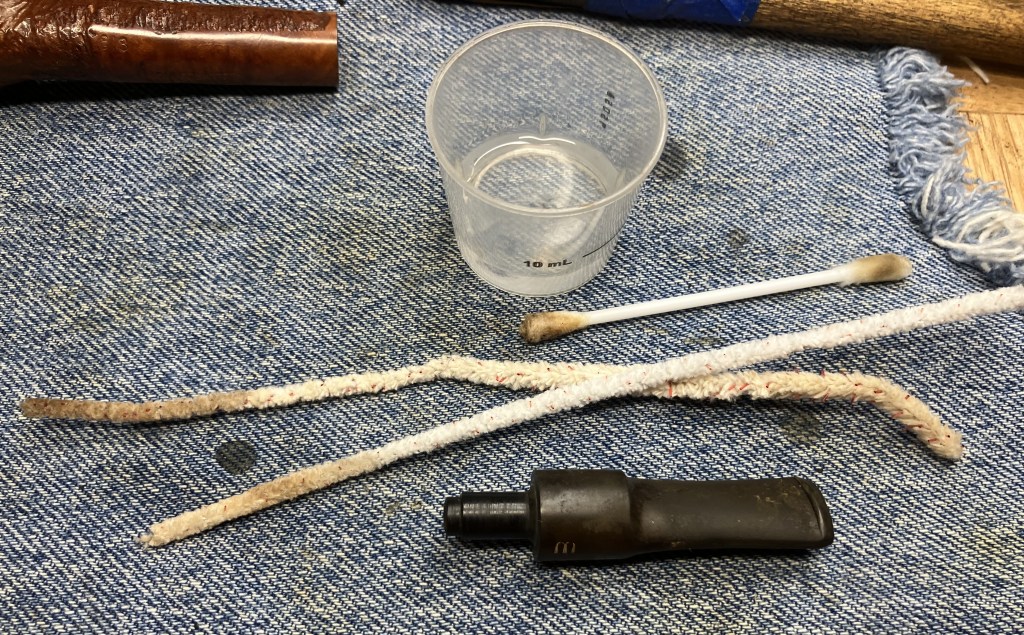
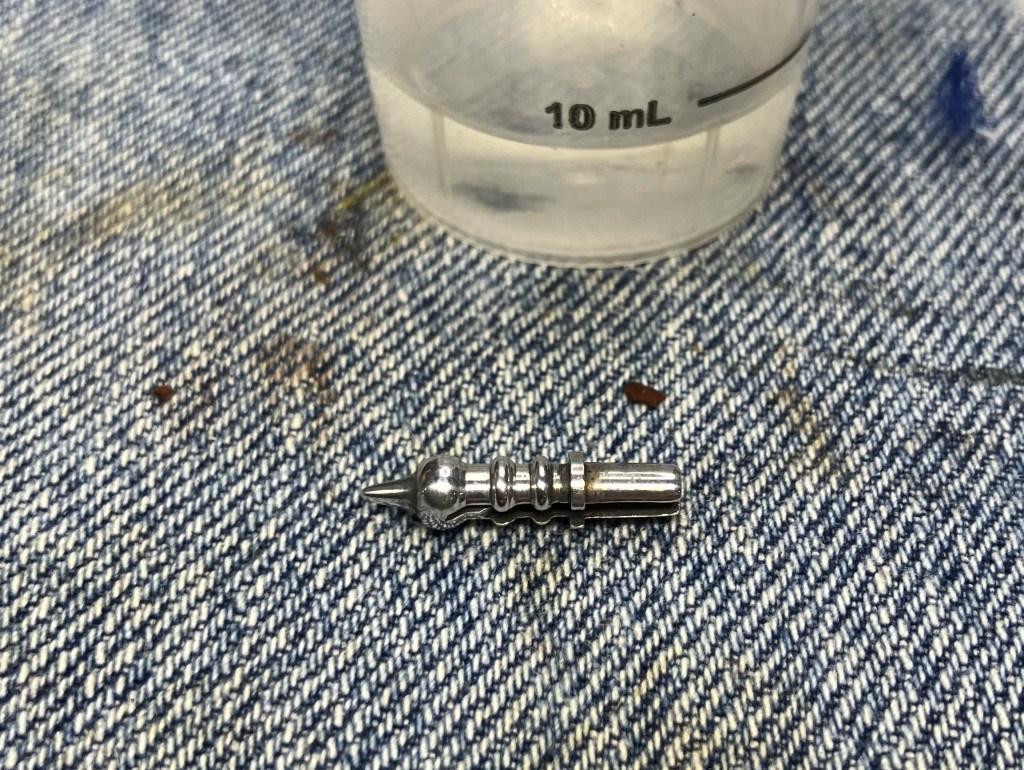
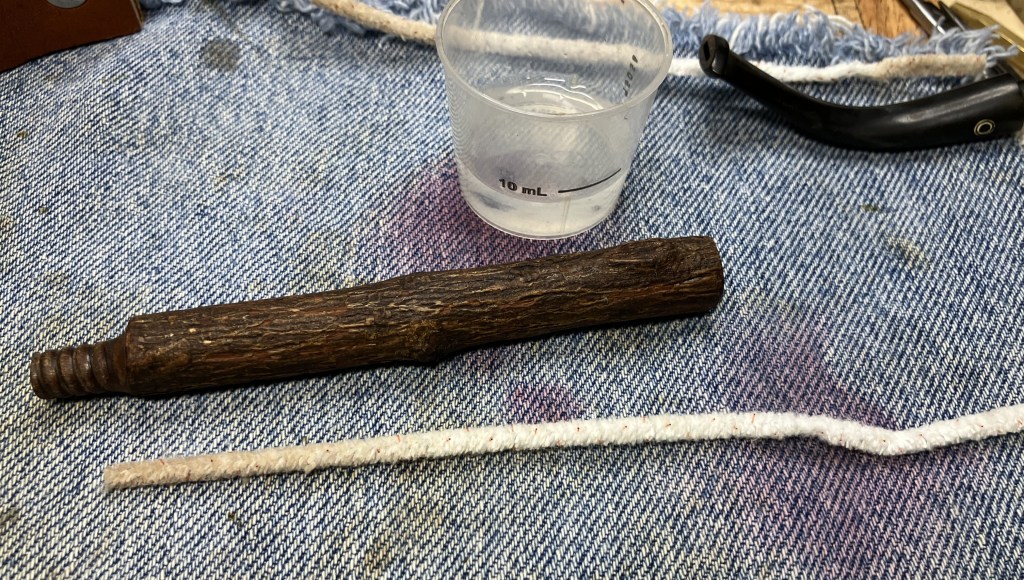
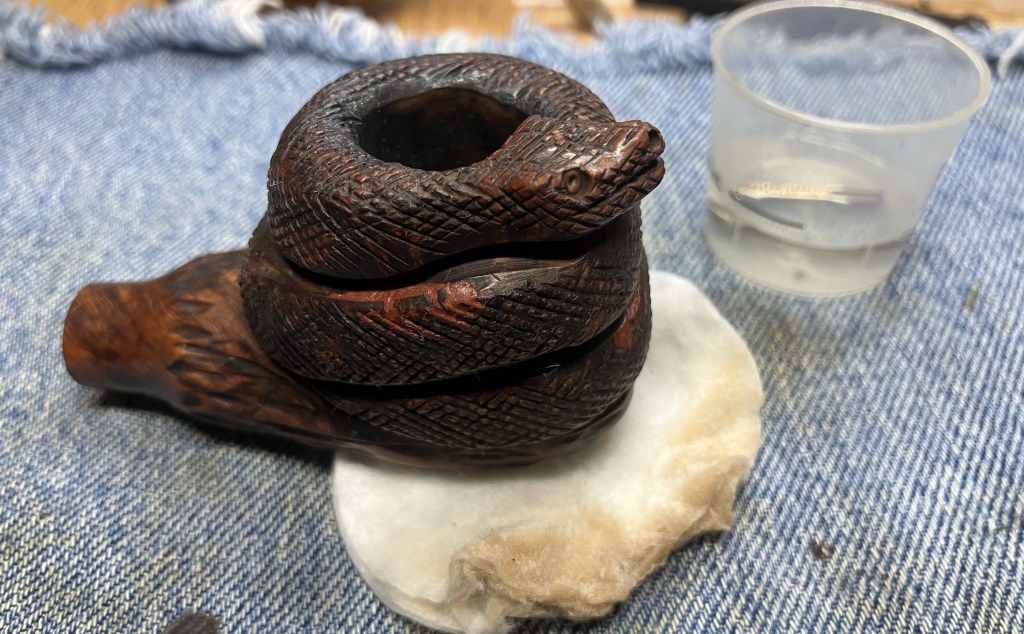
    I was able to pull the stinger from the stem without much difficulty.  I placed it in a medicine cup with 10 ml of 99% ethyl alcohol.
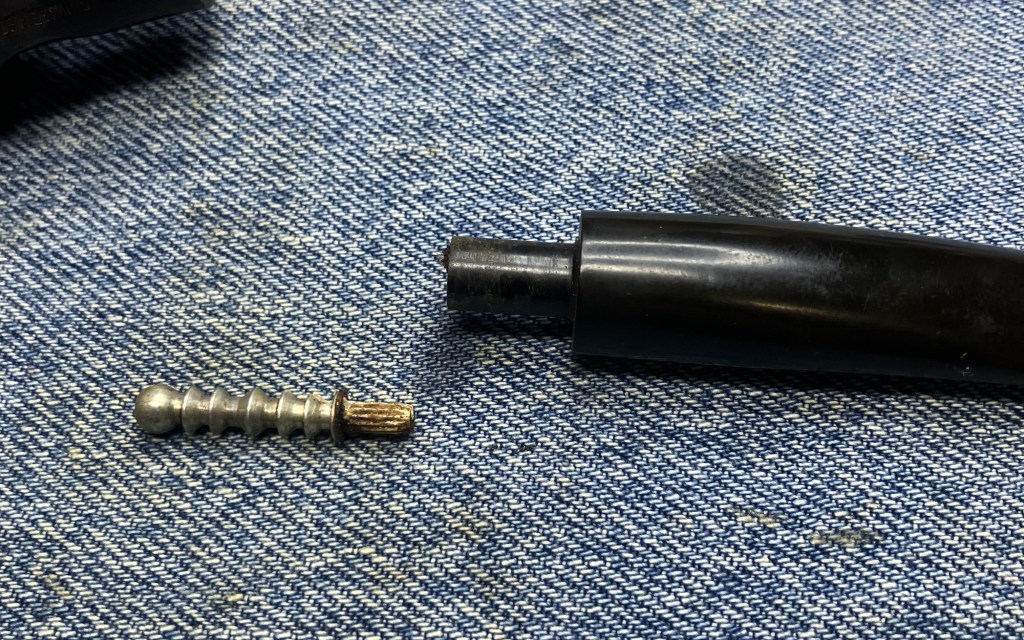
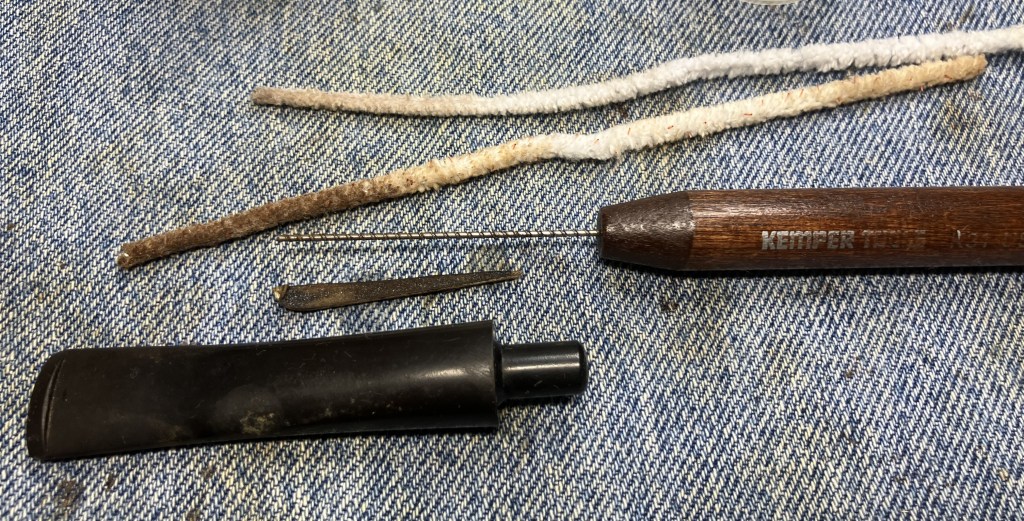
    The stem was cleaned with ethyl alcohol and bristle pipe cleaners.  The airway on the button end seemed rough and a bit constricted.  I opened the airway with a Vermont Freehand Slot Tool (Slot Tool (with handle) – Vermont Freehand) and emery boards cut at an angle.

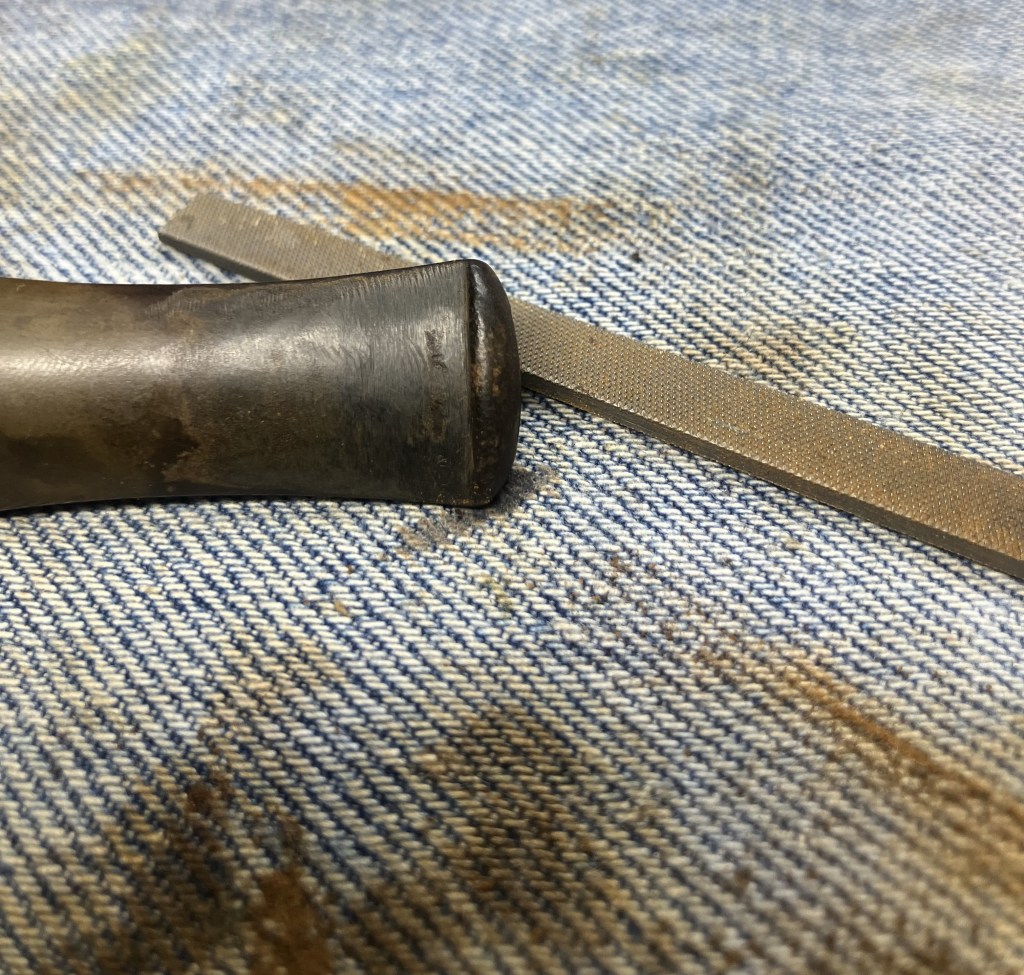
    The bite zone above the button was filed with a small flat file to remove the tooth dents and chatter.

    Sanding the stem lightly with a 400 grit sanding sponge was then done to prepare the stem for a bath in Briarviles’ Pip Stem Oxidation Remover (deox, as I like to call it).

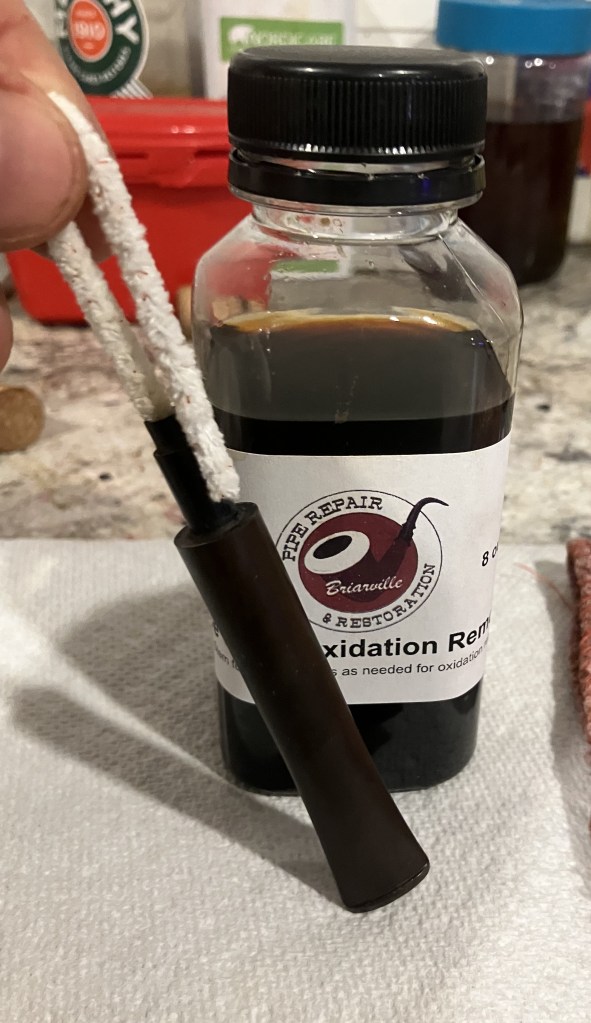
    A pipe cleaner was inserted into the stem to act as a handle for easy removal after the 2 hour deox bath.
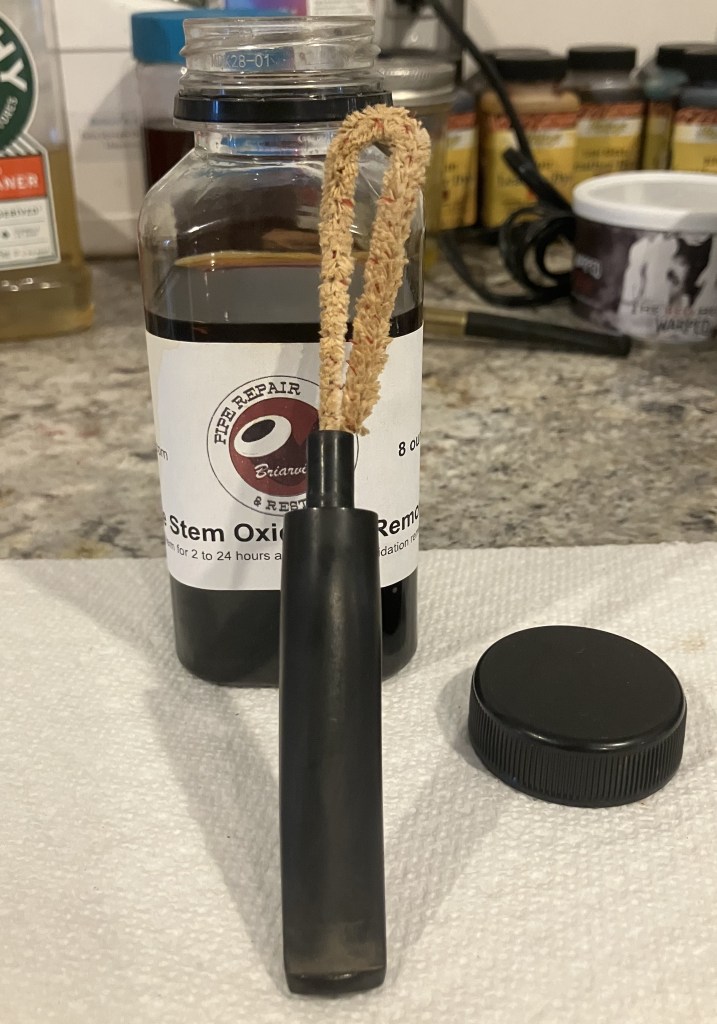
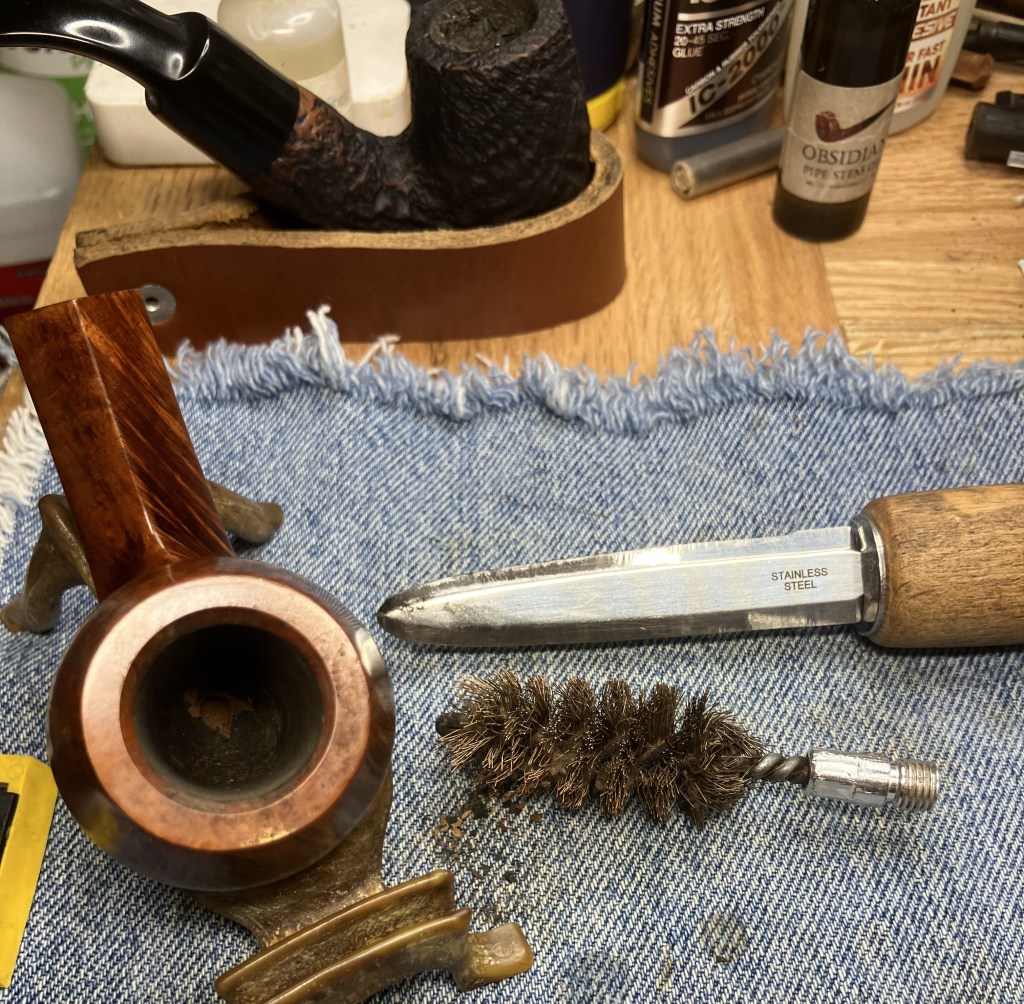
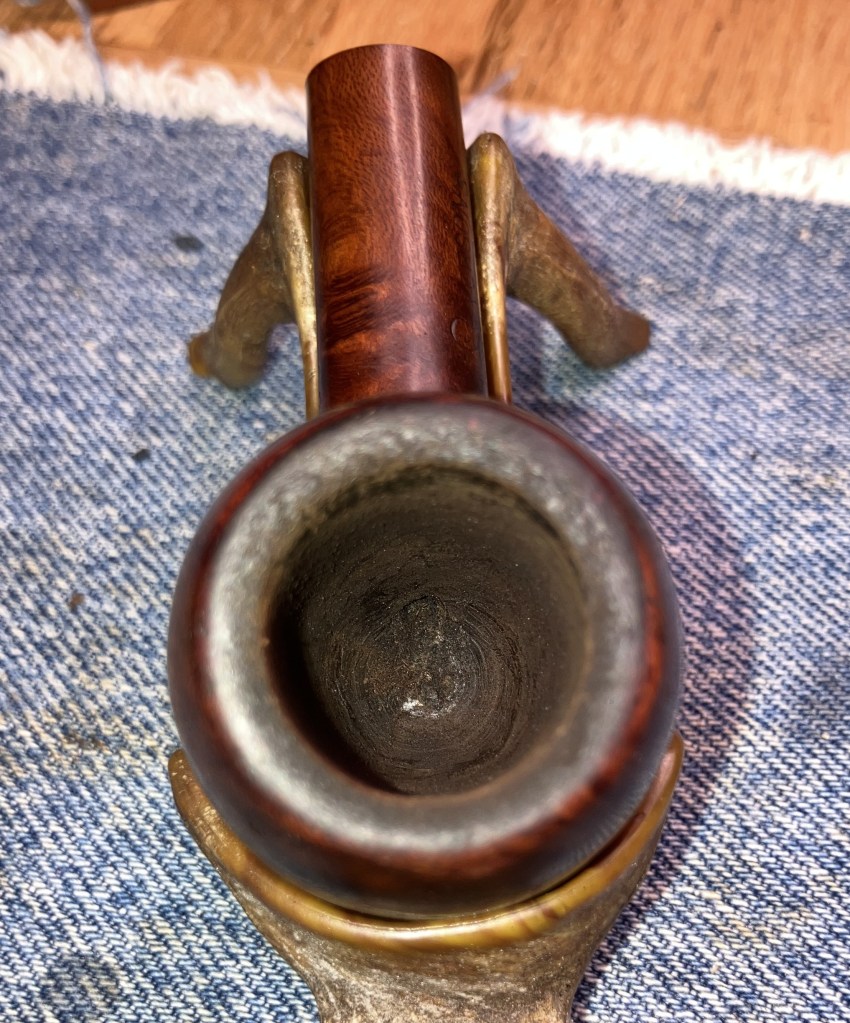
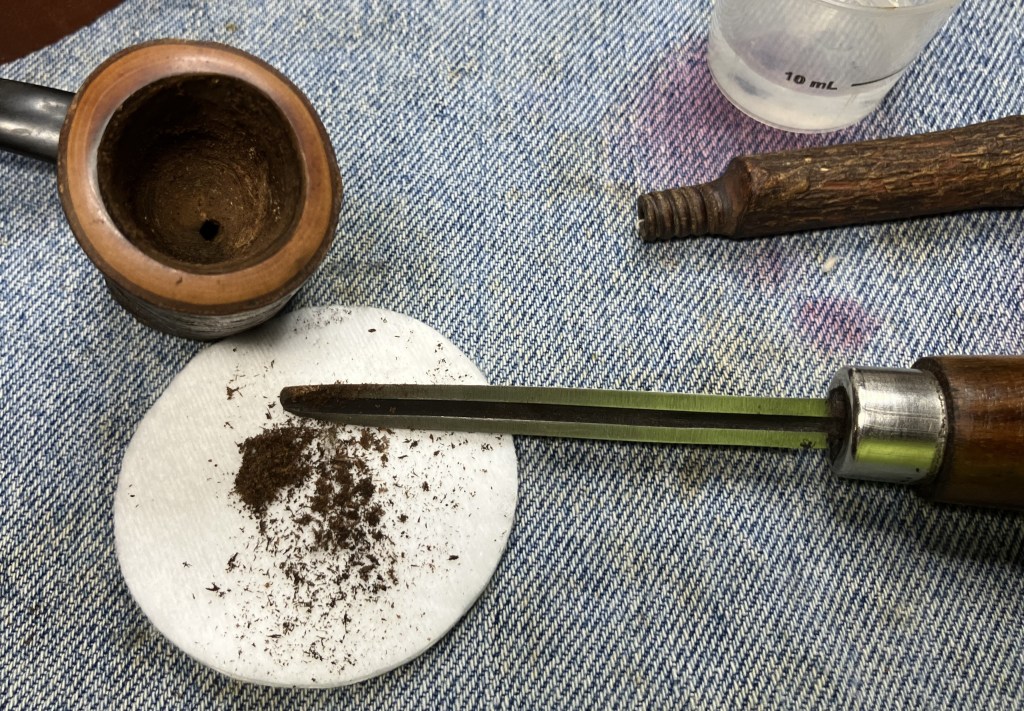
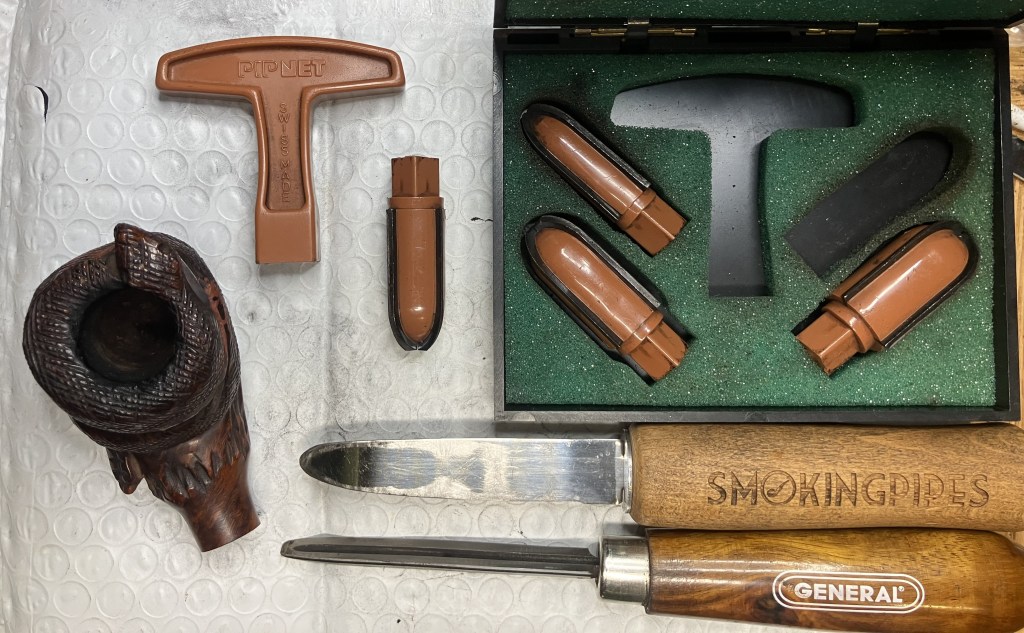
    With the stem soaking, I turned my attention to the reaming of the stummel.  The ream team was gathered; PipNet with the #2 and #3 blades, General triangular scraper and the Smokingpipes Low Country reamer.

    The PipNet and #3 blades did the majority of the cake removal.  
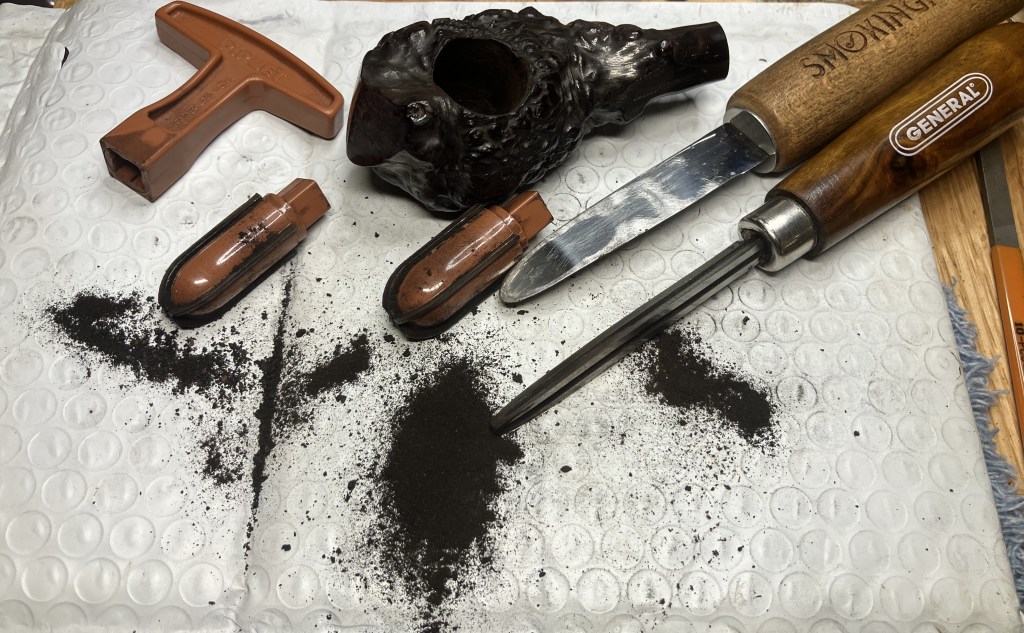
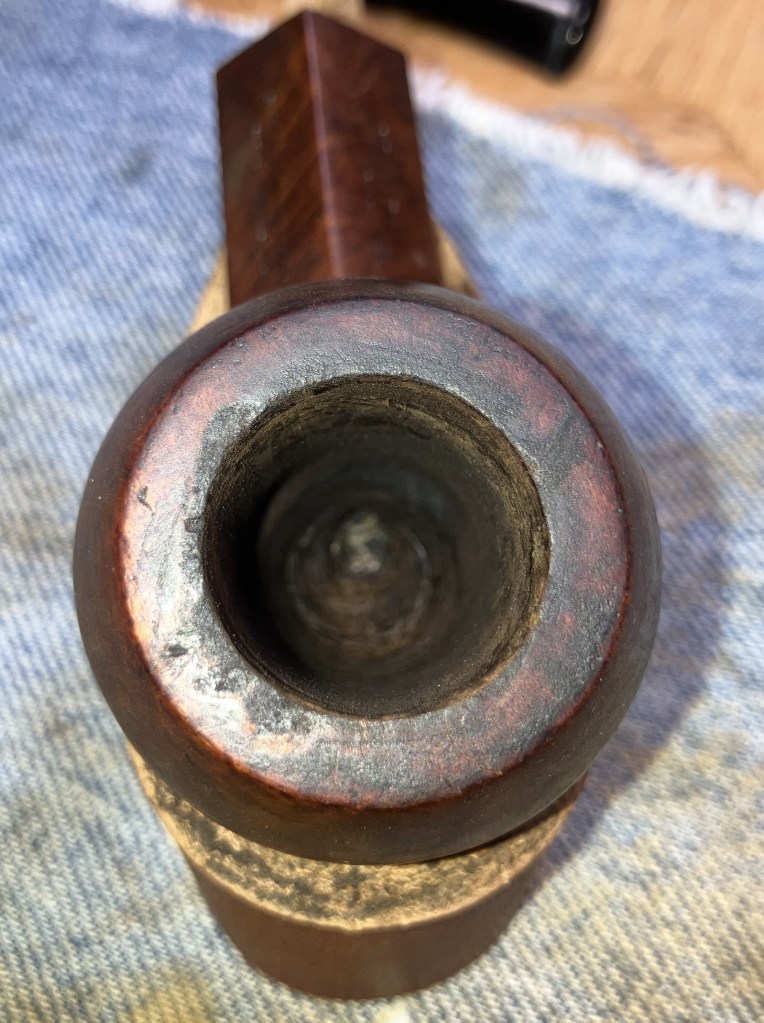
    The reamed tobacco chamber looked much better.

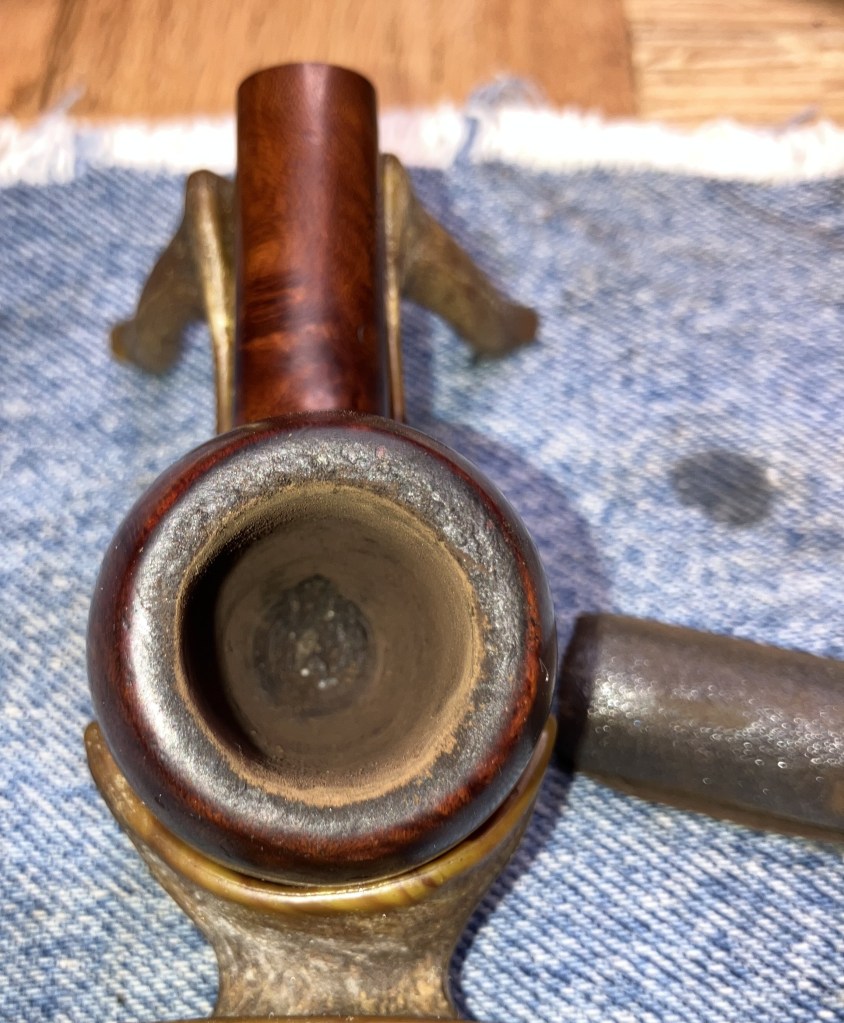
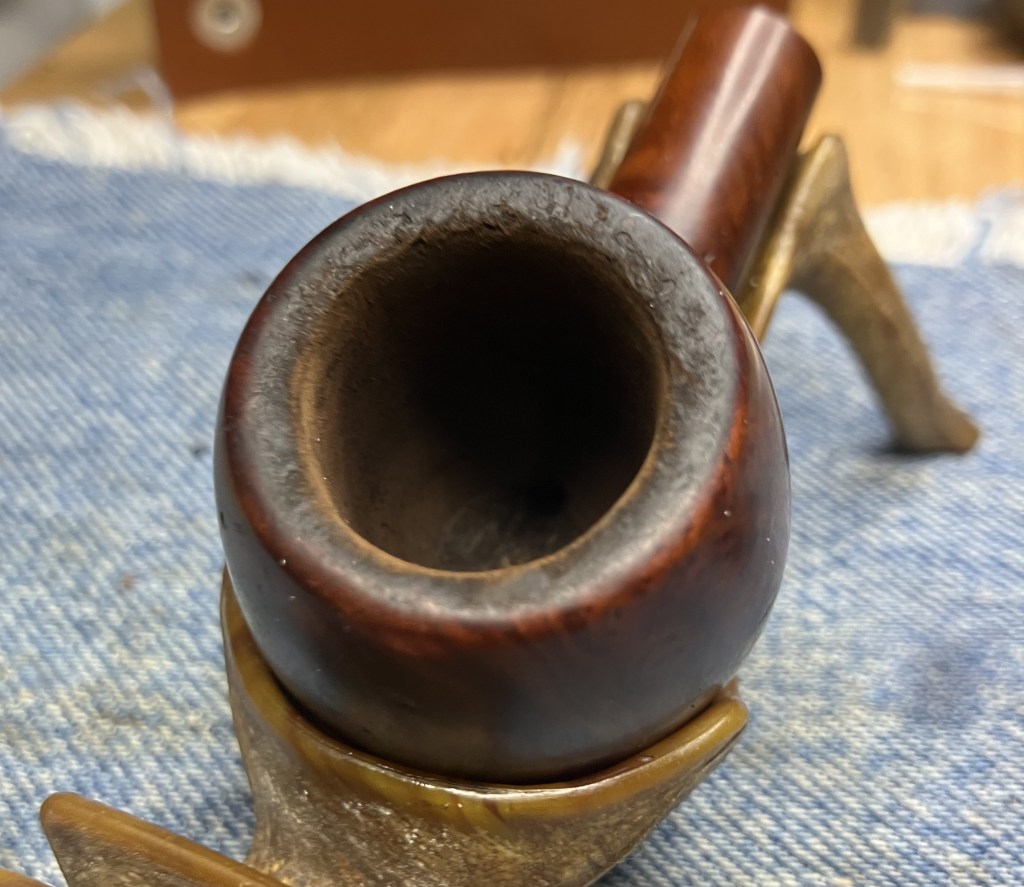
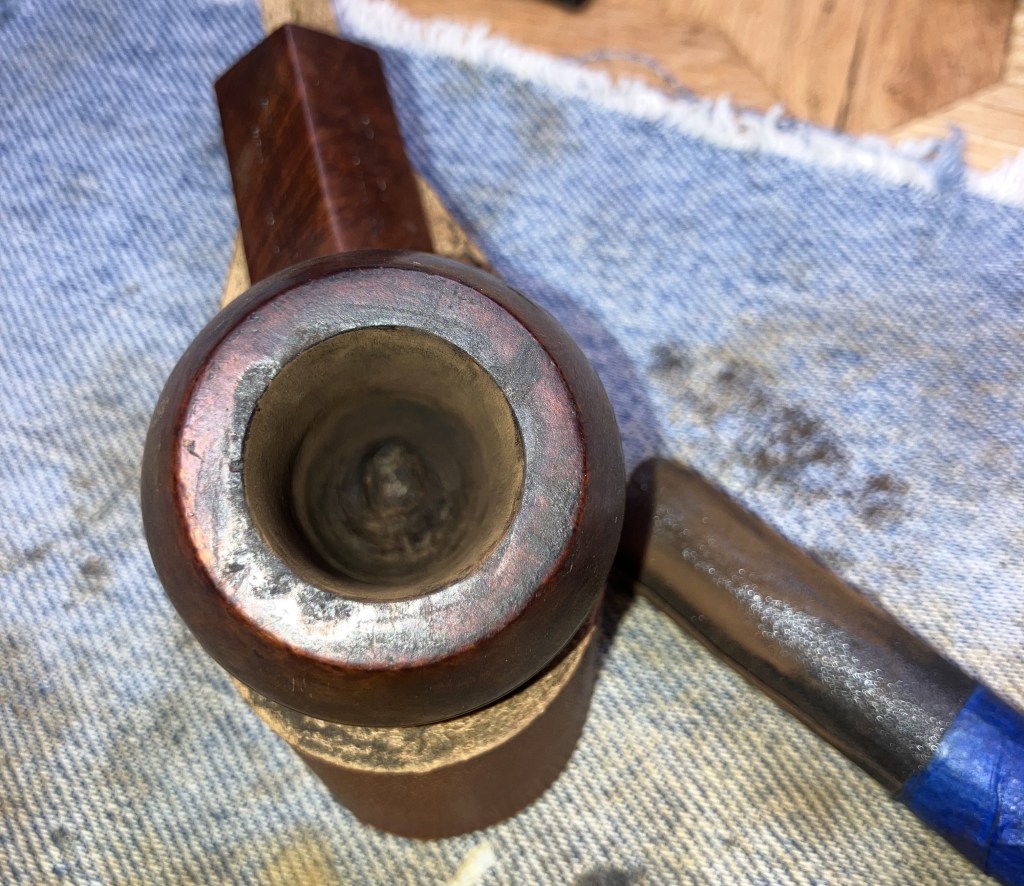
    The chamber was then sanded with 320 sandpaper wrapped around a wood dowel.  The sanded chamber showed no signs of heat damage.

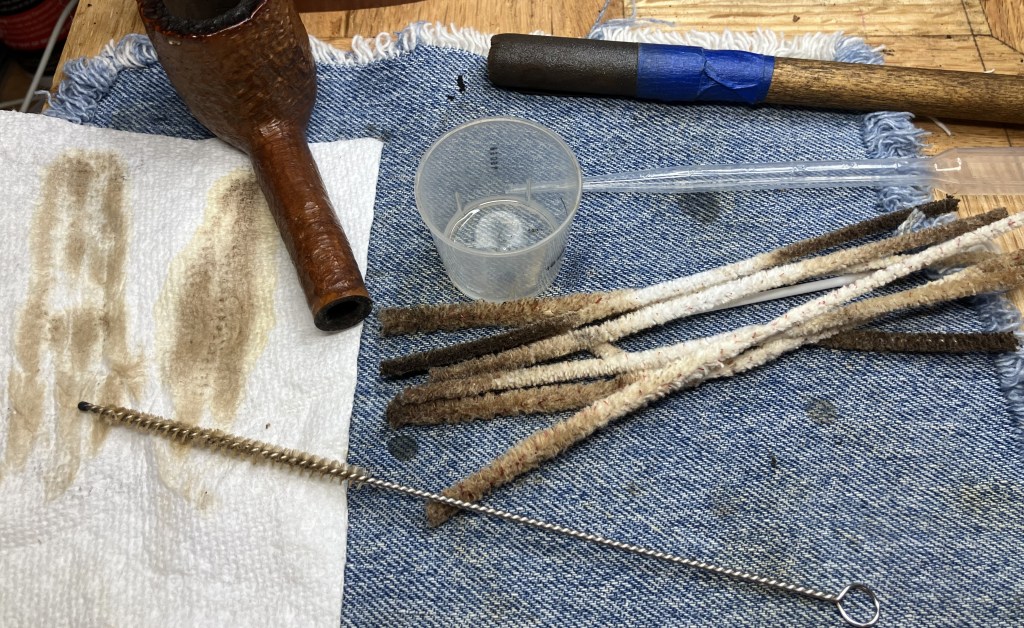
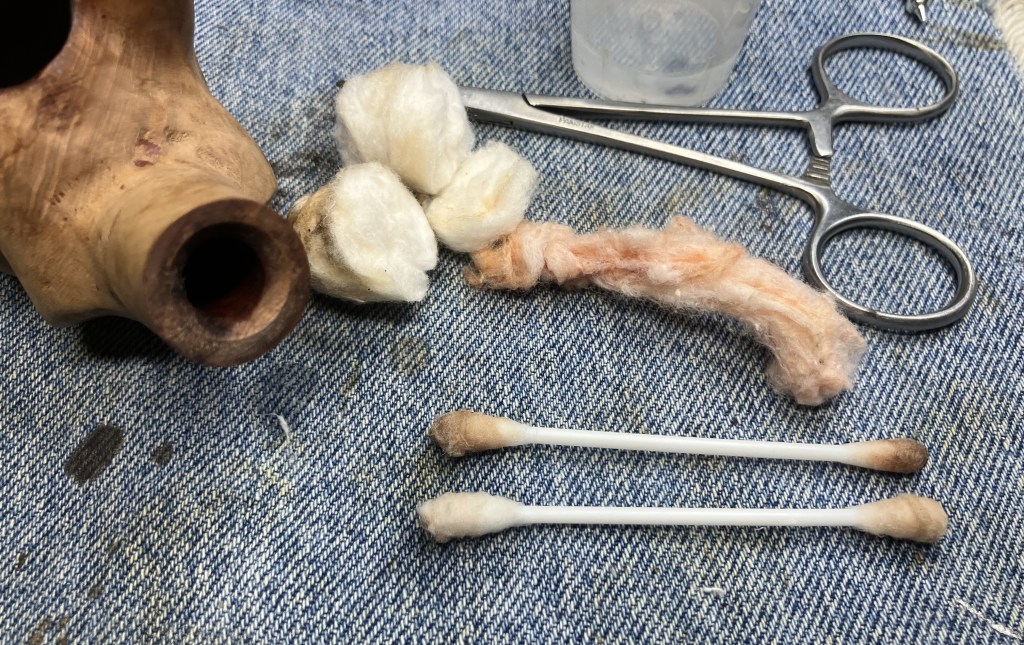
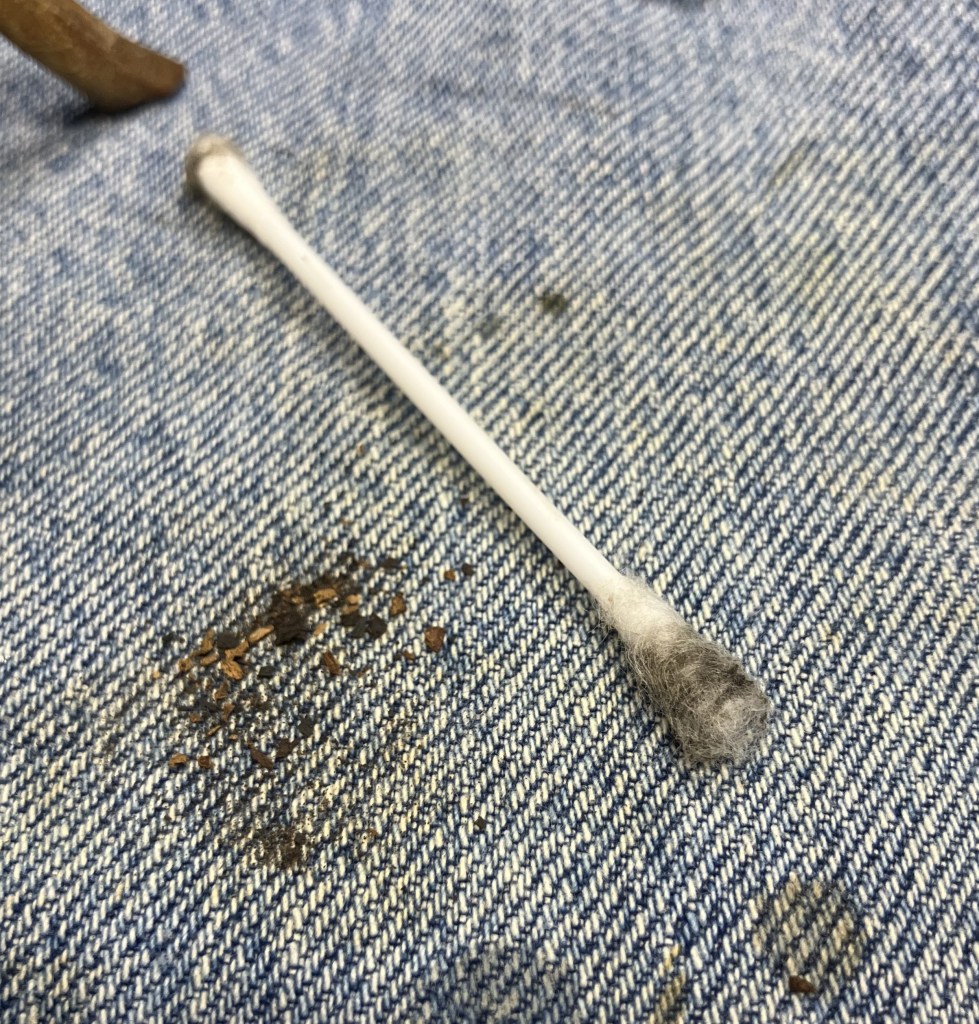
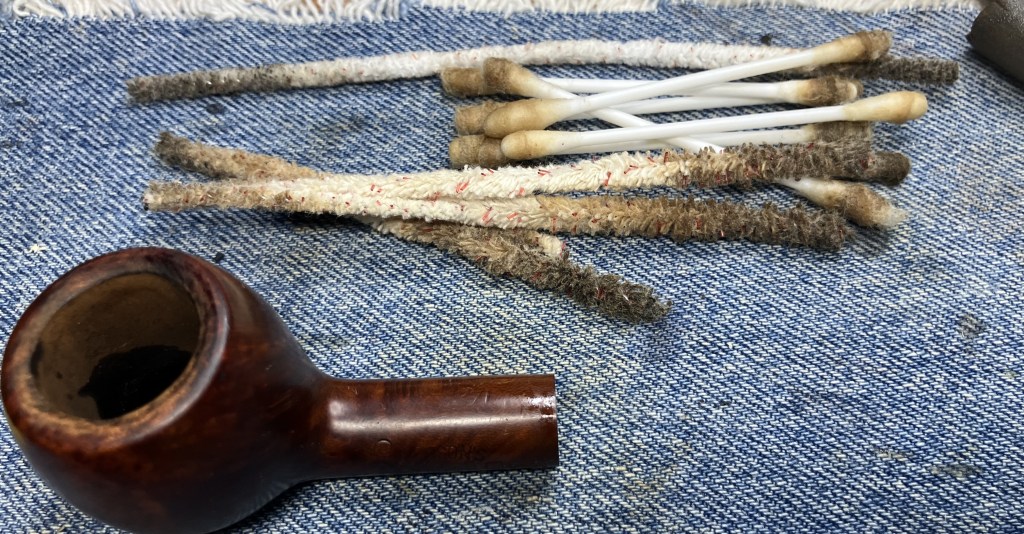
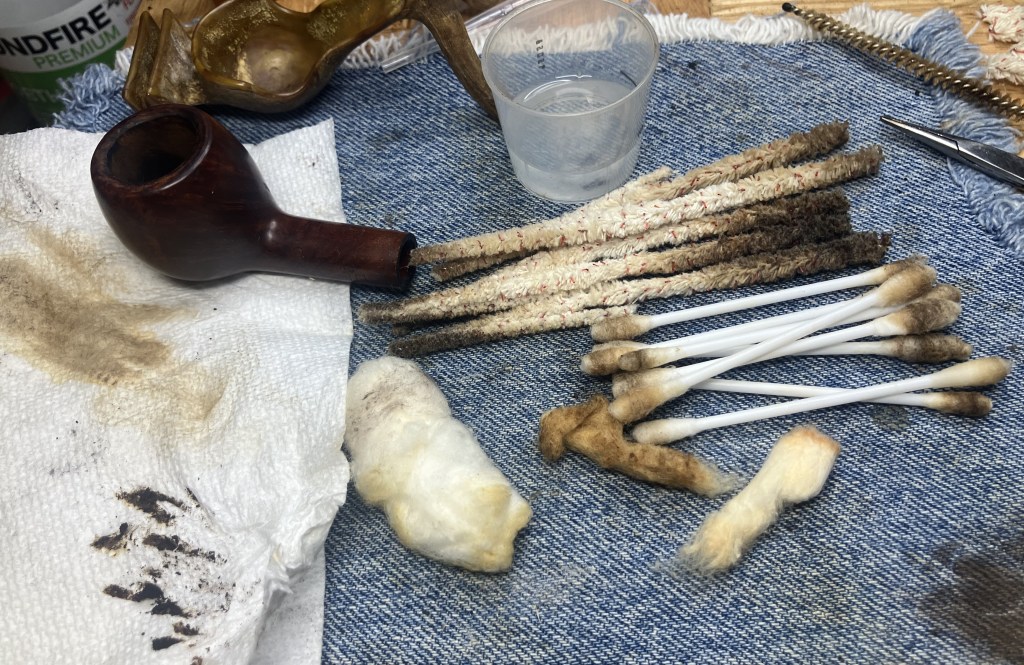
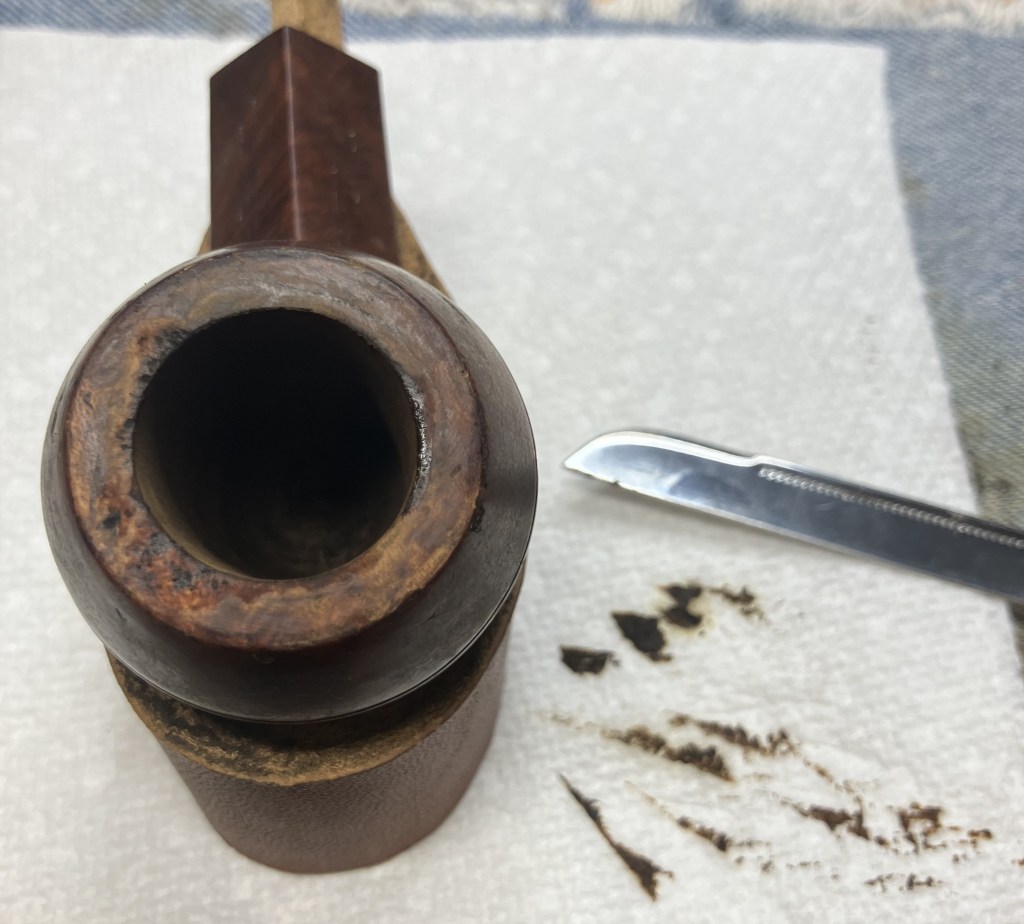
    I then cleaned the airway of the shank.  This was done by softening the accumulated smoking residue with ethyl alcohol on cotton swabs as I cleaned the mortise.  The softened yuck was then scraped using a dental scraper.  Alcohol dipped bristle pipe cleaners and alcohol dipped cotton swabs were also used.

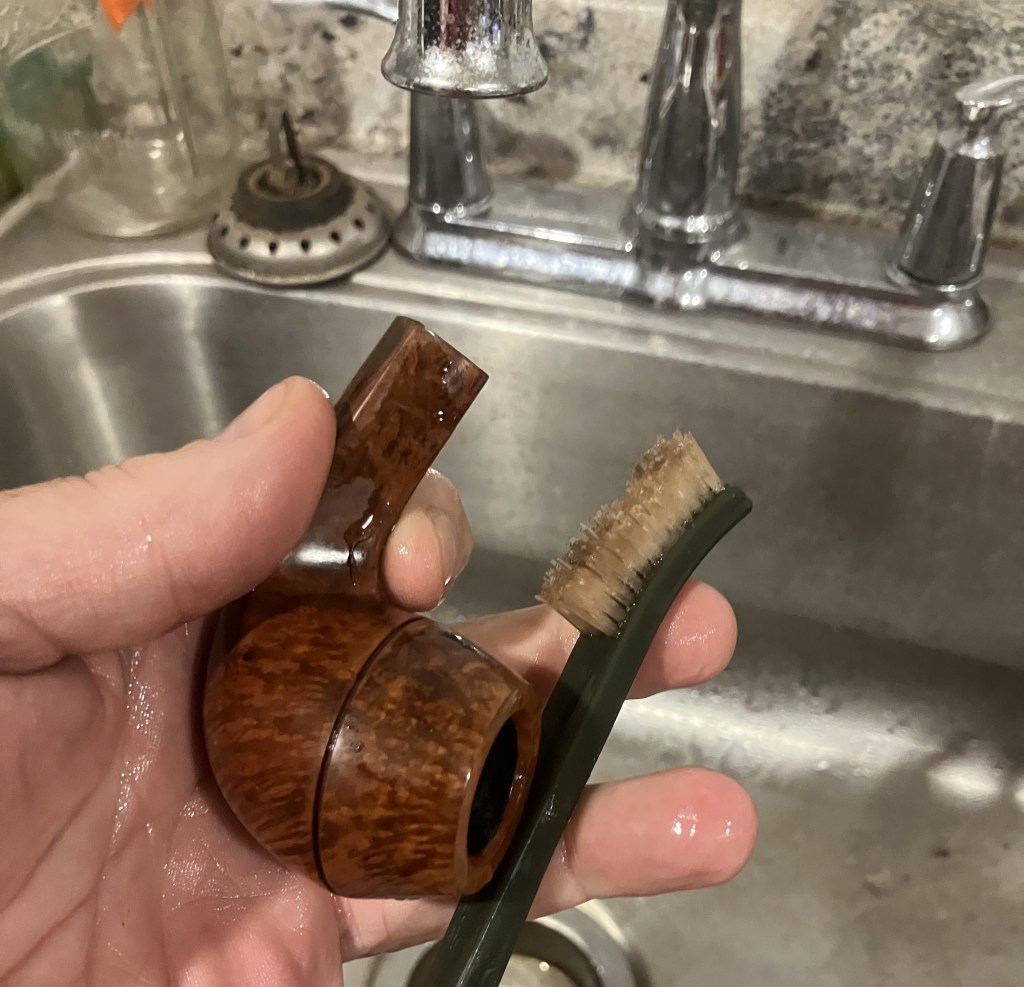
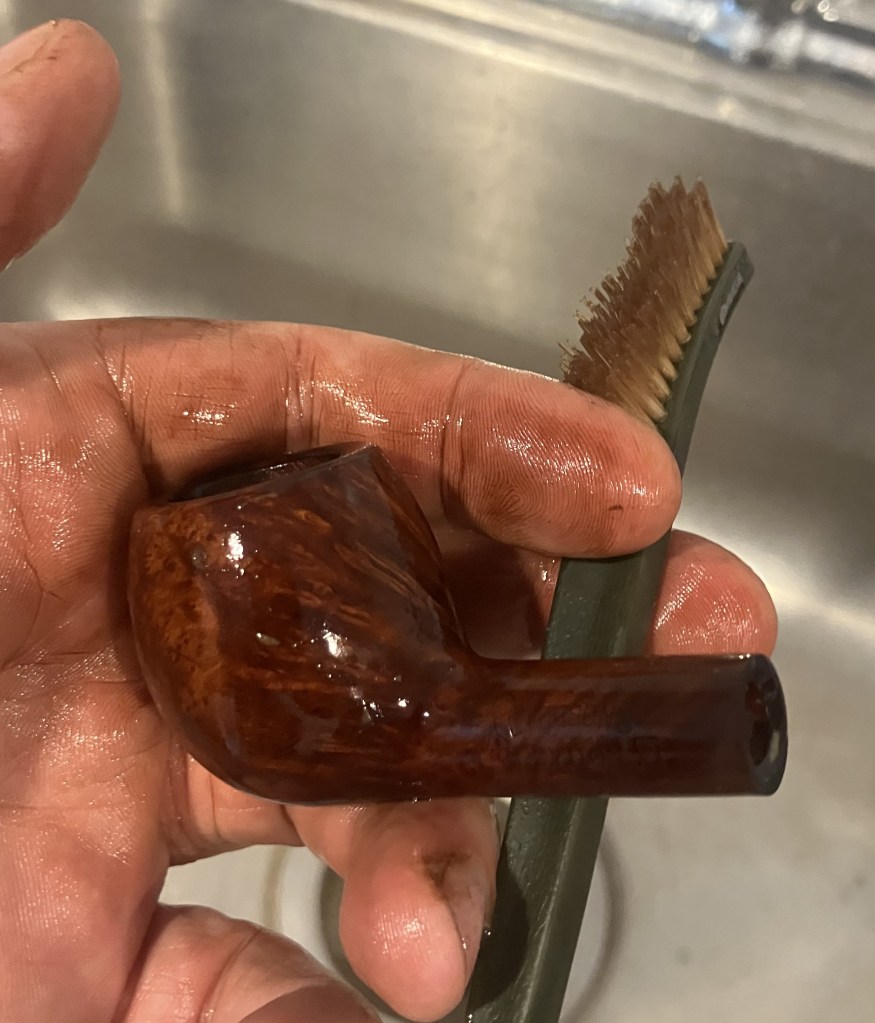
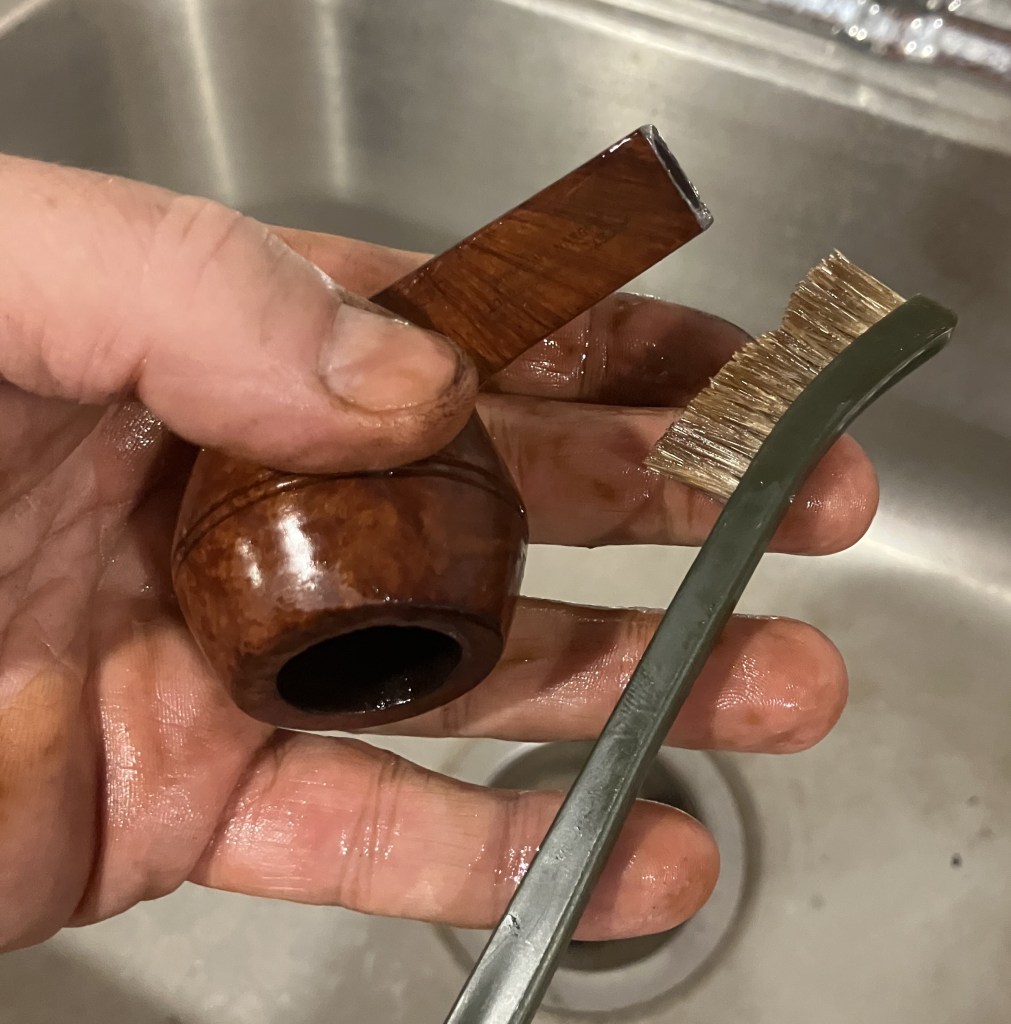
    The stummel was then taken to the sink for a scrub with undiluted Murphy Oil Soap and a nylon brush.  The soap was rinsed with warm water and the stummel dried with a cotton hand towel.
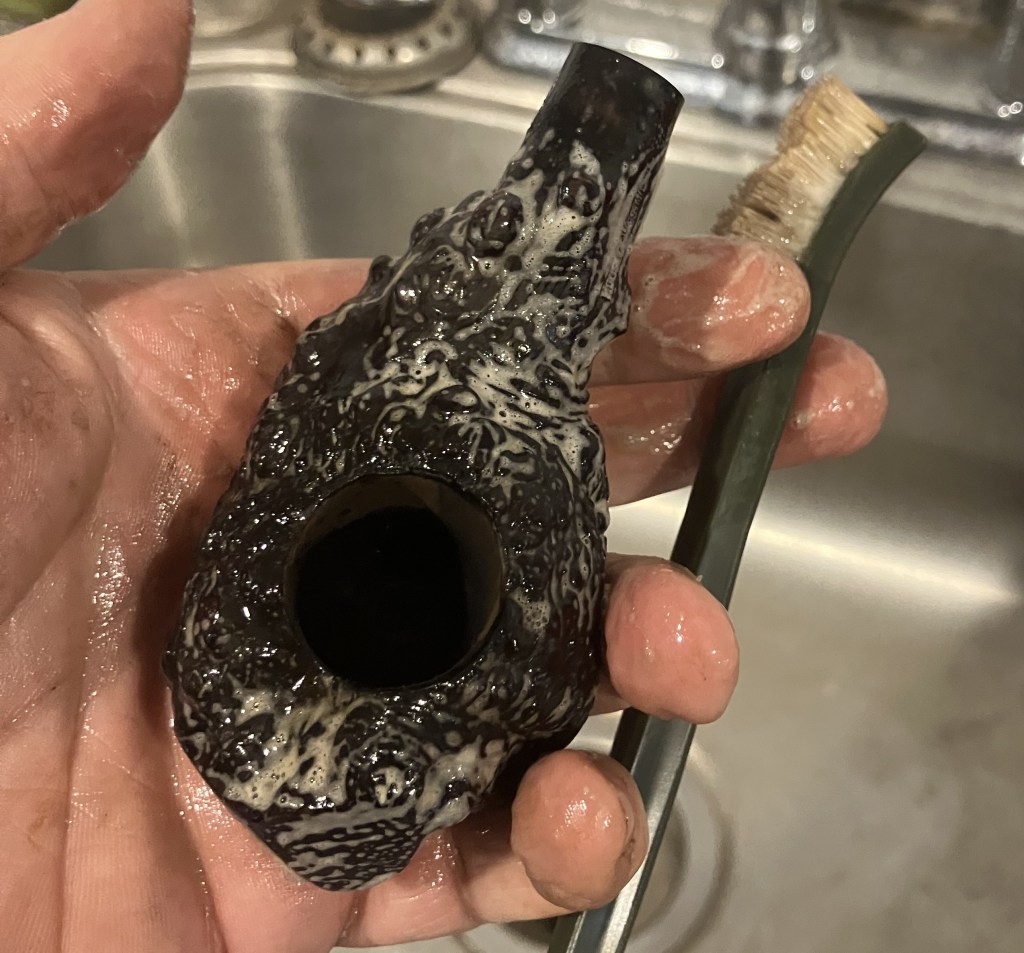
    Back at the workbench, I wiped the stummel’s stamp panel with 99% ethyl alcohol on a make-up pad.  This removed a lot of the shellac and some of the stain/dye.  You can see in the photo below that the shellac had filled in the scratched on the panel.  This layer of finish was quite thick.

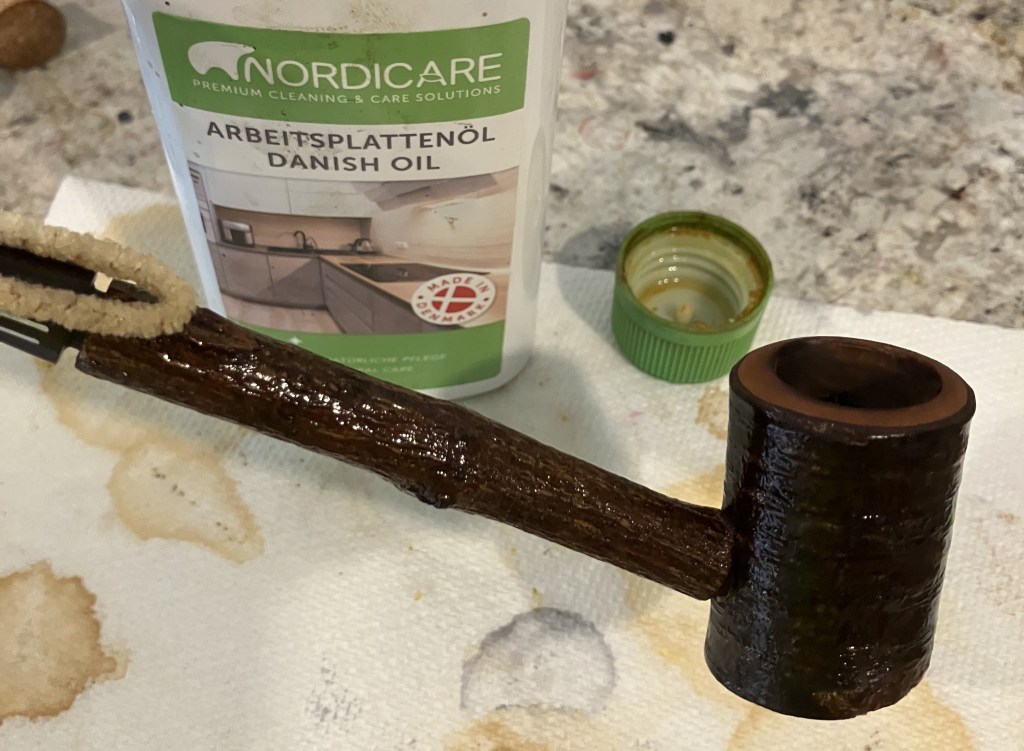
    I wanted to get rid of the old finish to see the briar detail more clearly and maybe some of the color of the wood.  Shellac is soluble in ethyl alcohol (EtOH, an old organic chemistry abbreviation), so I gave the stummel an hour long bath in a jar of EtOH.
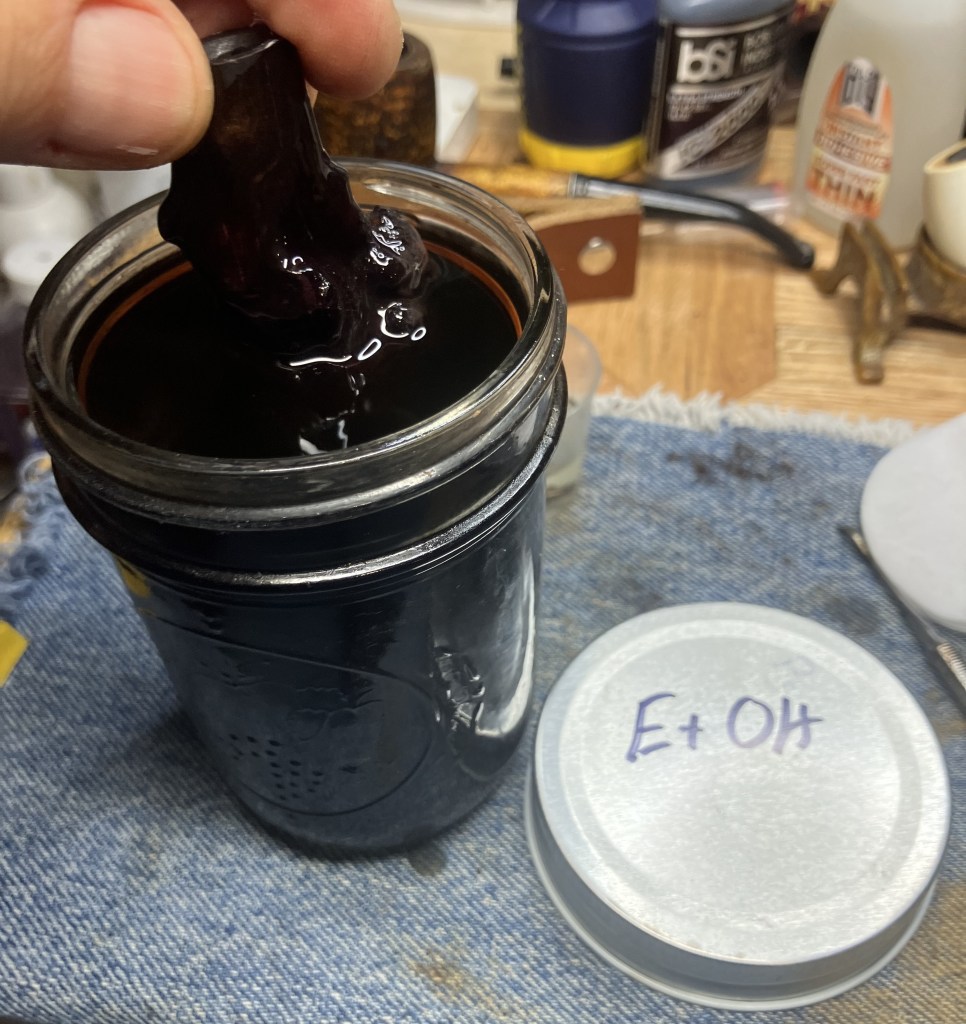
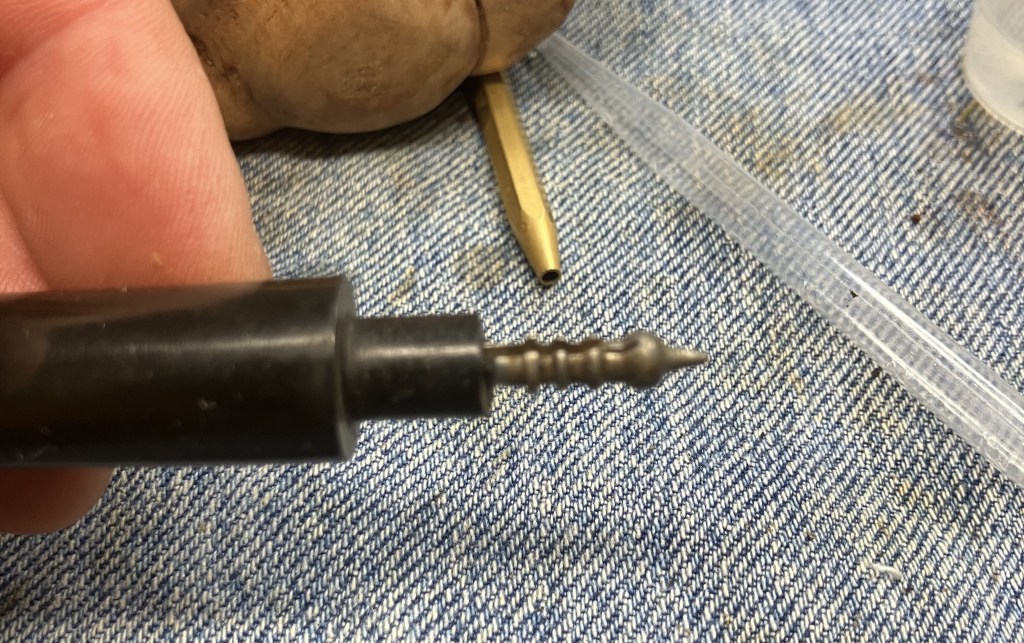
    This allowed me some time to clean and polish the stinger.  It was removed from the 10 ml of EtOH and scrubbed with a bristle pipe cleaner.  I used another pipe stem to hold the stinger while I work.

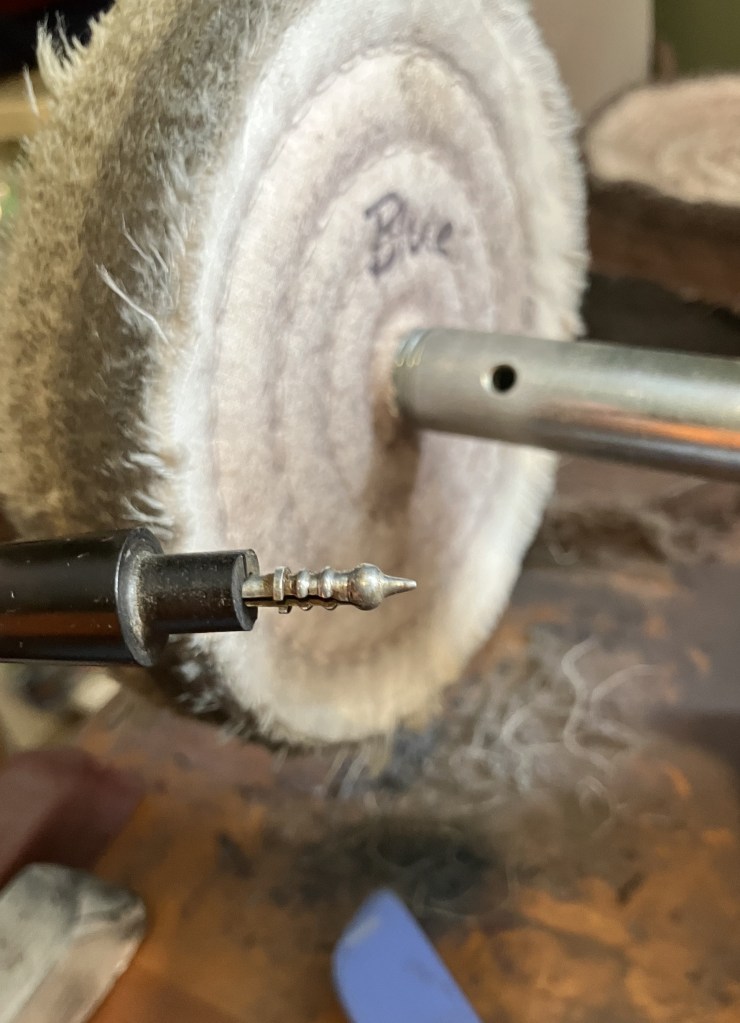
    The stinger was then buffed with white buffing compound on the white compound wheel.

    After cleaning off any remaining buffing compound the stinger looked great.
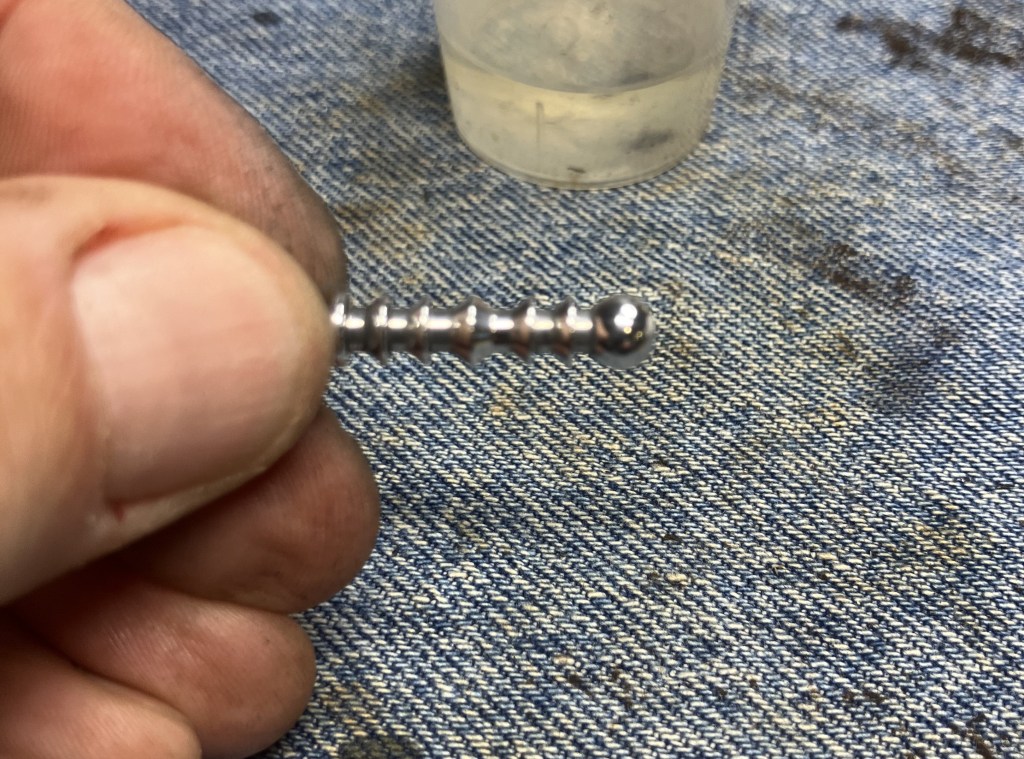
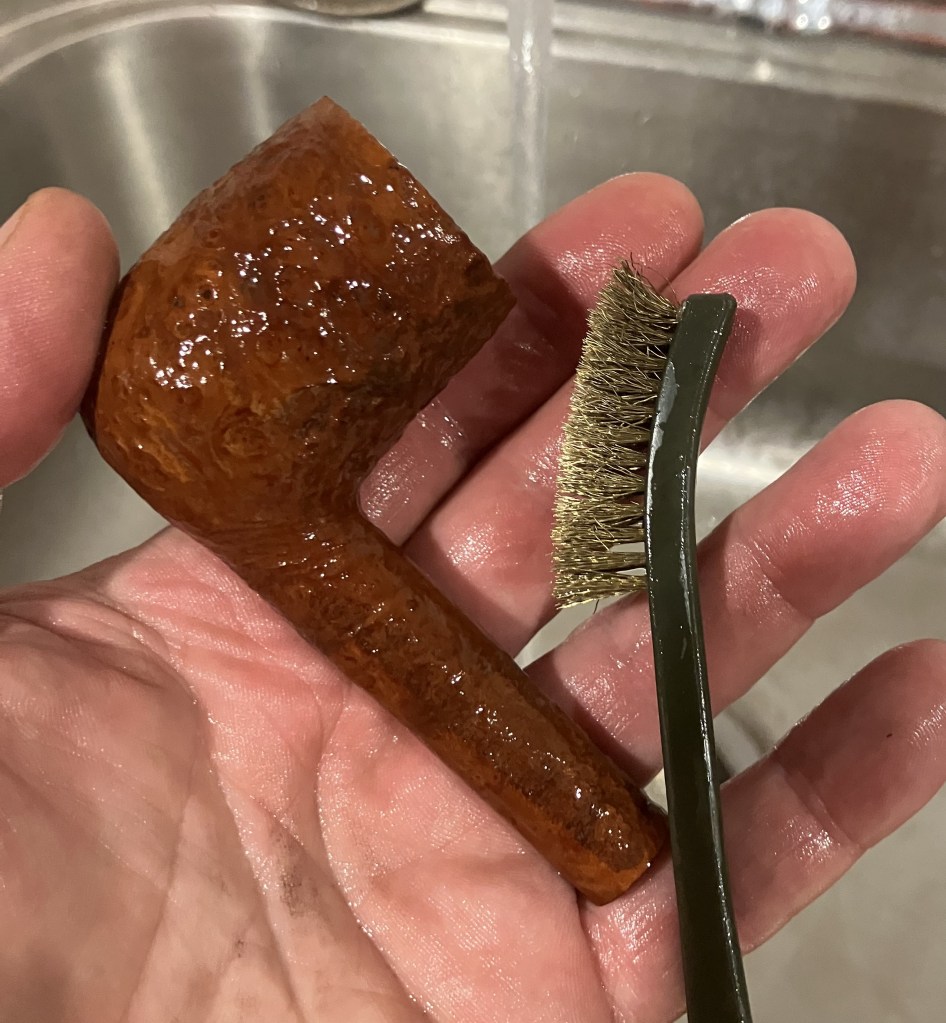
    After the hour-long soak in EtOH I scrubbed the stummel again but this time using the EtOH rather than Murphy’s.  You can see from the photo below that there was a great deal of dye and shellac liberated from the stummel.

    Again, back at the workbench the burl was looking less finish coated but it still had spots of shiny shellac in the low spots and a whole lot of purple.
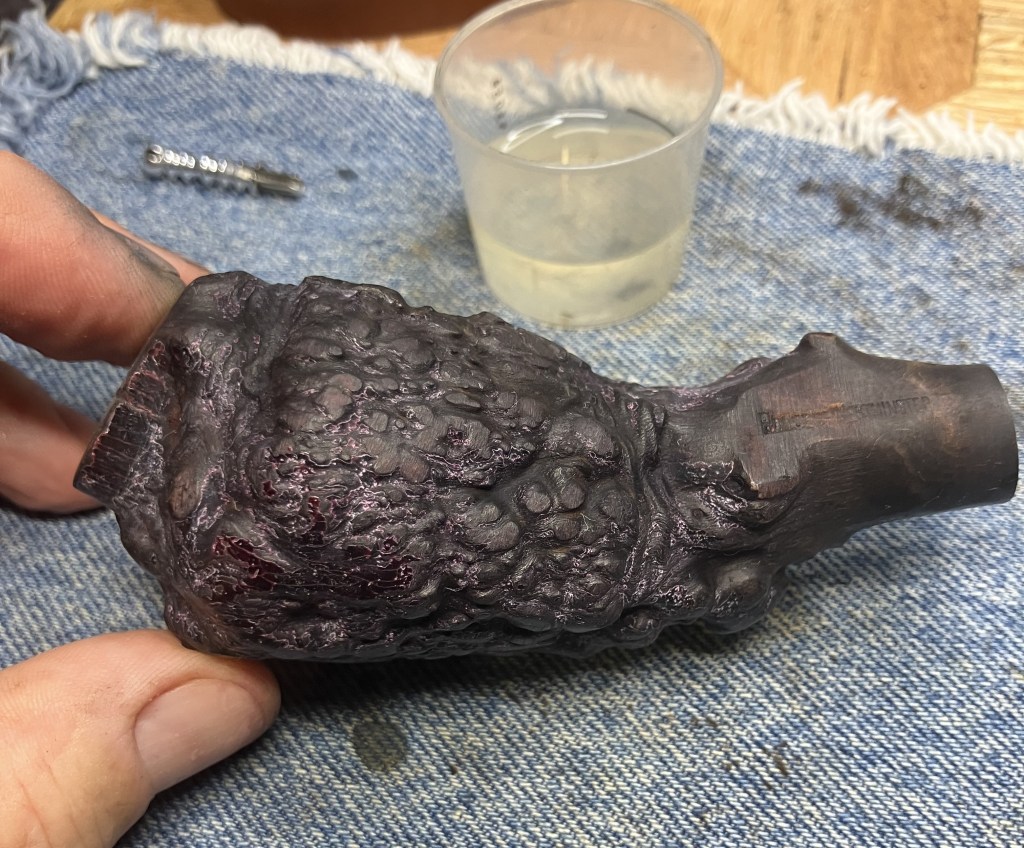
    With the airway residues further softened, I cleaned this out again with cotton swabs and EtOH.

    I tried wiping the stamp panel again, as a test, with acetone on a make-up pad.  I was amazed at how much color came off.

    I decided to give the stummel a 30 minute bath in acetone.

    After 30 minutes I removed the stummel.

    The stummel was then taken to the sink where I scrubbed it with a nylon brush and additional acetone.

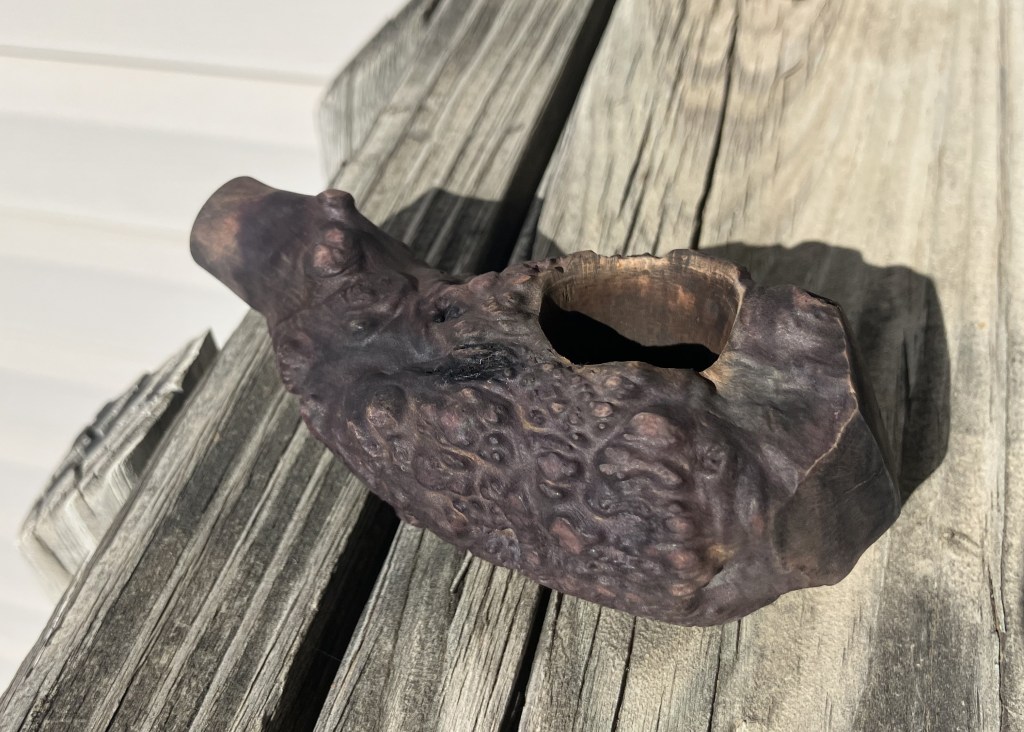
    I used Castile soap and the nylon brush to scrub away acetone from the surface of the pipe.  This was rinsed with water.  I then placed the stummel outside in the sun to allow the acetone to evaporate from the briar.  The stummel was left in the sun for over an hour.
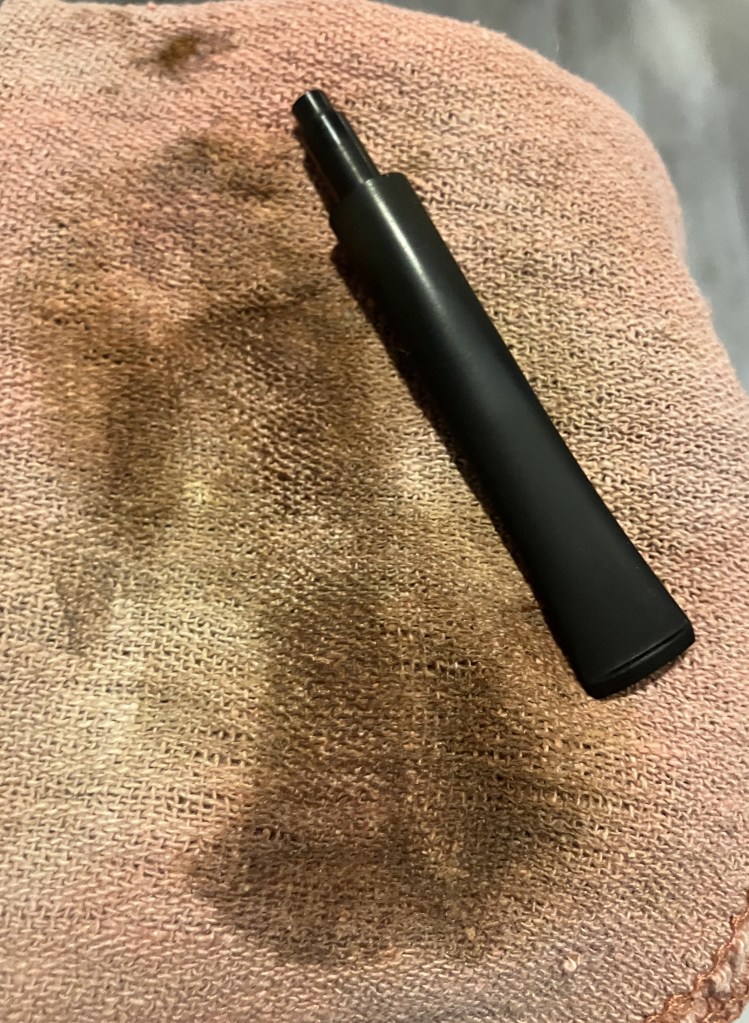
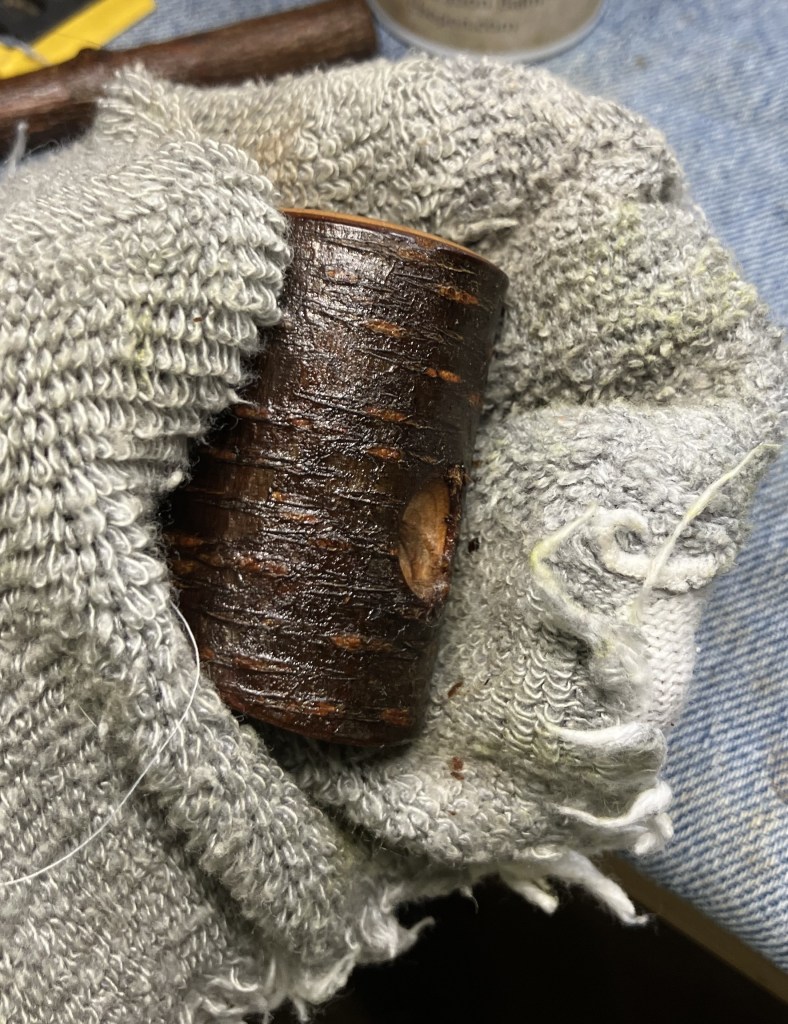
    I retrieved the stem from deox and vigorously rubbed it with a coarse shop rag.  This removes some of the oxidized vulcanite softened by the deox solution.

    The stem looked much better with minimal pitting.

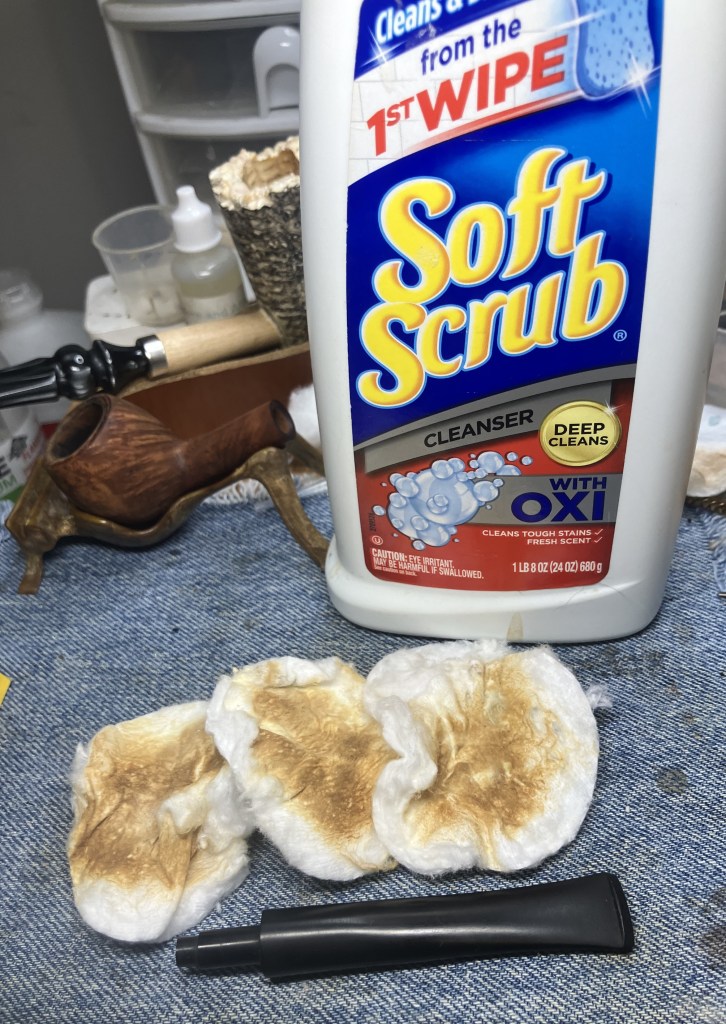
    Soft Scrub cleanser was used on make-up pads to scrub the stem.

    The first pad removed a good deal of oxidized vulcanite.

    The second make-up pad removed significantly less material.

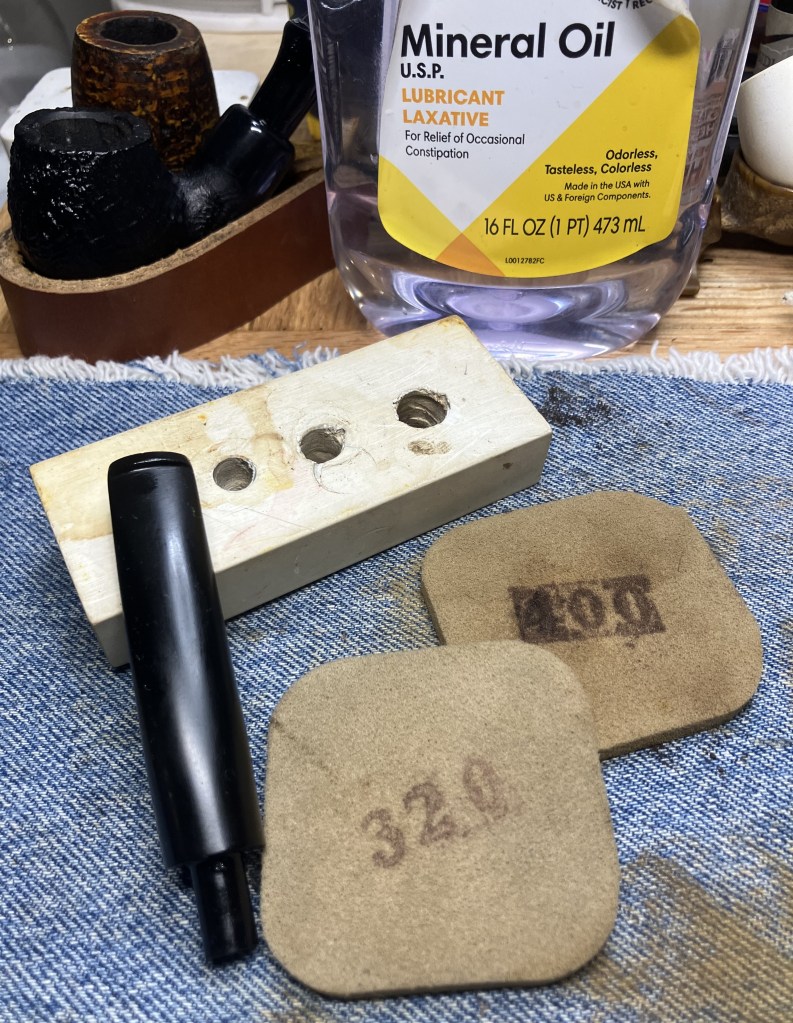
    Since the stummel was drying in the sun, I used a wood block with holes drilled for different diameters to hold the stem while I sanded it.  I like to either have the stem connected to the stummel of a block like this to keep from rounding off the joint where the stem meets the shank.
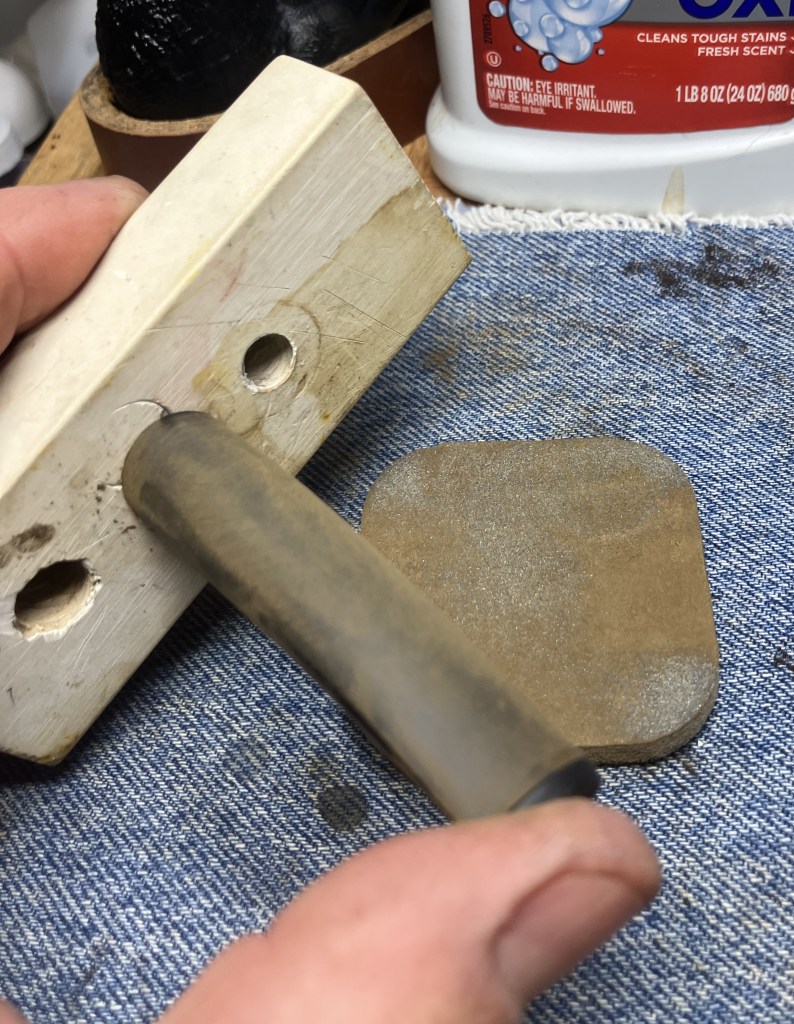
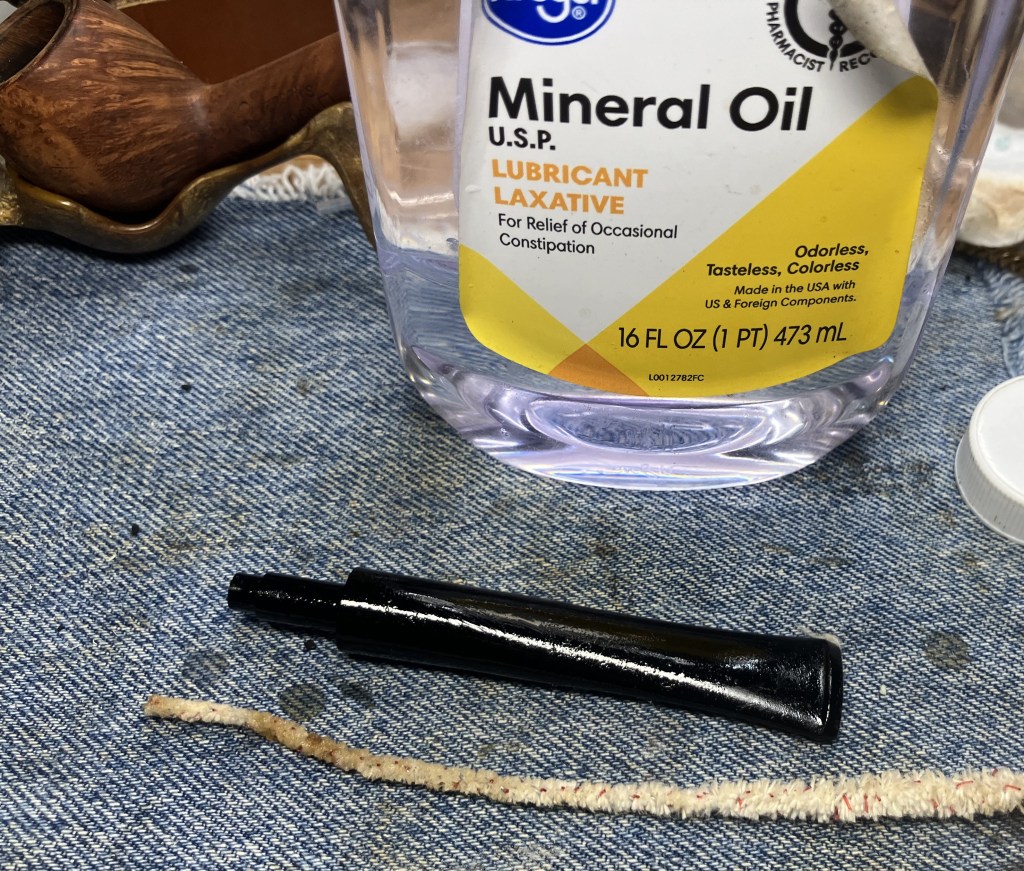
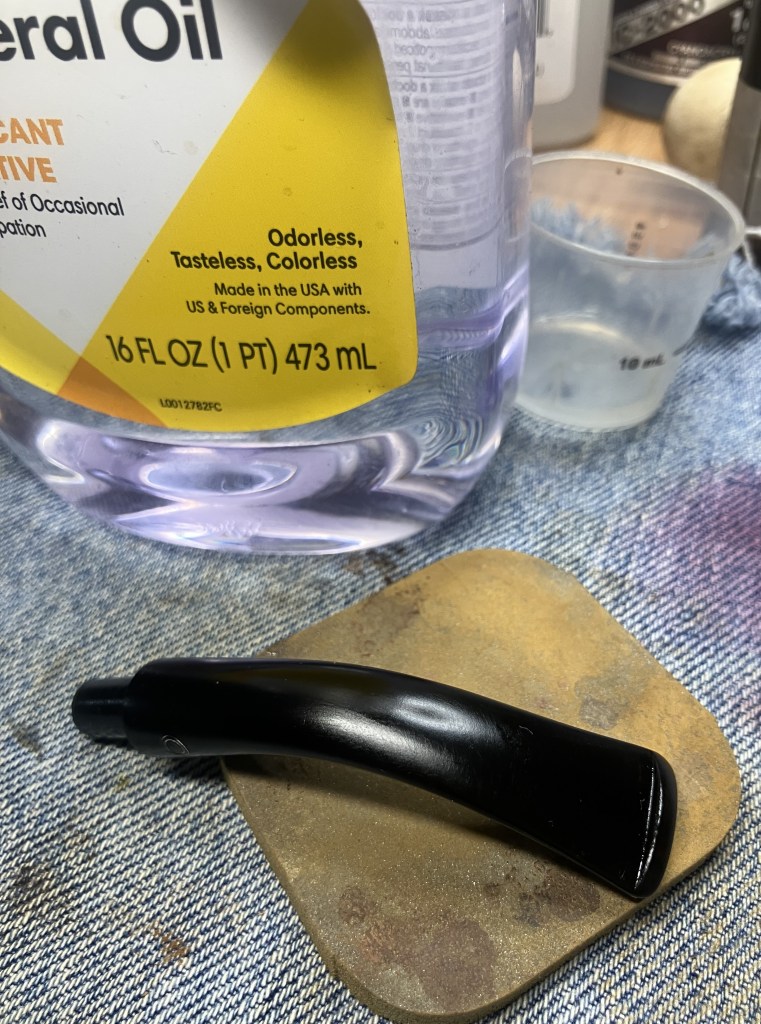
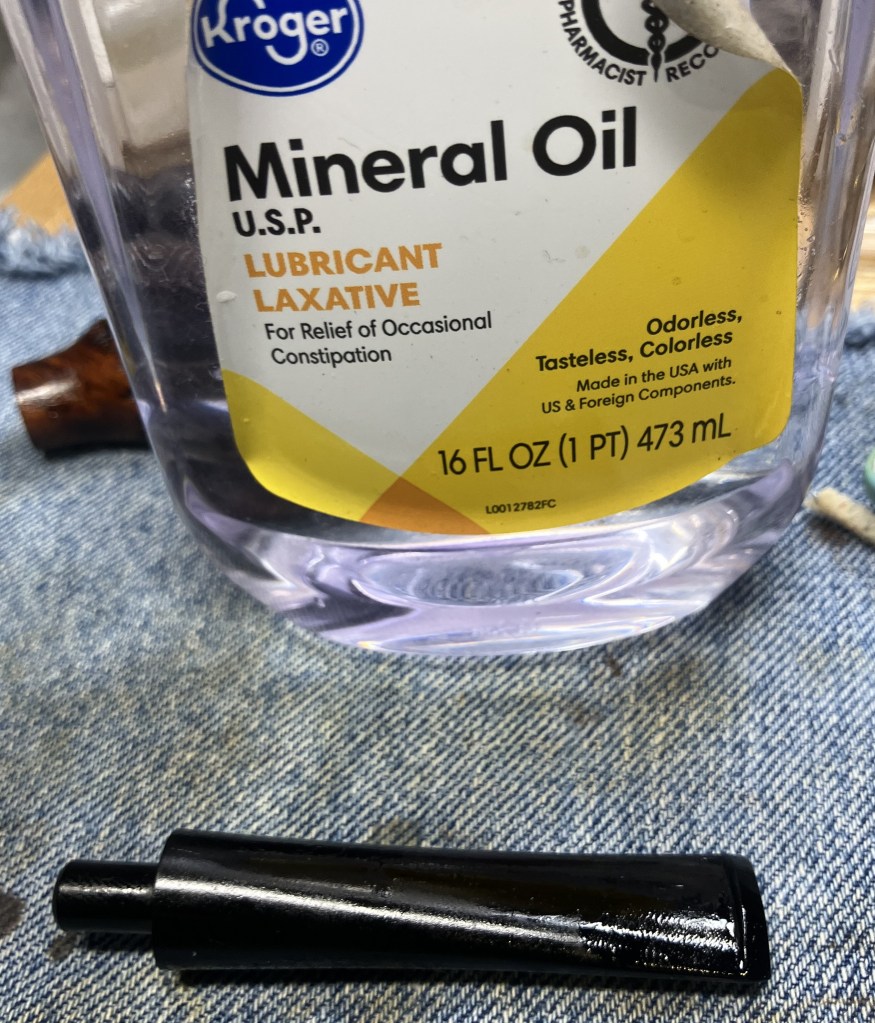
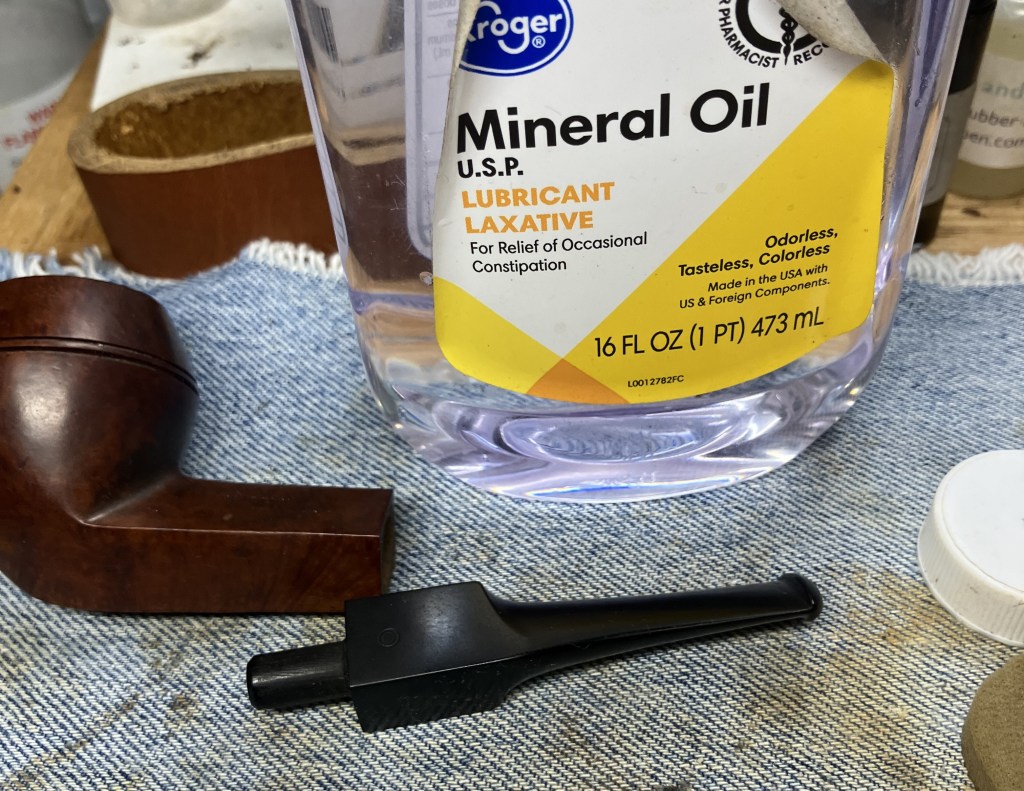
    After sanding with a 320 and a 400 grit sponge the stem was rubbed with mineral oil.
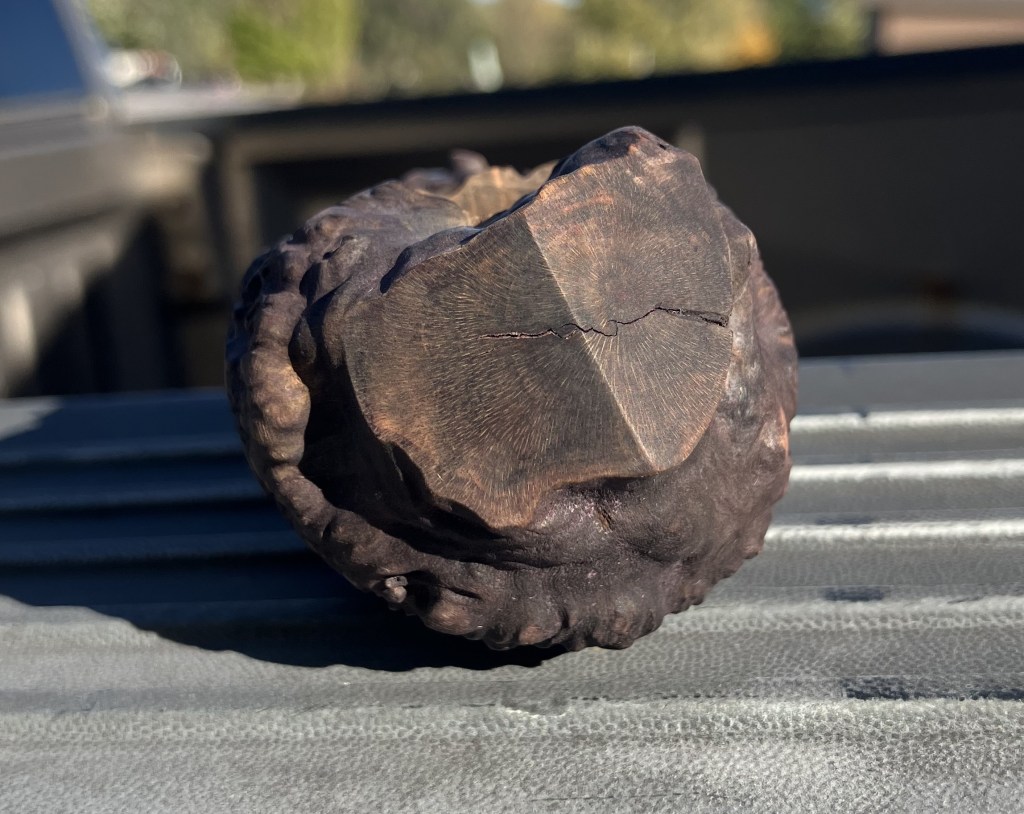
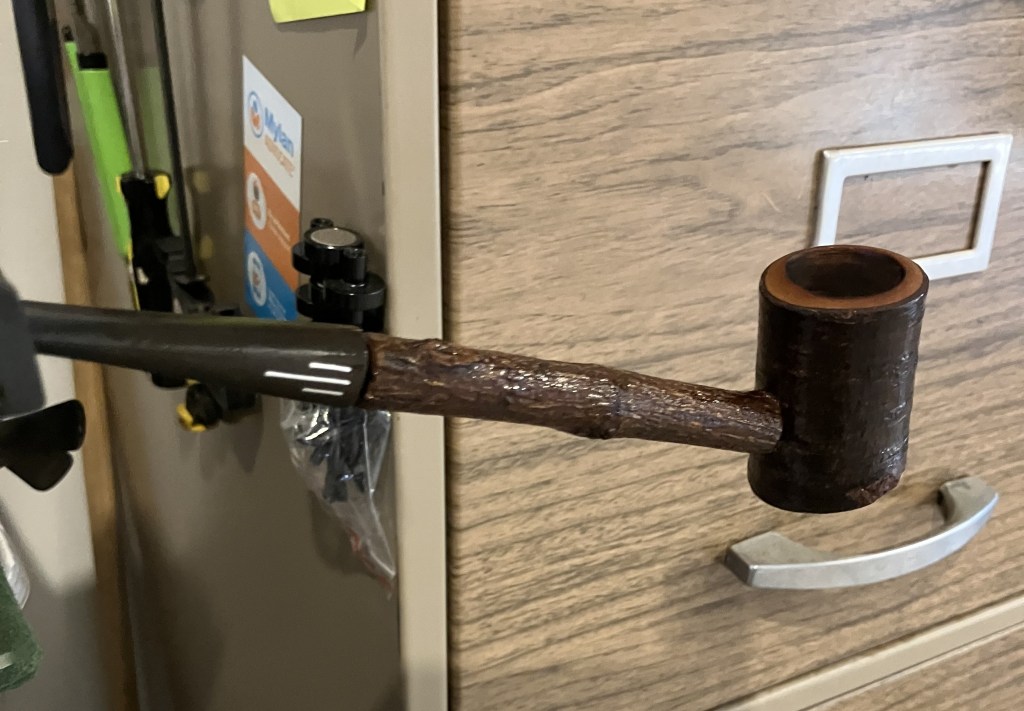
    I checked back with the stummel after an hour.  It still had a slight acetone smell so I knew it was not thoroughly dry.  I did take a few photos of the stummel in the sun to show how much finish had been removed.  Sorry, these shots were taken on the side-wall of my truck, not the best backdrop.
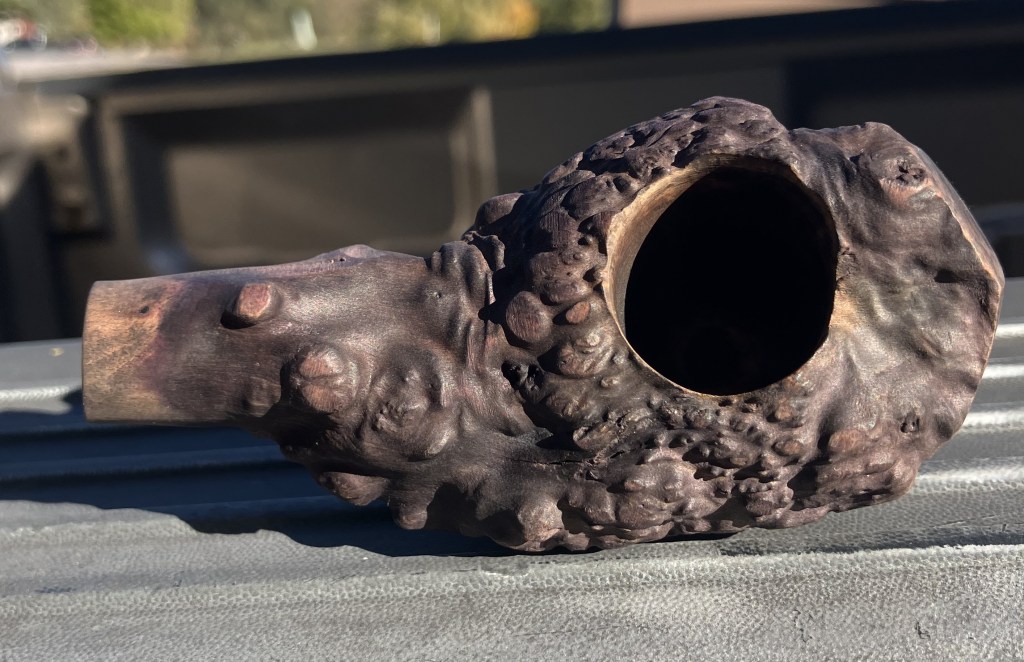
    I was glad to see that I could tell this was wood and not some weird plastic or space-age-epoxy-resin.  Still I wanted to lighten the briar further.  I thought about my successful (and some unsuccessful) uses of oxalic acid to bleach stained wood.  I thought that it might work here.

    The saturated oxalic acid solution was applied with a cotton swab.  This was allowed to sit for 30 minutes.  After the 30 minutes I again scrubbed the stummel with warm water then an additional scrub with Castile Soap and a final rinse with warm water.

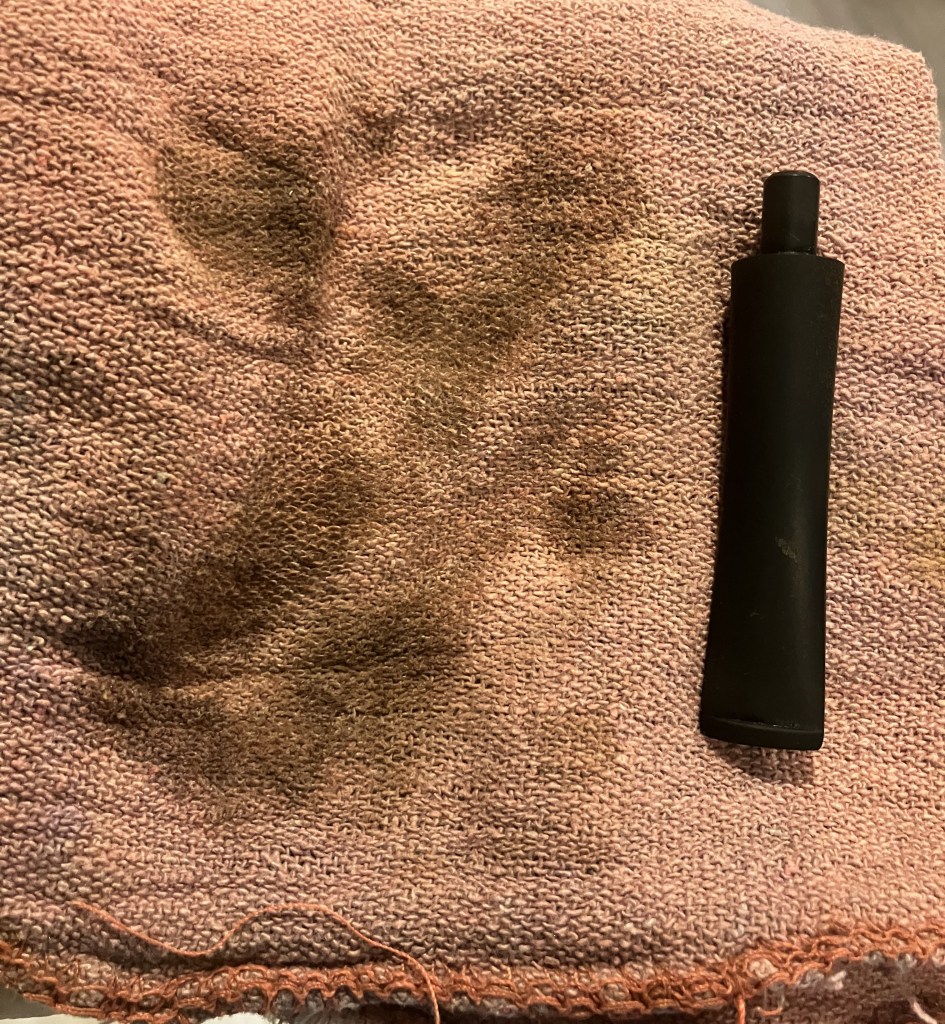
    I returned to the workbench and wiped the stummel with 99% EtOH on a make-up pad.  The pad in the photo below is after the entire stummel was wiped.  There was still a lot of dye coming off.  I declared defeat, the remaining dye would remain.  The oxalic acid treatment seemed to do little.  I had been defeated by the purple plague.

    All of these baths had made the slight crack in the front of the pipe to expand.  I used a fly tying bodkin to pick the old fill from the crack.

    The crack could not be compressed and it appeared to be superficial and not structural.  I decided to just refill it using briar dust and cyanoacrylate (CA, super glue).  I pressed briar dust into the crack and tamped it with the bodkin.

    Thin Ca was applied with a very narrow plastic tip.

    The Thin CA soaked into the briar dust and bonded it to the existing briar.  I repeated the filling of the crack with a second coating of briar dust and another drop of Thin CA.  The excess new-fill was filed with a small flat file and sanded with a 400 grit sanding sponge.
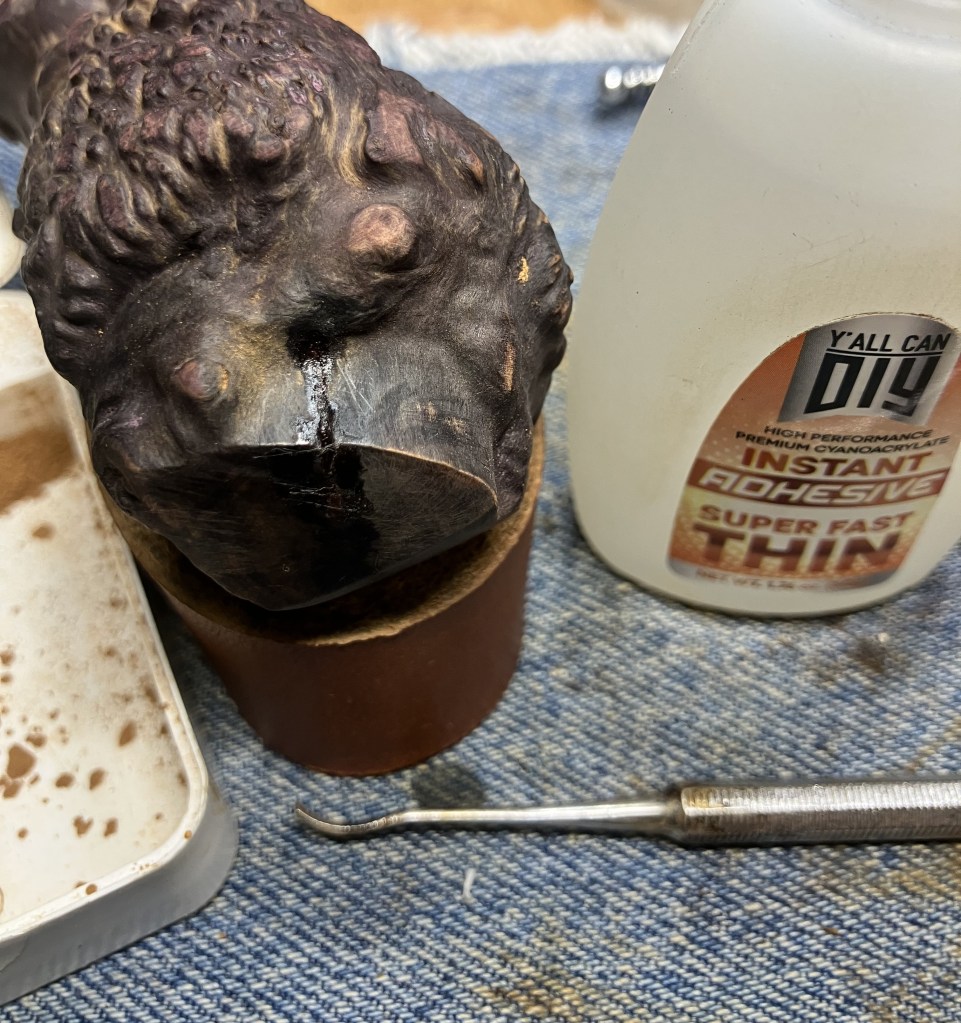
    Below is the fill as seen from head-on.

    And from the side with poor focus.

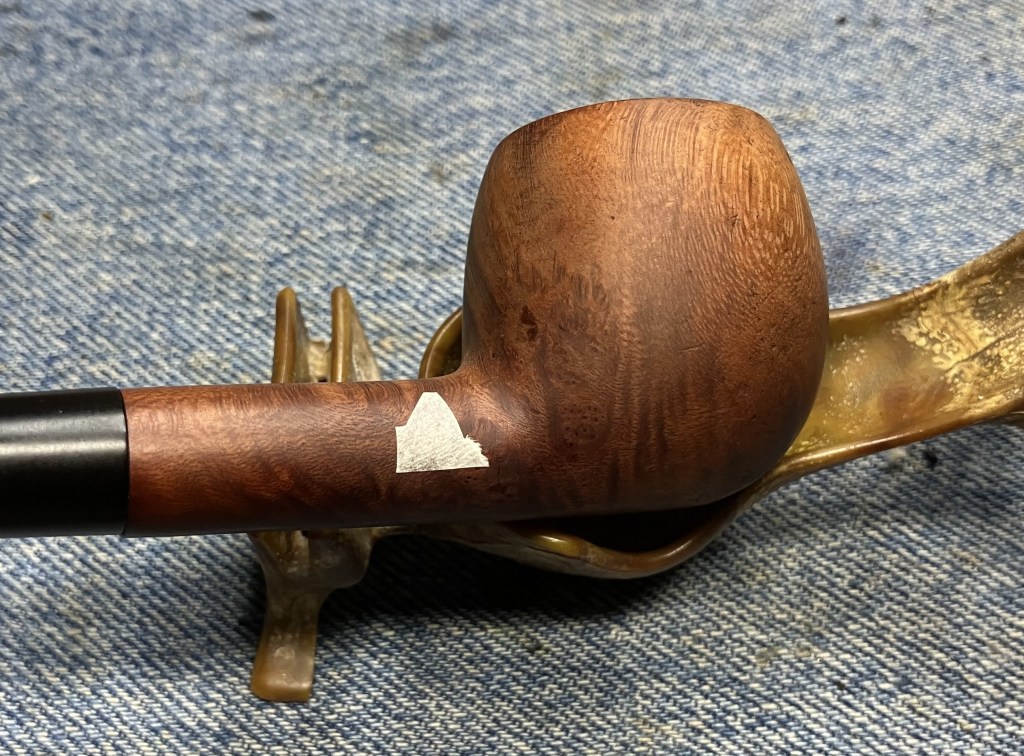
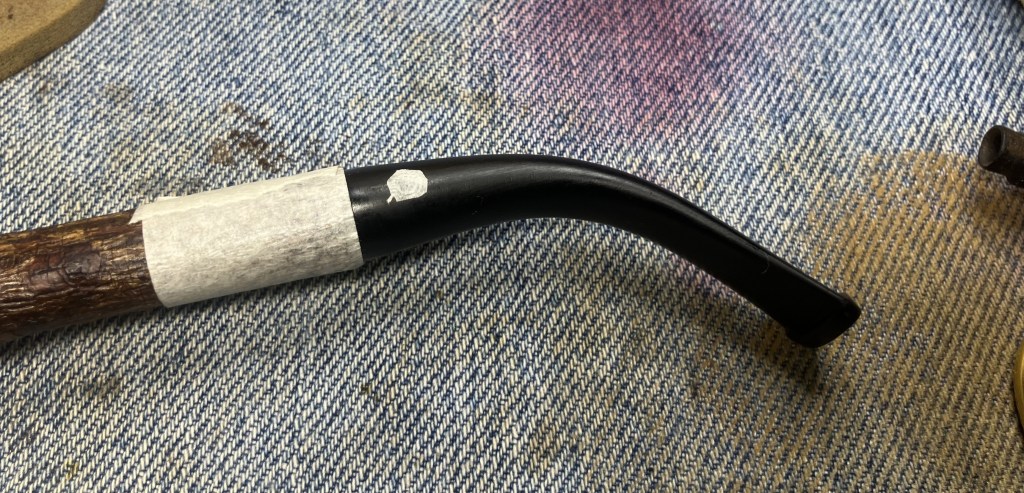
    It was time to sand the stem and the shank-end.  The area that I did not want sanded was taped with masking tape.

    A series of sanding sponges were used in grits 320-3500.  Between each sponge the stem was rubbed with mineral oil and wiped with a paper towel.
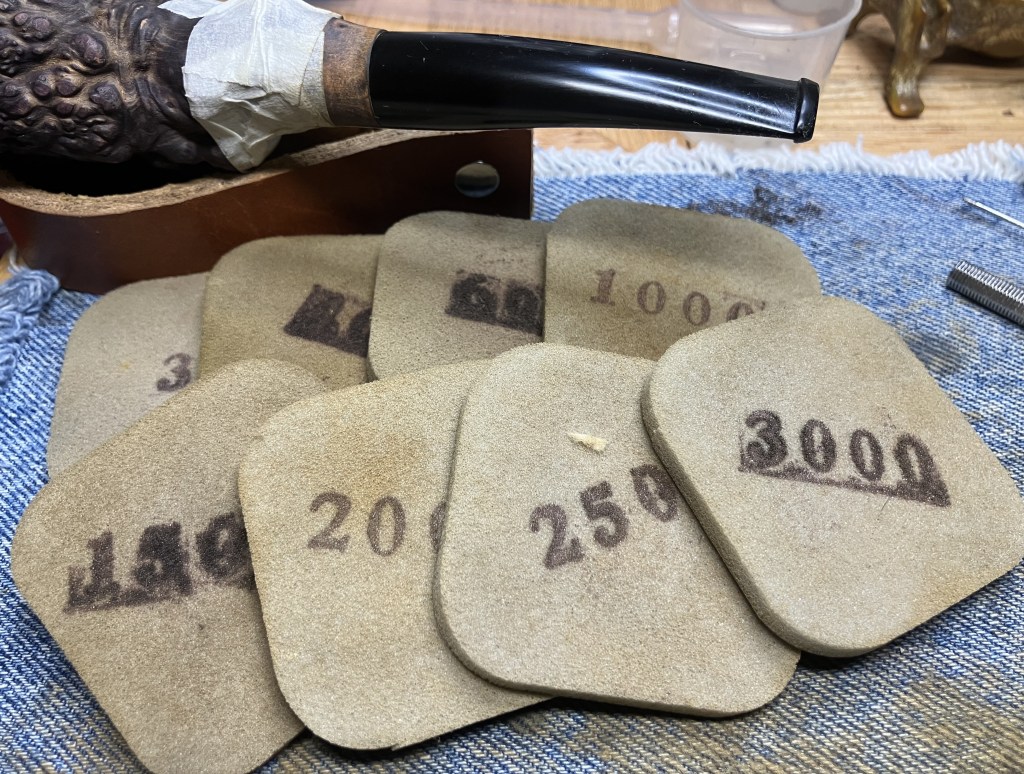
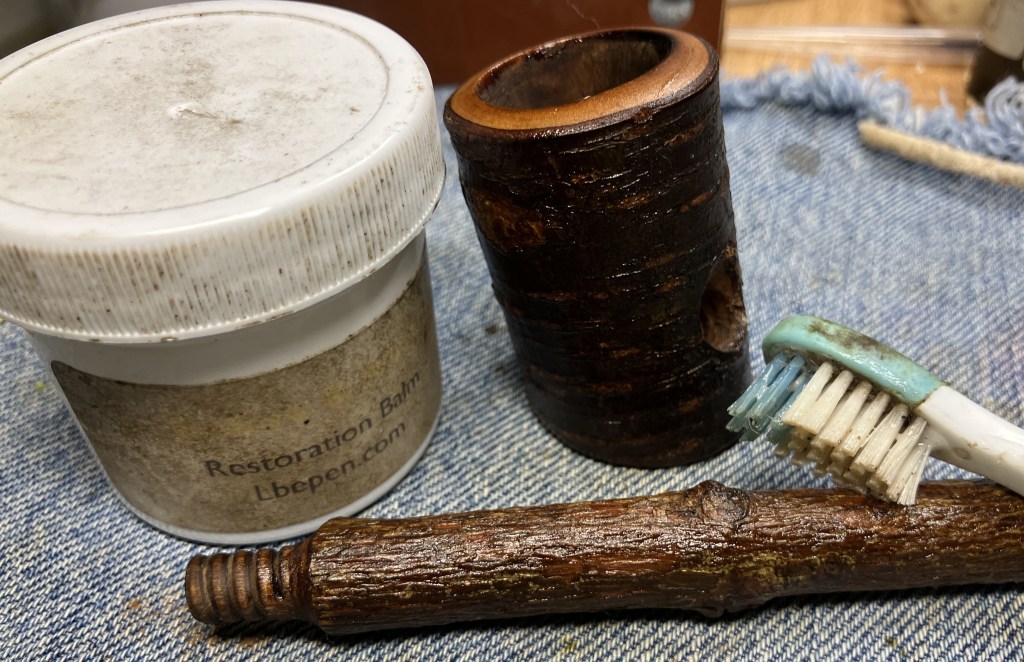
    After the 3500 sponge the stem was taken to the buffer and the shank-end and stem were buffed with rouge buffing compound followed by a buffing with white buffing compound.  I returned to the workbench and wiped the remaining buffing compound from the pipe.  The stummel was then coated with Before and After Restoration Balm applied with a baby toothbrush.  This was allowed to sit for 30 minutes.
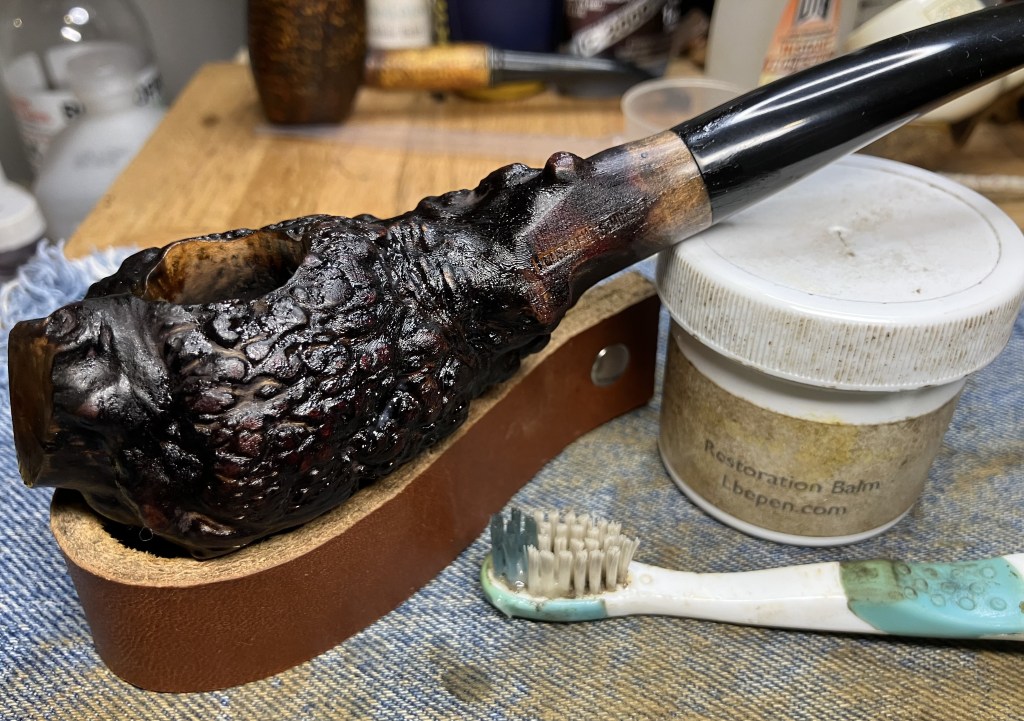
    The stummel was hand buffed with an inside out athletic sock to remove the remaining balm.

    The pipe was then returned to the buffer where several coats of carnauba wax were applied.  Care was taken to work the carnauba into and out of the rough texture of the briar.  The final step was a hand buffing with a microfiber polishing cloth then off to the photo table.

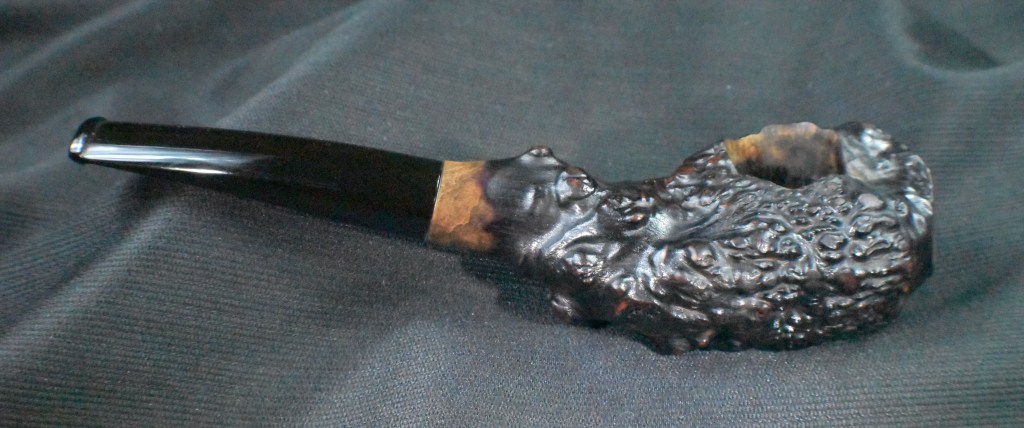
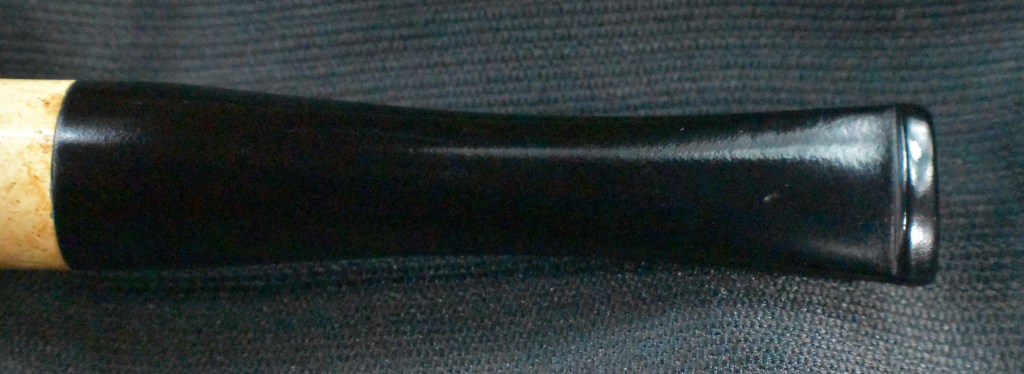
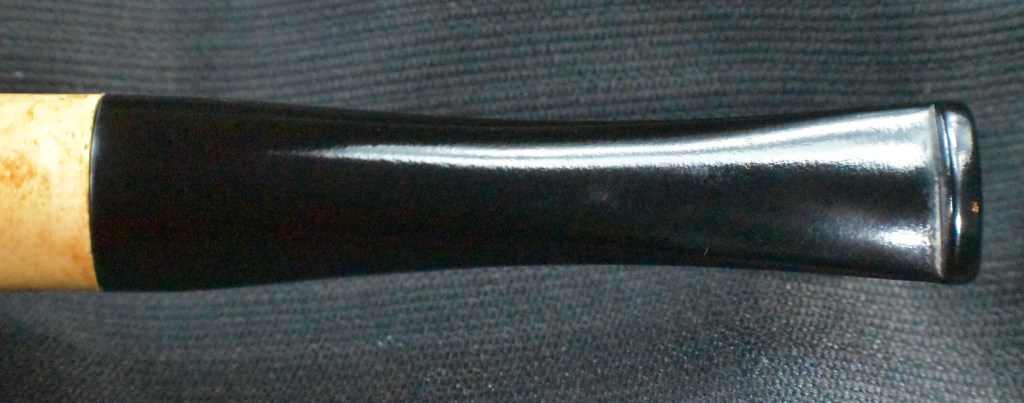
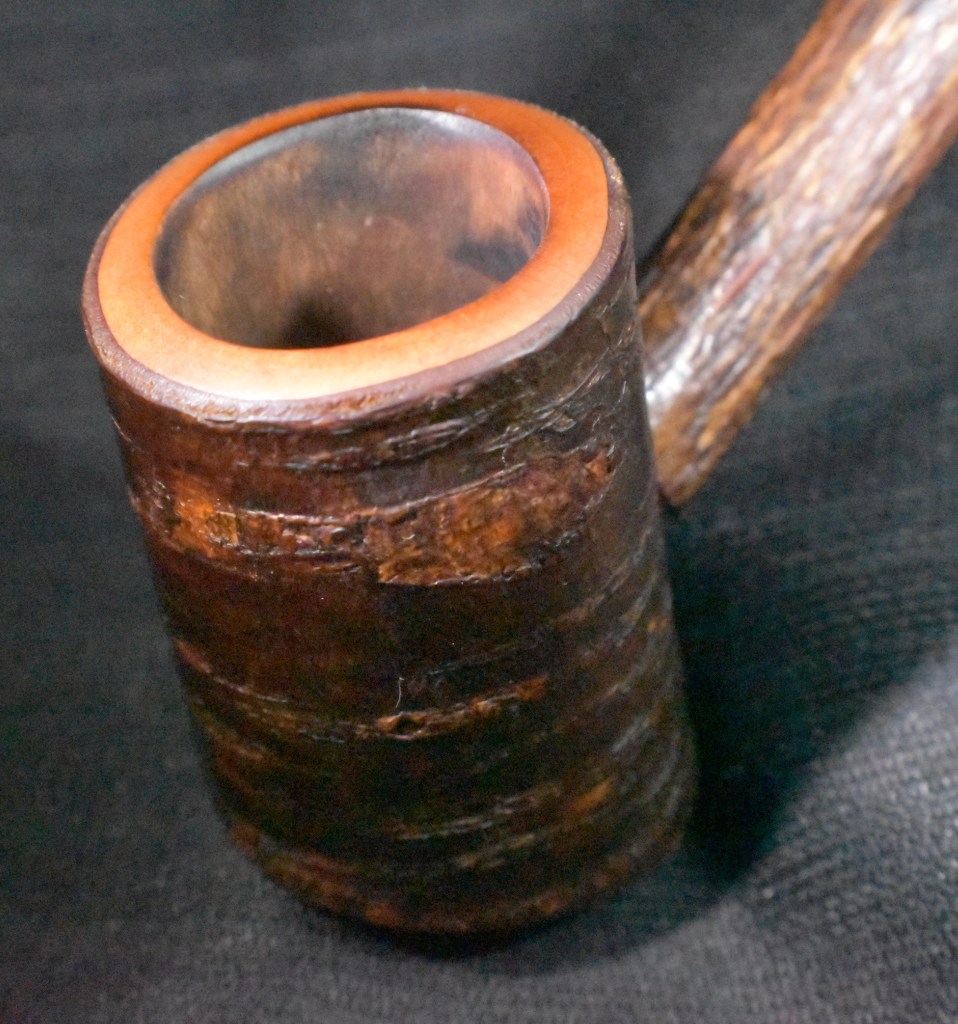
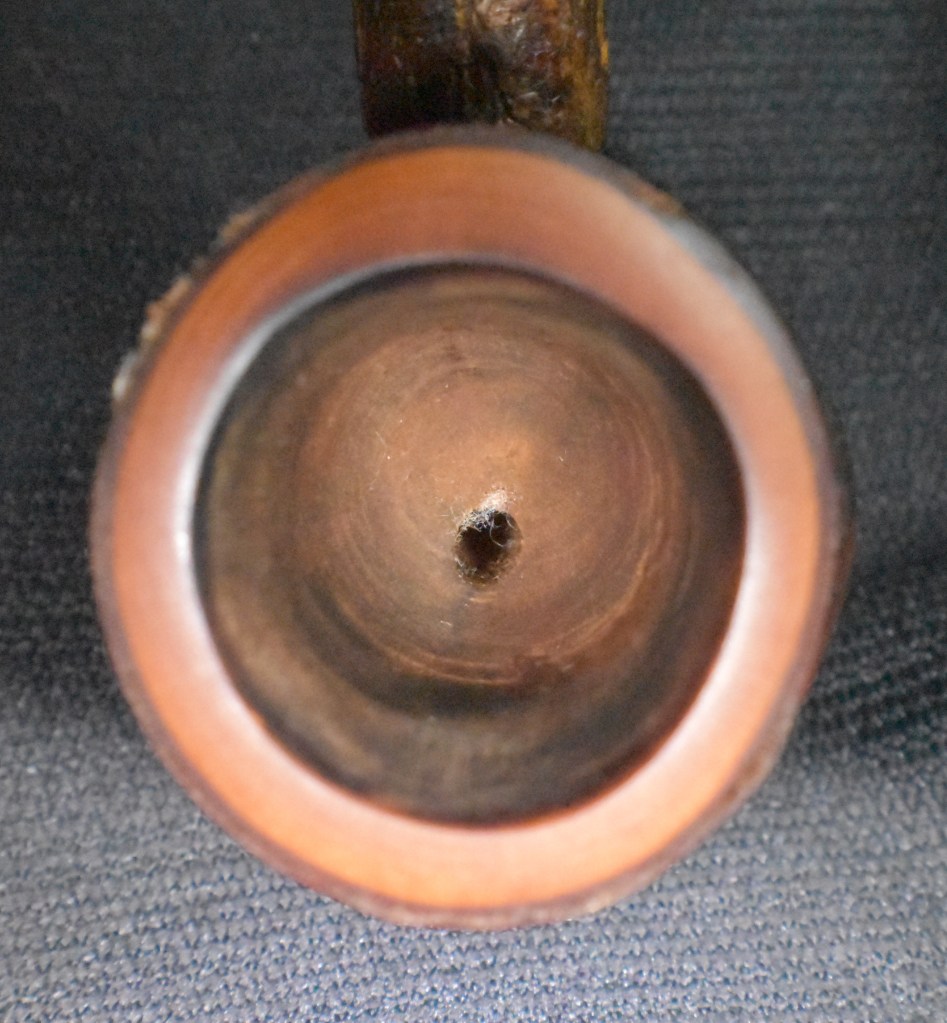
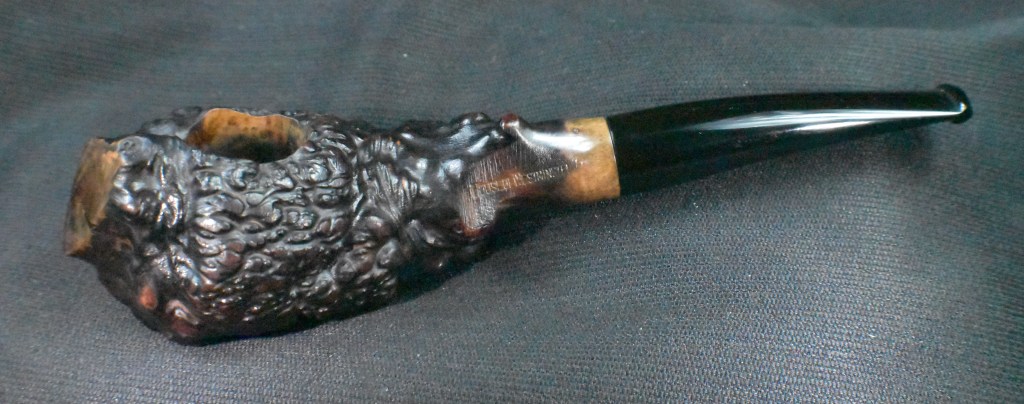
    This House of Westminster burl turned out well. I do wish it had a more natural color rather than purplish brown, but at least the clear coat is gone.The texture of the pipe is amazing to hold.  It is like a natural rustication and has a wonderful hand feel.  The smooth organic texture gives way to the polished stem, which turned out very nicely. Overall this pipe is a unique piece which will undoubtedly provide years of enjoyment to the next owner.   The dimensions of the House of Westminster Burl are:

    Length:  6.72 in./ 170.69 mm.

    Weight:  2.40 oz./ 68.04 g.

    Bowl Height: 1.51 in./  38.35 mm.

    Chamber Depth: 1.28 in./ 32.51 mm.

    Chamber Diameter:  0.80 in./ 20.32 mm. 

    Outside Diameter:  1.90 in./ 48.26 mm. 

    I do hope that you have found something here useful to your own pipe care, maintenance or restorations.  If you like this sort of thing, please click the like and subscribe buttons.  Thank you for reading the ramblings of an old pipe lover.  If you are interested in purchasing this pipe or any other from previous blogs please feel free to contact me at scimansays1787@gmail.com.

    Loading…

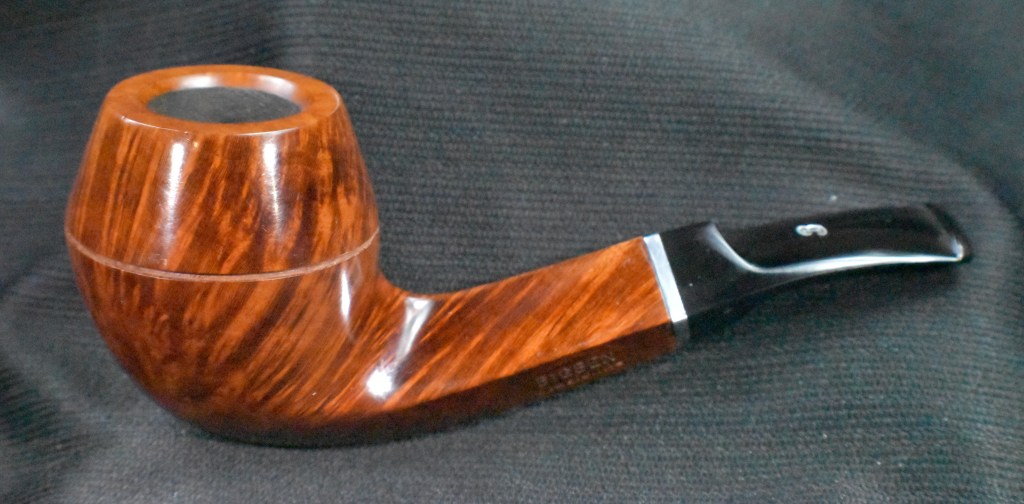
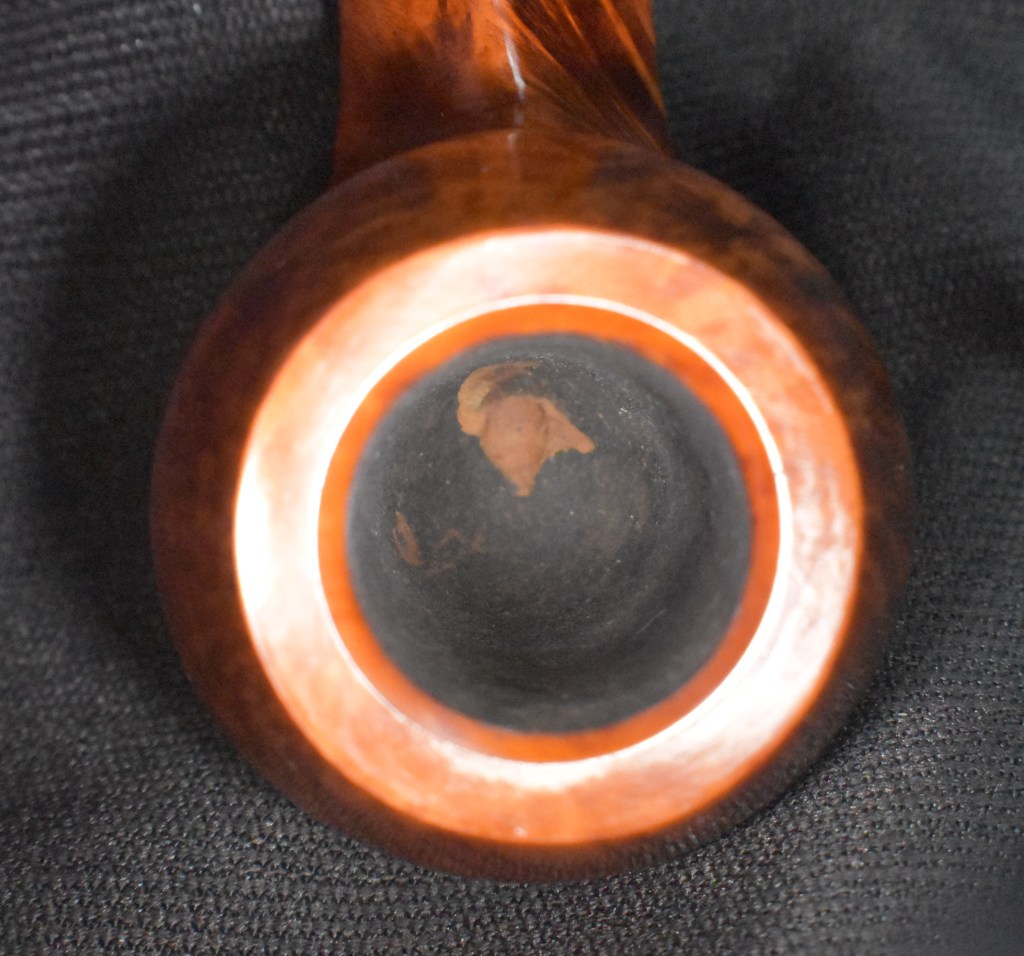
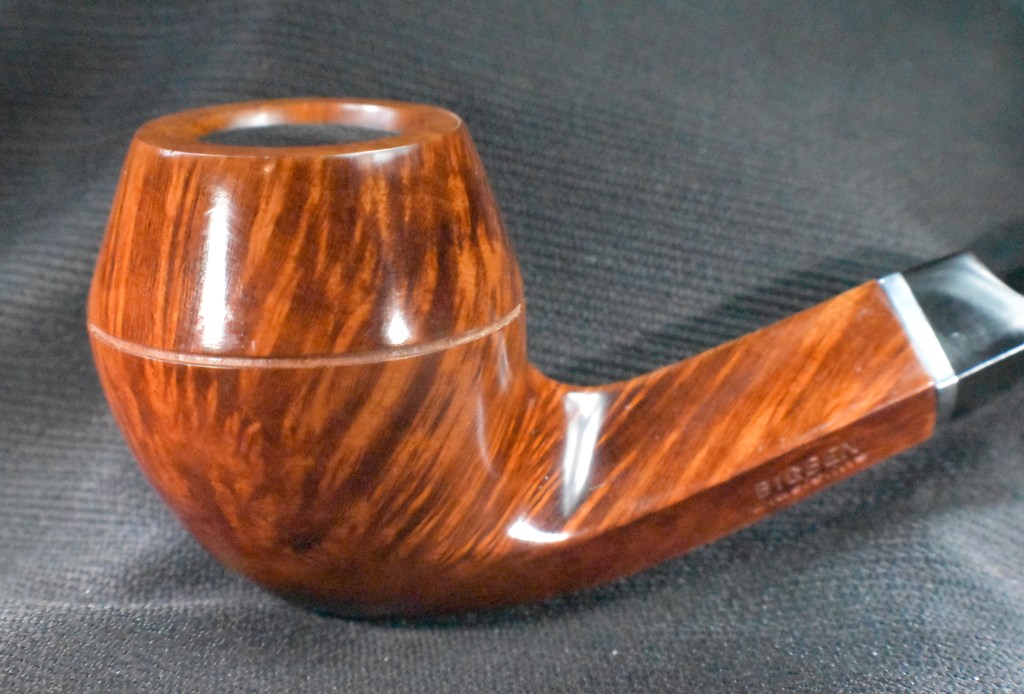
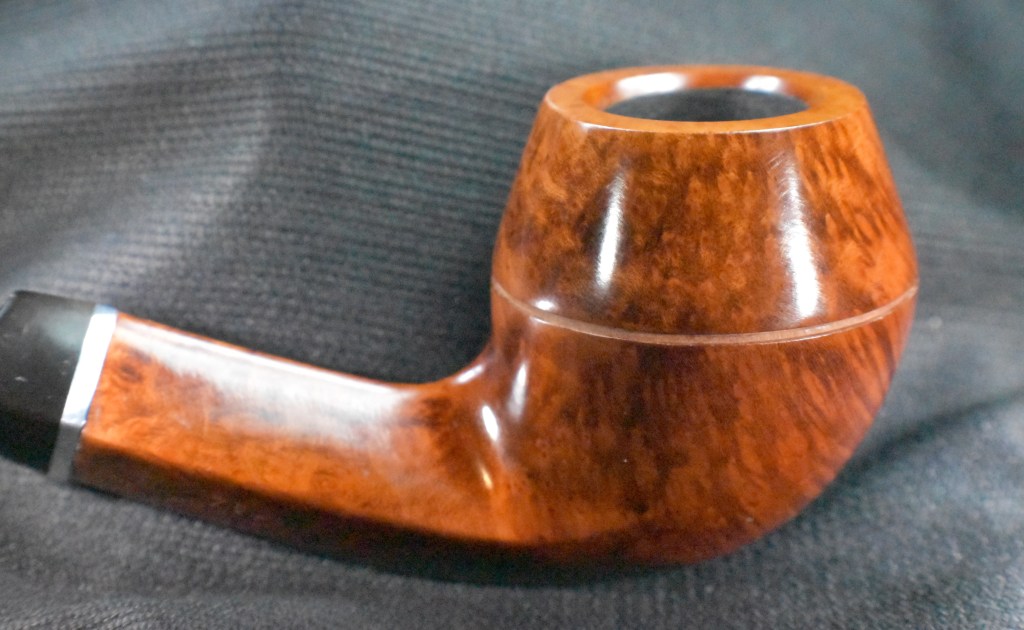
    Below are some photos of the finished House of Westminster Burl.
  • A Mountbatten Billiard Restoration

    October 28th, 2025

    Photographed and written by

    John M. Young

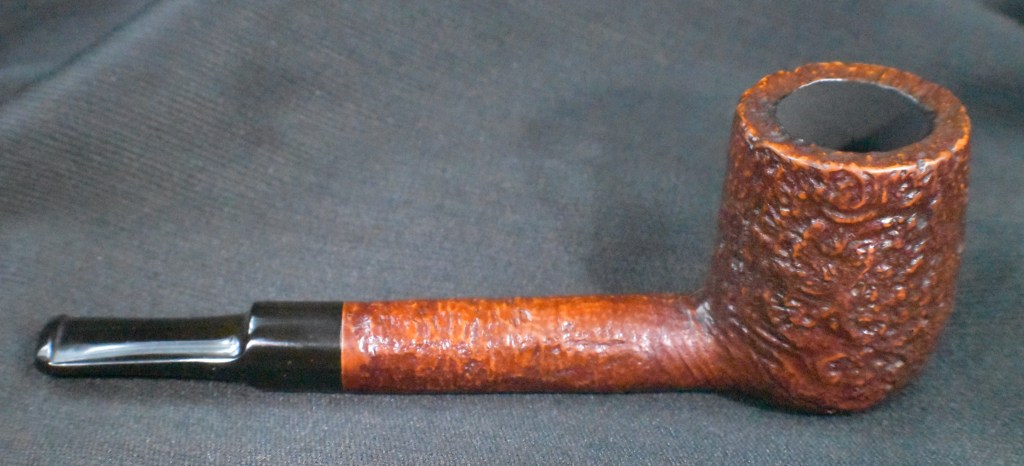
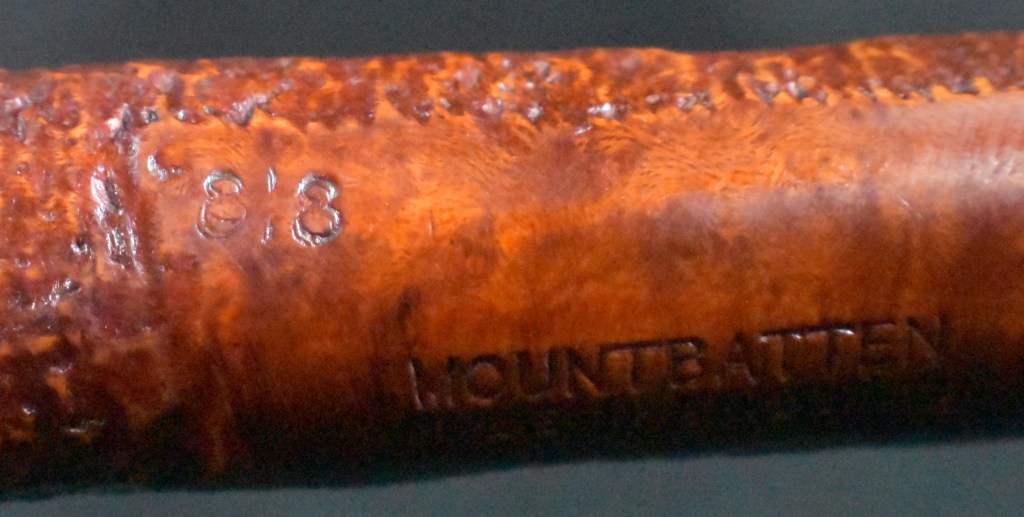
    You may have noticed that I have begun to only post one restoration blog per week.  I am sure that you are thinking that the writing quality will certainly improve with more time spent on each individual post.  Or, that I will make fewer mistakes because I have more time for perfection.  Yeah right, like either of those are going to happen.  Anyway, we are gathered together today for a pipe restoration, so here it is:  A Mountbatten that came in with an estate lot back on February 6th, 2025.  The pipe was stamped MOUNTBATTEN over MADE IN ENGLAND.  There was another stamp but I didn’t notice it until after I’d started the restoration.  See, I’ve already proven that I continue to make mistakes.  Here are some photos of the pipe before work was started.

    The pipe had obviously been smoked as evidenced by the lava deposits on the rim and the cake built up in the tobacco chamber.  The stem was oxidized with some tooth chatter, more dents actually.  The finish looked rather drab, which seemed strange because the sandblast texture was very nice with numerous bird’s eyes on both sides and straight grain on the front and back.  I thought that some contrast dye would improve the look dramatically.  Overall, this appeared to be a rather straightforward restoration.

    Background

    For some reason I always associated Mountbatten with Blatter of Montreal.  Perhaps it is due to my lysdexic (or is that dyslexic?) brain wanting to see a pattern with pipe names and “tt”.  This was the first Mountbatten that I recall working on.  The pipe was well crafted with the fit of the stem to the shank excellent.  I started with a search on pipedia.org for “Mountbatten”.  Here I found the following:
    “Mountbatten is often referred to as a Charatan second, but apparently the Mountbatten pipes were made by Charatan apprentices. So while they are not Charatans, they are perhaps on their way to becoming Charatans. A second would tend to be a pipe with a deficiency (in material or workmanship), a Mountbatten would perhaps be closer to a Charatan in quality.

    The following is originally from a pipes.org forum post by Bill Ramsey.

    “Friends, after 40 years of nosing around pipes, what I have gleaned is this: Charatan sold its seconds under private labels and later acquired the English rights for Ben Wade for just this purpose. Mountbatten, on the other hand was not a “second”(in that there was some physical deformity in the pipe) but rather a first line production from Charatan’s apprentice program. Each Charatan carver might have four or six apprentices at any one time of various skill levels. As they improved and started cutting pipes themselves, these pipes had to move… thus the Mountbatten. These were made on Charatan tooling with Charatan materials and teaching. Bear in mind that there was a high attrition rate and , perhaps, one apprentice in nine or ten made it to cutting their own bowls much less a Charatan carver. This is why you see more Charatans than Mountbattens on the market. You’re never going to put your kid through college by selling one but you’ve got a day to day workhorse of the first order. Good luck and happy puffing.”

    Pretty interesting! This is information comes to us from an interesting post on rebornpipes.com about restoring the pips bellow” (Mountbatten – Pipedia).

    So, I apparently had a pipe made by an apprentice that had mastered the fitting of stems to a shank and had advanced to blasting, which they were quite good at, then attempted finishishing blasts, which they were not quite as good at, yet.  I merely say that because I was not impressed by the finish of this pipe.  It looked kind of Play-doughy – unicolor and lacked definition. 

    I still wasn’t sure when the pipe was made.  Reading through the pipedia content on Charatan led me to a convoluted history with several “eras” for Charatan pipes but little to no information of Mountbatten.  If I assume the shape numbers remained the same for Chatatan and Mountbatten which I thought was a reasonable assumption, then they would be consistent.  Hmm, I was wrong about that.  818 was never a Charatan shape. The pipedia.org does have a single photo of a Mountbatten with a very similar shape number and finish:

    (File:Mountbatten 812, courtesy of Chris Rigol.jpg – Pipedia) 

    The Restoration

    As per tradition, I placed a relatively clean denim piece on the work surface.

    The ream team was gathered and included the following:  PipNet with the #2 & #3 blades, the General triangular scraper with the tip ground round and the Smokingpipes Low Country reamer.

    The PipNet’s #2 and #3 blades did the majority of the reaming.

    The clean-up was done with the other two scrapers.

    After Reaming the tobacco chamber was sanded with 320 sandpaper wrapped around a wood dowel.  There were a couple of gouges on the walls of the tobacco chamber from previous scraping/reaming but no signs of heat damage.  I thought that a bowl coating may be beneficial and hoped that I’d remember to do it.  The below photo also shows the lava deposits that I hoped the stummel scrubbing would eliminate. 

    The stem was cleaned with bristle pipe cleaners and 99% ethyl alcohol.  The stem was surprisingly clean.

    A pipe cleaner was inserted into the stem to act as a handle for removing the stem from the Briarville Pipe Stem Oxidation Remover (lovingly called deox).

    The shank proved to be a bit more difficult to clean than the stem.  This cleaning was done in similar fashion to the stem but with a nylon shank brush joining the assault.

    Once the shank was cleaned the stummel was taken to the sink for a scrub.  Here I used a nylon brush with Murphy Oil Soap, undiluted.  The soap was rinsed with warm water.

    Not being completely satisfied with the scrubbing, I upgraded to a brass brush and repeated the process.  After the rinse I dried the stummel with a cotton hand towel.

    Back at the workbench the stummel was wiped with 99% ethyl alcohol on a make-up pad.  This removed a little bit of color, perhaps a stain or wax residue.

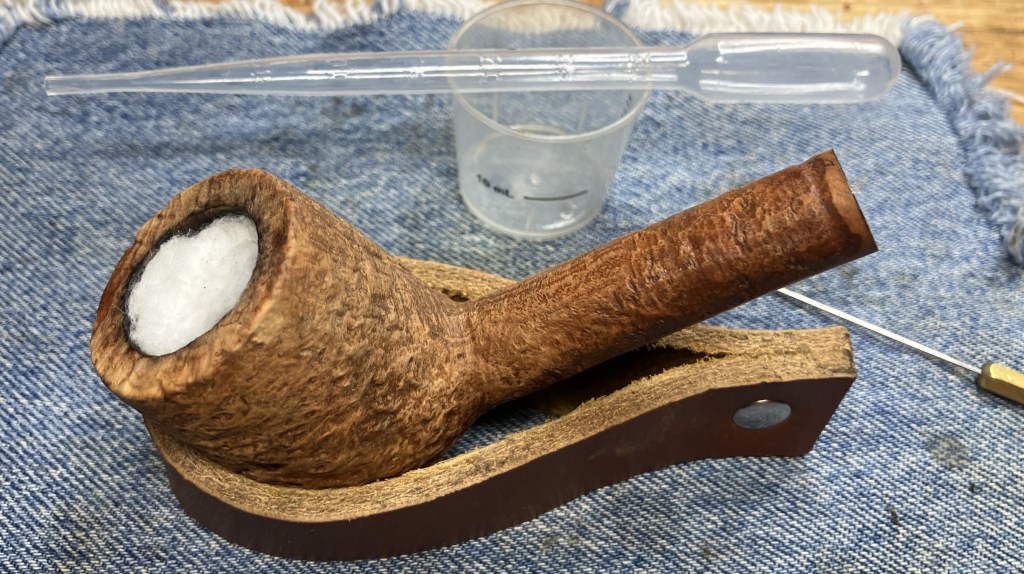
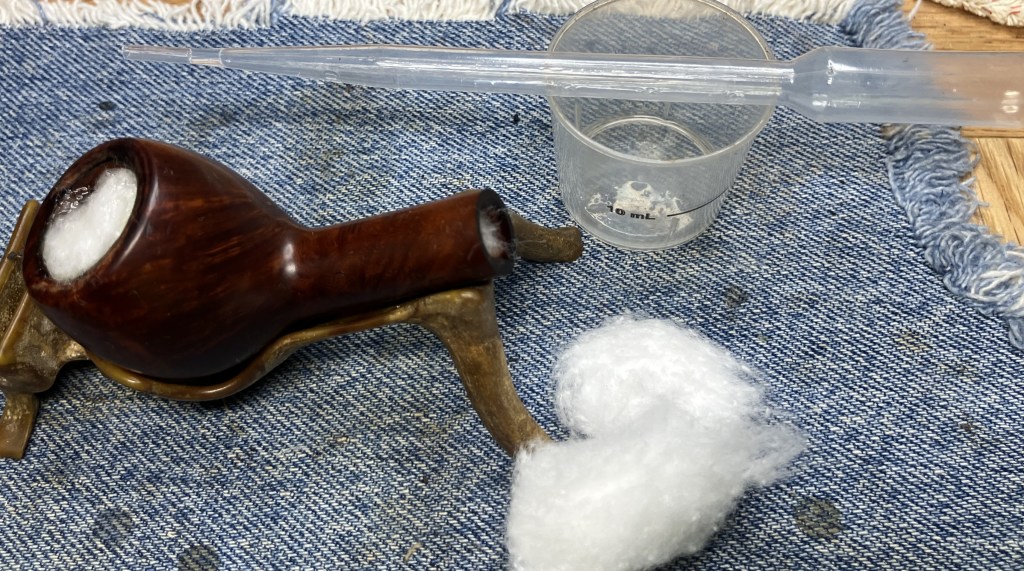
    I wanted to give this pipe an alcohol-cotton treatment to eliminate any remaining smoking residue from the airway/tobacco chamber.  The tobacco chamber was packed with cotton along with the shank.  I figured that 10 ml of alcohol would be the right amount. 

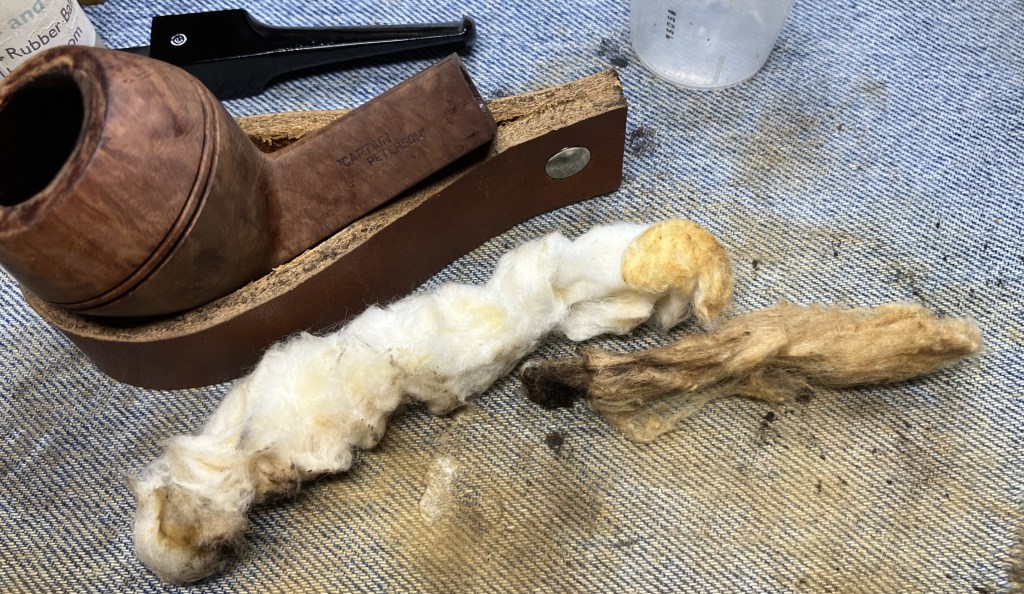
    The 10 ml of alcohol was applied with a disposable pipette.  It saturated the cotton completely and would dissolve the smoking residues and deposit them onto the cotton as the alcohol evaporated overnight.

    The next day I saw a purple color on the cotton packed into the shank.  This purple was usually from potassium permanganate (KMnO₄).  KMnO₄ is an oxidizing agent that is/was used as a stain for wood.  Maybe the shank end had been stained this way, certainly the whole stummel had not been.

    The cotton in the tobacco chamber did not have any of the purple coloring.

    The cotton was removed and the stem cleaned again to remove any of the remaining residues that the alcohol may have softened but not liberated from the airway.

    I removed the stem from deox.  It was placed on a coarse shop rag where I vigorously hand buffed it.  This removed some of the oxidized rubber which had been softened by the deox process.

    Bah!  The deox had removed some of the definition of the logo.  This occurs when the oxidation is deeper than the stamping.  The stem was returned to the workbench where it received a coating of mineral oil to keep it from further oxidizing.

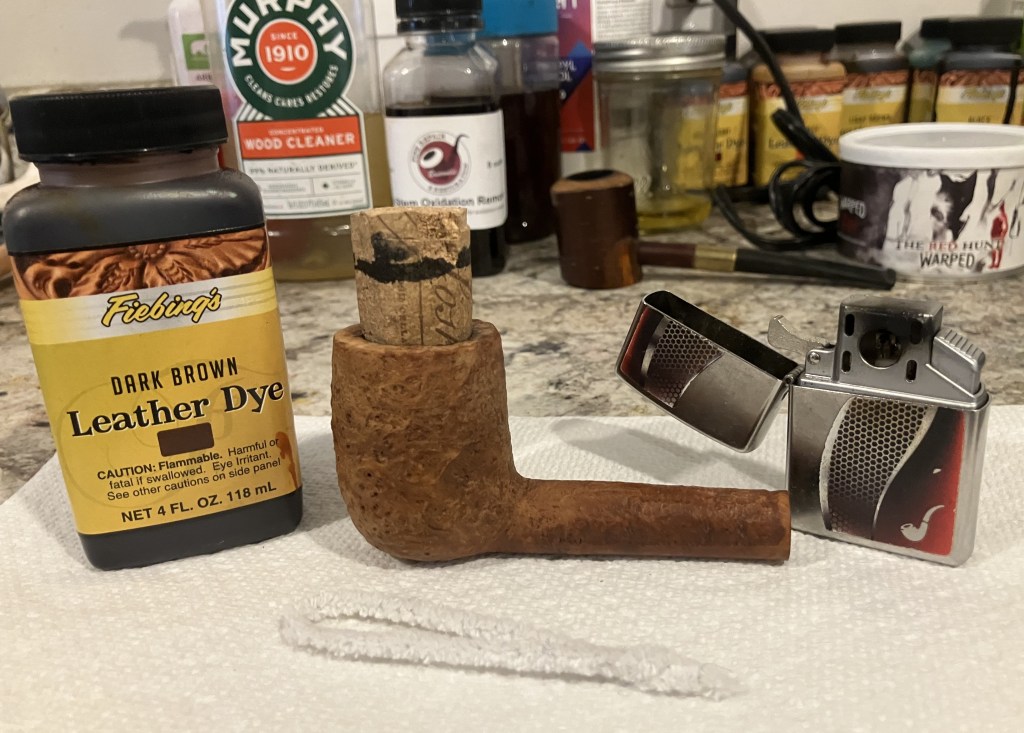
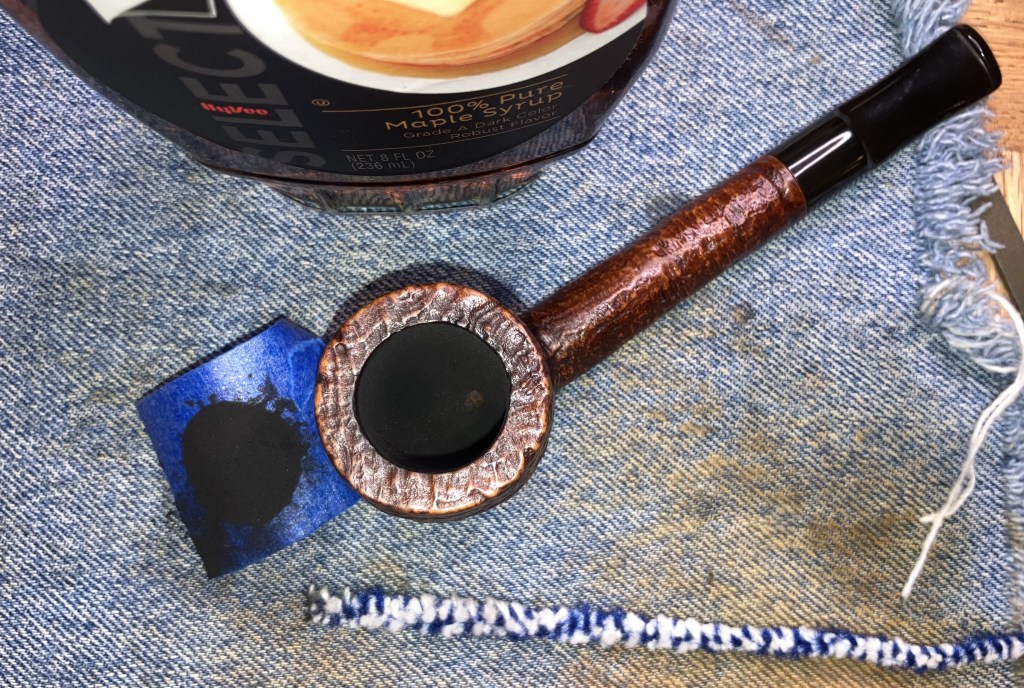
    I thought that this stummel would look better if the low spots of the blast were darker than the high spots.  To achieve this I thought a base coat of Fiebing’s Dark Brown Leather Dye would work nicely.  The tobacco chamber was sealed off with a wine bottle cork.  A folded pipe cleaner acted as my applicator for the dye and a lighter provided a flame to burn away the solvent portion of the alcohol based dye.

    A single coat of dye was applied and flamed.

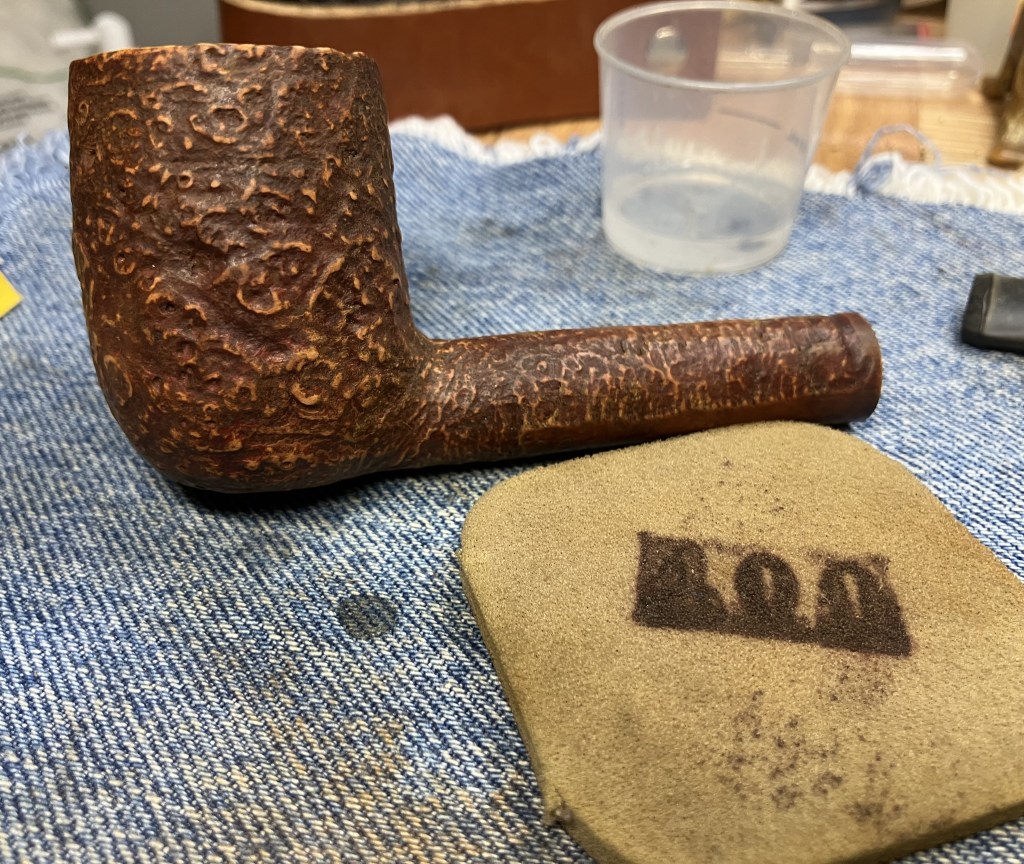
    I allowed the dye to dry then took it to the buffer.  I only wanted to remove the dye from the high spots so a light touch was used when buffing with rouge buffing compound.

    TO give the pipe more definition I lightly sanded the high spots with a 400 grit sanding sponge.

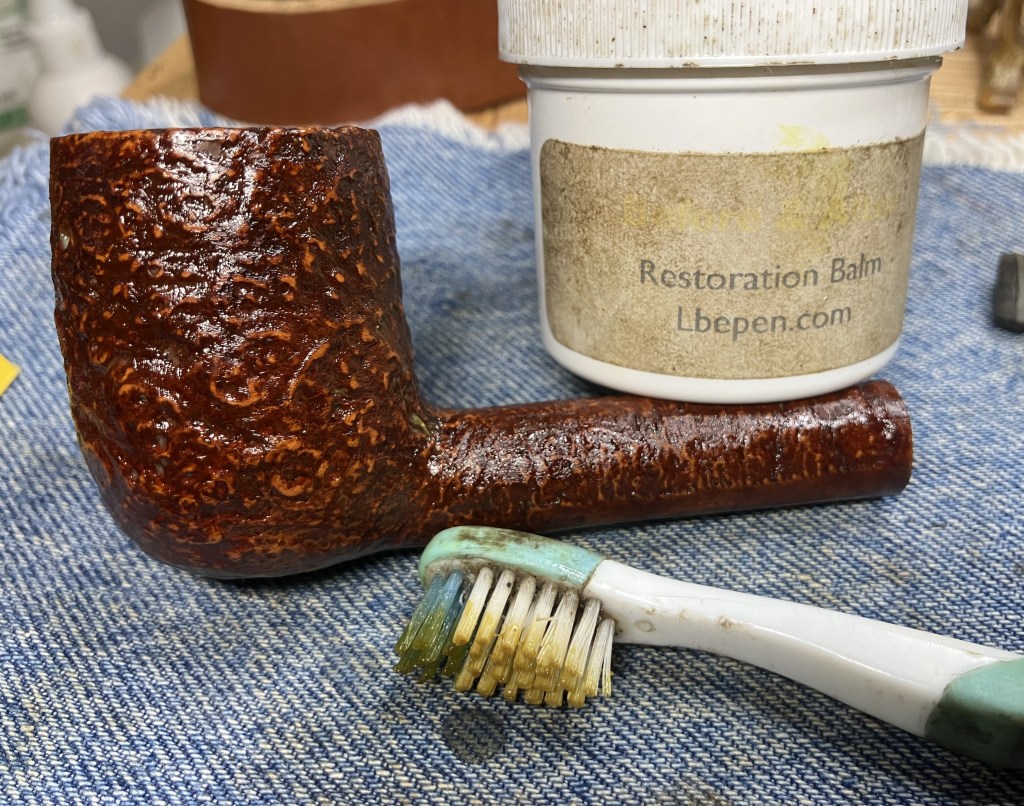
    The stummel was wiped with a make-up pad dipped in alcohol to remove buffing compound and sanding debris then a coating of Before and After Restoration Balm was applied and worked into the briar with a baby toothbrush.

    After about 15 minutes the Restoration Balm was hand buffed with an inside out athletic sock to remove the remaining balm.

    I covered the stem logo with a piece of masking tape to preserve the remaining logo.

    The shank was covered with a layer of masking tape to avoid sanding a well.

    The stem was sanded with a series of sanding sponges from 400-3500 grits.  Between each sponge, I rubbed the stem with mineral oil and wiped it with a paper towel.

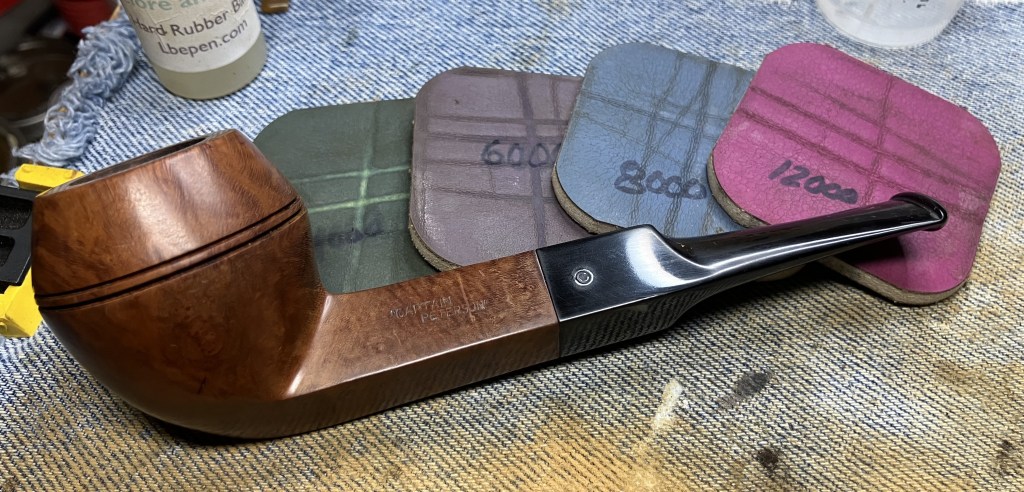
    The stem was then micro-meshed with the 4000-12000 pads.  Between each pad, I rubbed the stem with Obsidian Oil and wiped it with a paper towel.

    I buffed the stem with a blue compound on the dedicated blue compound buffing wheel.

    After buffing the stem, I removed the tape from the shank and the stem logo.  The logo was still slightly degraded by the deox process.  Hmm, I had hoped it would heal.  Yeah, unreasonable and foolish but still a hope.  It didn’t.

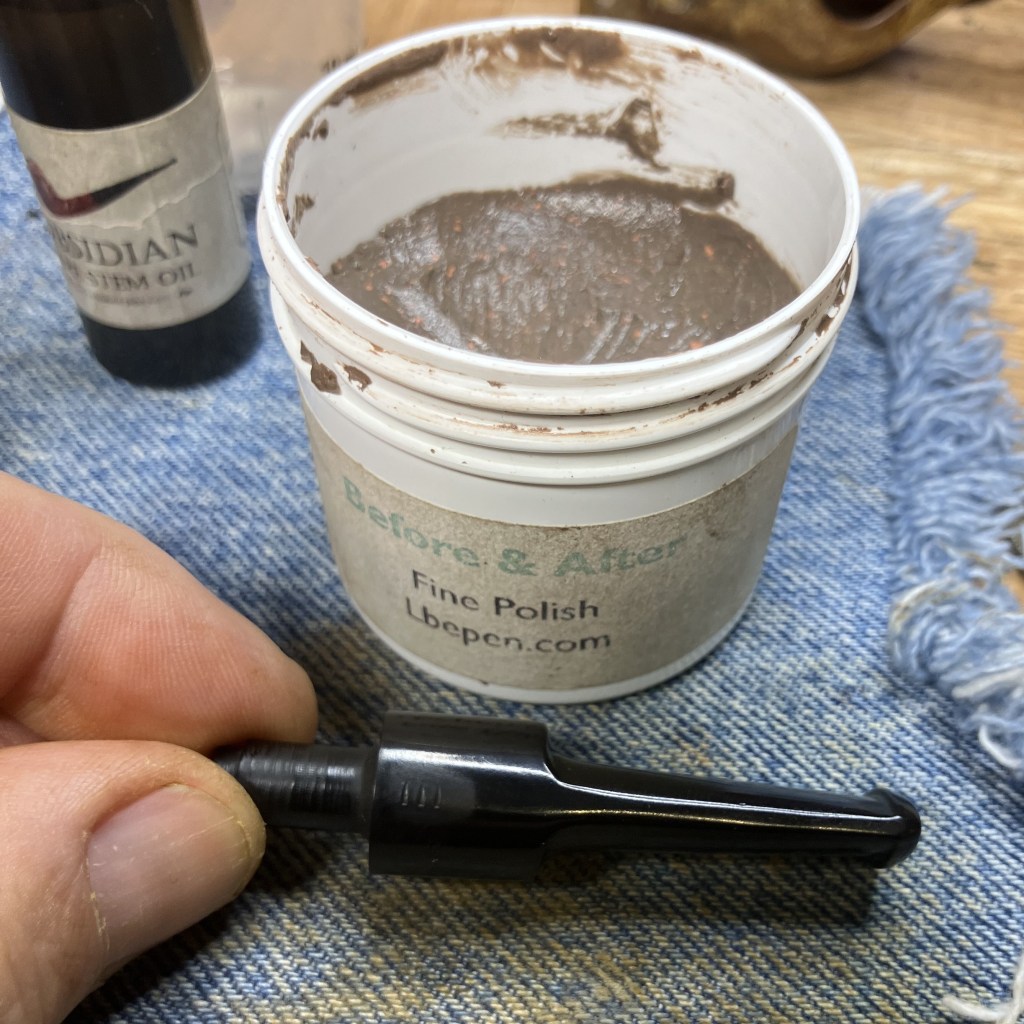
    To bend the unsanded/micor-meshed/buffed logo area, I tried to polish it with Before and After Fine Polish applied and hand buffed with a soft cloth.

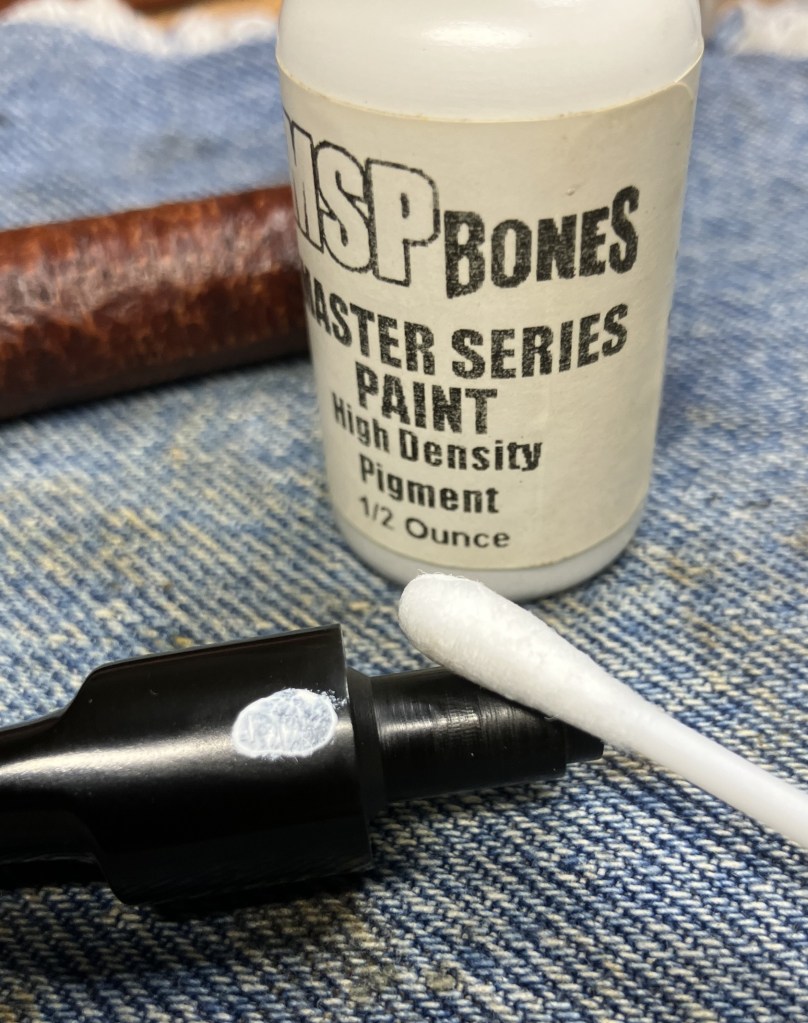
    I chose this white acrylic paint because I had it available, it’s water soluble, dries quickly and it reminds me that I need to paint a few miniatures for gaming.

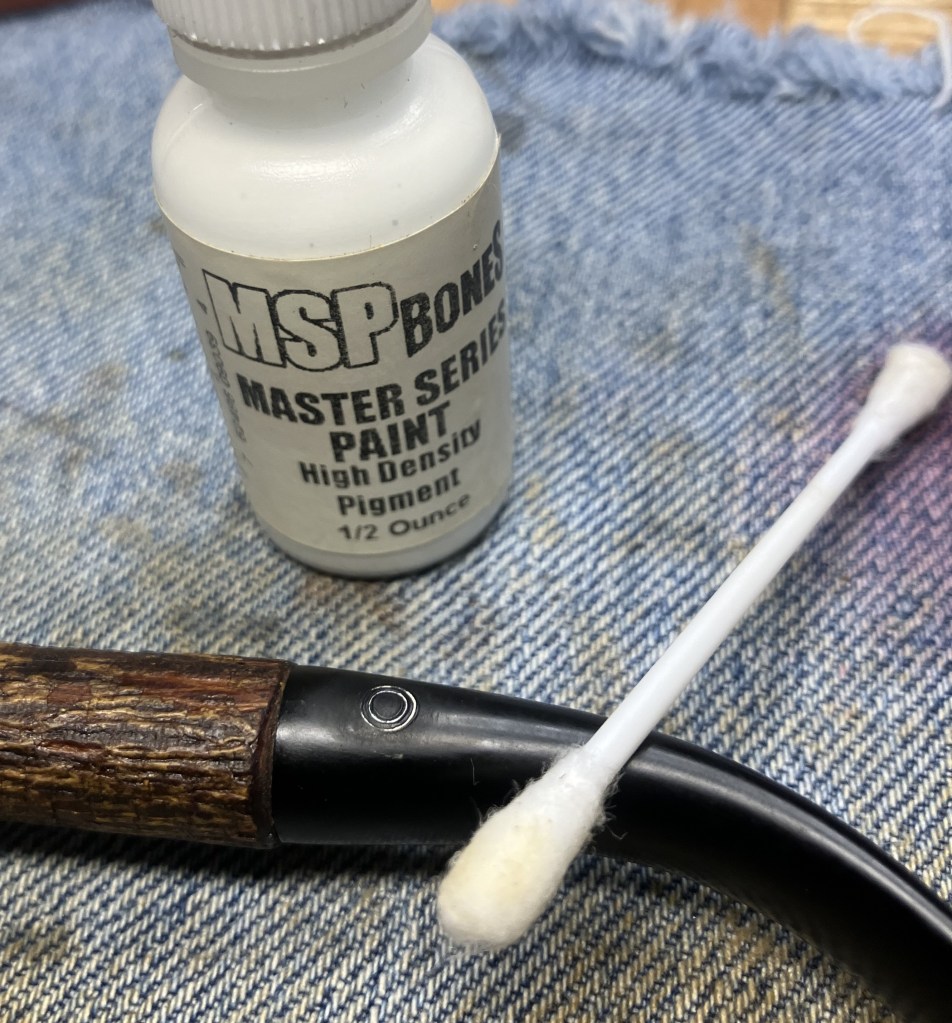
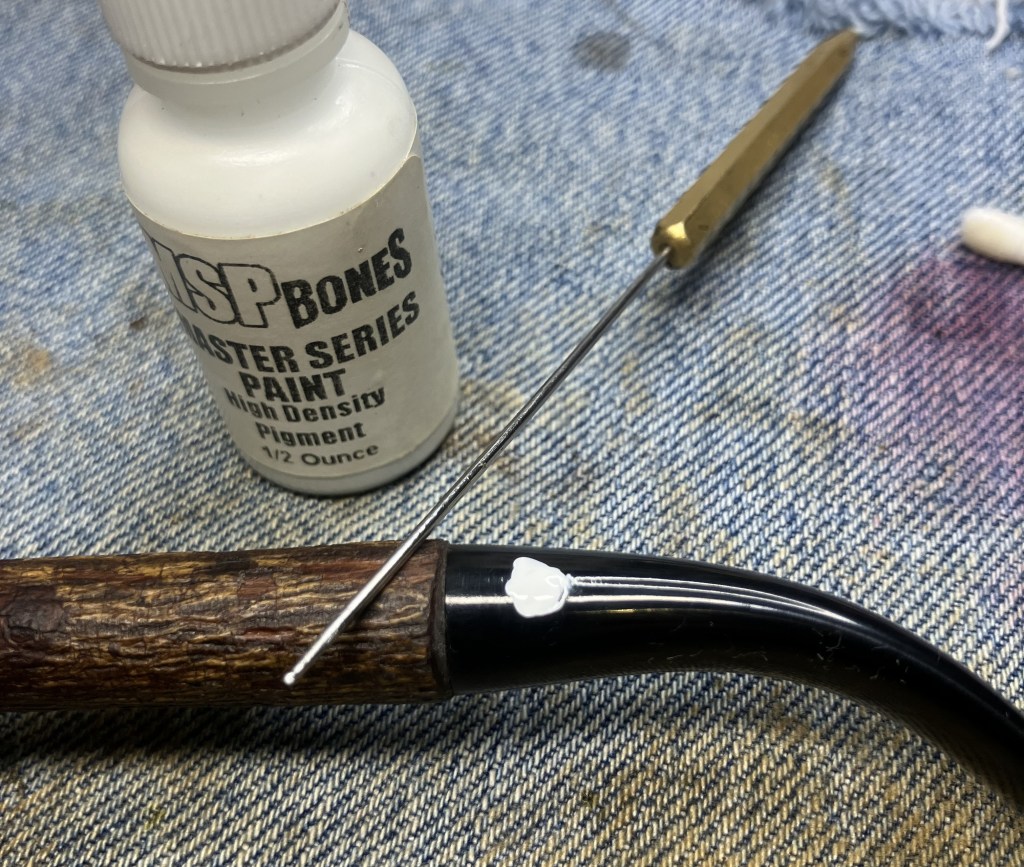
    I worked the white acrylic paint into the stampings of the logo with a cotton swab.

    The excess white acrylic was buffed off with a soft cotton cloth then re-micro-meshed the logo with a 12000 pad.

    I reassembled the pipe and thought back to the before photo.

    And compared it to the after.  I think the contrast dye brought out the texture of the blast better and added depth and character to the pipe.

    The pipe was then returned to the buffer for several coats of carnauba wax.  

    The final step was a hand buffing with a microfiber polishing cloth.

    Well, I thought I was finished then I saw the bowl when I was going to take the finished photos of the pipe.  DOH! I forgot that I wanted to give this pipe a bowl coating.  I coated the interior of the chamber with 100% applied with a cotton swab.  A capsule of carbon powder was poured into the chamber after I had blocked the airway with a pipe cleaner.  

    The rim was covered with a piece of painters tape.  The stummel was shaken for about one minute.  I removed the tape, pipe cleaner, dumped the excess carbon powder and blew through the airway to clear the remaining powder.

    The final step was a hand buffing with a microfiber polishing cloth (the real final step).

    This Mountbatten Billiard turned out very nicely.  The contrast dye helped eliminate the unicolor of the original finish.  The stem polished-up nicely even though I did lose some of the detail on the logo.  I went with a bowl coating to address a couple of gouges in the tobacco chamber from overexuberant scraping.  The blast texture is very pleasant in hand and brings out the lovely grain to this pipe.  Overall this pipe looks well made and of quality briar  that should provide years of enjoyment for the next owner.  The dimensions of the Mountbatten Billiard are:

    Length:  5.61 in./ 142.49 mm.

    Weight:  1.41 oz./ 39.97 g.

    Bowl Height: 1.92 in./  48.77 mm.

    Chamber Depth: 1.63 in./ 41.40 mm.

    Chamber Diameter:  0.74 in./ 18.80 mm. 

    Outside Diameter:  1.48 in./ 37.59 mm. (from cheek to cheek)

    I do hope that you have found something here useful to your own pipe care, maintenance or restorations.  If you like this sort of thing, please click the like and subscribe buttons.  Thank you for reading the ramblings of an old pipe lover.

    Loading…

    Below are some photos of the finished Mountbatten Billiard.

  • A Marxman Figural Bulldog, really a dog not the pipe shape, Restoration

    October 20th, 2025

    Photographed and written by

    John M. Young

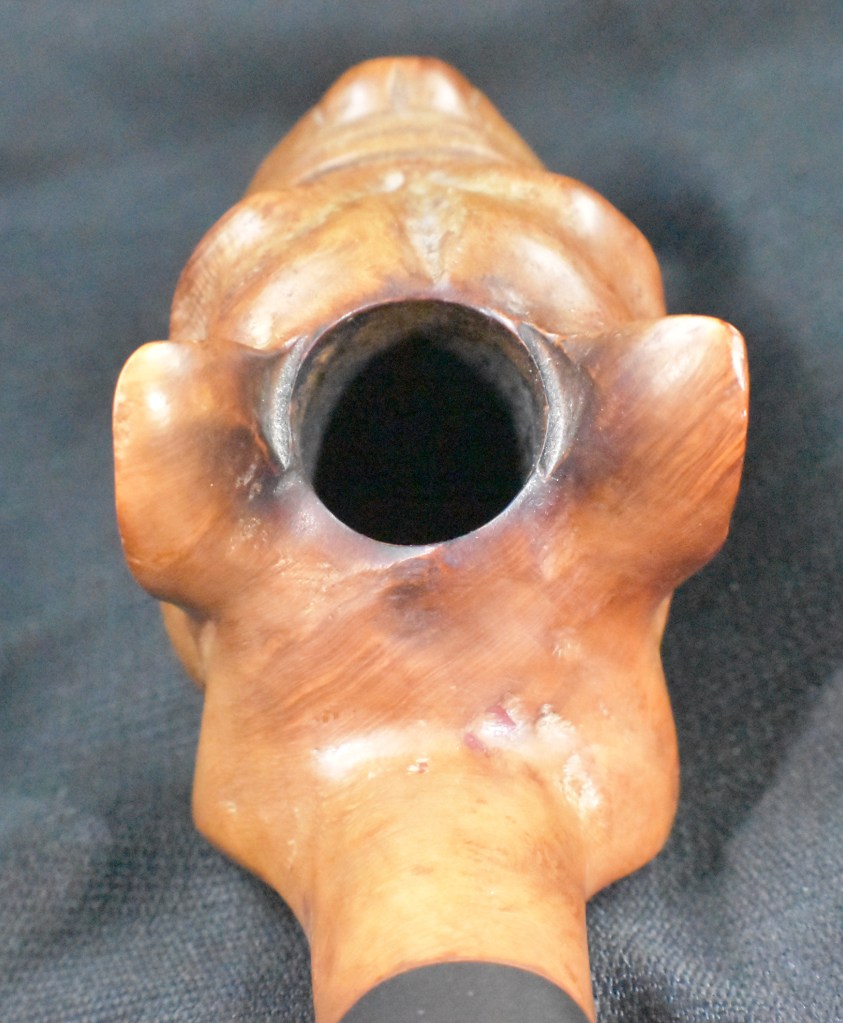
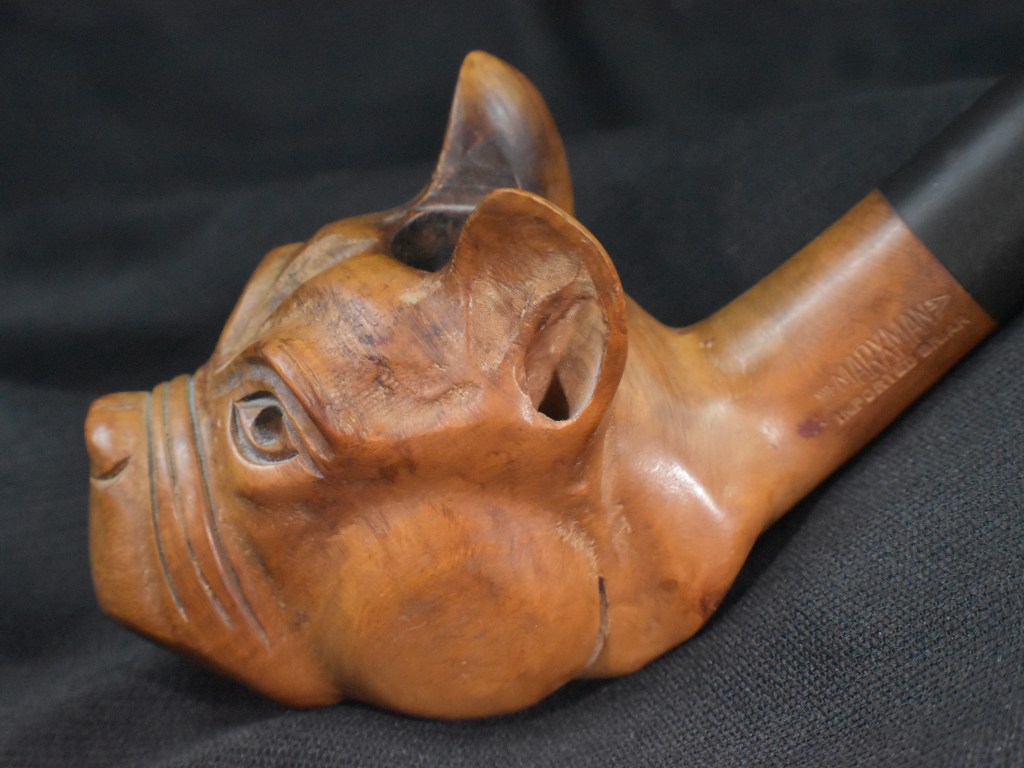
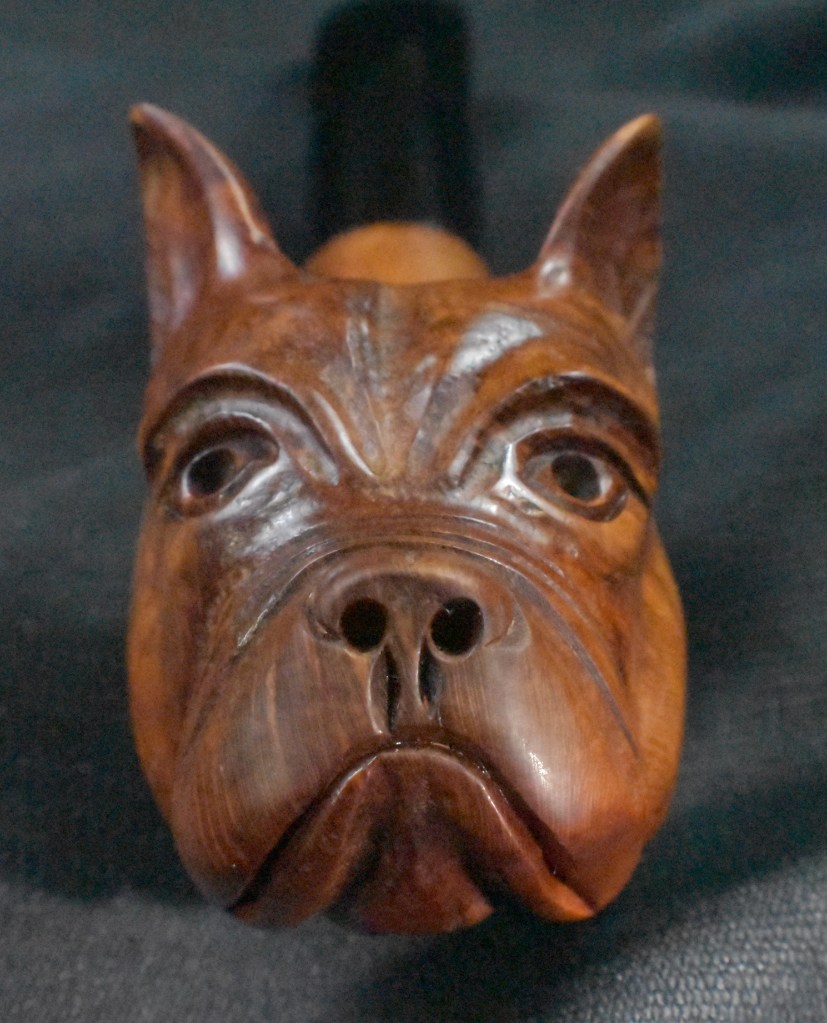
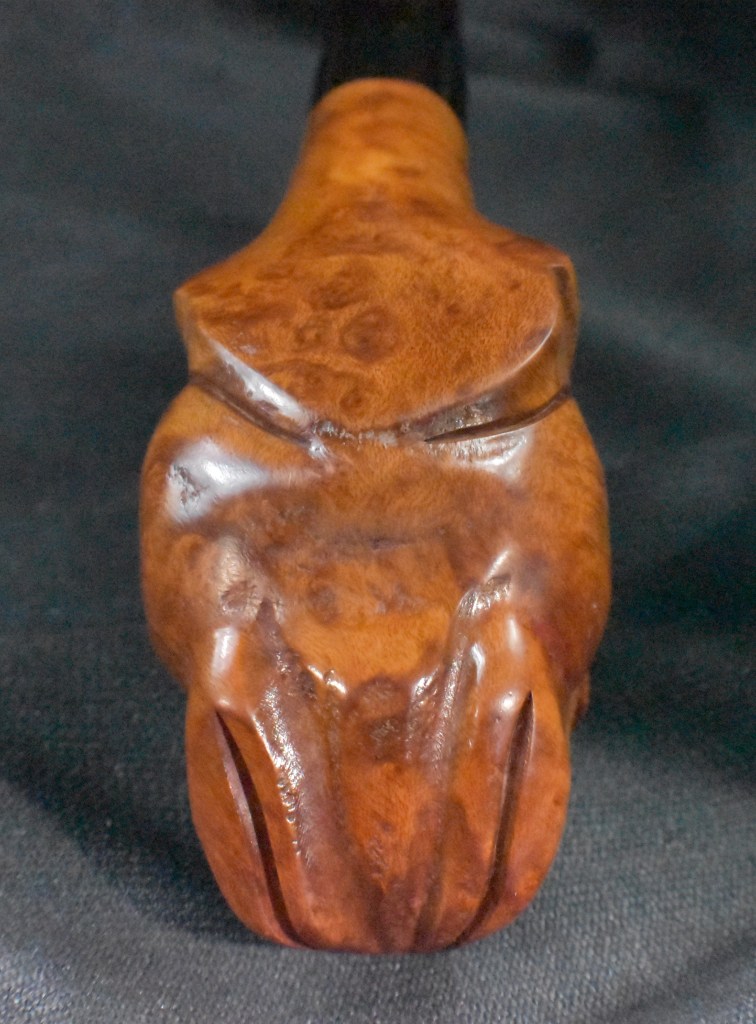
    The other day a friend was showing me the wonders of ChatGPT and how I could use it to write these blogs.  NEVER!  I do not think that any artificial intelligence will ever understand the feeling of satisfaction of restoring something as simple and inconsequential yet personally important as a tobacco pipe.  I fully intended this restoration to be a short and simple project.  I’ve restored many Marxman pipes so the research could be recycled and referred to and the pipe was in great shape.  Until it became like the “stinky car” episode from Seinfeld.  I’ll let you read about that later.

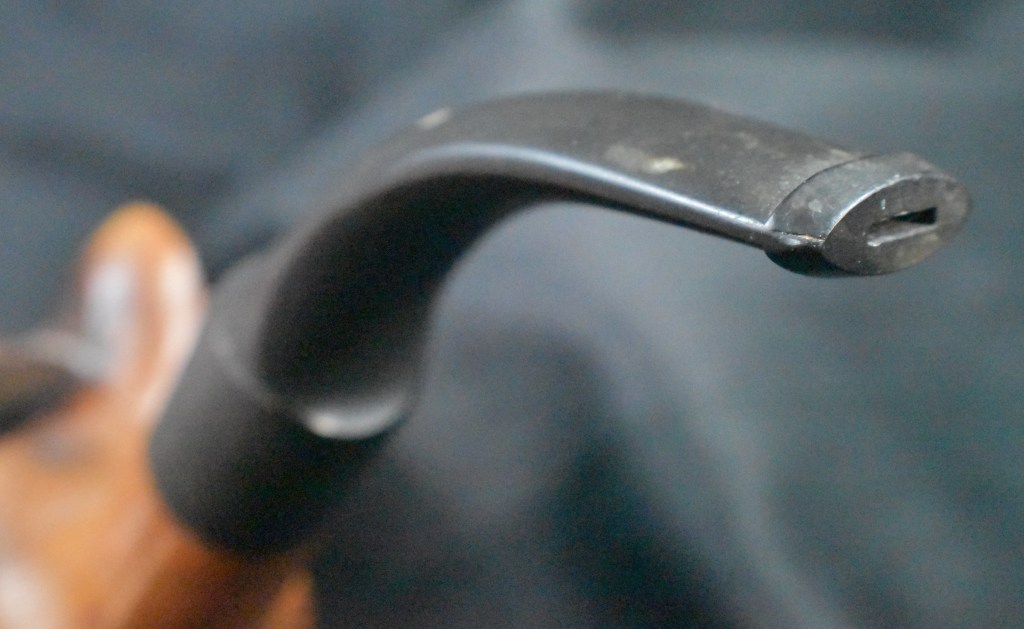
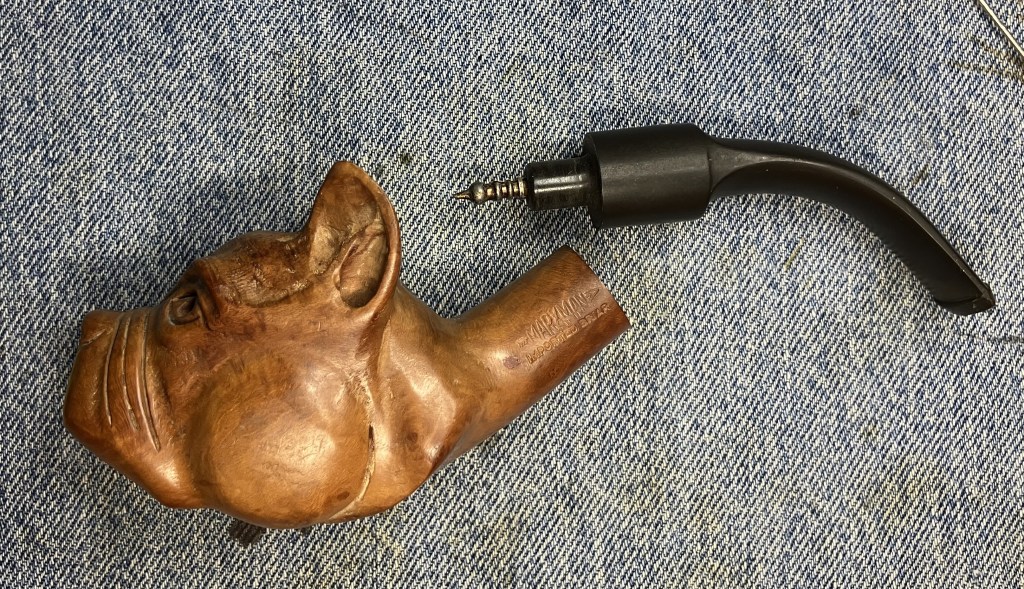
    And you’re a good dog. Oh sorry, I forgot who my audience was.  The Marxman was in pretty good shape and had not appeared to be heavily used.  Judging by the lack of tooth chatter on the stem and the relatively clean stinger and bowl it looked as though it had not been smoked more than a dozen times.  There was some oxidation on the stem and a fill in the dog’s right ear that I did not like the look of but overall this looked like a straight forward restoration.  This pipe was very large, I feel like I should mention that.

    Background

    Due to a level of laziness that impresses even myself, I will use the following from the restoration on a Marxman Rattlesnake figural pipe that I finished recently:

    “I have done a lot of Marxman restorations.  Next to Peterson pipes I am sure Marxman pipes come close as to numbers.  I have also written about the history of Robert Marx and how he formed and built up the company during World War Two, not an easy task considering the main material of his production was nearly inaccessible during the war years.  If you would like more information I think I did an acceptable job on Marxman history in the following blog:  A Marxman Dublin Gold Band Restoration – NebraskaPeteGeek.  Yeah it’s still written by me, but it’s pretty good for a change.

    As for Marxman figurals I have done a camel and a monk/friar.” (A Marxman Rattlesnake Figural Pipe Restoration – NebraskaPeteGeek).

    This pipe shows a carving skill that I think surpasses the carvings of the previous Marxman figural pipe that I have done.  Though the camel pipe is also of high quality.  The briar used must have been a very substantial piece of wood for the time.  I would place this pipe also within the late 1940s-1953 time frame.  All of the Marxman pipes from this period were carved in New York City.

    The Restoration

    After the “before” photos the pipe was taken to the workbench where it got to sit on the Barely used denim piece.  I say barely used since the last restoration (I linked it if you are curious) was so darn clean I had little chance to dirty the denim.

    I was able to pull the stinger from the stem with little effort.

    I place the stinger into a medicine cup with 10ml of 99% ethyl alcohol to start it’s cleaning.

    While the stinger soaked I cleaned the airway of the stem with alcohol and bristle pipe cleaners.  

    A look down the mortise showed little smoking residue.

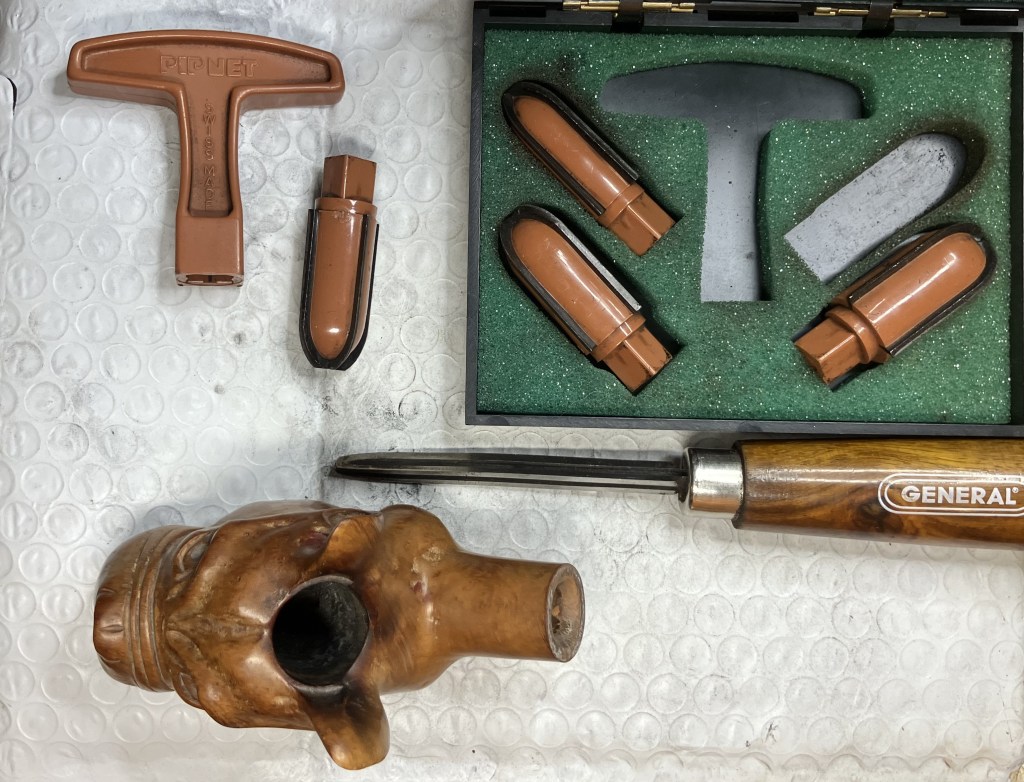
    The ream team was gathered and included the PipNet and the General triangular scraper.

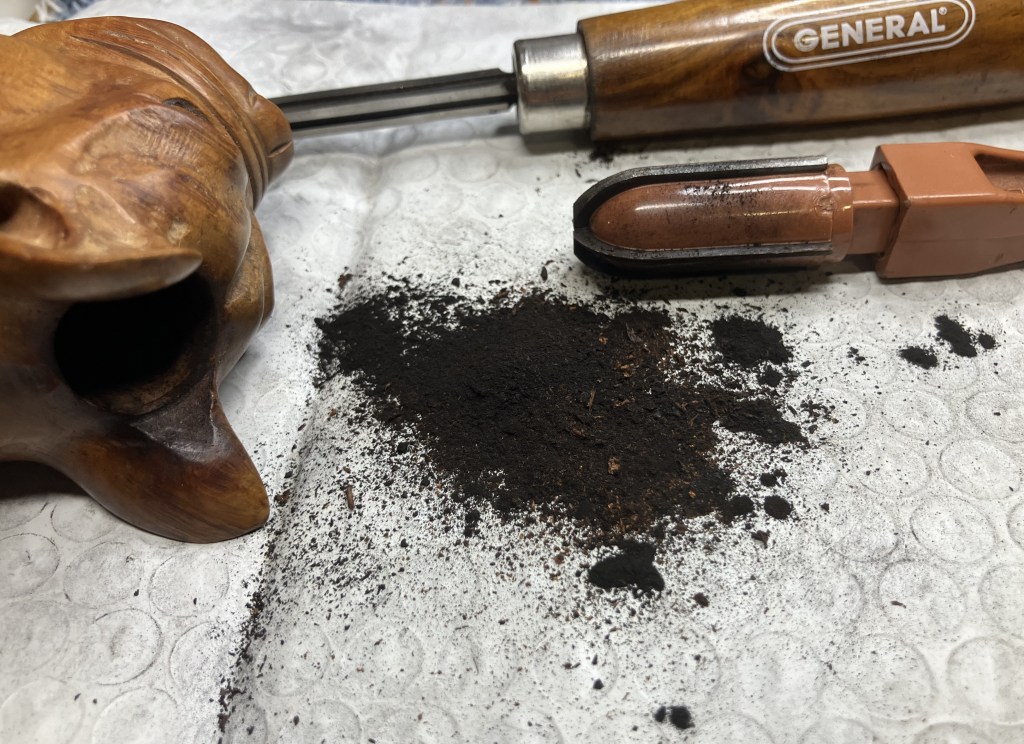
    There was a surprising amount of cake removed with the PipNet and the #2 blades.  

    The reamed tobacco chamber looked better but would need sanding to check for any damage to the chamber walls.

    Sure enough, sanding did show some light heat fissures.  These would be addressed with a bowl coating. 

    The shank cleaning was done with cotton swabs and bristle pipe cleaners dipped in 95% ethyl alcohol.

    The stem was lightly sanded in preparation for a soaking in Briarville Pipe Stem Oxidation Remover, also known as deox.

    A pipe cleaner was inserted into the tenon to act as a handle for retrieving the stem after a 6 hour soak.

    The stummel was scrubbed with Murphy Oil Soap and a nylon brush.  The soap was rinsed with warm water and the stummel dried with a cotton hand towel.

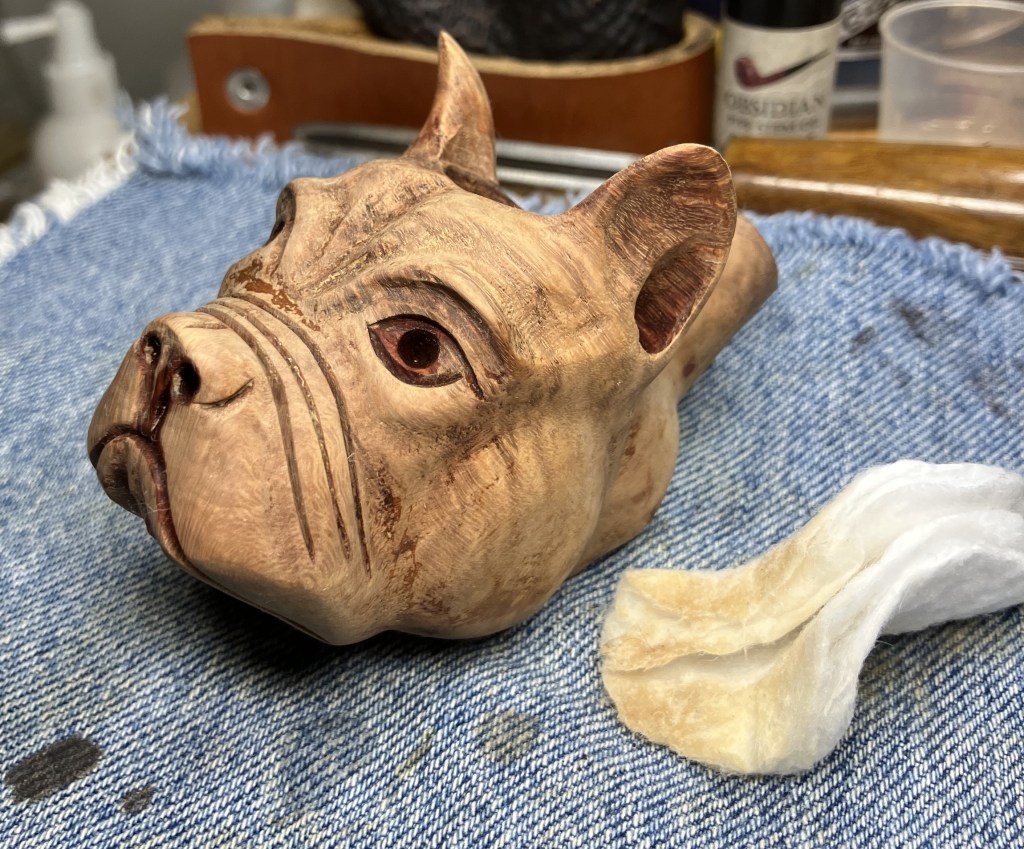
    Back at the workbench the stummel was wiped with 95% ethyl alcohol on a make-up pad.  The briar looked bare of any finish except for a few places in the depressions of the carvings.

    In the photo below, you can see a pit  and a small patch of a clear coat or lacquer. 

    The left ear of the bulldog must have also had a pit which was filled with the dreaded pink goo used as a filler.  I was thinking of methods to smooth out that lump of goo.

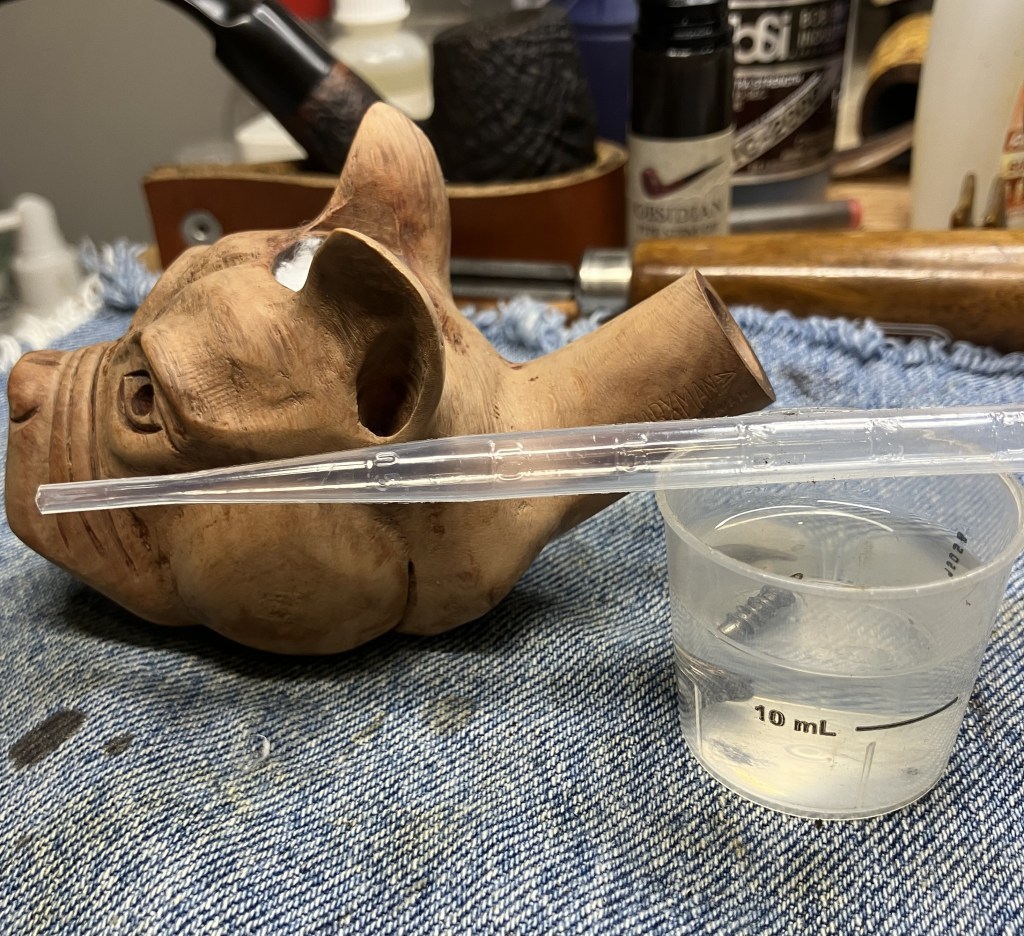
    This pipe had an aroma which I refer to as “granny purse”.  It is that smell that my grandmother’s purse had, kind of like something which had been repeatedly exposed to perfume where the perfume smell lingers long after it should.  I thought that it was due to the previous owner smoking  a Lakeland blend containing geranium oil.  I figured that an alcohol and cotton treatment would rid the pipe of the floral ghost and allow me some time to think of ways to fix that ear.  The tobacco chamber and shank were packed with cotton.

    95% ethyl alcohol was added to the cotton with a disposable pipette until the cotton was saturated.

    The alcohol cotton treatment would take an overnight wait so I turned to cleaning the stinger.  

    Since the pipe’s stem was still soaking in deox, I found an extra stem which fit the stinger.  This stem would provide me with a handle for buffing/polishing the stinger on the buffer.

    The stinger was buffed using a blue compound and looked much better.

    After the buffing and the removal of any remaining blue compound the stinger looked great.

    Below is a photo of the saturated cotton as I headed to bed.

    The next day the majority of the alcohol had evaporated.  This evaporation allows the alcohol to dissolve smoking residues and draw them into the cotton where they are deposited.

    I removed the cotton.  The cotton in the shank had a strange pick color.  The briar did not stain the make-up pad with alcohol pink as it would if a red dye had been used to stain the briar.  What is this? I wondered.

    I used a couple of cotton swabs to re-clean the shank.

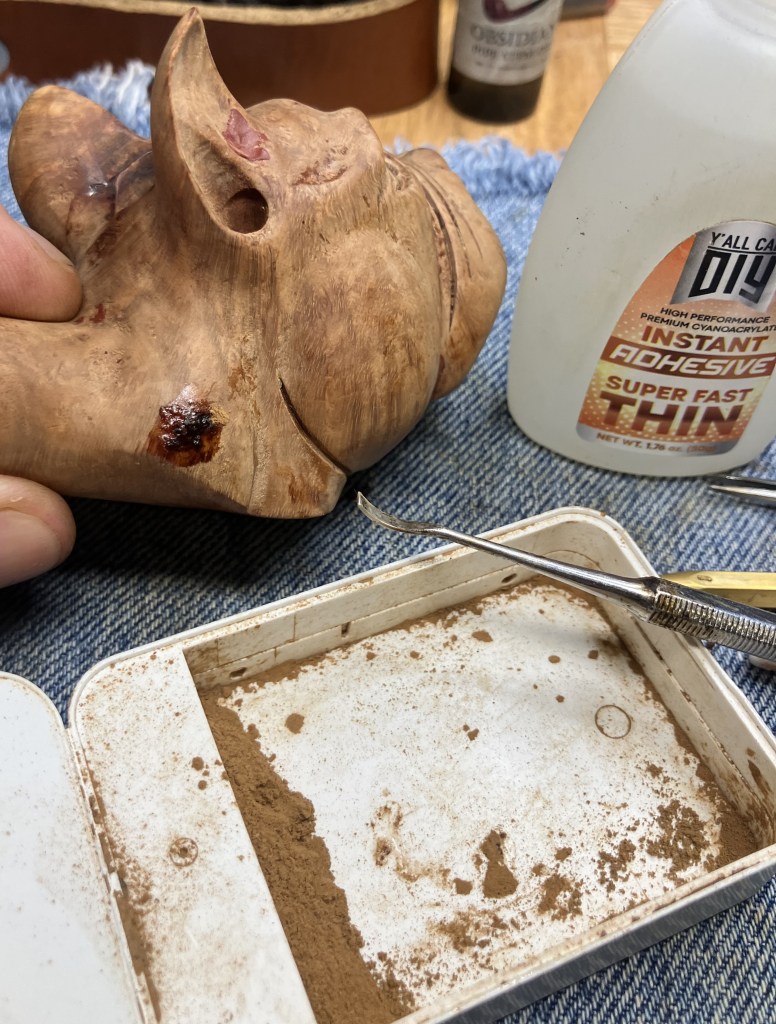
    To address the pit, I used briar dust and thin cyanoacrylate (CA, super glue).  The pit received a tiny drop of CA which then had briar dust pressed into it.  The briar dust then received another drop of CA.

    The fill was then filed with a small flat file and smoothed with a 400 grit sanding sponge.

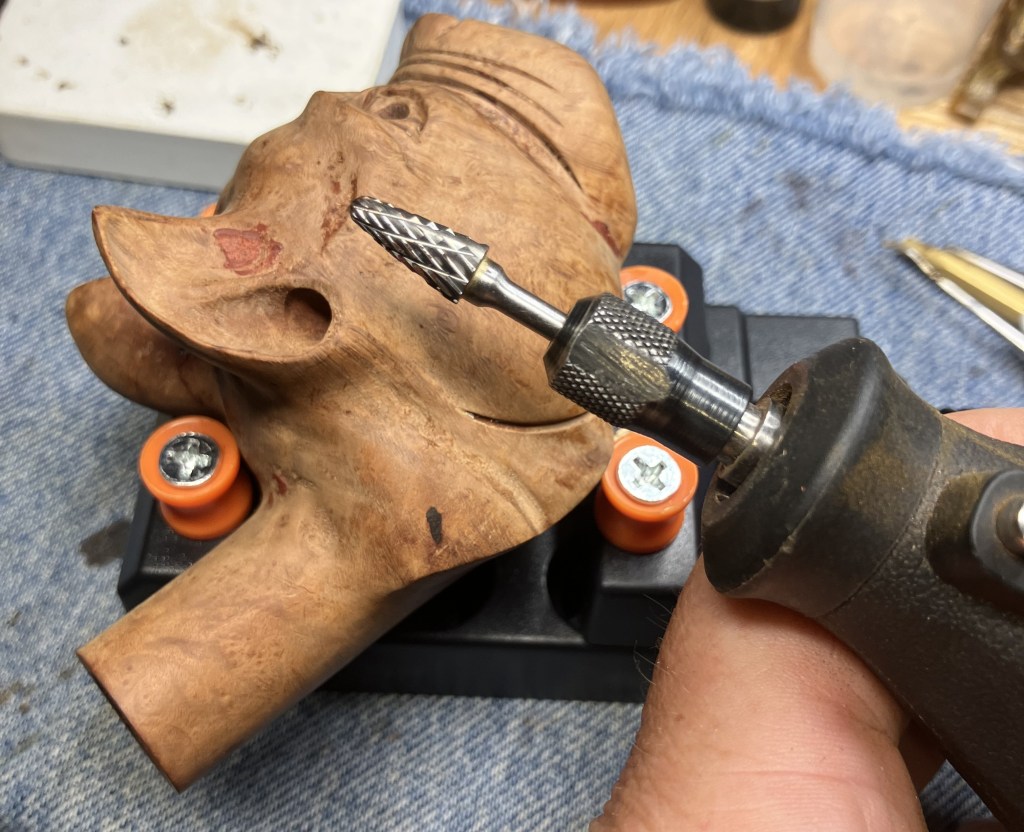
    My thinking of ways to fix the pink-goo-ear-fill was to re-carve it using a Dremel rotary tool.  The first bit I used was the pointy bit, below.

    The second bit used was more rounded to allow for a smoother finish.

    Below is a photo of the re-carved ear.  I could only see a tiny pit which I did not think required all that pink-goo.

    The stummel was sanded with 400 then 600 grit sanding sponges.  I did not want to over-sand and remove any detail of the carving.

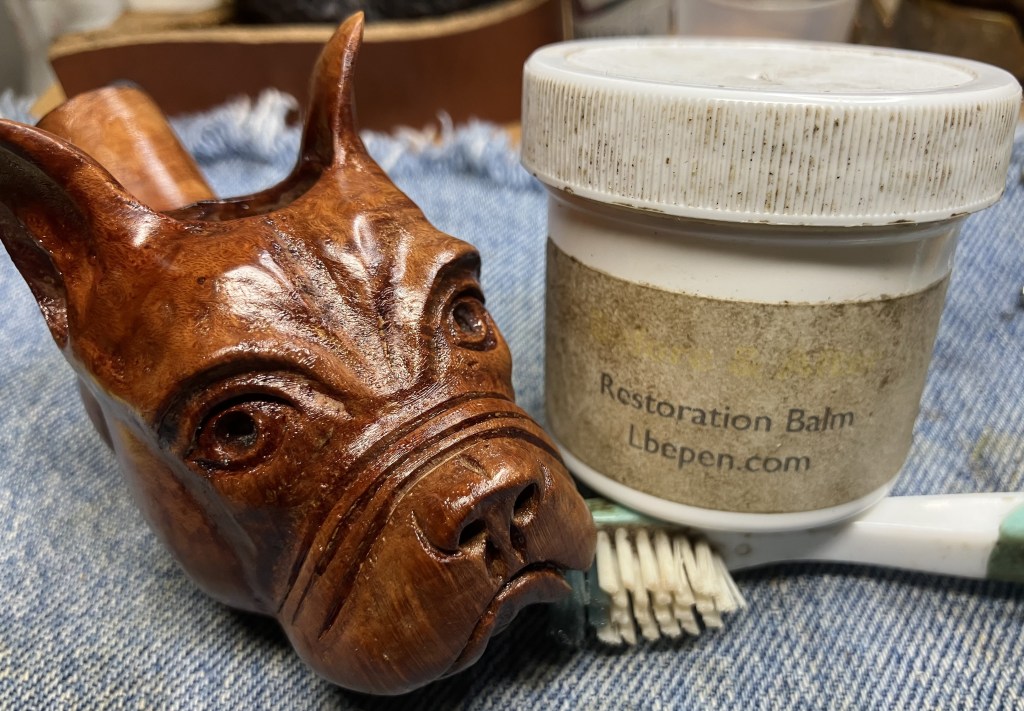
    The stummel was then coated in Before and After Restoration Balm, applied with a baby toothbrush, and allowed to sit for 30 minutes.

    The stem was removed from deox.  What was supposed to be a six hour soak turned into an 18 hour soak.  The stem was vigorously rubbed with a coarse shop rag.  This allows for the absorption of excess solution and removes some oxidized rubber.

    The stem appeared to be pitted from the deox removing oxidized rubber.   

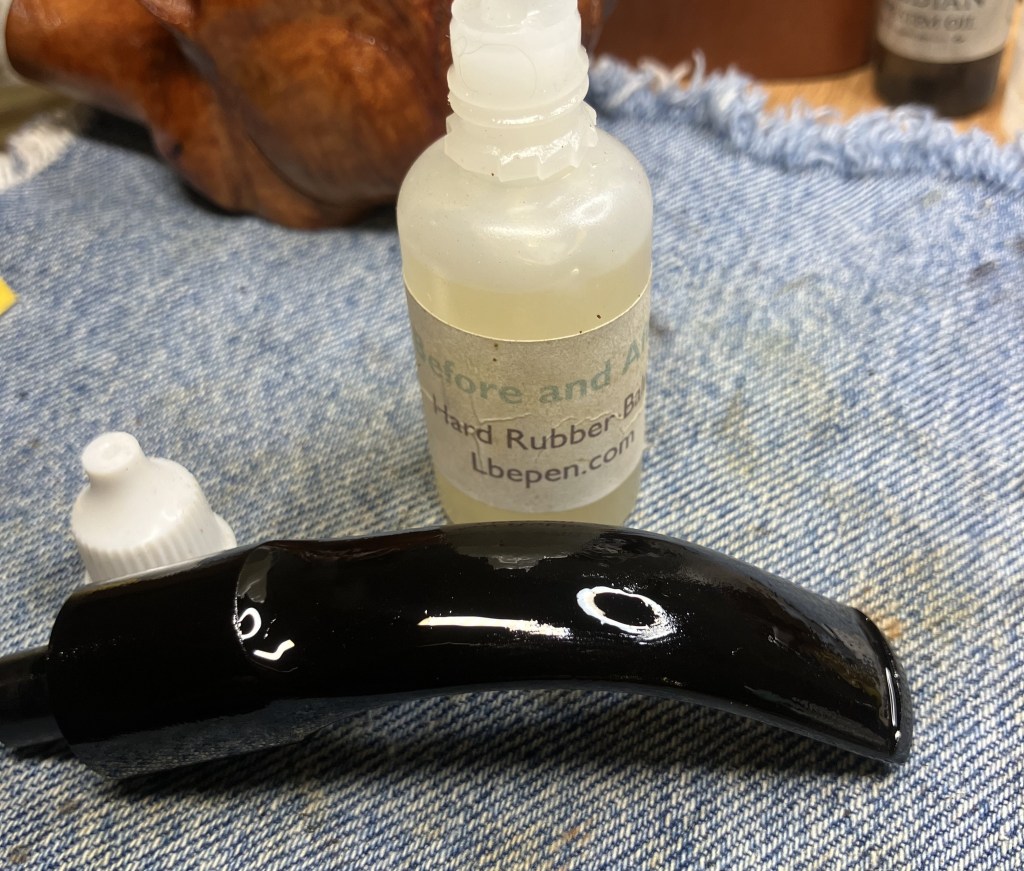
    I applied a coating of Mark Hoover’s Before and After Hard Rubber Balm.  I thought that this might help condition the vulcanite, this was allowed to rest for 6 hours.  

    The Restoration Balm was wiped from the stummel using an inside out athletic sock.

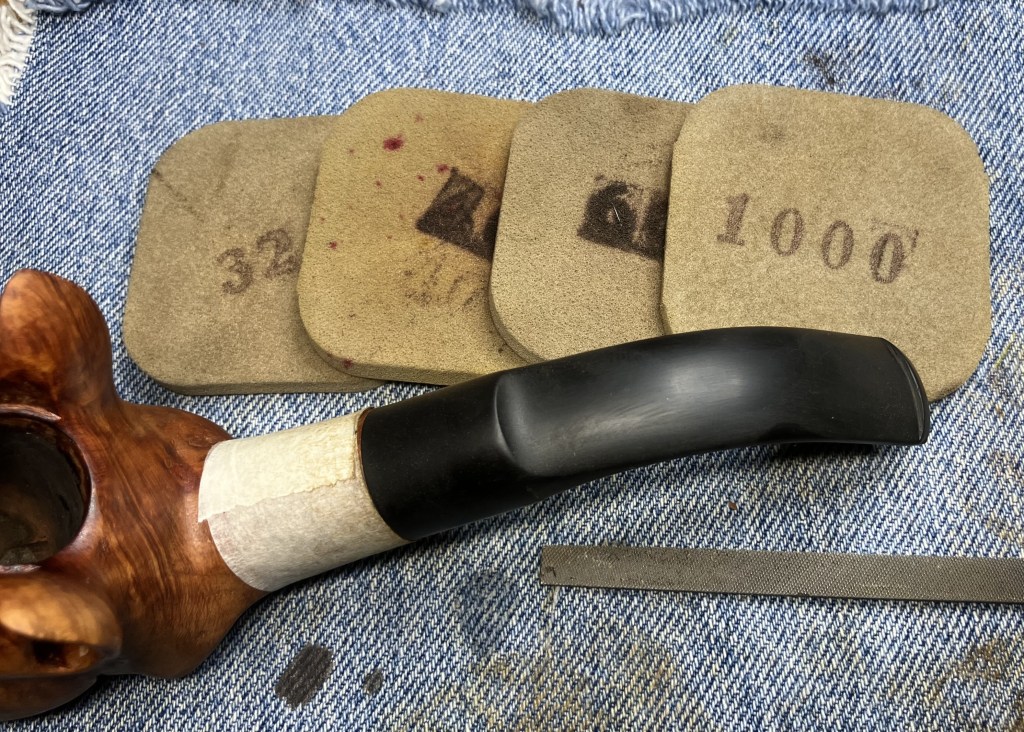
    When I returned to the stem, I wiped the remaining Hard Rubber Balm off with a dry paper towel.  The shank of the pipe was wrapped in masking tape to protect the shank from the sanding.  I then started sanding the stem with a series of sanding sponges from 320-1000 grit.  Between each sponge I rubbed the stem with mineral oil and wiped it with a dry paper towel.

    There was still a lingering granny purse smell to this pipe.  I thought another alcohol cotton treatment might remedy that.

    The cotton was removed the next day and it was still pulling some of that pink color from the airway of the shank.  Was this the source of the granny purse aroma?

    The tape was removed and cleaned with alcohol to rid the shank of any residual adhesive.  I then worked a bit of the Before and After Restoration Balm into the briar there and around the rim.  After that sat for 10 minutes I again wiped it with the athletic sock and took the pipe to the buffer for a few coats of carnauba wax.

    The final step was a hand buffing with a microfiber polishing cloth.

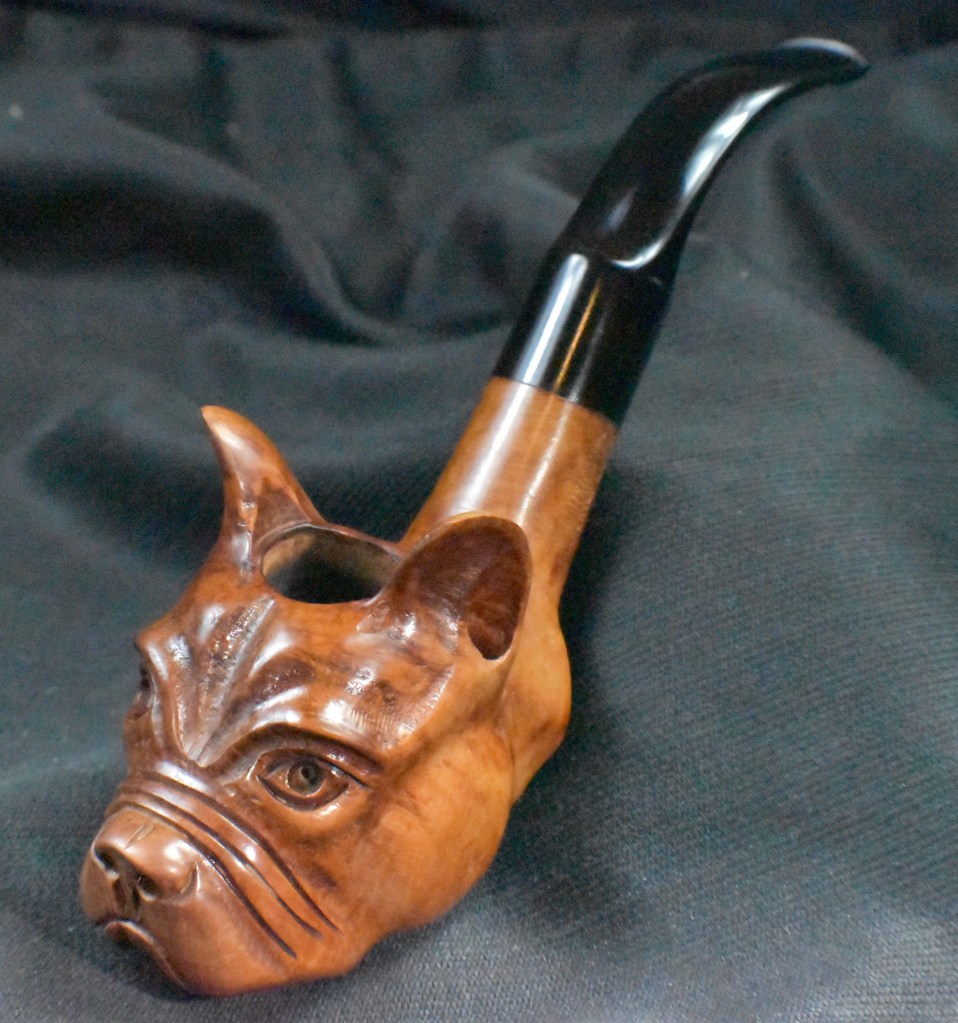
    This Marxman Figural Bulldog is a true beauty. It is a handful of a pipe and weighs in at over 3 ounces (88.45 g).  The amazing thing is that it clenches very well and does not feel nearly that heavy.  The expressive eyes of the carving are an indication of the skill of the carver and the quality of the carving.  The fill and the recarving of the ear that I did, were small touches which I think added to the pipe.  The briar itself must have been huge for this time period, just based on the size of the block, I am thinking this pipe was made after World War Two.  The dimensions of the Marman Figural Bulldog pipe are:

    Length: 7 in./178 mm.

    Weight:  3.12 oz./ 88.45 g.

    Bowl Height: 2.00 in./  50.80 mm.

    Chamber Depth: 1.44 in./ 36.58 mm.

    Chamber Diameter:  0.72 in./ 18.29 mm. 

    Outside Diameter:  1.77 in./ 44.96 mm. (from cheek to cheek)

    Oh, I almost forgot. Did the second alcohol cotton treatment exorcise the “granny purse” ghost? Mostly. There still remains a very slight hint of the geranium oil. I think that it should disappear with a couple of bowls of pipe tobacco.

    I do hope that you have found something here useful to your own pipe care, maintenance or restorations.  If you like this sort of thing, please click the like and subscribe buttons.  Thank you for reading the ramblings of an old pipe lover.

    Loading…

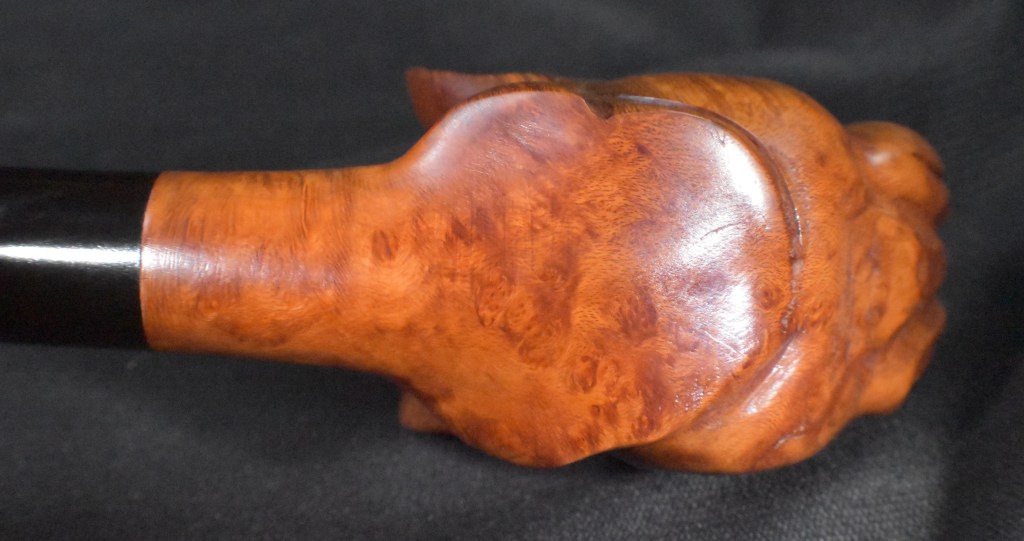
    Below are some photos of the finished Marman Figural Bulldog.

  • A Big Ben Classic Line 702 Bent Bulldog Restoration?

    October 2nd, 2025

    Photographed and written by

    John M. Young

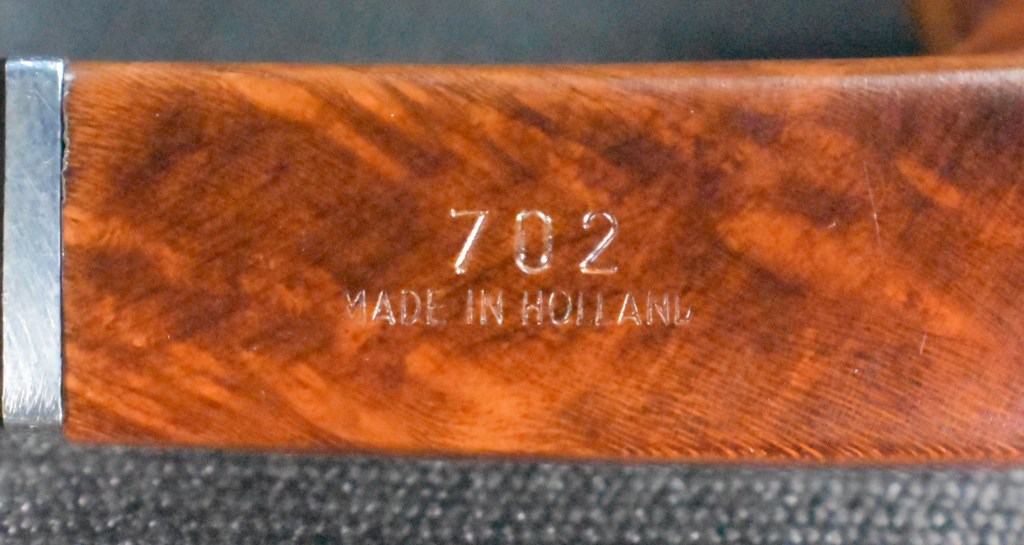
    Have you ever wondered how to use the terms Dutch, Holland or the Netherlands?  Well, this pipe may help.  The pipe was made in Holland, two of twelve provinces of the country known as the Netherlands.  Yeah, there are two Hollands, a north and a south.  The makers of the pipe were Dutch, referring to the culture and language of the region.  Okay, I have shown off my undergraduate geography major for four years quite enough for one day.

    This pipe caught my eye on eBay recently.  I was taken by both the shape and the price.  I immediately sent Sascha Mertens a private message via Facebook, asking if it was a good deal.  He replied quickly, as usual, saying that it was indeed a good deal for a relatively rare and desirable shape.  He had me at “good deal”.  I can’t say I place too much emphasis on popular things, I know what I like.  While we are talking about Sascha, he keeps me laughing with his complaints of purchasing pipes that are very clean.  Yeah, he complains when a pipe is too clean and does not provide him with the opportunity or challenge of cleaning them up himself.  This pipe is a wonderful example of that.  I think it had only been smoked once.  I now completely understand Sascha’s disappointment.  Below are some photos of the Big Ben 702 before I did any work, if you can call it that, on it.  

    The pipe was nearly brand new.  There was some unsmoked tobacco remnants in the bowl and a very minimal residue on the rim.  I cannot even call it lava.  The stem was slightly oxidized due to age with maybe a few light tooth marks.  The only other thing to complain about was a slight wax build-up in the beading.  This was going to be an “easy button” restoration.

    Background

    I first searched Big Ben on pipephil.eu:

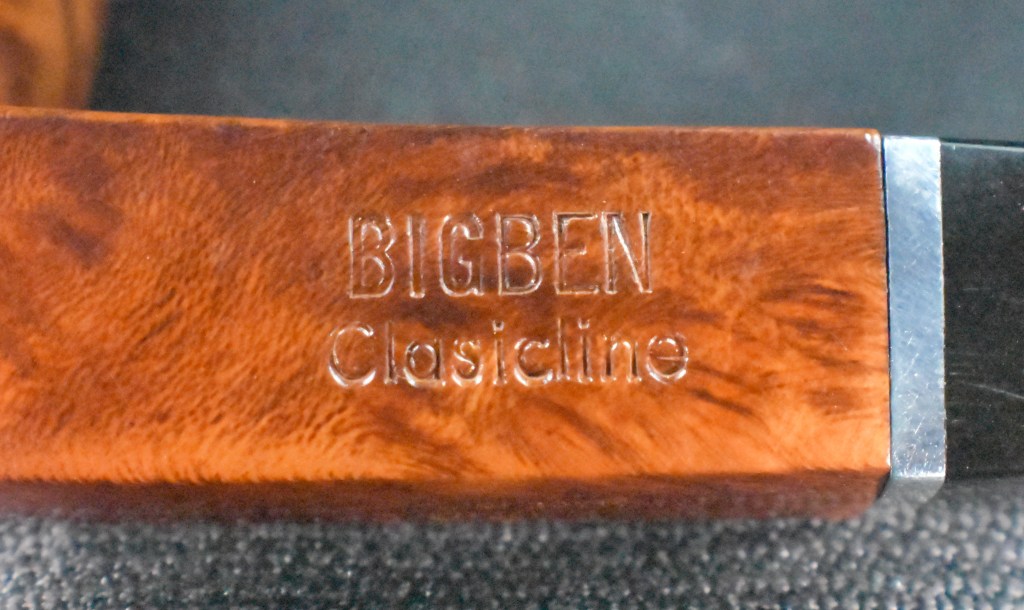
    Here I found very similar stamps but no reference to the Classic Line.

    (Big Ben — Pipes : Logos & Markings)

    The next search was on pipedia.org.  Here too, the entry was lacking specificity for the Classic Line.  Well actually it was lacking pretty much everything stating only, “The brand name Big Ben was originally owned by a small trade company in Amsterdam which was already well established in several countries selling pipes among other goods. The firm was bought by Elbert Gubbels & Zonen B.V. – see Gubbels – who were in search for a suitable brand name to further expansion on international markets.

    Big Ben became Gubbels’ mainstay brand with it’s own website” (Big Ben – Pipedia).

    I did follow the link from pipedia.org to the Gubbbels’ website:  Want to buy a Big Ben pipe? The best tobacco pipes since 1870 – bigben.  This site was a nice shopping and informational site.  I found the most impressive thing was that they opened the workshop up to the public every Friday from 10:00am-4:00pm.  Here in the US, that would likely meet with stern warnings from Occupational Safety and Health Administration (OSHA).

    “Our store is open every Friday! We cordially invite you to take a look at our production workshop. In our store you will find a wide range of Big Ben pipes in all shapes and colors. If your ideal pipe is not listed, we may be able to manufacture a pipe especially for you! Light maintenance of your beloved old pipe can usually be done on site.

    Making a pipe requires craftsmanship, a lot of fingerspitzengefühl and experience in working with the unpredictable and capricious material: the root of the Erica Arborea, better known as briar wood. Formed by the rocky bottom of the Mediterranean region, this noble and beautifully textured wood contributes its 50 to 80 years of growth to the value of the pipe. We are proud to be able to tell you the whole story – from carrot to tobacco pipe!

    We are open every Friday from 10:00 am to 4:00 pm. On all other days you can visit us by appointment.

    We look forward to seeing you in Beegden (Limburg)!”  (Want to buy a Big Ben pipe? The best tobacco pipes since 1870 – bigben)

    There was also a very nice history of the company and a look into their future.  It is quite detailed so I will not include it here but this link will take you there if you are interested in a very interesting history.  

    The Restoration

    The restoration began with a clean denim piece which I felt certain would remain clean upon finishing.

    I lexamined the tobacco chamber more closely under the bright lights of the workbench.  Only smoked once or twice, was my conclusion.

    The look down the mortise reaffirmed my thinking.

    The reaming of this tobacco chamber only required a brass bore brush, from a 20 guage shotgun and a light scrape from the Smokingpipes Low Country reamer.

    I swabbed out the chamber with an alcohol dipped cotton swab.  Below you can see that the reaming only produced a tiny bit of carbon and a few flakes of tobacco.

    The shank was cleaned out using 99% ethyl alcohol on cotton swabs.
    These too, came back with little grime.

    The stem was cleaned with alcohol and a bristle pipe cleaner.

    I used a dental scraper to clear the majority of the wax that was built-up in the bead around the bowl.

    The light residue on the rim was removed with saliva and a cotton make-up pad.

    I took the stummel to the sink for what was probably an unnecessary scrubbing with undiluted Murphy Oil Soap and a nylon brush.
    Some habits are hard to break.
    The soap was rinsed with warm water and the stummel dried with a cotton hand towel.

    Back at the workbench, the stem had a slight residue, likely from the airway cleaning.

    I rubbed the stem with alcohol on a make-up pad and did get some oxidized vulcanite from the surface.

    The stem was taken to the buffer where it was buffed with a blue buffing compound.
    This removed any additional oxidation along with the slight tooth chatter.
    It also dulled the bright silver of the stem logo.

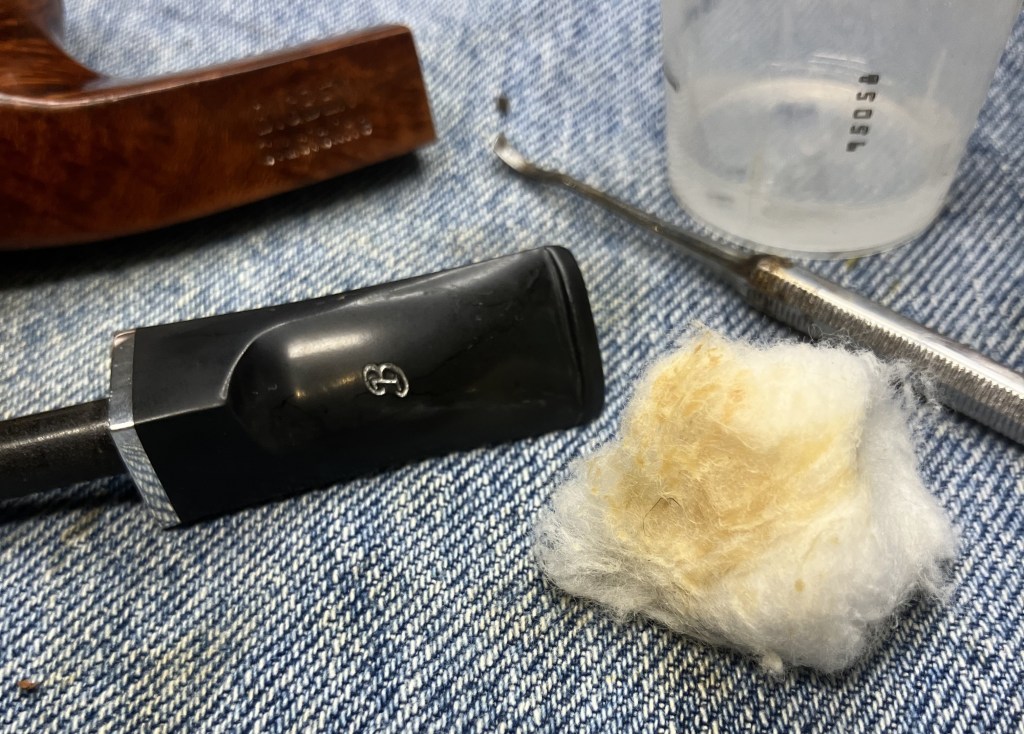
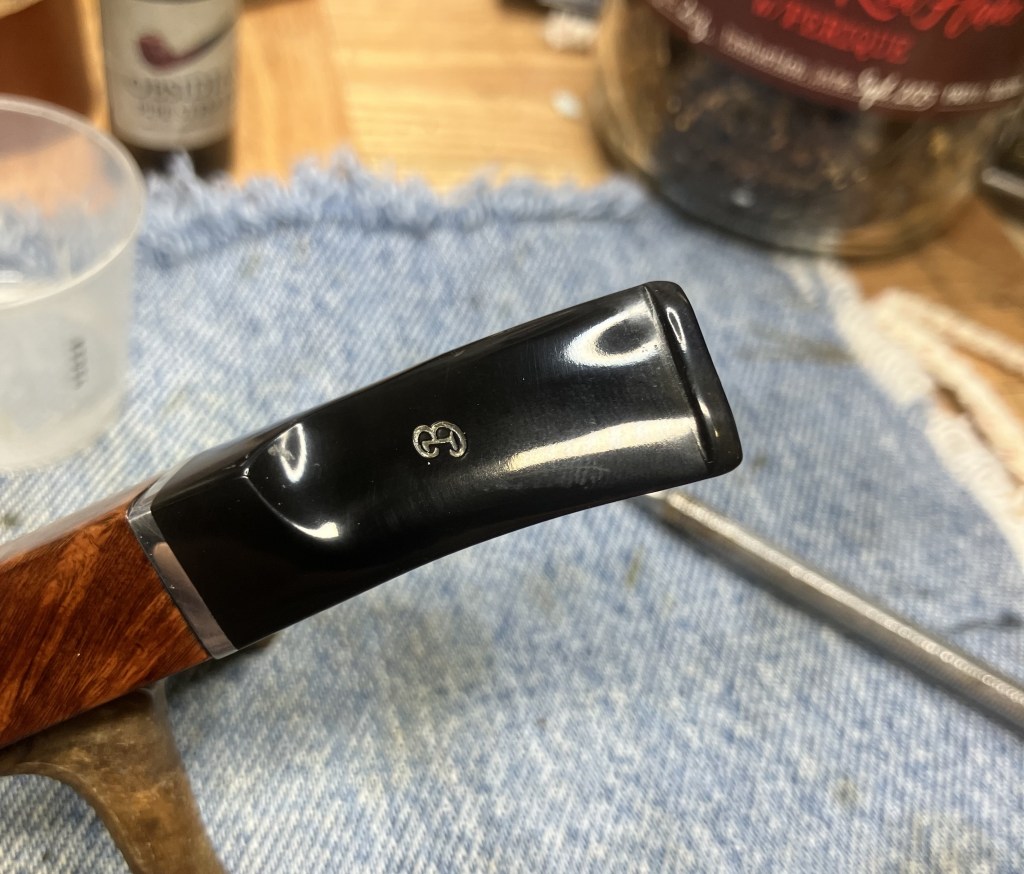
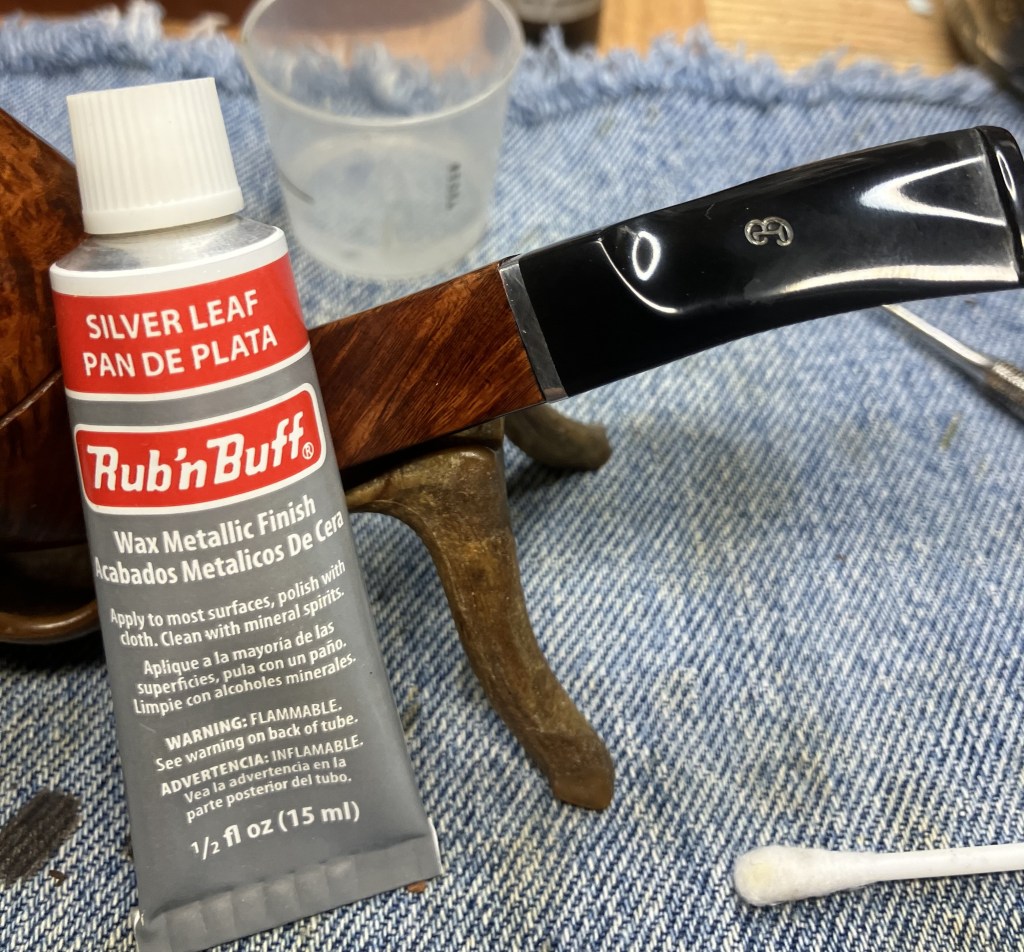
    To replace the silver, I used Silver Leaf Rub’nBuff.  Before applying the fresh silver, I cleaned the logo with a cotton swab dipped in alcohol.

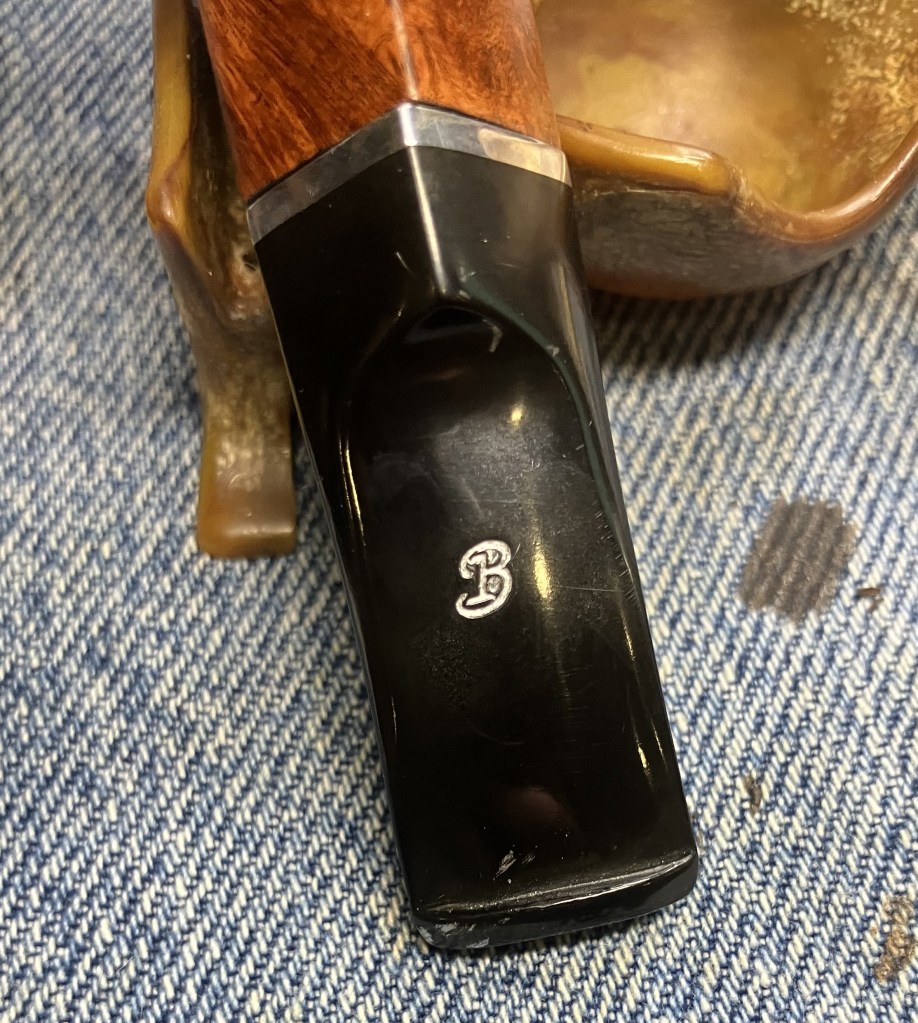
    The silver leaf was applied and hand-buffed with a soft cotton cloth.

    The resulting fresh silver was back to its original bright finish.

    The pipe was given several coats of carnauba wax with the buffer.

    The final step was another hand buff with the microfiber polishing cloth.

    This beautiful Big Ben Classic Line 702 did not need very much work. I love the shape and the balance of this pipe.  It fits my hand well and clenches like a dream.  The contrast dye was well done at the factory and really accentuates the briar.  THe bright nickel accent on the stem goes very nicely with the silver stem logo.  This is just a classy comfortable pipe that I am glad to add to my personal collection.  The dimensions of the Big Ben Classic Line 702 are:

    Length:  4.74 in./ 120.40 mm.

    Weight:  1.48 oz./ 41.96 g.

    Bowl Height: 1.97 in./  50.04 mm.

    Chamber Depth: 1.57 in./ 39.88 mm.

    Chamber Diameter:  0.68 in./ 17.27 mm. 

    Outside Diameter:  1.63 in./ 41.40 mm.

    I do hope that you have found something here useful to your own pipe care, maintenance or restorations.  If you like this sort of thing, please click the like and subscribe buttons.  Thank you for reading the ramblings of an old pipe lover.

    Loading…

    Below are some photos of the finished Big Ben Classic Line 702.

  • A Thompson Block Meerschaum Billiard Restoration

    September 30th, 2025

    Photographed and written by

    John M. Young

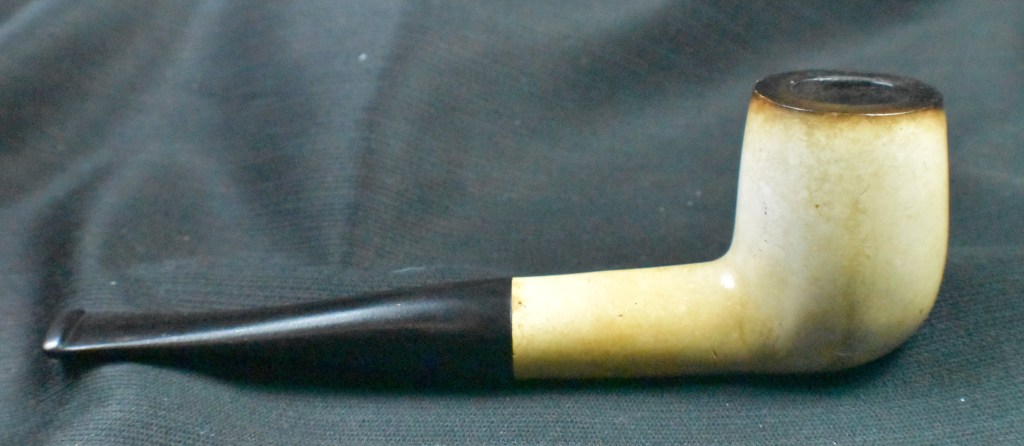
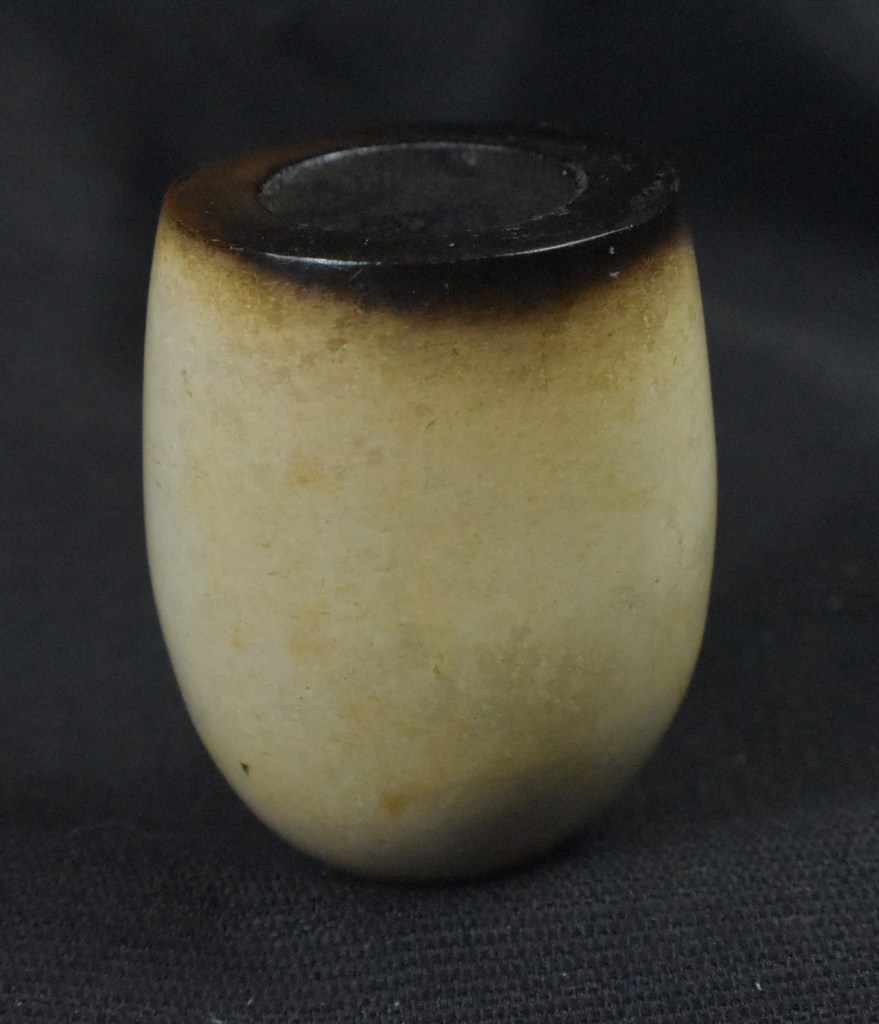
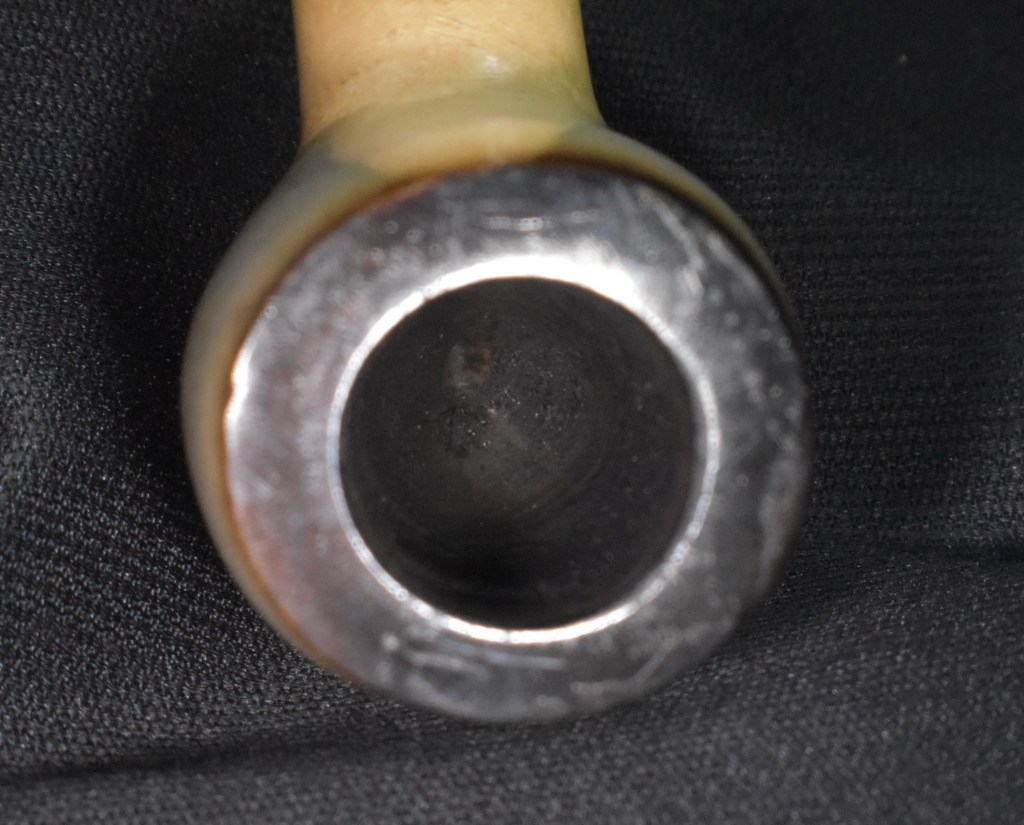
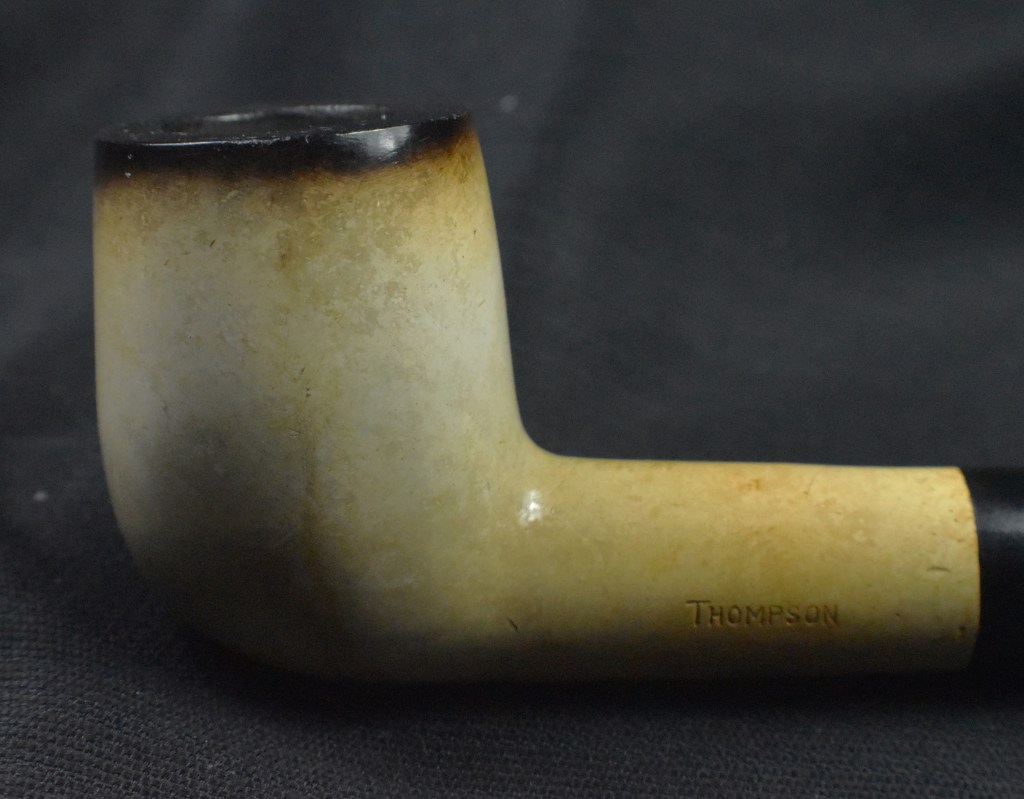
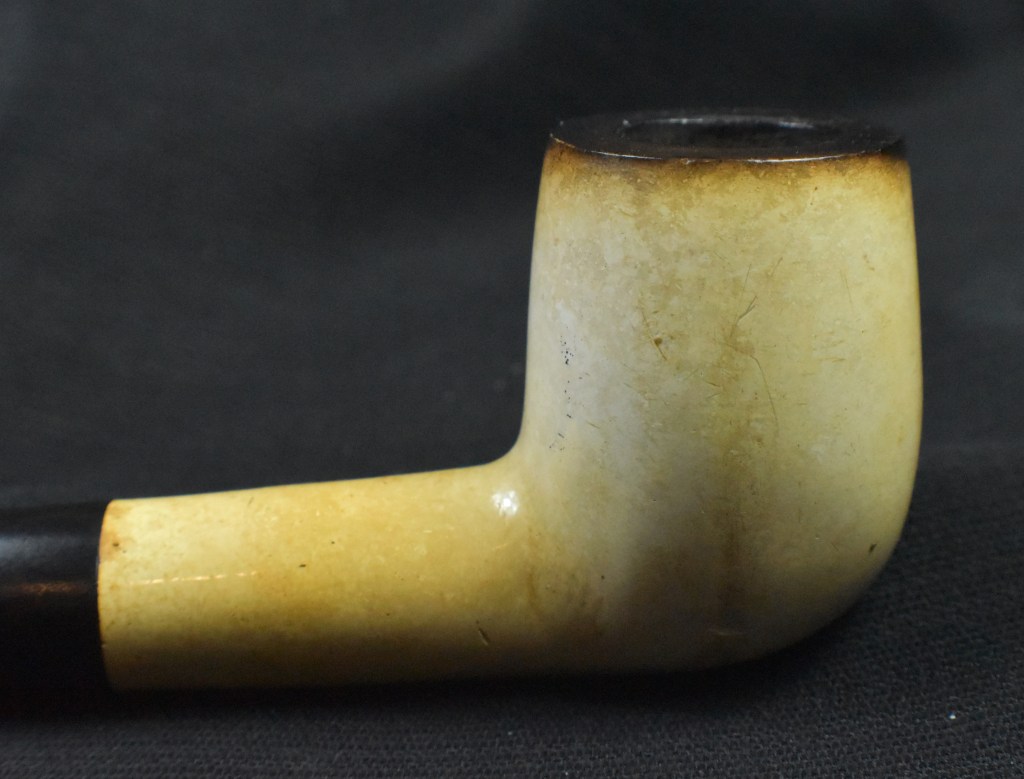
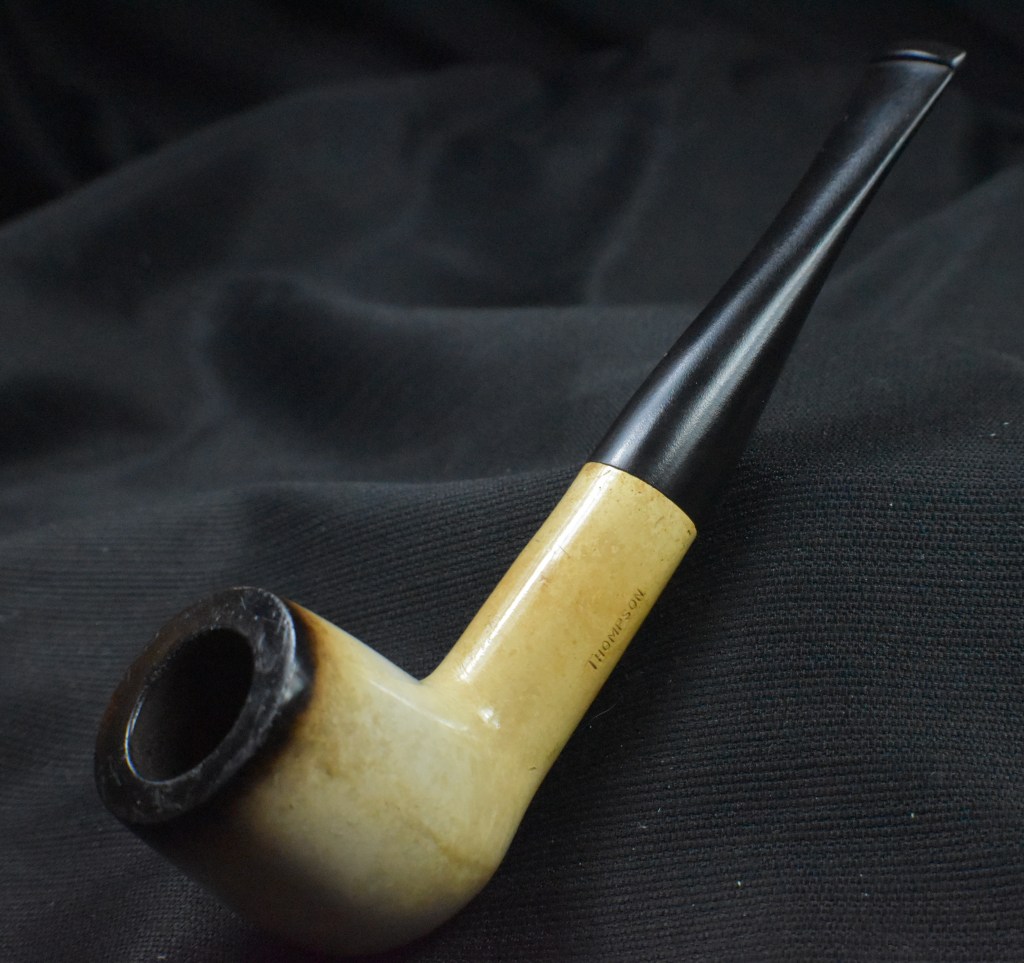
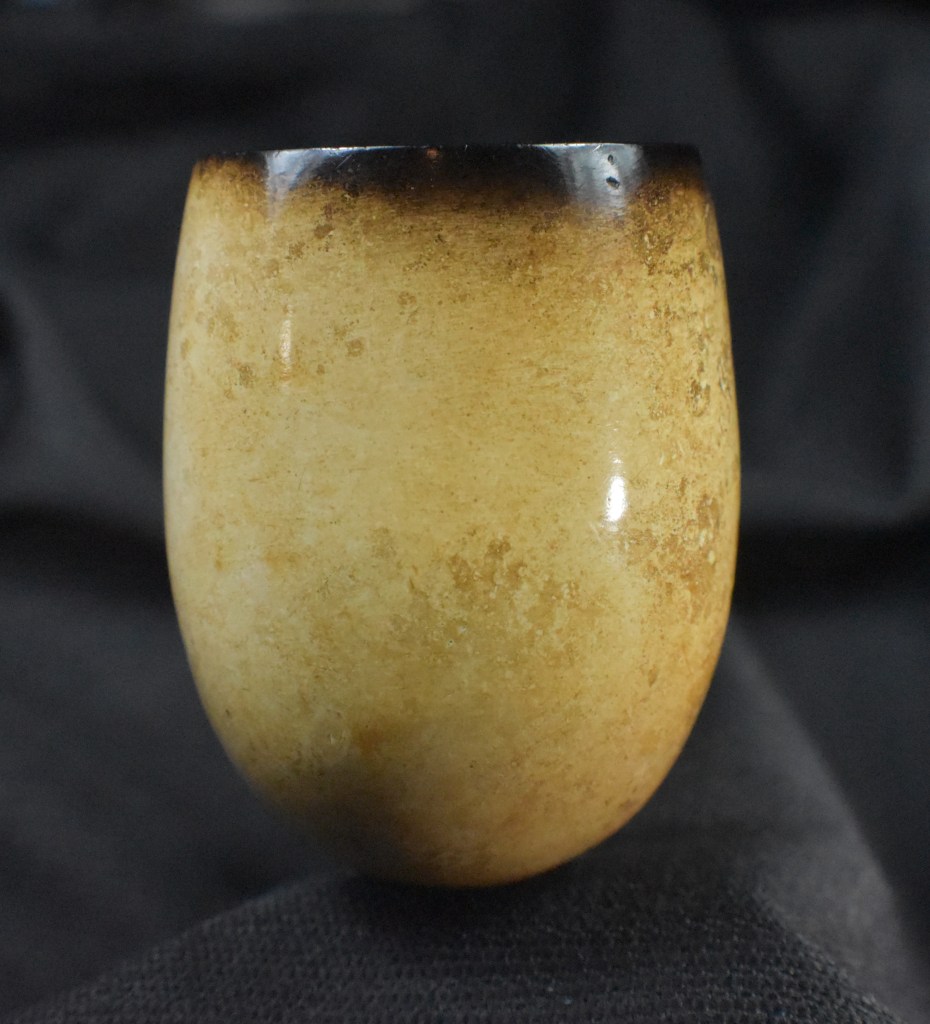
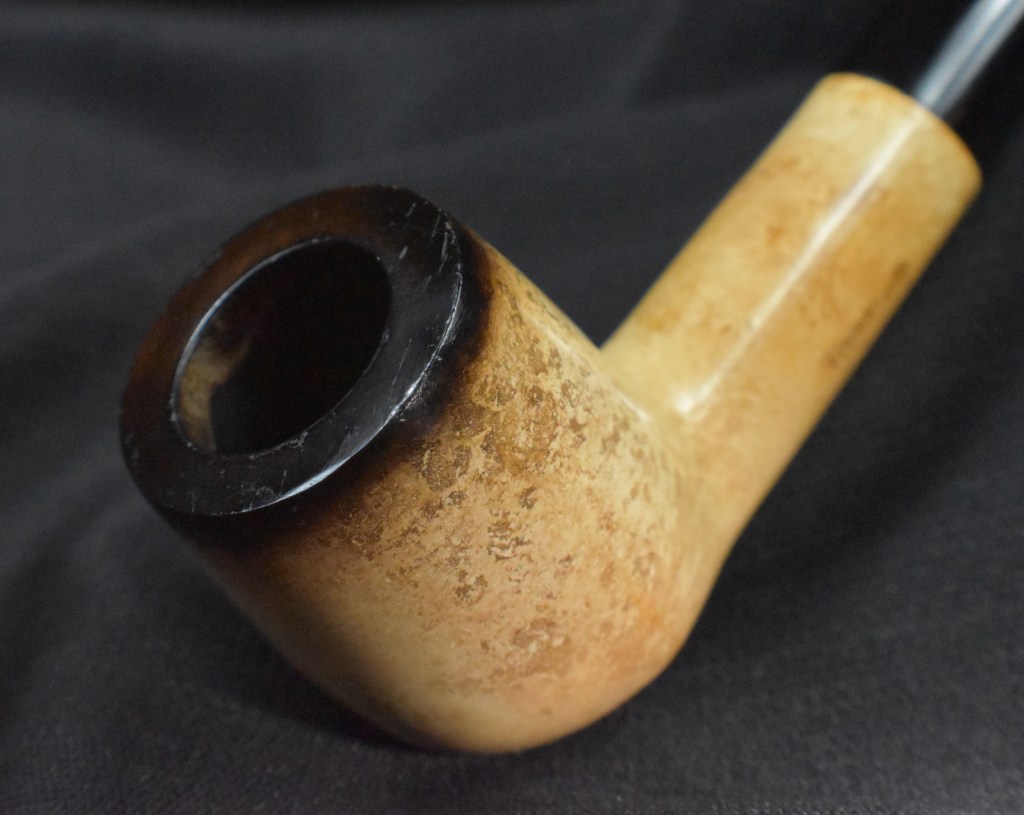
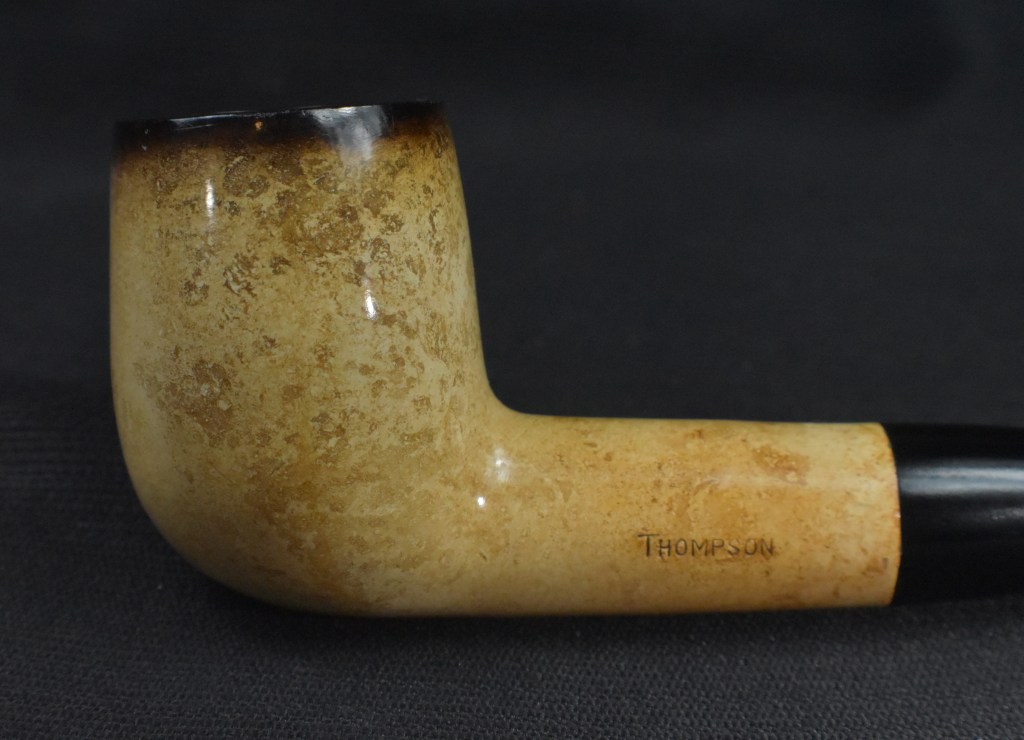
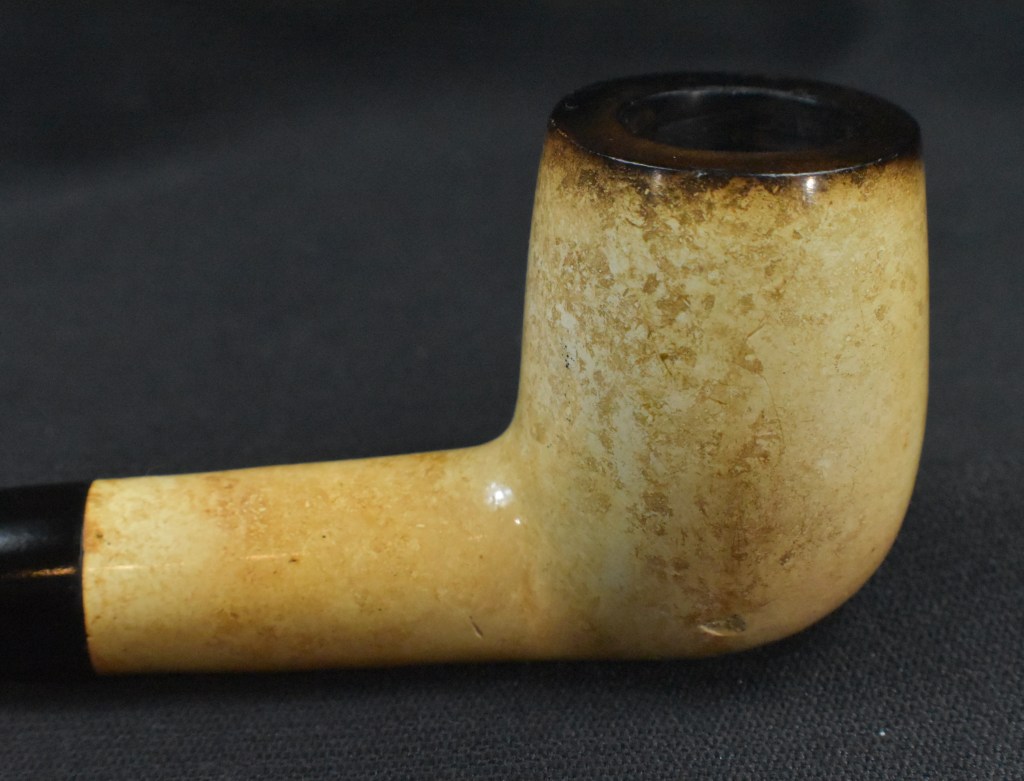
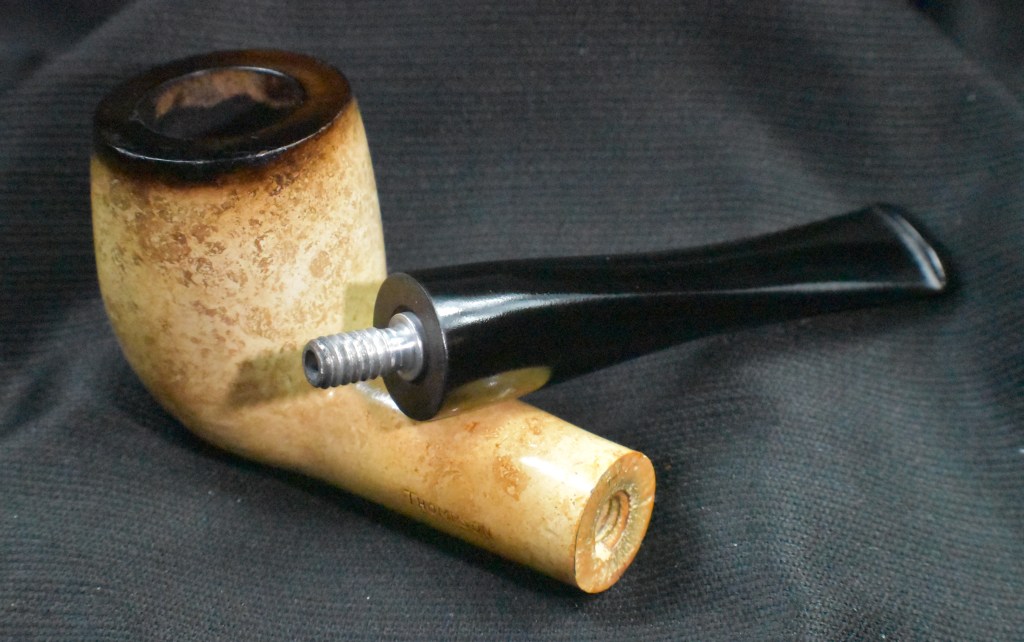
    I have thought, “a billiard is a billiard”.  I’ll admit that it is not my favorite shape for a pipe.  Sure it is a classic and probably the most popular of pipe shapes, with its cylindrical bowl perpendicular to a round shank.  Symmetrically, the shank and bowl are proportional, giving the pipe a look of balanced elegance. This Thompson billiard has all of those characteristics though its shank is more stout or substantial than a typical billiard.  This trait reminded me of a Peterson pipe, renowned for their more substantial shanks.  Perhaps that is what drew me to this particular pipe.   That and the fact that I was able to get a high quality British-made block meerschaum pipe for quite a reasonable bid.  Below are some photos taken of the pipe prior to any work done.

    The pipe was in great shape, sure there were a couple of chips on the stummel but that added character to the pipe.  The bowl had a light cake built up which would have to be carefully reamed but the rim looked pristine.  The stem appeared slightly pitted.  I do not know if that was the intended look or if that was a product of aging.  Either way it would be sanded and polished.  The shank end appeared to be very clean and the stem had no tooth chatter.  This looked like an easy restoration.

    Background

    Having restored a few meerschaums I immediately thought that this specimen had to be a Laxey Pipe Ltd. product.  I knew of no other British meerschaum makers.  I tried searching for “Thompson” on both pipedia.org and pipephil.eu and came up with nothing.  I then went to rebornpipes.com, Steve Laug’s catalog of restorations would certainly contain some information.  It did:  Thompson Meerschaum Pipes | rebornpipes.  In this blog entry Steve references a restoration done by Dal Stanton, Diving into the Provenance of a Thompson Genuine Block Meerschaum GT. Britain Brandy – The Pipe Steward.  I will use Dal’s research as the best source of information regarding the Thompson Block Meerschaum and quote it below:

    “My research on the origins of the Thompson Block Meerschaum name can be summarized like this: It was made with African Meerschaum from the Tanganyika Meerschaum Corporation (Tanganyika Meerschaum Corporation – Pipedia) and produced by Laxey Pipe Ltd. on the Isle of Man.  This conclusion was deduced from comments made about Thompson from various pipe forum threads.  Here is one example from Pipesmagazine.com (2012) among several that I found that demonstrates what I have found generally:

    @tschiraldi – Thanks! It’s my understanding that the Thompson Meerschaum pipes were made by the Manx Meerschaum Company on the Isle of Mann (Great Britain). Back story is that my 3x Great Grandfather was Sir Hall Caine who was a famous author known as the Manx Man and lived on the Isle of Mann. I thought it would be cool to own a pipe made by the Manx Meerschaum Company which was made on the Isle of Mann. Just thought it was interesting.

    “It’s my understanding…” is the key idea.  I found several comments with the assumption that Thompson Block Meerschaum pipes were produced by ‘Manx’ or ‘Laxey’ – the same producer.  When doing the research on James’ first commission, I discovered that the Laxey Co. produced the Peterson’s Meerschaum.  Here is the Pipedia information on Laxey Pipes Ltd.:

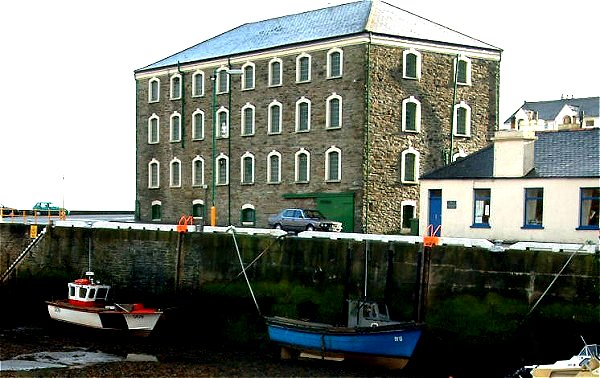
    Laxey Pipes Ltd. resided in a historical 19th century four-storey Man stone building at The Quay, Old Laxey, Isle of Man, which thankfully has been preserved.

    The company specialized in the production of meerschaum pipes using the Meerschaum mined by the Tanganyika Meerschaum Corporation in the Amboseli basin in Tanganyika (since 1964 part of the United Republic of Tanzania).

    Please note: you may often find names like “Manx Pipes Ltd.”, “Man Pipe Co.” and others more, but there is no indication of another Isle of Man pipe producer other than Laxey Pipe Ltd. at any time!

    Laxey Pipes Ltd. marketed their own brands like “Manxpipe”, “Manxman”, “Manxland” e.c. Names like “John Bull”, “White Knight” (unwaxed), “Domino” (black, or lined) indicated some shapes / colours of Laxey’s own series. The stems either showed the astronomical sign for “male” or “man” (circle + arrow), or the crest of the Isle of Man, the 3-legged X in a circle. Manxpipes and Laxey’s other brands were available through pipe retailers in general, but also were sold (mainly) to tourists through their own shop in Laxey.

    Furthermore Laxey Pipes Ltd. manufactured the meer bowls for Peterson, Barling, Nørding and others from the later 1960’s until 2001. Man Pipe e.g. was a brand distributed by Comoy’s. The bowls usually showed no nomenclature indicating the orderer. “Genuine Block Meerschaum” was engraved frequently. Often, just the stems were different, while bowls were the same.

    Supply of meerschaum from East Africa ran out (Kenya / Tanzania exhausted, Somalia inaccessible), and thus the last Laxey meers were supplied to trade in May, 2001. Laxey Pipes Ltd. tried to survive continuing with briar pipes – mainly in the Danish style -, but to no success. It closed down business in July 2002.

    In this article from Pipedia, there is no direct mention of Thompson Block Meerschaum however, it was left open that there were other brands produced from the 1960s until 2001 beyond those mentioned – Peterson, Barling, and Nording.

    I tend to agree with the sentiments of the Thompson Block Meerschaum pipes being produced by Laxey. Why? First, with the COM being ‘GT. Britain’ leaves few options (if any) of a Meer block being produced other than on the Isle of Man.  Secondly, the Thompson on the worktable resembles other products of Laxey with the smokestack coloring and the usual stamping: “Genuine Block Meerschaum”.  Here are examples of Laxey pipes including our Thompson.” (Diving into the Provenance of a Thompson Genuine Block Meerschaum GT. Britain Brandy – The Pipe Steward)

    Thank you Dal for doing a bang-up job on the research for the Thompson Genuine Block Meerschaum pipes.

    The Restoration

    As usual the pipe received a cleaned denim piece for protecting it and the workbench.

    The threads cut into the meerschaum were far from smooth but they looked remarkably clean.  I figured after a thorough cleaning I would use a light coating of petroleum jelly to ease the threading of the tenon.

    Below you can see the finish of the stem.  It almost had a sandblast-like fishing, not unattractive but I thought a gloss would look more elegant.

    The reaming was done with only the Smokingpipes Low Country reamer and the General triangular scraper.

    The tobacco chamber was sanded with 320 sandpaper wrapped around a wood dowel.

    The stummel was scrubbed with Murphy Oil Soap and a nylon brush. The soap was rinsed with warm water and dried with a cotton hand towel.  It was set in a pipe stand and allowed to dry for an hour after the scrub.

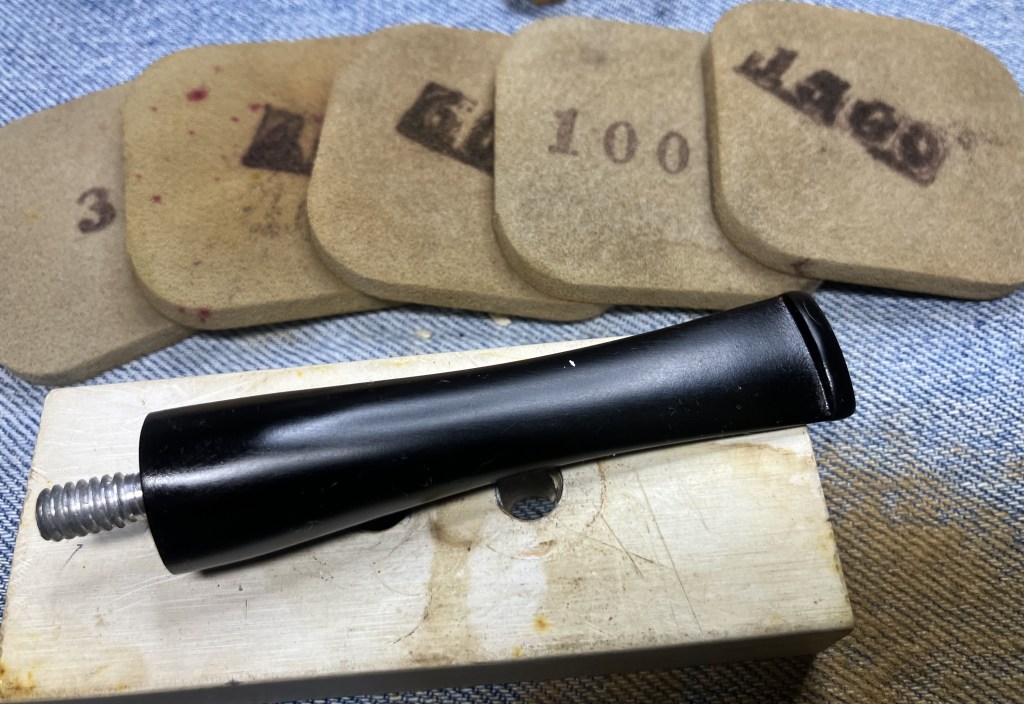
    I did not want to round the edges of the stem nor did I was to handle the stummel until it had been given a fresh beeswax coating so I used a wood block with a hole drilled for sanding.

    The stem was sanded with a series of sanding sponges from 320-1500 grits.  Between sponges the stem was rubbed with mineral oil and wiped with a paper towel.

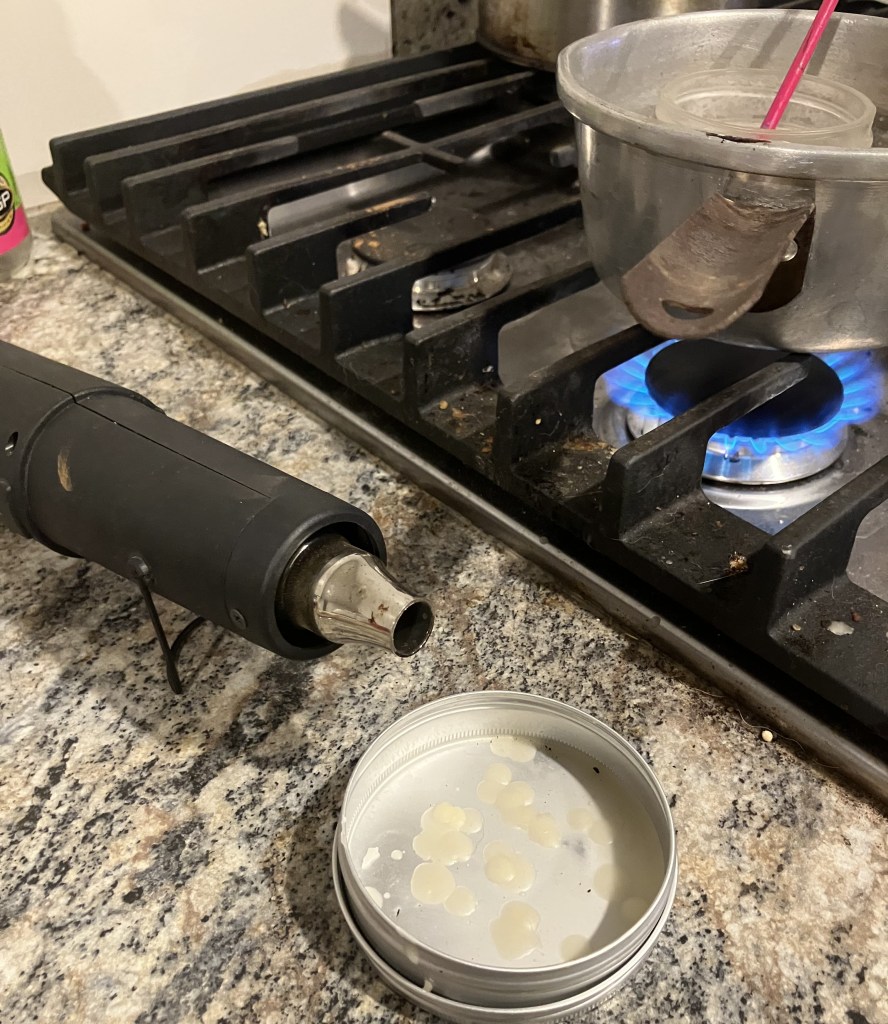
    After an hour I started prepping the beeswax.  I use a water bath on the stovetop to heat the beeswax.  The hot water keeps the wax liquified for a longer period of time and I don’t have to worry about overheating the wax as it never gets above 212F or 100 c.

    The stummel was heated using a heat gun.  The metal tin in the photo below is used to catch wax that drips from the stummel as it is applied with a small paintbrush.

    The tobacco chamber was plugged using a cork and the shank plugged with the stem.  The hot beeswax was applied with several coats and the stummel rotated around the heat gun constantly.  Upon finishing, I wiped the stummel with a clean dry paper towel.  The stummel was then allowed to cool over about 15 minutes.

    Once cooled, I wrapped the shank in masking tape to protect it from sanding.  I continued with the series of sanding sponges from 2000-3500 grits with oiling and wiping as above.

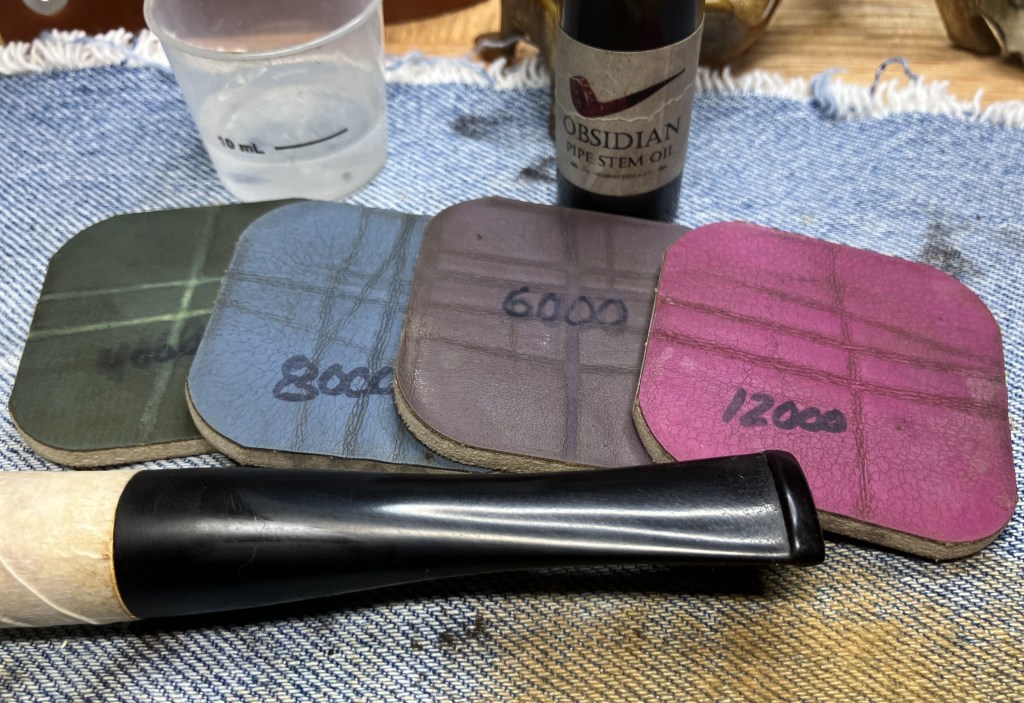
    The stem was then micro-meshed with pads 4000-12000.  I rubbed the stem with Obsidian Oil between pads and wiped with a paper towel.

    The stem was then buffed with a blue buffing compound.

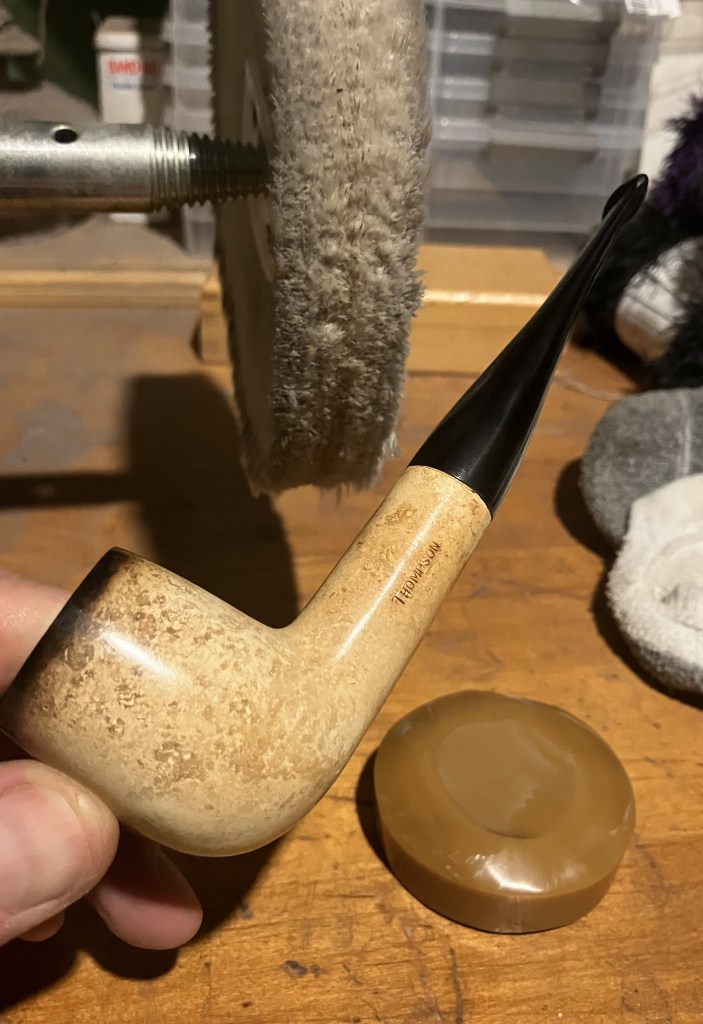
    After the remaining buffing compound had been wiped from the pipe and the tape removed the pipe received several coats of carnauba wax on the stem and a light buffing of the stummel.

    The final step was another hand buff with the microfiber polishing cloth.

    This lovely Thompson Block Meerschaum Billiard is a fine example of Tanganyika African meerschaum.  The mineral does not have the same fine grain and brilliant white of the Turkish meerschaum but it does have a character all its own, almost like a rustic version of the Turkish mineral.  The fumed rim gives way to a buttery cream color which will change with use and form a truly individual pipe.  The stem started out with a more rough texture.  This was sanded and finished to a high gloss black which stands out against the light meerschaum.    The dimensions of the Thompson Block Meerschaum Billiard are:

    Length:  6.00 in./ 152.40 mm.

    Weight:  1.72 oz./ 48.76 g.

    Bowl Height: 1.90 in./  48.26 mm.

    Chamber Depth: 1.54 in./ 39.12 mm.

    Chamber Diameter:  0.74 in./ 18.80 mm. 

    Outside Diameter:  1.44 in./ 36.58 mm.

    I do hope that you have found something here useful to your own pipe care, maintenance or restorations.  If you like this sort of thing, please click the like and subscribe buttons.  Thank you for reading the ramblings of an old pipe lover.

    Loading…

    Below are some photos of the finished Thompson Block Meerschaum Billiard.

  • A Peterson Croydon Square 42 Apple Restoration

    September 25th, 2025

    Photographed and written by

    John M. Young

    I remember reading my first Sherlock Holmes in middle school, The Hound of the Baskervilles by Sir Arthur Conan Doyle.  I loved the idea of a mystery, even though I knew about the great detective, the solution to the mystery was all new to me.  I feel that way about this pipe, a Peterson Croydon Square 42.  I had above average knowledge of Peterson pipes but had not heard of the Croydon Square line.  Where would this mystery lead me? 

    The pipe was another single target eBay acquisition.  I paid more than I really wanted to but it was a specimen that I had not seen before and I wanted to work on it. After a quick trip from LaGrange, Georgia to the wilds of southeast Nebraska, I had my prize.  The photos below show the pipe prior to any work.

    The Croydon Square looked like a well loved and used pipe.  The restoration looked straight forward; cleaning, reaming, sanding of the stummel, deoxidation of the stem with sanding and polish.  There did not appear to be any glaring issues with this old pipe, just use and time.

    Background

    Being unfamiliar with London, I’d not heard of Croydon nor of Croydon Square.  I am familiar with Peterson pipes though, yet Croydon was an unfamiliar line of  Petersons to me.  I first wanted some information about the geography. 

    (London Borough of Croydon – Wikipedia)

     Apparently Croydon dates back to:

    • Croydon was first recorded in 809 CE as the site of a Saxon minster church. It later grew into a major medieval market town.
    • Surrey Street Market has traded since 1276, making it one of the UK’s oldest continually operating markets.
    • Croydon Palace and Addington Palace served as archbishops’ residences for over 500 years, notably under John Whitgift.
    • Croydon Aerodrome pioneered international passenger flights and established the world’s first air traffic control tower.
    • Modern Croydon blends cultural venues, a tram network and major office space, anchored by Fairfield Halls and St George’s House.

    (Croydon’s History | Saxon Settlement to South London Hub)

    With my curiosity settled on that account, I turned my gerbil-like attention to the pipe.  I cannot give Kapp and Peterson the credit they are due.  In the most comprehensive guide to the history of Peterson Mark Irwin and Gary Malmberg wrote a wonderful book The Peterson Pipe (Irwin, Mark and Malmberg, Gary.  The Peterson Pipe; The Story of Kapp and Peterson. 2018, Briar Books Press, Canada. First edition, second printing.).  According to Irwin and Malmberg, the legacy of Peterson as “the world’s oldest continuously operating briar pipe maker” (Irwin, p. 3).  This is a treasure trove of information for those interested in Peterson pipes.  It is currently “sold out” from The Peterson Pipe Book (Softcover) | Smokingpipes.com.

    As complete a guide to Peterson pipes as this book is, it was lacking in much information regarding the Croydon pipe in hand.  I was able to glean additional information from Mark Irwin’s Peterson Pipe Notes (PPN) (Peterson Pipe Notes – Peterson Pipe Notes: Celebrating Peterson Pipes).  Within the blog entry, “136. Filling the Gap: The 1939 Rogers Import Peterson Catalog & Download” (136. Filling the Gap: The 1939 Rogers Import Peterson Catalog & Download – Peterson Pipe Notes), I read the following:

    “I’m also happy to report that a few revisions of the book are now in order. That didn’t take long, did it? So get out your pencil, it’s time to annotate your copy: (1) The Croydon Square origin date is given as 1949 in the book, as we only had an RDTA Almanac an unhallmarked specimen to go by. But now—surprise!—it’s clear that the line was being made as early as ’39. (The similarity between the name of Croydon Square and Trafalgar Square also has me wondering if the latter didn’t replace the former at some point.) (2) We can also pencil in ’39 as the earliest documented date (so far) for the Captain Pete.  (3) The ad copy in the catalog also suggests that, at this date, the line was made exclusively at the London factory. (4) And if that’s not enough, at the beginning of the “N” section in the Information Guide, you can write, “An N prefacing two-digit shape numbers of English-made pipes refers to a natural finish.”” (136. Filling the Gap: The 1939 Rogers Import Peterson Catalog & Download – Peterson Pipe Notes)

    In the above quote from Mark Irwin, the “RDTA” refers to “Retail Tobacco Dealers of America.  The forerunner of the current Premium Cigar Association with a few name changes in between.” (Mark Irwin, personal communication.  September 22, 2025).  Don’t worry, I had no idea what it meant either.  I emailed Mark and got a quick reply.  The PPN blog also had the following page from a 1939 Roger’s catalog:

    (136. Filling the Gap: The 1939 Rogers Import Peterson Catalog & Download – Peterson Pipe Notes)

    AHA, specific historical information about the Croydon Square pipe was at hand.  This put the pipe’s provenance from at least 1939 to ? and also the shape 42.  Although this information led to more questions.  There is no mention or illustration of fishtail stems, only P-lips.  The pipe in hand had been smoked quite a bit leading me to the thought that the stem of this pipe may be a replacement.

    In The Peterson Pipe, where the London production of pipes is discussed at length, was  another interesting piece of information.  Here, Irwin and Malmberg say, “Apparently, the London factory did not order a MADE IN ENGLAND die until after the war.  Any Peterson stamped with an English COM must be no older than the later 1940s” (Irwin, p.150).  If it is assumed that this pipe was not stamped due to there not being a stamp available then it would date from 1939-late 1940s.  If it was merely not stamped with a COM then it is assumed to be made during the years of pipe production at the London factory 1936-1962.  I prefer to think that it is due to the former.  This is actually a selfish desire to have the dates of production to be a more definitive late 1930s-late 1940s.  I know, too much conjecture…

    The Restoration

    The restoration began with a clean denim piece protecting both the work surface and the pipe.

    I began with the stem.  This was cleaned with bristle pipe cleaners and 99% ethyl alcohol.

    The stem was then submerged in Briarville’s Pipe Stem Oxidation Remover (deox).  It bathed for 18 hours.

    In the meantime, I worked on the stummel.  The ream team was gathered.

    The PipNet #1 and #2 blades were both put to use.  The General triangular scarper was also used to do some cleanup of the tobacco chamber and the rim.

    Below is a photo of the tobacco chamber after the reaming.

    The chamber was then sanded with 320 sandpaper wrapped around a wood dowel.  No damage to the chamber was observed.

    The rim however was encased in a layer of lava.

    The lava was softened with saliva and scraped with the blade of a sharp pocket knife.

    Next came the shank airway cleaning.  Again the 99% ethyl alcohol and bristle pipe cleaners were used.  There was also a good deal of scraping with a dental scraper and use of a nylon shank brush.

    I was not completely happy with my efforts to rid the airway of the residue of tar and general yuck.  I thought an alcohol and cotton treatment would do the airway some good.  The tobacco chamber and the airway were stuffed with cotton.

    99% ethyl alcohol was applied via a disposable pipette to the cotton until it was saturated.  This took about 10 ml of alcohol.

    The alcohol was allowed to evaporate overnight.  This allowed the alcohol to dissolve the tars and transfer them to the cotton as the alcohol evaporated.  The next day the cotton was stained, telling me the process worked.

    The cotton was removed and the airway was cleaned again.  The below photo shows the 2nd cleaning and the tars that were removed after the overnight cotton alcohol treatment.

    The stummel was then taken to the sink for a scrubbing with a nylon brush and undiluted Murphy Oil Soap.  The soap was rinsed with warm water and the stummel dried with a cotton hand towel.

    Returning to the workbench, the stummel was wiped with a make-up pad dipped in ethyl alcohol.

    The stem was removed from deox and rubbed with a coarse shop rag.  This removed a good deal of the oxidized rubber from the stem.

    The stem was then worked with Soft Scrub cleanser on make-up pads to remove more of the oxidation.

    I then oiled the stem with a liberal coating of mineral oil and let the stem sit for several hours.  Oh yeah, I also ran a pipe cleaner through the stem and oiled the interior as well.

    The rim looked far better but still rather rough. I thought that a light topping was in order.

    The topping was done with 320 sandpaper laid on a flat counter top followed by a piece of 400 sandpaper.  This revealed two additional areas of concern.  A deeper dent or ding in the inner rim (about 5:00) and a hairline crack (at about 7:00).

    I used a wood sphere wrapped in sandpaper to reestablish the inner rim bevel and smooth the rim.

    I deemed the crack to be superficial and not structurally important.  It was given a dab of Thin cyanoacrylate (CAl super glue) to seal it and was topped a second time with the 400 sandpaper.  The ding was filled by packing it with briar dust and then applying a small drop of CA.  This was repeated a second time.  The wooden sphere and sandpaper was used to smooth the fill and the rim was topped again with the 400 sandpaper.

    The stamps were taped off with masking tape to protect them from sanding.

    I prefer asymmetrical pieces of tape because they leave a less noticeable mark on the briar where sanding was not done.

    The first two sanding sponges used were the 320 and 400 grit.  Sanding with these two showed me where several dents and pits were.  All of these blemishes were small so they were filled by placing a tiny drop of Thin CA on the spot and sanding it with a very dirty sanding sponge.  By dirty, I mean a sponge that has a large amount of briar dust on it.  Even with the extra briar dust sometimes the CA gets onto the sanding sponge.  This can be seen below as the dark spots on the sponges.

    The small fills were sanded with 324 and 400grit sponges.

    Below are some photos of the fills after they’d been filled.

    The pipe was then sanded with the full series of sanding sponges from 320 -3500 grit.  Between each sponge the stummel was wiped with a make-up pad wetted with alcohol.  The stem was rubbed with mineral oil and wiped with a dry paper towel.

    The pipe was then worked with micro-mesh pads 4000-12000.  The wiping of the stem and stummel was done as with the sanding sponges except the stem was rubbed with Obsidian Oil.

    I took the pipe to the buffer and buffed it with blue buffing compound.

    After wiping any remaining buffing compound from the pipe it was given a coating of Before and After Restoration Balm and allowed to sit for an hour.  Why an hour?  Because I got side-tracked with another project.

    The excess balm was wiped away using an inside out athletic sock.

    The pipe was then taken to the buffer for several coats of carnauba wax.

    The final step was another hand buff with the microfiber polishing cloth then off to the final photo shoot.

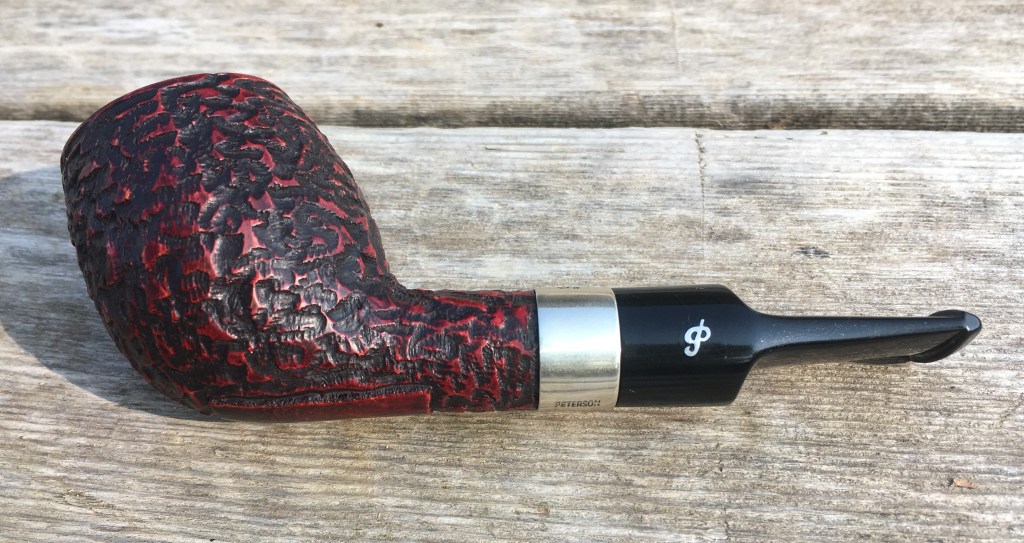
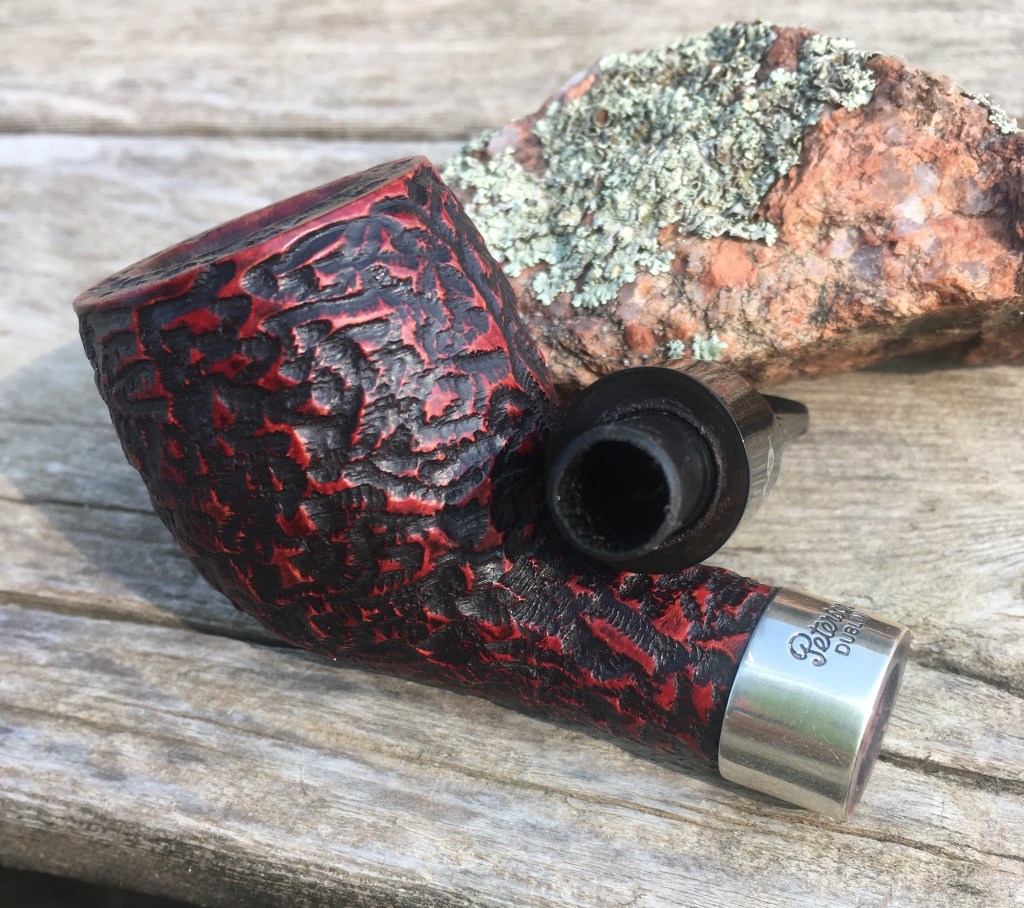
    This beautiful Peterson’s Croydon Square 42 is a great example of Peterson’s English workmanship.  The stain of the original pipe was maintained and gives the pipe a slight contrast-dye look.  It was finished with careful sanding and just carnauba wax.  The stem sanded and polished to a gorgeous glossy luster.  Though lacking any stunning briar grain there is some nice flame grain on the rear left.  The dimensions of the Peterson’s Croydon Square 42 are:

    Length:  5.67 in./ 144.02 mm.

    Weight:  0.95 oz./ 26.93 g.

    Bowl Height: 1.43 in./  36.32 mm.

    Chamber Depth: 1.25 in./ 31.75 mm.

    Chamber Diameter:  0.71 in./ 18.03 mm. 

    Outside Diameter:  1.37 in./ 34.80 mm.

    I do hope that you have found something here useful to your own pipe care, maintenance or restorations.  If you like this sort of thing, please click the like and subscribe buttons.  Thank you for reading the ramblings of an old pipe lover.

    Loading…

    Below are some photos of the finished Peterson Croydon Square 42.

  • A Missouri Meerschaum Freehand 9mm Filter Conversion

    September 23rd, 2025

    Photographed and written by 

    John M. Young

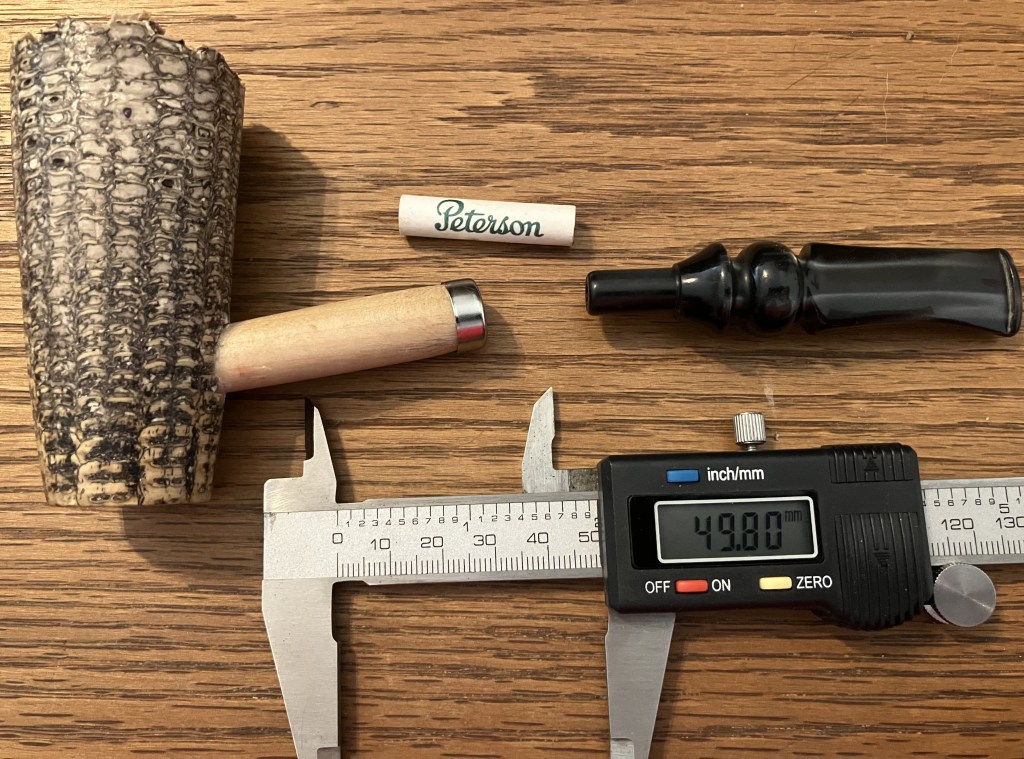
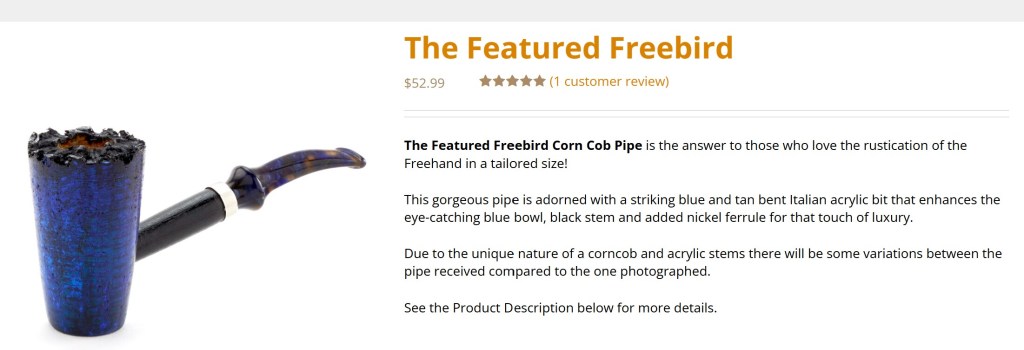
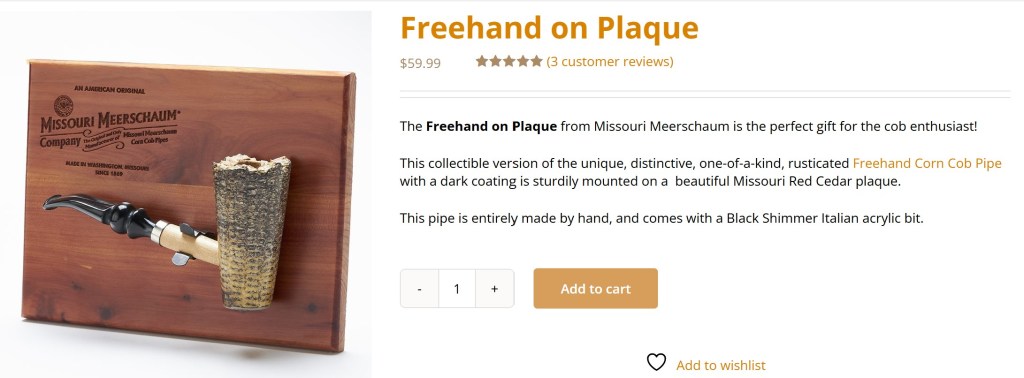
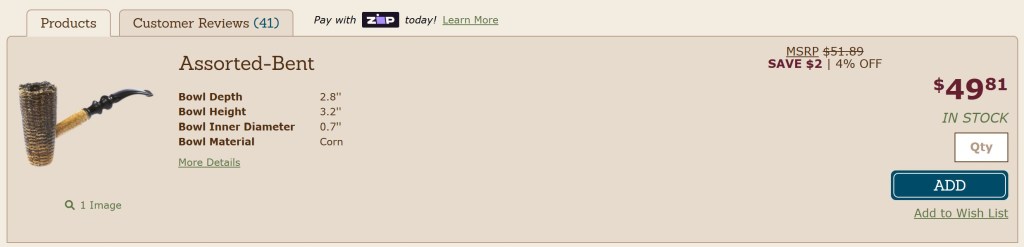
    Have you ever had what you think is a great idea, one that you are sure will work, but that no one else thinks is plausible?  Well, that is how this project started.  If you’ve read my ramblings for a while, you have probably read about discussions with Sascha Mertens.  He is a fellow piper and restorer from Germany.  Although we have never met face-to-face we have been chatting online for well over a year.  I value Sascha’s ideas, techniques and criticisms.  We have sent various gifts to one another across the Atlantic like pipes and tobaccos which neither of us has easy access to.  Sascha appreciates a good corn cob pipe and has mentioned that he likes how my Missouri Meerschaum (MM) Freehand 

    looks.  Sascha also, like many Germans, prefers to smoke pipes with filters.  That sparked my interest in converting a MM Freehand into a 9mm filtered pipe.

    I started with an imagined solution:  Drilling out the shank to a diameter which would fit a 9mm filter.  Next came a bunch of measurements with my MM Freehand and the idea started taking root.

    For this scheme to work I would need to drill out the shank and shorten the tenon on the existing bit.  I didn’t like that idea, but it should work.

    I sent the photos and ideas off to Sascha and he reaffirmed that it wouldn’t work.  O ye of little faith.  I think the doubt came from my placing of the filter in the shank rather than in the stem.  Stem placement is more typical and standard.  Not being standard, nor typical, I proceeded on with my grand plan.

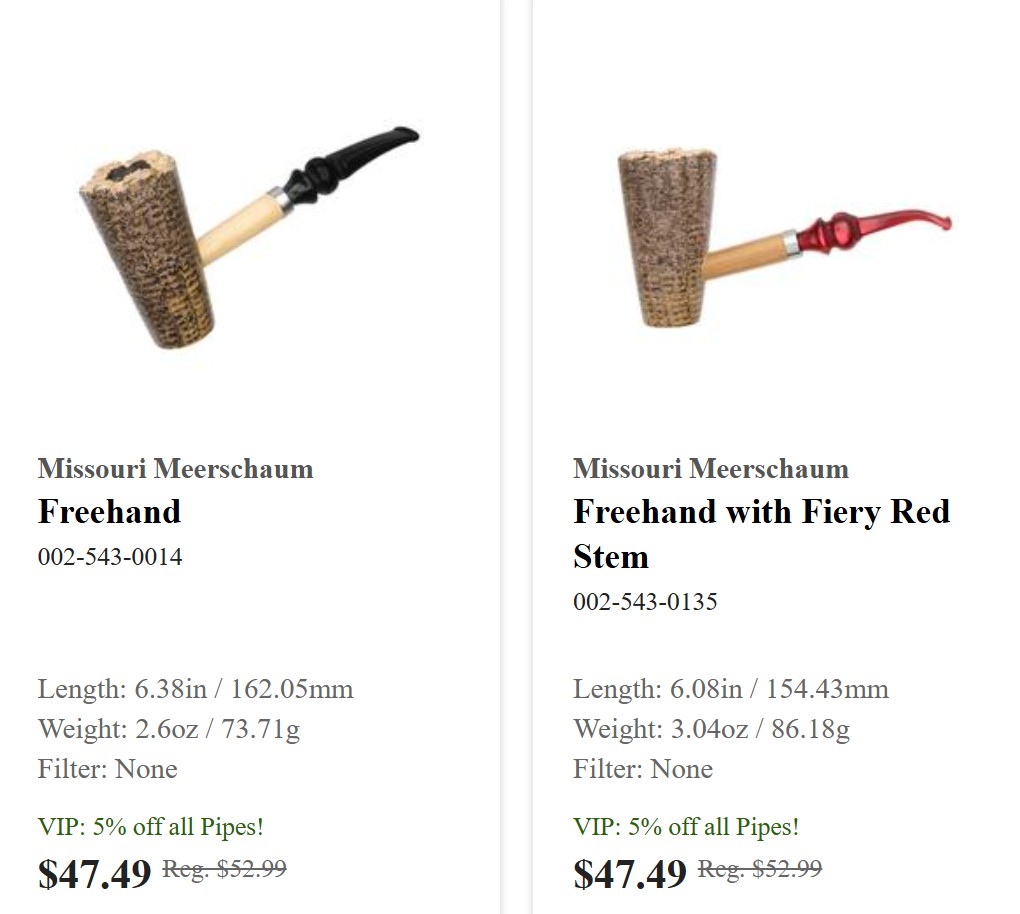
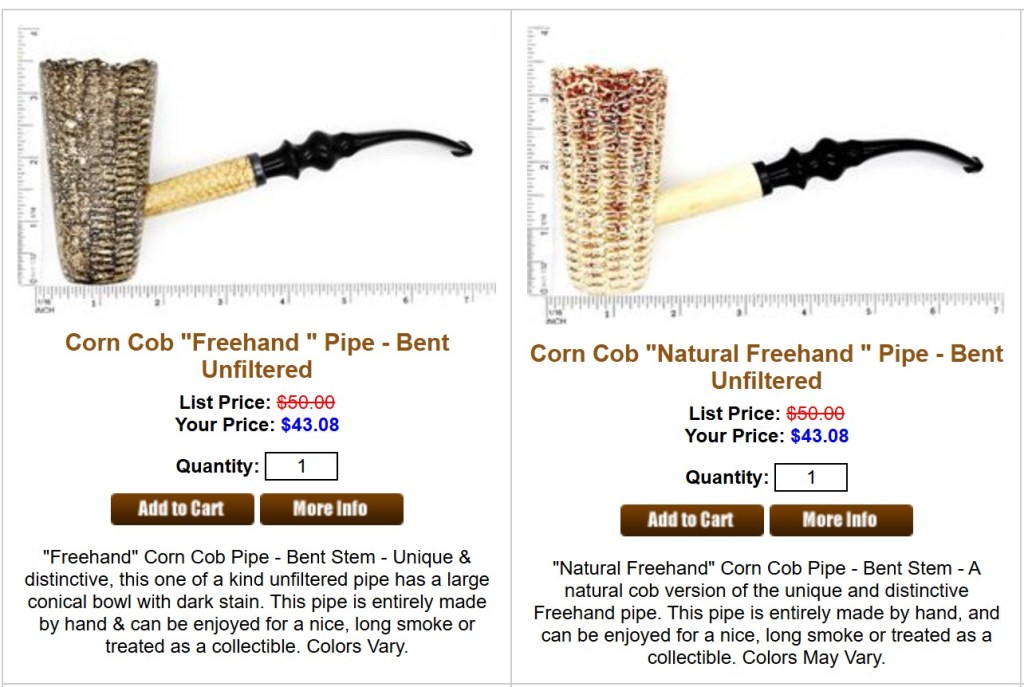
    I sent Sascha several options of available MM Freehands from various sellers:

    His response was simple and language-free: 

    The order was placed and the idea went to the back burner for a couple of weeks.

    Last night, the patient made her way to the operating table.  Apologies, I am getting ahead of myself, again.

    The patient first had a date with the camera for some “before” photos.

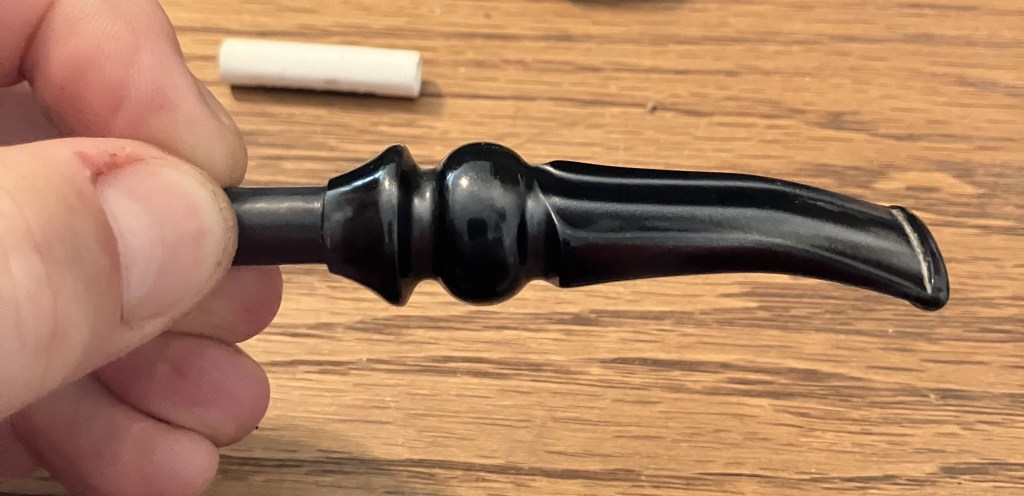
    The Freehand looked typical for a new MM pipe.  I was not impressed with the fit of the nickel collar.  That would have to be redone and straightened.  The stem was a beautiful dark grey metallic swirl stem, though it did fit rather tightly.  The draft hole of the shank was slightly obstructed with drilling debris, an easy fix.  I also debated myself about chiseling out the shank-end at the bottom of the tobacco chamber.  Hmm, we’ll have to see if I want Sascha to experience the not so wonderful flavor of hardwood smoke when his first couple of bowls of tobacco burn the shank end.  Muwahaha.

    After the photo session the MM Freehand made its way to the workbench and its denim piece.

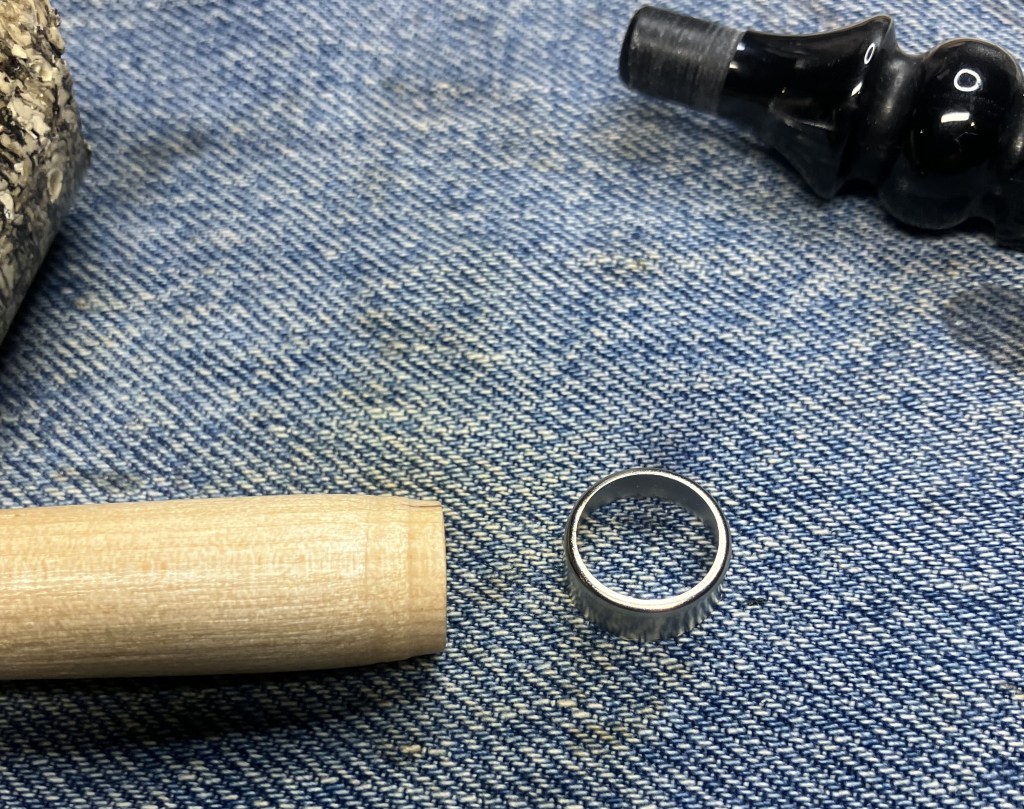
    The collar came free with a little effort and strong finger nails.

    Come one MM, I think your quality control could be a little better for your high-end cobs.  Maybe I am too demanding or “high-end cob” is an oxymoron.  The dented shank shows the ill fit of the collar better than my earlier photos.

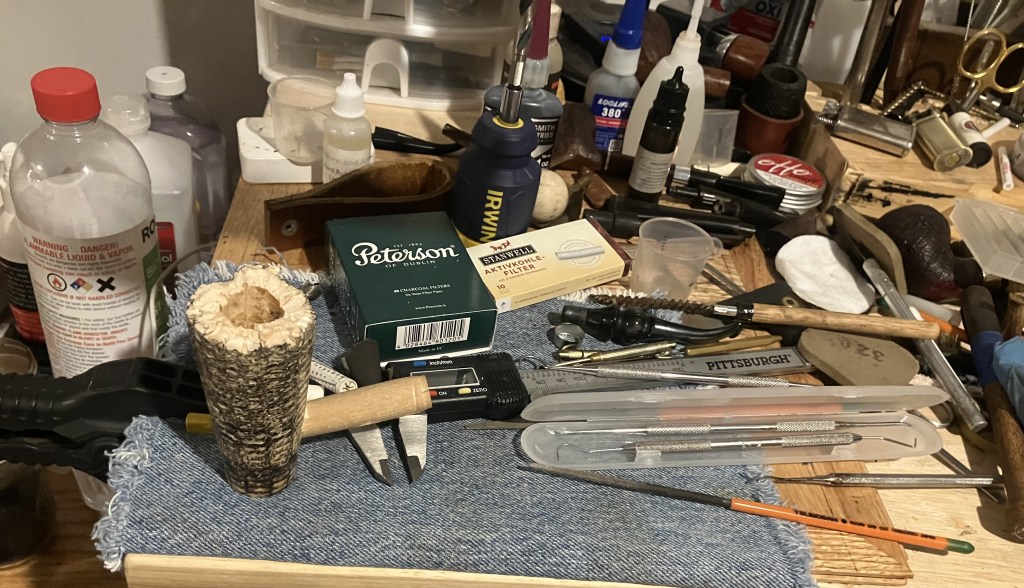
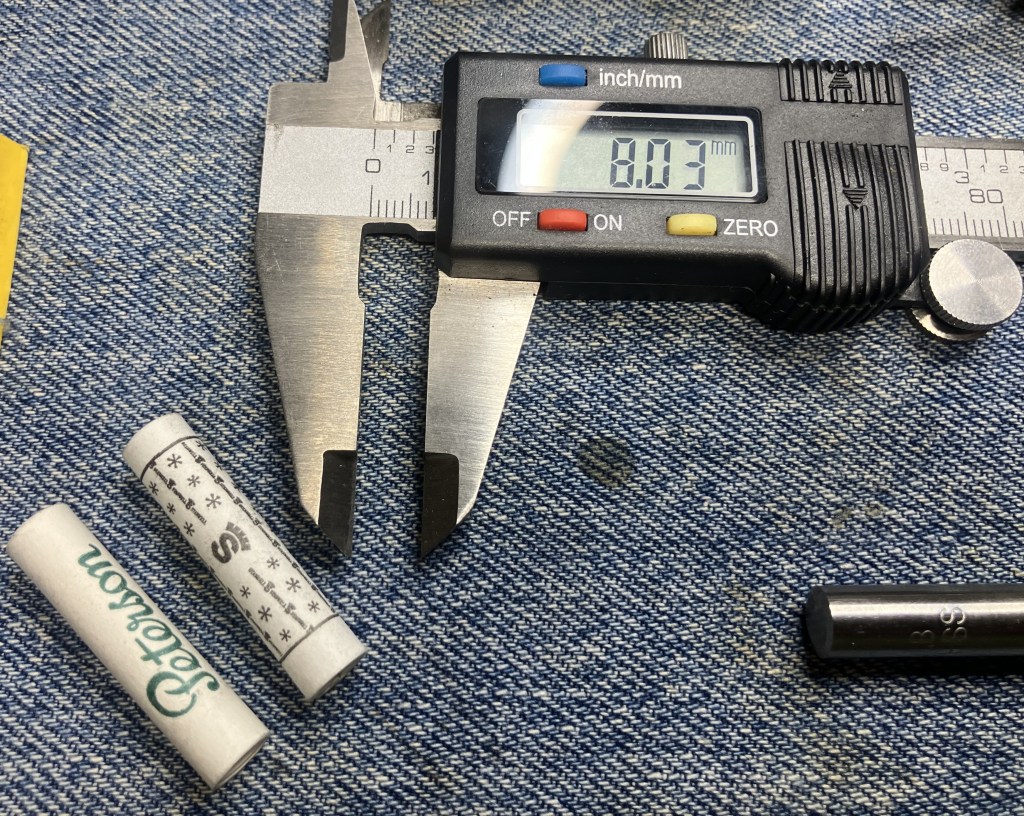
    I only have 3 varieties of 9 mm filters and one, a Denicotea, I can’t find, so I used the Peterson and Stanwell filters as my guides.

    The filters have a diameter of 8.03 mm.  I am not sure why they call these 9 mm filters.

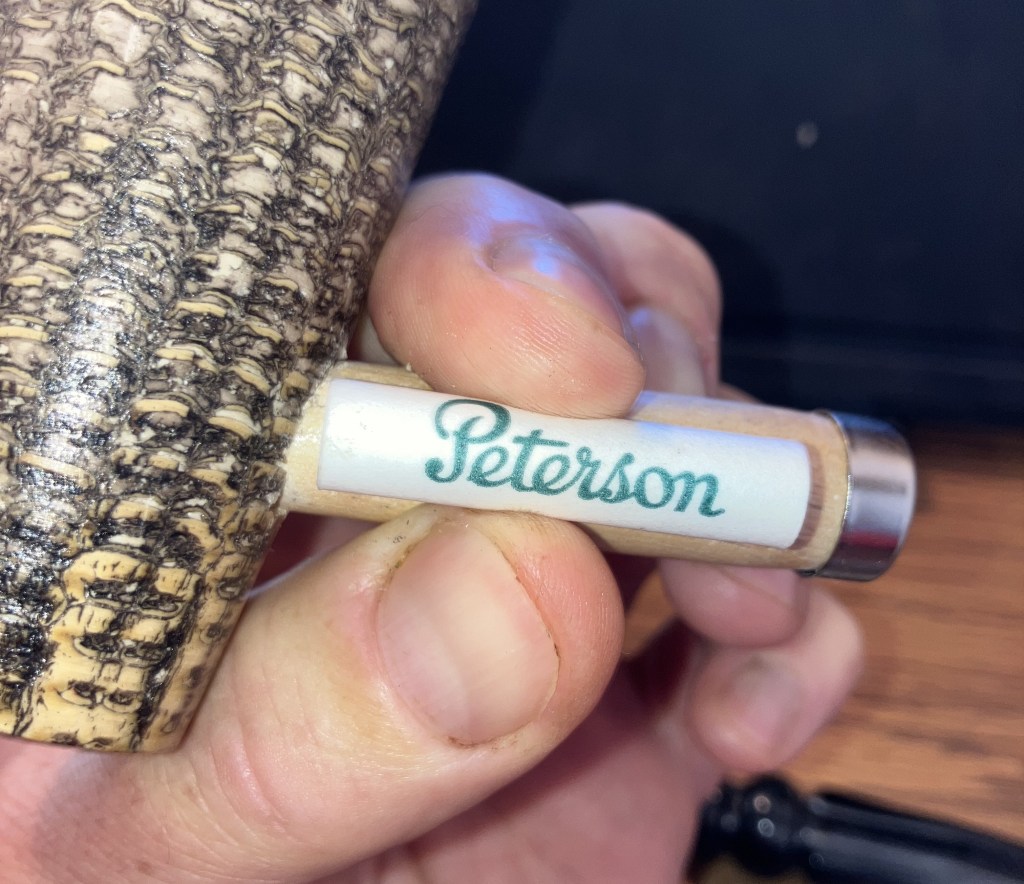
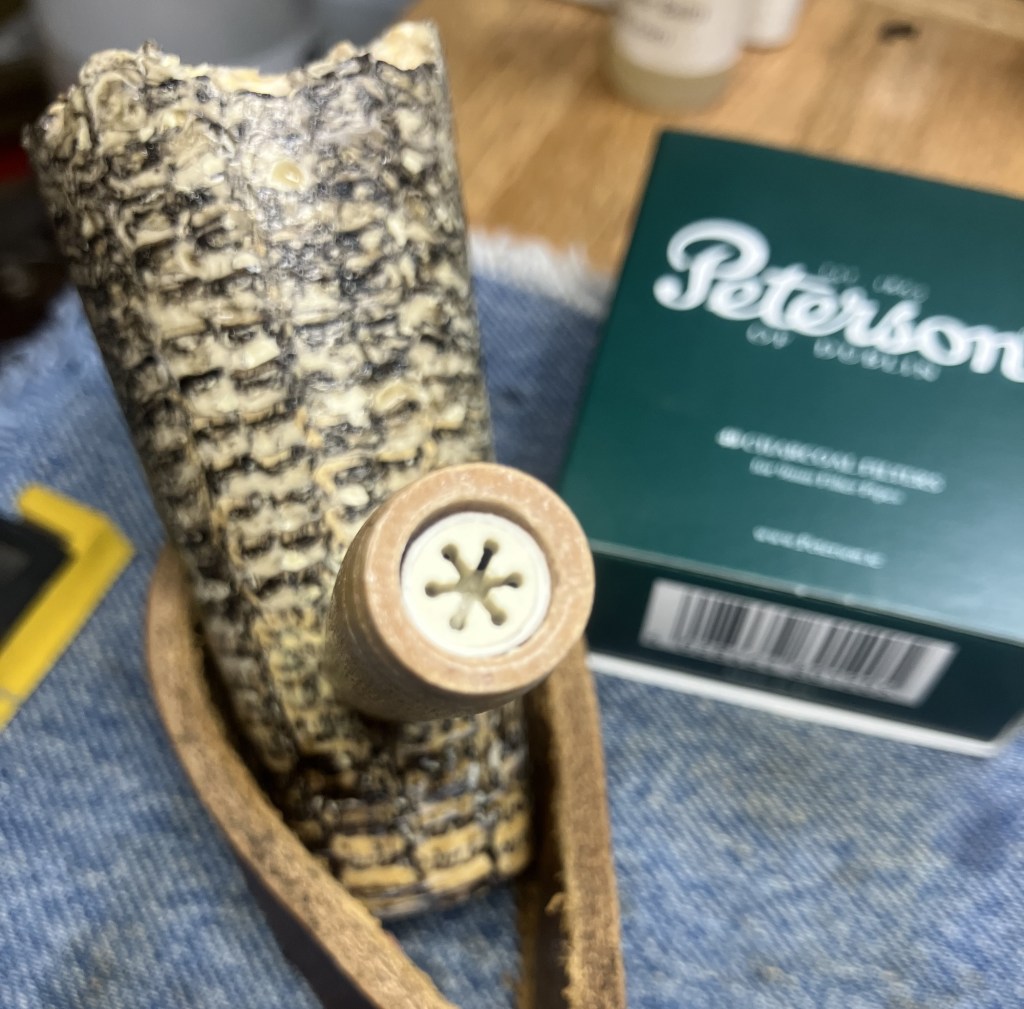
    The Peterson has ceramic end caps with 5 holes.

    While the Stamwell has a 6 axial snowflake pattern.  Both filters fit well in the shank mortise.  

    Both filters were also 1.409 mm in length.

    Or, 35.80 mm, for those of the European persuasion.  Okay, I know that the US is nearly alone in retaining standard units and I fought students, for 33 years as a science teacher, to use metric units.  Still, I am American and stubborn as a Scotts Irish Polack, because that is what I am.  We kind of ignore the German heritage of my mother’s side because they were the boring relatives.

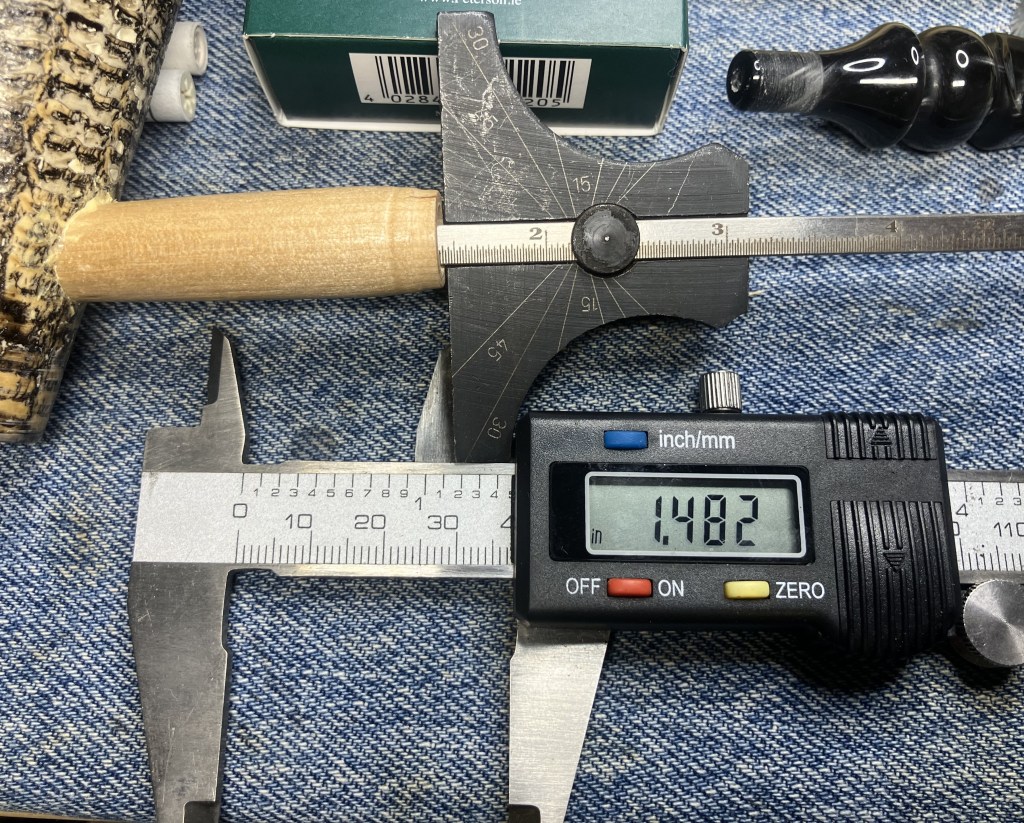
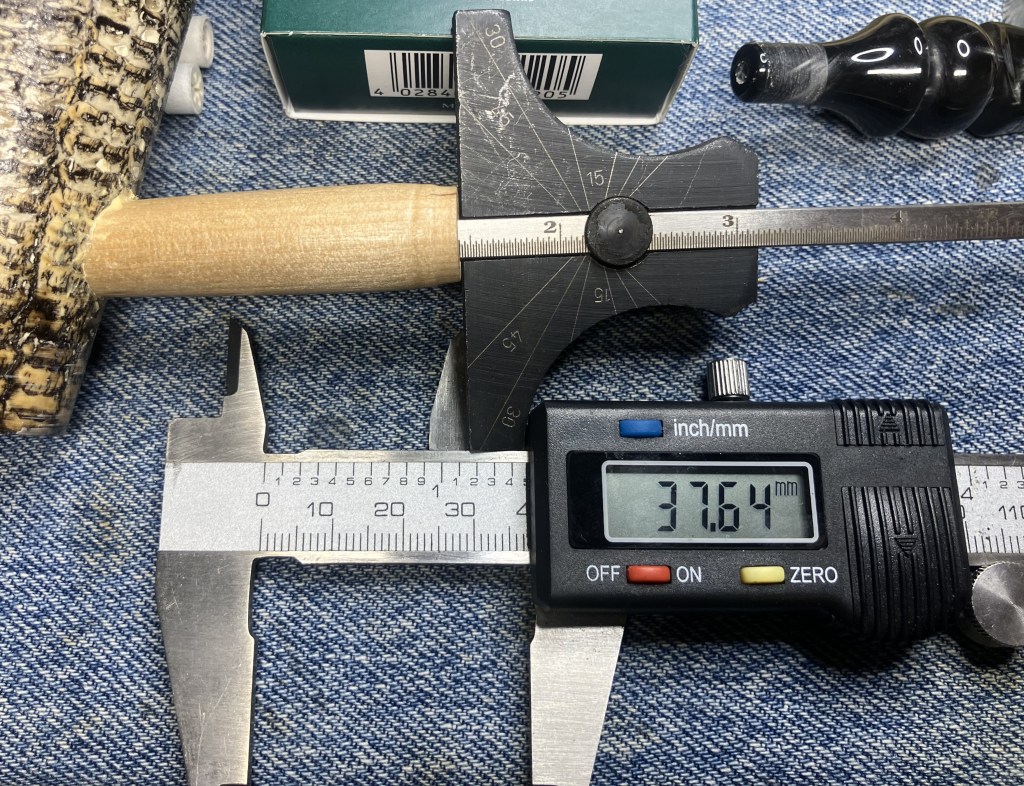
    The mortise was drilled to a depth of 1.482 inches.

    Yeah, that’s 37.64 mm.

    The filter diameter of 8.03 was paired with my 8 mm drill bit.  I wanted to extend the mortise drilling further into the shank to allow the filter and the tenon of the bit/stem.  I marked this depth with a German made Staedtler pen.  See, I am so multicultural… 

    The drill bit was then taped off with painters tape for depth management. 

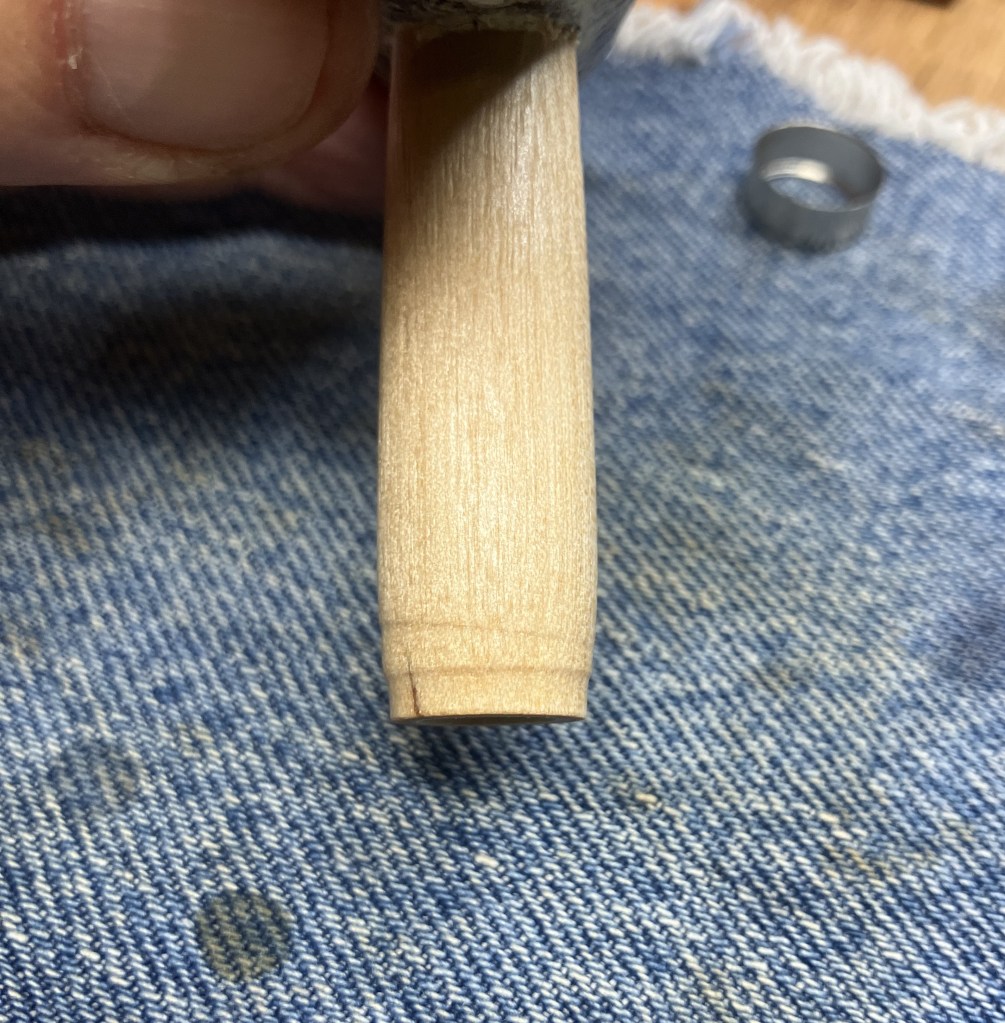
    The drilling went smoothly with just a hand drill, due to that is all I have.  There was a slight step where the two hold met within the shank.  This step provided just enough friction to stop a filter from being dropped into place.  Bah.  I used a small rat-tail file and a small tapered half-round file to smooth off the step.  It took what seemed to be hours but was probably ½ hour.  

    Finally the filter would drop in but not drop back out.  Tapping the shank of the workbench freed the filter.  Bad news:  My worry was that during smoking the filter would swell with moisture and lodge itself in the shank. Good news:  At least I know that the airflow is going through the filter and not around it.  Okay, that is kind of a reach for the good news.

    I thought that maybe more sanding of the new “filter chamber would improve the filter’s release and removal.  I made a sanding tool from an Exacto knife handle (with the blade removed).  I applied a contact adhesive to the 2 cm at the end of the handle.  I then applied more contact adhesive to the back of a piece of sandpaper.  Once they were both diy I rolled the sandpaper onto the Exacto handle.  This gave me a sanding tool which would only sand the first 2 cm of the filter chamber and not make the mortise any more loose. 

    The sanding continued and the filters would slip in without any difficulty.  When the stem was completely inserted it pushed the filter further into the shank.  I would then remove the stem and the filter would be stuck in the shank of the pipe.  I could wiggle it, showing that it was loose but the filter would not simply slide back out.  I found the best way to remove it was to use very fine tipped forceps to reach into the shank and grab the filter.  The fine tips would slip into the holes of the ceramic filter and the filter could then be twisted and pulled free.  This was not an ideal situation but it appeared to be the best case scenario of converting this pipe to a 9mm filter pipe.  I ordered a fine tipped “filter extractor” (AKA, forceps) to include in the package for Sascha.

    I think the conversion of this Missouri Meerschaum Freehand to accept 9mm filters was a success.  Sure, it was done in a non-traditional way.  Fitting a filter into the shank of a pipe is not the normal way to fit a filter.  However, I was able to maintain the original stem and shank of the pipe.  By just looking at this pipe, you would never know that it has been altered.  I remain uncertain about the need for a filter.  Perhaps there are more people who inhale pipe smoke than I think.  I will continue to not inhale pipe smoke and use filters infrequently, but certainly not judge anyone who prefers them.  I enjoy Carey Magic Inch pipes with their papyrus filter and I will occasionally insert a 9 mm filter into my Peterson Pipe of the Year 2017.  The short stem of this pipe is made a better smoking pipe with a filter.

    I do hope that you have found something here useful to your own pipe care, maintenance or restorations.  If you like this sort of thing, please click the like and subscribe buttons.  Thank you for reading the ramblings of an old pipe lover.

    Loading…

  • A French-made Cherrywood Demichurchwarden Restoration

    September 18th, 2025

    Photographed and written by 

    John M. Young

    I remember the first cherry wood pipe that I restored, several years ago.  I was bummed that one was in the estate lot, but I figured that it would be good practice if nothing else.  When I finished working on it I tried smoking it.  I was surprised at how well the pipe smoked.  I was not expecting that.  That was also the first time I tried banding a cracked shank.  That was long before I started documenting restorations but here are three recent photos of that pipe:

    I would like to think that my stem work and banding skills have improved since then.  Feel free to criticize, I can take it.

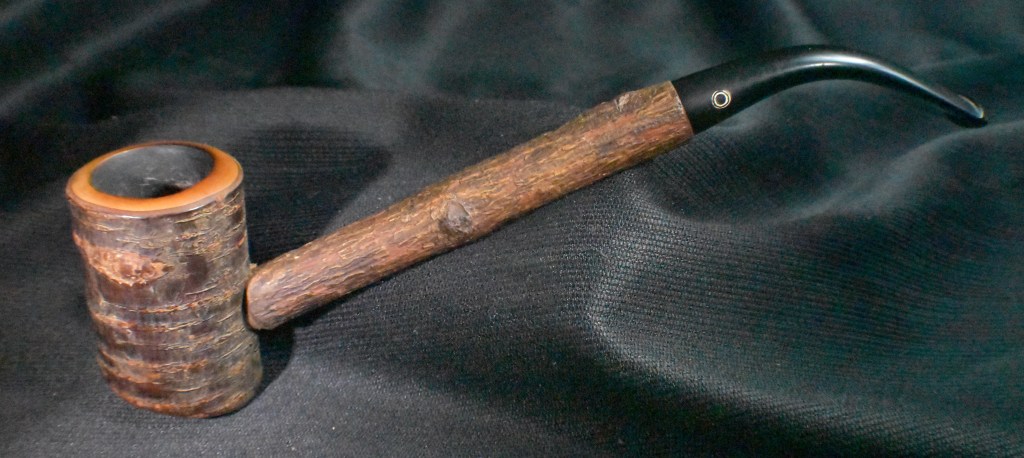
    Back to the subject of this restoration blog, The French mMade Cherrywood Demichurchwarden.  This pipe also came to me as part of an estate lot.  The target of the lot was not this pipe.  I wanted the Marxman Monk figural from a couple of blogs ago.  This pipe did strike my fancy though.  The sweeping curve of the stem and the long shank were both good looking and felt good while clenching.  The pipe was only marked with a single stamp reading MADE IN FRANCE.  Below are some photos of the pipe prior to working on it.

    The Cherry Wood was in very good condition.  This is most likely due to it having not been used.  There was some chatter on the mouthpiece and the bowl had obviously seen fire and tobacco, but I would wager less than 5 times.   The stem would require the most work and that was quite superficial.  The tobacco chamber would be reamed and sanded and the airway cleaned, other than that this was more of a cleaning than a restoration.

    Background

    Ropp is the pipe maker that comes to my mind whenever I see one of these pipes.  Lacking anything other than the “MADE IN FRANCE” stamp, I searched “Ropp” in pipedia.org and found the following:

    “Eugène-Léon Ropp (1830 – 1907) had acquired a patent for a cherrywood pipe (wild cherry, lat.: Prunus avium) in 1869. In 1870 he established a workshop to manufacture such pipes in Büssingen (Bussang, Vosges mountains). Around 1893 the business moved into the former mill of Sicard (part of the community of Baume-les-Dames – Département Doubs, Upper Burgundy – from 1895 on).

    The pipes were a big success in the export as well. Shortly before 1914 Ropp designated A. Frankau & Co. (BBB) in to be the exclusive distributor in the UK and it’s colonies.

    Probably in 1917 a workshop in Saint-Claude in the Rue du Plan du Moulin 8 was acquired to start the fabrication of briar pipes. In 1923 a small building in the environment of Saint-Claude, serving as a workshop for polishing, was added.

    • Circa 1920’s 1930’s catalog in PDF, courtesy, Joseph Morris: Early Ropp Catalog

    Even though cherrywood pipes were the mainstay of Ropp until the company finally closed down in September 1991. The company was taken over by Cuty-Fort Entreprises (Chacom, Jeantet, Vuillard, Jean Lacroix…) in 1994.” (Ropp – Pipedia).  The entry did contain one advertisement which looked rather familiar.

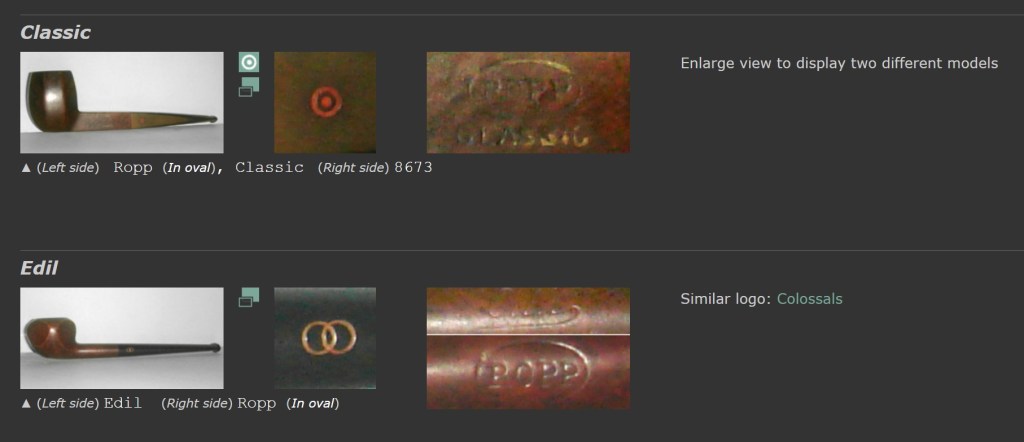
    I wondered if the logo on the stem of this pipe would provide any additional information.  The pipedia.org entry had several Ropp logos, but none of them were a match for this pipe.  Sure this might be a replacement stem.  The issue with that hypothesis is, “Why would you need to replace a stem on a pipe that has almost never been smoked?”  I went to pipephil.eu, the source of all things “logo” and did a search for Ropp.  There were only two photos of Ropp pipes with circle or bullseye logos:

    (Ropp — Pipes : Logos & Markings).  Unfortunately neither of these matched the pipe in hand.  

    Ropp was certainly the prominent cherry wood pipe maker but, after 20 years patents expired and pipe makers countrywide could copy Ropp’s style and cash in on the market for these pipes.  I assume that is what this pipe represents.  Ropp does not appear shy about stamping their name upon their pipes.  There are a large and diverse set of Ropp stem logos but they always seemed to have stamped the name on their pipes.  

    The Restoration

    The restoration, if you can even call it that, began as usual with a clean denim piece.

    Now before we begin, I have to start with some operational definitions.  “What are those?” you ask.  Operational definitions are words or phrases used in scientific writing where the author uses a specific definition of a word and how they will be using it in the article.  As an example, I’ll refer to this mortise as the threaded mortise.  

    The shank tenon is also threaded.  The stem has another tenon thus will be called the stem tenon.

    Finally the shank mortise is unthreaded and fits with the stem tenon.  Double the pleasure, double the fun.  

    As you can see from all those mortises and tenons, the pipe was really clean.  I looked at the draft hole; it was drilled offset to the front of the pipe’s tobacco chamber.

    Here it is with the stem attached allowing a better look at what I mean.  Weird, but I suppose it does line-up well with the stem.

    I started with the stem.  It was very clean and only required a single alcohol dipped pipe cleaner.

    Next I tried the shank.  It too only needed a single pipe cleaner.

    I had a foreboding feeling like something terrible was going to be discovered.  Nope, it was just a barely smoked pipe.  I started to scrape the tobacco chamber.  I used the General triangular scraper.  I rounded the tip of this frightening tool off on the neighbors grinder since I am far too lazy to swap out my buffing spindle for the grinding wheel.  Lazy and honest.

    After the scraping, I sanded the chamber with 320 sandpaper wrapped around a wood dowel and a couple of small pieces of sandpaper with the not-so-nimble fingertip.

    The stem and stummel were taken to the sink for a scrubbing with a nylon brush and undiluted Murphy Oil Soap.  Both pieces were rinsed of soap with warm water and then dried with a cotton hand towel.

    I lightly sanded the surface of the stem with a 320 sanding sponge, while avoiding the stem logo.

    The stem was then placed into Briarville’s Pipe Stem Oxidation Remover solution, also known as deox.  I originally thought I’d leave it in for a couple of hours, but this turned into a 18 hour stay.

    After the stem went into deox, I coated the stem and stummel with Before and After Restoration Balm.  The dry cherry bark absorbed the balm very quickly, taking much more than I thought it would.  The balm was applied with a baby toothbrush to work the product into the nooks and crannies of the bark.

    After about 20 minutes the surfaces of the stem and stummel were hand buffed with an inside out athletic sock to remove excess balm.

    I wanted to coat the bark with something to hold up to frequent handling.  I thought that a couple of coats of Danish Oil might be good.  I found a spare stem that fit the stem mortise to act as a handle while I applied the oil.

    The Danish Oil was applied with a folded pipe cleaner.

    The spare stem was clamped in a vice to hold the pipe as the Danish Oil dried.

    The next day, I removed the stem from deox and placed it on a coarse shop rag.  The stem was vigorously rubbed with the rag to remove oxidized material which the deox had softened.

    Back at the workbench the airway of the stem was cleaned with a pipe cleaner.

    The stem was then sanded with a 400 grit sanding sponge and oiled with mineral oil to see how the deox had worked.  The answer, very well.

    I taped the shank and stem logo with masking tape after reinserting the sten into the shank.  This was done to protect those two from the stem sanding.

    The stem was then sanded with a series of sanding sponges in grits 400-3500.  Between each sponge the stem was rubbed with mineral oil and wiped with a dry paper towel to remove sanding debris.

    The stem was loose fitting.  To address this I used a couple of drops of black cyanoacrylate (CA, super glue) applied to the tenn.  The blac CA was spread evenly onto the tenon with the edge of a fly tying bodkin.  Once the CA had dried I sanded the surface with a 1000 grit sanding sponge and tested the fit.

    The fit was better, but still loose.  I then switched to Thin CA applied and spread as before.  This was also sanded with a 1000 grit sponge.

    Better, but still loose.  One more time.  Perfect fit was achieved.

    I took the stem to the buffer where it was buffed with a blue buffing compound and the dedicated blue compound wheel.  The shine was great but the logo had suffered.  Before repainting it with white acrylic model paint, I cleaned the logo with 99% ethyl alcohol on a cotton swab.

    The paint was applied and worked into the stamp with the fly tying bodkin.

    The acrylic paint dries quickly and was rubbed with a soft cotton rag to remove the excess paint.

    I returned the pipe parts to the buffer where they were waxed with carnauba wax.  I worked the wax into the bark with and against the grain.  Using very light coatings of wax and working it into the slightly rough texture of the bark.  The stem was also given several coats of wax.

    I used a cotton hand towel to hand buff the stem and stummel to make sure there were no areas of wax build-up.  The final step was a hand buffing, with a microfiber polishing cloth, of the stem, shank and stummel.

    I think this Cherrywood demichurchwarden turned out very nicely.  The pipe feels great in both the hand and between the teeth.  The rustic look of the bark covered cherry wood is both attractive and functional.  I find the rustic charm similar to a corn cob pipe but with a European flair.  The relatively unused bowl should provide years of use.  The stem polished beautifully and the high gloss black finish accentuates the rustic nature of the rest of the pipe.   The dimensions of this French made Cherrywood pipe are:

    Length:  7.34 in./ 186.44 mm.

    Weight:  1.52 oz./ 43.09 g.

    Bowl Height: 2.02 in./  51.31 mm.

    Chamber Depth: 1.02 in./ 25.91 mm.

    Chamber Diameter:  0.70 in./ 17.78 mm. 

    Outside Diameter:  1.33 in./ 33.78 mm.

    I do hope that you have found something here useful to your own pipe care, maintenance or restorations.  If you like this sort of thing, please click the like and subscribe buttons.  Thank you for reading the ramblings of an old pipe lover.

    Loading…

    Below are some photos of the finished French-made Cherrywood Demichurchwarden.

  • A Marxman Rattlesnake Figural Pipe Restoration

    September 16th, 2025

    Photographed and written by 

    John M. Young

    Loading…

    I am not only a pipe restorer but also a Nebraska Master Naturalist.  “What the heck is that?” you ask.  The Nebraska Master Naturalist Program was started by a longtime friend, Dennis Ferraro (PhD) the official Nebraska Herpetologist as a way to certify non-academic citizens and get them involved in citizen science, volunteering, education and promoting the wild flora and fauna of Nebraska.  “Herpetology. What the heck is that?” you ask.  Herpetology is the study of reptiles and amphibians.  Since the mid-1980s I have pursued reptiles and amphibians across Kansas, Nebraska and Wyoming.  My interest has always been more biogeography.  “Biogeography, what the heck is that? You ask.  Goodness, you ask a lot of questions.  I’m interested in the geographic ranges of reptile and amphibian species within Nebraska.  Believe it or not, Nebraska has a very diverse set of physical features with numerous isolated pieces of specific habitat removed from where they would normally be found.  This leads to species also found outside of their expected or documented ranges.  That is what I enjoy doing, field biology searching for and documenting reptile and amphibian ranges.  So, when I saw this rattlesnake Marxman, I knew I had to have it even though it bears little resemblance to a real rattlesnake.  Yeah, I help Dr. Ferrao out every spring and fall with Prairie Rattlesnake (Crotalus viridis) research in western Nebraska.

    Here is what a researcher cabin looks like, every red bucket has one or more C. viridis in it.

    The subject of this post is a figural Marxman pipe that showed up on eBay last August.  Won and delivered for under $50, I was quite pleased.  The pipe came from Newark, Delaware.  The only rattlesnake in Delaware was the Timber Rattlesnake (Crotalus horridus) which is probably extirpated from the state (Snakes to Watch Out For – DNREC). 

    The stampings on the bottom of the pipe were MARXMAN (with the arrow passing through) over IMPORTED BRIAR over HAND CARVED (curved) over U.S.A..  The MARXMAN and the HAND CARVED were faint.  There was also a carving at the heel of the pipe which I think, is supposed to represent the end of a log.  This was an interesting feature.  Below are several photos taken prior to any work done.

    The pipe was in good shape.  It had been smoked as evidenced by the light cake in the tobacco chamber, the light lava deposits on the snake’s head and the smoking residue on the stinger.  I wondered if the stinger should be renamed fang?  Anyway, the oxidation of the stem was not too bad.  The pipe did show signs of having extensive fills done.  This was seen as the pinkish red spots that were carved through but remained as discolored patches.  I knew that I did not want to pick the old fill material out and redo the fills.  The recarving would likely look atrocious.

    Background

    I have done a lot of Marxman restorations.  Next to Peterson pipes I am sure Marxman pipes come close as to numbers.  I have also written about the history of Robert Marx and how he formed and built up the company during World War Two, not an easy task considering the main material of his production was nearly inaccessible during the war years.  If you would like more information I think I did an acceptable job on Marxman history in the following blog:  A Marxman Dublin Gold Band Restoration – NebraskaPeteGeek.  Yeah it’s still written by me, but it’s pretty good for a change.

    As for Marxman figurals I have done a camel and a monk/friar.  This is the first snake pipeI have gotten to work on.  I am guessing this pipe was made in New York City.  The home of Marxman during the years of production before Robert Marx sold the company to MasterCraft in 1953.  Again guessing, but with conviction, the pipe was made between 1938 and 1953.  Based on the inclusion of what looked like metal flecks in the rubber, I think the pipe was likely made during or shortly after WWII due to the recycling of rubber from tires and the accidental inclusion of metal in the stem.

    The Restoration

    After the before photos the pipe was taken to the workbench and a clean denim piece.

    I removed the stem then pulled the stinger.  It looked like it was coated in a brown lacquer of smoking residue.  I placed the stinger in a medicine cup with 99% ethyl alcohol.

    The ream team was gathered and consisted of the PipNet with the #2 blades, Smokingpipes Low Country reamer and the General triangular scraper.

    There was very little cake to actually remove.

    Below you can see the reamed tobacco chamber with some lava deposits around the inner edge of the rim.

    The chamber was sanded with 320 sandpaper wrapped around a wood dowel.  No damage to the tobacco chamber was noticed.

    The shank was surprisingly clean and took only a couple of cotton swabs dipped in alcohol to remove the accumulated residue.

    The airway was a little more dirty but again quickly cleaned with a nylon shank brush and bristle pipe cleaners dipped in alcohol.

    The stummel was taken to the sink for a scrubbing with Murphy Oil Soap, undiluted and a nylon brush.  The soap was rinsed with warm water and the stummel dried with a cotton hand towel.

    Back at the workbench the stummel was wiped and scrubbed with a make-up pad wetted with 99% ethyl alcohol.  The discoloring of the make-up pad can be seen below.  Very little stain came off the briar.

    I removed the stinger from the alcohol and used the same make-up pad to clean the aluminum.  The stinger left more yuck on the pad than the entire stummel did.

    The stem was cleaned with bristle pipe cleaners and more alcohol.  The button end of the airway drilling would not pass a pipe cleaner smoothly.  I remedied this with a slot tool and a sliver of an emery board.  

    The outside of the stem was lightly sanded with a 320 grit sanding sponge in preparation for the Briarville Pipe Stem Oxidation Remover bath.

    I placed a pipe cleaner in the tenon to aid in the retrieval of the stem.  I figured that I would leave the stem in the solution until the next day.

    In the photo below you can see the pink-stuff used as a filler. When I scrubbed the pipe I did not want to use a more aggressive brass brush for fear of removing too much of the filler.  

    Normally, I like to remove this unsightly pink-stuff but doing so with this pipe would mean that I would have to re-fill the material with cyanoacrylate and briar dust then carve the new fill to match the original carvings.  I strongly doubted my ability to do that, so leaving it alone seemed my best option.

    Well, there was another option:  Use a furniture touch-up marker to dye the pink-stuff to mask its unsightly pinknocity.  Wow, spellcheck thinks pinknocity is a word.

    This is what the pink-stuff looked like with a walnut colored touch-up marker.  Much better.

    The side, too, looked dramatically better.

    The following day, nearly 24 hours to the minute, I removed the stem from the Briarville solution.  I like to call this deox, poking fun at the detox of drug or alcohol abuse.  Yeah, been there, done that.  I also like to use a coarse texture shop rag to vigorously rub the stem while it is still wet with the deox solution.  This removes some of the oxidized vulcanite as can be seen in the photo below.

    The stem had pits where the oxidized material was chemically softened and removed from the stem and fleck of metal.

    I used several make-up pads doused with Soft Scrub cleanser to scrub away more of the oxidized vulcanite.  The color was more of a dark greenish than the typical dark reddish brown of vulcanite. 

    I oiled the stem with mineral oil and allowed it to soak in the oil for about 30 minutes.

    There was not much that I could do with the carvings of the stummel but give it a coating of Before and After Restoration Balm.  I worked this wonder-product into the crevices of the briar with a baby toothbrush.  The stummel then was set aside for 30 minutes.

    The stummel was wiped and hand buffed with an inside out athletic sock to remove excess Restoration Balm.

    I used masking tape to protect the shank from the sanding which the stem would undergo.  The sanding was done with a series of sanding sponges in grits from 320-3500.  Between each sponge I rubbed the stem with mineral oil and wiped it dry again with a paper towel.  This removed any of the sanding debris.  The stem looked better but the pitting was deep enough that the only way to remove it and retain the smooth feel from the shank to the stem would have been to also sand the shank briar.  I did not want to do that and risk removing detail from the carving.  Instead I took the pipe to the buffer and worked the stem with red buffing compound followed by blue buffing compound on their respective buffing wheels.  The results looked better but not great.

    The stummel was waxed with Renaissance Micro-Crystalline wax again applied with a baby toothbrush.  I did have to clean the baby toothbrush using alcohol before and after the wax.

    The final step was a hand buffing with a microfiber polishing cloth.

    This Rattlesnake figural by Marxman, though anatomically incorrect, is still a fun pipe for me.  Sure the stummel is full of the dreaded pink-stuff fills and the vulcanite of the stem is lower quality recycled tires, I still enjoy it.  The dying of the pink-stuff did improve the look, some, and the stem did polish-up, some, they are still nothing to brag about.  The carving of the snake is pretty impressive with the checkering over the entire curved body.  That is impressive.  The details like the rattle on the tail, the texture along the log and the end of the log are also quite impressive and well done. The snake is a caricature of the elegant serpent with the head being comically misshapen. I will say that the pipe feels very good and substantial in my hand and the weight is comfortable for short periods of clenching.   The dimensions of the Marxman figural Rattlesnake pipe are:

    Length:  5.58 in./ 141.73 mm.

    Weight:  1.94 oz./ 55.00 g.

    Bowl Height: 1.73 in./  43.94 mm.

    Chamber Depth: 1.56 in./ 39.62 mm.

    Chamber Diameter:  0.73 in./ 18.54 mm. 

    Outside Diameter:  1.61 in./ 40.89 mm.

    I do hope that you have found something here useful to your own pipe care, maintenance or restorations.  If you like this sort of thing, please click the like and subscribe buttons.  Thank you for reading the ramblings of an old pipe lover.

    Loading…

    Below are the finished photos of the Marxman Rattlesnake Figural Pipe.

  • A Peterson Captain Pete Made in England Restoration

    September 12th, 2025

    Photographed and written by

    John M. Young

    Loading…

    My affection toward Peterson pipes is hardly a secret, you could even say that I wear it on my sleeve.  Though it is more literally on my hat.

    That said, I have restored dozens of Peterson pipes and I always enjoy doing it even when it is more of a pursuit of folly trying to salvage a very abused old implement rather than refreshing someone’s dear old frien.The subject of this blog is a Captain Pete I found last May on eBay.  I probably paid more for it that I’d like to admit and certainly more than what I would have 3 years ago.  Regardless, after a short trip from Englewood, Florida the not so lovely old pipe arrived.  The stampings were mostly clear and read “CAPTAIN (0ver) PETERSON” on the top left shank.  I’m not sure why the Peterson stamp folks like their quotation marks but they seem to.  The stem was stamped with a worn and paint worn-off circled C.  On the right shank the stamp read “A PETERSON PRODUCT” over MADE IN ENGLAND with an offset 046.  The country of manufacture (COM) stamp is what intrigued me the most.  More on that in the “Background”.  The photos below show the pipe prior to any work.

    This pipe appeared to look rough.  The stem was severely oxidized, I feared saving the logo would be difficult at best. The bowl had been reamed but not very well.  There was a layer of lava on the rim which looked like it had been removed and redeposited.  I think what was thinking is that this l pipe appeared to have been smoked a lot but kind of kept up and cleaned on occasion.   

    Background

    Back on December 21, 2023 I wrote a blog about a Captain Peterson apple.  That blog is linked for those interested.  In that blog I said the following about the Captain Peterson line:  

    “I highly recommend the book The Peterson Pipe, by authors Mark Irwin and Gary Malmberg as well as a reading of pipedia.com’s Peterson pages.   According to Mark Irwin and Gary Malmberg, the Captain Pete:

    “This line’s name was derived from the nickname of Charles Peterson, known affectionately as “Captain Peterson.” The first issue, c. 1940-62, was in a smooth finish produced for Rogers Imports with a white stamped P inside C, or a circled P on the mouthpiece.  CAPTAIN over PETE on shank, and a MADE IN IRELAND in a circle.  English made versions show CAPTAIN over PETE on shank or “CAPTAIN PETERSON” and A PETERSON PRODUCT over MADE IN ENGLAND or LONDON MADE over ENGLAND.  The second issue (1998-), features an XL bowl with Sherlock Holmes shapes and compact stems, in rustic or combination of smooth and rustic, with a nickel band between two narrow brass bands.” (Irwin and Malmberg p.295)”  (A Peterson Captain Pete Restoration – NebraskaPeteGeek)

    This example of a Captain Peterson is described above and likely dates from 1940-62 and was made in London.  These dates can be further narrowed down by reading p.149-150 in The Peterson Pipe, where the London production of pipes is discussed at length.  Here, Irwin and Malmberg say, “Apparently, the London factory did not order a MADE IN ENGLAND die until after the war.  Any Peterson stamped with an English COM must be no older than the later 1940s” (Irwin, p.150).  This would mean that this pipe dates from 1945-1962 as 1962 was when Peterson shuttered the London factory.

    The Restoration

    After the before photos the pipe made its way to the workbench and a clean denim piece.

    I began work with the stem  due to thinking that the stem would require the greatest amount of time.  The cleaning was done with bristle pipe cleaners and 95% ethyl alcohol.  The stem was very fouled with tar and smoking residue.

    The stem has some tooth chatter on the bit above the button on both the top and bottom surfaces as the two below photos show in all of their poorly focused glory.

    The bits of the top and bottom surface were filed with a small slat file to remove most of the chatter.

    The stem was suspended in Briarville’s Pipe Stem Oxidation Remover solution and allowed to soak for 24 hours.  This solution is lovingly referred to as deox.

    The next day the stem was removed and rubbed with a coarse shop rag.  This removed a great deal of the oxidized vulcanite and can be seen on the rag in the photo below.

    The airway of the stem was again cleaned with alcohol dipped bristle pipe cleaners.

    I was pleased to see that the logo stamped on the stem remained intact after the time in deox.

    To further reduce the amount of oxidized vulcanite, I rubbed the stem with Soft Scrub cleanser on make-up pads.  The oxidized vulcanite can be seen darkly coloring the pads.

    The stem was oiled with mineral oil to keep the vulcanite from further oxidation.

    The tooth chatter that was not filed from the bite zone was filled with black cyanoacrylate (CA, super glue).  This was spritzed with a CA drying accelerator.  The hardened CA was then filed with a small flat file to smooth and reshape the stem.

    The shank of the pipe was wrapped with masking tape to protect the briar and allow me a handle while sanding.  The stem logo was also masked for its protection.  The stem was sanded with a series of sanding sponges from grits 400-2000.  Between each sponge the stem was rubbed with mineral oil and wiped with a paper towel to remove sanding debris.

    The sanding continued through the 3500 grit sponge with oiling and wiping as above.

    The stem was buffed using blue buffing compound on a low speed buffer with a flannel wheel dedicated to the blue compound.

    The stem was wiped of any residual buffing compound and the logo area cleaned with alcohol on a cotton swab.  I used a white acrylic model paint to repaint the imprint of the logo.

    The white acrylic dried quickly and was hand buffed with a soft cotton cloth to remove the paint from the stem outside of the stamp.

    The sequence of this restoration had me a bit out of sorts, but it was apparently time for the reaming.  The tools were gathered.

    The Pipnet #2 blade was the only one that fit and did most of the reaming.  Both the Smokingpipes Low Country reamer and the General triangular scraper were used but just for clean-up.

    Below the reamed tobacco chamber can be seen.

    The chamber was sanded with 320 sandpaper wrapped around a wood dowel.  I saw no signs of damage within the chamber.  The lava on the rim was softened with saliva and allowed to soak for a couple minutes.

    The rim was then scraped using the edge of a sharp pocket knife blade.  There were some rough spots on the rim but they looked superficial and easily removed with a light topping.

    The stummel was taken to the sink for a scrubbing with a nylon brush and undiluted Murphy Oil Soap.  The soap was rinsed with warm water and the stummel dried with a cotton hand towel.

    I packed the stummel with cotton and saturated it with 99% ethyl alcohol.  This was allowed to sit overnight.

    The next day the cotton was stained telling me the treatment had worked.

    The cotton was removed and was far dirtier than I was used to.  I could have sworn that I had cleaned the shank, yet I had no recollection of doing it.  Remember when I said the sequence of this restoration had me out of sorts?  It was apparently worse than I thought.  

    The airway was filthy and tar infested.  The good news was that the tar was very soft due to the extended soaking in alcohol.  The scraping with a dental scraper was very productive.  The cotton swabs eventually started to lighten as more of the tars were removed.

    I cannot say if this was a superior order to use than my normal sequence; reaming the chamber, then, clean the shank airway then alcohol/cotton treatment is needed for ghosting of severe dirtiness.  In this case it worked well.  The softening of the tar did make for easier cleaning.

    There were several small dents, scratches or pits on the surface of the stummel.  These revealed themselves more and I had started sanding.  I had covered the stamps with masking tape for their protection.  For the fills, I applied small amounts of thin CA using a long narrow applicator on the CA bottle.  Immediately after application I used a dust sanding sponge to sand the fill area.  The sanding sponge supplied the briar dust to join with the CA and for a fill.  This method only works if the spots to be filled are very small and the sander has total disregard for their sanding sponges as some of the CA and briar dust will certainly get on the sponge making it have nonabrasive spots.  I wonder if I will ever learn to use a piece of sandpaper like I did before I had sanding sponges.  The next three photos show the fills.

    The stummel was then sanded with the full series of sanding sponges from 400-3500 grit.  The stummel was wiped with a make-up pad wetted with alcohol between each sponge

    I removed the masking tape and cleaned any adhesive left behind by the tape.  I then worked the stummel with micro-mesh pads 4000-12000.  Again I wiped the stummel between pads with alcohol on a make-up pad.

    The stummel was coated with Before and After Restoration Balm and allowed to sit while I went out in search of a couple of evening Largemouth bass.  This is also called my stroll with a pole and of course a pipe.

    About an hour and a half later I returned and wiped the remaining Restoration Balm from the stummel with an inside out athletic sock.  There is the photobombing fishing pipe lurking in the background.  If you are curious it is a Peterson 127.

    The pipe was taken to the buffer where a couple of coats of carnauba wax were applied.

    I carefully dragged a knife blade around the beading to remove accumulated wax from the grooves.  The final step was another hand buff with the microfiber polishing cloth then off to the final photo shoot.

    This beautiful English made Captain Peterson 046 bulldog is a great example of post World War Two English workmanship.  The walnut stain of the original pipe was maintained and was  finished with careful sanding and just carnauba wax.  The stem was deoxidized, sanded and polished to a gorgeous glossy luster.  Though lacking any stunning briar grain the wood is solid and the few dents from wear were filled with minimal disruption to the original.  The dimensions of the Peterson Captain Peterson Made in England 046 bulldog are:

    Length:  5.71 in./ 145.03 mm.

    Weight:  1.62 oz./ 45.93 g.

    Bowl Height: 1.96 in./  49.78 mm.

    Chamber Depth: 1.65 in./ 41.91 mm.

    Chamber Diameter:  0.73 in./ 18.54 mm. 

    Outside Diameter:  1.64 in./ 62.89 mm.

    I do hope that you have found something here useful to your own pipe care, maintenance or restorations.  If you like this sort of thing, please click the like and subscribe buttons.  Thank you for reading the ramblings of an old pipe lover.

    Loading…

    Below are some photos of the finished Peterson Captain Peterson Made in England 046 bulldog.

    I did not want to affect the stamps here, so the existing scratches were not sanded away like I would have preferred to do.

←Previous Page
1 2 3 4 … 24
Next Page→

Blog at WordPress.com.

Privacy & Cookies: This site uses cookies. By continuing to use this website, you agree to their use.
To find out more, including how to control cookies, see here: Cookie Policy
 

Loading Comments...
 

    • Subscribe Subscribed
      • NebraskaPeteGeek
      • Join 36 other subscribers
      • Already have a WordPress.com account? Log in now.
      • NebraskaPeteGeek
      • Subscribe Subscribed
      • Sign up
      • Log in
      • Report this content
      • View site in Reader
      • Manage subscriptions
      • Collapse this bar
    %d