• About

NebraskaPeteGeek

  • American Pipe Makers
  • British pipe Makers
  • Danish pipe Makers
  • French Pipe Makers
  • German Pipe Makers
  • Irish Pipe Makers
  • Italian Pipe Makers
  • Others or Unknown Pipe Makers
  • Restorations
  • A Malaga Apple Restoration

    May 27th, 2024

    Written and photographed by 

    John M. Young

    I remember the warnings about peer pressure in the 1980s  Before that it was just called “running with the wrongs kids”.  I think this pipe purchase represents me being affected by peer pressure, although in a good way.  I had not heard of Malaga pipes or their founder, George Khoubesser, until reading about them in Steve Laug’s rebornpipes.com.  He has restored several of George “Manny” Khoubesser’s Malaga pipes over the years.

    It was chatting with Steve that had piqued my interest in Malagas.  I later mentioned that I had tried bidding on one listed at eBay.  He said that his brother was also bidding on that same pipe.  Well rather than run up the bidding and compete against one another we started coordinating on future Malage pipes as they became available.  Eventually I saw this one back at the beginning of May.  I made an acceptable offer to the seller and had a Malaga of my own to restore.

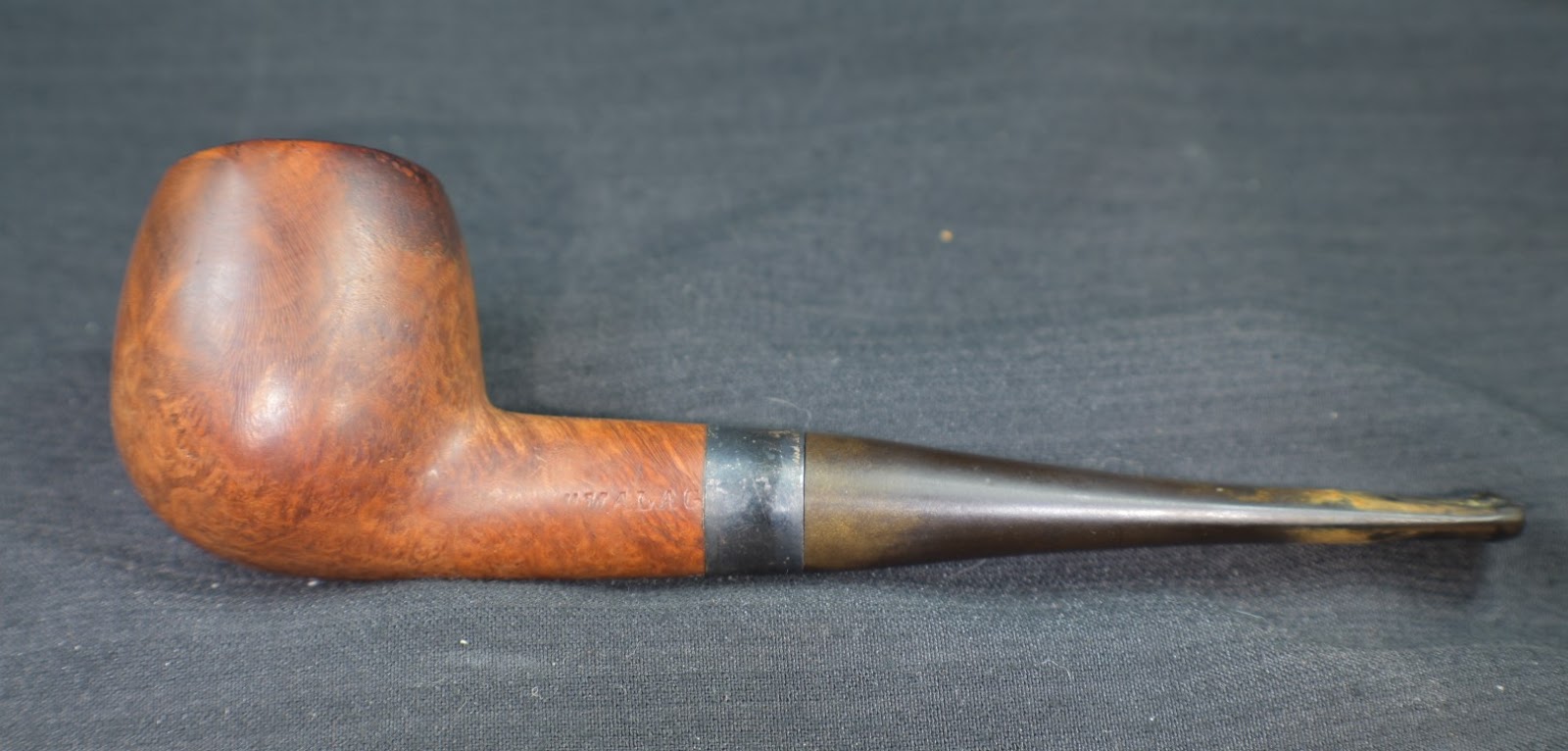
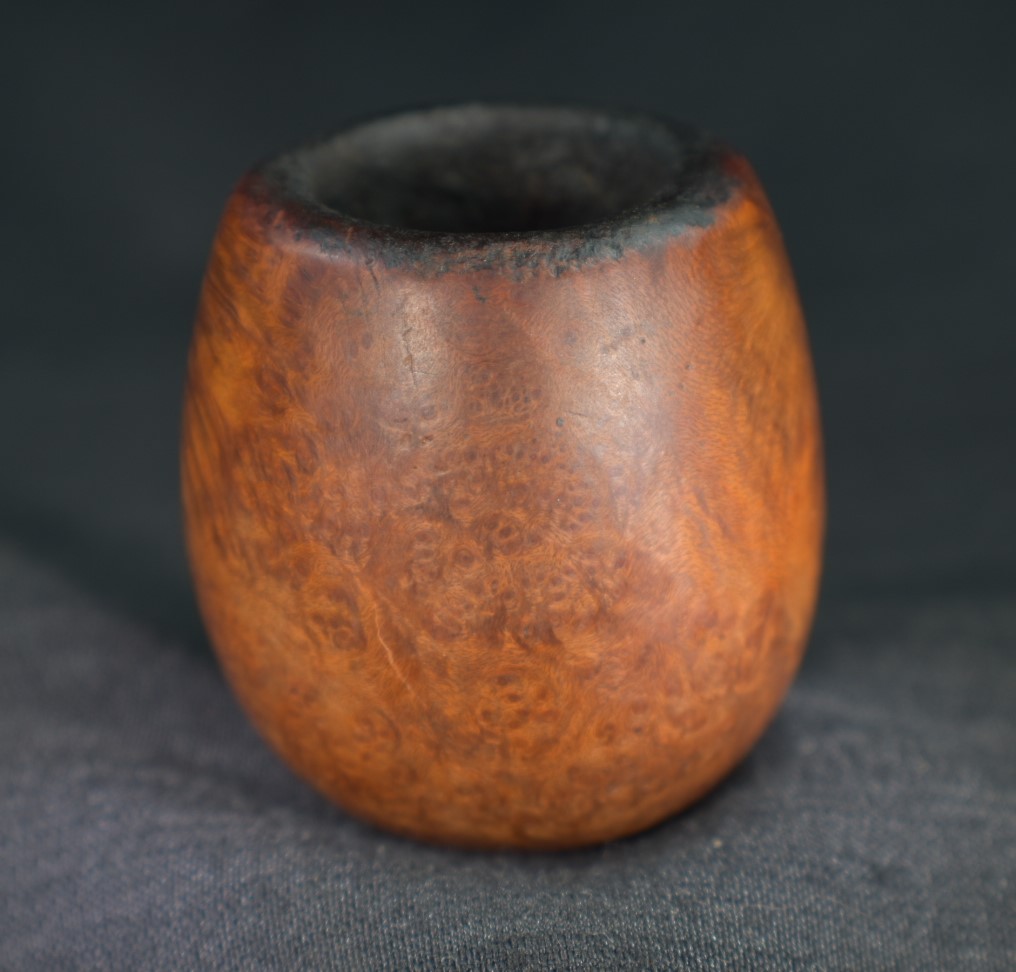
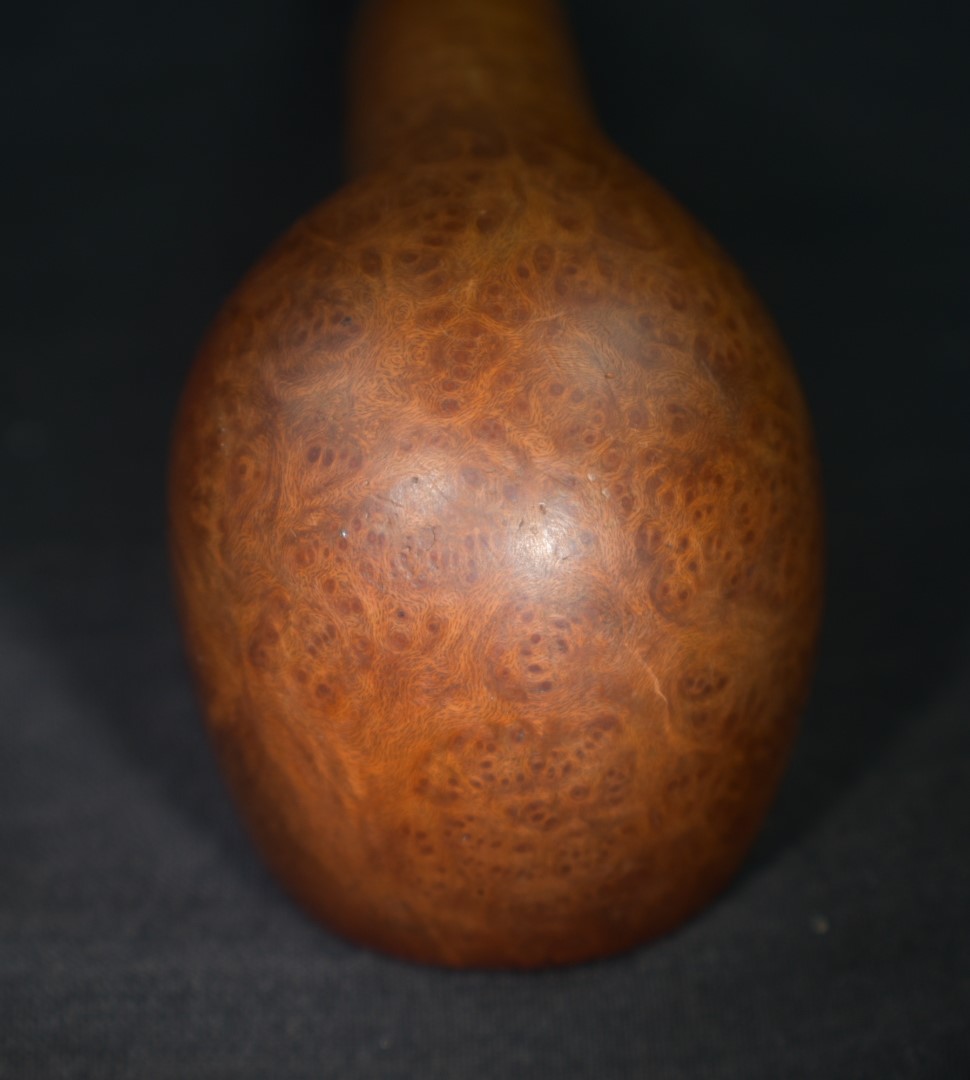
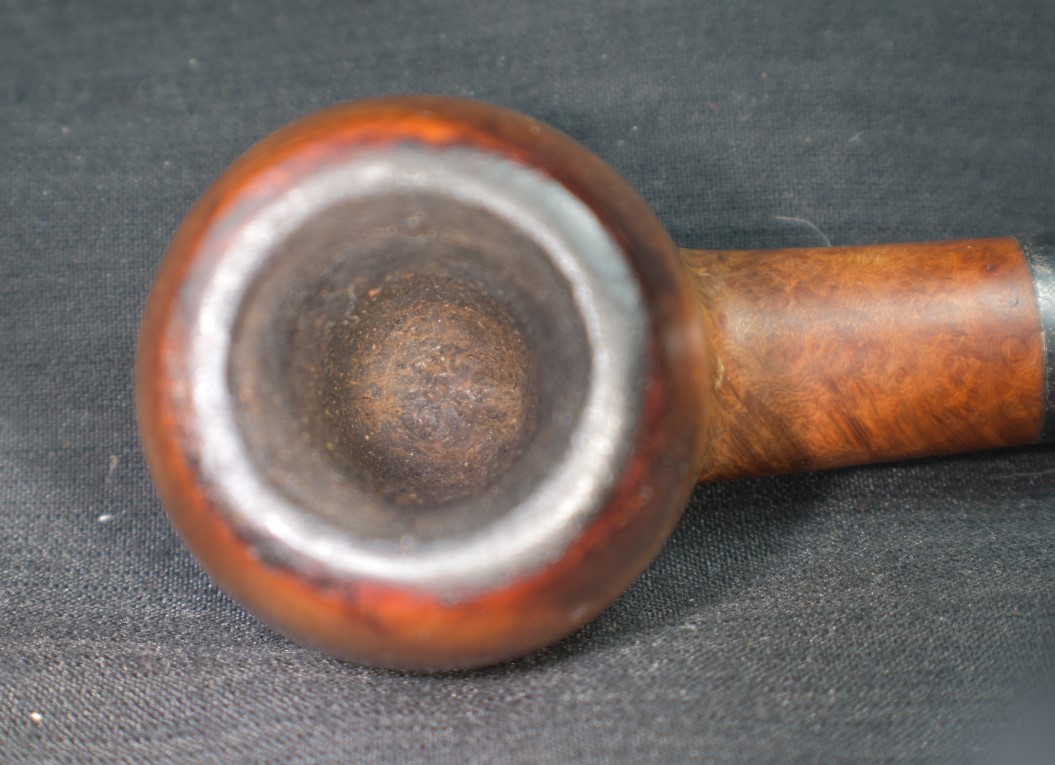
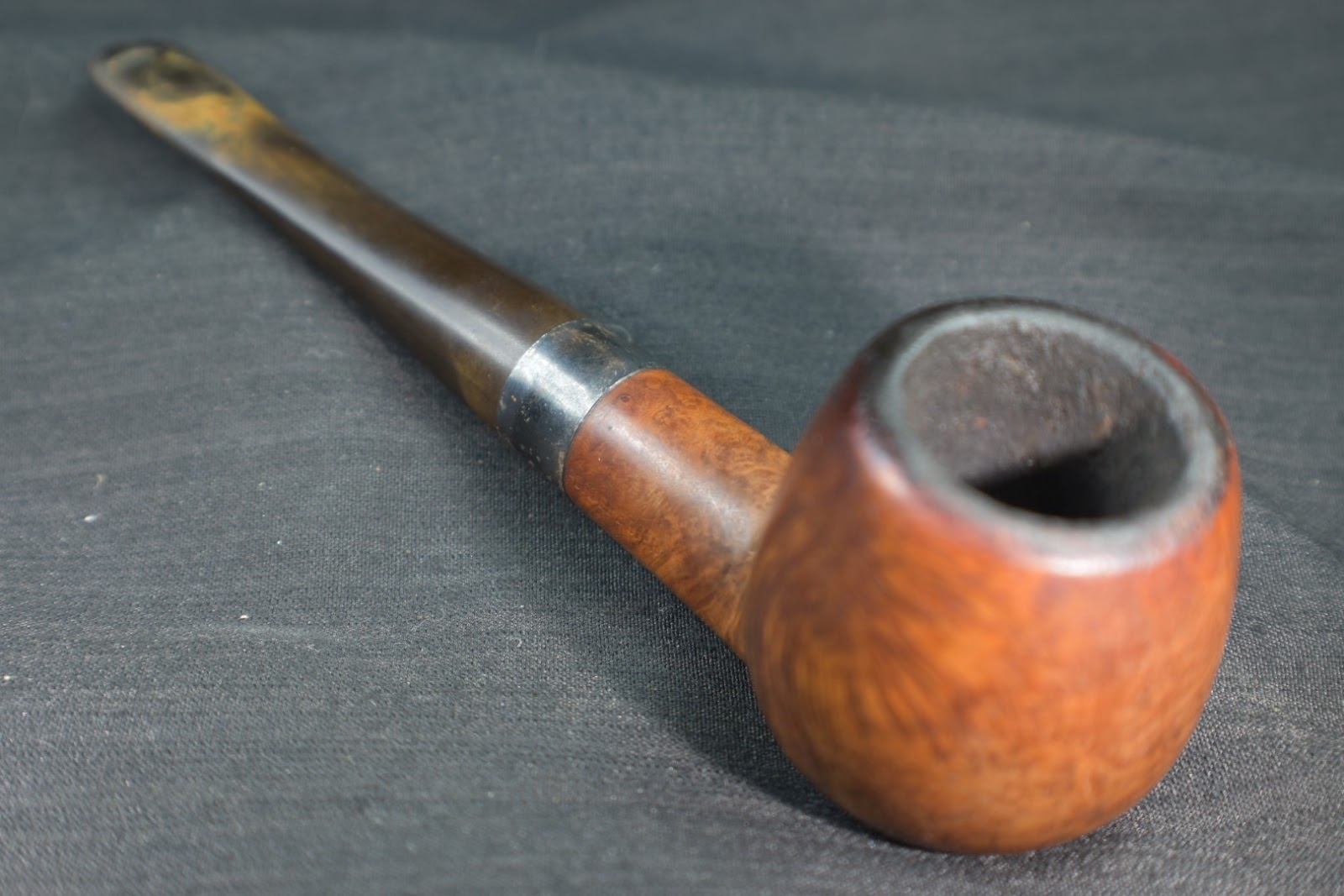
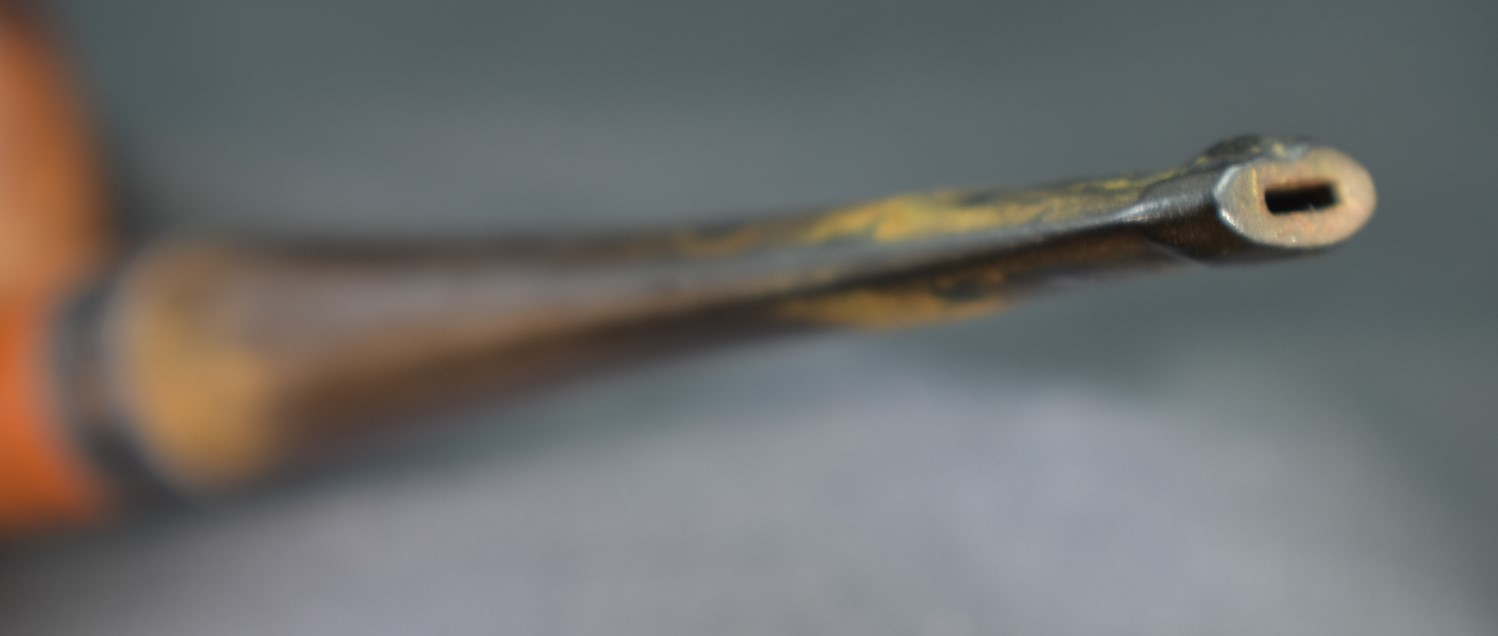
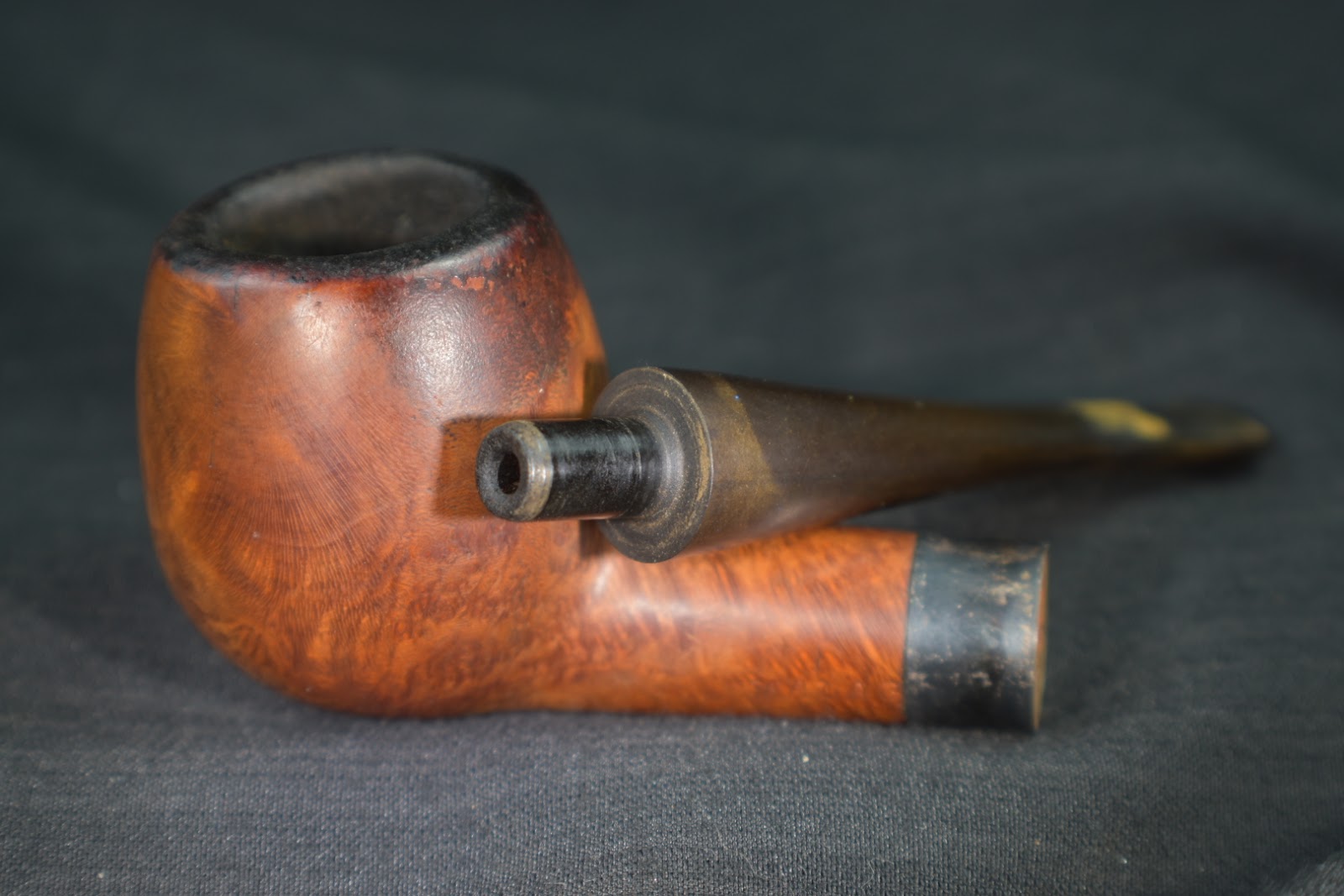
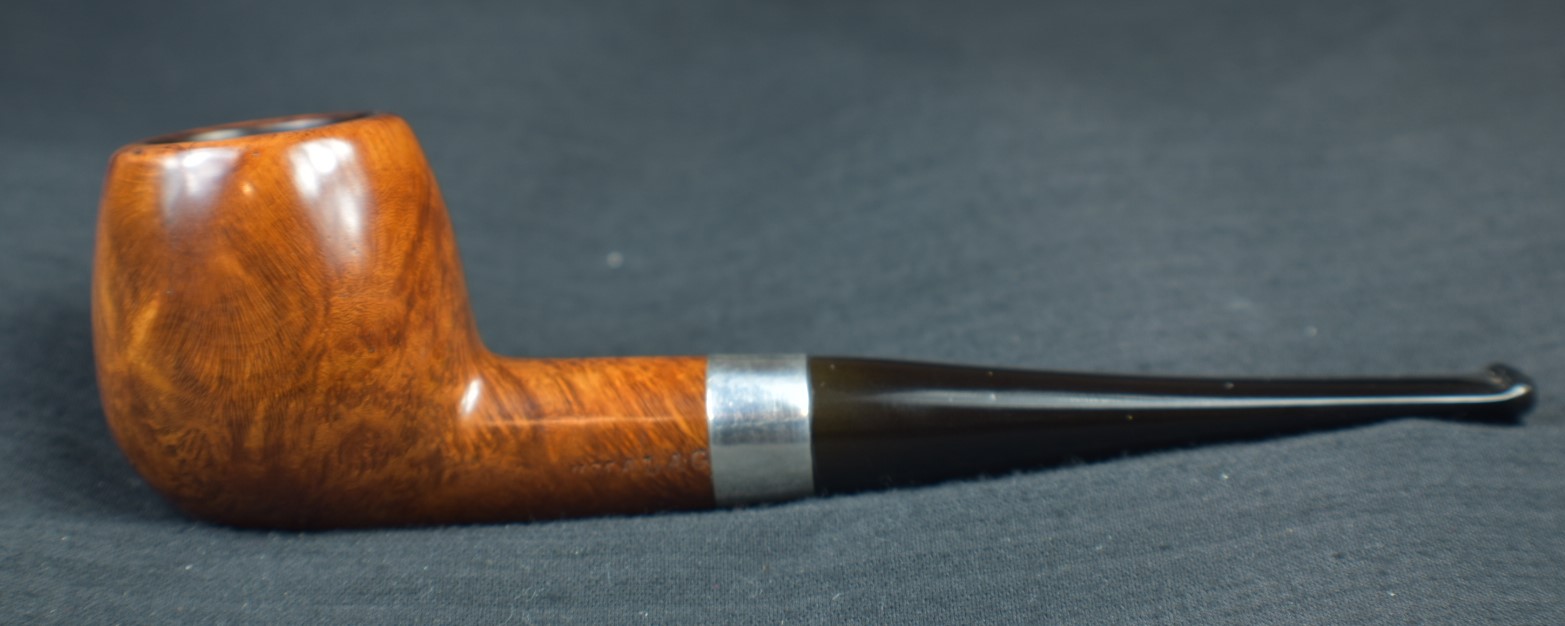
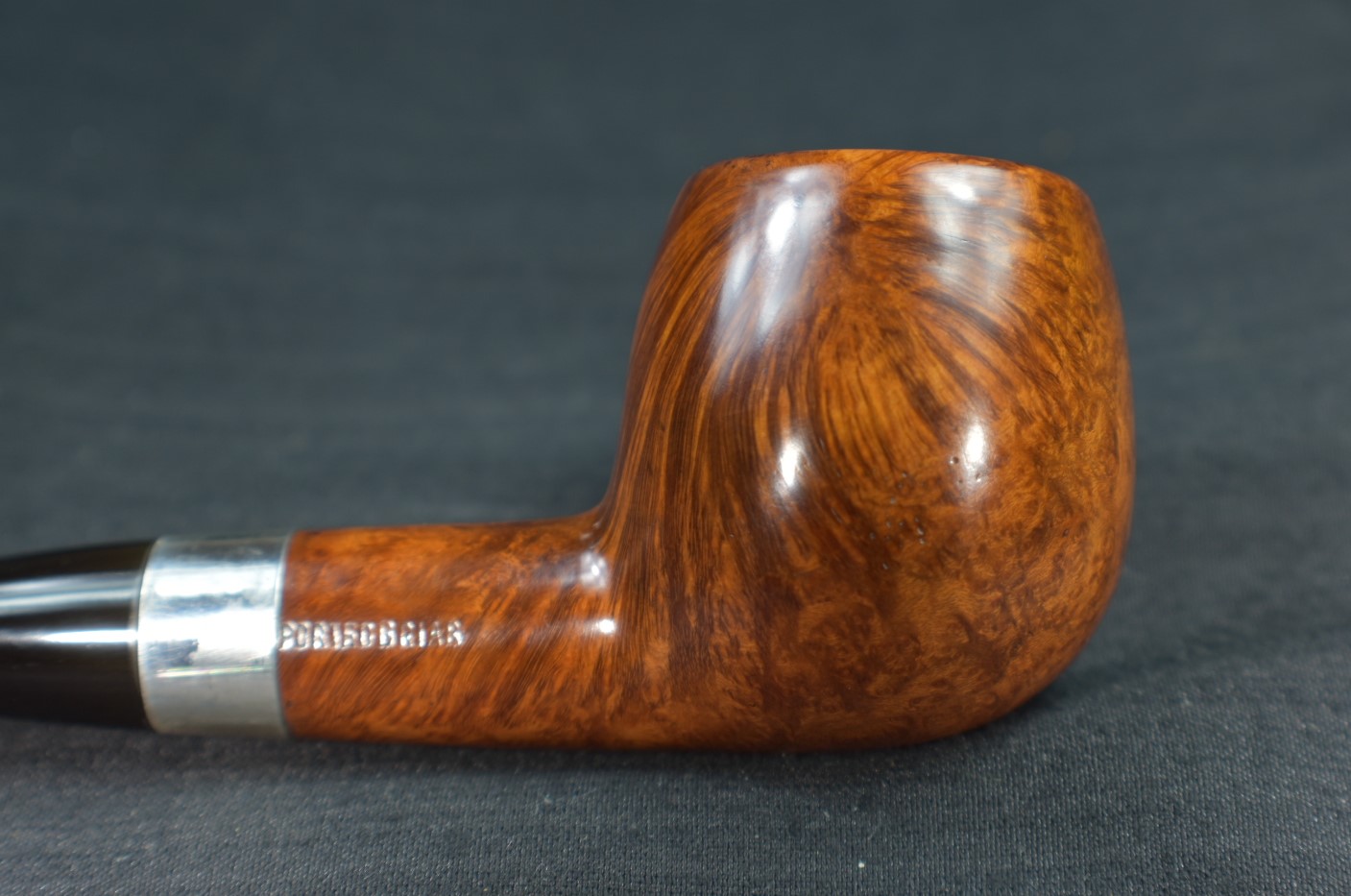
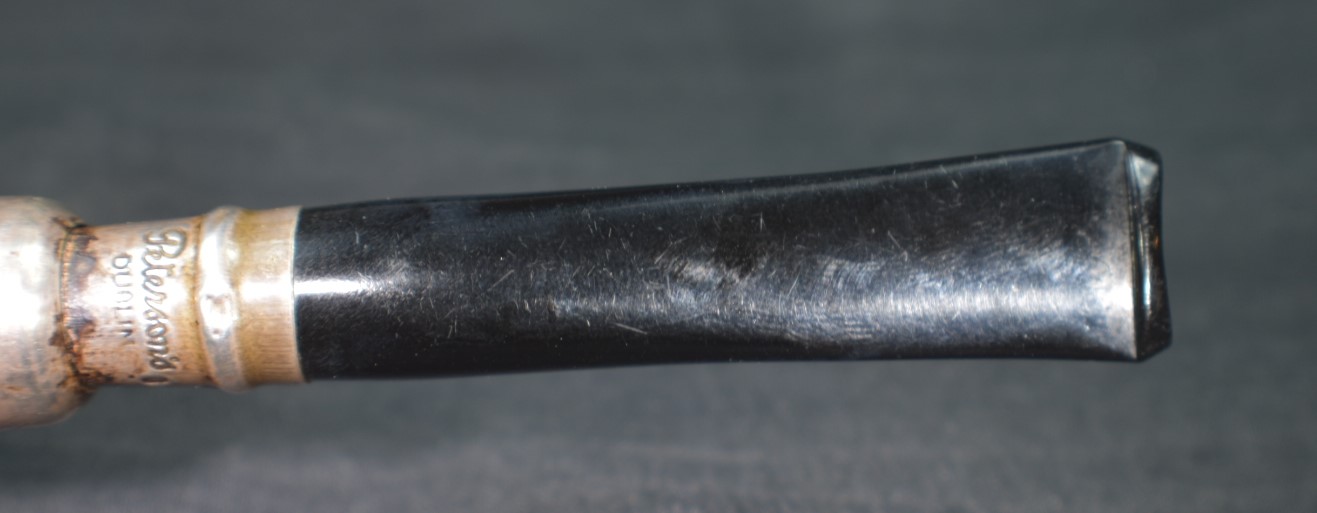
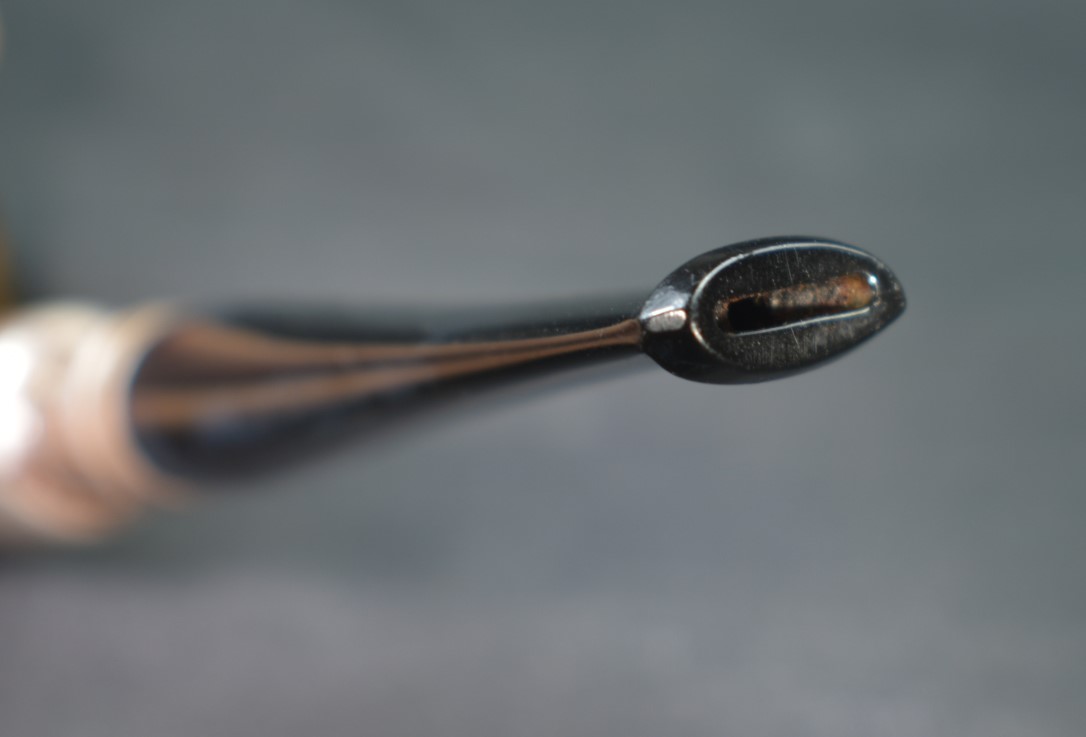
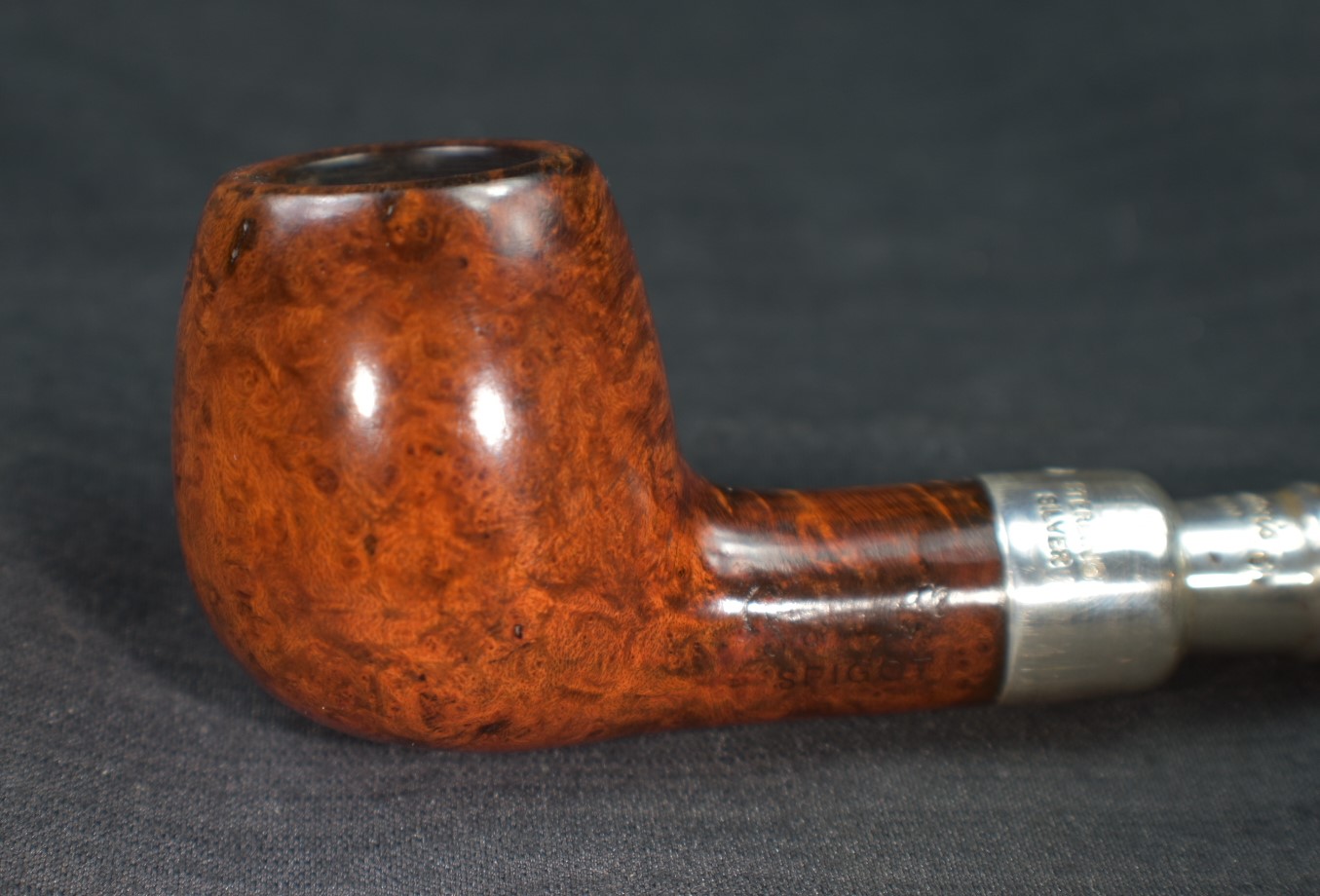
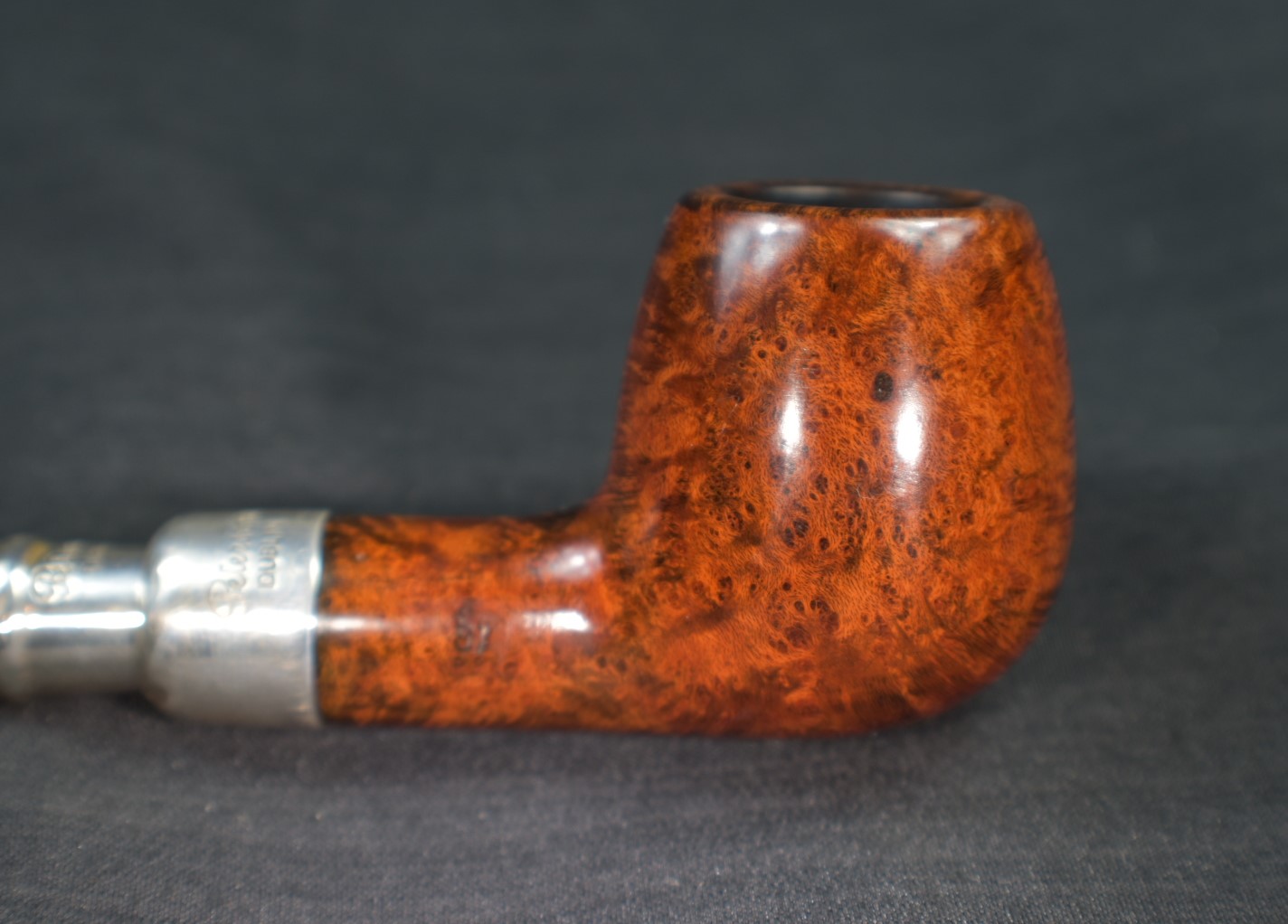
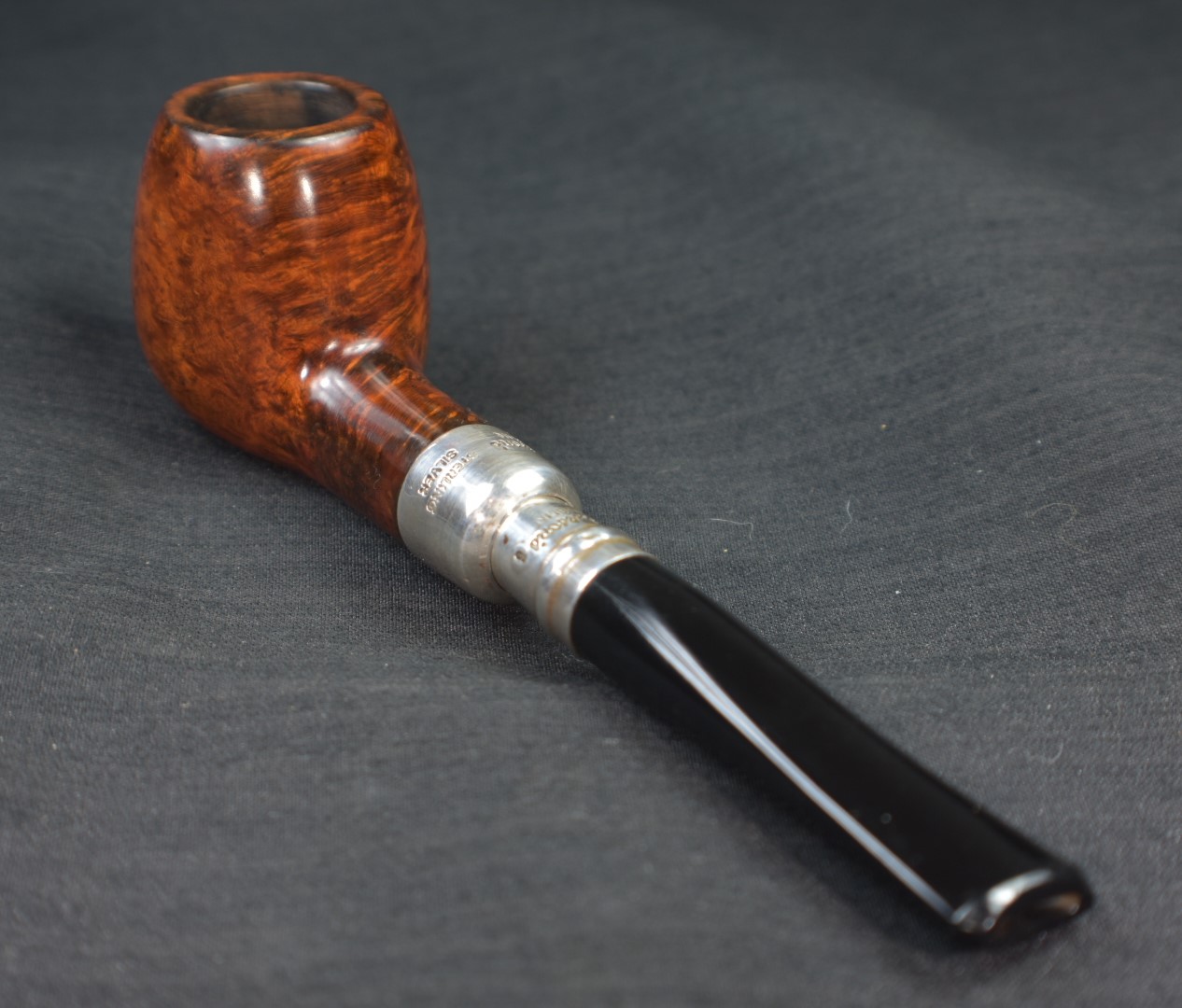
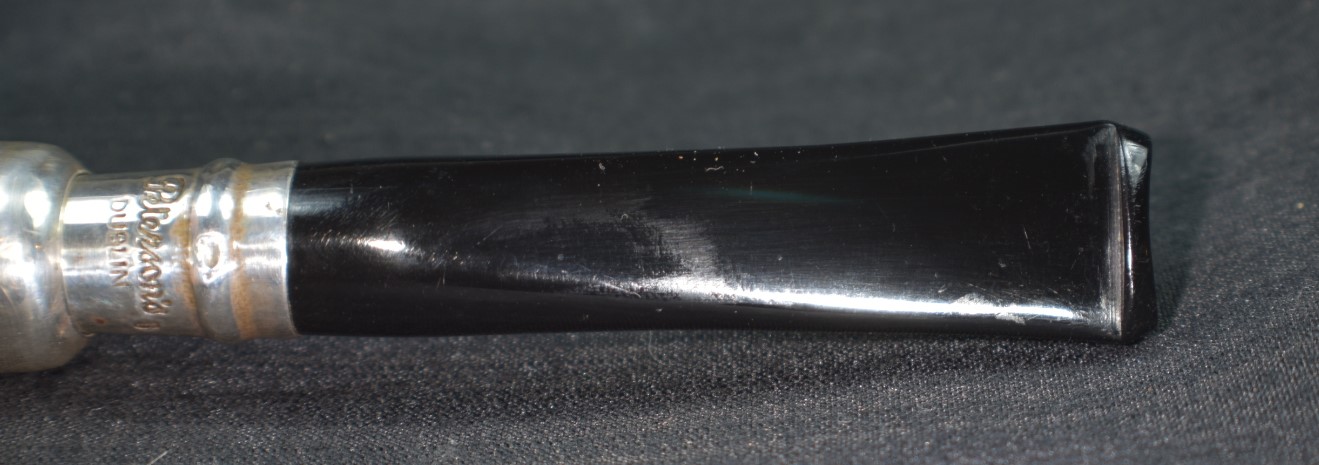
    Below are some photos of the pipe when it arrived here in southeast Nebraska.

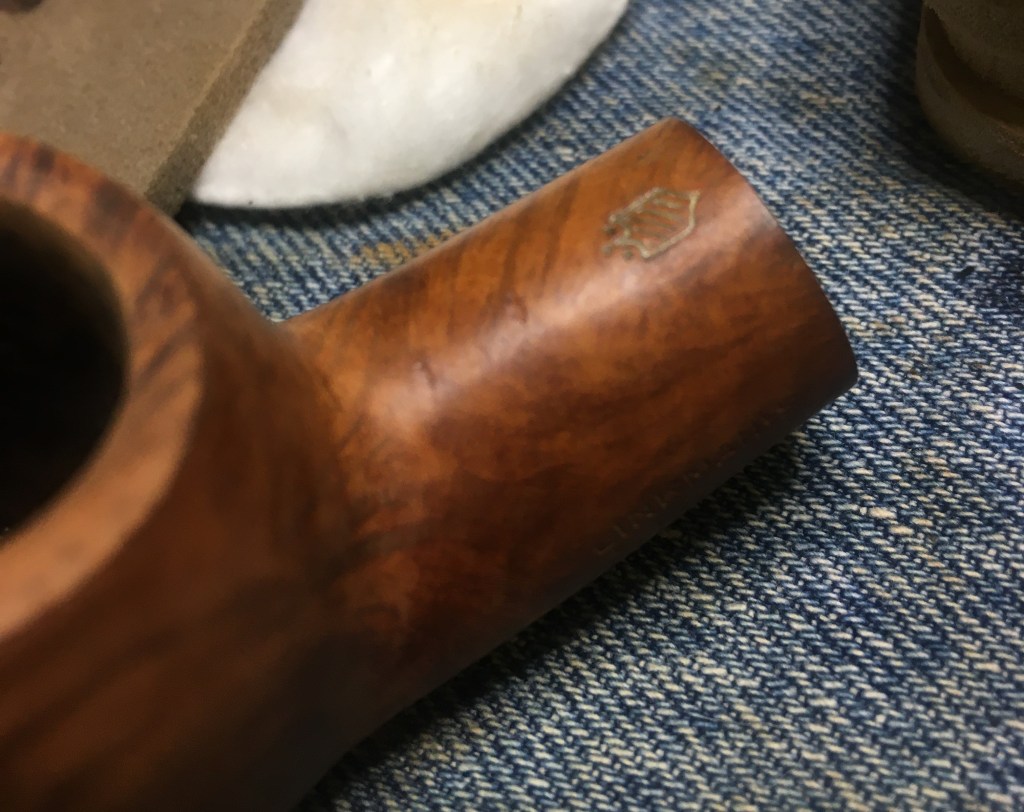
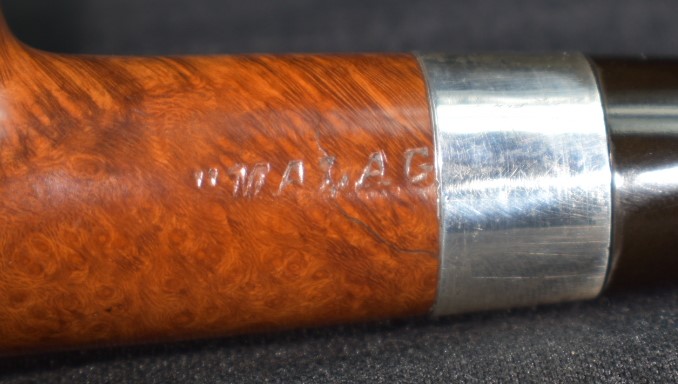
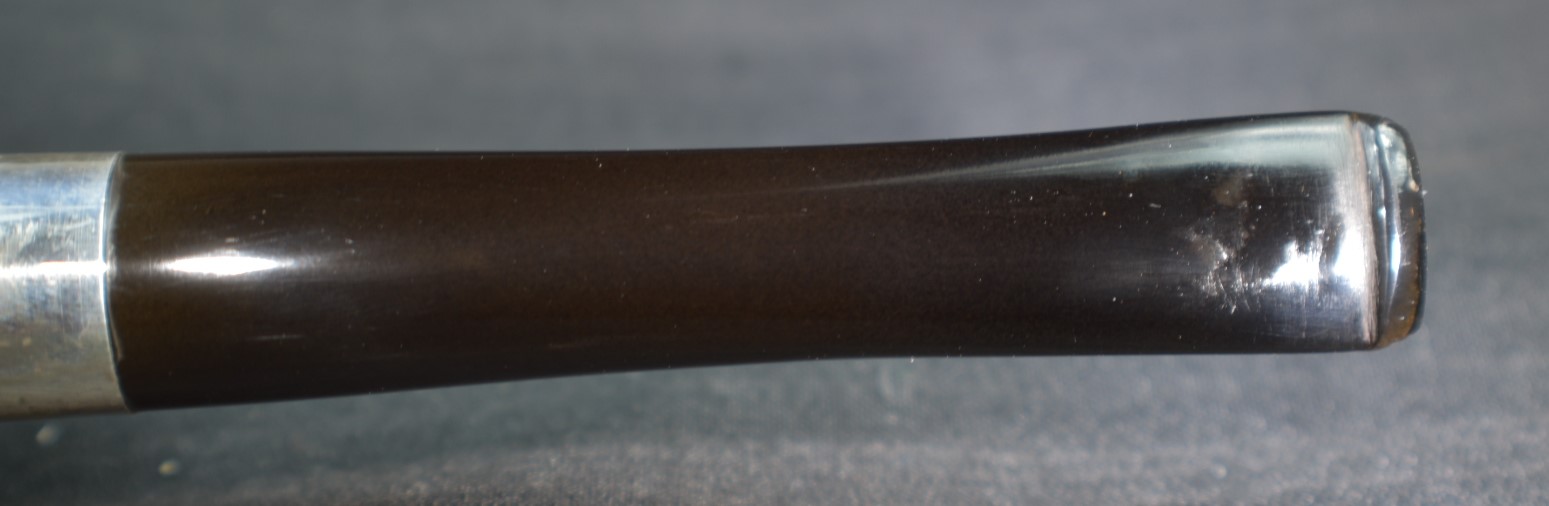
    Hmm, there appeared to be several ways to go with this restoration and to several levels.  The crack in the shank had been successfully repaired with a silver band albeit an oversized silver band that partially covers the stamps.  There looked to be a small crack around the rim.  I was not sure if it was superficial or structural.  The stummel looked great without a single fill, kudos to Mr. Khoubesser for excellent briar selection.  The stem would need a good deal of attention to repair the tooth dents.  

    Malaga Background

    Piedia.org has a nice history of Malaga pipes.  I will include the text here in its entirety:

    “The Malaga Pipe Company was founded circa 1939 by George Khoubesser, (b.1892 d.1971), and located in Royal Oak, Michigan at 1406 East Eleven Mile road. The second generation owner’s name was Emmanuel Khoubesser (b. 1942 d. 1981), who everyone knew him as “Manny”. He was a big jovial man that was easy to converse with, always had a smile and a good joke to tell his very loyal customers. He had the ability to befriend anyone within minutes. The small store was packed with curious customers every Saturday morning looking for the latest design made earlier in the week. He also carried a full line of custom mixed tobaccos that you could sample and an array tobaccos in tins.

    I was first introduced to him in 1969. I remember him taking me in the back to show me each step involved in pipe making. He was very serious about the quality of the product he sold and would never sell a flawed pipe, even if it was very minor. My step father purchased several of his pipes and really enjoyed them. He once said he’s never found a better pipe (his words).

    Manny passed away in 1981 and his wife and oldest children took over the business. Malaga closed in 1999 after 60 years in business. The building still exists on Eleven mile, looking almost like it did back then, but now houses the Michigan Toy Soldier Company. I would think the pipes Manny produced are now more valuable than ever. If you happen across one of these pipes, you’ll know a little bit more about it’s rich history. Enjoy!”

    (Malaga Pipe Company – Pipedia)

    If your taste for the history of Malag pipes has yet to be satiated I will refer you to Steve Laug’s blog regarding the history of the brand (George Khoubesser and Malaga Pipes | rebornpipes).  Steve also received a treasure trove of ephemera from the estate of one of his reader’s fathers (Malaga Pipes Catalogue of Pipes and Tobaccos | rebornpipes).  Wonderful information and valuable insights from people who are far more industrious than I with providing you with background information.

    The Restoration

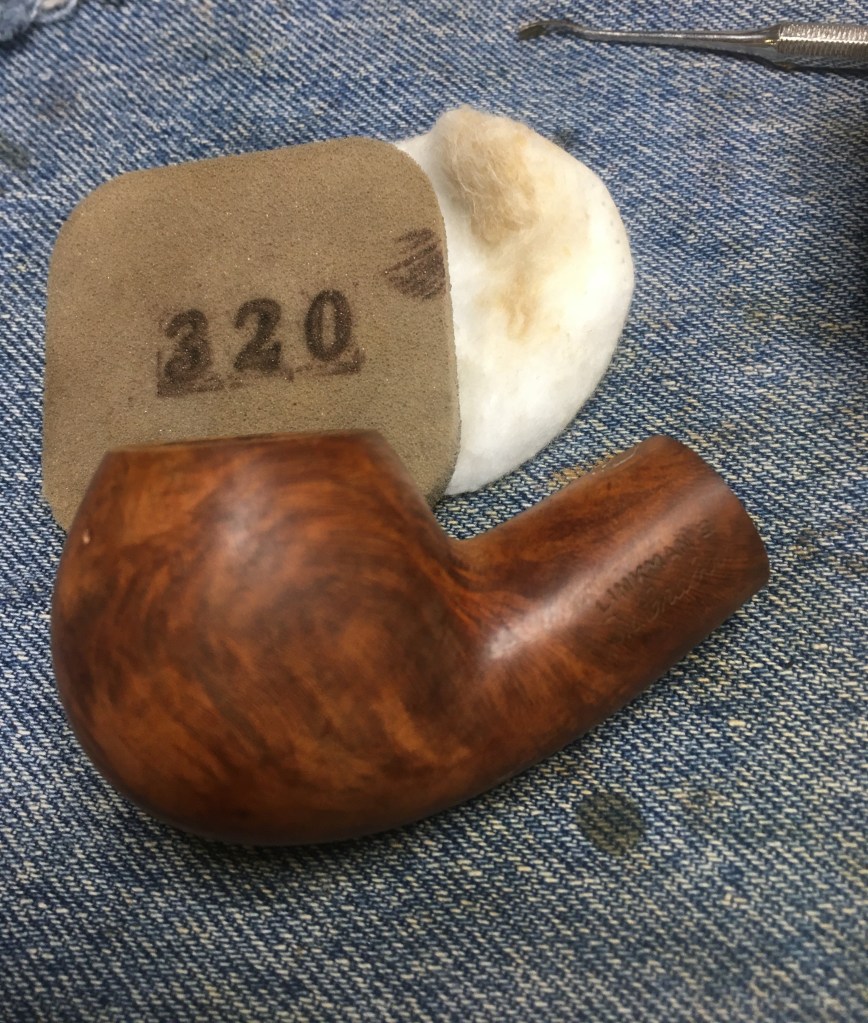
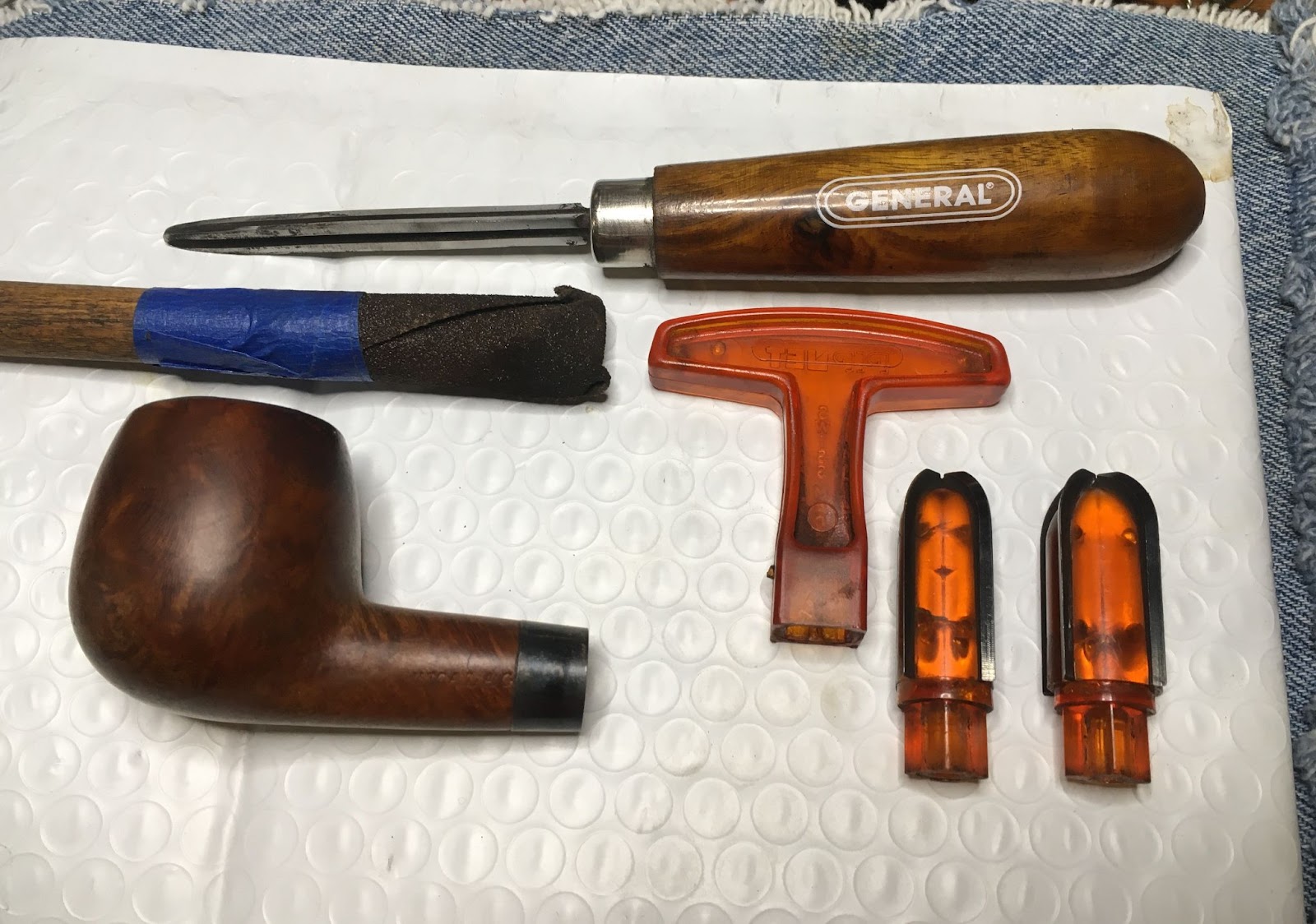
    In typical fashion this project began with a clean denim piece on the work surface.

    The reaming tools were assembled.  The PipNets’s #2 and #3 blades could be used in the large Malaga tobacco chamber.

    And used they were.  After the PipNet the chamber was scraped with the General triangular scraper and sanded with the 220 sandpaper wrapped around a wood dowel.  There was no evidence of heat damage to the interior of the chamber.

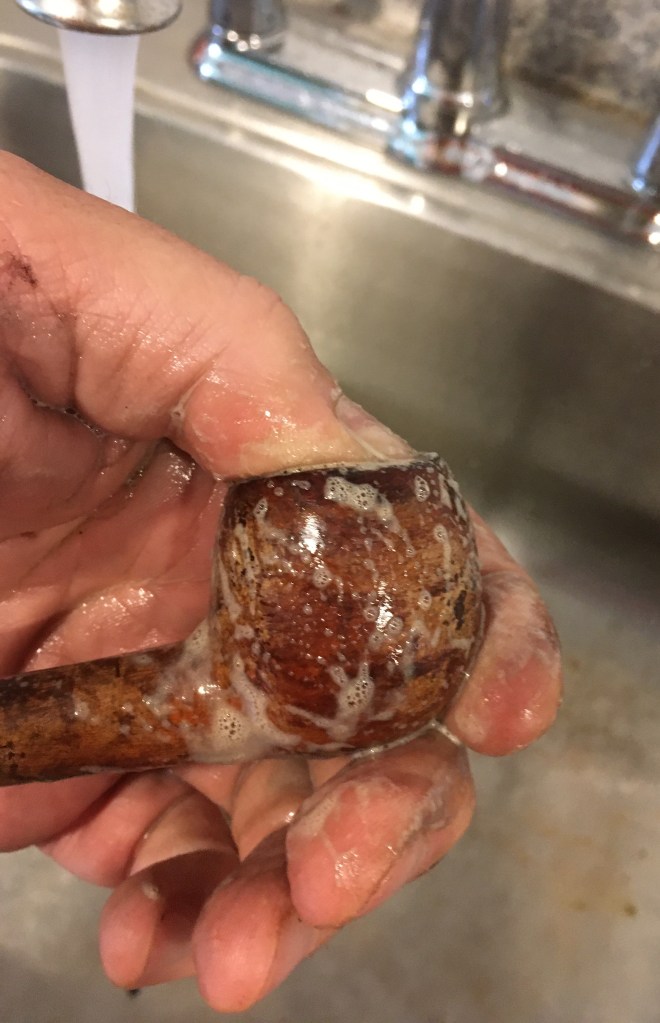
    Nex was a trip to the sink.  Here the stummel was scrubbed with undiluted Murphy Oil Soap and a medium stiff toothbrush.

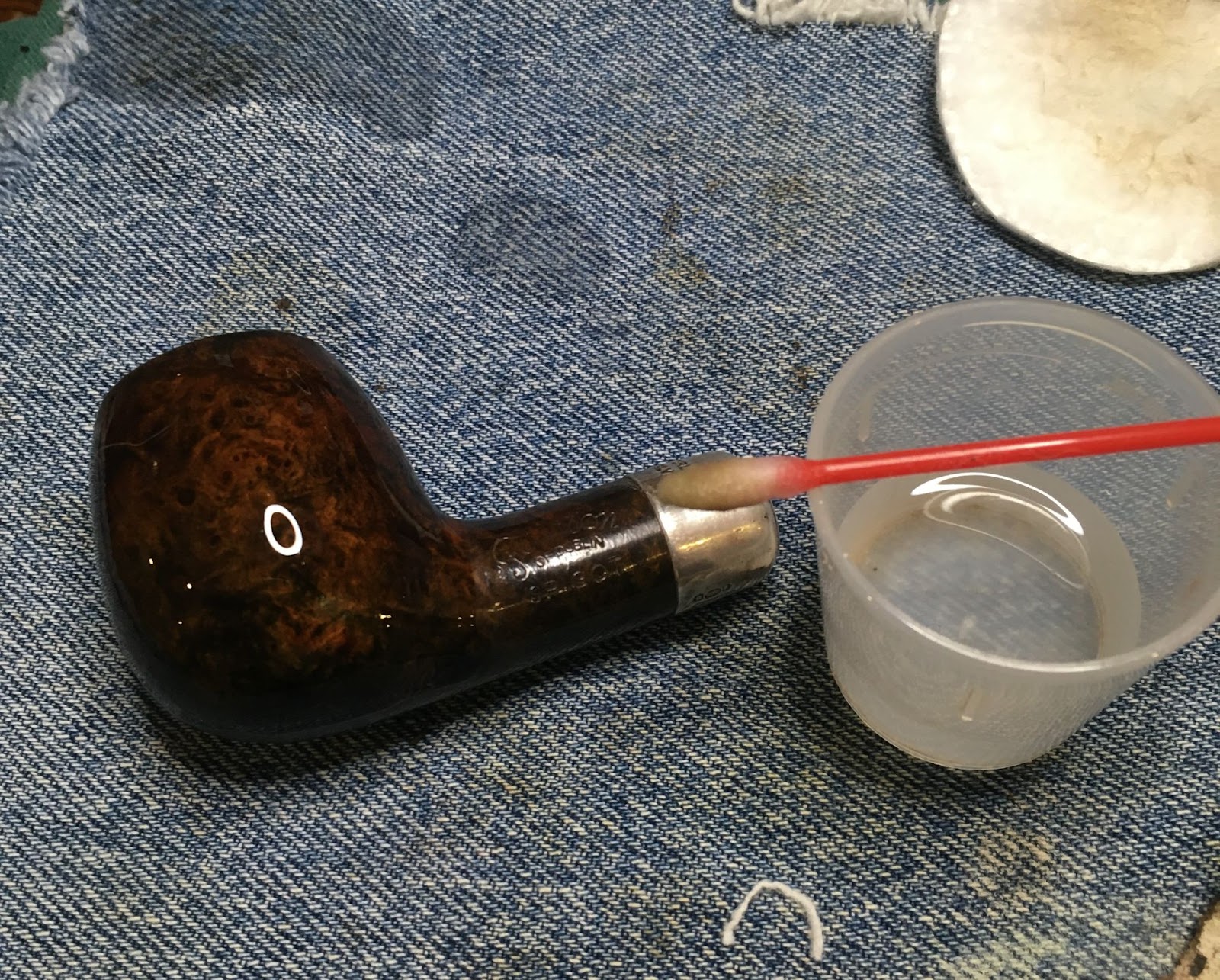
    Returning to the workbench the stummel was wiped with a cotton make-up pad wetted with 95% ethyl alcohol.  Some further grime, wax and perhaps stain was removed with the pad.

    Next, I addressed the calcium deposits on the stem by scraping them with a sharp pocket knife.

    The area immediately above the button was filed with a flat needle file and the entire stem was lightly sanded with 320 then 400 grit sanding sponges.  I failed to photograph the next step, apologies.  After the sanding I scrubbed the stem with make-up pads and Soft Scrub cleanser.  The pads were heavily stained with oxidized rubber.  Several pads and Soft Scrub applied to a Magic Eraser later, the stem was cleared of oxidized rubber. 

    The next step was to repair the tooth dents.  

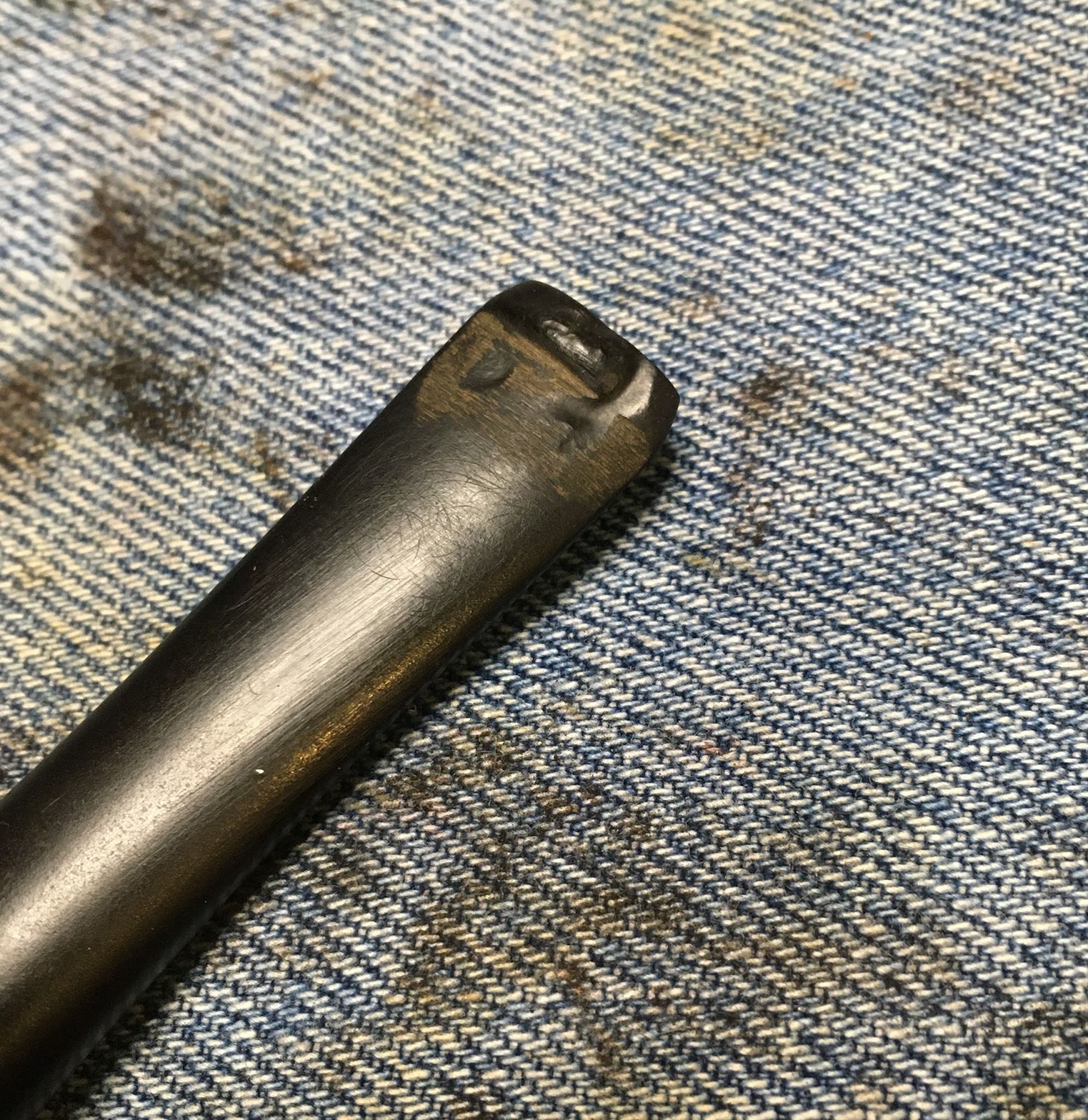
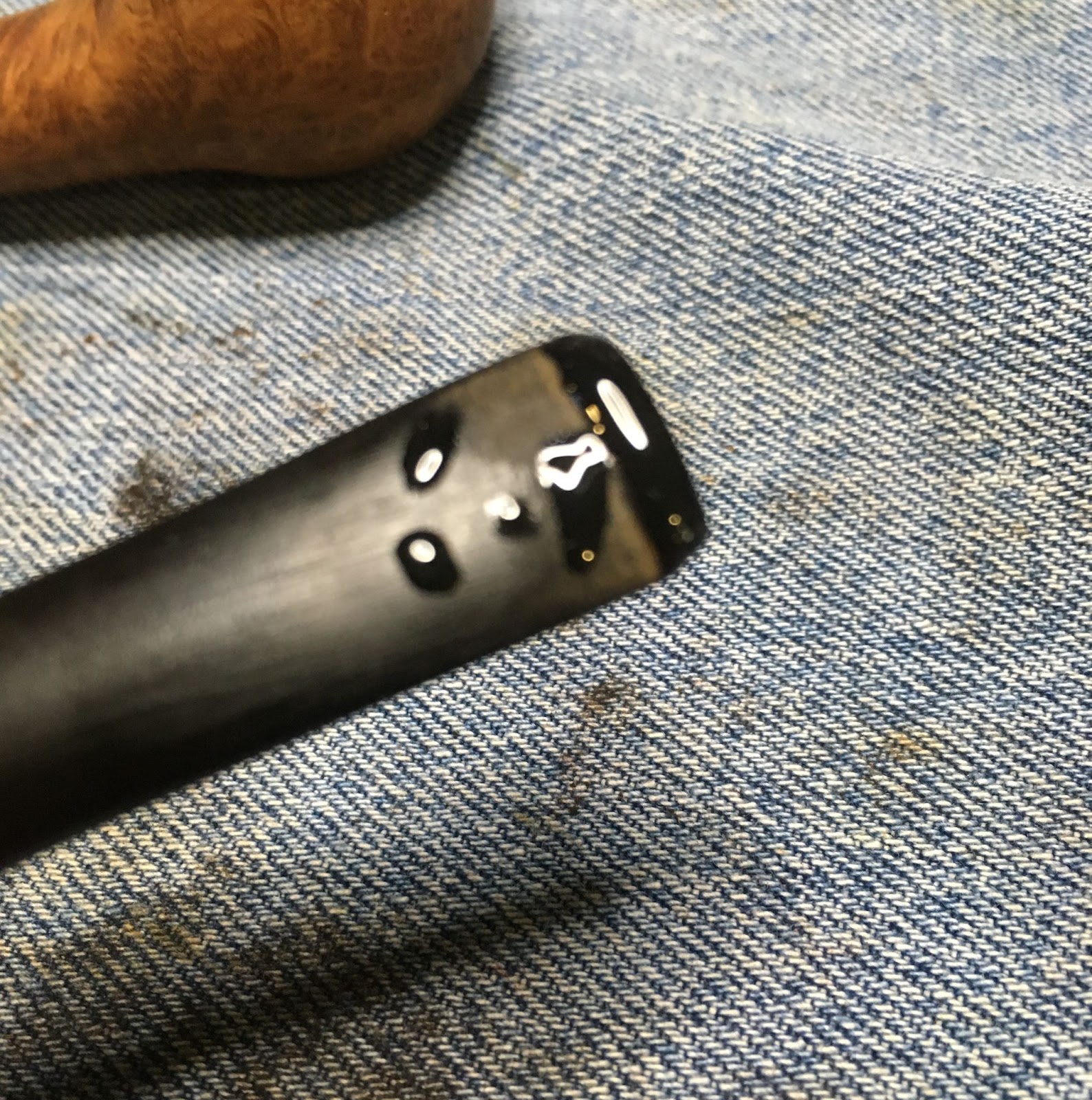
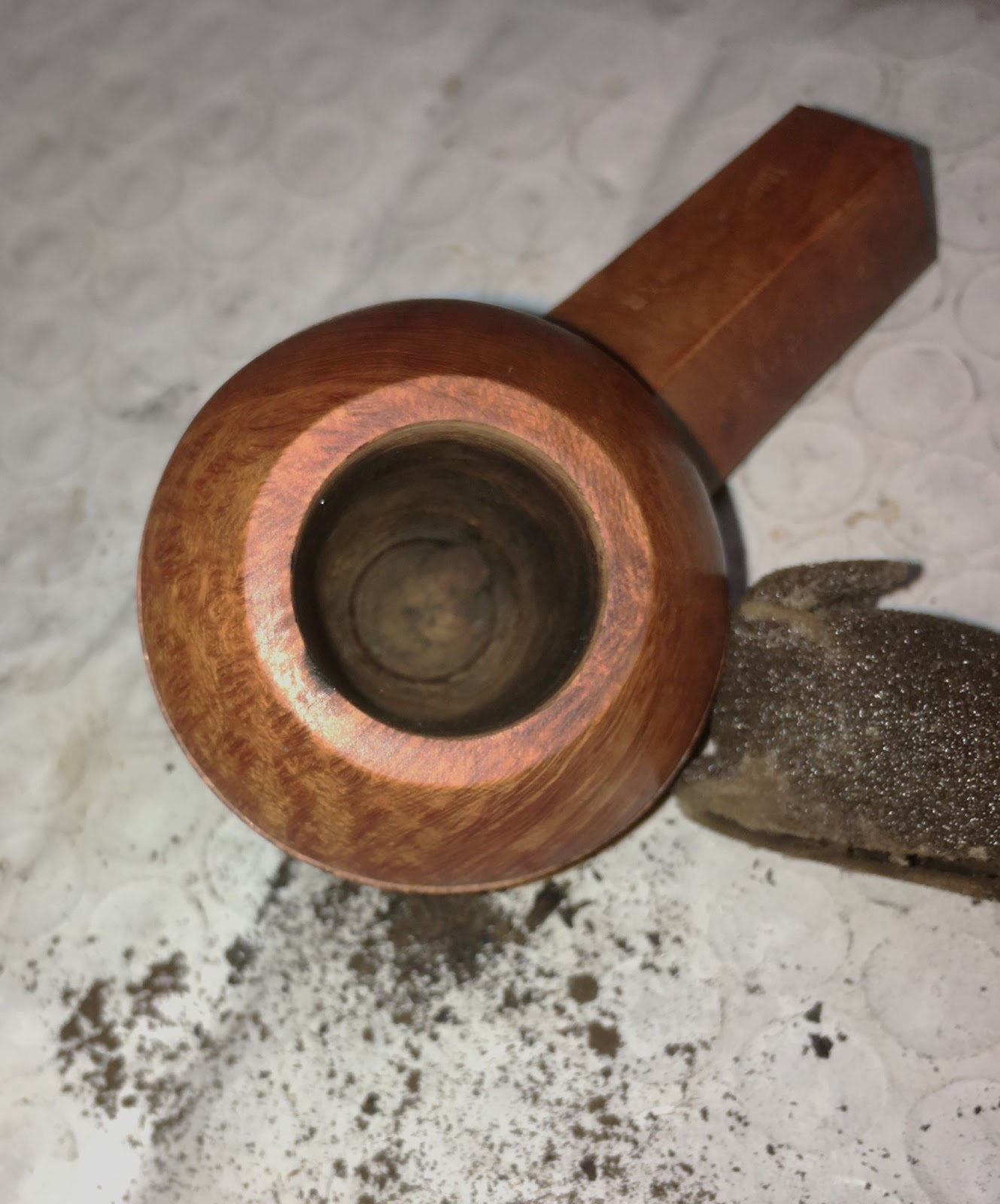
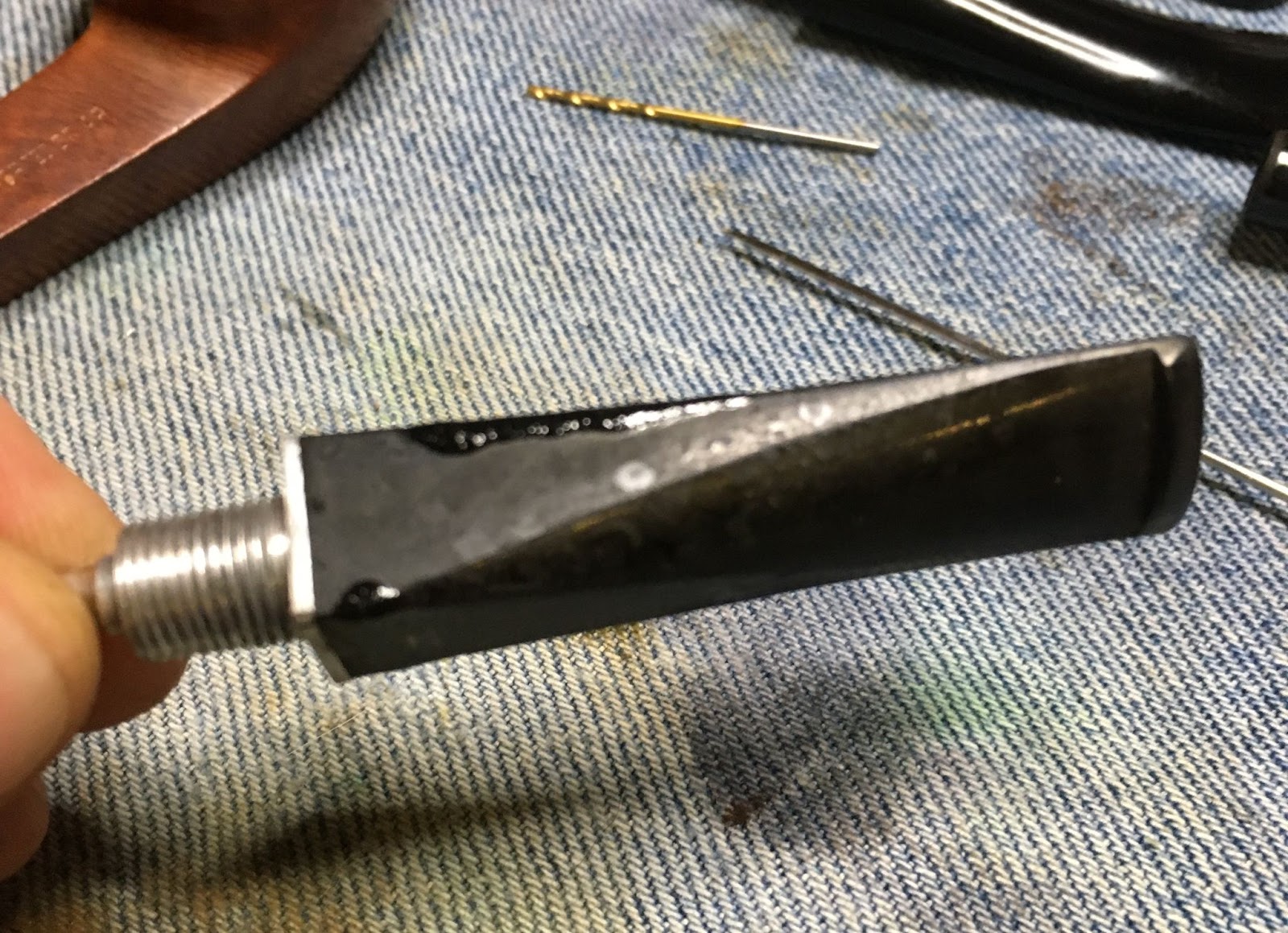
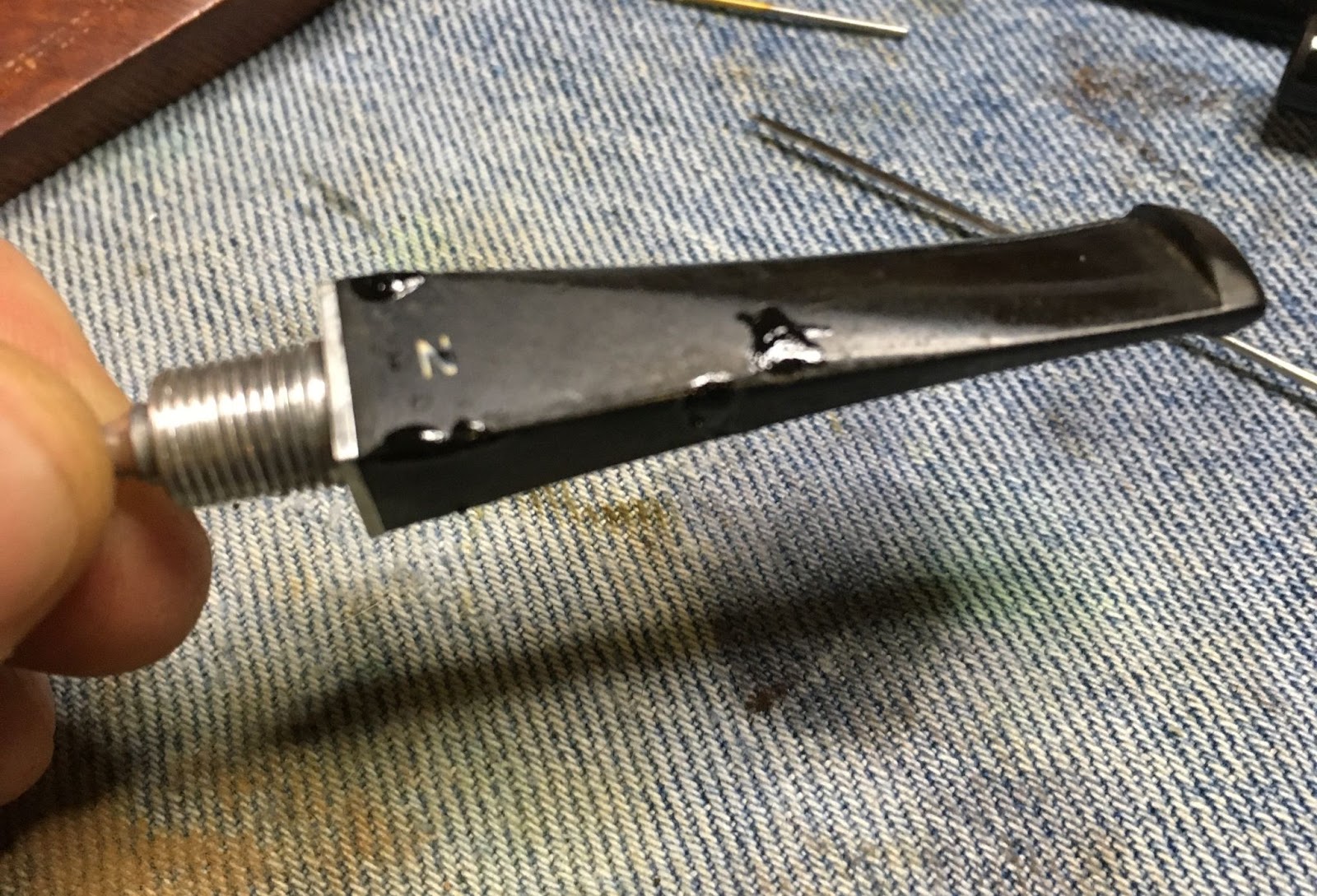
    I used black cyanoacrylate (CA, super glue) to fill in the dents and rebuild the damaged button.  Below are photos of the top and bottom of the stem.

    The wet CA was spritzed with a CA drying accelerator.  This cures the CA within seconds.  The following two photos show the cured CA.

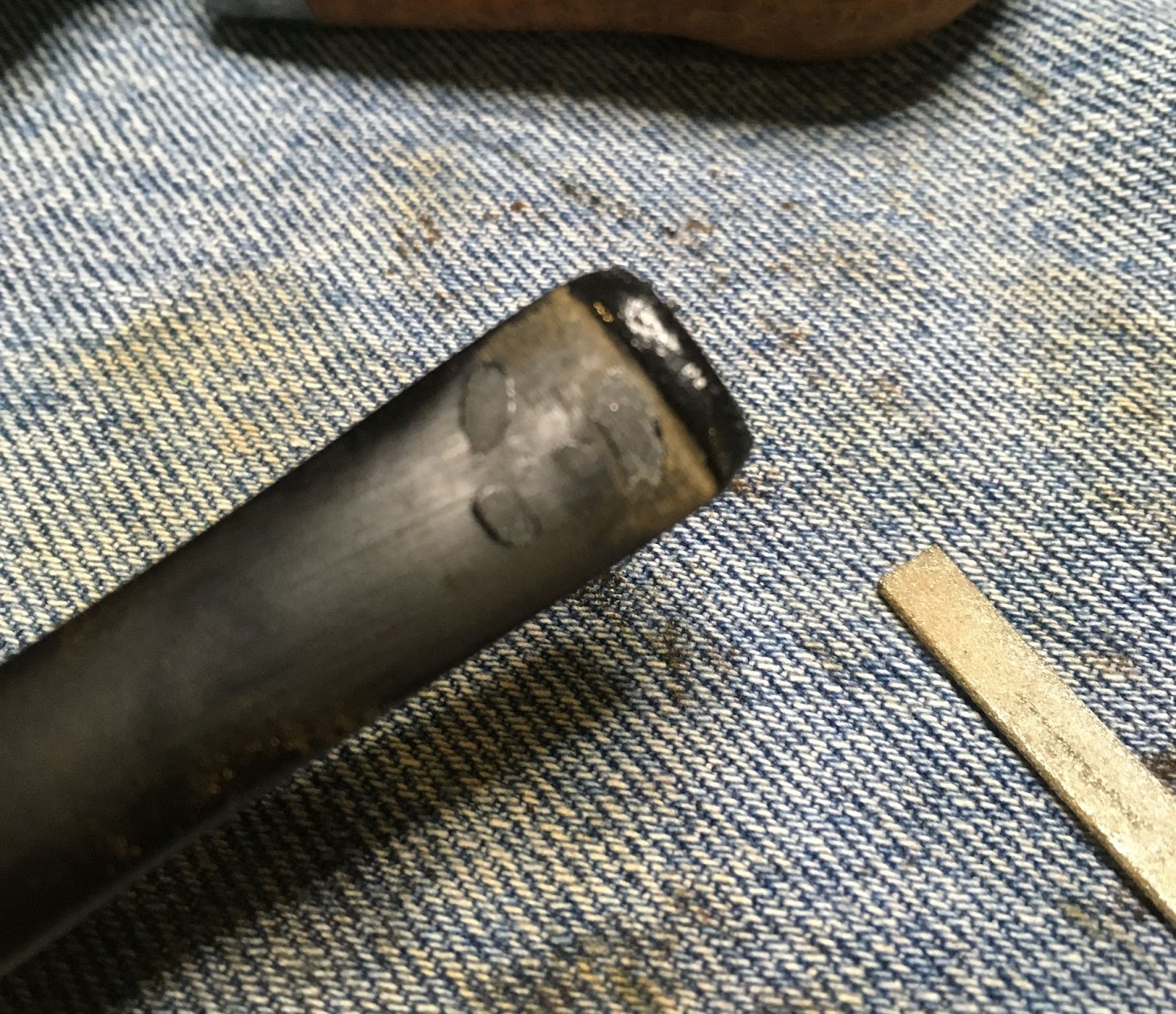
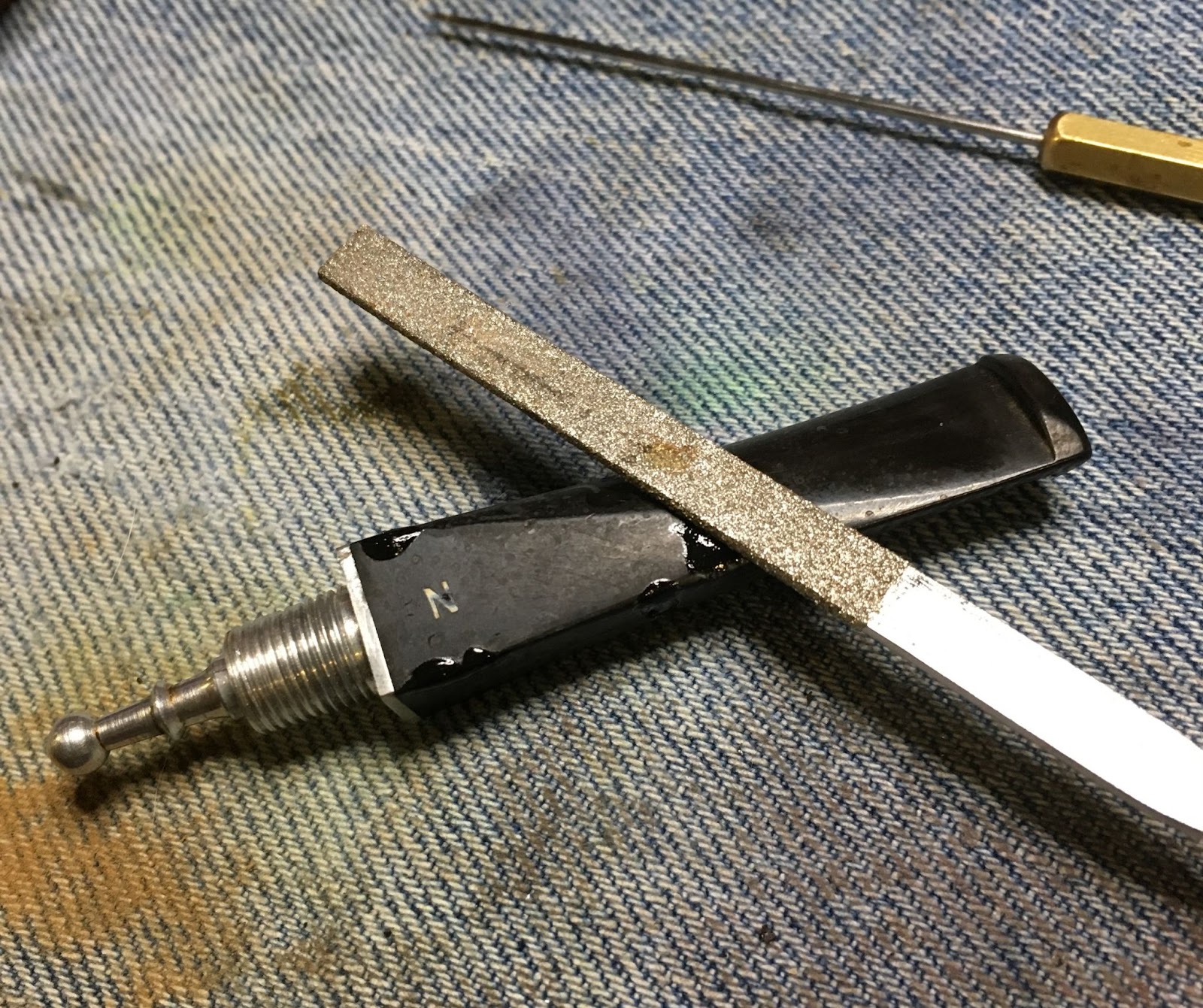
    The CA fills were filed with the flat needle file and the button reshaped.

    After filing the fills were sanded with the 400 sanding sponge.  The improvement was great but additional thin layers of black CA were required to smooth and blend the repairs.  The below two photos show the repairs prior to the additional thin layers and further sanding of the CA.

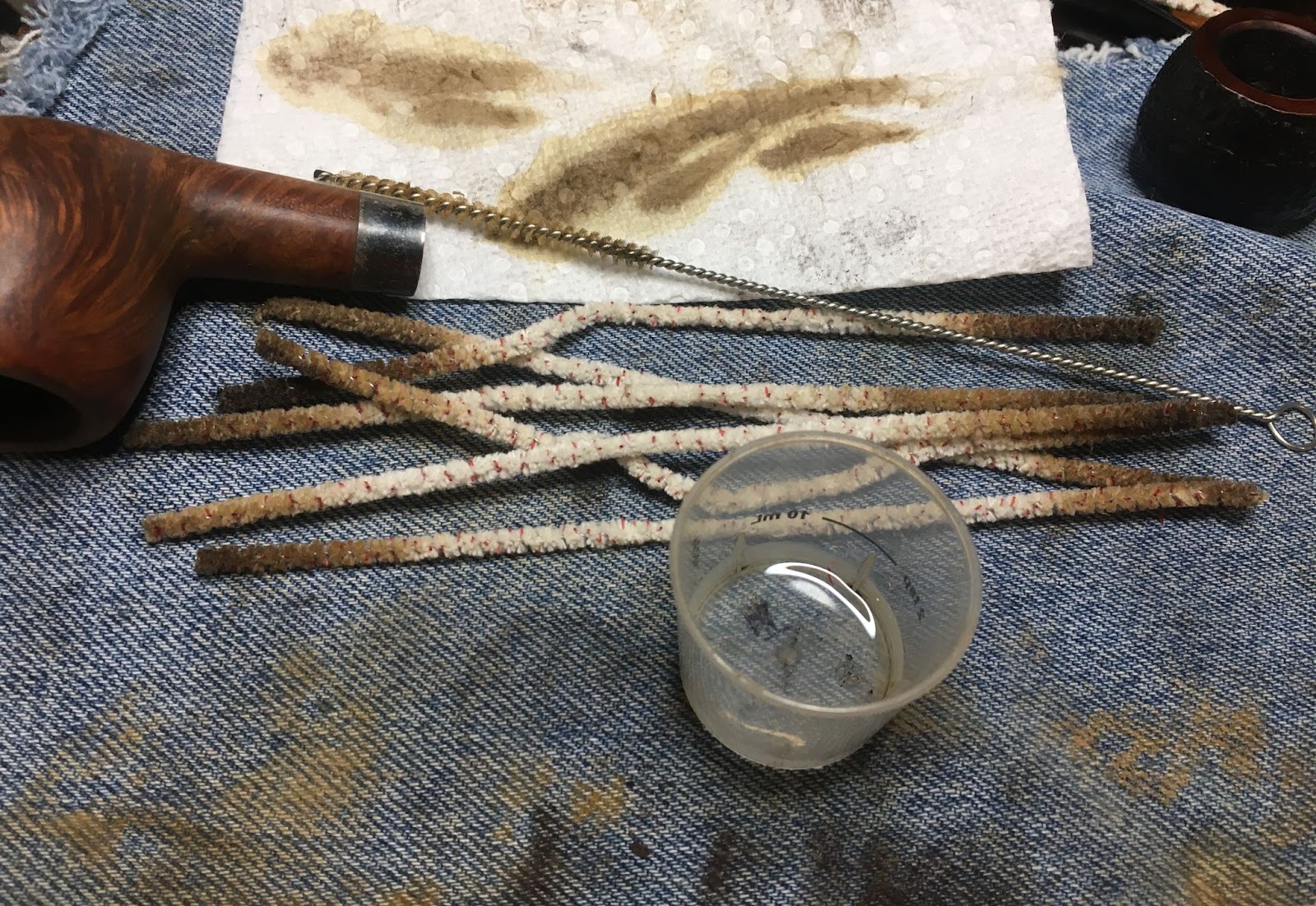
    With the stem bite marks repaired it was time to clean the airway.  95% ethyl alcohol and bristle pipe cleaners were used.

    The same process was used to clean the airway of the shank.  Ethyl alcohol and a nylon shank brush along with some scraping from a dental pick were added to the cleaning here.

    Throughout the above cleaning I was thinking about the silver band.  I had tried removing it after the murphy’s scrubbing, alcohol wiping, and now again after the alcohol rich shank cleaning.  If there had been glue used to fix the band I could not loosen it with water, soap, or alcohol.  I tried a bit of acetone to see if that would penetrate under the band and loosen the grip of the band on the shank.  Nothing seed to work.  Whomever had installed this band fit it very tightly to the shank.  I thought about heating it with a heat gun to try to remove it but decided that it really was a pretty well done banding.  How might it look if I just polished it?  I tried that. 

    The band polished nicely and I decided to stop worrying about it.  This was going to be a personal use pipe and I was okay with having a couple of letters of the stampings covered.

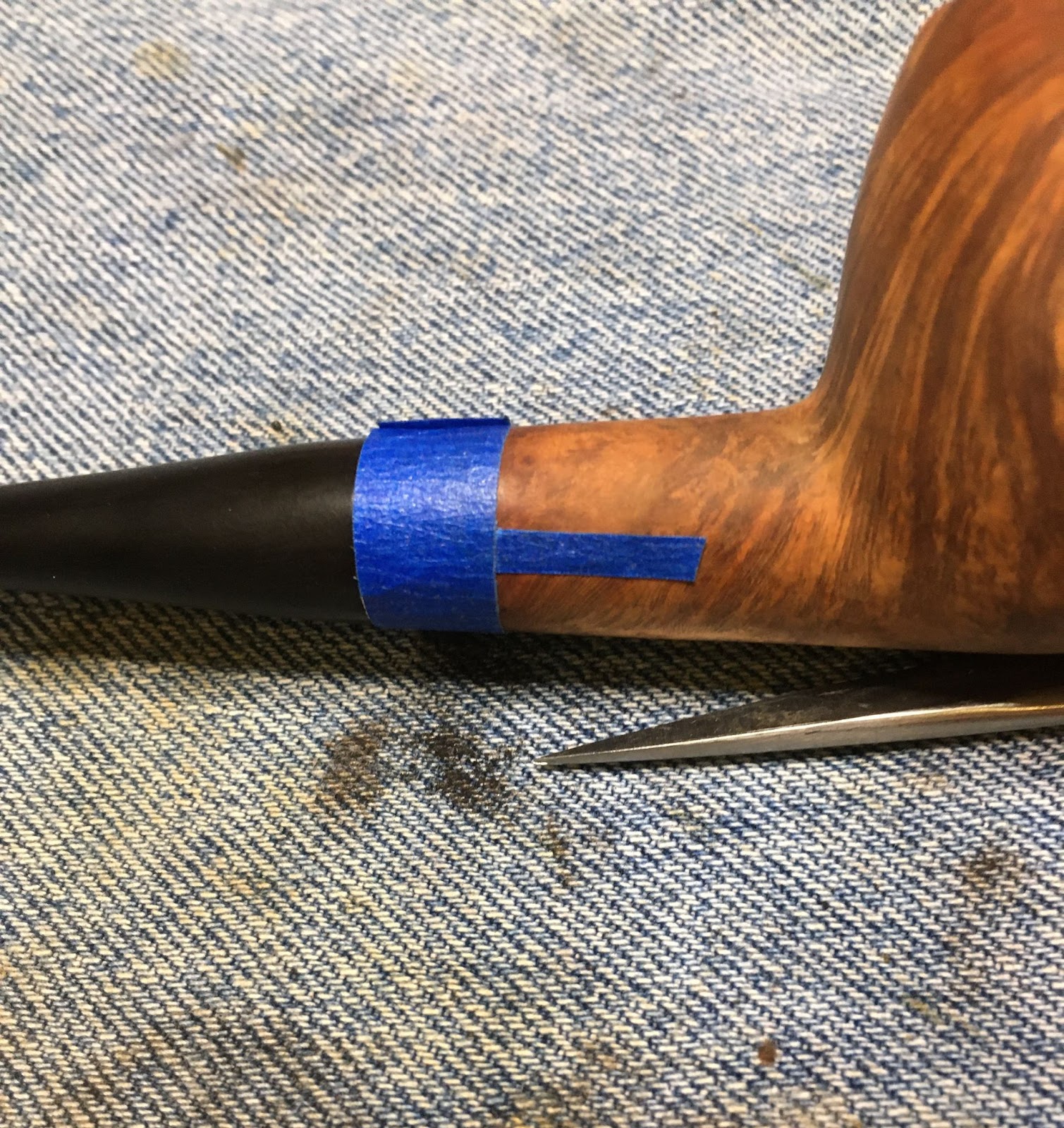
    I then taped the stamps and the silver with painters tape to protect them from the sanding which was to occur next.

    The stem and stummel were sanded with a sequence of sanding sponges from 400-3500.  Between each sponge the stummel was wiped with an alcohol moistened make-up pad while the stem received a bit of mineral oil from my finger and was wiped with a clean paper towel.

    Finishing the sanding, I removed the painters tape and vigorously rubbed any remaining adhesive off with a make-up pad and alcohol.  I then used the 4000-12000 micro-mesh pads in sequence on both the stummel and stem.   As with the sanding sponges, the stummel was wiped with alcohol on a make-up pad between pads.  The stem received a small drop of Obsidian Oil, rubbed in and wiped with a paper towel between pads.

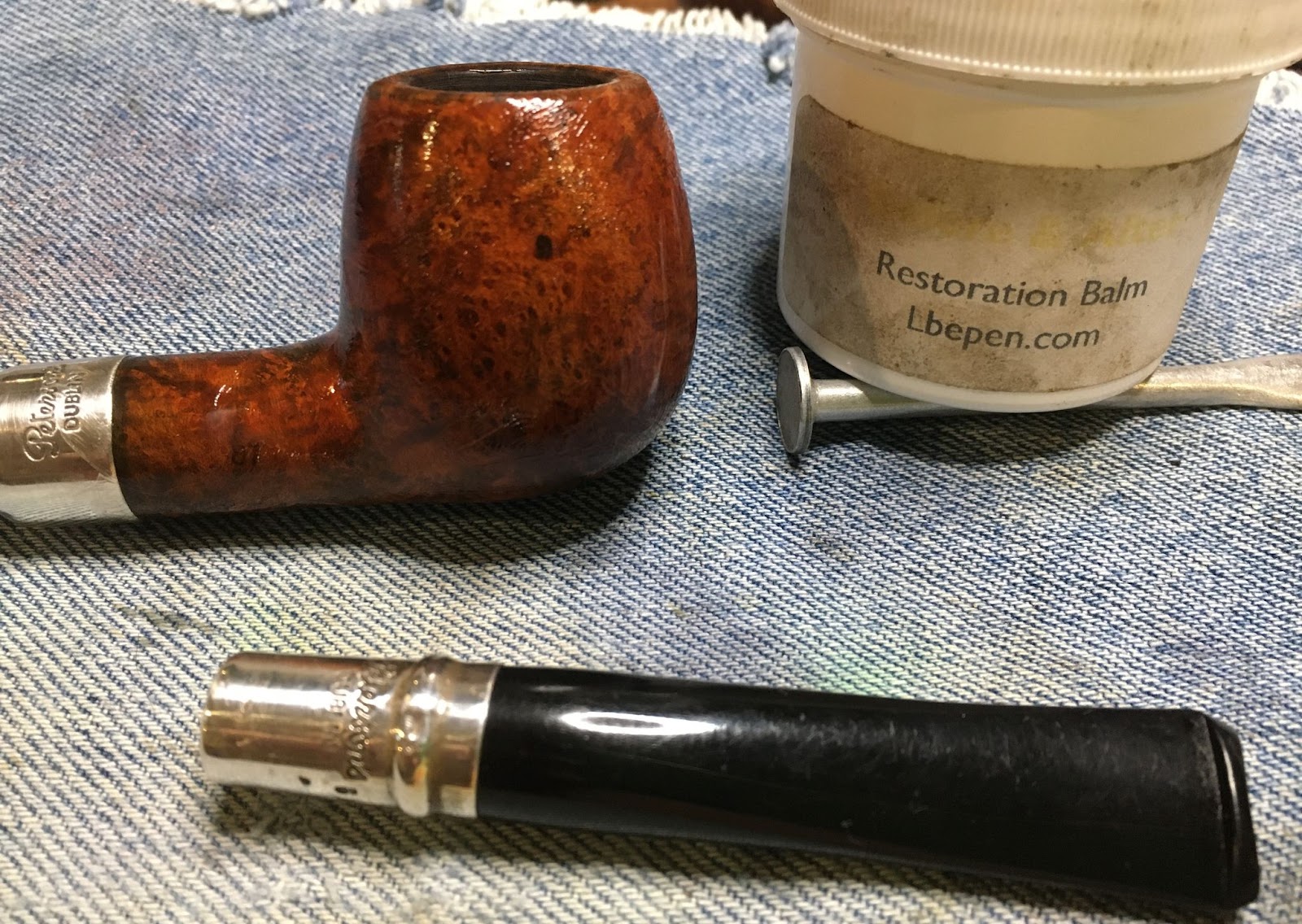
    The stummel was then coated in Before and After Restoration Balm and allowed to sit for 30 minutes.

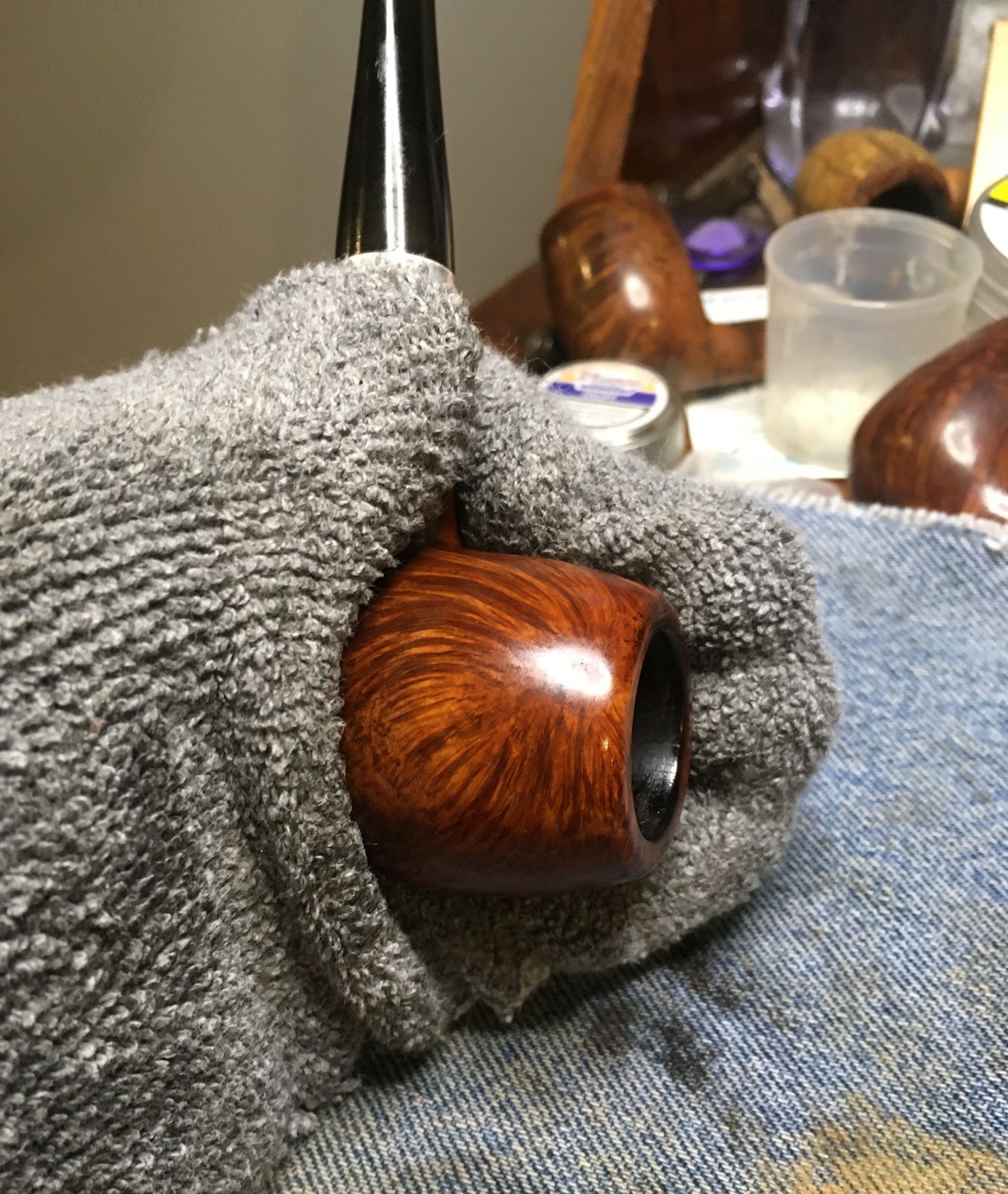
    30 minutes later the excess Restoration Balm was wiped off with an inside out athletic sock.  The balm had worked it’s magic and the stummel looked fantastic. 

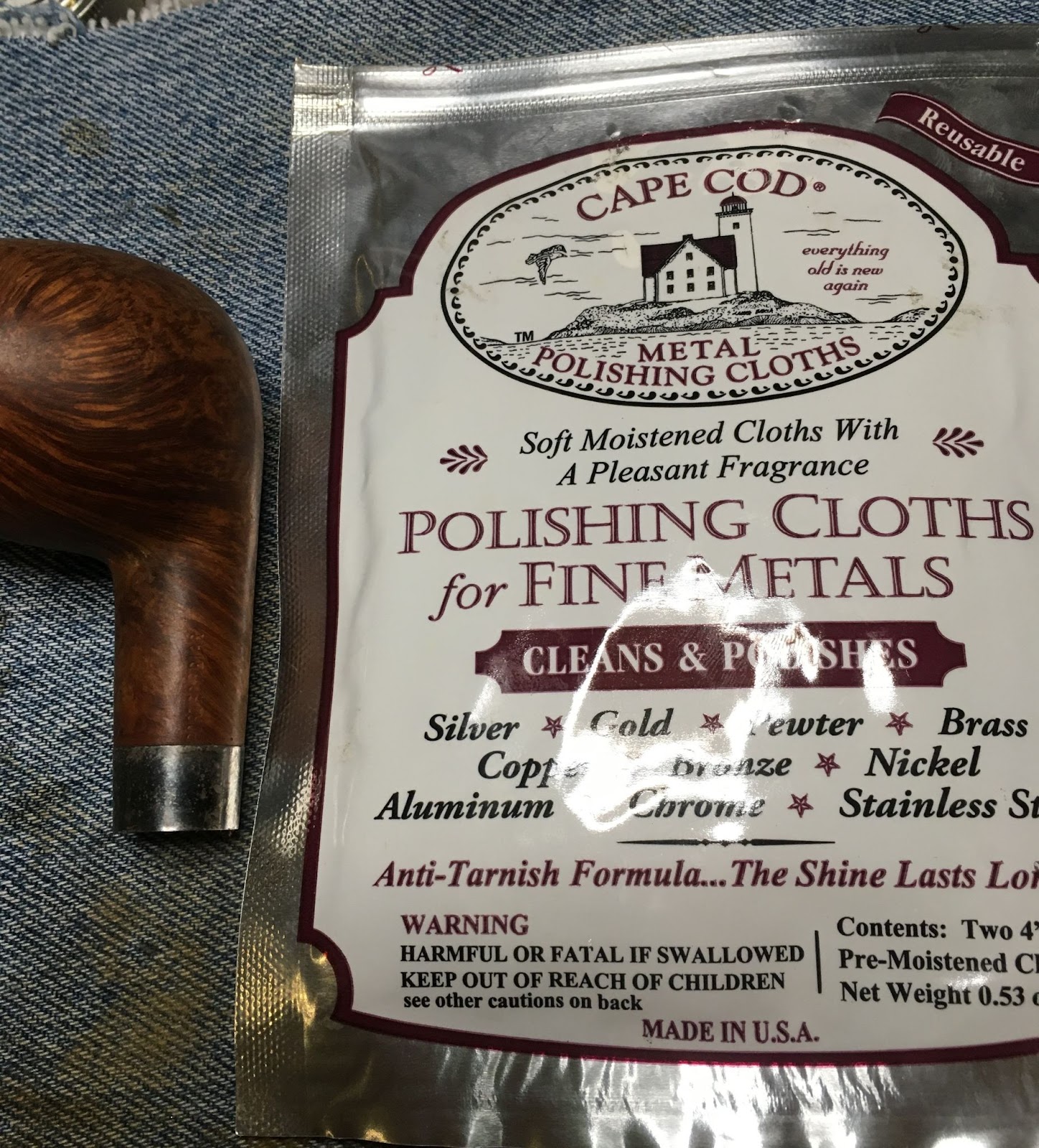
    The final polishing of the stem was done with Before and After Fine Polish.  This was applied by a fingertip and hand buffed with a soft cotton cloth.

    The Fine Polish was followed by Before and After Extra Fine Polish applied and buffed the same way.

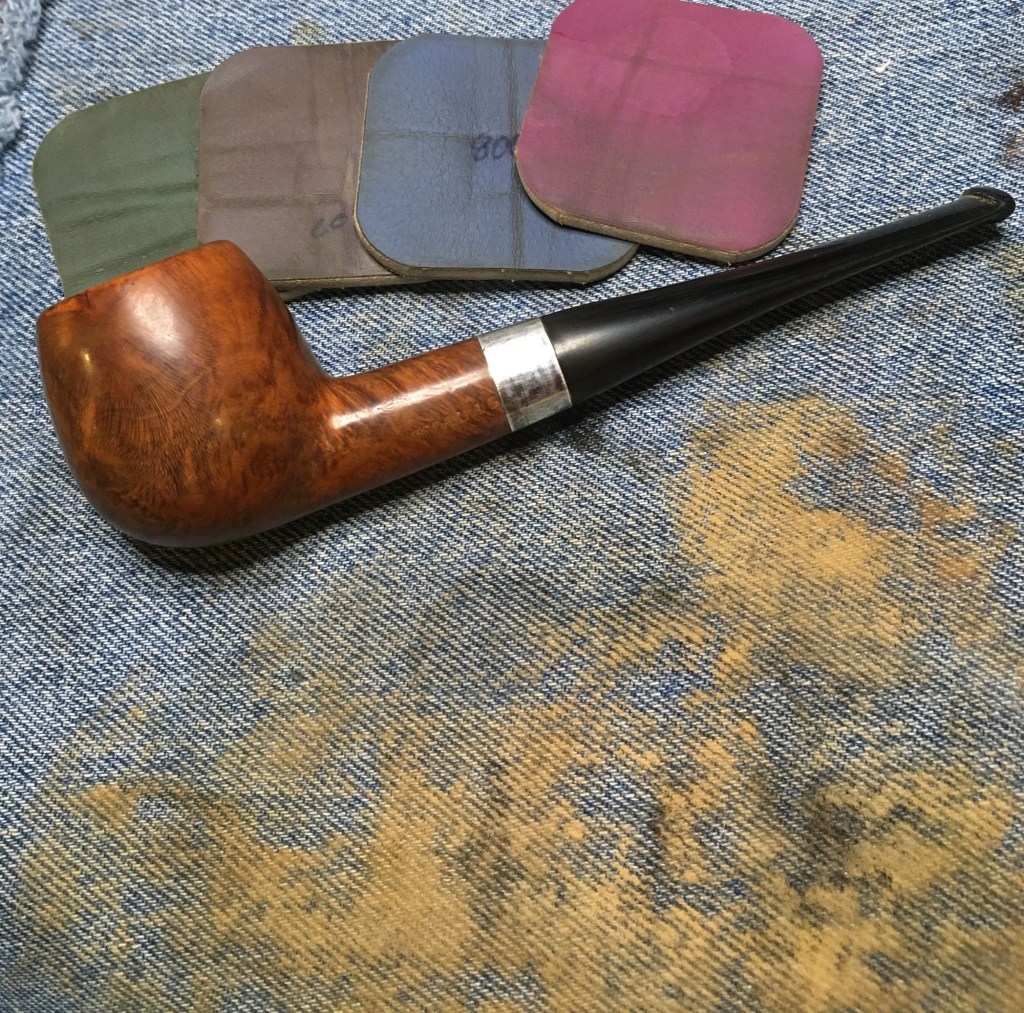
    The final step was to take the pipe to the buffer where it received several coats of carnauba wax.  After the wax was applied and buffed I hand buffed the pipe with a nanofiber polishing cloth in an attempt to improve on the already exquisite shine.

    I am pleased with the restoration of this Malaga Large Apple.  I have also filled the ample bowl with tobacco and given this old girl a “test drive”.  Steve Laug was quite right, Malaga pipes are fine smokers.  The grain of this pipe is beautiful with flame-like patterns especially on the right side.  The stem also cleaned up well.  I did notice a metal fleck in the rubber.  This usually indicated recycled rubber and was typical during the years around the Second World War.  Perhaps that gives a clue to the age of this pipe.  I do wish that it had not experienced a shank crack but the repair was done well and I think the silver band looks quite acceptable.  The only other flaw is the small crack on the rim.  I think that is superficial and did not think that it needed any attention.  The dimensions of this Malaga Large Apple are: 

    Length:  6.10 in./ 154.94 mm.

    Weight:  1.73 oz./ 49.10 g.

    Bowl Height: 1.78 in./  45.21 mm.

    Chamber Depth: 1.42 in./ 36.07 mm.

    Chamber Diameter:  0.83 in./ 21.08 mm.

    Outside Diameter:  1.61 in./ 40.89 mm.

    I do hope that you have found something here useful to your own pipe care, maintenance or restorations.  If you like this sort of thing, please click the like and subscribe buttons.  Thank you for reading the ramblings of an old pipe lover.

    Below are some photos of the finished Malaga Large Apple.

  • A Forecaster Bulldog Restoration

    May 23rd, 2024

    Photographed and written by 

    John M. Young

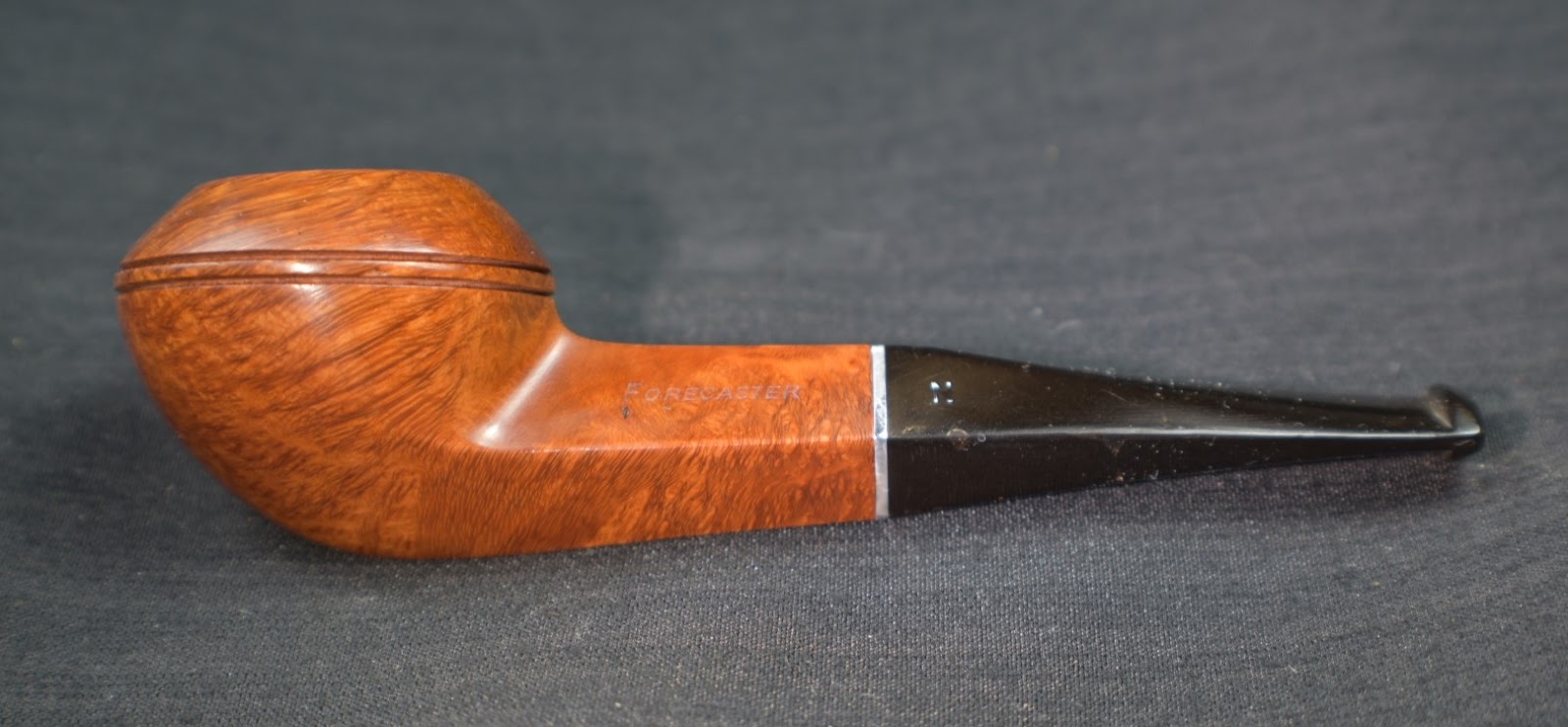
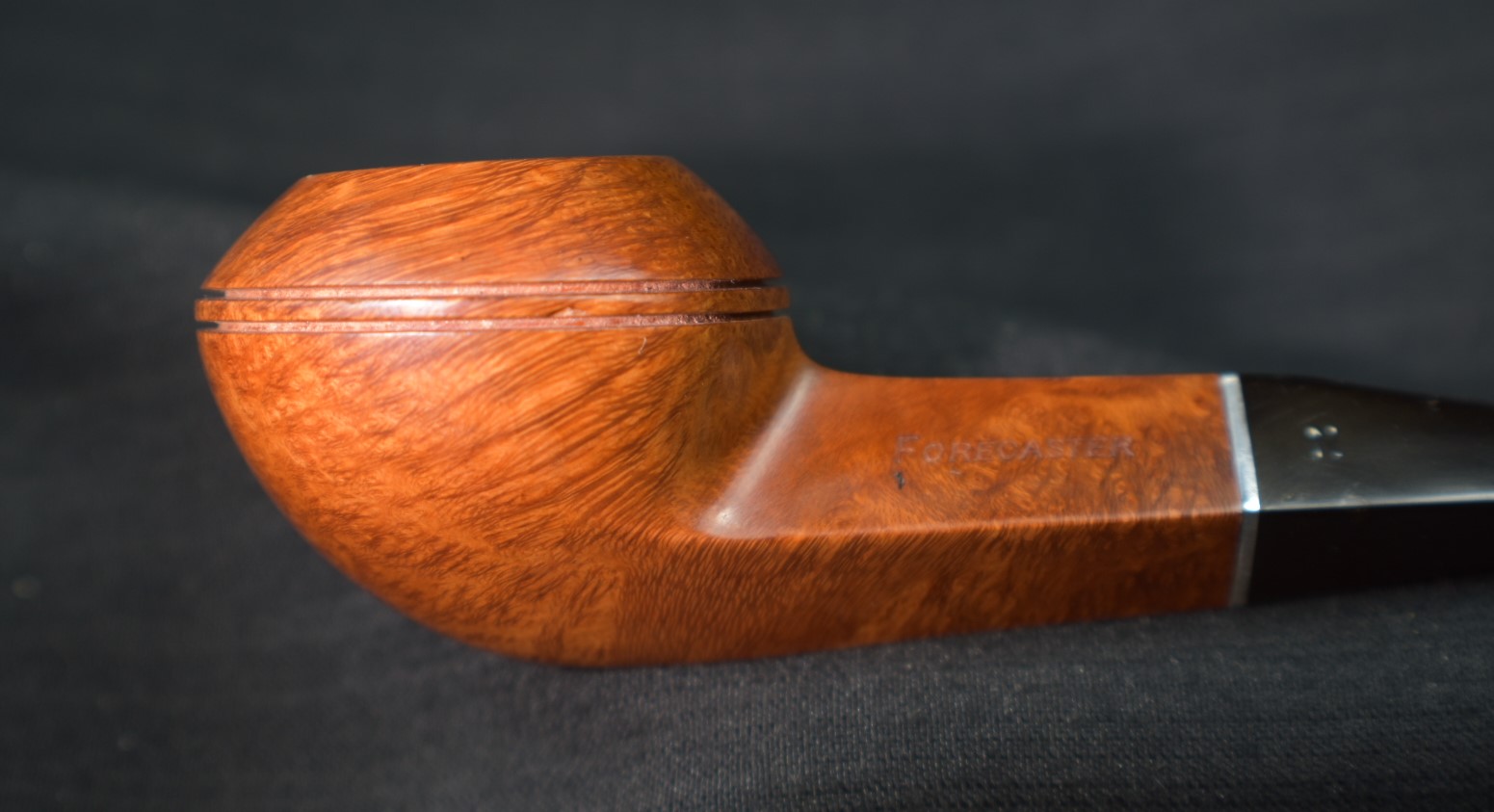
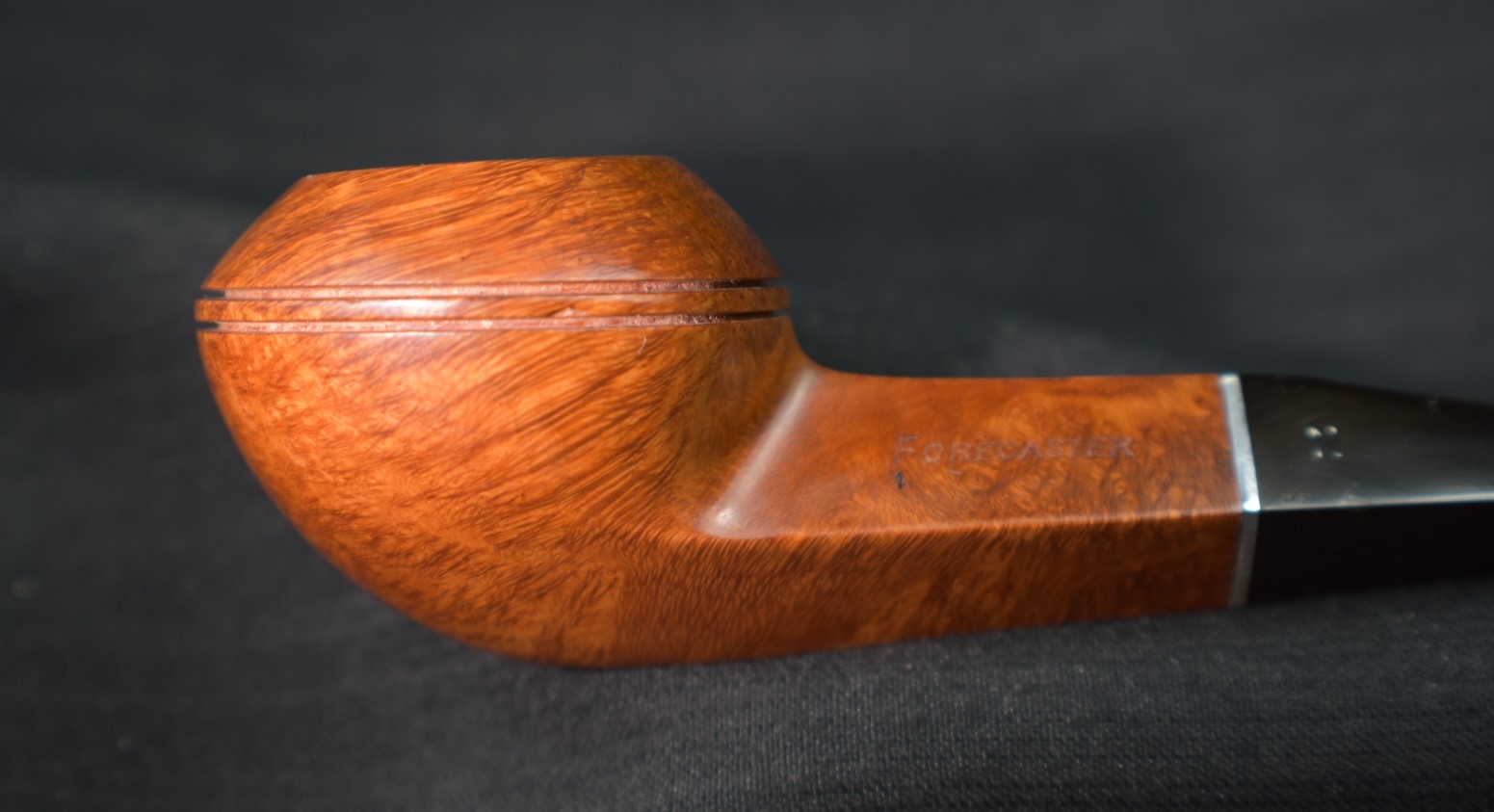
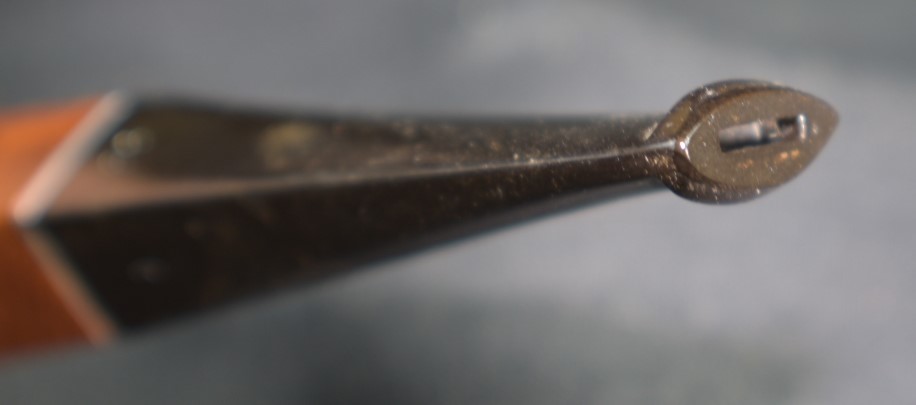
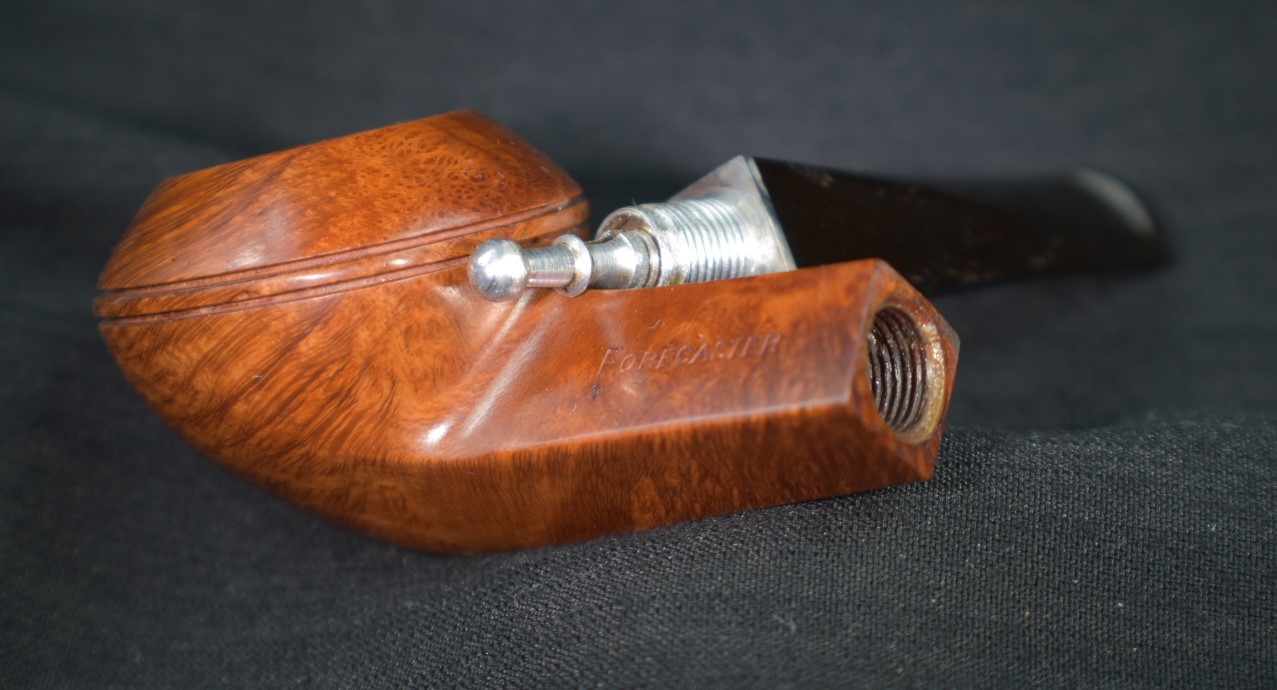
    I am a sucker or a couple of shapes and the bulldog is one of them.  By sucker, I mean that I am willing to spend more time on restoring a shape that I like than I am with a shape that I do not find as appealing.  This little Forecaster fit the “sucker” category in a couple of ways; one, I wanted to restore a forecaster pipe and two, the shape is a favorite.  The pipe came to me as a combined purchase with the Yello-Bole Yacht.  I linked that restoration if you are interested.  The damage to the Forecater was not nearly as evident from the eBay photos as it was in real life.   

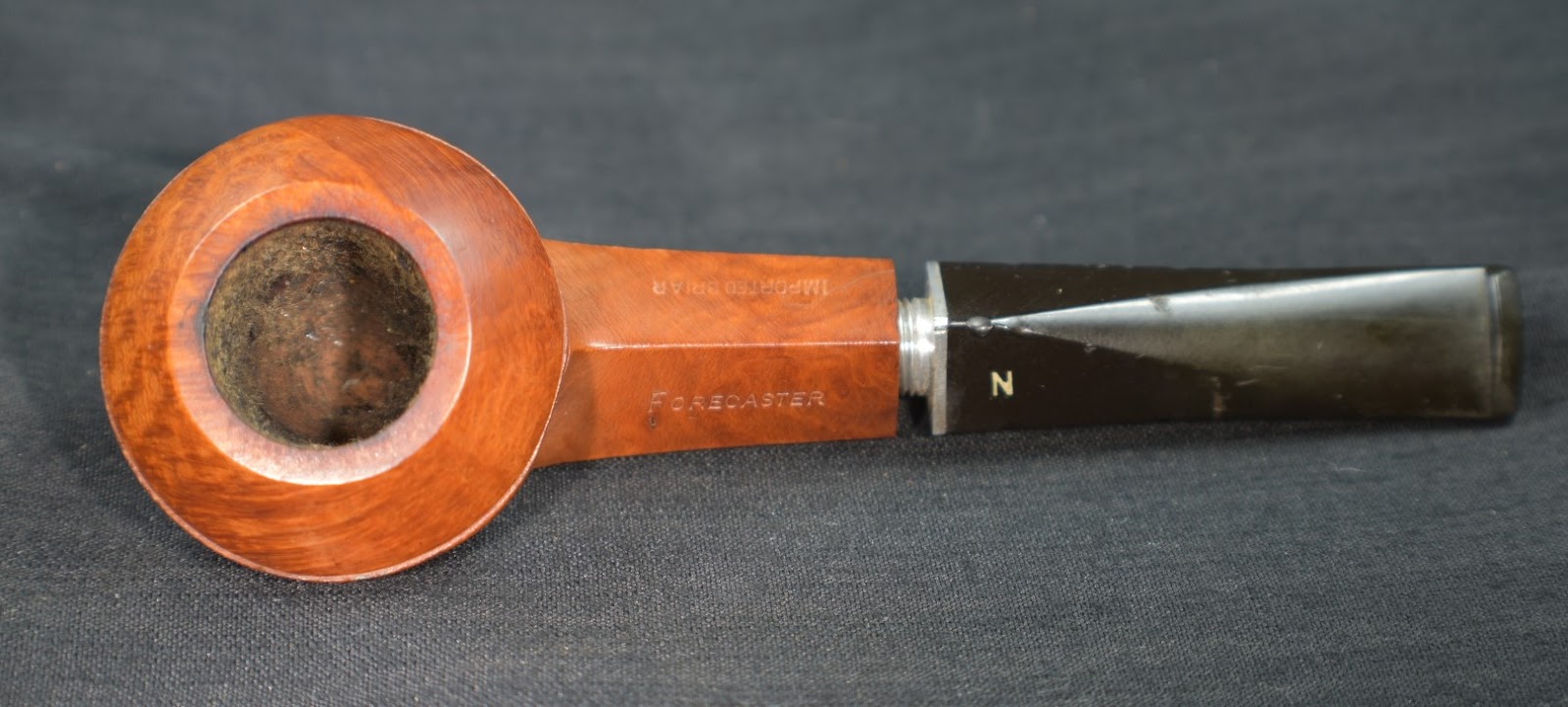
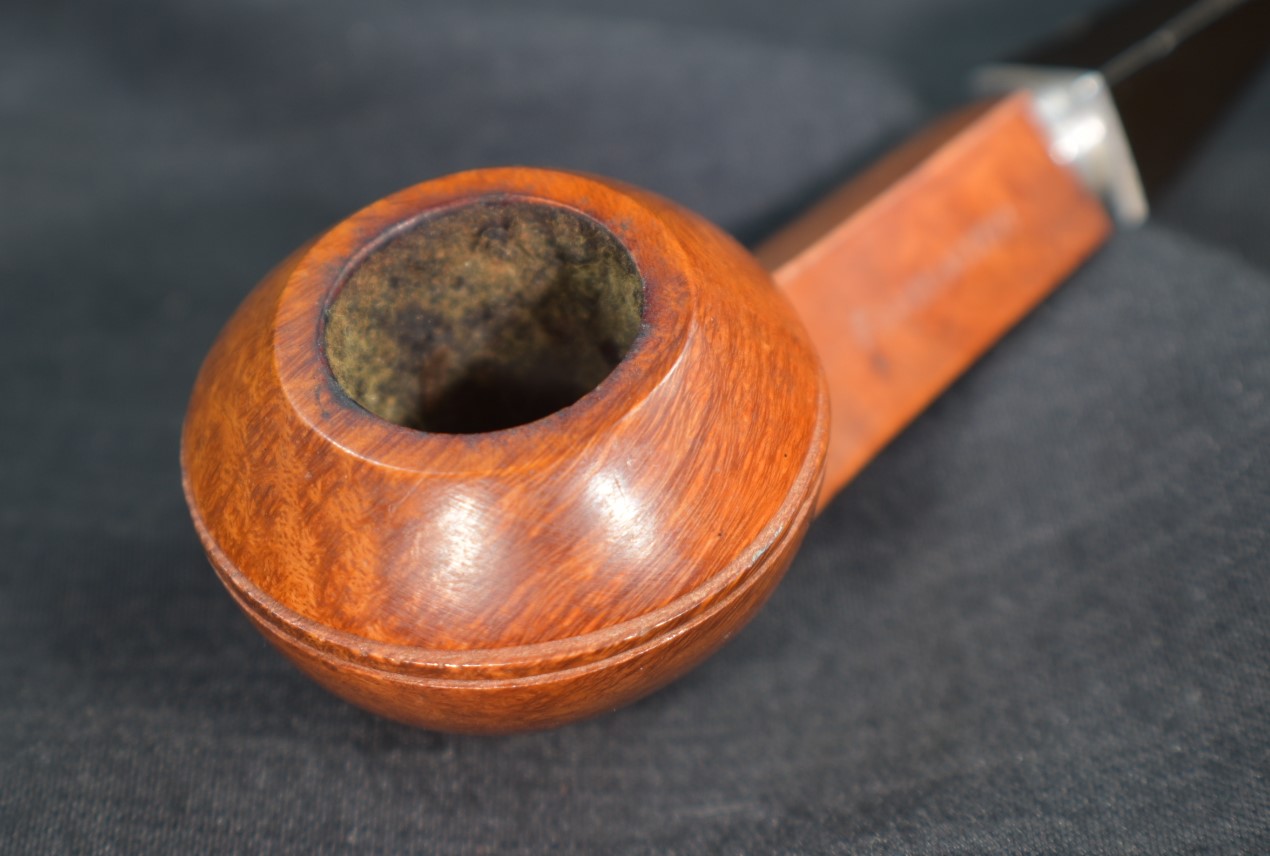
    Below are some photos of the Forecaster upon arrival here at what some consider the pipe clinic.

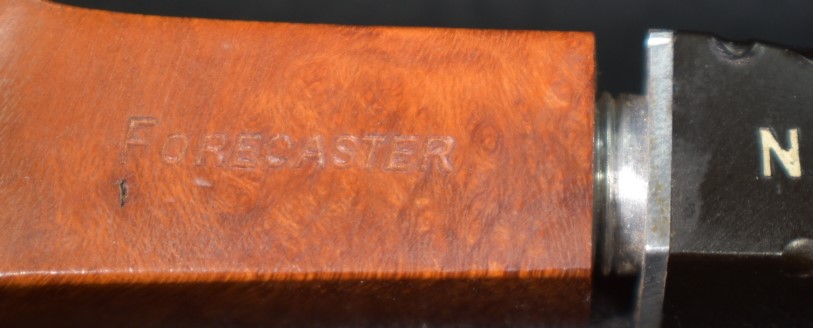
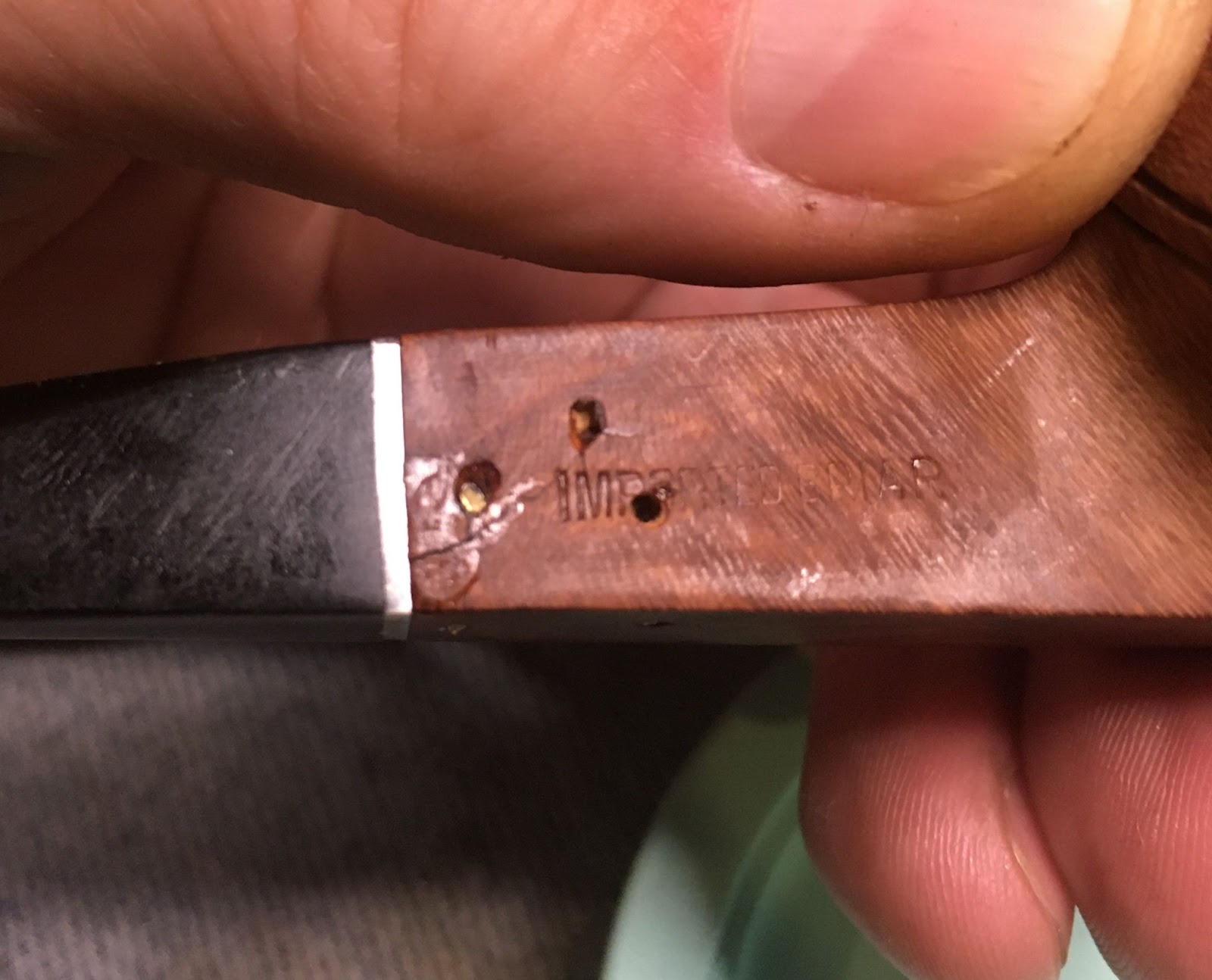
    The crack in the shank was barely evident yet should have been expected by looking at the construction and damage to the pipe.  The mortise was threaded which is a design that begs for owners to over tighten or a stem and can lead to cracking.  The damage to the stem looked as if it could have been done with pliers, further evidence of excessive pressure put on the mortise and potential cracking.  The question was:  “Why was so much force needed to screw in a stem?”  That was answered by examining the threads of the mortise.  Pieces of aluminum could be seen in the wooden threads.  They looked like they were embedded into the wood.  I am getting ahead of myself.  Before we get to the restoration let me give a quick review of Forecaster.

    Background 

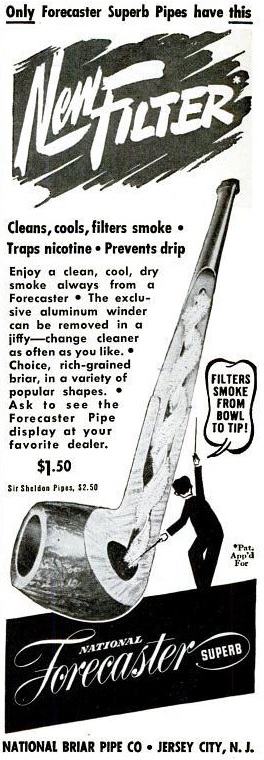
    Below are a couple of print ad images from Forecaster.

    (Forecaster – eBay)

    (Forecaster – Pipedia)

    These two ads give some historical perspective to the brand and pipe.  According to the University of Maryland library Archives, “Roger Bower (1903-1979) was active in broadcasting from 1925 to 1974. He joined radio station WOR in New York in 1928 and became a combination producer, director, actor, announcer, and sound effects engineer. During that time, WOR became the flagship station of the Mutual radio network, and Bower directed many prominent programs, including It Pays to be Ignorant, and Can You Top This? In the early 1930s, Bower announced the first Macy’s Thanksgiving

    Day Parade, which he continued to describe for many years. He gave one of the first (closed circuit) television demonstrations in 1933, in a Macy’s department store window. Bower remained with WOR for 24 years, until the station was sold in 1952.” (https://archives.lib.umd.edu/repositories/2/resources/524)

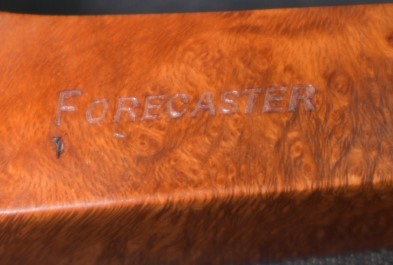
    Pipedia.org says the following, “Forecaster pipes were made by the National Briar Pipe Co. of Jersey City, N.J.. The pipe boasted an “aluminum winder” threaded through the airway meant to clean and cool the smoke. For more information see National Briar Pipe Co..” (Forecaster – Pipedia).  Upon reading the National Briar Co. page I found that, “The National Briar Pipe Co. was homed in Jersey City, New Jersey. Brands produced afak:

    • Biltmore
    • Forecaster
    • Honeybrook
    • King Eric
    • Kleenest
    • Nifty
    • Rembrandt
    • Sir Sheldon
    • Drysmoke Silvertone
    • The Mayflower
    • The Doodler (created and formerly produced by Tracy Mincer, †1966)

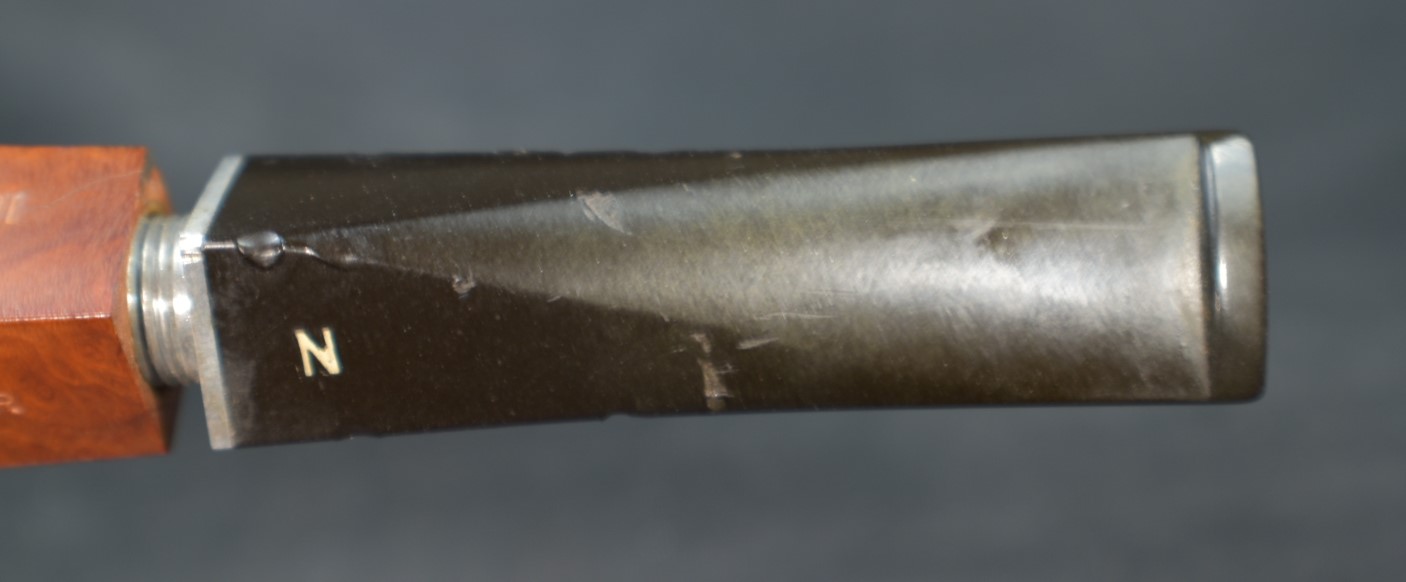
    Logo on the left side of the stem on Rembrandt branded pipes is a capital “N” in italics. Assume that holds true for other brands produced by National. —Dgillmor 21:55, 10 May 2012 (CDT)” (National Briar Pipe Co. – Pipedia).  This explains the N stamped and painted on the Forecaster stem. 

    As for the time line with this Forecaster bulldog I have nothing to assign it directly.  I think it is safe to assume it to be from the late 1940s-1970. 

    The Restoration

    In our last episode we discovered that Jill was pregnant with Roger’s baby, Seymour had been committed to an insane asylum and that strange aluminum flakes were infesting the threads of the Forecaster’s mortise.  Okay, I may have taken some liberties with the story there, about Jill and Roger but Syemore is definitely nuts and the aluminum flakes were more than just a rumor.

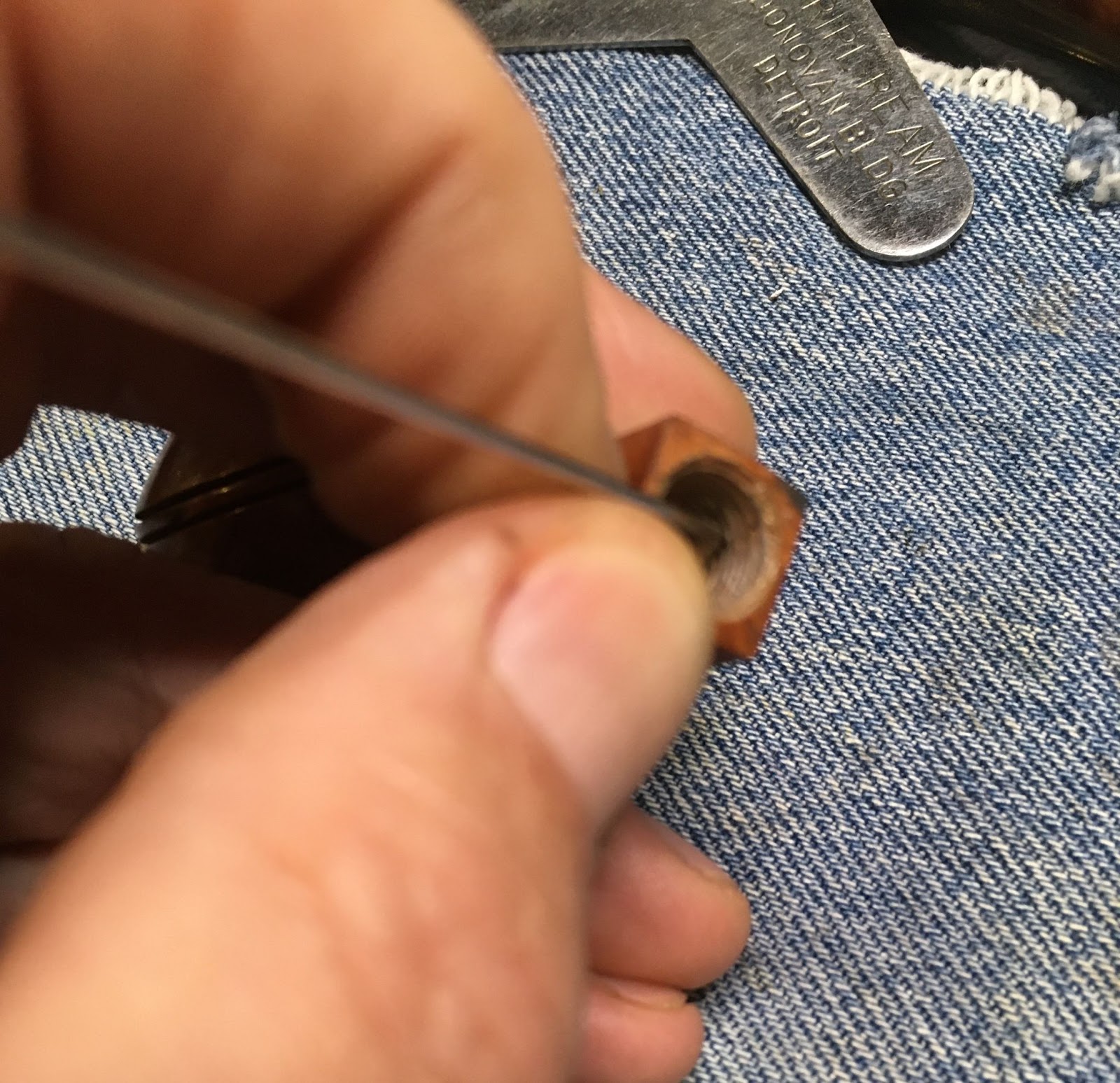
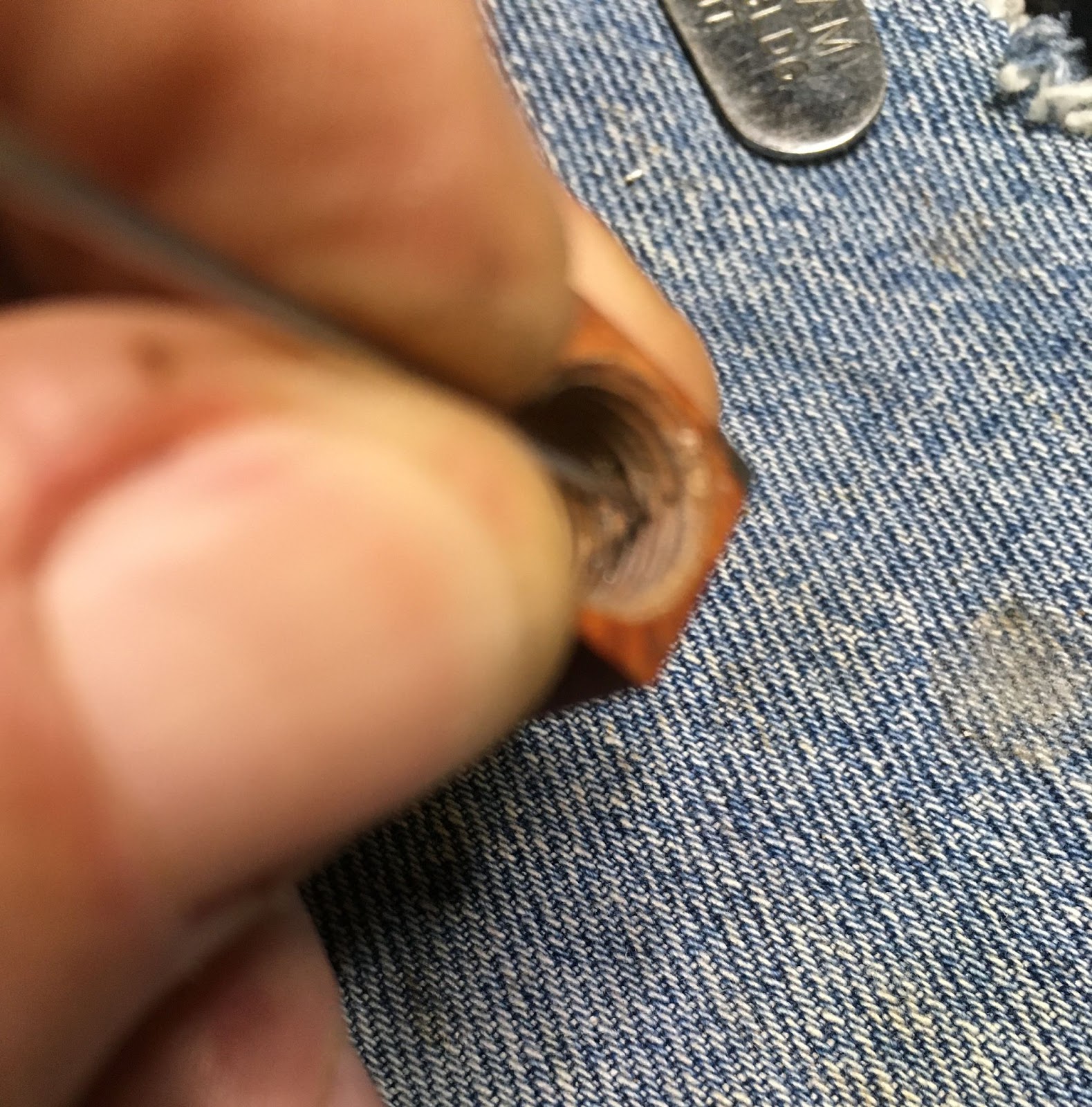
    I used a fly tying bodkin to pry the aluminum out of the threads then a brass shotgun bore brush to further clean the threads of debris.  It took me several minutes to get the visible flakes out of the threads.  

    Below you can see the metal flakes and briar dust from the threads.  I think the white German Shepherd hars was deposited post aluminum extraction and was not part of the problem. 

    Now I got to play detective and construct a situation of how this aluminum got into the wood and why the pipe had been used so little without resorting to aliens or bigfoot.  I am guessing that when the aluminum tenon was cut for threads some of the tailing remained on the tenon.  These flakes got forced into the briar threads when the pipe was originally assembled.  When the original owner first got his or her (yeah, that’s how woke I am) new pipe they had to take it apart.  We all know that experience.  This would have liberated any remaining tailings from the tenon and placed them on the scene.  The new owner, whether they were female, male or of undisclosed orientation then reassembled the pipe.  The stem would have been difficult to reassemble due to the debris filled threads.  Extra force would have been required, perhaps even a tool.  By tightening the stem with a tool the stem was marred.  The new owner couldn’t return the pipe as they had damaged it.  So they continued using it but they were also someone who liked a clean pipe so after the first use they wanted to clean the pipe out.  The stem was even more difficult to remove and upon reassembly could not be threaded in without enough force to further mar the stem and crack the shank.  I’d like to think there was a blood curdling scream, “What have I done?”  Probably not, in the 1950s-1960s, John Wayne was the role model and he never screamed “What have I done?”  The pipe was left with a gap in the fit of the stem to stummel.  Not wanting to look like an idiot the new owner stopped using the pipe concealing their idiocy from the world – until now.

    I reamed the tobacco chamber with a Triple-Ream tool that came with an estate lot a while back.  I couldn’t use my trusty PipNet with its #1 blade due to personal idiocy and breaking the blade.  Some of us don’t bother concealing our idiocy,  The fact that the pipe had barely been used helped greatly in the reaming process.  The chamber was also sanded with 220 sandpaper wrapped around a wood dowel.  Guess what – there was no damage to the chamber from excessive heat.  

    I started formulating a plan for the shank crack.  A couple of scenarios played out in my mind.  Again not resorting to aliens or bigfoot, I thought that banding would be the easiest solution.  The problem with that is that I have no diamond shaped bands.  Typically I use cartridge brass from spent shells or brass tubing.  Both of those are fairly thick materials and would be difficult to reform to a diamond shape.  The second option was something I had read from Charles Lemon.  He had repaired a cracked bowl using a 1.2 mm drill bit and 1.2 mm brass rods.  Here is the link to Mr. Lemon’s pinning tutorial.  If you are unfamiliar with Chrales Lemon’s work he can be found at https://dadspipes.com/.  SIdenote:  If you are familiar with my blogs and unfamiliar with Chrale’s you may need to join Seymour at the insane asylum. 

    I figured that if it worked for a bowl it should also work for a shank.  Given, a shank is going to be more difficult to work with due to the smaller size but the idea is the same.  After initially reading Charle’s tutorial I quickly ordered 1.2 mm drill bits and 1.2 mm brass tubing for the deluge of cracked bowls that I was sure would need my immediate care.  Well, the deluge never arrived but the bits and rods did.  I have yet to try this on a cracked bowl and was feeling quite sorry for the bits and rods due to their forced early retirement.  I decided this pipe could give me practice with the technique as well as justify the enormous capital investment for the 1.2 mm thingies (<$20 at Amazon).

    Now as typical for me, I like to think about a project a good deal before actually attempting it.  I started working on repairing the damaged stem while I was planning the pinning repair.  Some people call this multi-tasking.  I call it thinking about a project a good deal while working on repairing a damaged stem.  Probably because I am not good at multitasking.  Anyway, the stem needed to have new material built up where there were dents in the rubber.  I used layers of black cyanoacrylate (CA, super glue) spritzed with a CA drying accelerator.

    The new CA was then filed flat with a flat needle file and sanded with a 320 grit sanding sponge.

    Additional CA and drying accelerator were used to further fill any tiny depressions.  These were again filed and sanded.  

    I was still thinking about the pinning project when I moved on to the next phase – cleaning the stummel.  I was not dirty so I skipped scrubbing it and moved right to wiping it off with acetone moistened make-up pads.  There was a light clear coat on the briar that I wanted rid of.  The acetone worked well at removing it.

    It was finally time.  I had thought myself into a plan of action.  Drill two holes with the 1.2 mm drill bit in my battery hand drill.  Drill a third hole at the end of the crack , also 1.2 mm, to stop further crack enlargement.  I wanted the angle to be dissimilar and through the thickest part of the shank.  The holes were drilled and the brass rods inserted. 

    The final hole was a hole for terminating the crack.

    The brass pins were cut then roughed with a file to allow more surface area for the epoxy to adhere to.  I would recommend roughening the brass rod before the pins are cut to length as they would be easier to hold.  A mistake I’ll probably make again…

    The aluminum of the tenon was covered with Vaseline petroleum Jelly to avoid CA or epoxy glue from adhering to the aluminum.  Sidenote:  When drilling the pinning hole to the left, I accidentally made the hole too far into the threads. This meant that I either had to drill the mortise larger cutting into the brass rod or, to file the first 3-4 mm of threads off the tenon.  I chose to file the aluminum threads of the tenon.  You can see in the photo below the threads had been filed off.  

    The 2 part epoxy was mixed according to package instructions.  I would recommend against accidentally squeezing way too much epoxy resin onto your mixing surface, like I did.

    I applied a drop of thin clear CA for the crack.  The Vaseline coated aluminum tenon was rethreaded into the mortise.  The thin formula allowed the CA to penetrate the crack.  A Vaseline coated clamp was used to clamp the crack closed as much as possible. 

    After the CA had cured, a couple of minutes later, I used a fly tying bodkin to push some of the epoxy into the pinning holes.  The roughened brass rods were then pressed into the holes.  When doing this make sure the brass rods are a couple of mm shorter than the length of the hole.  This was another mistake which I made.  I thought I had cut them short enough so that I could fill the holes on either end of the brass rod.  I am not sure how I messed this part up.  Either I accidentally switched the rods when placing the pins or I cut the rods too close to the same length as the holes.  I dipped a cotton swab into acetone and cleaned any epoxy from the surface of the shaft.

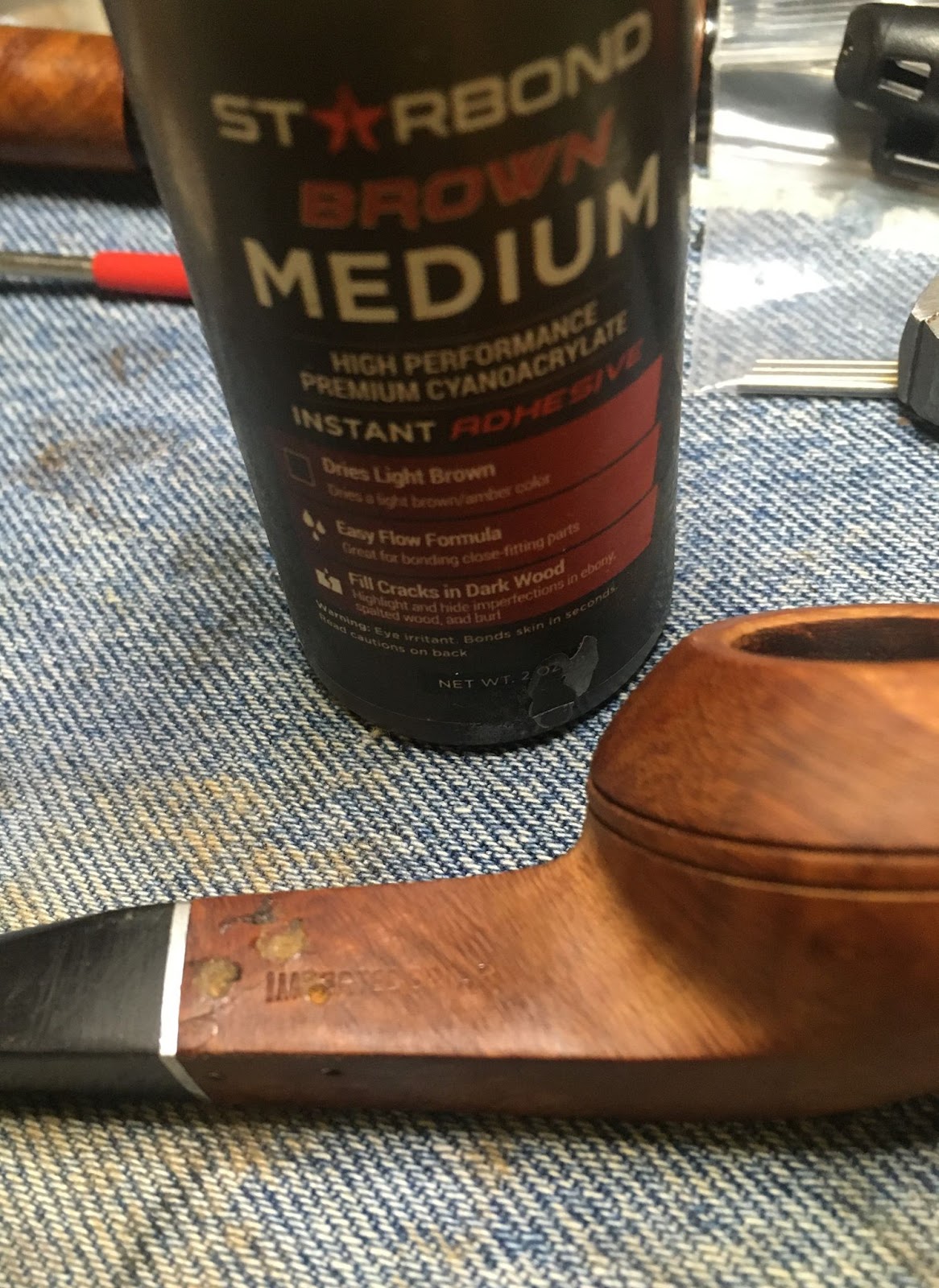
    The glued pins were set aside allowing the epoxy to cure for 2 hours.  After the epoxy had cured, a small drop of brown CA was applied to each end of the hole and a small amount of briar dust was pressed into the CA moistened hole.  Once cured this would be the first layer of the fill.  The cured CA briar dust fill was then filed slat with a flat needle file and smoothed with a 400 grit sanding sponge.

    The filling of the pinning holes was repeated on the adjacent side of the shaft.  The below photo shows the brown CA applied to the hole. 

    Below you can see the briar dust had been pressed into the CA.

    The stamps were then taped with painters tape to protect them and the stummel was sanded with the sequence of sanding sponges from 400-3500.  Between each sponge the stummel was wiped with an alcohol wetted make-up pad.

    The tape protecting the stapes was removed and the stummel was polished with a sequence of 4000-12000 micro-mesh pads.  Between each sponge the stummel was wiped with an alcohol wetted make-up pad.

    The stummel then received a coating of Before and After Restoration Balm and was allowed to sit for 30 minutes.

    30 minutes later the Balm was wiped away with an inside out athletic sock.  The pipe was then taken to the buffer where several coats of carnauba wax were applied with the buffer.

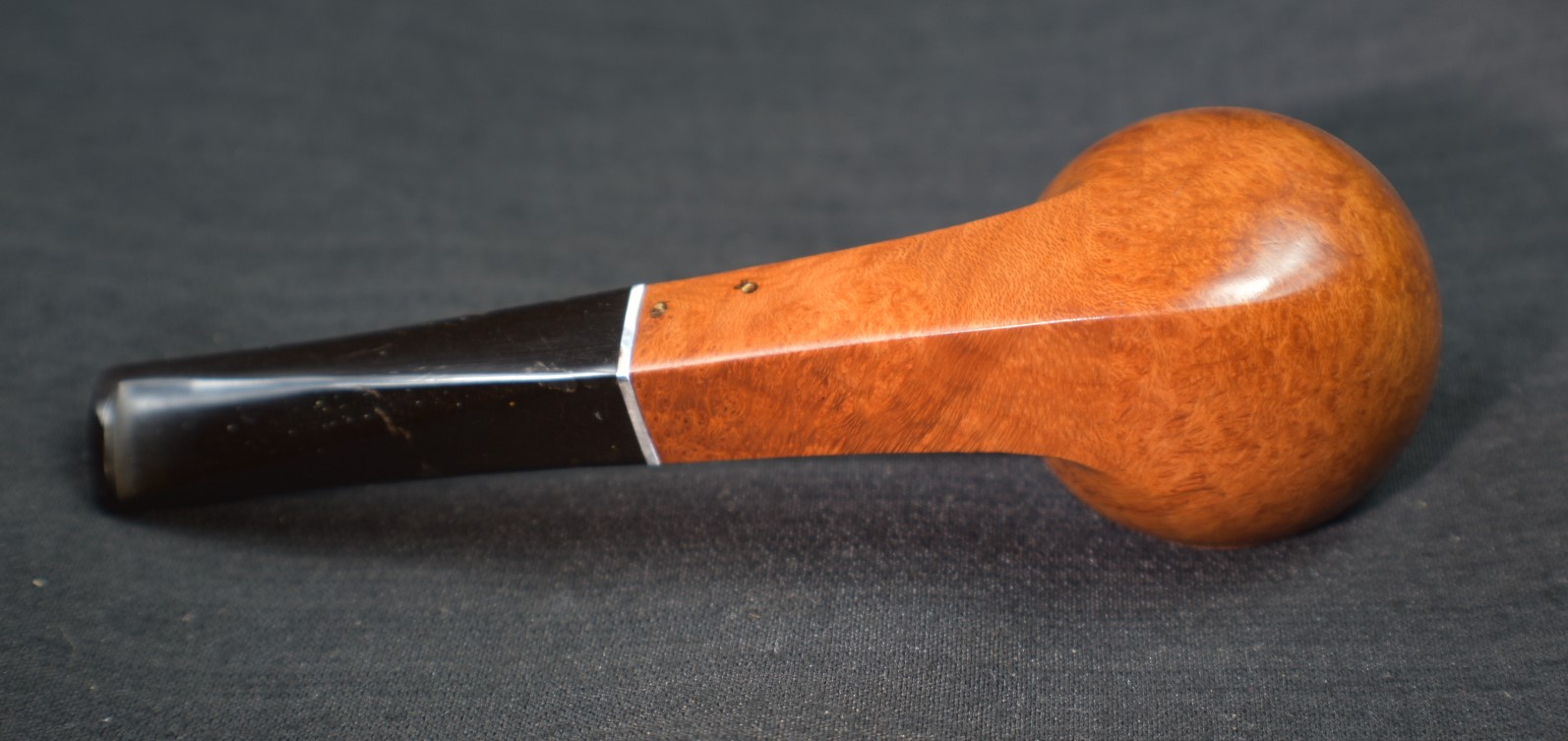
    I would like to say that I am pleased with the restoration of this Forecaster Bulldog but there were just too many flaws to make me truly happy.  Some were my mistakes or “learning experiences” others were just damage to the pipe.  Yes, it does look better than it did originally and it is structurally more sound  This one was certainly challenging, but to drill and pin the shank crack using hand tools was difficult.  Perhaps a darker base coat dye with some contrast would have been a wise move to conceal the repairs.  I rack this restoration up as a learning experience for me and I am looking forward to seeing how well the pinning holds up under normal wear and tear.  I will be keeping and using this pipe as a “work” pipe for tasks like mowing, truck maintenance, gardening etc, where it will get  more rough treatment to better test the pinning fortitude.  Also, the stem repairs look far worse in the photos than in normal room lighting.  I swear, they do, really.   The dimensions of this Forecaster Bulldog are: 

    Length:  4.66 in./ 118.36 mm.

    Weight:  0.90 oz./ 25.51 g.

    Bowl Height: 1.31 in./  33.27 mm.

    Chamber Depth: 0.85 in./ 21.59 mm.

    Chamber Diameter:  0.67 in./ 17.02 mm.

    Outside Diameter:  1.51 in./ 38.35 mm.

    I do hope that you have found something here useful to your own pipe care, maintenance or restorations.  If you like this sort of thing, please click the like and subscribe buttons.  Thank you for reading the ramblings of an old pipe lover.

    Below are some photos of the finished Forecaster Bulldog

  • A Peterson 87 Spigot Restoration

    May 21st, 2024

    Photographed and written by 

    John M. Young

    Well, my Peterson Pipe Acquisition Disorder (PPAD) has once again come out of remission.  I didn’t think that self medicating and meditation via fishing would keep it at bay for very long and I was correct.  Go me!  How could I say no to this little darling when it appeared with a buy now price less than ½ that of a new spigot.  As soon as I got the notification I looked and clicked the “hello PPAD button”.

    The pipe shipped quickly after an excruciating 3 day long posting time by the seller.  I know, they were building anticipation, right?   Don’t they realize the importance of immediate gratification to a poor soul suffering a terrible PPAD episode?  Within a week the Peterson Spigot made it from North Hollywood, California to the wilds of southeast Nebraska.  Below are some photos of the pipe as it appeared prior to any work. 

    Yeah, it has the potential to be a real looker and another yeah, it has a green tint towards the bottom.  I’ve never experienced a Peterson with a clear coat quite like this.  It will have to go.  There is a lava outcrop on the rim flowing over the edges.  The tobacco chamber needs a good reaming and inspection.  The shank and stem look disgusting, um, I mean well used.  But that grain is gorgeous.  

    Peterson Background

    For a complete history of the Peterson Pipe I cannot even begin to do justice to the subject.  Mark Irwin and the late Gary Malmberg have done a wonderful job with this in their book, image and purchase link below.

    (https://www.smokingpipes.com/accessories/books/moreinfo.cfm?product_id=471478)

    For a shorter and less costly history I will include a few good links for those who are interested:

    • Peterson Pipes History (Peterson Pipes History (#1 Best Source) – TobaccoPipes.com)
    • A Primer on Peterson Pipes (A Primer on Peterson Pipes | PipesMagazine.com)
    • System Day 2019: 100 Years Of Peterson System Advertisements (100 Years of System Advertisements – Peterson Pipes | Smokingpipes.com)

    For the history of this pipe I will start here with a quote from smokingpipes.com describing the 86 Spigot pipe: 

    “Peterson: Green Spigot (87) Fishtail Tobacco Pipe

    Product Number: 002-029-114391

    Peterson’s “87” is a straight Apple in classic Peterson style, with a bit of extra heft to its shank relative to the bowl and a tapered stem that keeps things balanced throughout. It’s still a robust, hearty smoker, that has no problem upholding the marque’s characteristically bold style and features a bowl that is capacious enough to thoroughly enjoy your favorite tobacco, yet small enough so that it doesn’t require a major time commitment.

    Along with their signature shaping style, Peterson of Dublin is renowned for their silverwork. The journey of becoming a Peterson silversmith requires years of training and personal mentorship from the factory’s senior craftsmen, and the superlative results testify to such a demanding, lengthy process — each worker having engineered his own mandrel to the extent that every metal accoutrement made is imprinted with the subtle, personal style of the one who machined it. Peterson’s Spigot line was created in 1977, after discovering an old Peterson catalog from 1906 that pictured pipes with spigot mounts, and the series is among the best at showcasing the Irish marque’s signature silver treatment, fitting sterling silver around both the shank end and stem base in a spigot-mount arrangement. The construction provides further reinforcement and durability and highlights even more sterling silver than would be used for a standard military mount. Presented here in the Green finish, the flashy, regal metal is paired to Peterson’s signature emerald stain for a unique, distinctly Irish take on the dress pipe aesthetic.

    -Truett Smith” (https://www.smokingpipes.com/pipes/new/peterson/moreinfo.cfm?product_id=607279)  Written as a true advertising genius, well said Mr. Smith.  

    Pipedia.org discussed the spigots in general.  “Gold & Silver Spigots: The Peterson Spigot is characterised by a gold or sterling silver covering on the tapered end of the mouthpiece which complements the sterling silver band of the pipe. The Spigot style evolved from the practice of soldiers in earlier centuries who repaired broken pipes by sliding a used cartridge case over the shank and reinserting the mouthpiece. In this unique spigot finished pipe, Peterson craftsmanship perfect the union of finest quality briar and precious metals. The silver or gold is spun to shape and then fitted to the pipe.

    These are amongst the most attractive and collectable pipes in the Peterson range of pipe issues. They just ooze quality. Prices start at around $200 and rise to $800 for the Gold versions.” (https://pipedia.org/wiki/Peterson)

    The final point to discuss here is the year that this pipe was produced.  Peterson’s hallmarking is a great way to precisely date a Peterson pipe.  Here are links to Peterson’s hallmarks (Hallmarks – Peterson Pipe Notes) and (PPN-Hallmark-Chart.pdf (petersonpipenotes.org))

    The image to the left is a screen clip of the PPN-Hallmark-Chart. While the photo below is the hallmark of this pipe.  

    This dates the 87 Spigot in the Year of Our Lord 2012.

    The Restoration

    As usual the work surface received a cleanish denim piece.

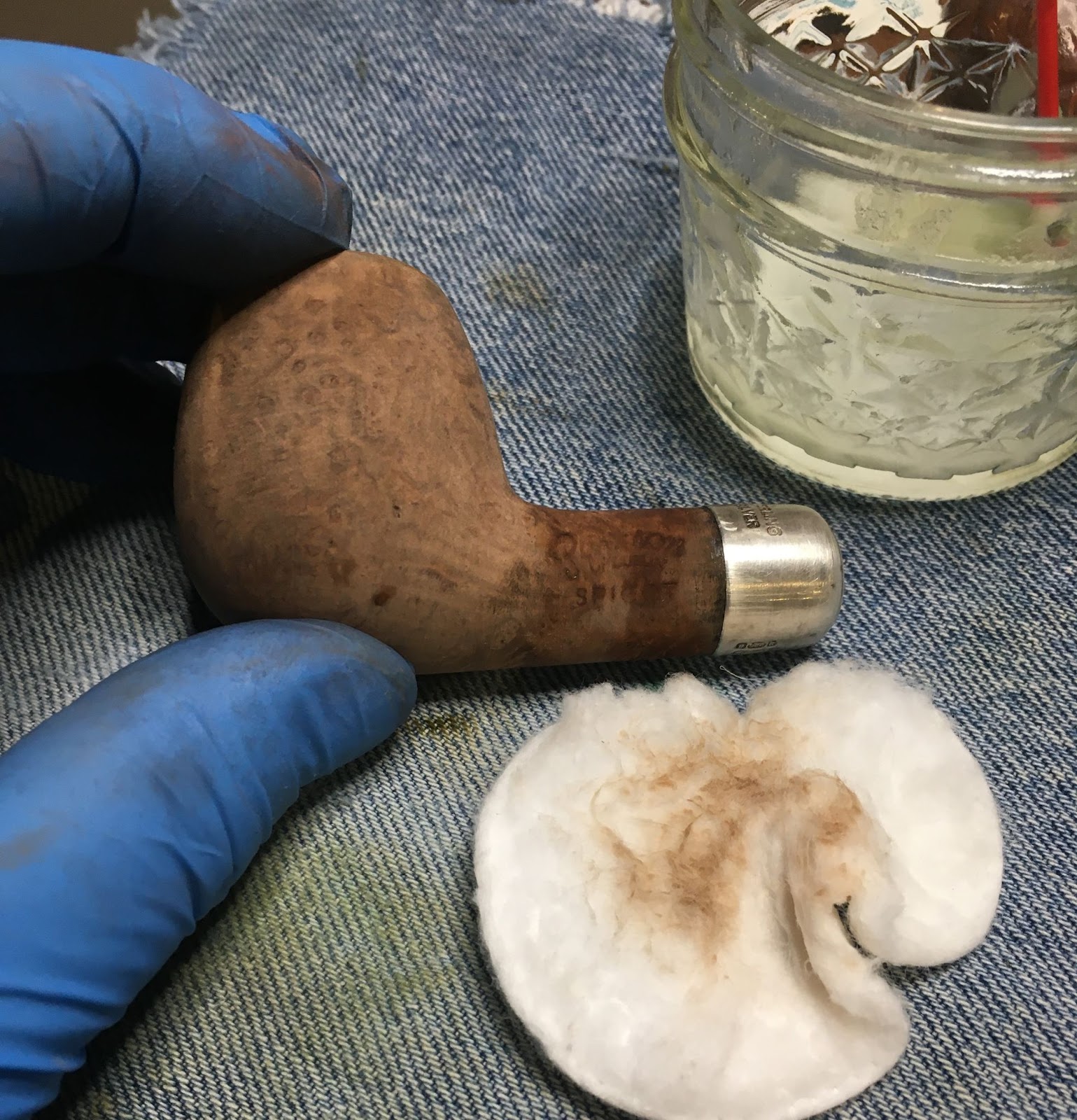
    I started with a make-up pad dipped in acetone to see if the finish was susceptible to acetone.  I hoped so.  I was not.  The acetone did remove the lava from the rime nicely as can be seen on the pad below.

    As I was considering options for removing the clear coat I began working on reaming the tobacco chamber.  The tools were assembled; PipNet with #2 blades, General triangular scraper, 320 sandpaper wrapped wood dowel and the 320 sandpaper wrapped Sharpie marker.

    The reaming and sanding of the chamber went well and revealed a tobacco chamber with no damage.

    Still pondering the finish removal, I started cleaning the airway of the shank.  Scraping with a dental scraper, numerous cotton swabs, bristle pipe cleaners and a good amount of 95% ethyl alcohol later the airway was clean.

    Still thinking about finish removal, I started cleaning the stem.  Again the ethyl alcohol and bristle pipe cleaners came to use.

    The acrylic stem needed minimal exterior work.  I sanded it with 1000-3500 sanding sponges then polished it with micro-mesh pads 4000-12000.

    During the above cleaning I decided to try physical removal of the finish over chemical removal.  Great care would have to be taken around the stamps but how hard could this finish really be, right?  I started sanding the finish on one side of the stummel.  Good Lord the stuff was hard.  Impervious, adamantine, diamond coated, were terms that came to mind.  I changed my mind after about 20 minutes of sanding and barely making a dent in the finish.  This was a job for modern chemistry.

    A couple of years ago I purchased a very cool used pipe rack for my son-in-law.  It needed to be stripped and refinished.  During my college days I spent one summer stripping and refinishing school gym floors.  We used methylene chlorine and it would eat its way through polyurethane finish in minutes.  It was also highly toxic and probably an environmental menace.  I wondered what products had been developed more recently for stripping finishes.  I settled on a non-toxic product called Max Strip Paint and Varnish Stripper.

    (Max Strip)

    It worked quite well on the pipe rack and seemed to live up to the non-toxic reputation.  The pipe rack also turned out amazingly well and was a great Christmas present.  I reread the toxicity information and decided that it should be okay for use with pipes.

    Application of stripper 1.  It seemed much thinner than I remembered it.  Hmm, perhaps reading the directions is a good idea.

    Oh yeah, shake the container well.  That made it much thicker, like I remembered.  The stummel was coated with a thick coating of the stripper and set bowl down in a disposable plastic dish.

    After 12 hours I wiped the stripper from the stummel using paper towels and rinsed it under a stream of water while scrubbing with a Scotch Brite pad.  The side where I had sanded the finish looked better than the rest of the stummel but none of it looked stripped.  I took it out into the sunlight for a better look and photos.  The scratches that can be seen were from the Scotch Brite pad.

    The shiny areas of remaining finish were evident.

    The stripper did manage to eat it’s way through the disposable plastic dish.

    Read those instructions again.  OK, it says to “scrape” the stripper and old finish from the surface.  I also used glass this time as a tray to catch the excess stripper.

    Application 2.  

    After 2 hours I scraped the stripper with a sharp kitchen paring knife.  This worked much better.   

    You can see the stripes where my scraping wasn’t well aligned.  I tried sanding with a 320 sanding sponge.  The stummel still had a layer of the clear coat that the sandpaper would barely touch.  The dust came off as a white powder or as a pastel green powder indicative of finish, not the reddish brown of briar.

    After the scraping the stummel was again rinsed with copious running water and further Scotch Brite scrubbing.

    Application 3.  Freshly sharpened knife and dental scraper at the ready.  I allowed the stripper to do it’s thing for an hour then scraped the stripper from the stummel.  Again I rinsed with water and scrubbed with the Scotch Brite pad. 

    The stummel looked better but still not free of the clear coat of stain.  I decided to try an acetone wipe to see what would happen.  To my surprise the make-up pad wetted with acetone came away with a good deal of green.  It was as if the stripper had softened the finish and it was now susceptible to acetone.  Yay! 

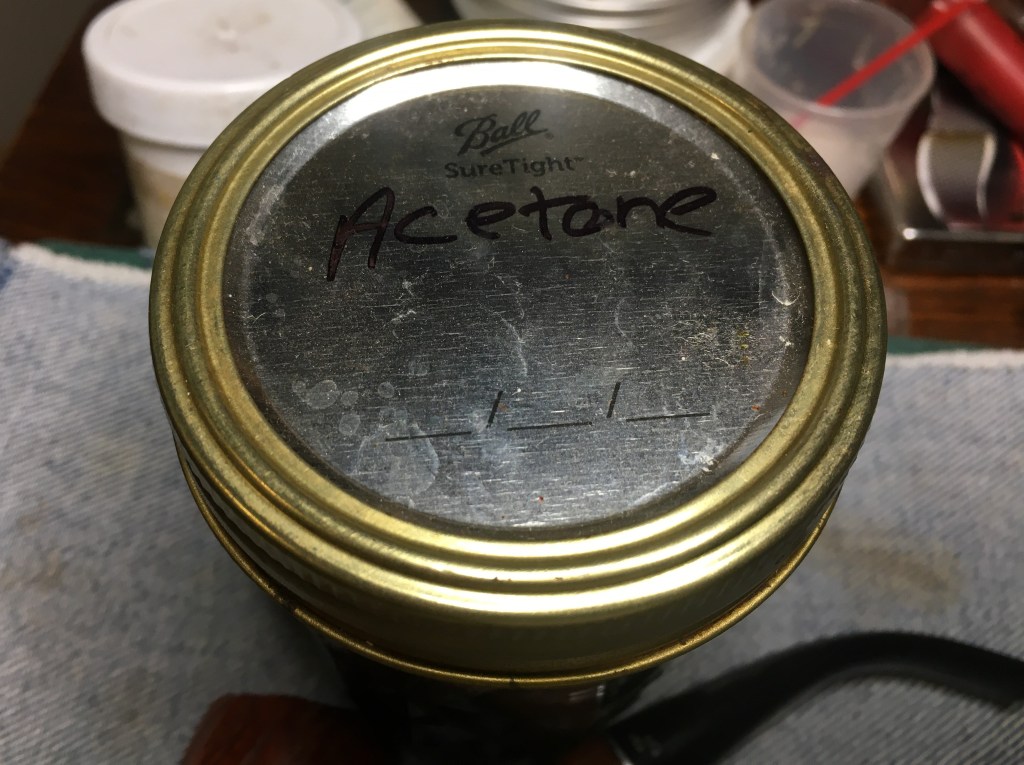
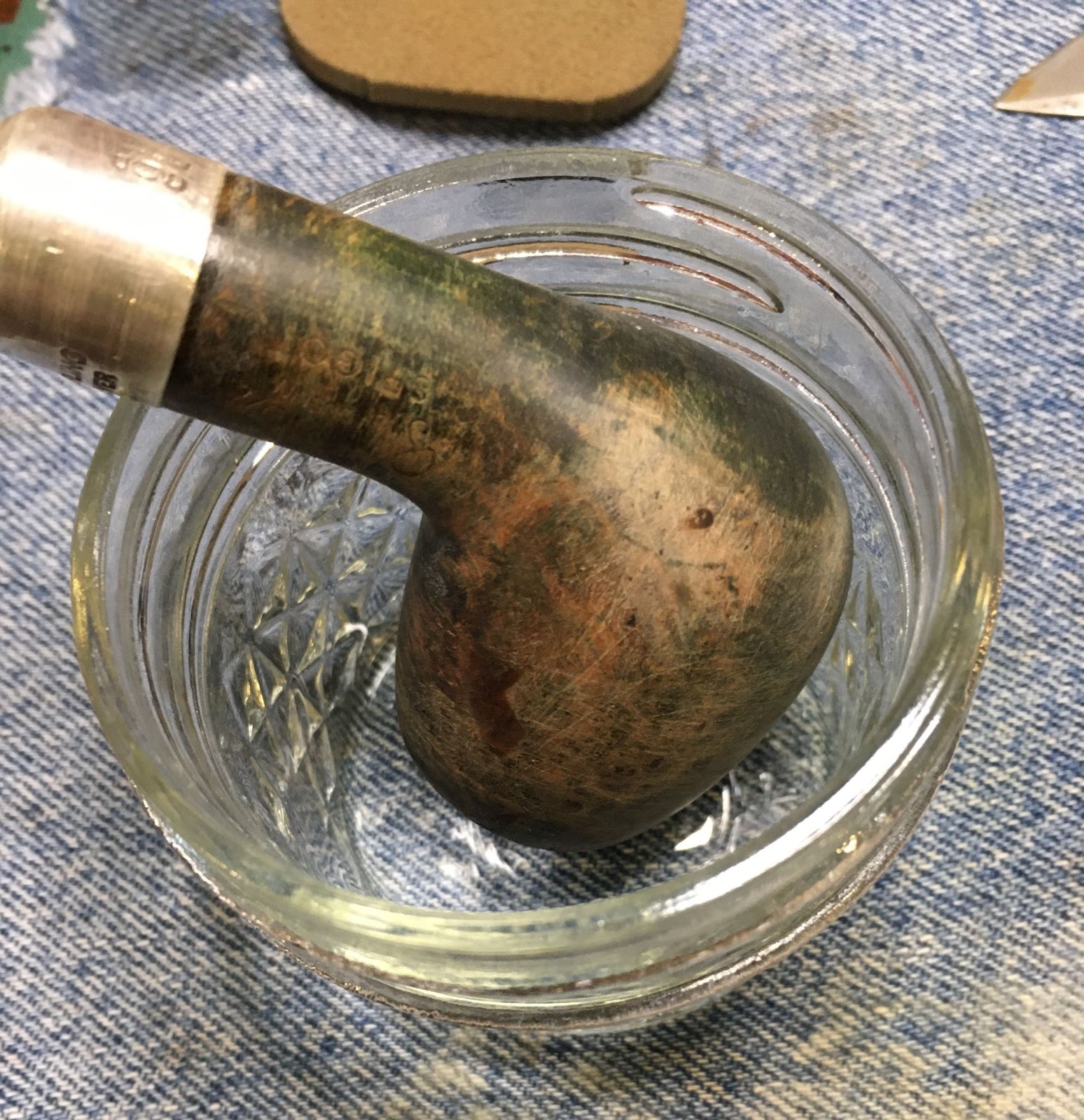
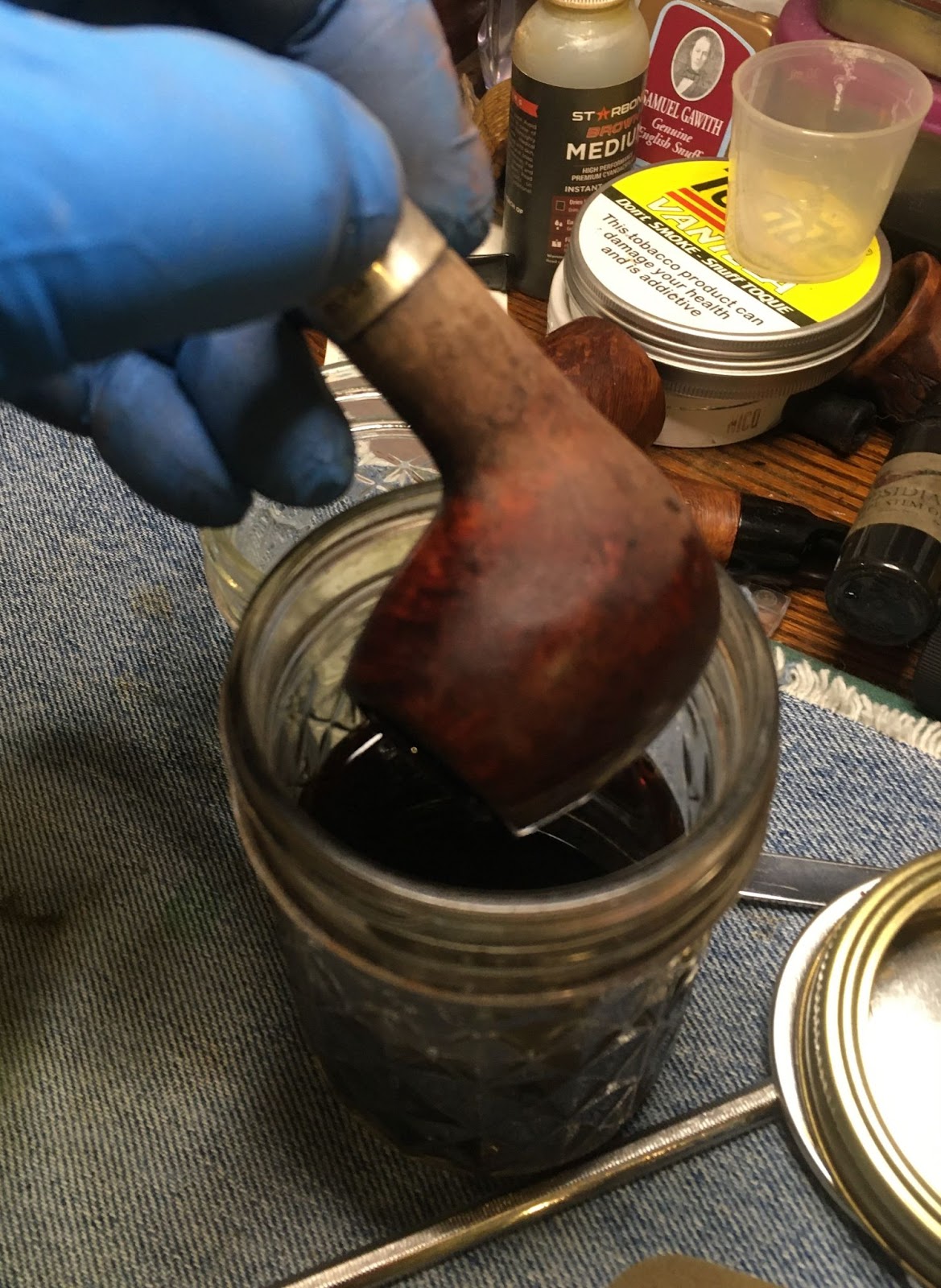
    I got out the acetone jar and submerged the stummel into the solvent.

    The stummel was allowed to soak in the acetone for one hour.  I then removed it with nitrile gloved hands.  The green was gone along with the finish.  I won!

    Another make-up pad wetted with clean acetone and very little color came off the stummel.

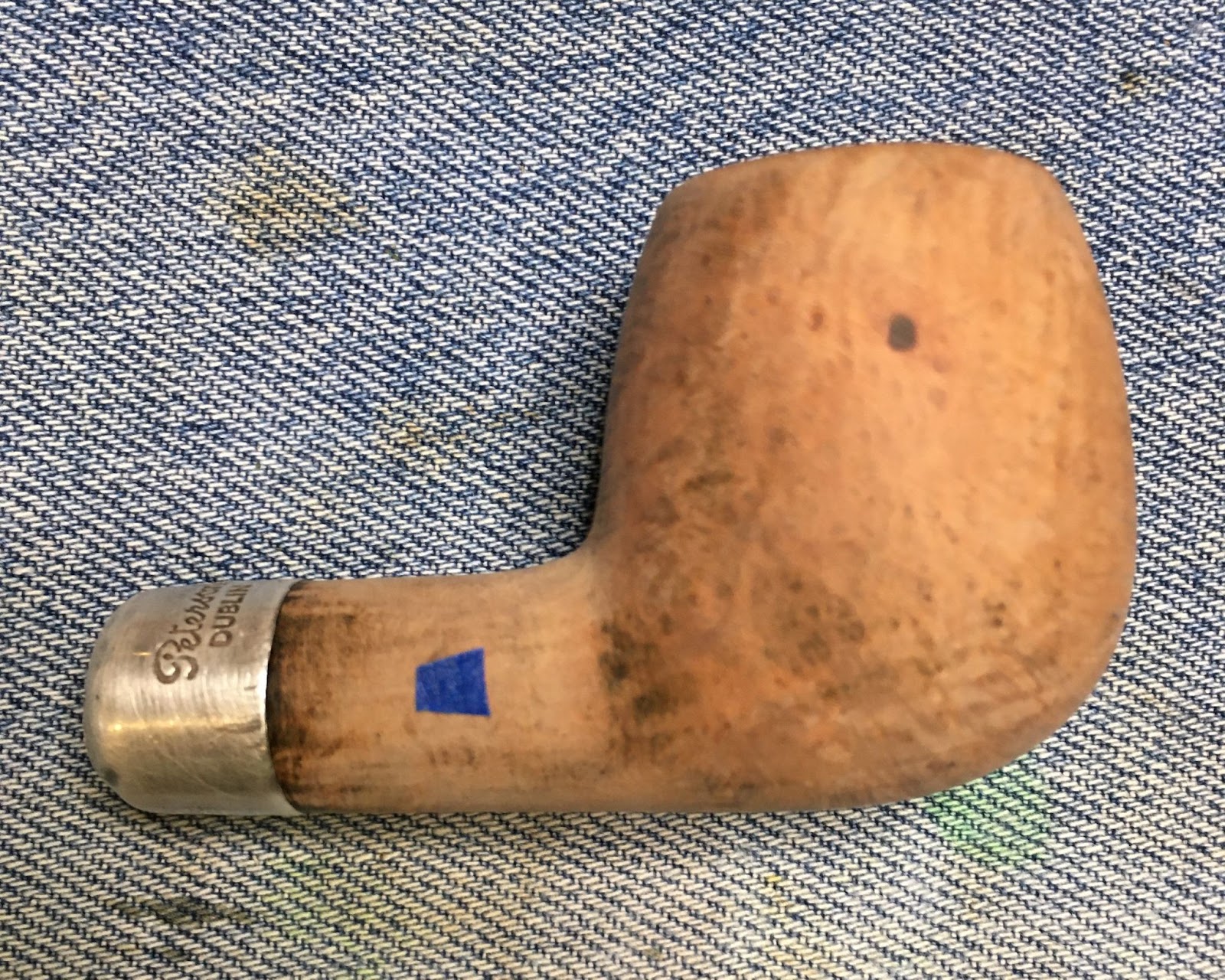
    I lightly sanded the stummel with the 320 sanding sponge.  There were still some areas where the sandpaper would not “cut” as with briar but these quickly sanded away.  The below two photos are again outside in sunlight.

    The beautiful brain was still there but all of the previous dye/stain had been removed.  This required a rebuilding of dye to emphasize the grain I’d seen before.  I made a difficult decision to not use green.  I knew this would violate the “restore” part of restoration but this was going to be a personal use pipe rather than a resale so keeping it original was not as high on the list of priorities.  I also feared the fading of the new green requiring another refinishing.

    The lack of finish also made several pits very noticeable.  These were filled with brown cyanoacrylate (CA, super glue) and briar dust.  The old fill material was picked from the stummel using a fly tying bodkin.  A small drop of brown CA was then applied to the pits and briar dust was pressed into the wet CA.  The new fills were filed with a flat needle file and smoothed with a 320 sandpaper sponge.  Where needed a second application of CA was used and sanded allowing the sanding to provide the briar dust.

    Additional sanding of the stummel required that the stamps be protected with a layer of painters tape.  

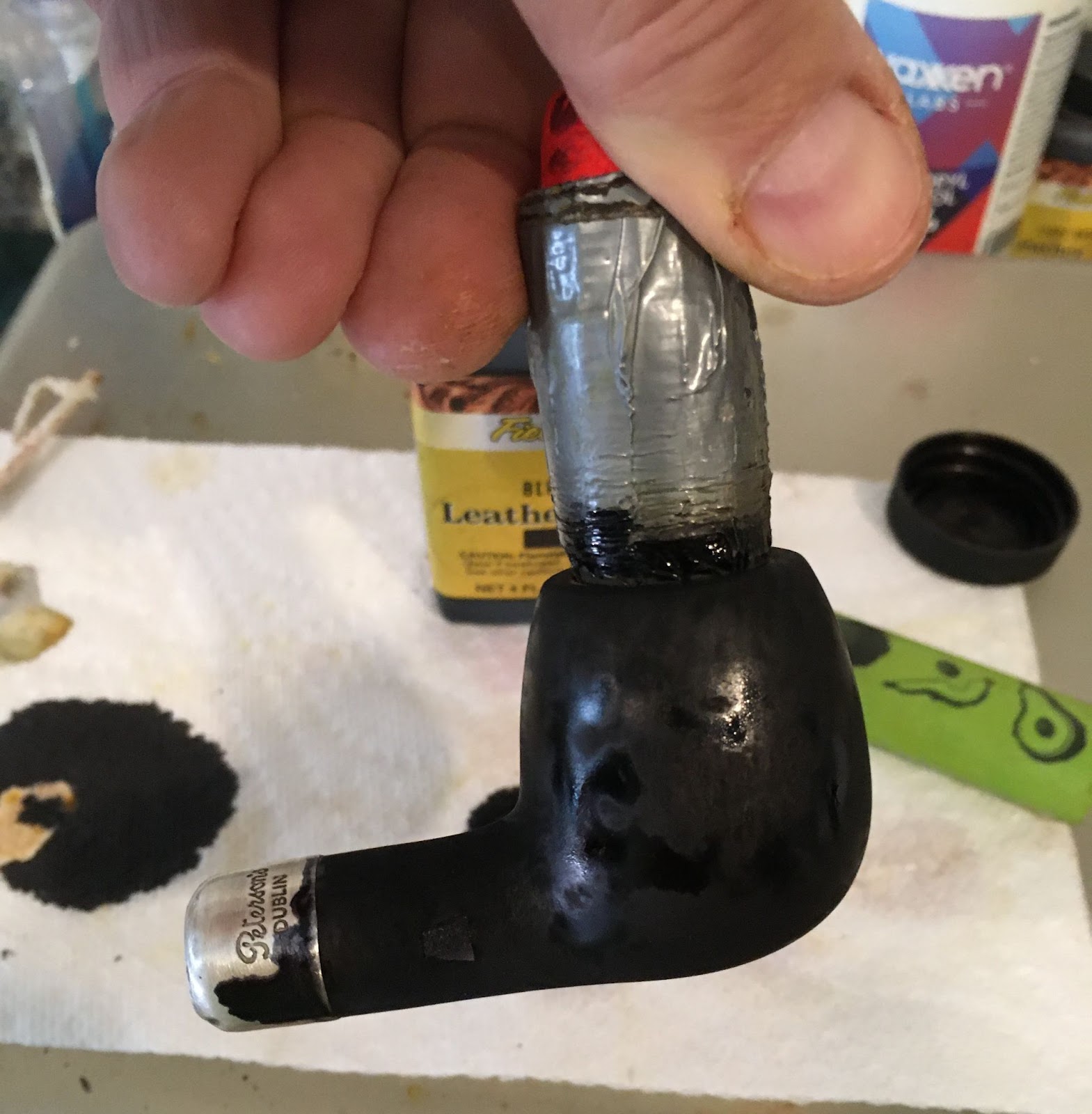
    The stummel was then sanded with the 400 sanding sponge.  The stummel was nor ready to have the briar grain reemphasized.  I used a black Fiebing’s Leather dye as a base for contrast dying.  

    The black dye was applied with a folded pipe cleaner and flamed with a disposable lighter to burn off the alcohol and set the dye to the briar.

    I then rinsed the stummel with 70% isopropyl alcohol over the sink to remove some excess dye.

    Back at the workbench the stummel was wiped with several make-up pads wetted with 95% ethyl alcohol to remove the black dye from the surface.

    Next came the sanding of the stummel to remove the outer layer of dyed briar.  The sanding continued from the 400-3500 sanding sponges.  Between each sponge the stummel was wiped with a make-up pad wetted with ethyl alcohol.

    To restore a bit of the original color to the stummel I used a “wash” of 95% ethyl alcohol with orange Fiebing’s Leather dye mixed at about 3:1 (3 parts alcohol to one part orange).

    The stummel was then micro-meshed using the 4000-12000 pads.  Between each pad the stummel was wiped with a make-up pad lightly wetted with ethyl alcohol.

    The stummel was then coated with Before and After Restoration Balm and allowed to sit for 30 minutes.

    30 minutes later the excess Restoration Balm was wiped away using an inside out athletic sock.  There’s that grain I had been waiting to see.

    The pipe was then taken to the puffer to receive several coats of carnauba wax applied with the buffer.

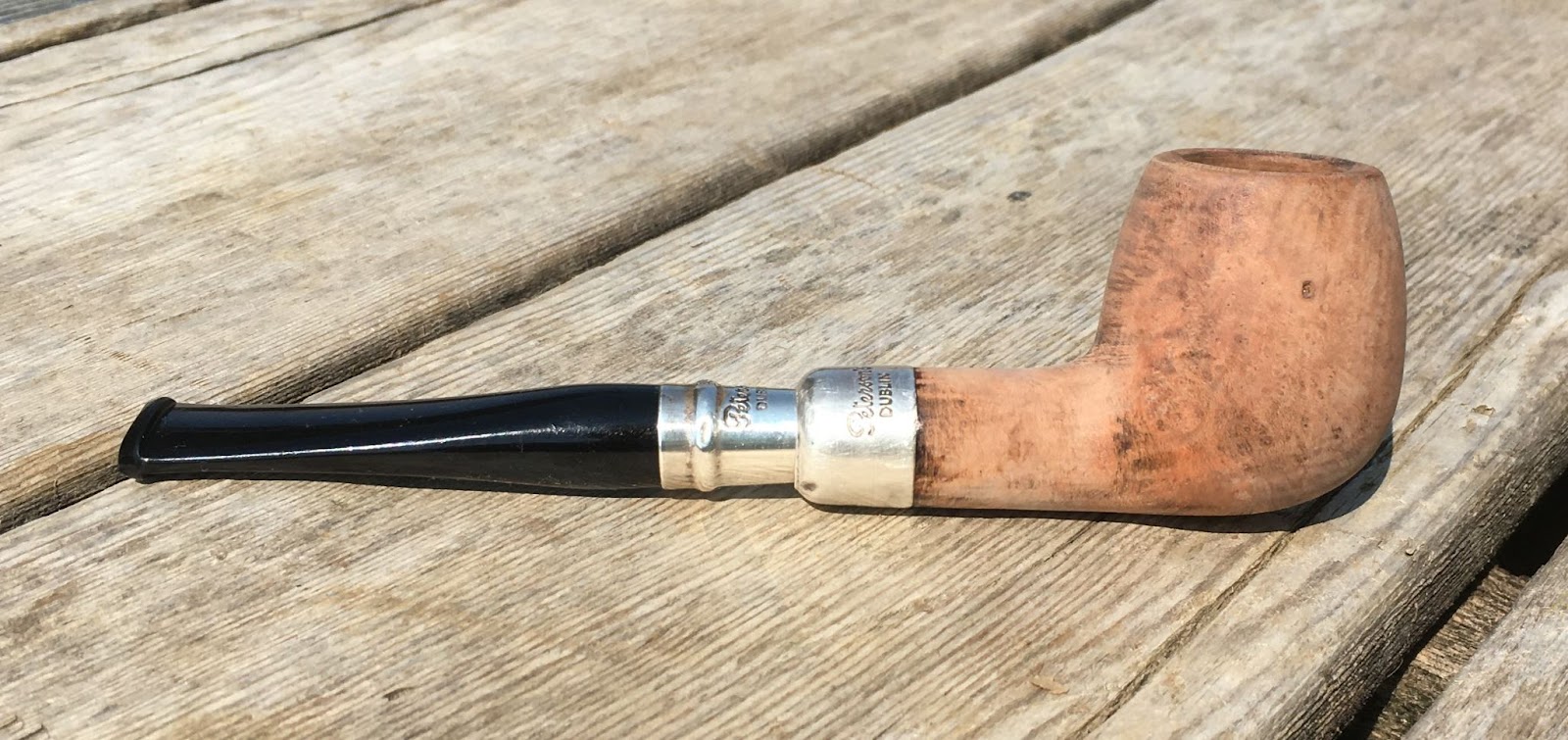
    I am pretty happy with the restoration of this Peterson 87 Spigot.  It is a shape that I love and I only have one other spigot.  The spigot system is very handy as well as classy looking.  This one was certainly challenging to remove the dreaded clear coat.  I lament the loss in clarity of the stamps but that is the price paid to be rid of the clear coat.  The contrast dying came out well as did the color of the finished Spigot.  The minor dents in the silverwork were not repairable by me but it does save me the trouble of having to dent them myself, I guess.  I am becoming more and more a fan of acrylic stems.  Their ease of maintenance is nice and I really don’t find their hardness to be an issue. The dimensions of this 87 Spigot are: 

    Length:  6.09 in./ 154.69 mm.

    Weight:  1.47 oz./ 41.8 g.

    Bowl Height:  1.77 in./  44.96 mm.

    Chamber Depth:  1.42 in./ 36.07 mm.

    Chamber Diameter:  0.73 in./ 18.54 mm.

    Outside Diameter:  1.47 in./ 37.34 mm.

    I do hope that you have found something here useful to your own pipe care, maintenance or restorations.  If you like this sort of thing, please click the like and subscribe buttons.  Thank you for reading the ramblings of an old pipe lover.

    Below are some photos of the finished Peterson 87 Spigot

    Yeah, the stampings did take a beating from all the stripper, dying and sanding.

  • A Yello-Bole Chesterfield (1933-1936) Restoration

    May 16th, 2024

    Written and photographed by

    John M. Young

    In the past I have written about how I think Yello-Bole pipes are considered the Cinderella of the KB&B line.  Kind of like the homely, overworked but trustworthy step-sister from the Disney adaptations.  When that ugly clearcoat is removed there is frequently beautiful grain underneath also like the Cinderella story, when the heroine gets all gussied-up she is a beautiful young woman.  I guess that makes me the Fairy Godmother or Godfather in this restoration.  Now if I could just get some magical forest critters to do the work for me…

    I go through phases.  For a while I was hunting for estate pipe lots, then I started targeting individual specimens of interest then back to lots.  Currently I am in specific targeting mode again.  This one was a targeted acquisition from eBay.  It made the journey from Fleming Island Florida to the wilds of southeast Nebraska and looked to be in very good condition after the travels.  Here are some photos of the Chesterfield before any work had been done.

    Bah, they even lacquered the aluminum collar.  Stupid clear coat.

    Judging by the faded stummel and the heavily oxidized stem this pipe had been stored or displayed out in the light.  It had not been used heavily as evidenced by the lack of smoking residue in the reservoir and the still visible yellow bowl coating.  The stem also showed minimal tooth chatter.  There was still plenty to do to make this old girl into the Belle of the Ball.

    Yello-Bole Background

    A couple of reasons I was bidding on this pipe were that I had never resotored a Chesterfield and the “Honey Cured Briar” stamp.  This is a bit more of a rarity than the usual “Cured with Real Honey”.  According to pipedia.org, “Pipes from 1933-1936 they were stamped “Honey Cured Briar” (https://pipedia.org/wiki/Yello-Bole).  That provides pretty finite dates for this old pipe.

    Back in March I blogged about a Yello-Bole billiard.  In this blog I wrote about the history of the company and will include that here.  Yello-Bole was started as a processor of briar that did not meet the quality standards for Kaywoodie pipes.  I’ll allow pipedia.org to tell the story as a more reputable source than my failing memory.

    “In 1932 Kaufmann Bros. & Bondy (KB&B), est. 1851, expanded their programm consisting of KB&B pipes, Reiss-Premier and Kaywoodie as the mainstay brand by introducing the Yello-Bole line. Yello- Bole was designed as an outlet for lower grade briar not used in Kaywoodie production.

    At that time KB&B produced their brands in Union City and in West New York, both New Jersey. Deviating from that, Yello-Boles were manufactured by The New England Briar Pipe Company in Penacook, New Hampshire to use this KB&B subsidiary to capacity.1966 Add

    As briar was hardly had during World War II, the KB&B Company embarked on a project of domestically grown briar wood, called Mission Briar or manzanita early in 1941. The Pacific Briarwood Company, a subsidiary founded for this purpose, began harvesting the burls growing on the slopes of the Santa Cruz Mountains of California. Though this wood is botanically the same as briar form the Mediterranean countries, the smoking characteristics were not quite as good and the project was abandoned after the war.

    Was it for that reason? Advertising from the 1940’s pictures the Yello-Bole “Honey Girl”, who gently urges the pipe smoker to smoke the pipe with “a little honey in every bowl.” In fact, honey was an ingredient of the material used to coat the inside of the bowl. It was said to provide a faster, sweeter break-in of the pipe.

    In 1952, 101 years after the Kaufmann brothers had opened a small pipe shop in the Bowery section of New York City, Kaufmann Bros. & Bondy Company with all subsidiaries was purchased by an unknown company strange to pipe industry. (At least, the new owner was economical because the KB&B managers had to leave their luxurious bureaus on 630 Fifth Avenue, New York – the Rockefeller Center – for new rooms in the factory on 6400 Broadway, West New York.) This interlude ended after only 3 years in March of 1955, when S. M. Frank & Co. bought Kaufmann Bros. & Bondy, The Kaywoodie Company, Reiss-Premier Corp., The New England Briar Pipe Co. and – of course – Yello-Bole.

    From the time of S.M. Frank’s purchase in 1955 until 1972 Yello-Bole was run as a separate company, as division of the parent. Through this period, Yello-Bole, same as Kaywoodie, had it’s own officers, sales force and maintained the production facilities in West New York. These 17 years were probably the most glorious years in Yello-Bole’s history.” (https://pipedia.org/wiki/Yello-Bole).

    “Tips for Dating Yello-Bole Pipes

    • KBB stamped in the clover leaf indicates it was made in 1955 or earlier as they stopped this stamping after being acquired by S.M. Frank.
    • Pipes from 1933-1936 they were stamped “Honey Cured Briar”
    • Post 1936 pipes were stamped “Cured with Real Honey”
    • Pipe stems stamped with the propeller logo were made in the 1930’s or 1940’s – no propellers were used after the 1940’s.
    • Yello Bole used a 4 digit code stamped on the pipe in the 1930’s.
    • Pipes with the Yello-Bole circle stamped on the shank it were made in the 1930’s, this stopped after 1939.
    • Pipes stamped BRUYERE rather than BRIAR it was made in the 1930’s.”  

    (https://pipedia.org/wiki/Yello-Bole).

    Using the above guidelines this pipe represents the 1st and 2nd bullet points:

    1. KBB stamped in the clover leaf
    2. “Honey Cured Briar”

    The Restoration

    With the usual clean denim piece placed, I began with the stem on this restoration.  I knew it was going to require a bit of time in the Before and After Deoxidizing solution or, deox, as I like to call it.  I cleaned the airway with bristle pipe cleaners dipped in 95% ethyl alcohol.  The exterior was rubbed with 0000 steel wool in an attempt to remove the oldest of the oxidation.

    The stem then received a pipe cleaner to act as a hanger and handle for lowering it into the deox.  I left the stem soaking for 2-2.5 hours.

    During the deox time I turned my attention to the stummel. I began with reaming the tobacco chamber with the PiNet and #2 blades.  The original yellow bowl coating was still slightly pliable and made reaming difficult.  That and the more conical drilling is why the Scotte Stainless Steel Reaming tool was also used to ream the bottom of the chamber.  The Generar triangular scraper had no difficulty scraping it away.  The chamber was then sanded using 220 sandpaper wrapped around a wood dowel followed by 320 sandpaper wrapped around a Sharpie marker.

    No damage from heat was expected nor discovered.

    The stummel was then taken to the sink for a scrub.  The scrub was done with a medium stiff toothbrush and undiluted Murphy Oil Soap.  The soap was rinsed with warm water and the stummel dried with a cotton hand towel.

    Back at the workbench the stummel was wiped with numerous make-up pads soaked in acetone.  This removed the clear coat and a good deal of the excess red stain from the briar.  I used a nylon scrub brush dipped in acetone to free the stampings of the clear coat covering them.

    The removal of the clear coat revealed 3 old fills which had softened from the acetone.  The old material was picked from the pits and they were refilled using brown cyanoacrylate (CA, super glue) and briar dust.  

    The new fills were smoothed with a flat needle file, topped with a small drop of brown CA then sanded with a 400 grit sanding sponge.

    The stummel received painters tape over the stamps to protect them from sanding or polishing in the case of the aluminum collar.

    The collar was taken to the buffer where it was polished with red buffing compound followed by buffing with white compound.

    The stummel was sanded with a sequence of sanding sponges from 600-3500 grits.  Between each sponge the stummel was wiped with an alcohol wetted make-up pad.

    After sanding the stummel, I worked with the 4000-12000 micro-mesh pads.  Between each pad the stummel was wiped with an alcohol moistened make-up pad.

    The stummel then had a coat of Before and After Restoration Balm applied and was allowed to sit for about 30 minutes.

    It was time to work on the stem.  I retrieved it from deox and allowed the solution to drip from the  stem.

    And drip.

    And drip.

    Finally I used a coarse shop rag to wipe away the remaining excess deox solution.  I like the shop rag as it is rough textured and it makes me think it is helping abrade away oxidized rubber while wiping.

    Stimm quite a bit of brown.

    Many make-up pads with Soft Scrub later the stem was looking better.  I took it to the buffer and buffed it with red followed by white buffing compounds to remove more of the stubborn oxidation.

    The stummel was wiped clean of the Restoration Balm with an inside out athletic sock.  The sock had many white hairs from the local White German Shepherd.  I am not sure if this is a necessary part of the restoration but it seems inevitable in this house.

    Tha stem was looking far better after the buffing however I worked it over with the 4000-12000 micro-mesh pads anyway.  Between each pad I wiped the stem with a drop of Obsidian Oil.

    The last step was to apply several coats of carnauba wax with the buffer.

    I am very pleased with the restoration of this Yello-Bole Chesterfield and can attest to it being a very good smoking pipe.  The time honored and proven Peterson system works well with or without the name “Peterson” stamped on the pipe.  The removal of the clear coat allowed the briars grain to be seen and appreciated.  The stem still shows some signs of the heavy oxidation but cleaned-up quite well.  The drilling of the stem is excellent and would make Charles Peterson proud to be imitated so well.  I know Peterson litigated patent infringers early on but am unaware of any litigation against KB&B.  Although patent law in the US allows 20 years of protection from the time the original patent is filed.  That would have made KB&B free to imitate after 1911. 

    The dimensions of this Chesterfield are: 

    Length:  5.31 in./ 134.87 mm.

    Weight:  0.96 oz./ 27.4 g.

    Bowl Height:  1.71 in./  43.43 mm.

    Chamber Depth:  1.47 in./ 37.37 mm.

    Chamber Diameter:  0.66 in./ 16.76 mm.

    Outside Diameter:  1.19 in./ 30.23 mm.

    I do hope that you have found something here useful to your own pipe care, maintenance or restorations.  If you like this sort of thing, please click the like and subscribe buttons.  Thank you for reading the ramblings of an old pipe lover.

    Below are some photos of the finished Yello-Bole Chesterfield.

  • A Gold Medal First Prize Lovat Restoration

    May 14th, 2024

    Photographed and written by

    John M. Young

    Why do I keep doing this to myself?  Here we have another wonderfully shaped pipe made with; quality briar, decent grain pattern that is well constructed and has a very pretty and unique stem.  “So, what is the problem?”, you ask.  I can find next to nothing on the maker of this delightful darling.

    Let me show you some photos taken of the Gold Medal Lovat before any work was done to it.

    The first places searched were pipedia.org and pipephil.eu.  Neither of these sites had anything on the Gold Medal.  Next was a Google search, it turned-up a reference to a very similar pipe.  The stampings appear to be very similar to the pipe I have in hand, though the stem is quite different.  I realize that the stem on the Gold Medal that I have could be a replacement but, I would prefer to think it original.

    Gold Medal First Prize Century Imported Briar Tobacco Estate Pipe | #4573590166 (worthpoint.com)

    I can safely say that whoever made the Gold Medal Lovat, made more than one of them.  I remembered seeing a Peterson pipe stamped with Gold Block.  In researching that memory, I came across Mark Irwin’s Peterson Pipe Notes blog post about the Gold Block Petersons.  I will link the blog here, https://petersonpipenotes.org/tag/gold-block/, for those who are interested.  In a nutshell, Gold Block was a pipe tobacco.  “To qualify for the 1987 offer, one had to send them £9.95 and proof of purchase for three tins of their Gold Block tobacco.” (https://petersonpipenotes.org/tag/gold-block/).  The same thing that American tobacco companies were doing with the coupon pipes like; Broadcaster, Van Roy, Silver MacDuff, Bruce Peters, Dr Grabow Westbrook, etc…  At the end of this blog, if it ever does end, I will add links to other coupon pipes which I have restored.

    Perhaps this Gold Medal Lovat was a promotional pipe affiliated with a tobacco brand.  I started searching Gold Medal as a pipe tobacco rather than a pipe.  Again a paltry amount of information but a couple of images did come up.

    (Gold Medal Tobacco Tin • Antique Advertising)

    (Gold Medal Tobacco Tin • Antique Advertising)

    They are asking well over $200 for those old tobacco tins.  I am apparently in the wrong business.  Now there was information on Cameron and Cameron.

    (https://rocketwerks.tumblr.com/post/185175224571/cameron-cameron-aka-kinney-tobacco-co-cameron)

    (https://antiqueadvertisingexpert.com/project/cameron-cameron-co-richmond-va-finest-grade-tobacco-can-circa-1920/)

    “By 1870 the tobacco-manufacturing companies owned by Alexander Cameron, William Cameron, and their younger brother, George Cameron, were among the largest in Richmond and Petersburg, and by continuing to expand their business throughout the remainder of the century, they made it one of the largest such enterprises operated by Americans at that time. They sold tobacco around much of the world through agents in Australia, China, India, Japan, South Africa, Europe, and North America. Although each company operated independently, they all worked together buying, manufacturing, and selling all forms of tobacco products, including cigarettes, cigars, plug tobacco, and smoking tobacco. In 1886 William Cameron retired, leaving the management of the far-flung business in the hands of Alexander Cameron and George Cameron, who purchased another Richmond firm within two years to create A. and G. Cameron and Sizer, later known as Cameron and Cameron.

    By early in the 1890s the Camerons’ factories in Richmond and Petersburg alone employed hundreds of workers and could produce as much as four million pounds of tobacco each year. Alexander Cameron and his partners began to face increasing competition from the American Tobacco Company, created in 1890, which continually undercut the prices of independent manufacturers. Cameron attempted to compete but ultimately decided to retire from the business, and by 1904 he had sold the Cameron factories to the new British-American Tobacco Company.”  (https://www.lva.virginia.gov/public/dvb/bio.asp?b=Cameron_Alexander)

    British-American Tobacco (BAT) is one of the world’s largest tobacco companies today.  Their business is mainly selling cigarettes all over the world to people who want them and being sued all over the world by countries who want to share in the profits of BAT by doing none of the work.  The sale of the Cameron tobacco business to BAT was done far earlier than this pipe.  To me, it has the look of a much more recent vintage than a turn of the century specimen.  

    Well jumping down that rabbit hole, though entertaining and educational, delivered little information on the Gold Medal Lovat.  How about turning to the stem and see where that may lead.  The stem is some strange rubber that is soluble in 95% ethyl alcohol.  More on that later.  It has no stamps but does have a single brass dot on the upper surface.  I searched through pipephil.eu for similar stems.  I looked back at the stampings.  SYNCHRO was an obvious clue.  The Synchro-Stem was a Kaywoodie patent from 1932. 

    (Document: Kaywoodie’s SynchroStem patent — Pipes : Logos & Markings – (pipephil.eu))

    The aluminum mortise and tenon are similar to a Kaywoodie synchro-Stem but the Gold Medal has twice as long a set of threads as a Kaywoodie.  Another difference is the draft hole in the aluminum tenon extension.  Kaywoodie draft holes are at an angle which makes cleaning with a pipe cleaner easier.  The Gold Medal stem has a draft hole which is drilled perpendicular to the airway.  I am sure this is easier to manufacture but makes cleaning more difficult.  More on this later.

    On the opposite side of the shank from the SYNCHRO stamp is a country of manufacture (COM) ITALY.  The only Italian made Kaywoodies were very recent pipes, “The S.M. Frank Co. now owns the Kaywoodie name, but no longer makes pipes. However, Italian made “drugstore” grade Kaywoodies are still being marketed in this country. These Italian-made Kaywoodies have a “white­outline” cloverleaf logo.” (Collector’s Guide to Kaywoodie Pipes – Pipedia).  Bah, another dead end.

    Let’s see what can be found from the CENTURY OLD stamp.  A search of CENTURY OLD leads to the following:  “It’s possible this pipe was made by Lorenzo, who marked some of their pipes as Century Old Briar, although the script here is different. This pipe has a similar rustication to the Lloyds Canadian example seen below” (Century Old – Pipedia).  

    Comparing the above from pipedia.org to the Gold Medal the font is more italic above and block lettered below. 

    According to pipedia.org Lorenzo has a line of pipes called Lloyds.  “Lloyd’s was strictly a Lorenzo second.”(Lorenzo – Pipedia)

    • Lloyds Examples and details, courtesy Doug Valitchka

    LloydsCanadian07.jpg”

    (Lorenzo – Pipedia) 

    As you can see the stamping here reads CENTURY OLD over BRIAR ITALY.  Again far different than the Gold Medal but the Italy connection is present and if you are familiar with Lorenzo pipes there was a good deal of orange stained briar produced by Lorenzo.   Orange is the color of the Gold Medal stem.  Yeah, I am reaching for a link…

    How about that nifty brass dot?  Single brass dots are a bit more rare and may provide some insight.  Savinelli’s Punto Oro line uses a single brass dot but let’s be honest,

    Savinelli would never stoop so low as to have an aluminum mortise and tenon.  I could not find any other Italian makers who had used a single brass dot as a stem logo.  The last thing I thought about was the four pointed star on the stem of the worthpoint.com Gold Medal.  Guess what, there is one maker who uses a four point star – Five Stars.

    Again, not helpful as Five Stars is a French pipe maker.  A whole lot of nothing when it comes to the provenance of this Gold Medal Lovat.  I am really wanting to go back to restoring Yello-Boles and their well documented histories.

    The Restoration

    As usual I began with a clean denim work surface.

    This restoration began with the stem.  It is an amazing stem.  It has the tooth feel of vulcanite but it softens with 95% ethyl alcohol like some plastics.  The stem with alcohol on my finger felt slick initially then became sticky.  Upon the alcohol evaporating the stem returned to its normal feel.  I took this to mean that cleaning it with alcohol was not the best option.  I ran a few pipe cleaners dipped in alcohol through the stem before making this discovery.  Afterwards, I used Castile Soap and hot water to scrub the airway of the stem.

    The next step was the reaming of the tobacco chamber.  The cake built up in the chamber was very hard and resisted the PipNet with the #2 blades.  I used the General scraper to scrape the majority of the cake and finished with the PipNet.  The chamber was then sanded with 220 sandpaper wrapped around a wooden dowel.  This was followed by sanding with 320 sandpaper wrapped around a Sharpie marker.

    Below is a photo of the chamber after sanding and wiped with an alcohol wetted make-up pad.  No evidence of heat damage was observed in the chamber.

    The rim had lava deposits as seen in the below photo.  

    These were removed by wetting the rim with saliva and scraping the rim using a sharp pocket knife.

    Next came the cleaning of the airway inside the shank.  I poured 4-5 ml of 95% ethyl alcohol into the tobacco chamber and allowed the alcohol to flow into the shank.  I then used a nylon shank brush to scrub the airway with the alcohol.  The alcohol was then poured from the airway into a medicine cup.  I also used cotton swab and folded bristle pipe cleaners in the scrubbing.  The aluminum mortise did not allow for effective scraping of the airway with a dental scraper thus making the scrubbing process longer and more difficult.  I repeated the alcohol/nylon brush scrub followed by the pipe cleaners/cotton swabs numerous times.

    Eventually I was tired of the airway scrubbing and needed to give my cramping hands a break.  I took the stummel to the sink for a scrub of the exterior.  This was done with a medium stiff toothbrush and undiluted Murphy Oil Soap.  The soap was rinsed with warm water and then dried with a cotton hand towel.  While I was at the sink I scrubbed the airway with a nylon brush and some Dawn dish soap.  This did remove some tar from the airway , based on the color of the lather.

    Back at the workbench I continued with the airway scrubbing.  The color of the alcohol was getting lighter and the cotton swabs less discolored from the tar residue.  You can also see from the below photo that a good deal of the pipe’s finish was removed by the Murphy’s Oil Soap scrub.

    Eventually the stummel was rid of the tar in the airway.  A light sanding and wipings with  95% ethyl alcohol removed the remaining finish and revealed the spots that required either old fill removal or spots to fill.  Old fill material was picked out using a fly tying bodkin.  The depressions received a small drop of brown cyanoacrylate (CA, super glue) applied with the bodkin then a pinch of briar dust was pressed into the wet CA.  The below photos show the CA/briar dust fills.

    The excess briar dust was brushed away and then topped with another small dab of brown CA.  They were then filed using a flat needle file and smoothed with a 400 grit sanding sponge.  Below you can see photos of the dark appearing sanded fills.

    The stamps were taped with painters tape to protect them from the sanding that was to come.  The pipe was sanded with a sequence of sanding sponges from 600-3500 grits.  Between each sponge the stummel was wiped with an alcohol wetted make-up pad.  Due to the small size and close quarters of this stem, I chose to use the buffer with red buffing compound rather than sanding.

    After the sanding the stem and stummel were worked with the 4000-12000 micro-mesh pads.  Between each pad the stummel was wiped with an alcohol moistened make-up pad.  The stem received a small drop of Obsidian Oil rubbed in by fingertip and wiped with a paper towel. 

    The pipe was then liberally coated with Before and After Restoration Balm and allowed to sit for 30 minutes.  After 30 minutes the excess Restoration Balm was wiped away using an inside out athletic sock.

    A quick trip to the buffer for several coats of carnauba wax finished this Lovat up quite nicely.

    Overall I think this Gold Medal First Prize Lovat restored very well.  In hindsight, I think it would have looked very interesting with a contrast stain of black and maybe a top coat of orange to match with the stem colors.  The existing stain looks good with the stem but I just wonder how a contrast stained stummel would look.  The dimensions of the lovat are as follows:: 

    Length:  5.33 in./ 135.38 mm.

    Weight:  1.11 oz./ 31.50 g.

    Bowl Height:  1.72 in./  43.69 mm.

    Chamber Depth:  1.49 in./ 37.85 mm.

    Chamber Diameter:  0.76 in./ 19.30 mm.

    Outside Diameter:  1.34 in./ 34.04 mm.

    I do hope that you have found something here useful to your own pipe care, maintenance or restorations.  If you like this sort of thing, please click the like and subscribe buttons.  Thank you for reading the ramblings of an old pipe lover.

    Below are some photos of the finished Gold Medal First Prize Lovat

    As promised some coupon pipe restorations  (yeah, I may have a problem):

    A Dr Grabow Westbrook Triangle Dublin Restoration

    A Millard Dublin Restoration

    A Vox Pop Superb Briar Air Conditioned Zulu Restoration

    A Silver MacDuff Restoration

    A Bruce Peters Dublin Restoration

    A Broadcaster Billiard Renovation

    A Van Roy Bard Selected Grain Restoration 

    A Ludwig and Hugo Stern (LHS) Sculptured Purex Dublin

    An Amphora Bent Billiard Restoration

    A Dr. Grabow Westbrook Restoration

  • A Yello-Bole Yacht (1933-1936) Restoration

    May 9th, 2024

    Photographed and written by

    John M. Young

    Here I go again, making you all read about some of my favorites rather than going out and finding obscure makers to educate myself about the history of pipes and pipe smoking.  But just look at the curves and lines of that adorable, dare I say sexy yacht shape Yello-Bole.  And to think she is 90 years old.  How can that not be of interest?  

    Yes, Yello-Bole was considered a second of Kaywoodie but, in my mind, that is like calling Mary Ann a second to Ginger on Gilligan’s Island.  I always thought Mary Ann was way prettier than Ginger.  But what do I know, I like Yello-Boles.  I also think that the pre-Second World War pipes were of a higher quality than those of post-WWII.  The mass production, limited briar and lower quality of briar in general probably all played a role in the decline of quality.  Then again I may be looking through some weird romanticized glasses.  I do need to get to the eye doctor.

    Yello-Bole Background

    Being a proud member of Generation X, I will refer to one of my previous blogs about Yello-Bole for an account of the brand’s history and the age of this specimen (https://wordpress.com/post/scimansays1787.wordpress.com/3929):

    “ Yello-Bole started as a processor of briar that did not meet the quality standards for Kaywoodie pipes.  I’ll allow pipedia.org to tell the story as a more reputable source than my failing memory.

    “In 1932 Kaufmann Bros. & Bondy (KB&B), est. 1851, expanded their programm consisting of KB&B pipes, Reiss-Premier and Kaywoodie as the mainstay brand by introducing the Yello-Bole line. Yello- Bole was designed as an outlet for lower grade briar not used in Kaywoodie production.

    At that time KB&B produced their brands in Union City and in West New York, both New Jersey. Deviating from that, Yello-Boles were manufactured by The New England Briar Pipe Company in Penacook, New Hampshire to use this KB&B subsidiary to capacity.1966 Add

    As briar was hardly had during World War II, the KB&B Company embarked on a project of domestically grown briar wood, called Mission Briar or manzanita early in 1941. The Pacific Briarwood Company, a subsidiary founded for this purpose, began harvesting the burls growing on the slopes of the Santa Cruz Mountains of California. Though this wood is botanically the same as briar form the Mediterranean countries, the smoking characteristics were not quite as good and the project was abandoned after the war.

    Was it for that reason? Advertising from the 1940’s pictures the Yello-Bole “Honey Girl”, who gently urges the pipe smoker to smoke the pipe with “a little honey in every bowl.” In fact, honey was an ingredient of the material used to coat the inside of the bowl. It was said to provide a faster, sweeter break-in of the pipe.

    In 1952, 101 years after the Kaufmann brothers had opened a small pipe shop in the Bowery section of New York City, Kaufmann Bros. & Bondy Company with all subsidiaries was purchased by an unknown company strange to pipe industry. (At least, the new owner was economical because the KB&B managers had to leave their luxurious bureaus on 630 Fifth Avenue, New York – the Rockefeller Center – for new rooms in the factory on 6400 Broadway, West New York.) This interlude ended after only 3 years in March of 1955, when S. M. Frank & Co. bought Kaufmann Bros. & Bondy, The Kaywoodie Company, Reiss-Premier Corp., The New England Briar Pipe Co. and – of course – Yello-Bole.

    From the time of S.M. Frank’s purchase in 1955 until 1972 Yello-Bole was run as a separate company, as division of the parent. Through this period, Yello-Bole, same as Kaywoodie, had it’s own officers, sales force and maintained the production facilities in West New York. These 17 years were probably the most glorious years in Yello-Bole’s history.” (https://pipedia.org/wiki/Yello-Bole).

    “Tips for Dating Yello-Bole Pipes

    • KBB stamped in the clover leaf indicates it was made in 1955 or earlier as they stopped this stamping after being acquired by S.M. Frank.
    • Pipes from 1933-1936 they were stamped “Honey Cured Briar”
    • Post 1936 pipes were stamped “Cured with Real Honey”
    • Pipe stems stamped with the propeller logo were made in the 1930’s or 1940’s – no propellers were used after the 1940’s.
    • Yello Bole used a 4 digit code stamped on the pipe in the 1930’s.
    • Pipes with the Yello-Bole circle stamped on the shank it were made in the 1930’s, this stopped after 1939.
    • Pipes stamped BRUYERE rather than BRIAR it was made in the 1930’s.” (https://pipedia.org/wiki/Yello-Bole).

    Using the above guidelines this pipe represents the 1st, 2nd and 5th bullet points:

    1. KBB stamped in the clover leaf
    2. “Honey Cured Briar”
    3. 4 digit code”

    Now for the shape number.   This is a four digit number.  Using the shape chart from the Kaywoodie Collector’s Guide I made the following:

    (https://pipedia.org/wiki/Kaywoodie_Shape_Numbers)

    So there we have it, a 1933-36 Yello-Bole Yacht, oval bit.  And a lovely Yello-Bole Yacht it is.  Well, maybe not lovely now but wait until the restoration is complete…  Speaking of before and after, below are some photos of the Yacht prior to any work being done.

    Yeah, I know.  It is kind of hard to see the loveliness in those before photos.  The old girl needs to have some work done.  The restoration will require, cleaning, finish stripping, dent and ding repair of the stummel and stem, oxidation removal from the stem and rebuilding of the stem’s button. 

    The Restoration

    In my typical fashion I began with a clean (kind of, the stains are getting harder to launder) denim piece as a work surface.

    The stem was removed.  The stinger appeared to be quite stuck and was placed in 95% ethyl alcohol to soak.

    Reaming tools were assembled.  The PipNet would have to sit this restoration out since I broke the smallest size, #1 blades.  The Scotte Stainless Reaming Tool would suffice along with the General triangular scraper and the 220 sandpaper wrapped dowel.

    Below is a post reaming photo of the tobacco chamber showing no damage from excessive heat.

    The rim was scraped with a sharp pocket knife to remove any lava and some of the charred briar.

    There were several spots where the rim had been damaged by dottle knocking or other rough handling.  Remedies included topping the rim by a few millimeters or filling with cyanoacrylate (CA, super glue) and briar dust.  I chose the latter so as to not change the shape of the yacht’s proportions.

    The stummel was taken to the sink for a scrub with a medium bristle toothbrush and undiluted Murphy Oil Soap.  The soap was rinsed with warm water and the stummel dried with a cotton hand towel.

    Back at the workbench the stummel looked significantly better.  It also showed exactly where the old finish needed to be removed.

    What solvent would be best for finish removal?  I usually start with the least offensive and work up from there.  I began with 95% ethyl alcohol on a cotton make-up pad.  It removed the fishing but at a very slow and tedious rate.

    Next I tried acetone on a make-up pad.  Much faster results came with this solvent.

    A few pads later and the finish was mostly removed.  I did not want to submerge the stummel into a jar of acetone.  My acetone jar is getting pretty dark with finish and stain from other pipes and I did not want to risk darkening the briar of this Yello-Bole nor did I have enough fresh acetone on hand to discard the old and make a new acetone bath.  

    A light sanding with a 400 grit sanding sponge followed by a make-up pad with acetone freed the thicker finish from spots.  Notice the stamps still had a heavier layer of finish.

    The stamps were cleared of their finish with the use of a nylon scrub brush dipped in clean acetone then scrubbed.  

    It turns out that the singer was immune to being pulled from the stem not my tars but by threads.  Cue the Homer Simpson, “DOH!”  Even though the threads look rather shoddily cut and tar filled they cleaned up nicely with alcohol and a bristle pipe cleaner.  The brown dust that you see on the denim is from a light sanding of the stem with a 400 grit sanding sponge.  I wipe the sponge frequently to clean the dust from the abrasive surface.

    The airway of the stem was cleaned with bristle pipe cleaners and 95% ethyl alcohol.

    Next came the cleaning out of the airway in the shank.  I had a feeling this one was going to be difficult and it was.  I started by pouring 4-5 ml of 95% ethyl alcohol into the tobacco chamber and allowed it to flow into the shank.  I used a nylon shank brush to scrub the airway with the alcohol.  The alcohol was then poured into a medicine cup.  The first time doing this is sometimes misleading.  It can take a couple of applications of alcohol to get the tar and yuck loosened up and dissolve into the alcohol.  Cotton swabs were used to further scrub the airway.

    The process was repeated numerous times.

    Feeling like I was making little progress I chose to pack the tobacco chamber and airway with cotton and saturate it with 95% ethyl alcohol and let it sit overnight.

    While the alcohol was working on softening and dissolving the yuck.  I set to repairing the stem.  I cut a piece of plastic to use as a dam to keep the black CA from flowing into the airway.

    Below you can see the placement of the dam.

    The black CA was layered onto the surface of the dam then quickly flipped over to keep gravity from pulling the CA into the airway.  The CA was spritzed with a CA drying accelerator.  Once I had a layer of solid cured CA on the dam I no longer had to invert the stem and could slowly layer additional CA to build up the missing stem material.  One of the keys to successful rebuilding of a stem is the multiple slow thin layer build up of CA rather than a thicker layering.

    Once I had enough material built up I removed the dam.  And sanded the end of the button flat.  The newly formed button was then shaped with a flat needle file and 320 sandpaper.

    Below you can see the restored/rebuilt stem with a coat of mineral oil.  The Stummel had sat for over 12 hours and the cotton was now mostly dry.

    I removed the cotton from the chamber and airway and resumed my cleaning with alcohol scrubbing.

    For a more abrasive approach I started using two bristle pipe cleaners folded over (4 pipe cleaners in thickness).  This allowed me to more forcefully scrub the airway.  After many more repetitions of the alcohol- scrub-alcohol-scrub the airway was finally cleaned.

    All of that scrubbing had an unintended consequence – the stem was now too loose.  To remedy this I applied a small drop of black CA to two sides of the tenon.  I used a paint brush to evenly spread the CA over the tenon, “painting” it in a light coat of black CA.

    Once cured the back CA was sanded using a 400 grit sanding sponge until the fit was perfect.

    The next task was to repair the damage around the rim of the stummel.  There were several dents which required a drop of brown CA in the dent then a pinch of briar dust pressed into the CA wetted depression.  A second small drop of CA was then added to the briar dust surface of the fill.  This allowed the CA to fuse the briar dust into a solid mass of fill material which could then be shaped and sanded.

    The fills using CA and briar dust are dark brown in color.  To minimize their appearance and to enhance the briar grain, I decided to contrast stain or dye the stummel with Fiebing’s Leather Dye in black.  I taped over the stampings to keep as much of the black dye as possible from the stamp areas.

    The dying gear was assembled. 

    The stummel was coated with the black Fiebing’s Leather Dye then flamed with the disposable lighter to burn off the alcohol solvent of the dye.  This also helps to set the dye into the briar.  I then used 70% isopropyl alcohol to rinse the entire stummel over the sink.  

    Returning to the workbench I used make-up pads wetted with 95% ethyl alcohol to wipe/scrub as much of the black dye from the stummel as I could.

    The stummel was then sanded with a 320 sanding sponge followed by sanding with a 400 grit sanding sponge.  Below are three photos of the results of the black contrast dye after being sanded.

    The stem and stummel were sanded together with the series of sanding sponges from the 600-3500 sponges.  The stummel was wiped with a make-up pad moistened with alcohol.between each sponge.  The stem had a light coat of mineral oil applied by fingertip then wiped with a paper towel between each sponge.

    After the sanding sponges the pipe was further polished using micro-mesh pads from 4000-12000.  The stummel was wiped with a make-up pad moistened with alcohol.between each pad.  The stem had a drop of Obsidian Oil applied by fingertip then wiped with a paper towel between each pad.

    The stem and stummel were then given a coat of Before and After Restoration Balm and allowed to sit for an hour.

    An hour later the Restoration Balm excess was wiped from the pipe using an inside-out athletic sock.

    The pipe was then taken to the buffer where it was given several coats of carnauba wax with the buffing wheel.

    I am very pleased with the restoration of this Yello-Bole yacht.  I can also report that it is a very good smoking little pipe.  This one will be going into my personal collection.  I think the contrast staining accentuated the briar grain beautifully.  The stem repair also went well and though not completely invisible is only noticeable under close scrutiny.  This old Yello-bole should be in service for another 90 years and will hopefully amaze someone in the early 2110s.

    The dimensions of this yacht are: 

    • Length:  5.31 in./ 134.87 mm.
    • Weight:  0.96 oz./ 27.4 g.
    • Bowl Height:  1.71 in./  43.43 mm.
    • Chamber Depth:  1.47 in./ 37.37 mm.
    • Chamber Diameter:  0.66 in./ 16.76 mm.
    • Outside Diameter:  1.19 in./ 30.23 mm.

    I do hope that you have found something here useful to your own pipe care, maintenance or restorations.  If you like this sort of thing, please click the like and subscribe buttons.  Thank you for reading the ramblings of an old pipe lover.

    Below are some photos of the finished Yello-Bole Yacht

    .

  • A Two Kings Billiard Restoration

    May 7th, 2024

    Photographed and written by 

    John M. Young

    This pipe is an enigma.  The shank is stamped with MADE IN ThE  over REPUBLIC over OF IRELAND.  I will refer to this stamp as MITROI from here on.

    The stamp above is faint and this was taken prior to the cleaning or any restoration work.  The only pipes that I know of that bear a stamp like this are Peterson pipes.  It was for this reason that this pipe was purchased from eBay.  There was another pipe in the lot and it was a cute little GUILDHALL apple shape.

    If you have followed this blog for a while you may have picked up on the fact that I am a big fan of Marxman, Dr Grabow Westbrook and Peterson Pipes.  The number of Peterson I own far exceeds their representation in the blogs due to the fact that I have been restoring pipes for several years and only been blogging about restorations since the end of October of 2023.  Most of the Petersons had been restored long before I started blogging. Perhaps I shall start to make them the subjects of the blog in the future.  Below are some photos of the object of my confusion prior to having any work done.

    Two Kings Background

    I am not sure why I made the above bold.  There is nothing on Two Kings.  Nothing on pipedia,org, pipephil.eu, Google search, Google images, nothing.  I am pretty sure that this pipe may evaporate at any second leaving the only record of its existence in these photos.

    So, what does one do when facing questions about all things MITROI?  Email Mark Irwin, of course.  Mark is one of the authors of the great Peterson Pipe book.  

    (Available at https://www.smokingpipes.com/accessories/books/moreinfo.cfm?product_id=471478)

    The below is an email exchange I had with Mark Irwin.

    Me:  “I’m looking forward to reading the X Pipe.  Congrats on that by the way.  I’m emailing you with a question:  What have I found?  I recently picked up a TWO KINGS (left shank stamp) with MADE IN THE over REPUBLIC over OF IRELAND.  The stamps are light and dirty, as I’ve not started the restoration yet.  The dimensions of the pipe are:

    • Length:  5.99 in./ 152.15 mm.
    • Weight:  1.54 oz./ 43.9 g.
    • Bowl Height:  2.01 in./  51.05 mm.
    • Chamber Depth:  1.65 in./ 42.00 mm.
    • Chamber Diameter:  0.78 in./ 19.81 mm.
    • Outside Diameter:  1.50 in./ 38.10 mm.

    All fit within the range of a 105. Have you ever heard of “Two Kings”. I cannot find anything on it.

    (I included some photos of the Two Kings which you saw above.)

    Thank you for you time,

    John”

    (Personal email)

    Mark Irwin’s reply:

    “Hi John,

    I suspect the TWO KINGS is similar to the B.P.L. pipes, i.e., someone connected to K&P was buying stummels already stamped with the MITROI, then stamping their own brand. You can read about B.P.L. pipes at the blog.  I agree, this looks like a 105.

    Best,

    Mark” 

    (Personal email)

    For those of you who were as curious as I was about this B.P.L. which stands for Briar Pipes Limited. I have included  the two links below.  They are both to Mark’s Peterson Pipe Notes blogs regarding B.P.L. and a wonderful restoration of a B.P.L. carved pipe by Charles Lemon.

    Mark Irwin’s response to the MITROI stamp:

    141. The B.P.L. (Briar Pipes Limited) – Peterson Connection

    Restoration of a B.P.L.:

    142. Restoring an Irish-Made B.P.L. Carved Bent Bulldog

    So the mystery is kind of solved.  This is a pipe that was based on a stummel carved by Peterson.  It was stamped at the Peterson factory then sold to an unknown party who then finished the pipe and stamped it with their own product name.  The time frame for this was probably about the same as the B.P.L. pipes; 1970-1980s.  I think I will call this subterfuge a Peterson made Peterson knock off.  I don’t think the descriptor will stick but it was fun to think of.  

    Well if I’m going to start imagining scenarios then here goes another:  Late one evening in 1972 a group of Antarctic Atlantean terrorists broke into the newly opened Peterson factory at Sallynoggin.  They were hoping that the move to the new factory had created the confusion needed for their evil plot.  They loaded up backpacks with stummels from the factory floor, careful not to select any stummels stamped with PETERSON as this would prove far more difficult for them to fence.  The terrorists then snuck from the factory and entered their get-away lorry.  It may not have been a lorry but, I’ve always wanted to use that word in a sentence and I can mark that off my “bucket list”.  They sped off into the dark Dublin suburbs.  At the top secret Antarctic Atlantean terrorist hide out they repackaged the pipes and contacted their devious network of underworld underlings each would deliver the MITROI stamped pipes to Tobacconists throughout Europe where they would be stamped with the name of the respective establishment and confound MI6.  The money from this illicit larceny was used as an attempt to reestablish the Atlantean State and end the exile of Atlanteans from their frosty abode in Antarctica.  Yeah, where are the college demonstrators for restoring the homeland of the Atlantean Exiles? 

    Side note: Atlanteans were used in the above scenario to avoid hurting anyone’s “woke” feelings about real ethnic groups. No Atlanteans were harmed in the imagining of this scenario.

    The Restoration

    As usual the pipe received a clean denim piece after the “before pictures” photo shoot.

    The first task was to ream the tobacco chamber.  The PipNet with #2 blade did most of the world.

    After sanding with 220 sandpaper wrapped around a wood dowel I could see no sign of damage to the chamber.

    The rim was encrusted with lava.  This was scraped from the rim using  a sharp pocket knife and saliva.

    After the scraping the stummel was taken to the sink for a scrub.  The scrubbing was done with a medium stiff toothbrush and undiluted Murphy Oil Soap.  The soap was rinsed with warm water and the stummel dried with a cotton hand towel.

    Back at the workbench the stummel was wiped off with a cotton make-up pad moistened with 95% ethyl alcohol.  Some remaining grime and/or old wax was removed.

    I started cleaning out the airway of the shank.  I poured 3-5 ml of 95% ethyl alcohol into the tobacco chamber and allowed it to flow into the shank.  I used a nylon shank brush to scrub the airway with the alcohol present.  The alcohol was then poured into a medicine cup.  I wiped the residue from the brush onto a paper towel.

    I used a dental scraper to scrape the airway as much as I could .  Tar removed by scraping reduces the scrubbing dramatically.  Cotton swabs dipped in alcohol were used to further scrub the airway and remove excess alcohol.  I repeated the scraping, alcohol/nylon shank brush scrubbing several times.

    Eventually the airway was cleaned.

    After the shank I set to work on cleaning the airway of the stem.  Bristle pipe cleaners were dipped in alcohol and used to scrub the airway.  I could get the nylon shank brush into the airway from the tenon end of the stem but not through the button.  I scrubbed with the brush as well.

    Once the interior of the stem was cleaned I sent the stem to deox.  Okay, that means that I submerged the stem into the Before and After Deoxidizing solution. (deox).  Normally I’ll leave a stem in for 2-6 hours.  This time I forgot about it and left it in for about 20 hours.  

    With the stem in deox, I returned attention to the stummel.  The rim needed a light topping.  This was done with a piece of 220 sandpaper laid flat on a countertop.  I used a circular motion and rotated the stummel 90 degrees every 3-4 circles.  This was done to keep the pressure equally distributed around the entire rim.  The 220 sanding was repeated with 400.

    That was a much improved rim.

    The extra time in deox had me a bit worried.  I don’t normally forget stems.  My name or what I was doing at that moment, yes, but not stems.  What was I talking about again?  Oh yeah, the stem in deox.  20 hours later I let the stem drip excess solution back into the deox jar.   

    I like to use a coarse shop rag to wipe the deox solution from a stem.  It absorbs the excess solution and is a bit more abrasive for removing oxidized vulcanite.

    Below you can see the rag stained with brown oxidized vulcanite.

    The stem was then scrubbed with Soft Scrub on make-up pads.  This removed still more of the loosened up oxidized rubber.

    For a better grip while sanding the stem I taped the shank and inserted the sem into the stummel.  I then sanded the stem with the sequence of sanding sponges from 400-3500 grit.  Between each sponge I wiped the stem with a finger dipped in mineral oil then wiped the excess oil off with a paper towel.  When finished the stem was oiled with mineral oil and set aside.

    Back to the stummel.  There were a few pits that needed to be filled.  The below shows the largest of them.  These were filled with a drop of brown cyanoacrylate (CA, super glue) and briar dust.  The CA was placed in the depression, a pinch of briar dust is then pressed hard into the depression.  You can try not to get the CA and briar dust onto your fingers or wear nitrile gloves.  Personally I kind of like the brown speckled fingertips.  The fill was then filed smooth with a flat needle file.  Usually a second application of CA was needed.  This was sanded with a 400 grit sanding sponge.  The sponge provided the briar dust and smoothed the fill in the process.

    After the fills were finished the stamps were taped with painters tape and the stummel was sanded with the sequence of sanding sponges, 400-2500.  Care was taken to not sand very much on the stem as it had already been sanded.  Between each sponge the stummel was wiped with a make-up pad wetted with 95% ethyl alcohol.  Below you can still see the adhesive from the painters tape around the TWO KINGS.

    The final sanding with the 3000 and the 3500 sponges was done without the painters tape.  The alcohol wiping was the same for each sponge.

    After the sanding sponges the stummel was micro-meshed with the 4000-12000 micro-mesh pads.  Between the pads I wiped the stummel as with the sponges.

    A coating of Before and After Restoration Balm was applied to the pipe, stem and stummel, and it was set aside.

    12 Hours later I returned and was ready to finish the Two Kings restoration.  

    The excess Restoration Balm was wiped away with an inside-out athletic sock.

    The pipe was then taken to the buffer where it received several coats of carnauba wax with the buffing wheel.  A final hand polish with a nano-fiber polishing cloth and the Two Kings was ready for the “after” photo shoot.

    Overall I am very pleased with the restoration of this Two Kings billiard.  It is a large pipe and feels very substantial in hand.  The shape is typical of a wonderfully muscular Peterson billiard .  The fishtail stem polished up nicely and its glossy black accents the natural grain of the briar.  I am sure this will make someone a great smoking pipe for years to come.  Maybe even one of the descendants of the Atlantean terrorists.

    The dimensions of this Two Kings billiard are: 

    • Length:  5.99 in./ 152.15 mm.
    • Weight:  1.54 oz./ 43.9 g.
    • Bowl Height:  2.01 in./  51.05 mm.
    • Chamber Depth:  1.65 in./ 42.00 mm.
    • Chamber Diameter:  0.78 in./ 19.81 mm.
    • Outside Diameter:  1.50 in./ 38.10 mm.

    I do hope that you have found something here useful to your own pipe care, maintenance or restorations.  If you like this sort of thing, please click the like and subscribe buttons.  Thank you for reading the ramblings of an old pipe lover.

    Below are some photos of the finished Tow Kings billiard.

  • A Bentley Lovat Restoration

    May 2nd, 2024

    Photographed and written by

    John M. Young

    The next pipe in que for the workbench is this cute little Bentley Lovat.  Once again I have chosen a pipe to restore that appears old, beat up, dirty and has little information concerning its origin story.  Yay ( feel free to read with extra sarcasm).  The pipe itself is good looking, well good looking if you use your “imagination”.  Structurally it was sound with well centered drillings and nice proportions.  The stamps are BENTLEY on the left shank and ALGERIAN BRIAR over FRANCE on the right.  

    Below are some photos taken of the Bently prior to working on it.

    Trust me, there is a pretty little pipe there.  In planning the restoration in my mind, I saw the usual cleaning and stem oxidation removal.  I also say the filling of pits and blemishes and a contrast staining to bring out the naturally occurring grain.  I will be sad to see the stem logo disappear but it was only painted on, not stamped and will not make it through a deoxidation process. 

    Background on Bently pipes

    I turned first to pipedia.org for a search of Bentley.  There is a short article on Bentley, “This is the production Brand of Hans Jonny “Former” Nielsen. When the U. S. pipe demand for quality handmade “freehand” pipes diminished, W.Ø. Larsen in Copenhagen sent their several workshop pipemakers home to work out of their house. Former who was the Larsen foreman at the time, eventually went to Germany and started the Bentley line of production pipes made on frasing machines, several at a time. Some years ago he returned to Denmark with this type of equipment and continues to make these production pipes in his current workshop in between making his famous handmade pipes.

    Bentley could also be a name of a line of Kaywoodie seconds.” (Bentley – Pipedia)  

    The last sentence of the quote is most applicable to the Bentley that I have in hand.  The aforementioned Bentleys sound like much higher quality pipes than this little lovat.  Next I turned to a search of Kaywoodie, again in pipedia.org.  I could find no mention of Bentley in a search of any Kaywoodie pages.  Things that make you say “Hmmm.”

    I then went to pipephile.eu to look for logos.  This pipe had a circle logo containing a “B”.  of the several circle B logos none of them matched.   Search for Bently did meet with several suspects.

    1. Very unlikely.

    2.  This one has potential.  The BENTLEY stamping looks very similar to the stamp on the  lovat but the stem logo is completely different.

     3. Very unlikely.

    4. Stamping here is lower case except for the “B”and the stem logo is missing the circle.

    5. Unlikely.  Country of manufacture (COM) is England.  The Bentley lovat is france.

    6. OK, so maybe it is a Kaywoodie second but, does Kaywoodie have any ties to French made pipes?  According to the below, yes.  They are both stamped Kaywoodie.  This might not be the case if a pipe were a true second as “KAYWOODIE” would not necessarily be present on a second.

    Conclusions:  This Bently lovat is stamped BENTLEY, ALGERIAN BRIAR over FRANCE and it is a pipe.  Thank you Captain Obvious.  Seriously that is all I can say with certainty.  It is a pipe, made in France from Algerian briar. 

    The Restoration

    This restoration started with a clean denim piece then reaming of the tobacco chamber.

    The reaming went well except that the chamber is drilled with a size that is just a smidge too tight for the PipNet #2 blade.  The General triangular scraper was used then followed by the sanding with 220 sandpaper wrapped around a wood dowel.

    The tobacco chamber was in great condition with no sign of any heat damage or careless scraping with sharp pointy knives.  The rim on the other hand needed some attention from a sharp knife.  I moistened it with saliva and scraped it with a sharp pocket knife.

    After the scraping it looked much better and only showed a bit of rim darkening.

    The stummel was taken to the sink for a scrubbing with undiluted Murphy’s Oil Soap and a medium stiff toothbrush.  The soap was rinsed with warm water and the stummel dried with a cotton hand towel.  Back at the workbench, I started picking the old fill material out of the pits.

    Before repairing the pits I started cleaning the shank airway.  The draft hole from the tobacco chamber was normal size then it widened considerably in the shank.  My nylon shank brush was too thin to be very effective.  I had to use two doubled over bristle pipe cleaners bent together to fashion a scrubbing tool.  I poured 3-4 ml of ethyl alcohol into the chamber and allowed it to flow into the shank.  I then used the two doubled over pipe cleaners to scrub the airway with the alcohol.  Cotton swabs were then used to remove the remaining alcohol.  This was repeated several times until the cotton swabs returned clean.

    After the shank was cleaned I turned my attention to the stem.  For such a short piece of rubber it certainly was dirty.  Bristle pipe cleaners dipped in 95% ethyl alcohol were used to clean the airway of the stem.

    The exterior of the stem was lightly sanded with a 400 grit sanding sponge then it was submerged into the Before and After Deoxidizing solution.  I planned on leaving it in the solution for 2-4 hours.

    This allowed plenty of time to fill the newly excavated pits.  I used a fly tying bodkin to apply a small drop of brown cyanoacrylate (CA, super glue) to the pit.  I then took a pinch of briar dust and pressed it into the CA filled pit.  The briar dust combined with the CA and cured almost instantly.  The new fill was then filed with a flat needle file flush with the surface of the stummel.  A second small drop of CA was applied with the bodkin.  While the CA was wet I sanded the area with a 400 grit sanding sponge.  The briar dust from the sanding and the dust on the sponge combined with the CA to fill any remaining rough spots or slight depressions.  The new fills appeared dark brown.

    Oh yeah, I forgot to say that I covered the stamps with painters tape to protect the stamps from sanding.

    The stummel was ready to have its grain accentuated.  Due to budget cuts the same paper towels have remained on the dying station for a few restorations.  Okay, maybe I’m just too lazy to lay down fresh clean ones.  The plan was to use Fiebing’s Leather Dye to dye the stummel black.  Sand away the dyed surface leaving the black dye on the softer grain where it had penetrated deeper.  Then apply a light brown dye over the black adding a more yellow color to the non-blackened briar.  The taped stamps would hopefully keep the black from giving the stamps an “Censored” bar appearance.

    The black was wiped with cotton balls soaked in 99% isopropyl alcohol to remove the black dye from the surface.

    The stummel was then taken to the workbench and sanded with a 320 sanding sponge to remove the outer layer of black dyed briar.  After the sanding the stummel was again dyed but this time with light brown Fiebing’s Leather Dye. 

    After the light brown had dried I lightly sanded with a 400 sanding sponge.  Below you can see the effect that I was hoping to achieve compared to the original surface.

    The stummel was then sanded using the sequence of sanding sponges 600-3500.  Between each sponge the stummel was wiped with a make-up pad wetted with alcohol.  Oh yeah, I forgot to say that I reapplied the painters tape to protect the stamps.

    Then the stummel was polished with micro-mesh pads from 4000-12000.  Again between pads the stummel was wiped with a make-up pad wetted with alcohol.

    The stummel then was coated in Before and After Restoration Balm and allowed to sit for 30 minutes.

    I retrieved the stem from the deox, that is my term for the Before and After Deoxidizing solution.  The excess solution was allowed to drip back into the jar.  The stem was then rubbed vigorously with a coarse shop rab to remove remaining solution and help abrade oxidized vulcanite.  A pipe cleaner was used to clear any deox solution from the airway.  I then scrubbed the stem with Soft Scrub applied to make-up pads.  Energetic scrubbing with the Soft Scrub removed the oxidized material.

    Since this stem is so short there was very little room to work with the sanding sponges or the micro-mesh pads.  I took the stem to the buffer and tried to polish it with a flannel wheel and red buffing compound.  This worked but did not have the finish that the sponges and pads would have achieved.

    30 minutes later the Restoration Balm was wiped from the stummel using an inside out cotton athletic sock. 

    All that remained was to give the pipe several coats of carnauba wax with the buffer.

    This little Bentley lovat of unknown origins is nevertheless an adorable pipe.  The briar took the dye as I hoped it would and now sports a lovely contrast dye that accentuates the grain.  The stem, though short, cleaned up well and works well with the dark contrast of the briar.  The draw is smooth and promises to be a delight to smoke.

    The dimensions of this Bentley Lovat are: 

    • Length:  4.95 in./ 125.73 mm.
    • Weight:  0.94 oz./ 27.00 g.
    • Bowl Height:  1.71 in./  43.43 mm.
    • Chamber Depth:  1.50 in./ 38.10 mm.
    • Chamber Diameter:  0.79 in./ 20.01mm.
    • Outside Diameter:  1.17 in./ 29.72 mm.

    I do hope that you have found something here useful to your own pipe care, maintenance or restorations.  If you like this sort of thing, please click the like and subscribe buttons.  Thank you for reading the ramblings of an old pipe lover.

    Below are some photos of the finished Bentley Lovat.

  • A Denicotea 201 Restoration

    April 30th, 2024

    Photographed and written by

    John M. Young

    I blame Sascha Mertens, a friend in Germany, for my desire to restore a Denicotea pipe.  Okay, maybe “blame” is too strong of a word; I credit Sascha for piquing my interest in the Denicotea brand of pipes.  Yeah, that sounds better.  I think Sascha is even counting the number of times he is mentioned in my blogs.  He really is a great guy and pipe restorer with a sense of humor very similar to my own.

    I found this Denicotea interesting because of the stamps. The DENICOTEA on the shank left and GENUINE BRIAR over MADE IN ENGLAND over 201 on the right side matched everything that I had seen concerning Denicotea pipes on pipephil.eu.  The top stamp was very weak, requiring a jeweler’s loupe to read. 

    The listing on eBay was for a $9.99 opening bid so, I figured what the heck.  

    I knew better to get too excited over an auction that only had two photos of the pipe.  I fully expected the poor darling to have issues that were not visible in the two less than revealing photos.  More on that in a minute.

    Background on Denicotea

    Pipedia.com has a short article on Denicotea.  I will include it here in its entirety:

    “Willy Heineberg founded the company Denicotea in 1932 and began manufacturing and selling smoking accessories such as filters, filter inserts, cigarette holders and pipes.[1] The company headquarters was initially in Cologne, but was relocated to Bergisch Gladbach after the Second World War.[2]

    Denicotea is actually the name of a silica gel filter, cigarette holders and care products for pipes and cigarette holders.

    I still find it a bit confusing as Denicotea seems to be a company[3] and a brand as well which is operated by COMPOSING-STUDIO GmbH[4].

    Brands

    Adsorba

    Adsorba is a fantasy series of pipes produced by Luigi Crugnola for the German market.

    Aldo Morelli

    Aldo Morelli is a fictional name. The brand Aldo Morelli has been registered for Denicotea on February 26th, 1992.[5]

    Depending on the different lines the pipes are made by Cesare Barontini, Gigi or Molina Pipe for Denicotea GmbH.

    Stefan Petzuch points out this brand appears to have similarities to the Mauro Cateni pipe brand, in particular they are both fictional Italian brands by German companies, and both have the “HAND CUT” imprint on the stem as seen bellow. This may connect the Aldo Morelli brand to Gebr. Heinemann KG in Hamburg, who had registered the Mauro Cateni brand. Or perhaps there is a connection between Denicotea and Gebr. Heinemann KG, or perhaps these pipe brands simply used “Hand Cut” stems from the same source.” (Denicotea – Pipedia)

    Interesting and weird are the two qualifiers that come to mind in reading that.  The four makers mentioned in the article; Luigi Crgnola, Cesare Barontini, Gig and Molina are all Italian pipe manufacturers.  Where does the MADE IN ENGLAND stamp on the example on pipephil.eu or the stamp on the pipe I purchased come in, I cannot say.  I can say that I am not the first person to have little success researching the origins of Denicotea pipes.  Dal Stanton, who is far more diligent in his background research than I, had a French made Denicotea.  He traced its origins to the St. Claude area but not to a specific maker.  Dal’s blog was posted on Steve Laug’s rebornpipes.com site.  Here is the link to Dal Stanton’s blog post:  https://rebornpipes.com/2016/09/29/nice-find-in-plovdiv-bulgaria-denicotea-deluxe-curling-bruyere-extra/

    Below are some photos of the Denicotea before any work was done.

    I am not sure how I did it but the GENUINE BRIAR  is very legible in this photo.

    This is why I had to get the jeweler’s loupe out.

    And this photo shows what I was referring to as issues not shown on eBay.  A double shank crack.

    Okay, my $10 pipe had some issues.  The tooth chatter, grime, dents and dings were expected.  The shank crack and dottle knocked rim damage was a set of bonus problems.  

    The Restoration

    I just finished loading all of the photos onto this document in the correct sequence.  I can’t help but feel that for the folks that have followed me for a few months, this is rather repetitive.  I do thank you for your continuing readership.  For those who are new to this blog or to restoration in general, welcome and thank you for stopping by.  This blog will be number 81 since the end of last October when I began blogging.  It’s crazy to think that I’ve restored that many pipes and wrote about them all.  Then I think back to the number of pipes that I restored before I started blogging.  Yikes, I really need to sell some of these.  Oh well.

    I began with a clean denim piece on the workbench.

    The reaming tools were gathered and put to work.  The PipNet with the #2 bladed struggled a bit with the tight fit and hard cake.  The General triangular scraper was used to open up the tobacco chamber and thi the cake allowing the PipNet to do it’s job. 

    After the reaming the General was used again to finish the scraping.  This was followed by the 220 sandpaper wrapped around a wood dowel.  The chamber was sanded to bare briar and no damage from heat was observed.

    Thi rim was encrusted with a deposit of lava.  This was moistened with saliva and scraped with a sharp pocket knife.  One of the many things learned from my father was how to sharpen a knife.  He had worked at Rath Packing Plant in Waterloo Iowa after being discharged from the Army and knew well how to sharpen a knife.  I can’t help but smile everytime I think of him, a high school dropout who later earned a PhD. 

    Below is the stummel with a freshly scraped rim.

    Next came the cleaning of the airway inside the shank.  I only took one photo of the process.  This makes it look like it was not as long of a process as it really was.  I use a rotation for shank cleaning.  First 3-4 ml of 05% ethyl alcohol is poured into the chamber.  This is allowed to flow into the shank.  I use a nylon shank brush to scrub the airway with the alcohol then pour the alcohol into a medicine cup.  I then use either cotton swabs or a pipe cleaner dipped in alcohol to further scrub the airway removing the softened and dissolved tars.  This is repeated using the same alcohol, if it is fairly clean, or fresh alcohol if it is heavily fouled with tar.  Eventually the pipe cleaners/cotton swabs return less dirty and the airway is cleaned.

    With the airway cleaned out I took the stummel to the sink for a scrub.  I used a medium stiff toothbrush and Murphy’s Oil Soap, undiluted, to scrub the stummel.  The soap was rinsed with warm water and the stummel dried with a cotton washcloth.

    Back at the workbench I wiped the stummel with a make-up pad dipped in 95% ethyl alcohol.  This came back stained bright red.  The alcohol was dissolving the original stain and removing it.

    A second make-up pad yielded similar results.  I sanded the stummel with a 320 sanding sponge and wiped the stummel with a make-up pad wetted with acetone.  The acetone also was removing red stain.  Additional wipes finally freed the red from the briar and I was able to proceed.

    Below is a closeup of the rim damage from careless dottle knocking or perhaps using this pipe to build a deck and pound in several pounds of nails.

    The rim was topped using a piece of 220 sandpaper laid flat on a countertop.  A circular motion was used and every 5 circles I would rotate the stummel 90 degree and continue with the circles.  This was done to apply an even pressure and equal sanding to the entire rim.  The outer edge was sanded using a piece of sandpaper inside a plastic funnel to give the bevel while the inner rim was beveled with a 2 inch polyvinyl chloride (PVC) pipe end cap wrapped in sandpaper.

    I then turned my attention to cleaning the stem.  This was done with bristle pipe cleaners dipped in 95% ethyl alcohol.

    Once the airway was clean, I started scrubbing the exterior with make-up pads with a few drops of Soft Scrub.  The soft scrub removed the oxidation from the stem with a good deal of “elbow grease” 

    Below you can see the stem after scrubbing and having received a coat of mineral oil.  I allowed the stem to soak in the oil for about an hour.

    There is a reason why screw in tenons usually have aluminum mortise and tenons, because they don’t crack when tightened.  Duh.  I really wanted to say that to the designer of this pipe.  Perhaps that is why there is so little information about Denicotea pipes – they just didn’t want consumers showing up at their doorsteps saying ”There is a reason why screw in tenons usually have aluminum mortise and tenons, because they don’t crack when tightened, DUH!”  Wll to repair this cracked shank I decided a brass band was in order.  I checked my brass tubing stocks and found that the 9/16 inch outside diameter (O.D.) tubing was nearly the exact same O.D. as the shank.  I would have to file and sand some briar from the shank to get it to slide onto the shank but it would ensure a nice fit and fairly flush band.  The band had to be narrow to retain the DENICOTEA stamp. 

    After filing the shank and checking the fit of the tube I was ready to cut the band.  I slid the 9/16 inch tube into a 19/32 inch tube.  It was a tight fit but this larger diameter tube would allow me to use the pipe cutter without the 9/16 inch tube from moving in the cutter and cutting an uneven thickness band. 

    Below you can see the 9/16 slid into the 19/32 tube.  The cutting wheel is at the bottom of the tube.  This technique gave me a nice even 3 mm thick band.

    Below is the band close to it’s new home.  At this point the stem was taken to the buffer where I used a rouge buffing compound to polish the stem.  I had not done this before.  Normally I will sand with the sanding sponges then use the micro-mesh pads.  This stem did not appear to need any sanding to smooth easy scratches or blemishes, except for immediately below the button.  The tooth chatter was sanded using the sanding sponges but it was difficult to work between the saddle and the button.  

    A fly tying bodkin was used to apply thin cyanoacrylate (CA, super glue) along the length of the crack.  The thin CA penetrated into the crack.  Brown CA was applied to the shank and the band was tapped into position.  The excess CA was wiped off with a cotton ball wetted in acetone.  The fly tying bodkin was again used to apply a bead of brown CA around the outside edge of the band filling the slight gap between the shank and the brass band.  Once cured this was sanded smooth.  Below is a closeup of the DENICOTEA stamp and the band.

    Below you can see the new band and how it looked with the unsanded/unfinished stummel and stem.

    The next step was to sand the stummel using the sequence of sanding sponges from 600-3500.  Between each sponge the stummel was wiped with a make-up pad wetted with alcohol.

    After the sanding the stummel was worked with 4000-12000 micro-mesh pads.  Again between each pad the stummel was wiped with a make-up pad wetted with alcohol.

    The stummel then received a coating of Before and After Restoration Balm and was allowed to sit for 30 minutes.

    After 30 minutes the stummel was wiped of the excess balm with an inside out cotton athletic sock.

    All that remained was to apply several coats of carnauba wax with the buffer.

    Overall I was very pleased with the restoration of this Denicotea 201.  The draw is very open and feels like it is meant to have a filter, yet there is nowhere to place a filter.  The briar grain is very nice showing some flame grain on the front and back with great bird’s eyes on the left.  The band turned out as well as I think it could have.  The shank crack is still very visible on the right side.  Since the crack runs through the stampings I could see no way to fill the crack while retaining the stamps.  I suppose that I will have to accept that crack and have faith in the band to keep it from spreading further.

    The dimensions of this Denicotea 201 are: 

    • Length:  5.53 in./ 140.46 mm.
    • Weight:  1.26 oz./ 35.80 g.
    • Bowl Height:  1.83 in./  46.48 mm.
    • Chamber Depth:  1.55 in./ 39.00 mm.
    • Chamber Diameter:  0.75 in./ 19.05 mm.
    • Outside Diameter:  1.43 in./ 36.32 mm.

    I do hope that you have found something here useful to your own pipe care, maintenance or restorations.  If you like this sort of thing, please click the like and subscribe buttons.  Thank you for reading the ramblings of an old pipe lover.

    Below are some photos of the finished Denicotea 201.

  • A Dr Grabow Westbrook Triangle Dublin Restoration

    April 25th, 2024

    Photographed and written by

    John M. Young

    I have a love for two groups of Dr Grabow pipes; the old Linkman’s and the Westbrook line.  The Linkmans were produced from 1932-1953 while the Westbrooks were from 1957-88.  The linkmans I have are mainly pre-World War Two (WWII) pipes while the Westbrooks are more undetermined ages.  I guess I should slow down and clarify this a bit.  “BACK IN 1898, two ambitious young men reached the momentous decision to go into business for themselves. They were Louis B. Linkman and August Fisher. From the time they were in knee pants they had worked for a pipe jobber in the mid-west.” (https://pipedia.org/wiki/M._Linkman_%26_Co.).  These two young entrepreneurs were joined by a third, “Anton Burger, who had also been employed by a pipe jobber in the mid-west, approached them and was taken in as a partner. M. Linkman & Company proceeded as a partnership; the business developed rapidly through the untiring efforts of these men in producing quality pipes and rendering good service to their customers.” (https://pipedia.org/wiki/M._Linkman_%26_Co.).  The company eventually

    came to be known as Dr Grabow.  

    History: 

    The subject of this blog has a  left stamp reading WESTBROOK over DR GRABOW.  I believe to be an earlier sample due to the stamping of the right side:  IMPORTED BRIAR over Ajustomatic over PAT. 2461905.  According to pipedia.org, “1949, February 15th. David P. Lavietes gets patent for AJUSTOMATIC stem to shank threading system, Patent #2461905”  (https://pipedia.org/wiki/Dr._Grabow_Pipe_History_Timeline).  

    So you ask, “Why is a patent from a Mr. Lavietes important to a Dr Grabow pipe?”  I reply, , “Good question.”  Before I answer that question let’s go back to 1952-53.  1952 Linkman (82 years old?) retires as president of M. Linkman & Co., or maybe in 1953-54?” (https://pipedia.org/wiki/Dr._Grabow_Pipe_History_Timeline).  As The founder of Dr Grabow was looking to retire he sold the company to Henry Leonard and Thomas (HL&T).  HL&T held the patent for the “Adustomatic” filed by Mr. David Lavietes.  Now, you see the connection.  In 1955, HL&T started manufacturing the Westbrook line.  They stamped the new line with a famous patent number giving additional merit to the new line.

    I do not think that pipes produced a few years after this would still be marketed as having this “new” feature.  Yes, it is conjecture but it makes sense from a marketing perspective. 

    “Henry Leonard & Thomas, Inc. (HLT) was founded in Ozone Park, Queens, New York by Henry J. Lavietes and two partners on May 31, 1938. The company patented a stem design for pipes and cigarette holders designed by Henry on March 9, 1943. Henry was the son of David Lavietes, who moved to Sparta, North Carolina in the early 1940s to purchase laurel and rhododendron burl to ship back to his son and HLT. Lavietes decided to stay in Sparta and founded the D&P Pipe Works with his other son Paul, originally as a 15 person operation. David Lavietes was the inventor of the Ajustomatic feature incorporated into Dr. Grabow pipes even today.

    In 1953, HLT acquired all assets and equipment of the Dr. Grabow company of Chicago, Illinois, and began production of Grabow and Hollycourt pipes. At the same time, they acquired the Continental Briar Company, owner of the Royal Duke, Duke of Dundee, and Honeydew pipe brands still evident in the common use of the word “Duke” to name Grabow pipes.” (Henry Leonard & Thomas Inc. – Pipedia)

    Another interesting feature of the Westbrook line is that they were only available as “coupon” pipes, meaning that they were not sold at normal retailers.  They were only available as promotional items via tobacco purchases.

    “Westbrook was one of several pipes (Berwyck, Belvedere, Emperor, and Sculptura) that were made by Grabow and distributed by R. J. Reynolds as coupon pipes. A coupon was placed into bags of Carter Hall and George Washington tobacco that was redeemable for these Grabow pipes. Westbrook was about 5 coupons and $3.00 for part of its life. This offer started in the mid-50’s and ended in the late 80’s. It was the longest running redemption offer in history” (https://www.timetoast.com/timelines/dr-grabow).  

    This now places the production of the Westbrook Dr Grabow Dublin to North Carolina in the late 1950s.  Now to find an official name for the pipe.  I found a 1970 catalog and screenshot the below image.  This lists the name as a Triangle Dublin

    (https://www.reddit.com/r/PipeTobacco/comments/lo30m9/happy_ipsd_heres_a_little_pipe_history_dr_grabow/#lightbox)  

    The Restoration:

     Here is what the Westbrook Triangle Dublin looked like prior to having any work done.

    Yep, it’s an old dirty beat-up pipe. The list of things to do was a long one.  It could be summarized as cleaning inside and out, sanding, refinishing and polishing.  That would exclude nearly all nuances but it does describe the process in general terms.  Of course, I will go into more detail below.

    The restoration began with a clean denim piece on the work surface.

    Reaming was the first task.  The reaming crew was assembled:  PipNet with #2 blade, Smokingpipes Low Country Reamer, General triangular scraper with tip ground to round, and 220 sandpaper wrapped around a wood dowel.

    The reaming was uneventful and the sanding unveiled the tobacco chamber free of any heat damage.

    The rim was moistened with saliva and scraped with a sharp pocket knife.

    The stummel was then taken to the sink where it received a scrubbing with a medium stiff toothbrush and undiluted Murphy’s Oil Soap.  The soap was rinsed with warm water and the stummel dried with a cotton hand towel.  Upon returning to the workbench, I wiped the stummel with a make-up pad dipped in 95% ethyl alcohol.  

    Next the stummel was sanded with the 320 and 400 grit sanding sponges to find any hidden spot to fill or to dig out existing fills which needed to be replaced.  Care was taken to avoid sanding the stampings.  A few pits were discovered and one large gouge on the front of the stummel was picked of it’s original fill material.

    The stummel was then topped to remove some of the damage from careless dottle knocking.  I know this sounds like a fun sport but let me assure you both Indigo Bunting and dottle knocking are far from fun leisure activities.  One is a lovely little bird and the other leaves rim scars that give pipe restorers nightmares.

    (https://www.audubon.org/field-guide/bird/indigo-bunting)

    The topping was done on a counter with a piece of 220 sandpaper laid flat.  This was followed by sanding with 400 sandpaper.

    The results of the topping are shown below.

    Next the shank airway was cleaned.  The airway was scraped with a dental scraper to remove the dry crumbly tars.

    After the initial scraping, I poured approximately 3-4 ml of the alcohol into the chamber and allowed it to flow into the shank.  I used a nylon shank shank brush to scrub the airway with the alcohol.  The alcohol was then poured out into a medicine cup.  Cotton swabs and folded over bristle pipe cleaners were then dipped in 95% ethyl alcohol and used to scrub the airway.

    This alcohol scrubbing was repeated numerous times, with scraping and scrubbing with the cotton swabs and folded pipe cleaners.

    Eventually the airway was mostly clean.  I decided to give the stummel an overnight alcohol and cotton soaking.  Cotton balls were stuffed into the airway and tobacco chamber then saturated with 95% ethyl alcohol.

    The stummel was set so that the alcohol would not pour from either end.  Evaporation would draw the tars from the briar ind into the cotton.

    While the alcohol was doing what alcohol does, I started working on the stem.  The button was reshaped with a flat needle file to give it more definition then the stem was sanded with the 320-600 sanding sponges.  The stem was wiped with a heavy coat of mineral oil and allowed to sit overnight.

    The next day the airway of the stem was cleaned using bristle pipe cleaners dipped in 95% ethyl alcohol.  The screw-in tenon was cleaned with 0000 steel wool dipped in the alcohol.

    The alcohol in the stummel had done a fine job at moving the tars and smoking residue from the briar into the cotton.

    Below are the cotton pieces removed from the stummel.  They were dry to the touch as the alcohol had evaporated overnight.

    The stem did not line-up correctly.  It was approximately 3-5 degrees over-clocked.  This could be remedied two different ways.  One was to heat the aluminum screw-in tenon to the point where the stem material was partially melted then rotate the aluminum back a few degrees.  The second was to “paint” the stem face of the tenon with a thin even coat of black cyanoacrylate (CA, super glue).  Allow it to cure then sand it smooth.  This additional material would lengthen the stem and shorten the screw-in distance, moving the alignment counter clockwise.  I chose the latter and painted the stem with black CA.

    I used an emery board to sand the new tenon face smooth.

    The stem lined up perfectly with the shank’s mortise aluminum.

    The stem was slightly underclocked when all finished. This is how many manufacturers finish the fit of the stems when they leave the production line.  

    Next I dealt with the fills.  Brown CA and briar dust were used to fill the larger gouges and pits. 

    The CA was applied into the depression.

     A pinch of briar dust was pressed into the wet CA.  The briar dust sets up almost immediately with the CA.

    The resulting fill was then filed with a flat needle file.

    A very light bead of thin CA was applied to the surface of the fill.

    The wet thin CA was then quickly sanded with the 400 sanding sponge.  This same technique was used to fill the smaller pits, a small drop of CA, followed immediately with sanding.  The sanding provides the briar dust for the fill.  It fills in the depression and the CA bonds with the dust to make a nice fill.

    The gouge at the front of the stummel was filled using the brown CA with the pressed briar dust.  This one took a couple of pinches and pressing to complete the fill.

    Once all the fills were done the stummel was sanded with the 400 grit sanding sponge.  I wanted to sand the outer surface from the stummel.  My hope was that I could remove some of the old original stain achieving a contrast stain appearance.  This proved unsuccessful.  The original stain had penetrated the briar very deeply.  I then thought that I might be able to lighten the whole stummel using oxalic acid.  Besides, I wanted more practice using the oxalic acid.  I Made a saturated oxalic acid solution a couple of restorations ago and stored it in a glass canning jar.  I applied this solution with a cotton swab.  As the stummel absorbed the solution and as it dried, I applied additional solution.  I wanted the whole stummel well coated.  I allowed it to sit with the oxalic acid for 45 minutes.  After 45 minutes I took the stummel to the sink where I rinsed it with warm water.  I dipped a toothbrush into baking soda and scrubbed the stummel with the baking soda and water.  I figured that this would neutralize any oxalic acid that remained on the stummel.  The stummel was further rinsed with warm water and dried with a cotton hand towel.

     After a few minutes of drying the stummel did appear much lighter and the grain was more visible.

    The stamps were taped over with painters tape and the stummel was sanded with a series of sanding sponges from 1000-3500.  Between each sponge the stemmel was wiped with a make-up pad dipped in alcohol.

    The stummel was then micro-meshed with 4000-12000 micro-mesh pads.   Between each sponge the stemmel was wiped with a make-up pad dipped in alcohol.

    The stummel was then coated with a liberal layer of Before and After Restoration Balm. 

    While the Restoration Balm was working its magic, I worked on sanding the sem.  The orange logo was raised slightly above the surrounding stem.  I used the topping counter with 400 grit sandpaper to sand the stem logo flush then used the sequence of sanding sponges 600-3500.  Between each sponge I dipped my finger into the mineral oil and rubbed it over the stem.  I then wiped off the excess oil with a paper towel.

    After the sanding sponges I used the 4000-12000 micro-mesh pads.  Between each pad I applied a small drop of Obsidian Oil to the stem, rubbed it in and wiped with a paper towel.

    The Restoration balm worked it’s magic on the briar returning the luster.  The excess balm was wiped off using the inside of a cotton athletic sock.

    The pipe was taken to the buffer where it received several coats of carnauba wax.

    Overall, I am very happy with this restoration.  The briar lightened up nicely with the scrubbing, sanding and oxalic acid treatment.  All of these combined to return the wood to more the way I imagine it looked fresh from the factory.  The stem polished up nicely as well, showing off the glossy ebony.  The orange spade provides a nice accent and fits in well with the color of the briar.  The scars on the bowl are present and show that this pipe had been used and was probably a favorite of someone’s.  I do regret that the stinger is missing and wish that I had a replacement, perhaps someday… 

    The dimensions of this Westbrook Dr Grabow Triangle Dublin are: 

    • Length:  5.29 in./ 134.37 mm.
    • Weight:  1.01 oz./ 29.00 g.
    • Bowl Height:  1.68 in./  42.67 mm.
    • Chamber Depth:  1.42 in./ 36.00 mm.
    • Chamber Diameter:  .70 in./  17.78 mm.
    • Outside Diameter:  1.29 in./ 32.77 mm.

    I do hope that you have found something here useful to your own pipe care, maintenance or restorations.  If you like this sort of thing, please click the like and subscribe buttons.  Thank you for reading the ramblings of an old pipe lover.

    Below are some photos of the finished Westbrook Dr Grabow Triangle Dublin.

←Previous Page
1 … 14 15 16 17 18 … 24
Next Page→

Blog at WordPress.com.

Privacy & Cookies: This site uses cookies. By continuing to use this website, you agree to their use.
To find out more, including how to control cookies, see here: Cookie Policy
 

Loading Comments...
 

    • Subscribe Subscribed
      • NebraskaPeteGeek
      • Join 36 other subscribers
      • Already have a WordPress.com account? Log in now.
      • NebraskaPeteGeek
      • Subscribe Subscribed
      • Sign up
      • Log in
      • Report this content
      • View site in Reader
      • Manage subscriptions
      • Collapse this bar