• About

NebraskaPeteGeek

  • American Pipe Makers
  • British pipe Makers
  • Danish pipe Makers
  • French Pipe Makers
  • German Pipe Makers
  • Irish Pipe Makers
  • Italian Pipe Makers
  • Others or Unknown Pipe Makers
  • Restorations
  • A Peterson “Donegal” Rocky 106 Billiard Restoration

    July 2nd, 2024

    Photographed and written by

    John M. Young

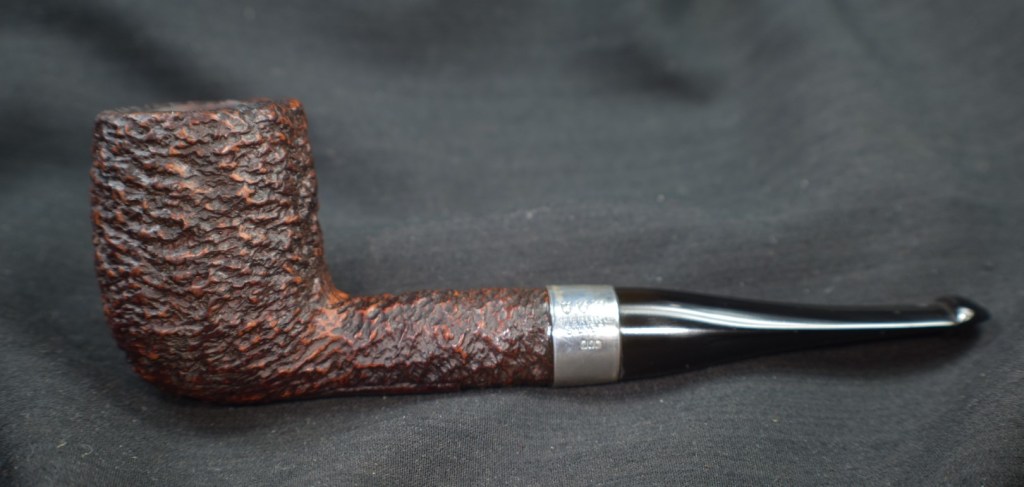
    I had never had a Peterson Donegal pipe prior to the arrival of this 106.  I know, crazy right?  I mean the Donegal Rocky has been a staple of the Peterson line since 1945.  I love the look of the texture with it’s craggy appearance and contrast stained briar.  I could not speak to the “feel in the hand” until I actually laid hands on this pipe.  Let me say, it is very nice.  My neglect of the line was not due to purposeful malice, just an unwillingness to spend as much money as the pipes were commanding.  Also, the fact that rustication has changed dramatically over the years.  I’ll get into that more in the “Background” but let’s just say the “pineapple” years were not pretty.  This rustication is what I think of when I think Donegal Rocky.

    This pipe is stamped Peterson’s (the top portion of this stamp is weak) over “DONEGAL” ROCKY.  Offset to the left is 106 with MADE IN THE over REPUBLIC over OF IRELAND to the right side of the stamping area.  The stem was a very tight fit upon arrival from Brooksville, Florida.  Maybe the humidity of that southern state was the cause.  Below are some photos of the pipe upon arrival.  Well, not quite as “upon arrival”.  When the pipe arrived the stem was very much stuck in the mortise.  A visit to my freezer for an hour allowed me to extract the stem easily.  Once warmed it was a very tight fit.  I did not completely reinsert the stem into the shank for fear of damaging the pipe.

    The pipe looked like it was generally in good shape.  The stem was heavily oxidized and had a pattern to the oxidation that I found amusing.  As if the previous smoker had antioxidant saliva.  The stummel was dirty with about 50 years worth of grime.  The tobacco chamber was well caked but not to excess, just definitely smoked.  The rim had a fair amount of lava, again indicative of a well used and loved pipe.  This looked like a nice straight forward restoration.

    Background

    I recently restored a Peterson Dunmore 606 Pot and wrote the following in that blog:  “As much as I love the history of the Kapp and Peterson company and Peterson pipes, I will not get into that other than give you resources to read the history for yourself.  I will delve into the Dunmore, or Dunmoor line of pipes at greater depth.

    For a great history Mark Irwin and Gary Marlburg’s book is a must read for a Pete Geek.

    (Available at https://www.smokingpipes.com/accessories/books/moreinfo.cfm?product_id=471478)  Given the price is a bit high but worth every penny for a Peterson aficionado.

    The next site is pipedia.org’s History of Peterson by Jim Lilley (Peterson – Pipedia)

    Lastly the pipephil.eu site for all things logo:  Peterson: historical pipes — Pipes: Logos & Markings (pipephil.eu)  They also have a few other links to things like the Peterson timeline and P-lip information.

    Now to the stuff regarding this pipe:  A Peterson Dunmore.  I refer to Mark Irwin again here and his blog, Peterson Pipe Notes.  I can wholeheartedly recommend the free at

    https://petersonpipenotes.org/  Yes, you will get emails but only for things like the weekly blog post and occasional Peterson pipe drops (like the Peterson Pipe Notes Pipe of the Year) or offers for cool Pete Geek merchandise.  Anyway Mark has an article on the Dunmore line that is great. https://petersonpipenotes.org/226-documenting-the-dunmore-system-and-classic-lines/

    I will include the text here in its entirety but recommend the link for the photos. This is used with permission of the author (thank you Mark).”

    The above holds true for this blog as well except take out the “Dunmore” and add “Donegal Rock” in it’s place.

    Once again I use Mark Irwin’s Peterson Pipe Notes as a primary source for this pipe.  His Blog “148.  The “Rocky” History of the Donegal Line” (https://petersonpipenotes.org/tag/peterson-donegal-rocky/) is a wonderful explanation of how the line originated and changed over the years.  I include it here in it’s entirety, with permission of the author (personal email).

    I recently acquired for study an amazing NOS (new/old stock) Donegal Rocky 01s with its box, sleeve and brochure. Hallmarked with a Celtic lower-case n for 1979, it’s a first-year release of this marvelous ‘short dutch’ bowl shape and convenient reason to take a look back at the long history of Peterson’s iconic “Donegal Rocky” line.

    The “Donegal Rocky” (in quotation marks), released in 1945 or so, was Kapp & Peterson’s first rusticated line. Not that K&P hadn’t rusticated pipes previously, they just that they hadn’t devoted an entire line to rustication. And they were apparently proud of it, because they gave it a sterling mount along with a black finish and white-stamped P on the mouthpiece.

    It was part of K&P’s “Product Line,” what I call gateway pipes and others might call an entry-level pipe, as you can see in this shape chart from the 1945 catalog. Like the Shamrock (European version) and “K,” it was originally a fishtail line.

    For nearly thirty years, from 1947 until 1975, the line continued uninterrupted, black rusticated finish with fishtail mouthpiece and sterling band.

    from the 1976 Associated Imports Point-of-Sale Brochure

    Then in 1976, just a year out from their Centennial celebration, Peterson (in an expansive mood) pushed the Donegal up a notch, giving the line a P-Lip. The 1976 engraving doesn’t show it, but you can just glimpse a new, deeper rustication in the (still black) 1978 Associated Imports chart:

    This rustication was done by a carver in Dublin, Paddy Larrigan told me this past June in Sallynoggin. The artisan did all of Peterson’s fantastic rustications from the period: the classic “Pebble Rustics,” the early Sherlock Holmes rustics, the Bond Street of Oxford Premier Systems, and the sterling-band P-Lip Donegals.

    And that’s where this 1979 01s comes in handy, because we can see with much greater clarity the rustication as well as the details of a “Donegal Rocky” at its pinnacle of engineering and finish:

    It’s worth remarking concerning the removable stinger. This spike-ended aluminum tube is easily removed, leaving the P-Lip mouthpiece strictly a graduated-bore regulation affair.

    If I were more dedicated, I’d smoke this pipe a few dozen times with and without the stinger and give you a report on what purpose it serves. I wonder if the craftsmen at the factory installed the stinger to approximate the effect of the older bone tenon extensions routinely attached to Classic Range Dublin & London, Classic and Premier lines? With or without the stinger, the pipe smoker should enjoy the benefits of the “Sub-System,” which I talk about at length in The Peterson Pipe. As it is, I’ll leave that to someone else, and happily report their findings.*

    Here’s the COM stamp, showing Peterson’s love of quotation marks (seen also in the “SPORTS” line) as well as a closer look at the stain and rustication technique:

    Sometime between 1978 and 1980 the sterling band was dropped to a nickel band and the P-Lip abandoned in favor of the Donegal’s traditional fishtail, all of which may (or may not) indicate a lessening in the quality of the rustication.

    Seen above from the 1981 Mark Twain brochure, the sterling band resurfaced, this time with the line’s first change in stain color to what some of us have in our rotations or remember: the contrast brown over black (seen in the dutch 339 hallmarked for ’81 below). The catalogs indicate some fluctuation from sterling to nickel bands on through the Late Republic era (1969-90) into the Dublin era (1991-2018), with the sterling being used (as happens so often with Peterson lines) in conjunction with a P-Lip in the 1997 catalog, but also in that year available with a nickel band and fishtail.

    The dublin 120 seen above is from ’94, and as you can see, while the rustication technique is nearly identical to that of the ’81 dutch billiard, the stain color has changed for a third time to burgundy-over-black, which seems to have been the standard during most of the early Dublin era.

    Sometime near the beginning of this century the Donegal was down-graded again to its original “Product” or gateway status by a nickel band and fishtail mouthpiece as seen in this B7, and while the stain remains the same, it looks less craggy:

    Things would grow steadily worse in the following years, however, as the gawdawful pineapple rustication took hold, so that by around 2010 the Donegal was reduced to the etchings seen on this B39:

    With the return of in-house rustication earlier this year, things are looking up for the Donegal, at least just a little, as you can see in this current 80s:

    The finish and the rustication are, so nearly as I can tell, identical with that used on current rusticated SH pipes, so that’s something, right? I don’t think I’d call it a Rocky anymore, but at least it still has a vulcanite mouthpiece, a plus.

    As for the future of the line—or the name—I couldn’t hazard any guesses. In the ideal Peterson of my imagination, the line would assume the craggiest crags, sharp textures and brilliant obsidian finish of the last batch of Rosslare Rusticated pipes, along with—of course—a vulcanite P-Lip. In the meantime, just to have it around, as one of the bedrock Peterson lines for almost 75 years, will do.

    According to Mark’s well documented history of the Donegal Rocky line this pipe shouldn’t have the contrast stained black/brown that I see as that didn’t come about until the later 1970s.  I emailed Mark asking him what he thought about my restoration of this pipe and at publication I have not heard back.  I assume he and his wife are shipping out the most recent Peterson Pipe Notes pipe stand, so I understand his busy schedule.  That is if my interpretation of the worn silver hallmark is correct.  

    The silver hallmark that I see on this pipe is a lowercase e as seen in this photograph:

    Now an argument could be made for either an e, c or o.  Respective dates would be 1972, 1970 and 1980.  The o would move the pipe closer to  the black/brown stain age range of 1981 as mentioned in the Mark Irwin blog above.

    The Restoration

    The restoration began as normal with a clean denim piece.  I then started work on the stem.

    The first job was to buff the stem with 0000 steel wool to remove the hard shiny oxidized coating. 

    This allowed the OxyClean solution easier and faster action at softening the oxidation.  The stem was left to soak in the Oxy for an hour or so.

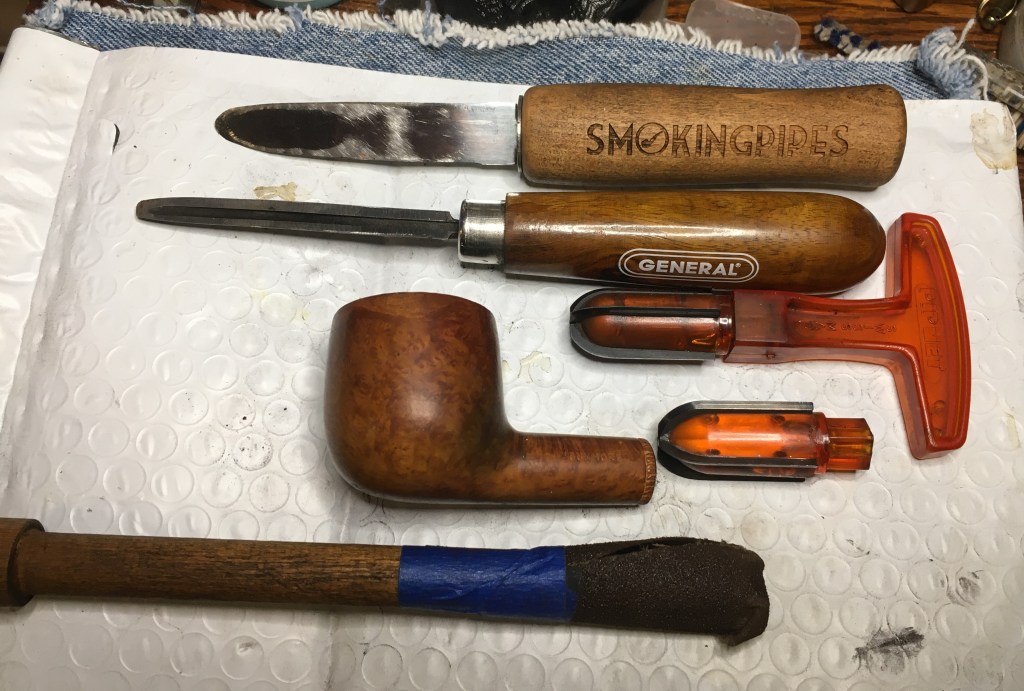
    Next came the reaming and the reaming tools were gathered.

    The lion’s share of the work was done with the PipNet reaming tool with its #2 and #3 blades.  This cake was very hard and dry and the tobacco chamber size was a very tight fit for the #3 blade so scraping was required to allow easier reaming with the PipNet.

    Eventually the chamber looked mostly cake free.

    I was pretty sure that I should be receiving some sort of tax subsidy for the carbon sequestration I would be responsible for by sending this pile to a landfill.

    Upon sanding the tobacco chamber I discovered that the cake had not protected the chamber as well as I would have thought that the previous owner was a puffing madman.  The inside of the chamber had light spiderwebs due to heat damage both to the left and right front.  Further sanding made it so that I could not feel anh roughness but I could still see the spiderwebs.  A quick message and photos were sent to Steve Laug for a bit of advice.  I wasn’t sure that this would need a waterglass, J.B.Weld of just a bowl coating.  Steve got back to me quickly and said a bowl coating would probably be sufficient.  

    I proceeded to the scrubbing.  This was done with undiluted Murphy Oil Soap and a medium toothbrush.

    After the exterior was scrubbed I used a bit of Dawn dish soap with a nylon shank brush to see how bad the airway of the shank was.  It was pretty bad.  The stummel was thoroughly rinsed inside and out with warm water and dried with a cotton hand towel.

    Back at the workbench I poured 3-4 ml of 95% ethyl alcohol into the bowl and allowed it to flow into the shank.  I scrubbed with a nylon shank brush and the alcohol then poured the alcohol into a medicine cup.  Yeah, there may be North American megafauna stuck in that tar pit.

    I scraped the airway with a dental scraper to remove as much of the tar as I could get out.  Repeated alcohol and shank brush scrubbings yielded more dissolved tar.

    Eventually the airway was cleaned and the smell of old smoking residue disappeared.

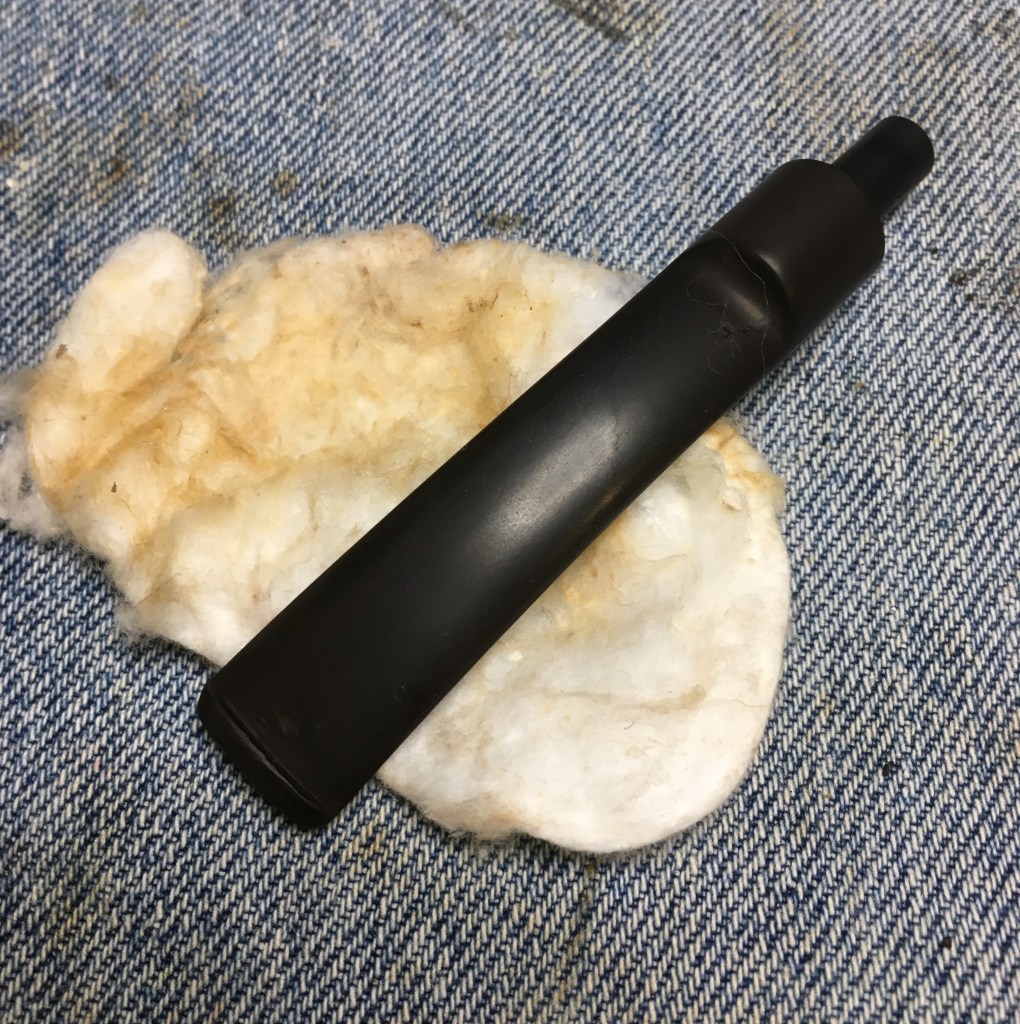
    The stem was retrieved from the Oxy and I began cleaning it with SoftScrub on make-up pads.

    It eventually was rid of the majority of the oxidation at least from the button.  Which was the area I needed to work on.  The button area was filed and sanded with a 320 grit sanding sponge.

    I moved on to a 400 and 600 grit sponge to further smooth the stem surface.  There would need to be some filling of dents with black cyanoacrylate (CA, super glue).

    The CA was applied then spritzed with a CA drying accelerator.  The quickly cured CA was then filed and sanded with the above mentioned sanding sponges.

     This was repeated until the fills were smooth.

    With the button reshaped and filled I cleaned the airwair of the stem.  The previous owner did apparently use a pipe cleaner through the stem as it was not nearly as fouled as the shank had been.  

    Next came the polishing of the silver.  I used a Cape Cod Metal Polishing Cloth on the silver band.  I love the smell of this product and it works well too.

    The silver had a respectable shine but there appeared to be a film of surface flaw to the finish.  I figured that I would spend more time with that later.

    There was little to do with the stummel other than to clean it thoroughly.  I used a baby toothbrush to work Before and After Restoration Balm into all of the craggy texture and let the balm work it’s magic.

    I prepped the shank by wrapping it in painters tape to avoid stray sanding.  The stem was sanded with a series of sanding sponges from 1000-3500.  In between each sponge I dabbed a finger tip’s worth of mineral oil onto the stem and rubber it in.  I then wiped the stem with a dry paper towel.

    After about 20-30 minutes the Restoration Balm was wiped from the stummel using an inside out athletic sock.

    I wasn’t sure which wax to use on such a wonderfully rough textured stummel.  I opted to use the Decatur Pipe Shield No-Buff Wax.  I cleaned the Restoration Balm from the baby toothbrush with 95% ethyl alcohol.  I used the baby toothbrush to work the Decatur wax into the crags and let it dry for the recommended 10-20 minutes, as per the instructions on the label. 

    I then took the stummel to the buffer and swapped out the carnauba waxing wheel for a clean flannel wheel.  I used the clean wheel to buff the N0-Buff wax.  Yeah, I know…

    Now to review:  The stem before.

    The stem after I had worked on it.  There remained a serious amount of discoloration on the tenon end.  This stubborn stuff required a less chemically subtle approach.

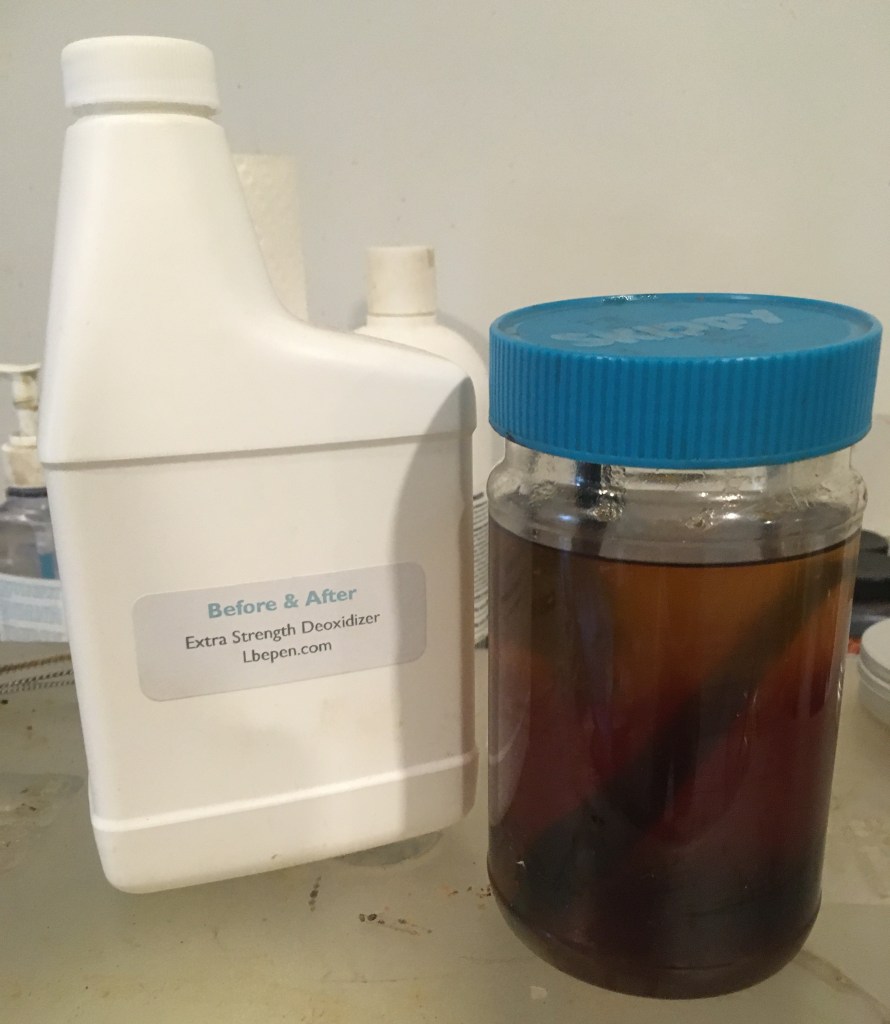
     I went with a dip into the Before and After Extra Strength Deoxidizer.  A pipe cleaner was inserted into the button end of the stem to suspend it from the jar top.  I allowed the stem to soak in the solution for 2 hours. 

    After the 2 hours I removed the stem from the solution and let the excess solution drip back into the jar. 

    With the stem all drip dried, well not really dry, I wiped the stem with a coarse shop rag and ran several pipe cleaners through the airway.  I then micro-meshed the stem with a series of 4000-12000 pads.  Between each pad I applied a small drop of Obsidian Oil to the stem, rubbed it in with my finger tip and wiped the stem with a dry paper towel.  I failed to photograph the micro-meshing.  Darn old people.

    The stem looked much better.  If you can’t wait to see it, feel free to jump down a bit.

    The spider webbing heat damage still needed to be addressed.  I retrieved the maple syrup and applied a big drop to my finger tip.  I rubbed this onto the surface of the tobacco chamber.   

    I then opened up a capsule of activated charcoal.  I dumped the charcoal into the chamber, placed my palm over the rim and egan shaking the stummel distributing the charcoal powder and covering the sticky syrup.  You can see the charcoal also left a very symmetrical spot on my palm.   Having forgotten to plug the airway with a pipe cleaner I also got a nice coating of carbon powder all over the shank’s airway.  Yay, more shank cleaning.

    Below are the photos of the bowl coating.

    I would say that my first Peterson Donegal Rocky restoration was a success.  I think it turned out very well.  I like the craggy appearance and feel of the pipe.  The shape is a favorite of mine.The brown and black contrast stain was left intact and I think it still works .  I was quite happy with the oxidation removal from the stem and the black vulcanite polished up nicely.  The silverband  looks as if it has experienced some trouble and I cannot get it to look bright and well, silver all around.  I am sure this will be a great smoking pipe but will have to wait a couple of days for the coat coating to thoroughly dry.  The dimensions of the Peterson Donegal Rocky 106 Billiard are as follows:

    Length:  5.95 in./ 151.13 mm.

    Weight:  1.54 oz./ 43.60 g.

    Bowl Height: 1.96 in./  49.78 mm.

    Chamber Depth: 1.70 in./ 43.18 mm.

    Chamber Diameter:  0.83 in./ 20.8 mm.

    Outside Diameter:  1.58 in./ 40.13 mm.

    I do hope that you have found something here useful to your own pipe care, maintenance or restorations.  If you like this sort of thing, please click the like and subscribe buttons.  Thank you for reading the ramblings of an old pipe lover.

    Below are some photos of the finished Peterson Donegal Rocky 106 Billiard.

    Some of the above “finished” photos were taken slightly out of sequence.  Example:  the bowl coating was added after some of the shots.

  • A Peterson Red Premier Meerschaum 406 Prince Restoration (with addendum)

    June 28th, 2024

    Photographed and written by 

    John M. Young

    In the last restoration I discussed my Peterson Pipe Acquisition Disorder had ended its remission.  Well, I neglected to say how severe the return to activity the PPAD had actually become.  Please do not grieve for me.  Your sympathy would be far better applied to another, for this is a disorder which I have brought upon myself.

    This restoration deals with a lovely Peterson meerschaum pipe which came to me as part of an estate lot.  I spied this Pete meer in the photos of the lot and couldn’t believe what I was seeing.  It was as if the Peterson was hiding amongst the other old pipes.  Apparently

    it’s camouflage was good because there were only 6 other bidders.  A few days later the goal and gem of the entire lot arrived here in the wilds of southeast Nebraska.  Below are some photos showing the Peterson meerschaum prior to any work being done.

    I had only worked on a handful of old meerschaum pipes.  I figured that I should probably read a couple of Steve Laug’s rebornpipes.com concerning meerschaum.  I have found that there are two main ways to learn; 1, from your own mistakes and 2, from listening to the wisdom of others who have made mistakes.  One of these is free and painless, the other, not so much.  I did know that I would be using far more soap and water than alcohol on this restoration.  I also knew that I wanted to keep the P logo on the stem at all costs since that was the only indication of this pipe’s maker.

    Background

    In the last restoration I did a Peterson Dunmore 606 Pot (linked for those who are interested).  I included a few links concerning the history of Peterson pipes.  I will include those here also.  “For a great history Mark Irwin and Gary Marlburg’s book is a must read for a Pete Geek.

    (Available at https://www.smokingpipes.com/accessories/books/moreinfo.cfm?product_id=471478)  Given the price is a bit high but worth every penny for a Peterson aficionado.

    Irwin, Mark and Malmberg, Gary (2018). The Peterson Pipe The Story of Kapp & Peterson, First edition, second printing 2021. Briar Books Press, Canada.

    The next site is pipedia.org’s History of Peterson by Jim Lilley (Peterson – Pipedia)

    Lastly the pipephil.eu site for all things logo:  Peterson: historical pipes — Pipes: Logos & Markings (pipephil.eu)  They also have a few other links to things like the Peterson timeline and P-lip information.”

    For the history of Peterson Meerschaums I will mainly be citing Irwin and Marlberg’s The Peterson Pipe book.  Peterson has a long history of meerschaum pipe making dating back to the 1870s  (Irwin, 2018 p. 15).  At the time when Charles Peterson began working for the Kapp brothers in Dublin, meerschaum was the old traditional material while briar was a new innovation destined to become more popular in the next century.  It was with briar that Charles Peterson created his original patents for the reservoir in 1890 and for the graduated-bore mouthpiece with what we call the “Patent-Lip” (P-Lip) today, in 1894.  1893 was the year that Charles Peterson and Henry Kapp bought out the shares of Christian Kapp of the Family business, which the brothers had run together.  “Christian was evidently not happy with this arrangement and disliked Dublin.  He trained to become a doctor, and on 12 June 1893 he sold his share of the business to his brother and Charles Peterson” (Irwin, 2018 p. 48).  The Kapp & Peterson company was born and the Peterson System has continued for over 130 years.  

    Now obviously the lovely Peterson meerschaum pipe in hand is not something made at the turn of the century.  According to Irwin and Malmberg, “ In 1968, Peterson returned to making block-meerschaum pipes after forty years.  They had made block meerschaums in all Patent Systems and many Classic Range shapes from 1896 until about 1929.  The scarcity and rising cost of amber, fragility of meerschaum and popularity of briar all contributed to the end of meerschaum production.”  (Irwin, 2018 p. 158).  The authors go on to state that, “These Republic-era meerschaums were first made in partnership with Manxman Pipes, Ltd., on the Isle of Man, a company Peterson bought outright in the early 1970’s (Irwin, 2018 p. 158). 

    I am not quite sure how the purchase of Manxman pipes worked.  Manxman was an apparent subsidiary of Laxey Pipes Ltd. According to pipedia.org:   

    “Laxey Pipes Ltd. resided in a historical 19th century four-storey Man stone building at The Quay, Old Laxey, Isle of Man, which thankfully has been preserved.

    The company specialised in the production of meerschaum pipes using the Meerschaum mined by the Tanganyika Meerschaum Corporation in the Amboseli basin in Tanganyika (since 1964 part of the United Republic of Tanzania).

    Please note: you may often find names like “Manx Pipes Ltd.”, “Man Pipe Co.” and others more, but there is no indication of another Isle of Man pipe producer other than Laxey Pipe Ltd. at any time!

    Laxey Pipes Ltd. marketed own brands like “Manxpipe”, “Manxman”, “Manxland” e.c. Names like “John Bull”, “White Knight” (unwaxed), “Domino” (black, or lined) indicated some shapes / colours of Laxey’s own series. The stems either showed the astronomical sign for “male” or “man” (circle + arrow), or the crest of the Isle of Man, the 3-legged X in a circle. Manxpipes and Laxey’s other brands were available through pipe retailers in general, but also were sold (mainly) to tourists through their own shop in Laxey.

    Furthermore Laxey Pipes Ltd. manufactured the meer bowls for Peterson, Barling, Nørding and others from the later 1960’s until 2001. Man Pipe e.g. was a brand distibuted by Comoy’s. The bowls usually showed no nomenclature indicating the orderer. “Genuine Block Meerschaum” was engraved frequently. Often, just the stems were different, while bowls were the same.

    Supply of meerschaum from East Africa run out (Kenya / Tanzania exhausted, Somalia inaccessible), and thus the last Laxey meers were supplied to trade in May, 2001. Laxey Pipes Ltd. tried to survive continuing with briar pipes – mainly in the Danish style -, but to no success. It closed down business in July, 2002.”

    (Laxey Pipes Ltd. – Pipedia)

    Tracing the 406 shape through the pipe charts from the early 1900’s to 1984 was interesting and made me realize it is time to visit the eye doctor again and get a new prescription for glasses.  The first iterations of the prince shape are found in the 1947 shape chart.  There are 4 prince varieties:  “Sports” 4 Large Prince, 407 Prince (straight stem), 407 Prince semi-bent and the 406 Large Prince.  The next catalog occurrence is in 1965.  Here the Peterson 406 is a prince with a slight bend.  The shape matches the pipe in hand very well.  The next occurrence is in the Peterson-Glass 1978-79 catalog.  This catalog shows the full range of Peterson’s meerschaum offerings and here the 406 prince has a slight bend.  The last catalog tracing the prince is the shape charts from the 1983 issue.  Here the 406 is shown with a slight bent stem and labeled as “406. Large Prince” (Irwin, 2018 p. 171).  The 406 also has an asterisk denoting that this shape is also “Available in Meerschaum”.   The 407 reappears as a prince with a straight stem and is not available in meerschaum. 

    The Peterson-Glass 1978-79 catalog also lists and discusses the available meerschaum finishes.  These included:  Golden Supreme, Tawny De Luxe, Golden Princess, Yellow Aboriginal, Red/Black Premier and Kapmeer. Now this may be taken with a grain of salt but I believe this to be a 406 Large Prince from the 1983 catalog but with the red staining of the Peterson-Glass 1978-79 catalog.  Either way, I think this pipe is a late 1970s-early 1980s product.

    The Restoration

    In typical “me” fashion I began with a cleanish piece of denim for the work surface.  I think I may need to visit the local thrift stores and see if I can pick up a couple pairs of jeans to turn into new denim pieces.  The laundry guy here at this house has much to be desired when it comes to stain removal.

    I removed the stem and gave it a light buffing with 0000 steel wool prior to a dunk in the OxyClean solution.

    I figured I would start with an hour in the Oxy then reassess if more time would be needed.

    The reaming was done with only scrapers.  I heeded the warnings of others who said to avoid reaming tools that would apply torque to the meerschaum.

    The previous owner either hadn’t smoked this darling very much or had taken care not to allow the build-up of a cake.  Well done, unknown guy or gal (keeping it inclusive).

    After sanding the tobacco chamber with 220 sandpaper wrapped around a wood dowel I finish sanded it with 320 sandpaper and my finger.  Next stop was the sink.  Here I scrubbed the stummel with undiluted Murphy Oil Soap and a medium stiff toothbrush.  The lather turned bright pink indicating that I was correct in identifying this pipe as a Red Premier from the Peterson-Glass 1978-79 catalog.  The soap was rinsed with warm water.  I also scrubbed the airway with a nylon shank brush and Dawn dish soap.  This produced slightly brown tinted lather and was also rinsed with warm water.  The stummel was then dried with a cotton hand towel.  

    Back at the workbench the stummel’s striped colors were more pronounced.  I wasn’t sure what to do about that.  Do I try to stain it with a red Fiebing’s Leather Dye or leave it alone and see how it looks after the molten beeswax?  I opted for the latter.

    I ran a bristle pipe cleaner dipped in 95% ethyl alcohol through the airway to judge how effective my scrubbing had been.  It came out pretty clean.  I proceeded to do this a few more times until no color was seen.

    To make sure there was no wax or excess dye remaining on the stummel exterior I used a medium toothbrush dipped in ethyl alcohol to scrub the stummel.  You can see that a little bit more red dye came off into the alcohol in the medicine cup and onto the toothbrush.

    There were small brown clouds of oxidized rubber around the stem in the Oxy solution.  I assumed this to mean it was working at loosening up that darn oxidation.

    Upon removing the stem from the solution I wiped it vigorously with a dry cotton make-up pad.  A significant amount of oxidized rubber came off on the pad.

    I then proceeded to use several more pads with SoftScrub to attempt to rid the stem of the oxidized material.  I was glad to see a general lightening of the pads but the oxidation was stubborn and remained difficult.

    I then tried using a piece of a Magic Eraser with SoftScrub.  I ended up taking the stem to the sink where I could rinse the Magic Eraser with water more effectively.  

    Once again, I forgot to take any photos of the sanding and micro-meshing of the stem.  I get focussed or “in the zone” and kind of lose myself sometimes.  Sorry, if it’s any consolation you can see the brown oxidized rubber dust from wiping the dust from the sanding sponges on the denim.

    I cleaned the airway of the stem and found it was also fairly clean.  Alcohol dipped bristle pipe cleaners were the weapon of choice, here.  The stem then received a coat of mineral oil.

    I checked the photos to make sure that the P logo was painted white.  I didn’t want to make the same mistake that I did on the last restoration and have to go back and repaint the logo.  If you enjoy learning from the mistakes of others check out the Peterson Dunhill 606 restoration.  The logo area was cleaned and de-oiled with a cotton swab and 95% ethyl alcohol.

    I used the plastic tube of a cotton swab to form a plastic scraper.  This was done with a lighter and pressed flat with a knife blade.  It was then trimmed to shape with scissors.  The white acrylic model paint was applied and allowed to mostly dry.

    The paint was then scraped off using the freshly made plastic scraper.

    I was ready to apply the beeswax.  I think this is what I was planning out in my head when I failed to photograph the stem sanding.  I wanted a fairly easy to apply and cleanup method to apply a layer of beeswax to the stummel.  I came up with the following plan:

    1. Melt the beeswax in a glass canning jar in a pan of boiling water.
    2. Place the stummel in an empty metal snuff can.  This is to catch the wax drippings.
    3. While the wax is melting, heat the stummel with a heat gun.
    4. Move the wax close to the stummel and paint the wax onto the surface of the stummel.
    5. Use the heat gun to evenly melt/distribute the wax over the entire stummel.
    6. Absorb the excess liquid wax onto a paper towel.

    That sounded like a good plan based only on having done this two other times.  And those were a couple of years ago.

    The double boiler wax melter.

    The empty snuff can wax catcher.

    The heat gun

    It’s “Go time”.

    The nearly constant heating and making sure everything was evenly coated.

    Absorbing the wax.  Hot, hot, hot.

    Ahhh, that’s better.  Using a cotton glove to absorb the liquid wax was much more comfortable than the paper towel.

    Here is what the pipe looked like back at the workbench.

    All that remained was to give the stem a couple of coats of carnauba wax with the buffer and take some “finished” photos.

    Overall this Peterson Meerschaum 406 Prince turned out quite nicely.  I admit to not being totally comfortable working with meerschaum.  At least not as comfortable as I am with briar.  Nevertheless, I think the pipe cleaned-up well.  I love the shape of the Peterson 406, the slightly bent stem gives it a graceful elegance not quite typical for the normal Peterson aesthetic of a more heavy shank.  With it’s wide bowl it should make a grand English blend smoker.  The stem polished up pretty well except for the tenon end which still retained some discoloration from oxidation.  I feared being too aggressive here and risking the loss of the stem logo.  The red stain of the meerschaum is attractive with the black rim and the stripe around the middle giving character. The dimensions of the Peterson Meerschaum 406 Prince are:

    Length:  6.58 in./ 167.13 mm.

    Weight:  1.63 oz./ 45.75 g.

    Bowl Height: 1.46 in./  37.08 mm.

    Chamber Depth: 1.17 in./ 29.72 mm.

    Chamber Diameter:  0.78 in./ 19.81mm.

    Outside Diameter:  1.65 in./ 41.91 mm.

    I do hope that you have found something here useful to your own pipe care, maintenance or restorations.  If you like this sort of thing, please click the like and subscribe buttons.  Thank you for reading the ramblings of an old pipe lover.

    Below are some photos of the finished Peterson Meerschaum 406 Prince. 

    Addendum:  Additional work done on stem.  I was not happy with my work on removing the oxidation from this stem.  I mentioned that I did not want to risk losing the stem logo with a more aggressive deoxidation treatment using Before and After Deoxidation Solution.  Mark Hoover, of Before and After products, reached out to me via Facebook personal messaging and stated, “I have never had loss so I am a bit perplexed.  You should not have any loss as there is no abrasive.  If the stamp is faint or heavily oxidized it was likely not strong under the oxidation so when you clean it it may just seem that way.  I promise you will not have this issue  with a deep stamp like the Peterson you just did.”  I have had the loss of a stamp using the Before and After Deoxidizing solution when the stamp was weak.  The Key point to Mark Hoover’s statement is “not strong under the oxidation”.  With a weak stamp, removal of oxidized material can remove a faint stamp as the stamp has been oxidized as well.

    With Mark’s assurance giving me more confidence, I returned the Peterson Prince to the workbench.  I wiped the stem of 95% ethyl alcohol on a make-up pad to remove the carnauba wax.  I then placed a pipe cleaner into the button as a hanger.  The stem was then suspended into the Before and After Extra Strength Deoxidizer solution.

    I allowed the solution to work on the stem for 90 minutes.  After 90 minutes I allowed the stem to drip excess solution back into the jar.

    After dripping I wiped the remaining solution from the stem with a coarse cotton shop rag.  I ran several pipe cleaners through the airway to remove any solution from the airway as well.  The oxidation was greatly reduced but there was still some discoloration.  I returned the stem to the workbench and used SoftScrub on a make-up pad.  SoftScrub is an abrasive and will wear away a stamp though it is far less abrasive than sanding.

    The stem was micro-meshed using the 4000-12000 micro-mesh pads.  I then polished the stem with the Before and After Fine Polish followed by the Extra Fine Polish.  The stem logo was again repainted as earlier.  The stem was finally given a couple of coats of carnauba wax at the buffer.  

    The below photos are of the Peterson meerschaum 406 Prince after readdressing the oxidation.

  • A Peterson Dunmore 606 Pot Restoration

    June 25th, 2024

    Photographed and written by 

    John M. Young

    My Peterson Pipe Acquisition Disorder (PPAD) has come out of remittance and I have experienced an attack. Then again it was fully expected.  I can’t run around with a name like NebraskaPeteGeek and not have full blown PPAD at least semiannually.  The lovely 606 in the photo above did not arrive like that.  It was spotted at an auction on eBay a couple of weeks ago.  I couldn’t believe my eyes at first.  A Peterson Dunmore with a shape other than the 300 System shape was very interesting.  I’ll get more into that in the “Background” below.  

    This pipe has Peterson’s over “DUNMORE” on the left, the Peterson P on the stem and MADE IN THE over REPUBLIC over OF IRELAND and 606 on the right. There is also a beaded edge at the shank end, a characteristic of the Dunmore line.  When the pipe arrived it appeared in the photos below. 

    Background

    As much as I love the history of the Kapp and Peterson company and Peterson pipes, I will not get into that other than give you resources to read the history for yourself.  I will delve into the Dunmore, or Dunmoor line of pipes at greater depth.

    For a great history Mark Irwin and Gary Marlburg’s book is a must read for a Pete Geek.

    (Available at https://www.smokingpipes.com/accessories/books/moreinfo.cfm?product_id=471478)  Given the price is a bit high but worth every penny for a Peterson aficionado.

    The next site is pipedia.org’s History of Peterson by Jim Lilley (Peterson – Pipedia)

    Lastly the pipephil.eu site for all things logo:  Peterson: historical pipes — Pipes: Logos & Markings (pipephil.eu)  They also have a few other links to things like the Peterson timeline and P-lip information.

    Now to the stuff regarding this pipe:  A Peterson Dunmore.  I refer to Mark Irwin again here and his blog, Peterson Pipe Notes.  I can wholeheartedly recommend the free at

    https://petersonpipenotes.org/  Yes, you will get emails but only for things like the weekly blog post and occasional Peterson pipe drops (like the Peterson Pipe Notes Pipe of the Year) or offers for cool Pete Geek merchandise.  Anyway Mark has an article on the Dunmore line that is great. https://petersonpipenotes.org/226-documenting-the-dunmore-system-and-classic-lines/

    I will include the text here in it’s entirety but recommend the link for the photos. This is used with permission of the author (thank you Mark).

    “226. Documenting the Dunmore System and Classic Lines

    Milos “Mike” Bera at PipesPens&More.com on eBay recently wrote me to say that he’d run across two examples of a Peterson Dunmore Classic line he’d never seen before—a higher-grade line with a briar-in-brass sandwich band. As I thought they were not only gorgeous but undocumented, the time seemed right to take a look back at the history of the Dunmore System and Classic lines.

    I’ve been a fan of the Dunmore lines since I first saw them through the case back in the late 1980s and had to have one, a fat-bottom 72 (the 302 equivalent). Like everyone else, I thought there was some kind of mistake—“Where’s the nickel mount?” I remember asking. But the Dunmore System set out to be something a little different, yet within the classic Kapp & Peterson house style.

    The line originated in collaboration with Iwan Reis in 1971. How it came about is anyone’s guess at this point. Chuck Levi, the man who more than any other was responsible for bringing the great Danish artisan pipes to the US, was working with the creative minds at K&P to bring something new to the IRC catalog, and this was one of about a dozen K&P lines that debuted as exclusives in the Iwan Reis catalogs of that era.

    The concept was to modernize the System pipe by removing what was perceived as the old-fashioned nickel mount. And old-fashioned it was—if you look at pipe catalogs from the 1940s on through most of the rest of the 20th century, nickel ferrules and even bands were almost non-existent. K&P was virtually the only hold out, using sterling bands on the Sterling Silver Classic line and on the Premier & De Luxe Systems. A bead was then carved around the stummel at the mortise end. As you can see from the IRC detail, sometimes the contrast stain made the beads stand out, and sometimes not.

    But there were two more ingredients to the original Dunmore aesthetic which can be seen the photo below. Paddy Larrigan, K&P’s master-craftsman, was always striving to push the envelope in pipe engineering, and one of the things he dearly loved was a pipe that would sit, so he shaved off the bottom of the shank to allow the Dunmore System to sit on its shank and button, which gives it its uniqueness in the catalog. The downside of this is that I am not convinced that all the Dunmore reservoirs, being slightly smaller than the traditional System, are quite as effective.

    The third distinguishing mark of the original Dunmore lines is the stem. Both the System and Classic versions utilized the wide-shoulder “Comfort Lip,” with a painted  gold P on the stem. This doubtless helps the System sit as well as giving it a more muscular visual balance, strength being a long-standing concept in the design language of the company. While it gives the illusion of being an army “push” mount, of course it isn’t, but is a traditional tenon-mortise or “navy mount” as the old hands at K&P used to call it.

    The 1971 IRC catalog description reads, “dunmoor briar IRC ’71 modern system without sterling band, natural $12.00.” This intentional misspelling of “Dunmore” would persist through subsequent IRC catalogs, the copy-writer evidently under the spell of e.e. cummings and favoring an English flavor to his pipes. The name, like almost all K&P line names, is taken from the Irish landscape, in this case the town in County Galway famous for Dunmore Castle.

    The 1975 Orange Catalog shows the initial Dunmore System release was in only seven shapes:

    This was later expanded to include both the original bent dublin shape 5 (75) and XL5 (XL75) and the replacement calabash shape 5 and XL5. The remaining “new” System shapes were also added to the Dunmore lineup, the 01 becoming the Dunmore 73, the 02 the 70 and the 03 the 76. The fact that the 304 and 306 “setters” introduced in 1984 never entered the Dunmore System lineup adds the probability that the line had been discontinued by then.

    The smooth Dunmore System features a light brown natural finish, sometimes occurring with broad flames, as can be seen in these photos of an unsmoked 77 System:

    The rusticated version of the Dunmore System seems to have been finished in at least two techniques or versions. Neither is as deep as the Pebble Rustic finish  but they still feel very therapeutic under thumb and finger.

    Even when we were beginning our research on the Peterson book (due out in reprint later this year), most Pete fans had no idea there was also a Dunmore Classics line featuring the same beading at the mortise and wide Comfort Lip mouthpiece. Documentary proof was found in the rare 1978-79 Peterson-Glass catalog:

    The Dunmore System and Classic Lines from the 1978-79 Peterson-Glass Catalog

    I don’t know whether the Dunmore Classics was a short-lived line or whether it was primarily available in Europe, but it almost never appears on the estate market here in the US. As you can see from the catalog and the 406 pictured above, the same aesthetic was followed for the Classic line—light brown, nearly natural, higher-quality smooth bowl (or dark rustic) and faux army mount with gold-painted P, wide saddle and P-Lip stem. Only the Dunmore System, as far as I have been able to document, had the flattened stummel allowing it to set.

    I have always hoped to run across an unsmoked rustic Dunmore System with the dark contrast stains seen in the Peterson-Glass catalog. I wonder if this finish actually went into production, because the ones I’ve seen all look more-or-less like the XL75 shown above.

    The original Dunmore lines seemed to have been dropped at about the time the company went through its worst redundancy in 1984, as there are no more traces of it in the company’s ephemera from 1983 on. I remember the proprietor of my B&M, Cavalier Pipe & Tobacco in Barracks Road Shopping Center in Charlottesville, telling me when I bought my shape 73 Dunmore that the line was out of production, so I’d better get it if I wanted it (don’t you miss high-pressure salesmen?)—and that would have been 1986 or ’87.

    The second iteration of the Dunmore Classics line is that recently discovered by Mike at PipesPens&More on eBay. I would tentatively date it to c. 1995, well after K&P had gotten on its feet again and was doing some new and fascinating things. It seems to belong with three other briar adornment lines from the same period: Paddy Larrigan’s Briar in a Circle Systems and the Galway and Kapp-Royal higher-grade lines with their wonderful inset briar rings.

    Mike’s Dunmore Classics line is certainly on a par, from the two examples he’s found, with the Galway and Kapp Royal briars and maybe better, although probably not as fine as the Briar in a Circle Systems. Take a closer look at this 80S, which Mike sold within 24 hours of posting it on eBay:

    The last Dunmore Classics line made a brief appearance in the Dublin era’s second decade, somewhere in the 2000s, probably around 2005 or so. Jim Lilley’s old blog site made a reference to them, and I remember seeing them for sale at internet shops.

    I know it appeared well before I got interested in writing the Peterson book, because I don’t have any internet images of it in my files. These photos of the B5 and B11 give a good idea of what the line was like, although it appears to have begun in a higher range and then slipped to a lower.

    Updated Identification Guide

    Dunmore  (1971–c. 1984; c. 1995; 2006–2010)   Appeared in 1971 as Iwan Reis & Co. exclusive line “Dunmoor,” Premier-grade unmounted System in smooth natural or rustic dark chocolate contrast in all shapes, with beading at the shank, faux wide-saddle P-Lip with gold paint P.  Documented in Associated Imports catalog from 1973. Classic Range line from 1978 with same faux army mount and finishes. Second scarce Classic Range line, c. 1990, higher-grade smooth bowl with brass sandwich and briar band, P-Lip. A third Classic Range line, 2006–2010, mid-grade, featured standard and some B shapes, with beading around bowl instead of shank-face, for European market.

    Many thanks to Mike Bera
    Photos of the Dunmore 80s and 68 courtesy Mike’s Pipes Pens & More
    Photos of the B5 and 406 Dunmore courtesy Smokingpipes.com” (https://petersonpipenotes.org/226-documenting-the-dunmore-system-and-classic-lines/)

    With that information at hand I can date this Peterson Dunmore with a good deal of certainty.  The 606 shape is of the “Classic Range line” thus from 1978-1984.  A mere 6 year window. 

    The Restoration

    There is a clean denim piece for a work surface so, it must be time to start another project.

    The stem was the part of this that needed the most attention and it went into the OxyClean solution first.

    The reaming tools were gathered.  The PipNet with its #2 and #3 blades for this nice wide chamber would see some action.

    The reaming started easy with the PipNet and the #2 blades.  The the #3 blades were a tight fit and required some scraping with both scrapers to allow it access to the tobacco chamber.  Eventually the chamber was reamed and sanded with 220 sandpaper wrapped around a wood dowel.  I finish sanded with 320 sandpaper and my finger.  The chamber looked great with no signs of any damage.

    The chamber may look good but the rim was lava encrusted.

    Saliva and a sharp knife were used to scrape the rim.

    The stummel then made its way to the sink for a scrub with undiluted Murphy Oil Soap and a medium bristle toothbrush.  The soap was rinsed with warm water and the stummel dried with a cotton hand towel.

    Returning to the workbench the stummel looked much better.

    A quick wipe with a make-up pad dipped in 95% ethyl alcohol to make sure there was no remaining wax or finish remaining was done.  This produced some color on the pad but I think it was just dirty old wax and maybe a bit of stain.

    I did see a few pits that would require filling with cyanoacrylate (CA, super glue)  and briar dust.

    I turned my attention to cleaning out the airway within the shank.  I used a couple of alcohol soaked cotton swabs to soften the old smoking residues in the airway.  I then poured 3-4 ml of 95% ethyl alcohol into the bowl and allowed it to flow into but not through the shank.  I used a nylon shank brush to scrub the airway with the alcohol.  The alcohol was poured into a medicine cup to assess the dirtiness of the airway.  Not bad but still quite a bit of cleaning and repealed alcohol scrubs.  Oh yeah, folded bristle pipe cleaners were also used to scrub with.  Numerous more cotton swabs, folded pipe cleaners and a few ml of ethyl alcohol later the shank was clean.

    The stem came out of the Oxy bath and was vigorously wiped with a dry make-up pad.  The pad was heavily stained with oxidized rubber.

    Several more make-up pads with SoftScrub were used to try to remove the stubborn oxidation.  Adjectives other than “stubborn”  may have been uttered during this process.

    I oiled the stem and left it for 24 hours.  The next day I returned and used SoftScrub again to remove the oil.  Well, more than oil came off.

    Back into the Oxy bath went the stem.  It was there for another hour.

    I turned my attention to filling the pits.  A small drop of brown CA was applied to the pit and a small scoop of briar dust was then placed onto the wet CA and pressed into the pit.  The excess briar dust was brushed off with a bristle pipe cleaner.  This was repeated for each of the fills.  The CA and briar dust set-up very quickly and were filed with a flat needle file then sanded with a 400 grit sanding sponge.

    The stummel was then sanded with a series of sanding sponges from 600-3500 grit, in sequence.  Between each sponge the stummel was wiped with an alcohol moistened make-up pad.

    The stummel was then worked with a series of micro-mesh pads 4000-12000 grit.  Between each pad the stummel was wiped with a make-up pad dipped in alcohol.

    The stummel then was coated with Before and After Restoration Balm and allowed to sit for 30 minutes.

    The stem was retrieved from the Oxy bath for the second time.  And wiped with a dry make-up pad.  This time much less oxidized rubber came off of the stem.

    The stem was sanded with a series of sanding sponges from 600-3500.  Between sponges I would rub a small drop of mineral oil onto the stem and wipe it with a paper towel.  This was followed by the micro-mesh pads 4000-12000.  Between the pads I applied a drop of Obsidian Oil to the stem, rubbed it onto the surface and wiped with a paper towel.  I failed to photograph any of the stem sanding and micro-meshing, sorry if you were looking forward to that. 

    The stummel was wiped clean of any remaining Restoration Balm with an inside out athletic sock.

    I debated showing this next step as it was a mistake.  Since I am rather adept at making mistakes I thought I’d show you what not to do.  I thought the Peterson P logo on the stem should be repainted in white.  I cleaned the surface with a cotton swab and 95% ethyl alcohol and gave it a coating of white acrylic model paint. 

    While the paint was still slightly pliable I scraped the high spots of the logo with a plastic card and wiped away any paint from around the logo.

    I then proceeded to wax the pipe with the buffer and carnauba wax and do the “finished” photographs.  It wasn’t until I was refreshing my memory and writing the background section that I came across the “P-Lip with gold paint P” from Mark Irwin’s Peterson Pipe Notes dunmore description.  Well the white P just wouldn’t do.  Back to the workbench, I recleaned the white acrylic paint from the logo using the ethyl alcohol and a cotton swab. 

    I then made an applicator for the gold Rub’nBuff from the plastic tube of a cotton swab.  I cut one end from the tube, heated the plastic with a lighter and flattened the hot plastic with a knife blade.

    I used scissors to cut the flattened plastic into a micro-spatula type device.

    The gold Rub’nBuff was applied with the plastic tool.  The excess gold was wiped onto the denim.  I let the gold Rub’nBuff dry for a minute of two and used the tool to scrape away the excess gold from around the logo.  The area was then hand buffed with a soft cotton cloth.

    There, that’s more like it and correct.  Living and learning.  I hope my mistakes help you to avoid making some of your own.

    The pipe went back to the buffer for a touch-up re-waxing with carnauba.  Then back to taking the real finished photos.

    Overall this Peterson Dunmore 606 Pot turned out pretty well.  I have to admit to not being happy with the finish of the stem.  The oxidation was deep into the vulcanite.  Even after the Oxy baths, SoftScrub and sanding it can still be seen.  Given under normal light conditions the stem looks fine, bright light makes the oxidation stand out.  I did not want to use the Before and After Deoxidizing solution for fear of losing the logo.  That may be the only way to address the issue short of sanding the entire stem and losing the logo to that.  This will be a personal pipe for the time being.  Unless someone really wants it and makes me an offer I can’t refuse.  The briar of the 606 is lovely, showing off Peterson’s Premier-grade and I was able to keep the original stain without altering it.  Of the areas that I filled I think only one was a flaw in the briar and the others were dings from use.   The very nature of the Dunmore non-System shape is a rarity and a pretty rarity at that.  The dimensions of the Peterson Dunmore 606 Pot are:

    Length:  6.21 in./ 157.73 mm.

    Weight:  1.44 oz./ 41.00 g.

    Bowl Height: 1.65 in./  41.91 mm.

    Chamber Depth: 1.36 in./ 34.54 mm.

    Chamber Diameter:  0.82 in./ 20.83 mm.

    Outside Diameter:  1.58 in./ 40.13 mm.

    I do hope that you have found something here useful to your own pipe care, maintenance or restorations.  If you like this sort of thing, please click the like and subscribe buttons.  Thank you for reading the ramblings of an old pipe lover.

    Below are some photos of the finished Peterson Dunmore 606 Pot. 

    Oops, there is a finished photo showing the white logo.  Darn lazy, I say.

    There’s another white logo.  Why do you keep reading stuff by this guy?

  • A Jarl 1502 Bent Billiard Restoration

    June 20th, 2024

    Photographed and written by 

    John M. Young

    Capturing the essence of an old pipe is part of the fun of restoration for me.  I had never held a Jarl pipe before this battered darling arrived.  It was part of the estate lot with the Stanwell from a previous blog.  (I linked it if you would like to see that one also.)  I searched through photographs online to see as many Jarl pipes as possible.  They looked similar to Stanwell pipes, with their Danish characteristics of more delicate shanks and sweeping curves.  More whimsical and fluid than the traditional shapes of France and England.  The drillings on this pipe were exceptional.  It looked like a quality piece of briar even before the restoration had begun.  The stamps of the Jarl were mostly clear and read JARL over MADE IN DENMARK.  There was also a 1502 as what I assume was a shape number stamped around the bottom of the shank.  Let me show you the pipe as it appeared before making it to the workbench.

    It may be difficult to see the qualities that I saw from the above photos.  The finish was long gone and the fit of the stem to the shank seemed out of alignment.  The oxidation of the stem was pretty bad as well.  Maybe it was just me looking through my rose tinted lenses or seeing the glass as half full rather than half empty.  Whatever the reasoning, I thought this old Dane would certainly make someone a grand smoker.

    Background

    There was not a great deal of information to be found on Jarl pipes.  I perused the “go to” sites of pipephil.eu for information on logos first.  The below screen capture shows everything that pipephil.eu had on Jarl.

    (J-Jd — Pipes : Logos & Markings (pipephil.eu))

    It was the middle section of the three that was most similar to the pipe in hand.  The stamps matched nearly perfectly save for the different shape number.  The photograph showed non rusticated patches on the sides and bottom very similarly to the Jarl I had. 

    (J-Jd — Pipes : Logos & Markings (pipephil.eu))

    The next search was on pipedia.org.  Jarl there led to a page with little information but a great number of photographs of Jarl pipes.  Here is the text in its entirety: “In December of 2010 Ellen Jarl wrote that Jarl pipes were made by her grandfather, Niels Mogens Jørgensen in a little factory in the town of Bramdrupdam, just outside Kolding, Denmark. We have no reason to doubt that Niels Mogens Jørgensen is the maker of these pipes:

    • Examples and details, courtesy Doug Valitchka” (Jarl – Pipedia)

    Like I said, not much information and darn near every article online includes this quote from Ellen Jarl.  Of the many photographs present there were several examples of rusticated Jarl pipes.  I will show a few to exemplify why I chose to refinish the Jarl 1502 the way that I did.

    The two photos above show the rusticated areas as unstained left and nearly black right.

    The above two show the rusticated area stained darker but not black.

    The final photo below shows what I am calling a worn black stain to the rusticated area.  This stain looks like it was originally black with some of the black buffed or wiped off.

    That was the finish that I would try to emulate.  All of the above photos are from 

    Jarl – Pipedia. 

    The Restoration

    On to the workbench with a clean denim piece and another beautiful old pipe hiding under the years of neglect.

    The reaming tools were gathered.

    And, put to work.  This tobacco chamber was deep with a conical taper at the bottom.  The PipNet couldn’t ream out that shape but the scrapers could.

    The chamber was then sanded with 220 sandpaper wrapped around a wood dowel.  No damage to the interior was observed.

    The stummel made its way to the sink for a scrubbing with undiluted Murphy Oil Soap and a toothbrush.  The rustications were actually scrubbed twice, once with the toothbrush and a second time with a stiff nylon brush.  The soap was rinsed with warm water.

    I hoped to soften and loosen the residue in the shank with warm water and a scrub with a shank brush and a bit of Dawn dish soap.  The soap lathered up brown and was thoroughly rinsed with water.

    Back at the workbench the stummel showed signs of a finish of some kind.  Note the darker shiny area along the shank.

    I used a make-up pad wetted with 95% ethyl alcohol to remove the finish.  This colored the pad indicating that the finish was being removed.  It also darkened the briar significantly, weird…

    I used a toothbrush dipped in ethyl alcohol and scrubbed the stummel and rewiped the stummel.  More finish was removed.

    Finally I wiped the stummel with acetone on a make-up pad.  This yielded some finish removed and allowed me to see a large red fill.  I picked the old fill material from the pit. The stummel’s color remained darkened.

    I started scraping the airway of the shank using a dental scraper.  I am not sure why but, the darkened briar bothered me.  I stopped working on the airway.

    I wanted to address this darkened briar.  I have had mixed results using a saturated oxalic solution on briar to bleach the wood.  I thought this might work well here.

    The solution was applied with a cotton swab and allowed to sit for 30 minutes.  The stummel was rinsed with copious amounts of warm tap water and scrubbed with a nylon brush during the rinsing.

    After the stummel dried I could see that the oxalic acid did a wonderful job at lightening the briar and returning it to a natural color.

    The stamping remained in great condition.

    Next, I needed to soften up the oxidized surface of the vulcanite.  I used a solution of water and OxyClean.  The stem was allowed to soak for an hour.

    I returned to cleaning the airway.  More scraping with the dental scraper, scrubbing with a shank brush and alcohol and cotton swabs dipped in 95% ethyl alcohol.  I forgot to photograph the shank cleaning other than the photo below.  Apologies if you love seeing many tar stained cotton swabs.

    As previously alluded to I wanted to darken the rusticated area while keeping the smooth panels natural.  I had purchased a product which I read about for painting miniatures for gaming.  This product was a water based latex that could seal off an area where no paint was wanted.  The latex could then be peeled off.  I thought that the stuff sounded interesting and had ordered a bottle of it a year or so ago.  I now had what I thought would be the perfect job for it.  Using a detailing paint brush I painted the Vallejo Liquid Mask onto the smooth surfaces.   As the mask dries it turns more clear.  I set the stummel aside to allow the mask to dry.

    I turned my attention back to the stem. 

    Once removed from the Oxy bath I used a clean make-up pad to vigorously wipe the Oxy solution from the vulcanite.  This removed some of the surface oxidation.

    I proceeded to use make-up pads and SoftScrub to scrub the surface of the stem.  Eventually the pads were no longer removing oxidized rubber.  

    The mask appeared to be dry.  I continued with the stem cleaning to allow more mask drying time.  Bristle pipe cleaners dipped in 95% ethyl alcohol were used to clean the stem’s airway.  Hey, there are some of the cotton swabs from the shank cleaning.  The stem was then coated in a layer of mineral oil. 

    Time to test the mask and dye the rusticated areas.  I prepped the area for dying and assembled the Fiebing’s Black Leather Dye, a folded pipe cleaner (applicator) and a lighter.

    The black dye was applied and flamed with the lighter burning away the alcohol of the dye.  

    I rinsed the stummel with a stream of 70% ethyl alcohol to rinse excess dye and wiped the surface with a paper towel.  I took the stummel to the buffer and buffed the stummel with rouge compound on a flannel wheel.  The buffer removed the outermost dye and the mask.  The masked areas were completely unaffected by the dye.  Success!  A little bit of scrapping with a sharp blade and sanding to clean up the edges would be needed to make the edges beautiful.  Looking at many of the Jarl pipe photos his pipes often have a reddish tint to the briar.  I liked the more golden, natural shade that I had and decided against a red or orange dye wash.

    After the scraping and sanding I applied a layer of Before and After Restoration Balm to the stummel and allowed it to sit for 20 minutes.

    20 minutes later the balm was wiped away using an inside out athletic sock to reveal a lovely two tone rustication.

    The stem was sanded using a series of sanding sponges from 400-3500 grit.  Between each sponge I rubbed in a dab of mineral oil and wiped it with a paper towel.

    I worked the stem with 4000-12000 micro-mesh pads.  Between each pad I rubbed in a small drop of Obsidian Oil and wiped it with a paper towel.

    The stem was polished with Before and After Fine Polish applied with my fingertip and hand buffed with a soft cotton cloth.

    Before and After Extra Fine Polish was then used to hand buff the stem again with a soft cotton cloth.

    The stem logo was repainted using white acrylic modeling paint.

    This was a fun restoration.  I got to work on a new brand and try a new product.  I think the pipe turned out very nicely.  Of course I have never seen another Jarl pipe and only had internet photos to base my judgment on.  I’ve heard the saying, “ignorance is bliss”.  I am therefore a blissful ignoramus regarding Jarl pipes.  Nevertheless, I think this pipe looks great.  The Vallejo Liquid Mask did exactly what it is supposed to preserve the natural grained briar from the black dye.  The “worn black” dye that I was trying to achieve turned out how I imagined it would.  The stem polished up pretty well, I didn’t want to be too aggressive with the restoration and obliterate the J logo.  I think that I captured the essence of the pipe.  

    The dimensions of the Jarl 1502 Bent Billiard are:

    Length:  5.66 in./ 143.76 mm.

    Weight:  1.25 oz./ 35.70 g.

    Bowl Height: 1.96 in./  49.78 mm.

    Chamber Depth: 1.72 in./ 43.69 mm.

    Chamber Diameter:  0.75 in./ 19.05 mm.

    Outside Diameter:  1.49 in./ 37.85 mm.

    I do hope that you have found something here useful to your own pipe care, maintenance or restorations.  If you like this sort of thing, please click the like and subscribe buttons.  Thank you for reading the ramblings of an old pipe lover.

    Below are some photos of the finished Jarl 1502 Bent Billiard.

  • A Linkman’s Dr Grabow De Luxe 9733 Restoration

    June 18th, 2024

    Photographed and written by

    John M. Young

    A few years ago when I started the hobby of pipe restoration I picked up a Linkman’s Dr Grabow 9733A with an estate pipe auction.  It was in decent shape, if memory serves.  For whatever reason I loved the shape and the feel of that pipe in my hand.  It was a bit heavy for a clincher and it did have a stinger.  Those are two qualities that I now pretty much avoid.  Below is a recent photo of that old Linkman.

    Well, the other day while looking through eBay auctions I came across a sister, as Sascha Mertens (A German friend and pipe restorer of great skill and graciousness) calls them.  There up for auction was a Linkman’s Dr Grabow 9733.  I can’t say if she was the older or younger sister but, I was as smitten with her as I was her sister.  Fortunately for me, there do not seem to be many folks interested in collecting these curvaceous darlings.  I did have to wait out the auction and with a winning bid south of $25 I had successfully started the adoption process.  A few days later the pipe arrived from Wernersville, Pennsylvania to the wilds of southeast Nebraska.  Upon opening the package I was graced by the following new member of my pipe family.  Her stamps read:  LINKMAN’S over Dr. Grabow on the left shank,  9733 De Luxe over BRUYERE on the right.  The top is stamped with a gold shield and the bottom with PAT. NO. over 1896800.  The stem also had a white “propeller” logo. 

    The pipe had some scars, dents and peeling finish and hygiene issues yet structurally she was solid with precise fitting mortise and tenon and was in wonderful shape for a 90ish year old pipe.  I was looking forward to spending some quality time with this old piece of briar.  There was a substantial queue in front of her to reach the work bench and she did have to wait her turn.  Okay, I pulled some strings and got her past a bunch of others.  Don’t tell them that though…

    Background on Linkman’s Dr Grabow pipes

    This story goes back to 1898.  No, this is not another of my Peterson pipe reflections but it does begin about the same time that Charles Peterson was changing the pipe smoking world with his wonderful patents.  In one of my very first blogs I wrote about the restoration of an MLC pipe.  “The stamp that I could not make out on my pipe was the MLC.  This stands for Mary Linkman & Company.  This is the same company formed by Louis B. Linkman, the originator of Dr. Grabow pipes.  In 1898 Linkman and August Fisher started a small business making pipes.  The business grew and, “in 1907 M. Linkman & Company was incorporated with Louis B. Linkman as president, August Fisher, vice-president…” (https://pipedia.org/wiki/M._Linkman_%26_Co.).  If you would like to see a very early blog about the MLC Hell Maria here is that link.

    So, two youngsters started up a pipe making company at the turn of the last century.  It doesn’t end there, friends.  I wrote the following in a blog about another Linkman’s pipe:  “ “BACK IN 1898, two ambitious young men reached the momentous decision to go into business for themselves. They were Louis B. Linkman and August Fisher. From the time they were in knee pants they had worked for a pipe jobber in the mid-west.” (https://pipedia.org/wiki/M._Linkman_%26_Co.).  These two young entrepreneurs were joined by a third, “Anton Burger, who had also been employed by a pipe jobber in the mid-west, approached them and was taken in as a partner. M. Linkman & Company proceeded as a partnership; the business developed rapidly through the untiring efforts of these men in producing quality pipes and rendering good service to their customers.” (https://pipedia.org/wiki/M._Linkman_%26_Co.).  The company eventually

    came to be known as Dr Grabow.”  

    According to Tobaccopipes.com “The birth of the Dr Grabow smoking pipe is simple enough. It started off when Dr Grabow himself and his acquaintance Dr Linkman regularly visited the local pharmacist at Brown’s Drug Store in Lincoln Park Chicago. Dr Linkman was on the lookout for a doctor’s name to Christian an innovative line of pipes in order to mellow out the smoking apparel’s smoggy image. He asked Dr Grabow to allow him to use his name to which he agreed and the name has stuck since then. Linkman continued to manufacture his Dr Grabow pipes until 1953. 

    The earliest of these exclusive pipes were stamped both with Linkman’s and Dr Grabow. They included a propeller emblem that was white in color at the top of the mouthpiece. Linkman’s pipes are also stamped with their own four digit code. This code indicates their model and shape. For example, the PRE – 1944 model names included the “Special”, “Supreme” and “Deluxe” versions of Dr Grabow’s pipes.

    In 1944 the white propeller emblem was replaced with a white spade, a move that heralded the introduction of Linkman’s new Dr Grabow pipes. All of the newer entries included most of the earlier favorites as well as “TRU-GRAIN” and “SELECT”. Later models of Dr Grabow pipes were described as Imported Briar.”  (https://www.tobaccopipes.com/dr-grabow-history/)

    Below I show documentation/definition of the stamps on the Linkman’s 9733.

    Dr. Grabow stamp

    “1930 Linkman (59 years old?) begins using Dr Grabow (62 years old) name” (Dr. Grabow Pipe History Timeline – Pipedia)

    De Luxe stamp – This excerpt from pipephil.eu shows a tremendous amount of information in a small blurb.  Which indicates a slightly bent Dublin shape rather than the bent bulldog of the 9733. 

    9733 stamp

    As for the 9733 shape, pipedia.org has an entire article dedicated to “Dr. Grabow Models (Series,Line) Names Through the Years” (Dr. Grabow Models (Series,Line) Names Through the Years – Pipedia).  In this article it says the following about the De Luxe:

    • DE LUXE begins with 92, 97, 98 – Two Dots, Circle or Shield on shank sometimes. Series 92 = Very dark reddish wine, solid looking finish, yet undefined, possibly from 1938 or slightly later era. Series 97 = Natural Variegated Grain Finish, c1937. Series 98 = yet undefined, Dark Brown appearance? Series 99 = Dark Walnut Finish, c1937.  

    (Dr. Grabow Models (Series,Line) Names Through the Years – Pipedia)

    This pipe has the “97” and “Shield”.  The second two numbers of the 9733 refer to the shape of the pipe.  The 97 with the “Natural variegated Grain Finish” looks like a good fit for a description of this pipe.

    Below is another Linkman’s line, the Courtleigh.  It has a different first 2 numbers, “88” followed by the “33”.   The 33 here is obviously the same shape as the De Luxe 9733  

    PAT. NO. 1896800

    “1932, April 13th, Linkman applies for his spoon/tool/nicotine-saliva trap stinger, Patent #1896800.” and

    “1933, February 7th, Linkman (62 years old) receives patent #1896800 for threaded stem”

    (Dr. Grabow Pipe History Timeline – Pipedia)

    (Patent Public Search | USPTO)

    BRUYERE

    The term “Bruyere” is French for heather or what we call briar.  The terms Bruyere and “Italian briar” were used prior to the Second World War by numerous pipe makers.  During the War there was an interruption to the supply of briar from the Mediterranean.  This led to manufacturers attempting to use various alternatives.  There have been documented 9733 and 9733A pipes stamped with “WEST COAST BRIAR”.  

    Example:  “I did finally get a 9733 stamped West Coast Briar, but it’s a real mess — someone (not me) severely distorted the stem with pliers in an attempt to remove it.  This damaged the propeller logo on the stem and sort of actually TWISTED the stem a bit, but it’s the only WCB I have, so it has to do until a better example comes along.

    Mine has WEST COAST BRIAR in block letters on the right side along with the number, a script “Dr. Grabow” over a block letter DE LUXE on the left and the SHIELD emblem on the top of the shank.  The usual patent number for the cleaner is on the bottom of the bowl.””  

    Author:  LokoMac8 on the Dr. Grabow Pipes forum https://www.tapatalk.com/groups/drgrabows/west-coast-briar-t376.html

    This most likely would have been Manzanita.  After the War many manufacturers used the term “Imported Briar” indicating that the wood used was indeed briar. 

    From the above stamps I can say with a good level of certainty that this pipe was made between 1933-early 1940s at the Chicago Dr. Grabow factory.

    The Restoration

    As usual the Linkman’s got a clean denim piece for work surface protection.  I must have been in a hurry to work on this pipe because I wasted no time in seeing how dirty the shank was.  Yes, it was pretty dirty.  I used 95% ethyl alcohol on cotton swabs to soften the smoking residues in the airway.  

    A dental scraper was then used to scrape as much tar from the airway as possible.  The more I can get out via scraping the less I have to scrub.  

    After several minutes of airway scraping and scrubbing I decided that maybe I should do this restoration the way I do most others.  Normally I start with the reaming, move to the stummel scrubbing then work on the shank’s airway.  I have no idea why I broke from this routine, maybe just excited by this pipe.  I returned to doing things “by the booK” and assembled the reaming tools.

    The PipNet with the #2 blades did the majority of the reaming.  The SmokingPipes scraper and the General were used to finish us the reaming.  

    The 220 sandpaper wrapped around the wood dowel was used to sand the chamber to briar.  The chamber showed no signs of any damage from excessive heat or any other mistreatment.  I further sanded the tobacco chamber with 320 sandpaper wrapped around a Sharpie marker.  The rim of the pipe remained dirty with a light lava deposit.

    The rim was wetted with saliva and gently scraped with a sharp pocket knife.

    The stummel was then taken to the sink where it was scrubbed with undiluted Murphy Oil Soap and a medium stiff toothbrush.  The soap was rinsed with warm water.  At this point I thought that I would try scrubbing the shank airway with a shank brush and Dawn dish soap.  The airway was thoroughly rinsed with warm water and scrubbed with the shank brush during the rinsing.  Upon returning the stummel to the workbench this is how it looked.

    I wetted a make-up pad with 95% ethyl alcohol and gave the stummel a wipe.  The remaining clear coat seemed susceptible to alcohol.  It must have been a light shellac.

    After a second make-up pad with alcohol the shiny spots of the stummel were gone.

    I looked over the clean surface of the stummel and saw one pit where the fill had loosened with the scrubbing.  I picked the remaining old filler from the pit.  This would get filled with cyanoacrylate (CA, super glue) and briar dust later.

    I returned to the cleaning of the airway.  I was hoping that the use of the water, soap and rinsing had softened the tar and yuck (Yuck – a highly technical term for hardened smoking residue) in the airway.  I poured 3-4 ml of 05% ethyl alcohol into the chamber and allowed it to flow into the shank.  I scrubbed with this alcohol and a shank brush to loosen and dissolve the yuck.  I then poured the remaining alcohol into a medicine cup.  The color was not bad.  Apparently my out of sequence scrubbing had served a purpose after all.

    I continued to scrub and clean with alcohol dipped cotton swabs until the airway was clean.

    Once satisfied with the cleaning of the airway I turned to the filling of pits on the stummel.  I only found the one pit which I had already picked free of old fill.

    This one pit was filled with a dab of brown CA applied with a fly tying bodkin.  I then quickly pressed briar dust into the wet CA.  The CA set-up almost immediately with the briar dust and the subsequent fill was sanded smooth.

    I did find some dents that I did not want to fill with CA and briar dust on the top of the shank and the front of the bowl.  To address these I thought that I would try to raise the dents using steam.  I heated the clothes iron on high, selected a soft cotton cloth and a pipette with tap water. 

    I wrapped the dented area with the cloth, applied several drops of water and pressed the iron to the wetted cloth.  The dents on both the shank and the bowl front were raised beautifully.  I love it when things work like they are supposed to.

    Next was the sanding of the stummel.  I first wanted to protect the stamps from any damage by taping over them with painters tape.

    Doh, forgot to tape that logo stamp.  I did tape it, then sanded the stummel with a sequence of sanding sponges from 400-3500 grit.  Between each sponge I would wipe the stummel with a make-up pad wetted with alcohol to remove dust.  This alcohol wiping is hard on smaller taping making me have to retape that logo more than once.

    After the sanding the stummel was worked with micro-mesh pads 4000-6000.  Again between each pad I wiped with an alcohol wetted make-up pad.

     At this point I repainted the logo with Gold Leaf Rub’nBuff.

    This is a relatively new product for me.  Steve Laug mentioned that I try it in one of our chatting  sessions and this was the perfect place for it.  I tried to apply it with a cotton swab and made a bit of a mess.  I think future applications will be done with a detail paint brush.  Anyway, I cleaned up the edges with an alcohol dipped cotton swab and continued micro-meshing with the 800 and 12000 micro-mesh pads.

    The stummel was then coated with Before and After Restoration Balm and allowed to sit while I worked on the stem.

    I cleaned the aluminum stinger with 95% ethyl alcohol, a magic eraser and pipe cleaners.  It looked much better.  

    This stem was not typical vulcanite.  I could feel the material get slippery with the 95% ethyl alcohol.  As the alcohol evaporated it would solidify again.  This is more typical of phenolic plastics like Bakelite.  Not wanting to dissolve the stem in alcohol I used SoftScrub on make-up pads to clean away the oxidized material.  The airway of the stem was cleaned with soap and water with bristle pipe cleaners. Below you can see the make-up pads become less discolored with oxidized material.  The stem was then oiled with mineral oil.

    I couldn’t wait any longer to see how the stummel was going to look.  I wiped the remaining Restoration Balm from it with an inside out athletic sock.  Beautiful is the word that came to mind.

    I wanted a better handle for holding the stem while sanding it.  The stummel seemed to be the easiest holder.  I taped over the finished briar.

    The stem was then sanded with a series of sanding sponges from 400-3500.  Between sponges I would apply a bit of mineral oil with my finger and rubbed it over the stem.  I would then wipe away the oil and dust from sanding.

    I micro-meshed the stem with the 4000-12000 pads.  Between each pad I applied a drop of Obsidian Oil to the stem, rubbed it on and wiped with a clean paper towel.

    The stem was then polished using Before and After Fine Polish applied by finger and hand buffed using a soft cotton cloth.

    After the Fine Polish Before and After Extra Fine Polish was applied and hand buffed.

    The pipe was then taken to the buffer for several coats of carnauba wax.

    This shape is an absolute favorite of mine.  I love the way it hangs from my mouth and feels in my hand.  The pipe turned out beautifully.  I was very pleased at the way the dents lifted without a trace and the fact that the single pit was a simple fix and nearly unnoticeable was a huge plus.  The stem polished up well and accentuates the briar grain wonderfully.  I like the lack of the aluminum ring at the junction of the stem and stummel more than her sister.  The final photo shows both side by side.  Let me know if you agree.  I am not sure if I prefer the beading around the bowl over the lack of beading.  On Some bull dogs I think the beading is necessary, this one, I am okay without it.  Perhaps it is because of the thickness of the shank that makes the beading seem a bit unnecessary. The dimensions of the Linkman’s Dr Grabow De Luxe 9733 are:

    Length:  5.32 in./ 135.13 mm.

    Weight:  1.58 oz./ 47.30 g.

    Bowl Height: 1.65 in./  41.91 mm.

    Chamber Depth: 1.25 in./ 31.75 mm.

    Chamber Diameter:  0.69 in./ 17.53 mm.

    Outside Diameter:  1.56 in./ 39.62 mm.

    I do hope that you have found something here useful to your own pipe care, maintenance or restorations.  If you like this sort of thing, please click the like and subscribe buttons.  Thank you for reading the ramblings of an old pipe lover.

    Below are some photos of the finished Linkman’s Dr Grabow De Luxe 9733.

    The sisters.  9733A, left and 9733, on the right.

  • A Stanwell 07 Bent Apple with a Triangular Saddle Stem Restoration

    June 13th, 2024

    Photographed and written by

    John M. Young

    I recently received a lot which included a couple of Danish pipes.  They were all gloriously dingy and well used.  I know, not everyones’ cup of tea but for me, heaven.  The first of the pipes that I selected was a Stanwell.  I had restored a Stanwell POY 1997 for my son-in-law as a birthday present but I only one other Stanwell had ever crossed my workbench. 

    This pipe was stamped 07 over STANWELL over HAND MADE over DENMARK.  The lot came from Sacramento, California via an eBay auction and a safe road trip provided by the United States Postal Service to the wilds of southeast Nebraska.  Below are some photos of the Stanwell 07 upon arrival.

    The previous owner apparently liked to keep the tobacco chamber clean as there was no buildup of cake present.  The pipe had obviously been smoked more than the bowl indicated.  The stem had calcium deposits and tooth dents indicative of long term but not hard clenching.  The finish was degraded and worn as would be expected of a well smoked and less well cared for companion pipe.

    Background

    The following is taken from pipedia.org and is an article from smokingpipes.com, included here in its entirety, italics were added by me save for the final sentence.

    “When pipe smokers talk about pipes that are consistently great smokers, exhibit the creative and beautiful designs that exemplify Danish pipemaking and offer the best value in factory produced pipes, they are talking about Stanwell. We hear time and time again, from customers and top pipe makers from around the world, that Stanwell is the best factory produced pipe in the world. Stanwell maintains the most modern pipe making facility in the world and for many years has enjoyed some unique relationships with many legendary Danish pipe makers. In fact, Stanwell occupies a pivotal place in the history of the world-wide popularity of Danish-made pipes. During WWII, Danish pipe smokers could no longer buy the English made briar pipes they preferred to smoke. In 1942, because of the unavailability of English pipes and raw briar, Poul Nielsen began making pipes from beech wood for Danish customers. At the time, Poul was managing a company called Kyringe, which made various wood products.

    At the end of the war, briar became available again, so Nielsen began importing his own briar and started making briar pipes to compete with the English manufacturers. It must be remembered that in 1948, England was the single great center for pipe making. Therefore, Nielsen changed the name of his pipes to “Stanwell”, which sounded much more like a proper English name than “Nielsen”. He also created the horse drawn carriage logo for its English connotations. He later changed his own last name from Nielsen to Stanwell, a testament to his devotion to the pipes he made. Stanwell’s relationships with Danish pipe makers goes back to Sixten Ivarsson, who is considered the originator of modern Danish pipe making. Ivarsson was commissioned to design Stanwell shapes. In 1969, the factory was moved a town called Borup, just outside of Copenhagen to be closer to Ivarsson.

    Stanwell revolutionized the pipe world with his new factory; until its debut, very few pipes were exported from Denmark. It was the Stanwell factory that first began mass exportation of Danish pipes and first whetted the appetites of Americans and Germans for the Danish pipe. Today Stanwell produces around 300,000 pipes annually. Stanwell relies on designs from the great Danish pipe makers, from Sixten Ivarsson to Jess Chonowitsch from which they create their hundreds of shapes. Since most sandblasting for Danish pipemakers is done at the Stanwell factory (Stanwell has a reputation for excellence in sandblasting that is used by many, many Danish carvers from Poul Winslow to Jess Chonowitsch), many of the pipes that they sandblast are then observed and used as starting points for Stanwell shapes with the consent of the original carvers. This interesting and unusual symbiotic relationship gives Stanwell the opportunity to offer hundreds of unusual and interesting shapes at an affordable price.

    Once a new shape is established and hand carved, it is then reproduced using a lathe. Following the initial carving of the pipe which is done by machine, all other processes are done by hand, from the final sanding and staining to the application of the wax finish. There are approximately 120 manual steps to Stanwell’s pipe making process. The Stanwell factory is arguably the most efficient pipe operation in the world. It is this efficiency that has made Stanwell so remarkably price competitive and able to offer pieces of superior quality to those created by other large factories.

    Essentially the goal of Stanwell is, and always has been, to produce high quality pipes at a price that is truly within the reach of the common man. In this they have succeeded admirably, offering perhaps more pipe for the money than any other pipe manufacturer in their price range. Stanwell pipe offers exceptional quality at a remarkably affordable price. Today it often seems that there are few options in between low cost, very low quality pipes and the handmade pipes that fetch hundreds of dollars. Stanwell manages to fill this void commendably by offering pipes close to the quality of the handmade with prices that are only slightly higher than drug store pipes.

    Stanwell pipes are a must for any pipe collection. The Stanwell name is a cornerstone of Danish pipe making. In owning a Stanwell, you will not only enjoy beautifully styled, great smoking pipe at a great price, you will own a piece of pipe making history.
    This is the end of smokingpipes.com material”  (Stanwell – Pipedia)

    • 07. Two versions of this shape number:

    a) Slightly bent Zulu-Canadian hybrid with an oval shank and a short tapered stem, by Sixten Ivarsson.

    b) Bent apple with a triangular shank and saddle stem.

    (Stanwell Shape Numbers and Designers – Pipedia)

    There is a section in the pipedia.org article concerning the HAND MADE designation:  “Pricing Information in 1970s

    1979 Tinder Box Catalog page featuring Stanwell pipes, courtesy Doug Valitchka

    • Hand Made, (smooth walnut, brown and black sandblasted) $13.60 USD” (Stanwell – Pipedia)

    If I had to proclaim a date of manufacture for this pipe I would venture to say this is a HAND MADE Stanwell 07 from the 1970s. 

    The Restoration

     As usual I began by placing a laundered denim piece on the worksurface.  

    This restoration started with the stem.  I figured that it would need to soak in a solution of OxyClean to loosen the oxidation from the surface of the vulcanite.  To speed the process alon I lightly sanded the stem with a 320 grit sanding sponge before the Oxy bath.

    I do not recall the concentration of the OxyClean and water and admit that this solution has been used numerous times since its original formulation.  As it still works, i’ve no mind for remixing it.

    During the Oxy bath, I turned my attention to the stummel.  The reaming tools were assembled though mostly unneeded.

    The PipNet saw very little action but did it’s job gloriously.  The scrapers also were not really required. 

    I did sand the chamber with 220 sandpaper wrapped around a wood dowel and could see no sign of any damage to the chamber from excessive heat.  The below photo was taken prior to the sanding.

    The stummel was taken to the sink for a scrubbing.  Undiluted Murphy Oil Soap and a medium bristle toothbrush were used for the scrubbing. 

    I also scrubbed the airway with a nylon shank brush and a small amount of Dawn dish soap.  The soap was rinsed with copious amounts of warm water and the stummel dried with a cotton dish towel.

    Upon returning to the work bench the stummel was wiped with a make-up pad dipped in 95% ethyl alcohol.  Very little color was removed from the surface of the stummel.

    I repeated the wiping with a make-up pad wetted with acetone.  Again, surprisingly little color came off the stummel.  The stummel did appear much darker than it had prior to the scrubbing.

    I sanded the stummel with a 320 sanding sponge to see if I could lighten the now dark stummel and re-wiped with both alcohol and acetone, respectively.  Dark briar dust came off but no real lightening of the briar. 

    I allowed the stummel to dry for several minutes and sanded again with a 600 grit sanding sponge. The dark surface remained.  Perhaps this was the “walnut” stain referenced in the HAND MADE description from the pipedia.org article?  

    I continued to sand and reshape the rim and rim bevels while thinking about how I wanted this pipe to look when finished.  I used a 2 inch polyvinyl Chloride (PVC) pipe cap wrapped in 220 sandpaper to reestablish the inner rim bevel.  I did not think the dark color accentuated the briar grain and did not really like the color.

    At the counter I lightly topped the rim with 220 sandpaper laid flat, followed by 400 sandpaper.  I sanded in a circular motion rotating the stummel in my hand 90 degrees after a few circles.  This was repeated 3 more times to keep even pressure on the rim while sanding. 

    I wondered how a saturated oxalic acid solution would affect the color of the briar.  In the past I have had mixed results in trying to “bleach” briar using oxalic acid.  I have a jar containing a saturated solution and painted some of the solution onto the stummel with a cotton swab.

    The effect was very fast and quite dramatic.  The solution lightened the briar in front of my eyes.  I allowed the solution to work its magic for 10 minutes.  After 10 minutes I rinsed and lightly scrubbed the stummel with warm water. 

    Upon drying I was happy to see briar of the color which I was more accustomed to.

    I could also see a single spot which I needed to fill with cyanoacrylate (CA, super glue) and briar dust.

    With the briar/stummel situation dealt with, I returned to the stem.  I removed the stem from the Oxy bath and dried it with paper towels.  I started scrubbing the oxidation from the stem with Soft Scrub on make-up pads.  The first several pads were heavily stained with oxidized rubber.

    Eventually the oxidized material was removed and the stem coated with mineral oil.

    The airway of the stem was cleaned with bristle pipe cleaners and 95% ethyl alcohol.

    The stem cleaning had given me time to think about how I wanted the stummel to look.  I decided that I wanted a darker base with a touch of reddish orange.  To do this I first needed to dye the stummel black.  I know you are probably thinking, “What?  You just spent all that time lightening the stummel.”  Yeah, I did.  But this black was going to be something that I was in control of, not the weird unknown dark that was removed.

    Black Fiebing’s Leather Dye was applied to the stummel with a folded pipe cleaner and flamed with a lighter.

    This black dye was then sanded from the surface of the stummel leaving the black to penetrate deeper into the soft grained briar and not penetrate as much into the harder grained briar.  

    When wetted with alcohol the light grained briar had a nice brown color contrasting well with the black.  It was lacking the reddish orange that I wanted though.  I mixed a wash of 50% Feibing’s Orange Leather Dye with 50% ethyl alcohol.  The alcohol was 95% ethyl.  This wash was applied with a cotton swab and flamed with the lighter.

    The stummel was then taken to the buffer where I buffed the freshly orange dyed briar with a flannel buffing wheel and rouge buffing compound.

    I am not sure why but the sanding of the stummel and stem of this pipe were very poorly photographed.  I am having trouble thinking of any reason for the oversight other than forgetf,,,  What was I talking about, again?  Anyway,  I know I did sand both with the series of sanding sponges and micro-mesh pads.  I also bet that in between each sponge and pad I wiped the surface with either alcohol, for the briar, or mineral oil, for the vulcanite.  I do remember that I failed to repaint the stem logo prior to polishing the stem and had to go back and repair the white.

    I cleaned the logo thoroughly with a cotton swab dipped in alcohol.

    I then used a white acrylic modeling paint to the logo.  Before the paint was completely dry I used a piece of thin plastic to scrape over the top of the logo.  This scraped the paint from the high spots leaving the stamped depressions.  A few minutes later the paint was completely dry and the logo was hand buffed with a cotton rag.

    The pipe then was taken to the buffer where it was given several coats of carnauba wax.  I then hand buffed the pipe with a nanofiber polishing cloth and took the finished photos.

    I think this Stanwell 07 is ready to return to a smoking lifestyle.  The contrast dye may not be a perfect match to the original walnut but I like it.  I looked through many photos of Stanwell pipes and the number of reddish tinted versions are darn near 50%.  The stem polish up very nicely and is a great combination of angels on top with a nice curve below.  It seems like such a small detail but the triangular stem with a curved bottom adds tremendously to this pipe.  I do believe that this pipe will be a Christmas present for my son-in-law.  His name is Sebastian and the Stanwell logo is very fitting.  Don’t tell him.   The dimensions of the Stanwell 07 Bent Apple with a Triangular Saddle Stem are:

    Length:  5.07 in./ 128.78 mm.

    Weight:  1.59 oz./ 45.1 g.

    Bowl Height: 1.65 in./  41.91 mm.

    Chamber Depth: 1.35 in./ 34.29 mm.

    Chamber Diameter:  0.79 in./ 20.07 mm.

    Outside Diameter:  1.67 in./ 42.42 mm.

    I do hope that you have found something here useful to your own pipe care, maintenance or restorations.  If you like this sort of thing, please click the like and subscribe buttons.  Thank you for reading the ramblings of an old pipe lover.

    Below are some photos of the finished Stanwell 07 Bent Apple with a Triangular Saddle Stem.

  • A Wally Frank Ltd. Rusticated Billiard Restoration

    June 10th, 2024

    Photographed and written by 

    John M. Young

    I have restored a few Wally Frank pipes and find them ever-interesting.  I suppose they are interesting because there is no archetypal Wally Frank pipe, this is opinion and meant to be taken as such.  What I mean is that Wally Frank was an effective businessman and followed the trends and style changes like a master marketer.  He seemed to always be searching for a “new” pipe that people would want to buy rather than focus on developing classic pipes which people would return to purchase as “classics”.  I’ll stop talking about Wally Frank for a few minutes and just focus on the pipe at hand.

    This Wally Frank came from an eBay auction that I just couldn’t ignore.  Well, not for the price anyway.  It  is a carved or rusticated billiard in the fashion of the Custombilts from the 1940s-1950s.  The little darling arrived in the middle of May and got bumped up in the restoration queue due to her good looks and to be completely honest, I was looking forward to a stress free restoration.  Here is what she looked like upon arrival.

    Stress free; some oxidation on the stem, a few decades of grime, minimal sanding, serious reaming and airway cleaning aside, this looks like relaxation therapy to me.

    Wally Frank Background 

    Okay, back to my editorializing about Wally.  The huge variety, nearly schizophrenic in nature, of Wally Frank style pipes may be due to his constantly trying to keep his offerings fresh in a competitive pipe market.  Frank’s pipes were not what I would consider high end pipes.  He was likely going after customers with less disposable income and mimicking a variety of popular styles .  He was known to venture throughout Europe searching for less known carvers and small shops where he could purchase quality at lower prices.  Wally Frank’s unique pipe offerings may make more sense when you consider the Wally Frank “Pipe of the Month Club”, an early subscription pipe offer.  He apparently wanted to keep the customers satisfied with new and unique offerings.  Here is the order form from http://www.pipephil.eu/logos/en/logo-w1.html

    The date on the form is difficult to make out but, I think it is 1947.  $1 in January of 1947 is equivalent to $14.58 in April of 2024 (https://www.bls.gov/data/inflation_calculator.htm).  Who wouldn’t jump at the chance to get a new pipe every month for $15 dollars today?   

    The first paragraph about Wally Frank from Pipedia pretty much sums up Frank’s contributions to our hobby:

    Wally Frank, Ltd. was one of America’s oldest and most respected names in pipes and tobaccos, beginning in the early 1930’s. Wally Frank operated a chain of tobacco stores in New York City (the flagship store was in Lexington Avenue) and had a vast catalog business for pipes and pipe tobaccos. Their numerous private-label pipes were made by many makers, including Charatan, Sasieni, Weber, and many others. Wally Frank, Ltd. also owned the Pioneer brand of meerschaum pipes, made from both Turkish and African meerschaum. In addition to importing pipes, he had many pipes made in his own name and also employed pipemakers like Peter Stokkebye, Svend Bang, and Ed Burak (who later became the owner of Connoisseur). As a result, each Wally Frank pipe must be individually evaluated on its own merit.  (Wally Frank – Pipedia)  Mr. Frank did this for many years, Wordcat.org is a library of print material available via interlibrary loans.  They have several Wally Frank catalogs available from 1930-1958 (au:Wally Frank, Ltd. – Search Results (worldcat.org)).  

    Due to the large number of sources of Wally Frank pipes there is no Wally Frank shape chart to use as with Dunhill, Peterson, Kaywooodie and other manufacturers.  I looked through the several Wally Frank pipes that I have kept for personal use and I could find only one with a shape number stamped on the pipe.  And that is a Custombilt pipe from the Wally Frank Era of ownership.  So, in  a sense not really a Wally Frank pipe.  The

    Above photos are from a restoration I did in February 2024, here is the link for those interested:  Custombilt Original 699.

    The Restoration

    Typical of my restorations I began with a cleanish denim piece on the workbench.  Clean is a relative term and my denim pieces are losing family members quickly and few clean relatives remain.

    I pulled the stinger from the stem and placed it into a plastic medicine cup with 95% ethyl alcohol. 

    The reaming tools were assembled. 

    The only tool that would fit into the tobacco chamber was the General triangular scraper.  The scraper did well and eventually opened up a hole in the cake.

    Once the hole was large enough the Scotte Stainless Steel reamer could enter the fight.  The lava on the rim was so thick that I couldn’t tell where the cake ended and the briar began. 

    A large pile of cake scrapings had appeared on the plastic envelope, AKA reaming surface.  The rim was still lava encrusted.  I had to scrape the rim to assess the tobacco chamber reaming.

    I was able to see the rim with the lava scraped away and able to get the PipNet into the reaming action.

    I was curious about how much cake had been removed.  I weighed a larger medicine cup of the electronic scale – 2.1 g (empty).

    I brushed all of the reamed cake into the cup and re-weighed it – 5.4 g.  I am pretty sure 3.3 grams is what the average kindergartener weighs in at.

    On to the scrubbing.  The stummel went to the sink where it was scrubbed with undiluted Murphy Oil Soap and a medium bristle toothbrush.  A second soap application was used with a stiffer nylon scrub brush due to the years worth of grime and the rusticated surface of the stummel

    After the scrubbing the stummel was rinsed with warm water and dried with a cotton hand towel.  I returned to the workbench and scrubbed the stummel further with a nylon brush dipped in ethyl alcohol.  I had to dip the brush numerous times.  I was removing clear finish, which I assumed was shellac and stain from the stummel.  The use of shellac made me think that this pipe may have been older than I had thought.

    Since my fingers were already covered in alcohol and finish I figured a bit more alcohol would be good.  I scrubbed the stinger and freed it from its tar coating.  The alcohol and a .30 caliber brass bore brush were used since the regular brass brush was over by the sink and I’m lazy. 

    The stummel was wiped several times with make-up pads dipped in ethyl alcohol to remove any traces of finish and traitorous stain from the stummel.

    With the stummel exterior cleaned I decided to let it dry for a few minutes and get the stem ready for a soak in an OxyClean solution.  The stem was lightly sanded using a 320 grit sanding sponge.

    Then it went into the solution.  I cannot remember what concentration this solution was mixed at but it is less than a saturated solution. 

    I began cleaning the airway by softening the residues with alcohol wetted cotton swabs then scraped with a dental scraper.  A nylon shank brush was used with alcohol poured into the bowl and through the shank.  That is the brown liquid in the cup below.  Alternating cycles of scraping, scrubbing, swabbing – repeat – were done until the airway was clean.

    Finally a doubled over bristle pipe cleaner dipped in alcohol emerged from the airway non-brown.

    The rim had seen some hard nocks, literally.  Below is a photo with sunlight.  This would require a light topping.

    I topped the rim with 220 sandpaper (on the right) and 400 sandpaper (left) using small circle motion.  I would rotate the stummel in my hand 90 degrees after 4 circles and repeat.  This is done to keep even pressure on the entire rim surface.

    Below is the rin in sunlight after topping with the 400 grit sandpaper.

    I lightly sanded the highspots of the stummel with a 600 grit sanding sponge.  I did not want to reduce the rustication but I did want to sand through the stain a little bit to add highlights to the briar.

    The rim was sanded using a sequence of sanding sponges 600-3500.  In between each sponge the rim was wiped with an alcohol dampened make-up pad.

    The rim was then micro-meshed with pads 4000-12000, in sequence.  In between each pad the rim was again wiped with an alcohol dampened make-up pad.

    The stummel was coated with a thin layer of Before and After Restoration Balm and allowed to sit while I continued working on the stem.

    The stem emerged from the OxyClean and was scrubbed with SoftScrub on make-up pads.  Below you can see how the pads show a lightening with less oxidation removed from left to right

    The interior of the stem was cleaned using bristle pipe cleaners and 95% ethyl alcohol.  The stem was then coated with mineral oil and allowed to sit for several minutes.

    Returning to the stummel – it was wiped of the Restoration Balm using an inside out athletic sock.  The briar looked very nice and rejuvenated. 

    The stem was then worked with the sequence of sanding sponges from 600-3500.  Between each sponge I would wipe a light layer of mineral oil onto the stem and wipe it with a paper towel.

    The stem was then micro-meshed with the 4000-12000 pads.  In between pads I rubbed in Obsidian Oil with my finger and wiped with a paper towel.

    I failed to photograph it but the final polishing of the stem was done with Before and After Fine and Extra Fine Polishes.  Each was hand buffed using  a soft cotton cloth.  Yeah, product placement, bring on the sponsors.

    The final steps were to apply several coats of carnauba wax to the shank and stem with the buffer.  I very lightly applied carnauba wax to the ridges with the buffer as well.

    I think this old Wally Frank Rusticated Billiard turned out very well.  I love the color of the original stain and think the rustication is perfect without me doing anything to it.  I appreciate the rugged yet classic lines of this shape.  The aluminum ring, though far from high class, does add a nice contrast to the glossy black vulcanite and the mahogany stummel.  The draw of the pipe is a bit constricted by the stinger for my preference but they are removable and when removed it is quite nice.  The dimensions of the Wally Frank Rusticated Billiard are:

    Length:  6.09 in./ 154.69 mm.

    Weight:  1.24 oz./ 35.3 g.

    Bowl Height: 1.77 in./  44.96 mm.

    Chamber Depth: 1.30 in./ 33.02 mm.

    Chamber Diameter:  0.77 in./ 19.56 mm.

    Outside Diameter:  1.41 in./ 35.81 mm.

    I do hope that you have found something here useful to your own pipe care, maintenance or restorations.  If you like this sort of thing, please click the like and subscribe buttons.  Thank you for reading the ramblings of an old pipe lover.

    Below are some photos of the finished Wally Frank Rusticated Billiard.

  • A Bonnie of a Bonnie Briar Restoration

    June 7th, 2024

    Photographed and written by 

    John M. Young

    Okay, sometimes I am attracted to a pipe on pure whimsey.  This time it was the name:  Bonnie Briar.  A term that has gone out of mainstream use and belies one’s Scott heritage “bonnie” or “bonny”.  Used as an adjective to describe something as lovely.  If you prefer a more formal definition here is Oxford’s “1.b. 1580– Of an object: attractive; beautiful or handsome; esp. (of a place) characterized by attractive landscape or architecture; scenic, pretty (used esp. as a conventional epithet in Bonnie Scotland).” (https://www.oed.com/dictionary/bonny_adj?tl=true)

    Now you may say, “If the briar is so bonnie, why’d they carve all them gouges in it?”  A fine question, indeed.  Perhaps they were trying out another Scottish stereotype of being frugal with one’s money?  Ah dinnae ken the reason but I liked the name and the graceful curves and had to adopt the wee bonnie lass.

    Below are some photos of the Bonnie Briar prior to working on it.

    As you saw it was a little used pipe and was in great shape.  It did have a cursed clear coat which had to be exorcised with extreme prejudice (that may be a bit dramatic).  Overall this looked to be a straight forward restoration.

    Background on Bonnie Briar

    When I saw the stem I immediately assumed it was an S.M. Frank co. pipe, namely Medico product.  Alsa, my prejudice led me astray.  According to pipedia.org, 

    “Bonnie Brier is a trademark of Finsbury Products, Inc. of Elmsford, NY.. The trademark was registered in November of 1976, and expired in August of 1997. The pipes are signed “Bonnie Briar” in script with the name of the model line underneath and “Imported Briar” below. There are several model lines with different makers marks on the stem or shank: Matterhorn (a crown), Standard, Highlands (script “H”), Interlude (stylized “JB” in an oval) and Willow Ridge (script “W R”).” (Italics are mine)

    (src: http://www.trademarkia.com, www.pipephil.eu)

    After reading the above I asked, “who the heck is Finsbury?”  Having never heard of them I continued along the trail.  Pipedia provided little information here but they did provide a clue with the Oppenheimer Pipe lead.  

    (American Pipe Brands & Makers E – F – Pipedia)

    I checked Finsbury on pipephil.eu and found the following:

    Again, not much additional information.  I then searched “Bonnie Briar” on pipephil and came up with logos matching the “makers marks” mentioned in the pipedia.org excerpt.

    The strange thing with the above set of logos is that pipephil.eu has the country of manufacture (COM) as England yet Finsbury has a definitive U.S. address of Elmsford, NY.  Perhaps the Oppenheimer ownership of Finsbury swayed their COM perspective.  Below are names of brands under the Oppenheimer umbrella.

    Oppenheimer Pipe – Pipedia

    Again using pipedia.org as the source:

    The Oppenheimer Group was a British holding company, which through the Cadogan company had various pipe brands. It was founded in 1860 by Charles Oppenheimer, along with brothers Adolphe and David, and Charles’s brother-in-law, Louis Adler. They established connections with GBD in 1870. With business interests in Saint-Claude, Oppenheimer bought the Marechal Ruchon & Cie. factory, which from then on had two directors in London (Adolphe Oppenheimer and James Adler, son of Louis Adler), and two in Paris (August Marécel and Ferdinand Ruchon). In 1906, the group built a large factory in Saint-Claude, under the direction of Lucien Verguet, which led to the merger of Sina & Cie. and C.J. Verguet Freres. In 1920, the London factory took over A. Frankau, which produced BBB. Between the wars, Oppenheimer assumed the management of Ropp and used countless pipe factories around the world. In the 1970s, with the creation of Cadogan France, which had the GBD, Chacom, and Ropp brands, the last two being sold later, it separated from its English partner.

    (From Pipes, Artisans and Trademarks, by José Manuel Lopes) (Italics are mine)

    (Oppenheimer Pipe – Pipedia)

    This clarifies the provenance of our little Bonnie Briar and establishes it as a pipe made in Elmsford, N.Y. between 1976-1997.  I am still slightly confused by the Medico style mortise and tenon though I cannot find any link between S.M. Frank and Finsbury, Bonnie Briar or Oppenheimer.  Not a real oldie but still a goodie.

    The Restoration

    As usual I began with a cleanish denim piece for a work surface.

    I tried to remove the clear coat with 95% ethyl alcohol on a make-up pad and met with no success.  The next attempt was with acetone on a make-up pad.  That did work.  Since the pipe was heavily carved a simple wiping of the surface would not be effective or efficient so the acetone jar would have to come into play.  This is not my preferred method as it can cause the briar to swell and has a tendency to reduce stamps making them less defined.  It does however remove lacquer quite well.

    Timing is the hard part with acetone.  In a perfect world a stummel would be placed in the acetone bath and removed every 30 minutes to see how well the removal of finish is proceeding.  In my world, I typically either have something come up or forget to remove the stummel and end up leaving it in the acetone for a longer period of time.  Once removed I like to use a brass or nylon brush dipped in acetone to scrub the stummel while it is still wet.  I couldn’t find whether my brass or nylon brushes so the steel brush was used very lightly.  Thye did show up later, amazingly right where I had left them. 

    The stummel was then wiped with acetone wetted make-up pads to remove any remaining residue.

    To evaporate the acetone that had soaked into the briar I placed the stummel outside in the partial sun for about 30 minutes.

    Below is what it looked like after drying.

    The reaming went quickly as the little cake present was thoroughly softened by the acetone bath.

    The cleaning of the airway within the shank was more difficult than expected.  I think the Black that is shown on the pipe cleaners and cotton swabs was more of a bowl coating that was sprayed into the bowl/shank.  I did not see how this pipe had ever been smoked enough to make the airway that dirty.  The stem airway was nearly clean from the start and I didn’t even think to photograph it.

    I lightly sanded the stummel with 400 then 600 grit sanding sponges.  I wanted the carvings dyed darker than the ridges of the stummel so I decided to dye it with Fiebing’s Dark Brown Leather Dye.  I then planned to sand the ridges to remove most of the dark brown leaving a more contrasted surface to the stummel.

    Here you can see the dying process.

    Once everything had been coated a couple of times the disposable lighter was used to flame the dye.  This burns off the alcohol solvent of the dye and sets the dye into the briar.

    The surface was then wiped with make-up pads wetted with 95% ethyl alcohol removing excess dye from the stummel.  Then sanded with a 400 grit sanding sponge to unveil the lighter briar of the ridges while leaving the troughs darker..

    The stummel was then worked over with sanding sponges 1000-3500 (I failed to photo document this) and 4000-12000 micro-mesh pads.  Between each sponge or pad I wiped the surface with a slightly alcohol dampened make-up pad to remove sanded material and dust.

    I wasn’t quite pleased with the color of the stummel so I thought a light with diluted Fiebing’s Orange Leather Dye would make the color a bit brighter.  I mixed equal parts of the orange dye with 95% ethyl alcohol.

    This dilution was applied to the stummel with a cotton swab.  The stummel was again flamed with the lighter and allowed to dry for a few minutes.

    I then used a clean flannel wheel on the buffer with one white diamond compound to buff the stummel.  This removed a little bit of the orange.  While there I also butted the stem.

    Below you can see the orange washed stummel after buffing.

    In the sunlight the color really showed.

    The stummel was given another alcohol wipe with a clean make-up pad then it received a liberal coating of Before and After Restoration Balm.

    While the balm was doing whatever magic that it does, I turned to repainting the logo and poorly photographing the repainting.  First the logo area was cleaned with a cotton swab dipped in alcohol.

    Next I used a white acrylic modeling paint working into the stamping of the logo.  This paint dries within a few minutes. 

    I then used a stiff plastic card to scrape the paint from the area around the logo.  And buff the remaining paint off with a cotton rag.

    The Restoration Balm was wiped from the stummel having done its magic.

    The stem was slightly loose when inserted into the shank.  This was remedied by pushing a needle nose pliers into the tenon spreading the two halves slightly more apart.

    Bonnie Briar was then returned to the buffer and after a quick wheel swap was given several coats of carnauba wax.

    I think this little pipe turned out quite nicely.  I did lose a small amount of definition with the stamping due to the finish removal but that is a small price to pay for the exorcism of that demon coating.  The color turned out to be a near perfect match to the original with better depth and slightly more contrast.  I do think that the draft hole drilling is a little too high in the bottom of the tobacco chamber.  That is something far outside my control without building up the bottom of the chamber with either pipe mud or J.B. Weld.  I could be wrong and should probably shut-up and test before commenting on it.  The draw is quite smooth and easy with or without a Medico filter.  I am sure this will be a fine smoking little pipe.  The dimensions of this Bonnie Briar standard are: 

    Length:  5.36 in./ 136.14 mm.

    Weight:  1.09 oz./ 30.90 g.

    Bowl Height: 1.51 in./  38.35 mm.

    Chamber Depth: 1.24 in./ 31.50 mm.

    Chamber Diameter:  0.72 in./ 18.29 mm.

    Outside Diameter:  1.30 in./ 33.02 mm.

    I do hope that you have found something here useful to your own pipe care, maintenance or restorations.  If you like this sort of thing, please click the like and subscribe buttons.  Thank you for reading the ramblings of an old pipe lover.

    Below are some photos of the finished Bonnie Briar standard.

  • A The Pipe Restoration

    June 5th, 2024

    Photographed and written by 

    John M. Young

    You know that feeling after a long day at work when you finally make it home and you just want to sit in your favorite chair in vegetative relaxation?  That is how I felt after the restoration of the Medico Guardsman.  I just wanted an easy pipe to work on.  I looked through the boxes of “help me” pipes and selected a black the pipe apple.  I have no recollection of when this pipe came to me or by what means.  If I were to guess, I’d say it was part of an estate lot from a couple years ago.  It’s days of languishing unused and unappreciated had come to an end.

    The pipe was in very good shape with just a touch of lava on the rim, no cake to speak of in the tobacco chamber, no layer of grime on the surface but it did have a surprising amount of tooth chatter on the stem.  Maybe the previous owner liked the appearance of being a pipe smoker without the smoking part.  To each their own…  Below are some photos of the pipe before any work was done.

    This appeared like it was going to be more of a cleaning and polish job with a bit of stem work than a full blown restoration.  I was okay with that.

    Background on The Pipe

    This brand of pipes is a perfect example of an inventor applying the term, “Better living through modern chemistry”.  The first line in pipedia.org reads as follows:  “the pipe (pyrolytic graphite/phenolic resin)” (Super-Temp – Pipedia).  No introduction, no capitalization, no context, just that line.  I find that funny and telling, like the pipe smoking world is just not ready for anything other than clay, briar or meerschaum.  So unaccepting the line isn’t even worthy of punctuation.  S.M. Frank has been successfully making and selling Brylon (briar dust and resin) since 1966 (Yello-Bole – Pipedia).  

    Pipedia.org does go on a bit more to say, “In 1963, Super-Temp Corporation began making plastic pipes with pyrolytic graphite bowl liners. They were called the pipe. In 1965, Super-Temp contracted to market their unique pipes through Venturi, Inc., the company which sold Tar Gard cigarette filters. Colors and stripes began to be offered circa 1967. About 1970, THE SMOKE pipes were added to the line – they were non-traditional shapes with a less expensive bowl liner. Venturi pipes were added around 1972 – they had no liner in the bowls at all. The pipes were out of production by 1975.” (Super-Temp – Pipedia)

    A while back Dal Stanton did a wonderful job with a restoration of a blue bulldog the pipe.  You can find that blog post here.  In typical Dal Stanton fashion his research for the brand was wonderfully in-depth and I will defer to Dal and his post if you would like more information about the brand and it’s history.  I will mention a gentleman who I found very interesting, a “Billie W. Taylor II, Ph.D. Pipe Collector.”  That is the title he uses on his website dedicated to the pipe, THE SMOKE and Venturi pipes.  Here is the link to his site.  I feel I must thank him for his site and his permission to link to his site, ”If you like this page and wish to share it, you are welcome to link to it, with my thanks.” (Billie W. Taylor II, http://www.thepipe.info/)

    The Restoration

    I guess I am just used to calling this next part “The Restoration”, though in this case I don’t really consider this a restoration,  the pipe is in too good of condition for a restoration.  Anyway, I began in my normal fashion with a clean denim piece for a work surface.

    Heck, the pipe was cleaner than the clean denim.  I blame the guy who does the laundry, yeah, that’d be me.

    The reaming tools were assembled and barely used.

    See what I mean by barely used?  

    This pipe looked like it had been smoked maybe a handful of times.  There was a bit of lava on the rim.  “Bit” could be an exaggeration…

    I probably could have skipped the scraping of the lava from the rim and just scrubbed it when I did the Murphy Oil Soap scrub but it is a habit to scrape the rim, I guess.

    Below is the scraped rim.

    Below is the stummel after having been scrubbed with a medium toothbrush and undiluted Murphy Oil Soap.  The soap was rinsed with warm water and the stummel dried with a cotton hand towel.

    Oh how nice it would be if every shank were this easy to clean.

    The stem was slightly more dirty but it too was quickly cleaned with 95% alcohol and bristle pipe cleaners.  The stem and it’s tooth chatter were more difficult to repair than expected.  The plastic just did not respond to sanding like a vulcanite stem did.

    I worked the stem with the sequence of sanding sponges 320-3500.  I taped off the shank as it was not needing any sanding.  Between sponges I wiped the stem off with an alcohol dampened make-up pad.  I remember reading Dal Stanton’s post where he had a similar experience with working with the plastic stem material.  He ended up unhappy with his initial work and went back and started all over with 320 sandpaper and worked back up to  the Before and After Fine & Extra Fine Polish.  I thought about redoing the whole sequence then thought to myself, “Hey self, this is going to be a working pipe, not something for sale or a museum exhibit”.  I agreed with self and proceeded.

    Next I removed the tape and wiped the pipe with the make-up pad to remove any adhesive from the tape.  I used a series of micro-mesh pads from 4000-12000 grit on both stem and stummel.  Between each of these pads the sem was again wiped off with the alcohol dampened make-up pad.

    The whole pipe, stem and stummel, were polished with Before and After Fine Polish.  The polish was hand buffed with a soft cotton cloth.  The same process was repeated with the Before and After Extra Fine Polish.  I forgot to photograph that step. 

    The pipe was then taken to the buffer where it received several coats of carnauba wax.

    I really like the look of this pipe.  It could be because the apple is a favorite shape or the classy elegance of an all glossy black pipe.  Either way, it is pretty.  There are two things that I have noticed; one – that the pipe feels heavy for the size and two – there is a strange chemical taste similar to formaldehyde when I draw air through the pipe.  Neither of these are good selling points.  As an example of this, the last two pipes restored were the pipe apple and a Medico Guardsman apple.  The sizes of the two pipes are within a few millimeters of each other on all dimensions yet the Medico weighs in at 1.11 oz and the

    the pipe weighs 1.47 oz., over a third of an ounce more.  I did smoke the pipe and found that it was a nice cool smoking pipe.  I did notice the formaldehyde taste once.  I do not know if this will continue with future smokes or if that is a “breaking in” issue with this bowl material.  

    The dimensions of the the pipe Apple are: 

    Length:  5.34 in./ 135.64 mm.

    Weight:  1.47 oz./ 41.9 g.

    Bowl Height: 1.54 in./  39.12 mm.

    Chamber Depth: 1.29 in./ 32.77 mm.

    Chamber Diameter:  0.72 in./ 18.29 mm.

    Outside Diameter:  1.44 in./ 36.58 mm.

    I do hope that you have found something here useful to your own pipe care, maintenance or restorations.  If you like this sort of thing, please click the like and subscribe buttons.  Thank you for reading the ramblings of an old pipe lover.

  • A No-Name Basket Pipe I mean Medico Guardsman Apple

    June 3rd, 2024

    Photographed and written by 

    John M. Young

    The question “Why do I do this?”  comes to mind with this Nameless pipe.    I had written the title and previous sentence before I discovered what this pipe was.  With some help and a phone call from Steve Laug this pipe’s Identity has been discerned and a Medico Guardsman.  This pipe had been used frequently.  The owner must have gained some enjoyment out of it or they would have surely just smoked another pipe.  Perhaps it was their only pipe.  There was no distinctive aroma other than old tobacco so the blend of choice was probably a common blend like Kentucky Club or Half and Half.  The finish on the pipe had long ago faded, cracked and peeled.  I couldn’t really see any distinguishing grain.  The stem had pretty significant dents from clenching, further proof that this pipe had been someone’s long term companion.  It also appeared to have a reverse tenon (more on this later).

    Back to the initial question, “Why do I do this?”  I could wax philosophically and throw together some word salad of jiberish or I could just say, “because I enjoy it.”  Perhaps in the same way that the previous owner enjoyed this pipe.  I find peace in working with my hands in a relaxing stress free fashion.  There is no timeline, no customer to please upon finishing this pipe, no expectation of having it turn out flawlessly, just me in the cool quiet of my basement with a couple of dogs lounging on the couch and an old pipe.  The motions of cleaning, sanding, refinishing are repetitive and require little thought.  This is my hobby and I do it because I like to.  The product of the hobby may be sold or given away.  It doesn’t really matter, either way someone will get a new-to-them pipe that they can enjoy in their future.

    Back to the pipe.  I kind of have to write this thoughtfully breaking it into two sections:  

    1. I had it pretty much finished and ready to write-up when I started chatting with Steve Laug.
    2. Back to the workbench with it in an attempt to fix what we had decided was previous “repair”.

    I guess I’ll start with the pipe as it appeared upon arrival.

    The word “rough” comes to mind.  My dad would have called it “rode hard and put away wet”.  Anyway you look at it this one definitely needed some work or a trash can.  I went with the first option.  With a cursory inspection I immediately thought this pipe to be a Medico due to the tenon with the space for Medico or Dr Grabow filters.  I could not make out any definitive stampings though.  Usually Medico stamps are good.  Even now, knowing what the pipe is, I could not clearly make-out the stamp.

    The G on the stem was also worn and didn’t register in my mind.  I thought that maybe if I removed the finish the stamp would be more clear.  I started a mental list of tasks for this restoration; reaming and cleaning the tobacco chamber, cleaning the airways of the shank and stem, stripping off the old finish and maybe dying the stummel, repairing the bite marks and tooth chatter, sanding, micro-meshing and polishing.  It all sounded daily typical. 

    Now is the time I would normally discuss the background of the pipe.  With this pipe I was unsure of it’s name and provenance.  I’ll revisit this later.

    The Restoration

    This restore began like most others with a clean denim on the work surface.

    The reaming tools were assembled.

    The reaming progressed as normally except that darn grate was in the way.

    Eventually the chamber was cleaned.  A dental scraper was used to scrape around the aluminum grate.

    The rim had some minor lava deposits which required a bit of scraping with a sharp pocket knife.

    Below is the scraped rim.

    To the sink.  Here the stummel was scrubbed with a medium bristle toothbrush and undiluted Murphy Oil Soap.  The soap was rinsed with warm water and the stummel was dried with a cotton hand towel.

    I returned to the workbench and assessed the stummel.  There were remnants of a clear coat finish on the briar, this had to go.  Still no clear stamps. 

    I first tried 95% alcohol on a make-up pad to remove the finish.  This did little.

    Next I tried acetone on a make-up sponge.  This worked well in dissolving the lacquer and removing some stain.

    Below you can see the right side of the stummel prior to a wiping with acetone on a make-up pad.

    Here is the same side after wiping with the acetone.

    Several acetone dipped pads later the finish was removed and the briar was accessible.

    The briar was in good shape and showed little signs of old fills or damage.  There was an ashtray scar where a cigarette probably charred the briar on the front of the stummel.  The stummel was sanded with 400 grit sanding sponges to see if there was damage that I had overlooked.  The stummel was then wiped with a make-up pad wetted with 95% ethyl alcohol.

    Below you can see the cigarette burn.

    I then started scrubbing the airway of the shank.  Bristle pipe cleaners, cotton swabs, a .33 caliber brass bore brush and a nylon bore brush were all used with copious amounts of 95% ethyl alcohol.  The airway was eventually cleaned but the end of the shank under the grate was difficult to access and continued to return tools stained with tar.

    To help conceal the ashtray scar and bring out the briar grain I decided that I would attempt a contrast stain.dye with black Fiebing’s Leather Dye.

    The black dye was applied with a folded pipe cleaner and flamed with a disposable lighter.

    I returned to the workbench to sand away the outer surface of black stained briar.  I hoped that this would leave the softer grained briar which had absorbed more of the black dye.  I allowed the black dye to dry for a while and turned my attention to cleaning out the airway of the stem.  Again bristle pipe cleaners, cotton swabs, a shank brush and ethyl alcohol were used.

    Once the stem was cleaned I returned to sanding the outer surface of the stummel with both a 320 and 400 grit sanding sponge.  The stummel was wiped with make-up pads dipped in 95% ethyl alcohol.  Below is how the stummel looked after sanding.  The dye had defined the grain nicely.  

    I thought the stummel needed a bit more color so I decided to give it a wash in a diluted red Fiebing’s Leather Dye.  I diluted the red dye with about 50% ethyl alcohol and applied it with a cotton swab.

    I thought that this combination of dyes looked about right,  I also knew that quite a bit of the red would end up being removed by sanding and micro-meshing but it should retain a light reddish hue.

    The stummel was then sanded using the sequence of sanding sponges from 600-3500 grit.  I very lightly wiped the stummel between pads with a very lightly alcohol dampened make-up pad.  I did not want to remove too much of the red dye.

    At this point I switched gears and started working on the stem.

    Okay, here is where it gets a little weird.  I had sent Steve Laug a private message on Facebook asking if his memory about the aluminum grate in the bowl was any better than mine.  He replied, “I have seen it in pipes here but also don’t remember the brand . It is a stinger apparatus if I remember right. With the carb it is like a barbecue grate” he then said, “Let me do some digging”.  I continued working  on another pipe.

    He messaged me a few minutes later saying, “Looks like a Medico Guardsman”.  He included a link.  Below are some photos from the link.

    (https://www.reddit.com/r/PipeTobacco/comments/1798ljp/refurbished_medico_guardsman_is_a_unique_pipe/?rdt=49705)

    That served as a very definitive identification to me.  I still wondered about the slightly different grate in the bowl on my pipe.  Perhaps the previous owner lost a couple of holes?  I’d heard of losing a button. Why not a buttonhole?  

    Anyway, the G on the stem also looked like the worn G on the pipe in hand.

    I think we are now ready for, dramatic pause, “The Background section. Yay.

    Background of Medico

    Pipephil.eu has the following photo of Medico Guardsman logos:

    (Medico — Pipes: Logos & Markings (pipephil.eu)).  I am not sure why I couldn’t connect the dots there.  It looks completely obvious in hindsight.

    A quick search of Medico of pipedia.org supplies the following.

    “When you trace the Medico tobacco pipes history, you have to trace it back to the origins of the company that created it. The company that originated the Medico brand is the S.M. Frank & Co. This company dates back to the year 1900. In that year, a man named Sam Frank began selling pipes and related tobacco products. Eventually, the company began making its own line of pipes. With the help of an experienced pipe manufacturer, Ferdinand Feuerbach, the company produced the popular Royal DeMuth and Hesson Guard Milano tobacco pipes. The company continued to grow well into the early part of the 1930s.

    By the early 1930s, there were some concerns about the tars and nicotine found in tobacco smoke. In order to mellow out the flavor of hot tobacco smoke as well as to capture the tars and nicotine, the S.M. Frank & Co. introduced the Medico pipe filter. This is an absorbent paper filter that many people still use to this day. In order to accommodate the new filter, the company developed an accompanying brand of pipes known as Medico. That line of pipes continues in production today.

    • 1934 Medico Absorbent Filter Patent 1,967,585, courtesy Doug Valitchka
    • Medico 1967585 A.jpg
    • Medico 1967585 B.jpg 
    • Medico 1967585 C.jpg 

    “The company ended up buying some of their main competition in 1955. That year the Kaywoodie brands came under the S.M. Frank Company. The Medico brand continued production through this transition without many changes. The next big change for the brand came in the late 1960s. In 1966, the company developed a synthetic material that combined the traditional briar wood with resins. It is known as Brylon. At that time, all Medico pipes were made from imported briar wood. In order to keep production costs down, the company began offering some lines with Brylon. Today, that is still true.

    Today, the Medico brand of pipes is still a top selling one for the S.M Frank & Co. This line of pipes comes in thirteen different finishes with five made of briar wood and the rest from Brylon. All come with the push bit with a filter inside. The filter is easily changed out when the smoker desires. In the briar wood finishes, this line includes the Silver Crest, Premier, Bold Rebel, Kensington, and Windsor. In the Brylon, the line includes the Lancer, Apollo, Standard, Varsity, Conqueror, Medalist, Cavalier, and V.F.Q. As far as price, the briar wood pipes tend to be higher in cost that the Brylon ones. Courtesy TobaccoPipes.com”

    (Medico – Pipedia)

    And a 1962 Medico print ad showing a Guardsman.

    (Medico – Pipedia)

    The Restoration Part Two

    The chatting in Facebook was becoming annoying for both Steve and I so a phone call was made and we were able to discuss this pipe.  Steve agreed with me in never having seen a Medico pipe with a reverse tenon.  He had seen a tenon where a previous owner had removed the aluminum from the stem and glued it into the shank thus making the pipe into a reverse tenon.  He thought that this is what may have occurred with this pipe as well.  I decided that the pipe needed to be restored to it’s original configuration.  This meant that I too would free the reversed tenon from the shank and glue it where it belonged, in the stem.  Both Steve and I agreed that the stem’s mortise appeared to have been roughened with sandpaper to allow the adhesive to better hold the aluminum.  So I set out to right perceived wrongs. 

    Our discussion also included using heat to soften the glue holding the aluminum in the shank, where we have lived in the US and Canada, our previous and current jobs, and turtles.  Yes, you read that correctly, turtles.  And no, there was no mention of using heat to remove a turtle from it’s shell.  

    Anyway, back to the restoration part two.  A new plan was formulating in my mind:

    1. Heat the aluminum to free it from the glue holding the “reversed tenon” in the shank.
    2. Reclean the shank.
    3. Glue the aluminum into the stem, where it belonged.
    4. Polish and wax for the final time.

    That sounded like a good plan.  

    The aluminum was heated with a disposable lighter for a count of 20.  I then used a very high tech aluminum tenon extraction device to apply force to the aluminum.  Oh, I suppose you are wondering exactly what a “very high tech aluminum tenon extraction device” is.  Well you take a smaller size channel lock and wrap the jaws with painters tape, tadah!  Your very own very high tech aluminum tenon extraction device.  Let’s just call it a VHTATED or pliers from here on out.  The heating and pliers seemed to have no effect on the tenon.  It probably needed more heat so, another 20 count of flame was applied.  At this point I will warn you to keep your fingers away from the little metal carburetor.  I have heard that they become very hot when exposed to a couple of 20 counts.  Yeah, I burned myself on that.  Twice.  Maybe three times but who’s counting?  Still nothing was moving.  Perhaps a change in the direction of applied force was needed.  Instead of a twisting motion with the pliers on the tenon maybe a straight line pull would be better.  I used a knife blade to press down between the shank end and the aluminum tenon.  I figured that the ring was all part of the tenon and it would pull the tenon free.  The knife blade slid the aluminum out away from the shank.  Victory, I thought!  

    Then I realized that the aluminum was just a spacer ring.  I removed it.

    Hmm, change of strategy.  Using a disposable pipette I drew up a little bit of acetone in the pipette and applied it around the aluminum/briar contact.  It seeped in quickly.  I figured that the acetone would certainly help dissolve the heated glue and help free the aluminum.  Nope.

    Okay, if a little acetone didn’t work more certainly would.  I dunked the stummel into my jar of acetone and let it soak for 2 hours.  Below you can see the liberated spacer ring lying below the stummel.

    Two hours later I removed the stummel and dried it of acetone.  The acetone did not appear to have removed my dye.  This was welcomed as a small victory.  I again tried to wiggle the tenon while gripping in with the pliers and rotating the stummel.  It moved.  Maybe only a mm but it moved.  I wiggled it some more.  I could get it to rotate 1-2 mm.  Okay, if a two hour soak was good and longer soak might completely free the aluminum from the shank.  Back into the acetone jar went the stummel.  I went fishing.  

    The next morning I retrieved the stummel from the jar.  I fully expected the rotation to be free and for the aluminum to slide free.  Nope.  I started thinking that if the aluminum carburetor had gotten hot enough to cause me pain then it had to be in contact with the aluminum of the tenon.  What if they were all in contact with each other?  That would mean that the grate was not a separate piece, which is what I had assumed.  I rotated the tenon back and forth with it’s 1-2 mm rotation and sure enough, the grate was moving 1-2 mm also.  They were the same piece of metal.  Moving the stummel around I could see light coming through the hole in the carburetor through a hole in the grate.  What if I could push the carburetor out with a punch from the top?  I got the fly tying bodkin. It was small enough to go through the grate holes but large enough not to pass through the carburetor.  I placed the tip through the hole and into the carburetor.  Then tapped it with the pliers.  At first nothing happened.  I tapped harder and the carburetor started to emerge.  I grabbed it with a needle nose pliers and removed it.  I then gripped the aluminum tenon and sure enough, it rotated and was pulled free.  

    The case of the Medico reverse tenon was solved.  The hole in the aluminum tube, visible in the photo above, was the hole that the carburetor fit into.  It had locked the whole aluminum grate-tenon-tube in place.  Below is a photo of the carburetor and the aluminum tube.

    Here is the tube with the carburetor hole facing up.

    Here is the tube with the grate holes facing up.

    The end of the tube was plugged completely with tar and yuck.

    The tar plug was removed and the whole piece thoroughly cleaned.

    With the removal of the grate the tobacco chamber could now be properly cleaned as well.

    With all that finished it was time to see if the pipe could be reassembled.  The pieces were all gathered.

    The aluminum tube was reinserted and tapped into place.

    The holes aligned and the carburetor was reinserted and tapped into place.

    The spacer was the most difficult piece to reattach.  Once it was nearly in place a thin bead of brown CA was applied to the shank using the fly tying bodkin.  The spacer was then pressed into position.  This was the only glue used during reassembly.

    The stummel then received a coating of Before and After Restoration Balm ti try to rejuvenate the briar after the extended time in the acetone.

    Even after the restoration balm tha acetone had done some bad things to the briar.  IT was dull and no longer smooth.  I resanded the stummel with the sanding sponges from the 1000-3500 sponges.  Then micro-meshed again with the 4000-12000 micro-mesh pads.  I did not bother to photograph this as you have seen it all before and this blog is getting entirely too long.  The Before and After Restoration Balm was applied again and allowed to sit for 30 minutes.  It was then wiped away with an inside out athletic sock.  The pipe was again waxed with several coats of carnauba wax with the buffer.

    This restoration proved to take far longer than what I thought it should have.  Although to be honest it kind of was two restorations in one.  I have to say that I think it turned out pretty nicely.  I also have to admit to having learned a great deal from the process.  A big thanks to Steve Laug and his extensive experience.  I am actually quite impressed with the Medico Guardsman pipe and am considering picking up a couple more to see if this was a common structure in all of them.  The dimensions of this Medico Guardsman Apple are: 

    Length:  5.46 in./ 138.68 mm.

    Weight:  1.11 oz./ 31.70 g.

    Bowl Height: 1.54 in./  39.12 mm.

    Chamber Depth: 1.06 in./ 26.92 mm.

    Chamber Diameter:  0.73 in./ 18.54 mm.

    Outside Diameter:  1.44 in./ 36.58 mm.

    I do hope that you have found something here useful to your own pipe care, maintenance or restorations.  If you like this sort of thing, please click the like and subscribe buttons.  Thank you for reading the ramblings of an old pipe lover.

    Below are some photos of the finished Medico Guardsman Apple.

←Previous Page
1 … 13 14 15 16 17 … 24
Next Page→

Blog at WordPress.com.

Privacy & Cookies: This site uses cookies. By continuing to use this website, you agree to their use.
To find out more, including how to control cookies, see here: Cookie Policy
 

Loading Comments...
 

    • Subscribe Subscribed
      • NebraskaPeteGeek
      • Join 36 other subscribers
      • Already have a WordPress.com account? Log in now.
      • NebraskaPeteGeek
      • Subscribe Subscribed
      • Sign up
      • Log in
      • Report this content
      • View site in Reader
      • Manage subscriptions
      • Collapse this bar