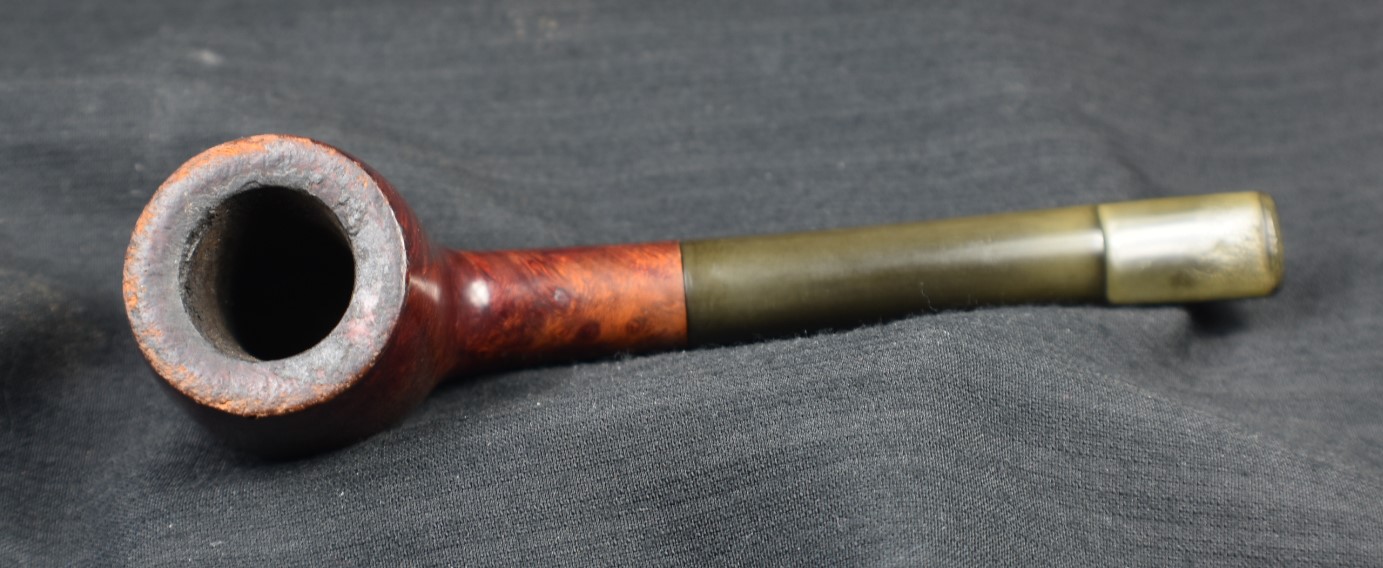
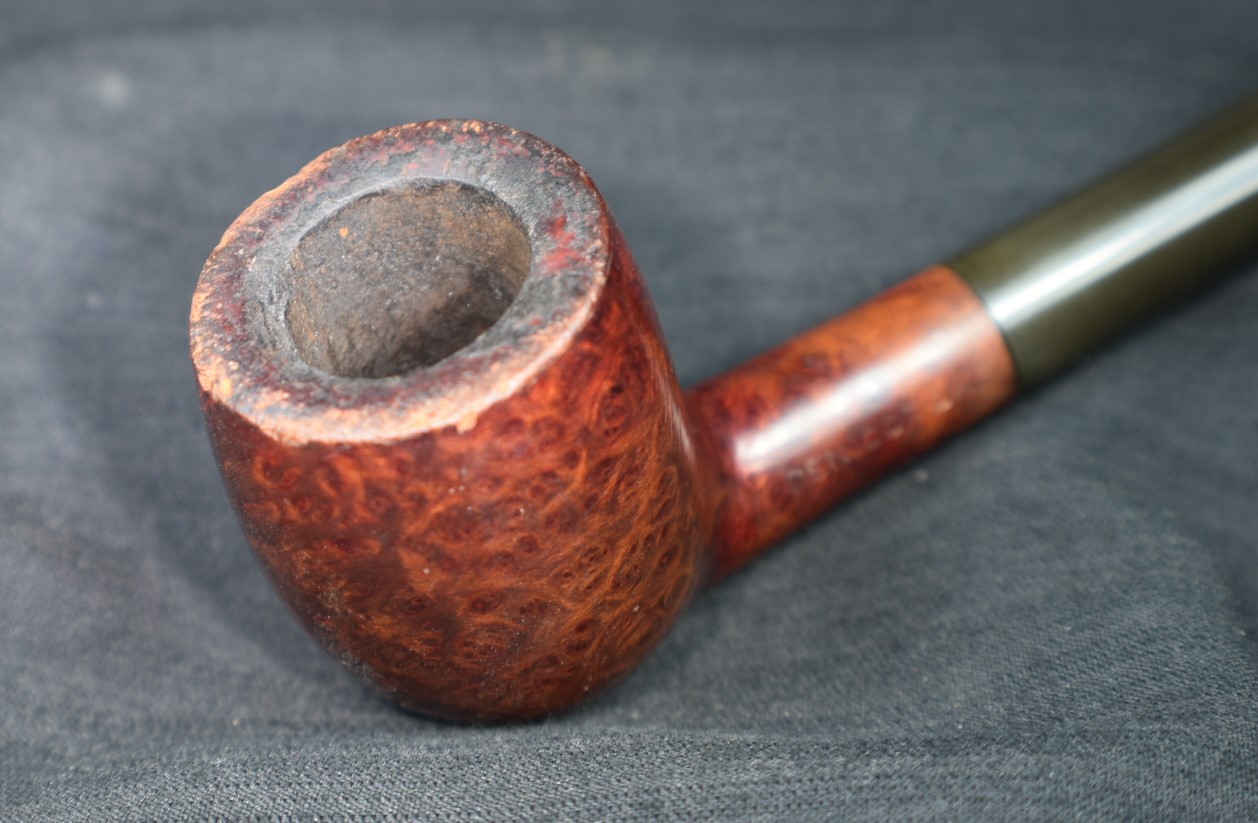
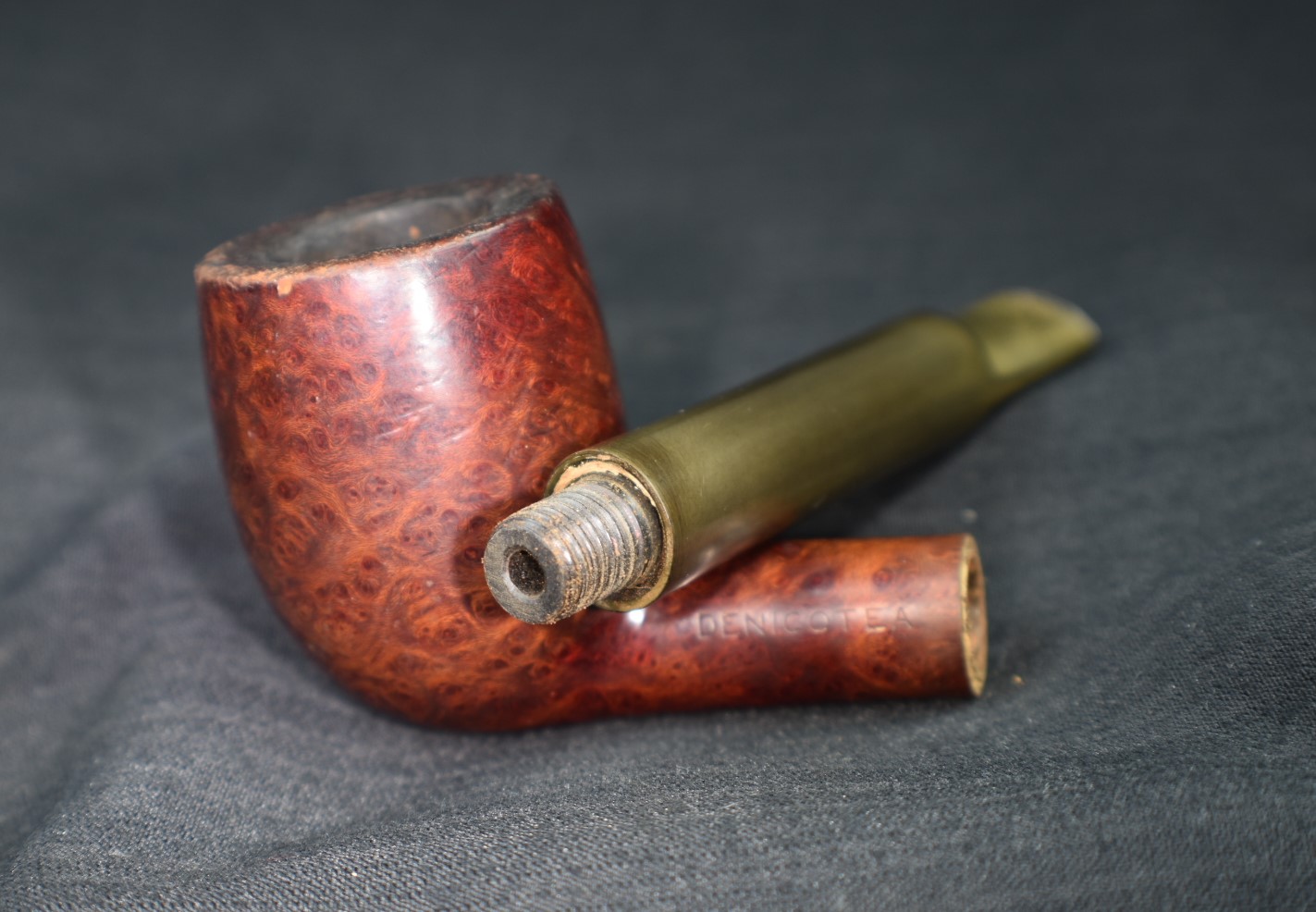
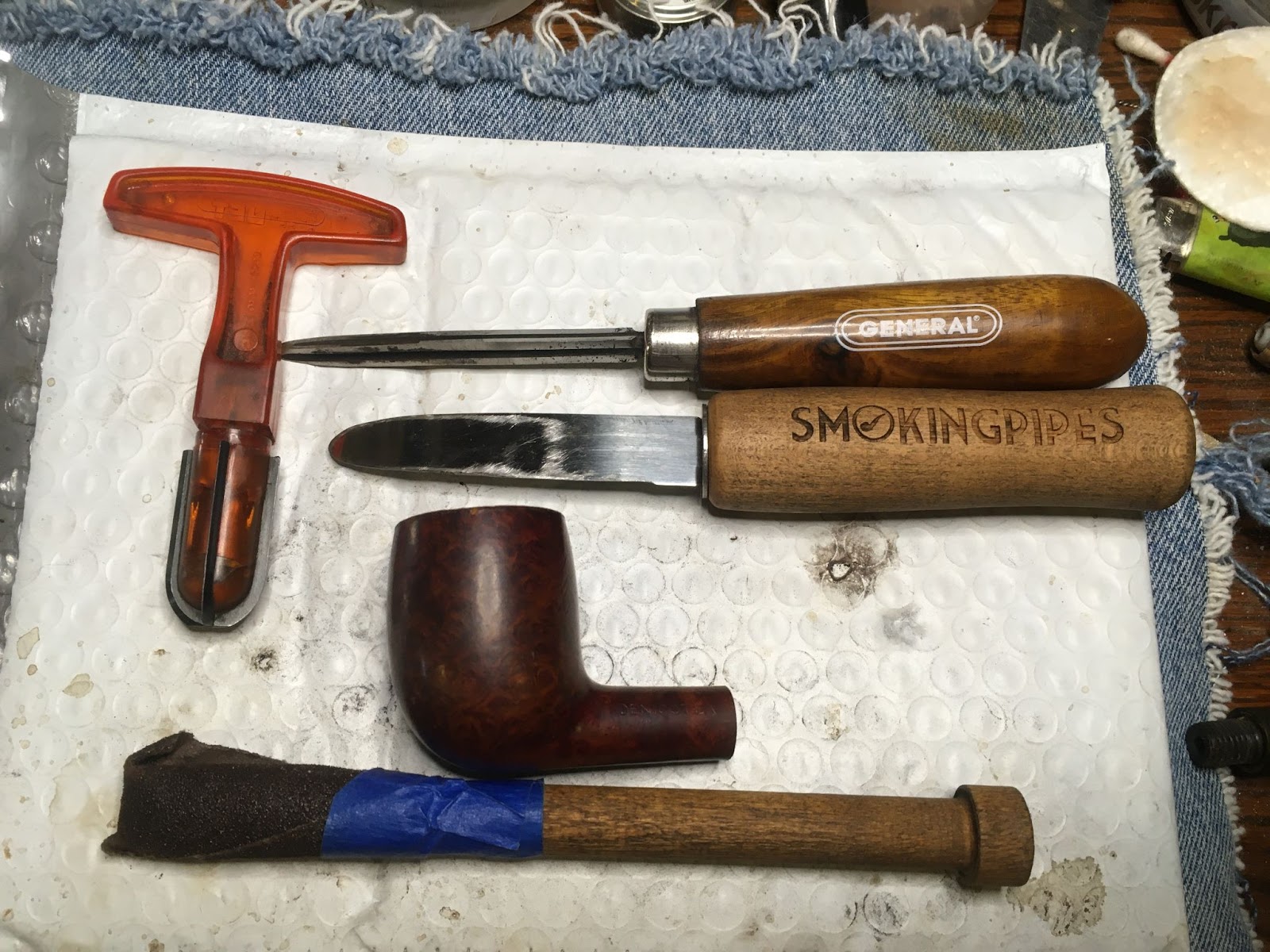
• About

NebraskaPeteGeek

  • American Pipe Makers
  • British pipe Makers
  • Danish pipe Makers
  • French Pipe Makers
  • German Pipe Makers
  • Irish Pipe Makers
  • Italian Pipe Makers
  • Others or Unknown Pipe Makers
  • Restorations
  • An 1876 Adolphe Oppenheimer Co. (A.O.C.) Poker Restoration

    April 23rd, 2024

    Photographed and written by

    John M. Young

    No, I am not getting political with this restoration and would greatly prefer you not to associate this restoration with Alexandria Ocasio-Cortez, also known as AOC, an American left-wing politician and activist, who has represented New York’s 14th congressional district since 2019, with a capital D after her name.  I remain a card carrying Libertarian and want the record to show that I do not support Representative Cortez in any way.  That said, this little pipe was probably made 70 years prior to the birth of Ms. Cortez and also owes her no affiliation.  I think that covers the political and legal requirements of distancing myself from the people and parties involved in dismantling the Constitution of the United States.

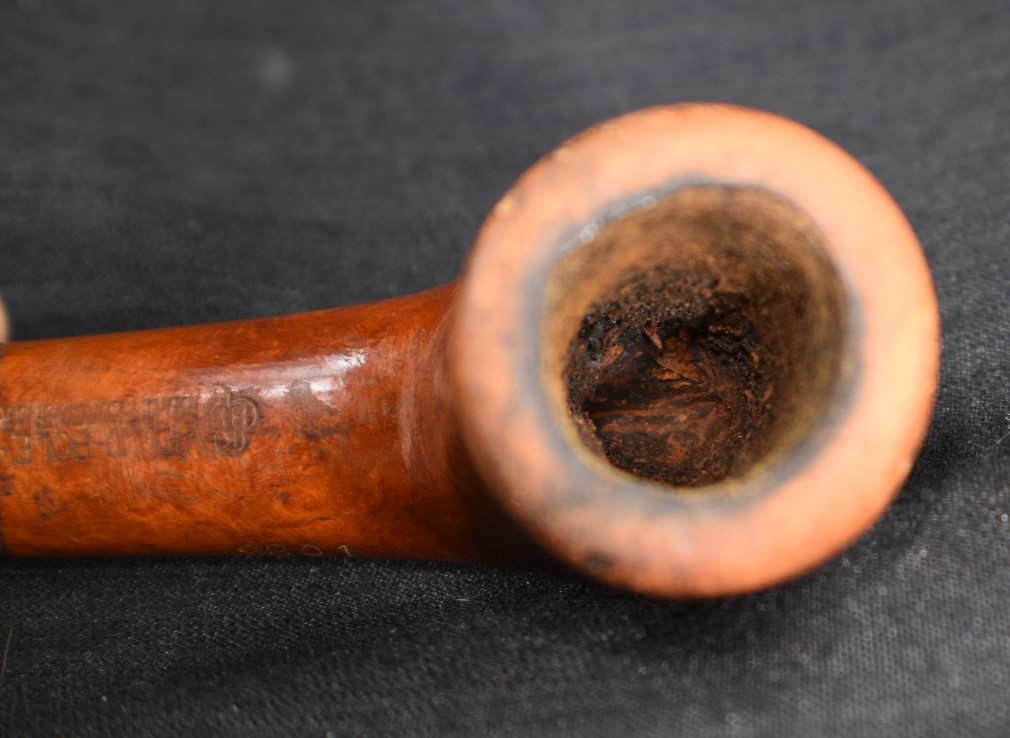
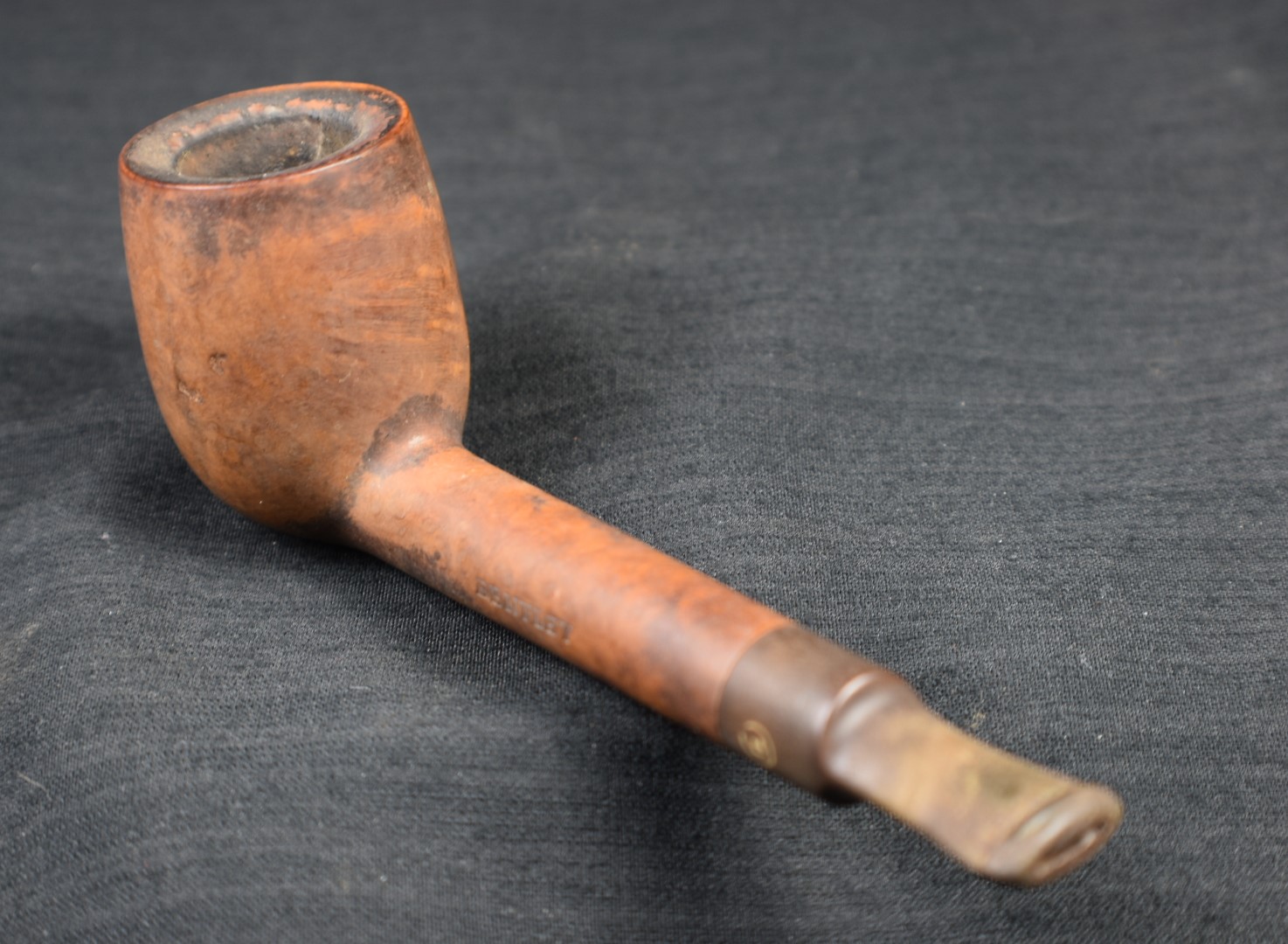
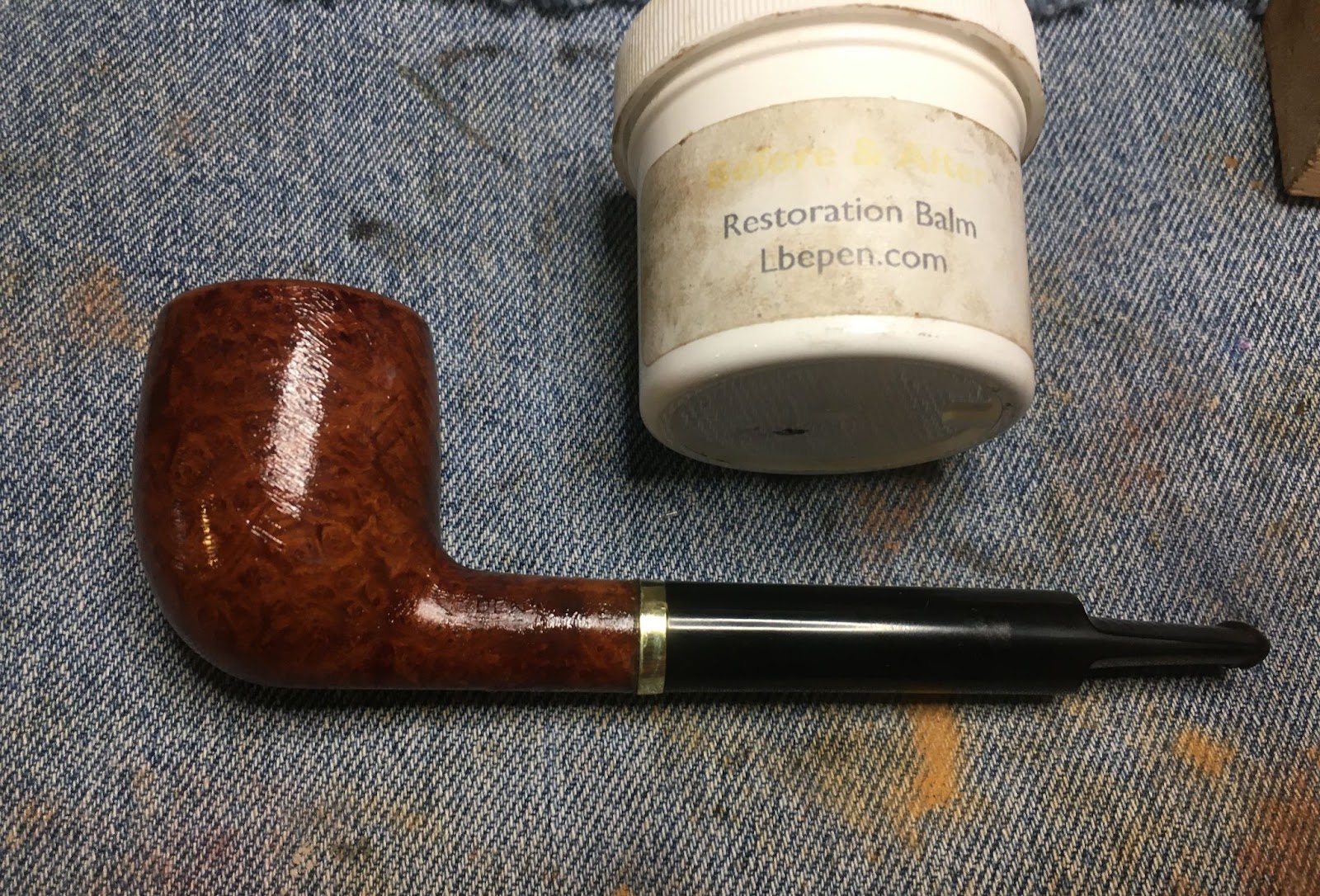
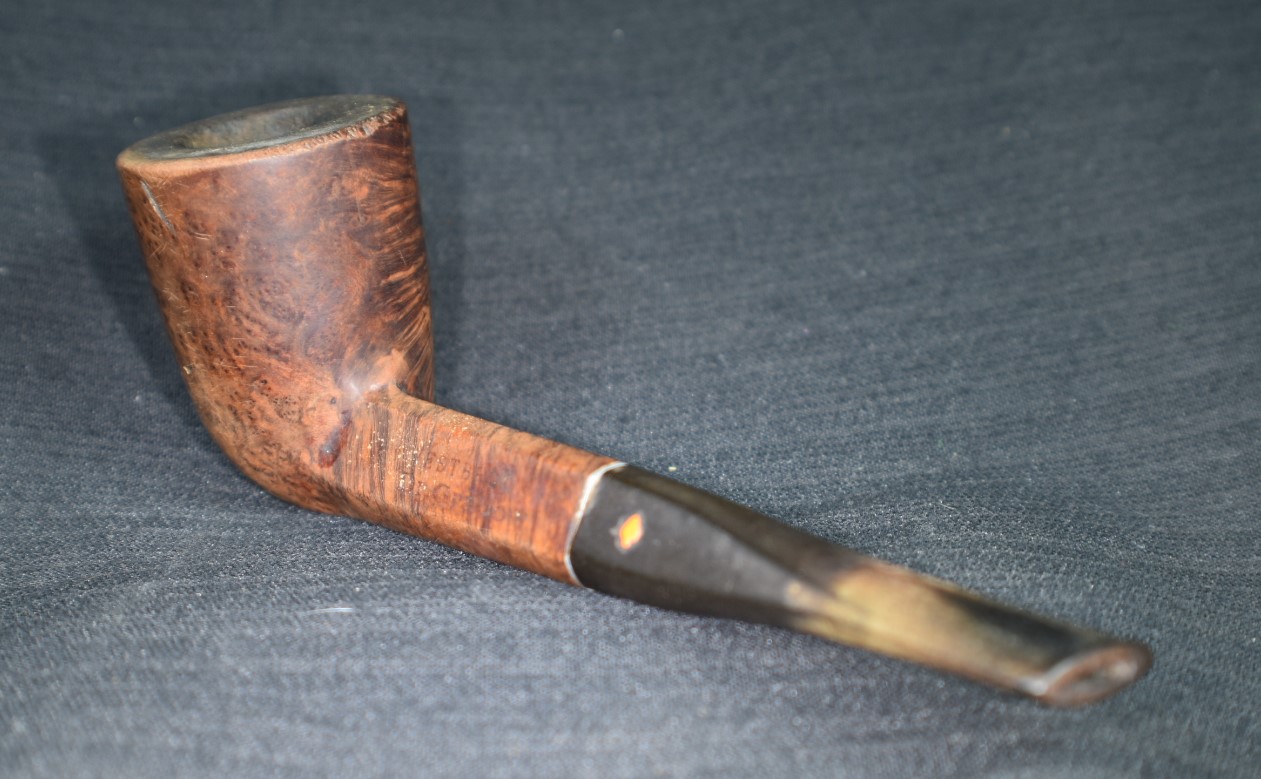
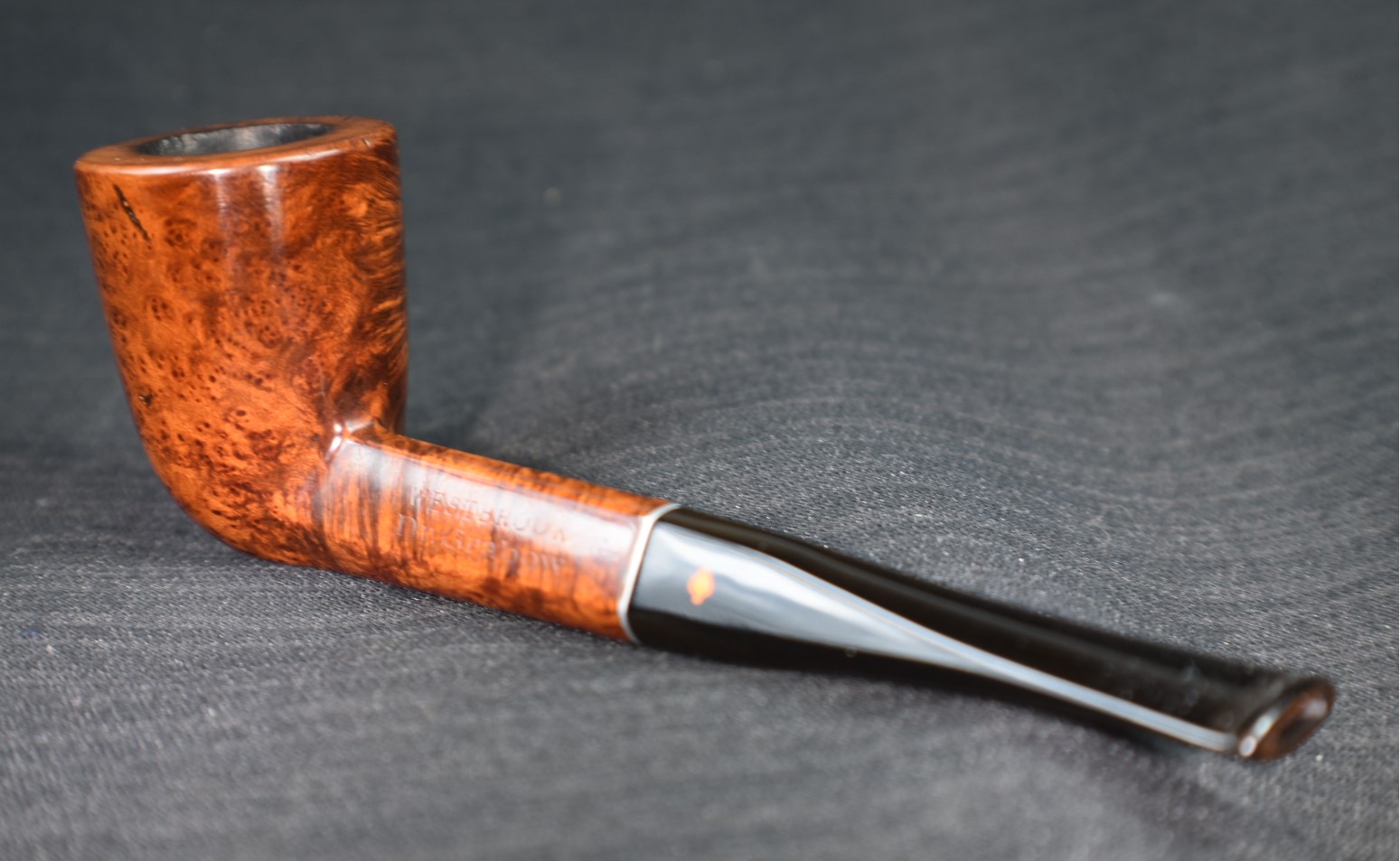
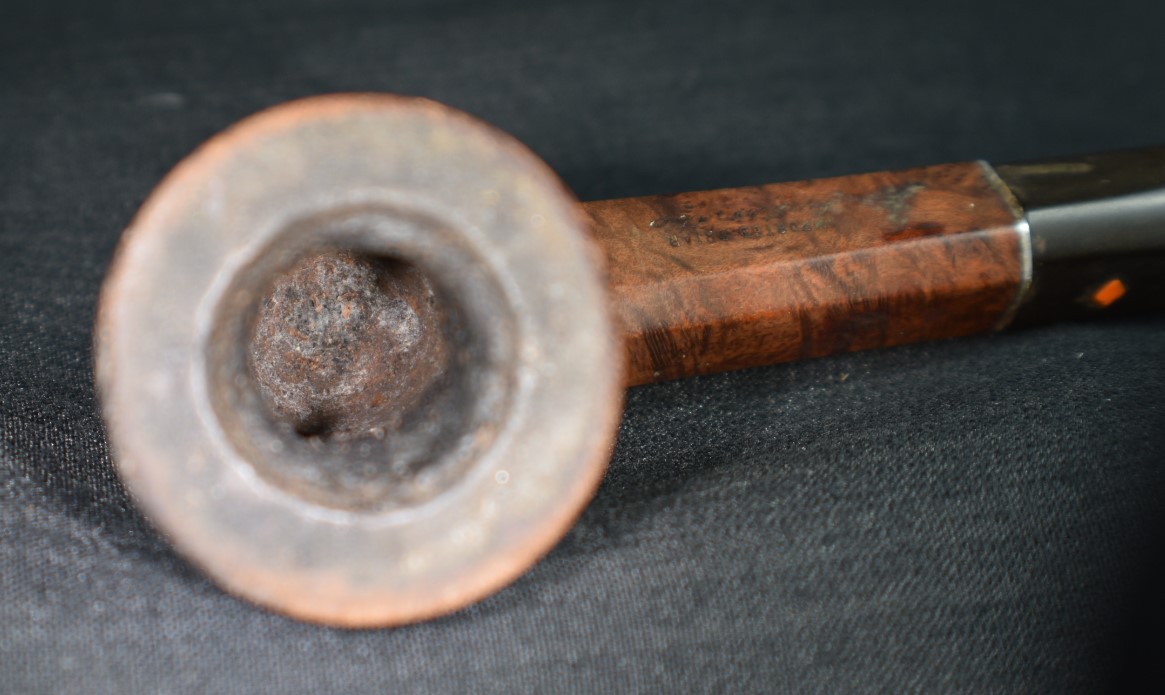
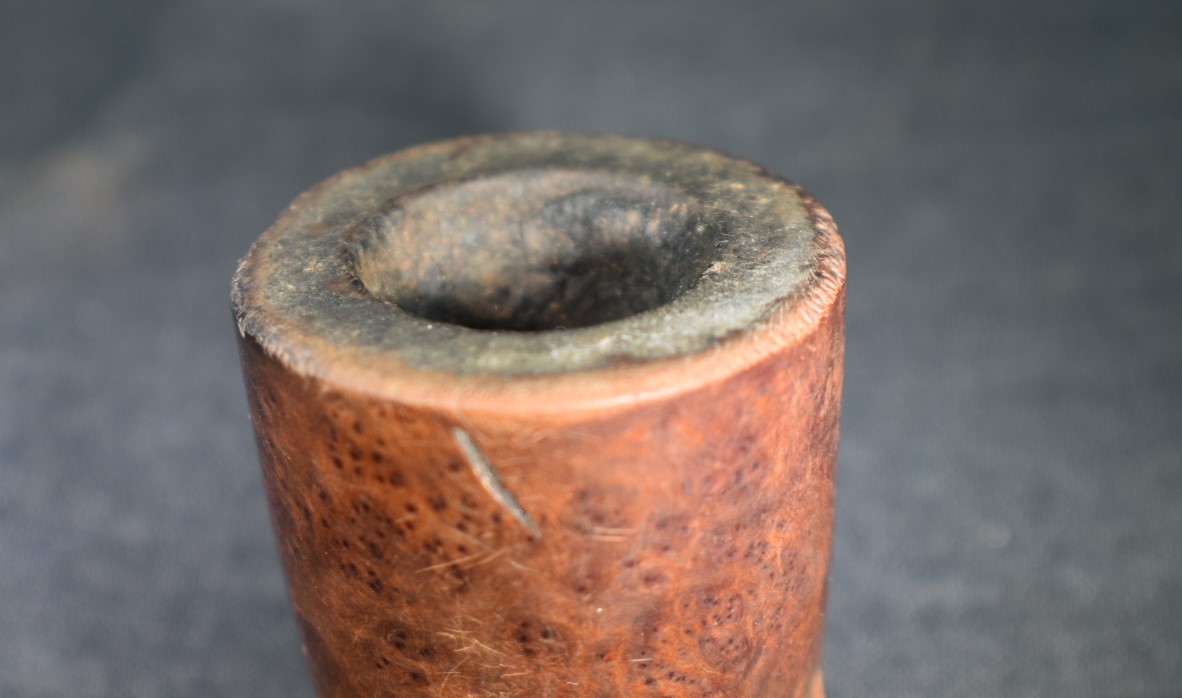
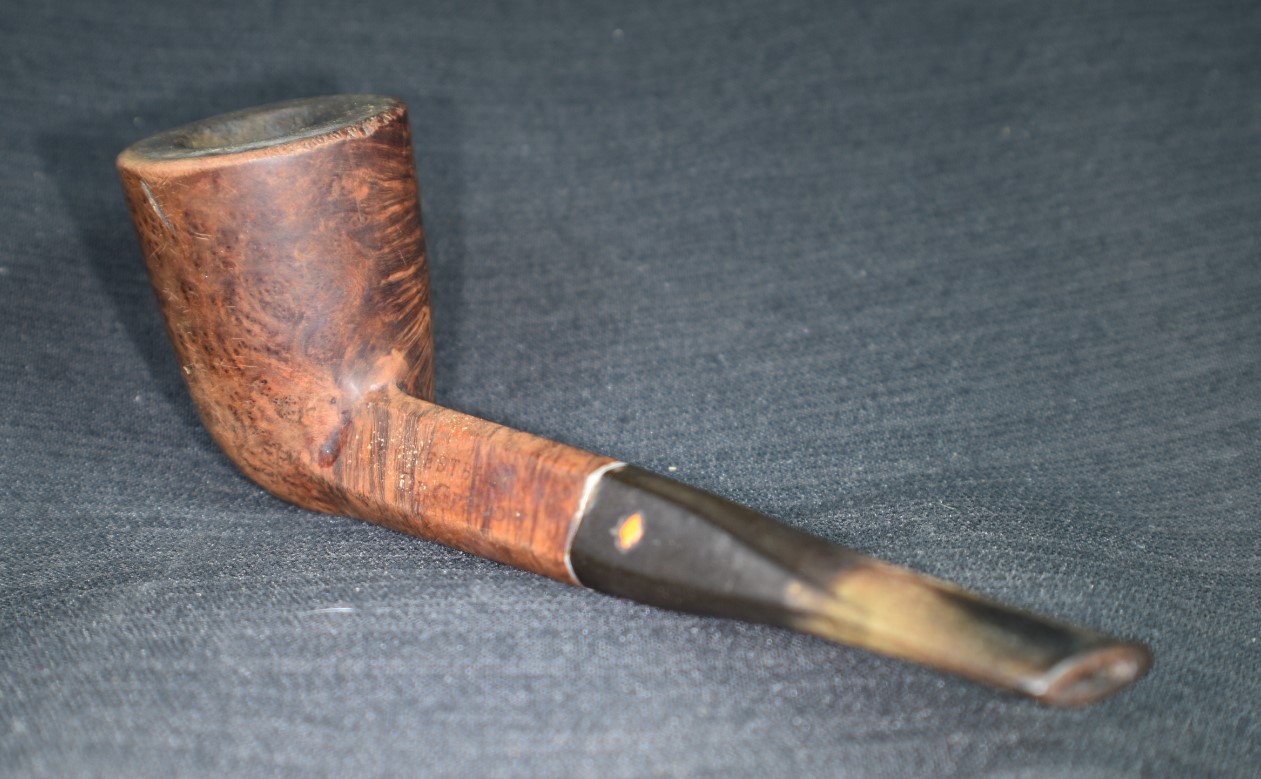
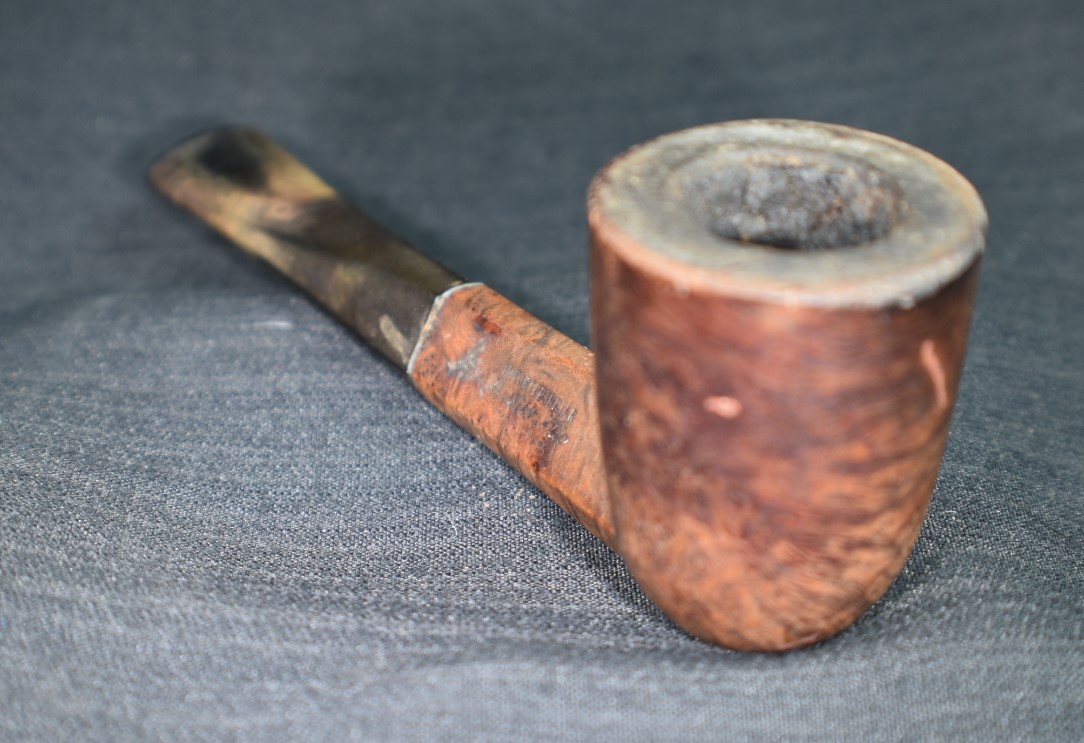
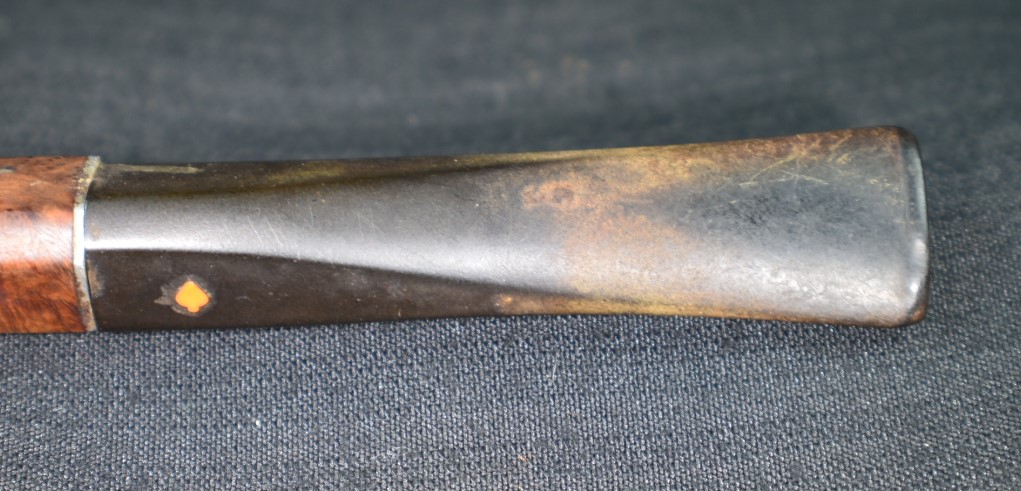
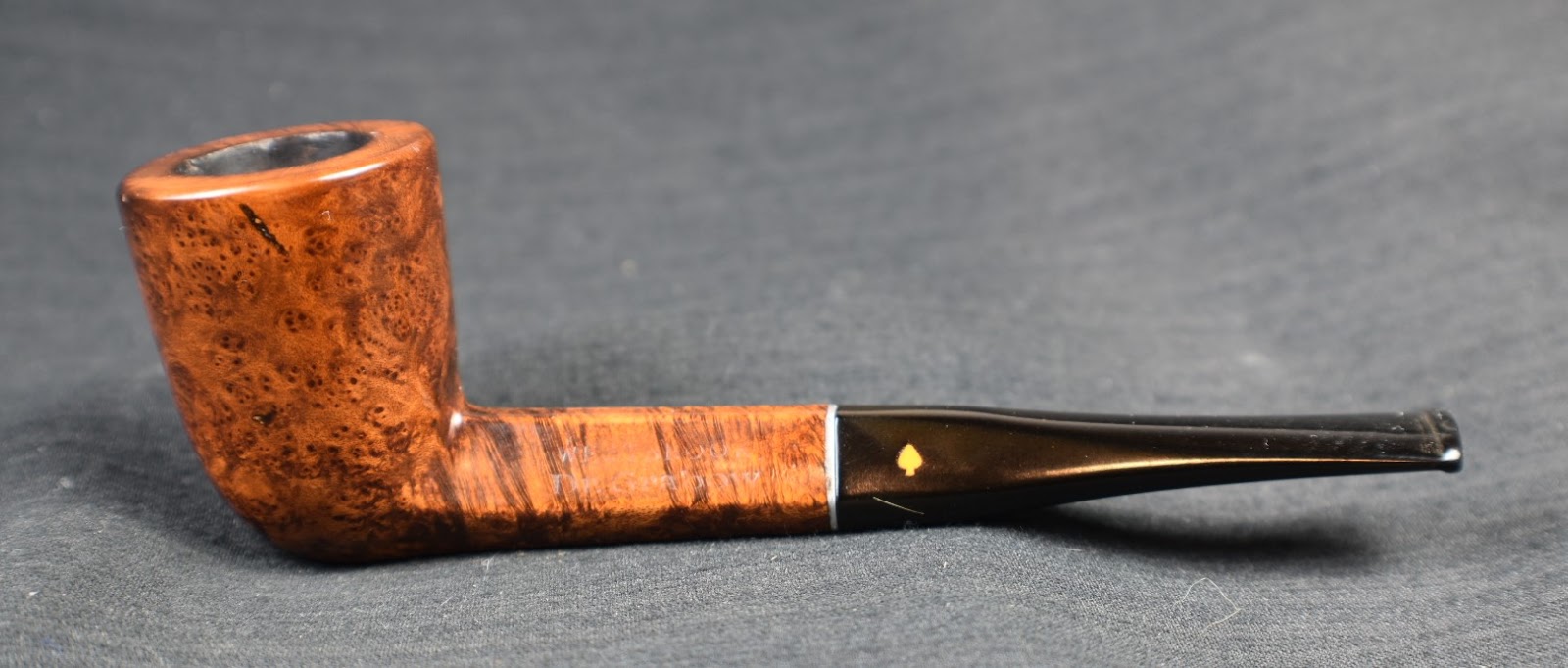
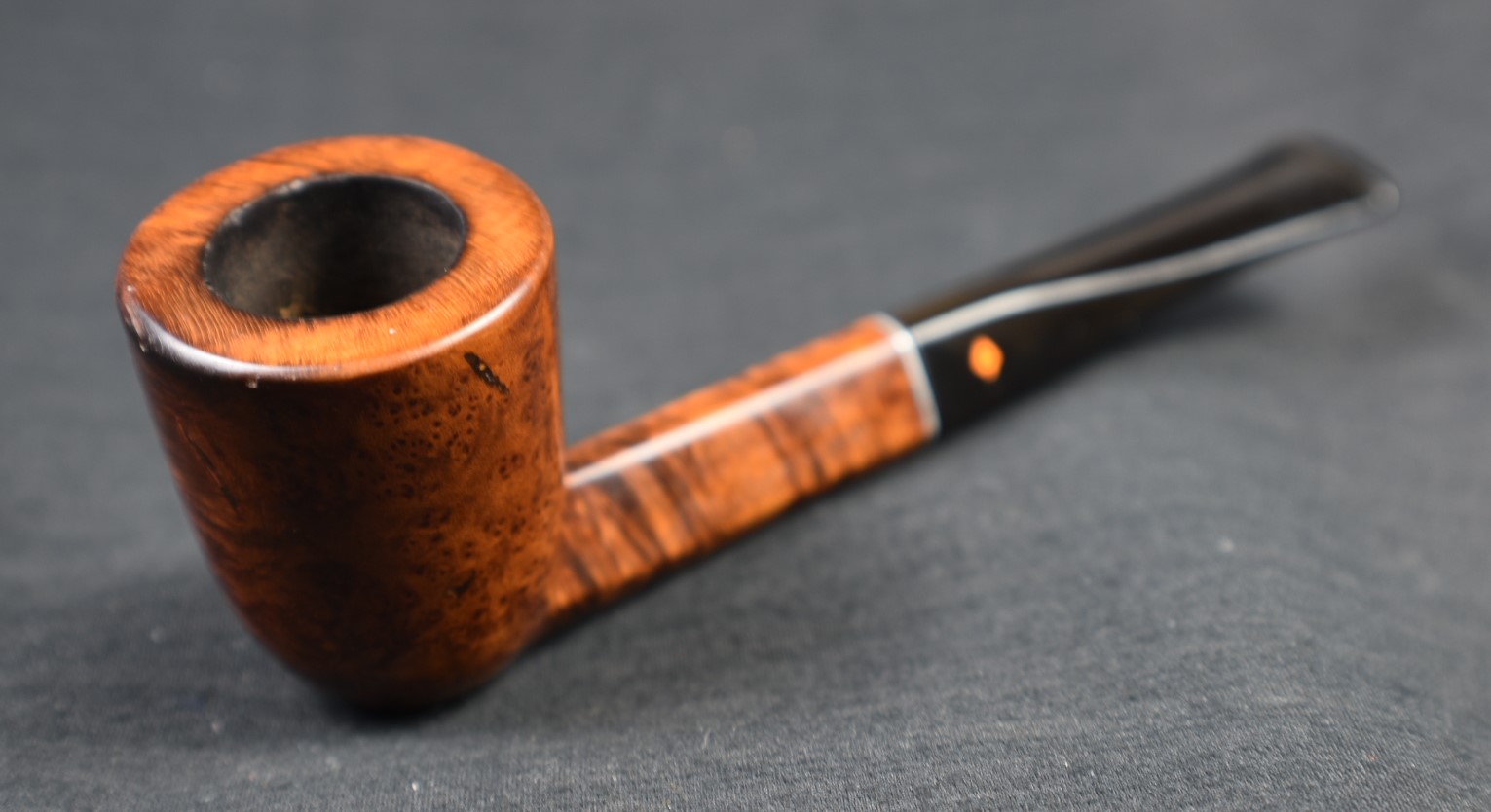
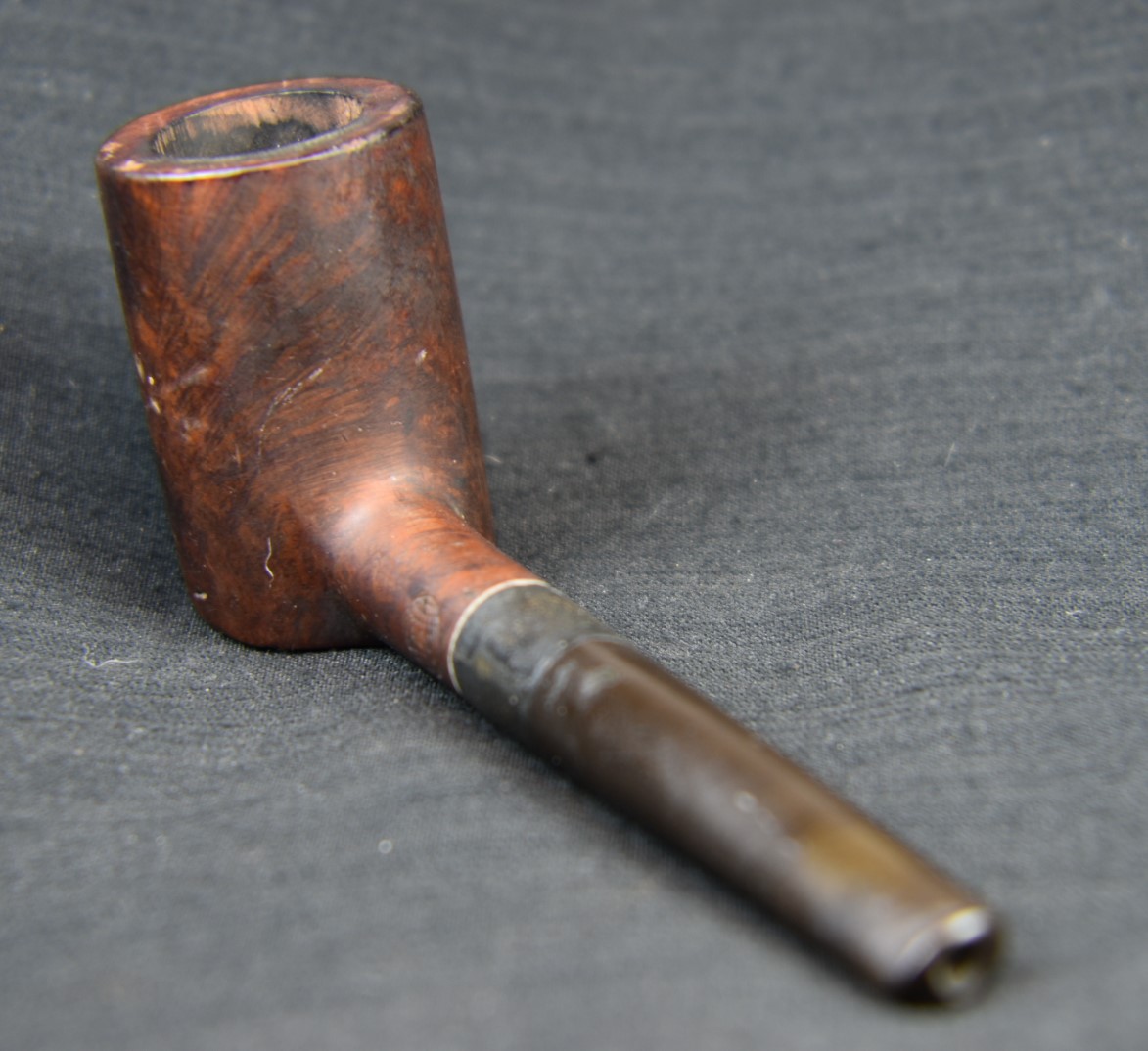
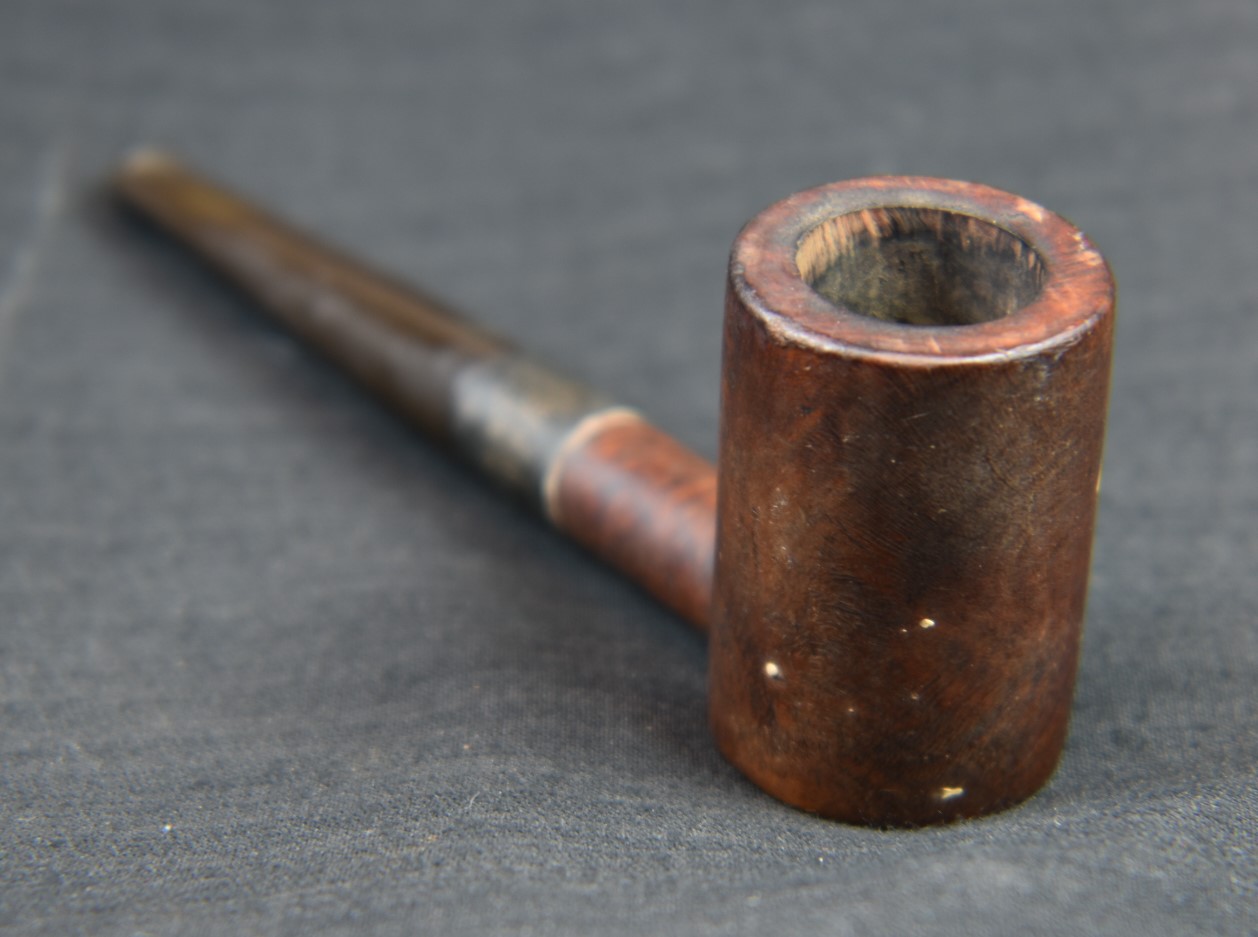
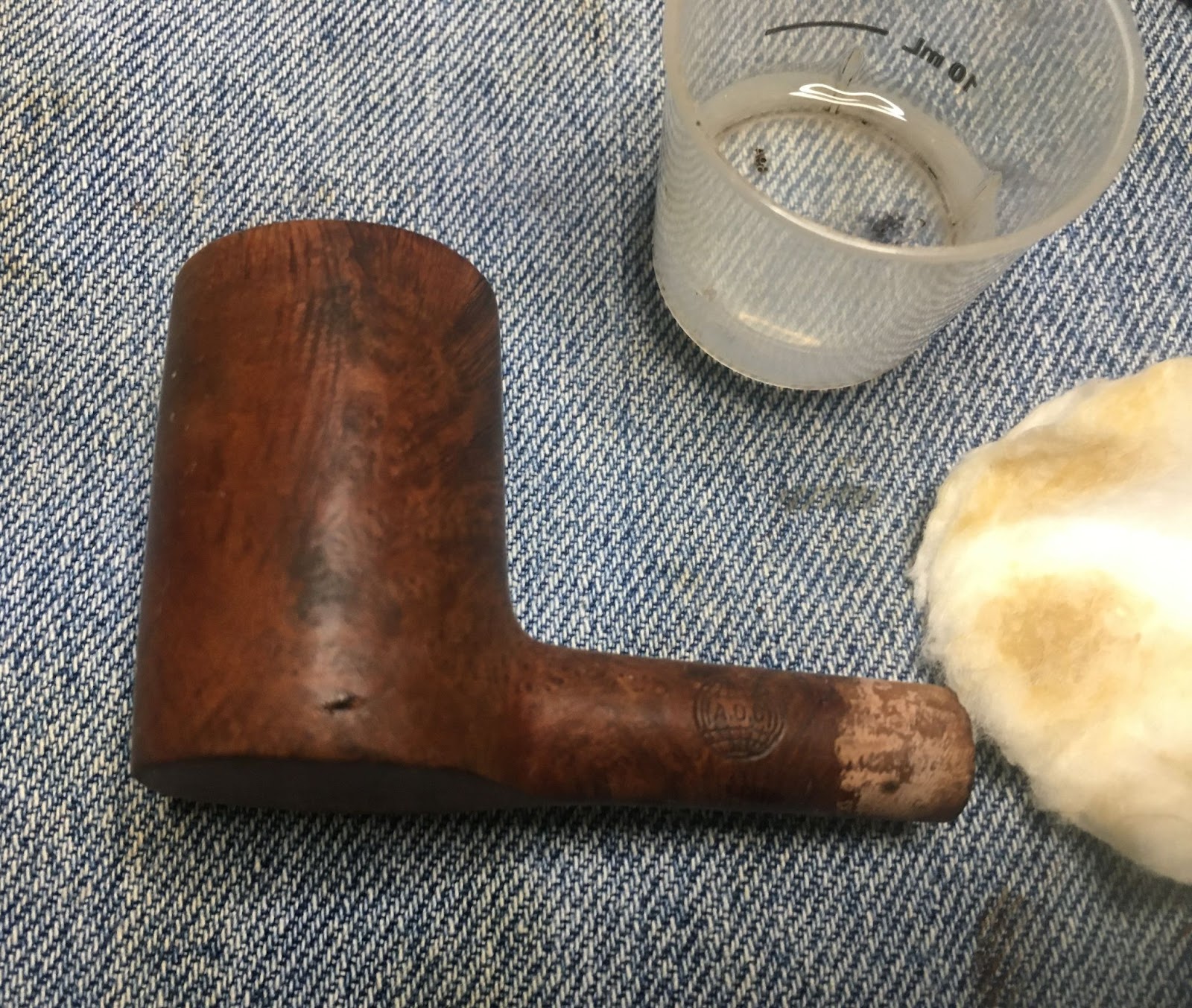
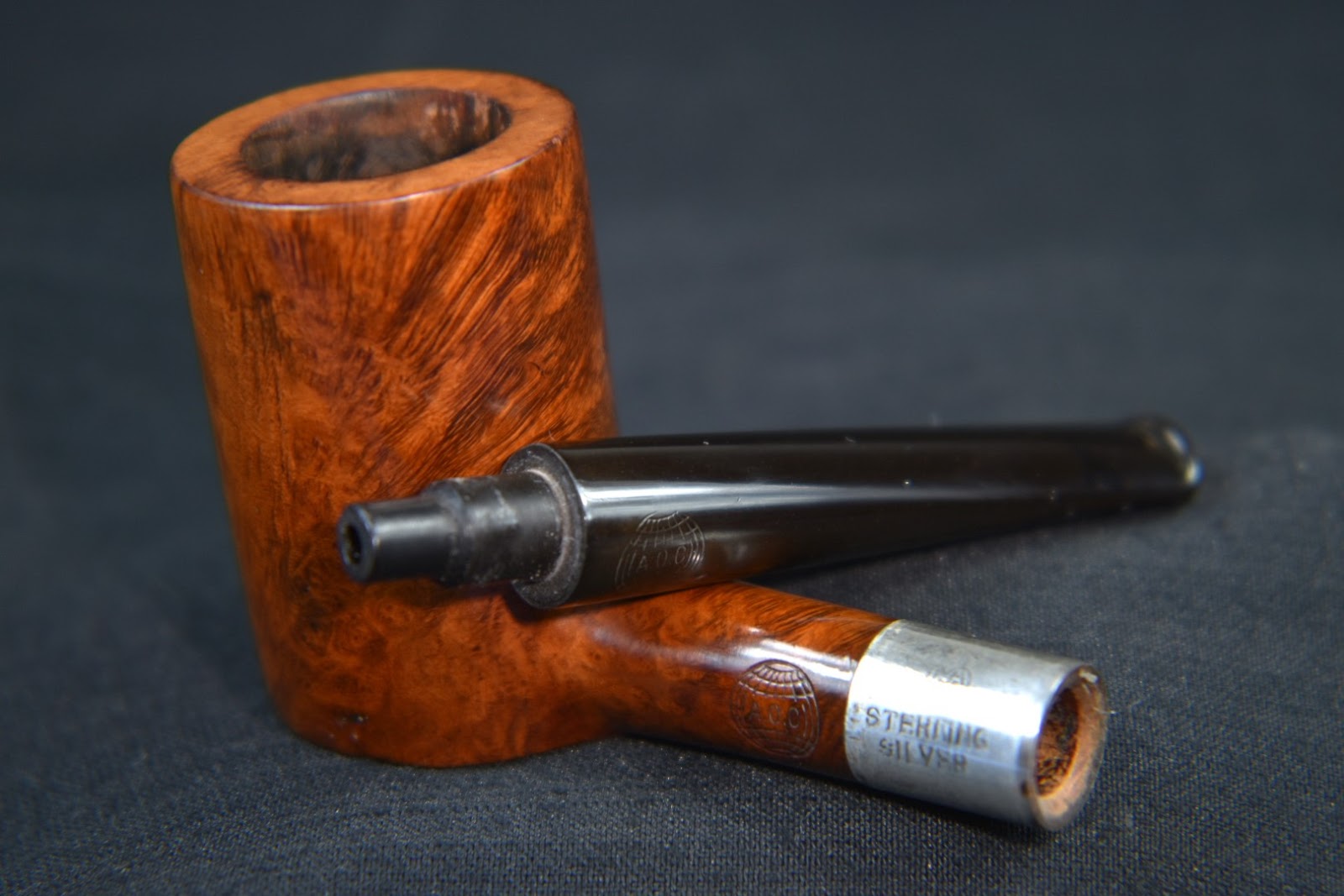
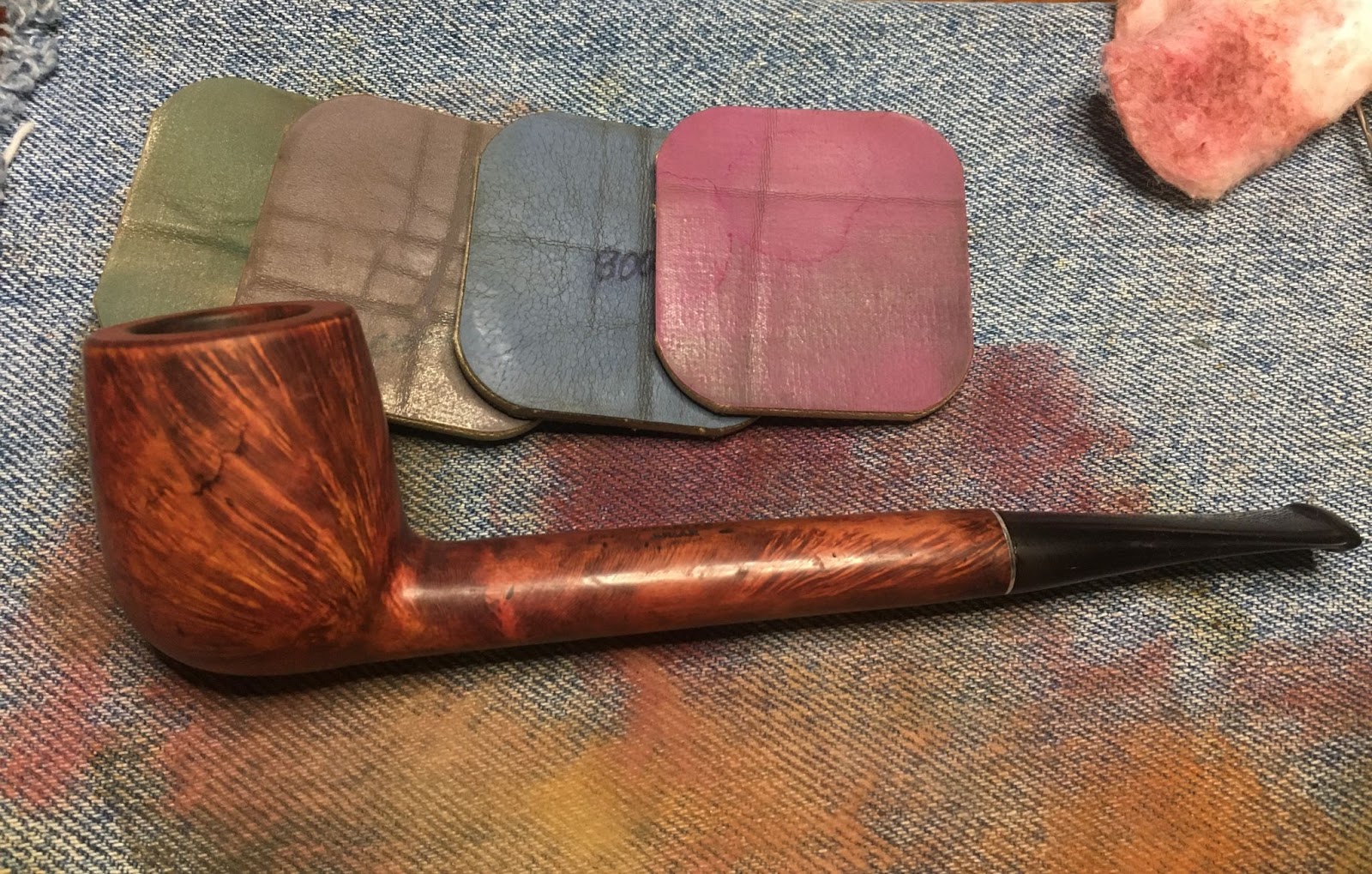
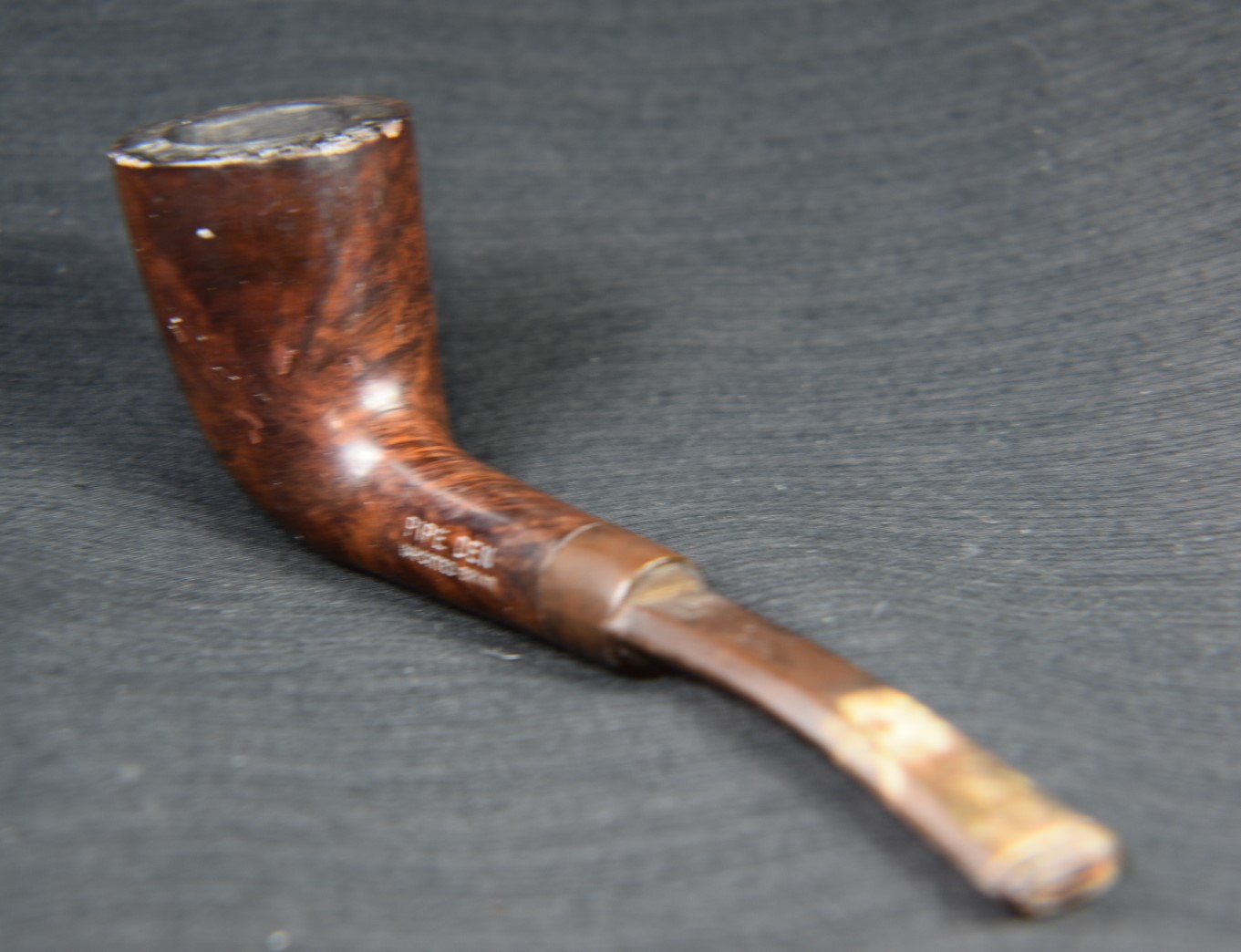
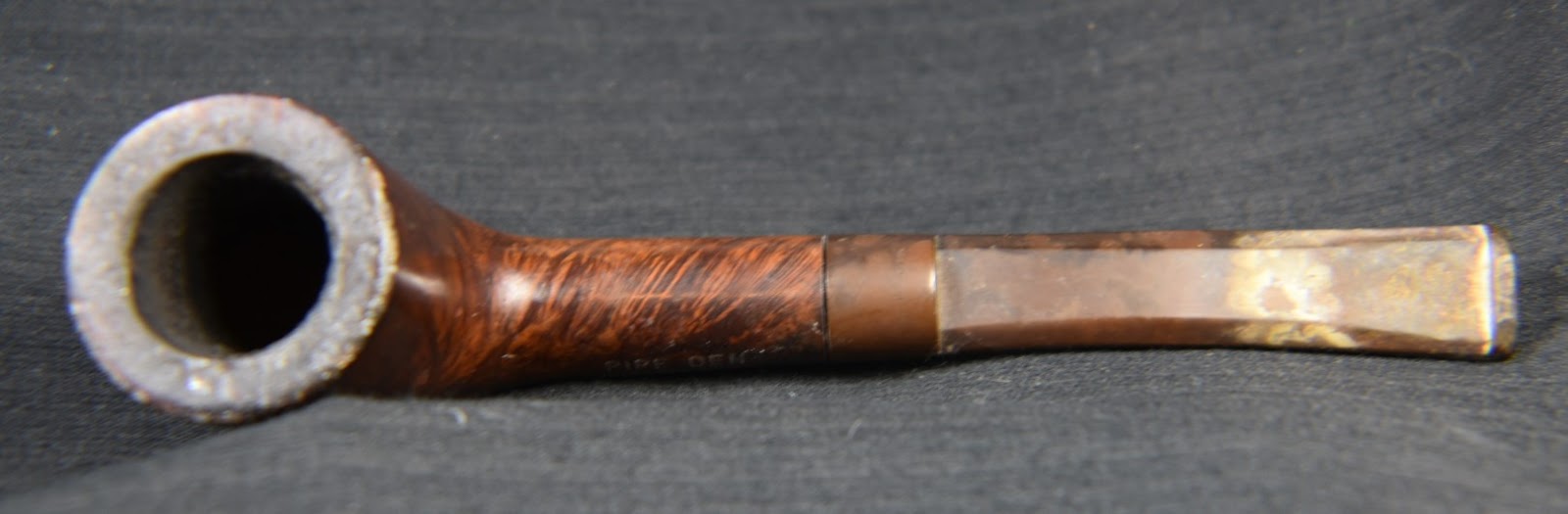
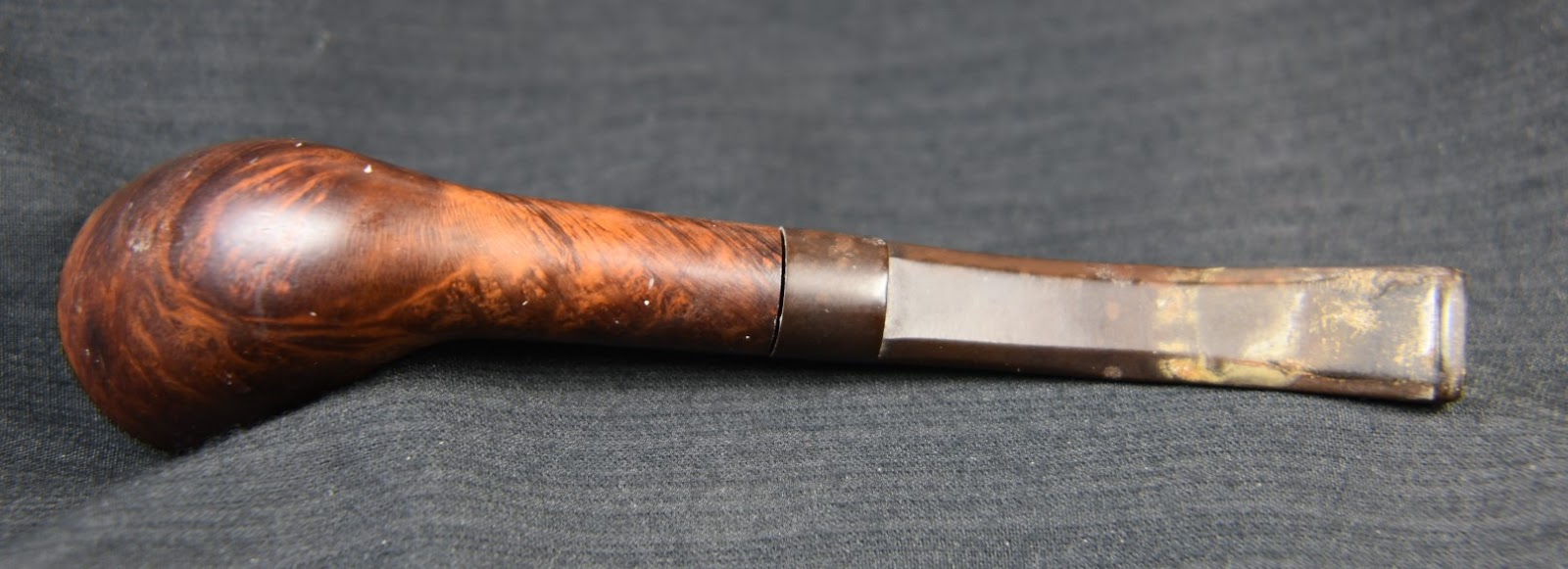
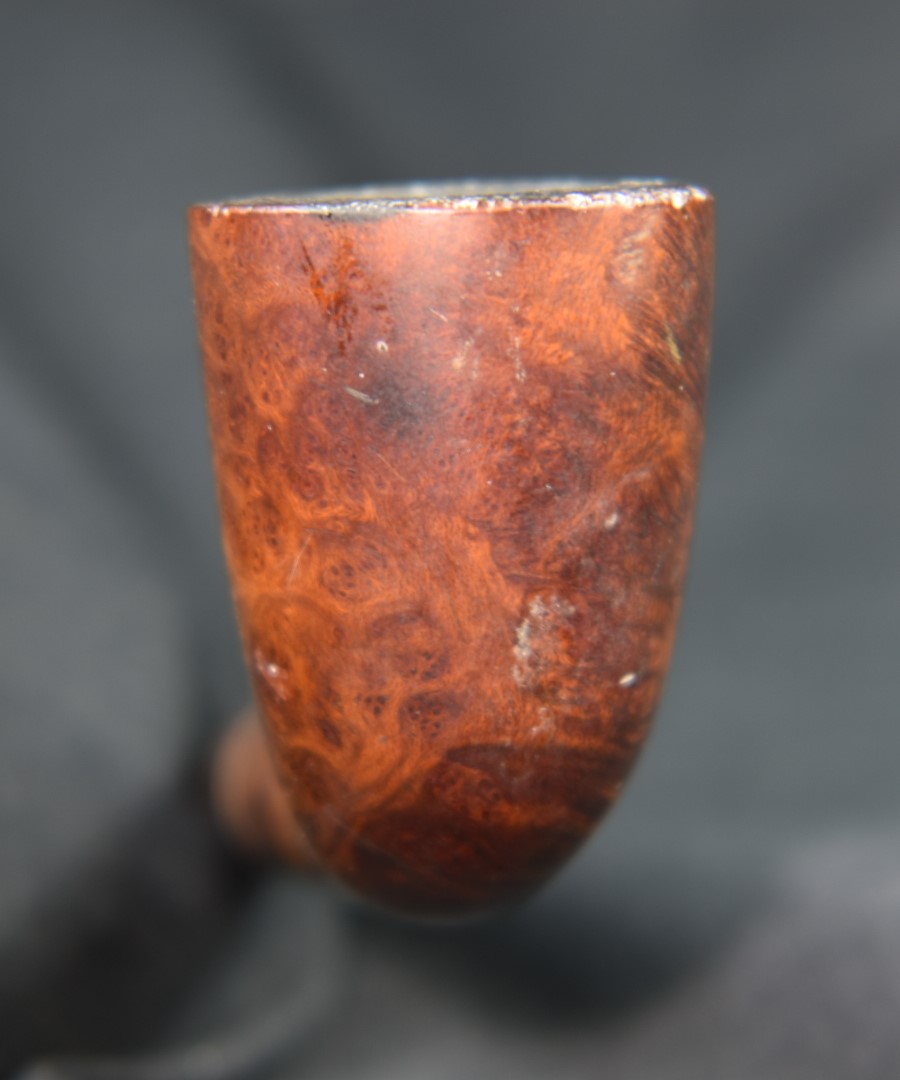
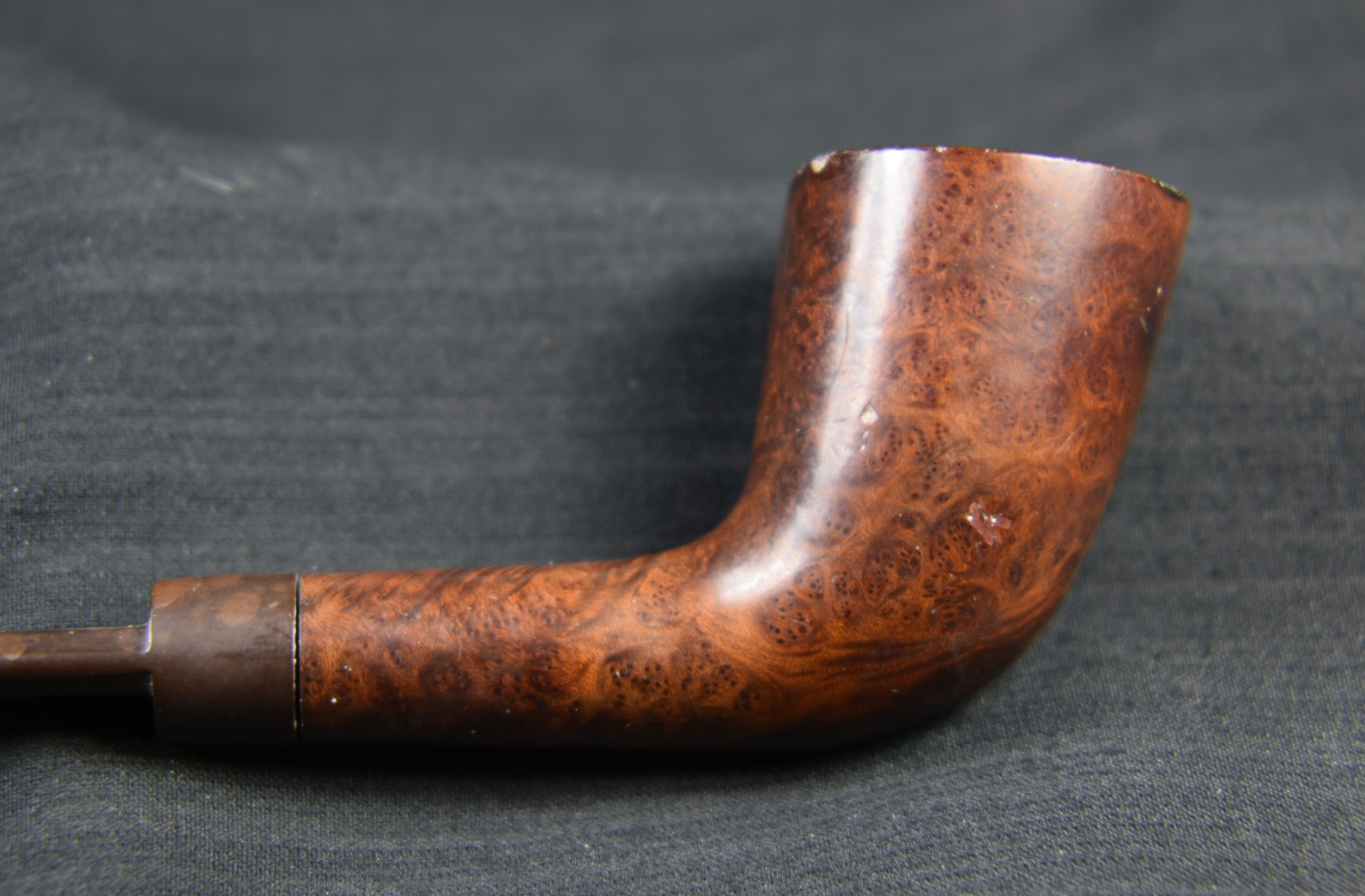
    The original purchase was made from eBay due to what appeared to be two interesting pipes. In the photo below the two are on the left. The middle poker with the orific bit and the orange logo indicating a Dr Grabow Westbrook. Upon arrival this poker was very dirty with grime obscuring the briar almost completely. 

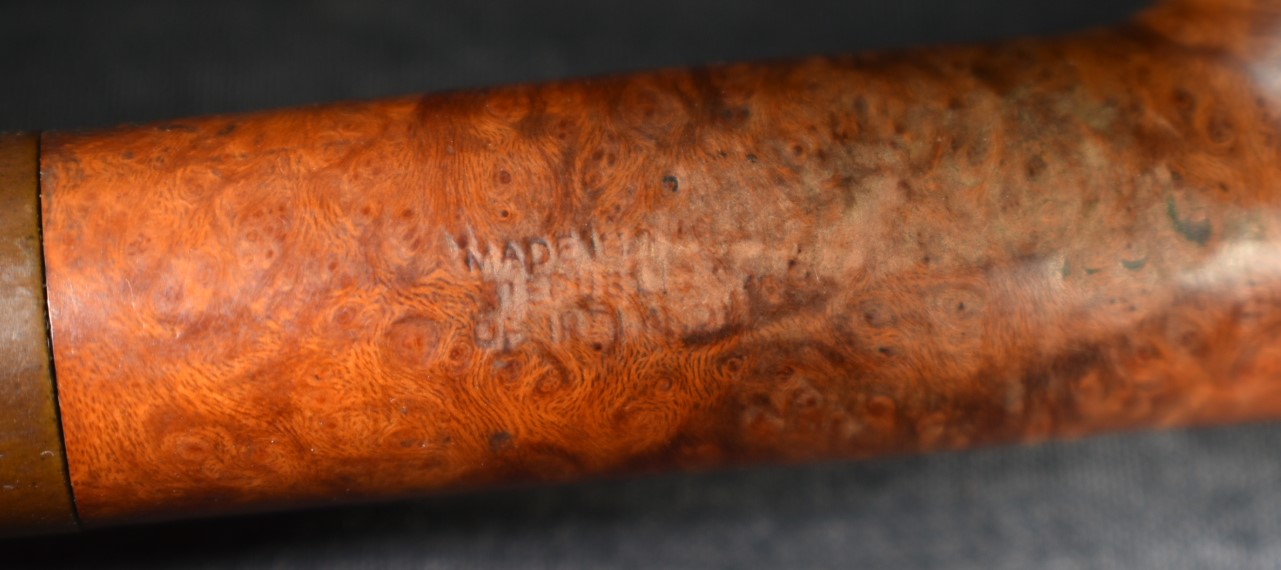
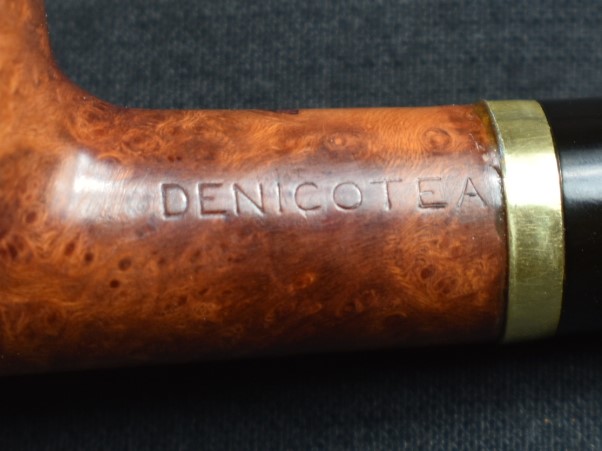
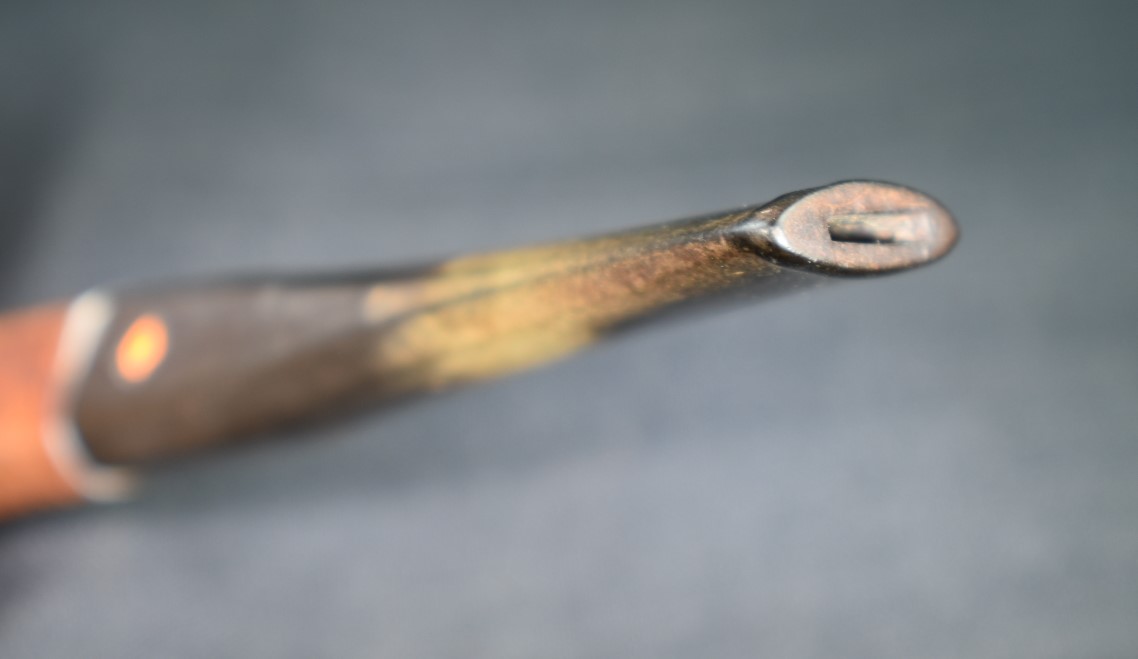
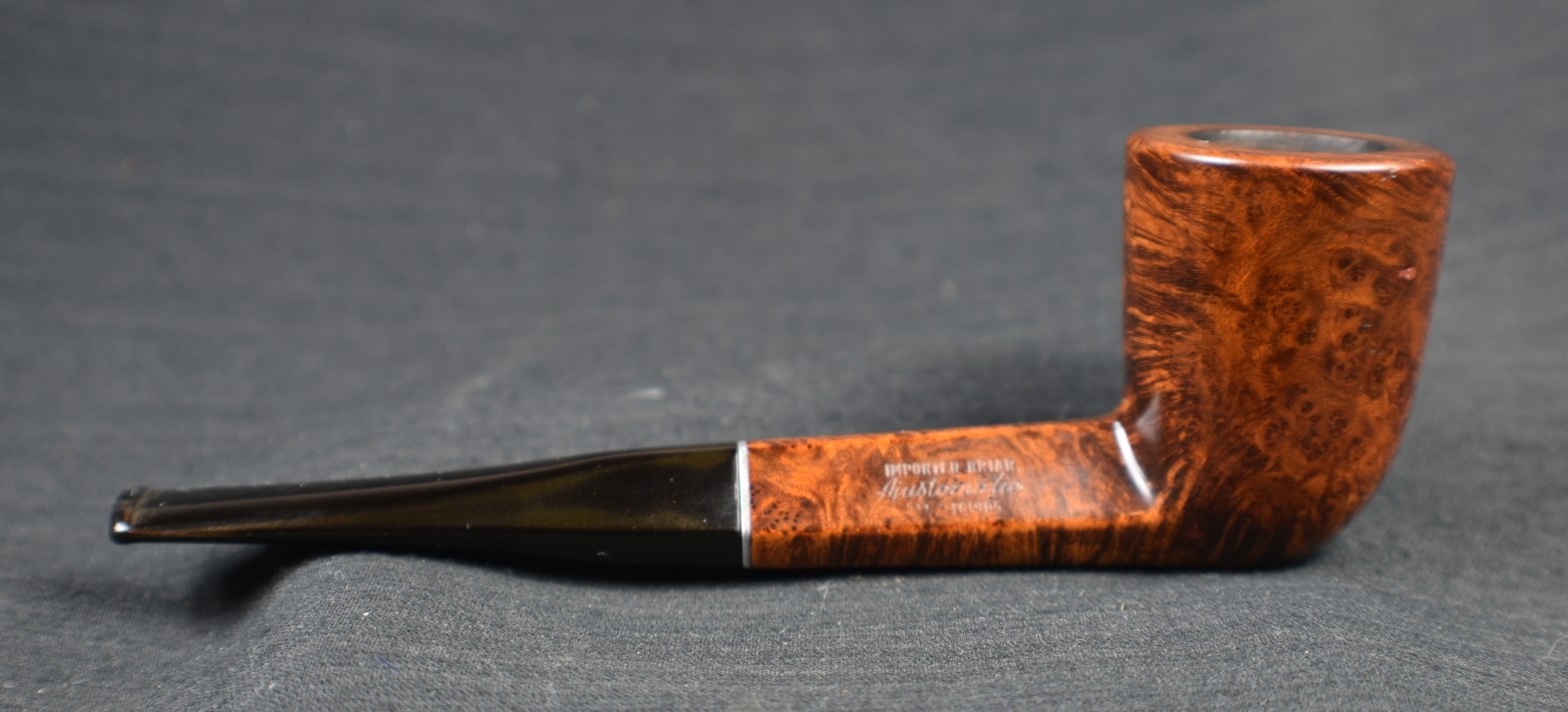
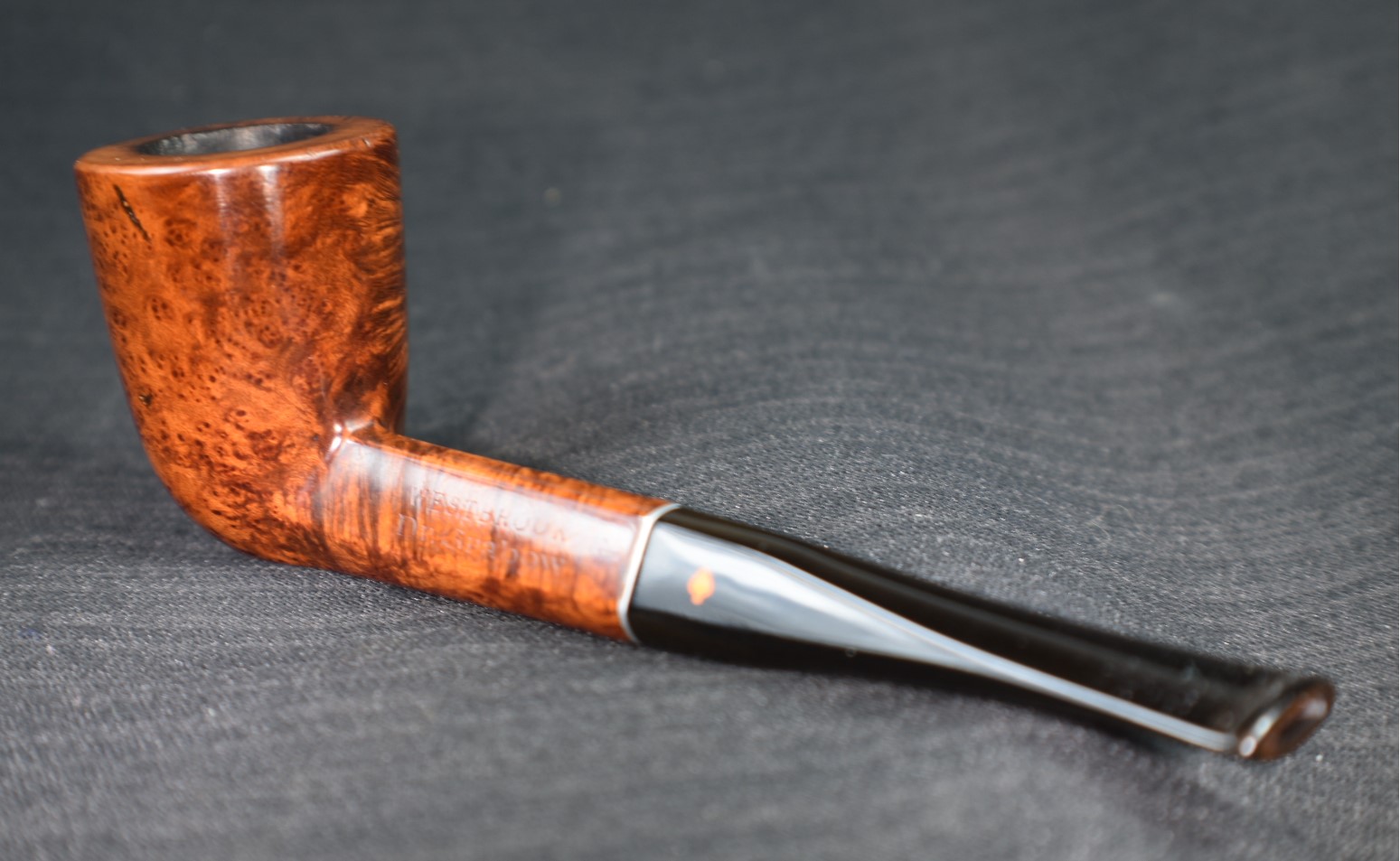
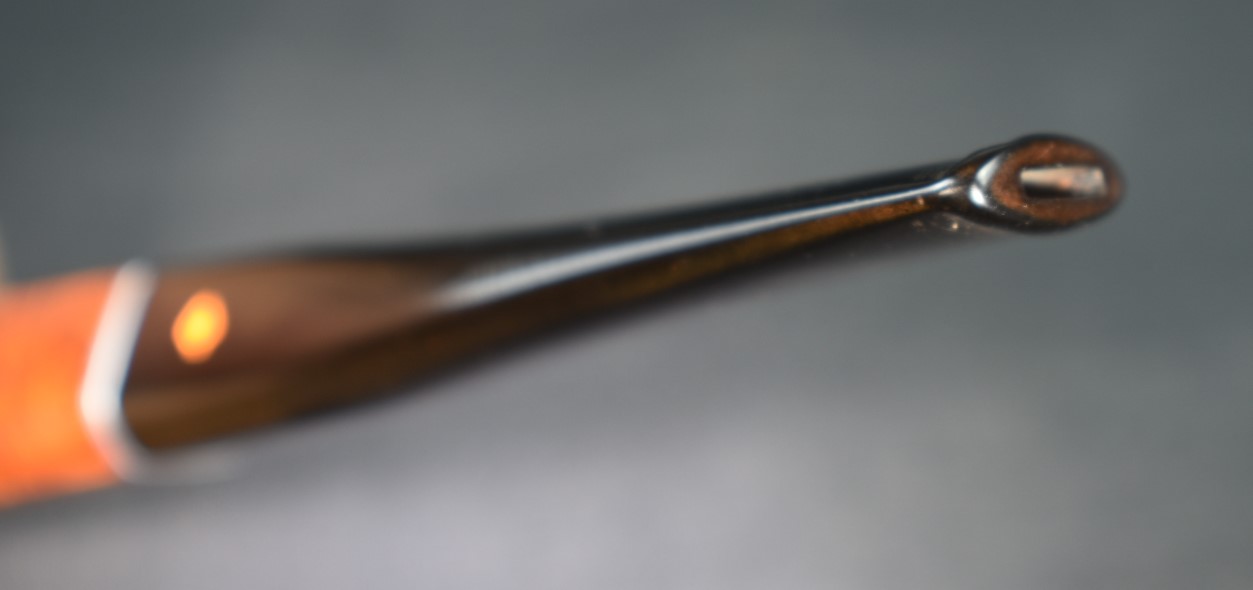
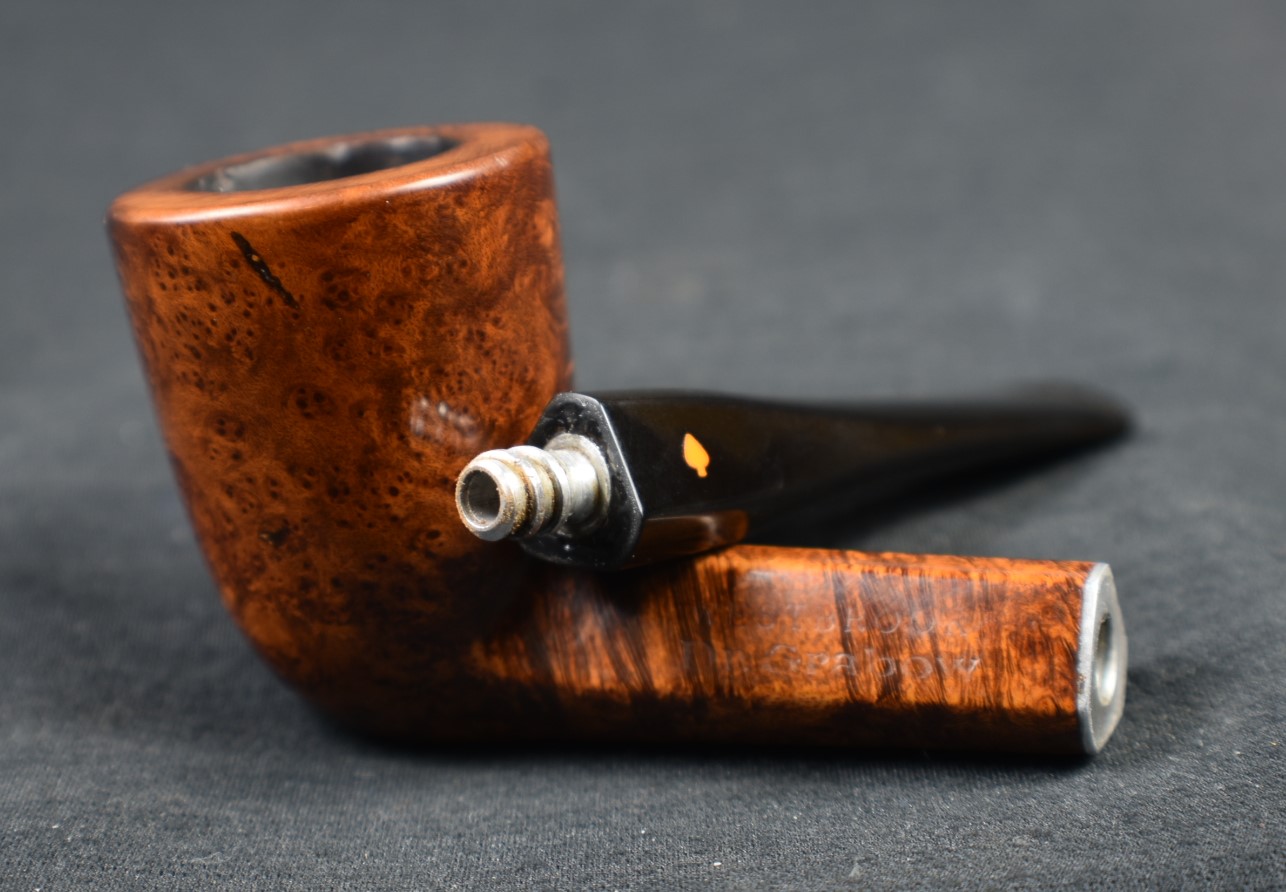
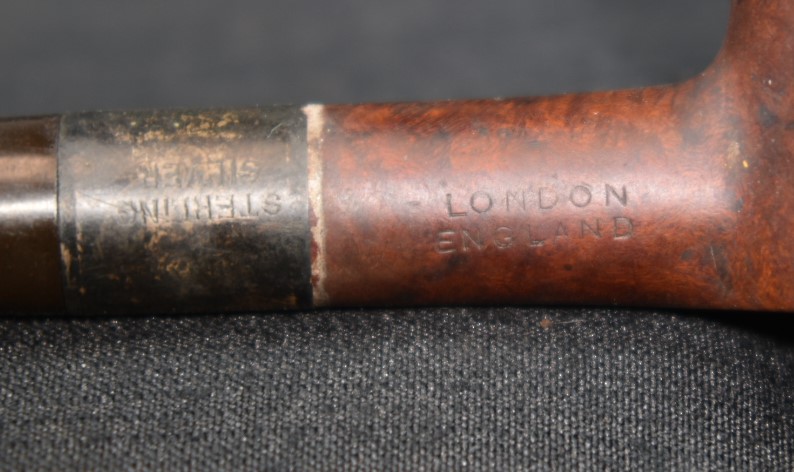
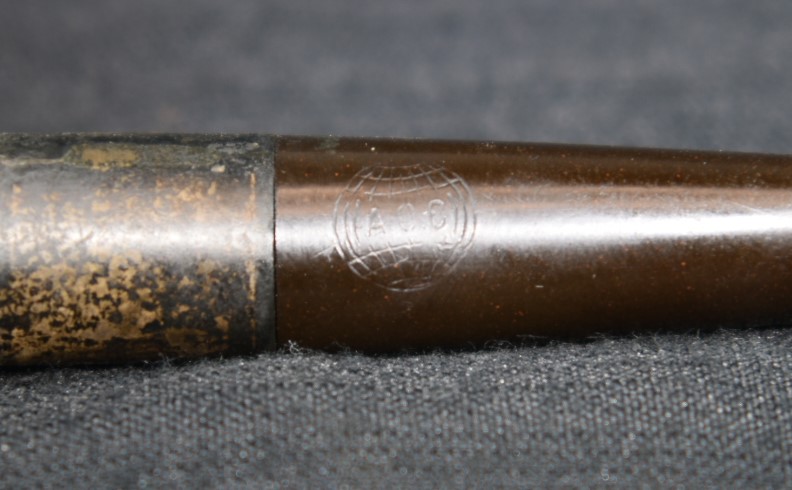
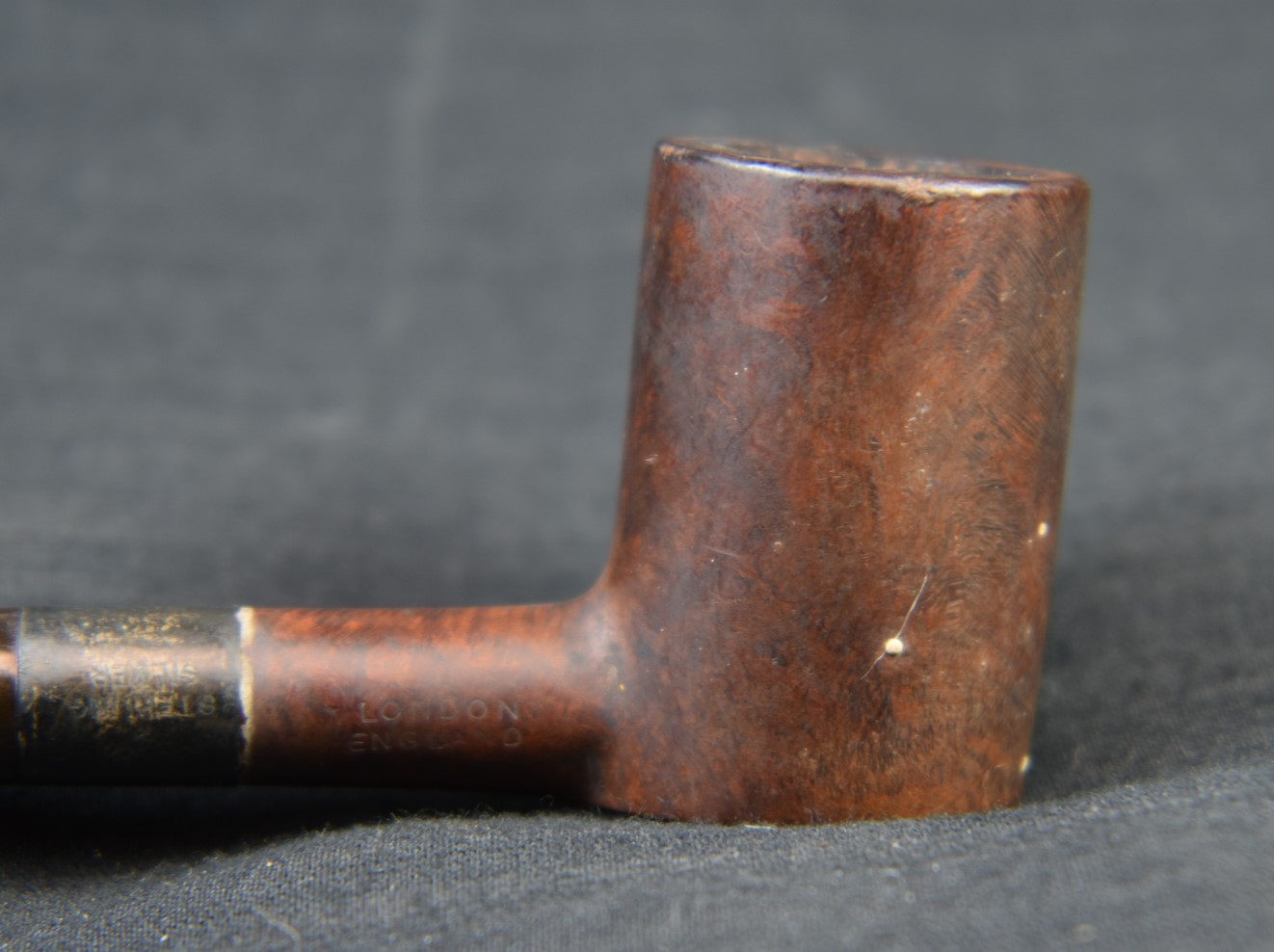
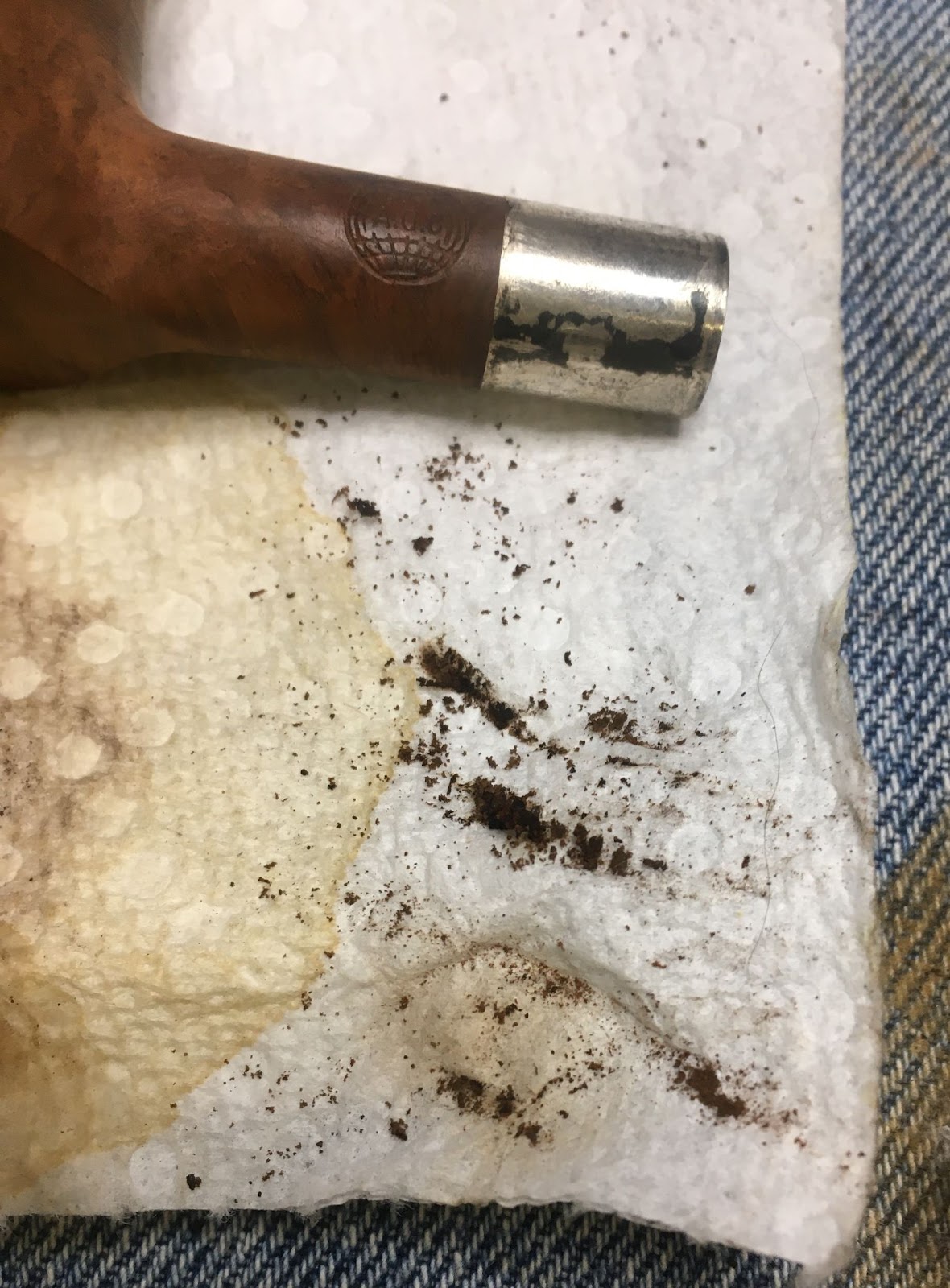
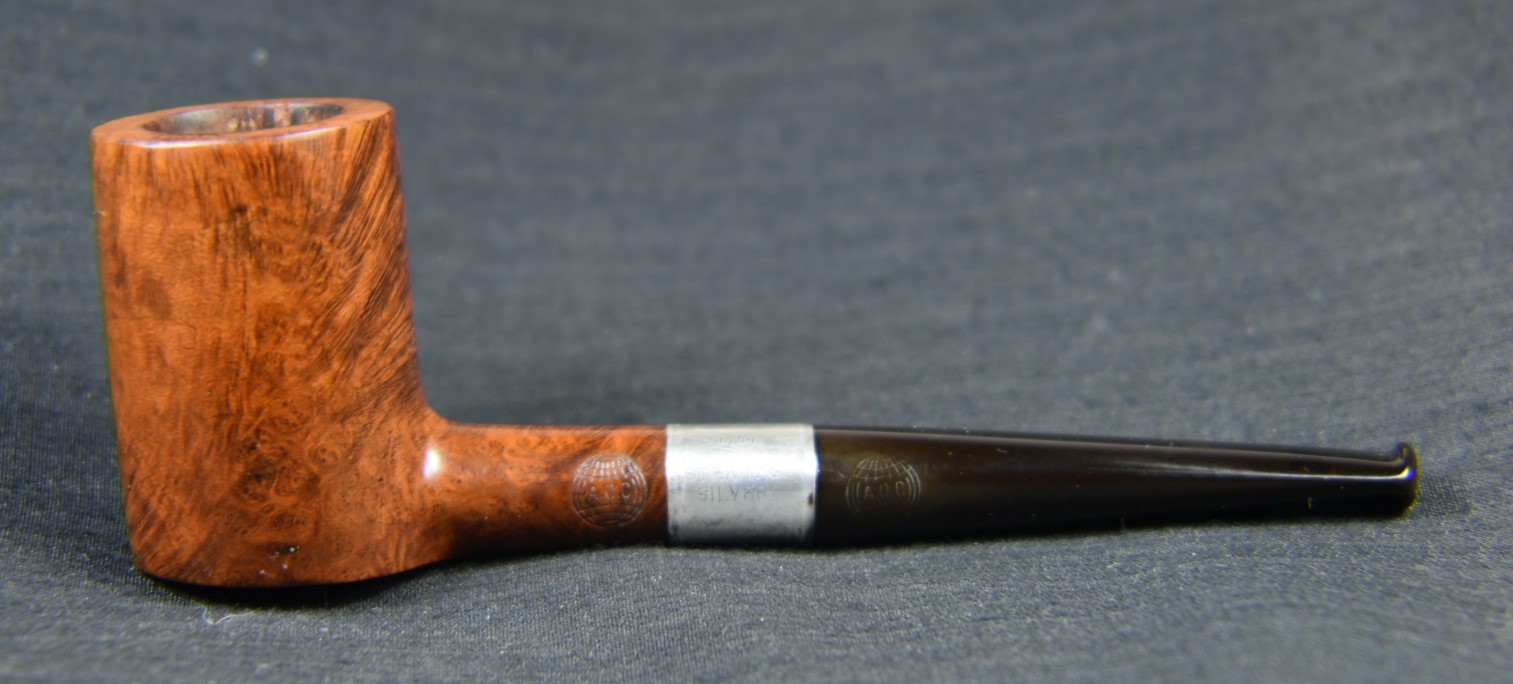
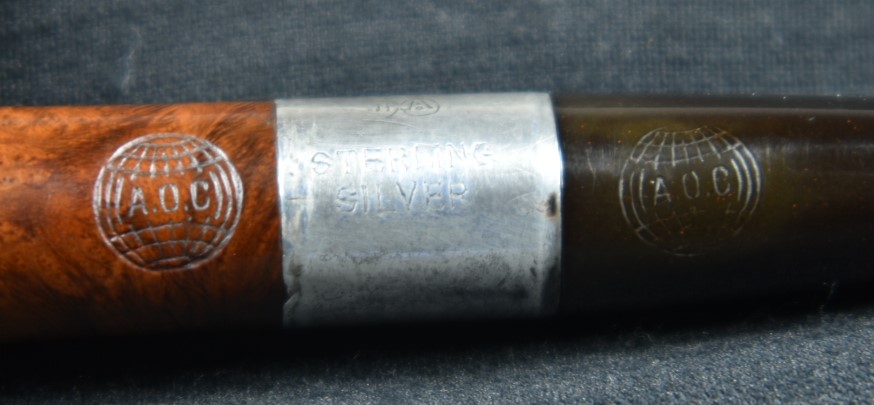
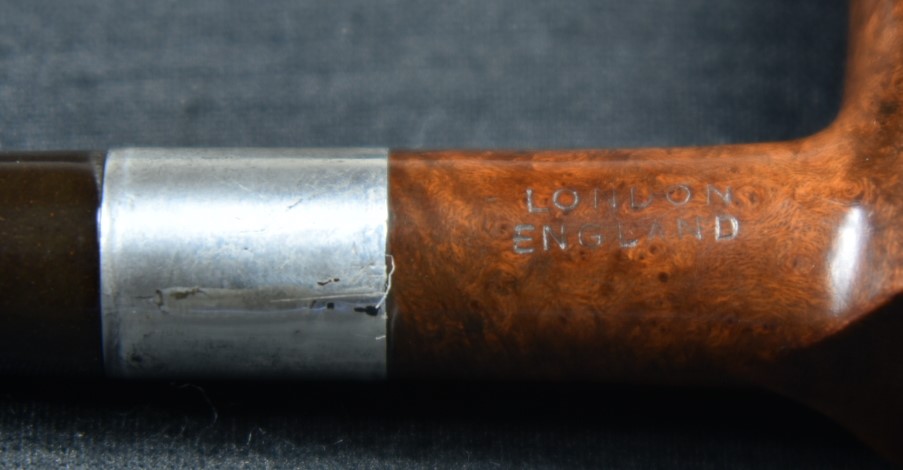
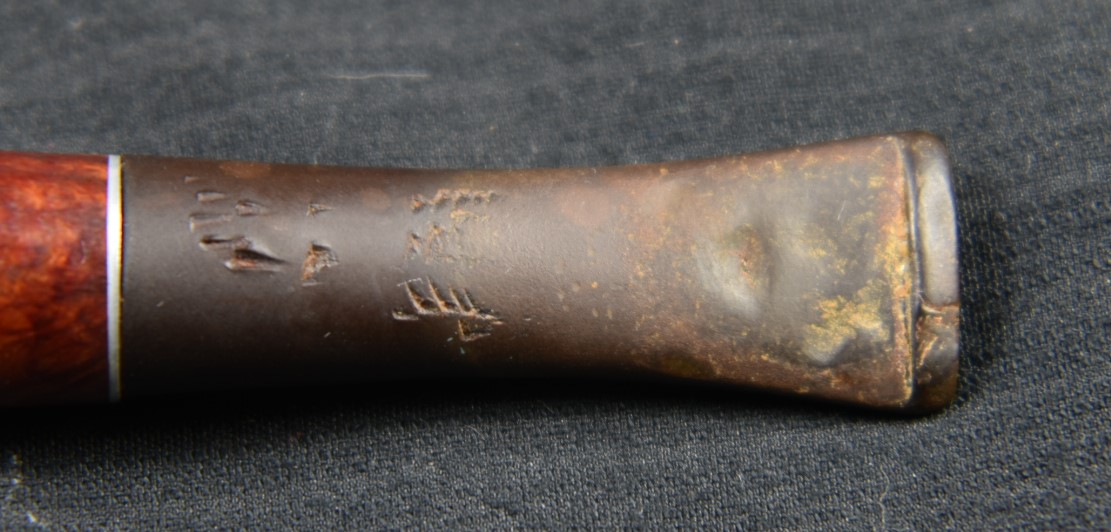
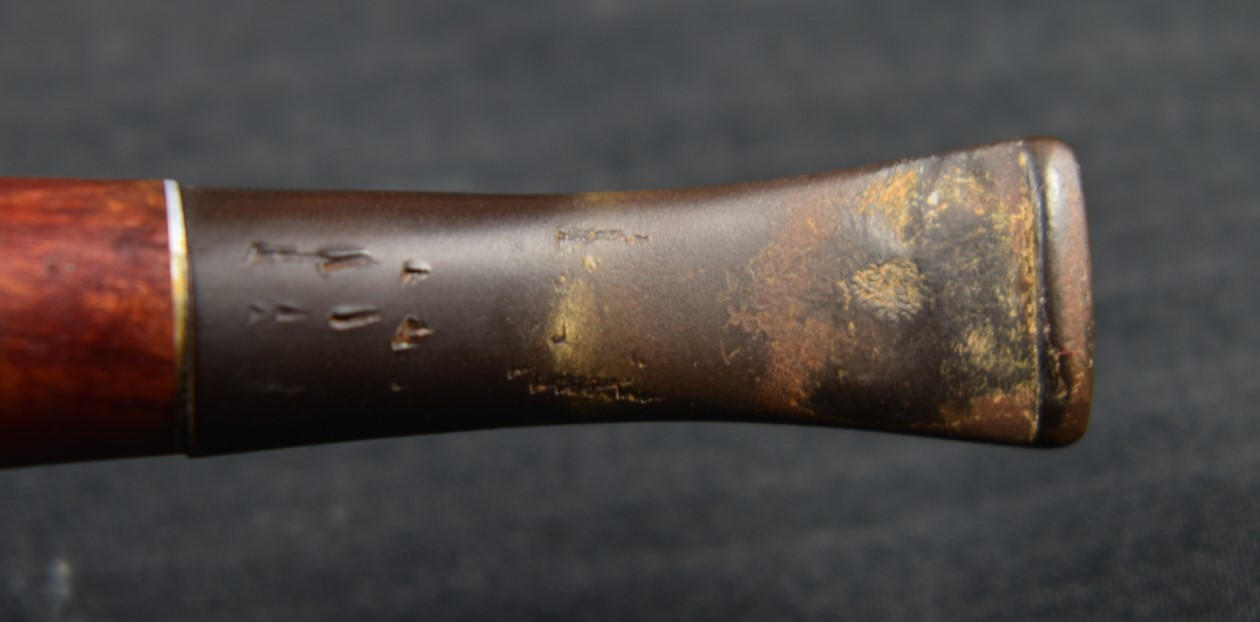
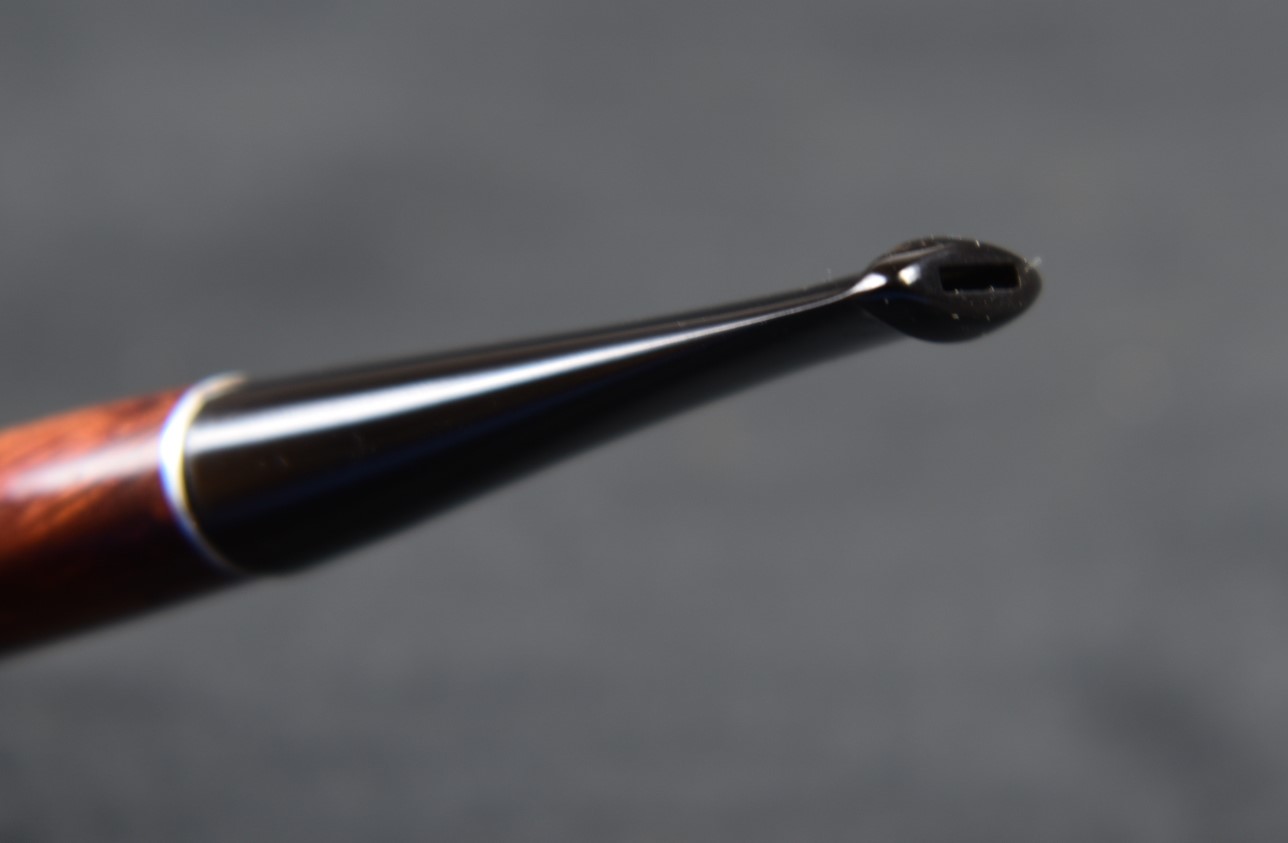
    I wasn’t even sure if there was wood under there as I could not see much grain.  The band read, STERLING SILVER but it appeared more like a black plastic.  The stampings on the shank were clear showing what appeared to be a globe with latitude and longitude lines surrounding the letters A.O.C. on the left and LONDON ENGLAND on the right.  The stem was stamped with a globe identical to the shank.  The button was the type I’d seen on pipes dating to pre-1920.  This old style bit is called orific.  Steve Laug did a nice article on “Whatever Happened to the Orific Button?” (used with permission of S. Laug).  Steve says the following of the pipes in his collection “are all older pipes with stems made of a variety of materials – amber, vulcanite, Bakelite and horn. In this group there are 45-50 pipes with this type of airway. All of them come from the mid to late 1800s and the early 1900s, literally another time and place.”

    Oppenheimer Background

    According to pipedia:

    “The Oppenheimer Group was a British holding company, which through the Cadogan company had various pipe brands. It was founded in 1860 by Charles Oppenheimer, along with brothers Adolphe and David, and Charles’s brother-in-law, Louis Adler. They established connections with GBD in 1870. With business interests in Saint-Claude, Oppenheimer bought the Marechal Ruchon & Cie. factory, which from then on had two directors in London (Adolphe Oppenheimer and James Adler, son of Louis Adler), and two in Paris (August Marécel and Ferdinand Ruchon). In 1906, the group built a large factory in Saint-Claude, under the direction of Lucien Verguet, which led to the merger of Sina & Cie. and C.J. Verguet Freres. In 1920, the London factory took over A. Frankau, which produced BBB. Between the wars, Oppenheimer assumed the management of Ropp and used countless pipe factories around the world. In the 1970s, with the creation of Cadogan France, which had the GBD, Chacom, and Ropp brands, the last two being sold later, it separated from its English partner. [1] (https://pipedia.org/wiki/Oppenheimer_Pipe)

    Wow, I had to read that paragraph several times to wrap my damaged brain around all that was written.  I think the pertinent information to this pipe are the 1870 and 1906 dates.  That would have been times when Adolphe was still alive and directing production.  I am assuming here that a line of pipes with one’s name would occur while the one is still alive.  It would also fit with the existence of the orific button on the stem of this pipe.

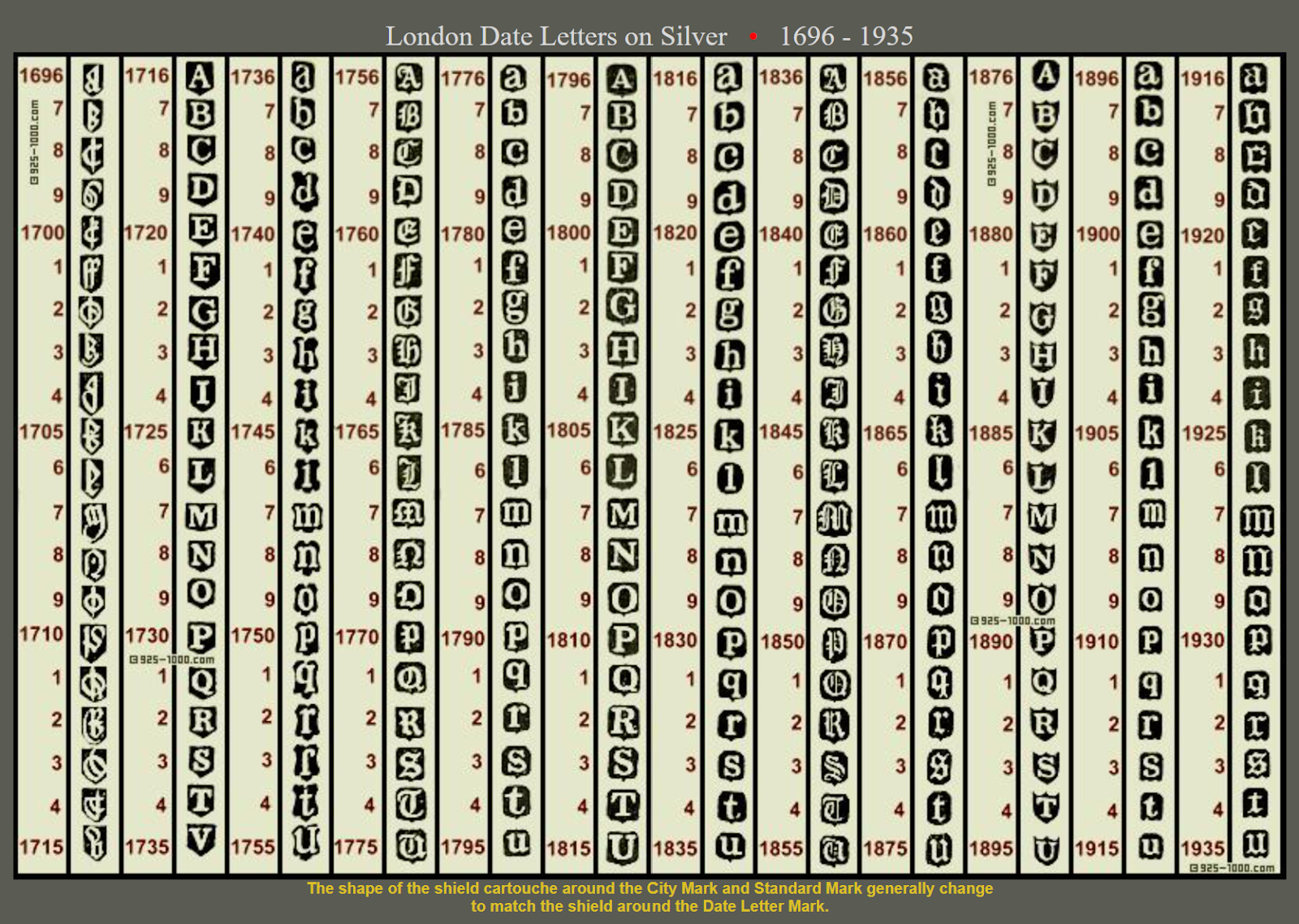
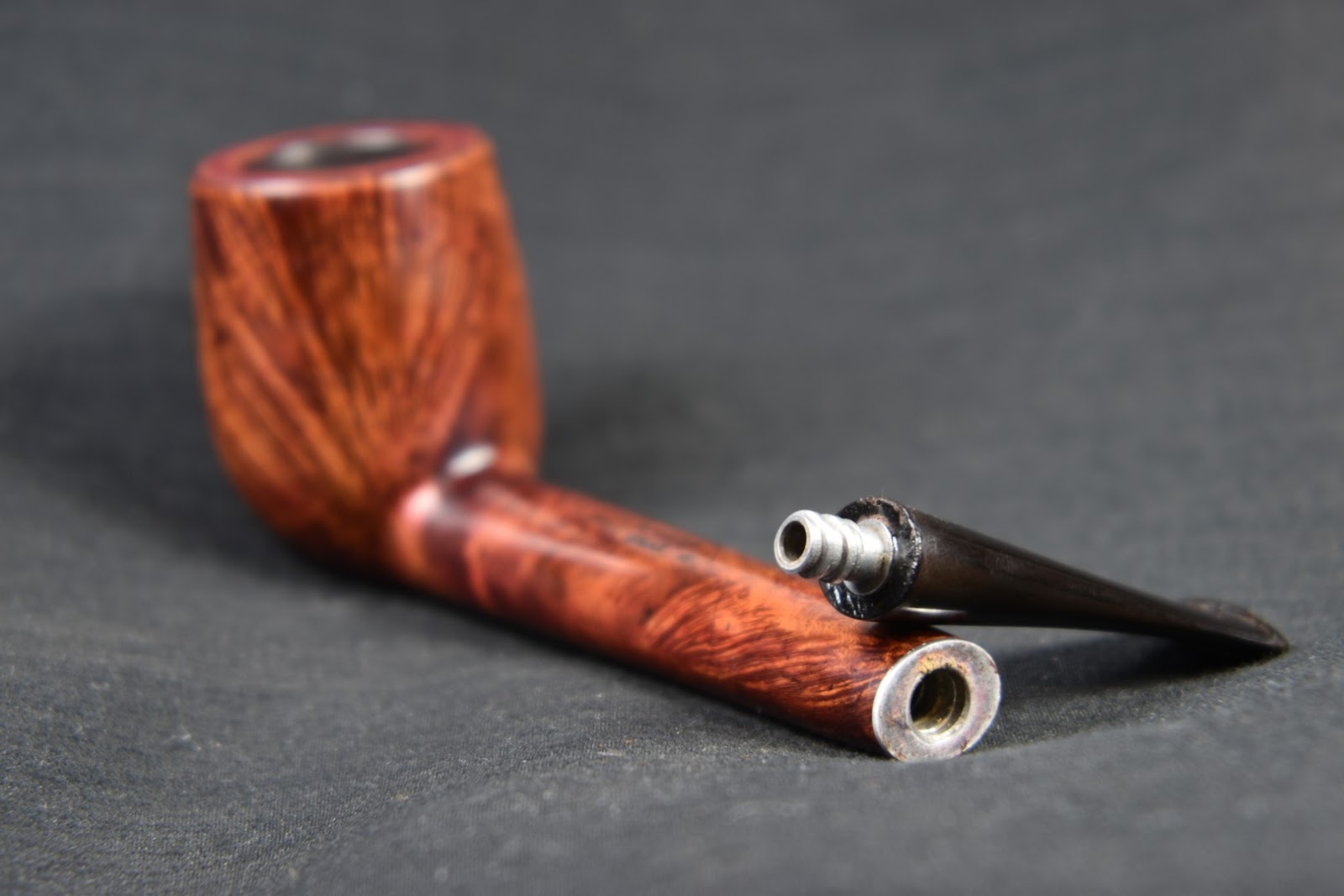
    Looking closely at the stamping on the silver band the left marks are illegible but the right mark is definitely a capital “A”.  Assuming that the pipe was indeed made in London, as indicated by the stamp, it would be relatively safe to assume the silver stamp would be that of the London assay office.  Below are the London assay date letter associated with their respective years.  1876 is an “A”. 

    (https://www.925-1000.com/dlLondon.html)

    I think the date stamp pretty much locks this providence of this pipe up.  It is an Adolphe Oppenheimer Company poker made in London England with a silver hallmark stamp indicating manufacture date of 1876. 

    I came across a few other interesting tidbits while researching this pipe.  I’ll leave the links for those who might find them interesting.

    History of Vulcanite (https://pipesmagazine.com/forums/threads/history-of-vulcanite-article.37354/)

    Smokingpipes.com example of an AOC  (https://www.smokingpipes.com/pipes/estate/england/moreinfo.cfm?product_id=533251)

    Pens Pipes and More video of an AOC Bulldog

    (https://www.youtube.com/watch?v=5MkmBA4-F5c)

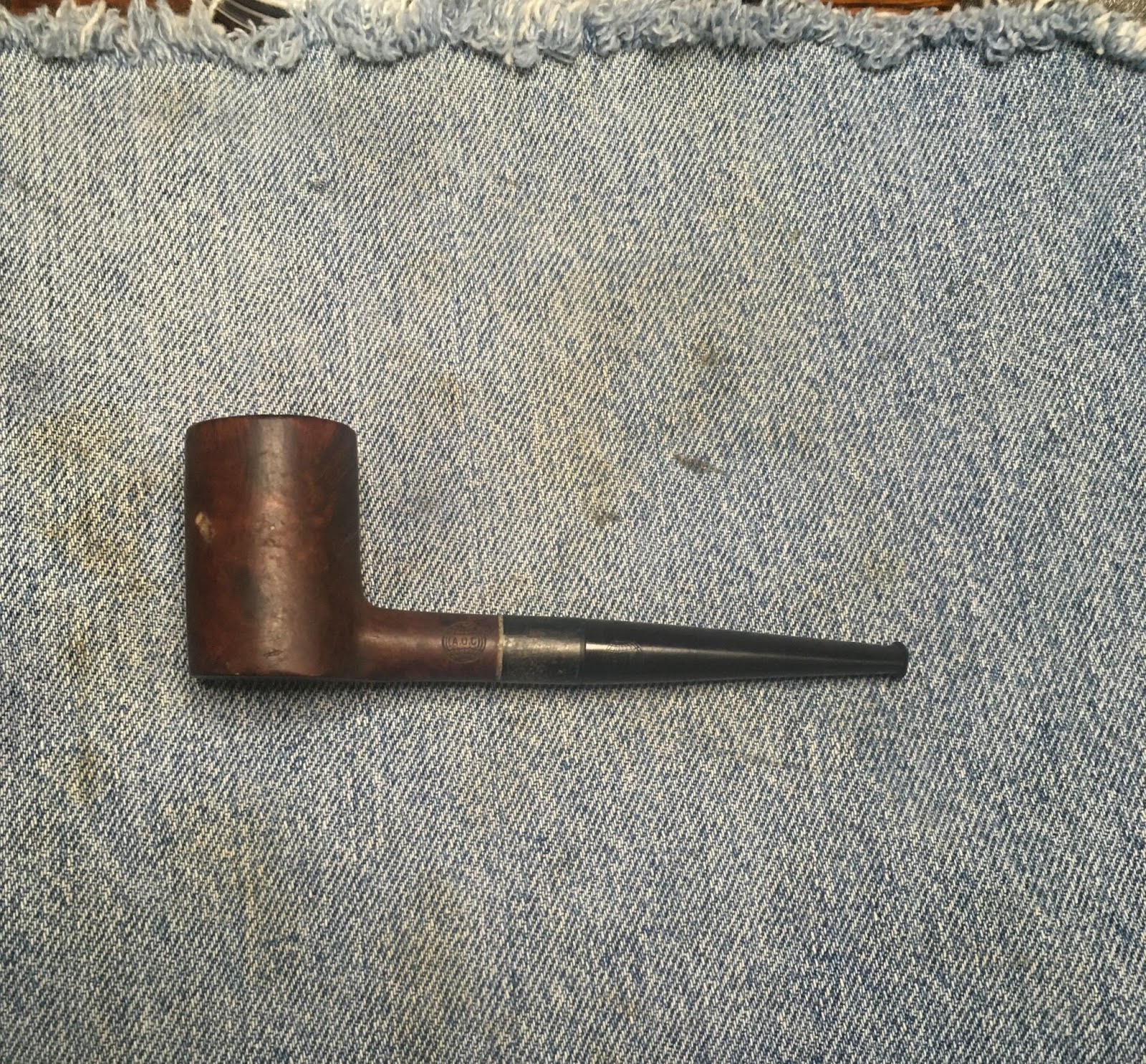
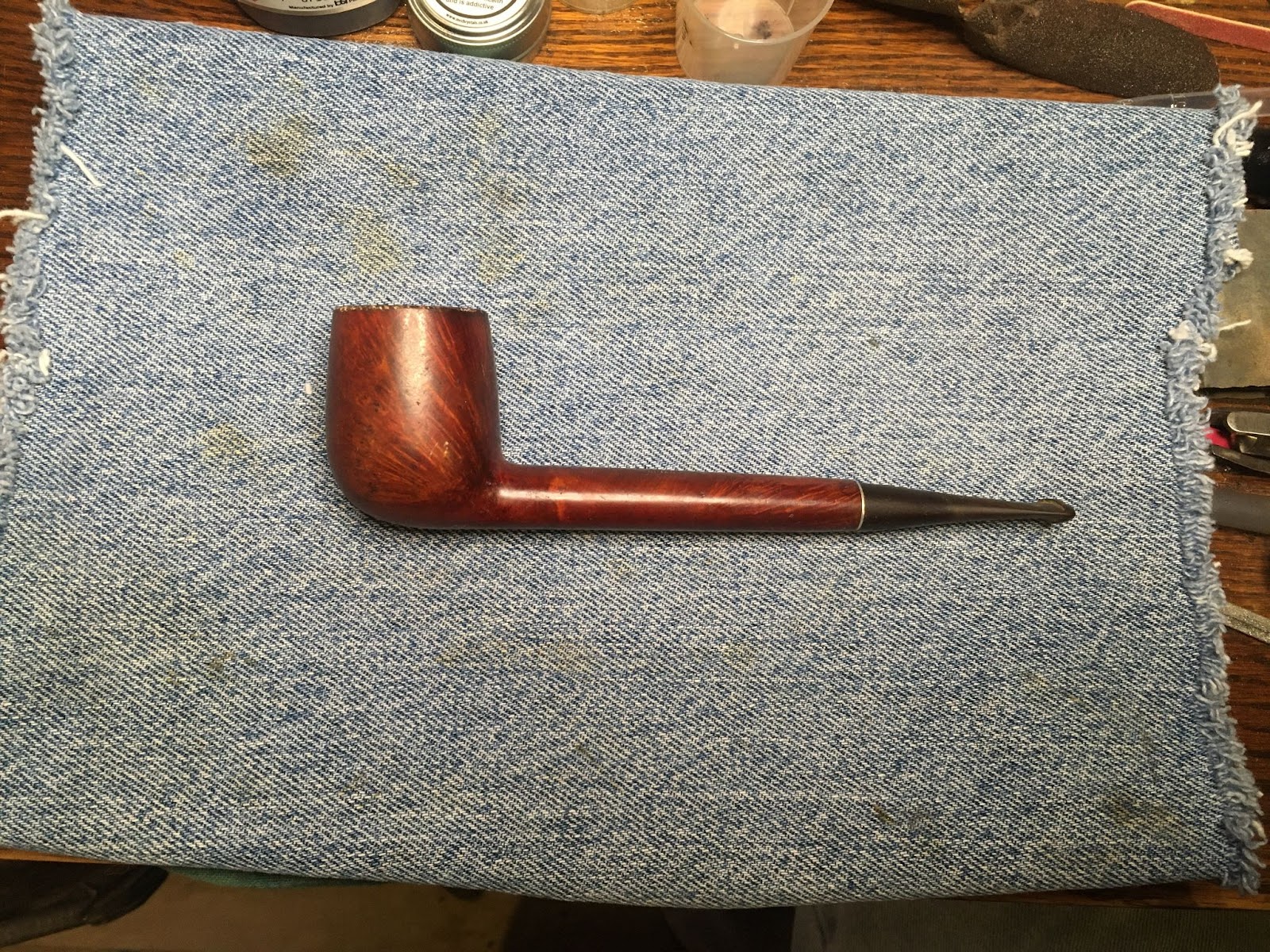
    The AOC Poker as it appeared prior to  any work being done.

    The Restoration

    As usual the pipe was moved to the workbench where it was placed on a clean denim piece.  I was most interested in seeing what was under the many years of grime that shrouded the briar.  That would have to wait a few more minutes.

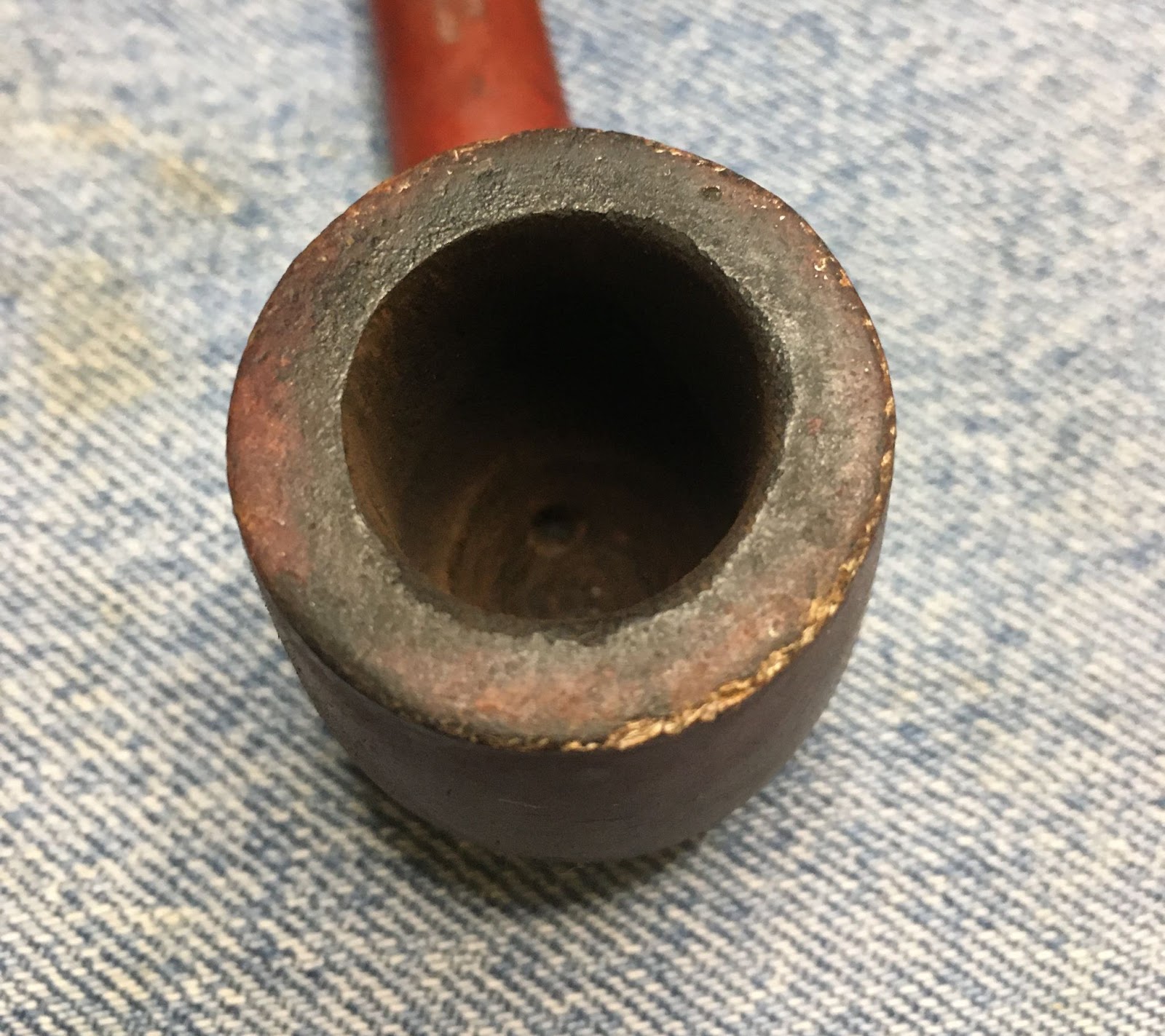
    Reaming the tobacco chamber was the first task to complete.  The pipe had been recently reamed so there was little for me to do.

    During this process the sterling silver band came loose.  The band was very thin and I thought that it would be easily damaged.

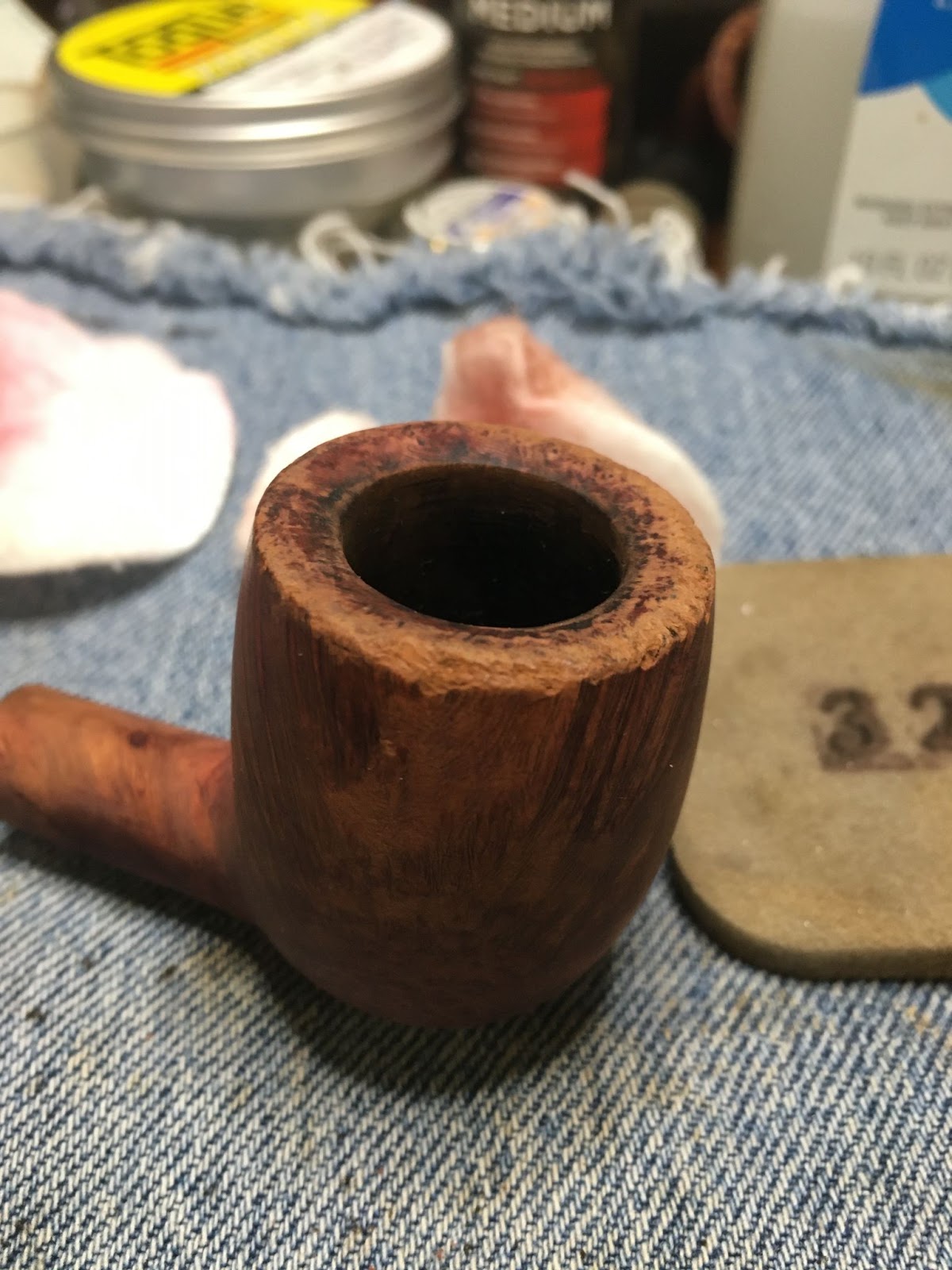
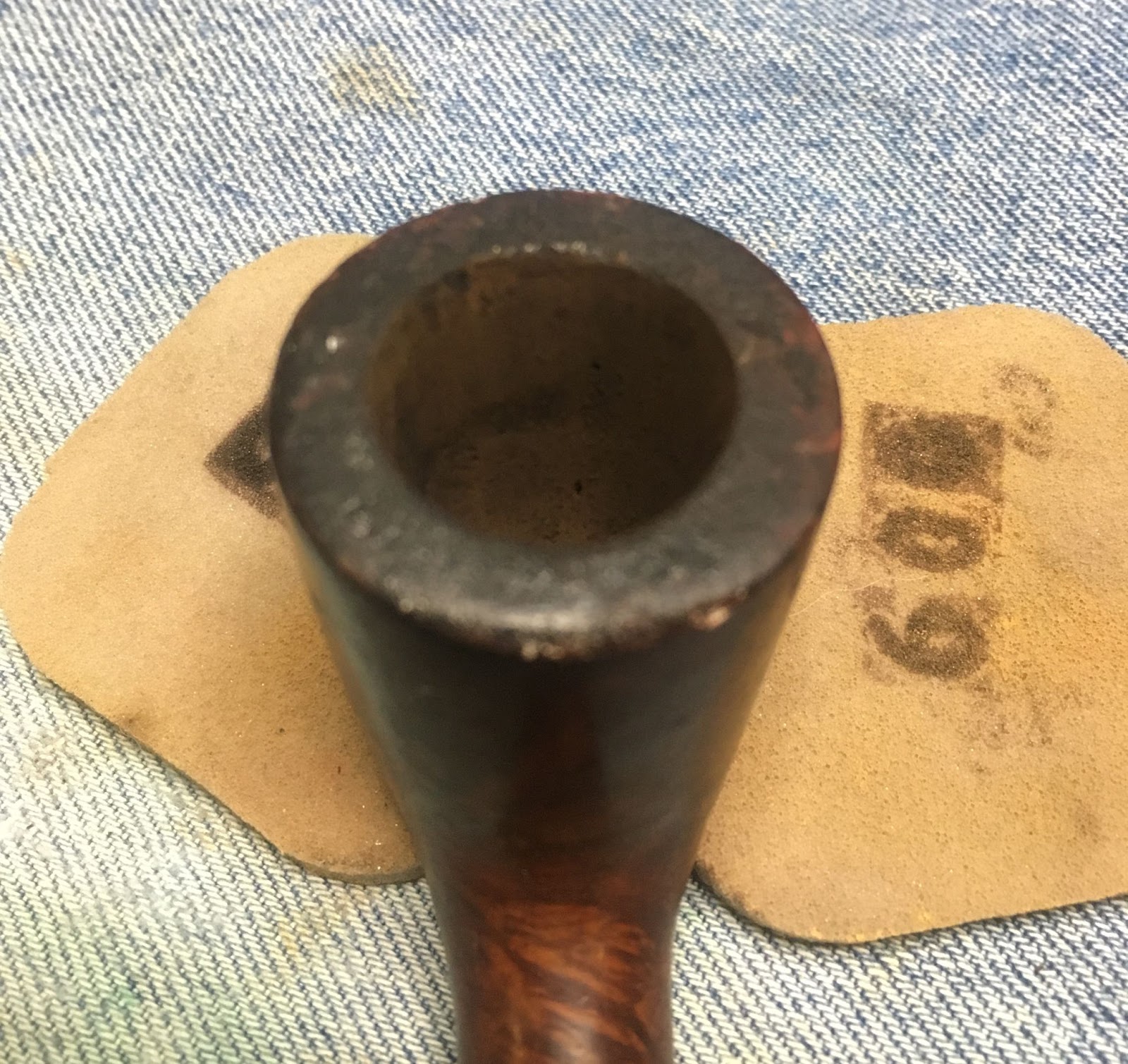
    After sanding the tobacco chamber, I needed to rid the rim of the lava deposits.

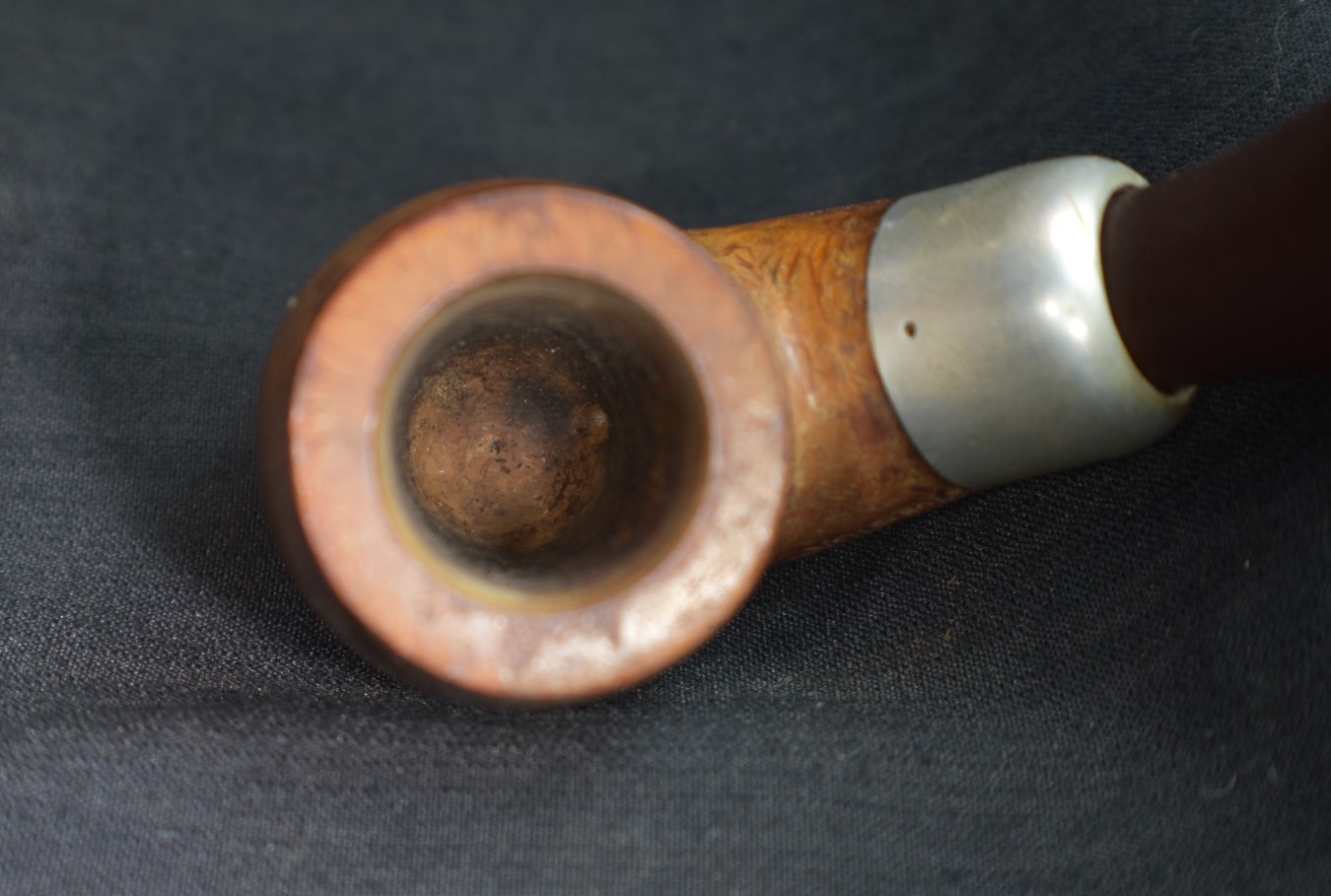
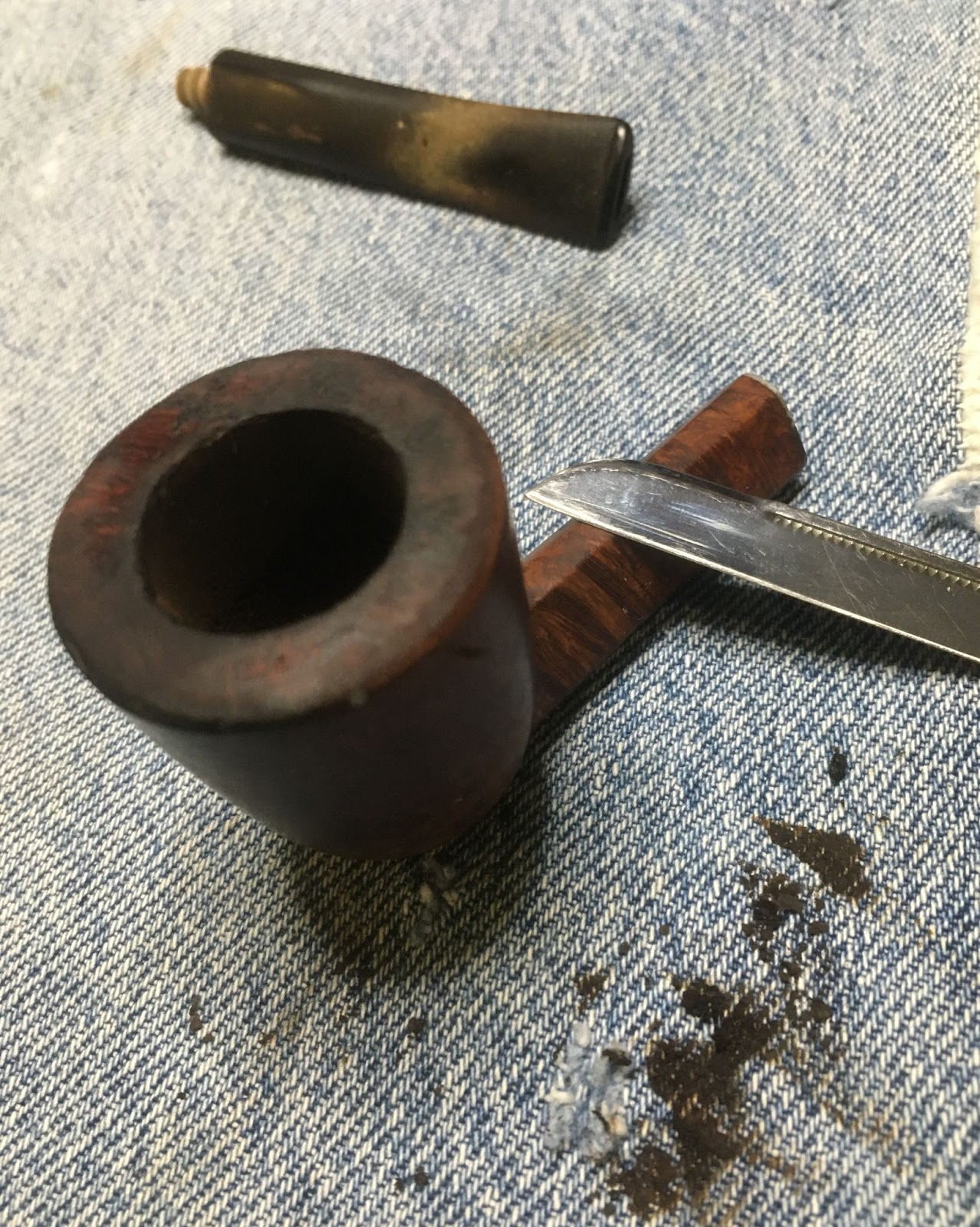
    The lava was moistened with saliva and scraped with a sharp pocket knife.  There were a couple of dents on the rim but it looked good and was free of charing.

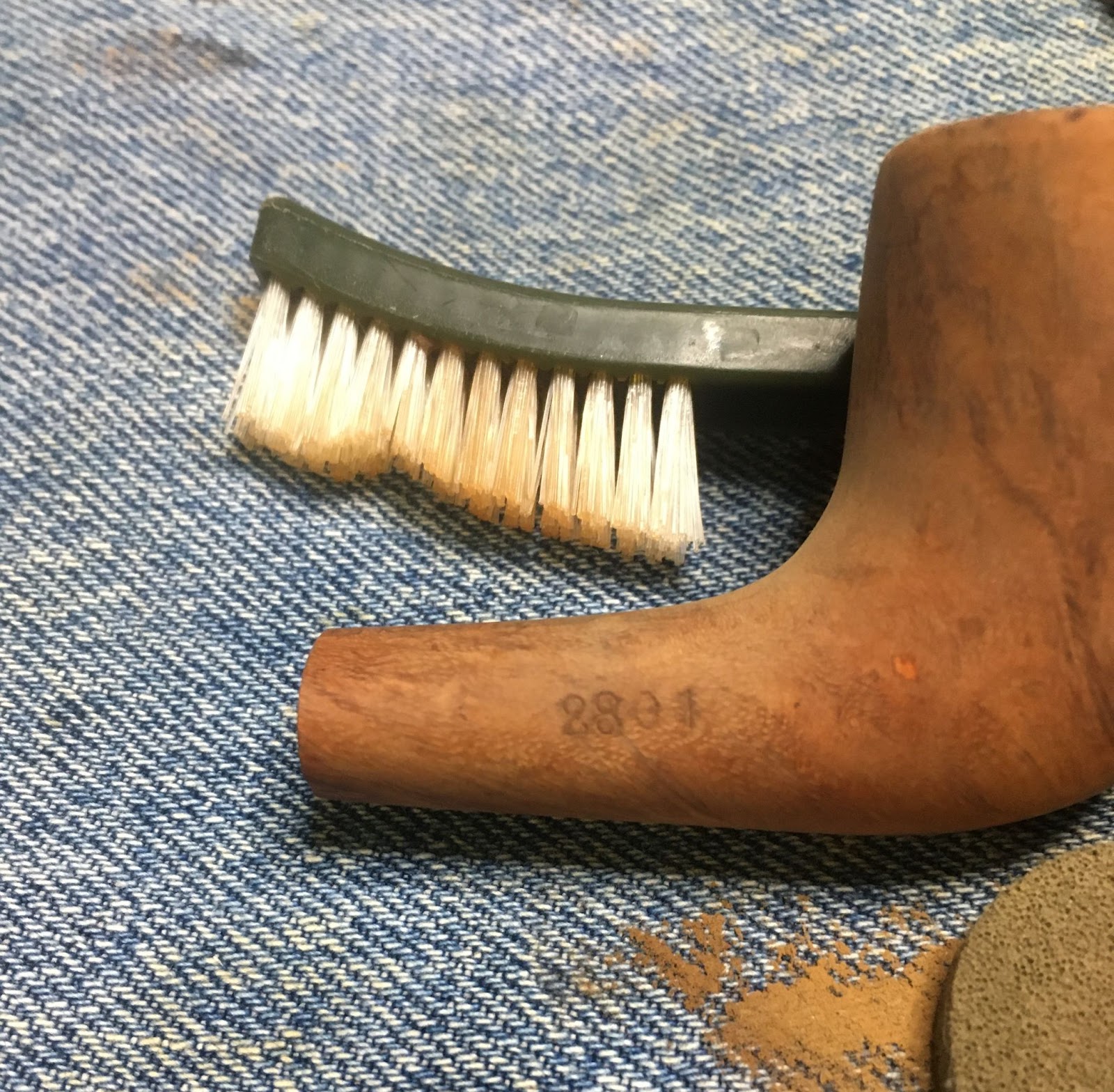
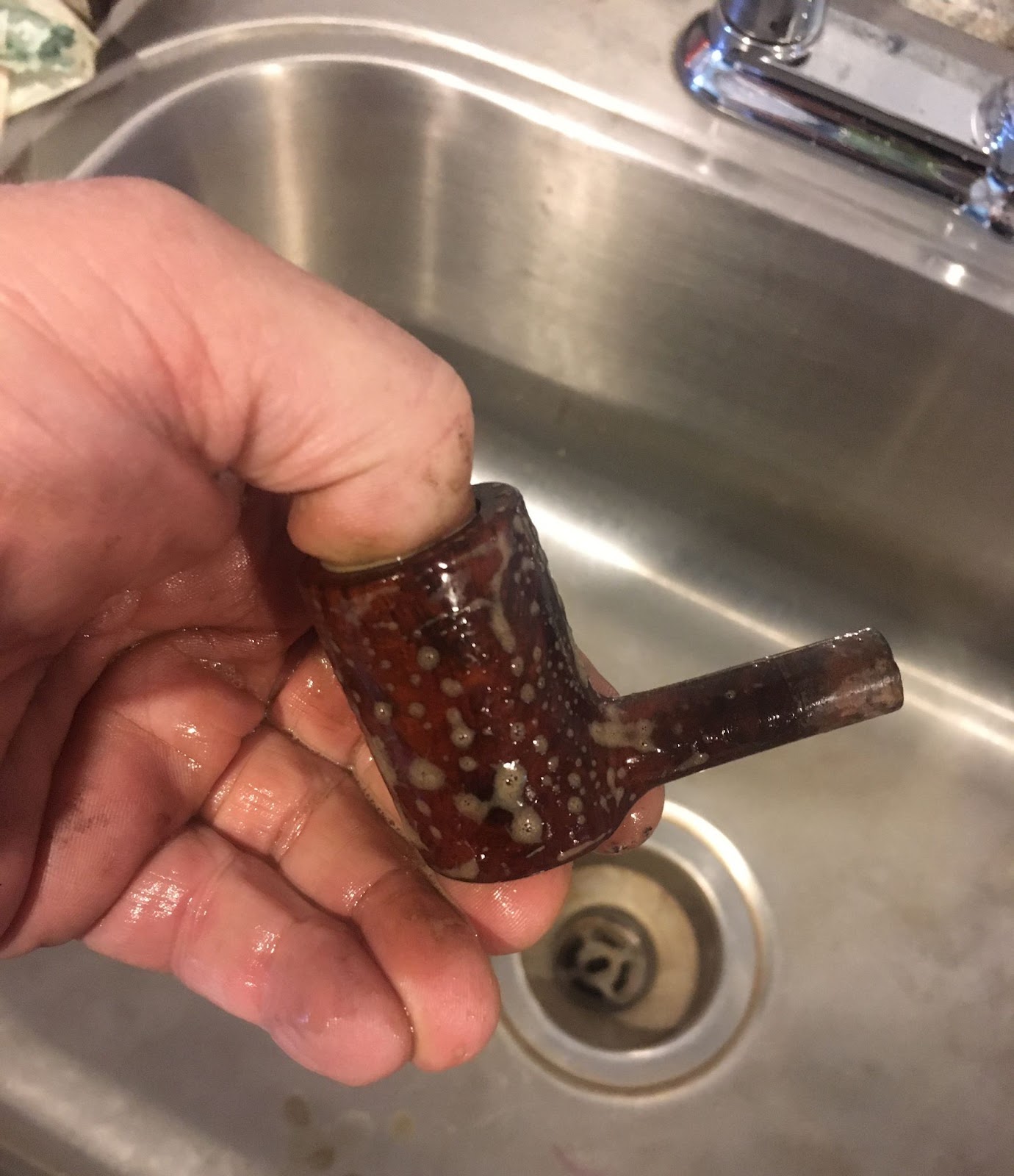
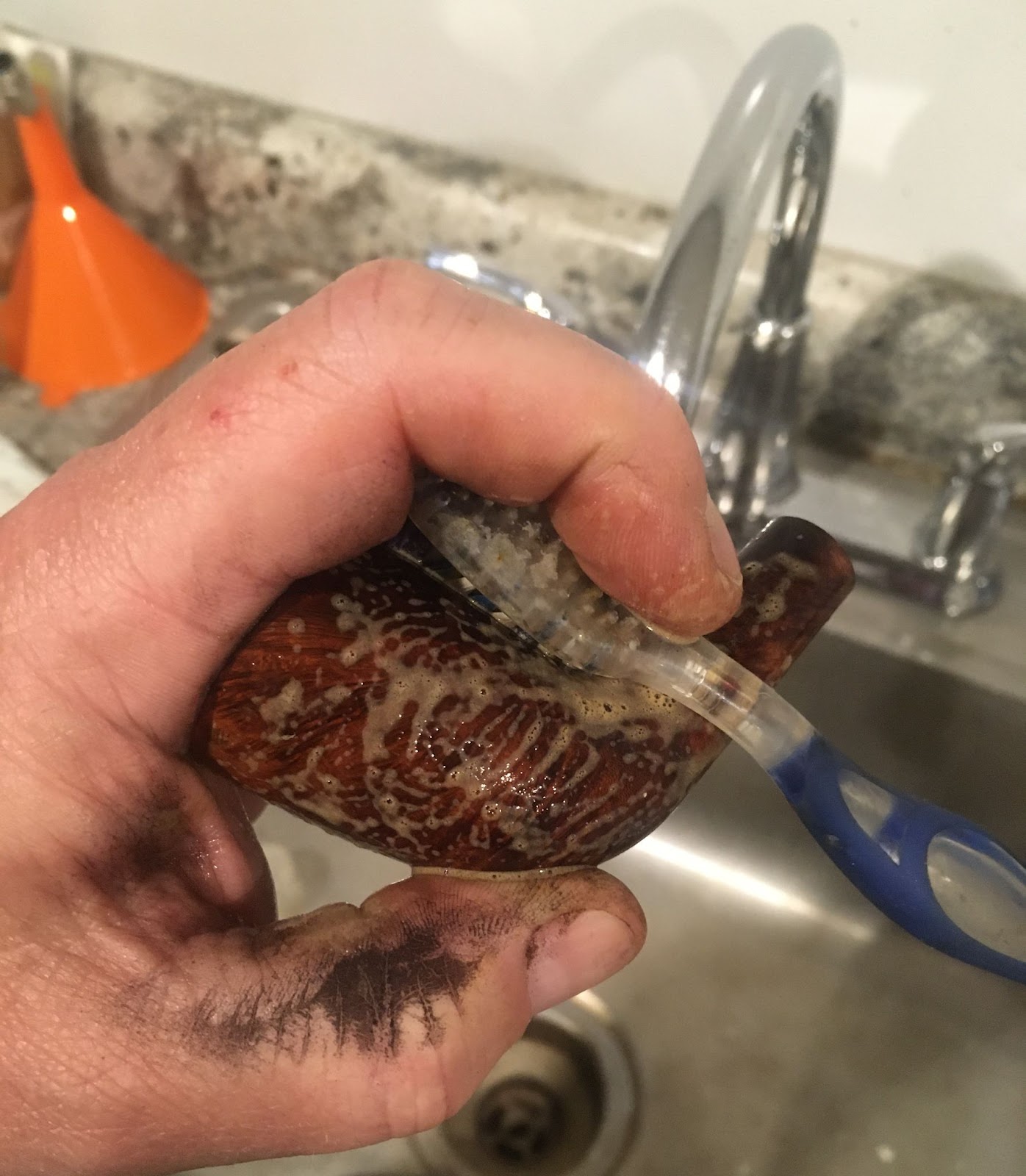
    Next was the moment I was most interested in, seeing what was under the grime.  I scrubbed the stummel with undiluted Murphy Oil Soap and a medium toothbrush.  The lather became gray with grime and was rinsed away with warm water.  I also used a nylon shank brush and a small amount of Dawn dish soap to scrub the airway of the shank.  This was also rinsed with warm water.  The stummel was dried with a cotton wash cloth and returned to the workbench. 

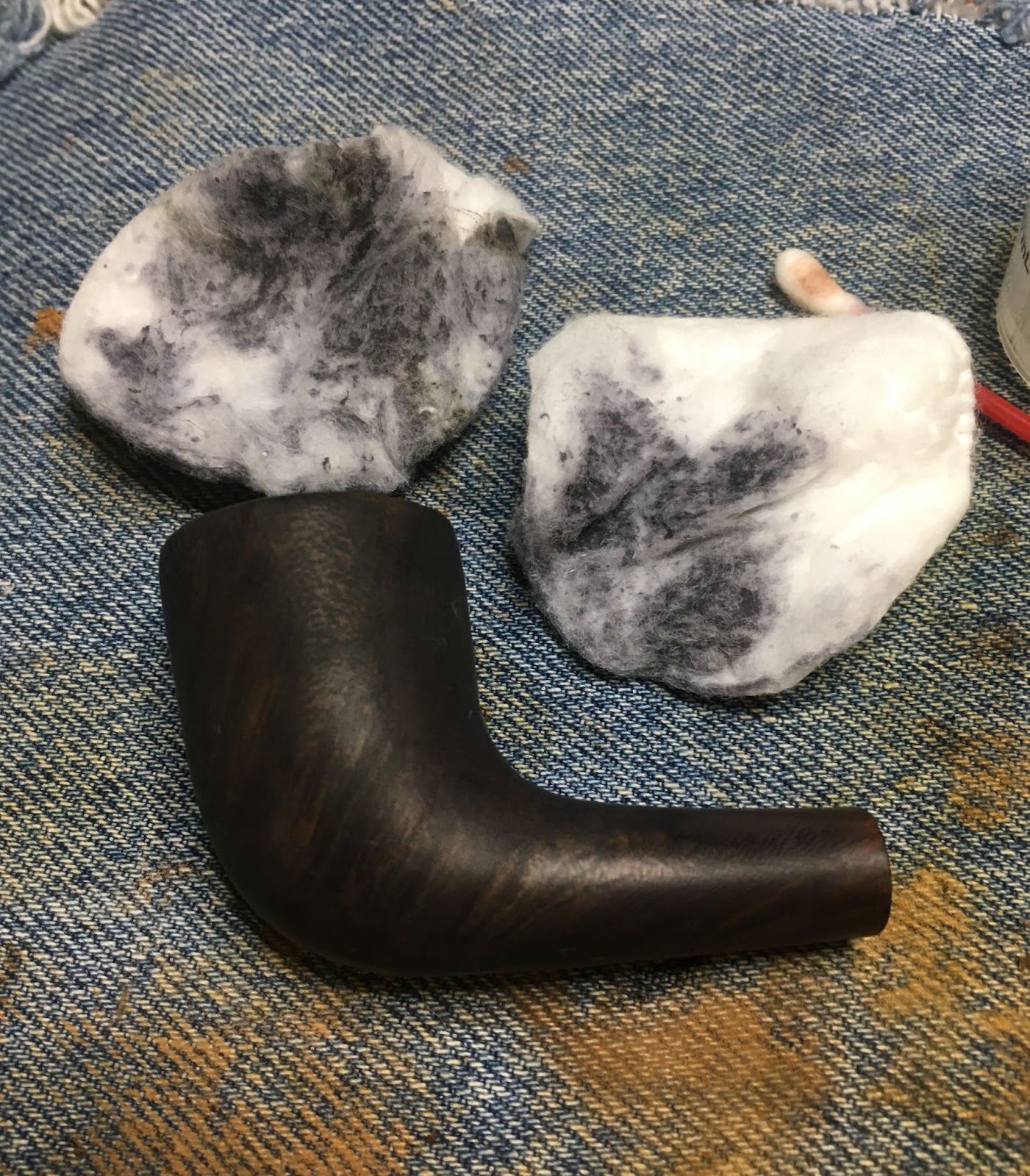
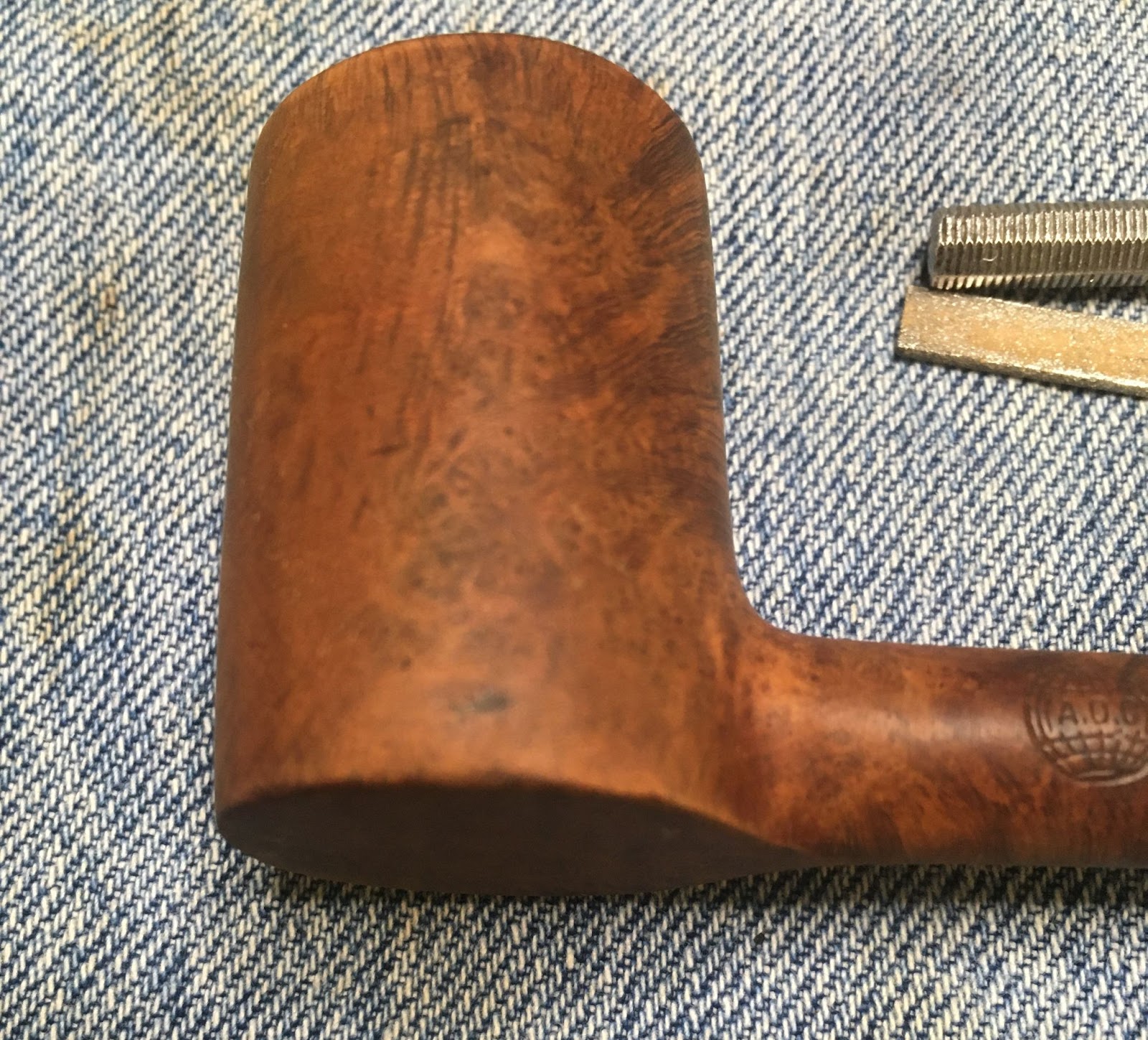
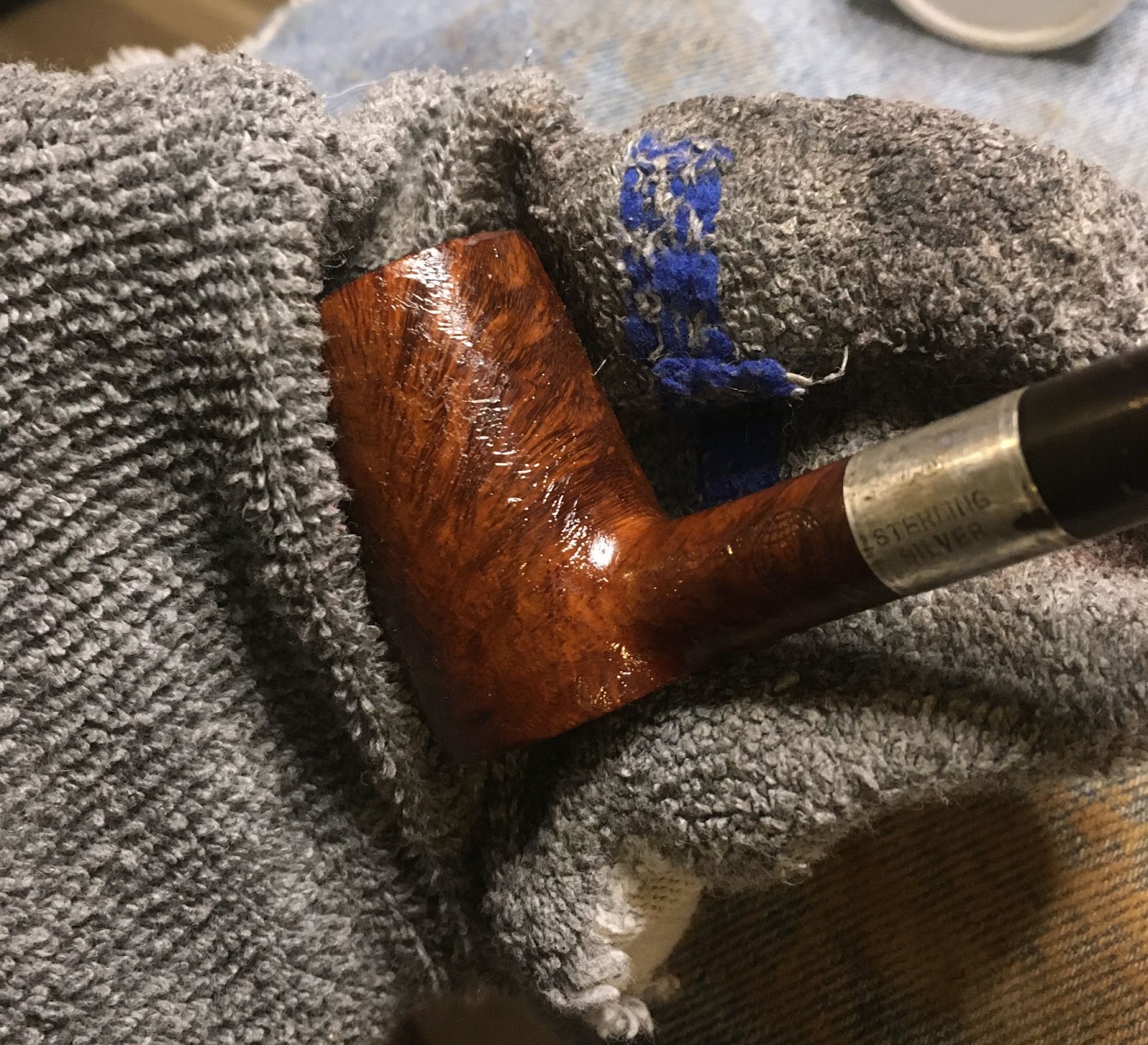
    At the workbench the stummel was wiped with a make-up pad dipped in 95% ethyl alcohol.  The pad changed color only slightly during the siping.  There was briar under the grime, yay!  The briar also had some nice grain.  The scrub and wiping also revealed a fairly large pit at the bottom of the left side.

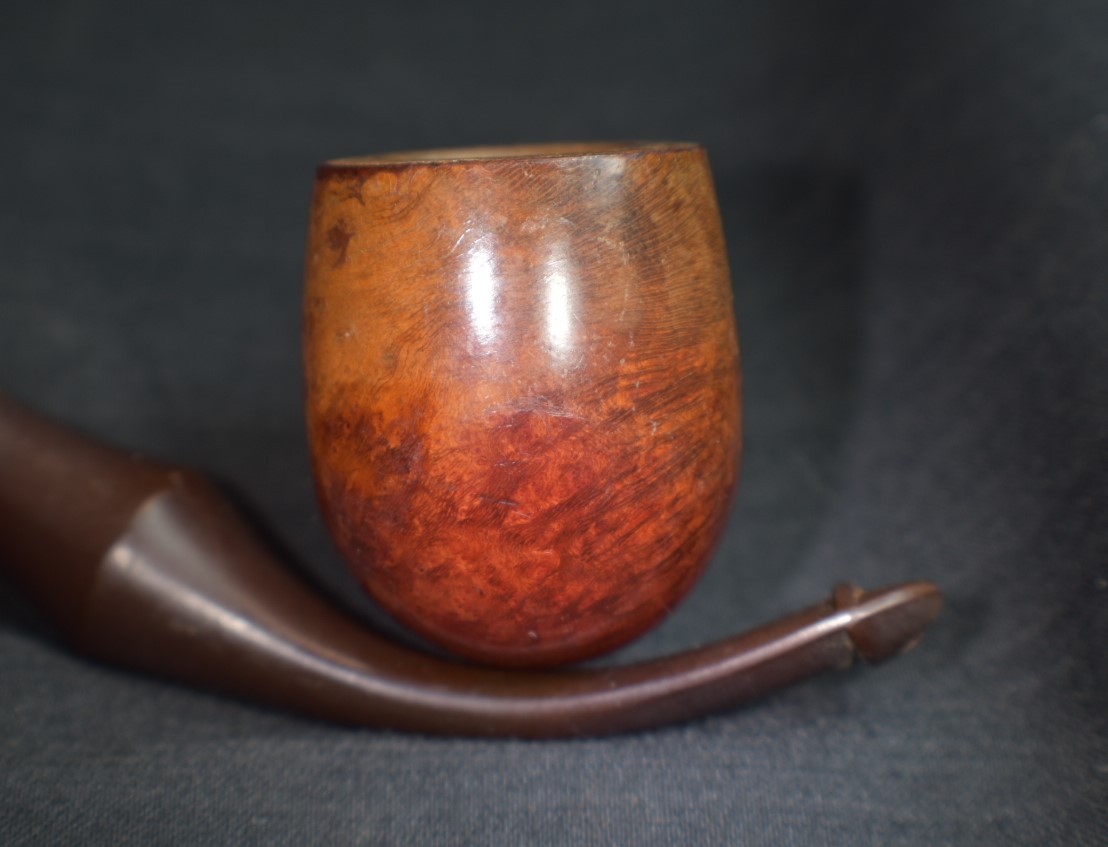
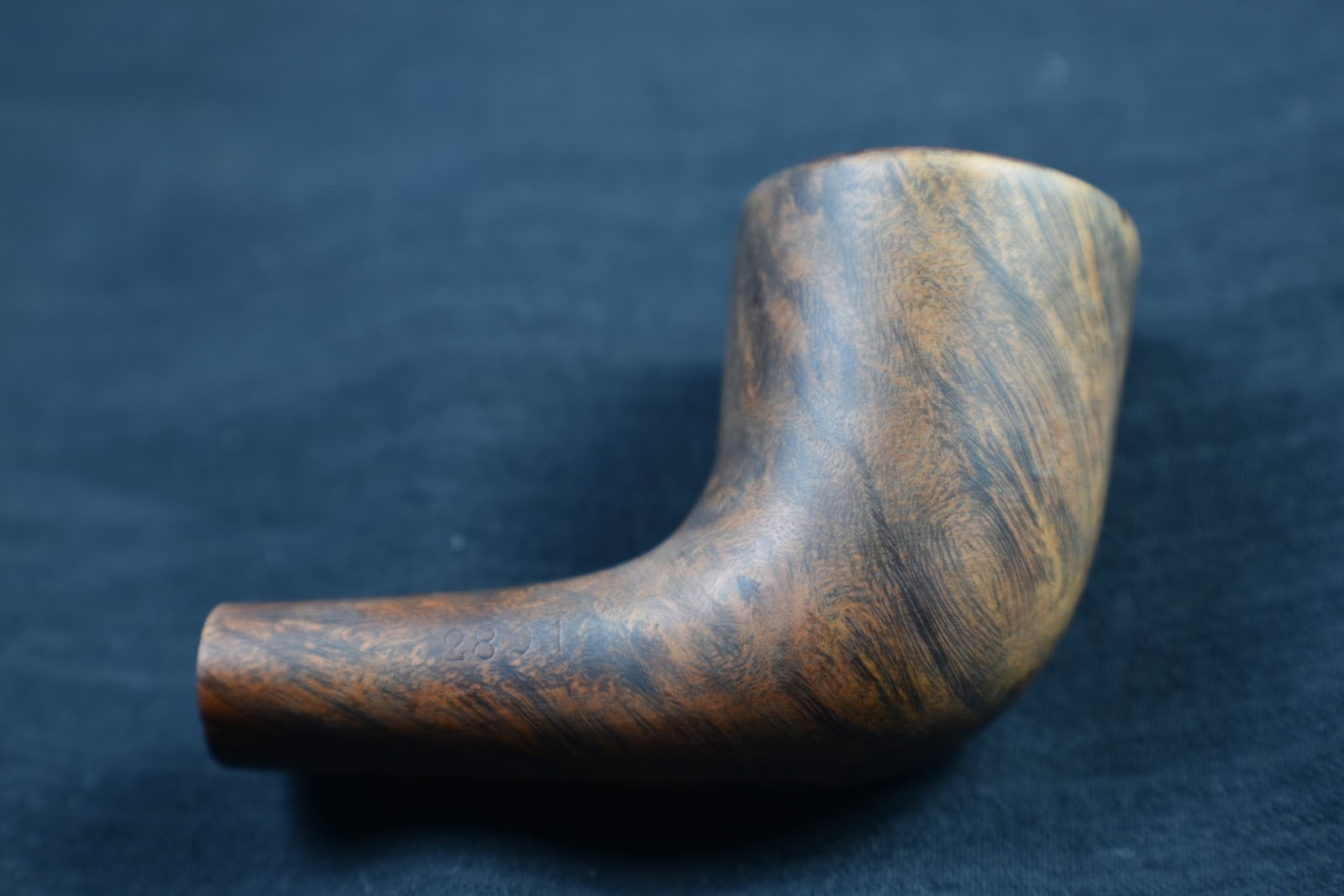
    The briar grain at the back of the bowl was the most attractive.

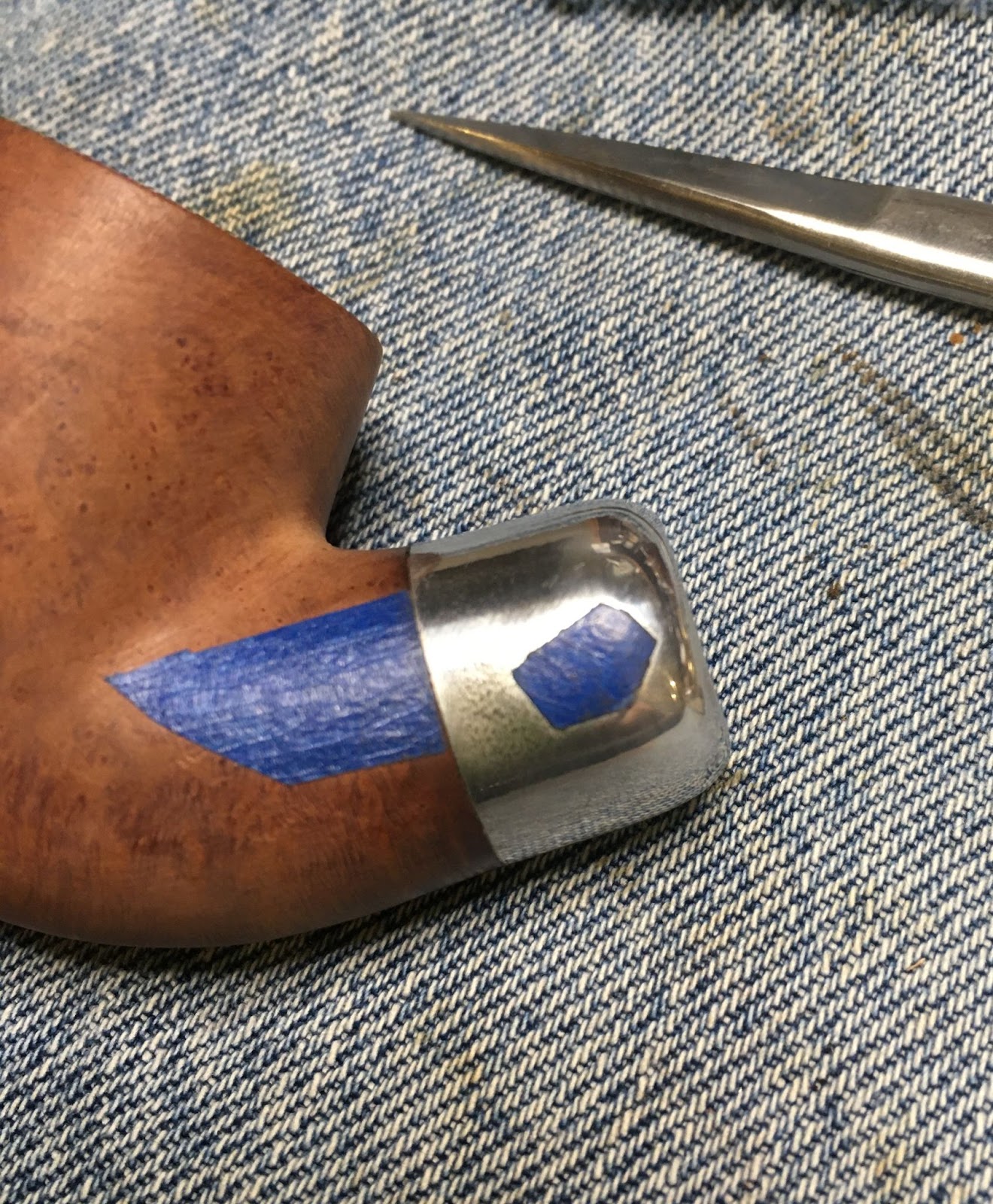
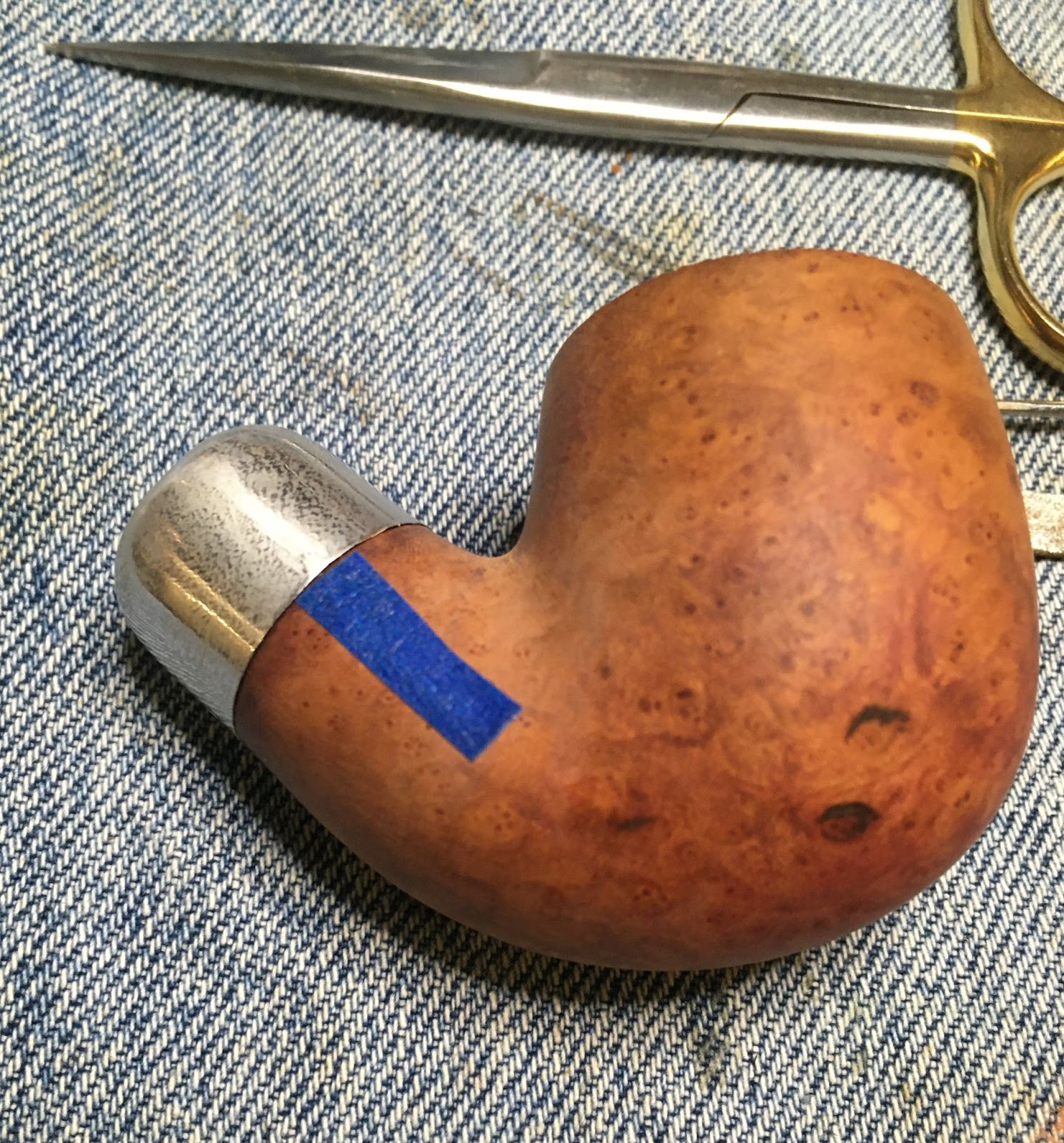
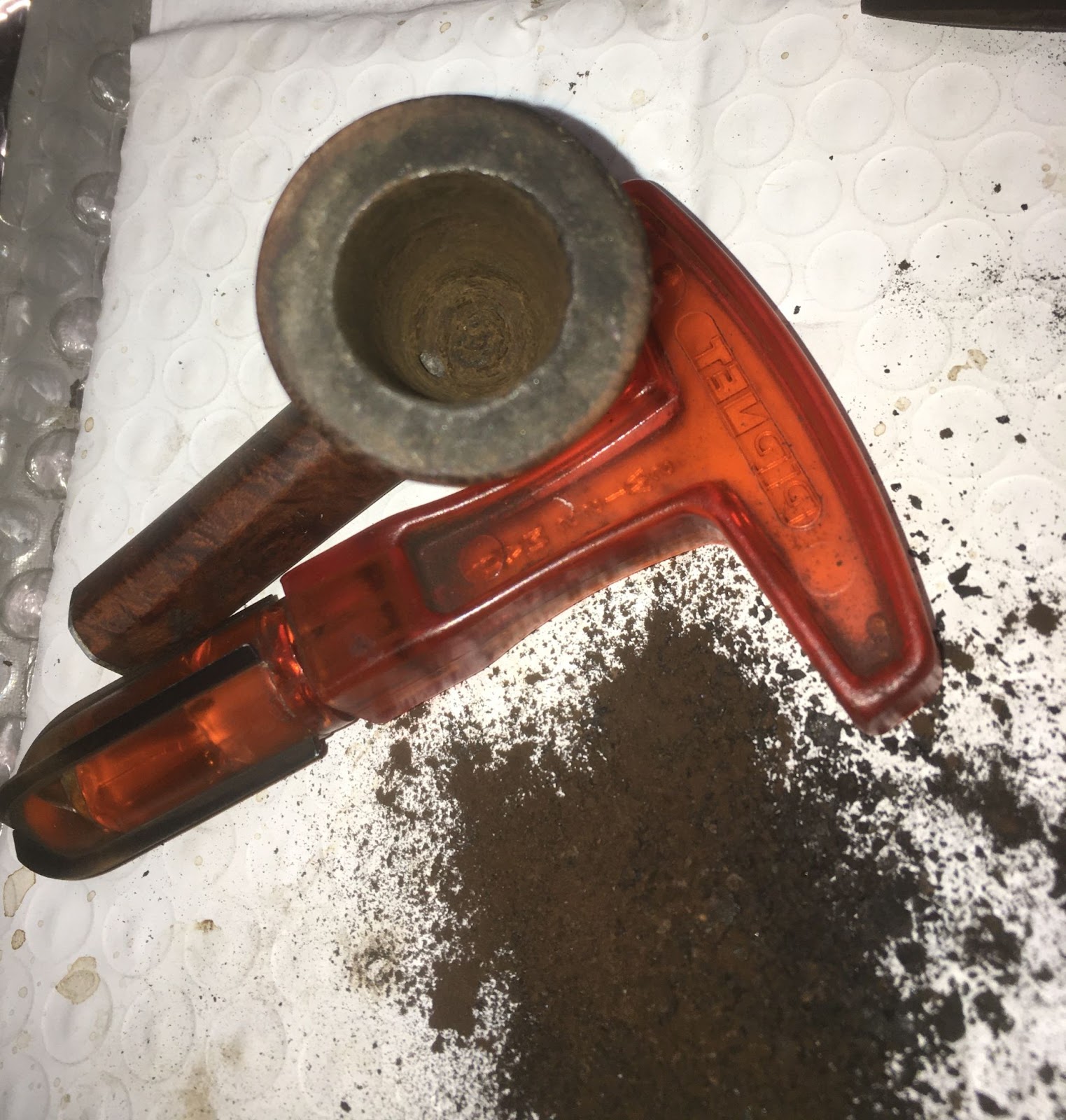
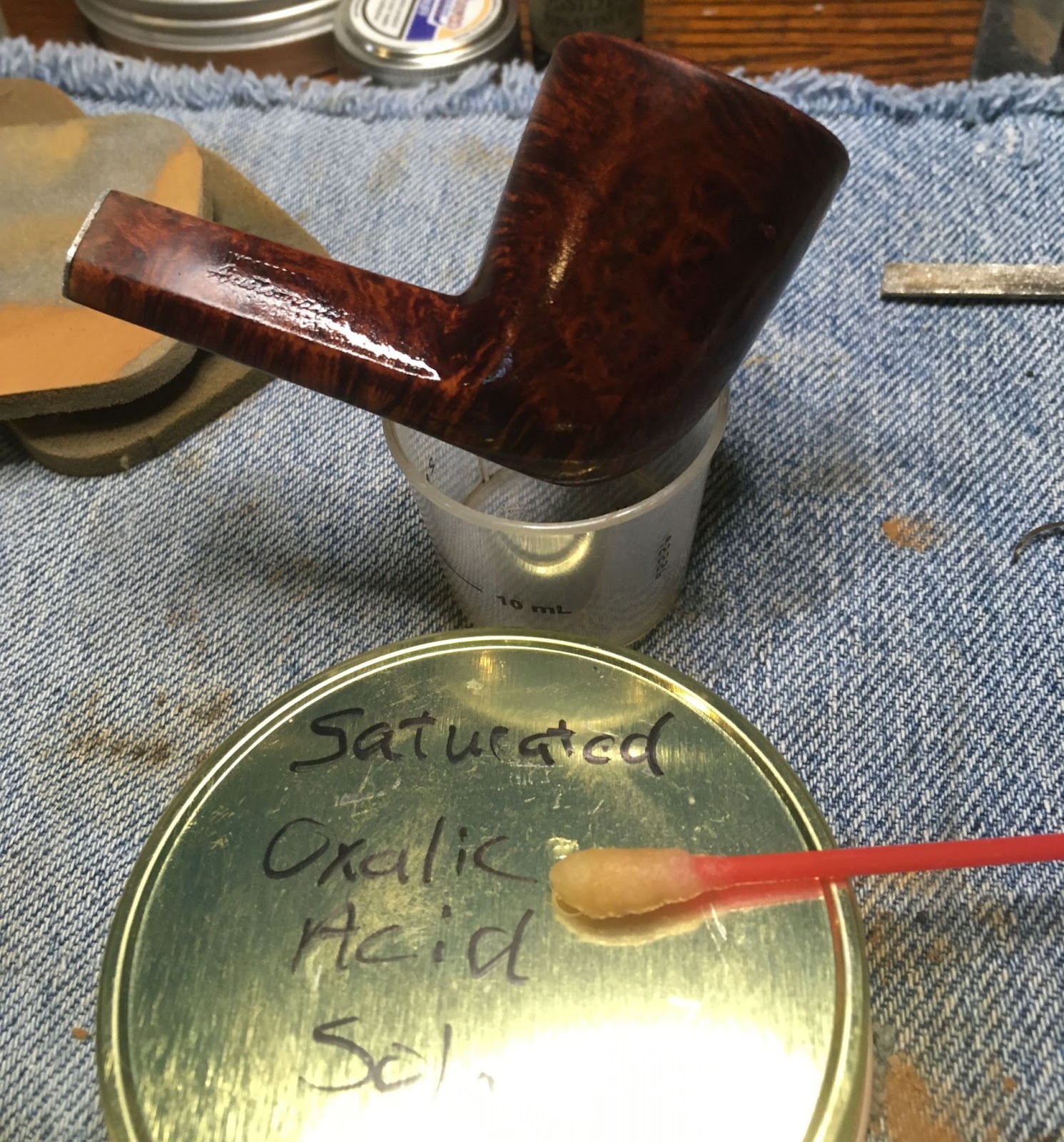
    I wanted to see how well the sterling silver would look after a cleaning.  The Cape Cod Metal Polishing Cloths were selected for this.  These clothes are moistened with  chemicals which I did not want to affect the briar.  I wrapped the briar with a layer of 3M Scotch tape. And proceeded to hand buff the band in situ on the shank inorder to retain the shape and protect the band.

    After a good deal of hand buffing the black tarnish was removed and the underlying silver could be seen.  Some areas of black stubbornly remained.

    The pit on the lower left side of the stummel needed to be filled.

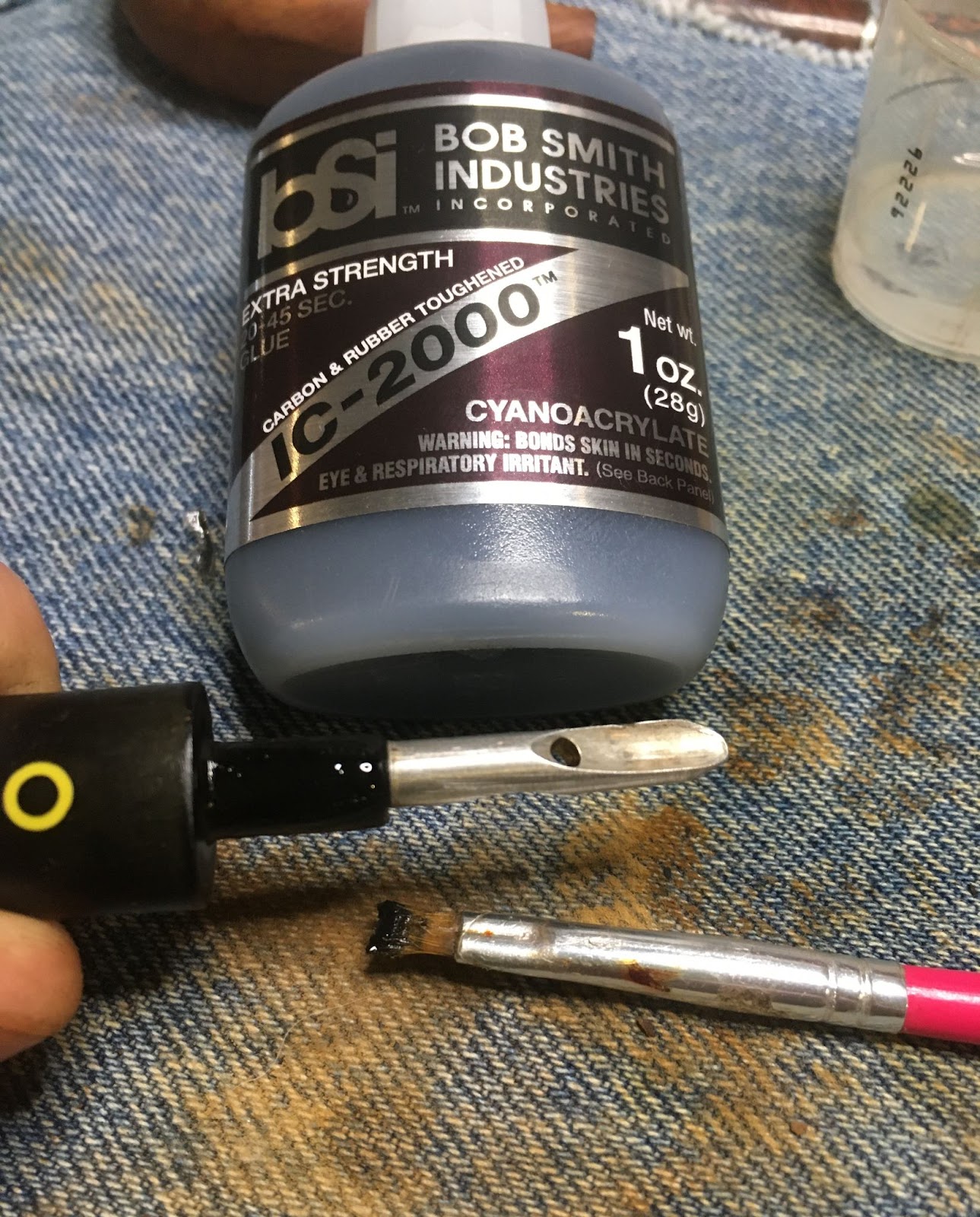
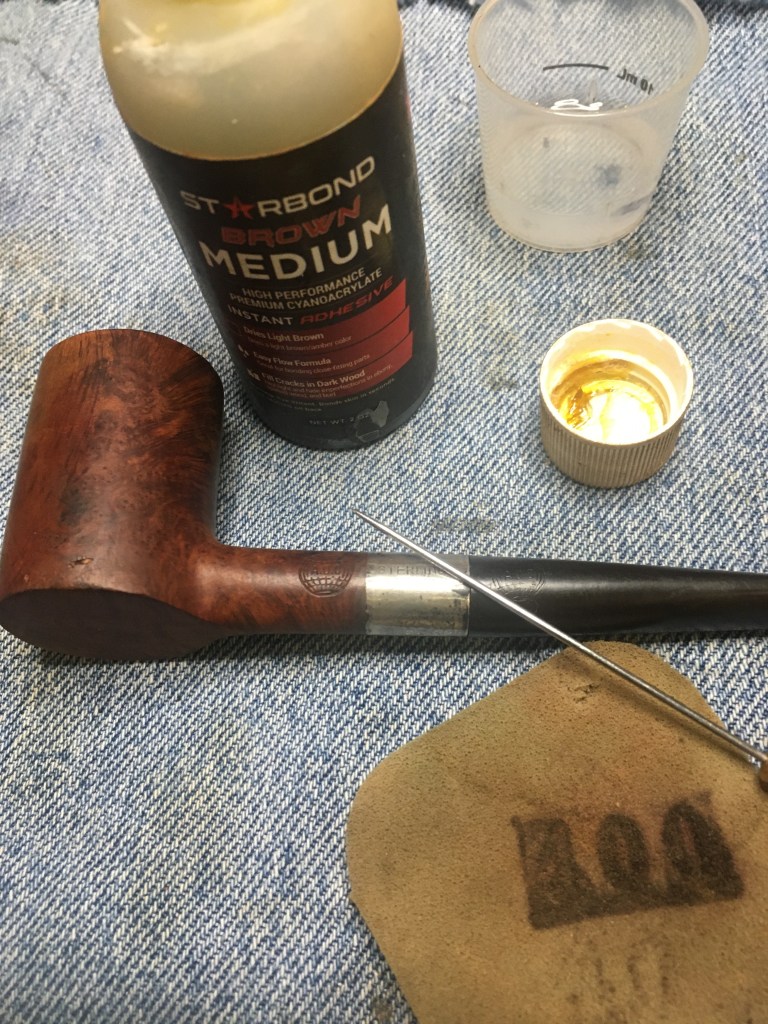
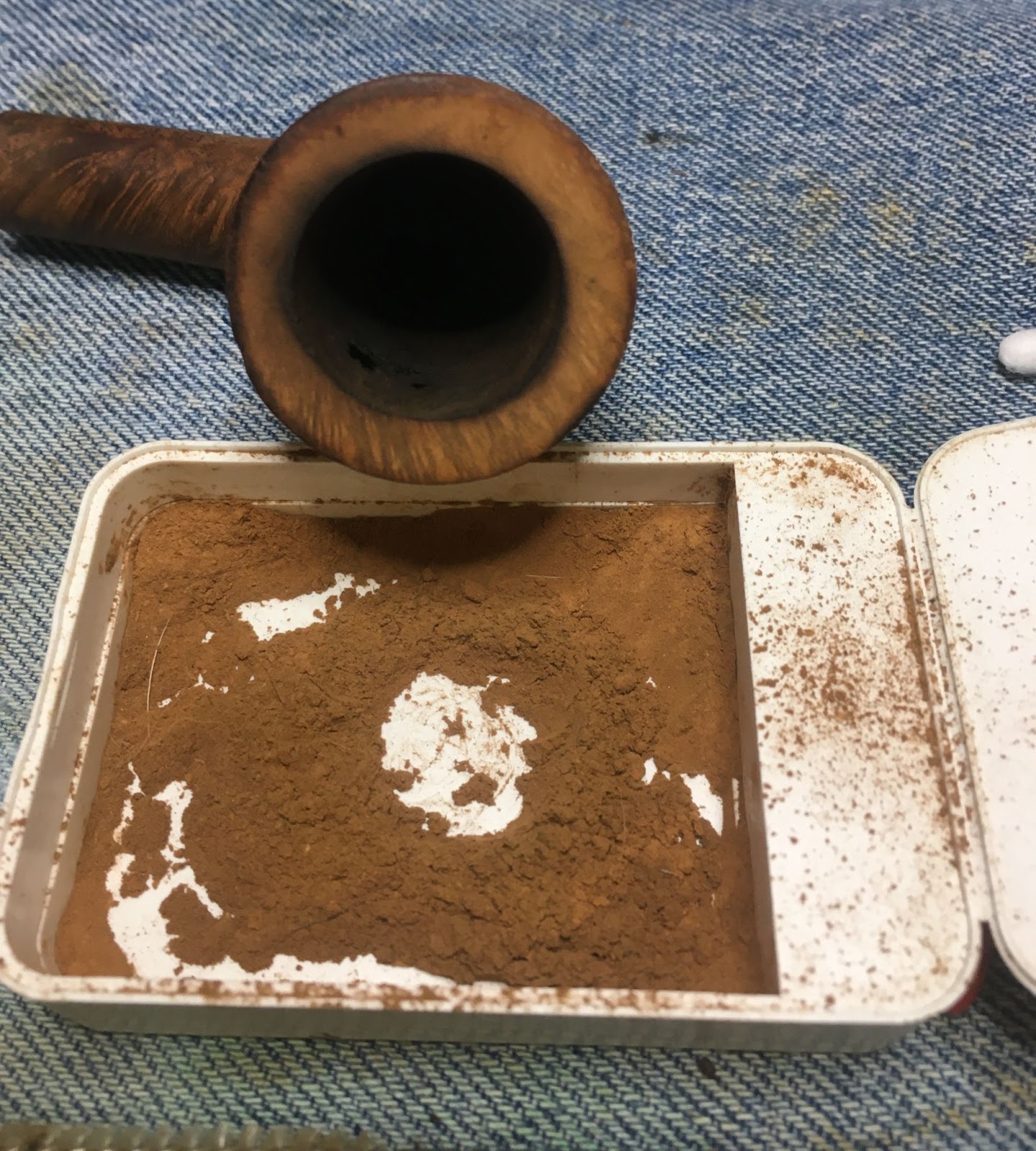
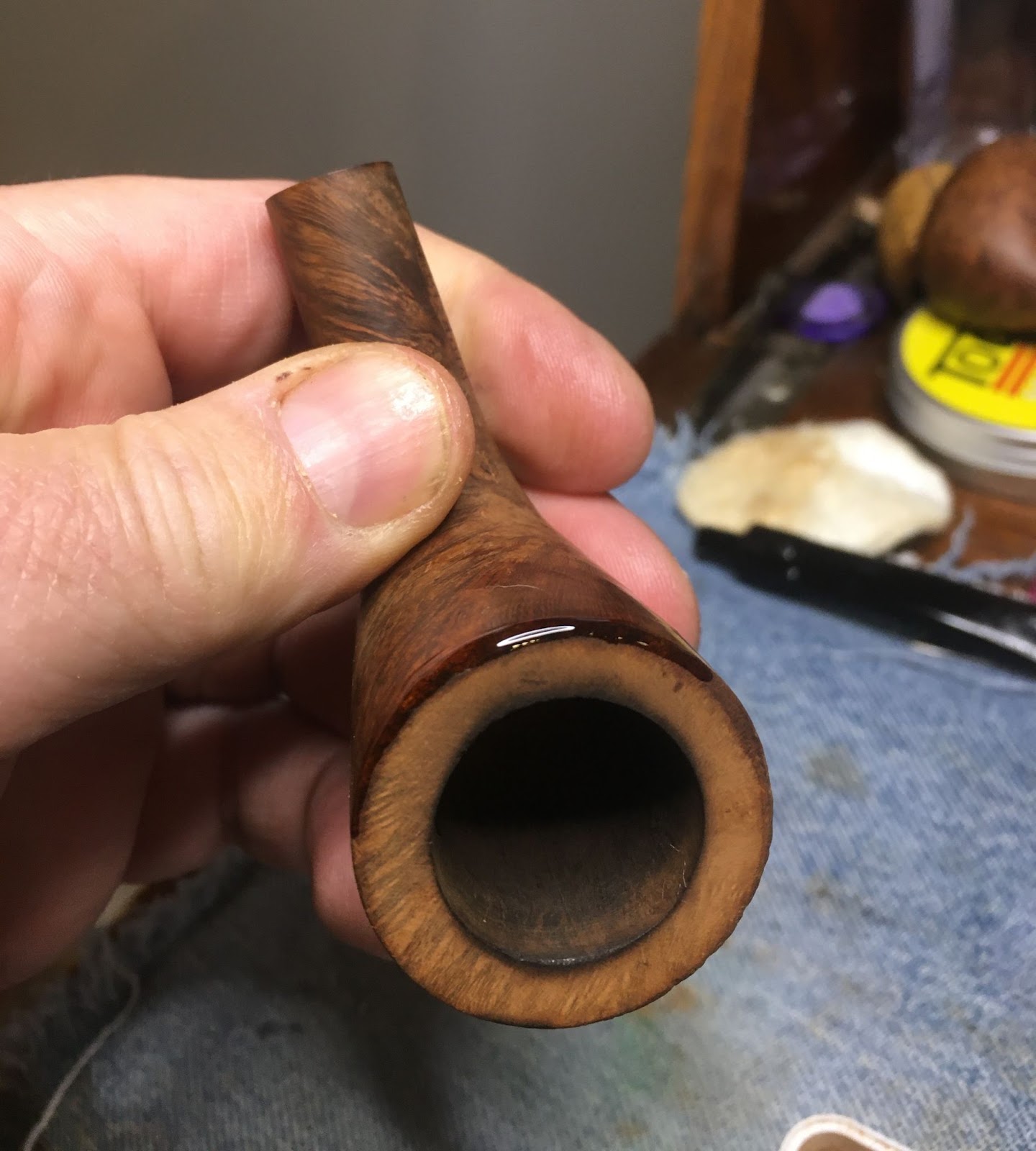
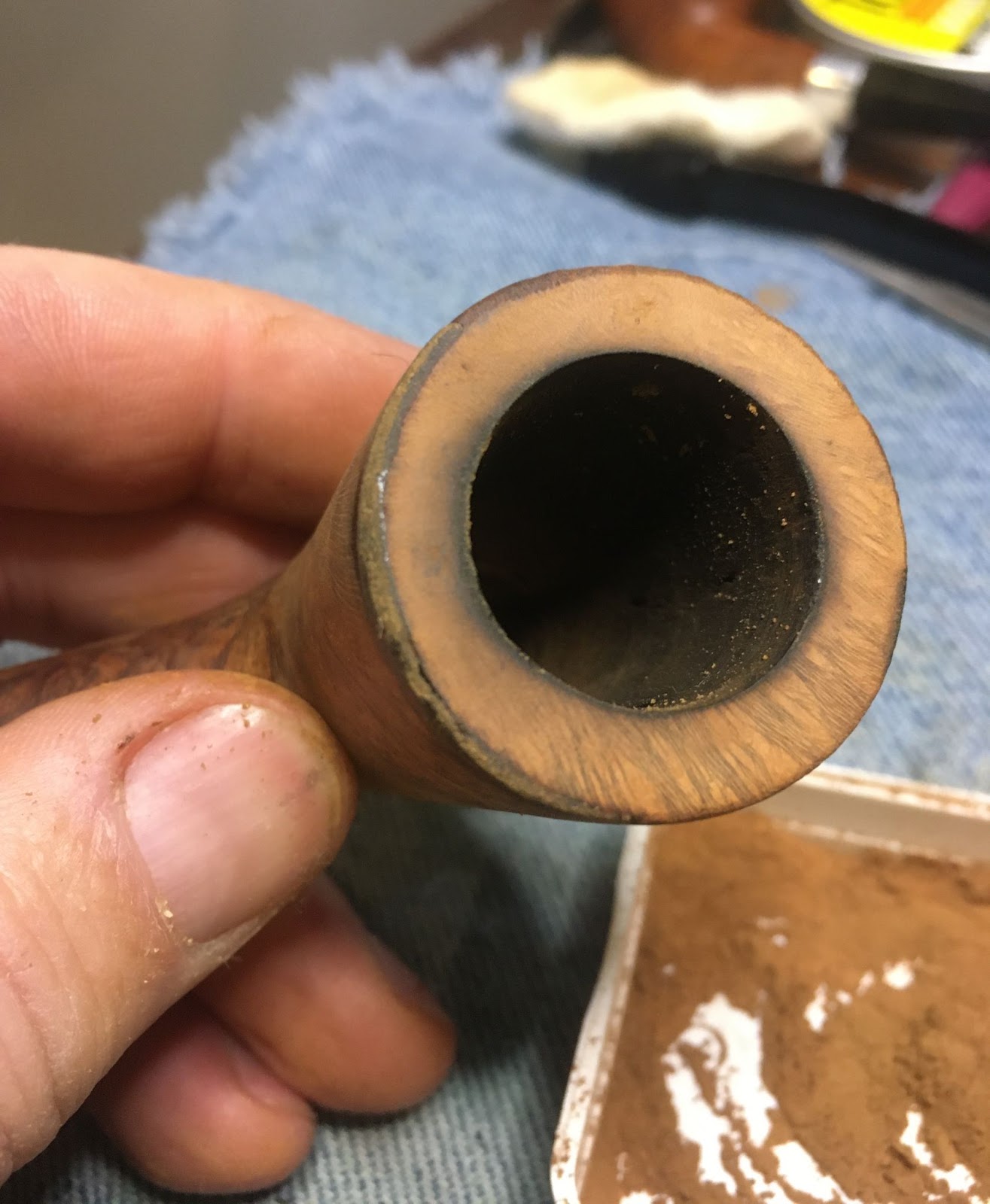
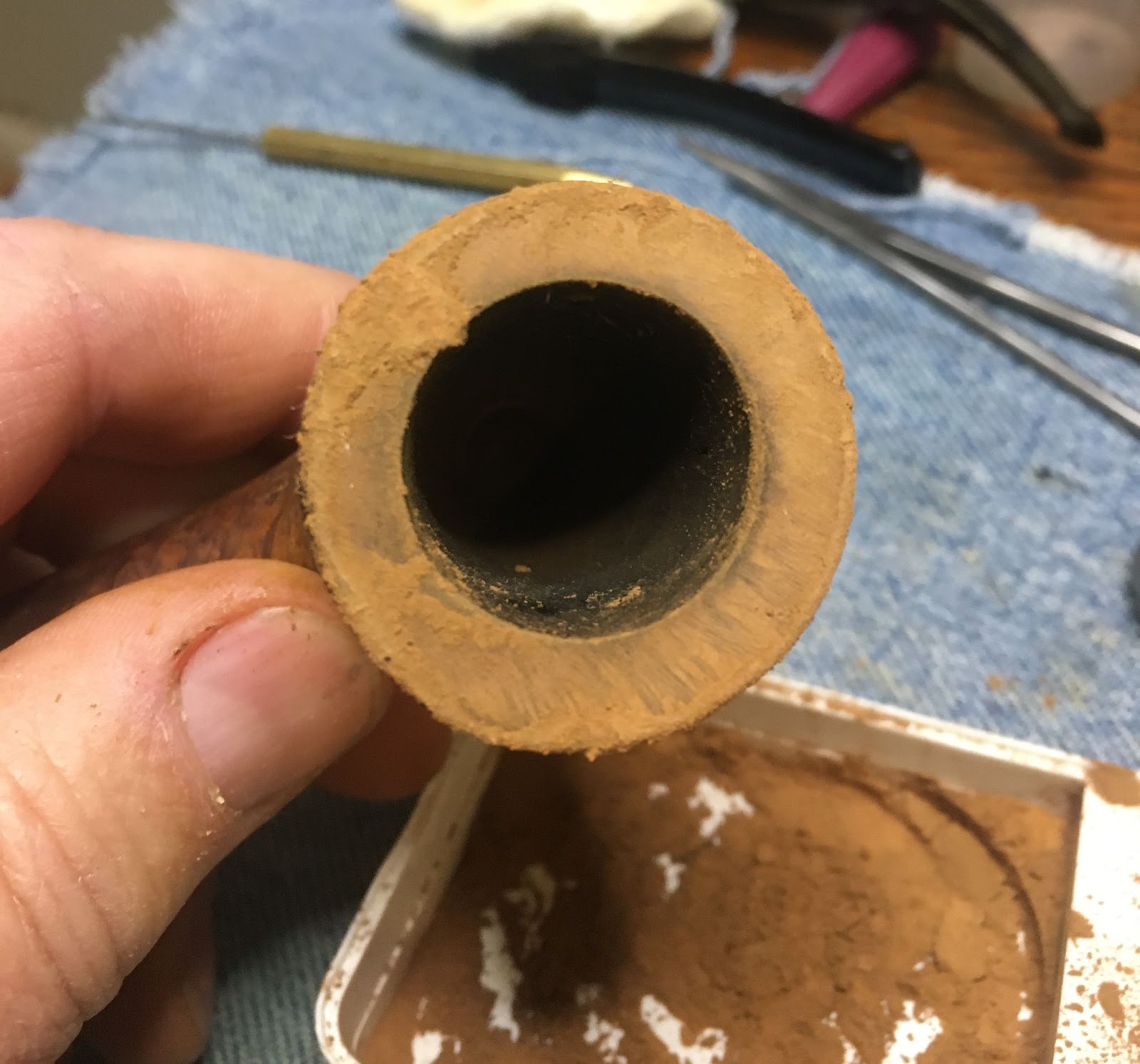
    The pit was filled using brown cyanoacrylate (CA, super glue) and briardust.  The pit was first picked out using a fly tying bodkin.

    A drop of CA was applied into the pit.  I used a dental scraper to scoop a small amount of briar dust and placed this onto the pit and used the back side of the dental scraper to press the dust into the wet CA and into the pit.

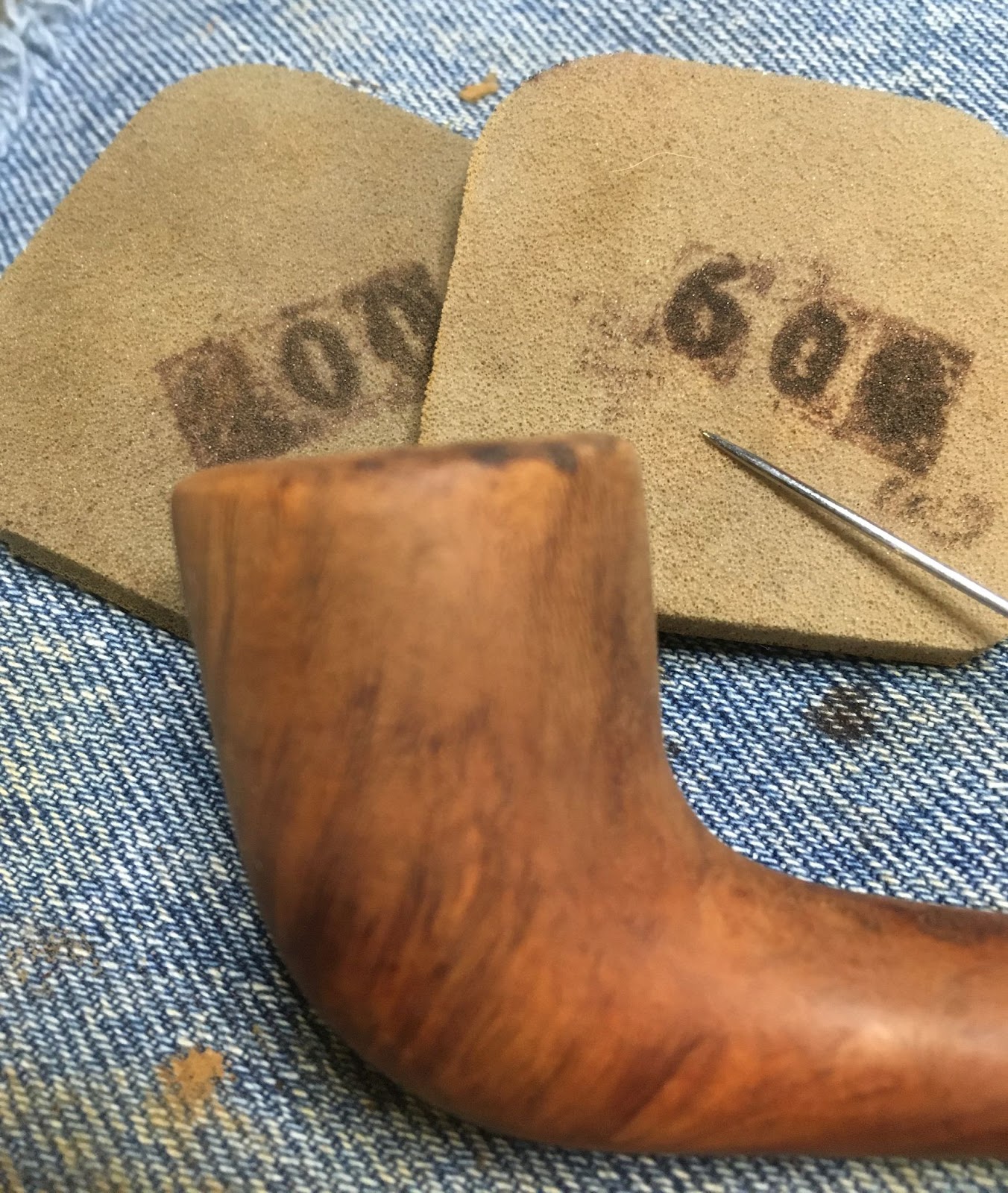
    The fill was filed with a flat needle file then sanded with a 400 grit sanding sponge.

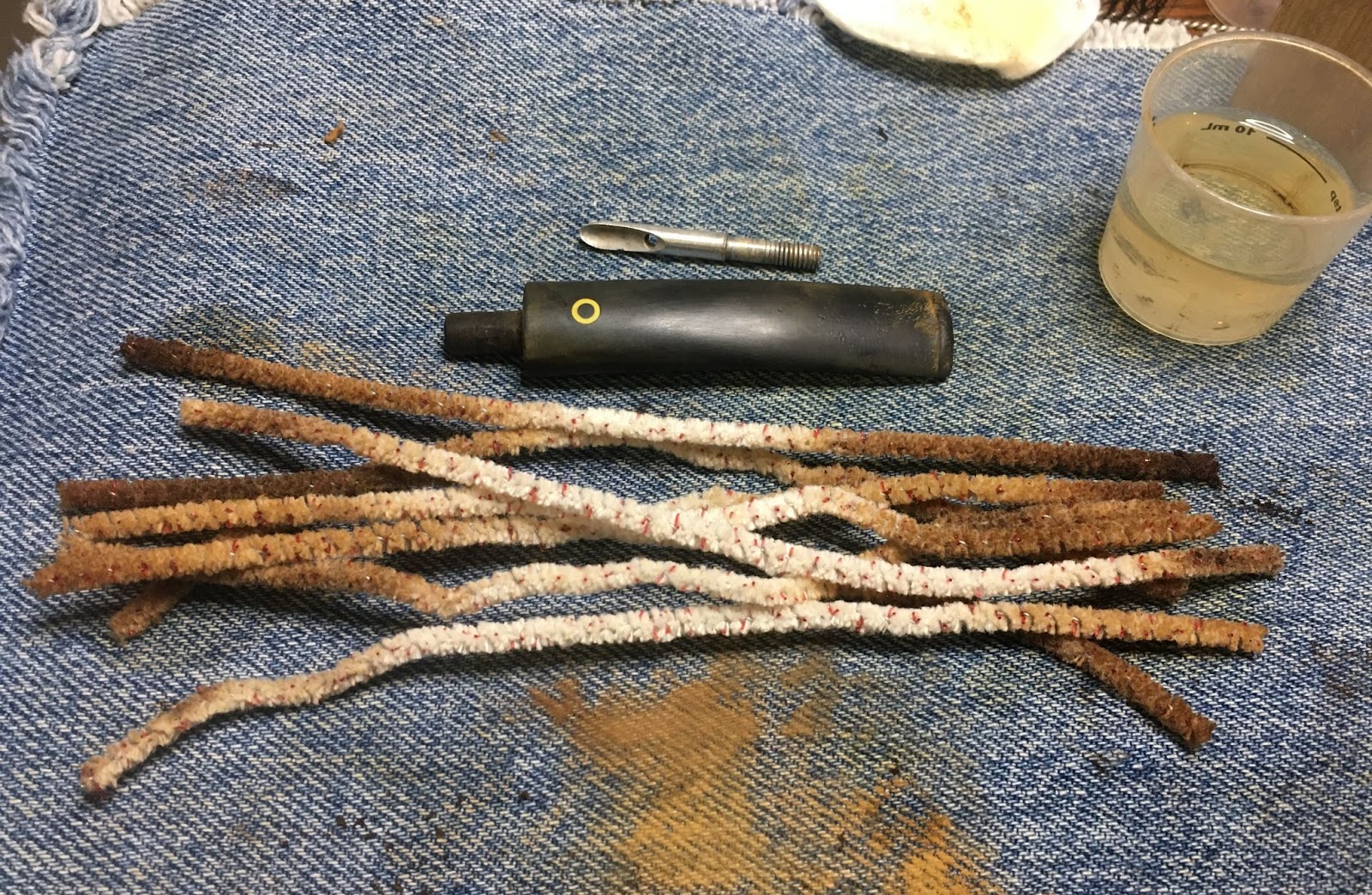
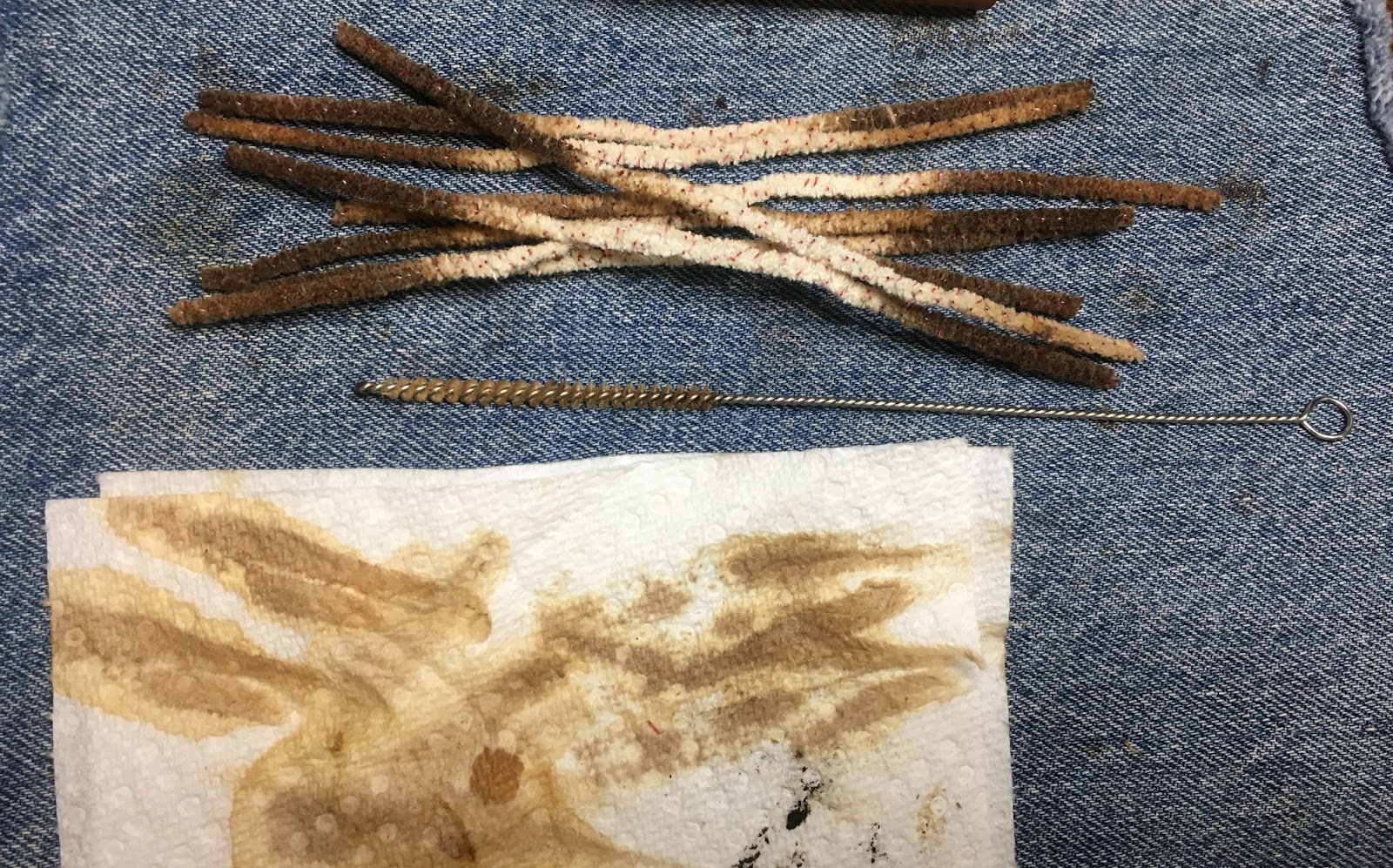
    Next the interior of the stem was cleaned using bristle pipe cleaners dipped in 95% ethyl alcohol.  The surface of the stem was lightly sanded with a 400 grit sanding sponge.  After the sanding the stem was coated in mineral oil and set aside to absorb some of the oil.

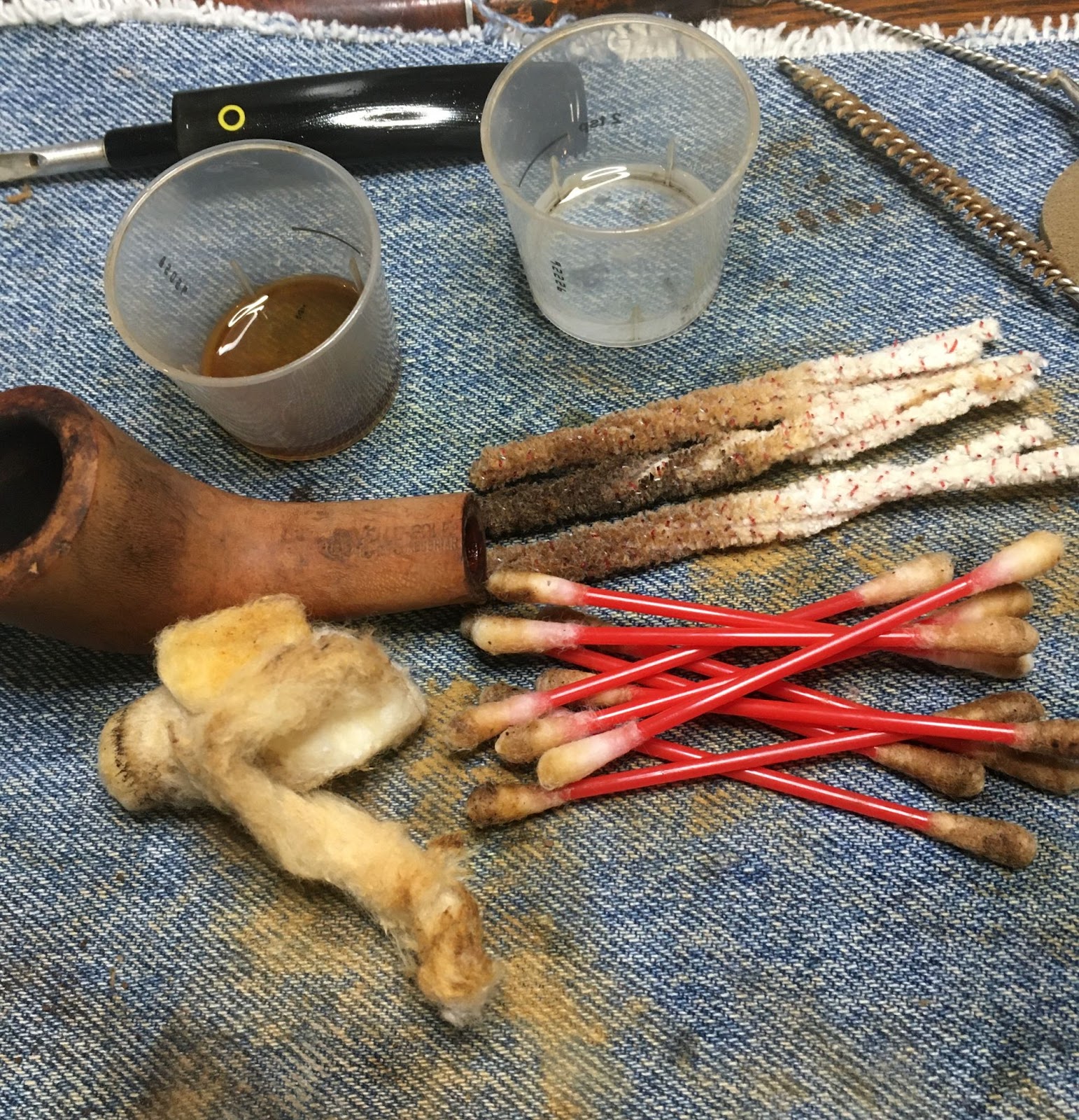
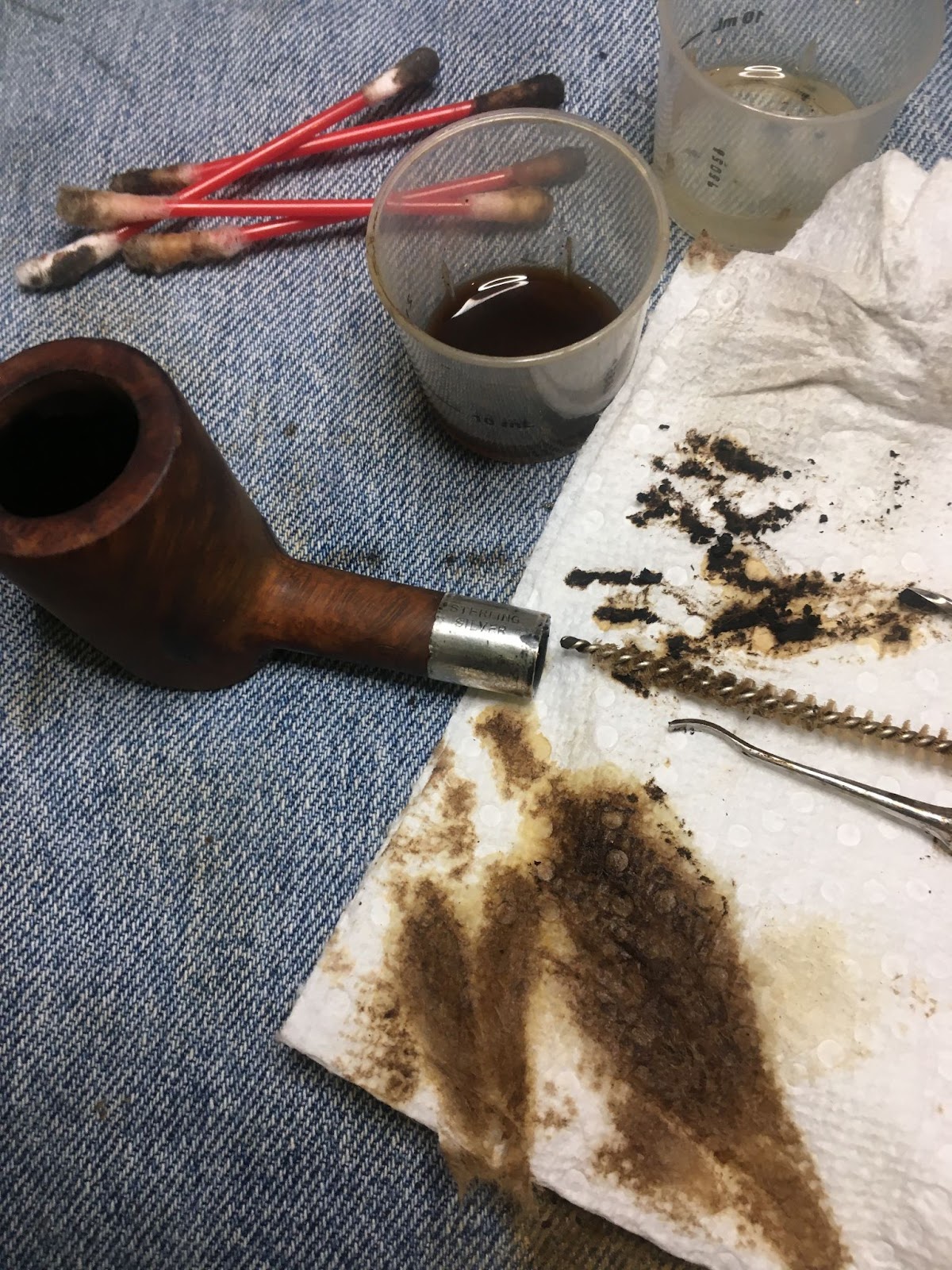
    I then turned my attention to cleaning the airway of the shank.  I used cotton swabs dipped in alcohol to scrub the mortise, then the dental scraper to scrape the tar and yuck (yuck is the technical term for smoking residue and tar) from the shank as deeply as I could reach.  The yuck that was removed was dry and crumbly even after the dawn dish soap and the alcohol cotton swab scrubbings.

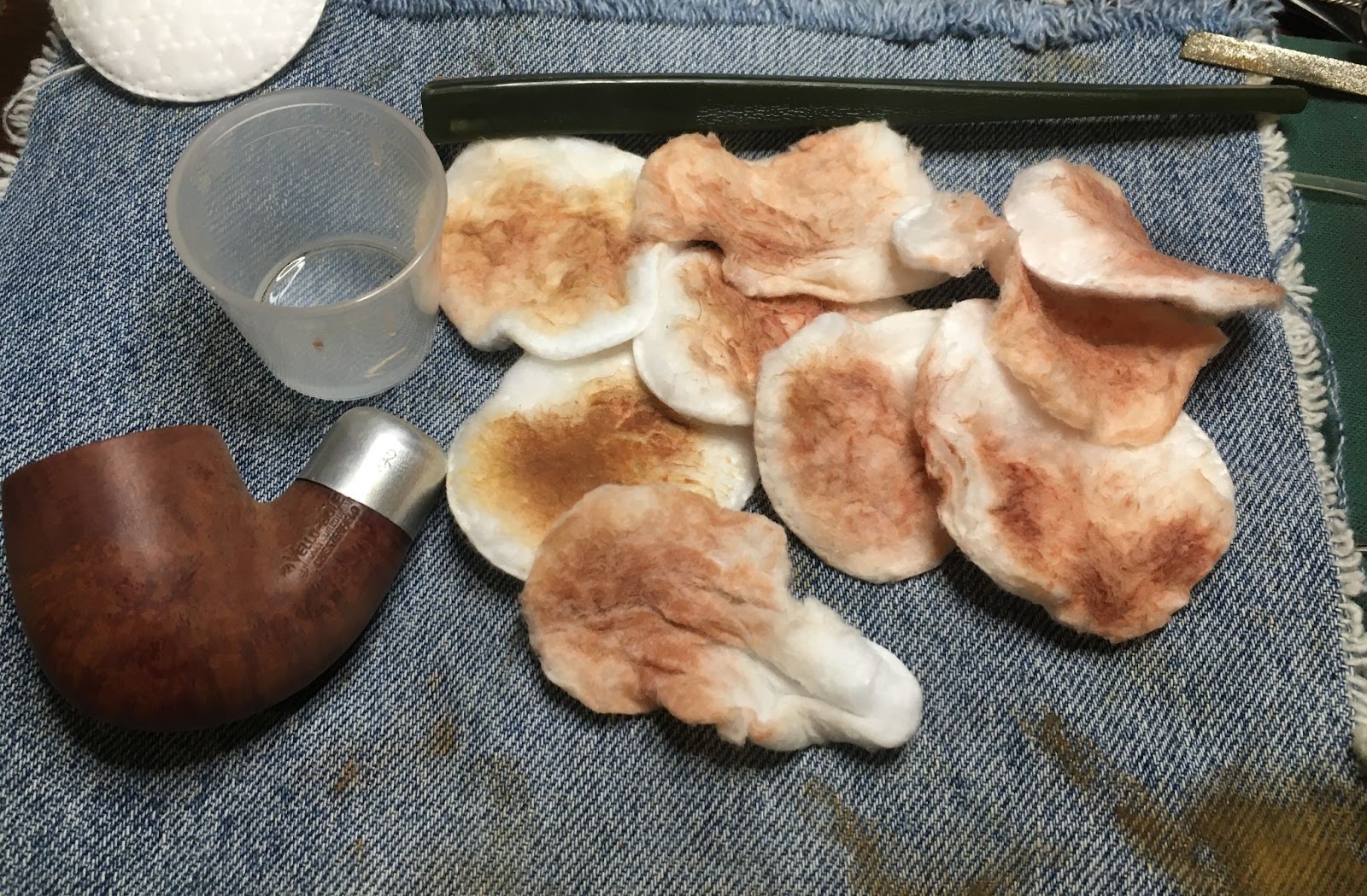
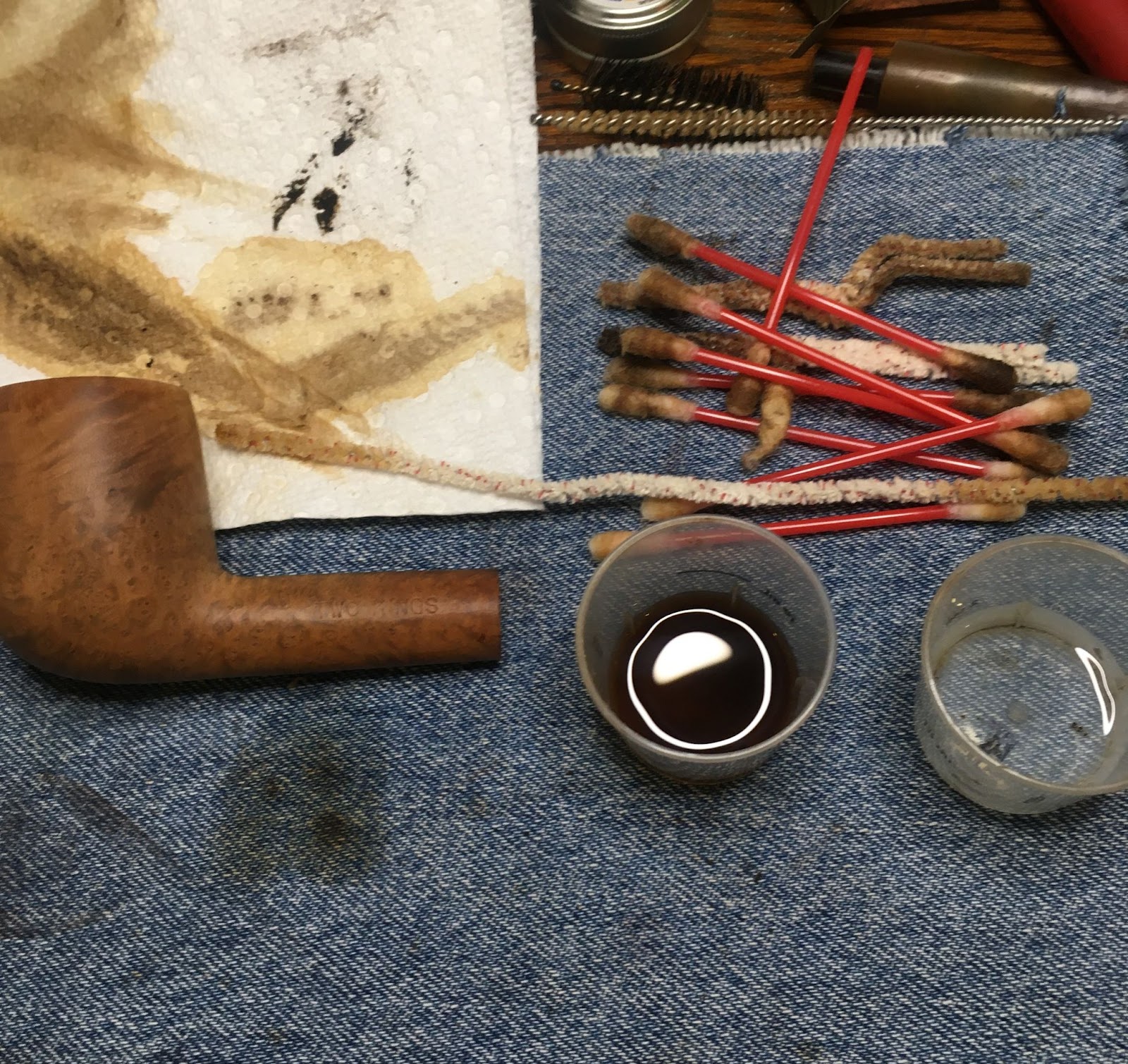
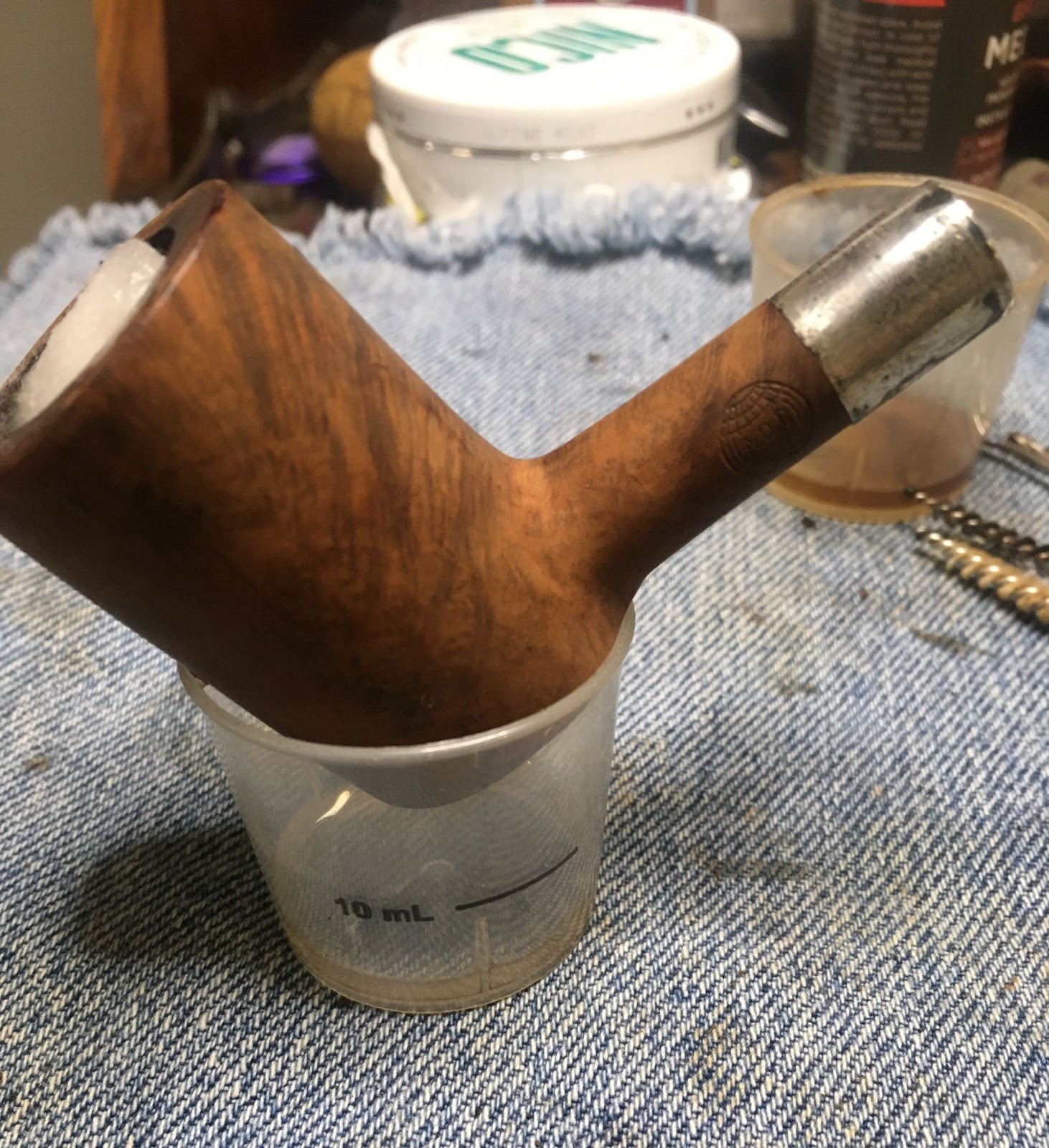
    I poured 5 ml of 95% ethyl alcohol into the bowl and allowed it to flow into the airway.  I used a nylon shank brush to scrub the airway with the alcohol.  The alcohol was then poured into a medicine cup.  The color was dark but I could still see through it.  The scrub brush was thickly caked with yuck.

    More scraping and using alcohol dipped cotton swabs to clear the shank were used.  Further alcohol-nylon shank brushings were done.  Note the alcohol in the cup is much darker.

    More of each of the above.  I started going to the sink and applying Castille soap to the shank brush and scrubbing the airway with that.  The soap was rinsed with warm water then alternated with the alcohol scrubbing.

    Even after all that scrubbing with soap/alcohol.I was still scraping crumbly yuck from the airway.

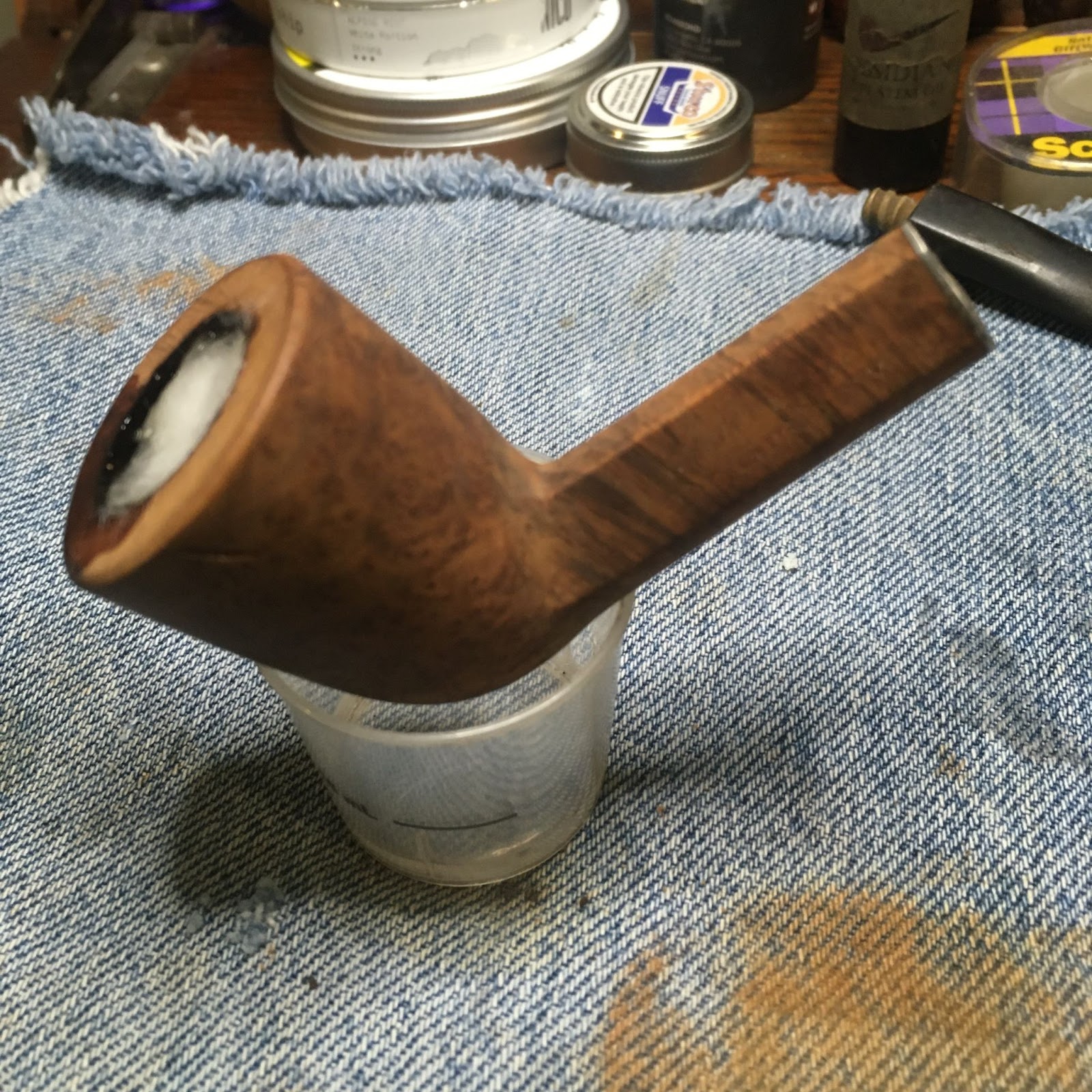
    I was becoming a bit frustrated with the lack of progress.  I knew it was progress but I had other things I needed to do.  I decided to pack the bowl and shank with cotton and fill each with 95% ethyl alcohol.  Hopefully the alcohol would dissolve the yuck and allow it to be absorbed by the cotton.

    Below you can see the cotton pushed through from the mortise.

    Shank view stuffed with cotton.

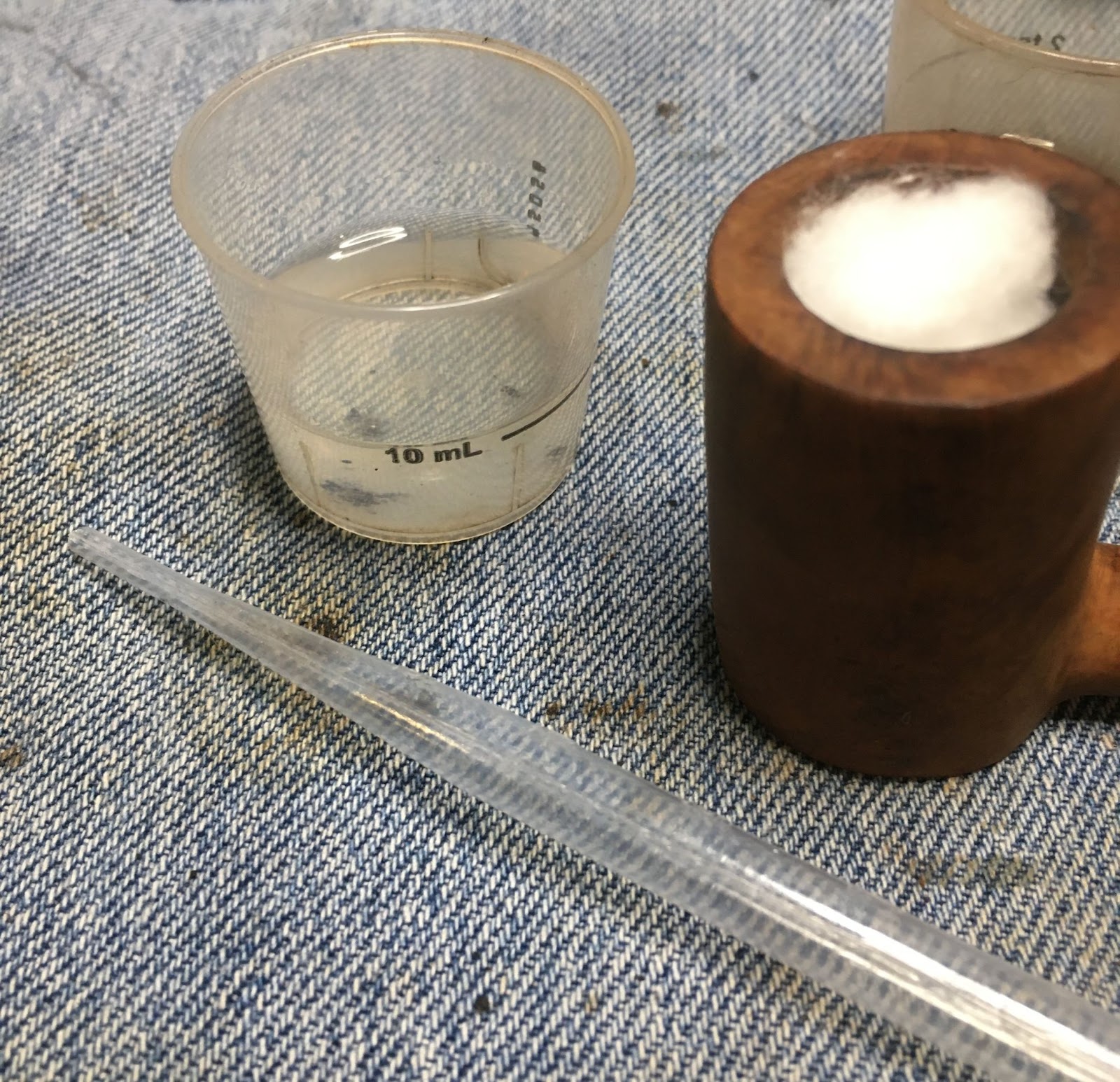
    The bowl was stuffed with cotton.  I figured that 10 ml of alcohol would suffice.  I used a disposable pipette to soak the cotton.

    I was close with my 10 ml prediction.  Only about a ml remained in the medicine cup.  The alcohol was allowed to soak for several hours.  

    While the alcohol did its dissolution magic, I returned my attention to the stem.  I cut a piece of painters tape to cover the stem logo to protect it from scrubbing and sanding.

    First I scrubbed the stem with Soft Scrub on a make-up pad.  Surprisingly little oxidation came off.

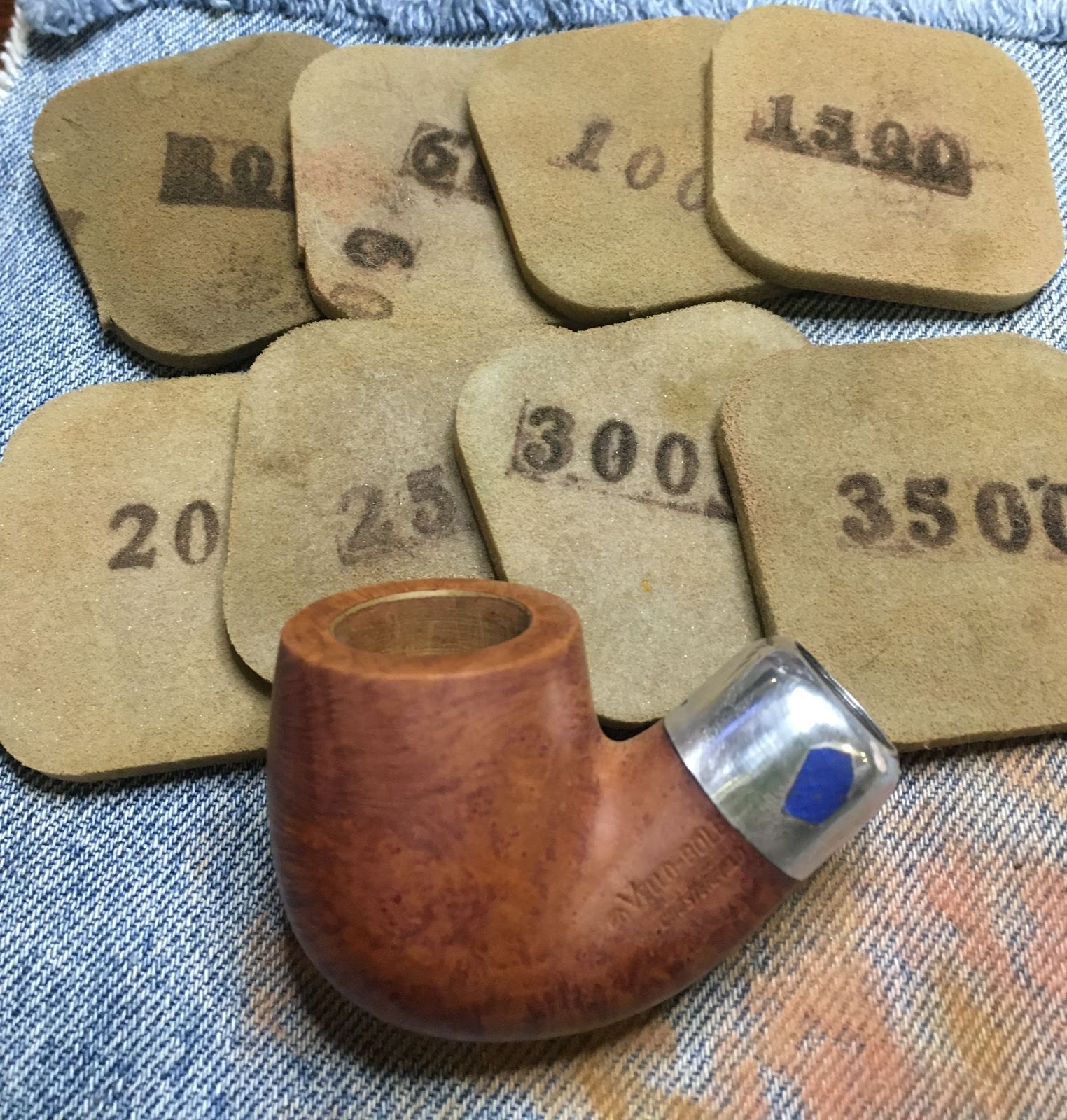
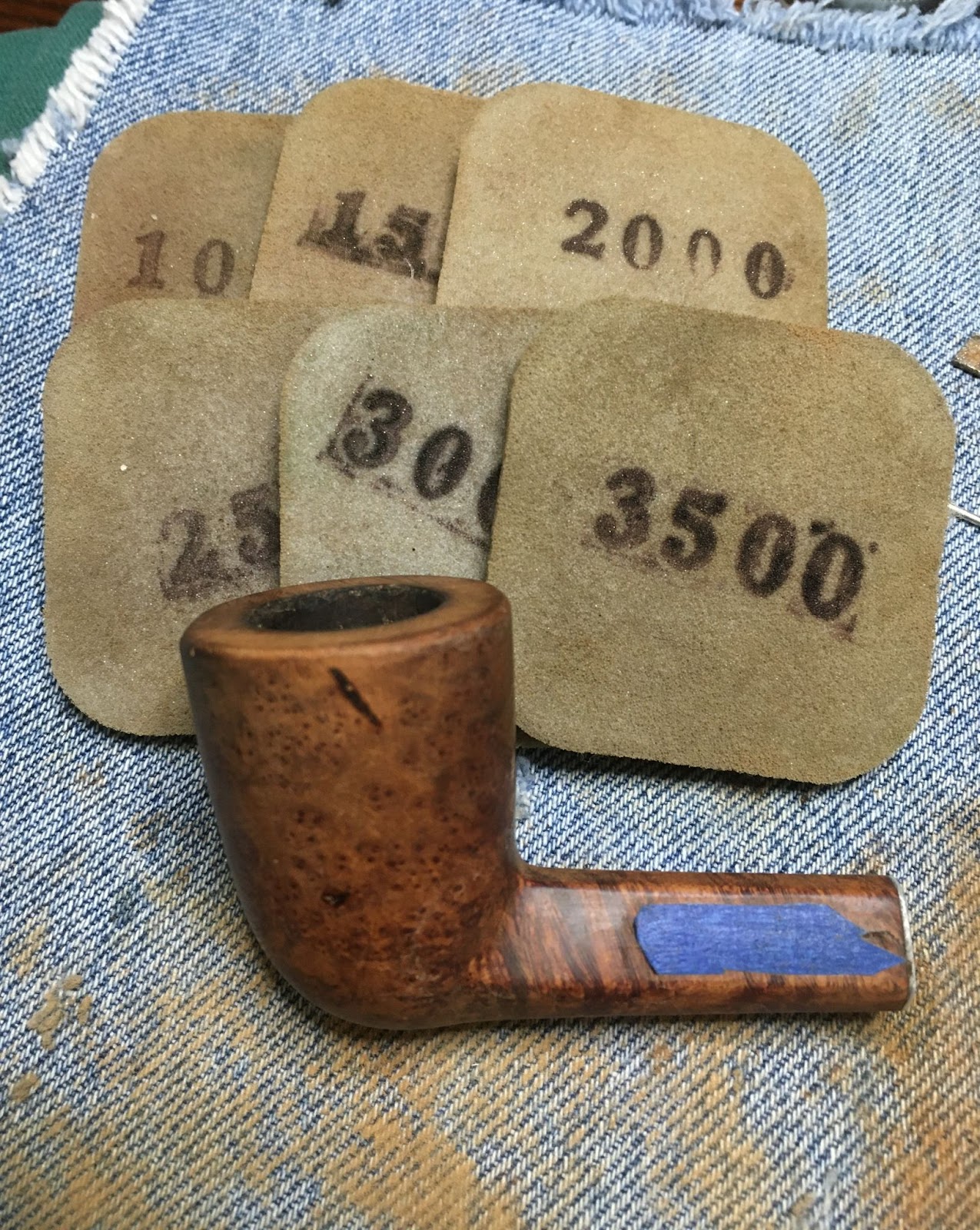
    The stem was then sanded with a series of sanding sponges from 1000-3500 grits.  Between each sponge I would dip my finger in mineral oil, rub the oil onto the stem then wipe the stem with a paper towel.

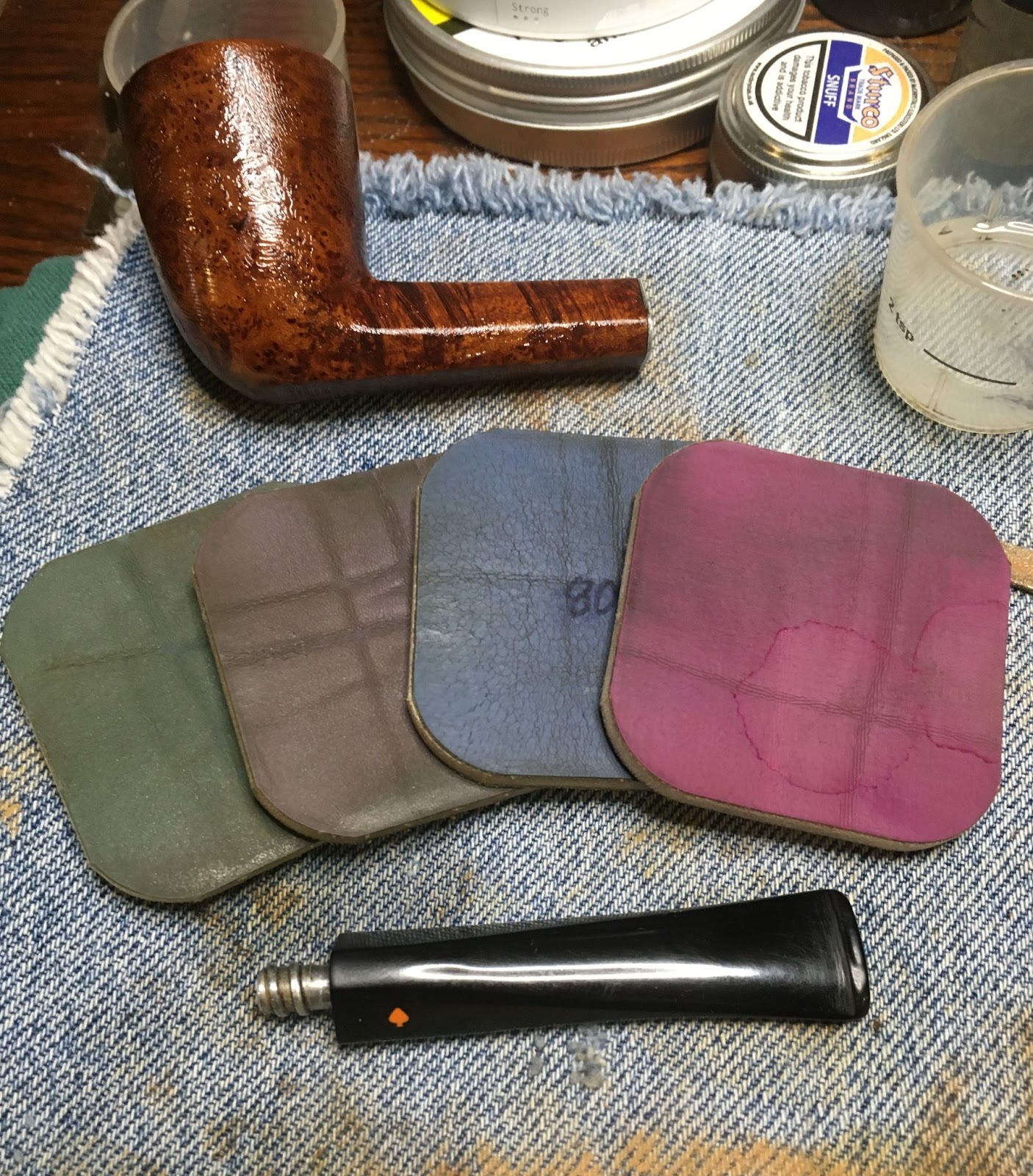
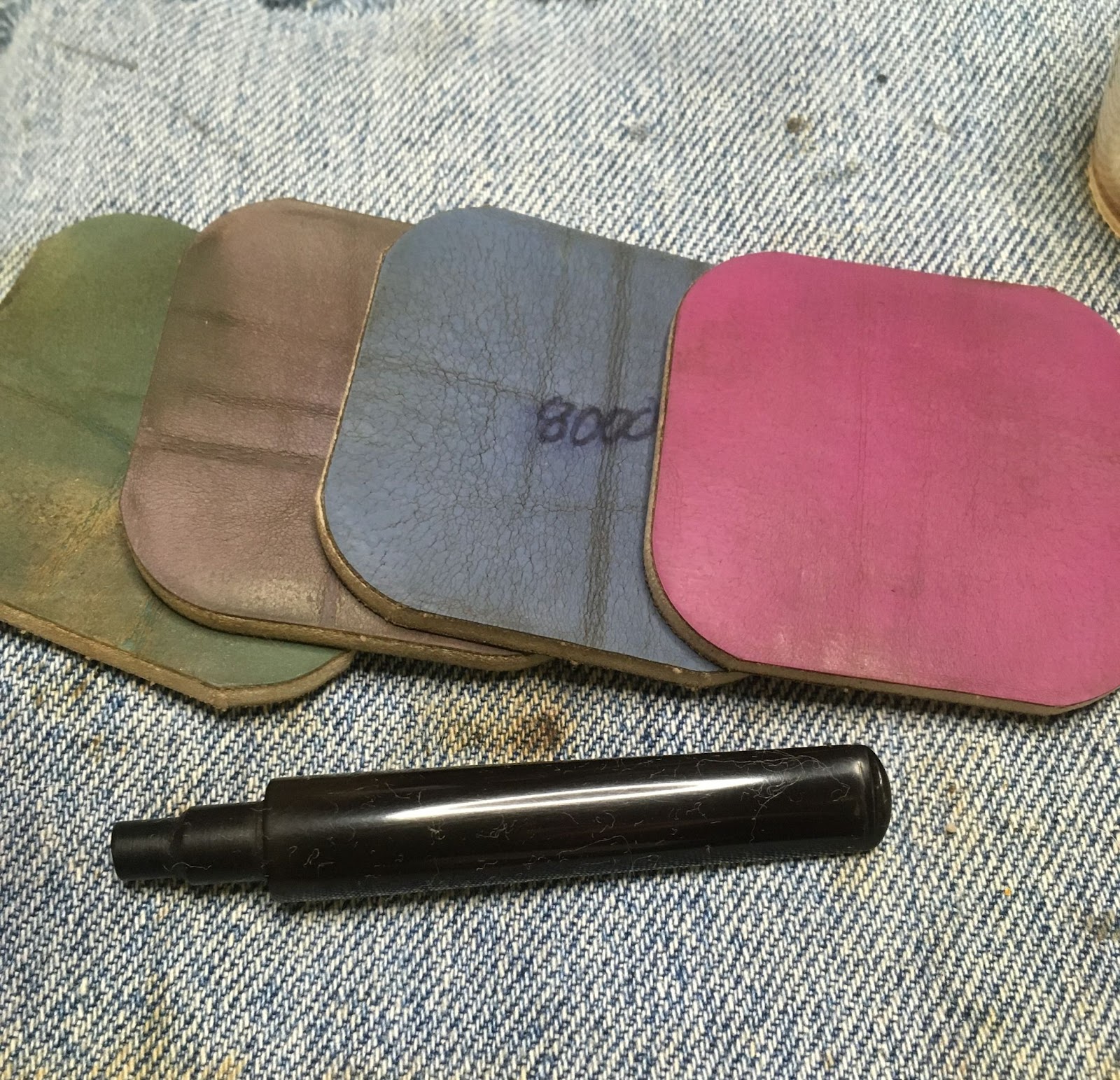
    After the final sponge I removed the tape and used a series of mich-mesh pads from 4000-12000 grit to polish the stem.  Between each pad I applied a drop of Obsidian Oil, rubbed it onto the stem and wiped the stem with a paper towel.

    The stem was then polished with Before and After Fine Polish using a soft cotton cloth.

    The fFine Polish was followed by Before and After Extra Fine Polish with a clean section of the same cloth.

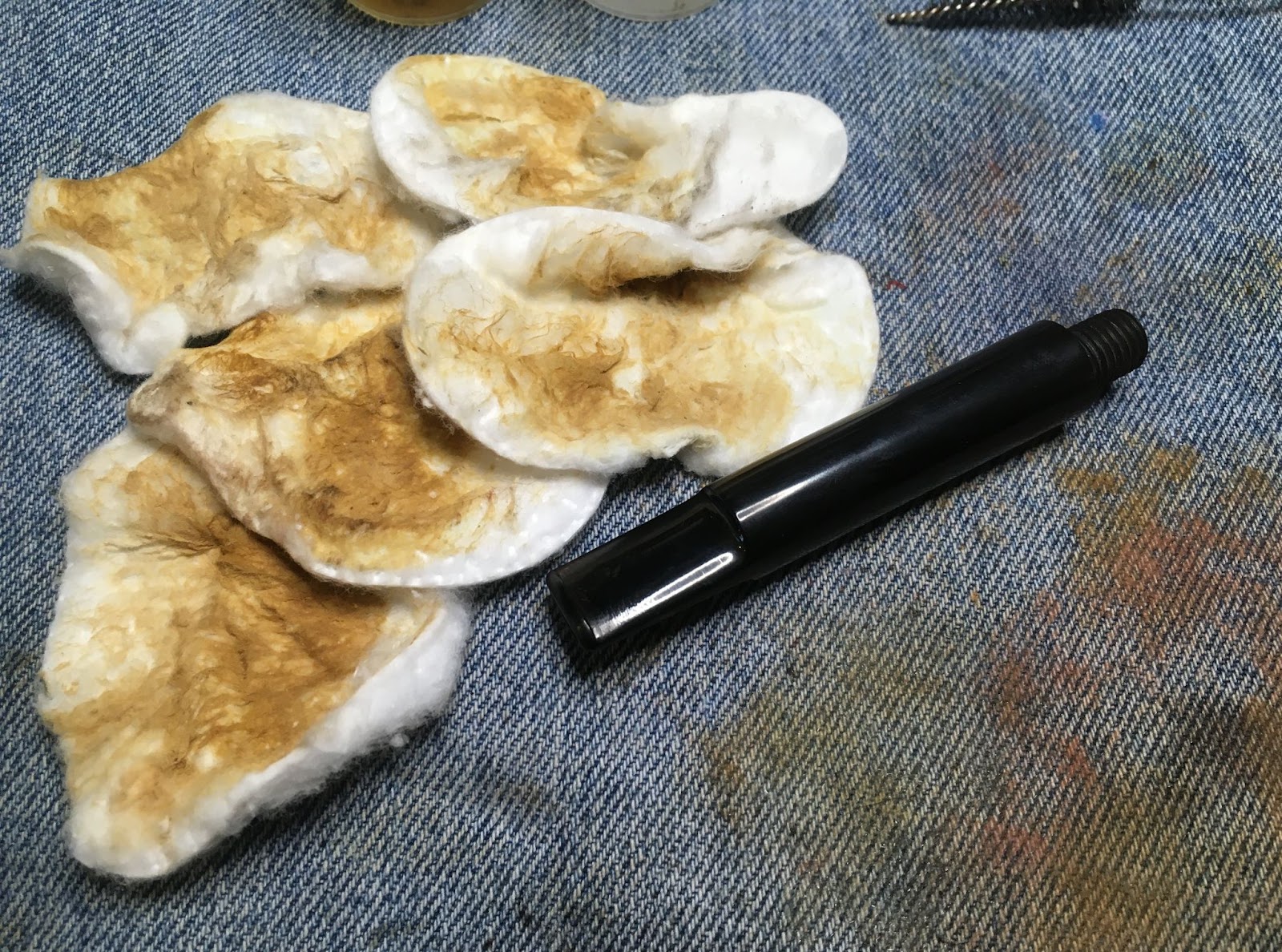
    Several hours later I removed the cotton which was now just slightly damp with alcohol as most of the alcohol had evaporated.  The cotton was brown from absorbing the yuck as the alcohol evaporated.

    Alcohol dipped cotton swabs and pipe cleaners finally returned with just a slight discoloration.  A few more of each and the airway was finally clean.

    The stummel was then sanded with a sequence of sanding sponges from 1000-3500.  Between each sponge the stummel was wiped with a make-up pad moistened with alcohol.

    After the sanding the stummel was polished with a series of micro-mesh pads from 4000-12000 grit.  Between each pad the stummel was wiped with a make-up pad wetted with alcohol.

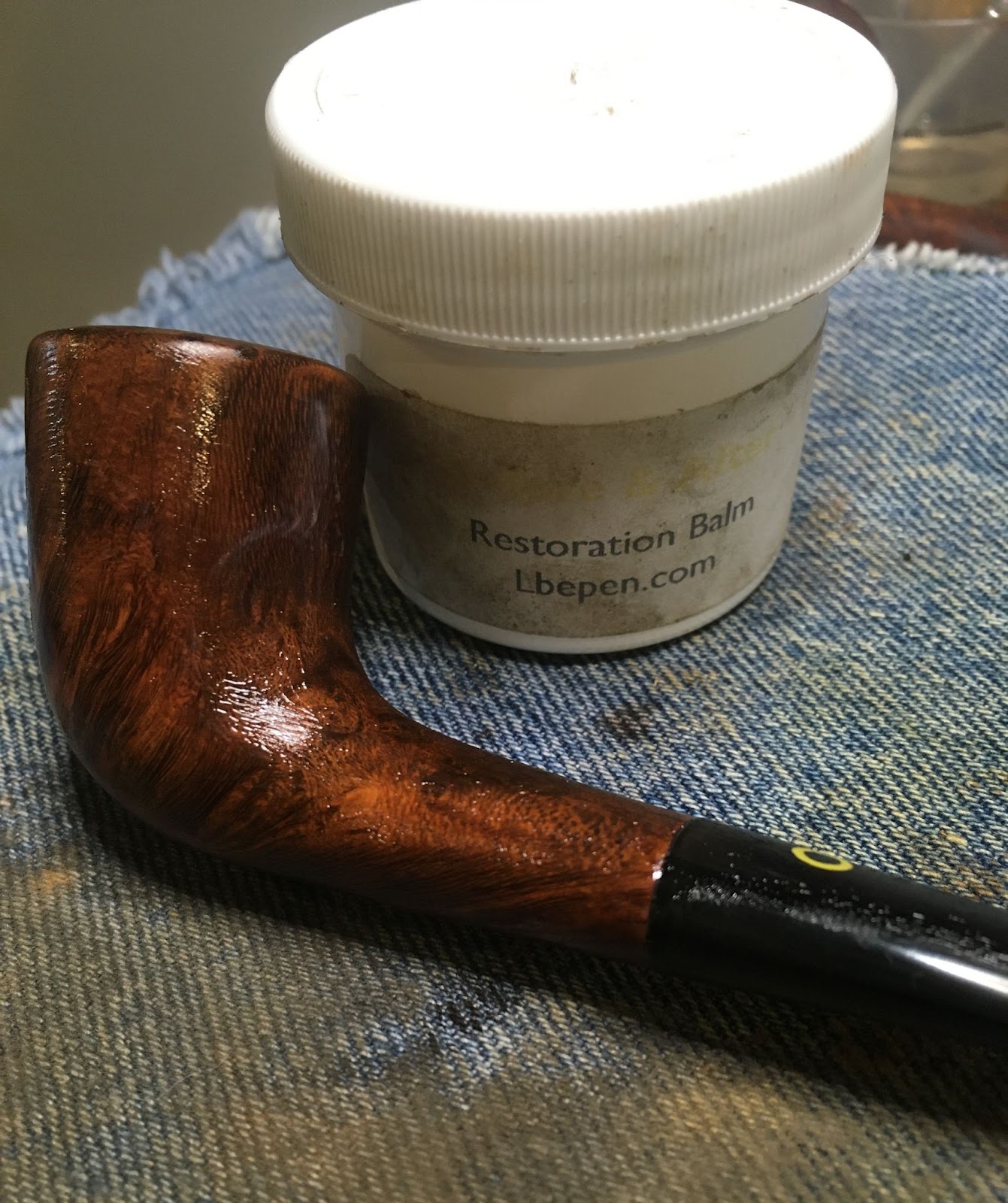
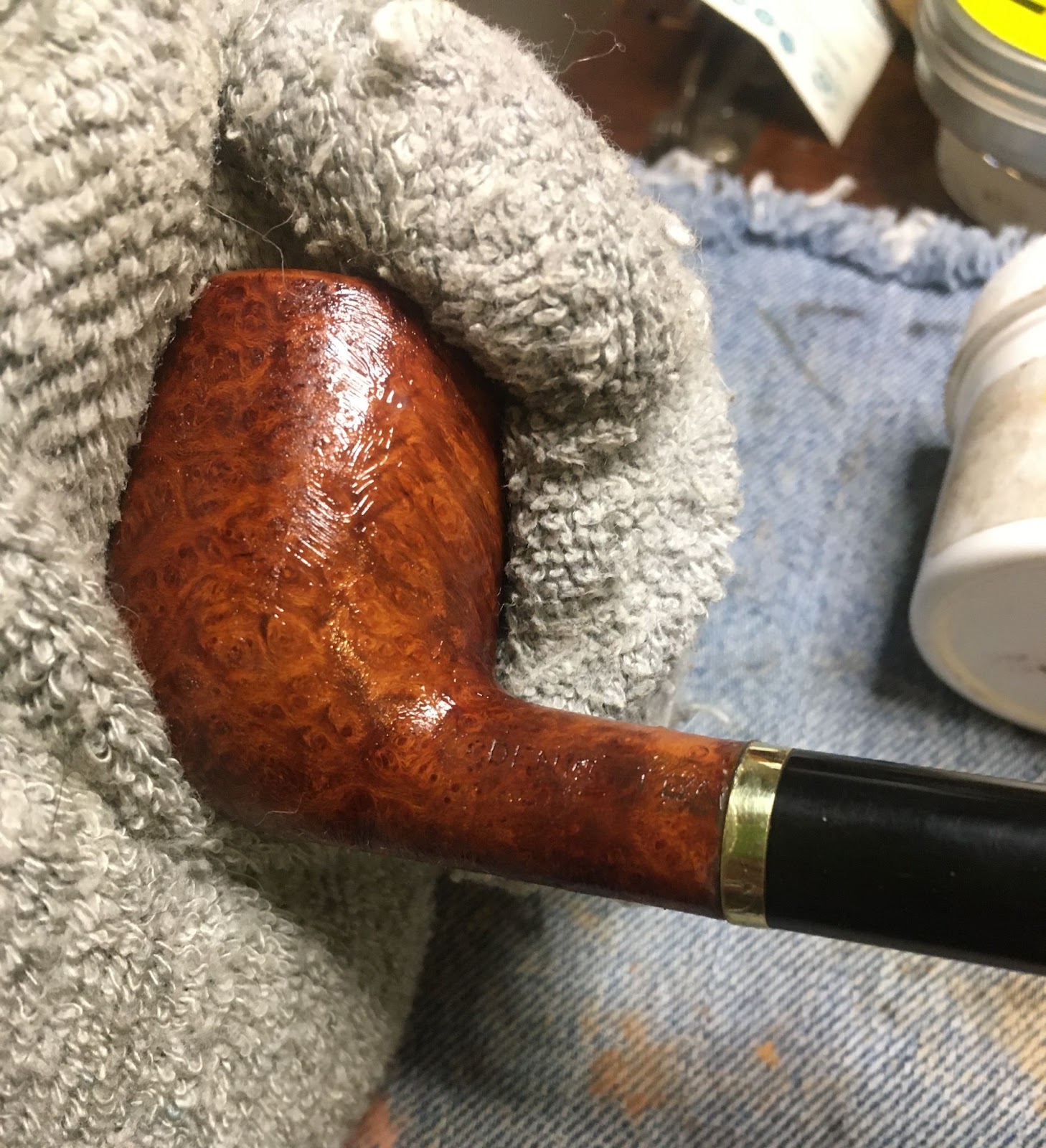
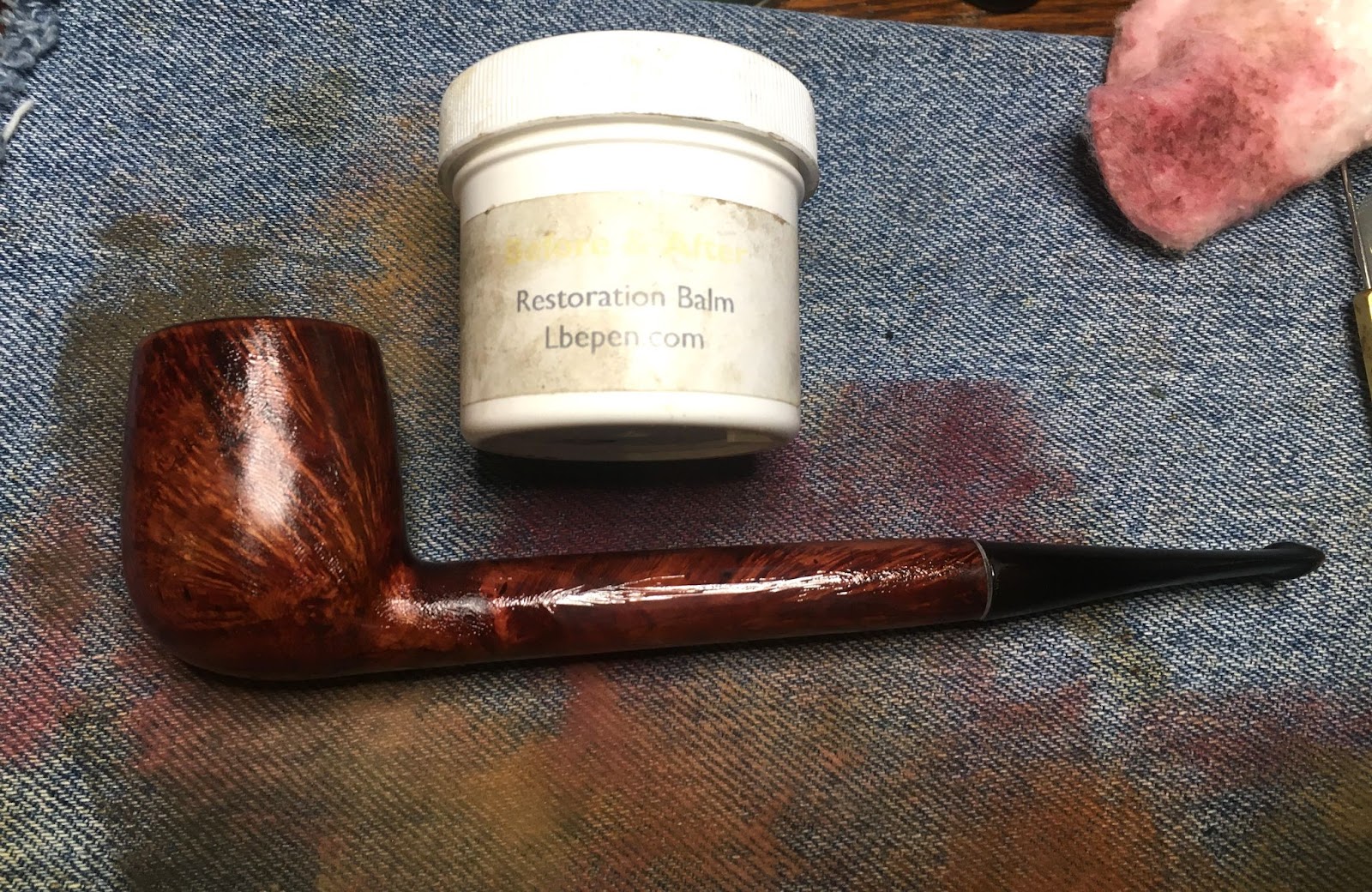
    The stummel was then coated with Before and After Restoration Balm and allowed to sit for about an hour.

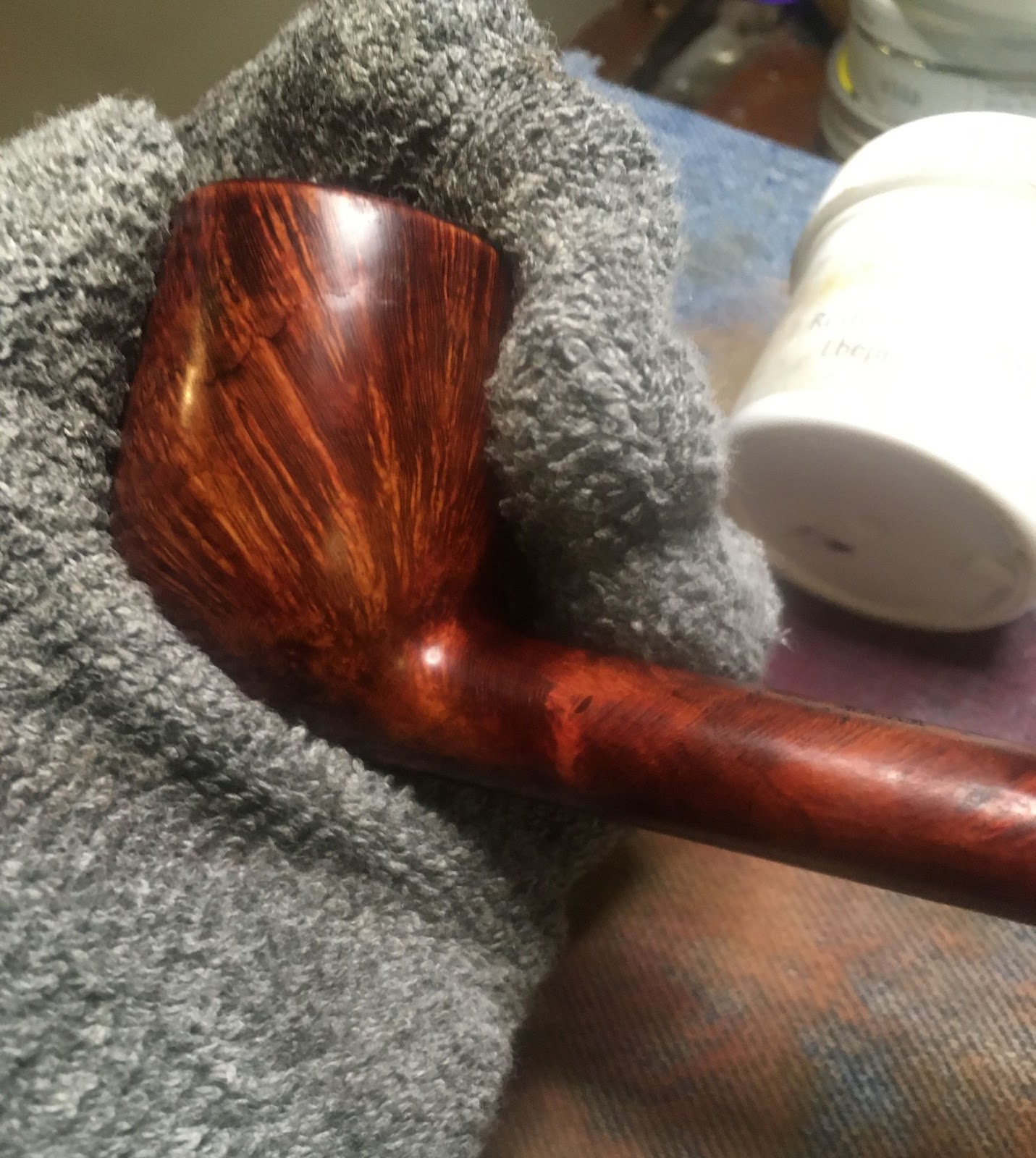
    An hour later the Restoration Balm was wiped off the stummel using the inside terry cloth of an athletic sock.

    The silver band was removed and the inside was cleaned with a cotton swab dipped in alcohol.  This band was very thin, slightly thicker than heavy duty aluminum foil.  Care was taken during the cleaning.  The inside of the stem was then polished with Before and After Fine Polish on a cotton swab.

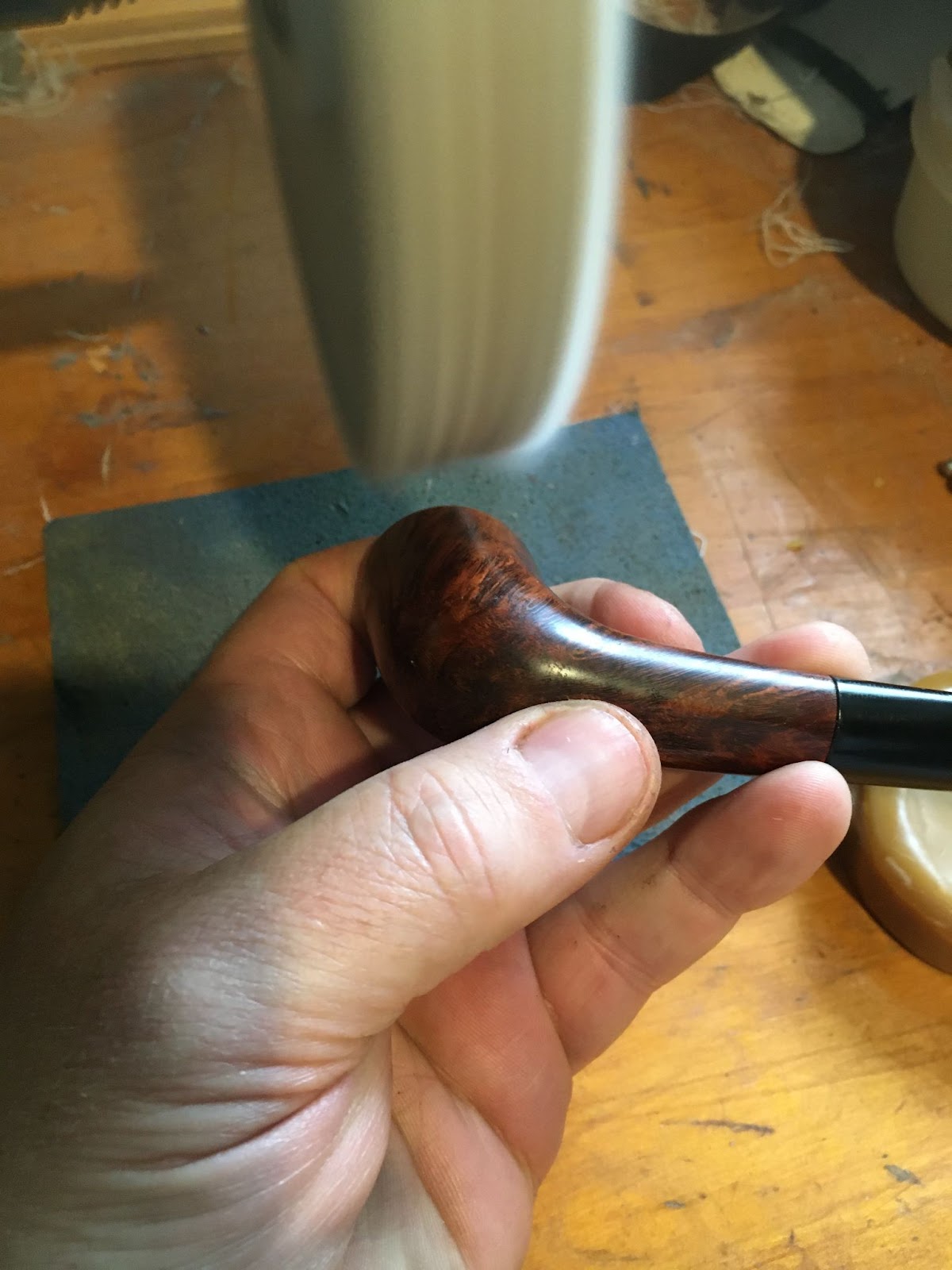
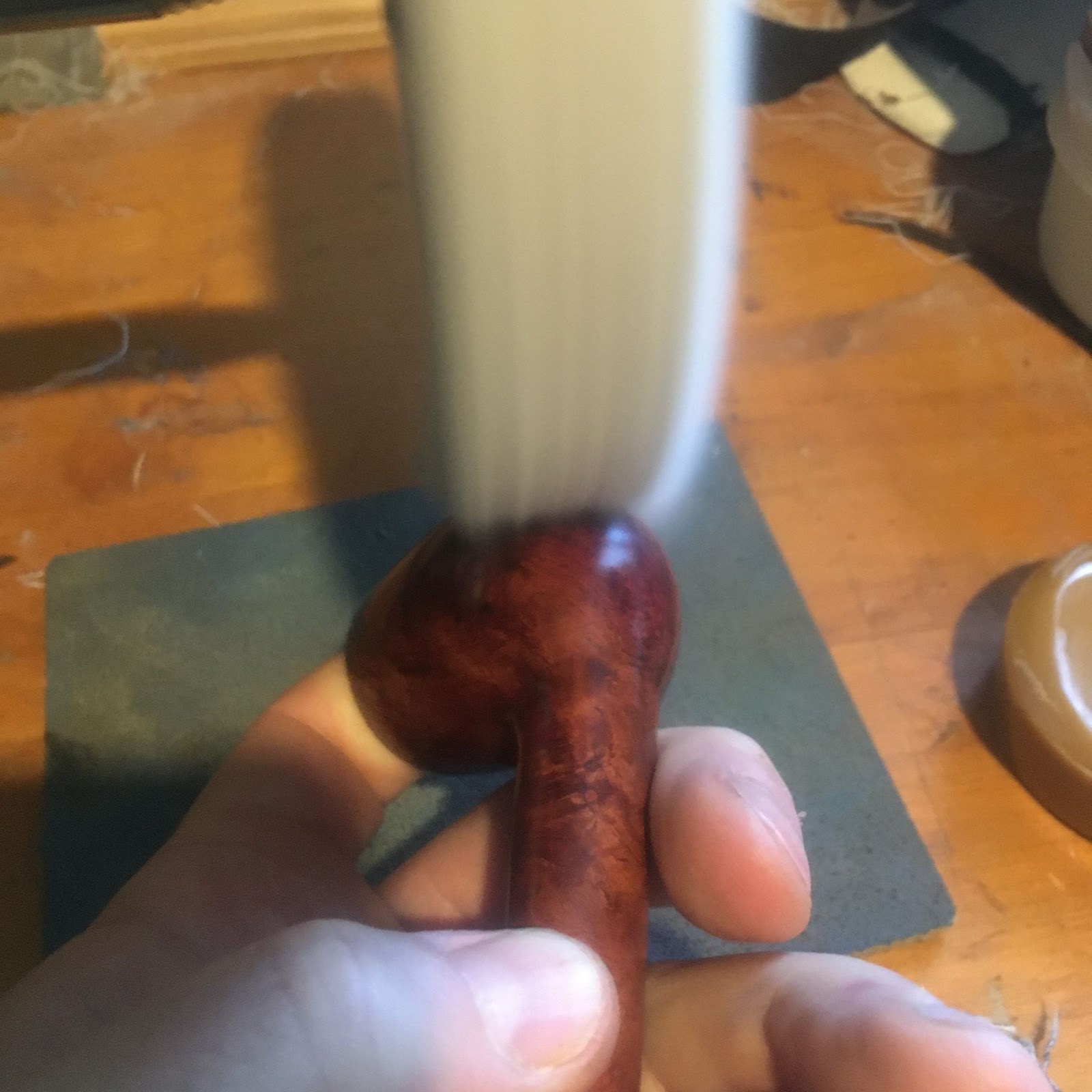
    The end of the shank was then sanded with 600 grit sanding sponge to remove and smooth any remaining old glue.  A bead of white all purpose glue was applied to the shank.  The silver band was then slid into place.  Excess glue was wiped off with the cotton swab and the surface cleaned again with alcohol.  Once the glue had set up the silver was carefully buffed with white diamond abrasive on the buffer.   The whole pipe then received several coats of carnauba wax with the buffer as well.

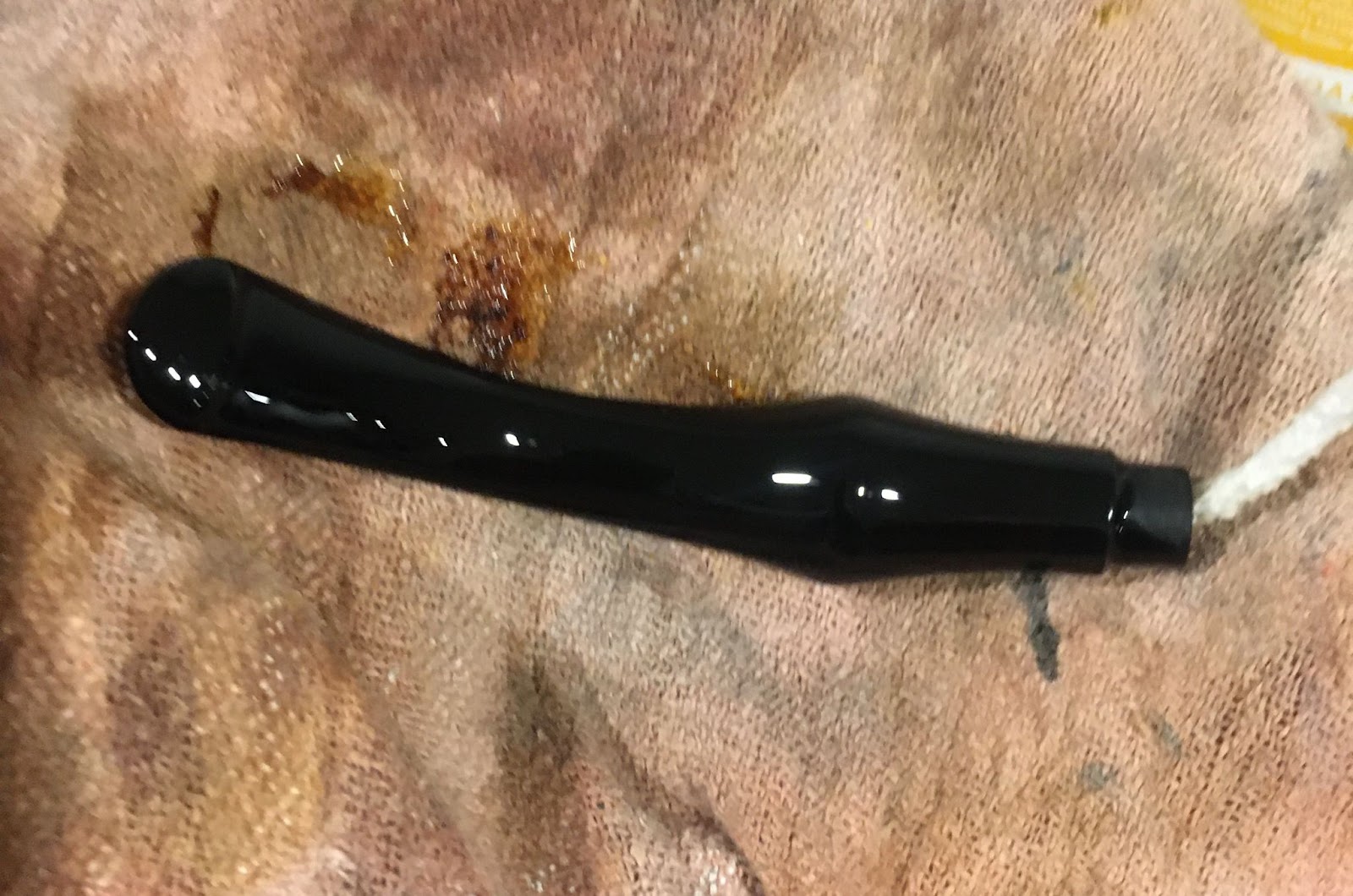
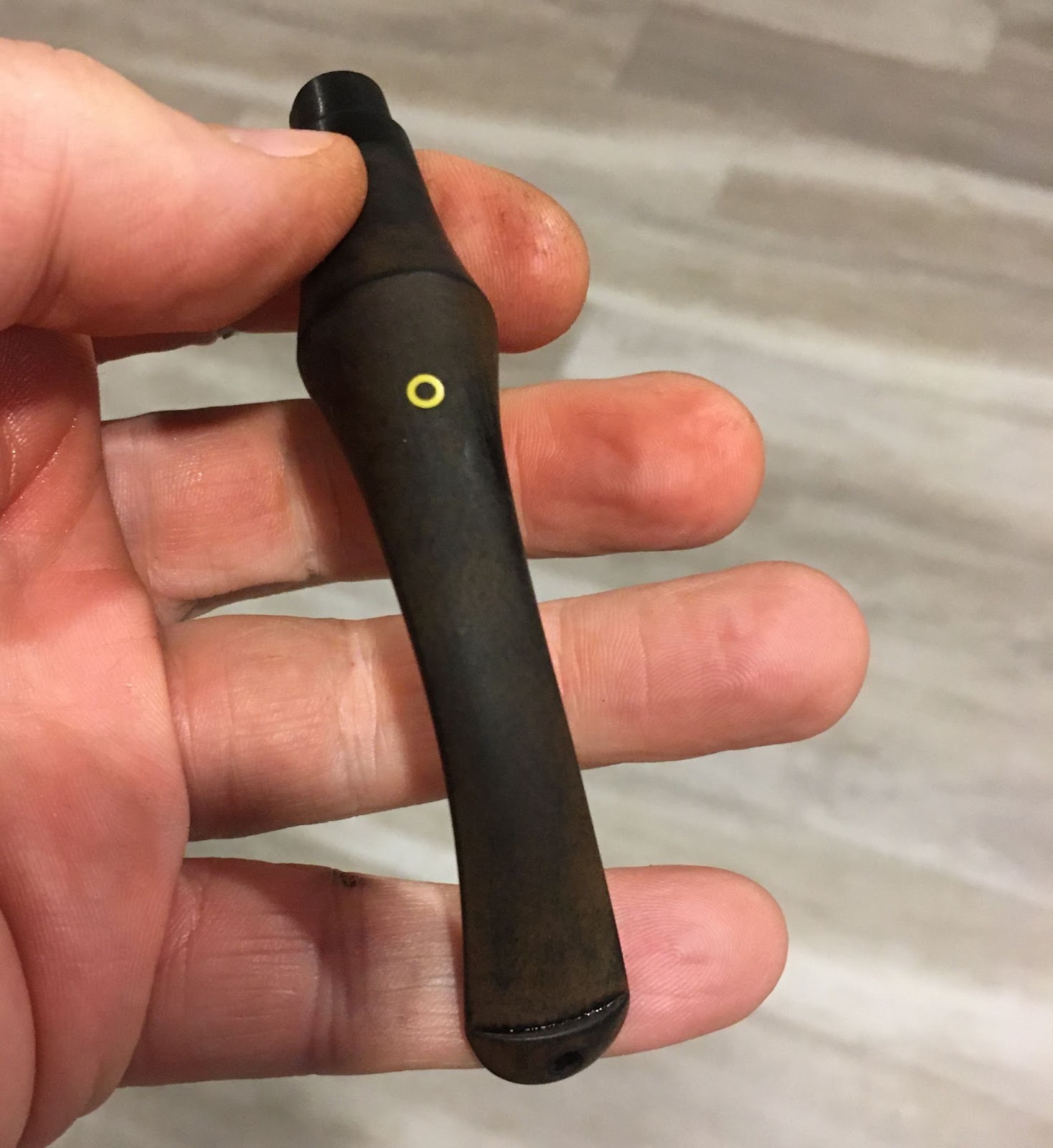
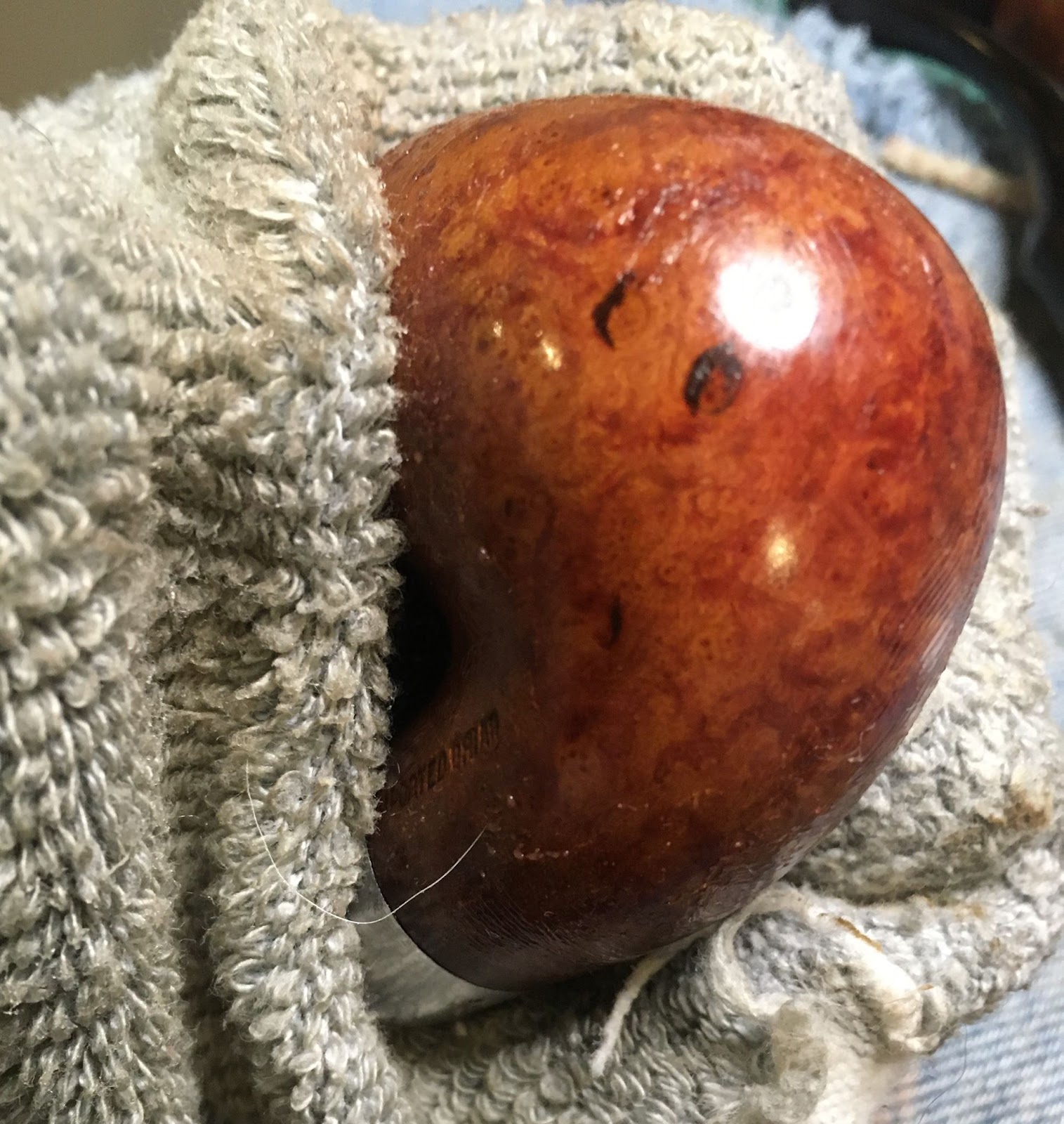
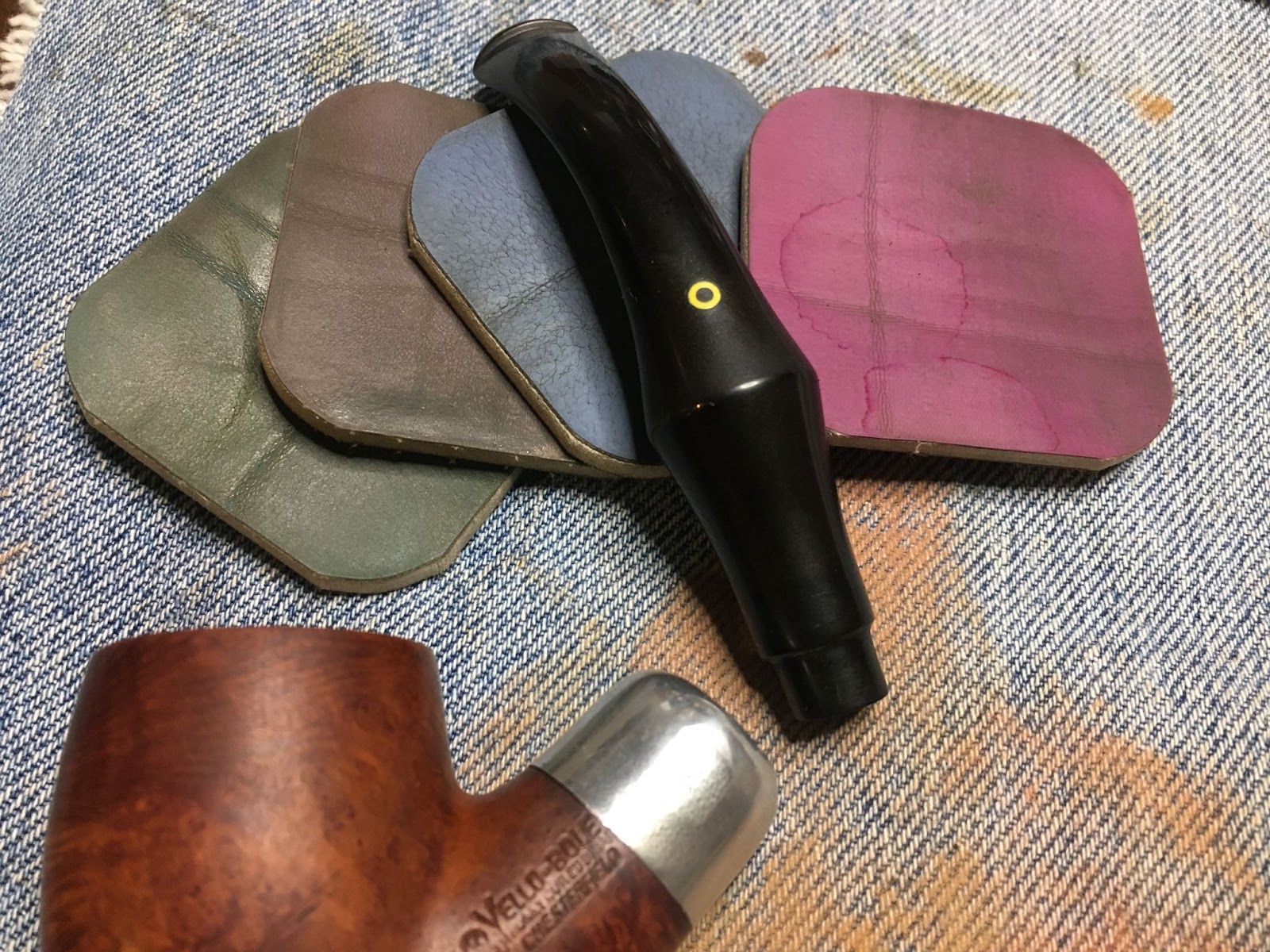
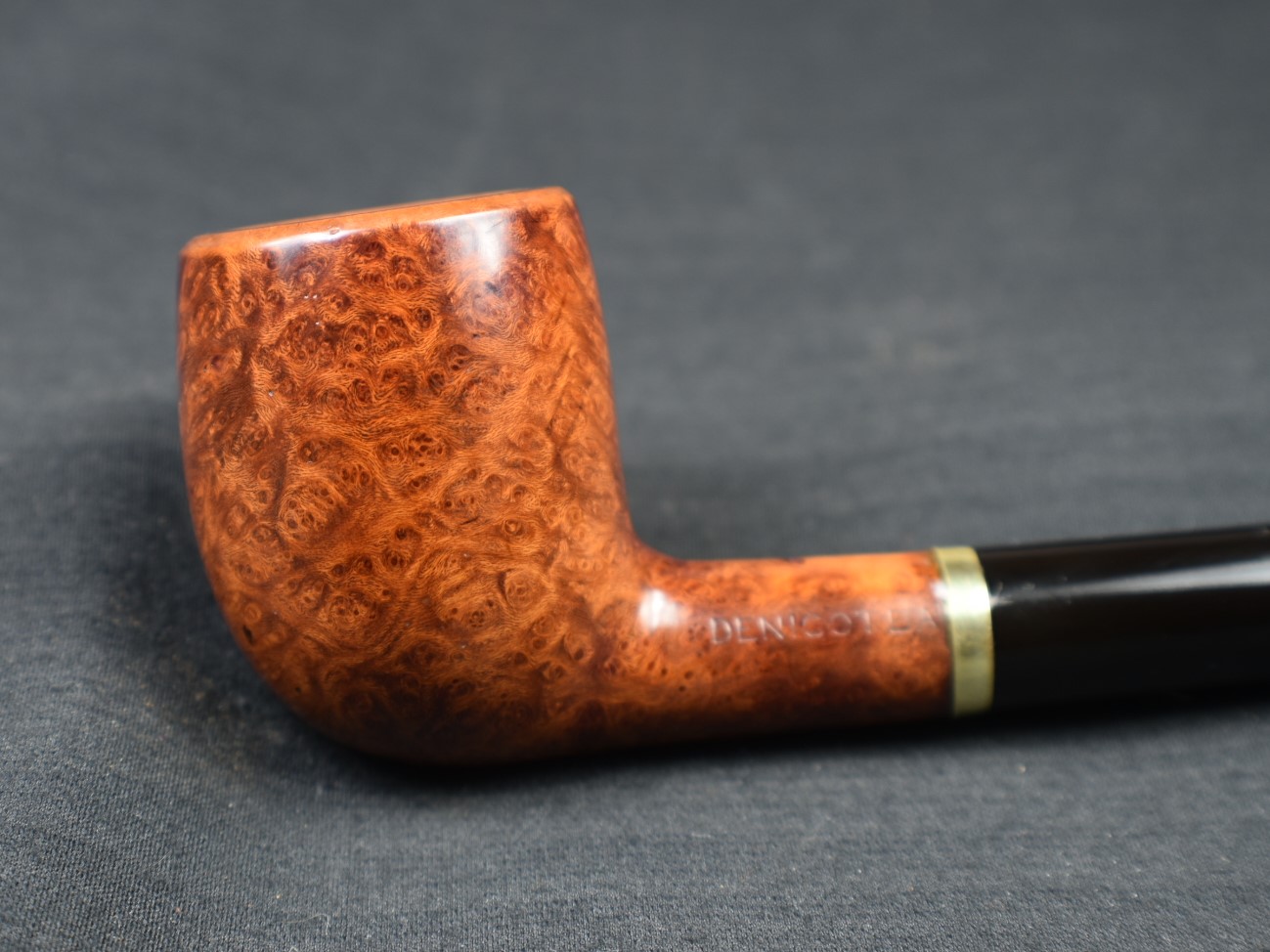
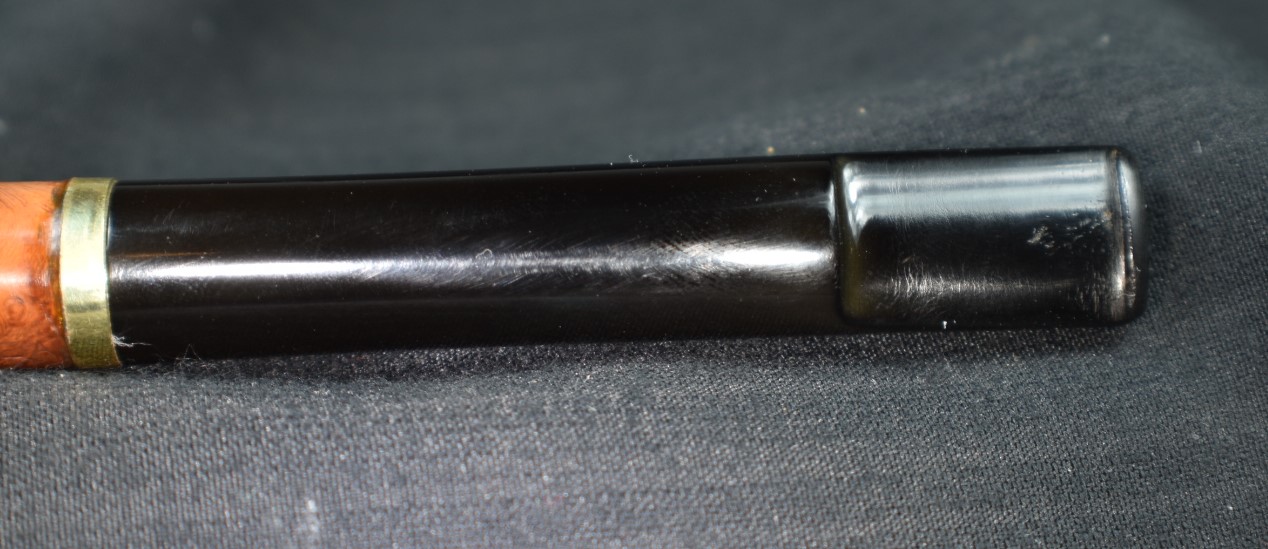
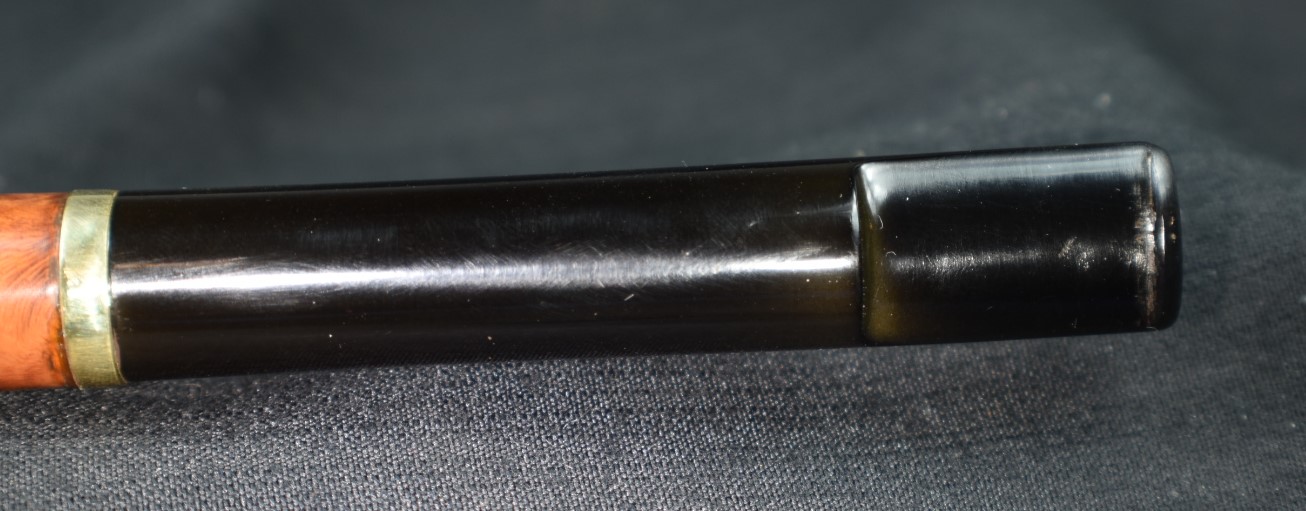
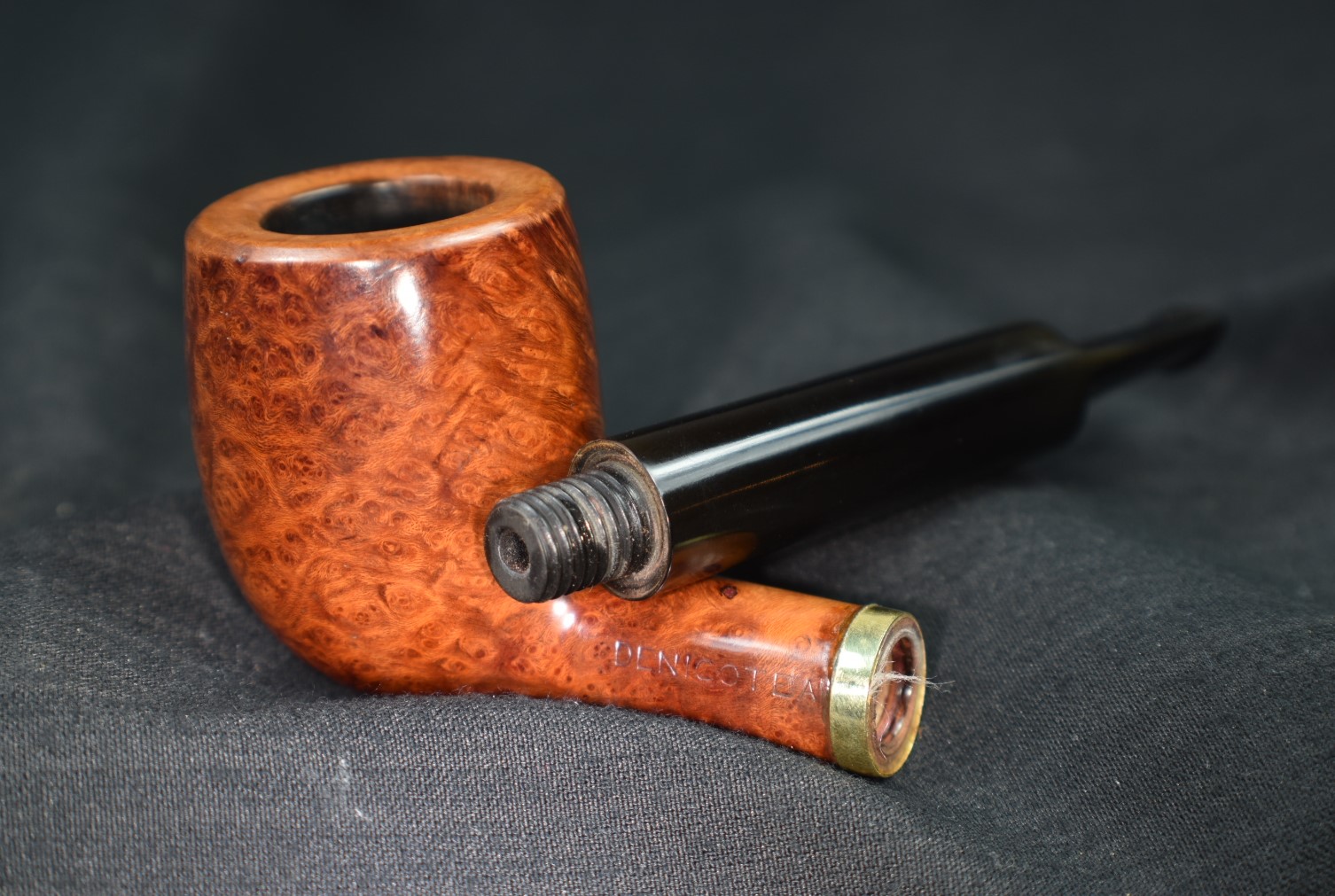
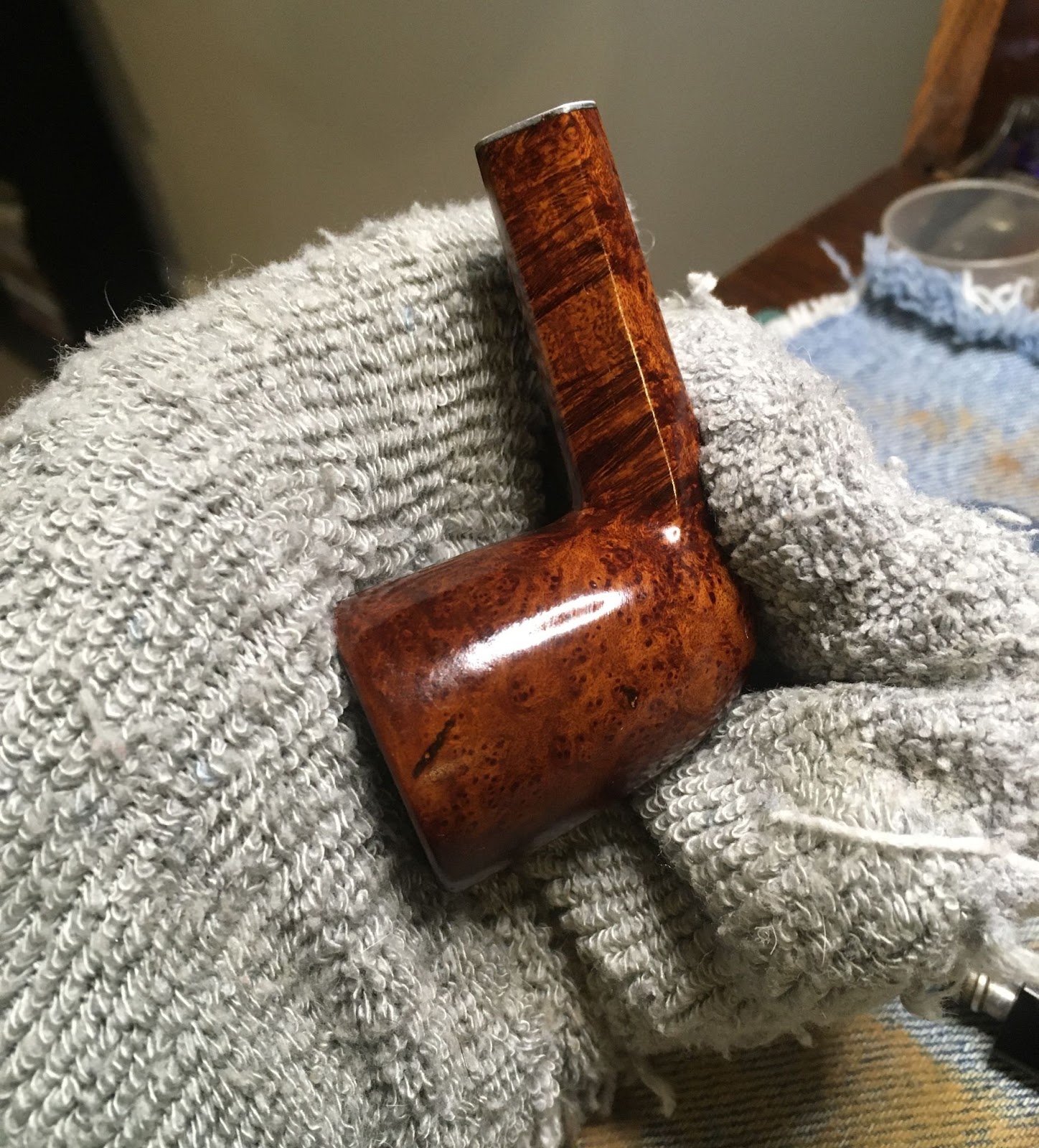
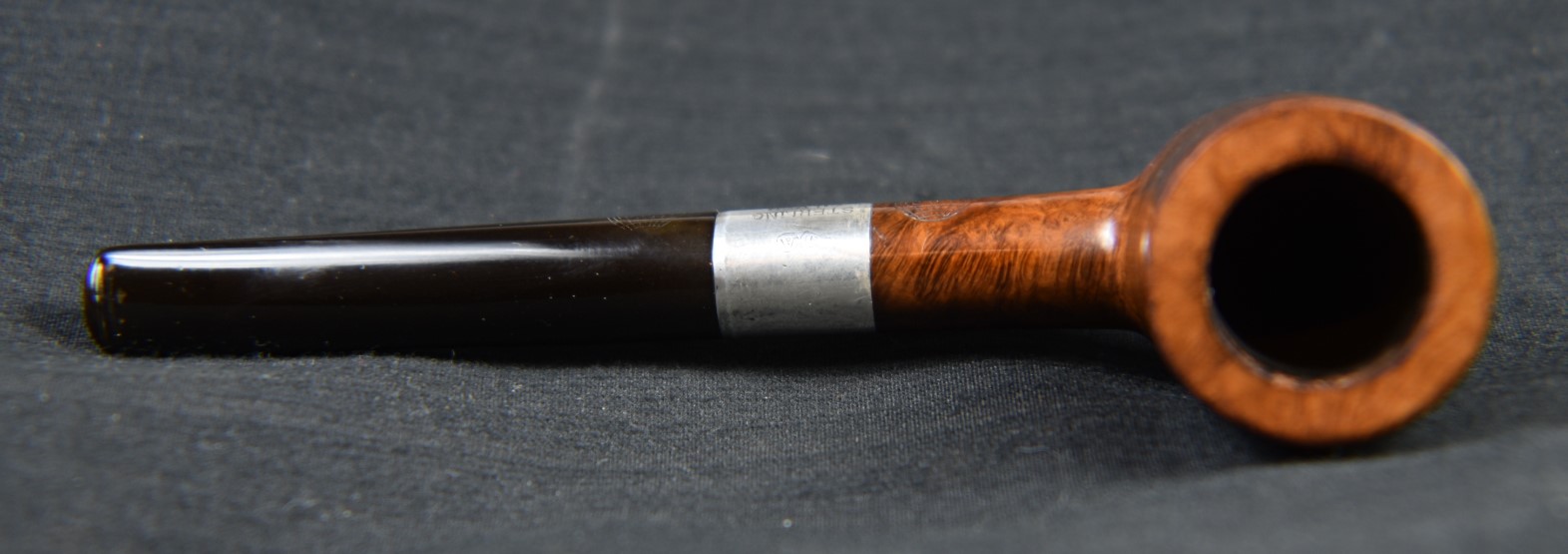
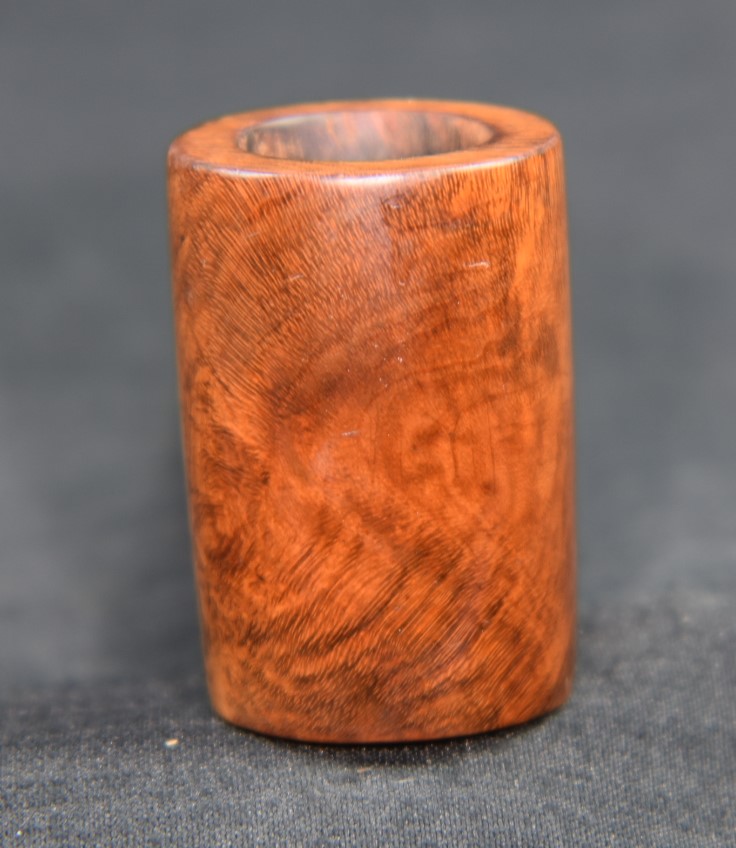
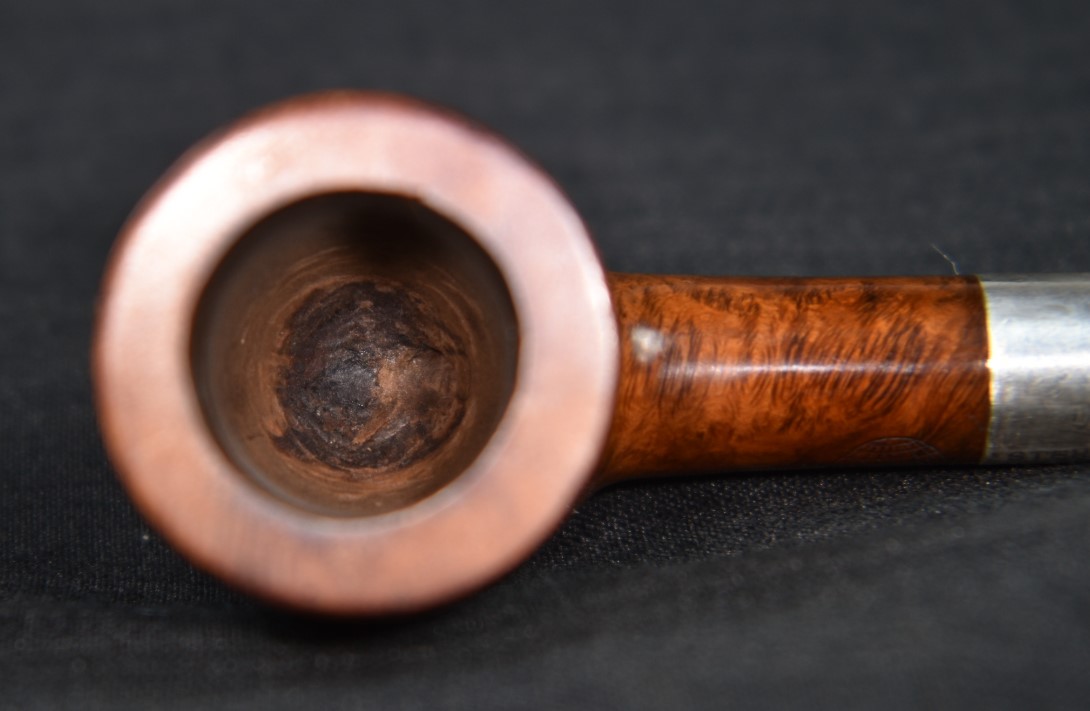
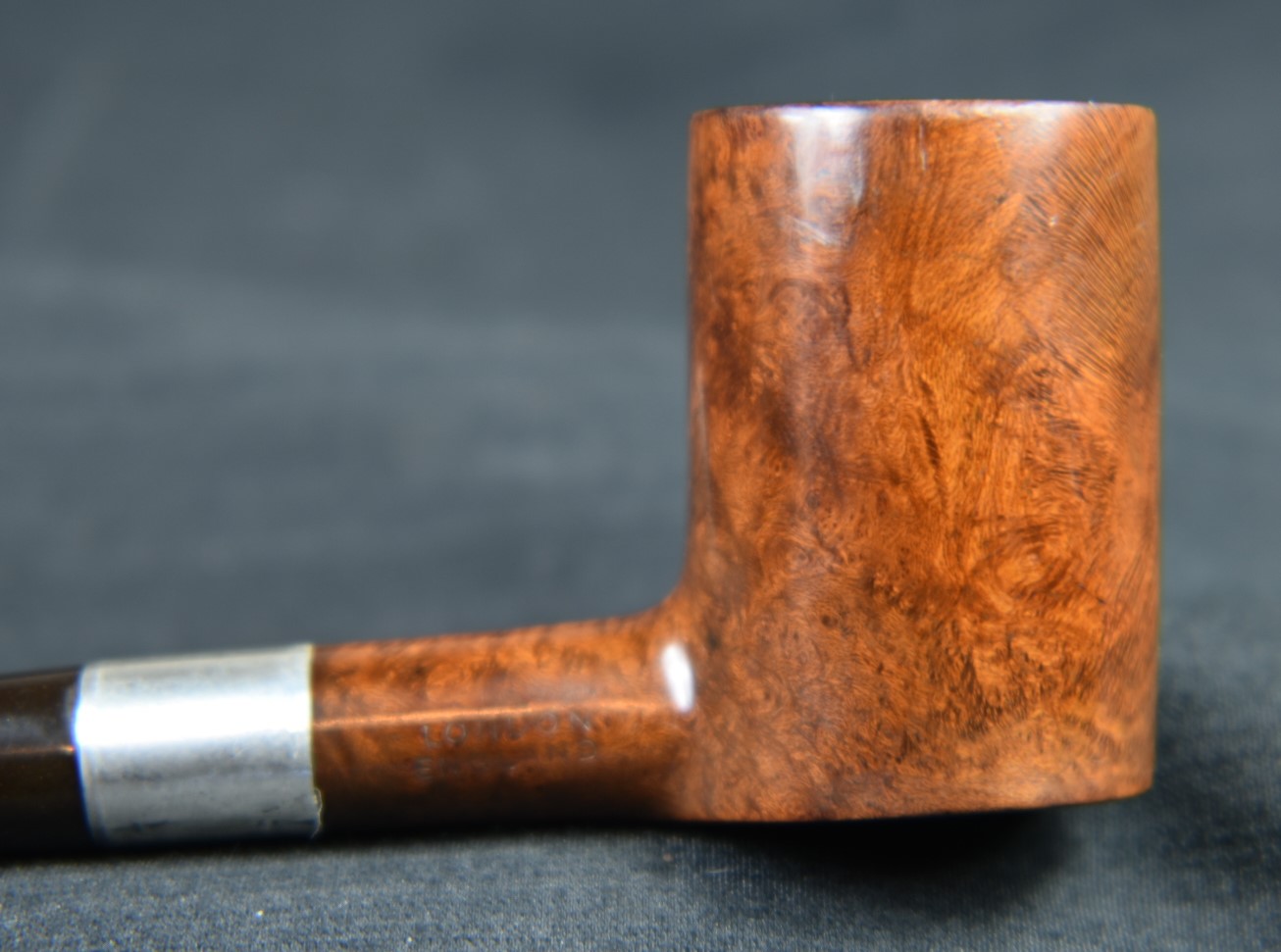
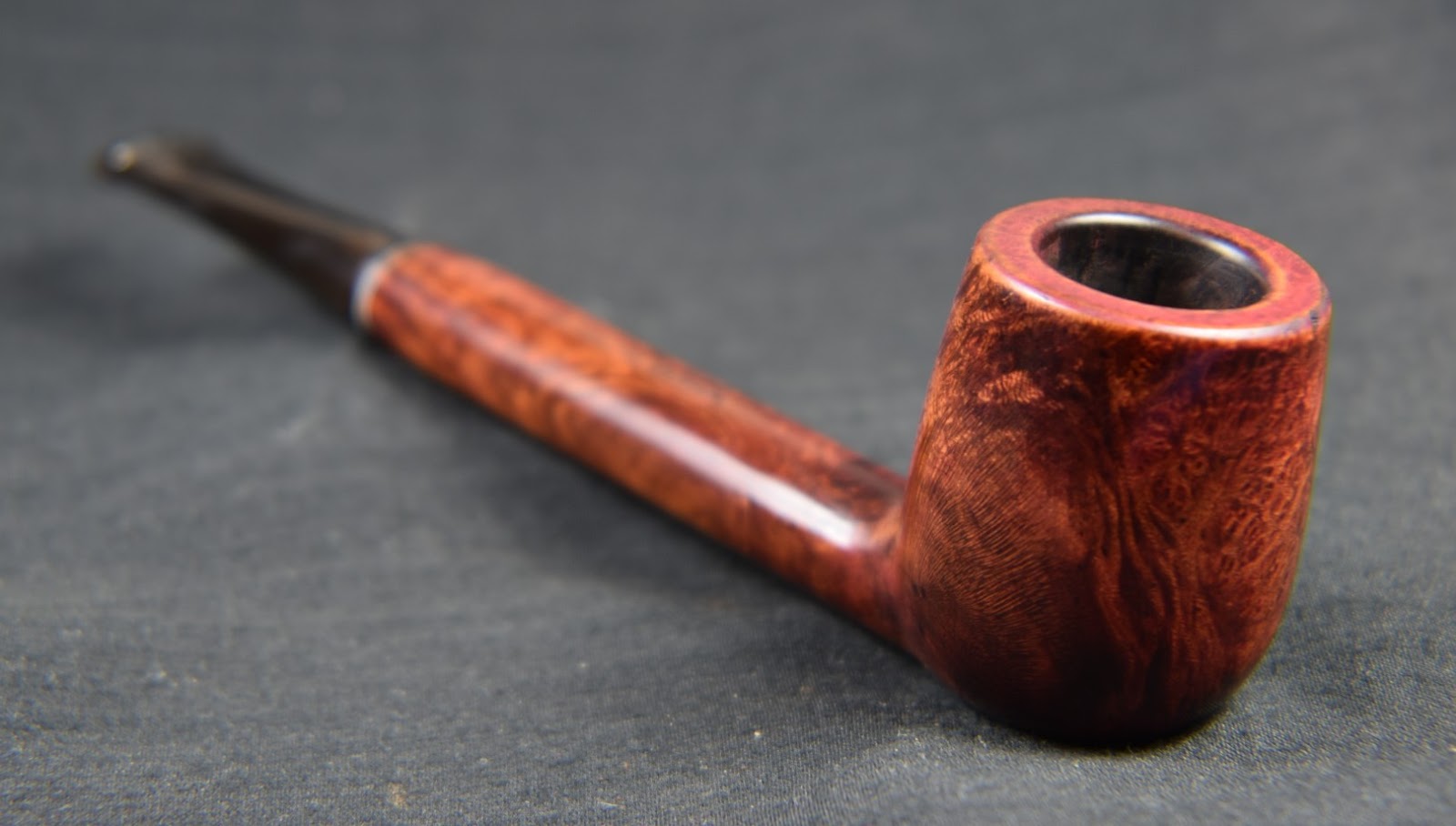
    That was a personal record for me.  The AOC Poker was the oldest pipe that I had ever restored.  I am very pleased with how well the restoration turned out.  The briar grain is beautiful; the old stain was preserved and not modified.  The stamps indicating the pipe’s heritage were also preserved intact.  The vulcanite cleaned up well and was returned to a lovely high gloss black.  It was sad that the stamps on the silver band did not fare as well in their battle against time, wear and oxidation.  Fortunately the date letter was legible.  I would like to think that 150 years from now someone will rediscover this old poker and really have an old pipe to restore.

    The dimensions of this Adolphe Oppenheimer Company (A.O.C.) Poker are: 

    • Length:  4.95 in./ 125.73 mm.
    • Weight:  0.94 oz./ 27.00 g.
    • Bowl Height:  1.71 in./  43.43 mm.
    • Chamber Depth:  1.50 in./ 38.10 mm.
    • Chamber Diameter:  0.79 in./ 20.01mm.
    • Outside Diameter:  1.17 in./ 29.72 mm.

    I do hope that you have found something here useful to your own pipe care, maintenance or restorations.  If you like this sort of thing, please click the like and subscribe buttons.  Thank you for reading the ramblings of an old pipe lover.

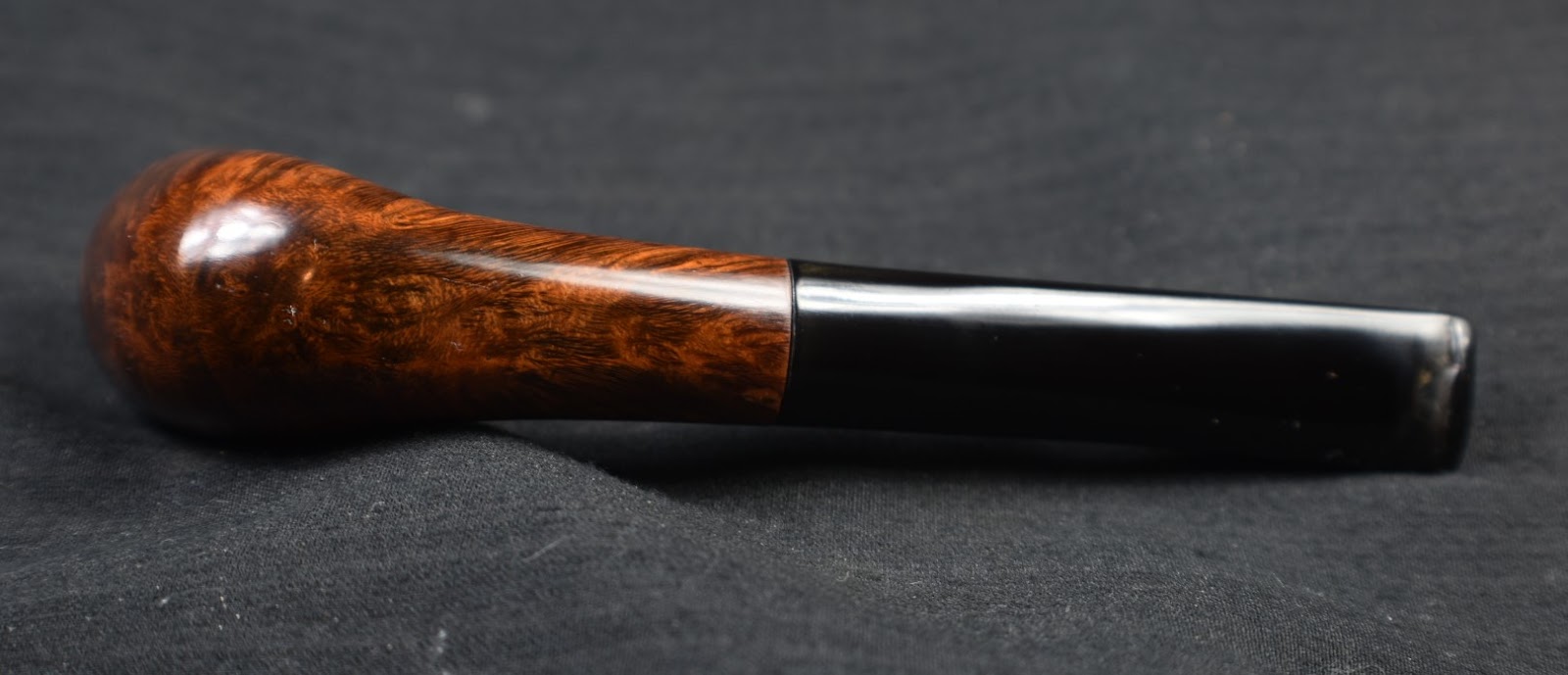
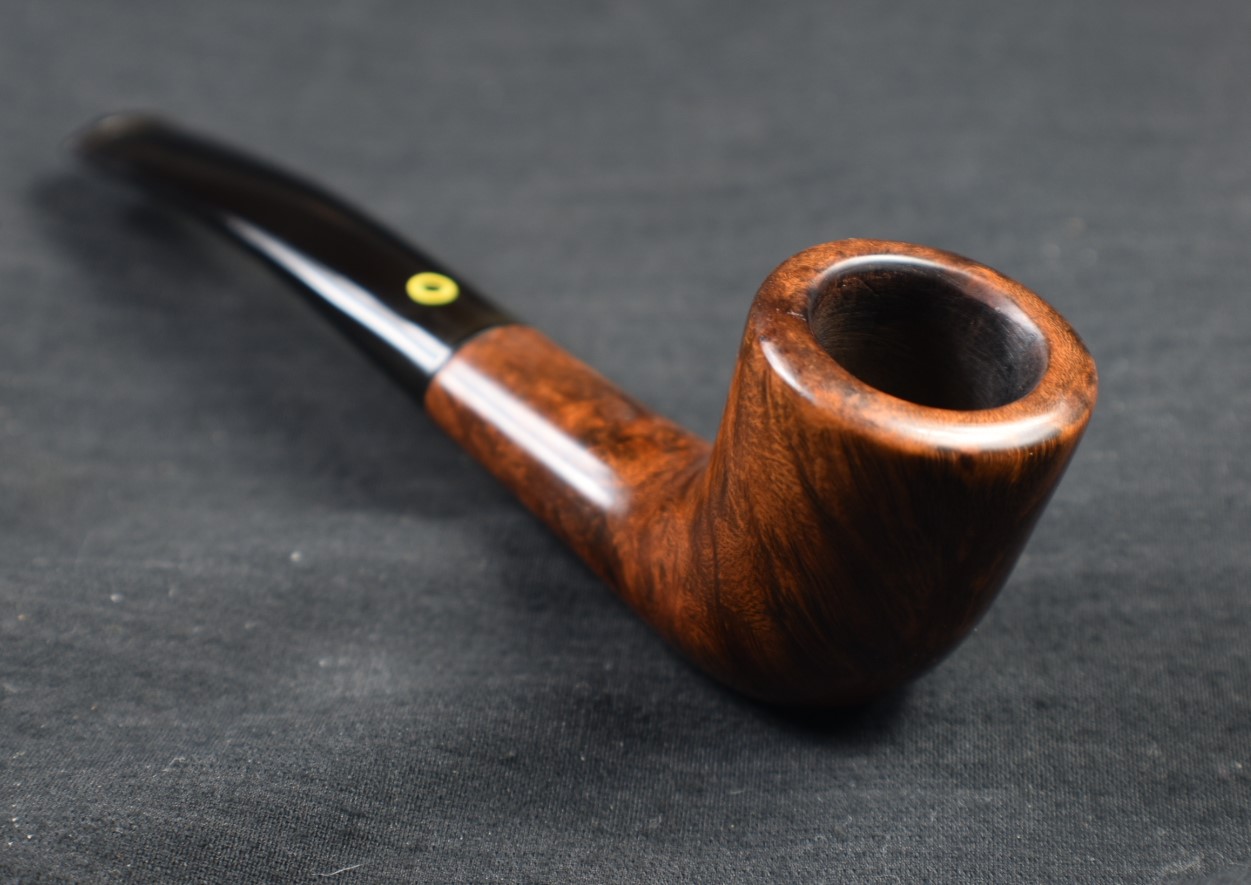
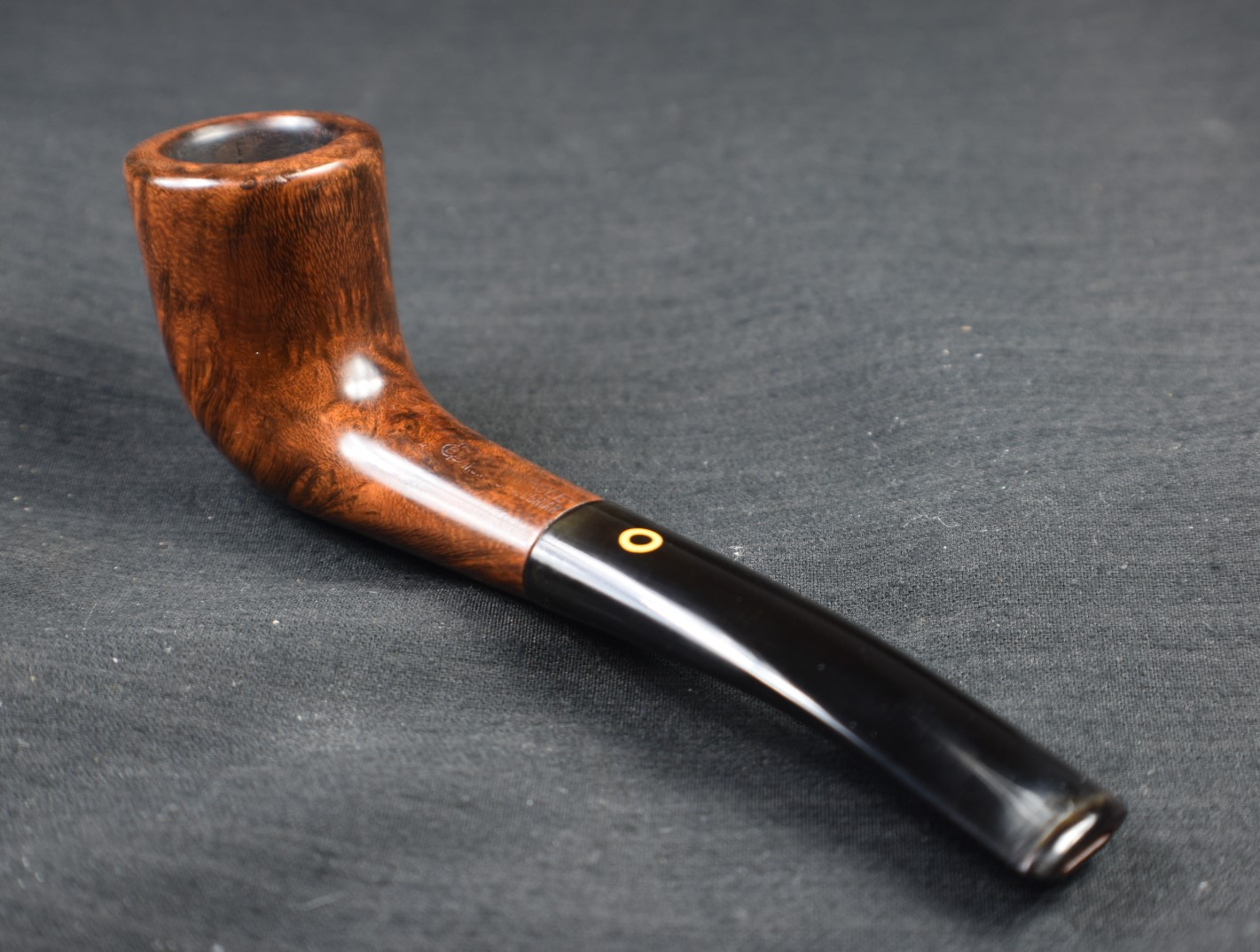
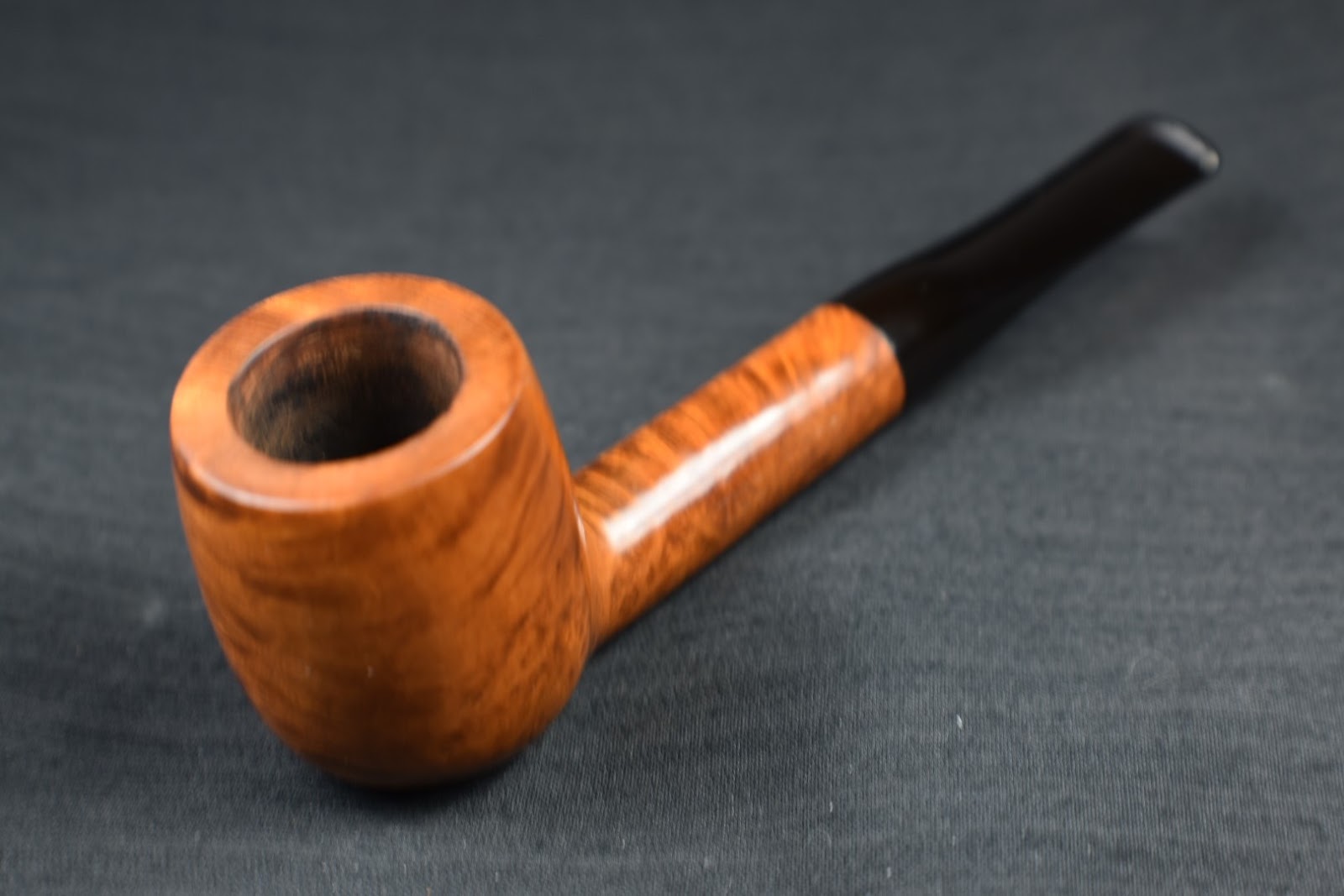
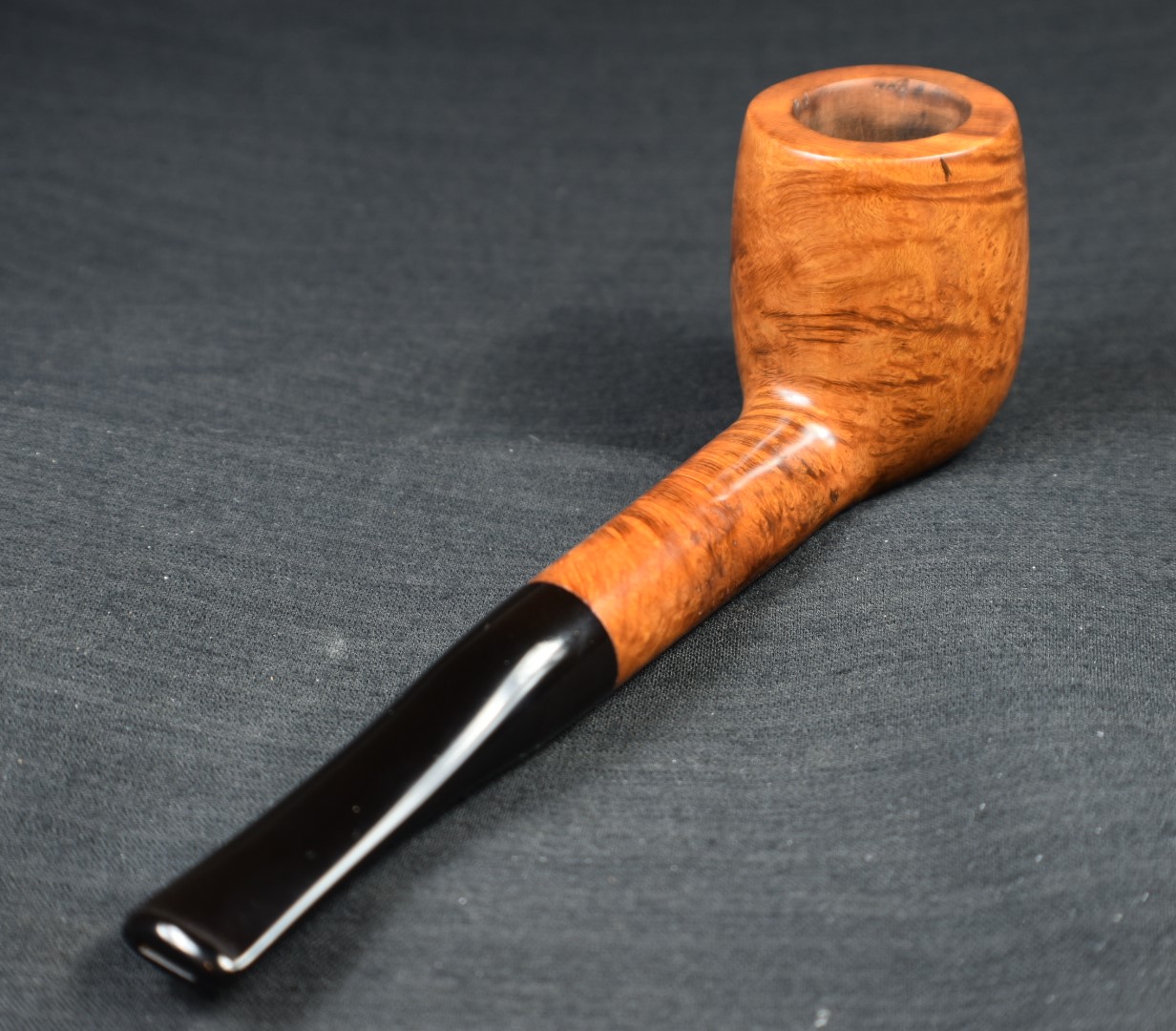
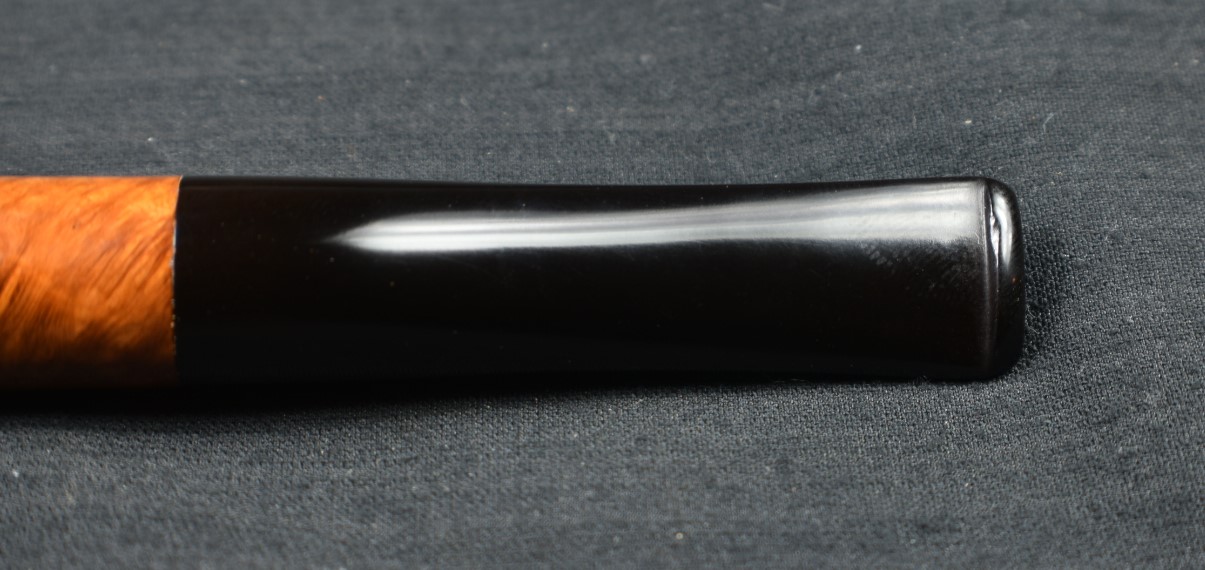
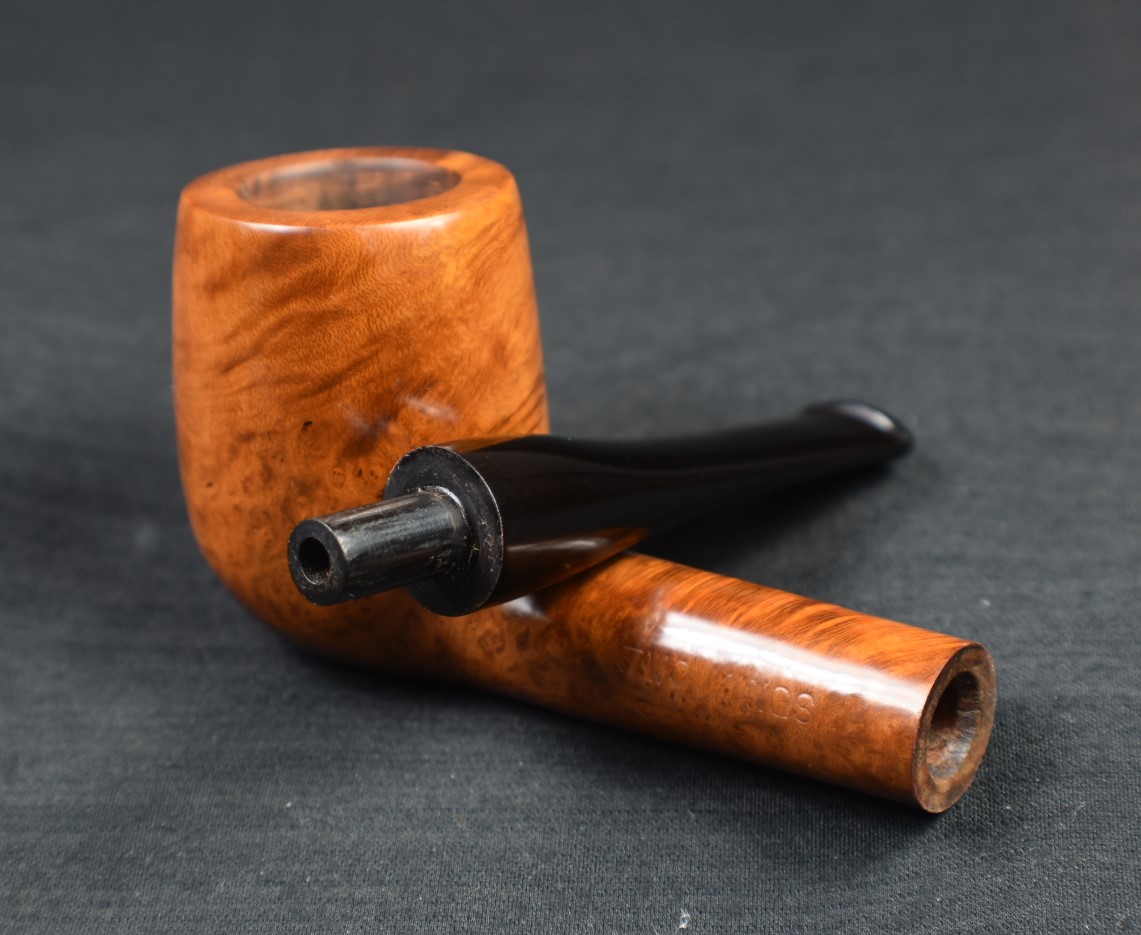
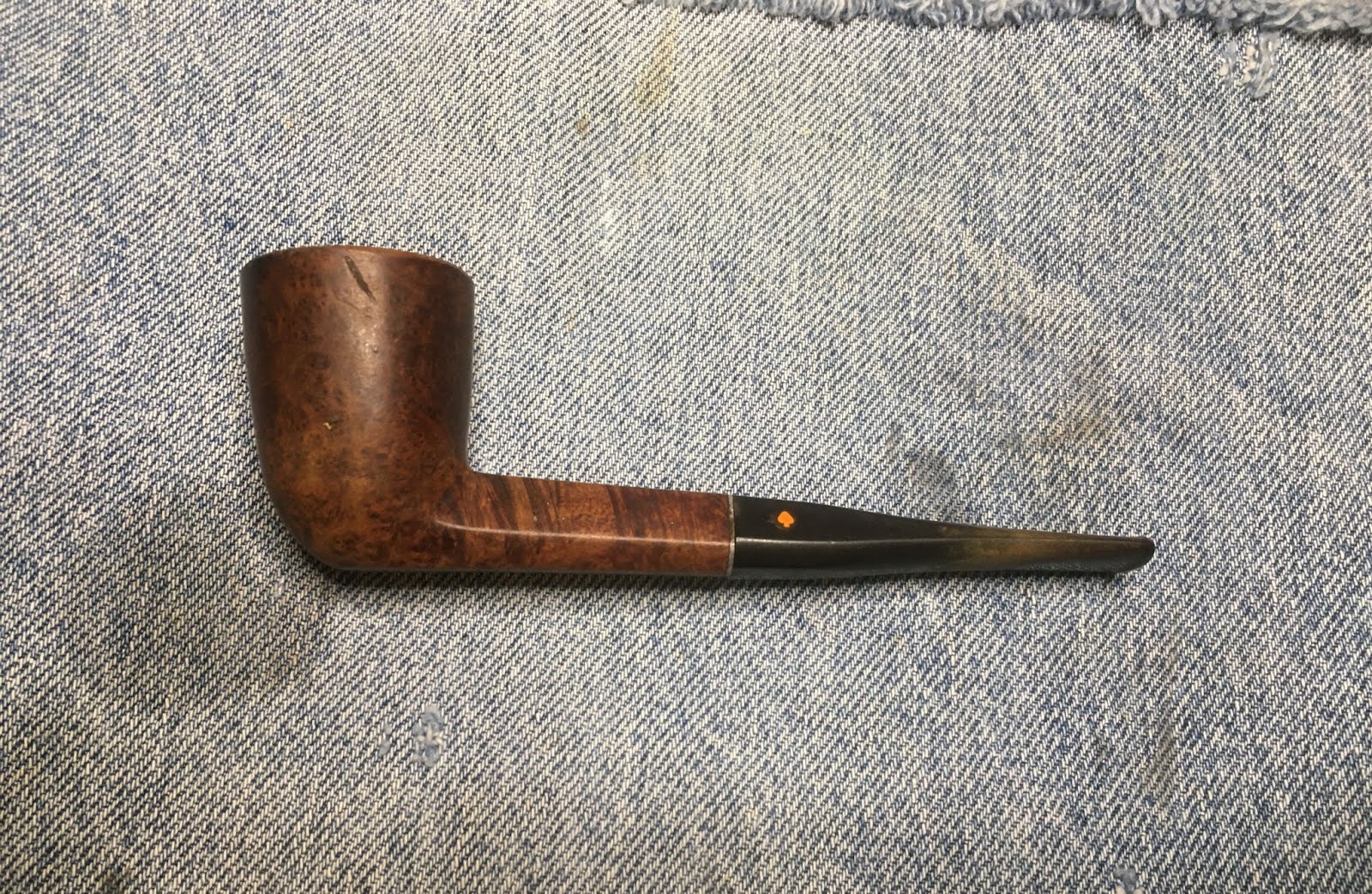
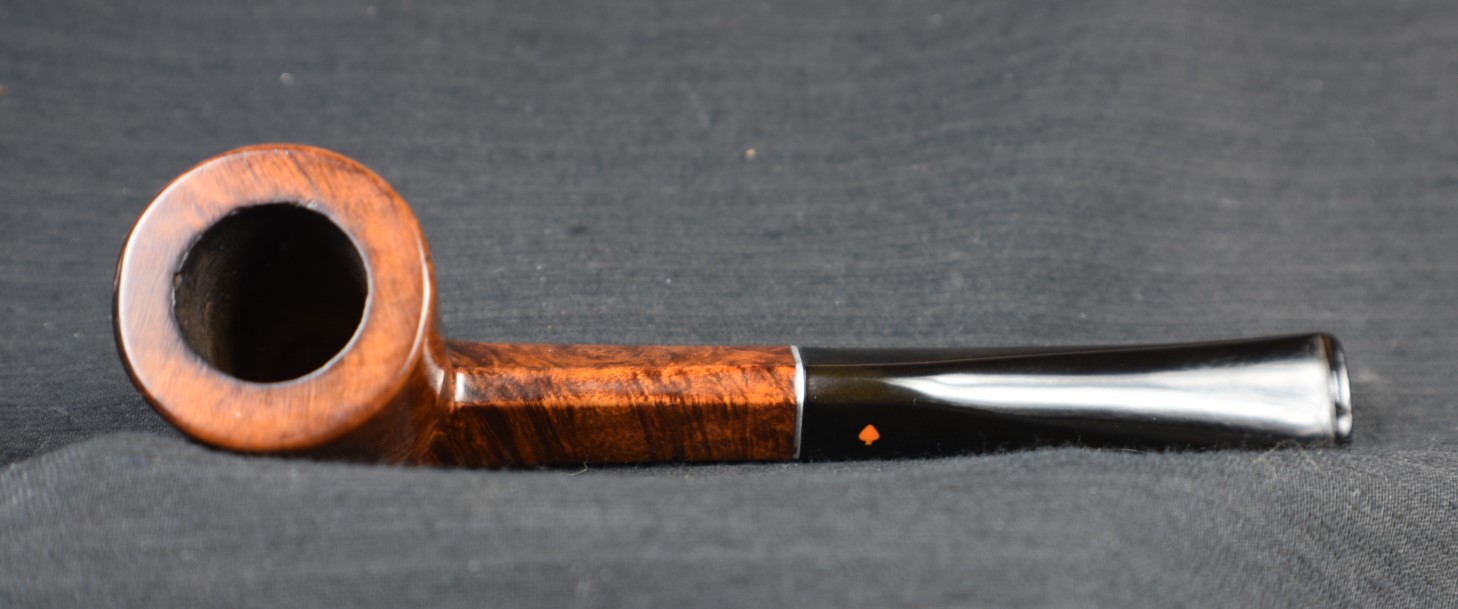
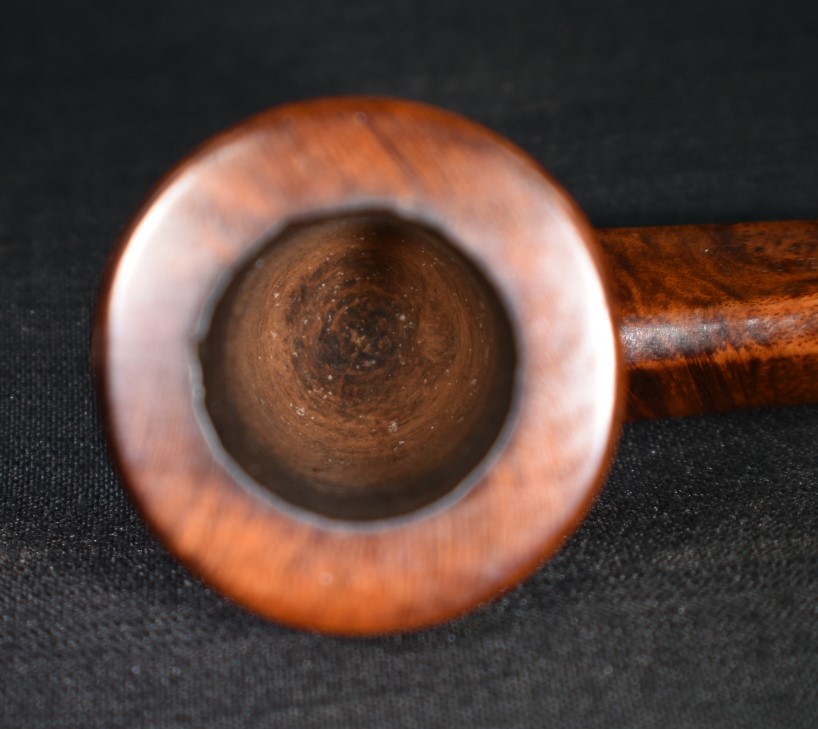
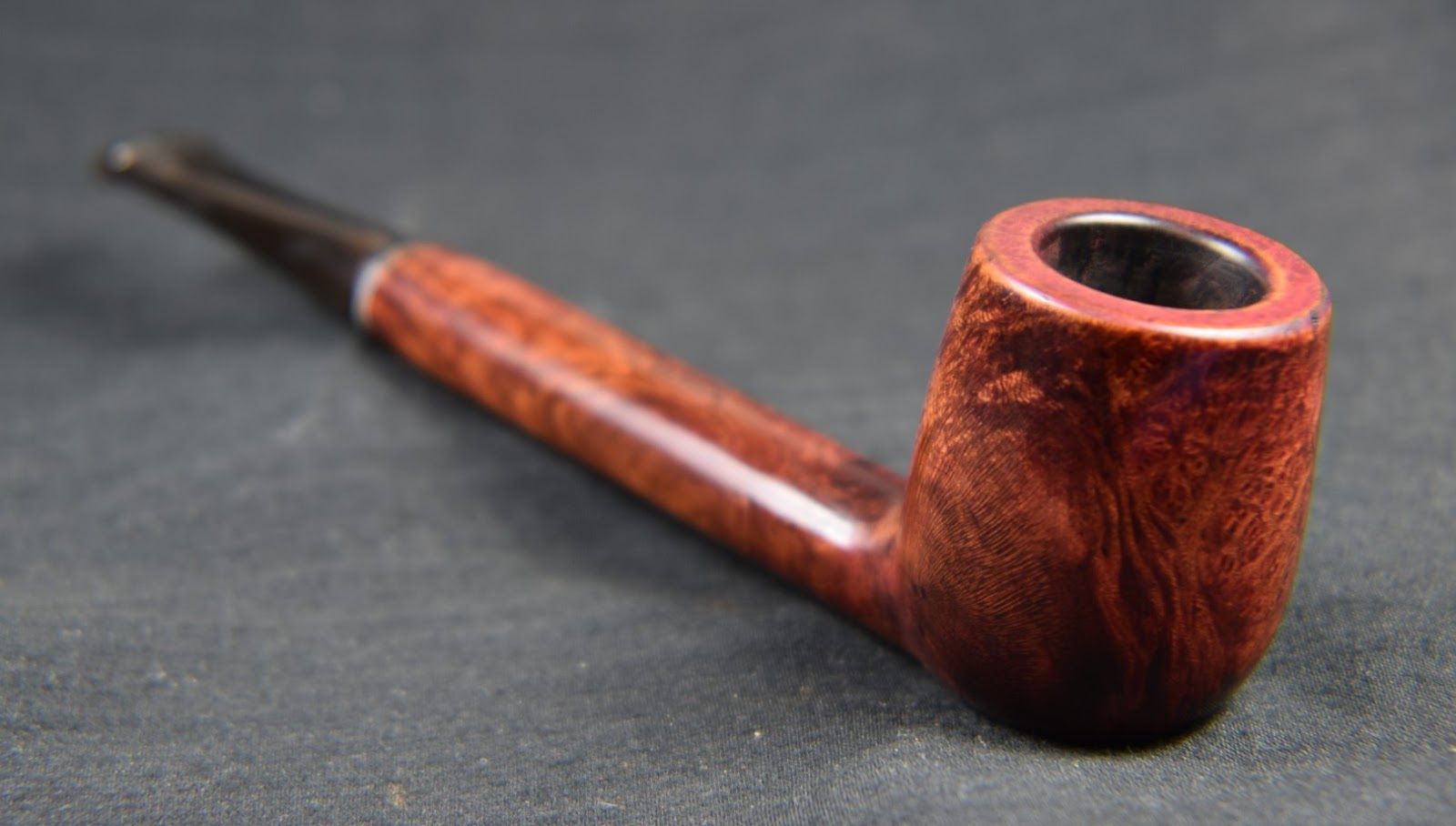
    Below are some photos of the finished A.O.C Poker.

  • A No Name Canadian Restoration

    April 19th, 2024

    Photographed and written by

    John M. Young

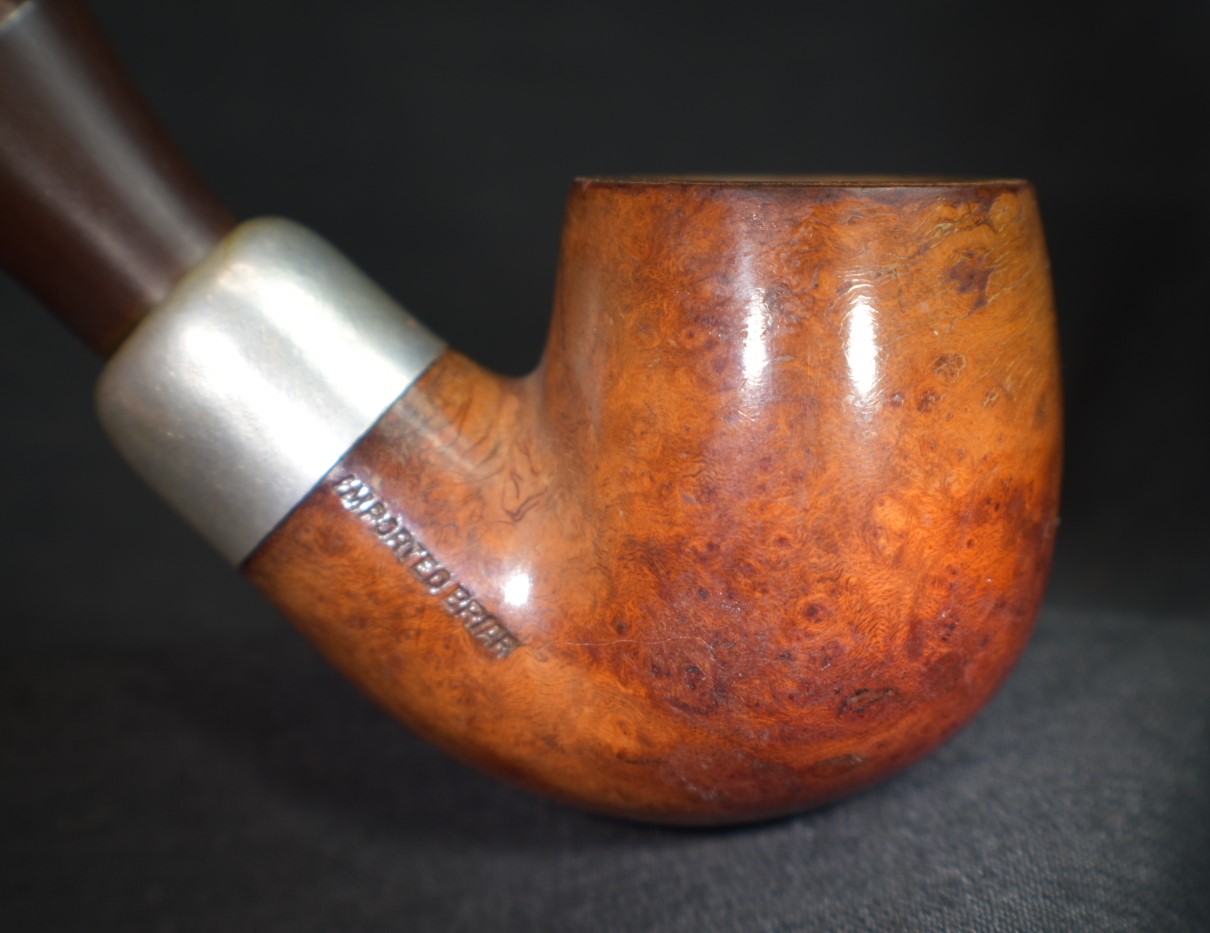
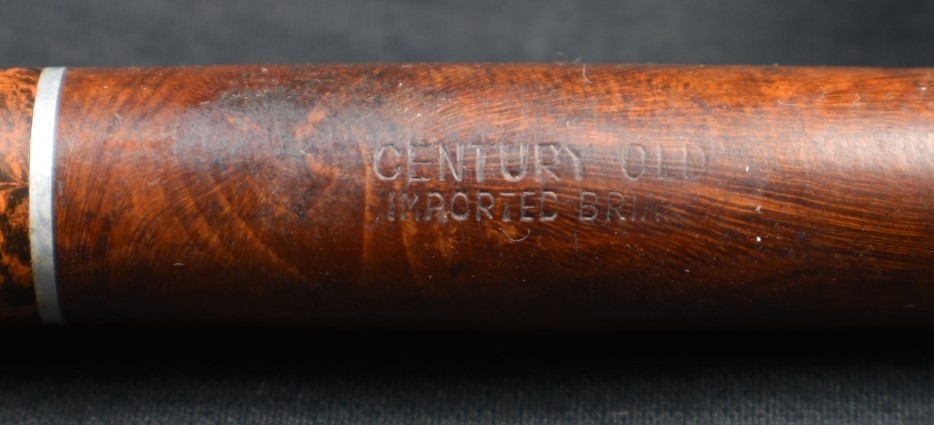
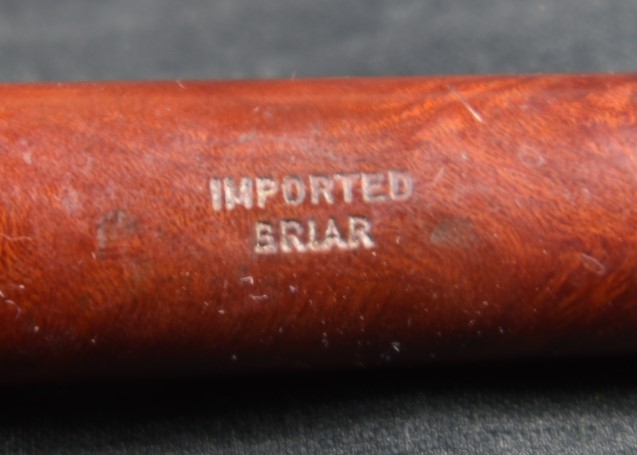
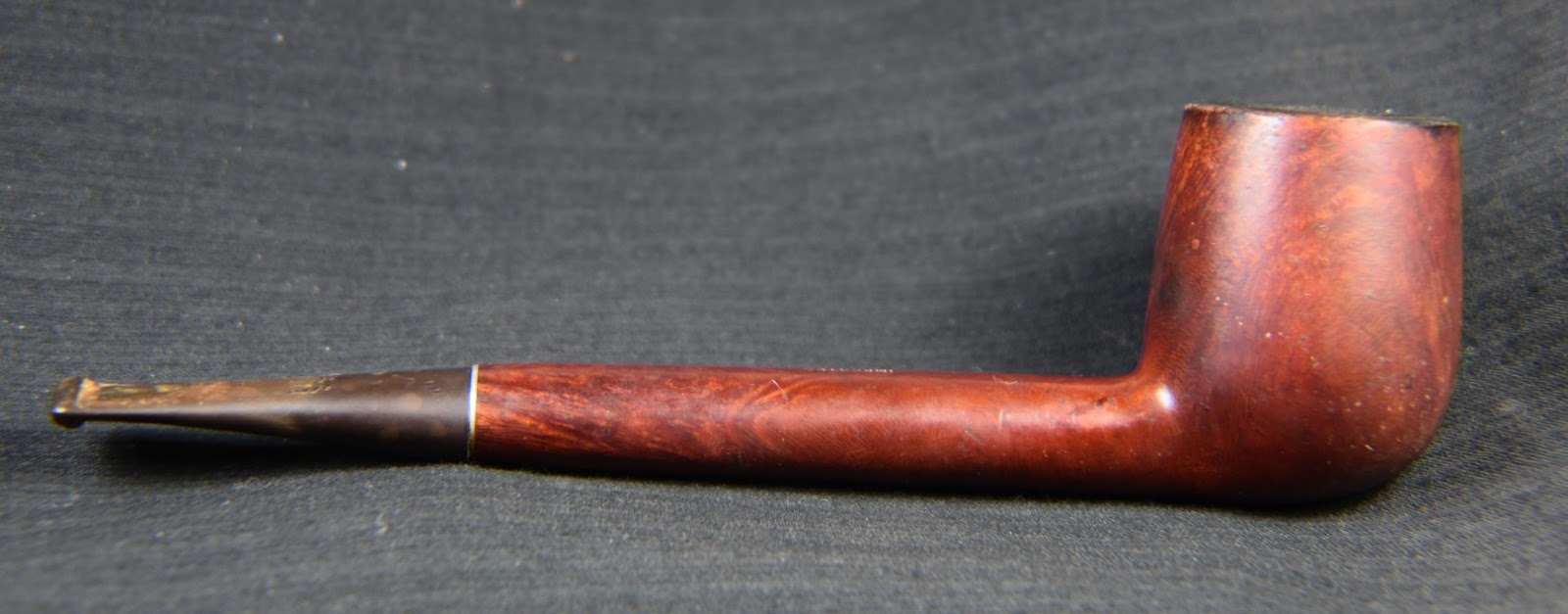
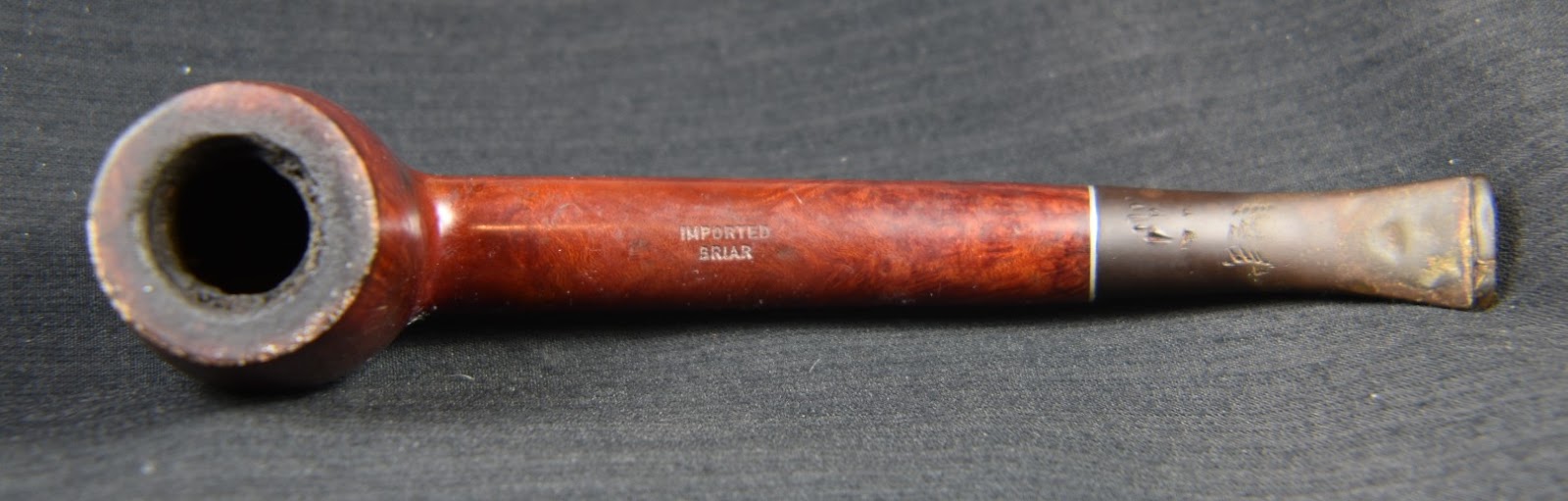
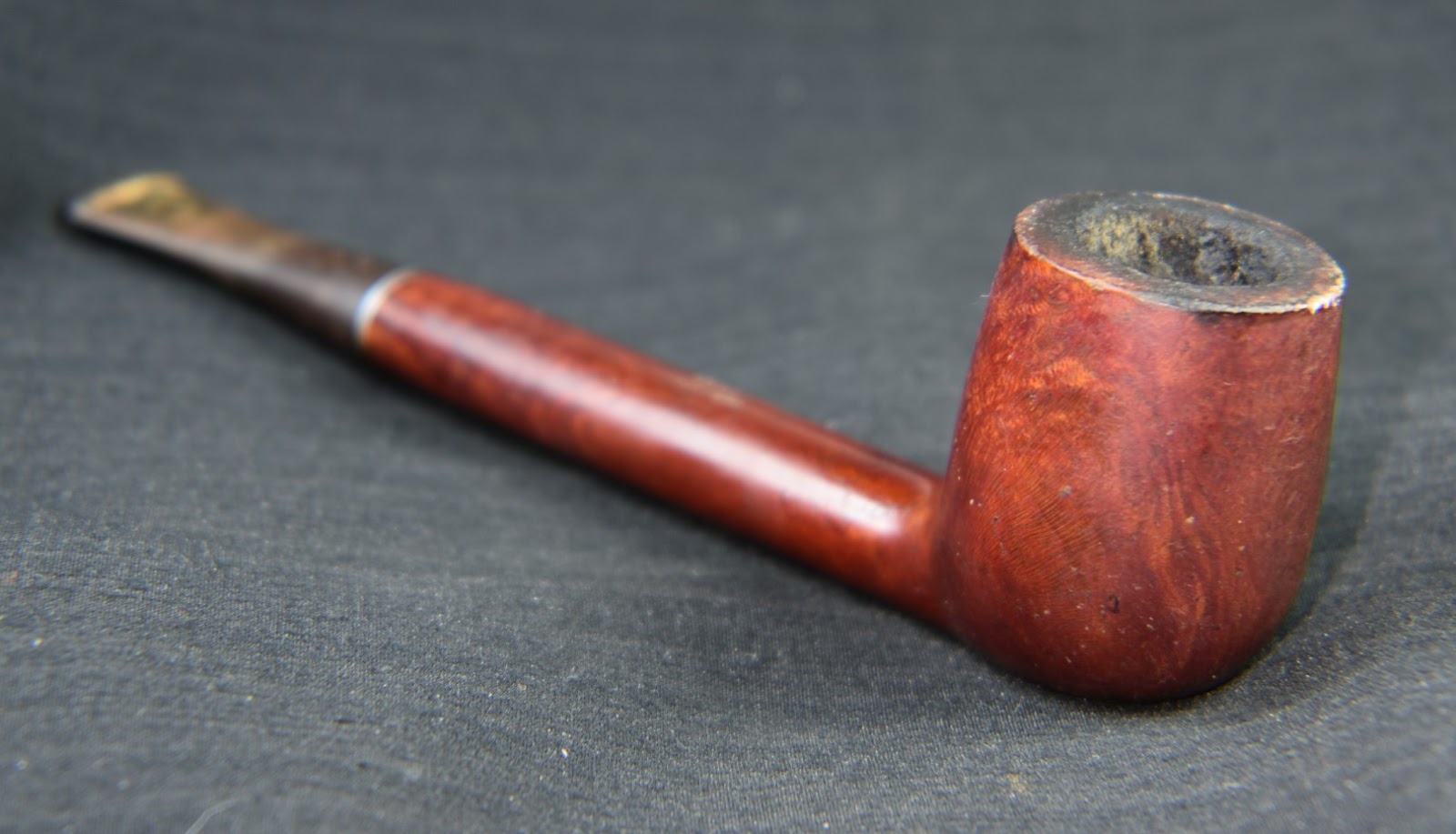
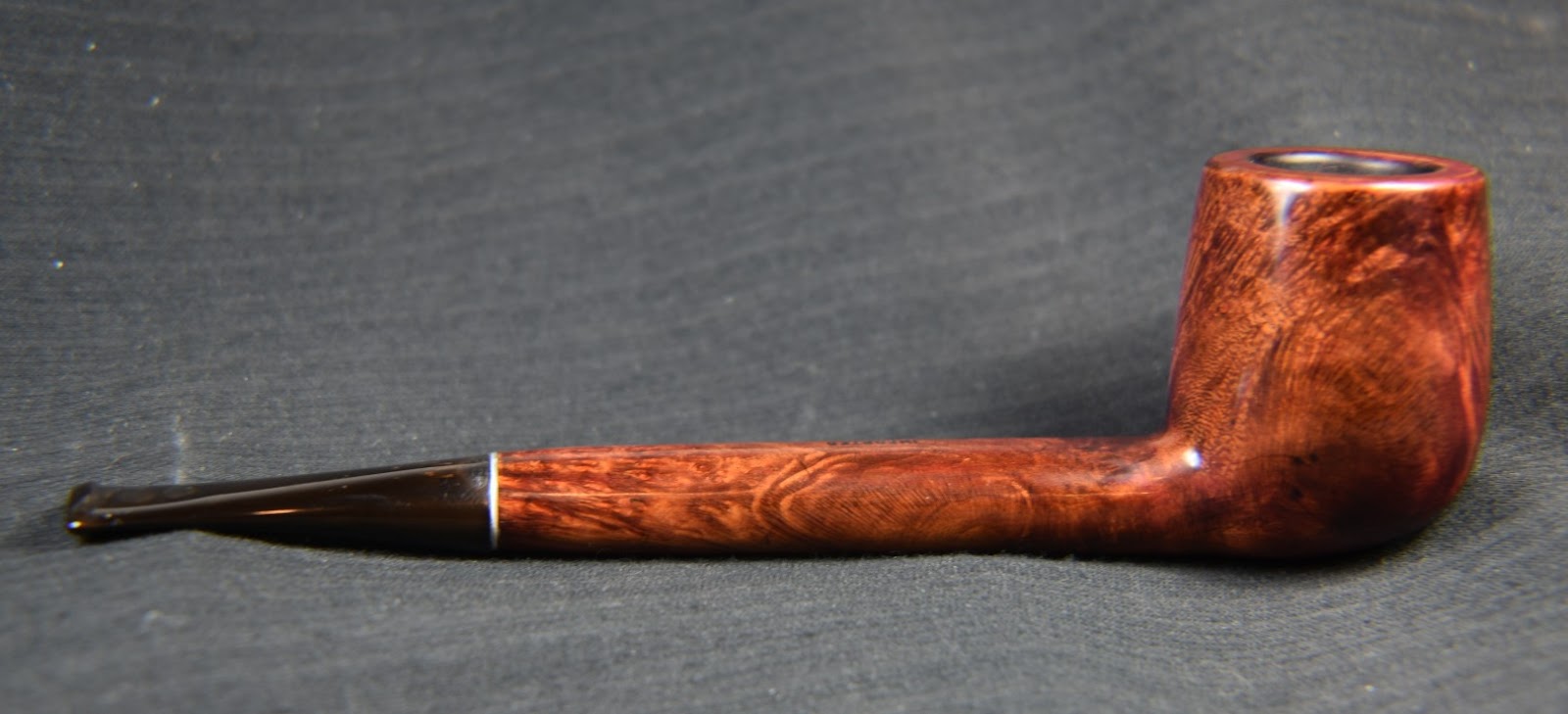
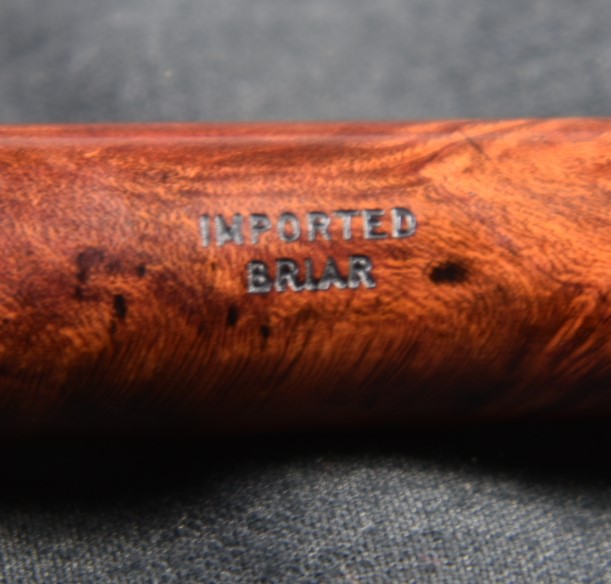
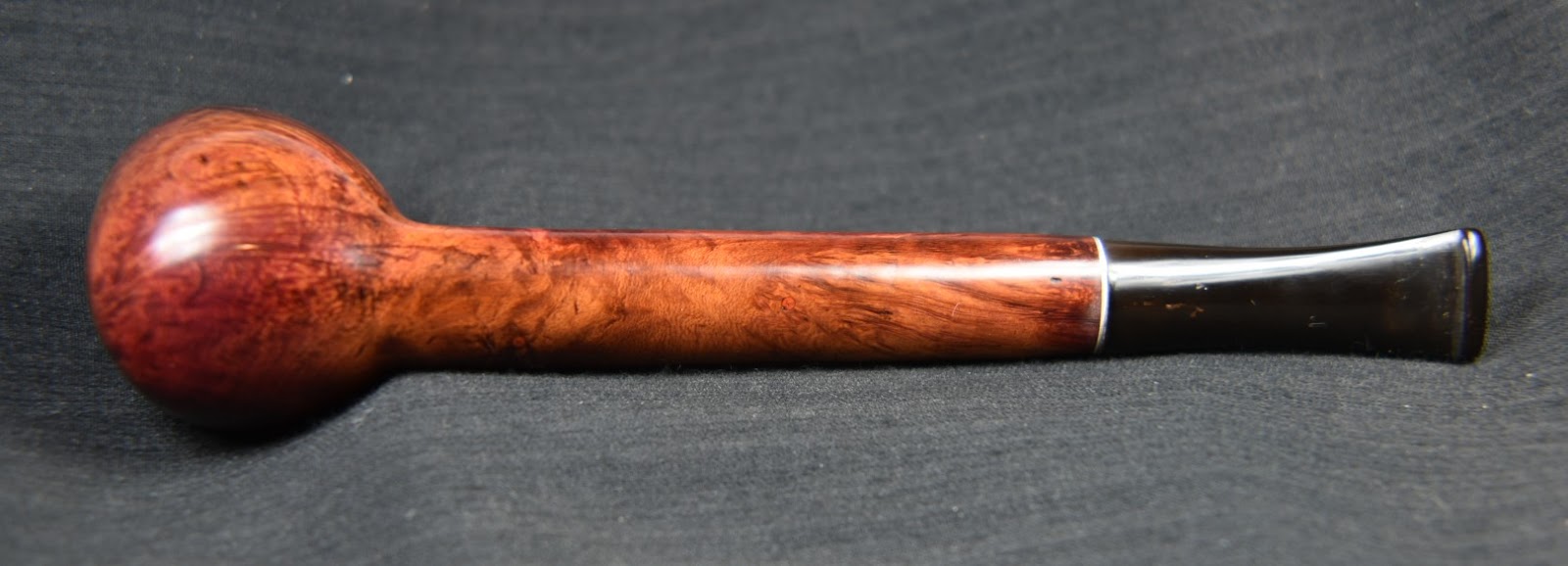
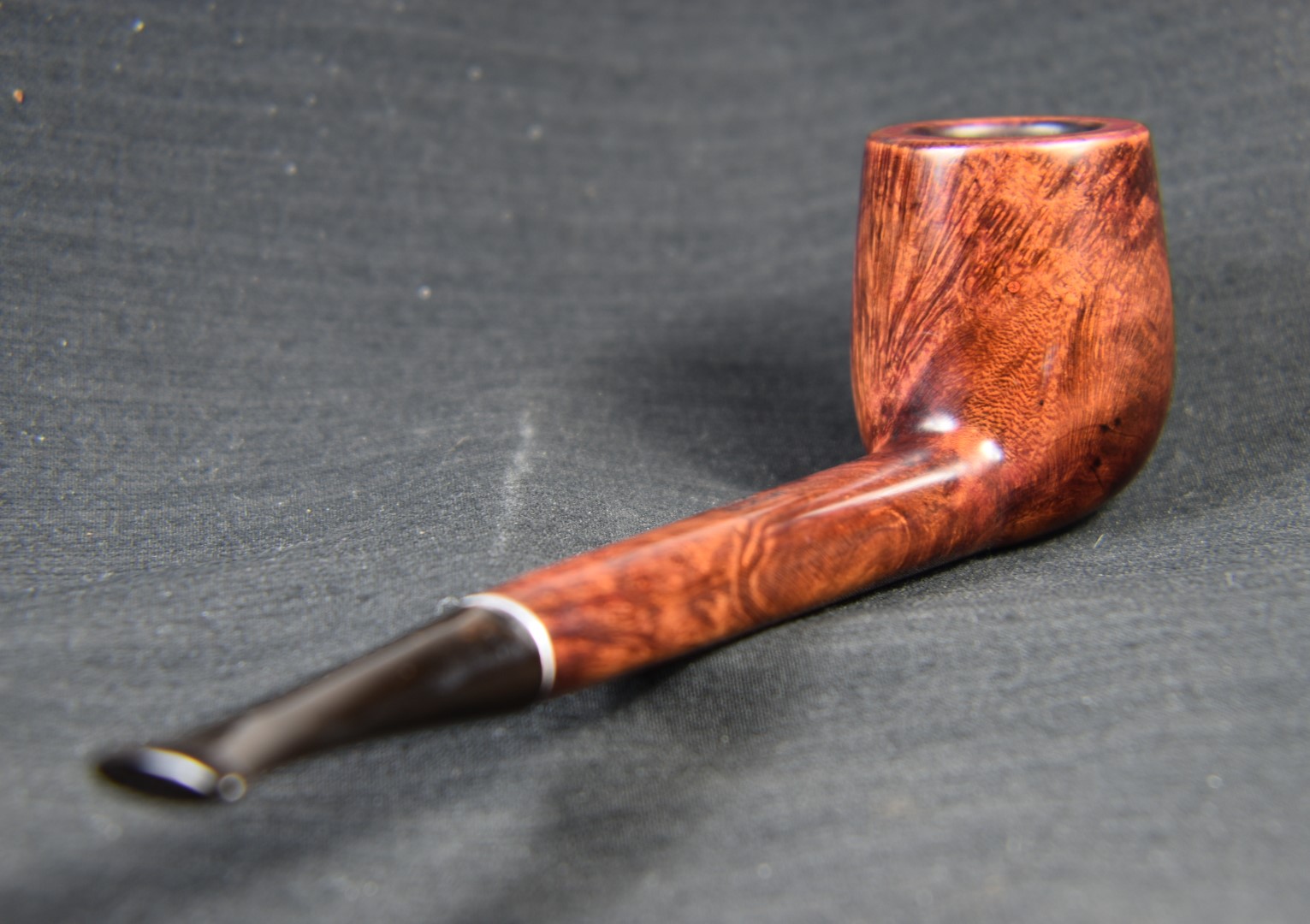
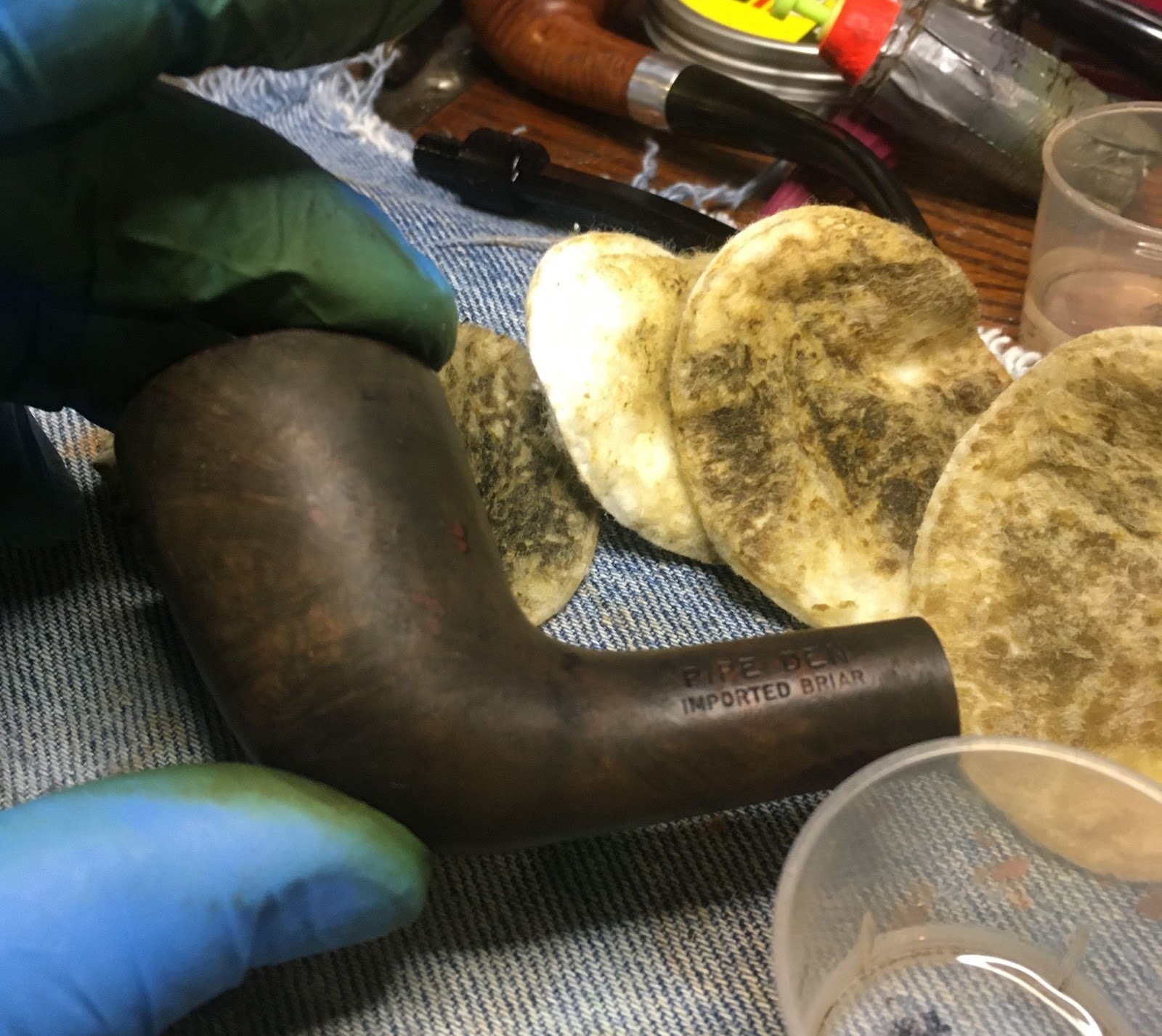
    Why is it that some pipes can’t qualify for the maker stamping their name on the pipe?  Not to sound like President Biden but, “Come on, man.”  IMPORTED BRIAR is not enough of a name to mean anything except that your briar is imported (Duh, isn’t it all imported?) and that the pipe was likely made in the US after World War 2 (WWII).

    Fortunately our government is there protecting us from the diabolical domestic terrorist native briar cartels.  As can be seen by,

     “Section 304 of the Tariff Act of 1930, as amended (19 U.S.C. 1304) 

    provides that, unless excepted, every article of foreign origin 

    imported into the U.S. shall be marked in a conspicuous place as 

    legibly, indelibly, and permanently as the nature of the article (or 

    container) will permit, in such a manner as to indicate to the ultimate 

    purchaser in the U.S. the English name of the country of origin of the 

    article. Congressional intent in enacting 19 U.S.C. 1304 was that the 

    ultimate purchaser should be able to know by an inspection of the 

    marking on the imported goods the country of which the goods is the 

    product.

        Part 134, Customs Regulations (19 CFR Part 134), implements the 

    country of origin marking requirements and exceptions of 19 U.S.C. 

    1304. As provided in section 134.41, Customs Regulations (19 CFR 

    134.41), the country of origin marking is considered to be conspicuous 

    if the ultimate purchaser in the U.S. is able to find the marking 

    easily and read it without strain.”

    (https://www.govinfo.gov/content/pkg/FR-1994-11-15/html/94-28159.htm)

    Use your best Yoda impression to read the following, “The sarcasm is strong in this one.”

    Okay, what are we looking at with this restoration?

    The Restoration

    Perhaps it is for the best that little information can be gleaned from the stamping to the heritage of this pipe.  All that background and history research would just keep me from addressing the things that need fixing with this pipe.  First off there is a clear coat to eliminate.  Then there is the standard reaming and cleaning, followed by repairing the damaged rim and stem.  I think the briar would benefit from a contrast stain allowing for a highlight red to be accented by black.  Stay tuned to see what happens.

    Of course I will begin with a clean denim piece protecting the work surface.  Someday I will get around to stripping the finish from this old roll top desk that I use as a workbench.  It has a shellac finish that does not agree with spilled alcohol or acetone.  A polyurethane would make more sense but it was my grandfather’s desk and I don’t want to alter it too much.

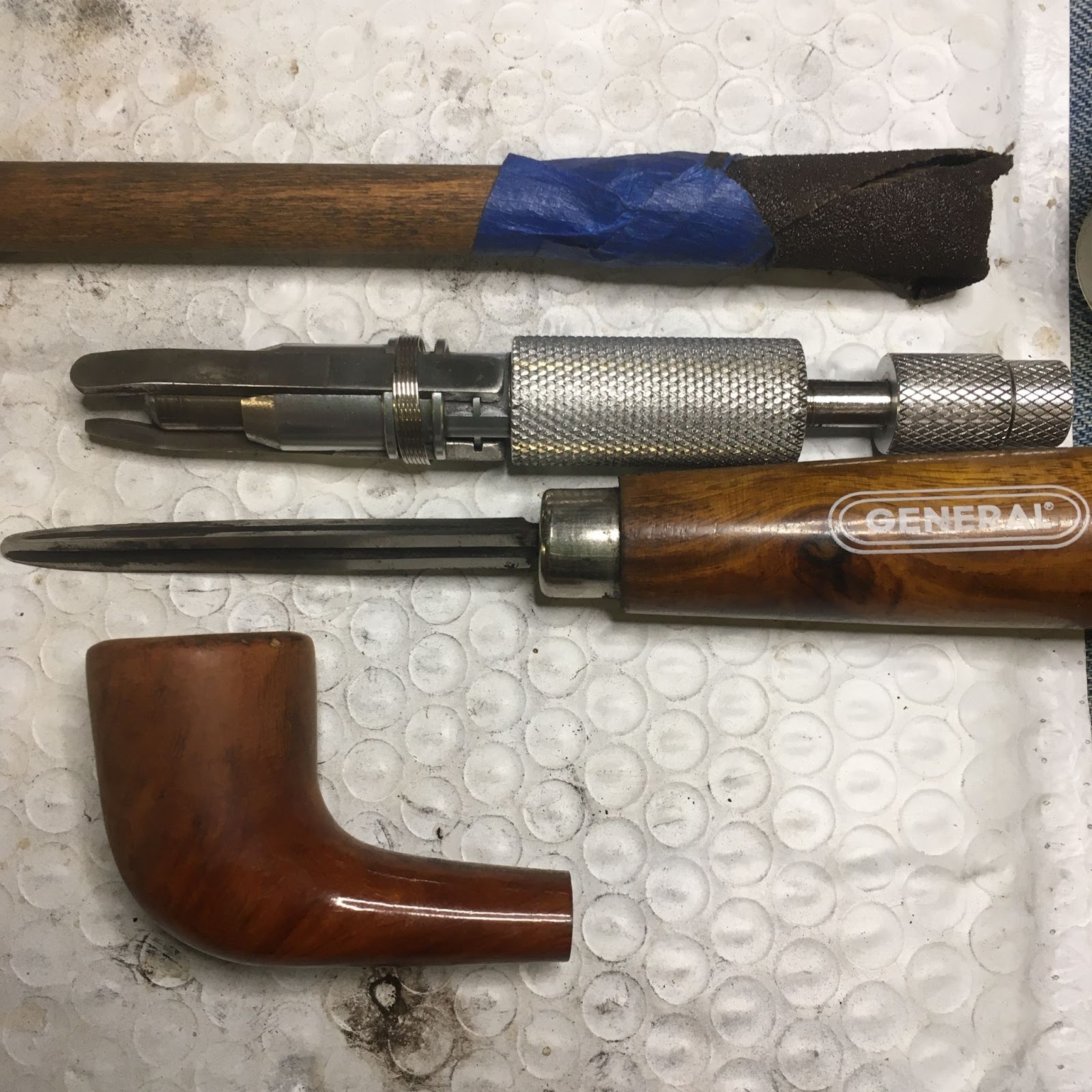
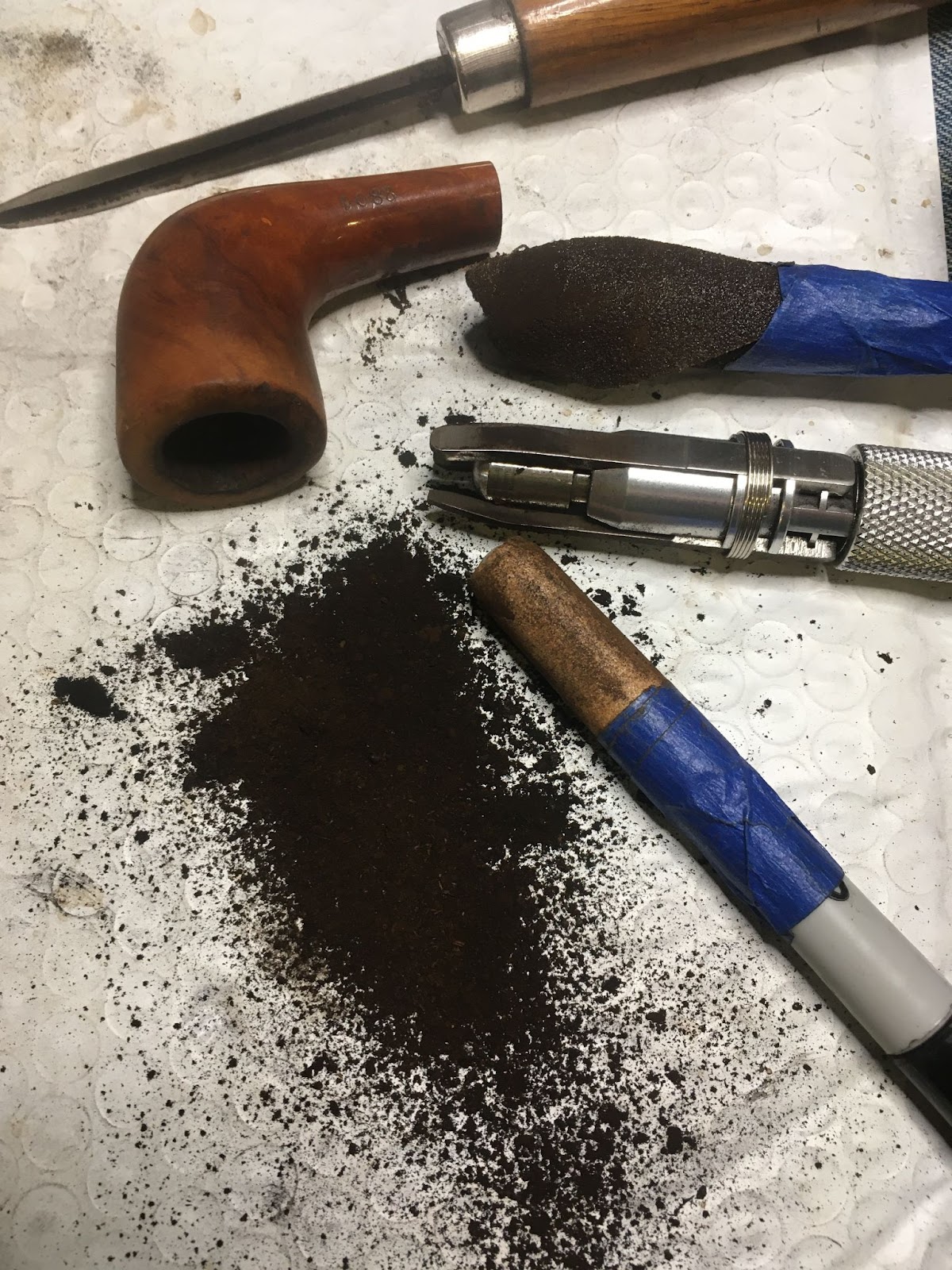
    I worked on reaming the tobacco chamber first.  The PipNet with a #2 blades after I had scraped the hard dry cake a bit with the General triangular scraper.  The problem was that the chamber had a diameter that was a touch too large for the #2 blades and too small for the #3 blades.  This meant more scraping.

    The chamber was sanded with 220 sandpaper to get to clean briar then finish sanded with 320 sandpaper.  There was no heat damage observed in the chamber.

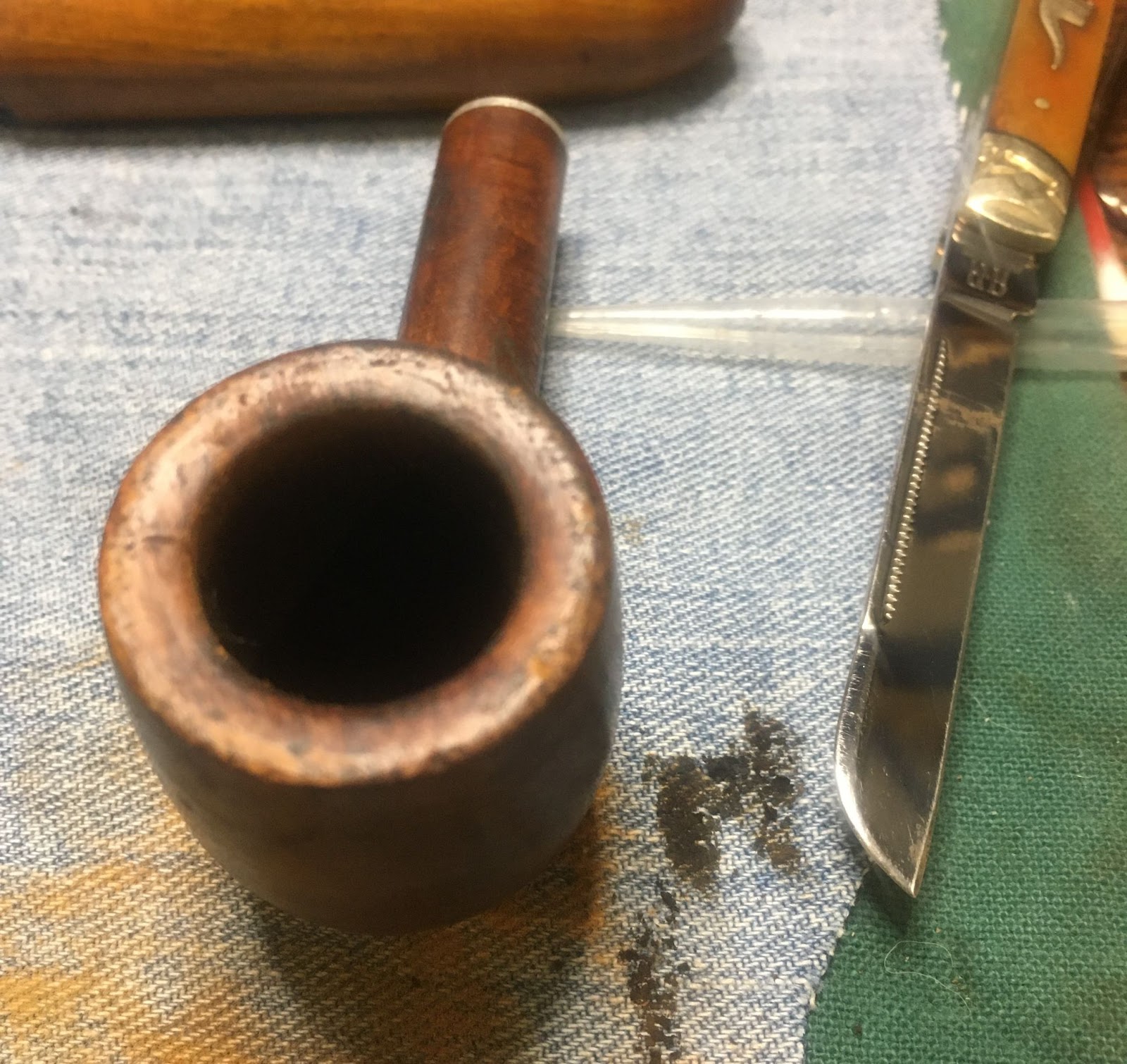
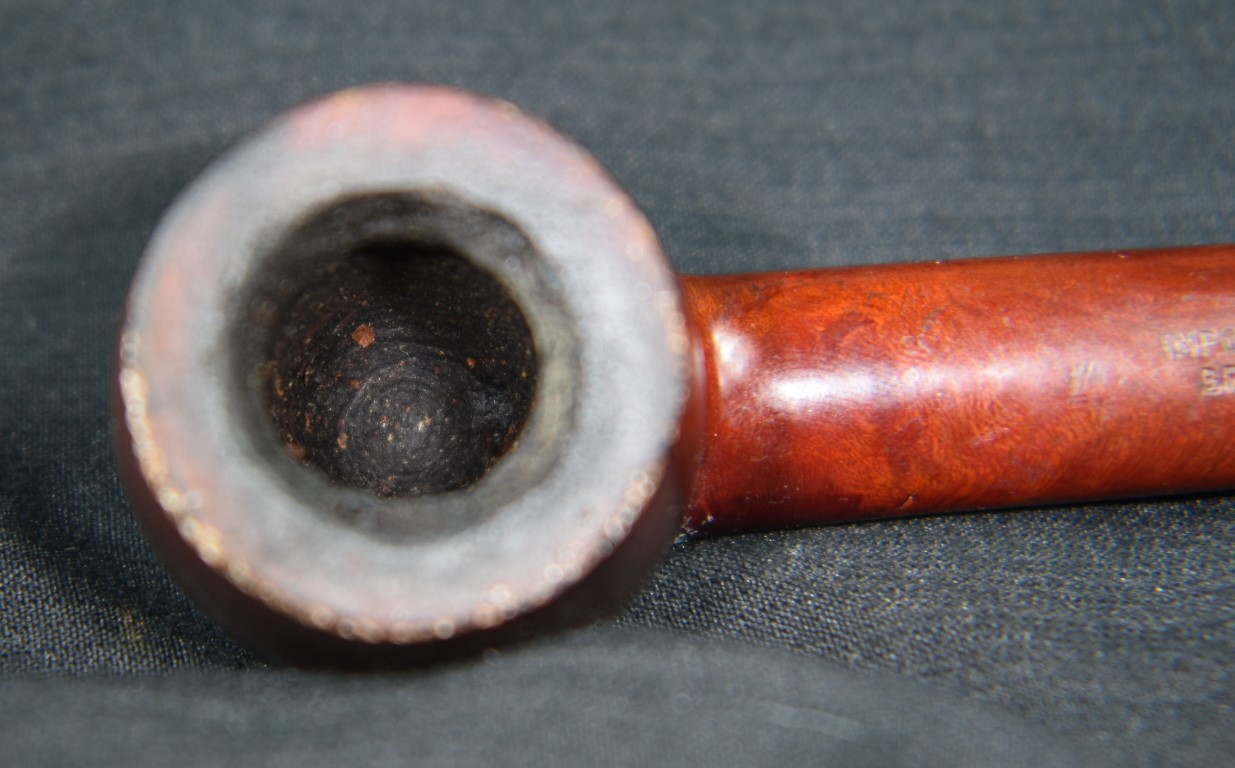
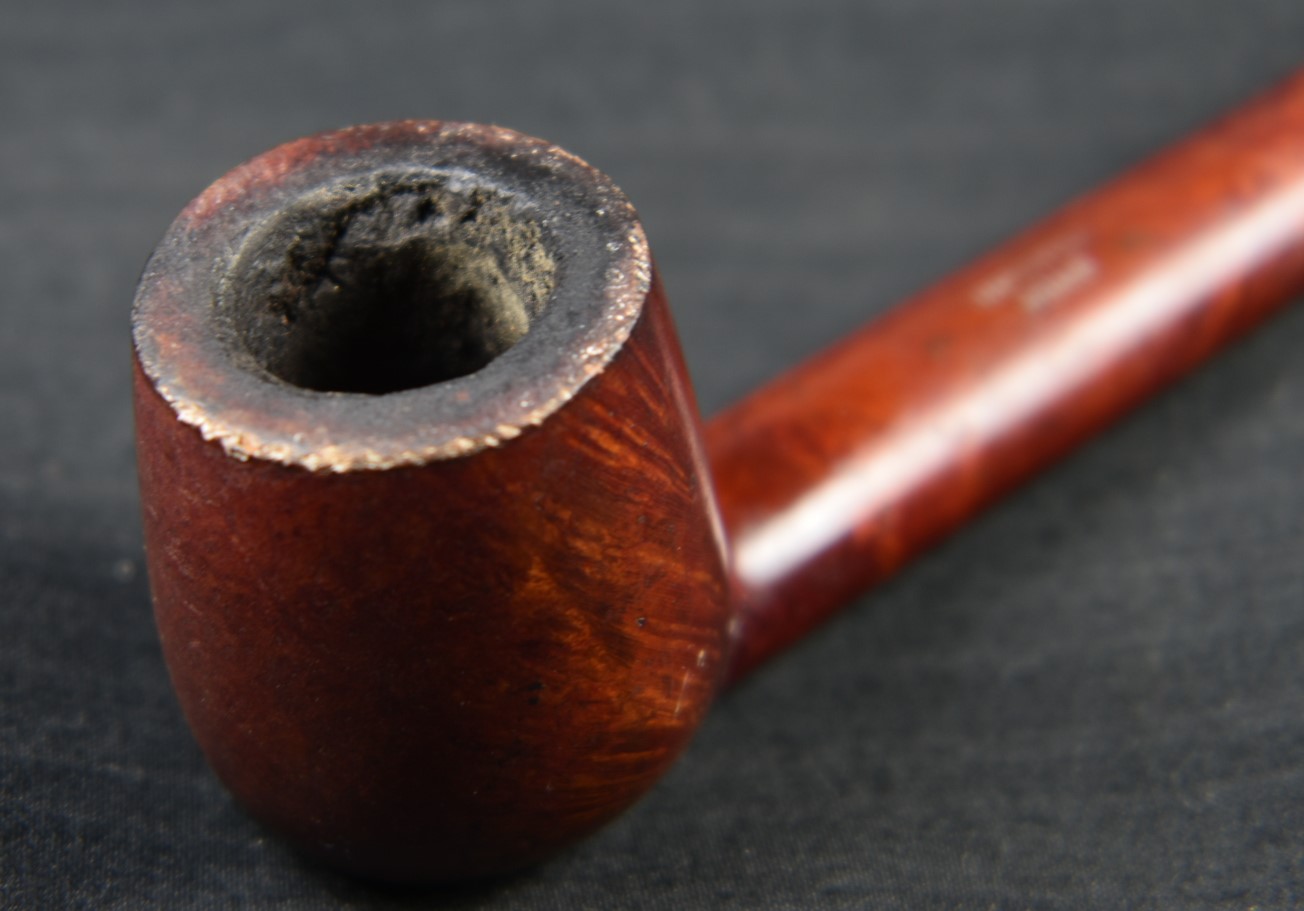
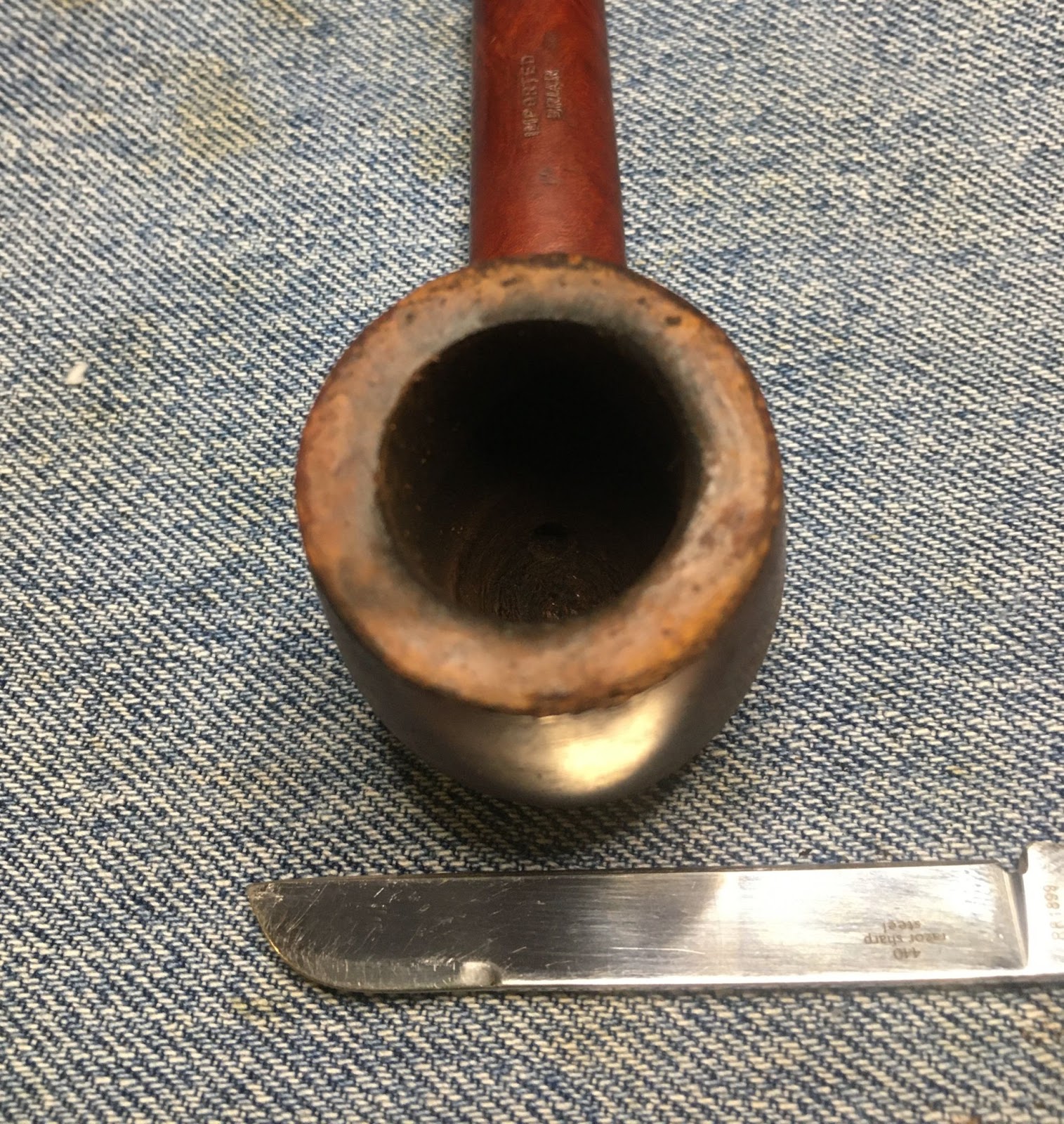
    That brings us to the rim.  The lava deposits made inspection of the rim difficult.  Though there did appear to be charring at the 8 o’clock position of the photo below and around the inside edge of the rim from 3-8 o’clock. 

    The rim was moistened with saliva then scraped with a shape pocket knife.

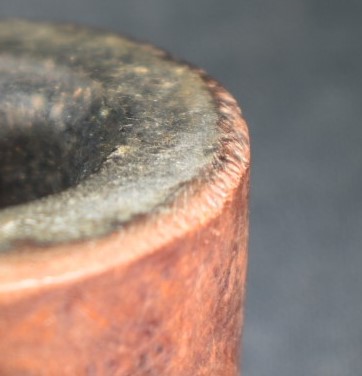
    A further scraping revealed that the rim damage was all around the rim.  The charing was also around most of the inside edge.  Topping this stummel and removing the dents and dings would be required.  I was hoping to only remove about 1/16 of an inch, 1-2 mm of briar from the rim.  Beveling of both the inside and outside edges would remove the edge damage and keep me from removing even more briar. 

    After the reaming of the tobacco chamber, I poured 2-3 ml of 99% isopropyl alcohol into the chamber and allowed the alcohol to flow into the shank.  I then used a nylon shank brush to scrub the airway.  I poured this alcohol into a clean medicine cup.  I was surprised that the alcohol did not have the dark color that I had expected.  The long shank would make scraping the airway very difficult.

    The stummel was taken to the sink.  Here I used undiluted Murphy Oil Soap and a medium stiff toothbrush to scrub the exterior of the stummel.  The stummel was rinsed with warm water and dried with a cotton washcloth.  I then decided to check the shank airway by using the shank brush with a bit of Dawn dish soap.  I was still having trouble believing that the airway was as clean as the alcohol led me to believe.  The Dawn shank brush scrub did not result in dark lather.  Maybe the previous owner did keep the airway clean.  The evidence was mounting in his favor but the question lingered, “If the rim was that fouled with lava, why did he keep the airway clean?”

    I returned to the workbench for another go at cleaning the airway.  About 5 ml of 99% isopropyl alcohol was used this time and scrubbed with the shank brush.  When this alcohol was poured out I saw the dark color I had expected.  The airway was dirty; it had just taken a bit of scrubbing to soften the yuck (yuck is a highly technical term to describe the smoking residue).  It was present, not easily scraped and needed to be removed.  This was going to be a long one.  I just realized the unintended pun, there – long shank, long cleaning job.

    Before I started the shank airway cleaning I wanted to top the stummel and remove the clear coat as it got sticky with the alcohol.  

    The topping was done by moving the stummel in a circular motion on a clean sheet of 220 sandpaper laid flat on a countertop.  Every 3-4 circles I would rotate the stummel in my hand to keep an even pressure of all sides of the stummel.  I wanted to remove about 1/16 inch or 2 mm of briar from the rim.  This would not be enough to eliminate the rim edge damage but I figured I could remedy that by beveling the outside edge of the rim.

    Next, I first tried removing it with 95% ethyl alcohol.  That worked albeit slowly.

    I then tried wiping it with acetone.  This worked better and faster.

    With the finish mostly removedI set to cleaning the stem.  The airway was cleaned with bristle pipe cleaners dipped in 99% isopropyl alcohol.  The outside was lightly sanded with a 320 grit sanding sponge then with Soft Scrub applied to make-up pads.

    Next came the shank cleaning.  The long shank did not allow for effective scraping with a dental scraper.  The cleaning did utilize a nylon shank brush with numerous scrubbings of the airway with 5 ml of 95% alcohol poured into the bowl and allowed to flow into the shank.  While in the airway the alcohol was scrubbed with the brush.  Below you can see the medicine cup use to collect the alcohol after the scrubbing.  

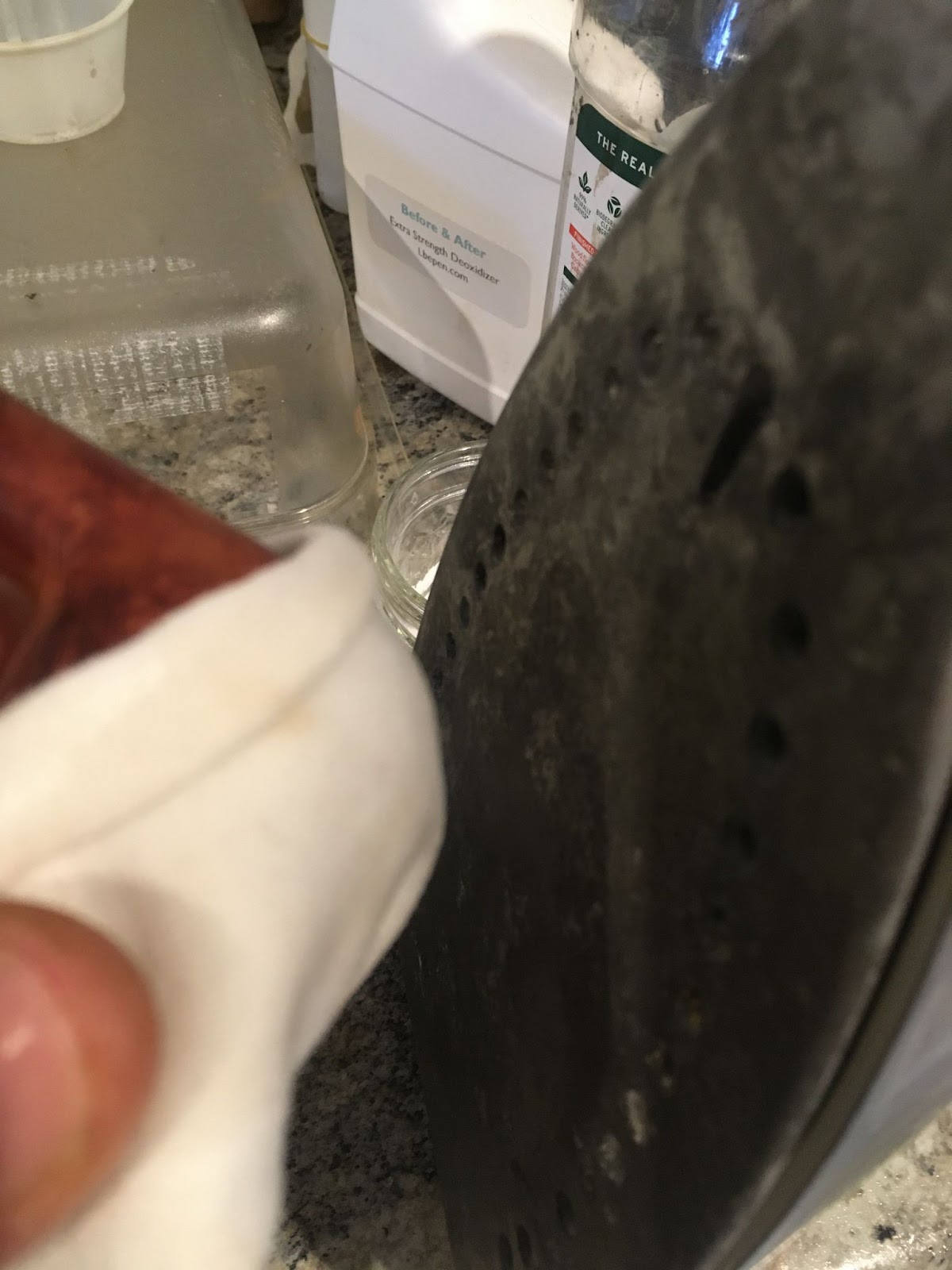
    There were a couple of dents in the lower left section of the stummel.  I used a hot iron and a damp rag to raise these.

    Below is a photo of the stummel partially wrapped in the wetted cotton rag and pressed against the hot clothes iron.

    The steam from the iron heated water raised the dents very nicely.

    After the shank was cleaned the pits on the stummel were filled using a small drop of cyanoacrylate (CA, super glue) and briar dust.  A small drop of CA was applied to the pit then sanded with a 400 sanding sponge.  The dust from the sponge combines with the wet CA to fill the pit.  Additional applications were used for deeper pits.
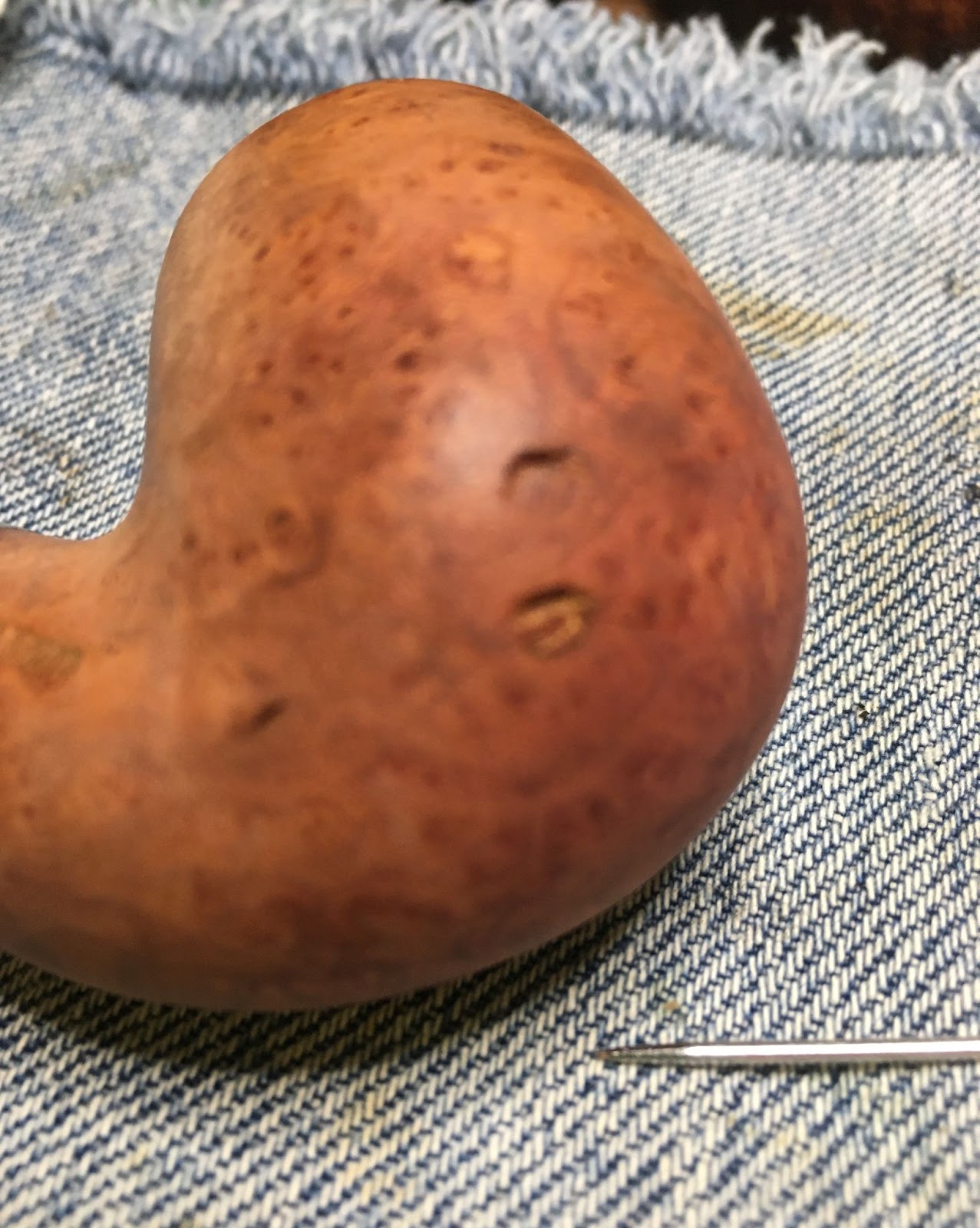
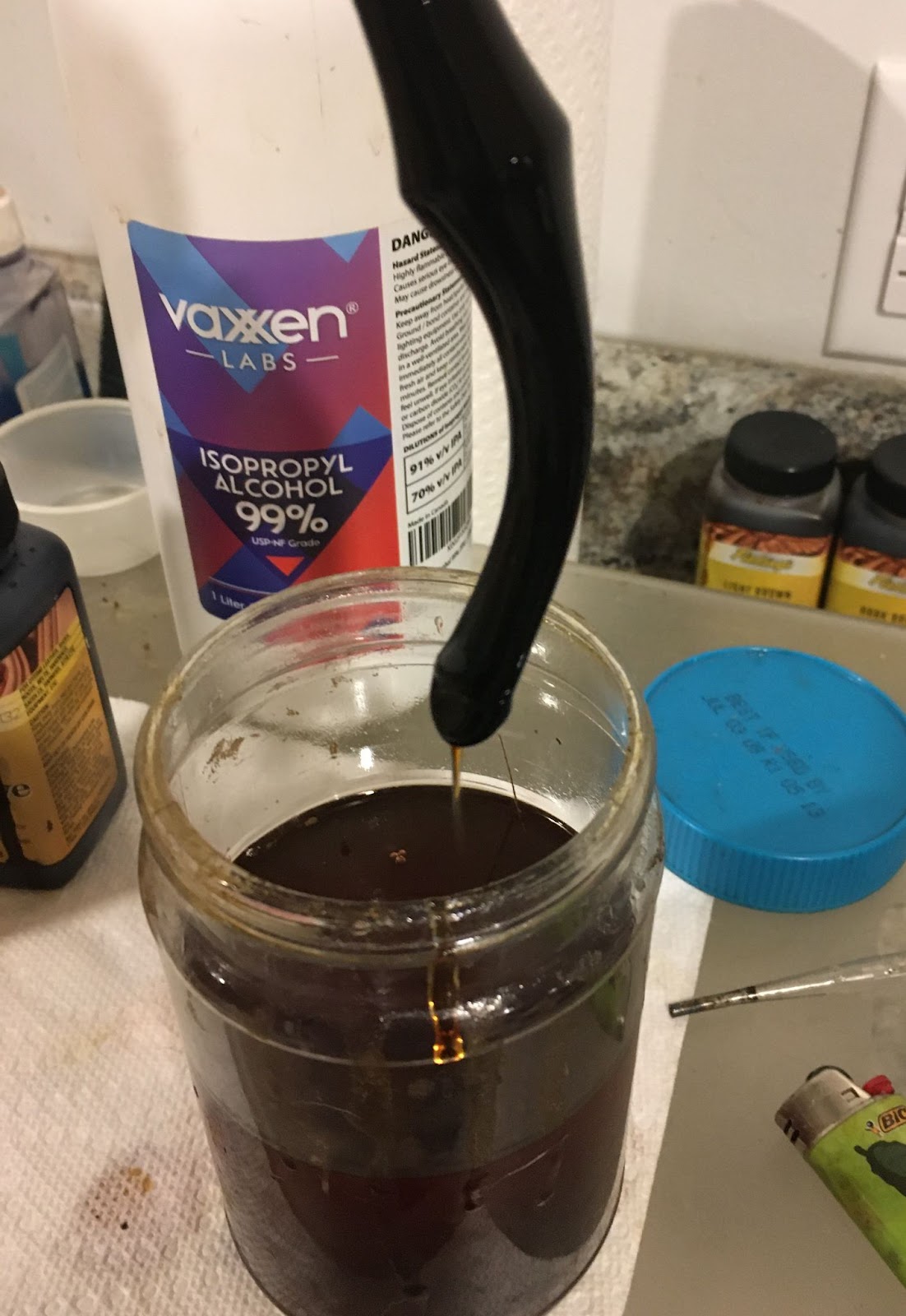
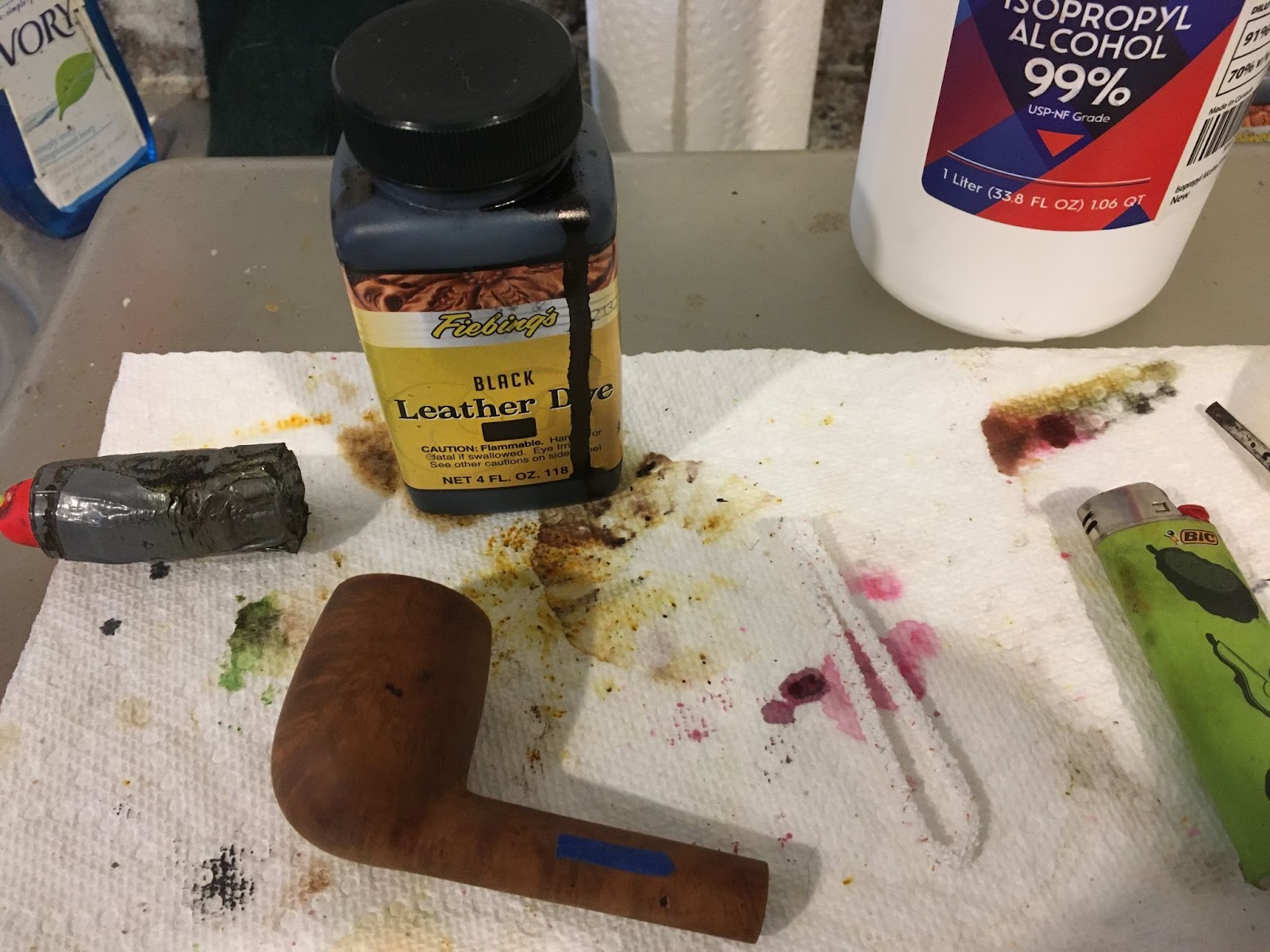
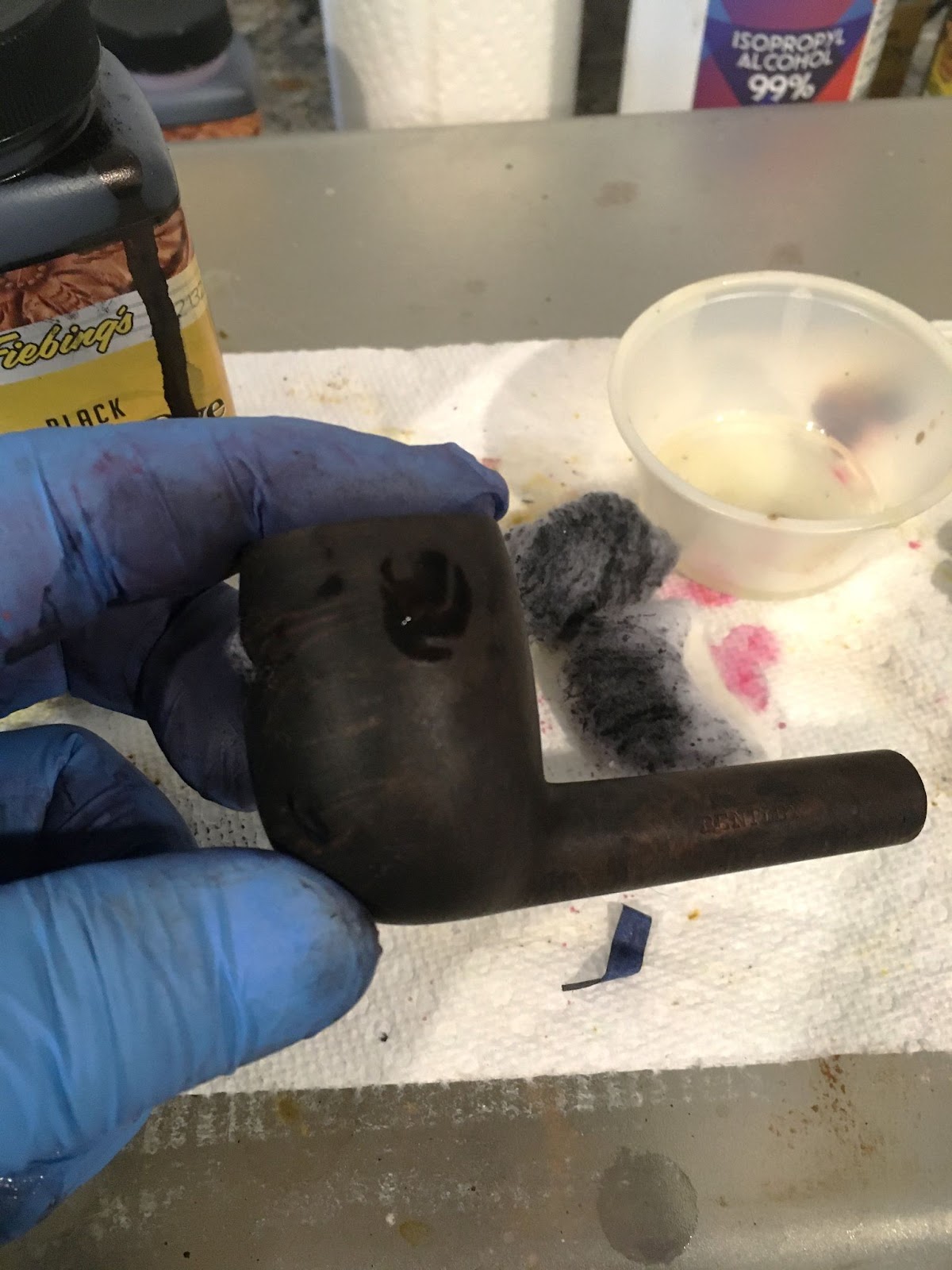
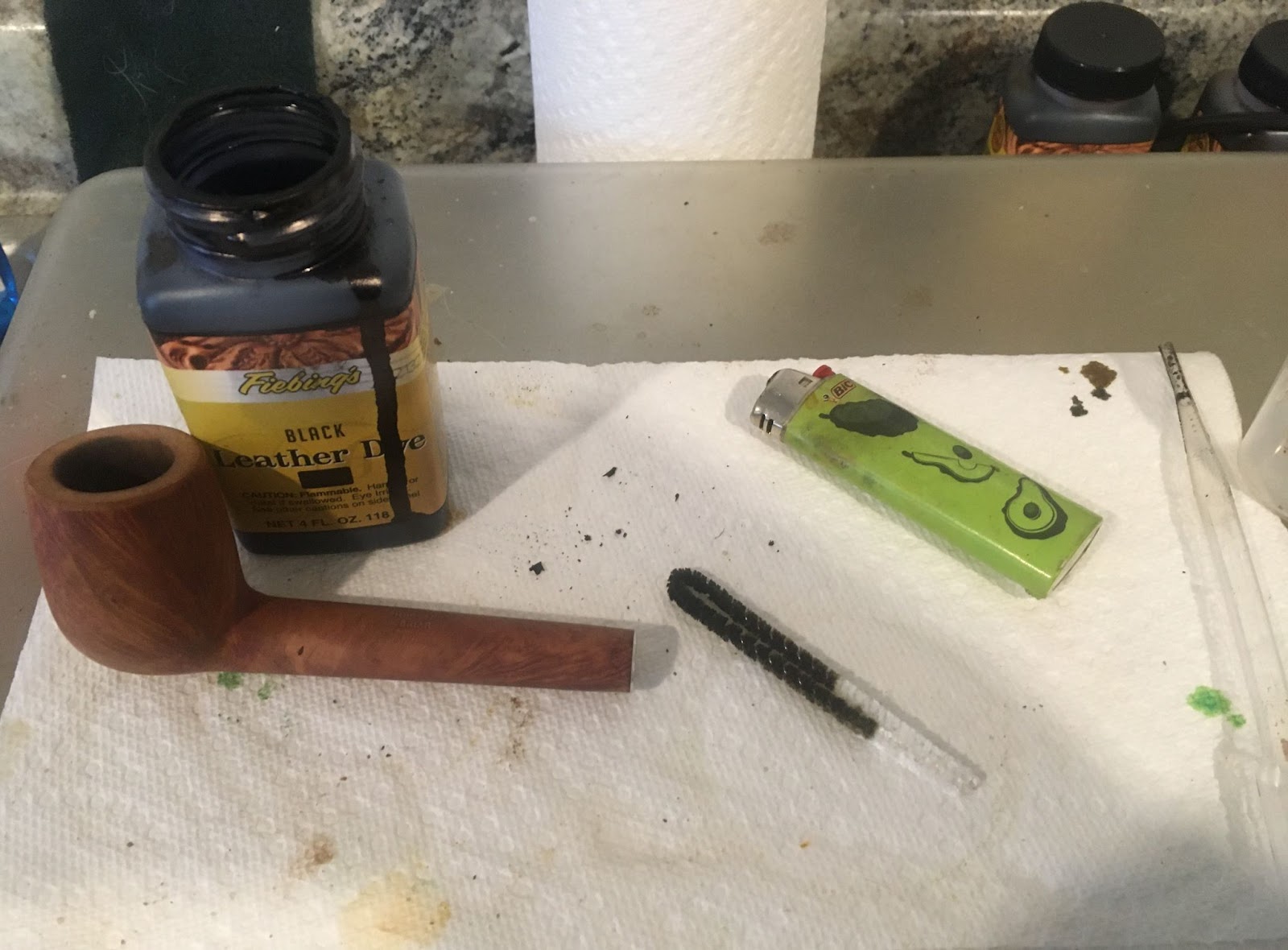
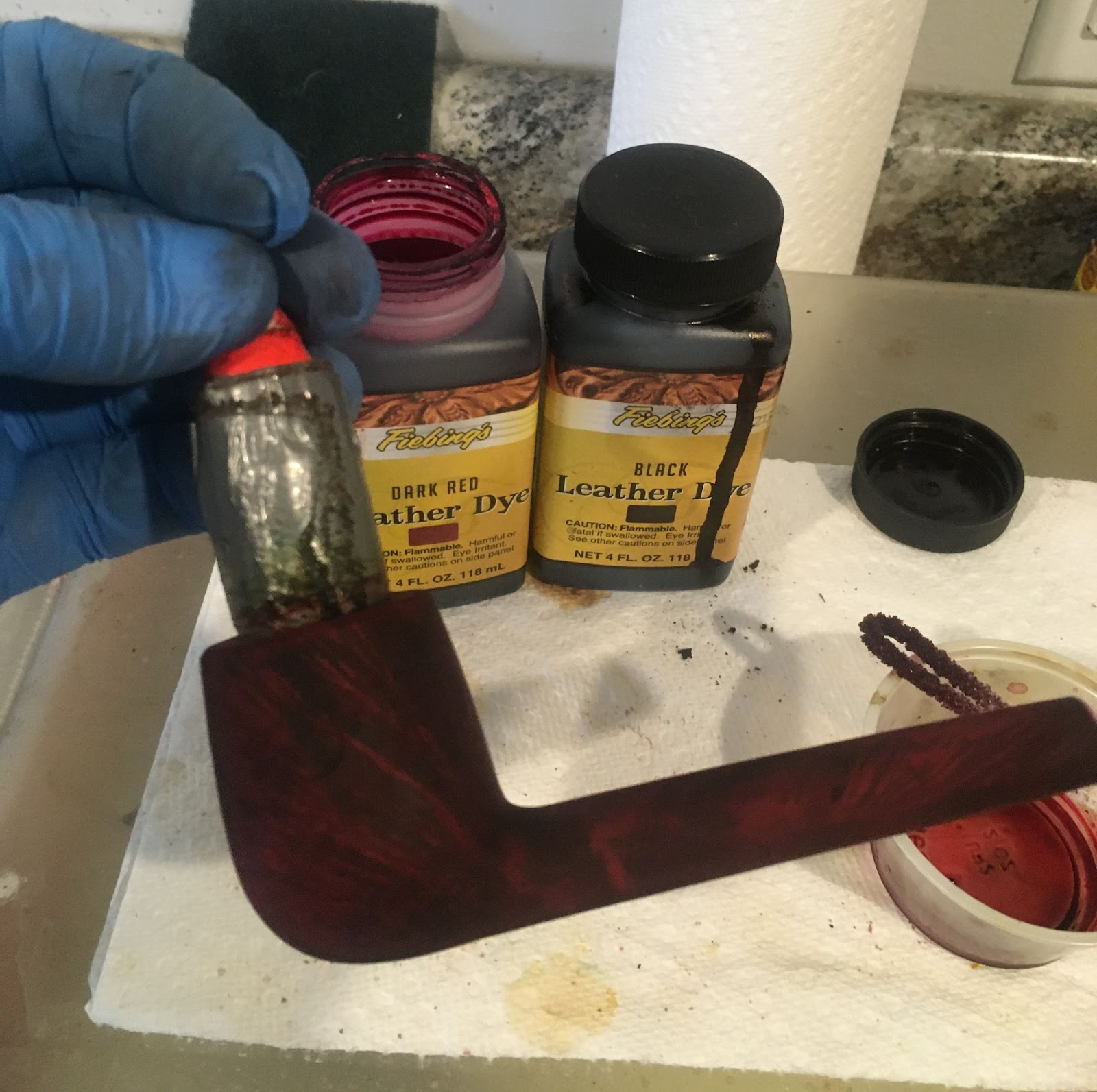
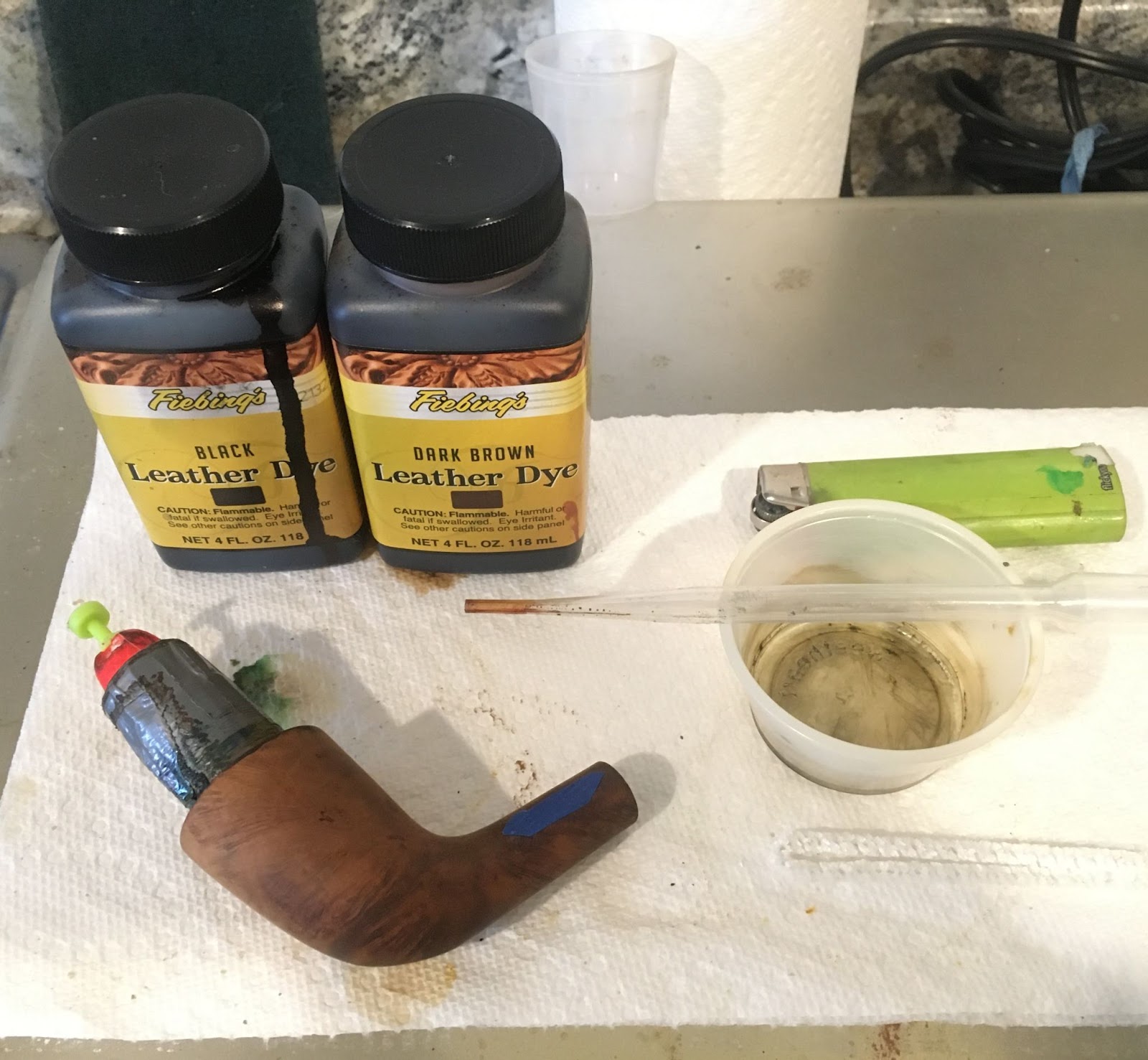
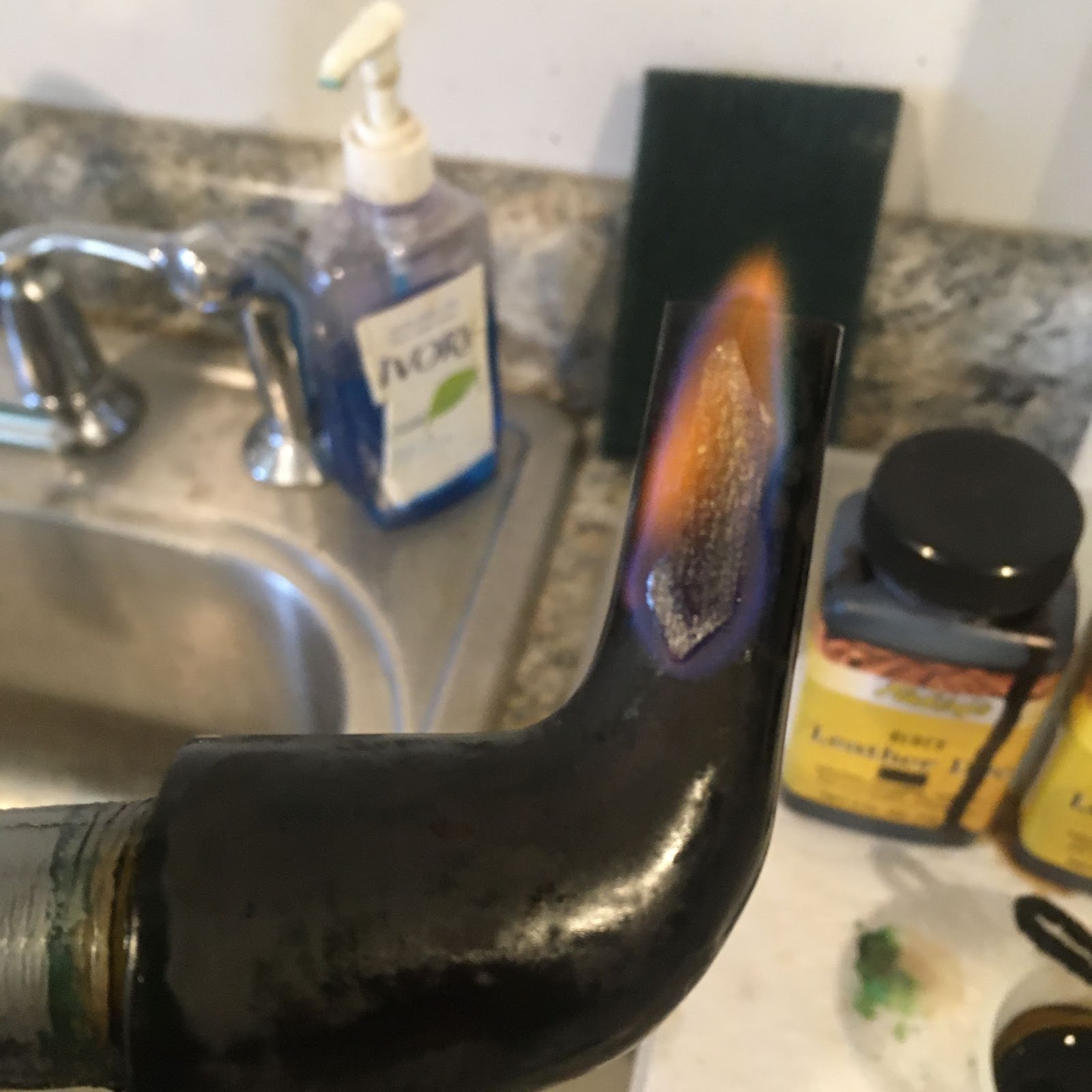
    I wanted a contrast dye that had a base of black with a secondary dye of red.  I hoped that this would give the pipe an accented grain in black with reddish hued highlights.  To achieve this I first dyed the stummel black with Fiebing’s Leather dye.  The dye was applied with a folded pipe cleaner and flamed with a disposable lighter.

    A duct tape wrapped fishing bobber was used to keep dye from the tobacco chamber and to act as a handle.

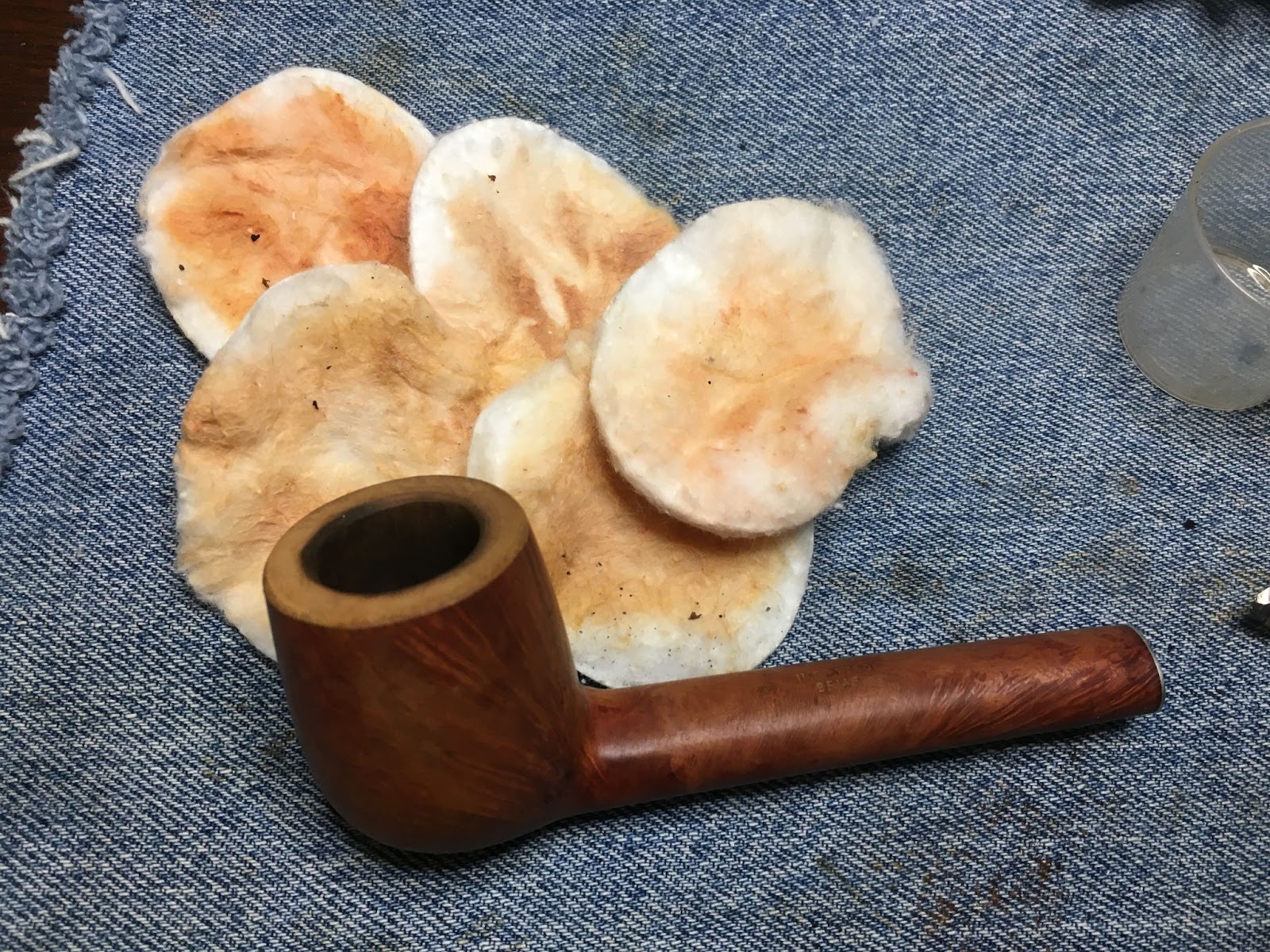
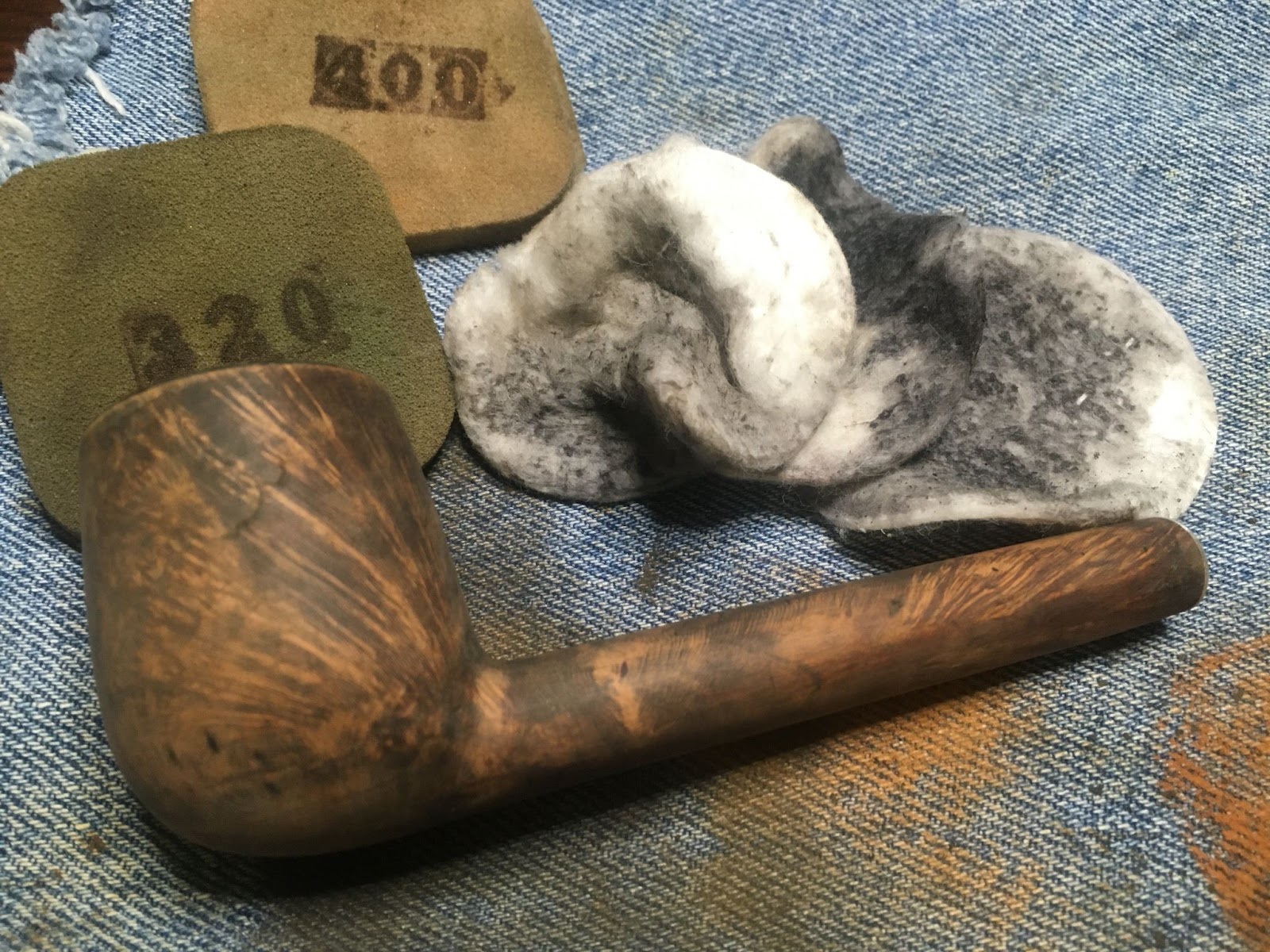
    The black dye was then wiped from the stummel using several make-up pads dipped in 95% ethyl alcohol.

    The stummel was then sanded with a 320 sanding sponge to remove the outermost black dyed briar leaving the underlying black dyed briar in place, accentuating the grain.

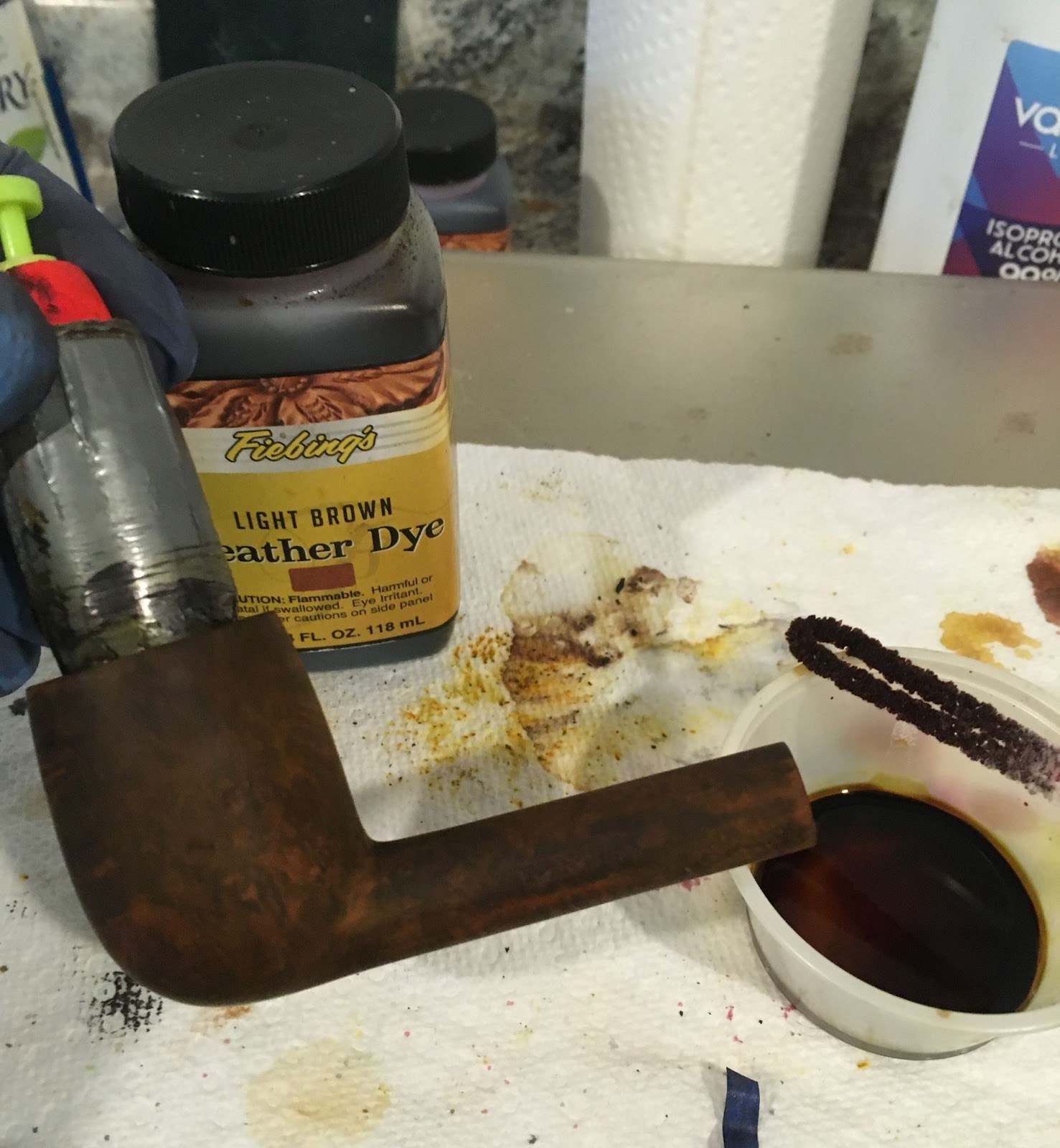
    A second dying of the stummel was then done with Fiebing’s Dark Red Leather Dye.

    This was then wiped from the stummel using alcohol dipped make-up pads.

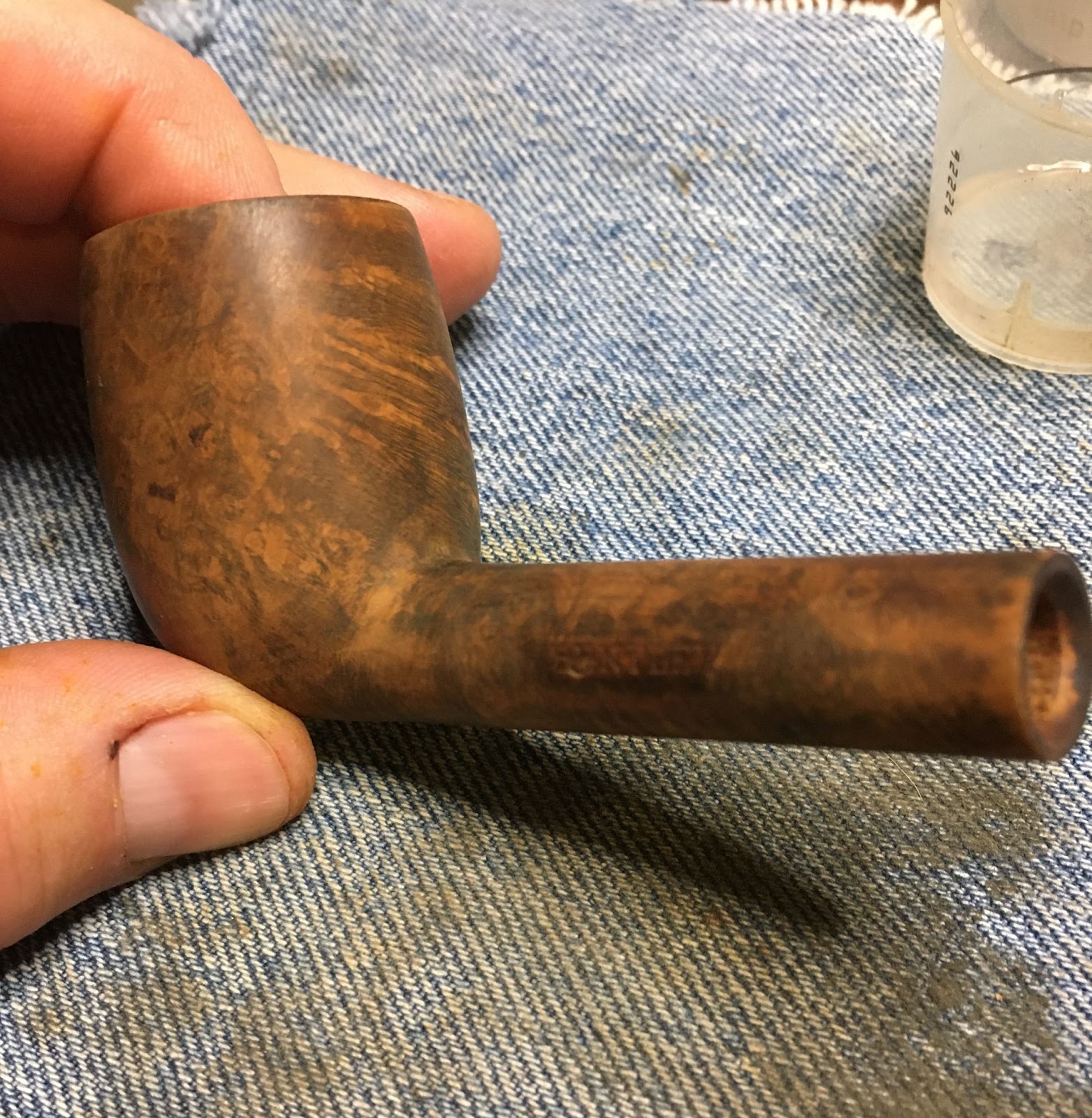
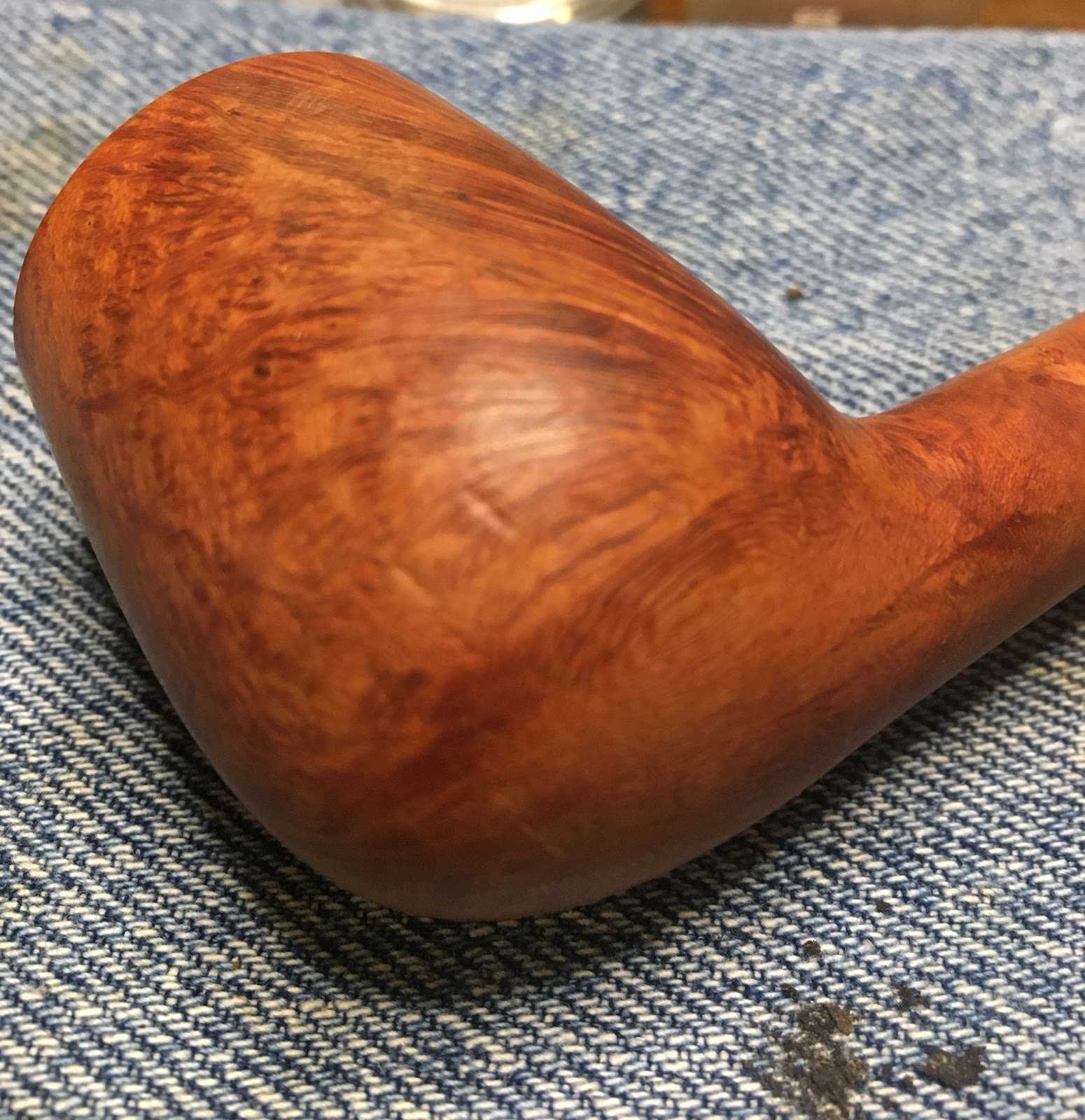
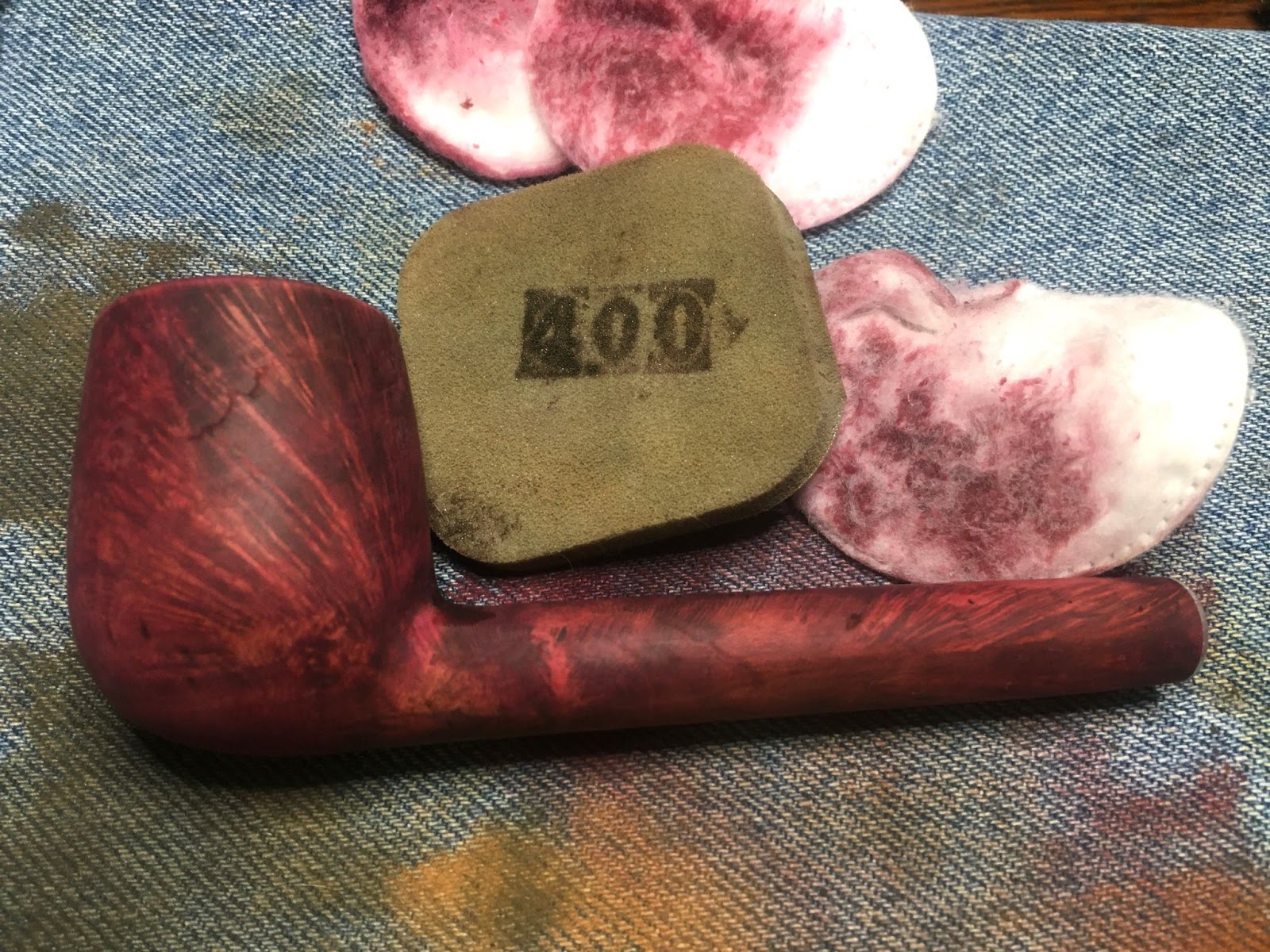
    The sanding of the stummel with a 400 grit sanding sponge then wiped with a clean alcohol dipped make-up pad resulted in the stummel looking quite red, below.  Notice the strange surface crack just above center – this was filled using thin CA then sanded, with the sanding dust filling the crack.

    Below is the contrast dyed stummel before any sanding with finer sanding sponges.

    I felt like this pipe was living up to the unofficial Nebraska motto – Go Big Red.  

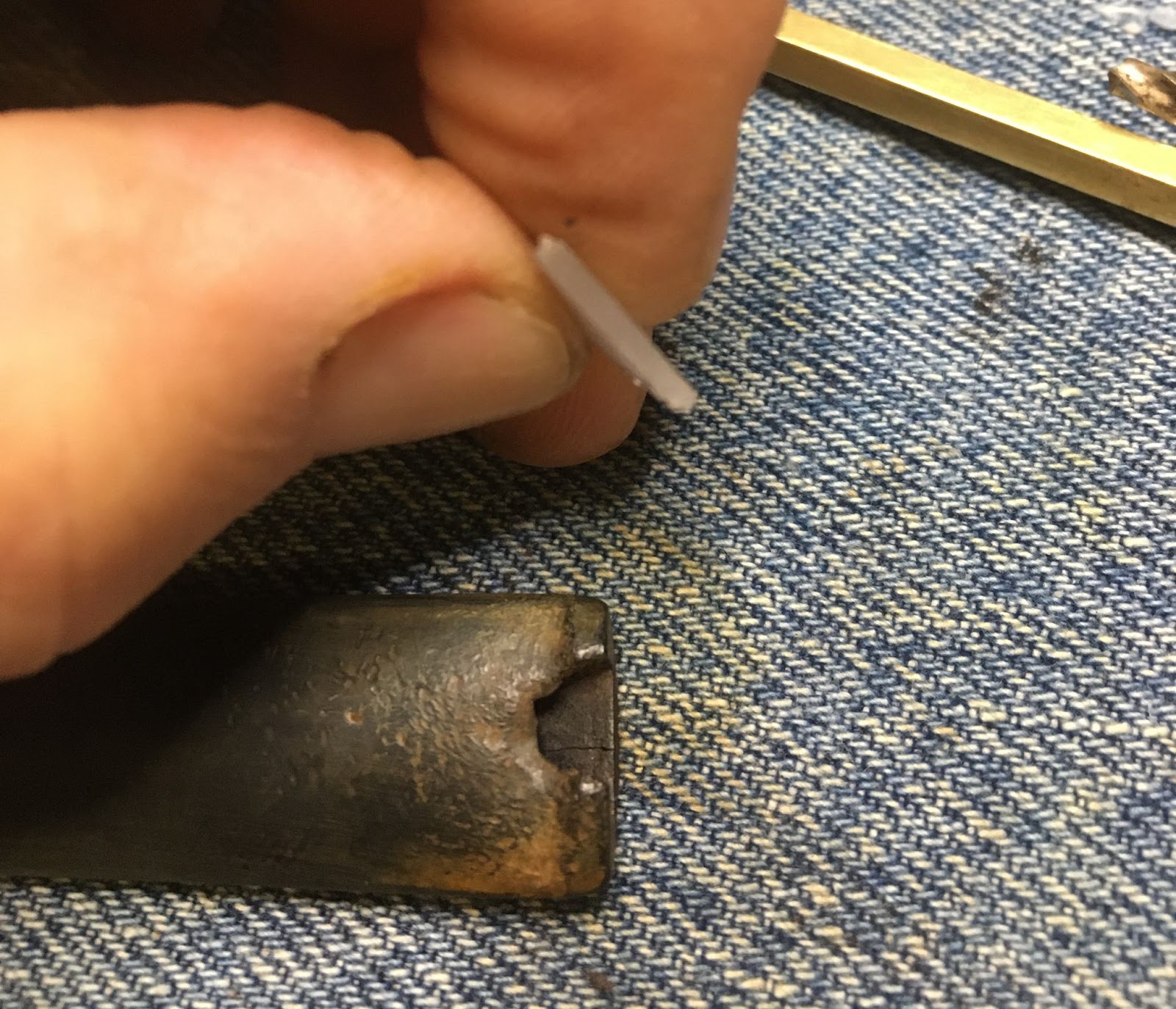
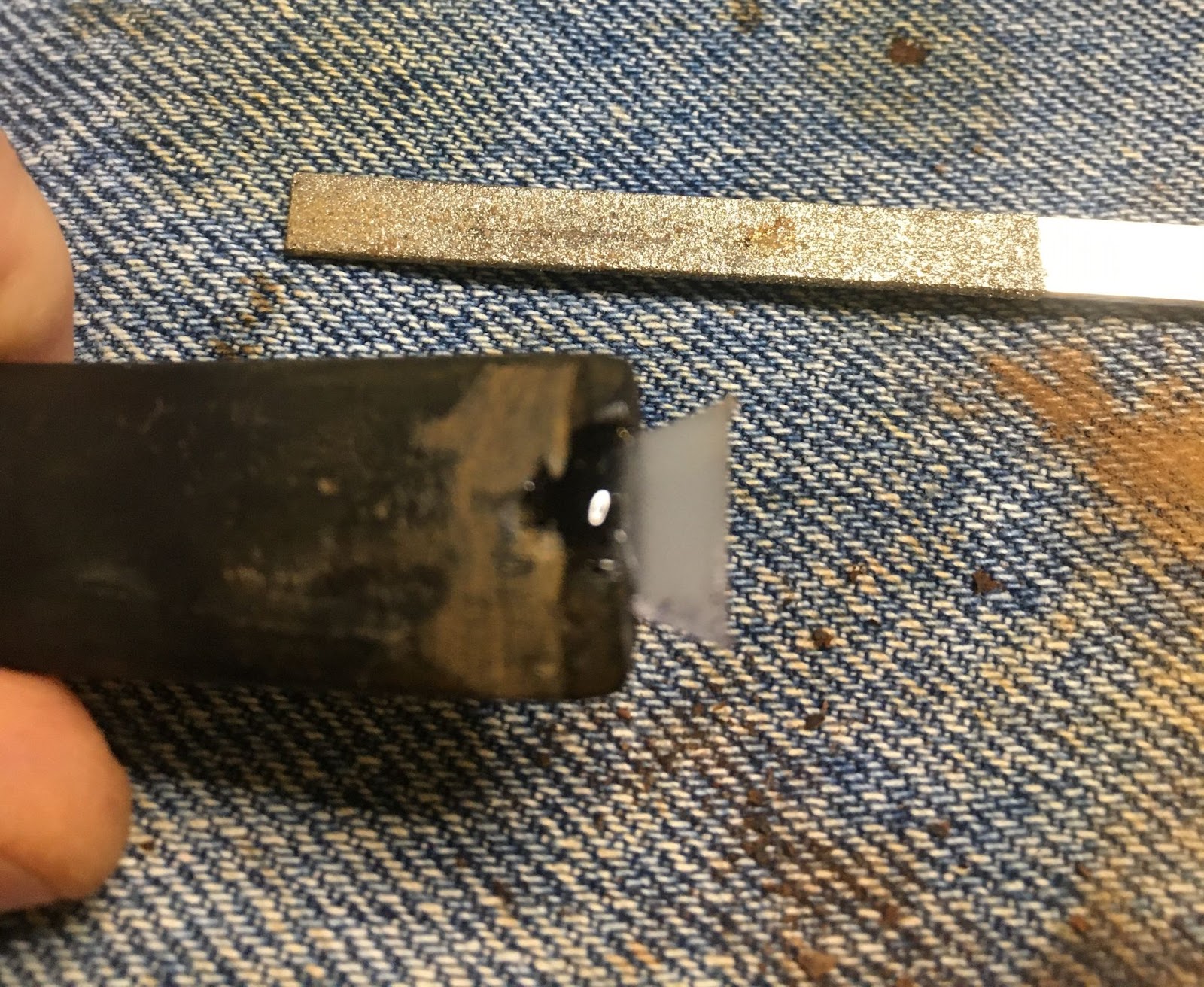
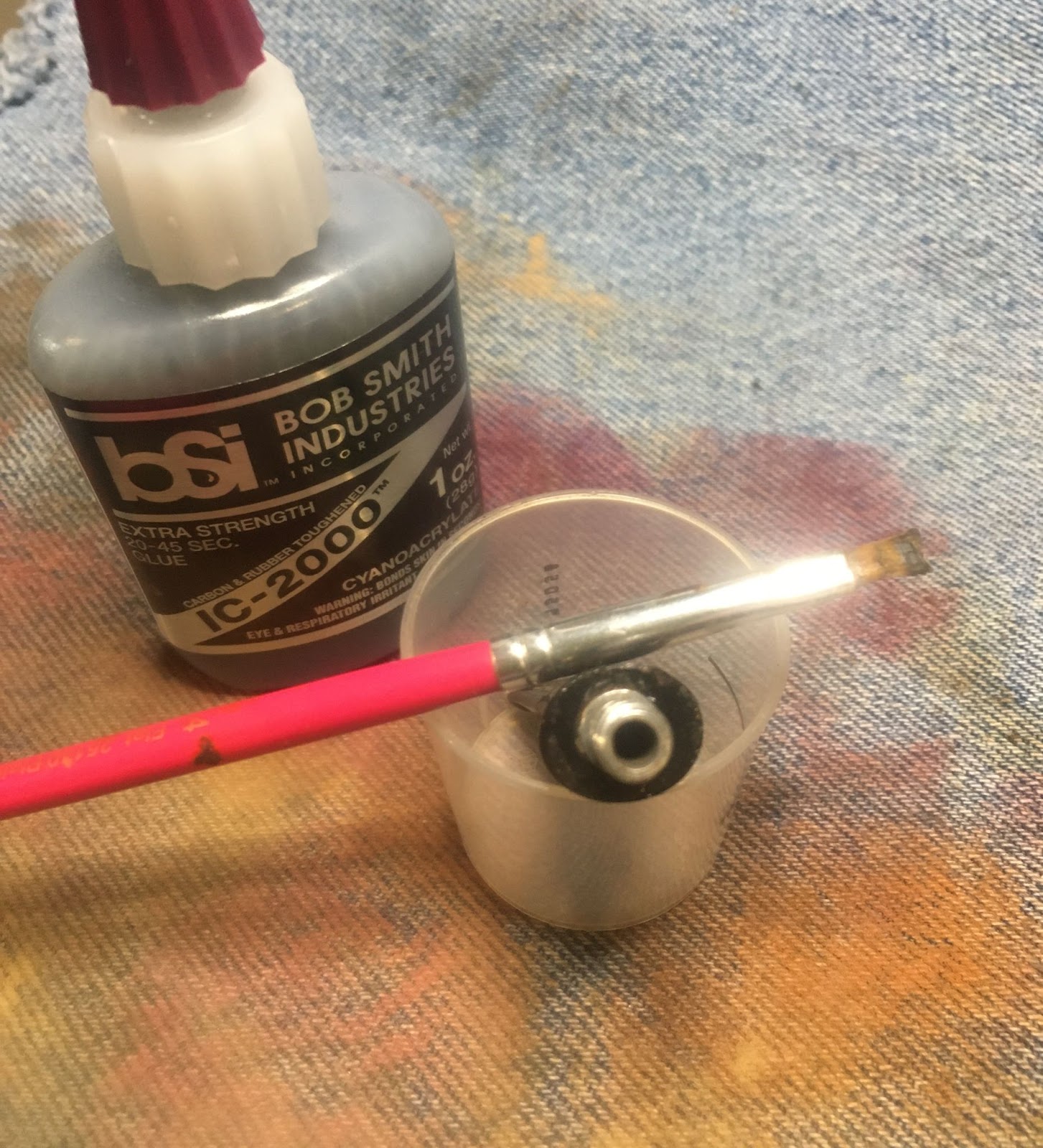
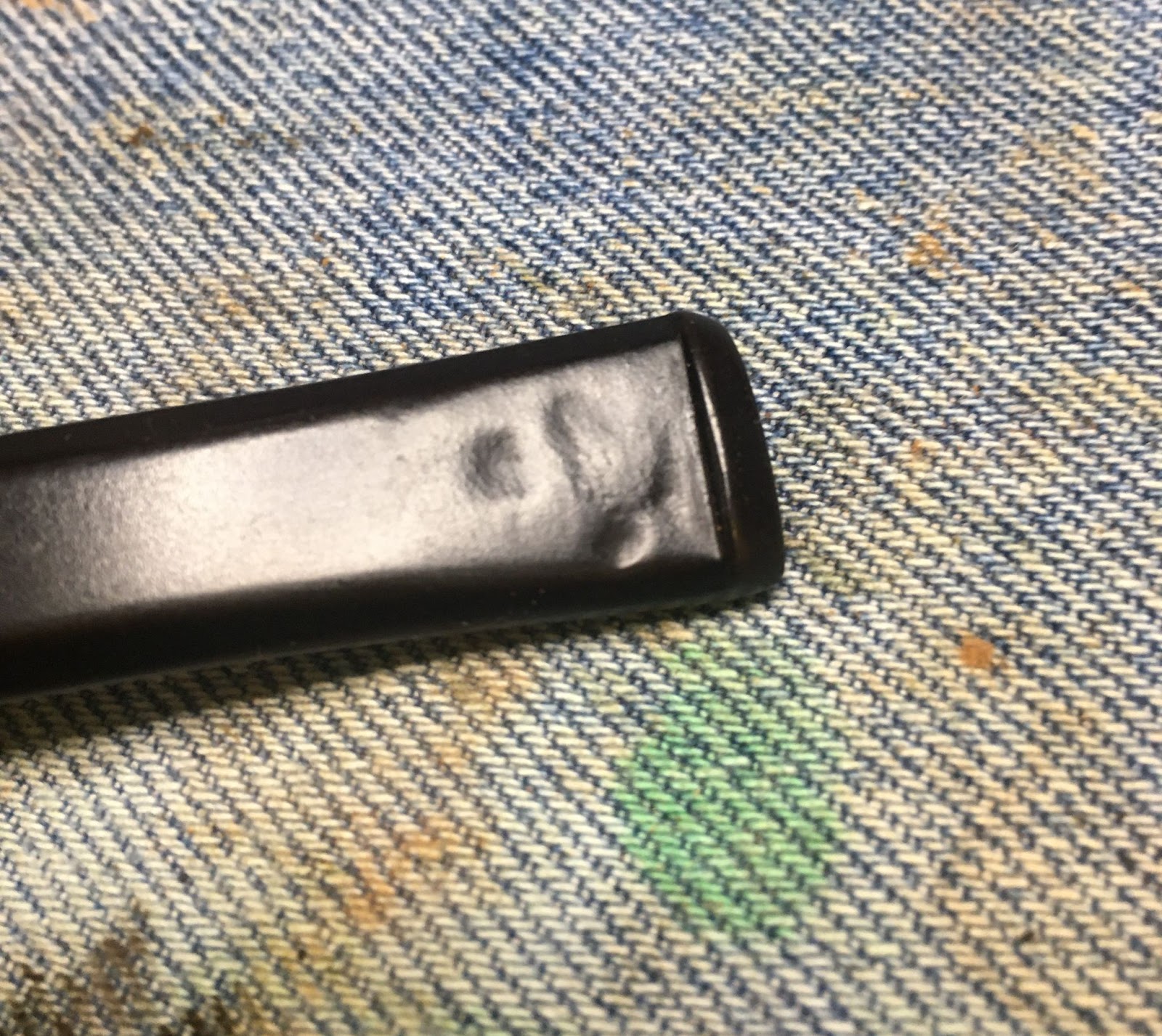
    Next on the list was the stem repair.  I admit to getting into the “stem repair” mode and losing track of documenting the process.  I start by de-oiling the areas to be repaired with an alcohol dipped cotton swab.  Then small drops of black CA are placed into the depressions on the stem.  The wet CA is spritzed with a CA drying accelerator.  Once dry or cured the CA is filed with a flat needle file.  If the depression is deep it may take several small drops of CA and subsequent spritzes with an accelerator to fill the depression.  That was the case here. When I started photographing, I was already filing the second application.

    A third application was applied and spread around to thin over a larger area using the tip of the applicator on the bottle.  This was then spritzed, filed and sanded with a 400 grit sanding sponge.  The next two photos show the depressions filled and sanded with the 4000 sponge.
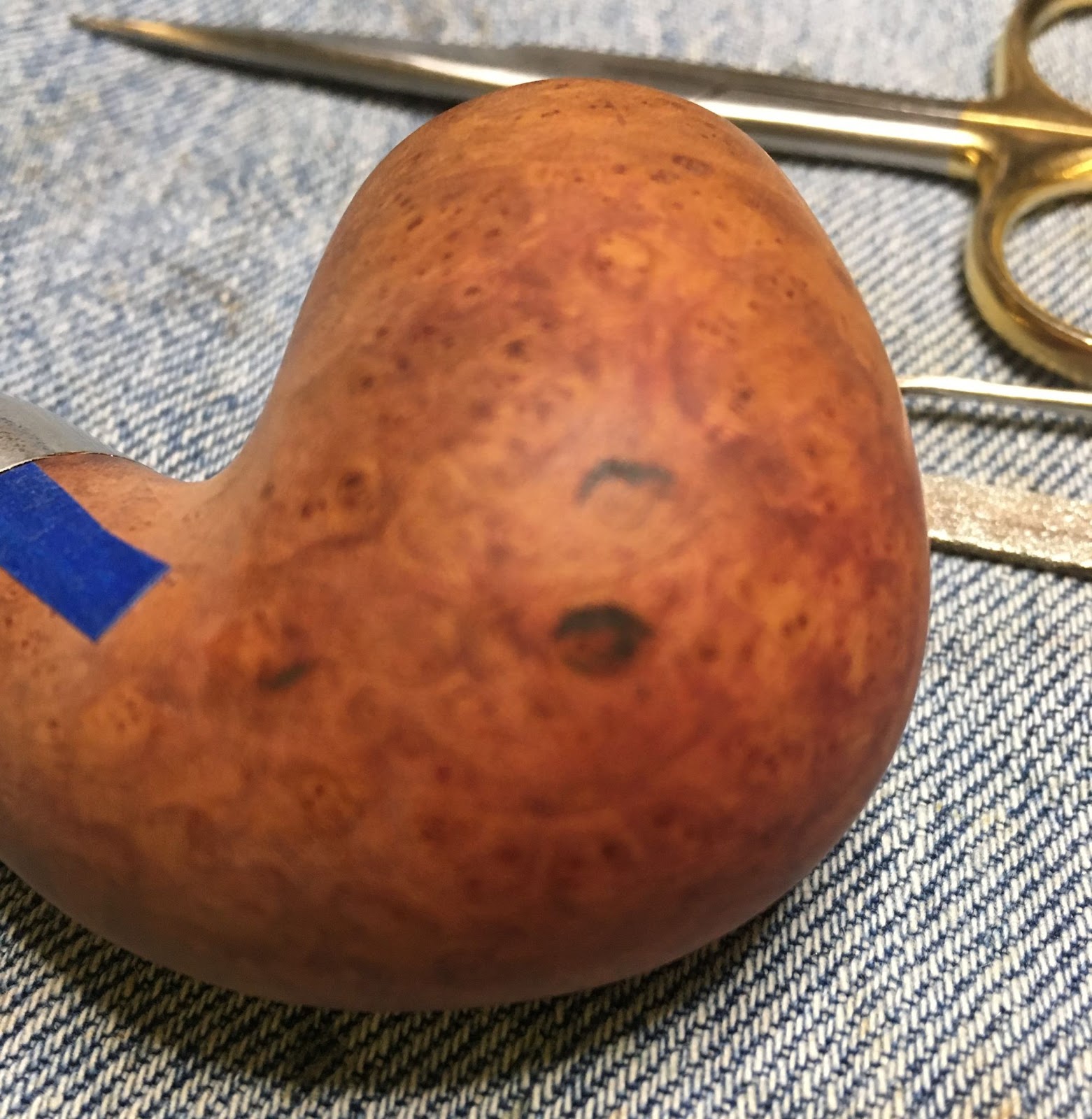
    The stem was slightly “over-clocked”.  This led to the stem not aligning correctly with the stummel, as it had been over tightened.  There are two ways to address this: 

    1) to heat the aluminum screw-in tenon until the stem is slightly melted, then rotate the aluminum to the correct position and allow it to cool.

    2)  Add a light layer of black CA to the edge of the stem and allow it to cure.

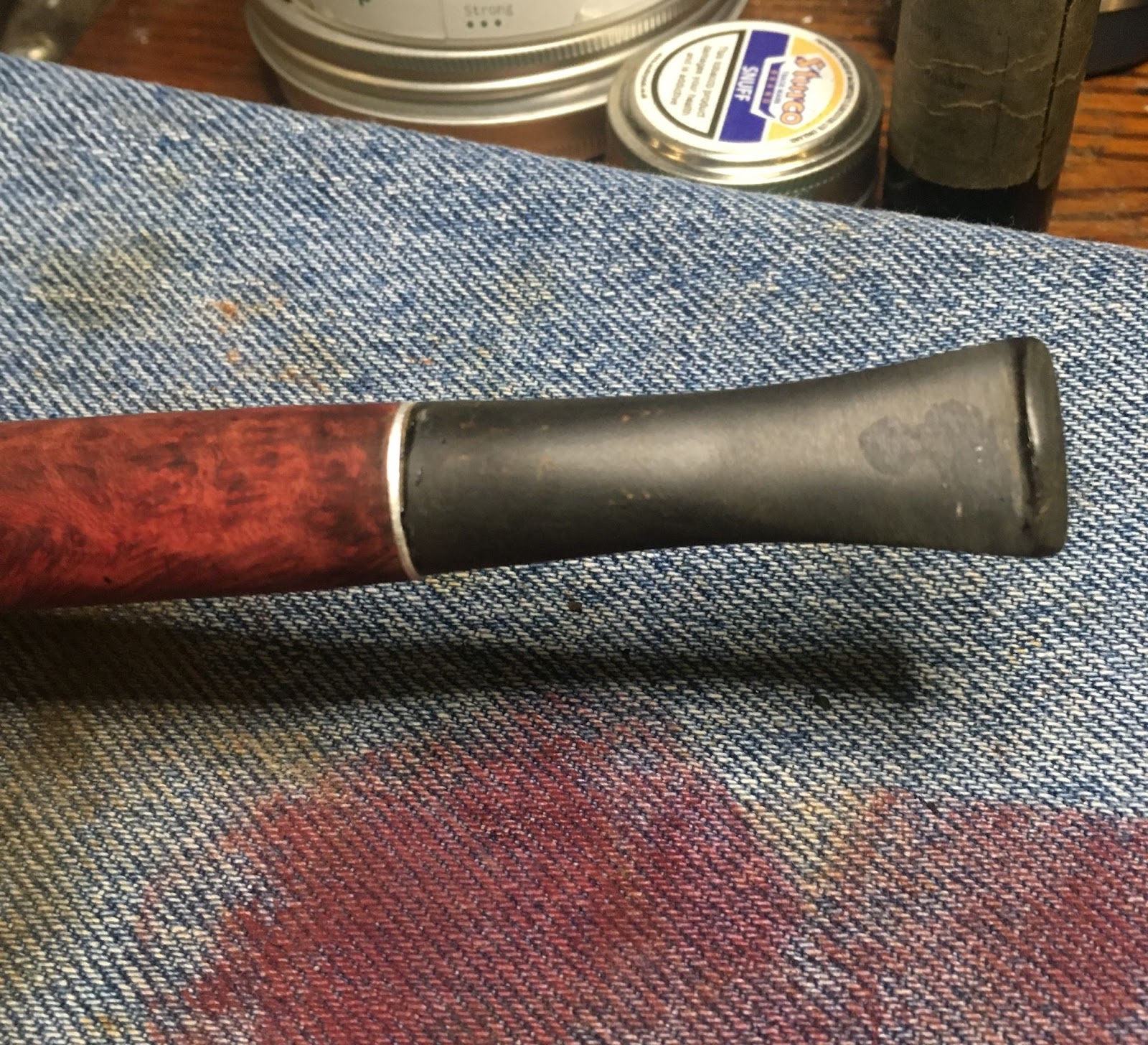
    Both methods work but come with downsides of being time consuming and tedious.  I chose to use the adding of black CA to the stem.  Since the alignment was very sligh, only a few degrees I only needed to “paint” or apply a single coat of black CA to the stem.

    The pipe was sanded intact.  I wanted to smooth out the mortise tenon joint as the original fit was less than smooth feeling.  I used a series of sanding sponges with grits from 1000-3500, in sequence.  Between each sponge the stummel was wiped with a make-up pad wetted with alcohol while the stemI received  a bit of mineral oil rubbed in by fingertip then wiped with a paper towel.

    After the sanding sponges I used a sequence of micro-mesh pads from 4000-12000.  The stummel was wiped between each pad as above.  The stem received a drop of Obsidian Oil between pads, rubbed in by fingertip and wiped with a paper towel.

    The pipe then was coated with Before and After Restoration Balm.  The balm was allowed to sit for 15 minutes.

    The excess balm was wiped with an inside-out cotton athletic sock to reveal a beautiful rejuvenated contrast dyed briar.

    The stem was further polished using Before and After Fine Polish.  The polish was applied by fingertip and hand buffed with a soft cotton cloth.

    The polishing was finished using the Before and After Extra Fine Polish using the above procedures.

    The final step was to apply several coats of carnauba wax using the buffer.

    I am quite pleased with how well this Italian Canadian of unknown make turned out.  It is a large pipe yet is surprisingly light in hand.  The contrast staining yielded the color that I had in my mind as I was imagining how it would look finished.  The screw-in tenon fits and aligns well.  Though not the most beautiful grain the contrast stain definitely improved the look of the briar and is accentuated by the high gloss black stem.  I am certain that this will be a nice smoking pipe even without a maker’s stamp.

    The dimensions of this large Canadian are: 

    • Length:  6.67 in./ 169.42 mm.
    • Weight:  1.40 oz./ 39.8 g.
    • Bowl Height: 1.88 in./  47.75 mm.
    • Chamber Depth:  1.65 in./ 41.91 mm.
    • Chamber Diameter:  0.78 in./ 19.81 mm.
    • Outside Diameter:  1.46 in./ 37.08 mm.

    I do hope that you have found something here useful to your own pipe care, maintenance or restorations.  If you like this sort of thing, please click the like and subscribe buttons.  Thank you for reading the ramblings of an old pipe lover.

    Below are some photos of the finished no name Italian Canadian.

    I think I might have to start selling these post restoration denim pieces as wall art.

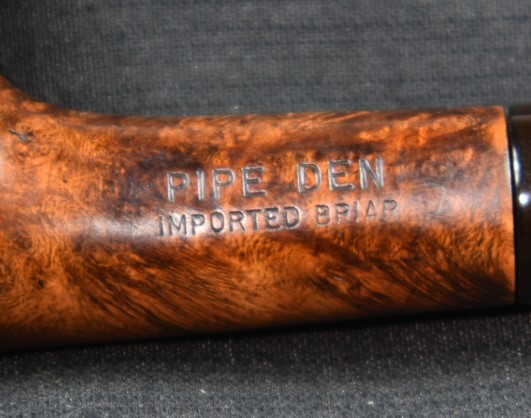
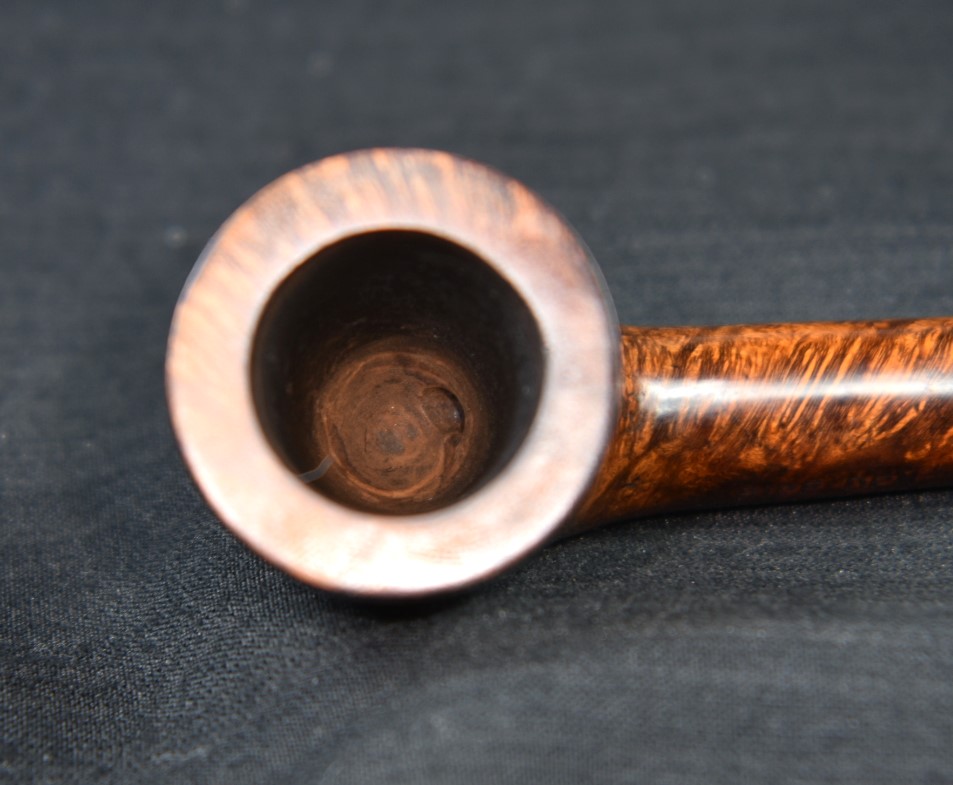
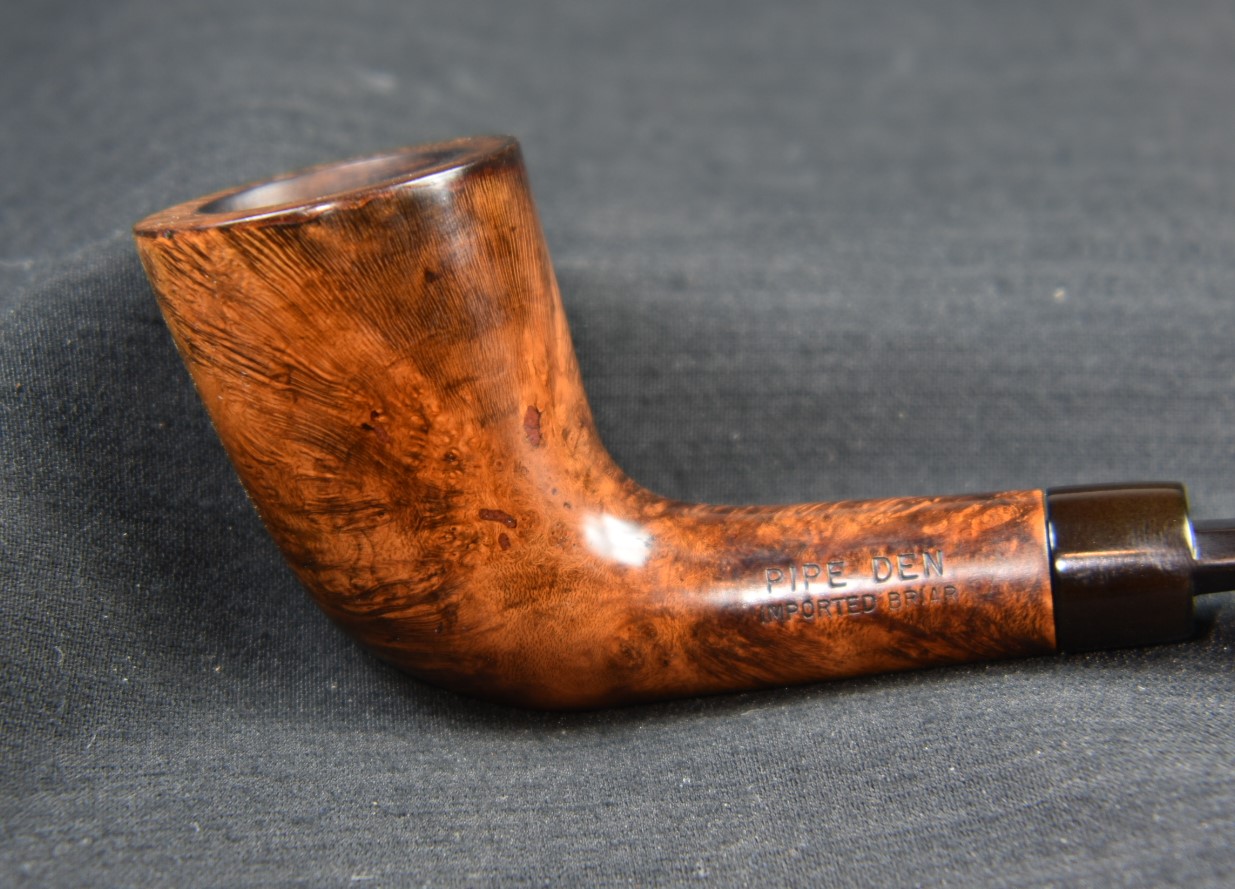
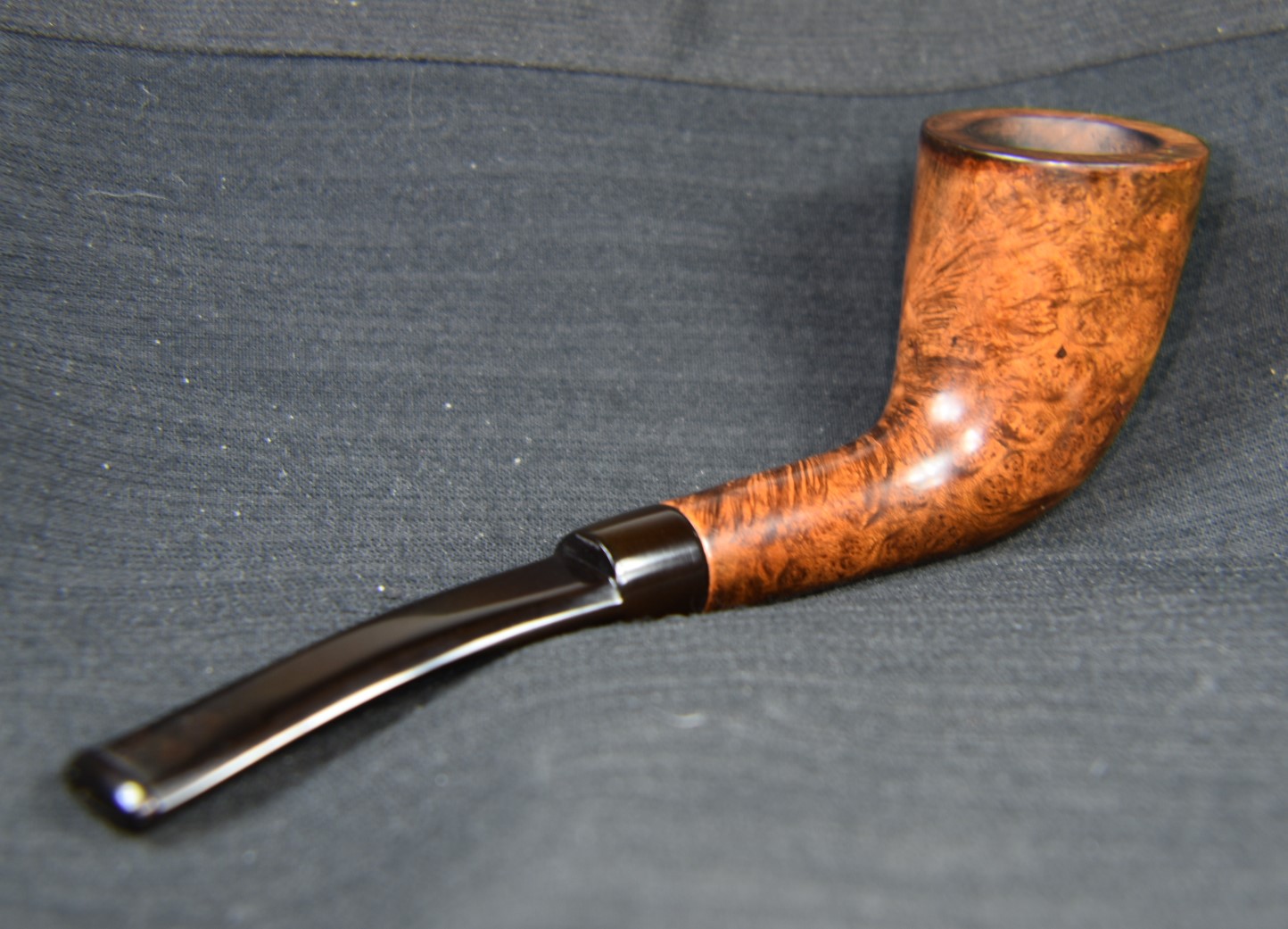
  • A Pipe Den Zulu Restoration

    April 17th, 2024

    Photographed and written by

    John M. Young

    The Pipe Den, the name harkens back to a day of local pipe and tobacco shops which our world appears to have mostly left in the past.  Many pipe smokers love our local brick and mortar shops and it warms our hearts to hear the success stories of the local shop that is surviving in the world of big internet retailers.  I live within an hour drive of one such shop and I admit to visiting it about once a year to stock up on a local blend assembled there.  The place has a cigar lounge and will infuse your clothing with cigar aroma at no cost.  I have been the only pipe smoker present on my last two visits.  The world I live in enables me to have pipe tobacco from all over the world available with the convenience of no 60 minute drive in city traffic and the thrill of opening the aromatic box, freeing the imprisoned contents and allowing them to join their tobacco blend brethren in glass jars upon a shelf. 

    I warmly remember the smell of David’s Briar Shop in a local mall Westroads in the 1970’s and 80’s. That smell is firmly locked into the vault and I have to admit to wishing to experience it again.  It is a nostalgic smell that when reminiscing with others about the mall, has never met with someone saying “I hate that smell”.  To the contrary, it seems to only incite fond memories. These are the memories that stir when I work on a pipe stamped with the name of a pipe shop.  

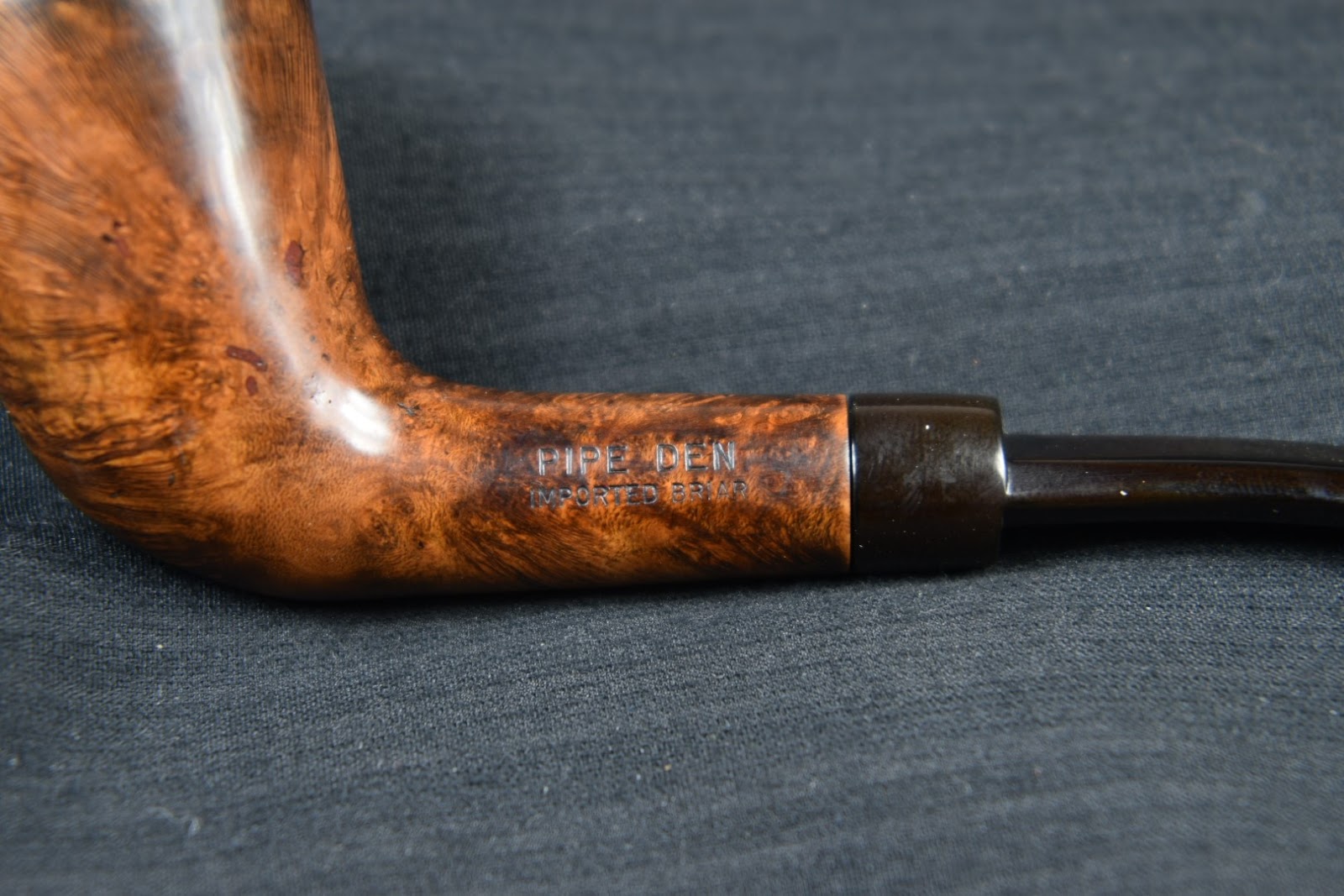
    This Zulu came to me as part of an estate lot.  Let me show you what I was looking at with this Pipe Den Zulu.

    Background on the Pipe Den 

    The Pipe Den is a shop from Vero Beach Florida.  According to the internet, source of only honest, truthful and accurate information, the Pipe Den still operates today.  According to their website, Bob Marshbanks has been,  “Serving pipe and cigar enthusiasts since 1977.  We are your premier cigar, pipe and tobacco shop” (https://pipedenvero.com/).  The website does not offer any online shopping yet invites patrons to the actual store to see what they have to offer.  There is no mention of specific pipes but they do state the following:

    “We offer a large selection of top quality pipes made by the world’s best pipe makers.  I personally guarantee all my pipes, even “starter” pipes.  Many “production” made pipes are manufactured of “Green” briar, heavily stained, varnished to cover poor grain and imperfections and smoke “hot”.  To order a pipe, select your shape preference and let me know the price range you have in mind.   Choose natural, dark or sandblast finishes.  This will allow me flexibility in my efforts to ensure that you will get the very finest pipe available from my selection.  

    Even easier, just call, we can discuss your preferences and we can be more sure of the selection.  I also have a selection of one-of-a-kind and freehand, hand carved Meershaum and Estate pipes.  

    The relaxed atmosphere at The Pipe Den is there for everyone.  You are welcome anytime to come by, sit and enjoy a good cigar, fill your pipe bowl and get away from the hassles.  I specialize in friendly old fashioned service.” (https://pipedenvero.com/pipes-%E2%80%A2-hints-%26-tips)

    Here is a very nice review of the Pie Den with some photos taken by the author:  The Pipe Den in Vero Beach My New Happy Spot in Florida (classyvice.com)

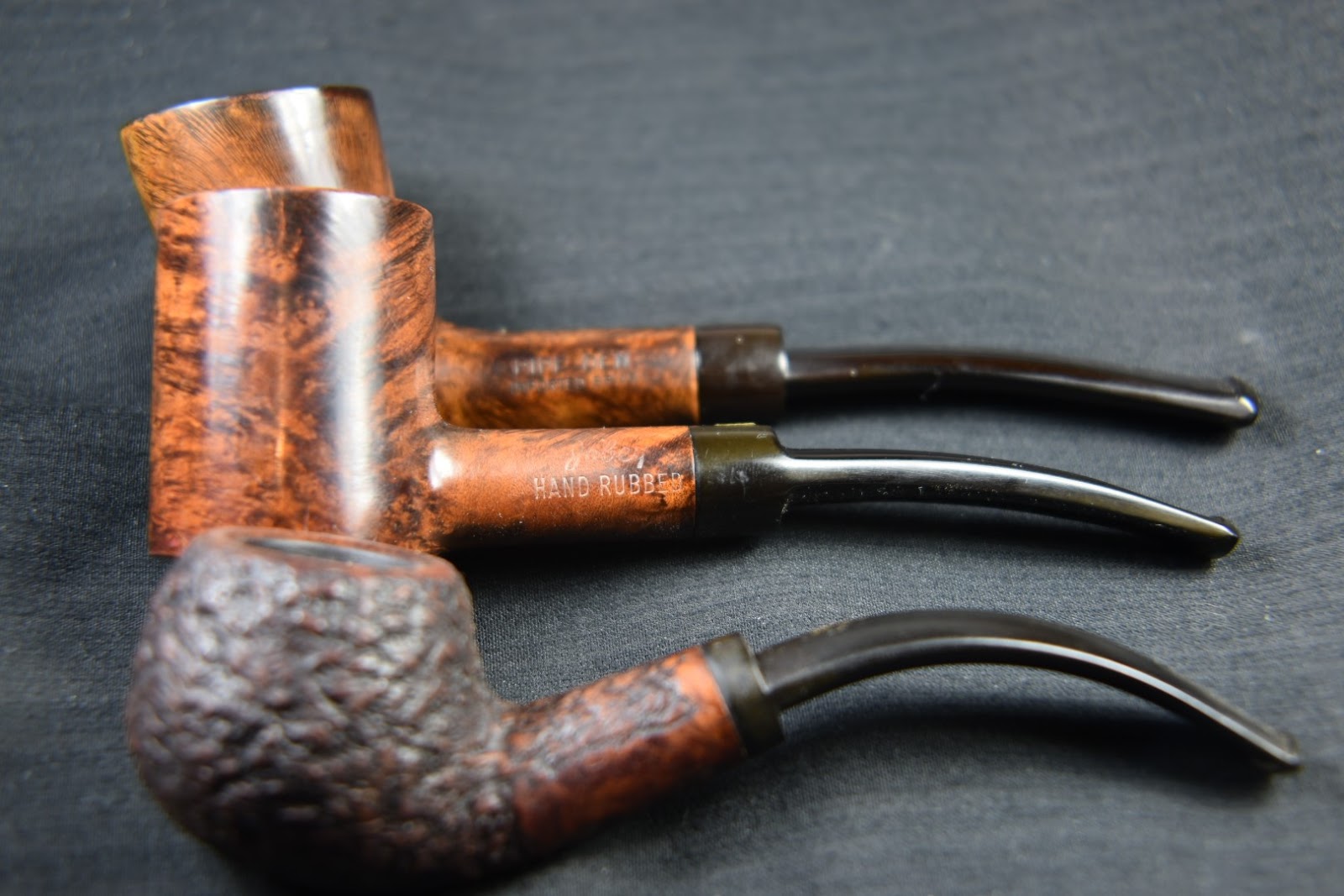
    The question of who made this pipe for Pipe Den remains.  In looking at the stem I see similarities to a couple of other pipes that I own.  I have two Jobey pipes that appear to have very similar identical stems.  They are saddle stems with a near 90 degree shoulder. 

    The quality of briar and the original stain color also match quite well.  Given those last two qualities are hardly good indicators of a shared heritage but they do look similar.  When looking up Jobey on pipedi.org, the first sentence of the entry says, “English – American – Danish – French… Sadly, solid information about Jobey is scamt…”(Jobey – Pipedia)  Even misspelling scant.  This should tell me something, what, I am not sure.  The pipedia.org article goes on to discuss possible origins of the Jobey company.  The most likely hypothesis, to me, is that Jobey was an American company and a subsidiary of the Norwalk Pipe Corporation (Norwalk Pipe Co. – Pipedia) and later sold to Weber.  There is also another discussion mentioning that, “Weber Pipe Co. owned and manufactured Jobey pipes – when mainly sold in the USA by the Tinder Box from 1970’s – 80’s. In addition Jobey / Weber bought Danish freehands from Karl Erik (Ottendahl). These pipes were offered as Jobey Dansk. Ottendahl discontinued exports to the United States in 1987 and in the very same year – obviously only as a ghost brand – Jobey was transferred to Saint-Claude, France to be manufactured by Butz-Choquin.”(Weber Pipe Co. – Pipedia).  This I believe is the most likely suspect.  The Pipe Den Zulu has a Jobey/Weber feel to it.  I can’t explain that other than the word “feel”.  The age would fit for the Pipe Den history, according to their website the Pipe Den opened in 1977.  I am of the opinion that this Pipe Den Zule was a Weber made pipe likely from the late 1970’s – 1980’s.

    The Restoration

    In the beginning…  No, that sounds too biblical.  How about, this restoration began with a clean piece of denim laid out on the workbench?  Much better.

    The fit of the stem was too tight and was left partially inserted to avoid dressing the mortise.  The stem was also in dire need of oxidized vulcanite removal.  That is where I began.

    I sanded the stem with a 600 grit sanding sponge to remove the calcium deposits, surface oxidation and light tooth chatter.  You can see that I used the denim to clean the sponge. 

    Next the interior of the stem was cleaned using bristle pipe cleaners and a nylon brush dipped in 95% ethyl alcohol.

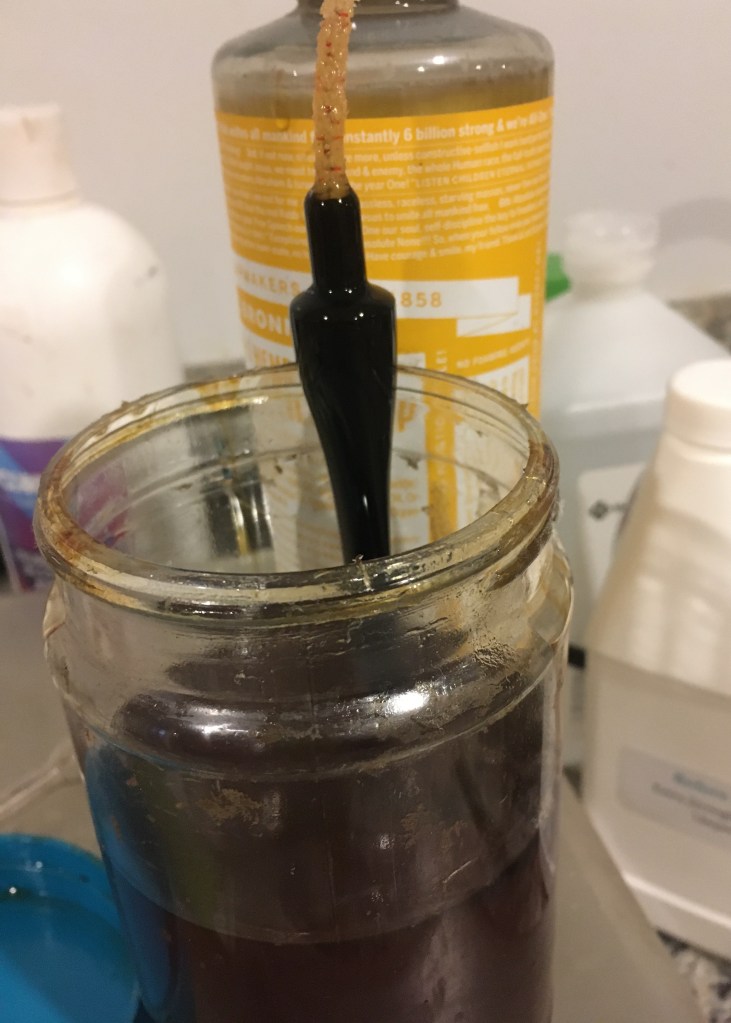
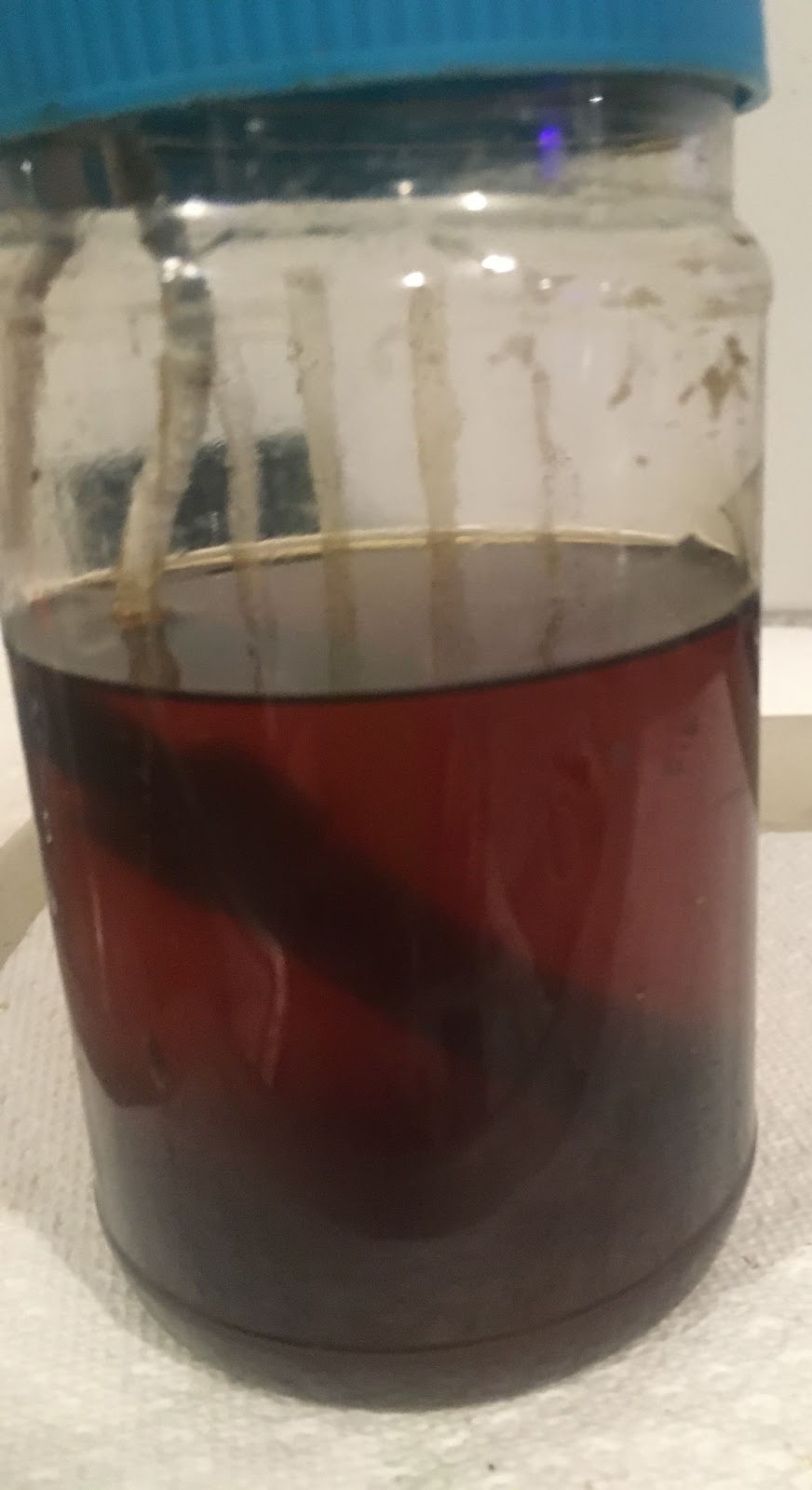
     With the stem cleaned inside and out, It was time to go into the Before and After Deoxidizing solution.  A pipe cleaner was used as a hanger to suspend the stem in the solution.

    I refer to this as the deox tank or deox, as a play on words with detoxification or detox for alcoholics and drug addicts.

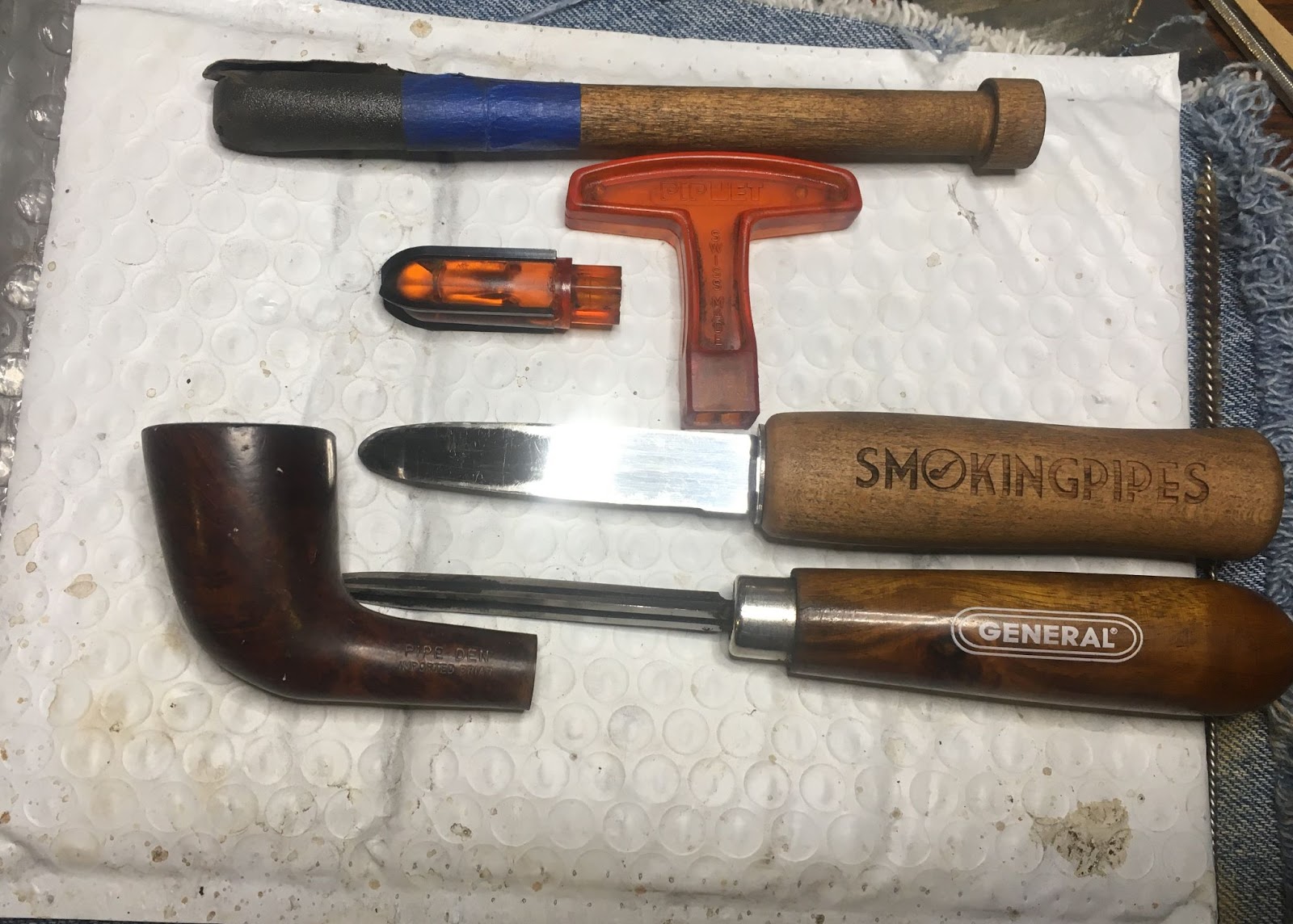
    With the stem in deox, I turned my attention to the reaming of the tobacco chamber.  The below tools were assembled.

    The chamber was bored with a very conical bit and did not fit the PipNet reamer at the bottom.  This required more scraping with the Smokingpipes Low Country Reamer and the General triangular scraper.

    The interior of the chamber was sanded to bare briar and no evidence of heat damage could be observed.  The rim was the next target of restoration.  I could see damage around the outer edge from tapping out dottle on surfaces not meant for tapping.  There was also a thick coating of lava.

    The lava was scraped with care and a sharp pocket knife after being moistened with saliva.

    The stummel was then taken to the sink.  Here it was scrubbed using a medium stiff toothbrush and undiluted Murphy Oil Soap.  The soap was rinsed with warm water.  At this point I decided to scrub the airway of the shank with a nylon shank brush and a bit of Dawn dish soap.  The airwar was rinsed with warm water and the stummel was dried with a cotton washcloth.

    Back at the workbench the stummel was wiped with a make-up pad dipped in 95% ethyl alcohol to remove any remaining wax or finish.  The pad came back with reddish brown, indicating that I was removing some of the original stain.  No finish could be observed.

    The cleaning of the shank was next on the list.  I poured about 4 ml of 95% ethyl alcohol into the bowl and allowed it to flow into but not out of the shank.  I used a nylon shank brush to scrub the airway with the alcohol present.  I then poured this alcohol into a medicine cup to be used until it was too blackened from dissolved tar.  After the alcohol scrub I returned to the sink and scrubbed the airway with undiluted Castile soap.  Then abc to the workbench for an alcohol scrub.  This rotation continued until my nylon brush was no longer turning black with tar.

    Between scrubbing rotations I would scrape the airway with a dental scraper and scrub with cotton swabs.  Eventually the airway was cleaned.

    14 hours later, I retrieved the stem from the Before and After Deoxidizing solution.  I allowed it to drip off excess solution for a few minutes.

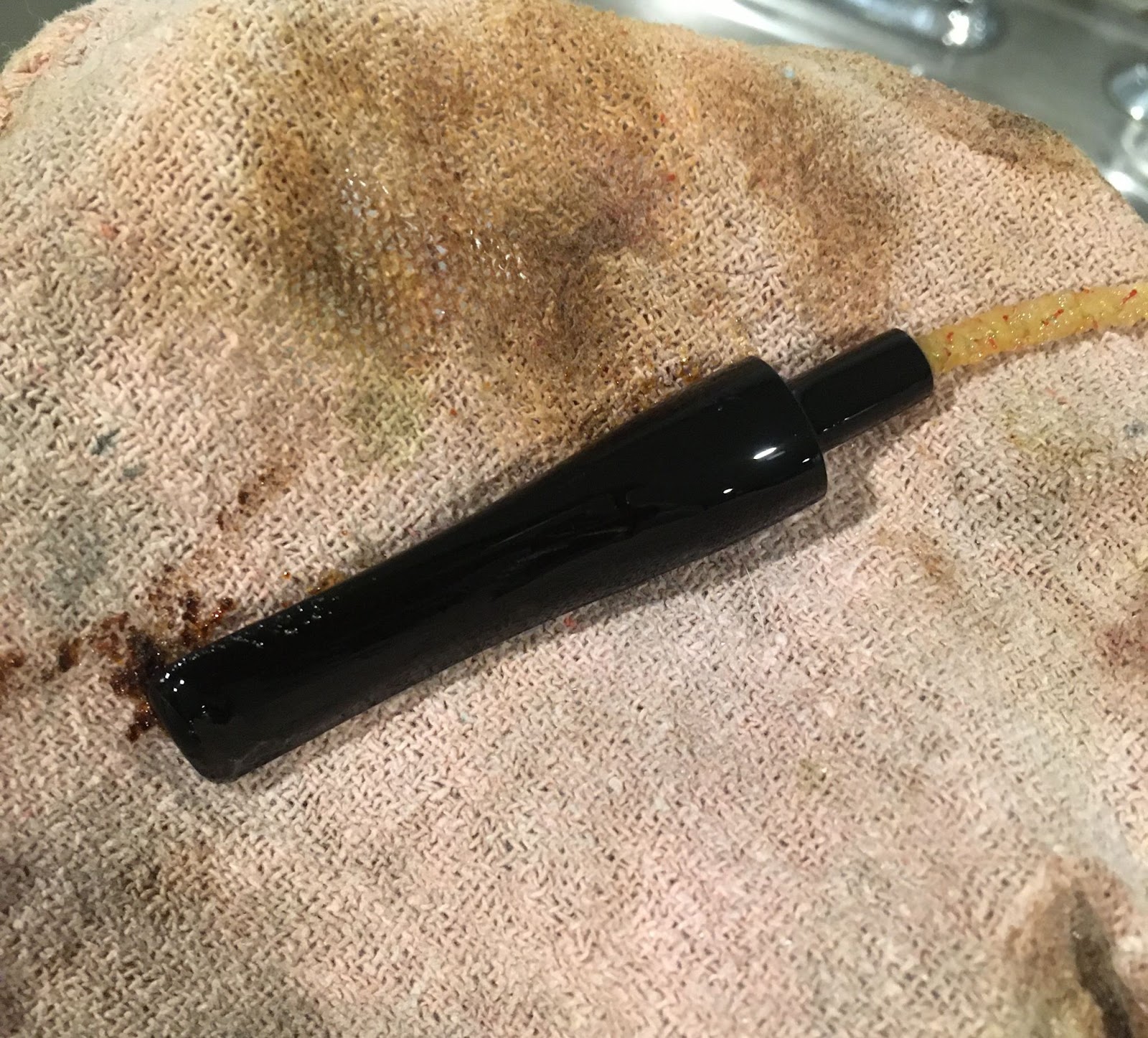
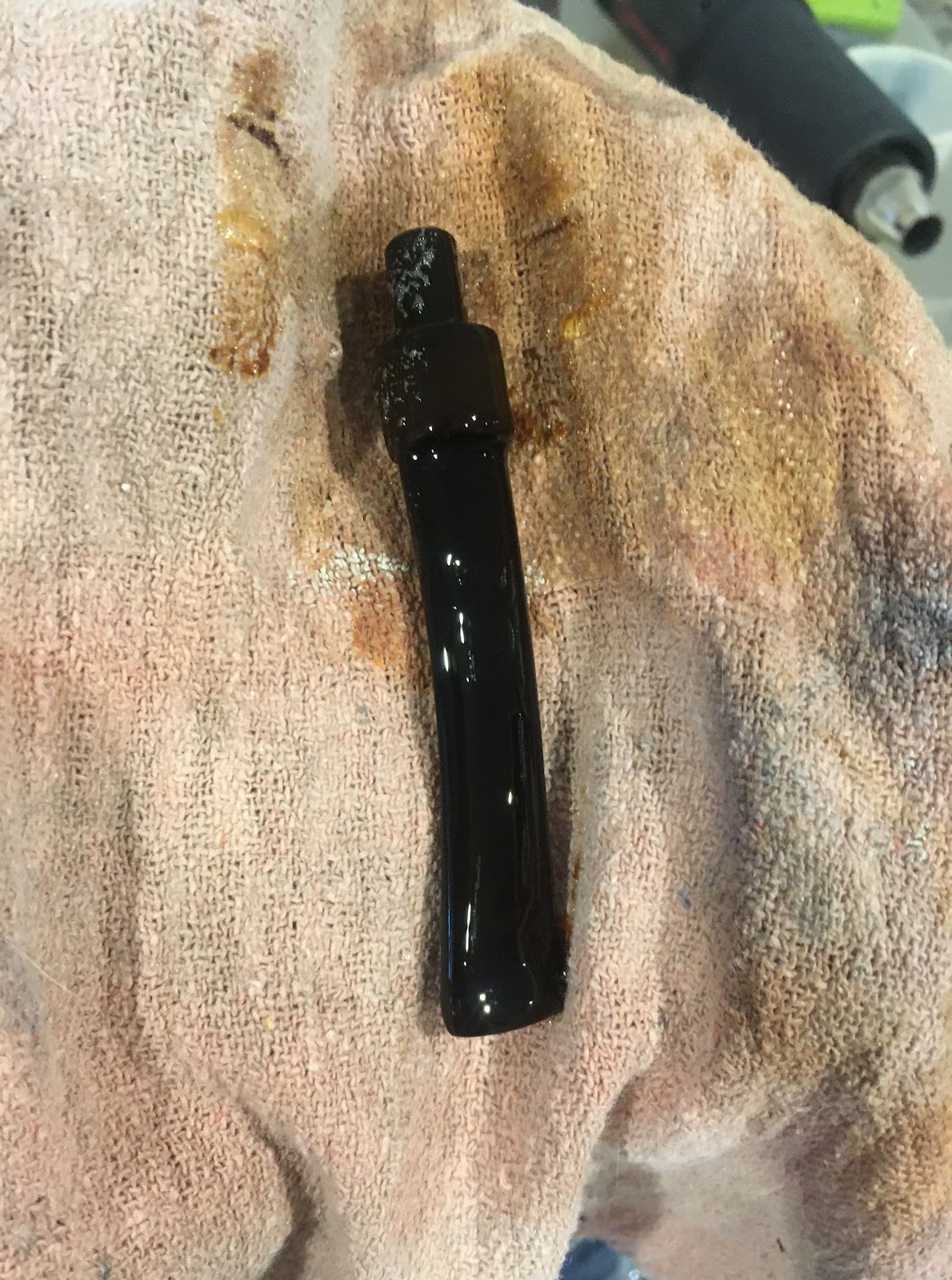
    Below the stem is on my preferred coarse cotton shop rag.  I like this rag for buffing a stem after the solution as it absorbs the remaining solution and abbrades some of the loosened oxidized vulcanite.

    Below is the stem after the buffing with the rag.

    After the hand buffing I used several make-up pads with Soft Scrub to further remove oxidized material from the stem.  I could have sworn that I photographed the pads but failed to find the photos.  Further proof than getting old is not for the…  What was I saying?

    The stem was then coated with mineral oil both inside and out.

    There were a few small pits which needed to be filled prior to taking on the damaged rim.  The small fills were repaired by placing a small drop of cyanoacrylate (CA, super glue) into the pit then sanding immediately over the pit.  The dust from the sanding and sanding sponge combined with the CA to fill the pit.  Two applications were sometimes needed for slightly larger pits.  Now to deal with that damaged rim  I did not want to top the rim and remove an ⅛+ inch or 3-4 mm of briar thus changing the shape of the stummel.  I lightly topped the pipe to restore sharp edges on the undamaged rim.  My plan was to apply a bead of brown CA to the damaged outside edge of the rim then press it into a container of briar dust.  The briar dust would then be combined with the CA to make a hard briar incorporated fill which could be sanded smooth. 

    Below is the bead of CA around the damaged areas

    Below is after the first dip of the wet CA into the briar dust.  The excess dust was scraped off with a pocket knife.

    Below is a photo of the new edge.  It would require a couple more beads of CA and dust dips but it was working.

    Below is dust dip number two.

    After filing and sanding the edge was restored.  The fill did appear darker than the supporting briar but that would be addressed with a contrast dye (more on that later).

    Now, to conceal the darker edge, I figured a darker stain or dye with the surface sanded away would provide a nice contrast showing off the grain of the briar and concealing the repairs.  In preparation for this dye job, I wanted to keep the dye from the stamp if possible.  I covered the stamp with a slightly irregularly cut piece of painters tape.  I wanted it irregular to avoid the “CENSORED” block look.

    I mixed equal volumes of both black and dark brown Fiebing’s Leather dye and added a couple of ml of 95% ethyl alcohol to allow them to mix thoroughly.  The dye was applied with a folded pipe cleaner and flamed with a disposable lighter to burn off excess alcohol in the dye and set the dye to the briar.

    Below you can see the tape had ignited during the flaming.  Oops.

    Back at the workbench, the stem appeared black.

    I wiped the excess dye from the stummel.  Several alcohol dipped make-up pads later the stummel can be seen to have a very dark brown color.  Oh yeah, I actually remembered the nitrile gloves this time.  I bet you didn’t see that coming?

    The stummel was then sanded with a 400 grit sanding sponge to remove the outer layer of dark dyed briar.  

    Next the damaged stem needed to be repaired.  Below are the top and bottom surfaces of the stem.

    Black CA was applied to the depressions on both the top and bottom of the stem.  The CA was then spritzed with a CA drying accelerator.

    These were then filed with a flat needle file until flush with the surrounding stem.  Both top and bottom required a second application of CA.  I prefer to use several light coats compared to a single large coat of the CA.

    Additional filing and sanding eventually led to the below photos of the top and bottom of the stem.

    The stem was then sanded using a sequence of sanding sponges in grits 1000-3500.  Between each sponge I applied a bit of mineral oil then wiped with a paper towel.

    After the sanding sponges I used a sequence of 4000-12000 micro-mesh pads.  Between each pad I rubbed in a small drop of Obsidian Oil and wiped the stem with a paper towel.

    On to sanding the stummel.  It was sanded with the sanding sponges 1000-3500.  Between each sponge the stummel was wiped with an alcohol dampened make-up pad.

    The stummel was then worked with a sequence of 4000-12000 micro-mesh pads.  Between each pad the stummel was wiped as with the sanding sponges.

    The stem then received polishing with Before and After fine then Extra Fine polish.  Both were applied by finger and hand buffed using a soft cotton cloth.

    The stummel then was given a coating of Before and After Restoration Balm and allowed to sit for 20 minutes.

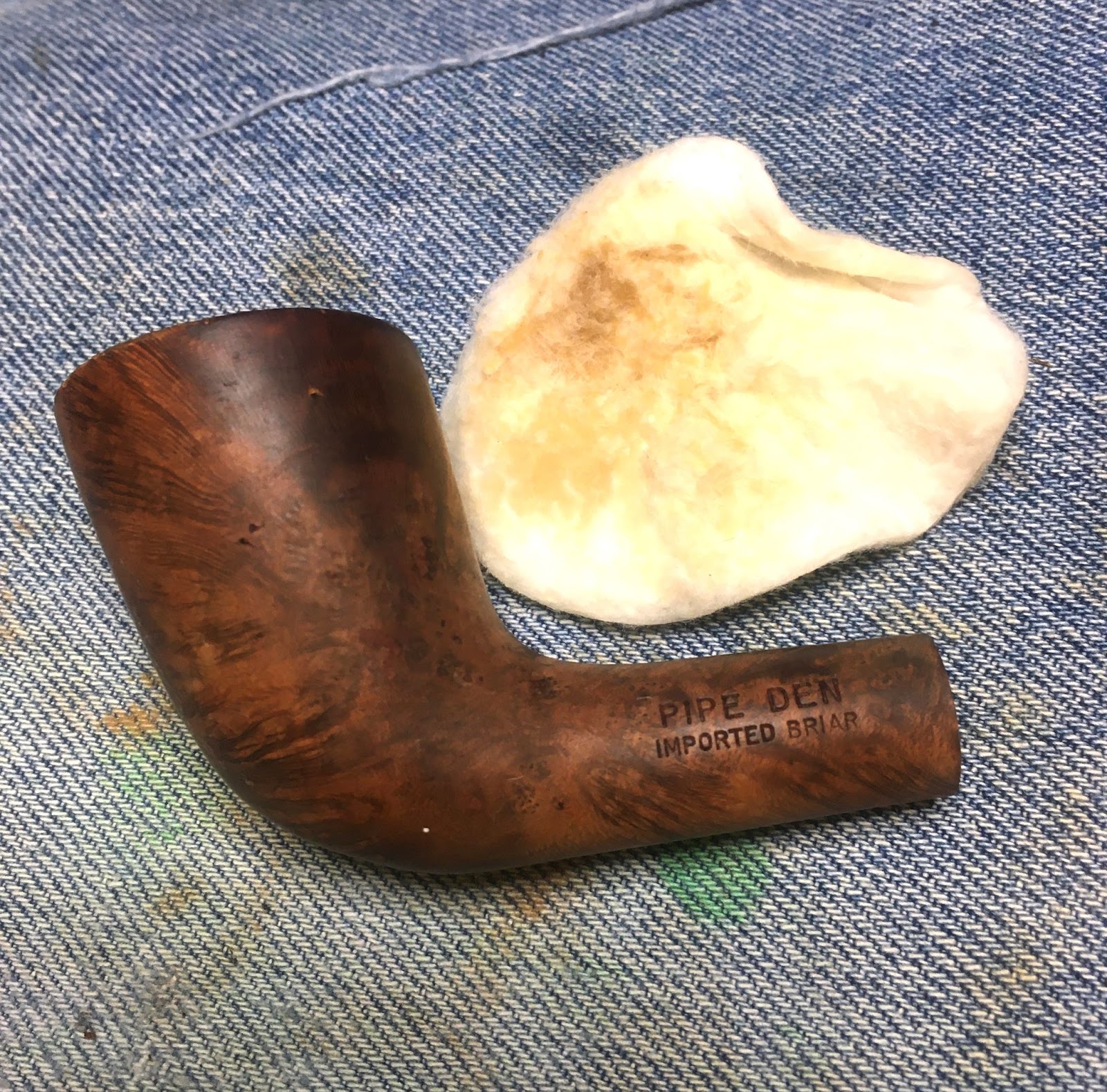
    The excess Restoration Balm was removed with an inside out cotton athletic sock to reveal a lovely grained briar.

    The pipe then received several coats of carnauba wax from the buffer.

    Overall I am pleased with how well this Pipe Den Zulu turned out.  I love the shape though I would appreciate a slightly larger size.  The repairs of the rim and stem came out better than anticipated.  The briar grain was accentuated by the contrast dye and shows itself far better now than when it was buried by years of grime.  Though the make of this very nice little pipe may never be known I am sure that it can find a new stewart who will get years of enjoyment from it.  

    The dimensions of this little beauty are: 

    • Length:  6.06 in./ 153.92 mm.
    • Weight:  1.05 oz./ 29.7 g.
    • Bowl Height: 1.94 in./  49.27 mm.
    • Chamber Depth:  1.59 in./ 40.39 mm.
    • Chamber Diameter:  0.77 in./ 19.56 mm.
    • Outside Diameter:  1.31 in./ 30.28 mm.

    I do hope that you have found something here useful to your own pipe care, maintenance or restorations.  If you like this sort of thing, please click the like and subscribe buttons.  Thank you for reading the ramblings of an old pipe lover.

    Below are some photos of the finished Pipe Den Zulu.

  • An Excelsior Poker Restoration

    April 15th, 2024

    Photographed and Written by

    John M. Young

    Now there is a cute little pipe.  Great traditional poker lines, pretty stain, interesting carvings, comfortable bit, clear stampings, beautiful clear coat – Screeerttttttt (that was the sound of an old needle scratched across a vinyl record).  There will be NO clear coat!  Yes my nemesis, the dreaded clear coat, more annoying than little sisters when you bring a date home to meet the parents.  More annoying than Northwoods mosquitoes.  More annoying than flat tires on the highway, in the freezing rain when you are in a hurry to get to work.  I know what you are thinking, “Hmm, I don’t think this guy likes clearcoat, sisters, mosquitoes or going to work.  I also wonder about his mental stability.”  I say, “Hah, I love my sister (most of the time), I love teaching (though retirement is far more enjoyable), I love the Mesabi Iron Range AKA Northwoods (Hi, Tomassoni family), the flat tires and the clear coat, not so much.

    This darling Excelsior came to me as a member of an estate lot purchased in January of this year.  It was not the item of interest of the lot.  I was after the 3 Senlar pipes of that lot.  If you are wondering what a Senlar pipe is here are links to those restorations:  Billiard, Canadian 1 and Canadian 2.  I had been smitten by the little Excelsior poker but it had to wait it’s turn at the bench until last night.  Let me show you what it looked like.

    Not quite sure how the White German Shepard got her hair in there.

    The pipe was in excellent shape.  I figured the restoration would be a quick and easy affair with the usual reaming, cleaning, deoxidizing and a bit of finish removal and refinishing.   The term “figured” can be replaced with assumed and we all know what happens when one assumes.  You make an “ass” of “u” and “me”.

    Background of Excelsior pipes

    This section proved more difficult than I originally thought.  I came across an entry for octagonal logo outlines a few weeks back on pipephil.eu.  Fortunately I took a screenshot and saved it into a folder for the Excelsior poker.  I knew that I would eventually get around to restoring the poker.  I then forgot about the screenshot.  When I started researching Excelsior, I remembered seeing the octagonal logo outline but I couldn’t find it again.  When saving the photos for this restoration I saw the screenshot and felt lucky that I had the foresight to save it weeks ago.

    The Excelsior has an “E” rather than the “D” as shown in the image below.

    (Dra-Duk — Pipes : Logos & Markings (pipephil.eu))

    The EXCELSIOR over ALGERIAN BRIAR over MADE IN FRANCE is the same naming sequence that Jeantet used but, that is more circumstantial evidence and block letters pretty much all look alike, making positive identification of the maker inconclusive.

    Jeantet has a long history of pipe making.  According to Pipedia.org:

    “The firm of the Jeantet family in Saint-Claude is first mentioned as early as 1775. By 1807 the Jeantets operated a turnery producing in particular wooden shanks for porcelain pipes and wild cherry wood pipes. The firm was named Jeantet-David in 1816, and in 1837 the enterprise was transformed into a corporation as collective name for numerous workshops scattered all over the city.  The manufacturing of briar pipes and began in 1858. 51 persons were employed by 1890. Desirous to concentrate the workers at a single site, the corporation began to construct a factory edifying integrated buildings about 1891 at Rue de Bonneville 12 – 14. This took several years. In 1898 Maurice Jeantet restructured the business. He is also presumed to enlarge Jeantet factory purchasing a workshop adjoining southerly. It belonged to the family Genoud, who were specialized in rough shaping of stummels and polishing finished pipes. (In these times it was a most common procedure to carry goods from here to there and back again often for certain steps of the production executed by dependant family based subcontractors. Manpower was cheap.)

    Jeantet was transformed to a corporation with limited liability in 1938. By that time a branch workshop was operated in Montréal-la-Cluse (Ain), where mainly the less expensive pipes were finished. 107 employees – 26 of them working from their homes – were counted in Saint-Claude in 1948 and 18 in the Ain facility.

    The Saint-Claude factory was considerably modernized by ca. 1950 installing (e.g.) freight elevators. In 1952 the southern workshop was elevated. 80 workers were employed in 1958. The factory covered an area of 2831 m²; 1447 m² of the surface were buildings.

    The climax of the pipe production was reached around 1969, when thirty to thirtyfive thousand dozens of pipes were made by 72 workers (1969). But then the production continously dwindled to only six or seven thousand dozens in 1987 and only 22 workers were still there. Eventhough, around 1979 a very modern steam powered facility for drying the briar had been installed in the factory’s roofed yard.

    Yves Grenard, formerly Jeantet’s chief designer and a great cousin of Pierre Comoy, had taken over the management of Chapuis-Comoy in 1971. Now, to preserve the brand, the Jeantet family went into negotiations with him, and resulting from that Jeantet was merged in the Cuty Fort Group (est. 1987 and headed by Chacom) in 1988 along with the pipe brands of John Lacroix and Emile Vuillard. Chacom closed the Jeantet plant, and the City of Saint-Claude purchased it in 1989. After alternative plans failed, the buildings were devoted to wrecking. The southerly workshop was wrecked before 1992.

    Today Jeantet pipes were produced as a sub-brand by Chapuis-Comoy who’s mainstay is Chacom of course.” (Jeantet – Pipedia)

    The pipedia.org article also had an image of the 1980 Jeantet catalog.  

    (File:Jeantet 1980 cat.jpg – Pipedia)

    From the catalog image we can see that Jeantet is using the octagonal logo outline around the letter “J”.  Likely for Jeantet.  I do not think it is too large of a leap to think that Jeantet used the octagonal logo outline around an “E” for the Excelsior pipe in hand.  With this in mind I conclude that the Excelsior poker is a Jeantet product with an undetermined year of production.

    The Restoration

    The restoration began as do most with a clean denim piece on the workbench.  This pipe needed to have that stinger soaked for a bit in 95% ethyl alcohol so, that was job #1.

    Job #2, see what solvent will remove this clear coat.  First attempt 95% ethyl alcohol on a cotton swab.  Mostly negative.

    Attempt two, acetone on a cotton swab.  Success.

    That means that the stummel needed to take an acetone bath for 30 minutes.

    While the acetone was doing what it does, I started on the stem.  The initial sanding was done with a 6000 grit sanding sponge to remove the light tooth chatter and oxidation.  Care was taken to avoid the logo.

    The interior of the stem was then cleaned out using bristle pipe cleaners dipped in 95% ethyl alcohol.  The button of this pipe seemed very constricted.  Not from damage or accumulated yuck (the technical term for smoking residue).  It was just a slightly smaller daft hole than would fit a bristle pipe cleaner.  I had to use Falcon Thin Pipe Cleaners to get through it.  As a remedy I cut an angular piece from an emery board, nail file, and used that to enlarge the airway.

    The stem was then scrubbed with several make-up pads with Soft Scrub applied.  I had not noticed how light the stamp was for the logo.  Once the Soft Scrub was not producing oxidized rubber the stem was oiled with a coat of mineral oil and allowed to sit.  The Soft Scrub was abrasive enough to remove the paint and most of the logo indentation.  I hoped that it would be deep enough for some fresh white paint.

    The stummel was retrieved from the acetone bath.and scrubbed with an acetone dipped toothbrush then wiped with acetone dipped make-up pads to make sure all the clear coat was dissolved and removed from the briar.

    I then worked on reaming the tobacco chamber.  Since the chamber was small I used the Scotte Stainless Steel Tool and the Smokingpipes Low Country Reamer.  

    The reaming was followed by sanding the chamber with 320 sandpaper wrapped around a wood dowel.

    The removal of the clear coat allowed me to discover three things I had not previously noticed.  One, a lage fill at the end of the stamp and two, a small pit on the base of the stummel and three a 6-7 mm long shank crack.  I decided that there was little I could do for the fill without damaging the stamp and the old fill was secure, so I left it alone.  

    The pit on the base was small and probably could have been ignored.  It wasn’t. 

    I used thin cyanoacrylate (CA, super glue) and briar dust to fill the pit.  A small drop of CA was applied then sanded with the 600 sanding sponge.  The briar dust on the sponge and the newly created dust from sanding combined with the wet CA to fill the pit. 

    The top, rim, and the bottom of the stummel were sanded with the sequence of sanding sponges 100-3500.  Between each sponge the stummel was wiped off with a make-up pad moistened with 95% ethyl alcohol.

    I stayed in stummel mode and cleaned out the shank next.  This was done by pouring about 5 ml of 95% ethyl alcohol into the bowl and allowing it to flow up the shank but not out.  I then used a nylon shank brush to scrub the shank interior with the alcohol in place dissolving the yuck from the airway.  The alcohol was then poured into a medicine cup and the shank scrubbed with cotton swabs.  This alcohol shank brush scrubbing was repeated until the cotton swabs came back clean.

    Before I started the new band, I wanted to get the stem sanded and micromeshed to ensure a perfect fit with the band.  I wiped the mineral oil from the stem and started lightly sanding with the 1000 sanding sponge.  I was careful to avoid the logo.  I continued with the sponges through the 3500 sponge.  Between each sponge I dipped my finger into the mineral oil, rubbed this onto the stem and wiped it with a paper towel.

     I then proceeded to the 4000-12000 micro-mesh pads.  Between each pad I applied a drop of Obsidian Oil, rubbed it with my finger and wiped it with a paper towel.

    The dreaded shank crack.  I am pretty sure there is no such thing as a good shank crack.

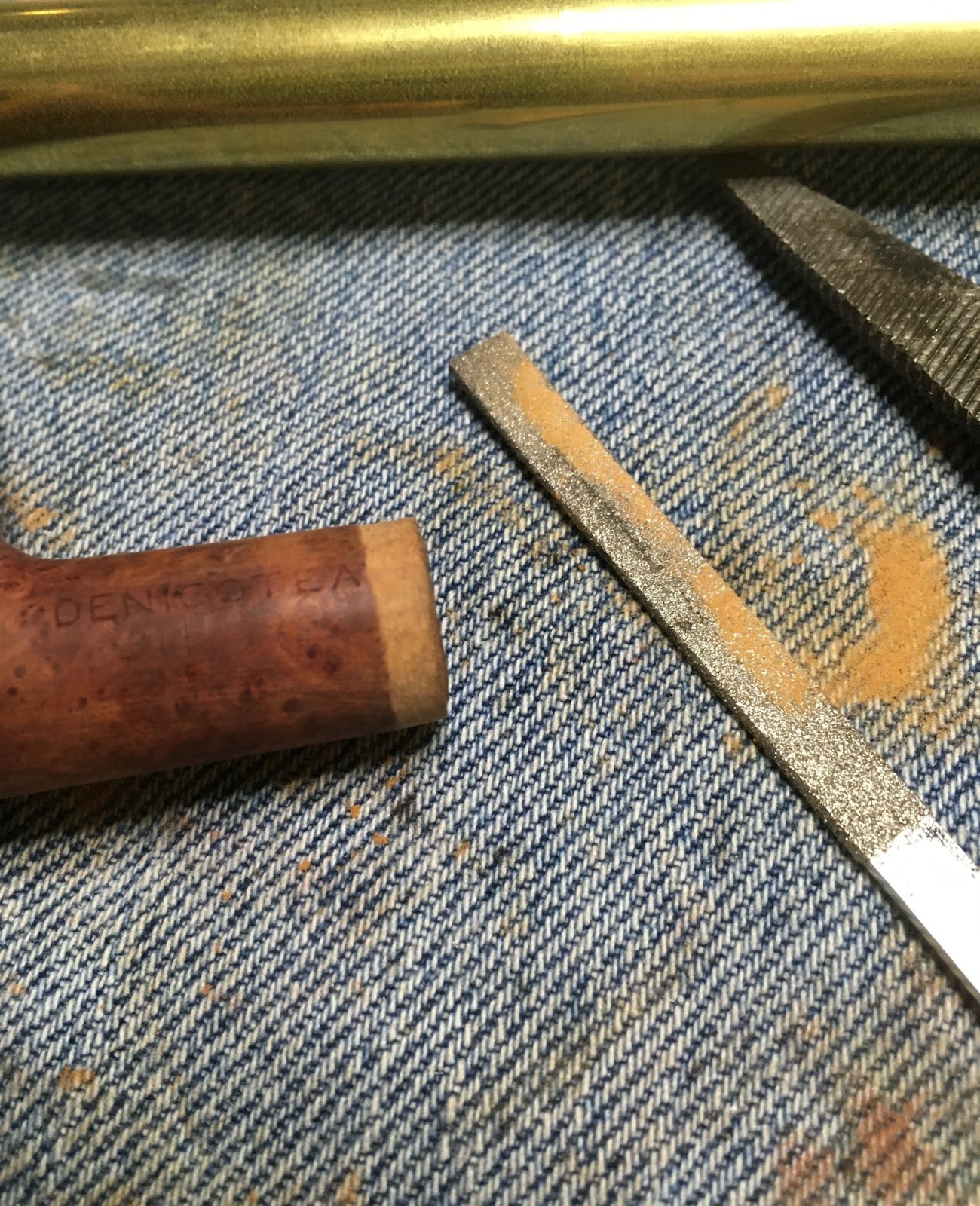
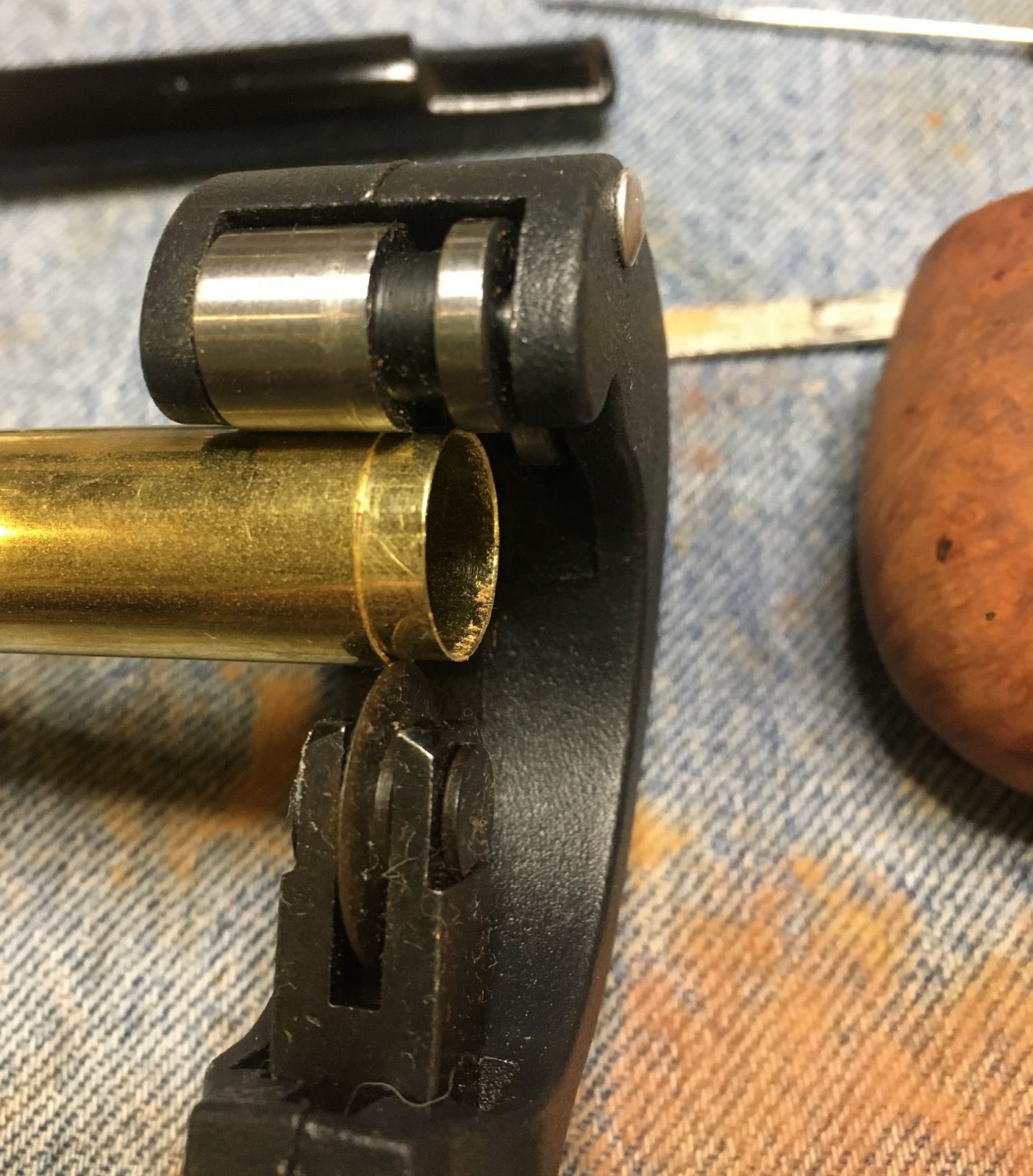
    This crack needed a band.  I checked my stock of brass tubing.  The 17/32 inch outside diameter (O.D.) brass tube was nearly a perfect fit.  A pipe cutter was used to cut the brass to 0.2 inches or 5 mm. 

    Nearly meaning that I had to file and sand a small amount of material from the shank.  This actually made for a smoother fit for the band.   I had to tap rather hard to get it to seat as far back as I wanted it.  I replaced the stem and it too was tight, too tight (I’ll come back to that in a minute).  Normally I would have used a tiny drill bit to drill a hole at the end of the crack to assure that it would not continue but that would have required a fill immediately beyond the band and into the rustication.  I could not see the crack opening at all with the band on and the stem inserted.  Both edges of the new band were sanded to give them a slight bevel to make them less obvious to the touch. I applied a bit of thin CA which seeped into the crack then forced the band into place.  Using a flat piece of steel and a hammer I tapped the band into place.  

    Below, you can see there is a slight overhang of the band.  This allowed the stem to slip under the band almost like a double mortise.  The full fit was pleasing to both the eyes and the fingers.  Now, remember when I said I’d come back to the tight fitting stem?  I used a 600 grit sanding sponge to sand the tenon by pinching the sanding sponge around the tenon.  The stem was then rotated.  I checked for fit every few rotations until I got a perfect snug fit.

    The logo had been near completely obliterated.  I tried to clean the area of any oil with a cotton swab and alcohol before painting it.

    I applied a white acrylic model paint and allowed it to dry.

    Using a rigid piece of plastic I tried to scrape the paint from the area above the stamp indentations.  It was no use.  I tried a couple of times to no avail, the stamp was just too light.  I then used the Before and After Fine Polish with a soft cotton cloth.

    I followed the Fine Polish with the Before and After Extra Fine Polish again with a soft cotton cloth.

    The final steps were to apply a couple of coats of Renaissance Microcrystalline wax to the stummel. 

    The label said to apply and wipe off with a soft cloth.   Instead I applied it with a baby toothbrush and buffed it with a clean flannel wheel on the buffer.  I changed wheels and buffed the stem and, staping, top and bottom with several coats of carnauba wax.

    Overall I am pleased with how well this Excelsior Poker turned out.  The clear coat was gone and the underlying briar looked great.  The step polished to a very nice high gloss.The new band accentuated the look of the pipe overall all adds a touch of class to the rustic carvings.  The sligh bent to the stem gives the pipe a comfortable balance for clenching along with the light weight.  I am sure that it will be a nice smoking little pipe.

    The dimensions of this little beauty are: 

    • Length:  5.64 in./ mm.
    • Weight:  1.04 oz./ 29.50 g.
    • Bowl Height: 1.64 in./  41.66 mm.
    • Chamber Depth:  1.52 in./ 38.61 mm.
    • Chamber Diameter:  0.69 in./ 17.5 mm.
    • Outside Diameter:  1.19 in./ 30.23mm.

    I do hope that you have found something here useful to your own pipe care, maintenance or restorations.  If you like this sort of thing, please click the like and subscribe buttons.  Thank you for reading the ramblings of an old pipe lover.

    Below are some photos of the finished Excelsior Poker.

  • A Large Italian Oval Shank Billiard Restoration

    April 11th, 2024

    Photographed and written by 

    John M. Young

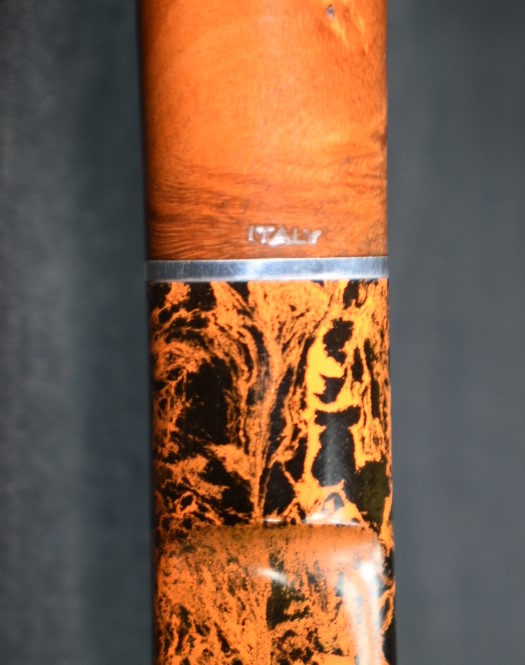
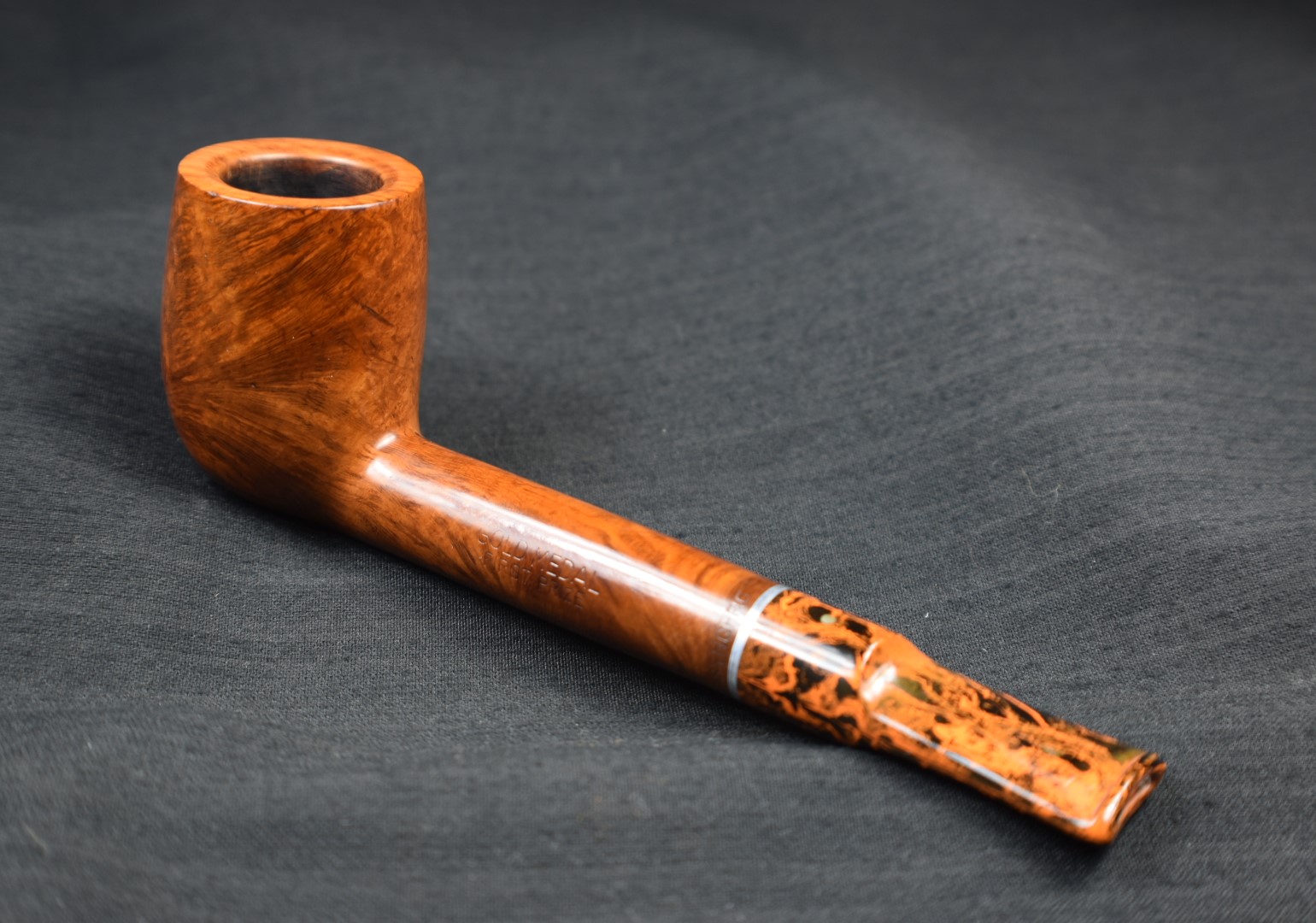
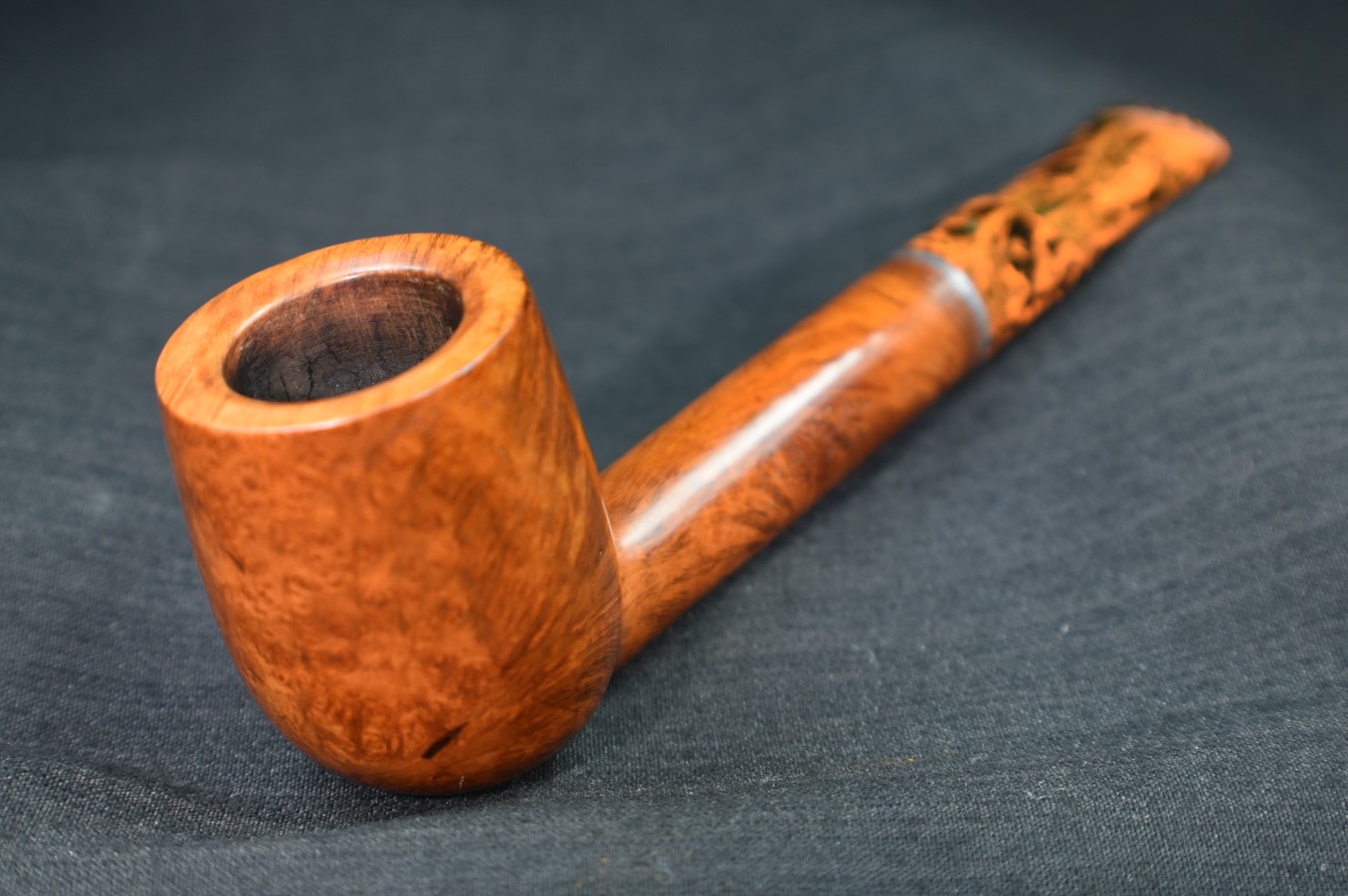
    Well, I have good news and bad news.  Or maybe, it’s good news and good news.  I have an Italian oval shank billiard, here.  The bad news is that I can’t do much about the history of a pipe when the only stamp on it is “ITALY”.  Now, if you find my histories or background sections annoying this is good news.  The other good news is how well this pipe turned out.  She is a very attractive no name.

    The pipe came to me as part of an estate lot purchased in March of 2024.  It was not the target of the lot.  After looking over the pipes I found the shank shape very interesting.  It was kind of an oval but with points on the ends and it was tapered from wide at the bowl to narrower at the stem.  I thought that it was more like a Canadian shape but Canadian shanks are not tapered.  The grain of the briar looked pretty uninteresting, at first glance, and there were no identifying markings so, it went back into the box of future projects.  Several weeks later I was looking through the box again and the stem drew me back to the pipe.  Here is what I was seeing:

    Just another old pipe, right?  But that shank was cool.  I thought, “wait, there is some interesting grain under the grime and crappy stain.  This old girl will clean up nice.”  Well, spoiler alert – A contrast stain would really show off the grain.  Yeah, the stem was a mess, she was dirty, there were pits to fill, and who knows what lies under that lava covered rim?

    The Restoration

    As usual a clean denim piece was added to the workbench.  I knew this piece of denim was not going to look clean for very long.

    I began with the stem.  I figured that it was going to be in the Before and After Deoxidizing solution for several hours so, best to get it in there first.  I sanded the worst of the oxidation and calcium from the stem with a 320 grit sanding sponge.

    Yep, so much for the clean denim.  

    Next I cleaned out the inside of the stem with bristle pipe cleaners dipped in 95% ethyl alcohol.  Ignore the aluminum stinger soaking in the alcohol, that’s part of another project.  After the cleaning the stem went into deox (my term for the Before and After Deoxidizing solution). 

    With the stem in deox, I turned to reaming the stummel.  The pipe had a large diameter bowl and was drilled with a tapered tobacco chamber.  This required using the PipNet with the #2, #3 and the Scotte reaming tools.

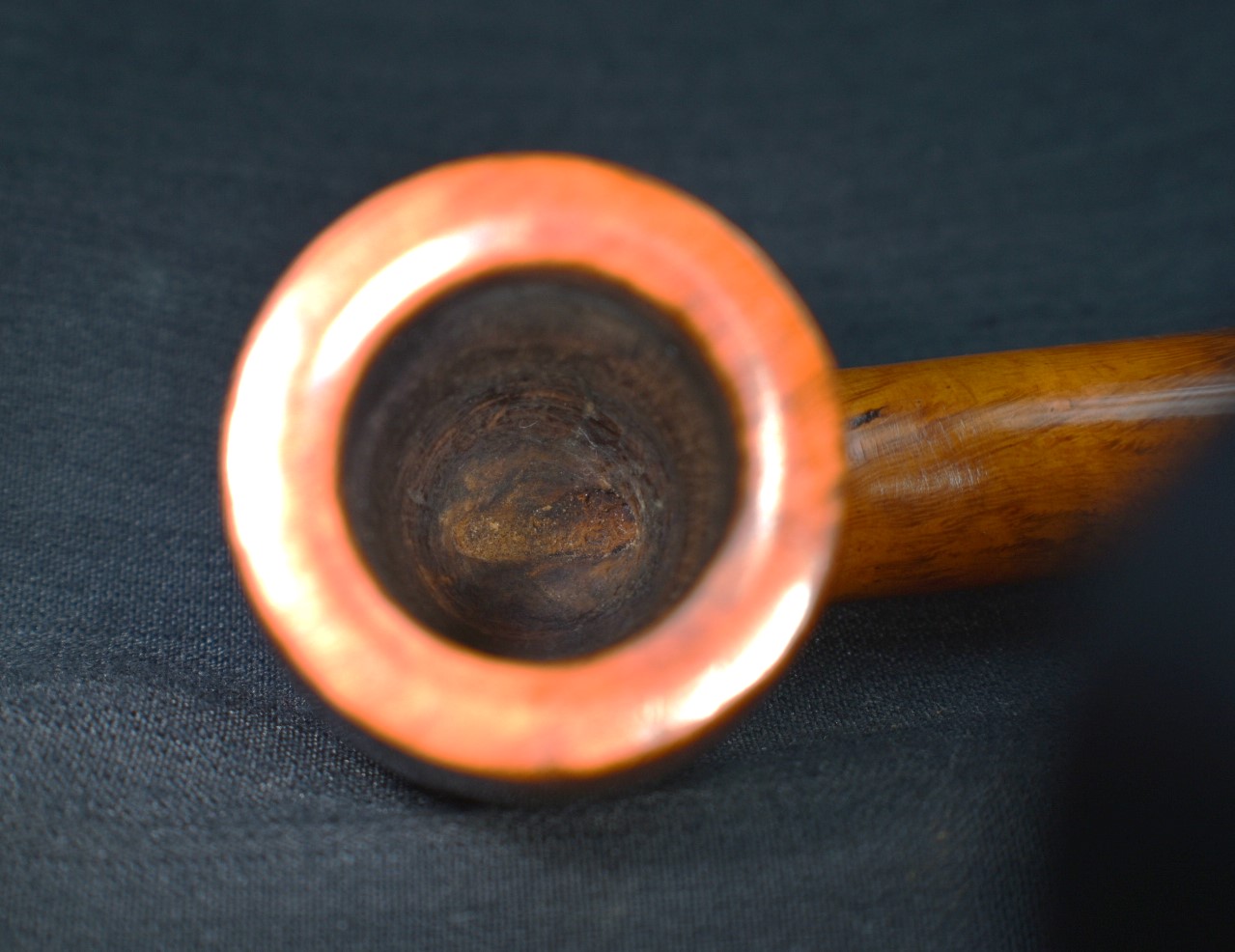
    The reaming was finished with the General triangular scraper and sanded with 220 sandpaper wrapped around a wood dowel.  The tobacco chamber showed no signs of any heat damage.  The rim on the other hand was still doing it’s impression of a Hawian island with it’s lava flows.

    The lava was softened with saliva and scraped from the rim using a sharp pocket knife. 

    After the reaming and rim scraping the stummel was taken to the sink.  Here it was scrubbed with undiluted Murphy’s Oil Soap and a medium stiff toothbrush.  The soap was rinsed with warm water and the stummel dried with a cotton dish towel.

    After the scrub, I sanded the stummelwith 320 and 400 grit sanding sponges searching for pits, dents and dings to fill.

    Several were found a couple had to have the old fill or dirt picked from them.   ALl were filled using brown cyanoacrylate (CA, super glue) and briar dust.

    The next day, I returned to the deox tank.  The stem had been soaking for 12-14 hours.  I removed the stem and let the excess solution drip back into the jar.

    The stem was then hand buffed with a coarse shop rag.

    Returning to the workbench I started scrubbing the stem with Soft Scrub on make-up pads.

    I progressed to using the Soft Scrub with the remnants of my Magic Eraser. 

    Once the pads started to provide a significantly less color change the step was coated with mineral oil and allowed to sit.

    I thought that a contrast stain would allow the grain of the briar to be more apparent.  I chose Dark Brown mixed with Black Fiebing’s Leather Dye.  I mixed the brown to black at a 2:1 ratio.  Prior to applying the dye I heated the stummel with the heat gun, shown below.  The dye was applied with a folded pipe cleaner and flamed with the lighter.  Two coats were applied and flamed.

    Returning to the workbench, I dipped make-up pads into 95% ethyl alcohol and wiped the stummel.  I wanted to get as much of the dye off of the stummel as possible.

    Once the dye had been wiped from the stummel I started sanding the surface with a 320 sanding sponge.  The sponge needed to be wiped off on the denim frequently to free it from the accumulated briar dust.  Below shows the stummel ½ sanded illustrating the accentuation of the grain.

    When finished with the 320 sanding sponge I sanded with a 400 sponge.  Between the sandings I wiped the stummel with a make-up pad dipped in alcohol.

    I wanted to sand the stem and the stummel together to avoid rounding the edges of each piece.  This meant that I needed to finish the stem.  I wiped the mineral oil from the stem and used a cotton swab dipped in alcohol to clean the oil from the area I would be working on.  I used black CA to fill the tooth dents.

    I applied the black CA into the dents and spritzed the stem with a CA drying accelerator. 

    The cured CA was then filed smooth with a flat needle file.

    Additional coats of CA were added to further smooth and blend the repaired areas.

    I prefer to work with several light coats rather than a single heavy coat of CA.  Below the dark spots are areas where another application is needed to fill a depression.

    Below is after filing and sanding to 400 grit.

    The same process was done for the bottom side of the stem.

    Once the stem had been sanded with the 600 grit sanding sponge the two pieces were reattached and the pipe was sanded together.  The 1000-3500 sanding sponges were used in series with care not to sand the ITALY stamp.  Between each sponge the stummel was wiped off with an alcohol moistened make-up pad.  The stem had a bit of mineral oil rubbed inby fingertip and then wiped with a paper towel.

    The pipe was then polished with a series of micro-mesh pads from 4000-12000.  Between each pad the stummel was wiped off with an alcohol moistened make-up pad.  The stem had a small drop of Obsidian Oil rubbed in by fingertip and then wiped with a paper towel.

    The stummel received a coating of Before and After Restoration Balm and was allowed to sit for 20 minutes.

    20 minutes later the Restoration Balm was wiped from the stummel using an inside-out athletic sock.

    The final step of the restoration was to apply several coats of carnauba wax to the pipe using a buffer.

    This lovely Italian oval shank billiard may not have a stamp indicating a maker and will thus be considered a “less than” pipe but looking at the before and after photo below, I dare you to call her “less than”.  She is more than average in quality of briar, workmanship and quality of finish.  I am quite pleased at how well this billiard turned out.  The stem had me a bit


    worried but after the repair it polished up nicely.  The Contrast stain did indeed make the briar grain shine.  This old girl will be a grand smoker and will hopefully bring someone many years of  enjoyment.

    The dimensions of this little beauty are: 

    • Length: 5.50 in./ 139.7 mm.
    • Weight:  1.34 oz./ 37.80 g.
    • Bowl Height: 1.97 in./ 50.04 mm.
    • Chamber Depth: 1.72 in./ 43.69 mm.
    • Chamber Diameter: .82 in./ 20.83 mm.
    • Outside Diameter: 1.47 in./ 37.39 mm.

    I do hope that you have found something here useful to your own pipe care, maintenance or restorations.  If you like this sort of thing, please click the like and subscribe buttons.  Thank you for reading the ramblings of an old pipe lover.

    Below are some photos of the finished Italian No Name Oval Shank Billiard.

    Wow, I have to work on that button.  The bright light makes it look oxidized.

    By the way, here is the finished piece of denim.

  • A Dr. Grabow Duke Restoration

    April 9th, 2024

    Photographed and written by

    John M. Young

    This is honestly more of a refinishing than a restoration.  This little Dr. Grabow Duke had never been smoked.  If you have read my blogs for a while you know that I do not like clear-coat finishes. Oh, and thank you for being a reader.  If you are new here, thank you for stopping by and I don’t like clear-coat finishes.  

    I know many folks don’t think too highly of Dr. Grabow pipes.  They have a reputation as mass produced, factory made, low quality and low price pipes.  I can agree with all of those statements save the “low quality”.  I view a good deal of the Quality of a pipe in the briar used and the finish applied.  This pipe is a prime example.  Though it is small the briar is a fine specimen.  It has nice grain and I did not see a single fill.  The finish of the pipe is another matter.  I do not like clear-coat finishes.  Hmm, have I said that before?  

    Allow me to show you some photos of the Dr. Grabow Duke prior to being worked on.

    Now, this pipe was in fine condition.  Never having been smoked helps in that and we could say that the finish on the pipe had not aged well.  I would still say that may be true being bumped around in a drawer, unused may lead to some dents, dings and surface scratches.  The fact remains that I do not like clear-coat finishes, scratched, aged, dented or dinged.  Hmm, have I said that I don’t like clear-coat finishes?

    Dr. Grabow Background

    I have not blogged about Dr. Grabow pipe too extensively.  Although my very first blog was about using a briar plug in the bottom of the bowl of a Dr Grabow Westbrook.  Back on December 27, 2023 I wrote a blog about a Grand Duke and included the following links for those interested in reading more about Dr. Grabow pipes.  I will include those links again here:

    History:   

    Dr. Grabow Pipes: https://www.tobaccopipes.com/dr-grabow-history/#:~:text=The%20famous%20smoking%20pipe%20brand,US%20patent%20number%201.896%2C800.

    Dr. Grabow on Pipedia:

    https://pipedia.org/wiki/Dr._Grabow

    Dr. Grabow timeline, Pipedia: 

    https://pipedia.org/wiki/Dr._Grabow_Pipe_History_Timeline

    Current Dr. Grabow:

    https://www.drgrabow.net

    This pipe has no shape number.  The only thing which I could find about the history on this specific pipe was a quote from the pipedia.org describing the Duke line, “DUKE (c1964?) — From 1964 to 1984 the “Little Duke” and the Lark were imported from Italy. Later made at Sparta to increase production at the facility.”  (https://pipedia.org/wiki/Dr._Grabow_Models_(Series,Line)_Names_Through_the_Years)

    The Restoration

    As previously mentioned, this was far more of  a refinishing project.  I did start with a new denim piece and immediately tried to discern what solvent would be best for removing the clear-coat.  Have I mentioned my dislike of clear coats?  Anyway, the first contestant was 95% ethyl alcohol.  Its two carbon chain did a fine job at removing the dust from the clear coat but accomplished little else. 

    The next contestant was acetone.  This highly volatile beauty did a fine job at removing the clear finish and some of the underlying stain by the look of the make-up pad.  

    I decided that rather than me scrubbing with acetone dipped make-up pads I would just give the stummel a 30 minute dunk in the acetone jar.

    This 30 minutes allowed me the time I needed to polish the stem.  There was no need to use the sanding sponges since the stem was already looking near new.  I ran through the 4000-12000 micro-mesh pads.  Between each pad I applied a small drop of Obsidian Oil, rubbed it around with my finger tip then wiped the stem with a clean dry paper towel.

    After 30 minutes the stummel was removed from the acetone.  The finish was mostly gone. 

    I rubbed the stummel with a few acetone wetted make-up pads to be sure and folded over a piece of 400 sandpaper to clean out the beading grooves. 

    Being very careful not to sand the stamps I sanded the stummel with a 320 and 400 sanding sponge.  My goal here was to remove the outer layer of darker stained briar while leaving the dark stain in the softer parts of the briar.  In essence, using the existing stain as a contrast dye without me having to dye the stummel.  I wiped the stummel between each sponge with an alcohol wetted make-up pad.

    The stummel was then sanded with a series of sanding sponges from the 600-3500 grit sponges.  Between each sponge I wiped the stummel with the alcohol wetted make-up sponge.

    After the sanding, I used the 4000-12000 micro-mesh pads in sequence.  Between each pad I again wiped the stummel as with the sanding sponges.  I failed to photograph this step.  If you want a description, it looked like the previous photo only more shiny and with more colorful pads.  The stummel was then coated with Before and After restoration Balm and allowed to sit for 30 minutes.  I also failed to photograph the restoration balm.  Geez, you just can’t get good help these days.  

    I wiped the balm from the stummel with the inside of a cotton athletic sock and reassembled the pipe.  It was really looking good.  All it needed was several coats of carnauba wax applied with the buffer.

    This restoration, if you want to call it that, turned out very nicely.  The clear coat was gone, replaced with the more natural beauty of the briar.  The wood grain was allowed to show off it’s God given lines accentuated by the stain from the original manufacturing.  Only now it was not hiding beneath all that despicable finish.  The glossy black of the long stem building on classic lines of the pipe. This is a small pipe indicative of the times.  I can imagine a worker taking a 10-15 minute break and relaxing with their pipe.  The dimensions of this little beauty are: 

    • Length: 5.86 in./ 148.84 mm.
    • Weight:  0.78 oz./ 22.11 g.
    • Bowl Height: 1.45 in./ 36.83 mm.
    • Chamber Depth: 1.15 in./ 29.21mm.
    • Chamber Diameter: 0.63 in./ 16.00 mm.
    • Outside Diameter: 1.18in./ 29.97 mm.

    I do hope that you have found something here useful to your own pipe care, maintenance or restorations.  If you like this sort of thing, please click the like and subscribe buttons.  Thank you for reading the ramblings of an old pipe lover.

    Below are some photos of the finished Dr Grabow Duke.

  • A Carved Italian No–Name Billiard or a Realtree-like Restoration

    April 5th, 2024

    Photographed and written by

    John M. Young

    I received this pipe as part of an estate lot.  I liked the shape, a healthy sized billiard, and the unfinished briar with grass-like carvings.  I thought about what to do with it for several weeks as it was patiently waiting for its turn upon the workbench.  Finally it hit me – Realtree-style camouflage.  I didn’t have any green Fiebing’s Leather Dye so that ordering of that piece bumped the project back down the list a couple of spots.  Finally the green dye arrived and it was time to see if I could make my vision a reality, a Realtree-like (I’m pretty sure that if I add “-like” I can’t be sued by the Realtree folks) reality.

    The pipe was free of any markings or stamps on the stummel.  There were a couple of marks on the tenon of the stem.  I am getting ahead of myself.  Let me show you what the pipe looked like prior to working on it.

    The pipe had been smoked but very heavily.  There was some minimal cake in the tobacco chamber and lava on the rim.  The singer appeared as if it had been cut off and it remained firmly attached initially.  A pliers was used to loosen and remove it.  The stem had some tooth chatter and was oxidized.  The stamps on the stem appeared to read ADE over IN ITALY.  I assumed the top line should have read MADE.  Overall a straight forward restoration of a good quality piece of briar.

    Background of the pipe

    Due to the lack of any stampings on the stummel and only the MADE over IN ITALY, I was not able to deduce much about the provenance of the pipe.  A search of logos on pipephil.eu did not turn up any similar stamings on stems.  I like to imagine the history of the pipe as a training piece used by an apprentice pipe carver.  The young carver had mastered the traditional English billiard shape and had impressed his Master Carver with the stummel.  The Master then asked him to practice stamping a stem.  Upon doing so revealed that he needed more practice.  Then the Master carver assigned him the task of carving the briar which he did with some success.  The master congratulated him on his efforts but was unwilling to allow the shop name to be stamped on the pipe as the young apprentice failed to leave a flat surface for such a stamp.  The young apprentice then received a quick smack to the back of his head and heard a few choice remarks about his inexperience and lack of functional brain cells in his native Italian.  It’s my imagination and I’m sticking with it!

    The restoration

    As usual I started with a clean piece of denim on the workbench.  

    Thi show was substantial and required both the PipNet #2 and #3 blades.  Given, there wasn’t much for them to scrape out but, they nevertheless gave it their all.  The chamber was sanded with 220 sandpaper wrapped around a wood dowel.  There was no damage in the tobacco chamber and I could actually see the lathe marks from the original turning of the stummel. 

    Next came the airway cleaning of the shank.  This was accomplished using folded over bristle pipe cleaners dipped in 99% isopropyl alcohol/

     After the shank was cleaned the stummel was scrubbed with Murphy’s Oil Soap and a medium stiff toothbrush.  The soap was rinsed with warm after and the stummel dried with a cotton dish towel.  I returned to the workbench and wiped the stummel with a cotton ball dipped in 95% ethyl alcohol to remove anything that the scrubbing failed to.

    Next came the cleaning and deoxidation of the stem.  I initially sanded it with a 320 sanding sponge to remove the outer layer of hard oxidation and some of the tooth chatter.

    The stem was then placed in a tub of water and Oxiclean.  I have no idea what the concentration of the solution was as it was one that I had mixed months ago and failed to write the amounts upon the lid.

    With the stem soaking in Oxiclean, I turned my attention to the stummel.  I had recently received the green Fiebing’s Leather Dye and was looking forward to trying it out.  The dying gear was gathered and the work area prepped with a couple layers of paper towels.

    I was as surprised as you are about remembering to wear nitrile gloves.  

    I was actually quick enough to catch a bit of blue flame with this shot.  I applied two coats of green and flamed each.

    The second coat flamed a bit longer than the first and allowed a better flame photo.

    Below is how the green dyed stummel looked after being wiped off with a paper towel.

    I returned the stummel to the workbench and wiped it off with a couple of alcohol soaked cotton balls/make-up pads.  

    And a couple more.  In hindsight, I wish I would have kept wiping until I couldn’t remove any green dye.  I then started sanding the high area with 320 and 400 grit sanding sponges.

    The sanding revealed the underlying undyed briar while allowing the low spots to remain green.

    The stem, having spent a couple of hours in the Oxiclean solution, was removed and rinsed with water.  I used Soft Scrub on cotton balls to remove the oxidized vulcanite from the stem.  Once finished scrubbing I oiled the stem with mineral oil.

    The interior of the stem cleaned up quickly with bristle pipe cleaners dipped in 99% isopropyl alcohol.  I did not bother cleaning the stinger as I did not figure I would include it as part of the finished pipe.

    The stem was sanded using a series of sanding sponges from 600-3500.  Between each sponge I would dip the tip of my finger into the mineral oil and rub this over the stem.  The excess oil was then wiped away with a dry paper towel.

    The process was repeated with micro-mesh pads 4000-12000.  The only difference being that I used Obsidian Oil rather than mineral oil between pads.

    I lightly sanded the stummel with 1000-3500 sanding sponges.  I wiped the stummel with a make-up pad dipped in alcohol between sponges.  I micro-meshed the stummel with the 4000-12000 micromech pads wiping with the alcohol dipped make-up pad between micro-mesh pads.   When finished I applied a coating of Before and After Restoration balm to the exterior of the stummel and brushed it into the carvings with a baby toothbrush.

    20 minutes later I wiped the excess balm from the stummel with the inside of an athletic sock.  Twe terry cloth of the sock enabled me to clean the balm from the grooves and polish them quite nicely.  The pipe was then taken to the buffer and given several coats of carnauba wax.

    The pipe turned out quite well.  The green dye is a definite green color.  I did not achieve the exact effect that I wanted but that is more due to the nature of the carvings.  As I was finishing the pipe I couldn’t help but think this was a great Easter themed pipe.  With Easter right around the corner I thought it would make a great gift for my son-in-law who loves straight pipes and I was sure that he would appreciate this billiard.  I gave it to him on Easter and he was quite pleased.  I have yet to hear how it smoked, though I have little doubt that it was a winner.  I do hope that you have found something here useful to your own pipe care, maintenance or restorations.  If you like this sort of thing, please click the like and subscribe buttons.  Thank you for reading the ramblings of an old pipe lover. 

    Below are some photos of the finished Realtree-like Italian Billiard.

    Happy Easter, Sebastian.  Enjoy the new pipe. Love, Dad.

  • A Pre-1936 (?) Kaywoodie Carburetor Triangular Setter Apple Restoration

    April 3rd, 2024

    Photographed and written by 

    John M. Young

    My infatuation with pipes from post World War Two through the 1950s has not ended.  We are just on a break.  I have a long line of pipes in que and the above Kaywoodie should have been subjected to the back of the line.  I couldn’t do it.  It was just too cute and had such a long noble heritage.  Okay, that is an exaggeration.  At the time this pipe was produced by Kaufman Brothers and Bondy, KB&B had been in business less than 20 years.  That is how old this pipe is.  So, maybe she pulled seniority and jumped to the front of the line not with the agility of a teenage gymnast but with the grace of a seasoned digitary of the House of KB&B.  

    This little darling came from an eBay auction where apparently no one saw the uniqueness of the pipe.  Well, not no one, since there were other bidders but, $5.50 for my win?  That was welcome and unexpected.

    I say unique due to the triangular stem, paneled bowl, carburetor and the four digit shape number.  Each of these features is interesting on their own but together I find them very interesting.  Allow me to show some photos of the Kaywoodie prior to wany work being done.

    Judging from the photos you may find the next statement difficult to believe.  The Kaywoodie was in good shape for a well used pipe of this age.  I’ll get more into that in a minute.  Yes it looked to be in rough condition but other than the stem reconstruction, the pipe was mostly just filthy.  I saw stem deoxidizing and rebuilding, filling pits in the briar, cleaning and sanding.

    Background on KB&B Kaywoodies

    I have restored several KB&B pipes in the past few weeks.  There were the four large Hand Mades and one Yello-Bole that came to mind.  I love the history of the company and their passion for the Kaywoodie stinger or condenser.  I will come right out and say it:  I do not like stingers.  My favorite Kaywoodie pipes are models which do not have the signature stinger.  Having said that, I appreciate a company who remained “all in” in their design for the 80 years or so of production.That shows dedication to their ideas and to their loyal customers.  

    Kaywoodie has a long and colorful history dating back to their origins, “Kaywoodie name first appearing in February of 1919.” (Kaywoodie History – Greywoodie LLC) The history of Kaywoodie pipes is fortunately well documented thus, allowing rather precise dates for a Kaywoodie collector to declare the provenance of their charges.  Rather than deposit it here, I will link the two outstanding histories of KB&B/Kaywoodie – Gewywoodie’s site is  great written history of the company (Kaywoodie History – Greywoodie LLC) and pipedia.org has pretty much the same written history with a rich library of Kaywoodie catalogs, photos and images of old print advertisements, (https://pipedia.org/wiki/Kaywoodie).  I can’t recommend them enough for those interested in reading more about the company and the products.  There is a third document which provides information more specific for tracing the providence of a specific pipe or model of pipes and that is he Collector’s Guide to Kaywoodie Pipes (https://pipedia.org/wiki/Collector%27s_Guide_to_Kaywoodie_Pipes).

    Now a little more on this specific pipe.  As I previously mentioned the four digit number is indicative of a Kaywoodie being made before 1936.  I quote from Collector’s Guide to Kaywoodie Pipes:  “If the pipe has a 4-digit shape number, the pipe is probably of “pre-1936” vintage.” (https://pipedia.org/wiki/Collector%27s_Guide_to_Kaywoodie_Pipes) or you can download the original document here.  

    Another mention of the four digit shape number from the Collector’s Guide states, , “Early (pre-1936) Kaywoodies had an “elongated” white cloverleaf on the bit, a large fitment, and four-digit shape numbers. The 1936 catalog shows a larger, “fuller” leaf, but lists two-digit shape numbers. Sometime between 1936 and 1947, the better pipes were marked on the bits with a black cloverleaf in a white circle. The white cloverleaf continued on the lesser pipes. However, this was not a consistent convention, as pipes of the same grade could have either type of leaf.”  (https://pipedia.org/wiki/Collector%27s_Guide_to_Kaywoodie_Pipes)

    BOth of the above quotes reaffirm the pre-36 date of origin.  The strange patent stamping of this pipe provides additional information.  An internet search of the US patent number led me to the following: 

    (https://patentimages.storage.googleapis.com/4b/ce/2c/0edcdc5ae498b0/US2082106.pdf)

    Now the question arises, “How can a “pre-1936” pipe have a stamp for a patent that was not awarded until June 1, 1937?”  

    The final piece of the puzzle comes from the 1936 Kaywoodie catalog.  This catalog clearly shows the Kaywoodie in question as the top pipe in the image below.

    (https://pipedia.org/wiki/File:Kaywoodie_1936shapes6.jpg).  It also clearly shows the model as being called a “03 Triangular Setter Apple”.  The stamp of this Kaywoodie Triangular Setter Apple is not a “03” but rather an “8803”.

    I donned my thinking hat also know as a conjecture cap and came to the following conclusion:

    This pipe was made prior to the switch to the “new-shape numbering system” to match the upcoming 1936 catalog.  During this transition the patented “Carburator” had been in production and had been incorporated into some pipes, even prior to the formalized granting of the patent paperwork.  The shape number does end in “03” indicating a carryover from the “old system”.  It does not take too much imagination to assume that the production at the factory would occur at a different rate than the churning of a bureaucratic patent office or the time lag of catalog development and printing.  All of these factors lead me to the conclusion that this pipe is a 1935-36 Kaywoodie Carburator Triangular Setter Apple.

    The Restoration

    As with nearly all my restorations, this one too began with a clean piece of denim to work on.

    Reaming was the first task for this pipe.  The tools were assembled.  No PipNet due to the small diameter of the tobacco chamber and the fact that the carburetor rose up from the bottom of the bowl about 5 mm.

    Most of the reaming was done with the General triangular scraper so as to not damage the carburetor.

    The below photo shows the rim after a good deal of lava had been scraped from the surface.

    Next came the cleaning of the stem.  The stinger made this slightly more difficult but this stinger did not interfere with the stem cleaning as much as some Kaywoodies that I had done.  The bristle pipe cleaners were dipped in 99% isopropyl alcohol to aid in the dissolution of the tars in the airway.

    Scrubbing the stummel was next.  Murphy’s Oil Soap was used undiluted and scrubbed with a medium bristle toothbrush.  The lava around the rim proved to be very adhered to the briar and a stiff nylon brush was used around the rim. The soap was rinsed with warm water and the stummel dried with a cotton dish towel.  At this time I decided to scrub the airway of the shank with a nylon shank brush and Dawn dish soap to soften and remove some of the residues inside.  This worked and released the strong aroma of old tobacco smoking residue.  From this I knew that the shank cleaning would be a long task.

    The scrubbing failed to remove all of the lava around the rim.  Further scraping with a sharp pocket knife was done.  I also used a Scotchbrite pad dipped in 99% isopropyl alcohol to help clear the lava.  You can also see in the photo below an old fill that had lost the fill material.

    With the lava finally cleared away I chose to work on the fills next.  It looked like most of the fills had come loose with wear.  Some picking of the old fill material was done with a fly tying bodkin.  New fills were made using brown cyanoacrylate (CA, super glue) and briar dust.  The fill received a drop of CA from the fly tying bodkin.  I then placed a small amount of briar dust onto the CA filled pit and pressed the dust into the pit.

    Below photo shows a CA/dust filled pit. 

    The new fill was then filed smooth and sanded with a 400 grit sanding sponge.

    Here were two small pits below the rim.

    Another pit filled along the bottom of the shank.

    With the fills done and sanded with a 400 sanding sponge, I turned to cleaning the exterior of the stem.  I chose to use Soft Scrub on make-up pads to remove the oxidation from the stem.  The stem was first sanded with a 400 grit sanding sponge to remove the outer surface oxidation then the several Soft Scrub pads were used.  After the scrubbing the stem was coated in mineral oil and allowed to absorb the oil while I worked on other tasks.

    Next came the cleaning out of the shank airway.  The photo below shows the dry crumbly tars that were scraped free with the dental scraper.  The cotton swabs and folded over pipe cleaners were dipped in 99% isopropyl alcohol.  

    Once a good deal of the tars had been scraped free the cotton swabs helped moisten the tars.  This led to the scrapings being more tarlike.  You can see a couple streaks of tar residues wiped onto the denim near the scraping pile lower right.  I also used alcohol dipped nylon shank brush scrubbings to help free the airway.  I could effectively use a favored method of pouring alcohol into the bowl and scrubbing with the pooled alcohol and a shank brush due to the hole in the bottom of the bowl that is the carburetor.  Eventually the shank returned clean cotton swabs.

    With the shank cleaned out I turned my attention back to the stem.  Rebuilding the button, to be exact.  Using a piece of flat plastic approximately 2 mm thick, from a lid, I measured and cut a “dam”.  This would be used to stop the black CA from flowing into the airway and keep the liquid CA out of places where I did not want new material deposited.  The airway was “painted with petroleum jelly to help seal the dam to the area where I didn’t want CA.

    The dam was placed into the airway.  I had tested the plastic to make sure that the CA did not readily adhere to the plastic.

    A thin coating of black CA was applied to the vulcanite.  I used a Cyanoacrylate drying accelerator spritzed onto the wet CA to quickly cure the CA.  I added additional coats of black CA filling the gap and spritzing with accelerator.  I have found that numerous thin applications will allow the CA to build up and cure better than fewer thicker applications.

    The below photo shows the fill at about four applications of CA.

    At this point I used a flat needle file to start shaping the flat surface of the reconstruction.

    I gripped the plastic dam with a needle nose pliers and pulled it free of the new CA material.  The CA that was over flowed past the button was trimmed with scissors and flattened with the flat needle file and sandpaper.

    Sorry about the photo quality.  The phone camera does not do well focusing on buttons, I guess.

    Additional beads of black CA were added to the button to add material.  These were then spritzed with accelerator and shaped with the needle file and sandpaper to arrive at a shape that was acceptable.

    I assembled the pipe and tried the draft to make sure the airway remained open.  I received the taste of “old pipe”, or rather the taste of old tobacco smoking residue.  Hmm, not acceptable.  It was getting late so I decided to pack the stummel with cotton, fill it with 95% ethyl alcohol and let the alcohol work by drawing the residues from the briar and into the cotton overnight.

    I taped off the carburetor with Scotch tape in an attempt at keeping the alcohol in the bowl.

    Using a disposable pipetteI added the ethyl alcohol slowly, allowing it to fill and saturate the cotton.

    Approximately 12 hours later I returned to the workbench and discovered that my cleaning of the bowl and stummel were not as complete as I had assumed they were..

    The cotton in the shank was quite dark with tars and smoking residue.

    The ethyl alcohol and cotton had performed their jobs well.  Testing the draw of the pipe delivered the taste of ethyl alcohol.  I guess I’d have to wait another couple hours to see if a second treatment of cotton and alcohol would be required.

    Moving on.  You probably noticed that I had used painters tape to cover the stamps earlier.  That was in preparation for the sanding that I knew would be coming.  And, here it is.  I sanded the pipe as a single piece.  Using the sanding sponges in series I sanded from the 1000-3500 grits.  Between each sponge I rubbed a finger dipped in mineral oil to the stem and wiped with a paper towel.  I would then dip a make-up pad in alcohol and wipe off the stummel before continuing to the next sponge.

    After the sanding came the micro-mesh pads.  The pads were used in sequence from 4000-12000.  I again wiped the stem and stummel between pads.  A slight difference here is that instead of mineral oil I used Obsidian Oil on the stem.

    The Pipe was looking very good.  I have to admit that sanding and micromeshing the panels of the pipe was far more tedious than working with a rounded shape.  Trying to maintain the flat characteristics of the panels took careful pressure and left little room for carelessness or watching television.  The stummel was given a coating of Before and After Restoration Balm and was allowed to sit for an episode of a silly aime I’d been ignoring.

    After 20 minutes the Restoration Balm was wiped from the stummel using the inside of an athletic sock.

    The final treatment of the Kaywoodie was to apply several coats of carnauba wax with the buffer.

    This Kaywoodie turned out beautifully.  In bright light I did notice tinges of oxidation that remained on the stem.  I am debating giving the stem a dip in the Before and After Deoxidizing solution.  I probably will but the effect of the deoxidizing solution of the reconstructed area worries me.  The finish of the stem is just gorgeous under normal room lighting.  The smooth polished briar shows grain that was completely obscured by the grime that the pipe initially had and shows wonderful bird’s eyes on both sides.  As with most pipes from this era this is a smaller specimen.  The dimensions of this pipe are:

    • Length: 5.40 in./ 137.16 mm.
    • Weight:  1.18 oz./ 33.45 g.
    • Bowl Height: 1.50 in./ 38.10 mm.
    • Chamber Depth: 1.17 in./ 29.72 mm.
    • Chamber Diameter: 0.65 in./ 16.51 mm.
    • Outside Diameter: 1.34 in./ 34.04 mm.

    I do hope that you have found something here useful to your own pipe care, maintenance or restorations.  If you like this sort of thing, please click the like and subscribe buttons.  Thank you for reading the ramblings of an old pipe lover.

    Below are some photos of the finished Kaywoodie Triangular Setter Apple Carburetor.

  • A Savinelli Roma 677 KS Salvage Operation

    April 1st, 2024

    Photographed and written by

    John M. Young

    I remember a good friend of mine saying, “There are two kinds of battles in the world:  Those worth fighting and those that aren’t.  If it’s worth fighting then you’d better be damn sure you’re going to win.”  Spoken like the true F-4 pilot that he was and darn good advice.  So, why in the world did I try to restore the above dismal darling?  I mean, you can buy a new one for under $100.  That poor thing’s issues had issues.  Perhaps it was Saint Jude Thadeus whispering in my ear?  No, I’m not Catholic.  Maybe it was because my right shoulder angel had a substitute that day and it was a Bad-Idea Fairy.  Whatever the reason, I decided that this Savinelli Roma would live to smoke again.

    Well deciding something and actually carrying through with the decision are two dramatically different things.  If you frequent my ramblings, thank you, you may remember a similarly damaged Savinelli, Porto Cervo 677 KS.  If you are new here, thank you as well.  I’ll link it here for those who might be interested.  This pipe had issues that the previous Savinelli had nightmares about.  OK, I’ll show you what I mean rather than taunting your imagination with unspeakable eldritch pipeological horrors (yeah, I tried to make it sound like an H. P. Lovecraft horror story there).

    Still, pretty scary, eh?  The list of things to be addressed were long and would certainly stretch my comfort level as a restorer.  The stem would need a great deal of oxidation removal and rebuilding of material to once again have a functional button.  The bowl interior was charred and misshapen.  The exterior would need reshaping, retextured, restrained and refinished.  All of that was just discernible from a cursory evaluation.  What diabolical horrors would lie within?  Okay, there I go again in Lovecraft mode.  Apologies. 

    Background on Savinelli

    A good deal of this background is information what I wrote or ,used from other sources, from the Savinelli Porto Cervo restoration.  I am a Generation-X slacker and have to live up to (or down) to that reputation.

    Early Origins

    “1876 was a year of breakthroughs: Thomas Edison patented the mimeograph, Julius Wolff-Eastport canned sardines for the first time, Alexander Graham Bell made the first telephone call,

    Pyotr Ilyich Tchaikovsky completed Swan Lake, Melville Bissel patented the first carpet sweeper, Mark Twain published Tom Sawyer, and in Milan, Italy, Achille Savinelli opened one of the first shops exclusively focused on tobacco and smoking accessories.

    That last item may seem relatively unimportant in the global scheme of advancements, but for those of us who love pipes, it was a monumental achievement, made even more difficult by the Italian government, which held a monopoly on tobacco. In addition, Achille was convinced that briar pipes represented the future of pipe smoking at a time when the market was dominated by clay and meerschaum. It may not have been obvious in 1876, but Achille Savinelli’s commitment to briar pipes would prove to be visionary.

    He soon began designing his own pipes (different from the styling we associate with Savinelli today) and arranged their manufacture by local pipemakers in the Varese district of north-west Italy. The pipes became so popular that some were exhibited at the 1881 Esposizione Industriale Italiana (Italian Industrial Exposition)—the precursor to today’s Milan Fair, one of the largest trade fairs in the world.” (https://pipedia.org/wiki/Savinelli)

    Post-WWII

    “With his two best friends, Amleto Pomé and Mario Vettoruzzo, he assembled a team of fifteen employees to start a new business in the Varese region—the same area of northwest Italy in which his grandfather, Achille Sr., commissioned his own designs more than 60 years before.

    Savinelli Pipes began production in 1948 and, although the pipes were of a superior quality and unique in their aesthetic, the brand wasn’t an immediate success. Few new brands are. It takes time for the public to catch on. Retailers were skeptical of placing Italian pipes alongside their best sellers from England or France, and customers, in turn, were hesitant to purchase a Savinelli over pipes by already established, foreign brands. Achille Jr. stood by his product, however; he knew it was only a matter of time before the world realized that these pipes were of a far superior quality, capable of competing with even the most well-established pipe manufacturers in the world. As it turns out, he was right. In less than a year, Savinelli pipes gained prestige in markets all across the world—heralded for their delicate balance of innovation and tradition, of form and function. Savinelli pipes were placed alongside the likes of Dunhill and Comoy’s in tobacconists from the United States to Europe, and, in time, this exposure modified Italy’s reputation; it was not only the premier exporter of briar, but now a premium source of fine briar pipes.” (https://pipedia.org/wiki/Savinelli)

    The term “Roma” in English often relates to the ethnic people, Roma or Romani.  In Italian Roma is Rome.  I highly doubt that a worldwide company like Savinelli is referring to anything other than Rome with this line of pipes. 

    The current Savinelli line continues to offer a Roma 677 KS but with a lucite stem.

    DESCRIPTION

    Savinelli Roma Lucite pipe shows a charming and modern composition. The dark rusticated finish color highly contrasts with the bright colors of the particular acrylic stem. 677 KS is a model with great appeal. Its triangular shank ,which only few manufacturers are able to offer, easily slides into the perfectly carved bowl. A really well designed pipe.

    (https://www.savinelli.it/rw_en/savinelli-roma-lucite-677-ks.html)

    I add the below description of a Savineli Apple, 626 due to the nice description of the styling of the line.

    DESCRIPTION

    Roma Series is for sure one of the most famous Savinelli pipe in the world. Its dark rusticated finish gives a very masculine style. Thanks to the smooth bowl’s rim you could appreciate how a finish can change the briar final color result. In fact both rim and bowl are stained using the same natural burgundy color. A little brass band adorn the ebonite stem. Model 626 fully personifies all the Apple style elegance. Its soft lines and dimensions make it an aesthetically and well-proportioned pipe.
    (https://www.savinelli.it/rw_en/savinelli-roma-626.html)

    The 677 KS shape is “A bent Billiard with a supple, Brandy-like taper toward the rim, Savinelli’s “677 KS” is a compact yet full-bodied take on the classic English shape. Per the Italian marque’s shaping conventions, Savinelli has elaborated on the standard design, adding mass to the base and transition with extra height and taper lent to the bowl, all paired to one of their signature triangular shanks.” according to Smokingpipes.com.  That is a mouthful of a description.  Also you will later see that the “extra height” is a bit less extra after the restoration.  The three digit shape code for Savinelli pipes was established in the 1970s according to information from pipephil.eu.  One more detail is the “KS” – this stands for King Size.
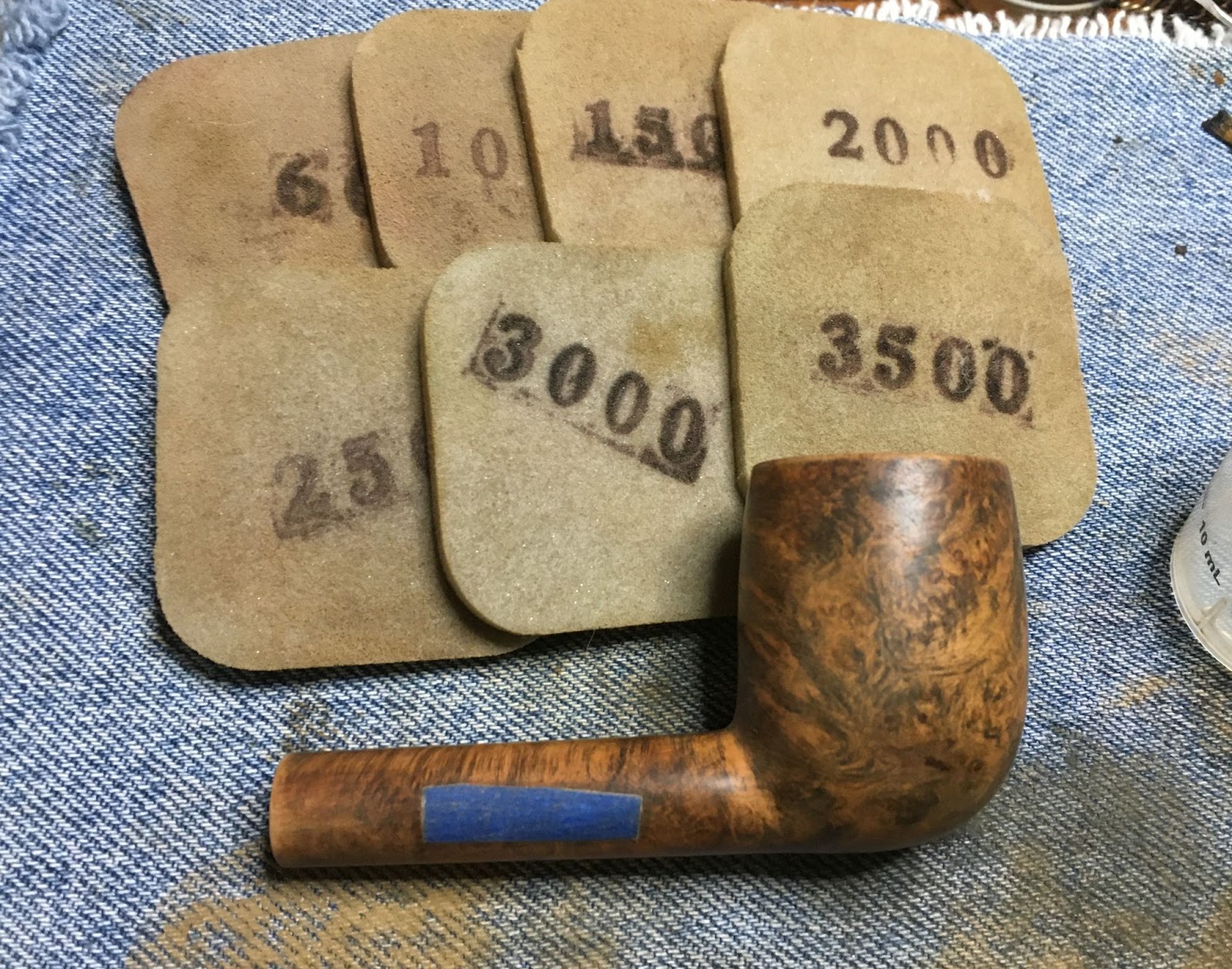
    (Document: Savinelli shape chart — Pipes : Logos & Markings – (pipephil.eu))

    The Restoration

    I started this restoration with a clean piece of denim on the workbench.  In the back of my mind I was thinking, “you are going to need a couple of those,”  

    I admit that I was more than a bit daunted by the prospect of rusticating or texturing a stummel to match the amazing work that Savinelli does.  So, I avoided that part.  I addressed the part of the pipe I felt comfortable working on – the stem.  Yeah, I know, “chicken, buck buck bawk.”

    The stem had thick calcium deposits on both top and bottom,  I scraped these with a sharp pocket knife and sanded with a 320 grit sanding sponge.

    The remaining calcium was picked from the dents using a dental pick and brushing with an alcohol dipped brass brush.

    Next the interior of the stem was cleaned using 95% ethyl alcohol, bristle pipe cleaners and cotton swabs.

    It was at this point I started to rebuild the damage caused by the clenching habits of the previous owner.  In hindsight, I wish that I would have scrubbed the stem with Soft Scrub with Oxiclean at this time and worked on the rebuilding after that.  Alas, I hope that you can learn from what I consider my mistakes.  I used a product that was newer to me, Bob Smith Industries IC-2000.  It is a cyanoacrylate (CA, super glue) which has been toughened with rubber.  It is designed to be used with rubber and sounds like it would be perfect for this use.  I applied an initial few dabs to the depressions of both the top and bottom of the stem.

    I use a CA drying accelerator to speed the drying of the CA.  Both surfaces were spritzed with this accelerator.  It makes the CA cure or dry in seconds.  The cured CA was then filed with a flat needle file and smoothed with a 400 grit sanding sponge.  The shiny surfaces in the photos below are areas where the file and sandpaper rode above and did not contact the CA in the depression.  Further applications were required to fill the entire depression.  I prefer to use several thin applications over a single thick application.

    More applications followed by more filing and sanding.  Voila.

    And then of course there is more sanding.  Here is where I scrubbed the stem with Soft Scrub with Oxiclean. 

    I am not sure if this discolored the CA fills or if the new rubberized CA doesn’t have the same black color as the CA that I was used to previously. Either way I was not as happy with the results as I had been previously.  Here is a photo of the finished stem and the fill is much more obvious than what I was used to.

    Leaving my comfort zone, I started working on the stummel.  This started out normally with the gathering of the reaming tools.

    I began with the #2 blades in the PipNet reaming tool.  This is where “normal” stopped and became “is this pipe salvageable” started.  The cake was dry, hard and brittle.  The reaming was a very rough feeling with large pieces of both cake and charred briar breaking off.  The chamber was very rough and uneven.  I moved to the #3 blades.  They fit into the mouth of the chamber and with effort removed the cake and charred briar to the bottom of the chamber.

    Scrapping with the reaming knife  and General triangular scraper revealed large area of severely charred wood.  This was chipped and broken out as thoroughly as possible.  Some of the damaged wood was still strong while other places were quite brittle.  Eventually the soft damaged wood was removed allowing me to sand the interior with the 220 sandpaper wrapped dowel.  I failed to take photographs of the chamber, perhaps in fear of my inability to remedy the situation.  The best photo I had was the following:

    In the above photo the middle chamber area was undercut by several millimeters.  I Thought it too deep to effectively use J.B. Weld, a product which I had successfully used for charred briar in the past.  This time though, the damage was much more severe and the volume of material to be replaced was far greater.  I  decided to move on and think about other options.

    I took the stummel to the sink for a scrubbing.  If the internal charing was very bad it would undoubtedly darken the briar on the outside of the stummel.  I wanted to see what was under the external grime.  I started by using undiluted Murphy Oil Soap with a medium bristle toothbrush.  As the photo below shows, the grime was extensive.  This first scrubbing was rinsed with warm water and dried with a cotton dish towel.  Afterwards the stummel still appeared dirty.  

    I scrubbed the stummel a second time with Murphy’s and a stiff nylon brush.  This improved the results but after rinsing and drying there remained a tacky feeling residue.  I scrubbed a third time again with Murphy’s Oil Soap but with a brass brush.  Finally the grime rinsed away and left a clean surface when dried.

    Below are photos taken of the scrubbed stummel back at the workbench.  There was darkening of the briar around the rim, front and back.  The wood in these areas seemed thick and solid enough for me to proceed and not throw the entire stummel into the dust bin.

    To be sure of the integrity of the briar I needed to top the bowl quite a bit.  The front edge was several millimeters lower than the sides.  This was done using 220 sand paper laid flat on a countertop.   A circular motion was used with the stummel being rotated in hand every few circles to keep the pressure and sanding even.

    It appeared as though someone had tried to sand the charred wood from the front of the rim at some prior time.  This had removed the factory texturing leaving a smoothed and darkened surface. 

    The topping of the rim did achieve a flat rim though a shorter stummel with a pronounced forward cant.

    Not wanting to remove any more briar than absolutely necessary, I stopped sanding.  The inside edge of the rin would be beveled as the pipe was originally made.  Before this beveling, I wanted to address the filling of the charred material of the tobacco chamber.  I had previously chatted with a fellow restorer about a “mortar” that he had used.  The ingredients were plaster of paris (POP), charcoal powder and salt.  In thinking about these materials I did not think that the charcoal dust was anything other than a coloring agent and it wouldn’t be strengthening the chemical bonds of the POP.  If anything it would weaken the crystalline lattice of the calcium sulfate hemihydrate (chemical name of POP when hardened).  I opted to try POP in this instance due to the its properties:

    “There are two main properties of Plaster of Paris: 

    • Non-flammable: 
    • Non-combustible

    Plaster of Paris is non-flammable as well as non-combustible as it has a low chemical reactivity. In extreme conditions, it also acts as an oxidizing agent. Plaster of Paris has fire resistance quality and its material is ideal for heat insulation. The material does not shrink when it sets. Hence, there are no cracks on the surface of the dry Plaster of Paris. At high temperatures, the plaster of Paris also decomposes and becomes toxic oxides.” (https://www.vedantu.com/jee-main/chemistry-plaster-of-paris)

    The “toxic oxides” would be sulfur oxides.  POP can withstand temperatures of 1200F (650C) without decomposing.  A typical pipe will be combusting tobacco at 500-900F (260-482C) well below this threshold.  (https://cameochemicals.noaa.gov/chemical/25054)  

    The POP powder was mixed with tap water as per product instructions.  It was then applied to the interior of the tobacco chamber in an even coating using a wood splint.  A pipe cleaner was used in the airway to prevent the POP from blocking it.

    While the POP was setting-up I began working on re-texturing the stummel.  I used a Dremel rotary tool with the bit shown in the below photo.  I tried to carve irregular sized and shaped indentations to the surface of the stummel where they had been worn away.

    The POP had begun to harden.  While it was still soft enough to mold, I used the PipNet and the #3 blades to carve an even hole for the tobacco chamber.  This newly surfaced chamber was smoothed with my finger wetted with water.

    While still damp, I emptied a capsule of activated carbon powder (charcoal) into the tobacco chamber, plugged it with my palm and shook the stummel vigorously.  The excess was dumped out aht I blew through the pipe to remove the remaining dust.  The POP was allowed to dry for another 15 minutes.

    With the stummel now re-textured it needed to be dyed.  According to the Savinelly website the original dye or stain was a “natural burgundy color”.  I did not have a natural burgundy dye so I used black.  The black Fiebing’s Leather dye was applied with a folded pipe cleaner and flamed with a disposable lighter.

    I then wiped the stummel dry with a paper towel.  I was not concerned with waiting for a certain amount of time for the dye to dry or set.  I was just wanting the dye to stain the textured indentations darker than the raised surfaces.  

    I returned the stummel to the workbench where I wiped the stummel with several make-up pads wetted with 95% ethyl alcohol to remove excess dye.

    The stummel was then sanded with a 400 grit sanding sponge.  This removed the black dyed briar surface revealing. 

    The sanding could not completely lighten the previously charred briar at the front, back and around the rim.  

    The stummel was lightly sanded with a series of sanding sponges from 1500-3500.  The stummel was wiped with an alcohol wetted make-up pad between sponges.  I then micro-meshed the stummel with the 40000-12000 micro-mesh pads.  I again wiped the stummel with an alcohol wetted make-up pad between pads.

    I then applied a coating of Before and After Restoration Balm to the stummel and let it sit for 30 minutes.

    30 minutes later the excess balm was wiped away using the inside of a cotton athletic sock.  The terry cloth did a fine job of getting into the textured surface and made the stummel look better than it had in many years.

    With the stummel looking very nice it needed a stem to go with it.  I taped the shank with painters tape to protect it from my sanding. 

    I then sanded the stem with a sequence of sanding sponges from 1000-3500.  Between sponges I rubbed mineral oil onto the stem and wiped away the excess oil with a paper towel.  

    Once finished with the sanding sponges I used micro-mesh pads 4000-12000 in sequence.  Between each of these pads I applied a drop of Obsidian Oil, rubbed it onto the stem with my finger and wiped the stem with a paper towel.

    I polished the stem with Before and After Fine polish using a soft cotton cloth.

    The last polishing was done with Before and After Extra Fine polish using the same soft cotton cloth.  Although a clean spot was used.

    To protect the briar frown the elements I chose to use Renaissance Micro-crystalline Wax.  And, no not because I love the smell of it, which I do.  I applied it with a finger and a baby toothbrush.  The product instructions say that it hardens instantly with a rub from a soft sloth.  I allowed it to dry for a few minutes before buffing with a soft cloth.  I did this 3 times then took it to the buffer where I buffed it with a clean flannel wheel.  The stem received several coats of carnauba wax with the carnauba wax wheel from the buffer.

    Overall I feel victorious with this restoration.  No, the Roma will certainly not win any beauty contests but it has been returned to serviceable and it looks pretty darn good.  I am not pleased with the finish of the stem.  The more I think about it, the more I think it was my error in applying the CA prior to scrubbing the stem with Soft Scrub.  I think the bleaching action of the Soft Scrub is what led to the discoloring of the black CA.  Given, it can only be readily seen with bright light, it still annoys me.  The polish of the stem turned out well.  I am also rather pleased with my first attempt at re-texturing a Savinelli pipe.  Though far from perfect it was definitely a learning process and one that I think deserves far more practice.  The pipe feels very nice in hand and has proven to be a shape that is comfortable to clench.  I am sure it will be a fine companion for outdoor activities where a more refined specimen might not venture; activities like gardening, fishing, yard work, etc…  I do hope that you have found something here helpful in the care, maintenance or restoration of your own smokey companions.  If you like this sort of thing, please click the like and subscribe buttons.  I thank you for reading the rambling of an old pipe lover.  

    Below are some photos of the finished Savinelli Roma 677 KS. 

  • A Peterson Killarney X105 Restoration

    March 28th, 2024

    Photographed and written by

    John M. Young

    Just when I thought my Peterson Pipe Acquisition Disorder (PPAD) was in remission I had a flare up of activity.  I could blame it on the weather, or maybe the fact that just smoking Peterson pipes (AKA self medicating) wasn’t enough to keep the demons at bay.  Then come the justifications:  “You know you have been focusing on post WWII- 1950s pipes and this poor 1949-1957 Killarney fits that description.” Or, “Well, if I don’t adopt her she might end up in an abusive home.”

    Whatever the reasons, I am now the proud companion of the above Peterson Killarney. The auction was won from a reputable seller and was described as “It’s been cleaned and polished … and is ready to enjoy.”  There was also a disclaimer, “We clean all our pipes before sale but only minimally. We do this to give the buyer an easier job to finish cleaning your pipe to your standards before smoking.”  The Killarney was indeed clean compared to a typical estate pipe and had been buffed/waxed.  The bowl had been reamed and was free of cake.  I was quite pleased  with the purchase.  I remember several years ago, during my early PPAD, if I could get a Peterson for under $45 I was happy.  This purchase still met that criteria.  That price point is today a relic of the past with even beat-up Peterson pipes demanding prices half again as much and more.

    The Killarney Before Restoration

    Here are some photos of the pipe as it appeared before any work was done by me.

    The largest issue I saw with the pipe was the deep bite marks in the stem.  My photos fail to show their true nature as the buffing and waxing helped to keep them from the camera.  Other than that the Killarney was a very nice specimen.  Besides, I do enjoy a relaxing restoration over some of the recent “not-so-easy” restorations.

    A brief background on the Peterson Killarney

    I cannot do the history of Peterson pipes justice in this blog.  In the words of Peterson, “As the oldest continuously operating briar pipe factory in the world, we at Peterson have a certain tradition to uphold, a legacy of craftsmanship dating back over 150 years.” (https://www.peterson.ie/pipes/).  There is a wonderful book by Mark Irwin and Gary Marlmberg, The Peterson Pipe, which explores the history of the company and their products since their inception.

    (https://www.smokingpipes.com/accessories/books/moreinfo.cfm?product_id=471478)

    I will only be focussing here, on the Killarney line.  The following is taken from Irwin & Malmberg’s The Peterson Pipe  (Irwin, Mark. The Peterson Pipe: The History of Kapp & Peterson. First Edition, second printing 2021 ed., Canada, Briar Books Press, 2018.).  

    Killarney (1949-)  Entry line with smooth finish and P-Lip mouthpiece.  May have either K or P stamped on mouthpiece; may have aluminum stinger (not to be confused with the tenon extension tube found on straight System pipes).  1949-c.1957 examples made for the US market may have any of the following COM stamps:  MADE IN IRELAND (forming a circle), “A PETERSON PRODUCT” over MADE IN IRELAND or LONDON MADE over ENGLAND. Some early specimens stamped KILLARNEY over NATURAL (a higher grade) have MADE IN IRELAND (forming a circle). Examples c 1986-90 feature a nickel band, which was replaced in ‘91 with a shank extension of nickel band with black acrylic inlay.  Fishtail mouthpiece from ‘86, although P-Lip is sometimes seen.  For the current German market the Killarney is stamped CONNEMARA.”  (Irwin and Malmberg p. 306)

    In examining the Peterson Killarney X105:  

    P-Lip mouthpiece.

    The K stamp on the mouthpiece.

    No to the “may have aluminum stinger”.

    “A PETERSON PRODUCT” over MADE IN IRELAND

    Based on this information I am going to wager that this Peterson Killarney is a product of the Dublin factory dating from 1949-1957.

    The Restoration

    I began with a clean denim piece under the reaming plastic coated envelope.  The reaming tools were gathered and really got to see darn little action.  The tobacco chamber was well reamed and I only could scrape out a little bit of additional carbon.  I did sand the chamber though with 220 and 320 sandpaper. 

    Below is a poor photo of the chamber interior.

    Next came the cleaning of the shank.  The terms”clean and ready to enjoy” and “minimally” popped into my head while cleaning out the airway.  I realize that clean is a subjective descriptor and everyone probably has a slightly different operational definition of ”clean” but it was clean when I finished.

    The stem airway was cleaned out next.  It was in better shape than the shank but still required a few alcohol dipped pipe cleaners to achieve the clean that I wanted.

    With the internals cleaned I started work on the stem.  First I sanded away the freshly buffed waxed surface to reveal the tooth dents.

    Fortunately the button had not received any real chomping and was in good shape.  I used black cyanoacrylate (CA, super glue) to fill the dents.  A small drop was placed in each drop on the top and bottom of the stem. 

    The CA was then spritzed with a CA drying accelerator.  The dried or cured CA was then filed with a flat needle file.

    Next, additional black CA was applied.  This too was spritzed with accelerator and filed then sanded with a 400 sanding sponge to smooth the surface and blend the new CA fills with the existing stem.  The process was repeated until I was satisfied with the result.

    I then taped the shank of the pipe in painters tape, reattached the stem to the stummel and sanded the stem with the sequence of sanding sponges 400-3500.  Between sponges I rubbed mineral oil onto the stem and wiped away the excess oil with a paper towel.  Once finished with the sanding sponges I used micro-mesh pads 4000-12000 in sequence.  Between each of these pads I applied a drop of Obsidian Oil, rubbed it onto the stem with my finger and wiped the stem with a paper towel.

    On to the stummel.  I used Murphy Oil Soap and a medium stiff toothbrush to scrub the stummel.  The soap appeared to be removing quite a bit of something from this “clean” pipe.  I then applied a second blob of Murphy’s and upgraded to a stiffer nylon scrub brush.  The stummel was rinsed with warm water and dried with a cotton dish towel.

    I returned to the workbench and wiped the stummel with a make-up pad dipped in 95% ethyl alcohol.  I scrubbed the surface with the pad re-dipping it a couple of times.

    Below is a photo of the stummel after the soap scrub and alcohol wiping along with the filled/sanded/micro-meshed stem.  

    I applied a coat of Before and After Restoration Balm to the stummel and worked it into the sandblasted surface with a baby toothbrush.  The balm was allowed to work it’s magic for 30 minutes.

    During the magic working,  I occupied myself with polishing the stem with Before and After Fine Polish.  The polish was applied by fingertip and rubbed with a soft cotton cloth. 

    I wanted to repaint what remained of the logo.  I used a cotton swab dipped in alcohol to remove any oil from the logo area.  I then applied white acrylic model paint to the K.  This paint dries quickly.  I then used a rigid piece of plastic to scrape over the surface of the logo.  This removed the paint from the stem except where it was in the depressions of the logo.

    For the remainder of the 30 minutes I involved myself with laundry but, I am sure you don’t want to read about that.  After 30 minutes, the balm was wiped away using an inside out athletic sock.

    With the stummel looking very nicely and the acrylic paint now completely dry, I was able to use the Before and After Extra Fine Polish to polish the stem.  

    I wanted a wax to protect the briar but I do not like using carnauba wax on sandblasted surfaces.  I opted to use Renaissance Micro-Crystalline Wax.  I applied the wax with my finger and worked it into the rough surface with a baby toothbrush.  I allowed the wax to dry for about 10 minutes.

    I then took the pipe to the buffer.  I put a clean flannel wheel on the buffer and buffed the wax stummel.  The waxing was repeated and rebuffed.  I swapped out the clean wheel for my carnauba waxing wheel and applied a couple of coats of carnauba wax to the stem.

    Overall, I am very pleased with this Peterson Killarney.  The 105 is a stout billiard design with Peterson’s masculine traditional proportions.  This pipe is very comfortable to hold with the sandblast being pleasant feeling yet allowing a better grip than with a smooth pipe. I’m sure it will be a pleasure to smoke.  The P-Lip stem or mouthpiece as Mark Irwin calls it in The Peterson Pipe book, is something that I find very comfortable and this one polished up very nicely after the rebuilding.  This pipe sports a large bowl and would surely make a 45 minute drive much more enjoyable.  The dimensions of this pipe are:

    • Length: 5.56 in./ 141.22 mm.
    • Weight: 1.40oz./ 39.70 g.
    • Bowl Height: 1.85 in./ 43.43mm.
    • Chamber Depth: 1.44 in./ 36.58 mm.
    • Chamber Diameter:  0.76 in./19.30.
    • Outside Diameter: 1.38 in./ 35.05 mm.

    I do hope that you have found something here useful to your own pipe care or restorations.  If you like this sort of thing, please click the like and subscribe buttons.  Thank you for reading the ramblings of an old pipe lover.

    Below are some photos of the finished Peterson Killarney X105.

←Previous Page
1 … 15 16 17 18 19 … 24
Next Page→

Blog at WordPress.com.

Privacy & Cookies: This site uses cookies. By continuing to use this website, you agree to their use.
To find out more, including how to control cookies, see here: Cookie Policy
 

Loading Comments...
 

    • Subscribe Subscribed
      • NebraskaPeteGeek
      • Join 36 other subscribers
      • Already have a WordPress.com account? Log in now.
      • NebraskaPeteGeek
      • Subscribe Subscribed
      • Sign up
      • Log in
      • Report this content
      • View site in Reader
      • Manage subscriptions
      • Collapse this bar