
Photographed and written by
John M. Young
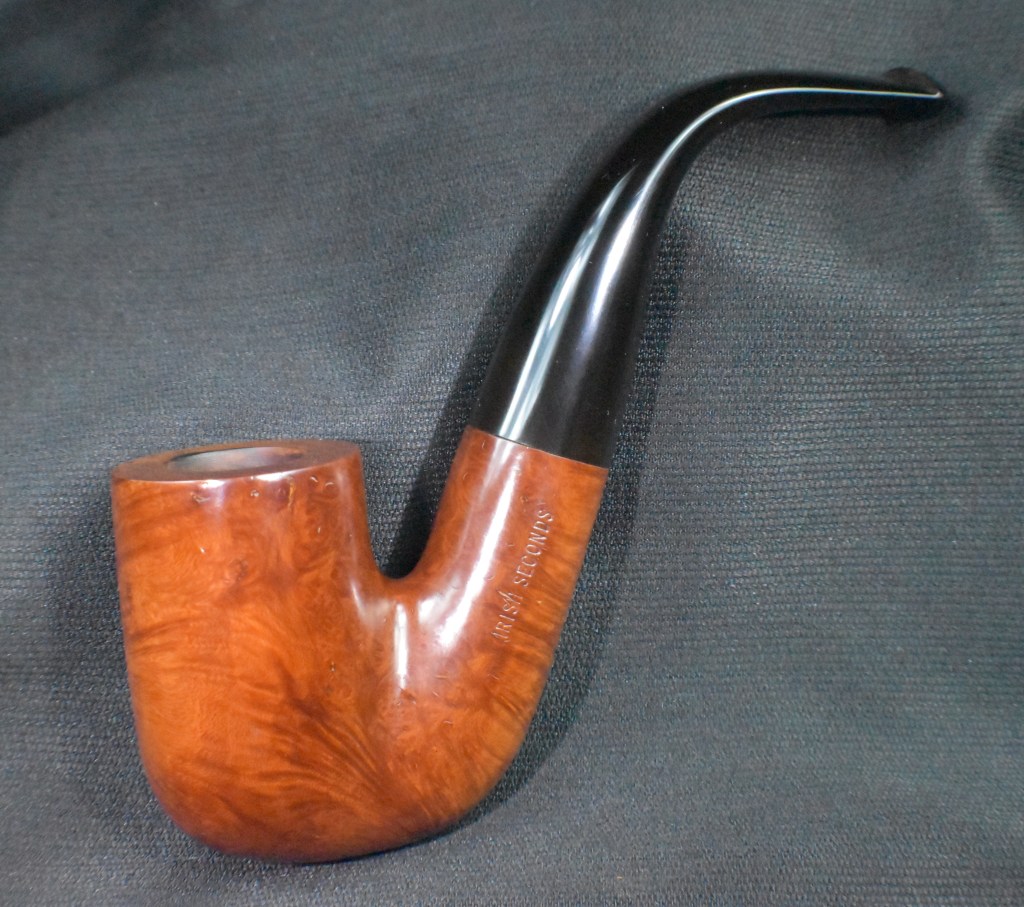
I think this totally counts as a Peterson. Given the poor darling didn’t make the quality assurance cut to the “big leagues” but the 02 shape is more of a rarity for Pete Geeks. I remember three years ago when I started to get more serious about restoring old pipes, that you could pick up a Peterson System Standard on the estate market for around $45. Over the past few years this has increased significantly. Perhaps another indicator of inflation or maybe just a growing interest in our beloved hobby. When I saw this pipe on eBay, I knew I had to try for it. I was surprised that I won the auction and soon had the Irish Lassie in hand. Below are a few photos or the pipe prior to any work done.


From what I could see the issues with this pipe’s briar were only cosmetic and would be dealt with accordingly. The pipe looked like it had only been smoked a few times. I think I could imagine why that button was horrible. It felt thick and chunky, like something made of Legos. Clenching that would be like getting X-rays at the dentist.
Background
I cannot begin to describe the history nor impact of the Peterson pipe company. I can tell you what I think is the best source of information on the subjects and that is Mark Irwin and Gary Malmberg’s book, The Peterson Pipe The Story of Kapp & Peterson. According to the authors,Peterson’s seconds are as follows,
“Seconds Peterson seconds are pipes of all shapes with briar flaws deemed unacceptable for ordinary models and sold at reduced prices, sometimes unstained, fit with fishtail or round button mouthpieces. Since the early 1990s they have only been available in Ireland. Occasionally they are described in Peterson catalogs under different names, and documented specimens have various stampings. In roughly chronological order these include:
Stamped arched KAPP & over straight PETERSON”S over arched DUMMIES An early specimen preserved at the Peterson museum with this stamp has a round-button mouthpiece.
IRISH FREE STATE stamp (1922-37) COM stamp with no brand or model name. Documented with or without nickel bands.
System Reject (1968-) Noted first in the Price List for January 1968 as being available in all six system shapes. Also found in the ‘80 Peterson-Glass Price List.
Erica System Reject (1987-98)Noted in two US distributor catalogs. Fishtail mouthpiece, unstamped nickel band, with COM of MADE IN THE over REP. IRELAND or with no COM.
Irish Seconds (1982-98) Classic Range shapes stamped with no brand name , fishtail mouthpiece, in unstained, black rustic or dark brown finishes, no band. (Irwin, Mark and Malmberg, Gary (2018). The Peterson Pipe The Story of Kapp & Peterson, First edition, second printing 2021. Briar Books Press, Canada. p312).
Mark also writes a weekly blog titled Peterson Pipe Notes. If you have not already subscribed I highly recommend it. It will be one of the best $0 purchases you can make and is a vault of information on all things Peterson and various other topics. I am not just saying that because Mark has posted a few of my restorations either. His blog concerning the Irish Seconds is very well researched, written and can be found here: https://petersonpipenotes.org/tag/irish-seconds/.
Now for the Oom Paul shape. Here I’ll let Mark sing the praises of the history of the shape and the Peterson pipes of note:
Oom Paul (https://petersonpipenotes.org/tag/peterson-oom-paul/)
So, when was this particular Peterson Oon Paul made? I really didn’t know. The 1976 catalog mention might be useful but it precedes the use of the IRISH SECONDS stamp by 16 years. I reached out to Mark Irwin and provided him with photos. Here is what he had to say, “This appears to me to be the 1988 Dublin Millennium edition. That would fit with the IRISH SECONDS stamp and the shank bend. The IS would have been sold in Ireland, almost entirely, but perhaps some escaped their island prison. We can confirm that with a quick measurement of the chamber diameter and the bowl diameter if you like, but I’m 99% positive.” (Mark Irwin, personal email). I replied to Mark by sending him the dimensions. His reply to those was, “That’s it!” This concltudes the search, in my book. THis is a 1988 Dublin Millennium edition Peterson 02 that didn’t meet the quality standards of Peterson and was thus labeled an Irish Seconds by the good folks in Dublin Ireland.
The Restoration
The restoration began with a clean denim piece for workbench protection.

Augh, the terrible button would be the first issue addressed with this pipe.

Apparently the previous owner tried to customize the button using their teeth and jaw power.

Impressive as their chomping was, I thought a file would be a better tool than my teeth.

I used large and small flat files to reduce the size of the button and soften the edges.

Below are photos of the top and bottom after filing.

An emery board, for filing fingernails was also used for more final shaping.

The shank was then taped using panthers tape to protect it from the stem sanding. The stem was initially sanded with a 320 grit sanding sponge.

Airway cleaning was done with bristle pipe cleaners dipped in 95% ethyl alcohol.

The stemm was then placed in Briarville Pipe Stem Oxidation Remover (deox) and allowed to sit overnight.

I turned my attention to reaming the stummel. I gathered the ream team: PipNet with #2 blades, General triangular scraper (with the tip ground round) and the Smokingpipes Low Country reaming knife.

This pipe had not been heavily smoked so the reaming was quickly handled.

Below is a photo of the reamed tobacco chamber.

The chamber was sanded with 320 sandpaper wrapped around a wood dowel. The sanded chamber showed no signs of any damage from heat save the small charred spot on the rim.

A better view of the sanded tobacco chamber can be seen below.

The stummel was taken to the sink for a scrub with undiluted Murphy Oil Soap and a nylon brush. The soap was rinsed with warm water and the stummel dried with a cotton hand towel.

I believe this to below photo best describes why this pipe was considered to be an Irish Seconds, the number of flaws leading to fills in the briar. I counted 11 on the left side alone. The old fill was picked from the briar using a fly tying bodkin.

The front only had two spots to pick then fill.

The right side with its birdseyes also had a couple of spots.

The rim had fills and a couple of cosmetic cracks. These were not deep structural cracks.

I used brown cyanoacrylate (CA, super glue) placed into the pits. I then pressed briar dust into the wet CA. This new fill sets up quickly. The excess briar dust was brushed off using a wire brush.

The same process was used on the other fills.

Once cured the new fills were filed with a small flat file to smooth them.

This was repeated on each side.

The fills of the cosmetic cracks on the rim were done with brown CA alone, no briar dust though, briar dust was used in filing the pits. The entire stummel was then lightly sanded with 320 and 400 grit sanding sponges taking care to avoid the stamps on either side of the shank.

The next day I removed the stem from the Briarville deox.

The Briarville solution evaporates quickly. While still wet I vigorously rubbed the stummel with a coarse shop rag to remove some of the softened oxidized vulcanite.

Back at the workbench the oxidized vulcanite was easily seen as a buff colored coating on the stem.

The stem also showed another aspect of Irish Seconds that I’ve not seen in Peterson pipes, poor finish sanding of a stem. I could still see the marks from the molding of the stem.

The fit of the stem to shank was very good with a fine tight fit and no gaps.

I again taped the shank, this time with masking tape. Masking tape is thinner and is less likely to produce a step from the stem to the shank.

The stem was sanded using a series of sanding sponges from 320-3500. Between each sponge the stem was rubbed with mineral oil and wiped with a paper towel.

I masked the stampings on both sides of the shank with masking tape.


The stummel was then sanded with a series of sanding sponges from 32-3500. Between each sponge the stummel was wiped with a make-up pad wetted with alcohol to remove sanding debris.

The tasking tape was removed and the adhesive wiped clean with alcohol. The pipe was then worked with micro-mesh pads 4000-12000. Again the stummel was wiped with an alcoholic make-up pad (I think that’s funny).

The stem was rubbed with Obsidian Oil and wiped with a paper towel between micro-mesh pads.

I coated the stummel with Before and After Restoration Balm and allowed it to do what it does for 20 minutes. The excess balm was wiped from the stummel using an inside out athletic sock.

The pipe was then taken to the buffer where it received several coats of carnauba wax.

The final step was a hand buffing with a microfiber polishing cloth further deepening the shine.
This not so typical Peterson shape, I mean, Irish Second, turned out very nicely. The fills are far less noticeable and the stem far more comfortable than when I started. Weight of the pipe is inconsequential hanging from the lower jaw and it would be an exceptional clencher. I was very happy with how well the stem turned out. The high gloss black looks outstanding with the more natural Briar and the briar grain, though not fantastic, is quite lovely. This old pipe may never win a beauty contest but it will serve very well as a useful pipe in someone’s rotation. The dimensions of the Irish Seconds Oom Paul are:
Length: 6.00 in./ 152.40 mm.
Weight: 2.39 oz./ 67.76 g.
Bowl Height: 2.25 in./ 57.15 mm.
Chamber Depth: 1.95 in./ 49.53 mm.
Chamber Diameter: 0.74 in./ 18.80 mm.
Outside Diameter: 1.38 in./ 35.05 mm.
I do hope that you have found something here useful to your own pipe care, maintenance or restorations. If you like this sort of thing, please click the like and subscribe buttons. Thank you for reading the ramblings of an old pipe lover.
Below are some photos of the finished Irish Seconds Oom Paul.


 NebraskaPeteGeek
3 responses to “An Irish Seconds Oom Paul (Peterson 02) Restoration”
Great job on the write up and restoration, particularly with those fills. My 02 has quickly become one of my favorite pipes.
LikeLike
Thank you for the kind words. I have not smoked it, there is currently someone interested in buying it. I’m sure it will be a great smoker.
LikeLike
[…] Mark also writes a weekly blog titled Peterson Pipe Notes. If you have not already subscribed I highly recommend it. It will be one of the best $0 purchases you can make and is a vault of information on all things Peterson and various other topics. I am not just saying that because Mark has posted a few of my restorations either. His blog concerning the Irish Seconds is very well researched, written and can be found here: https://petersonpipenotes.org/tag/irish-seconds/. (Young, John. An Irish Seconds Oom Paul (Peterson 02) Restoration – NebraskaPeteGeek). […]
LikeLike