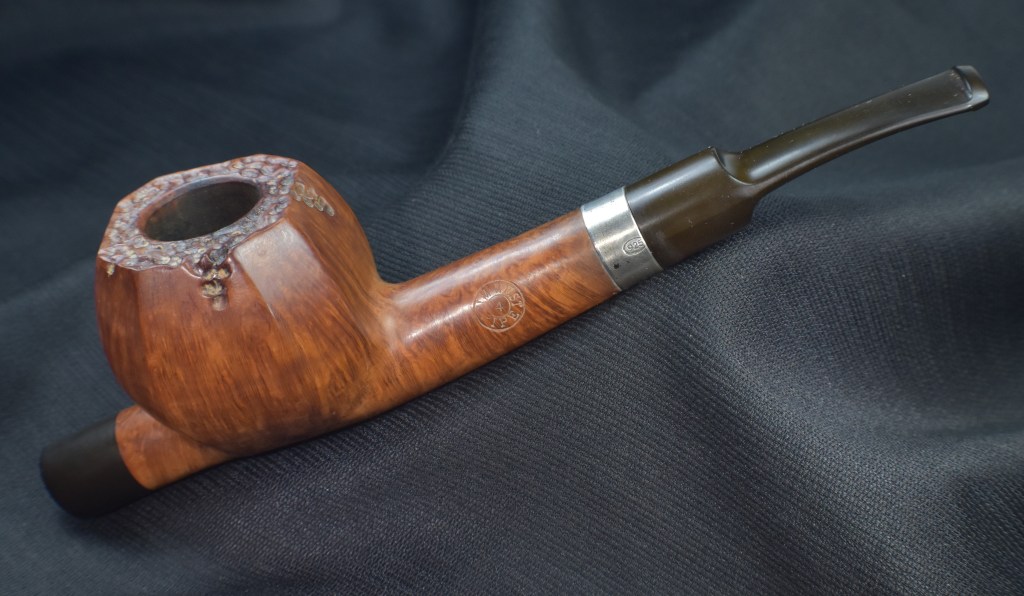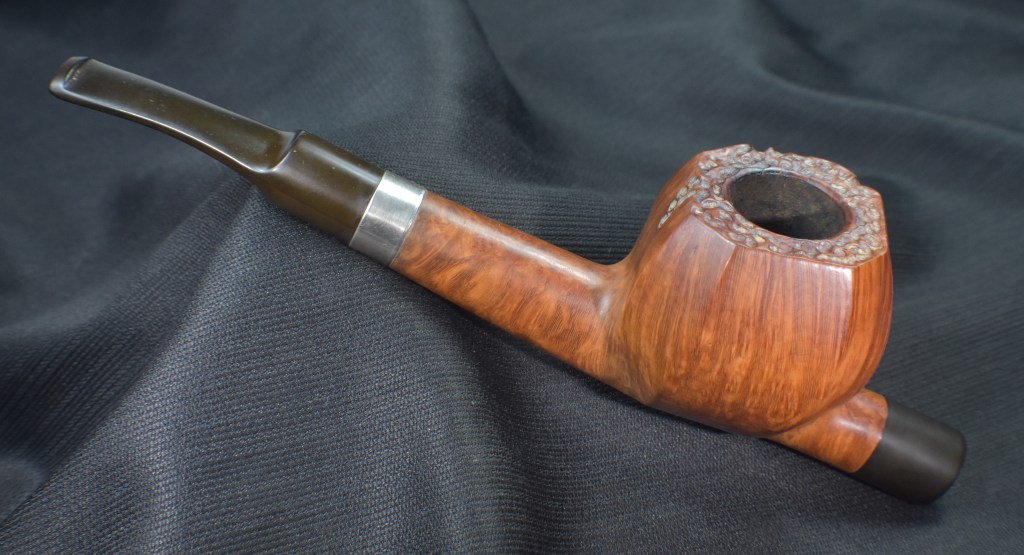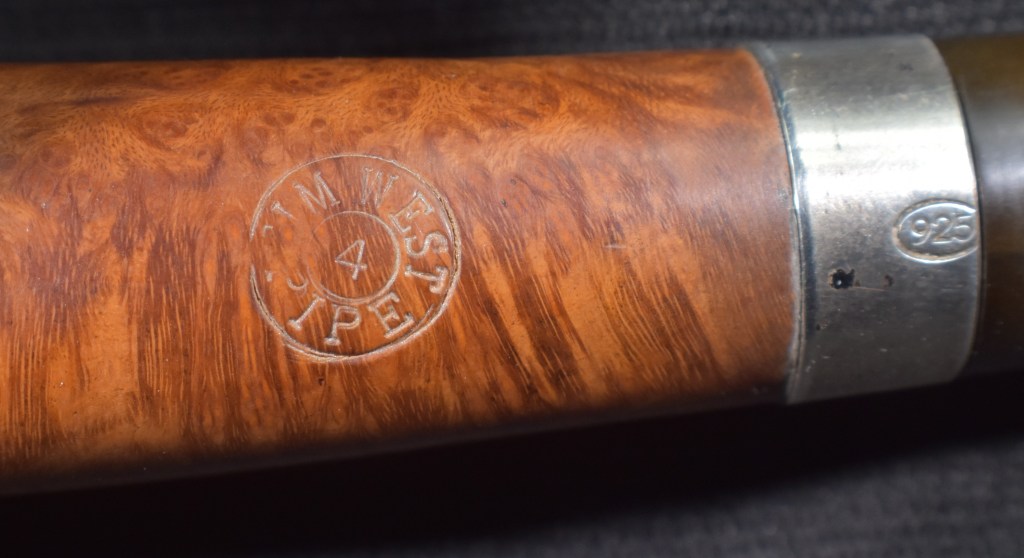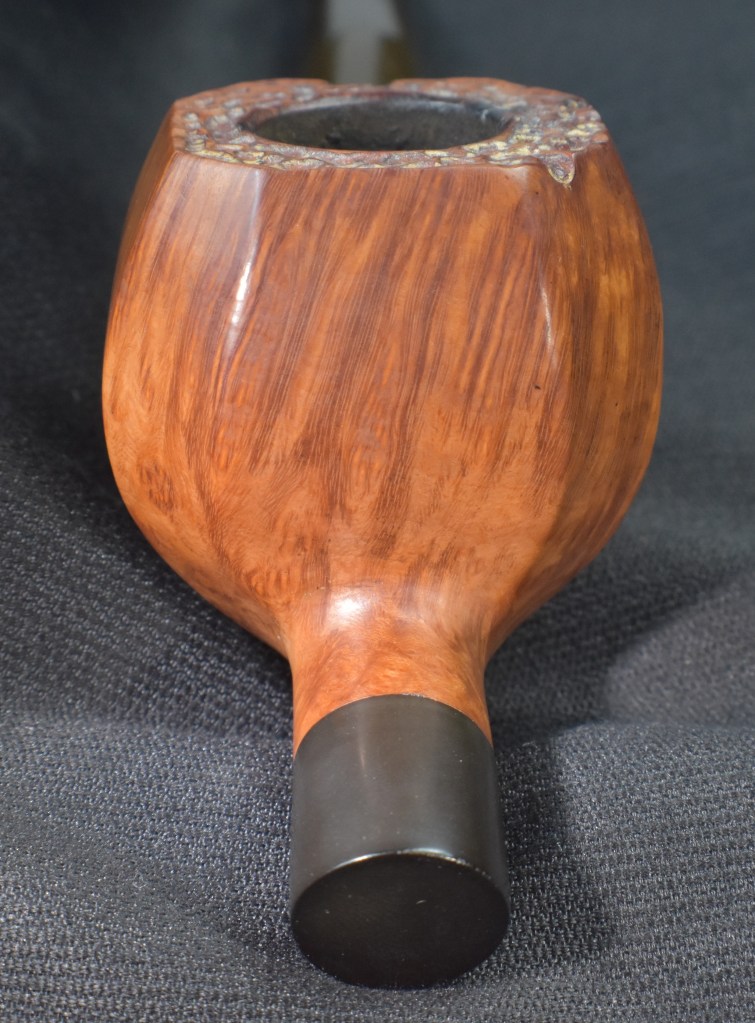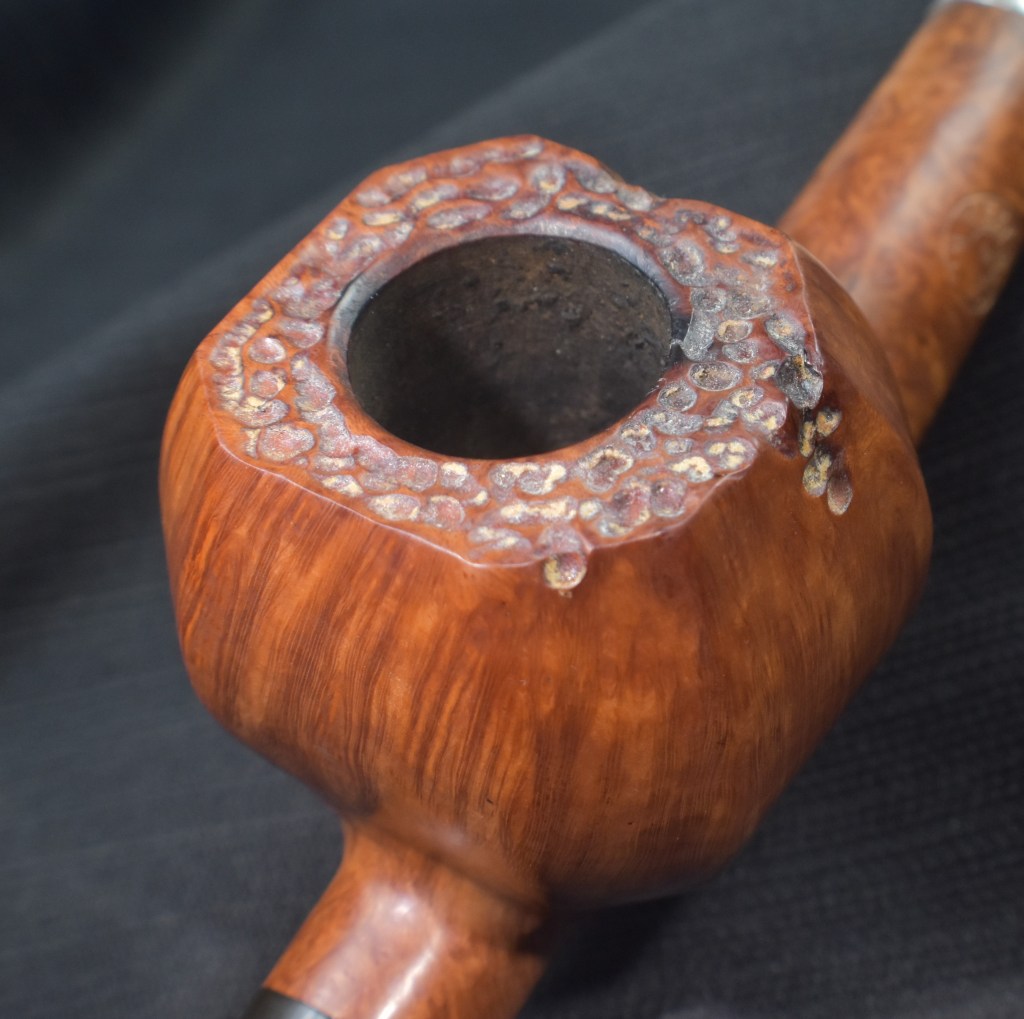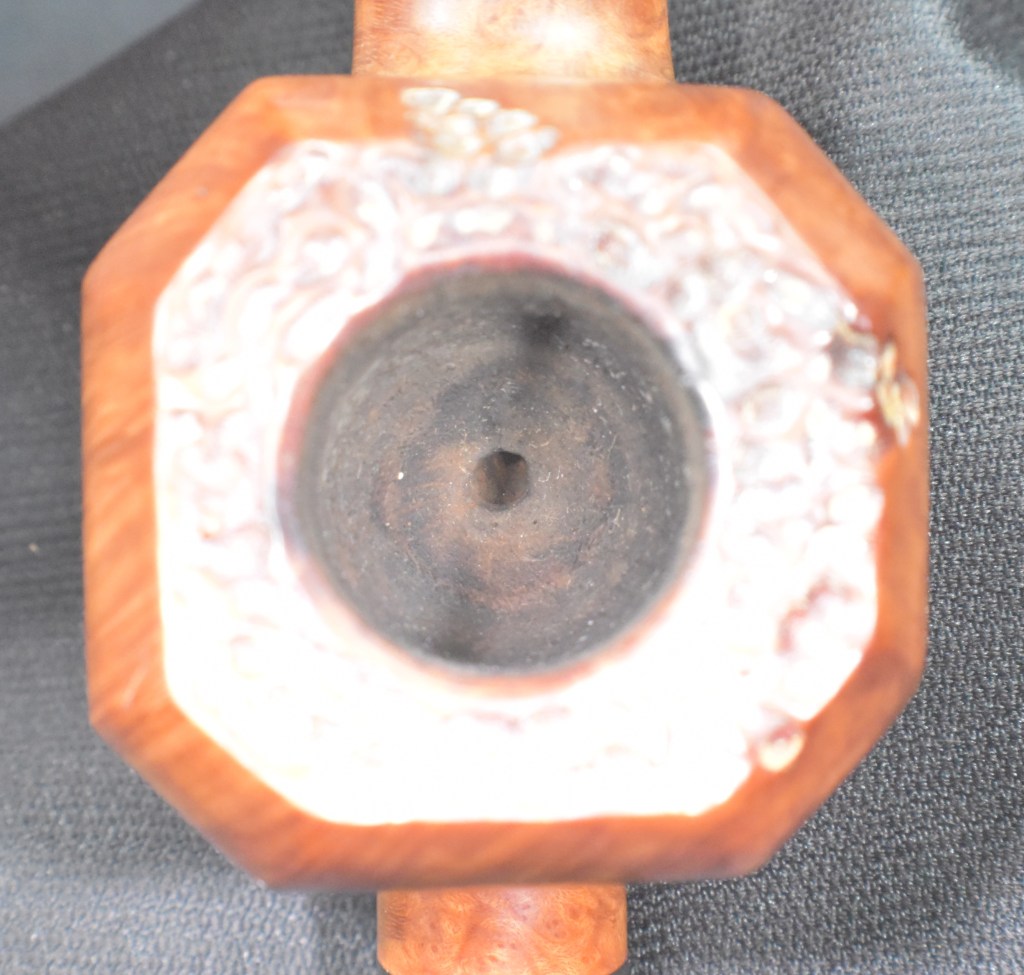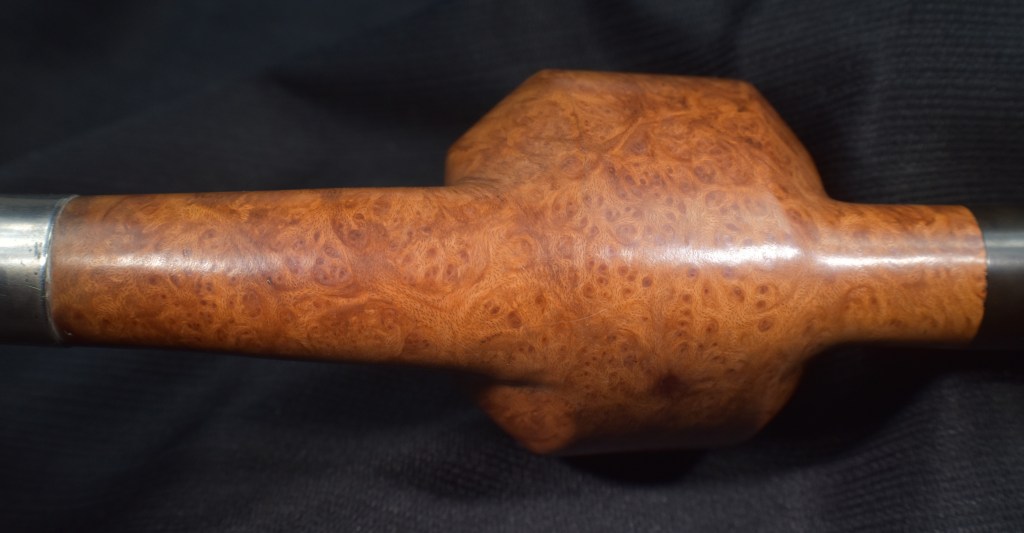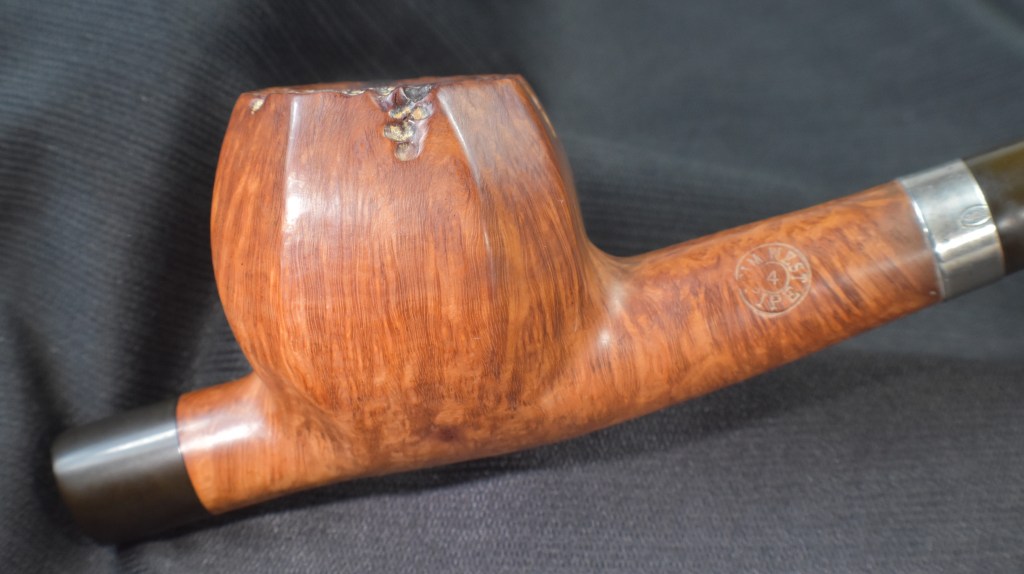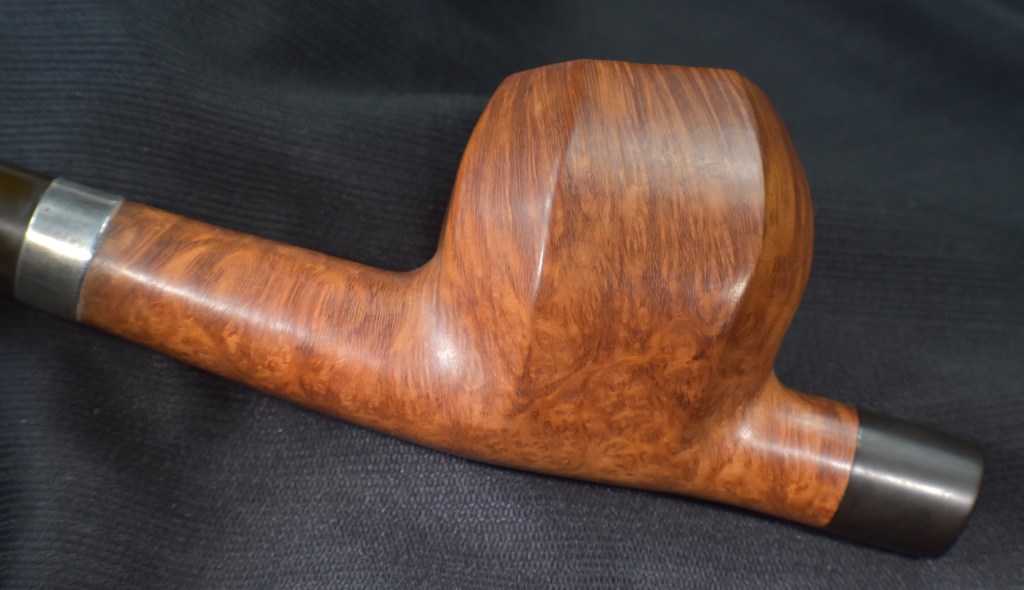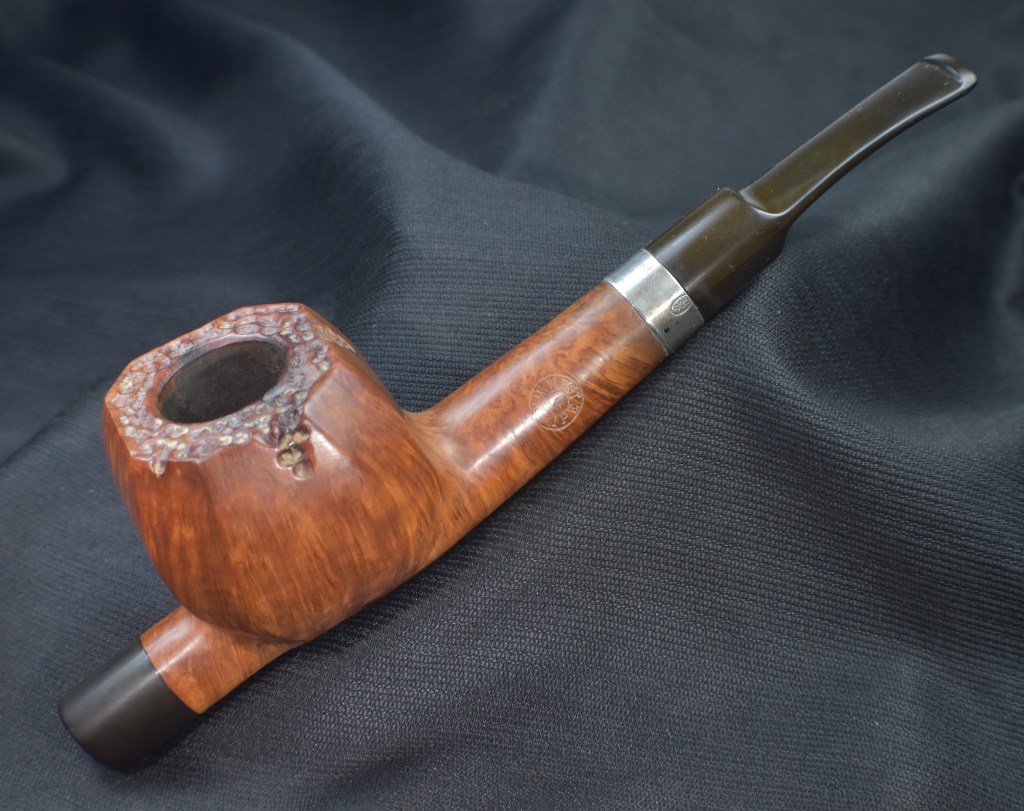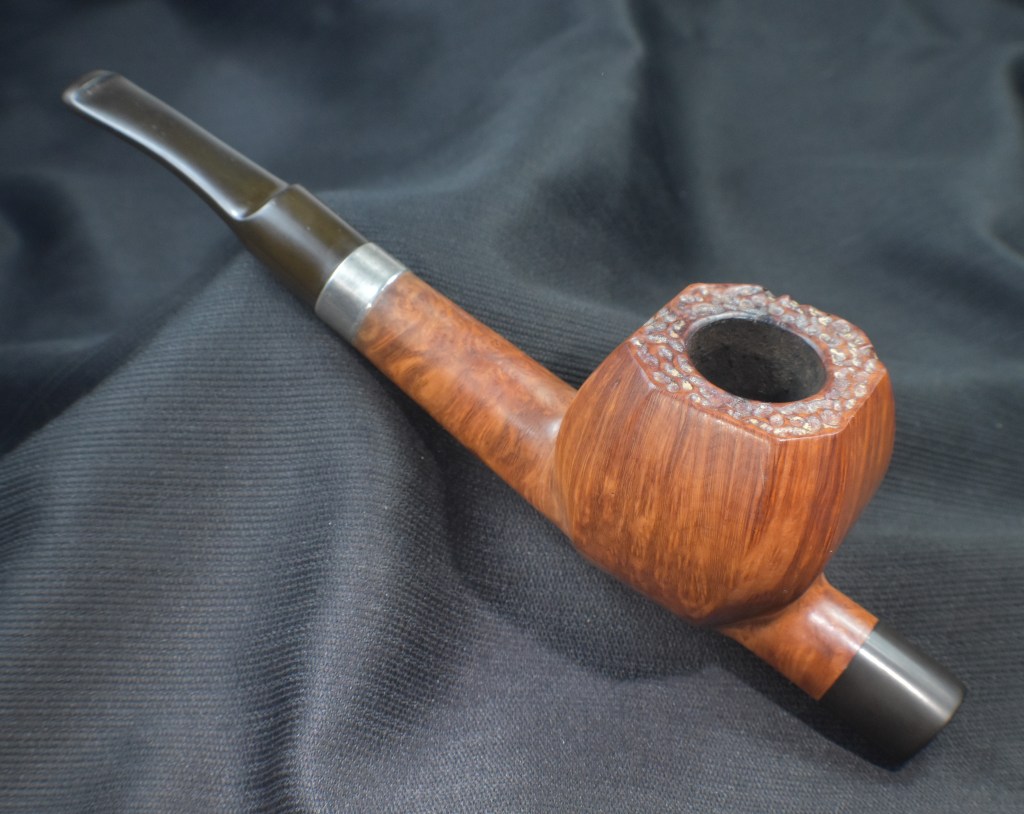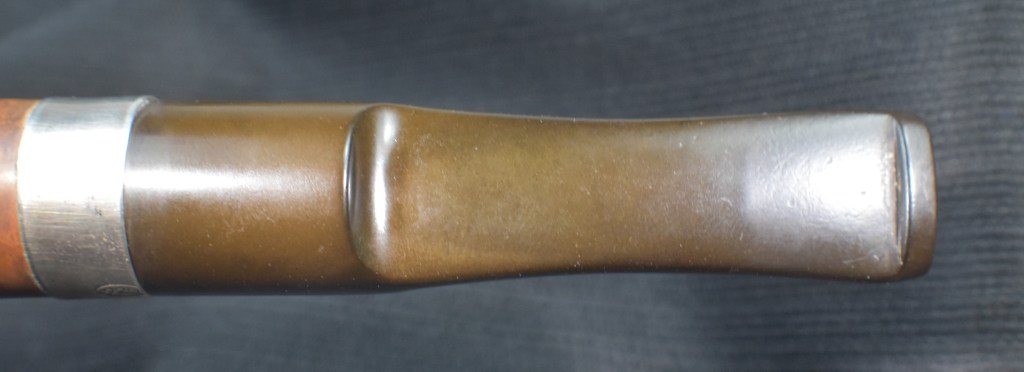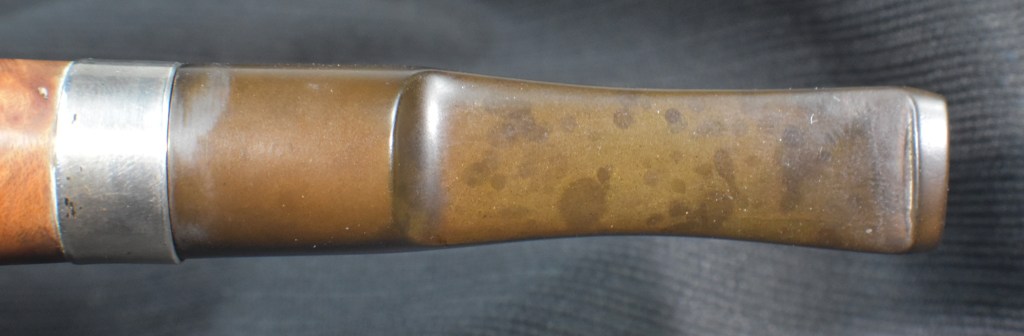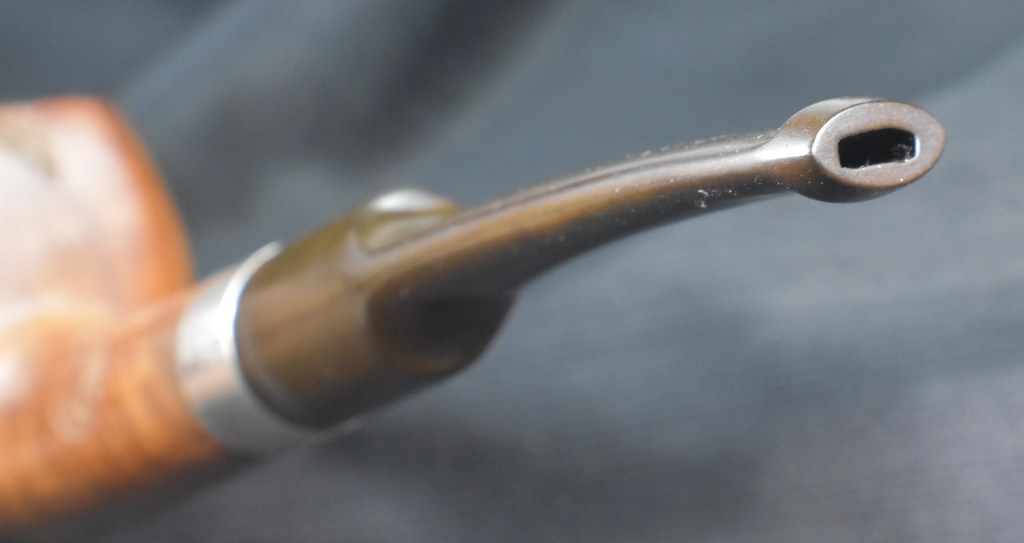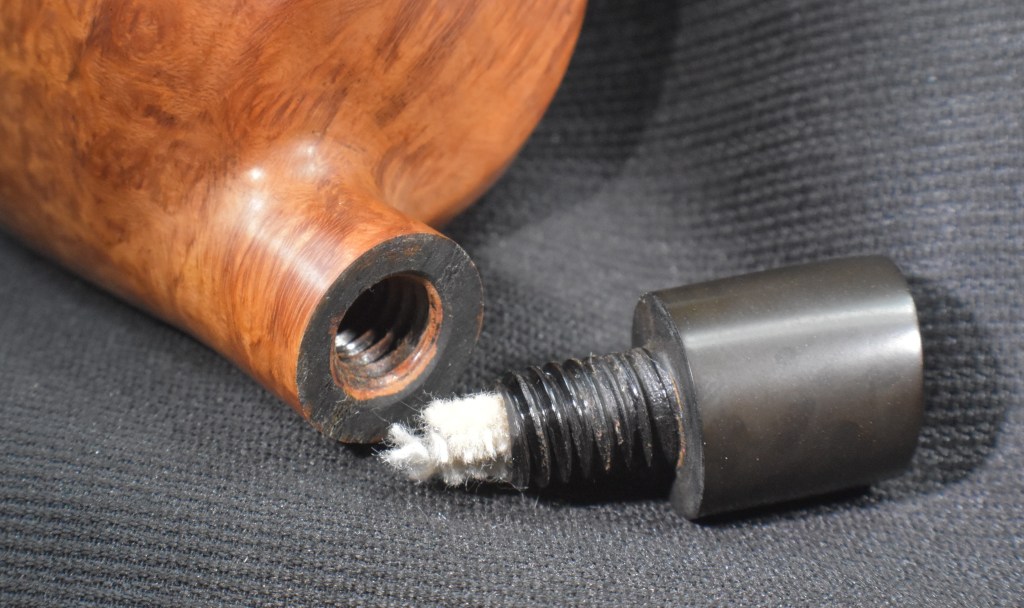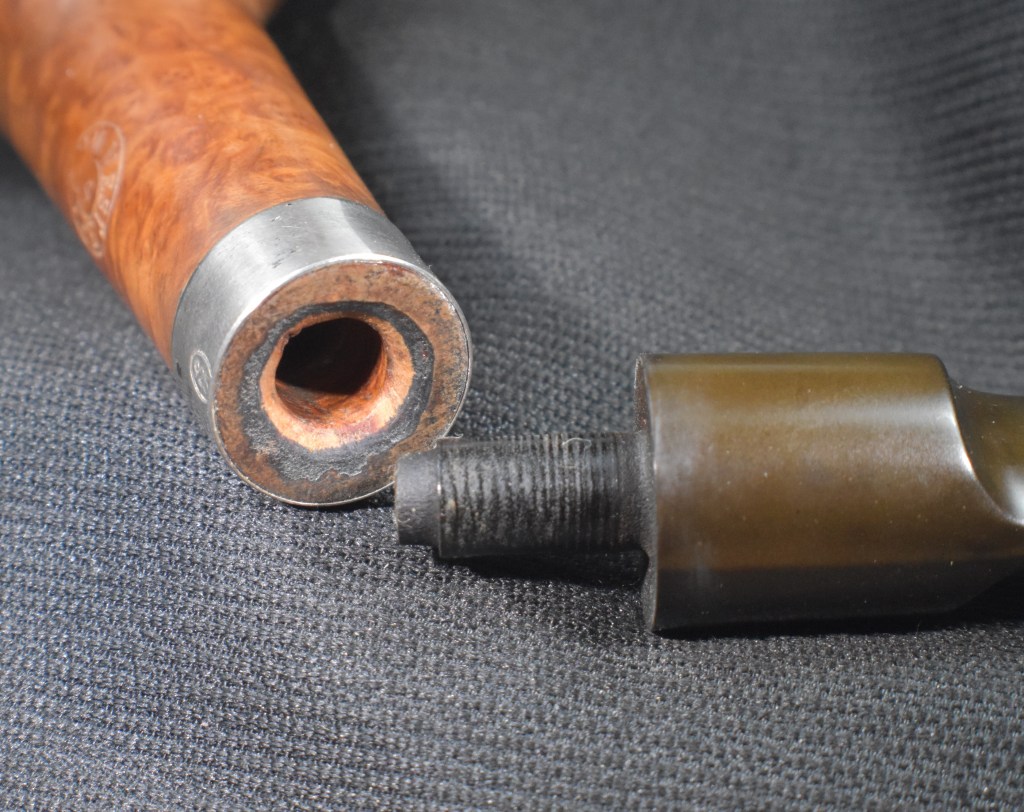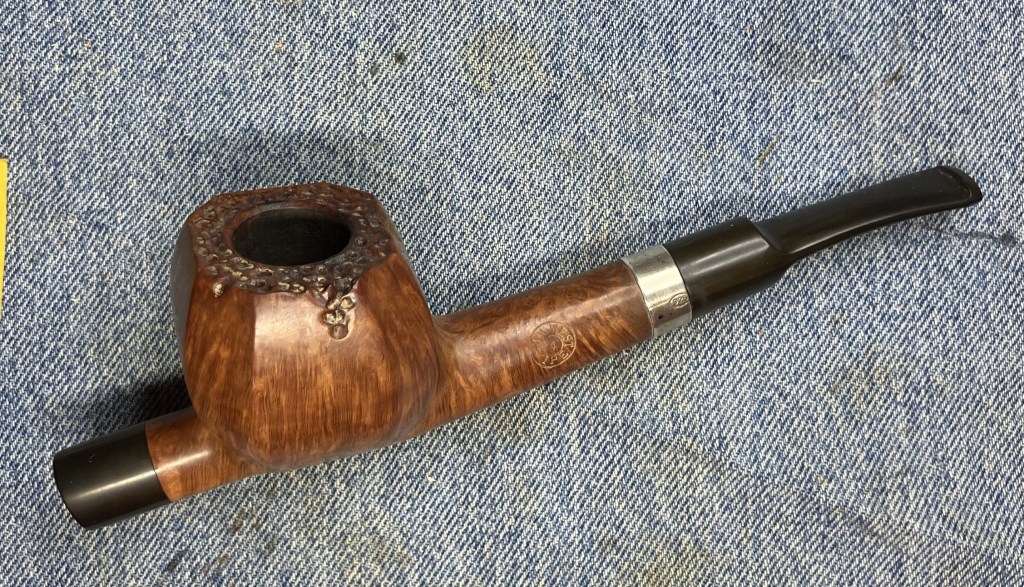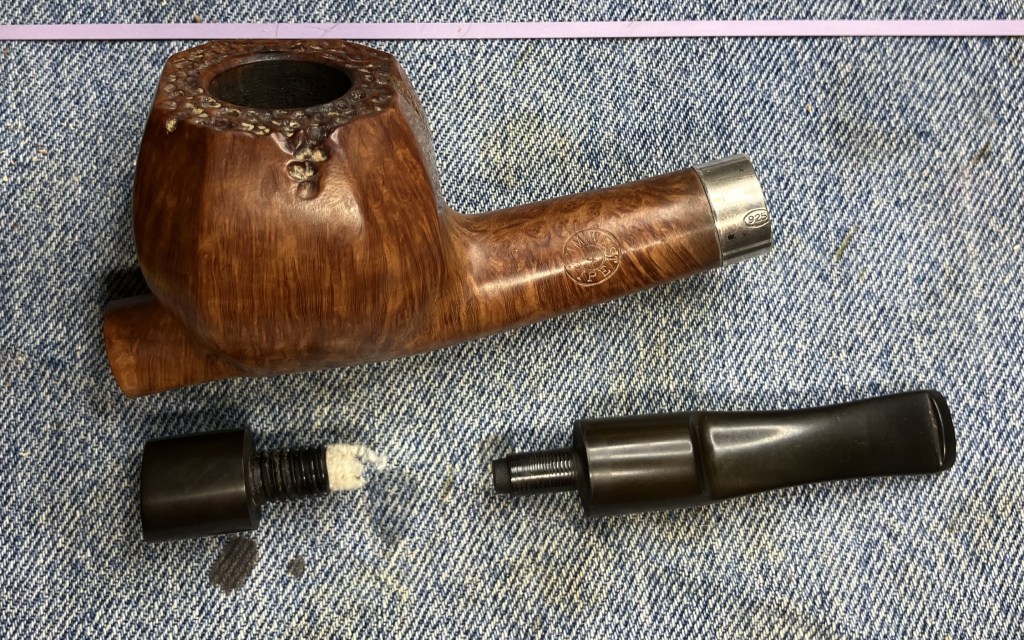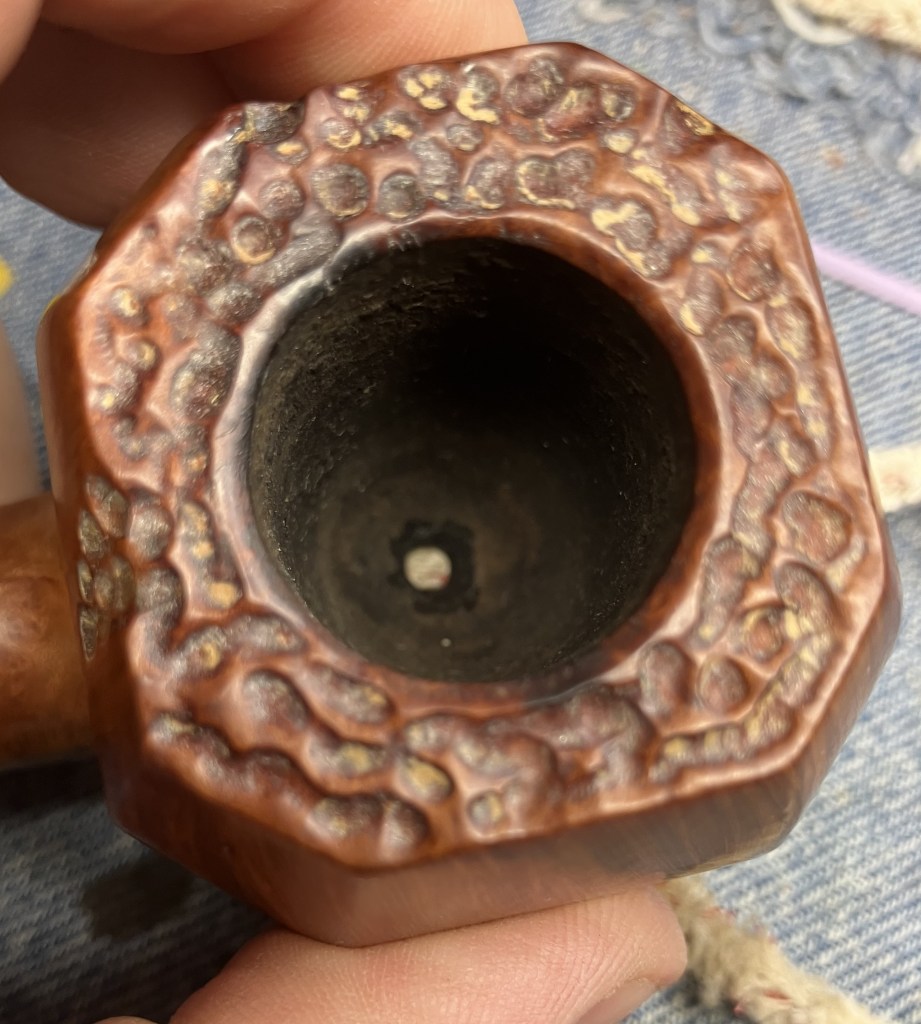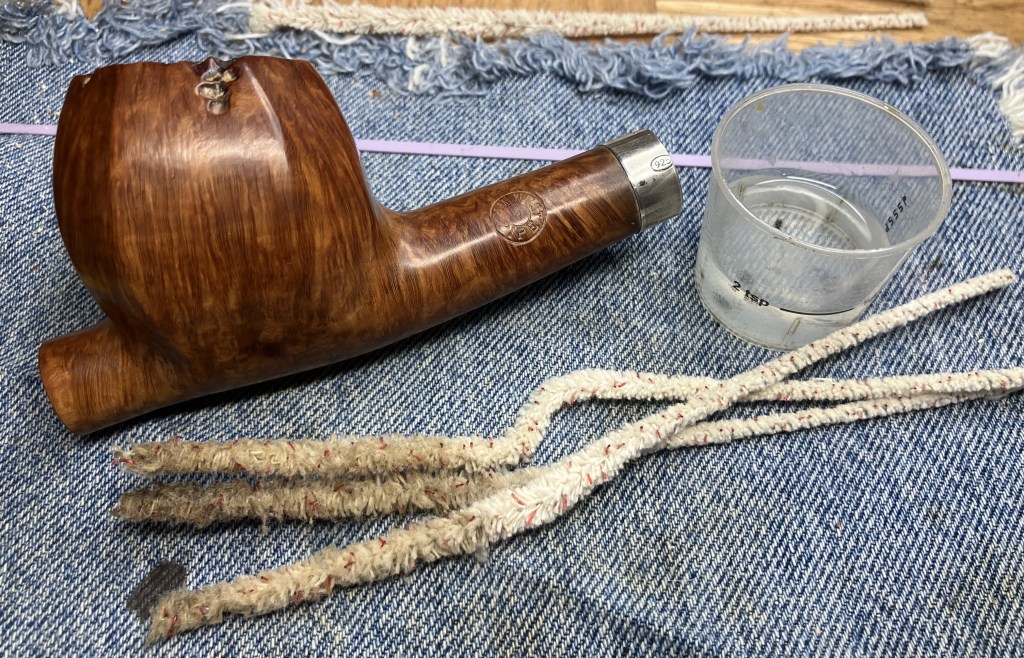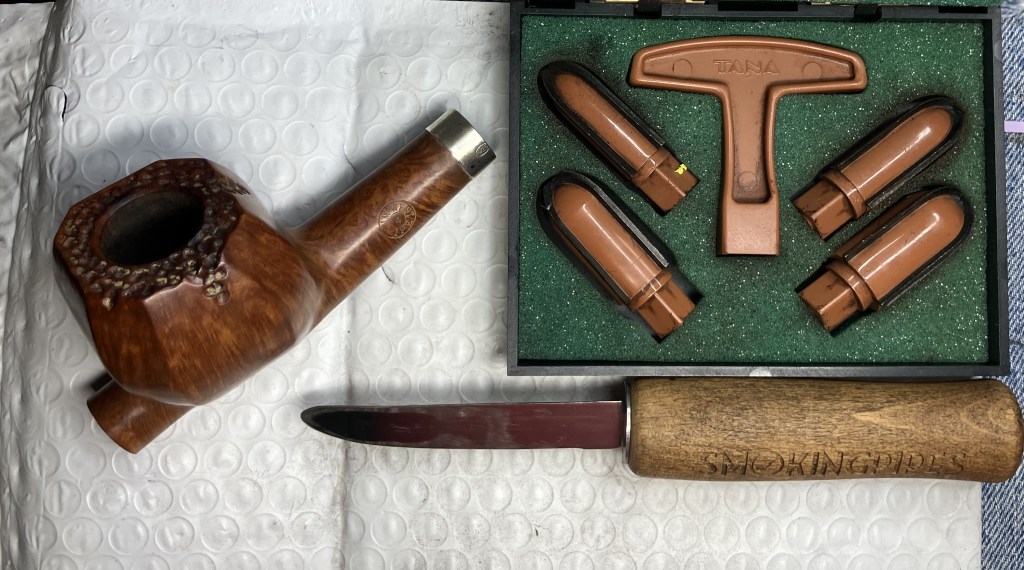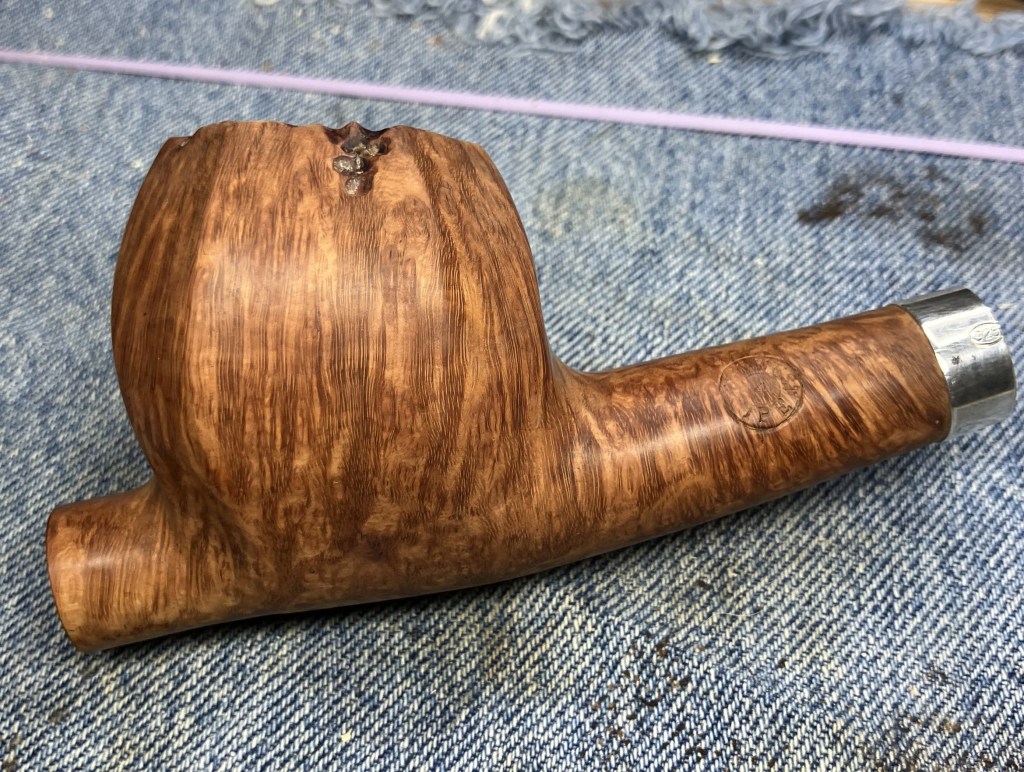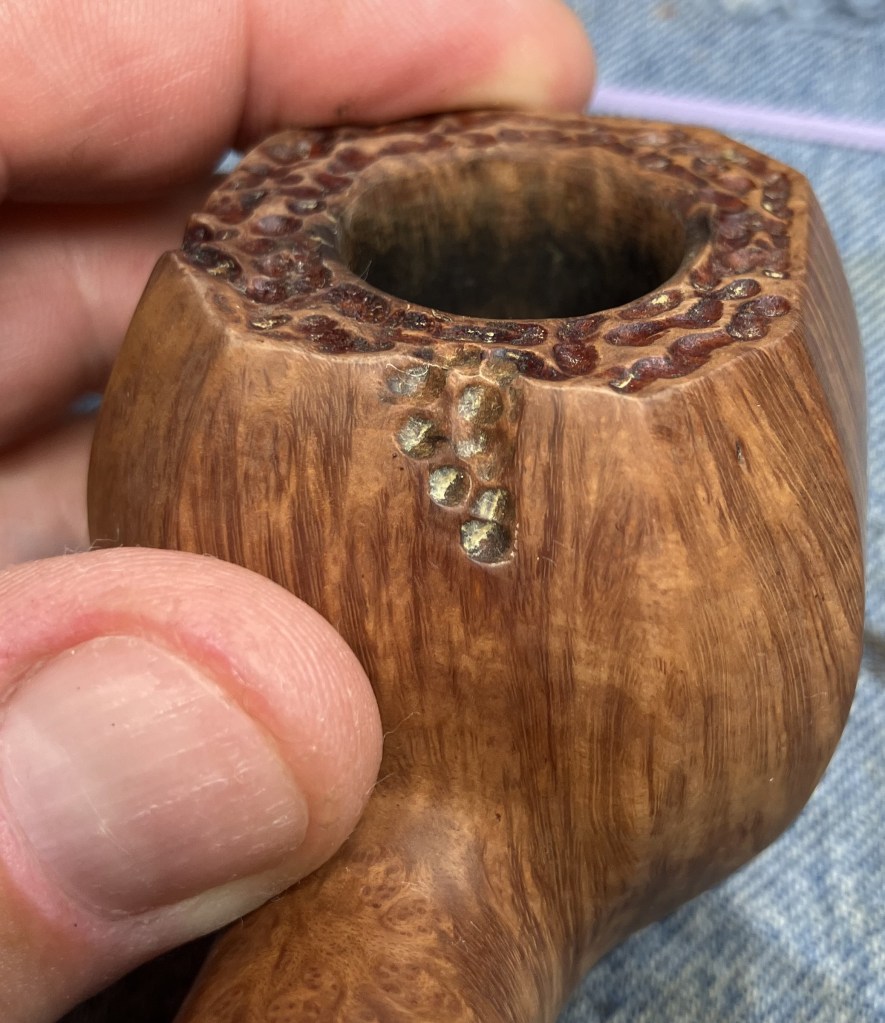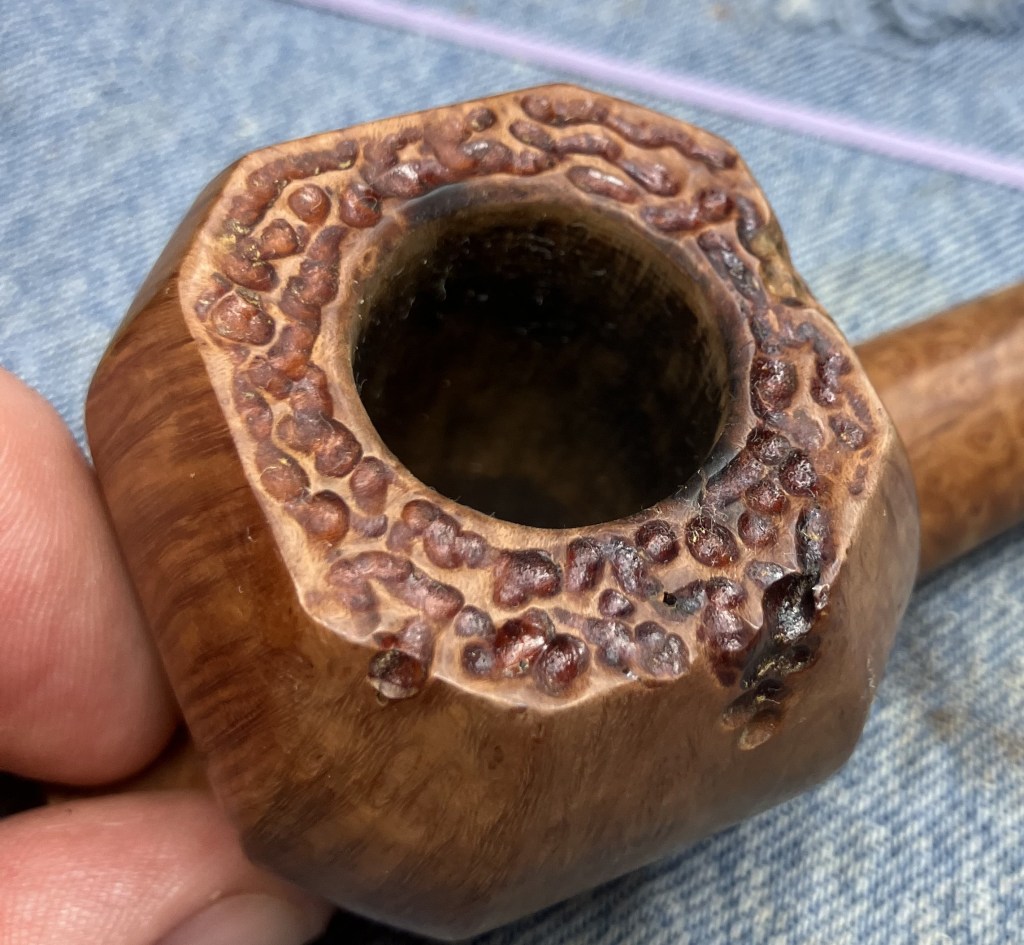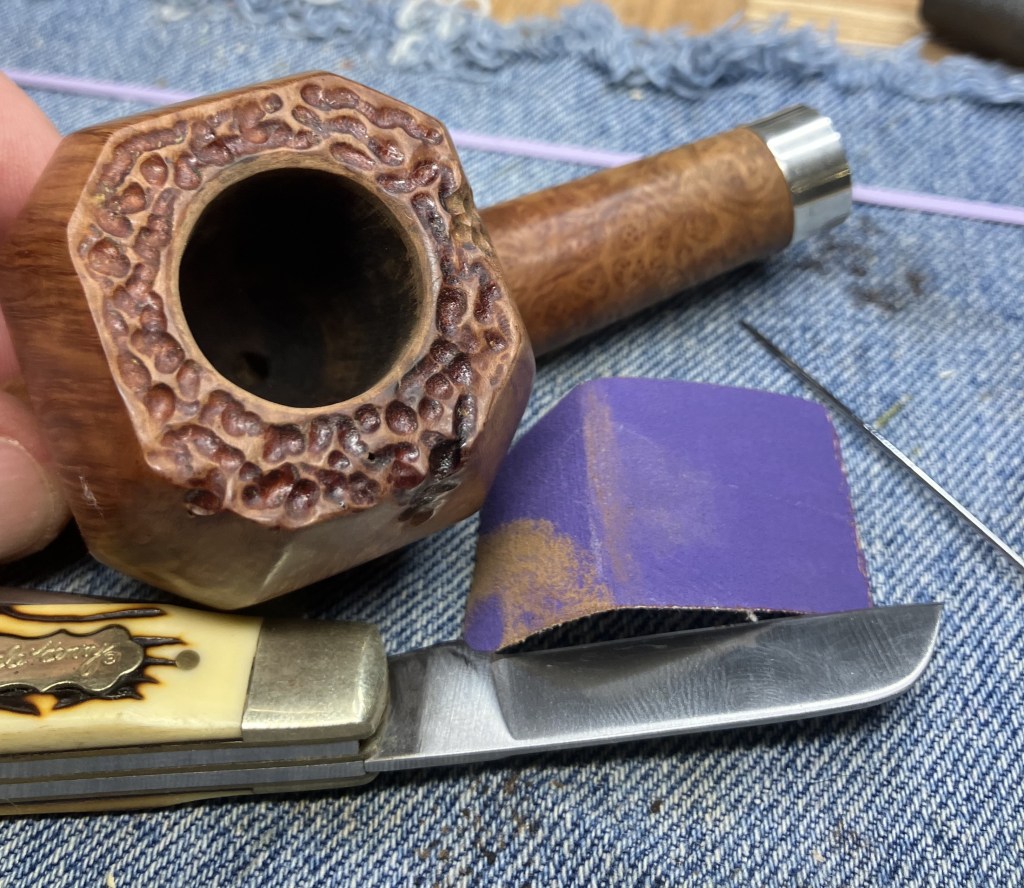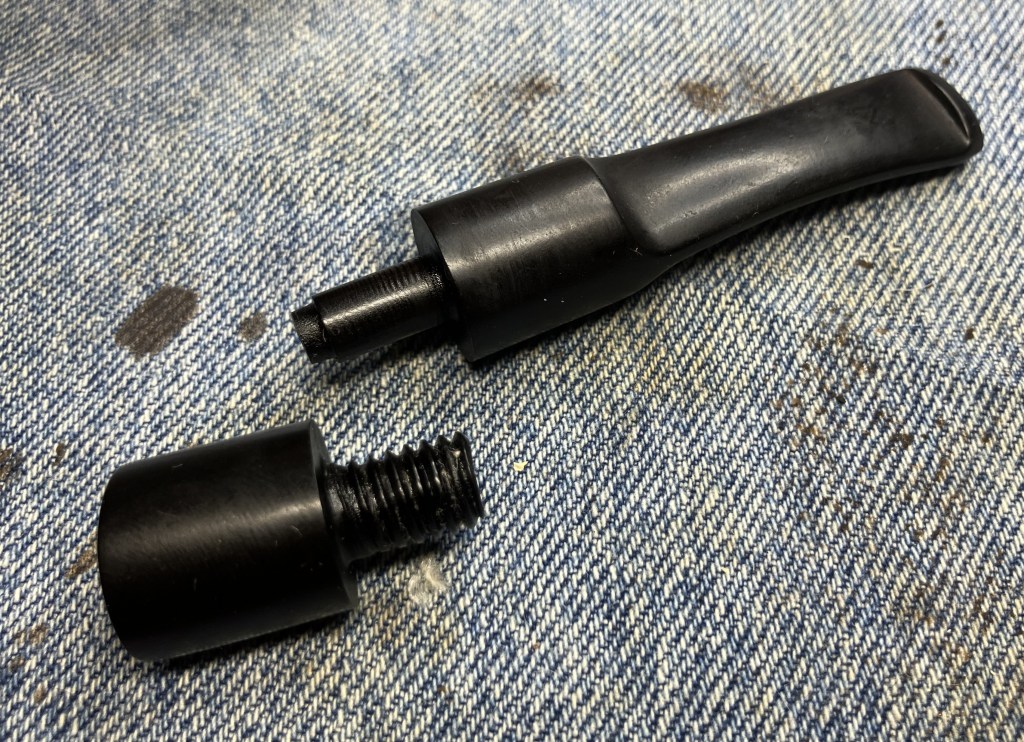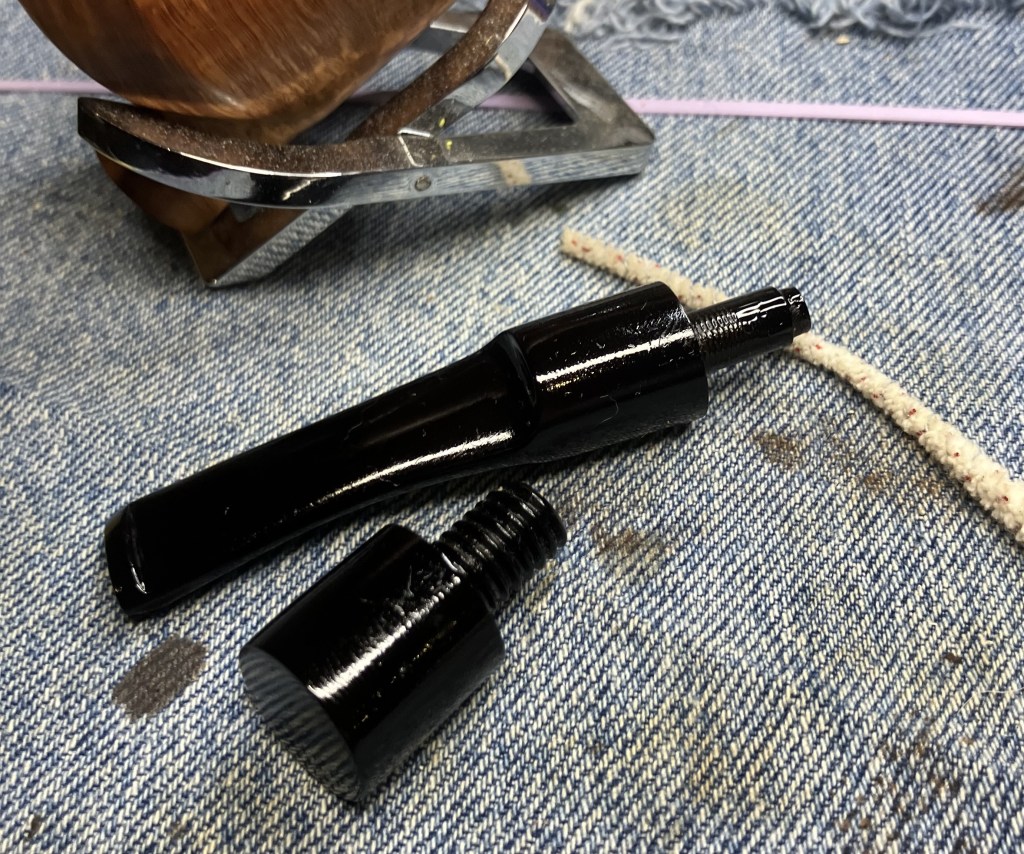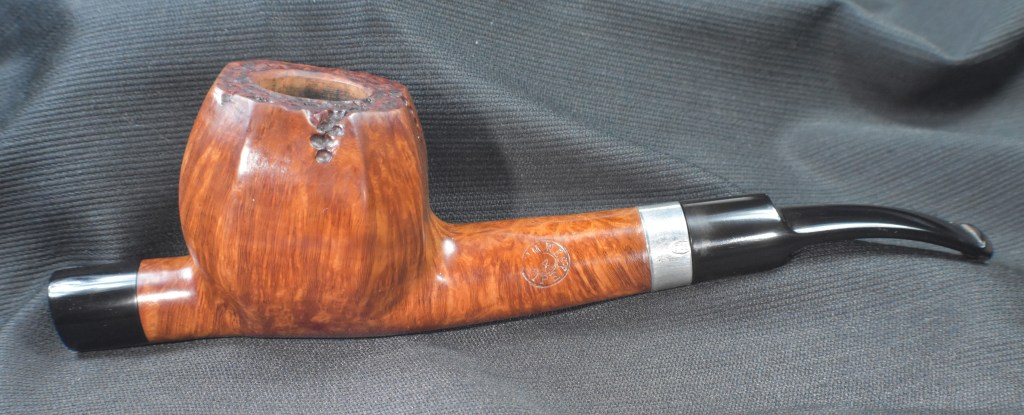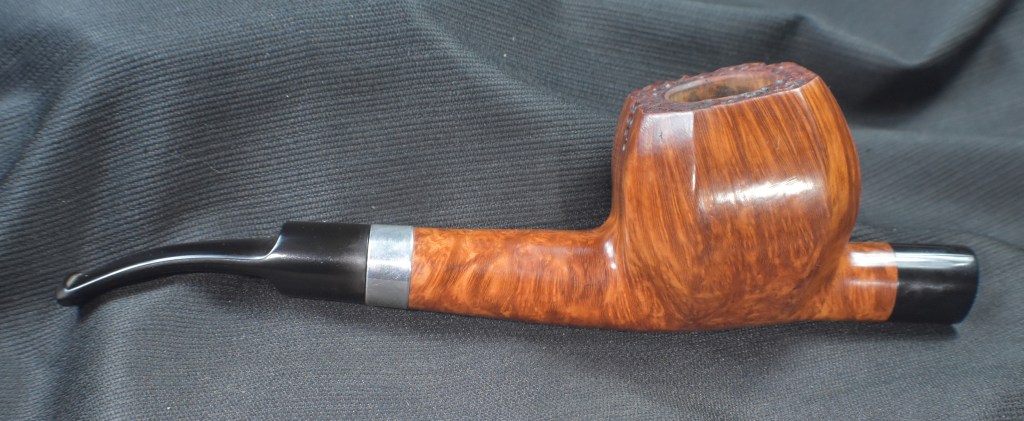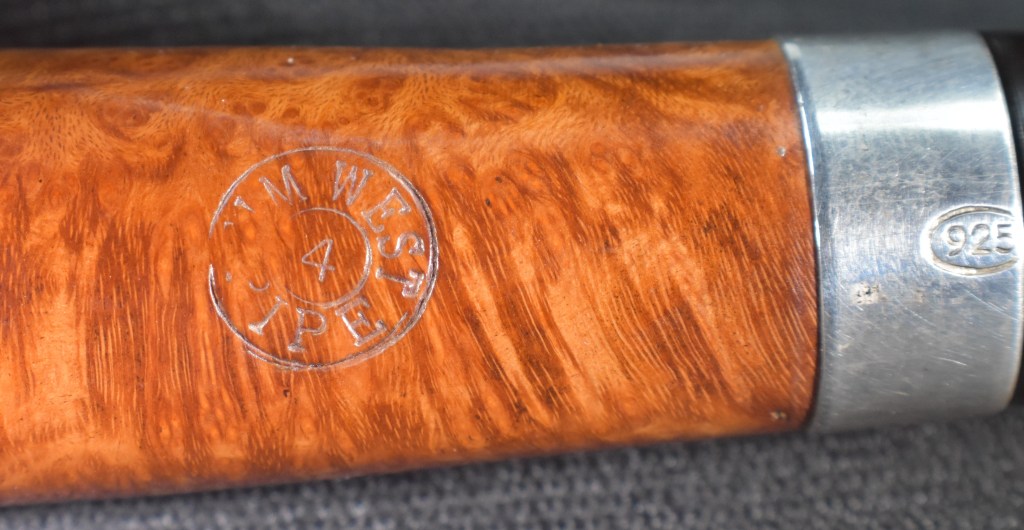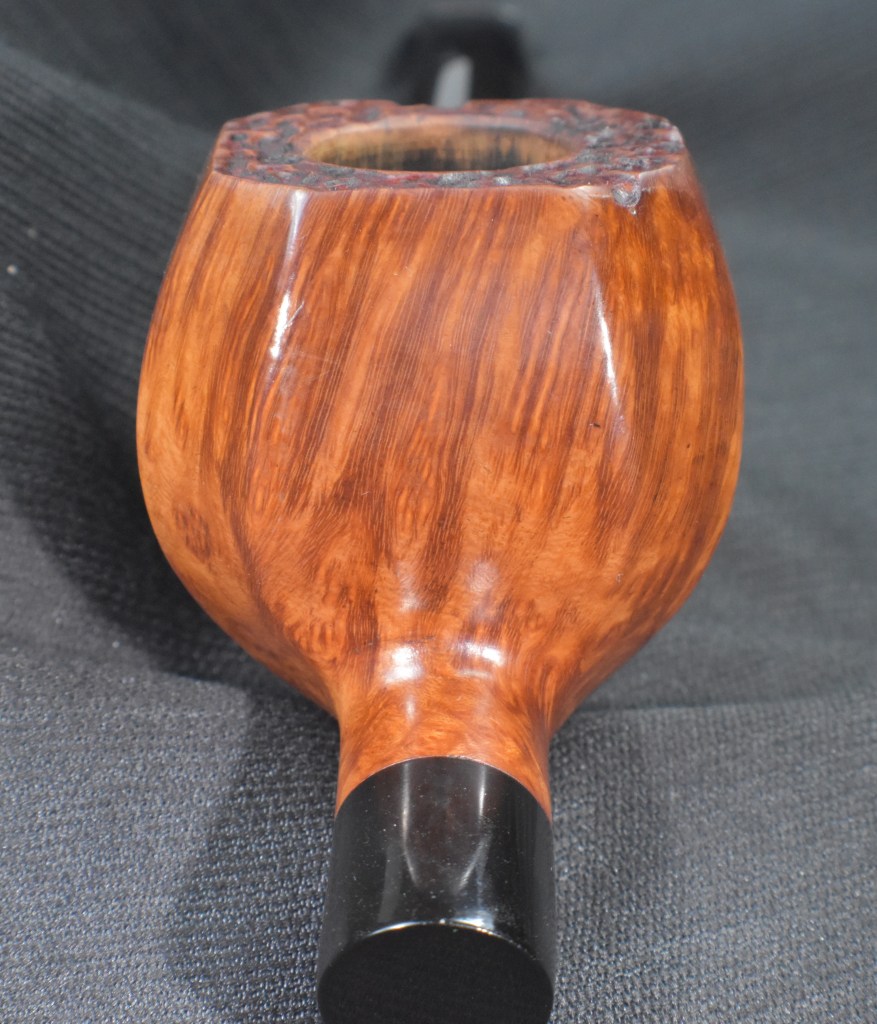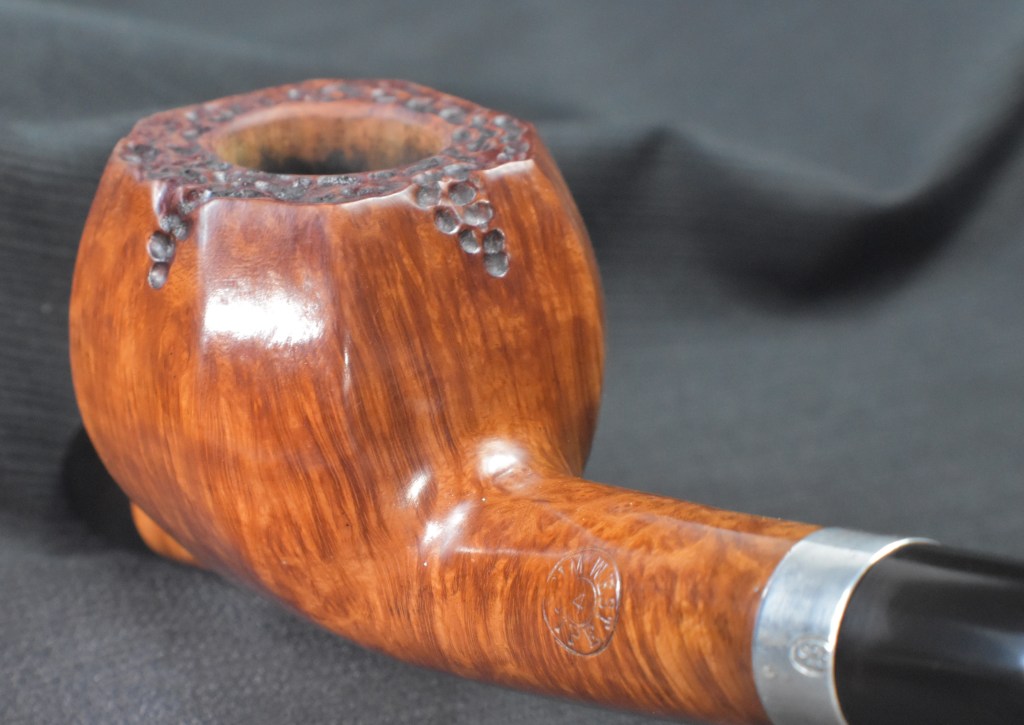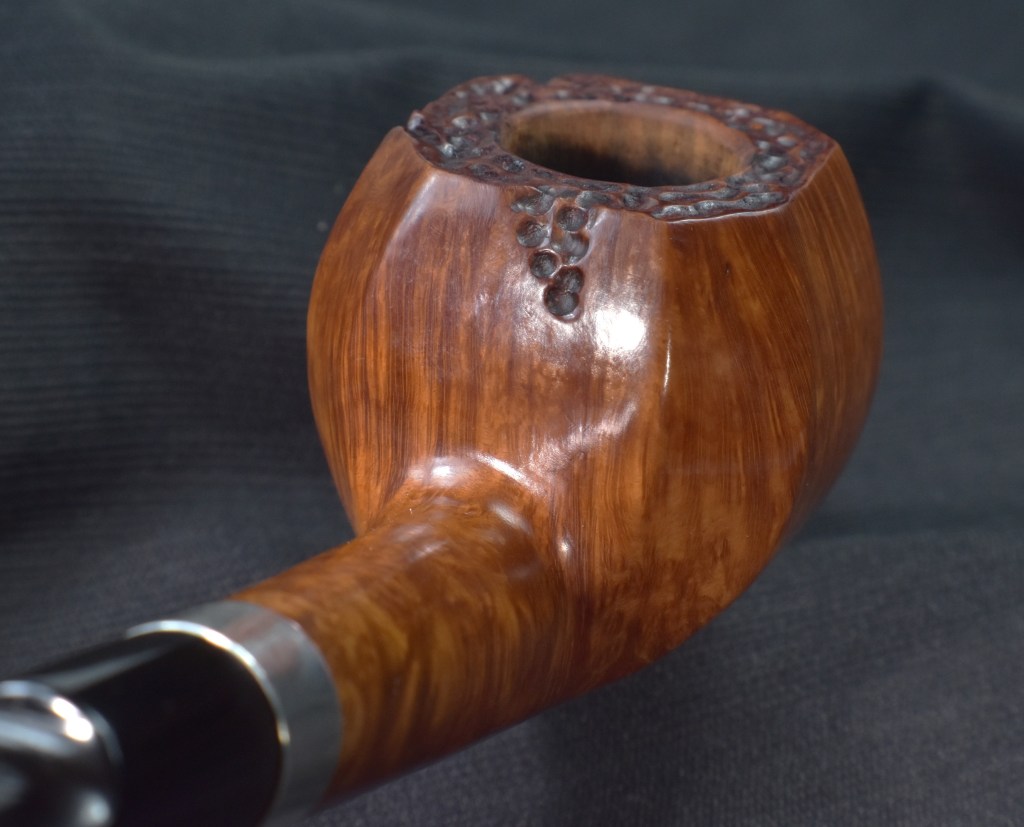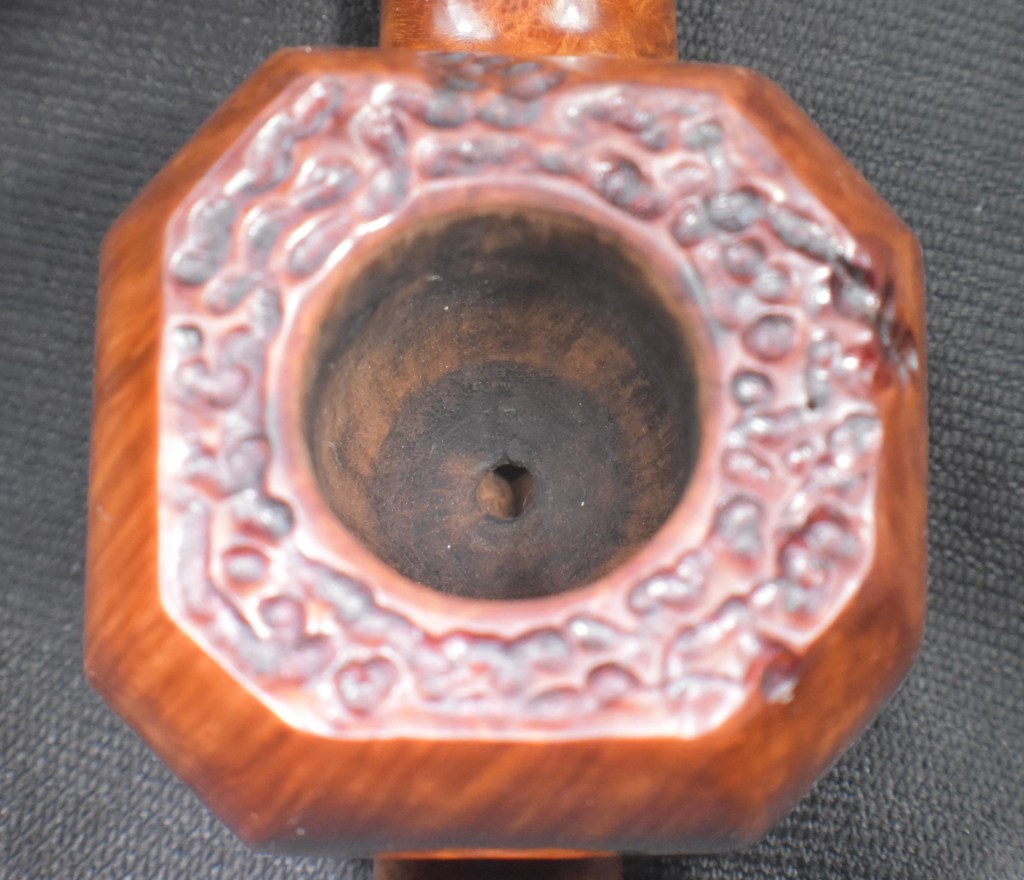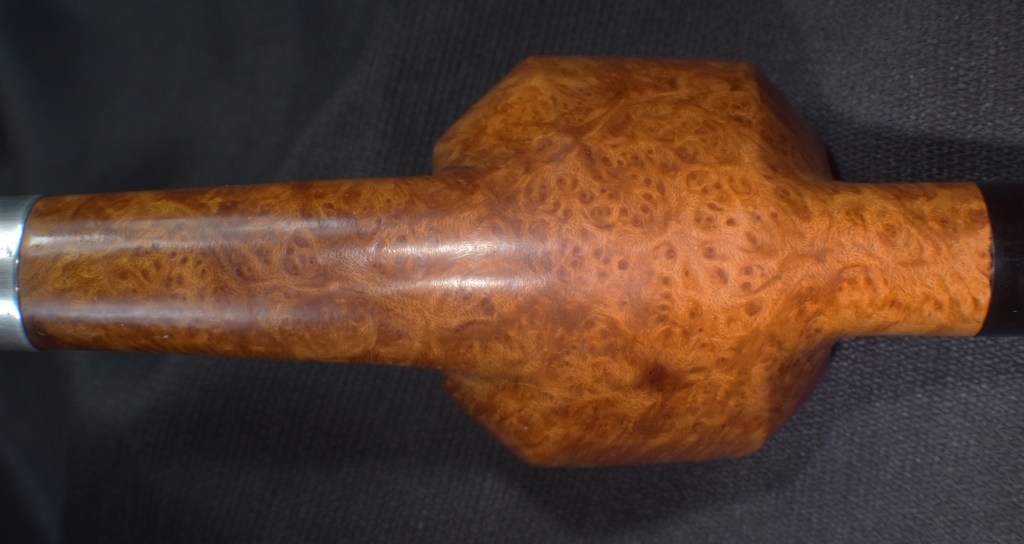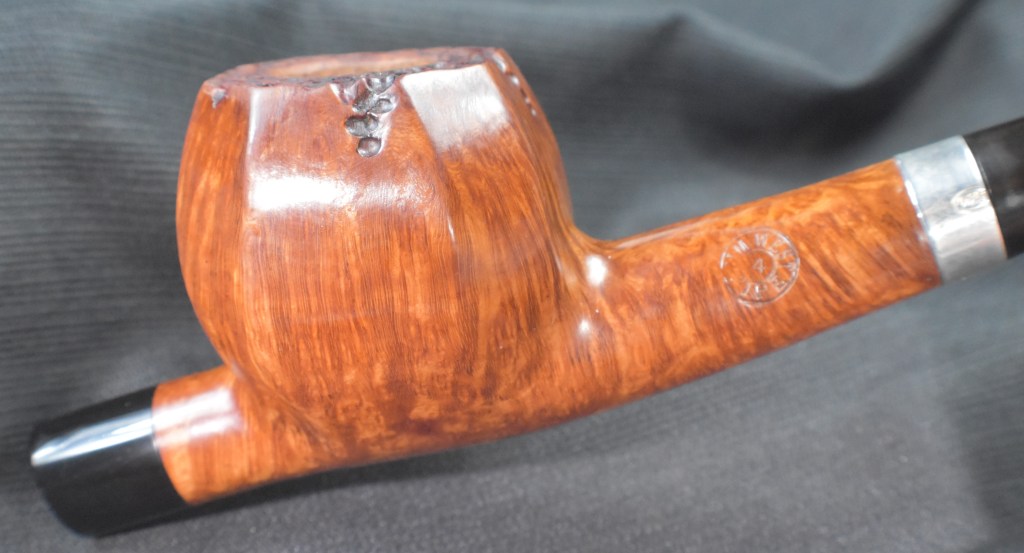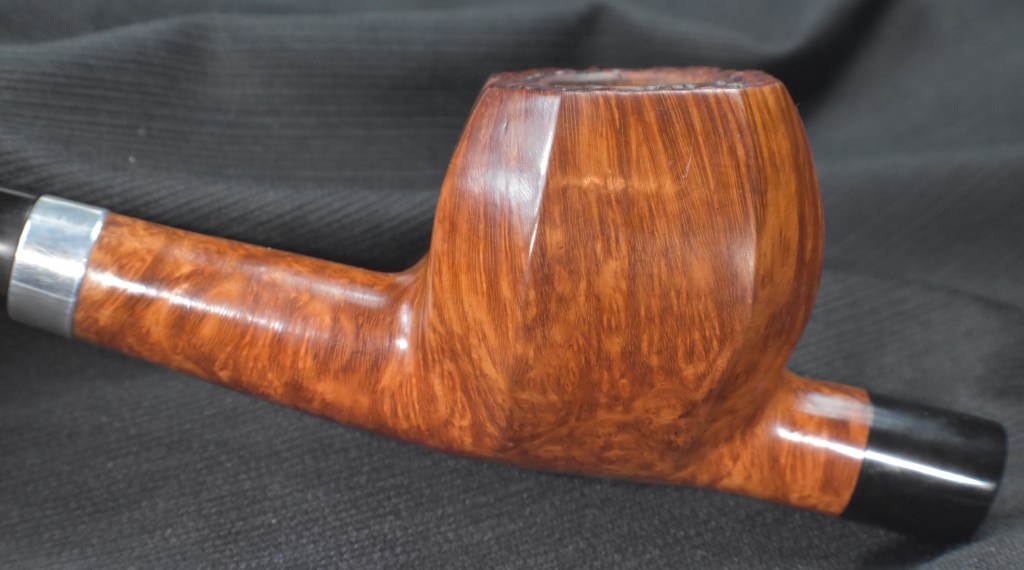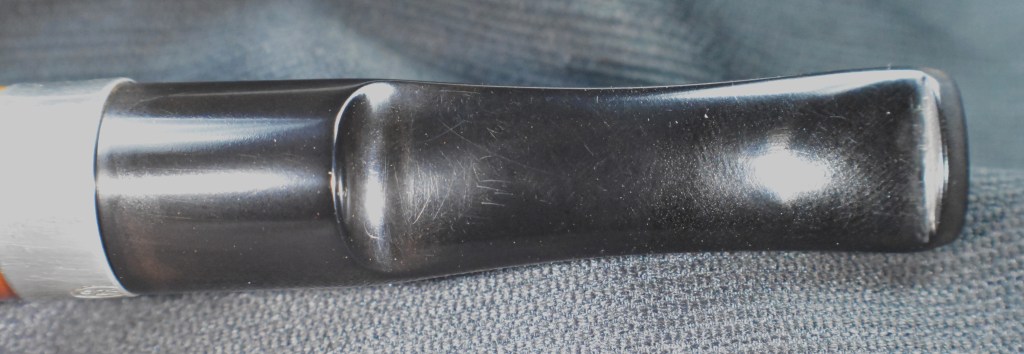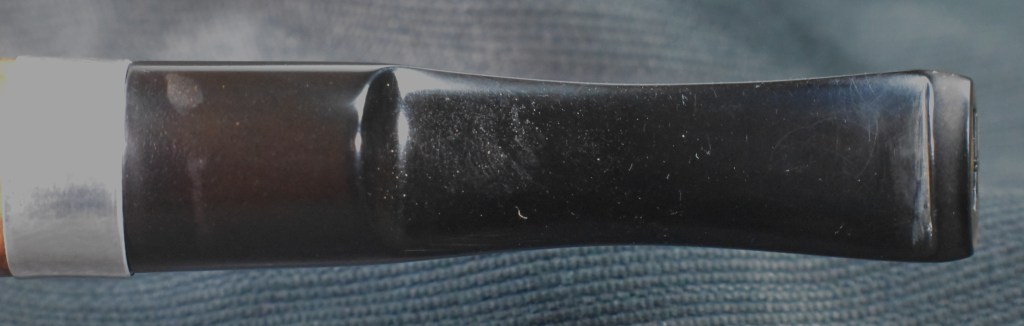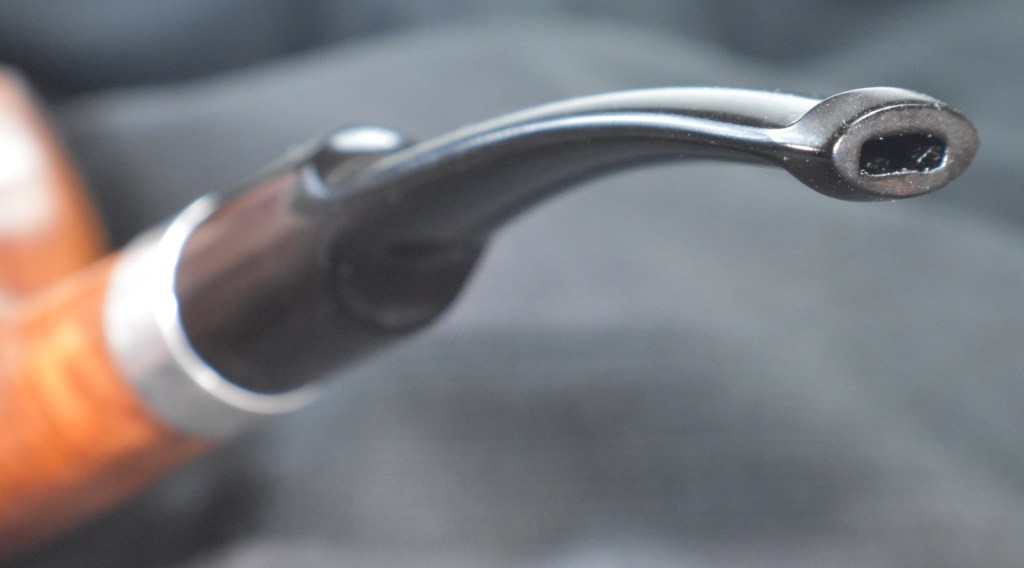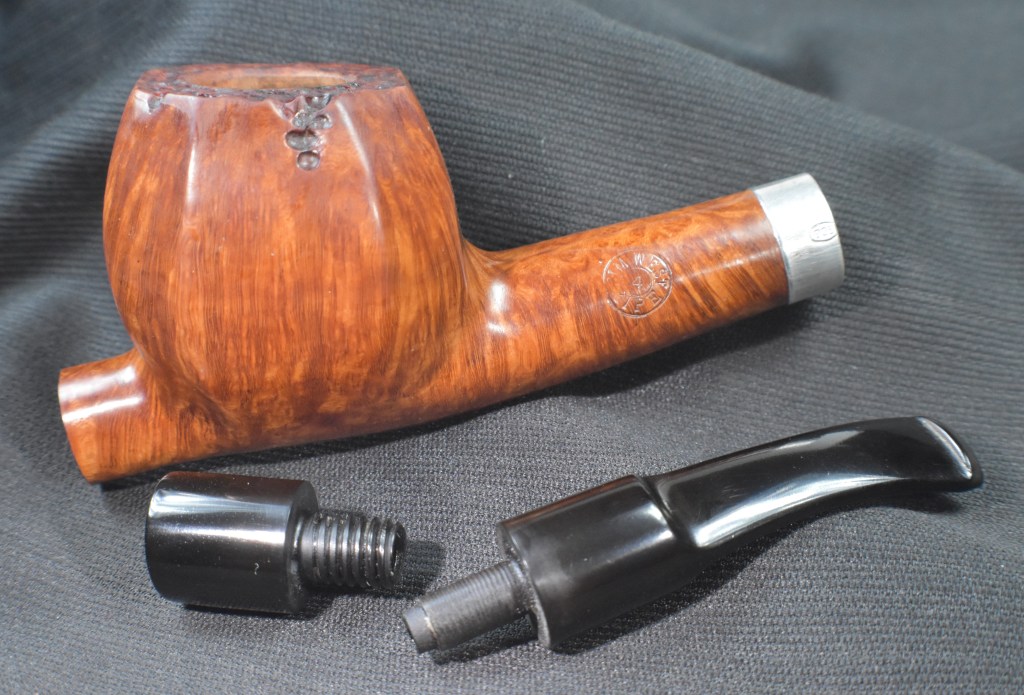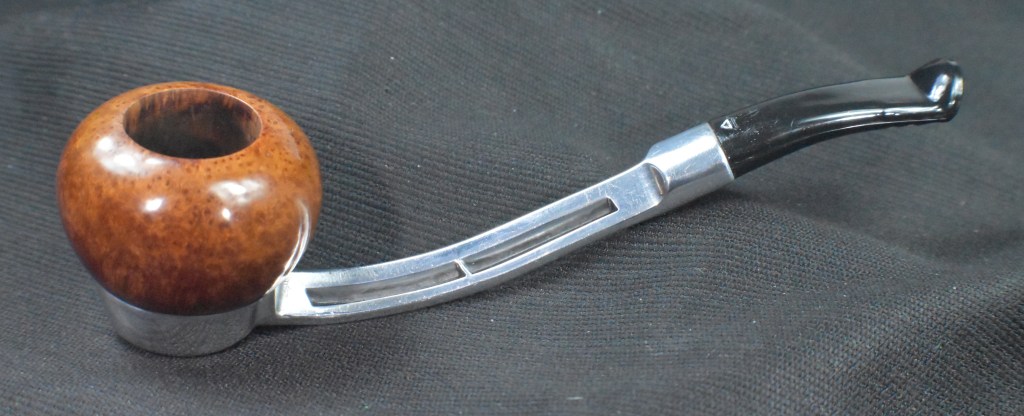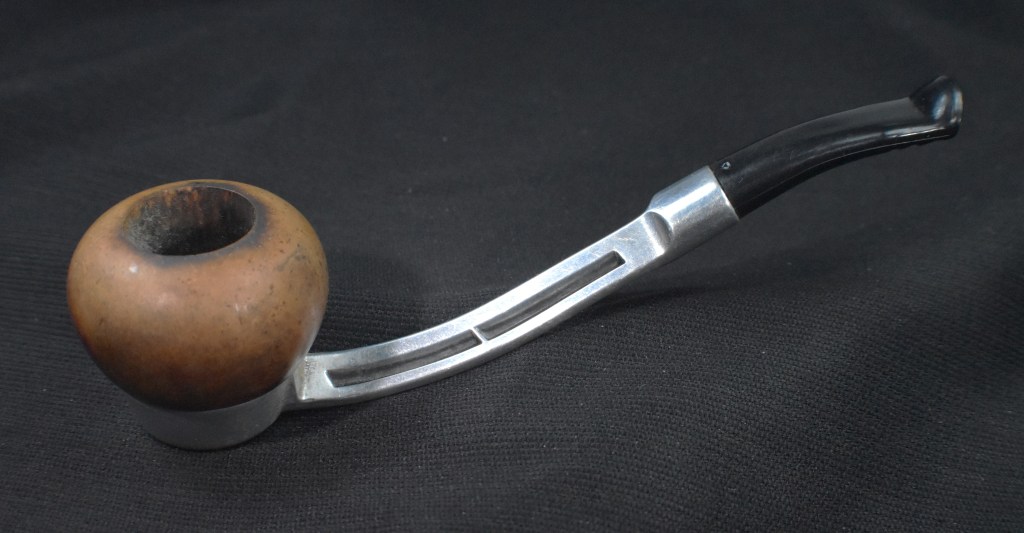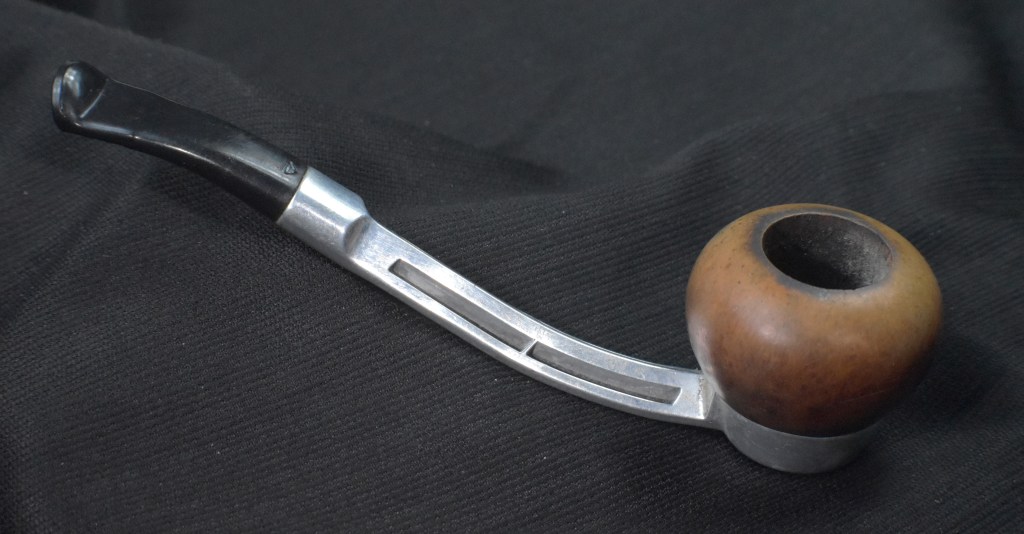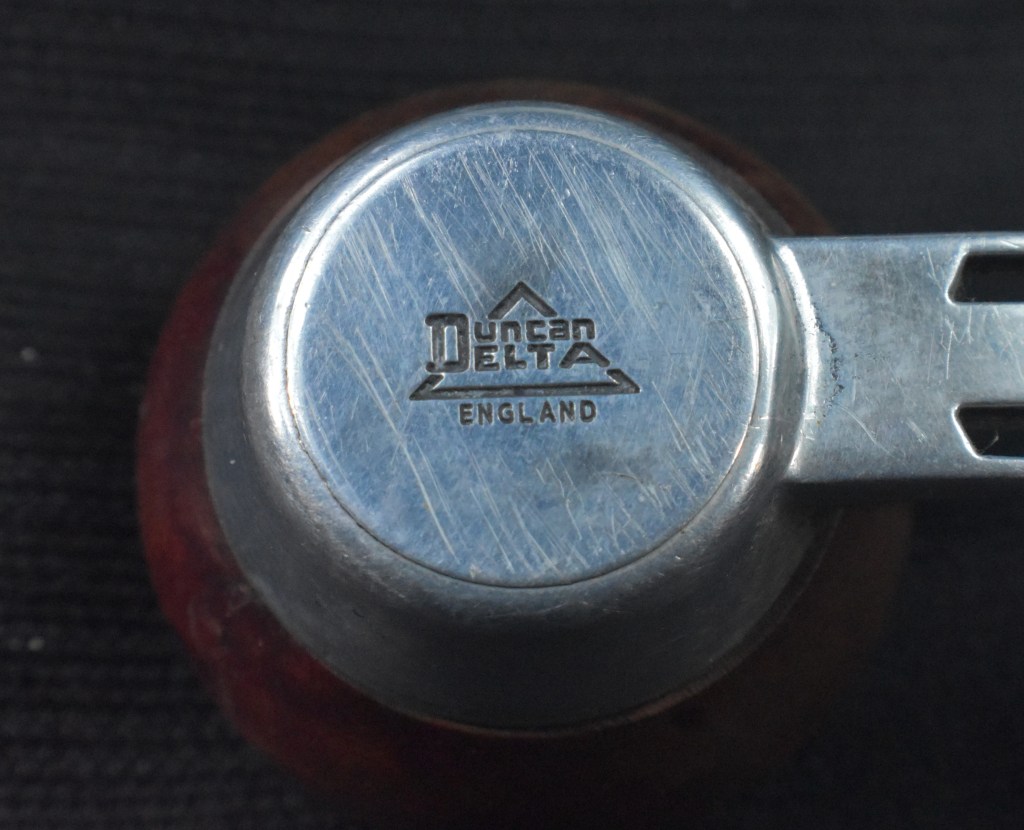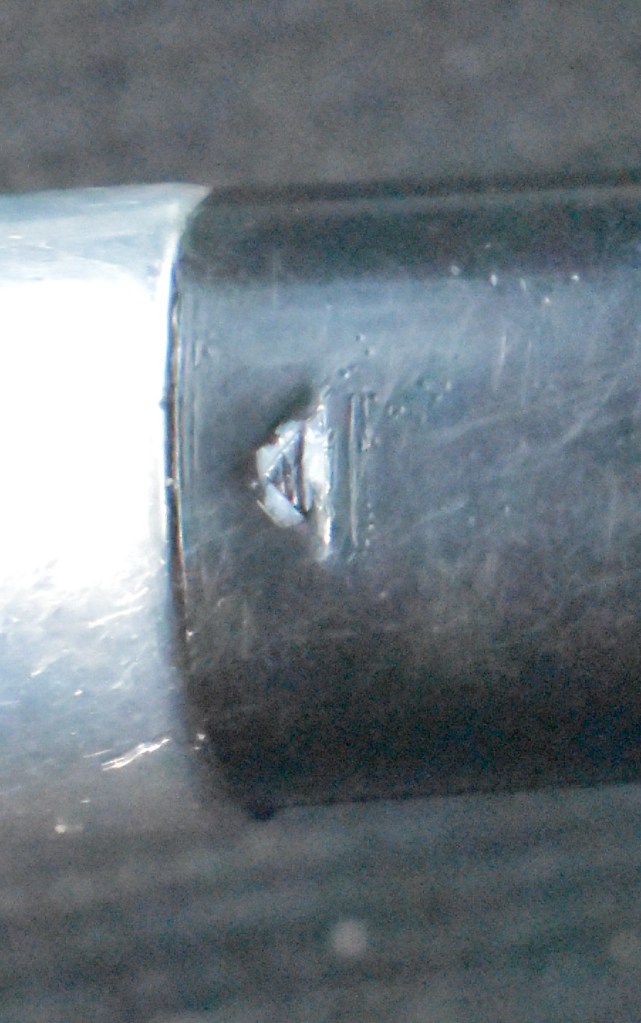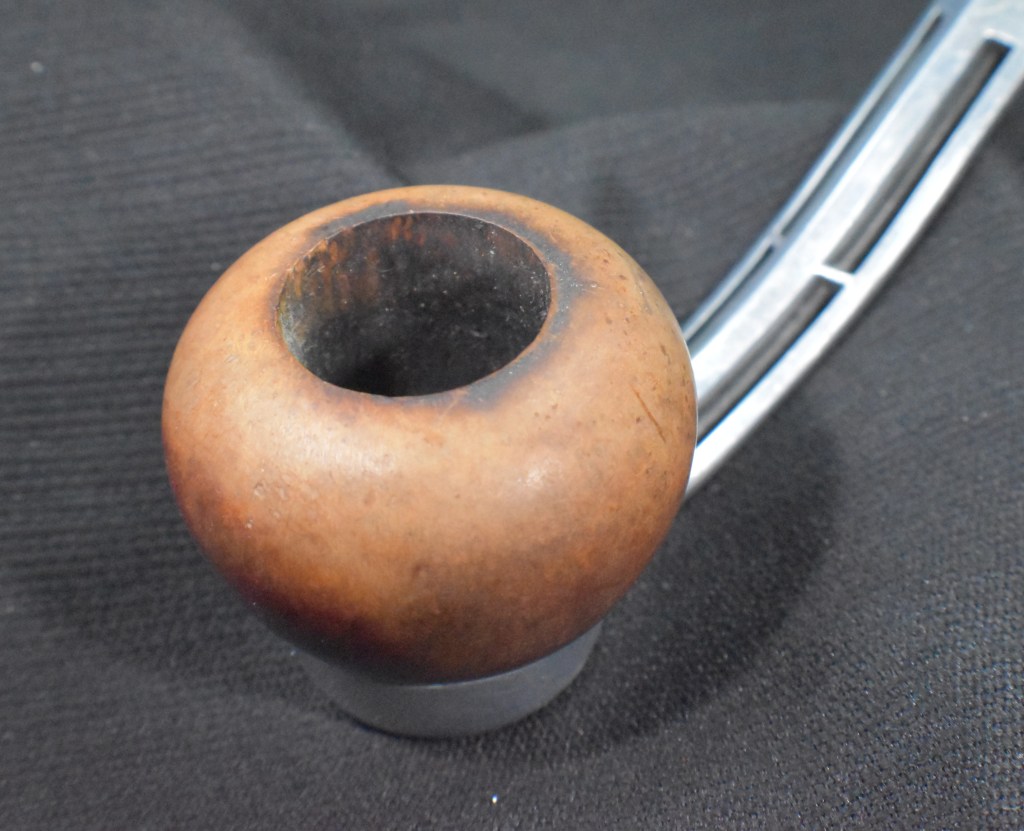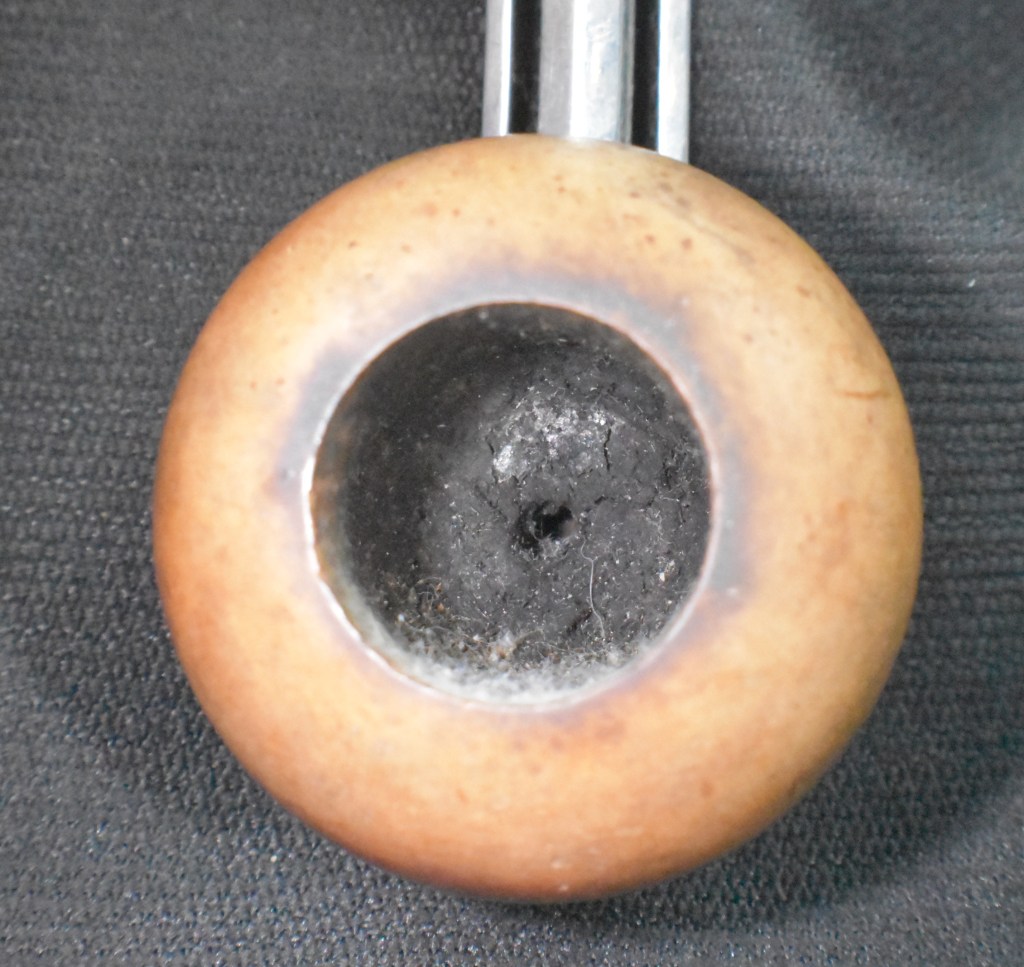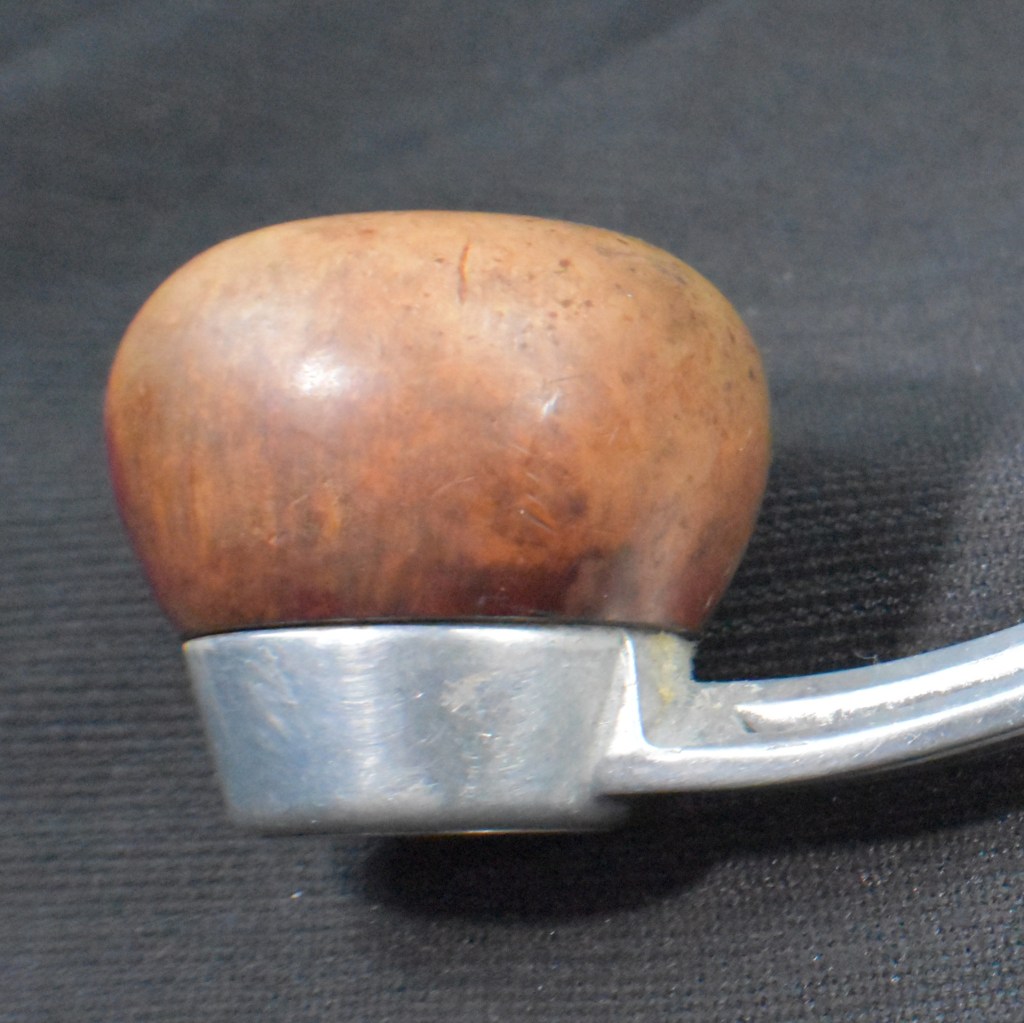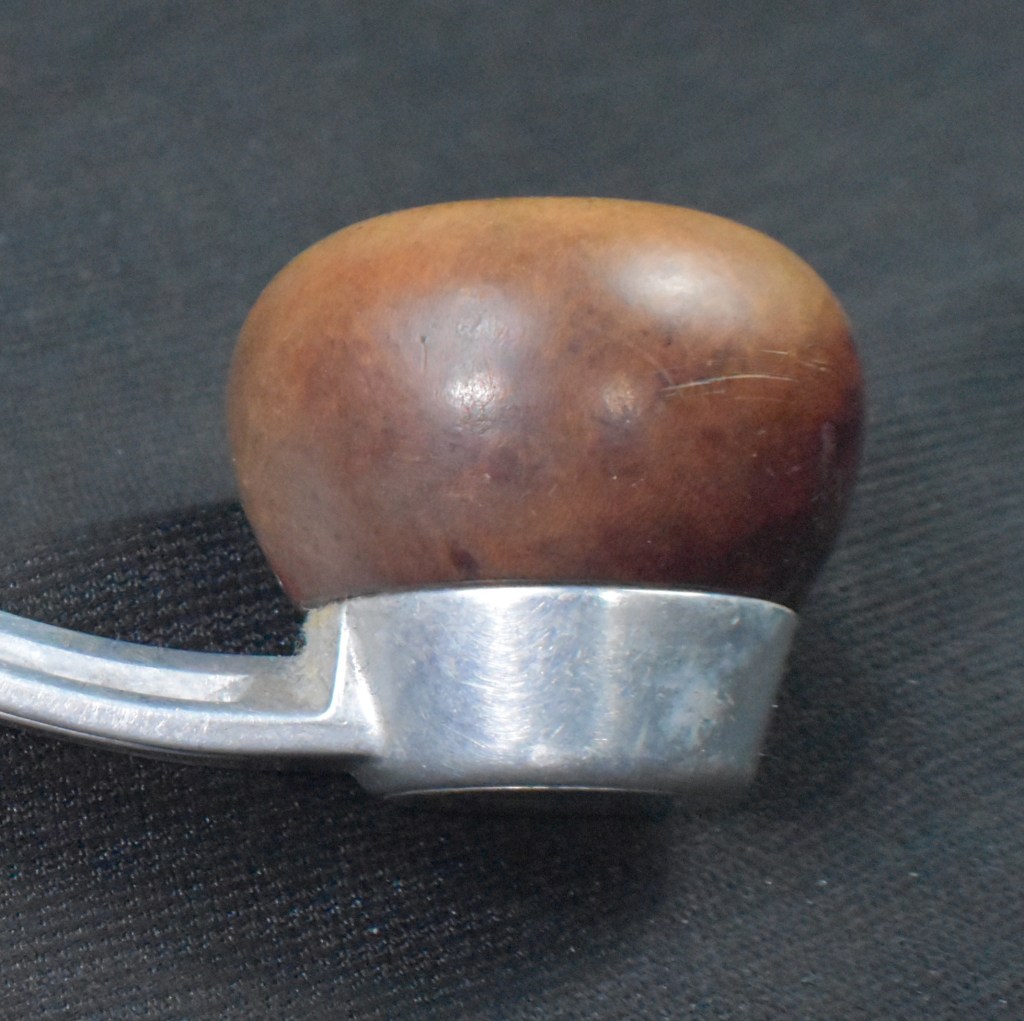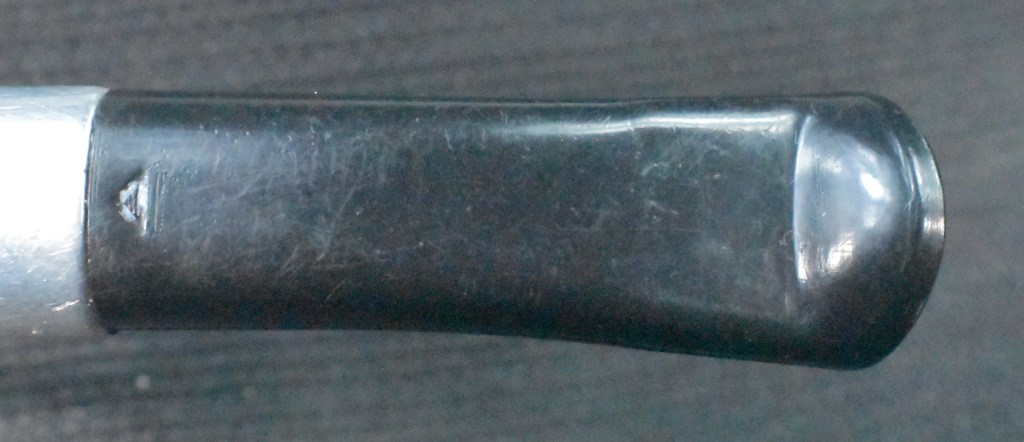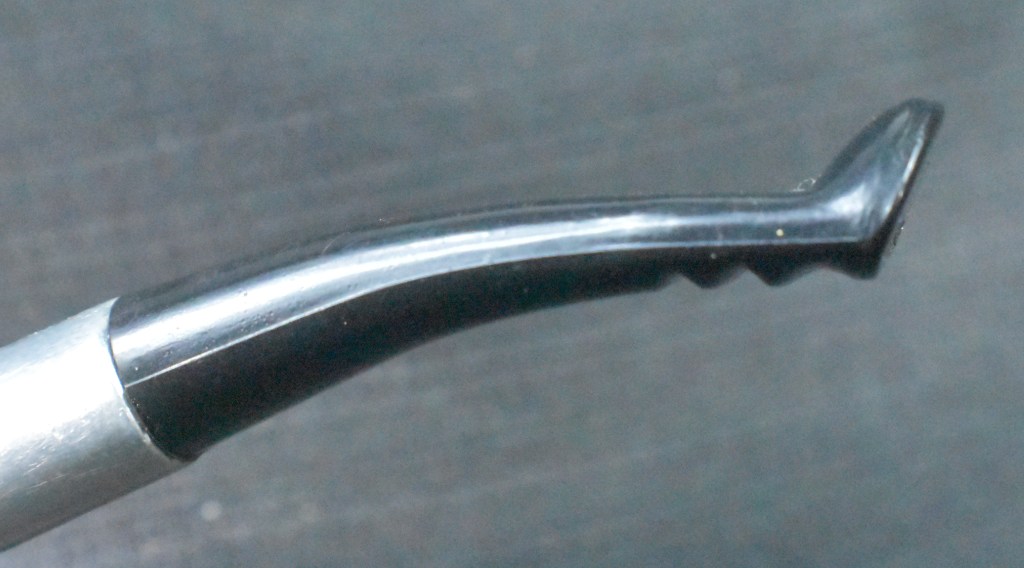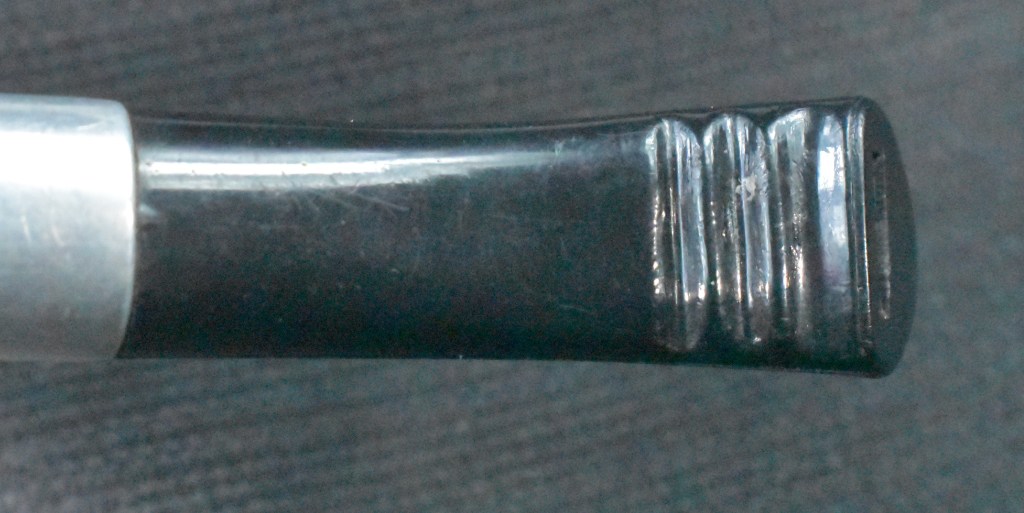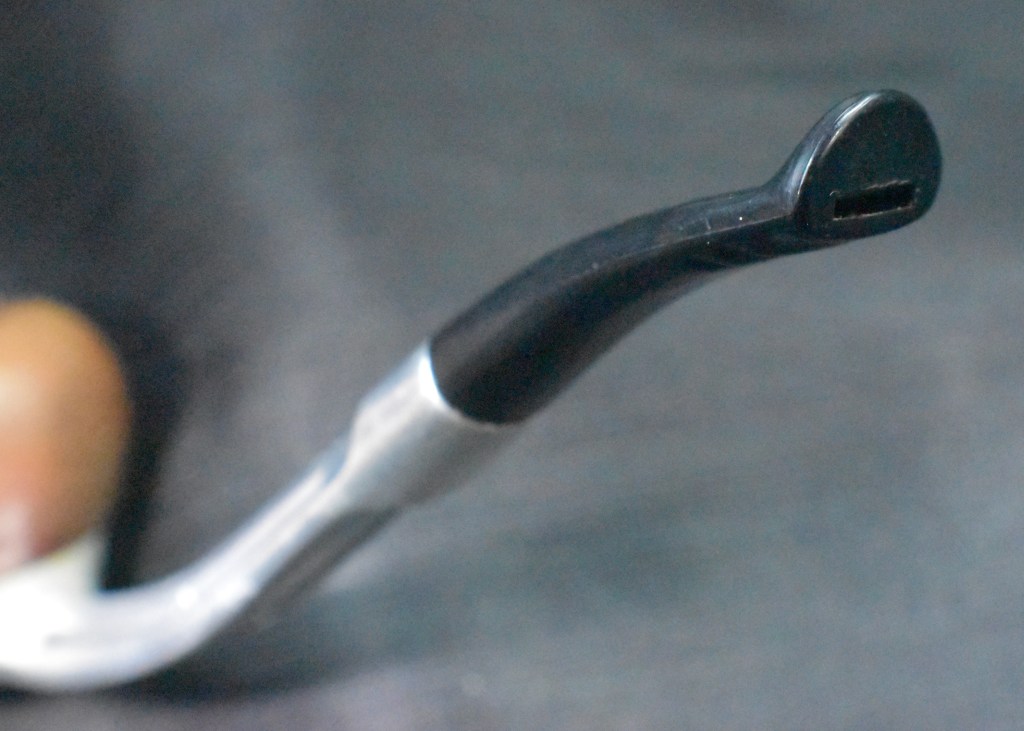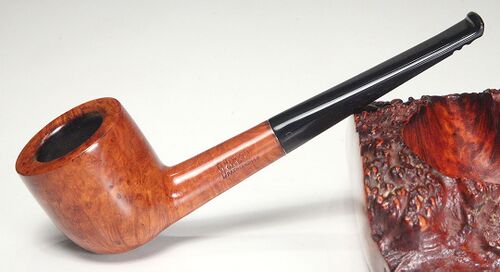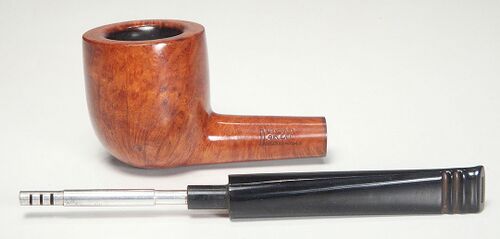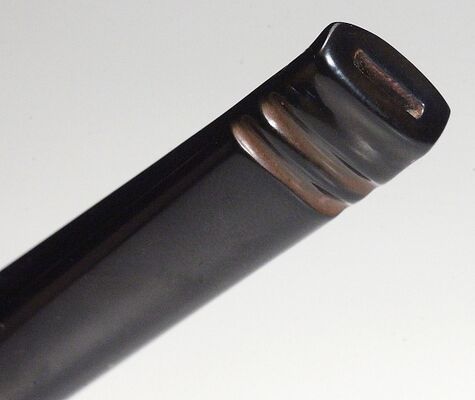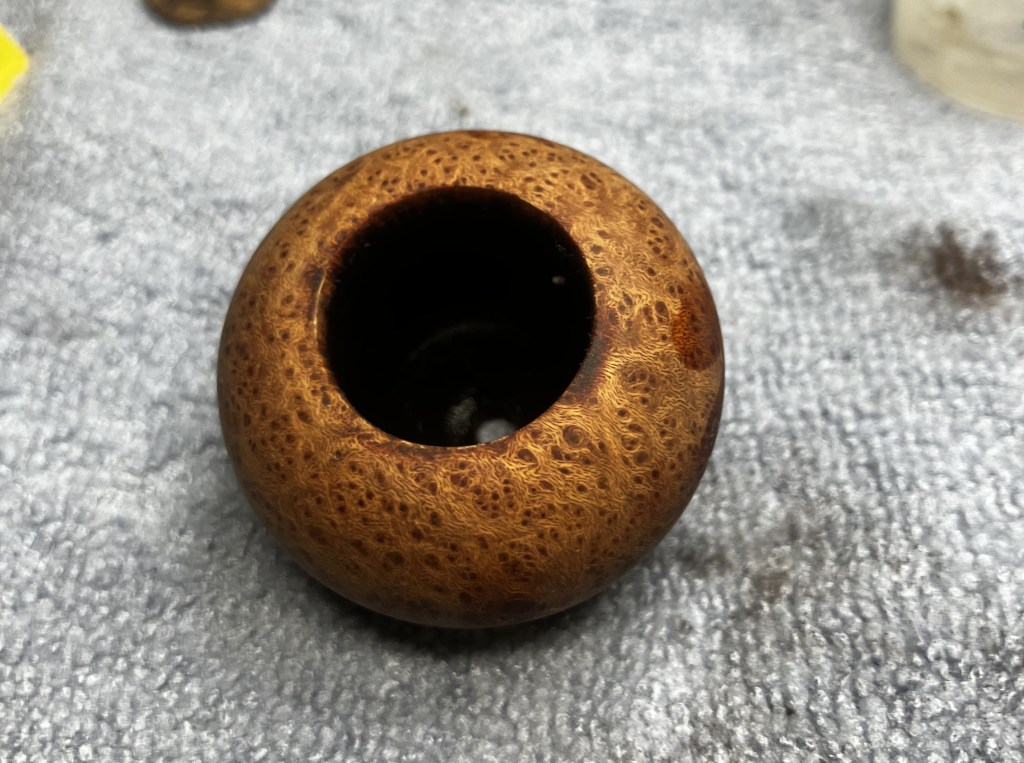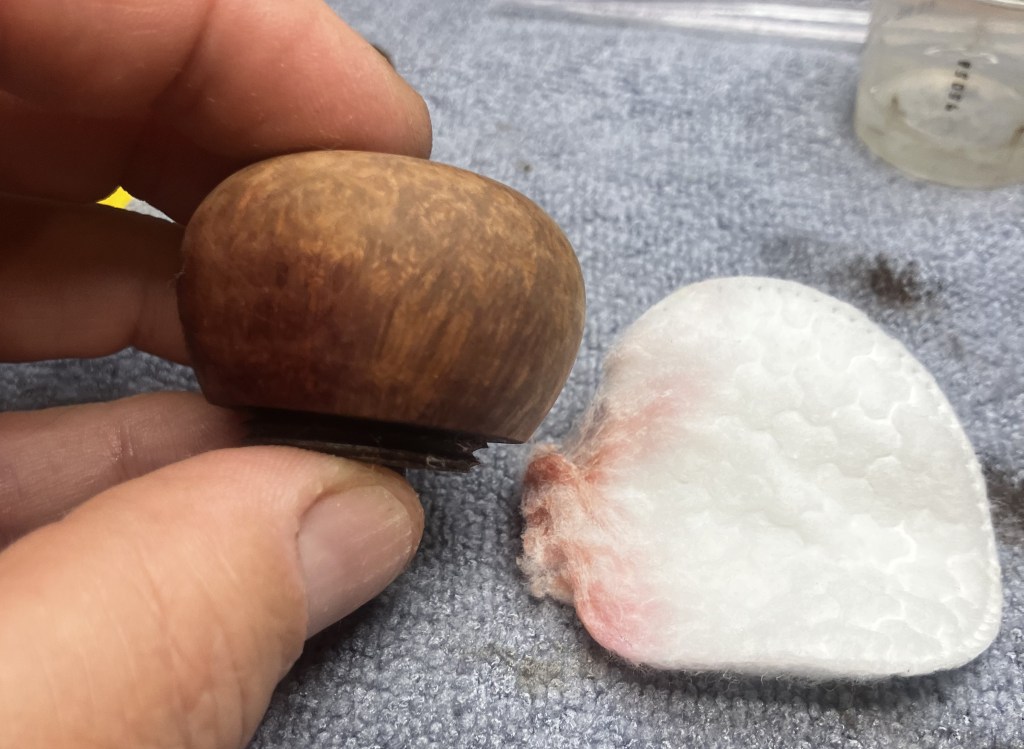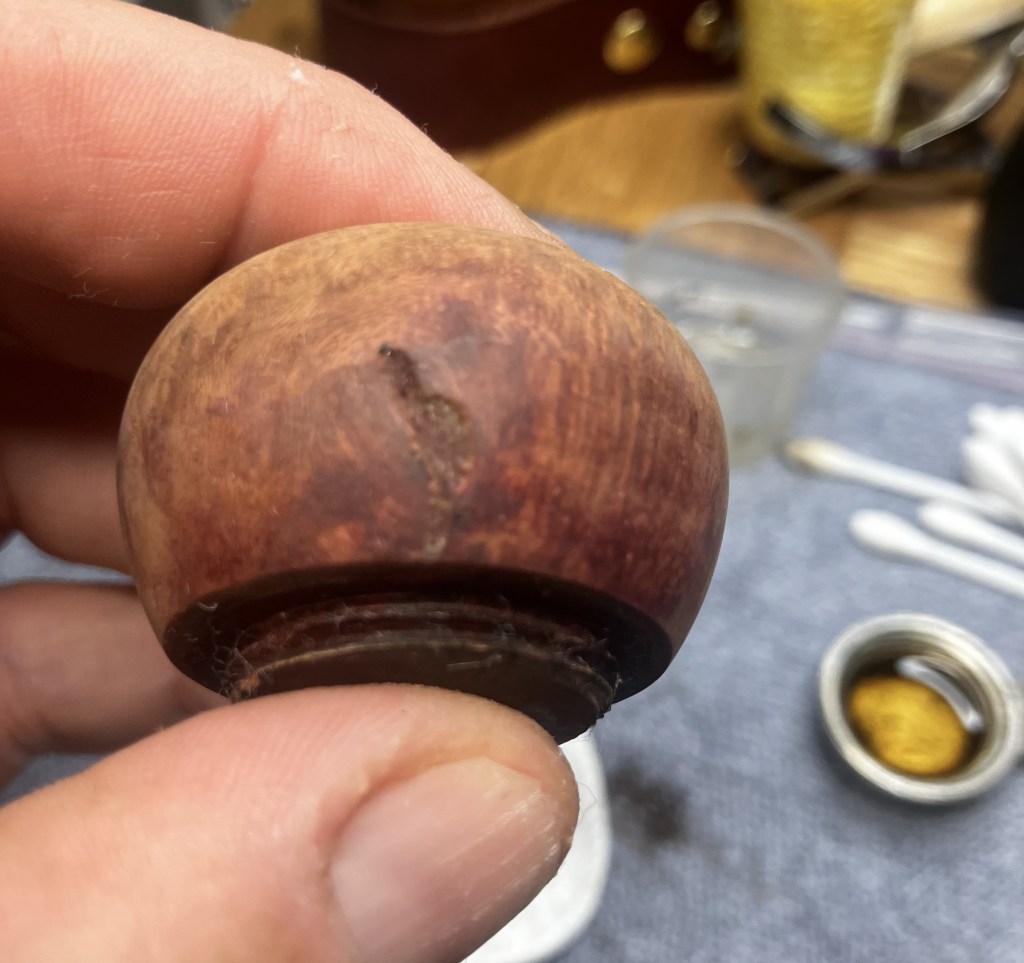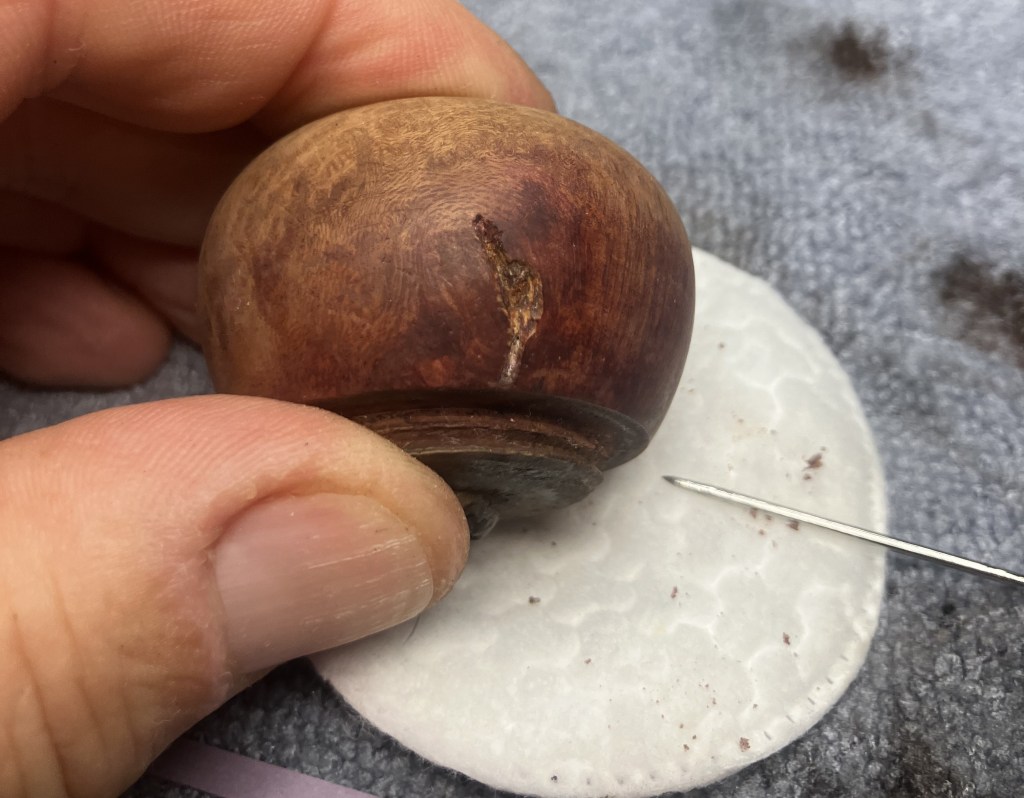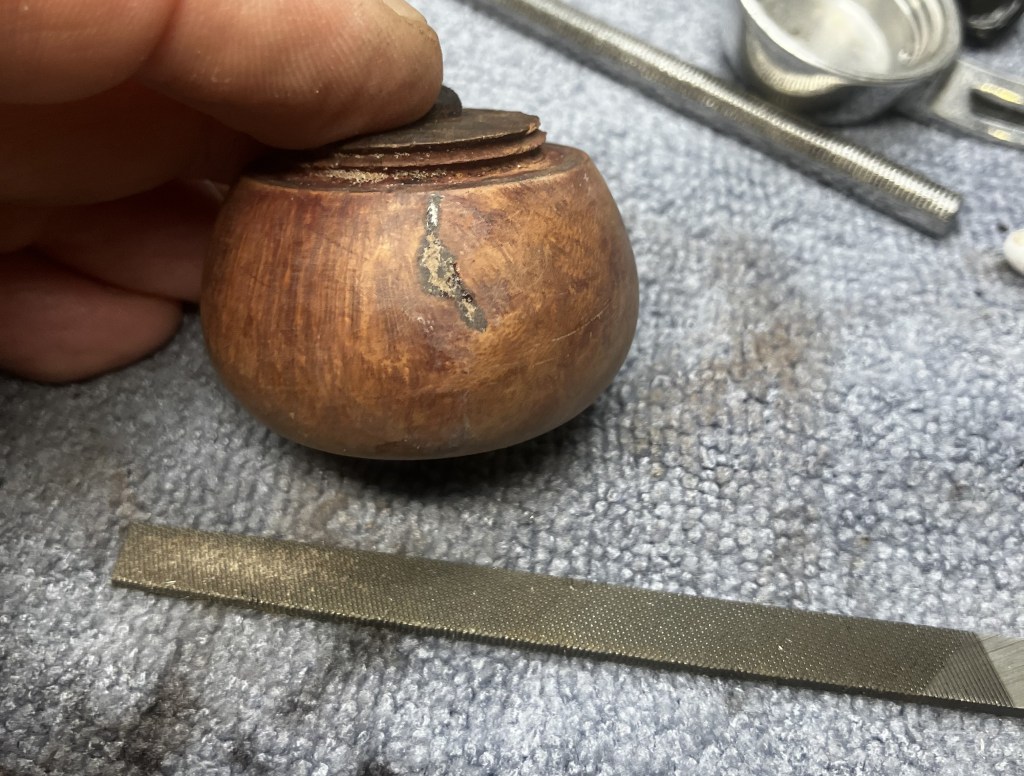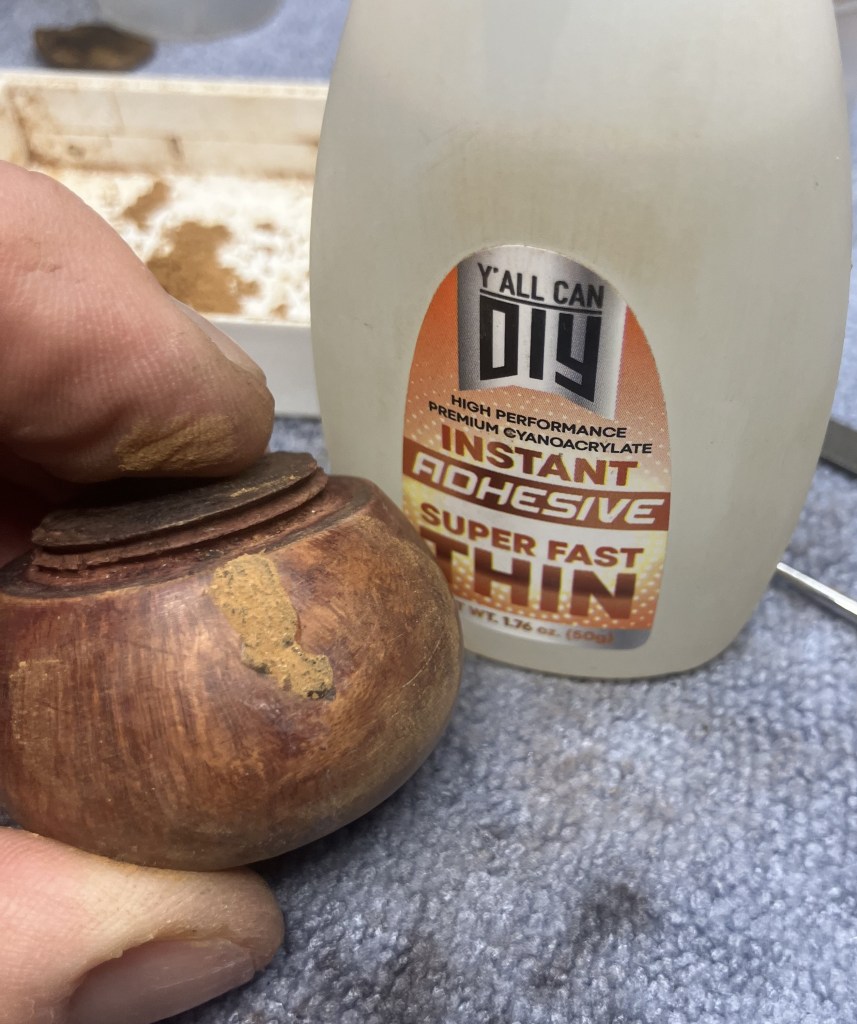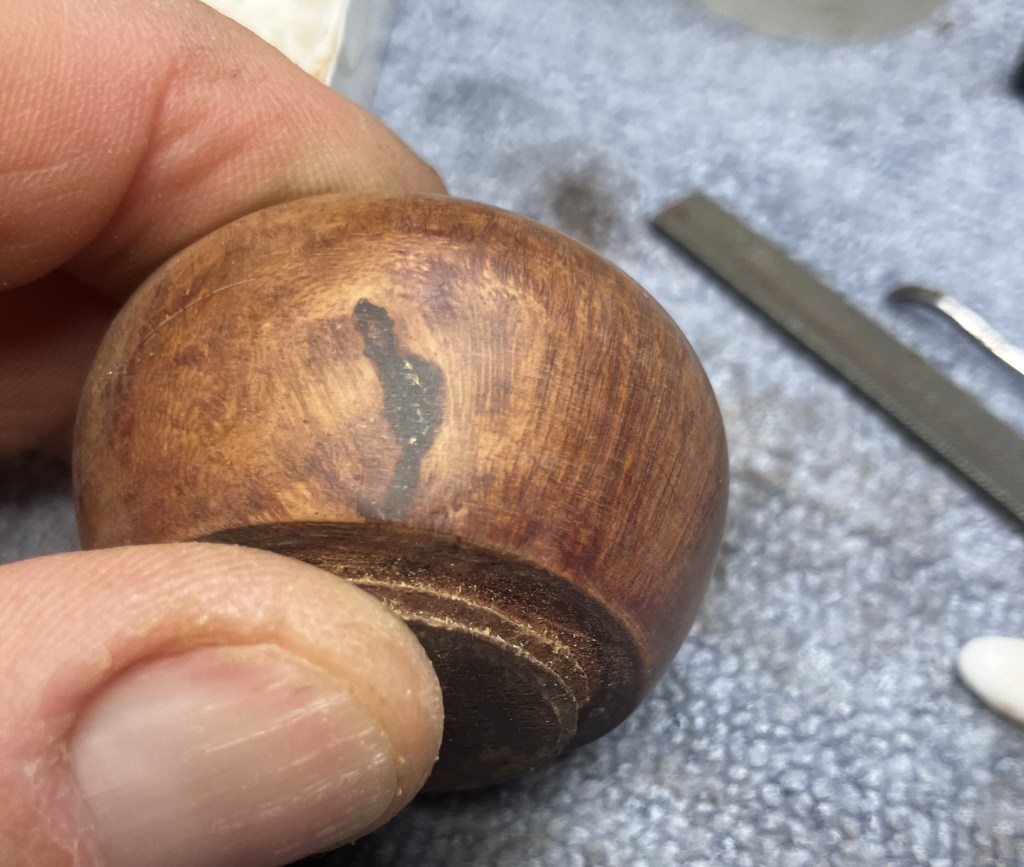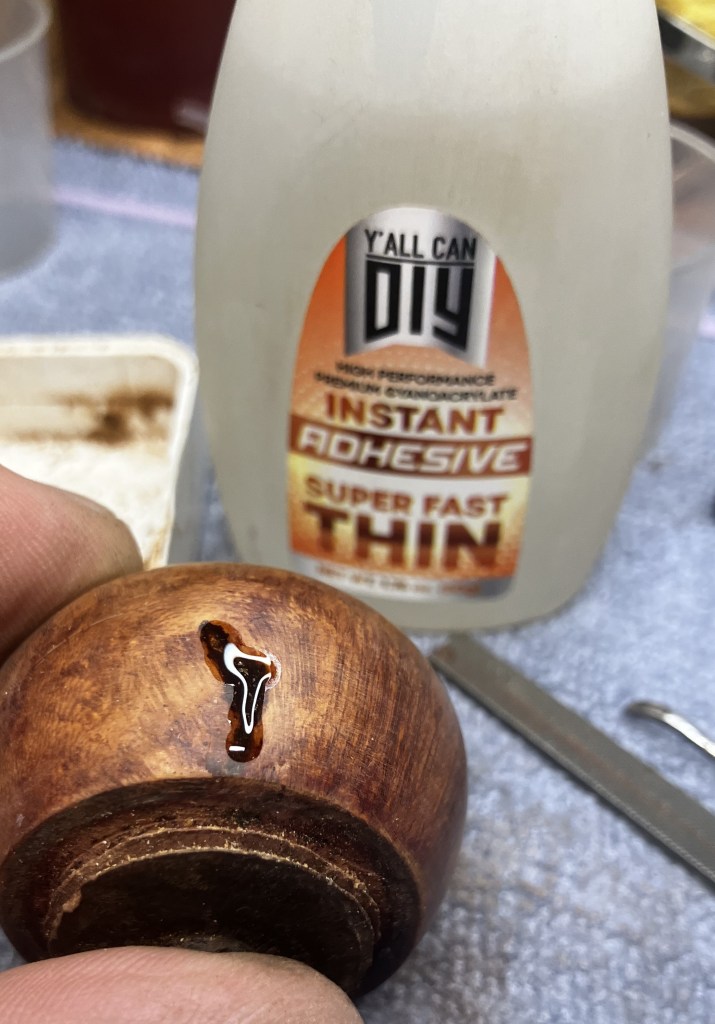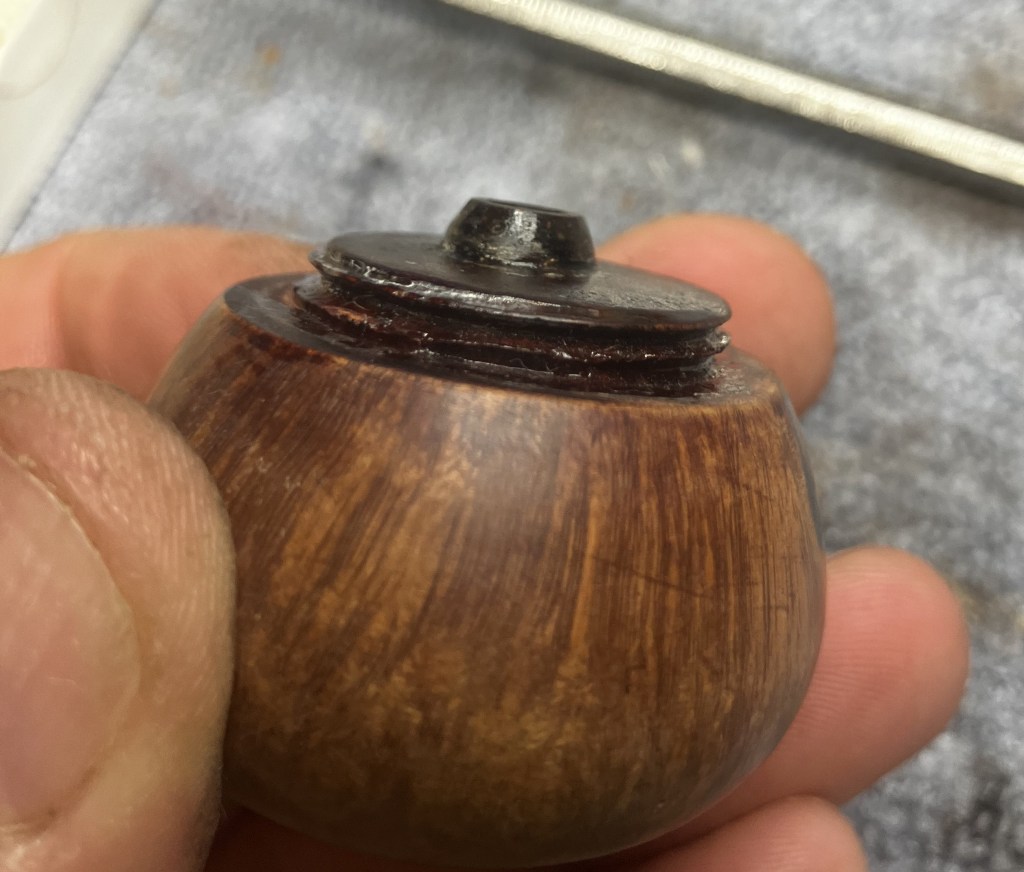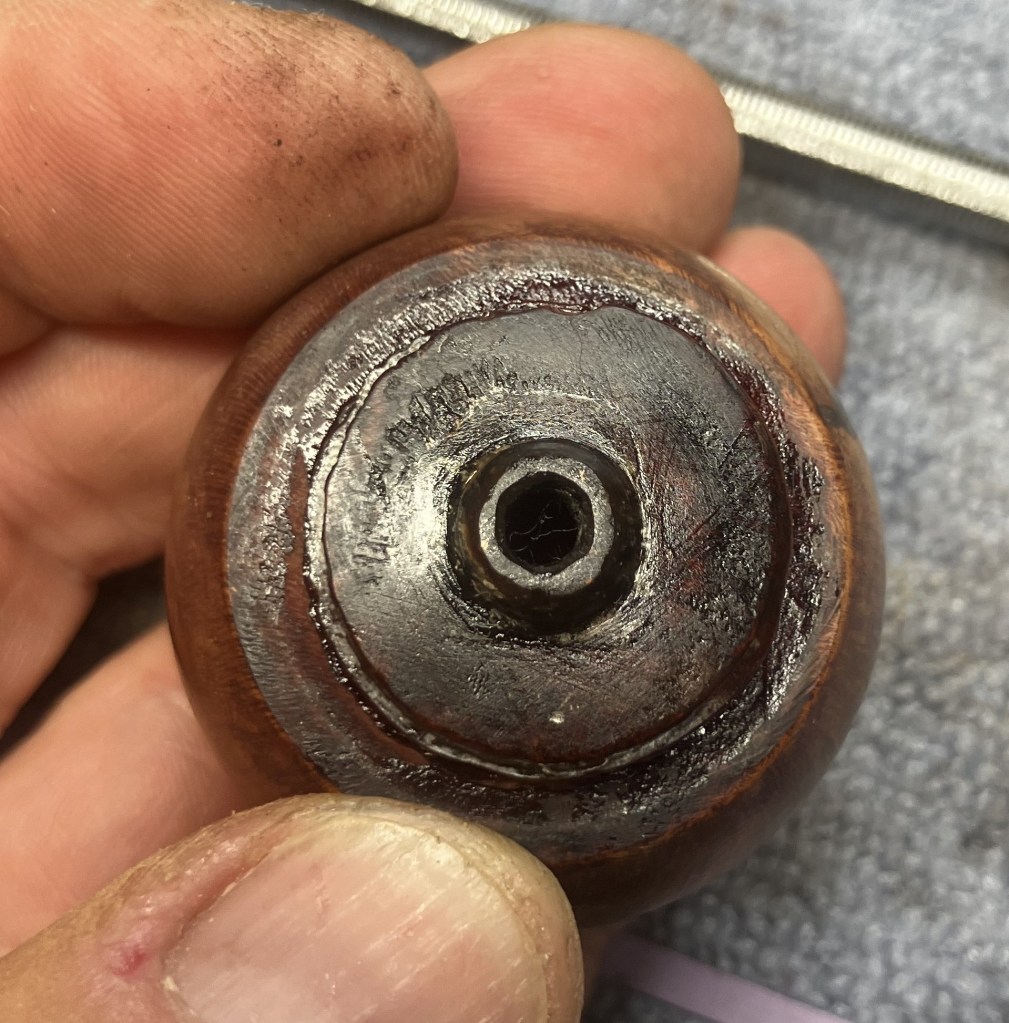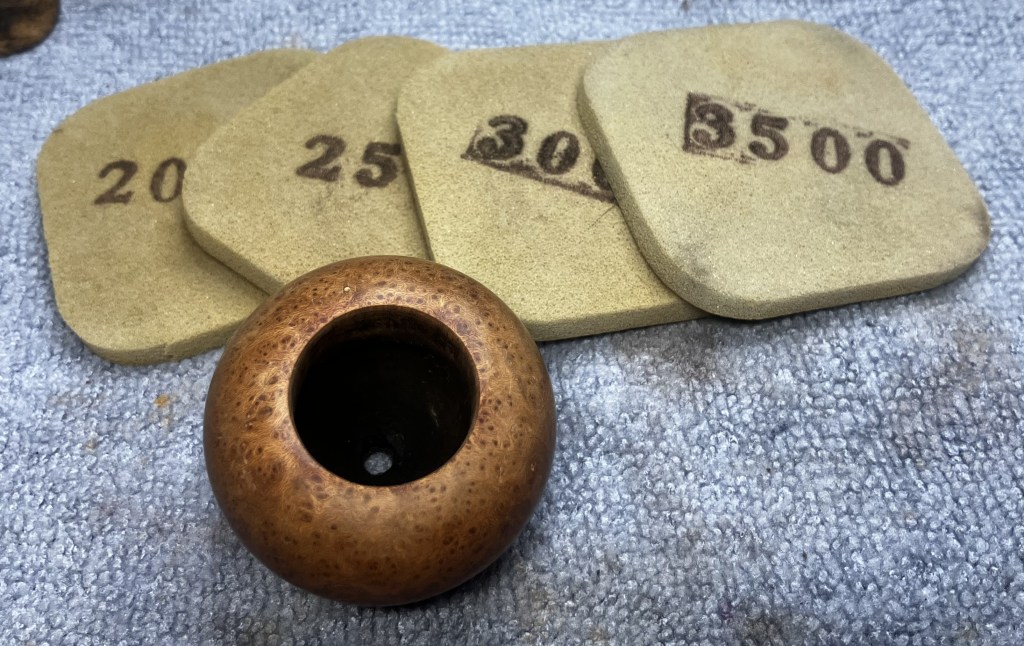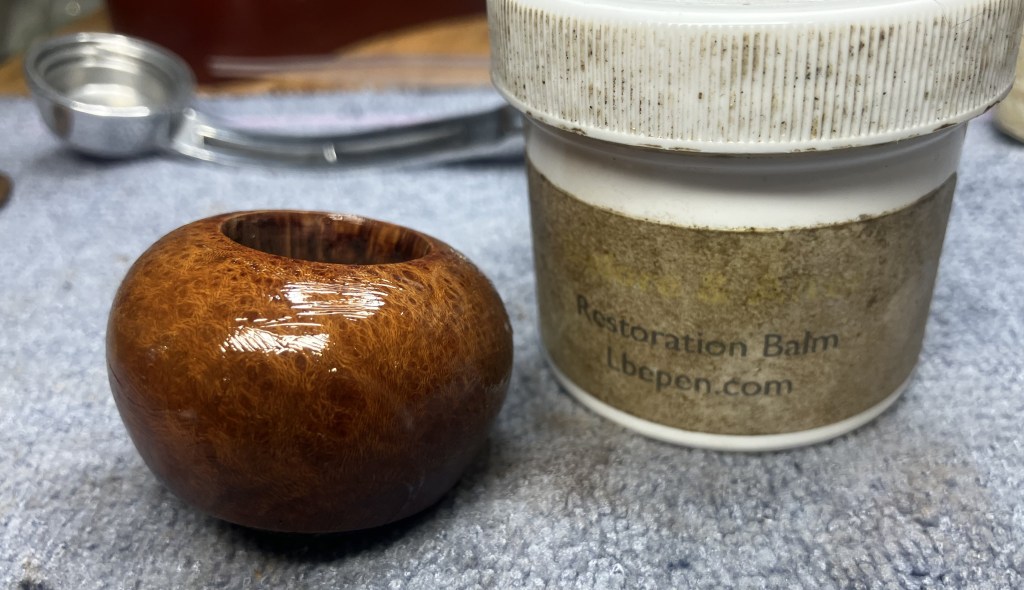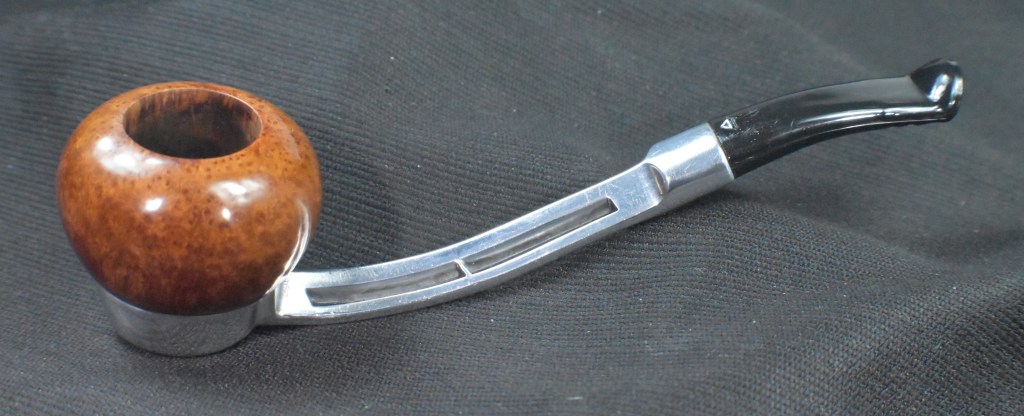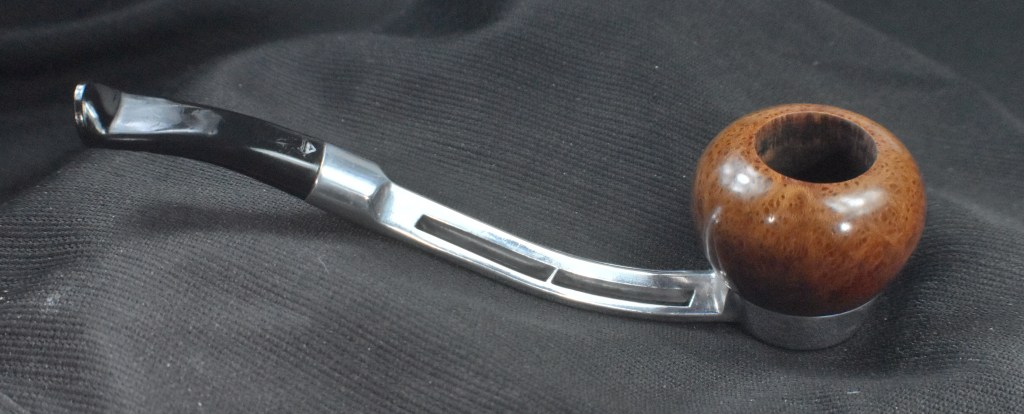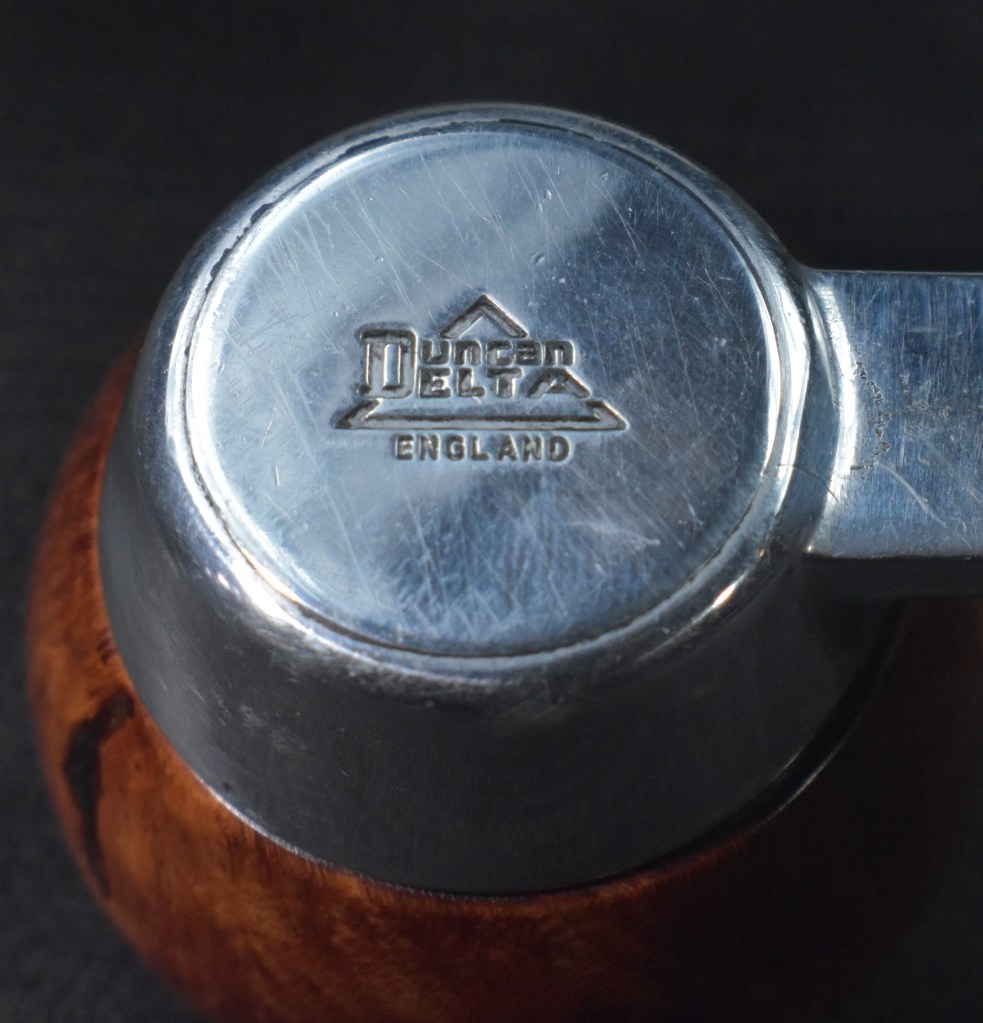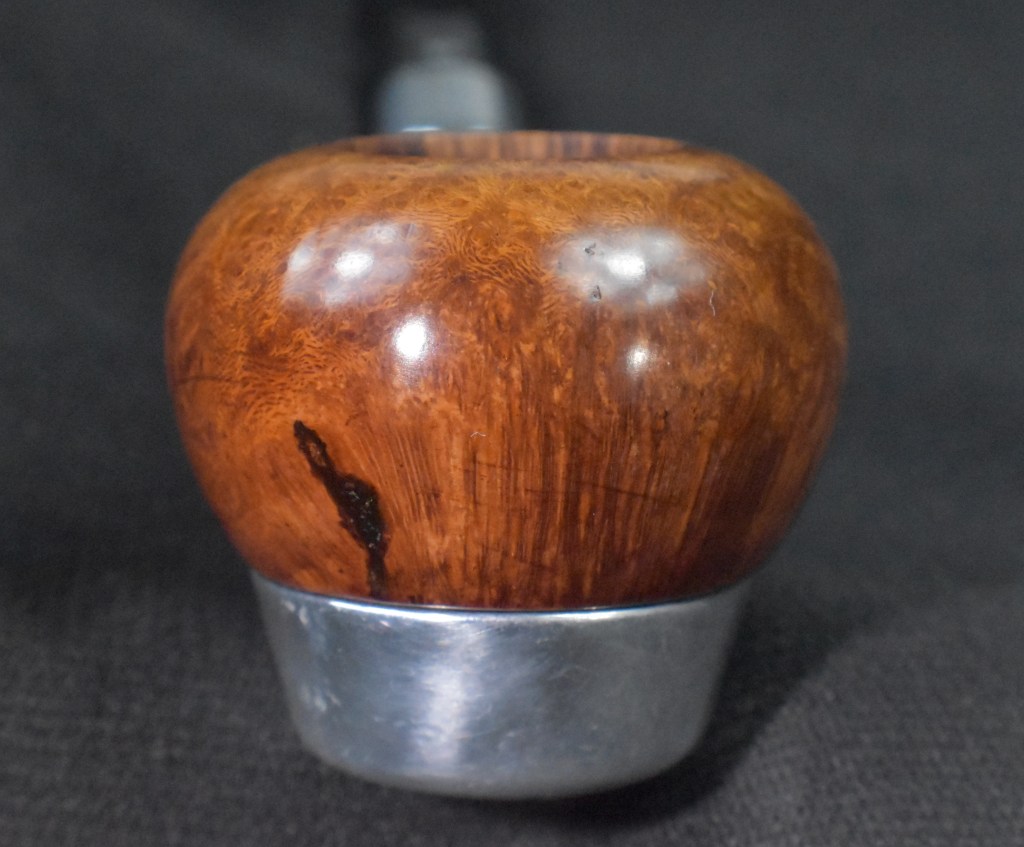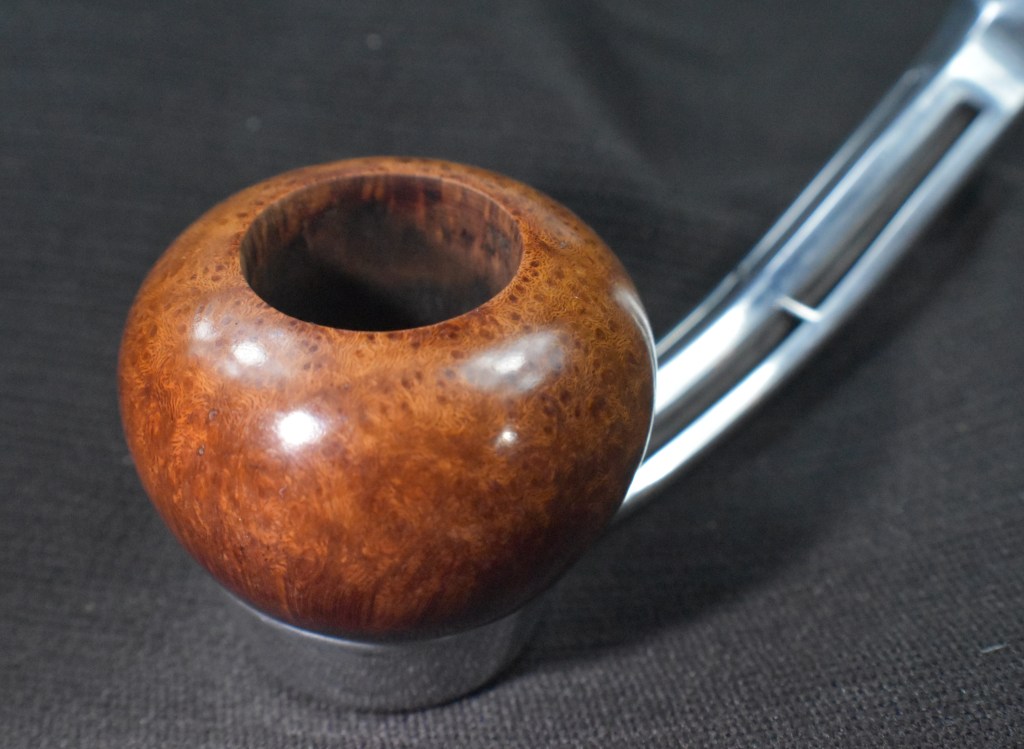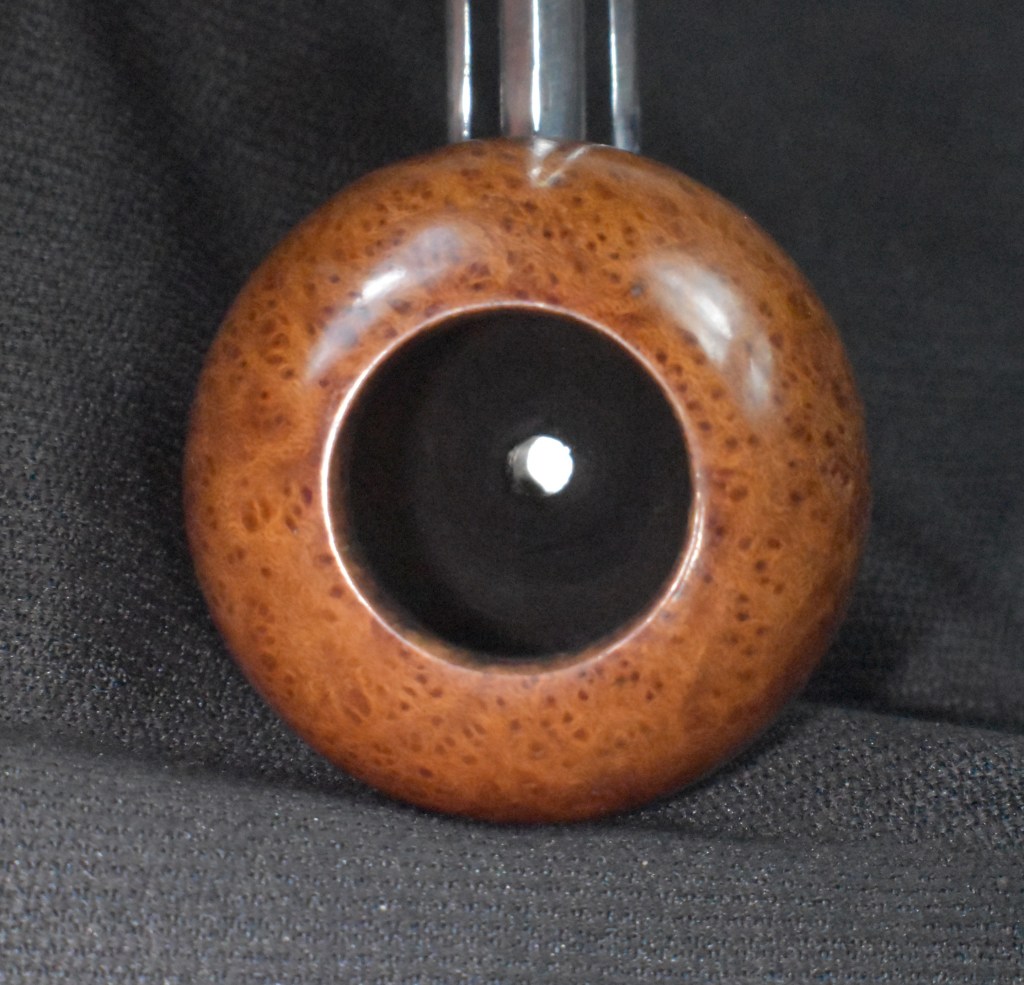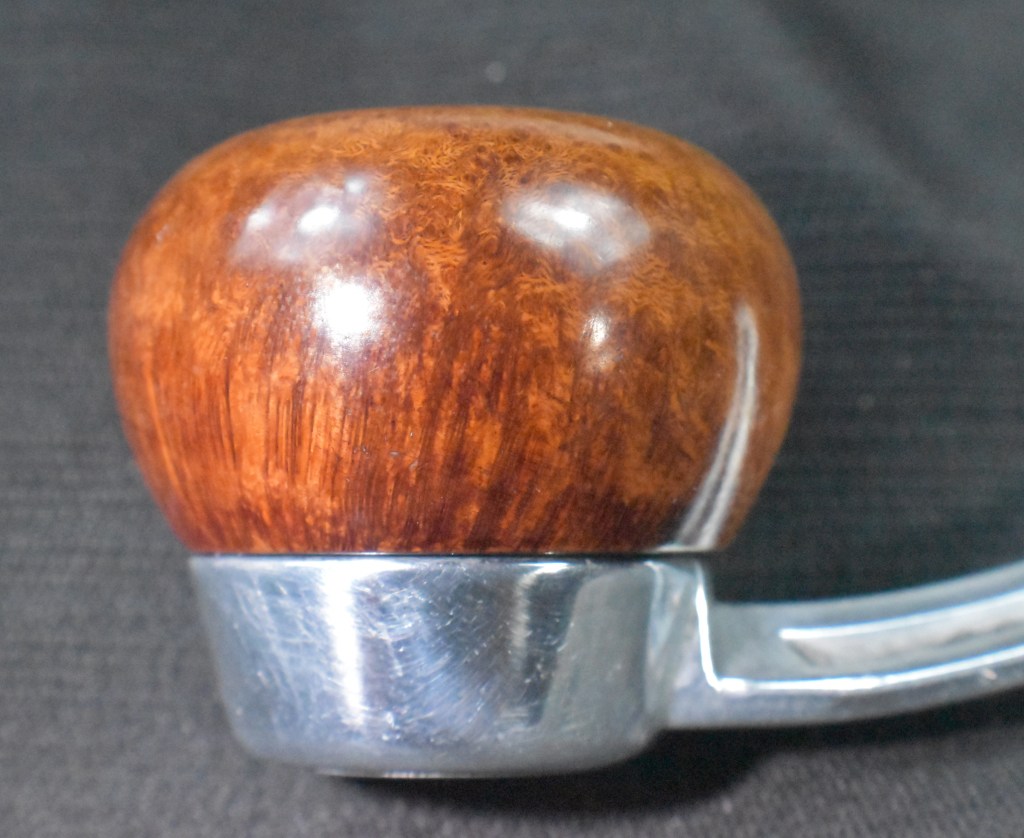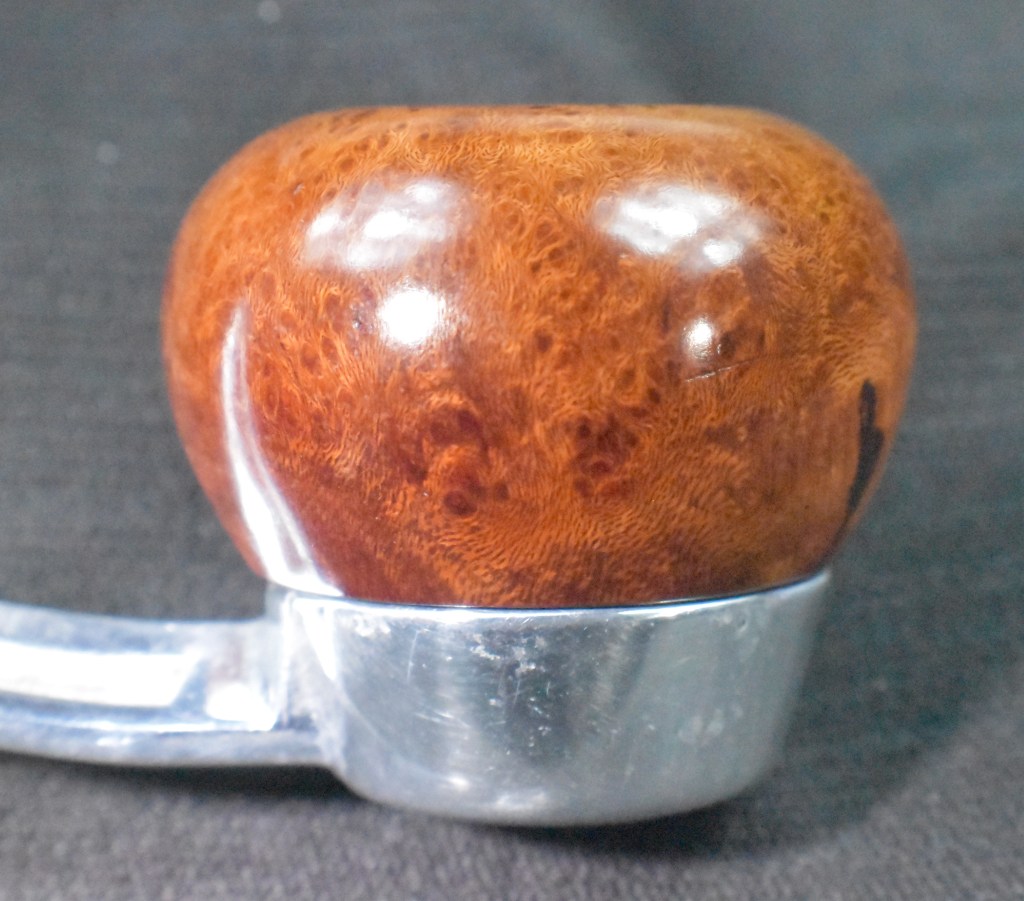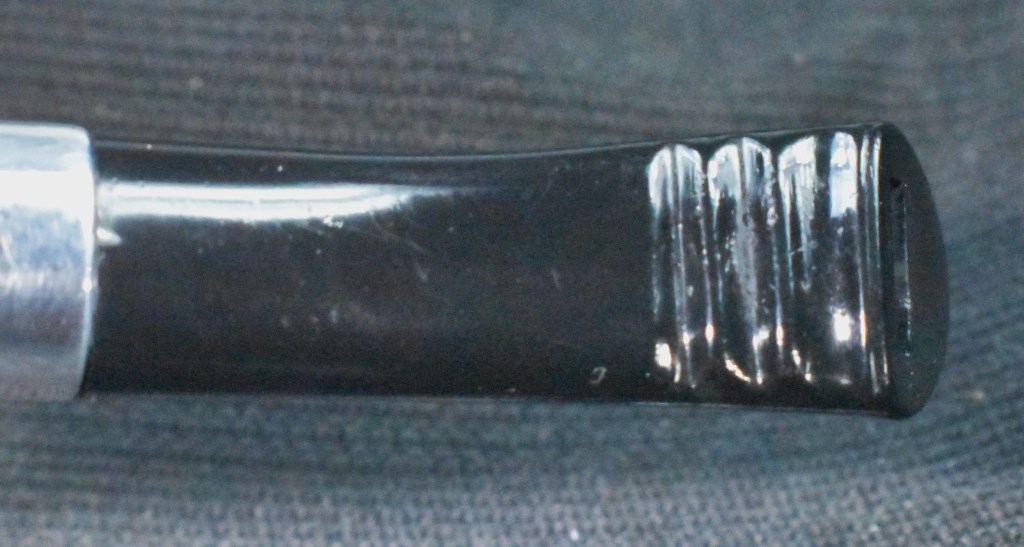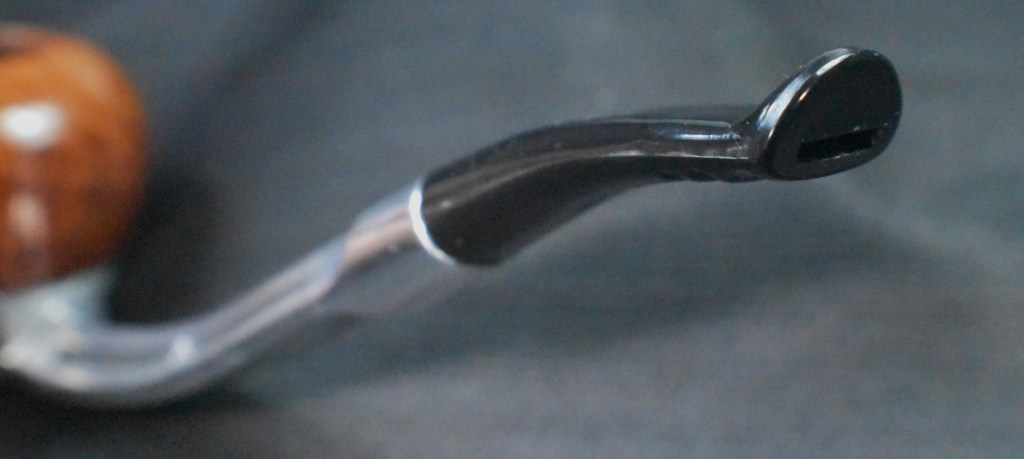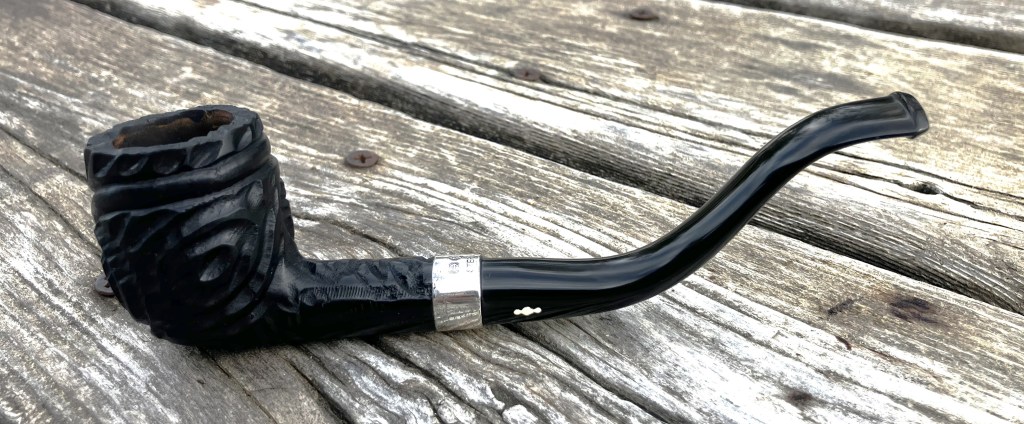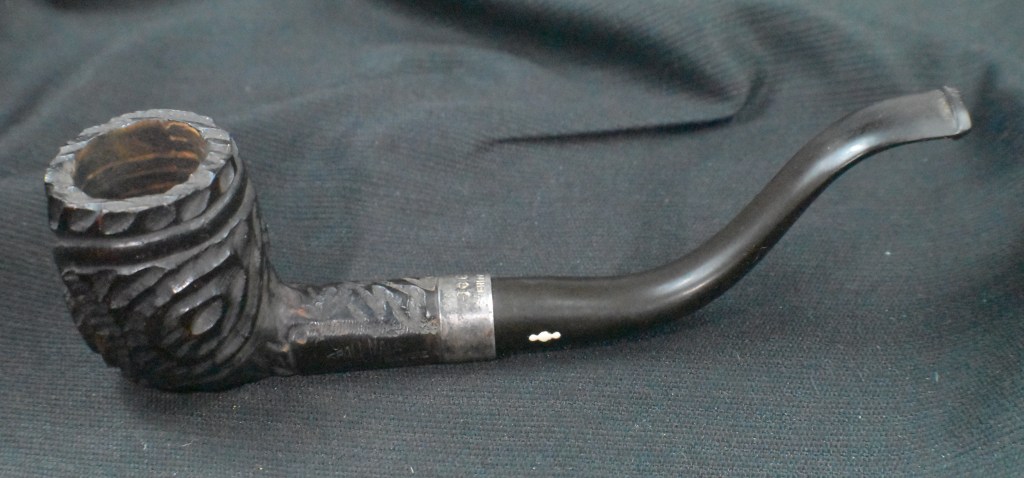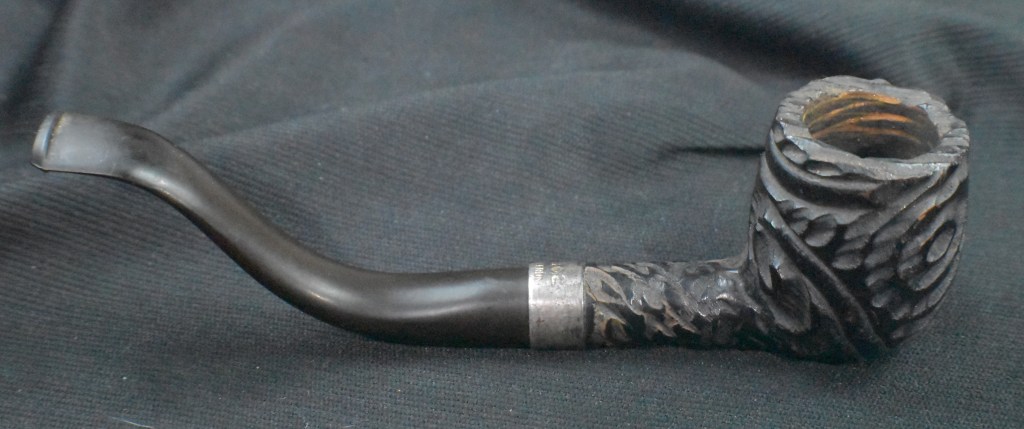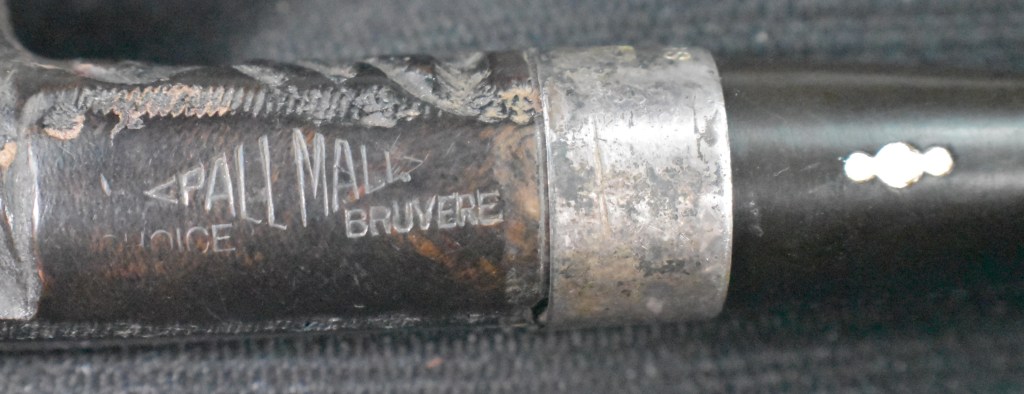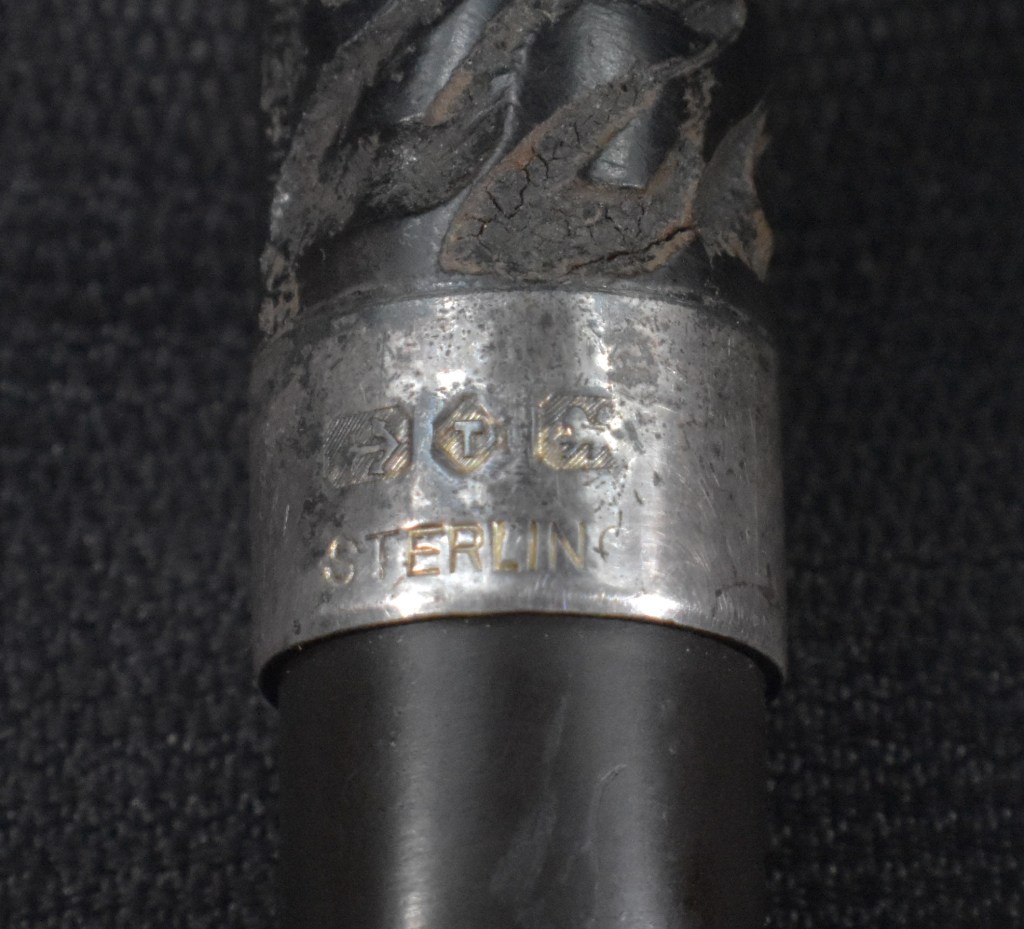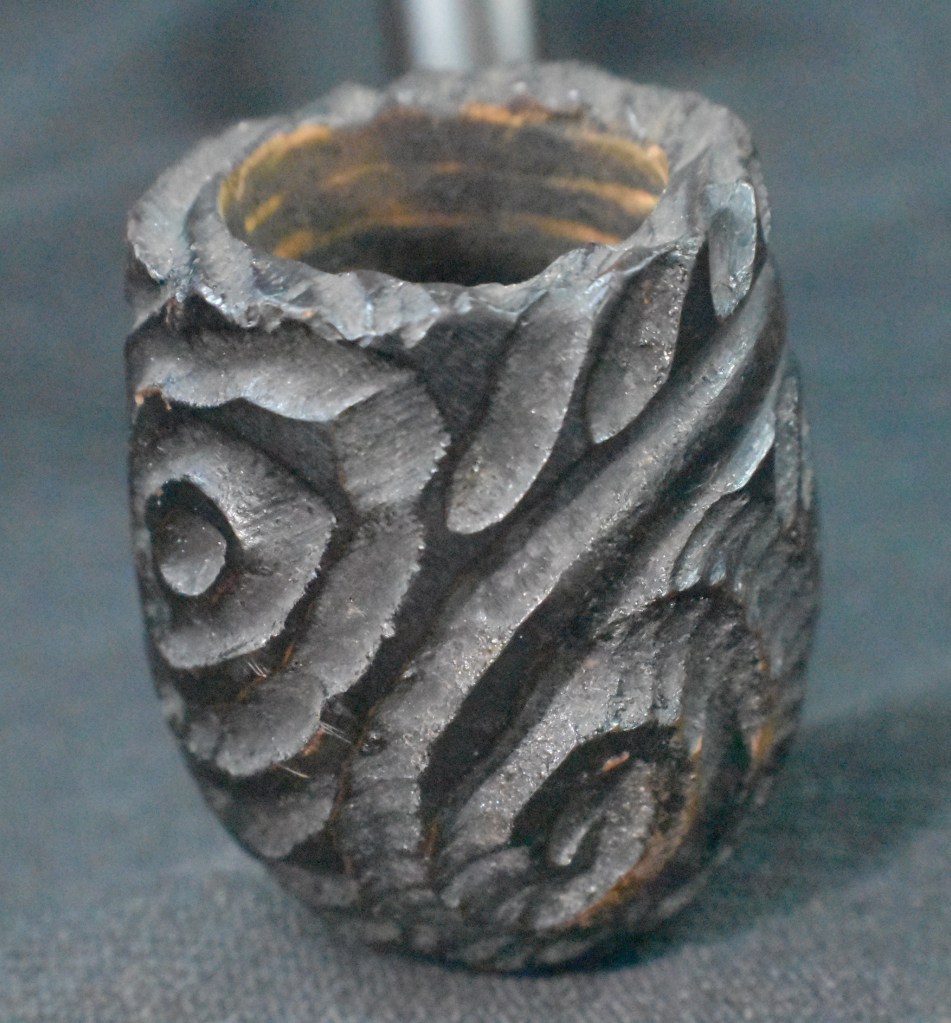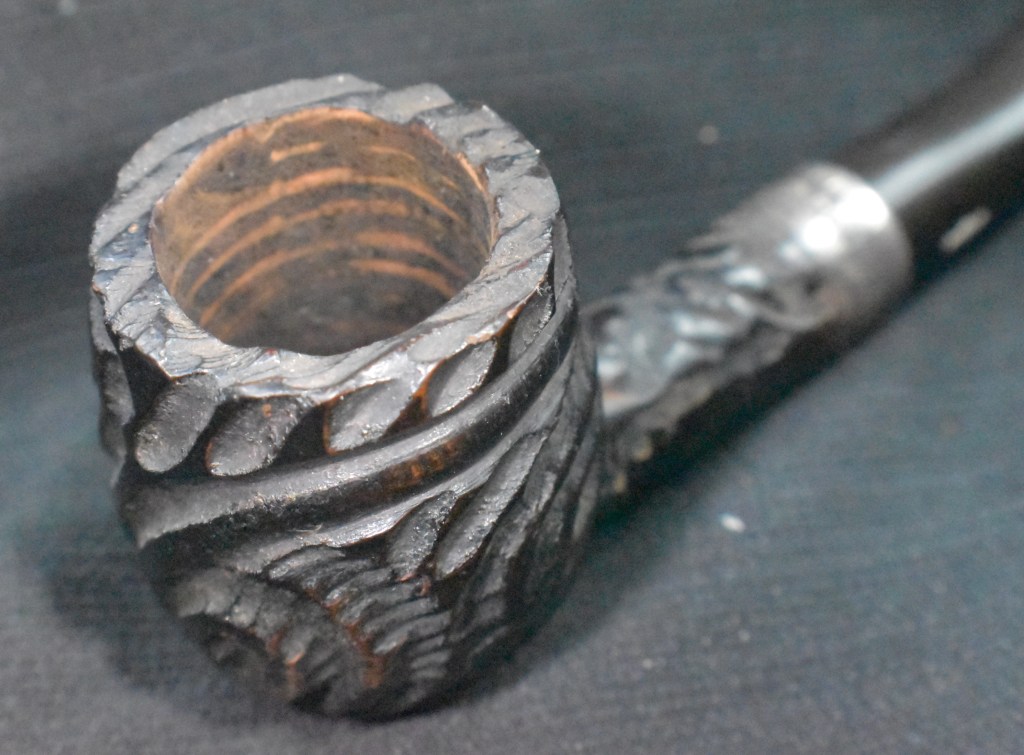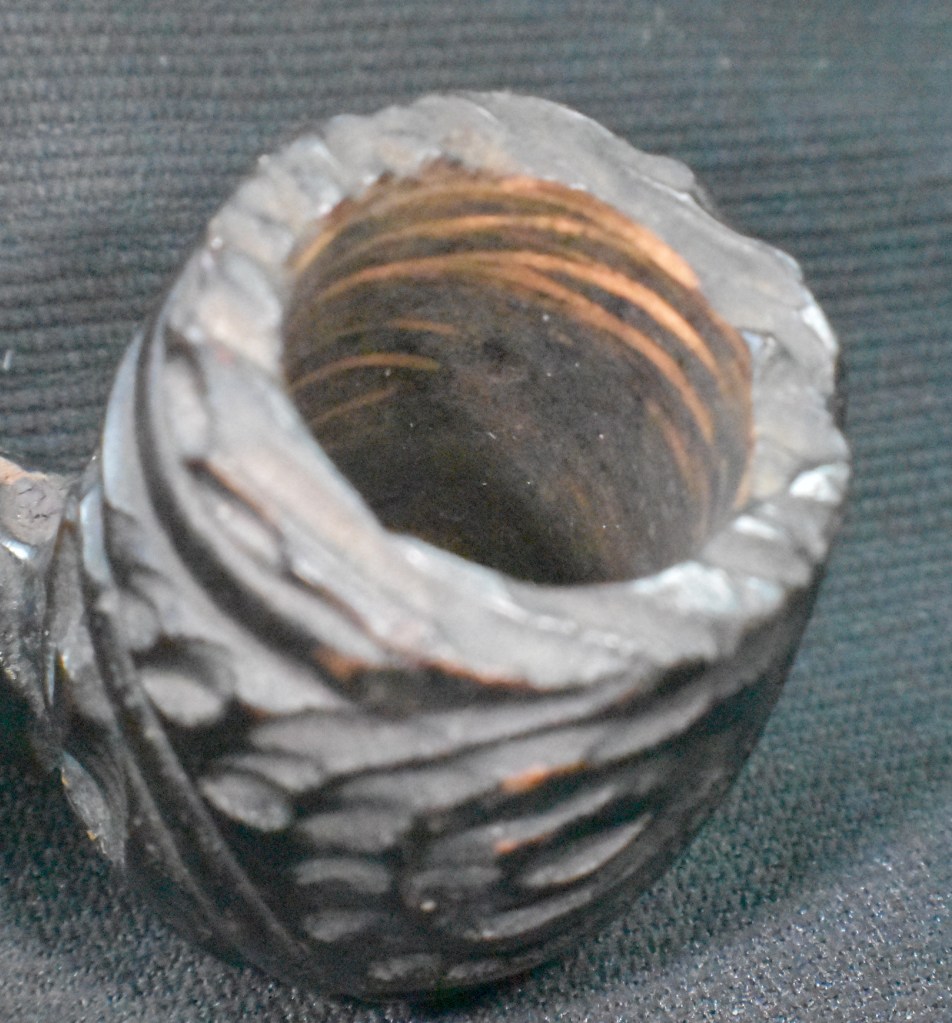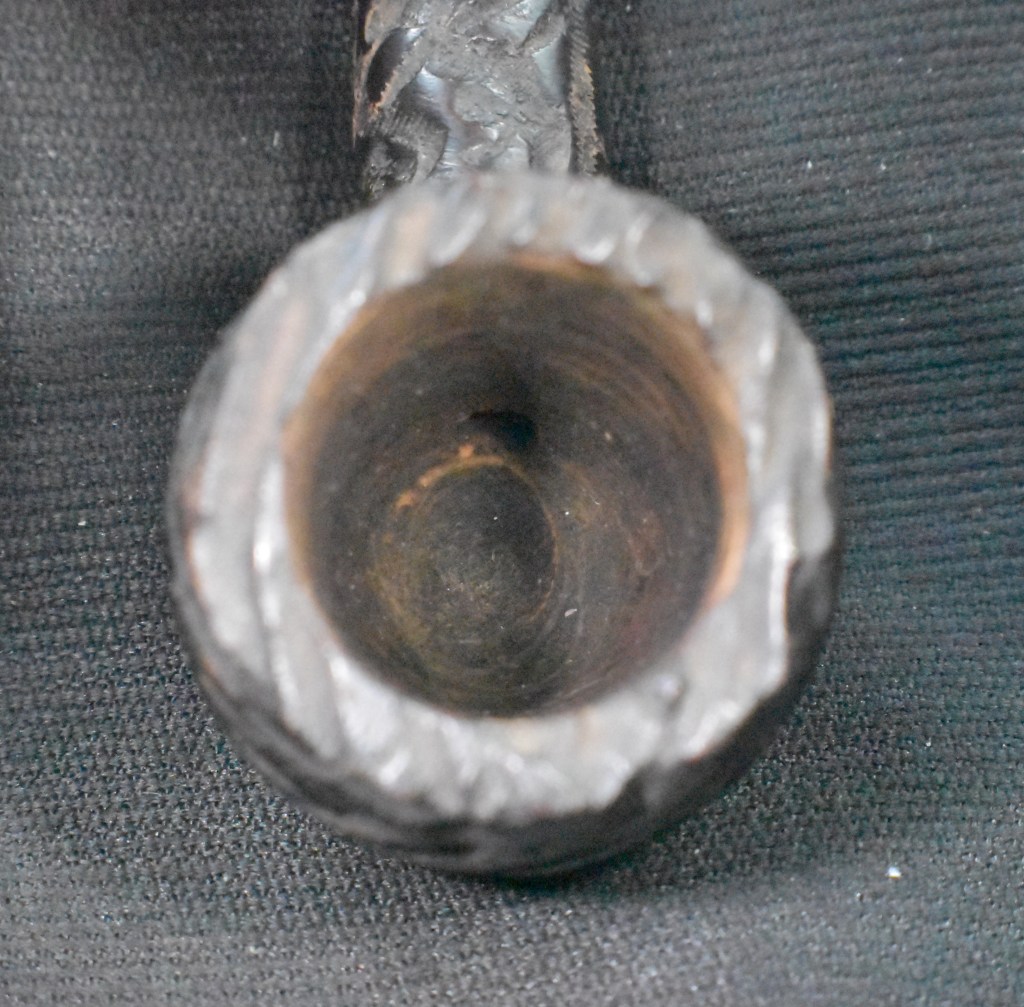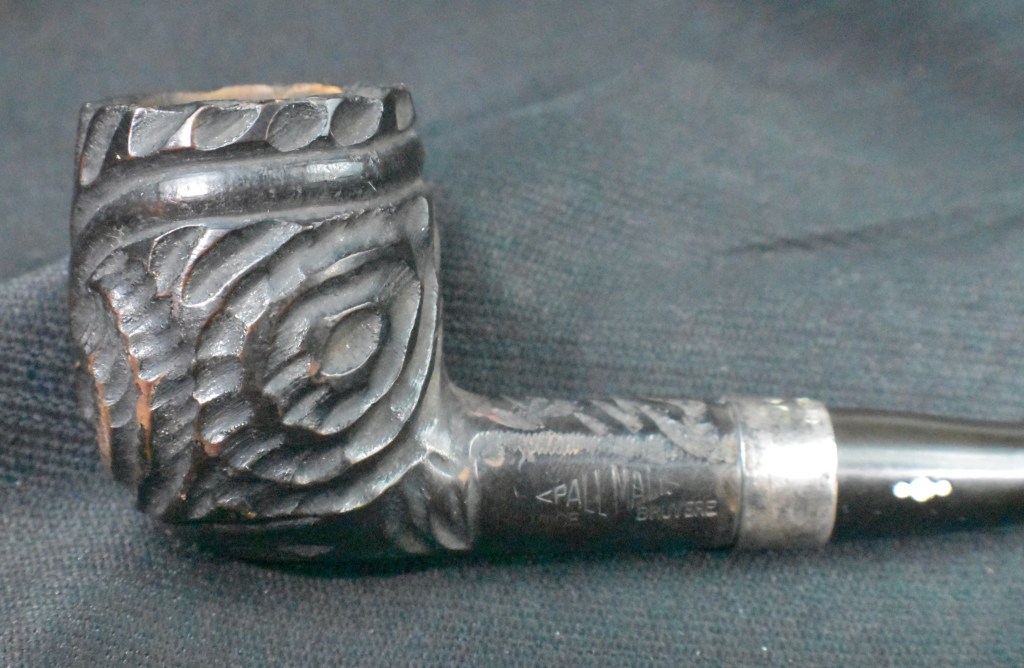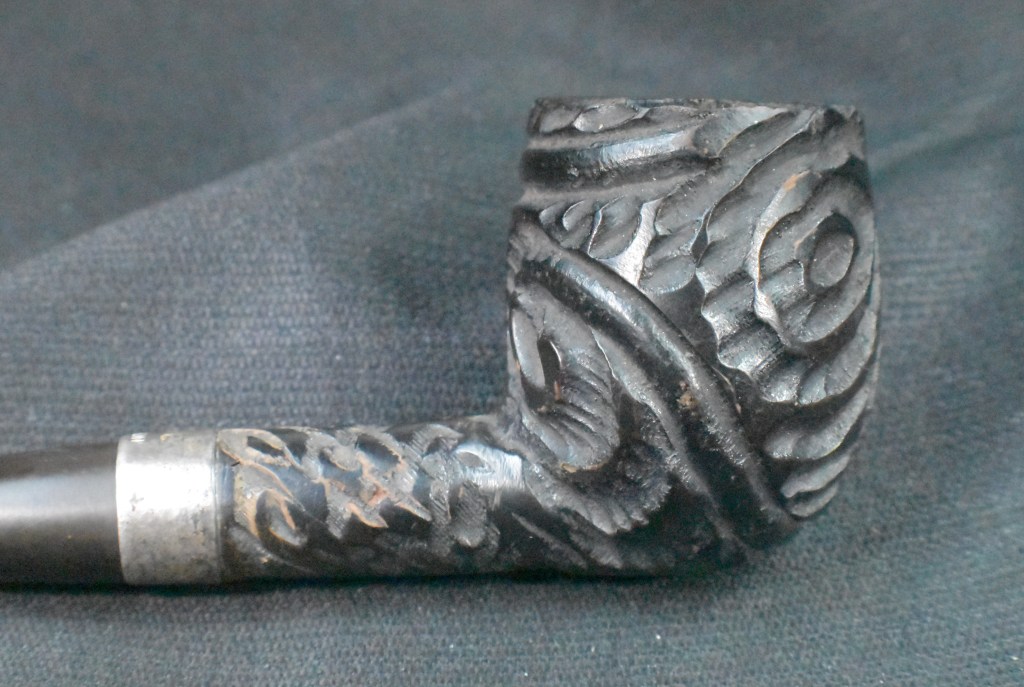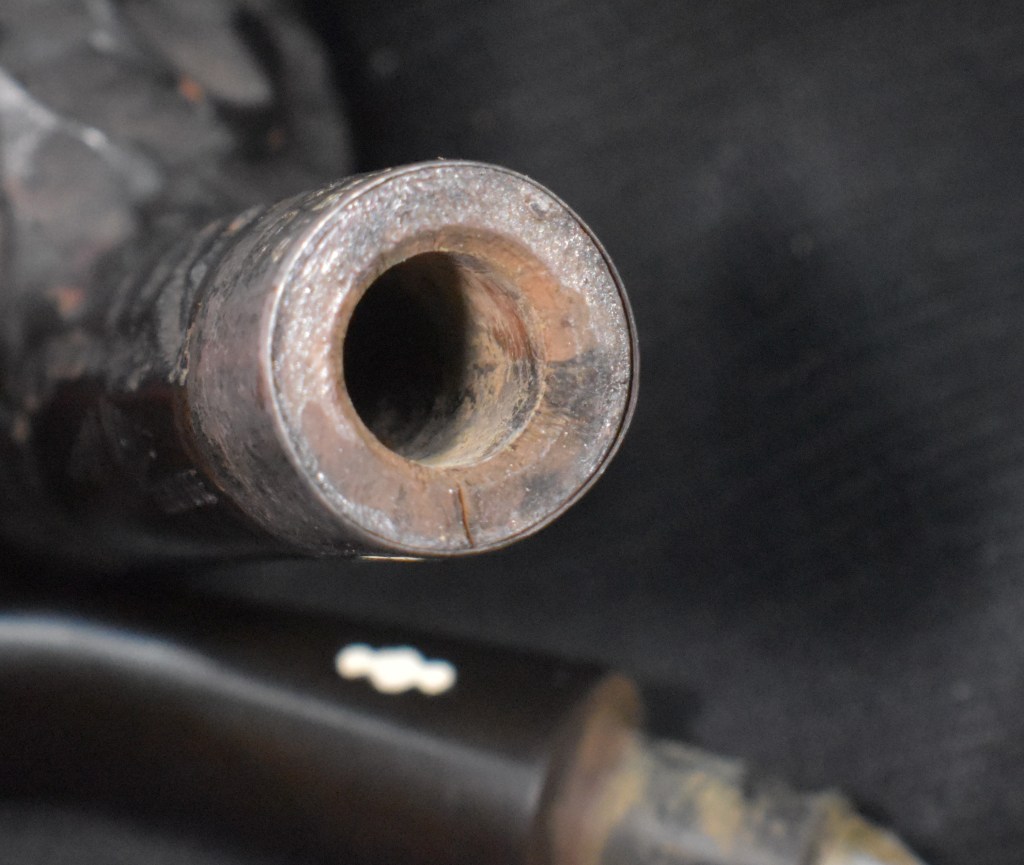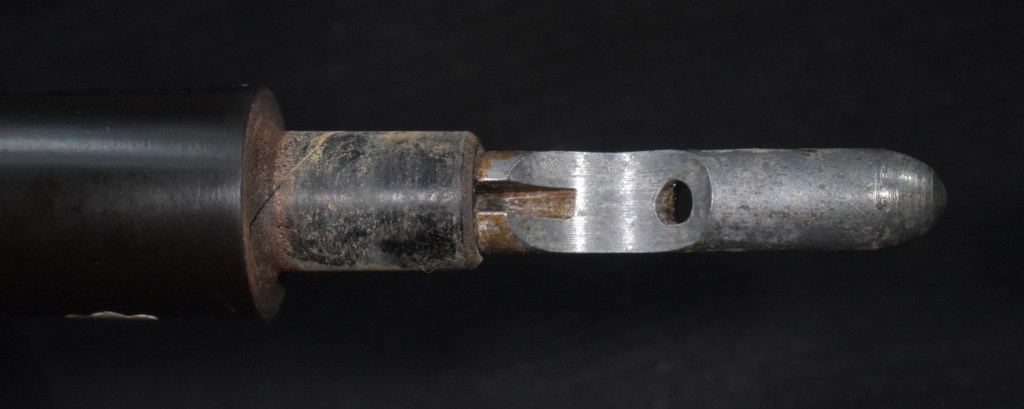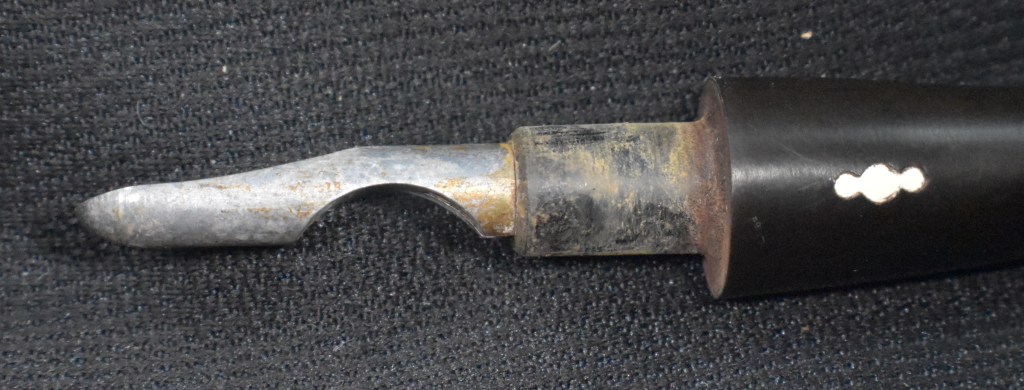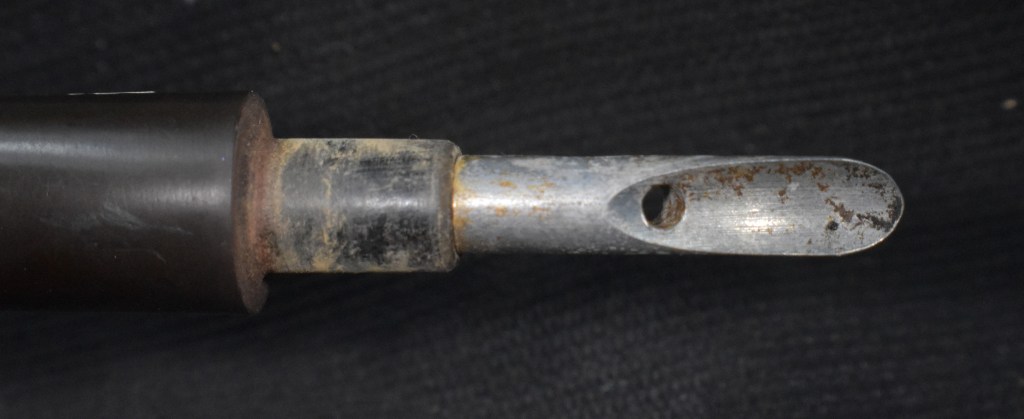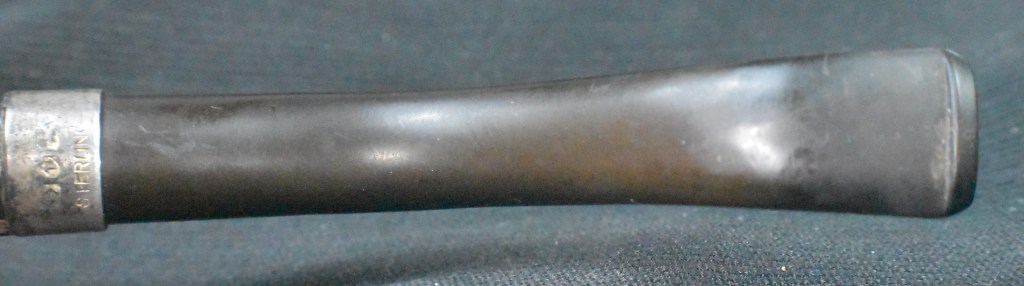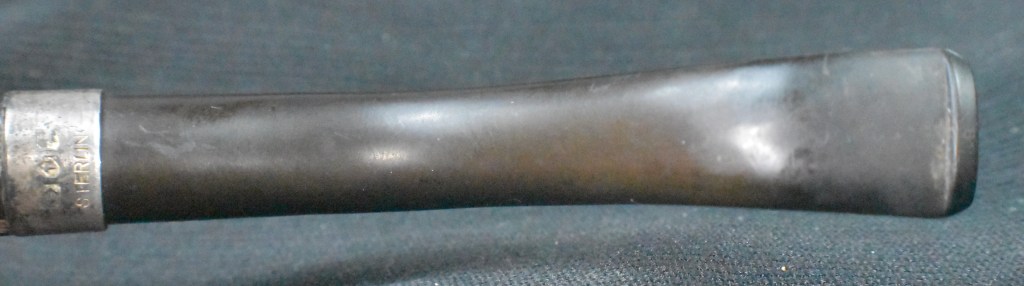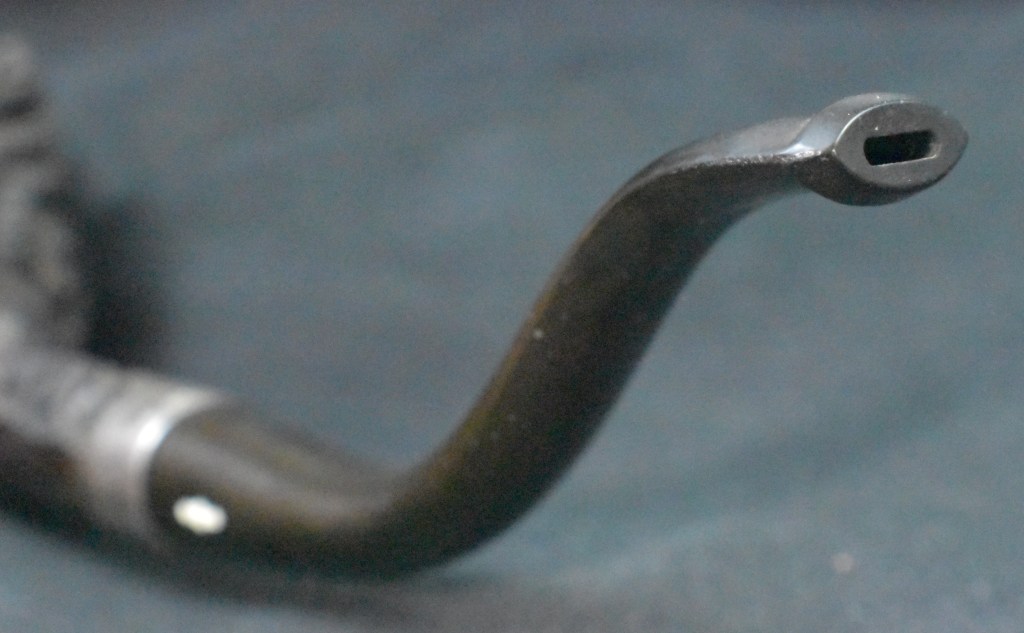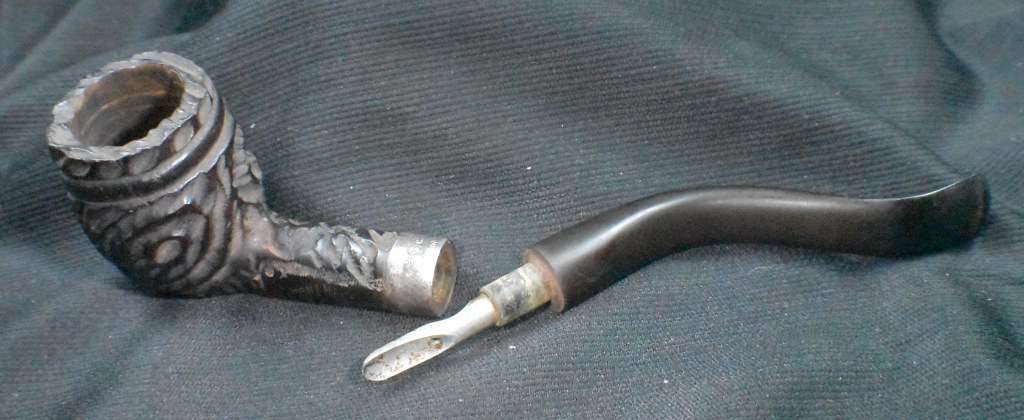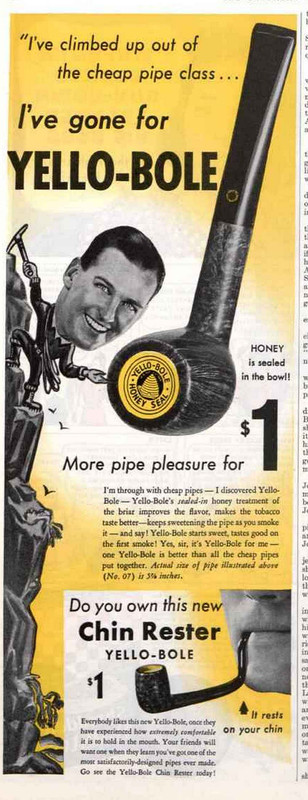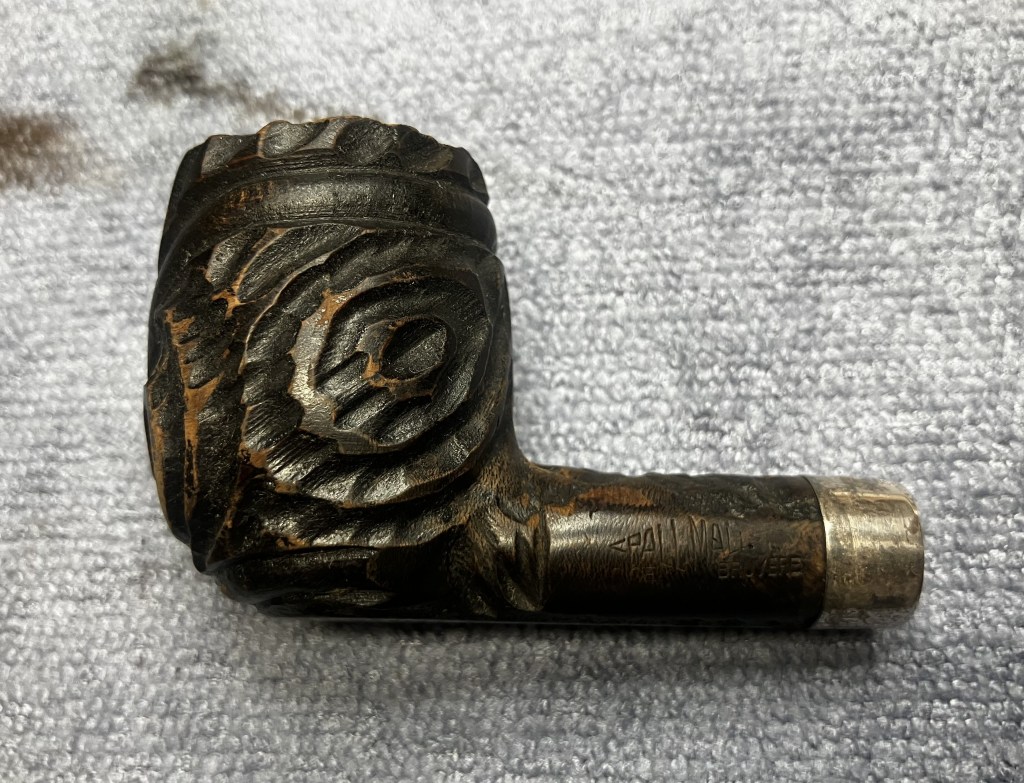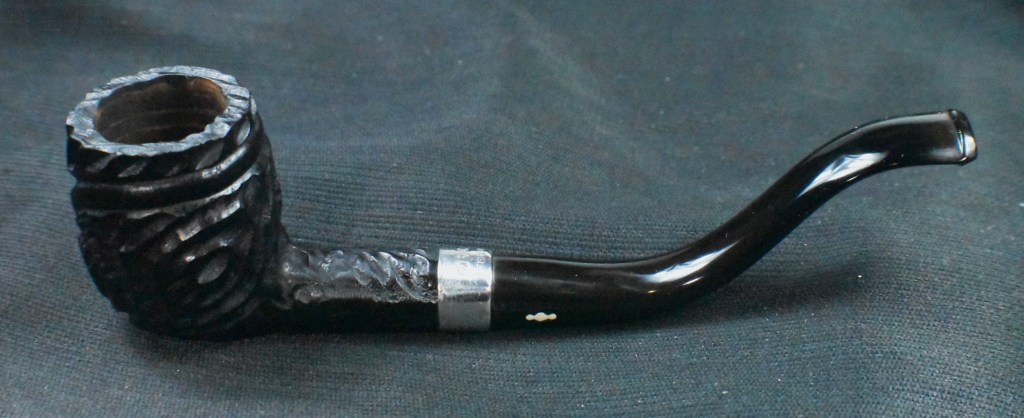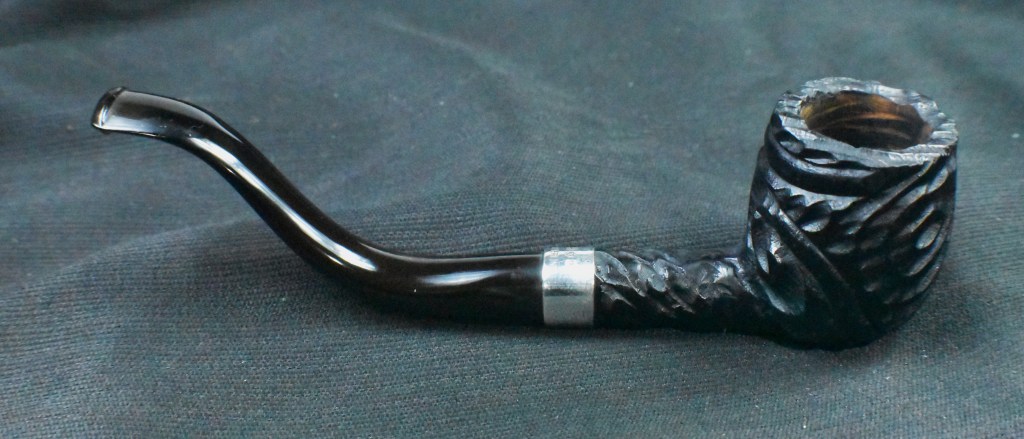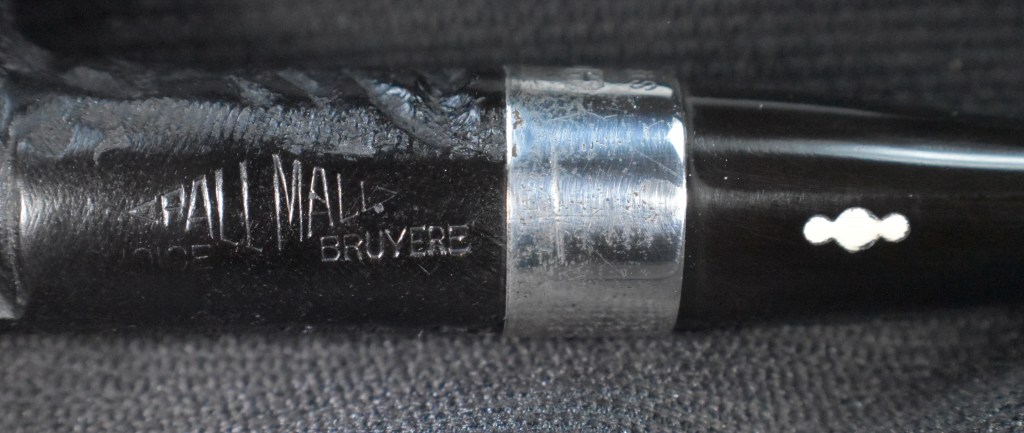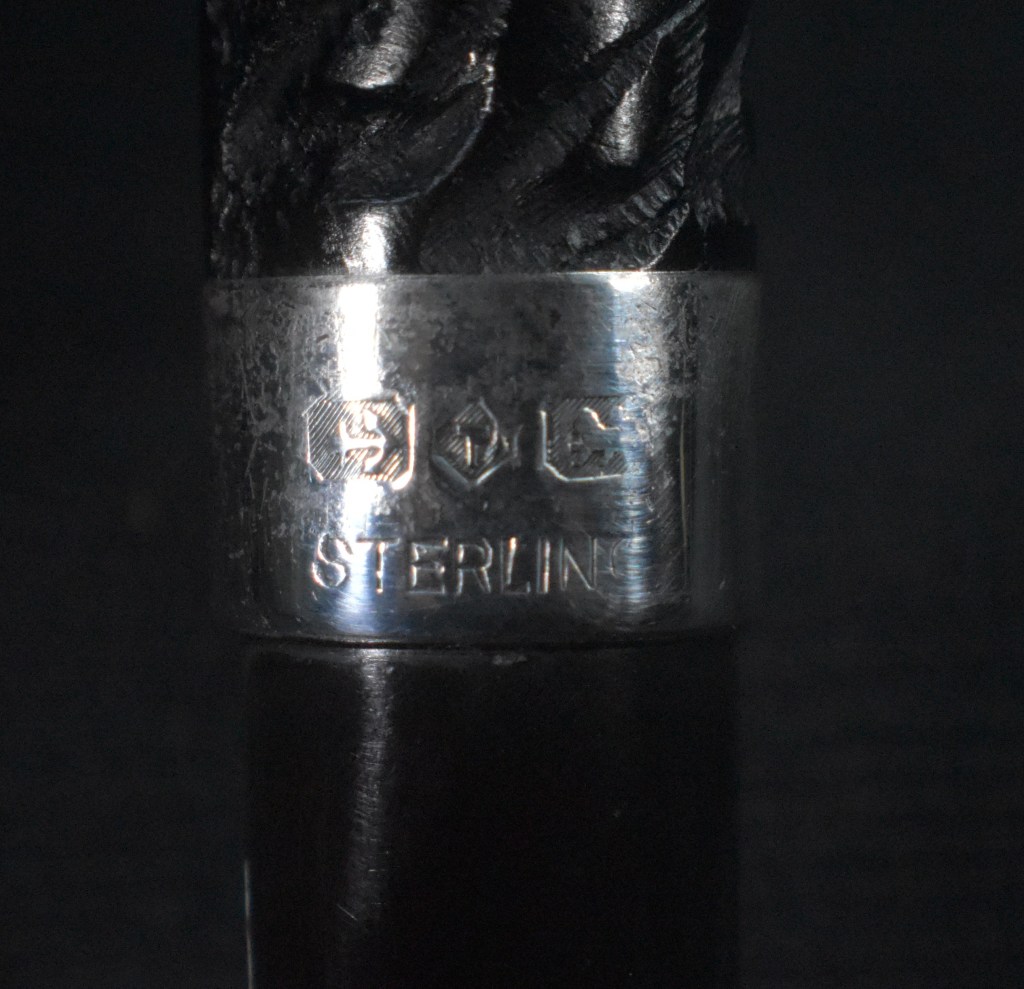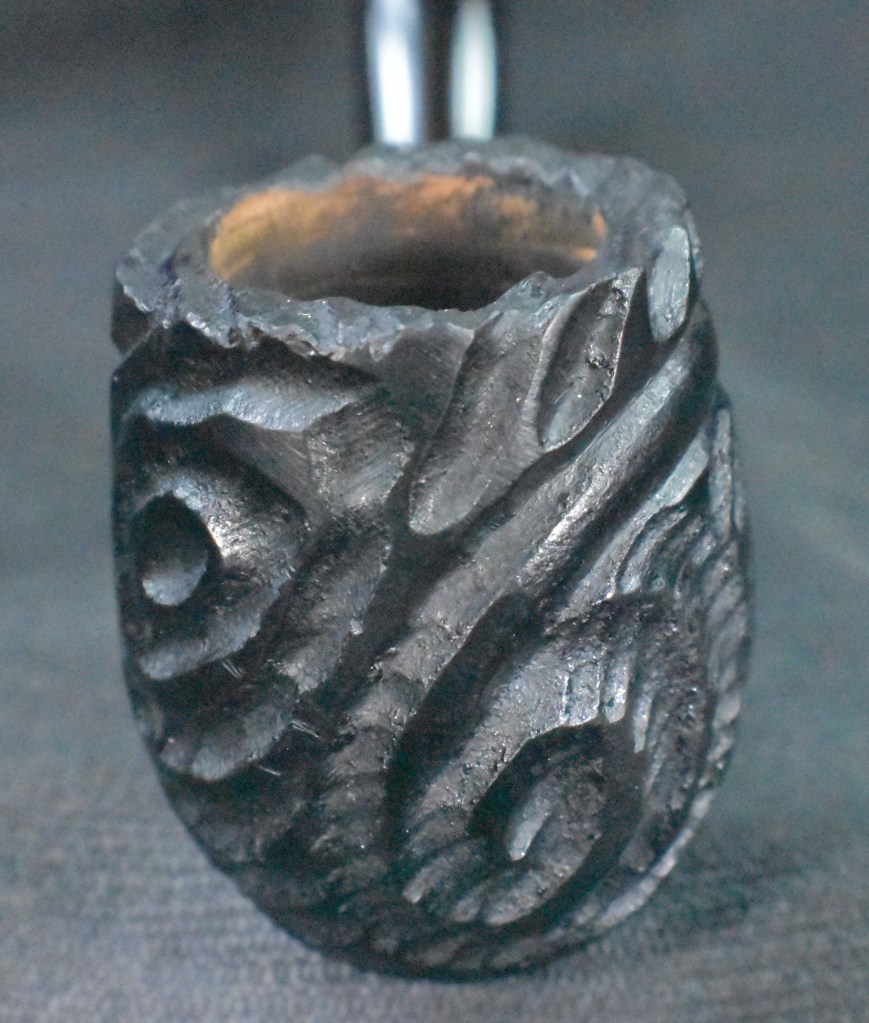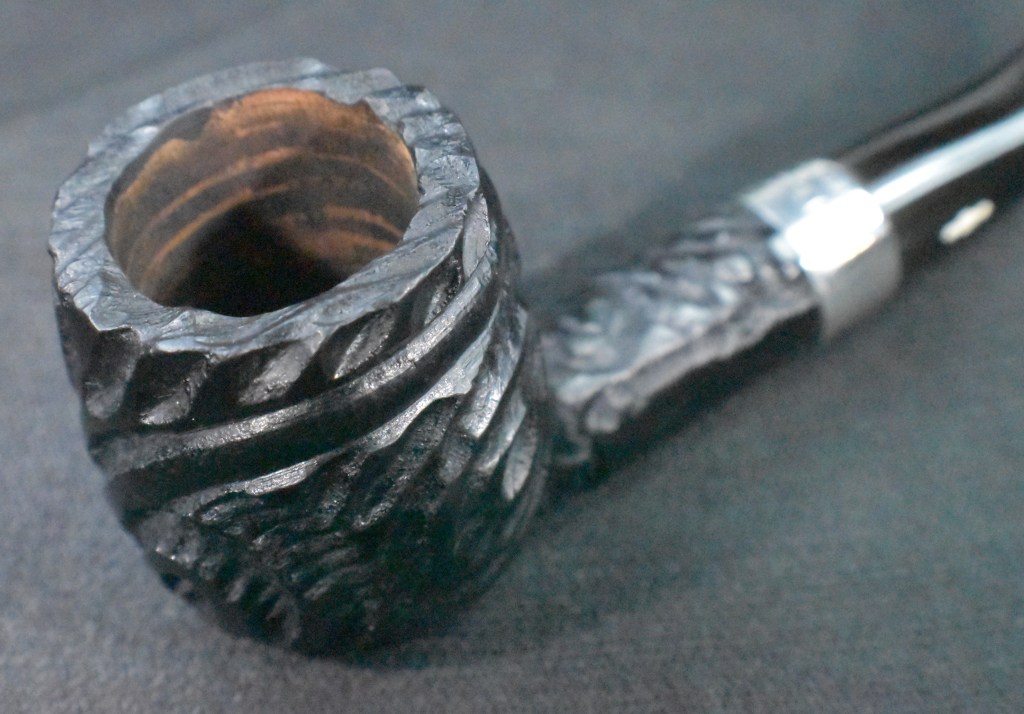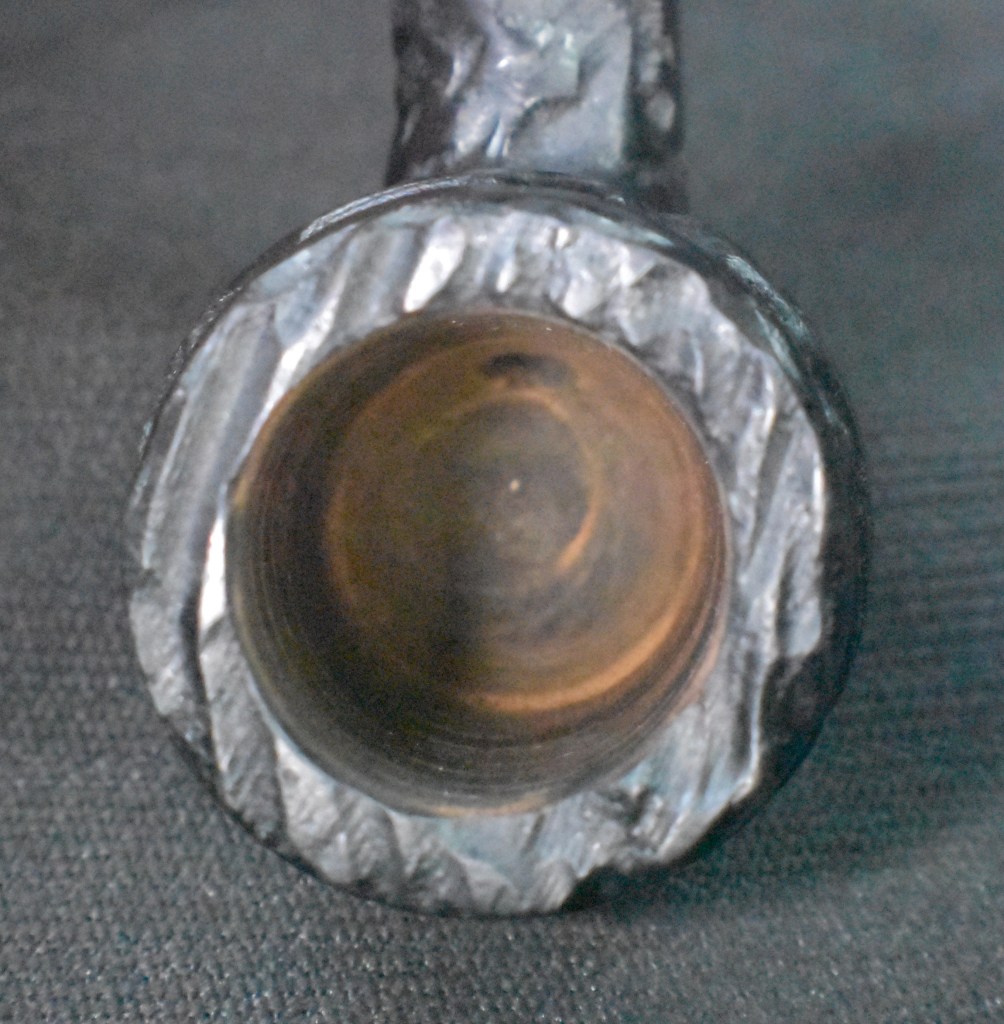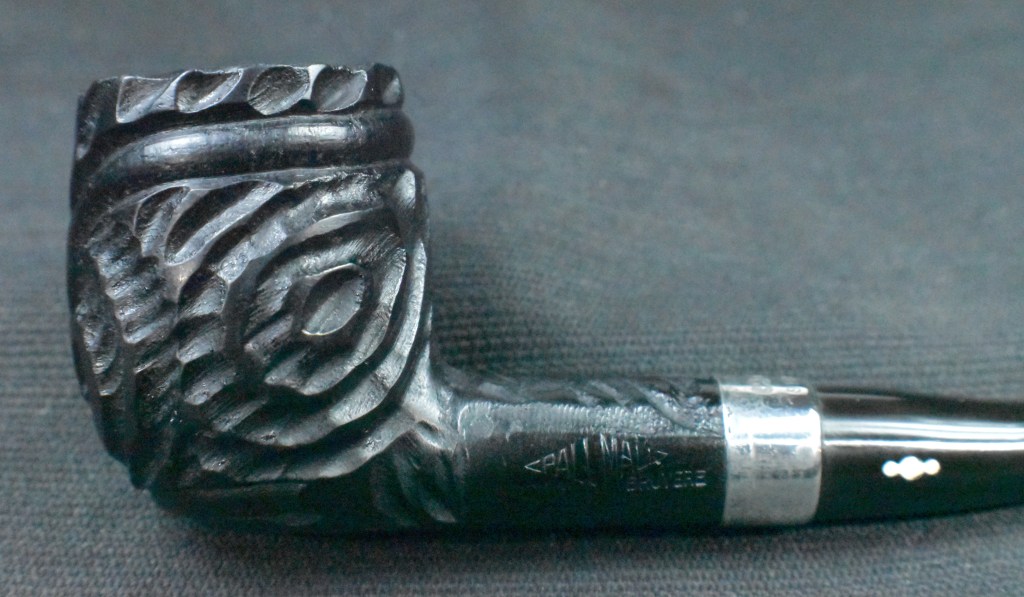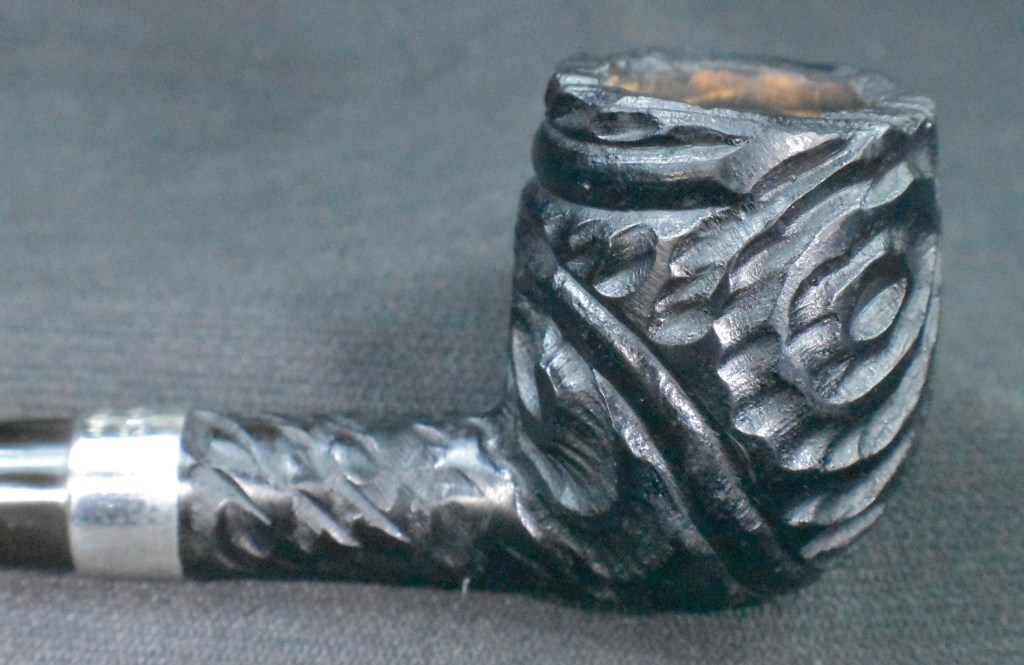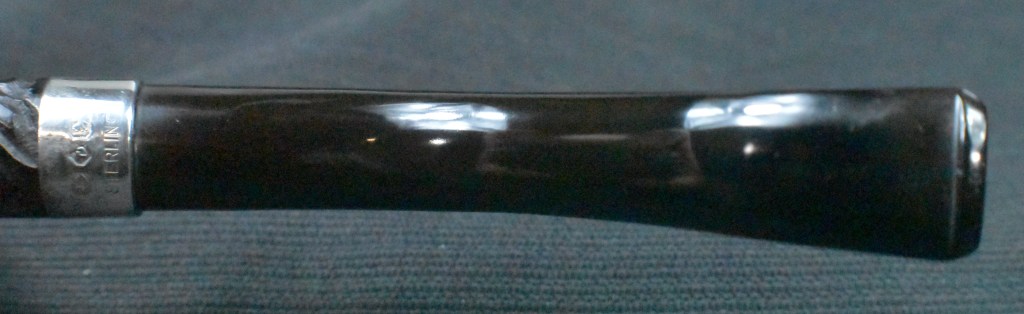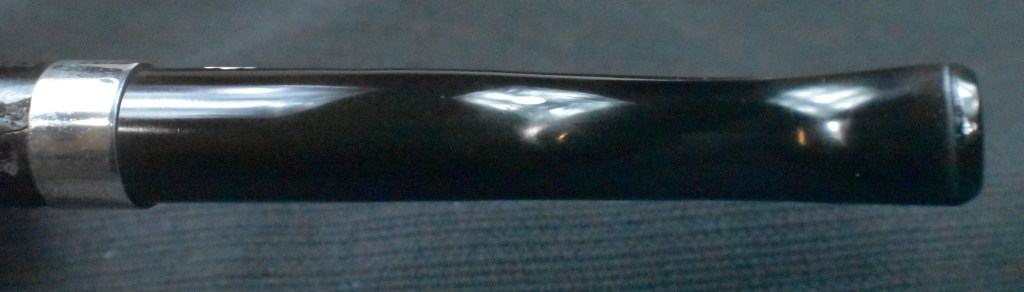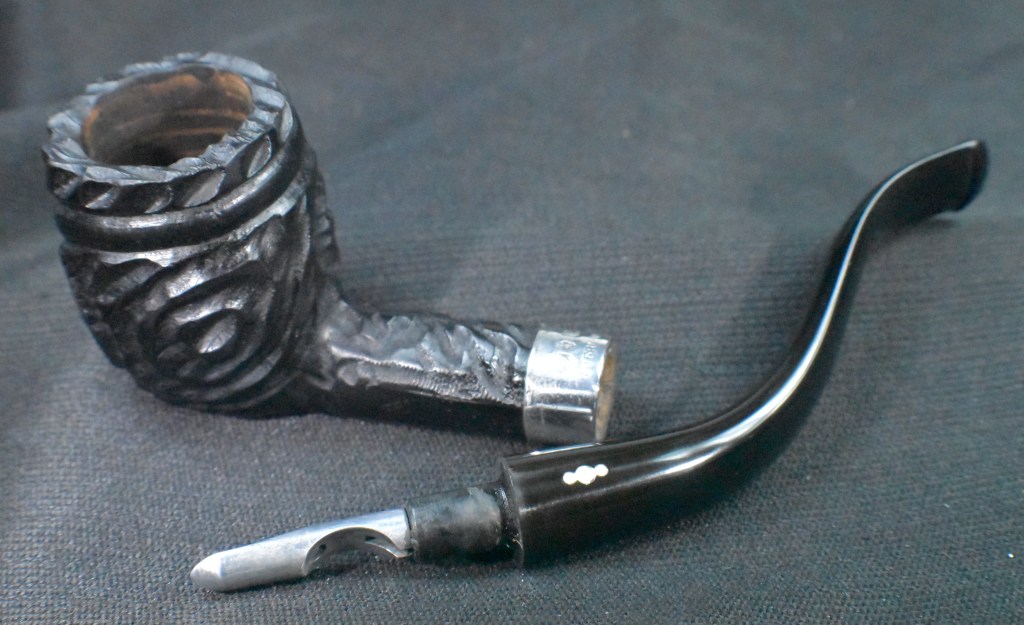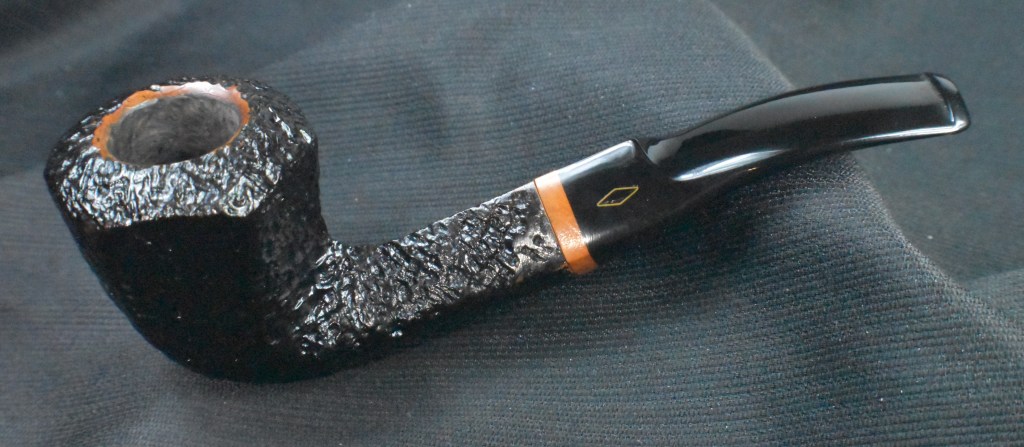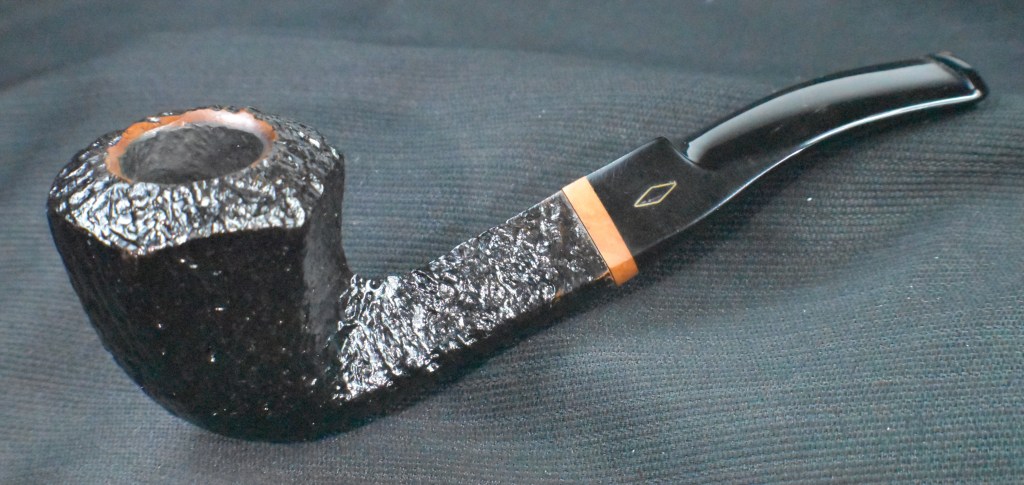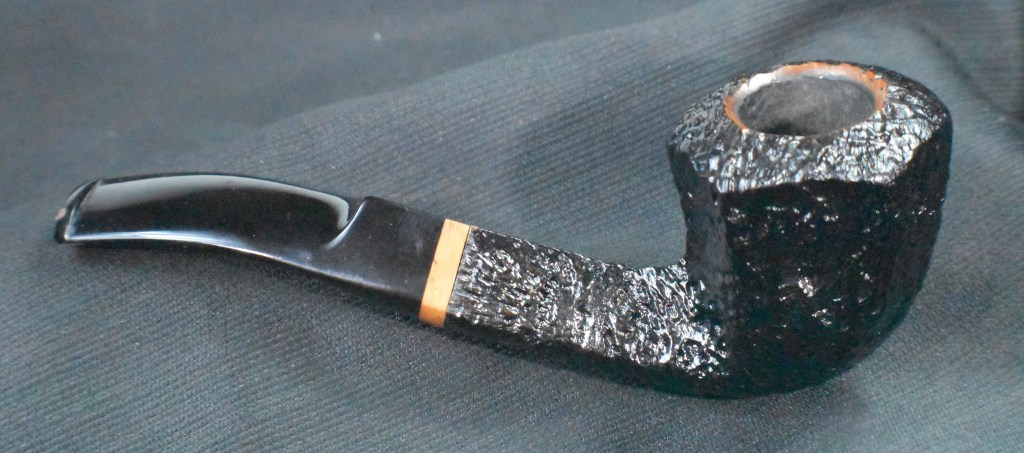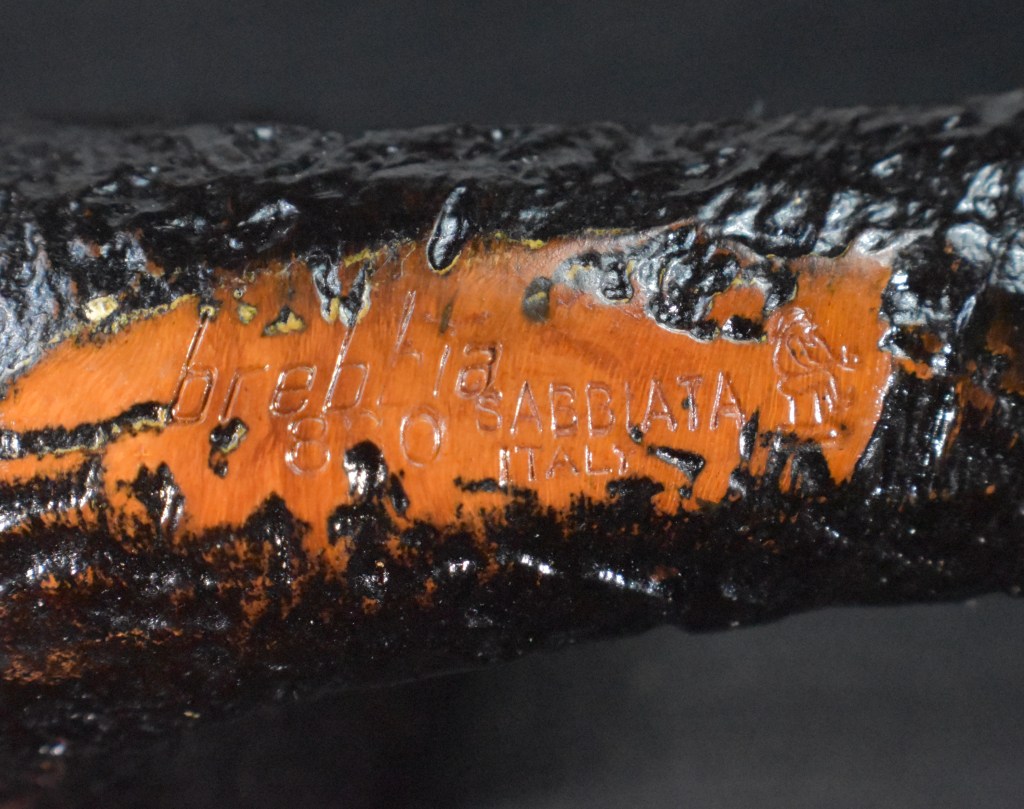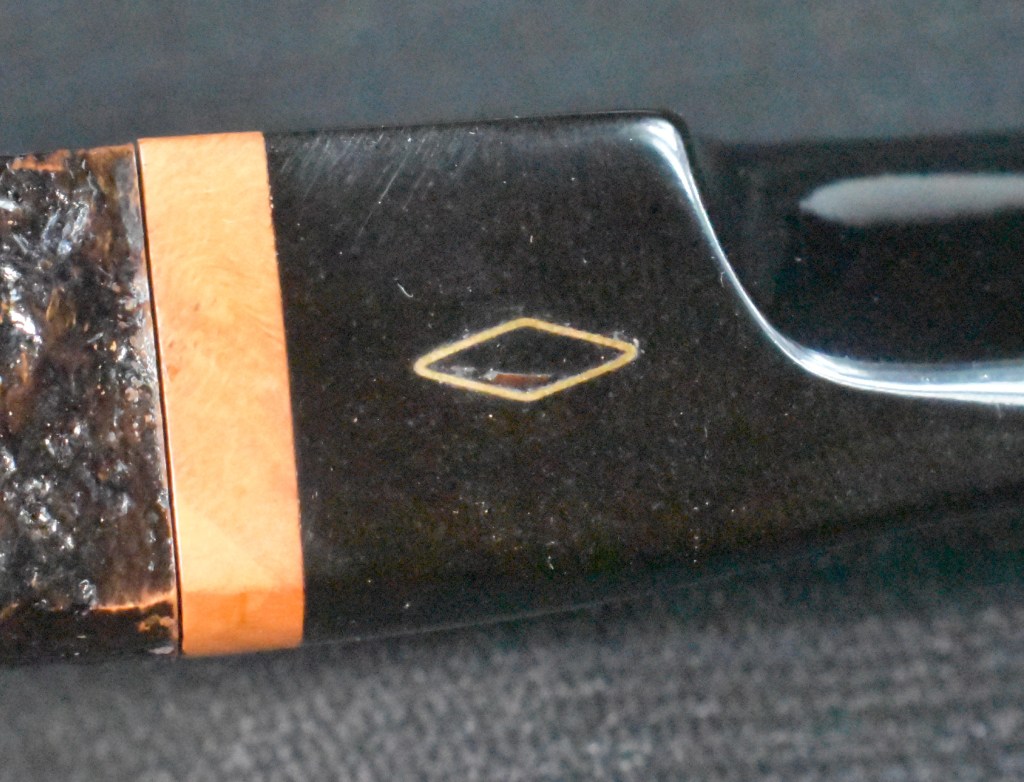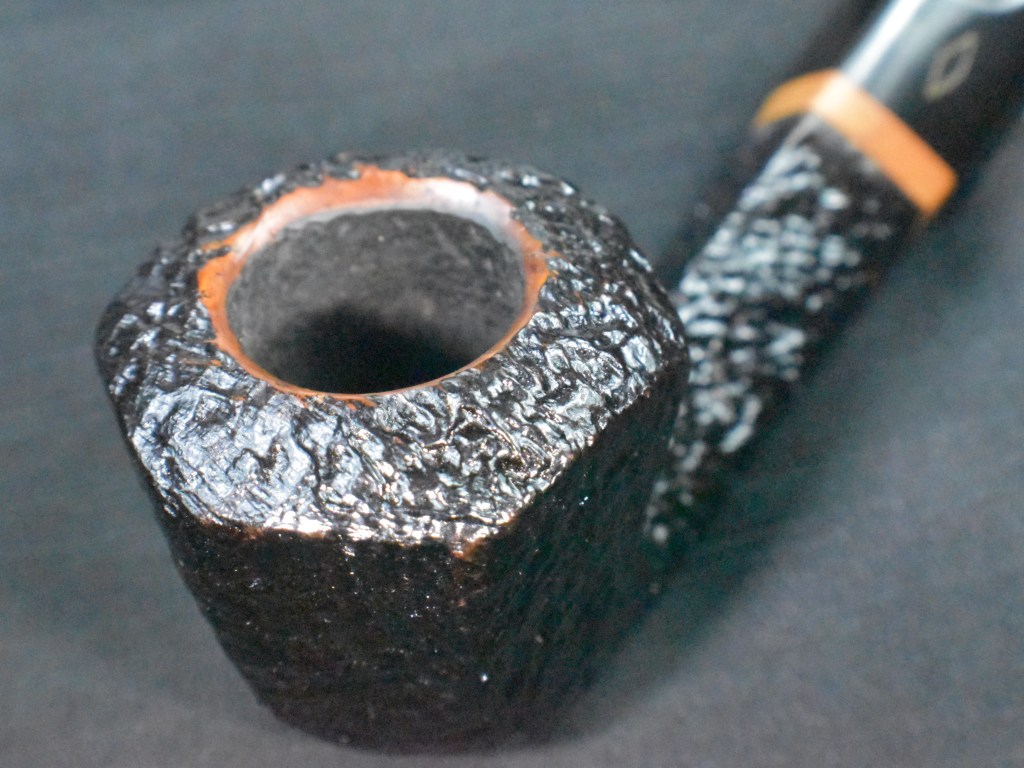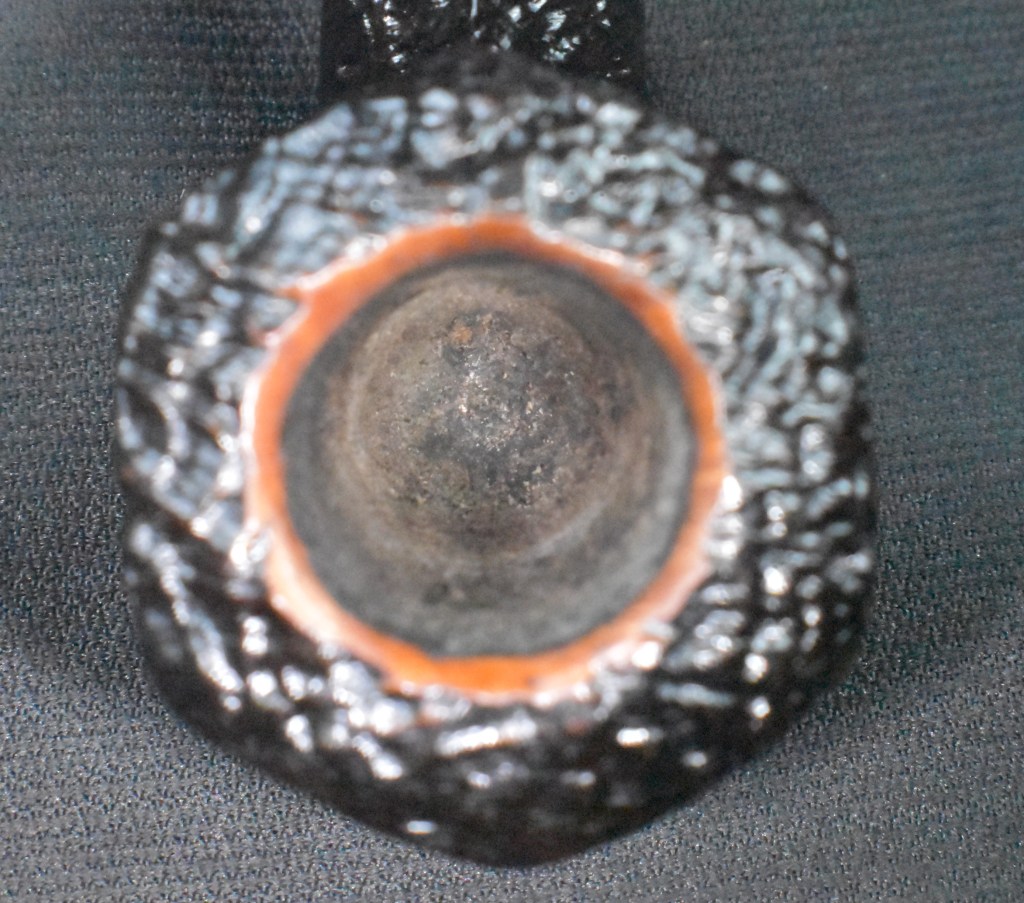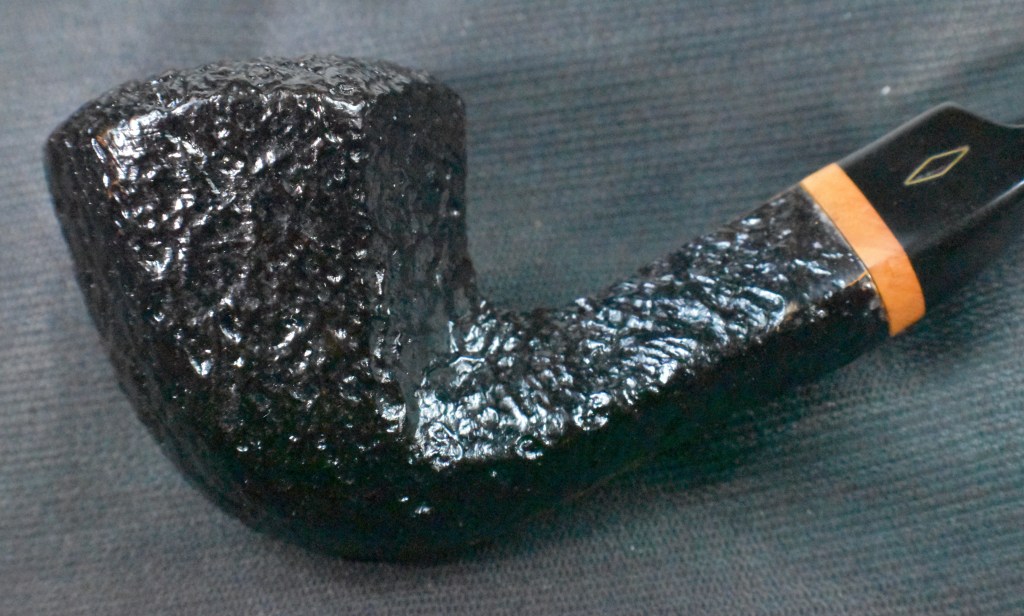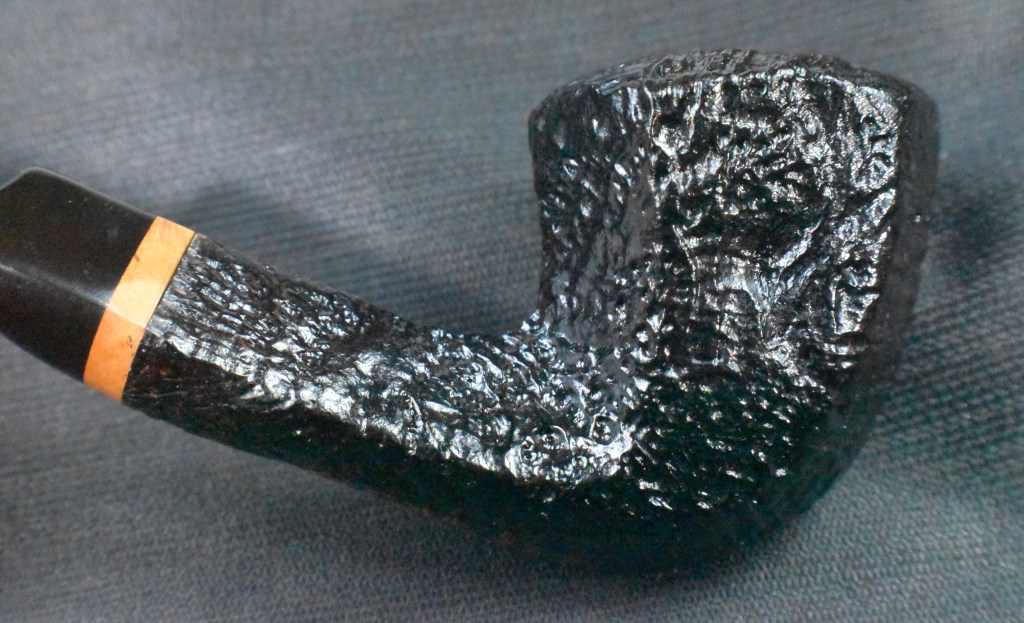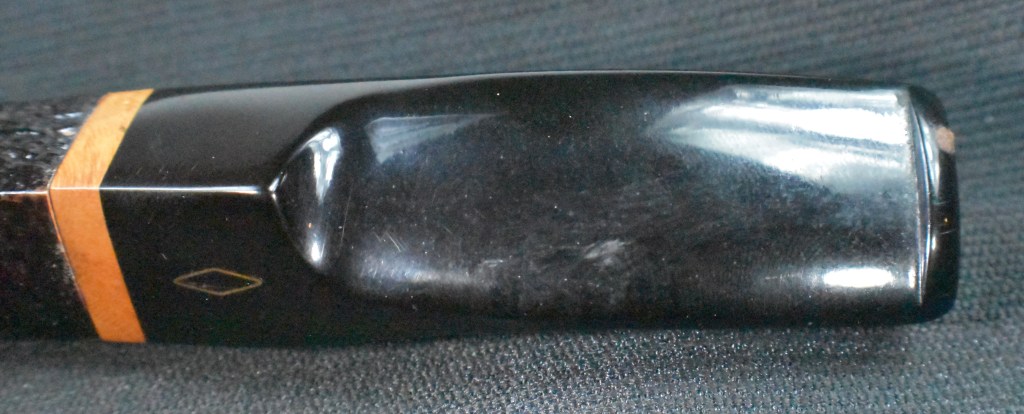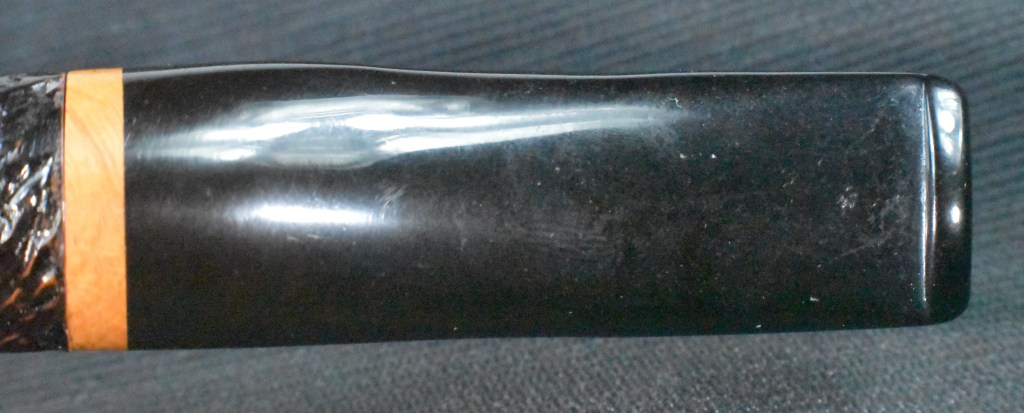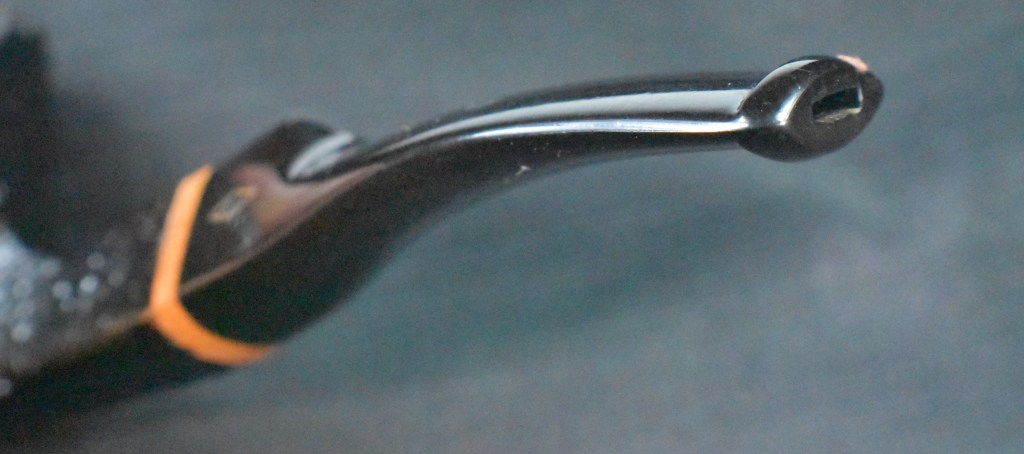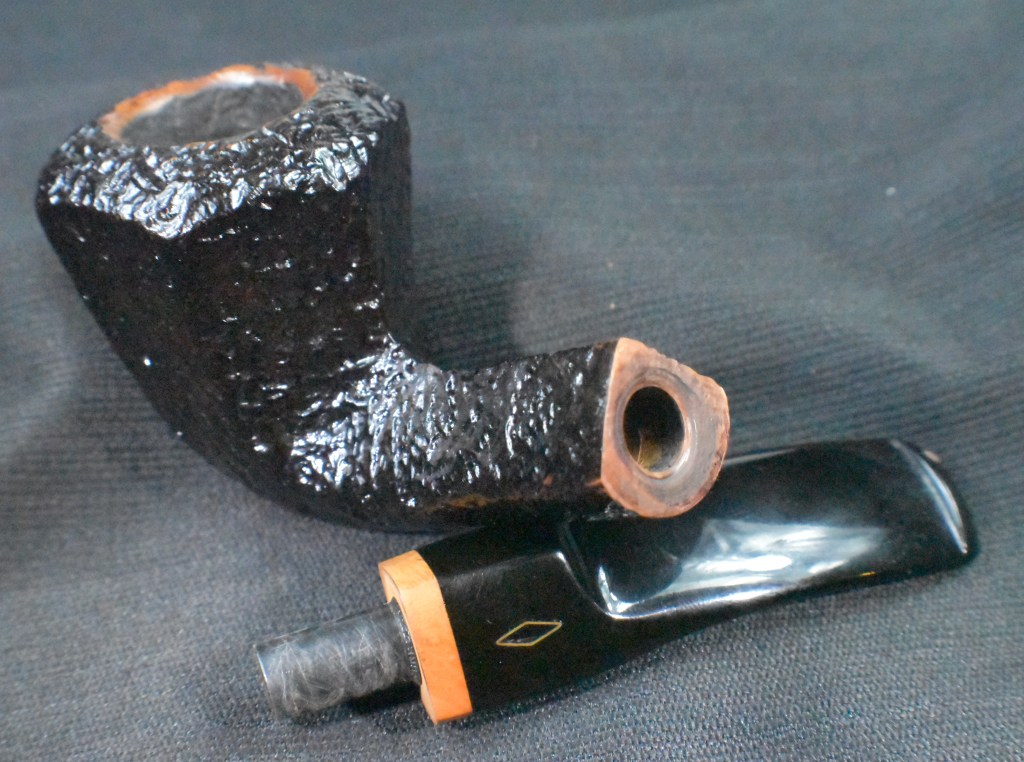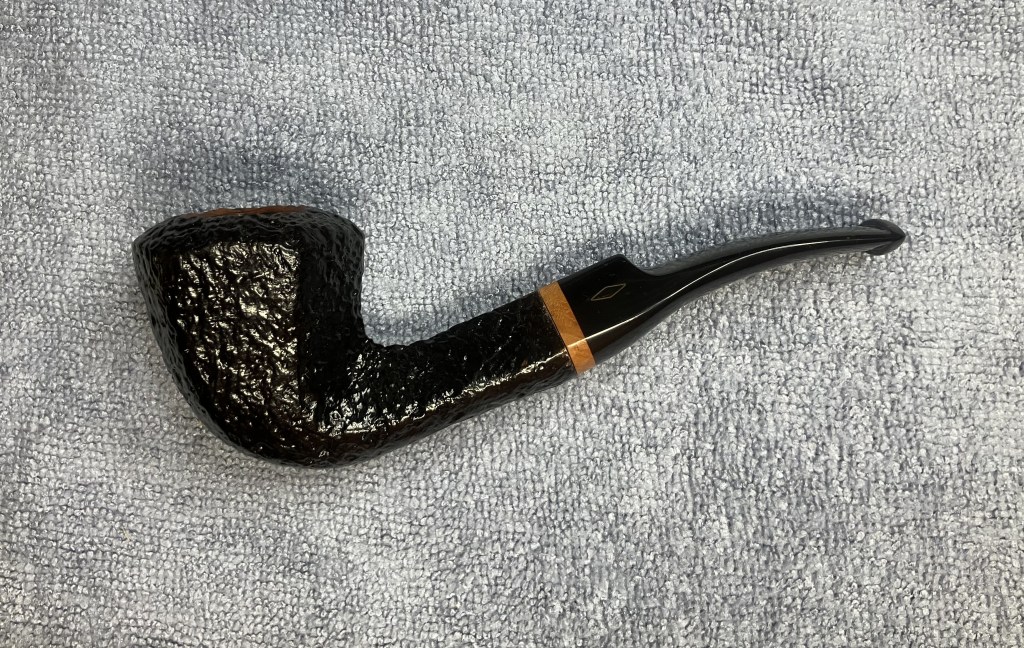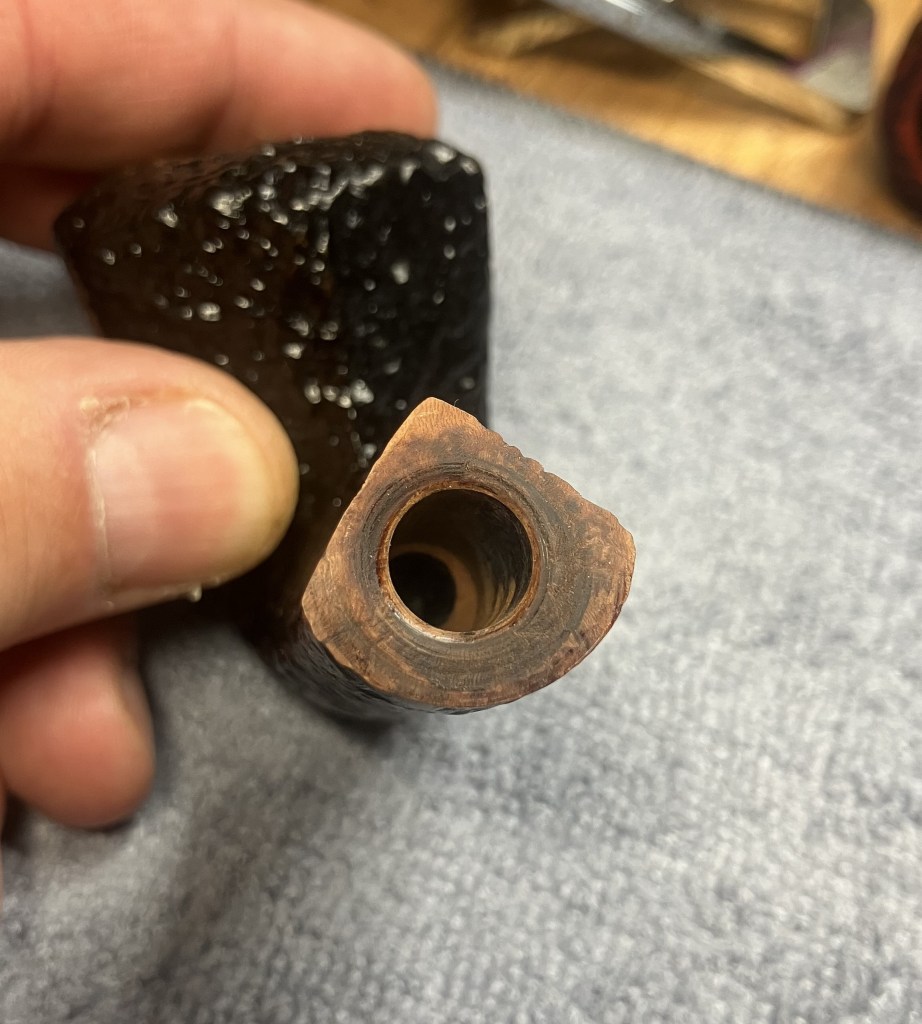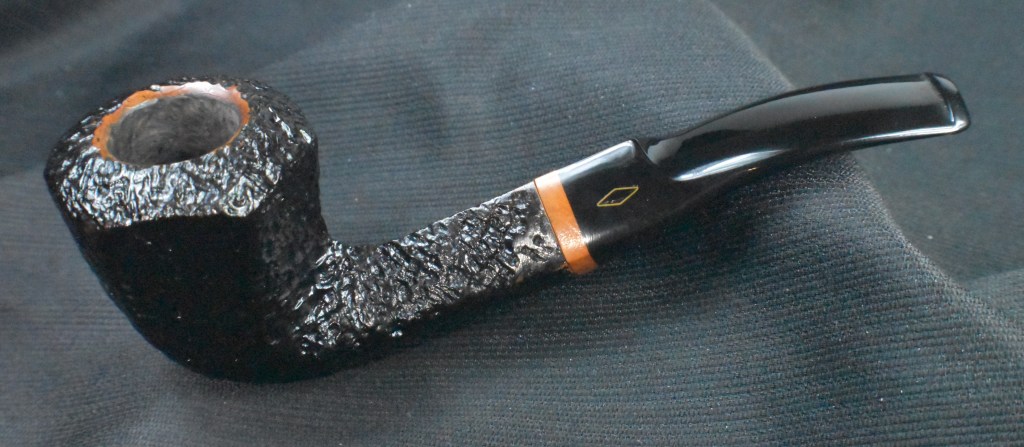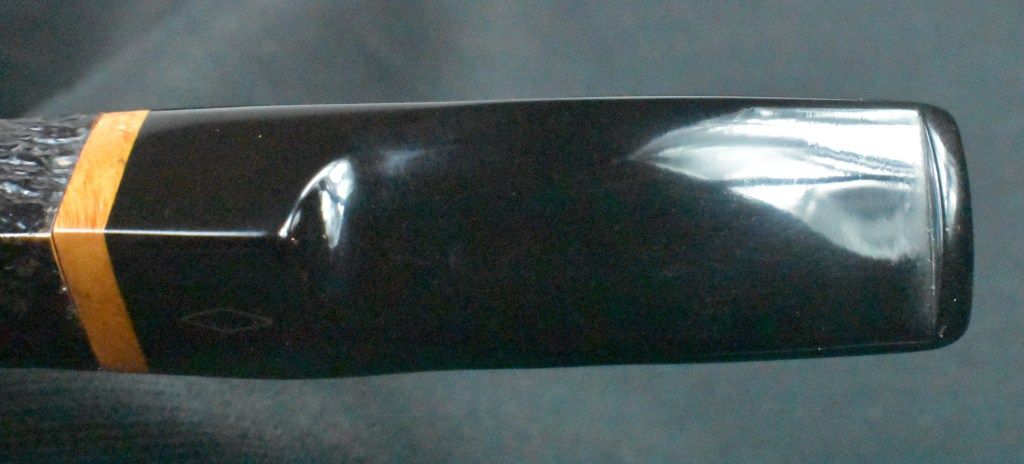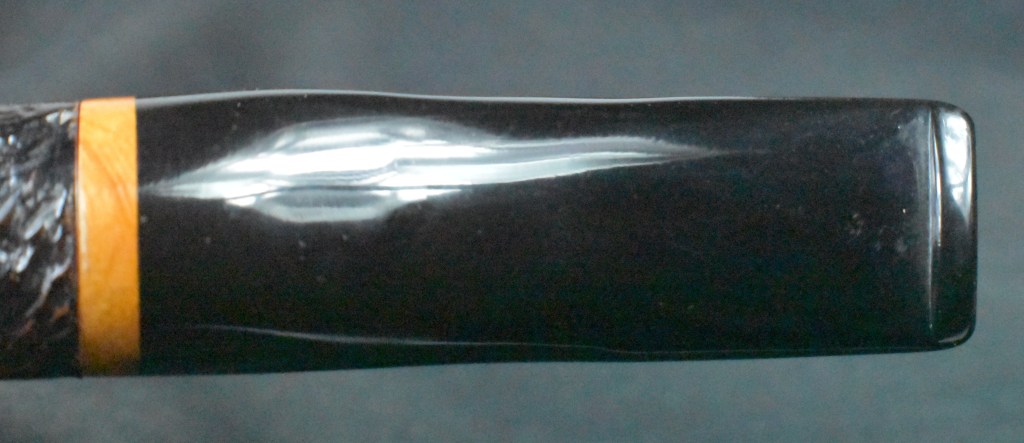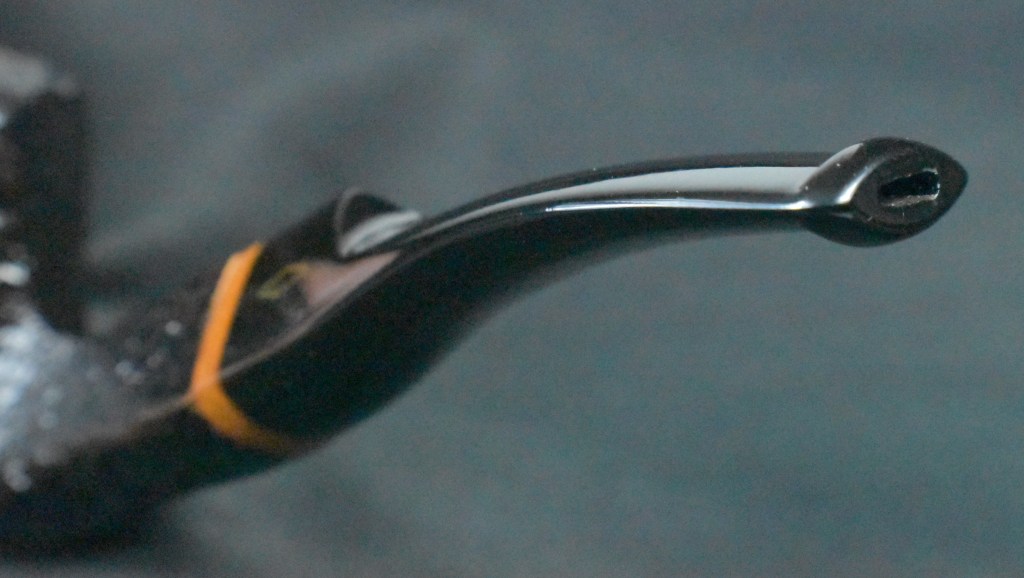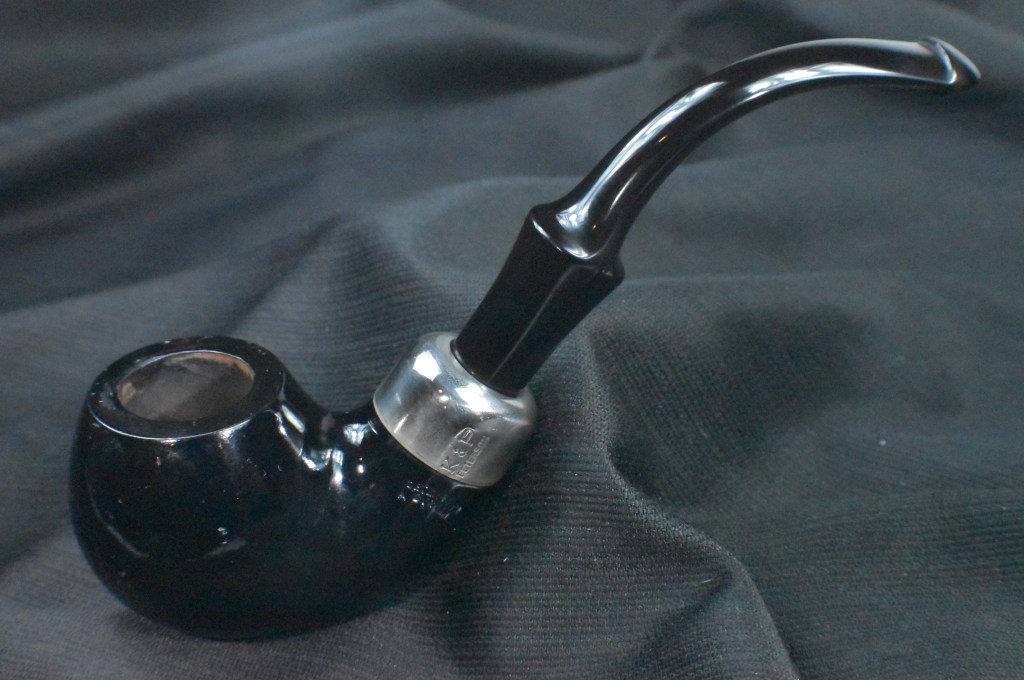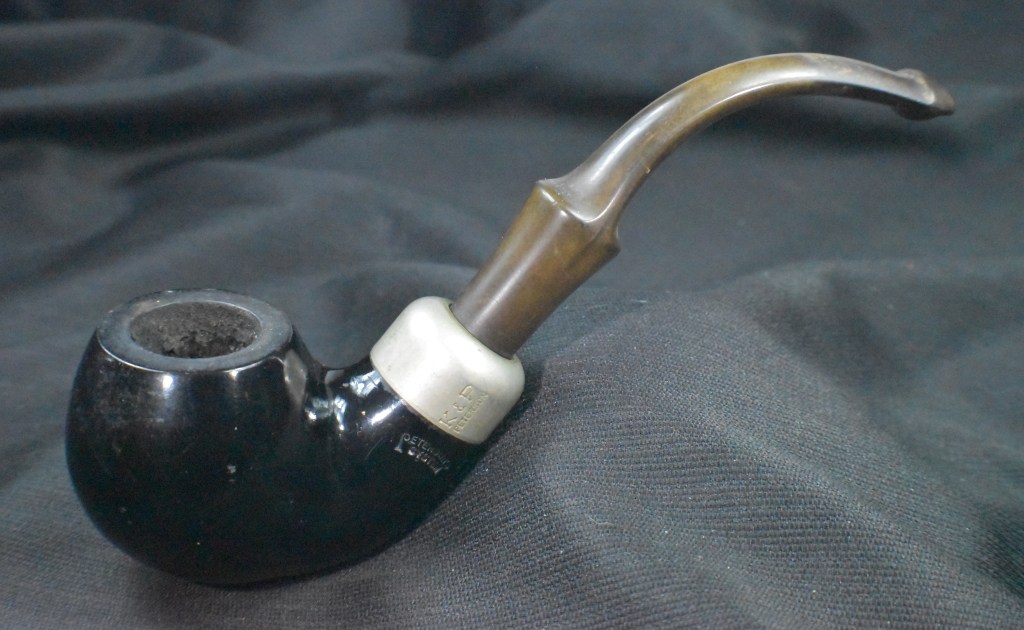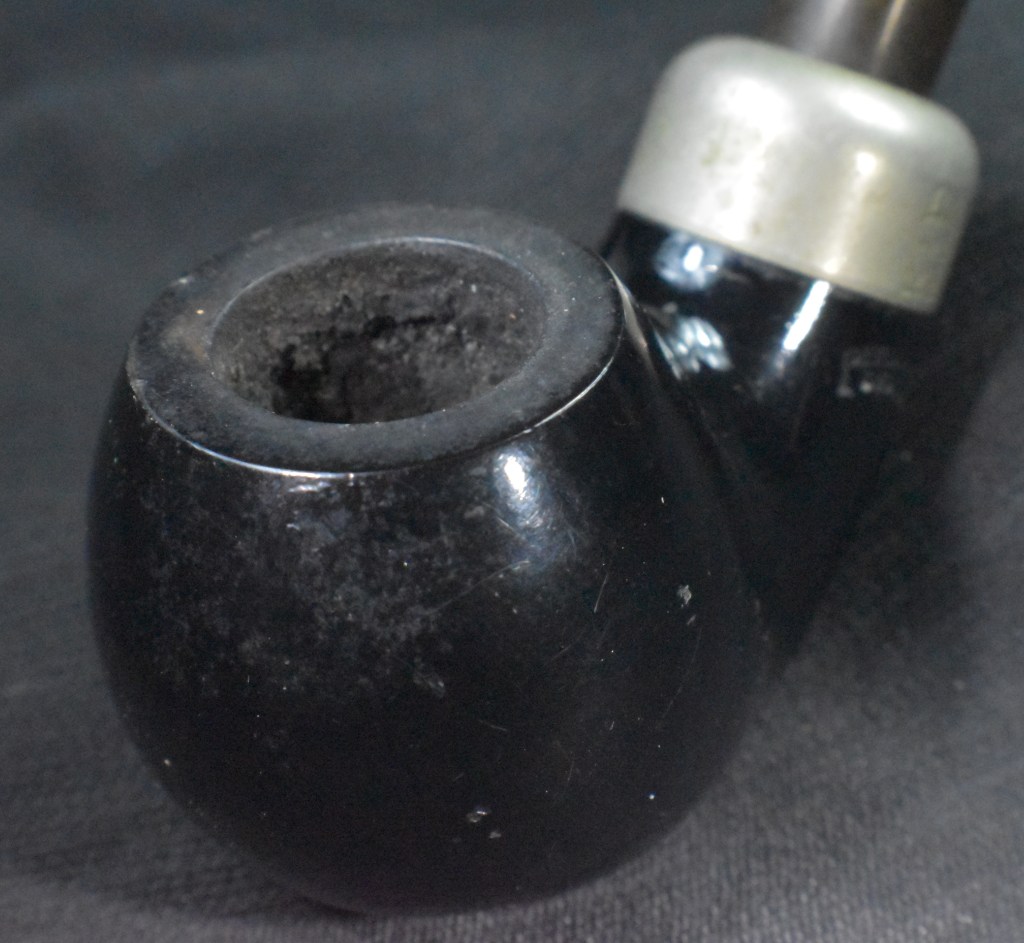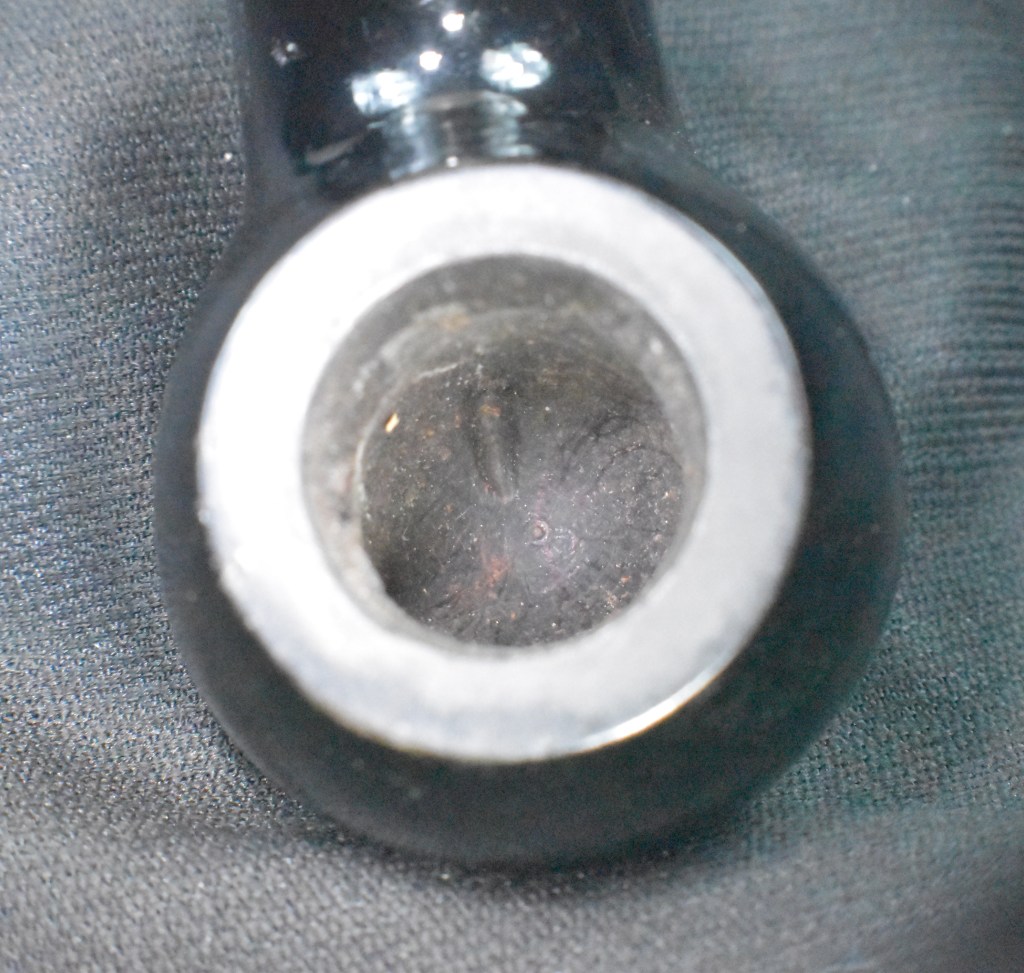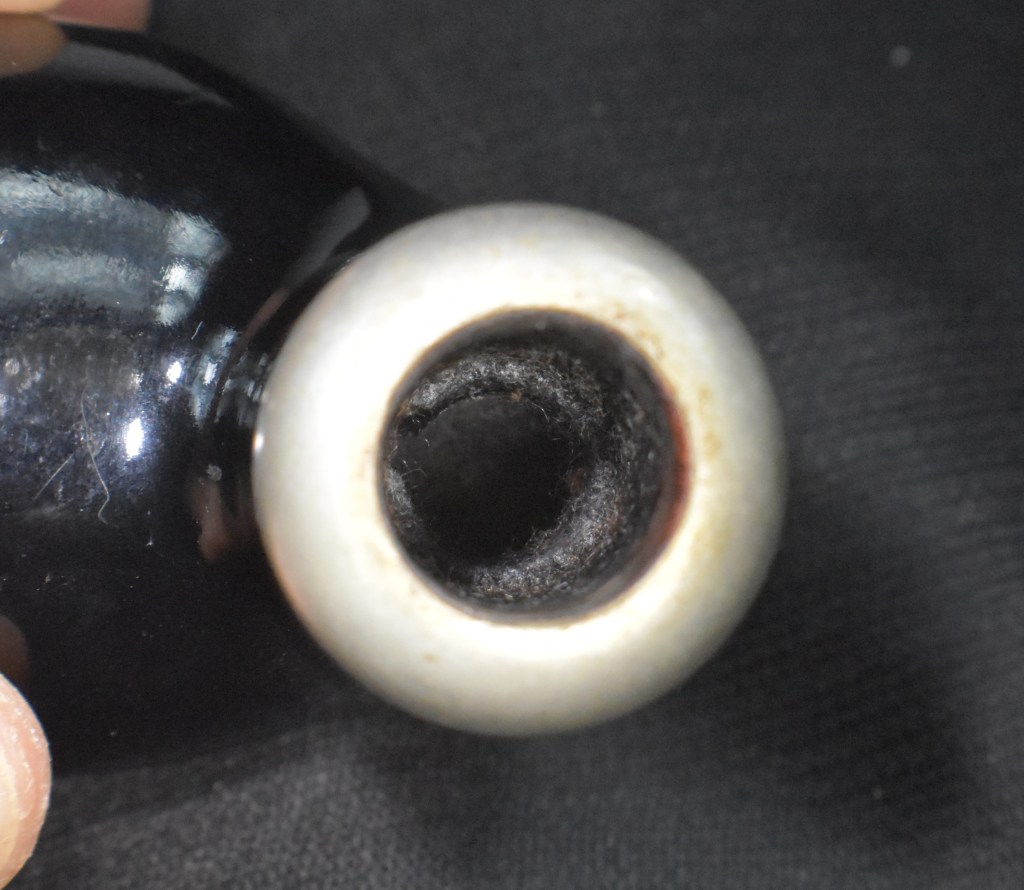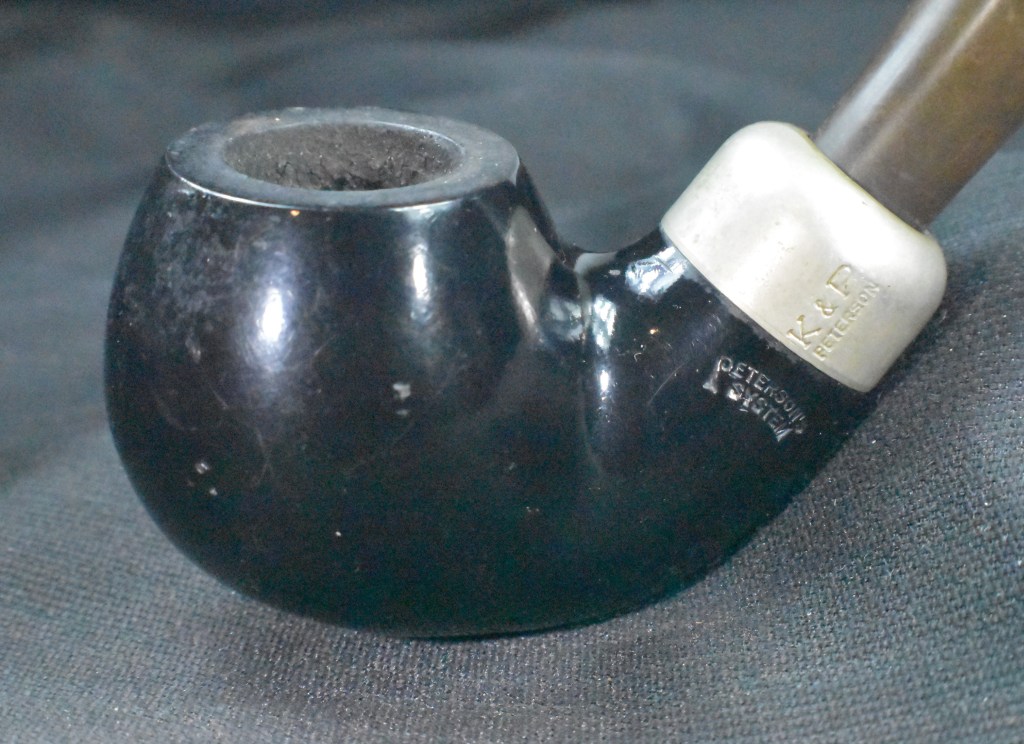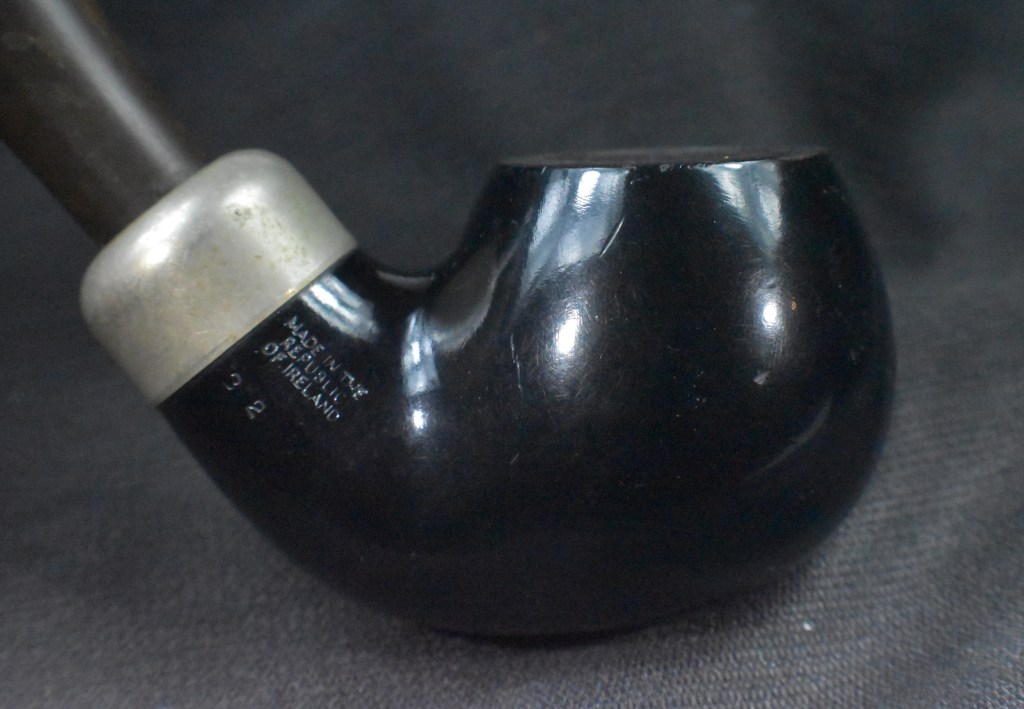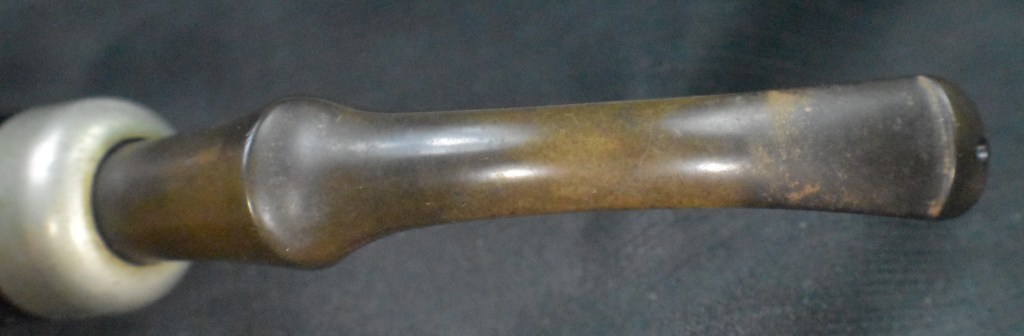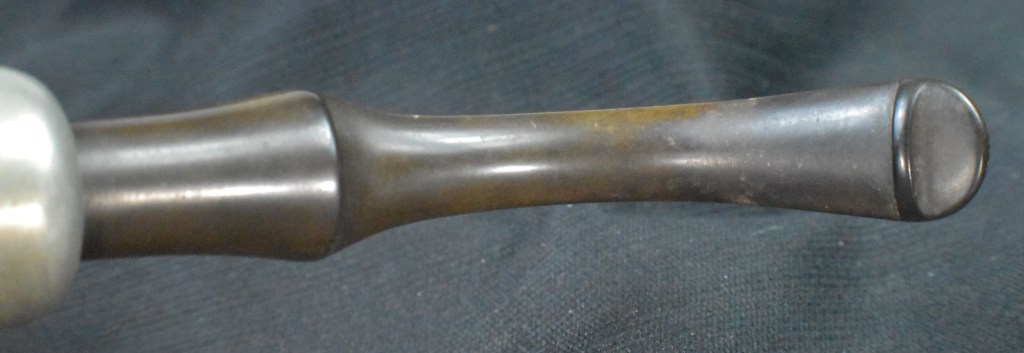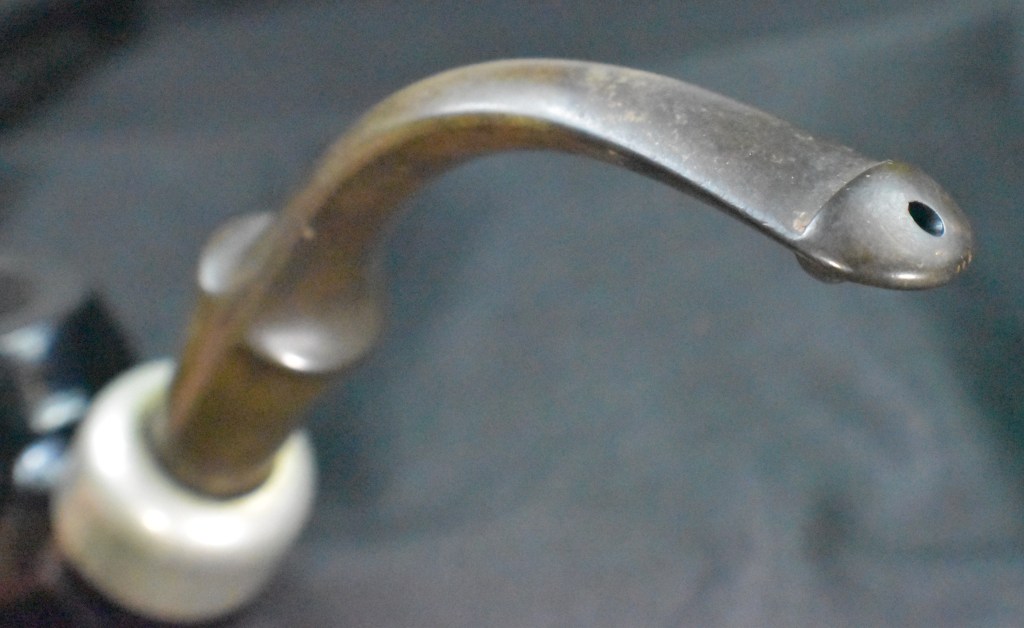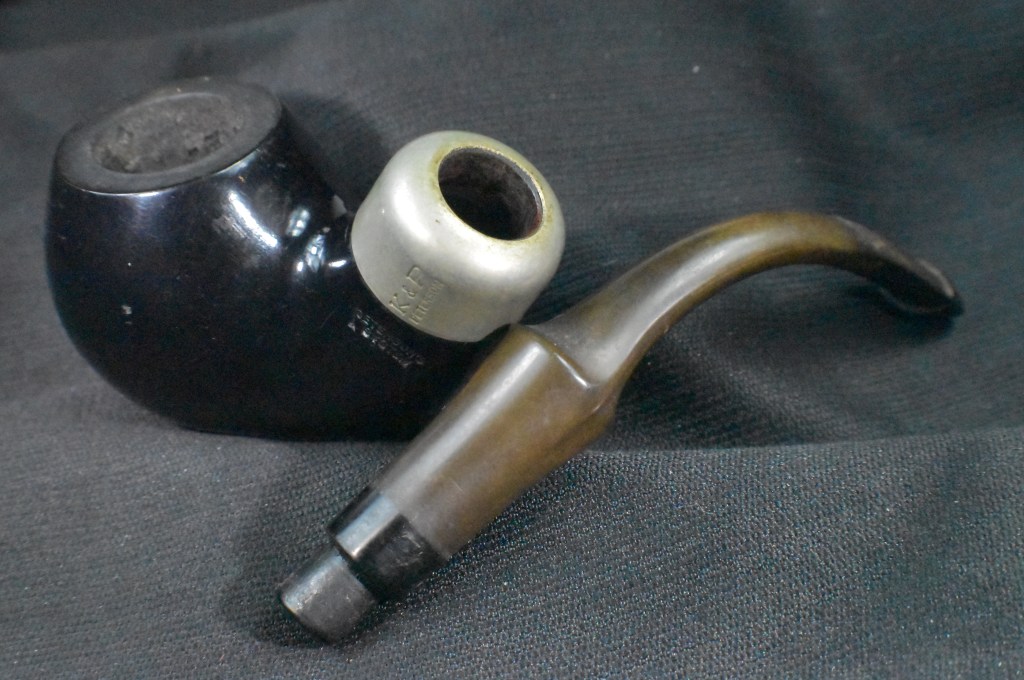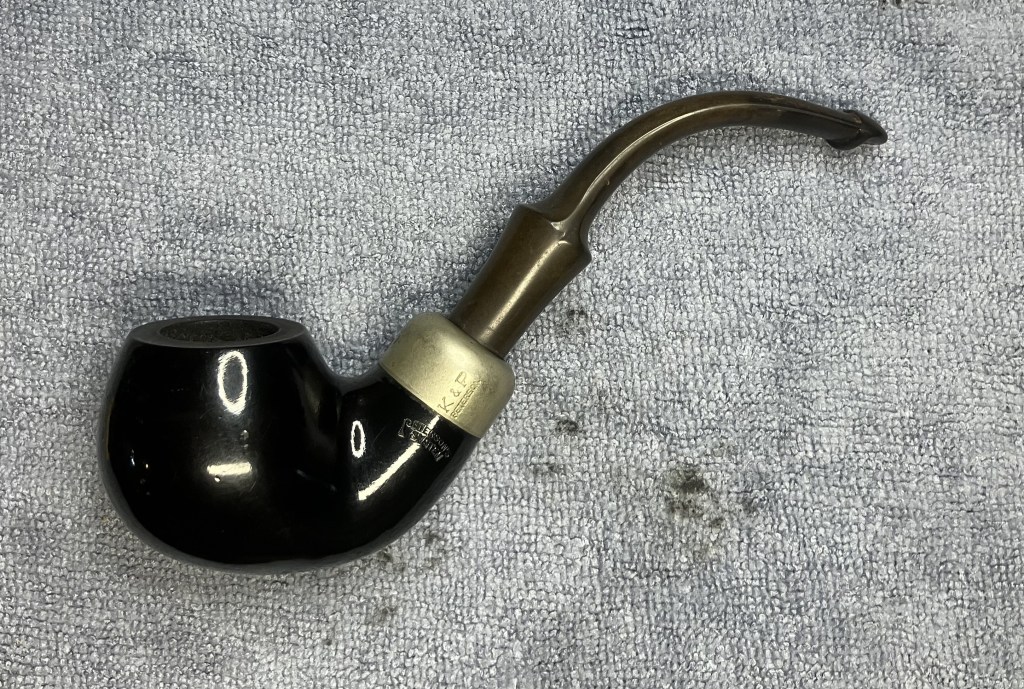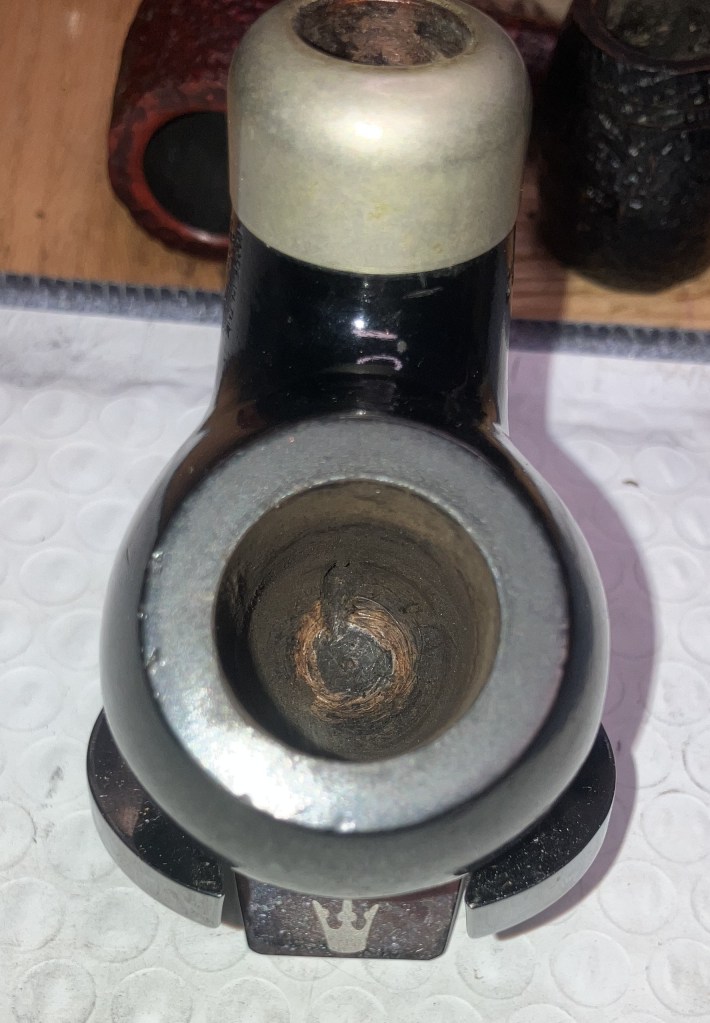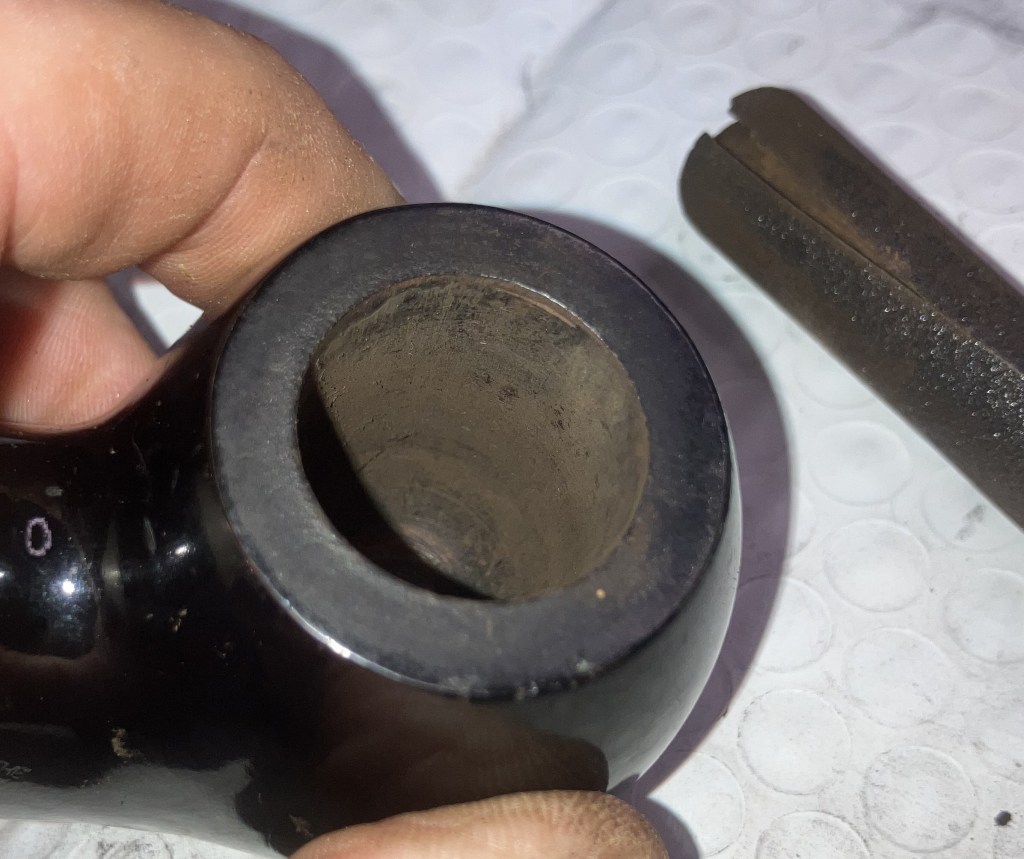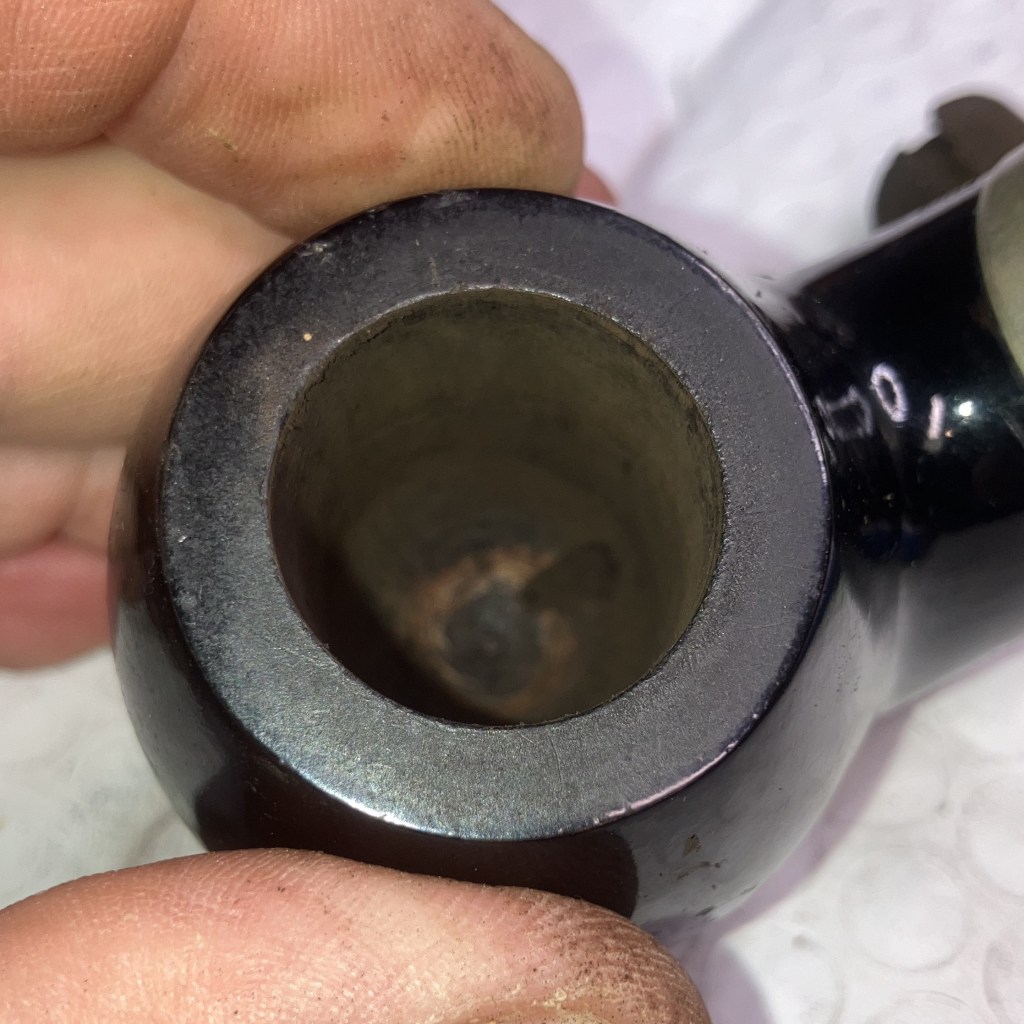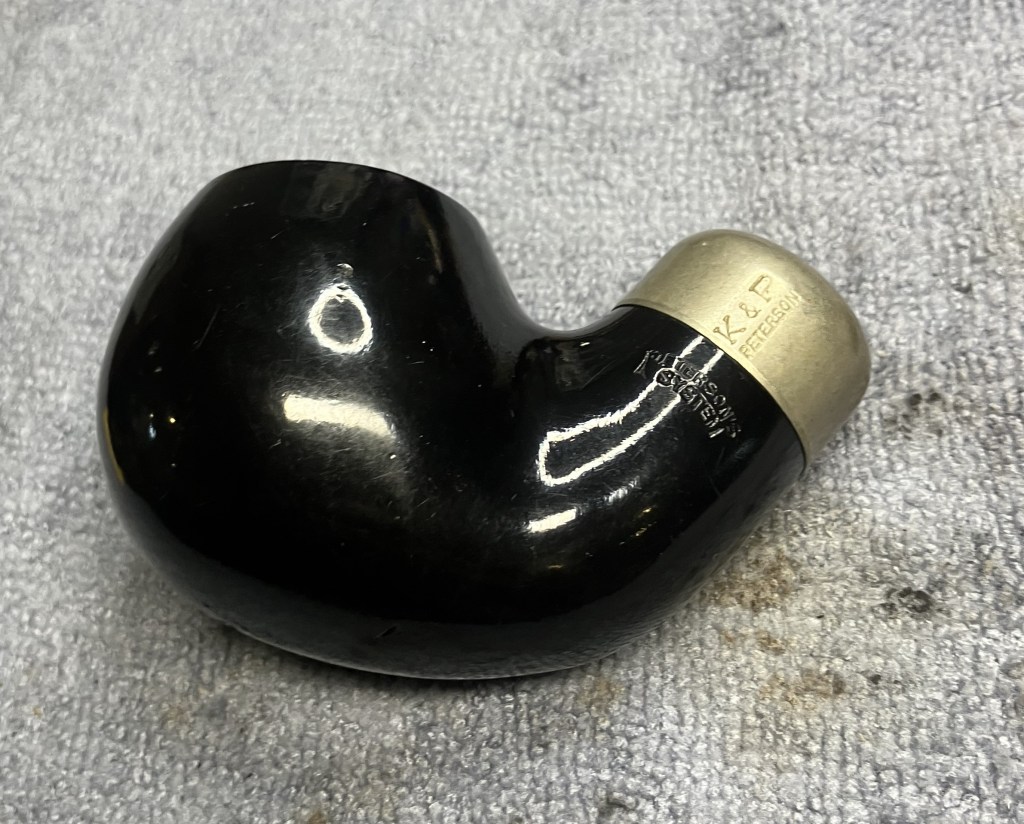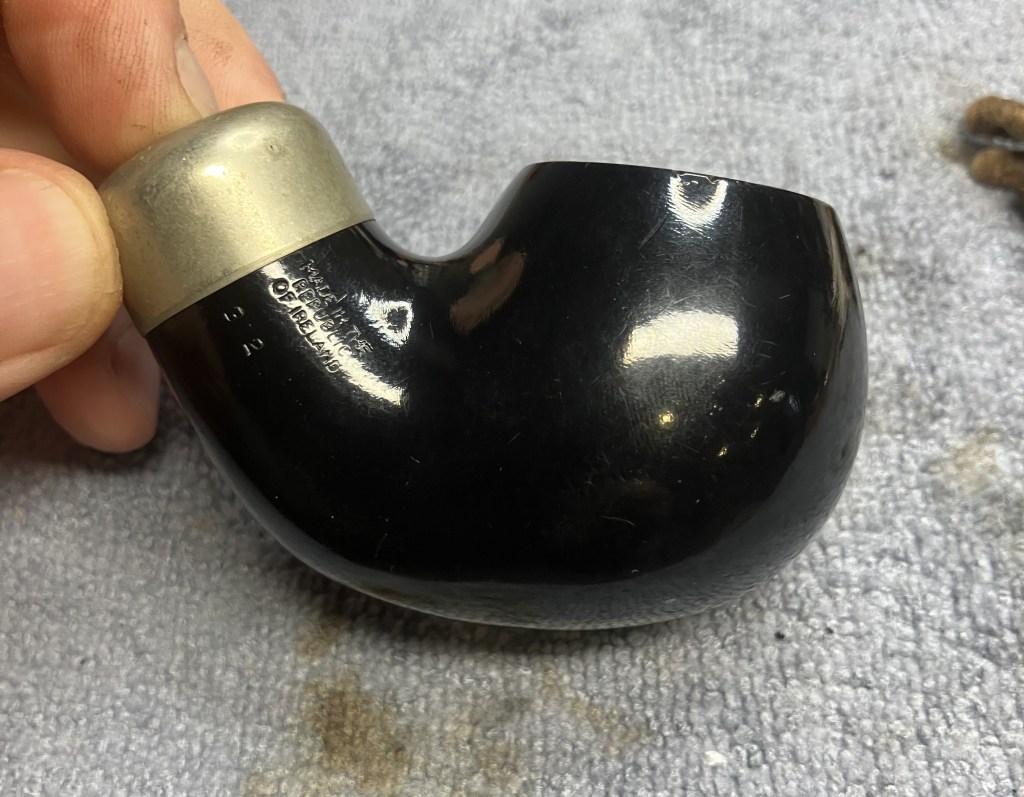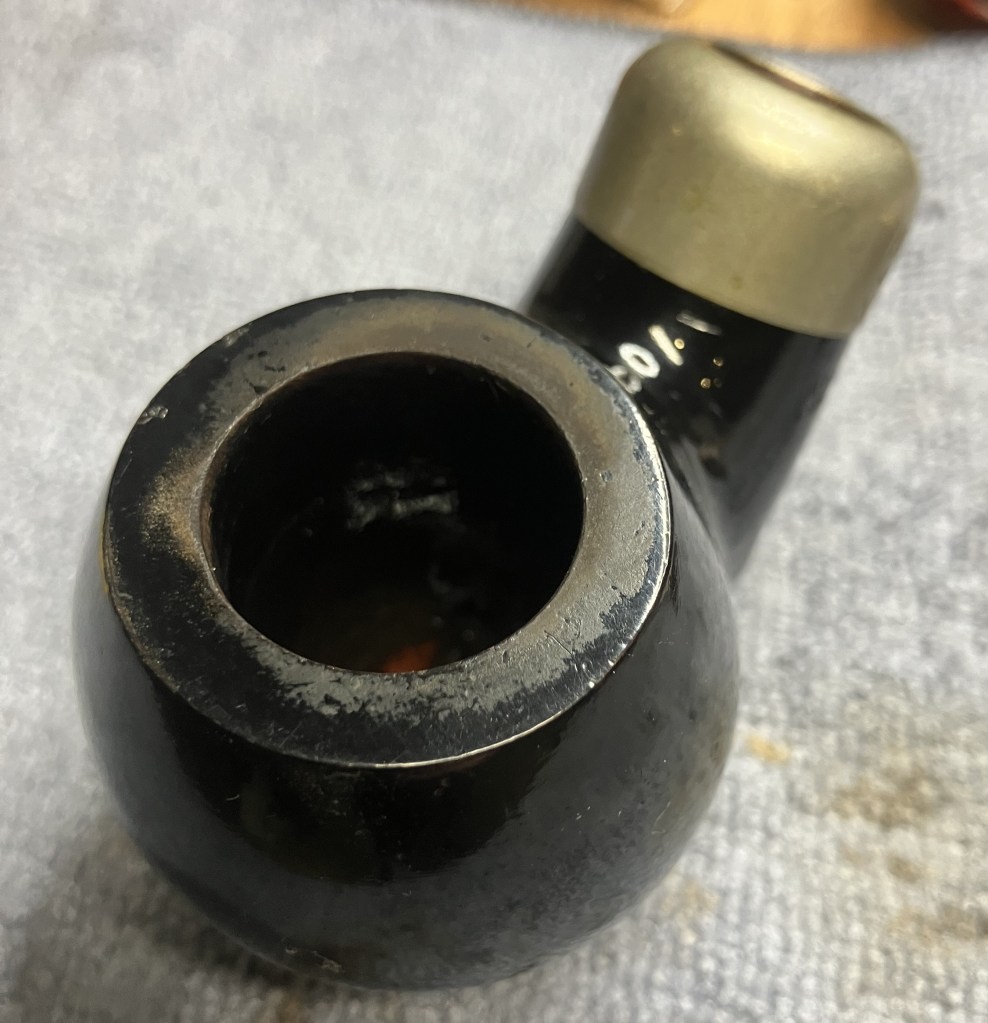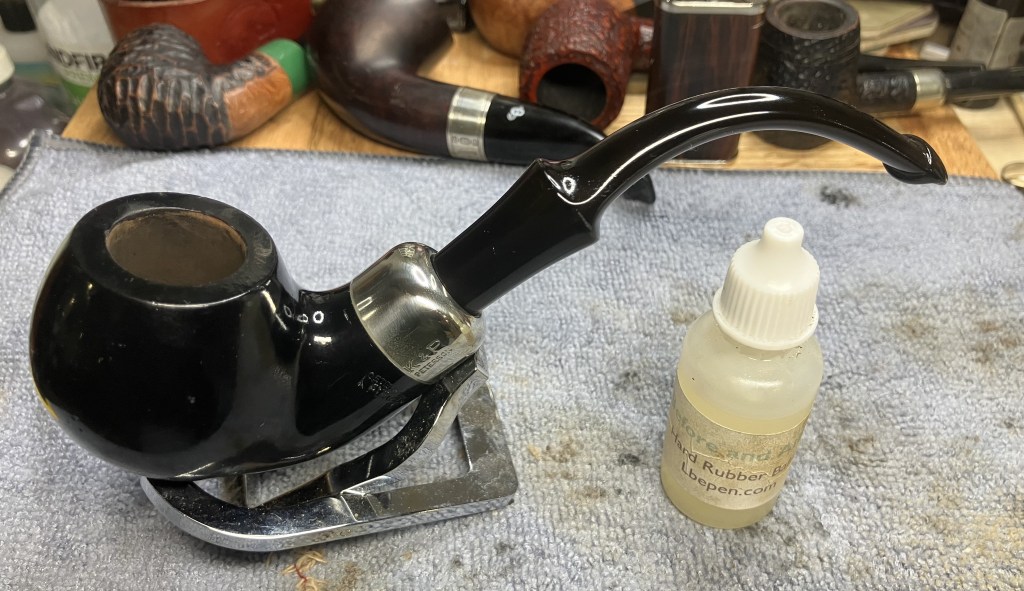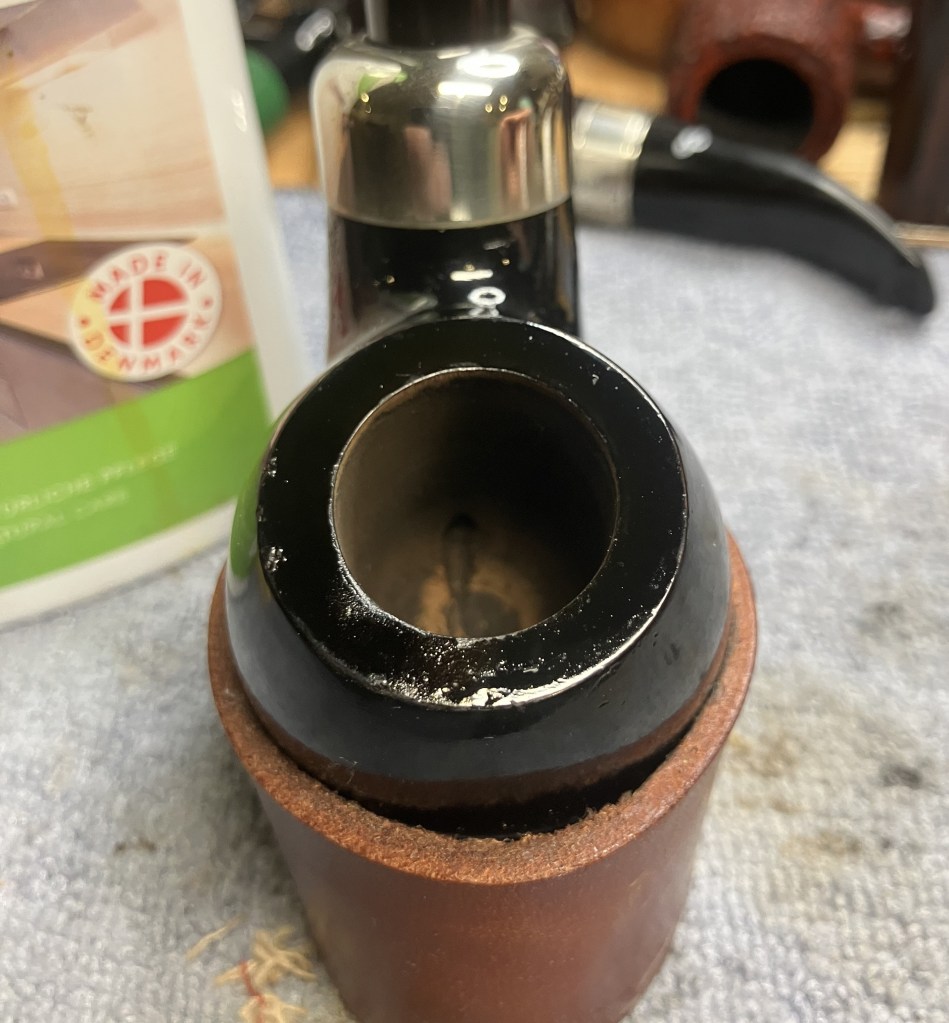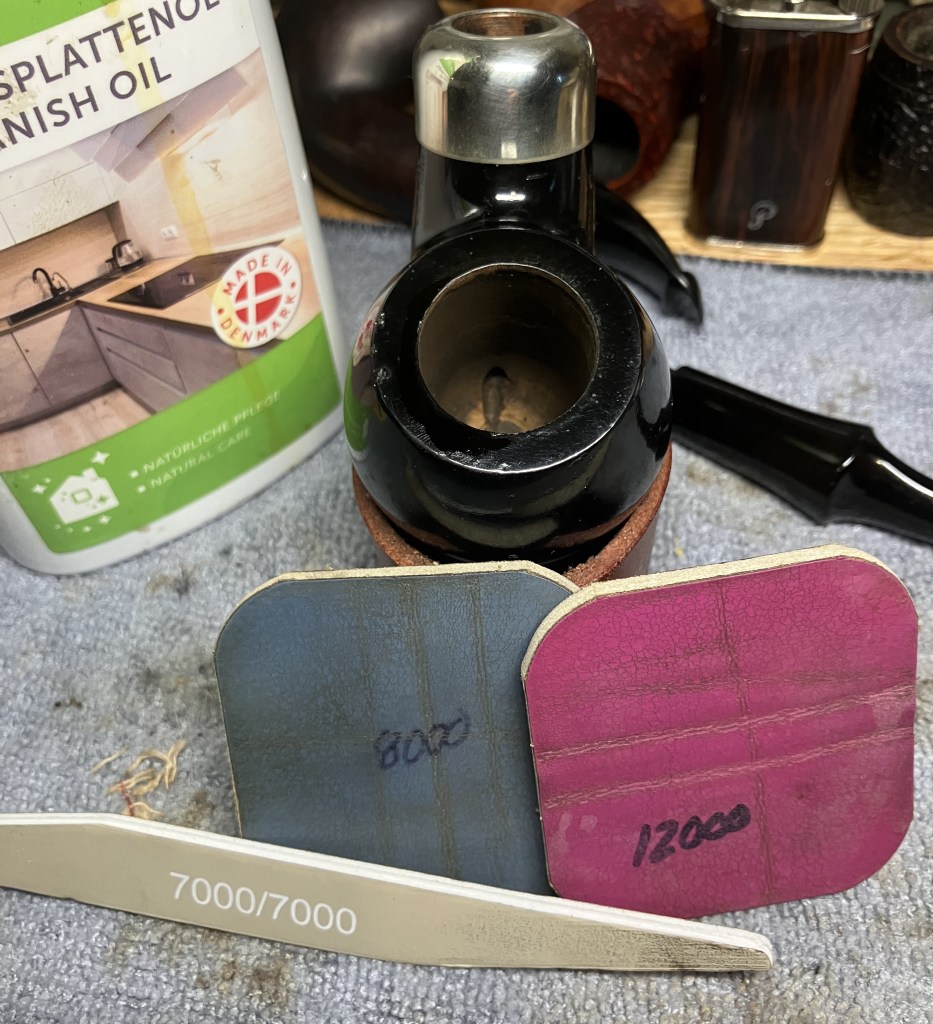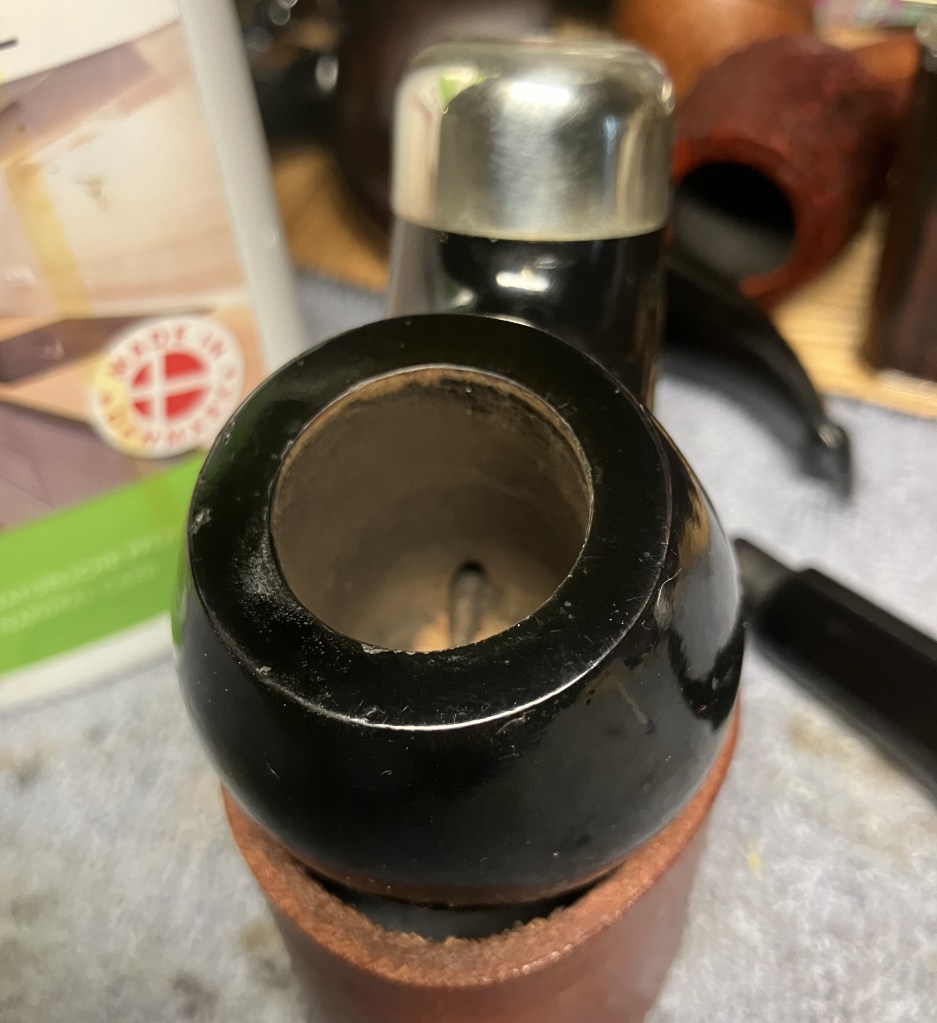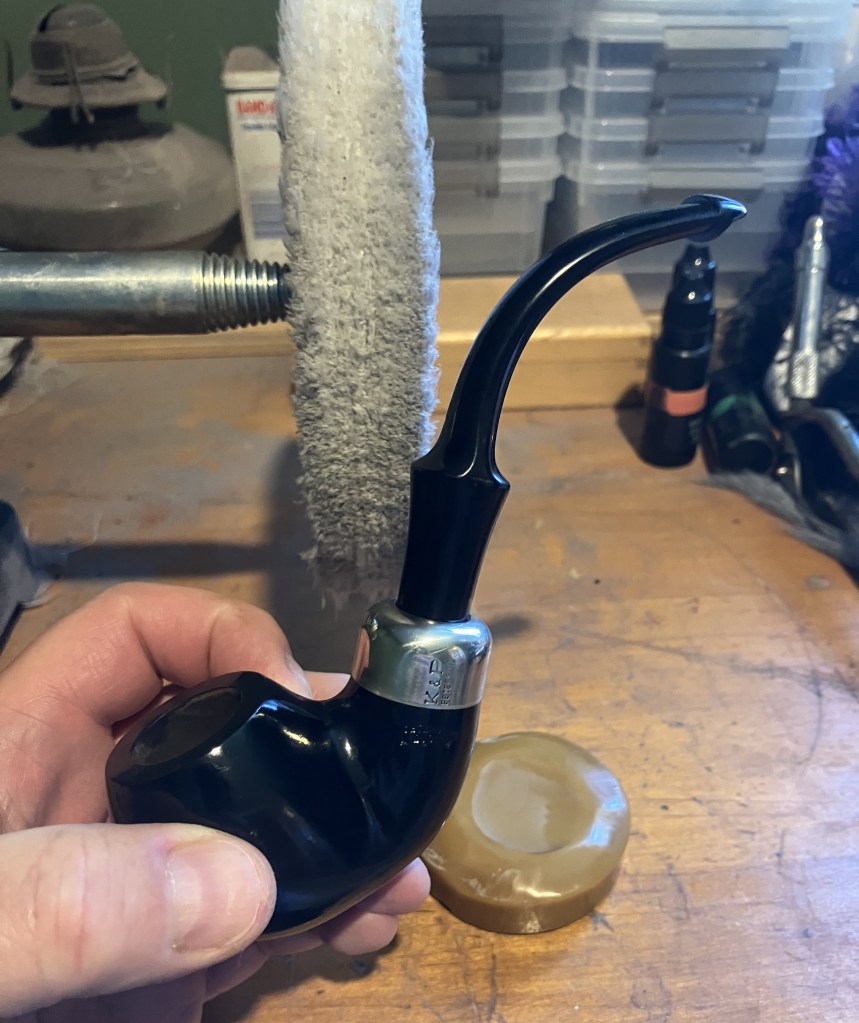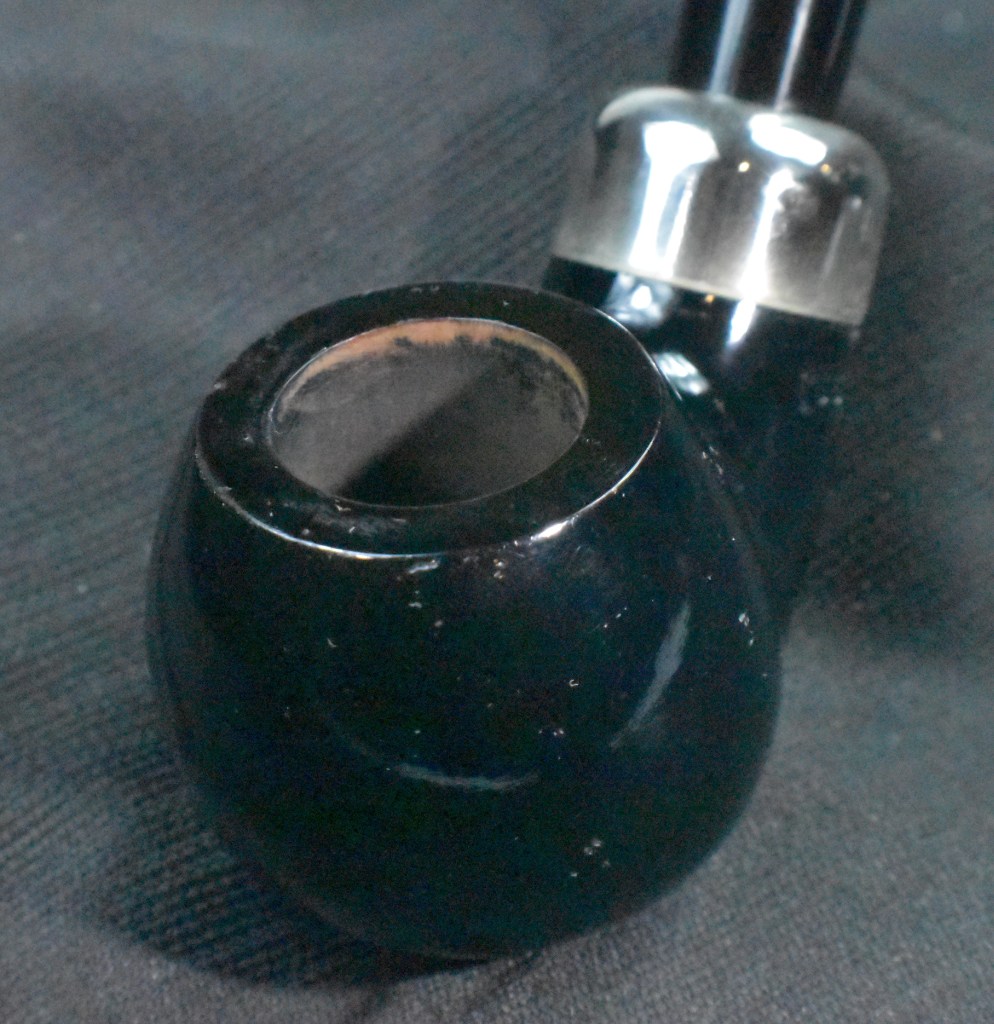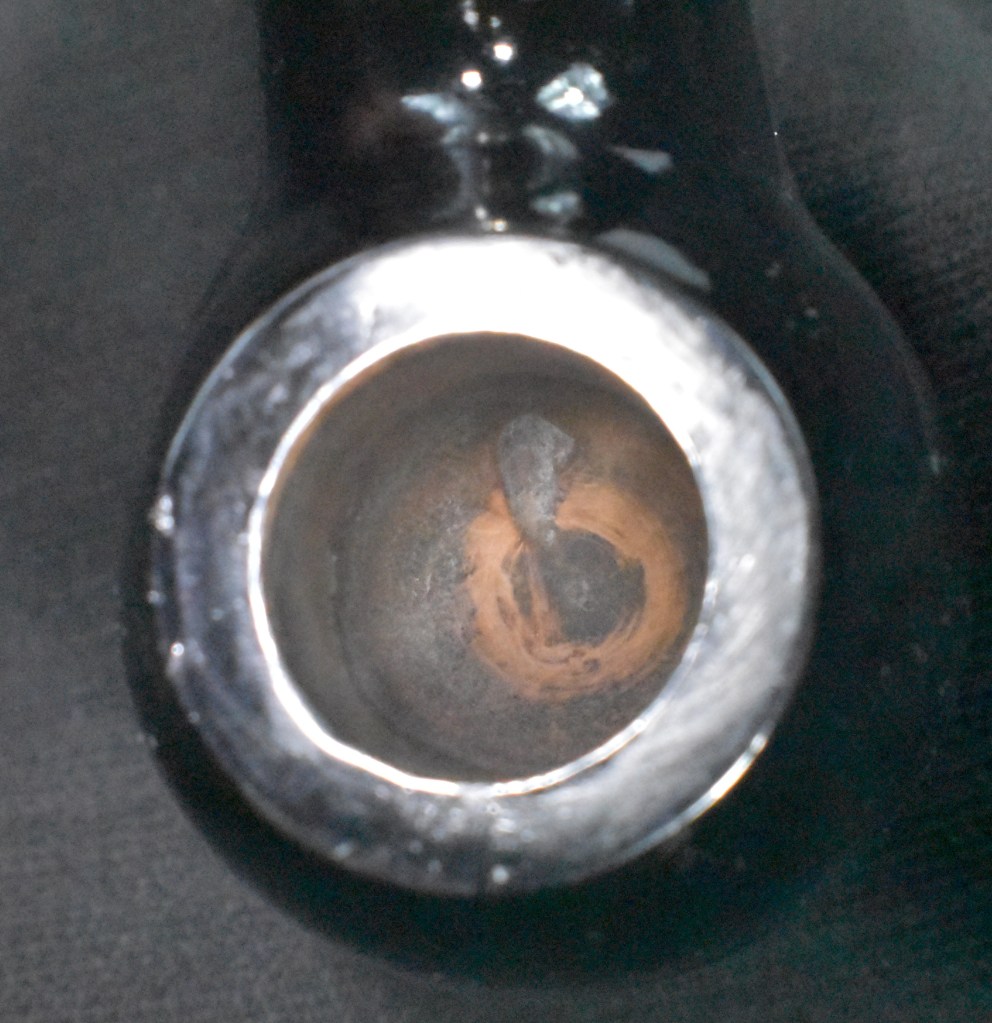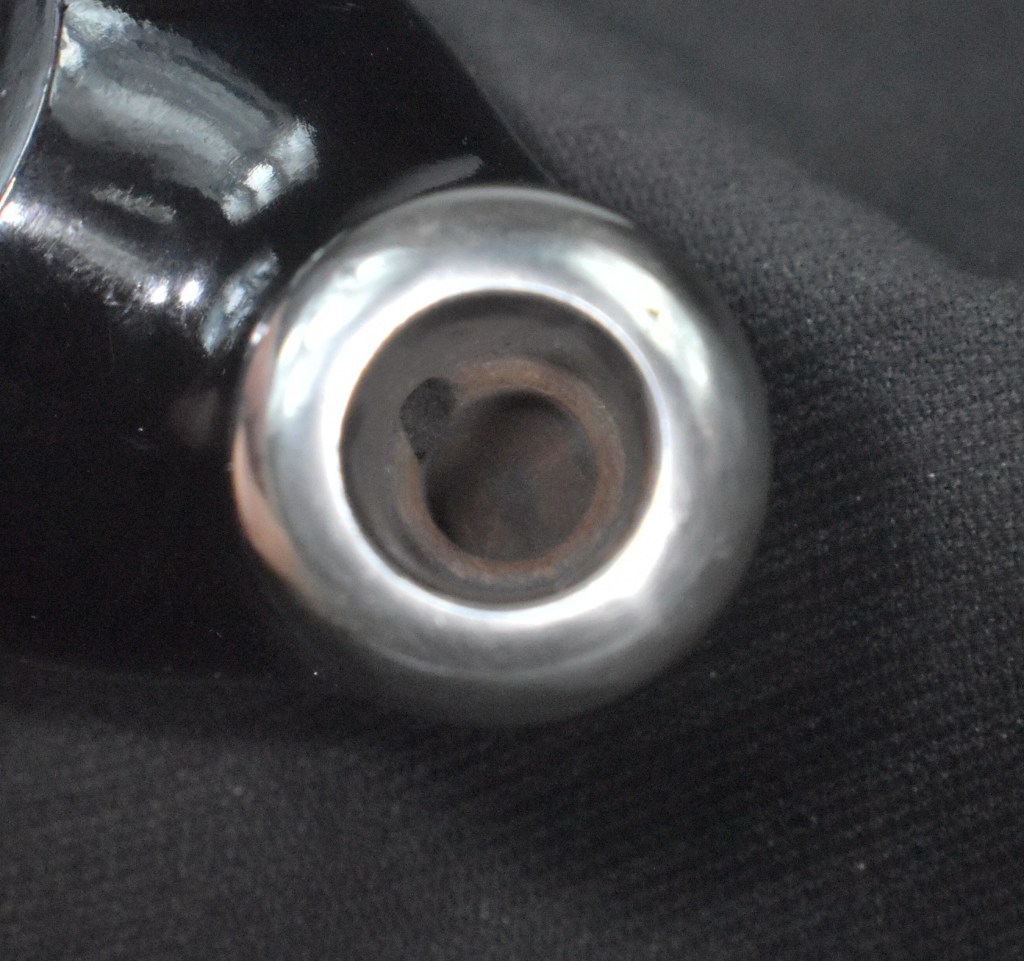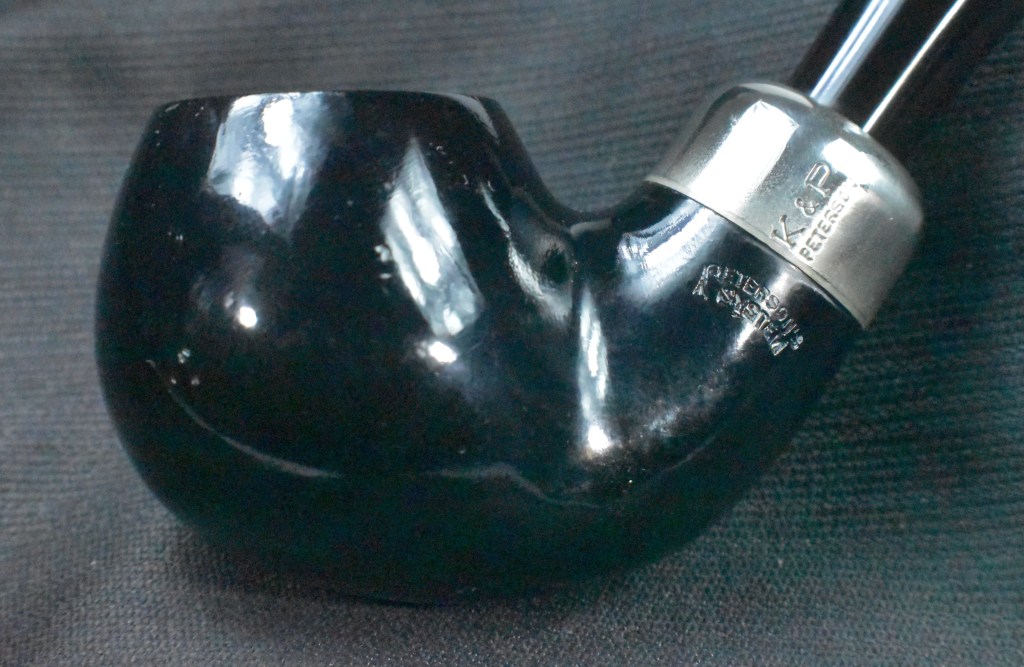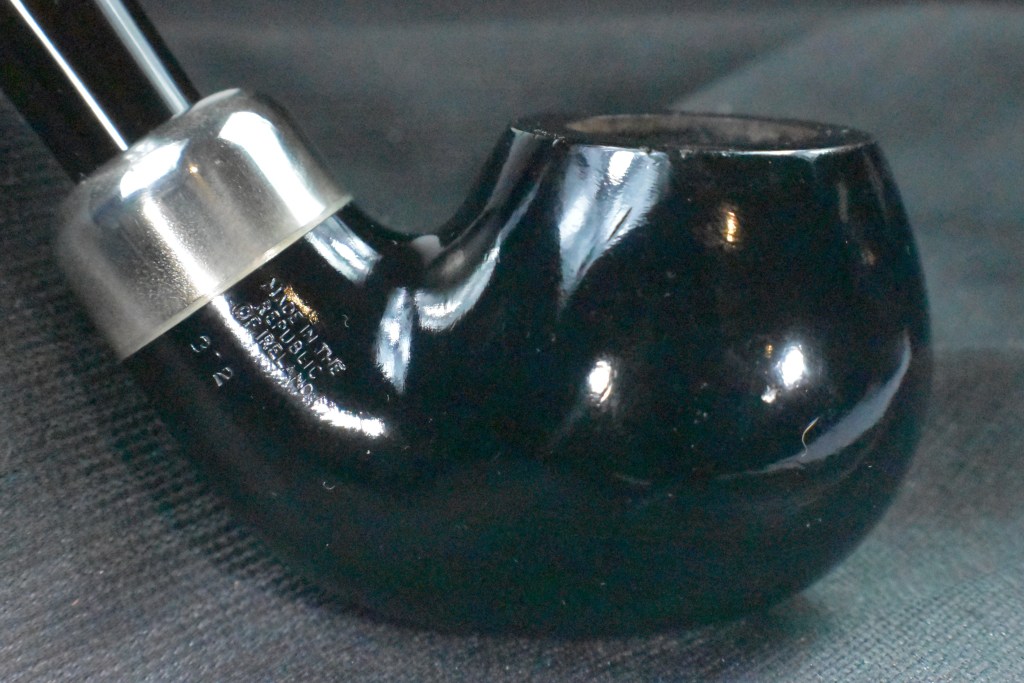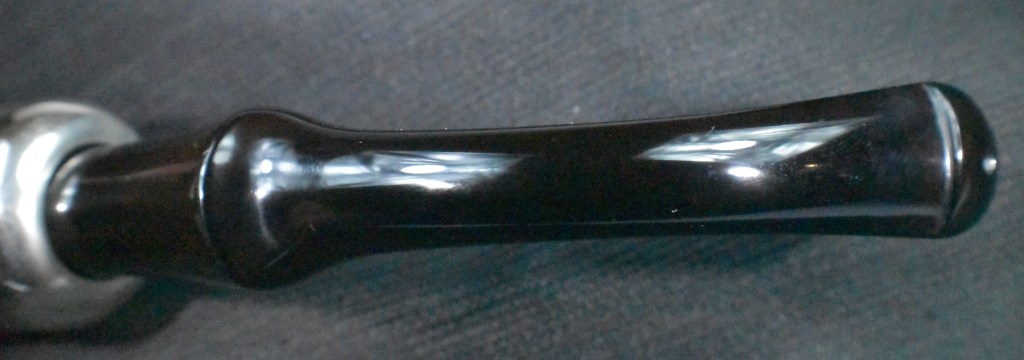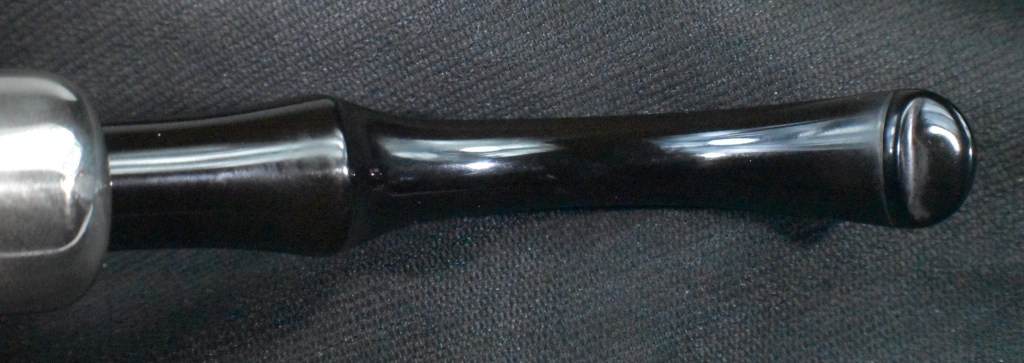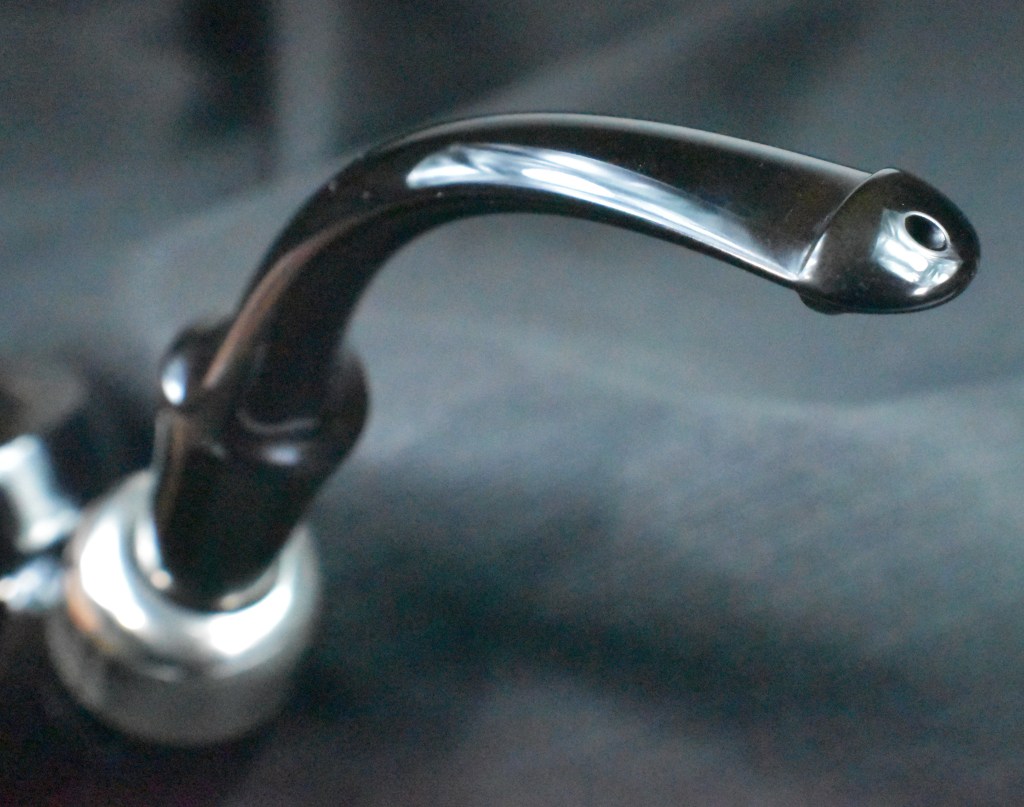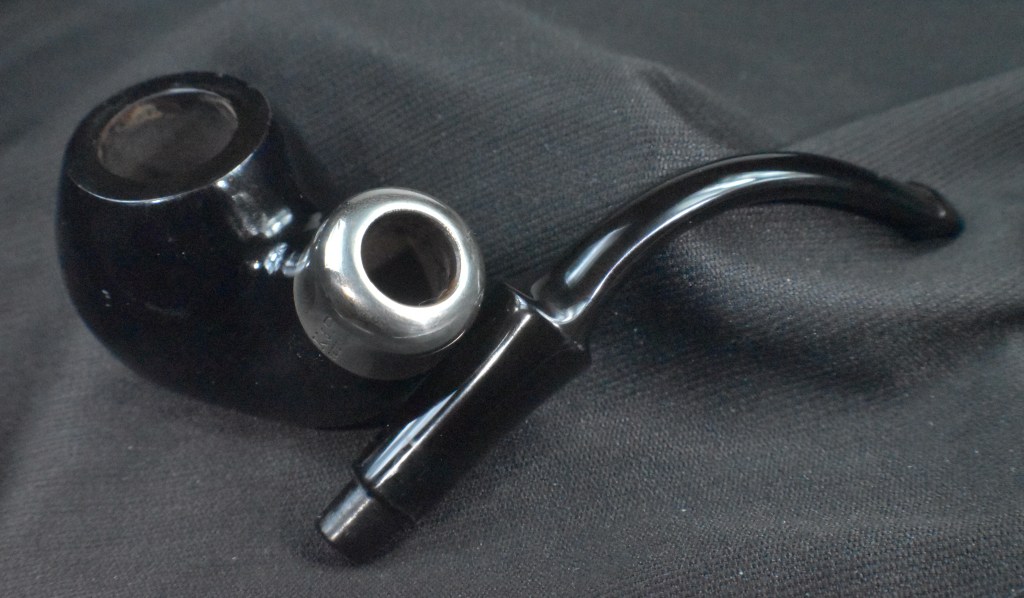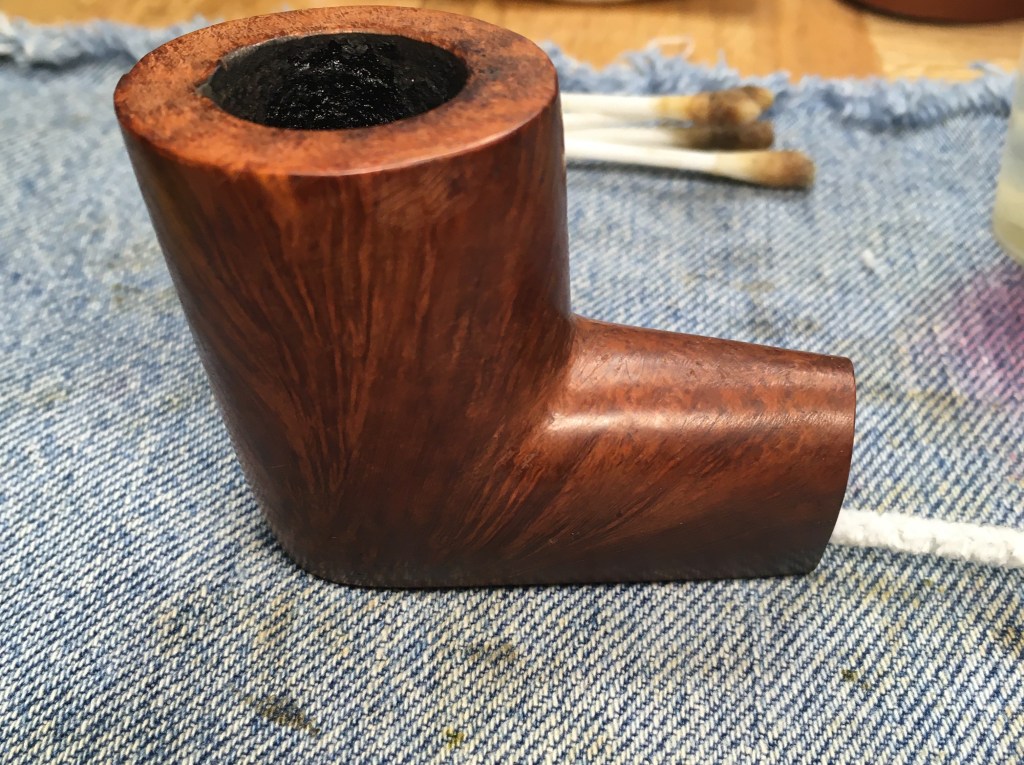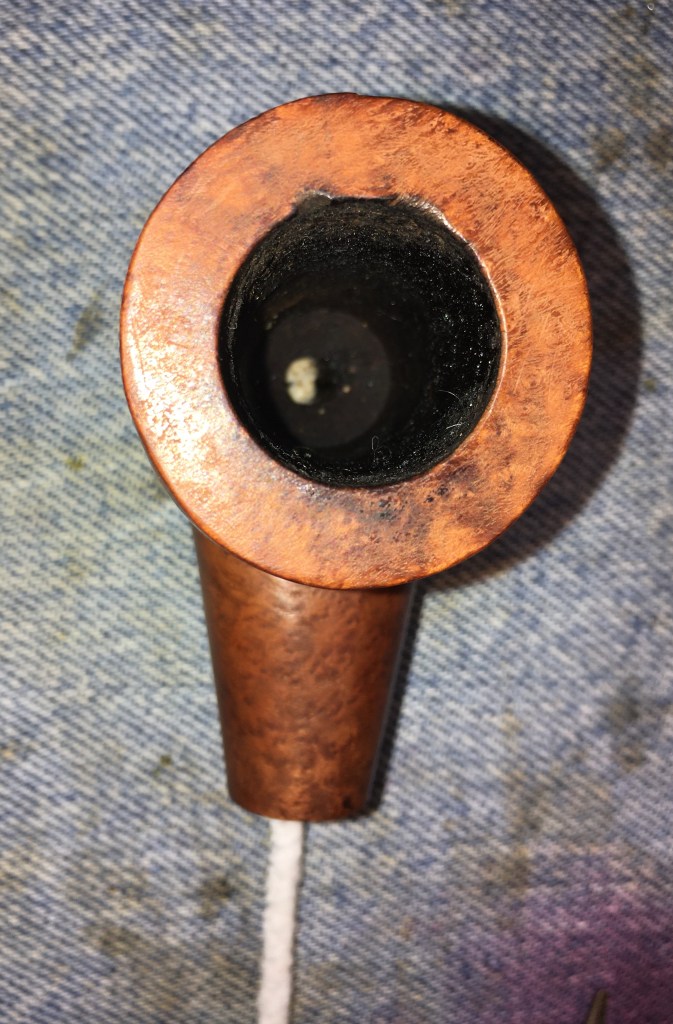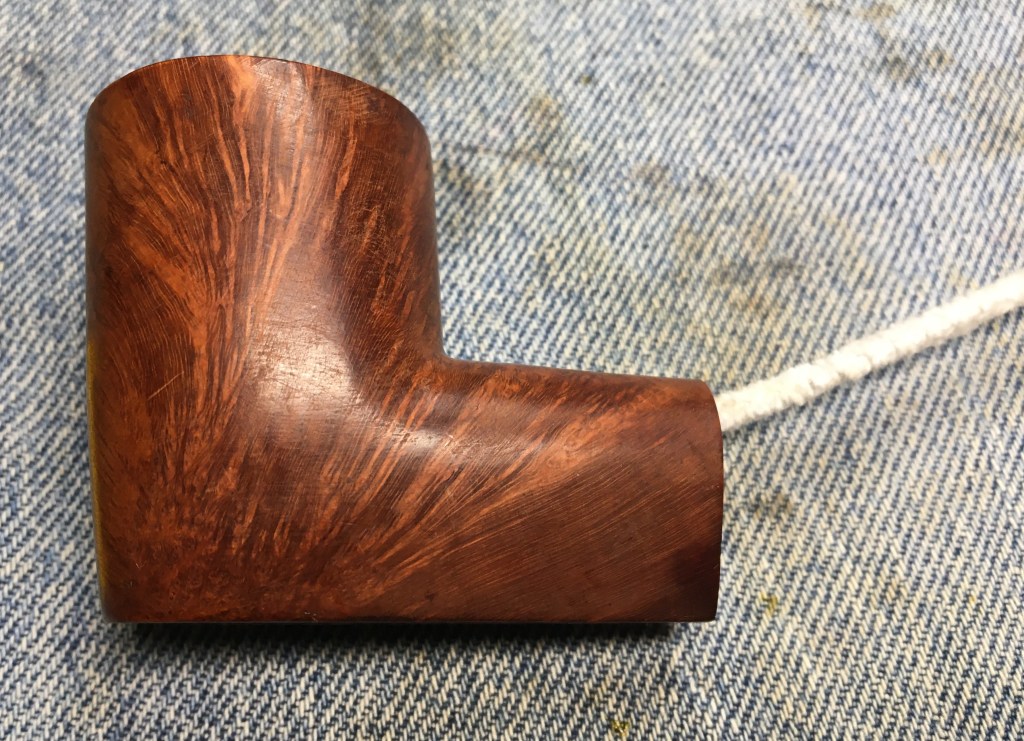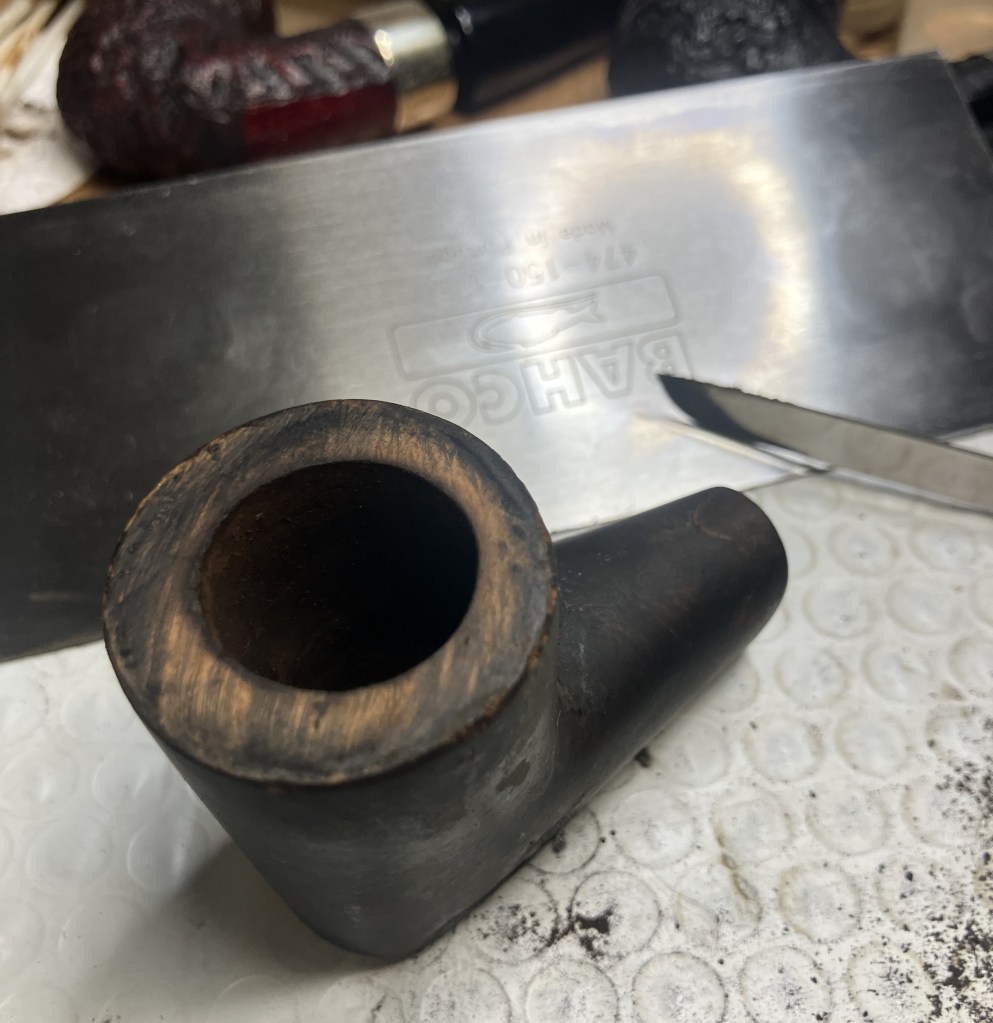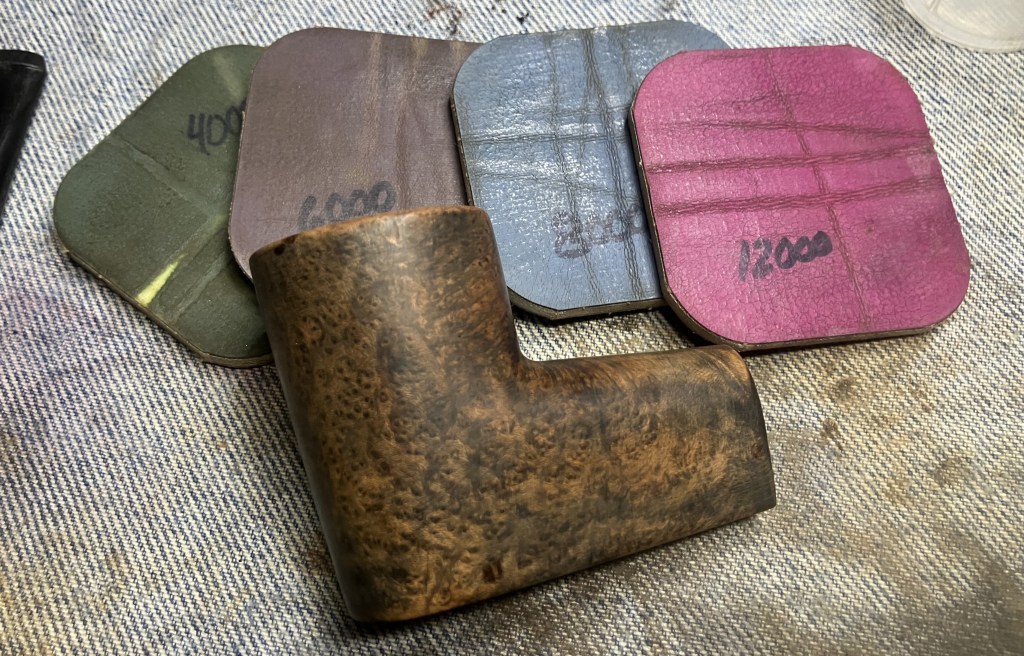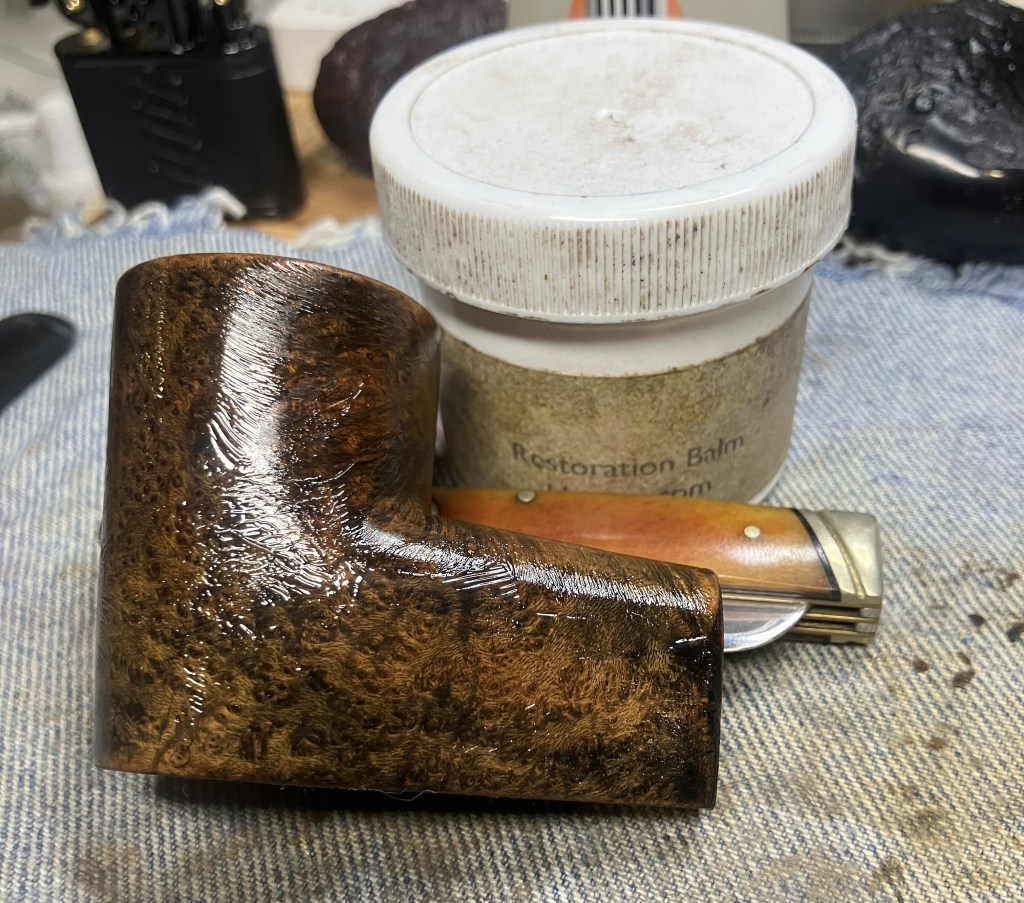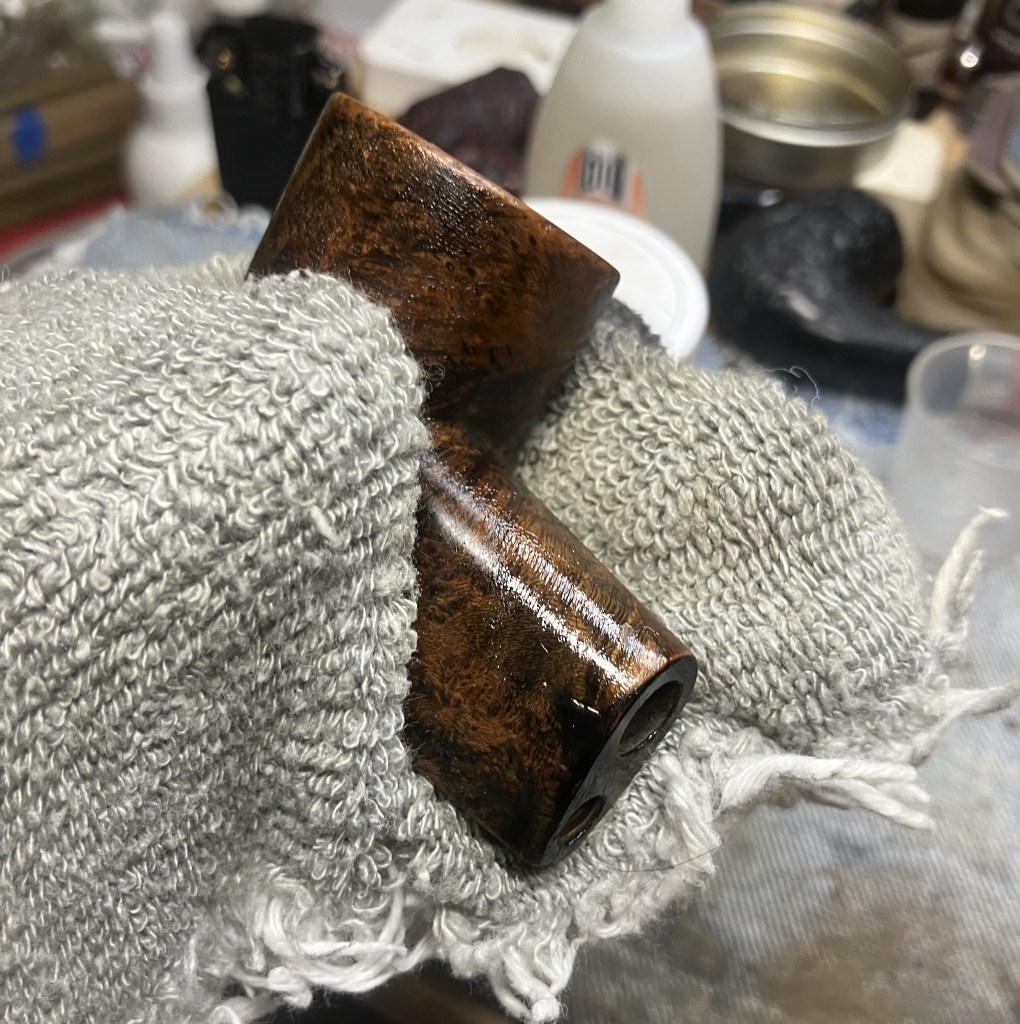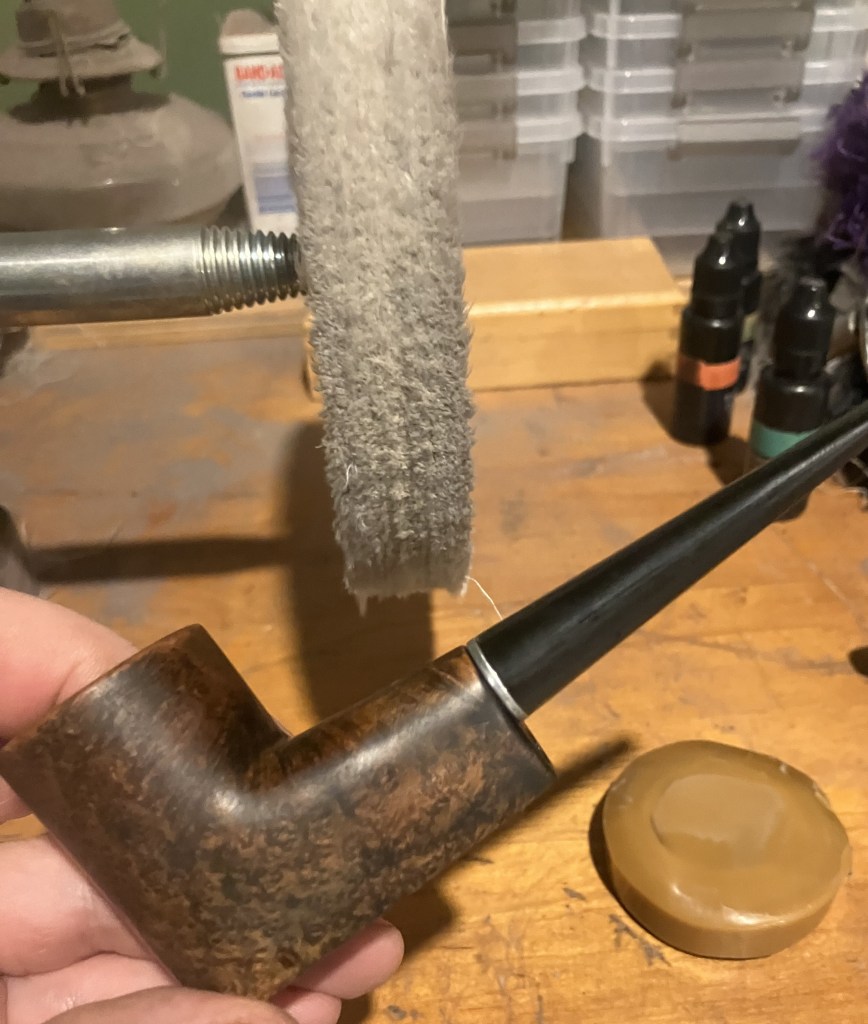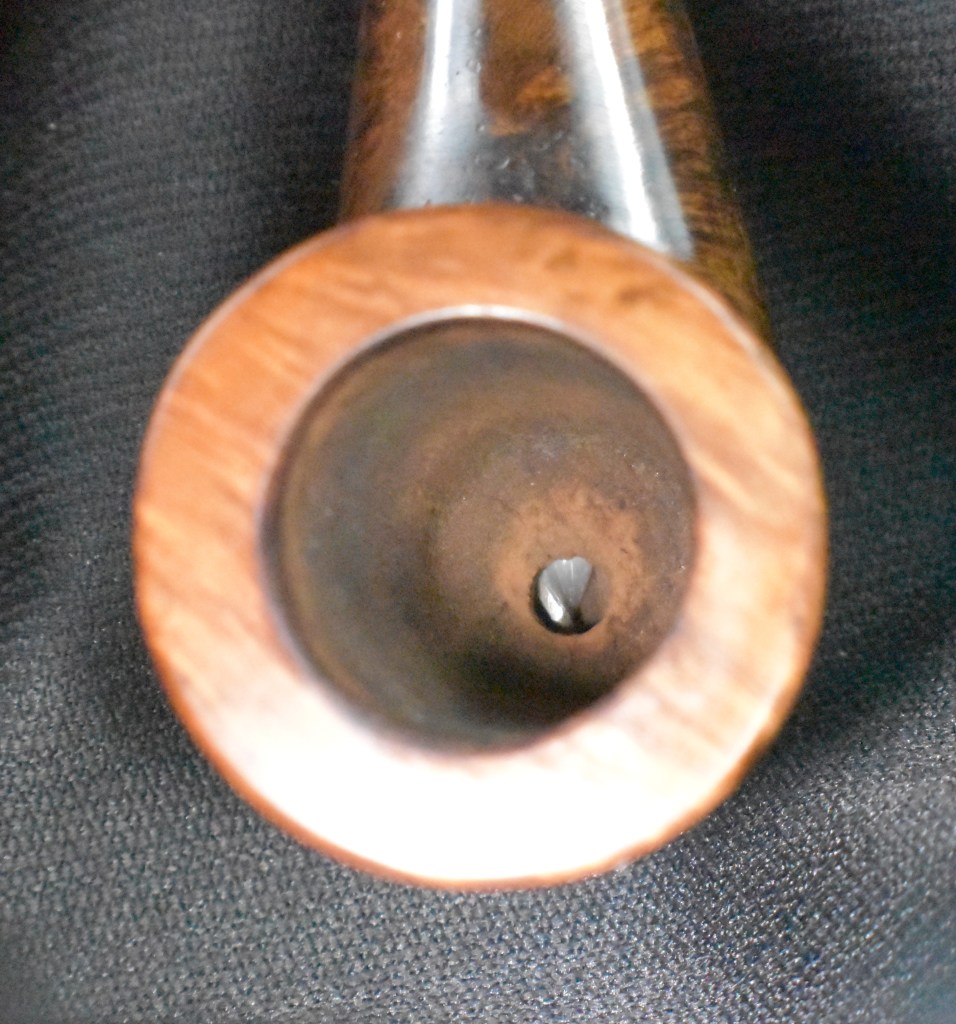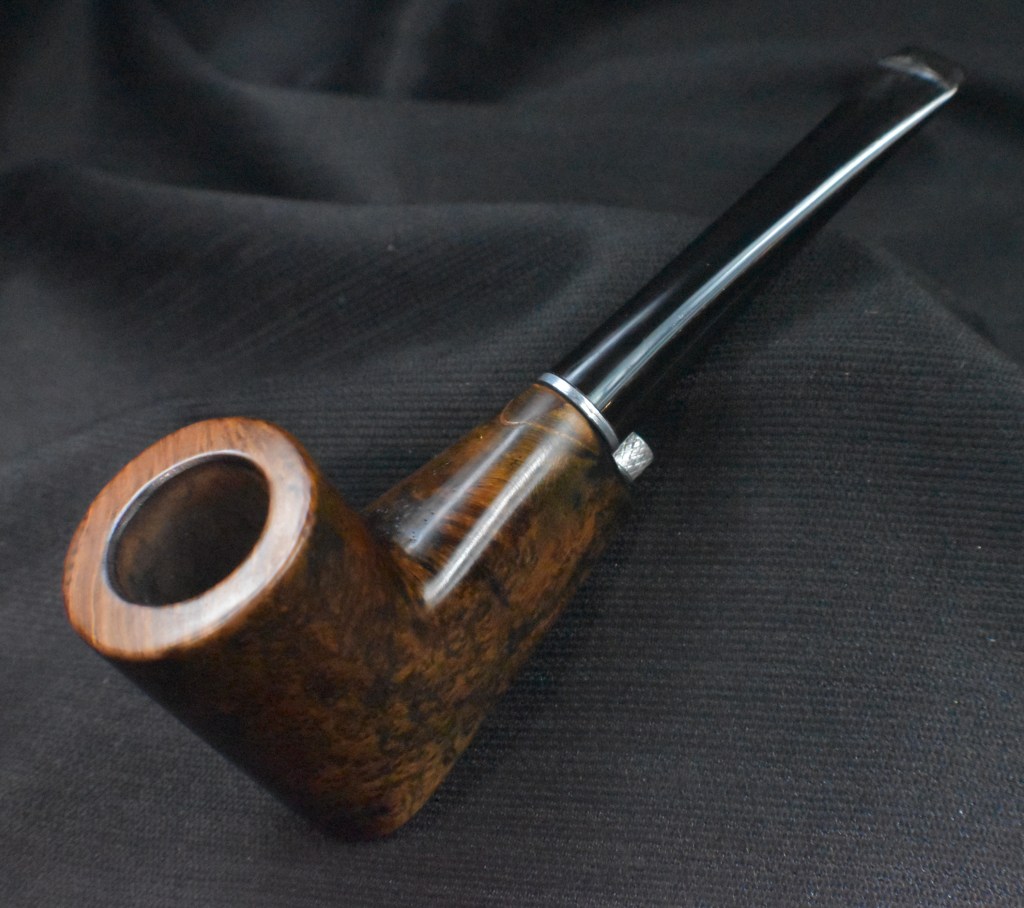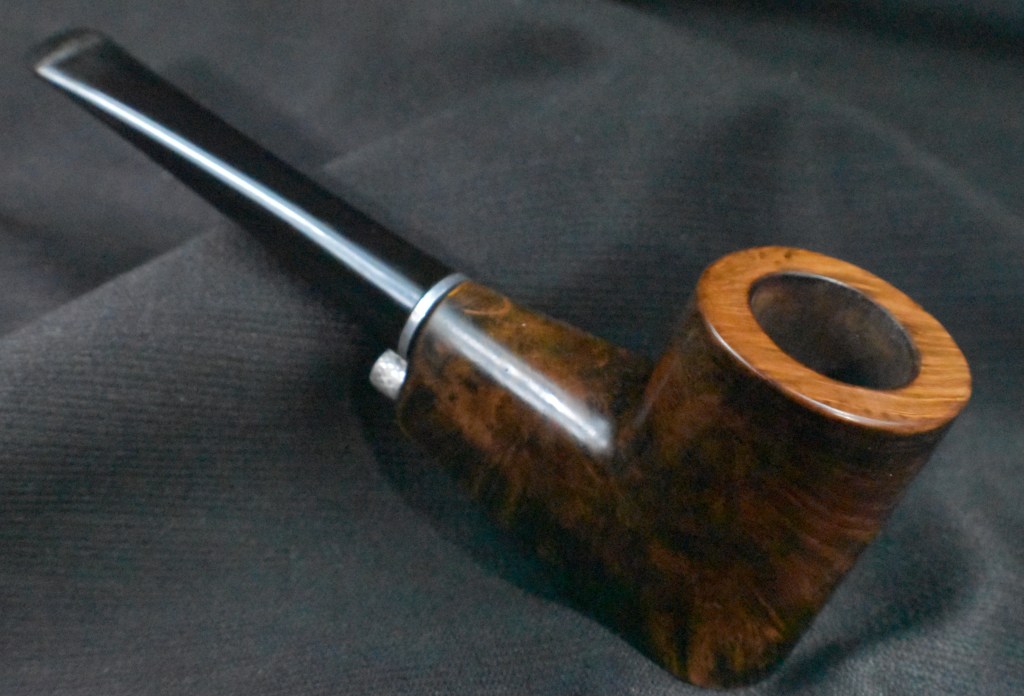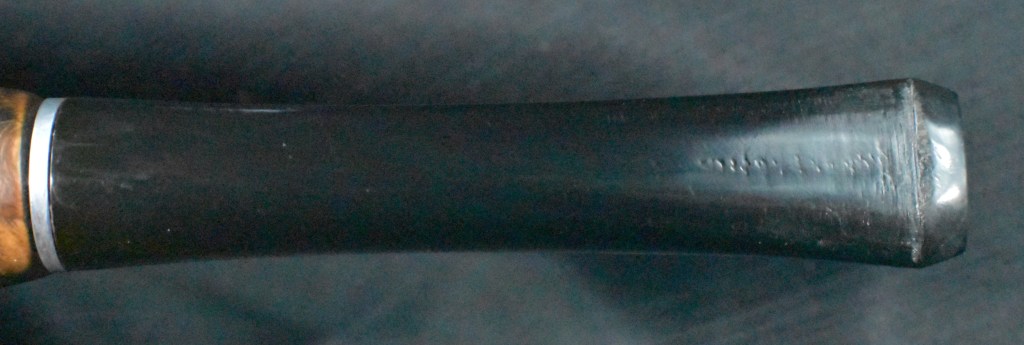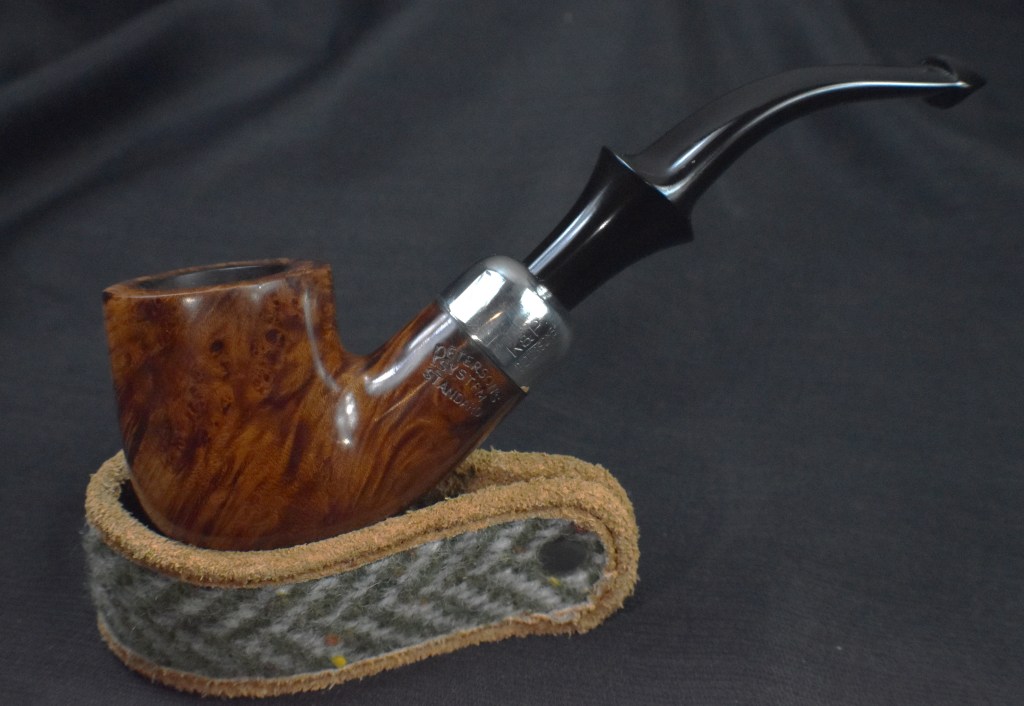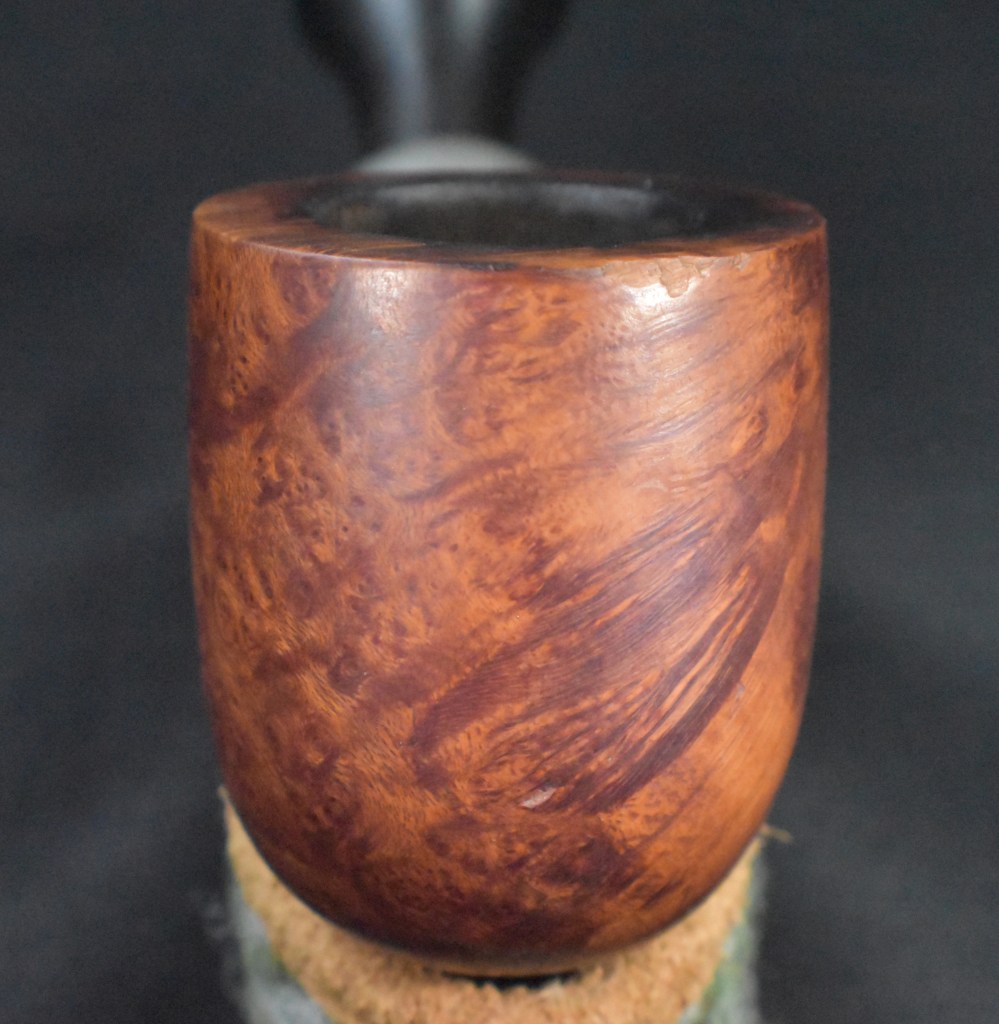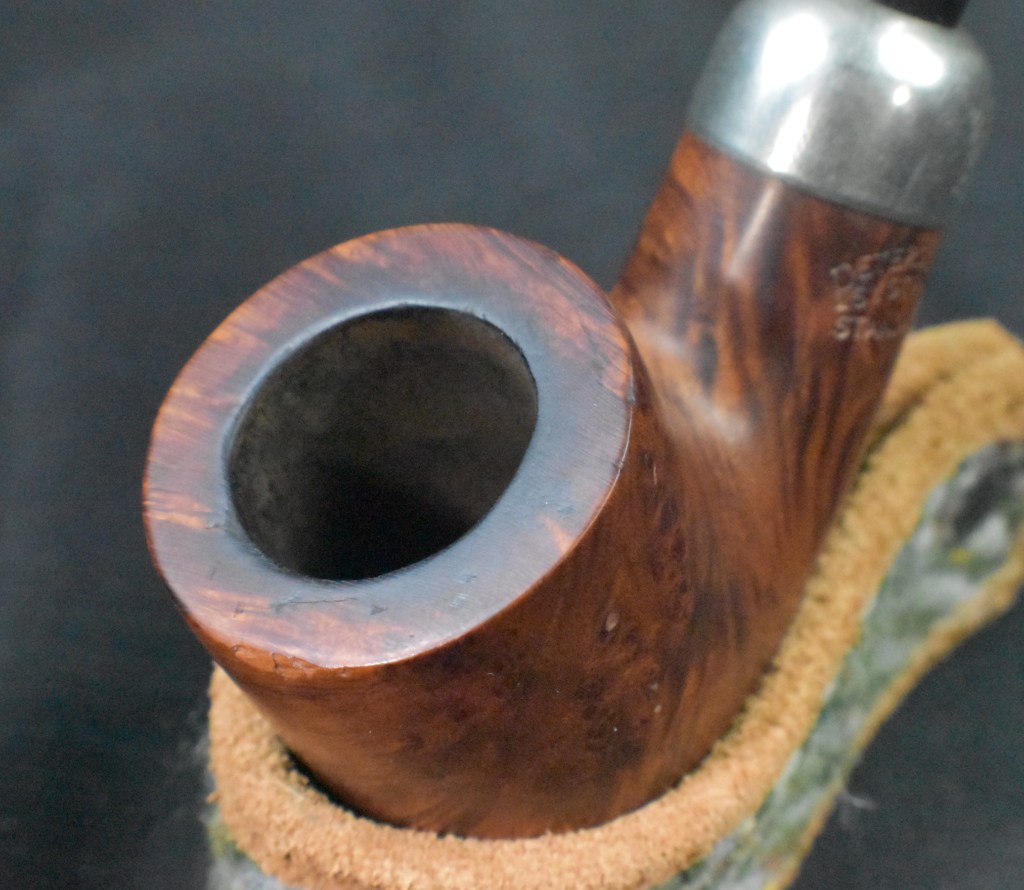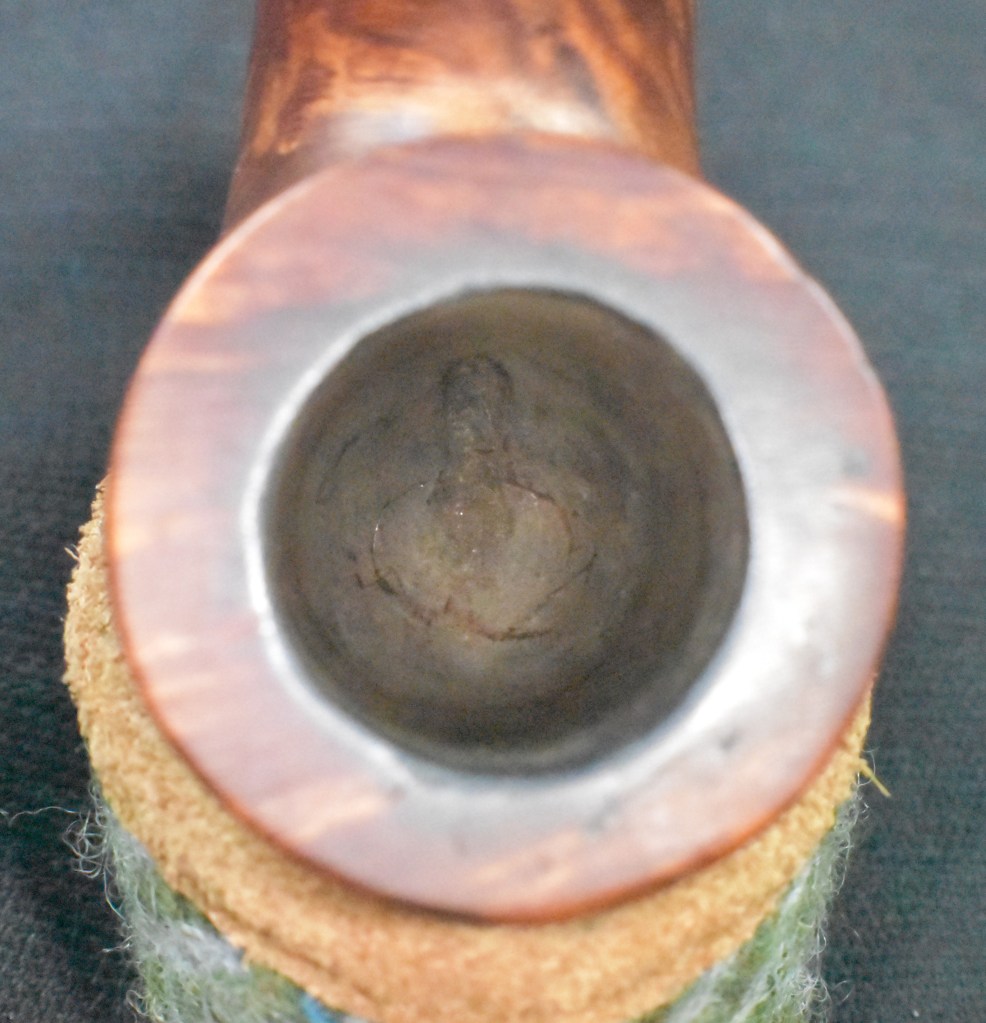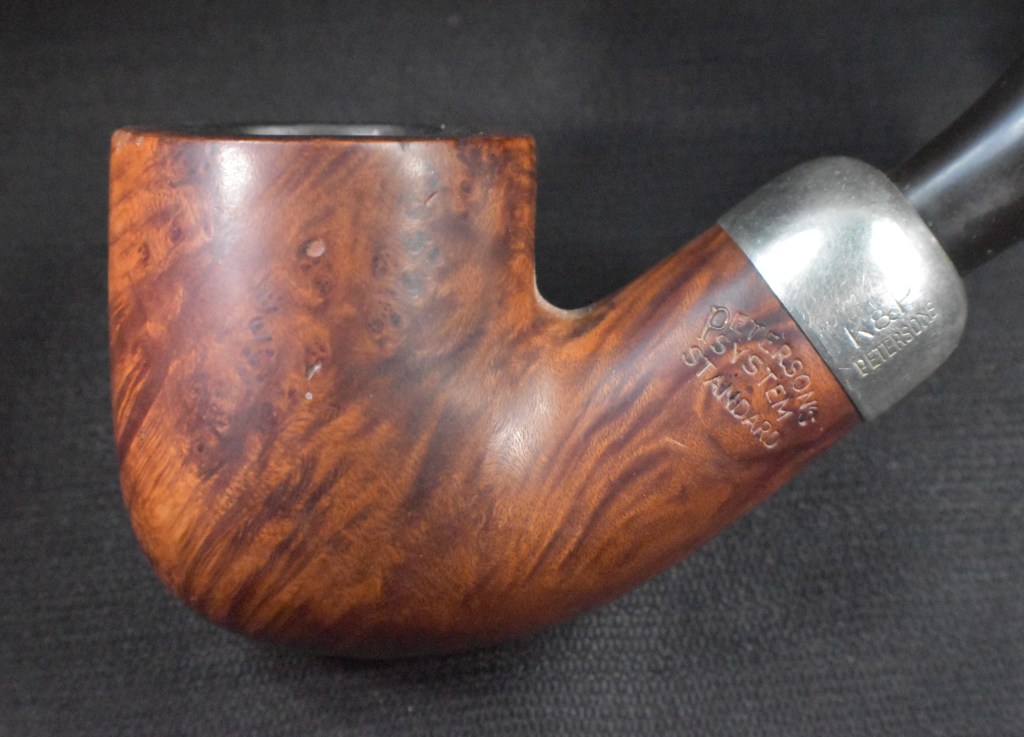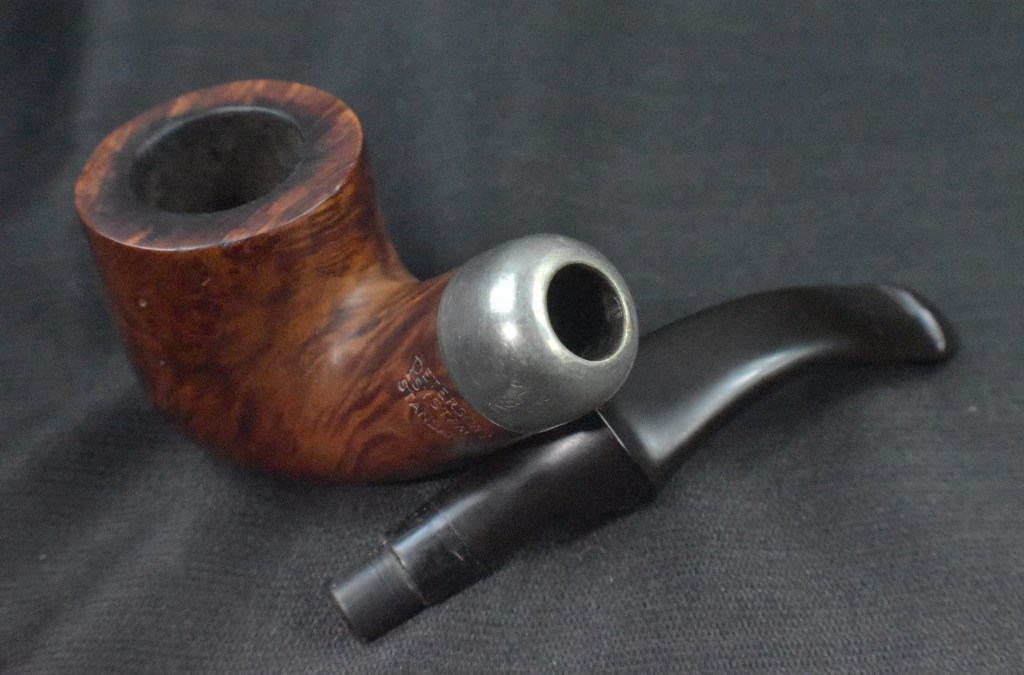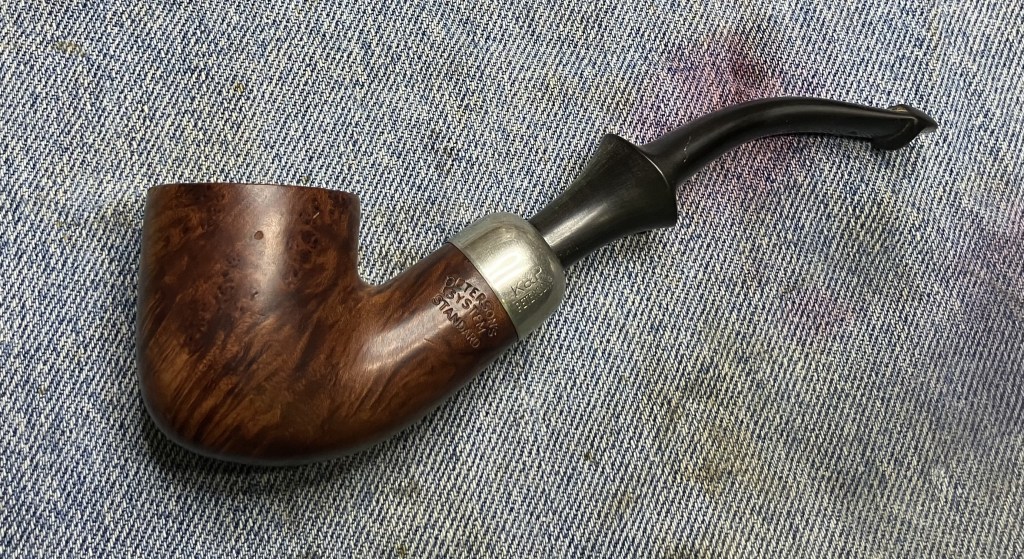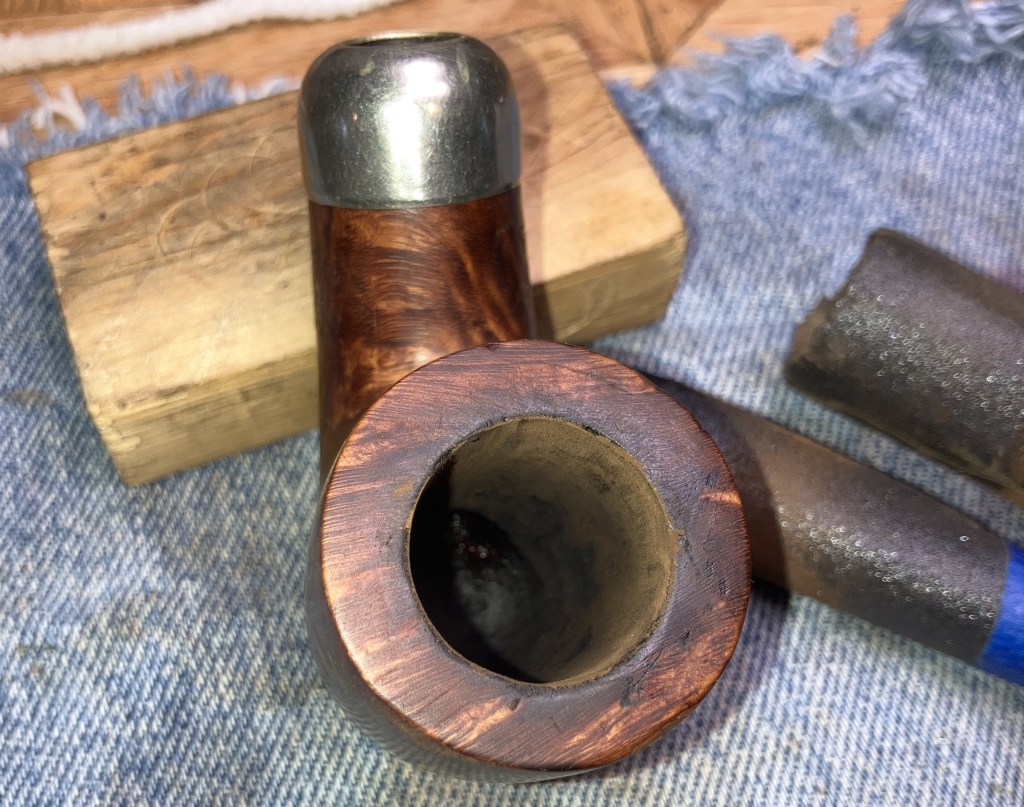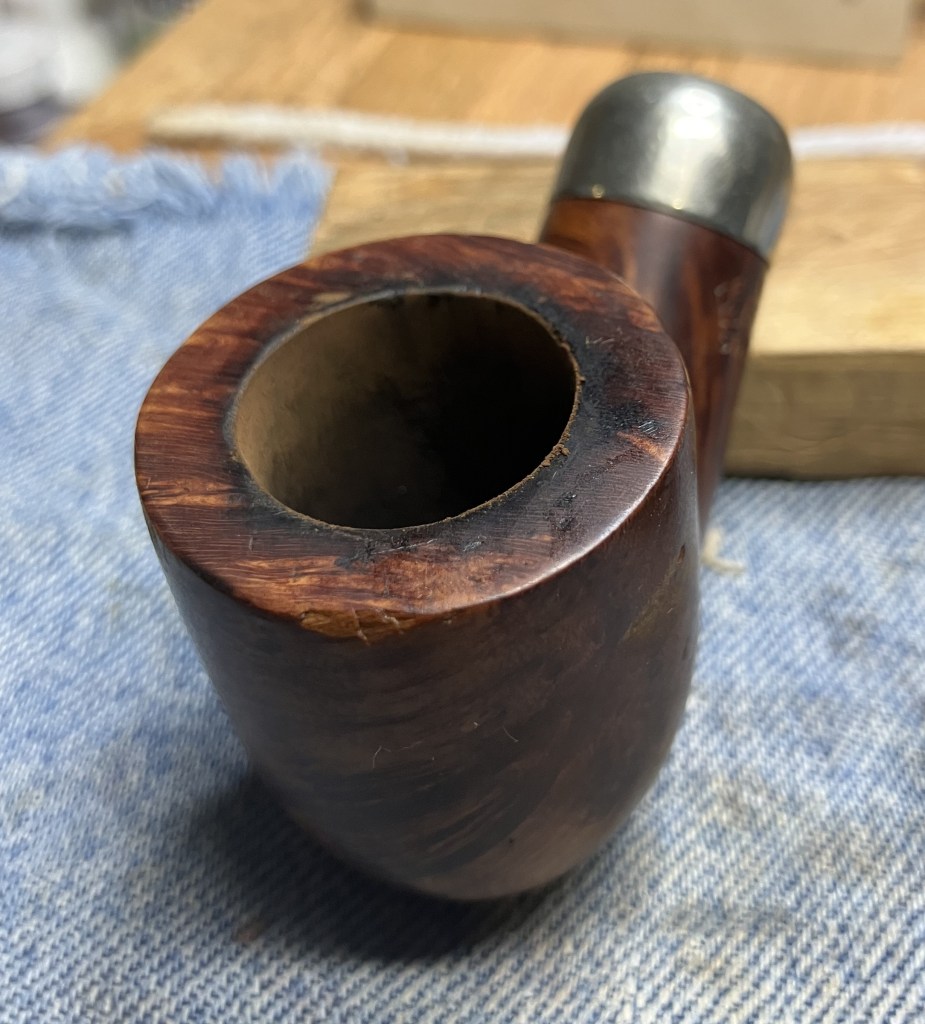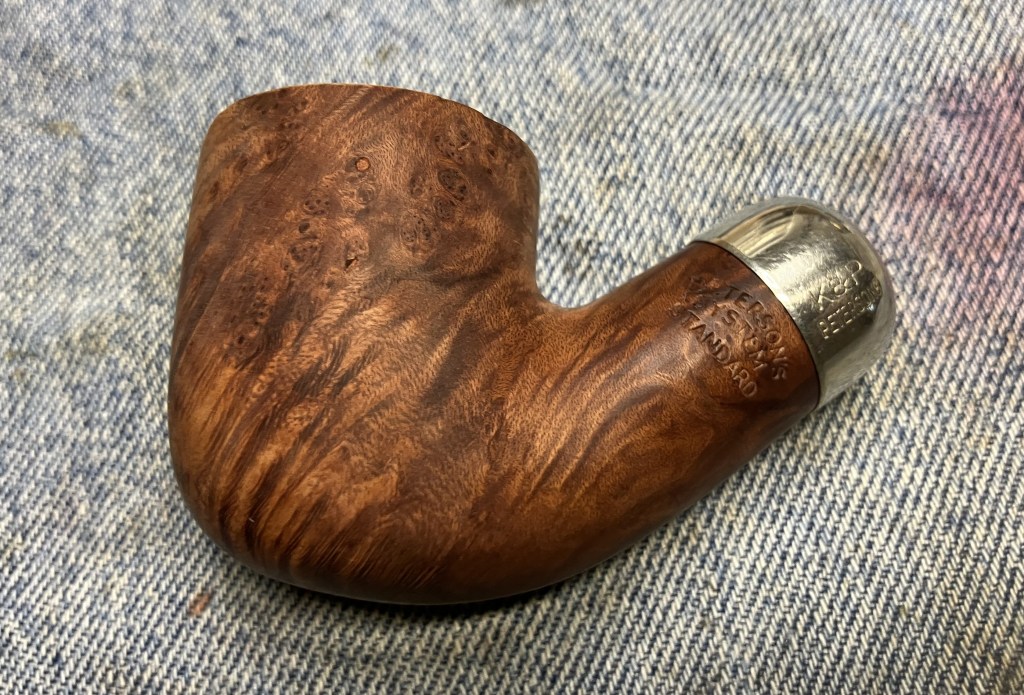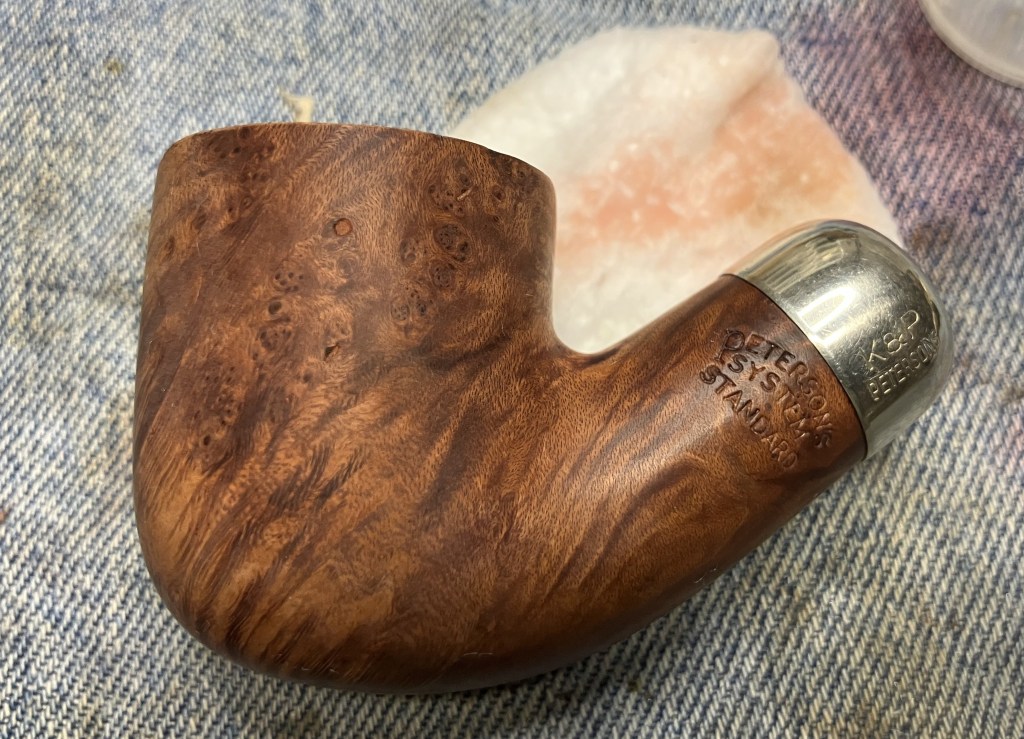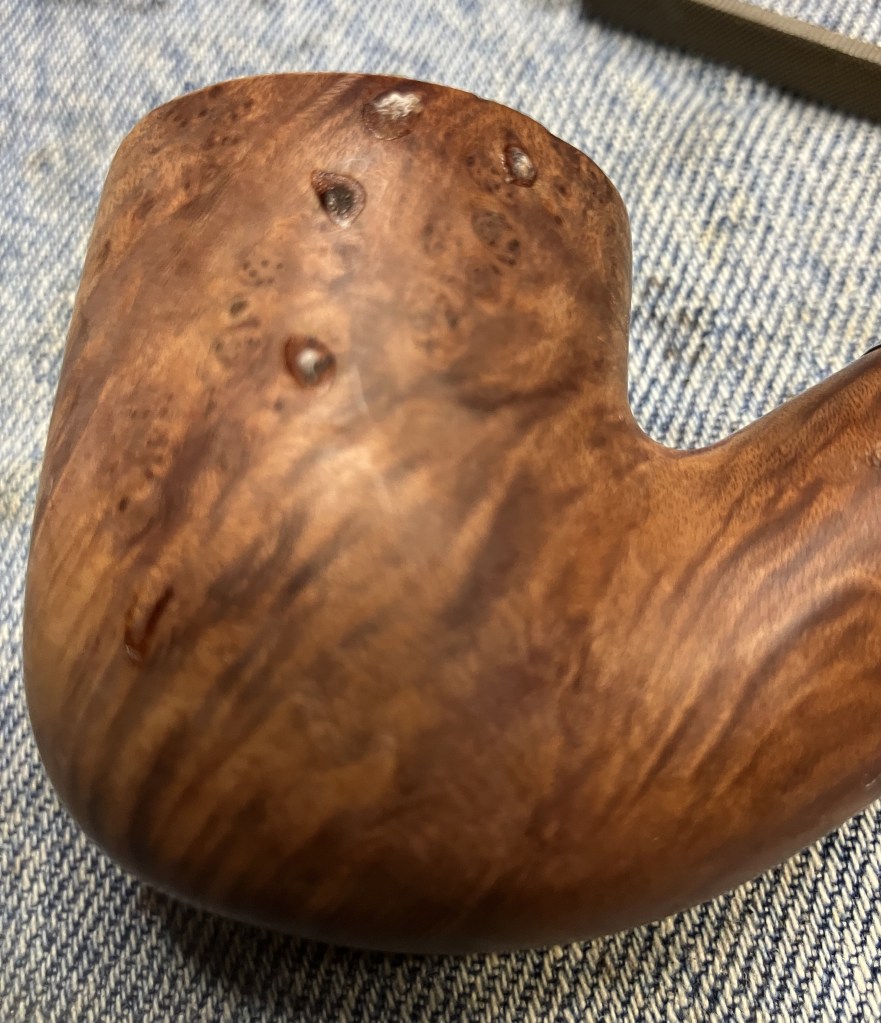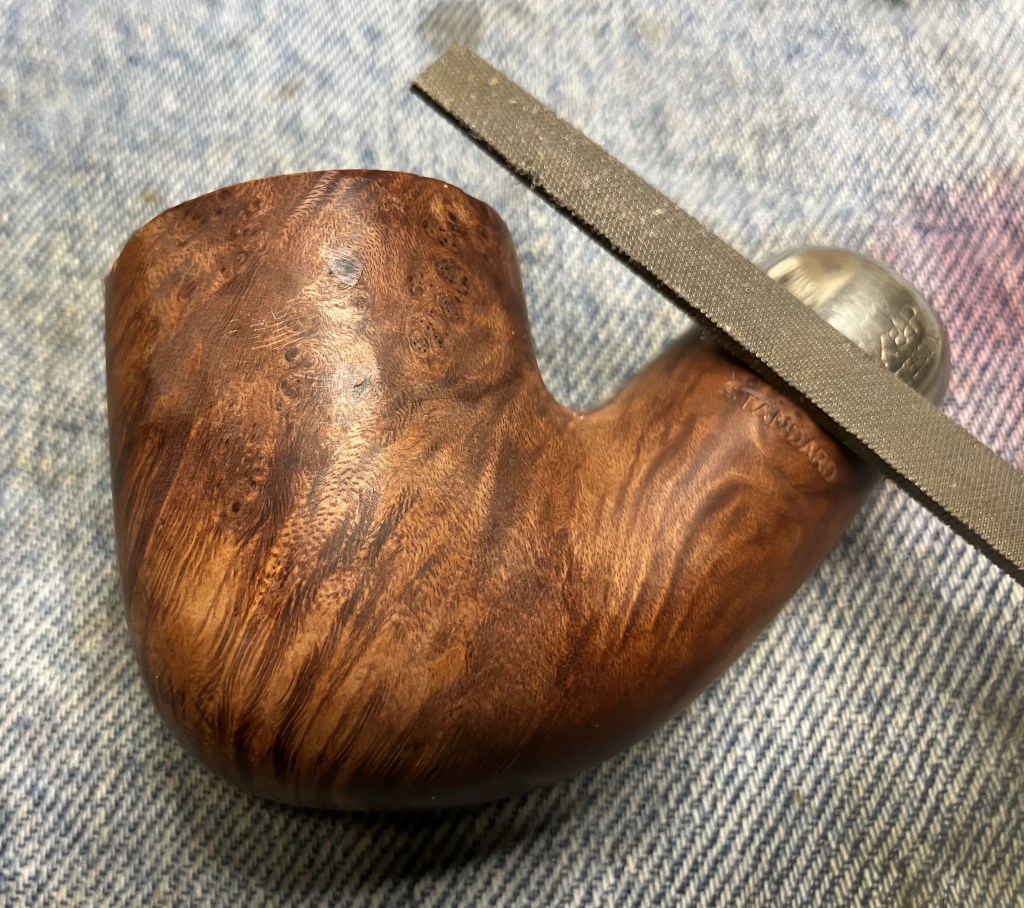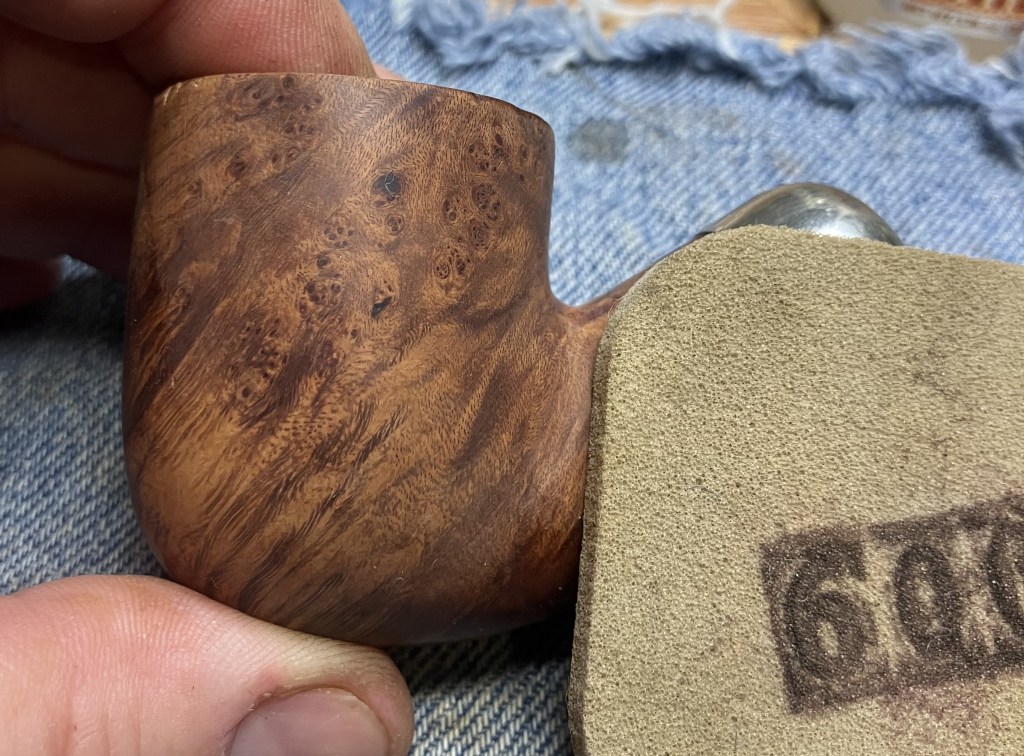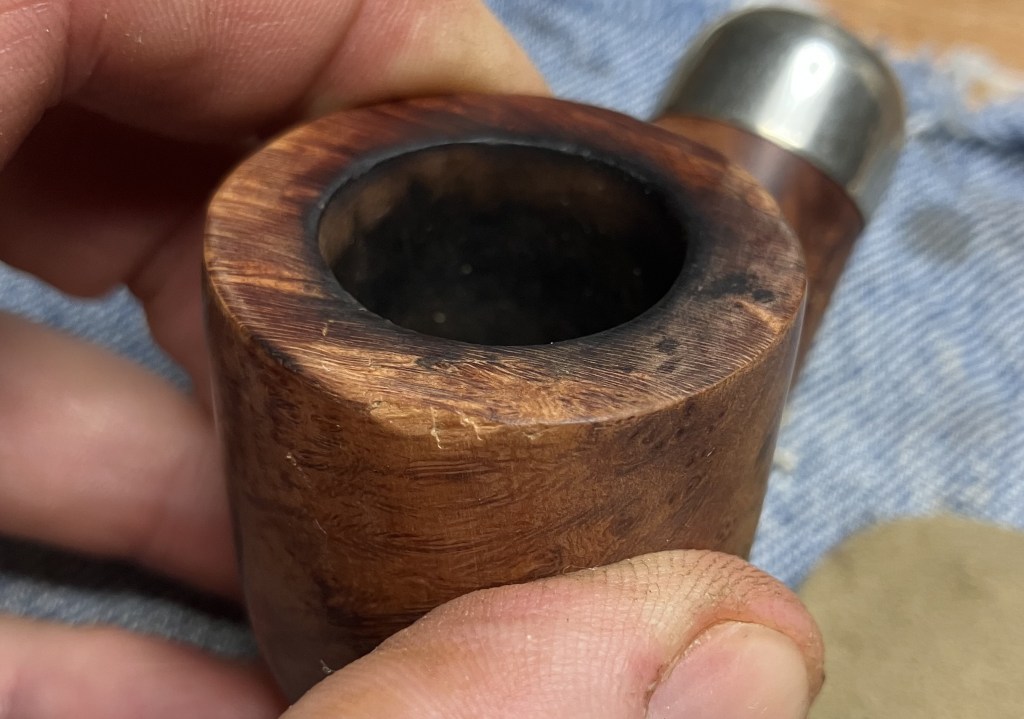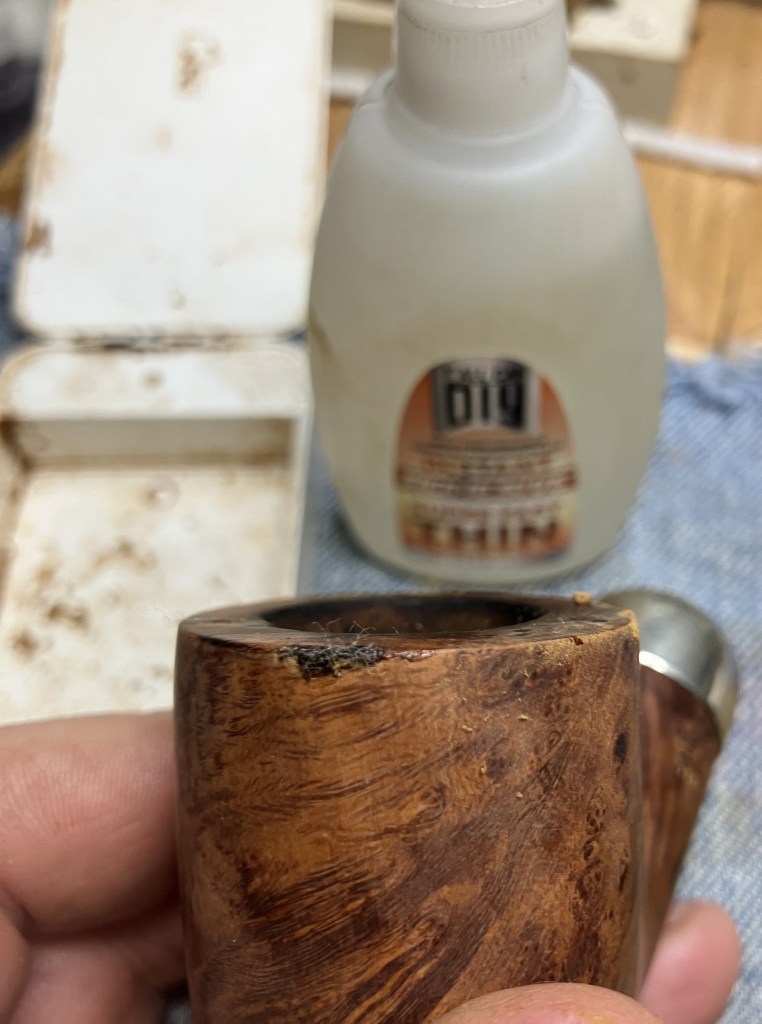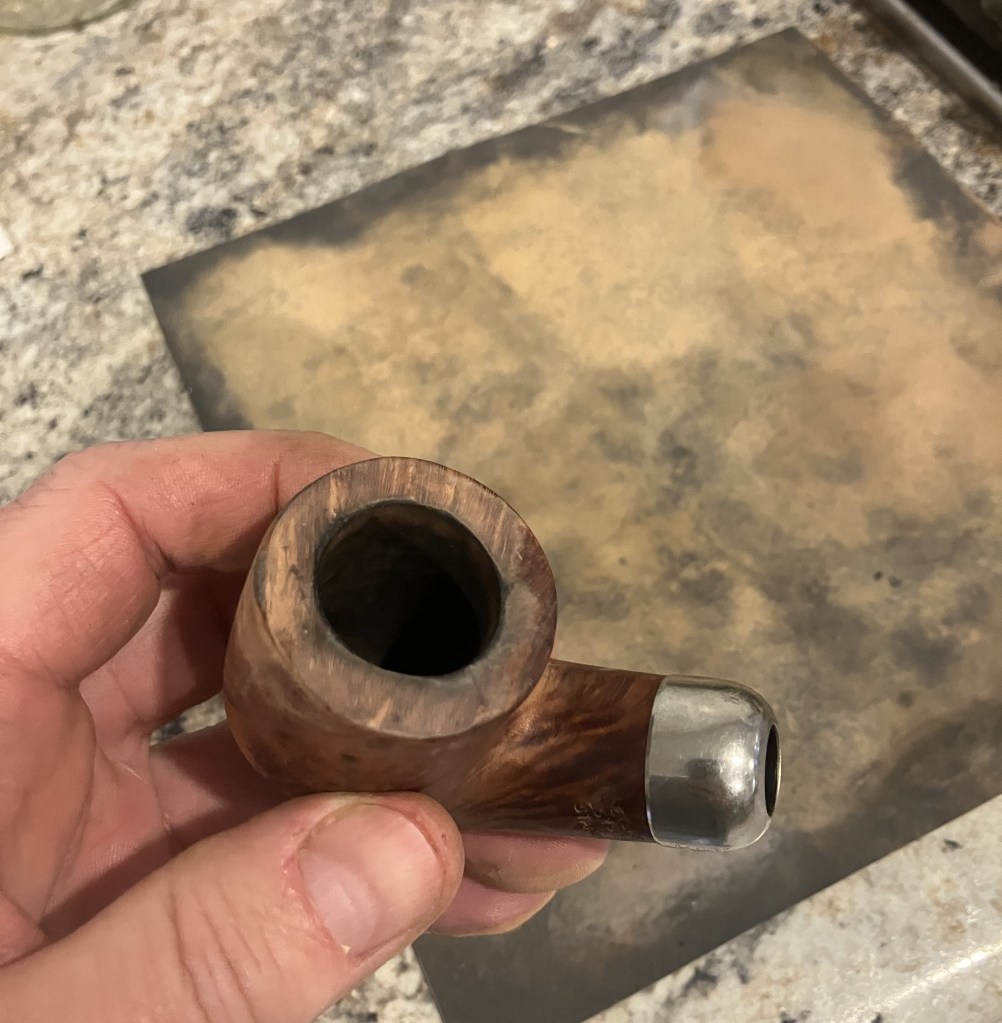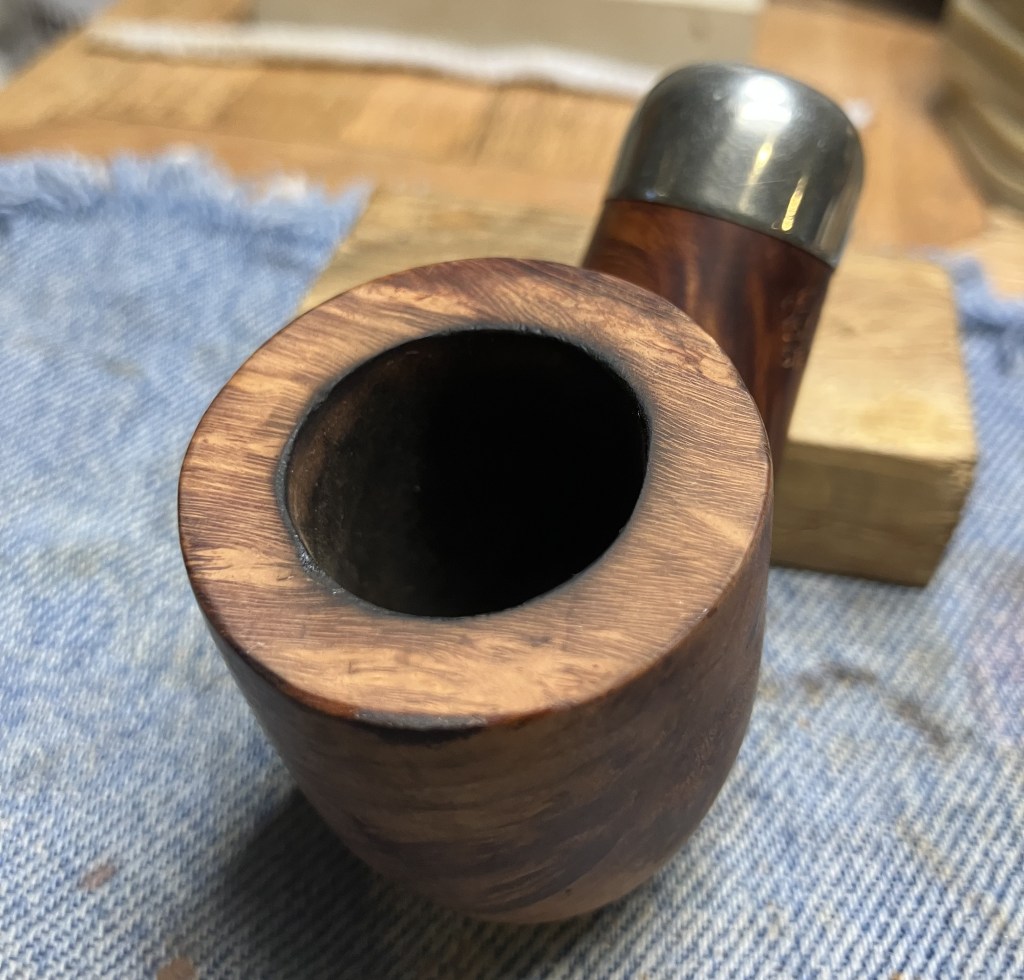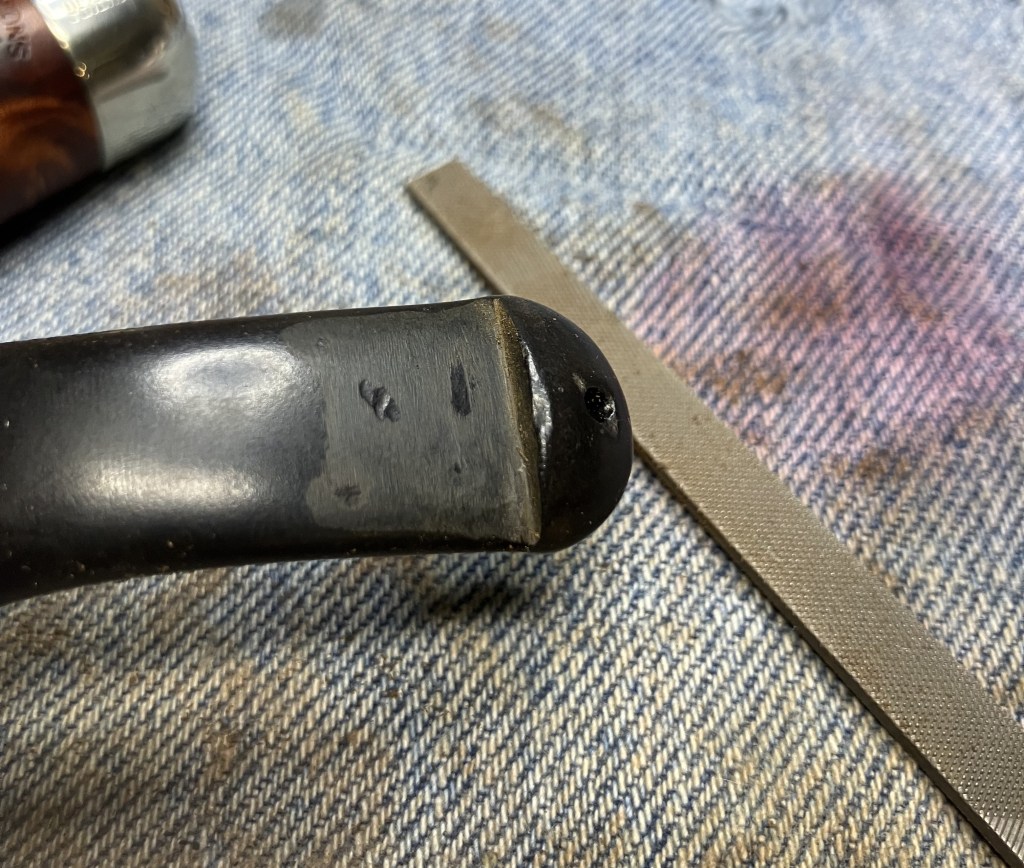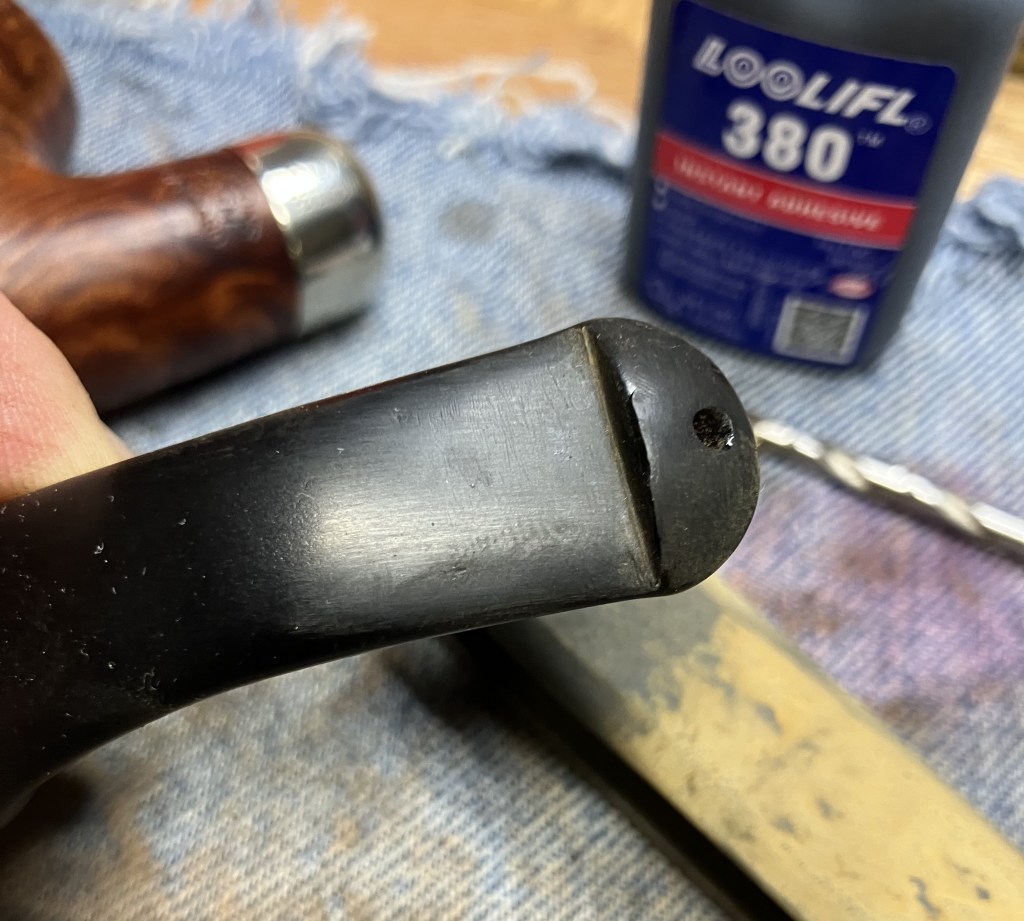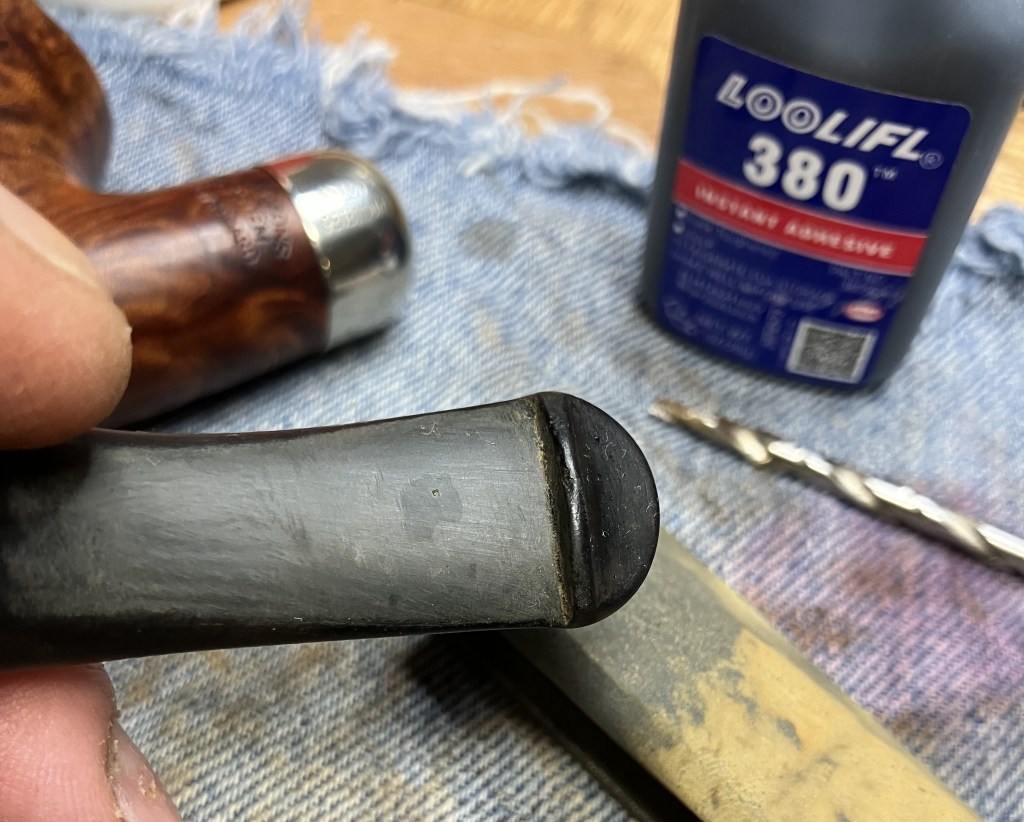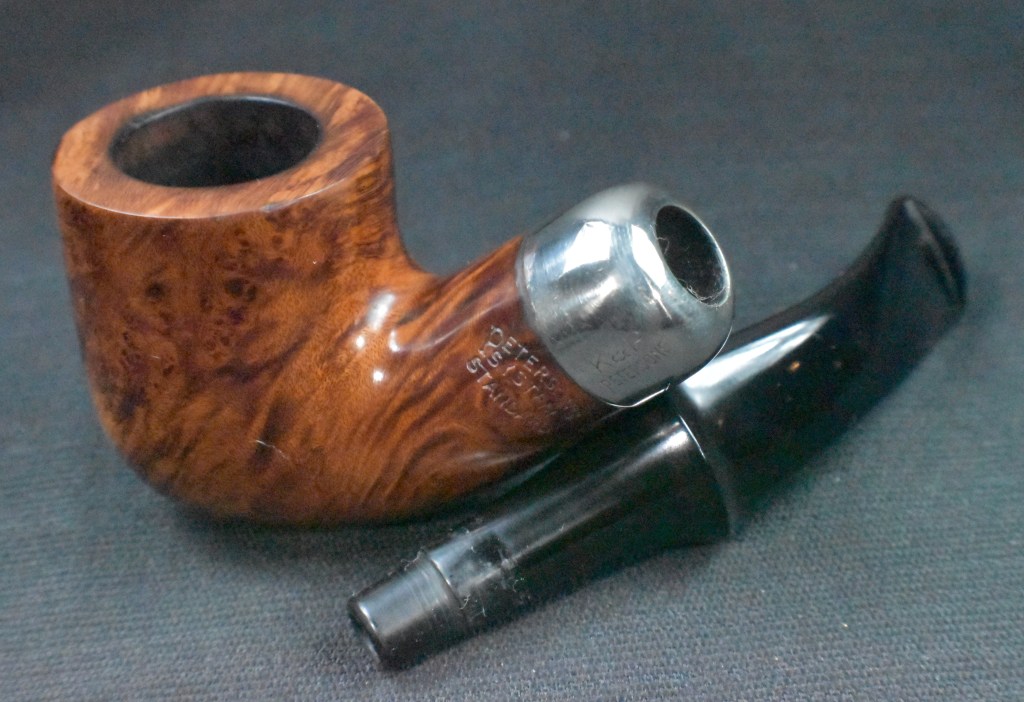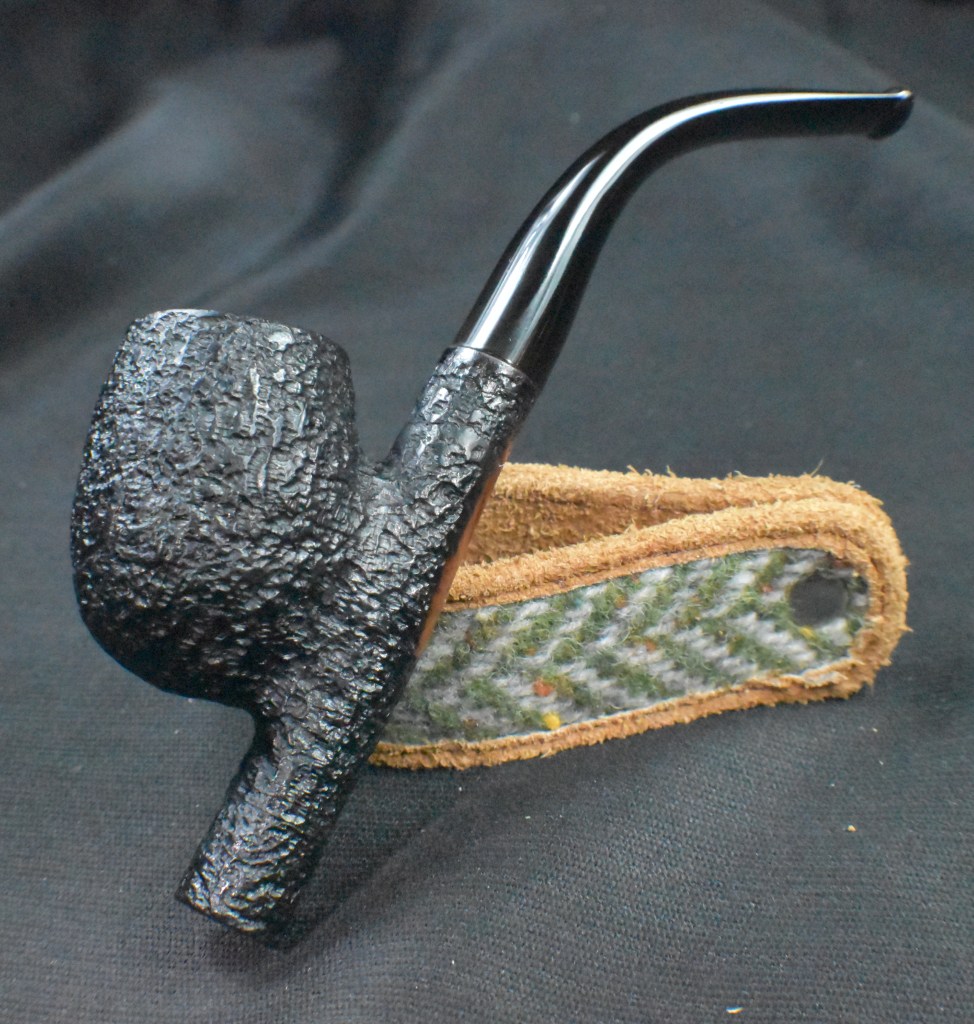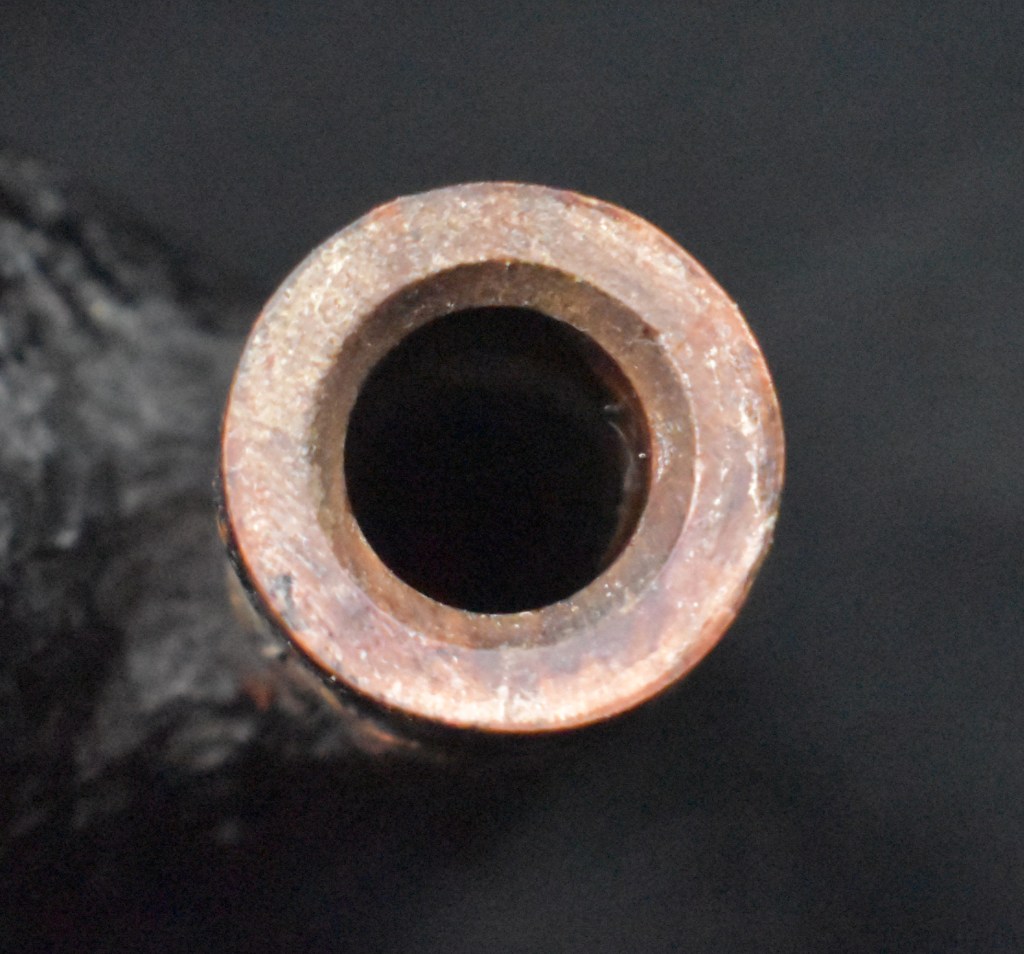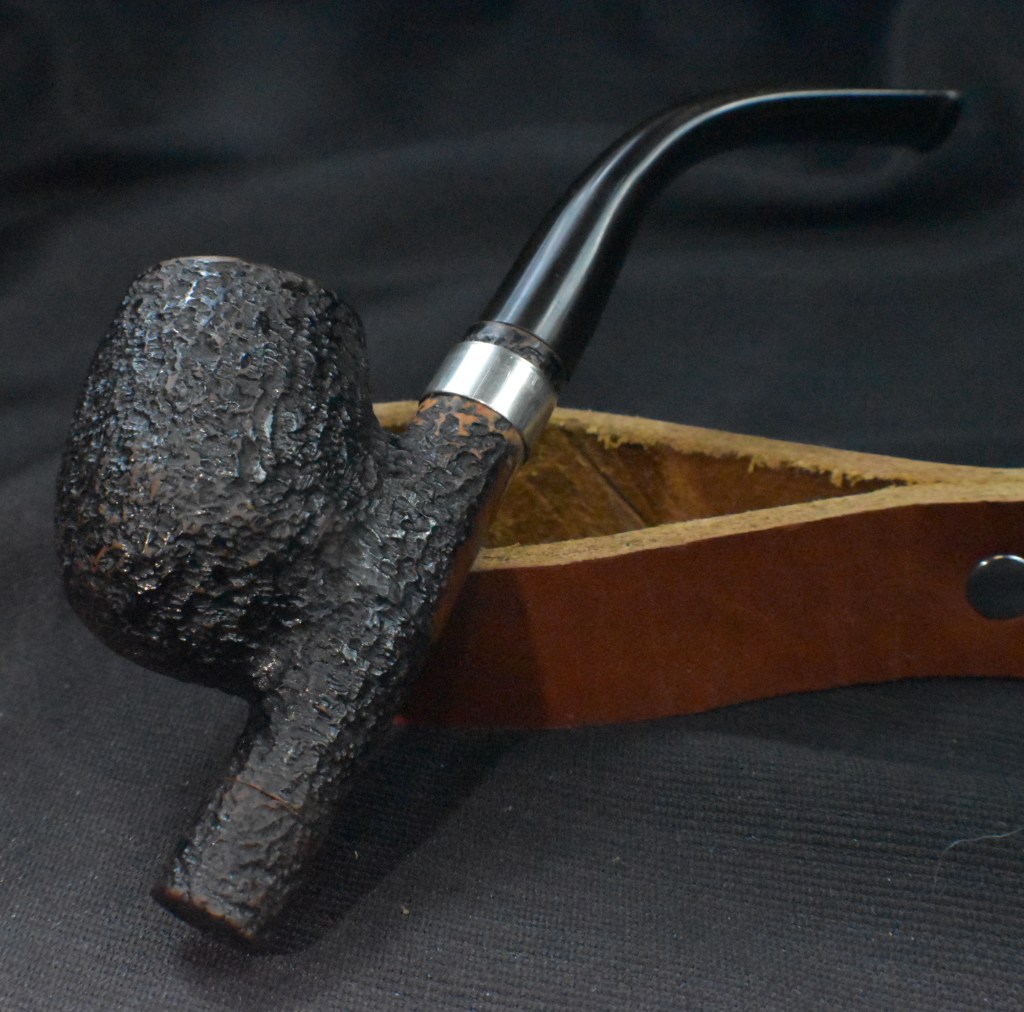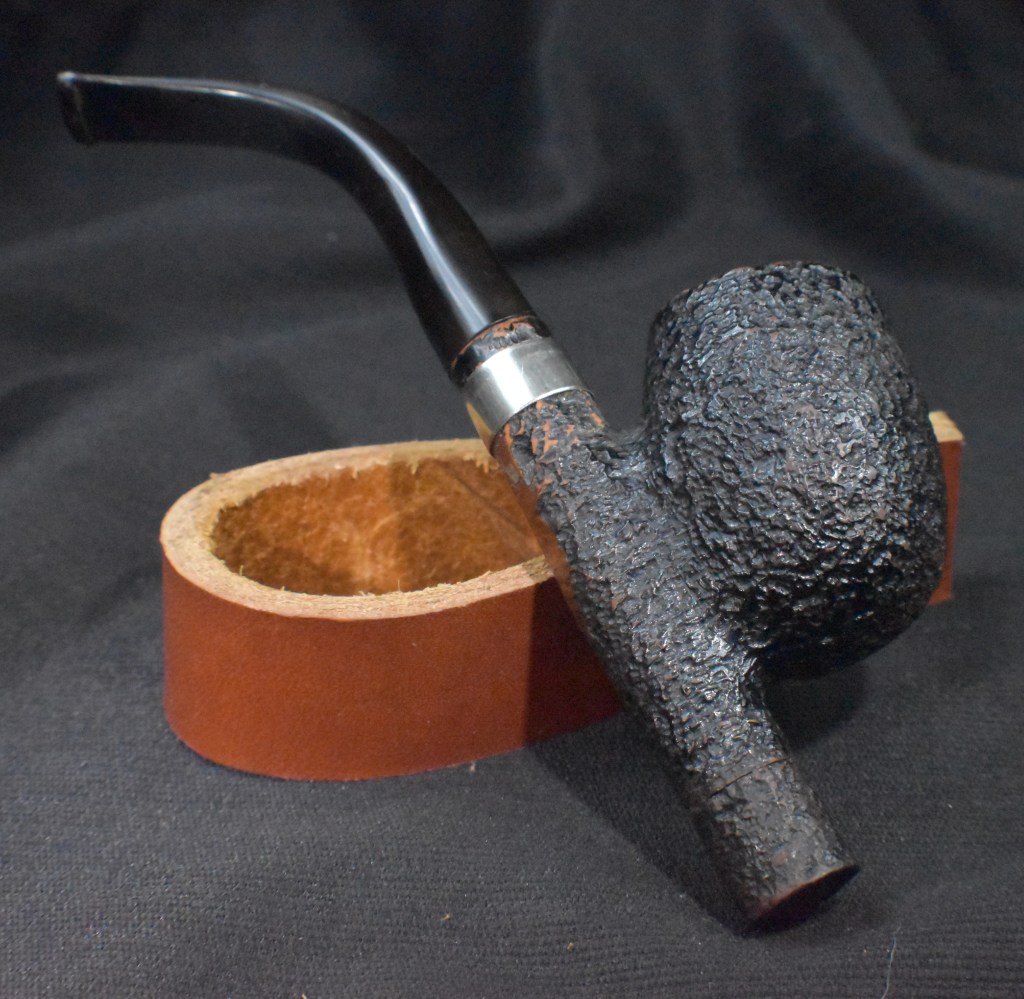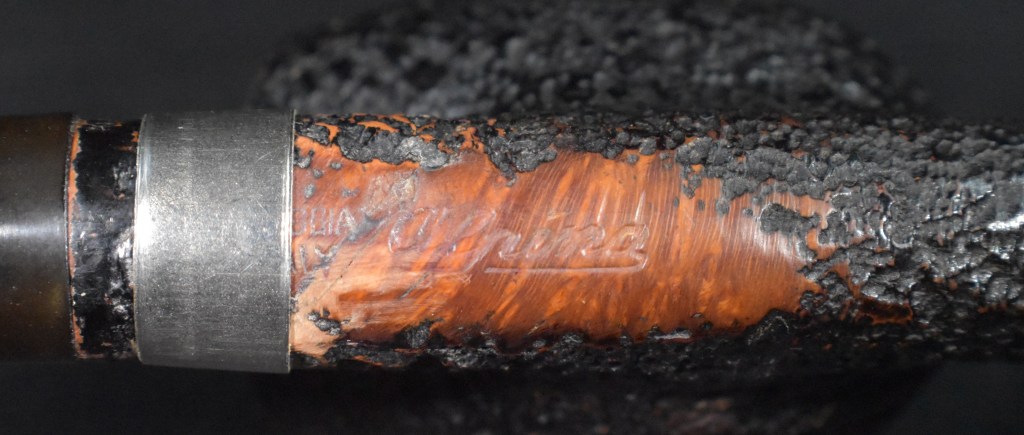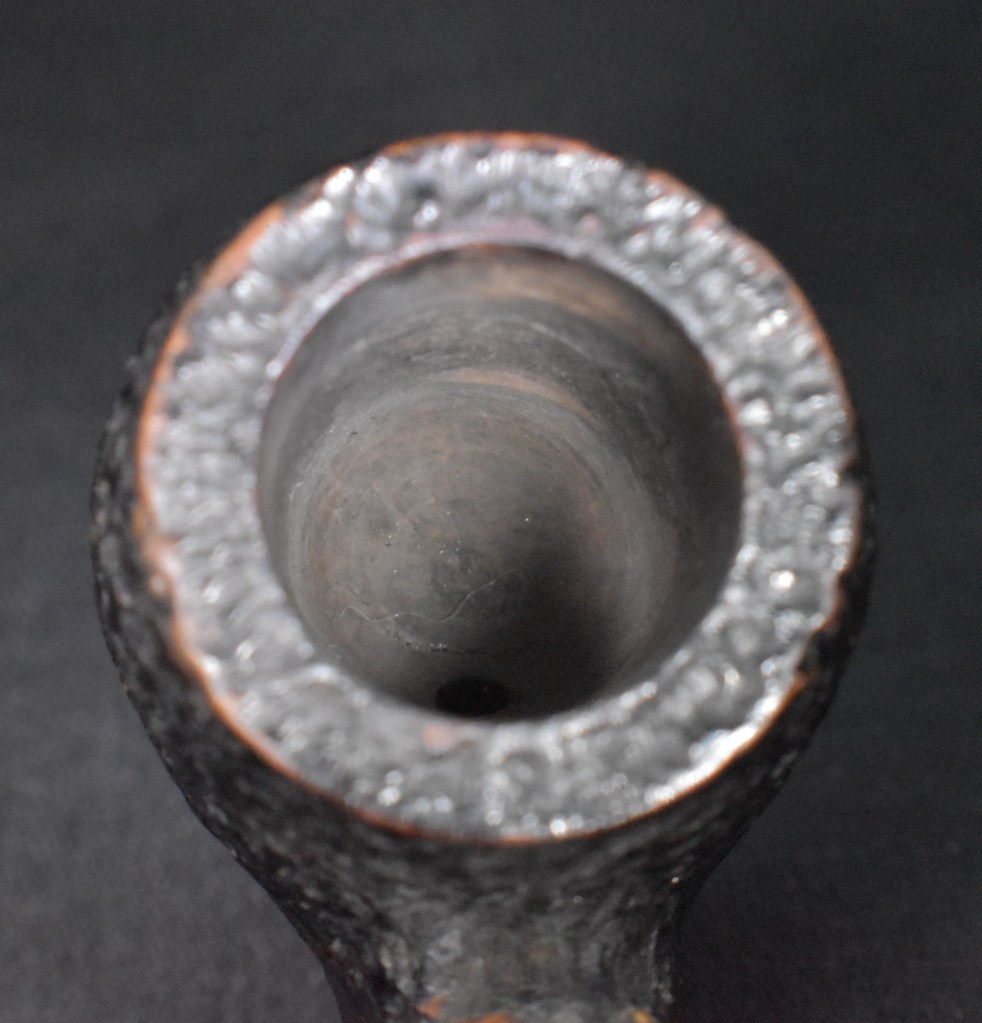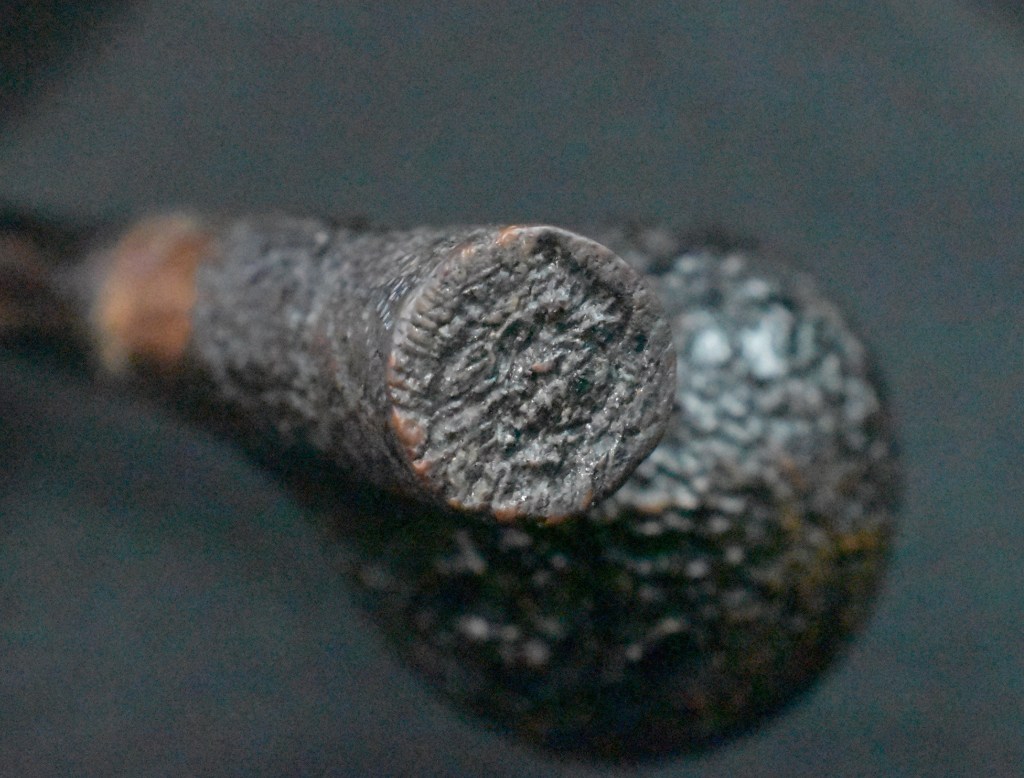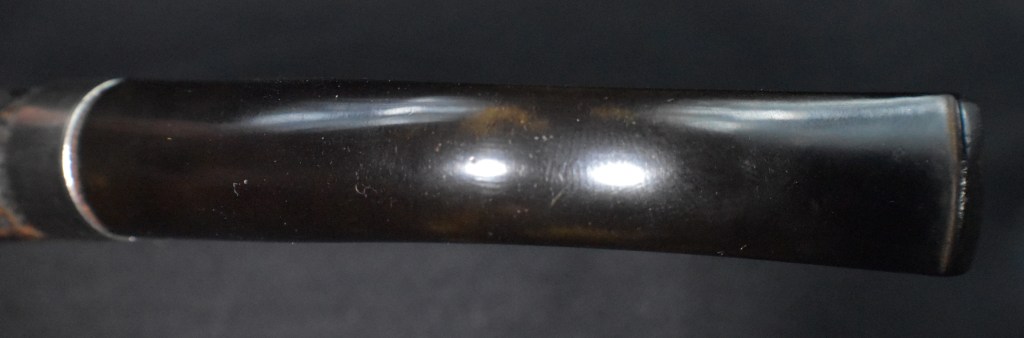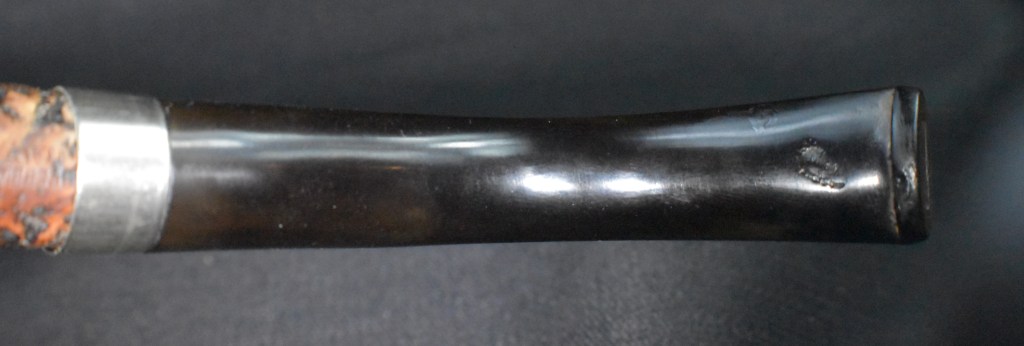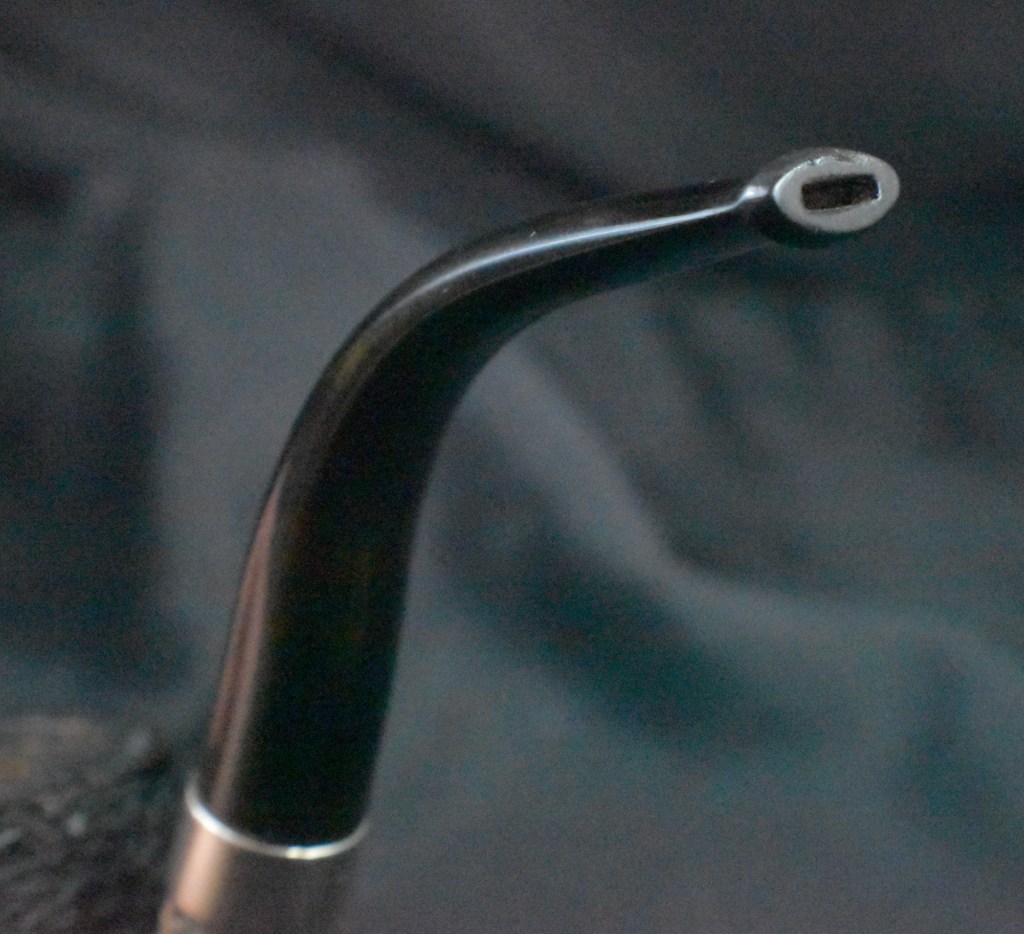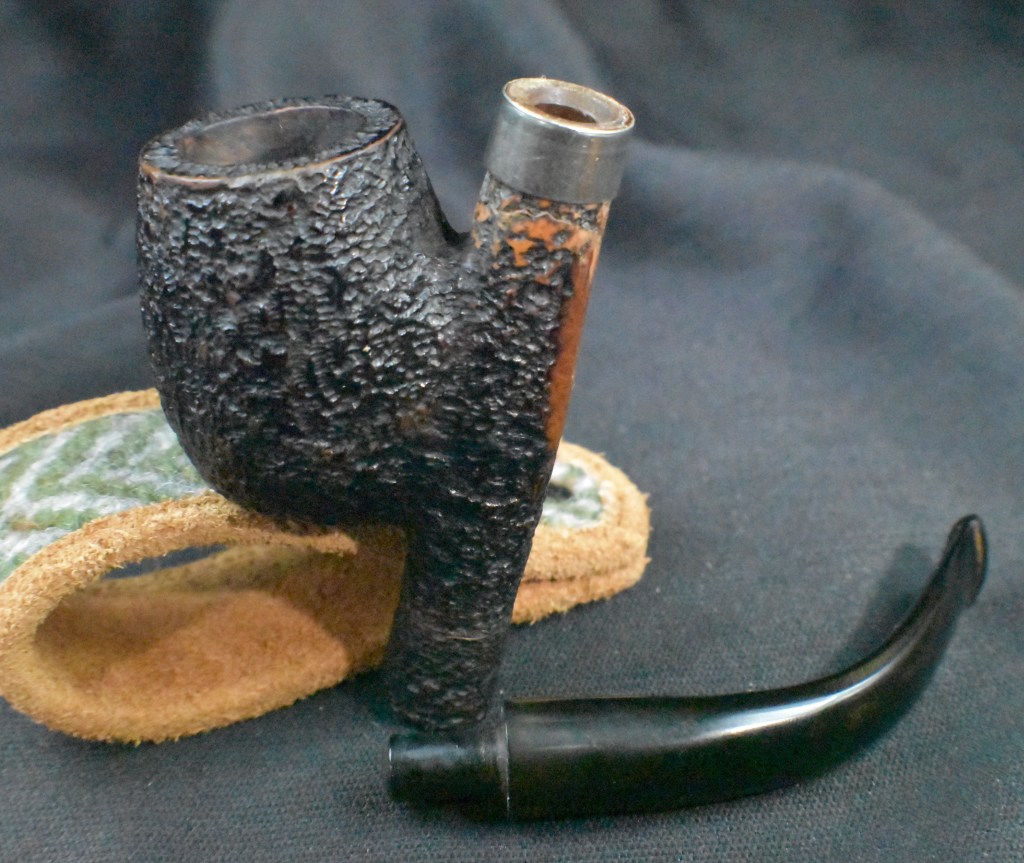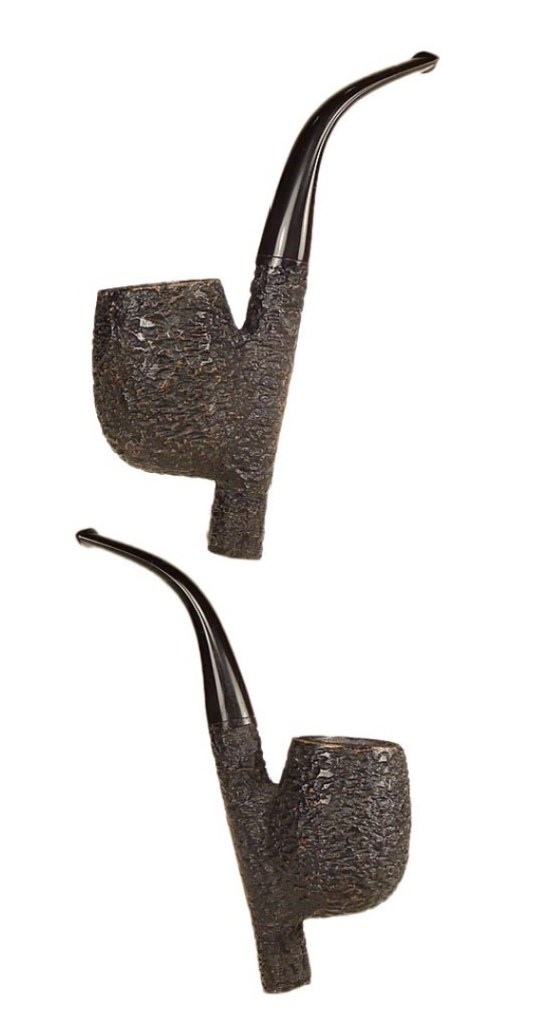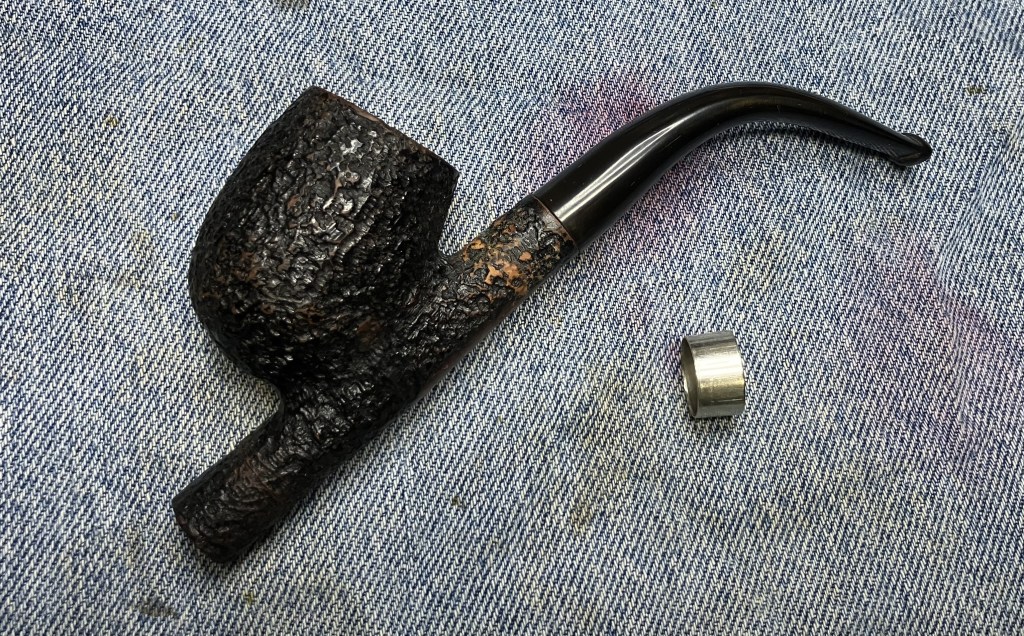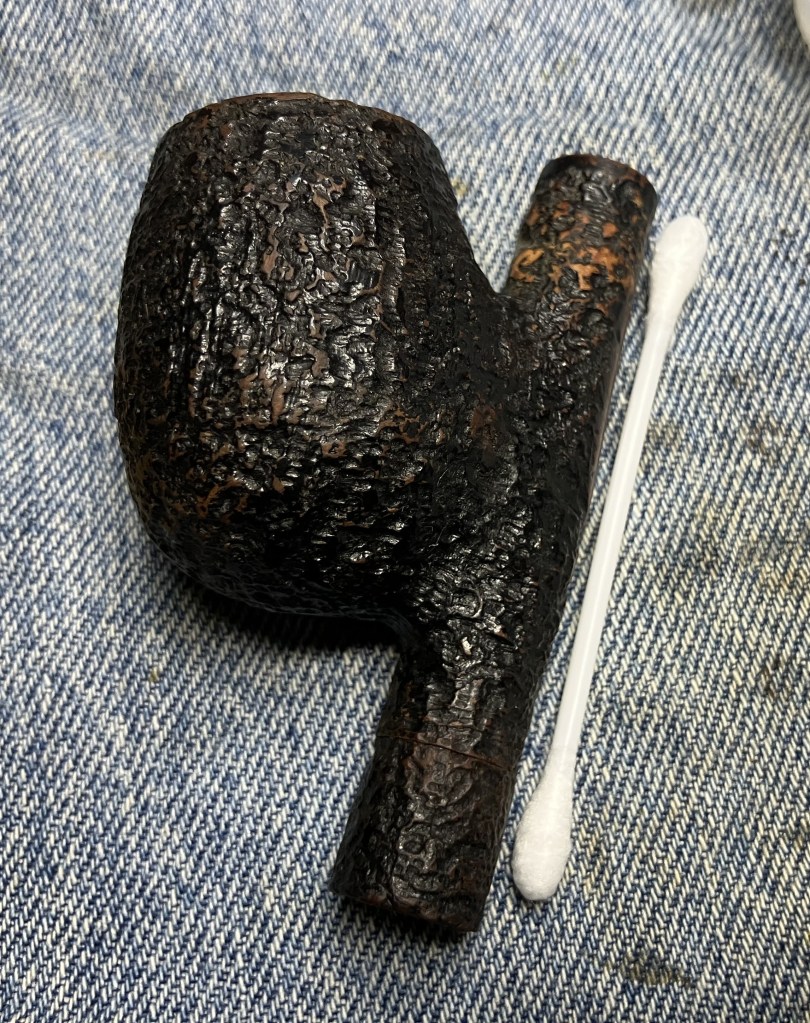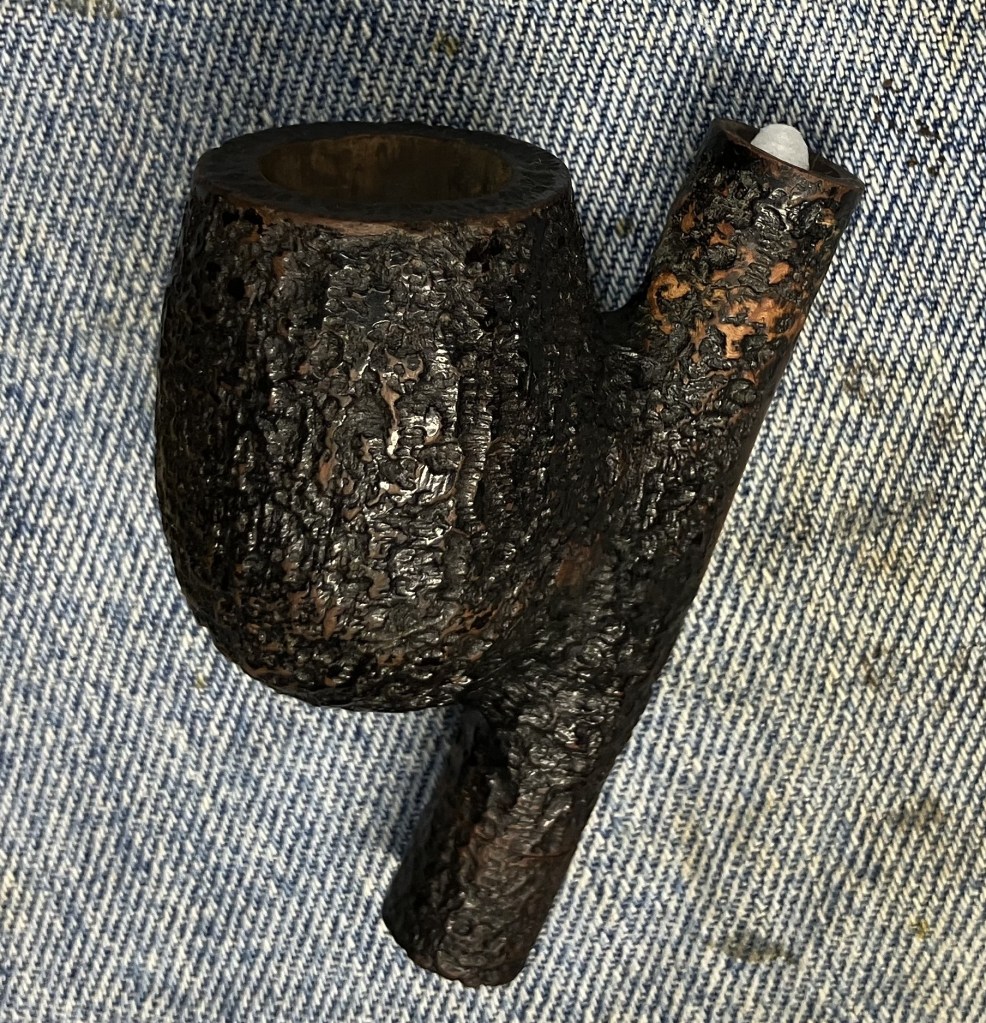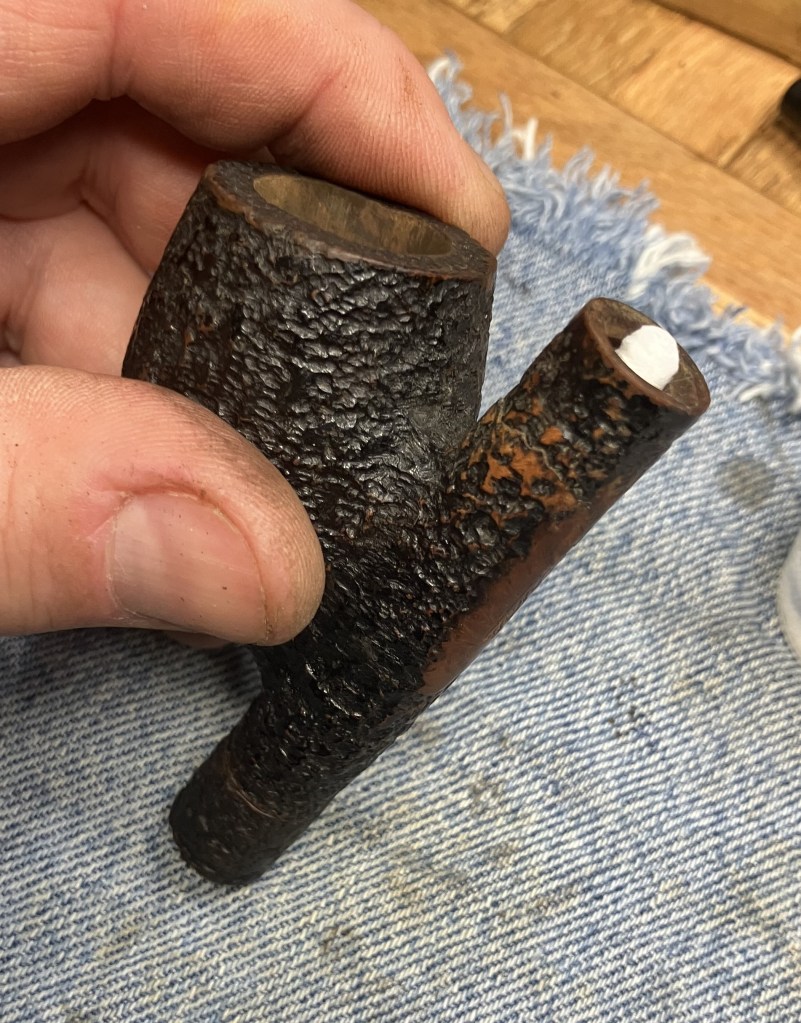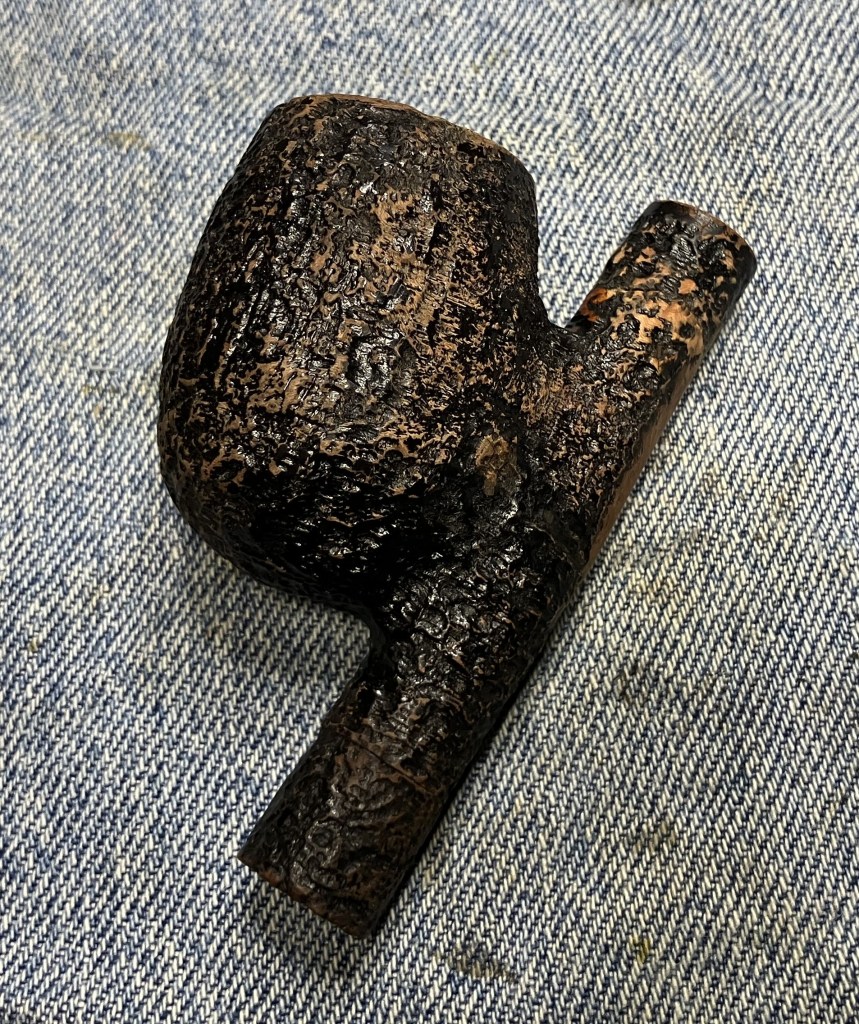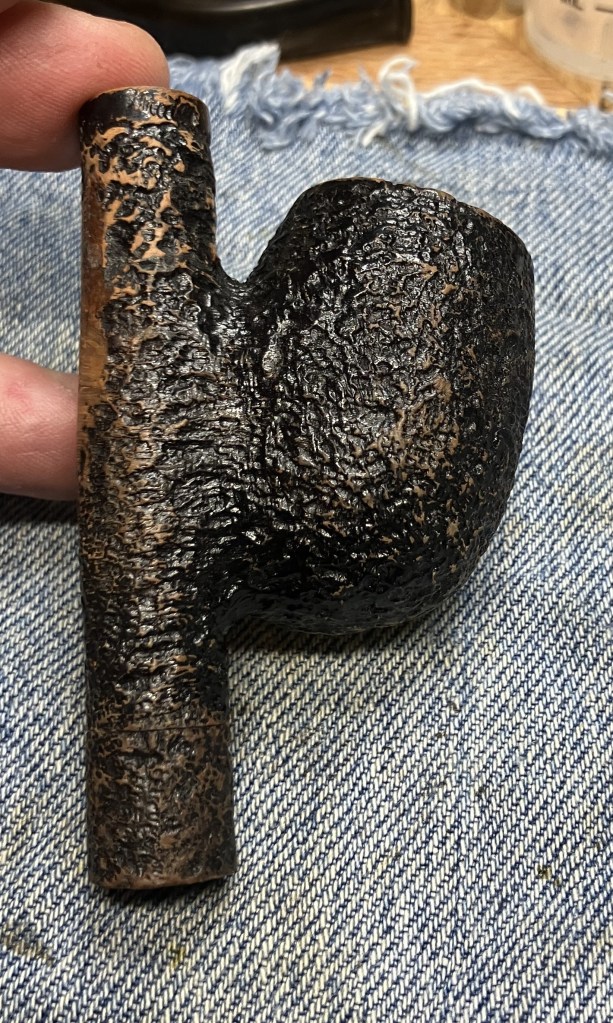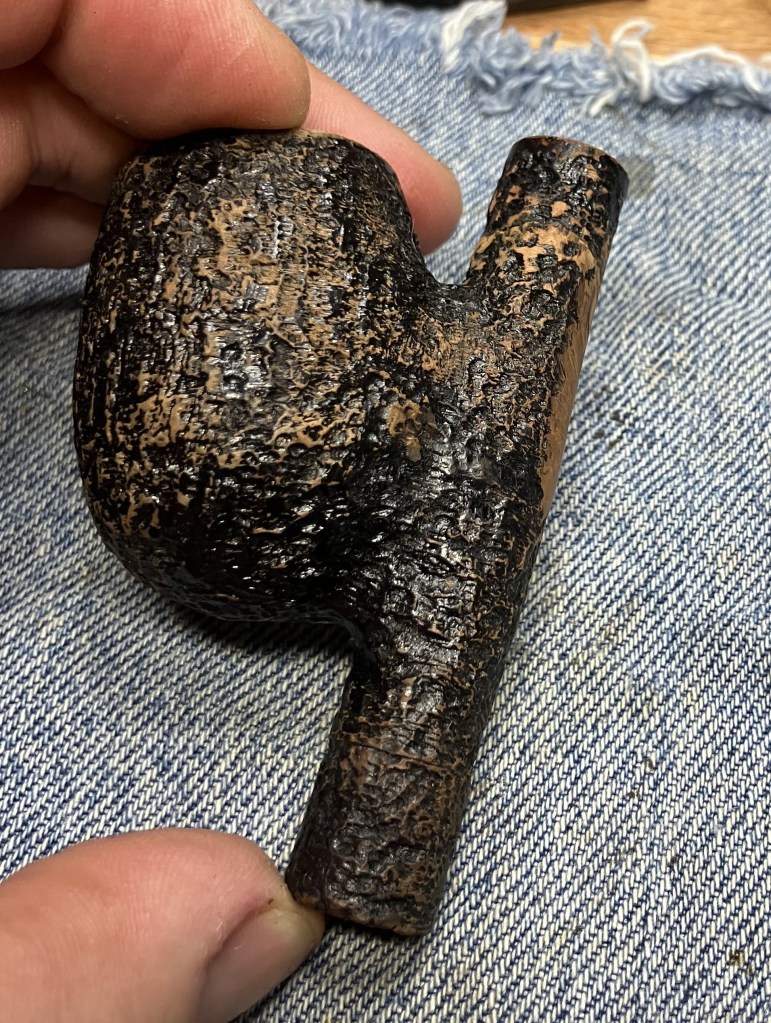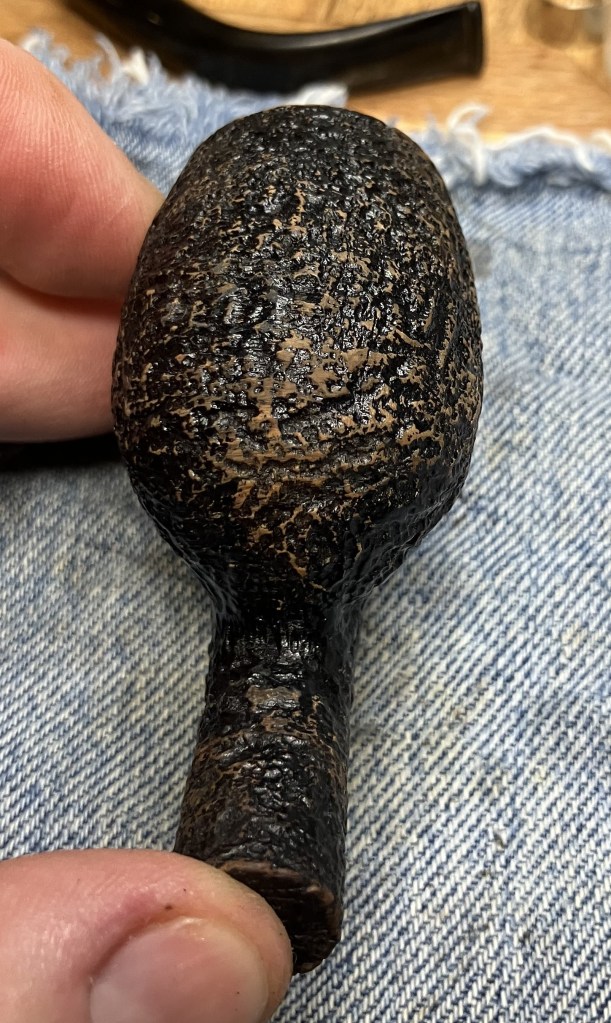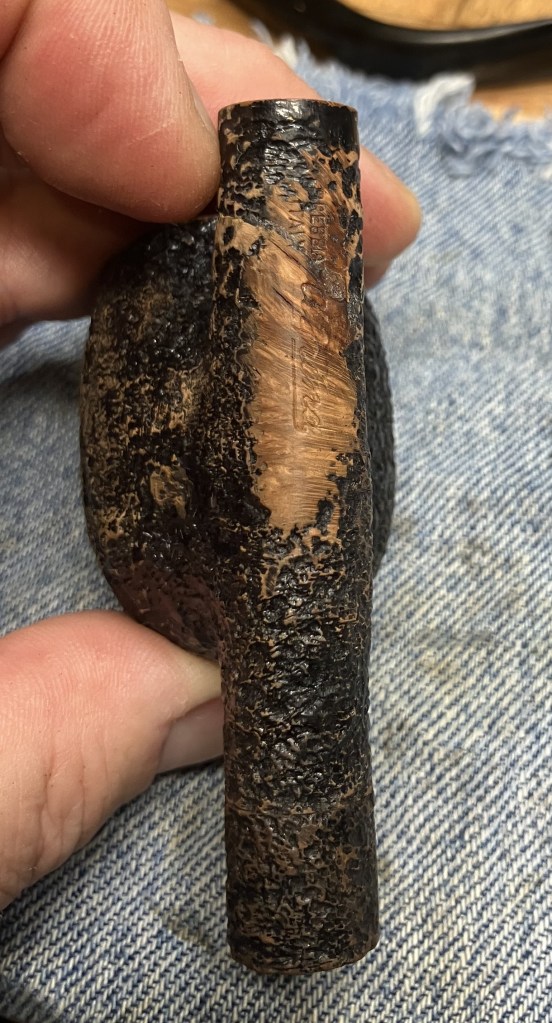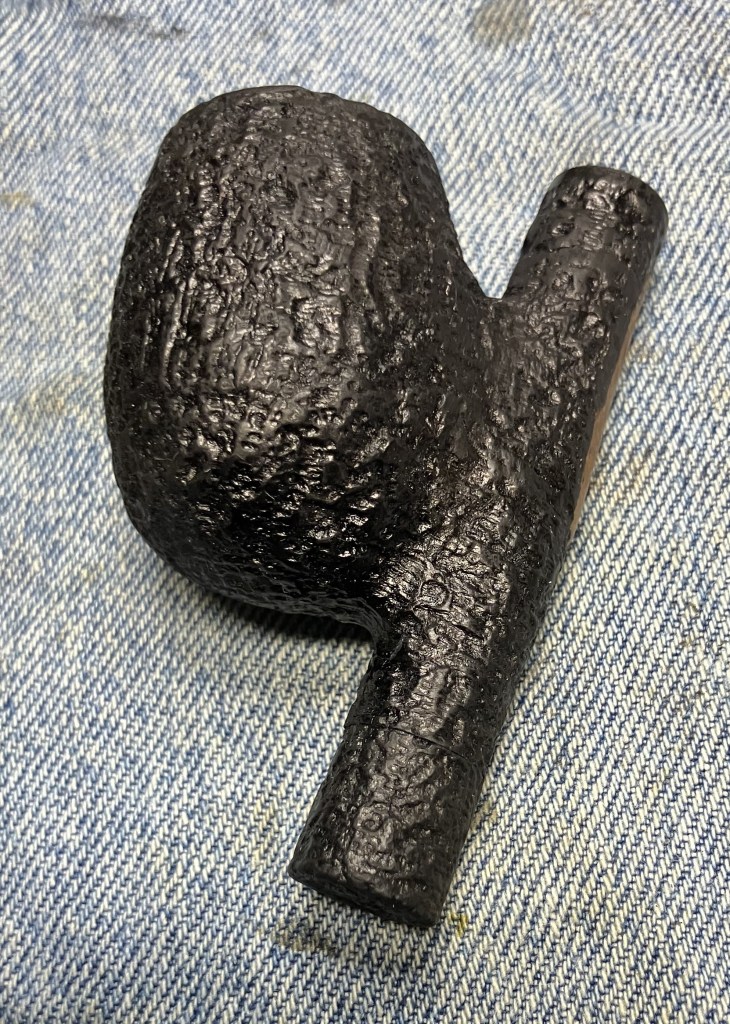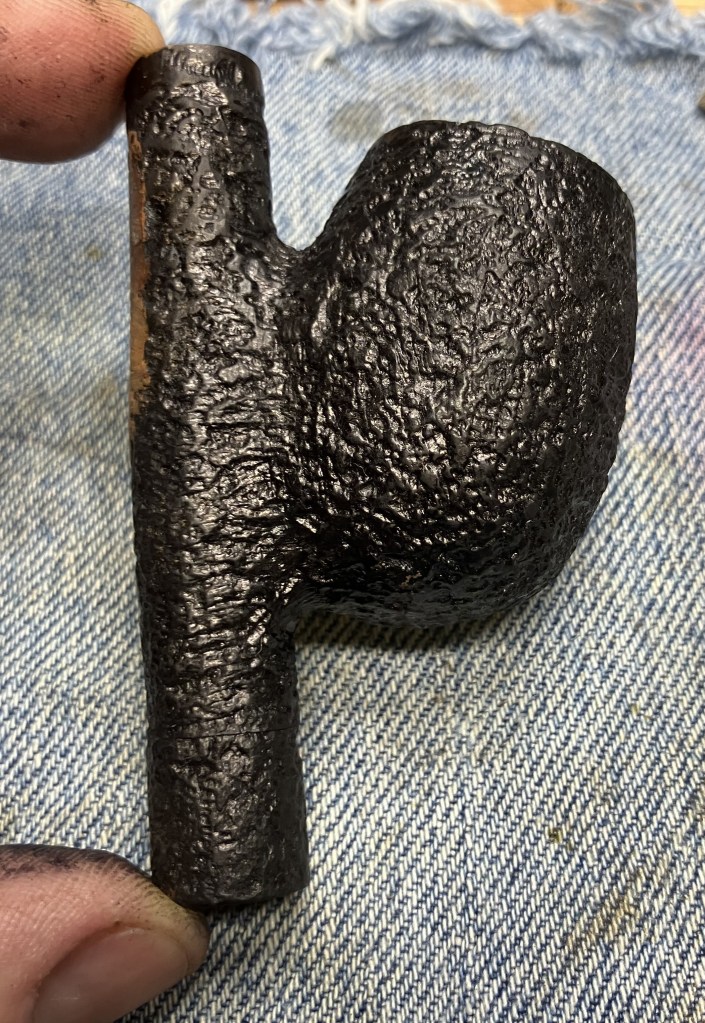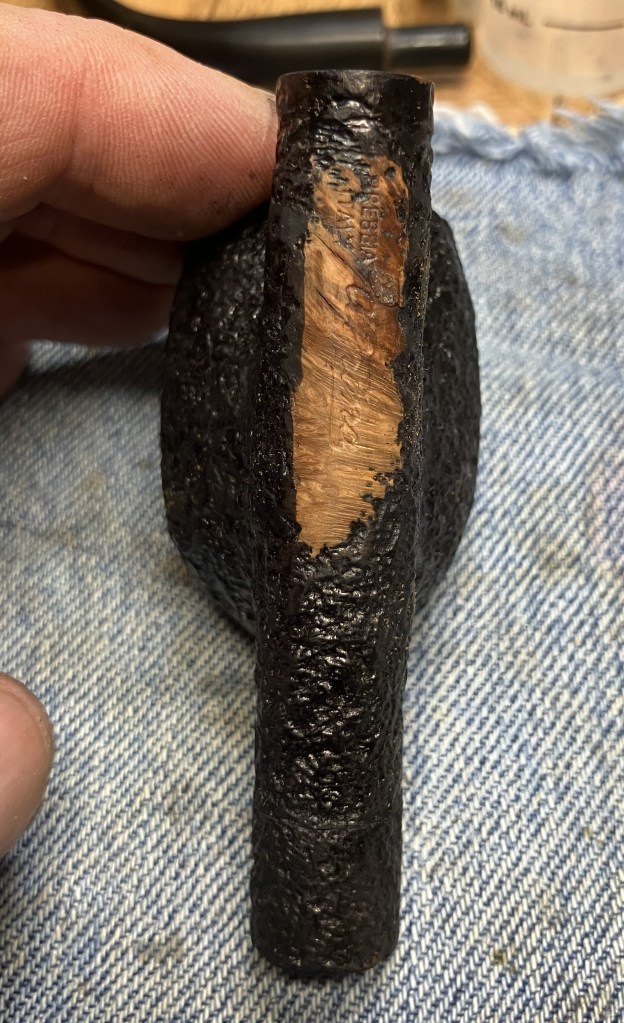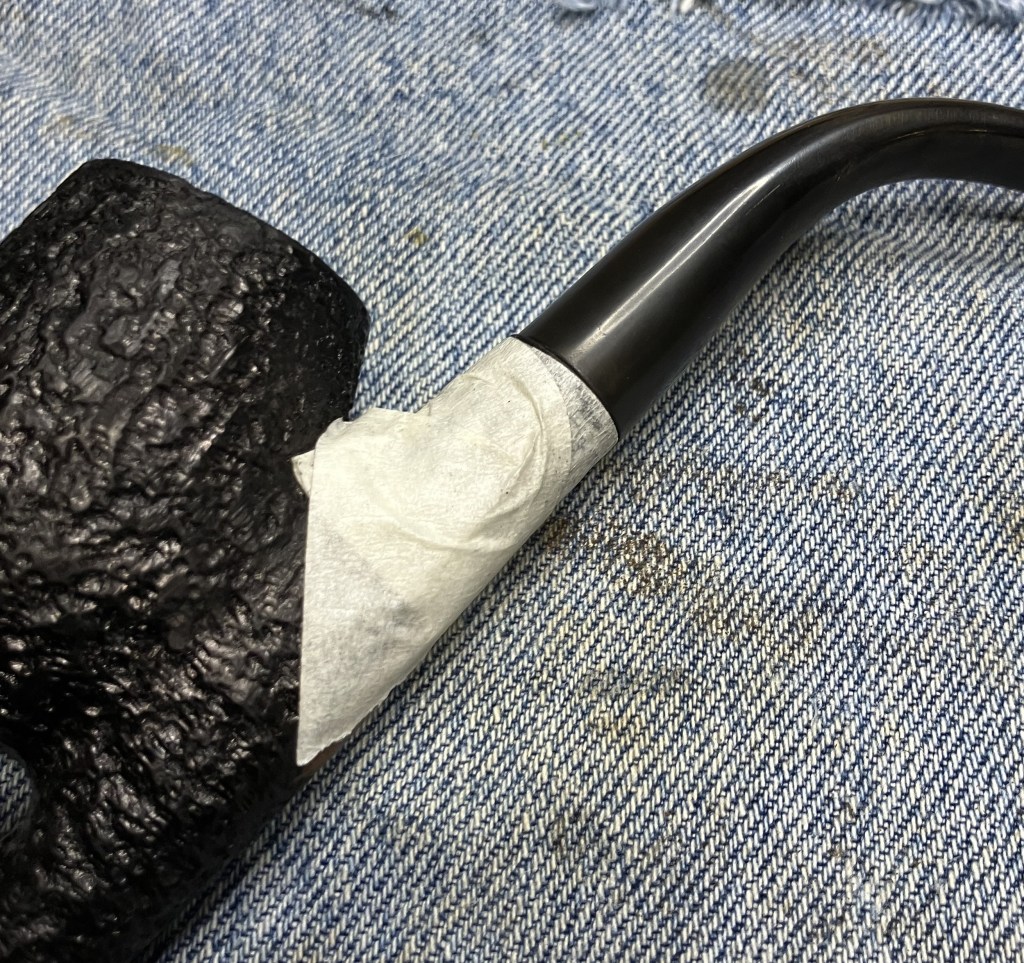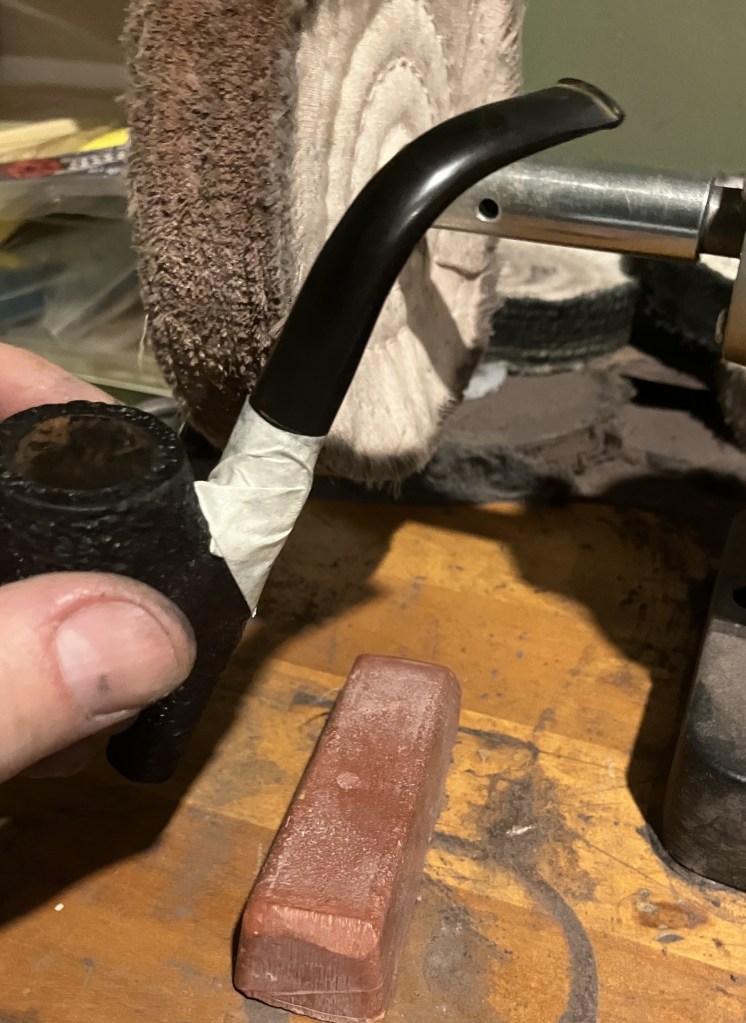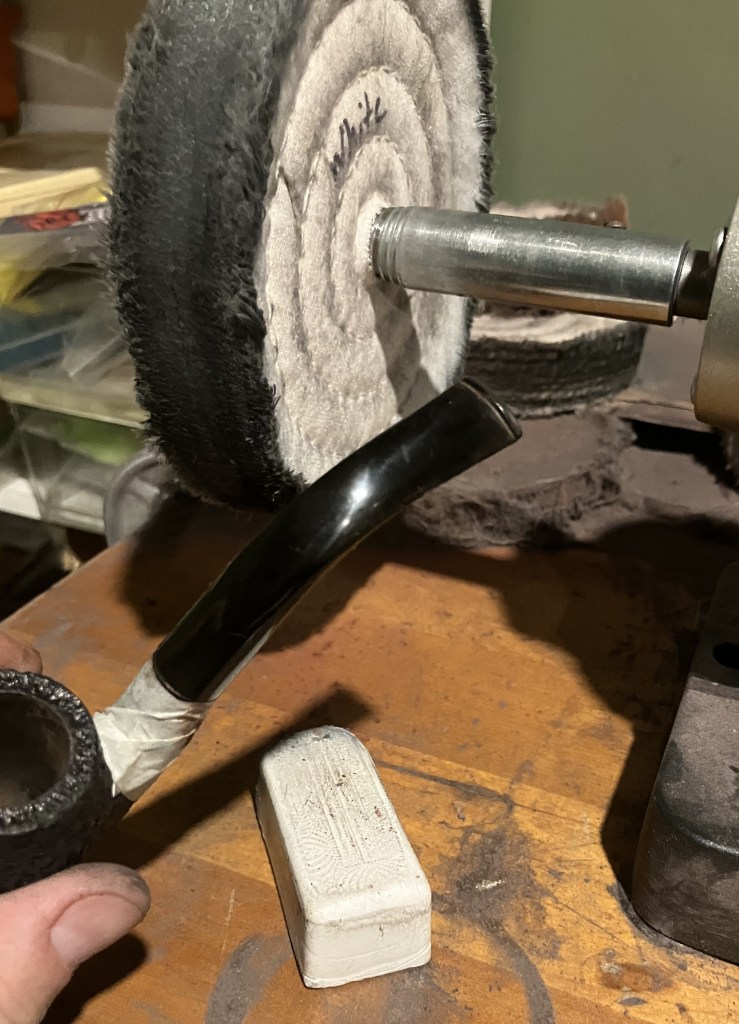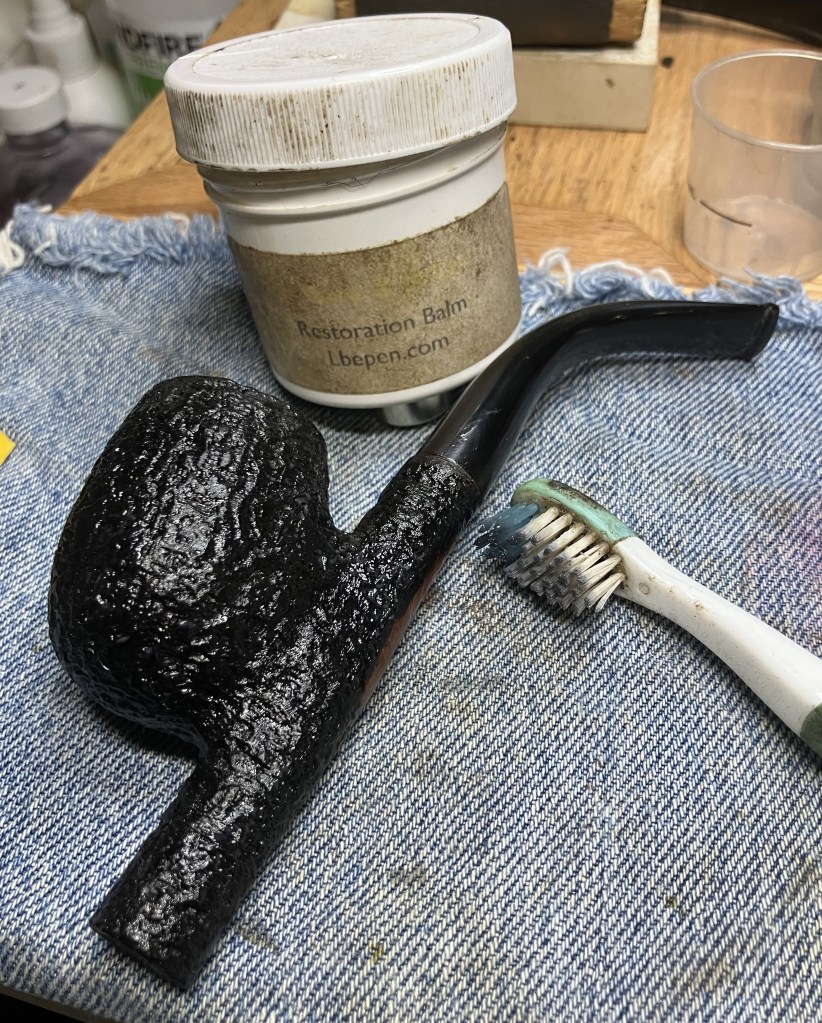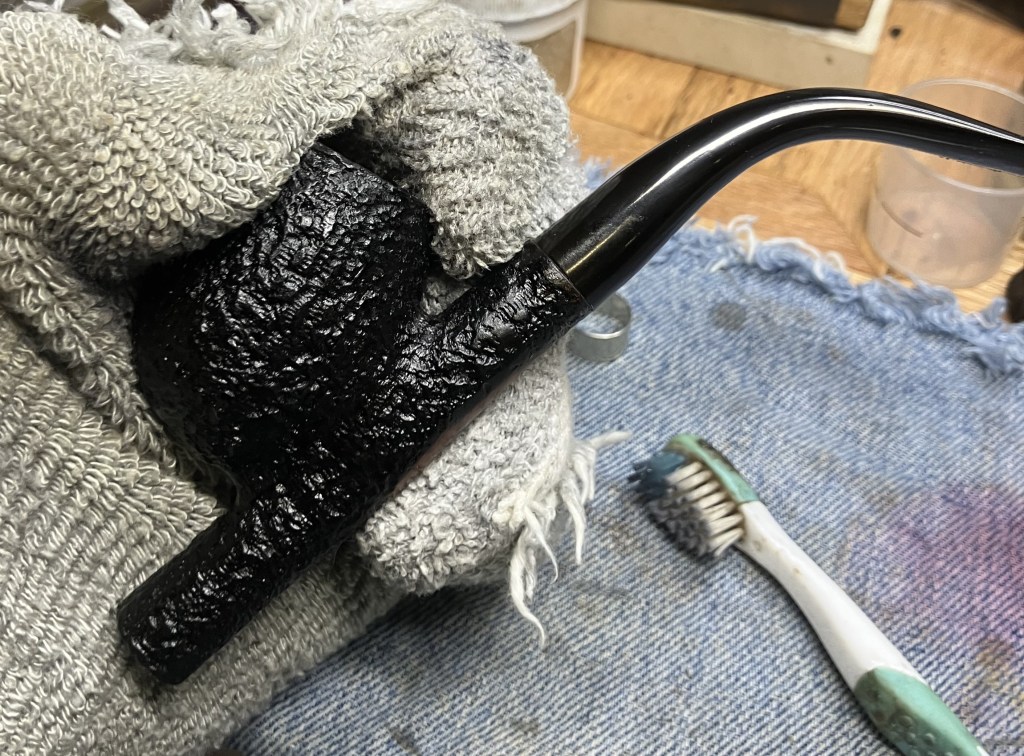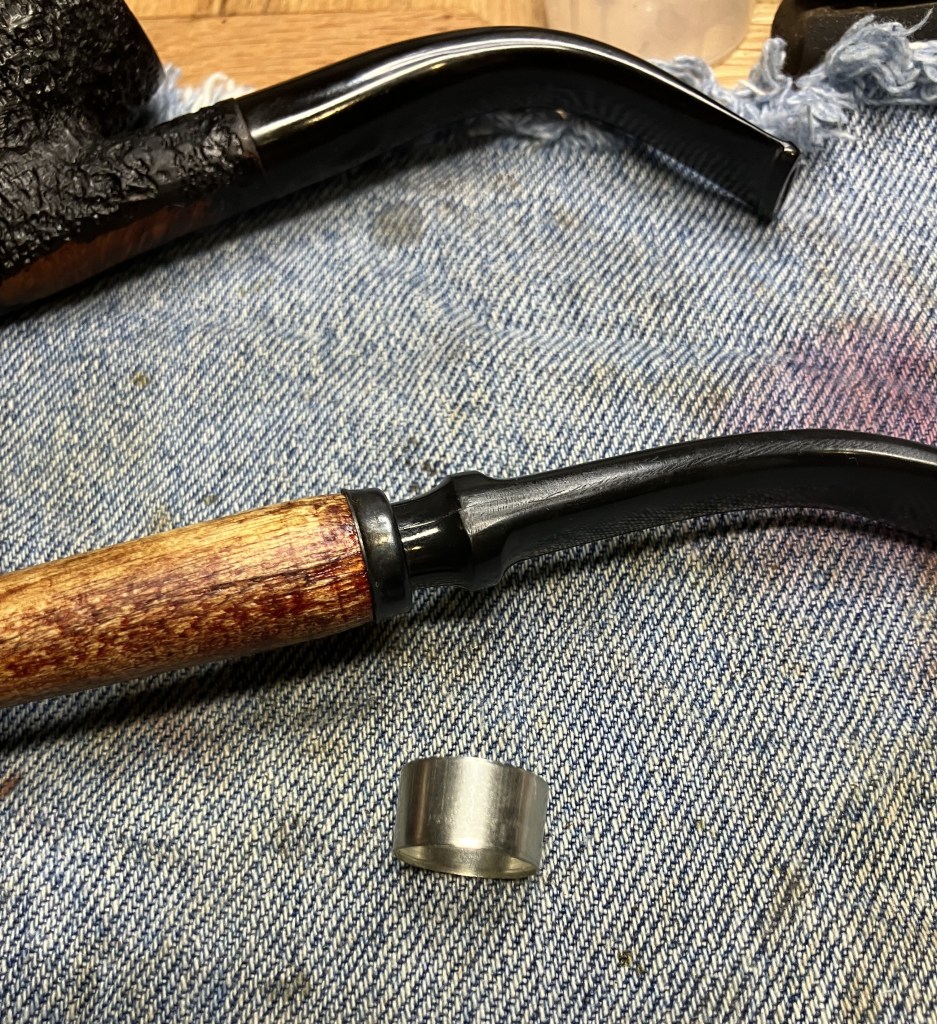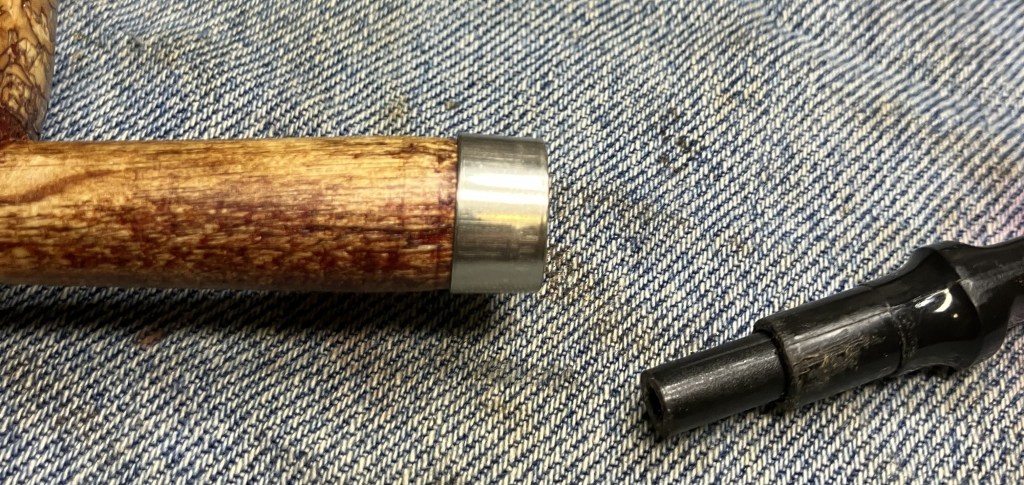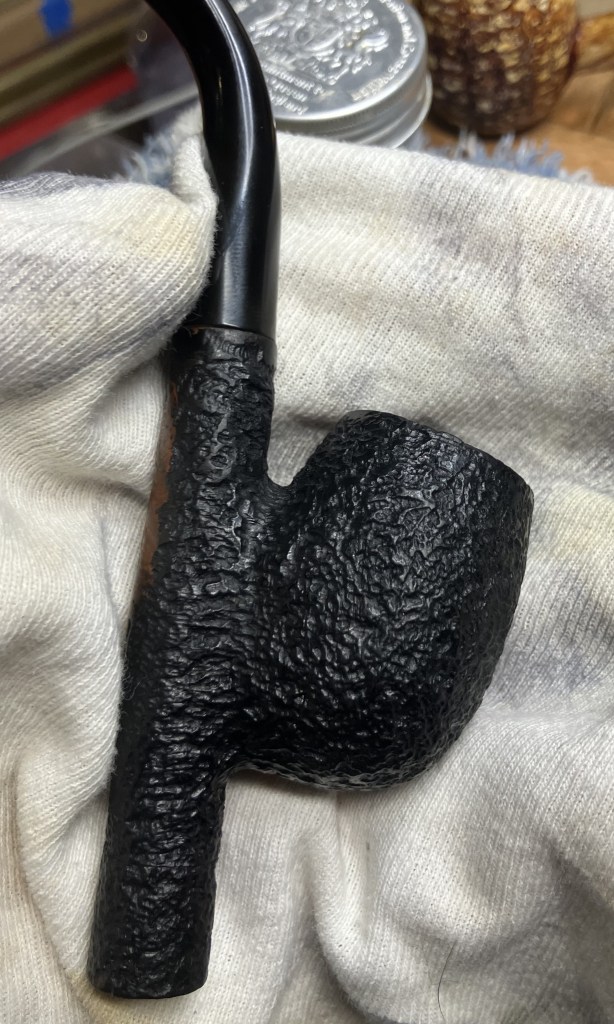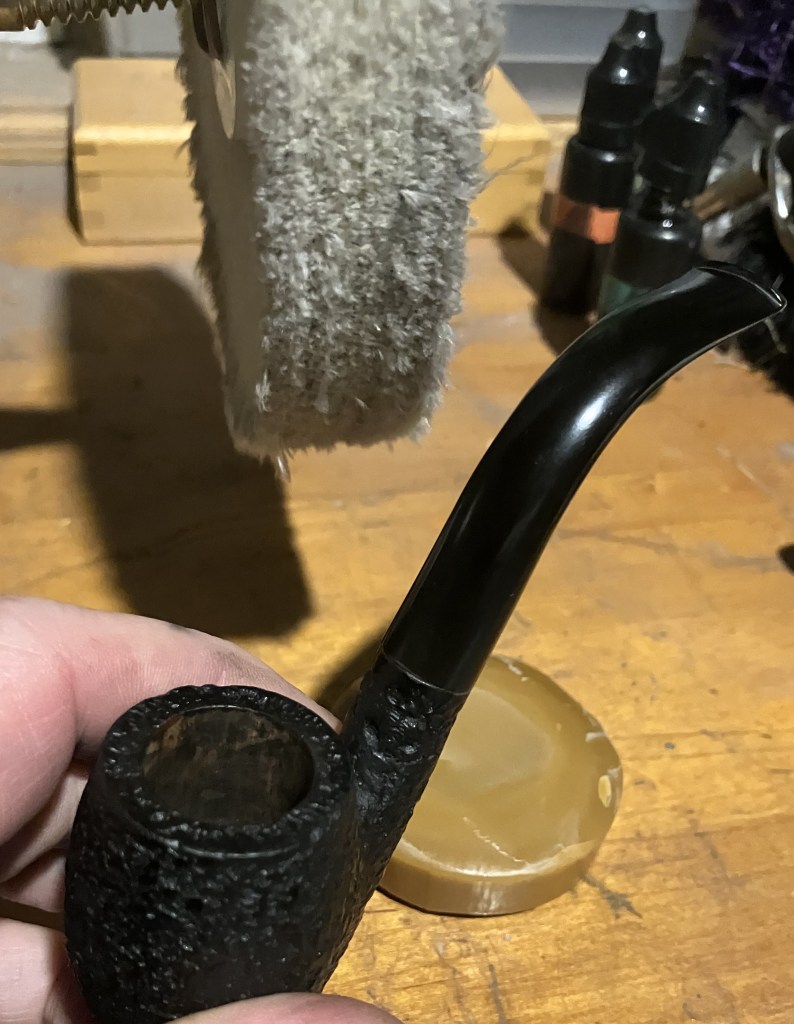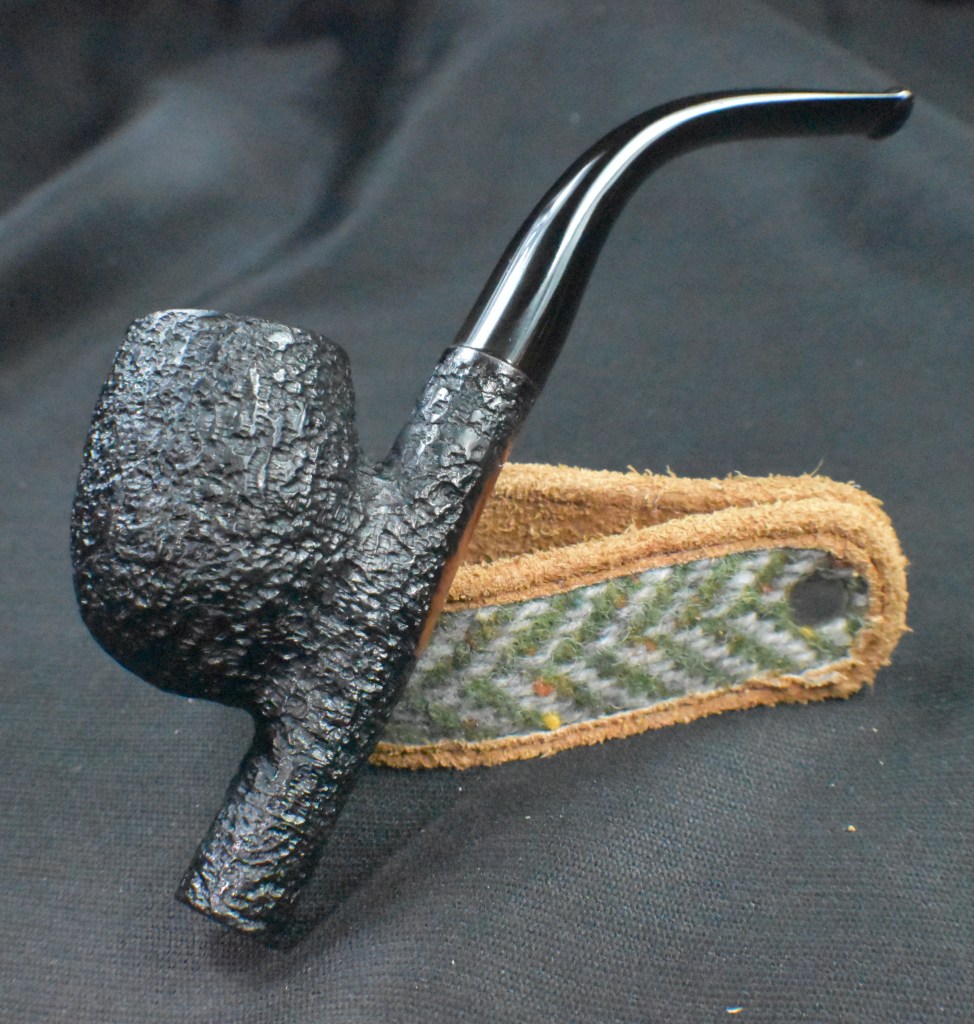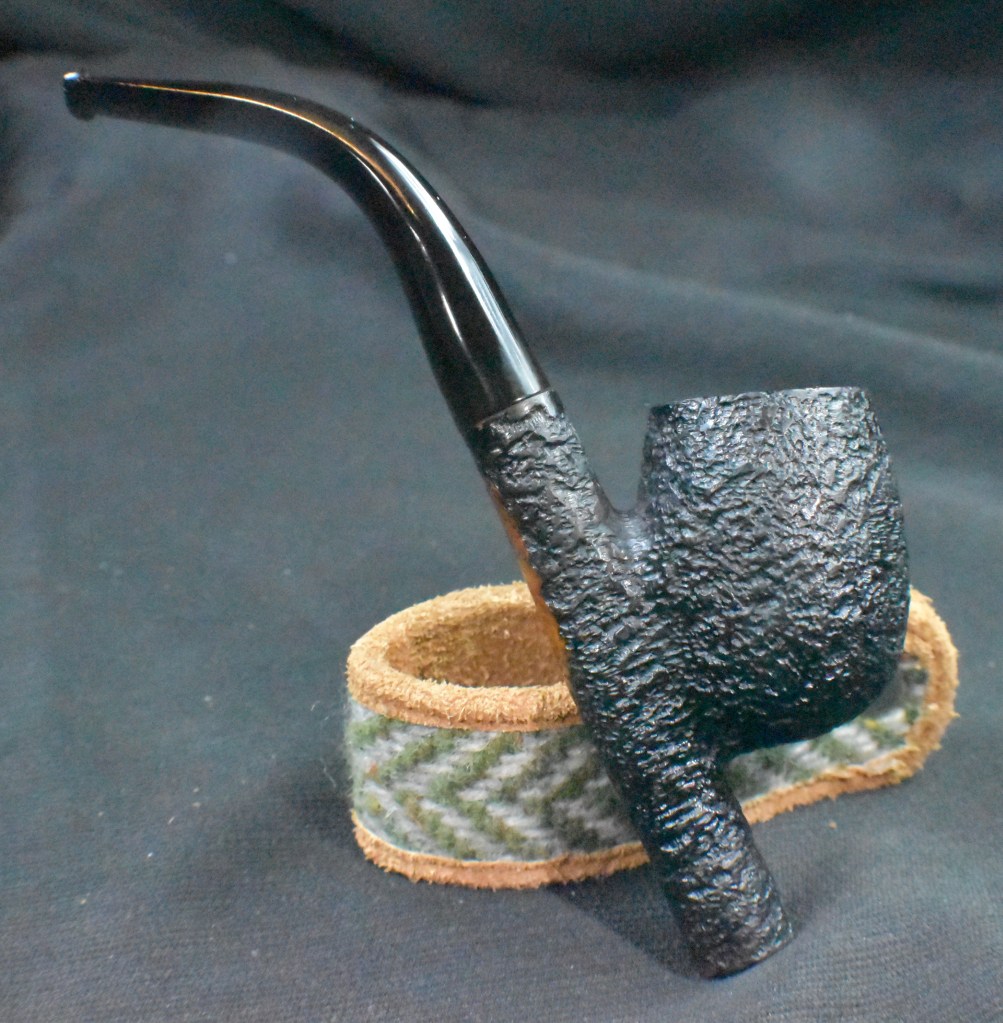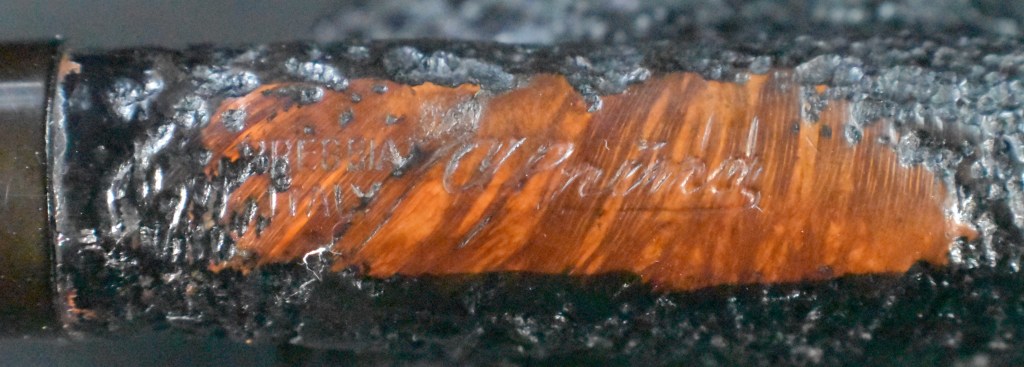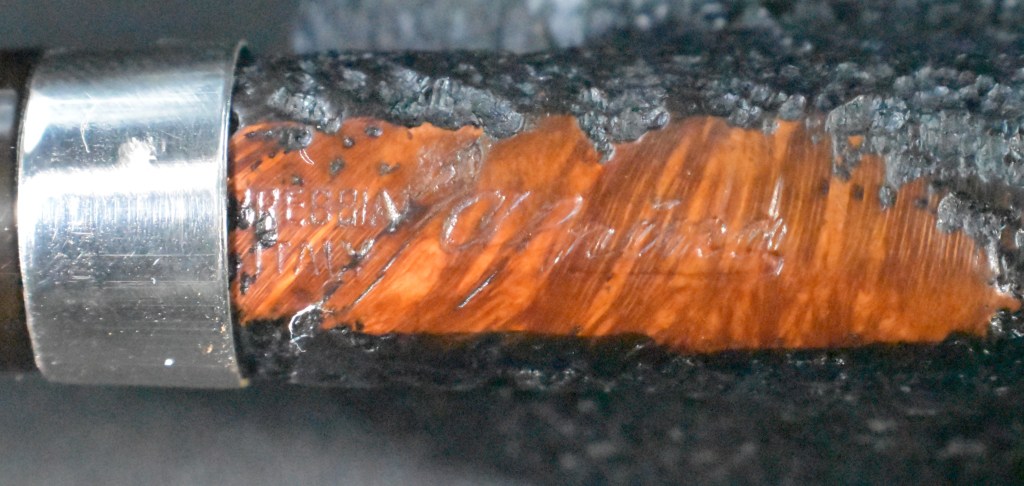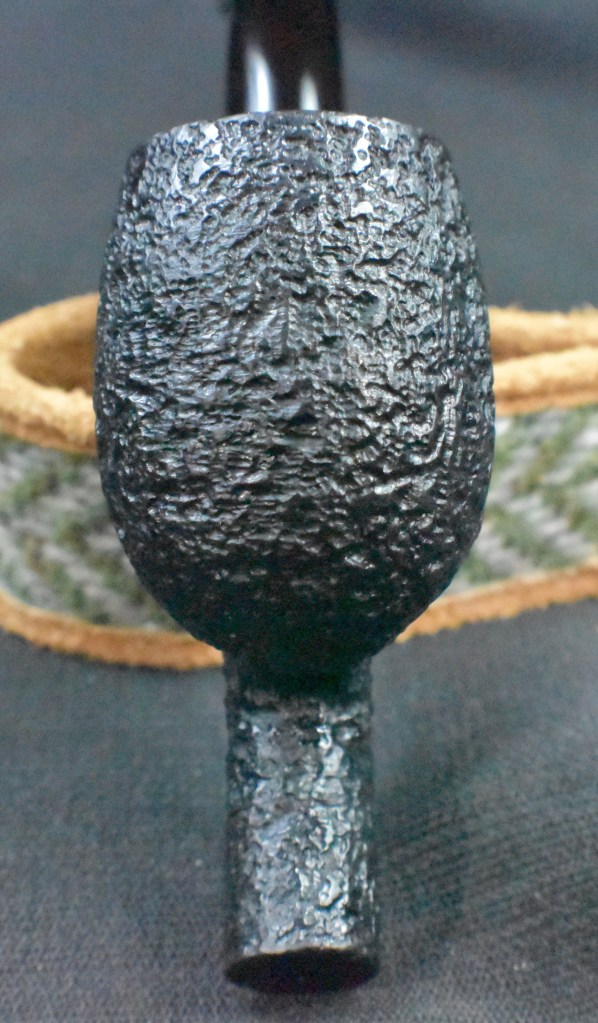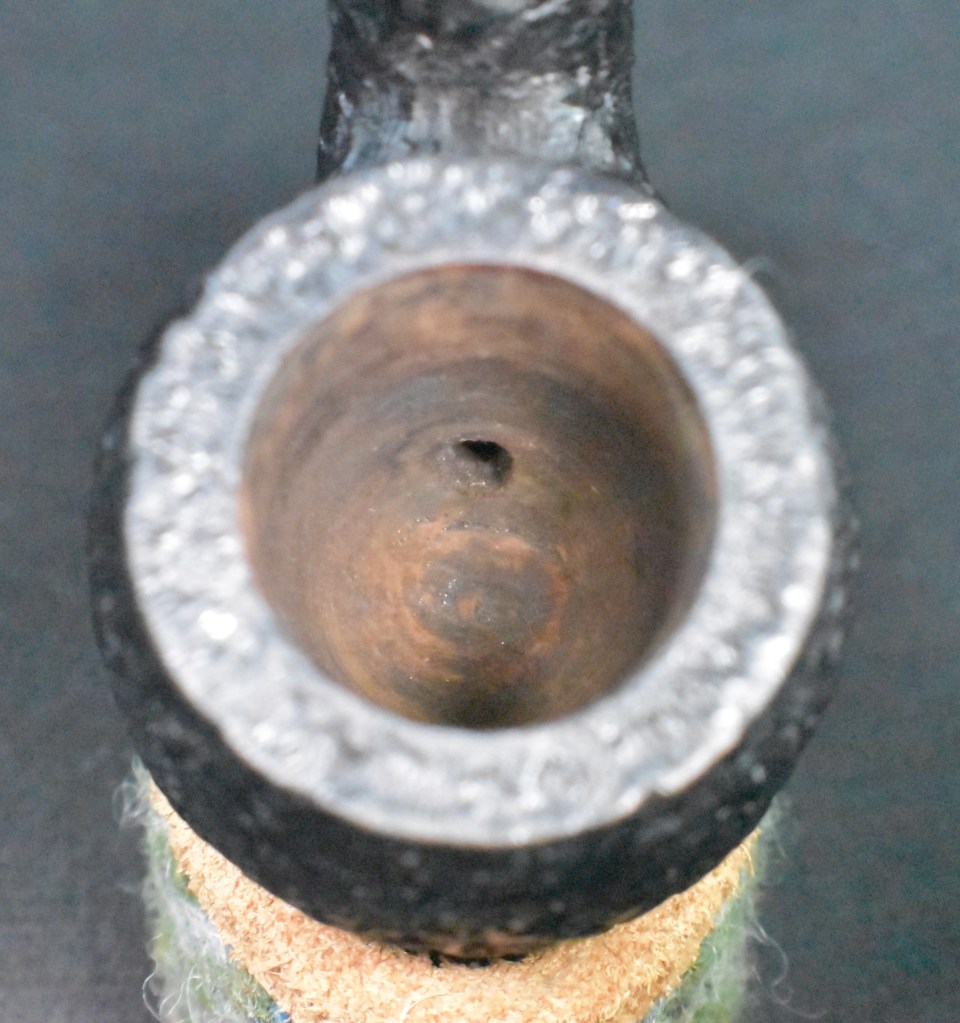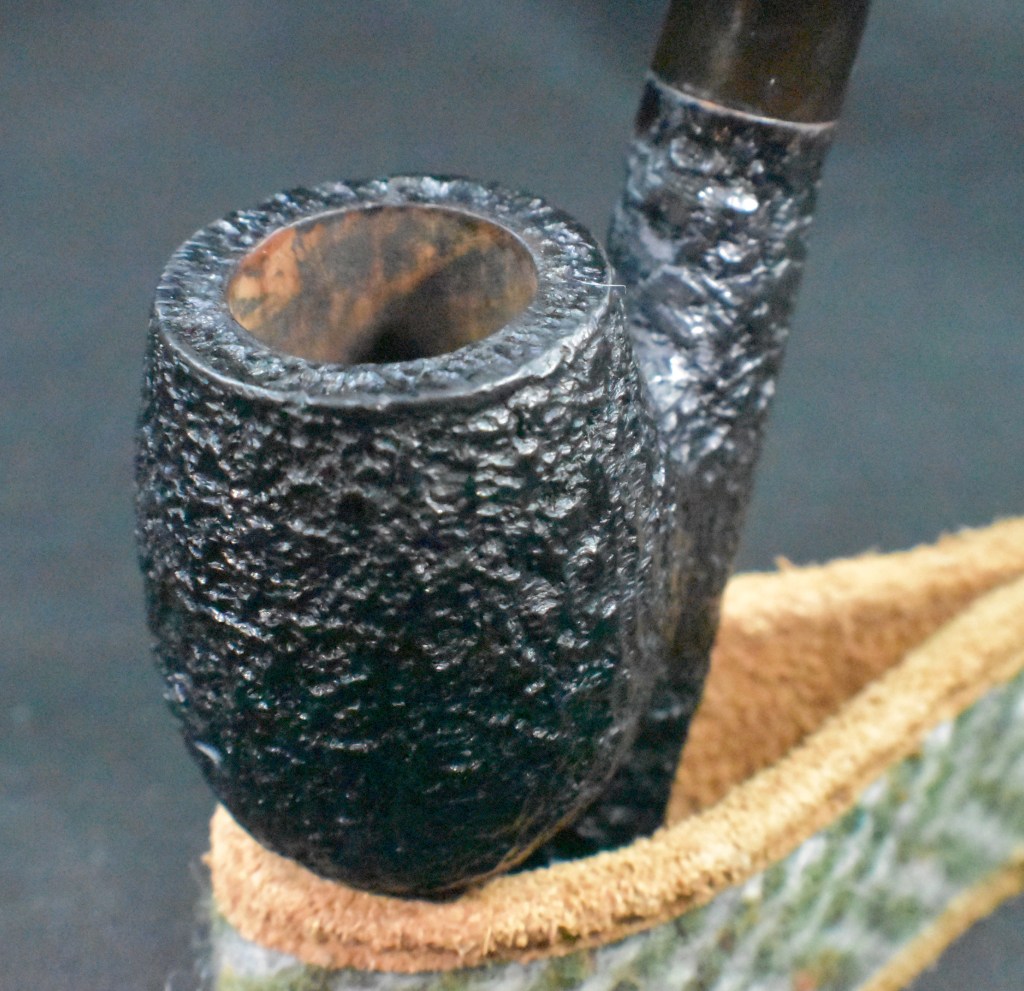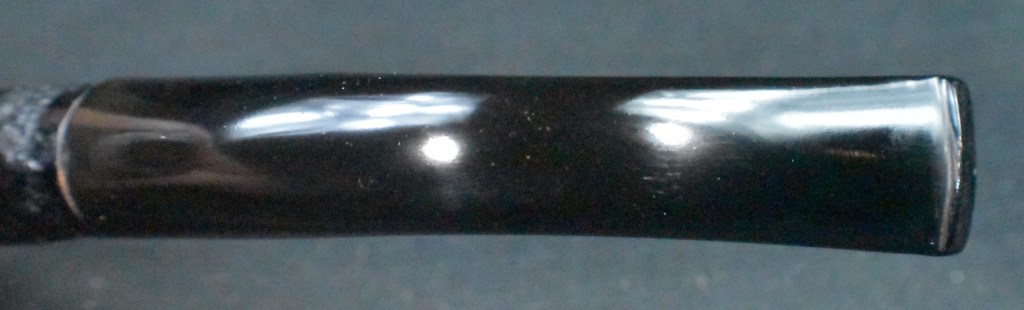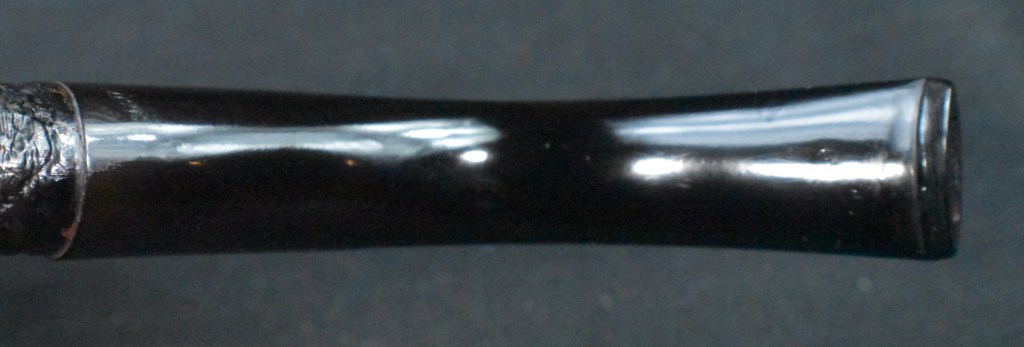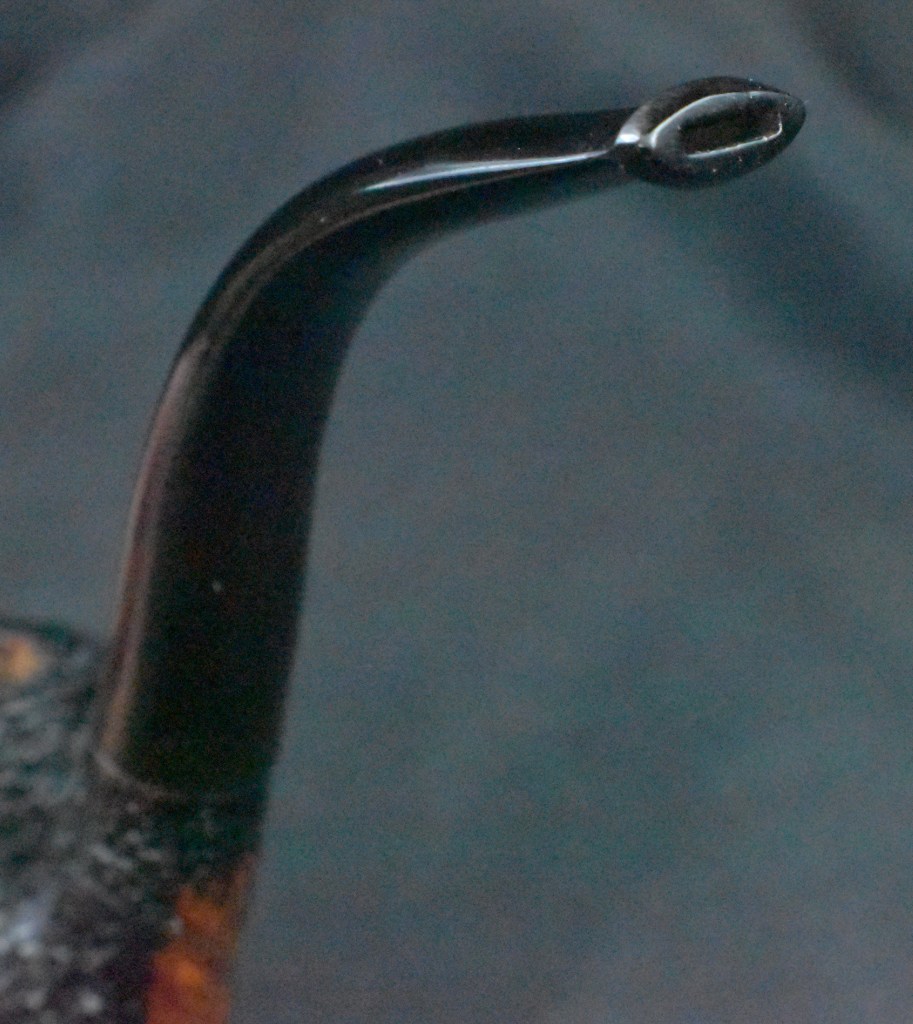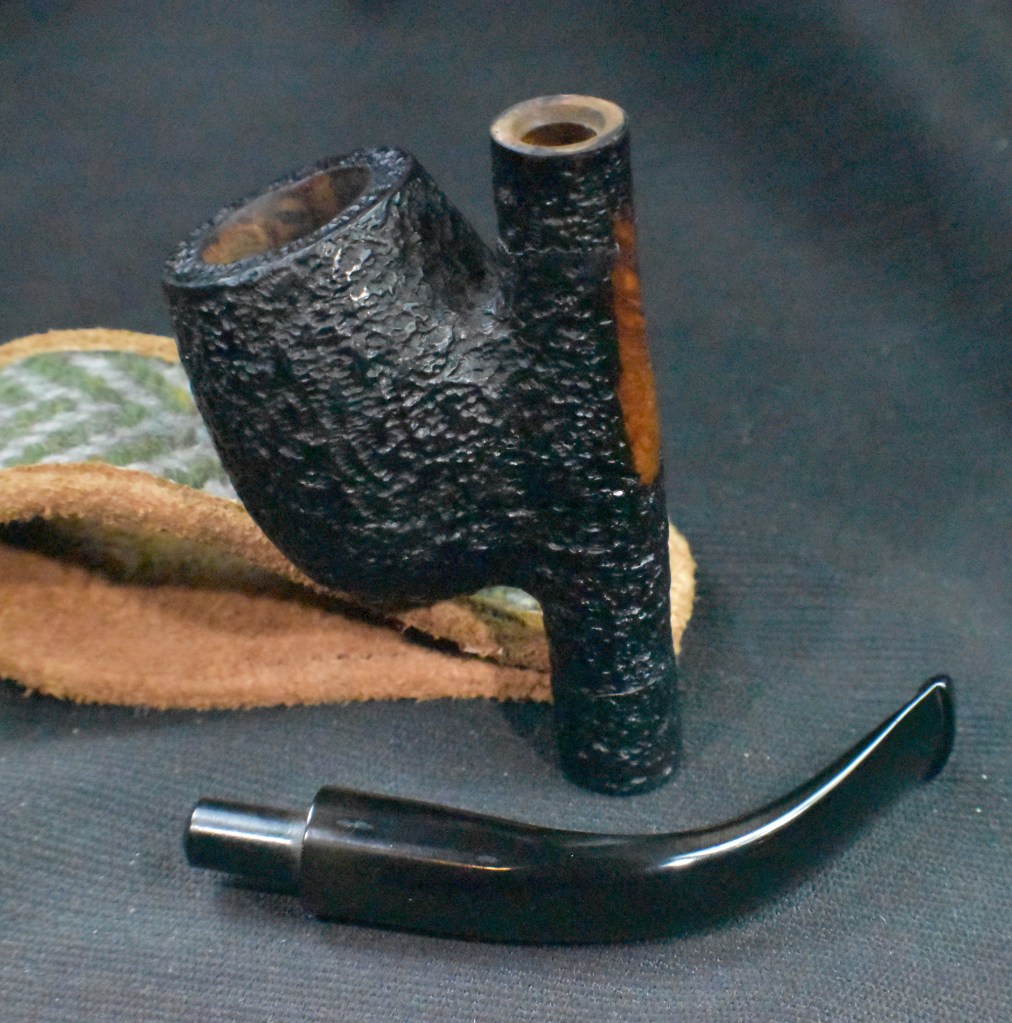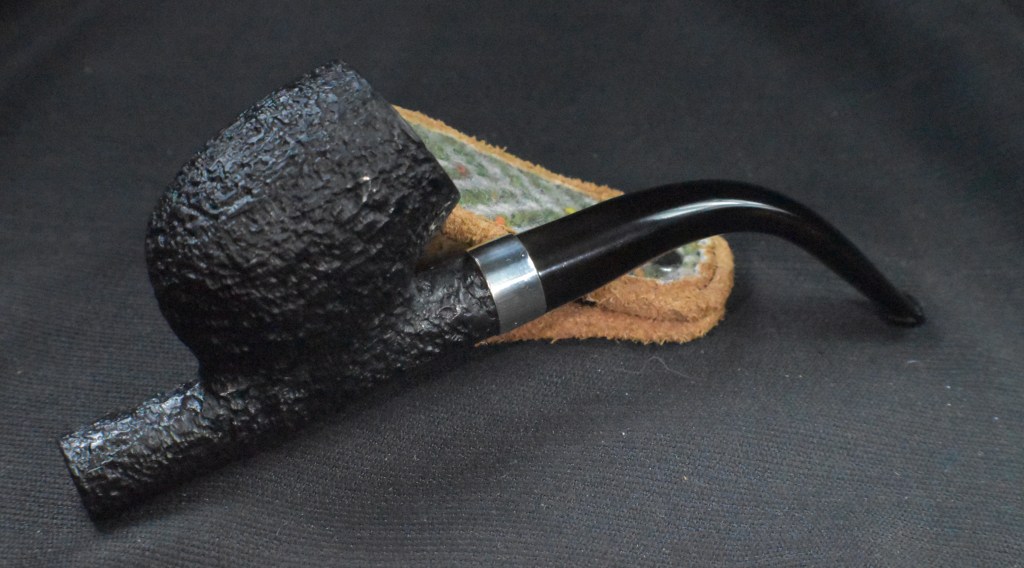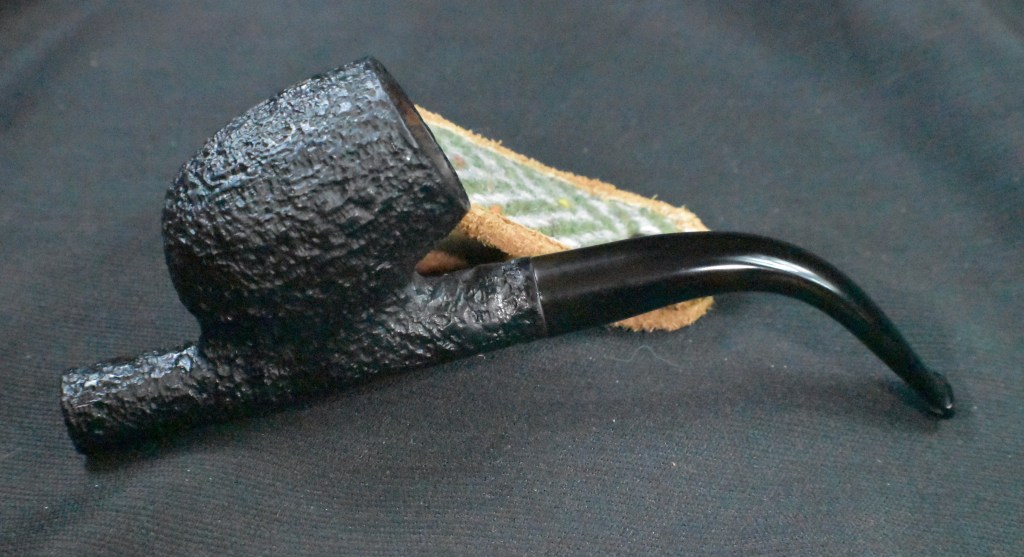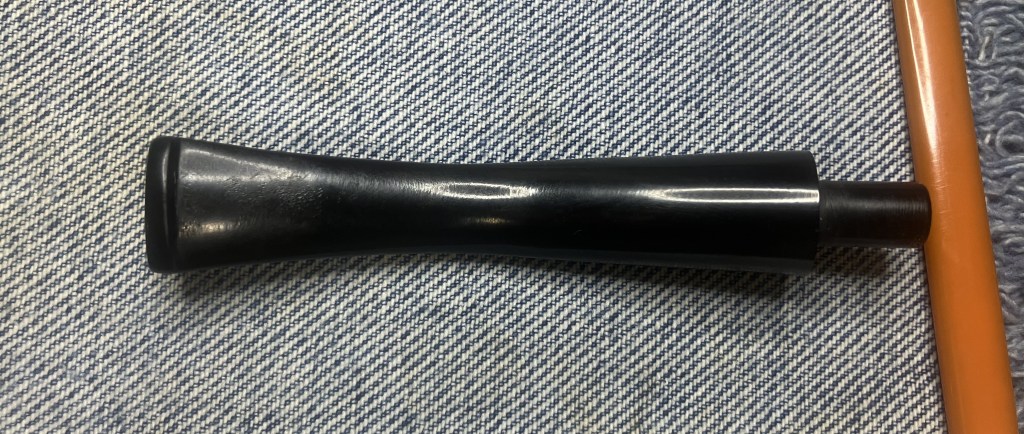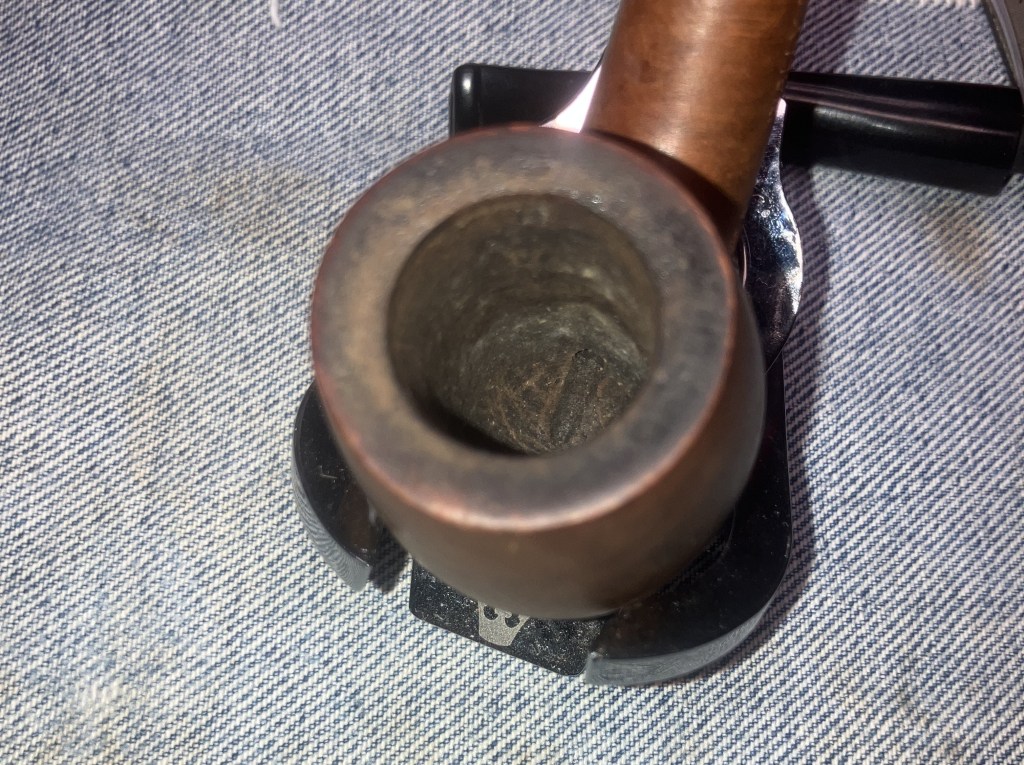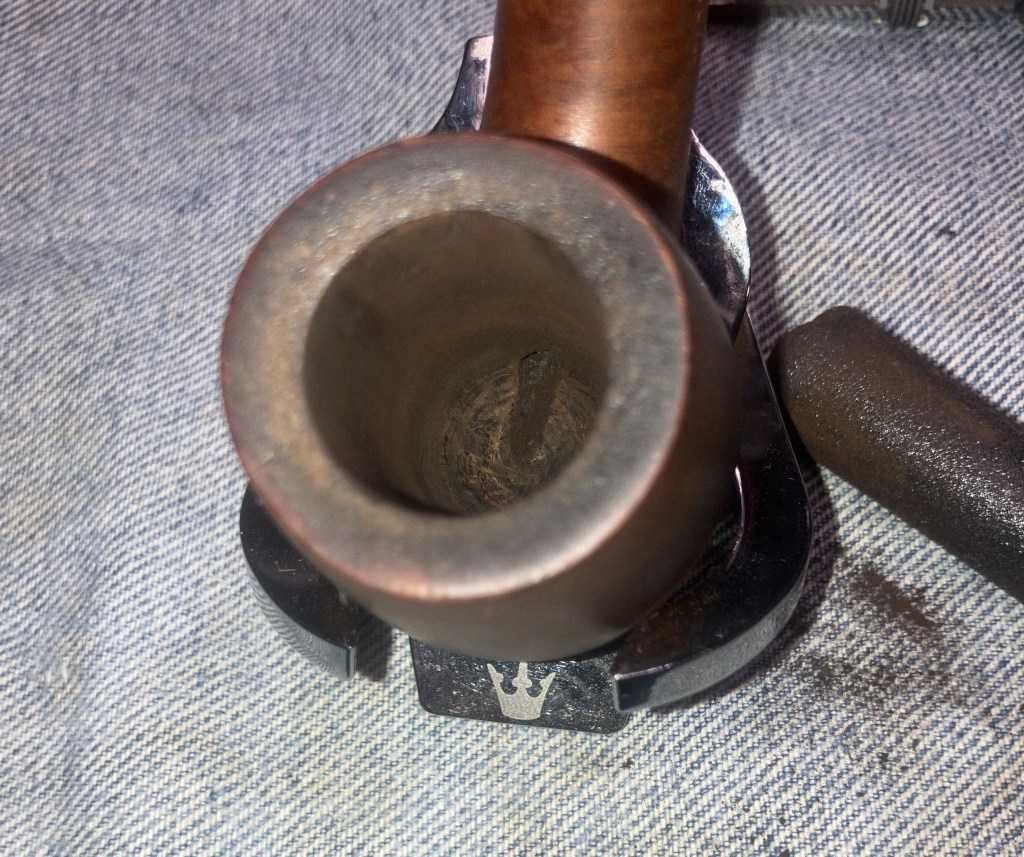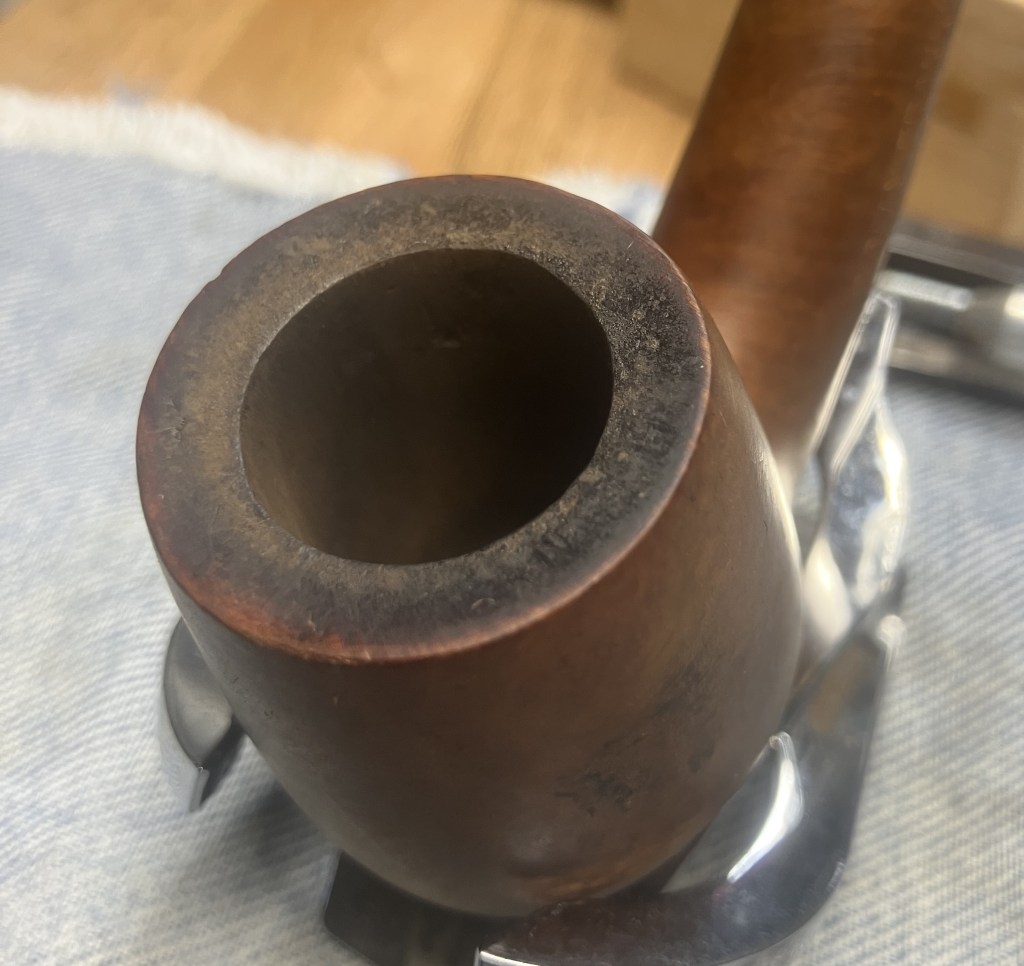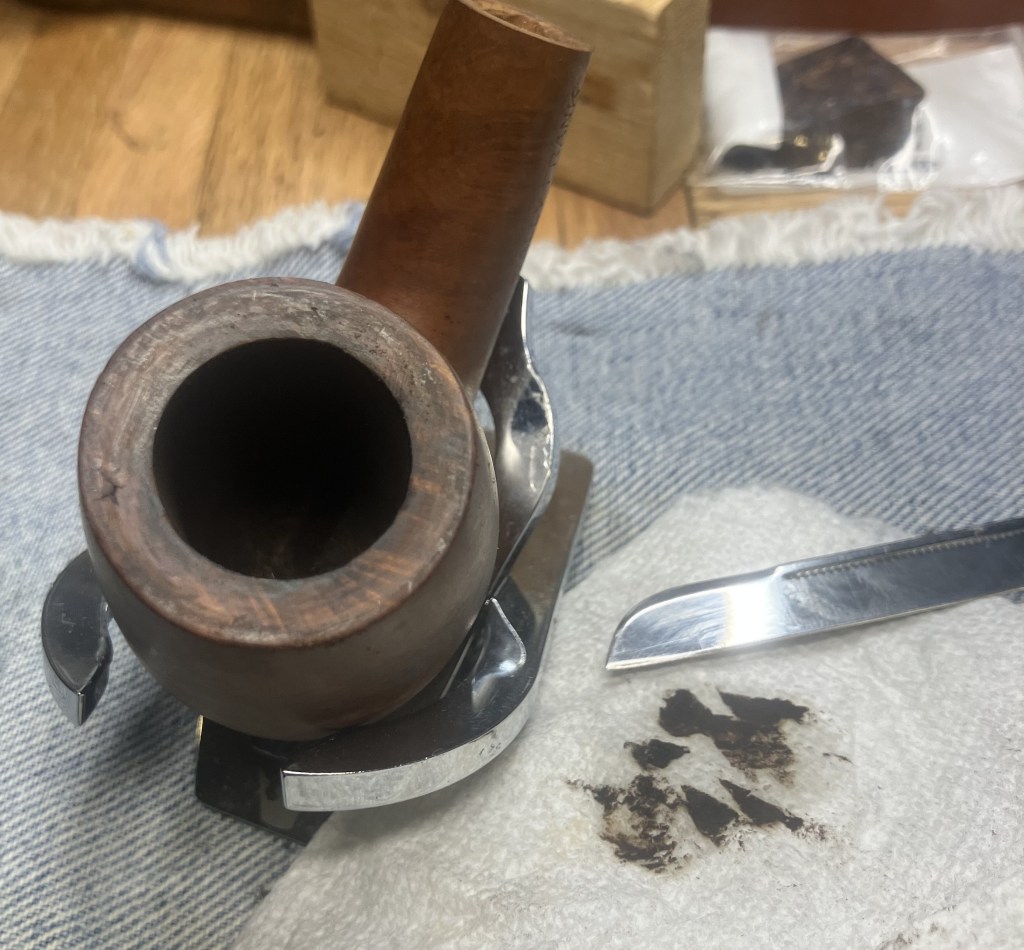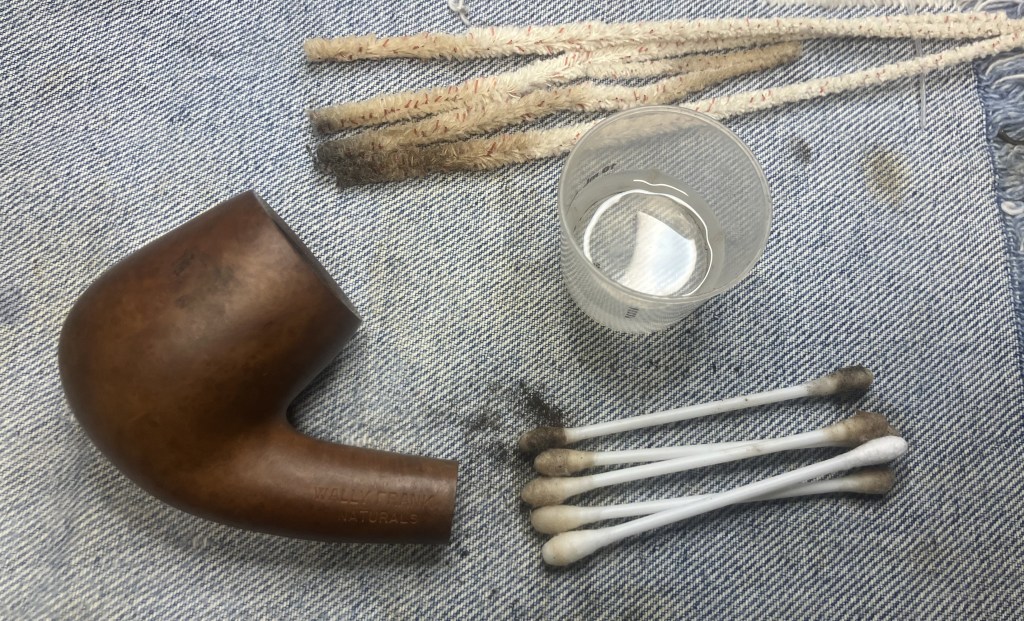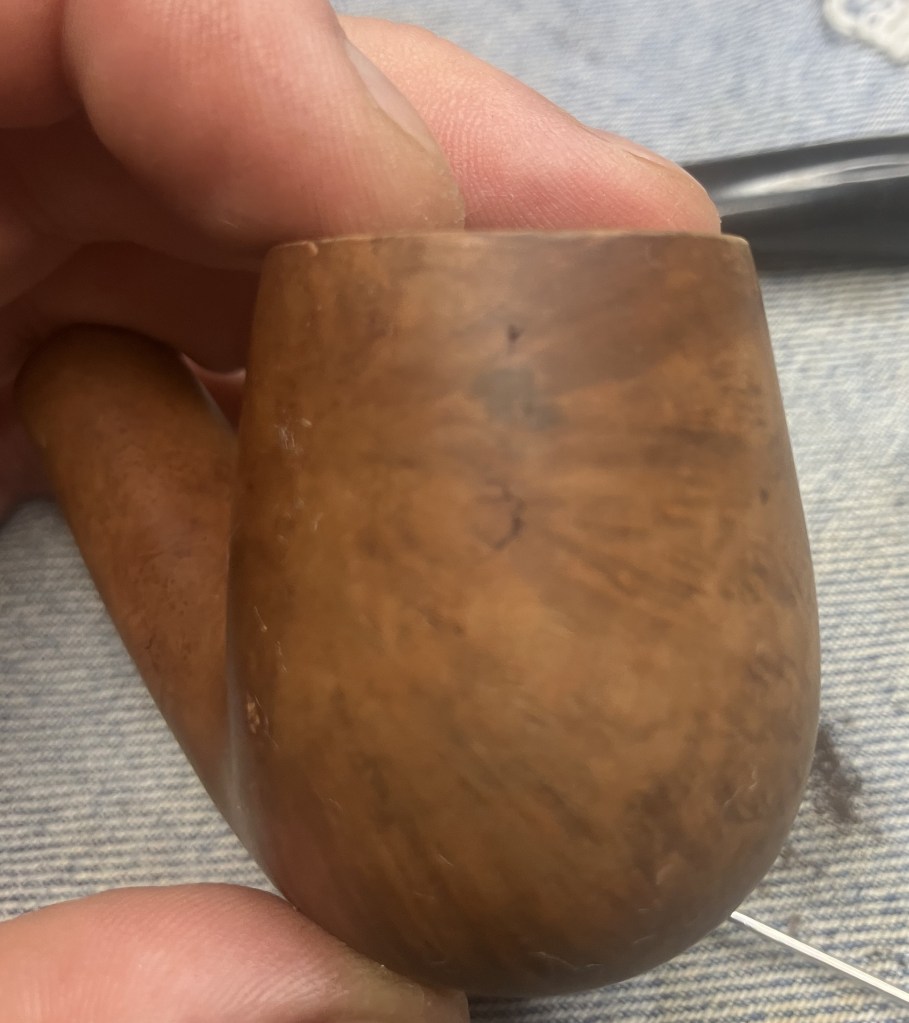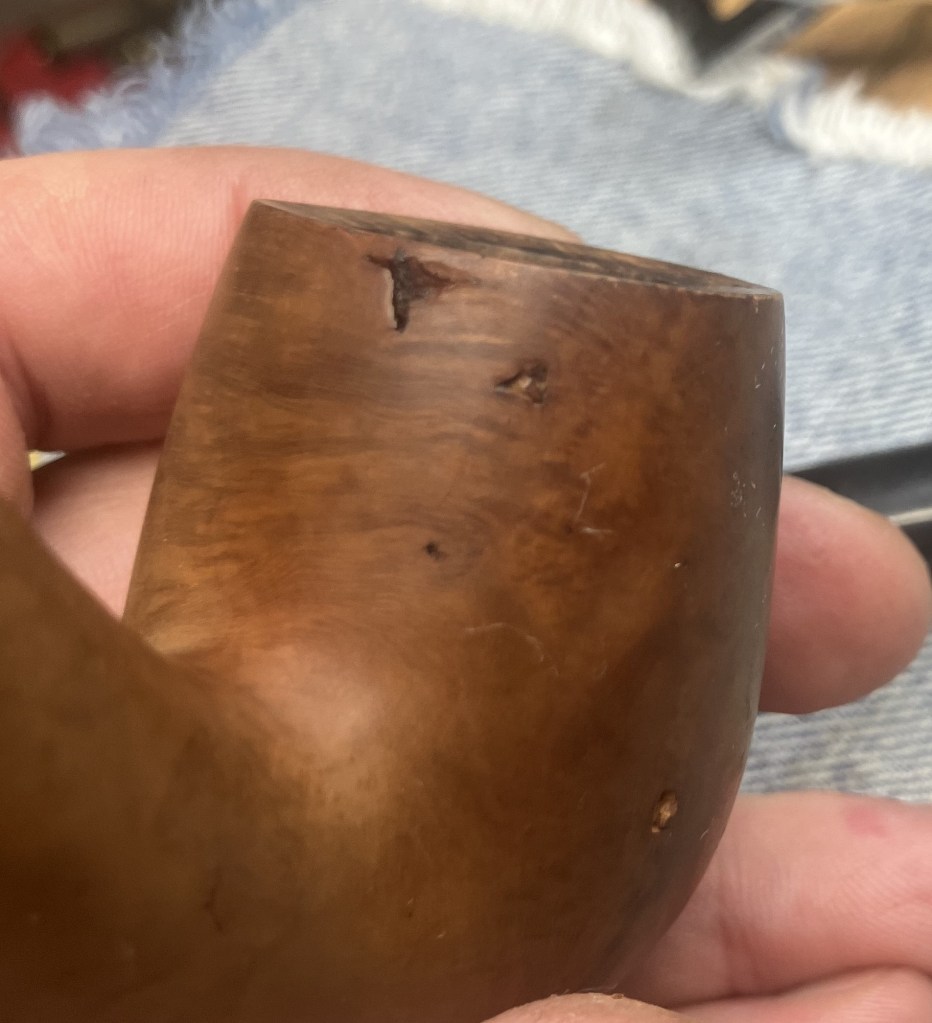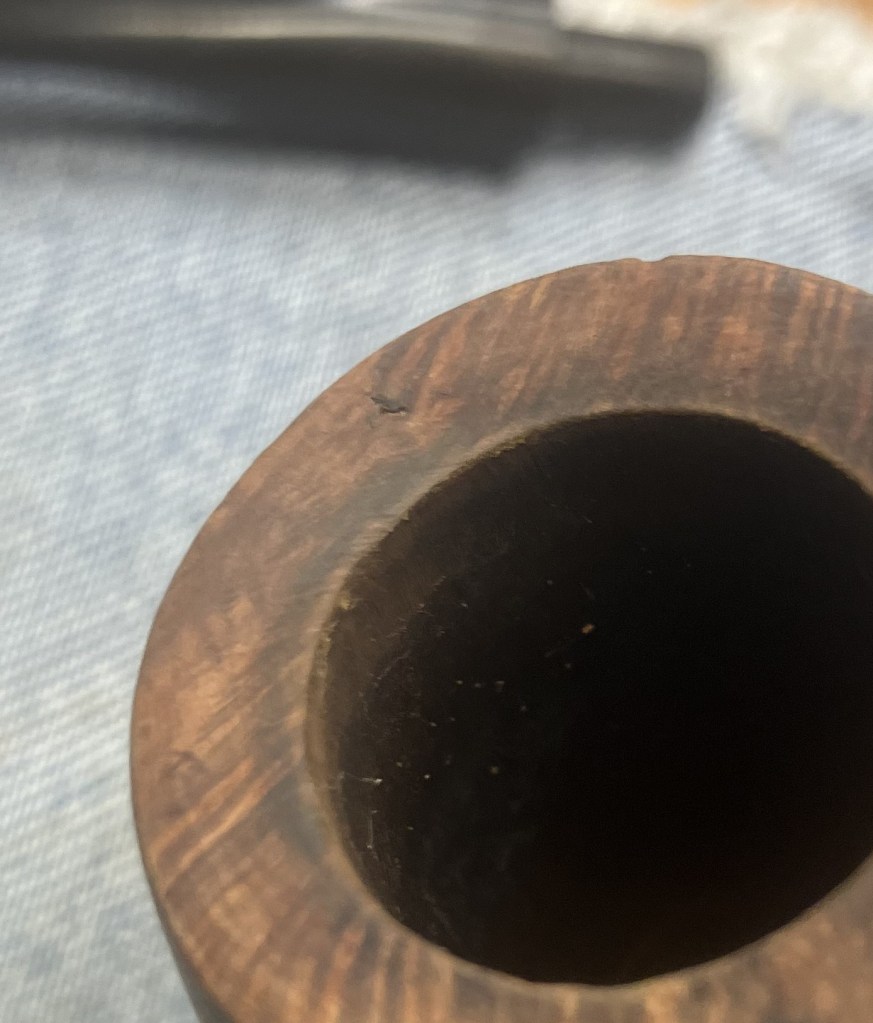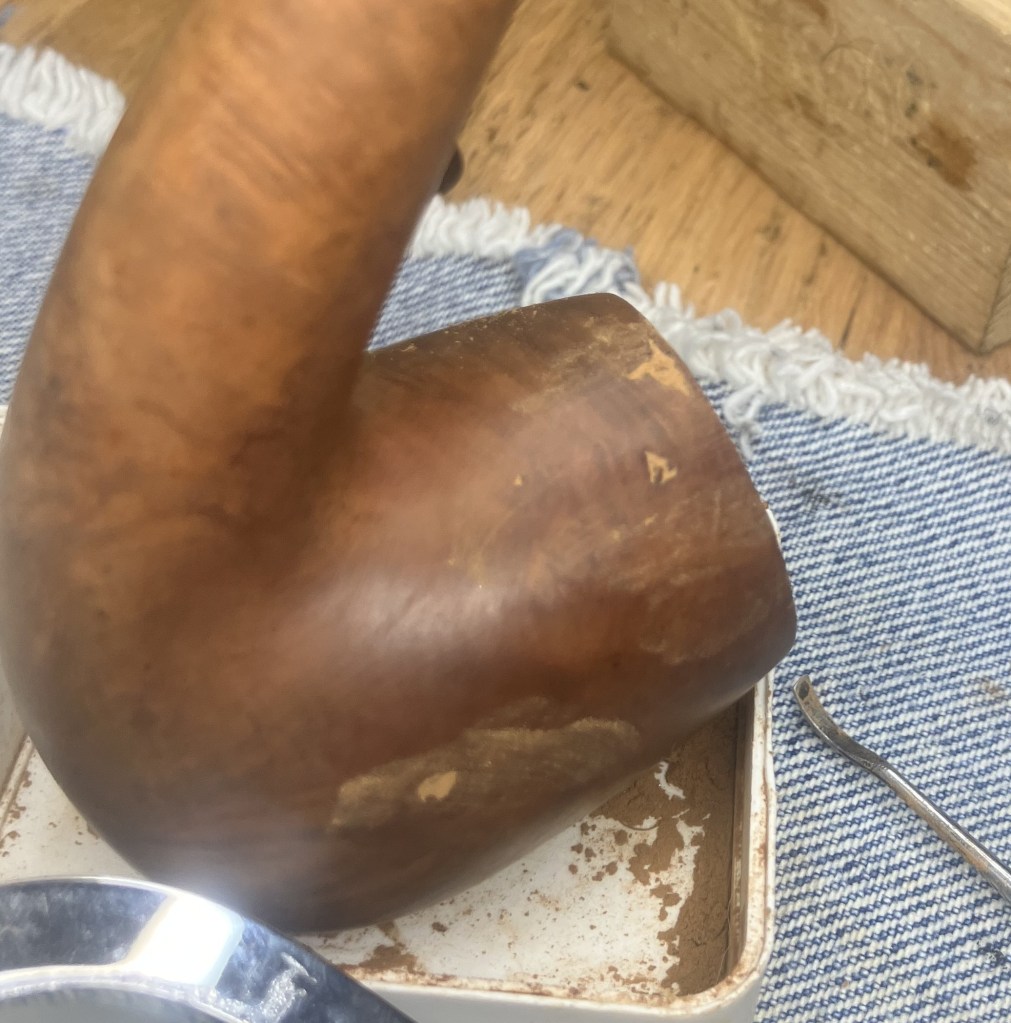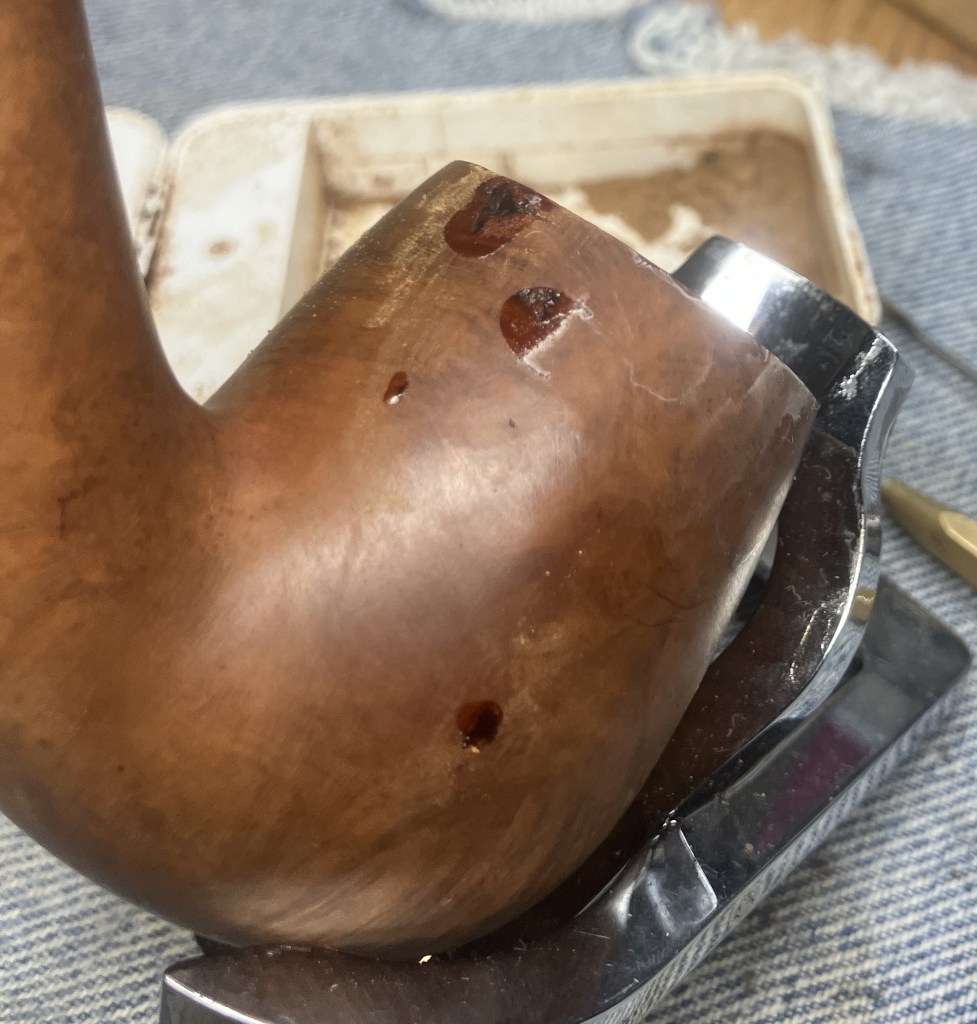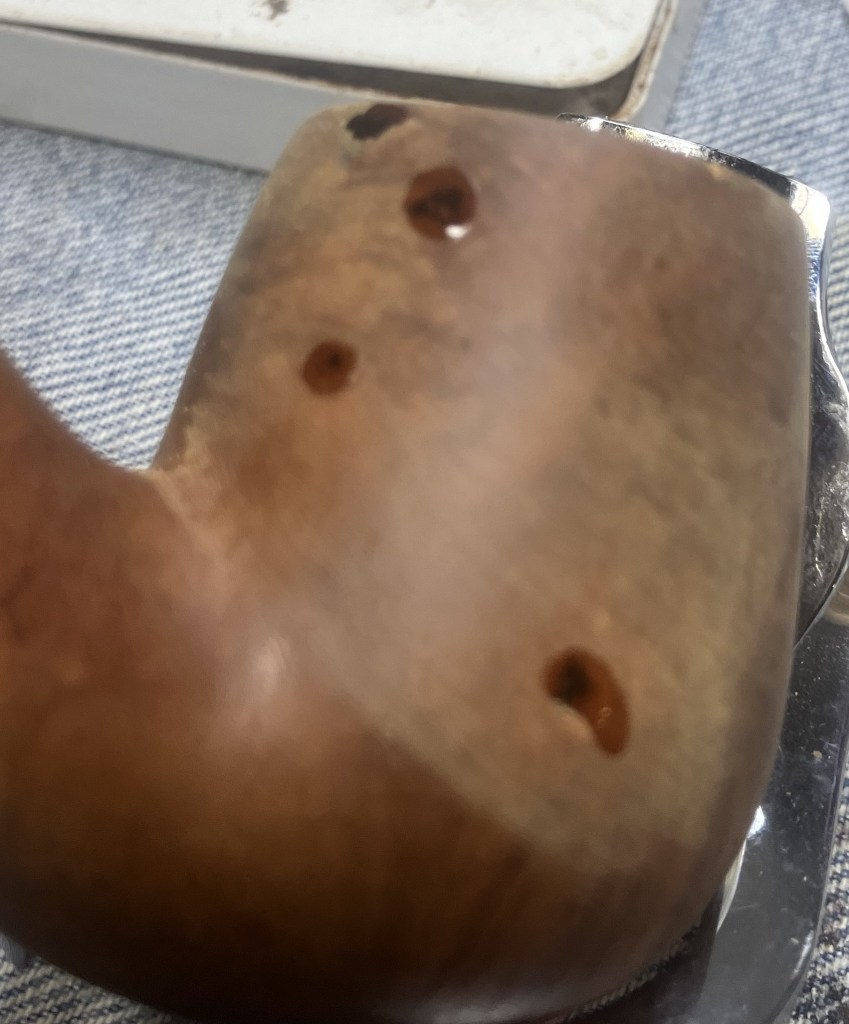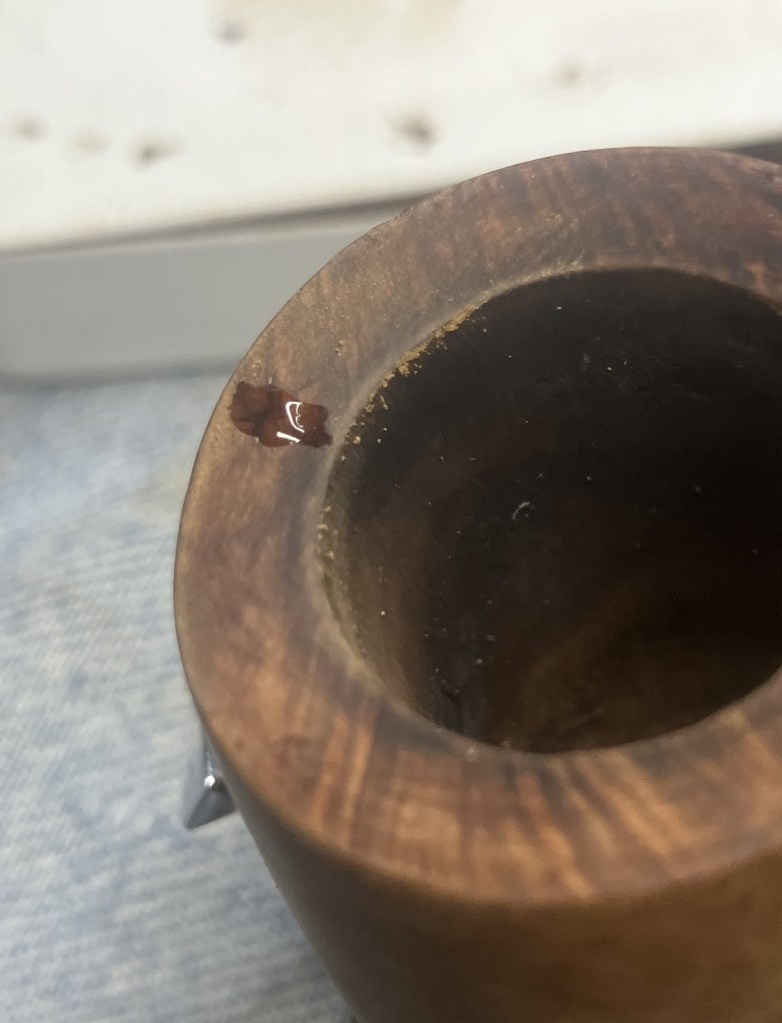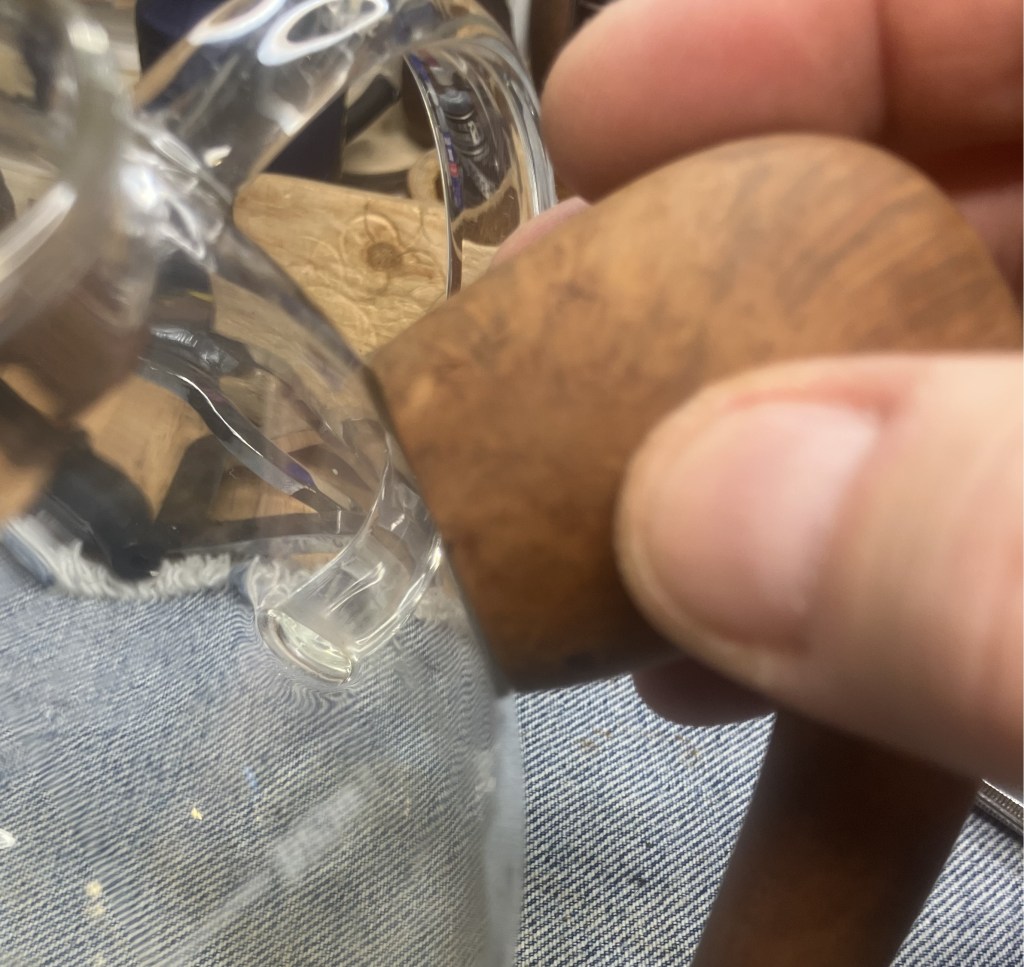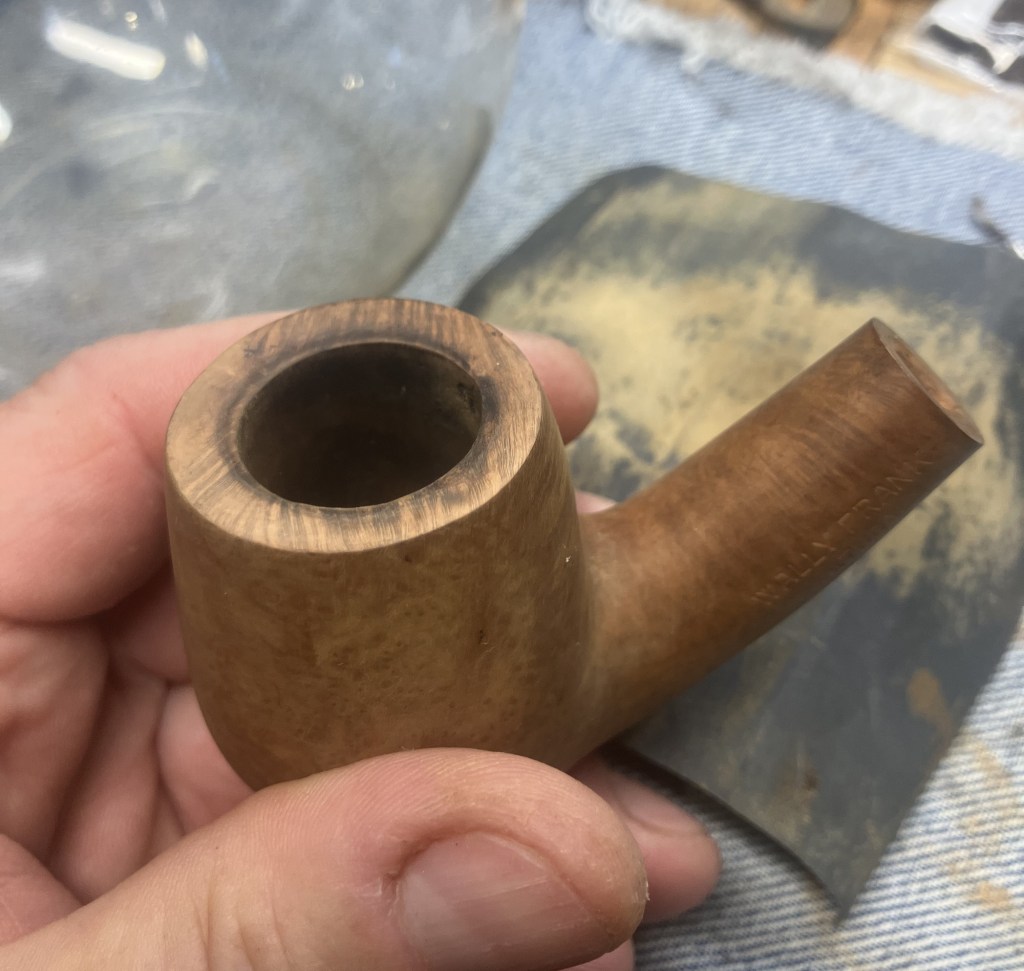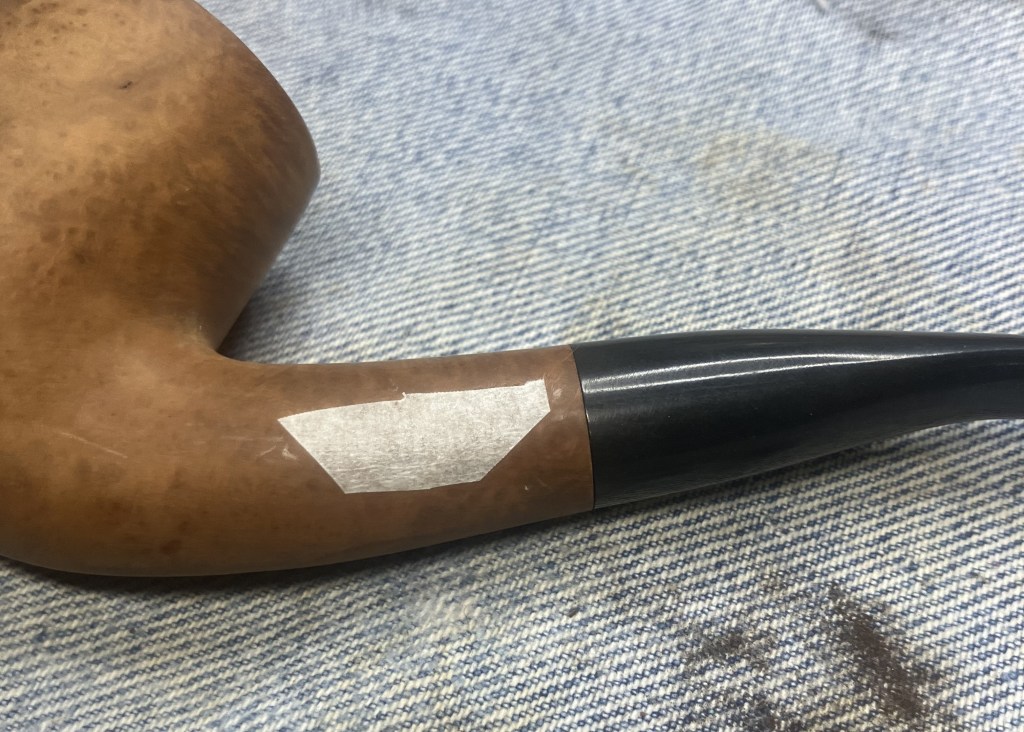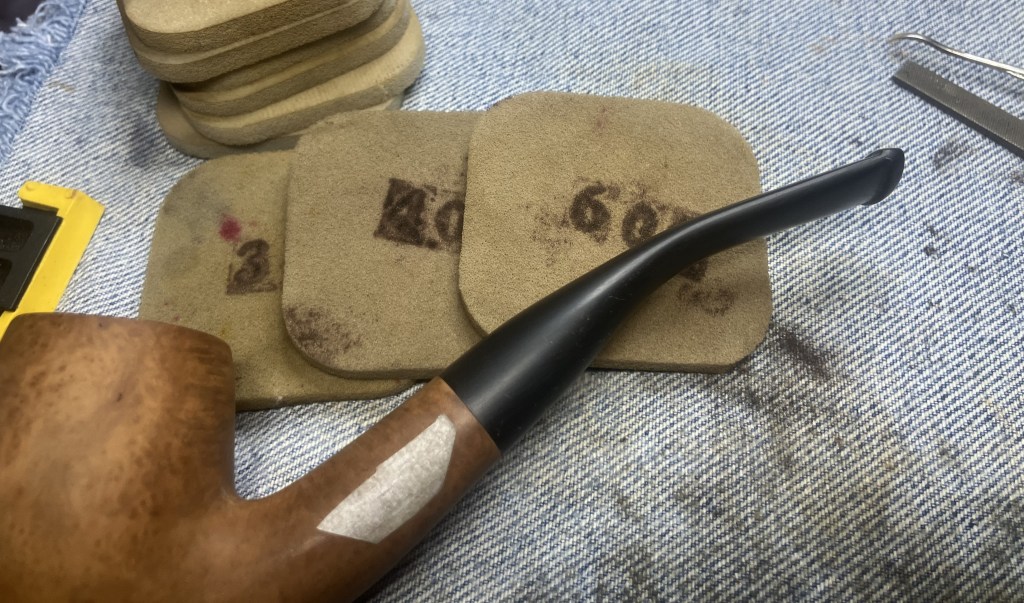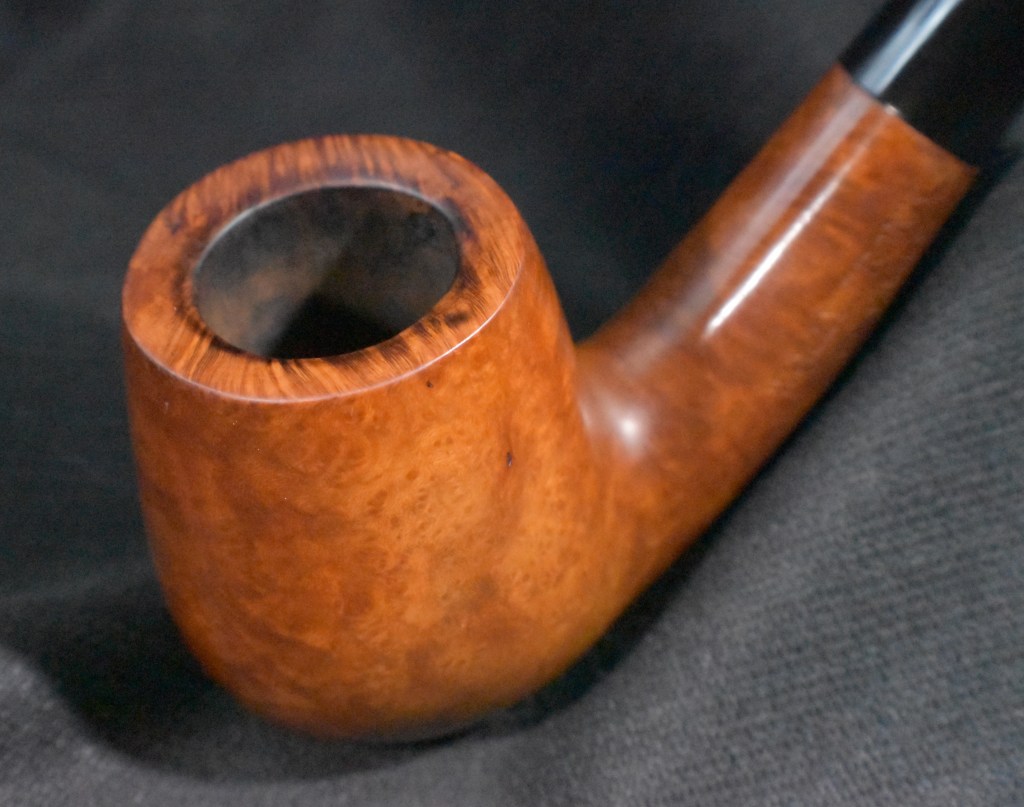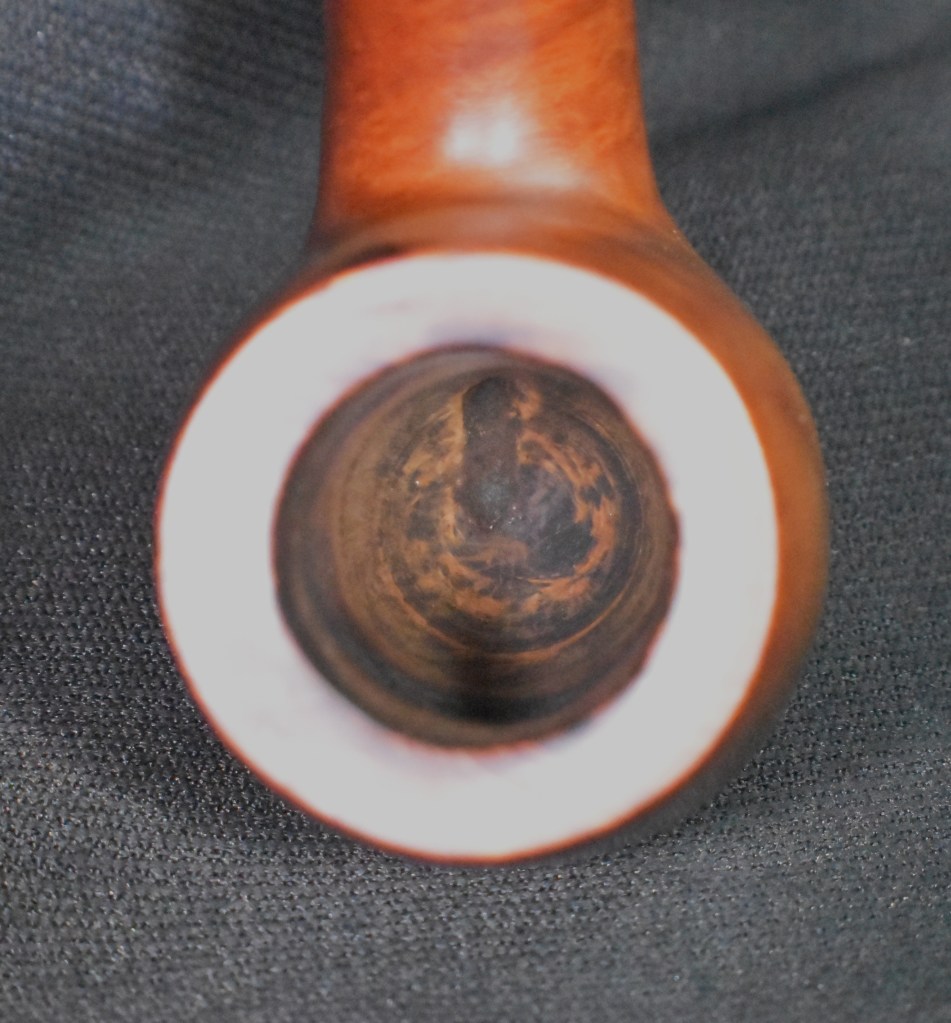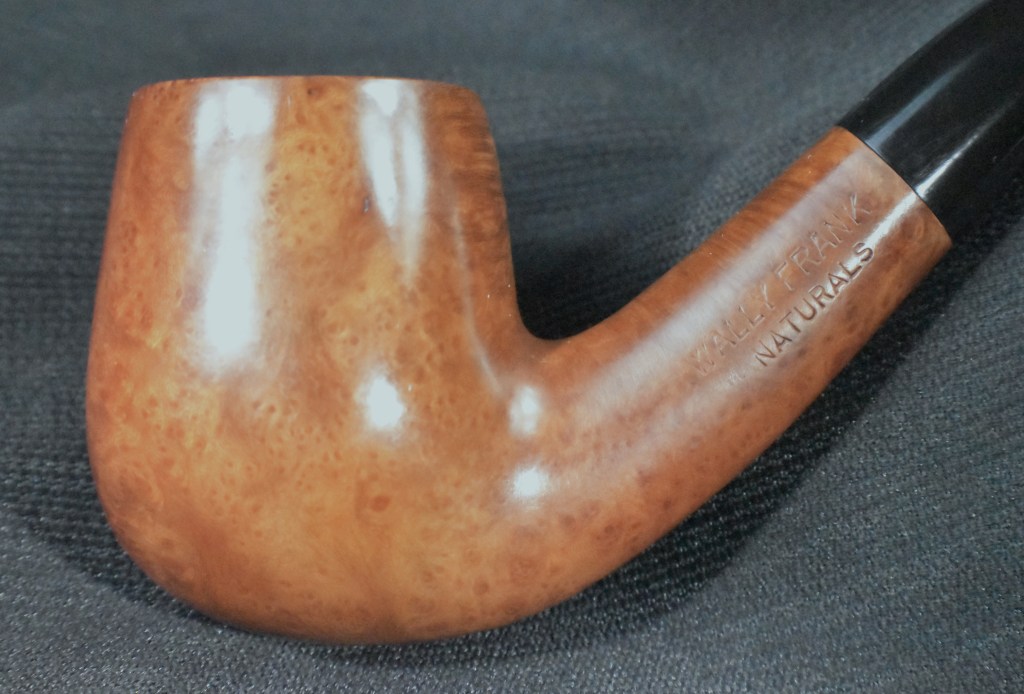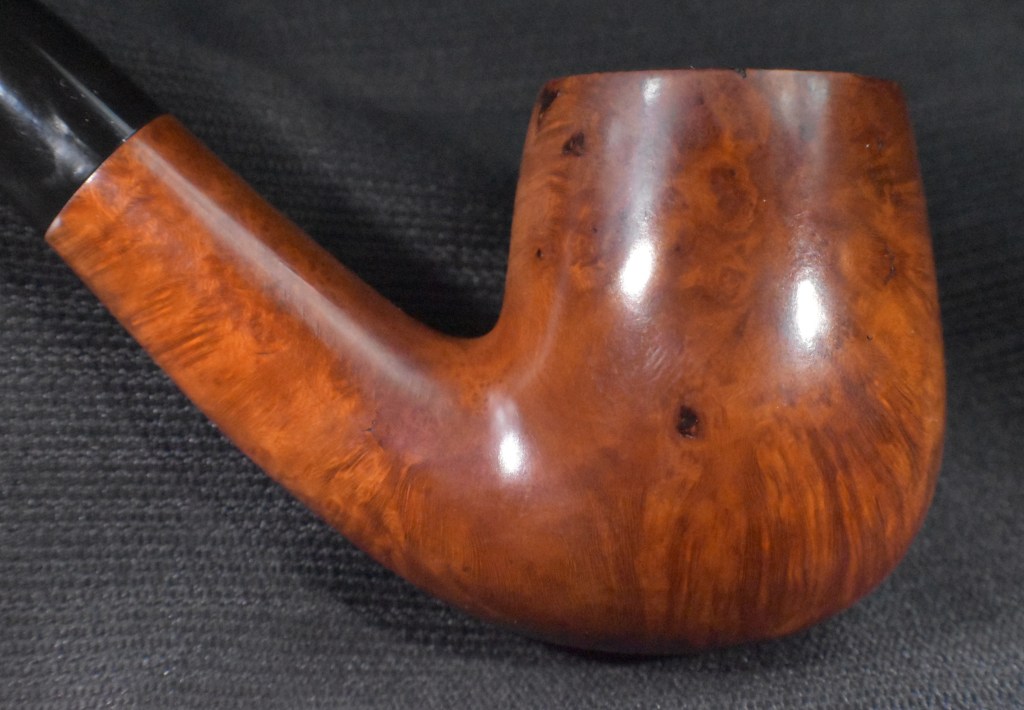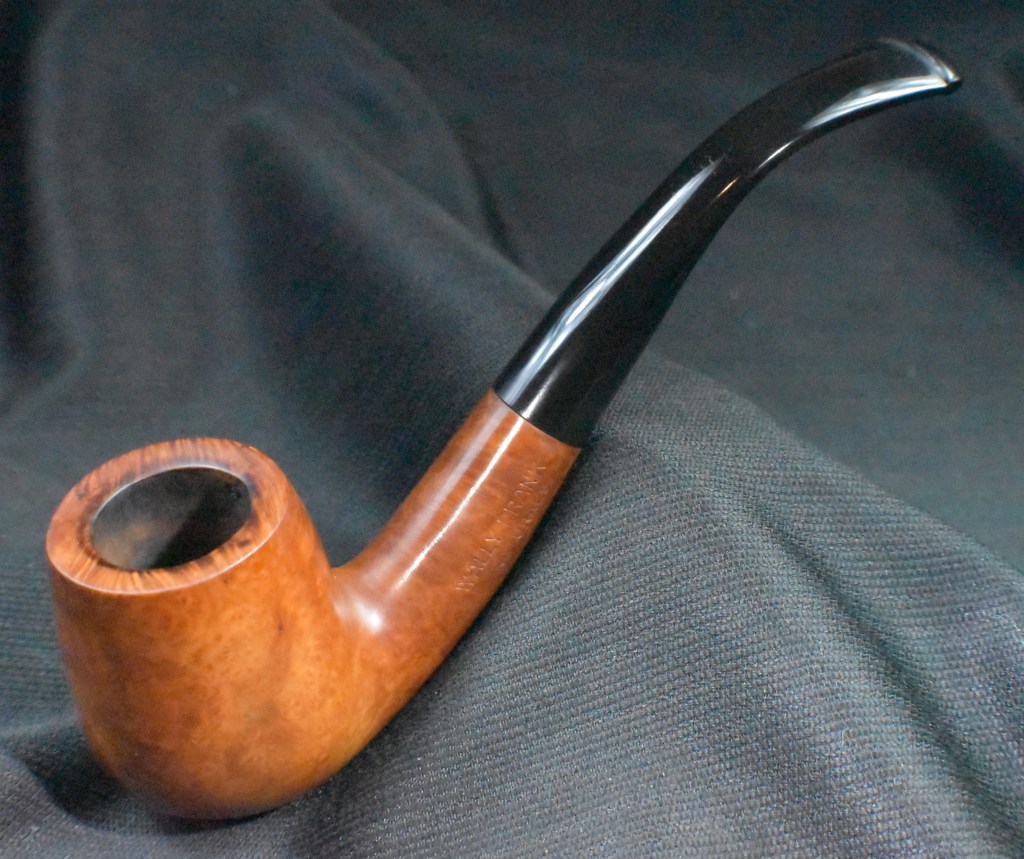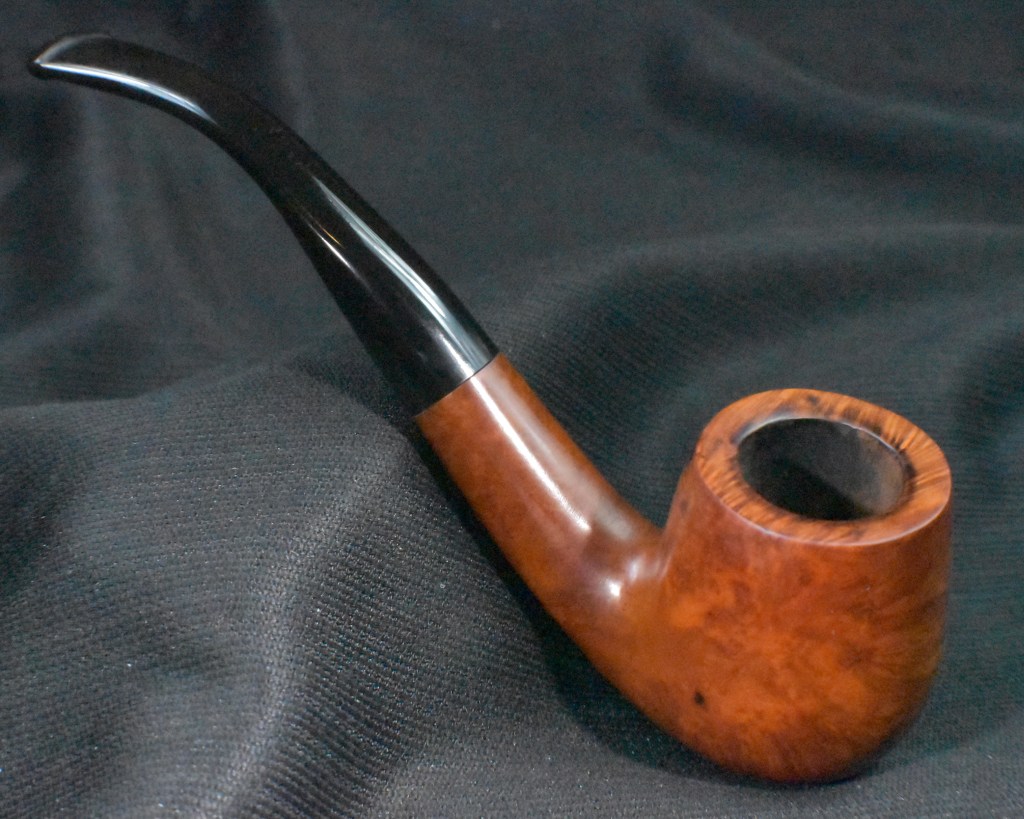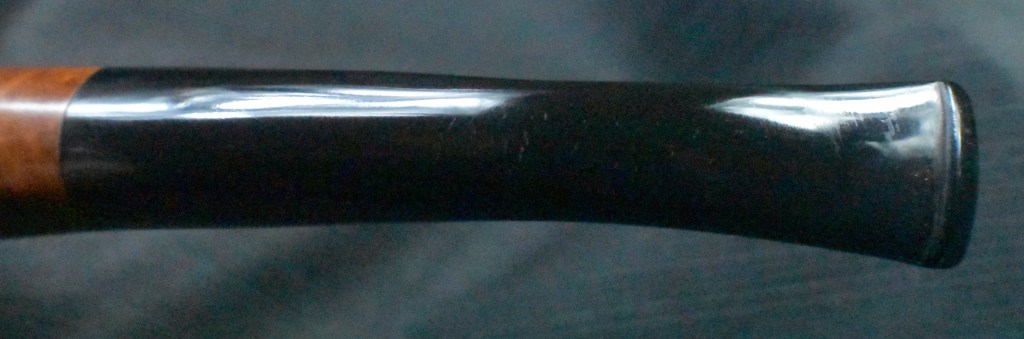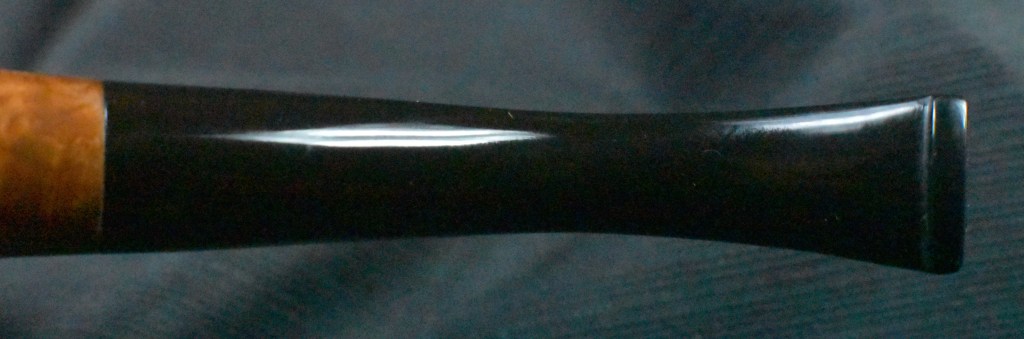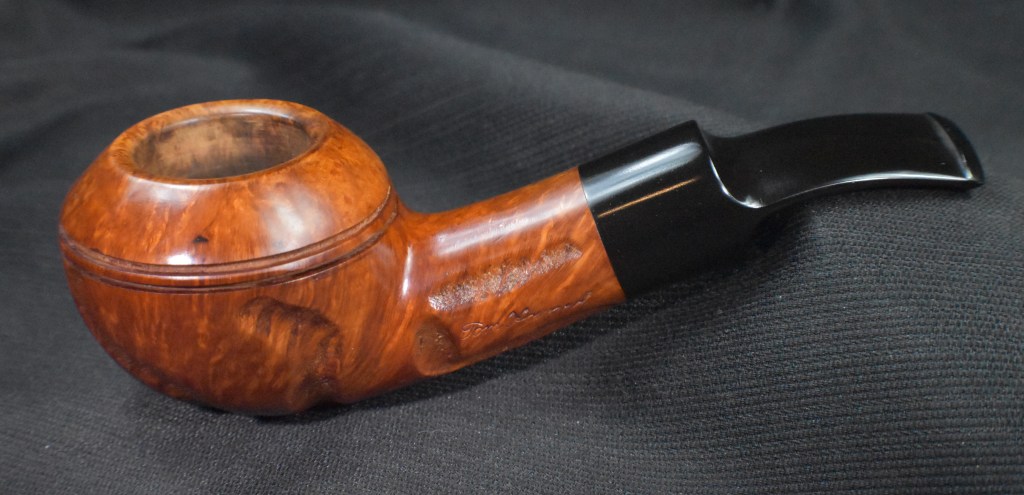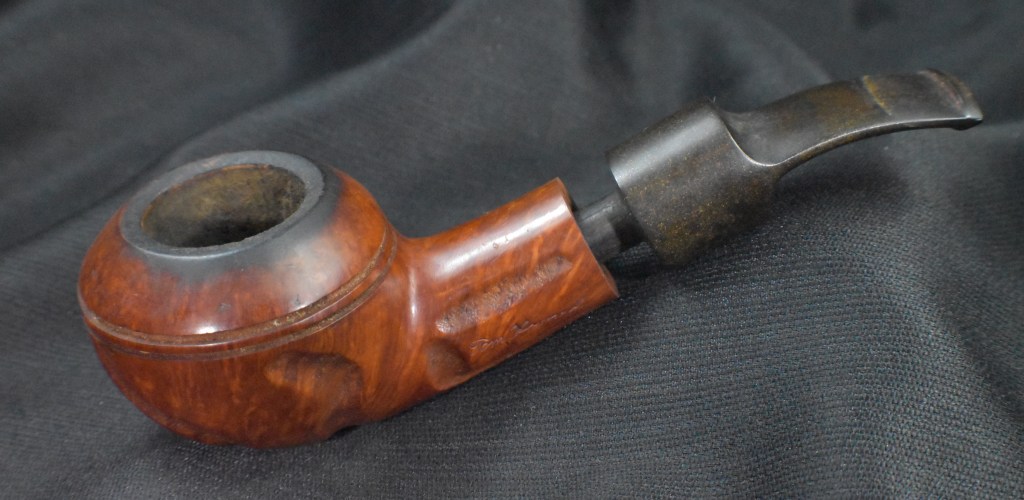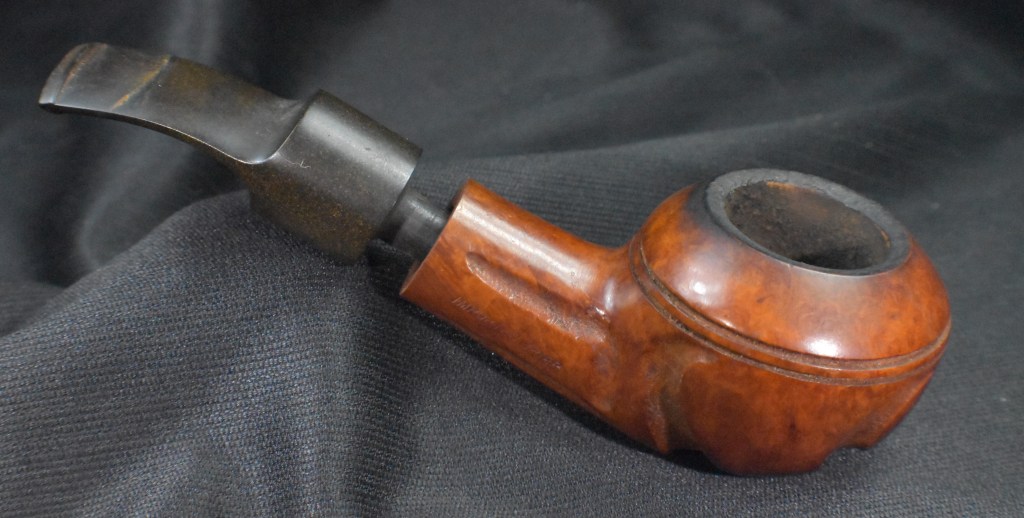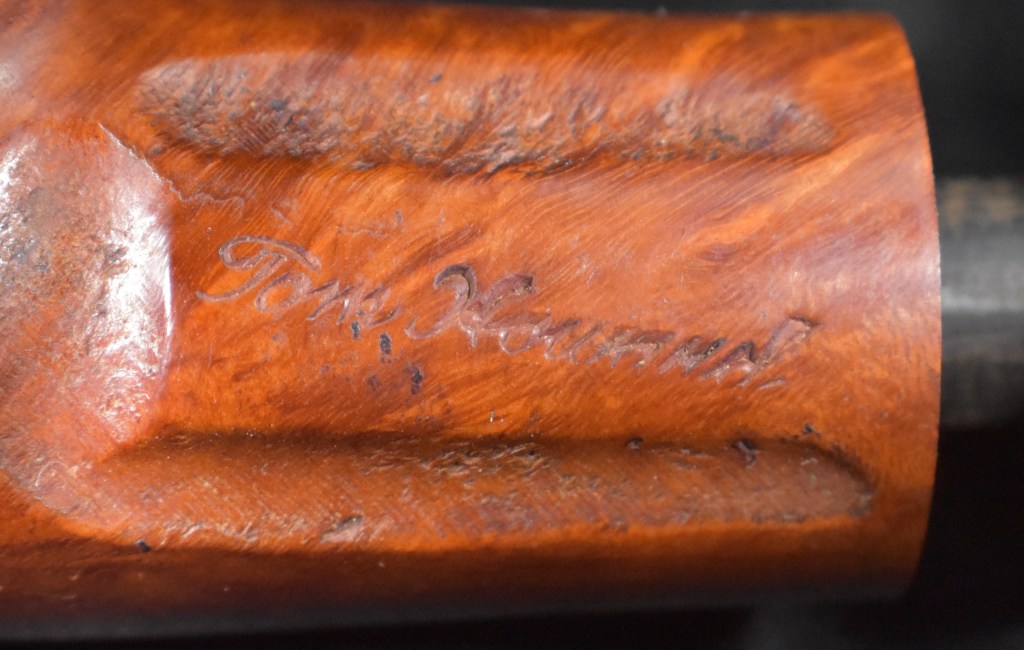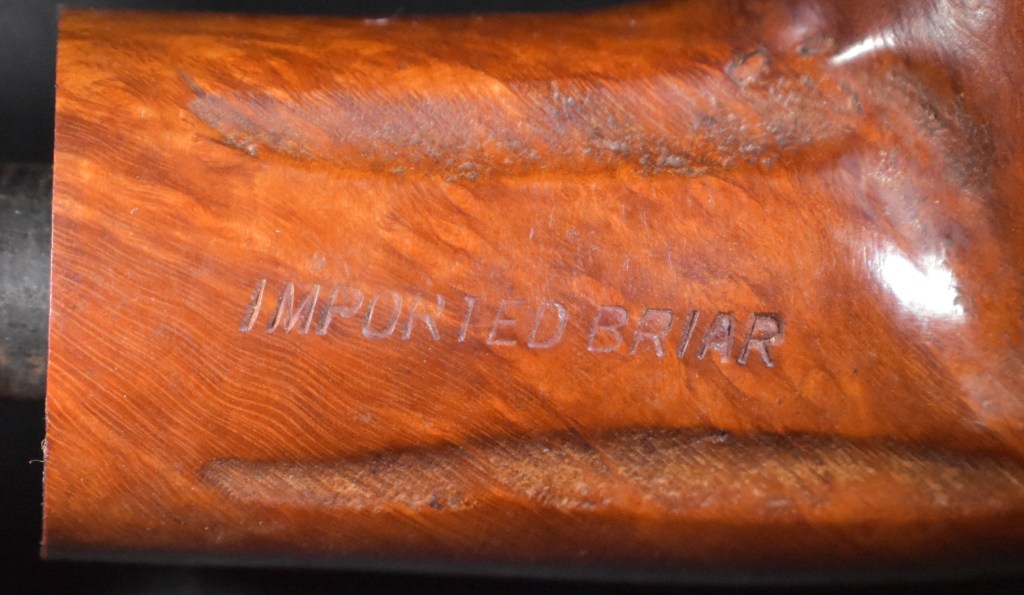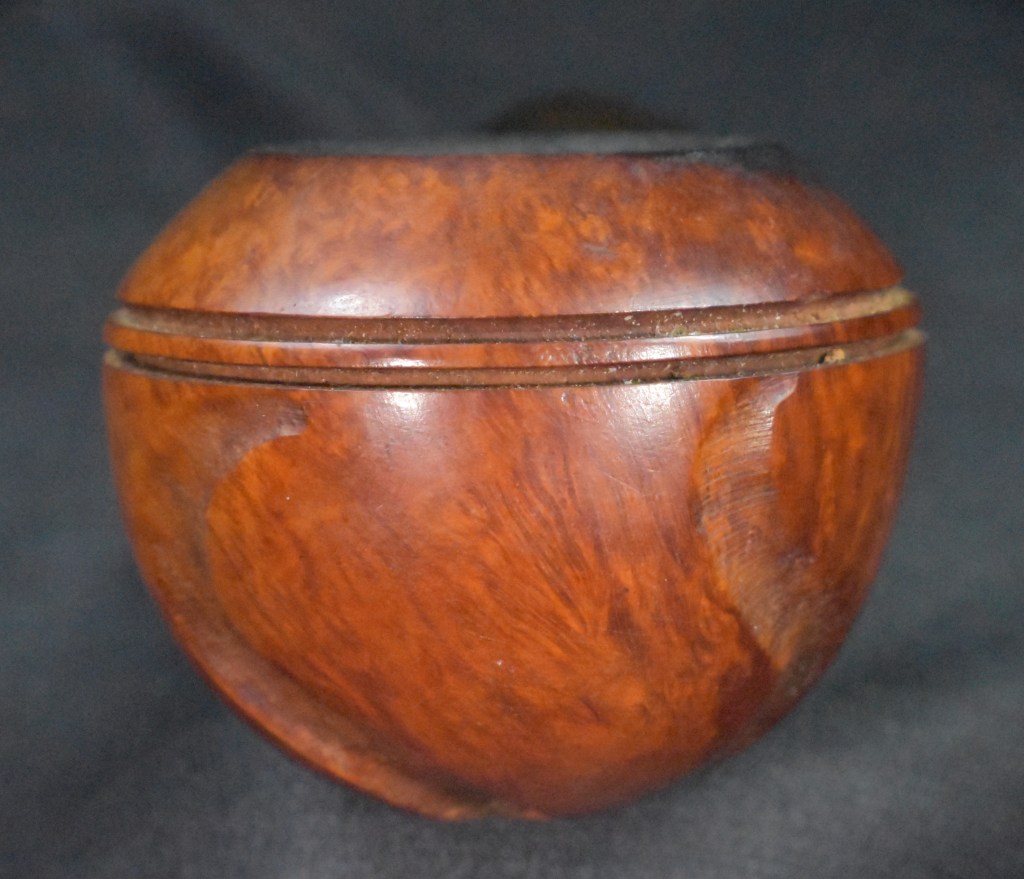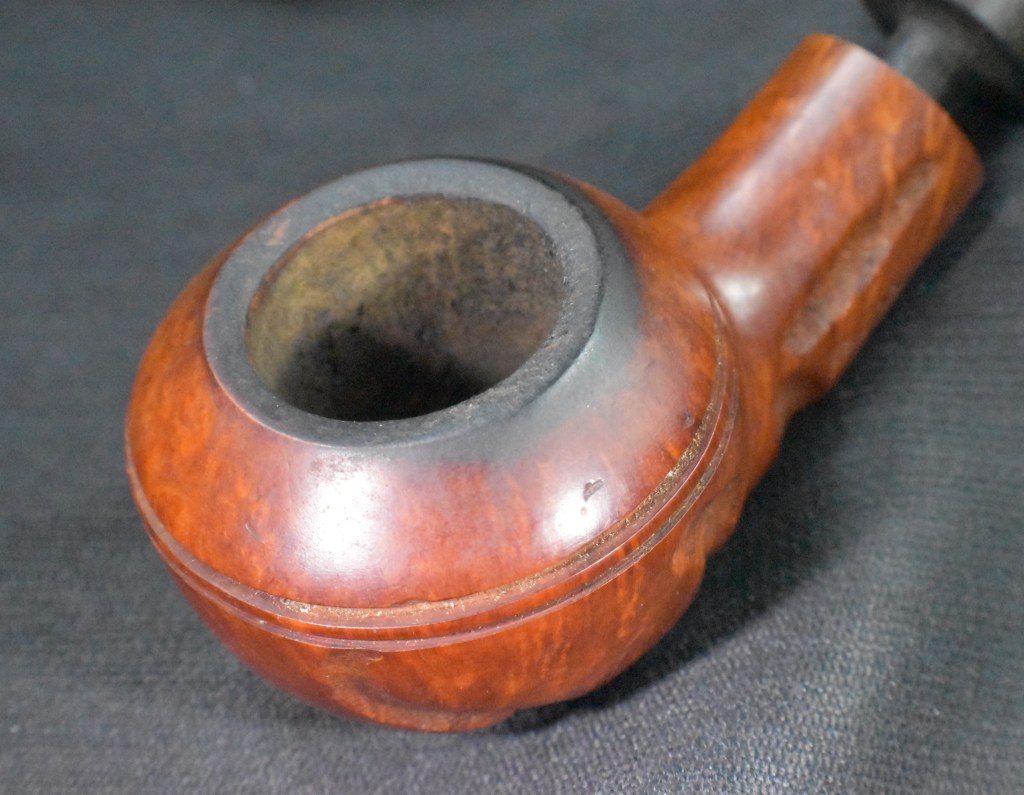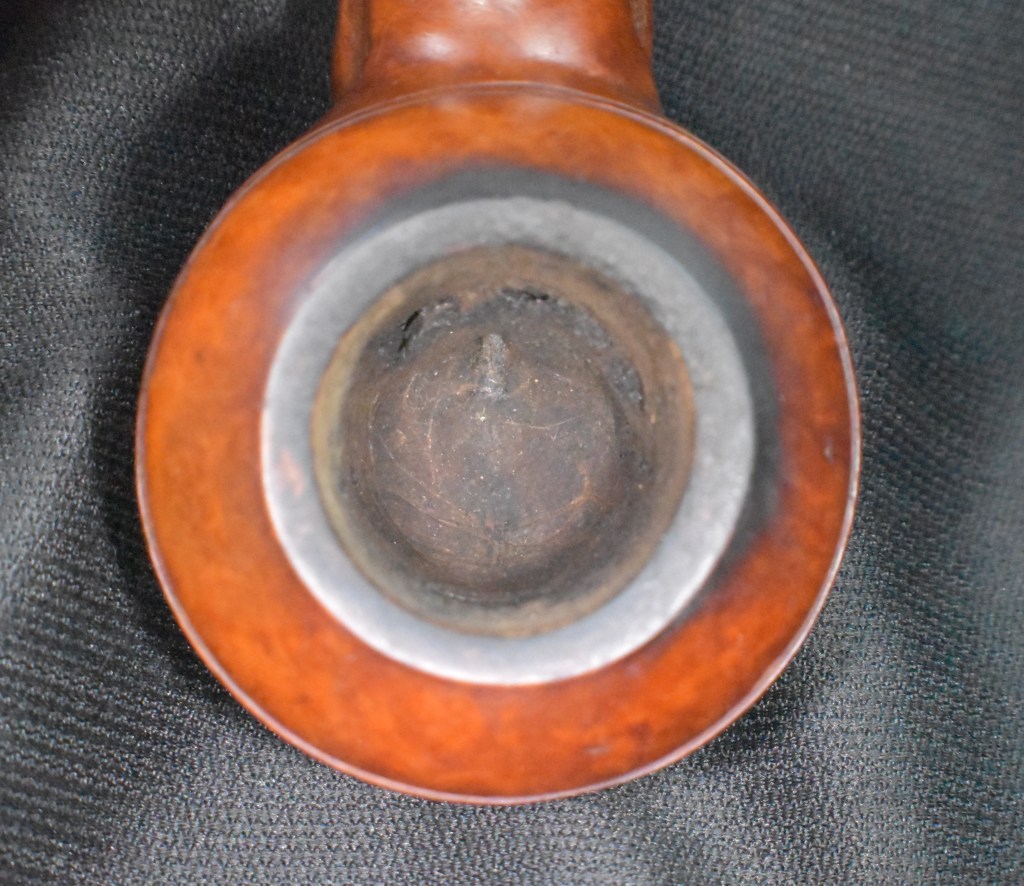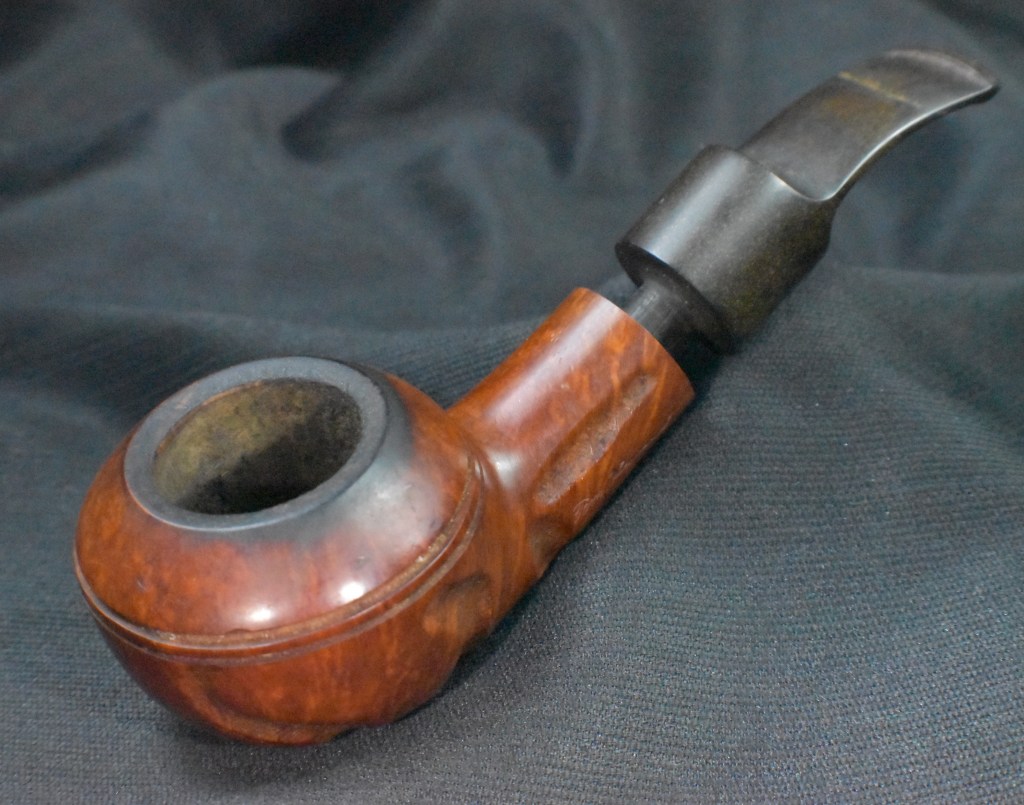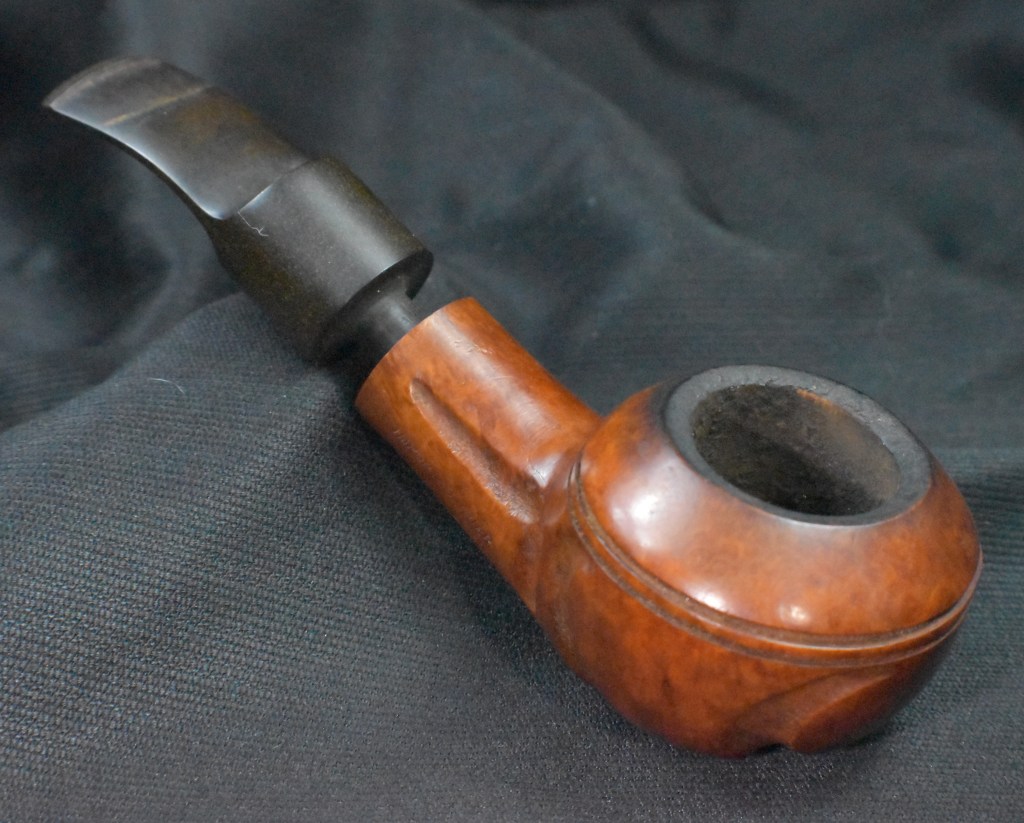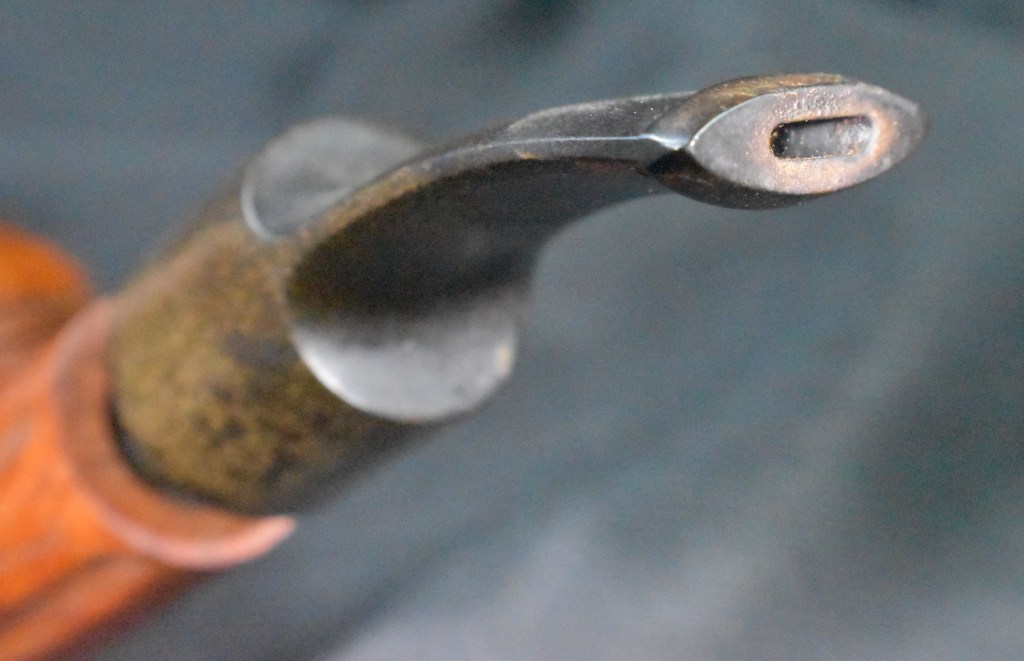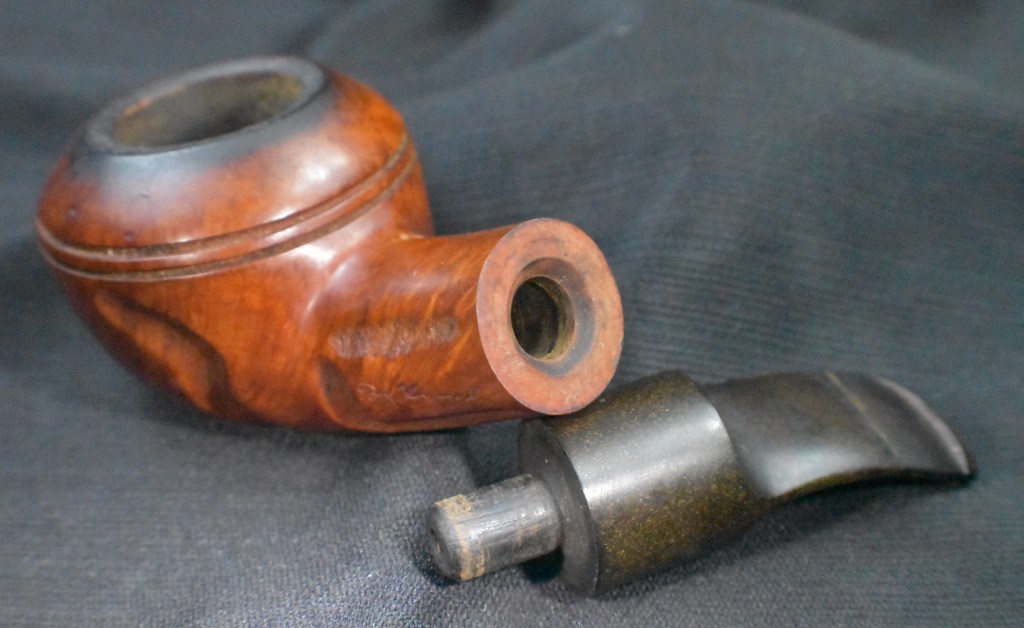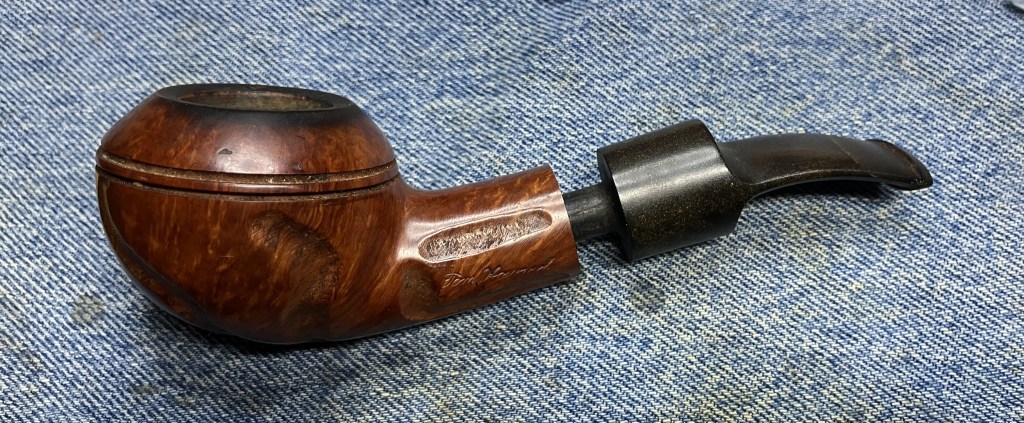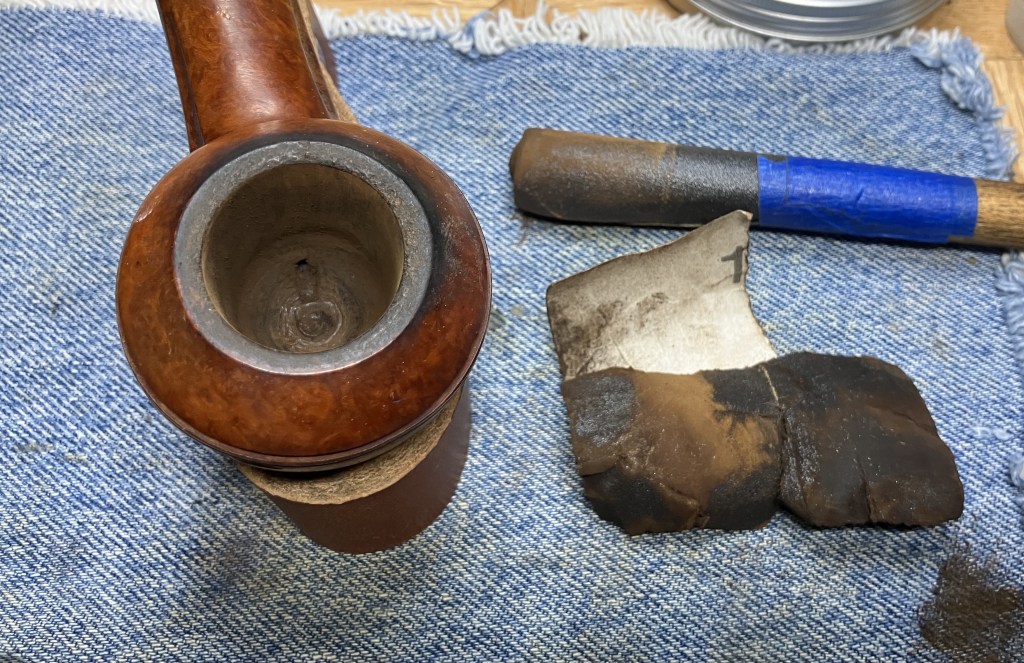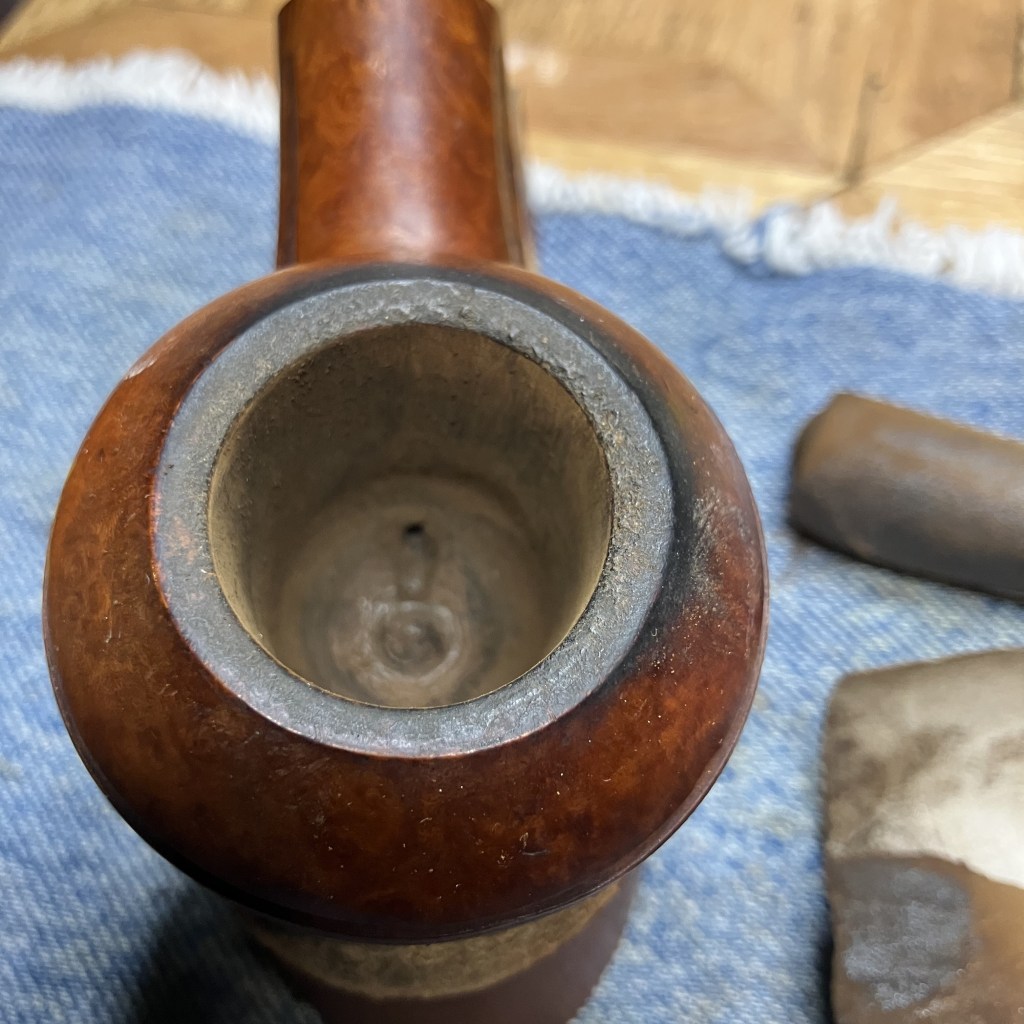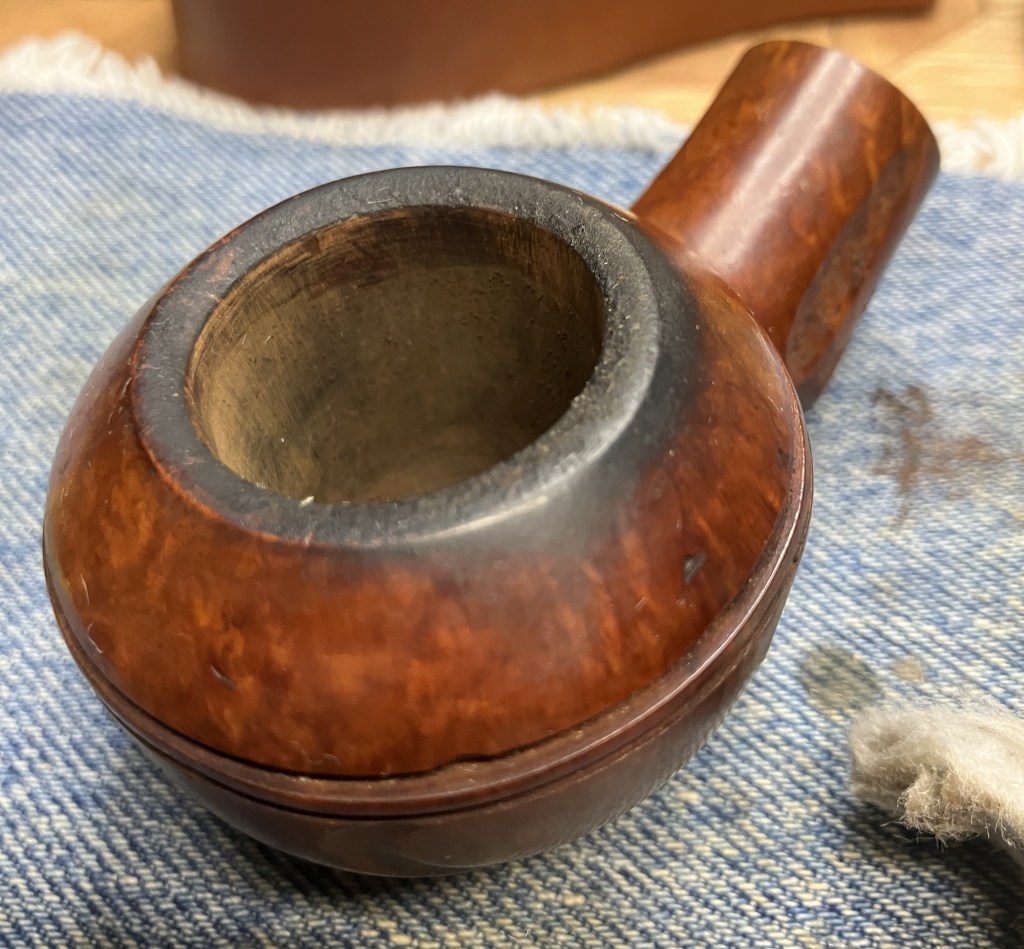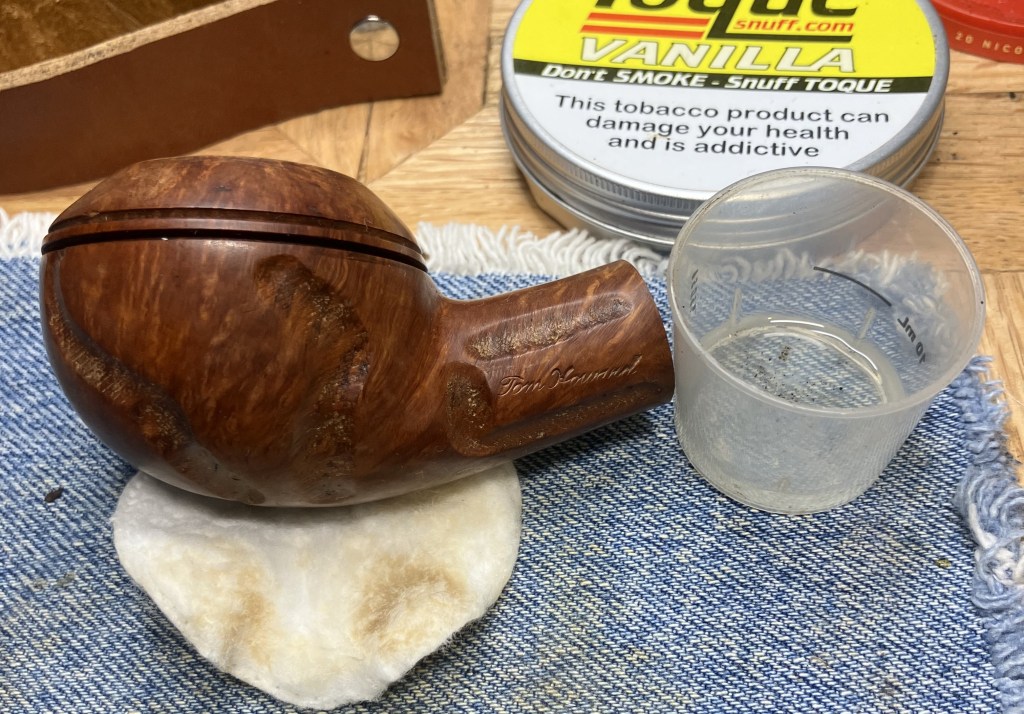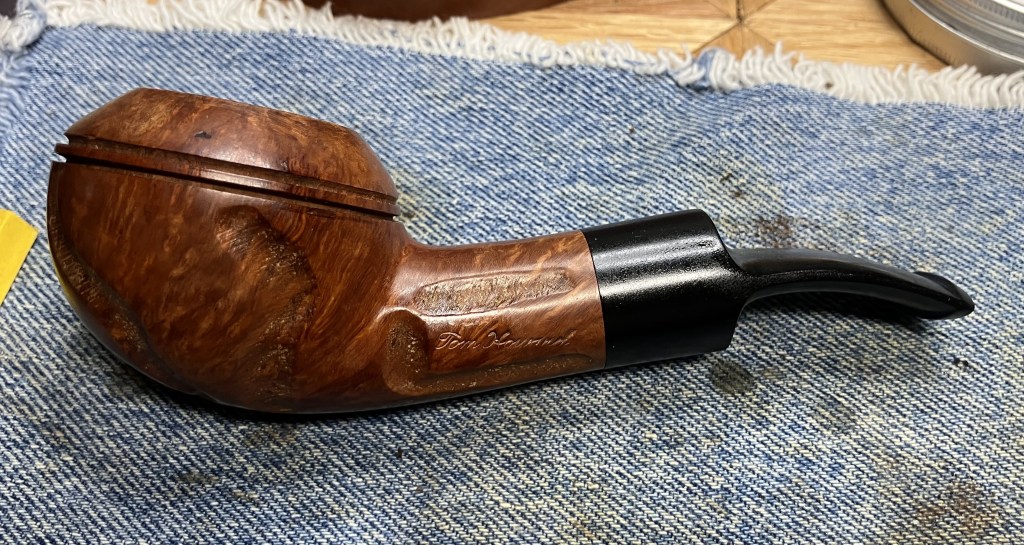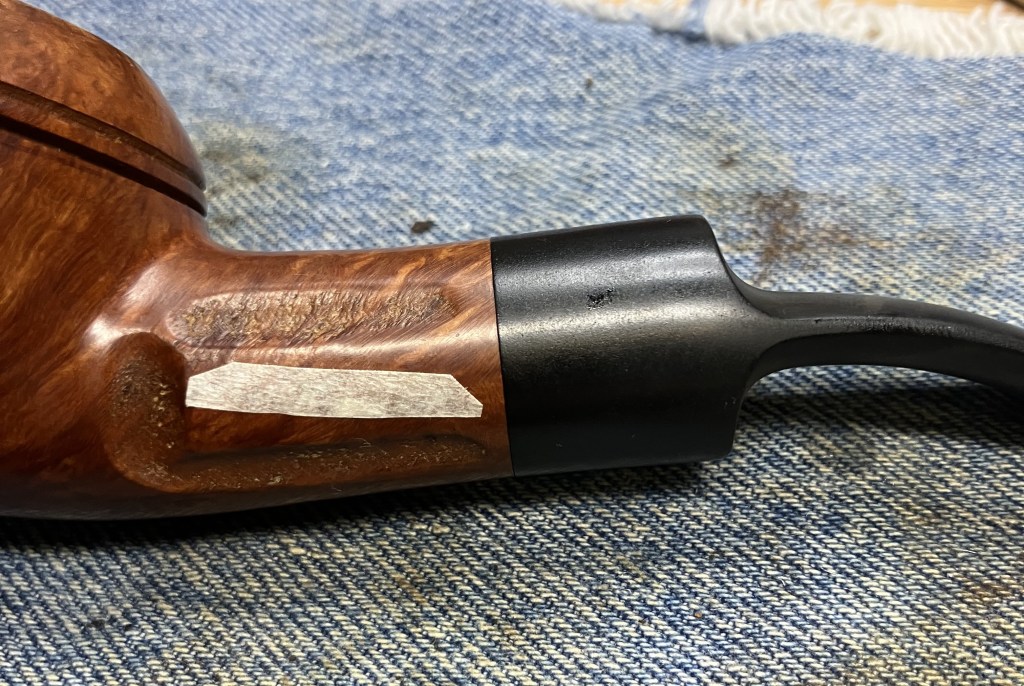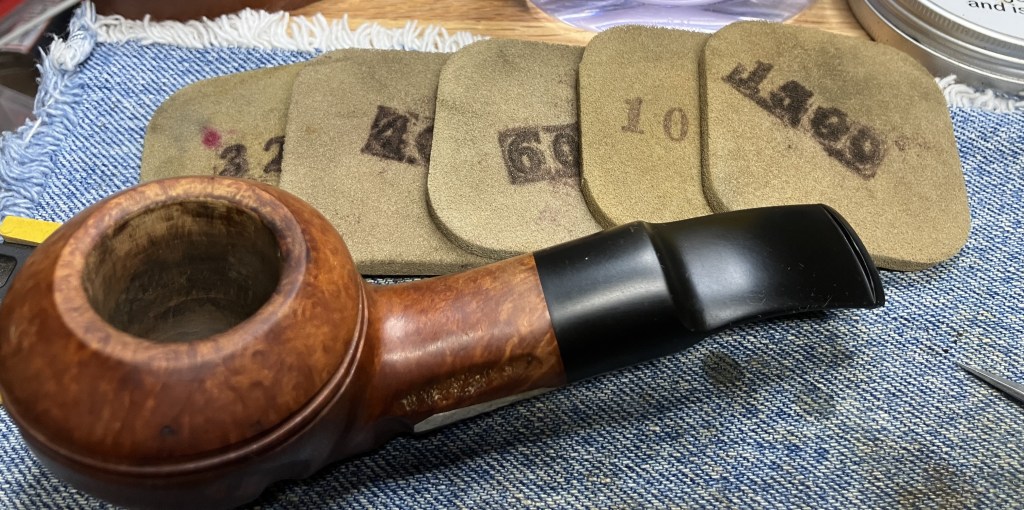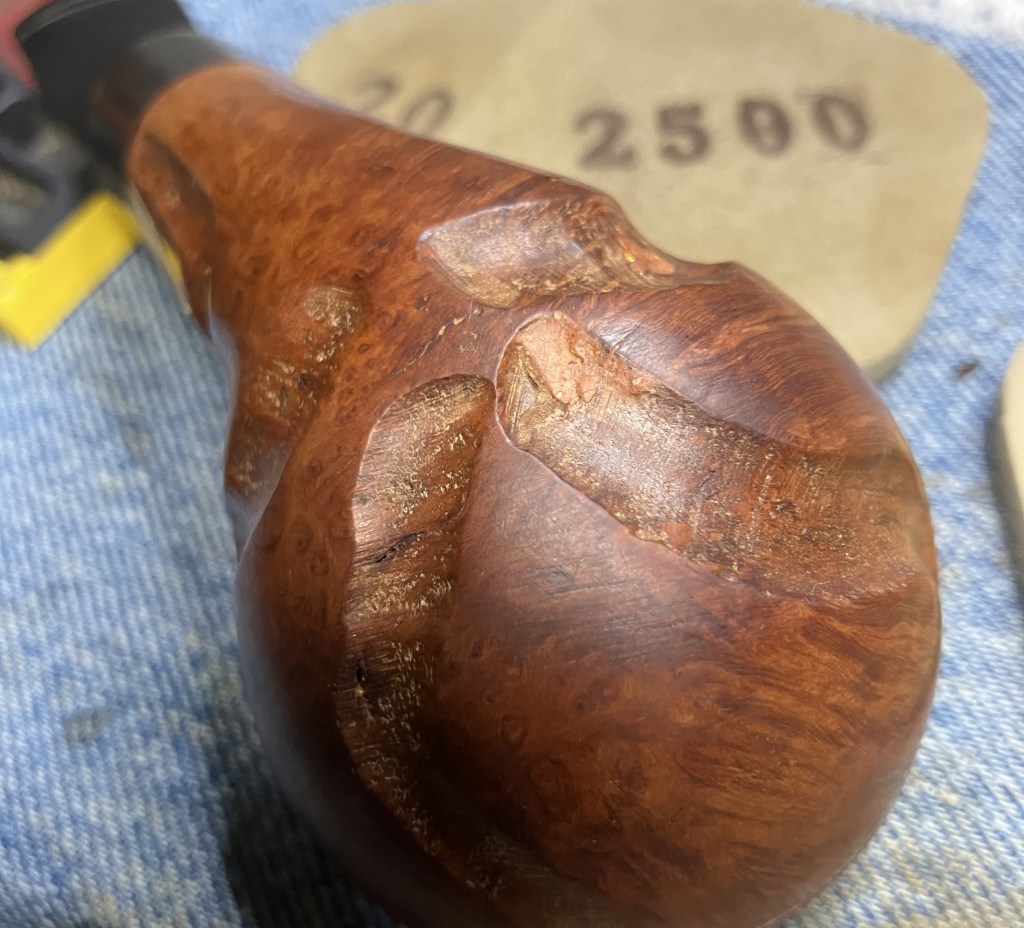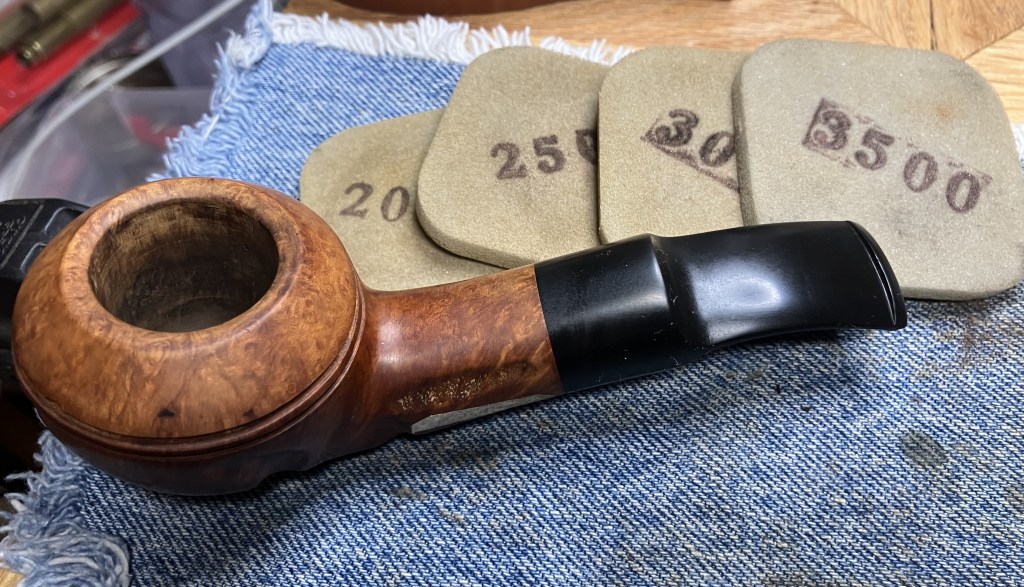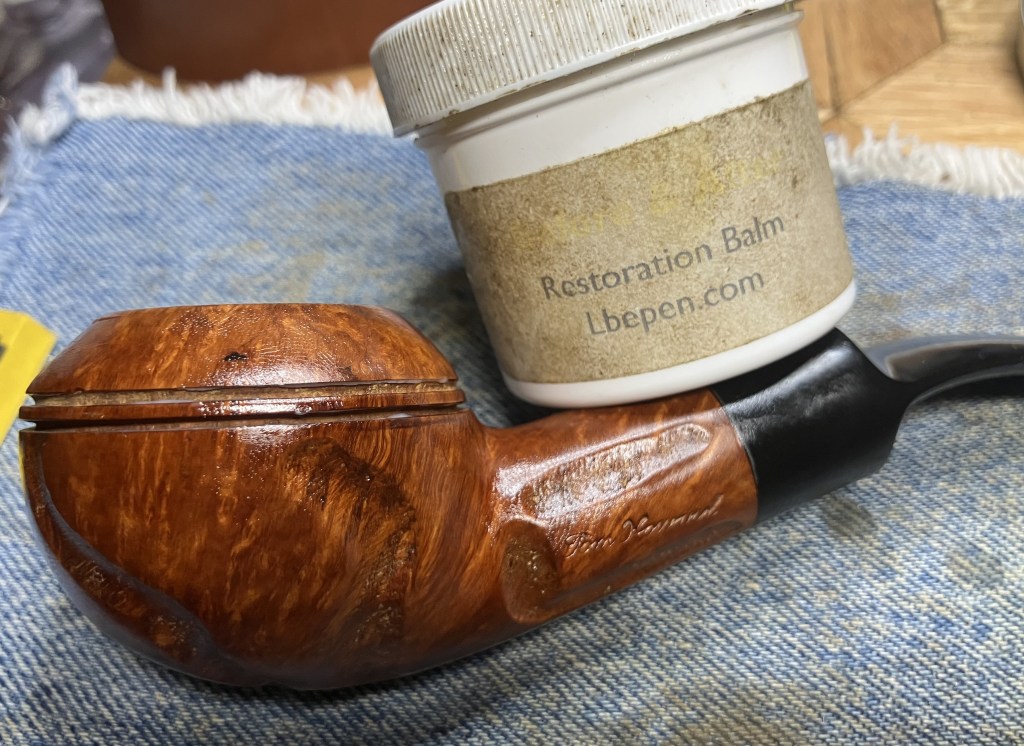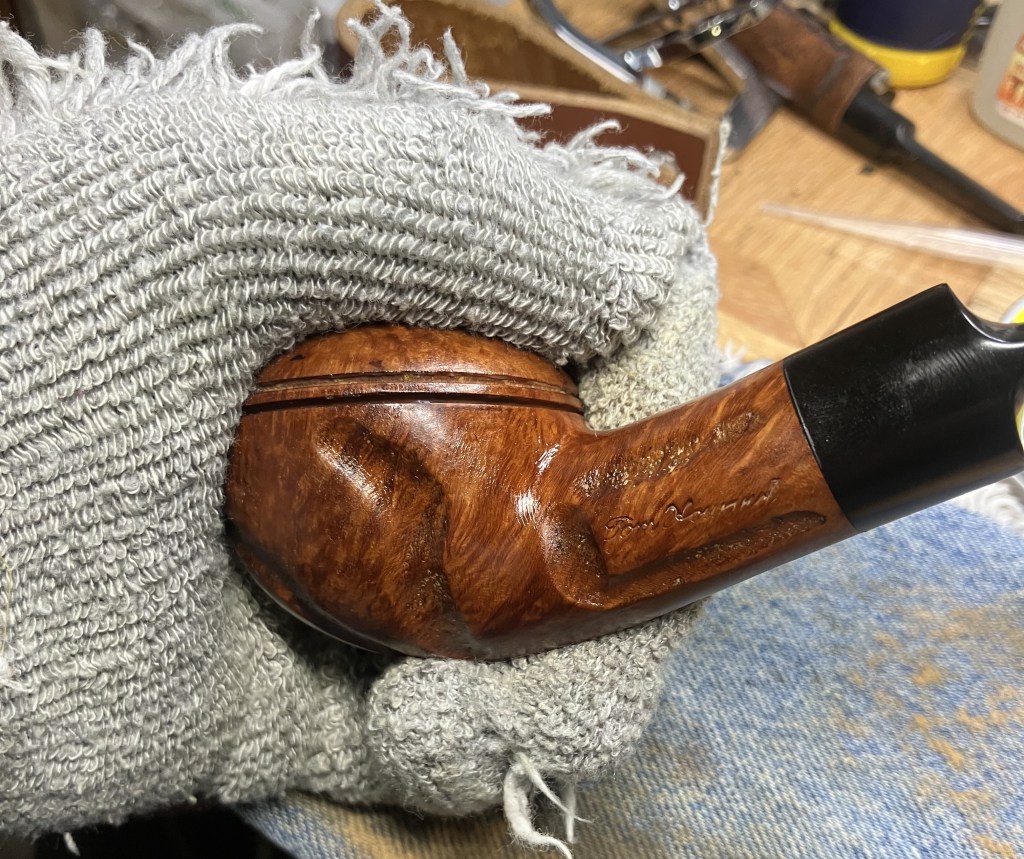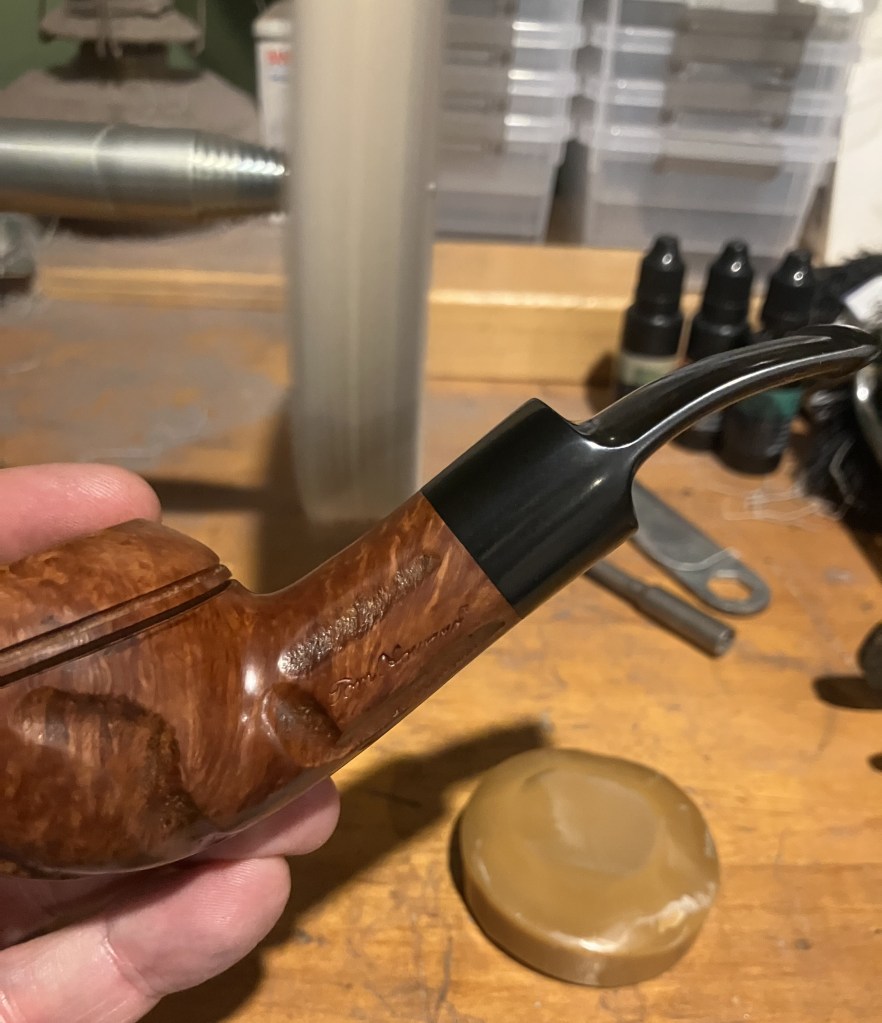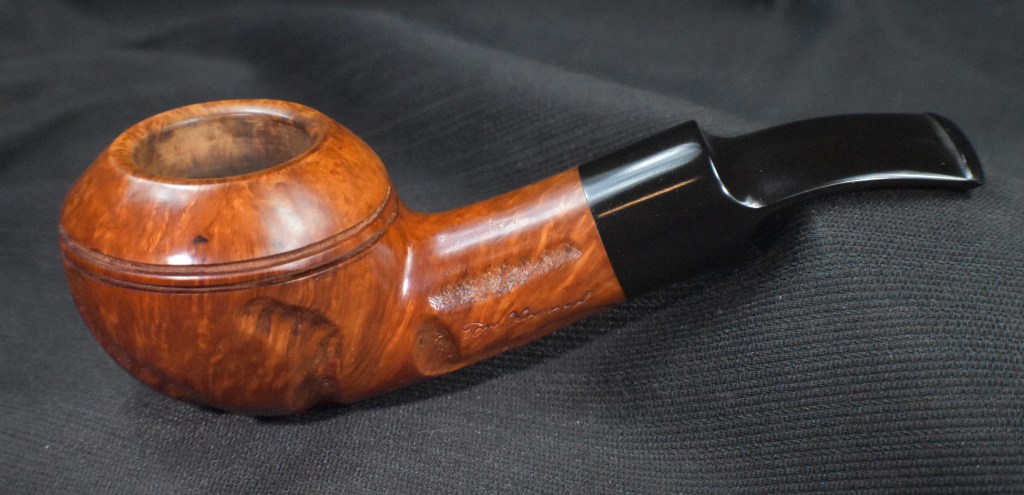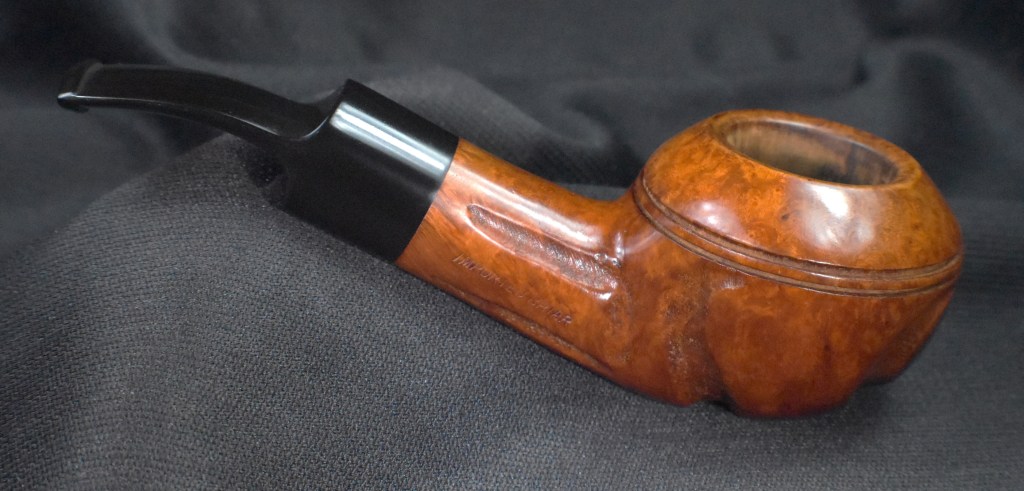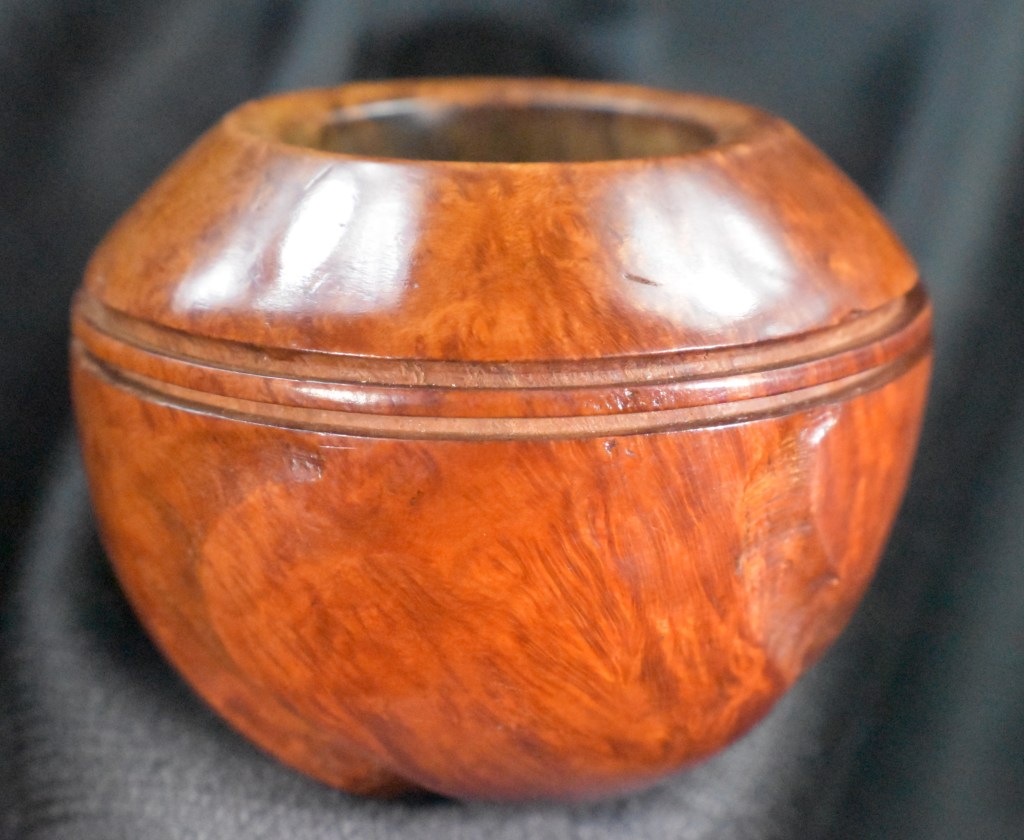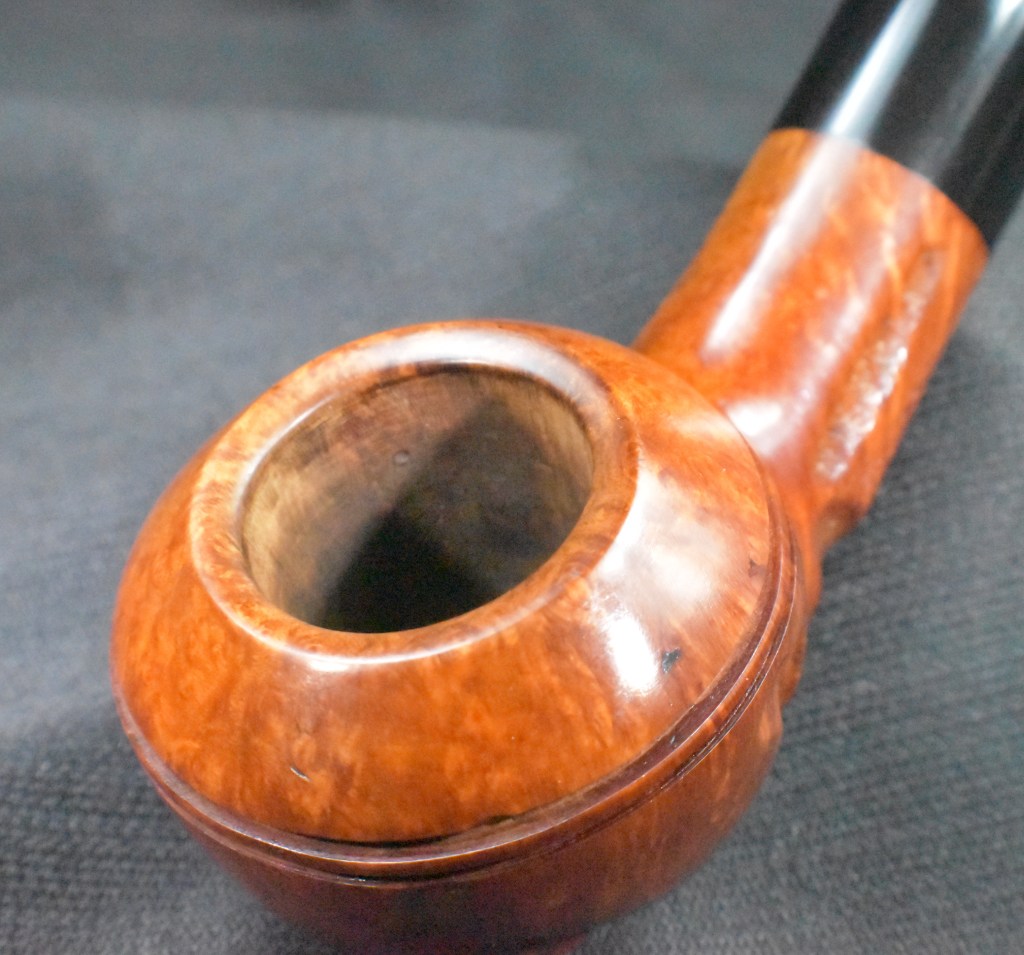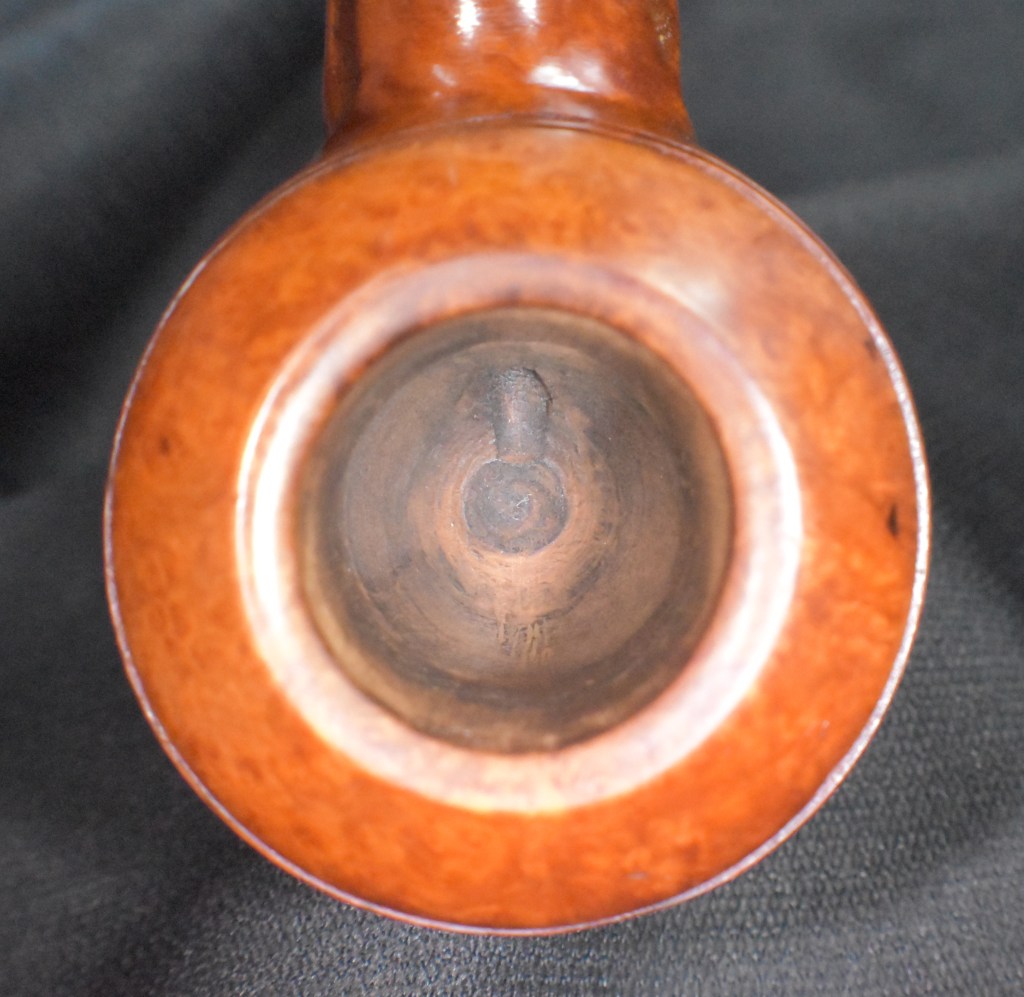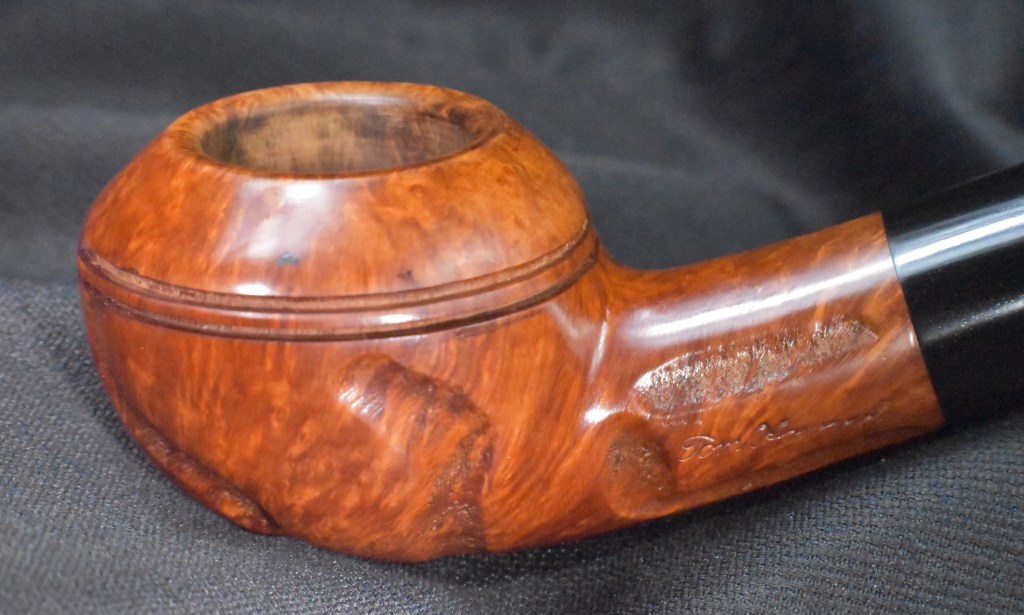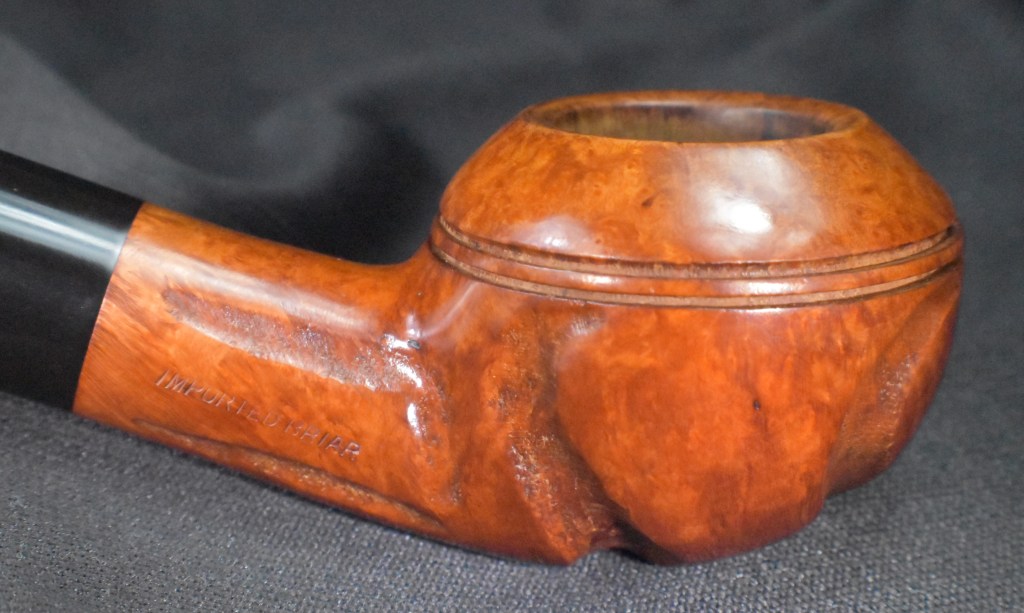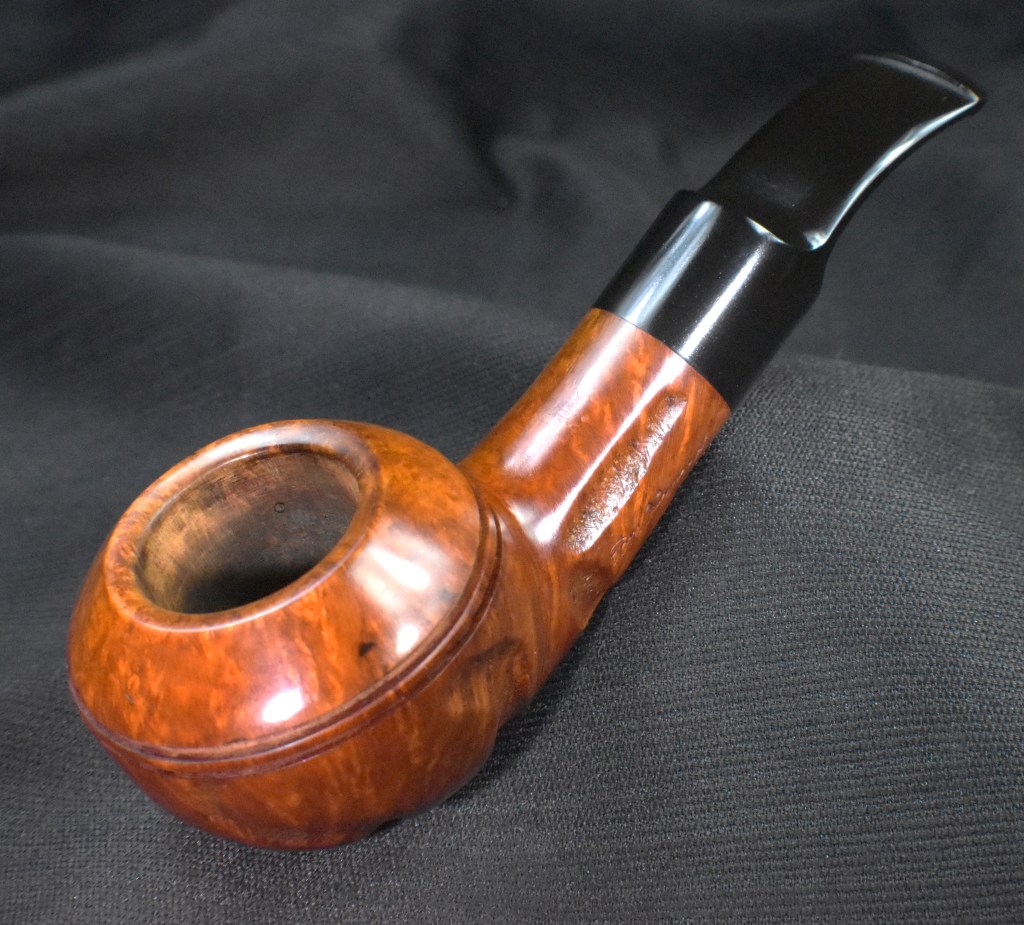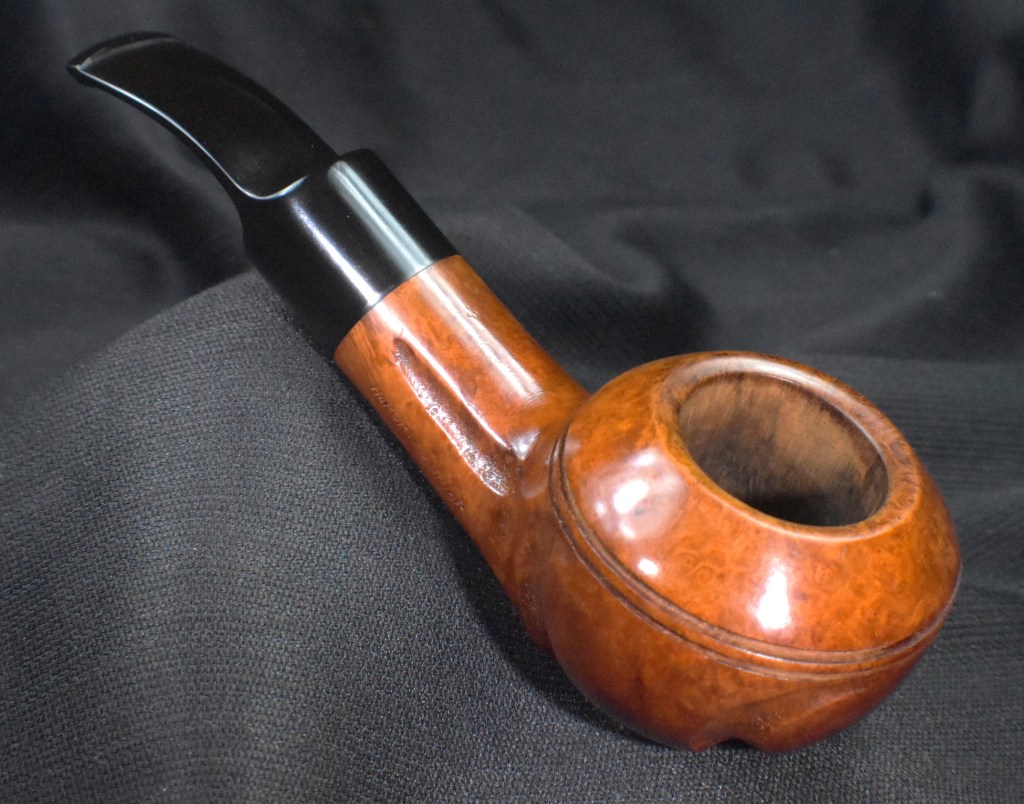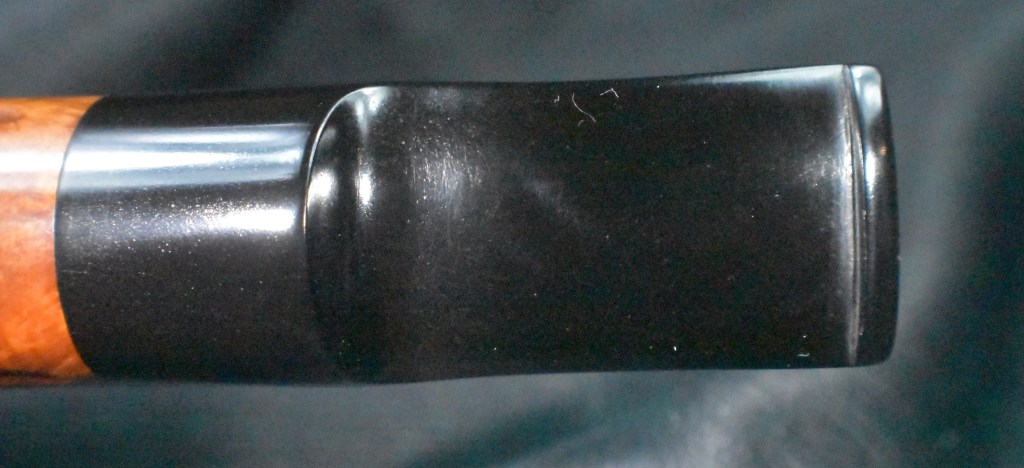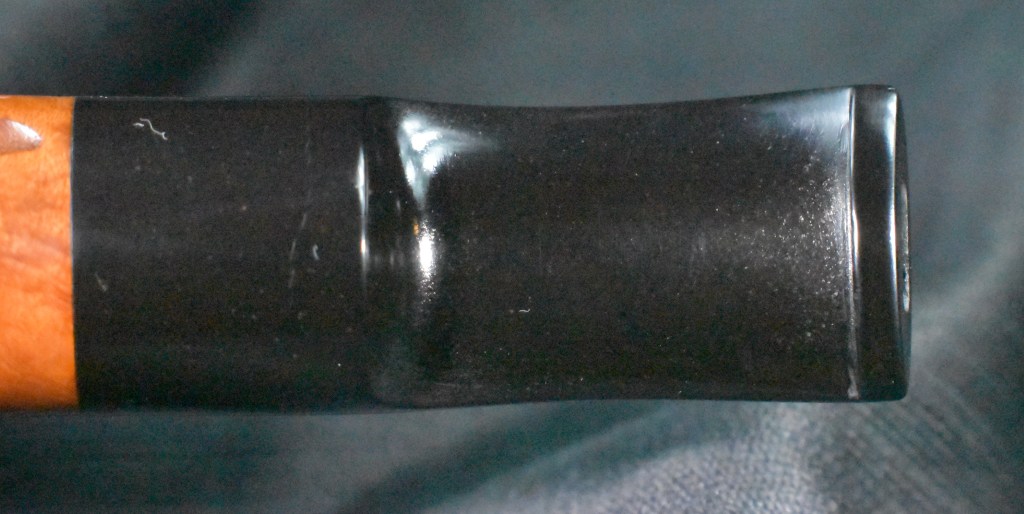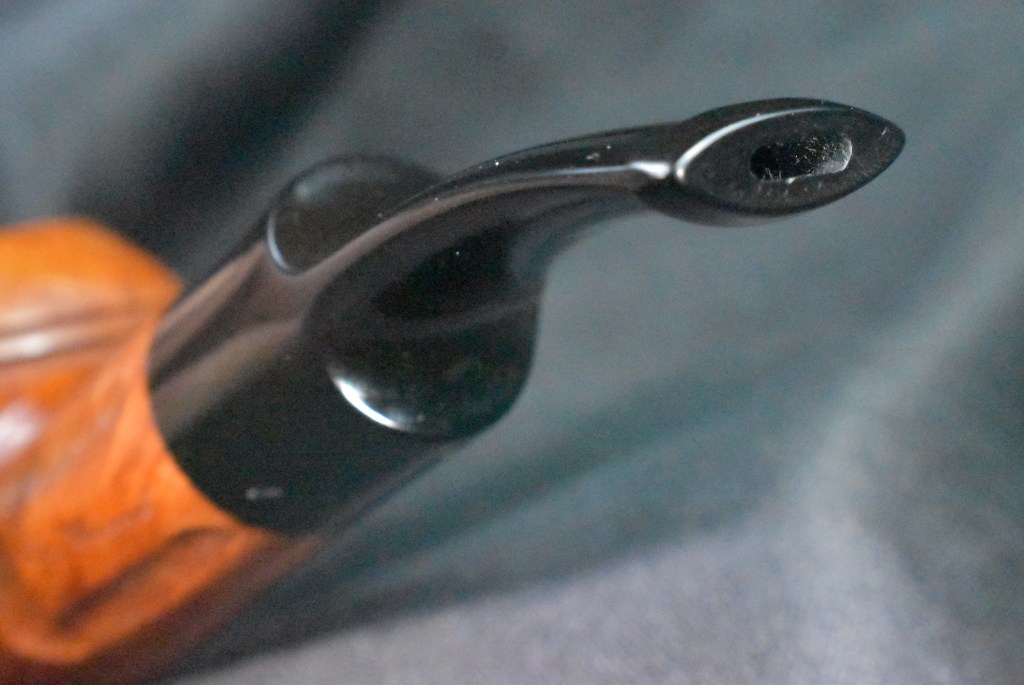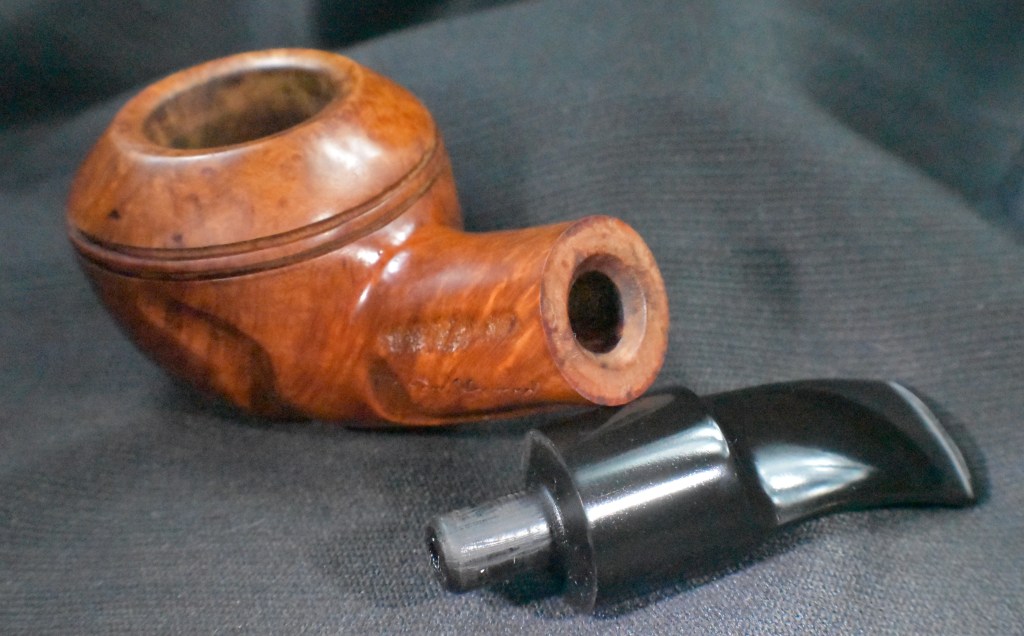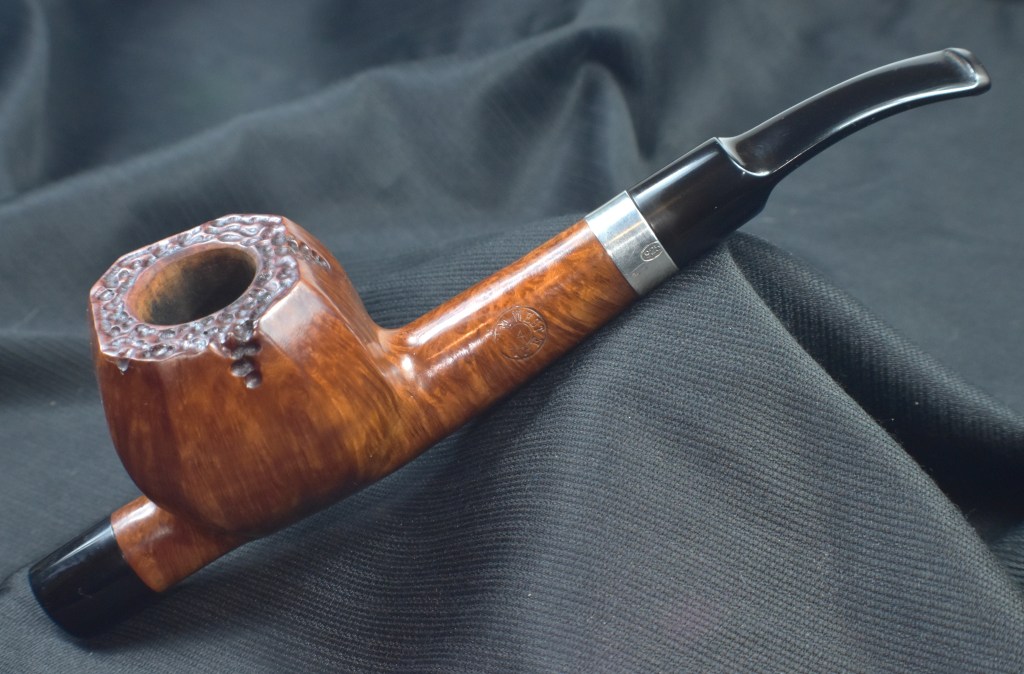
This Brebbia was picked-up as an estate pipe bound for my personal collection. I thought I needed a panel and had been searching for a Savinelli Ottogono bent billiard for what seemed like a couple of years. I saw this little darling and thought, “that is a great shape”. The auction timed out with no one wanting to pay the buyer their asking price. I watched and waited for another posting period or two and the pipe remained. I finally broke-down and made an offer that I thought was reasonable. The offer was accepted and the Brebbia made it’s way to the wilds of southeast Nebraska. Upon arrival I was amazed at the condition of the pipe. It looked far better than the description or photos indicated. Happy, but I have to admit, disappointed at the same time for the restoration would be so uneventful. Actually a cleaning and polishing would be a better description than calling this a restoration. Anyway, The below photos were taken of the pipe prior to it being worked on.
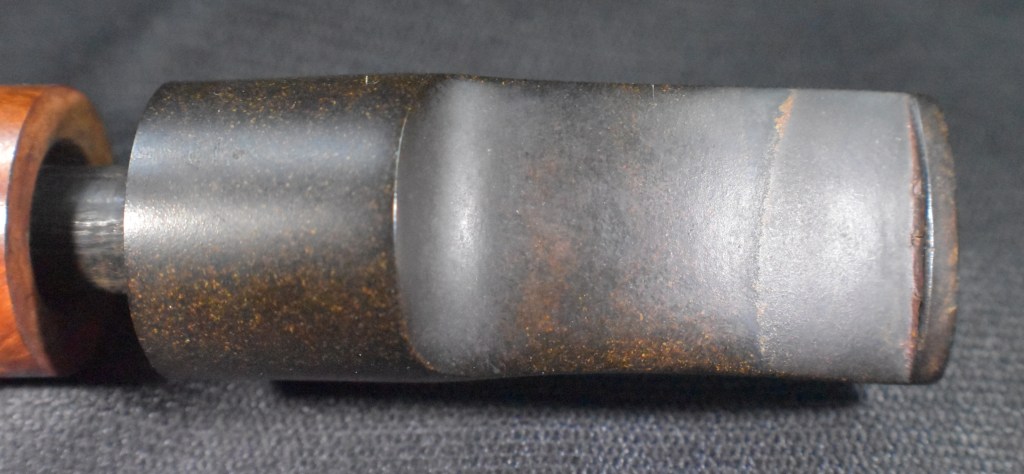
It really did look like a new pipe. You could tell that it had been smoked a couple of times by the condition of the tobacco chamber, the light cake build up and sure there were a couple of light tooth marks on the stem, but this pipe was in great shape. This one was going to be a breeze.
Background
The official Brebbia site, Pipe Brebbia | Official Website and Online Shop has a very nice history of the company section, History. This is recommended reading for those more interested in the brand and history. In a nutshell, Brebbia and Savinelli are like siblings. They grew up together then split off and went their separate ways. Like I said, a nutshell – a very small one too.
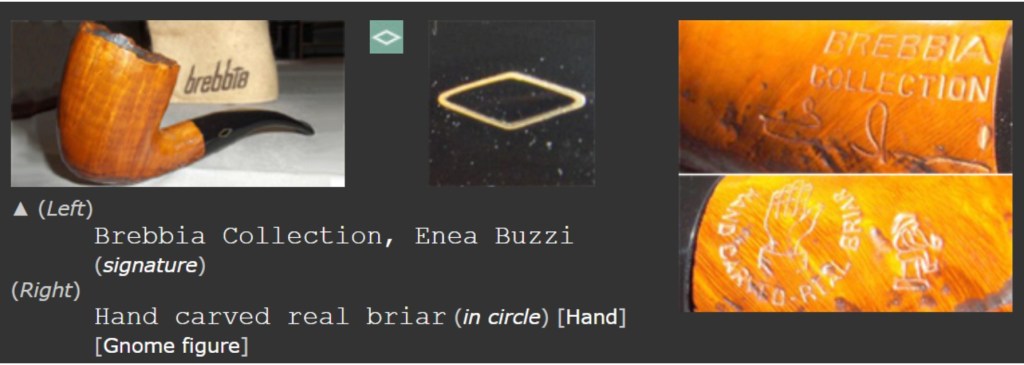
Additional reading about Brebbia can be found at Brebbia – Pipedia. As for the Brebbia logos, Brebbia — Pipes : Logos & Markings has a nice selection of photos including this one showing both the stem logo and the “Golden Gnome” as on the Brebbia in hand:
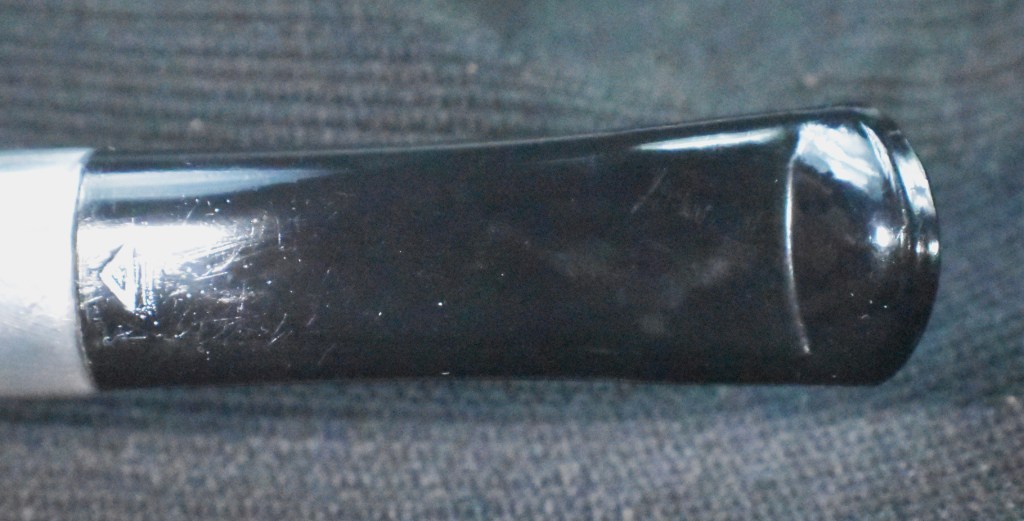
(Brebbia — Pipes : Logos & Markings). As for the date of production of this pipe, I could not find anything specific to the Sabbiata line other than the following:
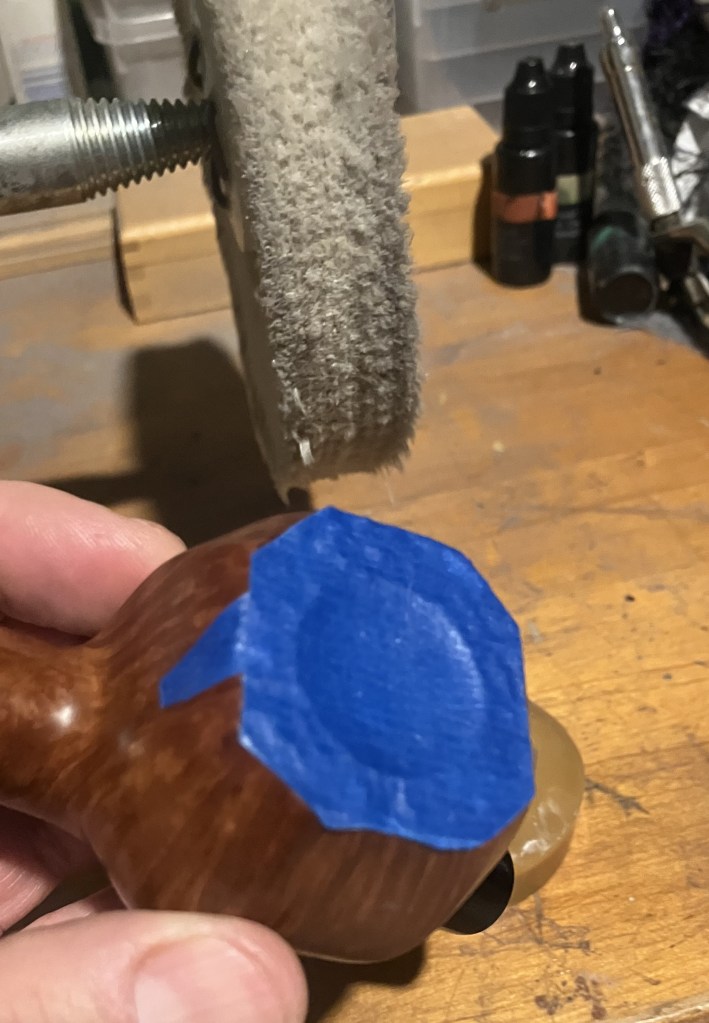
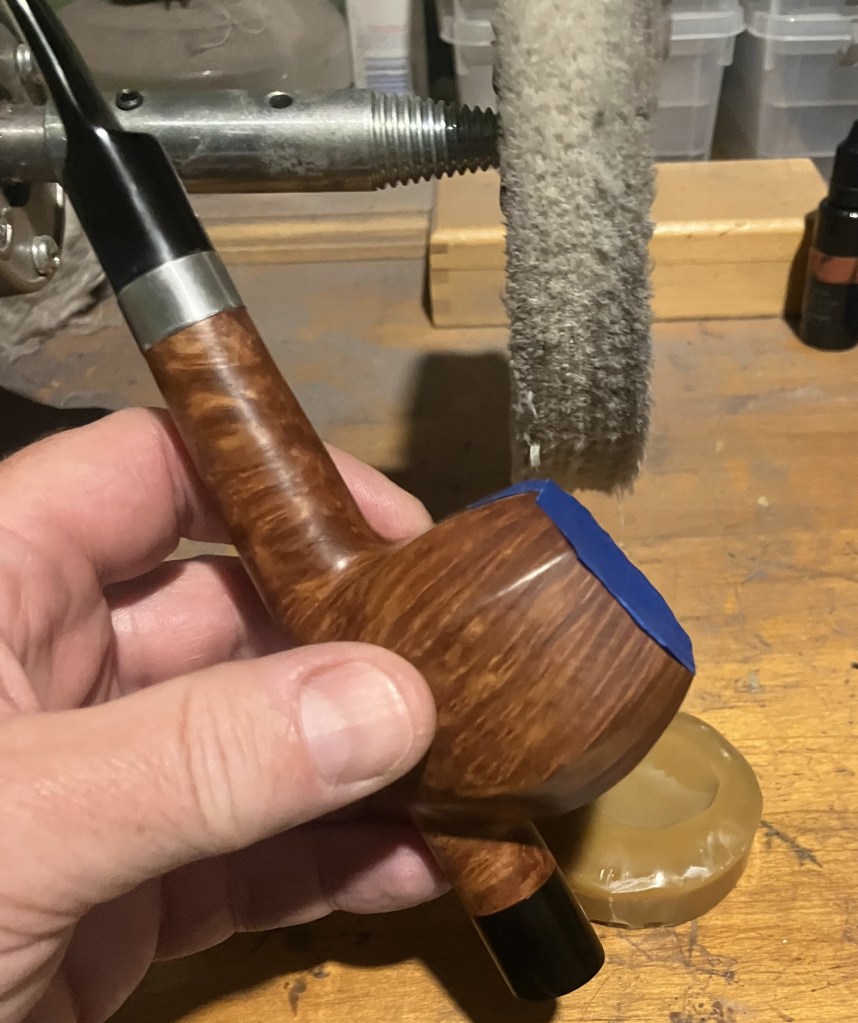
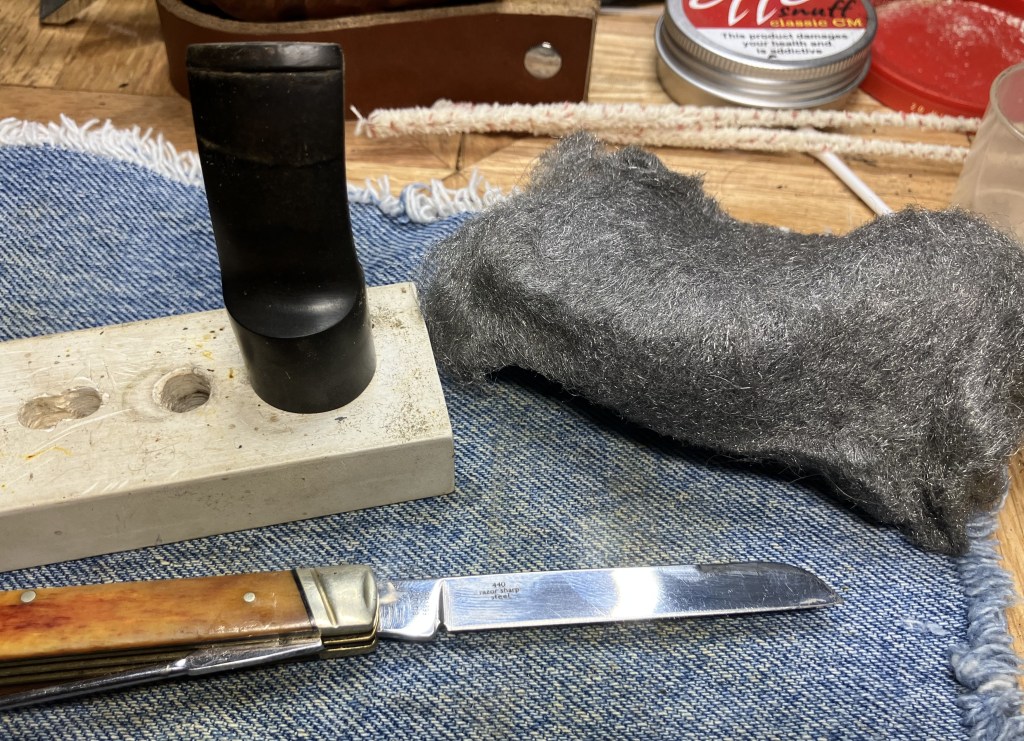
After the photo shoot for the before photos the Brebbia made it to the workbench. The verdict is still out on the new cloth surface protection towels. They look OK for photography but everything seems to snag on the fabric and wants to lift the cloth from the surface. I think I prefer the denim pieces but they were getting very stained.
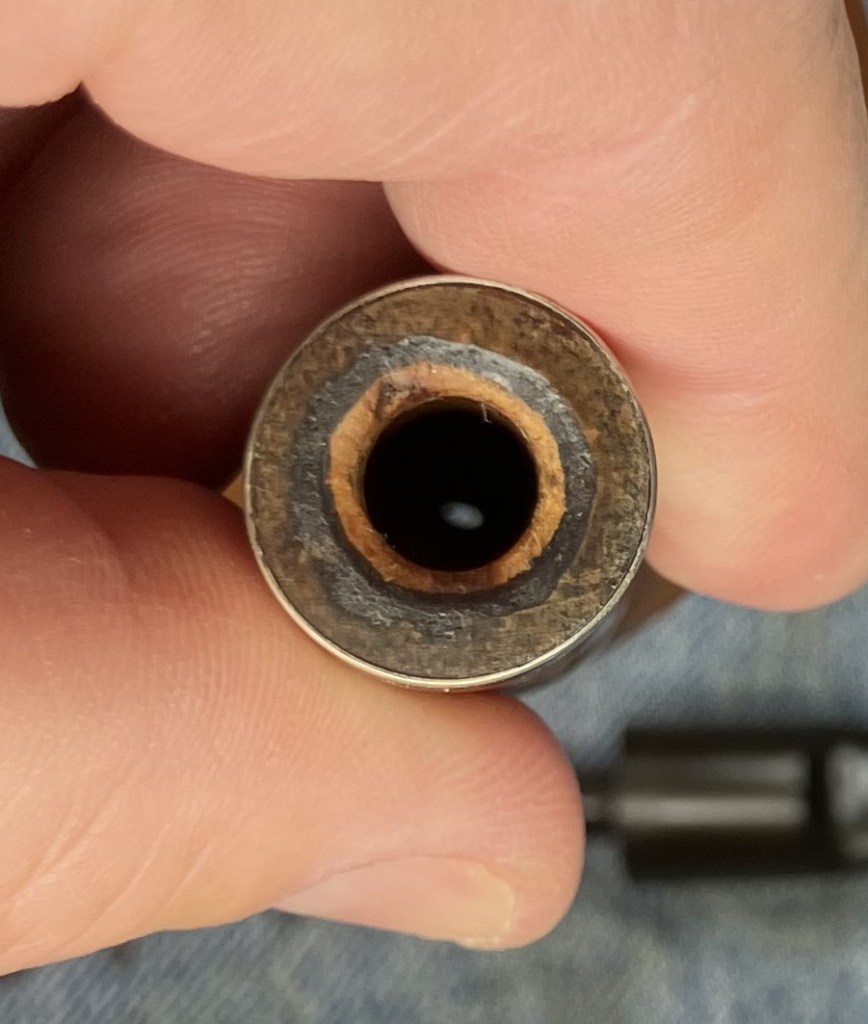
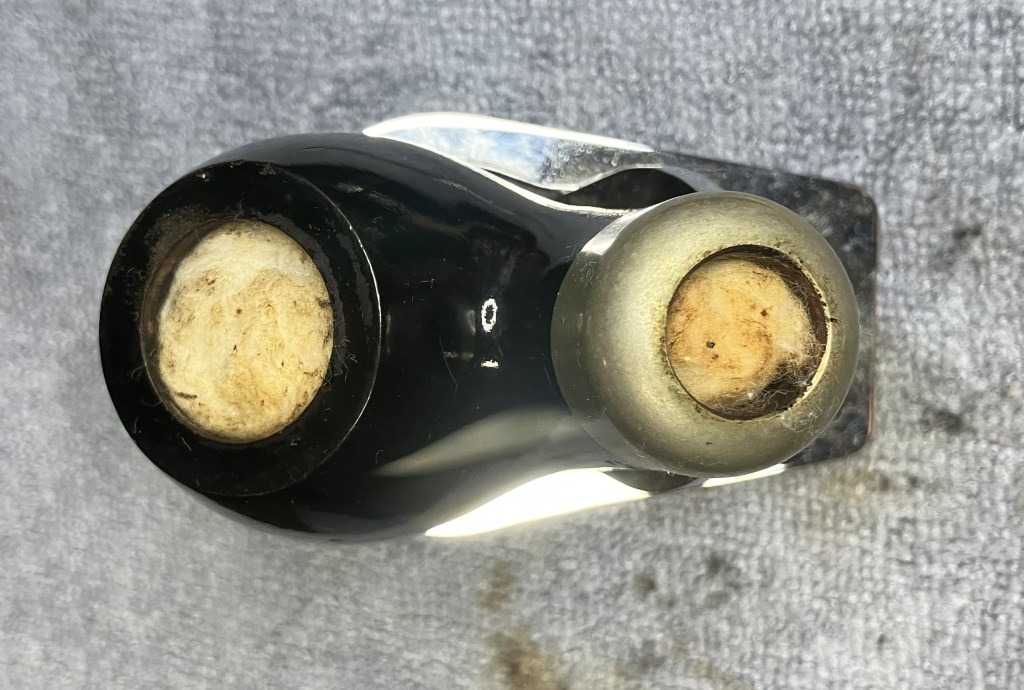
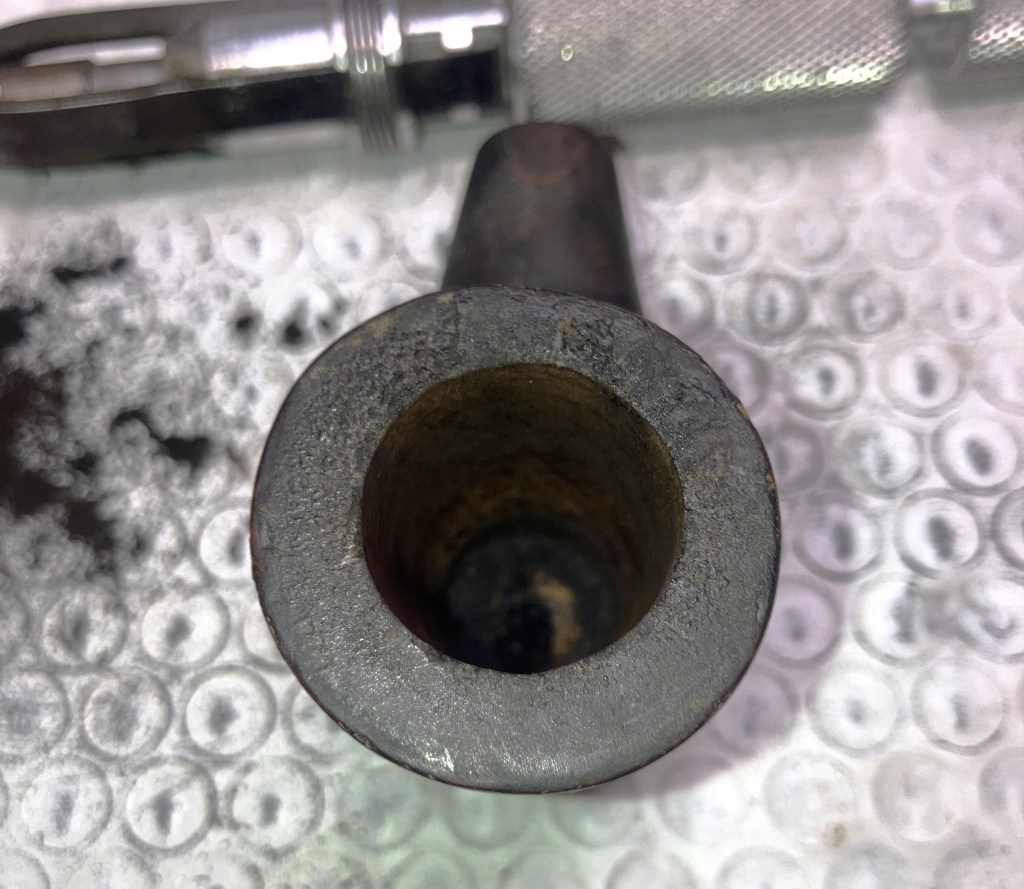
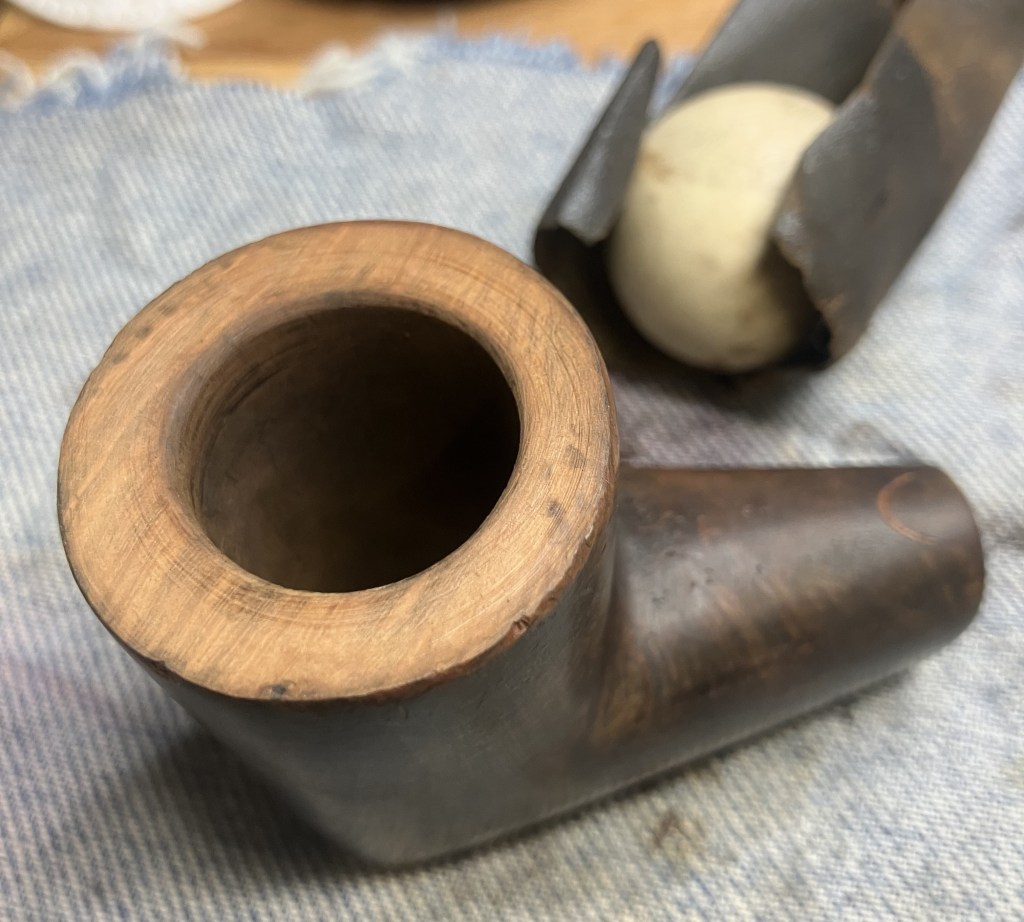
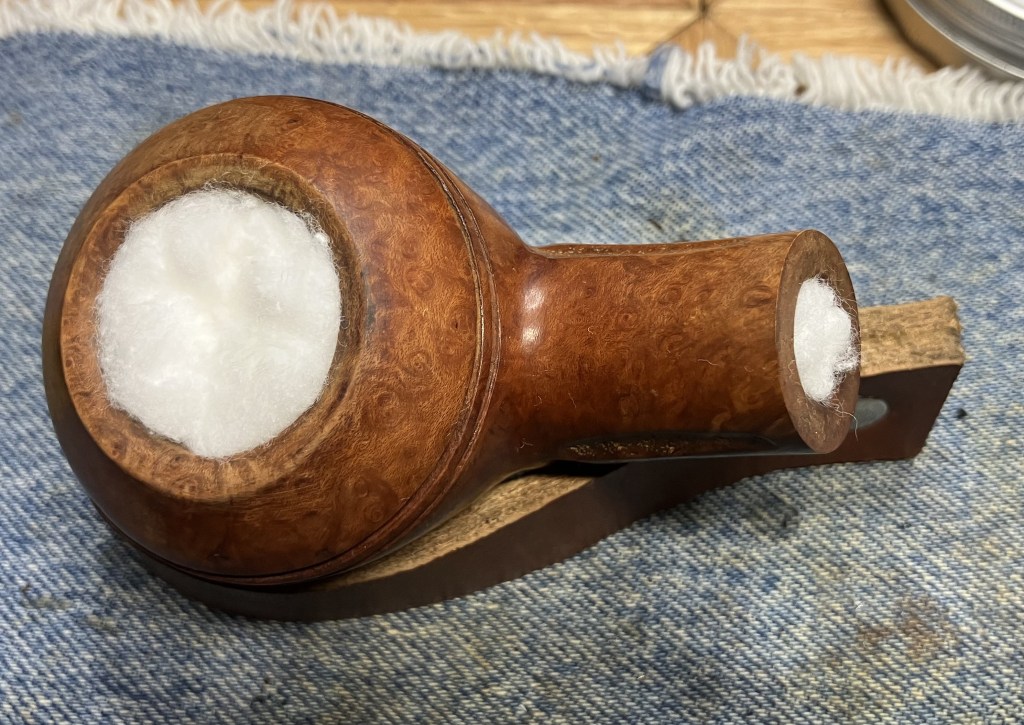
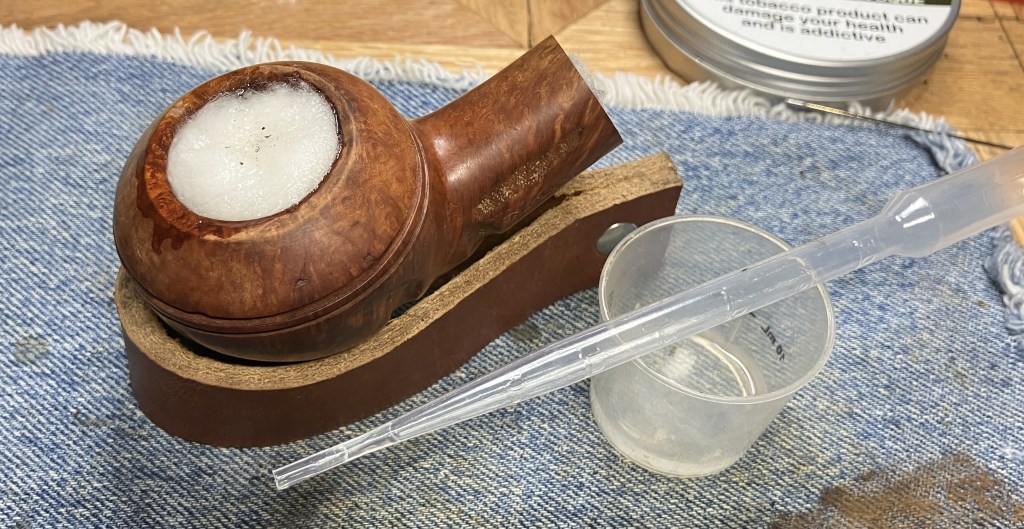
A look down the mortise showed a very clean shank.
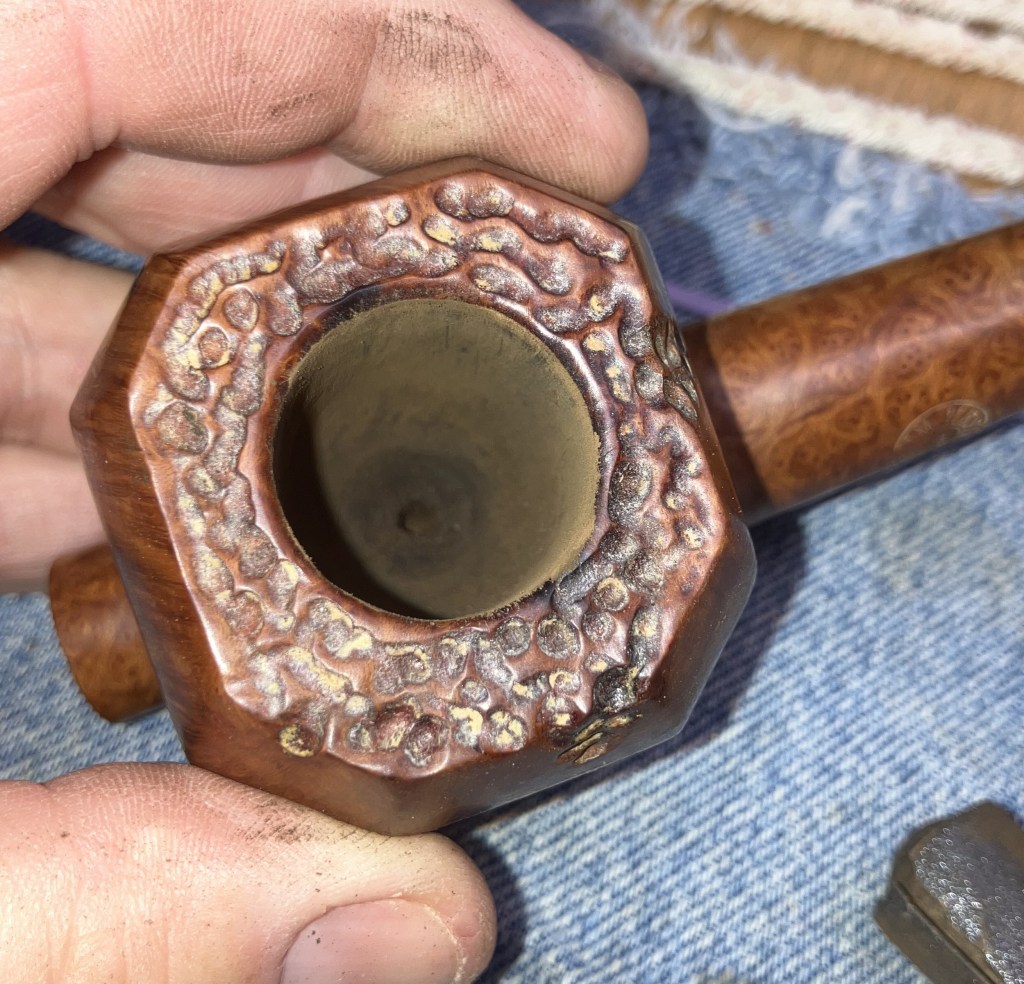
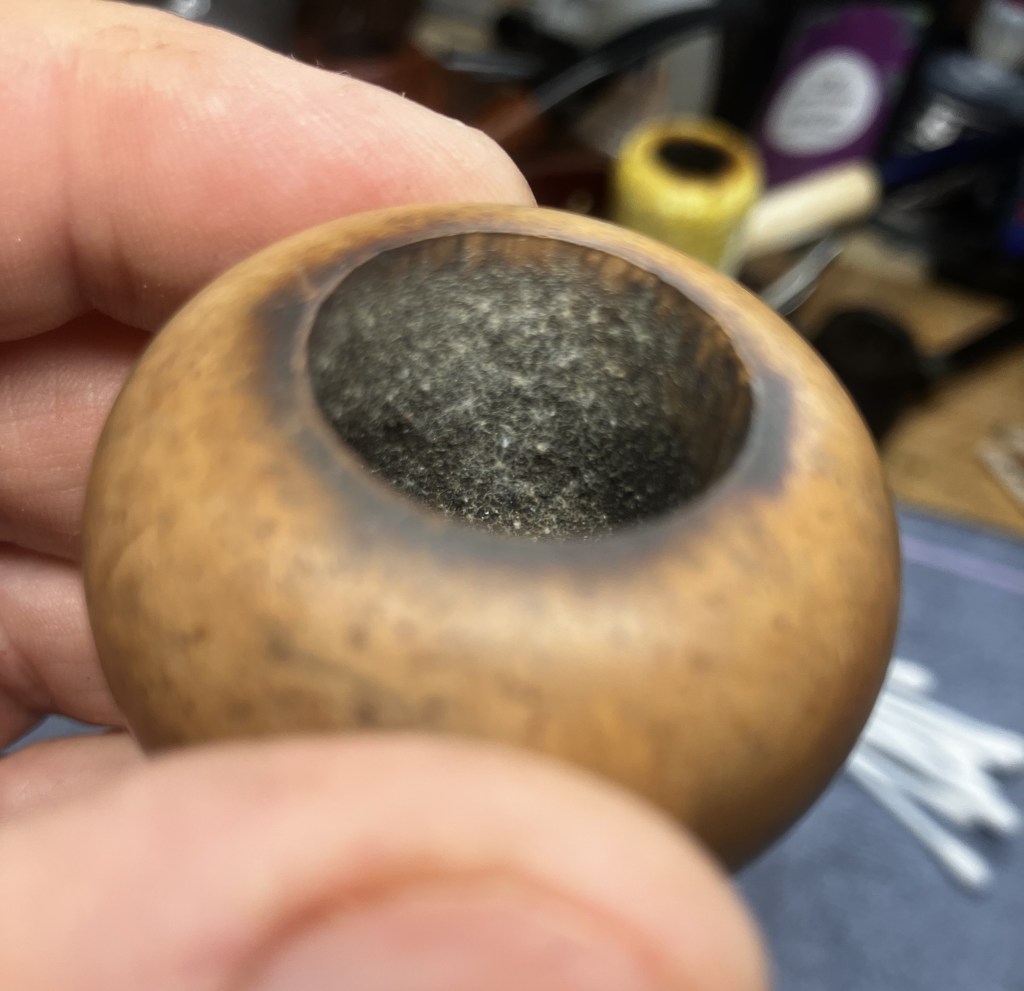
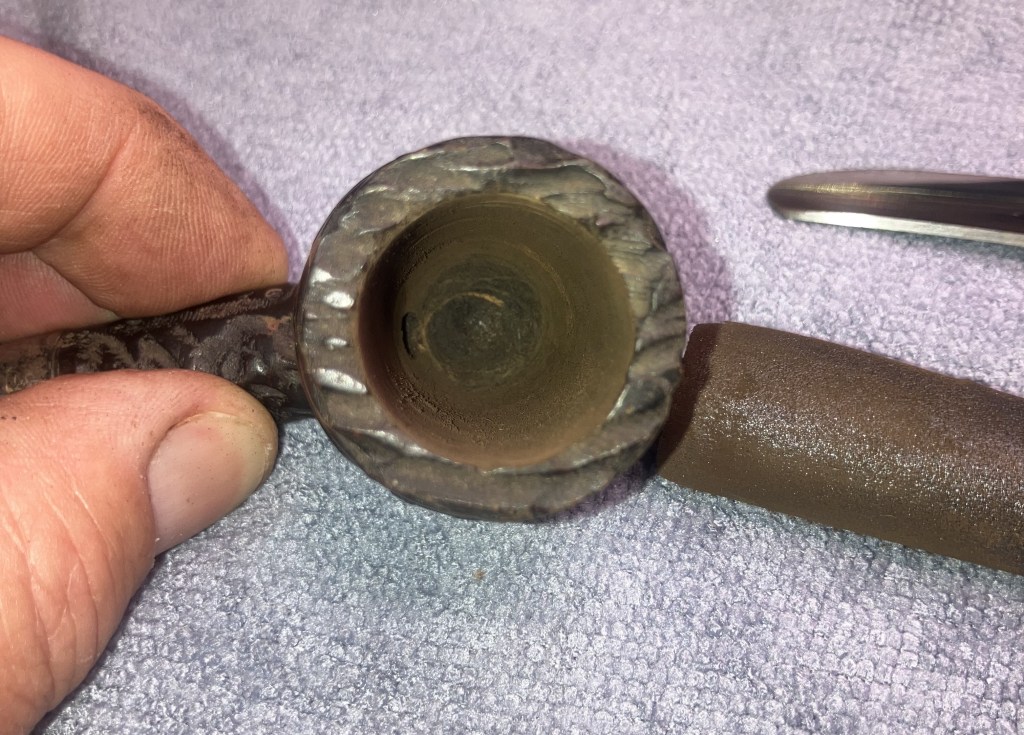
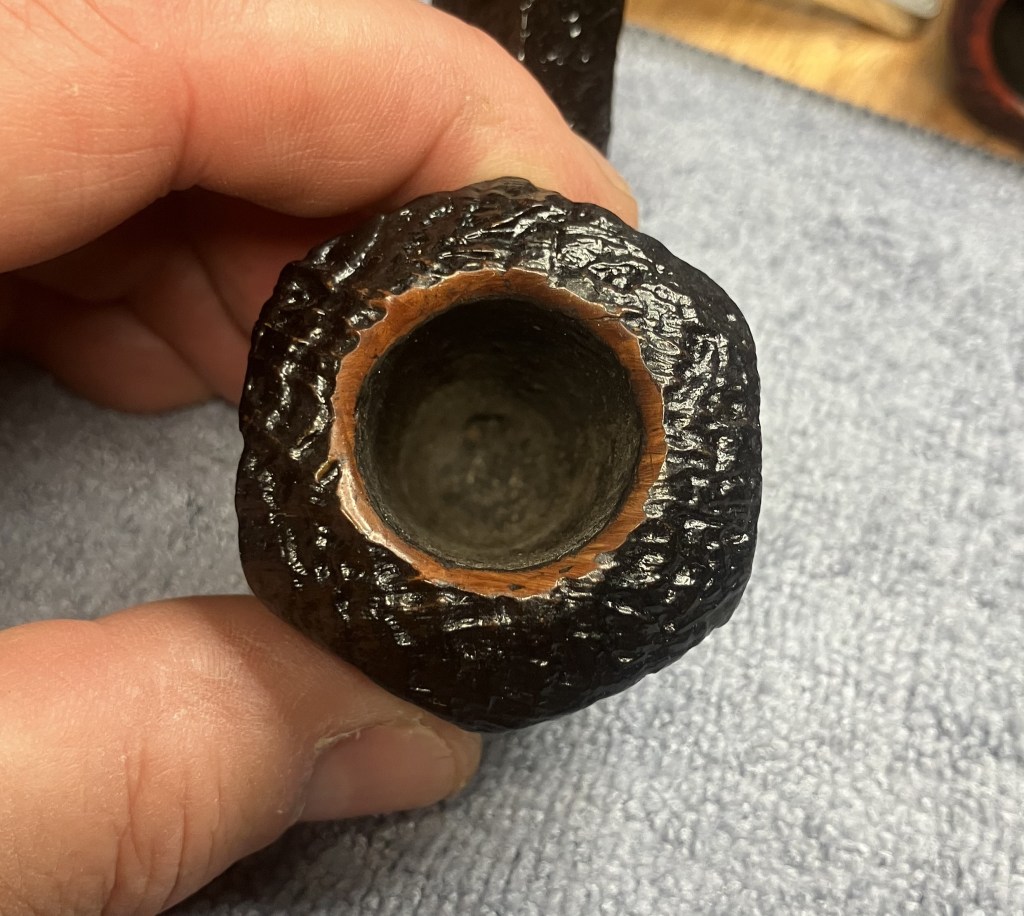
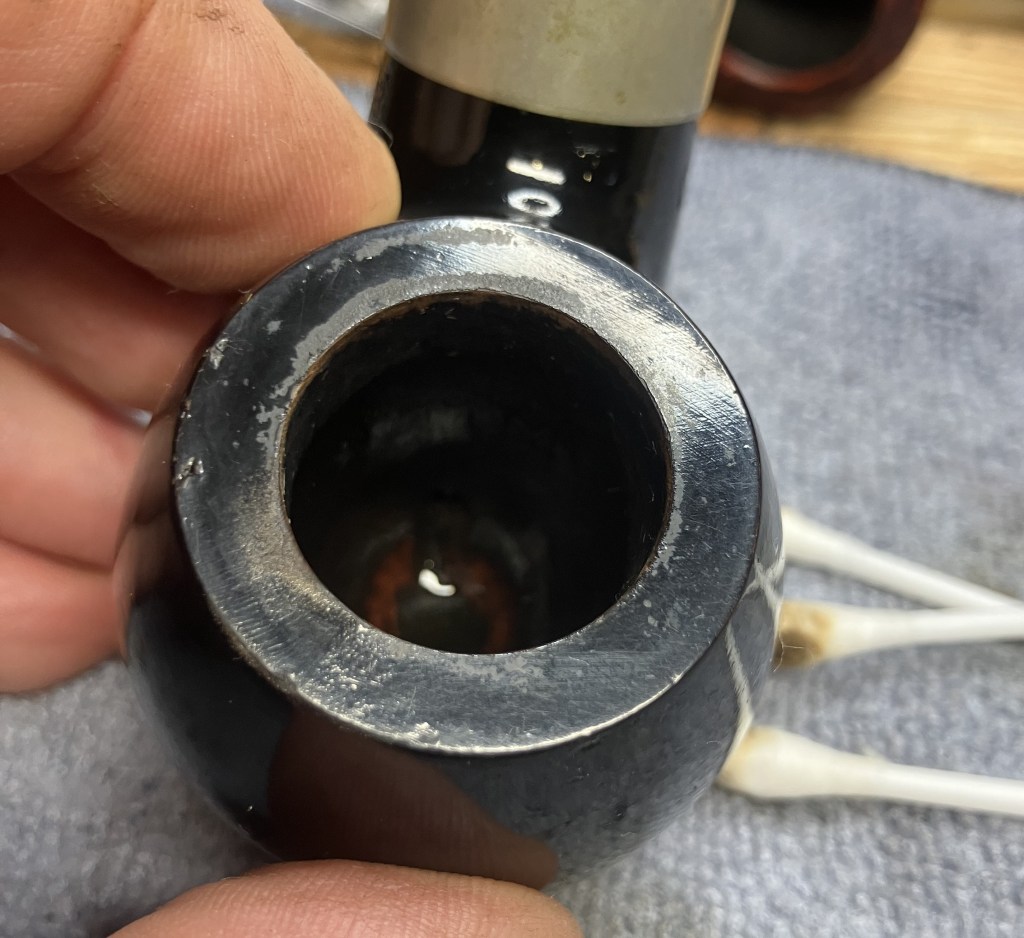
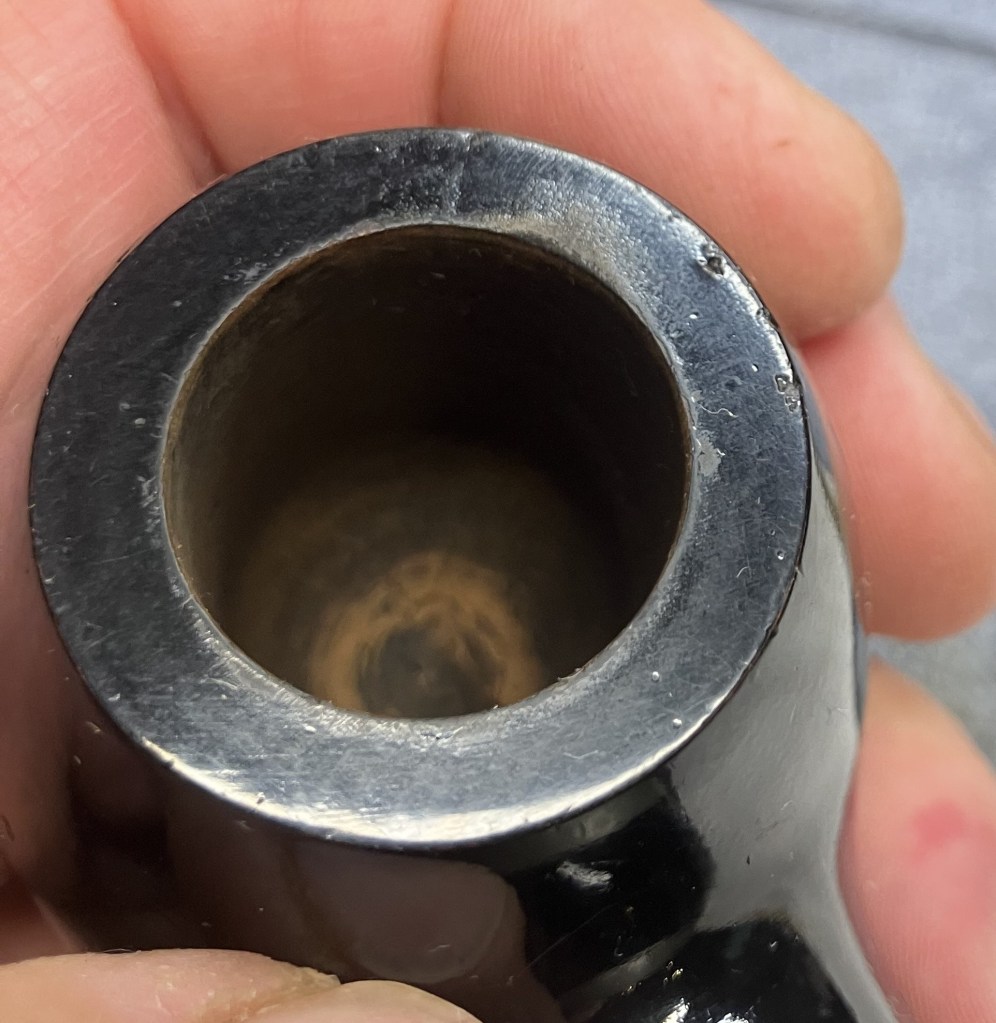
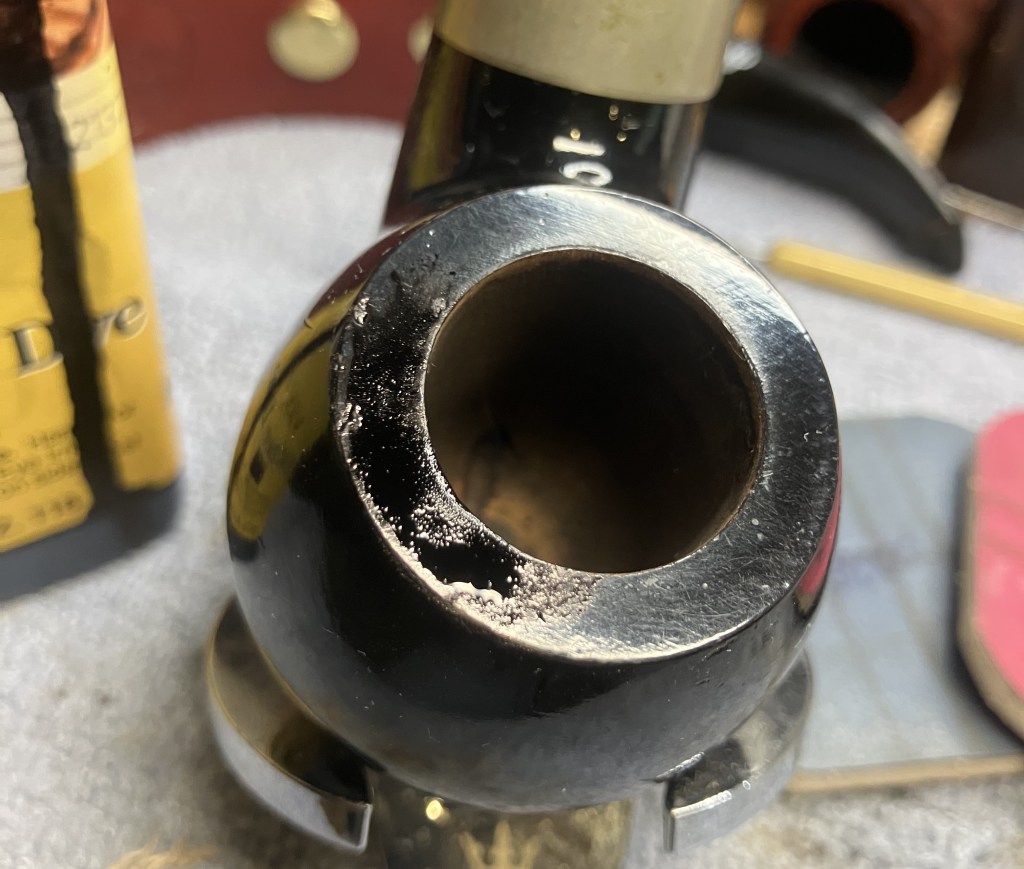
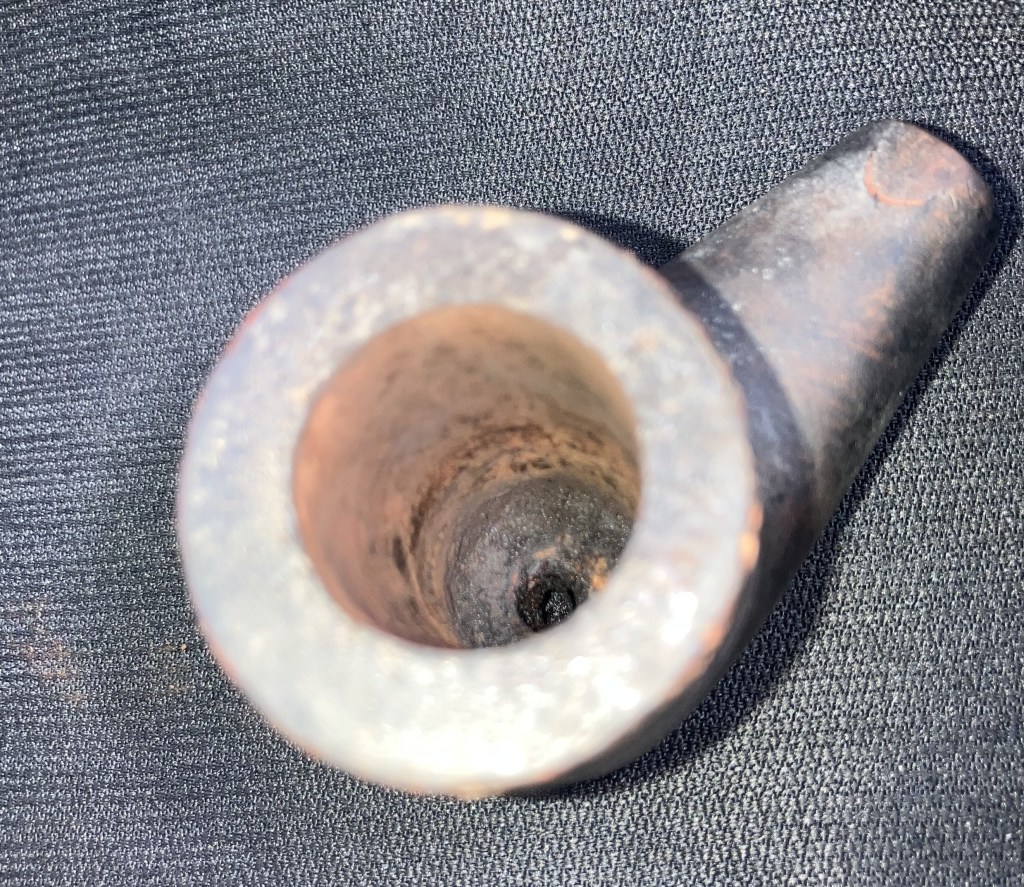
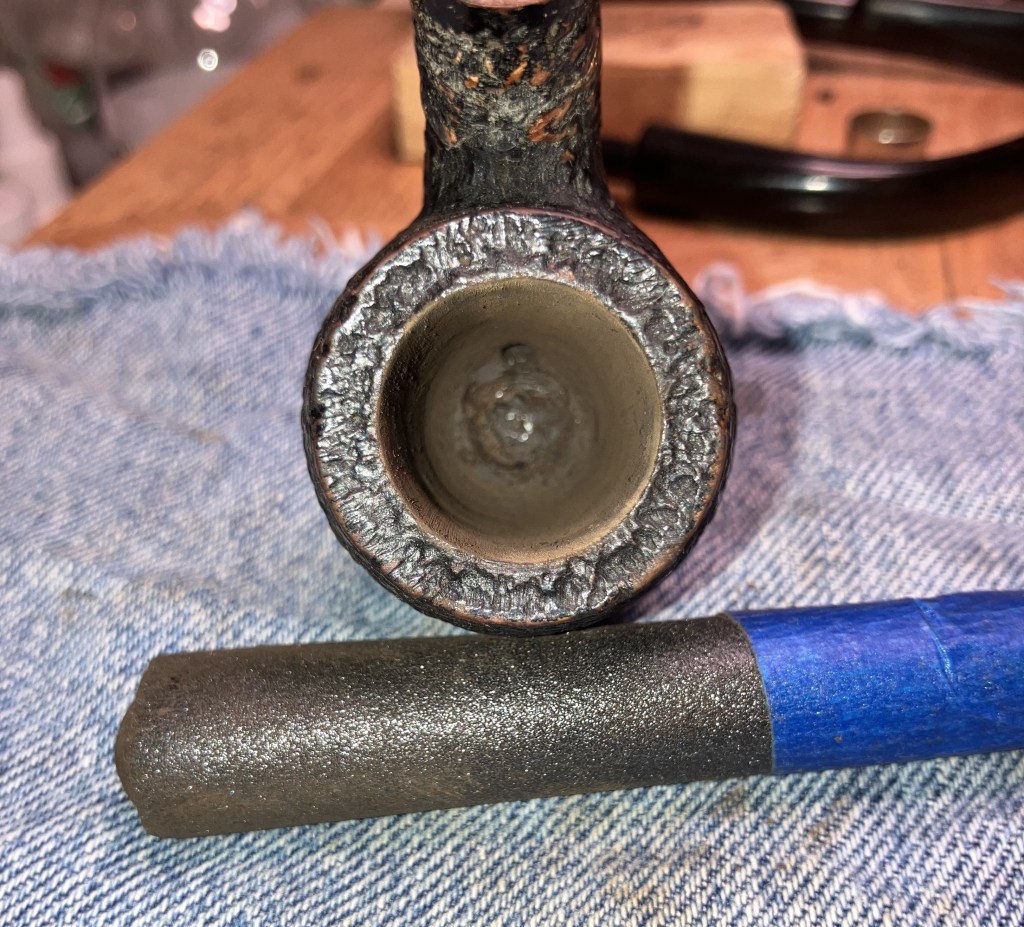
The tobacco chamber was also clean but did show signs of use.
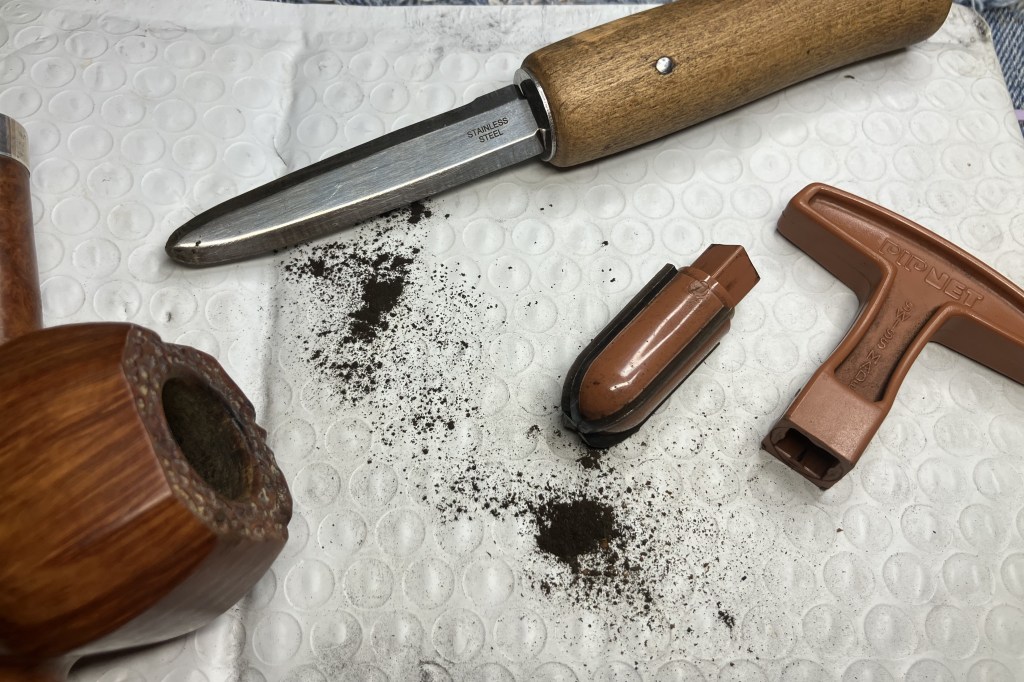
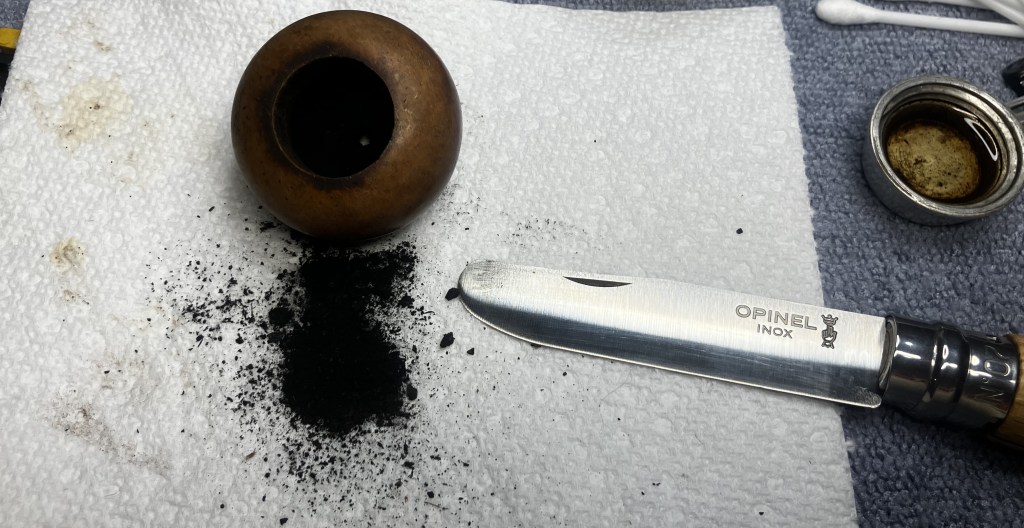
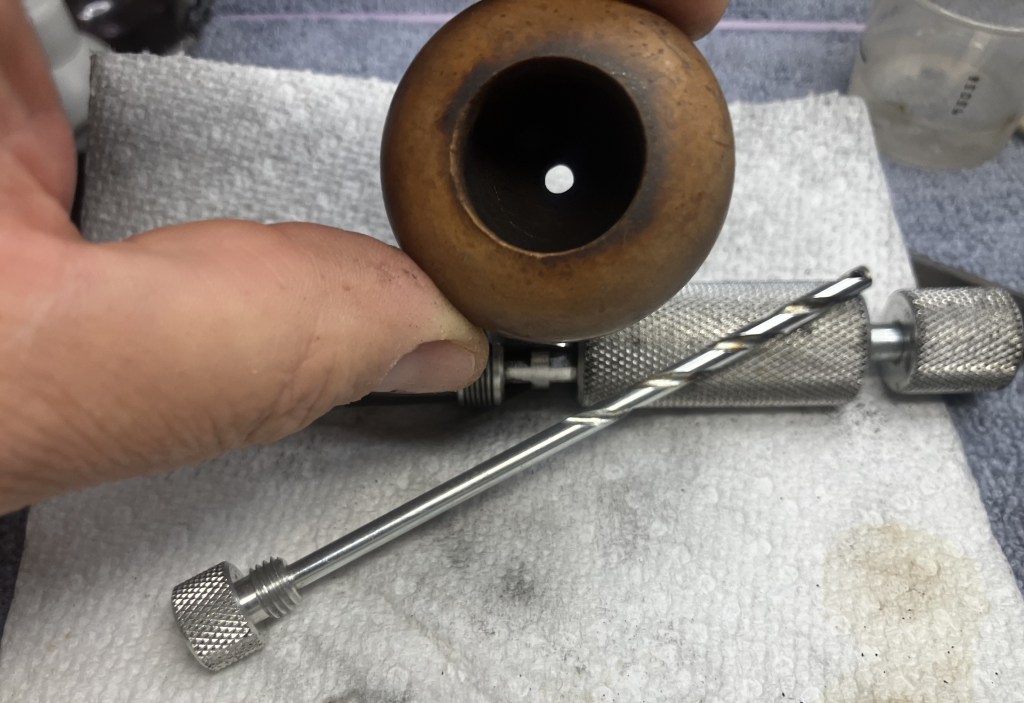
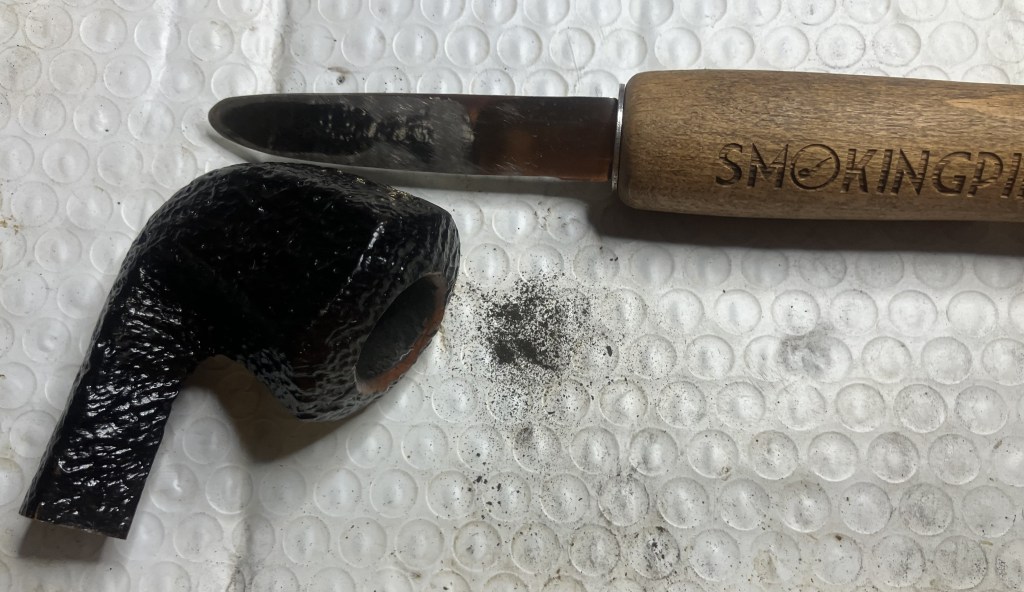
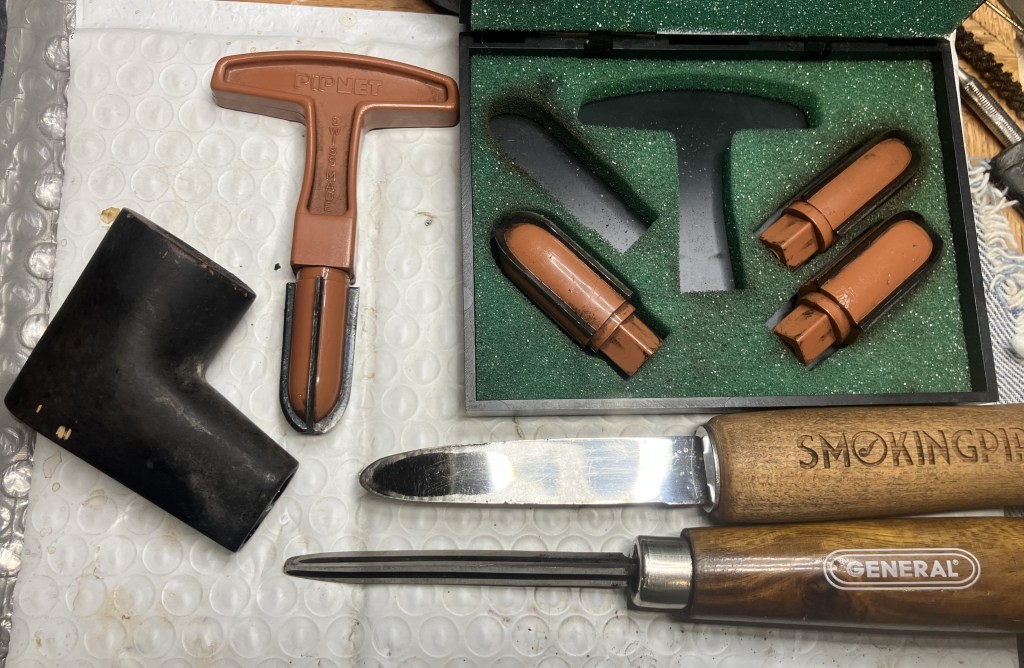
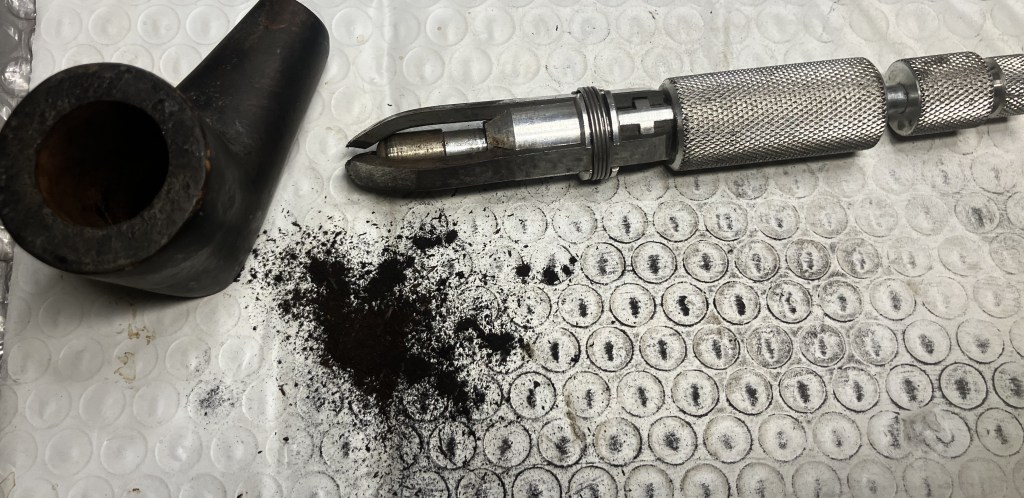
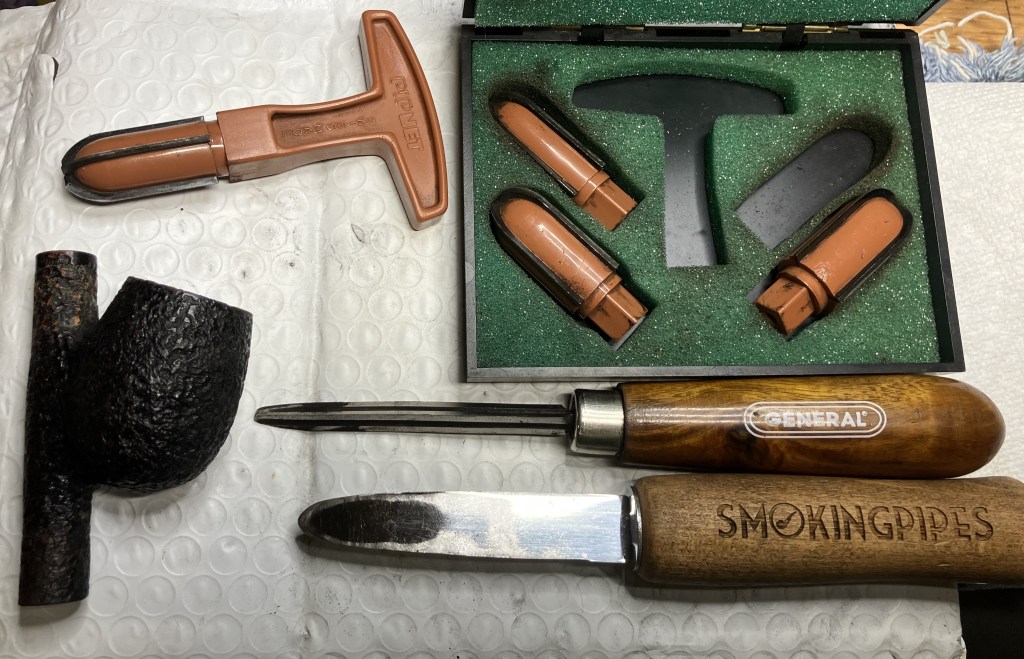
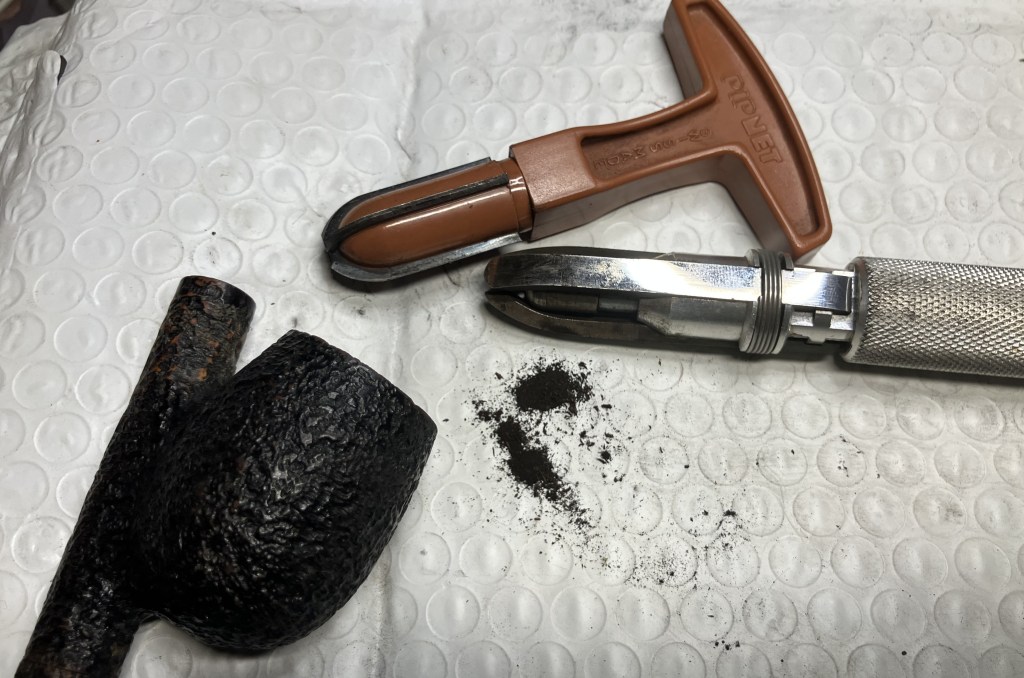
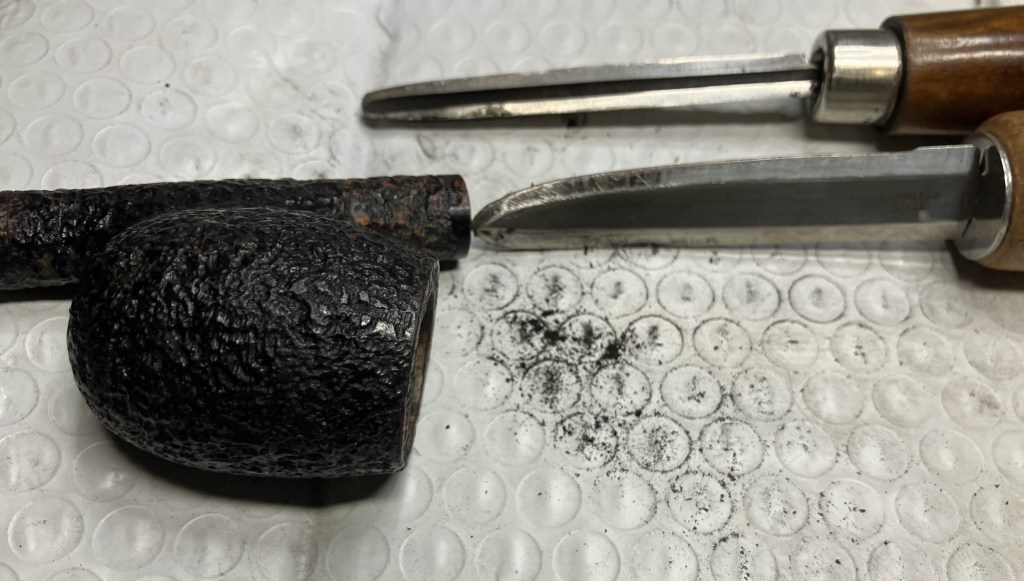
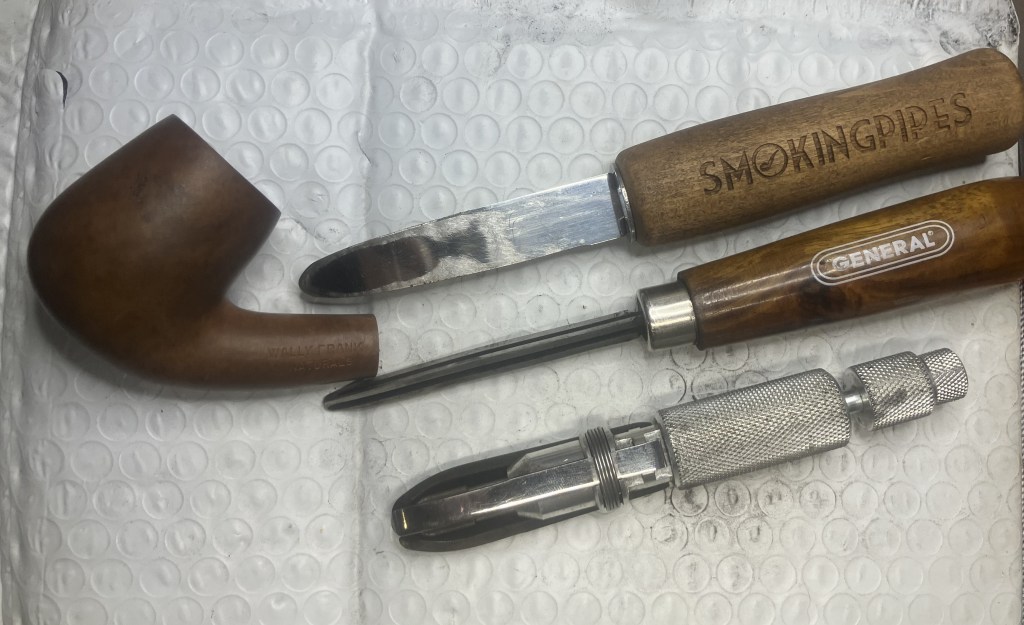
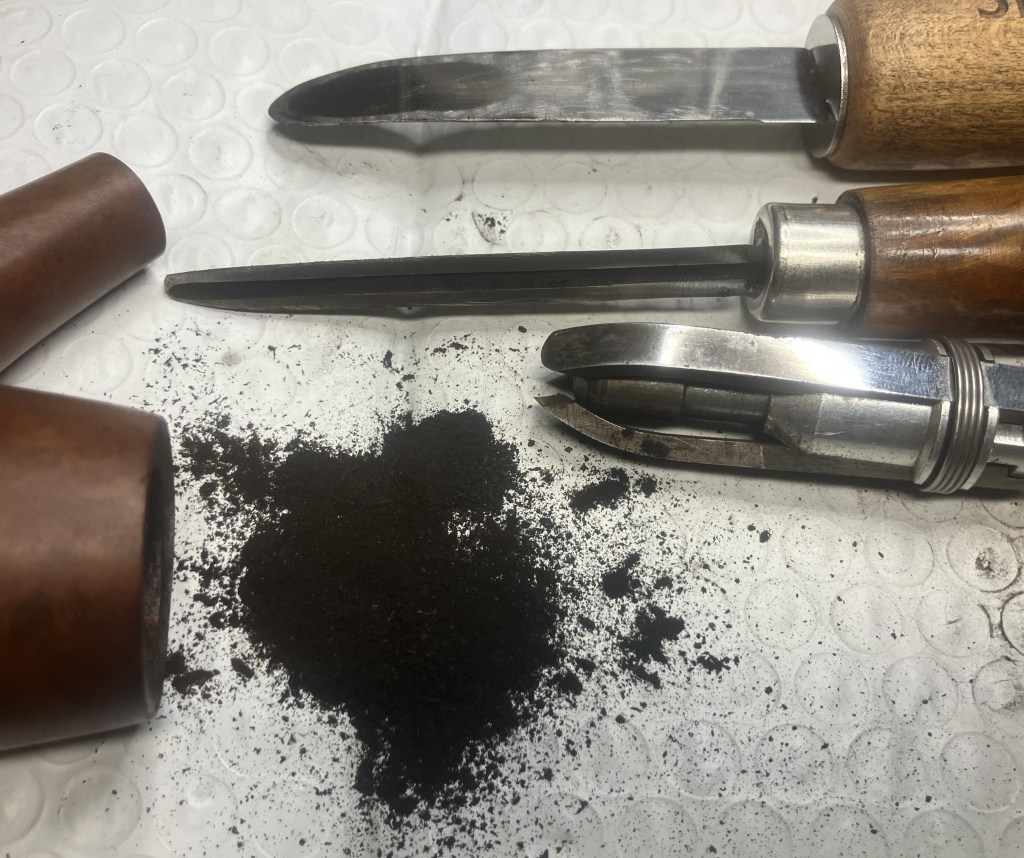
The only tool I used for reaming was the Smokingpipes Low Country reamer. And it didn’t have much to do.
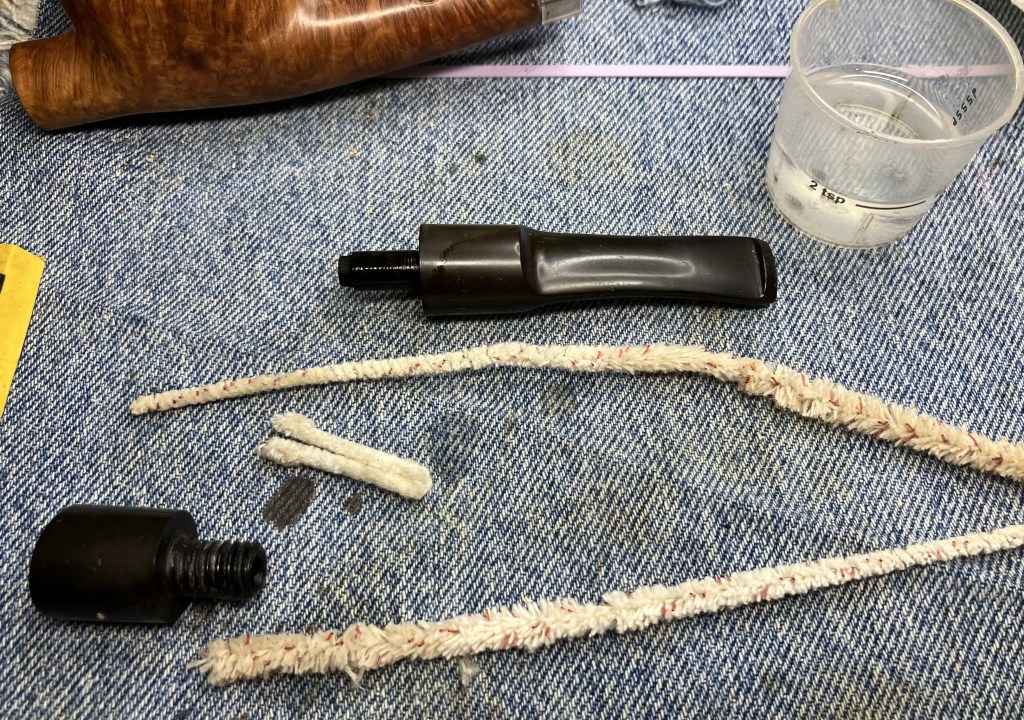
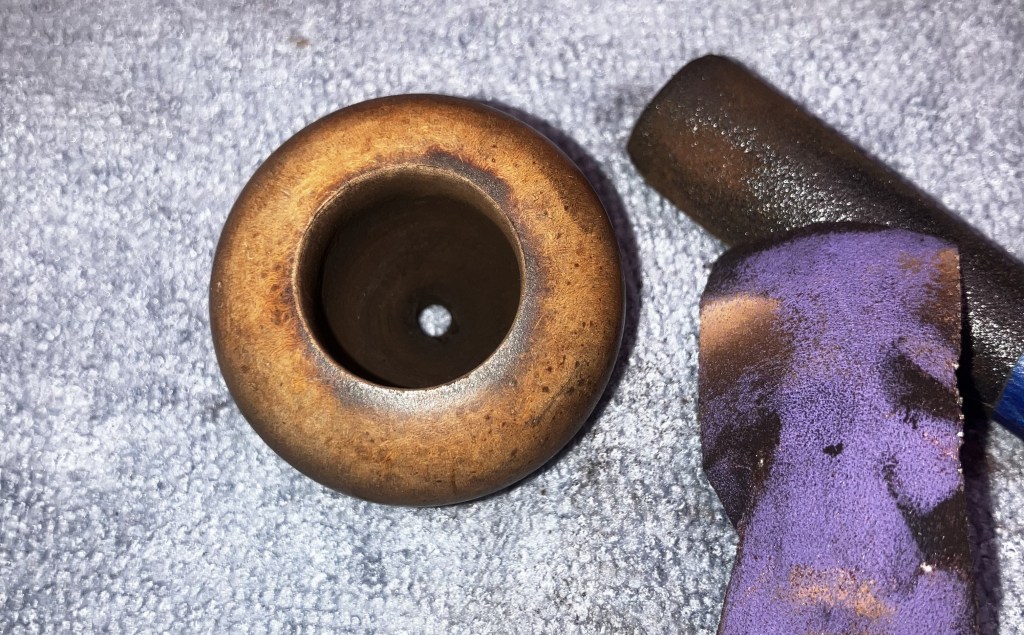
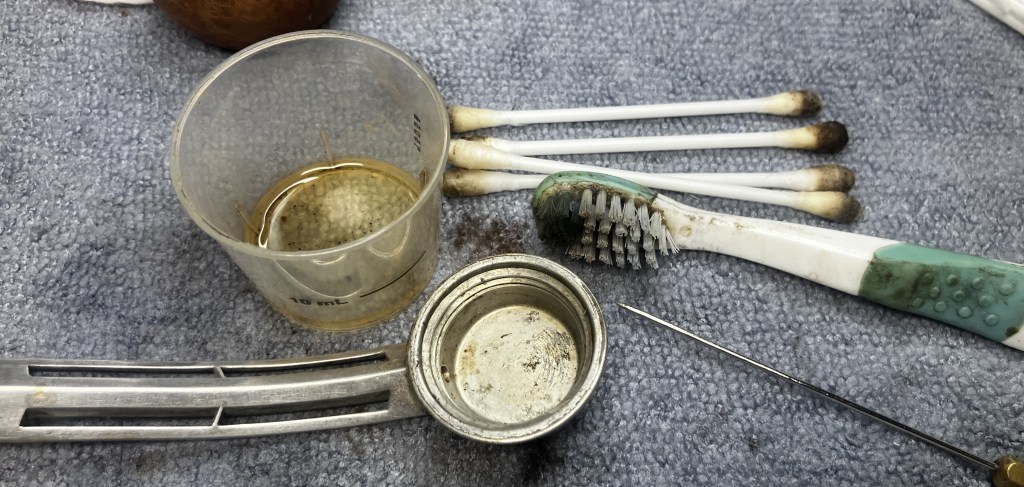
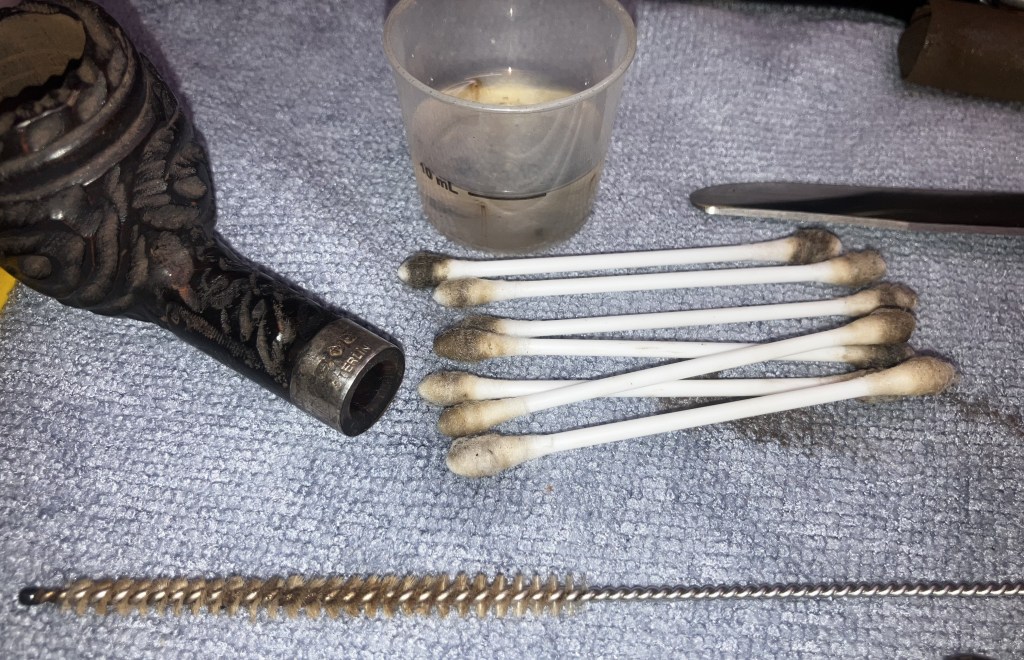
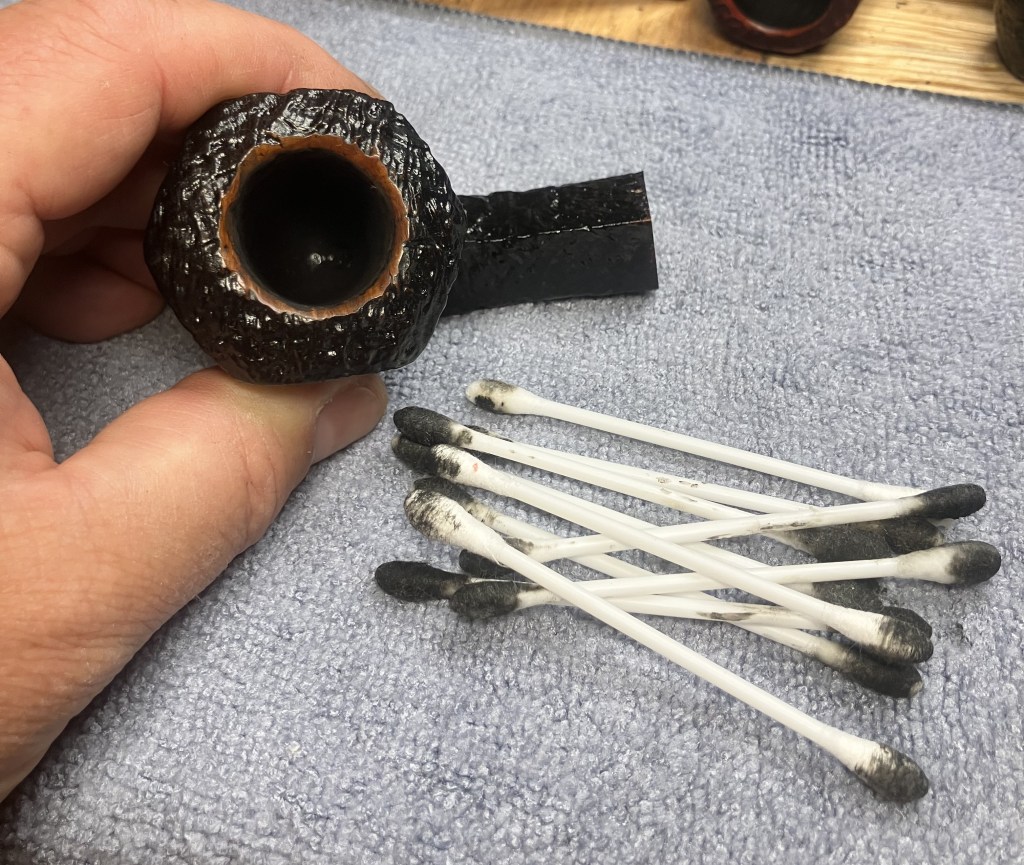
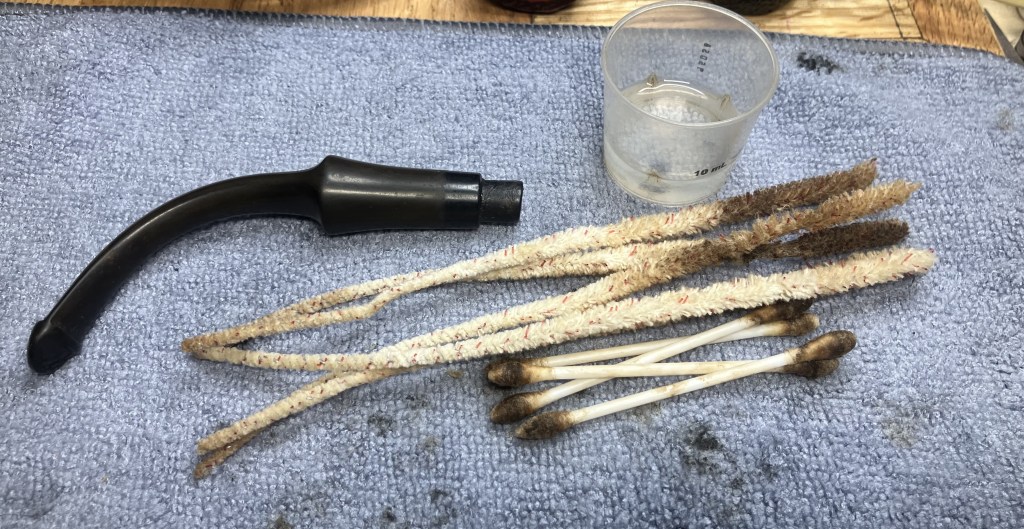
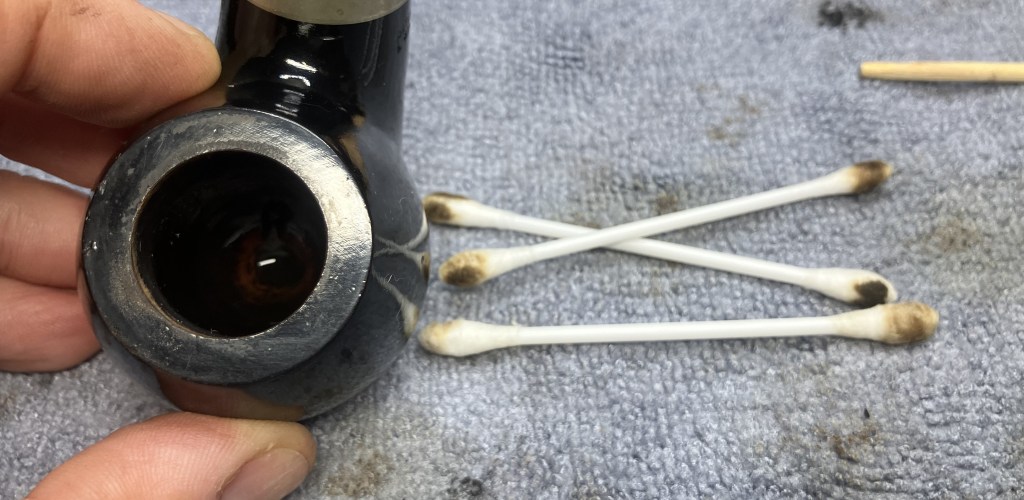
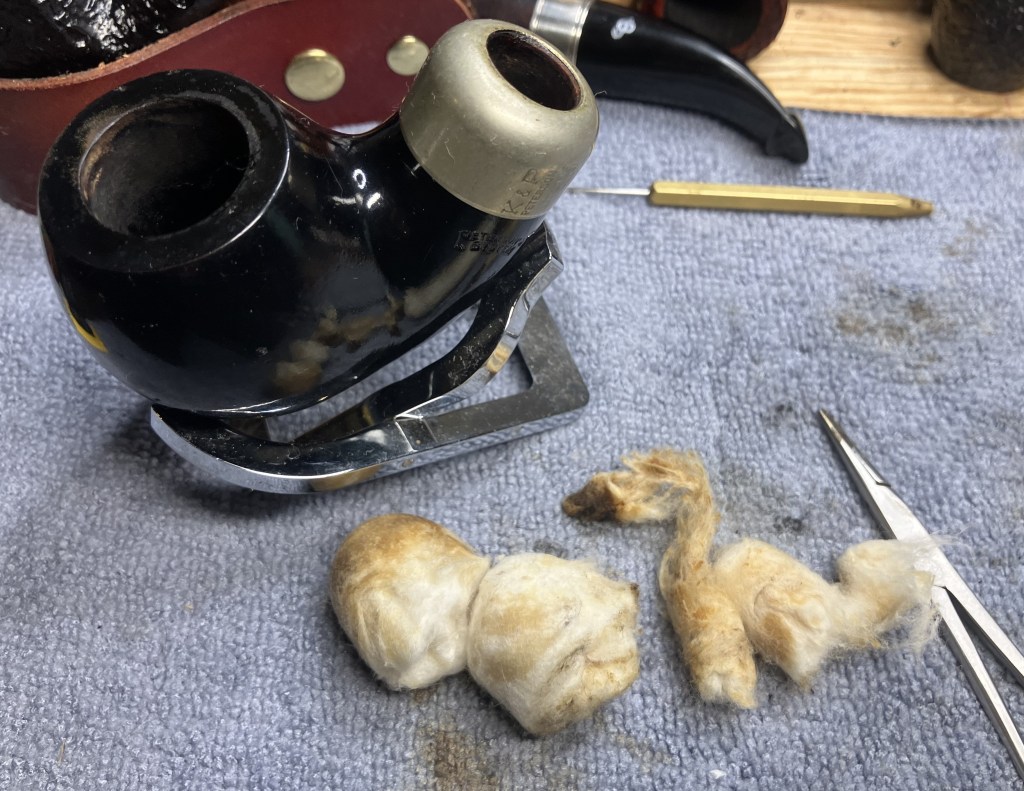
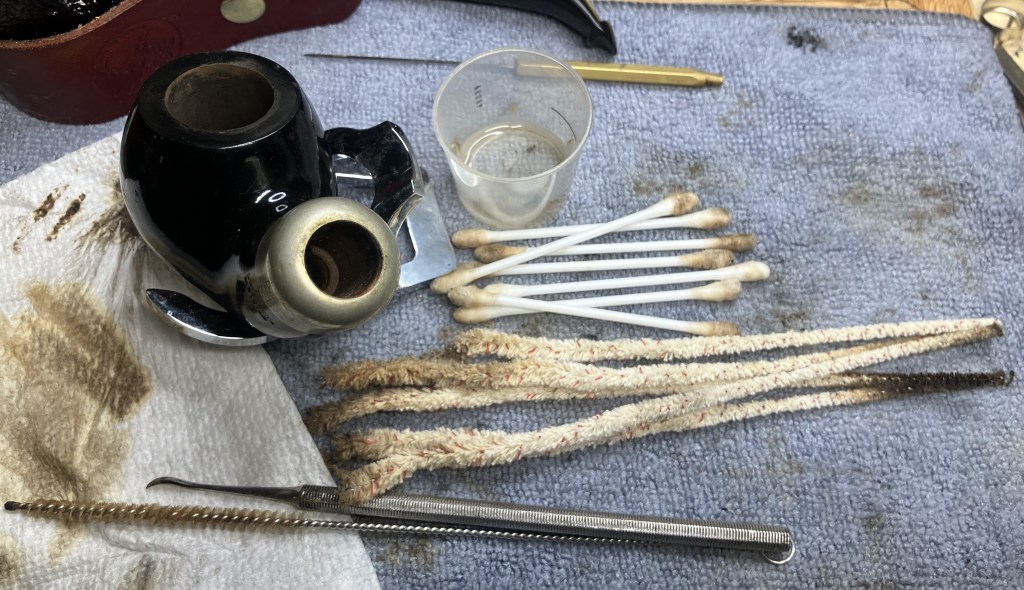
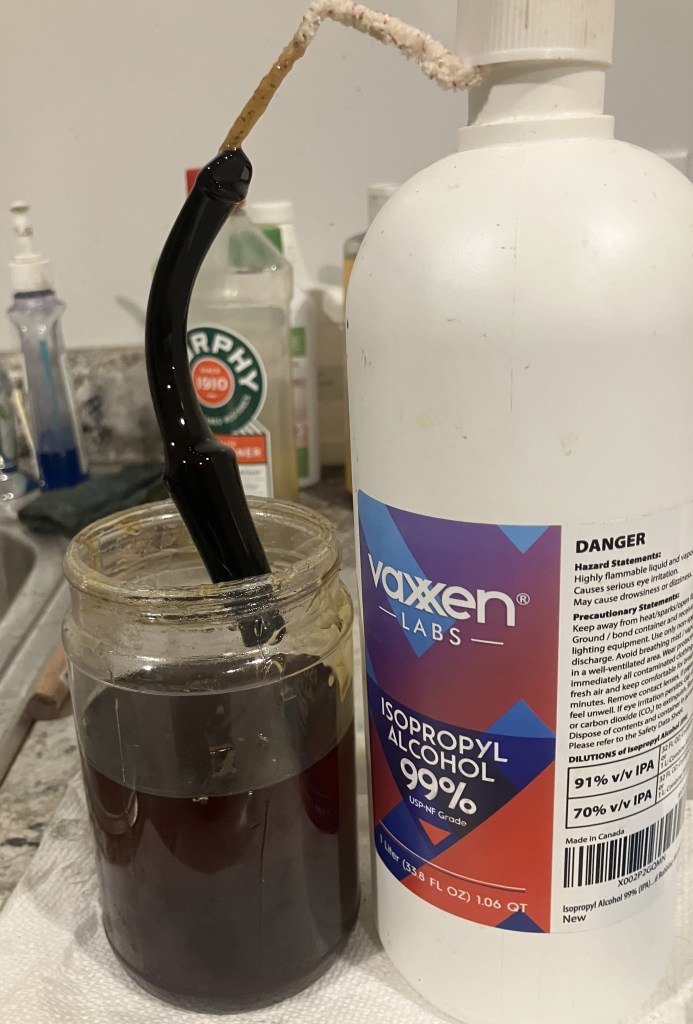
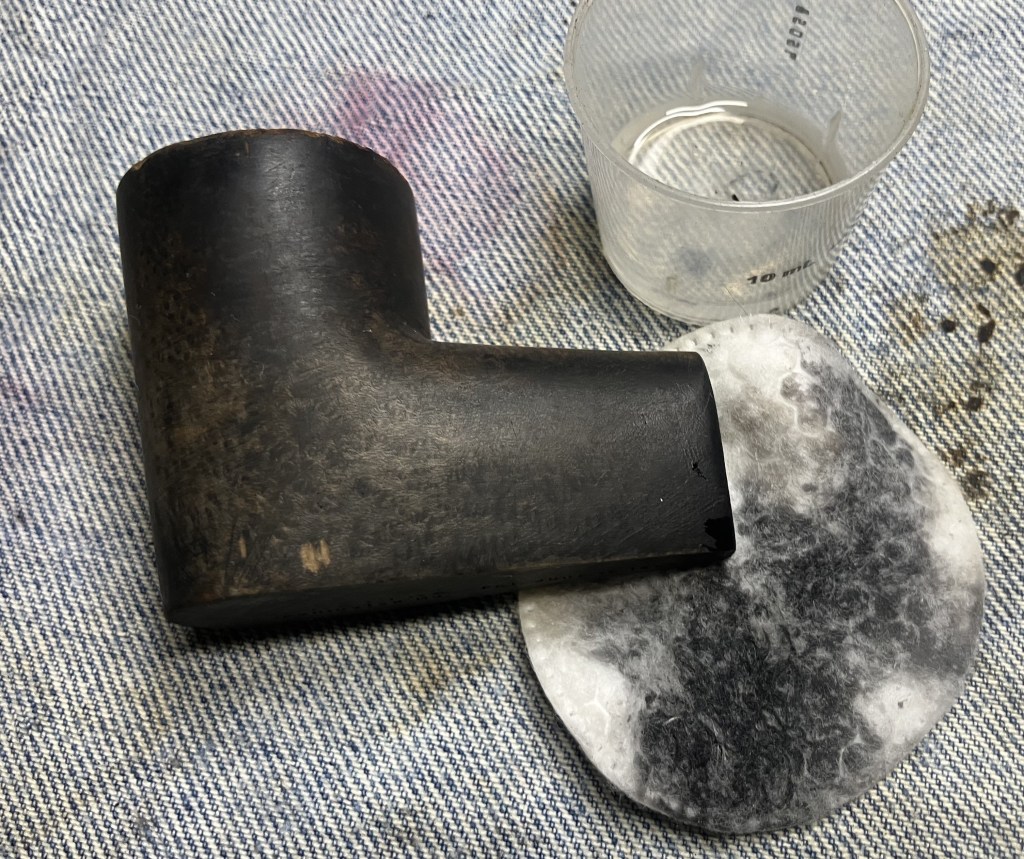
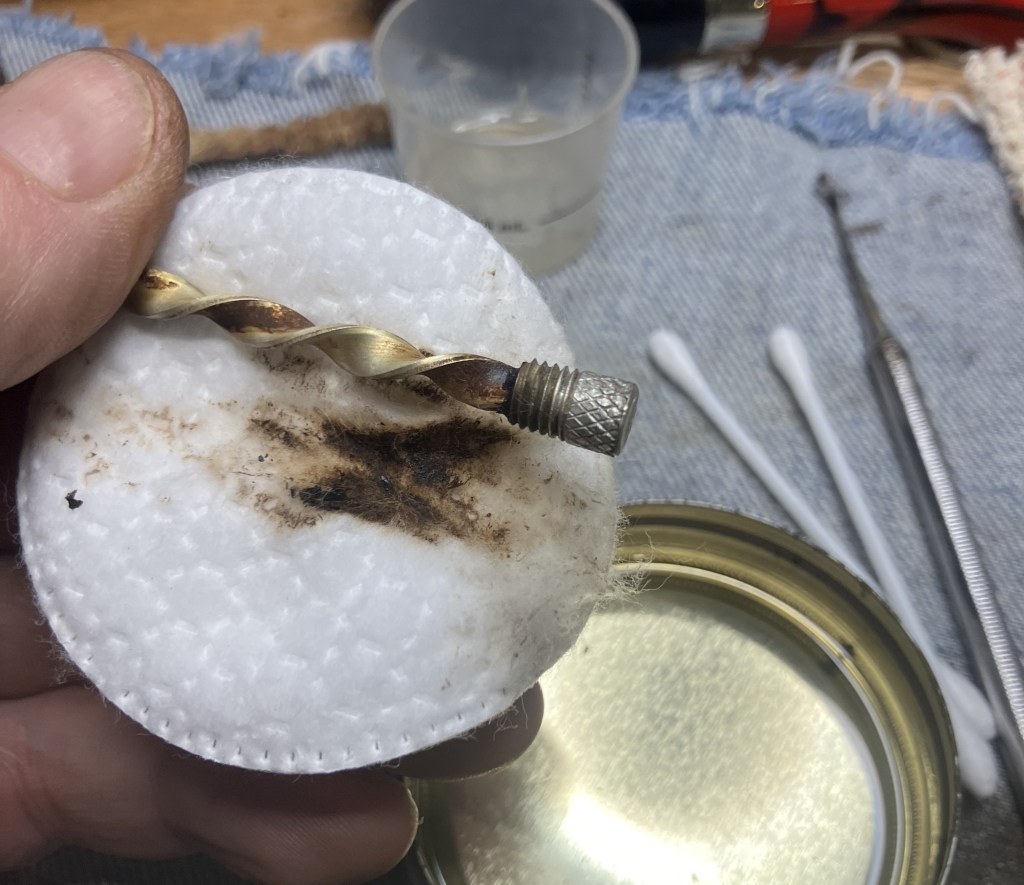
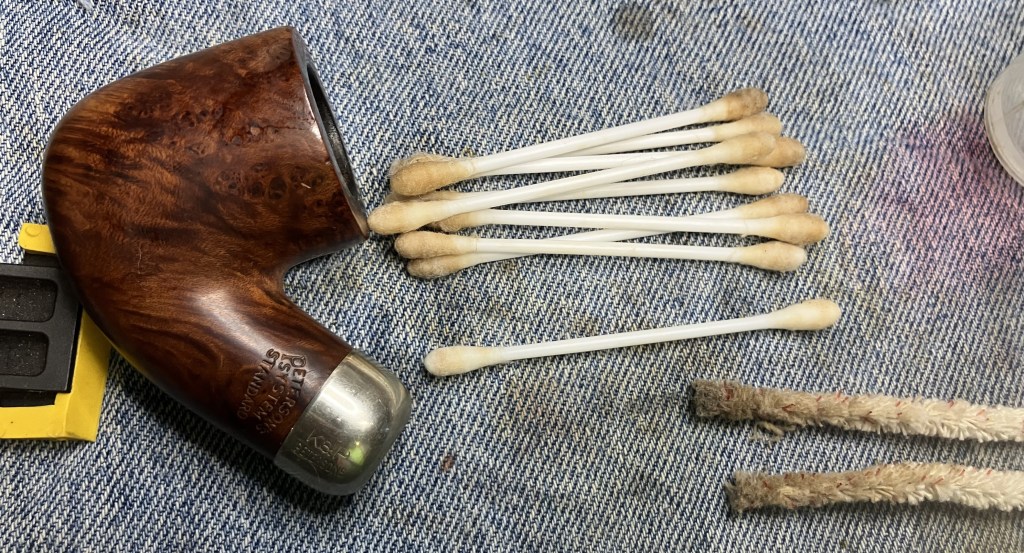
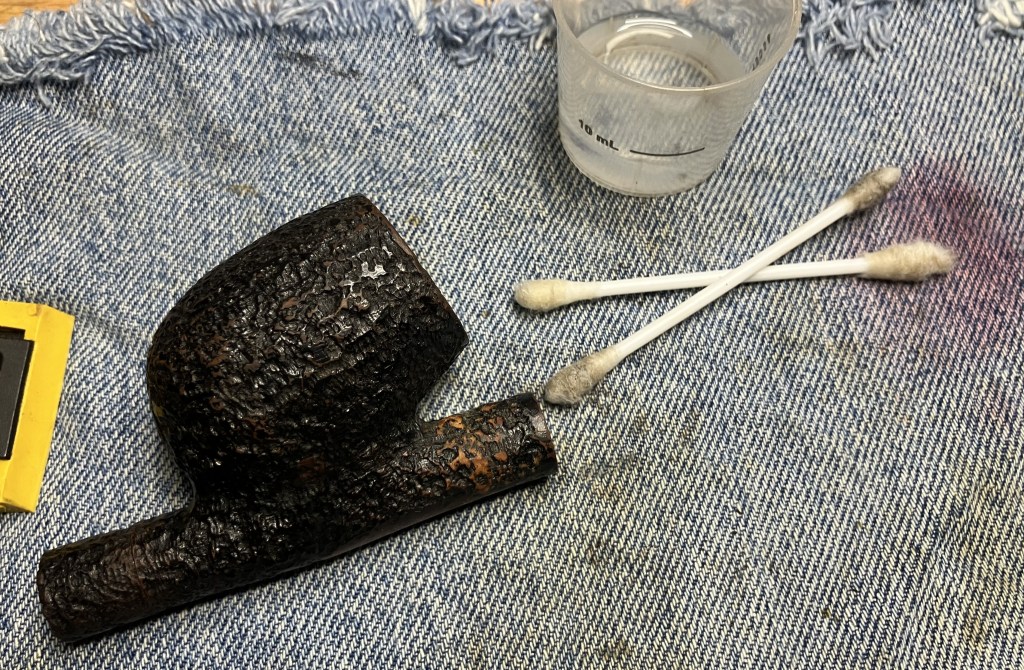
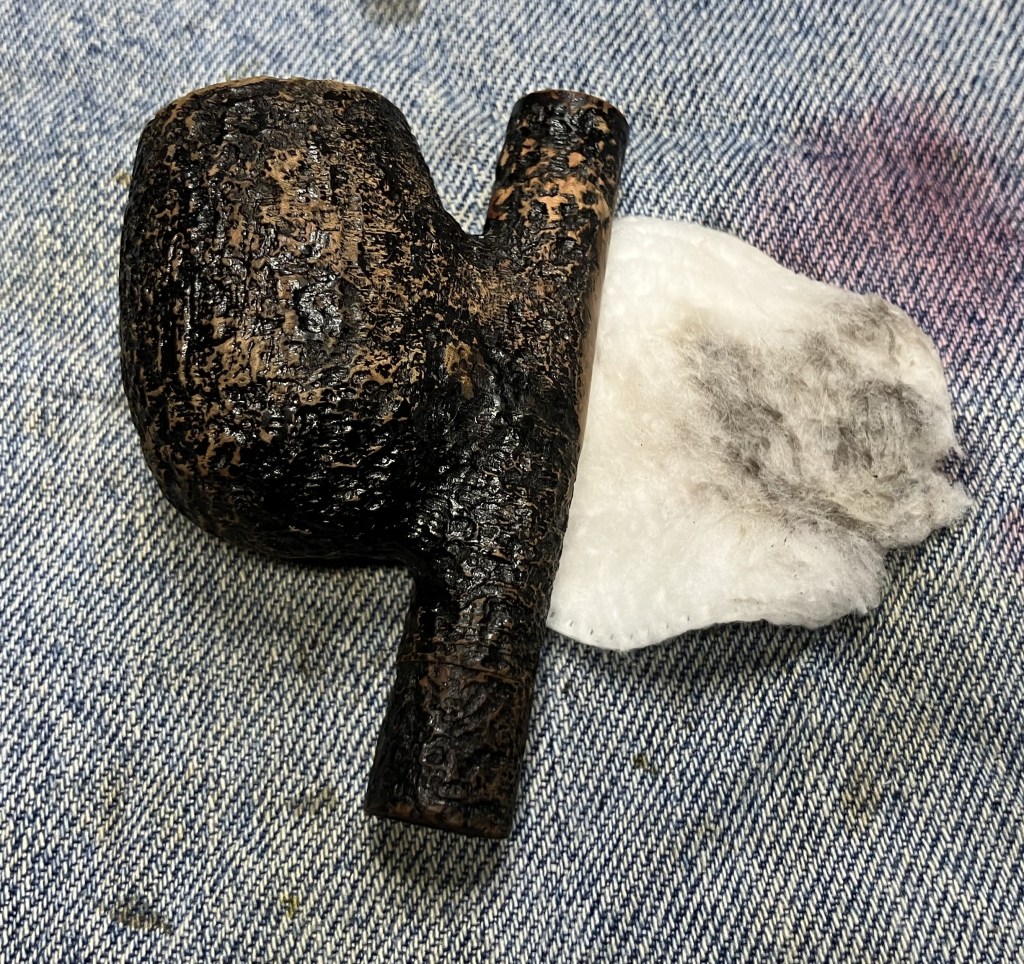
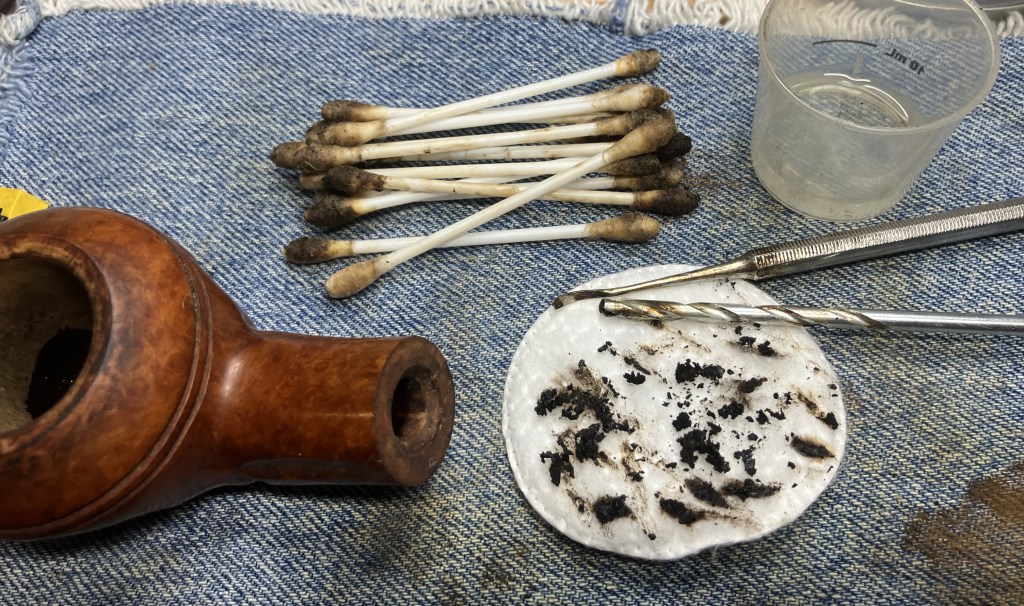
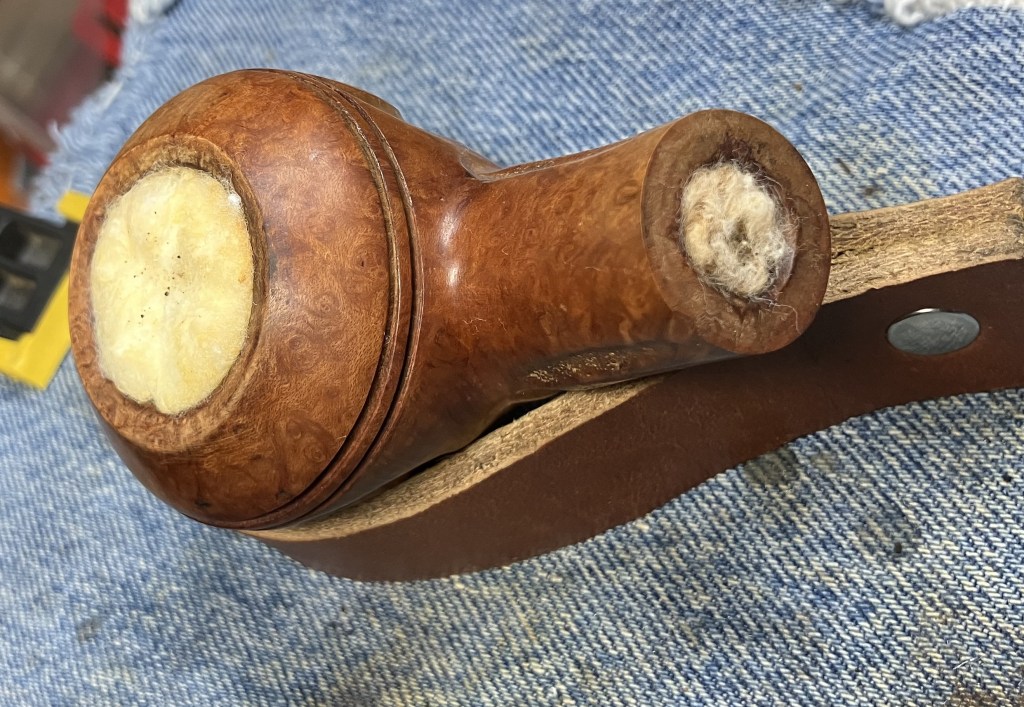
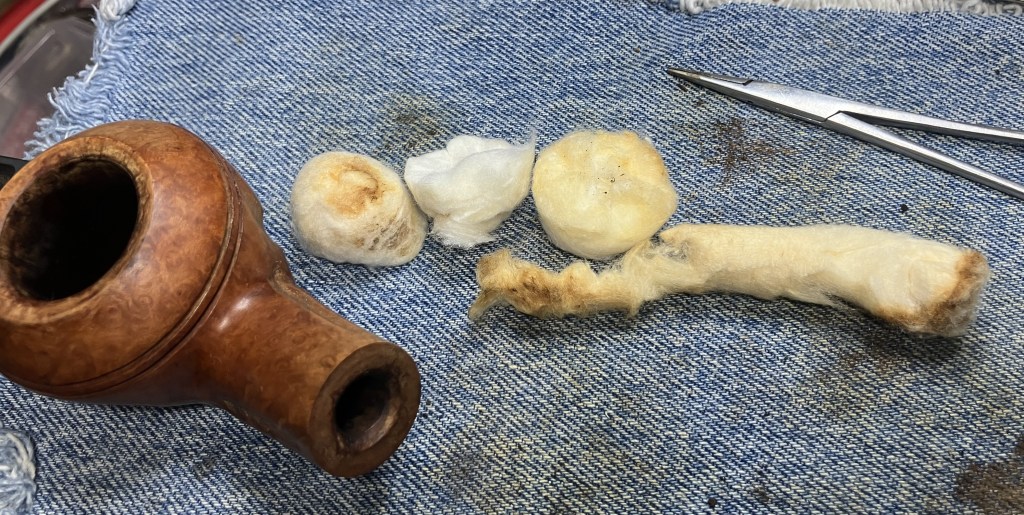
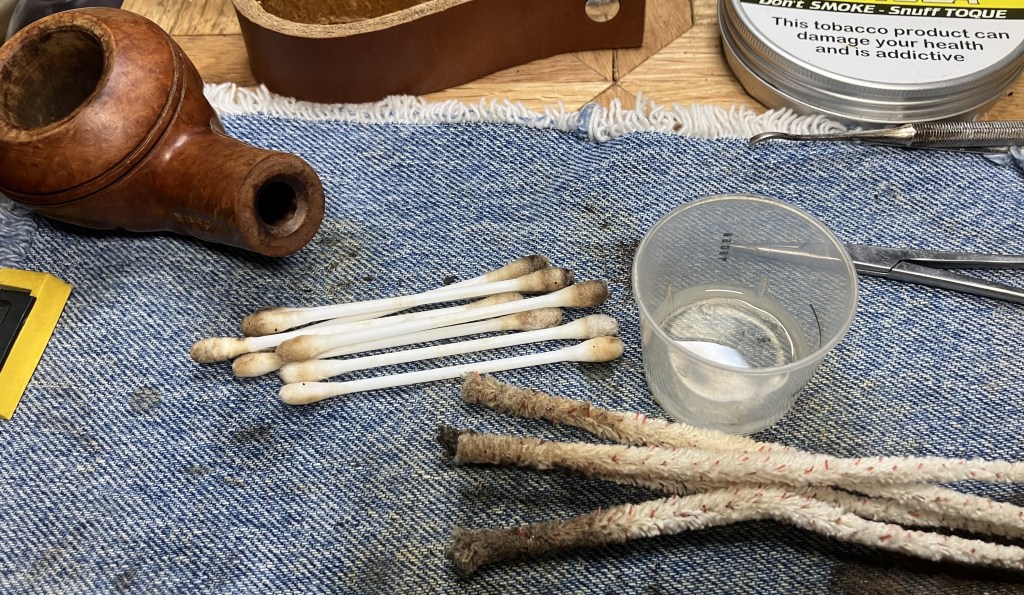
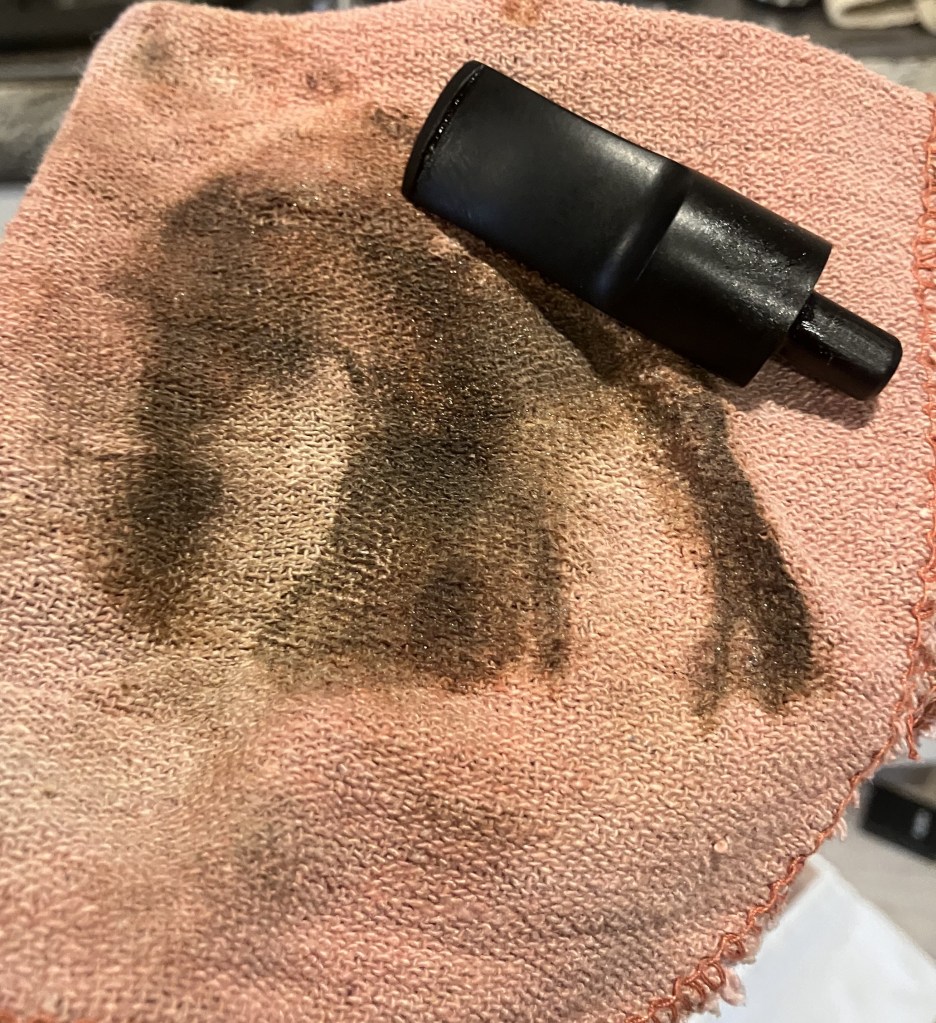
I started swabbing the chamber out with cotton swabs dipped in 99% ethyl alcohol and discovered that Bebbia used a rather thickly applied bowl coating.
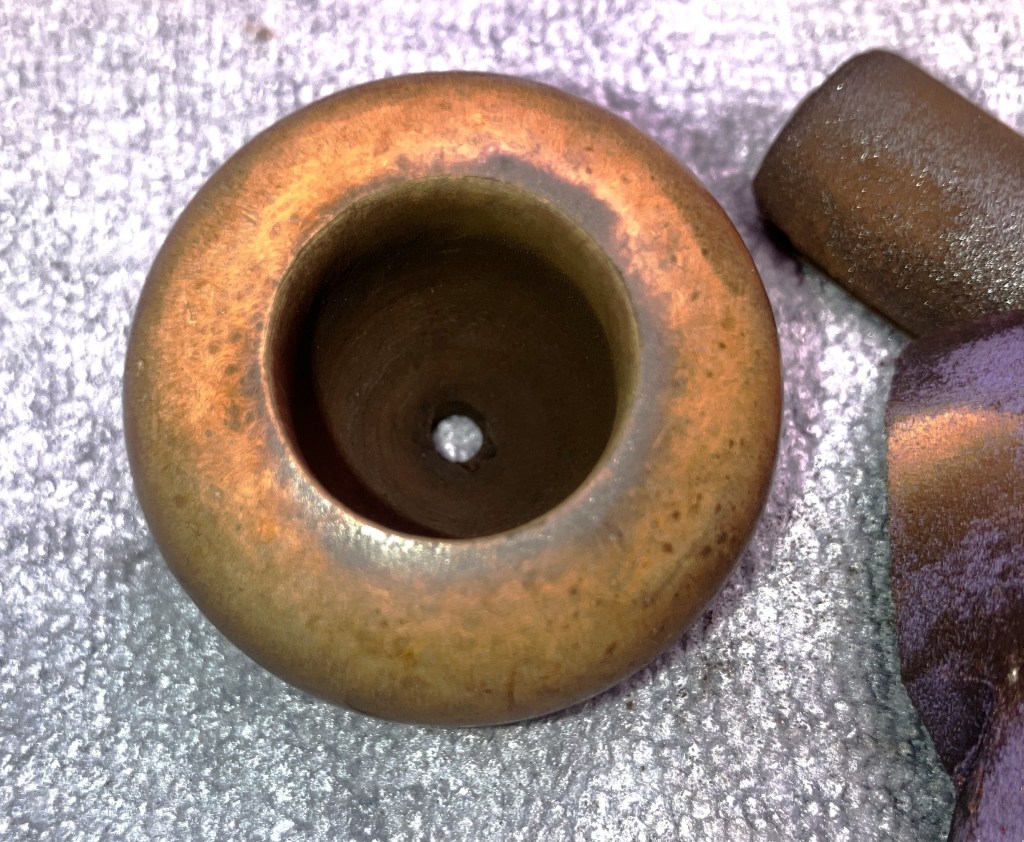
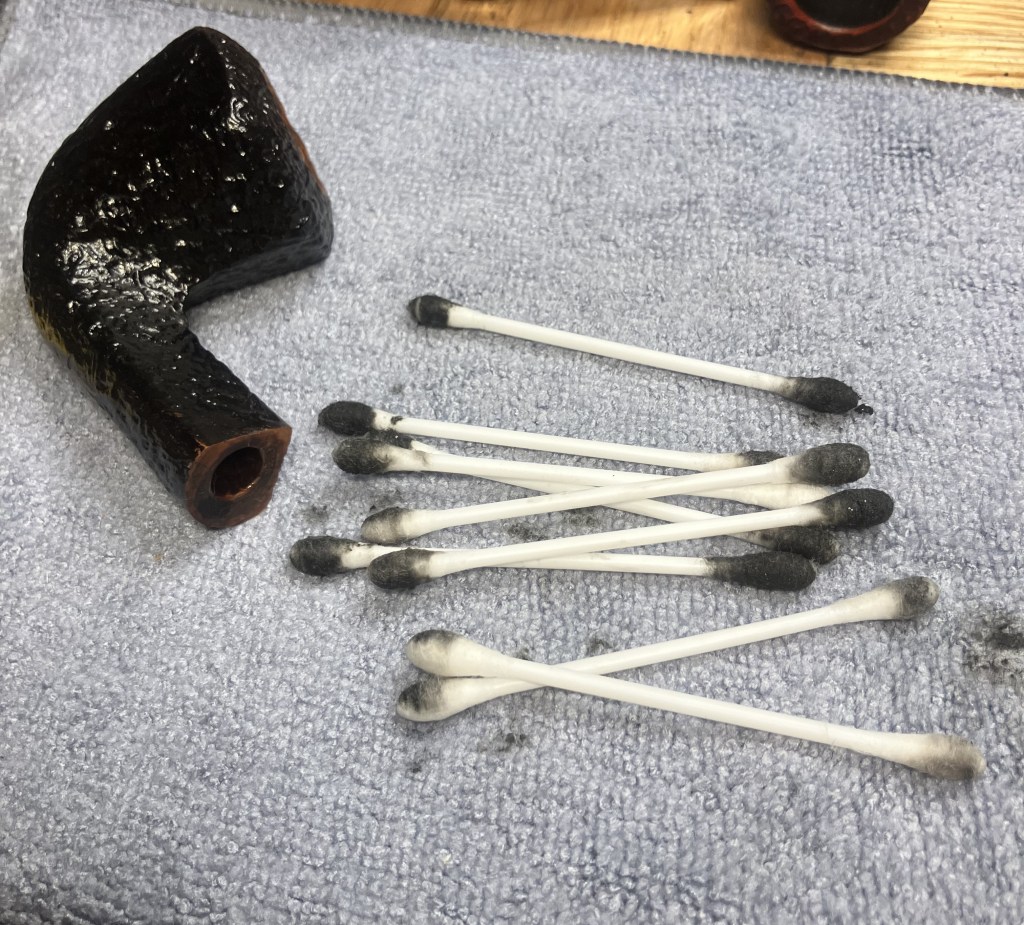
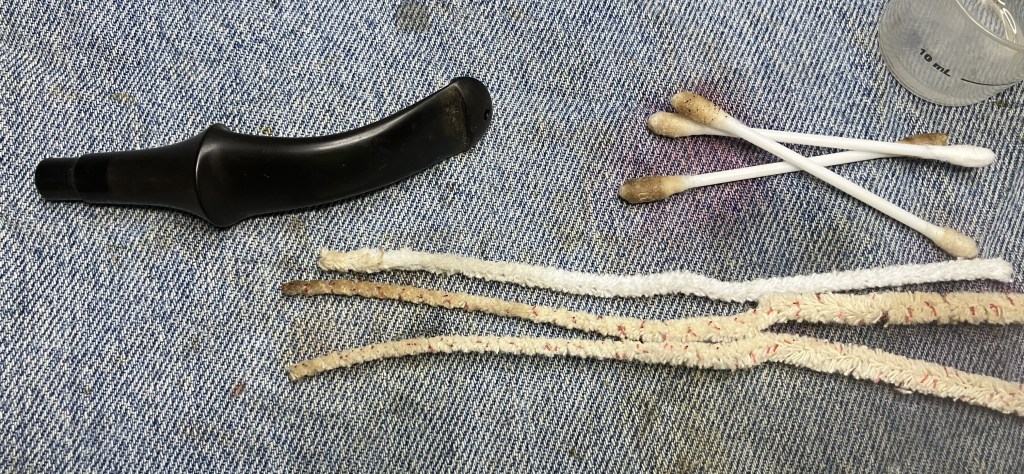
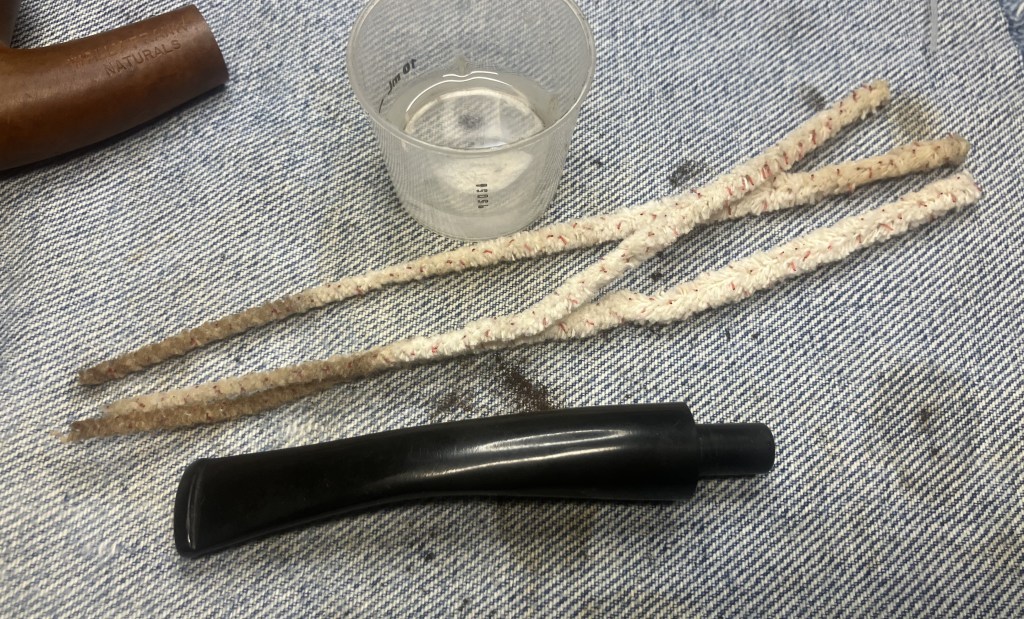
The coating must have been sprayed into the bowl and allowed into the shank because cleaning it with the same method provided the same black stained cotton swabs.
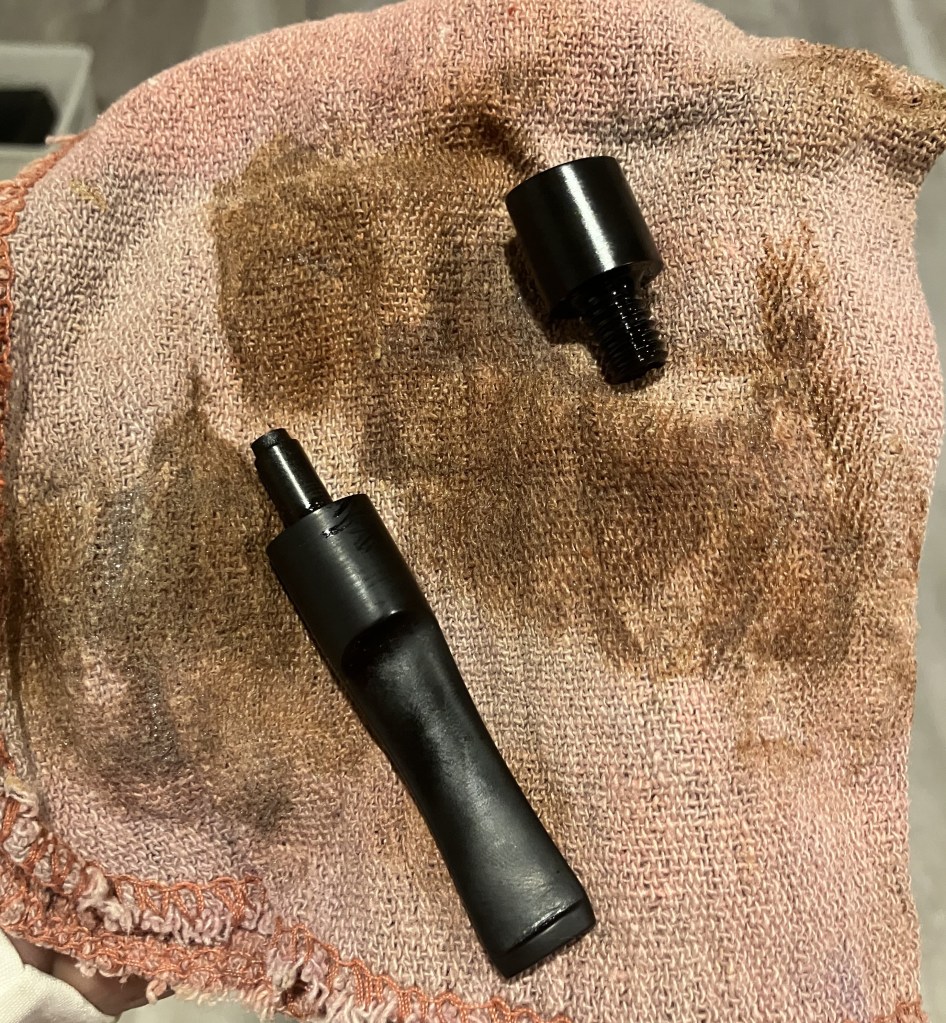
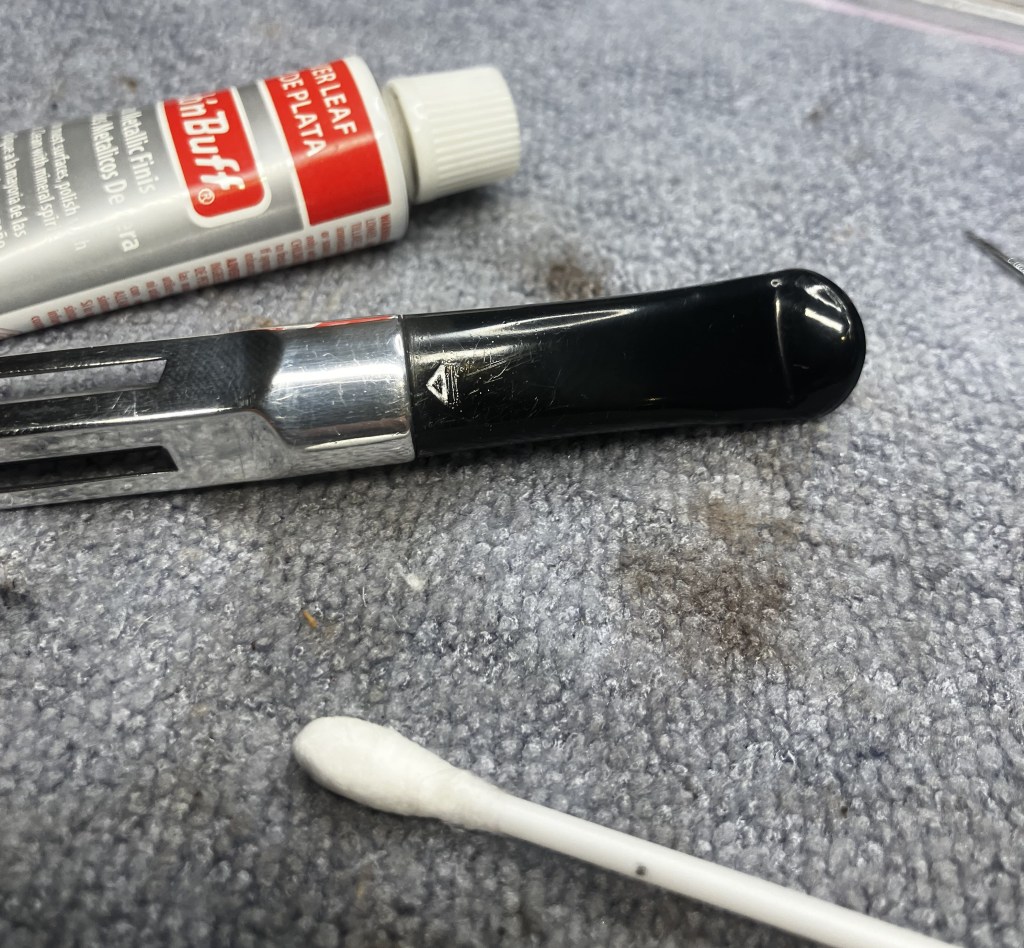
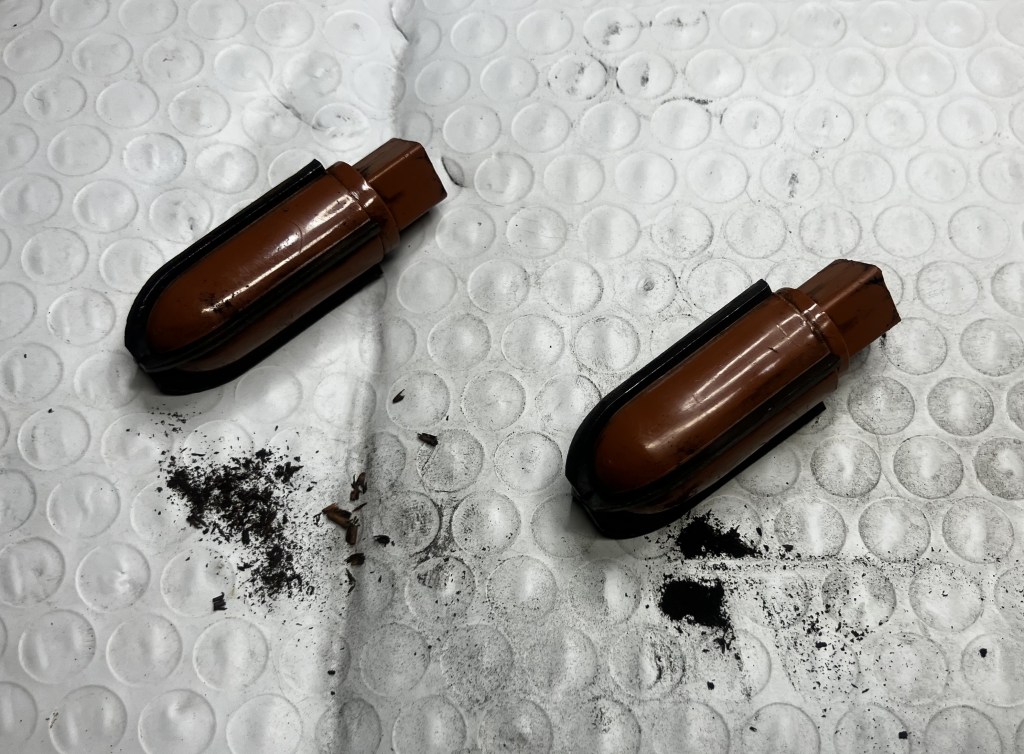
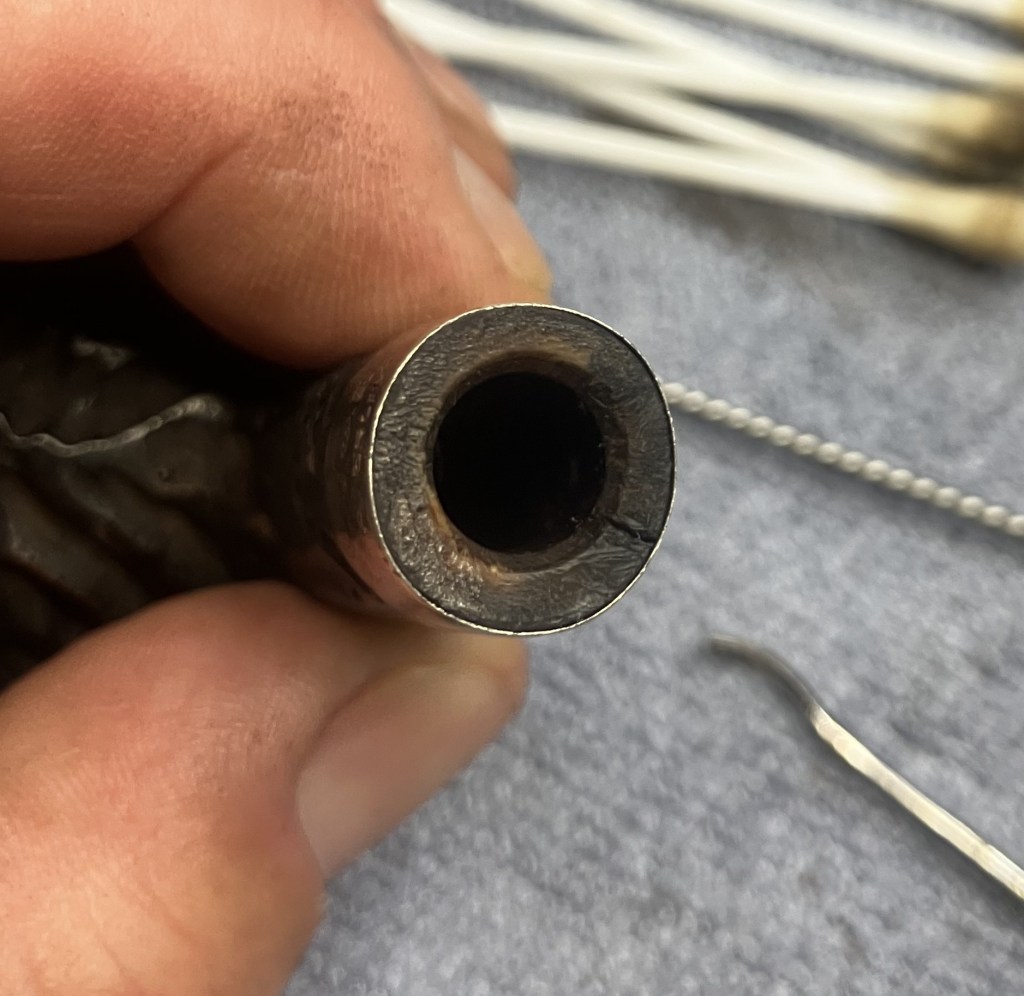
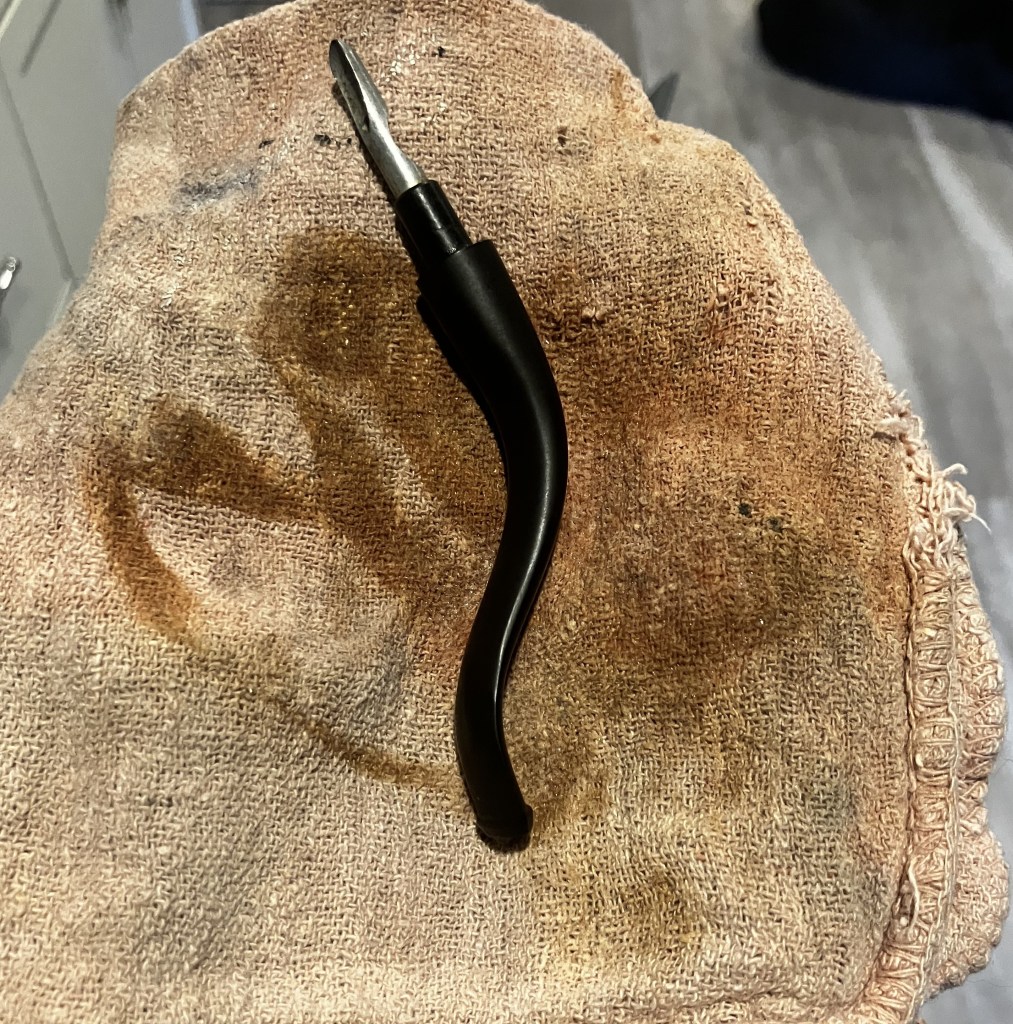
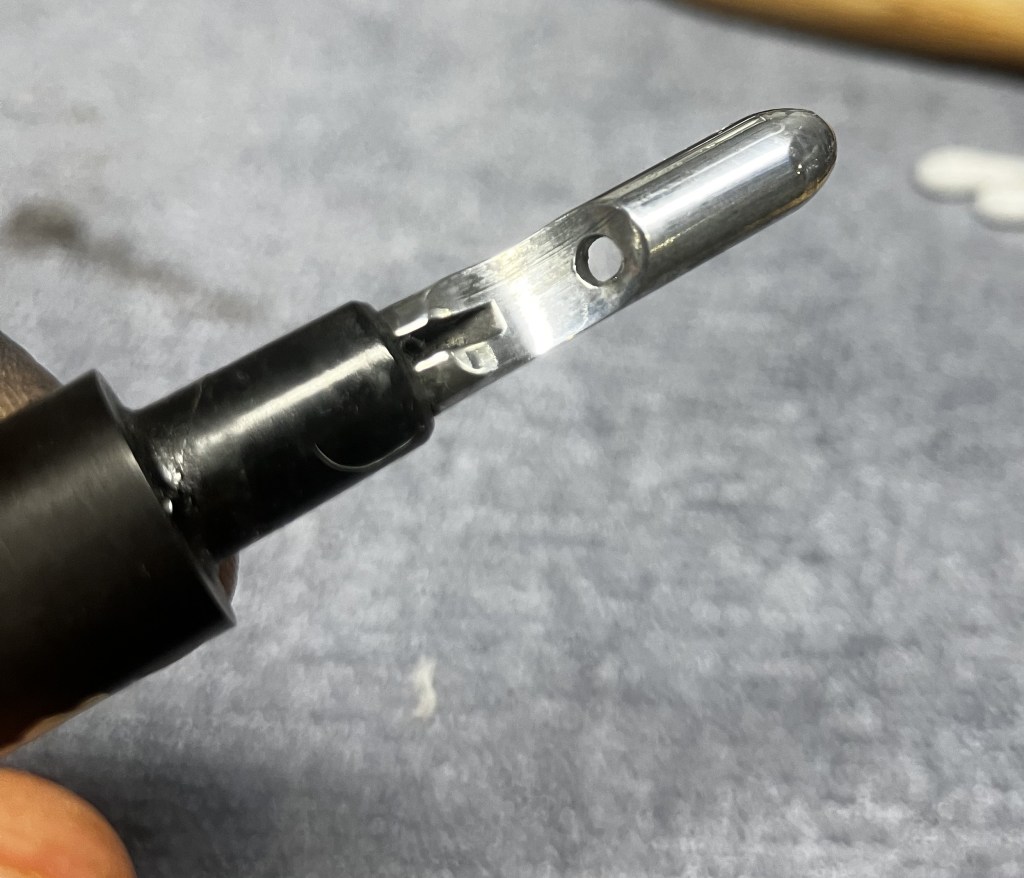
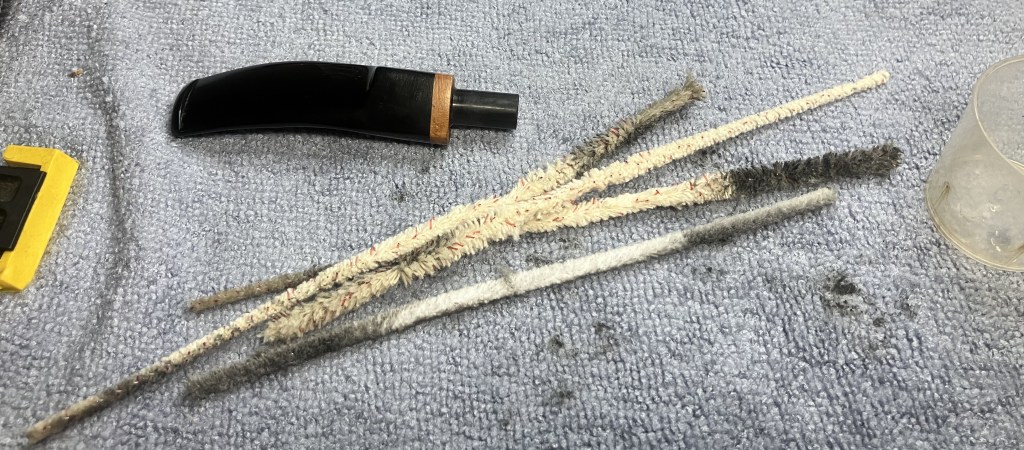
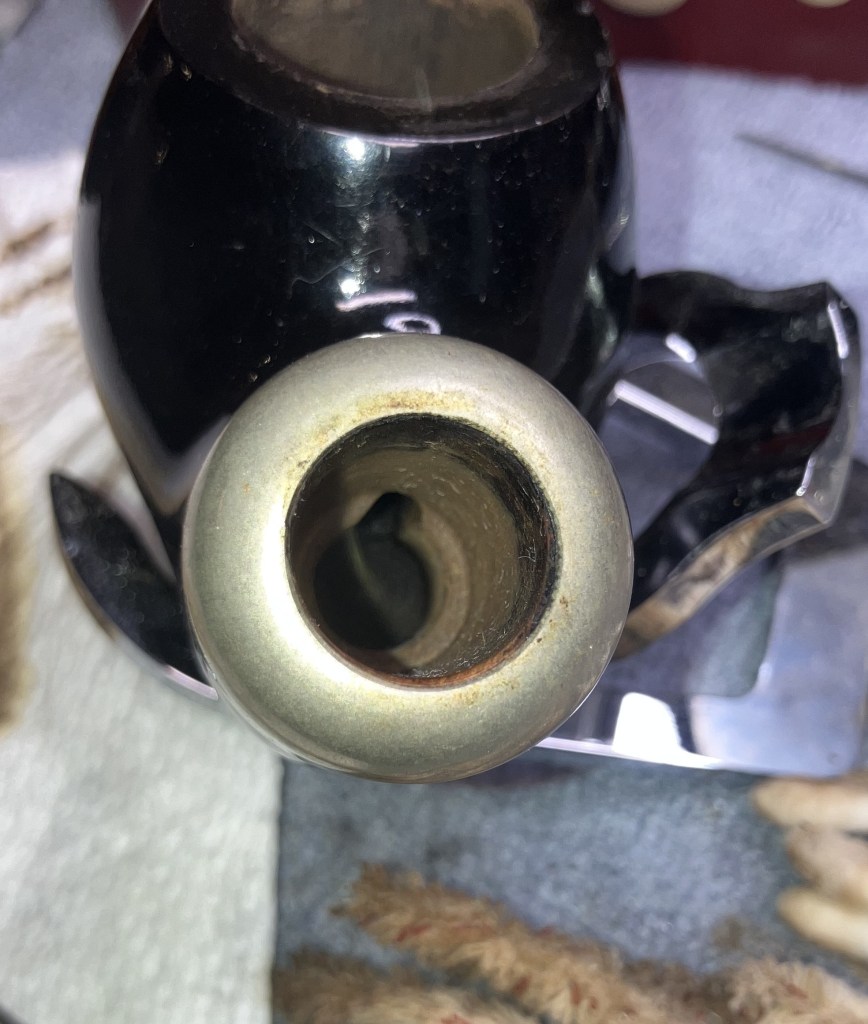
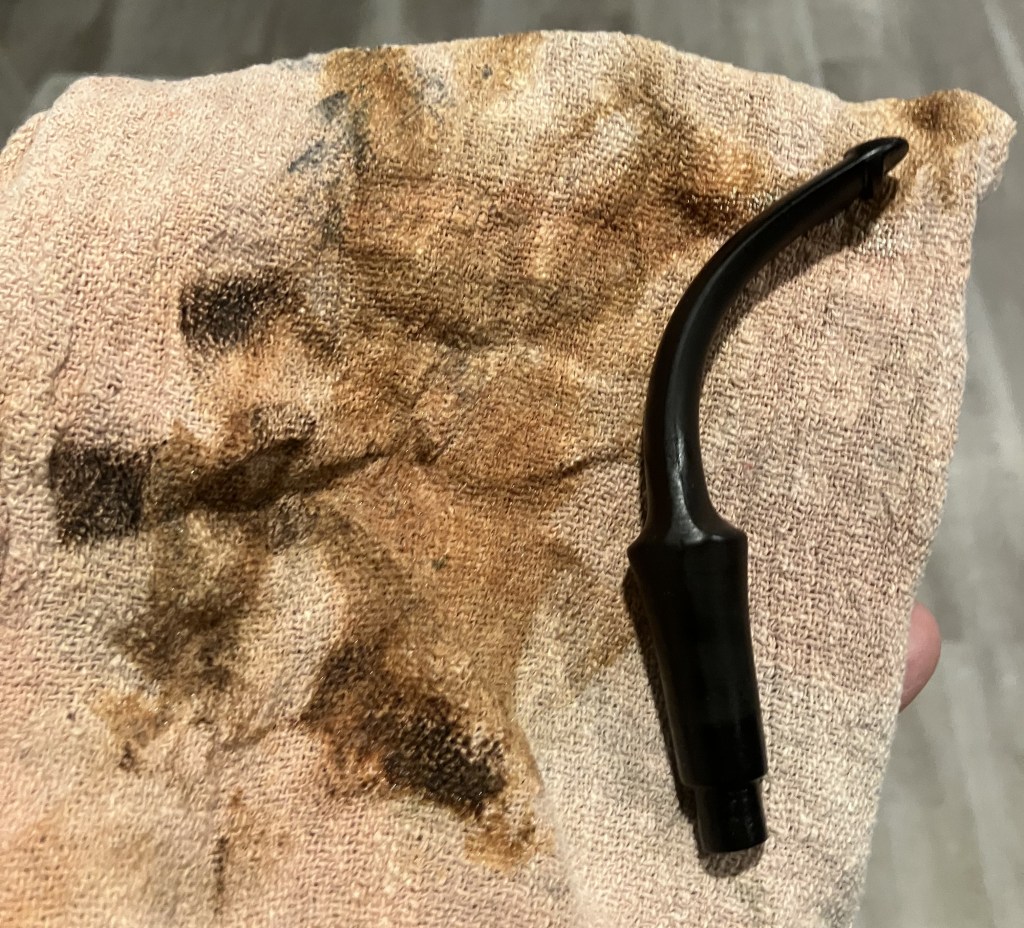
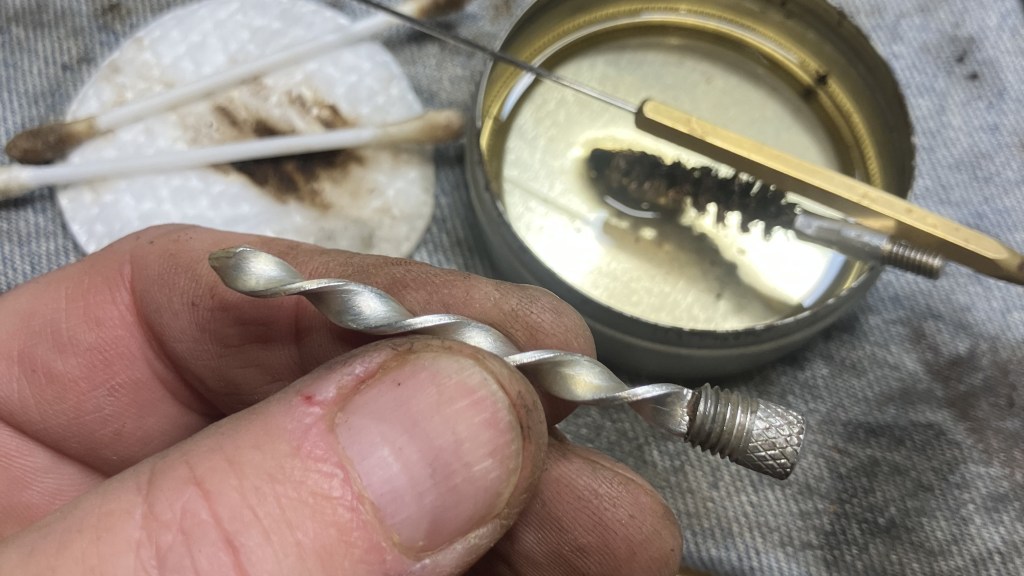
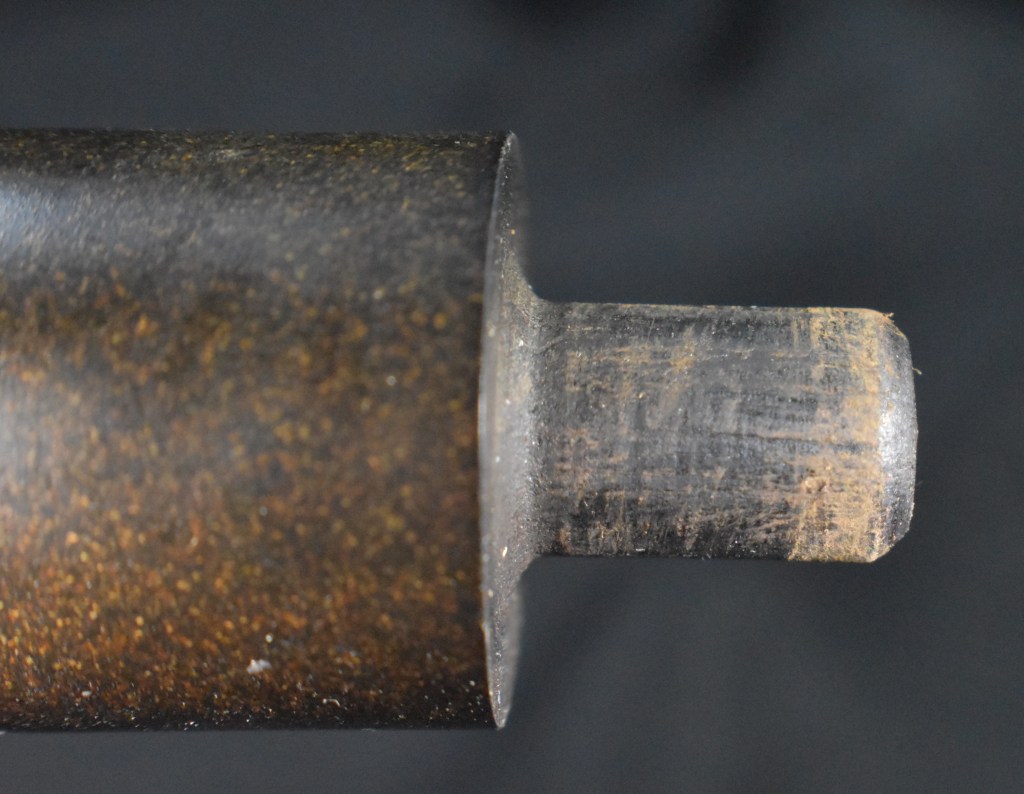
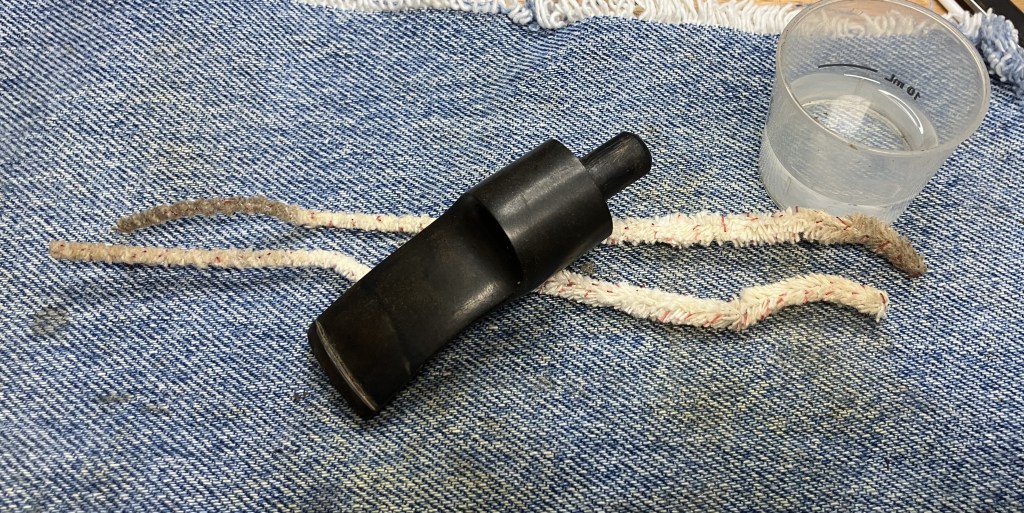
Some of the coating must have also made its way into the stem.
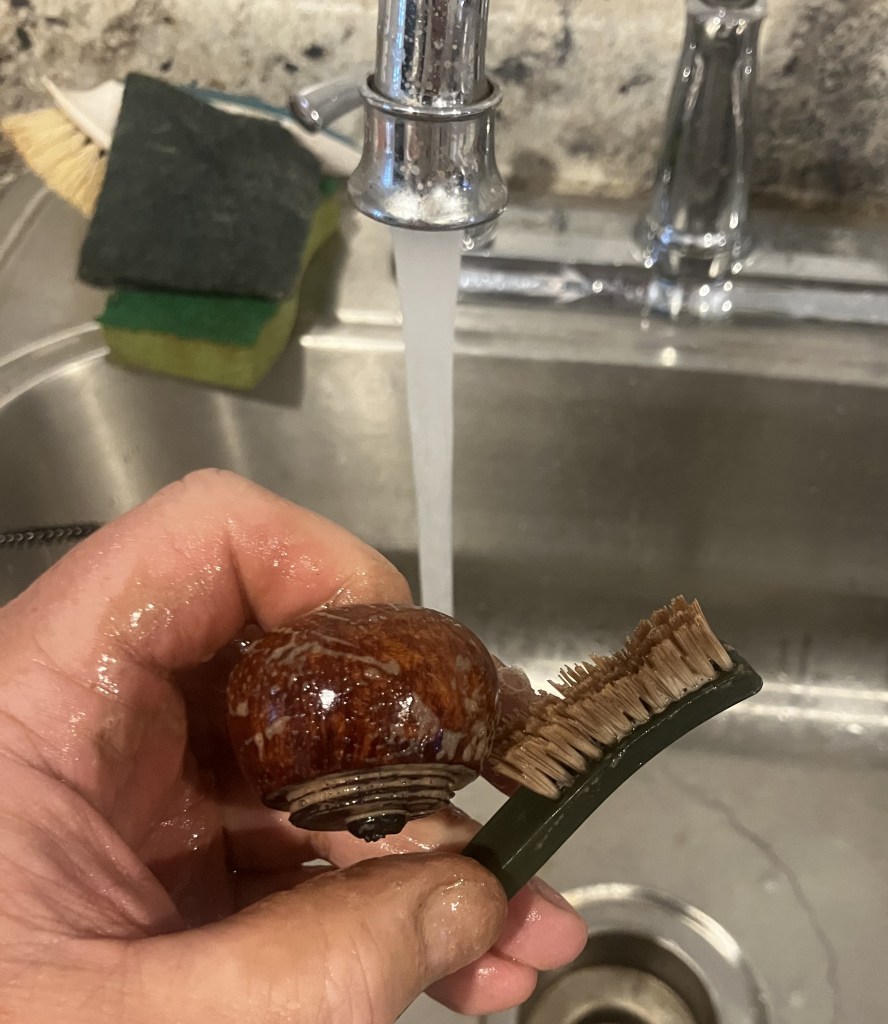
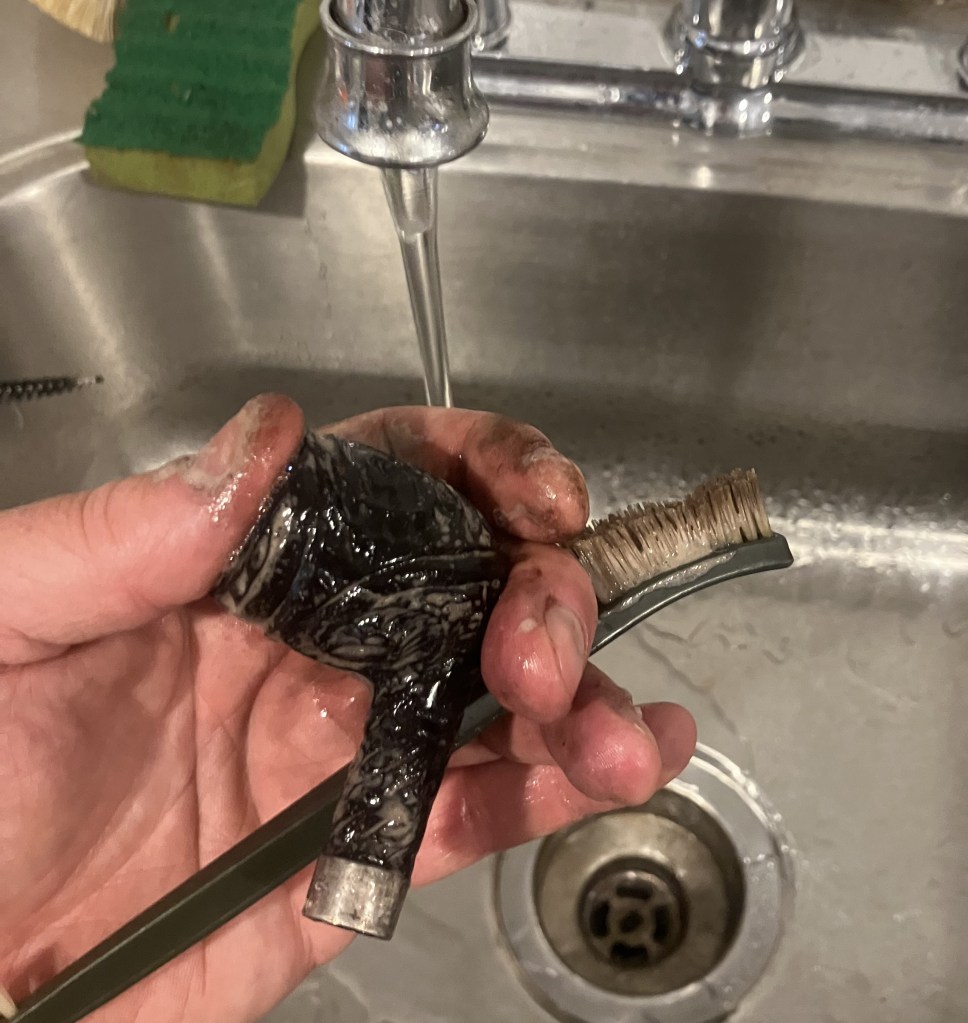
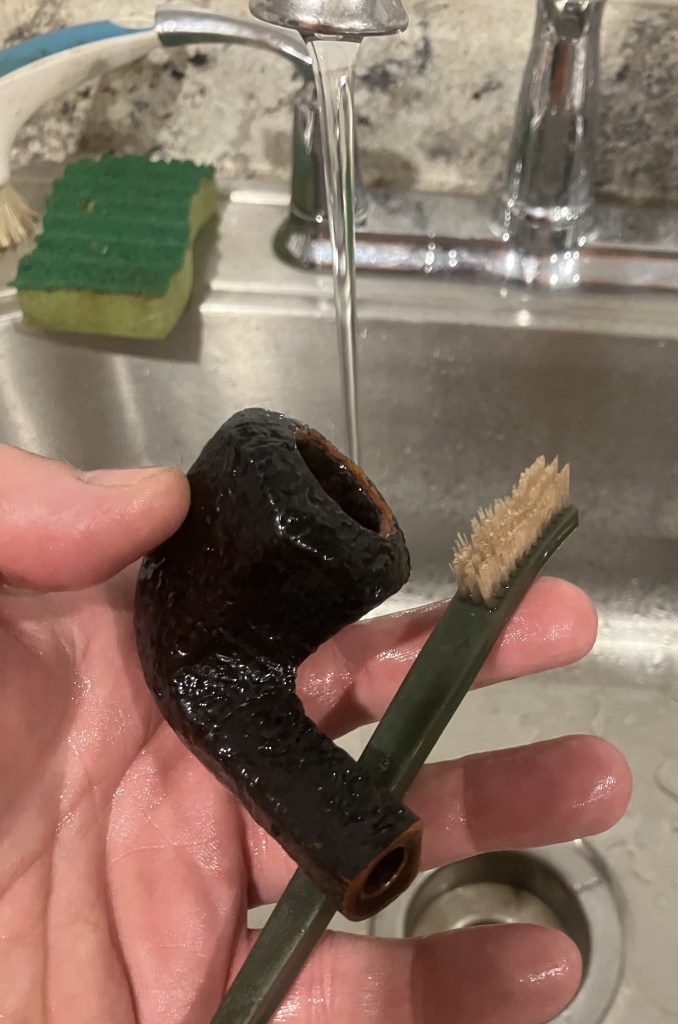
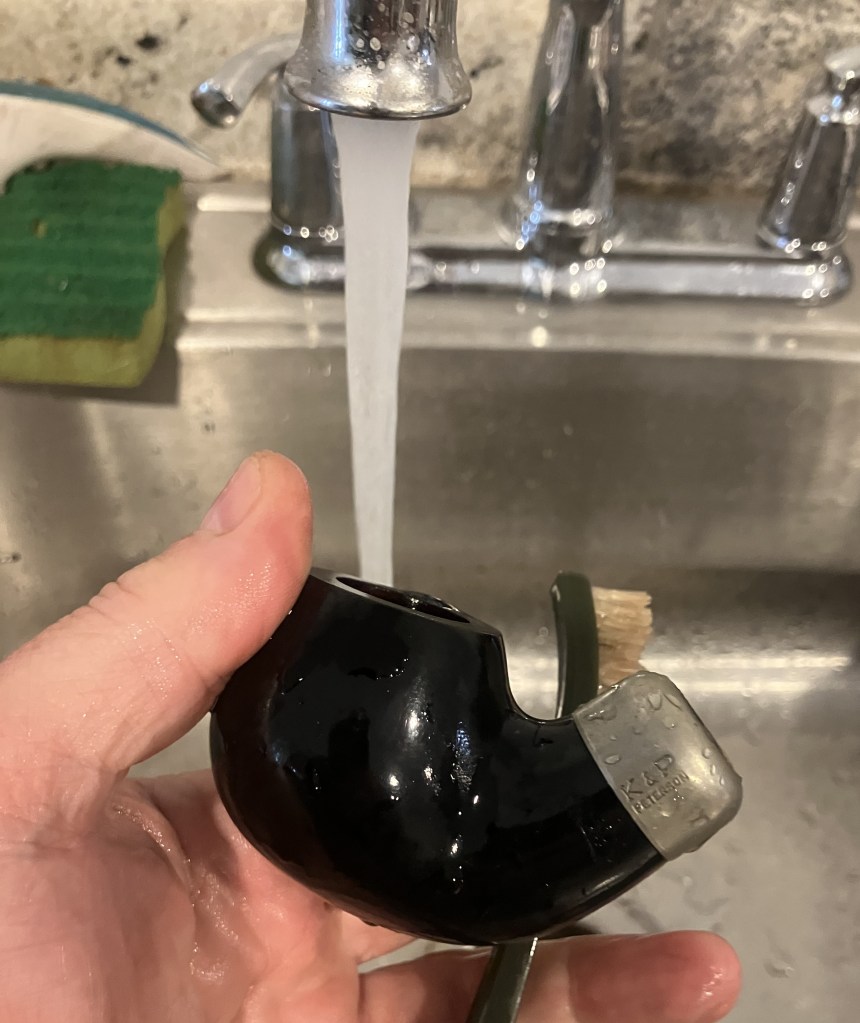
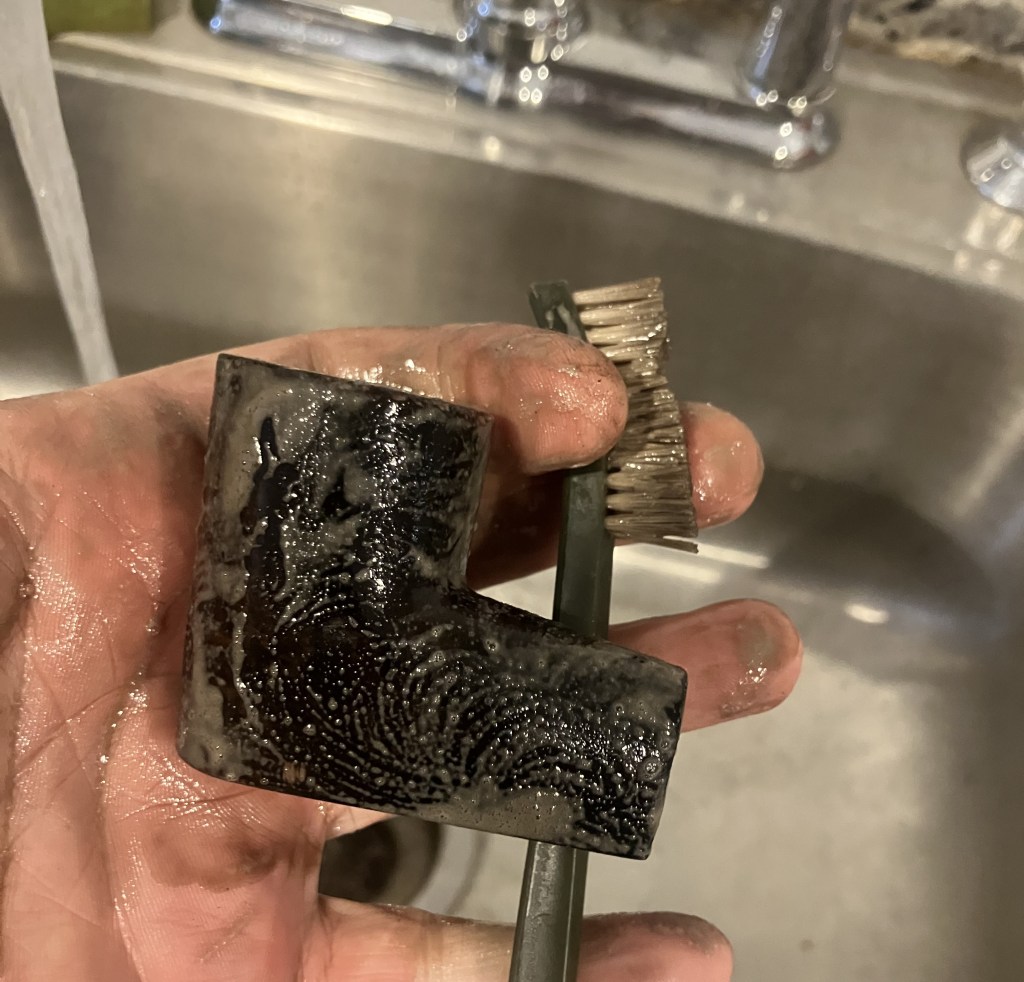
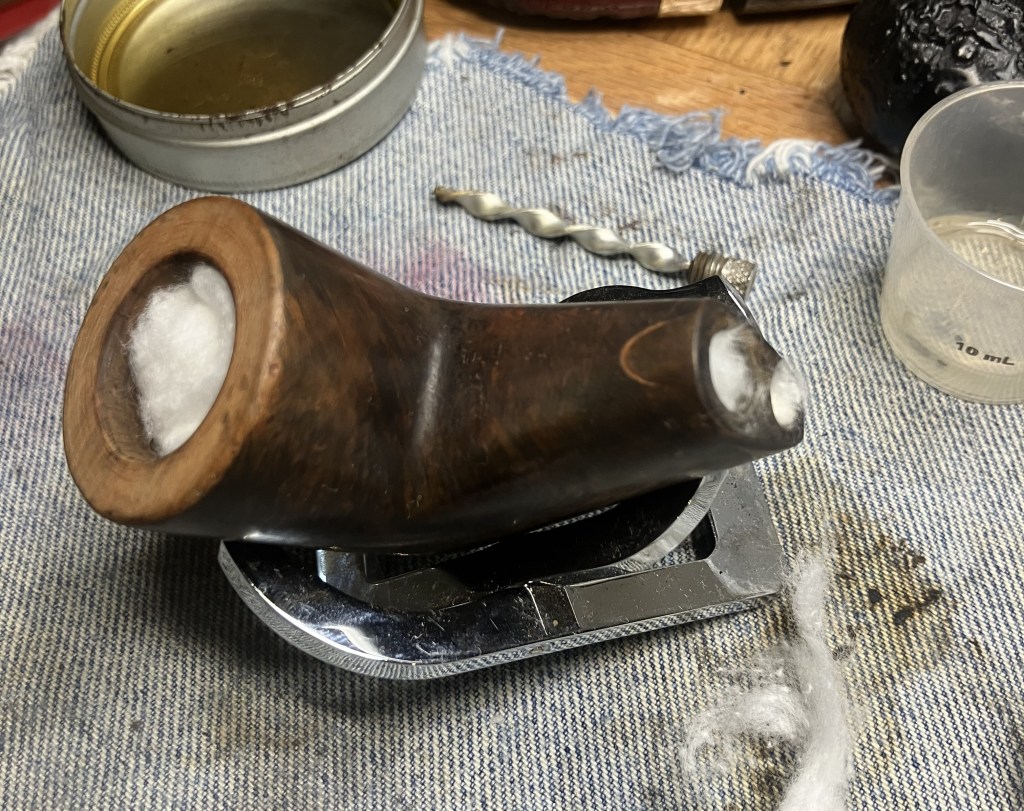
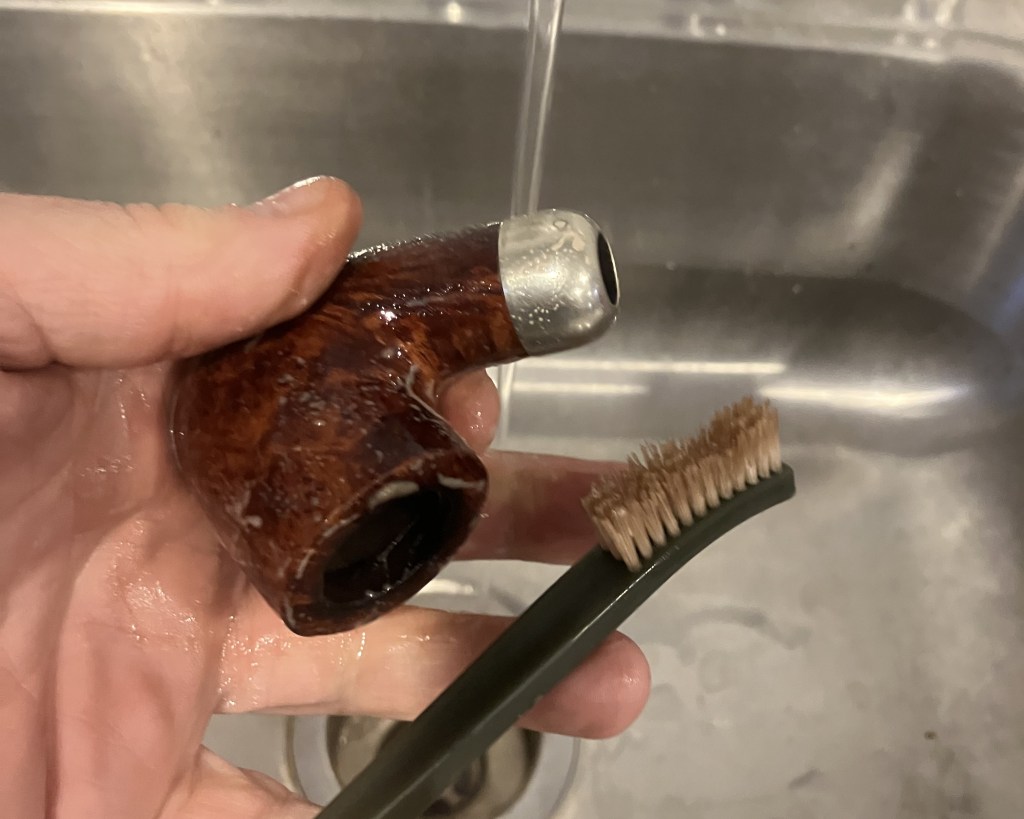
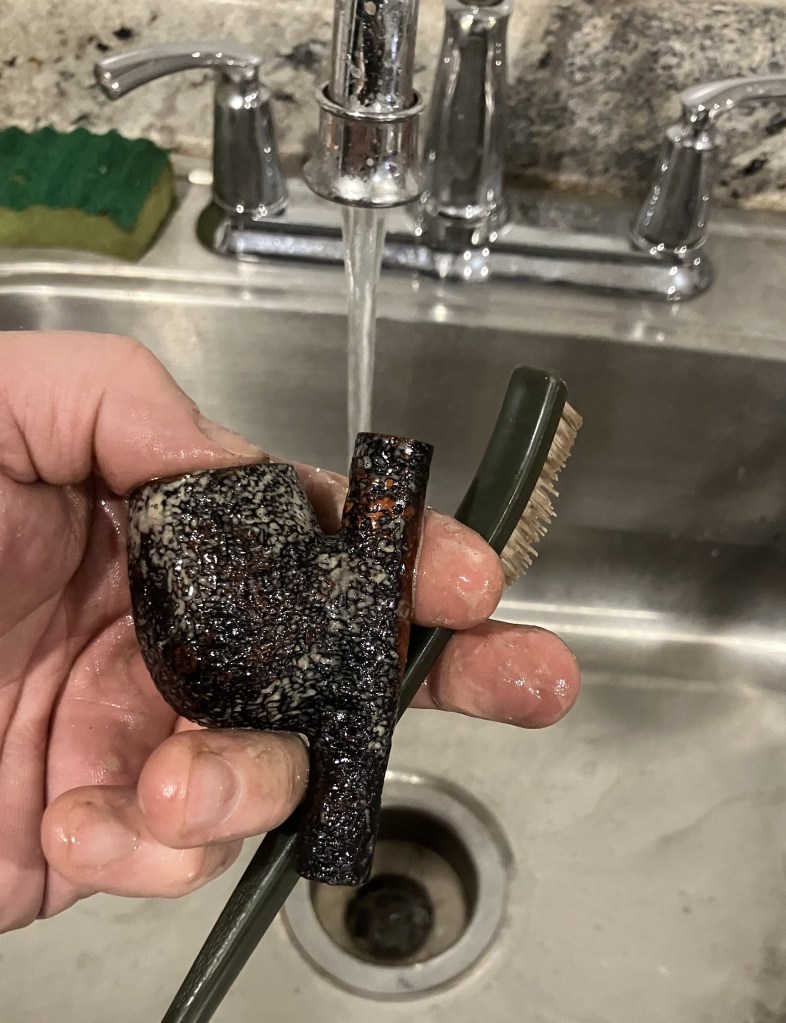
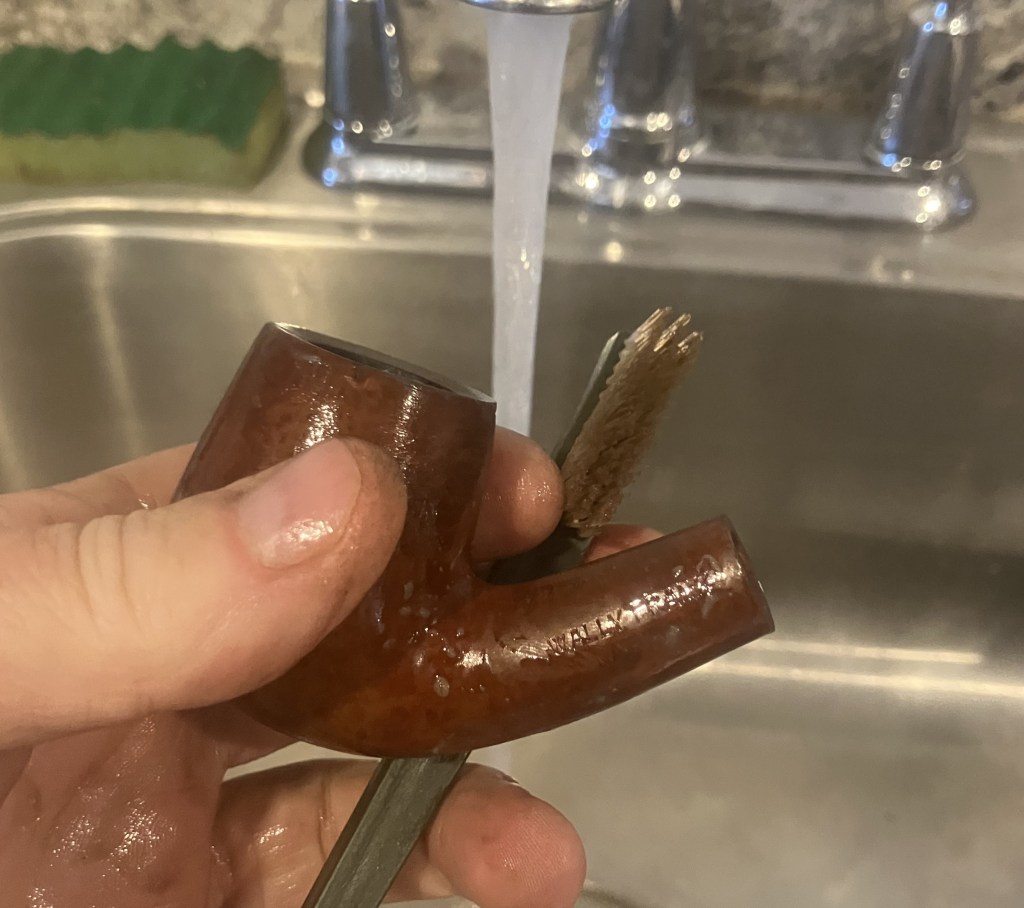
With that bowl coating stuff removed, I was able to say, “To the sink!” Here the stummel was scrubbed with undiluted Murphy Oil Soap and a nylon brush. The soap was rinsed away with warm water and the stummel dried with a cotton hand towel.
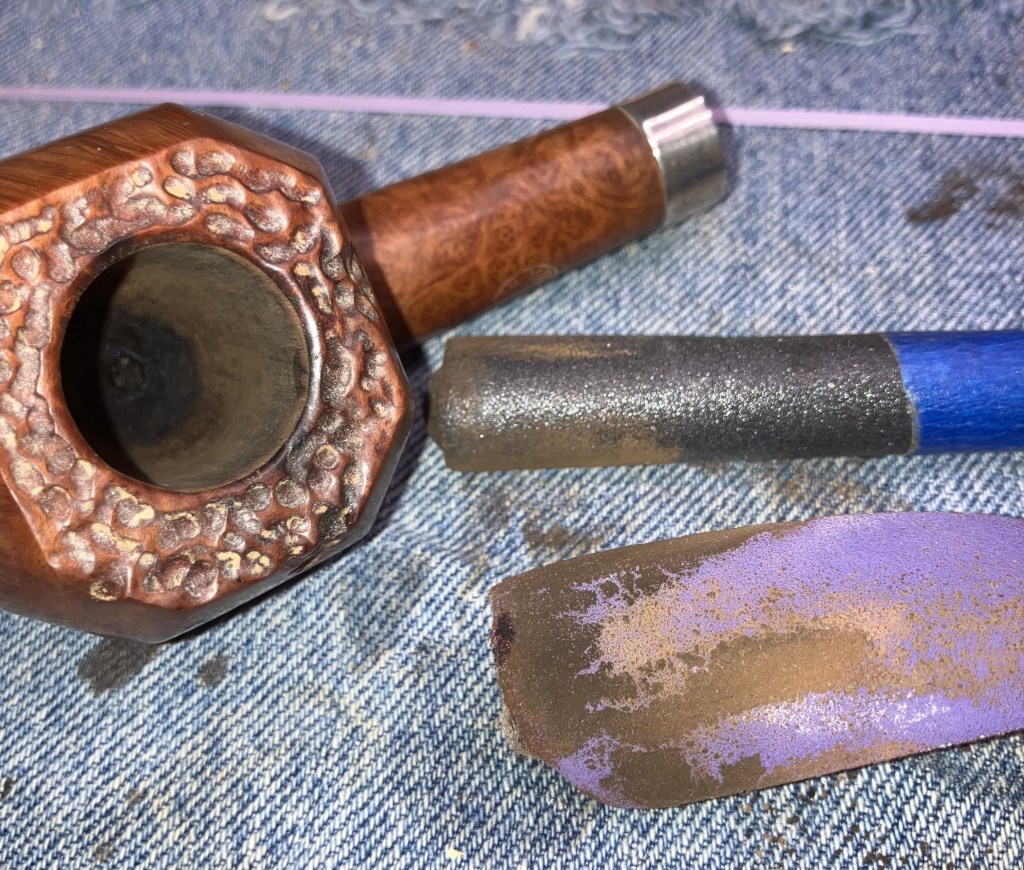
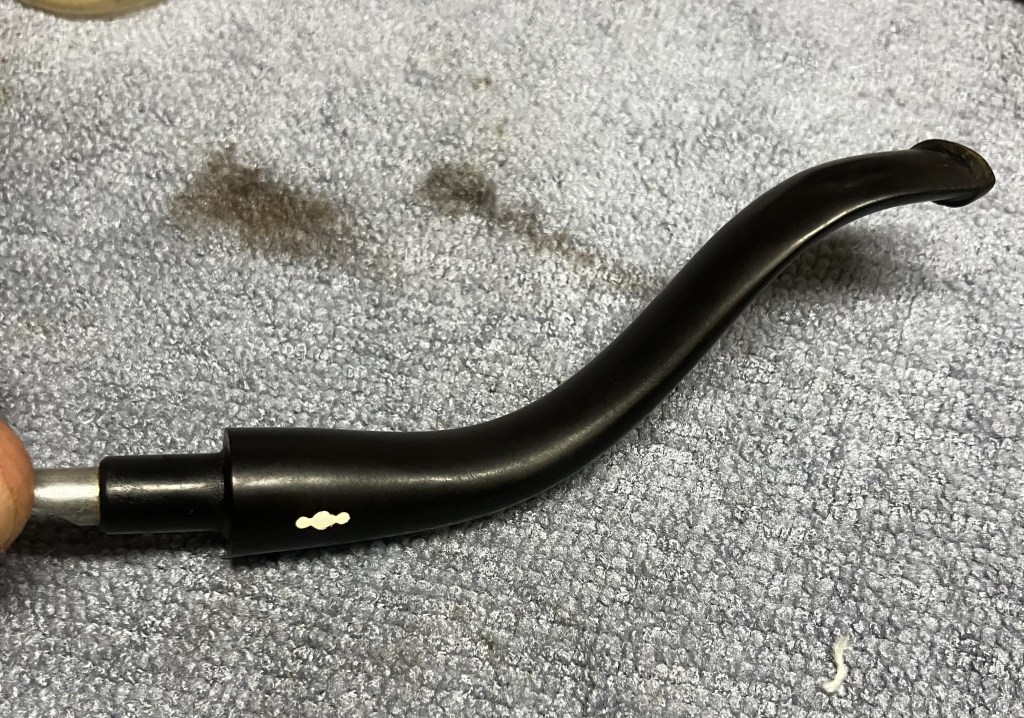
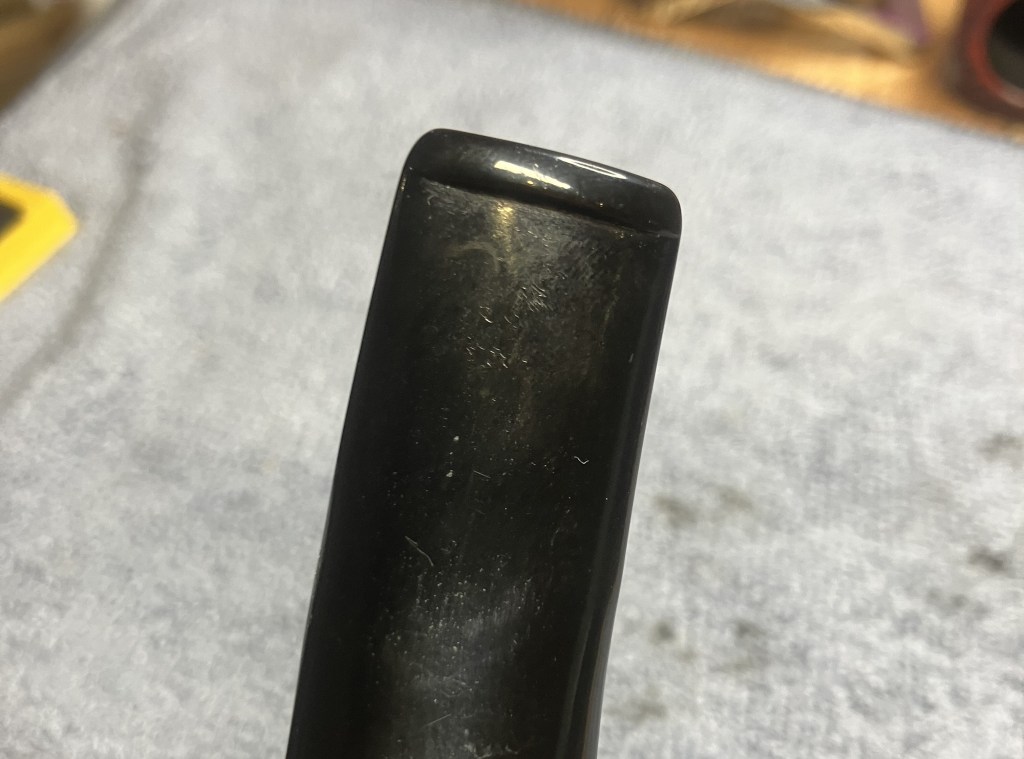
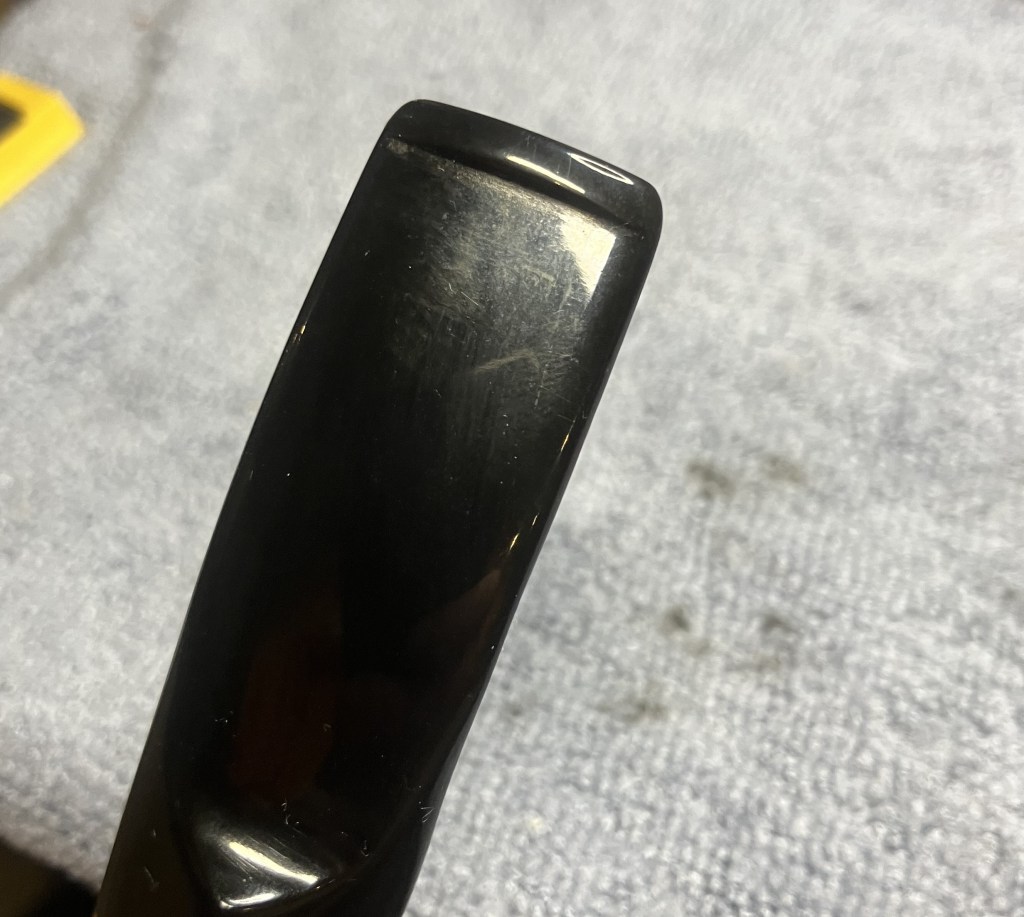
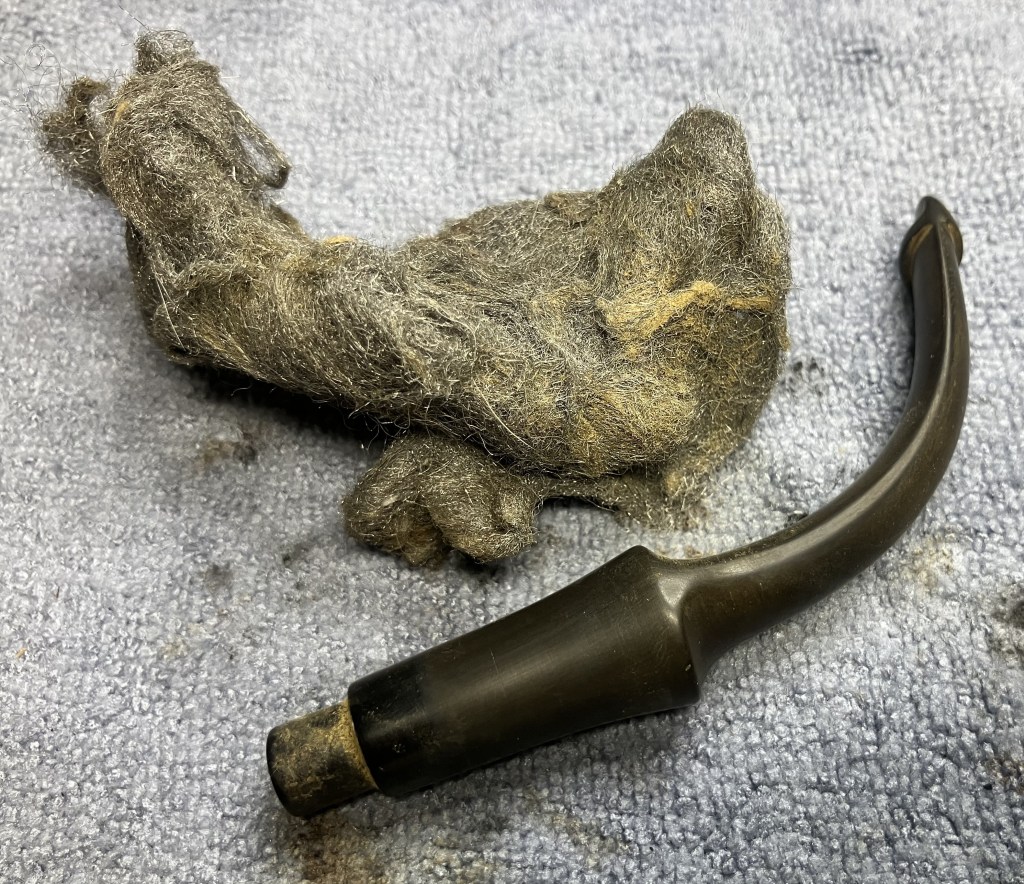
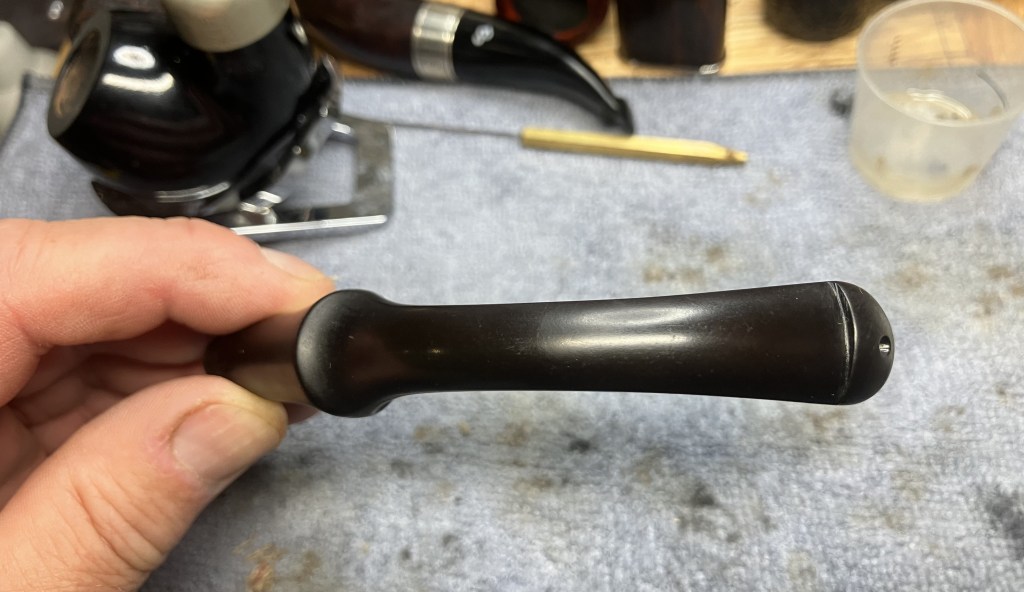
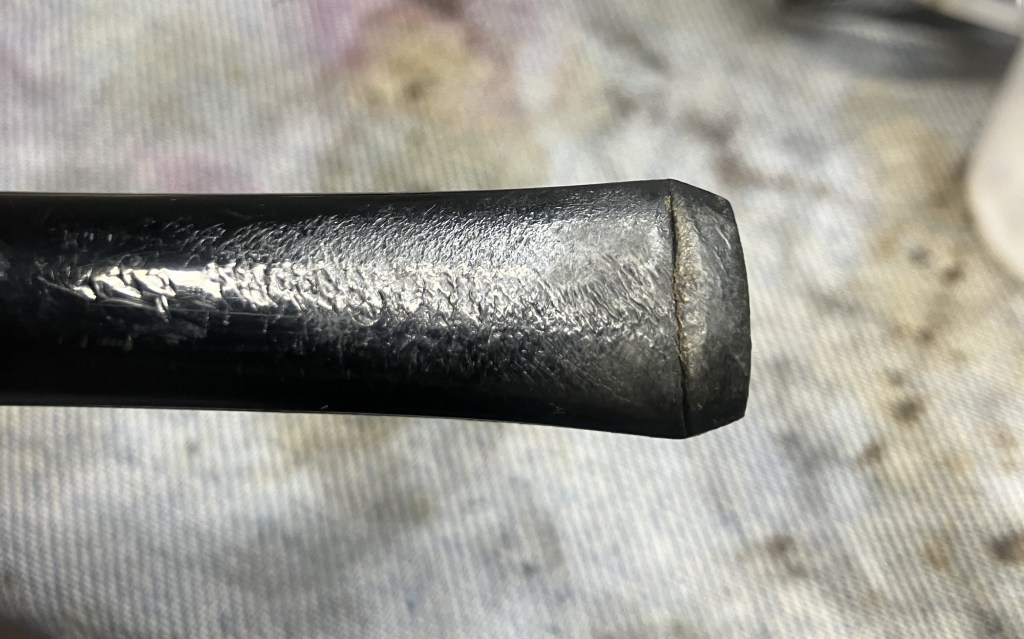
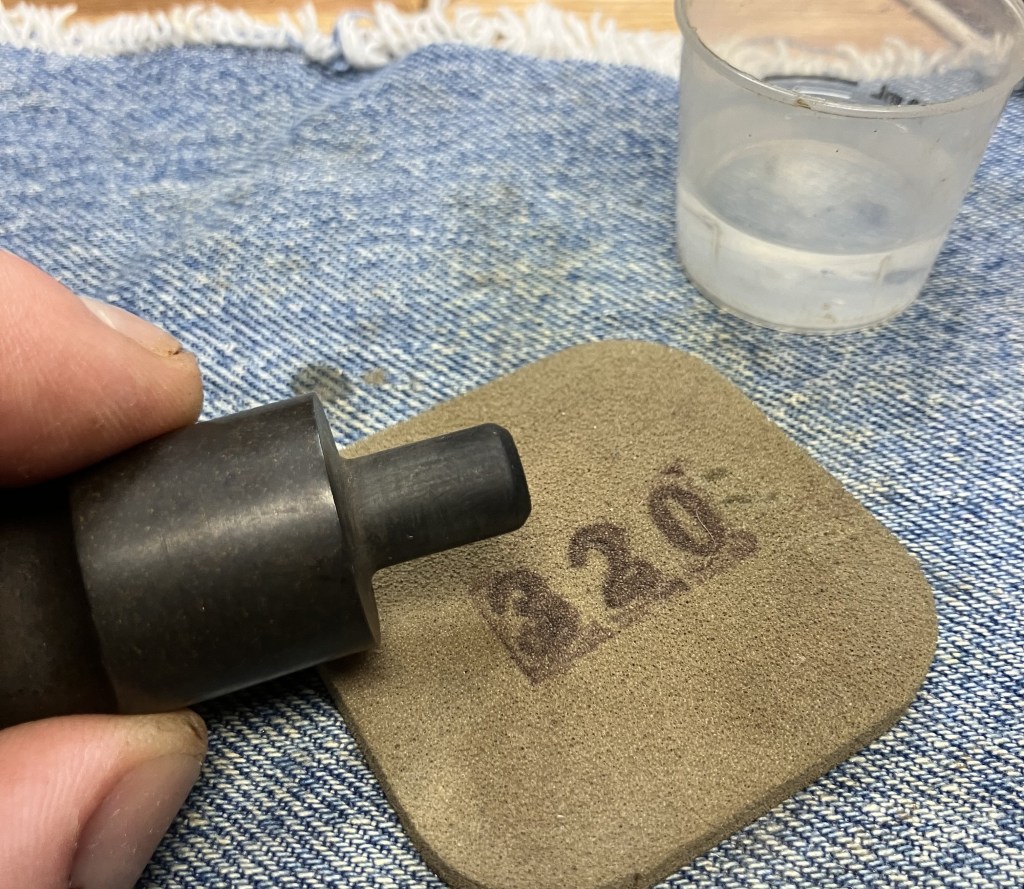
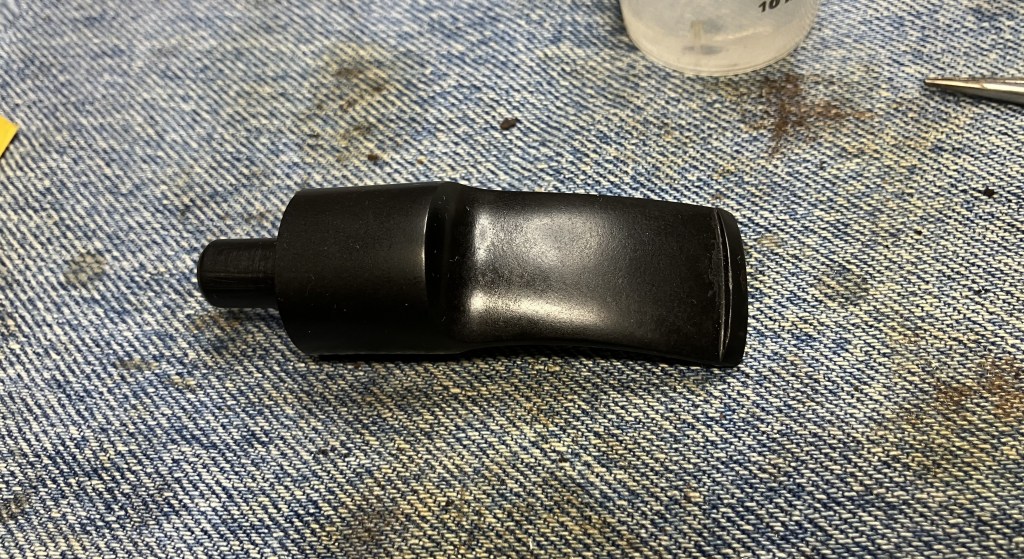
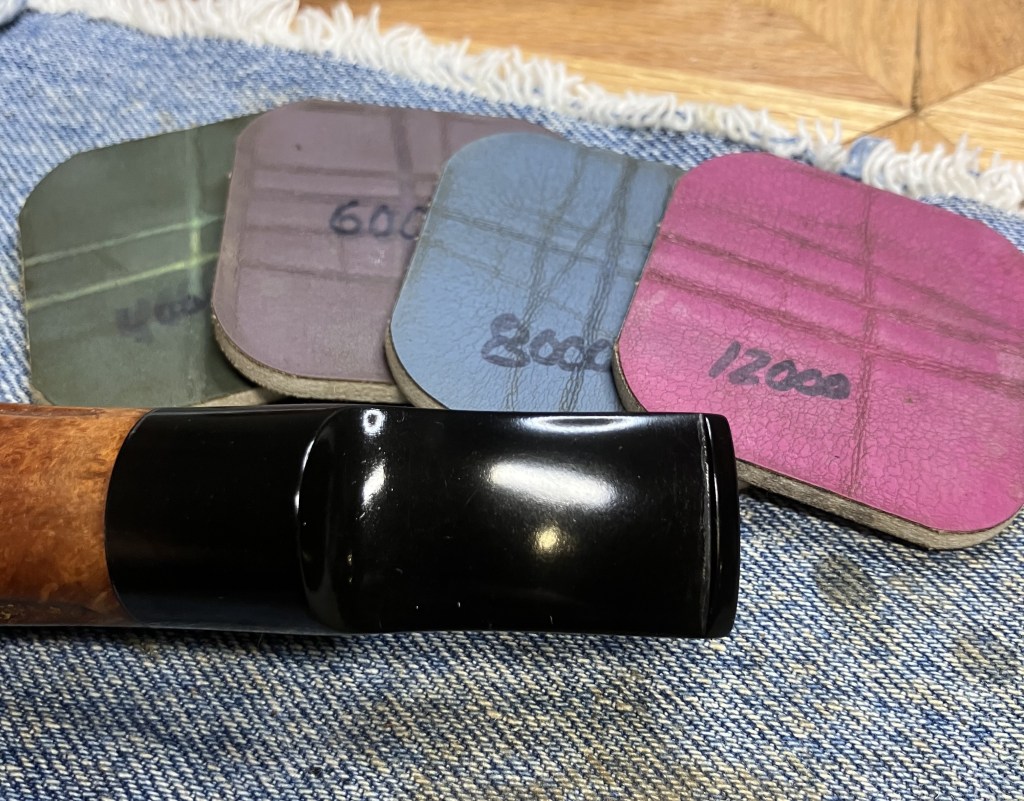
The stem showed ever-so-light tooth chatter scars.
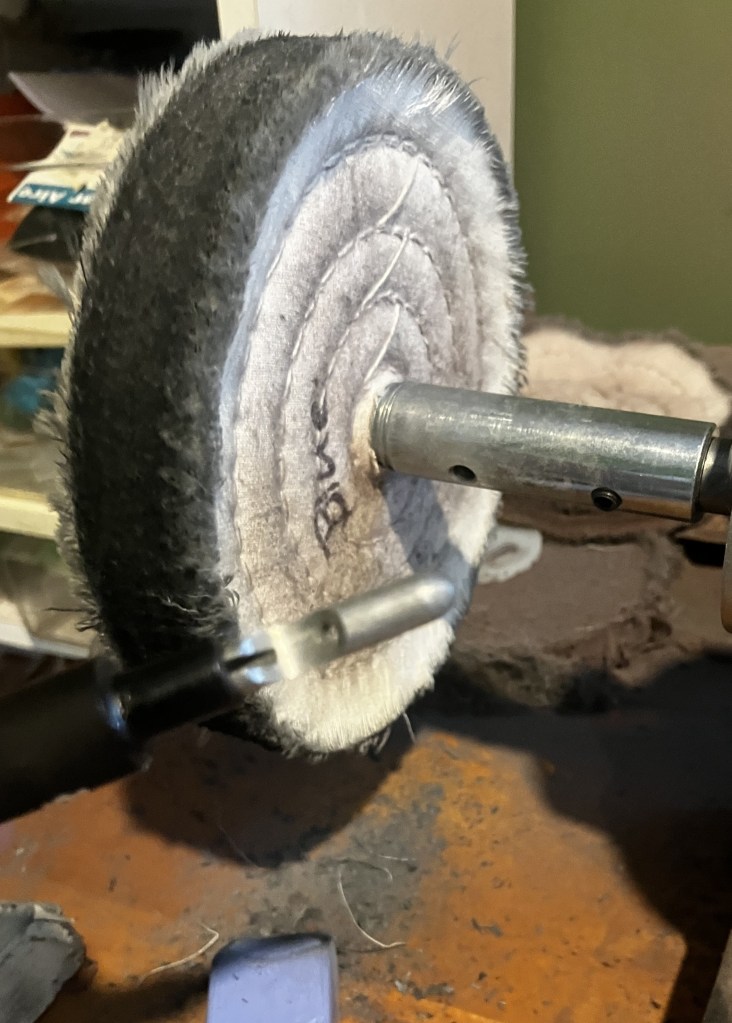
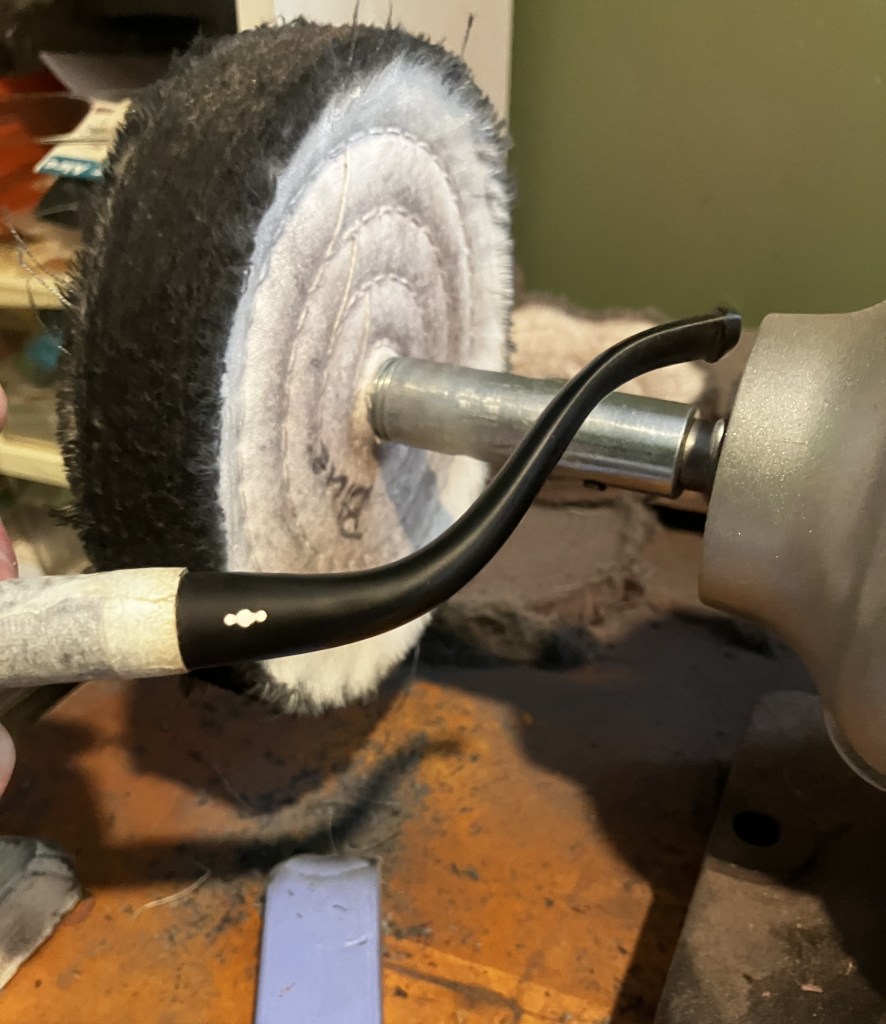
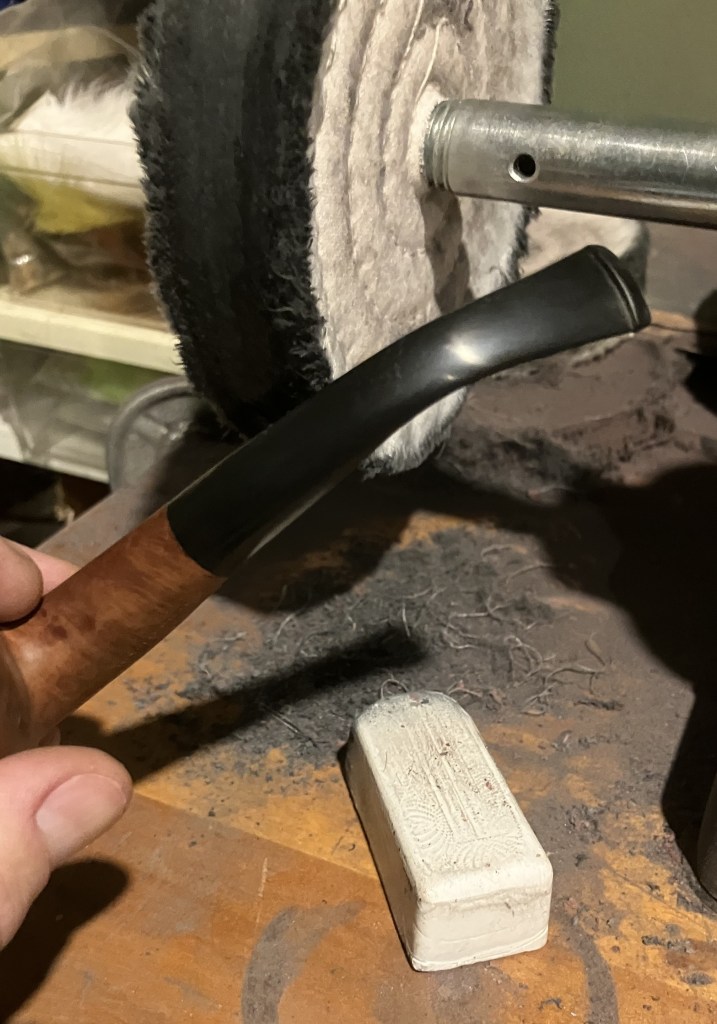
I did not think that sanding or micro-meshing was necessary to address this and that buffing with Blue Diamond compound would take care of the marks.
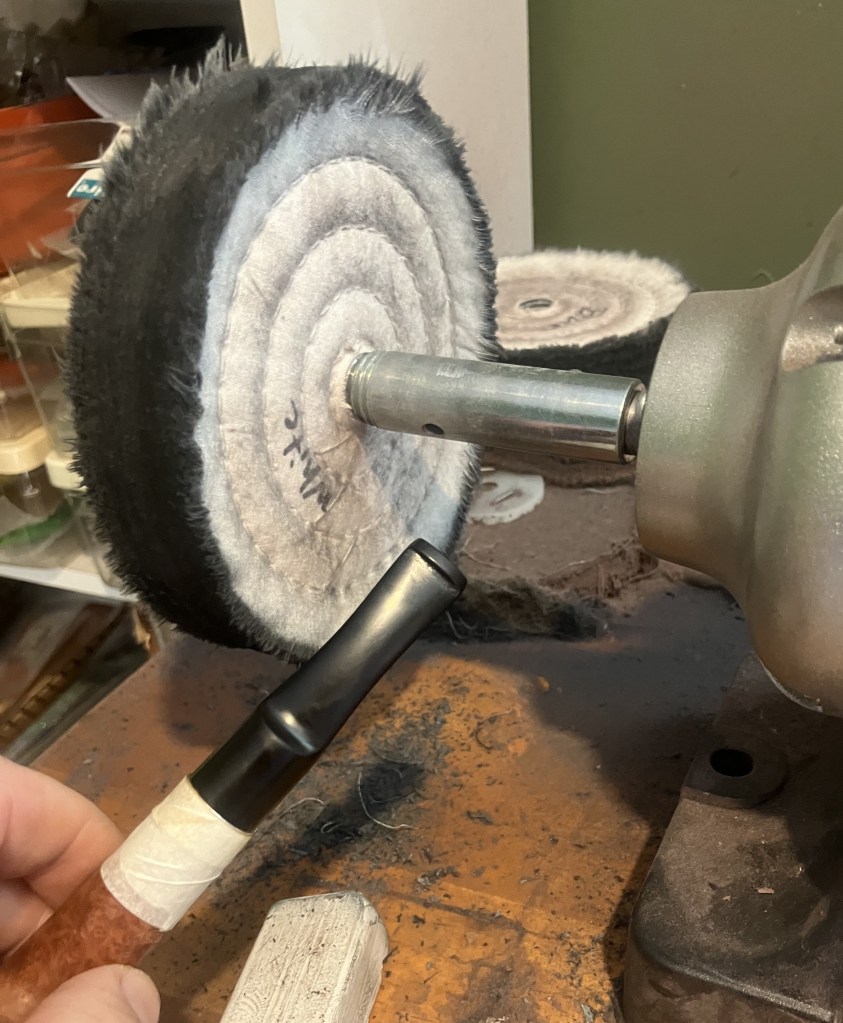
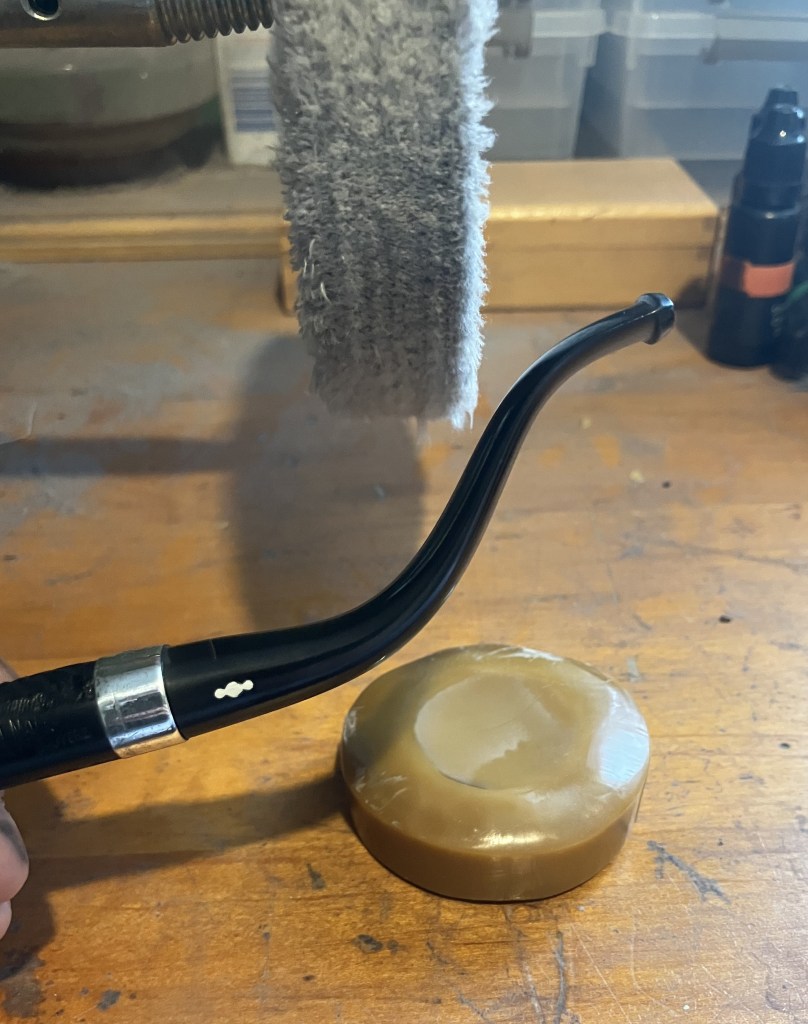
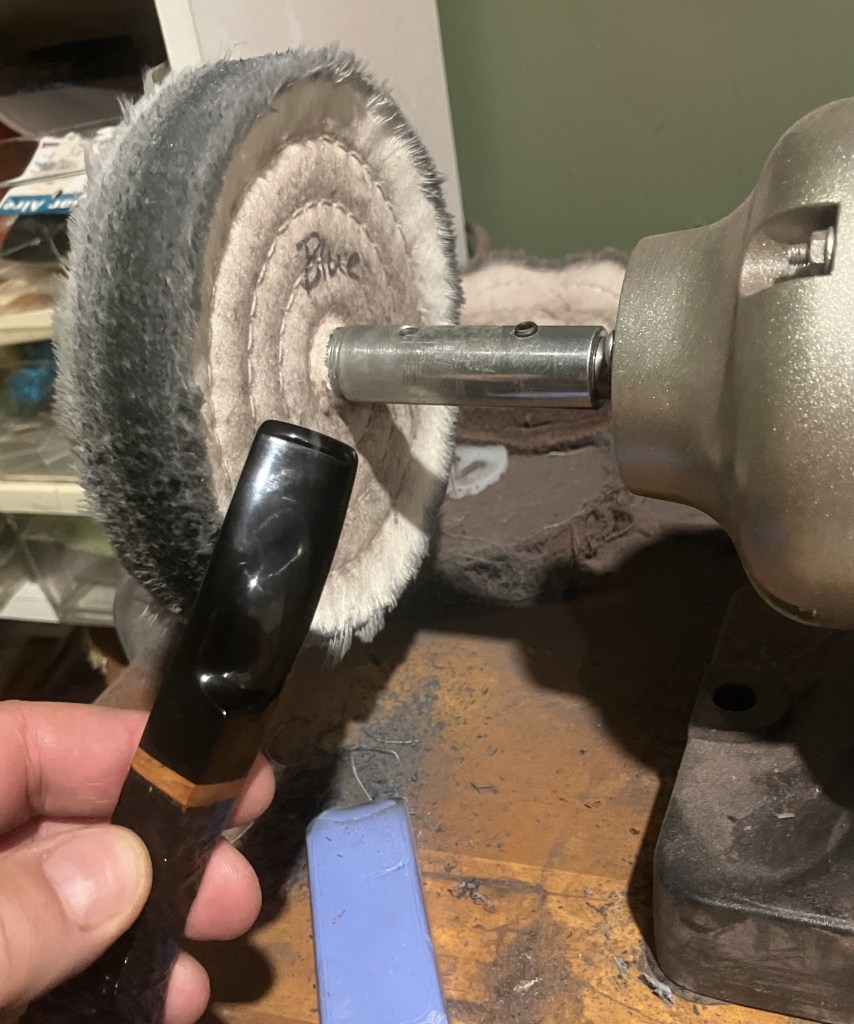
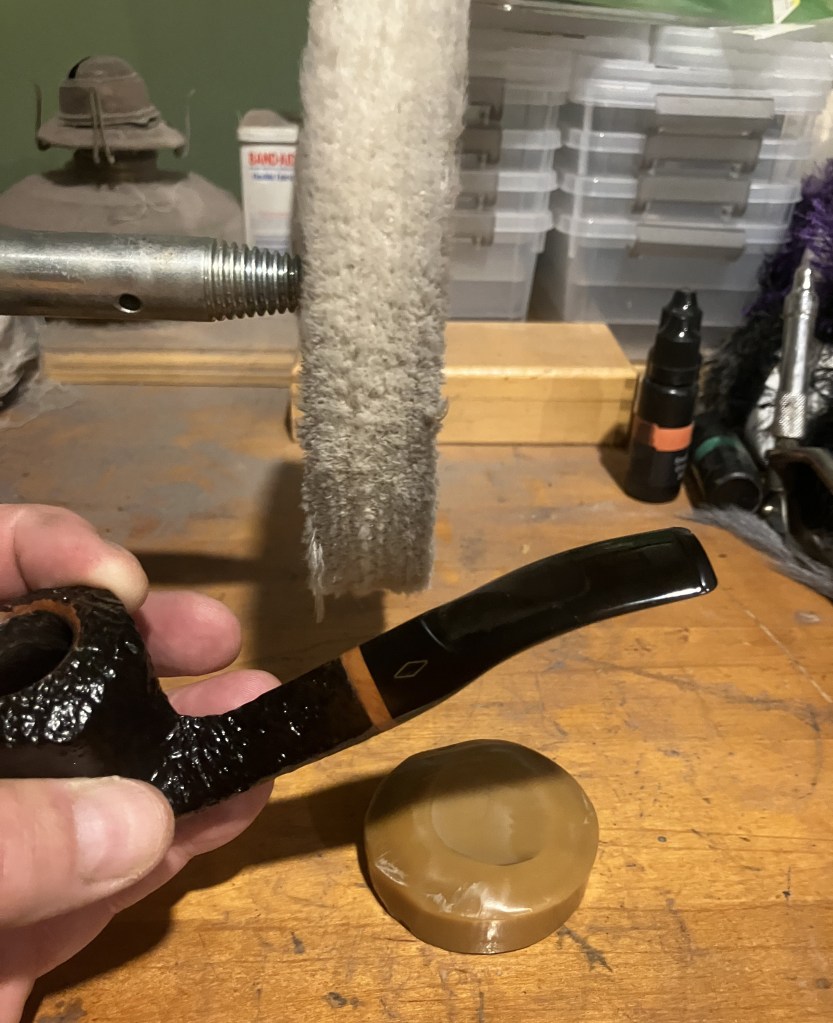
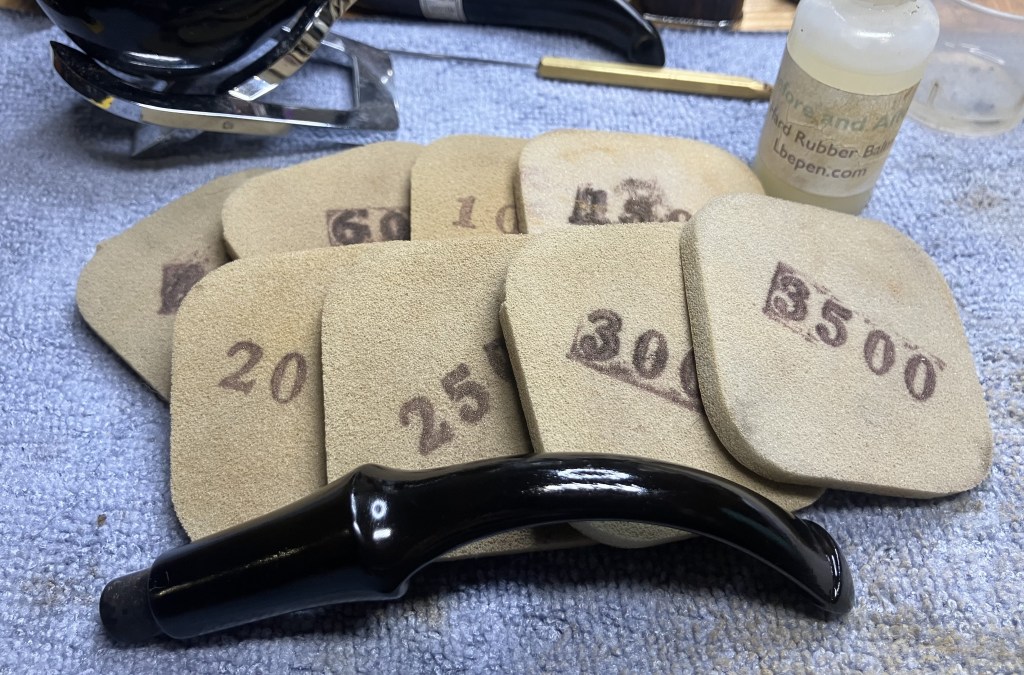
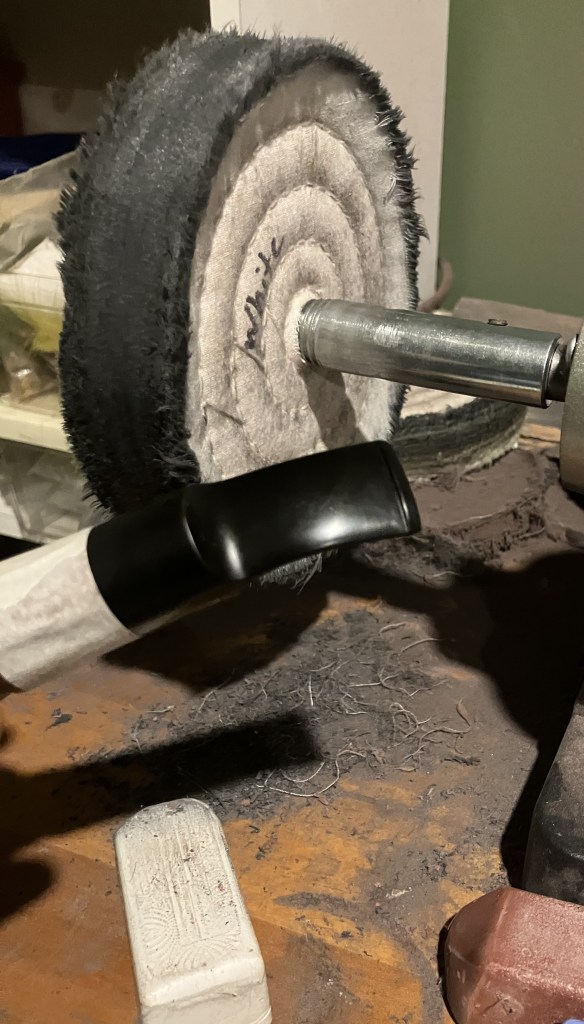
A couple of coats of carnauba wax at the buffer and the stem looked like new.
That’s it. That is all I did. I didn’t even bother taking a full set of after photos since the pipe didn’t look enough different to warrant taking them. I can say that it is a fine smoker and will be used and enjoyed for many years to come (hopefully).
The dimensions of the Brebbia Sebbiata 880 are:
Length: 5.78 in./ 146.81 mm.
Weight: 2.06 oz./ 58.40 g. (with band)
Bowl Height: 2.03 in./ 51.56 mm.
Chamber Depth: 1.64 in./ 41.66 mm.
Chamber Diameter: 0.75 in./ 19.05 mm.
Outside Diameter: 1.60 in./ 40.64 mm. (each facet was slightly different)
I do hope that you have found something here useful to your own pipe care, maintenance or restorations. If you like this sort of thing, please click the like and subscribe buttons. Thank you for reading the ramblings of an old pipe lover.
Loading…
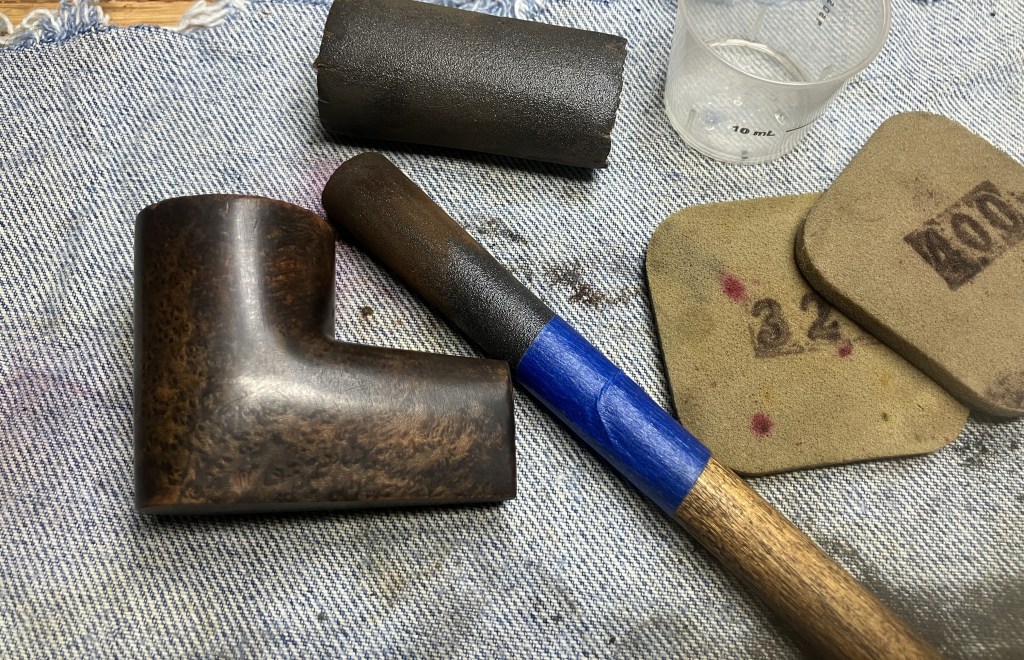
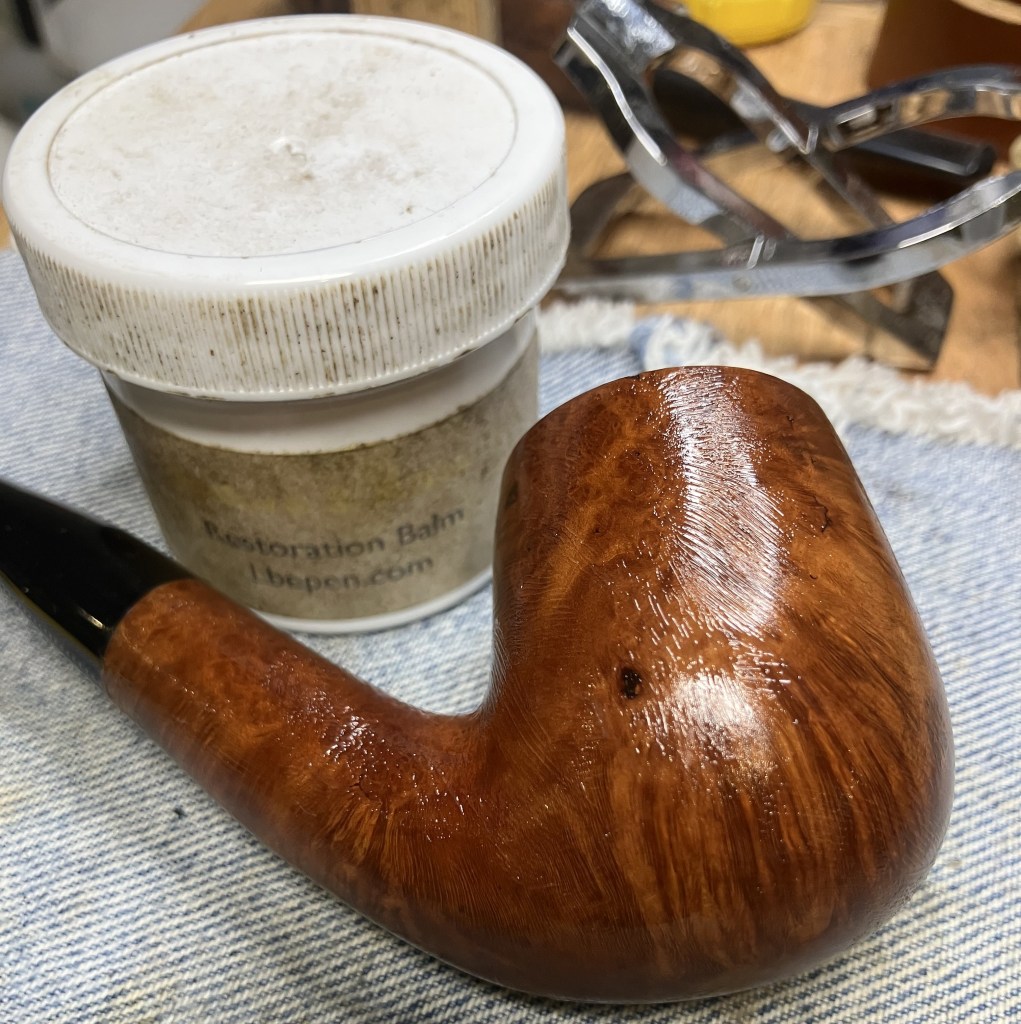
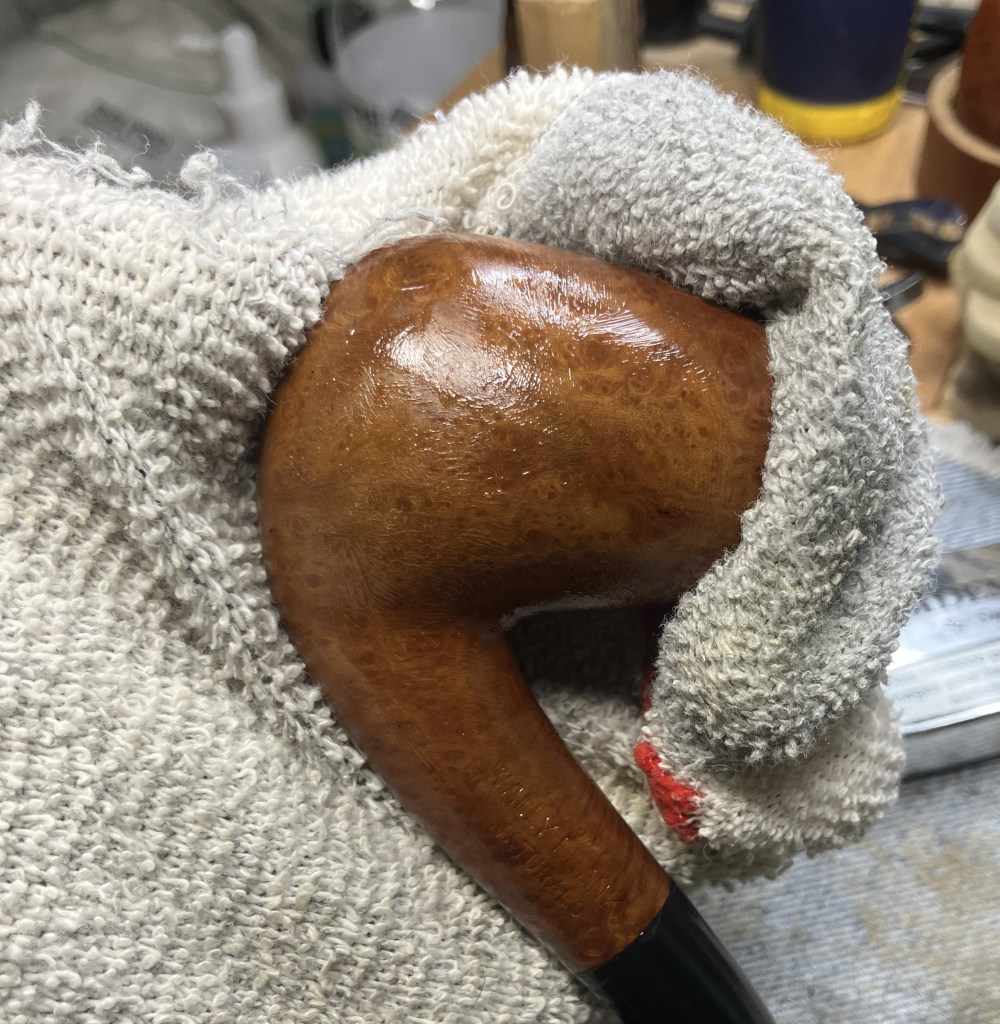
Below are some photos of the finished Brebbia Sabbiata 880:
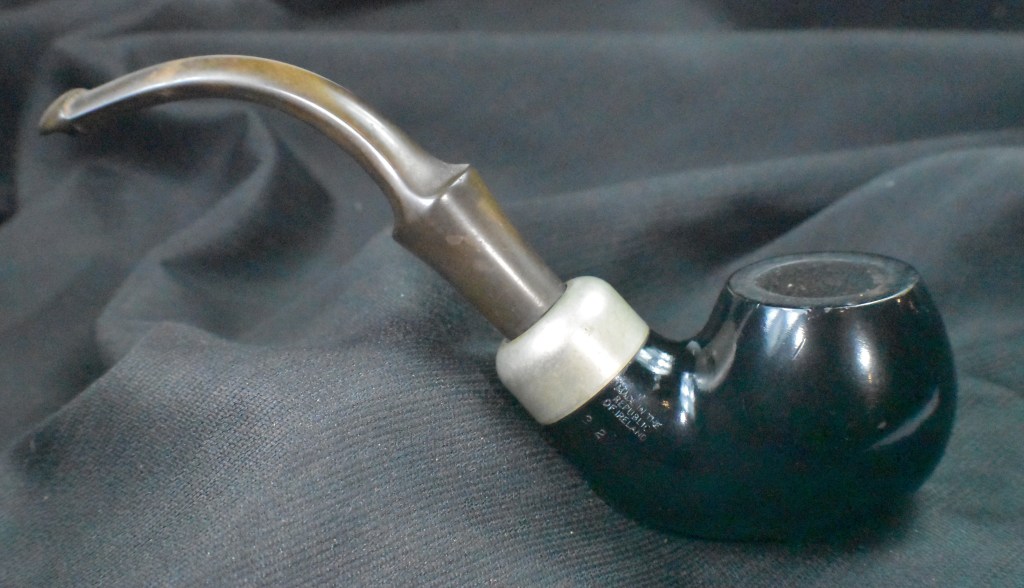
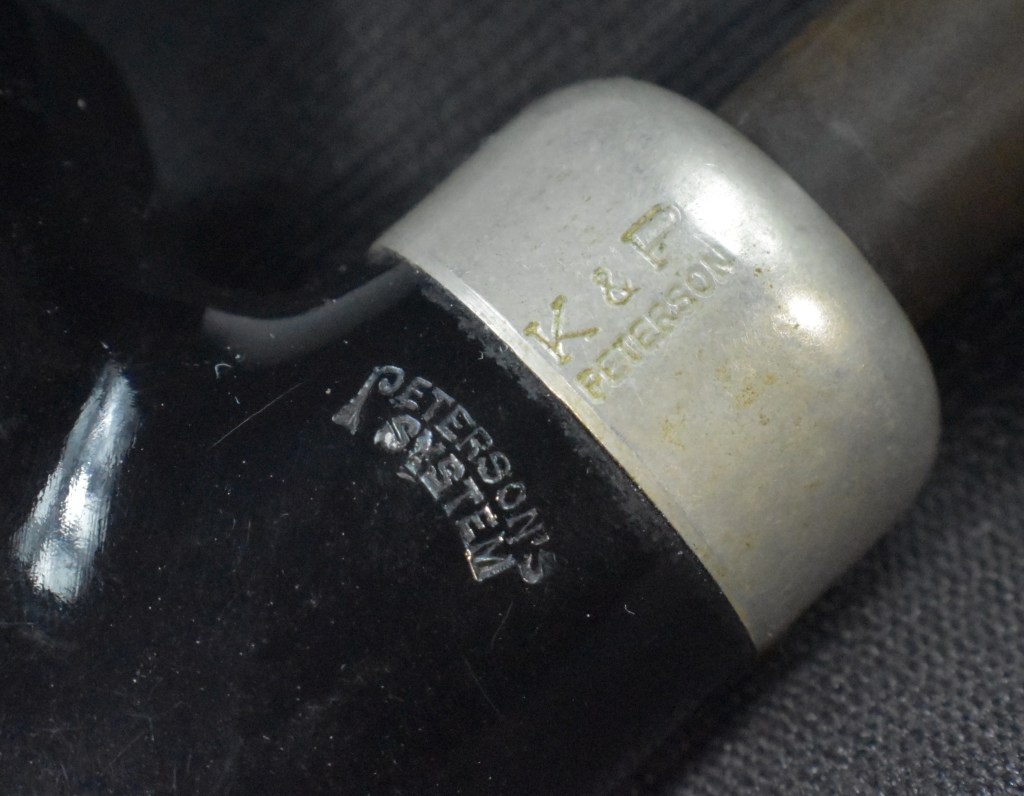
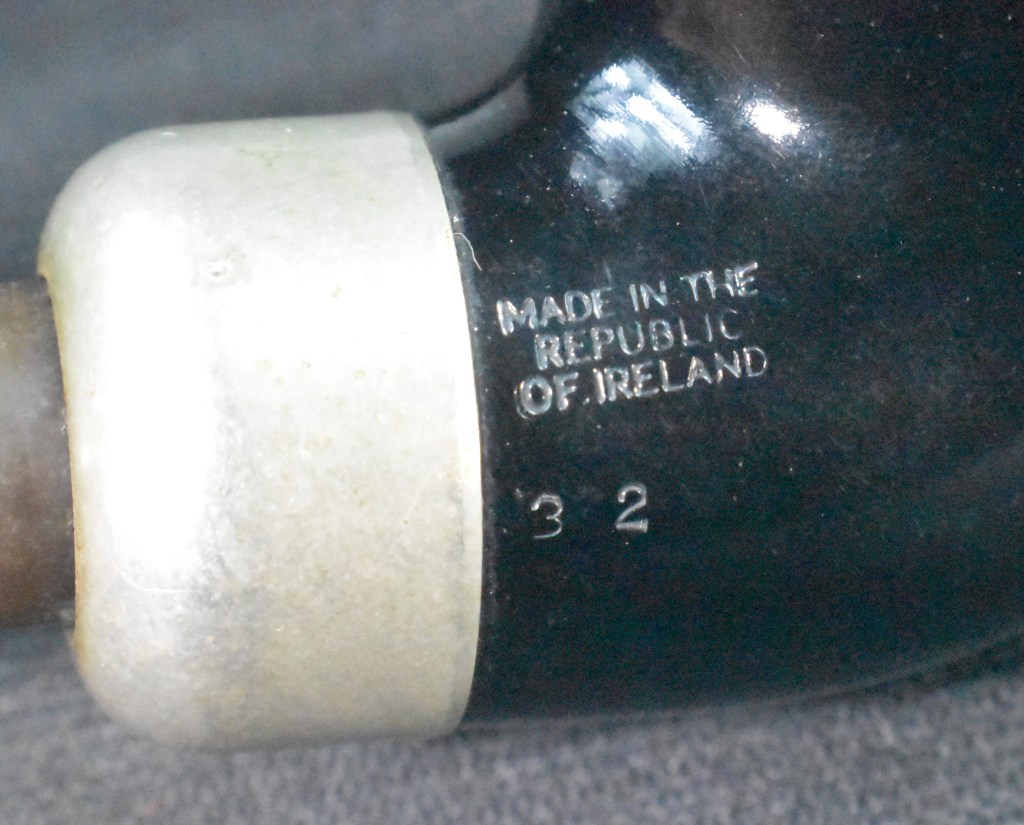
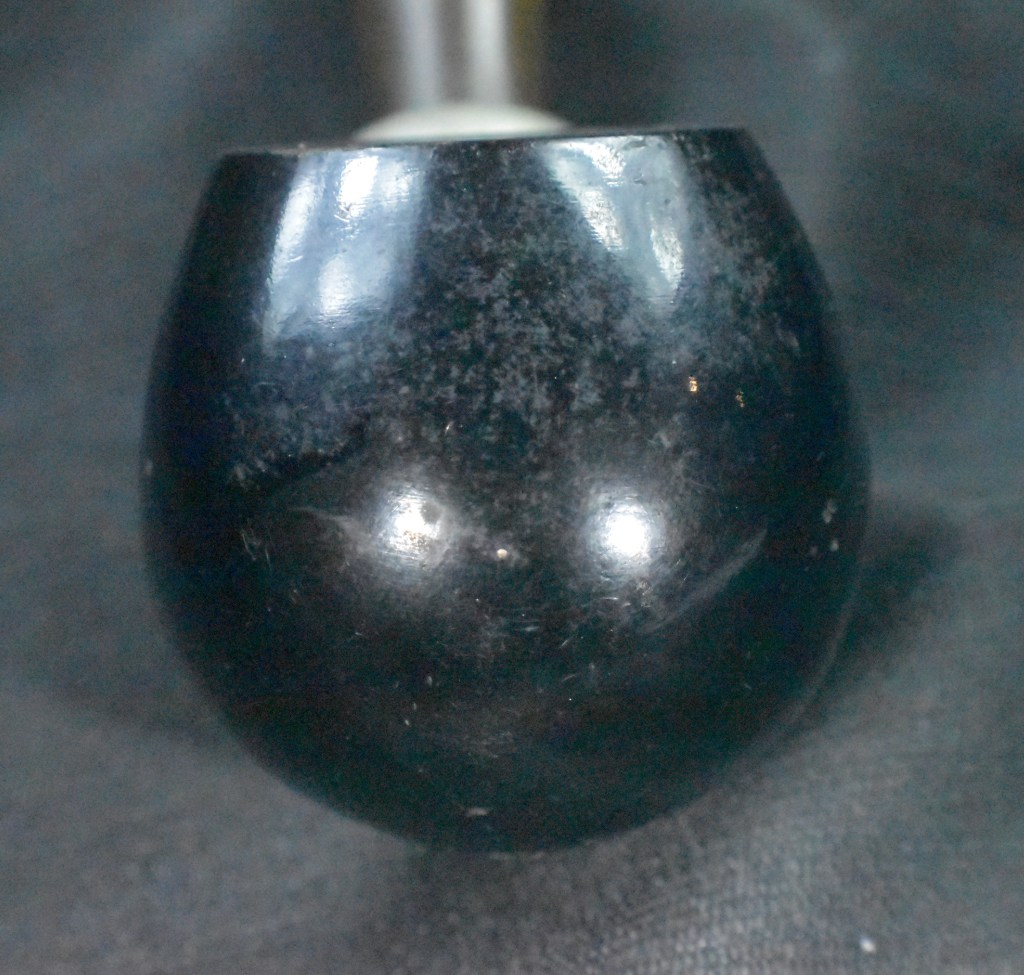
I have probably said this before, I love Peterson pipes and fishing. Now in fishing, catch and release is where fish are pursued,caught and then released. Hmm, I guess that didn’t need explanation. Anyway, a similar process can be done with pipes. A given specimen can be pursued, obtained, restored then collected or sold to a new owner. This restoration is even better than that, I got to restore a Peterson Ebony 302 for someone else. I didn’t have to pursue, obtain or look for a buyer. I’ve probably said this before too, “I’m lazy”.
Tom reached out to me to restore a well loved pipe of his. He apparently had been impressed with my restorations while abusing himself by reading my blog. He sent me some photos and I agreed to restore the pipe – it’s a Peterson, of course I’d restore it.
He packed up the pipe and sent it to the wilds of southeast Nebraska. Below are some photos taken prior to working on the Ebony.
Well loved, well used and well cared for, were terms that came to mind. The ebony finish was nearly pristine. I didn’t want to do anything to it other than cleaning and waxing except for the rim – that would take a bit of work. There was a light cake in the tobacco chamber and the reservoir showed signs of frequent use. The nickel collar was tarnished and should buff nicely. The stem was suffering from oxidation and looked to be where the majority of time would be spent. Overall this was going to be a fun project.
Background
I had to count how many Peterson pipes I had blogged about. I ran out of fingers and toes but used the dog’s feet to assist in the task, then I got sidetracked, darn ADHD. Let’s just say between 30-40. Adding to that all the pipes restored prior to blogging would likely put the number at closer to 100. Have I mentioned that I like Peterson pipes?
Back to the background. Peterson pipes or Kapp and Peterson, if you prefer, is the oldest operational pipe manufacturer in the world. Summarizing the history of Peterson would require a large book and perhaps a blog. Good thing Mark Irwin has provided both of these: The Peterson Pipe: The Story of Kapp and Peterson, written by Mark Irwin and Gary Malmberg, and petersonpipenotes.org (PPN). For a less lengthy summary Peterson – Pipedia provides a nice article.
For this pipe in particular I refer to Mark’s blog post on Ebony finished Peterson pipes: 367. A History of Peterson’s Ebony Finish, With Help from Sykes Wilford and Adam Davidson – Peterson Pipe Notes. As Mark discusses in the post, the ebony finish is difficult to perfect. This is the main reason I was glad to see that Tom’s 302 was in such great shape. It relieved me of having to try to reestablish a beautiful ebony finish myself. The 303 was added to Peterson’s line-up in 1978. Here is a description of the 303 from PPN:
“302 Extra-Large Apple. 1978-Present.
Length: 5.75 in. / 146.05 mm. Weight: 2.30 oz. / 65.20 g. Bowl Height: 1.72 in. / 43.69 mm. Chamber Depth: 1.39 in. / 35.31 mm. Chamber Diameter: 0.80 in. / 20.32 mm. Outside Diameter: 1.74 in. / 44.20 mm.
The 302 and its smaller, less jowly sibling the 303, first appeared in the 1978 Peterson-Glass catalog and were issued simultaneously as the De Luxe Systems XL2S (later 2S) and 3S, the Classic Range 02 / XL02 and 03, and in the Dunmore System as the 70 and 73. Peterson describes the 302 shape as “an extra-large apple” in the 1986 catalog and the 303 as a “medium apple.” If you look at this bowls closely, whether in new or vintage pipes, you’ll notice there are actually two shapes, one wider at the back and bottom of the shank and the other more rounded. This stems, I suspect, from outsourcing to two different bowl sources, as the difference is too great to be merely a sanding problem. In any event, I like and smoke both. The fat-bottom seems to have been the model for the Lestrade Sherlock Holmes, XL23. For both the 302 and 303, it’s worth seeking out the early-issue mouthpiece versions (pre-1990), some being quite short and some longer, but all possessing the wide saddle and the Comfort P-Lip.” (146. A Guide to System Shapes, 1896 – 2019, Part 1 (The 300 Shape Group) – Peterson Pipe Notes). To narrow down this 303’s historyI again refer to Mark Irwin’s PPN with two quotes
1) “From 1979 until now many Pete lines have been given the ebony treatment” and
I suppose I could just ask Tom, when he got this pipe, eh? That is what I did and here is his reply: “Yessir I got this last year from an estate sale in the heights in Little Rock. The fella that owned it was a huge part and mentor of many pipe smokers @ The Pipe & Tobacco Shop in Little Rock. I had no idea that all the pipes I bought at his estate sale were his. It’s a huge honor to have some of his pipes but my memory of his name I just can’t remember. He was around 90 when he passed.” (personal communicationTom Gilliam, AKA: AR Piper). Tom then said he would reach out to the owner of the shop.
The 302 made the 20 foot journey from the photo table to the workbench.
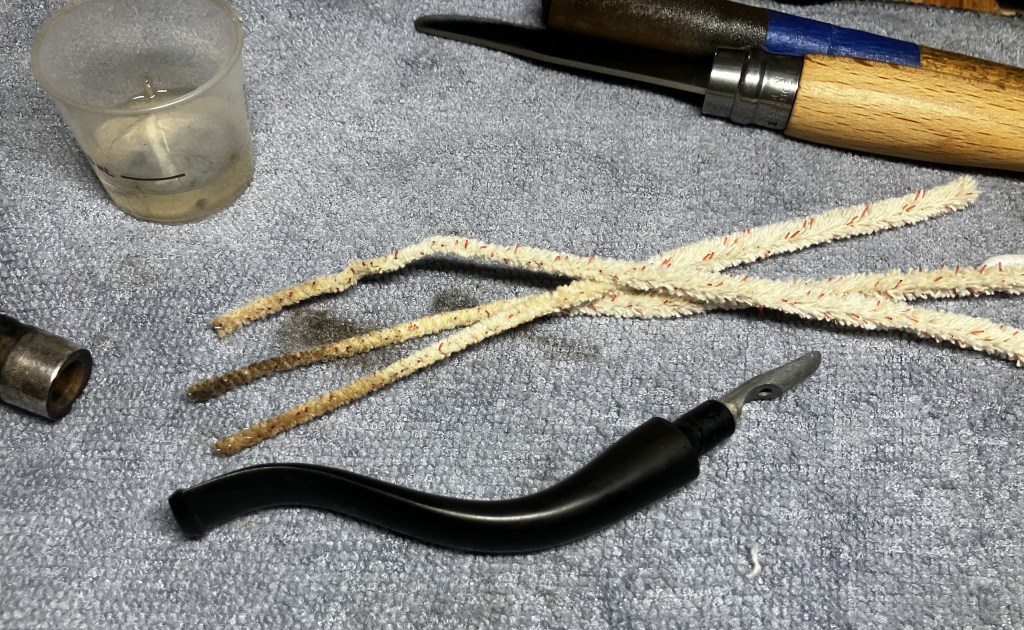
I began with the stem, cleaning it with 99% ethyl alcohol, cotton swabs and bristle pipe cleaners.
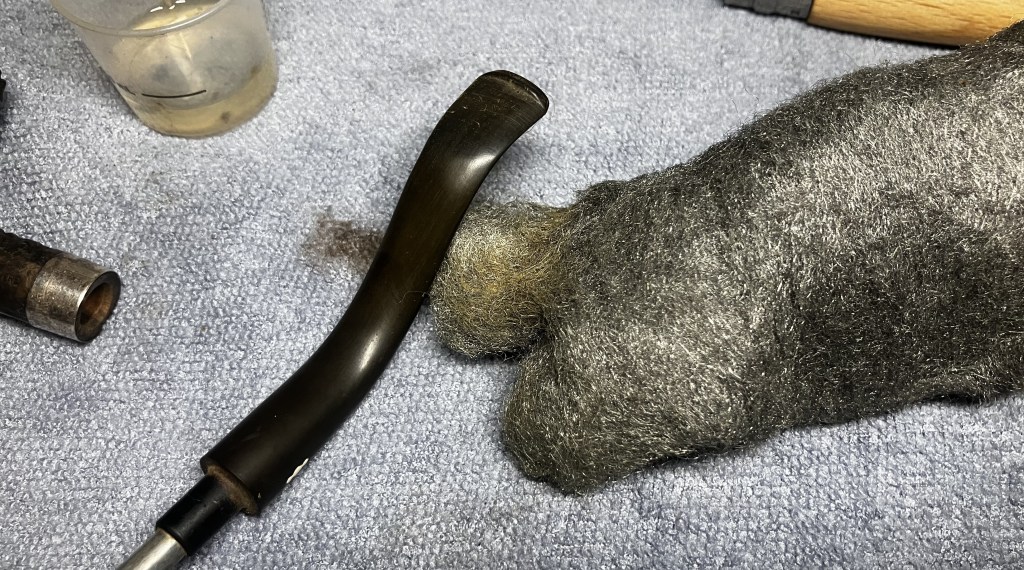
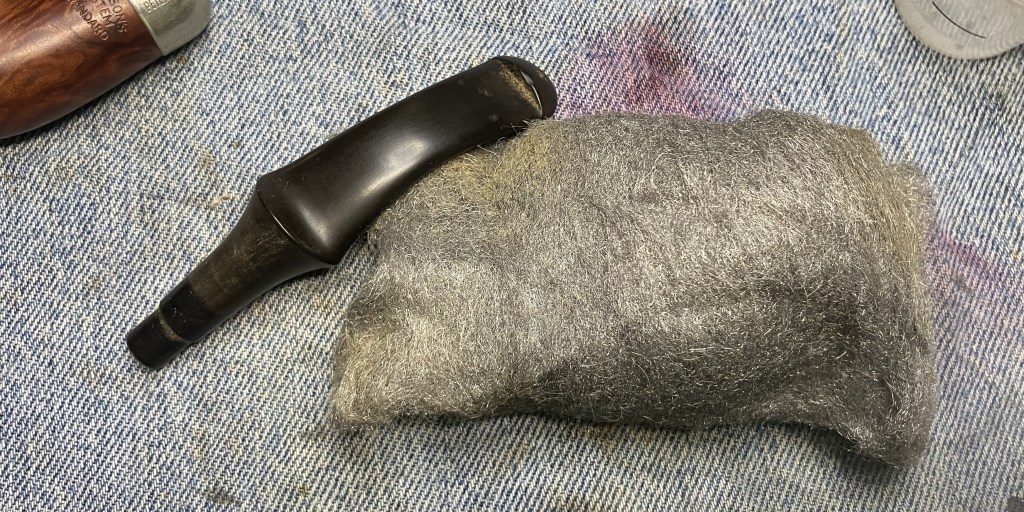
The surface of the stem was rubbed with 0000 steel wool to remove some of the surface oxidation.
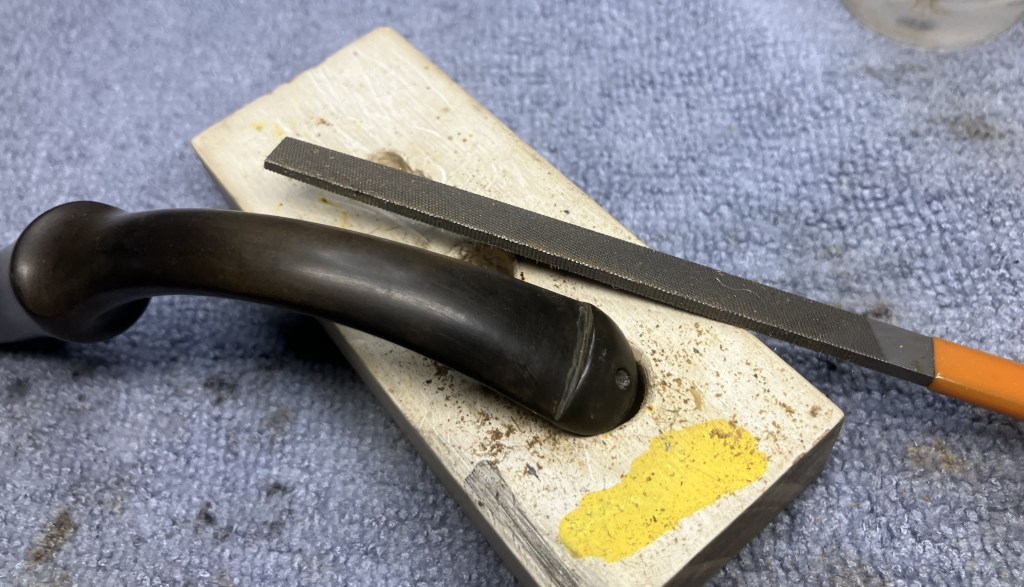
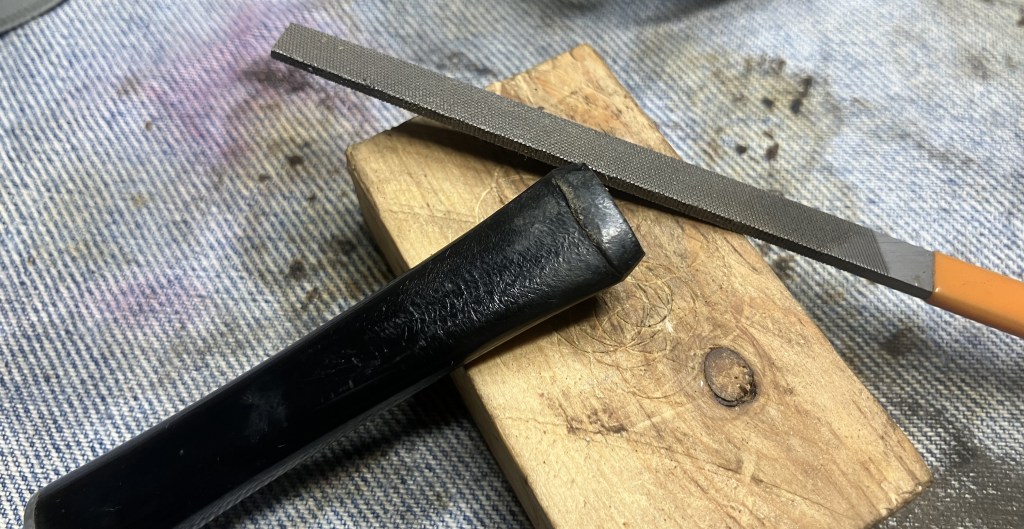
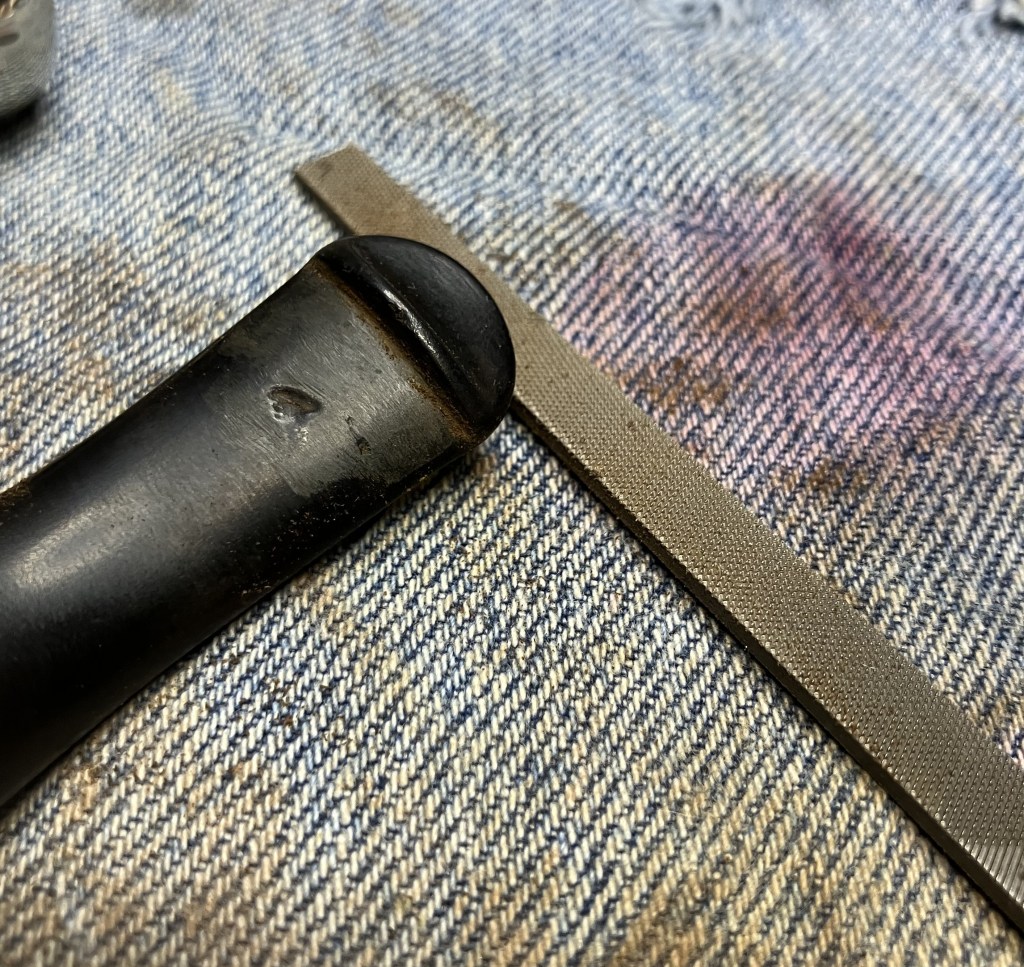
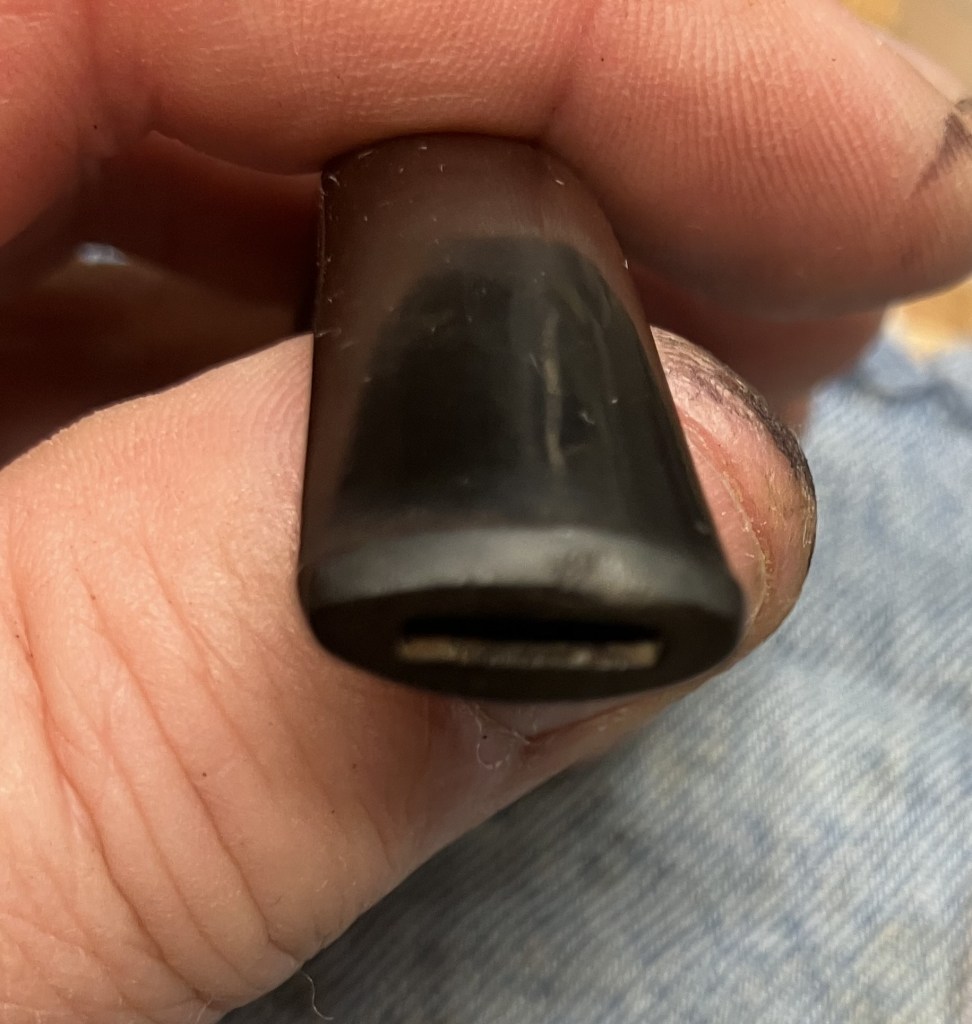
I used a small flat file to sharpen the edges of the button.
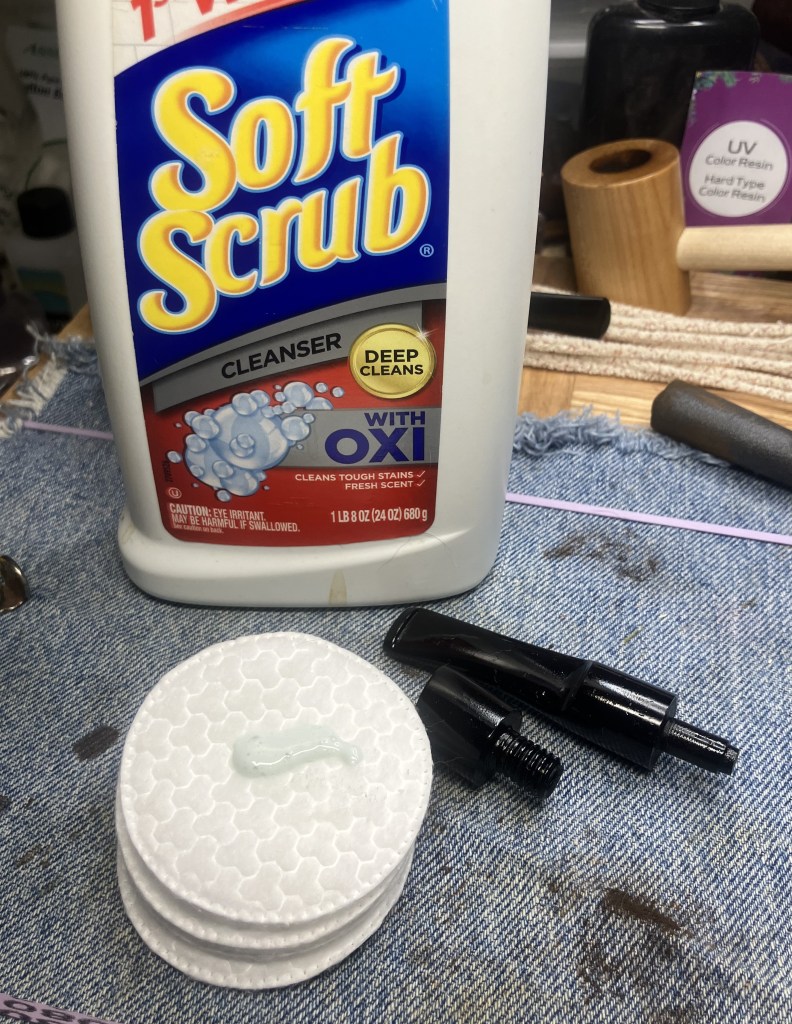
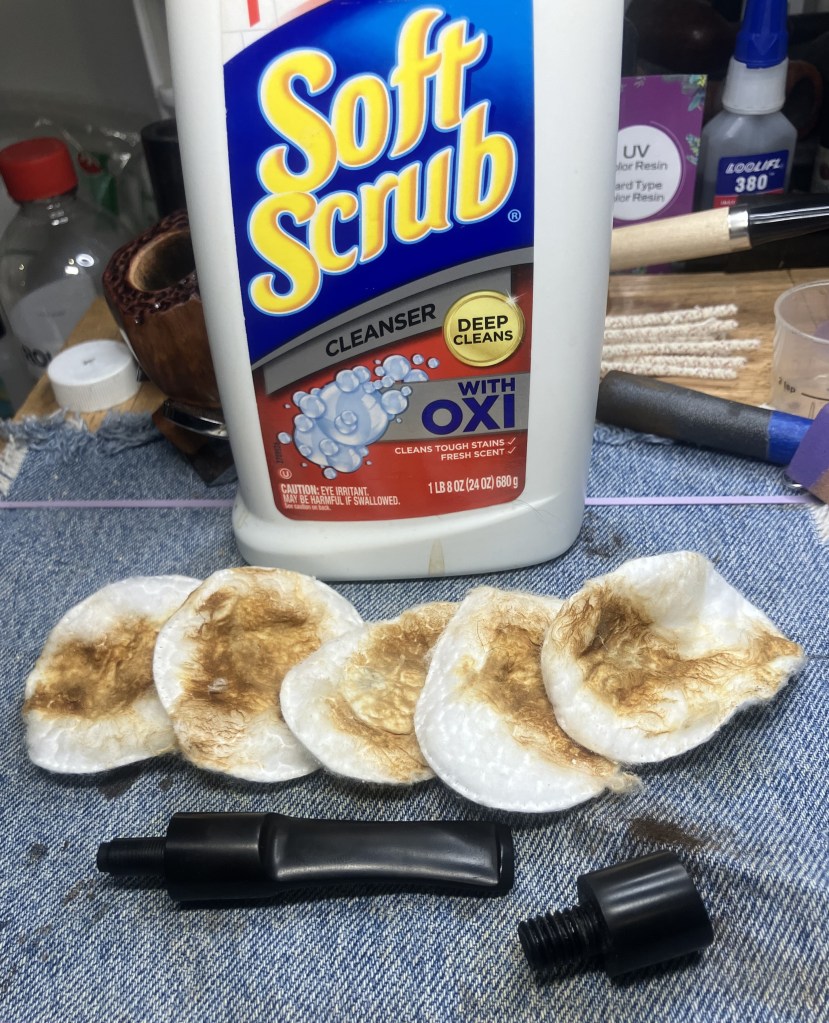
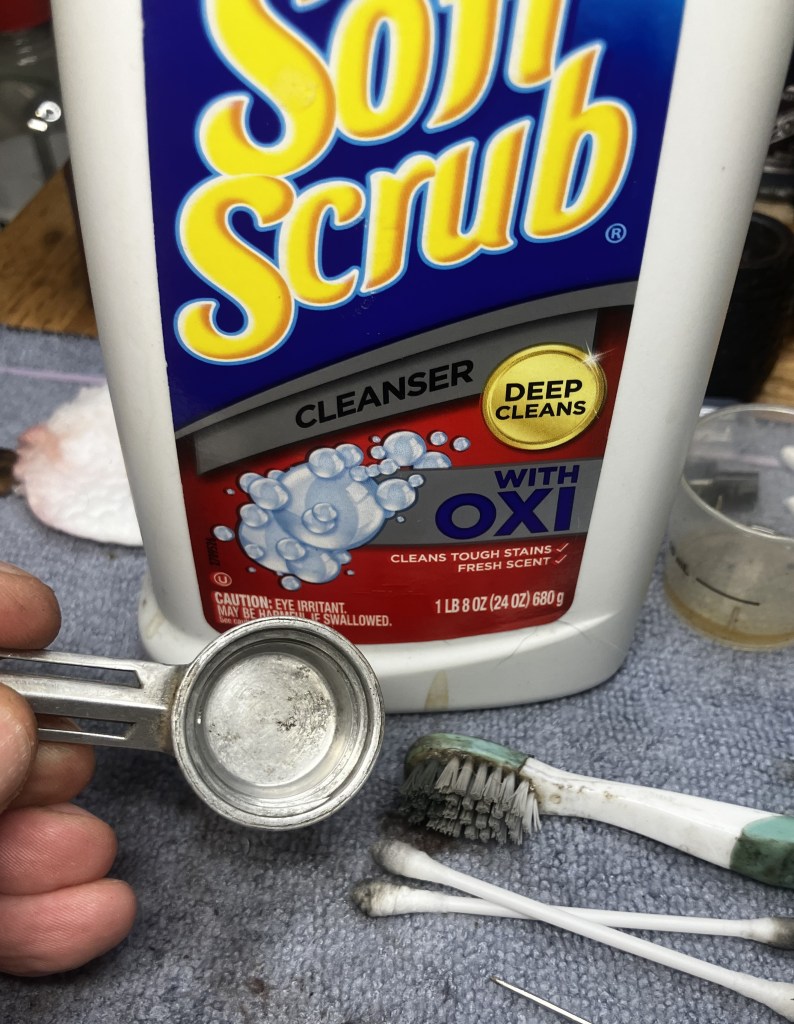
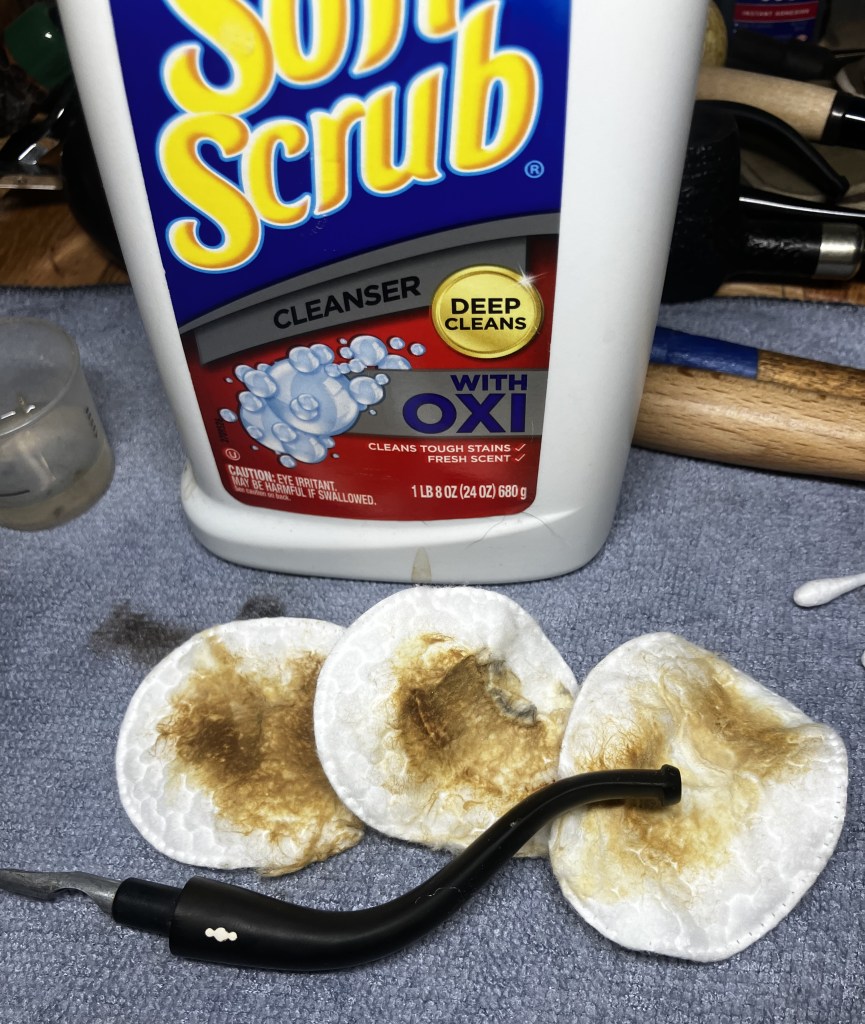
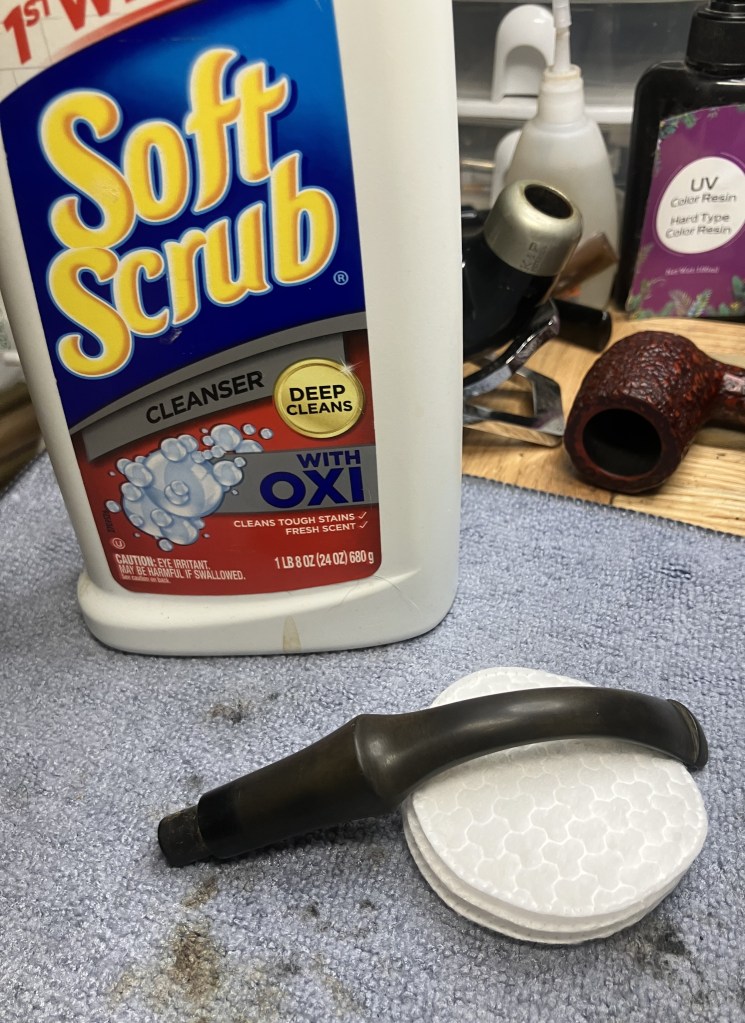
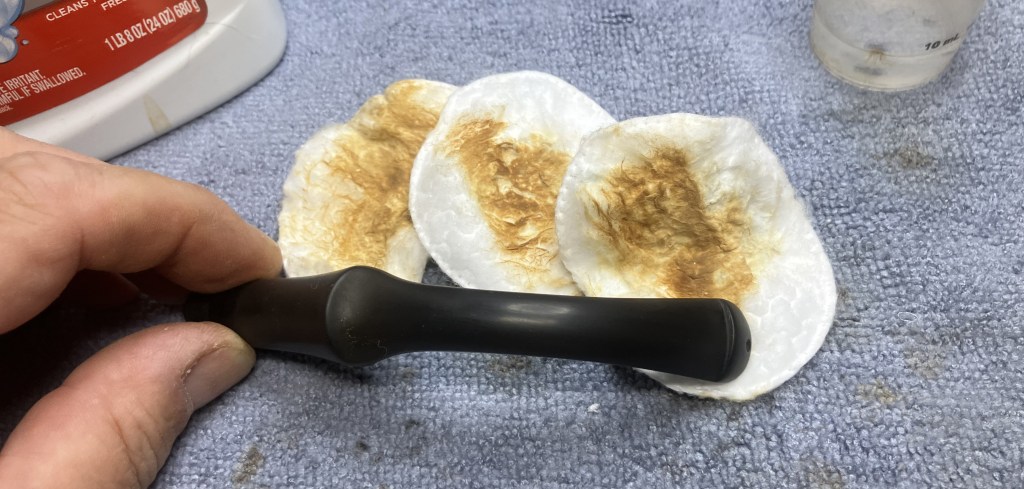
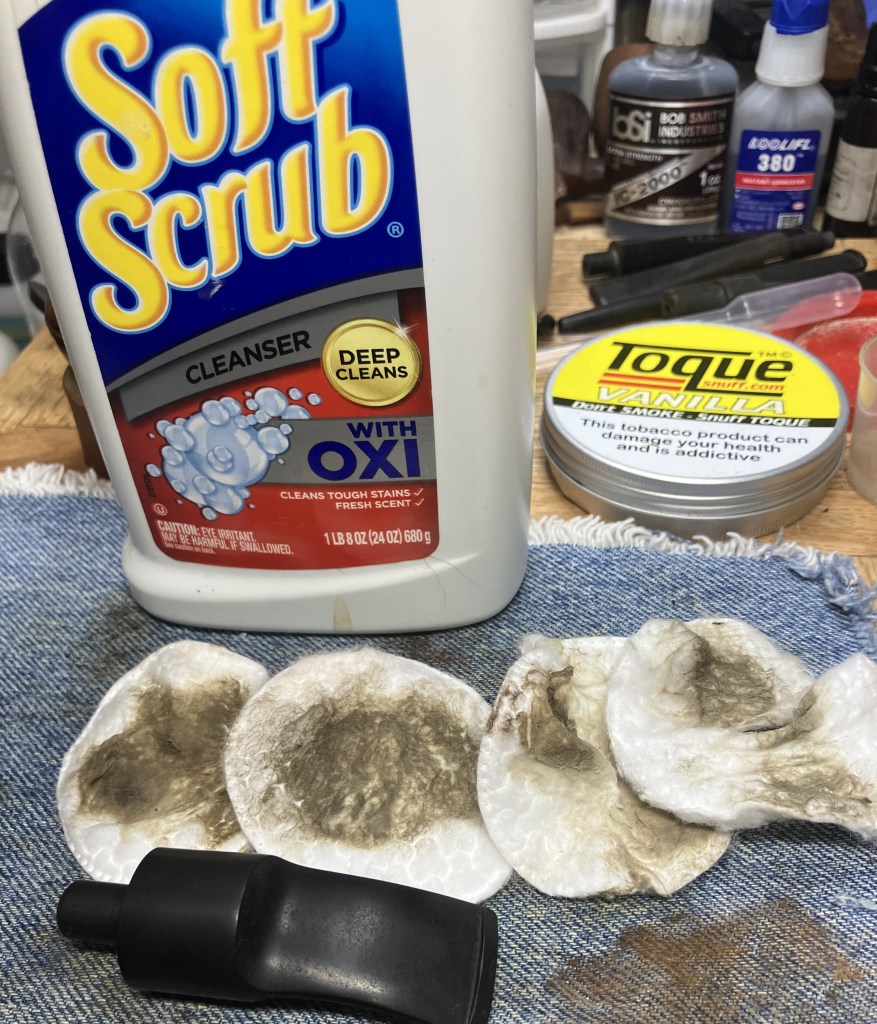
Next, the stem was scrubbed with Soft Scrub cleanser on make-up pads.
This removed more of the surface oxidation.
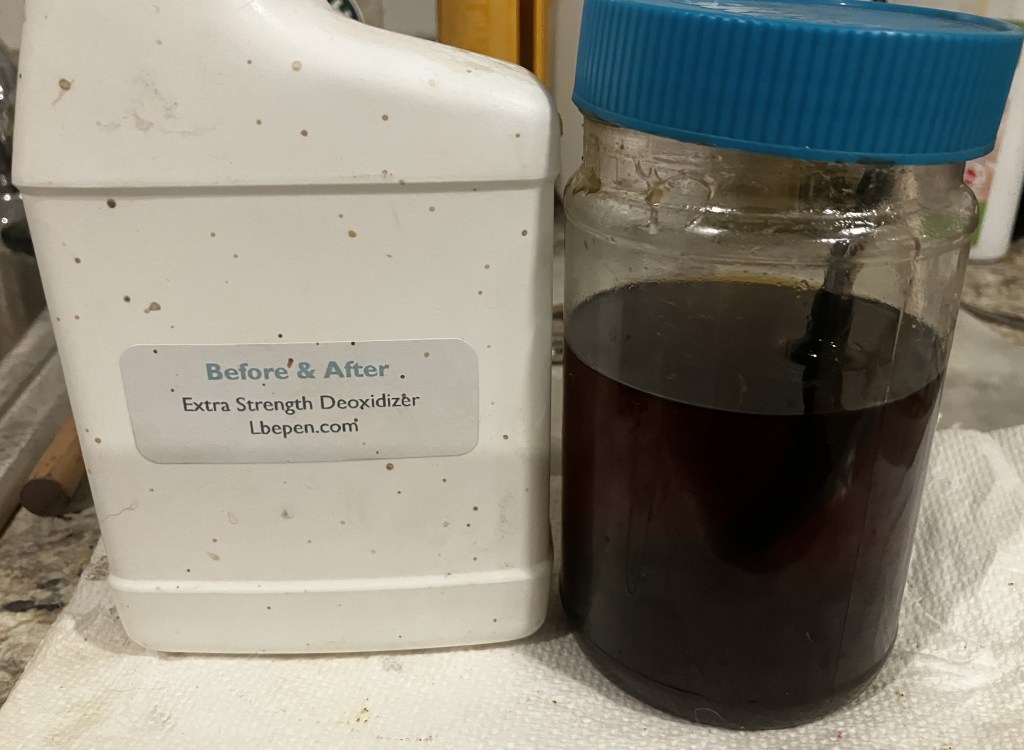
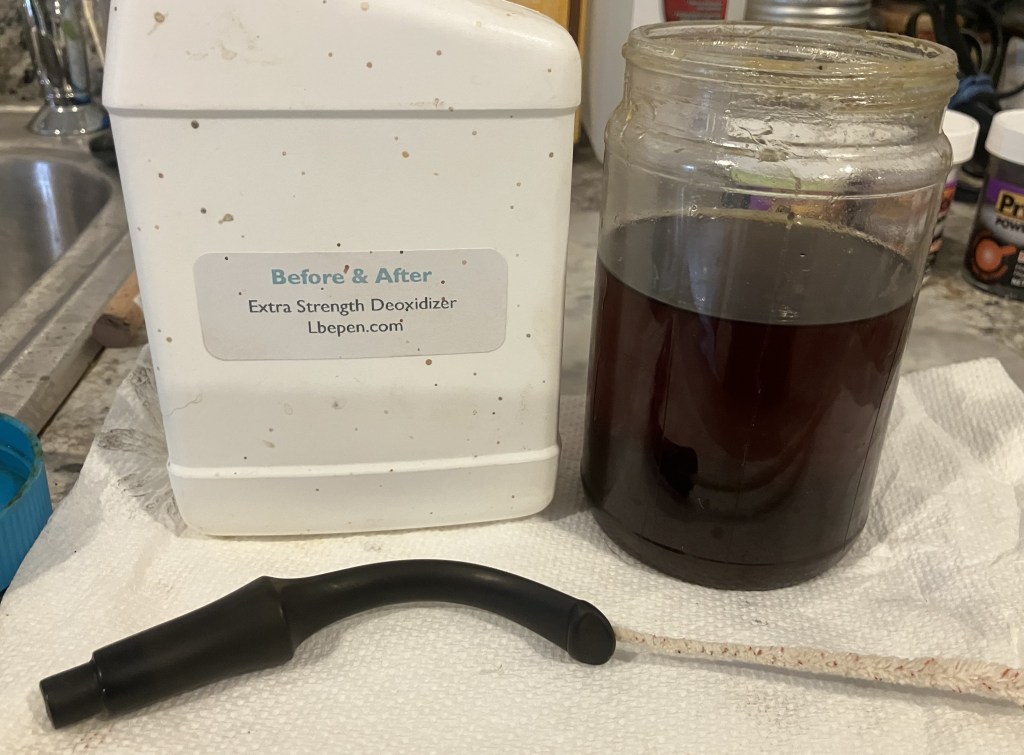
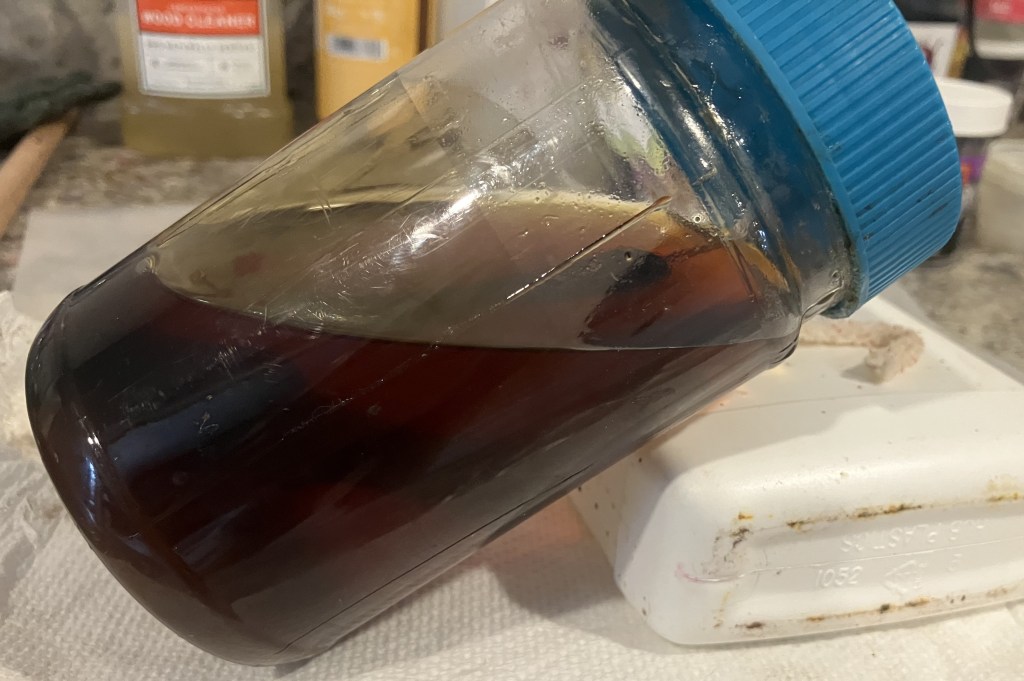
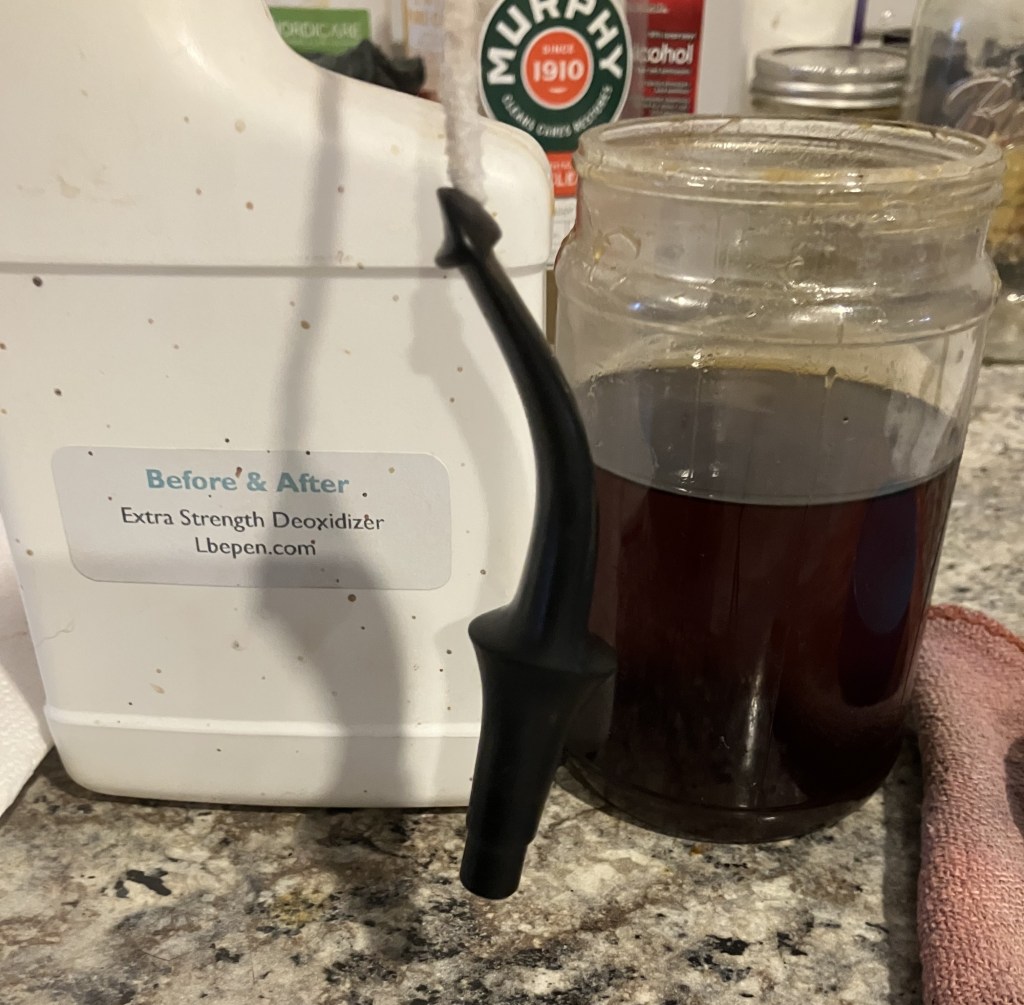
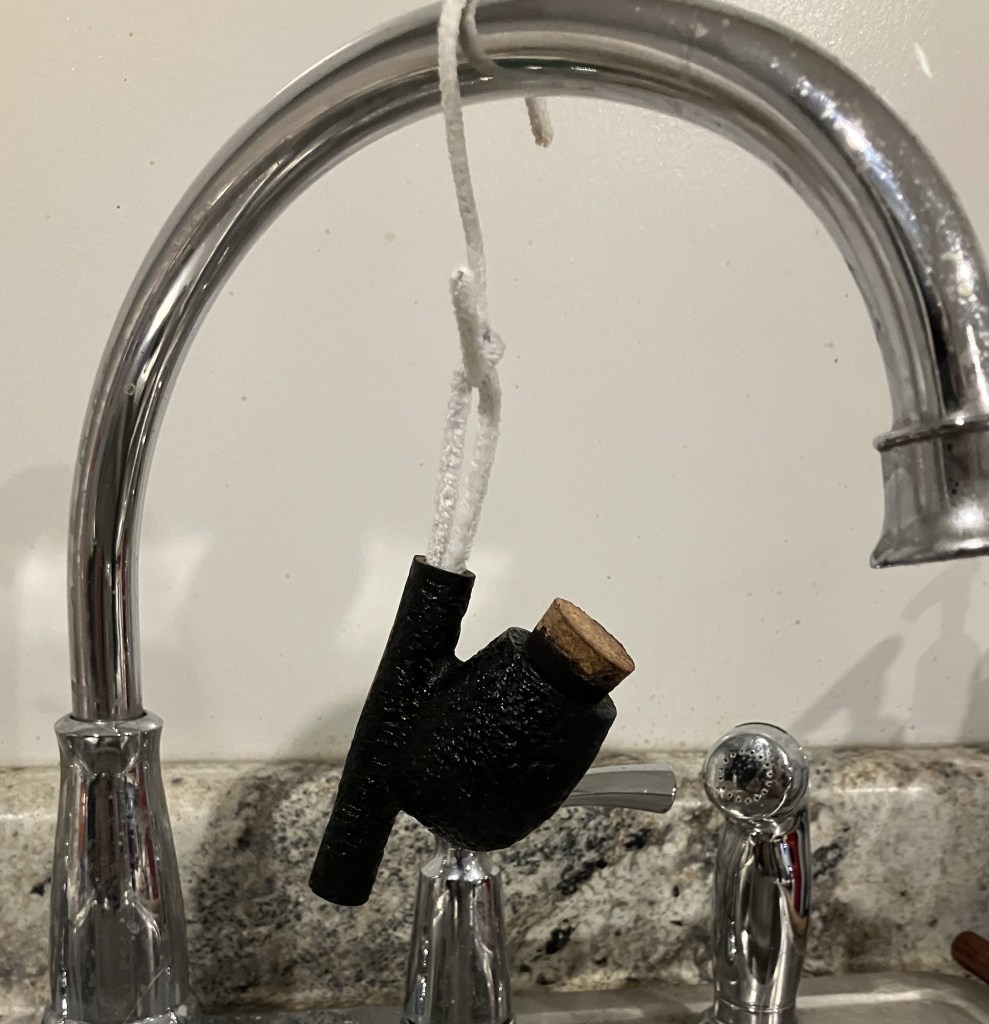
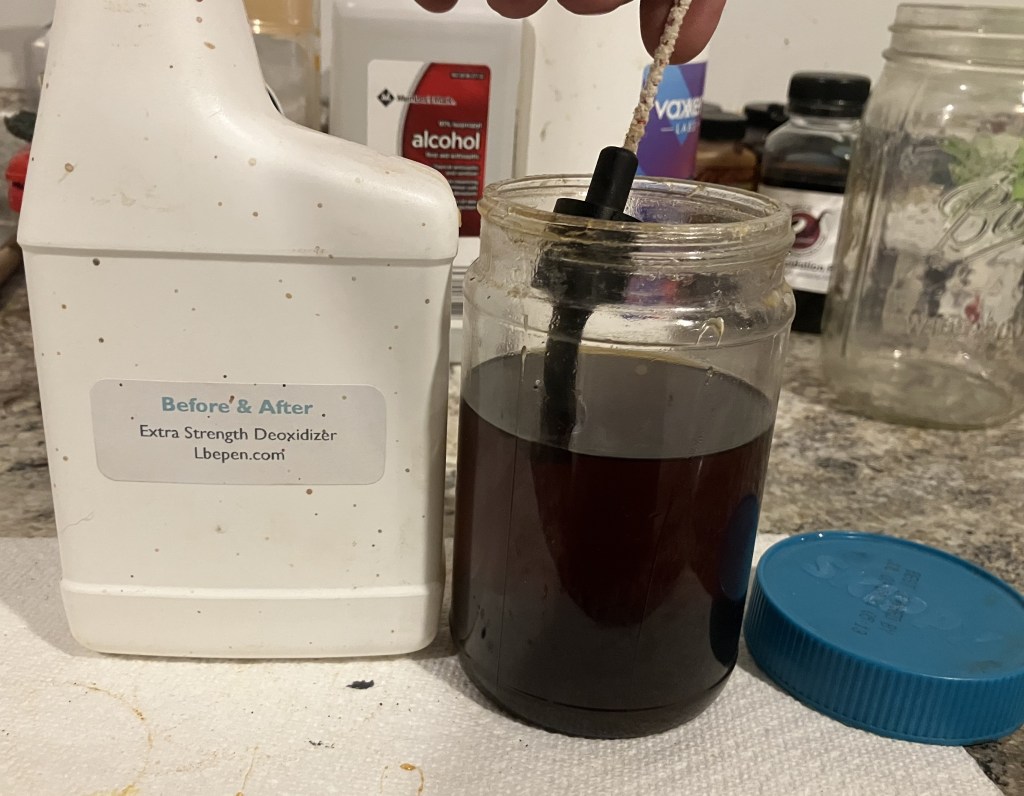
A pipe cleaner was inserted into the airway and the stem was suspended in Before and After Extra Strength Deoxidizer (deox).
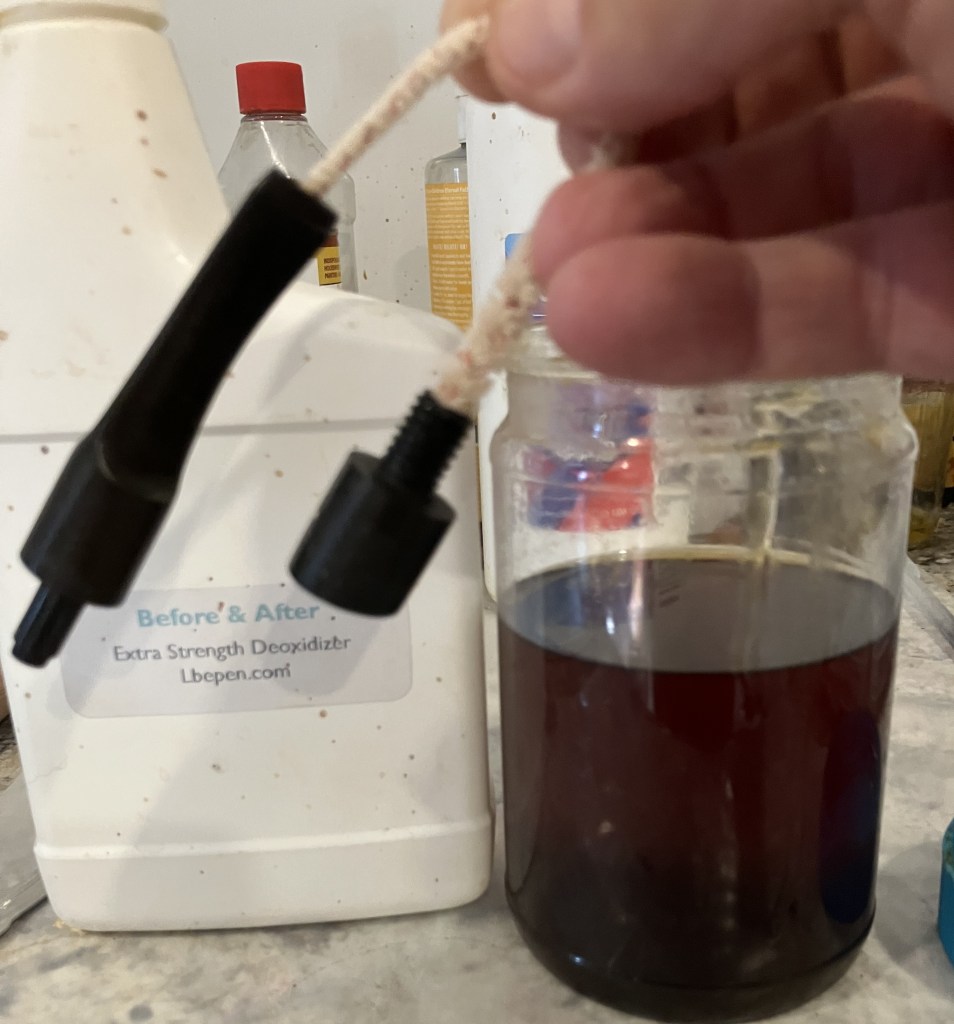
This stem was a bit longer than the depth of the deoxidizer so I propped the jar at an angle to fully submerge the stem.
I turned my attention to the stummel and the light layer of cake within.
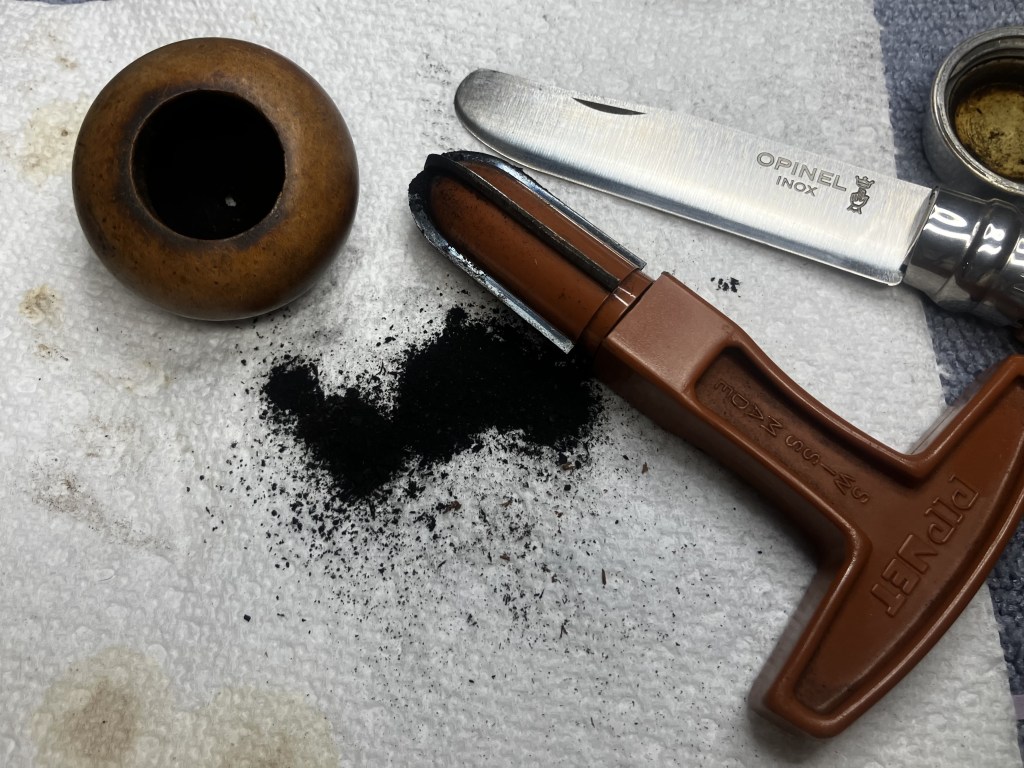
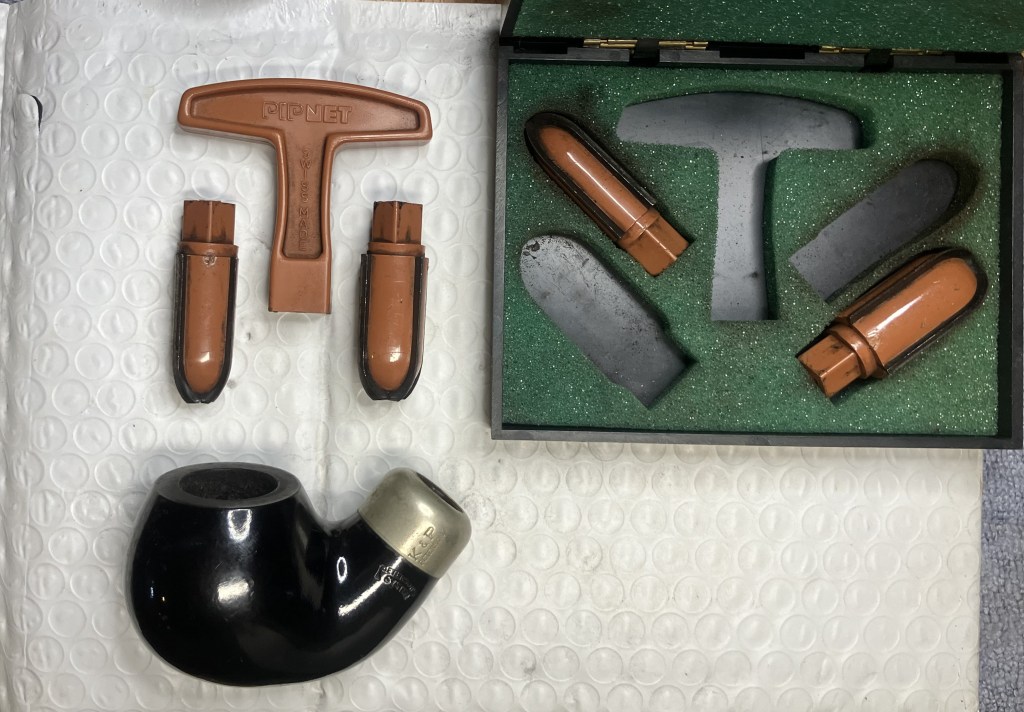
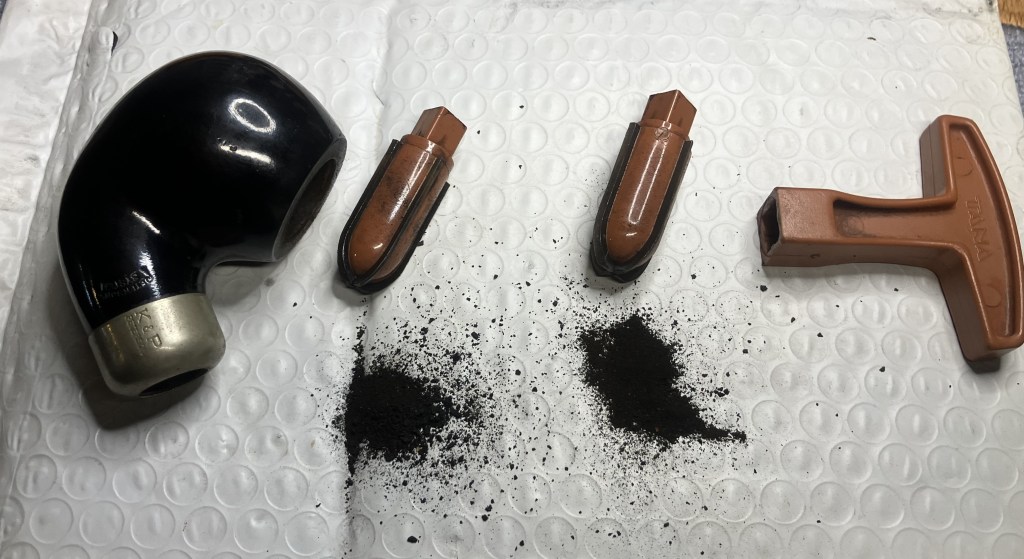
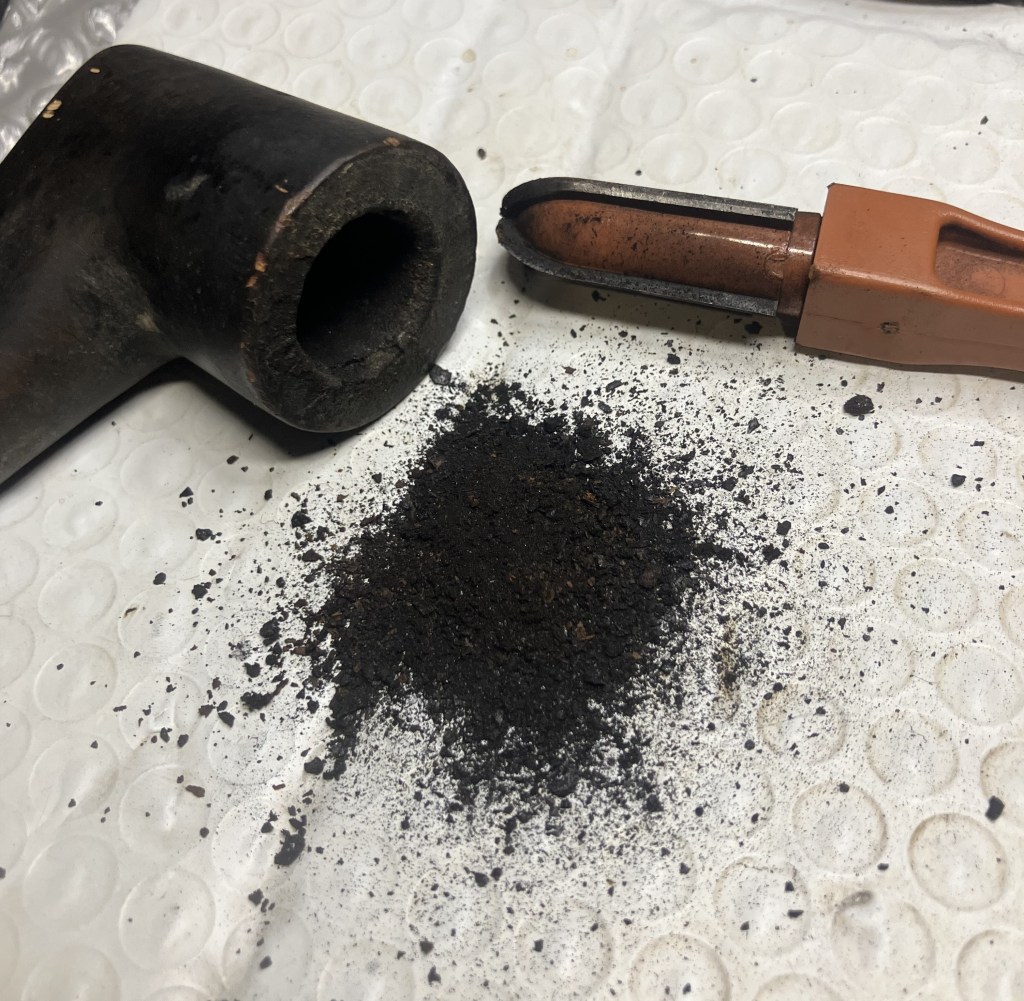
The number 2 and 3 blades of the PipNet worked very nicely.
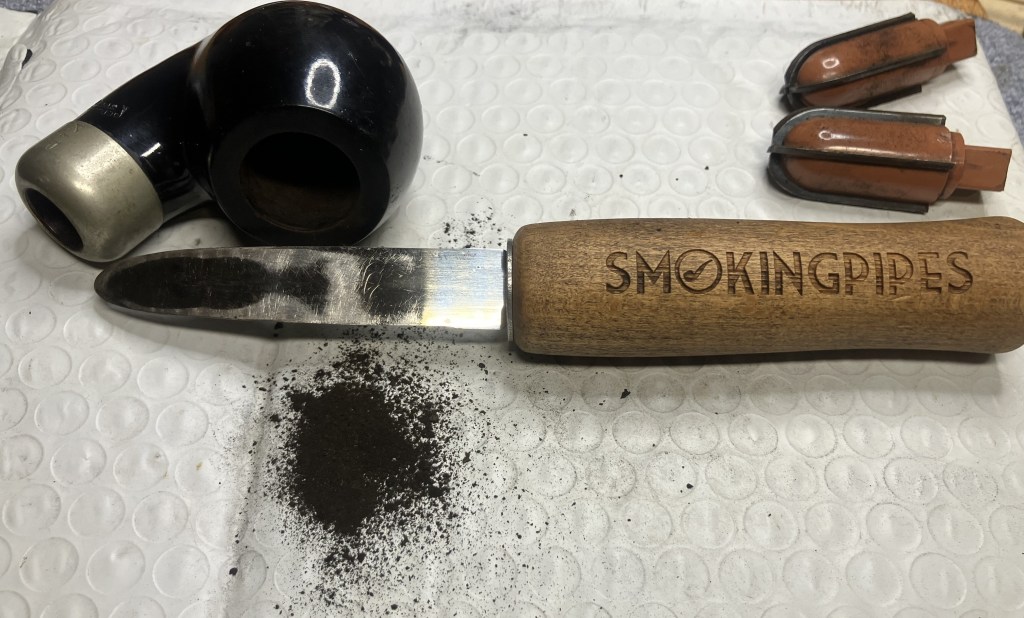
There was a small amount of clean-up that had to be done with a Smokingpipes Low Country reamer.
Looking down the tobacco chamber, I couldn’t see any signs of damage due to excessive heat.
Sanding the tobacco chamber with 220 sandpaper wrapped around a wood dowel then with 300 grit paper and my finger. Exposing the bare briar within the chamber confirmed the excellent condition of the tobacco chamber.
It was at this point I started cleaning out the shank and reservoir. This took a rather large number of alcohol dipped cotton swabs and bristle pipe cleaners. I also used a dental scraper and a nylon shank brush, also dipped in alcohol. I apparently failed to photograph any of this process. I could have sworn I took photos but there was nothing on the phone. Feel free to use your imagination of a pile of soiled cotton swabs.
To the sink! The stummel was taken to the sink for a scrub with undiluted Murphy Oil Soap and a nylon brush. The soap was rinsed with warm water and the stummel dried with a cotton hand towel.
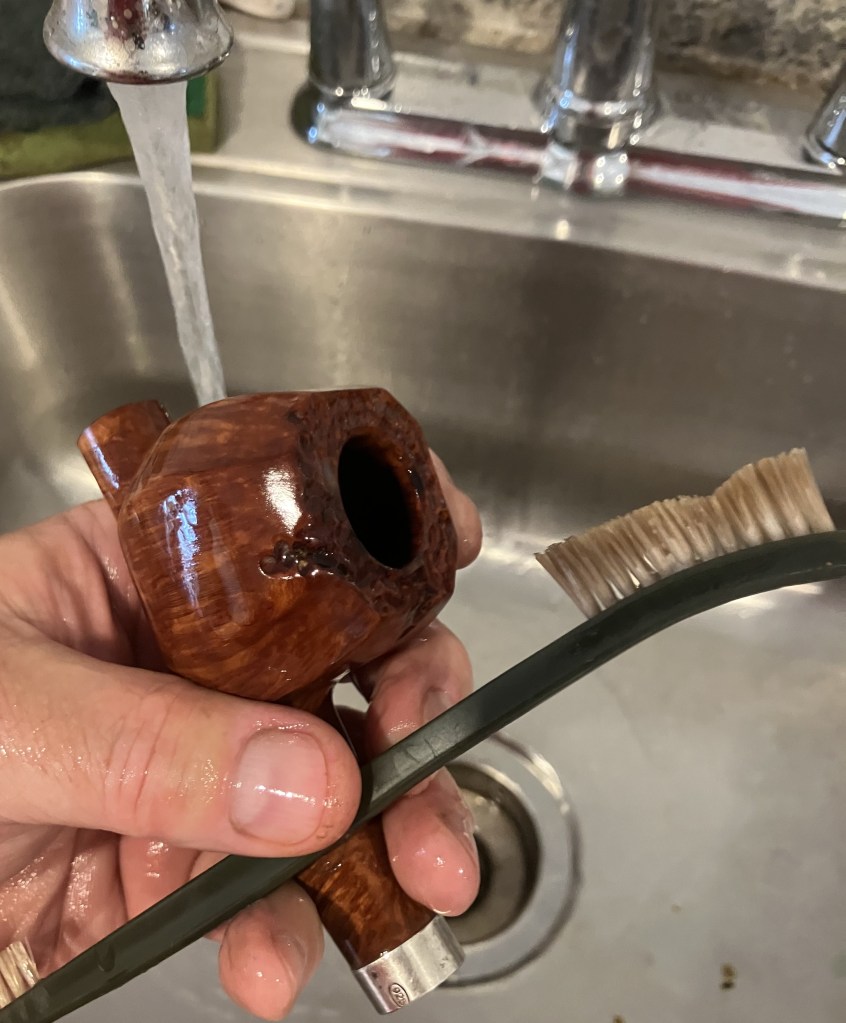
The stummel looked great except for the tarnished collar.
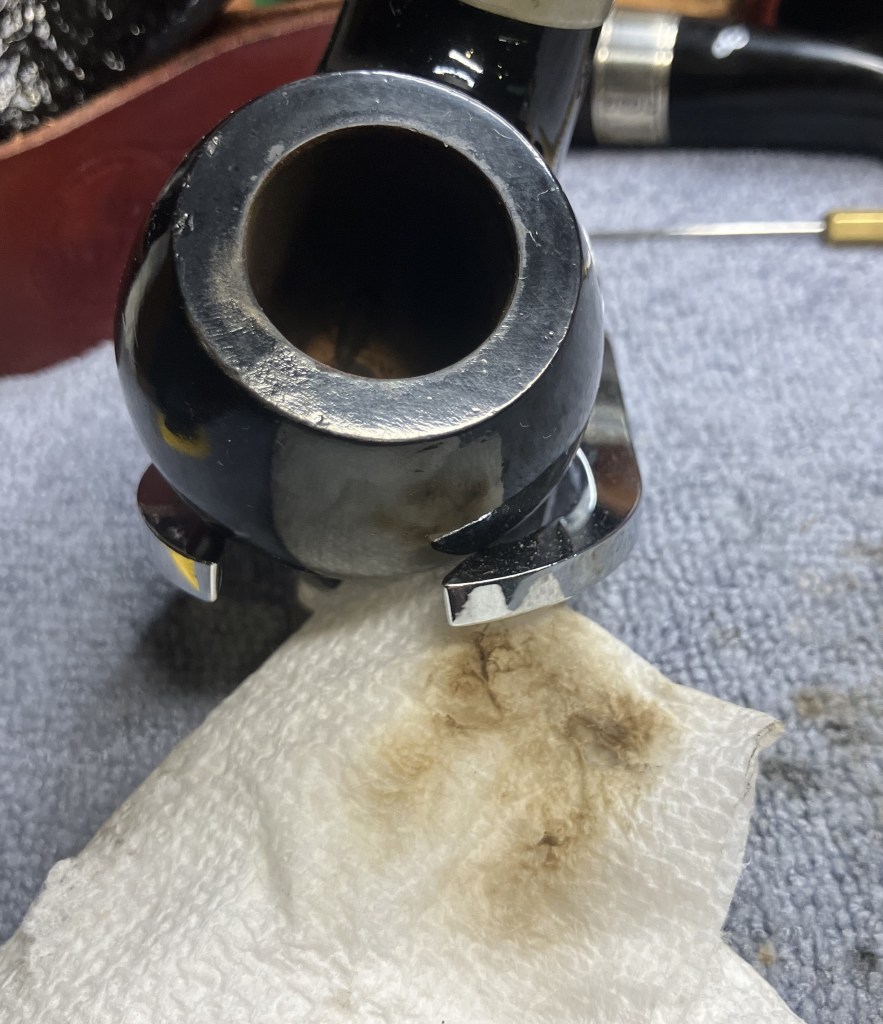
I was hoping that the scrub would remove the light lava deposits from the rim. Wrong. Normally I would scrape the rim with a sharp knife blade but I did not want to risk marring the ebony finish.
A more conservative approach was used – alcohol dipped cotton swabs.
The cotton swab scrubbing was slow and still there remained either some lava or slightly charred edges.
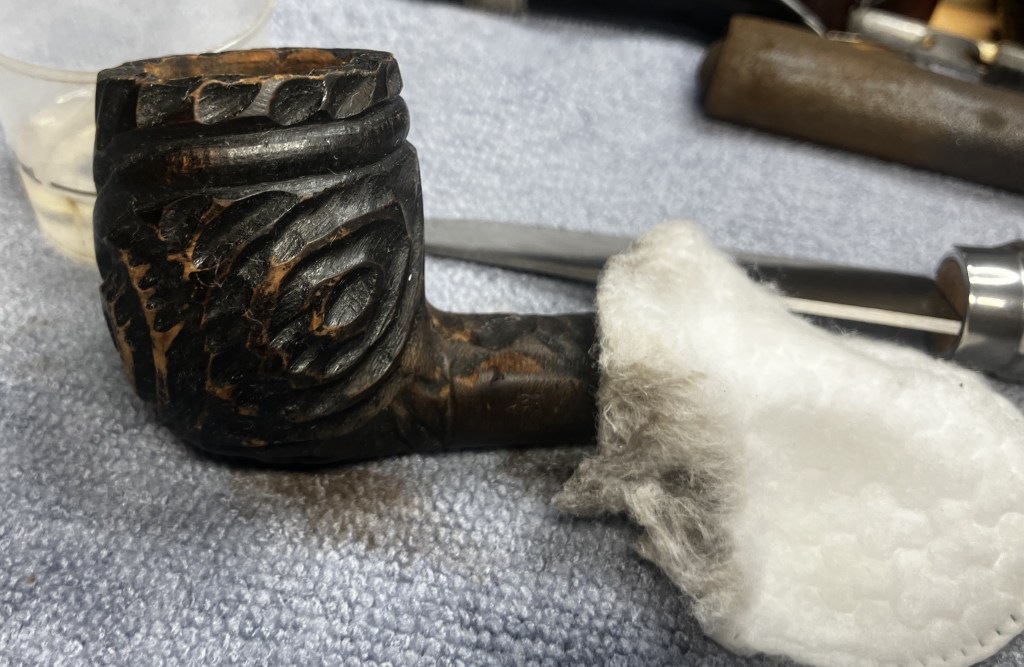
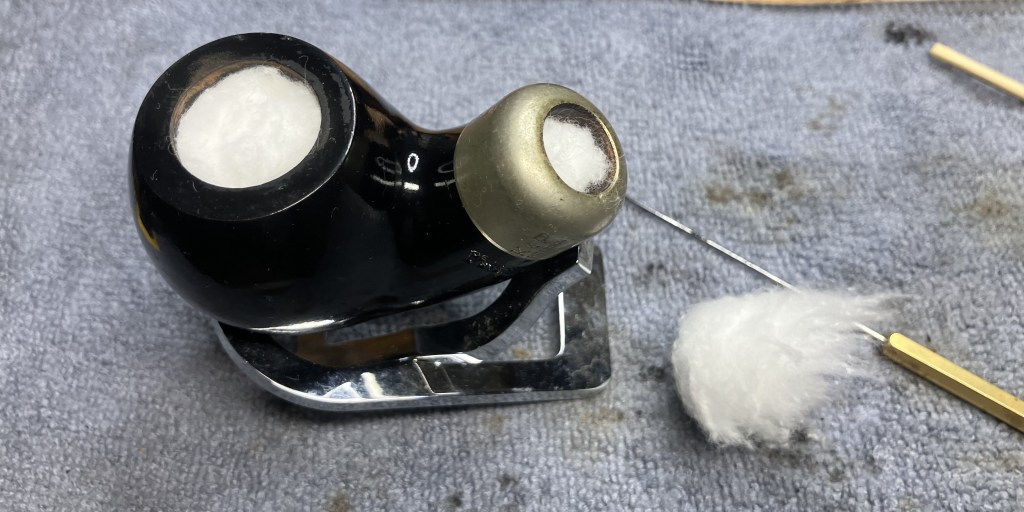
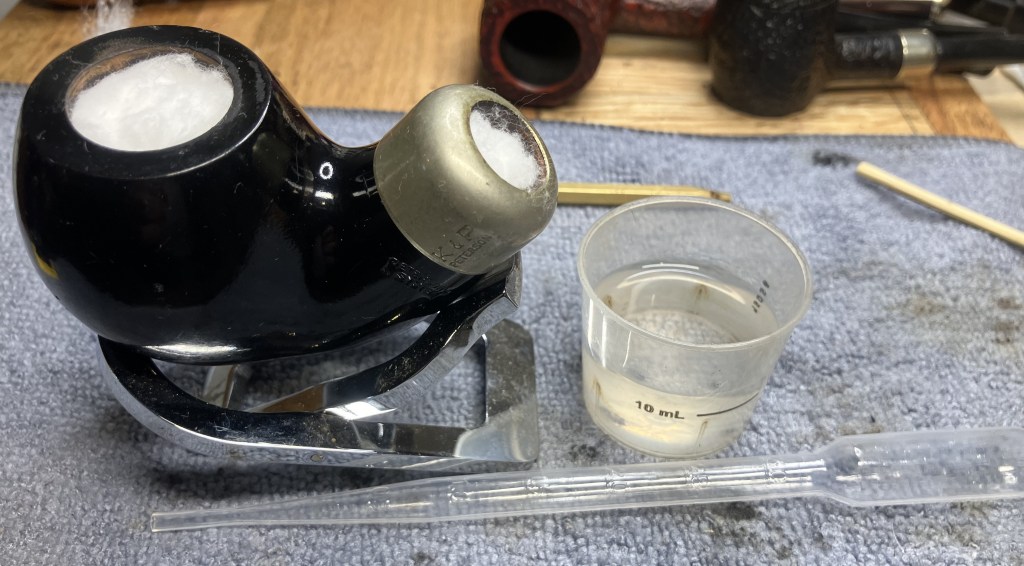
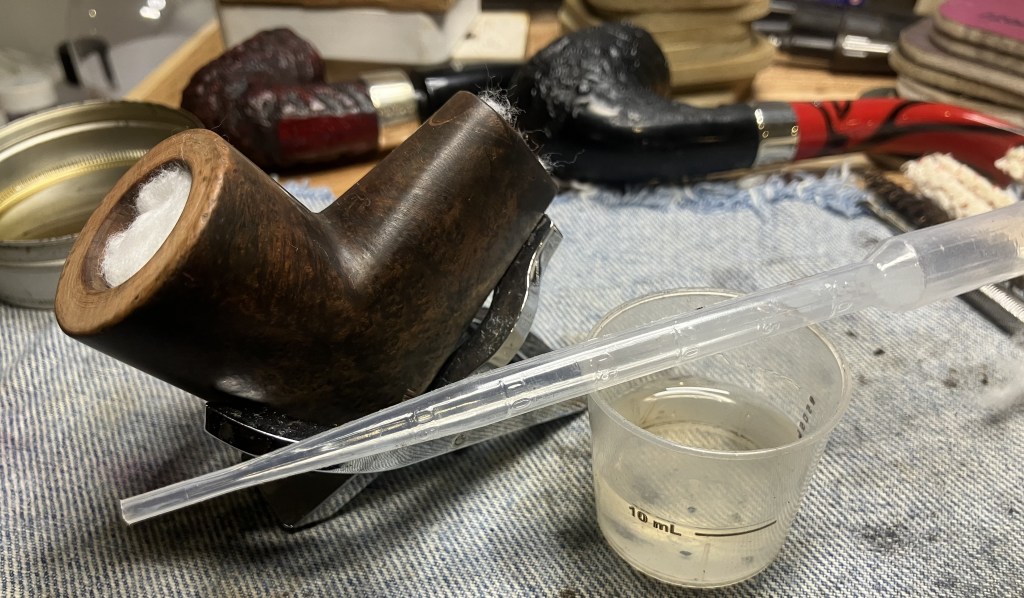
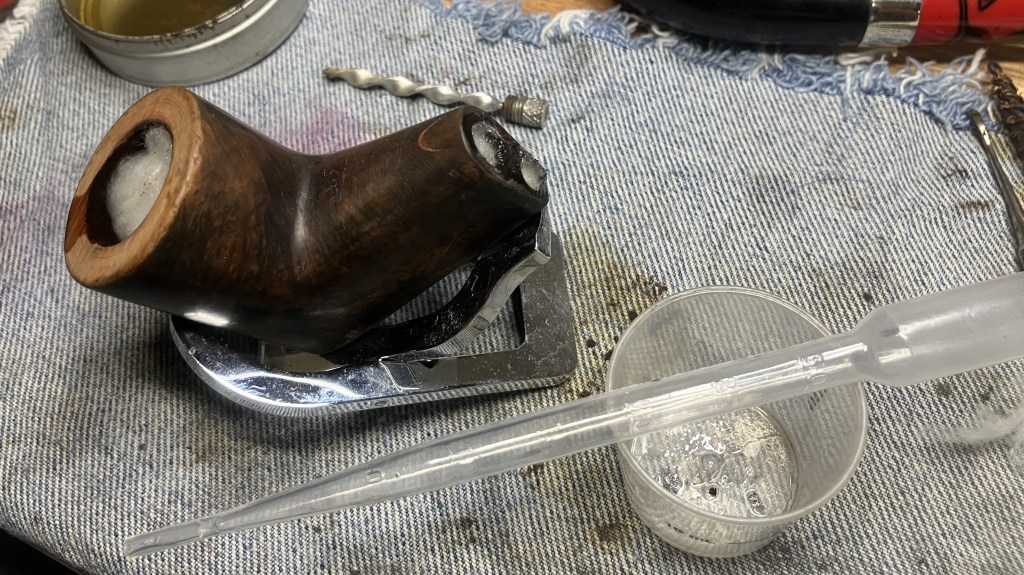
I needed time to think about how to deal with the rim so I figured I would do an alcohol cotton treatment. This would also help in loosening the remaining tar deposits within the airway, reservoir and shank. The bowl and airways were packed with cotton.
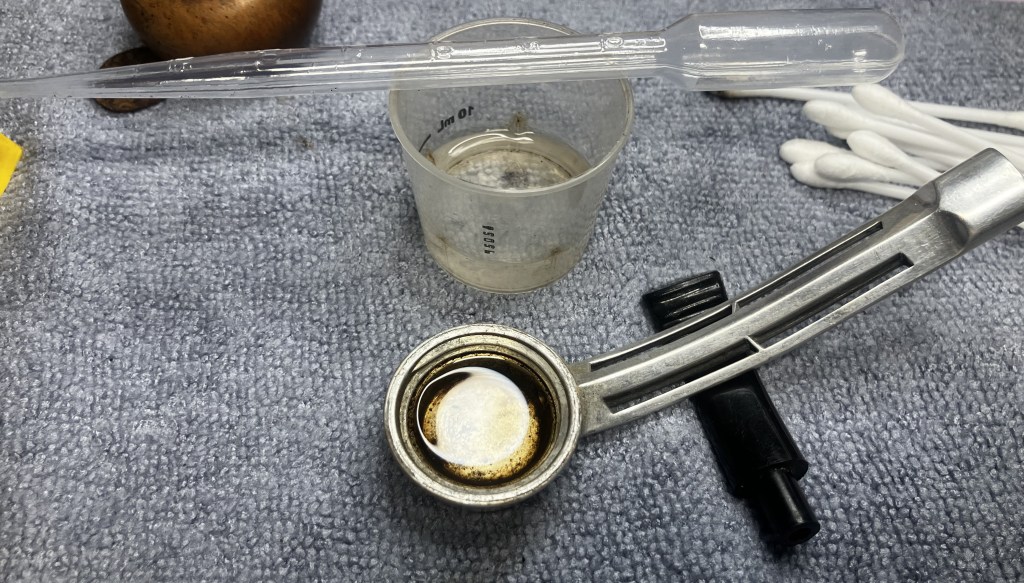
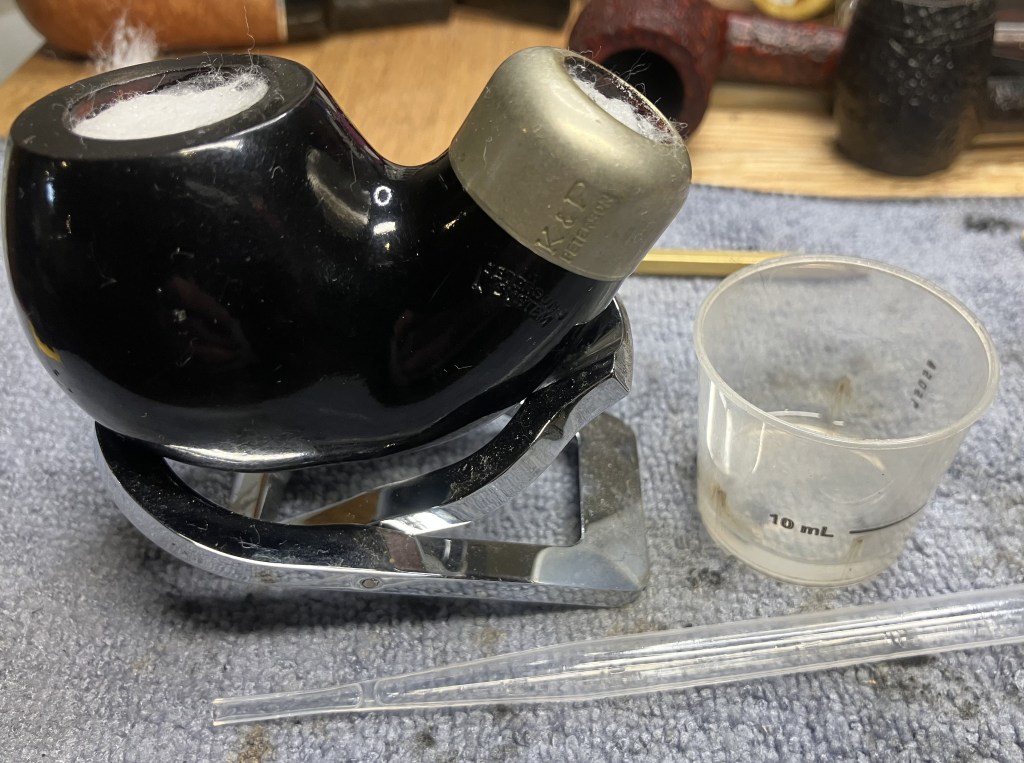
Since this was a larger chambered pipe, I figured about 12-15 ml of 99% ethyl alcohol would be needed. This would be added using a disposable pipette.
I was close, it took about 11 ml of alcohol to saturate the cotton.
8 hours later I returned to the pipe. The alcohol had dissolved the residues in and on the briar. As the alcohol evaporates these dissolved bits are moved to the cotton.
The cotton was removed.
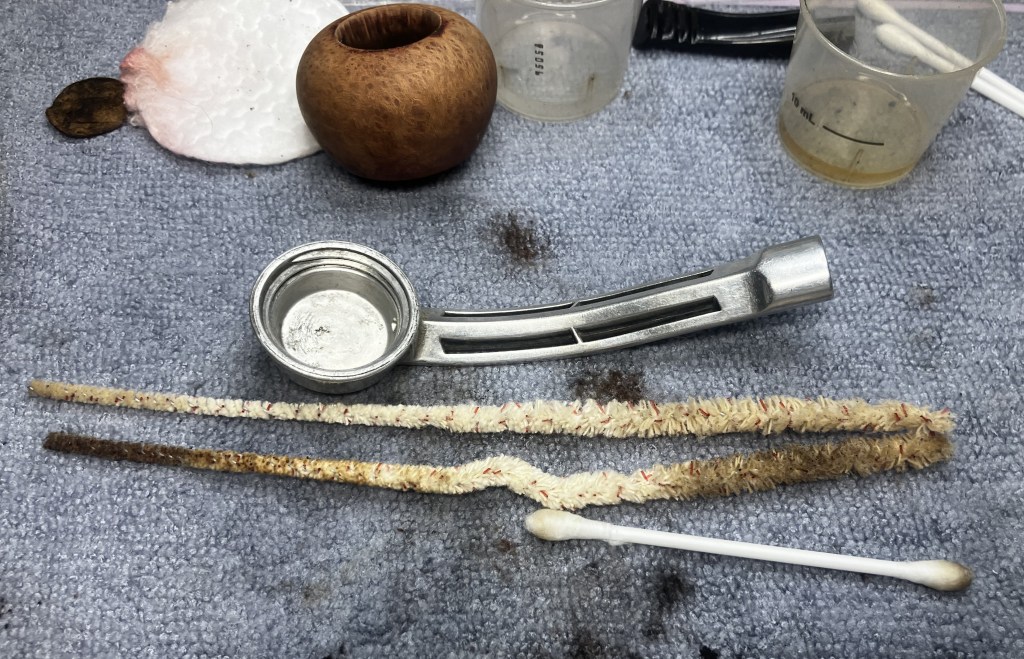
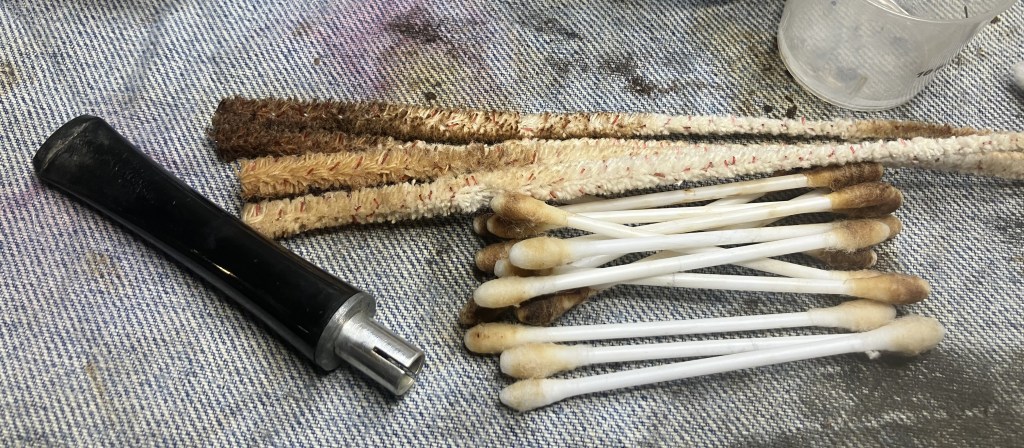
Another round of airway cleaning commenced. The heavily stained pipe cleaners are from the draft hole between the tobacco chamber and the airway of the shank. I had apparently forgotten to clean this during the early cleaning of the shank. This was probably due to me being very busy forgetting to take photographs.
Anyway, the shank and reservoir were now clean.
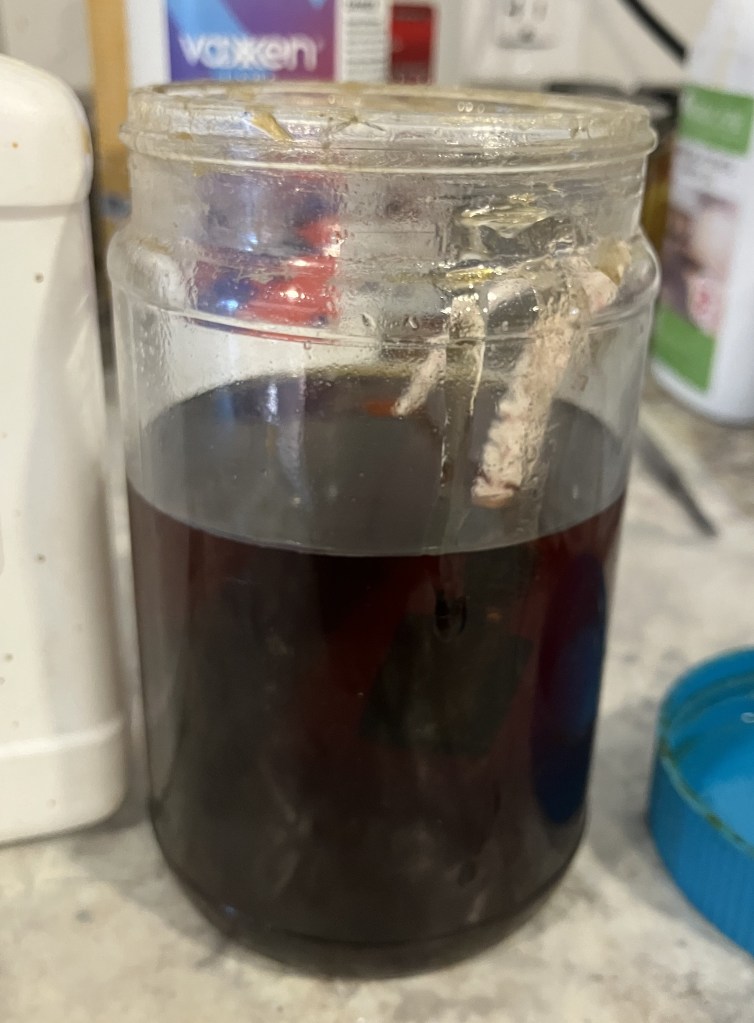
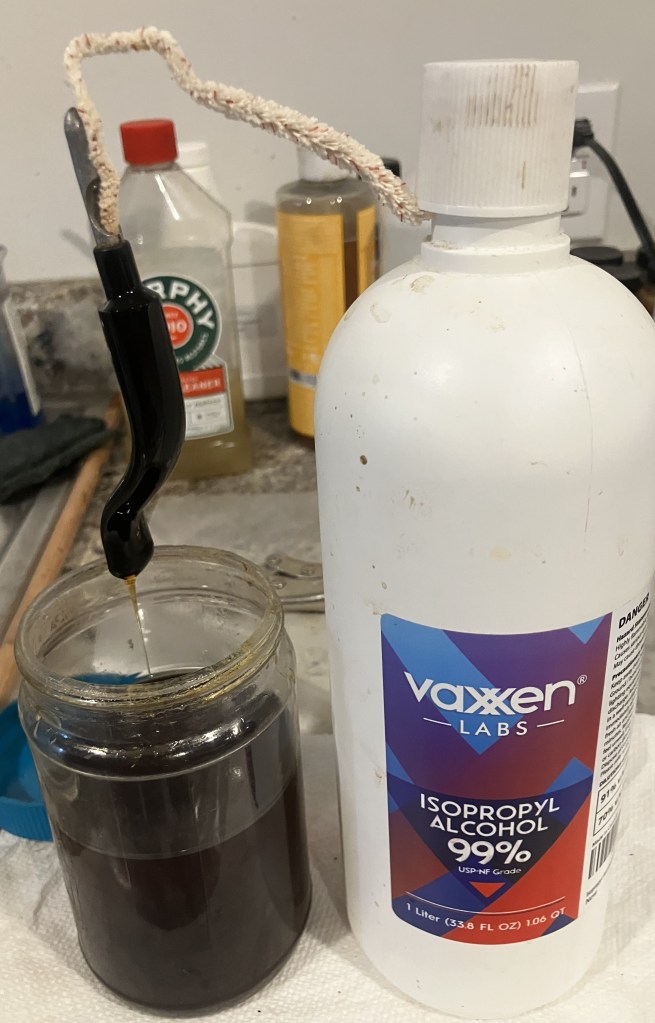
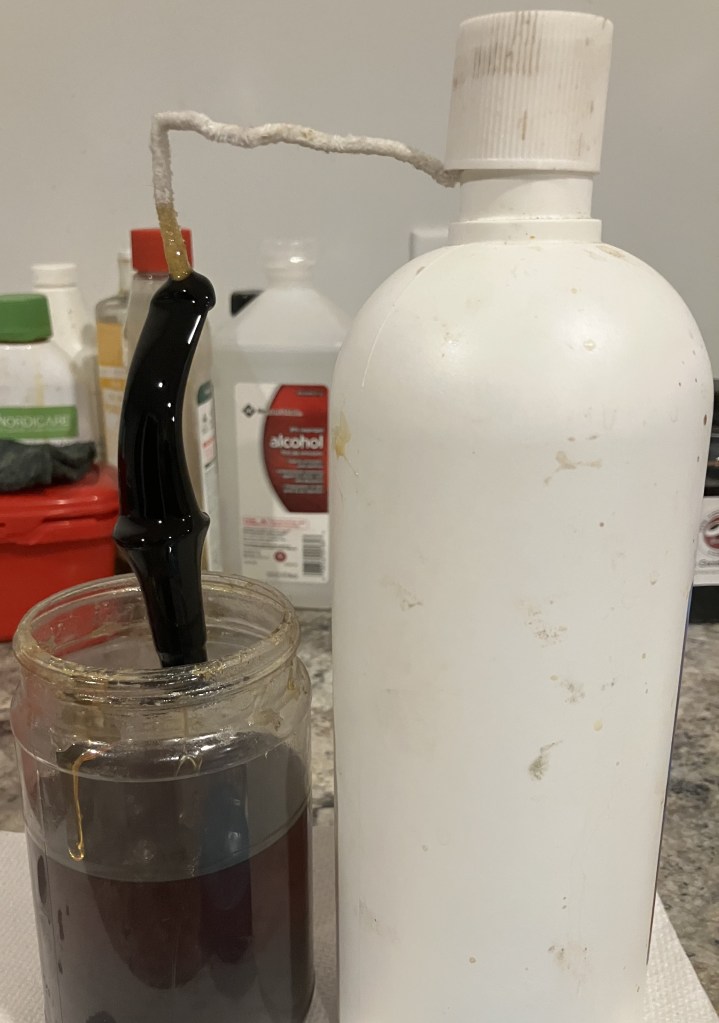
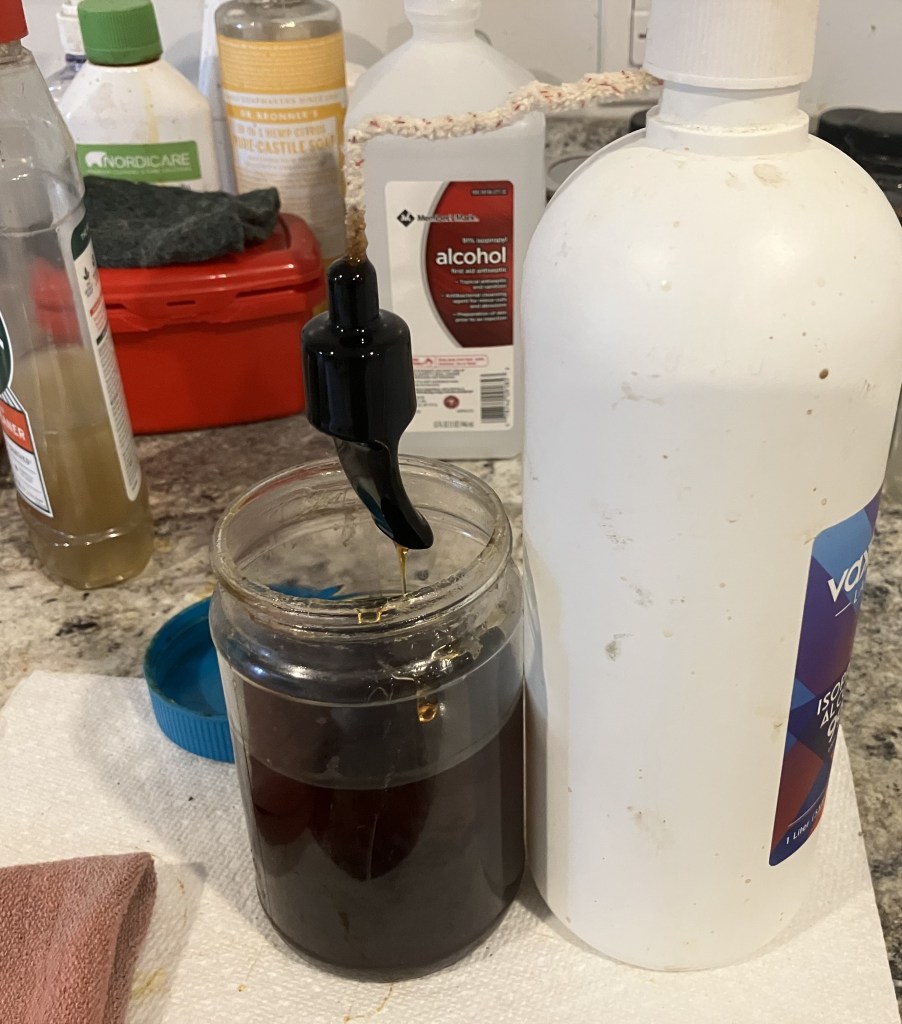
The stem was removed from the deox, having spent over 8 hours submerged. I used the patented Drip-O-Matic 3000 to allow some of the excess deox solution to drip back into the jar.
While the Drip-O-Matic 3000 was doing its job, I turned my attention back to that troublesome rim. With closer examination (squinting) I concluded that a good deal of the rim’s imperfections was still lava, not charring. I utilized a very high-tech technique to remove this stubborn material – saliva, a paper towel and a lot of rubbing. Well, that’s high tech here in the wilds of southeast Nebraska.
There was still one area that was charring on the rim. It looked like the previous owner held the pipe with his left hand and lit the pipe with his right hand from the 1:00-2:00 position.
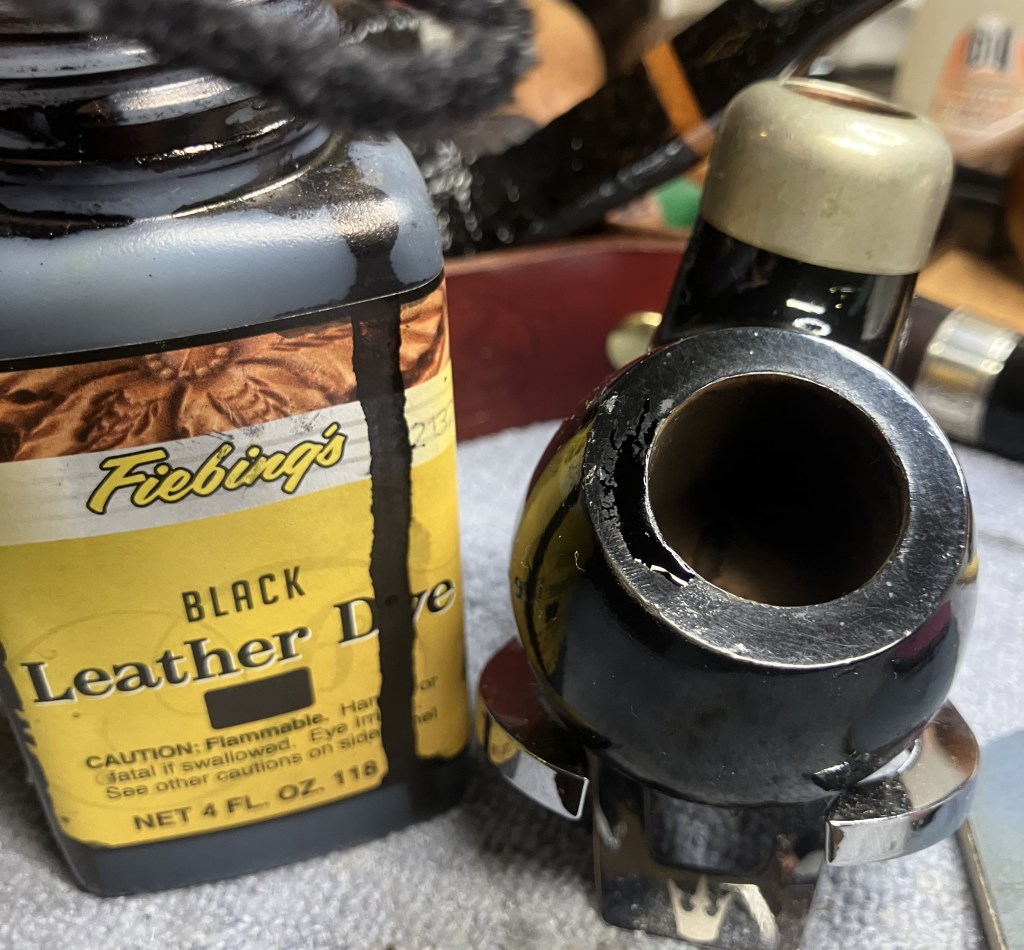
I thought maybe I could reapply a coating or two of Fiebing’s Black Leather Dye and this would miraculously erase the damage.
Hmm, maybe more than one of two applications…
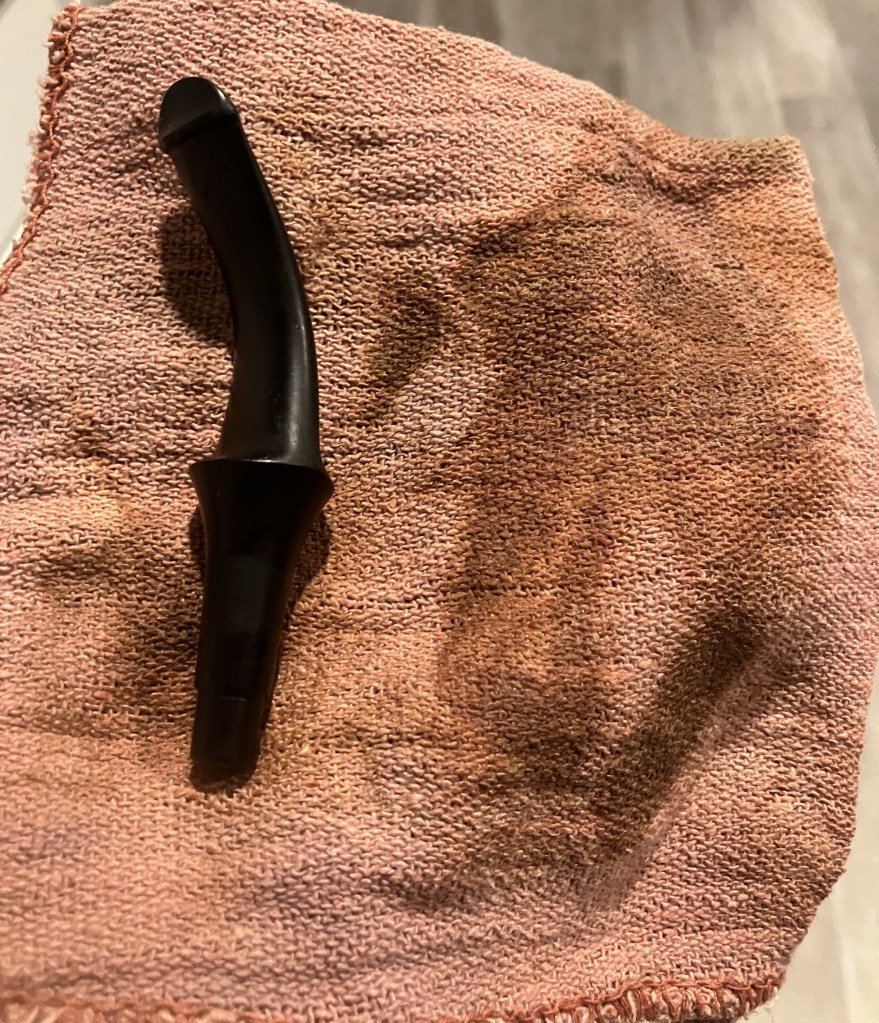
While the Fiebing’s was drying, I returned to the stem. A coarse shop rag was used to vigorously rub the stem. This removes the oxidized vulcanite that the deox solution has softened and does a lovely job of staining a clean coarse shop rag.
With the shop rag thoroughly defiled and the stem looking much better, it was time to start sanding the stem to return it to factory fresh.
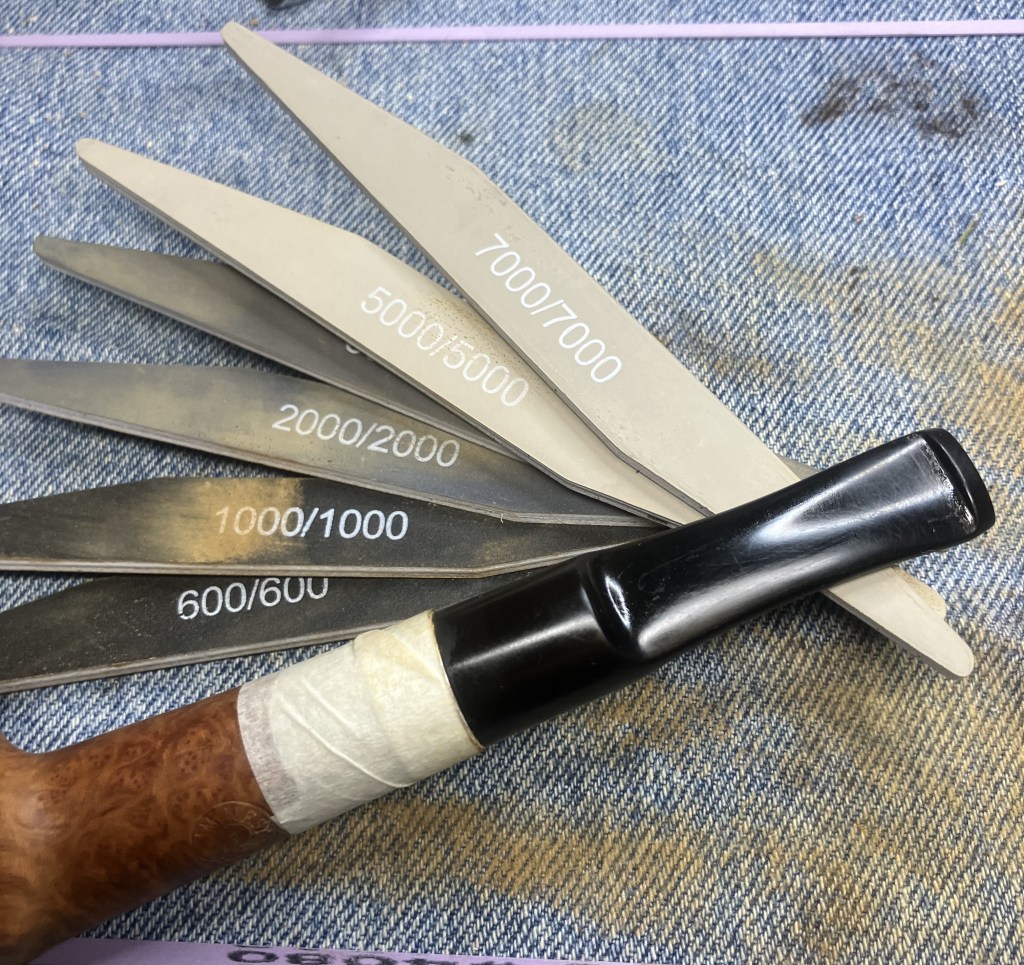
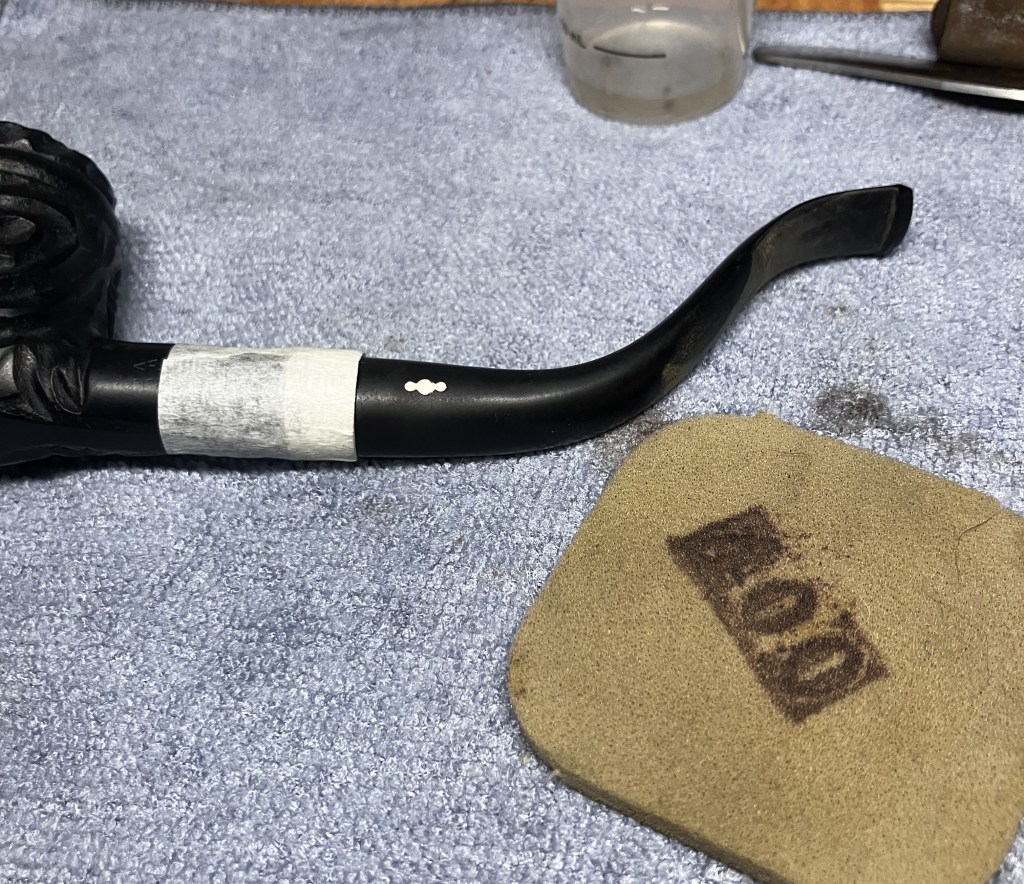
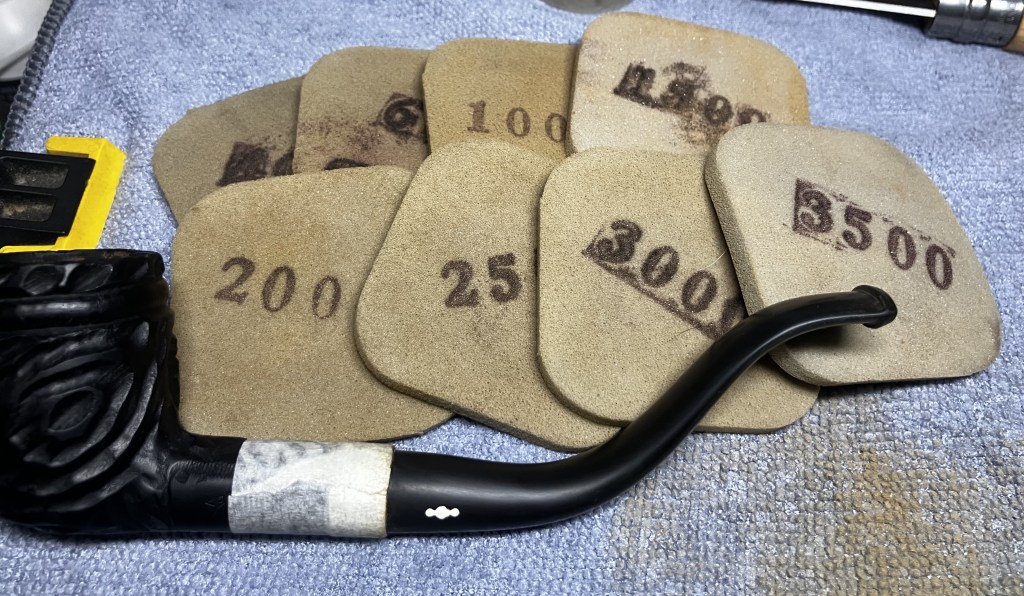
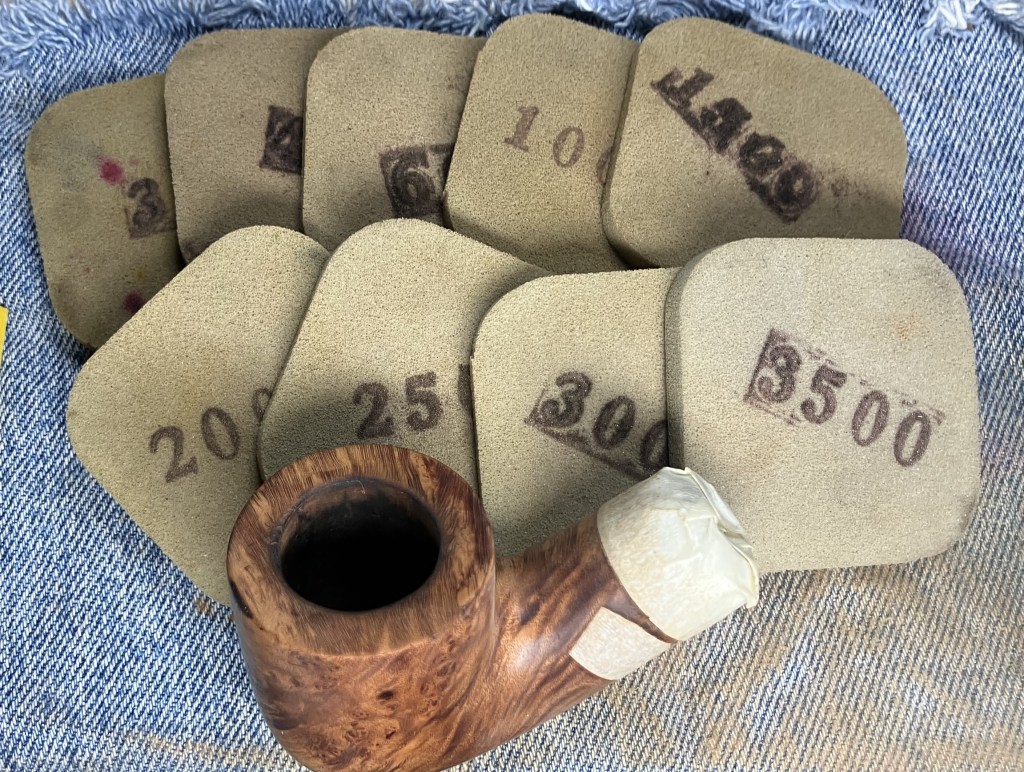
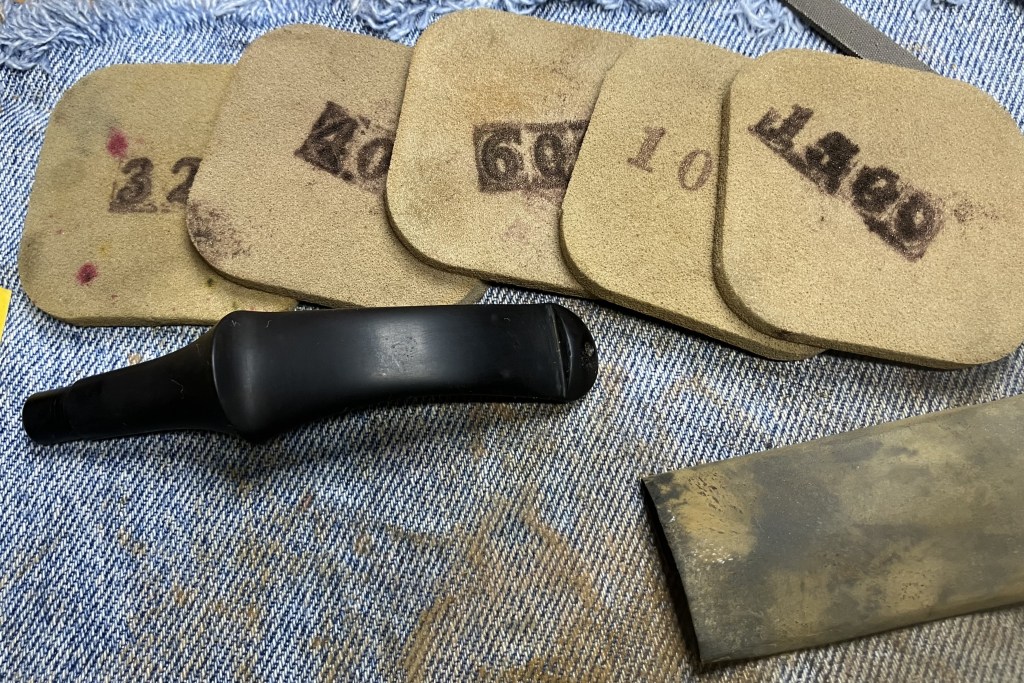
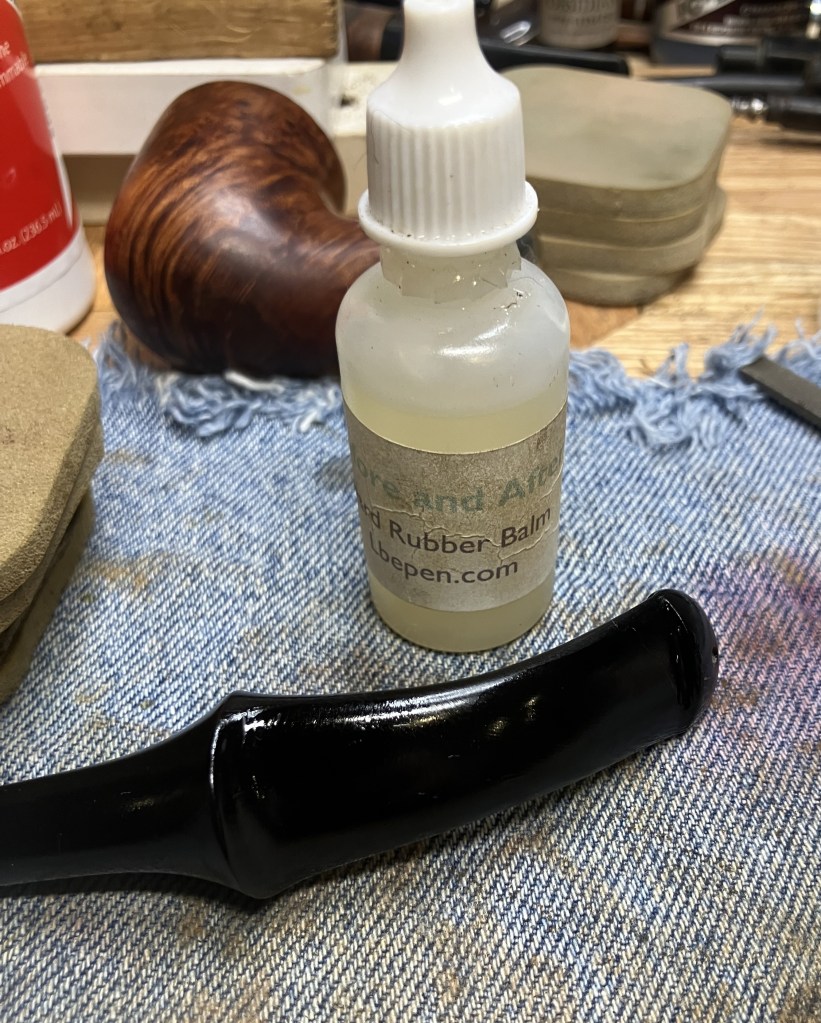
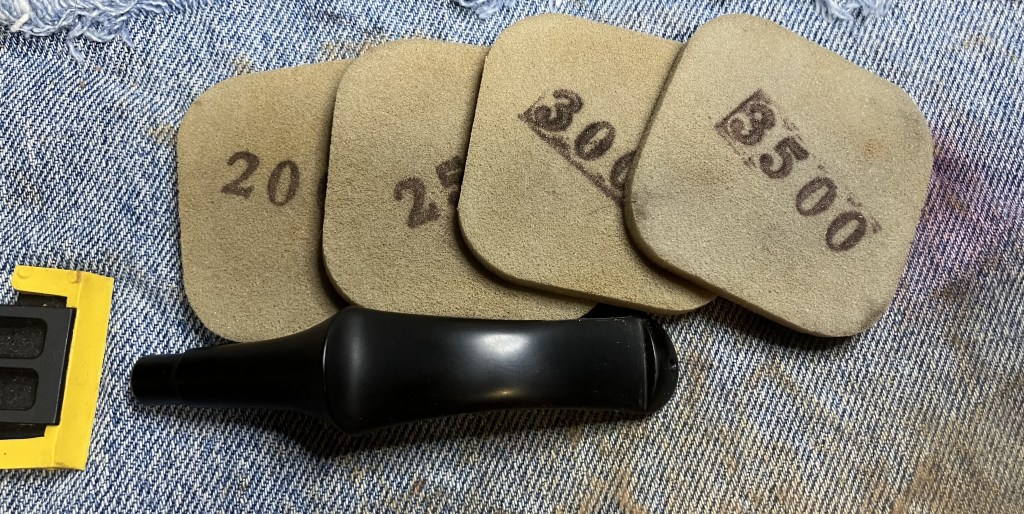
A series of sanding sponges in grits from 400-3500 were used. Between each sponge the stem was rubbed with a drop of Before and After Hard Rubber Balm and wiped with a paper towel. This wiping removed sanding debris from the stem. Once finished I coated the stem with the balm and allowed it to sit.
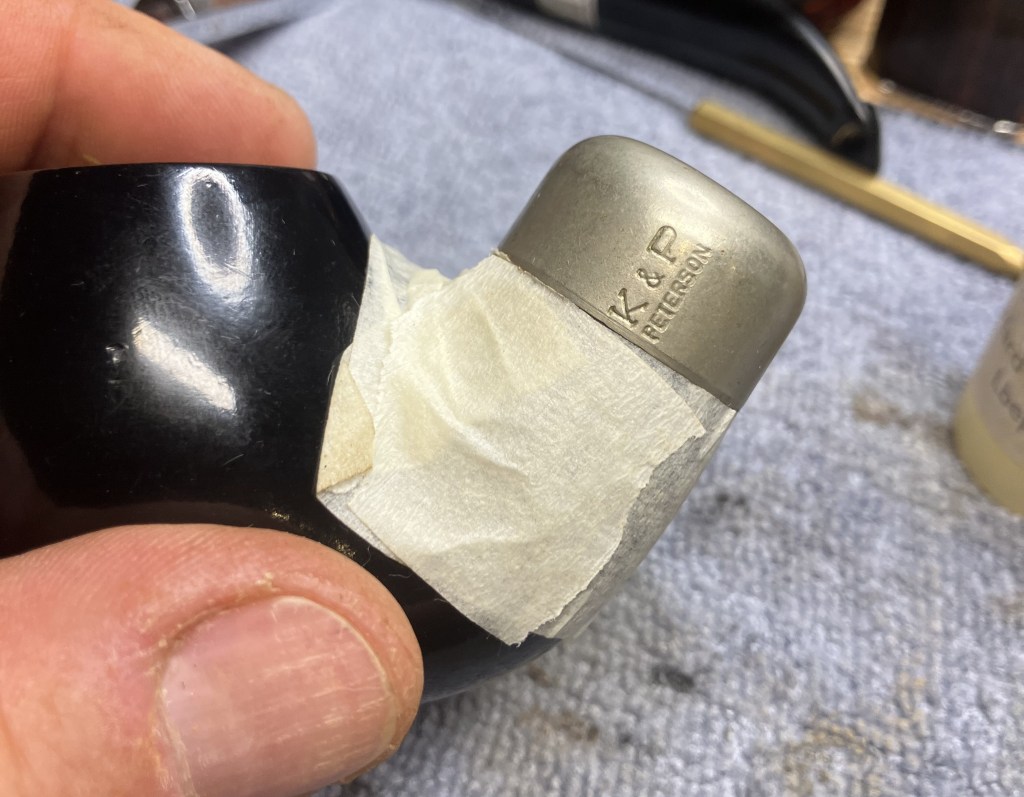
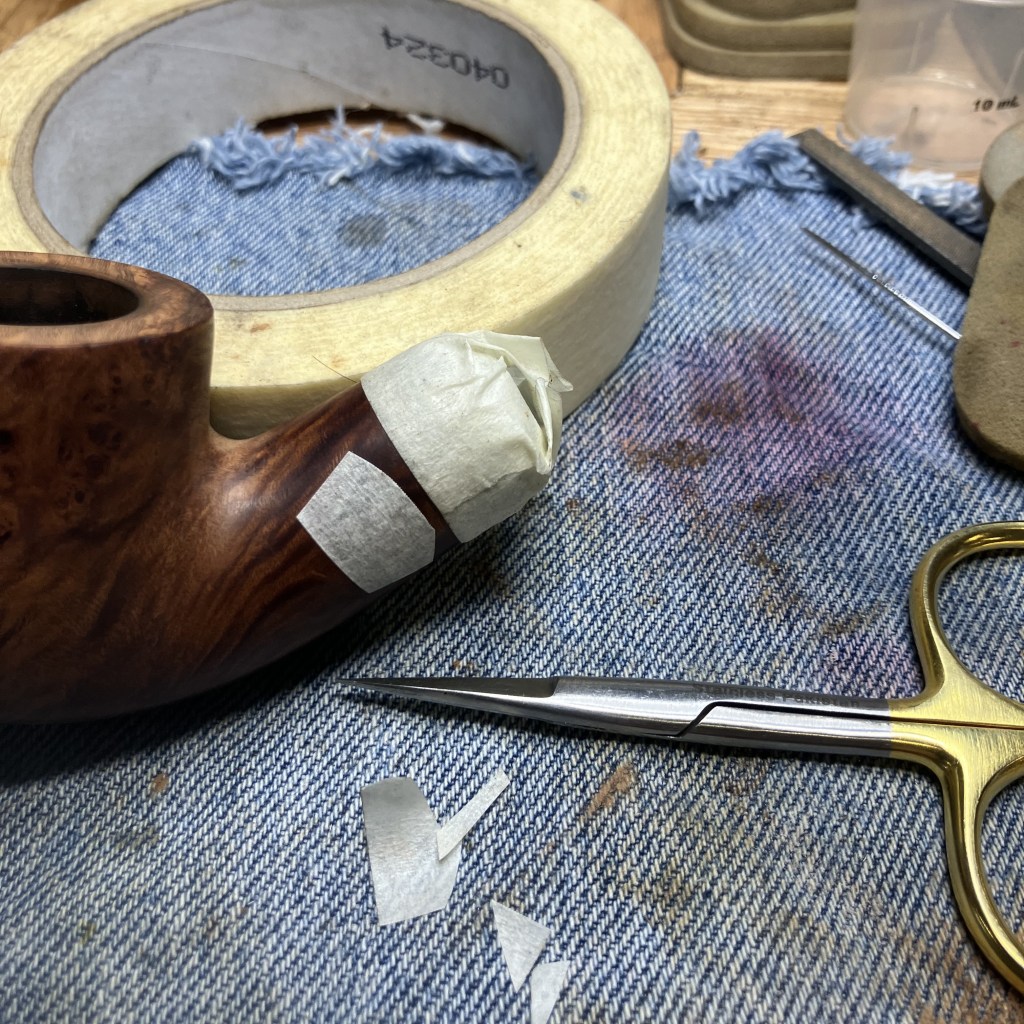
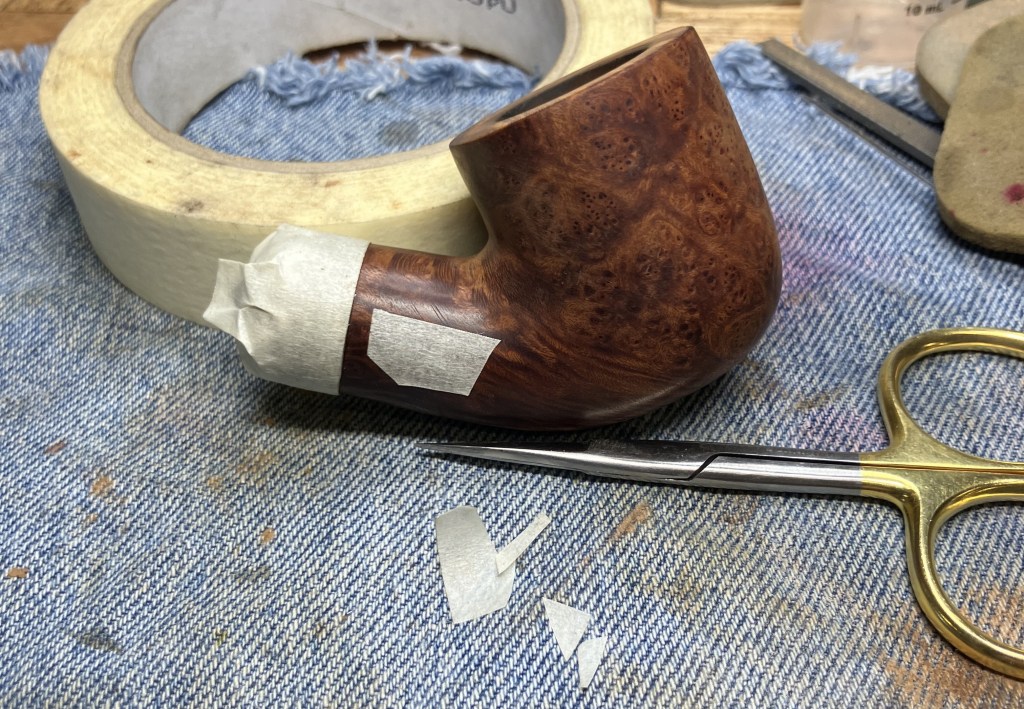
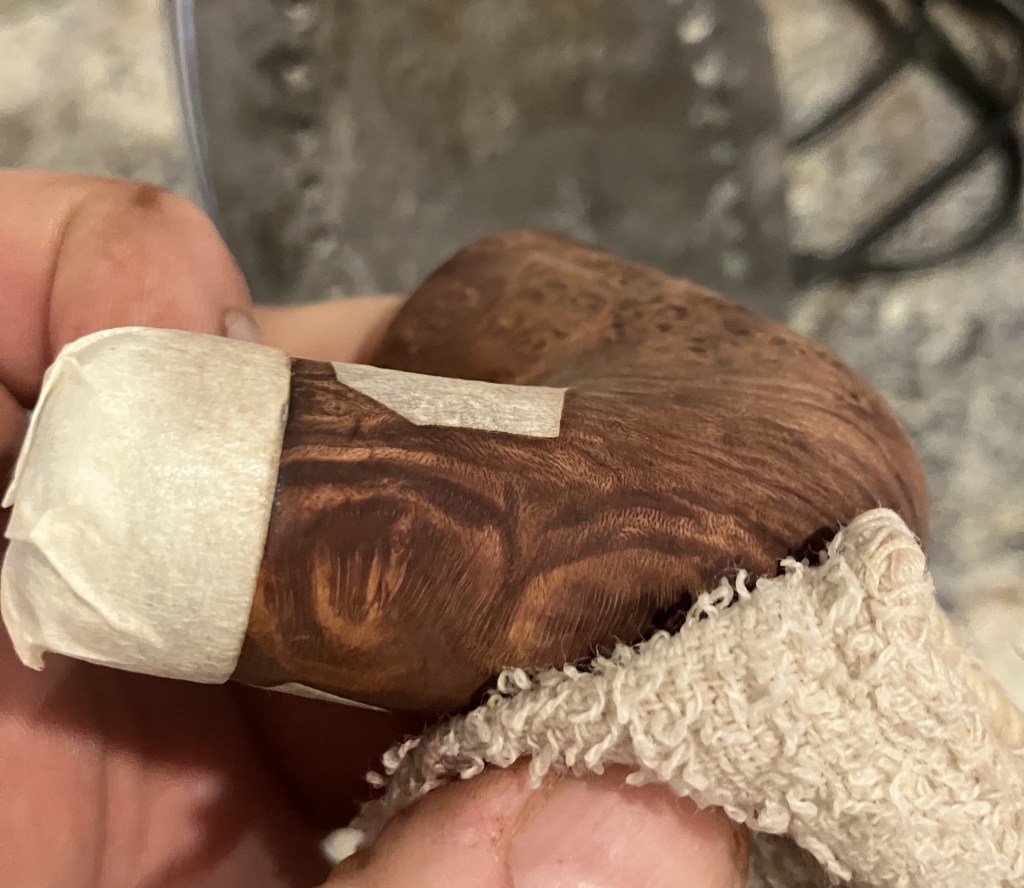
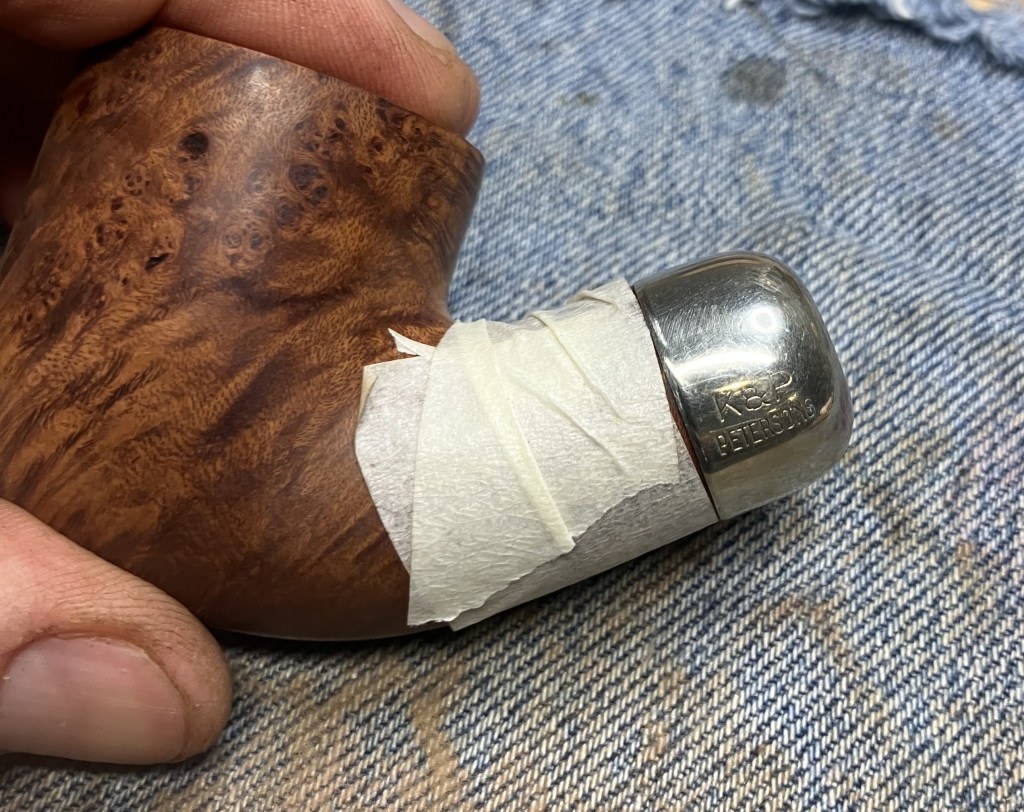
Time to make that tarnished collar shine. I wrapped the shank with masking tape to protect it from buffing.
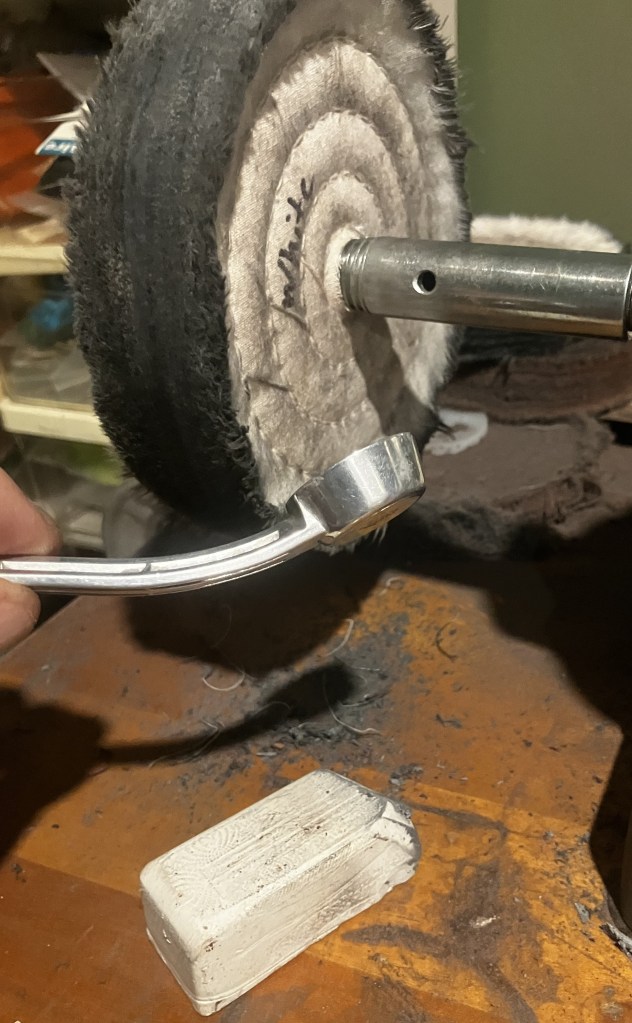
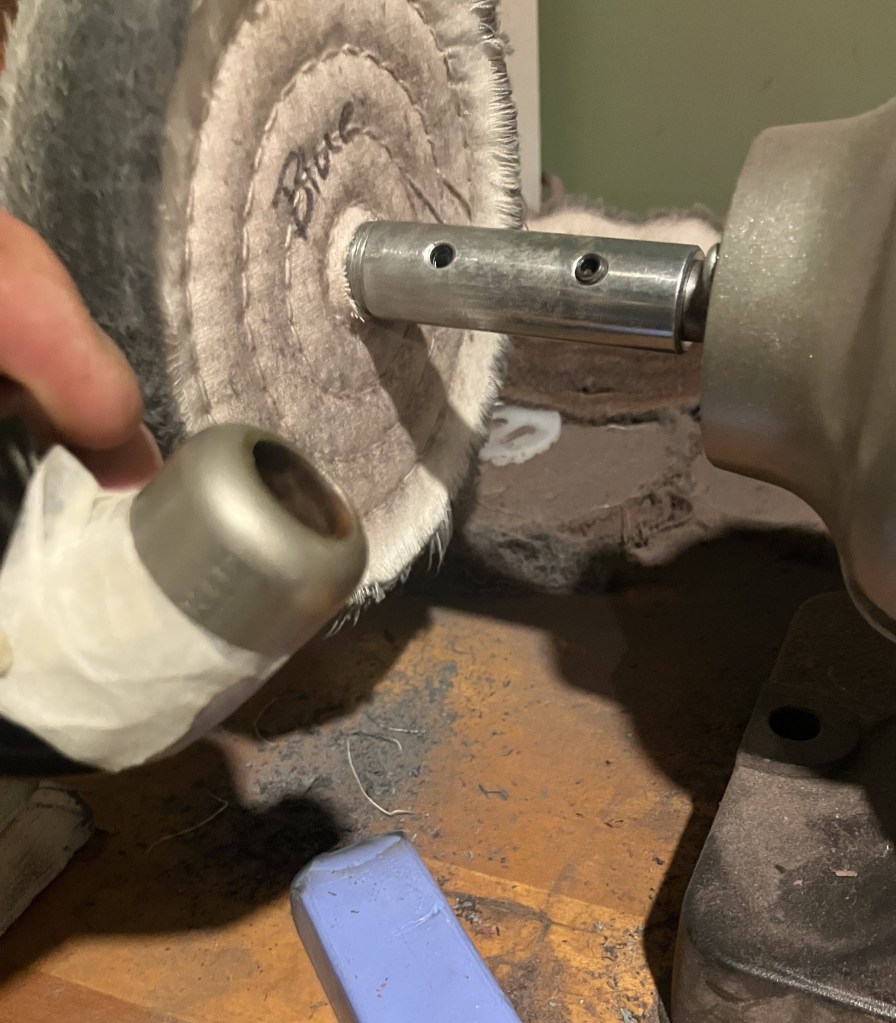
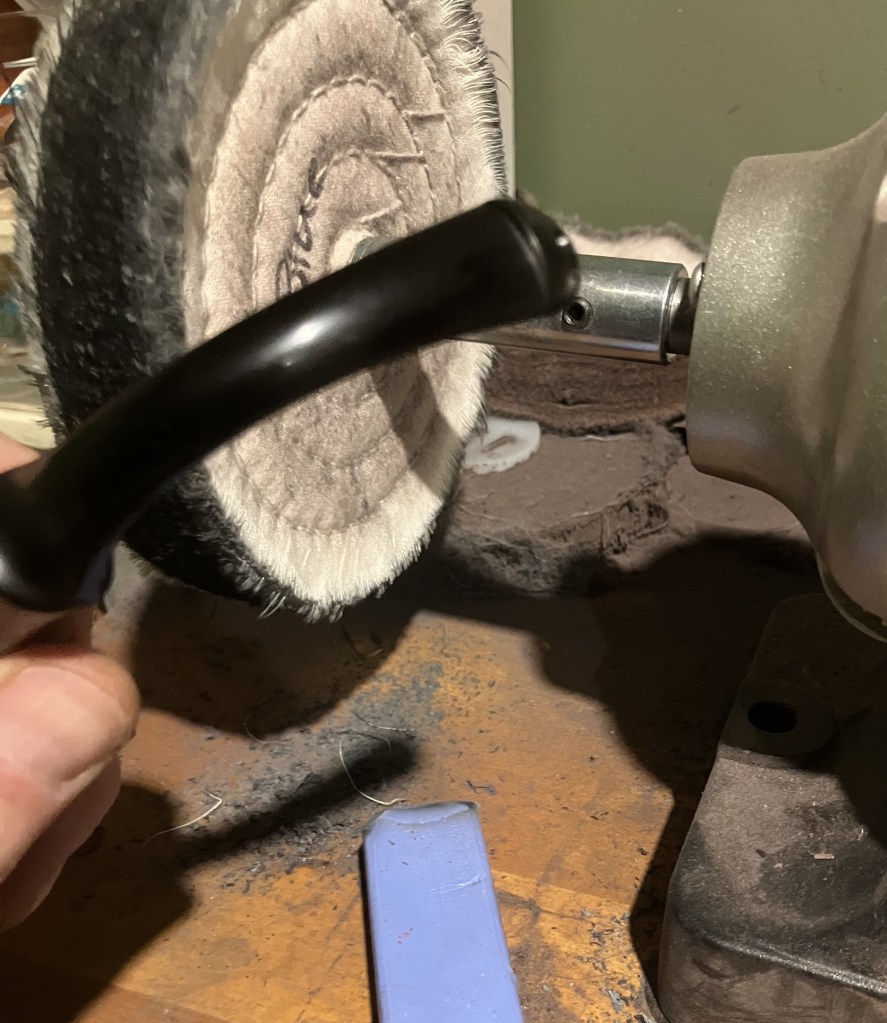
The nickel was polished with Blue Diamond at the buffer.
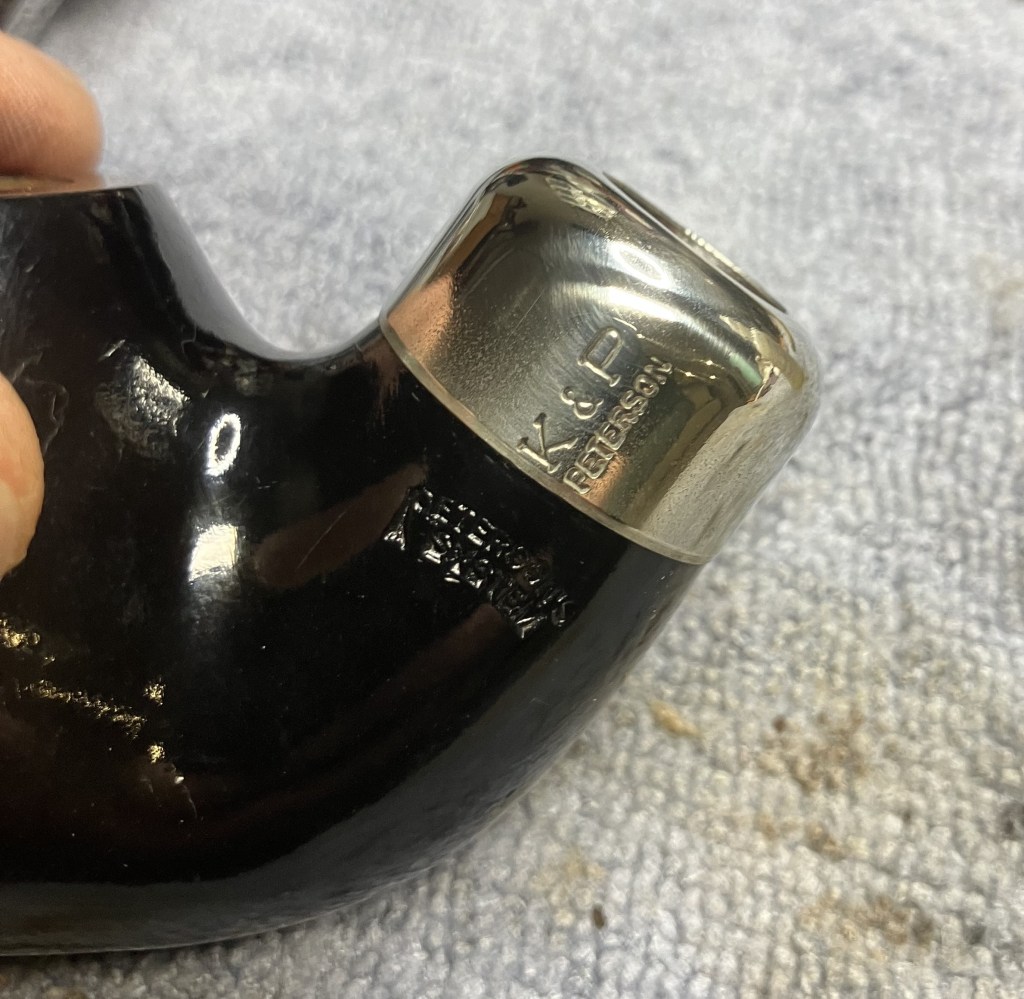
The results were a great improvement.
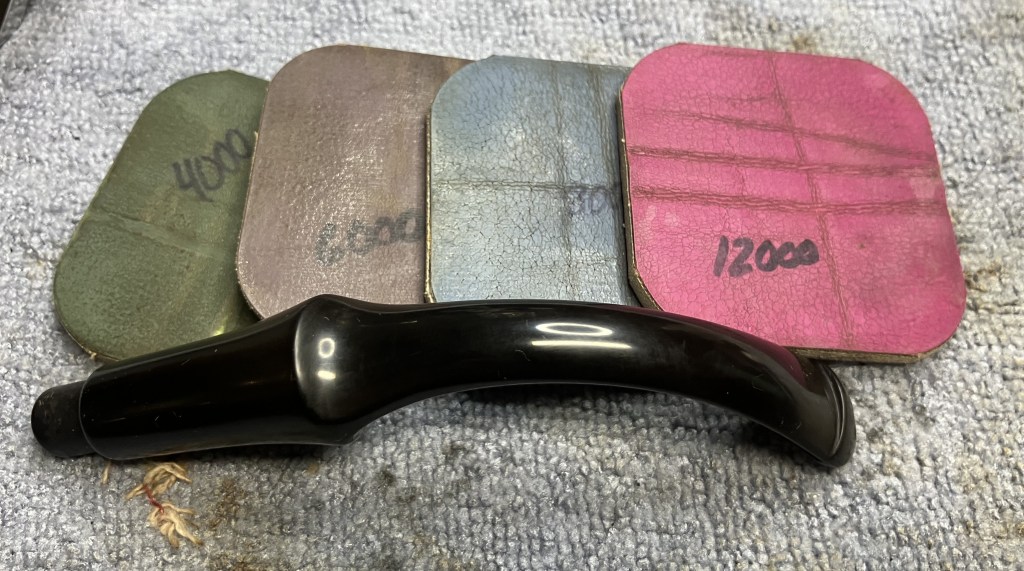
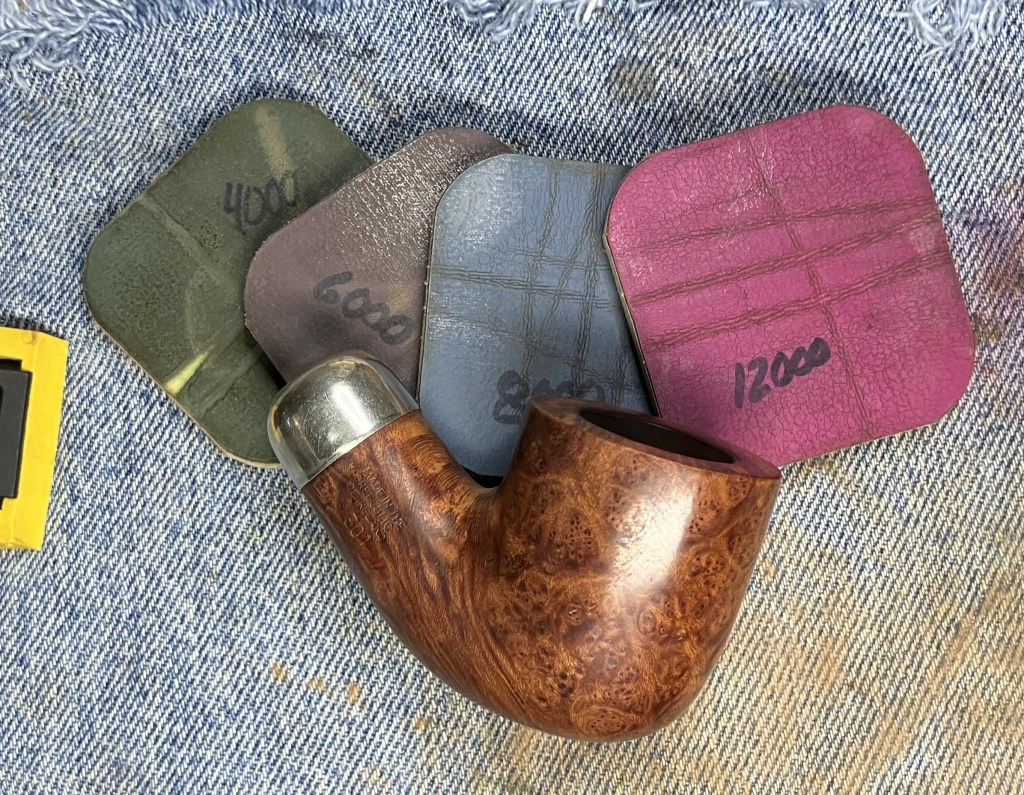
Back to the stem. I used 4000-12000 micro-mesh pads to work the stem, again with the Before and After balm and wiping between pads.
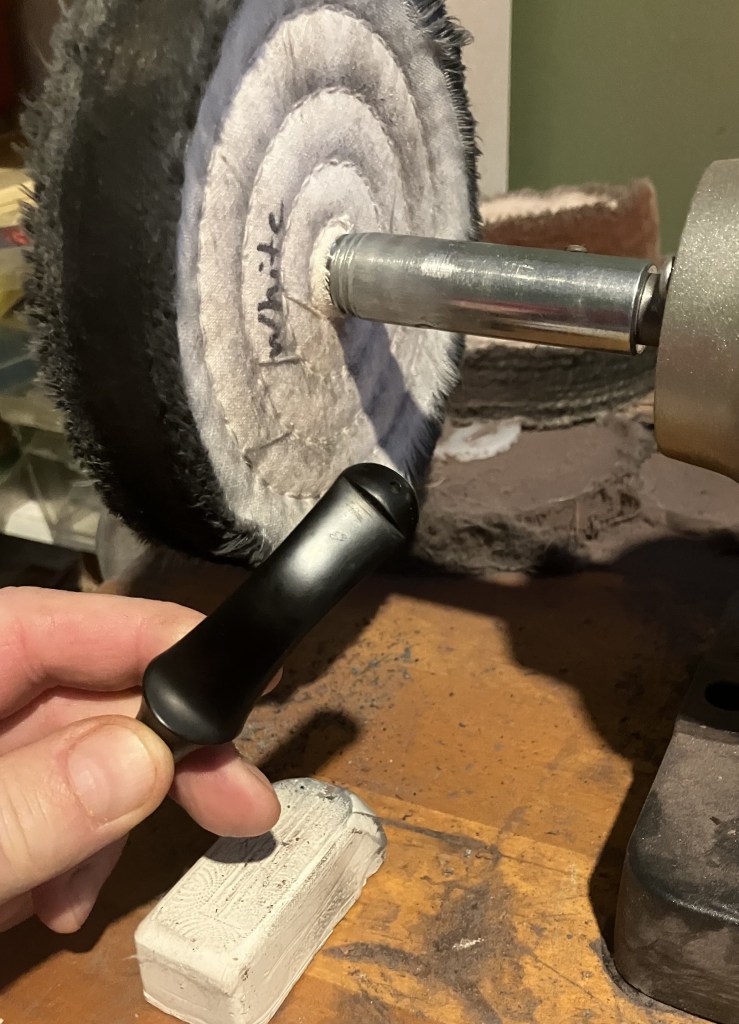
The stem was then buffed with Blue Diamond at the buffer.
A final coating of Before and After Hard Rubber Balm was given to the stem and it was reunited with the stummel.
The black Fiebing’s Leather Dye worked well at making the stubborn spot on the rim black but it was still noticeable. I thought that maybe a coati or two of Danish oil would help conceal the blemish.
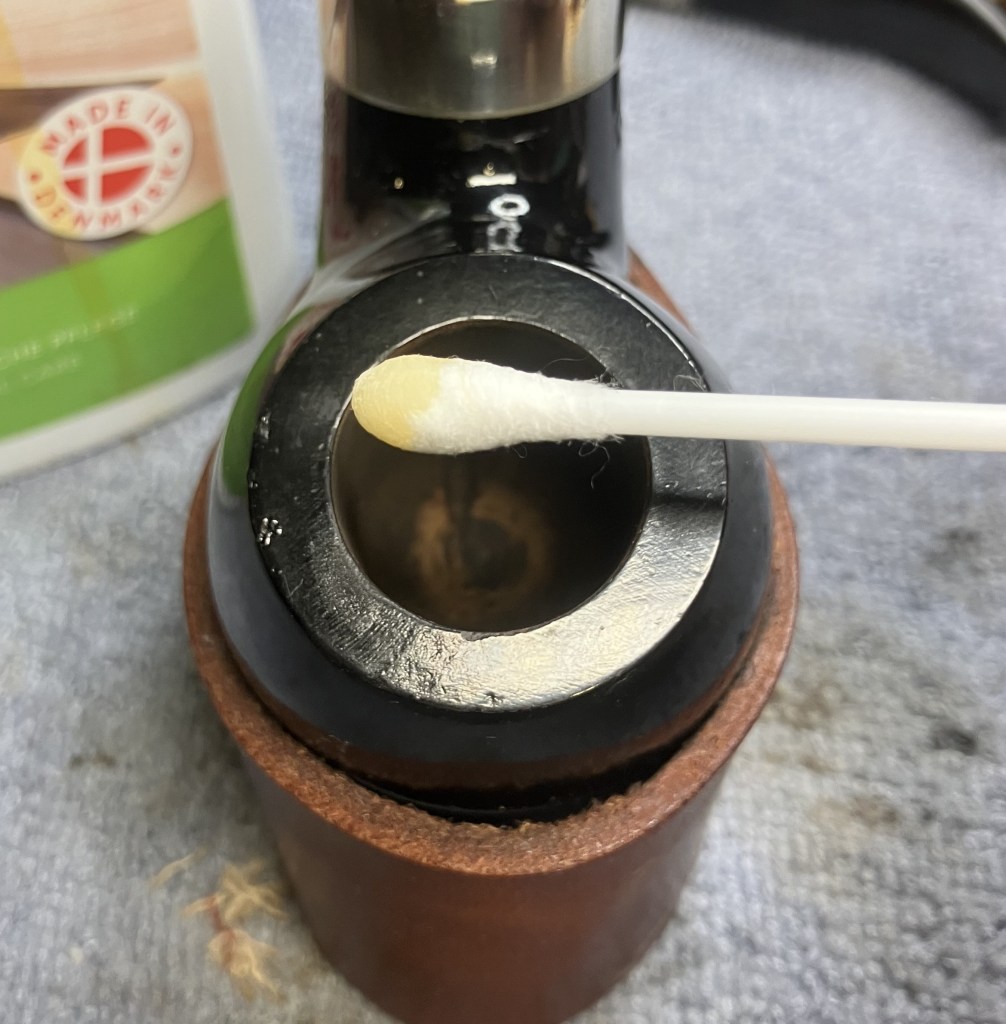
This was applied to the rim with a cotton swab.
The whole rim was coated to help blend the spot.
Then several more mini applications to the spot, itself. After the oil dried I worked the spot with 7000, 8000 and 12000 grit micro-mesh.
The stubborn little spot remained noticeable. I finally surrendered to failure. I thought maybe, just maybe, that the carnauba waxing would finally smooth the blemish, but didn’t hold much faith in that.
Several coats of carnauba wax were applied to both the stem and stummel.
The final step was a hand buffing with a microfiber polishing cloth which really brought out the shine.
What a chubby cheeked beauty. This Peterson System Standard 302 Ebony restored wonderfully. The glossy black finish was well maintained by the previous owner and needed little work. The slightly charred spot on the rim was fixed with a touch of black dye,Danish oil, polishing and disappeared with the waxing. The oxidation of the stem was removed and revealed the lovely black high gloss vulcanite. This glossy black matches the stummel and is accentuated by the polished nickel collar. Overall, I think the pipe looks nearly as great as it probably did exiting the Peterson factory in Dublin. I am sure that Tom, will enjoy many years of relaxing contemplation with this pipe. The dimensions of the Peterson System Standard 302 Ebony areas follows:
Length: 6.09 in./ 154.69 mm.
Weight: 2.58 oz./ 73.14 g.
Bowl Height: 1.88 in./ 47.75 mm.
Chamber Depth: 1.40 in./ 35.56 mm.
Chamber Diameter: 0.80 in./ 20.32 mm.
Outside Diameter: 1.79 in./ 45.47 mm.
I do hope that you have found something here useful to your own pipe care, maintenance or restorations. If you like this sort of thing, please click the like and subscribe buttons. Thank you for reading the ramblings of an old pipe lover.
Loading…
Below are some photos of the finished Peterson System Standard 302 Ebony.
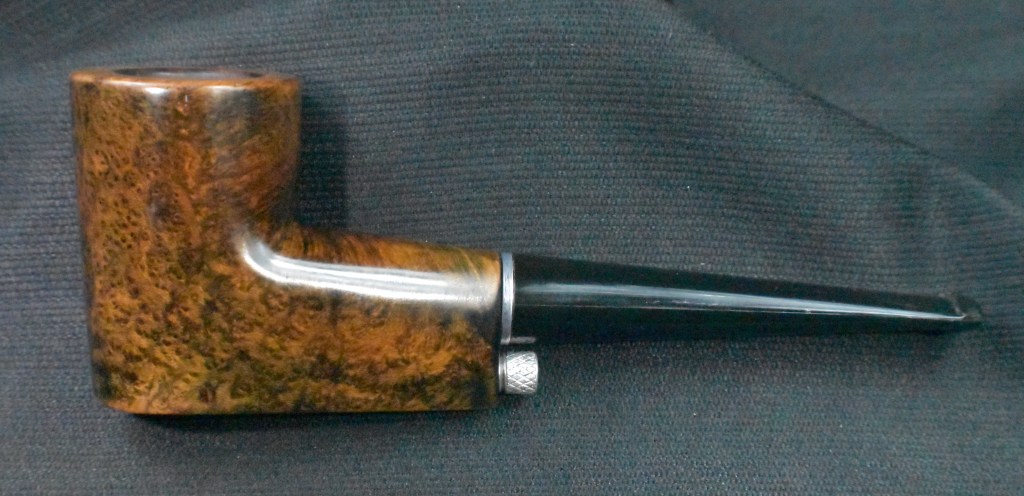
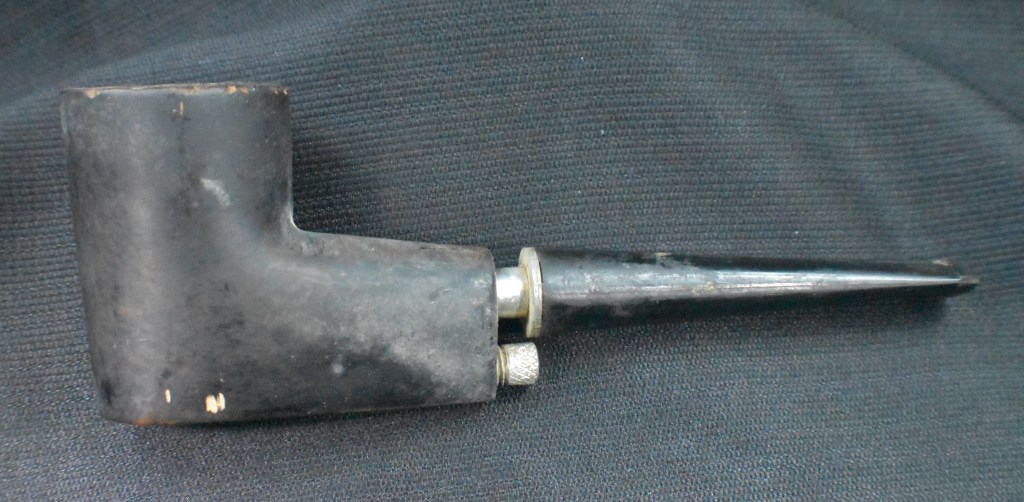
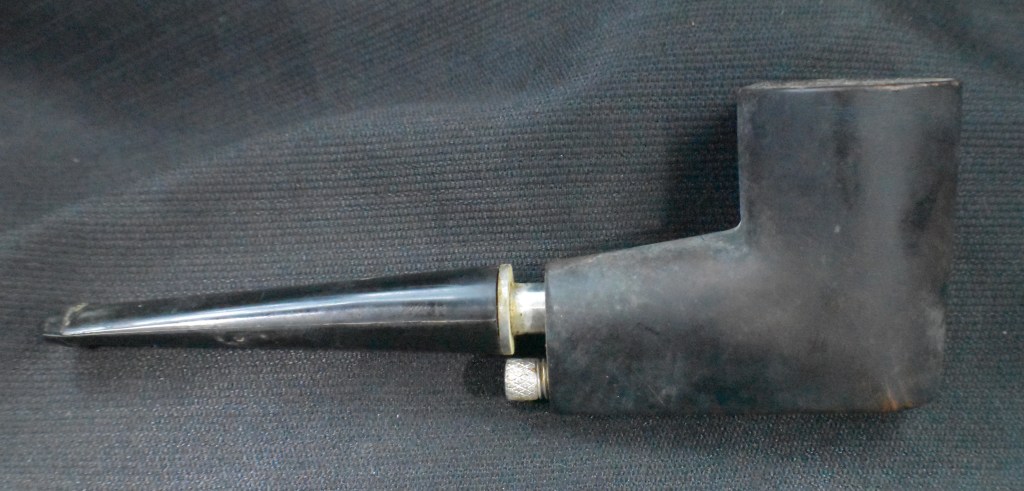
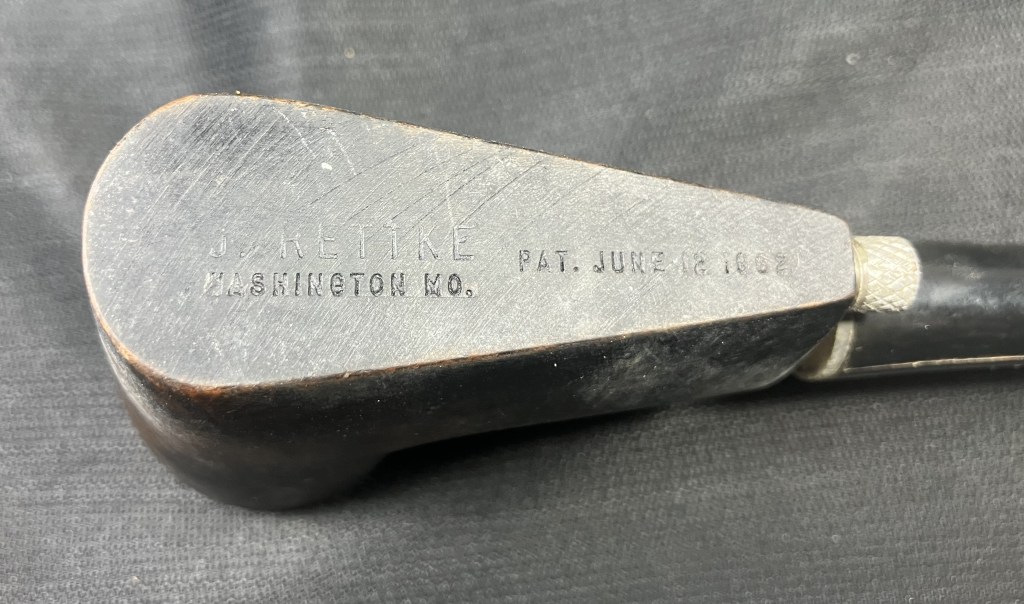
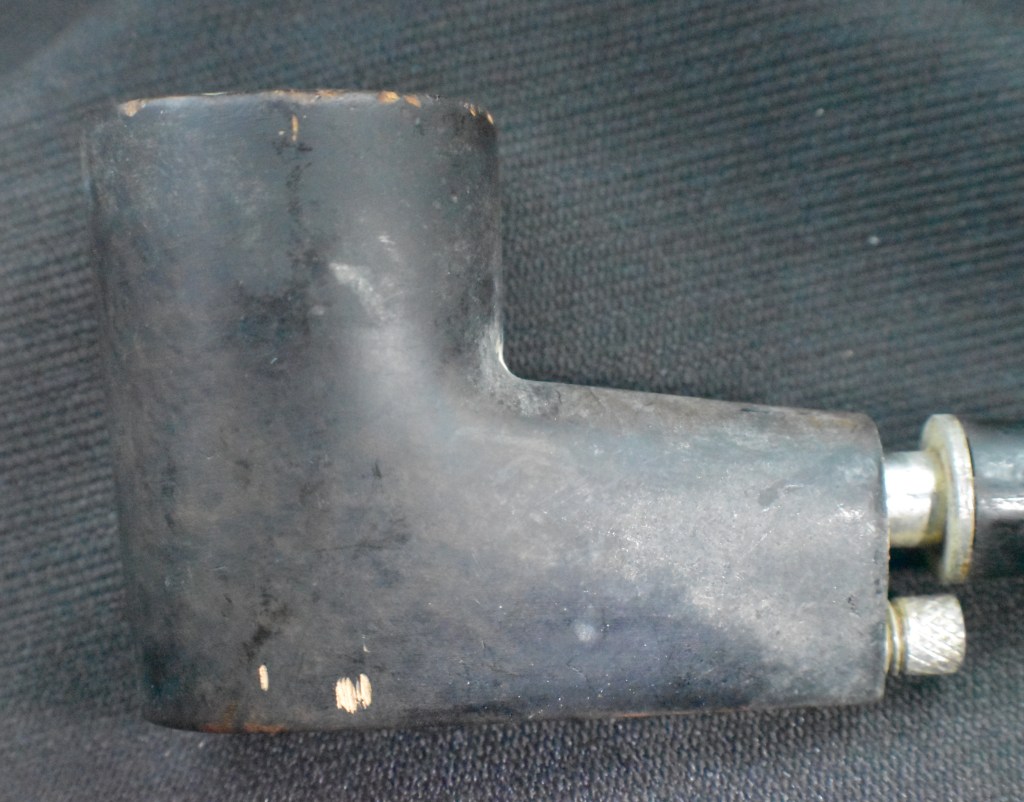
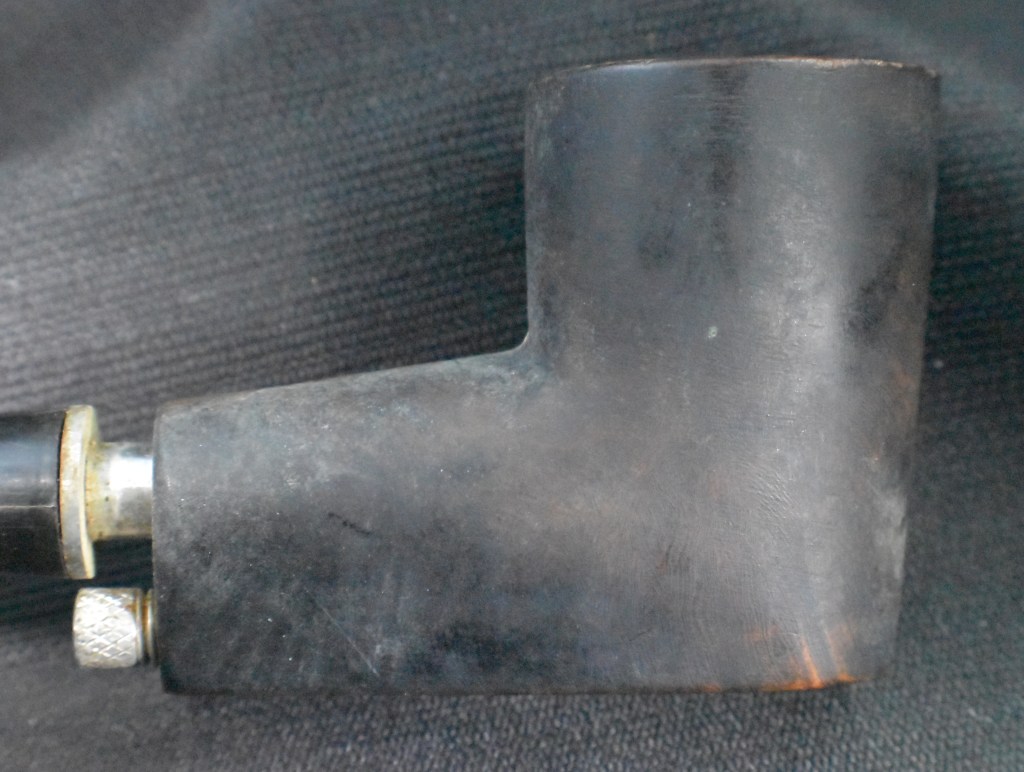
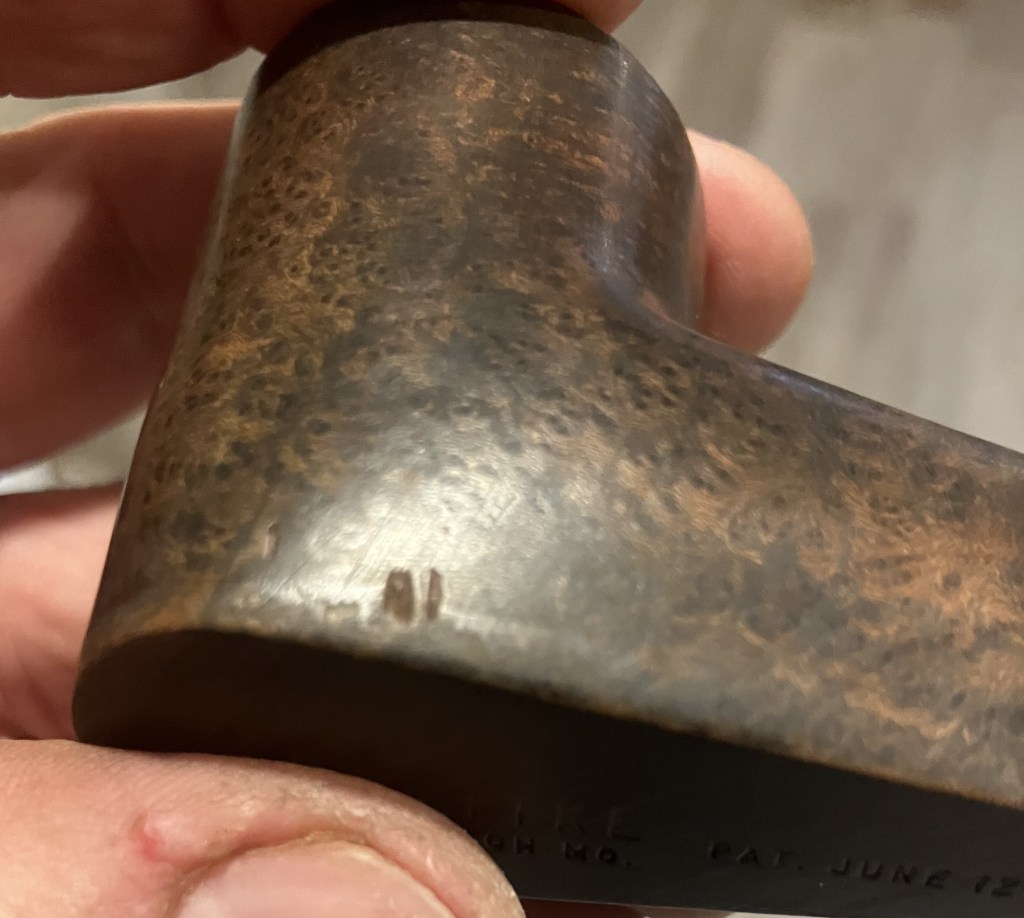
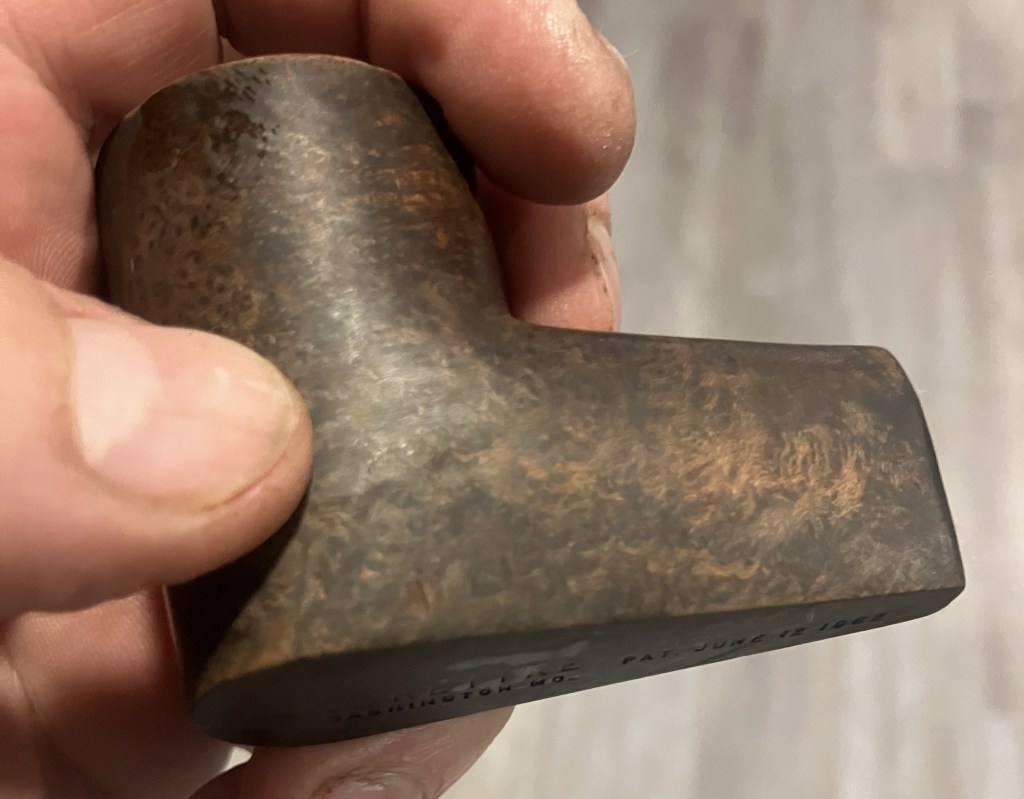
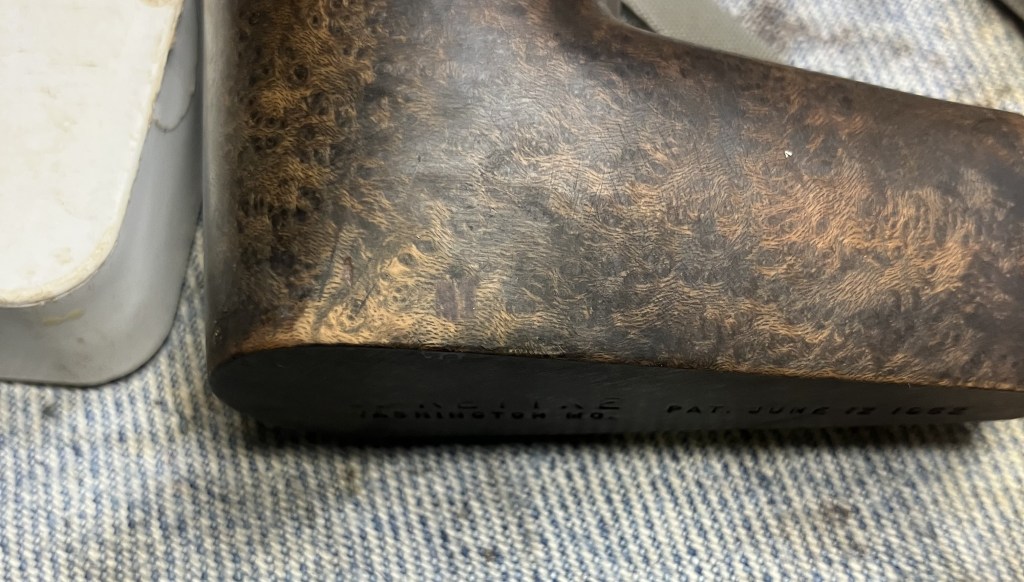
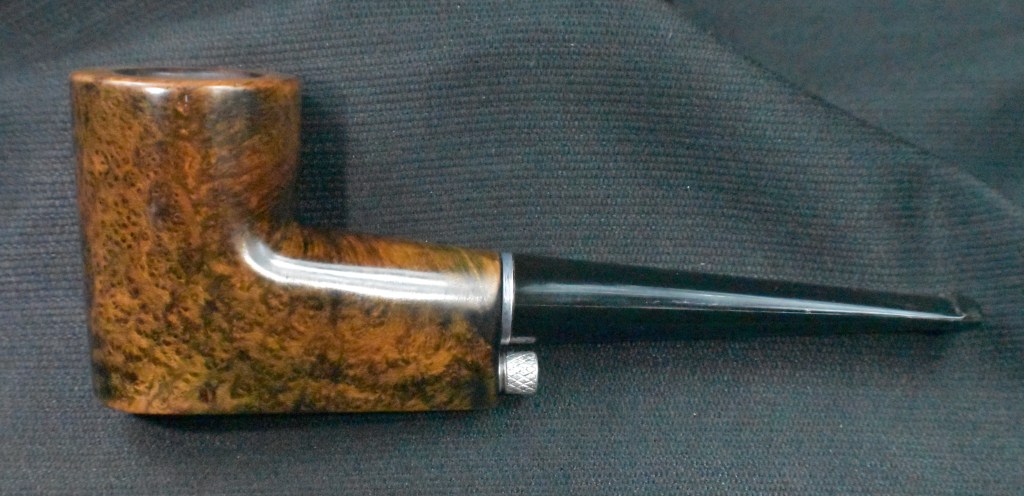
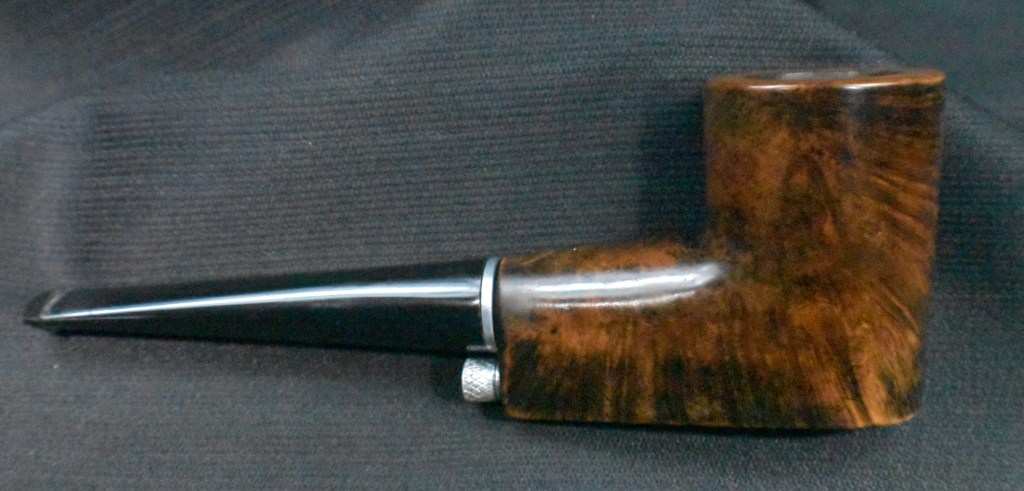
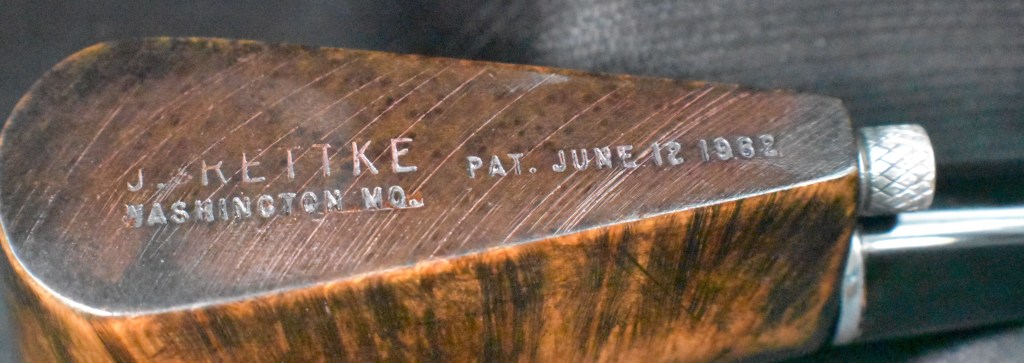
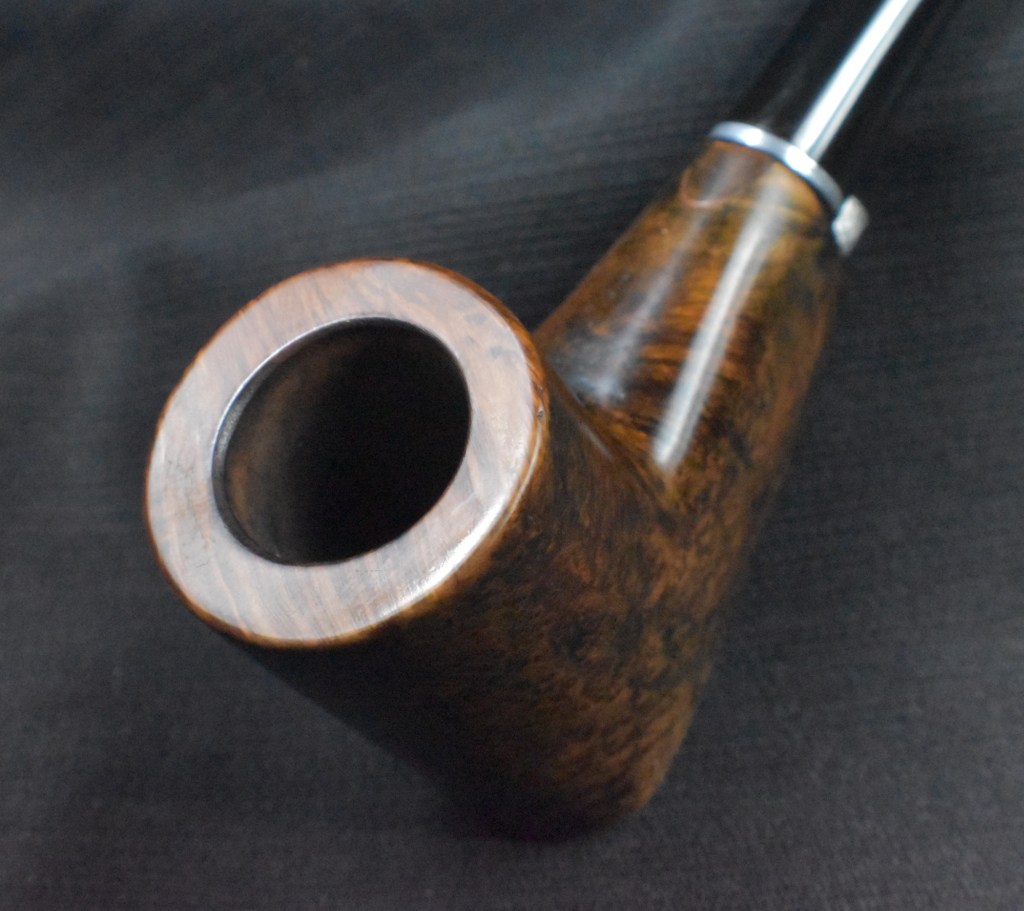
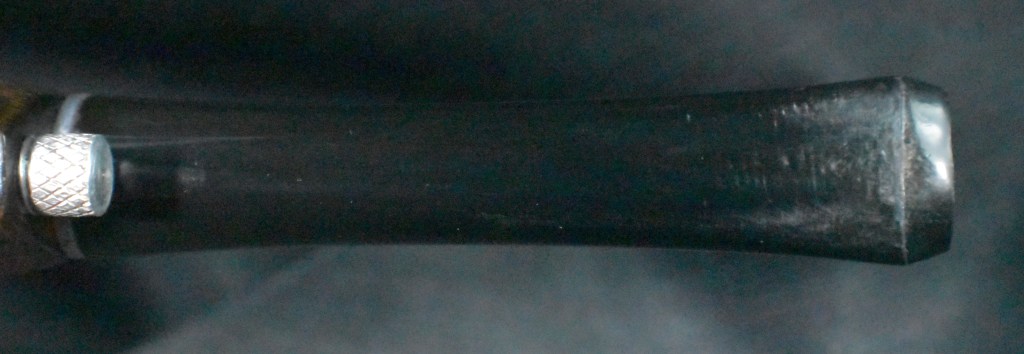
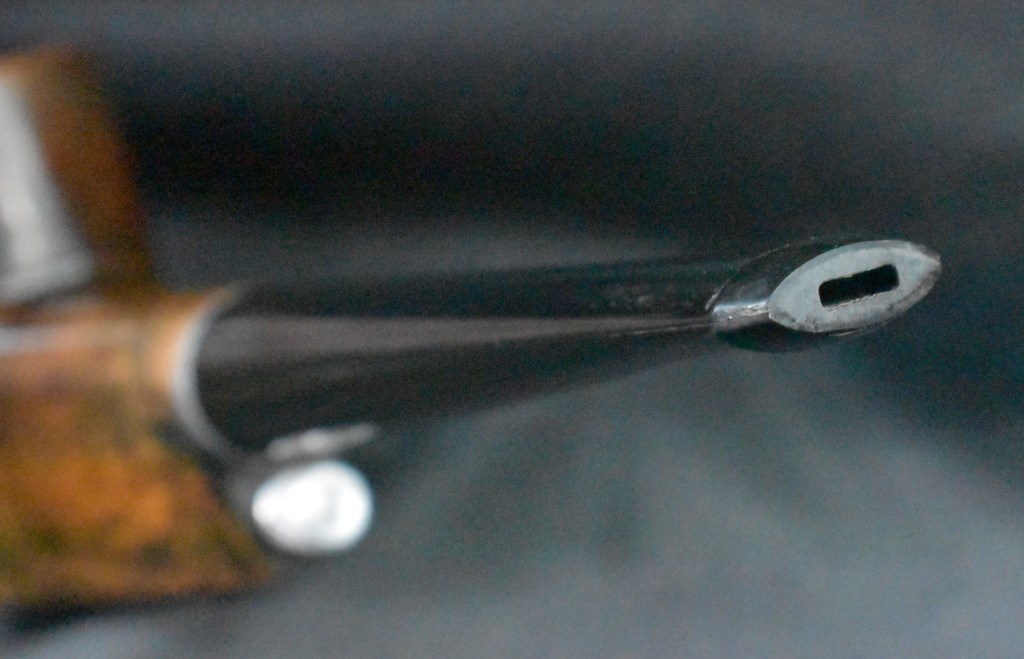
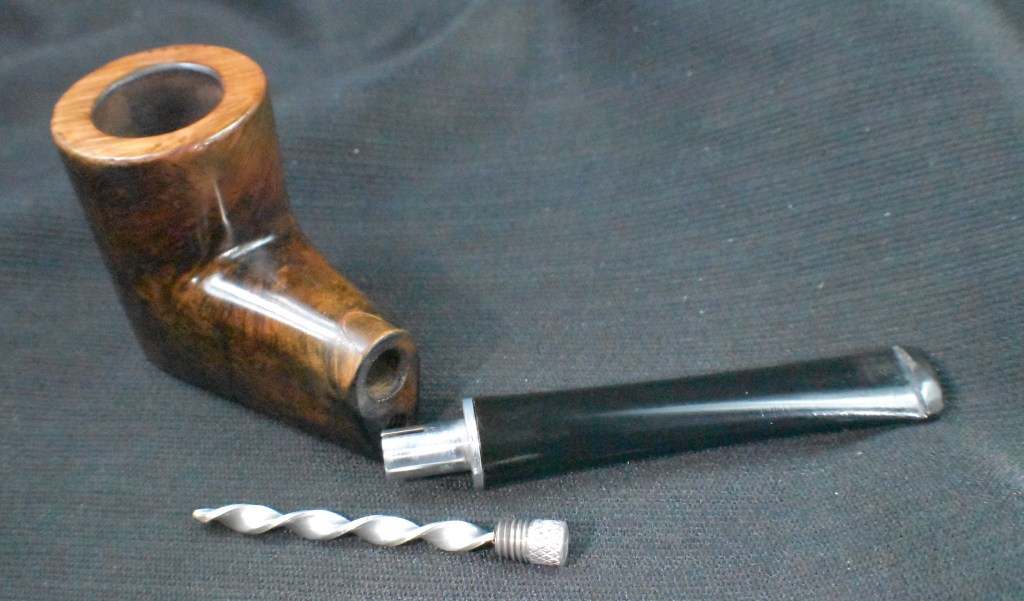
I know, I know, you have seen me restore two of these already. “How is this one different?”, you ask. Well, it was in far worse condition than the other two. Yeah, that’s not much of a reason. OK, I like working on them. They’re kind of ugly yet at the same time there is just something about them that intrigues me. Maybe because they look like a gimmick pipe but these actually work. Given I have only kept one for my own personal use. This pipe came from an eBay auction where I was the sole bidder. Maybe for good reason. Upon arrival the pipe sported the traditional stampings, J. RETTKE over WASHINGTON MO. next to PAT. JUNE 12, 1962 on the bottom of the pipe. Below are some photos taken before I began work on the pipe.
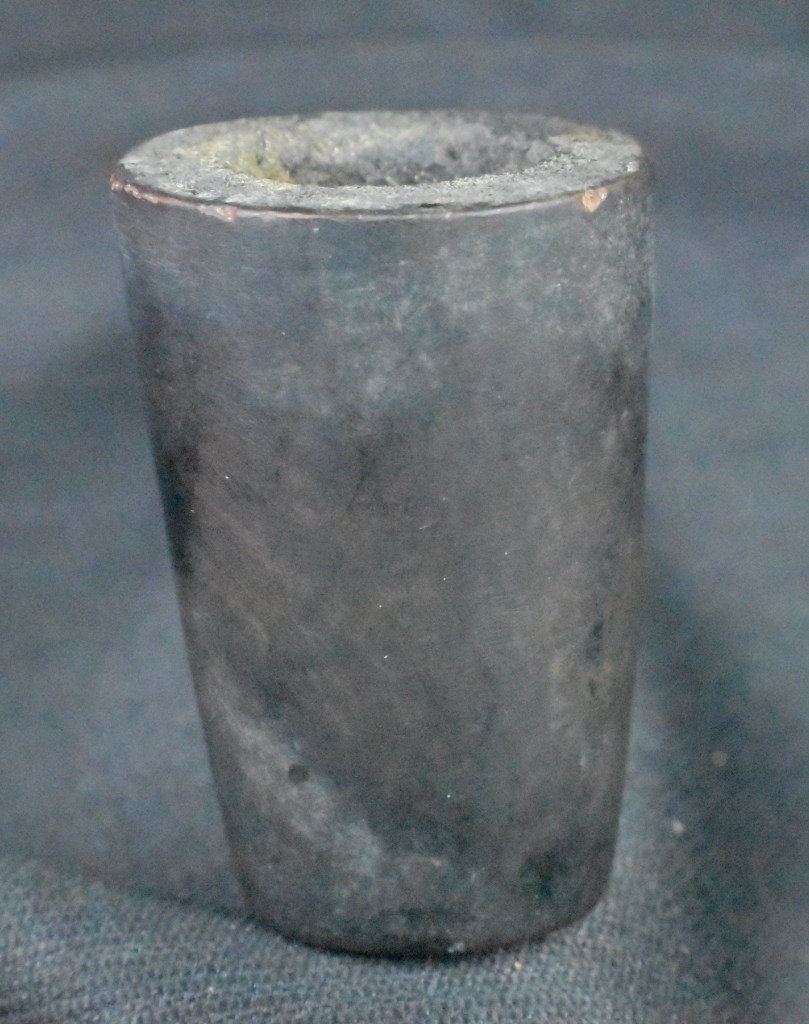
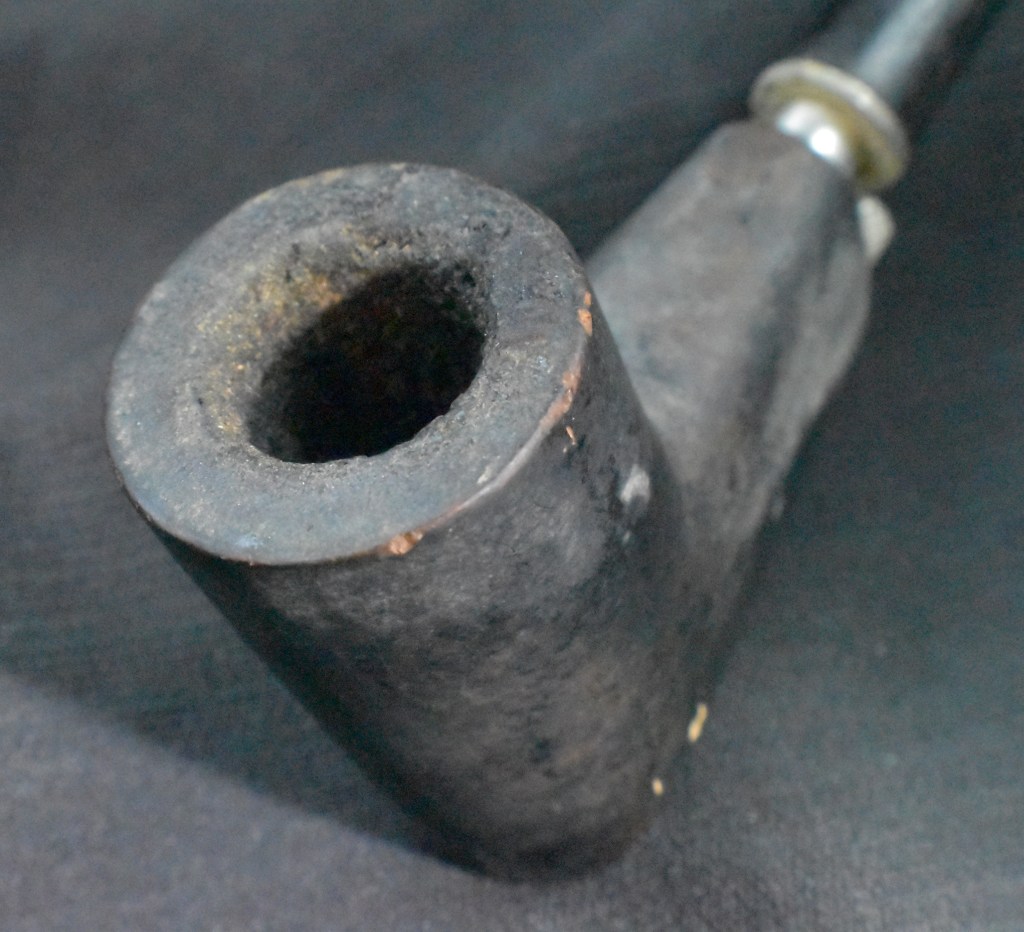
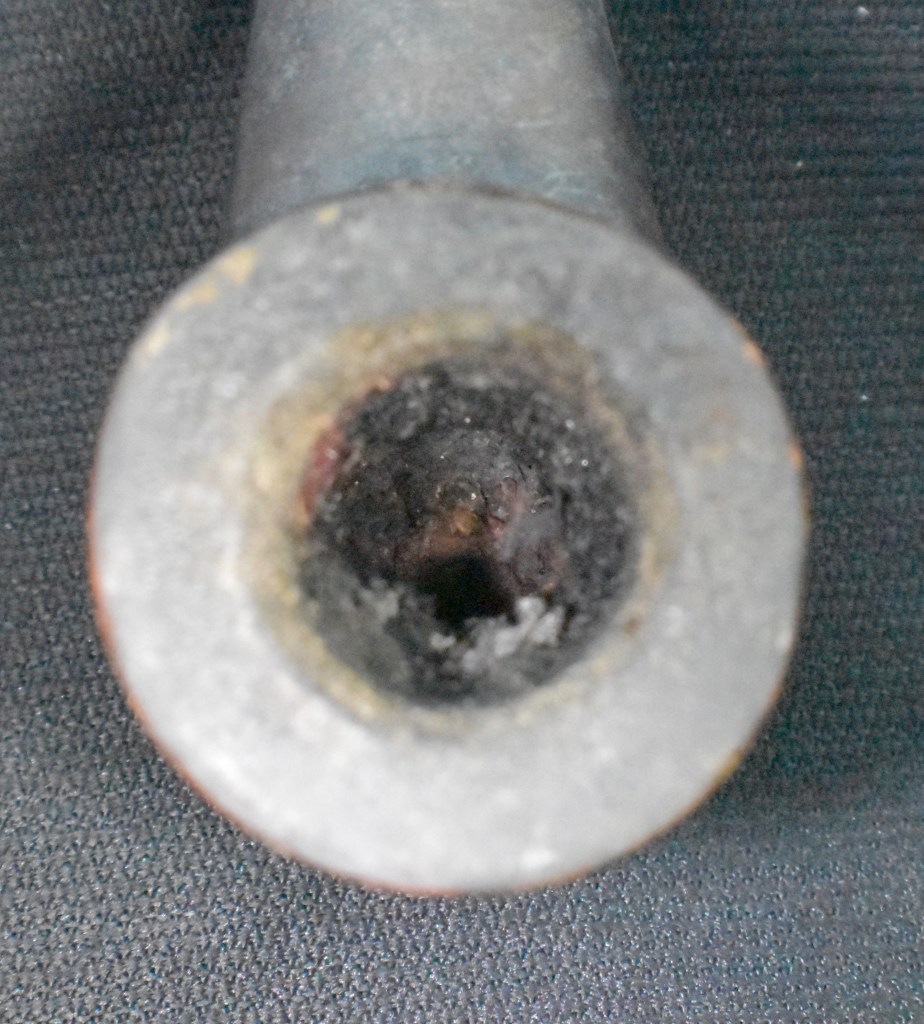
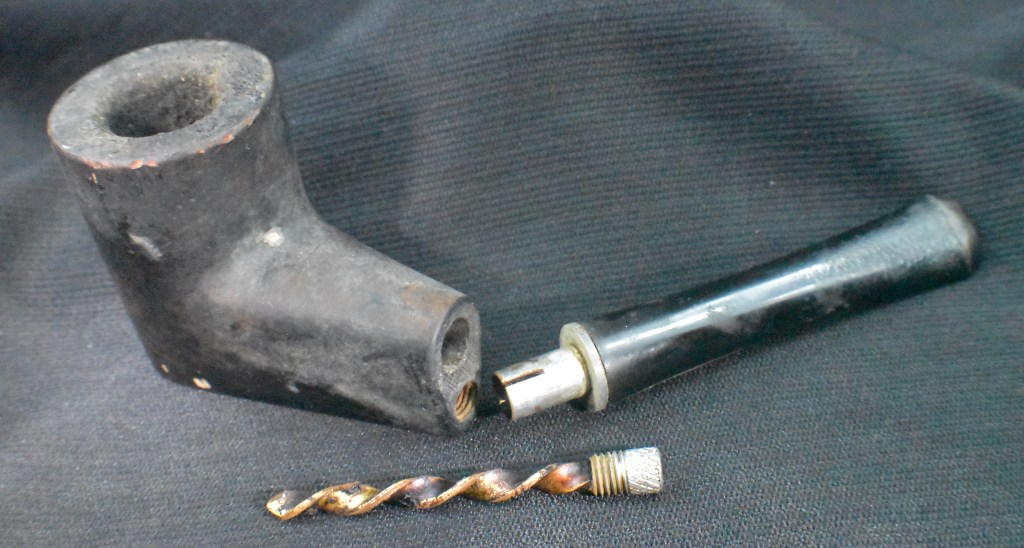
Oh the horror. It’s not that bad, really. The pipe was filthy and heavily used. That should tell me that it was a great smoking pipe. Why else would someone use it that much, right? I failed to photograph the stem for the “before” section, apologies. It was in bad shape. The Medico stems that J. Rettke used were a mix of nylon and vulcanite. I say this because I have encountered both in my Rettke restorations. This one was a well chewed nylon stem. The bowl had a thick cake and scraps of tobacco still within. There was a thick lava deposit on the rim. The exterior of the pipe was dirty and I thought this filth was masking the briar grain. The screw in aluminum “whirler” (J. Rettke’s name for the part) was stuck. This one was going to require some time.
Background
I will use the research I did from my first J. Rettke pipe for the “Background” section and include it here:
“I started my research on Rettke pipes with a pipedia.org search on “rettke”. Below is the short entry from that site.
“J. Rettke, Washington MO, PAT. June 12 1962. The silver colored thumbscrew below the stem unscrews and is a 2⅜” corkscrew like device. The company is now gone having been purchased by Missouri Meerschaum. This odd looking pipe is made of briar and has a lower chamber with a metal condenser and an upper chamber that contains a filter. The smoke leaves the bowl thru the lower chamber then into the upper and out the stem. It smokes dry and cool. It has a large bowl.”
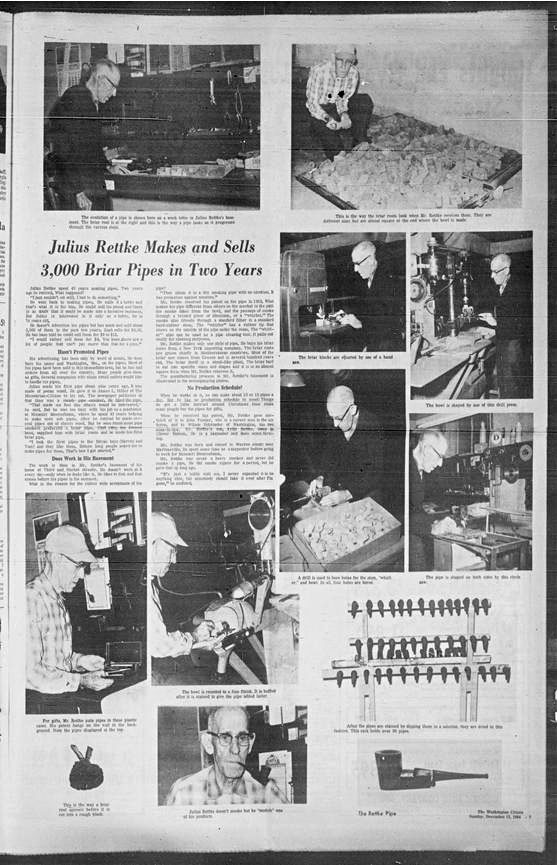
(Rettke – Pipedia) I could not read the above newspaper article even by zooming in.
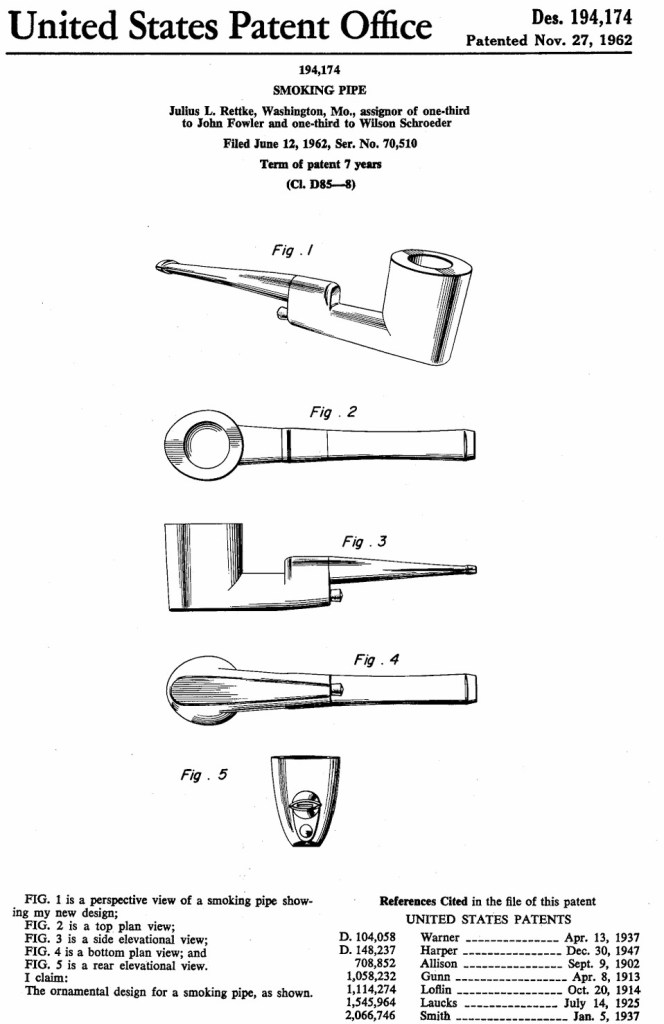
The next search was using Google patent and searching for “Rettke 1962”. This search turned up the original patent diagrams:
My next search was for Steve Laug’s Rebornpipes.com. Steve Laug did a Rettke restoration back in 2017 and contained links to the State Historical Society of Missouri. I could not get this site to produce the same document or to even display the link Mr. Laug has in his blog post. I will link Steve Laug’s blog here: Restoring a J. Rettke Patent Pipe from Washington, Missouri | rebornpipes. It is a very well written and researched piece that does contain a transcript of the newspaper article as well as several photographs of Julius Rettke and the pipe making process.
My favorite quotes from the newspaper article are,
“The work is done in Mr. Rettke’s basement of his home at Third and Market streets. He doesn’t work at it every day only when he feels like it. He likes to fish and that comes before his pipes in the summer.”
I can completely understand the lack of enthusiasm for pipe work when fishing is taking a priority.
And this quote:
“Mr. Rettke received his patent on his pipe in 1962. What makes his pipe different from others on the market is the path the smoke takes from the bowl, and the passage of smoke through a twisted piece of aluminum, or a “whirler.” The smoke also travels through a standard filter in a standard hard-rubber stem. The “whirler” has a rubber tip that shows on the outside of the pipe under the stem. The “whirler” also can be used as a pipe cleaning tool. It pulls out easily for cleaning purposes.” Here the newspaper article talks about a rubber tipped “whirler”. That is how the whirler of my pipe is made. The other Rettke pipes I saw in photos all had a knurled aluminum tip. This little fact is mostly non-important, I just found it interesting.
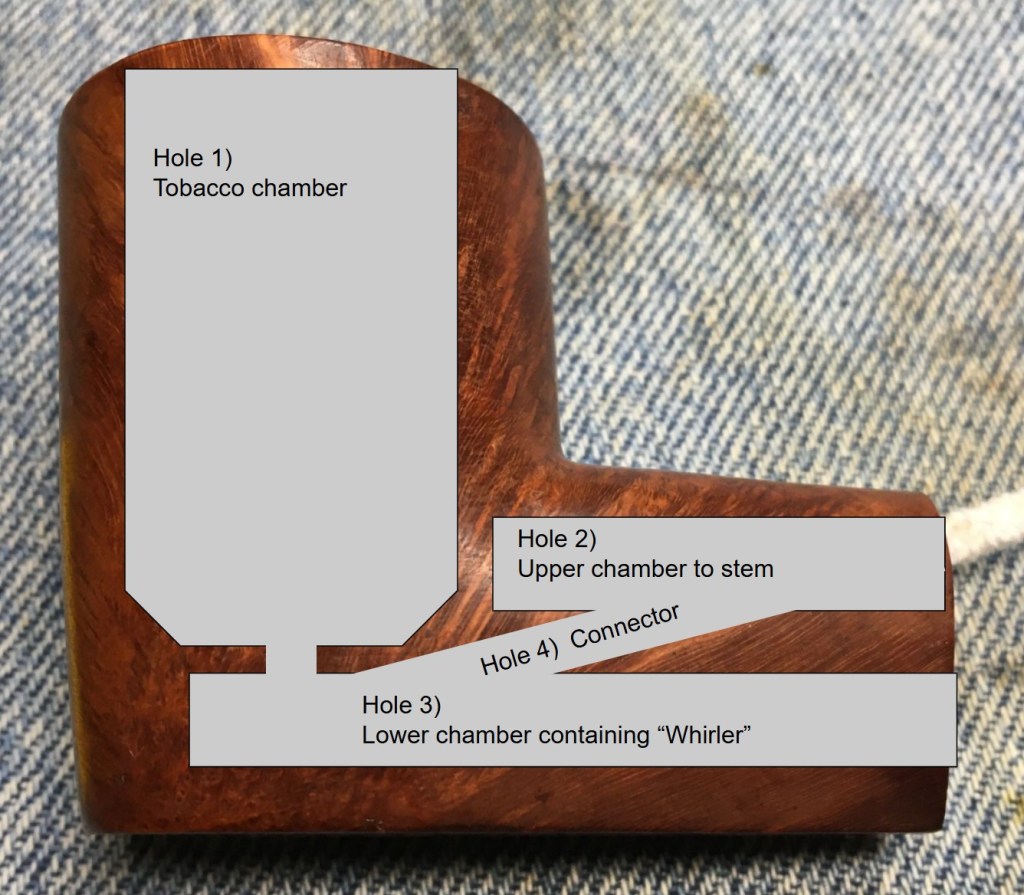
Now for the fun part: How does this pipe work? In the news article transcript it said, “four holes are bored.” under the photo of J. Rettke at the drill press. I read that after I had done my exploration of the stummel and it was in near complete agreement of what I observed.
Using the above photos, I overlaid some image features to indicate the “four” drillings.
Not to be a smart ass, but I think Mr. Rettke would agree that there were actually 5 drillings. The final hole would be a hole at the bottom of the tobacco chamber connecting the airway to the lower chamber. I’ll blame the reporter for the oversight and not Mr. Rettke.” (A Rettke Pipe Restoration for the Real American Pipe Smokers (RAPS) Facebook group – NebraskaPeteGeek). It seems weird to quote myself but, I’m far too lazy to rewrite all that. Feel free to take a look at the other two Rettke restorations. Here is the second: A J. Rettke Restoration – NebraskaPeteGeek.
The Restoration
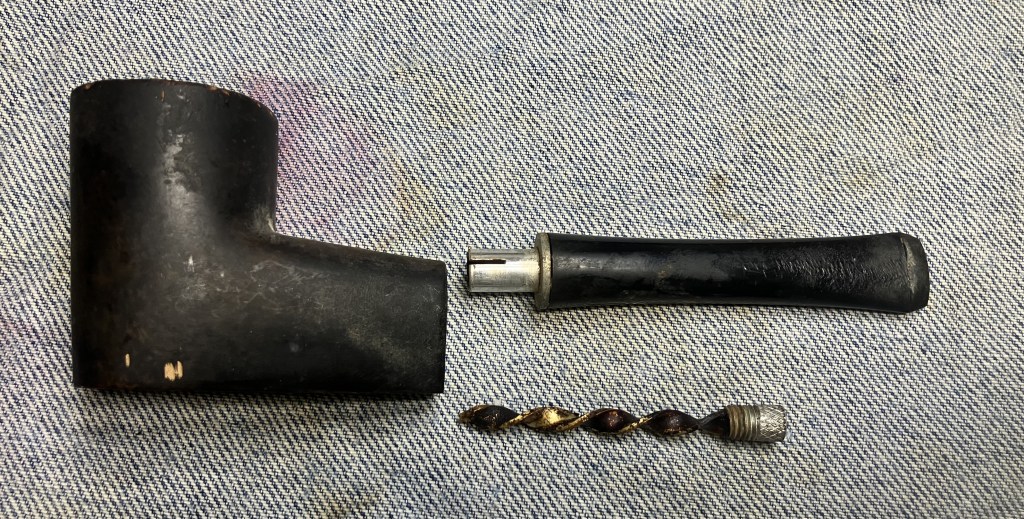
I wrapped the knurled end of the whirler with a thick piece of leather and gripped it with a pliers to free it from the stummel for the “before” photos. Below is the pipe on the workbench.
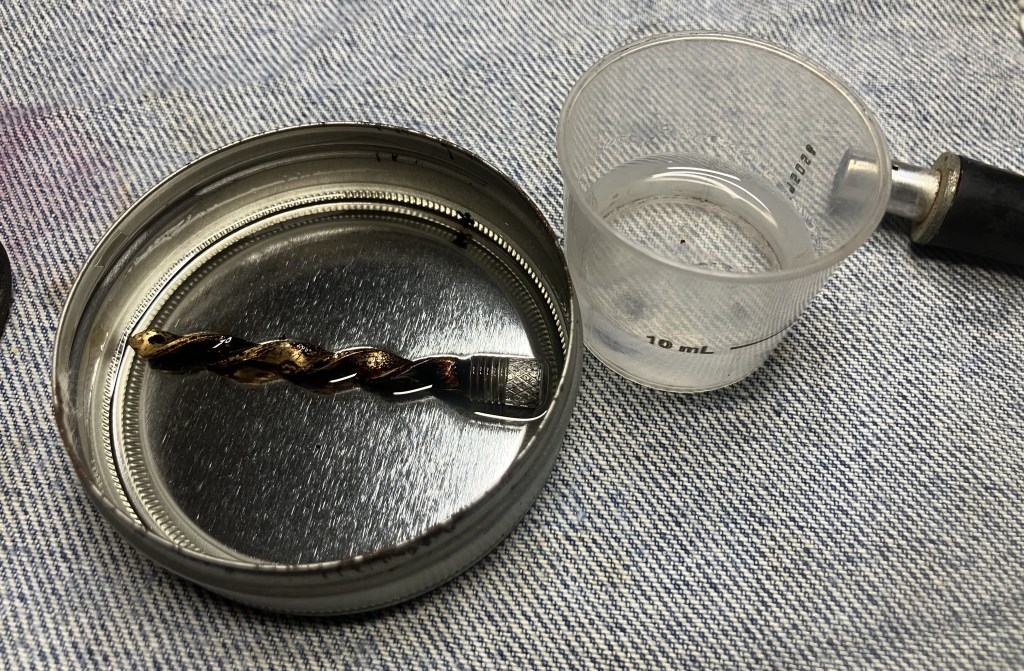
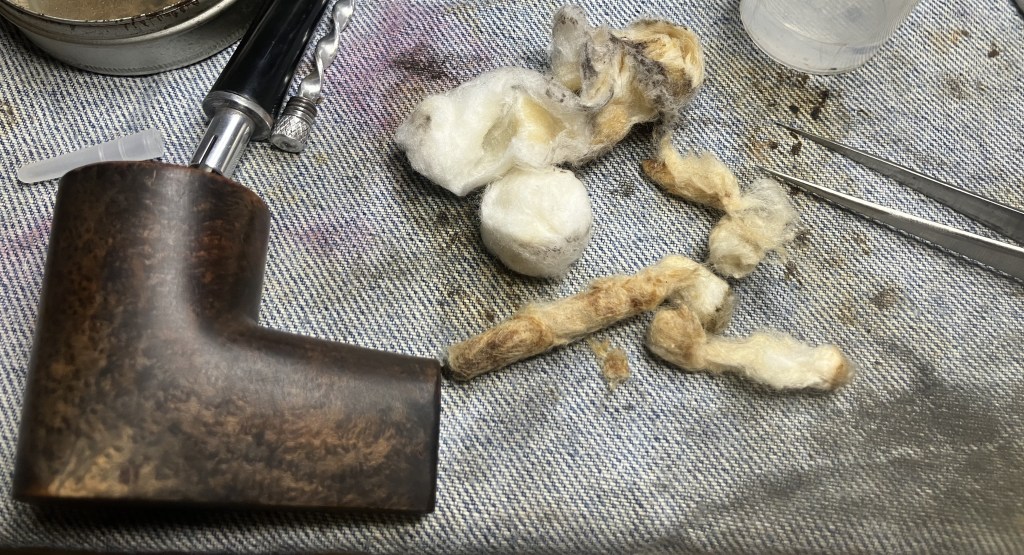
The whirler was too long for the medicine cup so it got an old snuff can lid with enough 99% ethyl alcohol to soak the aluminum.
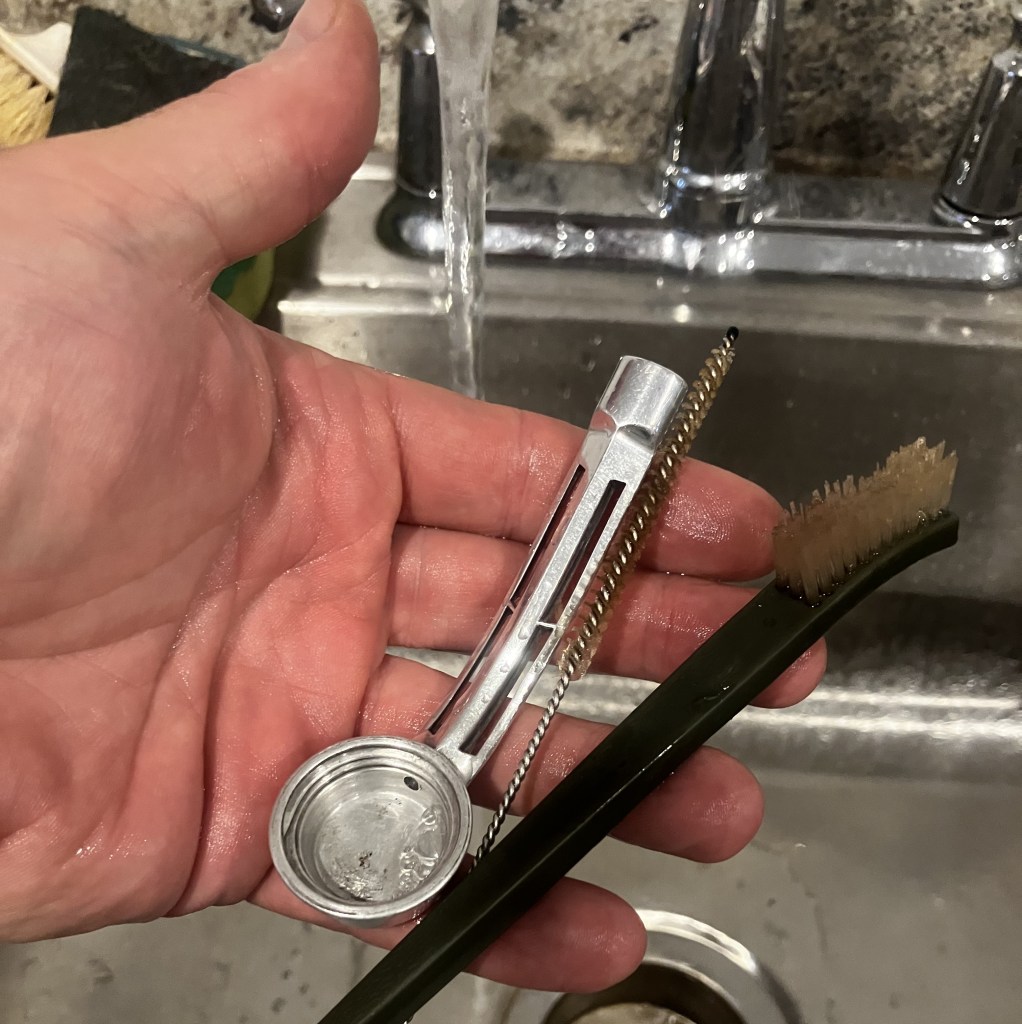
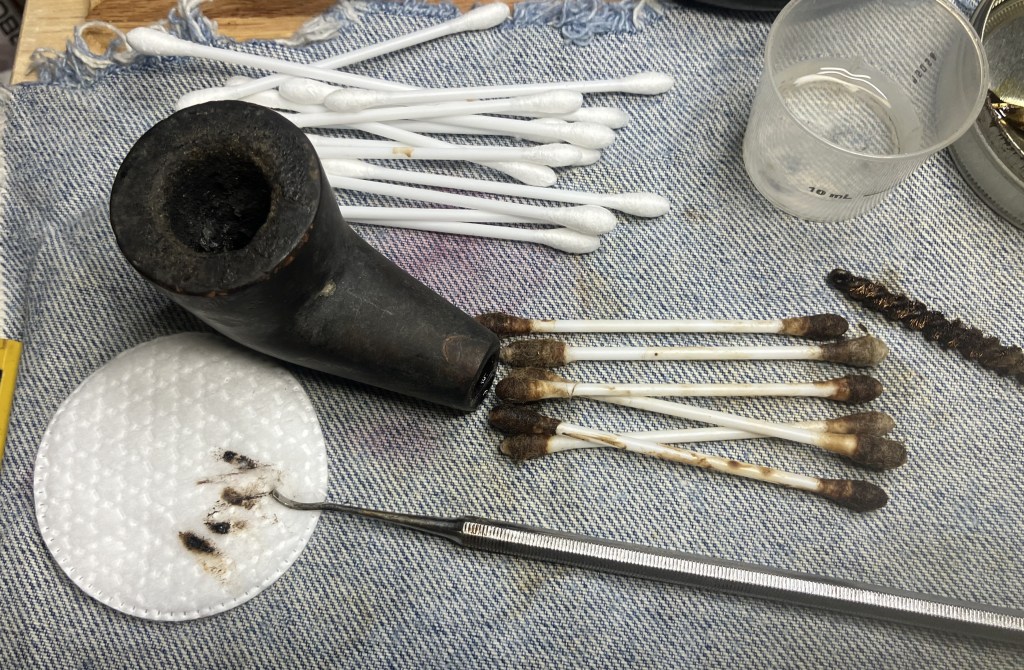
The airway of the shank was as disgusting as the rest of the pipe. I tried to moisten the tar deposits with alcohol dipped cotton swabs. I also used a .22 caliber brass bore brush to lightly scrub the upper and lower chambers. There was also some scraping with a dental scraper.
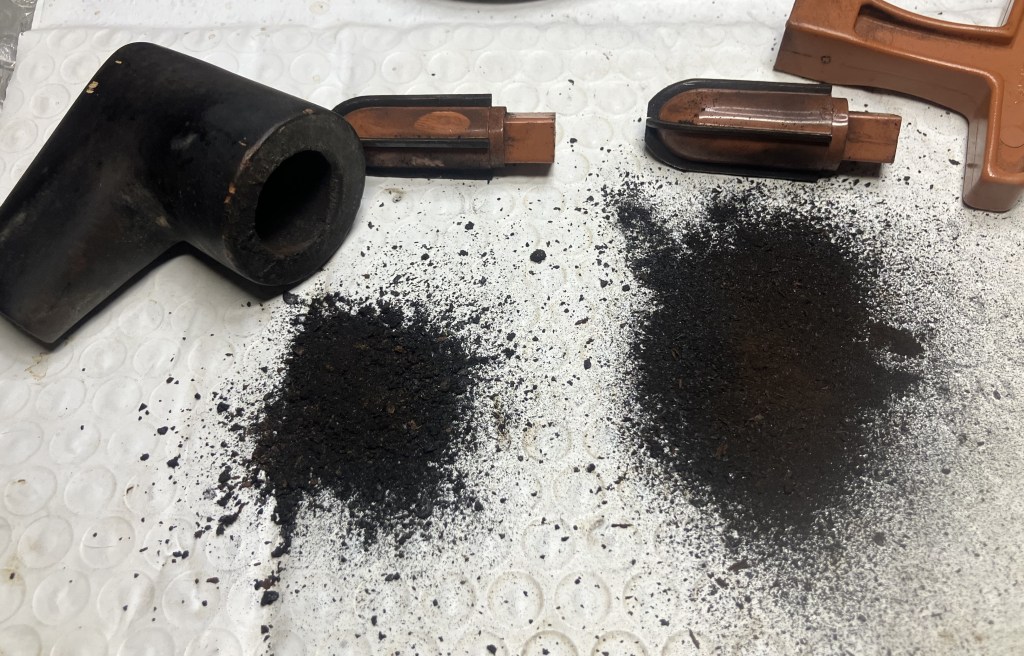
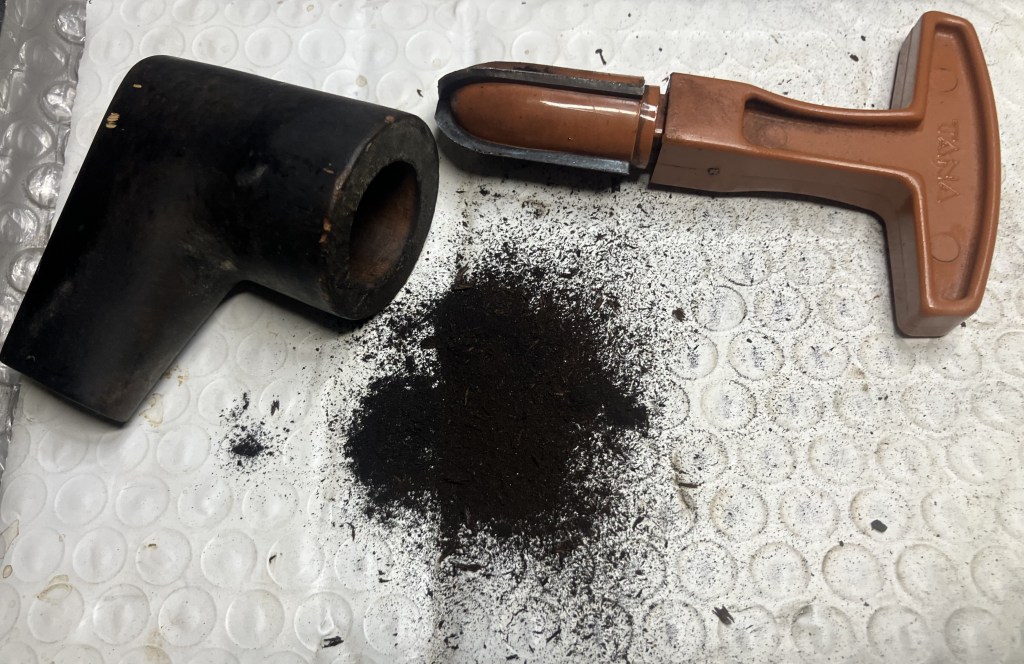
The reaming used three of the PipNet blades.
The first blade.
The second blade.
And the third blade.
Old Mr. Rettke must have had a drill bit with a more conical bottom as I needed to use the Kleen-Reem to ream that part of the tobacco chamber.
Even after all that the chamber needed scraping with the Smokingpipes Low Country reamer and the General triangular scraper.
Finally, the chamber was reamed. The walls were remarkably intact and undamaged by the many bowls of tobacco.
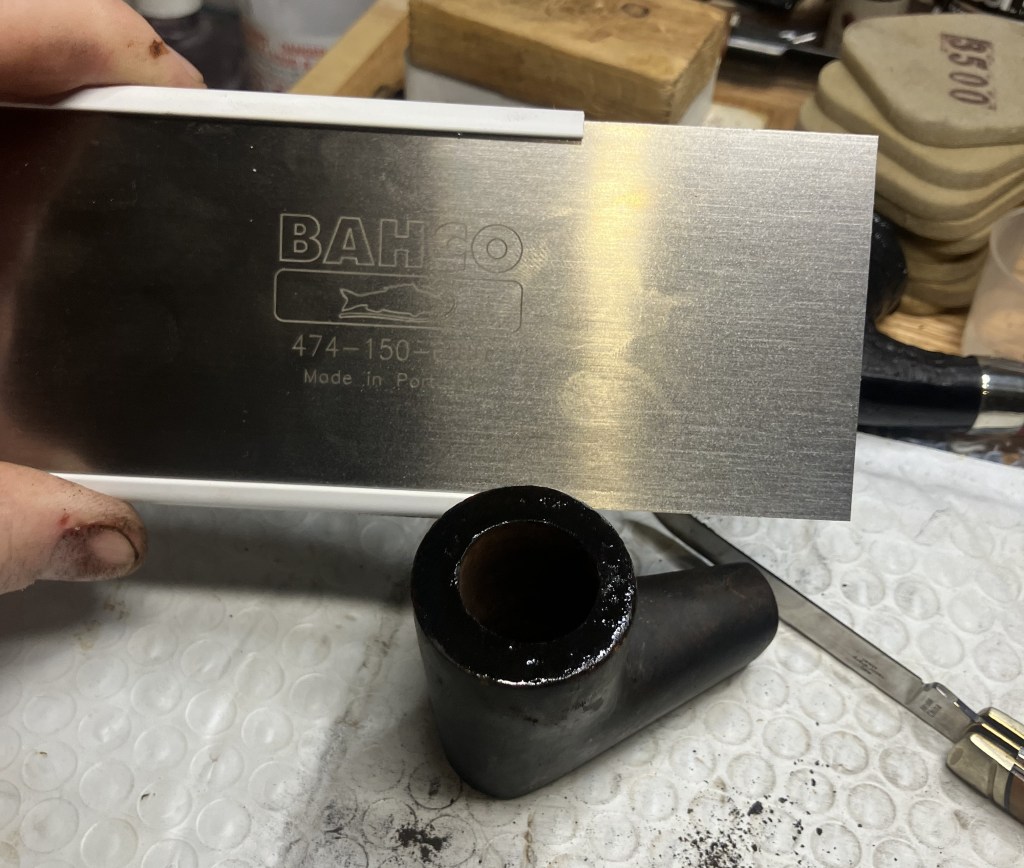
To rid the rim of it’s lava, I employed a new tool or toy. A cabinet scraper. The rim was moistened with saliva and allowed to soften for a few minutes.
The cabinet scraper performed admirably but revealed that the rim appeared to be stained or dyed black. I had never seen a black Rettke pipe before. Maybe it wasn’t as filthy as I suspected.
To the sink! Here the stummel was scrubbed with a nylon brush and undiluted Murphy Oil Soap. Yeah, it was filthy. The soap was rinsed with warm water and the stummel dried with a cotton hand towel.
Hmm, back at the bench it became obvious that the briar had indeed been dyed black. It wasn’t just dye though, it was like old Mr. Rettke had mixed the dye with lacquer. I wiped the stummel with a make-up pad dipped in 99% ethyl alcohol and it removed a lot of black.
I started sanding to see if I could penetrate the finish. It worked. I thought to myself, “a smooth black fishing is a tough thing to master. Maybe Mr. Rettke was trying his hand at that kind of finish to mask some flaws in this piece of briar?” Yes, it was all conjecture, but it makes for an interesting story.
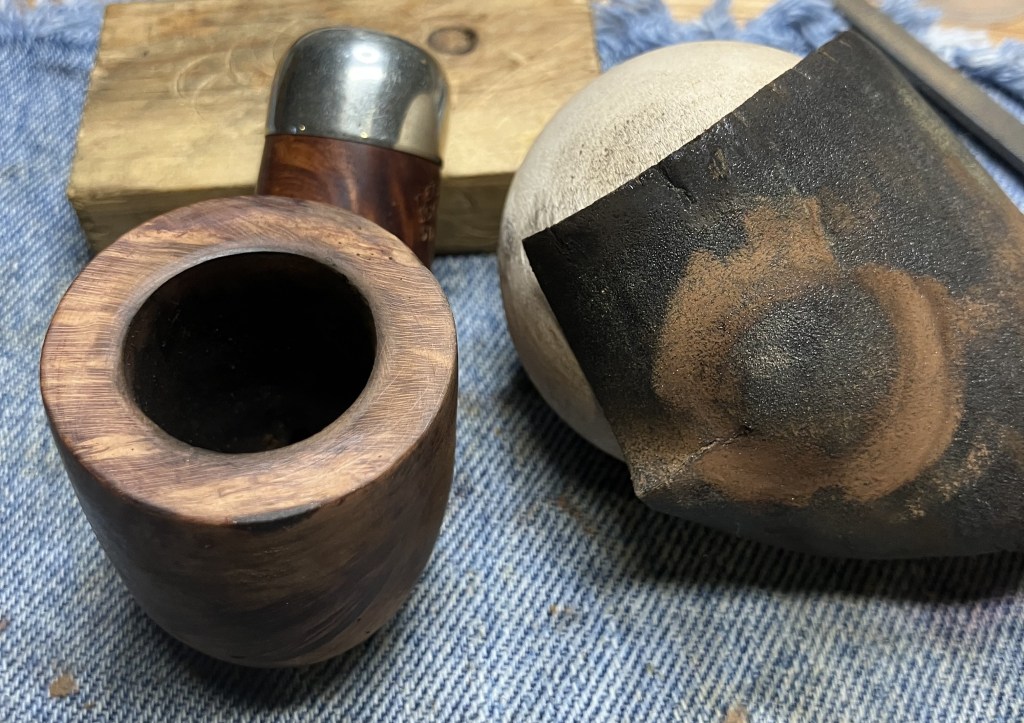
This pipe had a very sharp rim both inside and outside the tobacco chamber. To mask the dings and wear, I added a slight bevel to the inner rim using sandpaper and a wooden sphere. The outer rim was also beveled using a life and sandpaper.
I know, I was jumping around a lot with the different parts of the restoration. I next cleaned the whirler. I do that when I am thinking about how to go about doing something with a restoration. Repetitive activities help lubricate my thought process.
The whirler cleaned up nicely.
Hmm, there was a fill on the top of the shank, the parabolic light mark seen below. I wondered if this was what Mr. Rettke was trying to conceal with the black? I proceeded to pack the airways with cotton.
I figured that it would take a bit over 10 ml of ethyl alcohol to saturate the cotton. Using a disposable pipette I added alcohol until all of it was saturated.
I was right, a bit more than 10 ml. The alcohol would be left to evaporate, dissolving the tars and moving them to the cotton over the next several hours.
I turned my attention to the stem. It too was dirty and took several cotton swabs and bristle pipe cleaner dipped in alcohol to clean.
Here is a photo of the condition of the stem before working to smooth it. Yikes!
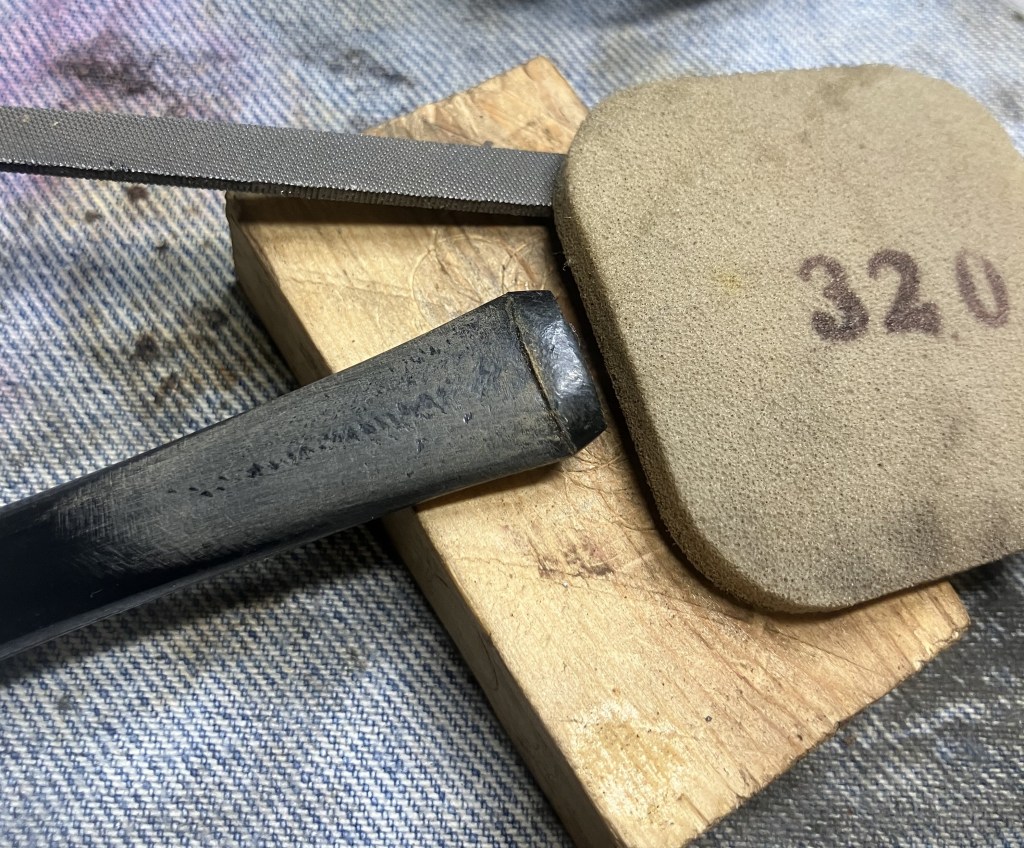
Filing was the first step. I used a small flat file to reestablish the button and remove some of the dents from teeth.
The filing and sanding with a 320 sanding sponge continued on both the top and bottom of the stem. Darn that nylon.
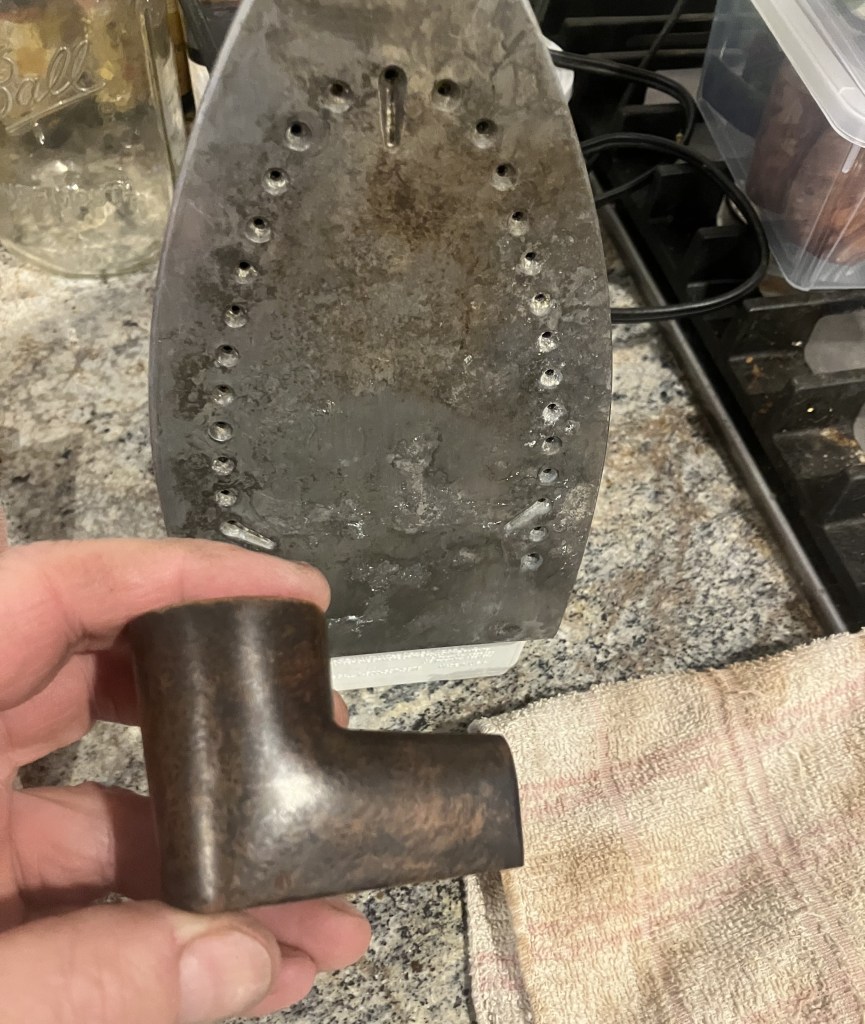
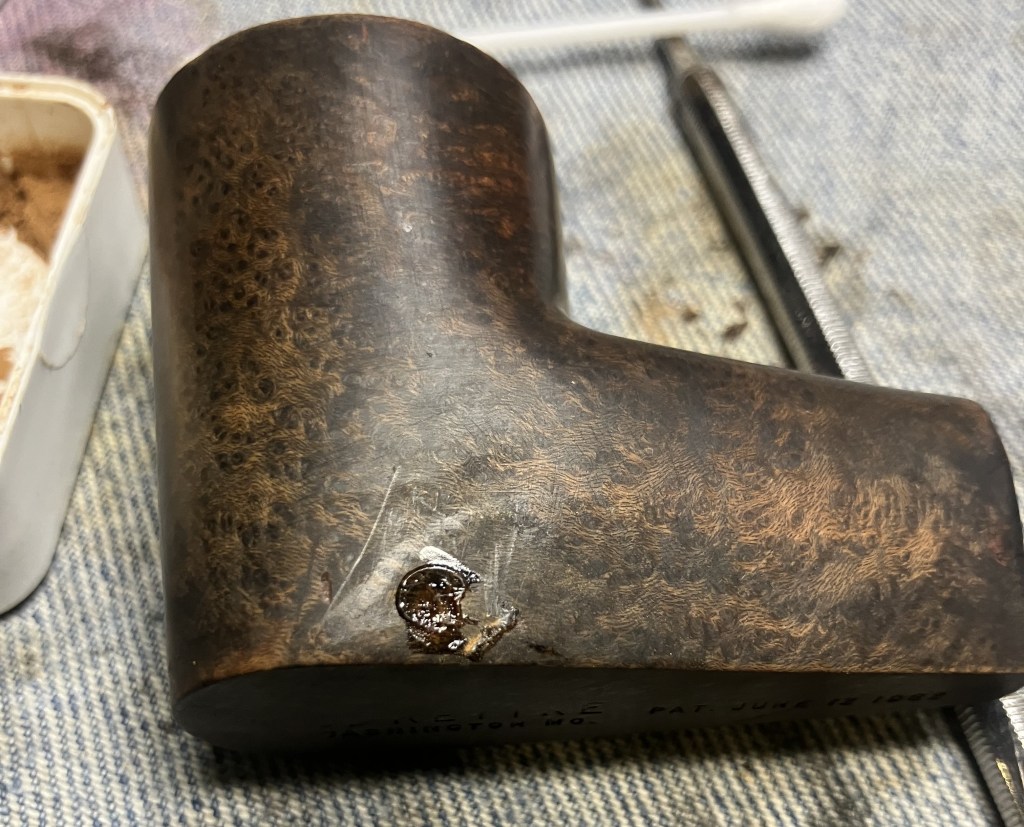
Taking a break from the stem, I thought about how to repair the two dings on the bottom left of the stummel. The alcohol was still soaked into the cotton within the airways and would be interfered with by my manipulations.
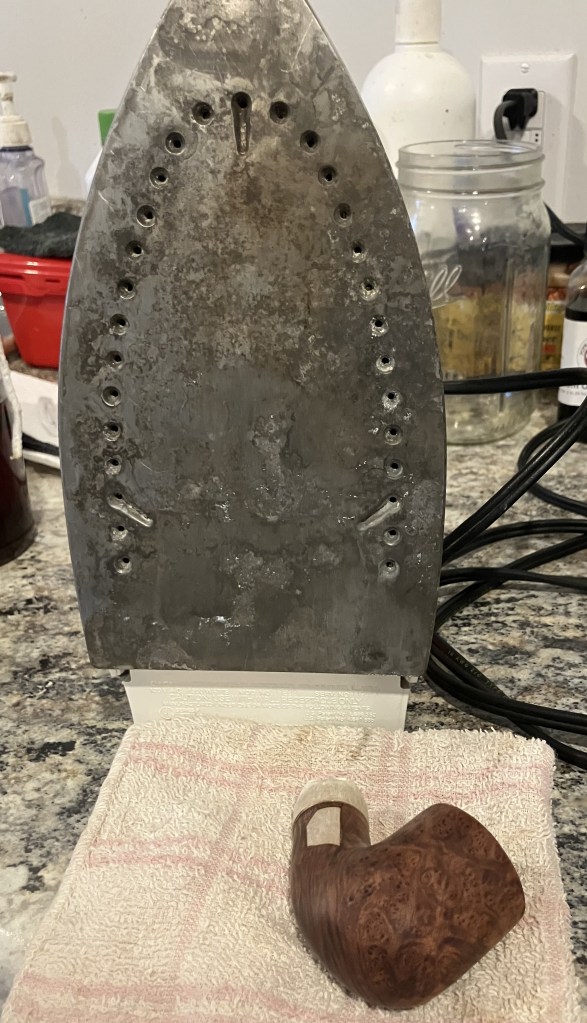
I first tried to raise the dents using a hot iron and a wet cotton cloth.
This worked a little bit but the dents remained.
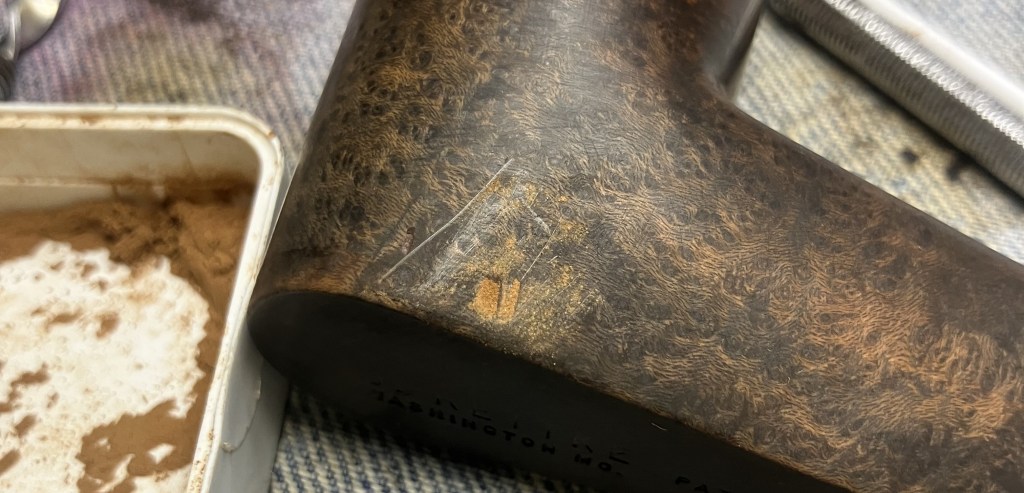
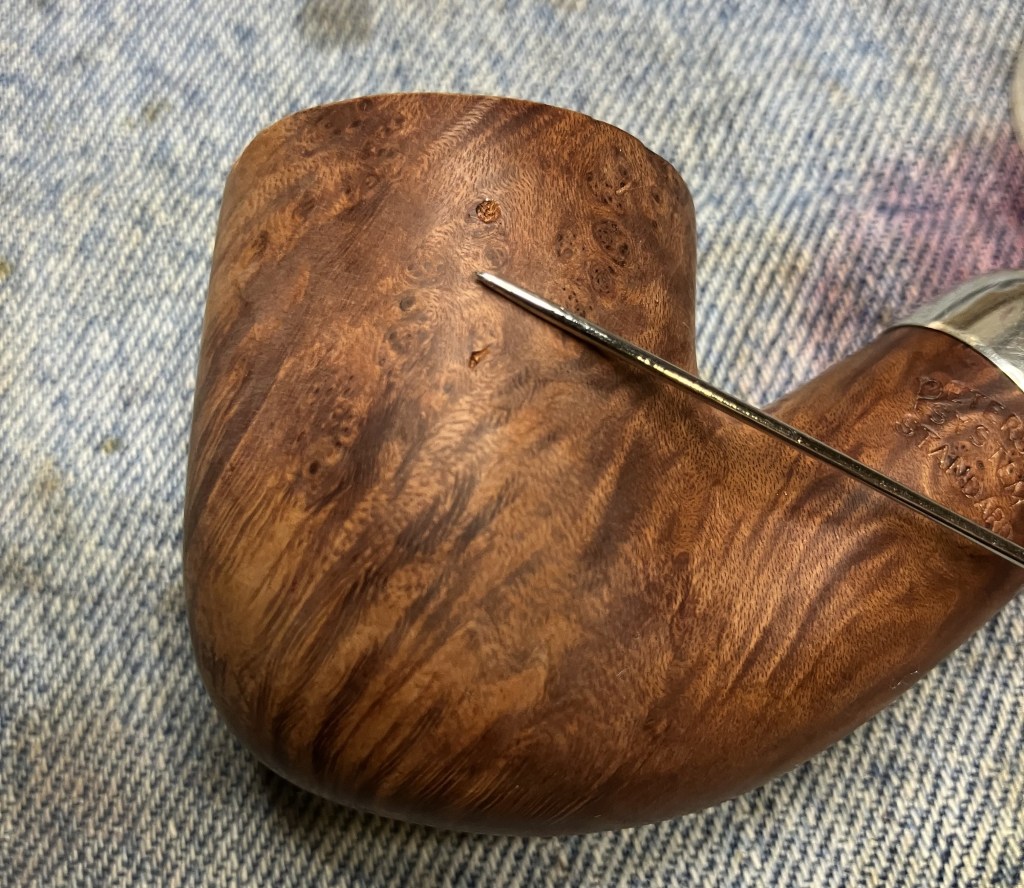
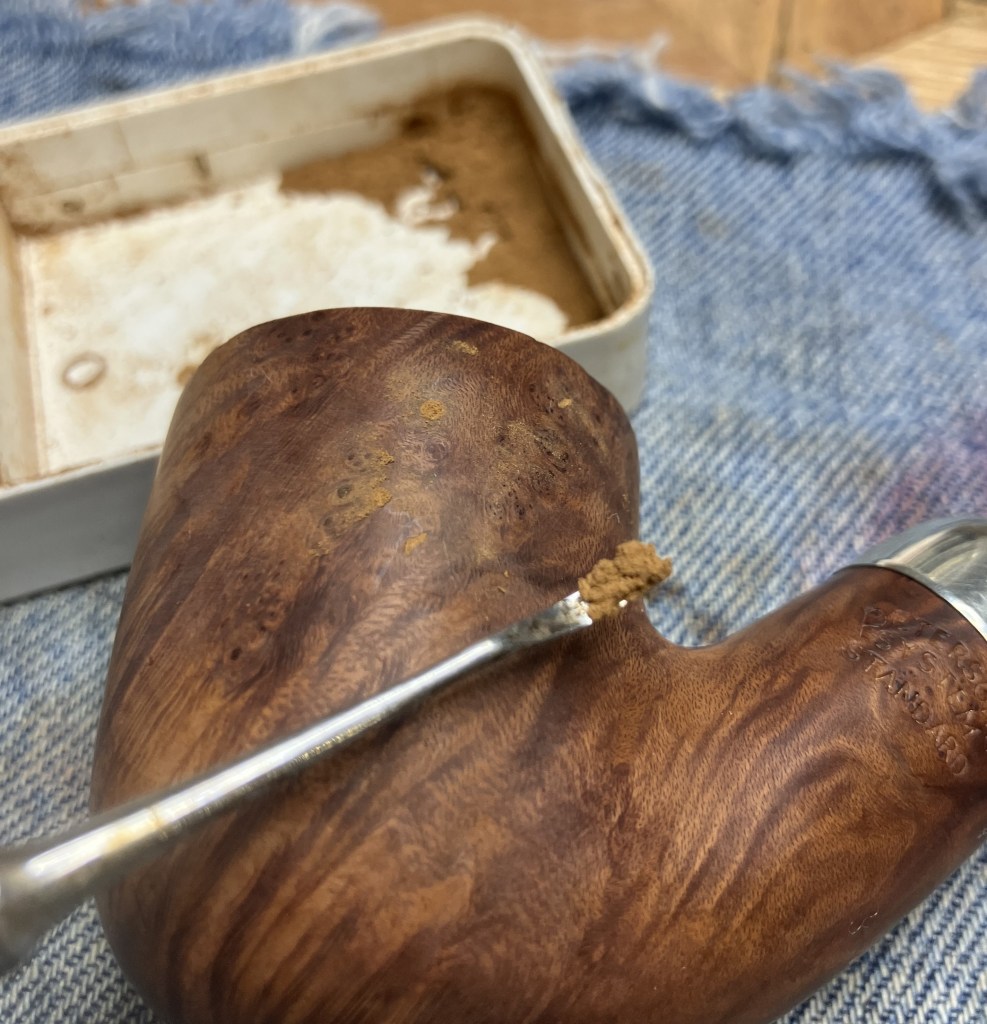
I filled the dents with briar dust and pressed the dust into the depressions.
This cyanoacetate (CA, super glue) was added to the briar dust.
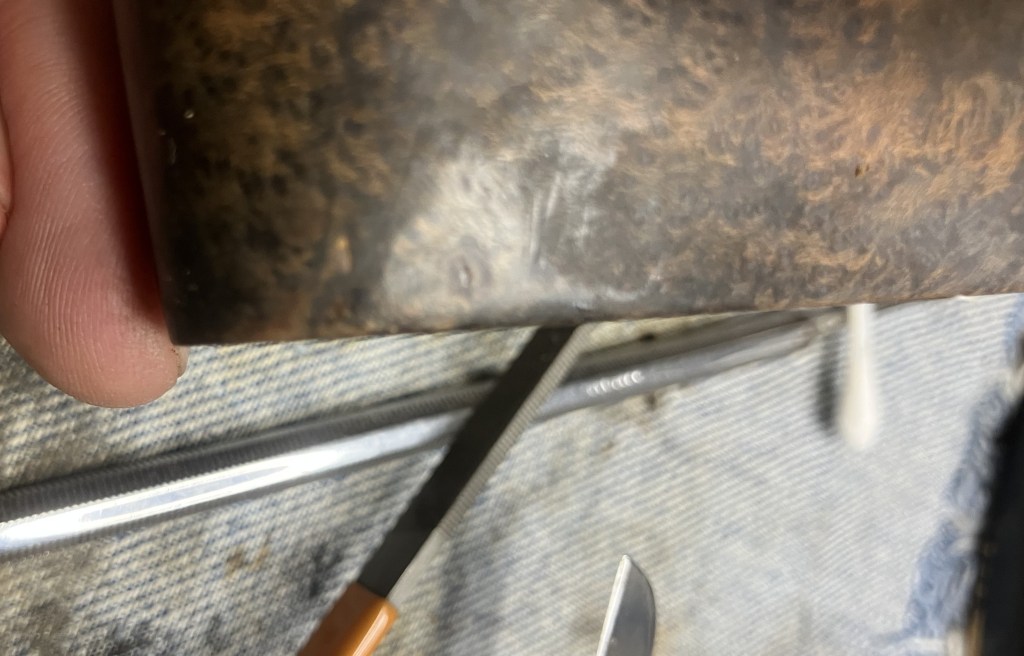
This was filed using a small flat file.
An additional application of briar dust and CA was used and more filing and a bit of sanding smoothed the damage.
The next day the cotton was removed.
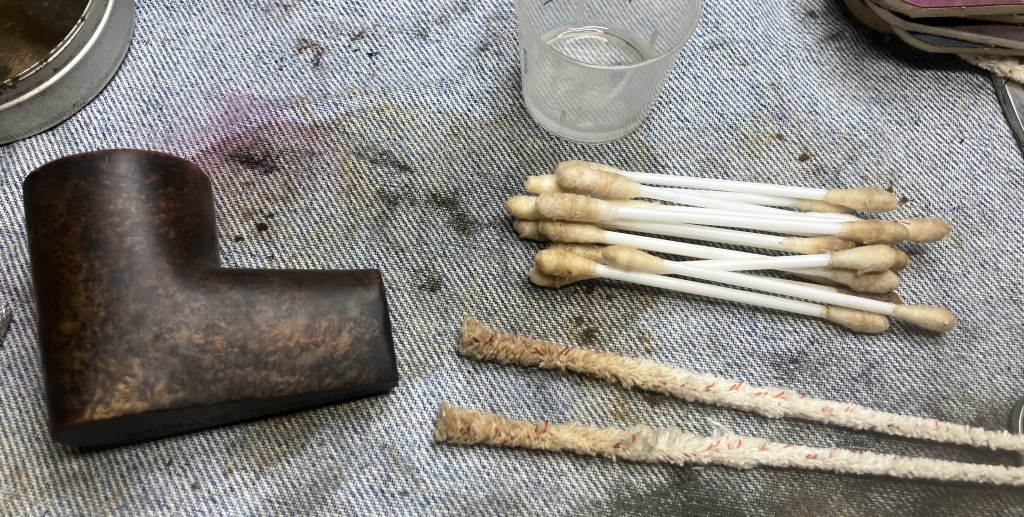
Another airway cleaning with cotton swabs and bristle pipe cleaners went much better that the first one.
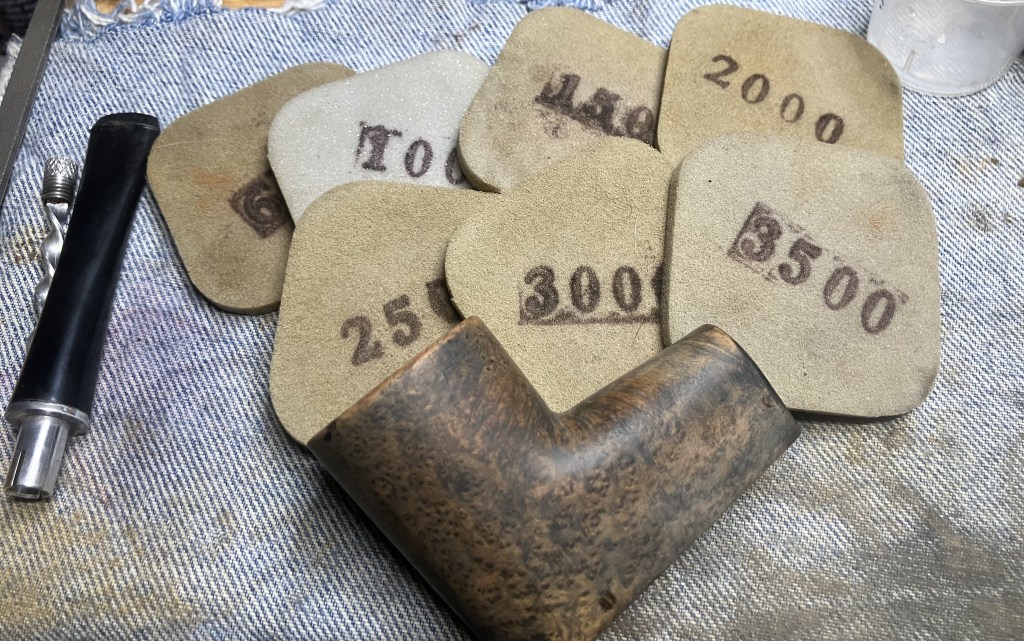
The stummel was sanded with a series of sanding sponges from 600-3500 grits. Between each sponge the stummel was wiped with a make-up pad wetted with alcohol to remove sanding debris.
The stummel was then worked with micro-mesh pads 4000-12000. The wiping was done as with the sanding sponges between each pad.
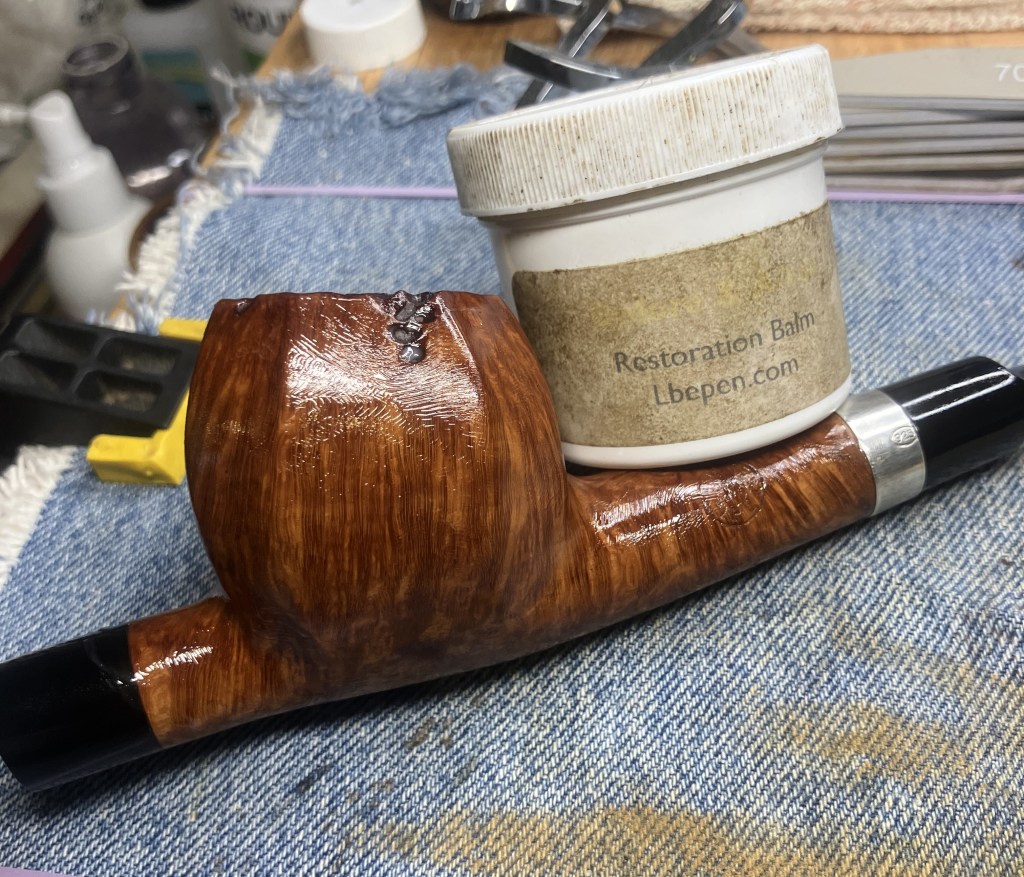
The stummel was coated in Before and After Restoration Balm and allowed to sit for 20 minutes. I liked the way the removal of the black finish had left a finish like a contrast dye on the briar.
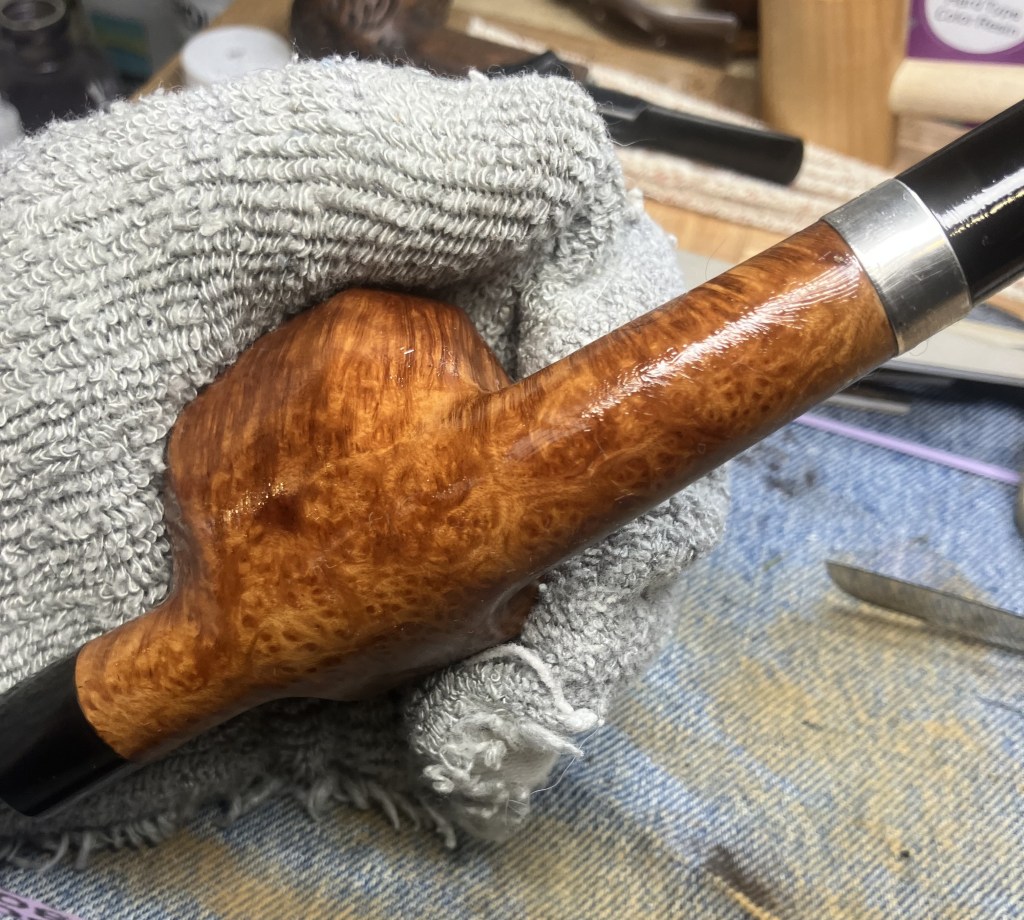
The excess Restoration Balm was wiped from the stummel using an inside out athletic sock.
It’s here that I realized that I had neglected to photograph all the sanding and buffing that I did on the stem. This is probably due to the fact that I do not enjoy working on nylon stems very much. They always seem like you are taking two steps forward and one step back while trying to give them a nice finish and even after a mile’s worth of steps they don’t look great. Well the stummel did look great and both the stem and stummel received several coats of carnauba wax at the buffer.
The final step was a hand buffing of the pipe with a microfiber polishing cloth before the “finished” photo shoot..
I doubt I will ever get tired of restoring J. Rettke pipes. This one turned out very nicely. Yeah, the stem still shows some signs of chompage but it is far better than it was before the restoration. The tobacco chamber was well preserved by all that cake and it looks great. The refinishing of the briar appears dramatically better than I expected. The contrast dye, though unexpected, shows off the wood grain beautifully. At the end of the first Rettke restoration, I said, “Overall this is a very nice and interesting historical pipe. I would consider this an artisanal pipe from a time before artisanal was cool.” Those two statements also apply to this pipe. The dimensions of the J. Rettke are:
Length: 5.39 in./ 136.91 mm.
Weight: 1.25 oz./ 35.44 g.
Bowl Height: 1.93 in./ 49.02 mm.
Chamber Depth: 1.46 in./ 37.08 mm.
Chamber Diameter: 0.75 in./ 19.05 mm.
Outside Diameter: 1.36 in./ 34.54 mm.
I do hope that you have found something here useful to your own pipe care, maintenance or restorations. If you like this sort of thing, please click the like and subscribe buttons. Thank you for reading the ramblings of an old pipe lover.
Loading…
Below are some photos of the finished J. Rettke pipe.
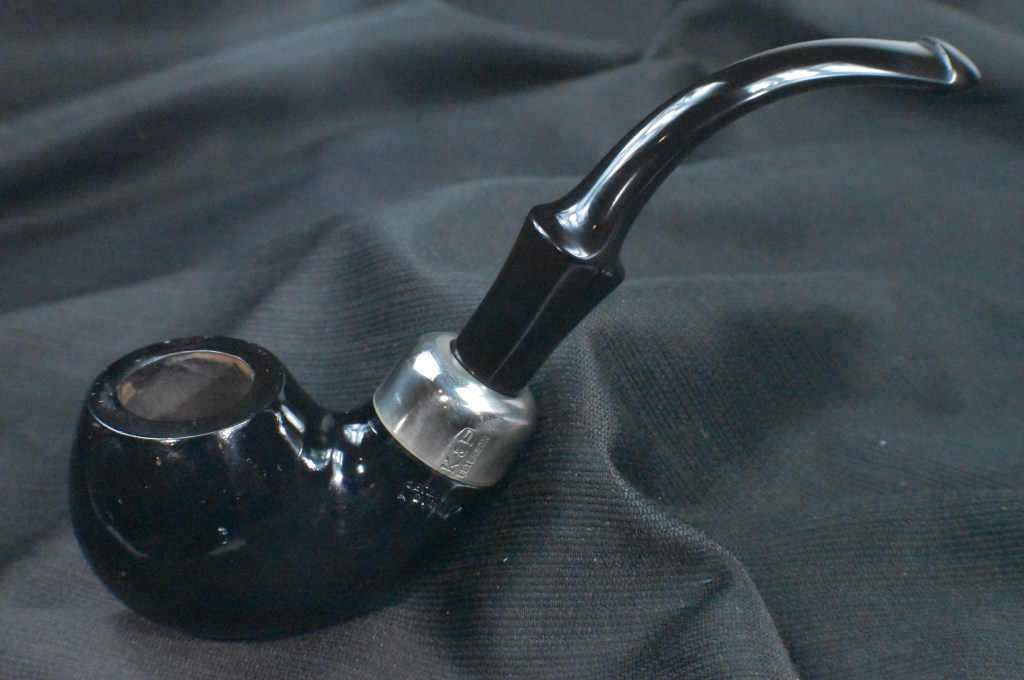
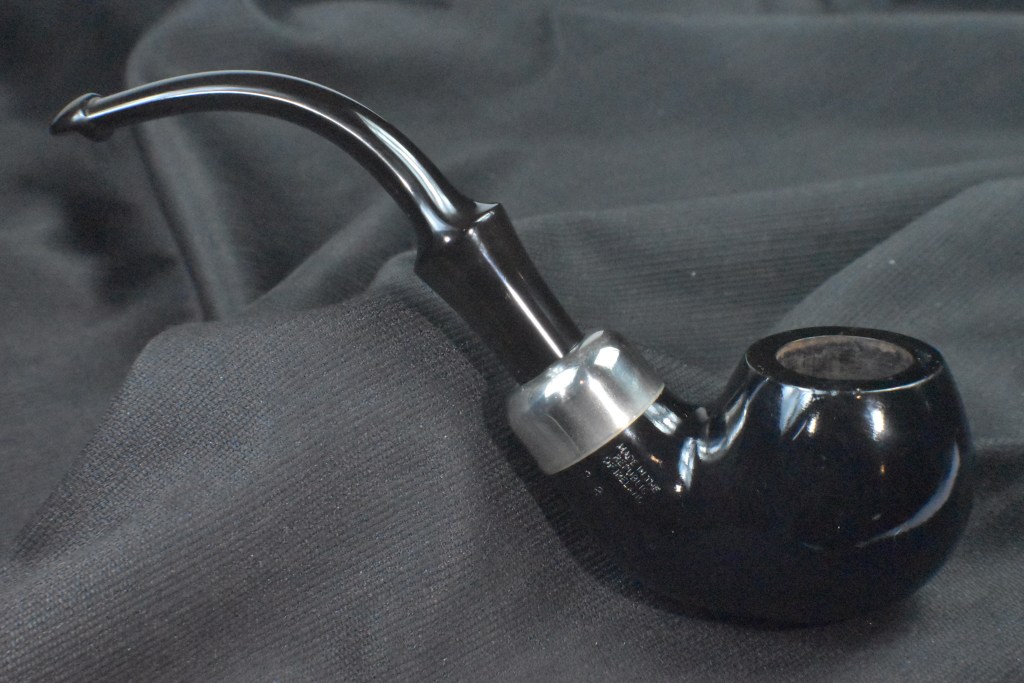
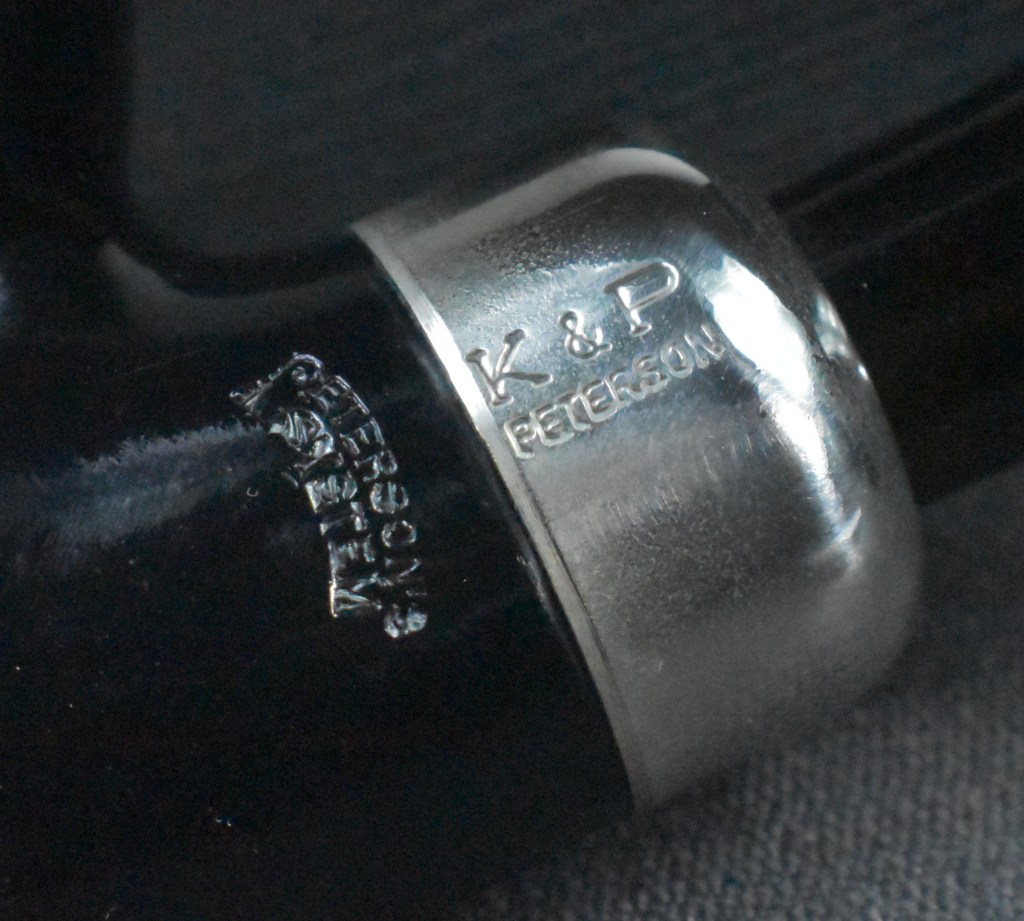
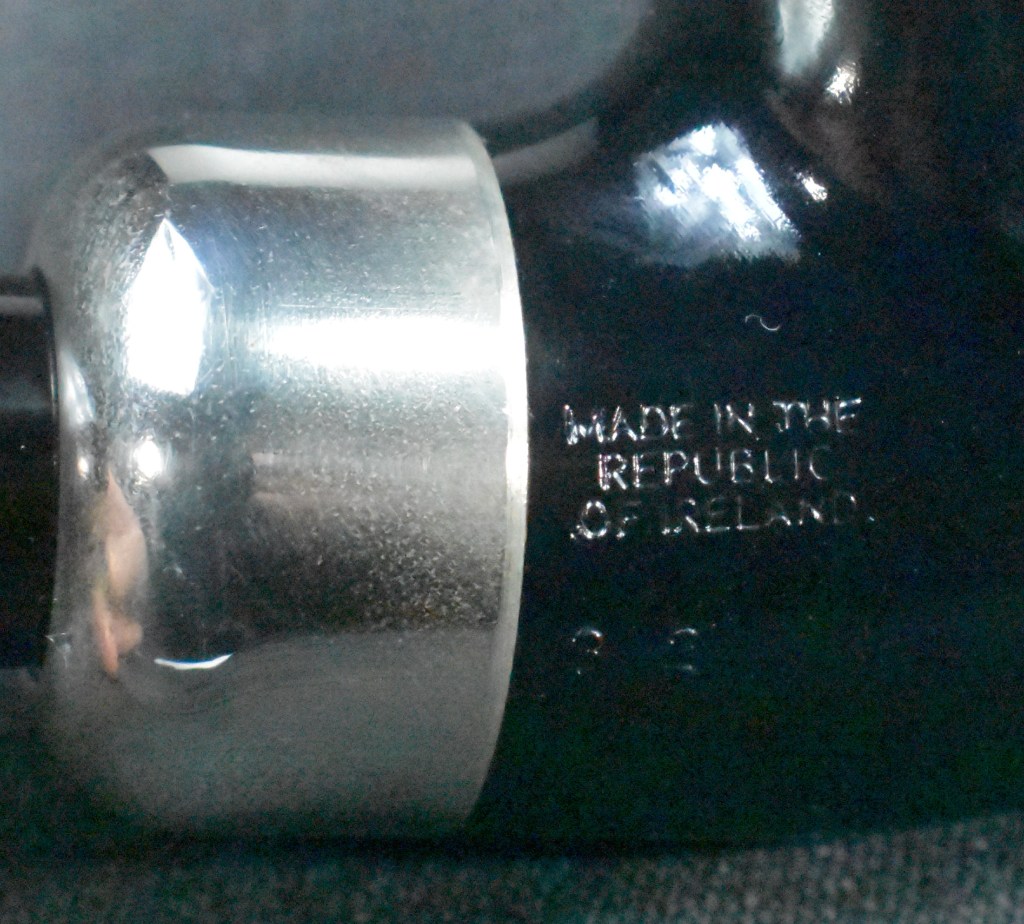
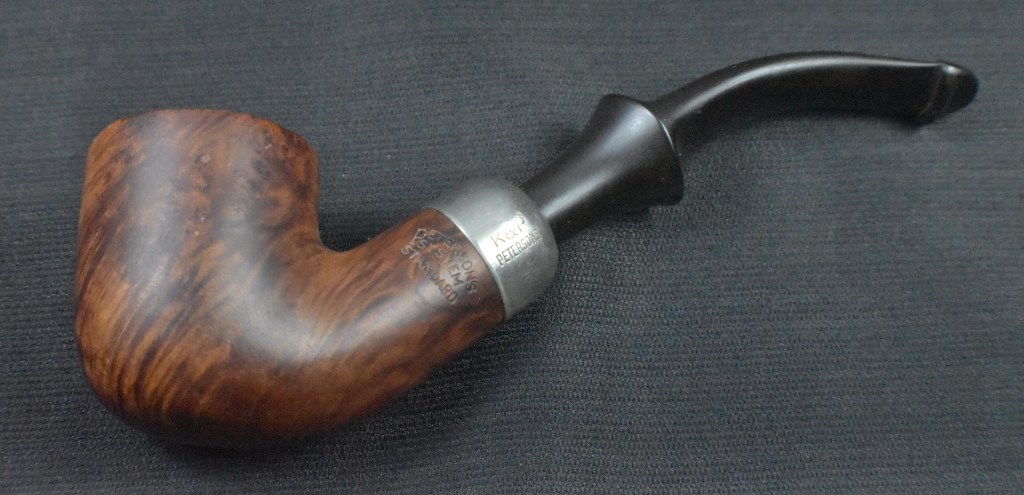
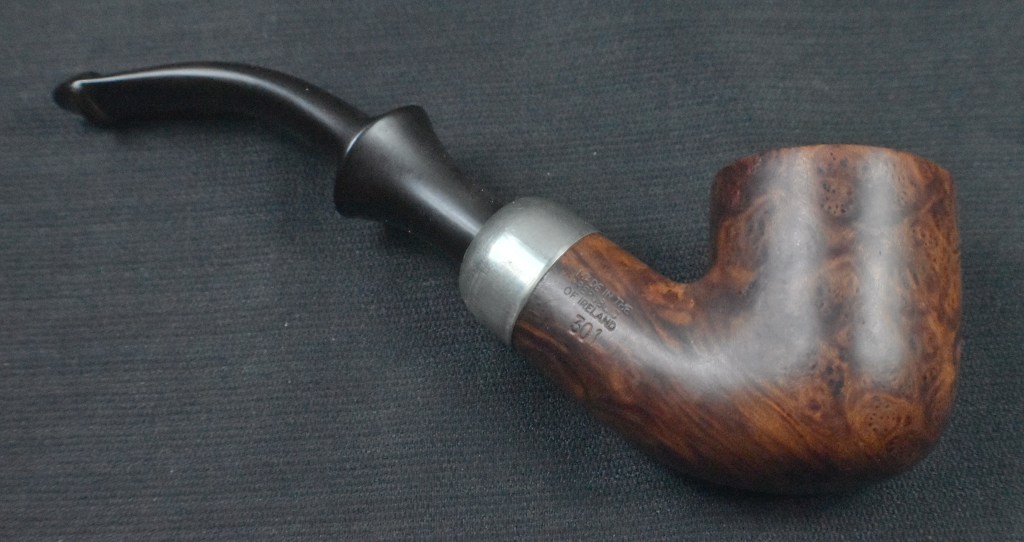
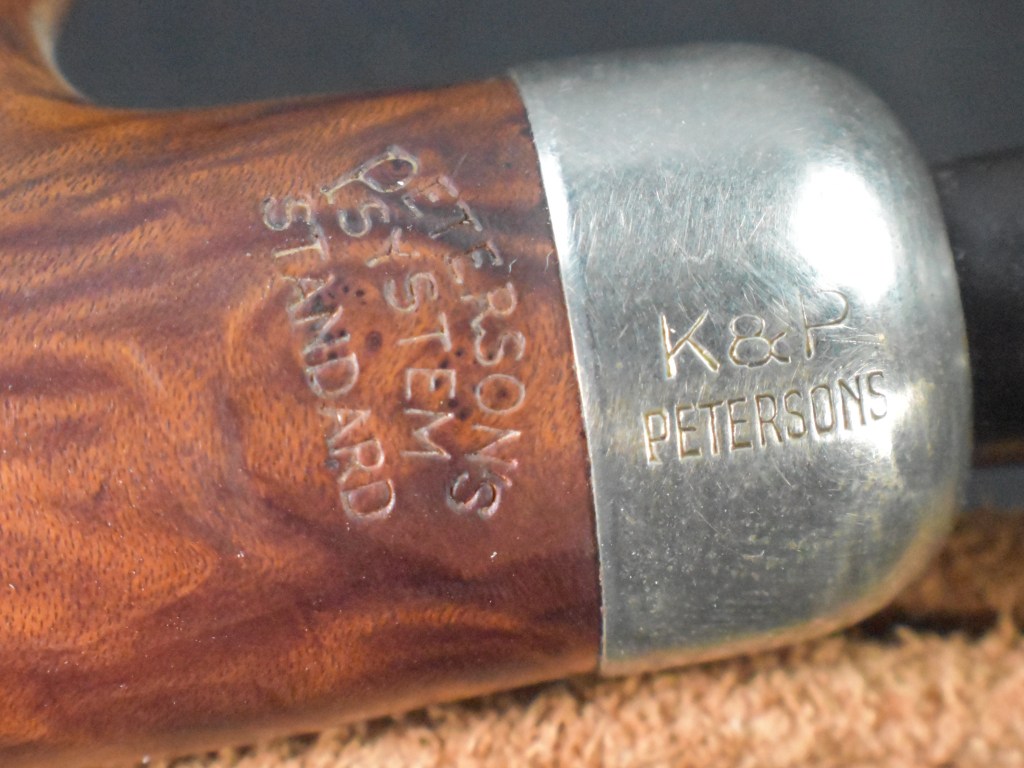
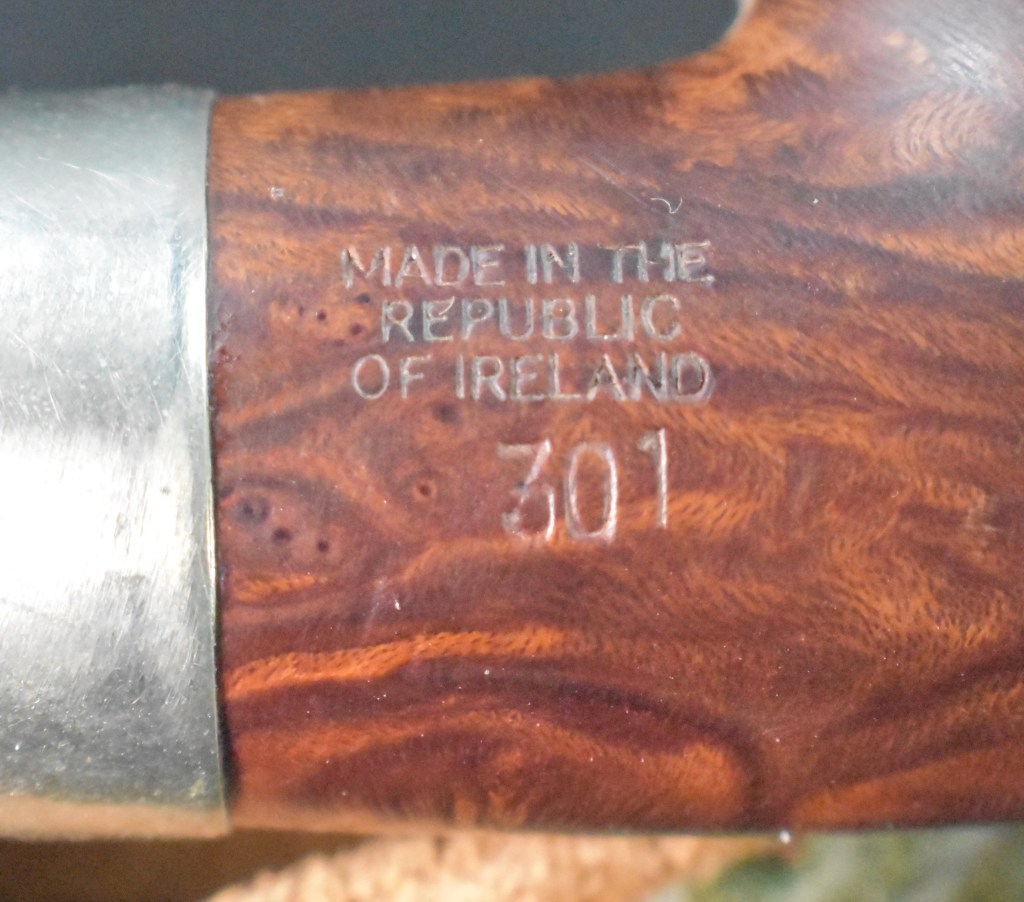
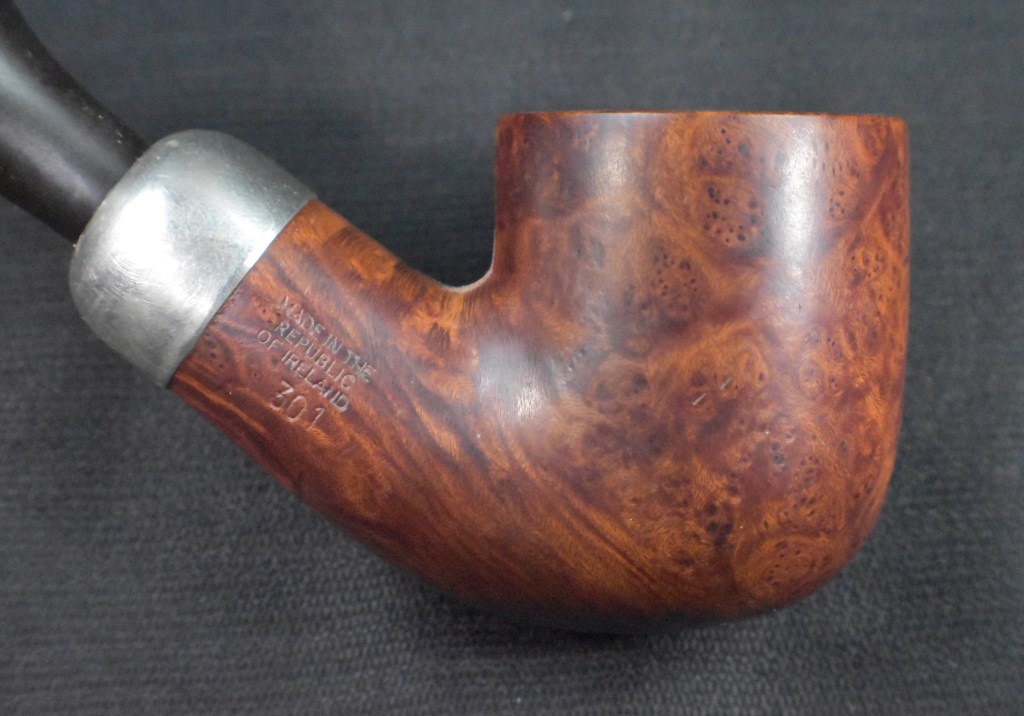
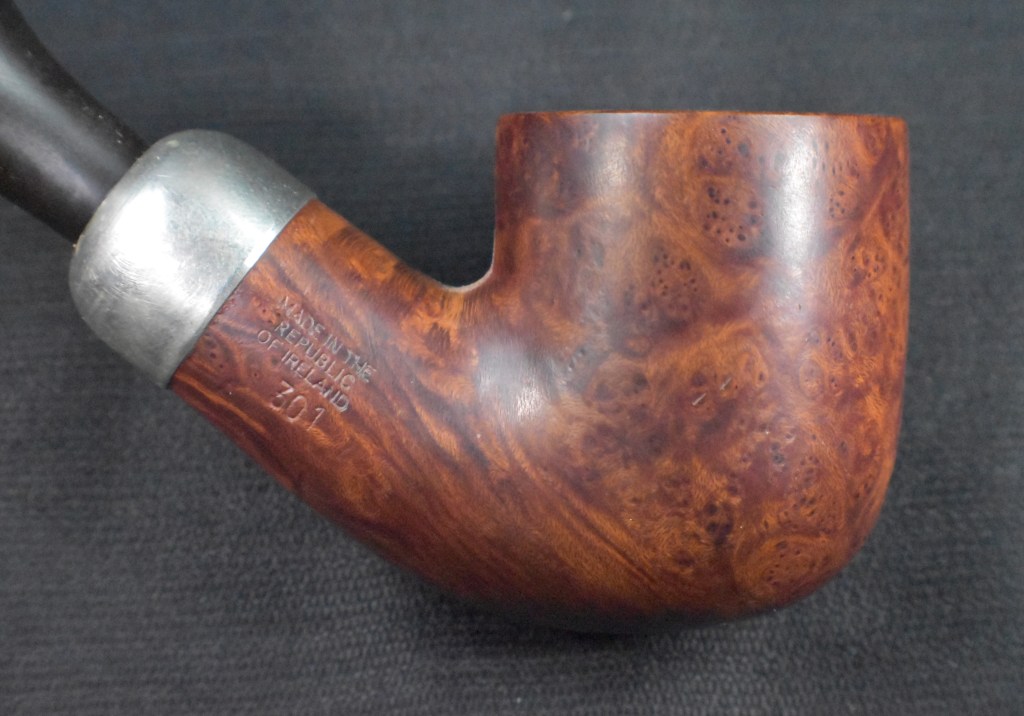
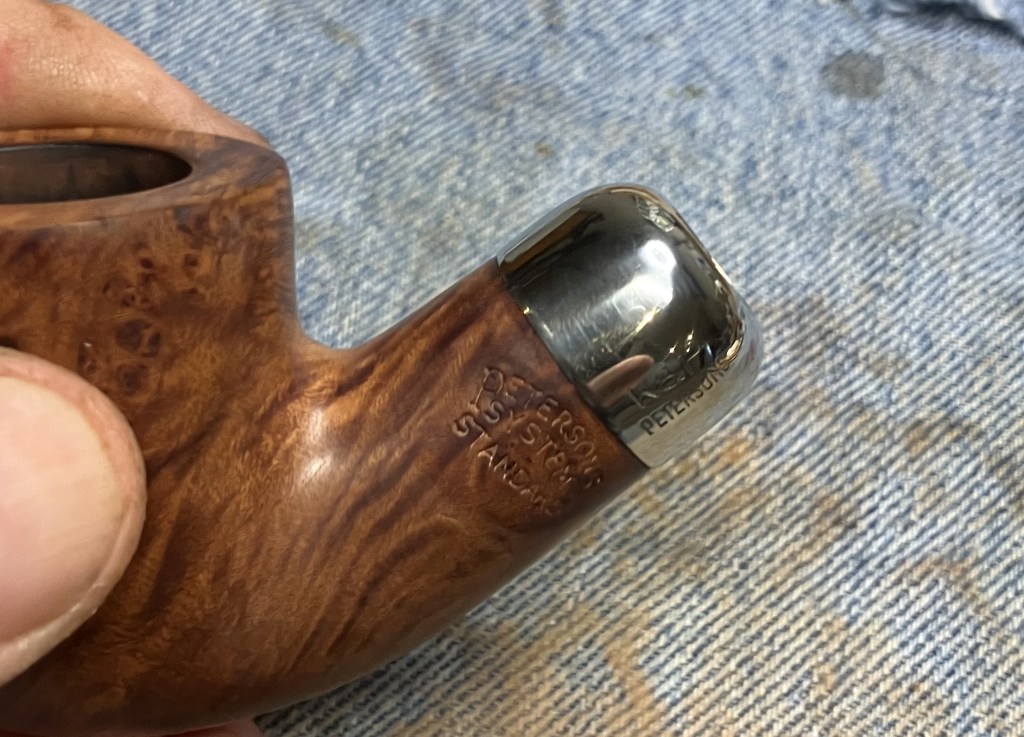
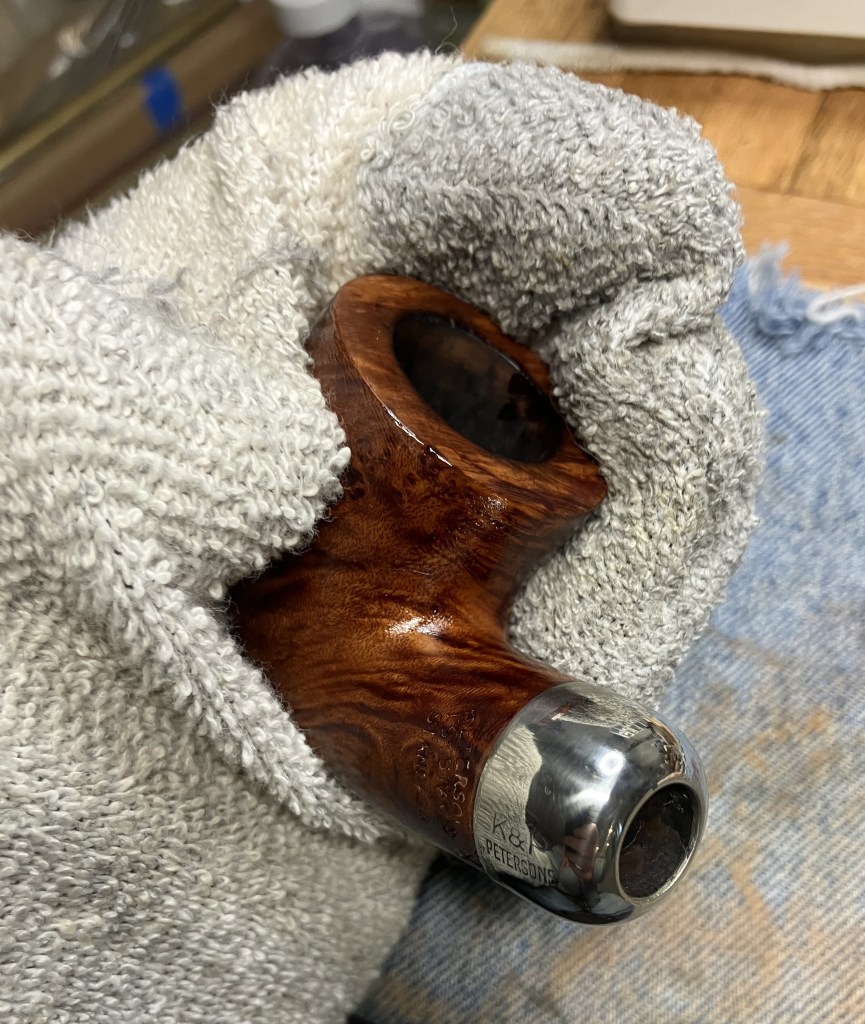
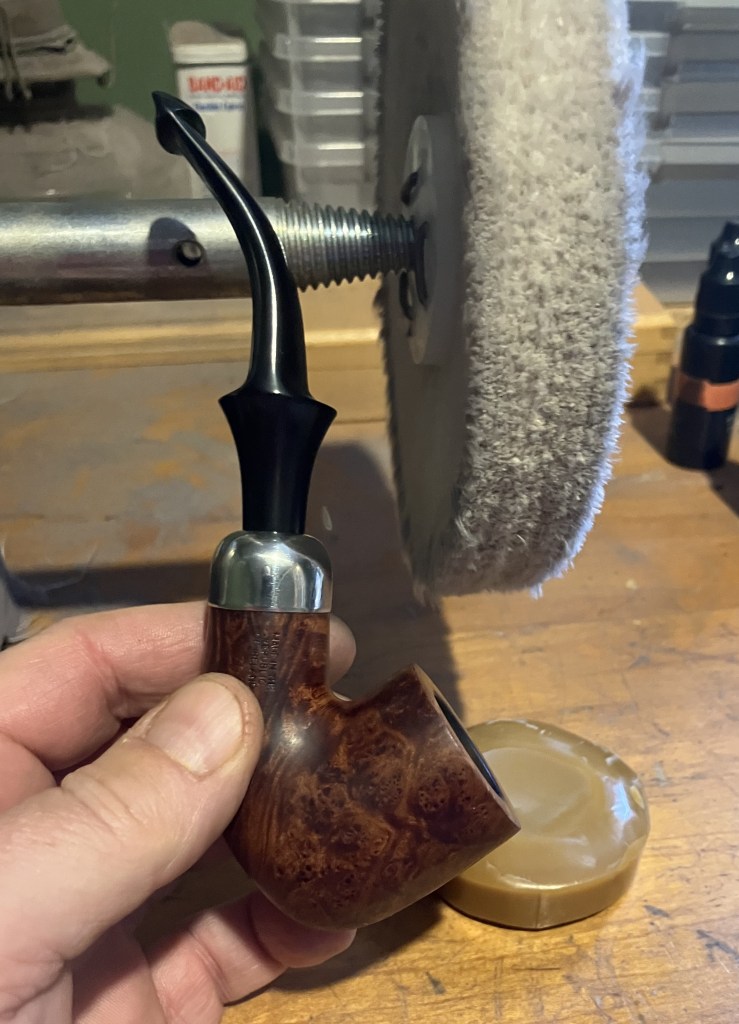
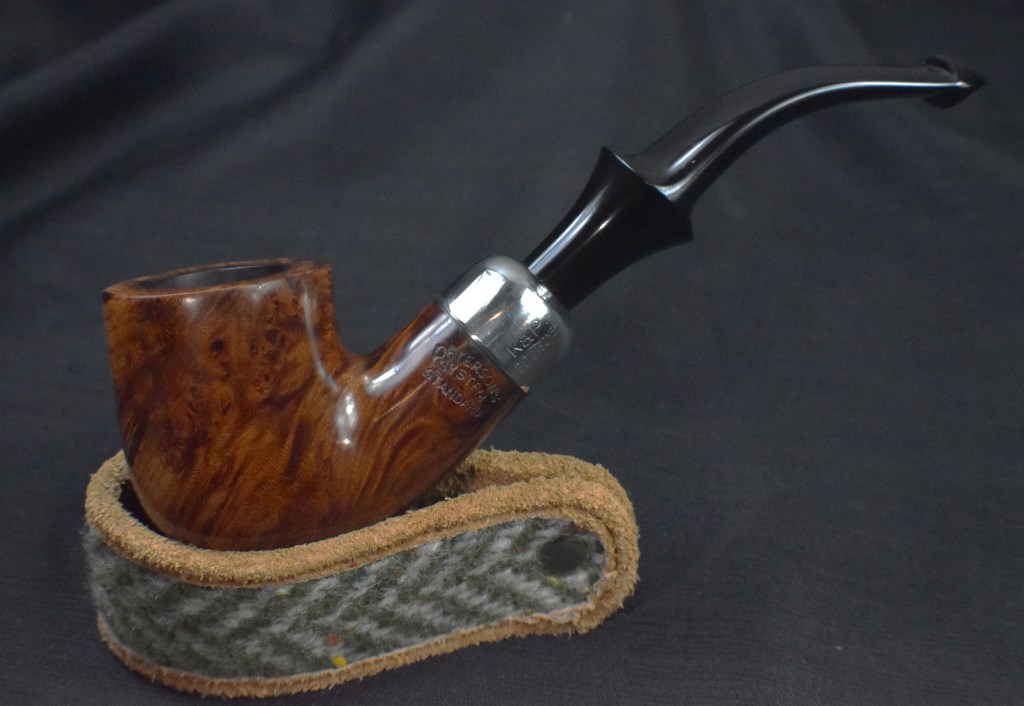
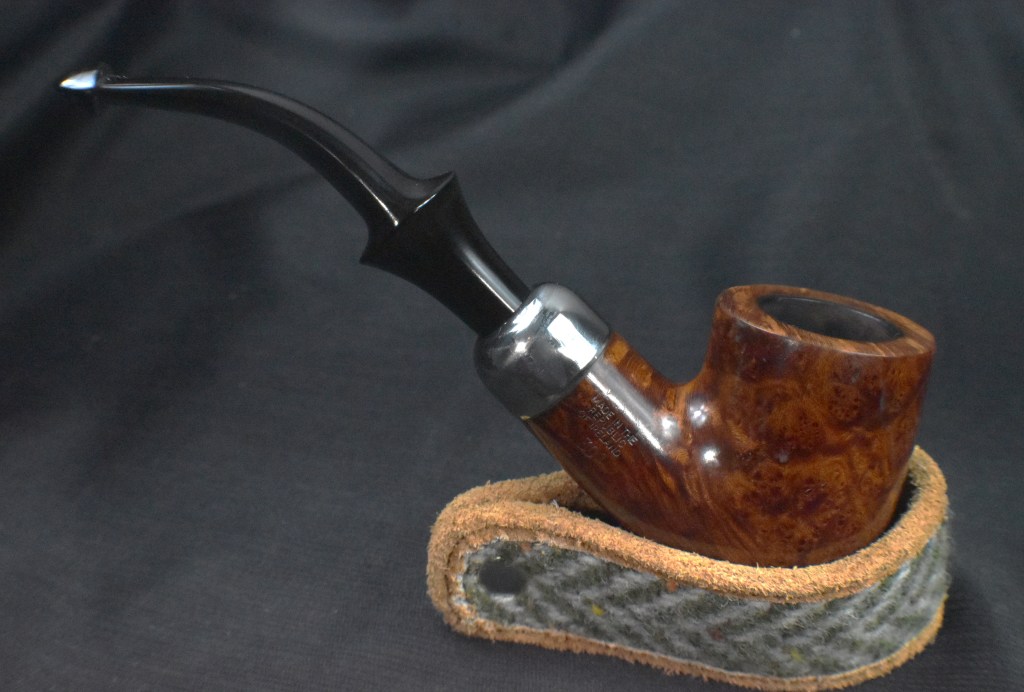
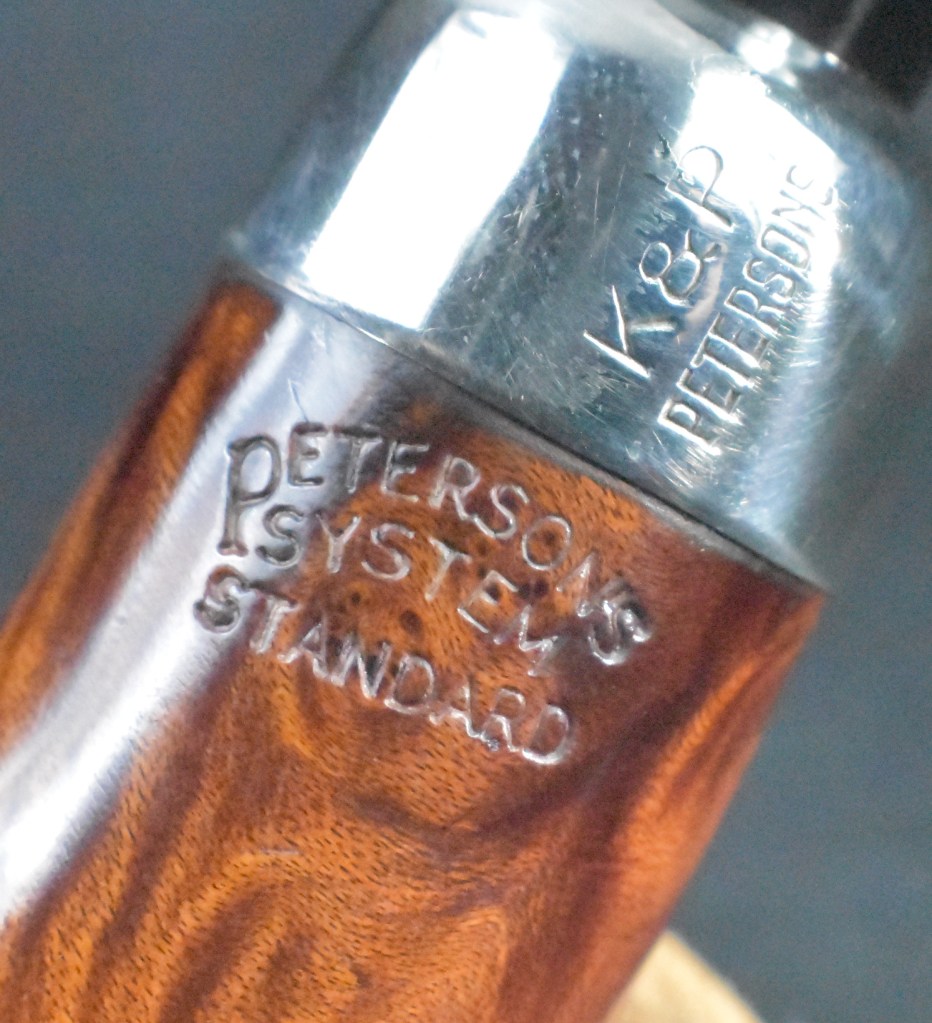
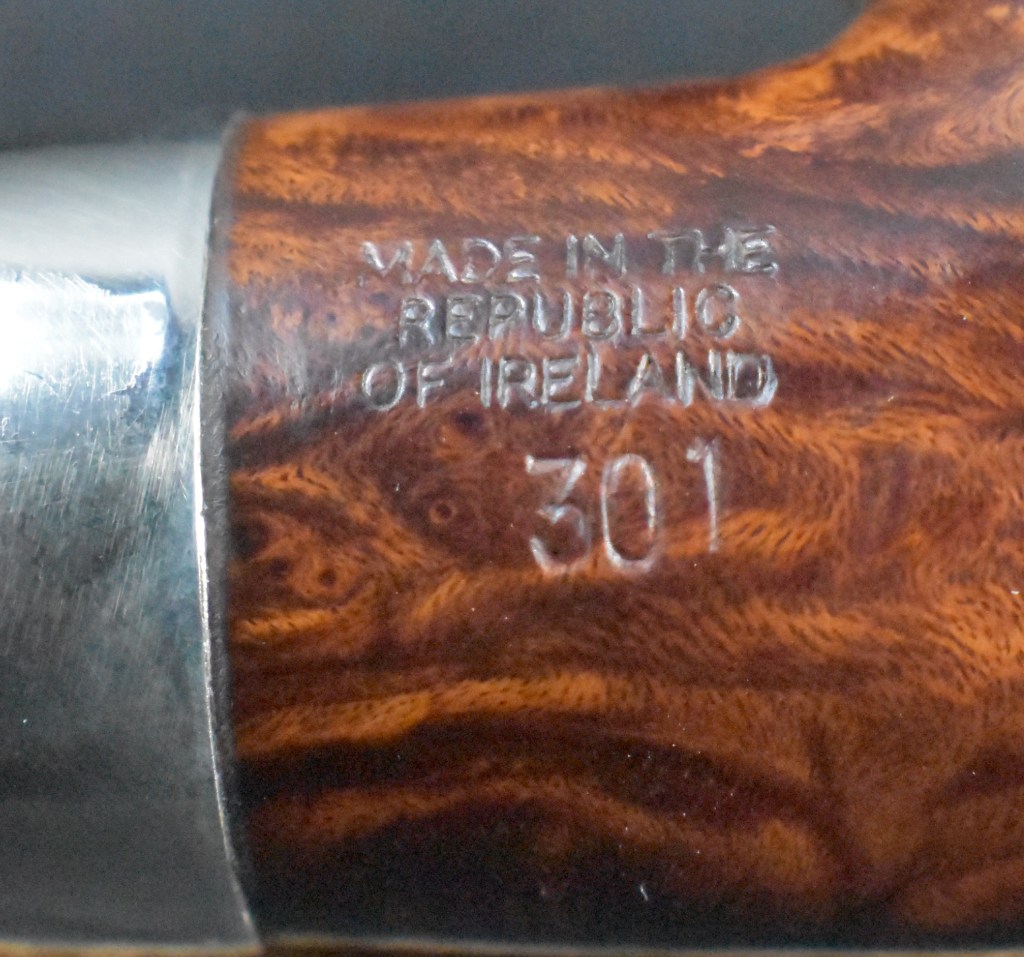
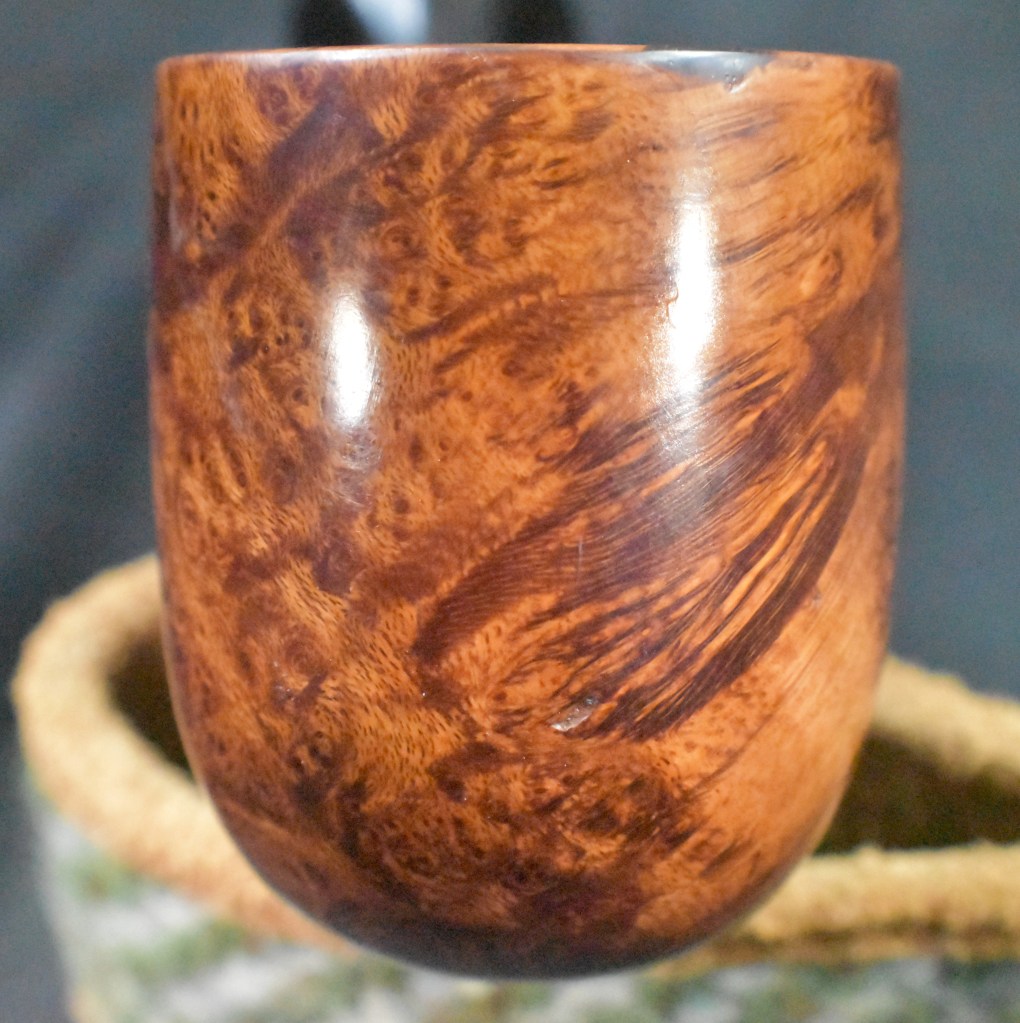
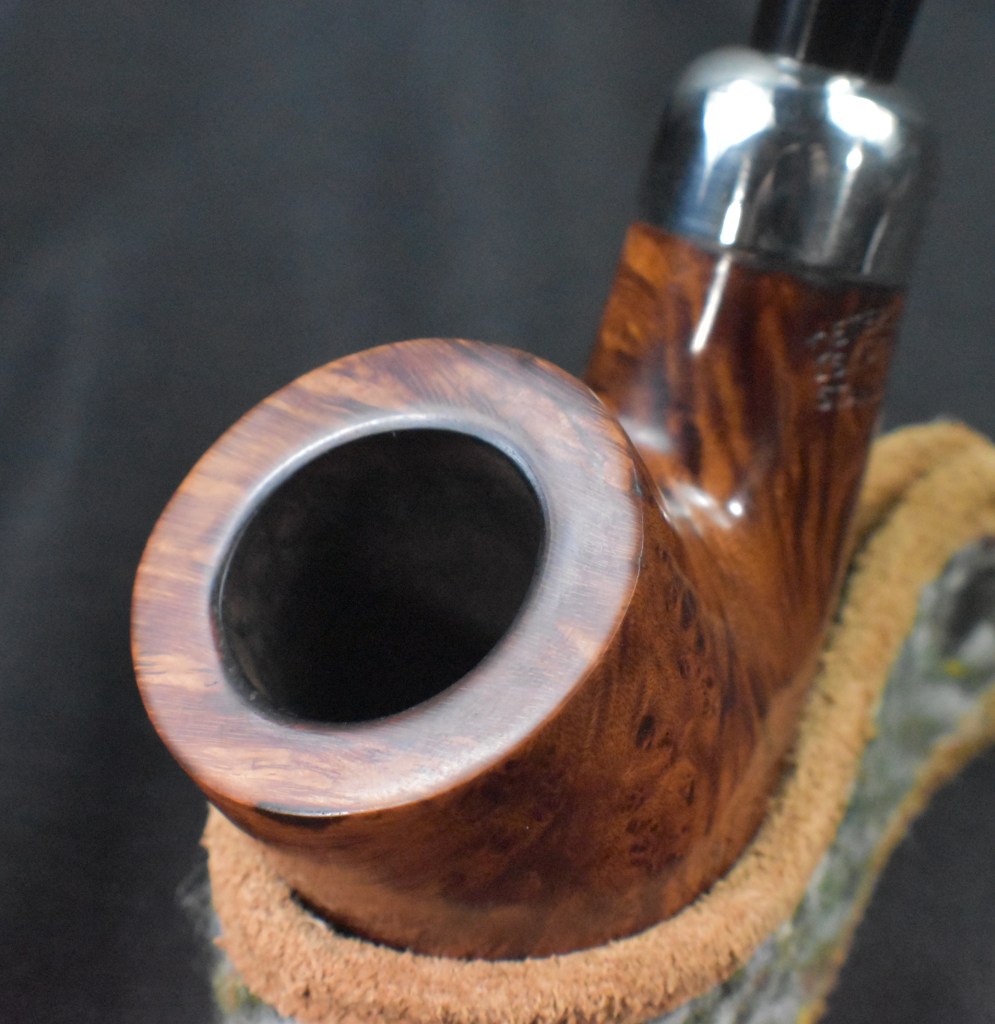
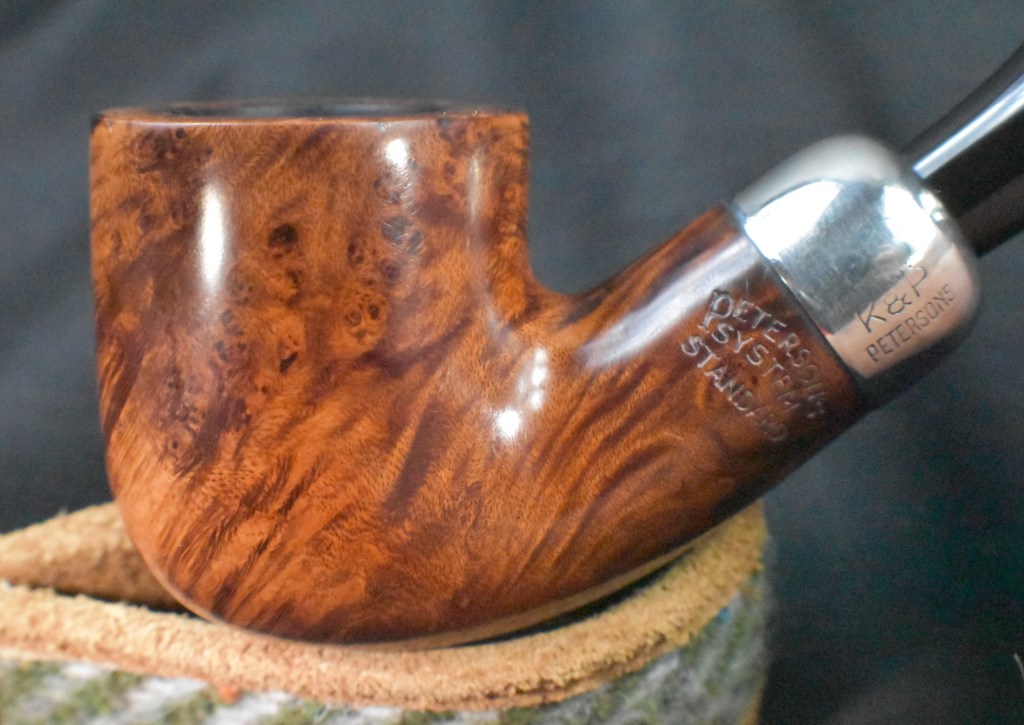
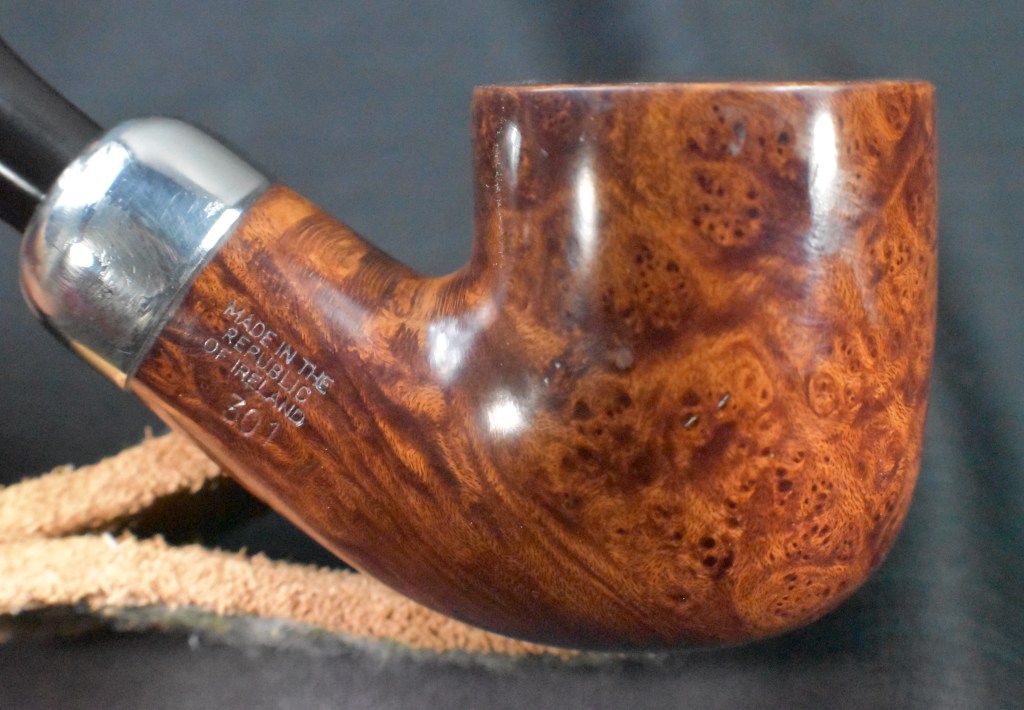
It seems strange to me that of all the Peterson pipes that I own, I have shown few restorations of them. This is because I was not documenting or blogging about them when they were restored. The blog has only been a lifestyle since October of 2023 and these pipes were acquired and restored long before that. This 301 is a re-restore. “Huh?”, you say. Well It was a pipe that I purchased on the estate market cleaned up and used for several years. Now someone has expressed an interest in acquiring their own 301 and asked if I had one available. Since pipes were made for smoking and this lovely Pete does not get very frequently used, I decided it would be better off with a companion who would use it. Where it came from originally is a question I cannot answer. Likely an eBay auction though. When it was purchased, also unknown, but probably early 2020s. The pipe was stamped PETERSON’S Over SYSTEM over STANDARD on the left shank and MADE IN THE over REPUBLIC over OF IRELAND over 301 on the right shank. The stampings are all crisp and clear. There was no signature P on the stem which I felt as if it was missing something without it also lacking was the faux hallmarks on the nickel ferrule. It was only stamped with K&P over PETERSONS. Below are some photos I took of the pipe before beginning this restoration.
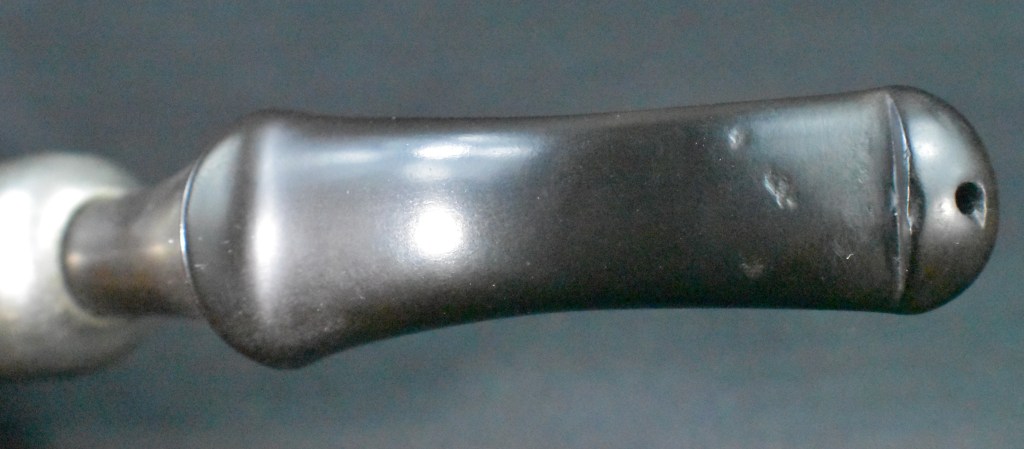
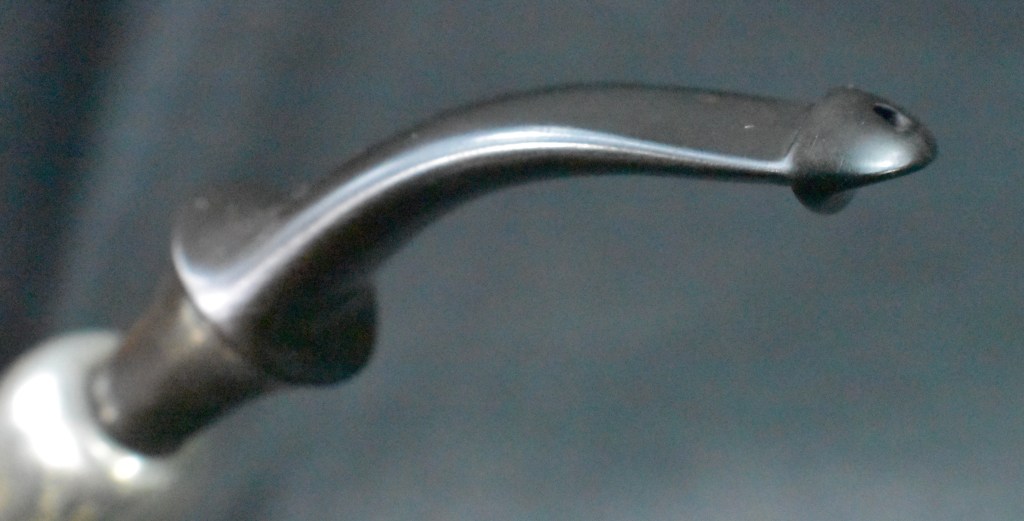
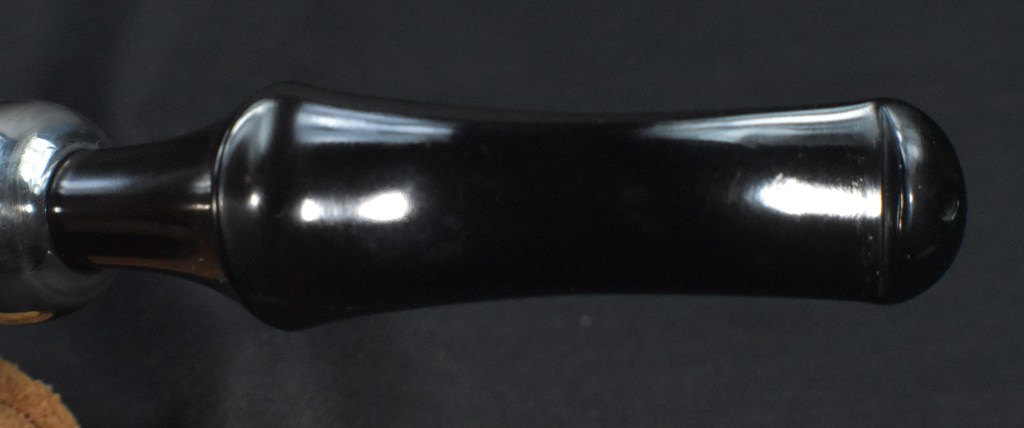
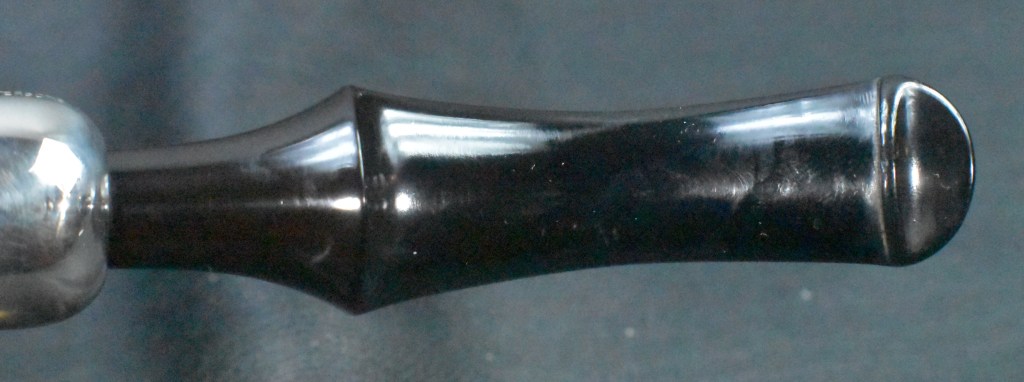
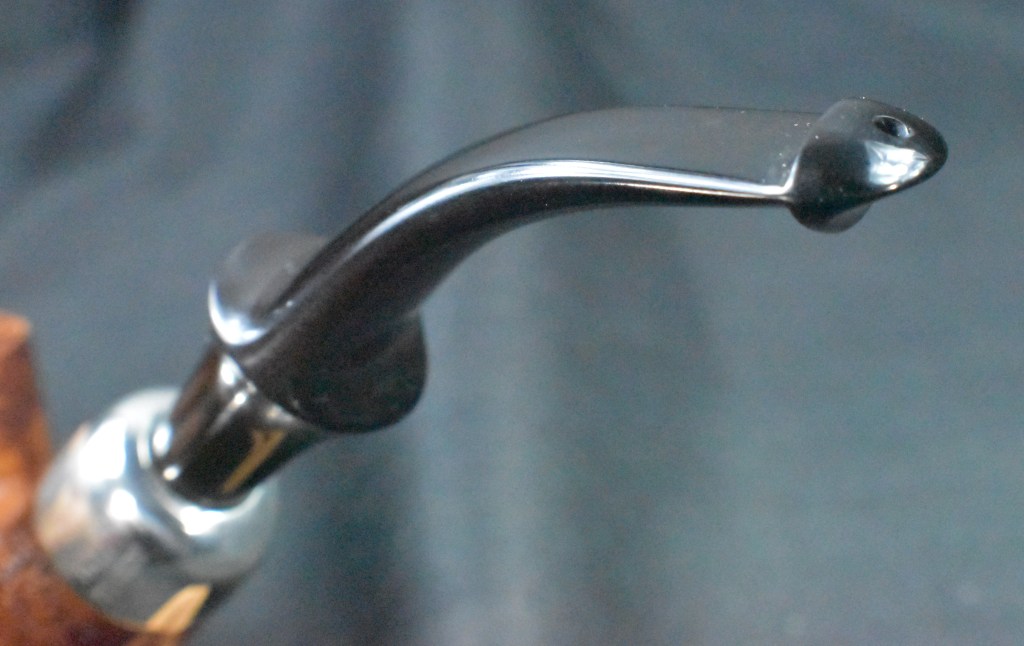
The pipe was in good shape overall. There were some tooth dents on the stem and slight oxidation. I apparently did not restore the stem, other than removing the oxidation, from when I first got the pipe. The tobacco chamber had been reamed, again probably from my cleaning. There were a few spots where the old fills were failing and a spot on the front of the outside rime where the pipe had been knocked. In general a “light” restoration was required.
Background
If you have read my previous blogs, thank you, and you are probably aware that I am a fan of Peterson pipes. Like many Peterson fan boys, or Pete Geeks as some call us, I could go on ad nauseum about Peterson pipes, their history and the remarkable innovations that made Peterson pipes the legend that they are. I will refrain from doing this again and give you a few sources of information which will allow you to read about the history of the company. For a great history Mark Irwin and Gary Marlburg’s book is a must read for a Pete Geek.
The last source is Peterson Pipe Notes. Mark Irwin has blogged about many particular Peterson lines, features and histories over the years. I can wholeheartedly recommend his blog and free subscription at
https://petersonpipenotes.org/ His posts are searchable for specific items of interest and will open an entire hoard of rabbit holes for you to delve into. Yes, you will get emails but only for things like the weekly blog post and occasional Peterson pipe drops (like the Peterson Pipe Notes Pipe of the Year) or offers for cool Pete Geek merchandise.
The Restoration
The 301 made its way to the workbench for a second time. Well, not the current workbench, this workbench is only a couple years old but you know what I mean.
I started with a light rubdown of the stem with 0000 steel wool.
That was followed with a cleaning of the inside of the stem with 99% ethyl alcohol, pipe cleaners and cotton swabs.
The shank was cleaned in similar fashion. Whew, I would have been embarrassed if this pipe was dirtier than that.
The tobacco chamber was sanded with 320 sandpaper wrapped around a wood dowel and by 320 on my finger. There was no sign of any heat damage to the chamber.
The rim did have a very light lava residue and a few dings.
The stem was suspended in Before and After Extra Strength Deoxidizer (deox) by inserting a pipe cleaner into the button and hanging it in the solution. I figured that 6-8 hours would be plenty of time for this stem.
The stummel was scrubbed with undiluted Murphy Oil Soap and a nylon brush. The soap was rinsed with warm water and the stummel dried with a cotton hand towel.
The scrub did soften the fill material as well as removed the dirt and most of the wax on the briar.
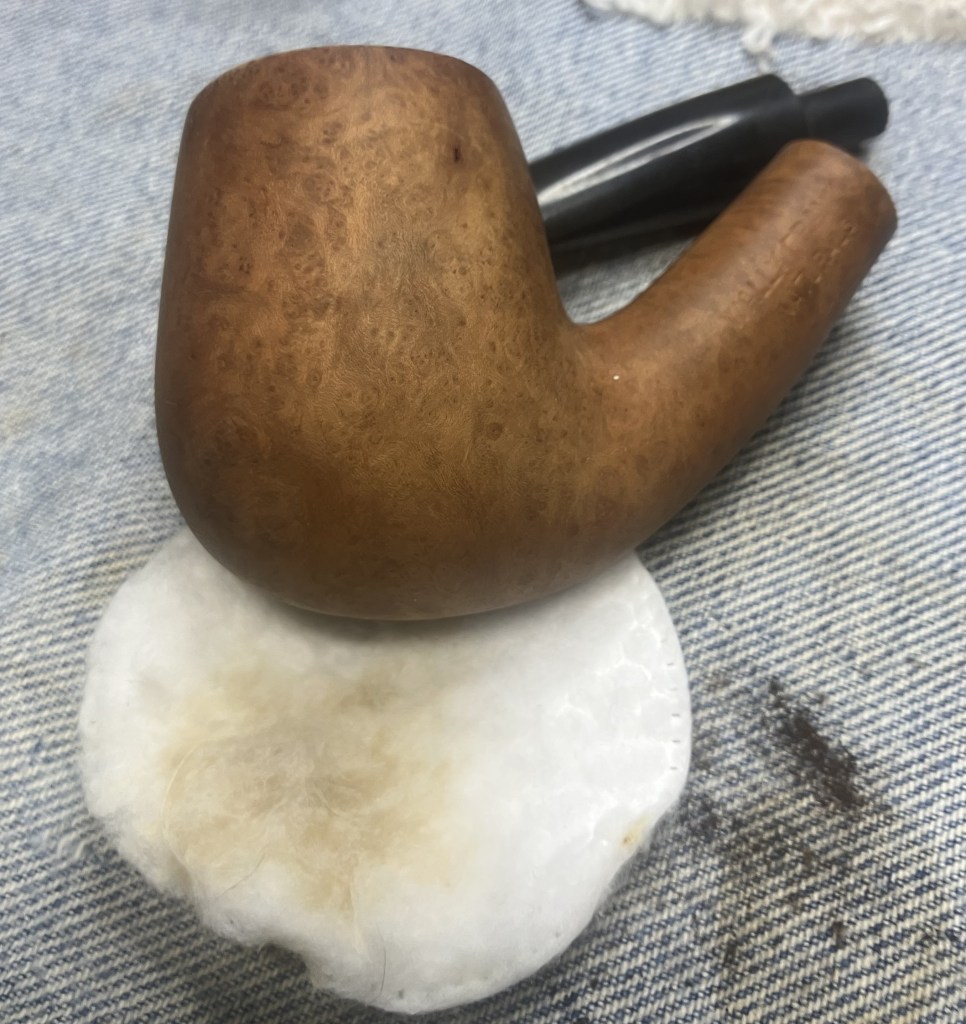
A wipe with 99% ethyl alcohol removed any remaining wax and a bit of the original stain as can be seen on the cotton make-up pad.
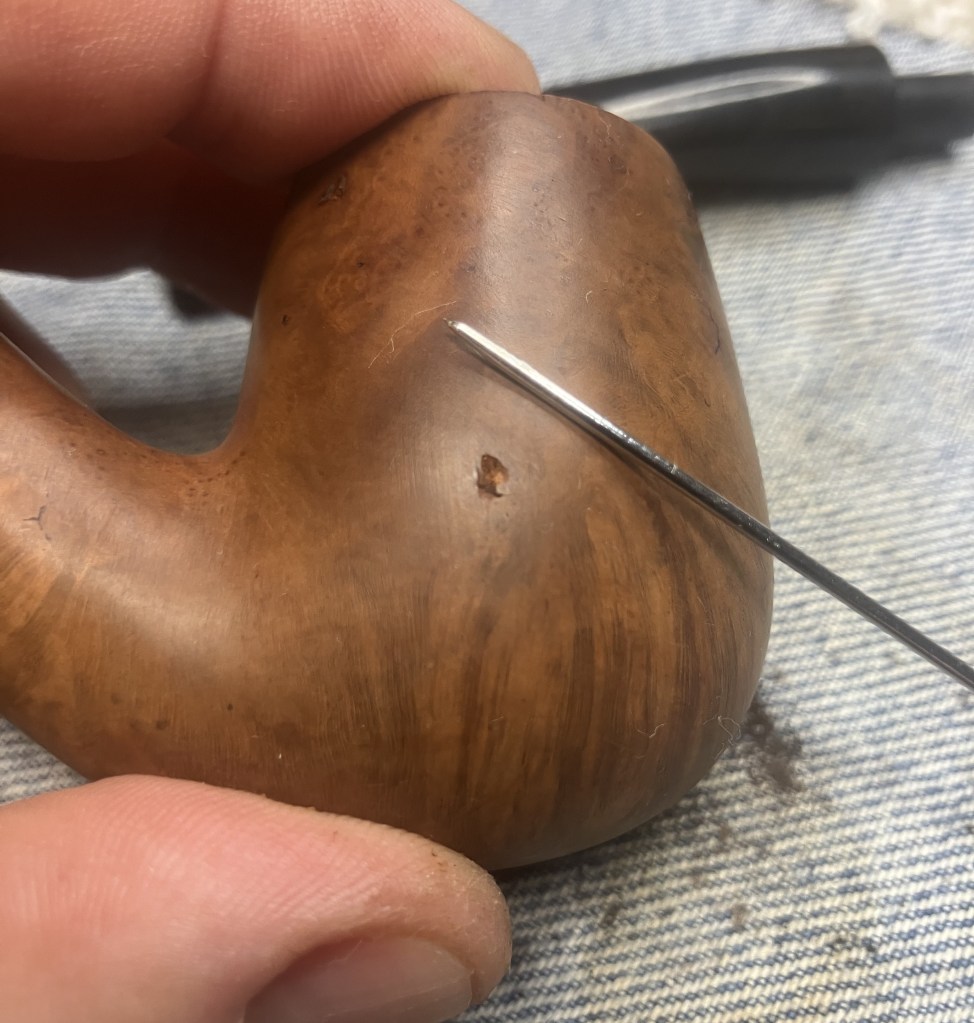
The old fill material was picked out using a fly tying bodkin.
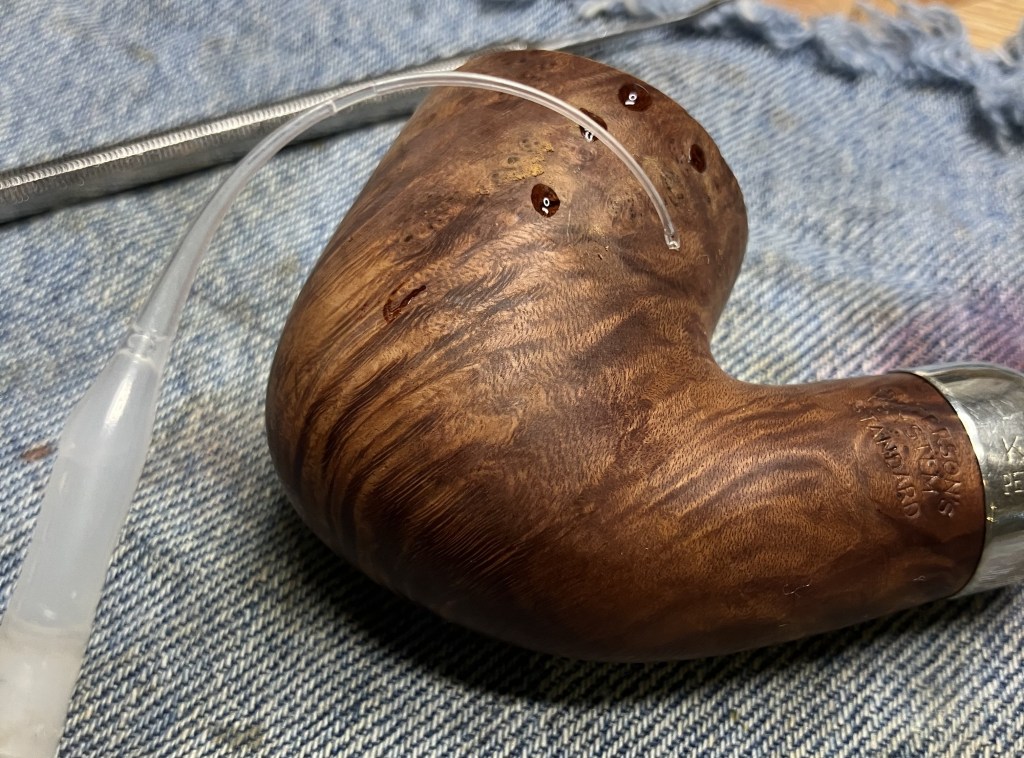
The new fill would be made of Briar dust pressed into the pits then topped with thin cyanoacrylate (CA, super glue). Below is a photo of a dental scraper which makes a fine little scoop for the briar dust and has a flat underside used to press the dust into pits.
Thin CA works best for this type of fill.
The disposable fine tip applicators are a godsend for delivering tiny drops of CA to the new fills.
I allowed the CA to cure on its own rather than applying a spritz of a drying accelerator. 20 minutes later the drops looked like little scabs.
These were filed with a small flat file.
After filing the new fills were sanded with a 600 grit sanding sponge. If any holes or voids were visible then a second application of briar dust and CA were used.
The damage to the front of the rim needed a similar repair.
Here, I applied the CA to the damaged area first, then pressed the rim into the container of briar dust. This pressed the dust into the wet CA. Fling the new fill material and repeating with additional CA and briar dust to build up the damaged area.
With the rim fill needing to be flattened to match the rim, I decided to lightly top the rim. This was done with 400 grit sandpaper laid flat on a countertop. A figure eight pattern was used while sanding. Bah, the sandpaper was getting full of dust.
I cleaned the sandpaper at the sink and repeated the light stopping of the rim.
The rim looked much better but now the inner rim showed light charring from lighting the tobacco.
A 2 inch wooden sphere was used with a piece of 320 sandpaper to uniformly sand the inner rim. This does add a slight bevel to the rim which was not a feature of the original pipe.
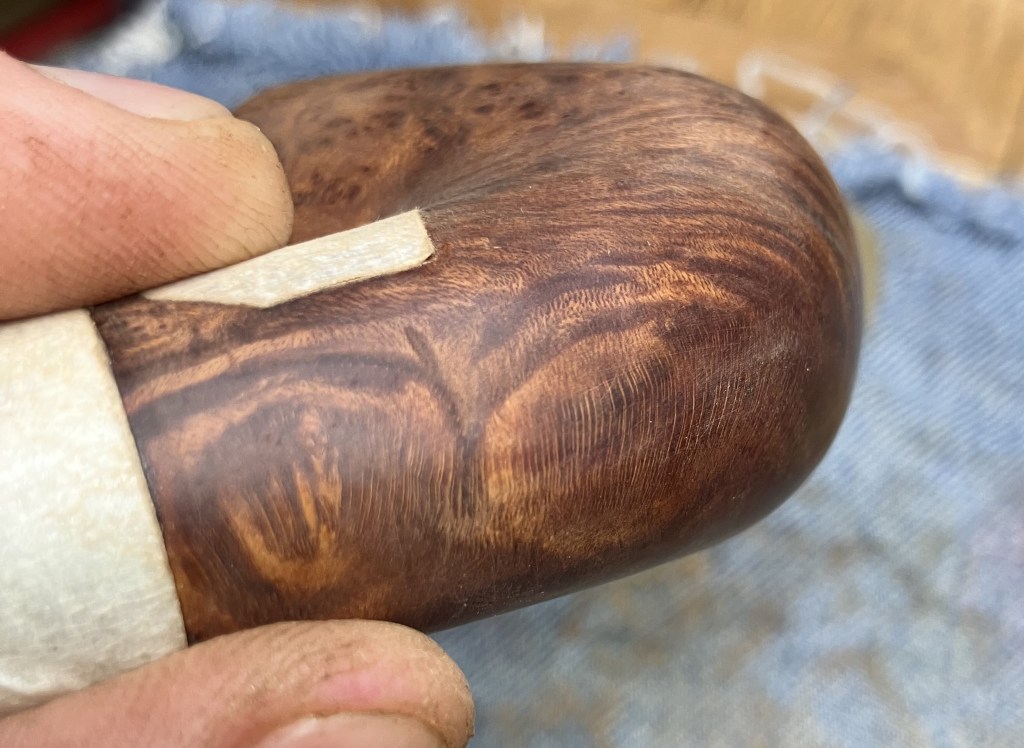
The ferrule and stamps were masked to protect them from sanding.
Both the left and right sides.
After the first little bit of sanding I discovered a small dent that I hadn’t noticed. It lined up with the wood grain concealing it.
It bothered me so much that I got out the iron and a wet cloth. This steaming will usually raise dents very well.
It did and the dent was no longer assailing my limited sensibilities.
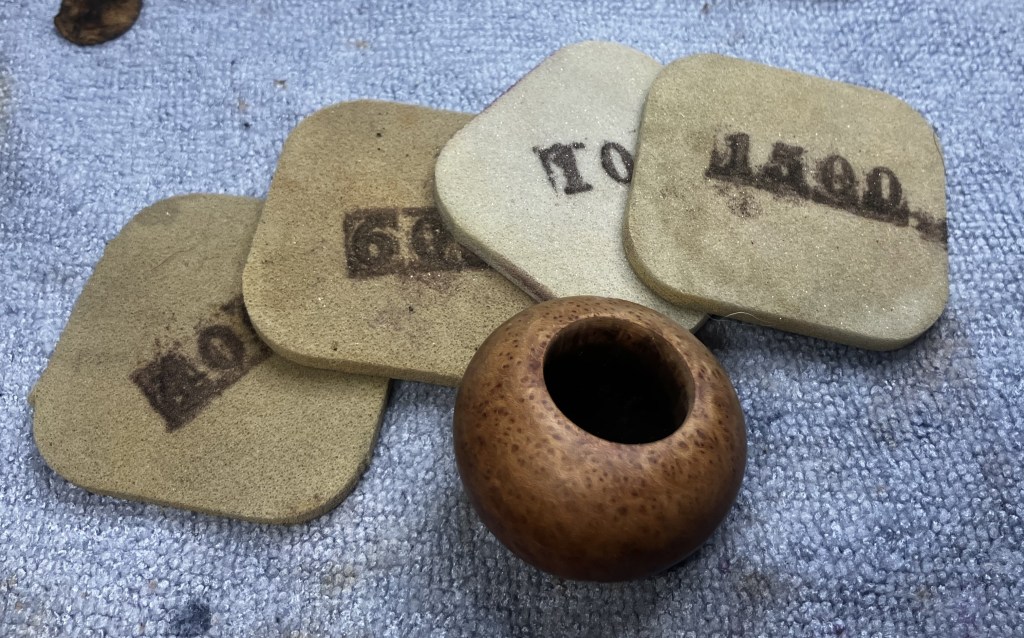
The sanding resumed with a series of sanding sponges from 320-3500 grit. Between each sponge the stummel was wiped with an alcohol wetted make-up pad to remove sanding debris.
The sanding sponges gave way for the micro-mesh pads. I went with 4000-12000 with wipings between each pad as with the sanding sponges.
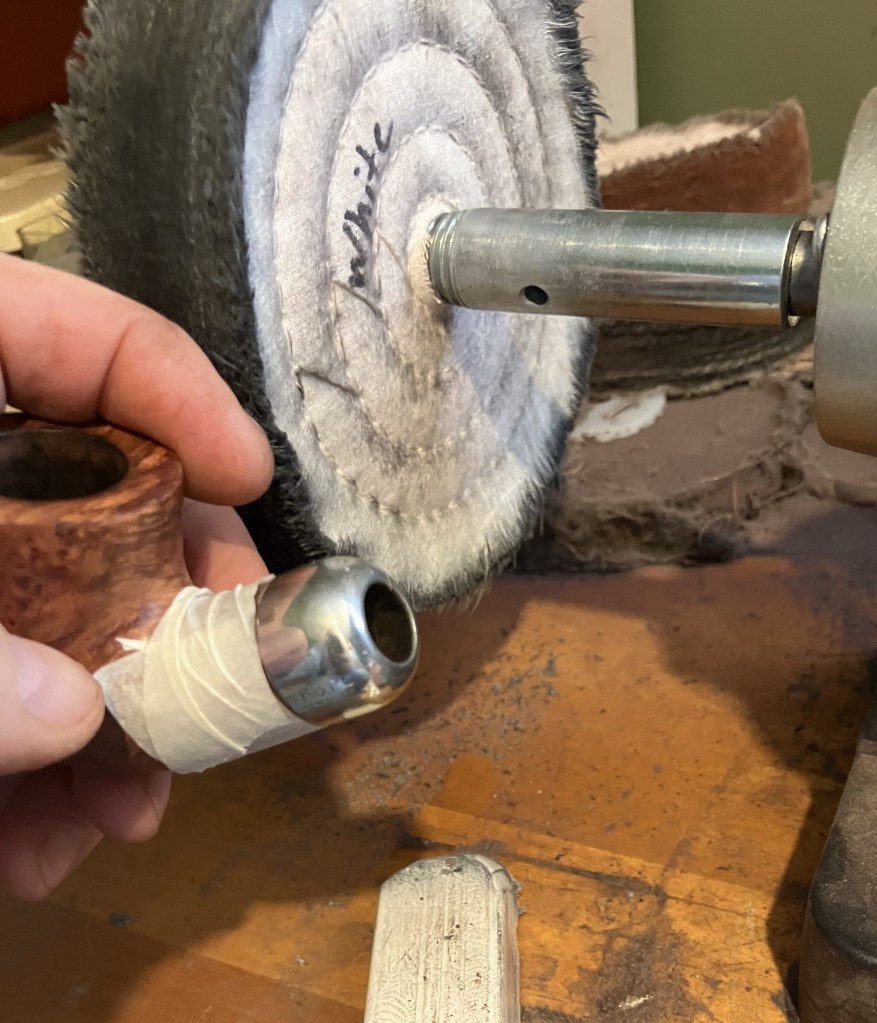
The shank was masked off to protect the newly sanded shank from the buffing wheel.
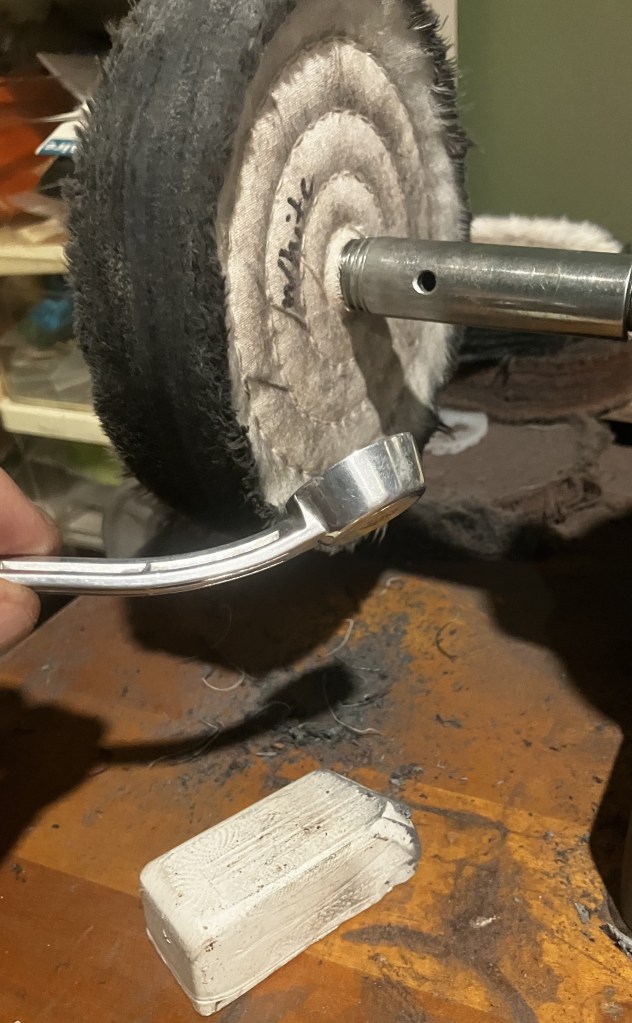
The ferrule was buffed with white buffing compound and the dedicated wheel.
The results were quite nice.
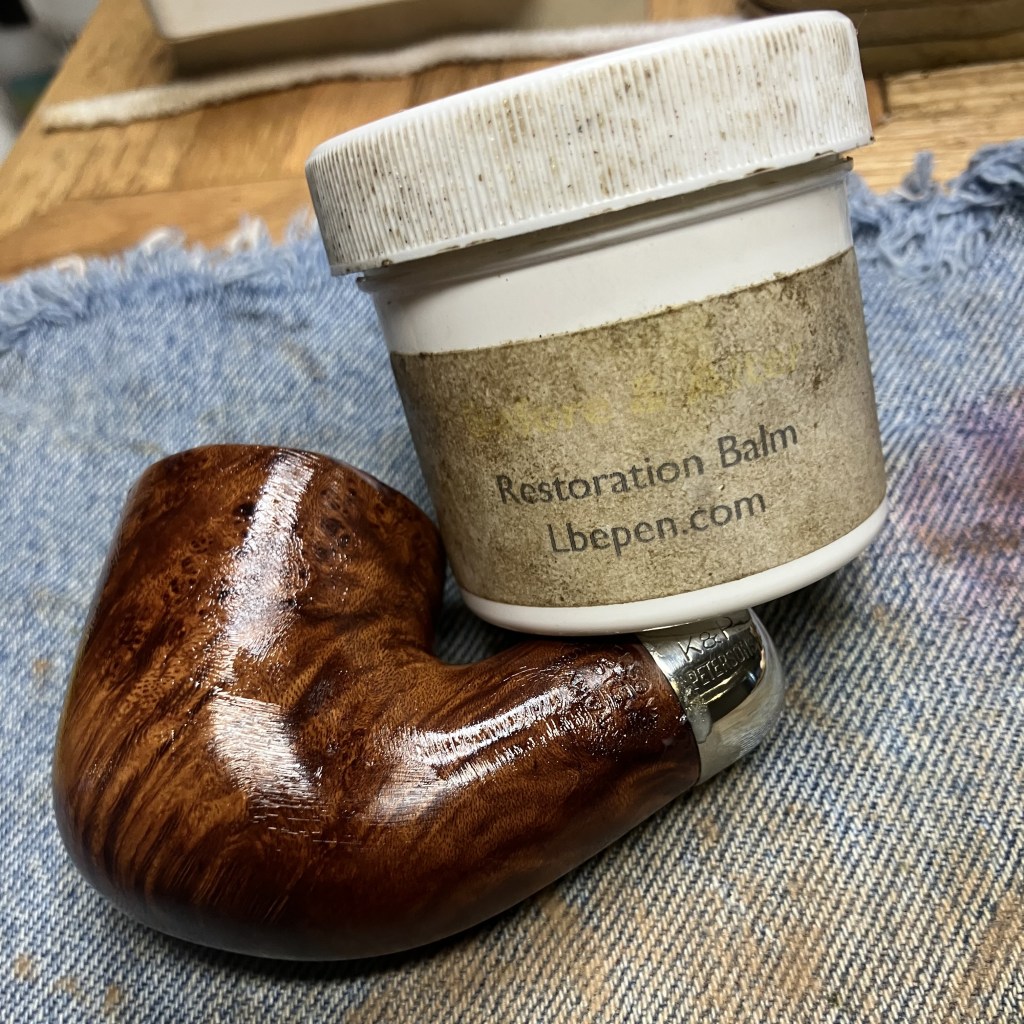
Before and After Restoration Balm was the next step. A nice thick coating over the briar was allowed to sit for 30 minutes.
An inside out athletic sock was used to wipe away the remaining balm and hand polish the stummel.
It was time to remove the stem from its deox bath. It had been in the solution for over 8 hours. The Drip-O-Matic 3000 was rebuilt and allowed excess deox solution to drip back into the container for a few minutes.
A coarse shop rag was used to wipe away the remaining solution as well as to buff away the softened oxidized vulcanite. The residue can be seen in the photo below.
The bite zone of the stem was filed with a small flat file to reestablish the button’s edges and reduce the dents from Chompy, the previous owner.
Filing was done on both the bottom and top bite zones. Darn that Chompy.
Some of the dents required the use of a black CA to fill the depressions.
I did use a CA drying accelerator for curing these fills. They were then filed and sanded smooth. Some required additional applications of CA.
Below you can see the larger dent still had a tiny spot that required a second drop of black CA.
The stem got a similar sanding regimen, the series of sanding sponges 320-1500. Wiping between sponges was mineral oil and paper towels rather than alcohol and make-up pads.
It was getting late so I gave the stem a liberal coating of Mark Hoover’s Before and After Hard Rubber Balm and went to bed. I doubt that letting the vulcanite soak in this product does anything but it made me feel good about myself and I slept well.
The next morning I wiped the Hard Rubber Balm from the stem and continued sanding with 2000-3500 grits sanding sponges.
I opted to polish the stem with white buffing compound rather than going to the micro-mesh pads. I have been trying to work on my buffing skills.
With the stummel finished and the stem buffed to a beautiful gloss, I coated both with several layers of carnauba wax at the buffer.
The final step was a hand buffing with a microfiber polishing cloth which raised the level of shine to a stunning point.
Another Peterson System Standard 301 that looks as good or better than when it left the factory in Dublin. Peterson is known to sand to 400 grit before polishing. This pipe has a finish that is sanded and polished finer than that. The “Comfort Lip” stem cleaned-up and polished beautifully. The original stain or dye on this briar was maintained and enhanced during the restoration. The nickel ferrule also polished-up very well. This shank strengthening feature is a lovely transition from the smooth finished briar to the glossy black vulcanite. The dimensions of the Peterson System Standard 301 are:
Length: 5.74 in./ 145.80 mm.
Weight: 1.69 oz./ 47.91 g. (with band)
Bowl Height: 1.80 in./ 45.72 mm.
Chamber Depth: 1.51 in./ 38.35 mm.
Chamber Diameter: 0.81 in./ 20.57 mm.
Outside Diameter: 1.44 in./ 36.58 mm.
I do hope that you have found something here useful to your own pipe care, maintenance or restorations. If you like this sort of thing, please click the like and subscribe buttons. Thank you for reading the ramblings of an old pipe lover.
Loading…
Below are some photos of the finished Peterson System Standard 301.
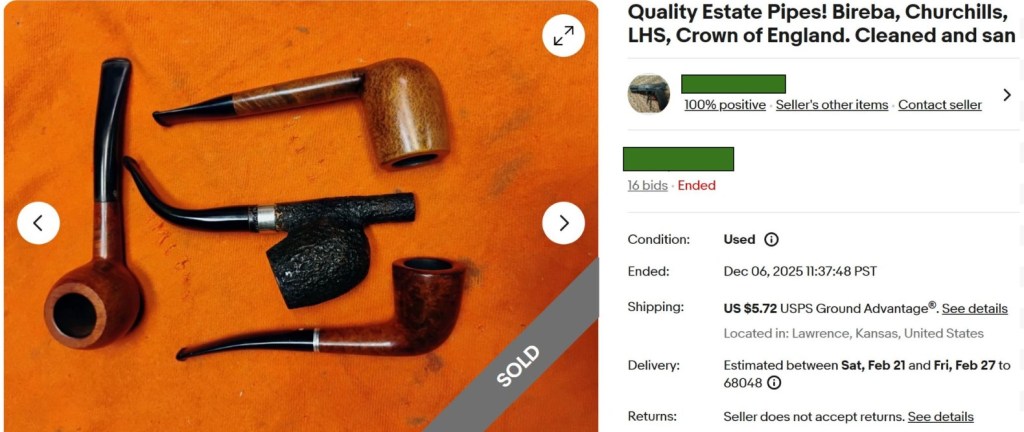
I have wanted to work on a cavalier style pipe for quite some time. Unfortunately, they always seem to exceed what I am willing to pay for them. Perhaps this is what piques my interest even more, peoples’ apparent desire to obtain a cavalier. They must be good smokers, eh? Well, I came across this estate lot on eBay and it had a cavalier, along with a couple of other interesting pipes. The description called it a “Bireba” and it had a wonky looking band. I figured what the heck, I’d never heard of Bireba and it looked like a fun pipe to work on.
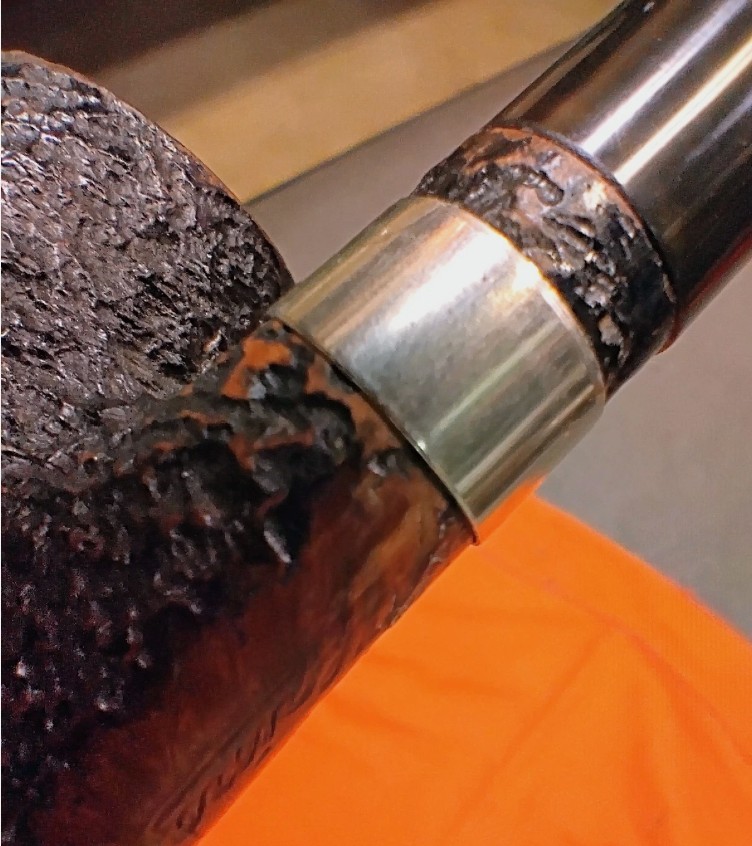
I won the auction for what I considered a reasonable price and the pipes made the short 185 mile journey from Lawrence Kansas to the wilds of southeast Nebraska. Upon arrival I couldn’t figure out why such a poor fitting band was even put on this pipe. I first thought that it was a repair of a cracked shank. The mortise was in perfect condition. Then I thought, decorative, but why such a poor fit.
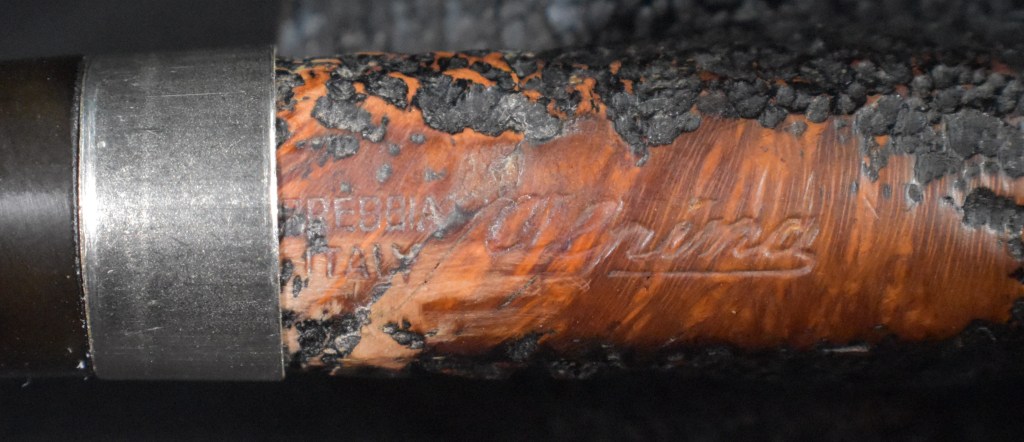
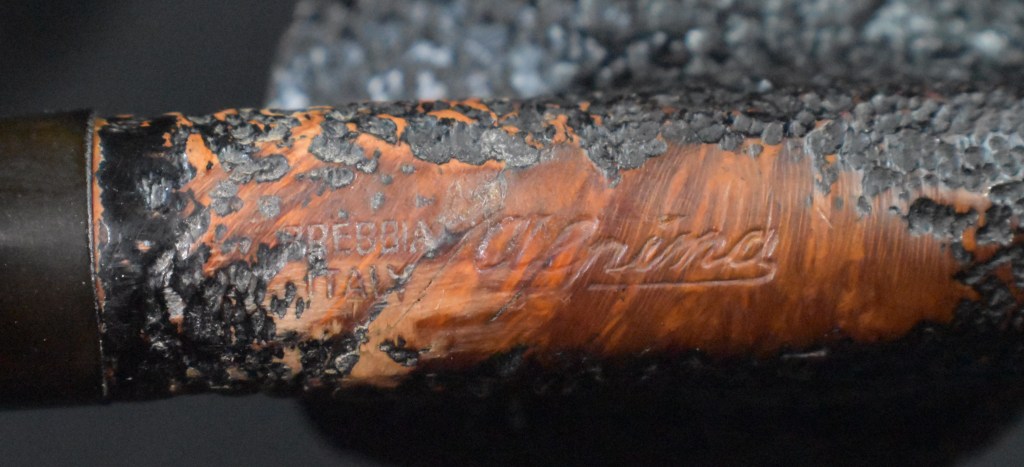
The band seemed too loose to be of any real purpose. The finish was worn away from the band sliding up and down the shank. It was while inspecting the stampings under the band that I discovered this pipe was actually a Brebbia. I thought, “Cool, I’ve never worked on a Brebbia before” and “Sweet, I didn’t pay what Brebbias normally cost.” The stampings read, BREBBIA over ITALY offset was the Alpina in a scrolling cursive with the tail of the final “a”sweeping below forming an underline. Anyway, here are a few photos of the pipe prior to working on it.
A shot of what I first saw.
Here is a shot with the band in its “proper” place.
Finally a photo of the stampings without the band.
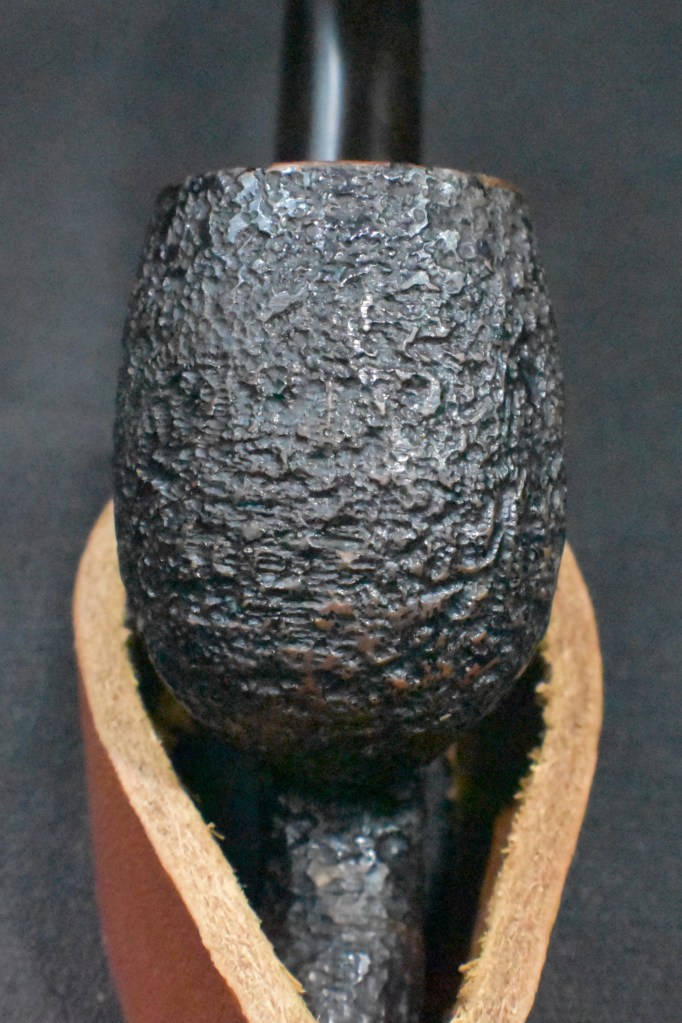
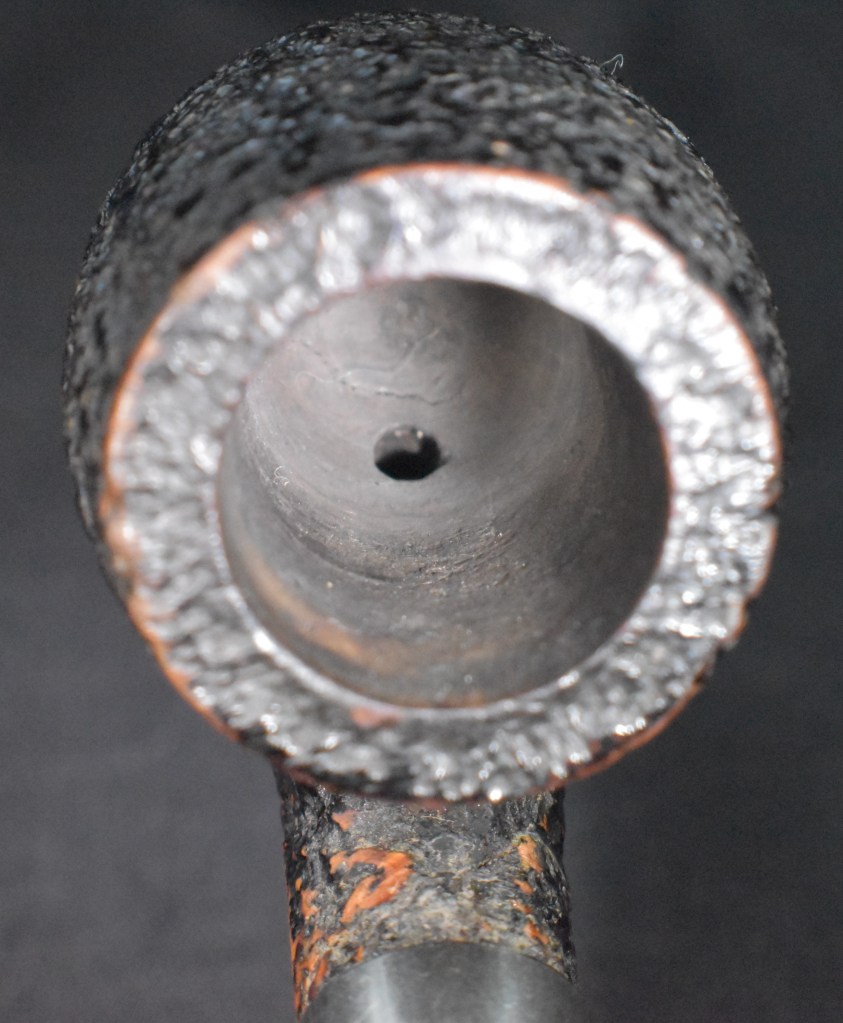
Bah, cavalier pipes are difficult to photograph. This pipe was in relatively good condition. Yeah, the finish was worn through the factory black dye, especially where the band rubbed through. The tobacco chamber looked either recently reamed or seldom used. The stem has some minimal oxidation and a couple of tooth dents. Overall this looked like a relaxing restoration.
Background
I started researching Brebbia with a look at what pipephil.eu had to say. Brebbia appears to have used a wide array of stamps, lines and logos over the years, here are a few: Brebbia — Pipes : Logos & Markings. Alas, none of the examples were of a Brebbia Alpina.
Next stop on the research express was pipedia.org. This entry was relatively short, so I included it in its entirety, minus the photos:
“Pipe Brebbia Srl, or better the M.P.B. (Manifattura Pipe Brebbia) was born in 1953 from the denouement of the association between Achille Savinelli and Enea Buzzi in 1947, where the first was employed in the marketing and the second in manufacturing of pipes under the name of Savinelli. It was made in exclusive up to 1953 and extended without further rights up to 1956.
The production, which is always careful and perfect, has continued in a traditional way for 60 years, using old lathes for the first steps, but finishing every piece by hand.
The secret of their manufacture, if we may put it this way, is the respect for the traditions with the experience acquired in several years of successful work, which could be summed up in two words: high quality.
The factory is currently managed by Enea’s son, Luciano.
For the last few decades, many of Brebbia’s pipes have been made by a number of small, otherwise independent pipe manufacturers, being marketed under the trade name Brebbia. For the northern European market, 9mm filter pipes are being produced, some of which employ VAUEN‘s Konex system (which ensures a good seat of the filter).” (Brebbia – Pipedia)
I was unable to find any information about the Alpina line. A quick Google search of “Brebbia Alpina tobacco pipe” did turn up this:
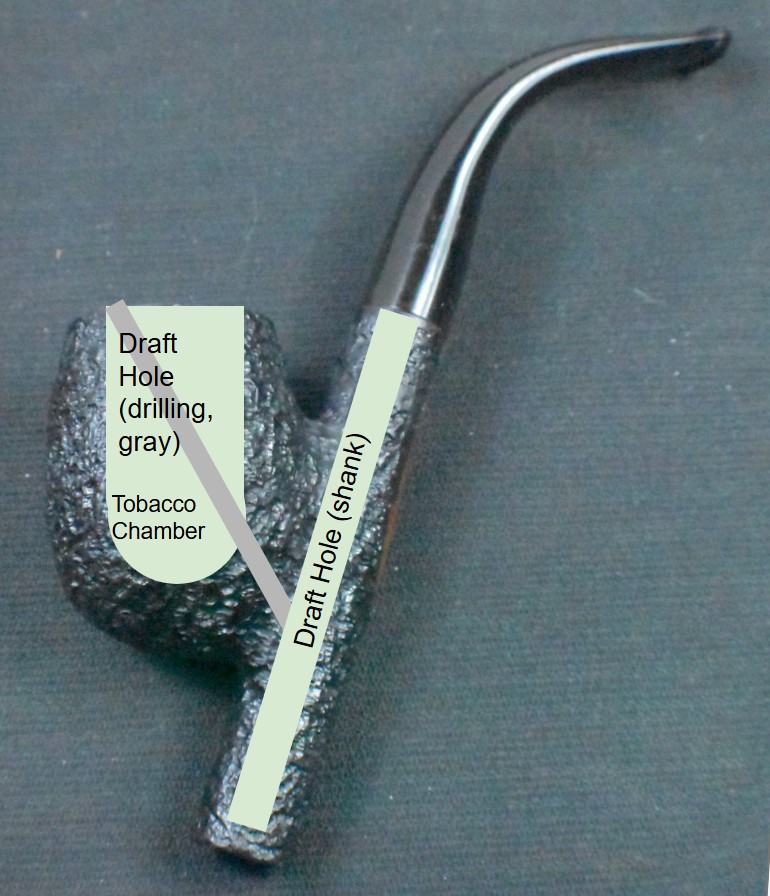
Before I begin the next section, I think a quick diagram of the drillings of this pipe might be helpful. Below, I took a photo of this pipe and overlaid the drillings (not perfectly to scale). The tobacco chamber and the draft through the shank are in a light green. The drilling of the draft hole from the tobacco chamber to the shank is done in a light gray. If you want a pipe that you can run a pipe cleaner through the stem and exit via the tobacco chamber, this pipe is not for you.
The Restoration
The pipe made its way to the workbench and a cleanish piece of denim. The confusing band was removed.
I began with reaming the tobacco chamber. I thought that the PipNet would be the correct tool.
The conically drilled chamber proved my supposition wrong. The Kleen-Reem was the correct tool. Either way there was little for the reamer to do.
The scrapers were used to remove the little cake at the button of the chamber.
Sanding with 320 sandpaper wrapped around a wood dowel showed that the chamber had no signs of any heat damage.
Next came the shank cleaning. This was surprising. There was some cake in the tobacco chamber. Given, not much, but the shank was much cleaner than I would have thought.
Surprise number two, was the depth that the shank was drilled.
Nearly an entire cotton swab fit into the drilling.
I was not expecting that.
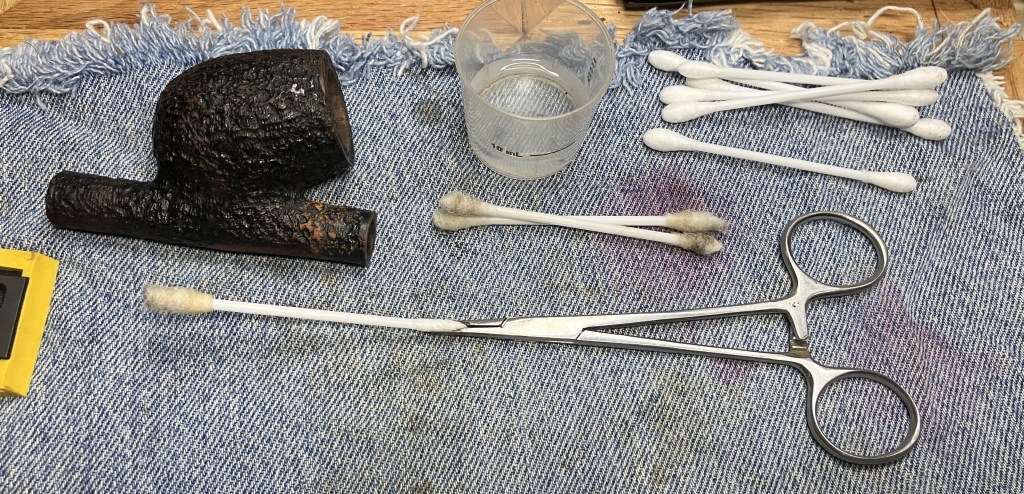
I used a forceps to hold the cotton swabs and dipped them in 99% ethyl alcohol. This pipe was showing signs that it had either been well cleaned by a previous steward or it had not been smoked very much.
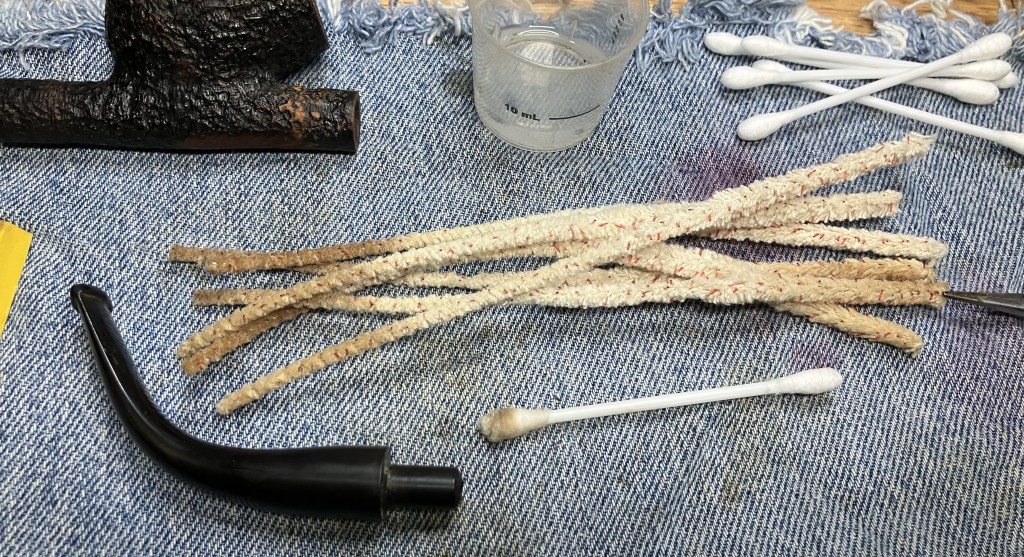
The stem cleaning was next. Here I used bristle pipe cleaners and 99% ethyl alcohol.
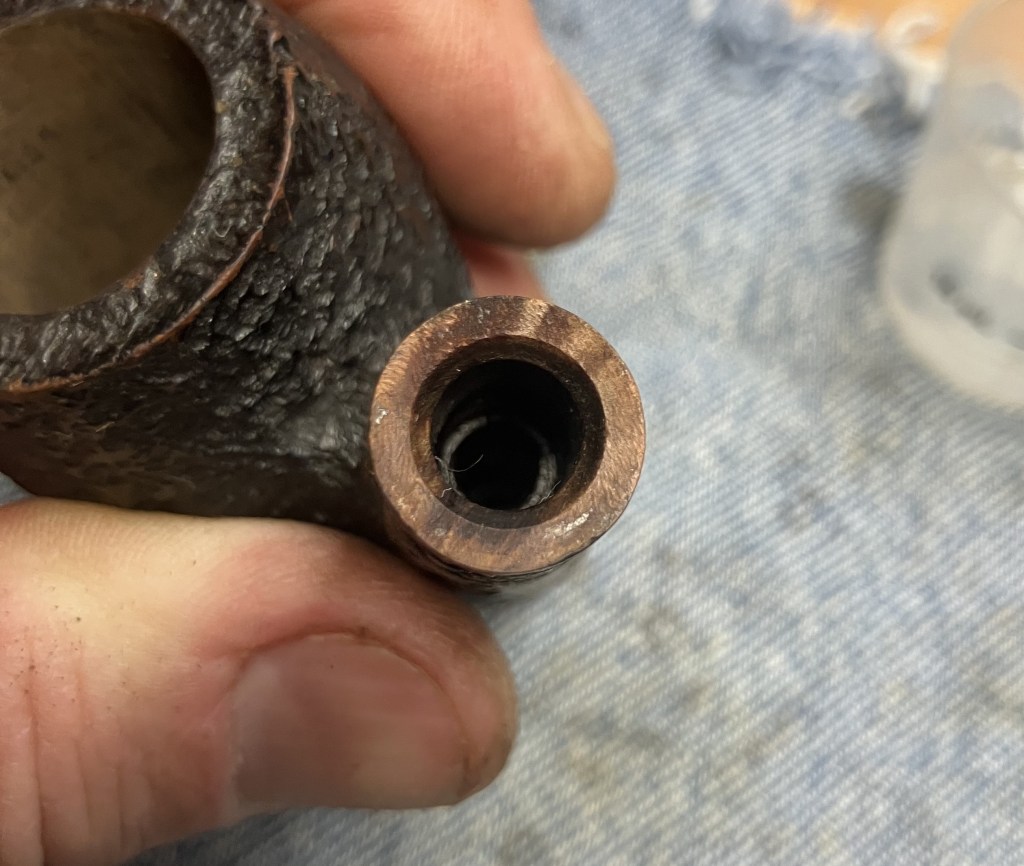
The mortise was drilled slightly smaller than the draft hole.
The stummel was taken to the sink for a scrubbing with a nylon brush and undiluted Murphy Oil Soap. The soap was rinsed with warm water and the stummel dried with a cotton hand towel.
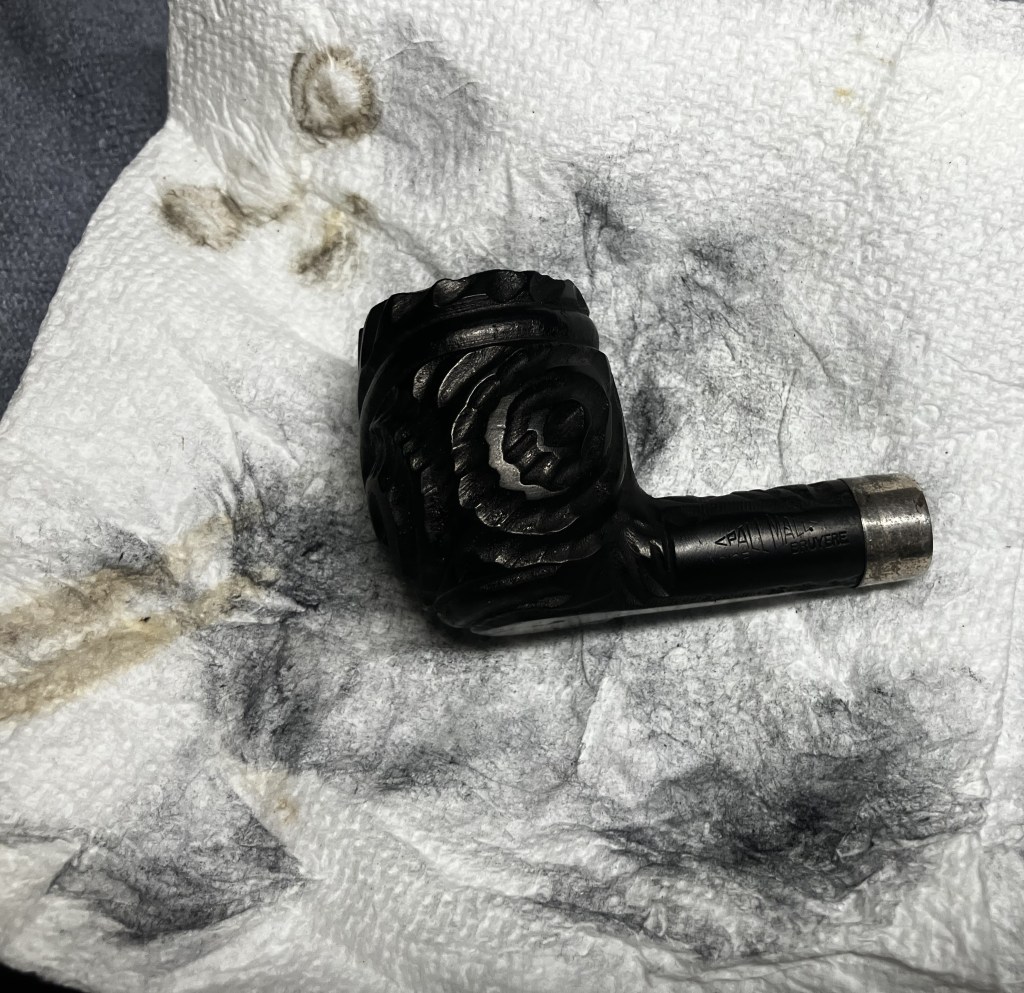
Back at the workbench it was obvious that the scrub had removed even more of the black finish.
A thorough wiping with a make-up pad dipped in alcohol removed a little more of the black.
Below are photos showing the sides, front and back of the pipe.
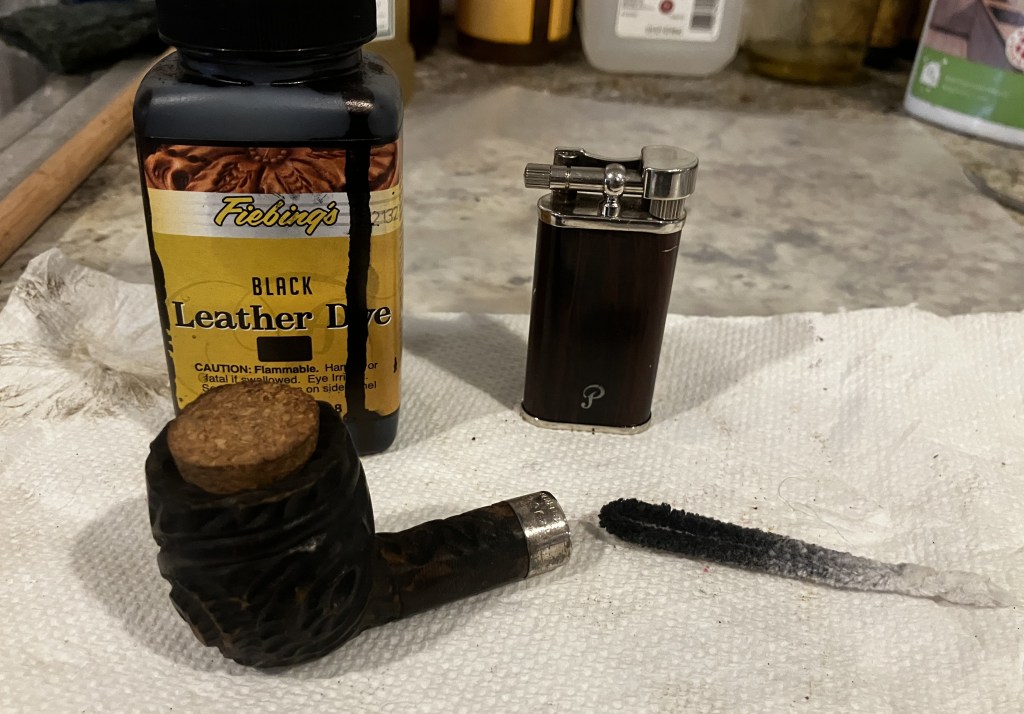
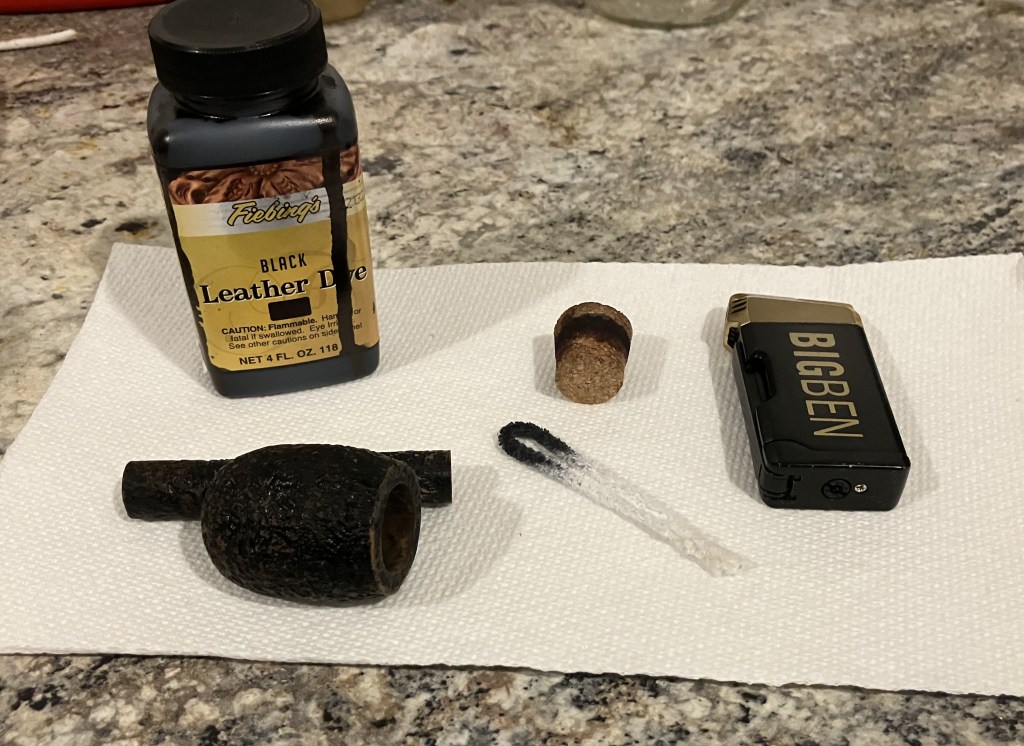
To remedy the worn black finish, I chose to apply Fiebing’s Black Leather Dye. Below is the dye kit; a cork to plug the tobacco chamber, a folded pipe cleaner as the applicator and a lighter to flame the dye heating it and evaporating the dye’s solvent (alcohol).
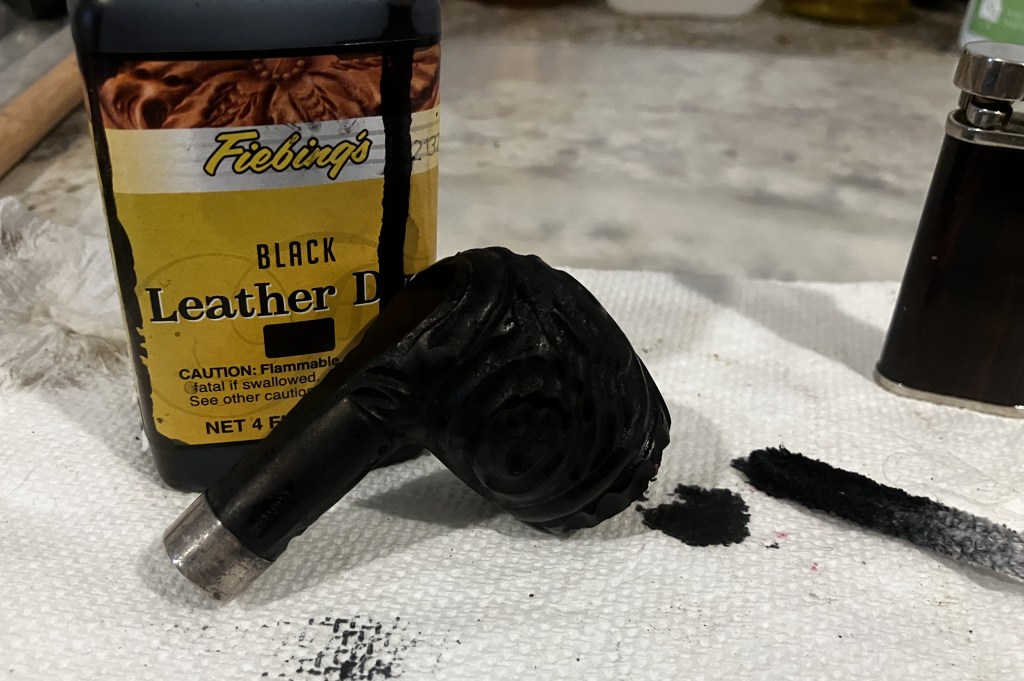
Several coats of black dye were applied with a couple flamings. The stummel was allowed to dry for about an hour.
Yeah, there is a reason I need at least 3 layers of paper towels under me when dying a stummel.
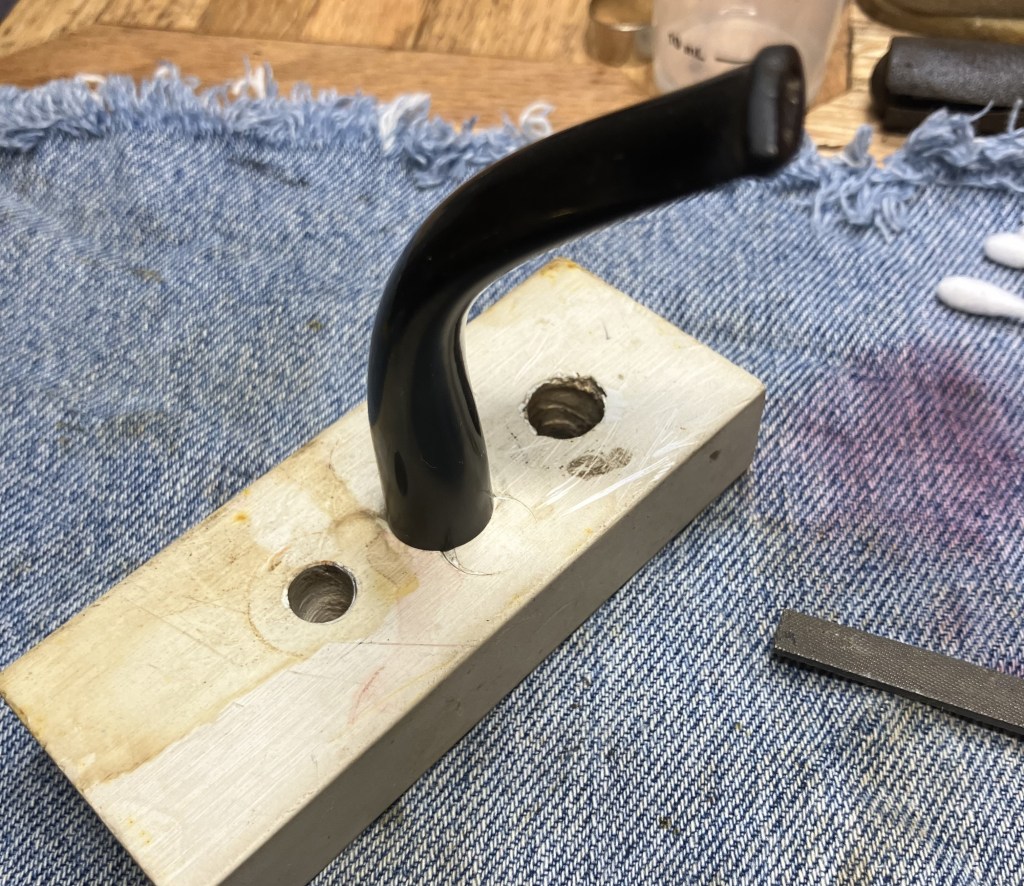
During the drying time, I turned my attention to the stem. There was bite damage to the top of the button.
To hold the stem I used a wood block in which I had previously drilled various size holes for this very purpose.
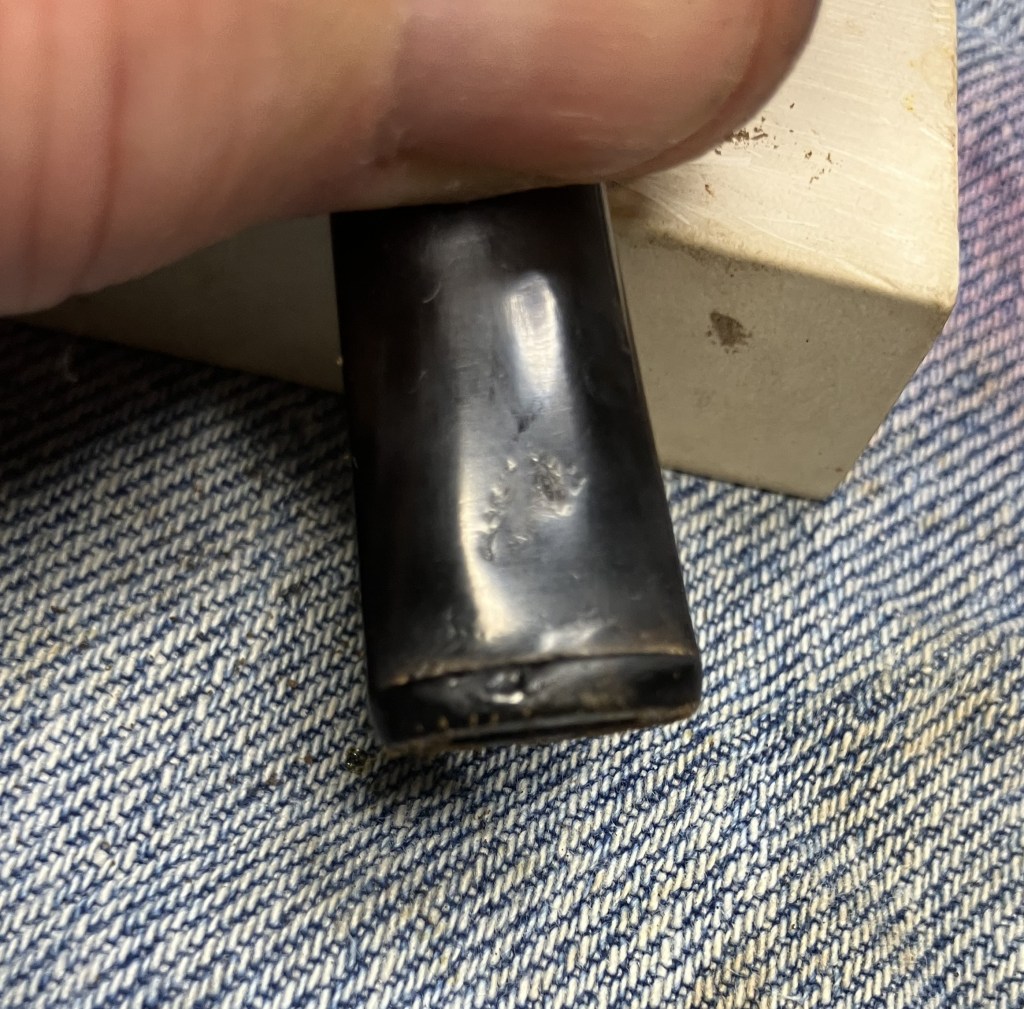
The underside of the stem had additional bite marks.
I used a fine flat file and sanding to try to reestablish the button and remove the tooth damage
This met with success except for one small tooth dent that I needed black cyanoacrylate (CA, super glue) to fill and repair.
One drop of black CA is all that was needed.
This drop was spritzed with a CA drying accelerator.
The drop was then filed and sanded smooth.
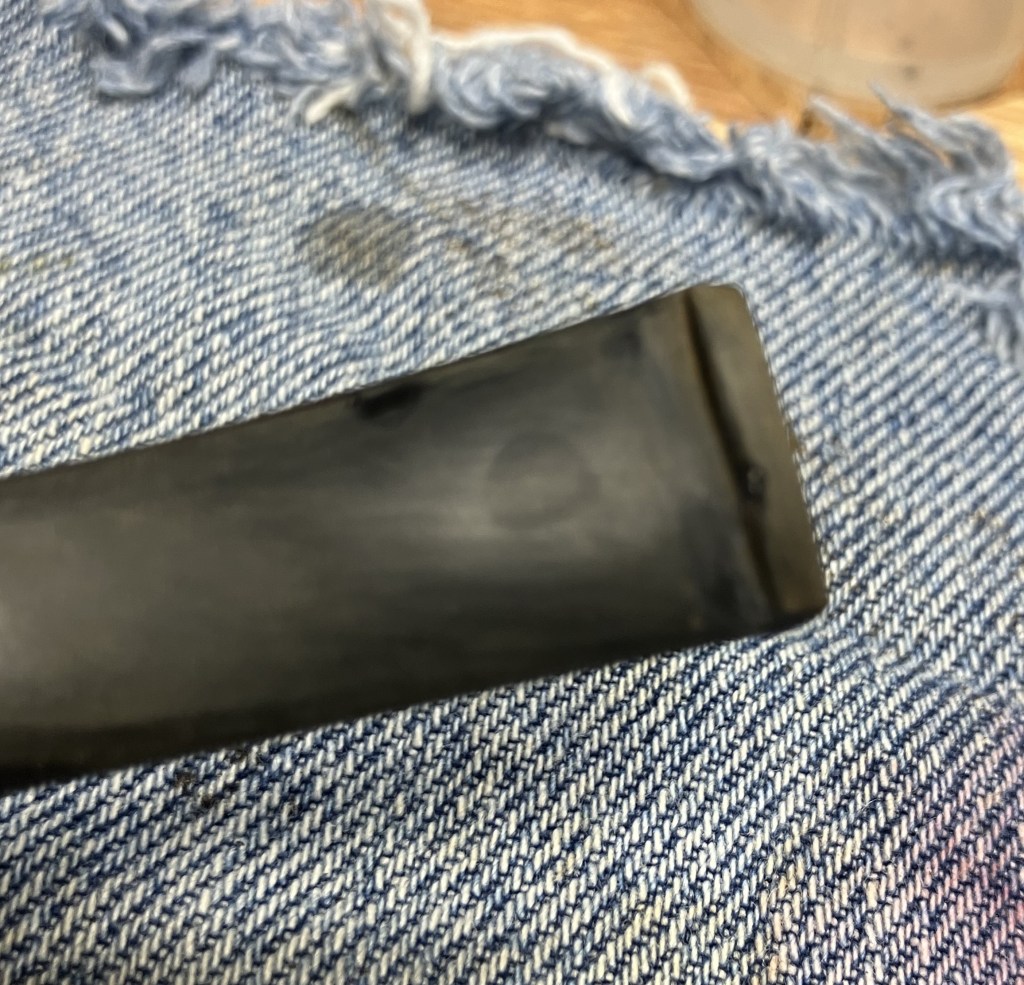
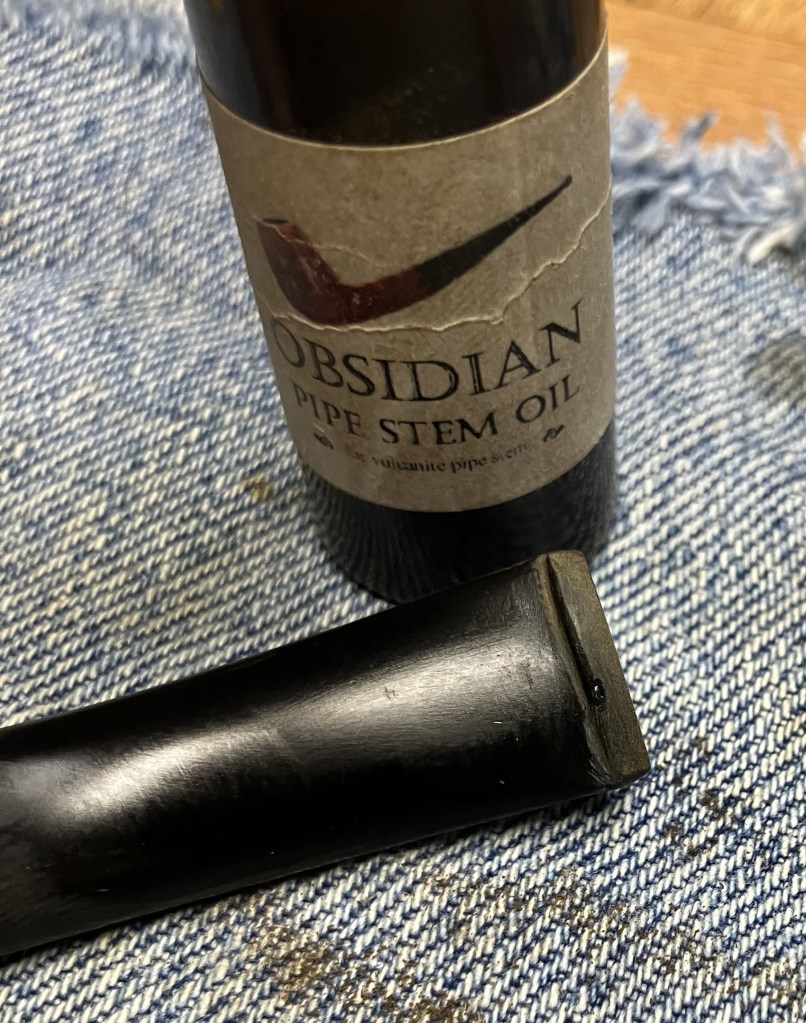
I rubbed on a little bit of Obsidian Oil to see if the fill was noticeable. It was nearly invisible.
I retrieved the stummel. The black dye looked good and the wear marks were gone.
Next, I masked off the shank and fitted the stem. I had sanded the bite zone of the pipe to 1000 grit with sanding sponges during the repairs to the button. I thought that the rest of the stem would be fine if I just buffed the stem at the buffing wheel. Besides, I wanted to work on my buffing skills.
Starting with the rouge buffing compound and the dedicated rouge wheel, I buffed the stem.
I wiped the rouge compound from the stem then switched wheels and proceeded to use white compound.
The stem looked great. I removed the masking tape and applied a coat of Before and After Restoration Balm with a baby tooth brush. This was allowed to rest for 20 minutes.
After the resting, the stummel was hand buffed with an inside out athletic sock to remove the excess balm.
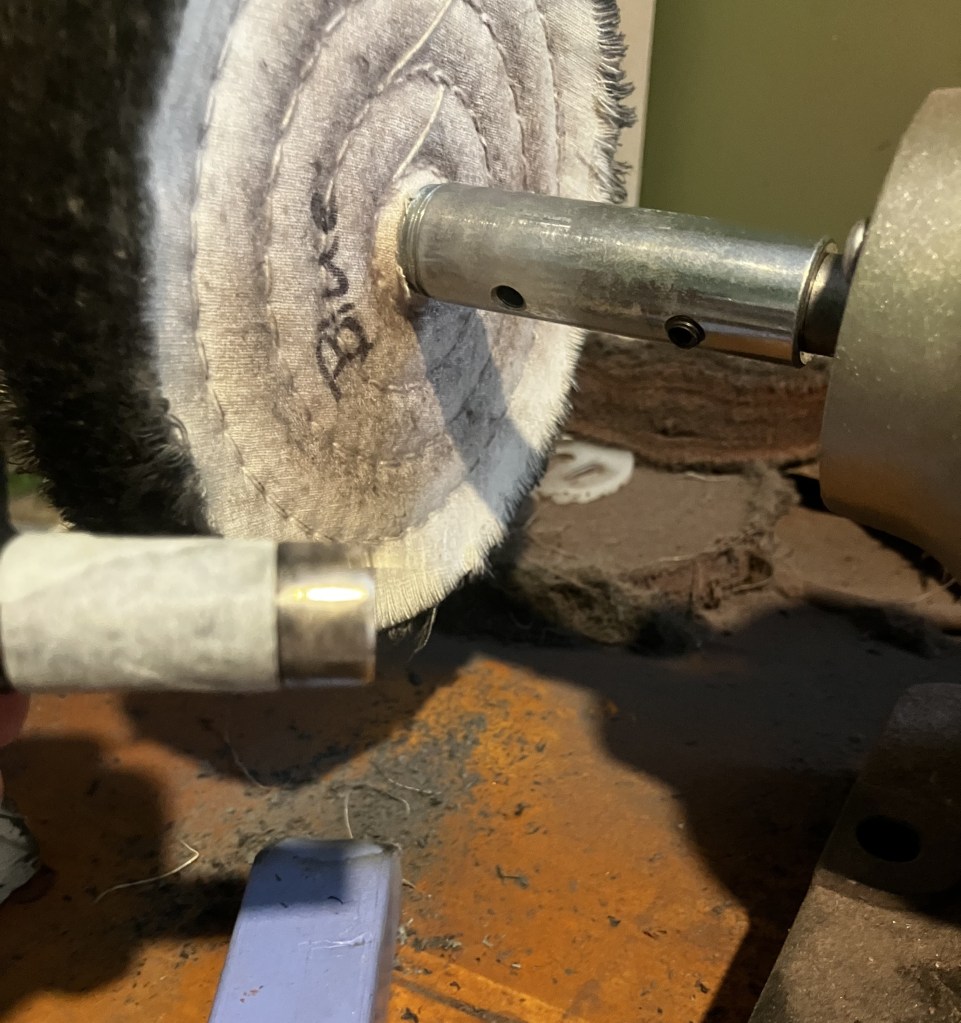
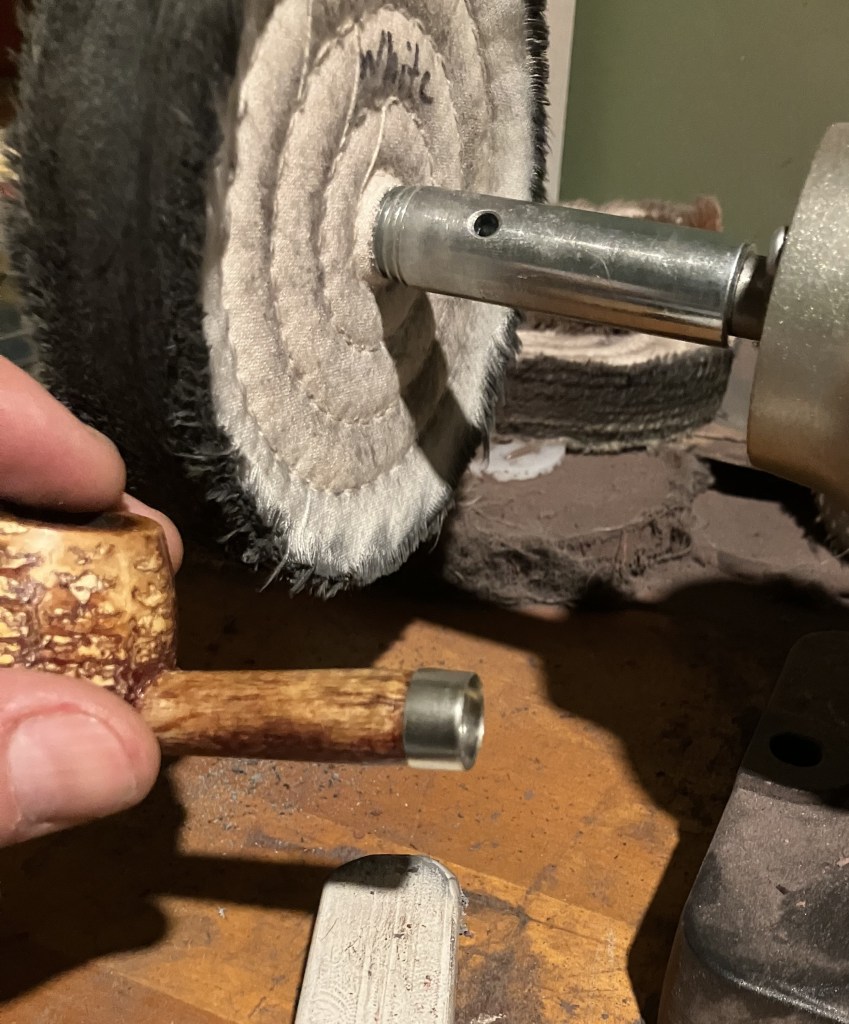
I figured that I should buff the band as well. Maybe the next owner of this pipe would want the band and if so, it should look good. I used a corn cob pipe shank to hold the band during the buffing.
The band fit over the cob’s band and was snug.
Back to the buffer.
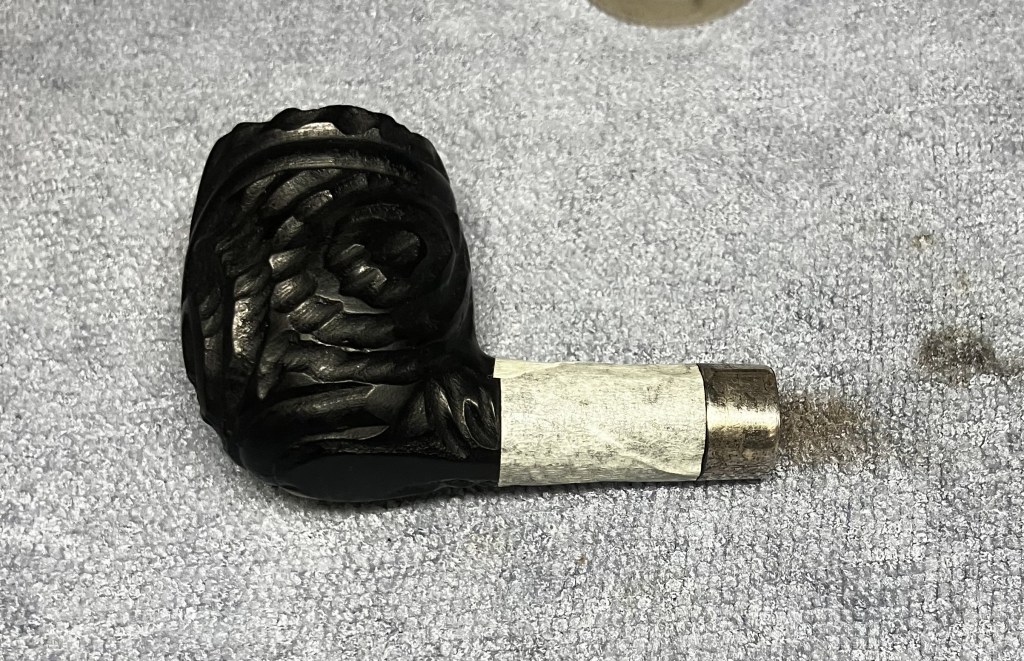
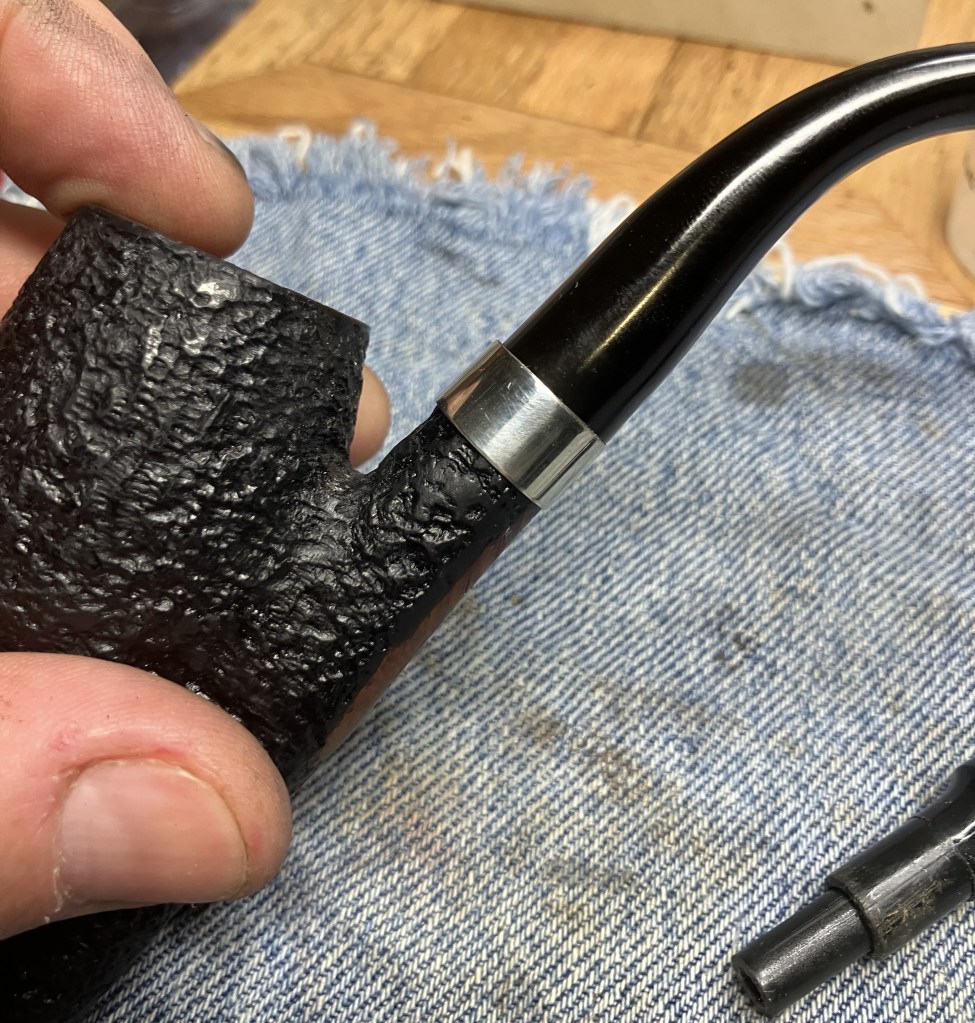
Below you can see the polished band on the pipe.
And the pipe without the band.
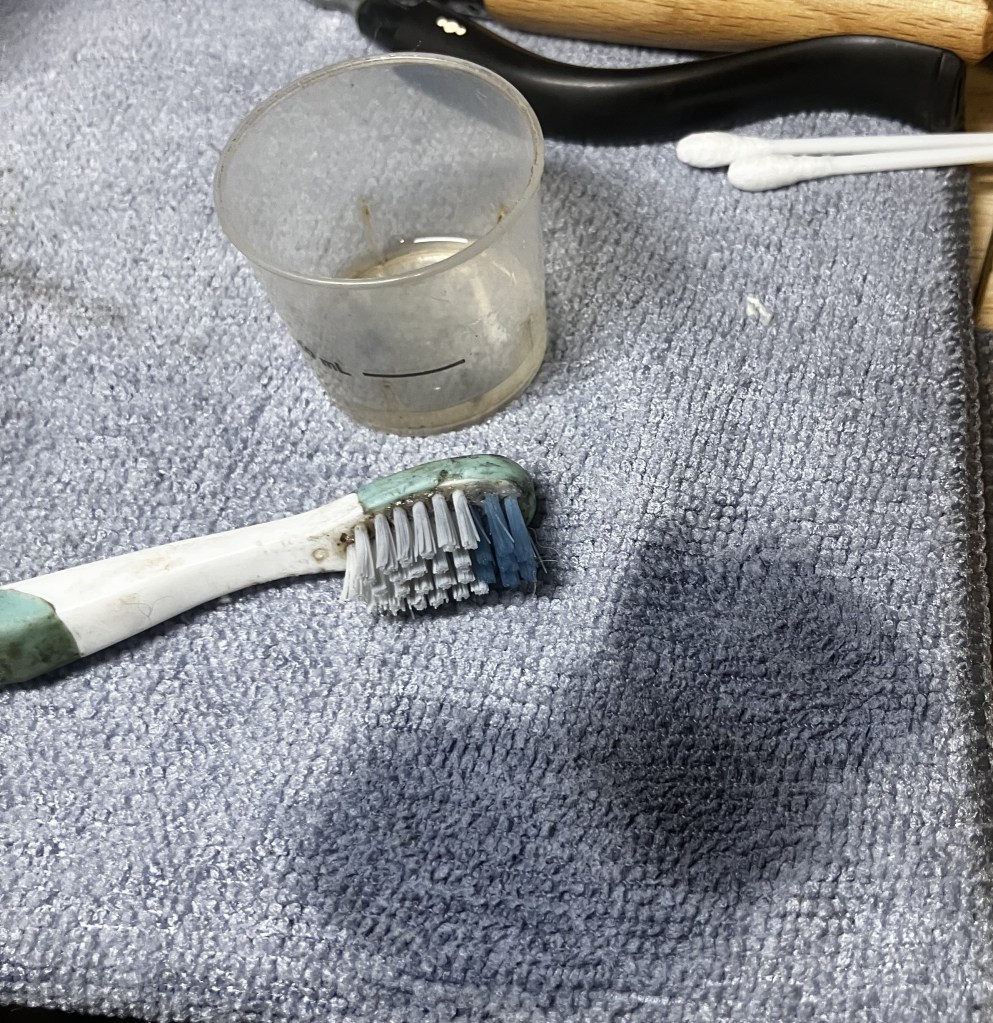
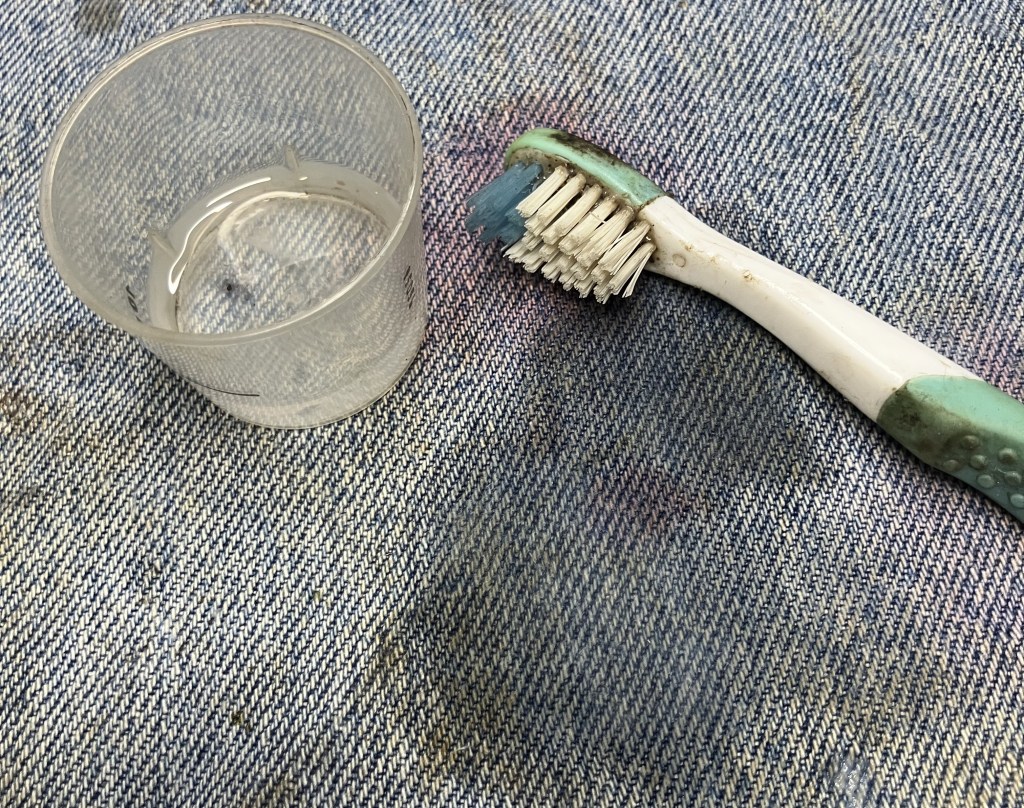
Well, it looks like someone came and used my baby tooth brush and did not clean it when finished. Hmm, I wonder who that could have been? Oh well, cleaning the brush was done by dipping it in 99% ethyl alcohol and brushing the denim work-top protector a couple of times.
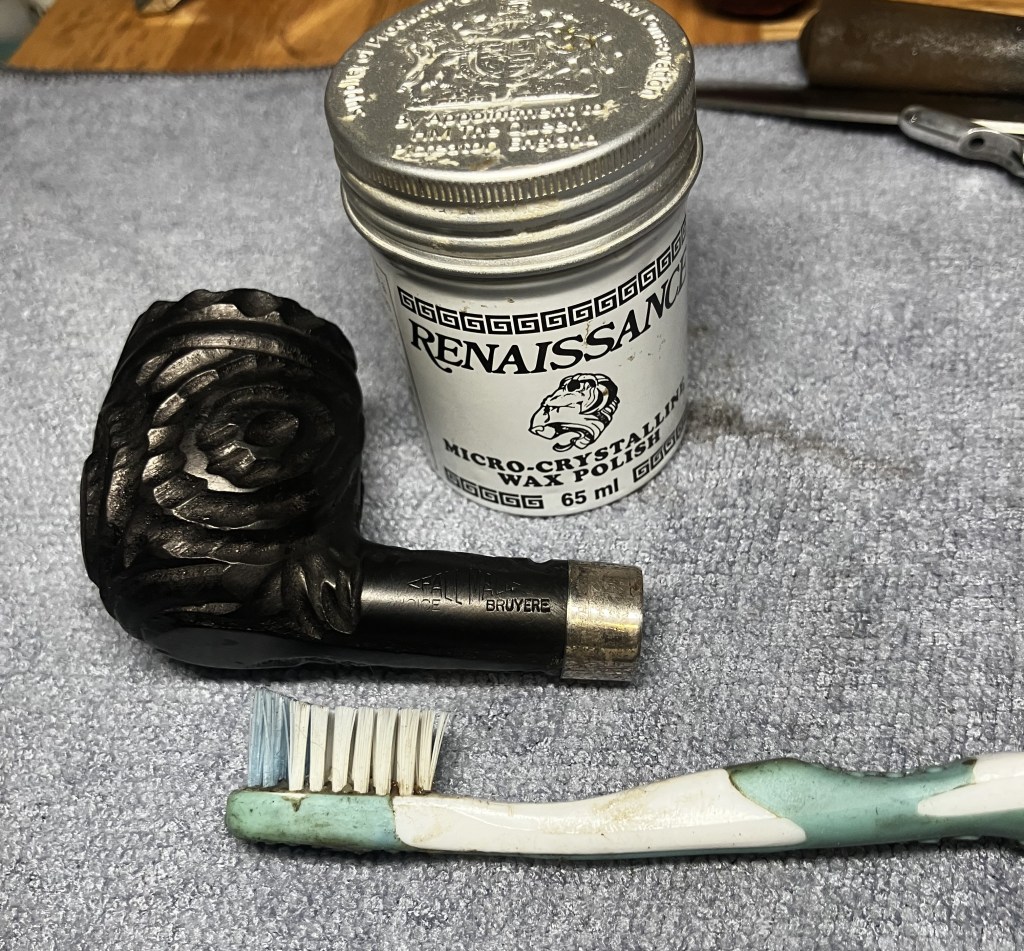
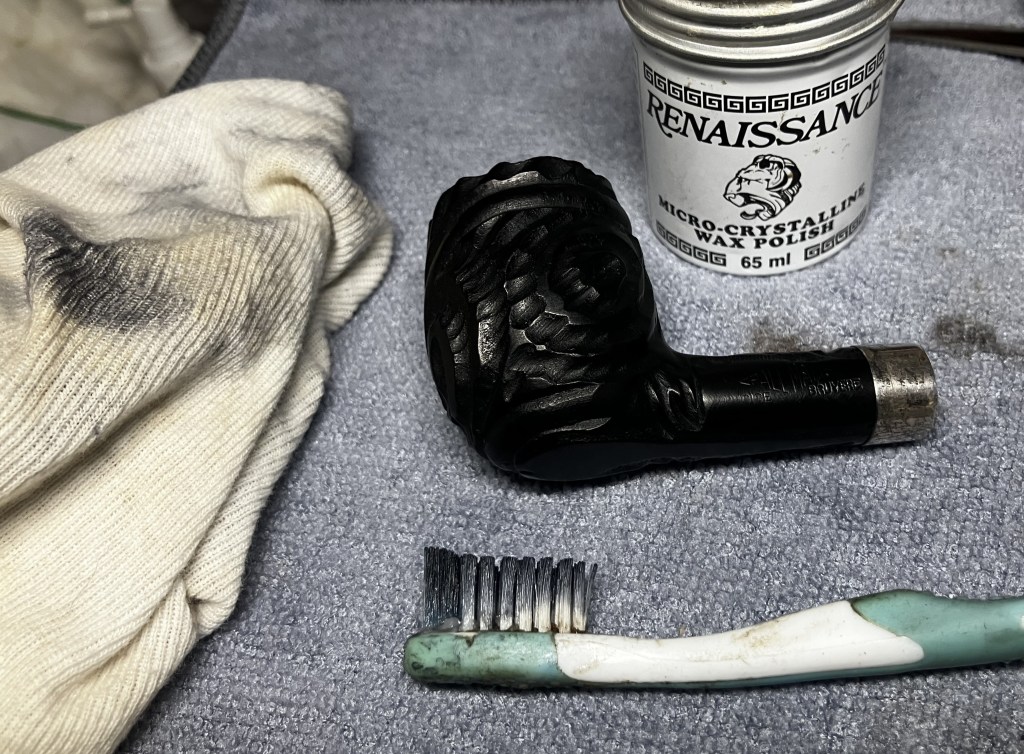
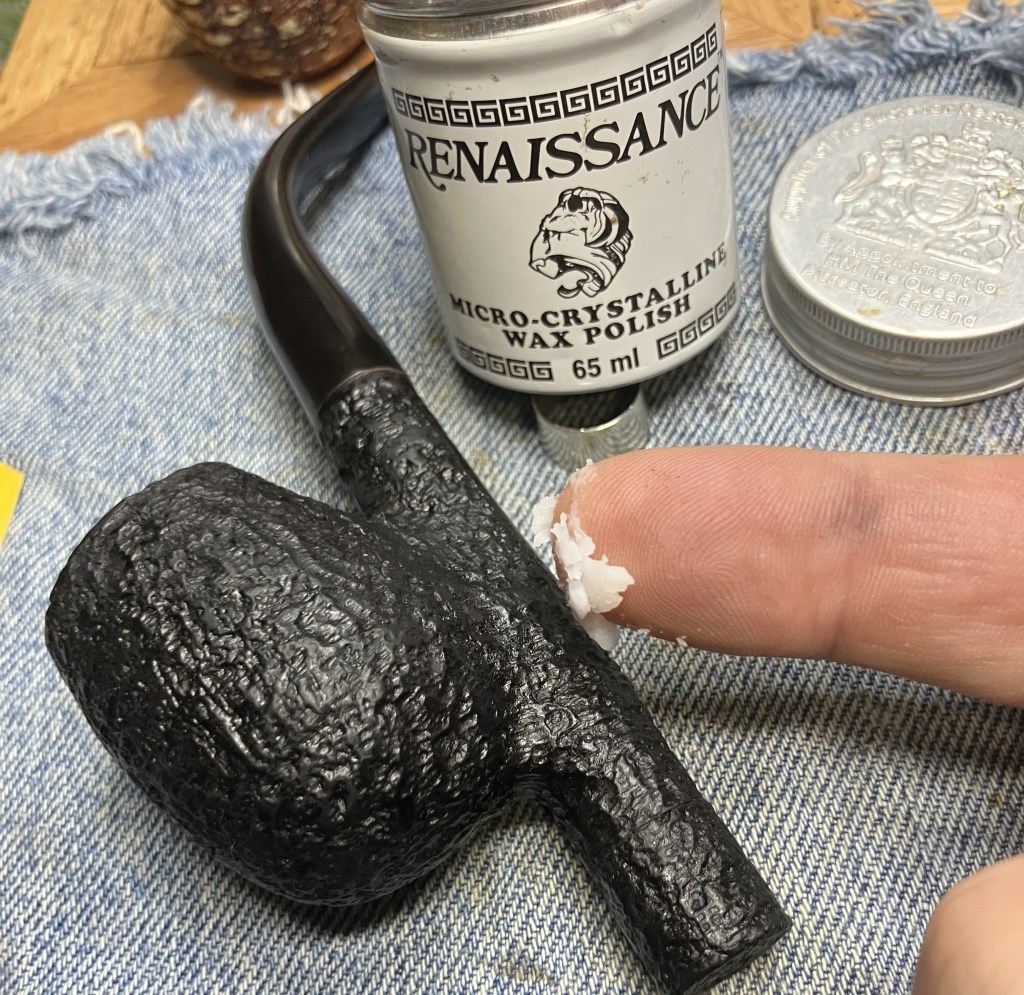
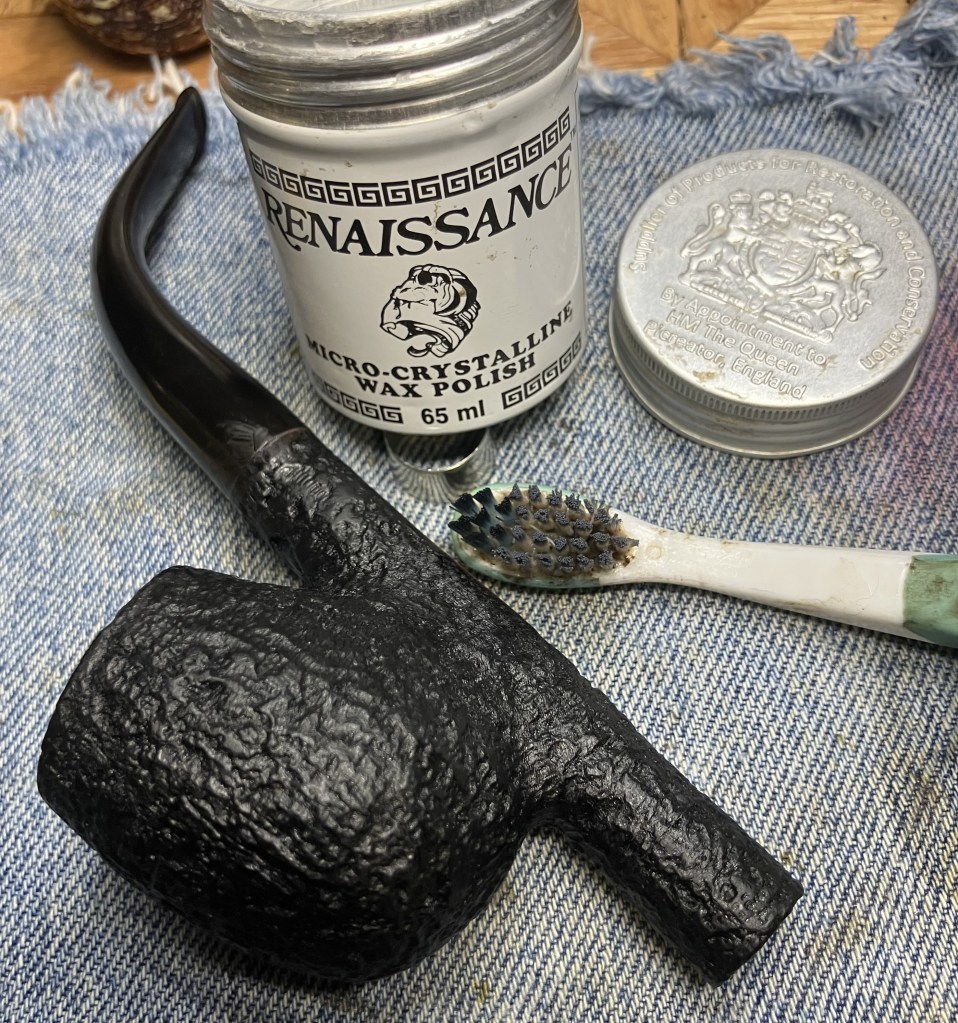
I like using Renaissance Micor-Crystaline Wax for rusticated pipes. “How much wax?”, you ask. About this much.
Baby tooth brush time, the little brush works very well to work the wax into all of the rustication crevasses.
As per the label instructions the wax was hand buffed with a soft cloth.
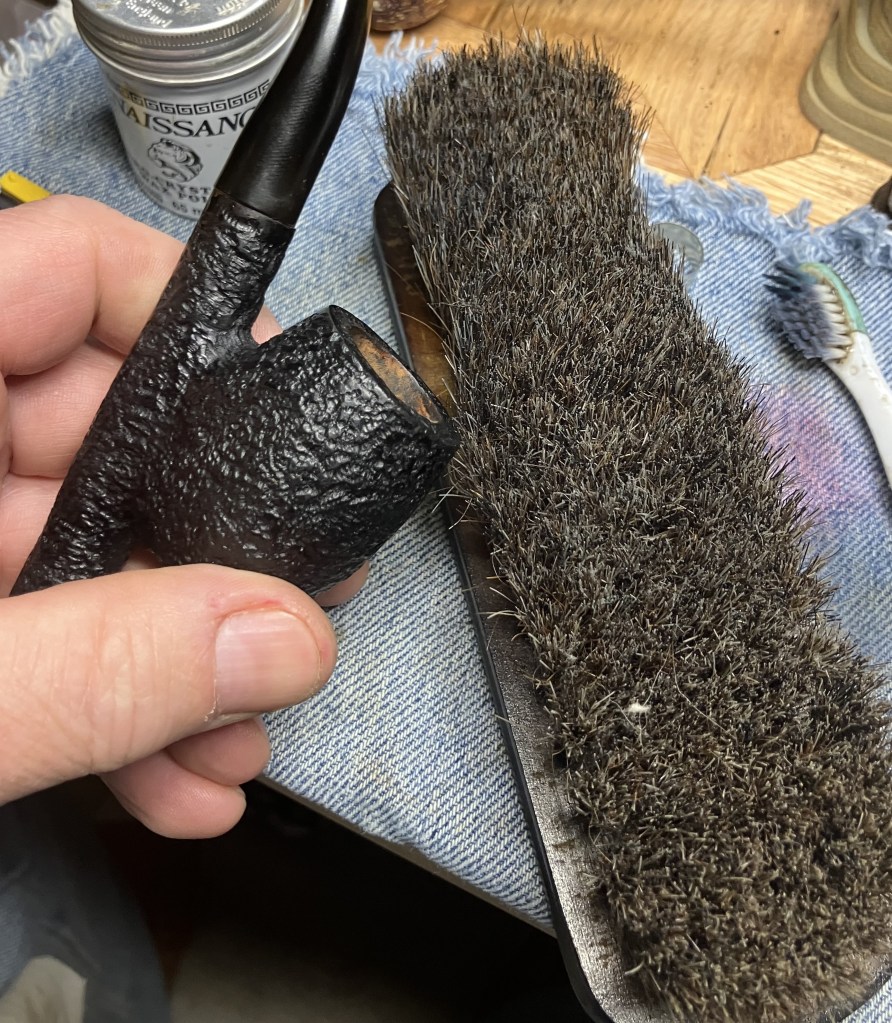
A little bit of shoe shine brush work to make sure there is no accumulated wax “white” film in the depressions.
The stem and stamping area received several coats of carnauba wax applied with the buffer.
Normally this would be the end but I wanted to clean the baby toothbrush after the Renaissance Wax in case the granddaughters come over for a grandpa sleep-over. Just kidding, I have toothbrushes for them.
This Brebbia Alpina Cavalier turned out very beautifully. I still don’t know what is going on with the band but then my input wasn’t asked for or needed when this pipe was made. The black dye returned the pipe to its original colors. The button reshaping turned out very nicely and appears as original as well. The stem polished up very nicely and the glossy black provides an interesting contrast with the rusticated black briar. The drillings of this pipe should allow the moisture from the smoke to condense out and drip the liquid into the large chamber or shank extension. This should act as a very large reservoir for accumulating liquid. Kind of like a Peterson System pipe on steroids. The band could be customized and included if the next owner would prefer it on or off. The dimensions of the Brebbia Alpina Cavalier are:
Length: 5.76 in./ 146.30 mm.
Weight: 1.55 oz./ 4394 g. (with band)
Bowl Height: 1.78 in./ 45.21 mm.
Chamber Depth: 1.36 in./ 34.54 mm.
Chamber Diameter: 0.71 in./ 18.03 mm.
Outside Diameter: 1.39 in./ 35.31 mm.
I do hope that you have found something here useful to your own pipe care, maintenance or restorations. If you like this sort of thing, please click the like and subscribe buttons. Thank you for reading the ramblings of an old pipe lover.
Loading…
Below are some photos of the finished Brebbia Alpina Cavalier.
Finally, photos of the finished pipe with and without the band. If you are interested in this pipe let me know which you would prefer. I can glue the band in place for you, if that is the way you would like it or leave it off. I will include it with the pipe if you prefer it unattached.
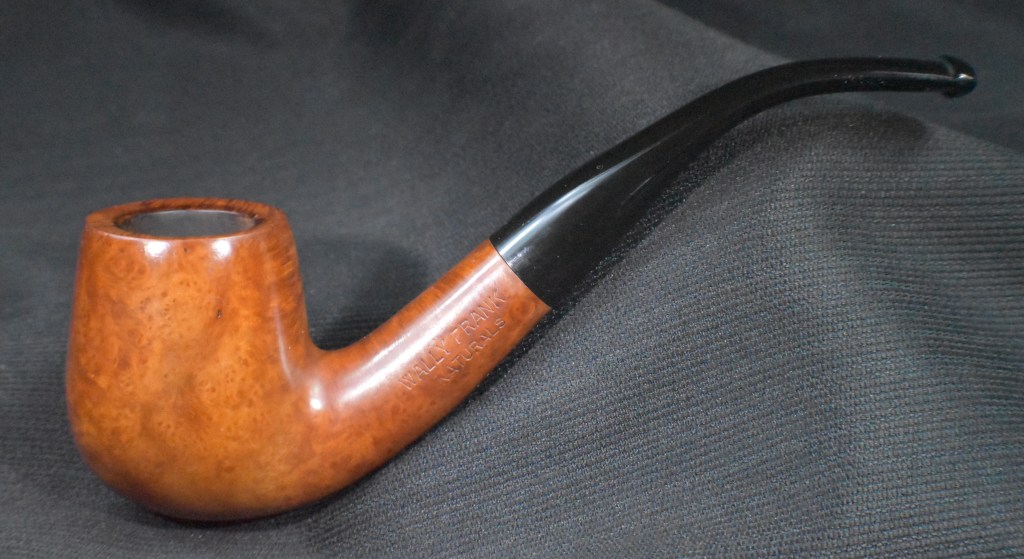
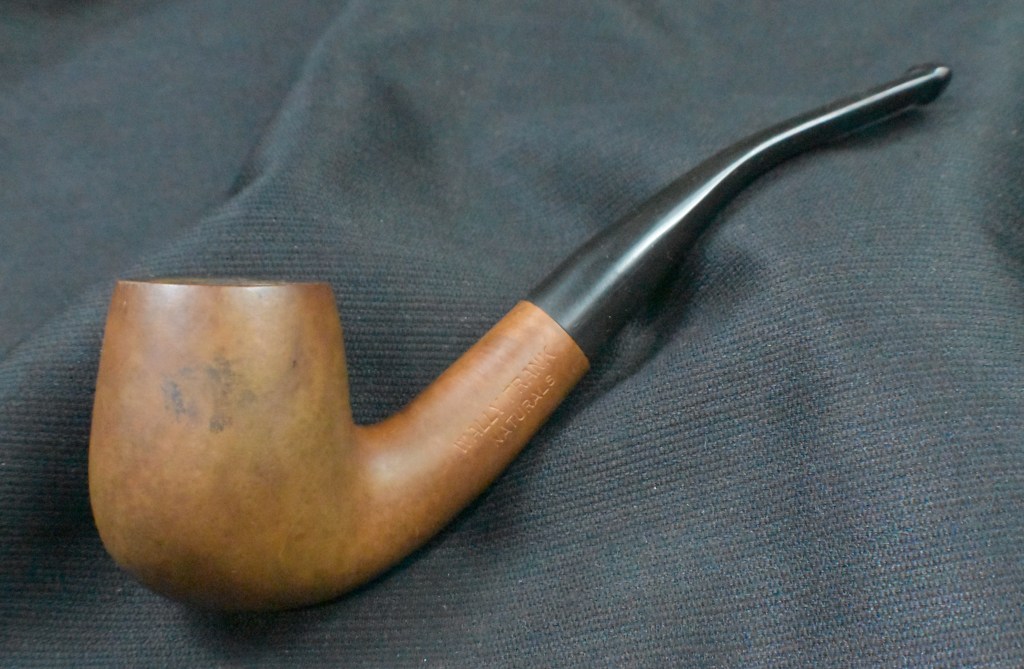
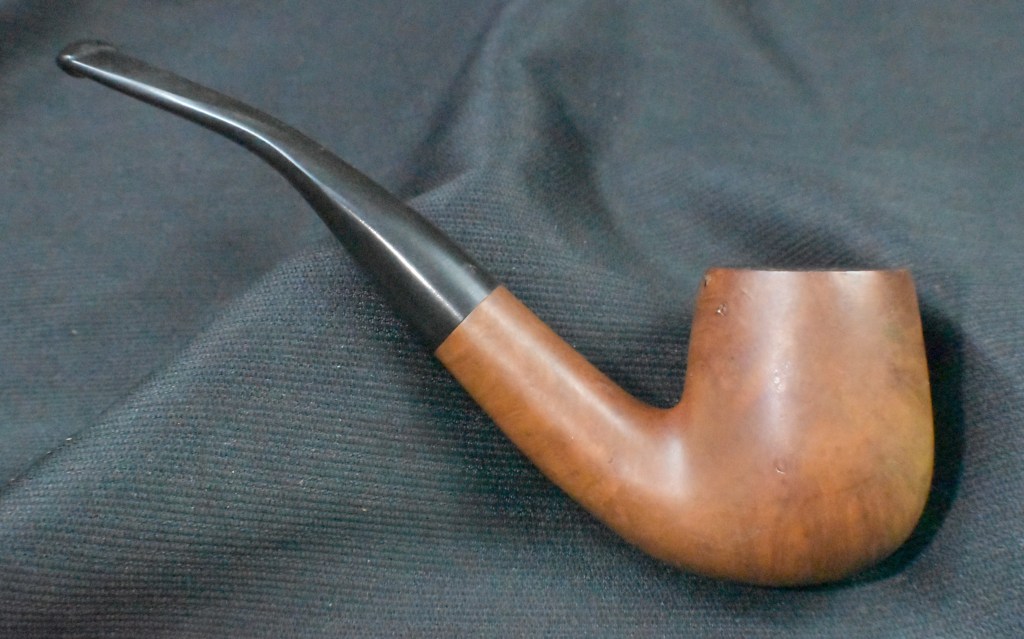
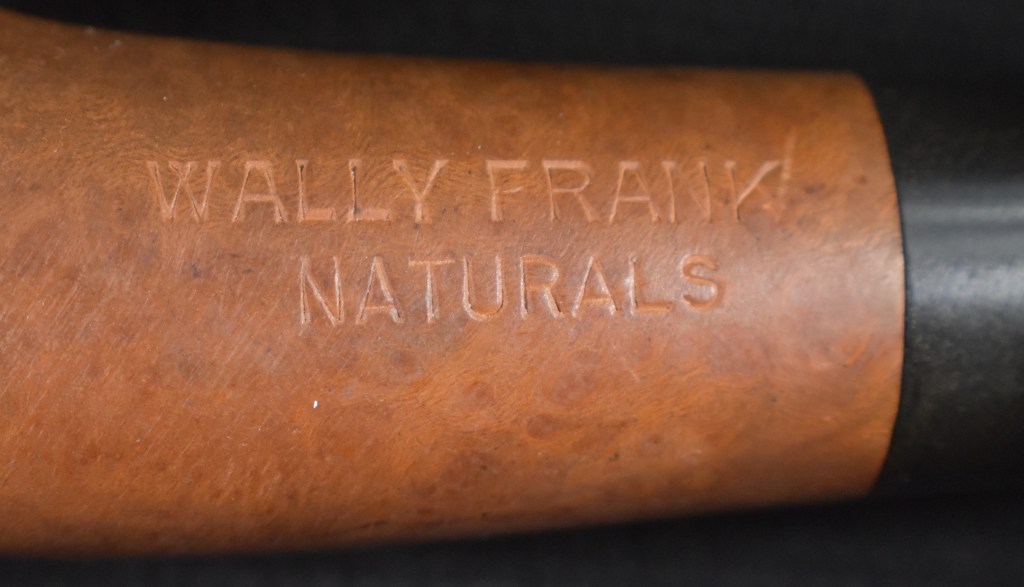
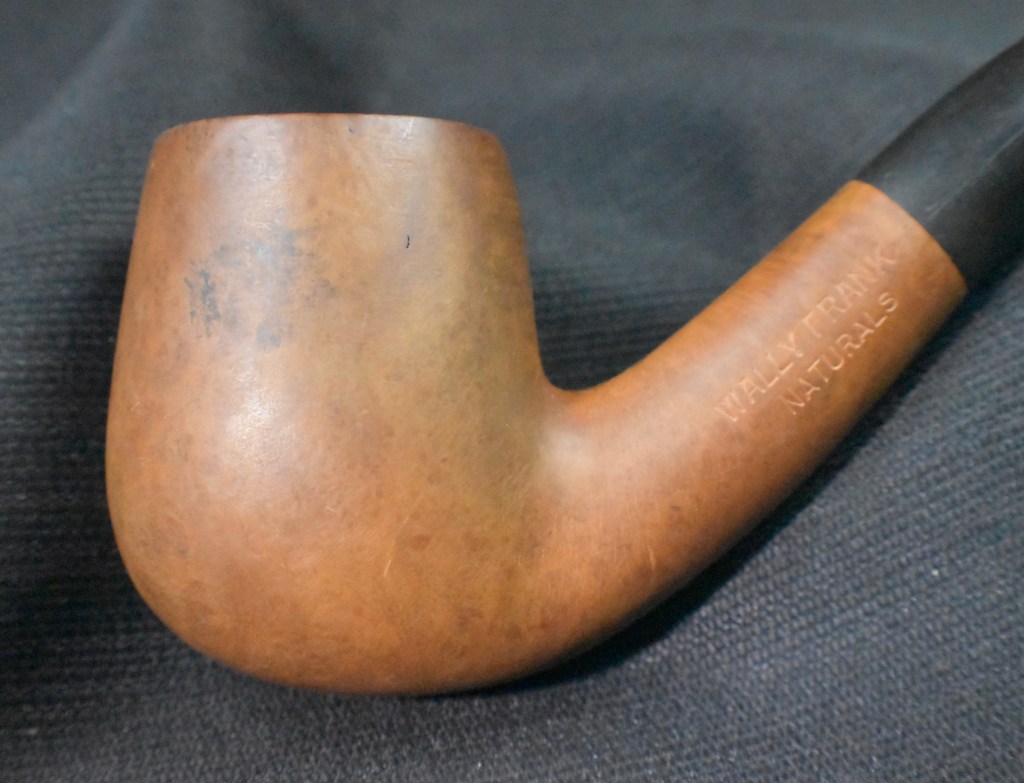
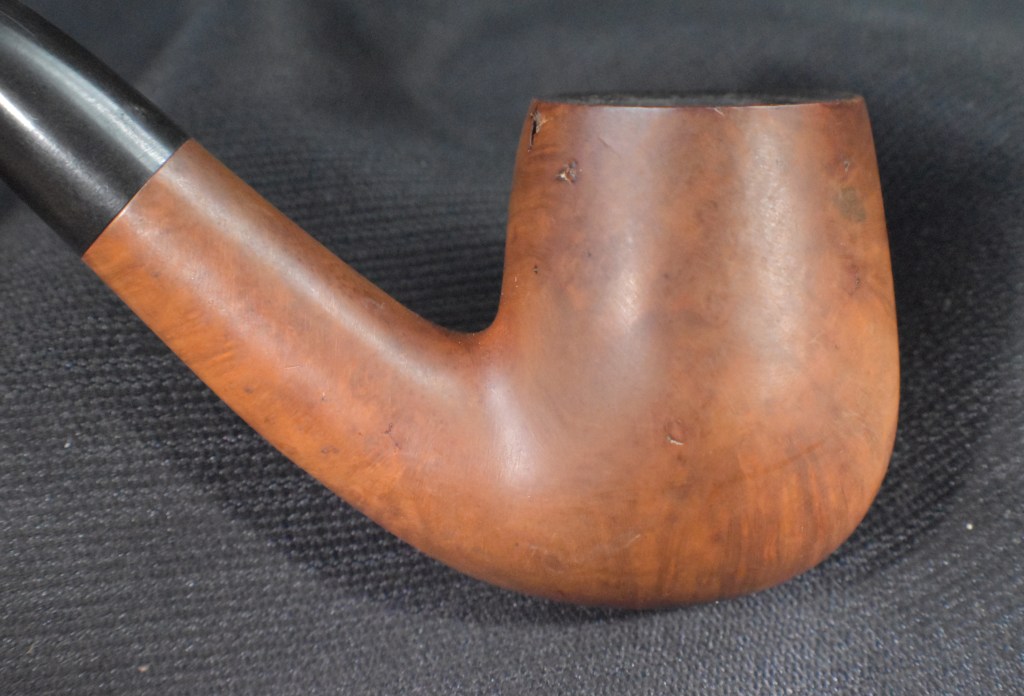
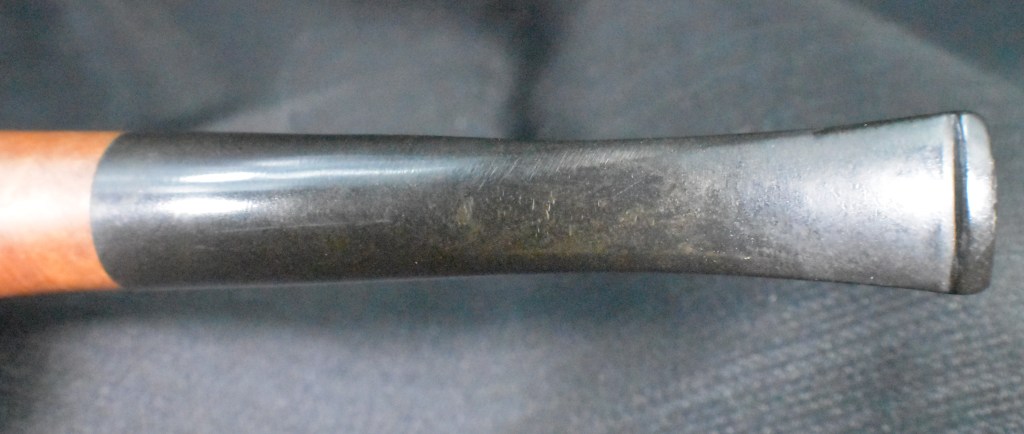
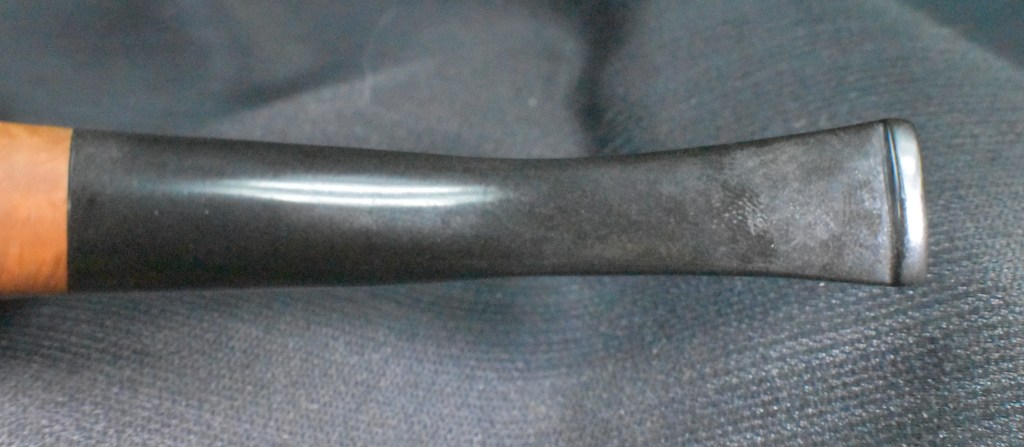
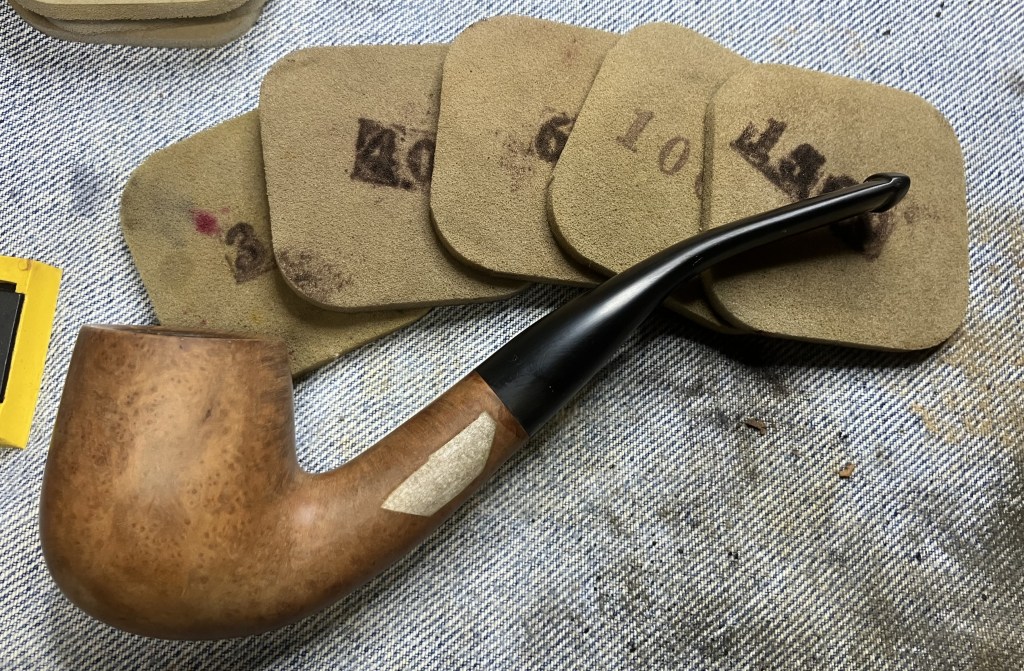
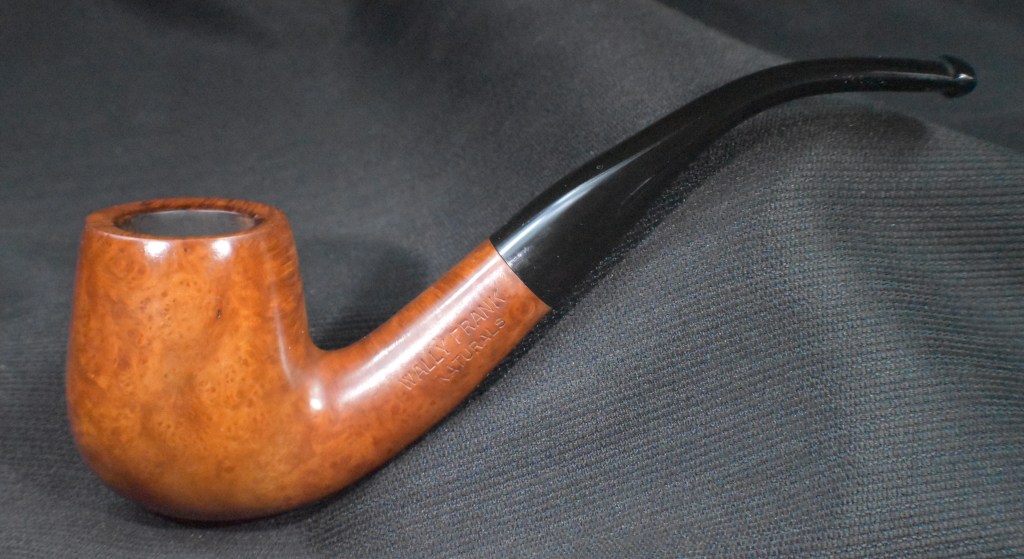
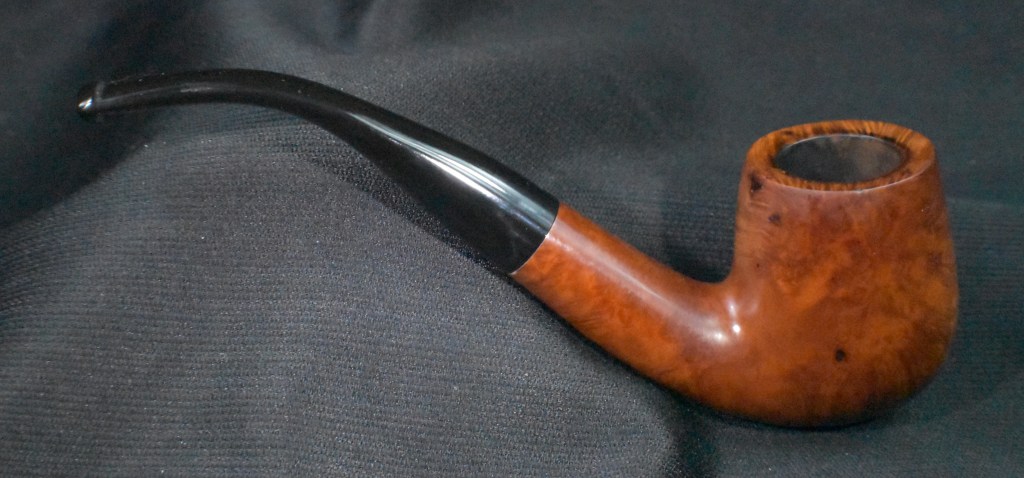
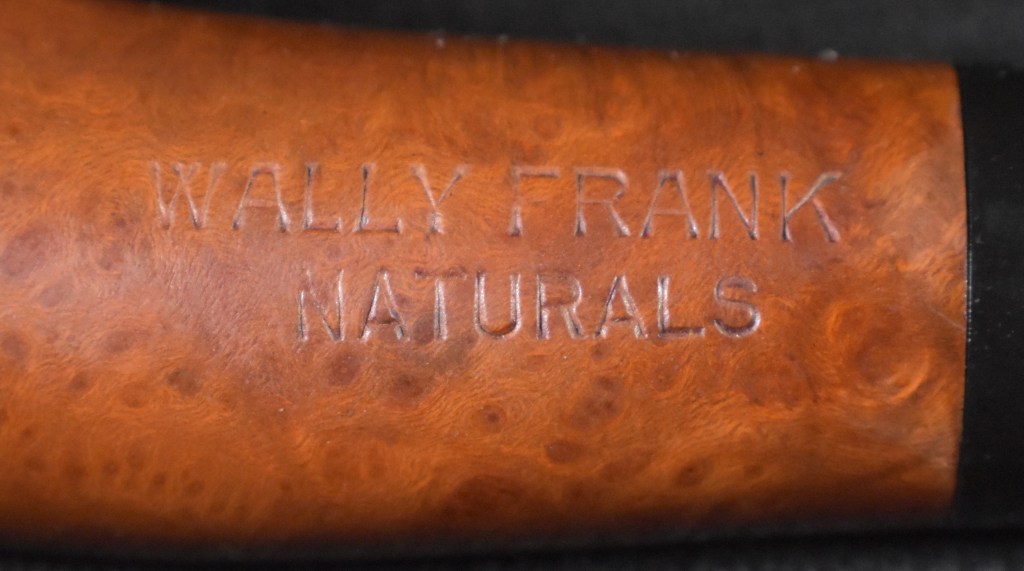
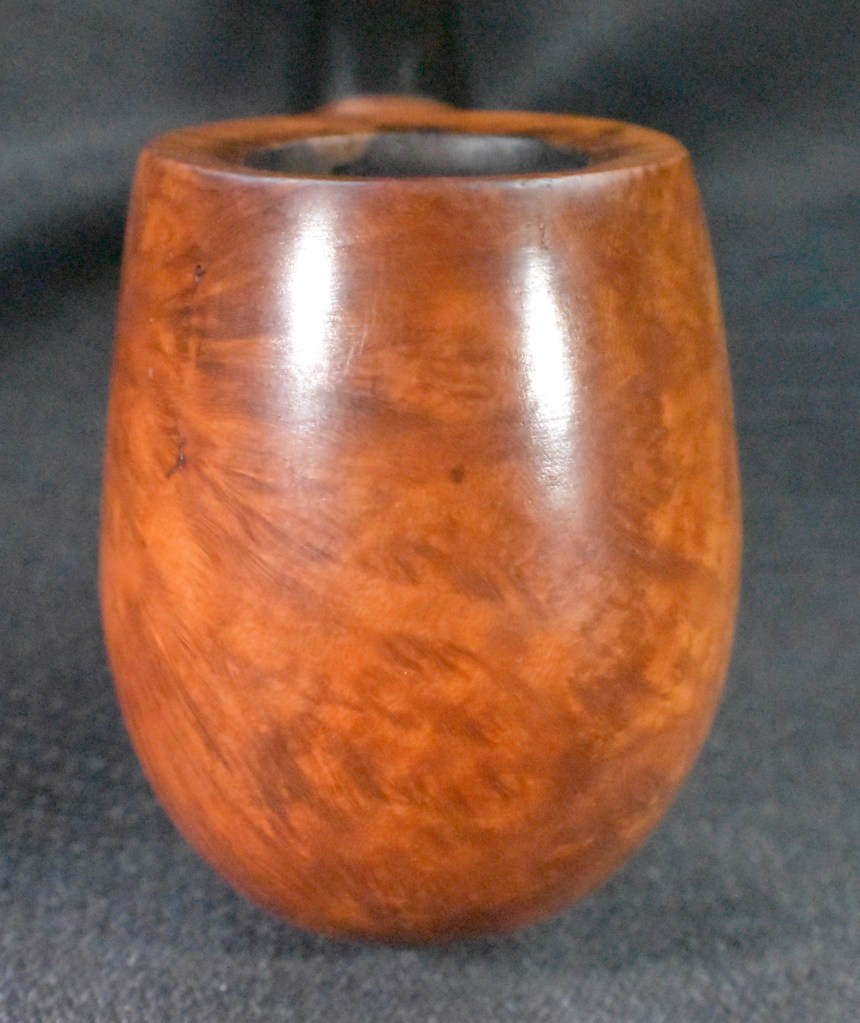
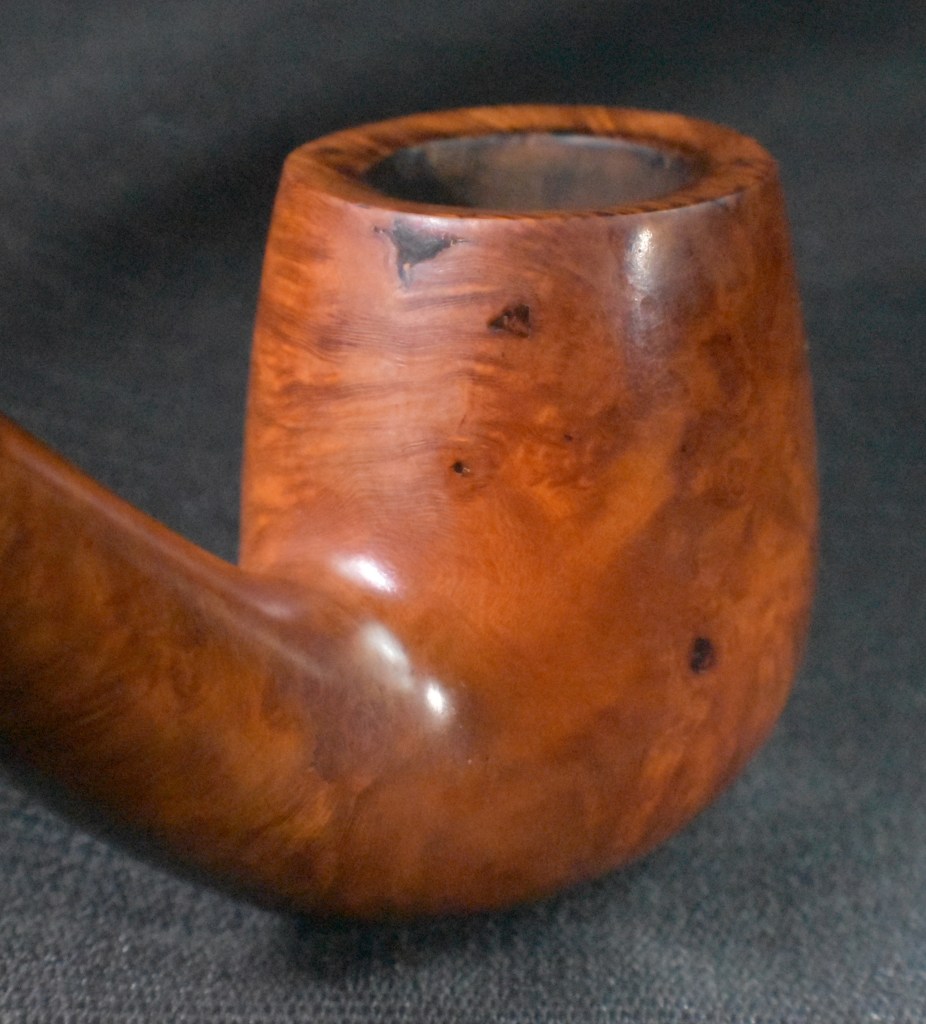
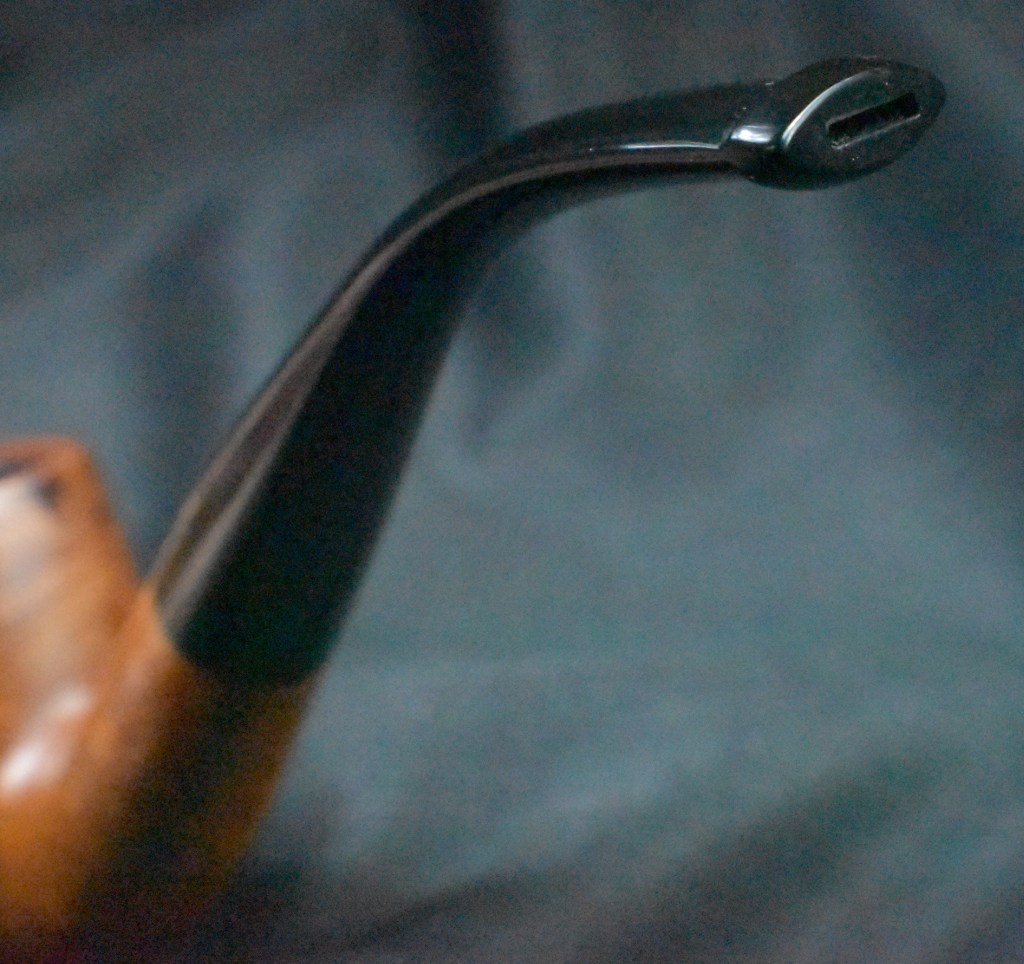
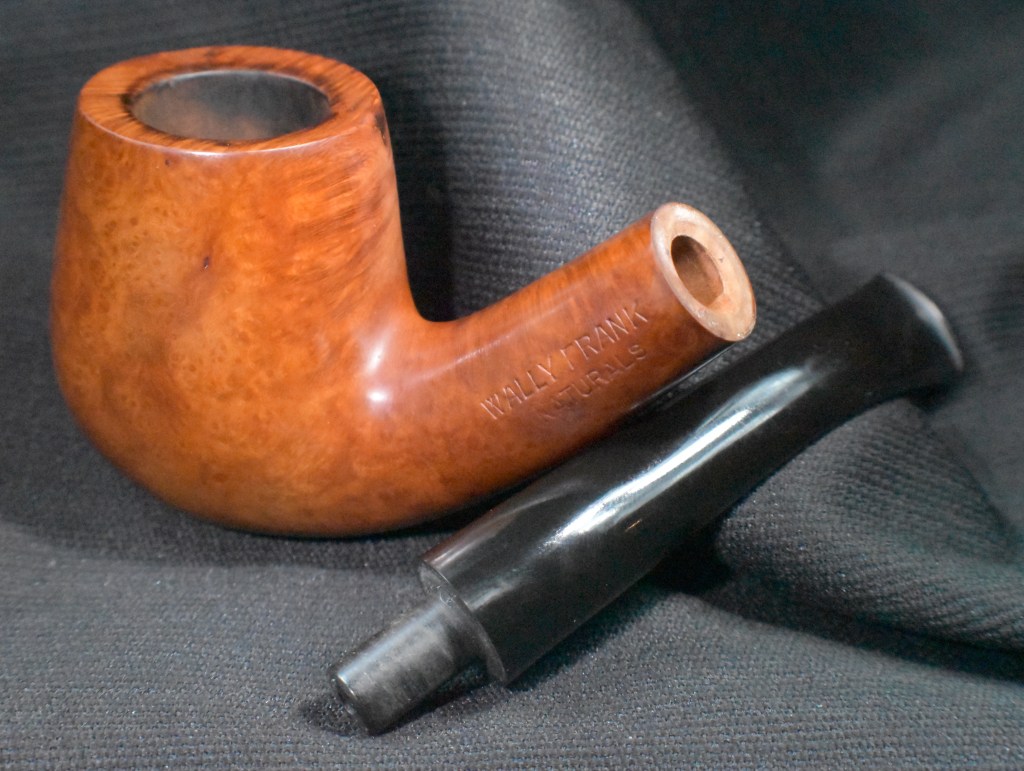
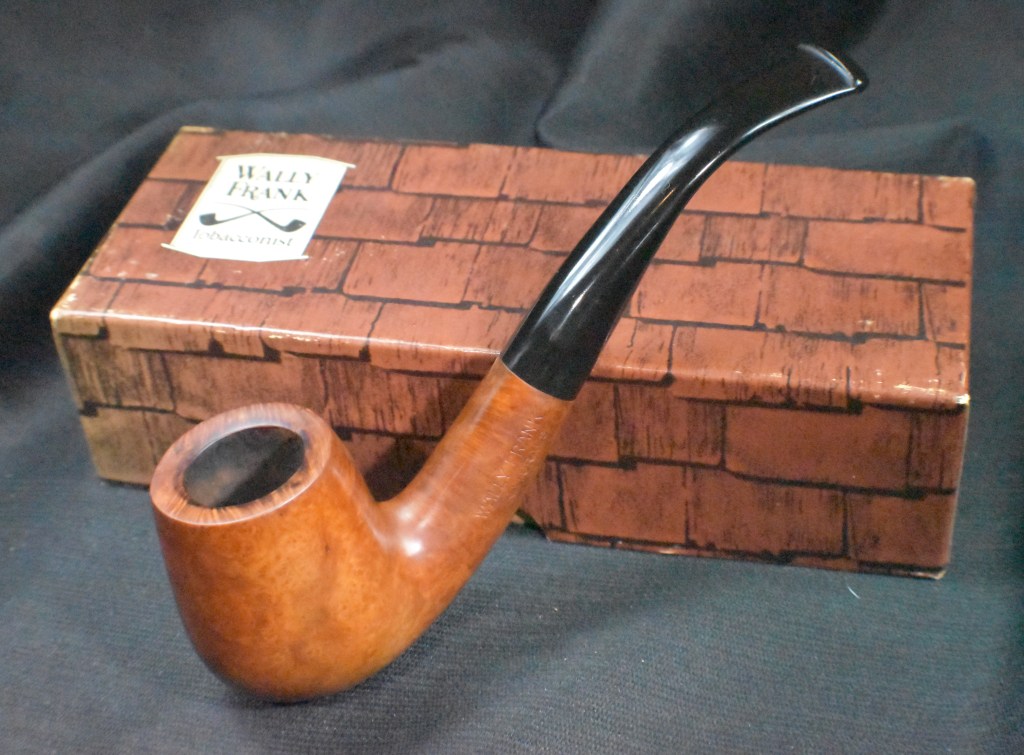
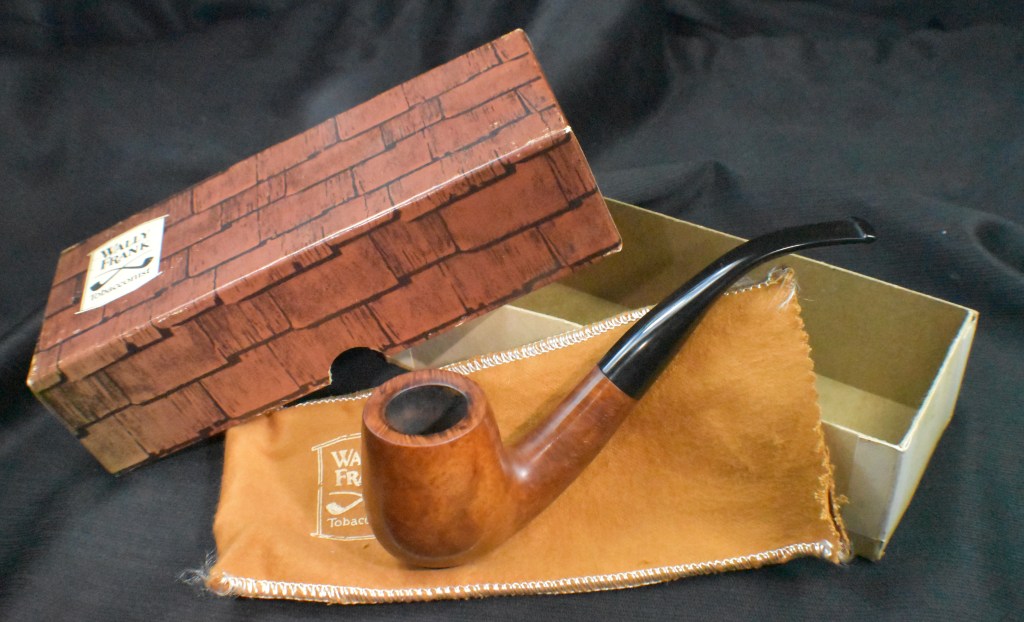
I do love a smooth bent billiard. There is just something classic and elegant about the shape. This Wally Frank Naturals is a nice example of a bent billiard and it also has the distinction of a classic American name. The pipe caught my eye on the eBay auction due it having the original box and pipe sleeve. I was surprised when I won the pipe for the meager bid that I made. Perhaps it looked like too much work for someone to give the poor old girl. A journey from South Carolina to Nebraska shortly after Thanksgiving and the pipe arrived. The stampings were clear and read: WALLY FRANK over NATURALS. No shape number nor country of manufacture. This led me to believe it truly was an American made pipe. Below are some photographs I took of the pipe prior to starting work.
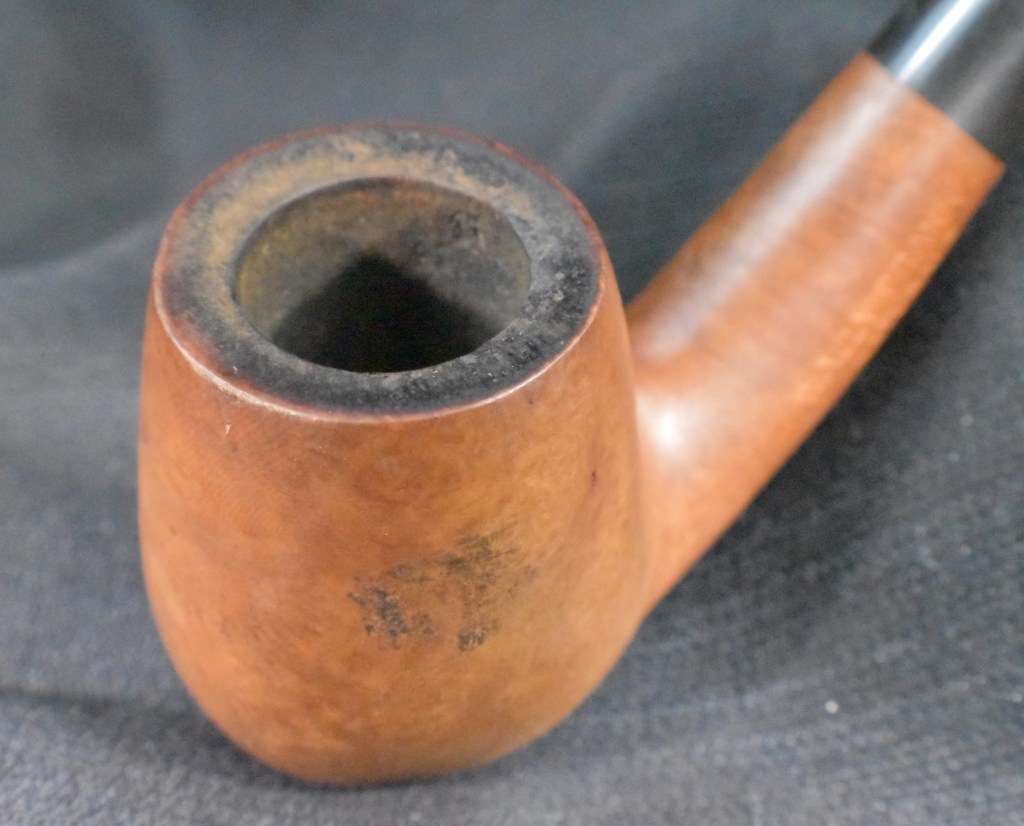
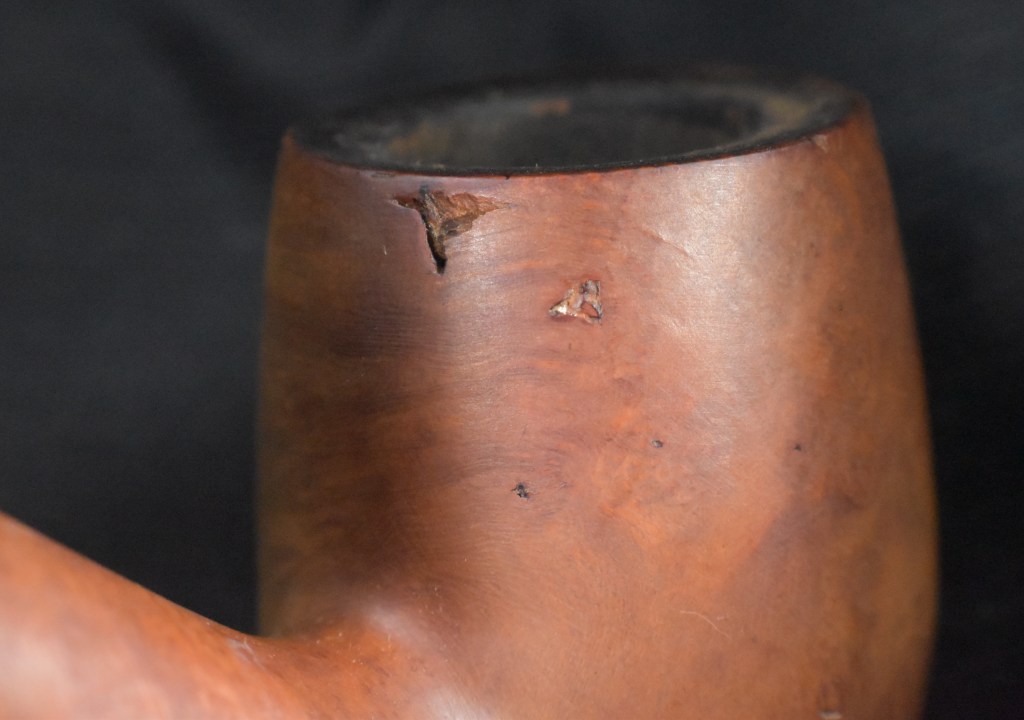
Overall, the pipe was in very good shape. The box is just a fun piece of ephemera that you don’t see frequently with estate pipes. There were a few pits that would require filling. The “Natural” finish would have to be maintained. The stem showed little evidence of oxidation, I thought that it must have been stored in that box and never saw the light of day. Of course a reaming of the tobacco chamber and a thorough cleaning were needed, but this looked like a very relaxing restoration.
Background
I am going to use my own writing on the background of Wally Frank from a blog I wrote back in June of 2024.
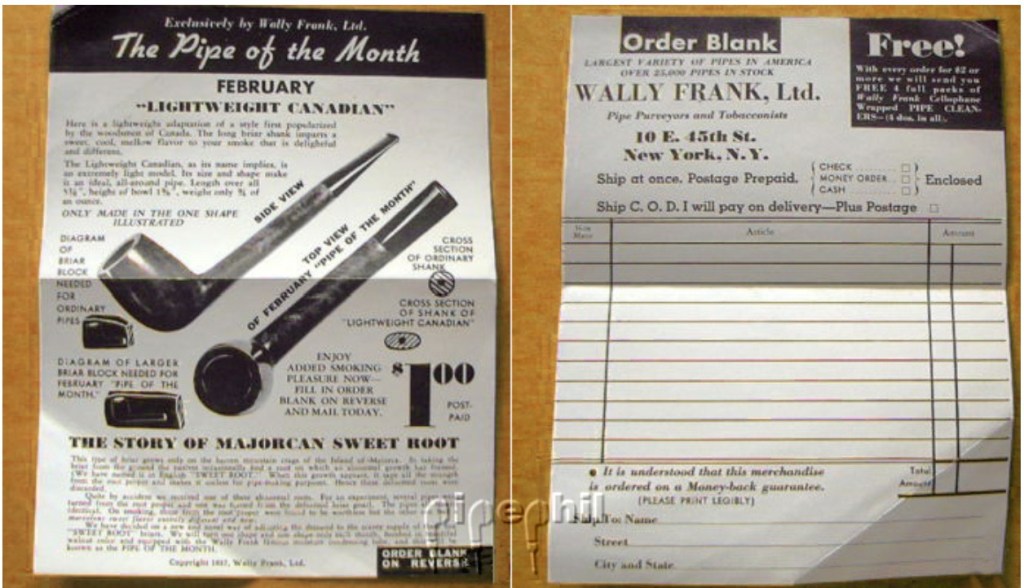
“Okay, back to my editorializing about Wally. The huge variety, nearly schizophrenic in nature, of Wally Frank style pipes may be due to his constantly trying to keep his offerings fresh in a competitive pipe market. Frank’s pipes were not what I would consider high end pipes. He was likely going after customers with less disposable income and mimicking a variety of popular styles . He was known to venture throughout Europe searching for less known carvers and small shops where he could purchase quality at lower prices. Wally Frank’s unique pipe offerings may make more sense when you consider the Wally Frank “Pipe of the Month Club”, an early subscription pipe offer. He apparently wanted to keep the customers satisfied with new and unique offerings. Here is the order form from http://www.pipephil.eu/logos/en/logo-w1.html
The date on the form is difficult to make out but, I think it is 1947. $1 in January of 1947 is equivalent to $14.58 in April of 2024 (https://www.bls.gov/data/inflation_calculator.htm). Who wouldn’t jump at the chance to get a new pipe every month for $15 dollars today?
The first paragraph about Wally Frank from Pipedia pretty much sums up Frank’s contributions to our hobby:
Wally Frank, Ltd. was one of America’s oldest and most respected names in pipes and tobaccos, beginning in the early 1930’s. Wally Frank operated a chain of tobacco stores in New York City (the flagship store was in Lexington Avenue) and had a vast catalog business for pipes and pipe tobaccos. Their numerous private-label pipes were made by many makers, includingCharatan,Sasieni,Weber, and many others. Wally Frank, Ltd. also owned thePioneer brand of meerschaum pipes, made from both Turkish and African meerschaum. In addition to importing pipes, he had many pipes made in his own name and also employed pipemakers likePeter Stokkebye,Svend Bang, andEd Burak (who later became the owner ofConnoisseur). As a result, each Wally Frank pipe must be individually evaluated on its own merit. (Wally Frank – Pipedia) Mr. Frank did this for many years, Wordcat.org is a library of print material available via interlibrary loans. They have several Wally Frank catalogs available from 1930-1958 (au:Wally Frank, Ltd. – Search Results (worldcat.org)).
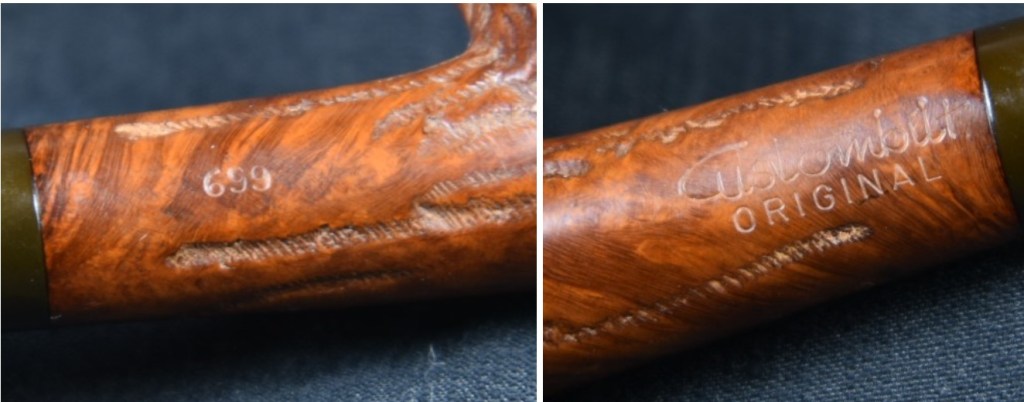
Due to the large number of sources of Wally Frank pipes there is no Wally Frank shape chart to use as with Dunhill, Peterson, Kaywoodie and other manufacturers. I looked through the several Wally Frank pipes that I have kept for personal use and I could find only one with a shape number stamped on the pipe. And that is a Custombilt pipe from the Wally Frank Era of ownership. So, in a sense not really a Wally Frank pipe. The
I apparently neglected to take a photo of the pipe arriving at the workbench and jumped right to the stem. Slight creases could be seen on the stem. I assumed these were from the bending of the stem, likely after it had been polished. There was also some light tooth chatter.
The chatter on the bottom of the stem was also visible but here, there were fewer creases.
The tobacco chamber had a light development of cake.
Due to the chamber being right in between the blades of the PipNet, I had to use the Kleen-Reem, Smokingpipes Low Country reamer and the General triangular scraper.
I was a bit surprised with the amount of cake removed.
Once sanded with 320 sandpaper wrapped around a wood dowel, I could see that the tobacco chamber was free of any heat damage.
The rim was encrusted with smoking residue or lava.
This was moistened with saliva and allowed to soak while I went upstairs to sharpen the pocket knife on a stone. Once that was done the rim was scraped with the resharpened blade.
The airway of the shank was cleaned with 99% ethyl alcohol on cotton swabs and bristle pipe cleaners.
The same alcohol and pipe cleaners were used with the stem. Well, different pipe cleaners, I mean the same is ridiculous because the first ones were dirty. Stupid English… My students used to find it funny when I said that. Most of them were English Language Learners and loved it when I made fun of English.
At the sink, I scrubbed the stummel with undiluted Murphy Oil Soap and a nylon brush. The soap was rinsed with warm water and dried with a cotton hand towel.
Back at the workbench the stummel was wiped with a make-up pad wetted with 99% ethyl alcohol. Very little color came off the briar indicating that it was clean of dirt and wax.
I went to work picking old fill material from the observable pits using a fly tying bodkin.
Several surface flaws were noted and I hoped that these could be filled with cyanoacrylate (CA, super glue)
The larger pits would require briar dust and CA.
There was also a small flaw on the rim. This would be tougher for fill due to the bevel of the rim.
The larger pits were packed with briar dust by pressing the dust in with my finger tip or the curved back of the dental scraper..
Using a fine disposable applicator tip on the bottle of CA, I applied a small drop of Thin CA to the briar dust.
Once set-up the new fill was filed with a small flat file then smoothed with a 400 grit sanding sponge. If the fill required additional briar dust , more was added and the CA application repeated.
The process was repeated for the rim.
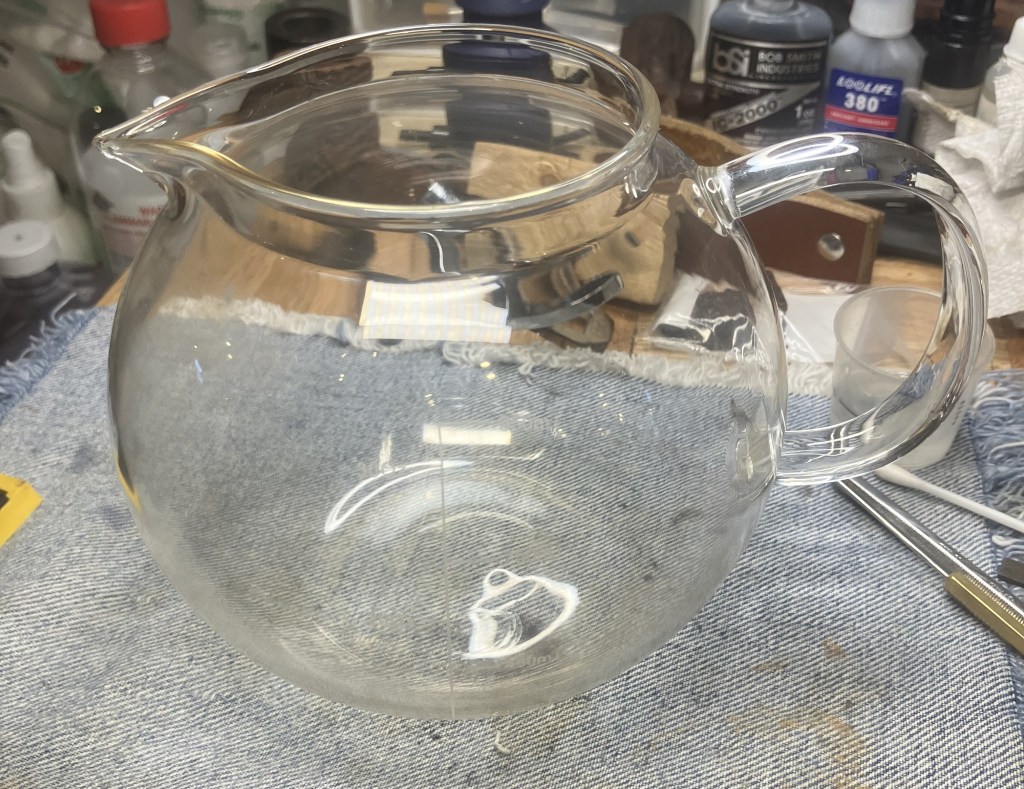
Now, I bet you are wondering, “why does this clown have a tea pot on his workbench?” Good question. This clown thought that I did not have any round surface large enough for sanding the bevel of this rim. Violla, a tea pot might just be a fitting curve.
And it was.
I held a piece of 400 sandpaper in place on the teapot and was able to sand the curved bevel quite well.
Covering the stamps with masking tape to protect them from sanding was necessary.
The stem was then sanded with 320-600 sanding sponges. There was also a little bit of filing of the tooth chatter, but I failed to photograph that. You can see the tip of the file in the photo below, though.
The stummel was then sanded to match the stem. Between sponges I wiped the stummel with an alcohol wetted make-up pad. The stem was rubbed with mineral oil and wiped with a dry paper towel between sponges.
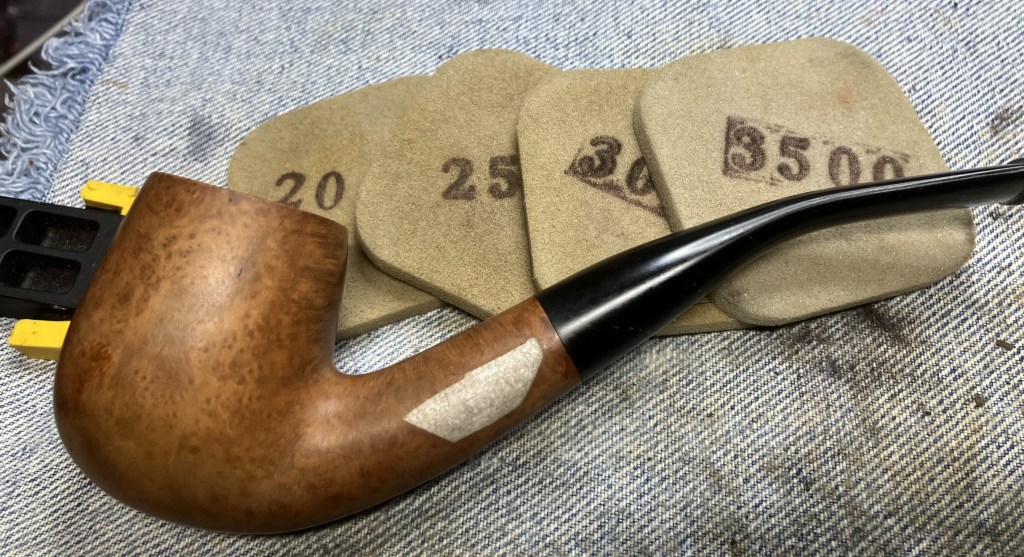
The sanding and wiping continued through the series of sanding sponges to 3500.
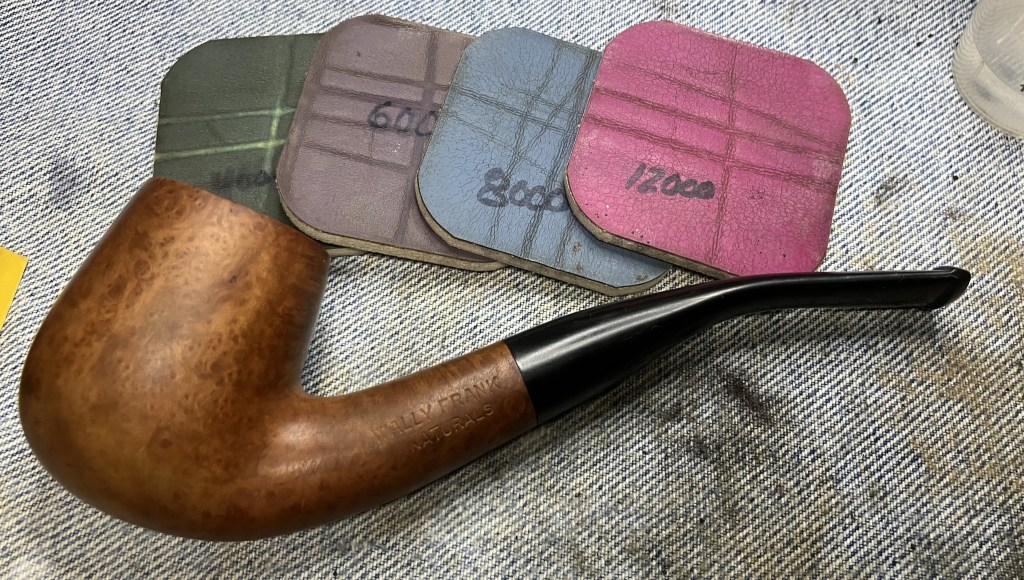
After the sponges came the micro-mesh pads. These were wiped as with the sanding sponges except I used Obsidian Oil on the stem rather than mineral oil.
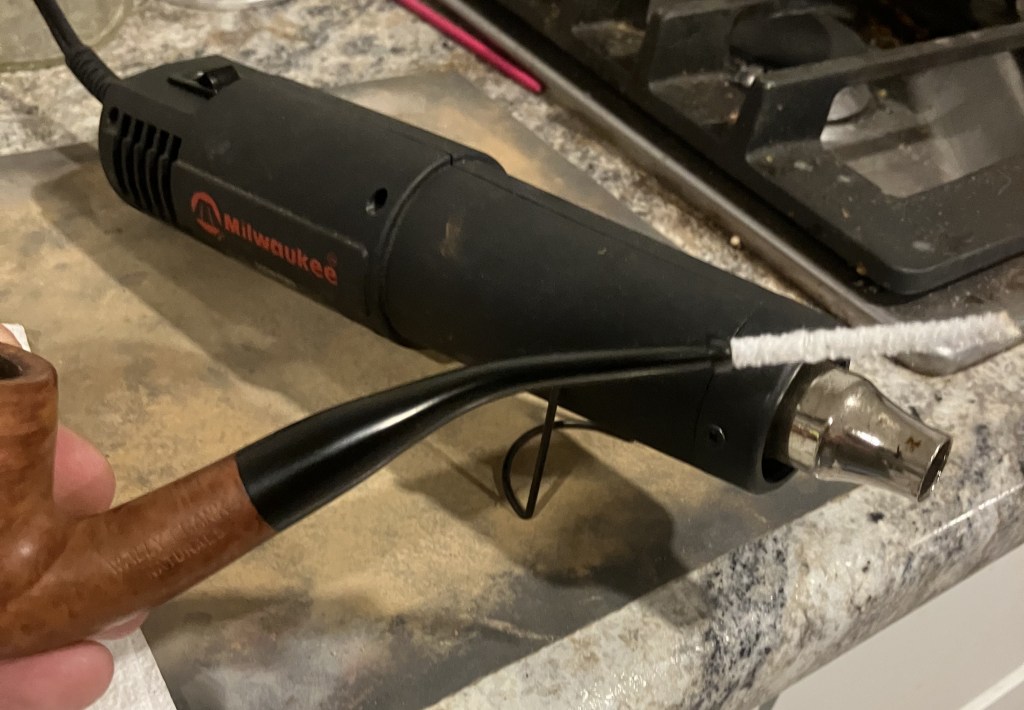
I placed a pipe cleaner in the stem then used a heat gun to heat the vulcanite and rebend it
The stem was then polished on the buffer with white buffing compound.
A coating of Before and After Restoration Balm was applied to the briar and allowed to work its magic for 30 minutes.
A thorough hand buffing of the stummel with an inside out athletic sock was used to remove the excess balm.
The final steps were to apply several coats of carnauba wax to the shank and stem with the buffer. This was followed by a hand buffing of the pipe with a microfiber polishing cloth.
I think this old Wally Frank Natural Bent Billiard turned out very well. The “Natural” nishing of the briar looks good though it does not conceal the fills. Fills in briar are necessary to give a smooth pipe the expected uniform even surface. I have not found a way to have them match the color of briar, perhaps someday a product will be discovered to aid this dilemma. The stem was in good condition before but looks very good with the removal of the creases and the adjusted bend. The stark difference between the glossy black and the natural briar is very attractive. The dimensions of the Wally Frank Natural Bent Billiard are:
Length: 5.94 in./ 1540.88 mm.
Weight: 1.57 oz./ 35.3 g.
Bowl Height: 1.95 in./ 49.53 mm.
Chamber Depth: 1.65 in./ 41.91.02 mm.
Chamber Diameter: 0.76 in./ 19.30 mm.
Outside Diameter: 1.51 in./ 38.35 mm.
I do hope that you have found something here useful to your own pipe care, maintenance or restorations. If you like this sort of thing, please click the like and subscribe buttons. Thank you for reading the ramblings of an old pipe lover.
Below are some photos of the finished Wally Frank Natural Bent Billiard.
The last Tom Howard pipe I restored could probably be considered a salvage rather than a restoration, here’s that one. This pipe is in far better shape, though still in dire need of some restorative care. This pipe came to me as part of a trade with fellow restorer Donald Cole. If memory serves, and it usually does not, I traded a Custom-Bilt billiard for this pipe and a couple others. I sent Donald a message with before and after photos and his reply was, “Hey now that’s lookin goooood!” (personal communication). I have to agree, but I am getting ahead of myself again. This large Tom Howard bulldog was stamped with Tom Howard, with a cursive script on the left shank and IMPORTED BRIAR on the right. Below are some photos of the pipe prior to beginning work.
A big job yes, but not a bad job. Big job, because of the huge size of the briar. The pipe was in very good shape for being 85ish years old. The stem appeared to require the most attention. The oxidation was strangely grainy looking, probably from lax quality control while vulcanizing the rubber. It certainly was thick enough to take a good deal of sanding though. The tooth chatter on the stem was not bad which indicated the previous owner was not a clencher or that this pipe was just too heavy to attempt clenching. The final stem issue was the incredibly tight fit of the mortise and tenon. Even with this thick shank, I did not want to force the two together and risk cracking it. The briar was in good shape minus the lava accumulation on the rim. I did hope that there was not any charring of the briar beneath the lava.
Background
I documented Tom Howard’s work in the previous Tom Howard pipe restoration blog. I will include that again here.
“I have to say that I was unfamiliar with any of Tom Howard’s work outside of pipemaking. I began with a search for his pipes on pipephil.eu. Here there was a short entry:
The next stop was pipedia.org. At that site there was more information but not a great deal. According to pipedia.org,
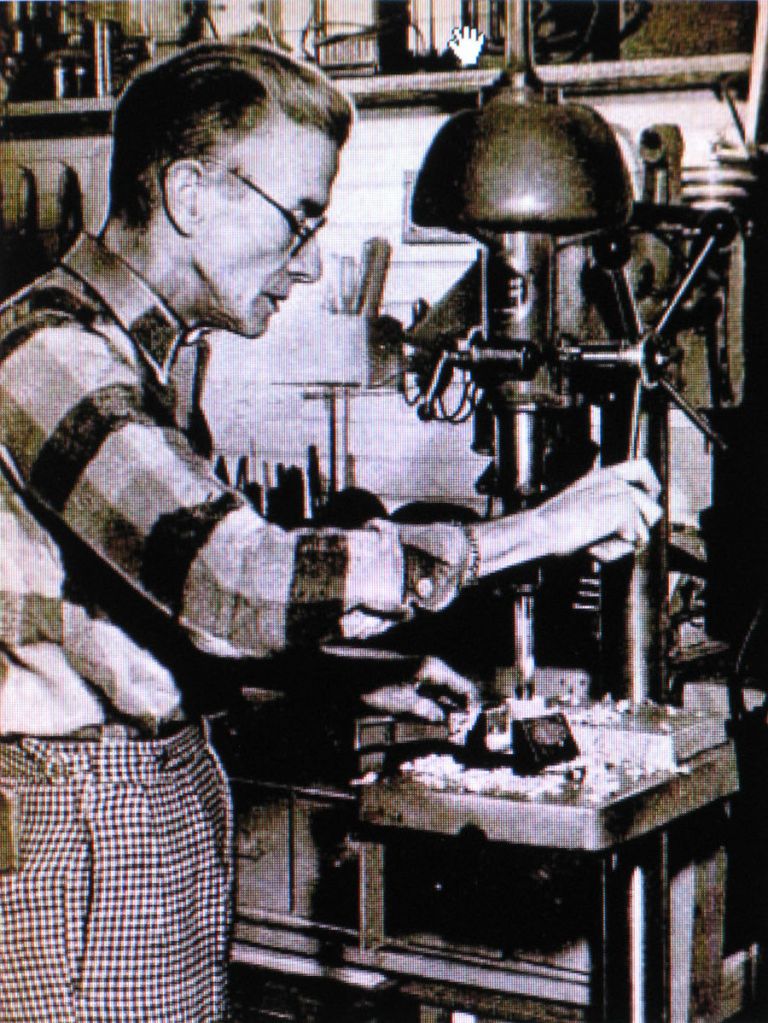
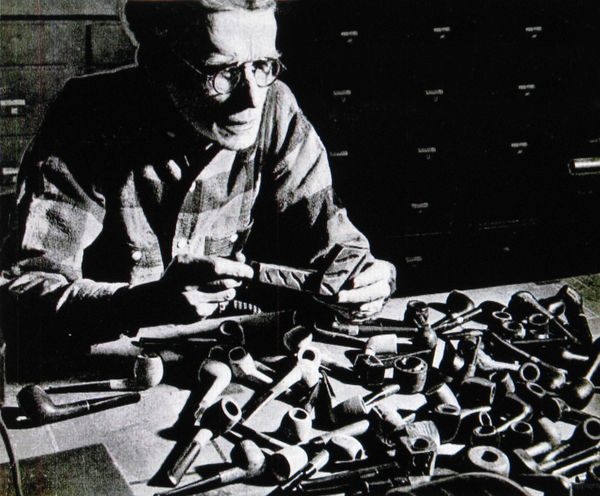
“Tom Howard was a popular comedian and personality in the 1940s/50s, known for vaudeville stage and radio work. But he also was a skilled pipe maker. In a Popular Mechanic article from 1947 he is written up as the “Hobbyist of the Month, Tom Howard.” He made pipes in his workshop outside his home in Red Bank, NJ. starting about 1939, and looks like into the late 1940’s or later. He purchased briar blocks by the bag as well as stem blanks, and in his well equipped shop he hand crafted his pipes, in about three hours on average. He was a true craftsman, also specializing in intricate model boats, trains and brass cannons, all built to scale.” (Howard – Pipedia)
There were also several photos of Tom Howard working in his shop. I found these interesting and include them below.
This pipe was likely made between 1939-1950 in the shop of Tom Howard in New Jersey. I had done a restoration of a Greenwich pipe back in November of 2023 that restoration can be seen HERE. Little information was available other than Greenwich House Corporation of New York City produced or imported Algerian briar pipes and produced and sold a metal pipe, Thoro-Kleen.” (A Tom Howard Billiard Restoration – NebraskaPeteGeek)
The Restoration
The very tight stem was hopefully just due to accumulated yuck in the mortise.
The first task was to prep the stem for deox, a term used to describe the bath in Before and After Extra Strength Deoxidizer. I used a wood block to preserve the edge of the stem from rounding from working it with 0000 steel wool. The pocket knife in the photo below was used to scrape some of the calcium despots from the button area.
The stem was clean on the inside.
The tenon was slightly smoothed with a 320 grit sanding sponge. I feared working it too much and reducing the fit from too tight to too loose.
The stem was then placed into deox for 18 hours.
Next came the reaming of the tobacco chamber.
The #3 and #4 blades of the pipeNet were used for most of this work with the General triangular scraper doing a little clean-up.
The interior of the chamber was sanded with 320 sandpaper wrapped around a wood dowel and with my finger.
The chamber showed no signs of any heat damage.
The rim had a worrying lava layer, though.
As gross as it sounds, saliva was allied to soften the lava before scraping. This scraping was done with the edge of a sharp pocket knife. This revealed uncharred briar, all that worrying was for nothing.
The clean stem was misleading, though, I kind of expected the shank to be a mess due to the tight fit with the stem. There was a great deal of scraping with a dental scraper and boring out of the draft hole with the Kleen-Reem shank drill. The shank was also scrubbed with numerous cotton swabs dipped in 99% ethyl alcohol.
A scrubbing of the stummel with a nylon brush and Murphy Oil Soap was done at the sink. The soap was rinsed with warm water and the stummel dried with a cotton hand towel.
99% alcohol was used to wipe the stummel after the scrub. Below you can see that there was still some residue removed on the make-up pad.
Due to the severe fouling of the shank, I thought it would be a good idea to allow the bowl and airway to have a cotton/alcohol treatment. Both were packed with cotton.
15+ml of 99% ethyl alcohol was added to the cotton with a pipette until the cotton was saturated. This would sit overnight.
The next day the alcohol had evaporated. In the process it had dissolved some of the tar from the bowl and shank and moved that yuck to the cotton.
The cotton was removed and showed that my previous shank cleaning was indeed insufficient.
Some more shank cleaning was done with bristle pipe cleaner and cotton swabs dipped in alcohol.
The stem was removed from deox and allowed to drip excess deoxidizer back into the jar.
The stem was then vigorously rubbed with a coarse cotton shop rag. This removed a lot of oxidized rubber that had been softened by the deox.
Back at the workbench the stem was rubbed with mineral oil on the outside and in the airway. The color had returned to mostly black but the surface was rough and pitted.
I used Soft Scrub cleanser on make-up pads to remove additional oxidized rubber from the stem.
A second oiling was done and the stem set aside for 20 minutes. I doubt that the oil was absorbed by the vulcanite but I needed a snack.
The moment of truth, would the mortise and tenon be a good fit after all my shenanigans? Yes!
The stamps on both sides of the shank were covered with masking tape.
The stem and shank were sanded together using a series of sanding sponges in grits from 320-1500. Between sponges the stem was rubbed with mineral oil and the shank wiped with an alcohol wetted make-up pad.
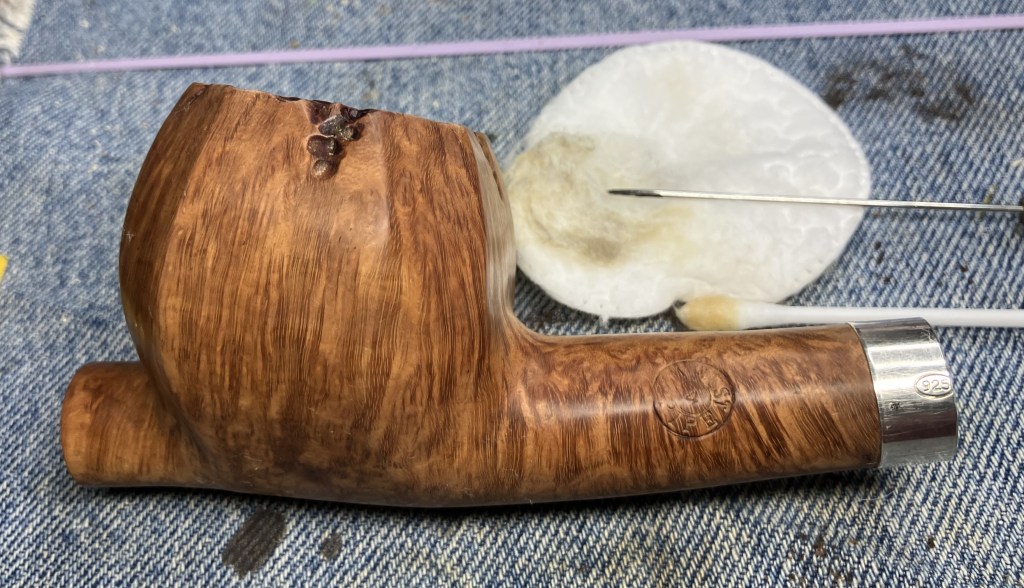
It was here that I finally came to the conclusion that I could not leave two old fills alone. I thought that I could, but they were just too darn annoying. Kind of like a scab over a healing wound that you just have to pick at.
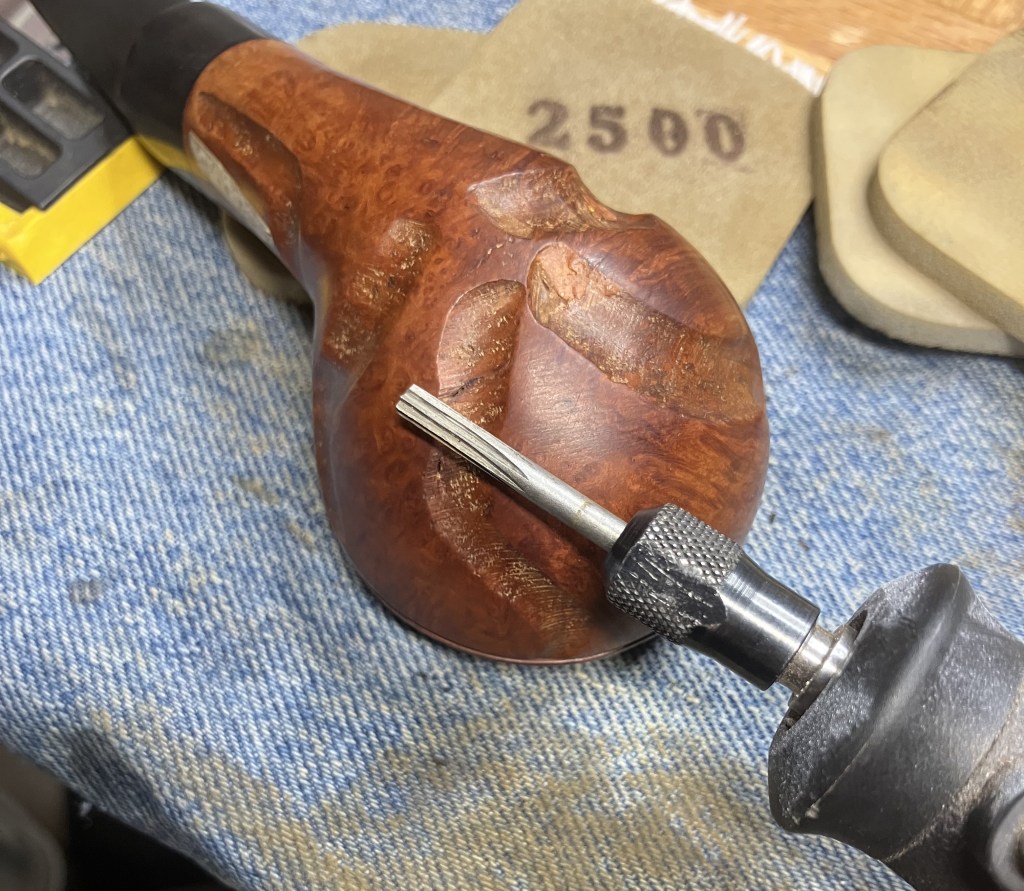
I used the Dremel rotary tool with the below carving bit. The old fill material was solid and not at risk of falling out but the edges were rough. I used the Dremel to smooth the rough edges.
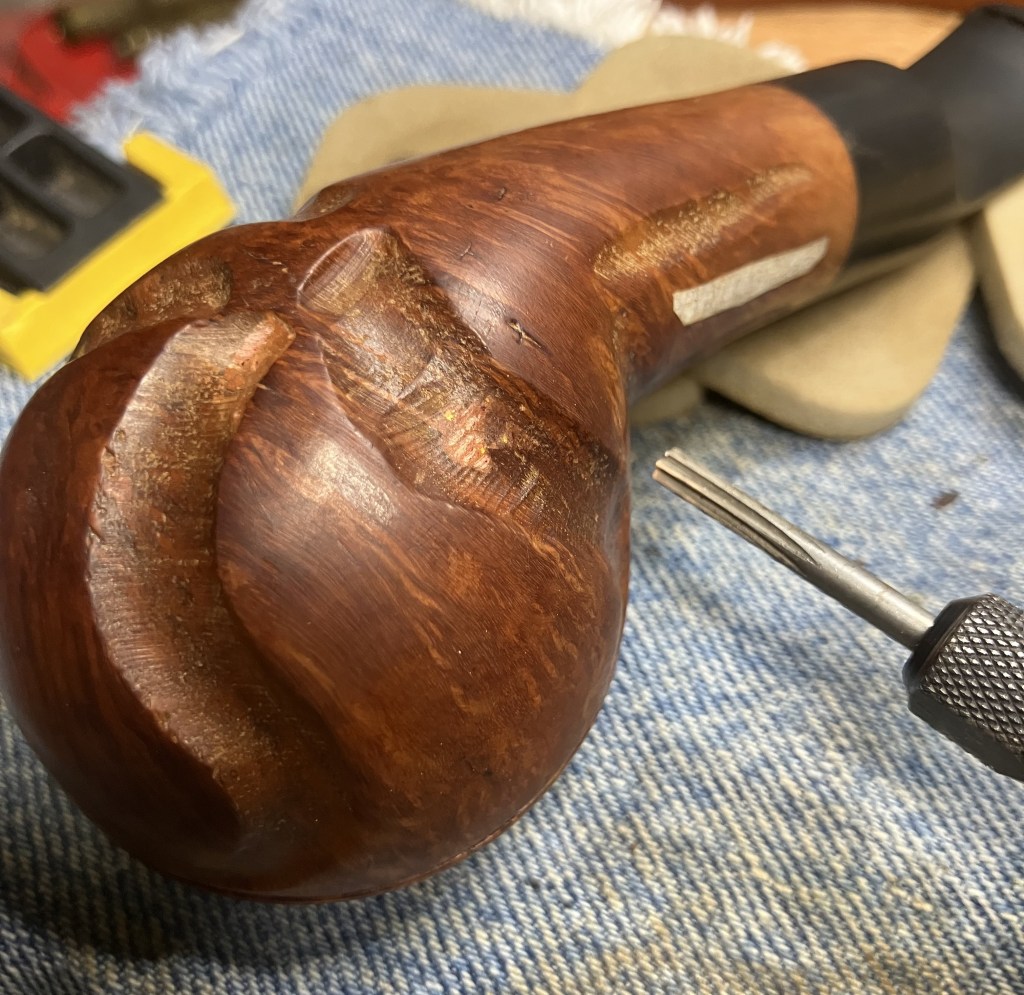
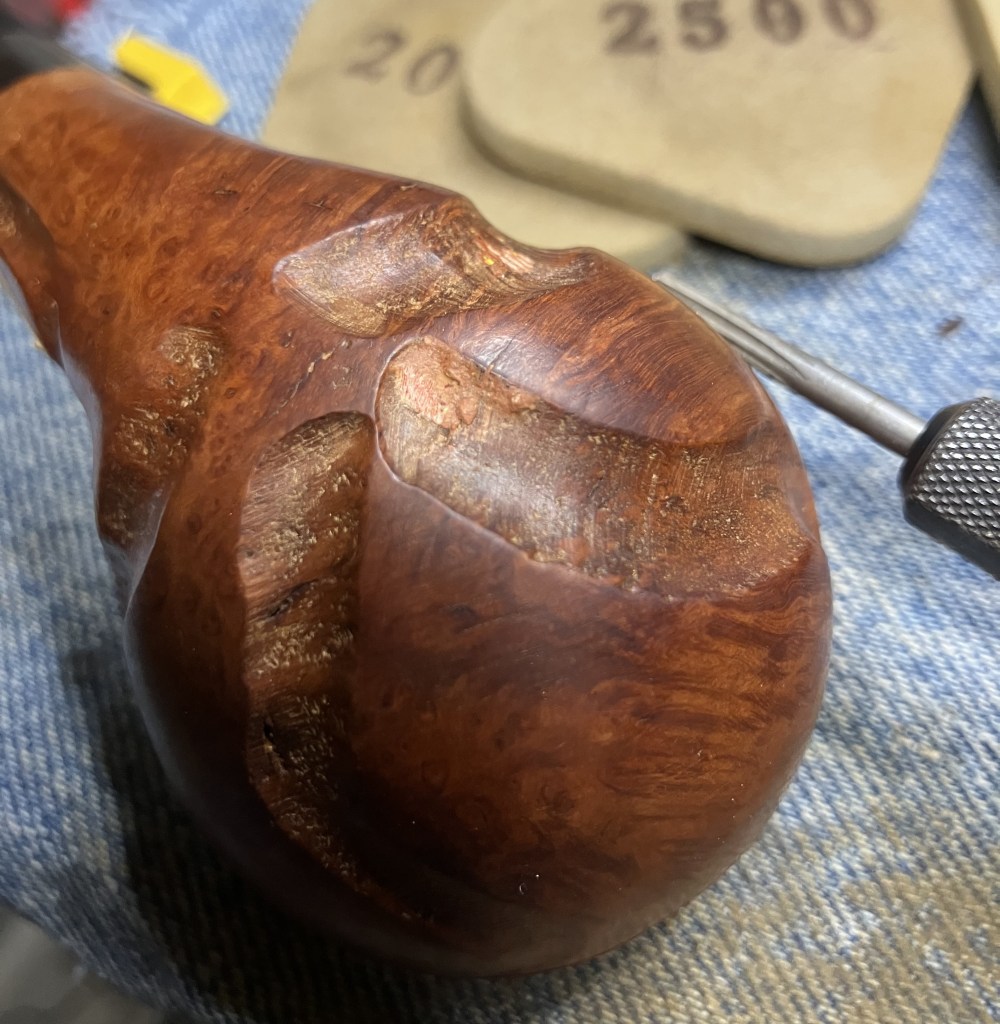
Once smoothed I used the sharp edge of the bit to carve grooves into the fill to match the rustication grooves surrounding it.
It was far from perfect but it looked far better.
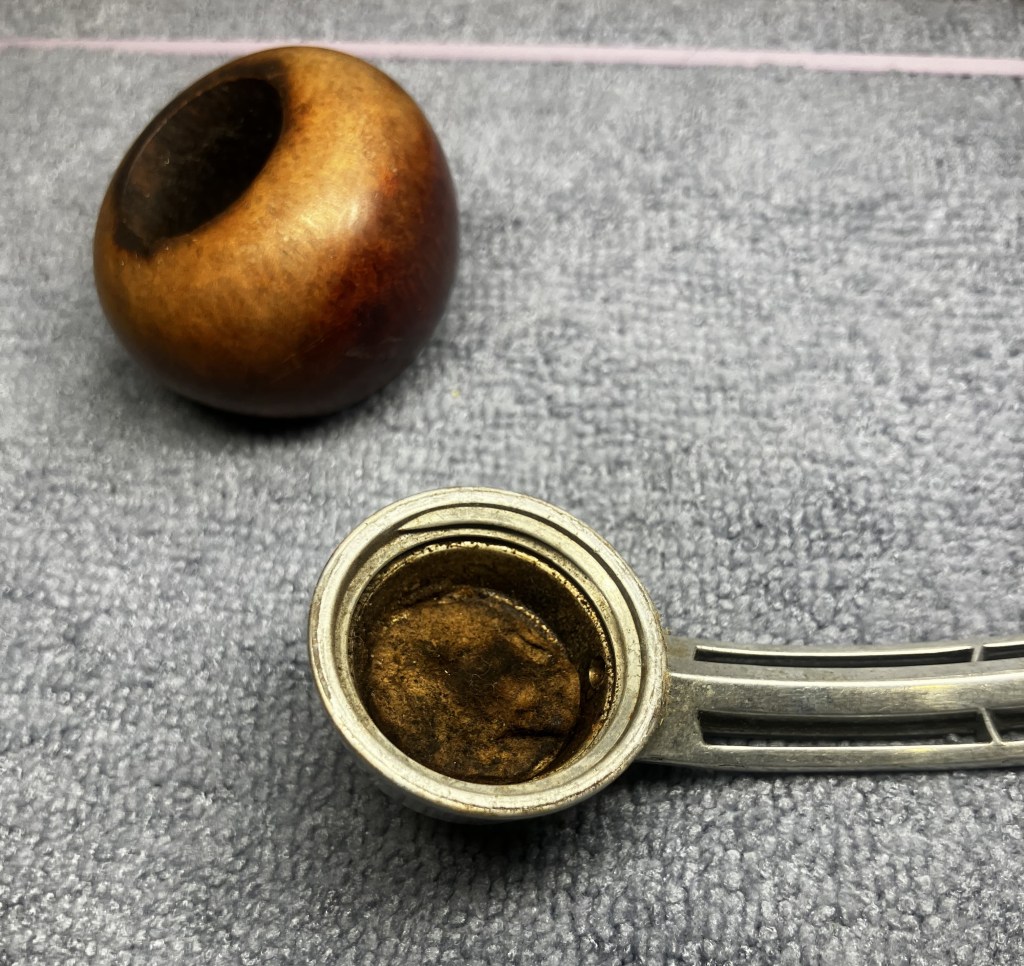
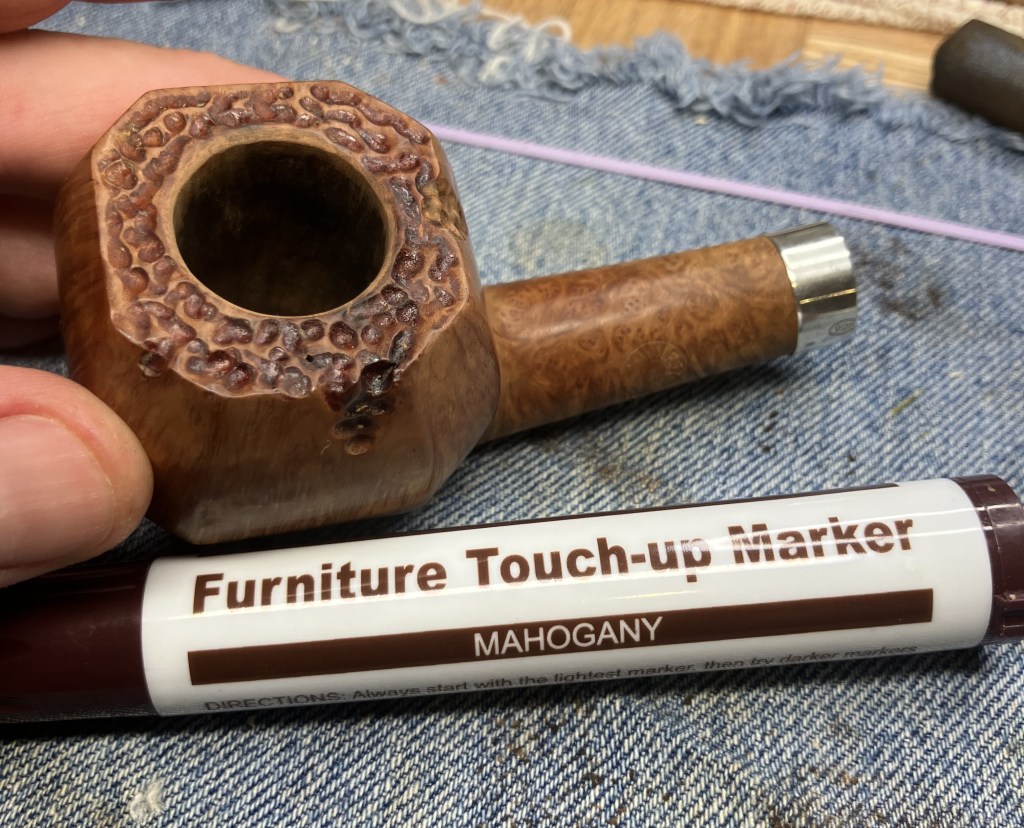
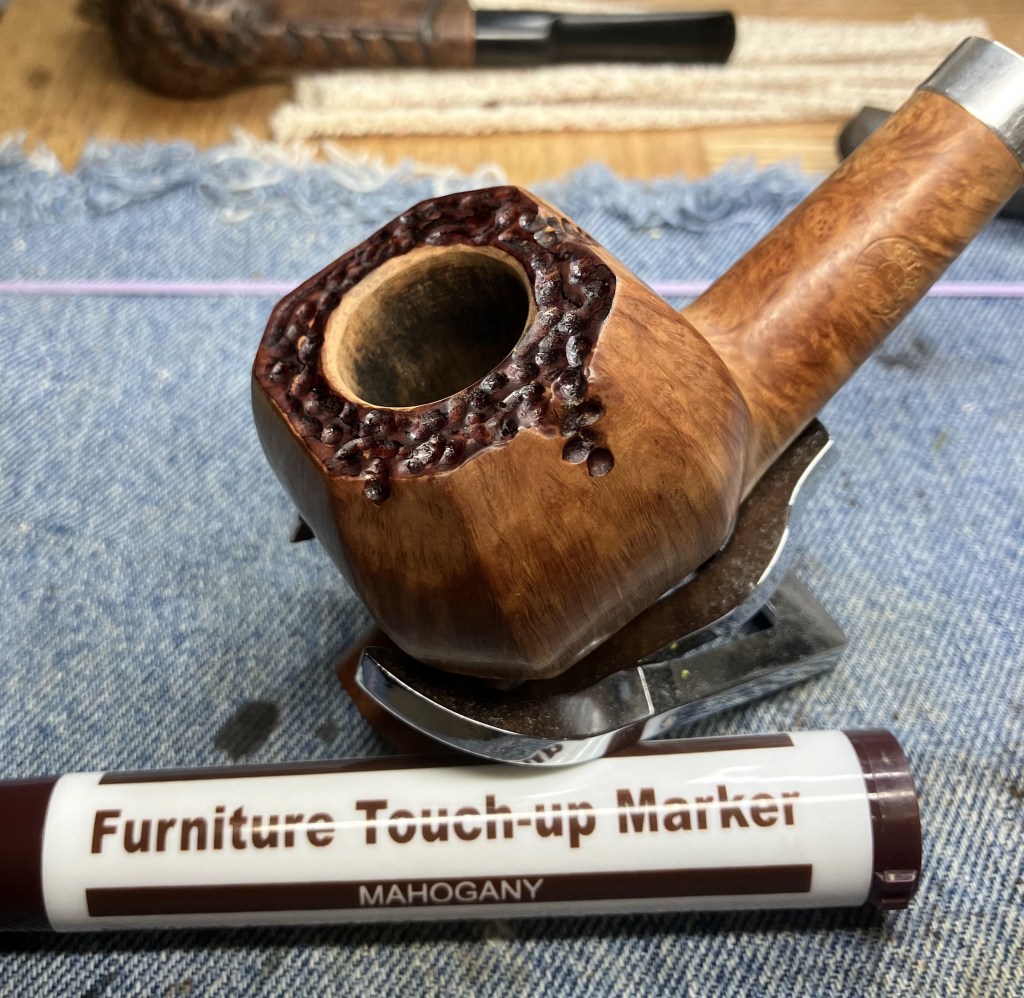
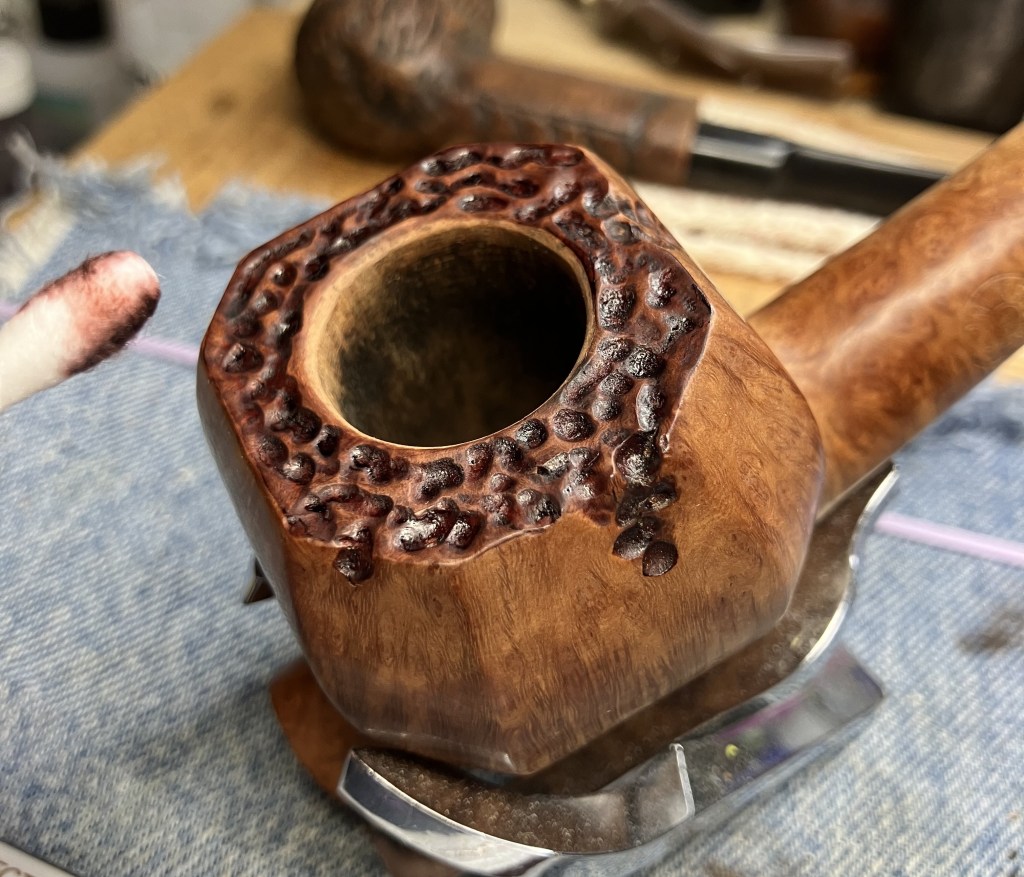
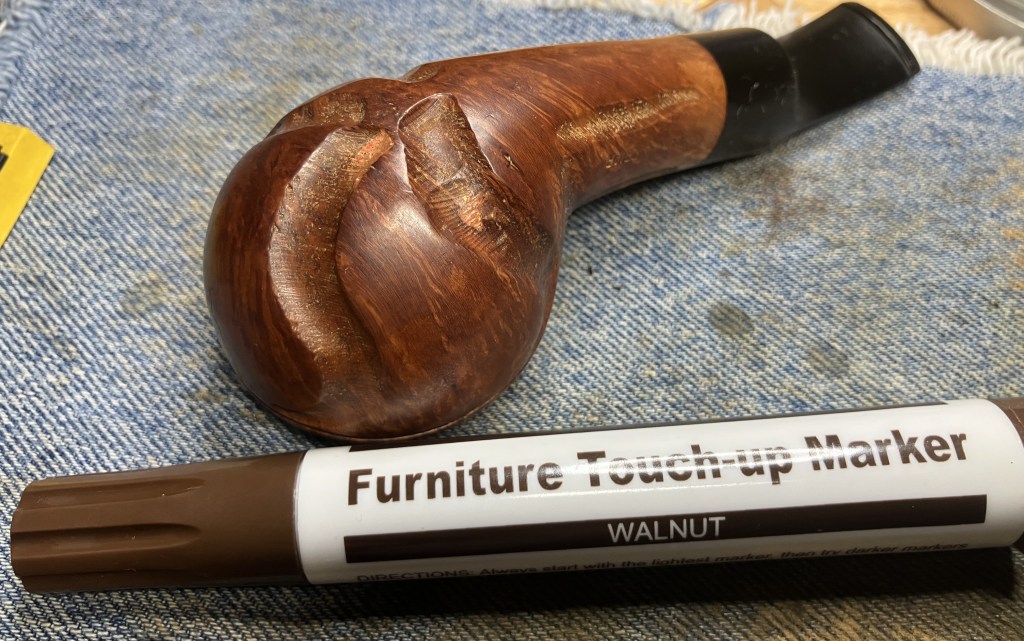
Once happy with the reshaping, I used a walnut Furniture Touch-up Marker to get rid of the pink color of the old fills.
With that done, I was able to finish the sanding. I continued with the series of sanding sponges from 2000-3500 grits with wiping in between sponges as before.
The stem was then worked with micro-mesh pads 4000-12000. Between each pad I oiled the stem with Obsidian oil and wiped it with a paper towel.
I wrapped the shank with masking tape then took the pipe to the buffer and polished the stem with white buffing compound on the dedicated white compound wheel.
After cleaning the stem of all buffing compound and wiping the stummel with an alcohol wetted make-up pad, I gave the stummel a coating of Before and After Restoration Balm.
After about 20 minutes the excess balm was wiped from the pipe using an inside out athletic sock.
The pipe was then taken to the buffer for several coats of carnauba wax.
The final step was a hand buffing with a microfiber polishing cloth further improving the shine.
Tom Howard pipes are typically large but this pipe is massive, 2.42 ounces worth of wonderful old briar and vulcanite. Even with it’s bend I doubt this pipe will make a clencher without some serious muscle building. The pipe is a beautiful example of Tom Howard’s workmanship. The smooth sections of briar are accented by the rough carvings. I’m sure the carvings are there to cover flaws in the briar but who cares? They give the pipe the characteristics Custom-Bilts and pipes of this ilk are known for. The vulcanite polished-up nicely and the glossy black further accentuates the briar. I am very pleased with how well this old pipe turned out. The dimensions of the Tom Howard Bulldog are:
Length: 5.43 in./ 137.92 mm.
Weight: 2.42 oz./ 68.61 g.
Bowl Height: 1.74 in./ 44.20 mm.
Chamber Depth: 1.34 in./ 34.04 mm.
Chamber Diameter: 0.94 in./ 23.88 mm.
Outside Diameter: 2.03 in./ 51.56 mm.
I do hope that you have found something here useful to your own pipe care, maintenance or restorations. If you like this sort of thing, please click the like and subscribe buttons. Thank you for reading the ramblings of an old pipe lover.
Loading…
Below are some photos of the finished Tom Howard Bulldog.
I’m back into Marxman mode. This one has sat neglected in the queue for several months. Everytime I looked over at the pipes waiting to be restored I thought about doing this one, then I got distracted like a dog whose owner yells, “squirrel!” Speaking of dogs, I frequently call my 85 pound four-legged tongue a “big headed freak”. This bulldog is kind of like that except it’s a big bowled freak with a lovely forward cant. I ordered this pipe from Judds Pen and Pipes, a well known seller of eBay, back in May of 2024. I told you it had been waiting in the queue for a while… Below are some photos I took before starting work on this pipe.
This pipe was in very good condition with grain that looked very promising under the accumulated wax/finish and did not look like it would require a tremendous amount of work. I did not like the overly glossy appearance of the pipe in general. Either it had a very thick layer of carnauba or there was an evil clearcoat finish lurking. The stem fit was not very tight, that would have to be addressed. The tobacco chamber had some cake and hopefully no damage beneath it. The stem showed almost no browning from oxidation. This was strange for a pipe over 75 years old but I wasn’t complaining. There was some tooth chatter and dents in the stem to be restored.
Background
Believe it or not this would be the 20th Marxman pipe which I have restored and blogged about. There are also a few that I didn’t write up as well. I would like to think Robert Marx would approve. In each of the Marxman restorations I have done, I have included a background section. I think the most complete history is from “A Marxman Jumbo C Restoration” ‹ NebraskaPeteGeek — WordPress. Rather than copy-paste it here, I will let those interested pursue that link.
There is a shorter history of Robert Marx and the Marxman company here, at pipedia.org.
The Dunsboro name can be found in a catalog image on pipedia.org. The site lists the catalog as “circa 1950s” but Robert Marx sold the company to MasterCraft in 1953, making the catalog likely from the early 1950s.
Once on the workbench and underlain with the required denim, I again wondered about the finish.
I began with rubbing the pipe with a make-up pad wetted with 99% ethyl alcohol.
This came back with dark stains of dirt and old wax. Well, I assumed it to be old wax. The stamping immediately became more clear and easier to read.
The stem fit was an issue.
With a closer examination of the tenon, I saw why this tenon was either abused to this was a poor attempt at restemming using a chainsaw as a tool for fine-tuning the fit of the tenon.
I started by attempting to re-face the edge of the stem with the tenon.
The refacing was done using a wooden block with holes cut to fit various diameter tenons and some 400 sandpaper.
The end of the mortise was far from straight.
I filed it flat with a small flat file.
I then used a ½ inch counterboring bit to give the airway a slight bevel.
The tenon was restored to cylindrical shape by applying several light coats of Thin cyanoacrylate (CA, super glue). These were lightly filed and sanded between coats of CA.
I had to test to make sure gravity was still affecting liquids, it was. No really, I didn’t spill the alcohol while cleaning the stem with bristle pip cleaners.
I filed the top and bottom surface of the bite zone with a small flat file to remove most of the tooth chatter.
The reaming tools were gathered.
To ream the tobacco chamber the #2 and #3 PipNet blades were used. A small amount of clean-up was done with the General triangular scraper.
After sanding the chamber with 320 sandpaper wrapped around a wood dowel the chamber looked good with no signs of heat damage, though there was some scratching of the wall by a previous owner.
The shank went well using cotton swabs and bristle pipe cleaners dipped in ethyl alcohol. There was also a bit of scraping done with a dental scraper and boring of the airway with the Scotte stainless steel pipe reaming tool – shank drill.
Next, the stummel was scrubbed with a nylon brush and undiluted Murphy Oil Soap. The soap was rinsed with warm water and then dried with a cotton hand towel.
I packed the tobacco chamber, airway and shank with cotton.
I then applied 99% ethyl alcohol with a disposable pipette to the cotton until it was saturated. The alcohol would be allowed to evaporate overnight. This softened and dissolved some of the accumulated tars in the airway, moved them from the briar into the cotton as the alcohol evaporated.
The next day the cotton showed signs of the successful removal of tars from the briar.
The cotton was removed using a forceps.
Recleaning of the airway indicated that the initial cleaning and the cotton/alcohol treatment were successful.
The shank stamps were masked with masking tape for their protection during the upcoming sanding.
I nearly forgot to fill the tooth chatter on the stem beforeI started sanding. Black rubberized CA was used for the fills. This was allowed to cure for about an hour before filing and sanding it.
A small flat file and 400 sandpaper were used to smooth the new fills.
I wanted to keep the pipe intact during the sanding avoids the rounding of the edges of both the shank and the stem, though some rounding of these edges had occurred by previous Keeping owners. The sanding was done with a series of sanding sponges from 320-1500 grits. Between each sponge the stummel was wiped with an alcohol dampened make-up pad and the stem rubbed with mineral oil then wiped with a paper towel. The wiping was done to remove sanding debris.
The sanding progressed with the 2000-3500 sanding sponges with the above wiping after each sponge.
Eventually the pipe was worked with micro-mesh pads 4000-12000. Here the wiping was done similarly to the sanding stems except instead of mineral oil I used Obsidian Oil on the stem.
The pipe was then taken to the buffer and buffed with white buffing compound on both the stem and stummel. The excess buffing compound was wiped off with a cotton hand towel then the pipe was cleaned with a make-up pad dipped in 99% ethyl alcohol to remove any remaining buffing compound.
I returned the pipe to the buffer for several coats of carnauba wax.
The final step was a hand buffing of the carnauba wax with a microfiber polishing cloth.
This Marxman Dunsboro turned out quite nicely. The briar grain is exceptional, for a Marxman. I added that disclaimer since Marxman pipes are kind of known for their rougher textures. The stem material is not of the highest quality vulcanite and even when polished it retains a less glossy finish. The repair of the tenon went better than expected producing a nice cylindrical tenon. Unfortunately, the mortise had become worn by the old uneven tenon and a rigid tight fit was near impossible to achieve. It is far better than it was though. Overall, this pipe will make a great smoking pipe and shows some of the characteristics of the better-quality WWII era Marxman pipes. The dimensions of the Marxman Dunsboro Saddle Bulldog are:
Length: 5.47 in./ 138.94 mm.
Weight: 1.45 oz./ 41.11 g.
Bowl Height: 1.82 in./ 49.78 mm.
Chamber Depth: 1.56 in./ 39.62 mm.
Chamber Diameter: 0.76 in./ 19.30 mm.
Outside Diameter: 1.62 in./ 41.15 mm.
I do hope that you have found something here useful to your own pipe care, maintenance or restorations. If you like this sort of thing, please click the like and subscribe buttons. Thank you for reading the ramblings of an old pipe lover.
Loading…
Below are some photos of the finished Marxman Dunsboro Saddle Bulldog.
I kind of think who ever came up with leather clad pipes either had some structurally sound but ugly briar blocks or they were hallucinating due to taking Ambien and took a break from walking their frozen turkey while wearing a tangerine Speedo and a sombrero long enough to wrap a piece of briar in leather. Yeah, let that vivid mental image marinate before continuing. Either way, they do show up on the estate market and can be pretty pipes. This Jeantet with a faux alligator-skin texture for example is a pretty pipe. Once again, I can’t recall how it came to me other than as part of an estate lot. Below are some photos of the pipe before work began.
The stem showed signs of oxidation and tooth chatter. The stem’s stinger was well lacquered with smoking residue indicating frequent use. The tobacco chamber had a bit of cake and the rim was lava encrusted. The seams of the leather looked good and intact and the condition of the leather, overall, was good. There was some discoloring of the edges of the leather around the rim which I thought would be difficult at best to remove. Overall though the pipe looked like it had great potential.
Background
Jeantet is an old name in briar pipes and harkens back to southern France in the late 1800s. My first stop on the research train was to pipedia.org. Here I found the following:
“The firm of the Jeantet family in Saint-Claude is first mentioned as early as 1775. By 1807 the Jeantets operated a turnery producing in particular wooden shanks for porcelain pipes and wild cherry wood pipes. The firm was named Jeantet-David in 1816, and in 1837 the enterprise was transformed into a corporation as collective name for numerous workshops scattered all over the city.
The manufacturing of briar pipes and began in 1858. 51 persons were employed by 1890. Desirous to concentrate the workers at a single site, the corporation began to construct a factory edifying integrated buildings about 1891 at Rue de Bonneville 12 – 14. This took several years. In 1898 Maurice Jeantet restructured the business. He is also presumed to enlarge Jeantet factory purchasing a workshop adjoining southerly. It belonged to the family Genoud, who were specialized in rough shaping of stummels and polishing finished pipes. (In these times it was a most common procedure to carry goods from here to there and back again often for certain steps of the production executed by dependant family based subcontractors. Manpower was cheap.)
Jeantet was transformed to a corporation with limited liability in 1938. By that time a branch workshop was operated in Montréal-la-Cluse (Ain), where mainly the less expensive pipes were finished. 107 employees – 26 of them working from their homes – were counted in Saint-Claude in 1948 and 18 in the Ain facility.
The Saint-Claude factory was considerably modernized by ca. 1950 installing (e.g.) freight elevators. In 1952 the southern workshop was elevated. 80 workers were employed in 1958. The factory covered an area of 2831 m²; 1447 m² of the surface were buildings.
The climax of the pipe production was reached around 1969, when thirty to thirty-five thousand dozens of pipes were made by 72 workers (1969). But then the production continuously dwindled to only six or seven thousand dozens in 1987 and only 22 workers were still there. Even though, around 1979 a very modern steam powered facility for drying the briar had been installed in the factory’s roofed yard.
Yves Grenard, formerly Jeantet’s chief designer and a great cousin of Pierre Comoy, had taken over the management of Chapuis-Comoy in 1971. Now, to preserve the brand, the Jeantet family went into negotiations with him, and resulting from that Jeantet was merged in the Cuty Fort Group (est. 1987 and headed by Chacom) in 1988 along with the pipe brands of John Lacroix and Emile Vuillard. Chacom closed the Jeantet plant, and the City of Saint-Claude purchased it in 1989. After alternative plans failed, the buildings were devoted to wrecking. The southerly workshop was wrecked before 1992.
Today Jeantet pipes were produced as a sub-brand by Chapuis-Comoy who’s mainstay is Chacom of course.” (Jeantet – Pipedia). If you were wondering, 2831 m² is about 0.7 acres. That doesn’t seem like much by today’s standards but I am sure in southern France that was expansive for its time. I am going to assume that this pipe was made some time prior to the demolition of the Jeantet plant in 1992, that is a pretty easy conclusion to draw. Moor likely it was produced prior to the closing of the plant in 1988.
Leather wrapping of briar has an equally interesting history and again pipedia.org details one of the most renowned leather workers who specialized in pipes. “In 1948 Jean Cassegrain inherited a small shop near the French Theater on the Boulevard Poissonnière in Paris, called “Au Sultan”. Articles for smokers and fountain pens were offered there.
Now, the absolute bulk of the pipes Cassegrain found in the inventory was from war-time production and due to the sharp restrictions on pipe production the French government had enforced in 1940, these pipes were of very poor quality and showed large fills. Strictly speaking, they were not marketable now that the French pipe industry produced pipes of pre-war standards again. In this situation Cassegrain had the probably most enlightened moment in his life: he took some of these pipes to a leather worker who clad bowls and shanks in leather. Only the rims of the bowls and the shanks’ faces remained blank.
E voila – the pipes looked pretty good now and were eye-catching enough to become an instant success in sale. Above all among the thousands of Allied soldiers who populated Paris in those days. The thing worked well, and even unexperieceid pipesters liked the covered pipes very much for they did not transmit the heat to the hand. Very soon Cassegrain had sold the old stock of pipes, and the leather-clad pipes became his only product. He began to place orders with renowned firms like Ropp or Butz-Choquin.
Because the name Cassegrain was already registered as a trade name for one his relatives, Cassegrain, a big fan of horse races, named his newly created firm after his favorite race course Longchamp near Paris. Hence an outlined galopping race horse with jockey was chosen as logo. The wind mill – see the frontpage of the catalog – symbolizes the name Cassegrain.
The numerous contacts with American soldiers bestowed an official contract on Cassegrain to supply the PX shops with his leather-wrapped pipes. According to his grandson, also named Jean and now CEO of the family firm, “There wasn’t an American GI in Europe who didn’t have one of these pipes at the time. They were exported and sold in PXs worldwide. That’s how it all started.”
In the course of the following years Cassegrain enlarged and refined the Longchamp pipe program continuously. More precious kinds of leather like calf and suede came in use. The top range was clad in alligator leather and even pony fur was used. In addition, many models showed vibrant colors now, and small sized pipes, the “Royal Mini”, made that also women interested themselves in the pipes. The hype was pushed furthermore, when well-known persons of public interest, like TV moderators or pop icon Elvis Presley, began to flaunt with a Longchamp put on.
The Cassegrain family expanded their business in 1955 starting a sortiment of pipe bags, tobacco pouches, pipe stands, ashtrays, tampers, lighters – all made of or clad in leather. (Going from there Longchamp turned to other gentleman’s leather-goods around 1960 and finally established itself as a global brand at the end of the 1960’s introducing the Xtra-Bag for ladies.)
After 1970 the interest in leather-clad pipes slowly diminished. The Longchamp pipes were offered for the last time in the 1978 catalog though previously placed orders were delivered until 1980.
The splendid success inspired many other renowned producers to offer their own lines Ropp, Butz-Choquin, Gubbels, GBD, Sasieni… Maybe Savinelli was the very last producing them for the label of the famous designer Etienne Aigner.” (Longchamp – Pipedia). Now there is no reference to Jeantet in the Longchamp article above but, it is pretty easy to imagine that the number of companies specializing in covering briar pipes in leather, with attractive results, would not have been an extensive list. The dates also coincide nicely with the heyday of pipe production during the 1950-1980s period. This would narrow down the production of this particular pipe to a product produced prior to the late 1970s.
The Restoration
After the before photos the pipe made it to the workbench.
The stem was a tight fit and not wanting to force things unnecessarily, I began work on the stem. The stinger was fouled with smoking residue and quite stuck in the stem. I used a strip of thick leather to protect the aluminum of the stinger from the jaws of the pliers.
Well I’ll be, the stinger was threaded. A nice touch showing a higher quality of workmanship than I was expecting.
I dropped the stinger into a medicine cup of 99% ethyl alcohol to soften the residue and proceeded to clean the vulcanite threads of the stem.
The airway of the stem was scrubbed using a nylon shank brush and the ethyl alcohol.
Numerous bristle pipe cleaners joined in the fun of removing the yuck from the airway.
The bite zone of the stem was filed with a small flat file to remove the tooth chatter and reestablish the button.
Below is a close-up of the top surface of the stem after filing.
And the bottom surface also after filing.
The stem was then suspended into Before and After Extra Strength Deoxidizer (deox). I planned to leave it in the solution for at least 12 hours but more likely 18.
I retrieved the stinger from the ethyl alcohol and scrubbed it with a brass brush, cotton swabs, bristle pipe cleaners, and regular pipe cleaners. It eventually looked pretty good.
I then took the stinger to the buffer to make it look even better by polishing it with white buffing compound. I hoped that I could not launch the stinger across the room as I lost a grip on it.
When, I didn’t lose my grip and the stinger now looked better than good.
The reaming gear was gathered.
The #1 PipNet blades proved too narrow for use but the #2 blades were about perfect.
The “about perfect” did require me to do a bit more clean-up with the Smokingpipes Low Country reamer and the General triangular scraper.
The reaming done, it was time to sand the tobacco chamber and assess for any heat damage.
The sanding was done with 320 sandpaper wrapped around a wood dowel. The bare briar showed no signs of any heat damage. The rim on the other hand, needed a good scraping.
The lava was moistened with saliva and scraped with the edge of a very sharp pocket knife.
I used a wood sphere and a sanding sponge to restore the inside edge bevel and to remove most of the charring from lighting the pipe.
To clean the leather I went looking for my saddle soap. I could have sworn I had some but could find none. After a little research, I discovered that Castile soap could be diluted with water and used as a leather cleaner.
Below is the result of the stummel being scrubbed with the diluted Castile soap. The soap was rinsed with warm water and dried with a cotton hand towel.
I had Mink Oil and Neatsfoot oil. I opted to use the Mink Oil since I liked the smell of it better.
The leather was liberally coated with Mink Oil and the rim with Before and After Restoration Balm. These were allowed to sit for 30 minutes. It was about here that I realized that I had not cleaned the shank airway. DOH!
The excess Mink Oil and Restoration Balm was wiped away using an inside out athletic sock after 30 minutes.
The shank cleaning then began, completely out of order and with extra caution as to not get the newly cleaned leather dirty. A good number of cotton swabs dipped in alcohol were used as was scraping with a dental scraper.
I was pretty sure there was still a good deal of yuck in the airway so a cotton/alcohol treatment was prescribed. The bowl and airway were packed with cotton and 12 ml of 99% ethyl alcohol measured into a medicine cup.
The alcohol was slowly added to the cotton with a disposable pipette until the cotton was thoroughly saturated. This would be allowed to evaporate overnight. The goal was to allow the alcohol to dissolve the residues and move them to the cotton as the alcohol evaporated. Since the stem was in deox overnight and the stinger was clean, I had only some Mark Twain reading to keep me occupied and sleep, of course.
The next day after lunch I returned to find the alcohol evaporated and the cotton stained.
The cotton was removed using forceps.
The cleaning of the shank proceeded again but much faster this time around.
I gave the leather a second coating of the Mink Oil and allowed it to absorb into the leather briefly before hand buffing with the athletic sock.
The stem was removed from deox and allowed to drip excess solution back into the jar.
A coarse shop rag was used to vigorously rub the stem to remove the loosened oxidized vulcanite and to absorb the solution. You can see from the stains on the rag how effective this was.
The stem was then scrubbed with Soft Scrub cleanser on make-up pads. One pad was used on each face of the stem.
The bite zone, top and bottom, were sanded with a 320 sanding sponge.
I wanted to keep the squared shape as much as possible. To do this I used a piece of 400 grit sandpaper wrapped around a wooded block. This was in an attempt to keep the square shank preserved as much as possible.
Mineral oil was rubbed onto the stem and wiped from the stem with a paper towel.
The stem was then sanded with a series of sanding sponges from 600-3500 grits. Again, the stem was rubbed with mineral oil and wiped with paper towels between each sponge.
The stem was then worked with micro-mesh pads 4000-12000. In place of mineral oil, Obsidian Oil was used between micro-mesh pads.
The stem was then buffed with a blue buffing compound on a dedicated blue wheel on the buffer.
The stem was then given several coats of carnauba wax on the buffer.
The final step was to hand buff the pipe with a microfiber polish cloth.
I can’t say that I am a user of leather clad pipes, I actually don’t think I have ever tried one. I can appreciate their appearance and their feel in the hand. They do feel good with their softer texture and in this case the faux reptile skin texture. The stem of this pipe polished up very nicely; this is a credit to Jeantet’s use of quality vulcanite. The glossy black stem is a beautiful contrast to the rich brown leather and the briar rim looks very nice together. The stitching and seams of the leather are niche and tight and show little wear. The dimensions of the Jeantet Leather Clad Panelled Apple are:
Length: 5.88 in./ 149.35 mm.
Weight: 1.70 oz./ 43.18 g.
Bowl Height: 1.74 in./ 44.20 mm.
Chamber Depth: 1.42 in./ 36.07 mm.
Chamber Diameter: 0.73 in./ 18.54 mm.
Outside Diameter: 1.53 in./ 38.86 mm.
I do hope that you have found something here useful to your own pipe care, maintenance or restorations. If you like this sort of thing, please click the like and subscribe buttons. Thank you for reading the ramblings of an old pipe lover.
Loading…
Below are some photos of the finished Jeantet Leather Clad Panelled Apple.
In all honesty, this is hardly a restoration. It is more of a cleaning and polishing. The pipe had never been fired. Why someone would do that is beyond me but after the last restoration I appreciate something that is more like pushing the easy button. I am not really sure when this pipe arrived other than it was at least a year ago. My record keeping started out very good when I began restoring pipes then went downhill quickly. Below are some photos of the Brigham billiard prior to starting work.
I am sure you noticed that the stem was not completely seated in the above photos. That is because it wouldn’t press into place without excessive force. The aluminum tenon was oxidized and I thought it best not to force it. The only other issue was the slight oxidation of the stem which made it look rather dull. Those were the only real things this pipe needed; aluminum polishing/oxidation removal and a stem polishing. Yay!
Background
Back on August 7, 2025 I wrote about a Brigham 202 Billiard with a dental bit. It is linked for those interested in that restoration. Anyway, I discussed The ultimate guide to Brigham pipes, a book by Charles Lemon. Here is a quote from that blog:
“The ultimate source of information on Brigham pipes is Charles Lemon, the author of Brigham Pipes – A Century of Canadian Briar. This wonderful book is available from Mr. Lemon on his website, Books, or from smokingpipes.com (Brigham Pipes – A Century of Canadian Briar | Smokingpipes) if you need to increase the total of your purchase to get the ever popular free shipping, and other various sources. I am unsure about Canadian immigration rules but I think this book should be required reading for prospective immigrants to Canada, especially if they are pipe smokers. ” (A Brigham 202 Billiard Restoration – NebraskaPeteGeek)
I once again found myself rereading Mr. Lemon’s work. My mind is far better at relearning than it is at remembering, Though I admit to being able to find the information much faster this time. The 1990s to early 2000s brought unique challenges and opportunities to Brigham. According to Charles Lemon, “ The company rounded the decade with two major introductions. The first, in response to demand for a lower-priced pipe, was the Italian-made Brigham System Pipe”, the first Brigham pipe made completely outside of Canada. The second and more far-reaching change was the development of the composite tenon, still in use today.” (Lemon, Charles. Brigham Pipe – A Century of Canadian Briar. Copywell, Woodbridge ON. Second Printing, October 2023. Page p. 51). So this dates the Brigham System pipe to the late 1990s. The next page narrows the latest possible production date to 2001.
Again referring to Lemon, “In all, Brigham tested ten different composite formulas before landing on a material that was less expensive than aluminum, strong, lightweight and tolerant of high heat levels. The new composite tenons generated quite a stir among Canadian pipe smokers when introduced in 2001, but the benefits, especially the much lower risk of a cracked shank, outweighed the initial resistance from Brigham pipe fans” (Lemon, p.52). One other dating quote from Mr. Lemon is in regards to the stem logo:
“”Brigham System” Pipes (late 1990s to early 2000s) were the first Brigham pipes made entirely in Italy. These were entry-level pipes available in 12 shape sand marked first with a yellow star on the stem, which later changed after 2001 to a maple leaf.” (Lemon, p. 55)
Since this pipe is clearly stamped as a Brigham System with a country of manufacture (COM) of Italy, a yellow star stem logo and an aluminum tenon it must have been made in the late 1990s to 2001.
The Restoration
From the photo table to the workbench, a scenic journey of about 15 feet, the pipe made it without incident.
I chose to work on the oxidized tenon first.
Using 0000 steel wool the oxidized aluminum was cleaned up and polished.
The mortise showed signs of some oxidized aluminum residue within.
I used a .22 caliber rifle brass bore brush to clean the mortise.
The shank was then cleaned with cotton swabs dipped in 95% isopropyl alcohol.
Once the mortise and tenon were cleaned up the two joined as they should.
I wanted to revitalize the stem with some buffing. I did not want to affect the finish on the shank, so I taped the end of the shank with masking tape.
Being the lazy bum that I am, I didn’t replace the buffing wheel and just used the white wheel and white buffing compound on the stem.
The yellow painted stem logo did take a slight beating from the buffing. I used some Pale Saffron acrylic modeling paint to refresh the logo. This color was a nearly perfect match to the original color. The acrylic paint was allowed to dry for a few minutes.
The excess paint was removed using micro-mesh pads. These were fine enough that the finish from the buffing was not noticeable.
The stem then received several coats of carnauba wax at the buffer. The stummel also was waxed with carnauba but very lightly as I did not want to fill the rustications with wax deposits.
The final step was to hand buff the pipe with a microfiber polish cloth.
This Brigham System pipe is one of the last Brighams made using the aluminum tenon. With its traditional internals and a very traditional billiard shape it is a very well balanced pipe with great hand feel. The texture does not show any real briar grain and the dye is rather artificial in appearance; it would certainly make an excellent working pipe for those projects in the yard or garage. I have had experience with the Brigham maple inserts and found that they do remove liquids and tar from the smoke effectively. The stem of this pipe polished-up very nickel and overall it looks like a brand new pipe. Which, never having been smoked, it really is. The dimensions of this Brigham System are:
Length: 5.95 in./ 151.13 mm.
Weight: 1.42 oz./ 40.26 g.
Bowl Height: 1.85 in./ 46.99 mm.
Chamber Depth: 1.66 in./ 42.16 mm.
Chamber Diameter: 0.84 in./ 21.34 mm.
Outside Diameter: 1.44 in./ 36.58 mm.
I do hope that you have found something here useful to your own pipe care, maintenance or restorations. If you like this sort of thing, please click the like and subscribe buttons. Thank you for reading the ramblings of an old pipe lover.
Loading…
Below are some photos of the finished Brigham System Billiard.