
Photographed and written by
John M. Young
As if Majestic wasn’t a good enough name they had to add the SUPER. That made me laugh when I first read the stampings. Here we have a delightful classic billiard pipe that has gained its turn at the workbench. The pipe was purchased as a single from a seller in Green Bay Wisconsin. I was attracted to it by the name and star inlay logo. I had seen neither and thought they looked intriguing. Besides, how can a guy say no to an attractive lass with good briar like this for under $15? The pipe was stamped SUPER (diagonally) Majestic (script) over SYSTEM V.D.. There was no country of manufacture (COM) leading me to think it was an American made product. The stem, as mentioned, had a silver-like 5 pointed star inlay. Below are some photos prior to working on the pipe:


The pipe showed signs of frequent use. There was a definite, though far from excessive cake in the bowl, the stinger had a coating of dried tarlac ( personal term combining tar with shellac). There were some minor tooth chatter dents on the stem and the strange banded oxidation. The oxidation pattern was perhaps due to the darker part being in a pipe rack and slightly protected from light. The stinger contraption was very unique, it looked as if it were machined by a prison inmate car engine fan wanting to make a stinger look like a crankshaft and be able to double as a shank (prison weapon). The final interesting part to note was that the shank had a cork insert acting as the mortise for the aluminum tenon. This struck me as a rather old fashioned connection of the stem and shaft.
Background
As you may expect there is not much information on Majestic pipes. Pipephil.eu led me to a couple deadends.

(Ben Wade — Pipes: Logos & Markings (pipephil.eu))

(M-Man — Pipes: Logos & Markings (pipephil.eu))
Undeterred, I went to pipedia.org. There a search for “Majestic” returned the following:
A. Pandevant & Roy Co.


Catalog Listing similar to the EPC Majestic example
A. Pandevant & Roy Co. of Paris had its beginning in 1884 and disappeared with the commencement of WWII in the late 30s or early 40s. “E.P.C.”, “La Savoyarde”, “MAJESTIC”, “La Parisienne” and “E.P.” were registered trademarks of the company.
Note: The following example and the information for this article is courtesy of Dal Stanton, The Pipe Steward, and his wonderful research from this restoration project: Discovering the History with the Reclamation of this Petite EPC Majestic Bent Horn Stem Billiard on RebornPipes.com. (A. Pandevant & Roy Co. – Pipedia)
Now, let it be known that Dal Stanton is a wonderful restorer of old pipes. Though his skills are very impressive, one of the things that I admire most is his attention to detail when writing up the history of a pipe that he is working on. The above is a perfect example of his diligence. While I was reading about the restoration of the above pipe I came across his description of the mortise of his pipe: “What I see next surprises me. I see the briar shank ringing something else inserted into to the mortise. A lining of some sort. I discover then that it appears to be cork. Cork seats the horn tenon in the mortise much like cork seats the Meerschaum bowl on a Gourd Calabash. I have never seen this before, but it seems to work quite well. I will condition the cork with a little petroleum jelly later. The challenge becomes protecting the cork while I’m cleaning the rest of the stummel internals. I’m not sure that I want the cork saturated with alcohol – I’m not sure that will be the best thing.
There it is the same cork insert that I am looking at with the Majestic which I am restoring. Coincidence? I think not. I believe that the Super Majestic Billiar is indeed an EPC Majestic produced prior to WWII in France.
I asked Dal Stanton to review this blog prior to publishing. He also saw the similarities that I did. He was unsure about the claim that my Majestic was an EPC product due to the differences in stem material, the star logo and the lack of the three hearts associated with the EPC stamping. He also recommended discussing the pipe with Steve Laug. I reached out to Steve, and sent him a link to this article as well. Steve also thought the link between the two Majestic pipes was reasonable. He commented, “I think you are right in connecting the two. There is a link. The fact that the bone insert is replaced with a metal can help to date it a bit. I am pretty sure that between WW1 and WW2 metal was used for the tenons in replacing the bone ones.” (Steve Laug, personal communication)
I think the Majestic Systeme V.D. Billiard is an EPC made pipe produced several years later than the Majestic pipe which Dal Stanton had restored. Perhaps the Systeme V.D. specimen was one of the latter pipes produced prior to WWII and the demise of the company.
The Restoration
The restoration began with a clean denim piece to protect the workbench

Due to the narrow bore of this pipe and the fact that I had broken my #1 blade of my PipNet, I relied on the Scotte Stainless Steel reamint tool.

The Scotte is more than adequate for the job and was aided by the Smokingpipes Low Country reaming knife and the General triangular scraper. The tobacco chamber was sanded with 220 sandpaper wrapped around a wood dowel.
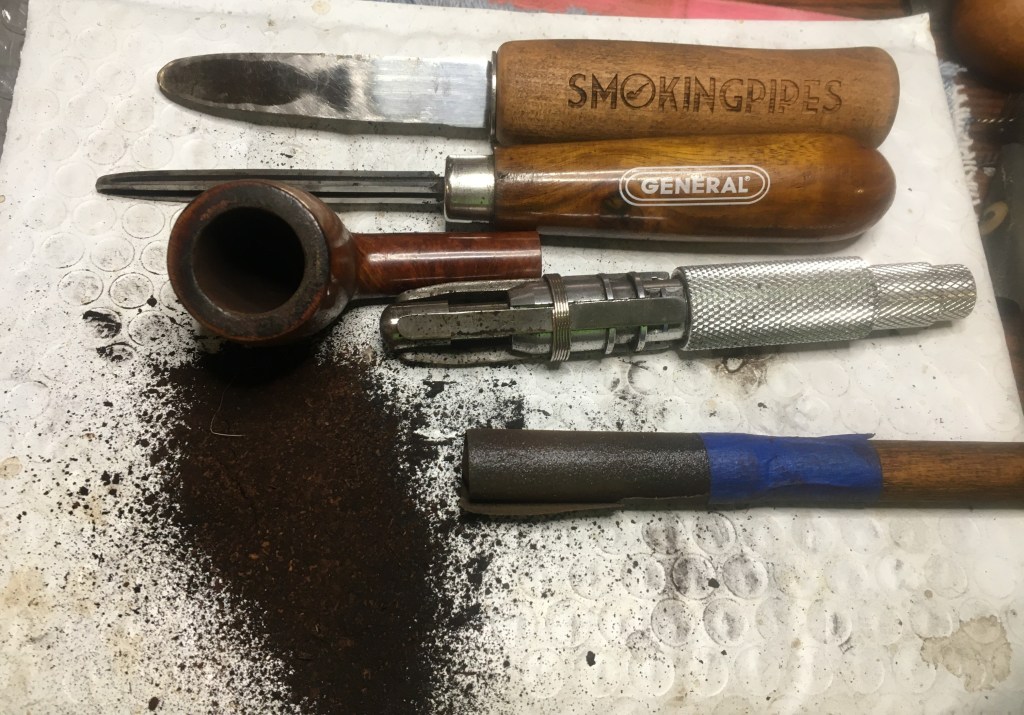
The chamber was sanded to bare briar and no sign of heat damage was observed. Yes, the resident white German Shepherd is always living up to her better descriptor of German Shedder.

The rim had a respectable layer of lava on it.

This was moistened with saliva and scraped with a sharp pocket knife.

The stummel was taken to the sink where it received a scrubbing with undiluted Murphy Oil Soap and a medium stiff toothbrush. The soap was rinsed with warm water and the stummel dried with a cotton hand towel.

While waiting for the stummel to air dry, I began work on the stem. The sinter was firmly attached to the stem and would not budge. I wasn’t sure if it was just a push fit stinger or if it was threaded. Either way it was stuck. I submerged it in 95% ethyl alcohol for a soak.

While the stinger was soaking I examined the stummel. The briar was of good quality and no pits were observed. The scrubbing had removed most, though not all of the finish. Patches of shiny finish can be seen in the photos below.


Back to the stinger. I scrubbed the stinger with a brass brush frequently dipped in the ethyl alcohol. The shape of the stinker was even more amazing when cleaned. This was a serious piece of millwork.

I started to clean out the shank of the pipe. Attempting to be cautious around the cork insert. A dental scraper was used to clean the tar from the airway as well as a nylon shank brush, numerous cotton swabs and folded bristle pipe cleaners. Eventually the airway was cleaned.

While in the cleaning mode, I cleaned the airway of the stem. This only used bristle pipe cleaners and 95% ethyl alcohol. Oh yeah, I forgot. The stinger was threaded into the stem. I don’t know why I would have expected anything less after seeing the machine work used for its manufacture.

The stem was given a light hand buffing with 0000 steel wool to allow the Before and After Deoxidizer solution access to the oxidized vulcanite.

A pipe cleaner was inserted into the tenon and used as a hanger to suspend the sem into the solution.

This stem was fairly oxidized so I figured at least 2 hours would be needed perhaps overnight.

I returned attention to the stummel. I wiped the surface with a make-up pad wetted with 95% ethyl alcohol. I hoped that the finish was shellac which is soluble in alcohol.

The alcohol seemed to have worked but to be completely sure I wiped the stummel with a make-up pad wetted with acetone.

If a little acetone is good, more must be better. This removed the last of any finish remaining on the stummel.


The briar was nice in that it had no pits of outward flaws; it also did not have much in terms of grain. I thought that a contrast dye would add a bit of depth to the existing grain. I did not want to sand and risk reducing the stamps so I taped over them with painter tape. This should keep the majority of the dye from the stamps and allow me to touch-up dye them later.

The stummel was then lightly sanded with 400 and 600 grit sanding sponges with the white German Shepherd attachments.

I applied a coating of black Fiebing’s Leather Dye to the stummel with a folded pipe cleaner and flamed the wet dye burning off the alcohol solvent.

The pipe was then rinsed with 91% isopropyl alcohol over the sink.

The stummel was then wiped with a paper towel to remove the excess dye. Notice the areas where the tape had been. The briar there is much lighter colored than the surrounding wood.

The stummel was then sanded to remove the outer layer of black dyed briar. The dye penetrated the softer open grain of the briar more than the harder grain. When sanded the area where the dye penetrated deeply is darker than the area where the dye was more on the surface.

I returned attention to the stem. It was removed from the Before and After Deoxidizer and allowed to drip excess solution back into the container. This drip dry device is quite the remarkable feat of engineering, eh?

After the stem drip dried for a few minutes I wiped any remaining solution off with a coarse shop rag. Two pipe cleaners were also run through the airway to clear it of solution as well.

The stem was lightly sanded with a 400 grit sanding sponge.

The stem was then scrubbed with SoftScrub cleanser on make-up pads to remove the oxidized rubber.

To try something different I decided to take the pipe to the buffer and buff the entire pipe with rouge buffing compound. I had seen restorers use the buffer to remove the outer layer of dyed wood. I had tried it in the past and never felt comfortable with the technique. I thought, practice and trying new things is good, right? Below you can see the results.


I liked the way the briar looked but I was not happy with the stem. That would need the old fashioned sanding sponges and micro-mesh pads. Another thing I noticed when buffing the pipe was that the stem was too loose. I thought about ways to refresh the cork. I read how Dal Stanton used petroleum jelly. I thought to myself, wood swells with moisture. Why not try steaming the cork? I put the kettle on and it soon started its annoying whistle. The exiting steam was allowed to flow into the shank. It flowed right through the shank out the tobacco chamber and onto my hand. Hmm, maybe a glove would have been a good idea. The steam worked very nicely at swelling the cork and a the stem was a perfect tight fit afterwards.

The buffing did not produce the finish that I thought this pipe was worthy of. I returned to doin things the way I was used to doing them. The stem was sanded with a sequence of sanding sponges from 400-3500 grit. Between each sponge I dipped my finger tip into mineral oil, rubbed this onto the stem and wiped the stem off with a clean dry paper towel.

I then used the 4000-12000 micro-mesh pads to polish the stem. This time I used a drop of Obsidian Oil between sponges, rubbed in and wiped off with a paper towel.

The stem was then further polished with Before and After Fine Polish on a soft cotton rag.

The Before and After Extra Fine Polish was used with the same cotton cloth.

The entire pipe was given a coating of Before and After Restoration Balm and allowed to sit for 30 minutes to ensure the Balm had enough time to work it’s magic.

The pipe was then wiped, cleaning off the Restoration Balm with an inside out athletic sock.

It was then taken back to the buffer to receive several coats of carnauba wax.

This Majestic turned out quite nicely. It is of a darker finish than I usually strive for but I think it works well with the classic elegant lines of this billiard. The silver tone star inlay on the stem also accentuates a darker finish and looks great surrounded by the glossy black vulcanite. I am not sure how I feel about using the buffer with red polishing compound rather than sanding to achieve a smooth finish. I mean it looks good but still it feels like cheating somehow. Either way, this pipe will make a fine smoker for its next companion. Te dimensions of the Super Majestic are:
Length: 5.98 in./ 151.89 mm.
Weight: 1.00 oz./ 28.40g.
Bowl Height: 1.72 in./ 43.69 mm.
Chamber Depth: 1.42in./ 36.07 mm.
Chamber Diameter: 0.74 in./ 18.80 mm.
Outside Diameter: 1.30 in./ 33.02 mm.
I do hope that you have found something here useful to your own pipe care, maintenance or restorations. If you like this sort of thing, please click the like and subscribe buttons. Thank you for reading the ramblings of an old pipe lover.
PS: If you know anything about the brand or the meaning behind the “V.D. stamping, please leave a comment. Thank you.
Below are some photos of the finished Super Majestic Billiard.


 NebraskaPeteGeek