
Photographed and written by
John M. Young
By my count this is Marxman restoration 14 since I started blogging pipe restorations. I know judging by the name I run withI should focus on Peterson pipes but Marxmans hold a special place in my heart. Besides I just counted Peterson restorations, including the James Fox pipe (which I think is a Peterson product) and the total is 22. Thus securing my name and title: Nebraska Pete Geek.
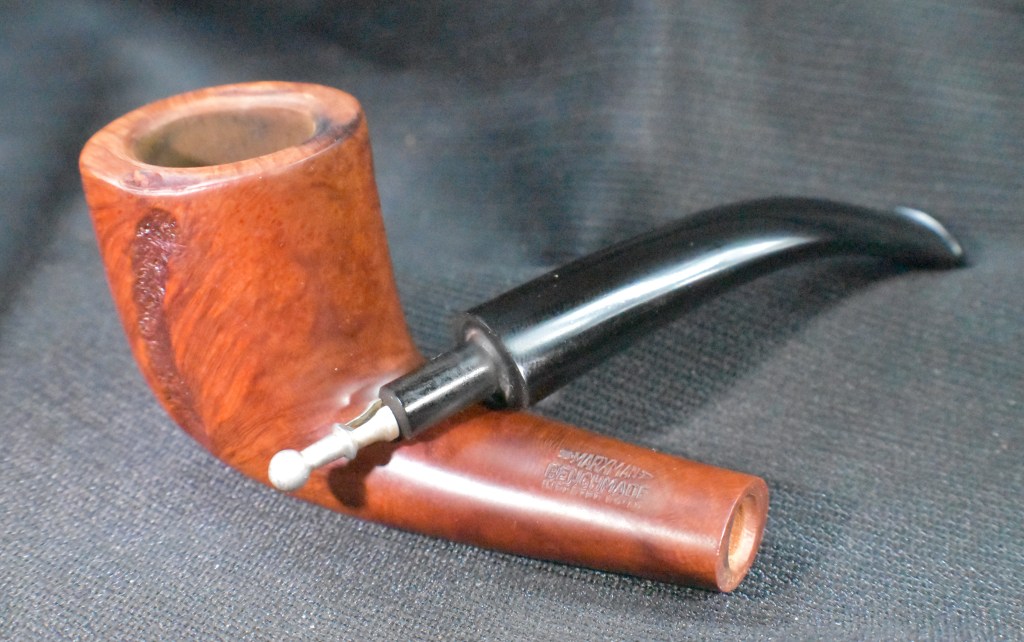
This Marxman arrived here back in August of 2024 and has been languishing in the queue for nearly a year. I alway thought it looked interesting but something else seemed to catch my attention. The shape is kind of like a forward canted Dublin or cutty but with a bent shank. I wondered what to call it or if the stem had been replaced. More on that in the “Background” section. The stapings are well defined with MARXMAN with the arrow over BENCHMADE over IMPORTED BRIAR.


The pipe was in pretty good shape. The funky stem was oxidized but not chewed on. The oval shank matched up very well with the stem alleviating my earlier worries about it not being an original stem. There were some obvious fills that would be a challenge to rework. Also the rim was heavily caked with lava. I hoped that there was not a severely charred rim below the lava flows.
Background
Looking through my digital collection of Marxman shapes I found this shape.

There it was right column 4th pipe down, a Quarter Bent Dublin. Huh, it’s supposed to look like that. Well good thing it does, then. I guess I am kind of getting ahead of myself with this pipe. If you are interested in a brief history of Marxman pipes I will refer to previous blog posts and steal what I wrote about then (wait, can you steal/plagiarize from yourself?):
On January 11, 2024 I blogged about a Marxman Gold banded Dublin (linked if you are interested) and wrote the following about Robert Marxman and Marxman pipes:
“My recent fascination with the post-World War Two (WWII, to properly use an acronym) led me to further appreciation of the Marketing genius of Robert Marx, the founder of Marxman Pipes Inc. Allow me to illustrate:


(Pipe Lovers Magazine 1946 all numbers : Free Download, Borrow, and Streaming : Internet Archive)
Those are the back covers of Pipe Lovers Magazine for each month of 1946. That represents a substantial investment in building and maintaining one’s brand name.
Here is a quick review of Marxman pipes from pipedia.org:
“Marxman (Marxman Pipe Company) was created by Robert (Bob) L. Marx in 1934, when he was 29, and after he had worked for the William Demuth Company. His pipes were not outstanding because of the quality of their wood (probably Algerian), but Bob started making unique sculpted pieces, which brought the brand fame in the World of Hollywood cinema. Actors like Zachery Scott, Dennis Morgan, Jack Carson, Alan Hale, Joel McRae, and Ronald Reagan were some of the faces that appeared on the bowls.
Bob knew how to innovate and took full advantage of marketing and press advertising in order to sell the brand–one of his slogans being “Relax with a Marxman”.
In a recent forum post on Pipesmagazine.com, contributor jguss posted the following from the February 2, 1935 issue of the United States Tobacco Journal:

A remarkable article showing the business acumen as well as a photo of the man himself. Thank you, jguss.
This is one of my favorite quotes about Rober Marx:
“Ted also said: Several years before UST bought Mastercraft, M/C had aquired Marxman Pipes. A wonderful kind man, Bob Marx was still working as a salesman in NYC, and I was fortunate to make a few sales calls with him. You all remember Charles Atlas? Bob Marx was about 76 and had just been awarded the (I think) Atlas Award for being the finest speciman of manhood over 70 years old in NYC, or maybe the state.
M/C had some inventory of Marxman stuff, but not a lot. I know very little about Marxman. Did they make, import, or both?” (Mastercraft – Pipedia)
The “Ted”, who is being quoted above, was the nickname of Tom Douglas. Here is an announcement of Mr. Douglas’ passing from Pipesmagazine forum November 26, 2018:
“Tom Douglas passed away at 71 years of age, this past Saturday, in Florida. It seems he had an infection in his stomach, but I don’t know much more than that, regarding what actually contributed to his death. He did have a history of heart and other health complications. I just spoke very briefly with his wife Joyce; you can imagine how she’s doing.
The impact Tom had on the pipe community is huge…beginning with an immense library of pipe knowledge through the pages of the Dr. Grabow Collectors Forum….his 25 years of service at the Grabow / Sparta pipe factory (where he retired in 1991)….his executive leadership over Mastercraft distribution for many years…”
So, at 76 years old Robert Marx was still involved in the business that he must have loved. This would have been around 1980.”
Then last winter, Mark Irwin, of Peterson Pipe Notes and author of The Peterson Pipe book, sent me a c. 1945 Marxman Brochure. I photographed the pages of the brochure and included them below.


One of the easiest things to date is a Marxman pipe. The company was formed in 1939 and sold in 1953 to MasterCraft. Though the Marxman name continued after 1953 the pipes were made in France or Italy and stamped as such with Country of Manufacture (COM) stamps. This means that a non COM stamped Marxman pipe was made in New York City between 1939-1953.
(The above was from A Marxman Mel~O Pear published July 23, 2023)
As for dating this Marxman Quarter Bent Dublin, all I can say with certainty is that it was made between 1939-1953 in New York City.
The Restoration
Showing its best side, the Marxman posed on a cleaned piece of denim.

The ream team was gathered

The number 2 blades of the PipNet did the majority of the work here, with the General triangular scraper just cleaning up a little bit.

The interior of the tobacco chamber looked good except for some strange gouges at the bottom of the chamber.

Sanding the interior was done with 32o sandpaper wrapped around a wood dowel. The walls of the chamber showed no signs of any charring or heat damage.

The stinger was well painted with dried smoking residue and resisted efforts to remove it by hand.

The underside of the stinger looked significantly worse than the top. Indicating that it had been smoked in this position and had probably not been frequently, if ever, cleaned.

My go to method for removing a stuck stinger is thick leather and a channel lock pliers. I have tried wrapping the jaws of the pliers with tape but that typically wears through and scars the aluminum of the stinger. The thich leather has yet to scar aluminum. It worked very well with this stinger.

Product placement photo. Hey Craftsman guys, I am open to sponsorship.

The stinger was placed in a medicine cup with 95% ethyl alcohol while I cleaned the airway of the stem with bristle pipe cleaners and some of the same alcohol. I also lightly sanded the stem to prepare it for the next step.

And here is that next step: An overnight bath in Briarville Pipe Stem Oxidation Remover. The pipe cleaner inserted into the stem is just there to act as a handle.

The stinger had soaked for several minutes softening the smoking residue. I scrubbed it with a brass brush and more alcohol.

The stinger cleaned up very nicely.

Next was the cleaning of the airway in the shank. This was a tar filled mess requiring alternating cotton swabbings, bristle pipe cleaners, a nylon shank brushings and a good deal of scraping with a dental scraper. It did eventually get clean though.

Then came the rim. What horrors were entombed within the foul eldritch encrustations? Oh sorry, I think I was channeling H.P. Lovecraft for a second there.

I softened the lava with saliva then scraped the rim with a sharp pocket knife. The lava did conceal a horror – the horror of a charred rim.

The stummel was then taken to the sink for a scrubbing with undiluted Murphy Oil Soap and a nylon brush. The soap was rinsed with warm water and the stummel dried with a cotton hand towel.

Back at the workbench the stummel was wiped with a make-up pad dipped in 95% ethyl alcohol. Very little was removed by the alcohol.

The scrubbing did reveal a couple of old fills within the rusticated carvings. The old fill material had an unpleasant pinkish color that stood out against the briar.

Yuck, there’s another one.

Ew, gross there’s one on the rim too. I tried picking the old fills out but they were very hard and refused my efforts. I was going to have to do some pondering on the best way to address the char and the fills.

I remember Sascha Mertens telling me about soaking a charred rim in the German equivalent of Murphy’s Oil Soap then scraping it. I thought, “what the heck, I’m ready to go to bed anyway.” I poured a little soap into a plastic container.

I set the rim in the soap and went to bed.

The next day when I returned to the pipe, I saw that the soap had done something. It was brown. I scraped the rim again with the sharp pocket knife, then scrubbed the soap from the briar.

The results were an improvement but the char remained. I did not want to top the bowl with sandpaper to remove the entire charred area as I feared that would change the shape of the pipe. Hmm, more pondering was needed.

I did top the rim lightly and all that did was to make the rustications on the rim less noticeable.

I tried beveling the inner rim using a wooden sphere and sandpaper. This helped but the char was still obvious. More pondering was needed.

The stem was removed from the Briaville solution and scrubbed with a coarse shop rag.

The stem was returned to the workbench where it was cleaned both inside and out then given a coating of Mineral oil.

Below you can see the tiny pits on the surface of the vulcanite from the deoxidizing.

The rim topped and beveled and still showing the charred area needed to have the carvings reworked to make them more like they were before the topping. I used a Dremel rotary tool and a carving bit to re-carve the two areas.

Below is a poor photo of the new carvings. I was able to get most of the old fill material out though so I considered that a victory in itself.

I lightly sanded the stummel, avoiding the stampings, with a 320 grit sanding sponge. This usually helps me see if there are other pits which will need filling. I saw nothing other than the big old fills.

I taped the stampings with painters tape to protect them from the upcoming sanding.

The pipe was sanded with a series of sanding sponges from 320-3500. Between each sponge I wiped the stummel with a make-up pad wetted with alcohol. The stem was rubbed with mineral oil and wiped with a paper towel between sponges.

At this point, my pondering thought that maybe oxalic acid might bleach the charred area and lighten it.

I applied the saturated solution of oxalic acid to the briar with a cotton swab. I allowed this to sit for 30 minutes. I then rinsed and scrubbed the stummel with a nylon brush and copious flowing tap water.

The char remained and the pondering organ was exhausted. I did think the little bit of old fill that I couldn’t remove might be concealed with a touch of stain. I used a maple Furniture Touch-up marker in the carved surfaces.

The pipe was then worked with micro-mesh pads in grits of 4000-12000. As with the sanding sponges the stummel was wiped with alcohol and a make-up pad between pads while the stem was rubbed with obsidian oil and wiped with a paper towel.

The stummel was then given a coating of Before and After Restoration Balm and allowed to sit for 20 minutes.

The excess balm was wiped from the briar with an inside out athletic sock.

The stem was buffed with rouge compound to see how it would look. I looked good.

The stem and stummel were both given several coats of carnauba wax applied with the buffer.

The final step was to hand buff the pipe with a microfiber polishing cloth.
This very intriguing shaped Marxman Quarter Bent Dublin is a real beauty with its natural briar color and carved rustications. The vulcanite stem sanded and polished very nicely to a glossy black. The difference in color adds to the attractiveness. I really appreciate the sleek forward cant of the bowl which is accentuated with the bend of the stem. It will be fun to see how this pipe smokes especially for the first bowl as I expect the “Imported Briar” is Algerian and it likely will have that unmistakable cinnamon cardamom taste that most Marxman pipes have with a freshly sanded tobacco chamber. The dimensions of the Marxman Benchmade Quarter Bent Dublin are:
Length: 6.02 in./ 152.91 mm.
Weight: 0.97 oz./ 27.50 g.
Bowl Height: 1.70 in./ 43.18 mm.
Chamber Depth: 1.47 in./ 37.34 mm.
Chamber Diameter: 0.74 in./ 18.80 mm.
Outside Diameter: 1.26 in./ 32.00 mm.
I do hope that you have found something here useful to your own pipe care, maintenance or restorations. If you like this sort of thing, please click the like and subscribe buttons. Thank you for reading the ramblings of an old pipe lover.
Below are some photos of the finished Marxman Benchmade Quarter Bent Dublin.


 NebraskaPeteGeek
One response to “A Marxman Benchmade Quarter Bent Dublin Restoration”
Well done as always! To get the rim clean there is only one Chance, saliva and scraping, because it’s IN the wood. The saliva pulls it out slowly. A long terme procedure, but it works!
LikeLike