
Photographed and written by
John M. Young
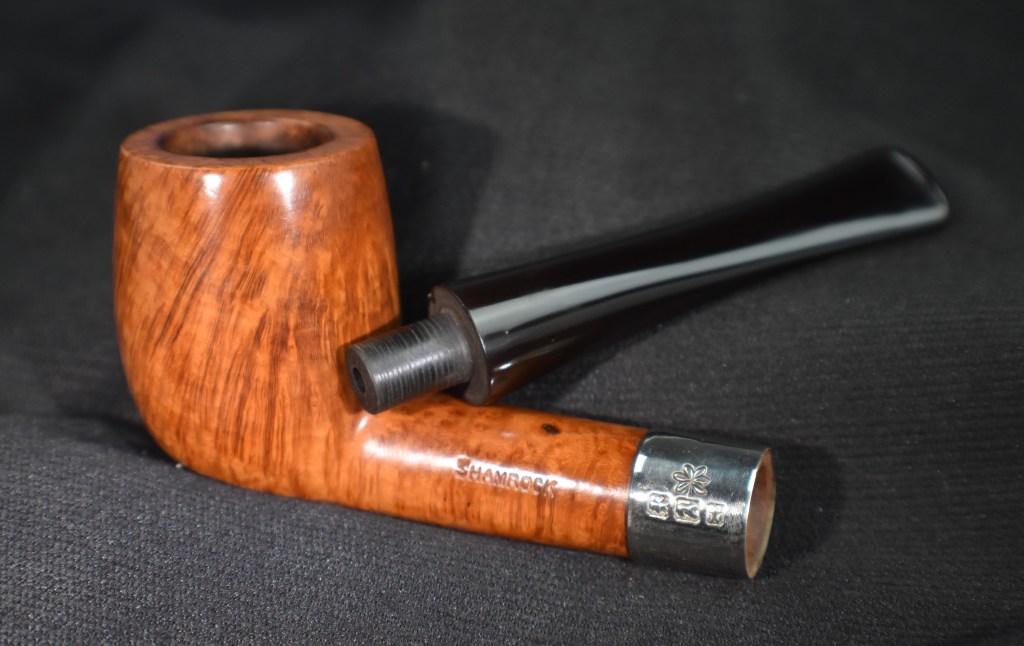
I realize it is Christmas season and Saint Patrick’s Day is a few months away but this Peterson Shamrock was demanding some attention. As you may have surmised, I am a Peterson Pipe lover, also known as a Pete Geek and thus rarely turn away a poor Irish briar in need of attention. This pipe came to me as part of an estate lot from Canada last September. I failed to record or remember precisely from where. The stamps are clear and well defined reading, SHAMROCK on the left shank and “A PETERSON (over) PROCUCT” over MADE IN IRELAND next to a 5 on the right shank. The nickel band has the faux hallmarks of a shamrock, an Irish wolfhound and a round tower. Below are some photographs of the pipe taken prior to any work done.


The plan for the restoration of the Shamrock looked to be straightforward and included the usual cleaning, refinishing and stem oxidation removal. There were a couple of fills of both the briar and the stem but that too would be typical for a used pipe of this age.
Background
I have said it before will likely say it again, I am a slacker, and as such, I will use my own quote to provide the dear reader with additional information regarding Peterson pipes:
“I have written about the restorations of several Peterson pipes over the past 13 months. I will include here good sources of Peterson history for those who would like additional information:
For a great history Mark Irwin and Gary Marlburg’s book is a must read for a Pete Geek.

(Available at https://www.smokingpipes.com/accessories/books/moreinfo.cfm?product_id=471478) Given the price is a bit high but worth every penny for a Peterson aficionado.
The next site is pipedia.org’s History of Peterson by Jim Lilley (Peterson – Pipedia)
Lastly the pipephil.eu site for all things logo: Peterson: historical pipes — Pipes: Logos & Markings (pipephil.eu) They also have a few other links to things like the Peterson timeline and P-lip information.“
The definitive source of “all things Peterson” is The Peterson Pipe written by Mark Irwin and Gary Malmberg. According to Irwin and Malmberg,
“Shamrock (c.1941-2009) Originally stamped SHAMROCK with no brand name, an inexpensive line first described in George Yale (New York) mail order booklet in 1941, imported by Roger Imports. The line was actively promoted beginning in ‘45, aggressively promoted in US by Rogers from early ‘50s when they registered the Shamrock logo with US Patent Office, claiming propriety since ‘38. Over the years offered with P-lip or fishtail mouthpiece, with or without nickel band, with or without shamrock logo on band, with or without S stamped in white or later in gold on mouthpiece. Appearing in 2008 as unstained smooth and rustic, fishtail mouthpiece with gold impressed P on stem. COMS of MADE IN over IRELAND (c. 1945-c.1965), MADE IN IRELAND forming a circle (c.1945-c. 1965), “A PETERSON”S PRODUCT” over MADE IN IRELAND (c. 1945-c. 1965), MADE IN THE over REPUBLIC OVER OF IRELAND (c. 1948-98) or “A PETERSON”S PRODUCT over MADE IN THE REPUBLIC OF IRELAND (c. 1948-98). Model is always difficult or impossible to date. (Irwin, Mark and Malmberg, Gary (2018). The Peterson Pipe The Story of Kapp & Peterson, First edition, second printing 2021. Briar Books Press, Canada. p. 312).
The dates of 1945-1965 can be slightly narrowed with the faux hallmarked nickel band. Again I turn to The Peterson Pipe book, “The stamp was used until about 1963, when hand soldered nickel bands and ferrules were replaced by pressed ferrules and premade bands.” (Irwin, Mark and Malmberg, Gary (2018). The Peterson Pipe The Story of Kapp & Peterson, First edition, second printing 2021. Briar Books Press, Canada. p. 302). In keeping with the author’s terms, this may or may not reduce the production years by 2 to 1945-1963.
The Restoration
The Shamrock restoration began with a clean denim place setting. The stem being the part in most need of attention was the starting point.

I rubbed the stem with 0000 steel wool to remove the outermost oxidation.

Then cleaned the airway. It was surprisingly clean.

Next, I inserted a pipe cleaner into the stem to act as a hanger for its time in the Before and After Extra Strength Deoxidizer or deox as I like to call it.

Suspending the stem in the deox enables the solution better access to every bit of the surface.

I had all day plans so the stem sat in the solution for about 8 hours until I returned to working on it. The stem was removed from deox and allowed to drip excess solution back into the jar.

I like wiping stems with a rough cotton rag after the deox bath.

The coarse material absorbs the remaining solution and helps to remove some of the oxidized vulcanite as well.

Back at the workbench the stem was given a liberal coating of mineral oil and allowed to sit for 15 minutes.

I wrapped the shank with painters tape in preparation for the sanding that was in the stem’s future. The stem was scrubbed with Soft Scrub cleanser applied to make-up pads.

I then turned my attention to reaming the tobacco chamber.

The #1 blades of the PiNet did most of the work with the reaming.

The General and the Smokingpipes Low Country reamer were used for some final scraping.

The chamber was sanded with 320 sandpaper wrapped around a wood dowel. The briar of the chamber looked good and showed no signs of heat damage.

The cleaning out of the airway of the shank was next. This was done with several cotton swabs and bristle pipe cleaners dipped in 95% ethyl alcohol. There was also some drilling with the Kleen-Reem shank drill, scraping with a dental scraper and scrubbing with a nylon shank brush.

The lava on the rim was softened with saliva and scraped with a sharp pocket knife.

The rim showed a bit of a charring around the inside rim edges.

The stummel was taken to the sink for a scrubbing with undiluted Murphy Oil Soap and a nylon scrub brush. The soap was rinsed with warm water and the stummel dried with a cotton hand towel.

The scrubbed stummel looked much better without its accumulated dirt. The alcohol on a make-up pad wiping produced very little color indicating that this stummel was not stained.

Curious to see how well the band would polish-up, I wrapped the shank with masking tape and took the stummel to the buffer. There I buffed the band with rogue compound. The results can be seen below.


The masking tape on the shank was removed and new tape was applied to the band. I also taped over the stamps to protect them from sanding.


There were two fills which needed to be done prior to sanding. The first was on top of the shank.

The second was on the bottom adjacent to the band.

I used brown cyanoacrylate (CA, super glue) and briar dust for the fills. I first applied a small drop of CA to the pit then pressed briar dust into the CA wetted pit. The fills were then filed smooth.


A second application of CA was done on each fill and left to dry on its own accord.

Once dried these were also filed smooth.


There was one dent in the stem that received filling very similar to the above briar fills except this was done with black CA. The photo below attempts to show the dent but the focus is poor.

The stem was sanded with a series of sanding sponges from 400-3500 grit. Between each sponge I rubbed the stem with mineral oil and wiped it with a paper towel.

The stem was then worked with a series of micro-mesh pads from 4000-12000. Between each pad I rubbed the stem with Obsidian Oil and wiped it with a paper towel.

The briar was coated in Before and After Restoration Balm and allowed to sit for 20 minutes.

The Restoration Balm was wiped from the pipe with an inside out athletic sock.

The pipe was then taken to the buffer for a few coats of carnauba wax.

The final step was a hand buffing with a microfiber polishing cloth to raise the shine.
Overall this Peterson Peterson Shamrock 5 Billiard turned out very nicely. The natural briar grain is both straight on the sides and flamed in the front. The band polished up better than I thought possible. The vulcanite lost the oxidation and revealed a lovely high gloss black that accentuates the glow of the briar and the shine of the nickel band. The dimensions of the Peterson Peterson Shamrock 5 Billiard are:
- Length: 5.89 in./ 149.61 mm.
- Weight: 1.31 oz./ 37.14 g.
- Bowl Height: 1.81 in./ 45.97 mm.
- Chamber Depth: 1.52 in./ 38.61 mm.
- Chamber Diameter: 0.69 in./ 17.53 mm.
- Outside Diameter: 1.35 in./ 34.29 mm.
I do hope that you have found something here useful to your own pipe care, maintenance or restorations. If you like this sort of thing, please click the like and subscribe buttons. Thank you for reading the ramblings of an old pipe lover.
Below are some photos of the completed Peterson Shamrock 5 Billiard.


 NebraskaPeteGeek