
Photographed and written by
John M. Young
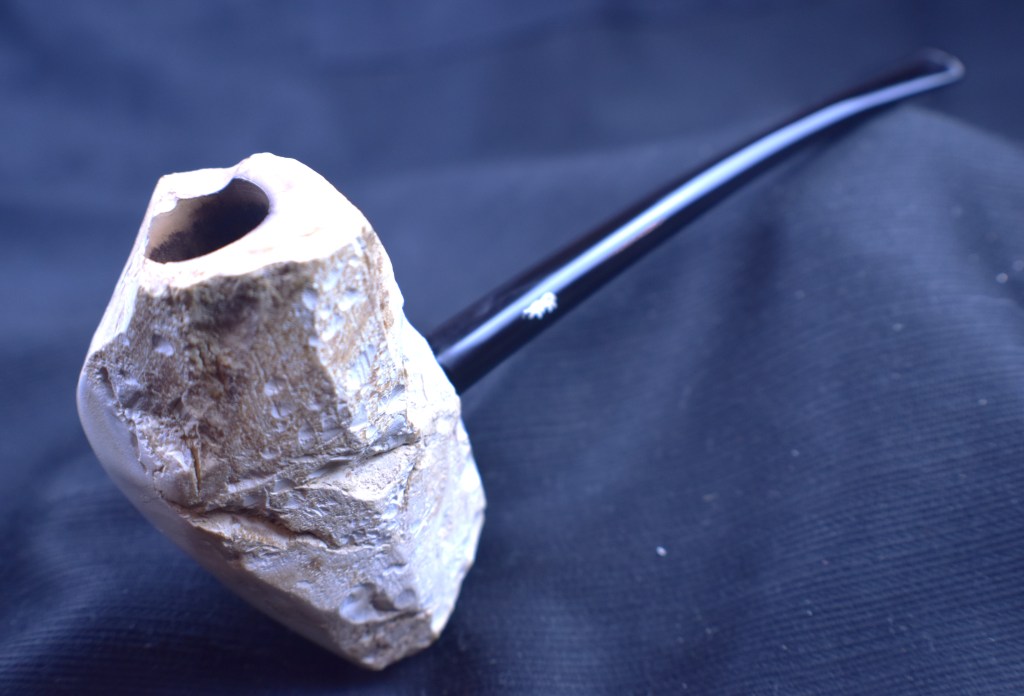
“Another Kiko Caveman?”, you ask. I reply. “YES!” These pipes are so interesting, not just to look at but to hold. The feel in the hand is remarkable. The first thing that strikes me is how lightweight they are especially for a hunk of rock. Second, is the sheer idea of the age of the mineral itself. One source dates this Amboseli sepiolite (meerschaum) to the Late Pleistocene to Holocene age so, approximately 12,000-10,000 years ago (https://www.sciencedirect.com/science/article/abs/pii/S007045710870027X). This is interesting since several pipes advertise “century old” briar. How many can claim to be 100 centuries old? Anyway, this Kiko came from an eBay auction and has a much less interesting acquisition story than the first Kiko Caveman. Meerschaum is a hydrophilic mineral, meaning water loving. A few weeks ago I was chatting with Sascha Mertens, a pipeman from Germany, he was explaining how to tell a block meer from a pressed meerschaum. You need only to place your tongue on the meerschaum. It will stick to a block meerschaum and not with a pressed. This reminded me of testing minerals as a geologist. The same thing would occur with anhydrous hydrophilic minerals. Well, my tongue stuck most uncomfortably to the Kiko. It was in need of a fresh coat of beeswax.
The stem is the only part of the pipe that is stamped with any identifiers. Here we can see the elephant logo on the left side of the shank and TANGANYIKA on the bottom surface.


The Meerschaum was in good shape and the tobacco chamber was mostly clean, no cake to speak of. It looked like this restoration would be mostly stem work and of course a fresh beeswaxing.
Background
I did a restoration of another Kiko Caveman a couple of weeks ago. I will include a link here to that restoration. I will also use the background of the previous restoration here as both pipes are similar.
The first step that I took in researching this pipe was to look up the logo at pipephil.eu. There I found the following:

(Ki-Km — Pipes : Logos & Markings (pipephil.eu))
Turning to pipedi.org for some history of Kiko led to the following entry:
“Kiko, meaning “pipe” in Swahili-Kiswahili to English translation, is probably the best known of the various brands listed below. In East Africa Meerschaum is found in Tanganyika, once known as German East Africa, and since 1964 part of the United Republic of Tanzania. The main deposit comes from the Amboseli basin surrounding the Lake Amboseli. Tanganyika Meerschaum is normally stained in shades of brown, black and yellow, and is considered to be inferior to Meerschaum from Turkey. Eventhough, the raw material is mined by the Tanganyika Meerschaum Corporation and to a large extent used for pipemaking. Uncounted pipemakers throughout the world were supplied with Amboseli Meerschaum, preferentially used for Meerschaum lined briars or leather-clad pipes. In Tanganyika the Kilimanjaro Pipe Company Ltd.” (Kiko – Pipedia)
And, more specifically the Caveman line of Kiko pipes.
- “Caveman Fashioned from a piece of natural meerschaum.Every pipe is unique and – is in fact a geological specimen over a million years old.Attractively boxed.” (Kiko – Pipedia)
A second entry at pipedia.org discusses the Tanganyika Meerschaum Corporation in greater detail.
“From Pipes, Artisans and Trademarks, by José Manuel Lopes
Tanganyika Meerschaum Corporation is a company that formed in 1955 by Kenyan businessmen from Nairobi after the discovery of a meerschaum mine relatively close to the surface on Kilimanjaro. The meerschaum is tougher, less porous, and cheaper than the Turkish variety. Another mine was soon discovered in Sinya, in the famous Amboseli Game Park.
The company, previously based in Arusha (Tanzania), became an associate of a Belgium firm, but closed some years after. It produced the Caveman, Countryman, Kiko, Killimanjaro, Sportsman, Townsman, and Wiga brands. It maintained a link with GBD for the making of the GBD Block Meerschaum series, and after its closure, the English firms, London Meerschaum and Manx Pipes (Manx Meerschaum) continued producing with African meerschaum.” (Tanganyika Meerschaum Corporation – Pipedia)
To give more depth to the meerschaum story here is a quick lesson in geography.

Lake Amboseli is a rainy season body of water along the shared border of Kenya and Tanzania, northwest of Mount Kilimanjaro. The straight white line on the image below is that border. Sinya refers to the Sinya Mine (https://www.mindat.org/loc-266724.html).
Zooming in on the south western shore of the temporary Lake Amboseli you can actually make out the excavations of the old mining activities. On the below image from google maps; pits, tailing piles, roads etc… can be discerned.

It appears that little to no mining is done at the site today. Several sources say that the meerschaum deposit were close to the surface, not very large and were played out
Super fast history lesson:
Before World War I, Tanganyika formed part of the German colony of German East Africa. It was gradually occupied by forces from the British Empire and Belgian Congo during the East Africa Campaign, although German resistance continued until 1918. After this, the League of Nations formalised control of the area by the UK, who renamed it “Tanganyika”. The UK held Tanganyika as a League of Nations mandate until the end of World War II after which it was held as a United Nations trust territory. In 1961, Tanganyika gained its independence from the UK as Tanganyika, joining the Commonwealth. It became a republic a year later. Tanganyika now forms part of the modern-day sovereign state of Tanzania. (https://en.wikipedia.org/wiki/Tanganyika_Territory)

With all of that information in mind and assuming that the TANGANYIKA stamp on the stem is referring to the country of manufacture (COM) this pipe was made not after 1962.
The Restoration
After getting a clean denim piece this pipe needed to have the stem freed from the tenon. It was firmly attached firmly, as if someone appeared to have glued the stem in place.

I wrapped the stem with several wraps of masking tape to protect the stem from the channellock pliers. A twist and turn later the stem was freed.

The tenon appeared to be aluminum as it was not attracted to a magnet and glued in place in the meerschaum. When inserted completely the stem was loose but if backed out about 2 mm it was a perfect fit. I decided that a cork washer would be the easiest fix for this situation.
The photo below shows the light cake deposits in the bowl were removed with 220 sandpaper wrapped around a wood dowel.

The stem was cleaned with bristle pipe cleaners dipped in 95% ethyl alcohol. The stem was then placed into a jar with Before and After Extra Strength Deoxidizer. The jar needed to be propped at an angle due to the length of the stem.

The stummel was cleaned with warm tap water and a nylon scrub brush.

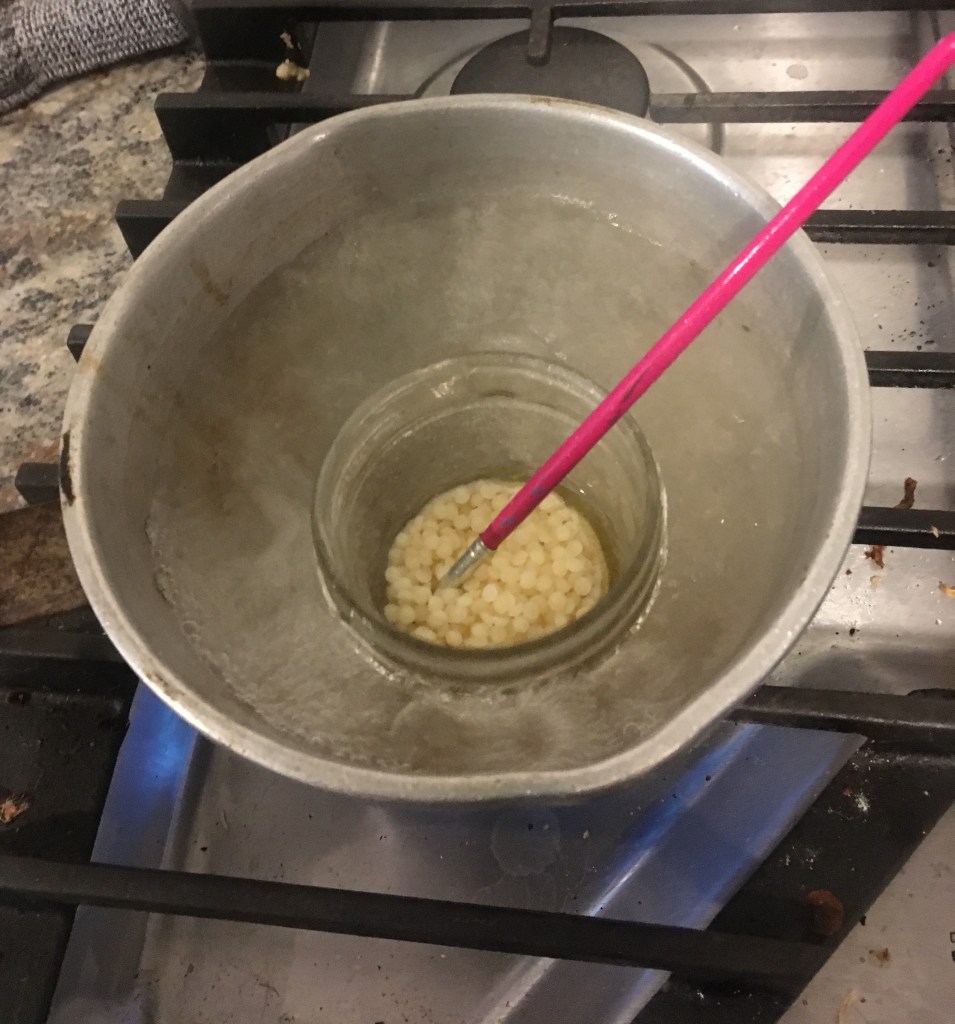
Fresh beeswax was melted in a small glass canning jar placed in a pan of boiling water. The surrounding water keeps the wax molten for longer enabling me to have more time with the molten wax.
The heat gun was set up in proximity.

I did not have a cork of suitable size to plug the tobacco chamber so through the power of adaptation I discovered a 20 gauge shotgun shell was the perfect diameter. The shotgun shell was my plug and handle for the heating of the meerschaum with the heat gun.

The molten beeswax was brushed onto the stummel and the meerschaum was heated with the heat gun. The aluminum lid acted as a wax drop catch pan. Several coats of beeswax were brushed onto the meerschaum.

Below you can see the meerschaum was set aside to cool.

After four hours the stem was removed from the Before and After Extra Strength Deoxidizer and it was allowed to drip excess solution back into the jar.

The stem was hand rubbed/buffed with a coarse shop rag to absorb the remaining solution and abrade the softened oxidized vulcanite.

The below photo is blurry but does show the oxidized rubber left behind on the rag.

The stem was rubbed with mineral oil to prevent new oxidation.

My masking tape protective layer was not quite adequate to protect the stem during the freeing from the stummel. Doh! That would need to be repaired with an application of black cyanoacrylate (CA, super glue). Well, now you know that I make mistakes. A lot of them… The stem stamping and logo were covered with painters tape to protect them during the sanding.

The dent was filled with black CA and allowed to dry/cure on its own.

Once cured the repair was filed with a small flat file. The stem was then sanded with a series of sanding sponges from 600-3500 grit. Between sponges the stem was rubbed with mineral oil and wiped with a paper towel.

The elephant logo area was cleaned with a cotton swab and ethyl alcohol to remove sanding debris and mineral oil in preparation of a new paint job. White acrylic modeling paint was used.

The paint was applied using a bamboo skewer.

When dried the paint outside of the depressed logo was removed during the micro-meshing. This was done with 4000-12000 micro-mesh pads. Between each pad the stem was rubbed with Obsidian Oil and wiped with a paper towel.

The stem was taken to the buffer where it was polished with Blue Diamond compound . The stem then received several coats of carnauba wax. The stummel, having just received fresh beeswax, did not have any carnauba wax applied.
I am very pleased with how well this Kiko Caveman turned out. I could not find any information concerning the shapes that the makers tried to carve for. This pipe was very different in regards to the tobacco chamber drilling than the previously restored Kiko Caveman. This pipe has a narrow 16.26 mm bore while the other Kiko has an 18.29 mm bore. I tried the narrow bore with Carolina Red Flake virginia blend and it smoked very nicely. The stem of this pipe polished nicely and the glossy black vulcanite accents the lighter meerschaum well. The long stem does not make for a very comfortable clenching pipe but the “hand feel” makes up for that. Besides, the flat bottom of this pipe provides a perfect and stable sitting base. The dimensions of the Kiko Caveman Chimney are:
- Length: 6.85 in./ 173.99 mm.
- Weight: 1.92 oz./ 54.43 g.
- Bowl Height: 3.02 in./ 76.71 mm.
- Chamber Depth: 1.69 in./ 42.93 mm.
- Chamber Diameter: 0.64 in./ 16.26 mm.
- Outside Diameter: 1.92 in./ 39.88 mm. In line with the stem
1.47 in./ 37.34 mm. Perpendicular to the stem
I do hope that you have found something here useful to your own pipe care, maintenance or restorations. If you like this sort of thing, please click the like and subscribe buttons. Thank you for reading the ramblings of an old pipe lover.
Below are some photos of the finished Kiko Caveman Chimney.


 NebraskaPeteGeek