
Photographed and written by
John M. Young
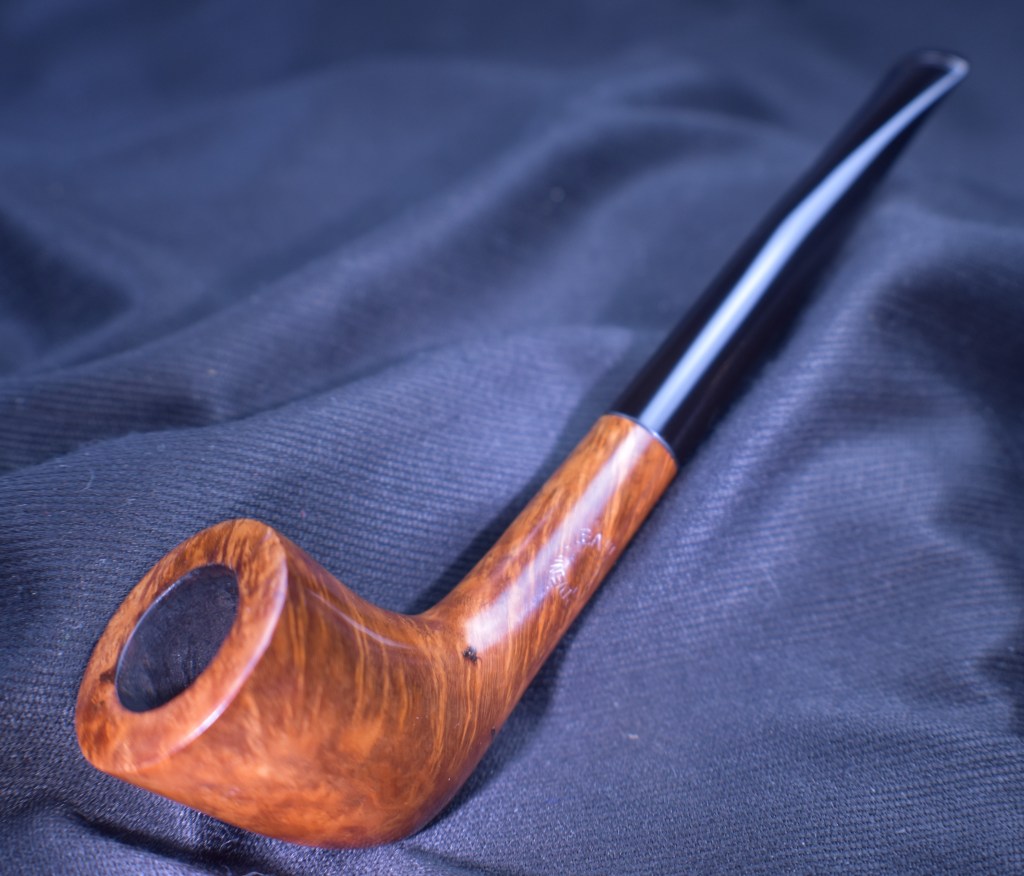
DENICOTEA arched over DELUXE on the left shank with HOCKEY over BRUYERE EXTRA on the right. 741L on the underside of the shank next to the stem.


Background
In a previous blog I wrote about the history about what little I found about Denicotea, I will link that post here, and include the information below:
“Pipedia.org has a short article on Denicotea. I will include it here in its entirety:
“Willy Heineberg founded the company Denicotea in 1932 and began manufacturing and selling smoking accessories such as filters, filter inserts, cigarette holders and pipes.[1] The company headquarters was initially in Cologne, but was relocated to Bergisch Gladbach after the Second World War.[2]
Denicotea is actually the name of a silica gel filter, cigarette holders and care products for pipes and cigarette holders.
I still find it a bit confusing as Denicotea seems to be a company[3] and a brand as well which is operated by COMPOSING-STUDIO GmbH[4].
Brands
Adsorba
Adsorba is a fantasy series of pipes produced by Luigi Crugnola for the German market.
Aldo Morelli
Aldo Morelli is a fictional name. The brand Aldo Morelli has been registered for Denicotea on February 26th, 1992.[5]
Depending on the different lines the pipes are made by Cesare Barontini, Gigi or Molina Pipe for Denicotea GmbH.
Stefan Petzuch points out this brand appears to have similarities to the Mauro Cateni pipe brand, in particular they are both fictional Italian brands by German companies, and both have the “HAND CUT” imprint on the stem as seen bellow. This may connect the Aldo Morelli brand to Gebr. Heinemann KG in Hamburg, who had registered the Mauro Cateni brand. Or perhaps there is a connection between Denicotea and Gebr. Heinemann KG, or perhaps these pipe brands simply used “Hand Cut” stems from the same source.” (Denicotea – Pipedia)
Interesting and weird are the two qualifiers that come to mind in reading that. The four makers mentioned in the article; Luigi Crgnola, Cesare Barontini, Gig and Molina are all Italian pipe manufacturers. Where does the MADE IN ENGLAND stamp on the example on pipephil.eu or the stamp on the pipe I purchased come in, I cannot say. I can say that I am not the first person to have little success researching the origins of Denicotea pipes. Dal Stanton, who is far more diligent in his background research than I, had a French made Denicotea. He traced its origins to the St. Claude area but not to a specific maker. Dal’s blog was posted on Steve Laug’s rebornpipes.com site. Here is the link to Dal Stanton’s blog post: https://rebornpipes.com/2016/09/29/nice-find-in-plovdiv-bulgaria-denicotea-deluxe-curling-bruyere-extra/”
This Denicotea has neither the Country of Manufacture (COM) stamps of England nor France. It does have a shape number 147L which I could find no corresponding match with brands associated with Denicotea. This pipe’s heritage appears to remain a mystery.
The Restoration
The restoration began with the reaming of the tobacco chamber. There was little cake to remove indicating that the pipe had not been used heavily. This premise was later shattered. The chamber was rather narrow making me use the Kleen-Reem, General triangular scraper and the smokingpipes Low Country reaming knife to clear the cake.

The below photo illustrates the very small amount of cake present. The bowl was sanded with 220 sandpaper wrapped around a wood dowel and no evidence of heat damage was observed on the bare briar.

The rim had no lava deposits again indicating that the pipe had not been smoked too heavily.

The stummel was taken to the sink and scrubbed with undiluted Murphy Oil Soap and a nylon scrub brush.

Next came the cleaning of the shank. This is where I realized that this pipe had indeed been smoked a good deal. For all the maintenance that the bowl had received the shank had been severely neglected. It was very full of tar and smoking residue, also known as yuck. Now, to cut the previous owner some slack, the shank was not easy to clean as the airway appeared to be bored at 9.5 mm. The plastic tenon was inserted into this bore and left with a step. There was another step at the bowl end of the airway where the drilling draft hole went from a normal small hole to the 9.5 mm. These two steps had accumulated a great deal of yuck and could not be reached with dental scrapers to help clear the yuck. Numerous cotton swabs dipped in 95% ethyl alcohol were used along with a nylon shank brush. I seemed to make little progress as the cotton swabs continued to emerge heavily stained with yuck. I then decided to try stuffing the tobacco chamber and the shank with cotton, filling them with 95% ethyl alcohol and allowing them to sit overnight.

The stem was not much better than the shank. I plugged the button end with my finger and poured some ethyl alcohol into the airway. Here I scrubbed with a nylon shank brush.

The alcohol was allowed to drain into the sink. It was full of yuck.

The stem was designed for use with 9 mm filters and judging by the accumulated yuck, they had not been used as I don’t think a filter could have been inserted with all of the residue in the stem.

I alternated between using Castile soap and 95% ethyl alcohol hoping that one of the two would help reduce the yuck.


It was about here that I noticed the fine scratched immediately above the button.

The scratches were present on both the top and bottom sides of the stem.

The stem was returned to the workbench where I continued cleaning the stem with more traditional methods. Bristle pipe cleaners and cotton swabs dipped in alcohol were used. I also wrapped small 5 cm square pieces of paper towel around a rat tail file and scrubbed the airway with these dipped in alcohol. Eventually I was victorious and the stem cleaned.

To address the scratches I sanded the button end of the stem with 400, 600 and 1000 grit sanding sponges. I used a small circular pattern while sanding. This eliminated the scratches.

While the stummel was still soaking with the cotton and alcohol I picked the old fill from the briar. There were two big fills on the left.

One large fill and one smaller fill on the right.

And two larger fills on the rim which were picked free of old fill material.

The whole stem was sanded with a series of sanding sponges from 400-3500 grits. Between each sponge I rubbed the stem with mineral oil and wiped it with a paper towel.

This is where day one ended. The pipe was to sit overnight allowing the alcohol to soften and dissolve the yuck in the airway.
The next day I returned to find the cotton, as expected, quite stained with removed yuck.

The cotton was removed and I tried cleaning the airway with cotton swabs and the 5 mm paper towel pieces wrapped around the rattail file.

The cotton alcohol had worked but not to the extent I had hoped for. Many more cotton swabs and scrubbings with alcohol yielded nothing but more stained swabs.


This prompted me to repack the bowl and shank with cotton and repeat the overnight soaking.

Since the cotton helb the alcohol in contact with the walls of the airway and was not dripping alcohol I went ahead with the filling of the pits. For this I used brown cyanoacrylate (CA, super glue) and briar dust. I applied the CA into the pit and then pressed some briar dust into the wet CA. These cured almost immediately. The subsequent fill was filed with a small flat file and smoothed with a 400 grit sanding sponge. The three photos below show the first application of CA/briar dust.


The filling process was repeated for each of the fills.


Where needed the brown CA was added a third time without briar dust and allowed to cure. The pipe was again allowed to sit overnight enabling the alcohol to further dissolve and remove the yuck.
The next day, I revisited the pipe.

The cotton was again stained with removed yuck. I removed the cotton.

The staining was far less than the previous attempt. I started cleaning with alcohol dipped cotton swabs. At first I thought that no progress had been made then suddenly the swabs began to come out with less staining. I had finally removed the yuck.

The stamps were covered with painters tape to protect them during the sanding. The stummel and stem junction was sanded with sanding sponges 400-3500. Between each sponge the stummel was wiped with a make-up pad moistened with 95% ethyl alcohol.

The pipe was then worked with micro-mesh pads from 4000-12000. The stummel was again wiped with a make-up pad dipped in alcohol. The stem was rubbed with Obsidian Oil and wiped with a paper towel between micro-mesh pads.

The pipe was taken to the buffer where I buffed the entire pipe with Blue DIamond on a clean wheel. After the buffing compound was thoroughly wiped off the pipe received several coats of carnauba wax. The final step was a hand buffing with a microfiber polishing cloth.
This pipe is a perfect example of how my prejudice led me to inaccurate conclusions. Yeah, the tobacco chamber looked clean and there was no lava on the rim, both indicating a little used pipe, only to discover a heavily tarred mess of an airway. Overall I am pleased with the finished restoration. The briar grain is nice, the new fills are a bit too noticeable. In hindsight, I am thinking that a contrast dye of black would have concealed them and accentuated the briar grain. That might be another project for this winter when I am hunkered down avoiding the cold and snow. The stem polished up very nicely. The long sleek glossy black vulcanite is a great contrast with the briar. I do really like this shape, though it doesn’t quite fit a cutty nor a zulu. I guess that’s why it is called a Hockey. The dimensions of the Denicotea Deluxe Hockey are:
- Length: 6.66 in./ 169.16 mm.
- Weight: 1.18 oz./ 33.70 g.
- Bowl Height: 1.77 in./ 44.96 mm.
- Chamber Depth: 1.42 in./ 36.07 mm.
- Chamber Diameter: 0.67 in./ 17.02 mm.
- Outside Diameter: 1.30 in./ 33.02 mm.
I do hope that you have found something here useful to your own pipe care, maintenance or restorations. If you like this sort of thing, please click the like and subscribe buttons. Thank you for reading the ramblings of an old pipe lover.
Below are some photos of the finished Denicotea Deluxe Hockey.


 NebraskaPeteGeek