Written and photographed by John M. Young

We all know of Dr. Grabow pipes and likely have our own opinions of them. Anyway you look at it Dr. Grabow pipes are an American icon. I do not feel the need to examine the history of the brand and am including links regarding history for those who are interested.
History:
Tobacco Pipes: https://www.tobaccopipes.com/dr-grabow-history/#:~:text=The%20famous%20smoking%20pipe%20brand,US%20patent%20number%201.896%2C800.
Pipedia:
https://pipedia.org/wiki/Dr._Grabow
Pipedia timeline:
https://pipedia.org/wiki/Dr._Grabow_Pipe_History_Timeline
Current Dr. Grabow:
After I retired from being a high school science teacher for 32 years I started restoring estate pipes. As part of my education in the realm of restorations I came across the blogs of Seve Laug (https://rebornpipes.com/). I have to say how impressed I was at his knowledge and skills. Unfortunately my own knowledge and skills were quite undeveloped. Fortunately, ignorance is curable. Through the avid consumption of articles and practice restoring estate pipes I developed a passable set of skills of my own. I received this Dr. Grabow Westbrook as part of a “grab bag” of pipes for restoration from Steve Laug’s partner, Kenneth Lieblich (kenneth@knightsofthepipe.com).
The Westbrook series began in the mid-1950’s. I have to admit that I was drawn to them because of the orange spade. Amazingly, my attraction to them was shared by Dr. Grabow aficionados and according to Dr. Grabow Models (Series,Line) Names Through the Years: “WESTBROOK (c1955? to about 1985 or so) — One of the earliest RJR pipes and very sought after even today, long after the special offer program stopped.” https://pipedia.org/wiki/Dr._Grabow_Models_(Series,Line)_Names_Through_the_Years
So either I accidentally chose a good one or there are a lot of folks who like orange.
This old Westbrook looked dirty and well worn or, as my father used to say “rode hard and put away wet”.


Upon reaming the bowl with a PIPNET I discovered that the previous owner liked to scrape the bowl with a sharp tipped knife. There was a hole all the way through the briar. The edges did not appear charred so I figured he was just a scraper. The next step was to clean away the years of accumulated dirt, oils and grime. This was done using a medium stiffness toothbrush and Murphy’s Oil Soap. Since the pipe was rusticated I also used a brass brush, 12 gauge shotgun bore brush, with the oil soap to get the “lava” from the rustication on the rim and the deeper grooves. 


At this point I was faced with a decision. Should I:
- Scrap the whole restoration and use the pipe as salvage/parts.
- Fill the bottom of the bowl with J-B Weld and top that with a “pipe mud”.
- Drill out a regular hole in the bowl and make a briar plug and fit it to the hole.
I have a thing for old Dr. Grabow pipes and Westbrooks in particular, so option 1 didn’t seem very good. I had used the J-B Weld method with pipes that had suffered the scrapings of misguided owners before and had good results but, never with a hole all the way through. I had never tried to fashion a plug so, I went with the “let’s make a plug” method, option 3. Maybe I could also build some new skills.
Not having access to a drill press I tried drilling out the hole by stepping up larger and larger drill bits with a hand drill. This worked ok until I got to the final bit, ⅜ inch. The final bit chipped the briar making the hole irregular. Hmm, does this warrant the purchase of a drill press? Anyway, I can always fill rough spots.


It was time to find a suitable plug doner. I had an old no-name bullnose that I had previously used for a piece of briar and the bottom looks to be nice and thick. Four cuts later I had the beginnings of a plug.


Shaping of the plug was done with small needle files of various shapes and sand paper. This did lead to cramping of the hands. The small notch that you can see on the second photo below was the original draught hole. I kept it intact as a reference point to line up with the Westbrook’s draught hole.
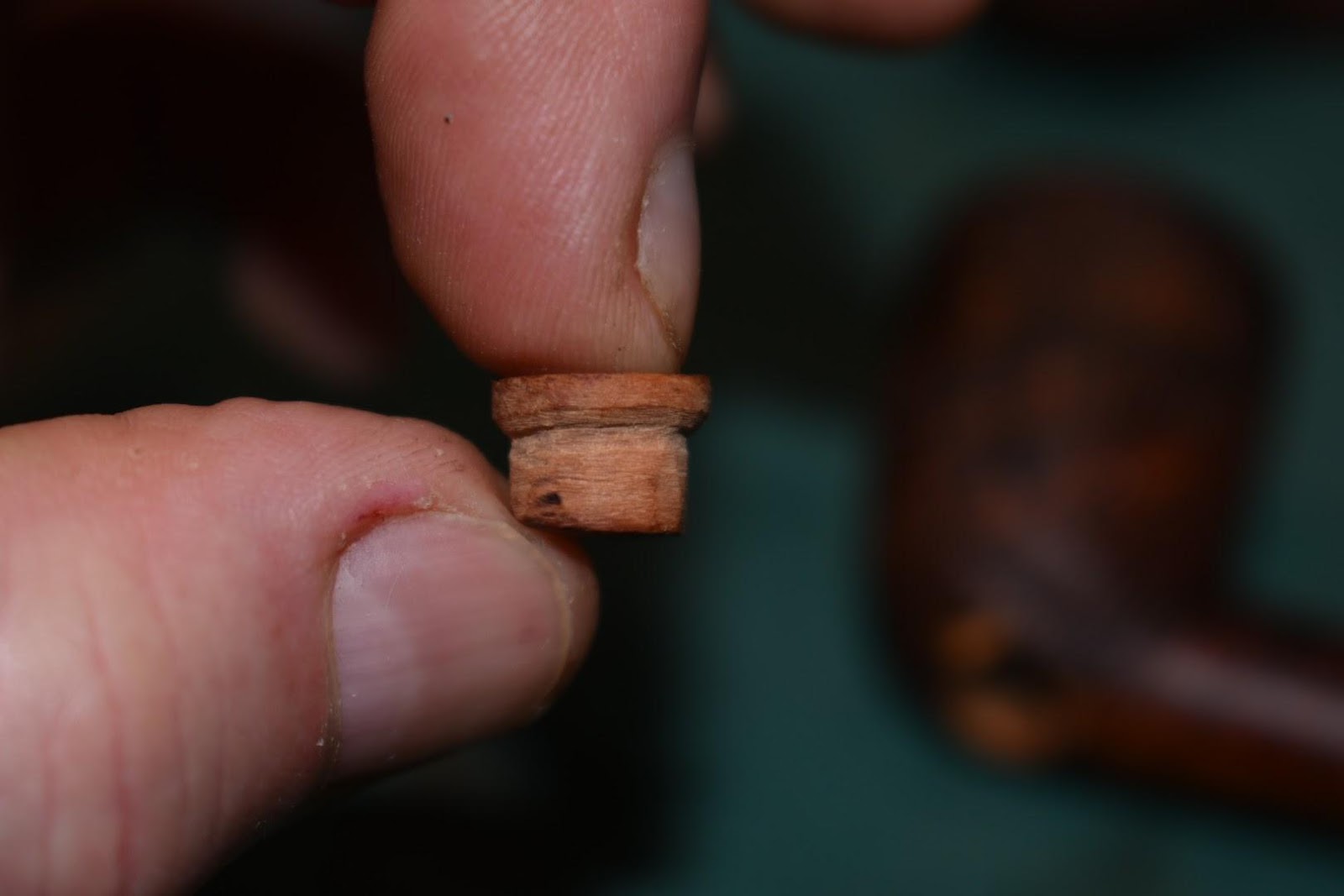

Eventually the plug was fit as well as I was going to get it. I put a bead of J-B EWeld around the sides of the plug and fit it into place using the draught groove to align it to the Westbrooks draught hole. The inside looked good.


I had had enough hand cramping and fiddling with small pieces of wood. At this point I decided to make a slurry of clear J-B Weld mixed with briar dust from other restore projects. I filled in the remaining hole with this slurry and allowed it to dry for several days. Eventually it became hard enough to file and sand.
During the drying I had plenty of time to address a very used and abused stem. The good news with the stem was that the orange clover leaf Dr. Grabow logo lined up perfectly with the shank.


I neglected to take pictures throughout the restoration of the stem. I started by carefully scraping the worst of the calcium deposits and oxidation with a sharp knife. After that I used a wet/dry 220 sandpaper with a light touch to remove the oxidation. I then dropped the stem into Before & After Extra Strength Deoxidizer (For Sale | La Belle Epoque (lbepen.com) for about an hour. After removing the stem from the deoxidizer I let the stem drip much of the chemical back into the container. After the drip dry, I vigorously rubbed the remaining chemical with a cotton rag and ran pipe cleaners through the draught hole. As soon as I had removed all the deoxidizer with the rag and pipe cleaners I applied a coat of mineral oil to the stem and ran a wet-with-mineral-oil pipe cleaner through the stem. To repair the hole chewed through the mouthpiece, I used a piece of plastic cut from a plastic container. Here are a couple of examples with different pipe stem for scale:

I coated the narrow part of the plastic with petroleum jelly and inserted it into the mouthpiece. I then used STARBOND black cyanoacrylate (super glue, abbreviated CA) to build up the missing material. The CA does not adhere to petroleum jelly. I will usually do a light coat of CA and spray it with STARBOND Accelerator to get it to dry almost instantly. Repeat as necessary to fill in the missing material. The repaired spot is then filed with a fine flat needle file and sanded with 220 then 400 grit wet/dry sandpaper. After the sandpaper, I used micromesh pads with grits 1500-12000. Obsidian Oil is used on a cotton cloth between each micromesh pad. The final polishing was done with Before & After Fine Polish and Extra Fine Polish (Lbepen.com). The finished stem looked good.


After the J-B Weld had completely cured and hardened I was able to shape it with a file and sandpaper. The J-B Weld/briar-dust patch was significantly darker than the existing briar.. Fortunately the rustication allowed me to conceal the patch with a few cuts made with a cut-off wheel on the Dremel MultiPro and applications of Fiebing’s Light Brown Leather Dye blended the patch fairly well.


I admit to not being a woodcarver nor having the best tools for the job. It did however work well enough for this old Westbrook and my approval. Due to the rustication of the pipe there was minimal sanding to be done. I did lightly hit the high points with the 3200 and 4000 micromesh pads. After that light sanding I wiped the whole pipe off with 99% ethyl alcohol. I rubbed in a liberal amount of Before & After Restoration Balm (Lbepen.com) with my fingertips and let it dry for an hour. I Rubbed away excess balm and buffed the bowl with the inside of a cotton athletic sock. The final treatment of the wood was a light coat of Decatur Pipe Shield No Buff Wax applied with my finger and worked into the rustication with a toothbrush. The wax was allowed to dry for 30 minutes then was buffed off with a shoe-shine brush.
Below are some photos of the finished pipe:


She may not look as good as she did when she left the factory but she smokes very nicely and has many years and many bowls of tobacco in her future. Thank you for reading the ramblings of an old pipe lover.
John
 NebraskaPeteGeek
2 responses to “A Dr. Grabow Westbrook Restoration.”
thanks for posting this I very much enjoyed reading it. I’m in the process of restoring the identical pipe. With respect to “pipe snobbery” and Dr Grabow pipes…the only one that has to like it is you! I think it is fantastic to save these icons of Americana! Happy piping!
LikeLike
Thank you so much for the kind words and advise. I do like researching the history of these pipes and am glad to hear tthat someone enjoys reading my ramblings. Good luck with your restoration.
LikeLike