It seems like I haven’t worked on a Peterson pipe for a while but, that’s not true. I did that Captain Pete commission just a couple of weeks ago. Oh well, I’ll use my newly created meme anyway:
This restoration is on a Peterson I have never worked with a Kapp-Royal bent pot 01. This beauty was spotted on eBay back in April of 2025. I remember when I wouldn’t pay more than $45 dollars for a Peterson pipe. Then Inflatron (the inflation monster) attacked like Godzilla. Sadly this Irish lass was a bit more than the $45 but all things considered it was still reasonable. The stampings are all clear and read as follows: Peterson’s over “KAPP-ROYAL” on the left shank, with MADE IN THE over REPUBLIC over IRELAND, offset 01, on the right shank. Below are some photograph taken prior to work on the pipe.
The Kapp-Royal was in very good condition. The stem had light oxidation and no tooth chater, to speak of. The briar looked very nice with fine birdseye’s on both flanks. The gap where the stem met the stummel was an annoyance which would have to be addressed. Other than a few minor fills and some sanding/polish this beauty would be ready for a new owner in no time.
Background
For the first three pieces of Peterson history I turned to the official Peterson website. Here, I chose quotes from the general history of Peterson, the “Classic” shape range, and the 01 shape in particular:
As the oldest continuously operating briar pipe factory in the world, we at Peterson have a certain tradition to uphold, a legacy of craftsmanship dating back over 150 years. Whether you’re browsing for your very first pipe or are a seasoned collector in search of a rare gem, know that every pipe in our catalogue carries with it that same preservation of tradition. A Peterson pipe isn’t just a utilitarian tool; it’s a piece of history you can carry with you in your travels, a faithful companion to accompany you through all that life offers. (Peterson.ie: Pipes)
One of our most popular shapes, our signature take on the bent Pot enhances the inherently muscular design with a broad, squat bowl and extra-sturdy proportions through the shank and transition, as well as an elegant quarter bend. (Peterson Pipes: Army Filter Heritage (01) Fishtail (9mm))
Since our inception, we’ve offered a range of specific tiers suited to our customers’ tastes and price requirements. Our Classic range represents non-System pipes crafted for the Everyman, unique and timeless designs that capture our House Style and quality craftsmanship at a price any smoker can enjoy. Rather than relegating production to one or two lines, we offer a variety of styles, shapes, and finishes among these entry-level series, including traditional navy mounts (flush-fitting stems), P-Lip mouthpieces, and army mounts. (Peterson.ie: Classic Pipes)
Next I looked into the big The Peterson Pipe book (Irwin, Mark and Malmberg, Gary (2018). The Peterson Pipe The Story of Kapp & Peterson, First edition, second printing 2021. Briar Books Press, Canada.) for a more specific account of the Kapp-Royal line.
“Kapp-Royal (1969. 1976-79, c. 1988, 2004-) First appearance as a line introduced 1969. In 1976-79 Iwan Ries catalog offering identical with non-System Dunmore line. Second appearance the late eighties as a high-grade Italian-market line with briar band inset into mouthpiece. From c. 2004, Italian line available in the US as high grade, orange finish, sterling band, amber-colored acrylic fish-tail stem or sometimes vulcanite, embedded aluminum P.” (Irwin and Malmberg p. 306)
According to the above description by Irwin and Malmberg, this pipe is likely a Kapp-Royal from the “c. 1988” period and made in the Dublin factory.
The Restoration
The Kapp-Royal made its way to the workbench after the “Before” photo shoot. Here it received a cleaned denim piece and a more thorough examination.
Below you can see that gap I was referring to earlier. I couldn’t see an obstruction to a tight fit but there certainly was one.
The original fills had failed and would need fixing. Fortunately they were a distance away from the stamps.
Another old fill was located on the heel.
The reservoir, well not really a reservoir since this is a Classic 01 and not a System pipe, was surprisingly dirty. That could definitely be the culprit for the ill fitting stem.
The tobacco chamber looked very clean. I could even make out the chuck marks from the Peterson factory. How could a chamber this clean have a shank that is fouled so badly?
Below is another shot of the chamber prior to work done. It had obviously received some scraping by the marks at the bottom of the chamber yet the rim looked pristine.
I figured there was no reason to ream this tobacco chamber so proceeded directly to sanding it. I could see no damage to the chamber other than the scraping marks at the bottom of the chember.
The shank cleaning was far more difficult. Here I used the following techniques: Nylon shank brush scrubbing with alcohol present, Folded bristle pipe cleaners dipped in alcohol, cotton swabs dipped in alcohol and dental scraper scraping.
The stem was, like the tobacco chamber, surprisingly clean requiring only a couple bristle pipe cleaners wetted with alcohol. The stem did not need to be treated with either Before and After Extra Strength Deoxidizer or Briarville Pipe Stem Oxidation Remover. I thought sanding/polishing would suffice. I did apply a coating of mineral oil to the stem though.
The stummel made its way to the sink for a scrub with undiluted Murphy Oil Soap and a nylon brush. The soap was rinsed with warm water and dried with a cotton hand towel.
Back at the workbench the stummel was wiped with a make-up pad wetted with 95% ethyl alcohol. Very little color came off indicating that the stummel was clean.
The disturbingly dirty shank bothered me so, I decided to give it an overnight cotton-alcohol treatment. The bowl was stuffed with cotton balls while the airway was stuffed with more cotton.
The cotton was saturated with 95% ethyl alcohol until no additional alcohol could be absorbed with a disposable pipette.
The next day the cotton was removed.
The logo area was de-oiled with alcohol on a cotton swab. Yeah, I tried to mask it without de-oiling at first – unsuccess!
The stamps and logo were masked with painters tape to protect them from the upcoming sanding.
The fills were redone using a dab of brown cyanoacrylate (CA, super glue) applied with a fly tying bodkin. Briar dust was then pressed onto and into the wet CA. A quick dab of additional CA was applied to the top of the new fill.
The new fills were filed with a small flat file and smoothed with a 400 grit sanding sponge.
The pipe was then worked with a series of sanding sponges from 400-3500 grits. The stummel was wiped with a make-up pad wetted with alcohol between each sponge. The stem was rubbed with mineral oil and wiped with a paper towel between each sponge.
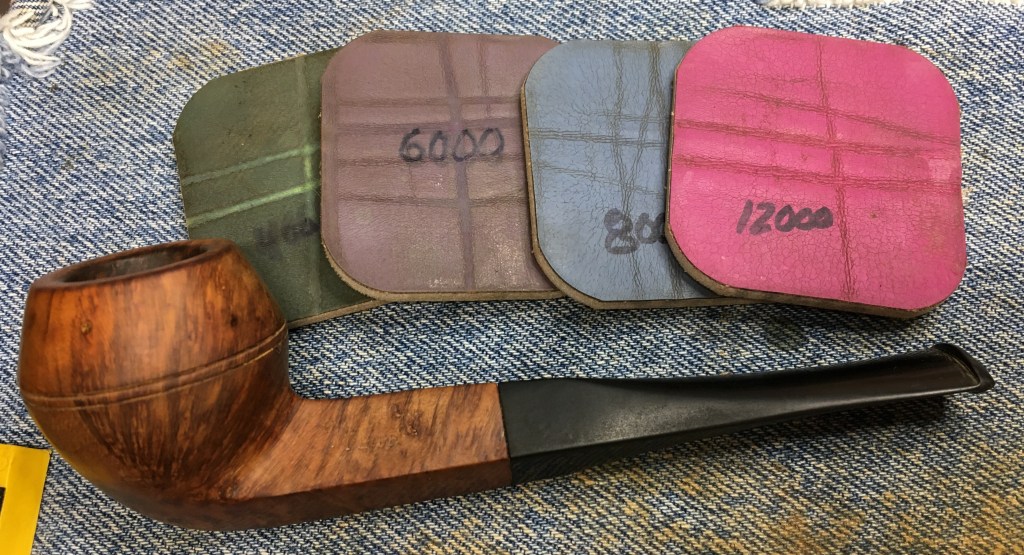
I then worked the pipe with 4000-12000 grit micro-mesh pads. Between each pad I repeated the above wiping except Obsidian Oil was used in place of mineral oil.
The pipe was then buffed with white buffing compound at the buffer.
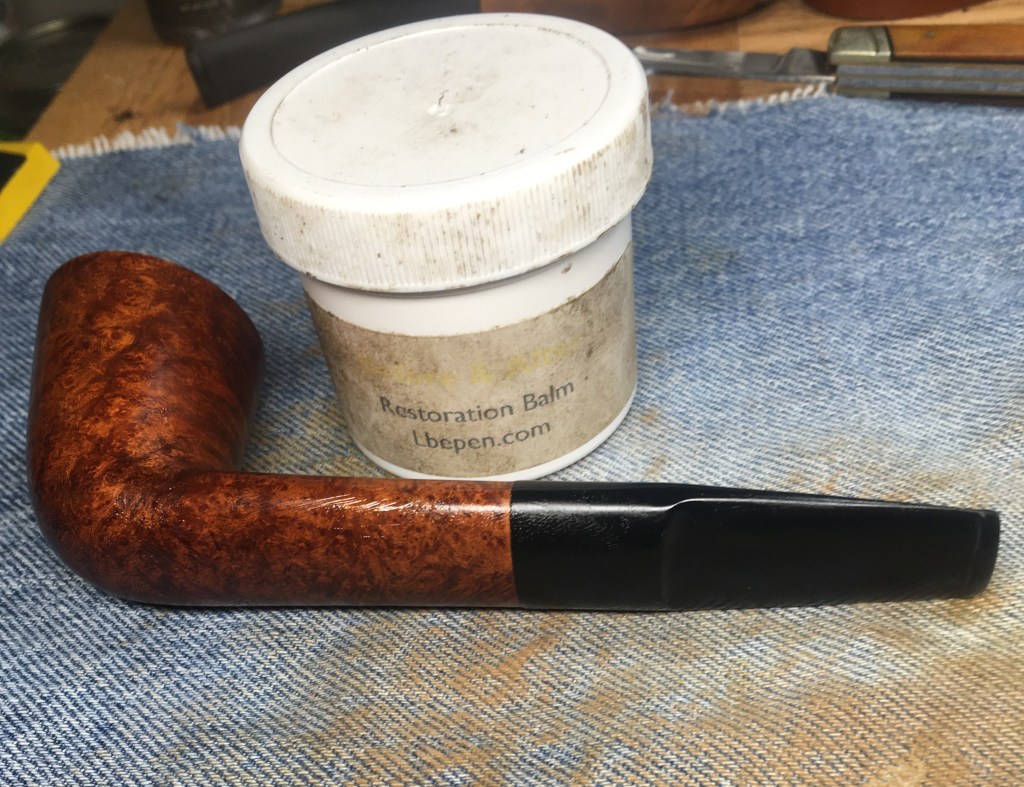
The remaining buffing compound was removed with hand buffing and a rag then wiped with a make-up pad wetted with alcohol. The stummel then received a coat of Before and After Restoration Balm and was allowed to sit for 15 minutes.
The excess Restoration Balm was wiped from the stummel with an inside out athletic sock.
The stem logo was again cleaned with alcohol and a cotton swab.
To re-do the gold logo, I used Gold Leaf Rub’nBuff applied with a fly tying bodkin.
The excess gold leaf was wiped away with a paper towel.
The stem was then polished with Before and After Fine Polish followed by their Extra Fine Polish. Both were applied and hand buffed using a soft cotton cloth.
The pipe then received several coats of carnauba wax at the buffer.
The final step was another hand buff with the microfiber polishing cloth then off to the final photo shoot.
I don’t think I’ll ever tire of working on Peterson pipes. This pipe started out not needing much but in the end it is absolutely beautiful. The bird’s eyes on both sides are gorgeous. The vulcanite stem polished very nicely and with that briar band looks amazing. I have nothing against the 01 shape, it is just not my favorite but this pipe could change my mind on that. The hand feel and balance while clenching is very comfortable. The dimensions of the Peterson Kapp-Royal 01 Bent Pot are:
Length: 5.56 in./ 141.22 mm.
Weight: 1.74 oz./ 49.33 g.
Bowl Height: 1.79 in./ 45.47 mm.
Chamber Depth: 1.57 in./ 39.88 mm.
Chamber Diameter: 0.84 in./ 21.34 mm.
Outside Diameter: 1.44 in./ 36.57 mm.
I do hope that you have found something here useful to your own pipe care, maintenance or restorations. If you like this sort of thing, please click the like and subscribe buttons. Thank you for reading the ramblings of an old pipe lover.
Loading…
Below are some photos of the finished Peterson Kapp-Royal 01 Bent Pot.
I always feel humbled when someone reaches out to me to restore an old pipe. I should say I’m humbled and nervous. It is an honor to be asked but there is always the nagging feeling or insecurity of damaging someone’s favorite pipe or worse a family heirloom. Today’s restoration emphasizes that very well. The pipe was made by Peterson, I think everyone knows my feelings toward Peterson pipes. If not, the handle Nebraska Pete Geek may give you a clue. This example was a Captain Pete, an all time favorite line. The owner reached out to me via email and lives only about 25 miles away. Crazy small world, eh? The Owner, let’s call him William to protect his identity (or less dramatic, privacy) had subjected himself to reading one of my restoration blogs. The poor guy survived the ordeal and still wanted me to take a look at this pipe. Descriptions and photos were sent and I gave an estimate of what I thought I could do for the old Captain Pete. A few weeks later the pip arrived in the mail. Below are some photos I took before starting work on the pipe.
The old Captain had seen some years in the service of a pipe smoker. The most obvious issues were the pits where the old fills had failed. The stem showed signs of oxidation and a bit of chomping. Structurally the pipe was solid and in good shape the restoration would be more aesthetic. William had said that he would like the stamping preserved as much as possible. This would be a challenge due to the faint stamps, in general and specifically for the fills on the left shank amidst the stamps.
Background
I blogged about a Captain Pete back on December 31, 2023. You can see that restoration HERE, if you are interested. That was about the second month of my blogging. Anyway, I wrote the following:
“Peterson pipes have a long and storied history which is rich and fascinating. I highly recommend the book The Peterson Pipe, by authors Mark Irwin and Gary Malmberg as well as a reading of pipedia.com’s Peterson pages. According to Mark Irwin and Gary Malmberg, the Captain Pete:
“This line’s name was derived from the nickname of Charles Peterson, known affectionately as “Captain Peterson.” The first issue, c. 1940-62, was in a smooth finish produced for Rogers Imports with a white stamped P inside C, or a circled P on the mouthpiece. CAPTAIN over PETE on shank, and a MADE IN IRELAND in a circle. English made versions show CAPTAIN over PETE on shank or “CAPTAIN PETERSON” and A PETERSON PRODUCT over MADE IN ENGLAND or LONDON MADE over ENGLAND. The second issue (1998-), features an XL bowl with Sherlock Holmes shapes and compact stems, in rustic or combination of smooth and rustic, with a nickel band between two narrow brass bands.” (Irwin and Malmberg p.295)”
(A Peterson Captain Pete Restoration – NebraskaPeteGeek) I apparently was not concerned with notating Irwin and Malmberg’s work correctly so I will make amends and do that here, (Irwin, Mark and Malmberg, Gary (2018). The Peterson Pipe The Story of Kapp & Peterson, First edition, second printing 2021. Briar Books Press, Canada.).
This Captain Pete was certainly a first issue dating from 1940-62 made in Ireland.
The Restoration
As usual after the initial photo shoot the pipe made it to the workbench and a clean piece of denim.
The first thing I did was to use a fly tying bodkin too scratch the old wax from the beading around the bowl.
Next the ream team was assembled. There didn’t appear to be a tremendous cake build up but the pipe had obviously been smoked.
The #2 blades of the PipNet did the majority of the reaming with both the Smokingpipes Low Country reamer and the General triangular scraper used for clean-up.
The shank was dirty but considering the amount of cake present I thought the previous owner had used pipe cleaners on a daily regular basis. The dental scraper was used to scrape the airway and did not produce as much tar as I was expecting.
Overall the shank cleaned out well with only alcohol dipped cotton swabs.
The stem also cleaned up fairly quickly with bristle pipe cleaners dipped in 95% ethyl alcohol.
After a light sanding of the stem with a 320 grit sanding sponge I tried to paint the tooth dents with a flame from a lighter. This helped raise the vulcanite a little bit.
The stem was then placed in a bath of Briarville’s Pipe Stem Oxidation Remover and let sit overnight.
I continued working on the stummel. Below is a photo of the rim with a light lava coating in places.
I moistened the rim with saliva to soften the lava. The rim was then scraped with a sharp pocket knife.
I used a round polyvinyl chloride (PVC) end cap wrapped in 320 sandpaper to re-establish a good bevel on the inner rim.
The stummel was then scrubbed with undiluted Murphy Oil Soap and a nylon brush. The soap was rinsed with warm water and the stummel dried with a cotton hand towel.
BAck at the workbench, the stummel was looking clean.
I gave the surface a wipe with a make-up pad dipped in 95% ethyl alcohol . Little color came off the pipe indicating that there was no wax or finish remaining on the stummel. The alcohol also helped soften the old fills allowing me to remove as much of the fill material as possible. With the stem in the oxidation remover and the stummel drying, I called it quits for the night.
The next day I removed the stem from the Briarville solution and wiped it with a coarse shop rag. This absorbed the excess solution and removed some of the oxidized vulcanite.
There remained some brown oxidation on the surface. I could not make out the stem logo that had been stamped 60+ years ago but could see the circle and imagined the P within.
The below photo shows two of the most exasperating details of this restoration: How to preserve the remaining stamps while bringing the stamped material back to life. I needed some serious thinking for this one.
I tried spot cleaning the remnant stem logo with Briarville Pipe Stem Oxidation Remover on a cotton swab. I was not impressed with the results.
Maybe if I do it some more… Still not impressed.
OK, more thinking time while I worked on repairing old fills. This was done by placing a small dab of brown cyanoacrylate (CA, super glue) into the pits using a fly tying bodkin.
More CA in pits.
A small scoop of briar dust was then pressed into the wet CA. This causes the CA to cure nearly immediately.
The rough top of the new fills were filed off with a small flat file. The fills then got another dab of brown CA to top-off the new fills. This was allowed to cure over about an hour.
The cured CA/briar dust fills were then filed smooth with a small flat or ½ round file
When finished I realized that I wasn’t finished and that I’d missed two fills. DOH! Repeating the above process except this time I ran a paper business card through the lower bead groove to remove excess CA before pressing the briar dust in and scraping the groove with a fly tying bodkin before the CA briar dust could cure.
The spot treatment of the logo area with Briarville Pipe Stem Oxidation Remover was less satisfactory than I hoped. Perhaps my solution is losing potency due to the number of stems that I have bathed in the juice? I turned to a tried and true method of removing the oxidation, SOFT Scrub on a make-up pad.
The stem was rubbed with a heavy coat of mineral oil and allowed to sit for a few minutes before I wiped the excess off with a paper towel.
Next would be the sanding. To protect those faint stamps I covered them with painters tape. The pipe was then sanded with a series of sanding sponges from grits 320-3500. Between each sponge the stummel was wiped with a make-up pad wetted with 95% ethyl alcohol. The stem was rubbed with mineral oil then wiped with a paper towel.
After the sanding sponges I worked the pipe with micro-mesh pads 4000-12000. The wiping between pads was repeated as with the sanding sponges but between pads I used Obsidian Oil rather than mineral oil.
The stummel was given a liberal coating of Before and After Restoration Balm and allowed to sit for 30 minutes.
An inside out athletic sock was used to hand buff away the remaining balm.
The pipe was then taken to the buffer for several coats of carnauba wax.
After the waxing I used a fly tying bodkin to clear the beading grooves of excess wax.
The pipe was hand buffed with a microfiber polishing cloth to raise the shine.
I gave this old Pete a bowl coating not because the tobacco chamber had any damage but because the owner had requested it and it gave me a little more time with the old Captain Pete. I used 100% maple syrup and activated charcoal powder.
The airway was plugged with a cotton swab. Another cotton swab was used to paint the chamber with a light coating of syrup. The capsule was dumped into the chamber and sealed off with painters tape over the rim. The stummel was then shaken vigorously for over a minute to evenly distribute the charcoal powder.
The tape was removed and the powder dumped.
The final step was another hand buff with the microfiber polishing cloth then off to the final photo shoot.
It is always fun to work on a Peterson pipe and working on someone else’s Peterson is like catch and release fishing. Although in all honesty, my days of collecting Peterson pipes are pretty much over. I am releasing more than I am catching today. This old pipe was a fun challenge. Yeah, I couldn’t restore it to how it looked when it came out of the factory in Dublin. The stampings and logos were just too worn and those two pits by the stamps were just taunting me to obliterate the Stamps. In the end I am happy with how the pipe turned out. The overall finish is superior to how it would have looked coming out of the factory. I do not want to be critical of Peterson but they typically only sand a pipe to 400 grit. I am pretty certain that the owner will be as happy with the pipe as I am. The dimensions of the Peterson Captain Pete bulldog are:
Length: 5.70 in./ 43.18 mm.
Weight: 1.21 oz./ 34.30 g.
Bowl Height: 1.80 in./ 45.72 mm.
Chamber Depth: 1.50 in./ 38.10 mm.
Chamber Diameter: 0.72 in./ 18.29 mm.
Outside Diameter: 1.51 in./ 38.35 mm.
I do hope that you have found something here useful to your own pipe care, maintenance or restorations. If you like this sort of thing, please click the like and subscribe buttons. Thank you for reading the ramblings of an old pipe lover.
Loading…
Below are some photos of the finished Peterson Captain Pete 155 bulldog.
Tom Howard, Tracy Mincer and Wally Frank are all names that I think of when I imagine the archetypal pipe makers of the World War II era. Yeah, I know Wally was an importer of pipes but darn it, it’s my imagination. I envision an older guy dressed in a flannel shirt under a worn leather apron, duck cotton pants, Red Wing leather boots and a liberal dusting of wood shavings sprinkled from head to toe. The workshop is equally dusty and briar shaving covered with electric light emanating from bare incandescent light bulbs swinging above each tool station. OSHA be damned! I suppose this is a romanticized image yet, it remains how I imagine the pipes of those days were made. Tom Howard pipes have always struck me as a bit chunky and unrefined, in a good way. Like a toy made by the loving hands of a grandfather for a grandchild. Grandpa’s lack of formal training, precision tooling and general lack of formal designing create a very usable toy that will most likely be used and abused. These are the jobs of both the grandpa and the grandchild. They are not making/enjoying art, they are making/enjoying life.
This Tom Howard pipe had been made to be used and used it was. I would consider it used to the point of abuse.
The original listing of this pipe was spotted on eBay and looked far better than the actual pipe. After the purchase the pipe made its way from Cedar City, Utah to the wilds of southeast Nebraska.
Upon arrival the pipe looked good overall the grime concealing most of the flaws quite well. Below are some photographs taken before any work was done.
Upon closer examination and with the bright photography lights I was able to see that this pipe had been used more than the advertised “Lightly”. The tobacco chamber was well caked and there was a significant lava deposit on the rim. There was a thin crack on the backside of the bowl which appeared to go completely through. The stem was heavily oxidized on one side but did not look as though it had been clenched or chewed. Another day in pipe restoration paradise.
Background
I have to say that I was unfamiliar with any of Tom Howard’s work outside of pipemaking. I began with a search for his pipes on pipephil.eu. Here there was a short entry:
THe next stop was pipedia.org. At that site there was more information but not a great deal. According to pipedia.org,
“Tom Howard was a popular comedian and personality in the 1940s/50s, known for vaudeville stage and radio work. But he also was a skilled pipe maker. In a Popular Mechanic article from 1947 he is written up as the “Hobbyist of the Month, Tom Howard.” He made pipes in his workshop outside his home in Red Bank, NJ. starting about 1939, and looks like into the late 1940’s or later. He purchased briar blocks by the bag as well as stem blanks, and in his well equipped shop he hand crafted his pipes, in about three hours on average. He was a true craftsman, also specializing in intricate model boats, trains and brass cannons, all built to scale.” (Howard – Pipedia)
There were also several photos of Tom Howard working in his shop. I found these interesting and includ ethem below.
This pipe was likely made between 1939-1950 in the shop of Tom Howard in New Jersey. I had done a restoration of a Greenwich pipe back in November of 2023 that restoration can be seen HERE. Little information was available other than Greenwich House Corporation of New York City produced or imported Algerian briar pipes and produced and sold a metal pipe, Thoro-Kleen.
The Restoration
The restoration began uneventfully with a cleaned piece of denim on the workbench.
I wanted to get the stem in the Briarville Pipe Stem Oxidation Remover quickly so as to speed along this project. The internals of the stem was cleaned with bristle pipe cleaners and 95% ethyl alcohol. The outside was lightly sanded with a 320 grit sanding sponge.
I quickly tapered the tenon with a countersink bit.
A pipe cleaner was inserted into the stem to act as a handle for easy removal from the solution in a few hours.
I then turned to the reaming of the tobacco chamber. The “ream team” was gathered.
The PipNet with the #3 blades started the process and quickly revealed that the tobacco chamber was quite severely charred. The Smokingpipes Low Country reaming knife was used to clean out as much of the charred and damaged briar as possible. The chamber was then sanded with 320 sandpaper wrapped around a wood dowel.
The photo below shows the sanded tobacco chamber. The walls don’t look bad but they were damaged from charring and were far from straight boring. They were actually curved out.
The bowl appeared like the advertisement below – concave walls. This was not something that I wanted to have when finished. As I continued I was contemplating remedies for this bow-bowled condition.
The airway of the shank was far dirtier than the stem had been. I started the cleaning with alcohol dipped cotton swabs and a dental scraper.
More scraping, cotton swabs, a nylon shank brush and even a brass bore brush were used.
Eventually the airway’s tar deposits were vanquished.
The stummel was taken to the sink for a scrubbing with undiluted Murphy Oil Soap and a nylon brush. The soap was rinsed with warm water and the stummel dried with a cotton hand towel.
The scrubbing had softened the old fills. They were picked from the briar using a fly tying bodkin.
There were more pits scattered around the stummel.
I was ready for the crack repair. The crack itself was small and was quite tight even though it ran a good deal of the bowl’s length. I used a 2 mm drill bit with the depth taped off with masking tape.
Three holes were drilled at different angles through the crack in the briar on each side. Brass pins were cut from a length of 2 mm brass rod.
The below photo shows the pins partially inserted and their angles.
I forced some JB Weld into the drilled hole using a fly tying bodkin. The brass pins were roughed up with sandpaper then pressed into their respective holes. I used a thin CA to penetrate the crack.
The remaining epoxy was spread into the tobacco chamber using a nitrile gloved finger. The stummel was set aside and allowed to cure/dry for 2 hours. During this time I removed the stem from deox and vigorously rubbed the remaining solution from the vulcanite.
I reattached the stem to the stummel while it was still curing. The stem like the oxidation had not been removed but this was just surface oxidation that would be removed with sanding.
After the curing/drying time, I used brown CA and briar dust to refill the excavated pits.
The stem was then sanded with a series of sanding sponges from grits 320-3500. Between each sponge I wiped the stummel with a make-up pad wetted with alcohol. Below you can see that the shank was wrapped with masking tape to keep the joint where the two pieces meet from being rounded.
The stummel was sanded with grits 320-600. The sanding avoided the stamped areas. I did not sand finer than the 600 because this was in preparation of giving the stummel a contrast dye. I don’t think the dye absorbs as well into the briar if the surface has been sanded with very fine sandpaper.
The dye kit consisted of black Fiebing’s Leather Dye, a lighter, a cork and a folded pipe cleaner as an applicator.
The dye was applied with the pipe cleaner and flamed with the lighter. This burns off the solvent portion of the dye and allows it to better stain the briar. The cork acted as a plug keeping the dye from the inside of the tobacco chamber. The stummel was then wiped with a paper towel.
I did not care about giving the dye drying time as I was only interested in the dye penetrating the softer grained briar. I took the stummel to the buffer where I buffed the black dye outer layer of briar from the stummel using the rouge compound and rouge wheel.
The resulting color is shown in the photo below. The stummel was then lightly sanded with a series of sanding sponges from 1000-3500. Between each sponge the surface was wiped with an alcohol wetted make-up pad.
The stummel was then given a coating of Before and After Restoration Balm and allowed to sit for 20 minutes.
An inside out athletic sock was used to wipe away any remaining balm.
The epoxy in the tobacco chamber had cured for about 3 hours. It still remained slightly soft. I used the PipNet with the #3 blade to remove the epoxy from the high points of the chamber. There was still a rather significant curve to the inside walls. A second batch of epoxy was mixed. I planned on using the pocket knife below as a trowel to apply the epoxy to the tobacco chamber. This epoxy sets-up in about 15 minutes so I allied the freshly mixed epoxy to sit for about 5 minutes before applying.
This application better filled the remaining low areas. I used a single finger from a nitrile glove to spread the epoxy into the low spots.
Below you can see the interior at this time. The epoxy was again set aside for a couple of hours to cure.
After the curing time, I again used the PipNet and #3 blades to remove the high spots and reform a cylindrical tobacco chamber. The results were far better with only a couple of areas that remained depressed. These were again filled with fresh epoxy and allowed to cure. I failed to take any photos, apologies. Once the final epoxy had cured for a couple of hours the PipNet was used again. This time the tobacco chamber had been restored to a nice cylindrical cavity. I had to wait overnight to allow the epoxy to fully harden enough for sanding. The next day the tobacco shamber was sanded with 320 sandpaper. I wanted a good bowl coating to cover the epoxy and chose to use 100% maple syrup and carbon powder for the coating. A cotton swab was used to apply an even coating of syrup to the tobacco chamber. A pipe cleaner was inserted into the airway to prevent syrup and carbon powder from entering.
A capsule of carbon powder was poured into the chamber/
The rim was covered with a piece of masking tape.
The stummel was then shaken, rotated, shaken, rotated, shaken, etc… After a few minutes of this the tape was removed and the remaining powder dumped. The resulting bowl coating would take a couple of days to dry.
The final step was a hand buffing with a microfiber polishing cloth further improving the shine.
Tom Howard made a sturdy pipe and this one withstood the abuse of hard use and time and came through it still smoking. I am very pleased with how well this old pipe turned out even though it took days longer than I had intended. The briar grain is quite pretty and the contrast dye brought the grain forward. The sturdy shank compliments the round bowl nicely. Pinning the cracked bowl with 3, 2 mm brass pins winn undoubtedly hold the crack together and not allow it to be an issue in the future. The old vulcanite polished up beautifully and the high gloss finish accentuates the black dye contrasts in a cohesive fashion. I am sure this old pipe will be a sturdy smoking companion for many years to come.The dimensions of the Tom Howard Billiard are:
Length: 5.72 in./ 145.29 mm.
Weight: 1.59 oz./ 45.08 g.
Bowl Height: 1.97 in./ 50.04 mm.
Chamber Depth: 1.52 in./ 38.61 mm.
Chamber Diameter: 0.80 in./ 20.32 mm.
Outside Diameter: 1.55 in./ 39.37 mm.
I do hope that you have found something here useful to your own pipe care, maintenance or restorations. If you like this sort of thing, please click the like and subscribe buttons. Thank you for reading the ramblings of an old pipe lover.
Loading…
Below are some photos of the finished Tom Howard Billiard.
I think this totally counts as a Peterson. Given the poor darling didn’t make the quality assurance cut to the “big leagues” but the 02 shape is more of a rarity for Pete Geeks. I remember three years ago when I started to get more serious about restoring old pipes, that you could pick up a Peterson System Standard on the estate market for around $45. Over the past few years this has increased significantly. Perhaps another indicator of inflation or maybe just a growing interest in our beloved hobby. When I saw this pipe on eBay, I knew I had to try for it. I was surprised that I won the auction and soon had the Irish Lassie in hand. Below are a few photos or the pipe prior to any work done.
From what I could see the issues with this pipe’s briar were only cosmetic and would be dealt with accordingly. The pipe looked like it had only been smoked a few times. I think I could imagine why that button was horrible. It felt thick and chunky, like something made of Legos. Clenching that would be like getting X-rays at the dentist.
Background
I cannot begin to describe the history nor impact of the Peterson pipe company. I can tell you what I think is the best source of information on the subjects and that is Mark Irwin and Gary Malmberg’s book, The Peterson Pipe The Story of Kapp & Peterson. According to the authors,Peterson’s seconds are as follows,
“Seconds Peterson seconds are pipes of all shapes with briar flaws deemed unacceptable for ordinary models and sold at reduced prices, sometimes unstained, fit with fishtail or round button mouthpieces. Since the early 1990s they have only been available in Ireland. Occasionally they are described in Peterson catalogs under different names, and documented specimens have various stampings. In roughly chronological order these include:
Stamped arched KAPP & over straight PETERSON”S over arched DUMMIES An early specimen preserved at the Peterson museum with this stamp has a round-button mouthpiece.
IRISH FREE STATE stamp (1922-37) COM stamp with no brand or model name. Documented with or without nickel bands.
System Reject (1968-) Noted first in the Price List for January 1968 as being available in all six system shapes. Also found in the ‘80 Peterson-Glass Price List.
Erica System Reject (1987-98)Noted in two US distributor catalogs. Fishtail mouthpiece, unstamped nickel band, with COM of MADE IN THE over REP. IRELAND or with no COM.
Irish Seconds (1982-98) Classic Range shapes stamped with no brand name , fishtail mouthpiece, in unstained, black rustic or dark brown finishes, no band. (Irwin, Mark and Malmberg, Gary (2018). The Peterson Pipe The Story of Kapp & Peterson, First edition, second printing 2021. Briar Books Press, Canada. p312).
Mark also writes a weekly blog titled Peterson Pipe Notes. If you have not already subscribed I highly recommend it. It will be one of the best $0 purchases you can make and is a vault of information on all things Peterson and various other topics. I am not just saying that because Mark has posted a few of my restorations either. His blog concerning the Irish Seconds is very well researched, written and can be found here: https://petersonpipenotes.org/tag/irish-seconds/.
Now for the Oom Paul shape. Here I’ll let Mark sing the praises of the history of the shape and the Peterson pipes of note:
So, when was this particular Peterson Oon Paul made? I really didn’t know. The 1976 catalog mention might be useful but it precedes the use of the IRISH SECONDS stamp by 16 years. I reached out to Mark Irwin and provided him with photos. Here is what he had to say, “This appears to me to be the 1988 Dublin Millennium edition. That would fit with the IRISH SECONDS stamp and the shank bend. The IS would have been sold in Ireland, almost entirely, but perhaps some escaped their island prison. We can confirm that with a quick measurement of the chamber diameter and the bowl diameter if you like, but I’m 99% positive.” (Mark Irwin, personal email). I replied to Mark by sending him the dimensions. His reply to those was, “That’s it!” This concltudes the search, in my book. THis is a 1988 Dublin Millennium edition Peterson 02 that didn’t meet the quality standards of Peterson and was thus labeled an Irish Seconds by the good folks in Dublin Ireland.
The Restoration
The restoration began with a clean denim piece for workbench protection.
Augh, the terrible button would be the first issue addressed with this pipe.
Apparently the previous owner tried to customize the button using their teeth and jaw power.
Impressive as their chomping was, I thought a file would be a better tool than my teeth.
I used large and small flat files to reduce the size of the button and soften the edges.
Below are photos of the top and bottom after filing.
An emery board, for filing fingernails was also used for more final shaping.
The shank was then taped using panthers tape to protect it from the stem sanding. The stem was initially sanded with a 320 grit sanding sponge.
Airway cleaning was done with bristle pipe cleaners dipped in 95% ethyl alcohol.
The stemm was then placed in Briarville Pipe Stem Oxidation Remover (deox) and allowed to sit overnight.
I turned my attention to reaming the stummel. I gathered the ream team: PipNet with #2 blades, General triangular scraper (with the tip ground round) and the Smokingpipes Low Country reaming knife.
This pipe had not been heavily smoked so the reaming was quickly handled.
Below is a photo of the reamed tobacco chamber.
The chamber was sanded with 320 sandpaper wrapped around a wood dowel. The sanded chamber showed no signs of any damage from heat save the small charred spot on the rim.
A better view of the sanded tobacco chamber can be seen below.
The stummel was taken to the sink for a scrub with undiluted Murphy Oil Soap and a nylon brush. The soap was rinsed with warm water and the stummel dried with a cotton hand towel.
I believe this to below photo best describes why this pipe was considered to be an Irish Seconds, the number of flaws leading to fills in the briar. I counted 11 on the left side alone. The old fill was picked from the briar using a fly tying bodkin.
The front only had two spots to pick then fill.
The right side with its birdseyes also had a couple of spots.
The rim had fills and a couple of cosmetic cracks. These were not deep structural cracks.
I used brown cyanoacrylate (CA, super glue) placed into the pits. I then pressed briar dust into the wet CA. This new fill sets up quickly. The excess briar dust was brushed off using a wire brush.
The same process was used on the other fills.
Once cured the new fills were filed with a small flat file to smooth them.
This was repeated on each side.
The fills of the cosmetic cracks on the rim were done with brown CA alone, no briar dust though, briar dust was used in filing the pits. The entire stummel was then lightly sanded with 320 and 400 grit sanding sponges taking care to avoid the stamps on either side of the shank.
The next day I removed the stem from the Briarville deox.
The Briarville solution evaporates quickly. While still wet I vigorously rubbed the stummel with a coarse shop rag to remove some of the softened oxidized vulcanite.
Back at the workbench the oxidized vulcanite was easily seen as a buff colored coating on the stem.
The stem also showed another aspect of Irish Seconds that I’ve not seen in Peterson pipes, poor finish sanding of a stem. I could still see the marks from the molding of the stem.
The fit of the stem to shank was very good with a fine tight fit and no gaps.
I again taped the shank, this time with masking tape. Masking tape is thinner and is less likely to produce a step from the stem to the shank.
The stem was sanded using a series of sanding sponges from 320-3500. Between each sponge the stem was rubbed with mineral oil and wiped with a paper towel.
I masked the stampings on both sides of the shank with masking tape.
The stummel was then sanded with a series of sanding sponges from 32-3500. Between each sponge the stummel was wiped with a make-up pad wetted with alcohol to remove sanding debris.
The tasking tape was removed and the adhesive wiped clean with alcohol. The pipe was then worked with micro-mesh pads 4000-12000. Again the stummel was wiped with an alcoholic make-up pad (I think that’s funny).
The stem was rubbed with Obsidian Oil and wiped with a paper towel between micro-mesh pads.
I coated the stummel with Before and After Restoration Balm and allowed it to do what it does for 20 minutes. The excess balm was wiped from the stummel using an inside out athletic sock.
The pipe was then taken to the buffer where it received several coats of carnauba wax.
The final step was a hand buffing with a microfiber polishing cloth further deepening the shine.
This not so typical Peterson shape, I mean, Irish Second, turned out very nicely. The fills are far less noticeable and the stem far more comfortable than when I started. Weight of the pipe is inconsequential hanging from the lower jaw and it would be an exceptional clencher. I was very happy with how well the stem turned out. The high gloss black looks outstanding with the more natural Briar and the briar grain, though not fantastic, is quite lovely. This old pipe may never win a beauty contest but it will serve very well as a useful pipe in someone’s rotation. The dimensions of the Irish Seconds Oom Paul are:
Length: 6.00 in./ 152.40 mm.
Weight: 2.39 oz./ 67.76 g.
Bowl Height: 2.25 in./ 57.15 mm.
Chamber Depth: 1.95 in./ 49.53 mm.
Chamber Diameter: 0.74 in./ 18.80 mm.
Outside Diameter: 1.38 in./ 35.05 mm.
I do hope that you have found something here useful to your own pipe care, maintenance or restorations. If you like this sort of thing, please click the like and subscribe buttons. Thank you for reading the ramblings of an old pipe lover.
Loading…
Below are some photos of the finished Irish Seconds Oom Paul.
You know when you see something and the little voice in your head says, “Wait! There’s something peculiar about that”? That is exactly what happened when I was perusing eBay and saw this pipe. I can’t recall if it was the photo or the header, “James J Fox Made in Dublin Ireland Pipe” that caught my eye but one of them gave me a temporary case of whiplash. Now, we all know what a pipe made in Dublin actually means but what is this James J Fox stamp? A distant relative of Wileward Ethelbert Coyote, perhaps? (Wile E. Coyote for those non-cartoon-culture savvy). Even with less than stellar photographs, I knew I had to lay hands on this lass. The button was clicked, money sent and the pipe arrived. Well, it was a bit slower than that but you get the idea. Upon arrival, I got a good look at the stampings. Top left, Fox over Special in a flowing script. This one was faint, not worn, just faint. The top right shank had MADE IN DUBLIN over IRELAND. Again the stamp was faint but only in the middle top portion. Almost as if the stamp was not flat. The final stamp was on the lower left face of the shank and it read, JAMES J FOX over DUBLIN LONDON. The photos below show the pipe as it appeared before any work was done.
This looked like it would be a straightforward restoration with no real obstacles. Yeah, the stem was oxidized and there was some weird stain on the front left of the bowl but the stem fit was great and the rim indicated that the previous owner took care of this pipe or hadn’t used it extensively.
Background
I went directly to the James J. Fox website as the start of the background search. Here it states the following:
“We have been trading in fine tobacco and smokers’ accessories from 19 St James’s Street since 1787 and our customers have included discriminating smokers from all walks of life – from commoners to kings. Among them have been Sir Winston Churchill, Oscar Wilde, British and Foreign Royalty, the officer’s mess of famous British regiments, and the leading lights of the stage, film, sport, tv, radio, music and literature.
Our world famous tobacco business started with Robert Lewis, who began trading fine tobacco in St James’s Street in 1787. James J Fox was formed in Dublin in 1881 and opened its first tobacco shop in London in 1947. Fox acquired the business of Robert Lewis on 14 September 1992, uniting two of the most respected names in the cigar world. Both companies now trade as JJ Fox (St James’s) Ltd and run the cigar departments of Harrods and Selfridges.” and about their founder,Frederic James Fox (1913-1990) “Born in 1913, Frederic (Freddie) was the fourth of five children and the youngest of James Fox’s three sons.He found himself in charge of the family business, a single cigar shop on Dublin’s Grafton Street, after the untimely death of his two brothers. Stanley Fox was shot dead by armed thieves thought to be members of the IRA in 1926, while Ronald (Biffy) was missing in action over the Dutch coast in 1942 during an RAF mine laying mission. Freddie, not content with just one shop, took the business from strength to strength. He established a successful import and wholesale business in Ireland alongside the world’s first Duty Free outlet which expanded the retail cigar business into London. He developed numerous brands including Punch Nectares, Bolivar Amado, Hoyo Royal Hunt and La Corona Policromia, and established the Astor Tobacco Company. His enterprising nature also saw Freddie acquire and develop a successful import and wholesale business in the Channel Islands; and he oversaw the origin of the business’s entry into the property markets, developing several high profile office buildings in St Helier, Jersey including Sir Walter Raleigh House on the Esplanade. Freddie Fox died in 1990. He is still sorely missed by his family, friends and colleagues from the cigar industry. Were he to be asked to comment on his career achievements, he might say :
For a far more complete history of the James J, Fox shops and their history I will refer to Mark Irwi’s Peterson Pipe Notes blog, 157. The James Fox – Peterson Small Batch Lines: An Interview with Yiorgos Manesis (157. The James Fox – Peterson Small Batch Lines: An Interview with Yiorgos Manesis – Peterson Pipe Notes). Yiorgos Manesis says in Irwins blog, “They used to make their own pipes here, a small factory for a few years. It didn’t last long, and only two or three people worked there. I don’t know if they were turning bowls, or just getting bowls and finishing them here. They were involved in all parts of the tobacco business—they were making pipes, hand-blending their own pipe tobaccos. And Freddie Fox, who was Robert and Stuart Fox’s [the 5th generation owners] grandfather, was a very intelligent, savvy man.” (157. The James Fox – Peterson Small Batch Lines: An Interview with Yiorgos Manesis – Peterson Pipe Notes). Now is this pipe one of those made by Fox?
I sent some photos to Mark Irwin asking him what he thought of this pipe soon after it arrived. His response was, “Boy oh boy! Isn’t this COOL? Does it look like the Peterson 493 shape to you? It pretty much does to me. These James Fox / Peterson pipes are really scarce. Yes, please let me know when you run the blog post, as I want to point everyone out to it as well as include at least one of these photos to help them get to your blog.” (Mark Irwin, personal email). I cannot say that I was terribly familiar with the 493 shape so that is where I went hunting.
Mark’s Peterson Pipe Notes provided me with two wonderful posts describing the development of Peterson’s bulldog shapes. Blogs 388 (1891-1919) and 390 (1920-1947) detail the development of shaps during the years in parentheses.
“Two years after hostilities ended and bringing our survey of the IFS and Éire eras to its conclusion is the fullest flowering of bulldogs in K&P’s history, before or since: the distributor’s catalog c. 1947. Three squat bulldogs, the 493, 494 and 495, all reintroducing the “Cad” name. The 170 / 175 and 150 /155 don’t appear to be different shapes, but merely different stems—one saddle, one bent.”
(https://petersonpipenotes.org/390-a-visual-history-of-petersons-bulldog-shapes-part-2-from-the-end-of-the-patent-through-the-irish-free-state-and-eire-eras/ highlight added by me). In examining the James J. Fox and comparing it to the 493 from the diagram above the shape looked very similar. Mark appeared correct but one thing which struck me was the saddle stem. The 493 looks to have a saddle that tapers slightly from the shank towards the button.This narrowing is completely absent in the Fox Special, if anything the Fos pipe has a reverse taper. Using my micrometer I checked the width at the shank, 0.72 (18.4 mm) inches and at the opposite end of the saddle, .74 inches (18.8 mm). This is far from definitive proof that the pipe was made in the short lived James J. Fox shop but it does make me say, “Hmmm.”
Though lacking a shape number, the Fox Special must be regarded with some suspicion. Mark thought it looked like a Peterson 493, and I concur with estimated measurements from the shape charts the dimensions do fit nicely. The 493 shape existed through the 1970s as evidenced in a chart and description, “This shape chart from Associated Imports point-of-sale brochure leUS pipe smokers know what shapes they might expect in non-System pipes. Note several rare, currently sought-after shapes by collectors: the XL02, XL999, XL493s, 124 and 120F.” on page 170 of The Peterson Pipe The Story of Kapp Peterson (Irwin, Mark and Malmberg, Gary. Briar Works Press. 2018, First Edition, second printing 2021. Printed in Canada).
So, we are left with little but supposition, assumptions and conjecture, three great words, but hardly a definitive date of birth nor maker for this lovely pipe. Ath the end of this blog I show the measured dimensions of the Fox Special. If you compare the dimensions of this pipe to the listing of a Peterson 493 from smokingpipes.com there remains little doubt of this pipe’s heritage.
The Restoration
As usual the pipe was introduced to the workbench with a cleaned denim piece. I say cleaned because though laundered, stains aplenty remained.
I began with a quick prep of the stem for a bath in Briarville’s Pipe Stem Oxidation Remover. This product was sent to me by Richard Messineo of Briarville to try. Again I wish to thank Richard for the chance to test this product. The stem was lightly sanded with a 400 grit sanding sponge.
I then cleaned the airway with bristle pipe cleaners dipped in 95% ethyl alcohol.
The stem was submerged in the Briarville solution. The label instructions say 2-24 hours. I allowed this stem 13 hours of exposure.
In the meantime I began reaming the tobacco chamber.The tools of choice were the PipNet, Smoingpipes Low Country Reamer and the General triangular scraper (with the tip ground round).
The number 3 blades of the PipNet did the lion’s share of the work with the General coming in for clean-up.
The tobacco chamber was sanded with 220 sandpaper scraped around a wood dowel. The chamber appeared free of any heat damage or charring.
Next came the cleaning of the airway. This was done with numerous cotton swabs and bristle pipe cleaners both dipped in 95% ethyl alcohol as well as some scraping with a dental scraper.
The stummel was taken to the sink for a scrubbing with undiluted Murphy Oil Soap and a nylon brush. The soap was rinsed with warm water and the stummel dried with a cotton hand towel.
Back at the workbench the stummel looked better but the stain at the front right remained.
A wipe with 95% ethyl alcohol on amake-up pad removed a bit of color, probably old wax and stain.
The stain persisted.
As a remede, I thought maybe oxalic acid would bleach the stain.
I used a saturated solution of oxalic acid applied with a cotton swab on the stain. The swab assumed an orangish color.
After the oxalic acid had sat for 30 minutes I returned the stummel to the sink for another scrub with Murphy Oil Soap. I figured the basic nature of the soap and copious rinsing would neutralize the acid and rinse any remnants. Once dry the stummel appeared as below. The stain was vanquished.
The next day I returned to the stem. The Briarville Pipe Stem Oxidation Remover is getting darker in color. I am not sure how many stems this product is able to treat. I think this was number 3 or 4.
The stem was removed and was vigorously rubbed with a coarse shop rag. Below you can see that some of the oxidized vulcanite was removed onto the rag.
The stem looked much better.
I scrubbed the stem with Soft Scrub cleanser on make-up pads to remove more of the oxidized vulcanite.
The stem was then coated with another product, Before and After Hard Rubber Balm. This product was sent to me from Mark Hoover to try. Thank you, Mark. I really like this balm for treating vulcanite stems after they have been restored. It is more viscous than Obsidian Oil and I think it lasts longer than Obsidian Oil in protecting polished stems.
In preparing the stummel for sanding, I covered the stampings with masking tape. I prefer to cut slightly irregular pieces of tape for this as they do not give as blocky a look to the unsanded areas under the tape.
The stummel and stem were united during the sanding to avoid rounding the joint between the two materials at their seam. The sanding was done with a series of sanding sponges in grits of 400-3500. Between each sponge the briar was wiped with a make-up pad dipped in alcohol to remove sanding debris. The stem was rubbed with mineral oil and wiped with a dry paper towel between sponges.
The tape was removed and the pipe micro-meshed with pads 4000-12000. The above between pad wiping was done as with the sanding except I used Obsidian Oil rather than mineral oil.
The stem was polished with Before and After Fine followed by Extra Fine Polish.
Each was applied by finger then hand buffed using a soft cotton cloth.
The stummel was then covered with a liberal coat of Before and After Restoration Balm. I let the balm work its magic for 20 minutes.
The excess balm was hand buffed with an inside out athletic sock to remove it and reveal the revived briar grain.
The pipe was then taken to the buffer for several coats of carnauba wax. I used a fly tying bodkin to remove the xa deposits from the beading around the rim. The final step was a hand buffing with a microfiber polishing cloth further deepening the shine.
I think this Fox Special turned out very well. This stained spot and stem were the two areas I was most concerned about, both turned out exceptionally well. The high gloss black vulcanite really accentuates and contrasts the briar grain. The condition of the rim makes the pipe look like it is a brand new specimen rather than a restored old beauty. The stampings, though faint, can all be made out and add to the mystery of this pipe provenance. Peterson product or not, it is a beautiful Irish Lass.
The dimensions of the James J. Fox, Fox Special are:
I do hope that you have found something here useful to your own pipe care, maintenance or restorations. If you like this sort of thing, please click the like and subscribe buttons. Thank you for reading the ramblings of an old pipe lover.
Loading…
Below are some photos of the finished Royal Guard 522.
I don’t understand how the red in pipes is so difficult to capture in photographs. The oxidation is easy to capture and this stem had plenty of that. The rim was coated in a layer of lava indicating a fair amount of use but the tobacco chamber was pretty clean. Perhaps the previous owner liked to keep the cake to a minimum but was not concerned about rim maintenance. I did not like the look of the clear coat on the pipe and hoped that would be easily removed. Overall this looked like a straightforward restoration.
Background
I can barely say anything about this pipe. Pipedia.org has nothing on Marseille. Pipephil.eu has the following:
Which, in all honesty, is the same as nothing. The pipe has no country of manufacture (COM) stamp but, if I were a betting man, I’d bet on France. Marseille makes me think of Marsielle Marso but I kind of dislike bringing that up due to the dislike of mimes in general by AMericans. At least in my experience mimes are not appreciated.
Smokingpipes.com has two old estate pipe listings. One by Butz-Choquin
Both Butz-Choquin and Chacom are French pipe makers although the lack of any maker’s stamps or COM on the Marseille at hand opens any conclusion I make to pure speculation.
The Restoration
This is the second pipe of the double restoration. The first was the E. Wilke Squashed Apple. If you missed that restoration there is the link. I said in that one that I do not normally like to work on more than one pipe at a time. Anyway, here is the Masrielle situated on a clean denim piece.
I lightly sanded the stem with a 400 grit sanding sponge. I was careful to avoid the stem logo.
Next the tooth marks were filed smooth with a small flat file.
The stemairway was cleaned with 95%ethyl alcohol and pipe cleaners. The button was a little bit constricted so I used a Vermont Freehand Slot Funneling Tool to clean up the slightly off-center drilling. I also used a piece of emery board (fingernail file) to sand the airway at the button.
The stems of both project pipes were suspended in Before and After Extra Strength Deoxidizer (deox). The stems were left in the solution for four hours.
I returned to the stummel and cleaned out the airway within the shank. 95% ethyl alcohol with cotton swabs and a nylon shank brush were the tools of choice here.
Next came the ream team: The PipNet with #2 blades, the Smokingpipes Low Country Reamer and the General triangular scraper with the tip ground off, round were called up for duty.
They all served valiantly with the PipNet doing the lion’s share of the work.
Once sanded Chuck marks within the tobacco chamber could be observed. This told me that the pipe, though used, had not experienced a lot of use.
The stummel made her way to the sink for a scrubbing with undiluted Murphy Oil Soap and a nylon brush. The soap was rinsed with warm water and the stummel dried with a cotton hand towel.
The scrubbing did not remove the lava from the rim as well as I had hoped. Back at the workbench a wipe with ethyl alcohol on a make-up pad barely touched the clear coat and the lava.
The rim required a bit of scraping with a sharp knife. Saliva was applied to soften the deposits on the rim prior to and during the scraping.
It was looking better.
The problem with a good scraping was what it uncovered. The absence of the lava highlighted some dings on the rim. Topping would be my solution to this.
I wondered if wiping the stummel with acetone on a make-up pad would be sufficient to dissolve away the clear coat.
The acetone was working but oh, so slowly.
Light sanding helped etch the coating but it was still a slow process.
I decided to give the stummel a 30 minute bath in acetone.
After 30 minutes the stummel was removed and wiped with another make-up pad.
The shininess of the clear coat was gone and with it most of the red stain.
The four hour deox bath ended and both stems were set up to drip excess deon solution back into the jar.
The Marseille stem was vigorously rubbed with a coarse shop rag to remove both the remaining deox solution and some of the oxidized vulcanite.
The stem was scrubbed with Soft Scrub cleanser on a few make-up pads to remove more of the stubborn oxidized vulcanite.
Both stems were oiled with mineral oil and set aside overnight.
I returned my attention to the stummel. I wanted to try to return it to the reddish brown. I assembled the materials needed to dye the stummel; Dark Red Fiebing’s Leather Dye, a lighter , a wine bottle cork and a pipe cleaner. The cork was to be both a plug, keeping dye out of the tobacco chamber and a handle. The lighter, for flaming the wet dye, allowing the alcohol solvent to burn off and set the dye to the briar and the pipe cleaner as an applicator.
Below is the freshly dyed stummel in red.
The stummel was allowed to air dry another 30 minutes at the workbench.
A second dying was done with mahogany Fiebing’s Leather dye and the same process as with the red dye.
Below is the freshly dyed stummel with mahogany over the red dye.
This too was allowed to dry for 30 minutes before lightly wiping the stummel with a make-up pad wetted with 95% ethyl alcohol.
The stamps were taped with painters tape to protect them during the sanding to come.
The stem and stummel were reconnected and sanded together. A series of sanding sponges in grits of 600-3500 were used. Between each sponge the stummel was wiped with an alcohol dampened make-up pad to remove sanding debris. The stem was rubbed with a light coating of mineral oil and wiped with a paper towel between sanding sponges. You can see in the photo below where I wiped the sponges off on the denim. It not only protects the workbench surface but is a great place to wipe sanding sponges.
The stummel was then worked with micro-mesh pads 4000-12000. The wiping of the stummel with a make-up pad was repeated as was the oiling and wiping of the stem.
The pipe was taken to the buffer for several coats of carnauba wax. The final step was a hand buffing with a microfiber polishing cloth.
I said it before and I say it again, I am developing an appreciation for the oval shank. It is a feature that provides a more robust feel in the hand while retaining a more elegant contour in profile. I am sure the extra briar also provides additional strength for those who are a bit more hard on pipes. The oval shanked volcano of this Marseille restored beautifully. The dye turned out lovely and the factory staining was fairly well mimicked. The stem oxidation was problematic with the loss of the logo disappointing. I admit that I am not finished with this restoration. I am waiting for another brand of stem deoxidizer which a supplier has sent me to try. I want to try it on this stem and report the findings when I have used the product. Stay tuned for updates. Overall I am very pleased at how well this pipe turned out. The dimensions of the Marseille Oval Shank Volcano are:
Length: 5.05 in./ 128.27 mm.
Weight: 1.47 oz./ 41.67 g.
Bowl Height: 1.84 in./ 46.74 mm.
Chamber Depth: 1.47 in./ 37.34 mm.
Chamber Diameter: 0.76 in./ 19.30 mm.
Outside Diameter: 1.56 in./ 39.62 mm.
I do hope that you have found something here useful to your own pipe care, maintenance or restorations. If you like this sort of thing, please click the like and subscribe buttons. Thank you for reading the ramblings of an old pipe lover.
Loading…
Below are some photos of the finished Marseille Oval Shank Volcano.
I will probably catch grief for calling this a squat apple and be corrected by some saying it is a tomato or an author but to my eye, it looks like an apple and to be specific an Cortland Apple sans the anthocyanins and their red. Sorry, my previous life as a chemistry teacher emerged and demanded recognition. This plump little darling caught my eye along with its long shanked Marxman coconspirator. The eBay listing only had two photos, the below is a screenshot of one of them:
Those adorable chubby cheeks demanded that I buy the pair. There was a little bit of drama but I’ll leave that to the blog about the Marxman but after a few days wait, the E. Wilke and Marxman both arrived.
Below are some photos of the pipe prior to working on it.
Yeah, it had some issues but that shape, that amazingly round bowled shape. I was smitten. The stem looked like a Weber that had been left out in the sun. The pipe had obviously been smoked and showed the signs of moderate use, as shown by the charring and lava on the rim. There was also that strange dark streak of the right shank and that truly dreadful fissure on the bottom of the shank but those chubby cheeks could not be denied. I would reclaim this dilapidated doll and make her mine.
Background
E. Wilke stamped on the shank of this pipe refers to Edwin Wilke. According to pipedia.org,
“Edwin Wilke founded Wilke Tobacco in 1872. As the story goes, according to a 1937 New York World-Telegram article, he had no sons, and so he taught his two daughters, Anna and Louisa Wilke, how to make pipes and blend tobacco, and by his death in 1930 they were well versed in both trades, and adamant about only using quality briar. In 1950, when they were the focus of an article in the Sarasota Herald-Tribune, they were the only women pipe makers in the United States, and had sold pipes to Herbert Hoover, Lord Halifax, John Steinbeck and others. The sisters also blended pipe tobacco and repaired pipes. They did not, however, smoke pipes.
Wilke prided itself on “unpainted pipes”, and promised that only Macedonian briar was used, without paint, varnish, plug, or putty of any kind. As of 1950, some of their pipes were selling for up to $100.00, or just under $1,000.00 dollars today. By the release of a 1970 New York Magazine highlight of the shop, that claim had risen to $500.00, or over $3,000.00 today.
The Wilke Pipe Shop was located for decades at 400 Madison Avenue and 48th, in New York City, and in the 1970s opened a satellite store in the famed Wanamaker’s department store in Philadelphia, selling Wilke pipes made by Steven Johnson. In 1983, the brand was purchased by pipe maker Elliott Nachwalter and his wife, Carole Burns. They continued to operate the Madison Avenue store until the early 1990’s, at which point the couple moved to Vermont and Pipeworks & Wilke was born as a mail-order business.
Carole Burns[1] continued blending tobacco in Montpelier, Vermont till July 2017. Now John Brandt looks to continue blending Wilke’s traditional blends and bringing back some of the older blends from the early days to keep the 145 year old brand alive and growing.[2]“ (Wilke – Pipedia)
Now, this pipe did seem to fit a couple of the characteristics from the pipes.org article; it was unvarnished and it did not seem to have any putty filling imperfections in the briar. I cannot speak to the “Macedonian briar” as there is no stamp indicating the origin of the briar. I still think that the stem of this pipe reminds me of Weber made pipes from the same era. In researching further I found an old Google Groups discussion of E. Wile pipes from 2002. Here the user “” started a thread with the following,
“Can anyone give me a brief history about this manufacturer or brand? I
am curious about… if this was a NY company that made pipes, still in
The interesting part came from another user named “LDaneman”. LDaneman, states the following”
“As a former employee and pipemaker for Edwin Wilke Company, I can give you a
little history. The little shop on Madison Avenue was purchased by a Stanley Becker, a jewish NY lawyer. Some pipes were left over from Wilke’s hey-day, . . . I forget the name of the Italian pipemaker who did extra-large art deco shapes.
Through the 80’s the old (80+) tobacconist still blended up on the 4th Floor and I have fond memories of ‘time-traveling’ with him. The 524 blend was better than Dunhill, and the 400 was pretty good as well. The key was an unflavored golden Cavendish and a dark fine cut Cavendish in the 524.
I started a new pipemaking workshop in Philadelphia for Wilke’s concession shop in John Wanamaker’s department store. Our pipes made national news and we shipped tobaccos to European customers. My pipes sold from $65 to $1000 but our main pipemaker was Stephen Johnson. Last I heard Steve worked for Zino Davidoff.
Steve made some sweet smoking pipes and I smoke a few of my own make with the Wilke stamp, but still own a couple by Steve as well.
I was fired under dubious circumstances. The management of Wanamakers hated me since I successfully marketed Eltron razors when they failed, pens, and really hit the roof when I began blending a men’s fragrance.
Wilke in Philly folded less than a year after my departure into the perfume business and the New York shop was sold soon after that. I heard Wilke finally vanished after the buyer was hit with unpaid employee taxes and was bankrupted, but that is just a rumor to me, . . . I don’t know if that is true or not.
Most the Wilke pipes are not especially good, mass-manufactured by a factory whose name escapes me. Unless made by the old Italian fellow (an indented tenon is usually an indication of his make) or by Steve Johnson, . . . well just forget it.
Now, I have no reason to doubt anything that LDanman writes. The pipeda.org information indicates that the location of the Wanamaker’s in Philadelphia occurred in the 1970s and that LDaneman “Set up a new pipe making shop” on Wanamakers mezzanine. This too would likely be during the 1970s. His knowledge of the company is interesting but his jumping around in time, frustrating. The part about the Weber made pipes was particularly interesting as I thought the stem of this pipe looked like a Weber made stem.
The Weber connection is further supported by information again from pipedia.org,
“The firm grew to be one of the giants of the American pipe industry focusing itself in the middle price and quality zone. Trademark: “Weber” in an oval. Beside that Weber – especially in the years after 1950 – was a most important supplier for private label pipes that went to an immense number of pipe shops. Alone in New York, exactly the same pipes were found at Wilke’s, Barclay Rex, Trinity East, Joe Strano’s Northampton Tobacconist in Ridgewood, Queens, Don-Lou in Bensonhurst, Brooklyn… Nearly all pipes for Wilke were unstained and many models, for example the “Wilke Danish Bent”, could hardly deny originating of Weber.” (Weber Pipe Co. – Pipedia)
So, the question remains, “who made this pipe and when?” I honestly do not know. I feel pretty sure of my original thought that this was a Weber made pipe, likely from the 1970 or later. Produced for the E. Wilke company.
The Restoration
As usual the pipe made its way to the workbench and a clean denim piece. I actually undertook the restoration of two pipes during this project. That is not something I really like to do but my schedule has been filled with essential time sucking activities. Okay, I’ve been doing a bit of fishing and have not been at the workbench as much as I should.
The stem required some work before I could put it into the Before and After Extra Strength Deoxidizer solution (deox). This will be called pre-deox and involved; some scraping of calcium/oxidation, filing tooth dents and light sanding with a 400 grit sanding sponge.
The stem was also cleaning out internally with bristle pipe cleaners dipped in 95% ethyl alcohol.
The stem had trouble passing a pipe cleaner through the button so I did work on opening the airway a little bit. I used a tapered piece of an emery board to sand the interior of the airway.
The resulting airway was much better.
The stems of the two project pipes, the E. Wilke and another oval stemmed piece were suspended in deox with pipe cleaners as hangers. They each spent about four hours in the solution.
During this time I continued work on the E. Wilke stummel. The shank was cleaned out using a dental scraper, nylon shank brush, cotton swabs and pipe cleaners with 95% ethyl alcohol.
Once the shank was clean I turned to the tobacco chamber. The PiNet #1 and #2 blades along with the General triangular scraper and the Smokingpipes Low Country Reamer were used.
The below photo shows the results of each tool.
After reaming the chamber was sanded with 220 sandpaper wrapped around a wood dowel. The tobacco chamber showed no signs of charring or heat damage.
Next, the stummel went to the sink where it was scrubbed with undiluted Murphy Oil Soap and a nylon scrub brush. The soap was rinsed with warm water and the stummel dried with a cotton hand towel.
The scrubbing revealed an unsightly charred rim and a dark stain I thought was accumulated grime.
A second scrubbing of the stummel was done with no effect on the supposed grime.
Back at the workbench I got a good look at the two areas of concern. The charred rim would require topping and then some.
The rest of the stummel looked pretty good.
An alcohol wipe confirmed that there was no finish on the stummel.
I took the stummel to the counter where I laid a piece of 320 sandpaper flat on the counter.
Using a figure 8 motion I topped the rim removing the charred wood.
The results of the topping are shown in the photo below.
The charred area below the rim was lightly filed and I attempted to blend the filing to minimize the noticeability of the filing.
The dark streak on the lower right shank was some strange stain on the briar.
I have had good results using a saturated oxalic acid solution to bleach stains from wood and thought it might be useful for both the rim and the shank.
The oxalic acid was applied to the darkened areas with a cotton swab and allowed to sit for 20 minutes.
After the initial 20 minutes I applied more oxalic acid to the entire stummel. This was allowed to sit for another 30 minutes.
After the stummel was scrubbed a third time using Murphy Oil Soap and a copious amount of rinsing the stummel was dried using the cotton hand towel. Once dry the results of the oxalic acid were observed. The stummel looked better but not as good as I had hoped.
The darkened areas had been lightened but they remained darker than the surrounding briar.
I started repairing the blemish on the bottom of the shank. I know E. Wilke was proud of their “no putty” but that pit was unacceptable to me.
I applied brown cyanoacrylate (CA, super glue) to the pit with a fly tying bodkin.
A dental scraper was used as a spoon to scoop a small amount of briar dust and place it on the wet CA.
The back of the dental scraper was used to press the briar dust into the wet CA in the pit.
Additional brown CA was applied to the pit after the dust had been brushed off.
A second application of brown CA was applied once the first had cured.
After the second application had cured and set up, I filed the fill using a small flat file to remove the new fill material and smooth the surface.
The new fill was then sanded with a 400 grit sanding sponge.
I sanded the entire stummel with a 400 sanding sponge followed by a sanding with a 600 sponge. I was looking for additional spots which might require CA filling. I found none.
I figured the best way to conceal the darker areas caused by the charring or staining was to give the stummel a contrast dye. I thought a black undercoat of dye might be the perfect camouflage. I covered the stamp with painters tape hoping this would prevent the dye from dying the stamp area. It didn’t.
The stems were removed from deox and allowed to drip excess solution back into the jar.
The E. Wilke stem was vigorously rubbed with a coarse shop rag to remove both remaining solution and oxidized vulcanite.
The stem was then scrubbed with Soft Scrub cleanser applied to make-up pads. This removed more oxidized vulcanite.
Below you can see the E. Wilke and the other restoration victim. Both stems had been oiled with mineral oil after their Soft Scrub ordeals.
The dye kit was gathered. It consisted of Fiebing’s Black Leather Dye, a cork to keep dye from the tobacco chamber, a lighter and a pipe cleaner as an applicator.
The Fiebing’s Dye was applied and flamed, burning away the alcohol solvent of the dye and fixing it to the briar.
The stummel was then rinsed with 99% isopropyl alcohol and wiped with a paper towel.
Back at the workbench the results of the black dye can be seen. The dye penetrated the softer grained briar more than the harder grain. A light sanding removed the outermost layer of briar revealing lighter and darker areas due to penetration depth.
Below is a photo of the sanded stummel.
The stem and stummel were then sanded with a series of sanding sponges from 400-3500 grit. The stummel was wiped with an alcohol dampened make-up pad between each sponge while the stem was rubbed with mineral oil and wiped with a paper towel between sanding sponges.
The stem and stummel were then worked with micro-mesh pads from 4000-12000. Again stummel wiping with an alcohol make-up pad between micro-mesh pads was done. Between pads the stem was runned with Obsidian Oil and wiped with a paper towel.
The pipe was then taken to the buffer where it received several coats of carnauba wax.
The final step was a hand buffing with a microfiber polishing cloth.
Overall, I am very pleased at how well this E. Wilke pipe turned out. Though it is likely not an example of the highest quality E. Wilke pipe of the company’s heyday, still is a lovely little piece. The contrast stain did a good job of concealing the blemishes that the pipe accumulated over the years of use. The stem polished up nicely and the glossy black accentuated the light and dark grain from the contrast dye. The thick walls and the cheekiness that they provide are even more pronounced with the finished pipe than they were when it arrived and I think it is far more attractive now. The dimensions of the Carlyle Oval Shank Dublin are:
Length: 5.00 in./ 127.00 mm.
Weight: 1.08 oz./ 30.62 g.
Bowl Height: 1.42 in./ 36.07 mm.
Chamber Depth: 1.06 in./ 26.92 mm.
Chamber Diameter: 0.72 in./ 18.29 mm.
Outside Diameter: 1.58 in./ 40.13 mm.
I do hope that you have found something here useful to your own pipe care, maintenance or restorations. If you like this sort of thing, please click the like and subscribe buttons. Thank you for reading the ramblings of an old pipe lover.
Loading…
Below are some photos of the finished E Wilke Squat Apple.
This brings me to the bad news, the bad news is that it is a Comoy’s. I suppose I should explain, Comoy’s is really a collaboration between the Chapuis and Comoy’s families and centered in two locations, the Saint-Claude region in France and London, England. There are many names involved over a 150 year period. The various people are related and moved between countries over the years. This is why I said, “The bad news”. It is because I find this all confusing.
In a nutshell Henri Comoy was from the Sainte-Claude region. As many folks did, he followed his father as a wood turner. He ends up married and living in London, making pipes from briar. His wife’s sister provides the connection to the Chapuis name. His wife’s sister, Fanny Beausire was married to Charles Pierre Chapuis, a Swiss watchmaker. They had seven children, three of which are important to this story; Charles Chapuis dies leaving the children partially orphaned, Emile (21 years old when Charles dies), Louis (19) and Charles (15). Louis and Charles are adopted by their Aunt Anna, Henri Comoy’s wife, and moved to London. Here they are taught the Comoy family business of pipe making alongside Henri and Anna’s two biological children, Paul and Adrien Comoy. The four boys, Louis Chapuis, Charles Chapuis, Paul Comoy and Adrien Comoy are treated equally regarding inheritance within the business.
This leads to the start of the start of the company. “H. Comoy & Co. Ltd was established in 1914. It was a partnership between Henri, his sons Adrien and Paul and his nephews Louis and Charles.” (Comoy’s – Pipedia) By 1921 the company expands to the United States. Now the adopted brothers remain in contact with the older Emile. He is in the pipe business as well selling pipes wholesale in Paris, according to the pipedia.org article. In the early 1922 Emile, Louis and Charles started another company, Chapuis-Comoy, in Saint-Claude. This company serves the French market for briar pipes. I know, this nutshell is becoming larger and larger. Old man Henri Comoy died in 1924 and within 5 years H. Comoy & Co. Ltd became part of Cardogan Investments Ltd. In 1928 the two pairs of brothers created Chacom in Saint-Claude. Now Chacom can have the French and European market while Comoy’s deals with England and the US. Here is where things get weird, both companies use the same shape charts thus all the overlap in Comoy’s and Chacom shapes.
As pipedia explains, “In 1929, H. Comoy Co. Ltd became part of Cadogan Investments Ltd, created by the Oppenheimer Group, which at that time already owned a number of very important and well-known brands such as Maréchal & Ruchon (GBD), Civic & Co Ltd, BBB de Frankau, Sina, Verguet Frères, Orlik and Loewe.” (Comoy’s – Pipedia). Comoys are apparently allowed to manage their own business affairs and continue with business as usual. Of course there is an “UNTIL” coming. Comoys was left alone until the 1980s when Cardogan took over and quality went downhill.
Chacom had their ups and downs as well, with mergers with La Bruyere in 1932. Then the war, the recovery, the reassertion or market share, the regaining of their own name Chacon from Le Bruyere and eventual integration with Ropp. For the much longer version please see some of the following links:
Hopefully this all kind of explains why CARLYLE from the pipephil.eu photos is an English maker while the pipe is sporting a country of manufacture (COM) stamp clearly saying FRANCE. I told you it was confusing…
The Restoration
After all that background it’s good to get back to the easy stuff, for me anyway – the restoring. The Carlyle began the procedure with a clean denim piece on the workbench.
The airway of the stem was cleaned with bristle pipe cleaners and 95% ethyl alcohol.
The stem was then lightly sanded with a 500 grit sanding sponge and a pipe cleaner was inserted into the tenon to act as a hanger for suspending the stem in Before and After Extra Strength Deoxidizer solution (hereafter called deox).
The stem was immersed in deox for two hours.
The reaming tools were gathered.
The PipNet and the #1 blade was only used to clear the bottom of the tobacco chamber as this chamber was quite conically bored. The #2 blade did most of the work reaming the chamber. The Smoingpipes Low Country Reamer and the General triangular scraper were used for some light clean-up work. The chamber was then sanded with 220 sandpaper wrapped around a wood dowel.
The tobacco chamber showed no signs of heat damage or charring.
Another view of the chamber, below.
Scrubbing with undiluted Murphy Oil Soap and a nylon brush came next. The soap was rinsed with warm water and the stummel dried with a cotton hand towel.
Returning to the workbench the stummel was wiped with 95% ethyl alcohol on a couple of make-up pads. This removed some of the finish and stain.
I then wiped the stummel with acetone on new make-up pads. This removed more of the clear coat finish and more stain.
With the clear coat removed, I started picking the old fill material from the largest of the three fills. Additional acetone was used to soften the old fill material for picking with a fly tying bodkin.
There was one other large fill at the front of the bowl. This too was picked out.
The airway of the shank was cleaned using a dental scraper, bristle pipe cleaners and cotton swabs along with a healthy dose of 95% ethyl alcohol.
The stummel was then lightly sanded to reveal any additional areas where old fills may have been hiding.
The depth of the front fill was minimal and was filled with brown cyanoacrylate (CA, super glue).
The two pits on the right side were deeper. These were filled with brown CA applied into the pit with a fly tying bodkin.
Briar dust was then scooped with a dental scraper and a small pile placed on top of the wet CA. The back of the dental scraper was used to press the dust into the CA filled depression.
The briar dust cured almost immediately with the briar dust. The resulting fill was then filed with a small flat file.
The front fill received a second coat of brown CA. and was filed after it had cured.
The new fills had slightly lighter areas around them from the filing. I wanted to blend the color to match the existing stain.
I first used a Cherry Furniture Touch-up Marker and allowed the stain to dry. The area was lightly wiped with a make-up pad moistened with 95% ethyl alcohol.
The color was close but not close enough. I used the Mahogany marker over the area, allowed it to dry and re-wiped with the alcohol. I was happy with the results of the second stain.
The stamp was taped with painters tape for protection from the sanding.
After two hours, the stem was allowed out of deox. The drip-dry-o-matic (patent pending) was deployed to allow excess solution to join it’s jarred brethren.
I used a coarse shop rag to vigorously rub the remaining deox solution from the stem. This removes some of the oxidized vulcanite from the surface.
Back at the workbench I used Soft Scrub cleanser on make-up pads. This removed a great deal of the oxidized vulcanite.
And, some more.
The COM stamp and the “maybe” logo were taped with painters tape to protect them from sanding.
Ready for sanding.
The stem and stummel were sanded intact to avoid the rounding of the edges of each part. A series of sanding sponges from 400-3500 grit. Between each sponge I wiped the stummel with a make-up pad moistened with alcohol. The stem was rubbed with mineral oil and wiped with a paper towel.
The painters tape was removed and wiped with alcohol to remove any adhesive remaining. The pipe was worked with micro-mesh pads from 4000-12000. Again, between each pad I wiped the stummel and stem between each pad as with the sanding sponges except in place of mineral oil I used Obsidian Oil.
The stummel received a coating of Before and After Restoration Balm. The balm was allowed to stay on the stummel for 15 minutes.
The remaining Restoration Balm was wiped from the stummel using an inside out athletic sock.
The pipe was then taken to the buffer where the pipe was given several coats of carnauba wax.
The final step was a hand buffing with a microfiber polishing cloth.
I am developing a new appreciation for the oval shank. It is a feature that provides a more robust feel in the hand while retaining a more elegant contour in profile. I am sure the extra briar also provides additional strength for those who are a bit more hard on pipes. This oval shank Carlyle Dublin restored in beautiful fashion. The briar grain grain is lovely and the factory staining was preserved. The stem lost the oxidation without losing the FRANCE stamp though I would have liked to see the factory fresh top stem logo but that appears to have been lost years ago to wear and buffing. Overall I am very pleased at how well this pipe turned out. The dimensions of the Carlyle Oval Shank Dublin are:
Length: 5.43 in./ 99.57 mm.
Weight: 1.20 oz./ 18.71 g.
Bowl Height: 1.84 in./ 38.10 mm.
Chamber Depth: 1.57 in./ 27.69 mm.
Chamber Diameter: 0.74 in./ 16.00 mm.
Outside Diameter: 1.35 in./ 28.45 mm.
I do hope that you have found something here useful to your own pipe care, maintenance or restorations. If you like this sort of thing, please click the like and subscribe buttons. Thank you for reading the ramblings of an old pipe lover.
Loading…
Below are some photos of the finished Carlyle Oval Shank Dublin.
As a child of the 1970s I grew up with the series The Six Million Dollar Man. For those who never heard of this, it was a TV series where an astronaut crashes his ship and is badly damaged. He is rebuilt using “bionic” parts allowing him superhuman abilities. During the title sequence a narrator explains, “”We can rebuild him. We have the technology. We can make him better than he was. Better . . . stronger . . . faster.” For some reason this line kept going through my head during this restoration. Given the “faster” doesn’t work but the other two, most definitely. The pipe was one of 13 pipes won in an eBay auction from Germany. I was hoping to acquire some lesser known makers or lines of pipes to the US market.
The shape of this pipe is a tough one for me, it is a dainty pipe with a curved bowl. Is it a bent tulip, a chimney, a billiard? Heck, I don’t know, I’ll just use the 8497 stamped on the shank to identify the shape. As for the other stamps there was “Spitfire” in a flowing cursive script and GENUINE over BRIAR as a circle on the underside of the shank. Below is a screenshot of this pipe from the original eBay listing. It shows a repaired stem from a break, a chipped shank end and a good deal of excess glue, perhaps a failed clenching experience while mowing the lawn.
Below are some photos of the Spitfire before work had begun. Well, that is not entirely true. The break was held together by the glue until I tried to remove the stem. The stem was quite stuck. Unaware of my incredible strength, the glue broke while I tried to free the stem. Umm, there may have been a slight exaggeration there about my strength. The stem remained stuck within the shank piece as seen in the photos below.
Ok, you can see there are some issues here that will have to be addressed; the stem stuck in the broken shank and the broken shank being the greatest. The lesser issues include general dirtiness, stem oxidation, excess glue removal, tobacco chamber reaming and other typical restoration stuff. This is going to be a fun project.
Background
The first place that I searched was pipephil.eu for the name “Spitfire”. There I found the following:
(Sn-Ss — Pipes: Logos & Markings). Here you can see the same script style in the “Spitfire” stamping. The GENUINE BRIAR stamp is not represented but the four digit shape number is present. There is also a slight difference in the logo coloration of the bottom image from pipephil.eu. The bullseye shown is more indicative of the colors used by the British Spitfire fighter aircraft in World War Two.
I assume that the blue coloration of the logo in this Spitfire had merely faded over the years.
The next search site was pipedia.org. There “Spitfire” resulted in:
(Italian Pipe Brands & Makers R – S – Pipedia). The Lorenzo link took me to a nice bit on the history of the predecessors of and the formation of Lorenzo Pipes in 1969. Also, there was the following quote specific to the Spitfire line:
“A somewhat more bargain series was given its own brand name: Spitfire. Spitfires displayed 1:1 transferred Lorenzo models (mainly for 9mm filter) as well as smaller, more classically shaped pipes. These were also extremely popular.” (Lorenzo – Pipedia). The store takes a more tragic turn in 1983,
“In 1983 Lorenzo Tagliabue came to bitter grief: his little daughter, the only child, died of cancer. He lost all interest in the business and retired still in 1983, leaving no heirs who wished to continue the business. Lorenzo Pipes was licensed for and continued for a shorter period by Comoy’s of London (Cadogan / Oppenheimer Group). Then Lorenzo Pipes almost disappeared and Lorenzo Tagliabue passed away in 1987.
But this wasn’t the end. In 1988 Riccardo Aliverti and his wife Gabriella purchased all rights to the Lorenzo trademark from the Tagliabue family and production of the renown Lorenzo Pipes resumed.
The Aliverti family is involved in pipemaking since Romolo Aliverti, the father of the current owners, joined the Lana Brothers in 1920. He later reached the rank of technical director. No wonder that his son Riccardo showed an interest in pipe making. Riccardo began learning the pipemaking trade in 1954 at the age of fourteen under his father’s watchful eyes and succeeded him as technical director upon his father’s retirement in 1973.
Today the third generation of the Aliverti family is working for the company. Massimo Aliverti, Riccardo’s son, has been with the company as sales director since 1991. He works closely with his father and knows all phases of production. Massimo has established a broad customer base for Lorenzo around the world.
As far as the informations are reliable, Lorenzo’s better lines (One Star, Two Star, Three Star, Moscato, Spumante and the Grand Canadian) are made in Italy while the cheaper ones (New Era – Riesling, New Era – Poggio, Angera, Angera Satinato, Cadry, Churchwarden, Filtro, Arena, Cadore, Sport PS and Garden) are made in Albania by Tomori to benefit from the rich deposit of briar in Albania.
The website of Lorenzo’s American distributor SMS Pipes gives a good impression of today’s Lorenzo Pipes. SMS also offers a wide range of Meers.” (Lorenzo – Pipedia).
I think that it is safe to say that this pipe was made in Italy by Lorenzo most likely between the early 1970s-1983.
The Restoration
Breaking a pipe is seldom fun and breaking one while removing a stem is less fun than that. I suppose I could take some consolation in the fact that it had already been broken and the attempted repair was what had actually broken. Regardless, the pipe made it to the workbench. I immediately dropped the shank piece and tenon end into a small medicine cup with 95% ethyl alcohol. Apologies for not photographing that step. The alcohol worked quickly in freeing the stem from the broken piece of shank. The below photo has the broken piece of shank pressed in place though not glued, for the photograph.
I began with reaming the tobacco chamber. I thought the PipNet and the #1 blade would be narrow enough for this petit chamber. It was for the first 1- 1.5 cm then the chamber tapered.
I used a Tsuge reaming tool for this narrow chamber. This was followed up with the General triangular scraper.
I remember picking up the Tsuge tool after my first PipNet set lost the #1 blade to breakage. The chamber was then sanded with 220 and 320 sandpaper wrapped around a wood dowel and a Sharpie marker, respectively. There was no damage from heat or charring in the chamber but there were a couple of places where the chamber had experienced small dings, likely from previous clumsy reaming/scraping.
The shank was cleaned with cotton swabs and bristle pipe cleaners dipped in 95% ethyl alcohol.
The stummel was then taken to the sink for a scrubbing with undiluted Murphy Oil Soap and both a nylon brush and a brass wire brush. The soap was rinsed with warm water and the stummel dried with a cotton hand towel.
Back at the workbench the stummel was wiped with 95% ethyl alcohol on a make-up pad. This removed some stain from the briar.
The plan to repair the shank was this:
Glue a ¼ inch or 6.5 mm brass tube into the mortise well past the break.
Glue the broken shank end into place.
Fill the seams with cyanoacrylate (CA, super glue) and briar dust.
Recarve the rustication and redye the shank.
The mortise of the Spitfire was drilled at ¼ inch or 6.5 mm. I needed to deepen the mortise to implement my fix. I used a Brad Point Drill Bits 1/4-Inch Hex Shank Stubby Drill Bit in a screwdriver handle to extend the mortise approximately 1.4 inch (6.5 mm) past the furthest edge of the break.
The brass tube was slid into position to test the fit. So far, so good.
The pieces of briar refused to align precisely. Bah! Hmm, there was a layer of glue from the previous fix on the briar which kept the broken pieces from aligning correctly.
I began soaking the broken edges with acetone to soften the old glue.
While the glue was soft I worked it with a nylon brush. This helped peel the edges of the glue from the briar. The acetone would evaporate quickly so I had to soften and scrub quickly. Eventually the glue was removed.
The brass tubing was cut to length using a tubing or pipe cutter.
The brass tube was scratched up with 80 grit emery paper to increase the surface area for the glue to adhere to. The tube was pressed into place without the broken shank piece and Thin CA was allowed to seep into the joint. The broken shank piece was slid over the brass tube and situated correctly. Additional Thin CA was applied to these seams. The two pieces of briar were then clamped and allowed to cure.
As the CA was curing I began cutting the tenon to fit into the brass tube. This required the use of the VermontFreehand Adjustable Tenon Turning Tool. I made several cutts adjusting the cutter very slightly (approximately 1/8th turn of the adjustment screw). I feared taking too much material off and shattering the thin tenon. Once the tenon was close to the right size I began filing the new tenon and smoothing it with 400 grit sandpaper.
When the CA that set, I used a countersink bit to hand bevel the inner edge of the mortise.
The stem was pressed into place and the fit was not too bad. I had to file the top of the stem to fit the shank. This was done by wrapping the shank with a layer of masking tape and filing the stem with a small flat file. The lower edge of the joint would have to wait until I had the chip filled before I could fit it to the stem.
Since the seam where the two shank pieces joined was adjacent to the stamps care had to be taken to keep from damaging the stamp. I applied brown CA with the tip of a fly tying bodkin to the seam. Briar dust was then pressed into the wet CA. The briar dust caused the CA to cure almost immediately. The excess dust was brushed off with a brass brush. This was repeated to fill the seam in very small increments.
The same process was used on the carved surface seams.
To fill the chipped shank end, I applied a bead of brown CA to the area that I wanted filled. This wet CA was then pressed into the box of briar dust. The excess dust was brushed off with a nylon brush and another thin layer of CA was applied. This wet CA was again pressed into the briar dust. Once the chip in the shank end was filled with CA and briar dust the end was filed with a small flat file. The final fill was topped with a coating of Thin CA to seal the layers of brown CA and briar dust.
At this point I was getting impatient to get a look at the finished pipe. I opted to try buffing the stem’s oxidation into submission. In hindsight, this was a mistake. I describe it here so that you can avoid being as dumb as me.
I wrapped the shank with masking tape to protect it from the buffing.
Using a rouge compound I buffed the stem until I thought I’d removed the oxidation.
The problem was, the stem looked shiny but shiny brown. I wanted shiny black. I wetted a few make-up pads with Soft Scrub cleanser and scrubbed the stem. They removed a great deal of oxidation.
“Okay, I’ll quit being in a hurry and do it right,” I said to myself. I suspended the stem into the Before and After Extra Strength Deoxidizer (I refer to this as deox). It was allowed to soak overnight.
The next day I removed the stem and allowed it to drip excess solution back into the jar.
I like to scrub the remaining deox from the stem with vigorous use of a coarse shop rag.
The coarse texture of the rag absorbs the solution and removes more of the oxidized rubber as can be seen below.
The stem was certainly looking more black this time. There remained brown areas especially on the top side of the stem. I sanded the stem with a series of sanding sponges from 400-1000 grit. The zone immediately (1 cm) below the button was filed using the small flat file and further sanded. Once sanded I returned to the buffer and buffed the stem with white compound.
Pleased with the stem, I turned my attention to recarving the rustications on top of the fills. I used the Dremel rotary tool and a sharp carving bit.
I tried to keep the lines pretty much the same but to carve through the fill material. I very much wanted to eliminate any shiny CA spots.
The newly carved textures looked good but their color was off when compared to the rest of the shank.
I used a Mahogany Furniture Touch-up Marker to re-stain the briar to match the existing color.
Not bad.
Not bad, at all.
The stummel was given a coat of Before and After Restoration Balm, applied with a baby toothbrush and allowed to sit for 20 minutes.
20 Minutes later the Restoration Balm was hand buffed from the stummel using an inside out athletic sock.
The baby toothbrush was cleaned using 95% ethyl alcohol. Renaissance Micro-Crystalline Wax was applied to the stummel using the baby toothbrush. I applied two coats of wax allowing 10 minutes between coats.
The stummel was taken to the buffer where it was buffed using a clean flannel wheel. While there I applied several coats of carnauba wax to the stem and the stampings on the underside of the shank.
To address those two rough spots from previous reaming/scraping inside the tobacco chamber, I opted to use a maple syrup and charcoal bowl coating. I applied a very thin coating of syrup to the chamber using a cotton swab.
I then used a capsule of Activated Charcoal dumped into the chamber. Oh, note the pipe cleaner in the shank. This keeps the charcoal from getting into the airway. I covered the rim with a piece of masking tape and vigorously shook the stummel for several seconds to distribute the charcoal powder evenly onto the wet syrup.
After removing the tape, dumping the excess charcoal and giving the stem a good blow, don’t draw in, you’ll get a mouthful of charcoal. The final step was a hand buffing done with a microfiber polishing cloth.
This was a long and troublesome restoration. Little things like; not having the ¼ inch brass tubing and waiting for it to arrive, the old glue removal, fitting the brass reinforcement tube, cutting the tenon, and being dumb and skipping steps, made the whole process last for many days. In the end, I think the pipe turned out well. Yeah, like the pipedia.org article says, “A somewhat more bargain series”, it is a cheaper pipe. I enjoy the challenge of returning a pipe like this to working condition. The re-carvings turned out very nicely as did the re-staining. I think you would be hard pressed to notice the break repair if you could not see the seam on the smooth stamp surface. The stem also did polish up fairly well. The brass reinforcement will certainly add strength to the pipe and should keep it from having another break. It is still a dainty little pipe which would probably be a great addition to someone who loves Virginia flake tobacco in a tall narrow bowl. The dimensions of the Lorenzo Spitfire Bent Billiard 849 are as follows:
Length: 5.37 in./ 136.40 mm.
Weight: 0.87 oz./ 24.66 g.
Bowl Height: 2.02 in./ 51.31 mm.
Chamber Depth: 1.75 in./ 44.45 mm.
Chamber Diameter: 0.61 in./ 15.49 mm.
Outside Diameter: 1.24 in./ 31.50 mm.
I do hope that you have found something here useful to your own pipe care, maintenance or restorations. If you like this sort of thing, please click the like and subscribe buttons. Thank you for reading the ramblings of an old pipe lover.
Loading…
Below are some photos of the finished Lorenzo Spitfire Bent Billiard 8497.
I have always thought that rooting for the underdog was an American characteristic. This is probably a very flawed thought as I am an American and the vast majority of my life experiences are with other Americans. Given, I taught English as a Second Language (ESL) science in a large urban school and had students from many different countries. The fact remains that most of my life was spent with American culture and Americans. Well, it turns out that psychologists have studied this rooting for the underdog and actually have theories for it. One article I read, Decision Affect Theory: Emotional Reactions to the Outcomes of Risky Options, by Barbara A. Mellers, Alan Schwartz, Katty Ho and Ilana Ritov found that;
“Emotional responses also depend on probabilities and unobtained outcomes. Unexpected outcomes have greater emotional impact than expected outcomes” (https://www.jstor.org/stable/40063228). So what does all this nonsense have to do with a pipe? The subject of this restoration is a terribly beaten up Peterson Donegal Rocky which I thought to be barely salvageable. In other words, this poor Pete was a major underdog. Below are some photos of the Donegal Rocky prior to work done:
I think you can see what I mean by an underdog. This pipe was a mess. The rim was severely charred and had extensive lava deposits on the remaining rim. There also appeared to be lava on the mortise. The rustications were filled with dirt and grime. The tobacco chamber still had tobacco in its cake constricted chamber. The stem was oxidized, calcium deposited and chewed on. The stem also wouldn’t correctly seat. All of these factors made me consider just depositing the old pipe in the trash then I thought why not root for the underdog and see what I could do with what I had.
Background
In a previous restoration blog I used the following: “As much as I love the history of the Kapp and Peterson company and Peterson pipes, I will not get into that other than give you resources to read the history for yourself. I will delve into the Dunmore, or Dunmoor line of pipes at greater depth.
For a great history Mark Irwin and Gary Marlburg’s book is a must read for a Pete Geek.
Now to the stuff regarding this pipe: A Peterson Dunmore. I refer to Mark Irwin again here and his blog, Peterson Pipe Notes. I can wholeheartedly recommend the free at
https://petersonpipenotes.org/ Yes, you will get emails but only for things like the weekly blog post and occasional Peterson pipe drops (like the Peterson Pipe Notes Pipe of the Year) or offers for cool Pete Geek merchandise.
I recently acquired for study an amazing NOS (new/old stock) Donegal Rocky 01s with its box, sleeve and brochure. Hallmarked with a Celtic lower-case n for 1979, it’s a first-year release of this marvelous ‘short dutch’ bowl shape and convenient reason to take a look back at the long history of Peterson’s iconic “Donegal Rocky” line.
The “Donegal Rocky” (in quotation marks), released in 1945 or so, was Kapp & Peterson’s first rusticated line. Not that K&P hadn’t rusticated pipes previously, they just that they hadn’t devoted an entire line to rustication. And they were apparently proud of it, because they gave it a sterling mount along with a black finish and white-stamped P on the mouthpiece.
It was part of K&P’s “Product Line,” what I call gateway pipes and others might call an entry-level pipe, as you can see in this shape chart from the 1945 catalog. Like the Shamrock (European version) and “K,” it was originally a fishtail line.
For nearly thirty years, from 1947 until 1975, the line continued uninterrupted, black rusticated finish with fishtail mouthpiece and sterling band.
from the 1976 Associated Imports Point-of-Sale Brochure
Then in 1976, just a year out from their Centennial celebration, Peterson (in an expansive mood) pushed the Donegal up a notch, giving the line a P-Lip. The 1976 engraving doesn’t show it, but you can just glimpse a new, deeper rustication in the (still black) 1978 Associated Imports chart:
This rustication was done by a carver in Dublin, Paddy Larrigan told me this past June in Sallynoggin. The artisan did all of Peterson’s fantastic rustications from the period: the classic “Pebble Rustics,” the early Sherlock Holmes rustics, the Bond Street of Oxford Premier Systems, and the sterling-band P-Lip Donegals.
And that’s where this 1979 01s comes in handy, because we can see with much greater clarity the rustication as well as the details of a “Donegal Rocky” at its pinnacle of engineering and finish:
It’s worth remarking concerning the removable stinger. This spike-ended aluminum tube is easily removed, leaving the P-Lip mouthpiece strictly a graduated-bore regulation affair.
If I were more dedicated, I’d smoke this pipe a few dozen times with and without the stinger and give you a report on what purpose it serves. I wonder if the craftsmen at the factory installed the stinger to approximate the effect of the older bone tenon extensions routinely attached to Classic Range Dublin & London, Classic and Premier lines? With or without the stinger, the pipe smoker should enjoy the benefits of the “Sub-System,” which I talk about at length in The Peterson Pipe. As it is, I’ll leave that to someone else, and happily report their findings.*
Here’s the COM stamp, showing Peterson’s love of quotation marks (seen also in the “SPORTS” line) as well as a closer look at the stain and rustication technique:
Sometime between 1978 and 1980 the sterling band was dropped to a nickel band and the P-Lip abandoned in favor of the Donegal’s traditional fishtail, all of which may (or may not) indicate a lessening in the quality of the rustication.
Seen above from the 1981 Mark Twain brochure, the sterling band resurfaced, this time with the line’s first change in stain color to what some of us have in our rotations or remember: the contrast brown over black (seen in the dutch 339 hallmarked for ’81 below). The catalogs indicate some fluctuation from sterling to nickel bands on through the Late Republic era (1969-90) into the Dublin era (1991-2018), with the sterling being used (as happens so often with Peterson lines) in conjunction with a P-Lip in the 1997 catalog, but also in that year available with a nickel band and fishtail.
The dublin 120 seen above is from ’94, and as you can see, while the rustication technique is nearly identical to that of the ’81 dutch billiard, the stain color has changed for a third time to burgundy-over-black, which seems to have been the standard during most of the early Dublin era.
Sometime near the beginning of this century the Donegal was down-graded again to its original “Product” or gateway status by a nickel band and fishtail mouthpiece as seen in this B7, and while the stain remains the same, it looks less craggy:
Things would grow steadily worse in the following years, however, as the gawdawful pineapple rustication took hold, so that by around 2010 the Donegal was reduced to the etchings seen on this B39:
With the return of in-house rustication earlier this year, things are looking up for the Donegal, at least just a little, as you can see in this current 80s:
The finish and the rustication are, so nearly as I can tell, identical with that used on current rusticated SH pipes, so that’s something, right? I don’t think I’d call it a Rocky anymore, but at least it still has a vulcanite mouthpiece, a plus.
As for the future of the line—or the name—I couldn’t hazard any guesses. In the ideal Peterson of my imagination, the line would assume the craggiest crags, sharp textures and brilliant obsidian finish of the last batch of Rosslare Rusticated pipes, along with—of course—a vulcanite P-Lip. In the meantime, just to have it around, as one of the bedrock Peterson lines for almost 75 years, will do.
Thanks go out to Mark again. Now, as for this Donegal Rock; the rustication and the color fit the late 1990s-2010, pre-”gawdawful pineapple” phase. The quote describing it best is “Sometime near the beginning of this century the Donegal was down-graded again to its original “Product” or gateway status by a nickel band and fishtail mouthpiece as seen in this B7, and while the stain remains the same, it looks less craggy:” This included the burgundy-over-black dye, the nickel band and the fishtail mouthpiece. The rustication is difficult to describe due to the worn nature of the pipe but it is definitely of a hand carved nature and not that of machine made look. Overall, I guesstimate this pipe to be from the 1990s-early 2000s. This makes it a more recent pipe but one that has seen a great amount of use and abuse.
The Restoration
Vivid mental images of how this pipe might turn out filled my head as I placed it on the clean denim piece.
I began with an initial sanding of the stem to remove the surface oxidation. TO maintain the crisp edges of the stem I wanted to keep it attached so the shank was wrapped in masking tape, protecting it from the sanding.
Once sanded, I removed the stem and examined the tenon. The below photo doesn’t do the layer of grime justice. The tenon was encrusted with smoking residue and tar.
I used a sharp pocket knife to scrape the end of the tenon and started cleaning it with a 95% ethyl alcohol dipped bristle pipe cleaner.
Several additional alcohol dipped pipe cleaners and a good deal of nylon brush scrubbing the stem airway was clean.
A pipe cleaner was inserted into the tenon to act as a hanger suspending the stem in Before and After Extra Strength Deoxidizer (lovingly referred to as deox).
The edge of the mortise was as crusty as the tenon had been. I have seen thick lava deposits on a rim but not on a rim this bad before. I softened the crust with saliva and let it soak for a couple of minutes and scraped the surface with a sharp pocket knife.
I gathered the reaming kit; PipNet, Smokingpipes Low Country Reamer and General triangular scraper.
I initially thought that one the #2 and #3 blades of the PipNet would be needed. Wrong. The #4 blade was also put to work.
After the #4 blade there was still scraping to be done with the General.
The tobacco chamber was sanded with 220 sandpaper to bare briar. There was some slight charring of the interior of the chamber. This was not severe and I thought that a bowl coating would suffice to protect the briar.
Next came the shank cleaning. I began with scraping the walls of the mortise with a dental scraper. The scrapings were thick and filled with cotton fluff from pipe cleaners. Well, I assumed that was the source of the cotton even though this pipe looked like it had never seen a cleaning nor a pipe cleaner.
The stummel was taken to the sink for a scrub with undiluted Murphy Oil Soap and a nylon scrub brush. The amount of grime scrubbed from the stummel was impressive. The soap was rinsed with warm water and the stumel dried with a cotton hand towel.
Looking at the freshly scrubbed and dried stummel I could see quite a bit of grime remaining on the mortise, within the rustications and on the rim. Another scrubbing was done with undiluted Murphy’s and a brass brush. The rinsing and drying were done as before.
Back at the workbench the stummel was wiped with a make-up pad dipped in 95% ethyl alcohol. The alcohol lifted a red dye from the briar.
The scrubbing revealed the damage to the rim much more clearly.
Possible remedies came to mind. Plan A – was to cut a wedge of briar from another pipe. I had one of nearly equal chamber diameter.
This idea would glue the edge onto the existing rim, fill the seams with cyanoacrylate and briar dust, shape the wedge to match the lines of the 999 shape, carve the new briar to match the pattern of the existing briar then dye the stummel. This plan would produce a finished product that was a true restoration. The plan was also drought with issues. My greatest concern was with the gluing of new briar to the old briar. I thought that I could pin this briar patch in place to make it more secure. This plan sounded like it would take many hours of tedious work, though fun.
Plan B – cut the rim on both sides to match. This would give the stummel a forward canted look. The new rim would require re-texturing. This plan also completely changes the original shape of the pipe and would make this a salvage rather than a restoration. This plan would only take a fraction of the time of the previous plan as well.
I went with Plan B. If this worked it would produce a fine working pipe, one that would be perfect for knocking around while changing the oil in the truck, fishing or doing yard work and I’m lazy.
I used a Dremel with an abrasive sided cutoff wheel to cut the non-charred side of the stummel.
I tried to match both sides and used the abrasive side of the wheel to flatten the rim.
This did accentuate the out-of-round tobacco chamber. I then started cleaning the shank with numerous cotton swabs dipped in ethyl alcohol and more scraping with the dental scraper.
The draft hole was scrubbed with a nylon brush and numerous bristle pipe cleaners.
The tars of the airway were persistent and I thought maybe an alcohol cotton treatment would better soften and remove them. The tobacco chamber and shank were stuffed with cotton and 95% ethyl alcohol was added with a pipette until the cotton was saturated.
Below is a photo of the saturated cotton. This was allowed to evaporate overnight. As the alcohol evaporated it would hopefully dissolve some of the tar and deposit it into the cotton thus removing it from the walls of the airway.
The stem sat in deox for 4 hours. I removed the stem and allowed it to drip some of the excess solution back into the jar.
Below you can see the stem on a coarse cotton shop rag.
The shop rag was used to vigorously rub the remaining solution from the stem. This rubbing removed the solution and a good deal of oxidized vulcanite.
I then scrubbed the stem with several cotton make-up pads sprinkled with Soft Scrub cleanser. The below photo shows a general progression of reduced oxidized rubber removal. The stem looked much better. I had talked to Doug Bisbee of dk Metal Pipes (https://www.dkmetalpipes.com/dkmetalpipe) earlier in the week. Doug does amazing work restoring Kirsten pipes. We discussed how he restores the vulcanite stems using only a buffer rather than the sanding and micro-meshing that I had always used. I thought this would be a good time to attempt a similar technique with my existing equipment. Doug uses Airway buffing wheels rather than the felt wheels I have. I have not invested in these wheels yet but am considering trying them out. An issue is that I would need to get a new ¾-1 horsepower variable speed buffer as well as the wheels to properly use them.
Using what I already have I worked the stem with my buffer and the red abrasive.
I followed this with the white compound on the dedicated white wheel and produced a nice finish on the stem.
The next morning I returned to the stummel. The cotton was stained with smoking residue removed from the briar.
The cotton was removed and I continued cleaning the airway/mortise with alcohol dipped cotton swabs. This process started out similarly to the day before but quickly improved dramatically. The discoloration of the cotton swabs below show that the remaining tars were much more easily removed after the alcohol and cotton treatment.
The bristle pipe cleaners in the draft hole showed a similar result.
I used a couple different carving bits in the Dremel rotary tool to get the texture to match the Donegal Rocky rustication.
It was time to try matching the Peterson dye. I thought that I would start with a black undercoat topped with a dark red. Fiebing’s Leather Dye was the product of choice. Folded pipe cleaners acted as my applicators while a wine cork wrapped in several coats of masking tape provided a plug to keep the dye from the tobacco chamber and a handle.
The black Fiebing’s was applied and flamed with a lighter.
The black was wiped with a paper towel and allowed to dry for about 10 minutes. It was then taken to the buffer and buffed from the highspots.
The remaining buffing compound was wiped from the stummel using an alcohol wetted make-up pad. Below is a photo of the black dyed , buffed and wiped stummel.
Next, the stummel was dyed with the dark red Fiebing’s.
This was flamed and allowed to dry for an hour.
The pipe was starting to look more finished.
I wrapped the shank with masking tape to protect it during the nickel band polishing. The band was polished at the buffer with white compound.
The stem looked good but I wanted it to really look good. I hand buffed it with Before and After Fine Polish on a soft cotton rag.
The Fine Polish was followed by the Before and After Extra Fine Polish buffed by hand with the same but a clean spot with the same soft cotton cloth.
For the bowl coating I used maple syrup applied with my fingertip to the interior of the bowl. Before starting a thick pipe cleaner was inserted into the draft hole to keep the syrup and carbon out of the hole. Once the syrup was applied I opened a capsule of carbon powder and dumped it into the bowl. The bowl was covered with a 2 inch wide piece of painters tape and shaken vigorously for several seconds to distribute the carbon powder.
The tape was removed and the remaining powder dumped. Below is a photo of the new bowl coating.
The bowl coating would take a couple days to dry completely. The rustications of this pipe were worn fairly smooth with use. This allowed me to use the buffer to apply several coats of carnauba wax to the stummel and to the stem. The final step was to hand buff the pipe with a microfiber polishing cloth.
This is not my first Peterson Donegal Rocky restoration but it was the first time I attempted a white background for the before and after photos. I am still learning camera settings and photo editing for the white. Feel free to comment on background preferences. As for the pipe, I think it turned out about as well as it could have. I like the craggy appearance and feel of the pipe and the rim re-rustication. The 999 shape is a favorite of mine. The burgundy and black contrast stain does come close to matching the original dye and I think it still works . I was quite happy with the oxidation removal from the stem and the black vulcanite polished up nicely. The nickel band looks bright and well polished. I am sure this will be a great smoking pipe but will have to wait a couple of days for the coat coating to thoroughly dry. The dimensions of the Peterson Donegal Rocky 999 areas follows:
Length: 5.66 in./ 143.76 mm.
Weight: 1.58 oz./ 44.79 g.
Bowl Height: 1.42 in./ 36.07 mm.
Chamber Depth: 1.17 in./ 29.72 mm.
Chamber Diameter: 0.90 in./ 22.86 mm.
Outside Diameter: 1.65 in./ 41.91 mm.
I do hope that you have found something here useful to your own pipe care, maintenance or restorations. If you like this sort of thing, please click the like and subscribe buttons. Thank you for reading the ramblings of an old pipe lover.
Loading…
Below are some photos of the finished Peterson Donegal Rocky 999.