
Photographed and written by
John M. Young
If you have been following this blog for a while you know I have a love of Marxman pipes. If you are new to the blog, welcome. By the way, I have a love of Marxman pipes. To be honest I am not sure when I got this pipe nor where it came from. Record keeping is not my strong suit and I just can’t seem to find an intern to work for nothing. Anyway, I’m pretty sure it came as part of an estate lot last summer and has been languishing in the queue since then. The stamping on the base of the pipe read A above Jumbo (in a fancy script) over BENCH MADE. On the underside of the shank the MARXMAN stamp, with the arrow is partially visible, over IMPORTED BRIAR, also faint. Below are some photos taken prior to working on the pipe.


Poorly centered draft hole.


Overall, the pipe looked to be in pretty good shape. The off center draft hole was not something that could be addressed. I could make it look as it did or better when it left the Marxman factory though.
Background
The Jumbo stamp on this pipe is a bit misleading. There is nothing that I can see that would classify it as jumbo. It is what I would call regular size, at best. Perhaps wartime jumbo was different from non-wartime jumbo. I am getting ahead of myself. In previous posts I have reported on the genius of Rober Marx, the creative mind behind Marxman pipes. Here are two links which will take you to two other Marxman Jumbos which I have restored:
- Jumbo C https://wordpress.com/post/scimansays1787.com/7197
- Jumbo Dublin https://wordpress.com/post/scimansays1787.com/3071
As for the date of production for this pipe, I think it is a wartime or shortly after World War II era pipe. My reasoning is threefold:
- The flecks of metal found in the hard rubber stem material. During the war many products were in very short supply. Rubber was a significant one. Old used tires were routinely recycled during this time. Metal flecks in pipes are indicative of this recycling.
- The use of a brass condenser or tenon extension. Aluminum was another product which was in very short supply during the war. I had never seen a brass condenser before and I hypothesise that this was due to wartime shortages of aluminum, the preferred metal for “filters” like this.
- The smaller size of a “Jumbo” is due to the shortages of briar due to the war in Europe. Smaller pipes require less briar meaning that more pipes could be made by reducing the sizes of the stummels cut from a block of briar.
The Restoration
The good looking pipe began the restoration on a cleaned piece of denim acting as a protective cover for the workbench.

I disassembled the pipe and thought the color of the metal stinger was off. At the time I wrote this off as discolored by smoking residues.

The stinger was placed in a plastic medicine cup with a few milliliters of 95% ethyl alcohol. The stem was prepared for a several hour long bath in Briarville Pipe Stem Oxidation Remover by lightly sanding it with a 320 grit sanding sponge.

The airway of the stem was cleaned with bristle pipe cleaners dipped in the ethyl alcohol.

The tood chatter was filed with a small flat file. I also added definition to the button with the edge of the file to the button.

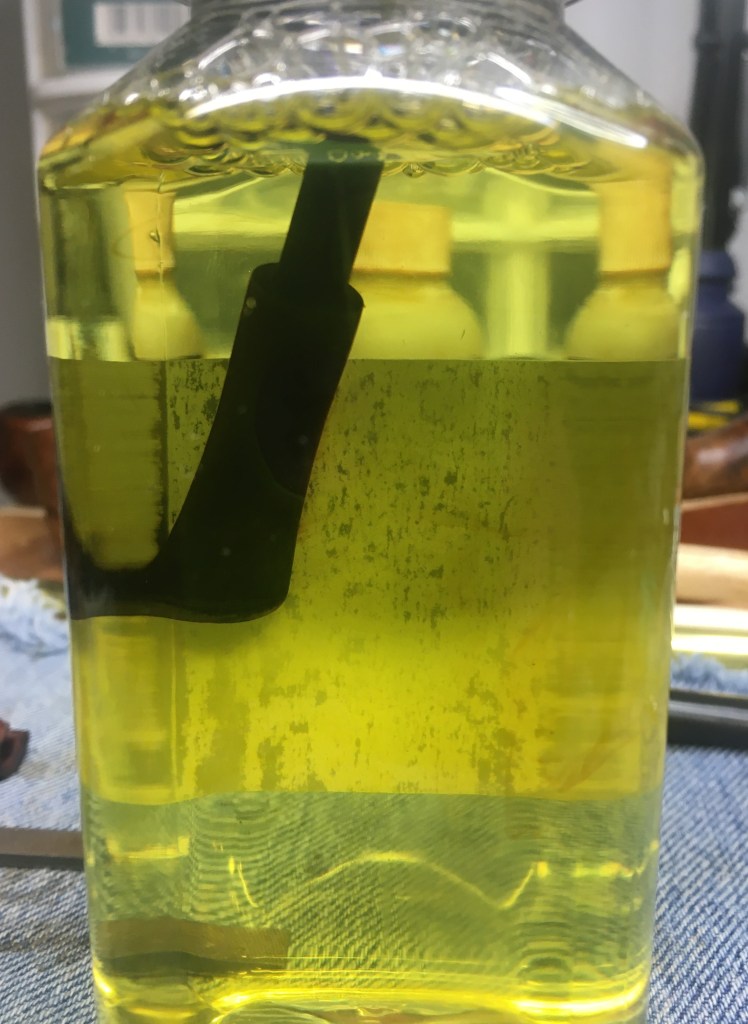
The stem was then suspended in the Briarville solution (referred to as deox, henceforth).

The label instructions recommend 2-12 hours for the Briarville deox, this meant overnight. I turned my attention to the stummel. The ream team was gathered.

A PipNet with #1 and #2 blades were used for the majority of the reaming. The General triangular scraper was used for cleanup work.

A wood dowel wrapped in 320 sandpaper was used to sand the interior of the tobacco chamber.

DOH! I missed the bottom of the bowl while sanding. There, that was better. The chamber showed no sign of heat damage though the drilling for the airway was not centered very well. Perhaps this is another indicator of wartime production, illustrating that manufacturers had trouble retaining skilled craftsmen.

The airway of the shank was then cleaned out using cotton swabs, a nylon shank brush, folded bristle pipe cleaners each dipped in the 95% ethyl alcohol. Also used was a dental scraper. The more tar I can scrape from an airway, the far less scrubbing with the previous three it requires.

The rim had some light lava deposits.

These were removed by moistening with saliva and scraping with a sharp pocket knife.

Below, the rim after the scraping.

Next, the stummel was taken to the sink for a scrubbing with undiluted Murphy Oil Soap and a nylon scrub brush. The soap was rinsed with warm water and the stummel dried with a cotton hand towel.

Back at the workbench the stummel looked much better.

I removed the stinger from its alcohol bath and was surprised to discover that it was not discolored but brass. What? A brass stinger? That was the first time I had seen one of those. Oh well, it cleaned up nicely with a bristle pipe cleaner.

At this point I wanted to sand the stummel but I did not want to do that without the stem in place. Hmm, it wouldn’t be ready until the morning. I know. I’ll epoxy these 10 popper bodies to their hooks. That way I’ll have something to demand my attention and allow me to neglect restoring pipes, tying some more bass poppers.

The next morning I successfully refrained from making bass lures and focused on the Marxman. The stem was removed from deox and wiped with a coarse shop rag. This removed some of the oxidized rubber.

My lovely bright yellow Briarville deoxidizing solution is no longer bright yellow.

The stem after the deox bath.

Below is one of those metal flecks/inclusions I mentioned in the Background section.

The stamps were covered with painters tape for their protection from the sanding. I decided to avoid the sanding of the bottom altogether but I wanted insurance for the shank zone.

A series of sanding sponges ingrits from 320-3500 were used in sequence for sanding the stem and stummel (sans the bottom). Between each sponge I wiped the stummel with a make-up pad wetted with alcohol to remove sanding debris. The stem was rubbed with mineral oil and wiped with a paper towel between sponges.

I wrapped the shank with masking tape to protect it from the buffin that I wanted to do to the stem. I used a rouge compound and the dedicated rouge wheel.

The sanding and buffing worked nicely but there remained a tooth dent on the top of the stem that I did not like.

I chose to clean the area with an alcohol dipped cotton swab and apply a dab of black cyanoacrylate (CA, super glue) to the dent.

The CA was spritzed with a CA drying accelerator.

This was then filed flat and sanded smooth before rebuffing the area. That took care of the dent.

The stem was then polished with Before and After Fine followed by Extra Fine Polish. These wonderful polishes were applied and hand buffed with a soft cotton cloth.

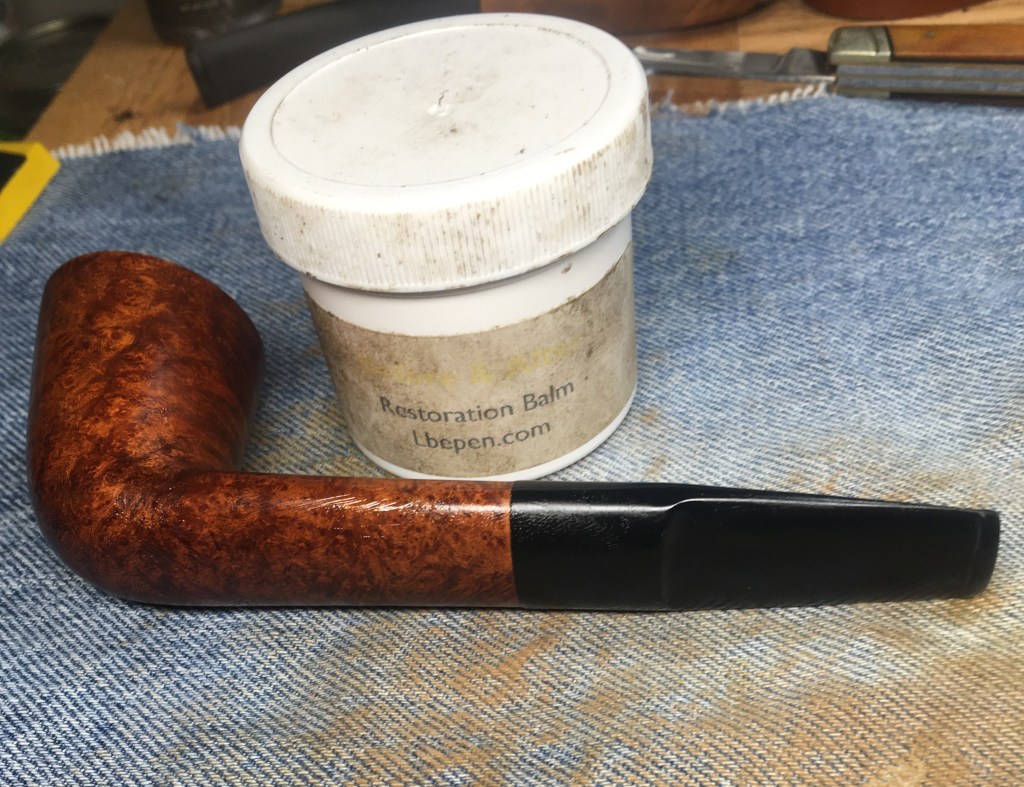
The stummel was then given a coat of Before and After Restoration Balm and allowed to sit for 30 minutes.

Excess balm was wiped or hand buffed from the stummel with an inside out athletic sock. The Terry cloth of the sock is a great material for getting the remaining blam from the nooks and crannies of the rustications.

Since the carvings of the pipe were rather shallow, I thought that carnauba wax applied with the buffer would be ok and not gum-up the carvings. Extra effort was put into making sure the grooves were worked with the edge of the wheel.

The final step was a hand buffing with a microfiber polishing cloth further deepening the shine.
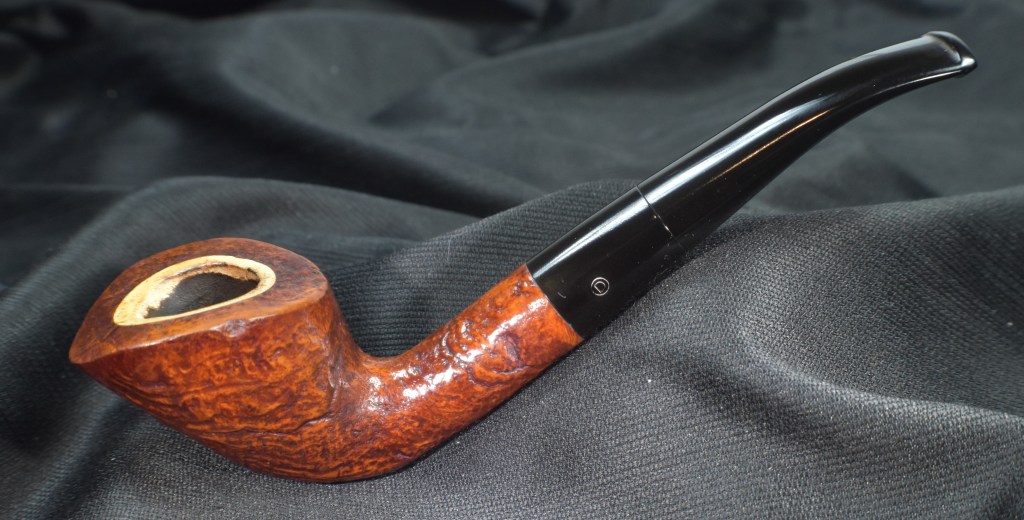
Overall this Marxman A Jumbo Bench Made apple turned out very nicely. The soft appearance of the briar is accented by the rustications. The glossy black vulcanite provides a lovely contrast for both textures. The pipe says, “I’m Jumbo” but the size says different. Perhaps the Jumbo is just a quality claim by Marxman rather than a size claim. Either way, it is still a pretty little pipe and will undoubtedly be a fine smoker with an old and venerable heritage. The dimensions of the Marxman A Jumbo Bench Made apple are:
Length: 5.61 in./ 142.49 mm.
Weight: 1.06 oz./ 30.05 g.
Bowl Height: 1.49 in./ 37.85 mm.
Chamber Depth: 1.16 in./ 29.46 mm.
Chamber Diameter: 0.69 in./ 17.53 mm.
Outside Diameter: 1.37 in./ 34.80 mm.
I do hope that you have found something here useful to your own pipe care, maintenance or restorations. If you like this sort of thing, please click the like and subscribe buttons. Thank you for reading the ramblings of an old pipe lover.
Below are some photos of the finished Marxman A Jumbo Bench Made apple.




 (
(






 Which, in all honesty, is the same as nothing. The pipe has no country of manufacture (COM) stamp but, if I were a betting man, I’d bet on France. Marseille makes me think of Marsielle Marso but I kind of dislike bringing that up due to the dislike of mimes in general by AMericans. At least in my experience mimes are not appreciated.


 .
.






 NebraskaPeteGeek
Leave a comment