
Photographed and written by
John M. Young
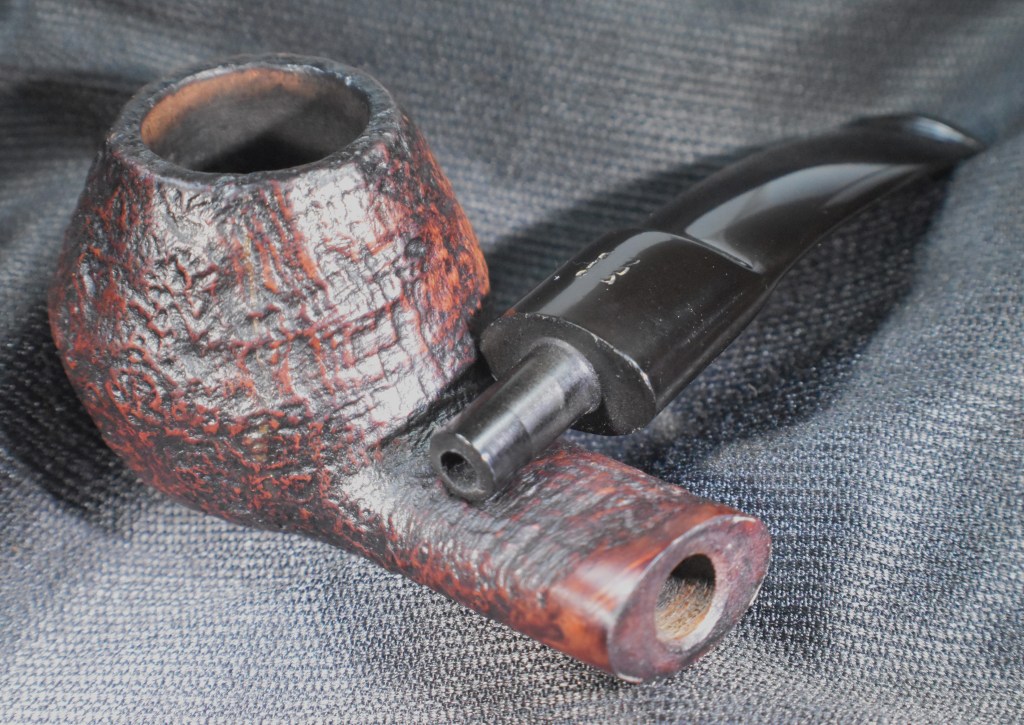
I had heard of and smoked a good amount of Mac Baren tobacco. A Mac Baren pipe though, was new to me. This pipe was part of an estate lot which I won from Eschweiler, Germany. The lot consisted of 13 pipes and what I was hoping for was pipes that were a bit more uncommon here in the United States. A Mac Baren certainly met that criterion. The pipe was stamped MAC BAREN over EXTRA with the “”MA” and the “E” being quite faint. To the right was a slightly smaller stamp MADE IN over DENMARK and a 02. There was also a logo on the stem which I could make out what appeared to be two animals flanking something adorned with a crown. Unfortunately the logo was worn, faint or both. The below photos were taken prior to having done any work on the pipe.


Background
This was an interesting “Background” section because I was initially befuddled (far from unusual). The traditional “go to” site, pipedia.org, had no information on Mac Baren pipes. The source for logos, pipephi.eu did have a similar entry for Mac Baren though.

(M-Man — Pipes: Logos & Markings)
The stem logo was very faint on the Mac Baren pipe in hand but it was certainly a match and the stamp style, also faint, matched as well.
Returning to pipedia.org, I searched again but this time began with the listing of Danish pipe makers. Here I found the below:

(Danish Pipe Brands & Makers M – Q – Pipedia). The link to Mac Baren Tobacco Co. led to the below:

I was able to screenshot a good image of the Mac Baren logo though. Hmm, I think I’ll have to try the gold leaf on that logo when it is time to freshen it.

(Pagina non trovata | Mac Baren Tobacco Company). Apparently the purchase of Mac Baren by Scandia Tobacco Group had also ended the support of their website. All was not lost though, there was a second link leading to Georg Jensen. This link was followed to the following entry at pipedia.org:
“The Georg Jensen pipe factory was founded by Per Georg Jensen and his wife in 1954, in Kopenhagen, Denmark. Since the 80s the company is under the management of his daughter Lis, and his son with the same name, Per Georg Jensen. The company manufactured around 2,000 factory pipes per year. Among the top of the line pipes are hand carved special editions and free hands.
Top of the Line models of Georg Jensen have vulcanite or ebonite stems, factory pipes usually have acrylic stems.
Factory pipes (in increasing quality) were marked:
Danish Sand Achat / Amber Red Flame / Red Skin Sunrise / Orange extra / Starline Contrast / Bicolour / Harmon Excellent / Masterpiece
Pipes were commonly marked (in increasing quality) with: MODEL + MODEL NUMBER + “Made in Denmark”, GJ stamp in red on the stem. MODEL NUMBER + “Georg Jensen” in italic or fancy font.
Extremely rare and collectible freehands were marked with:
“Straight Grain”, and a number that discerns the grading from 1 (lowest) to 13 (highest).
Special edition pipes were marked with: MODEL + MODEL NUMBER + “Handmade in Denmark” + GJ stamp in white on the stem.
The factory closed down in 2001 when Per Georg Jensen (jr) became “Tobacco Professor” for MacBaren Tobacco house.
- You might also enjoy listening to Brian Levine’s interview with Georg on the Pipes Magazine Radio Show
Source: Manfred Arenz
No direct link was given herebut inferences or assumptions could be made. The only problem with those is the old saying, “when you assume you make an ass of you and me”. Not having trouble being called an ass but wanting to provide readers with as correct of information as I can, I turned to my European expert, Sascha Mertens. Sascha was hit with a message via Facebook and asked what he knew about Mac Baren pipes. I included a few phone photos as well. Below is the response from Sascha:
“I sent the Pictures of the MB pipe to Danny. Maybe he can tell a bit more about the pipe itself but it seems they were only produced for Switzerland.” (Mertens, Sascha. Personal communication).
Sascha also sent me two photos of letters describing the negotiations of making the Mac Barens pipes. I attempted to enhance the photos of the documents for clarity they are seen below:


Armed with the above information I feel secure in dating the Mac Baren Extra 02 as a pipe made by George Jensen in the mid 1970s for the Swiss market. The dates from the above documents would place the production after June 28, 1973.
Now, I often ask myself, “how did this pipe get to me?” Well remember back in the introduction when I said this Mac Baren was part of a German estate lot? Here is a photo of the eBay listing with the Mac Baren circled:

Apparently that is how old pipes move across international borders. Some old retired pipe restorer wants something a little bit different so he wins an auction from Germany and Boom, foreign pipes magically appear far from their homes.
The Restoration
The Mac Baren made it to the workbench and a freshly laundered denim piece.

I started working on the stem. I removed the old filter and wondered how much filtering a tiny little filter like that could do. Obviously something because it was stained with residue. The stem was cleaned out with bristle pipe cleaners dipped in 95% ethyl alcohol.

Another pipe cleaner was inserted into the tenon to act as a hanger for suspending the stem in Before and After Extra Strength Deoxidizer (referred to as deox). I planned on leaving it in the solution for 6 hours.

The reaming tools were gathered. The PipNet and #1 blade seemed to be the best fit for the reaming of the tobacco chamber.

I quickly realized that the conical boring of the chamber was better matched with the shape of the Kleen-Reen reaming tool and the Smokingpipes Low Country Reamer. The small amount of cake was scraped free by these trusty three.

The interior of the chamber was sanded with 220 sandpaper wrapped around a wood dowel.

The stummel was taken to the sink for a scrubbing with undiluted Murphy Oil Soap and a nylon brush. This was repeated a second time with additional Murphy’s and a brass wire brush. The soap was rinsed with warm water and the stummel dried with a cotton hand towel.

Back at the workbench the stummel looked much better without the years of accumulated grime.


The airway of the shank was cleaned out using alcohol dipped cotton swabs and more bristle pipe cleaners.

The stummel was given a coating of Before and After Restoration Balm and allowed to sit for a couple of hours.

After 6 hours the stem was removed from deox and allowed to drip the excess solution back into the jar.

Below is the still wet with deox stem ready for a vigorous rubbing with a coarse shop rag.

I like the coarse shop rag for removing the remaining solution and for rubbing off some of the oxidized rubber that the solution loosens from the stem.

Back at the workbench, the stem looked far better but some pitting was now obvious from the removed oxidation.

Make-up pads drizzled with Soft Scrub cleanser were used to scrub the stem and remove more of the oxidation.

The stem was then reattached to the stummel and masked to protect the shank during buffing. Attaching the stem to the stummel keeps the joint from being rounded during the buffing or sanding process. After the buffing the stem looked much better but there were still areas of brown oxidation showing. Especially near the button.

I used a small flat file to file the area below the button for about 1-1.5 cm. This was then sanded with a series of sanding sponges 320-1000 grit. After sanding I returned to the buffer.

The filing and sanding was buffed with white compound on the dedicated white buffing wheel. Below you can see the results.

I used Rub’nBuff Gold Leaf Wax Metal Finish in an attempt to restore the stem logo. The logo had been faint originally and the deox and buffing had not helped matter. Though I had been very careful around the logo with both. The wax was applied using a fly tying bodkin and worked into the stamped logo. Like the name of the product says, I rubbed and buffed using a gentle hand and a soft cloth.

The stem was then hand buffed with Before and After Fine Polish on a soft cloth.

After the Fine Polish I did the same with Before and After Extra Fine Polish.

The stummel received a coat of Renaissance Micro-Crystalline Wax via baby toothbrush. This was allowed to air dry for 10 minutes and was hand buffed with a soft cloth. I repeated the application with a second coat and 10 minute dry time. The second coat was lightly buffed at the buffer with a clean flannel wheel.

The stem received several coats of carnauba wax while at the buffer. The final step was a hand buffing done with a microfiber polishing cloth.
The dimensions of the Mac Baren Extra 02 areas follows:
Length: 5.16 in./ 131.06 mm.
Weight: 1.24 oz./ 35.15 g.
Bowl Height: 1.55 in./ 39.37 mm.
Chamber Depth: 1.24 in./ 31.50 mm.
Chamber Diameter: 0.67 in./ 17.02 mm.
Outside Diameter: 1.55 in./ 39.37 mm.
I do hope that you have found something here useful to your own pipe care, maintenance or restorations. If you like this sort of thing, please click the like and subscribe buttons. Thank you for reading the ramblings of an old pipe lover.
Below are some photos of the finished Mac Baren Extra 02.


 NebraskaPeteGeek