
Photographed and written by
John M. Young
Yeah, it’s another Denicotea. I Completely blame Sascha Mertens for the accumulation of Denicotea pipes over the past year. Sascha is a German pipeman and restorer who is actually a great guy and has led to my delinquency and departure from focusing on my beloved Peterson and Marxman pipes. Okay, that’s not quite fair, I also really like old Yello-Boles, Kaywoodies and Linkman’s Dr Grabow pipes. Come to think of it, I also have a fondness for the pipes of the 1930s-and 1940s and then there’s weird ones. Oh, and the metal pipes, I can’t leave those out. Wow, Maybe it’s not Sascha that is to blame. Maybe it is the raging attention deficit disorder? No, I’d rather blame Sascha.
Anyway, the subject of this restoration is a very lengthy named Denicotea. This pipe came to me all the way from “Vilnius, default, Lithuania”. That is what the location on eBay said, “default”. That rates right up there with the “Slow Child” caution signs. How’d you like to grow up with one of those signs in your front yard telling every motorist passing by that you are “Slow” or mentally handicapped. Cruel, I say. Wow, this blog is full of mental detours today. Back to the pipe. It came from Lithuania and was stamped with the following: DENICOTEA arched over a straight DURABEL. I think Denicotea had to make this pipe with a diamond shank to allow for all the Stamings. On the adjacent side, there is a stamp, GOLF over BRUYRER EXTRA. Adjacent to that is a 710, which I assume to be the shape number. The stem sports a stamped logo of an encircled D, which is a bit faint and lacking any paint. Below are some photos of the pipe before work was done to it.


The pipe was in great shape and the Lithuanian seller was a very good pipe cleaner. This made my job easy but I have to admit a touch of disappointment in having such an easy restoration. I still wanted to remove whatever clear coat was present and maybe touch up the fills.
Background
In a previous blog I wrote about the history about what little I found about Denicotea, I will link that post here, and include the information below:
“Pipedia.org has a short article on Denicotea. I will include it here in its entirety:
“Willy Heineberg founded the company Denicotea in 1932 and began manufacturing and selling smoking accessories such as filters, filter inserts, cigarette holders and pipes.[1] The company headquarters was initially in Cologne, but was relocated to Bergisch Gladbach after the Second World War.[2]
Denicotea is actually the name of a silica gel filter, cigarette holders and care products for pipes and cigarette holders.
I still find it a bit confusing as Denicotea seems to be a company[3] and a brand as well which is operated by COMPOSING-STUDIO GmbH[4].
Brands
Adsorba
Adsorba is a fantasy series of pipes produced by Luigi Crugnola for the German market.
Aldo Morelli
Aldo Morelli is a fictional name. The brand Aldo Morelli has been registered for Denicotea on February 26th, 1992.[5]
Depending on the different lines the pipes are made by Cesare Barontini, Gigi or Molina Pipe for Denicotea GmbH.
Stefan Petzuch points out this brand appears to have similarities to the Mauro Cateni pipe brand, in particular they are both fictional Italian brands by German companies, and both have the “HAND CUT” imprint on the stem as seen bellow. This may connect the Aldo Morelli brand to Gebr. Heinemann KG in Hamburg, who had registered the Mauro Cateni brand. Or perhaps there is a connection between Denicotea and Gebr. Heinemann KG, or perhaps these pipe brands simply used “Hand Cut” stems from the same source.” (Denicotea – Pipedia)
Interesting and weird are the two qualifiers that come to mind in reading that. The four makers mentioned in the article; Luigi Crgnola, Cesare Barontini, Gig and Molina are all Italian pipe manufacturers. Where does the MADE IN ENGLAND stamp on the example on pipephil.eu or the stamp on the pipe I purchased come in, I cannot say. I can say that I am not the first person to have little success researching the origins of Denicotea pipes. Dal Stanton, who is far more diligent in his background research than I, had a French made Denicotea. He traced its origins to the St. Claude area but not to a specific maker. Dal’s blog was posted on Steve Laug’s rebornpipes.com site. Here is the link to Dal Stanton’s blog post: https://rebornpipes.com/2016/09/29/nice-find-in-plovdiv-bulgaria-denicotea-deluxe-curling-bruyere-extra/”
This Denicotea has neither the Country of Manufacture (COM) stamps of England nor France. It does have a shape number 710 which I could find no corresponding match with brands associated with Denicotea. This pipe’s heritage appears to remain a mystery.
The Restoration
I found myself feeling dishonest when I called this a restoration. It started out as more of a cleaning or refreshening.

I did want to get rid of whatever clear coat had been applied to the briar so, I guess that does make this a restoration. I first tried 95% ethyl alcohol on a cotton swab to test the finish removal. The swab was quickly stained red.

Seeing that ethyl alcohol worked, I decided on a bath of ethyl for a couple of hours. EtOH was the abbreviation for ethyl alcohol for a biochemistry lab I worked in, if you are wondering.

The stummel was submerged in the alcohol and the lid screwed back on tight. This alcohol had been used several times previously thus the very dark color.

The stem was very clean and my application of alcohol dipped cotton swabs and a pipe cleaner proved a bit unnecessary.

After the alcohol bath time, the stummel was removed and the briar vigorously rubbed with make-up pads. There still appeared to be some “shiny” to the stummel.

I lightly sanded the stummel with a 400 grit sanding sponge and wiped the surface with make-up pads wetted with acetone. This got rid of the shine that remained after the ethanol bath.

The tobacco chamber did not need a reaming so I just sanded it with 220 sandpaper wrapped around a wood dowel. The chamber showed no evidence of any damage.

The stem was not oxidized and I suspected it was made of acrylic rather than vulcanite. I masked over the stamps with masking tape and began sanding with sanding sponges. This was done to better see the old fills. I wanted to pick the old fill material out and replace it with cyanoacrylate (CA, super glue) and briar dust.

There were several old fills. I used a fly tying bodkin to pick the old filler out. The ethanol bath had softened the old fills nicely. The pits were then given a small drop of brown CA and had briar dust pressed into the wet CA.

The new fills were filed smooth with a small flat file then the whole pipe was sanded with a sequence of sanding sponges from 400-3500. The stummel was wiped with an alcohol wetted make-up pad between each sanding sponge while the stem was rubbed with mineral oil and wiped with a paper towel.

The masking tape was removed and the adhesive cleaned away with ethyl alcohol. The pipe was then worked with micro-mesh pads 4000-12000. The stummel and stem wiping was done as with the sanding sponges.

I applied a coating of Before and After Restoration Balm on the entire pipe and set a timer for 30 minutes.

The excess Restoration Balm was wiped off with an inside out athletic sock.

The pipe looked wonderful after the Restoration Balm did whatever magic it does.

I Painted the stem logo with white acrylic paint and allowed it to dry for a few minutes. Using a plastic card, I scraped off the excess pain and neglected to photograph any of it. The pipe was then taken to the buffer where it received several coats of carnauba wax. The final step was a hand buffing with a microfiber polishing cloth.

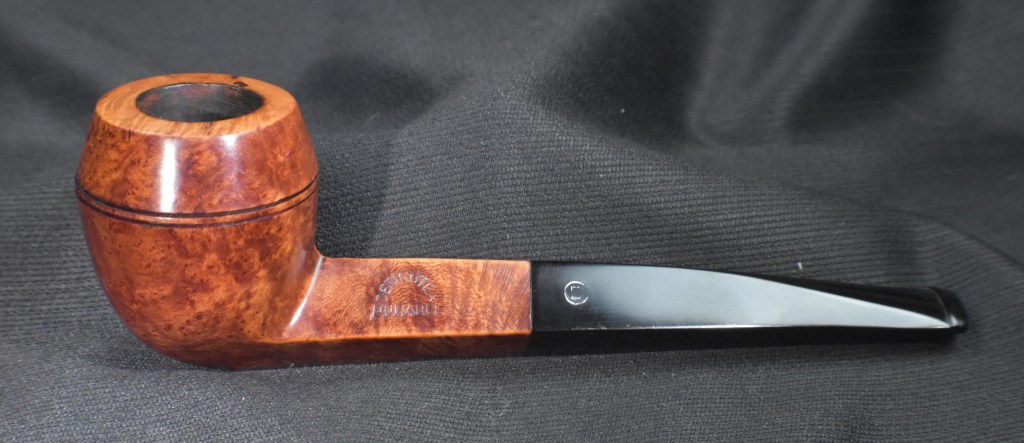
This Deincotea Golf turned out very nicely. I admit that I have already smoked it one time and that was with an actual Denicotea crystal filled pipe filter. Sascha Mertens sent me a package of ten filters when we were exchanging care packages a while back. Thank you Sascha. I am not usually a filter pipe smoker but it seemed appropriate for the maiden voyage. The feel and look of the pipe are very excellent, as are the smoking characteristics. I like the slightly longer stems of the Denicoteas that I have added to my personal collection. They do require a bit of awareness at first though. This pipe is a touch too long to make for a comfortable clencher though it is a wonderful pipe for the contemplation of life. The dimensions of the Denicotea Durabel Gold Bruyere Extra 710 are:
Length: 6.04 in./ 153.42 mm.
- Weight: 1.55 oz./ 43.94 g.
- Bowl Height: 1.90 in./ 48.26 mm.
- Chamber Depth: 1.41 in./ 35.81 mm.
- Chamber Diameter: 0.75 in./ 19.05 mm. (Conically bored diameter is at the top)
- Outside Diameter: 1.60 in./ 40.64 mm.
I do hope that you have found something here useful to your own pipe care, maintenance or restorations. If you like this sort of thing, please click the like and subscribe buttons. Thank you for reading the ramblings of an old pipe lover.
Below are some photos of the completed Denicotea Durabel Gold Bruyere Extra 710 (that’s still a lot of words).


 NebraskaPeteGeek