Briar Wind-capped Horn Restoration
Written and photographed by John M. Young
Wally Frank is a most enigmatic (AKA: crazy cool) figure in the history of pipes. A world traveler in search of briar, pipes, pipe making artists and craftsmen, a businessman, a marketer, all fascinating. This print ad illustrates what I mean. Here we see Castello pipes advertised with the Weber Guide to Pipes and Smoking and Wally Frank Natural Unvarnished pipes all on one page.
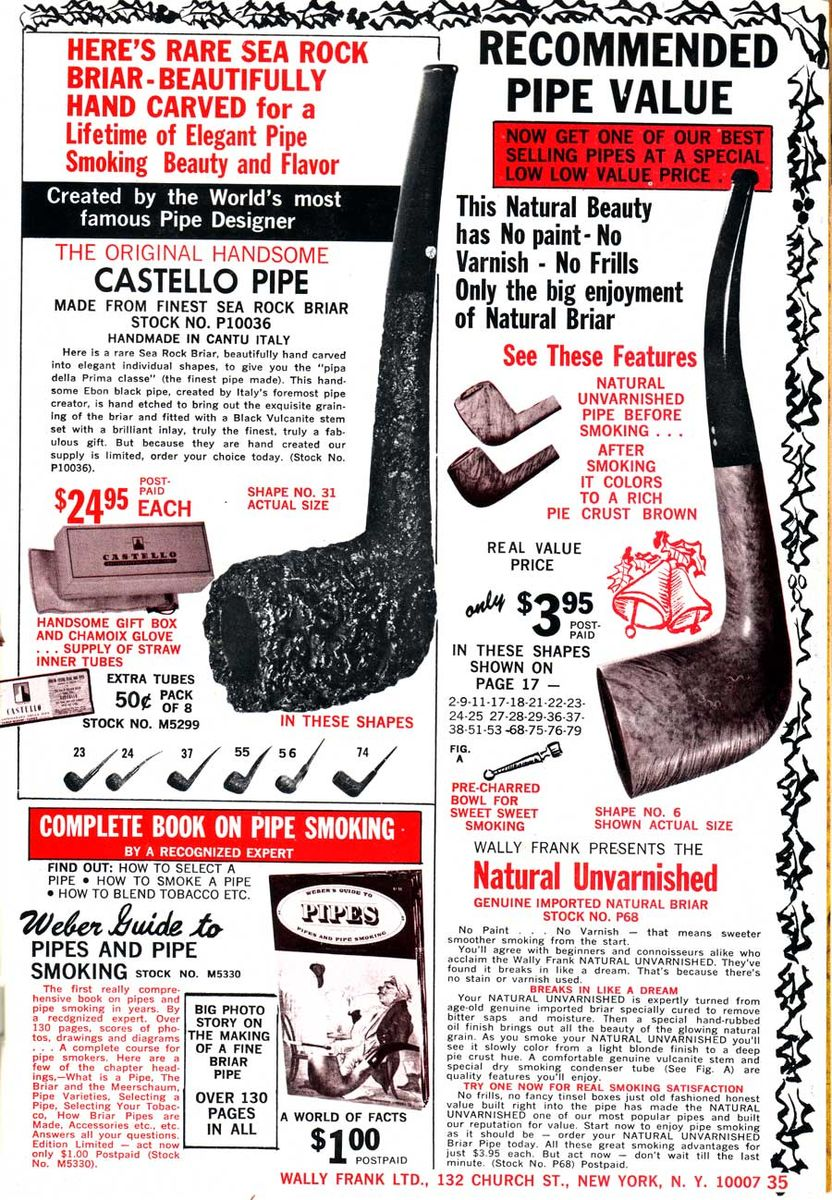
(File:Castello Ad.jpg – Pipedia)
“Why is that so interesting?”, you ask. Frank “discovered” Carlo Scotti, founder of Castello and imported his pipes to America. Weber, one of the largest pipe manufacturers in America and Weber’s book telling you everything about how to smoke a pipe. Weber was also a major producer of Wally Frank pipes. And his own Wally Frank brand. All on one lovely Wally Frank ad page. Sounds like an empire builder to me.
One of the best stories of Wally Frank’s career is the “discovery” of Carlo Scotti. I quote from Hacker’s The Ultimate Pipe Book:
“In 1952 Wally Frank, the famous East Coast tobacconist, was on a buying trip in Italy and came across Scotti’s pipes. He liked them and wanted to import them into the U.S. Unfortunately, there was a problem:Scotti’s “white line” trademark looked almost identical to the trademark Frank was using for his “White Bar” line of pipes. The solution was obvious. Scottie would simply change his logo. The two men sat down in the warm Italian sun and came up with the idea of drilling a hole in the “near side” of the stem, interesting a small piece of crumpled silver foil, and sealing it over with clear Lucite. A legend was born and even today some collectors insist that every Catello pipe has a diamond in it… or at worst, a rhinestone. But perhaps it is best to leave both the clear Lucite and the image intact, for the superb craftsmanship and the smokability of the Castello is really what constitutes the true value of a pipe.” (pp. 255-256)
Hacker, Richard Carleton. The Ultimate Pipe Book. Autumngold Pub., 1984.
One of my favorite Wally Frank’s marketing ideas was the “Pipe of the Month Club”. Here is the order form from http://www.pipephil.eu/logos/en/logo-w1.html

The date on the form is difficult to make out but, I think it is 1947. $1 in January of 1947 is equivalent to $13.91 in January of 2023 (https://www.bls.gov/data/inflation_calculator.htm). Who wouldn’t jump at the chance to get a new pipe every month for $14 dollars today?
The first paragraph about Wally Frank from Pipedia pretty much sums up Frank’s contributions to our hobby:
Wally Frank, Ltd. was one of America’s oldest and most respected names in pipes and tobaccos, beginning in the early 1930’s. Wally Frank operated a chain of tobacco stores in New York City (the flagship store was in Lexington Avenue) and had a vast catalog business for pipes and pipe tobaccos. Their numerous private-label pipes were made by many makers, including Charatan, Sasieni, Weber, and many others. Wally Frank, Ltd. also owned the Pioneer brand of meerschaum pipes, made from both Turkish and African meerschaum. In addition to importing pipes, he had many pipes made in his own name and also employed pipemakers like Peter Stokkebye, Svend Bang, and Ed Burak (who later became the owner of Connoisseur). As a result, each Wally Frank pipe must be individually evaluated on its own merit.
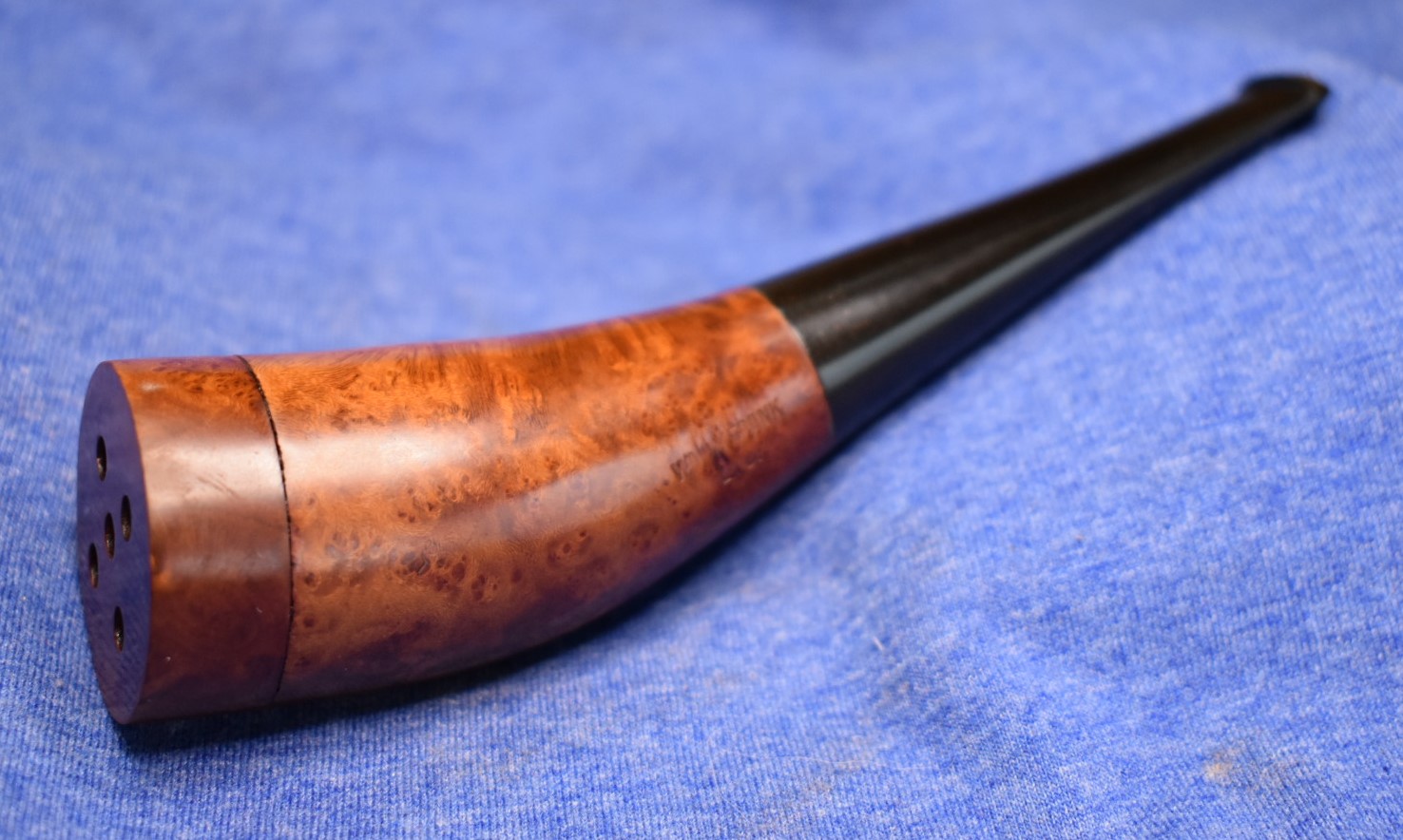
That brings me to the subject of this blog post. A unsmoked Briar Wind-cap Wally Frank Horn pipe. I have little idea as to when this pipe was produced. I gather from forum posts that the pipe of the month club died away in the early 1960’s yet, no one had any verifiable sources for that. I’d like to think that this pipe was a pipe of the month yet I also have no verification. I can say it is a unique looking pipe and my descriptions will be “individually evaluated on its own merit.”
I don’t remember exactly how or when this pipe came to me. It was most likely part of an estate lot which bid on and won via an ebay auction. I tried looking back through my “purchase history”. Unfortunately, the photos after about a year do not seem to be archived. Here are the photos of the dusty and dirty horn:
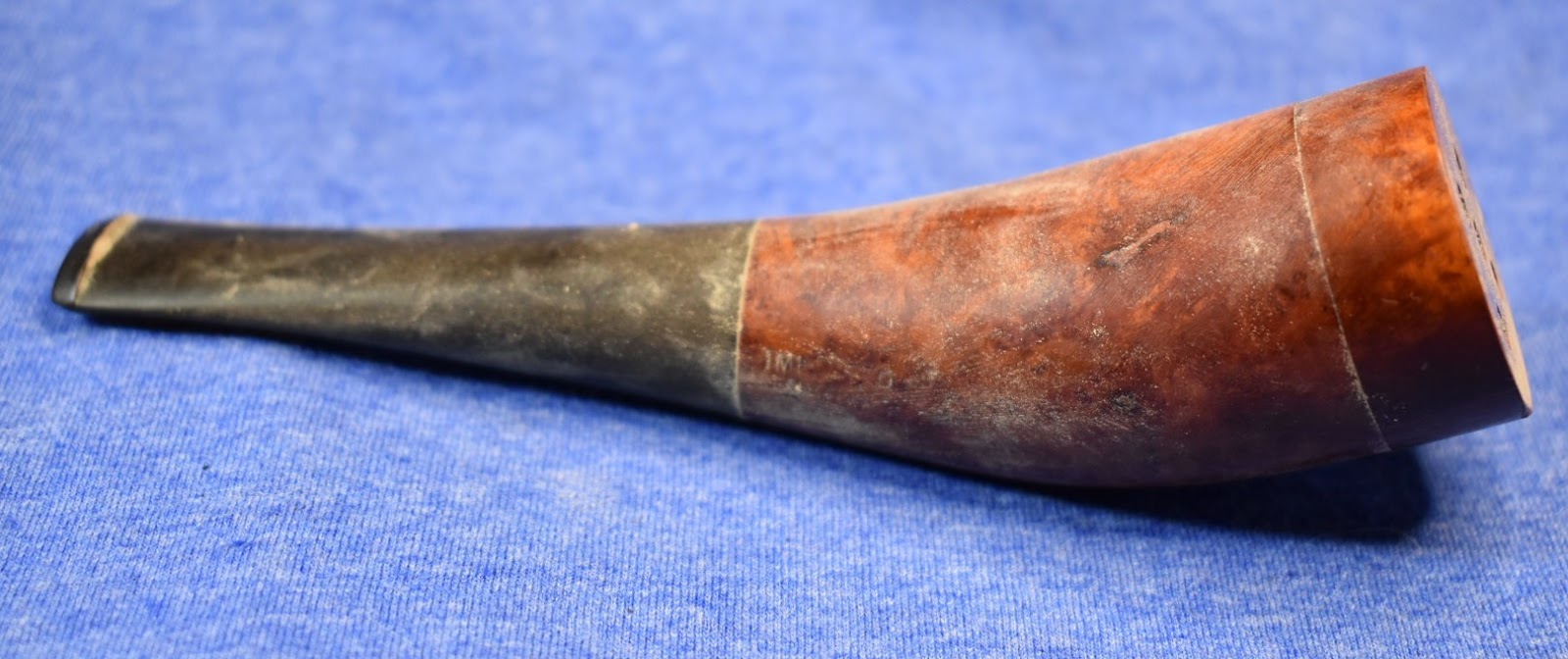


The pipe, though dusty, looked as though it had never been fired. The stem was oxidized and had no evidence of any contact with teeth. “This isn’t going to be a restoration”, I thought to myself, just a cleaning.
That is where I started. Cleaning. I took the horn to the sink and used undiluted Murphy’s Wood Cleaner on a medium stiff bristle toothbrush. The Murphy’s lather changed to a slight gray color as it removed the dirt and dust. The Murphy’s was rinsed with warm water and the stummel was dried with a cotton dish towel. I then wiped the surface with a cotton make-up removal pad moistened in 95% ethyl alcohol. I hoped that this would loosen and remove any dirt remaining as well as tell me more about the finish on the briar.
The pad became pink with the red dye that was used to stain the briar. The dirty spots on the pad are from me using it on the threads of the wind cap. The removal of stain with the pad indicated there was little finish to worry about.
The stem did not appear to have enough oxidation to warrant a bath in the Deoxidation Solution. I used Soft Scrub on a make-up removal pad and vigorously rubbed the stem.

After the scrubbing the stem was oiled with Obsidian Oil. I took both parts of the pipe to the bright light to assess the best course of action and for some photos.


In this photo you can still see the lathe chuck marks inside the tobacco chamber.


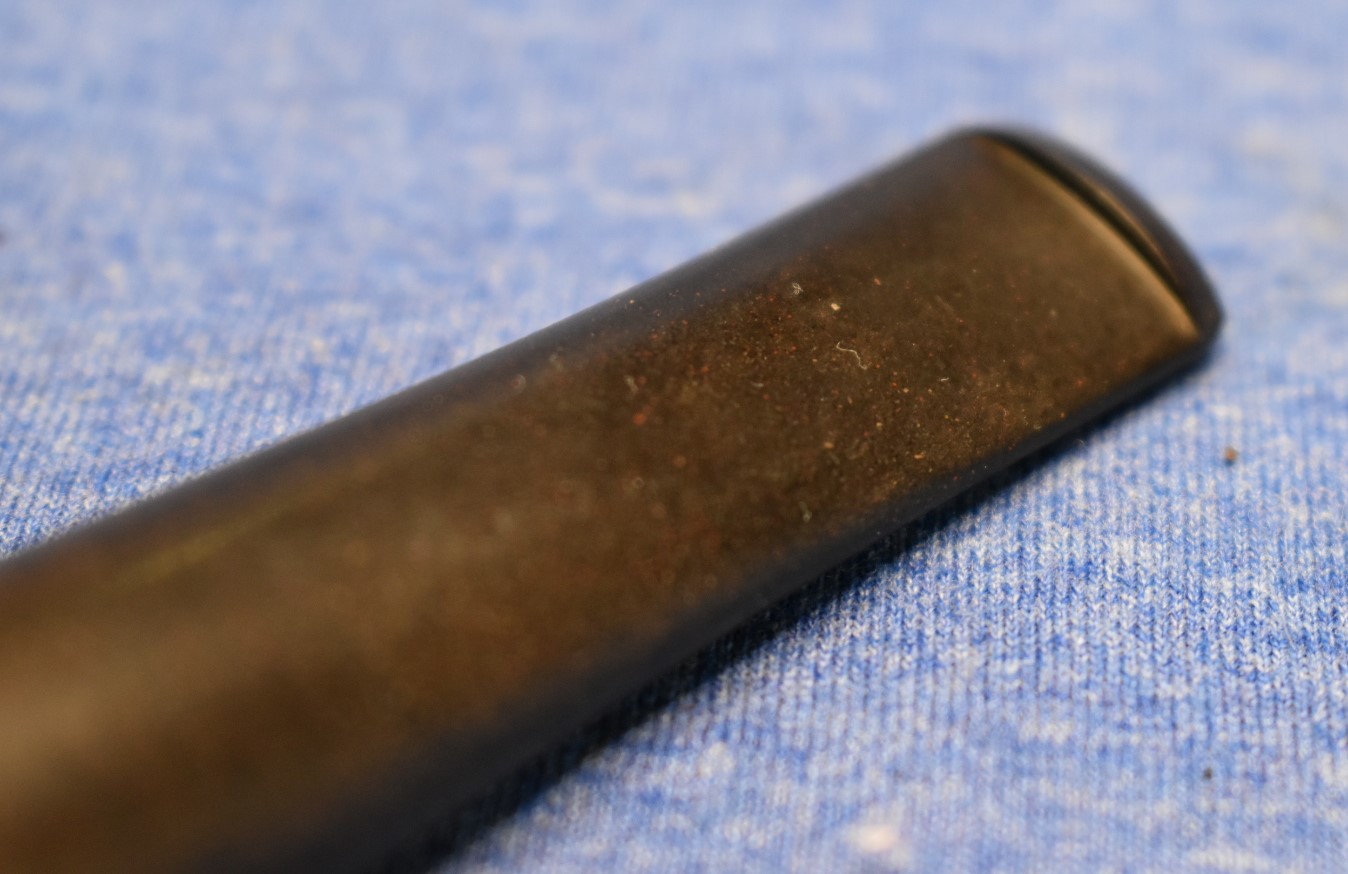
The stummel had one spot with an obvious fill. This fill was not a good color (too pink) match to the briar so it had to go. The stem looked like it had tiny pock marks all over the surface. I did know it was just from age, oxidation, poor quality vulcanite or a combination of those.
First thing I addressed was removing the old fill material. It was fairly soft and canme out with little effort. I used the dental pick and fly tying bodkin for most of the removal and scrubbed the hole with a brass wire brush.

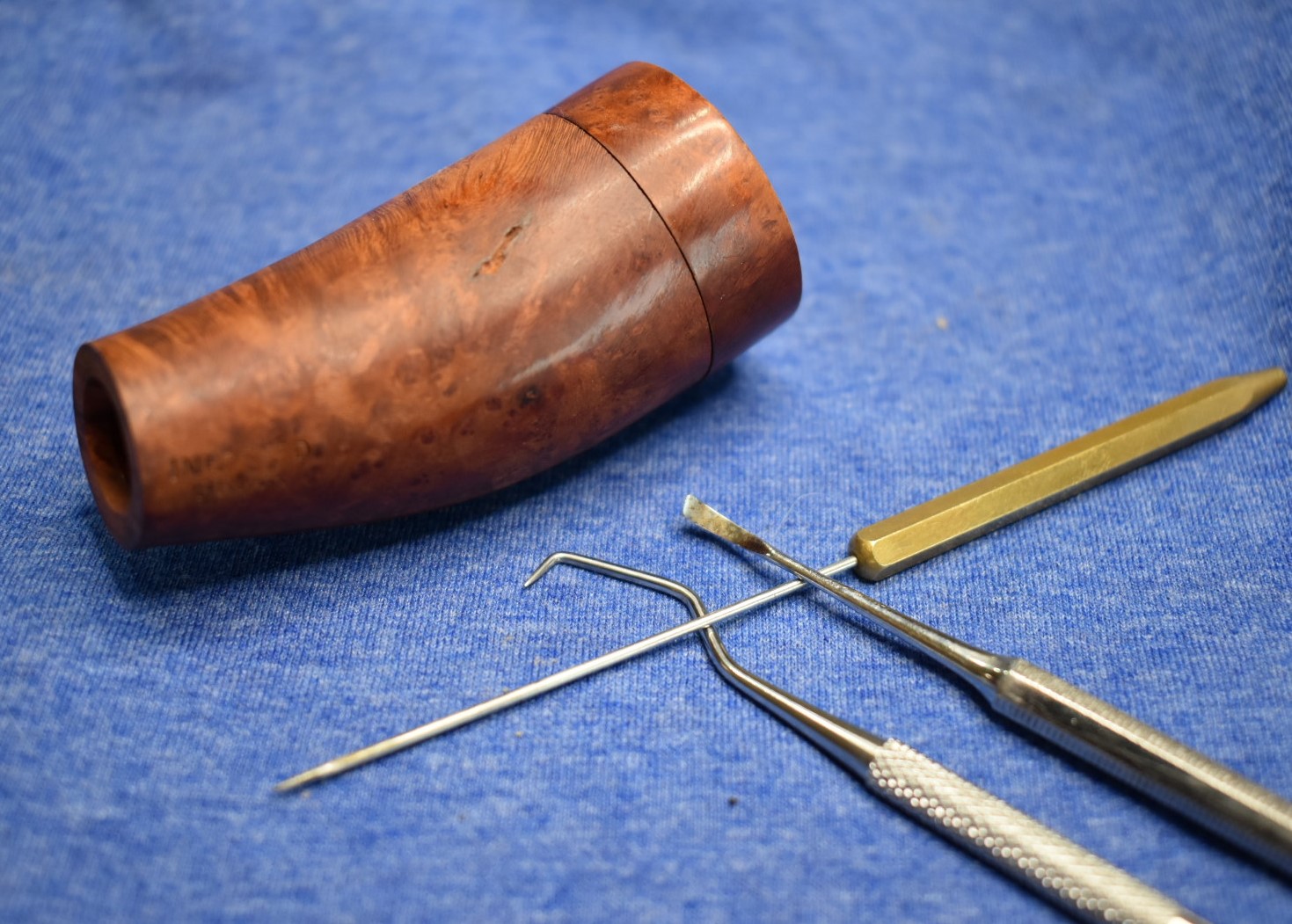

With the old fill removed I started working on the stem. I reassembled the pipe and wrapped the shank with scotch tape to avoid scratching the briar with the sandpaper or micro-mesh pads. I worked the stem’s surfacewith 400 wet day sandpaper wrapped around a small foam block. I then used the 1500 micro-mesh pad dry. After the pad I wiped the stem with a dry make-up pad and applied a drop of Obsidian Oil with my fingers. I wiped the excess and used a wetted 1500 micro-mesh pad. After this pad I wiped, oiled and wiped the stem again. I then proceeded to the 1800 micro-mesh pad also wetted with water and then the 2400 pad dry. In between pads I continued to wipe, oil and wipe excess.
I then prepared to work of the fill. I used Brown cyanoacrylate (CA, super glue) and briar dust for the new fill material. I dipped the bodkin into the CA and got a small drop. I placed the drop into the hole, took a pinch of briar dust and pushed it into the glue wetted hole. I used the flat side of the dental broad dental pick to force the dust into the hole. It set-up nearly immediately.

I then used a flat needle file to remove the material new fill until it was smooth to the surface. I very light touch with 200 sandpaper revealed that I still had a couple of low spots in the new fill. I repeated the CA and briar dust. At this point I removed the scotch tape and cut two pieces of painters tape to cover the stampings. I figured that any sanding and micro-meshing from here out could be done to both the stem and the stummel.

The new fill was then filed and sanded to smooth. The sanding would be blended with the sanding and micro-meshing.


I did not need to use the 1500 nor 1800 micro-mesh pads on the stummel. I used the remaining series, 2400-12000 on the stem and stummel. Between pads I would wipe the briar with a make-up pad moistened with 99% isopropyl alcohol and the stem with a drop of Obsidian Oil on my fingers wiped with a dry make-up pad. When finished with the micro-mesh pad I applied a liberal coating of Before and After Restoration Balm to the briar and a coating of Obsidian Oil to the stem.

I let the balm and oil do their magic to the pipe for about an hour. After the hour had passed I wiped the entire pipe with an inside-out athletic sock to remove the remaining balm and oil. The pipe was looking very reshreshed. The last step was to take it to the buffer for several coats of carnauba wax.
This was a fun restoration of an unusual old pipe. I have no idea how the horn shape smokes. My fear would be that the top inside of the tobacco chamber would get too hot and be prone to the risk of heat damage. Or perhaps this shape is meant to be used while reclining in a hammock enjoying a pipe on a warm summer day. That is a delightful image. If you enjoyed this kind of thing please, click the like and subscribe. I thank you for reading the ramblings of an old pipe lover.
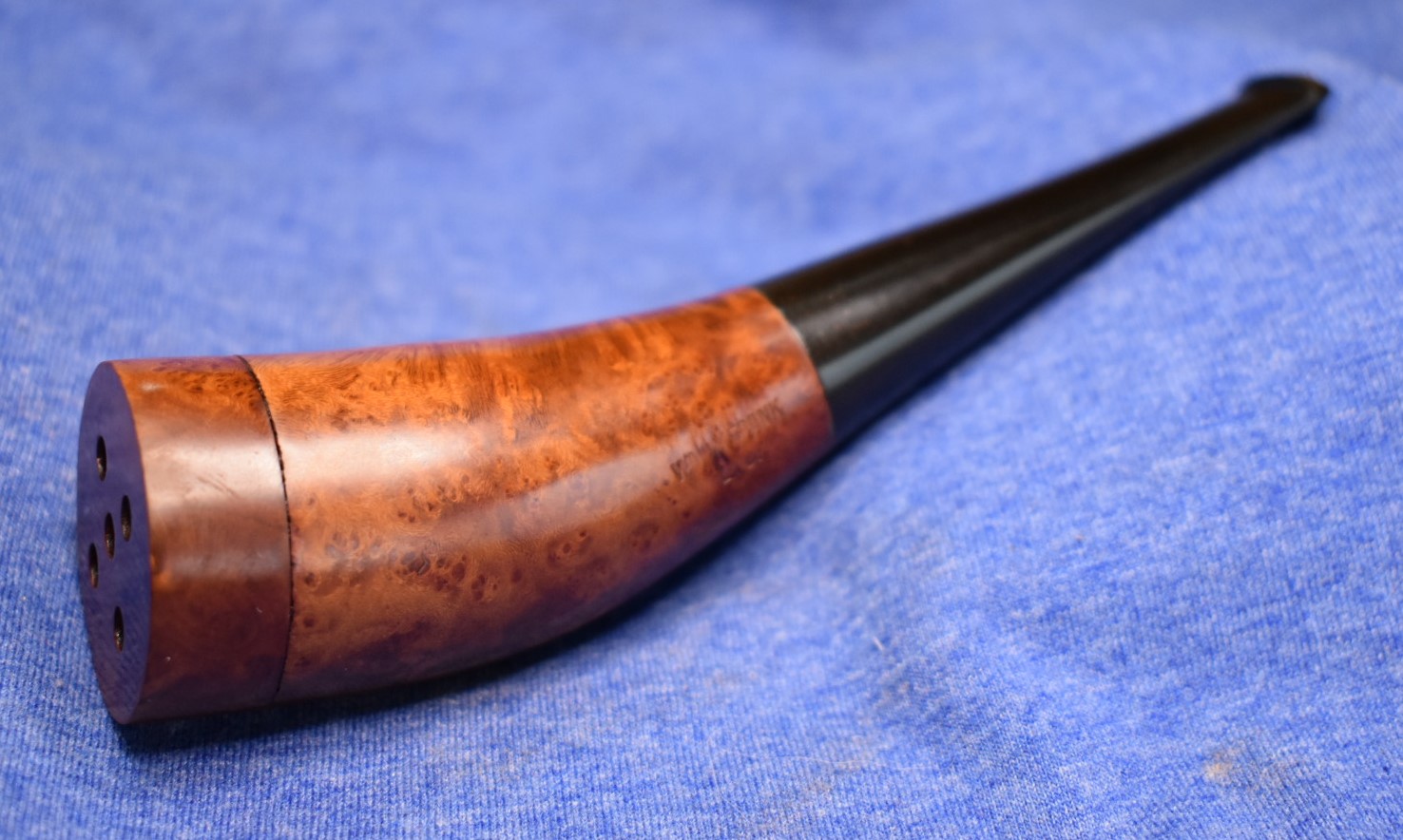
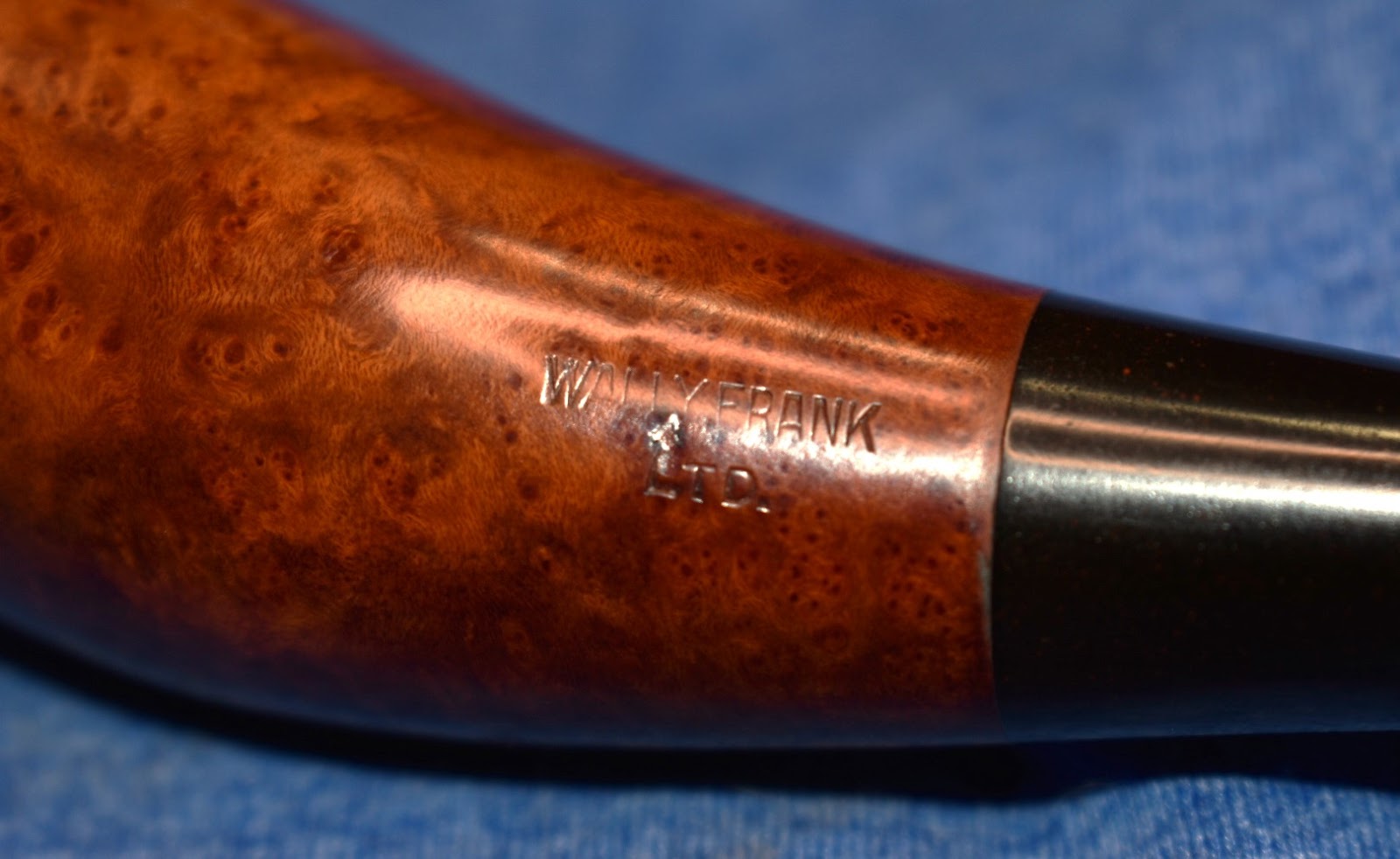
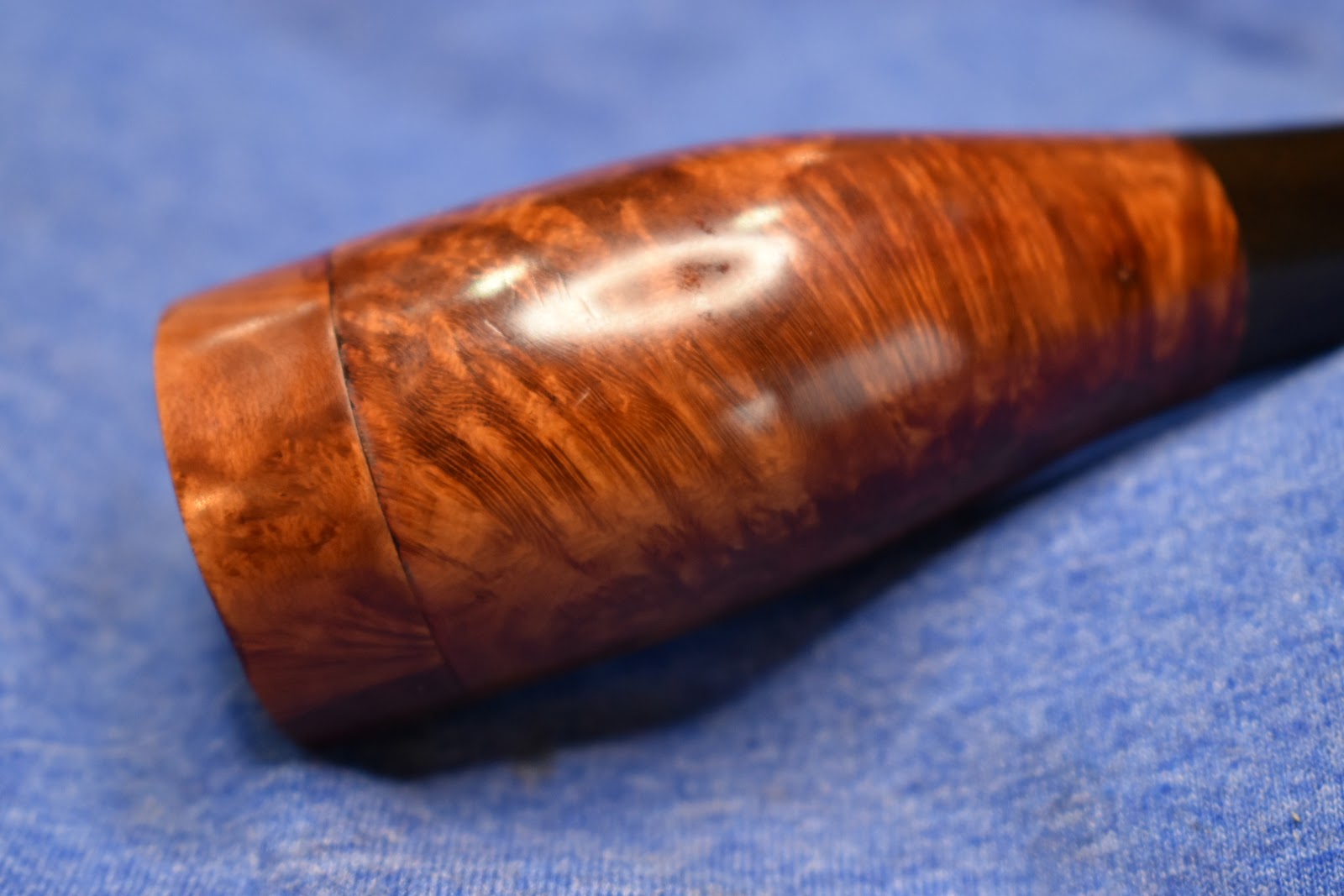
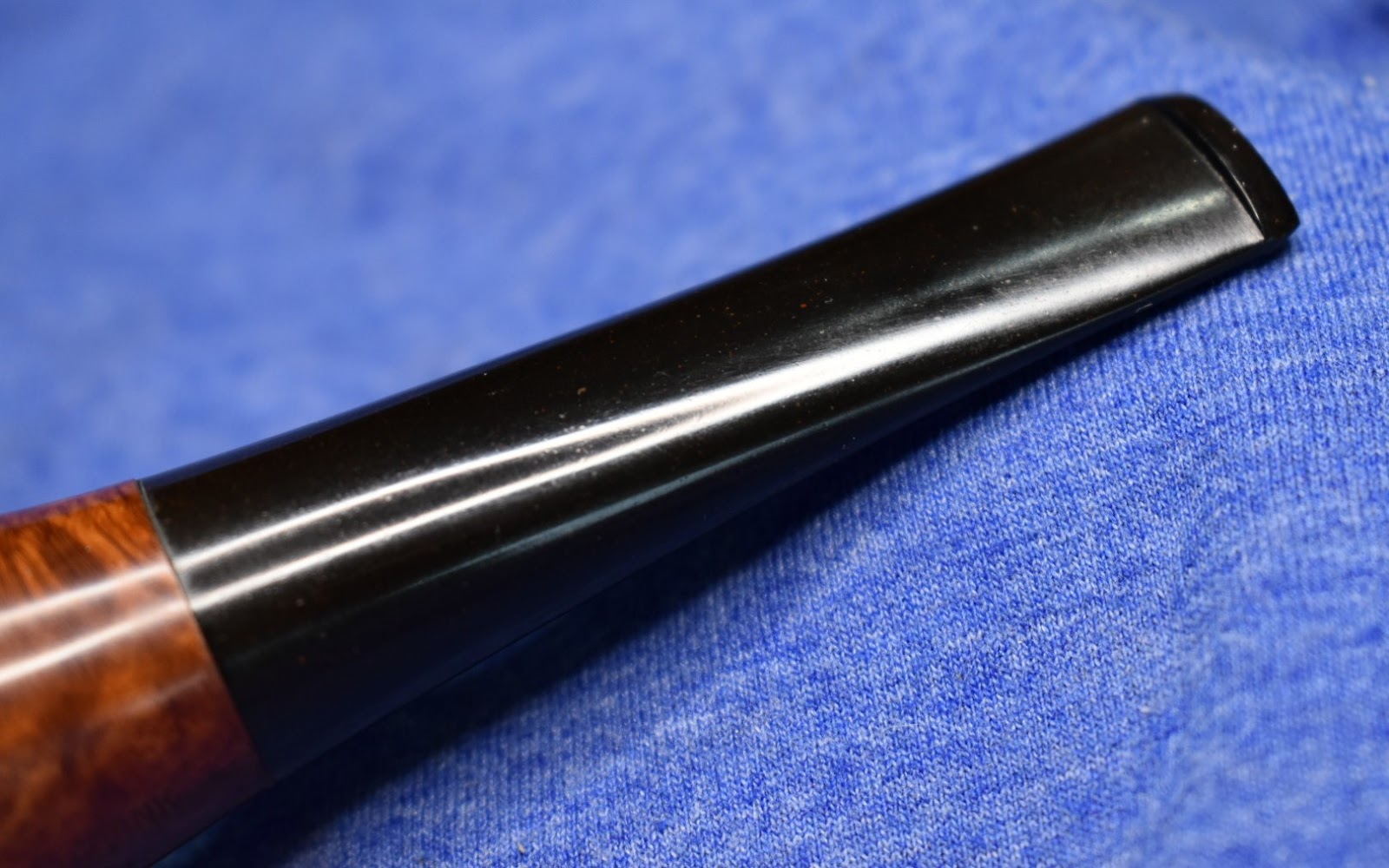
Below are photos of the finished Briar Wind-cap Wally Frank Horn:




 NebraskaPeteGeek

One response to “A new old stock (NOS) Wally Frank ”
[…] A new old stock (NOS) Wally Frank […]
LikeLike