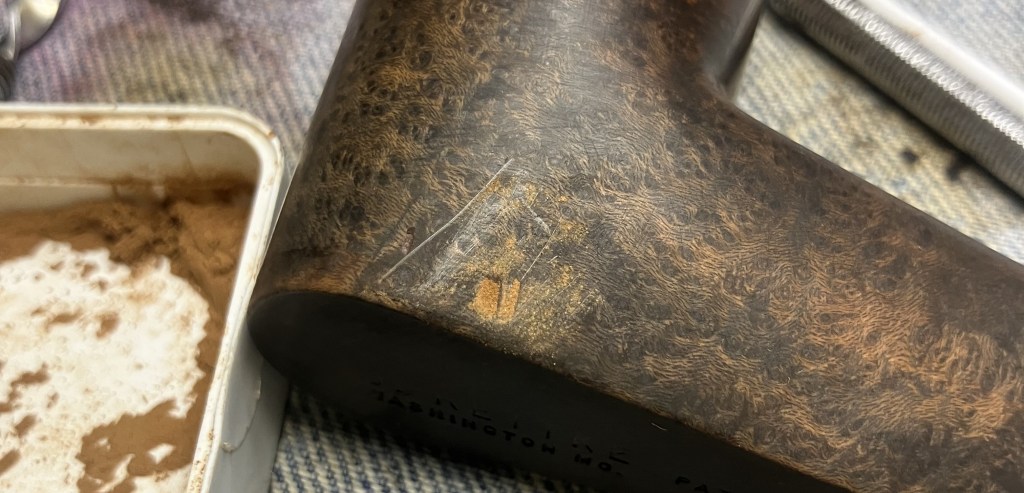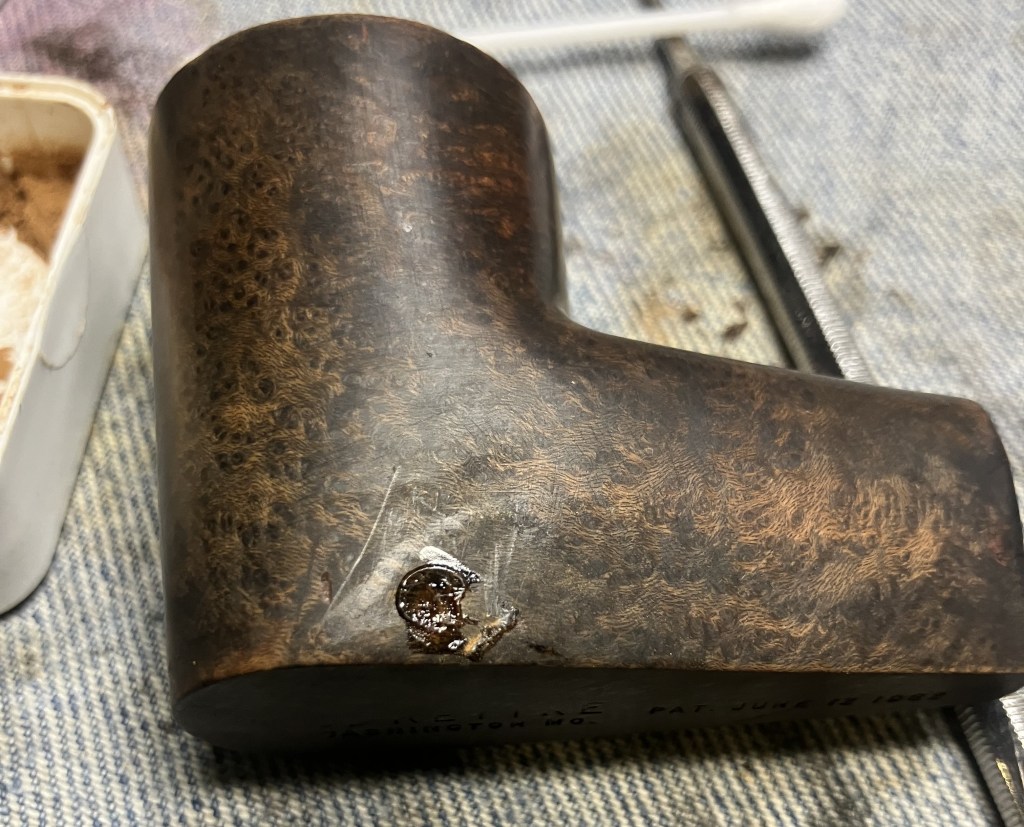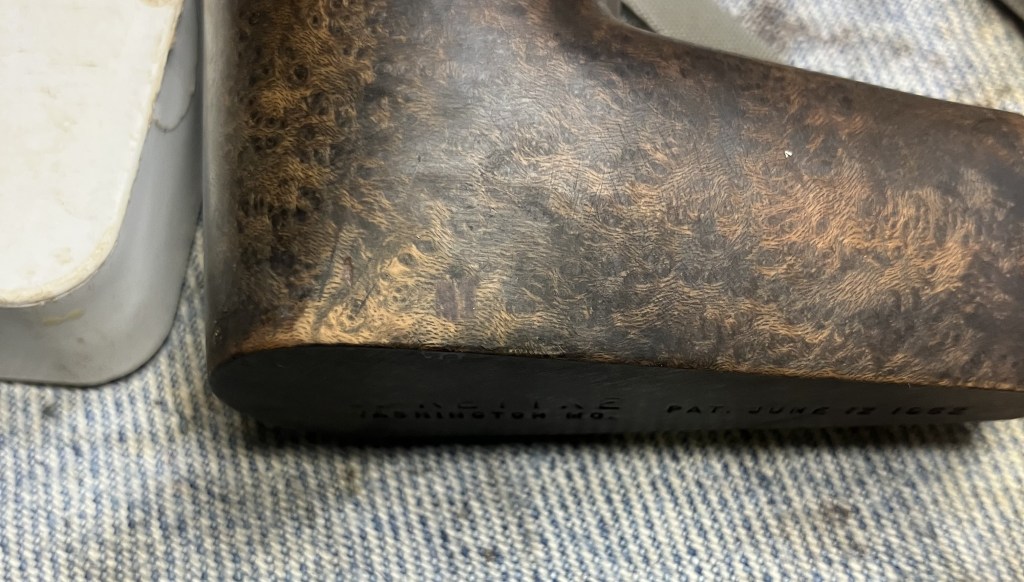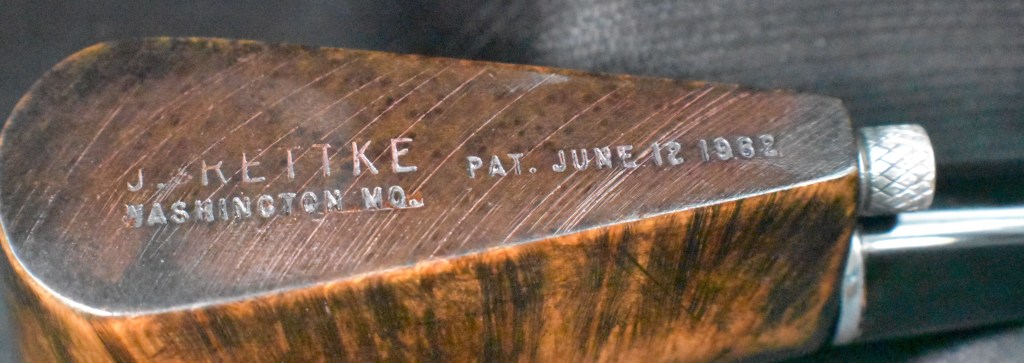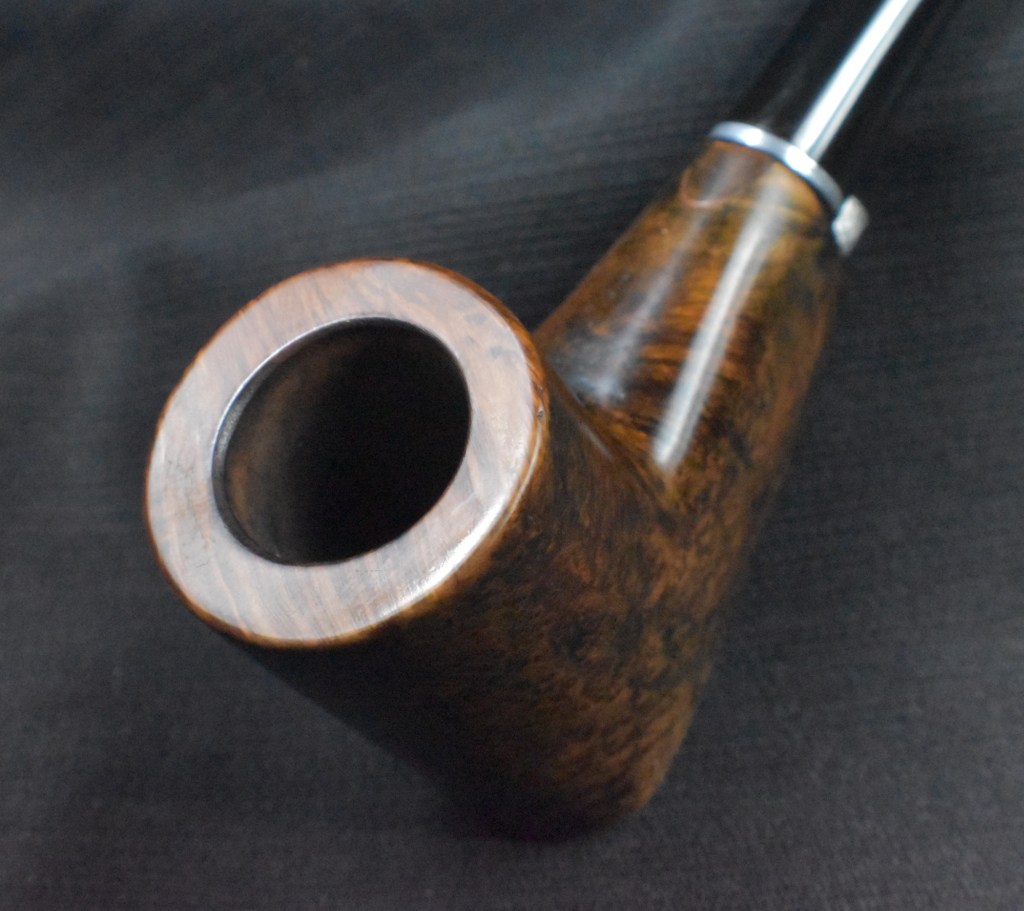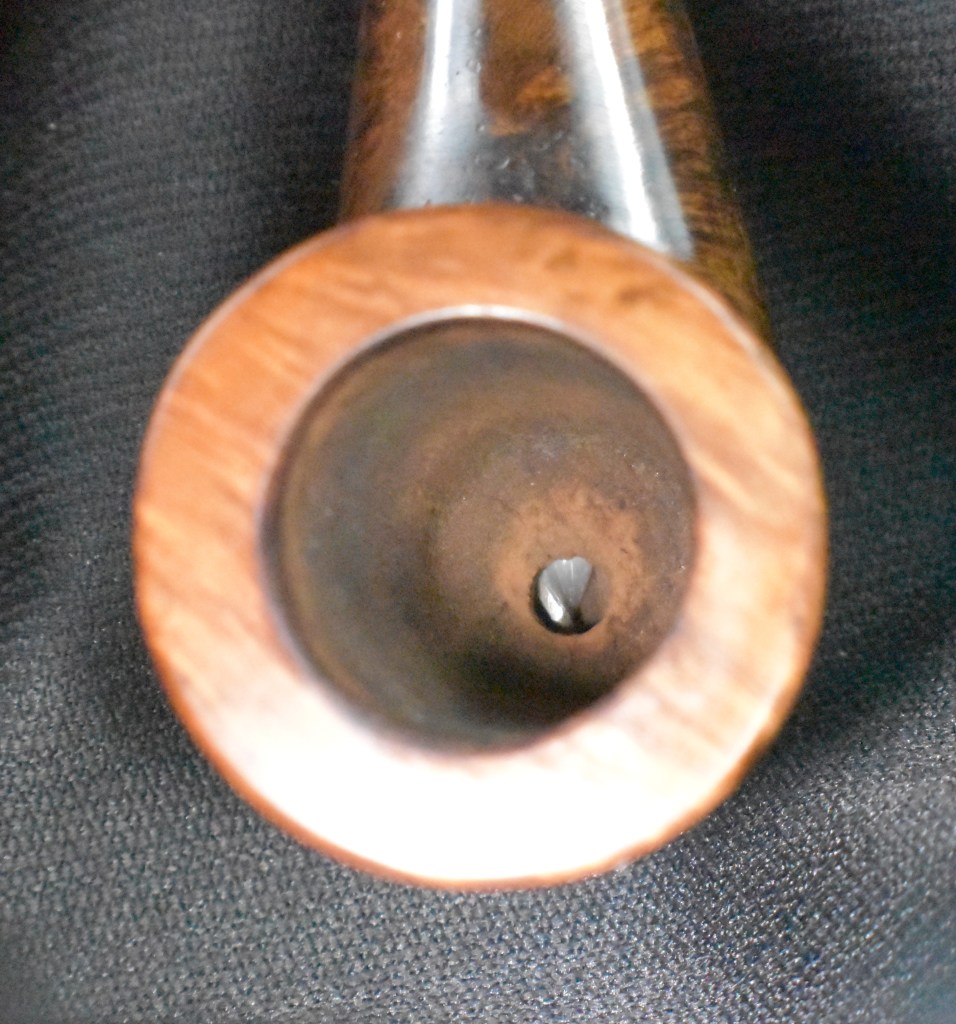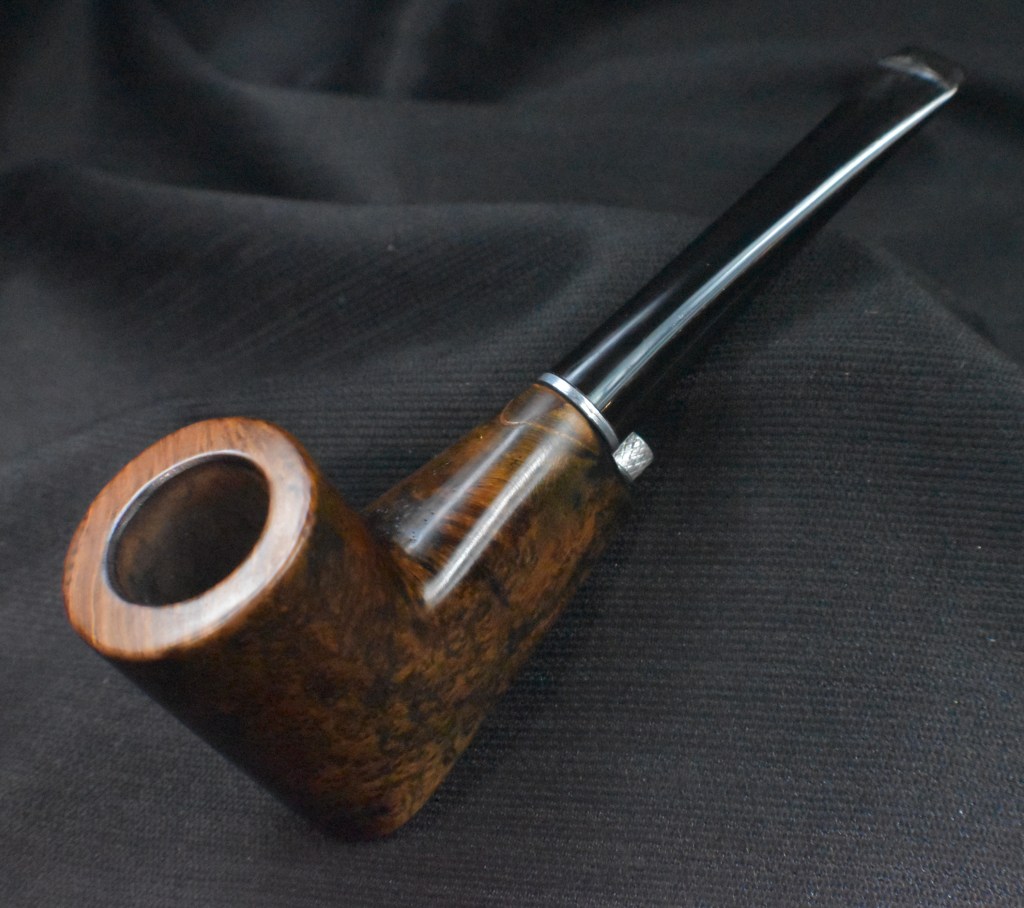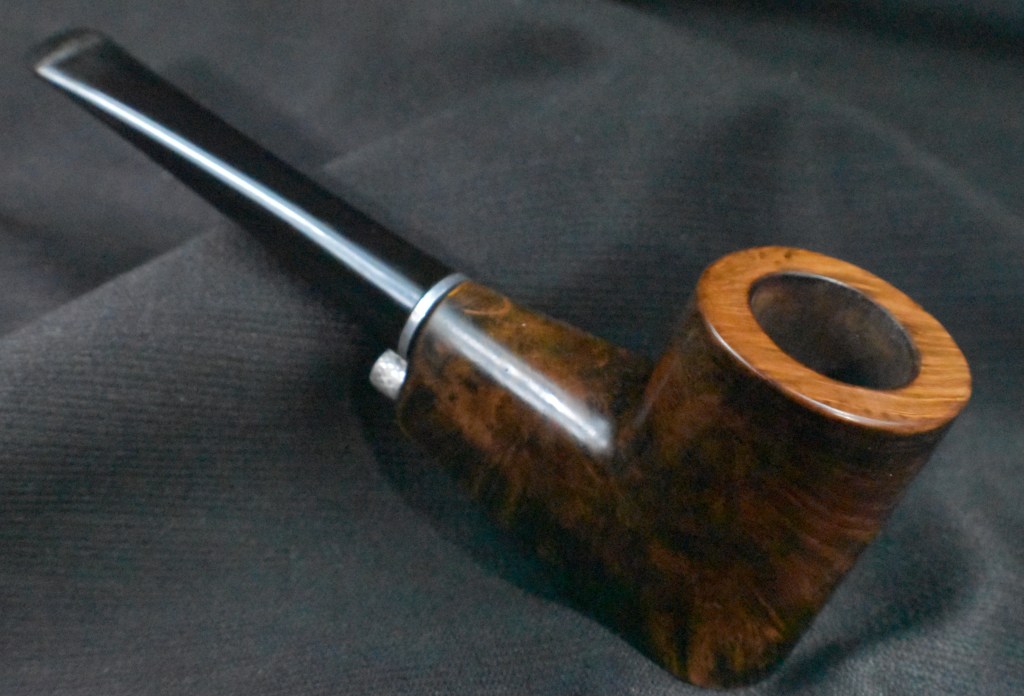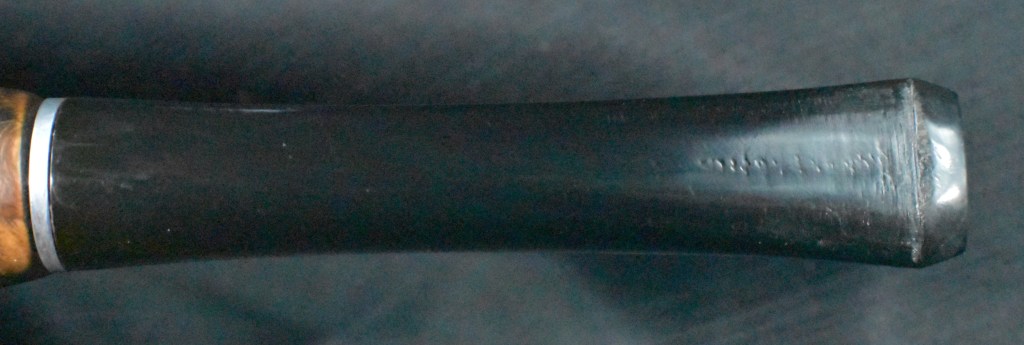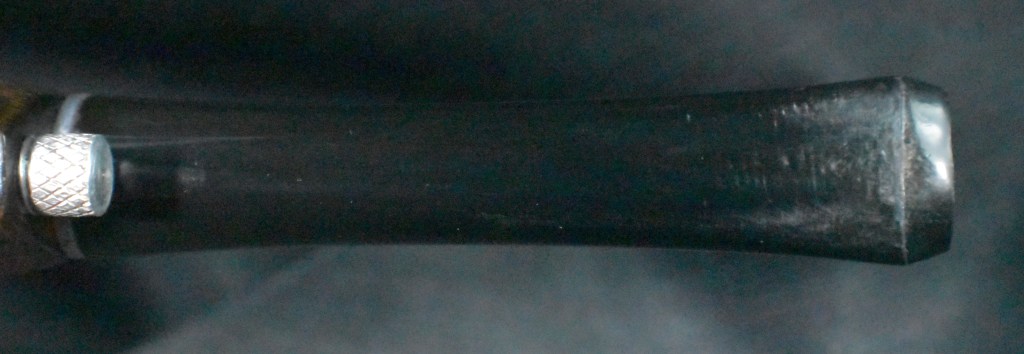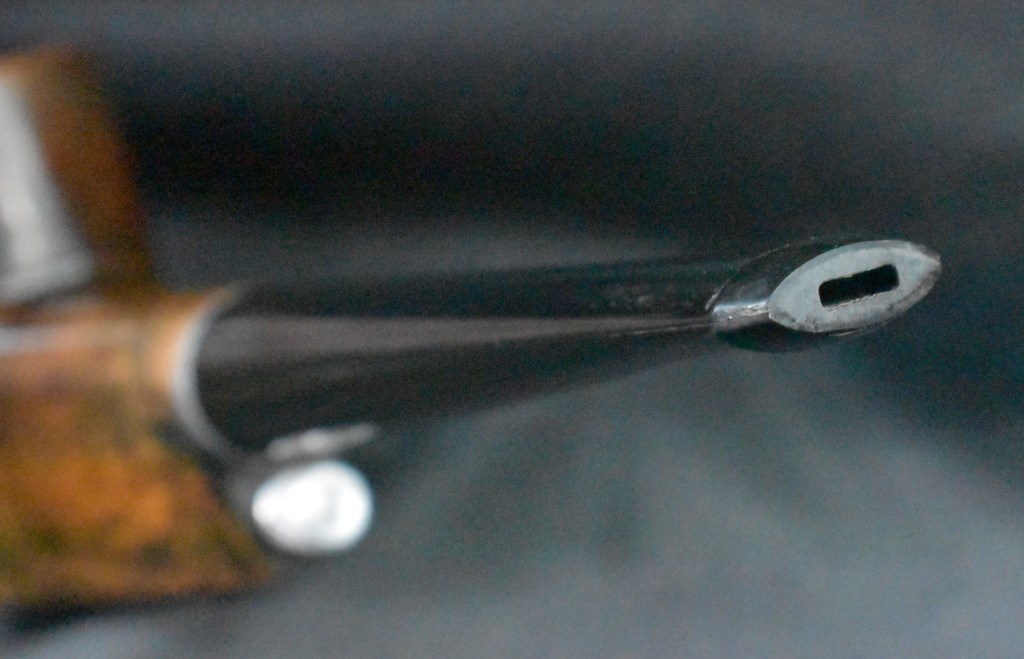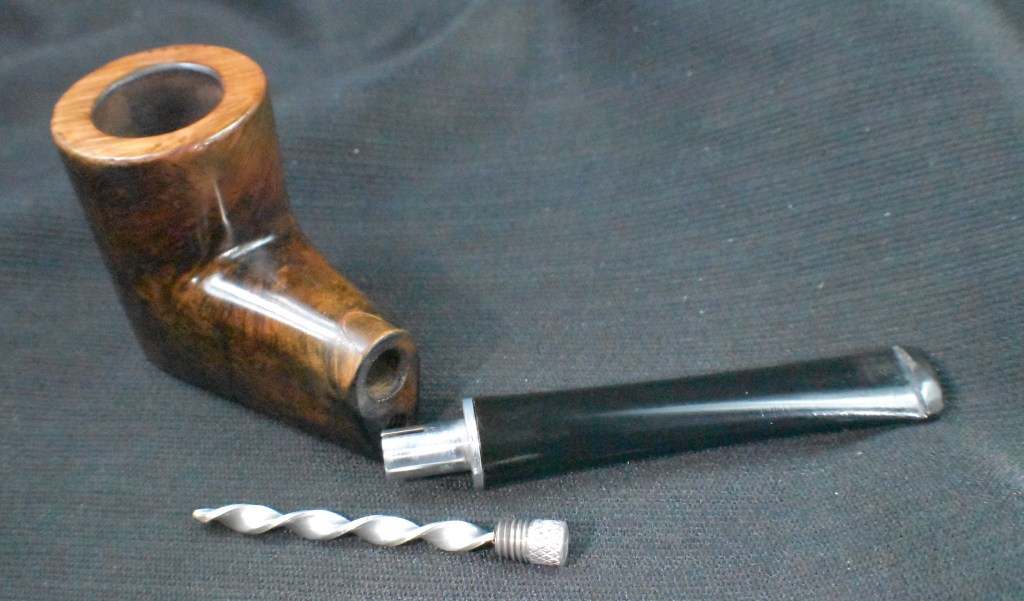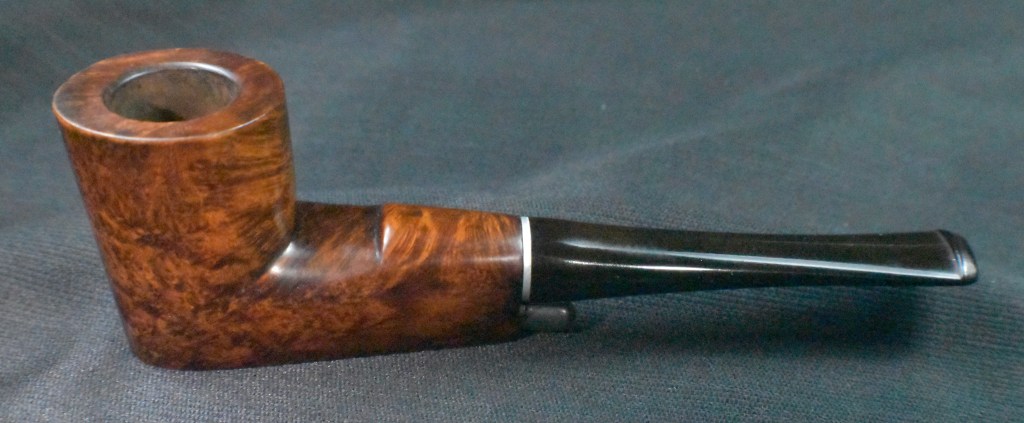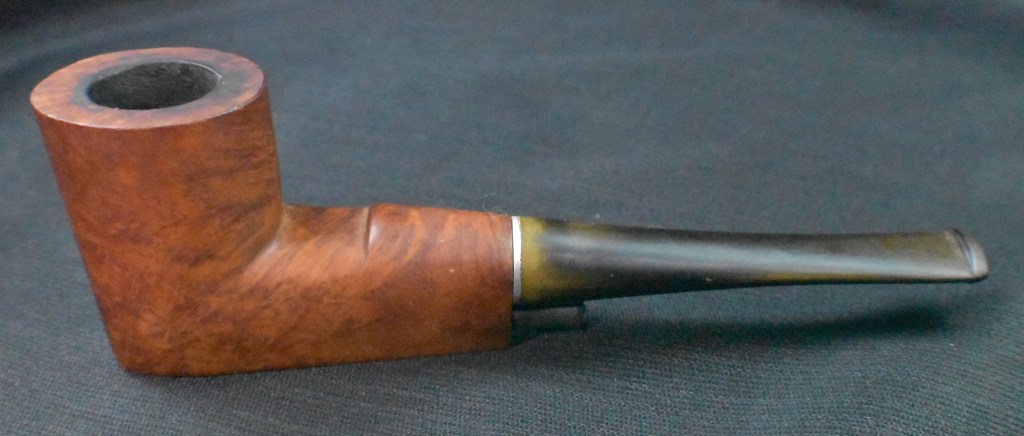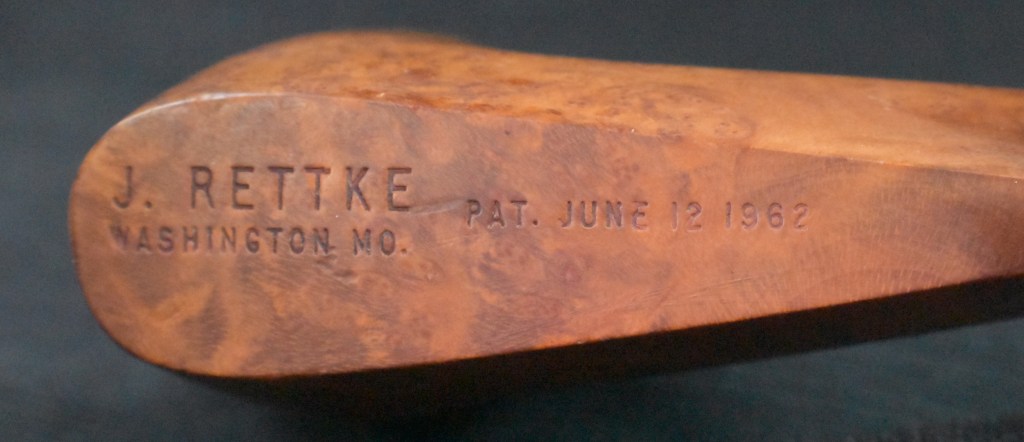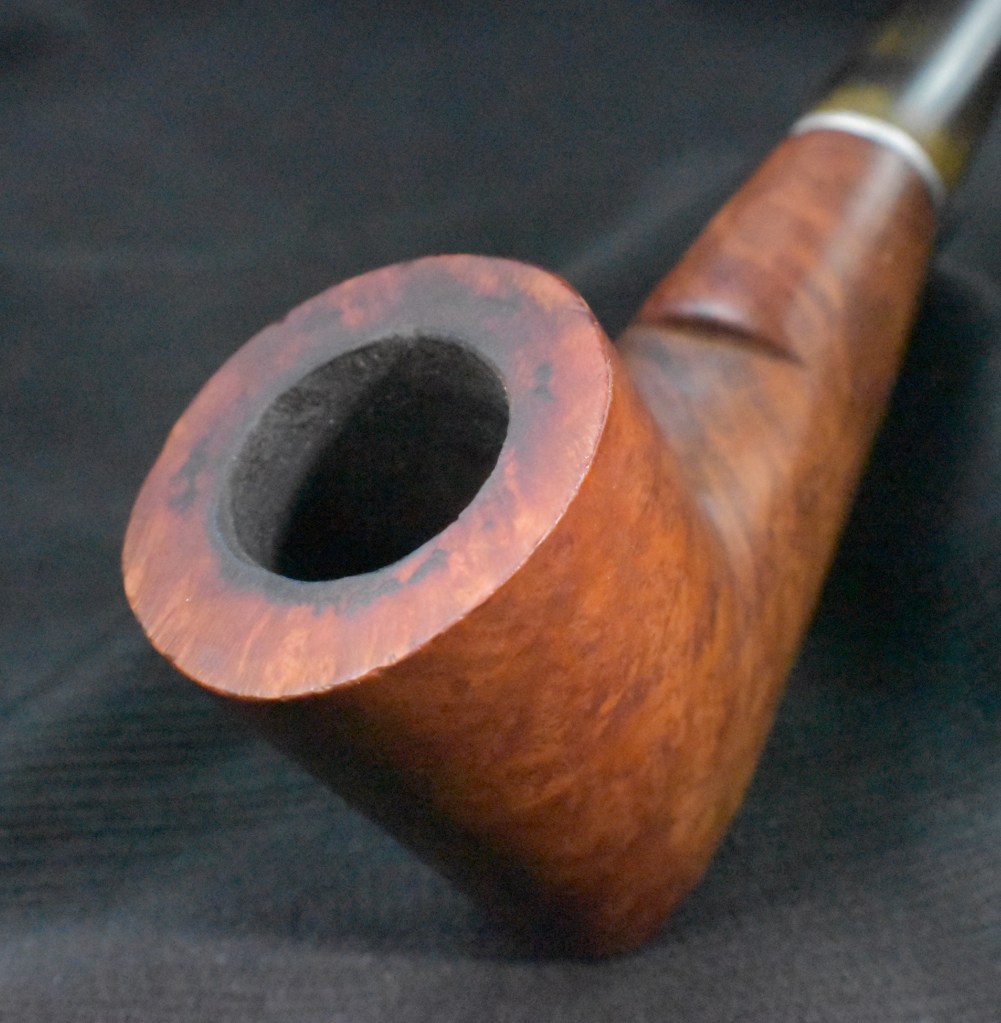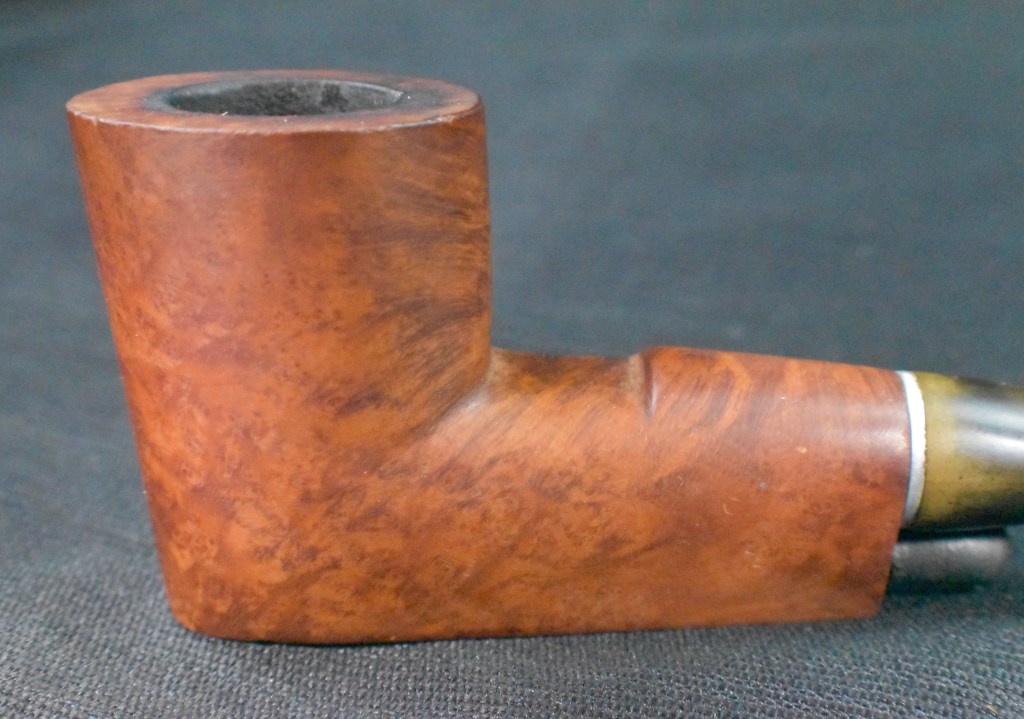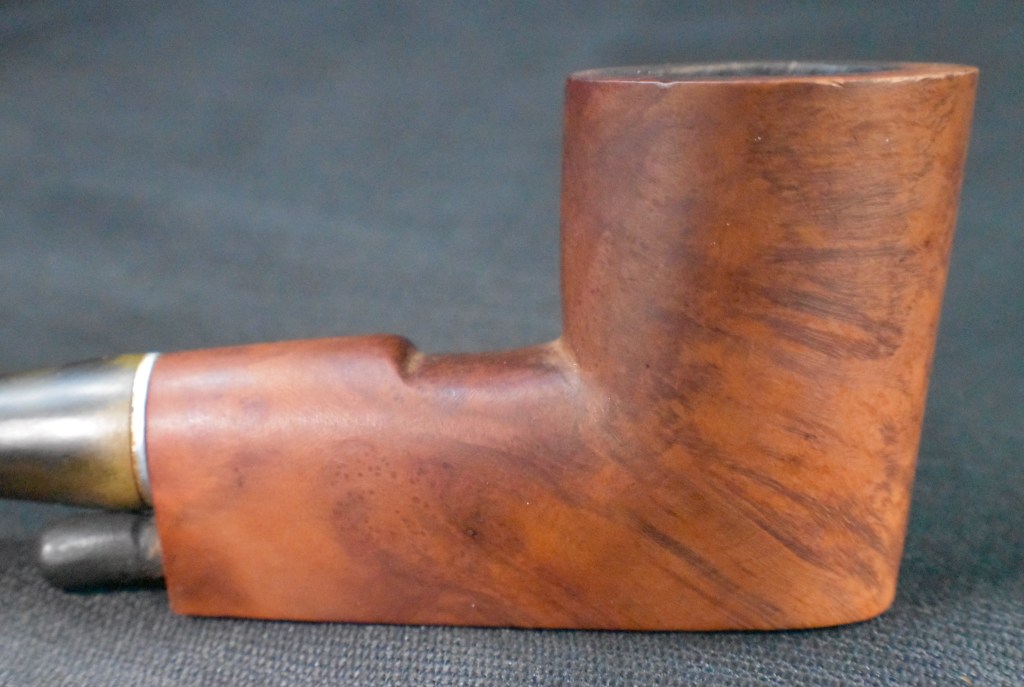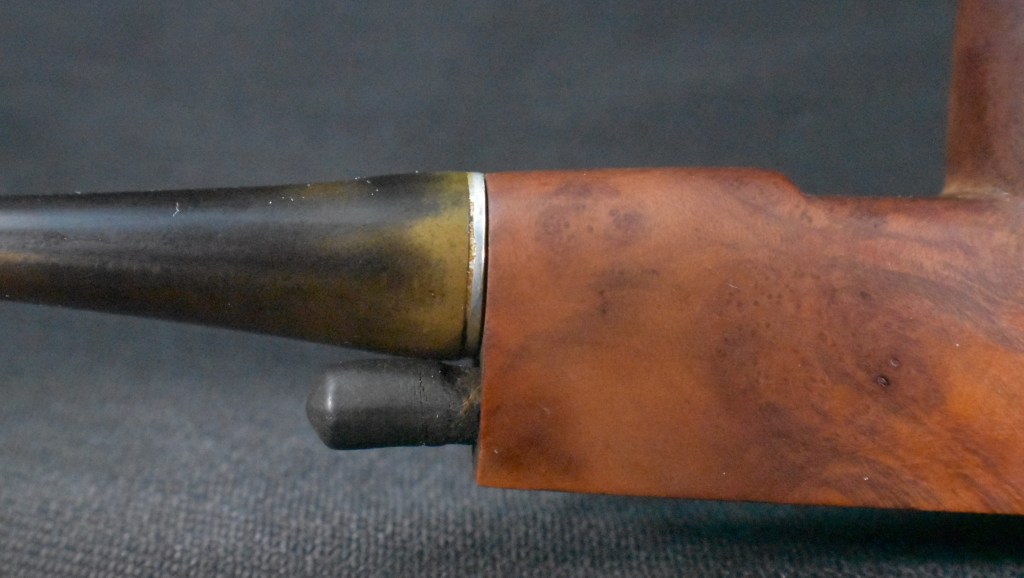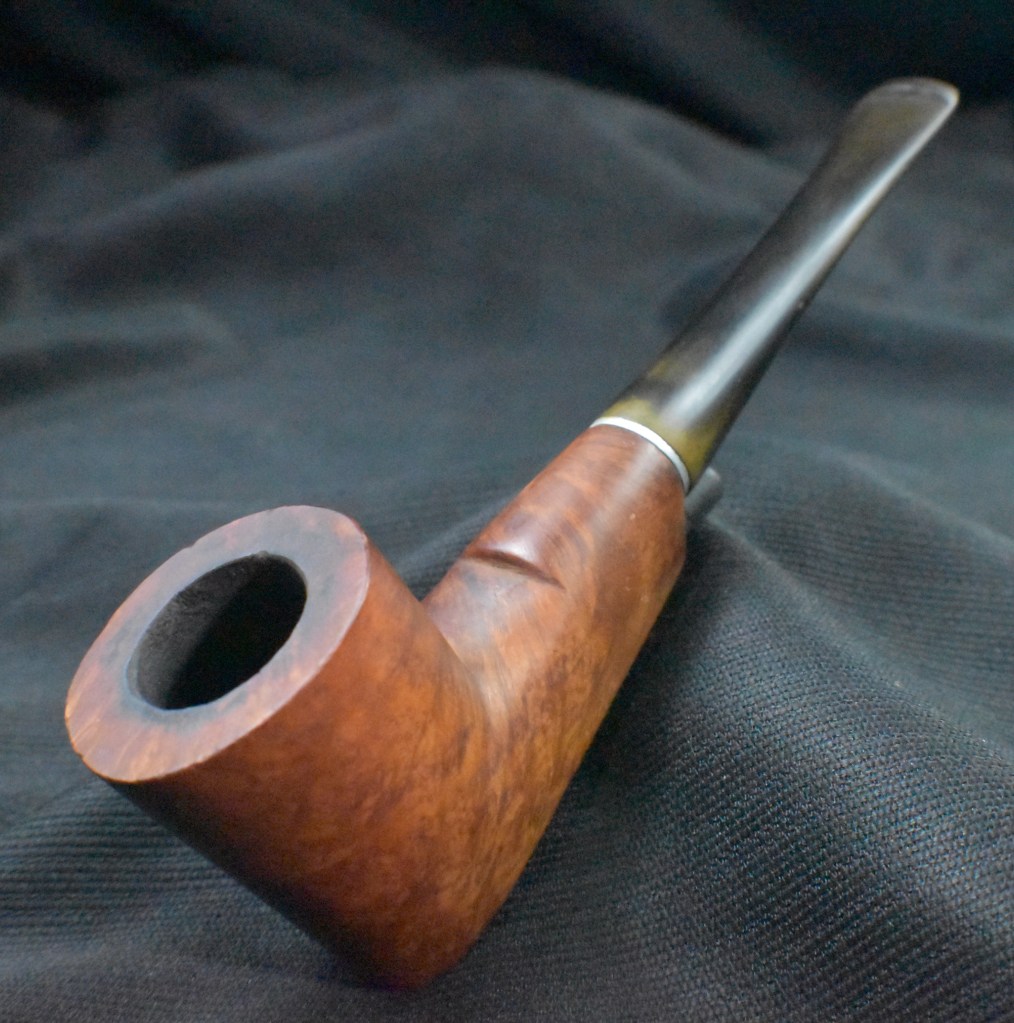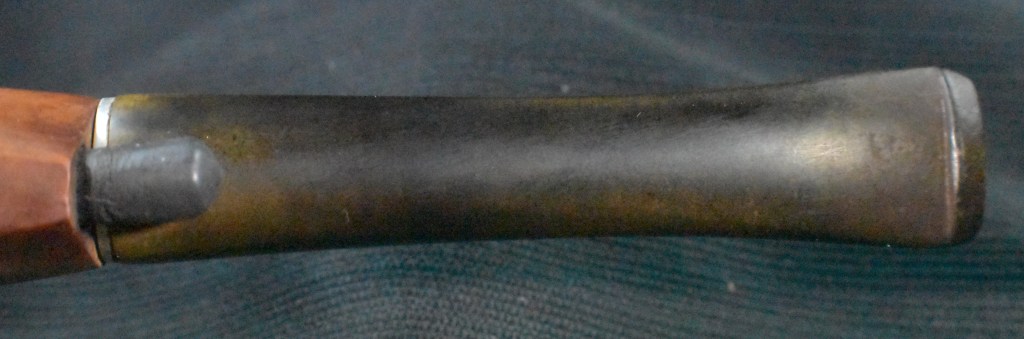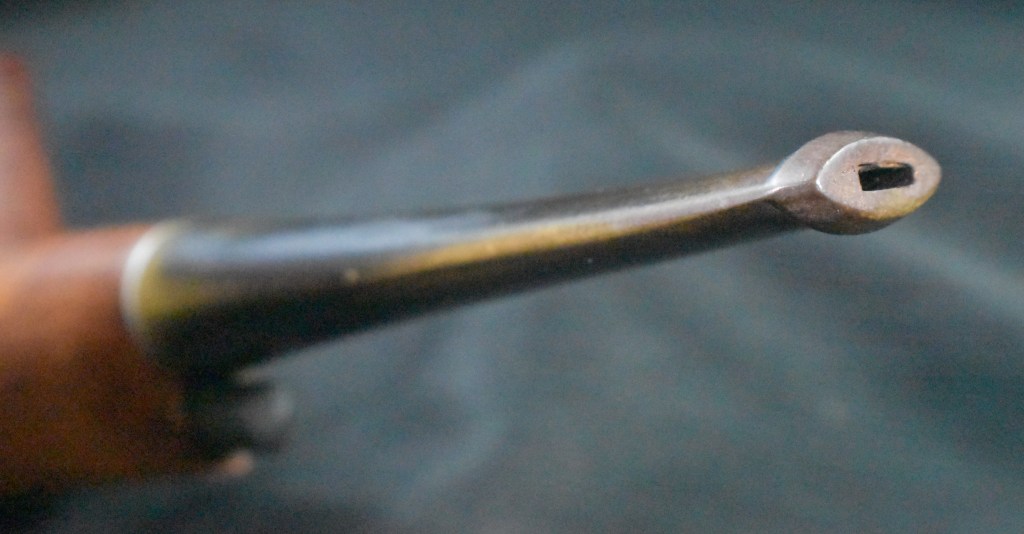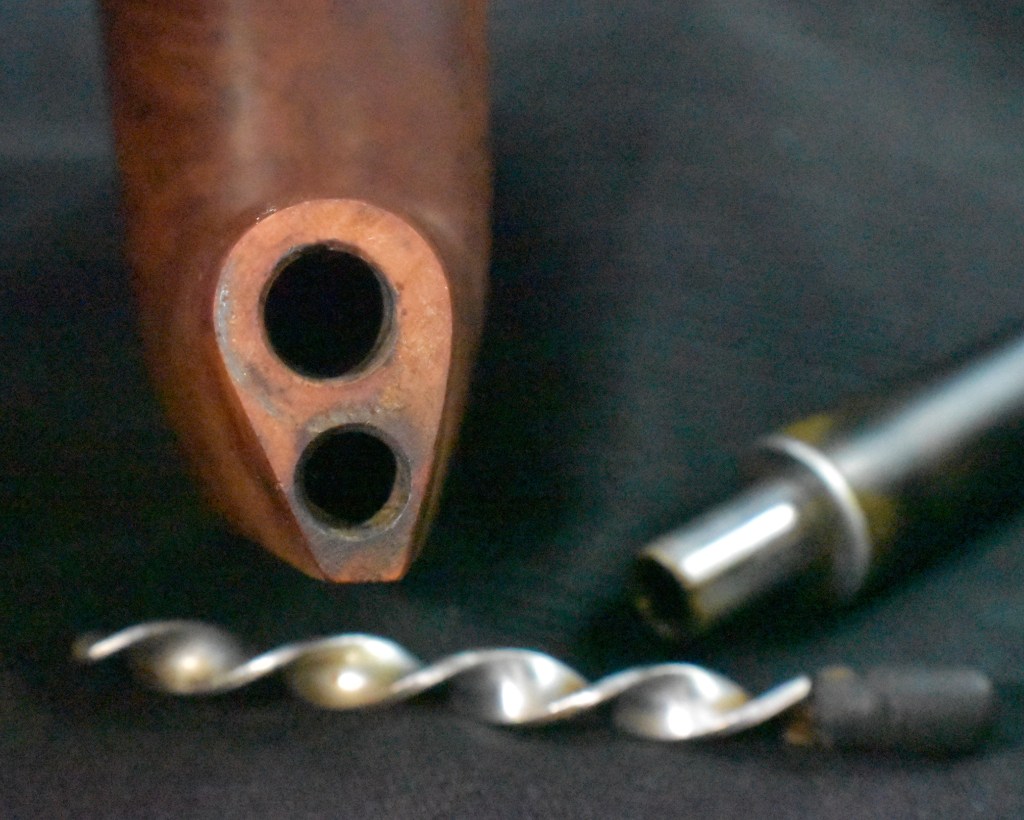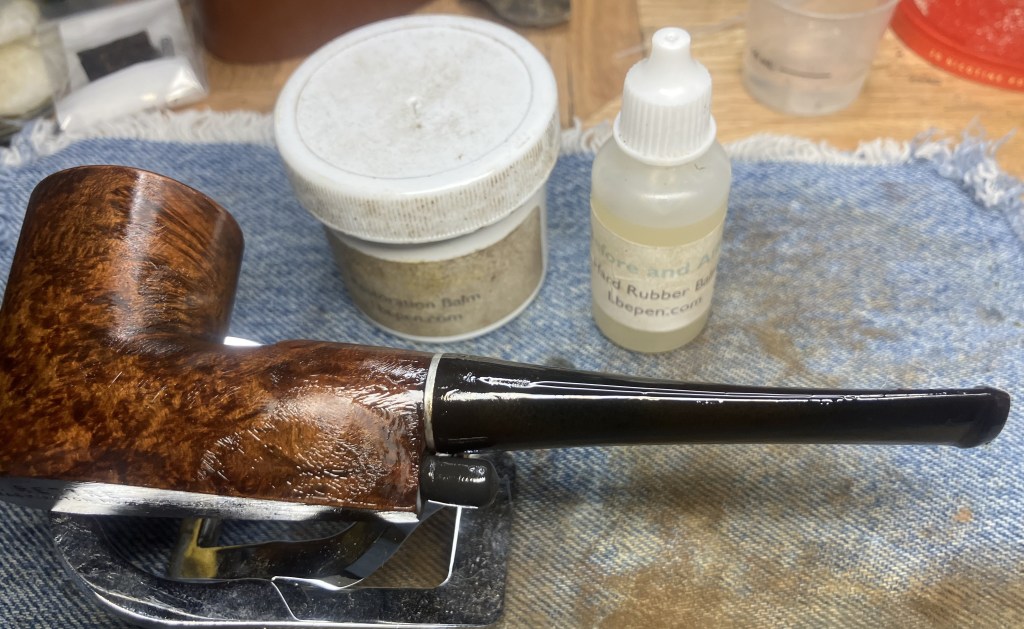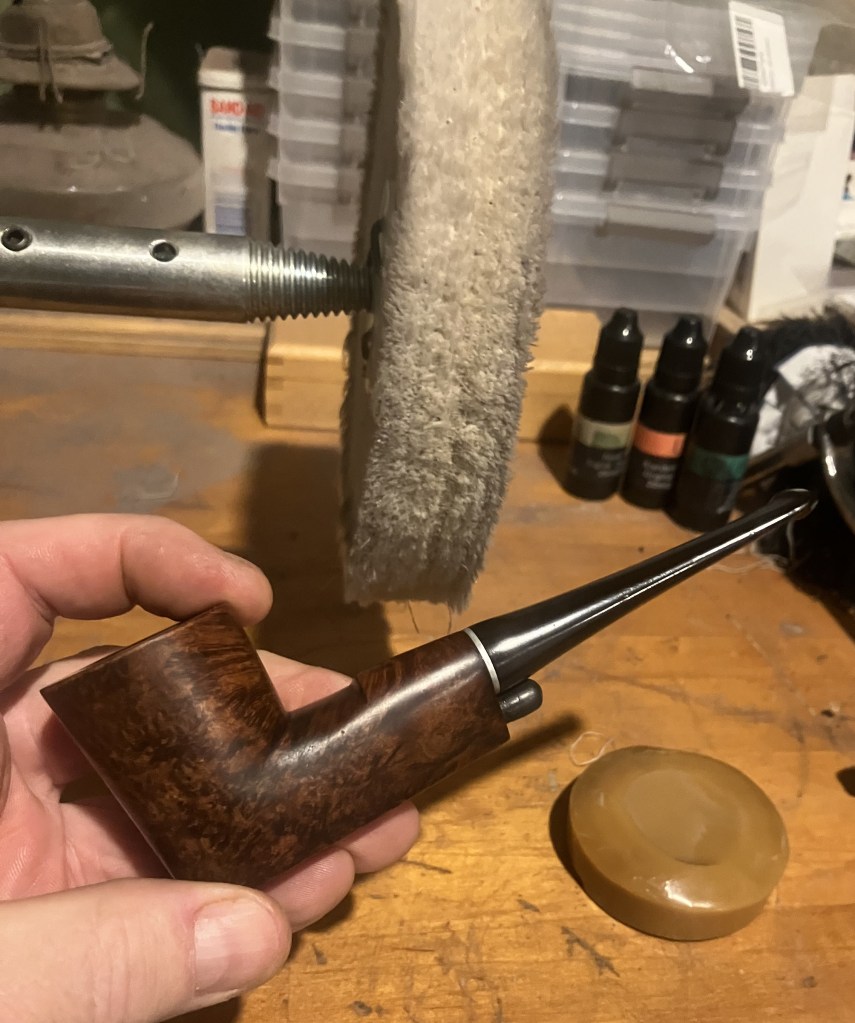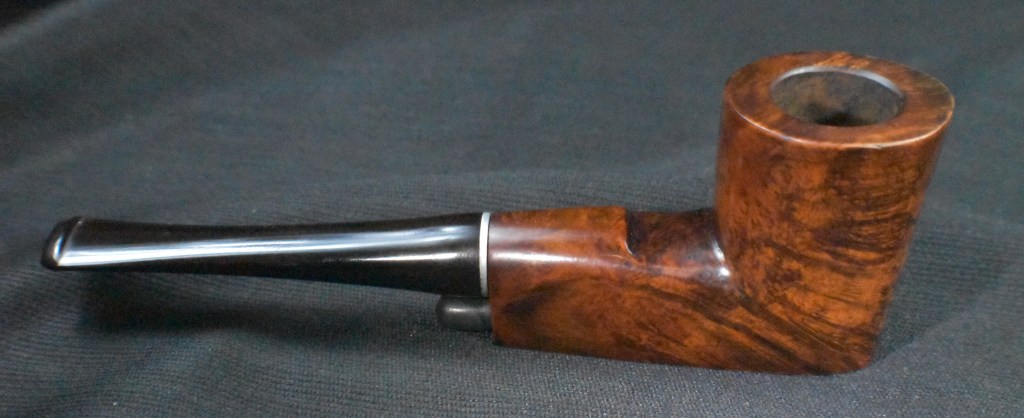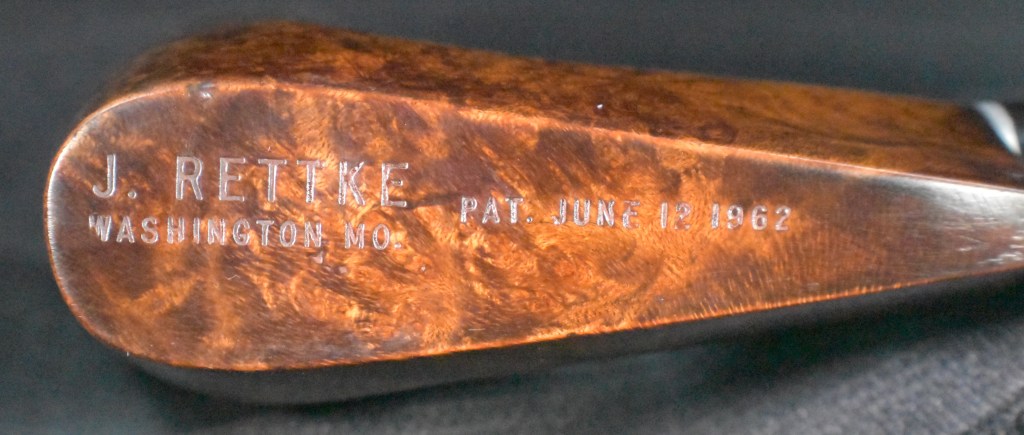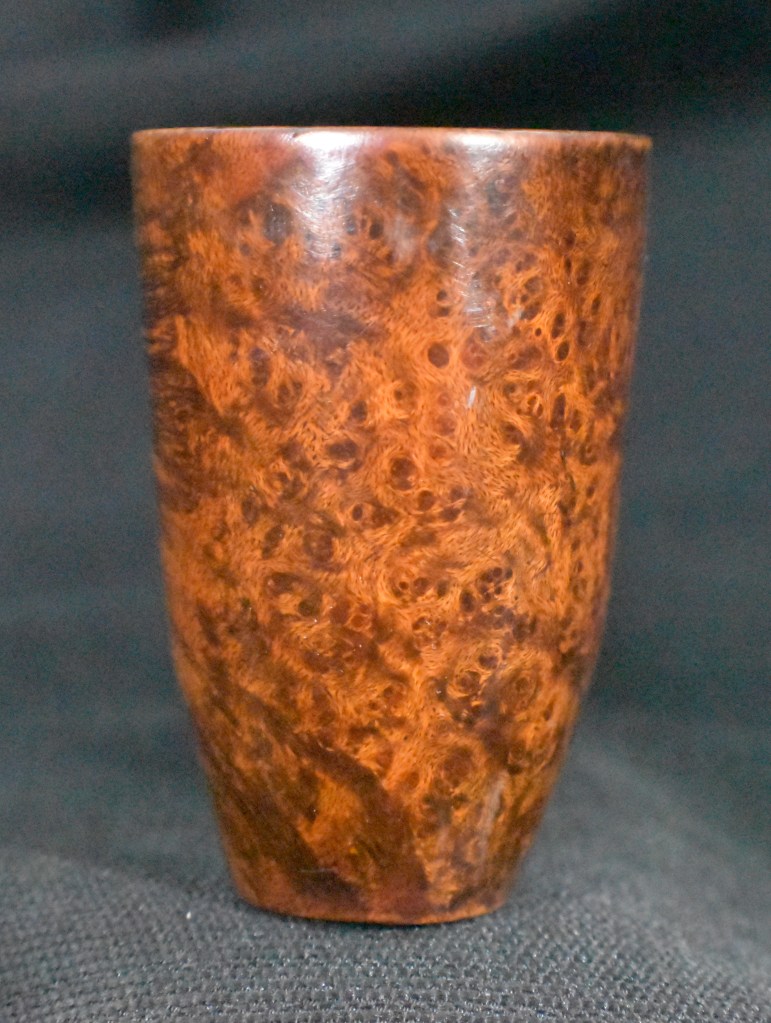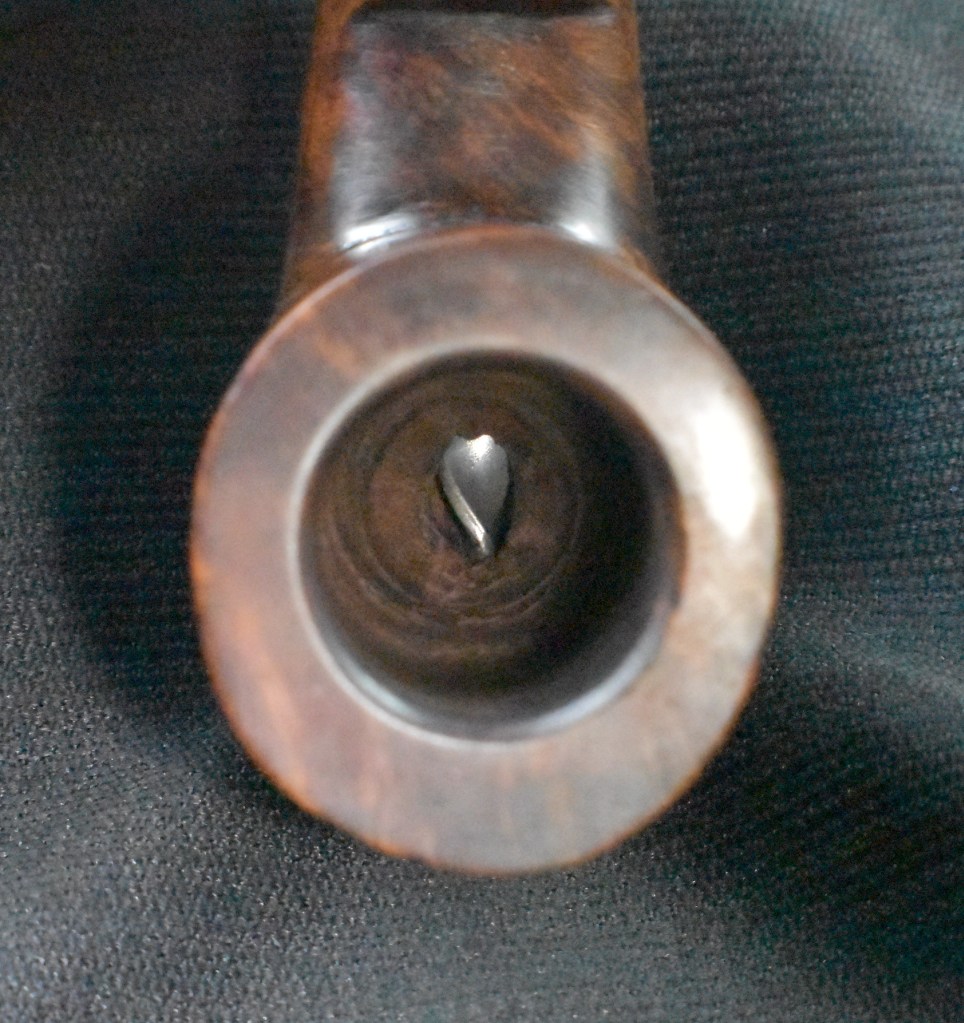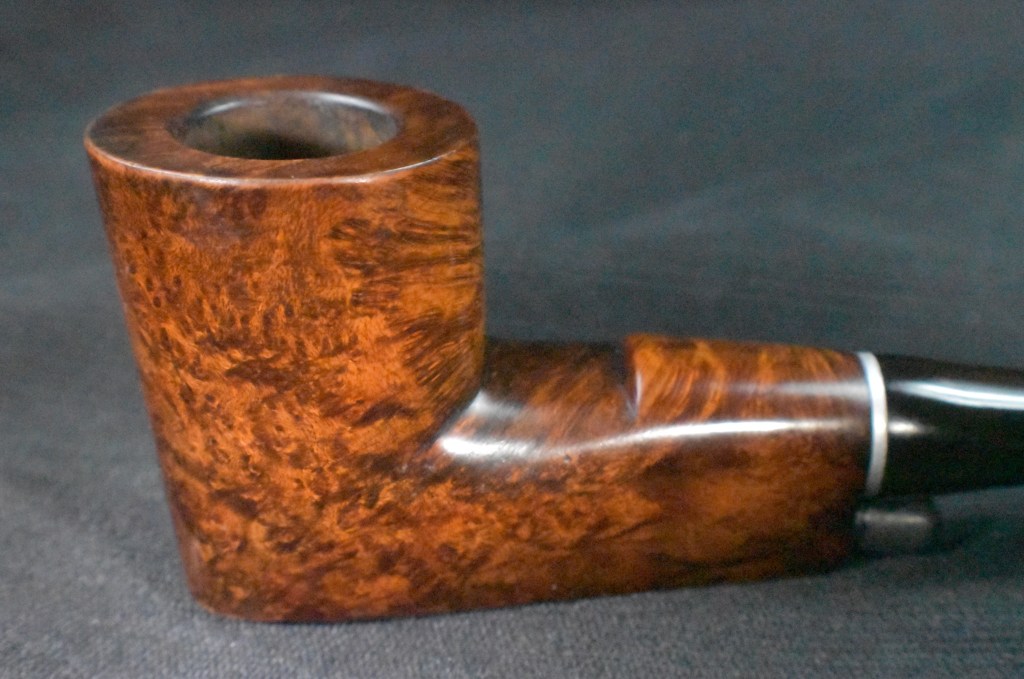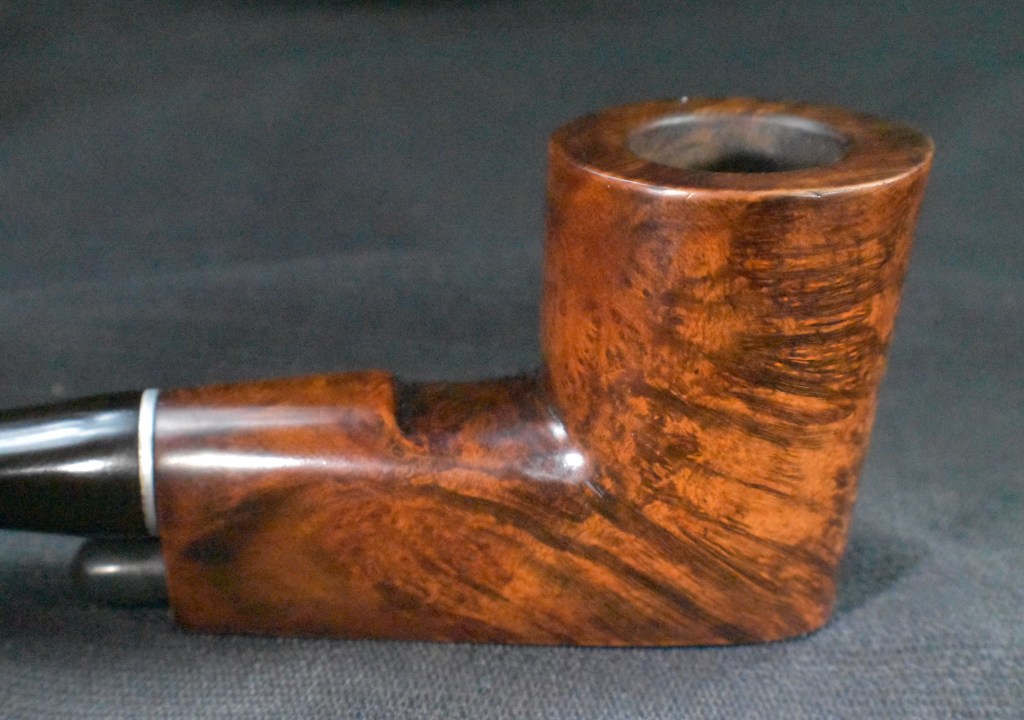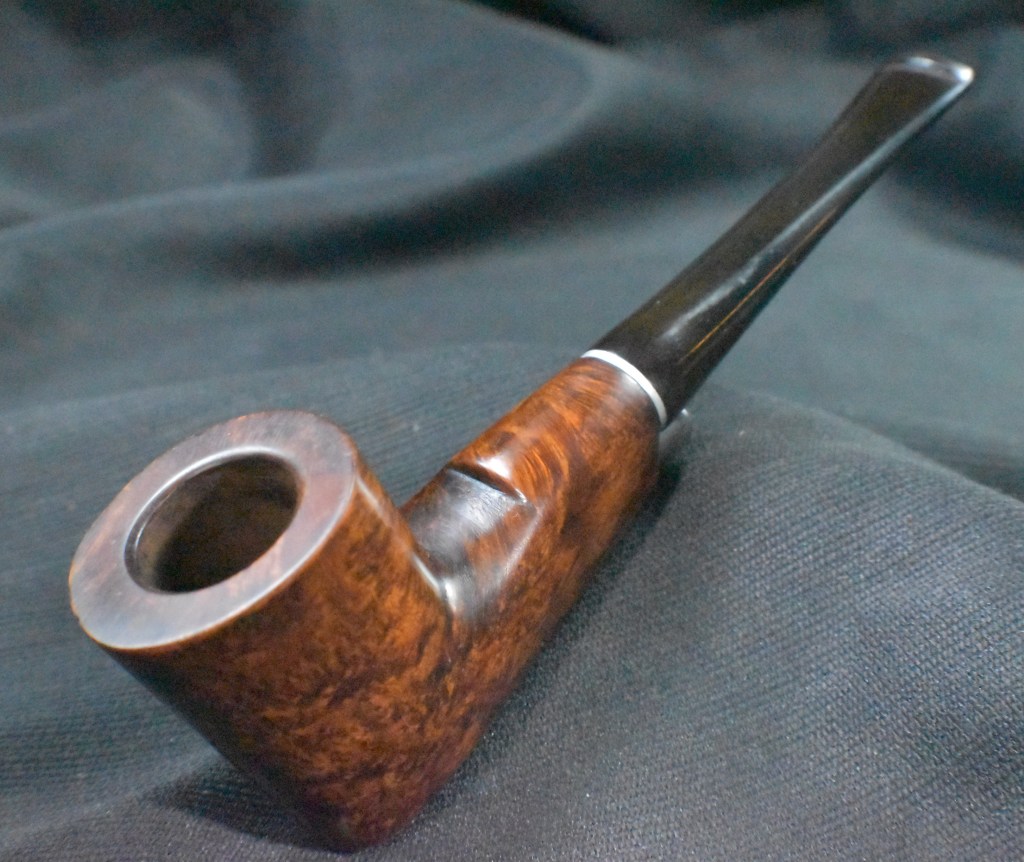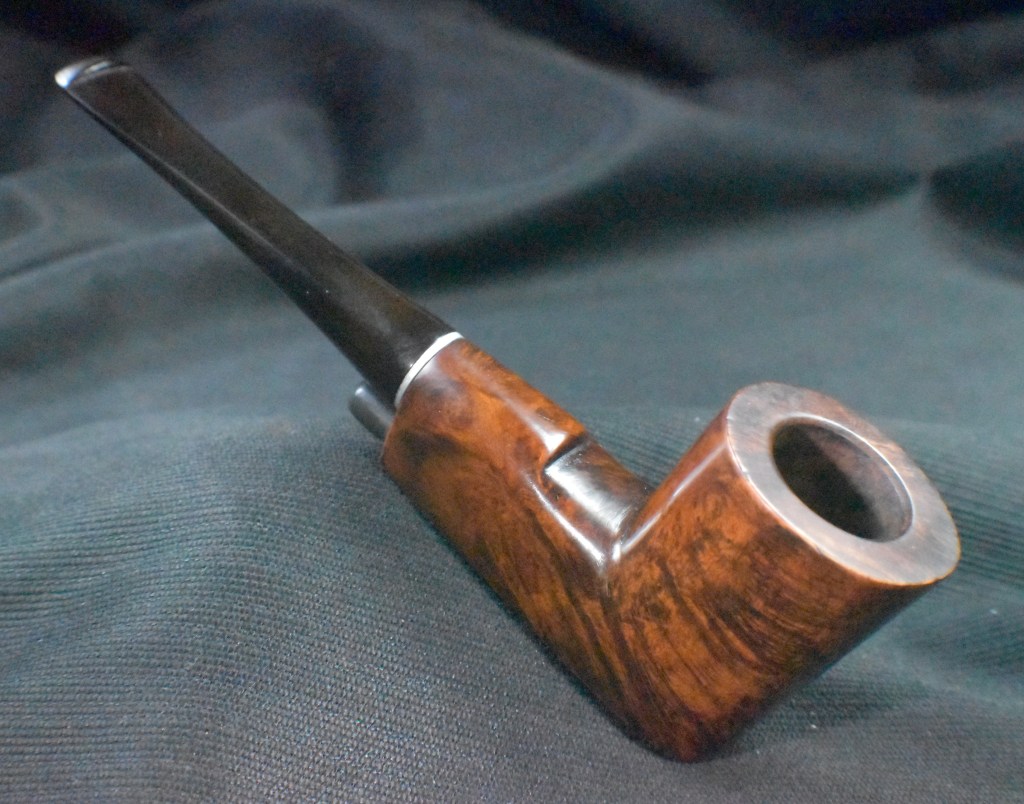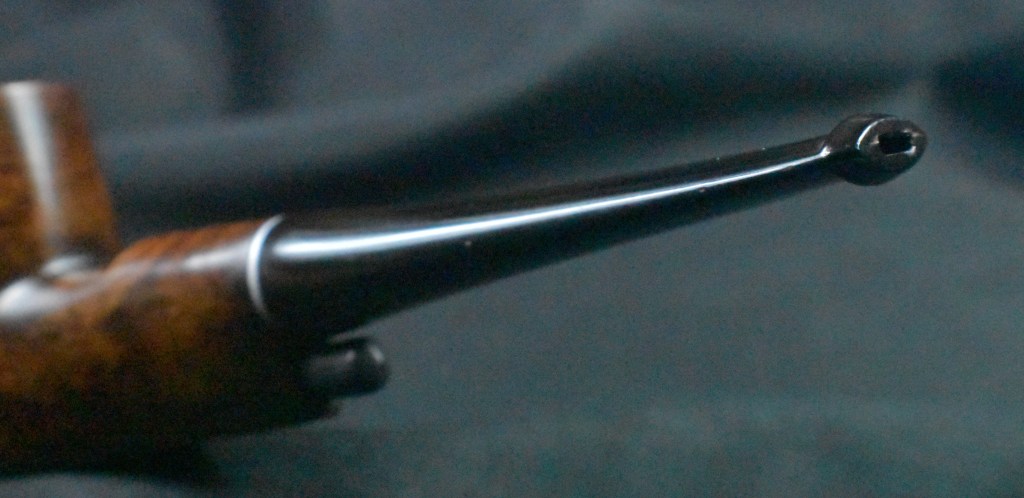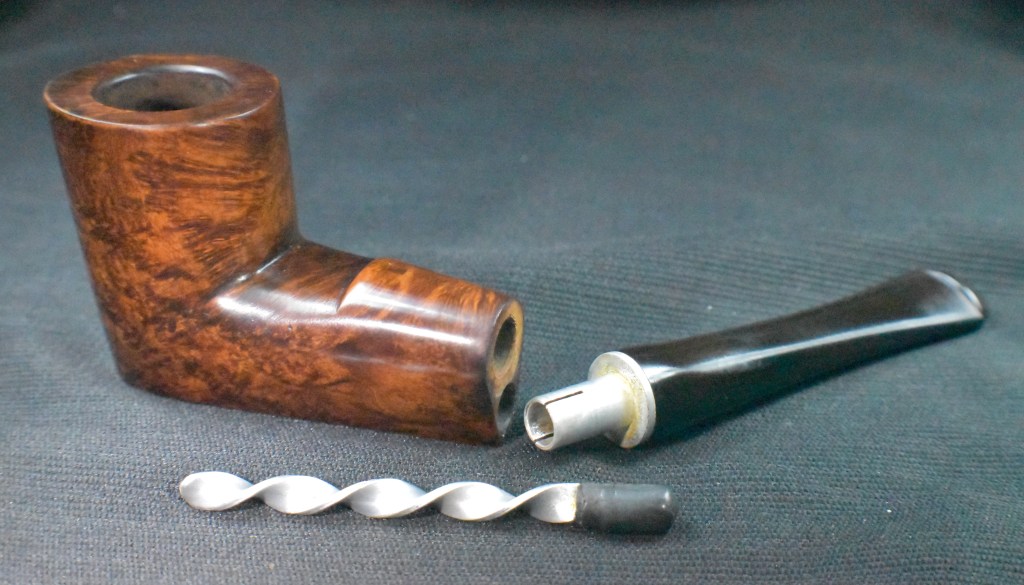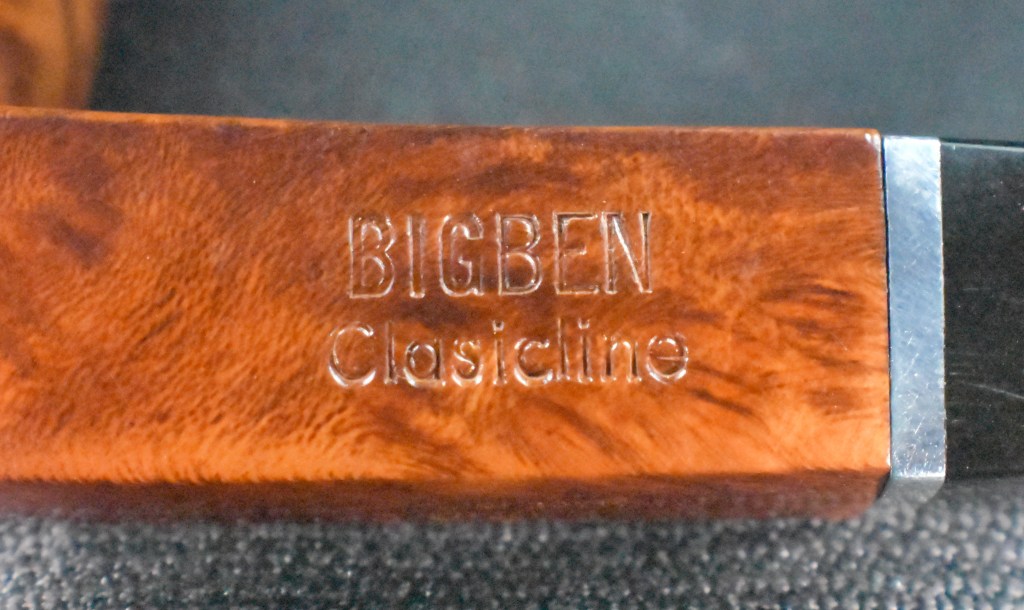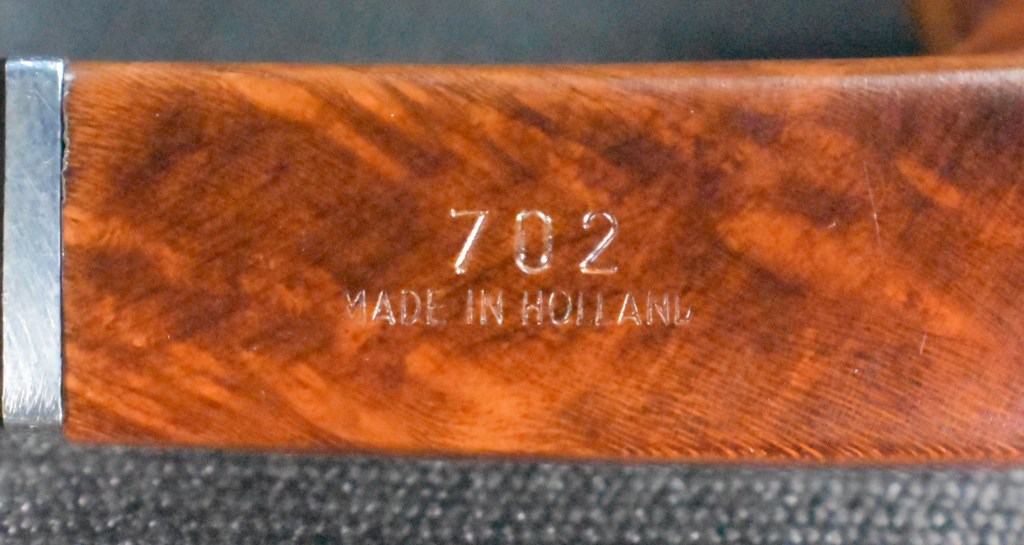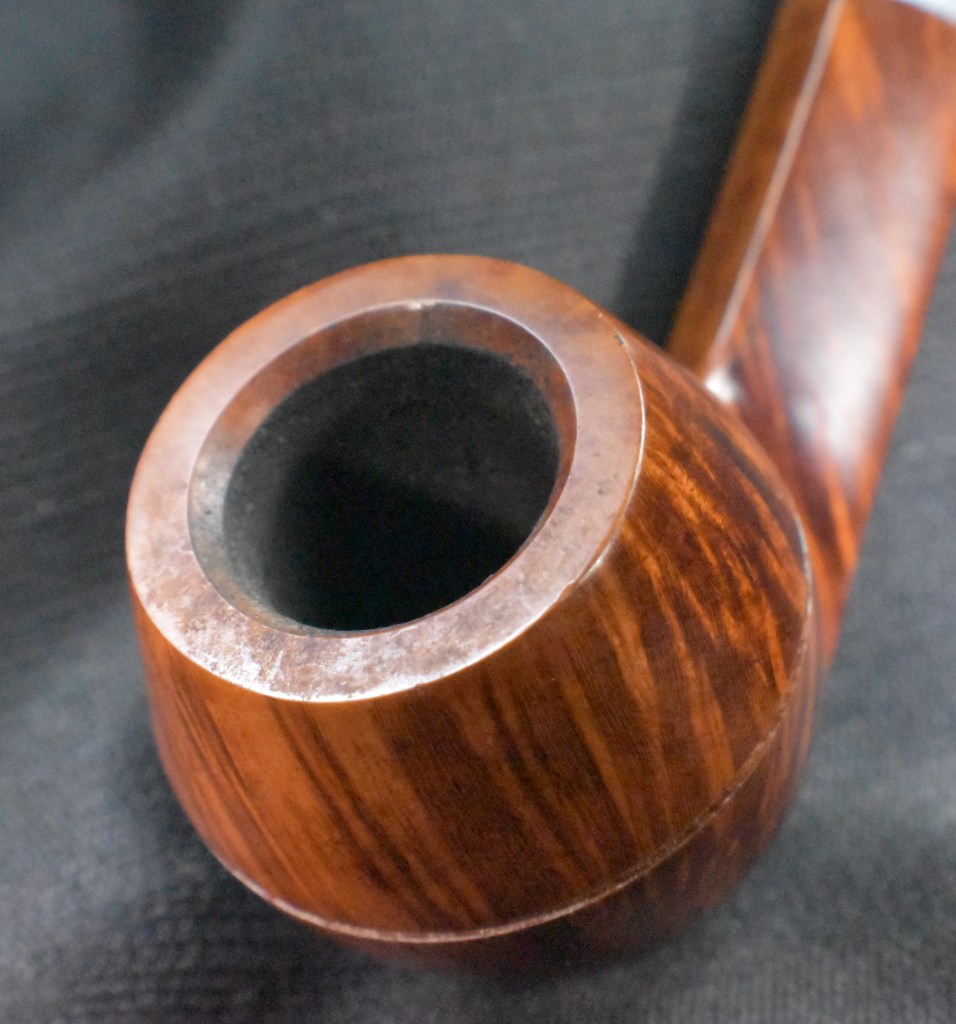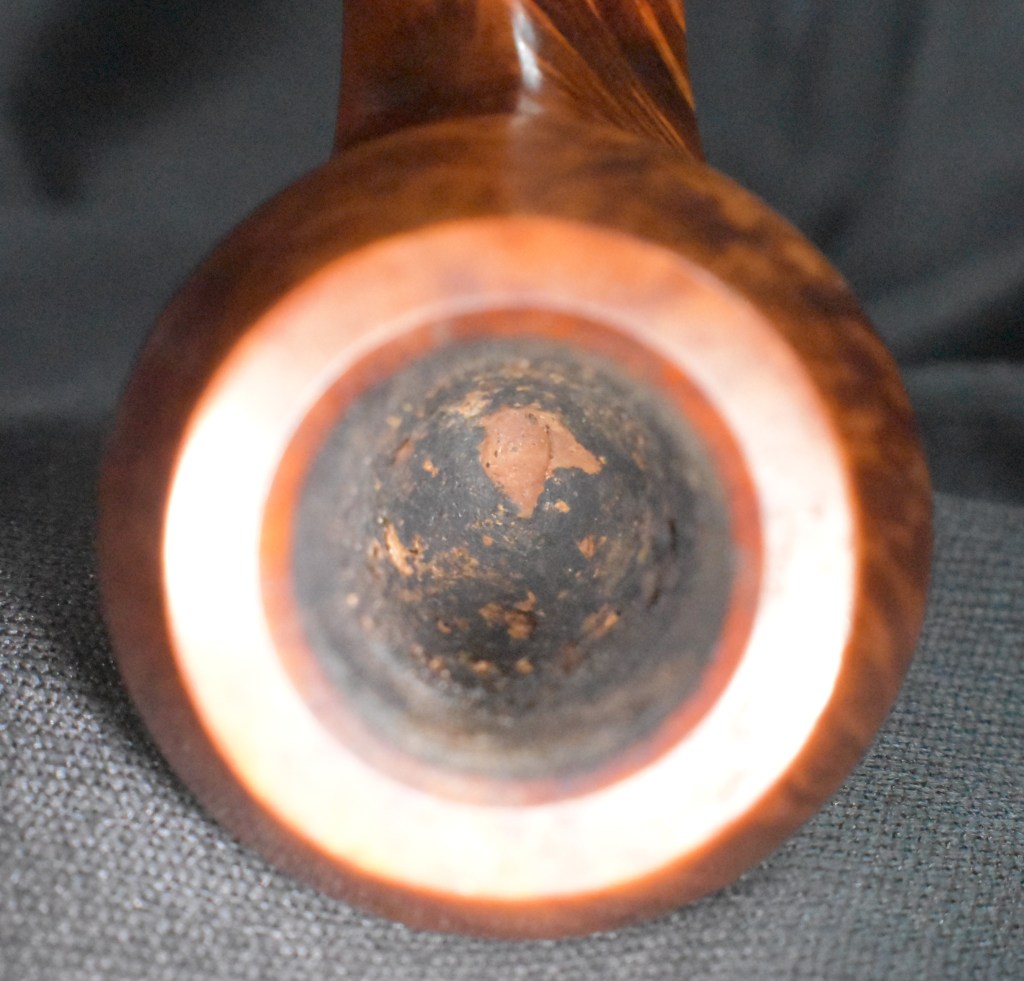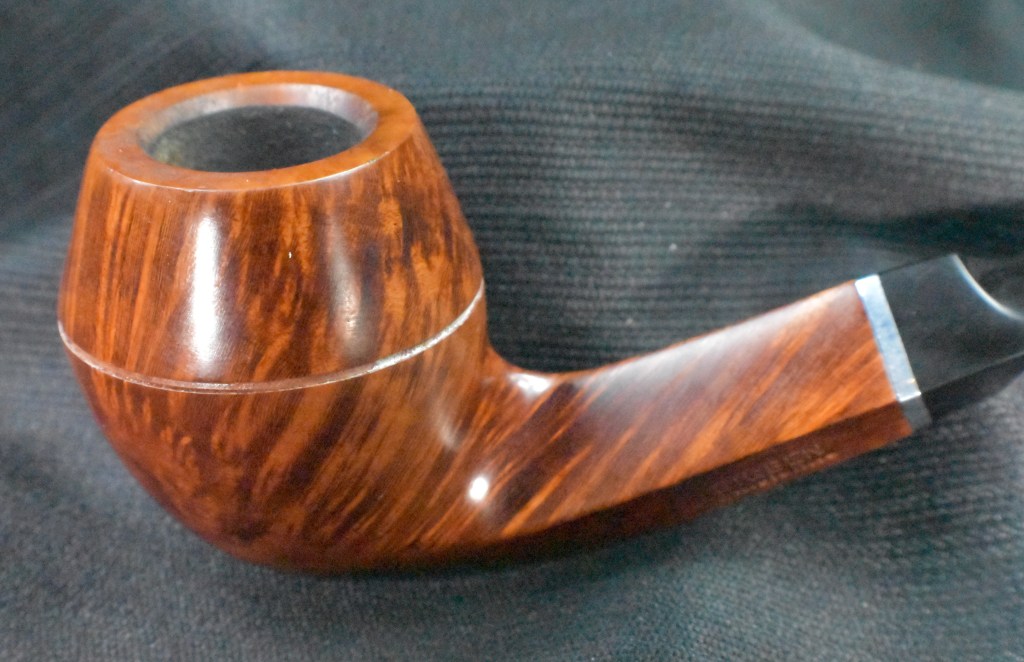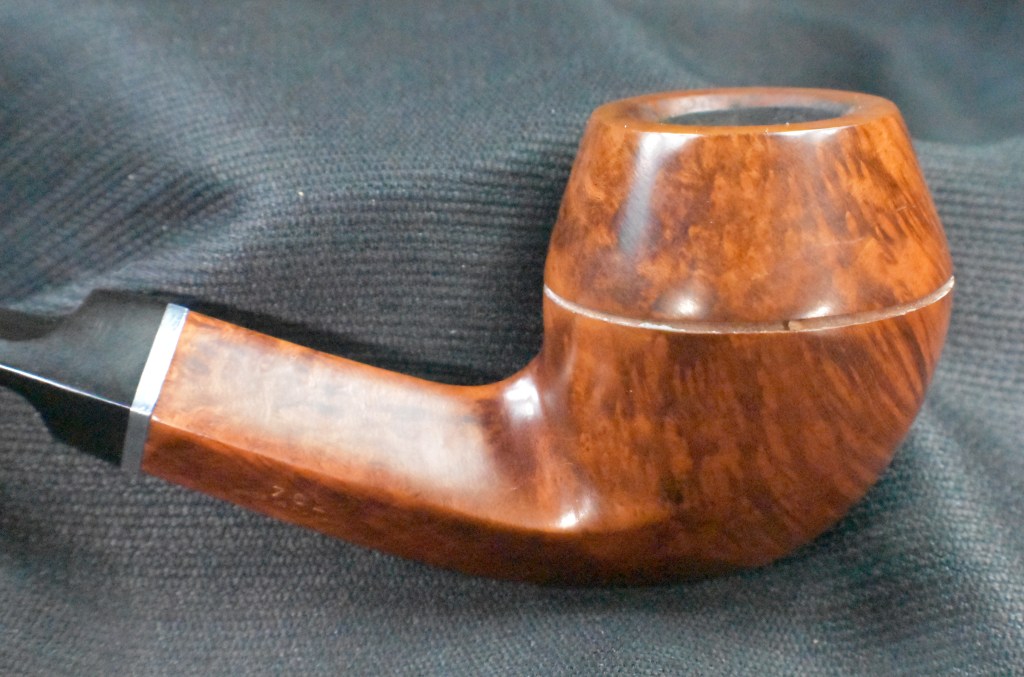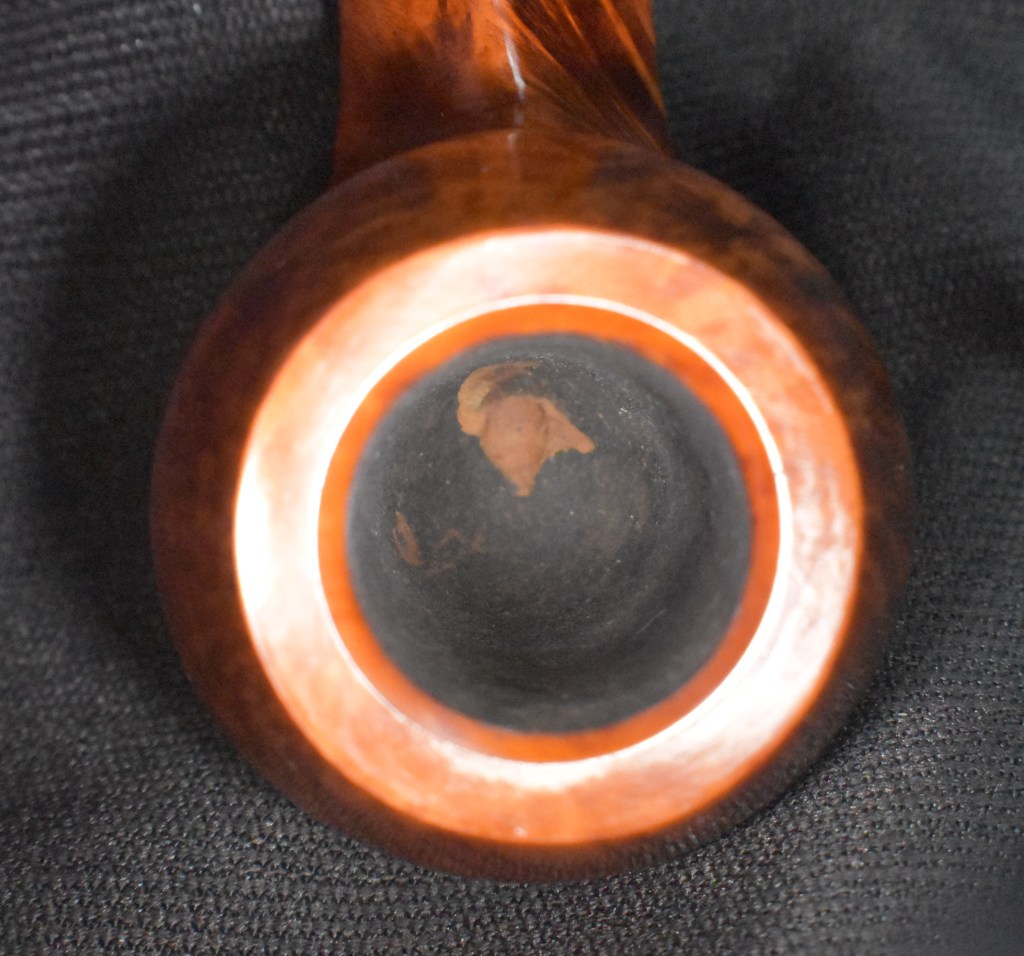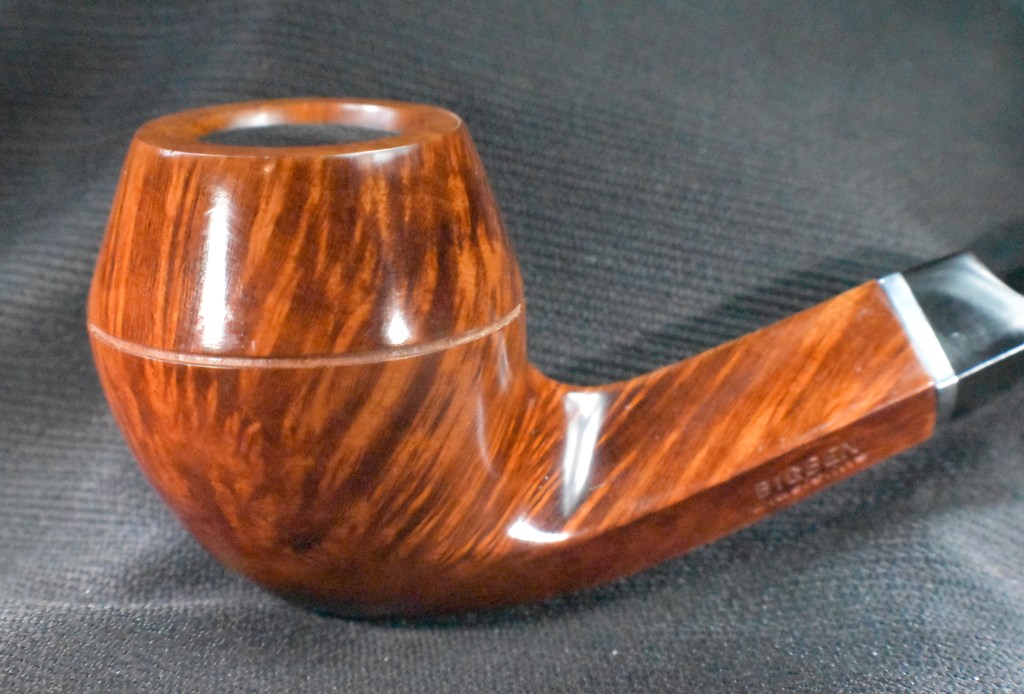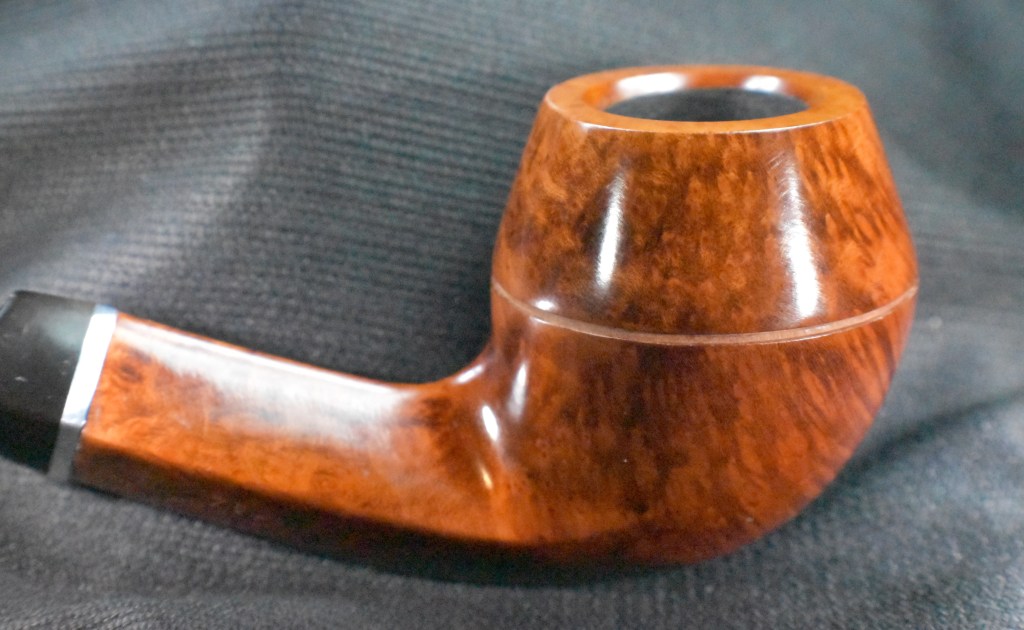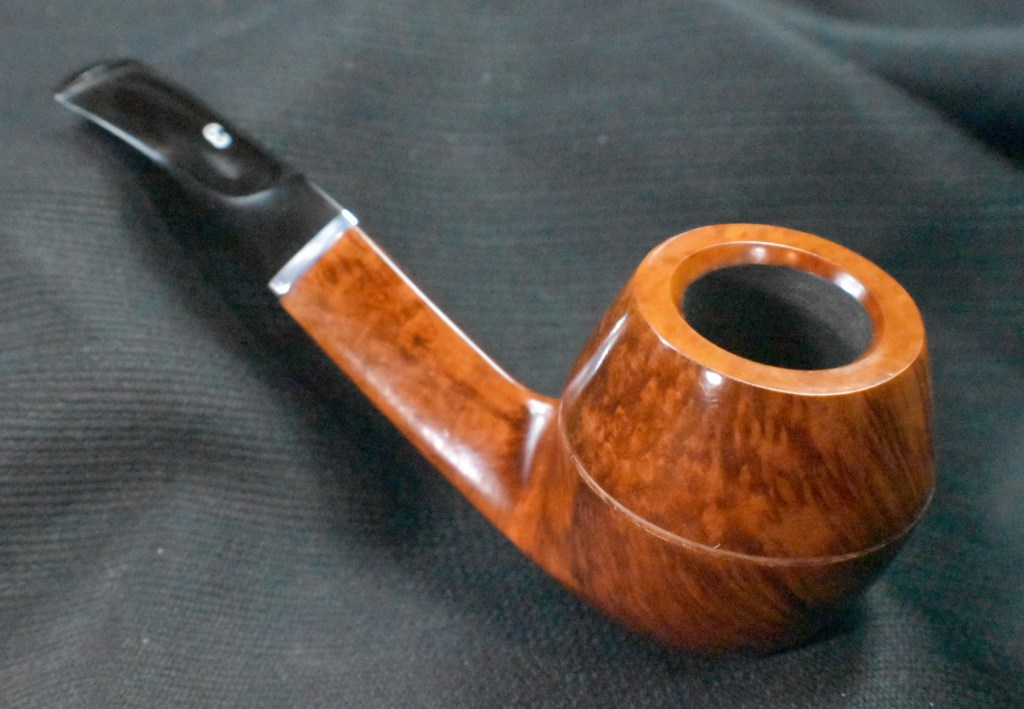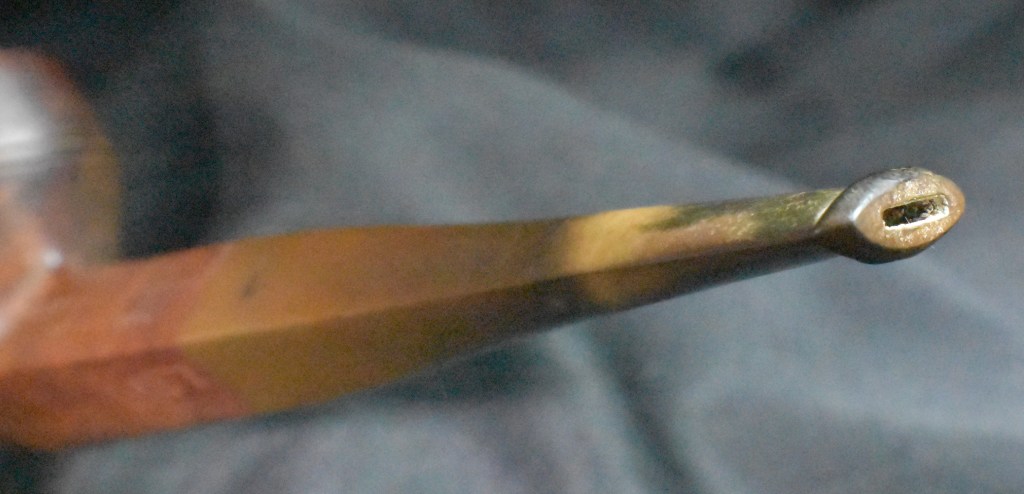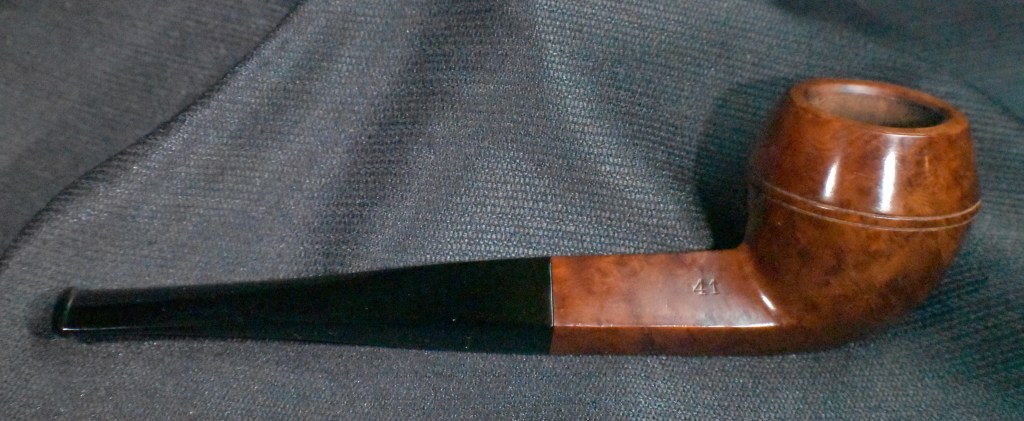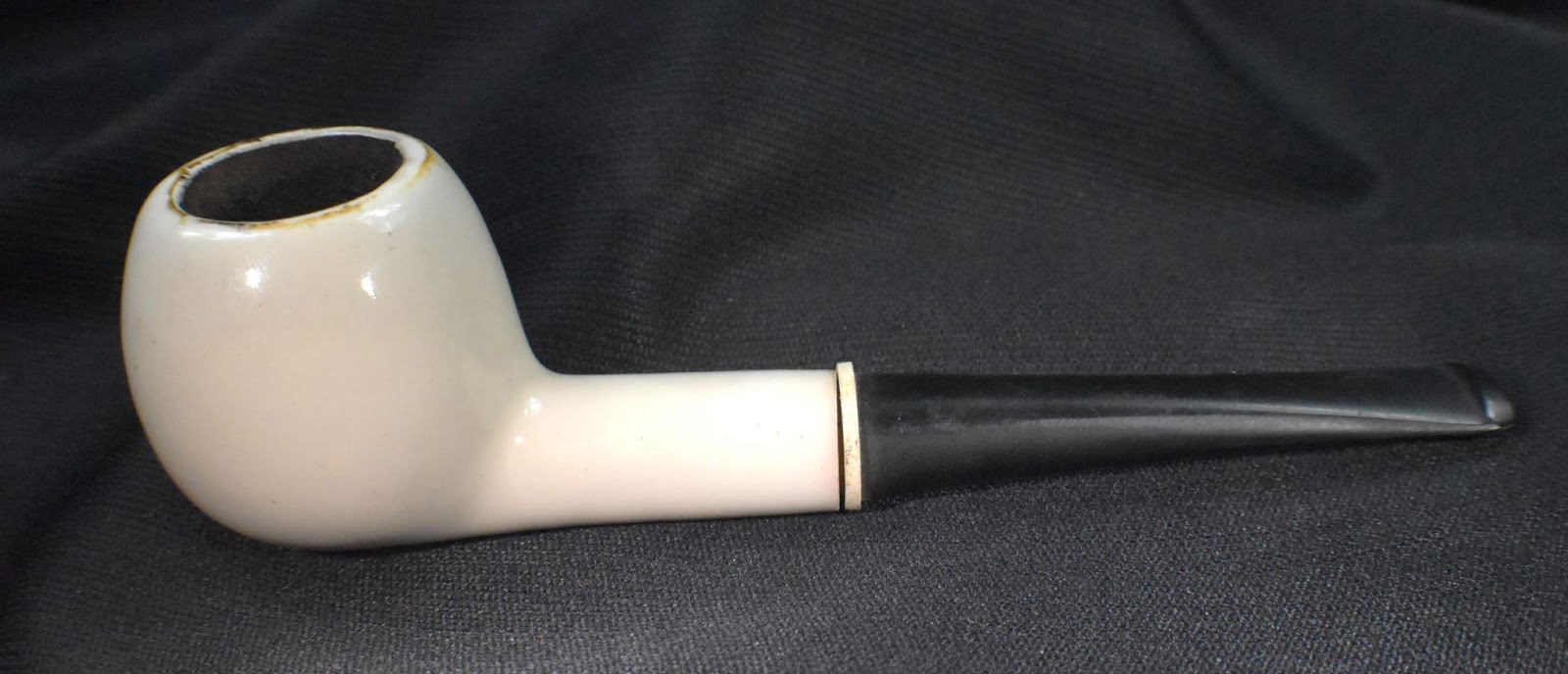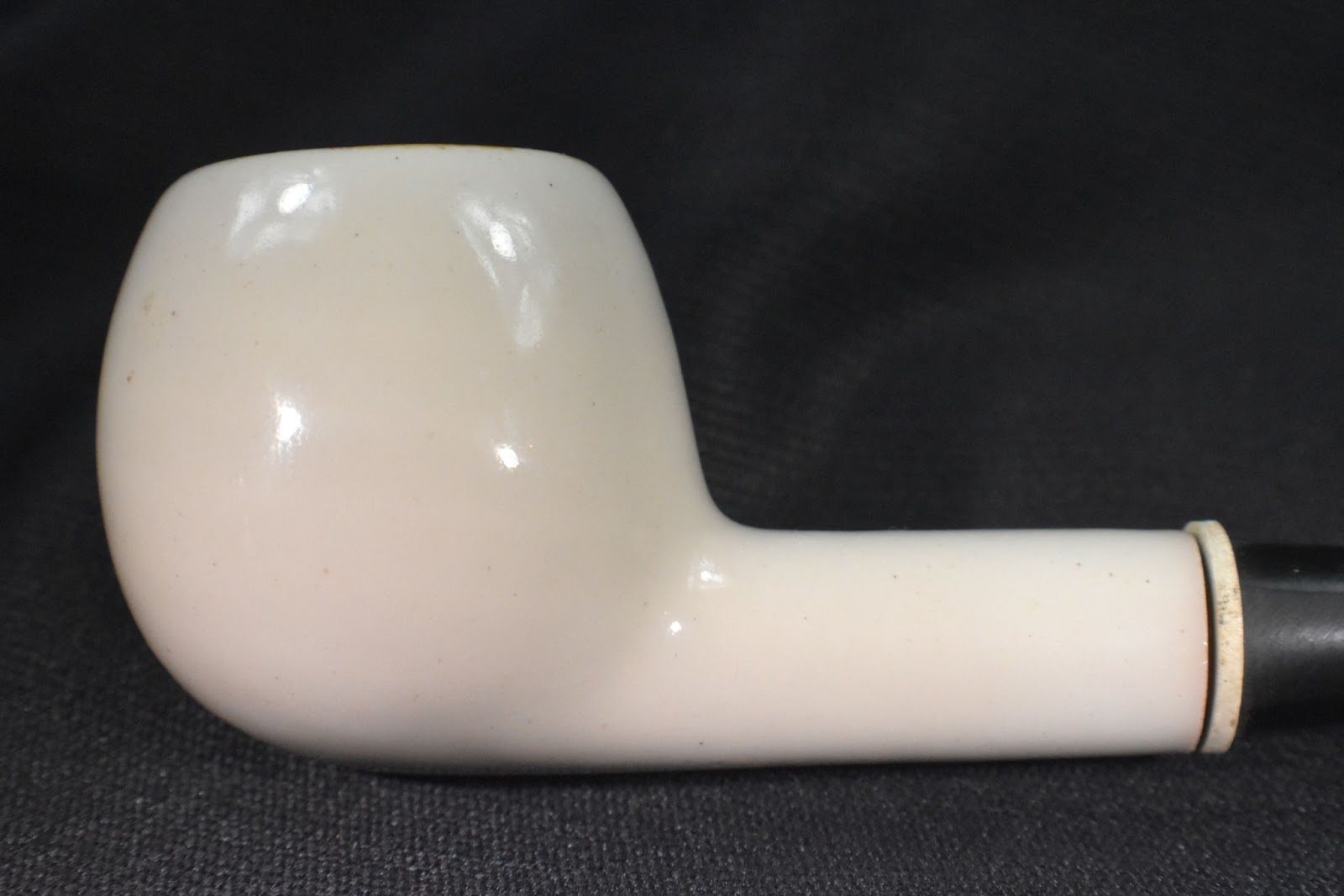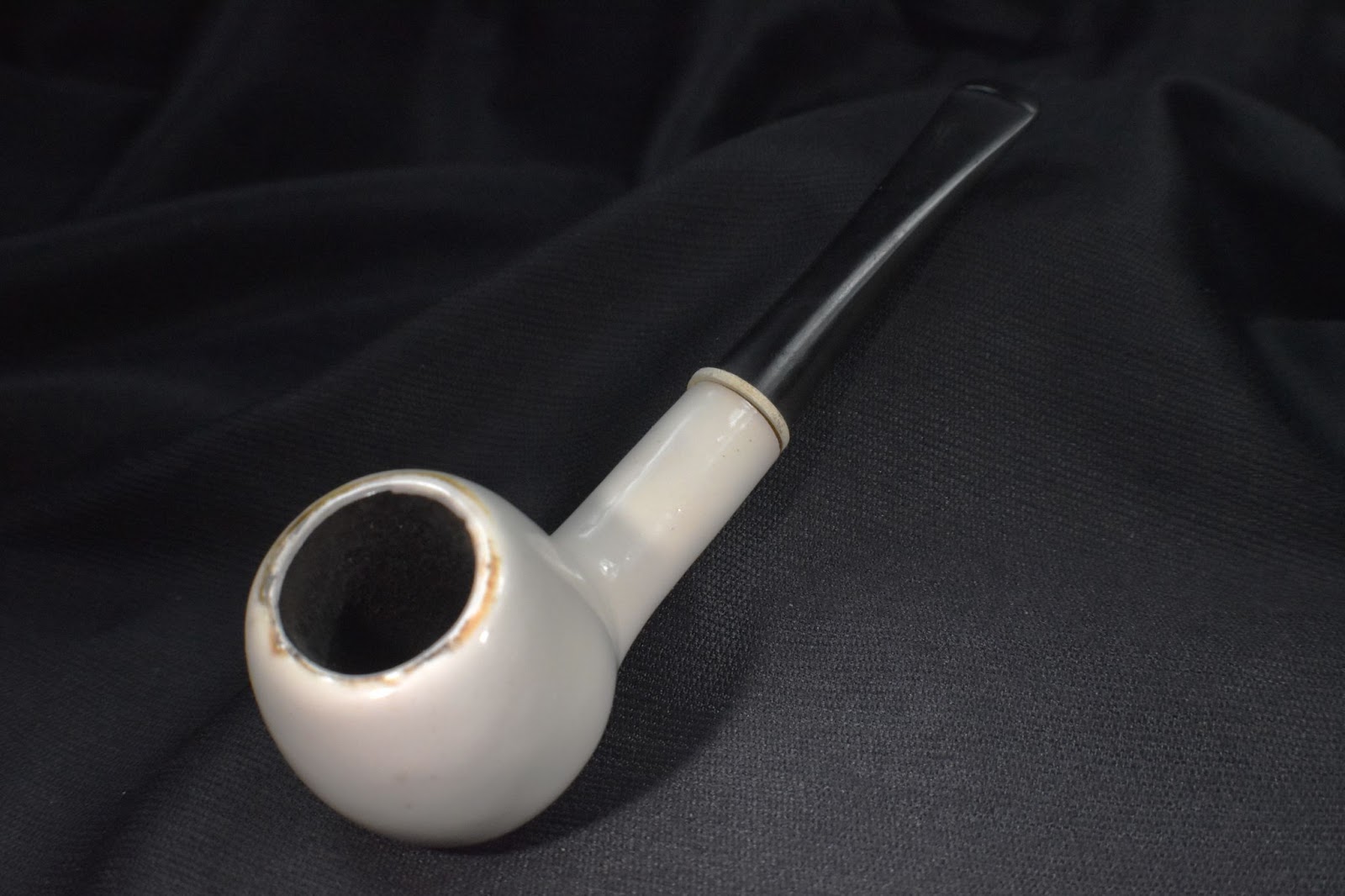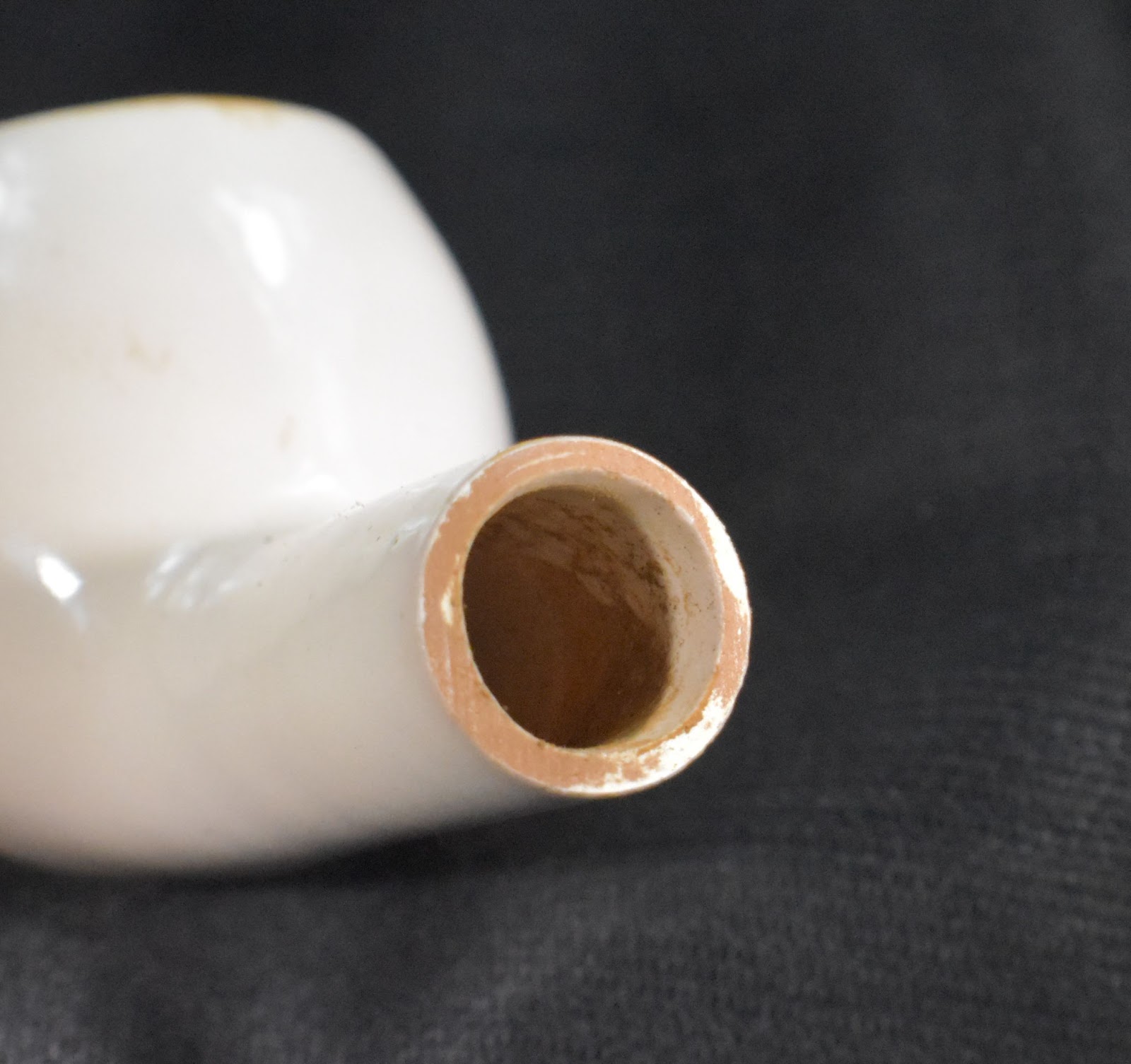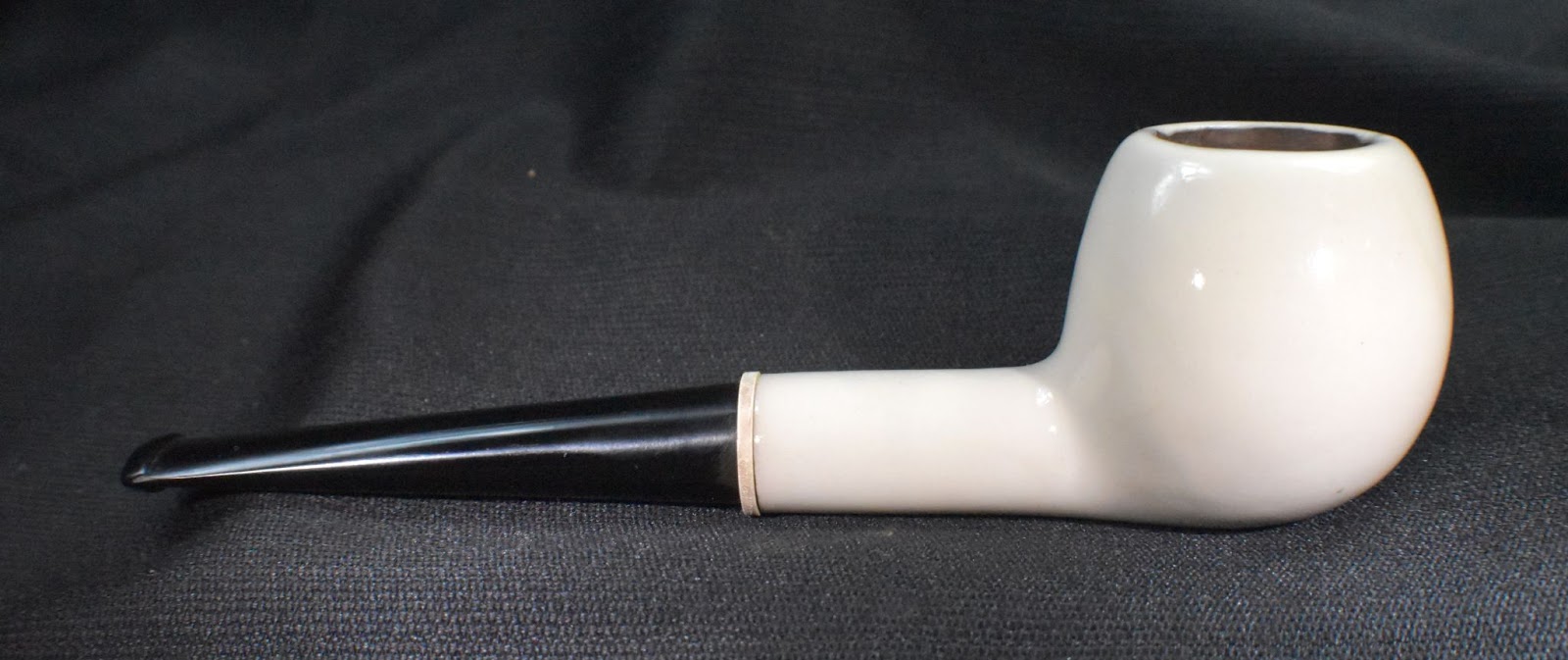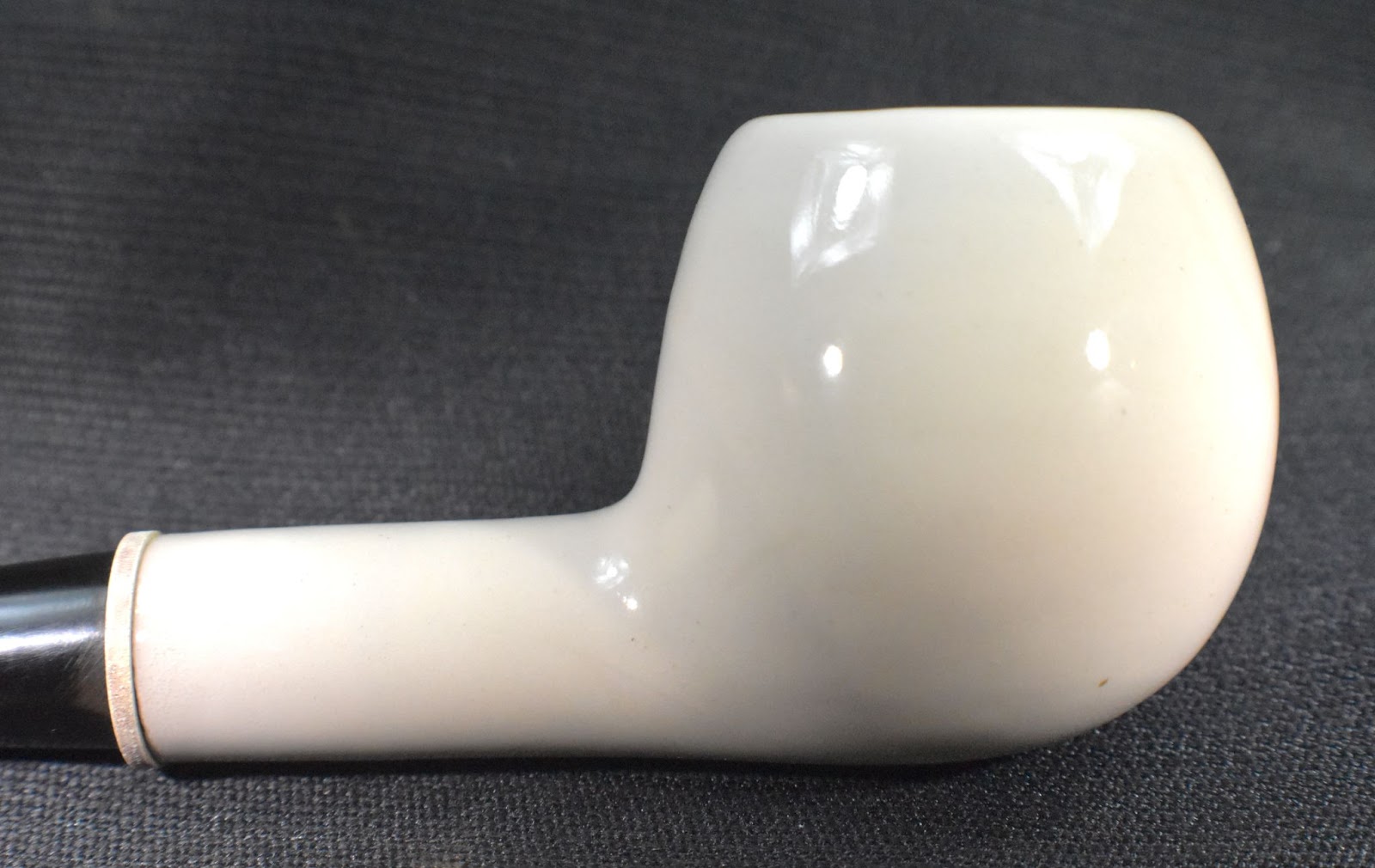
Have you ever wondered how to use the terms Dutch, Holland or the Netherlands? Well, this pipe may help. The pipe was made in Holland, two of twelve provinces of the country known as the Netherlands. Yeah, there are two Hollands, a north and a south. The makers of the pipe were Dutch, referring to the culture and language of the region. Okay, I have shown off my undergraduate geography major for four years quite enough for one day.
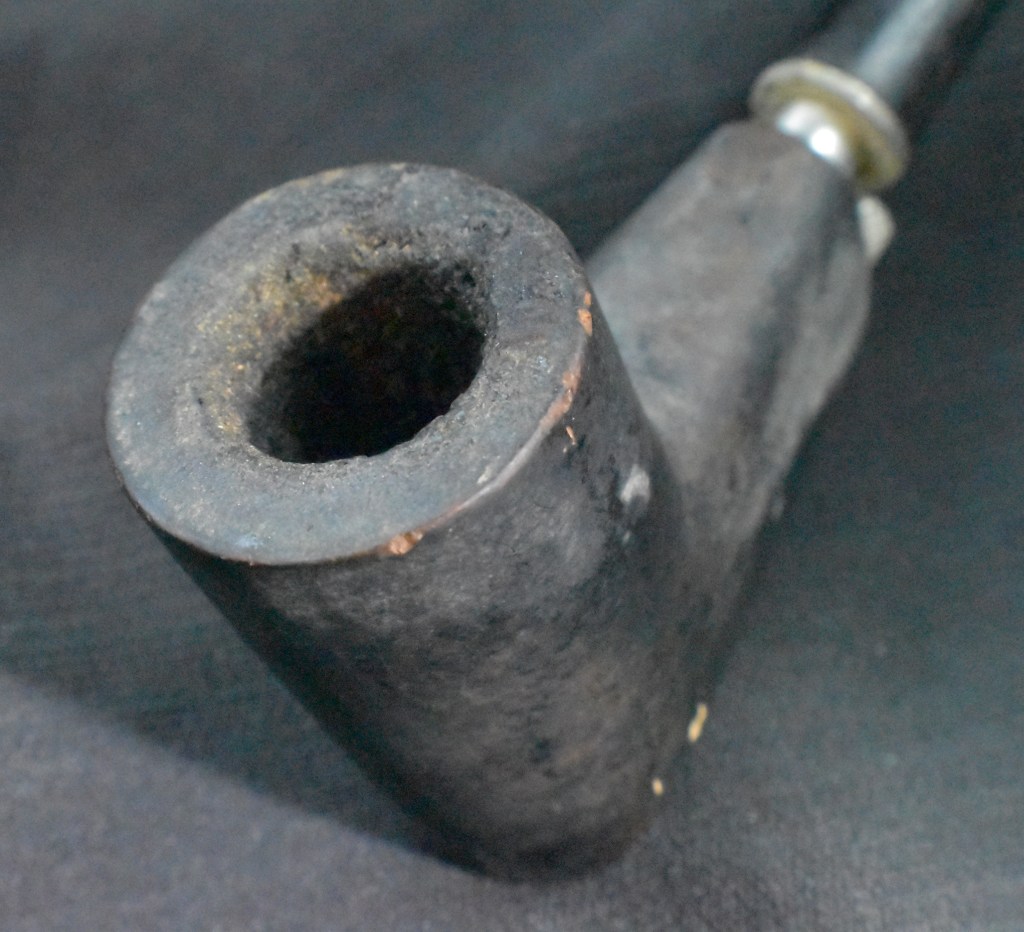
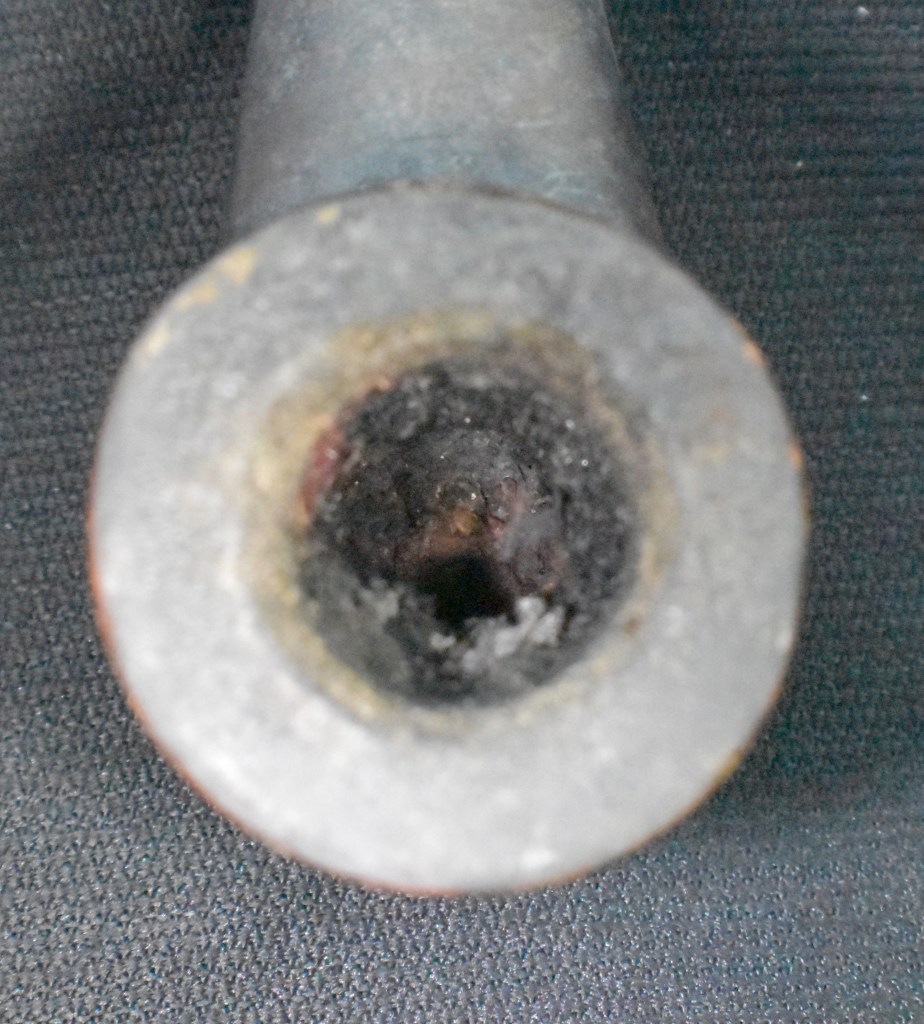
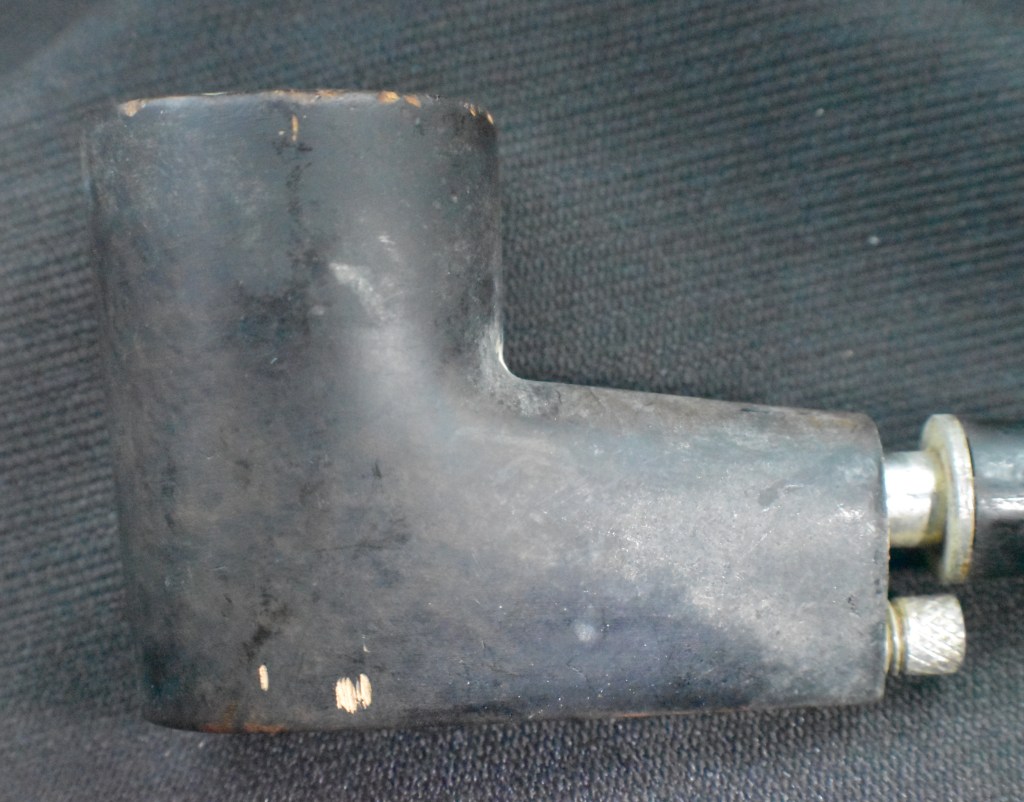
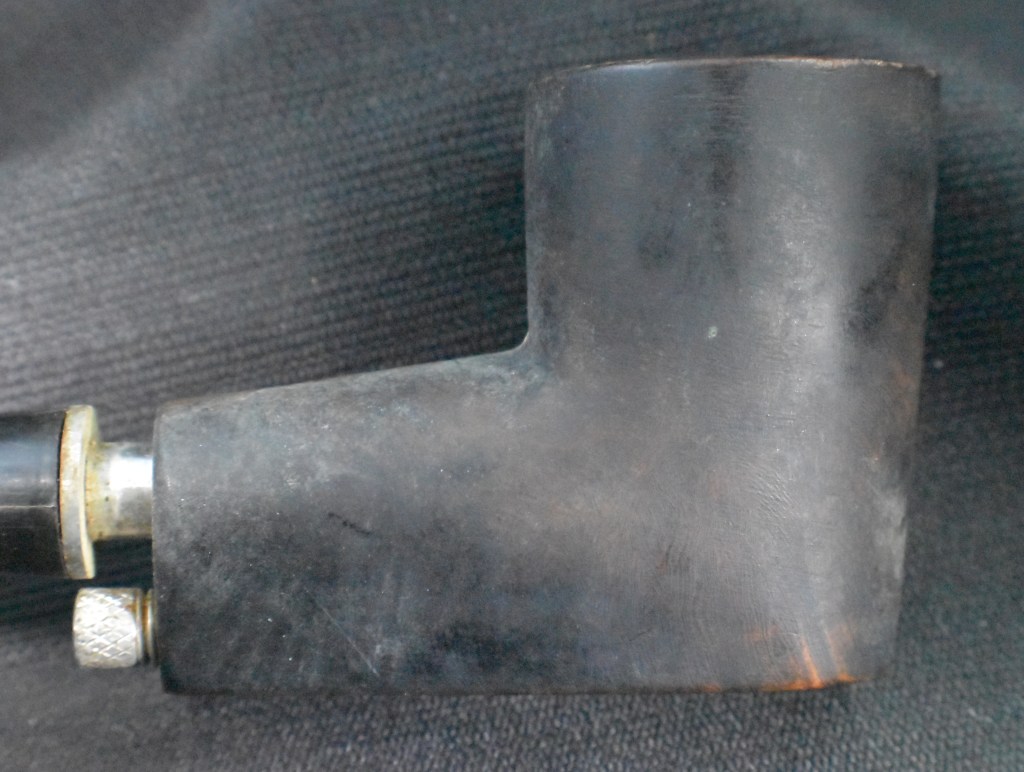
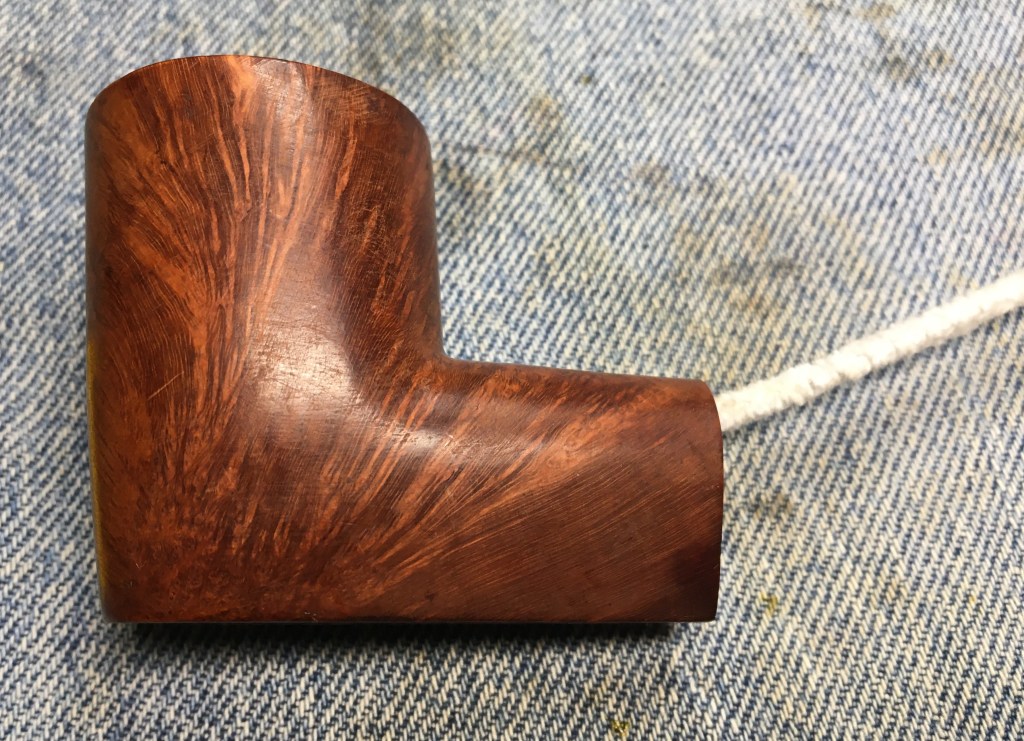
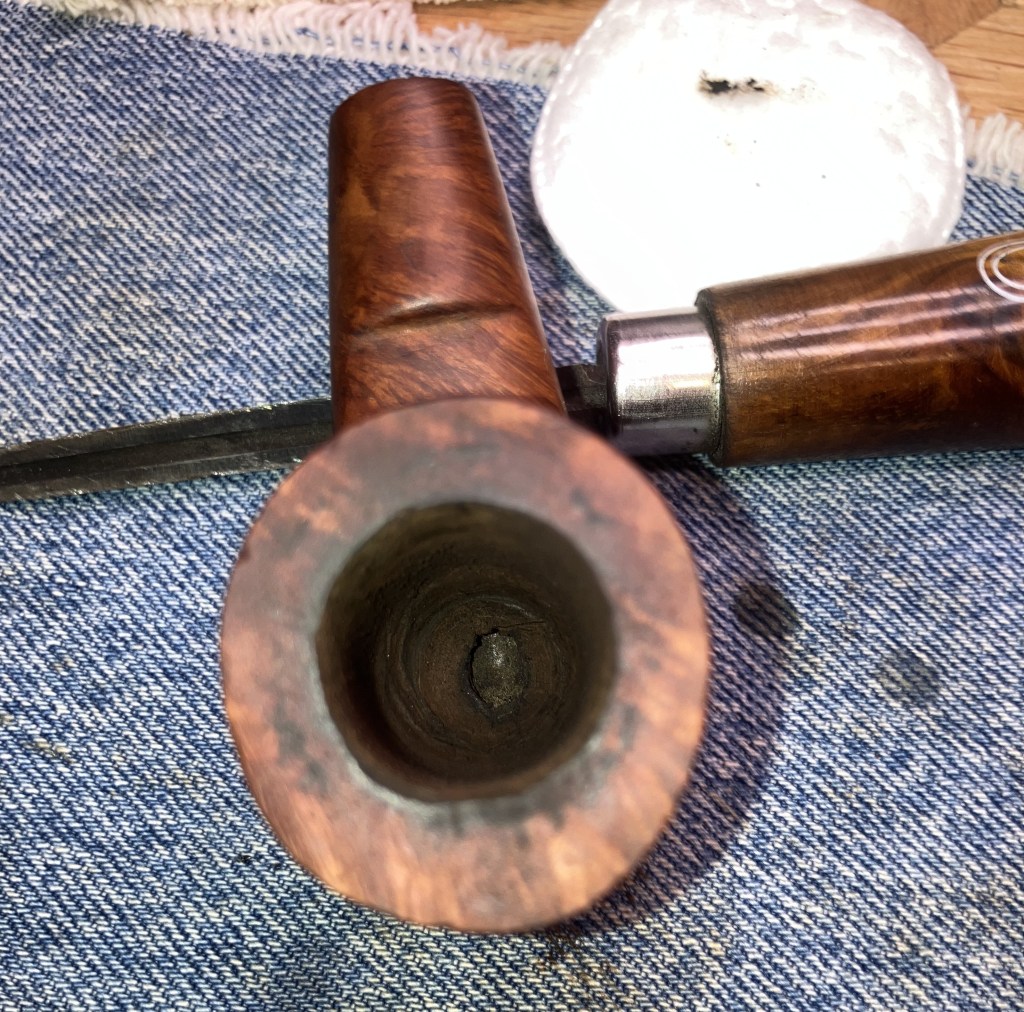
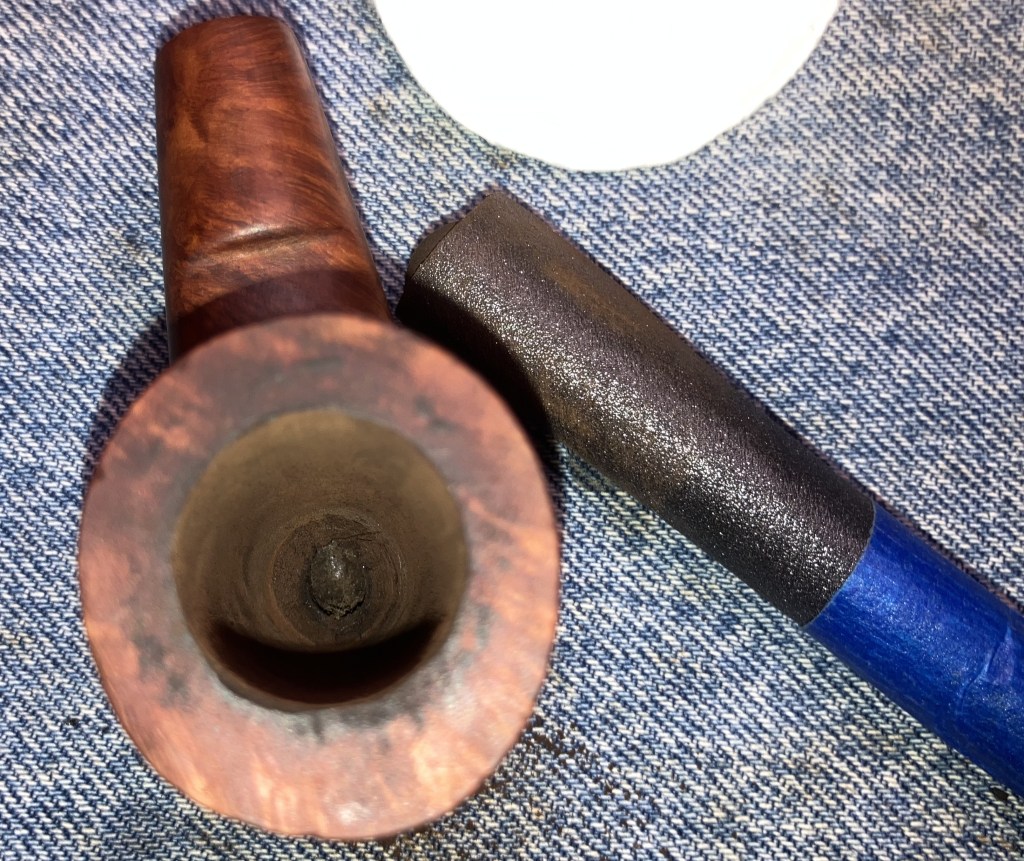
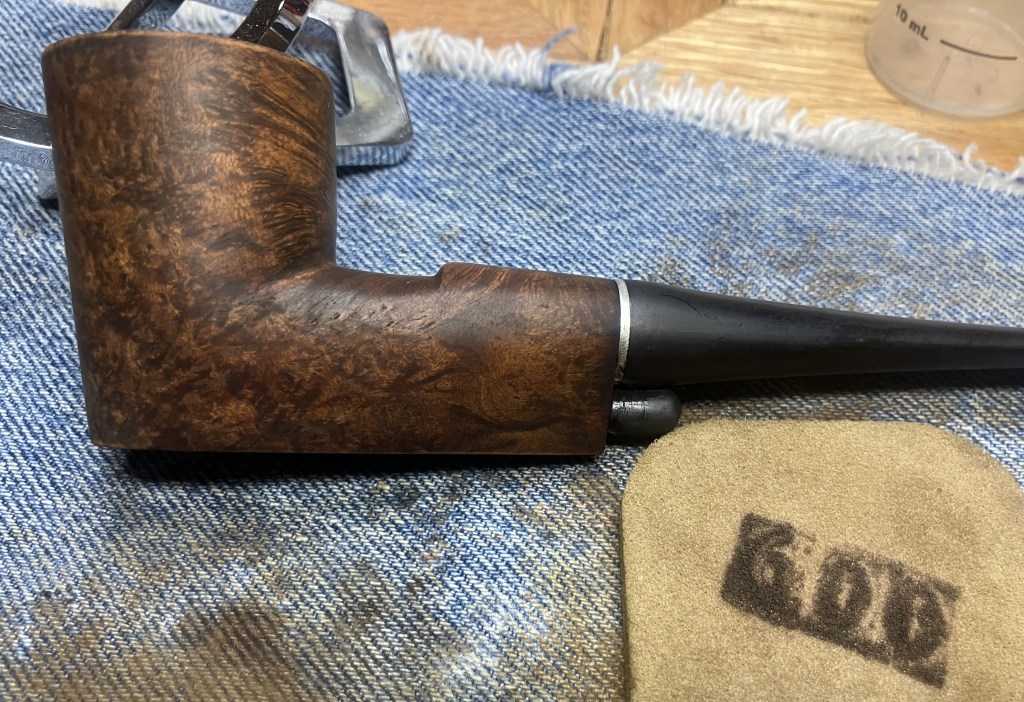
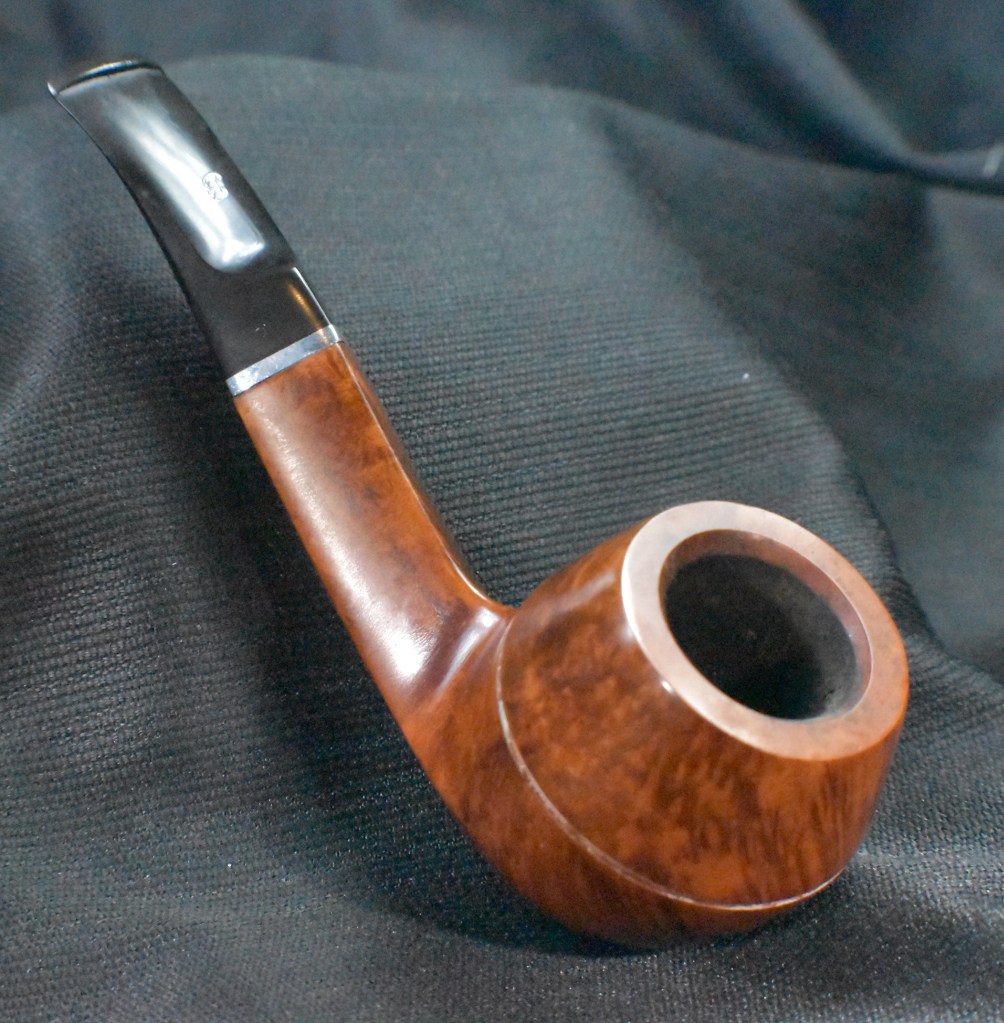
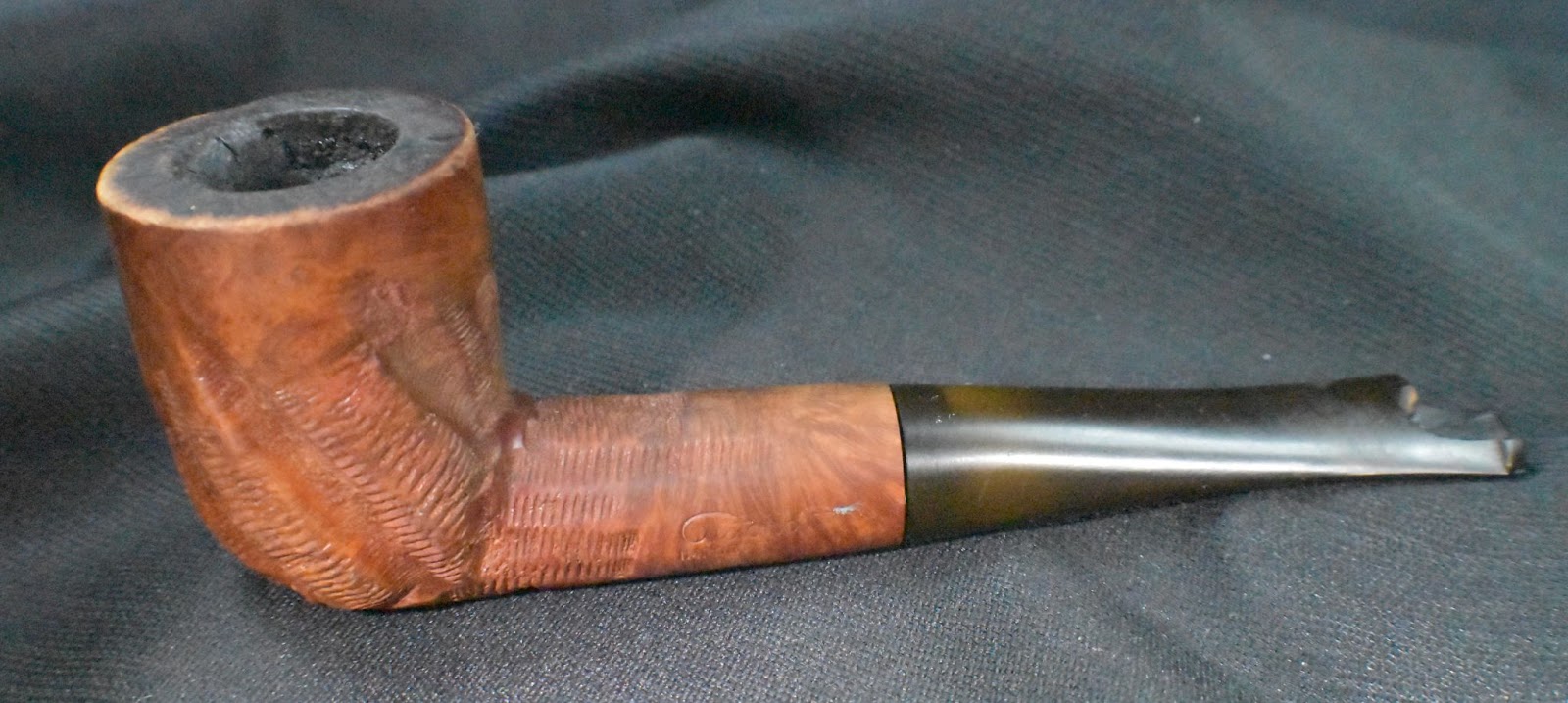
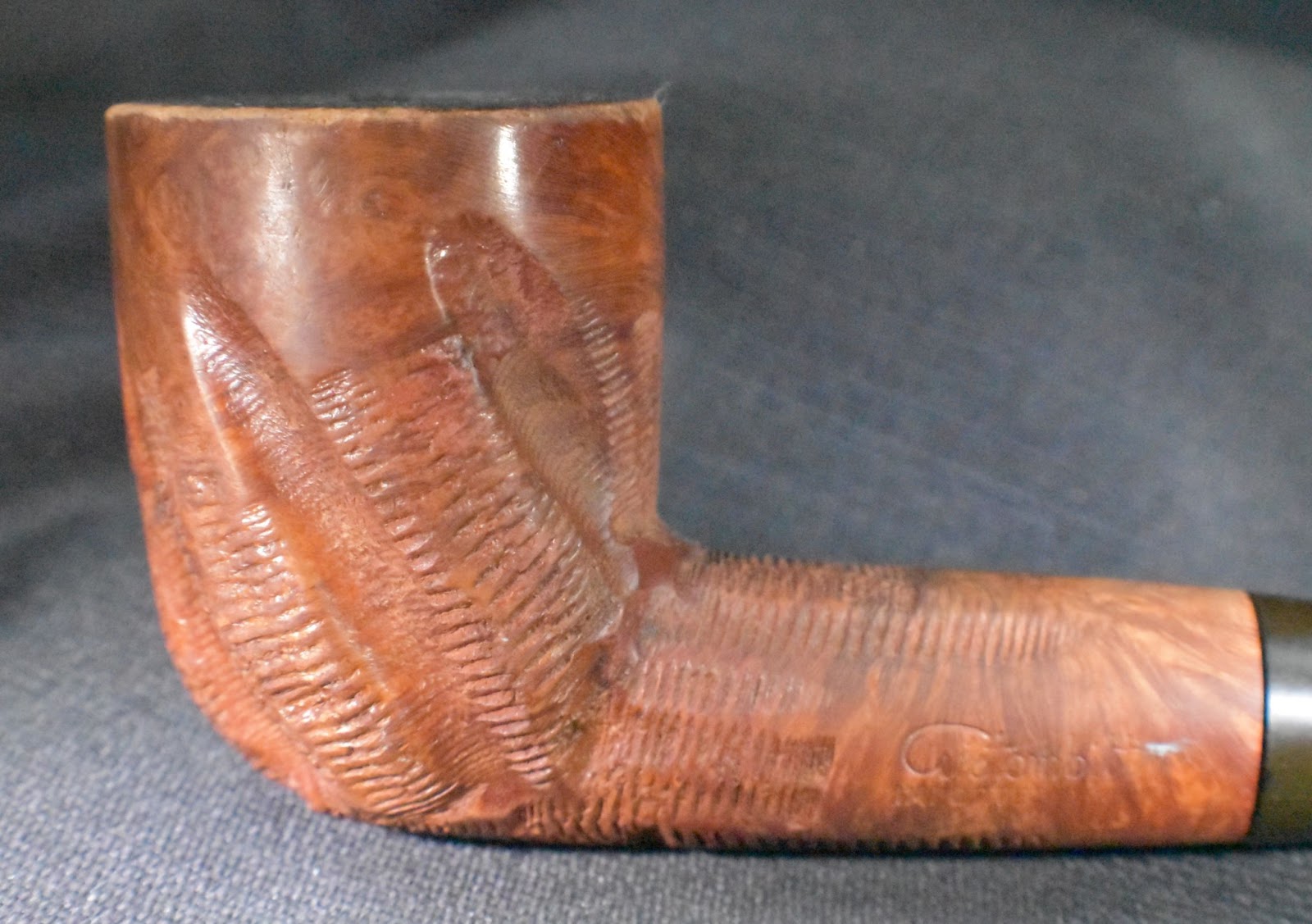
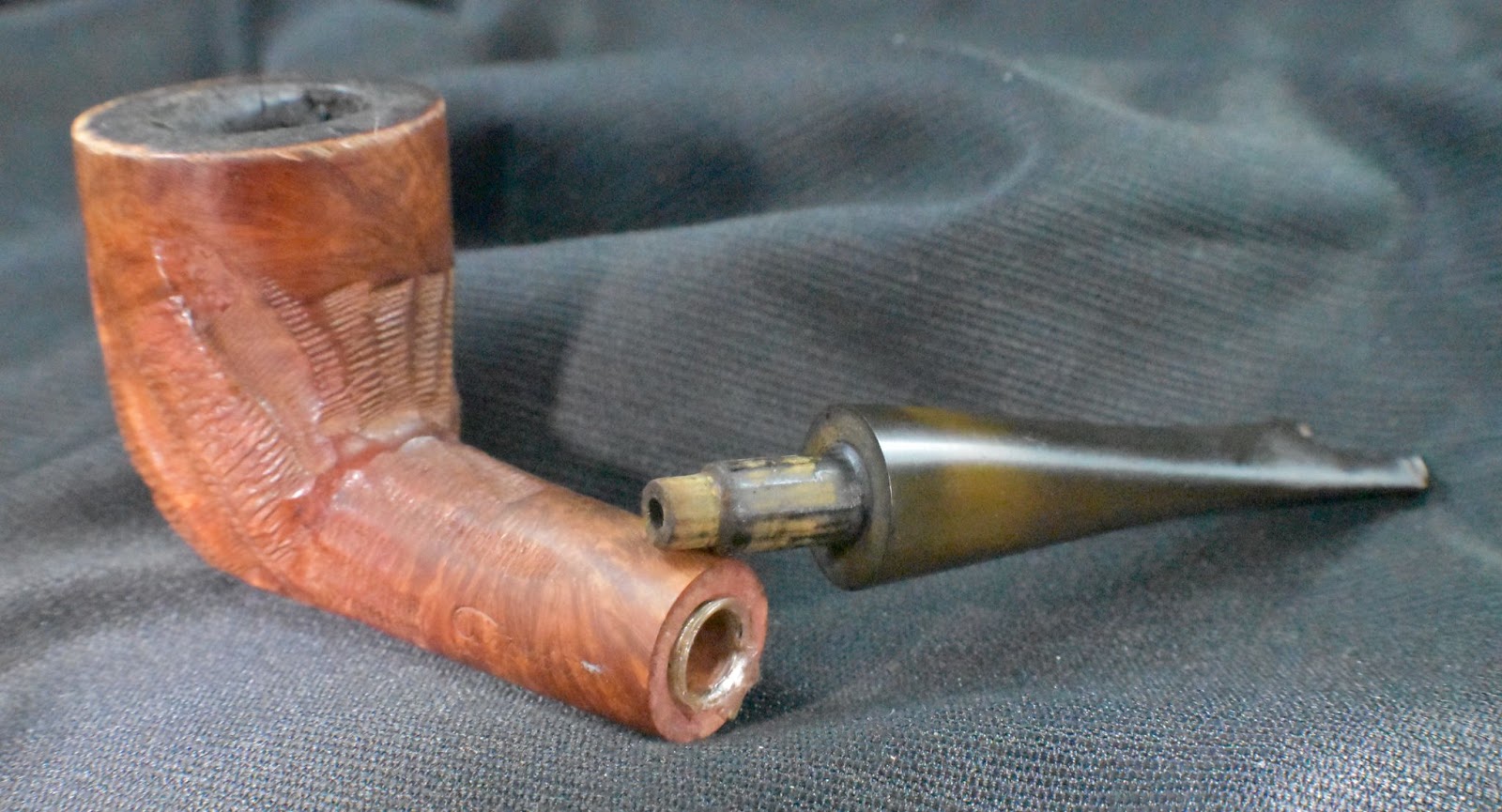
This pipe caught my eye on eBay recently. I was taken by both the shape and the price. I immediately sent Sascha Mertens a private message via Facebook, asking if it was a good deal. He replied quickly, as usual, saying that it was indeed a good deal for a relatively rare and desirable shape. He had me at “good deal”. I can’t say I place too much emphasis on popular things, I know what I like. While we are talking about Sascha, he keeps me laughing with his complaints of purchasing pipes that are very clean. Yeah, he complains when a pipe is too clean and does not provide him with the opportunity or challenge of cleaning them up himself. This pipe is a wonderful example of that. I think it had only been smoked once. I now completely understand Sascha’s disappointment. Below are some photos of the Big Ben 702 before I did any work, if you can call it that, on it.
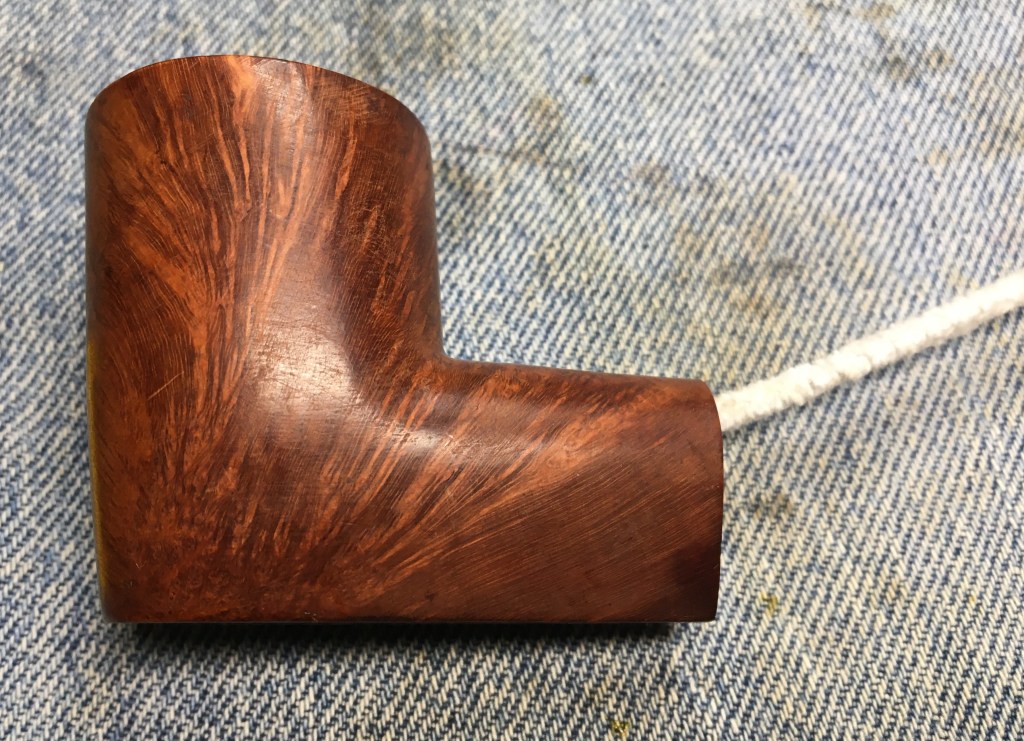
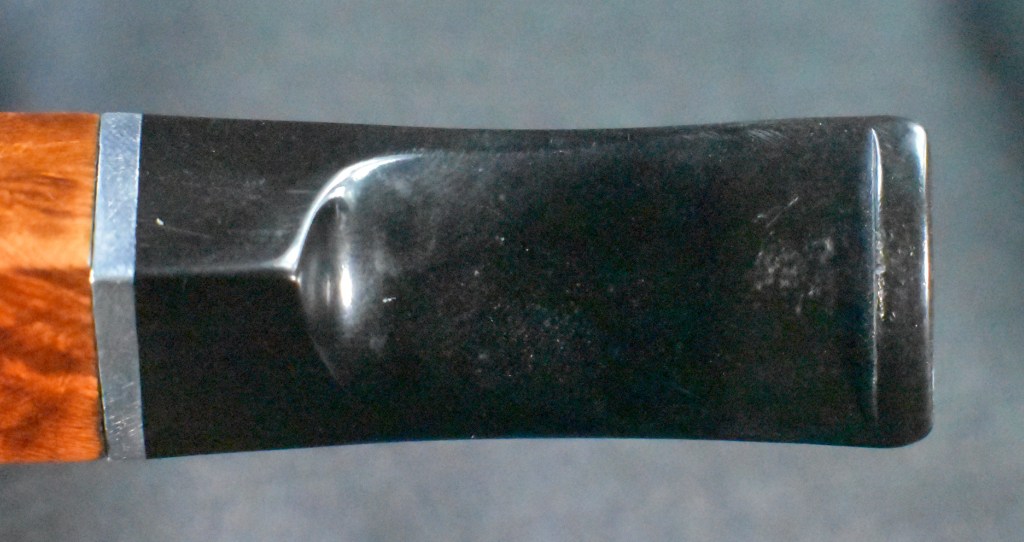
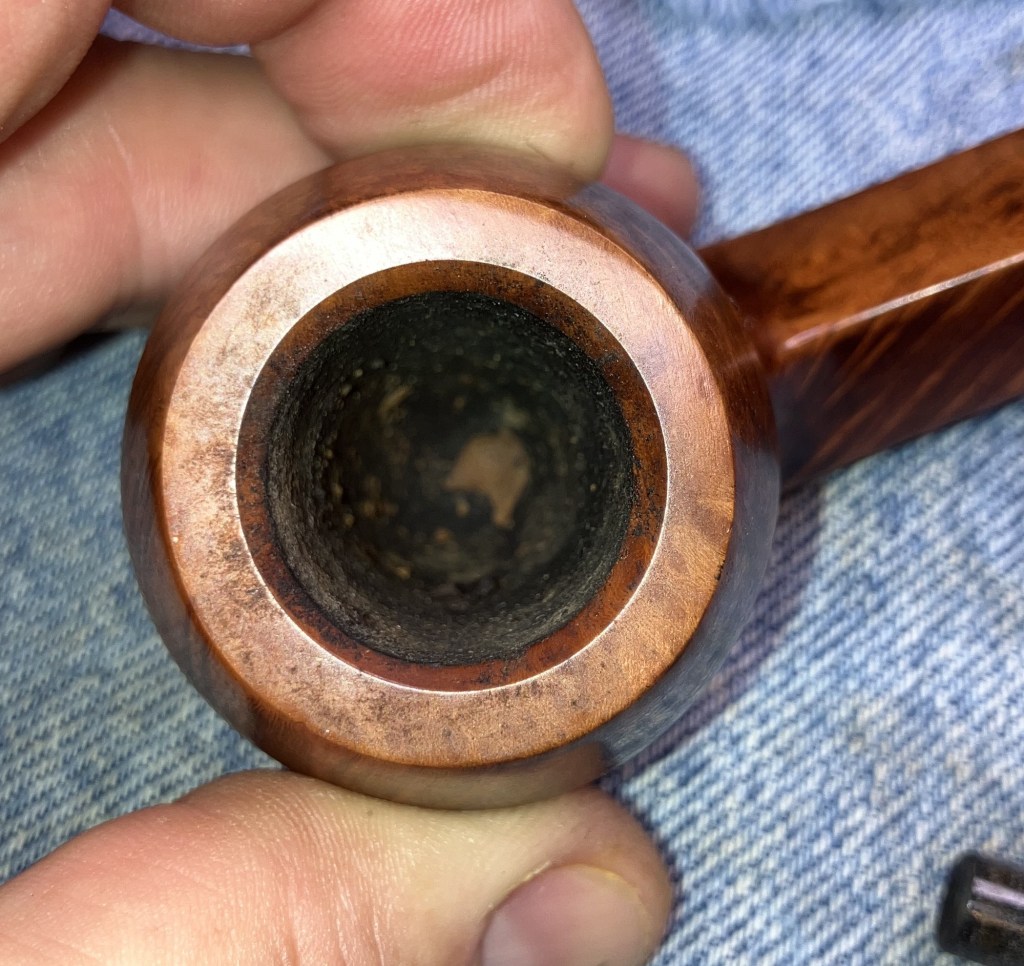
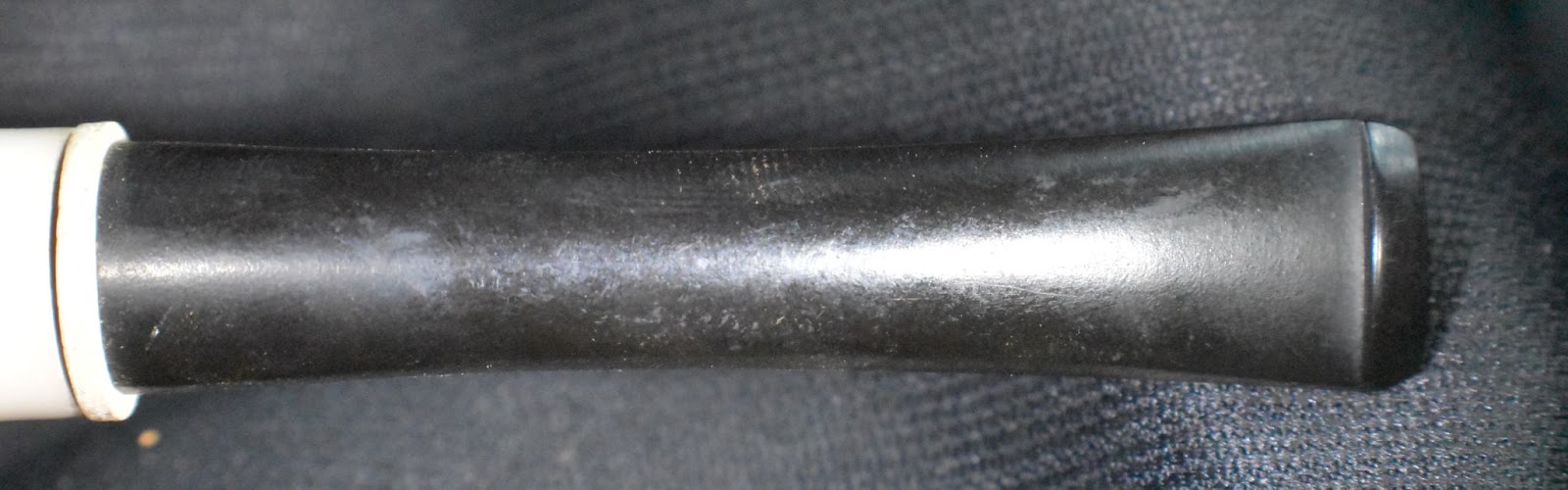
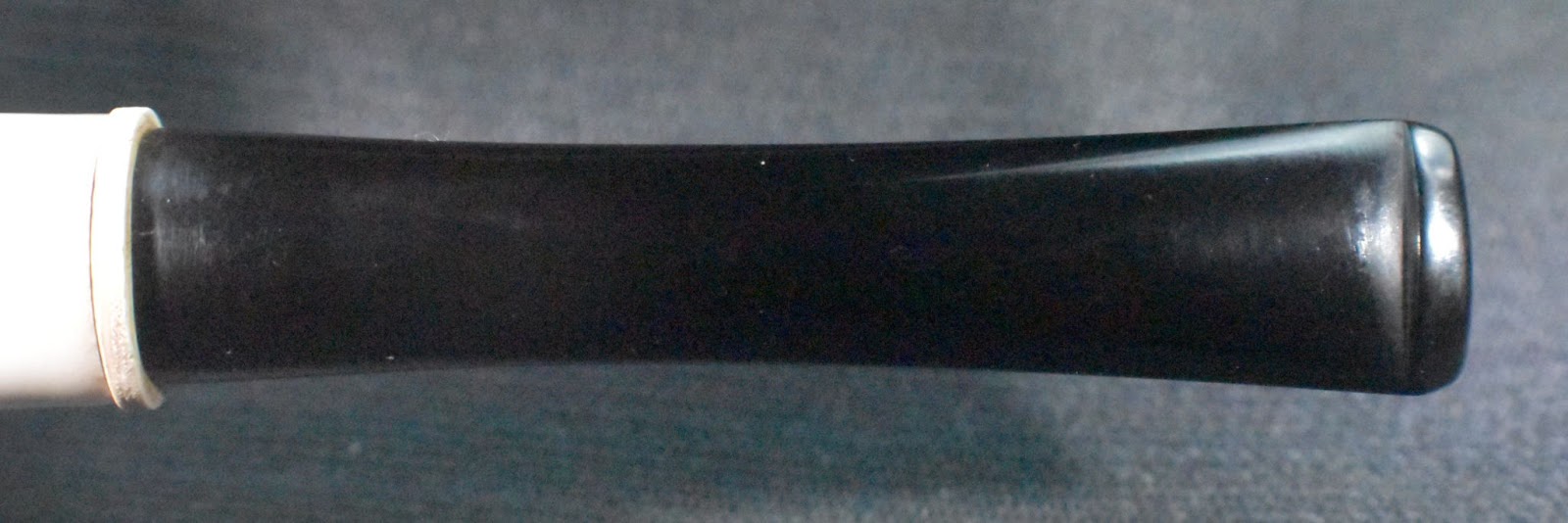
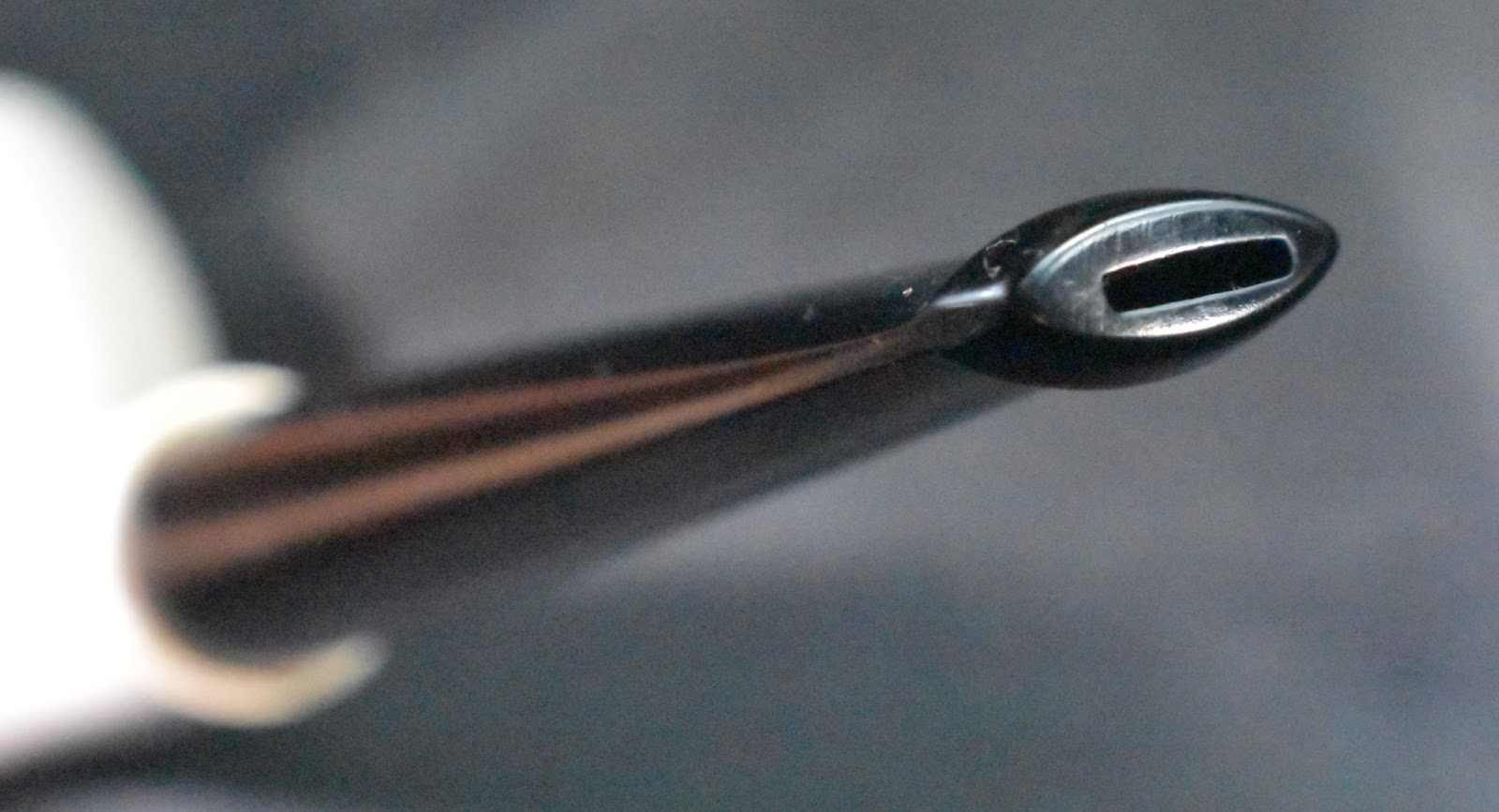
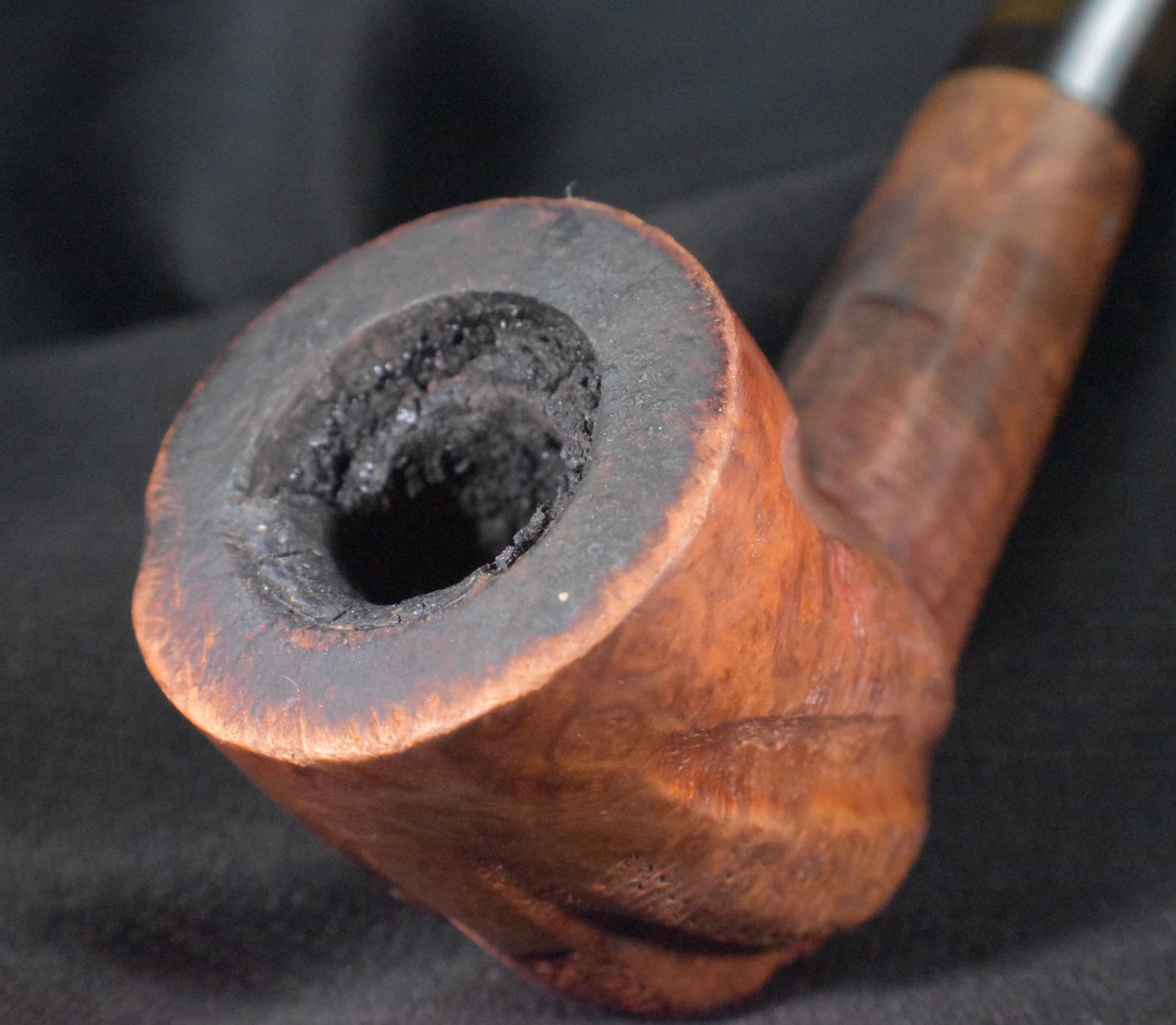
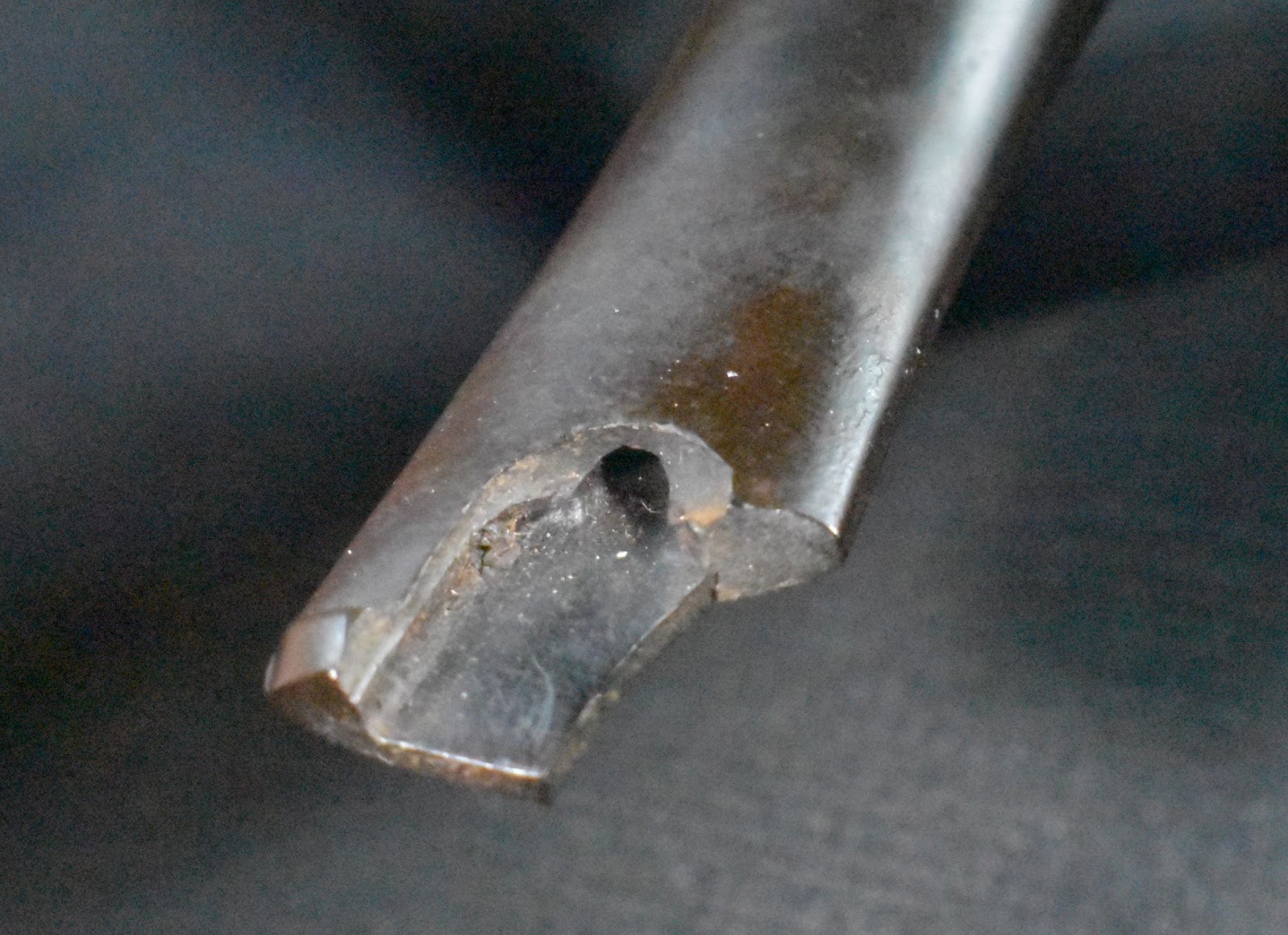
The pipe was nearly brand new. There was some unsmoked tobacco remnants in the bowl and a very minimal residue on the rim. I cannot even call it lava. The stem was slightly oxidized due to age with maybe a few light tooth marks. The only other thing to complain about was a slight wax build-up in the beading. This was going to be an “easy button” restoration.
The next search was on pipedia.org. Here too, the entry was lacking specificity for the Classic Line. Well actually it was lacking pretty much everything stating only, “The brand name Big Ben was originally owned by a small trade company in Amsterdam which was already well established in several countries selling pipes among other goods. The firm was bought by Elbert Gubbels & Zonen B.V. – see Gubbels – who were in search for a suitable brand name to further expansion on international markets.
I did follow the link from pipedia.org to the Gubbbels’ website: Want to buy a Big Ben pipe? The best tobacco pipes since 1870 – bigben. This site was a nice shopping and informational site. I found the most impressive thing was that they opened the workshop up to the public every Friday from 10:00am-4:00pm. Here in the US, that would likely meet with stern warnings from Occupational Safety and Health Administration (OSHA).
“Our store is open every Friday! We cordially invite you to take a look at our production workshop. In our store you will find a wide range of Big Ben pipes in all shapes and colors. If your ideal pipe is not listed, we may be able to manufacture a pipe especially for you! Light maintenance of your beloved old pipe can usually be done on site.
Making a pipe requires craftsmanship, a lot of fingerspitzengefühl and experience in working with the unpredictable and capricious material: the root of the Erica Arborea, better known as briar wood. Formed by the rocky bottom of the Mediterranean region, this noble and beautifully textured wood contributes its 50 to 80 years of growth to the value of the pipe. We are proud to be able to tell you the whole story – from carrot to tobacco pipe!
We are open every Friday from 10:00 am to 4:00 pm. On all other days you can visit us by appointment.
There was also a very nice history of the company and a look into their future. It is quite detailed so I will not include it here but this link will take you there if you are interested in a very interesting history.
The Restoration
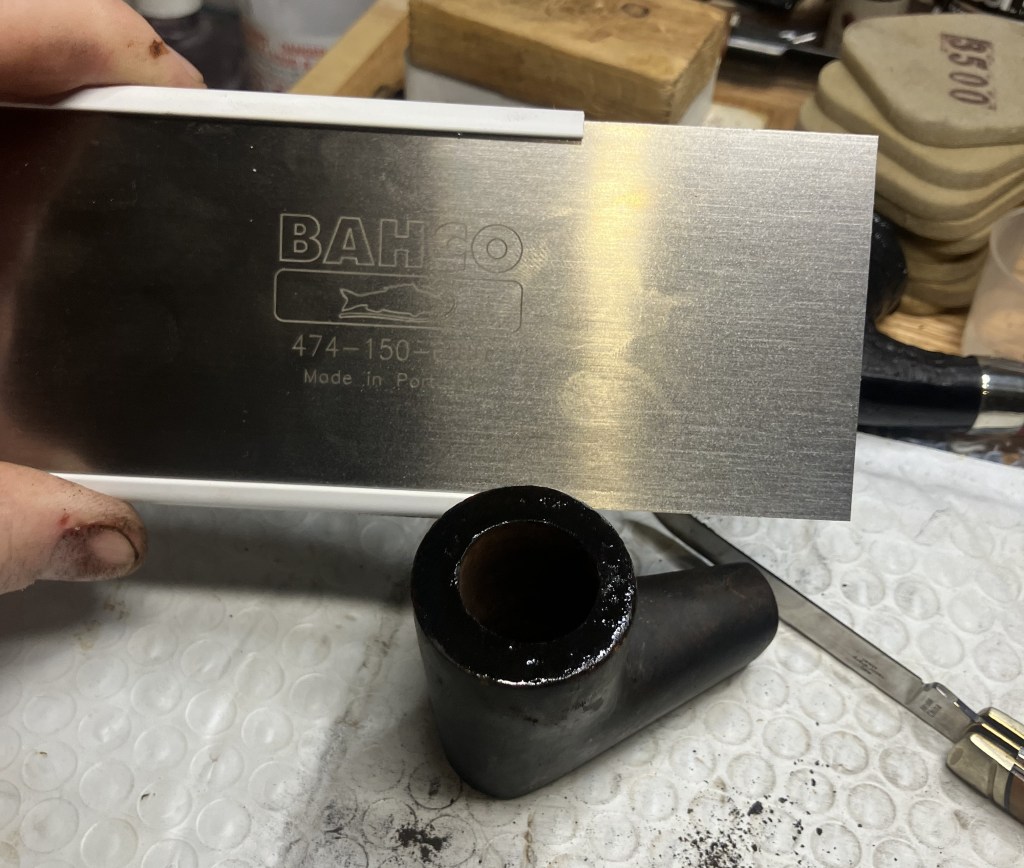
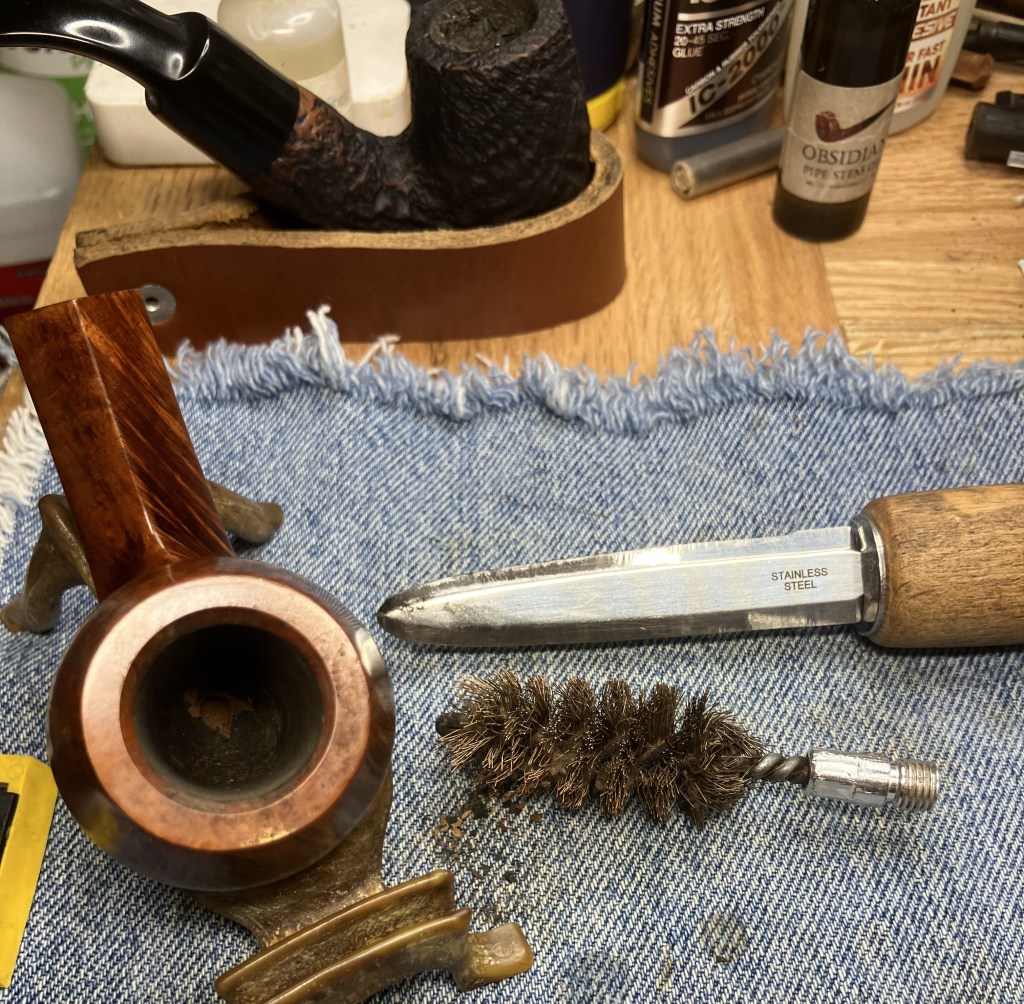
The restoration began with a clean denim piece which I felt certain would remain clean upon finishing.
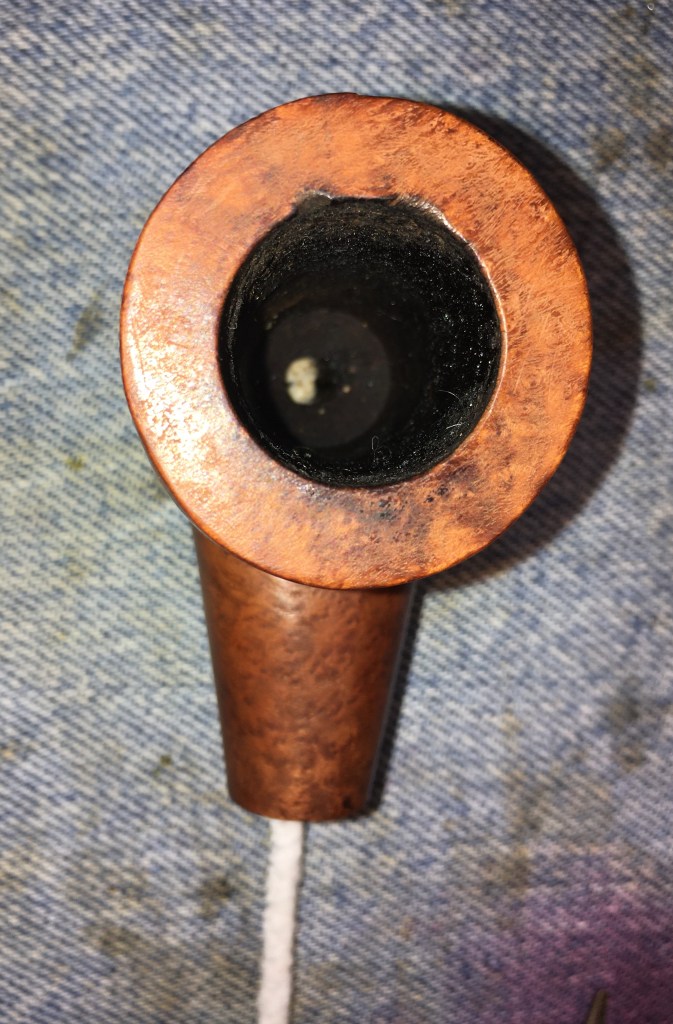
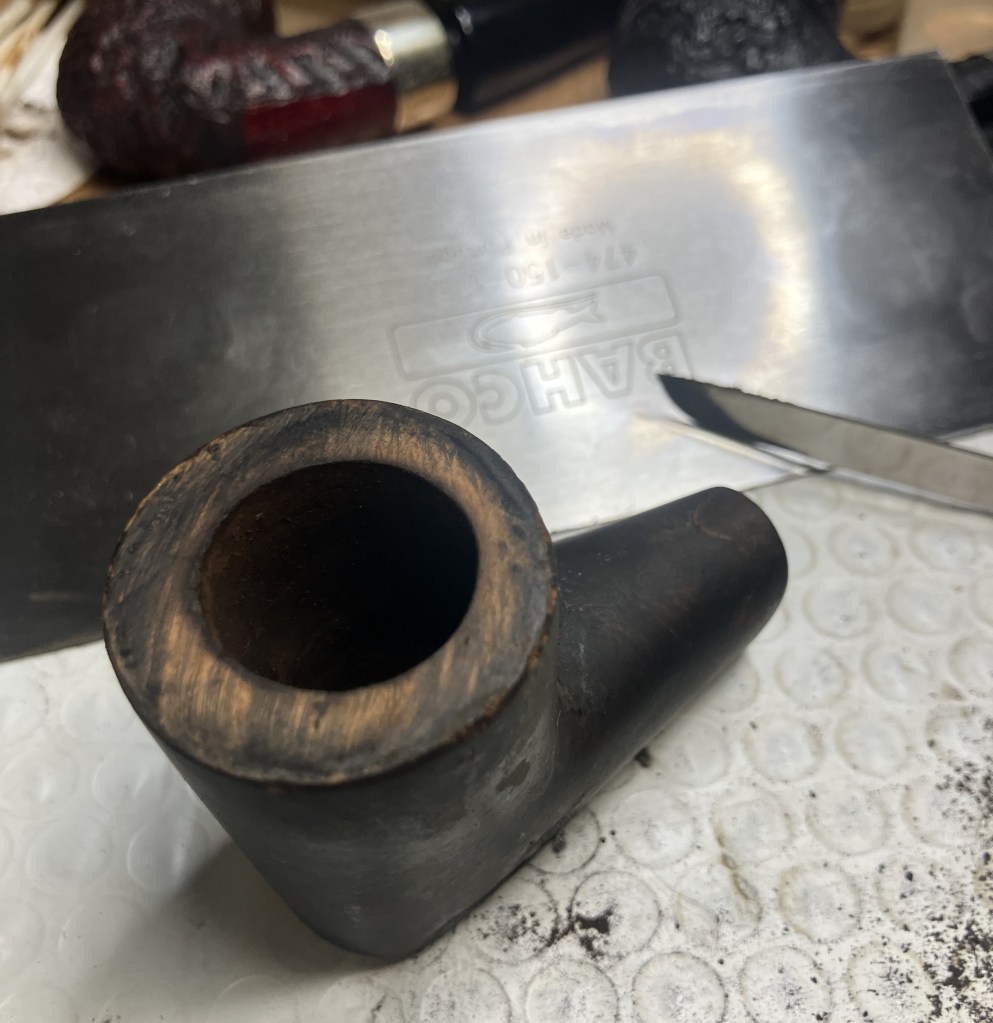
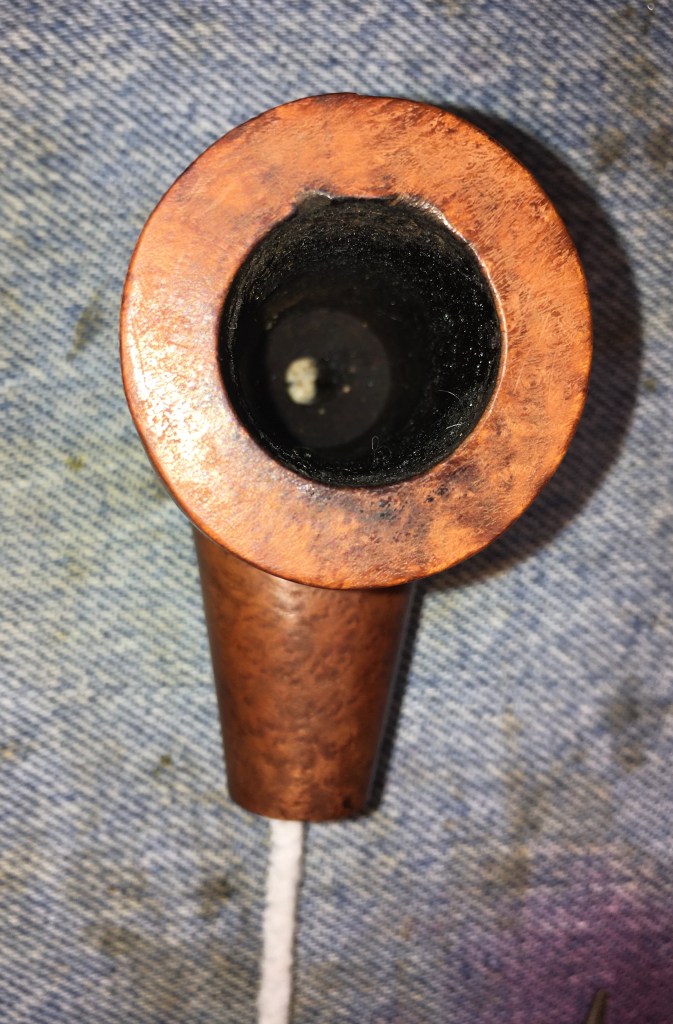
I lexamined the tobacco chamber more closely under the bright lights of the workbench. Only smoked once or twice, was my conclusion.
The look down the mortise reaffirmed my thinking.
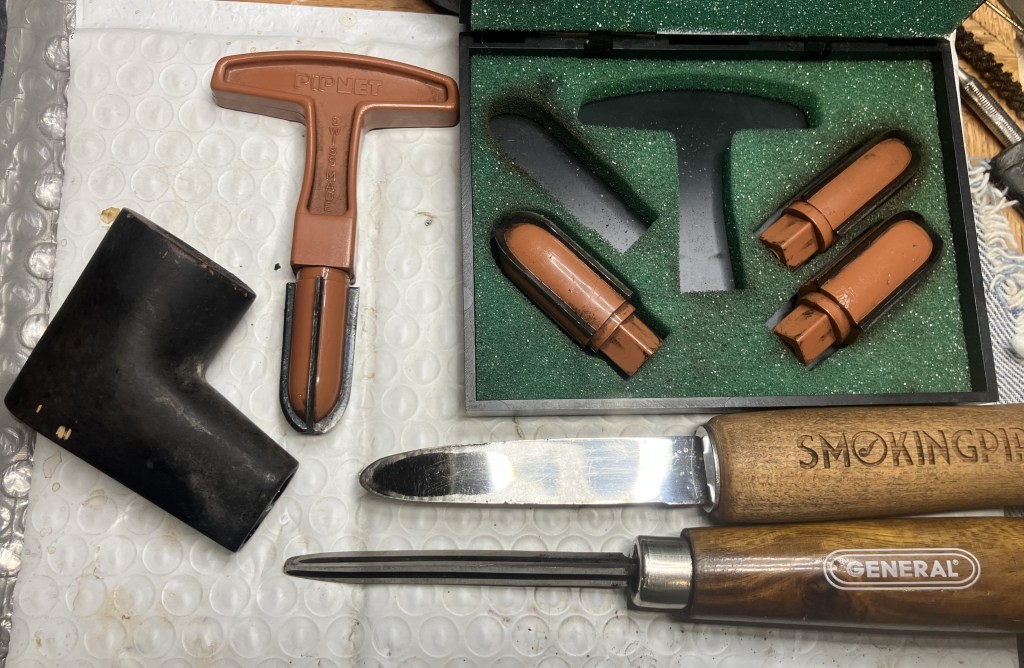
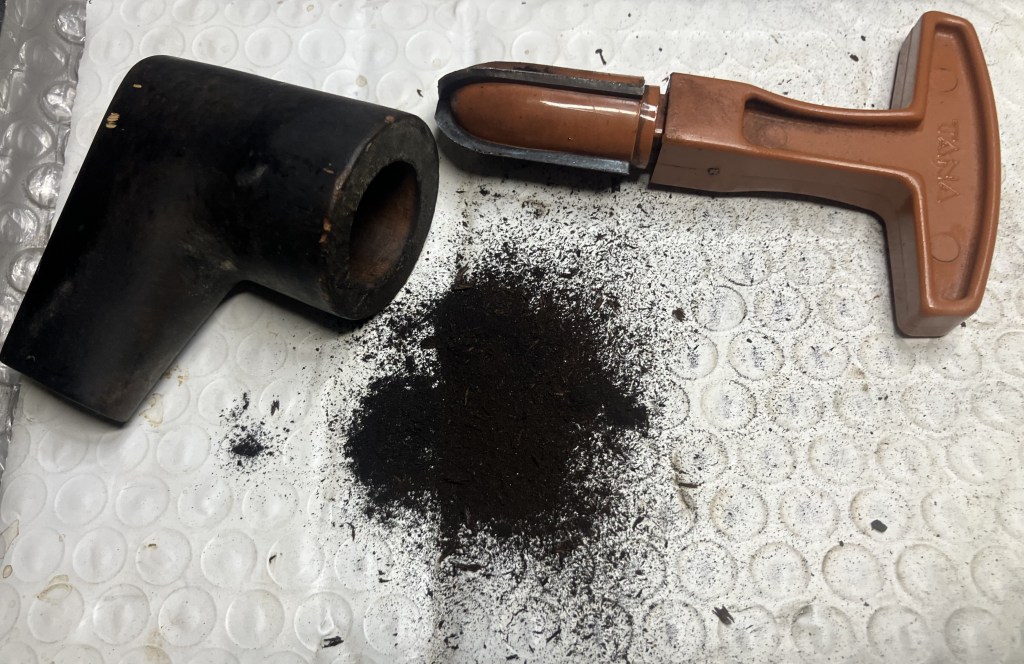
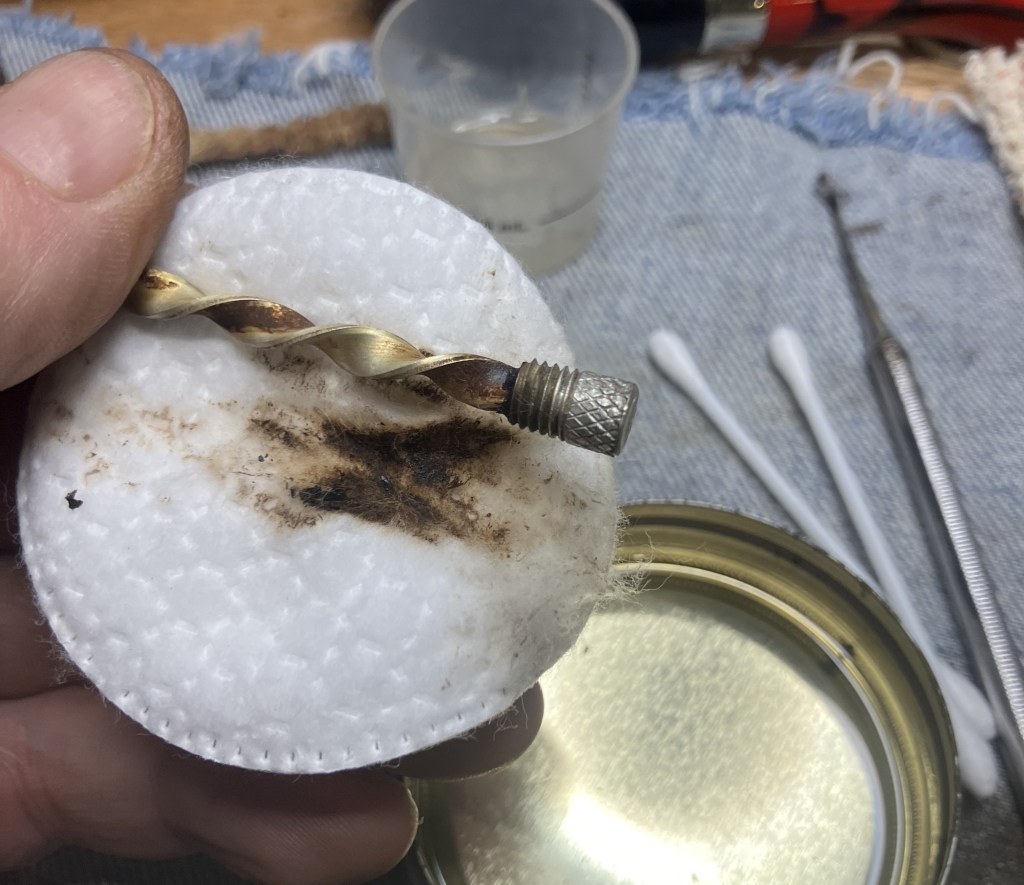
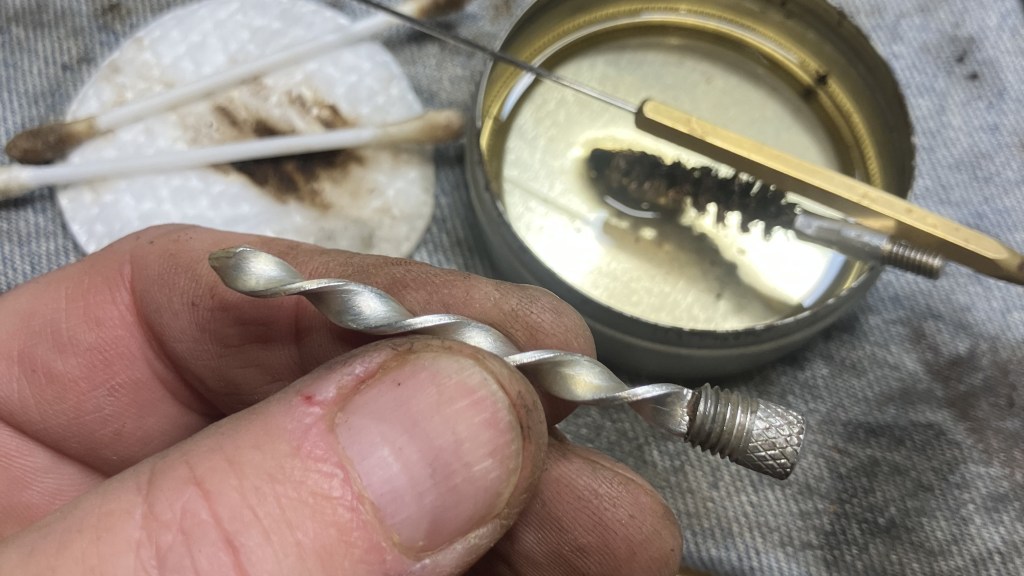
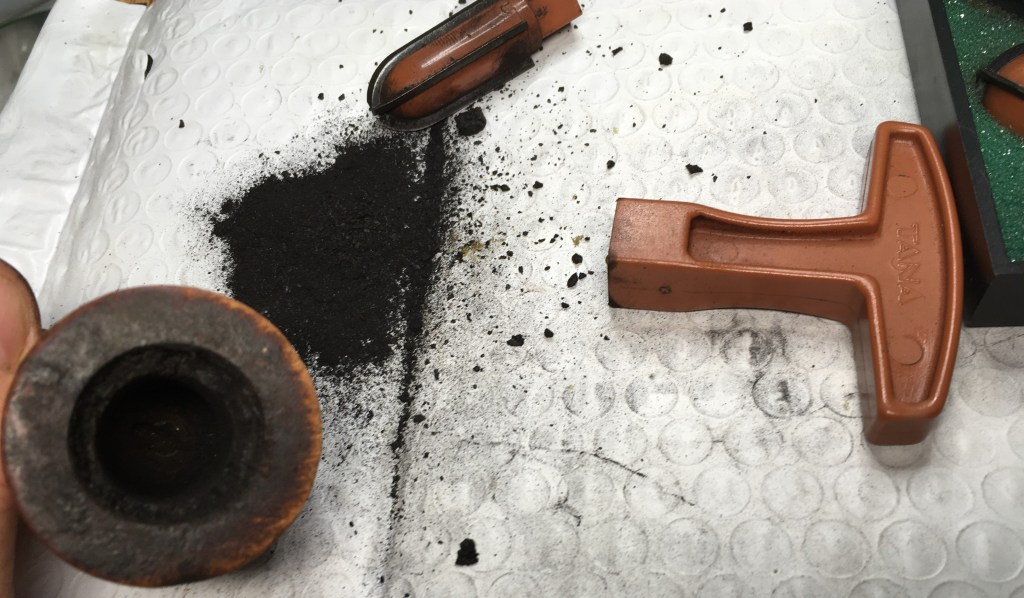
The reaming of this tobacco chamber only required a brass bore brush, from a 20 guage shotgun and a light scrape from the Smokingpipes Low Country reamer.
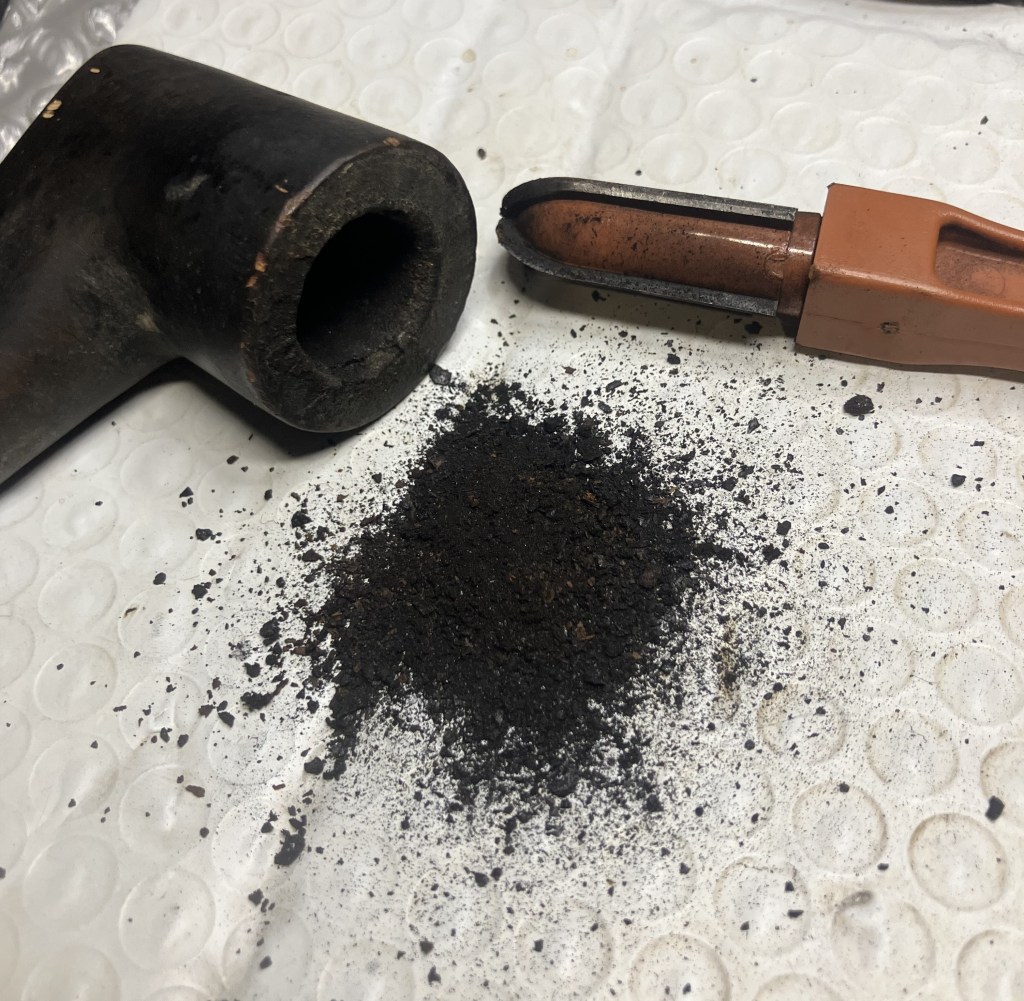
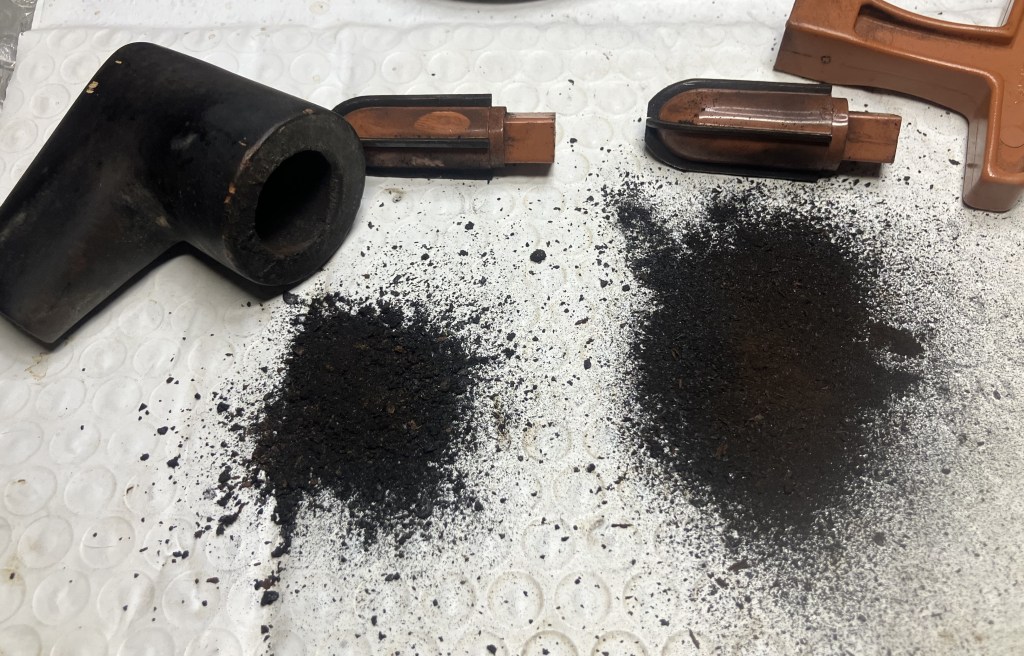
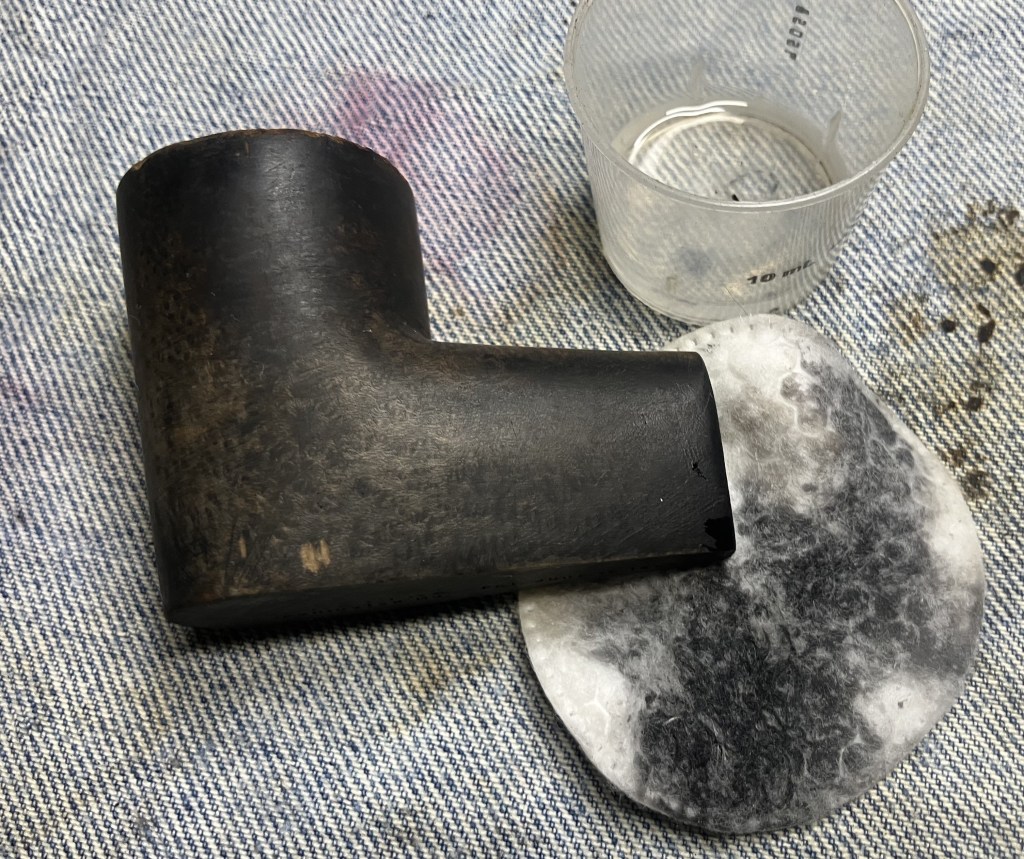
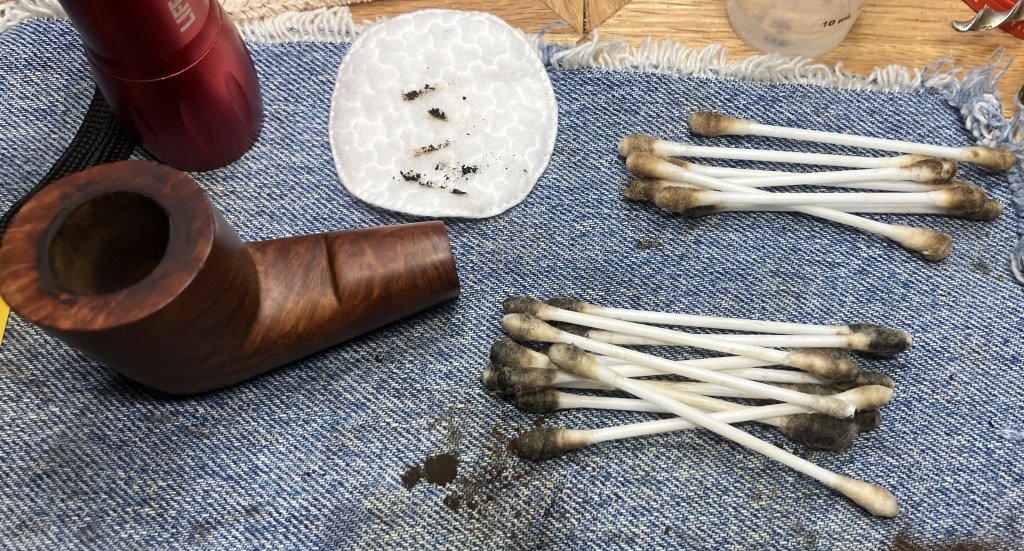
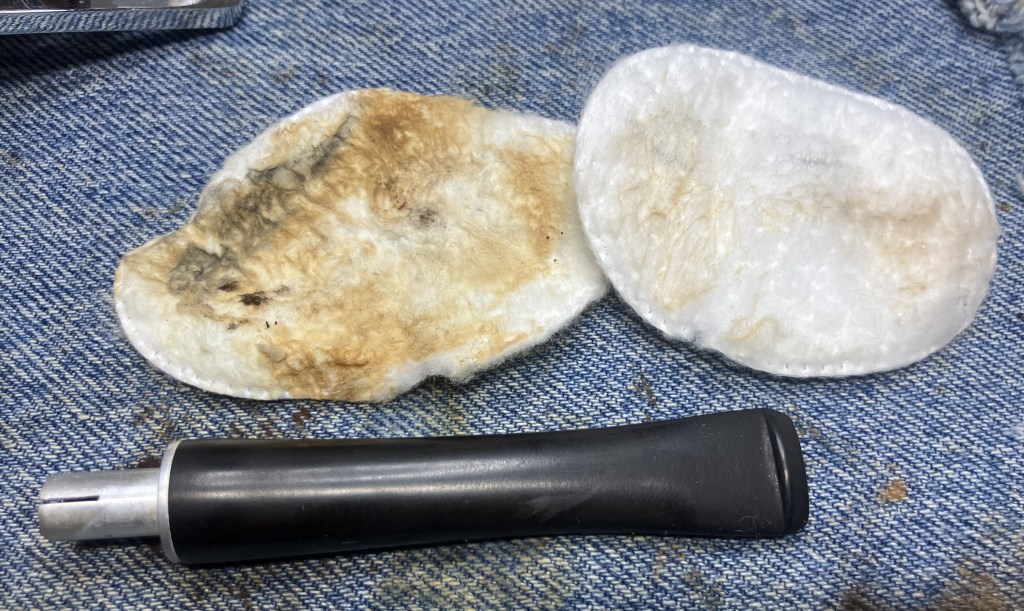
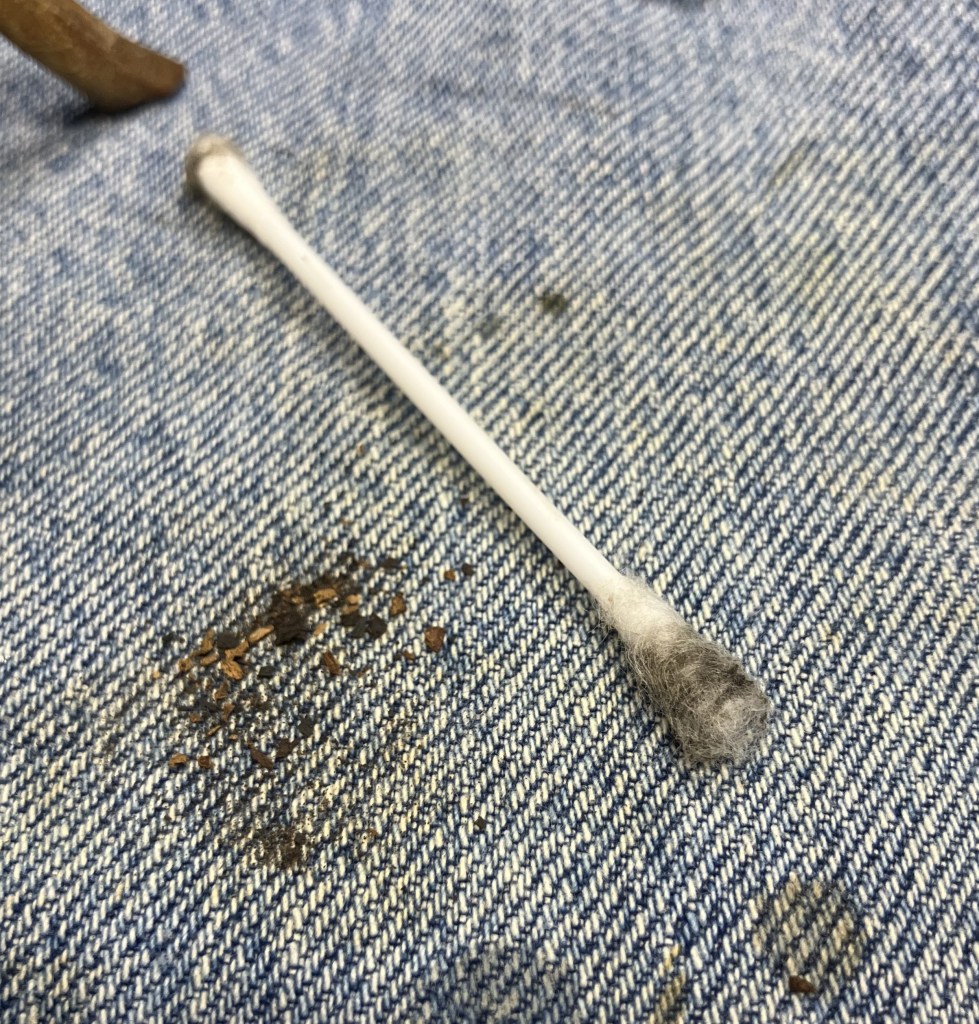
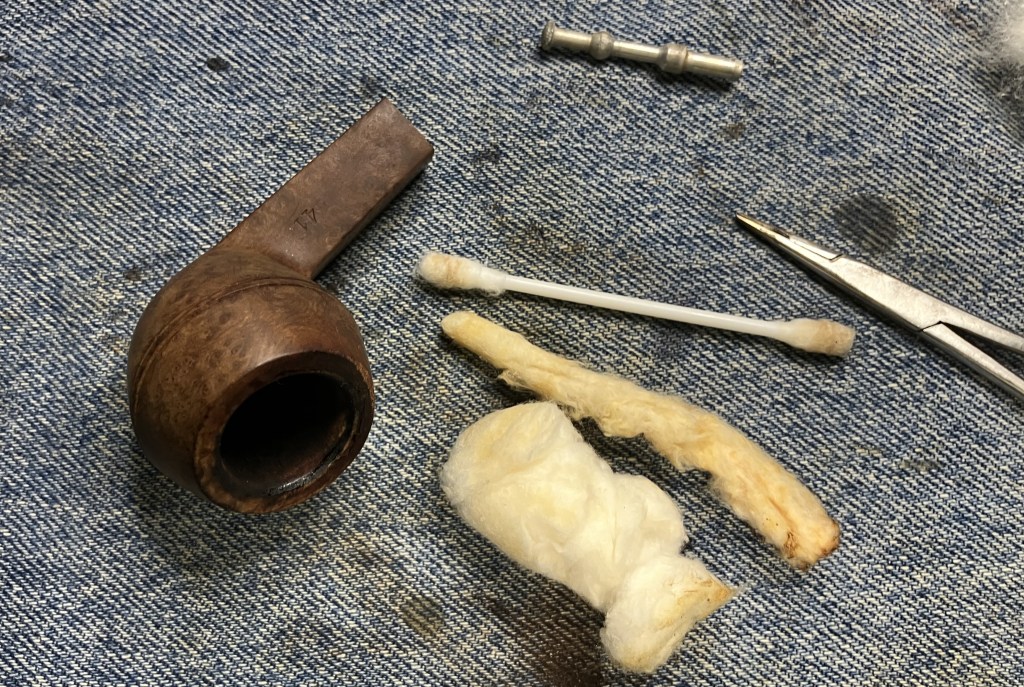
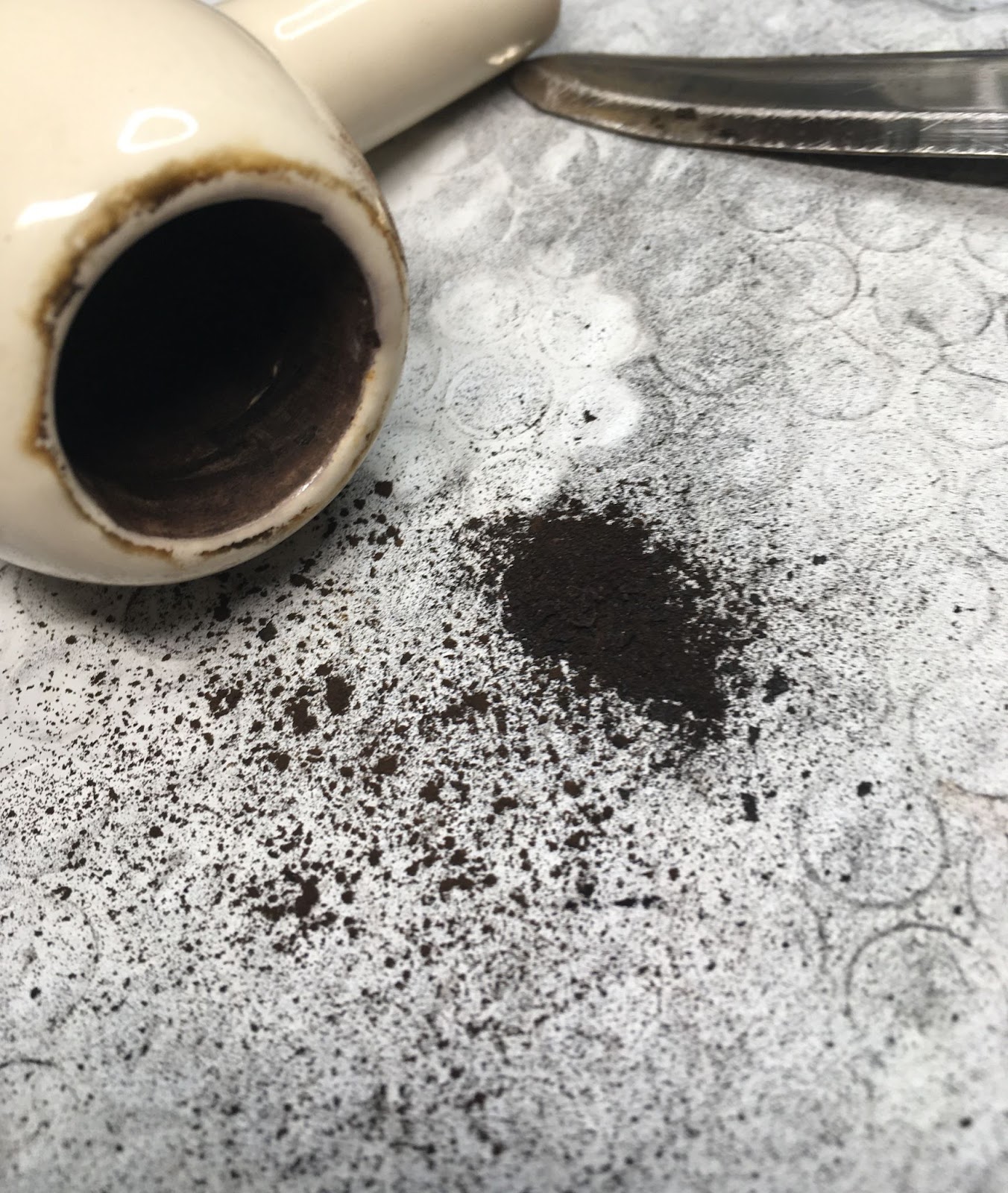
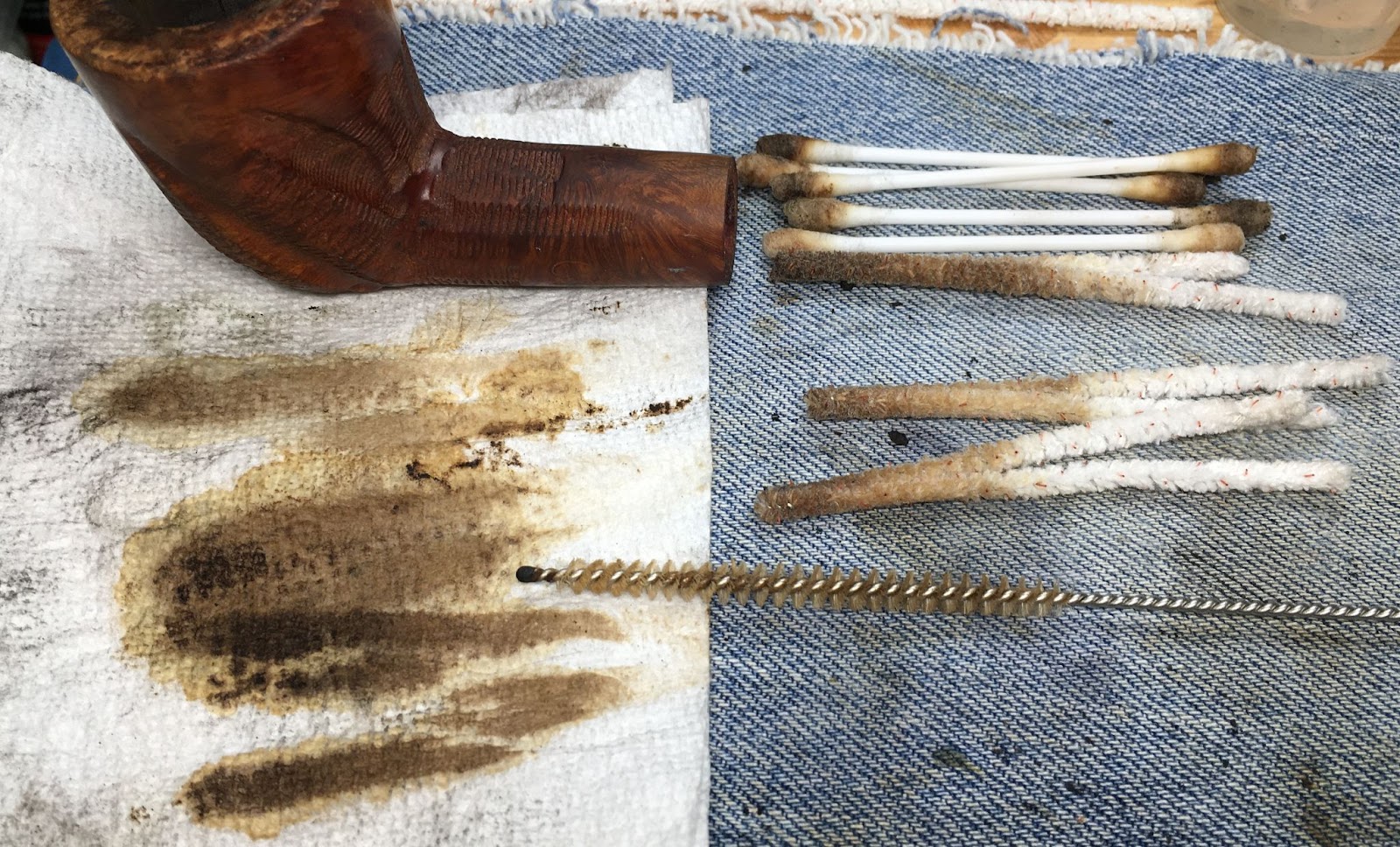
I swabbed out the chamber with an alcohol dipped cotton swab. Below you can see that the reaming only produced a tiny bit of carbon and a few flakes of tobacco.
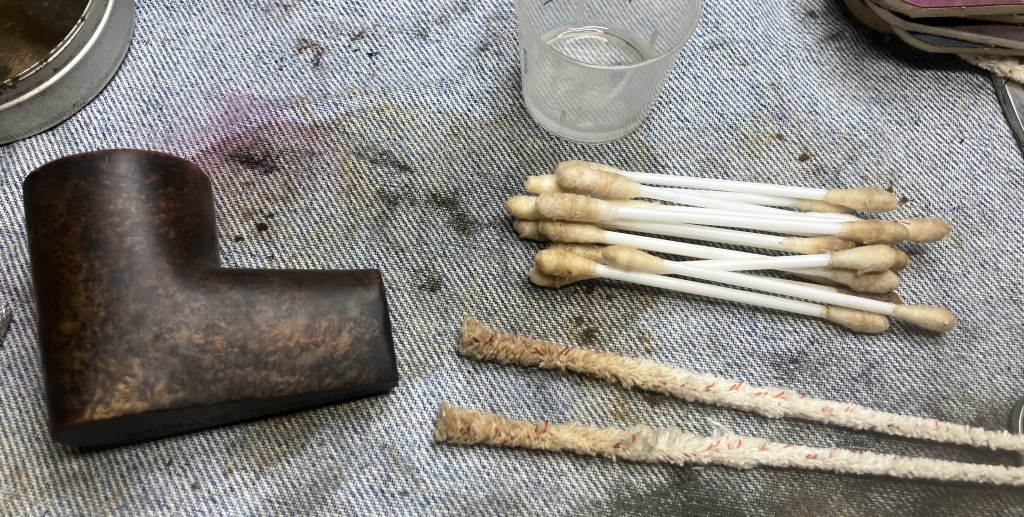
The shank was cleaned out using 99% ethyl alcohol on cotton swabs. These too, came back with little grime.
The stem was cleaned with alcohol and a bristle pipe cleaner.
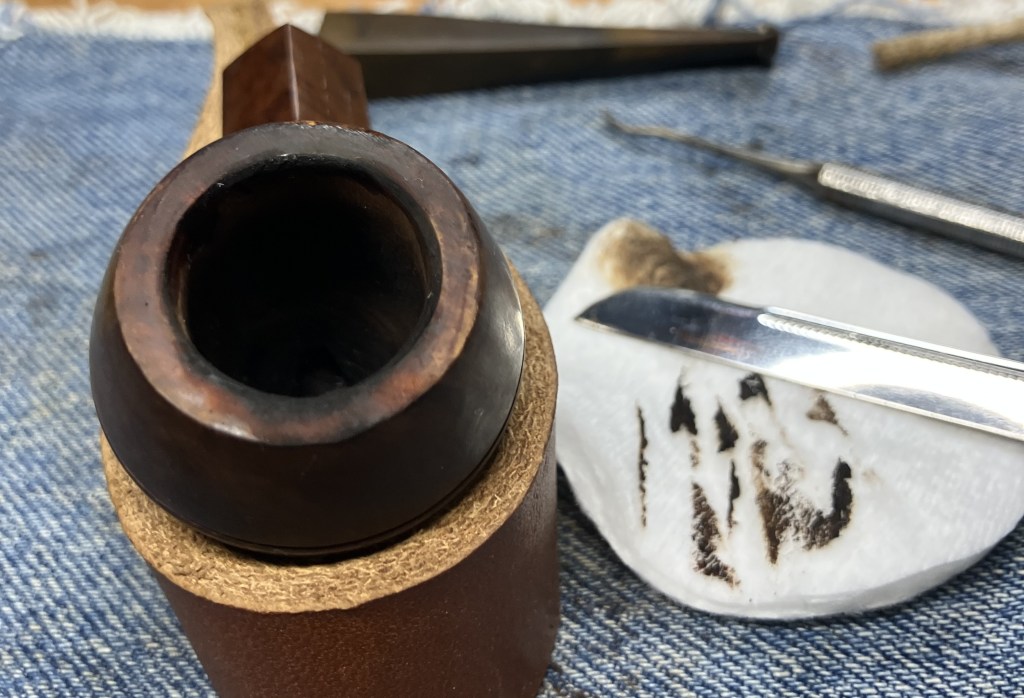
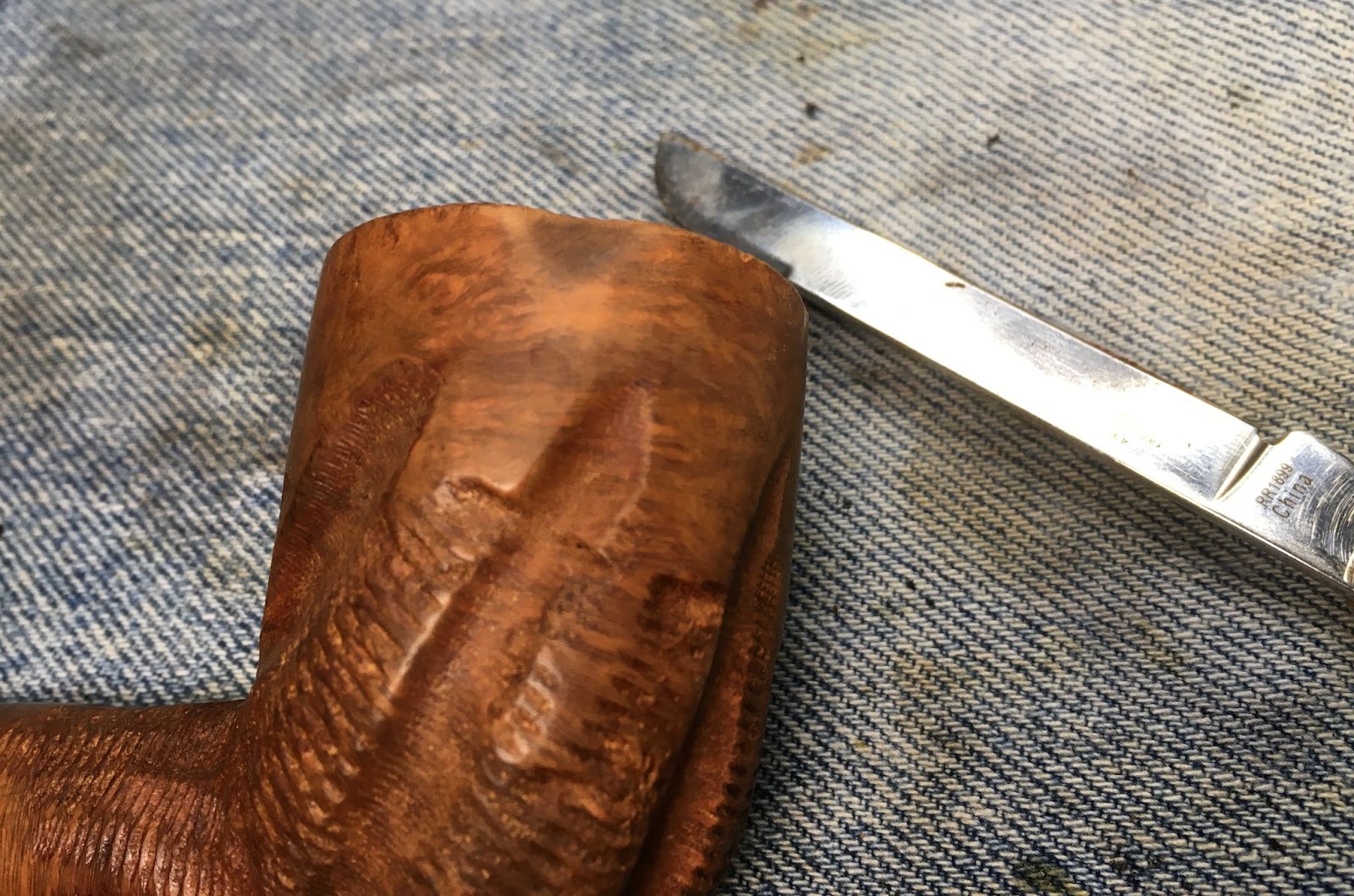
I used a dental scraper to clear the majority of the wax that was built-up in the bead around the bowl.
The light residue on the rim was removed with saliva and a cotton make-up pad.
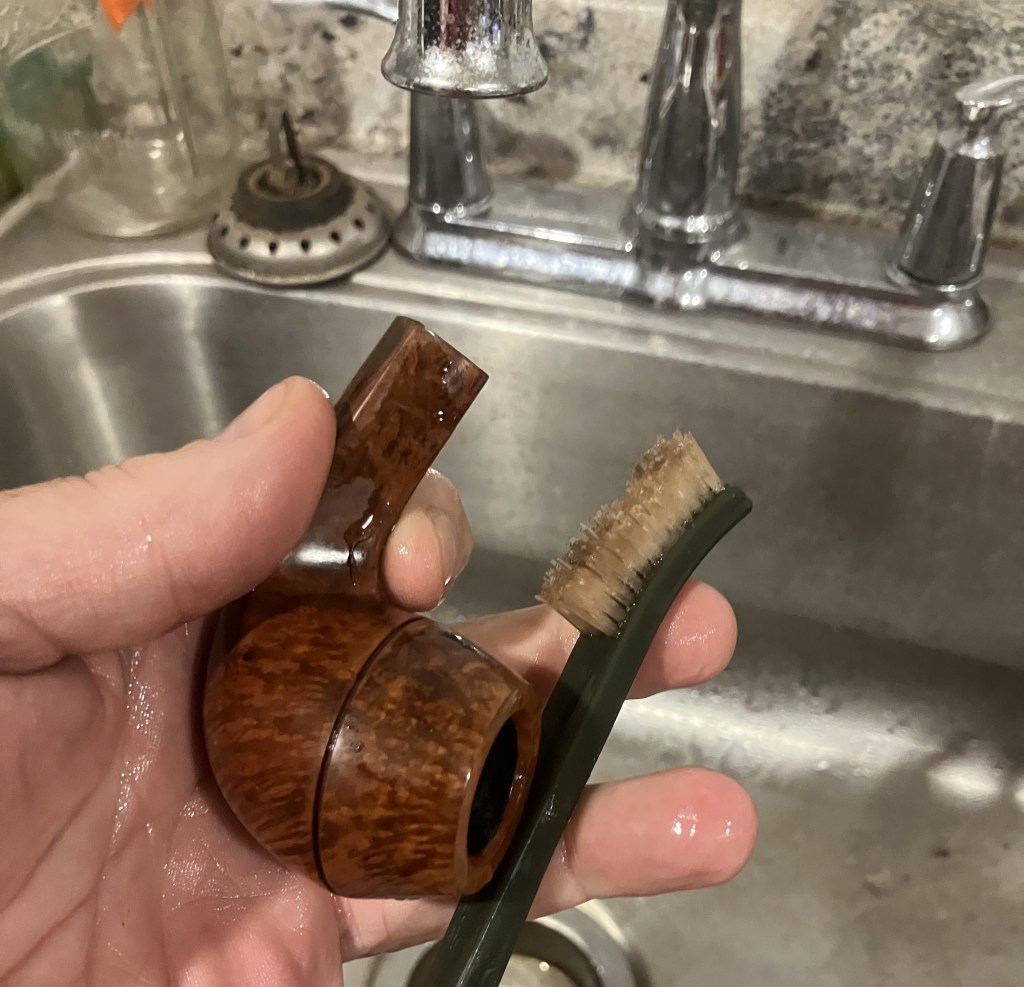
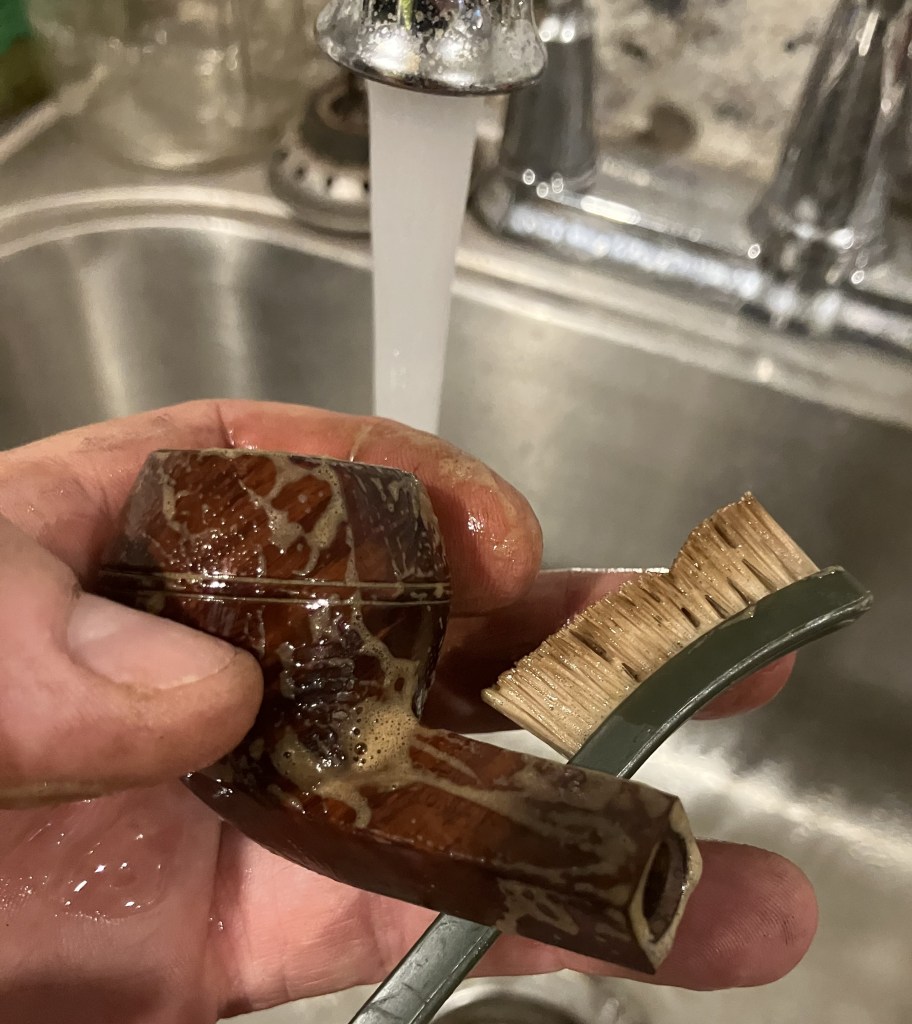
I took the stummel to the sink for what was probably an unnecessary scrubbing with undiluted Murphy Oil Soap and a nylon brush. Some habits are hard to break. The soap was rinsed with warm water and the stummel dried with a cotton hand towel.
Back at the workbench, the stem had a slight residue, likely from the airway cleaning.
I rubbed the stem with alcohol on a make-up pad and did get some oxidized vulcanite from the surface.
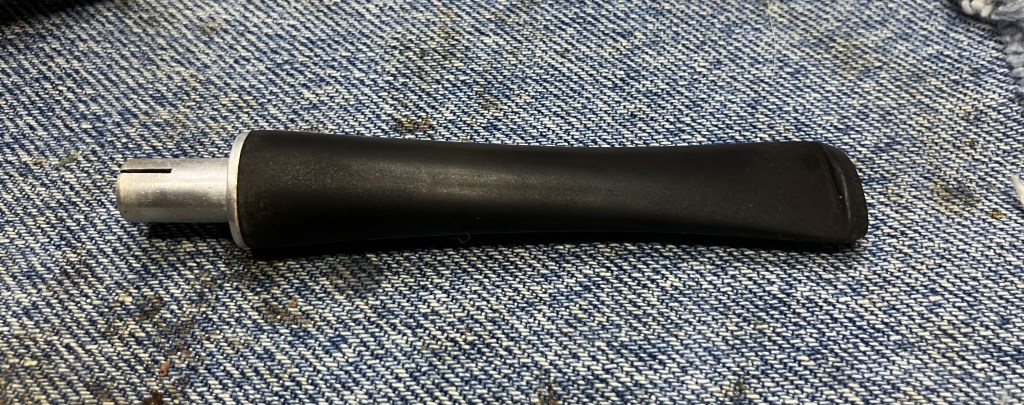
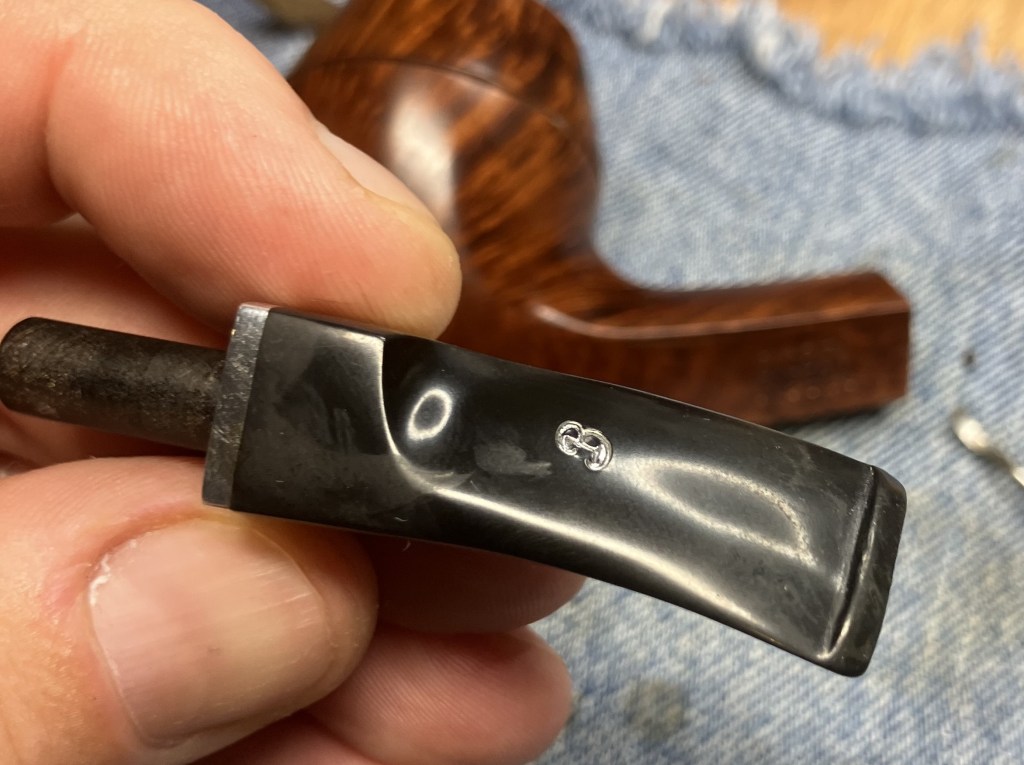
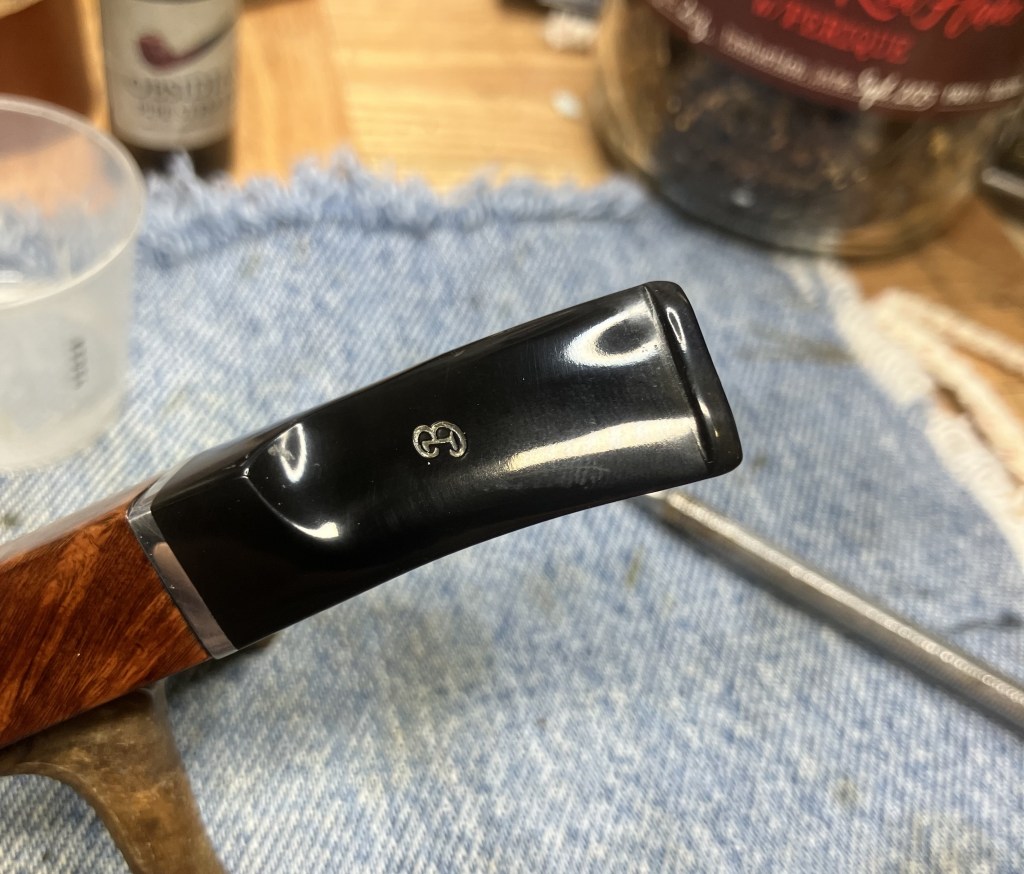
The stem was taken to the buffer where it was buffed with a blue buffing compound. This removed any additional oxidation along with the slight tooth chatter. It also dulled the bright silver of the stem logo.
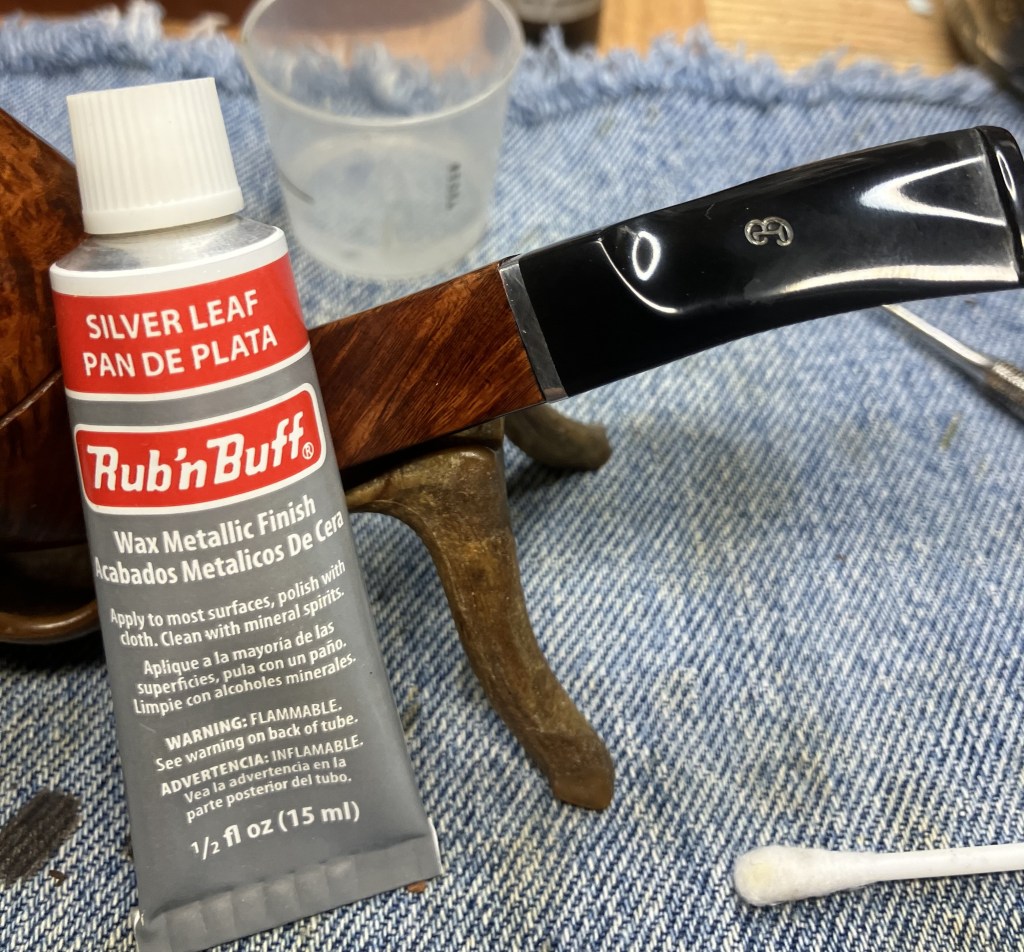
To replace the silver, I used Silver Leaf Rub’nBuff. Before applying the fresh silver, I cleaned the logo with a cotton swab dipped in alcohol.
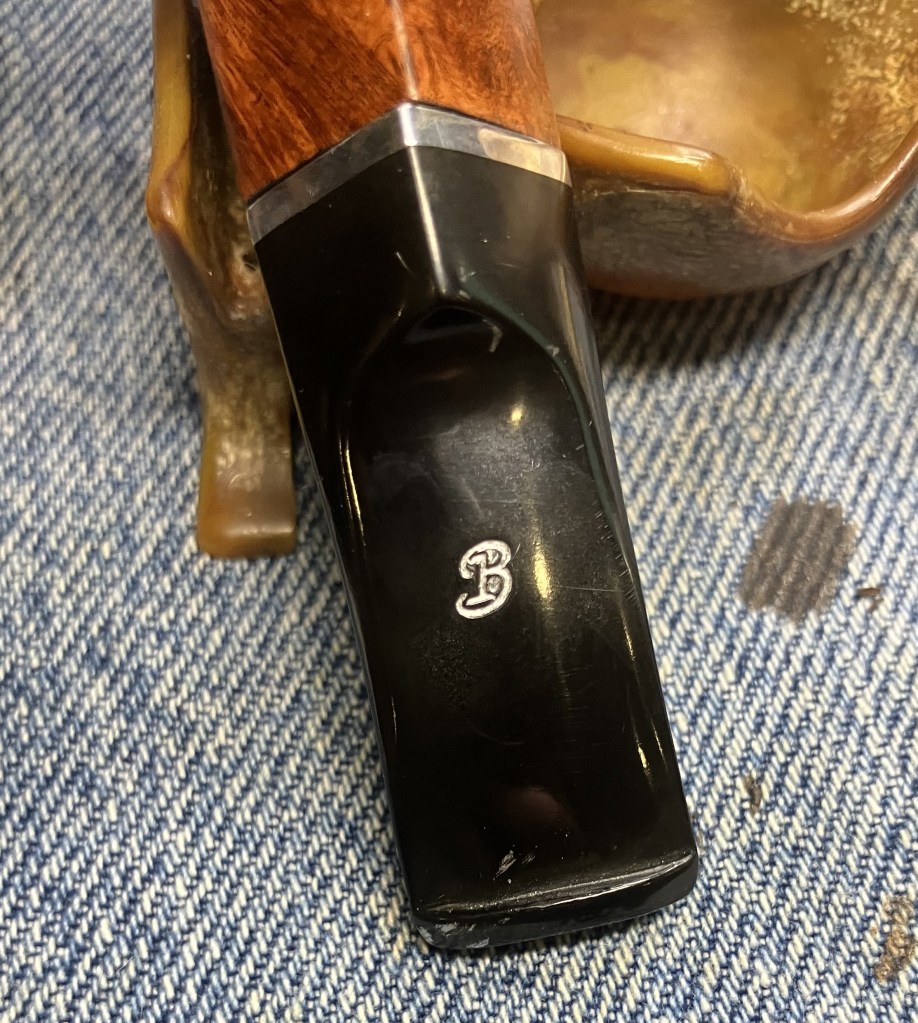
The silver leaf was applied and hand-buffed with a soft cotton cloth.
The resulting fresh silver was back to its original bright finish.
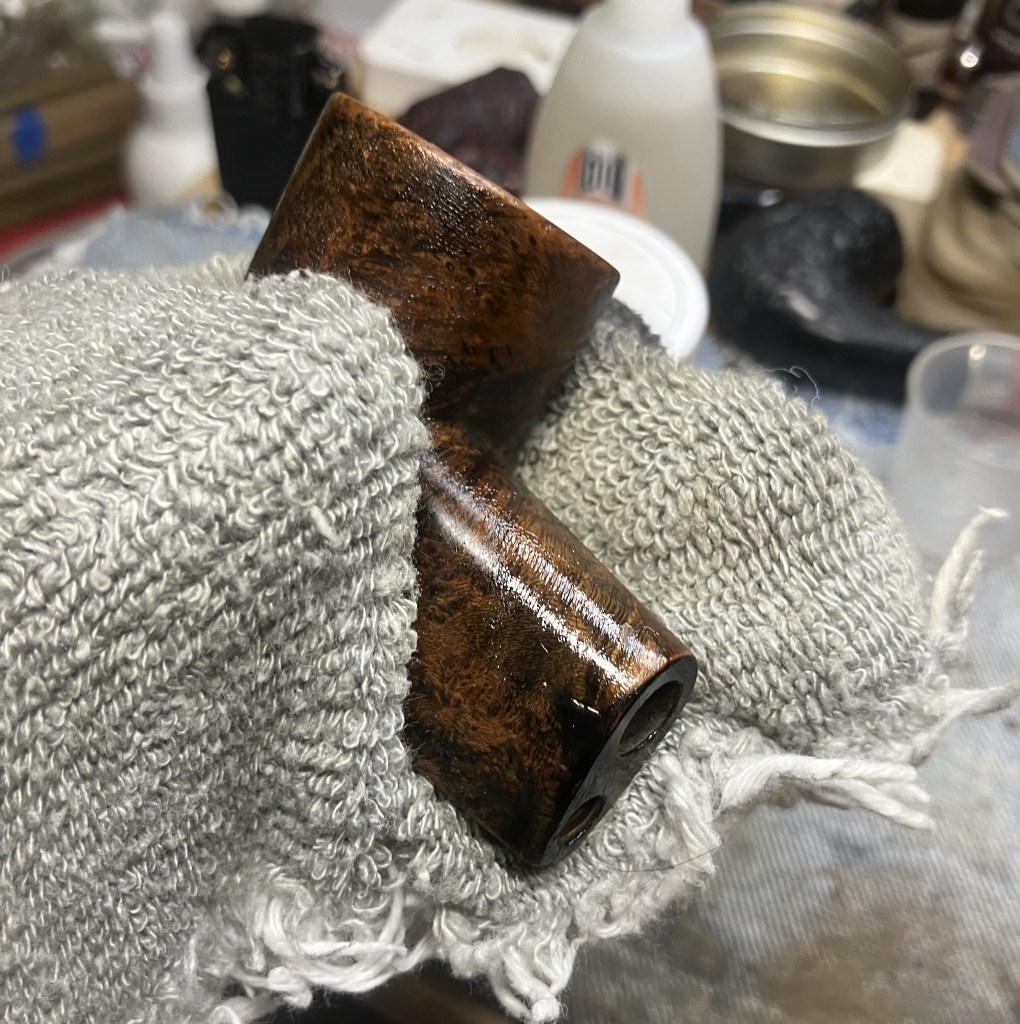
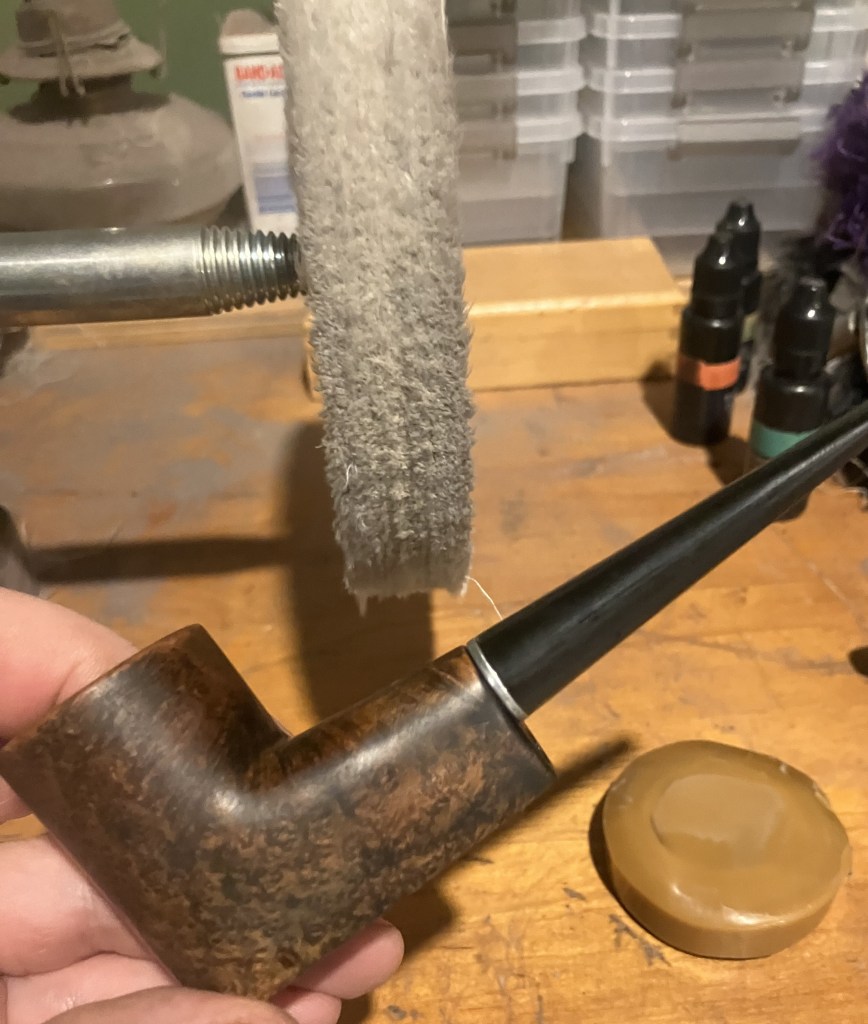
The pipe was given several coats of carnauba wax with the buffer.
The final step was another hand buff with the microfiber polishing cloth.
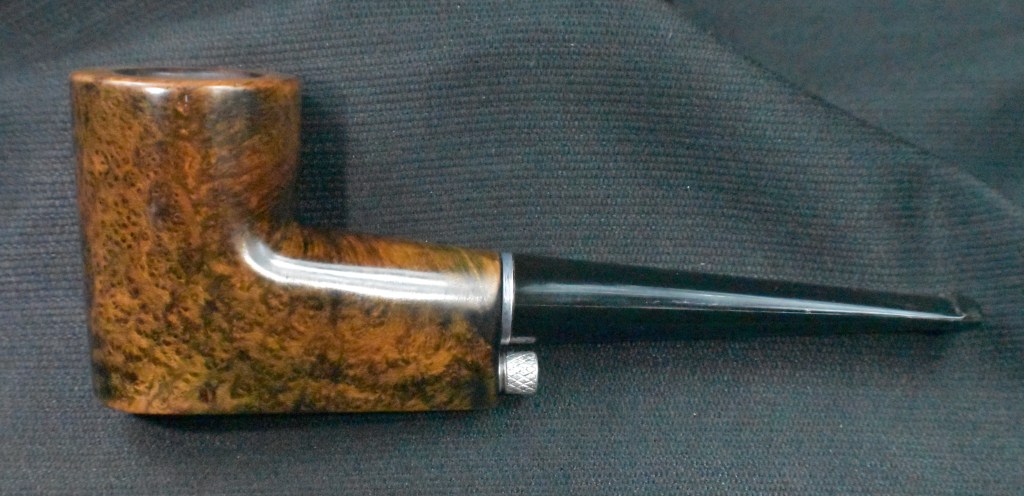
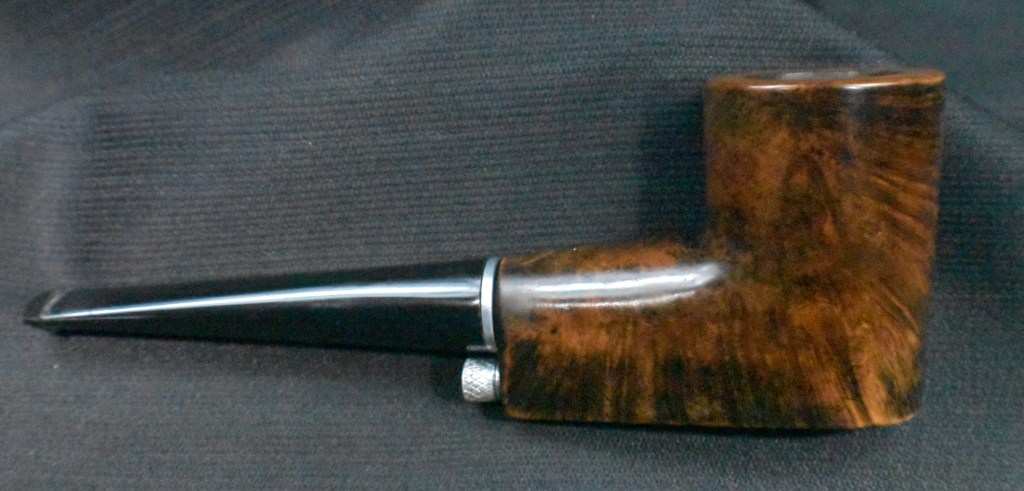
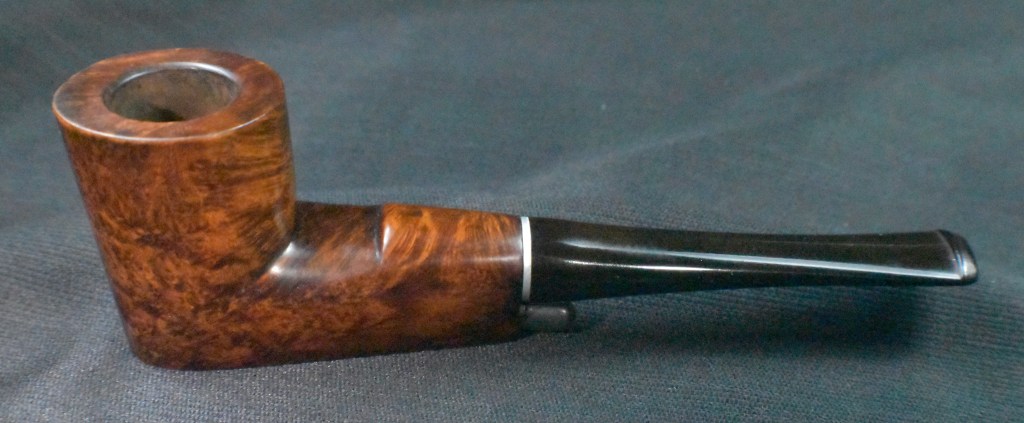
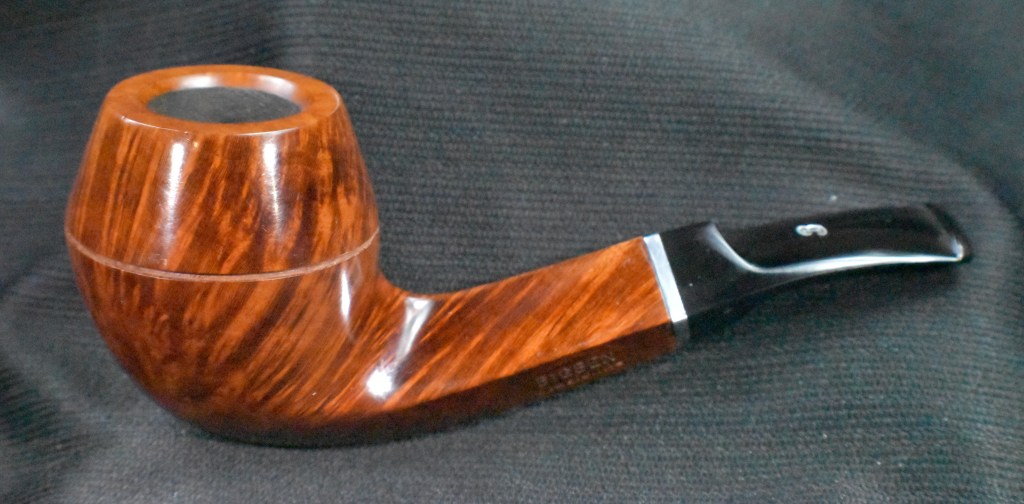
This beautiful Big Ben Classic Line 702 did not need very much work. I love the shape and the balance of this pipe. It fits my hand well and clenches like a dream. The contrast dye was well done at the factory and really accentuates the briar. THe bright nickel accent on the stem goes very nicely with the silver stem logo. This is just a classy comfortable pipe that I am glad to add to my personal collection. The dimensions of the Big Ben Classic Line 702 are:
Length: 4.74 in./ 120.40 mm.
Weight: 1.48 oz./ 41.96 g.
Bowl Height: 1.97 in./ 50.04 mm.
Chamber Depth: 1.57 in./ 39.88 mm.
Chamber Diameter: 0.68 in./ 17.27 mm.
Outside Diameter: 1.63 in./ 41.40 mm.
I do hope that you have found something here useful to your own pipe care, maintenance or restorations. If you like this sort of thing, please click the like and subscribe buttons. Thank you for reading the ramblings of an old pipe lover.
Loading…
Below are some photos of the finished Big Ben Classic Line 702.
Decisions, decisions. I had the urge to work on a bulldog this week but which one from the queue would be the lucky victim?
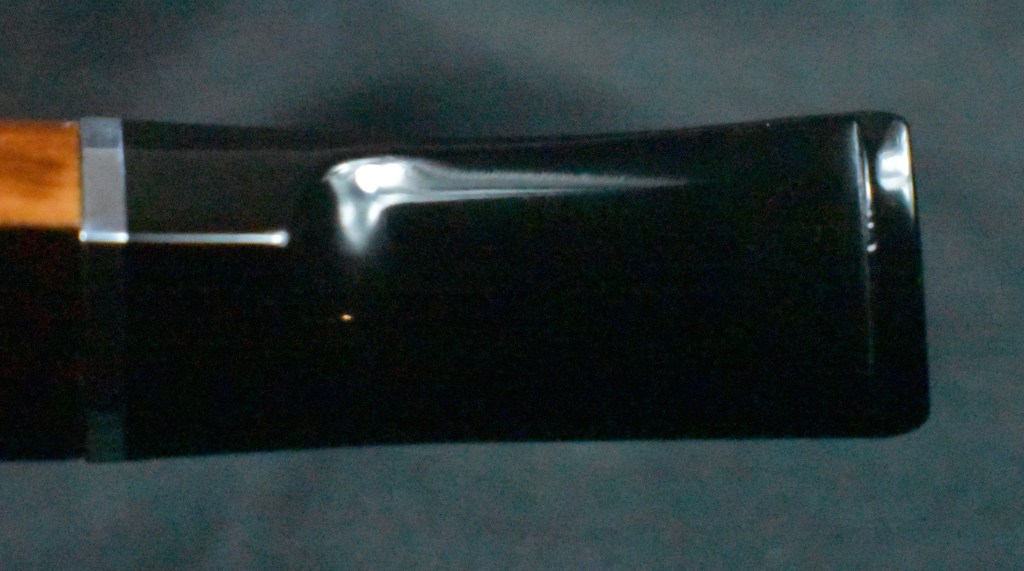
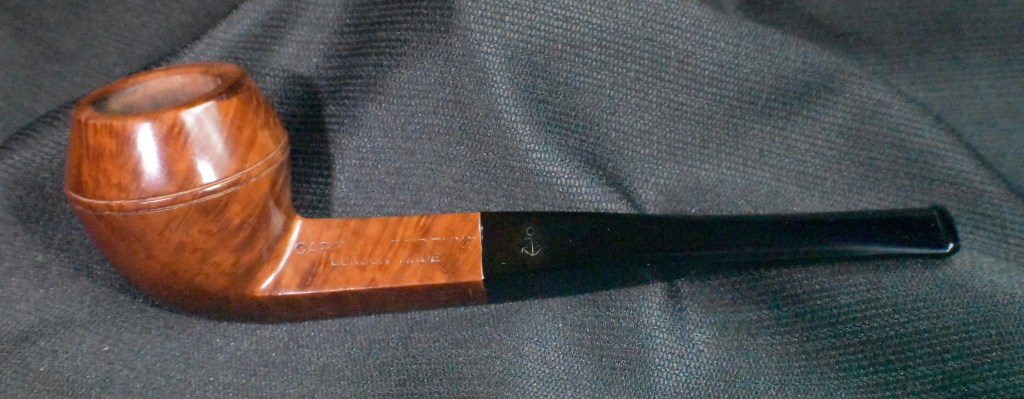
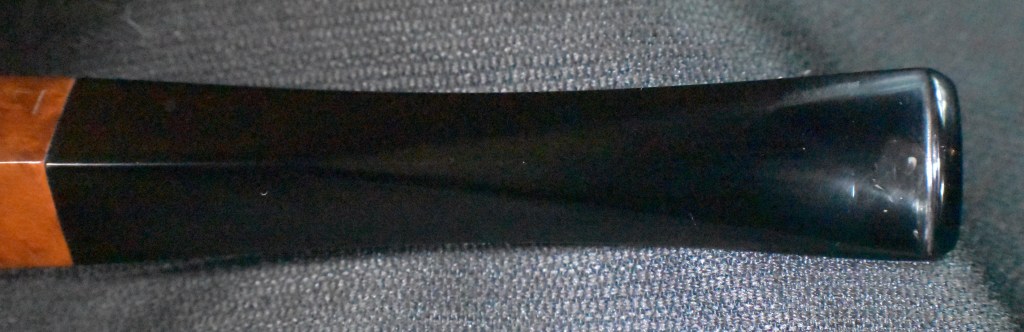
I had worked on Peterson and Marxman pipes recently, so they were out of the running. That left the Briars and Blends pipe (bottom) and the Captain Fortune (top). Well, from the title of this blog you have probably surmised my choice. TheCaptain Fortune was a purchase made to help out a Nebraska antique dealer I came across while looking for restoration subjects. I don’t usually opt to lend a hand to specific businesses but these guys were new, from Nebraska and had a pipe that I found interesting. Below is the original listing:
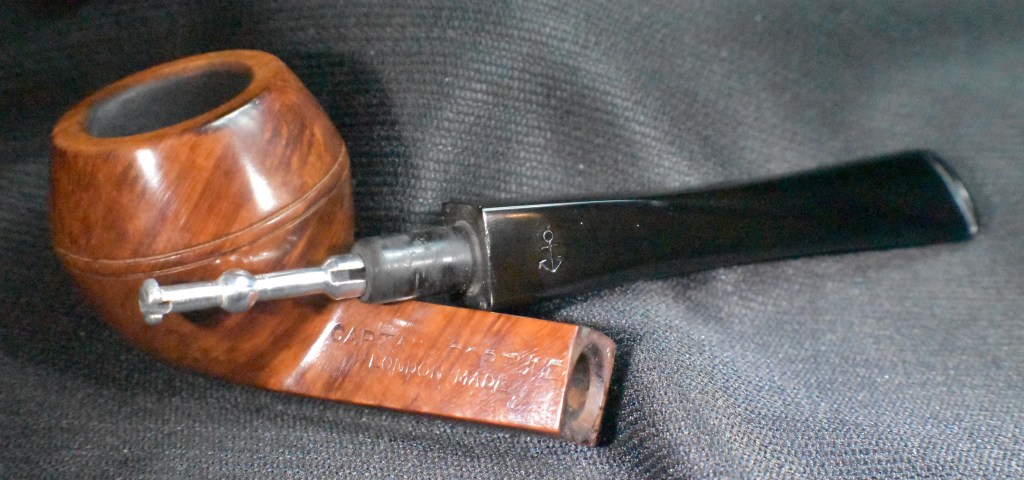
After submitting an offer, which was accepted, The pipe was on its way from northeast to southeast Nebraska. Upon arrival the pipe looked like the below photos.
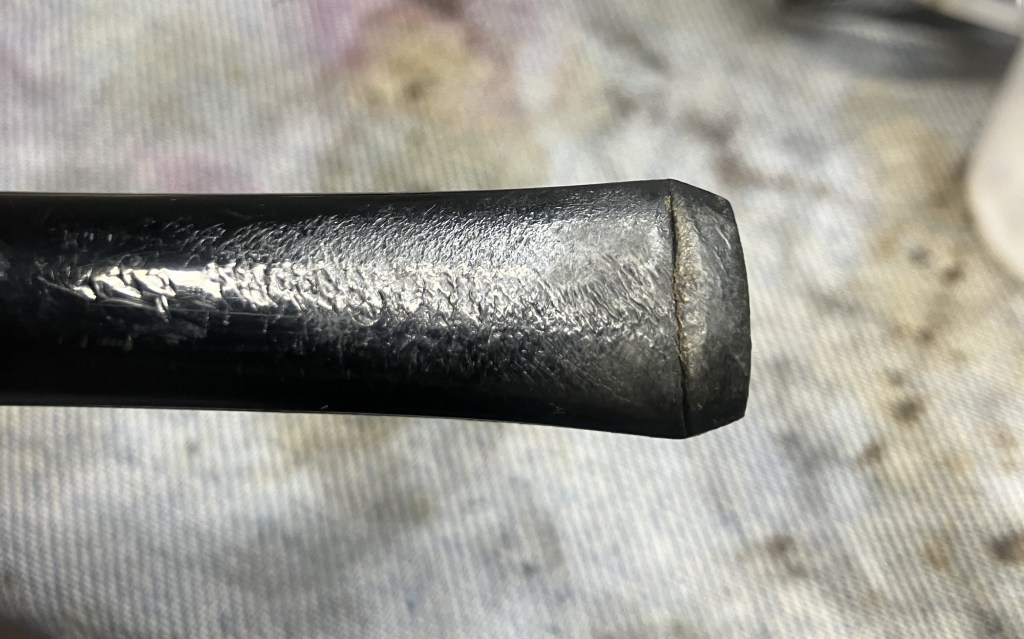
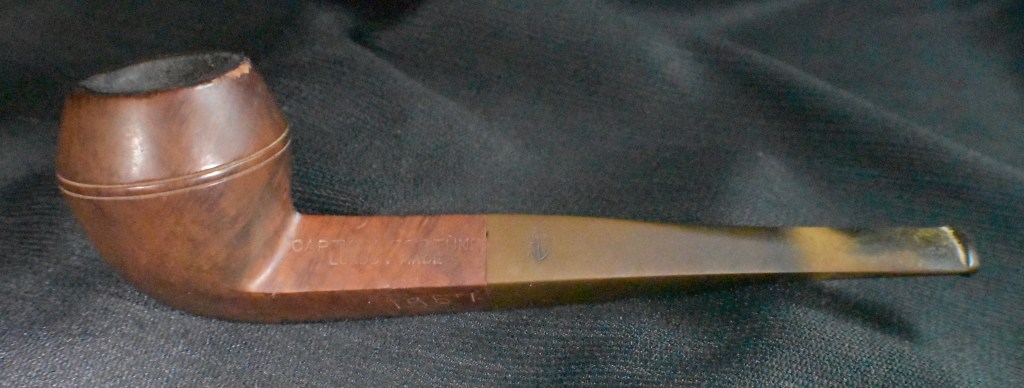
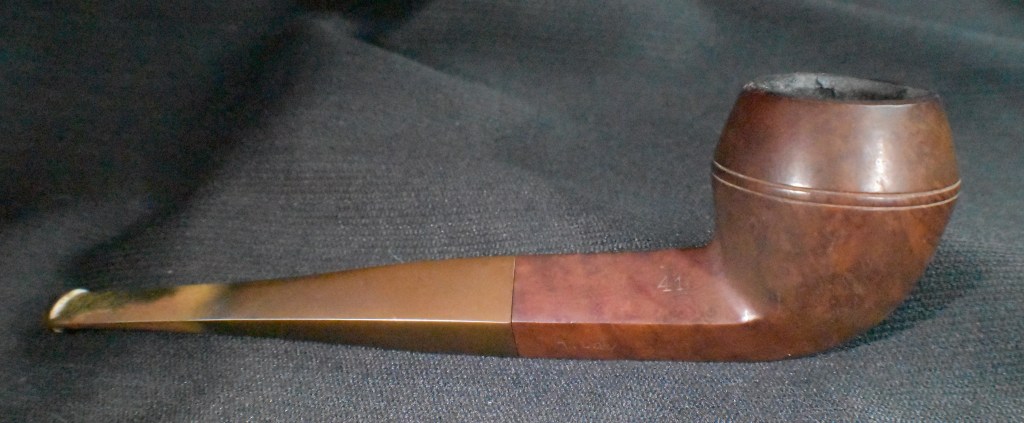
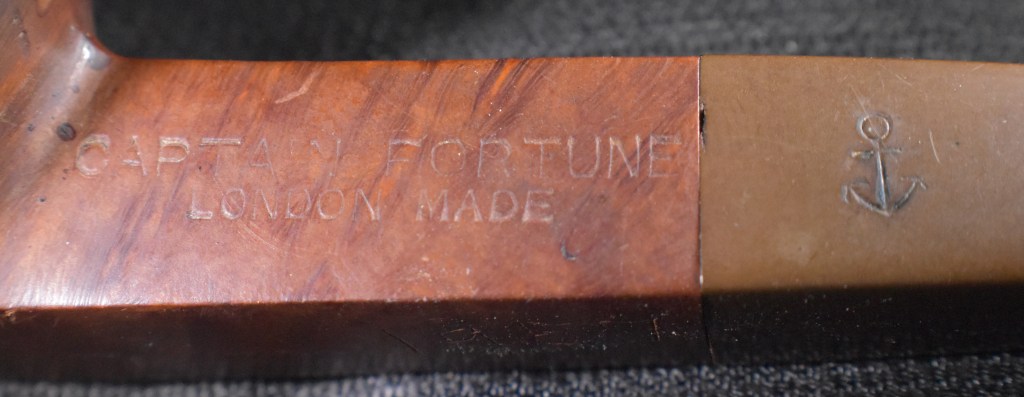
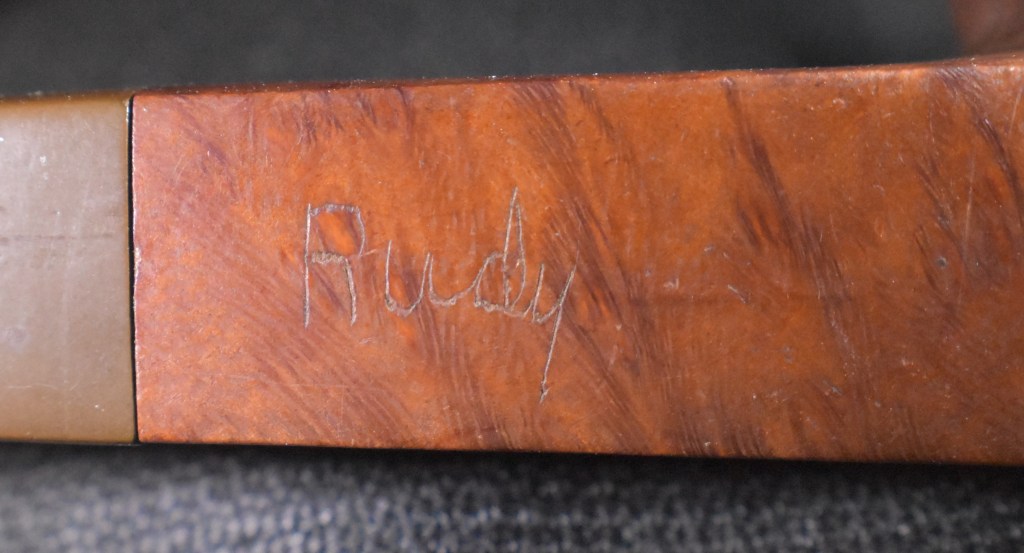
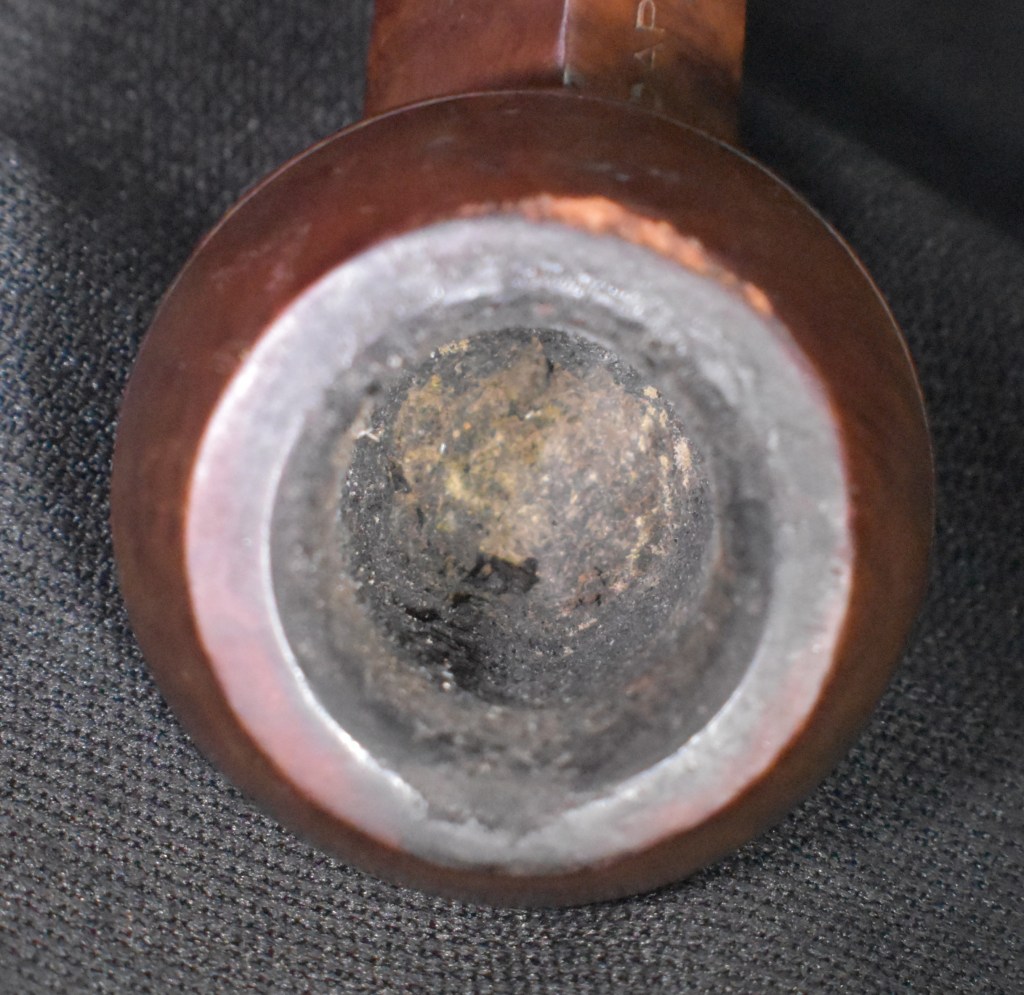
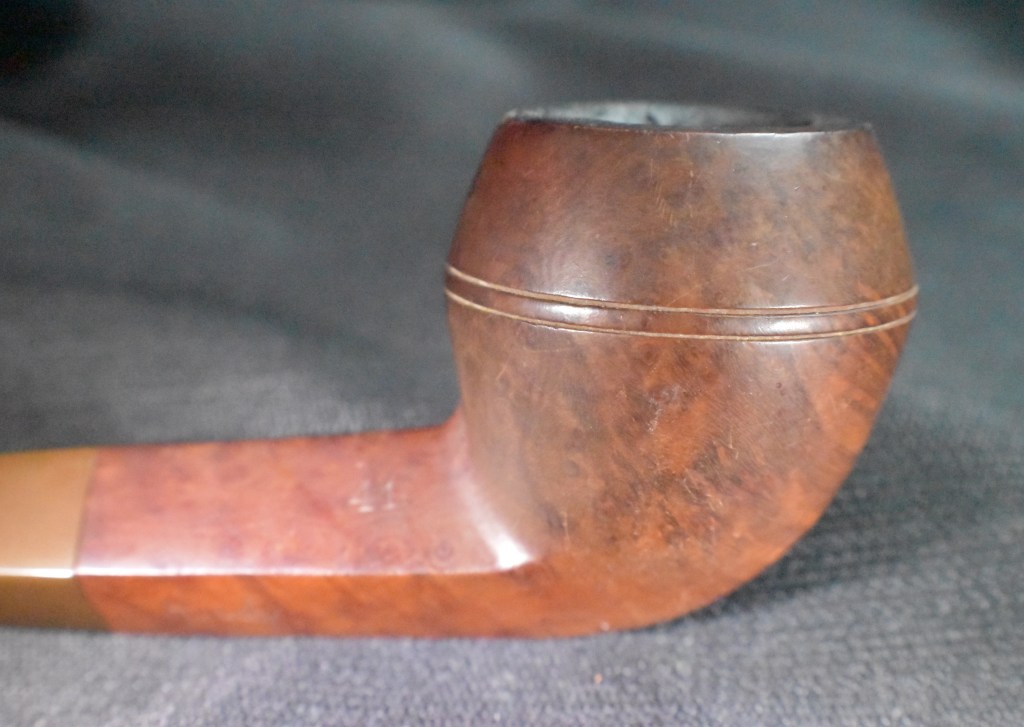
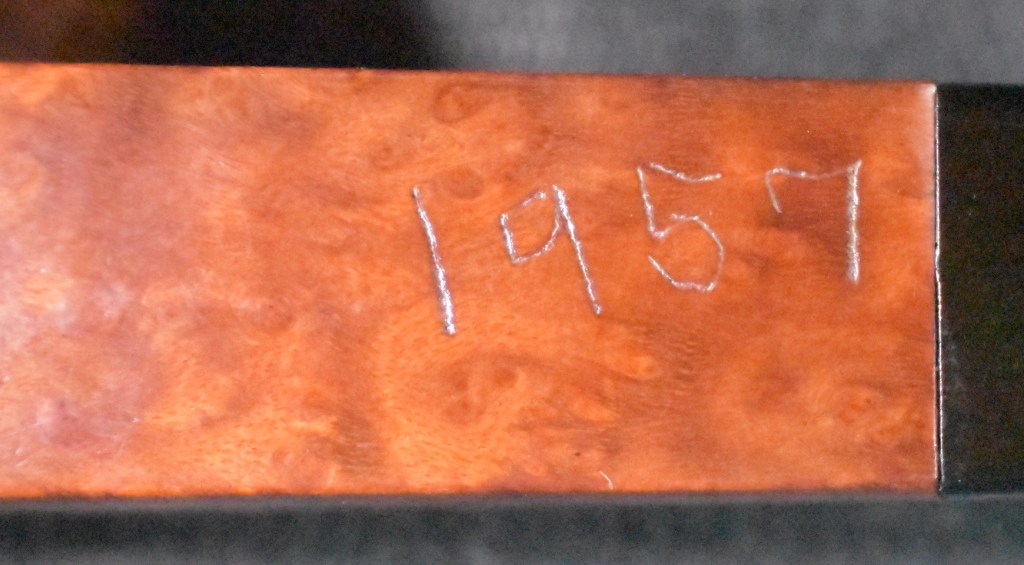
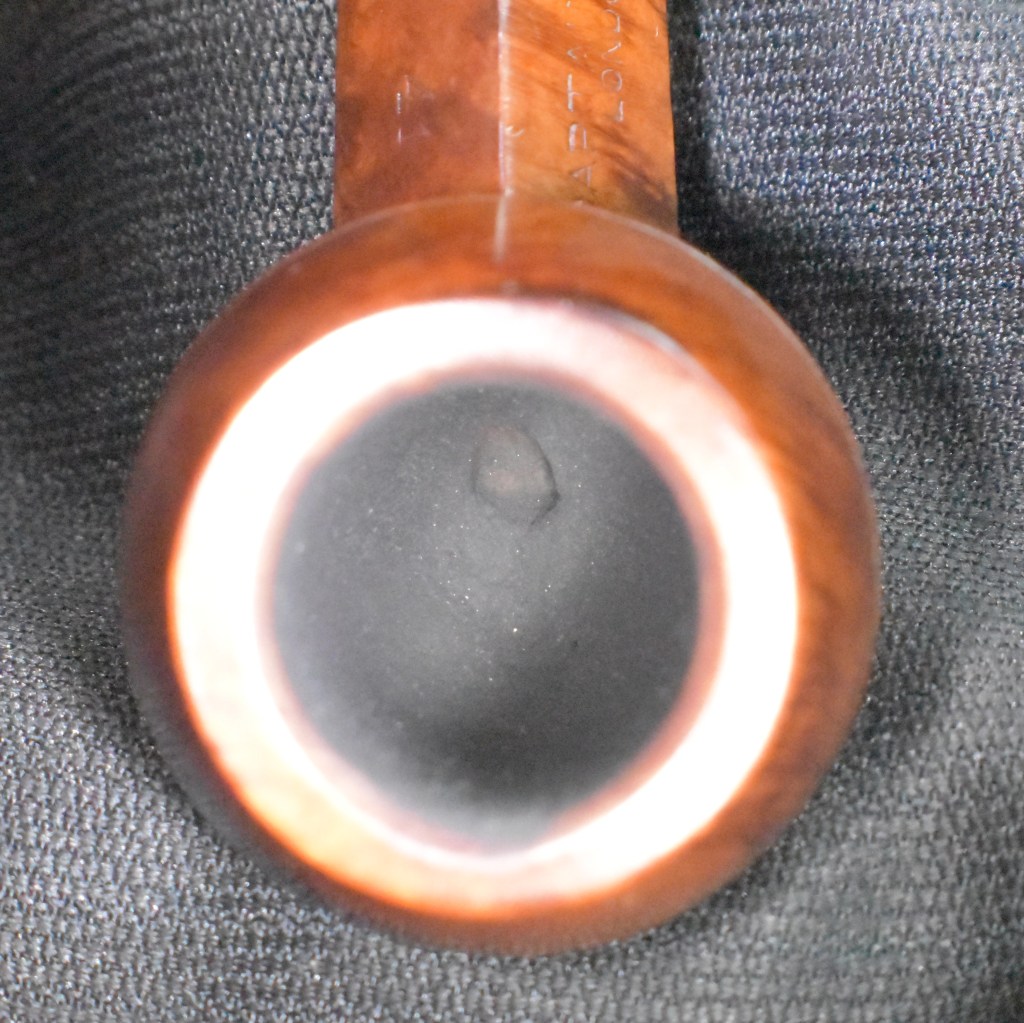
The pipe had definitely been used. The condition of the stem with its calcium deposits, discoloration and bite hole on the underside indicated that. The bowl, as well, showed substantial cake. The rim had a lava deposit and several chips indicating that the dottle was knocked out on hard rough surfaces. There was also an area on the inside front of the rim that looked like charring from lighting the pipe from the front with a non-pipe lighter. The stinger looked surprisingly clean but oxidized. Perhaps the previous owner loved this pipe and a clean airway. That would explain the lack of smoking residue on the stinger. I doubted that the additional markings of Rudy and 1977 were factory marks, but they did add some context to the age of the pipe and when it was being smoked.
Background
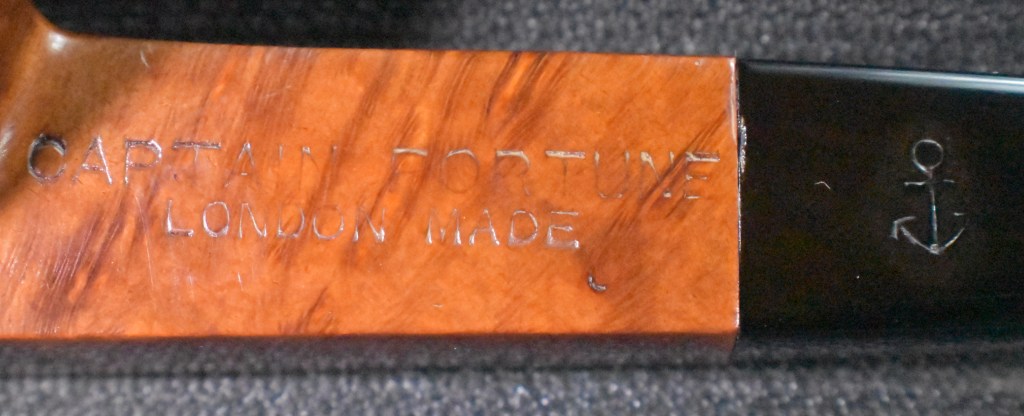
Captain Fortune is a brand of pipes made by John Redman Ltd. and British Empire Pipe company. According to pipedia.org’s brief entry,
“Other lines include Aristocrat, Buckingham, Buckingham Palace, Canberra, Captain Fortune, Dr John, Golden Square, Redonian, Richmond (not Sasieni), Twin Bore
Former factory located at 3-11 Westland Place, Hackney, London N1 7LP” (John Redman Ltd./British Empire Pipe Co. – Pipedia). That was not much to work with then I recalled working on another John Redman pipe back in December of 2024. I will link to that restoration here. The research for that pipe was more productive and I will include a quote from it below:
“My thirst for knowledge remained unfulfilled. I tried searching the internet without a guide and found a wonderful article by an anonymous author on the vkpipes.com site.
“This famous picture above is perhaps the only broad known illustration to materials about John Redman LTD & British Empire Pipe Co. And the majority of sources doesn’t move usually far beyond a couple of sentenses: this company did really exist, it was located at this address and there is their former building. However…
However, this Edwardian building on Westland Place was only an annex and no actual manufacturing was located there. The principle place of business and offices were located in Whitecross Street 123/5/7, within 15 minutes of slow walking from Westland Place. Therefore, one of their series was named Whitecross – you may find it in the catalogue below. The building on Whitecross St. still stands there and you may see it on the picture below. The crossing street is the Fortune St., so we have got an explanation of another Redman’s brand name – Captain Fortune.
Indeed, many Redman’s brands bear such toponomical signs: the “Golden Square” series comes from the Golden Square located between the Lower John and Upper John streets, “Dr. John” is the most probably related to the abovementioned John streets. There are also Canberra road and Canberra House in London (which might inspire stamping of the famous Canberra pipes) as well as Canterbury House (Canterbury series). Burlington pipes named after the Burlington Arcade (see also H. Simmons). The majority of them are located quite close to John Redman’s main office. No wide explanations are needed for the series Westminster and Kensington. And of course, some British imperial charm was added with names Aristocrat, Redman’s Royal, King’s Ransom.
John Redman (as it happened later to Eric Nording) was both a carver and an owner of a business of the same name. The first pipes were born in 1934, but personal efforts appeared soon to be insufficient, what inevitably led to emerging of the name John Redman LTD. Unfortunately, we don’t have artifacts, which could be unambiguously carried to the “pre-war” period. In the WWII years the company could hardly got to the list of lucky manufacturers, who received scarce briar from the state.
But by the end of 1950s John Redman’s firm offered a well balanced portfolio – from popular and practical “Captain Fortune”, “Dr John”, “Golden Square” to top graded Redman’s Royal made of best briar and almost without any stains (comparable to GBD Virgin, but the “Royals” were usually much larger and carved in their own unique style). And of course, we shouldn’t forget about qualitative and still affordable Redonians, Aristocrats and Canberras – a very strong middle (and upper middle) segment. More details, list of offered brands as well as presentation and gift sets can be seen in the catalogue.
It is known that in late sixties and later a part of the production was ordered from subcontractors, for example Blakemar Briars, and since 1992 trademarks of John Redman were taken over by Gerald Grudgings of Loughborough; this company wasn’t a top manufacturer, but many sources attribute the invention of the lovat shape to it.
As the conclusion we are proud to express our sincere and warmest thanks to Robert Deering, who worked for John Redman in 1960s and gave us a number of very important directions.
Now, the Captain Fortune pipe in hand has what I assume to be an owner’s autograph and a date etched into the briar along the underside of the shank. It reads “Rudy” and “1957”. I am going to go out on a limb here and say that those are not factory originated marks. I am also going to say that 1957 was the year that that date was inscribed. That would place this pipe squarely into the time quoted by the above article as of the , “end of 1950s John Redman’s firm offered a well balanced portfolio – from popular and practical “Captain Fortune…” This supposition and the apparent age of the pipe itself would make this Captain Fortune bulldog produced in London during the latter 1950s.
The Restoration
The captain Fortune made its way from the photo table to the workbench, a grueling 18 foot distance and to its denim piece.
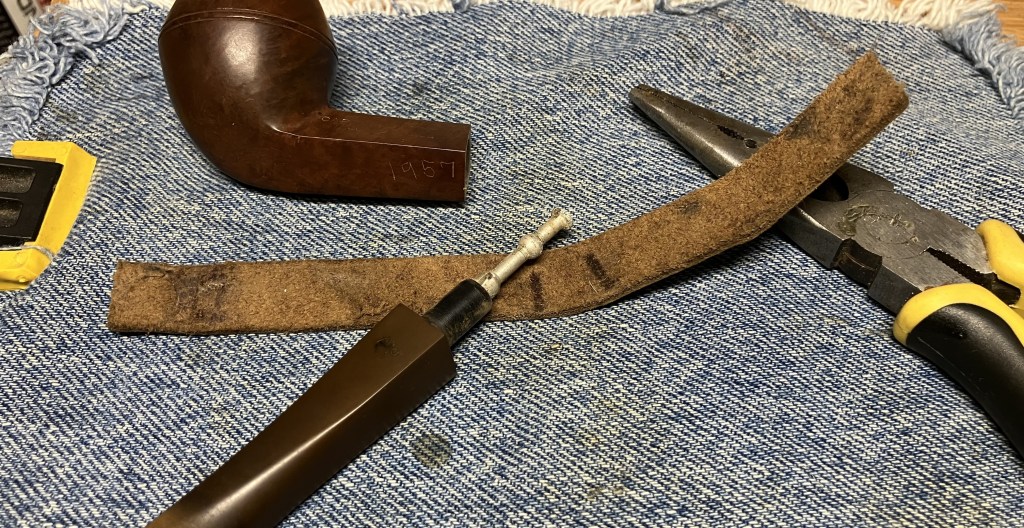
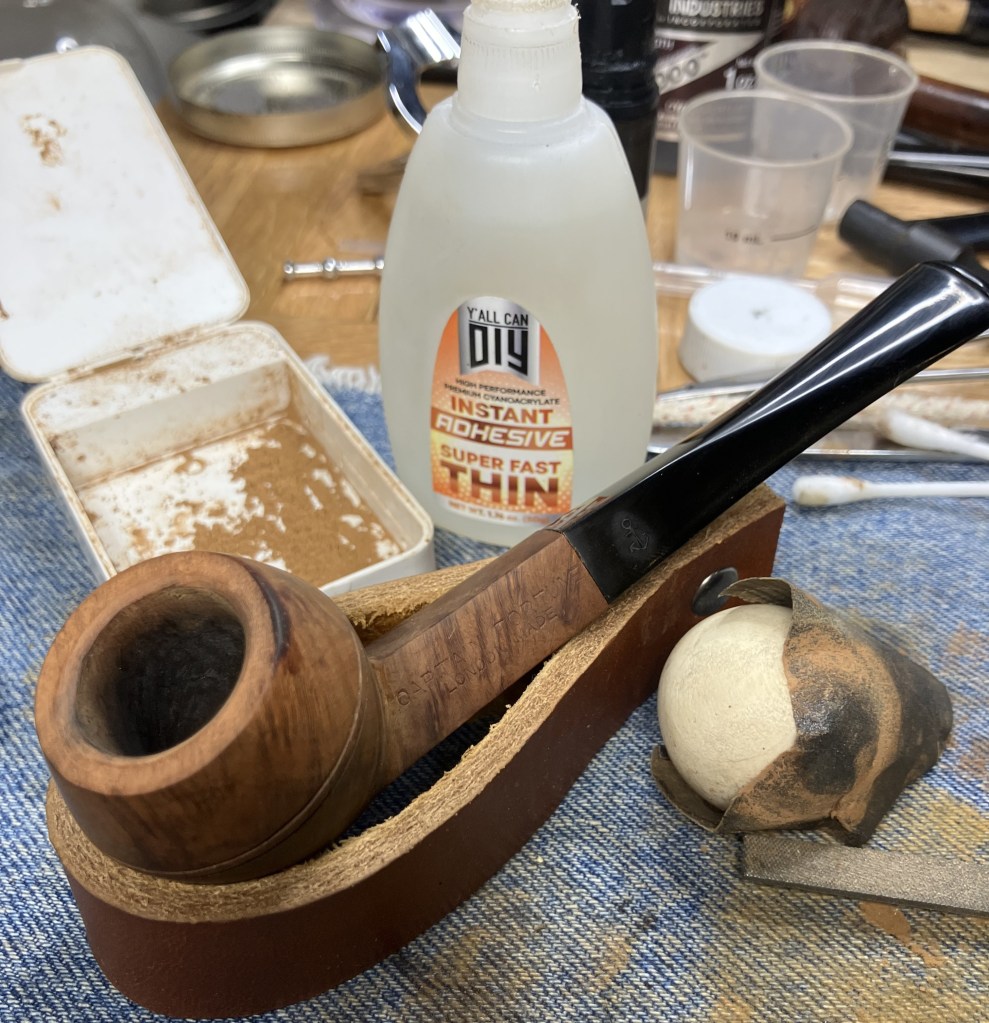
Once at the workbench I removed the stem and gathered my official Stinger Extraction Device (SED). The SED is actually a strip of thick leather used to protect the aluminum of a stinger from the jaws of a pliers.
The suckedness of this stinger led to absolute failure in its removal. Not wanting to risk breaking the vulcanite, I devised plan B.
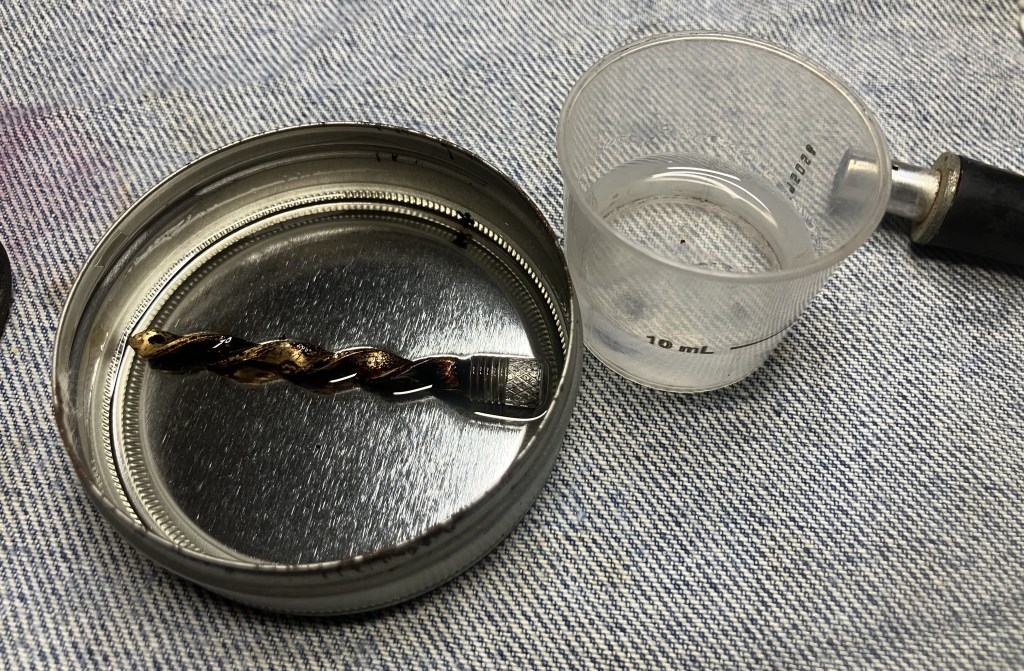
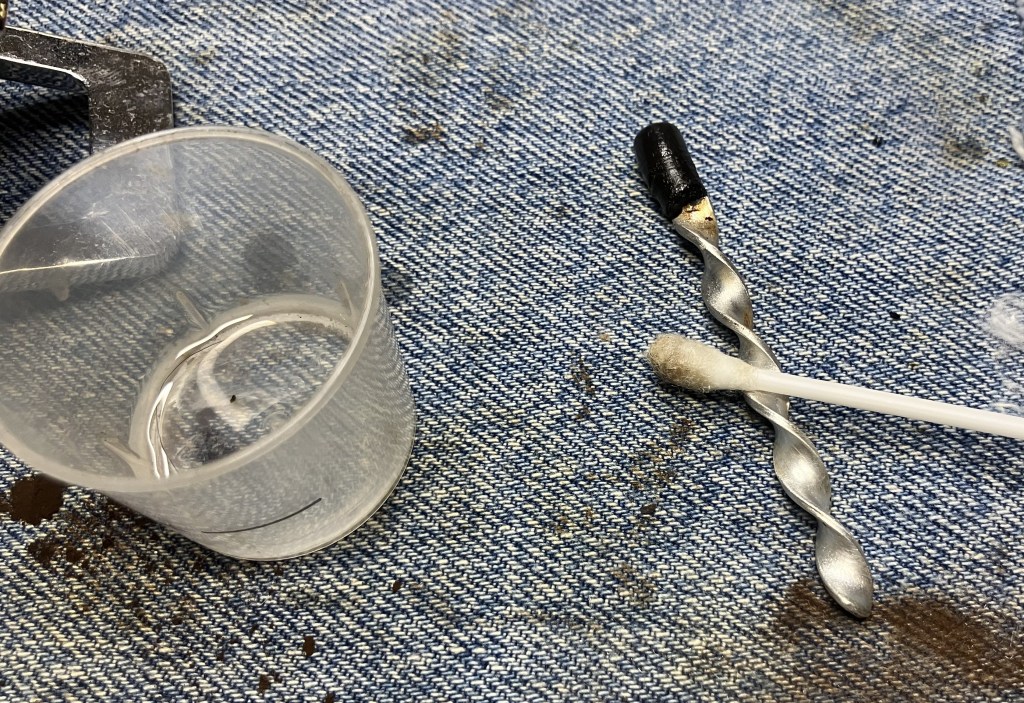
Being a big believer of Plan Bs, in general, I chose to soak the stinger and end of tenon in a medicine cup with 99% ethyl alcohol. Now, I know what you are thinking, “That stem is too heavy to stay in that little medicine cup.” Trust me, it will be fine.
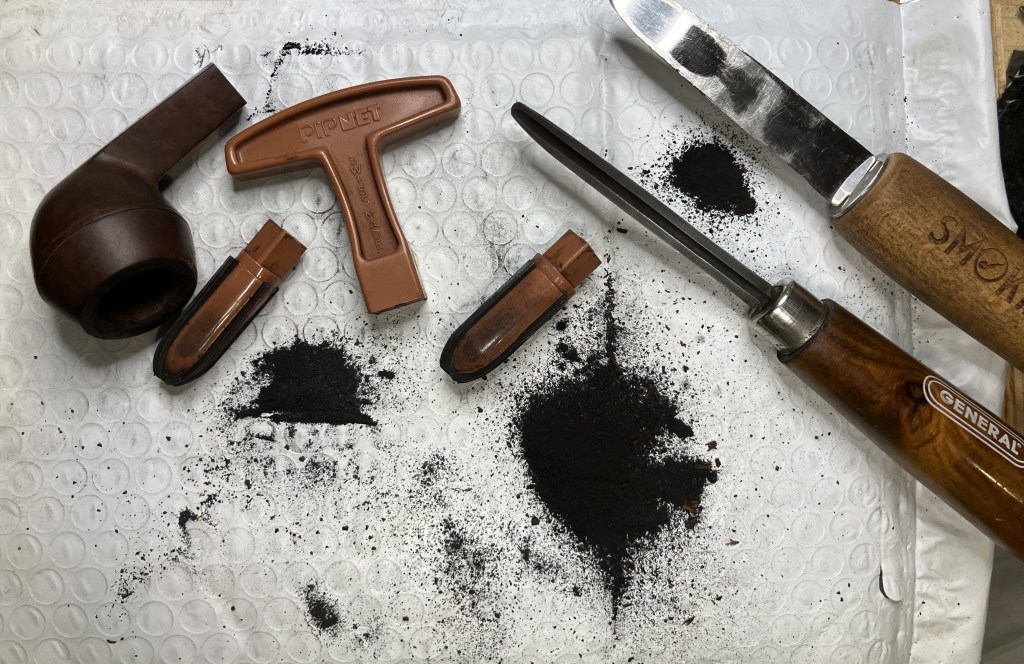
PipNet led the ream team with the #1 blades.
That was until I realized that the cake was much thicker than I thought it was. The PipNet #2 blades came out and earned their keep. The Smoking pipes Low Country reamer was great for the curve at the bottom of the chamber and the General triangular scraper did cleanup on the interior walls.
The tobacco chamber looked much better and more spacious.
The chamber was sanded with 320 sandpaper wrapped around a wood dowel.
Now, normally sanding does create some shaking of the workbench. This shaking was just enough to tell me that the stinger was ready to come out of the stem. No, the top heavy stem did not tip over the medicine cup of alcohol and spill the alcohol all over the workbench. That would indicate that the restorer was a total clutz and perhaps an idiot. No, let’s just say that after some using alcohol to clean the top of the workbench the stinger was ready removed using the official SED.
Now, back to the sanding. Things looked pretty good until I used alcohol wetted cotton swabs to clean out the sanding debris from the tobacco chamber. As the alcohol evaporated I saw several spiderweb patterns of heat damage to the chamber.
The below photo shows the webbing while the alcohol was evaporating, making the lines look darker. There were more spider webs on the interior right than left. None of them were very bad nor deep. The chamber felt nice and smooth to my finger. I thought that I should give this pipe a bowl coating to protect it and aid in the formation of a light cake.
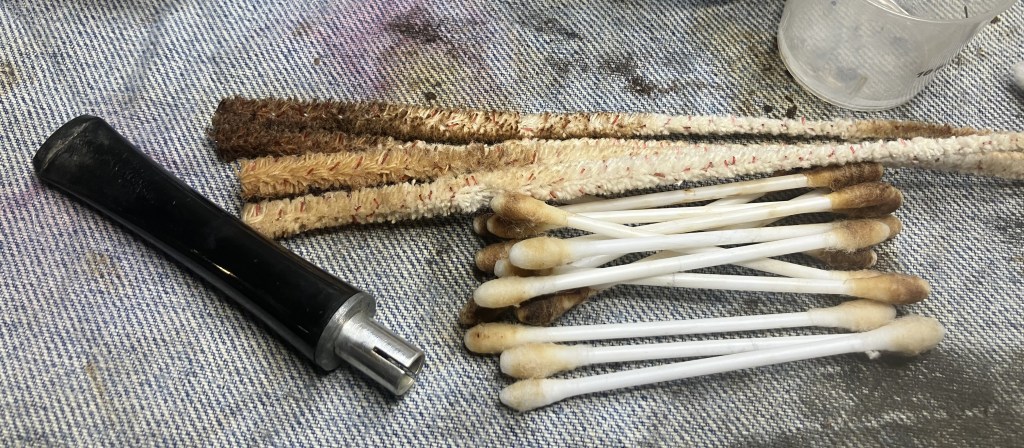
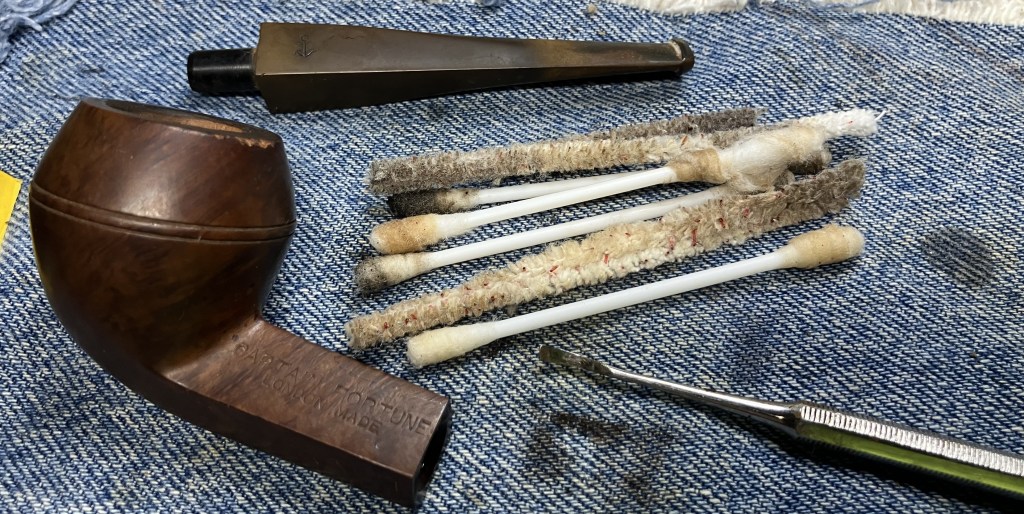
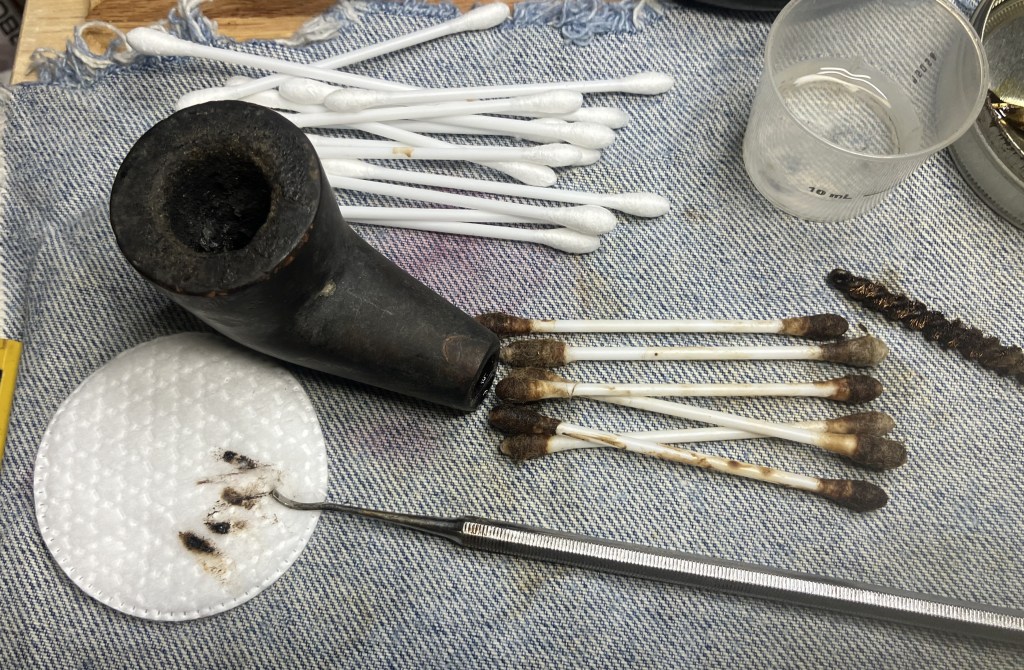
Cleaning the shank came next. This was done with several bristle pipe cleaners and cotton swabs all dipped in 95% ethyl alcohol. There was also some scraping with a dental scraper. Every successful scrape removed reduced the cotton swabs and pipe cleaners needed dramatically.
Next came the rim. I was a bit worried what I’d find under that layer of lava.
The lava was moistened with saliva and allowed to soak for a couple of minutes. Then I lightly scraped with a very sharp pocket knife. This did reveal some charring but not as bad as I had feared.
The stummel was taken to the sink for a scrubbing with a nylon brush and undiluted Murphy Oil Soap. The soap was rinsed with warm water and the stummel dried with a cotton hand towel.
Returning to the workbench, the stummel was wiped with an alcohol wetted make-up pad. This removed remaining wax and some lingering grime.
I turned my attention to the stem. This was cleaned with bristle pipe cleaners and 95% ethyl alcohol. The stem was surprisingly clean.
I inserted a pipe cleaner into the tenon for easier removal of the stem in the morning. The plan was to leave it in deox, that’s what I like to call time spent in Briarville’s Pipe Stem Oxidation Remover. I have to say, this product is a good one and is available here: Briarville Stem Oxidation Remover 8oz | Briarville, Inc. And no, your’s will not come looking like this, it will be a bright yellow.
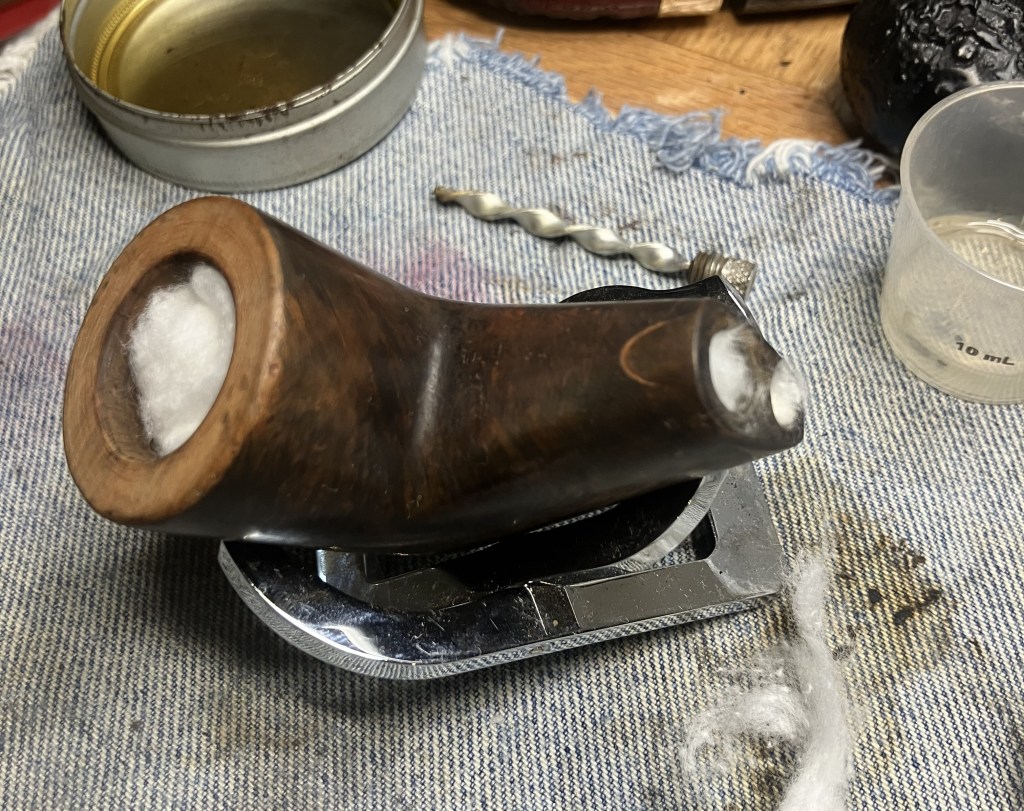
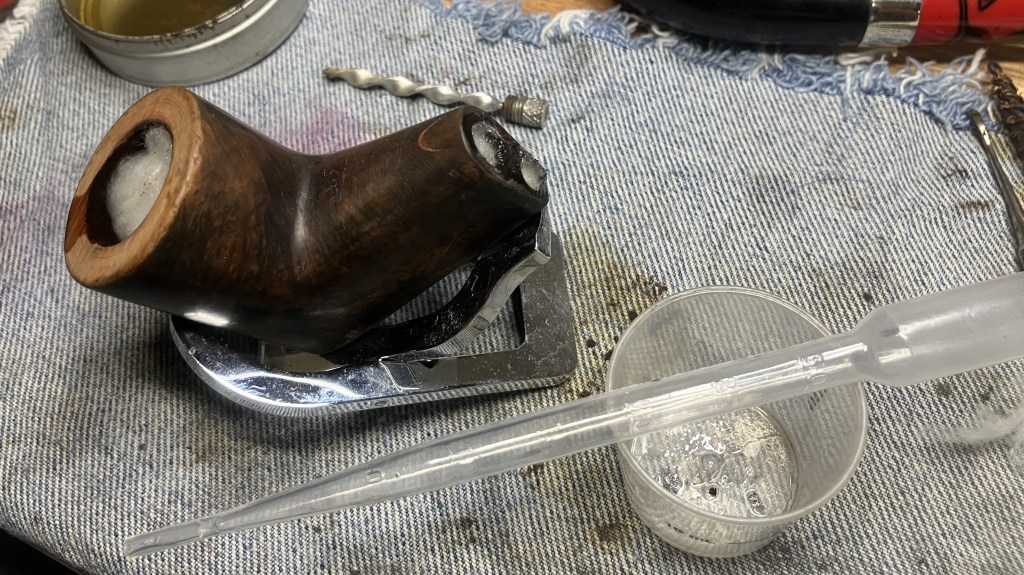
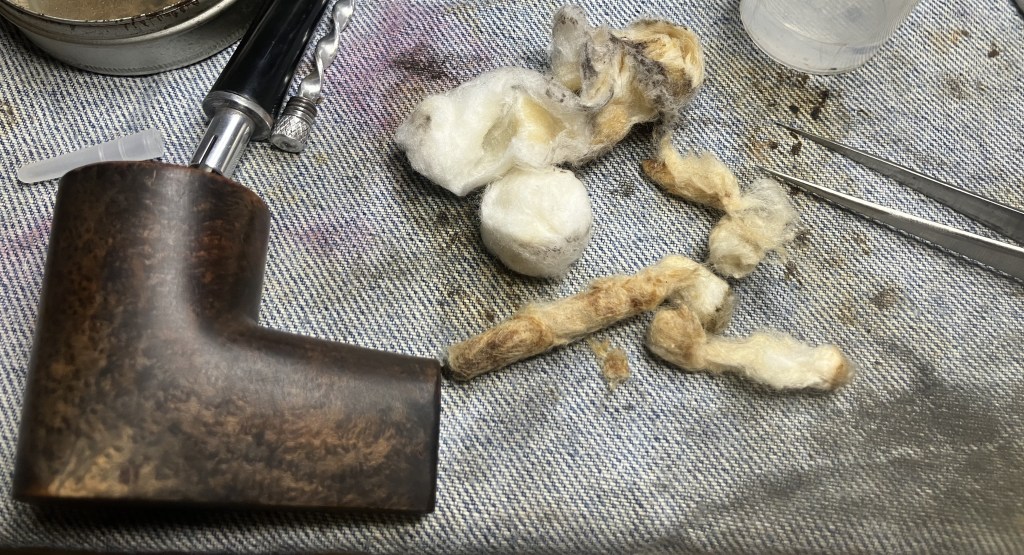
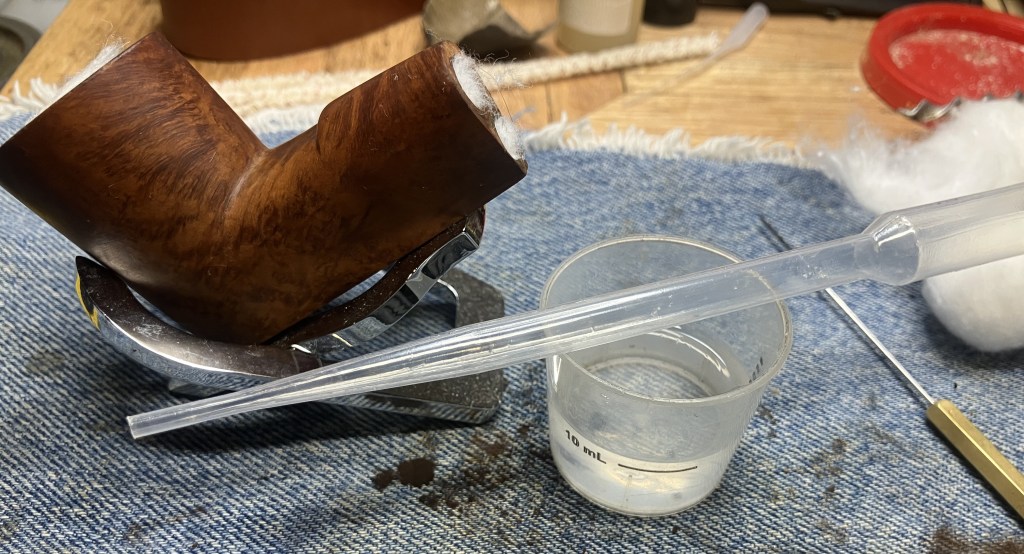
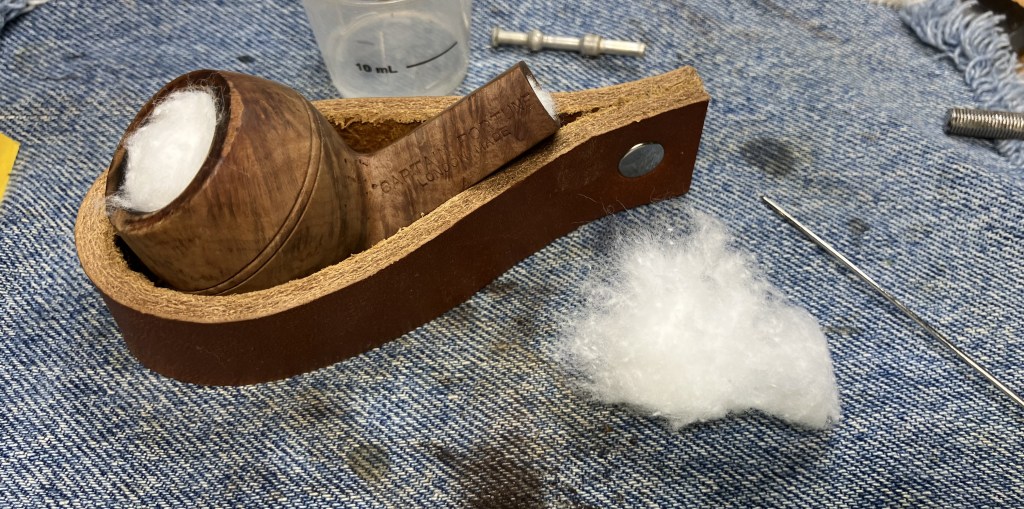
I thought this pipe would benefit from an alcohol cotton treatment so I stuffed the bowl and the shank with cotton.
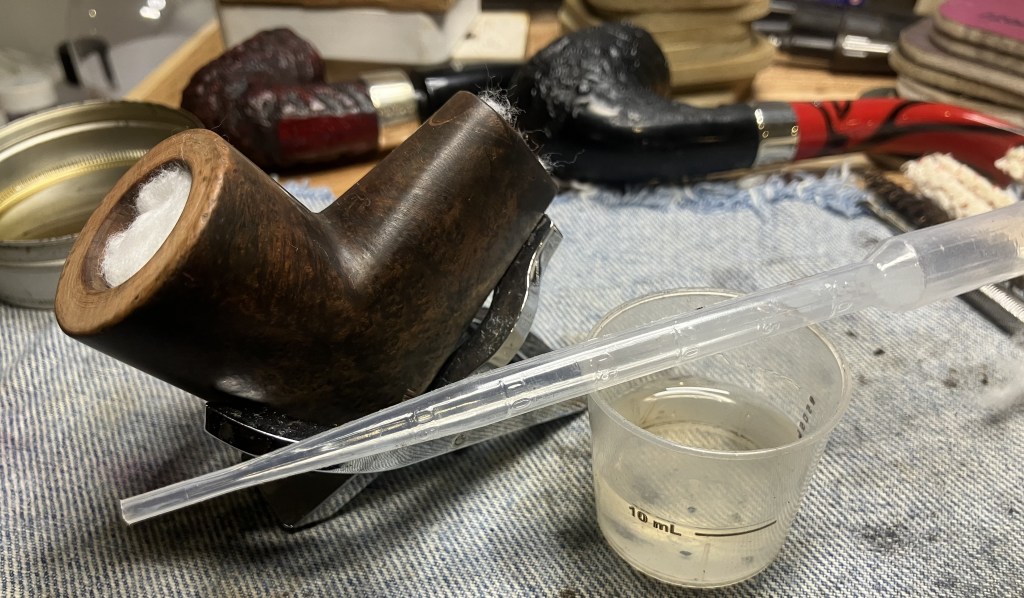
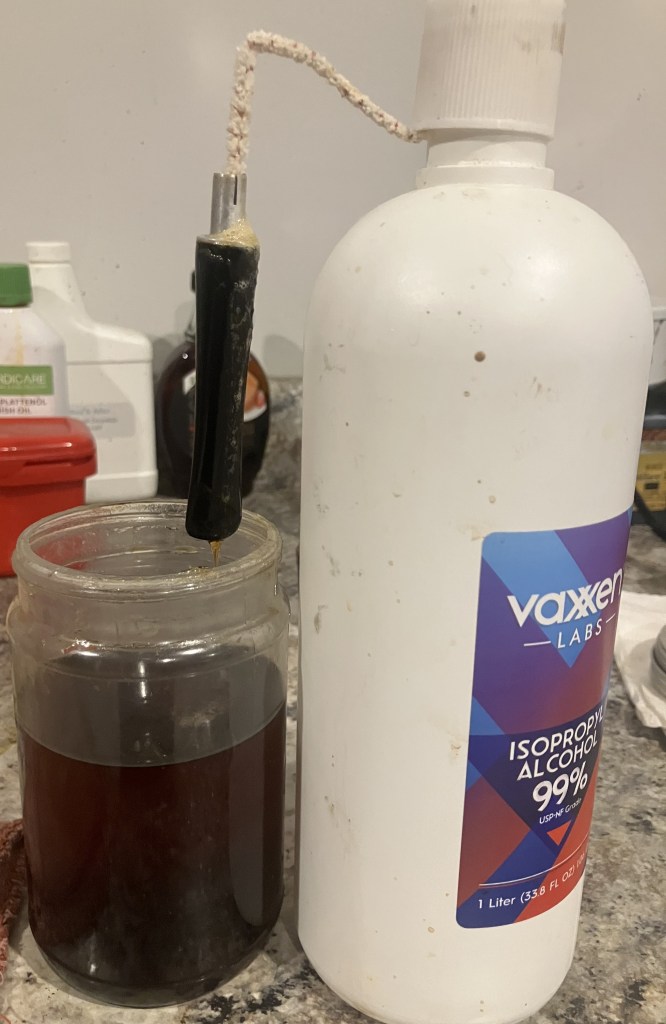
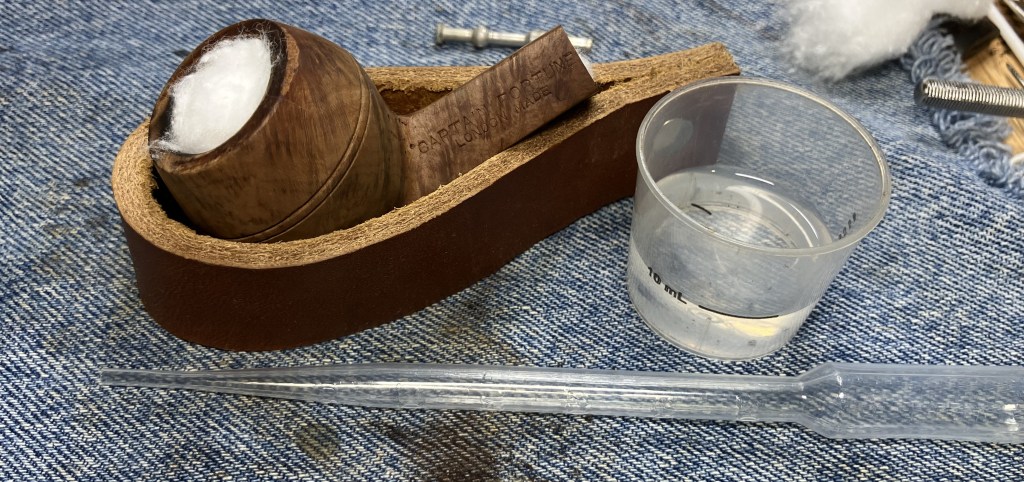
I then poured out 10 ml of 95% ethyl alcohol into a medicine cup, thinking that would be about the amount needed. A disposable pipette was used to transfer the alcohol to the cotton.
Lucky guess, you say. I say I missed it by 1 ml. This needed to sit and evaporate overnight and the stem was soaking overnight, I guessed it was time for me to end this session.
In the morning the cotton was no longer white. The evaporating alcohol had worked to dissolve the tar and smoking residues from the briar and move them into the cotton.
I removed the cotton and cleaned the airway with a cotton swab. It came back with minimal residue.
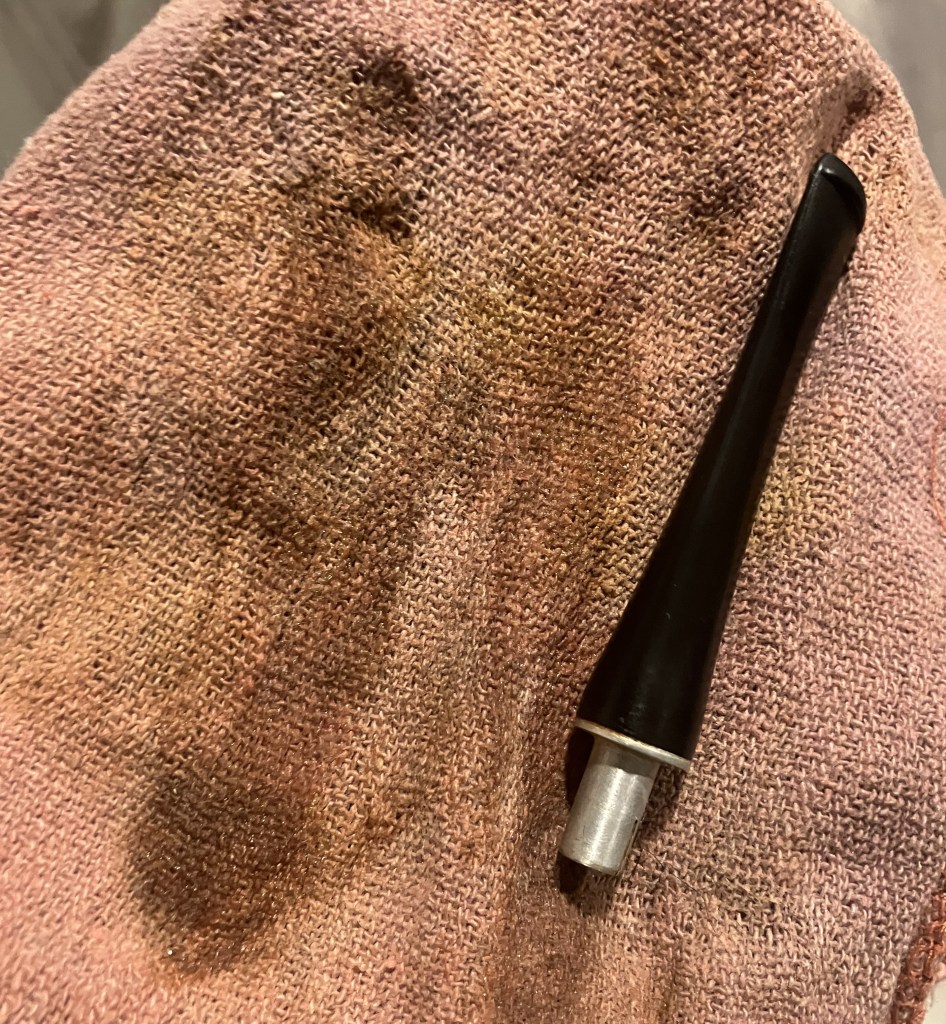
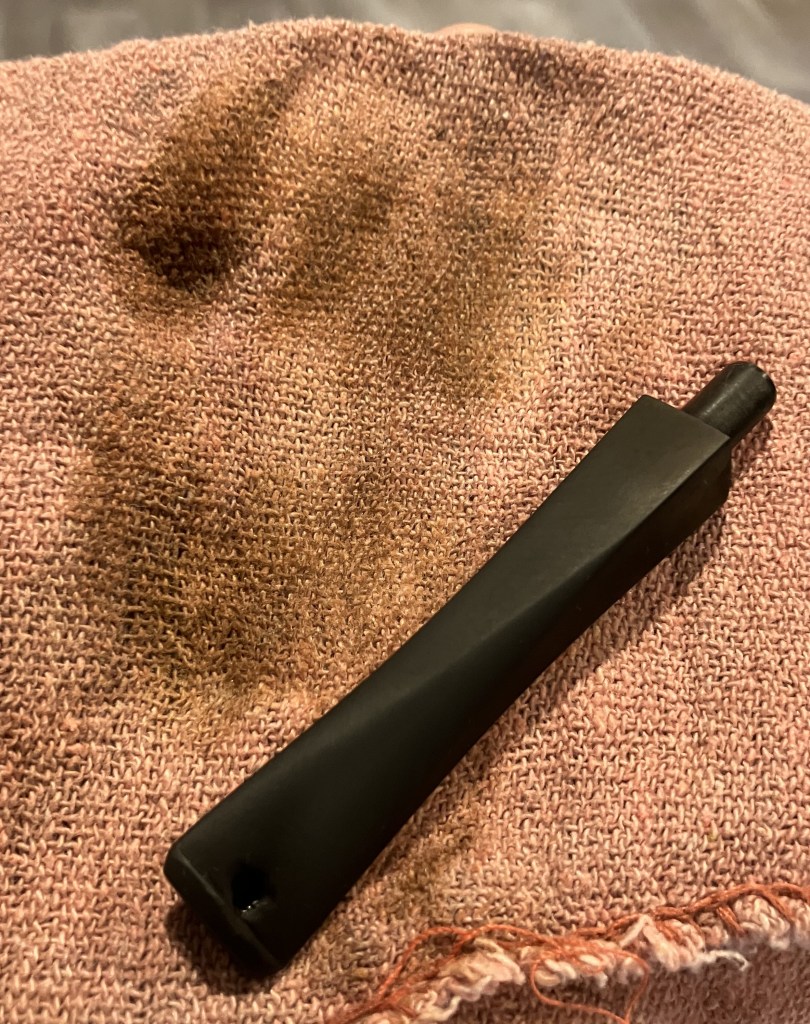
The stem was retrieved from deox and vigorously rubbed with a coarse shop rag. This removed quite a bit of the oxidized vulcanite.
The stem logo was still visible but it was more faint. Extra care would have to be used to keep this stamp.
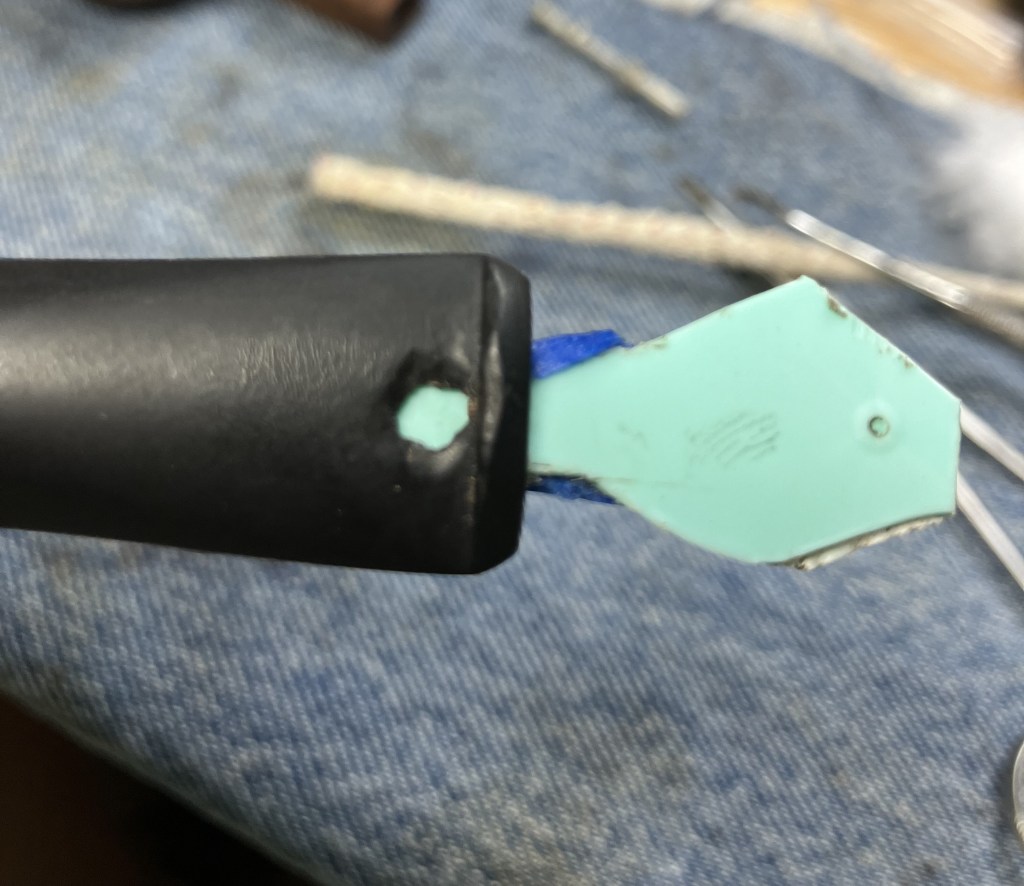
I used a piece of a plastic lid to act as a dam to keep the cyanoacrylate (CA. super glue), that I planned on using to fill the hole, from entering the airway.
I added several layers of painters tape to thicken the dam to achieve a tight seal.
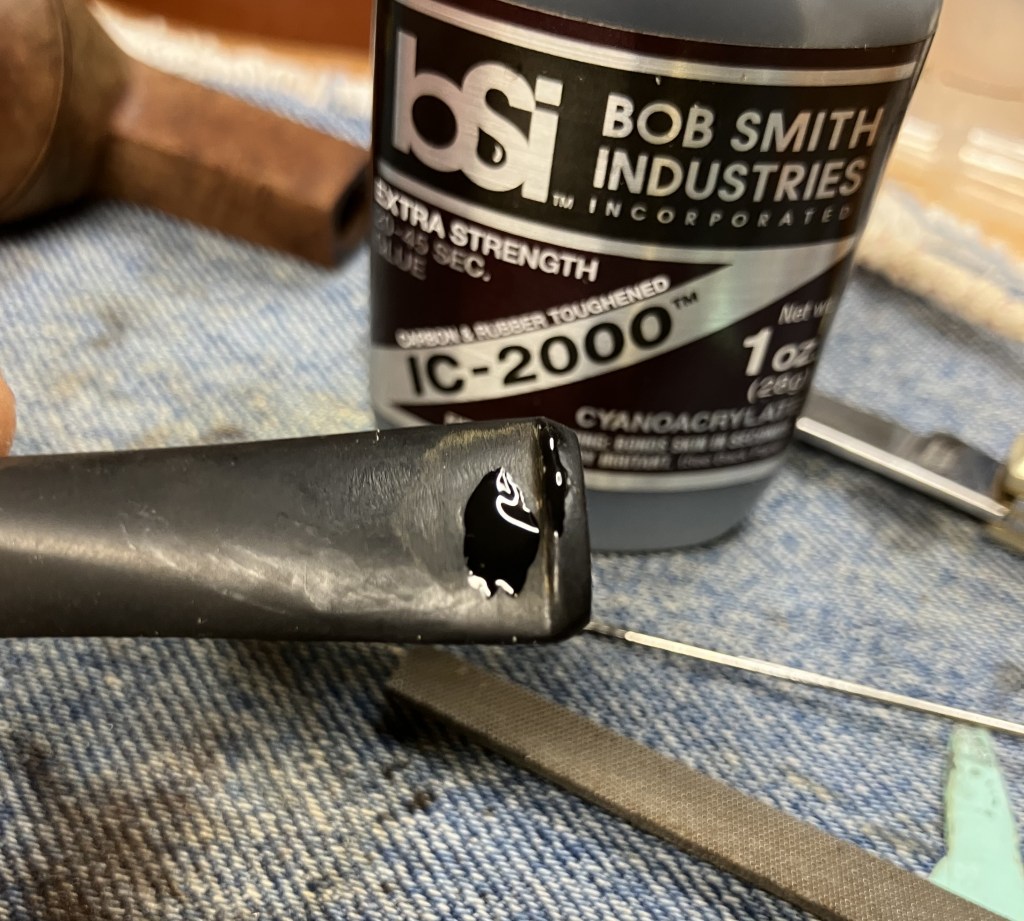
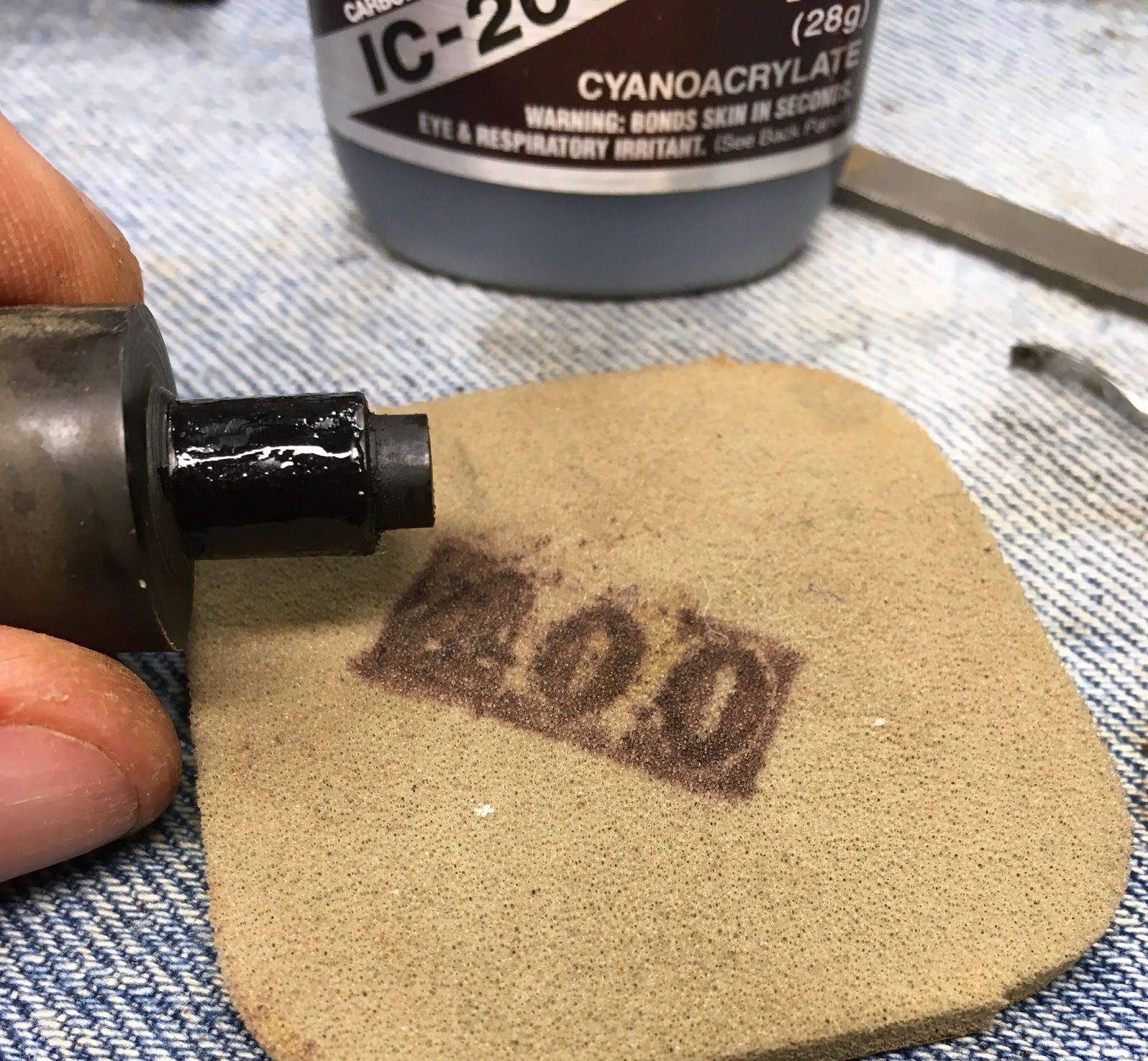
The Bob Smith black CA was the product of choice due to having rubberizing agents in the formula. This gives it a bit more flex than regular CA. I applied the CA to the gap with a fly tying bodkin. I intended to allow the CA to cure on its own but after 15 minutes, I got impatient and spritzed it with a CA drying accelerator. I removed the dam and squirted some accelerator into the airway as well to assist in speeding up the curing process.
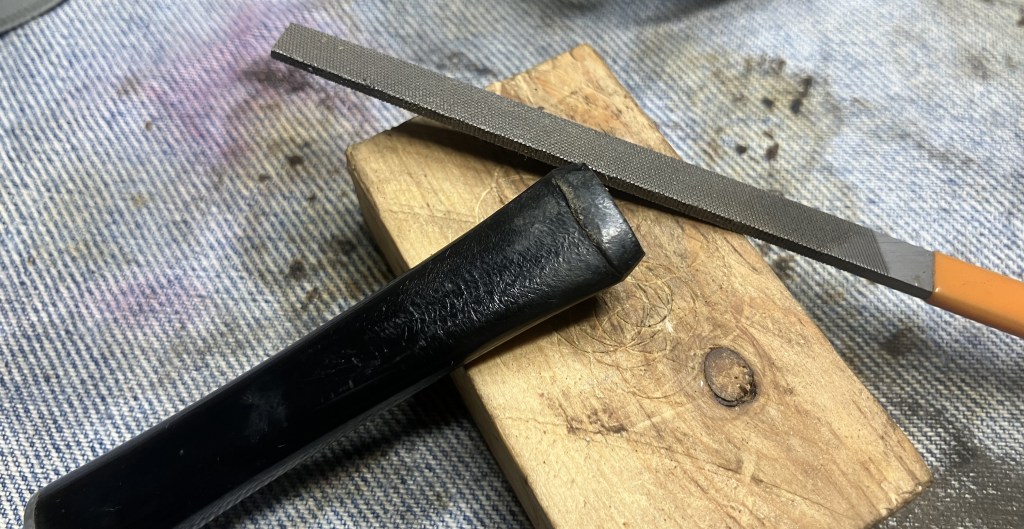
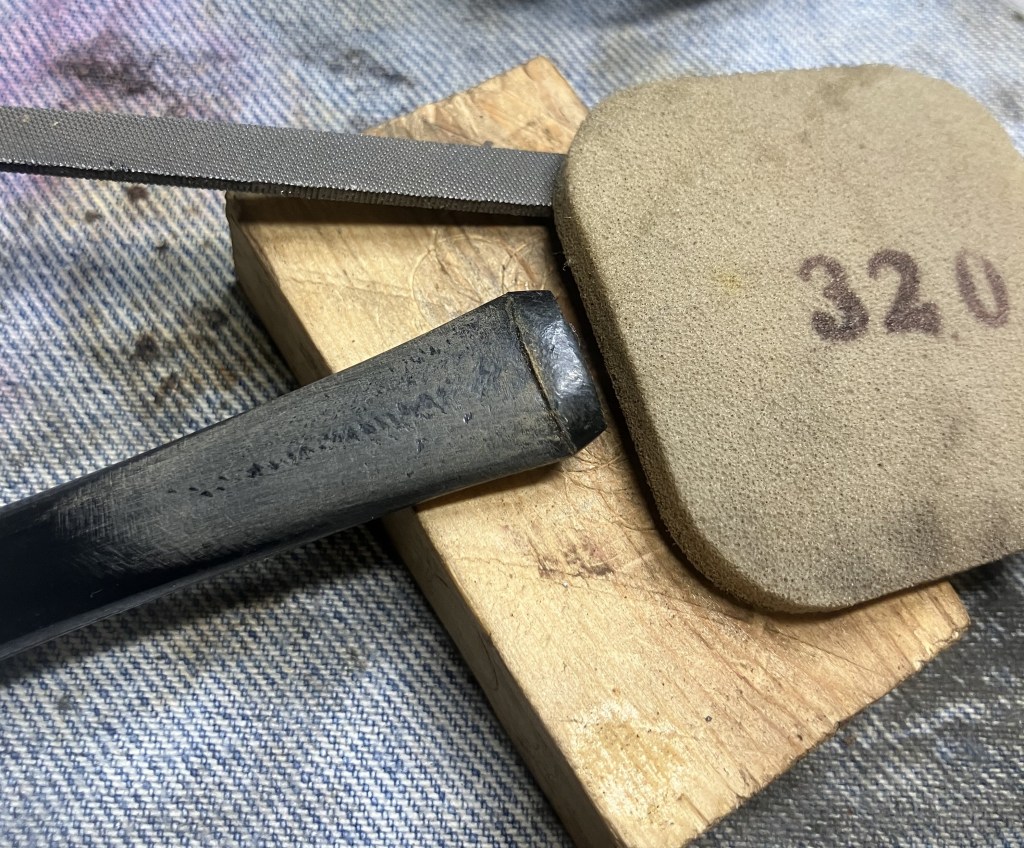
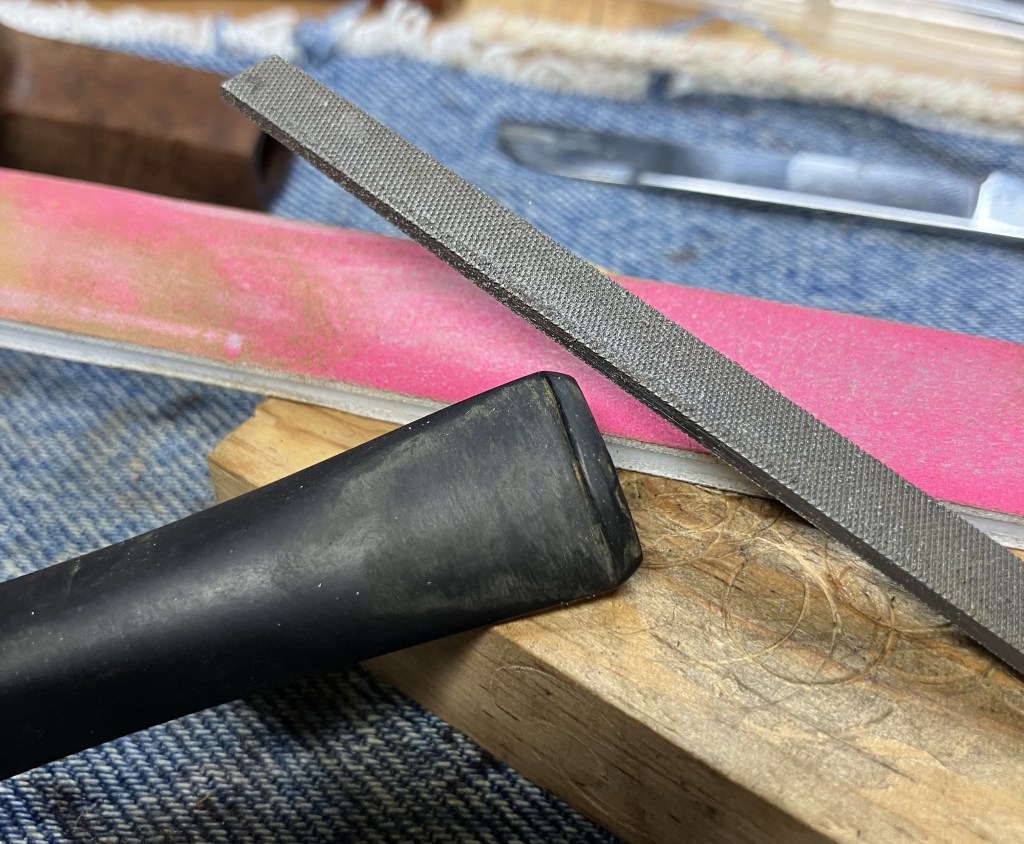
Once hardened, I filed the fill with a small flat file. There remained a small depression and the button also showed signs of wear.
A second application of the black CA to both the depression and the button edge was done with the fly tying bodkin.
Again lacking patience I spritzed the wet CA and sped the curing along.
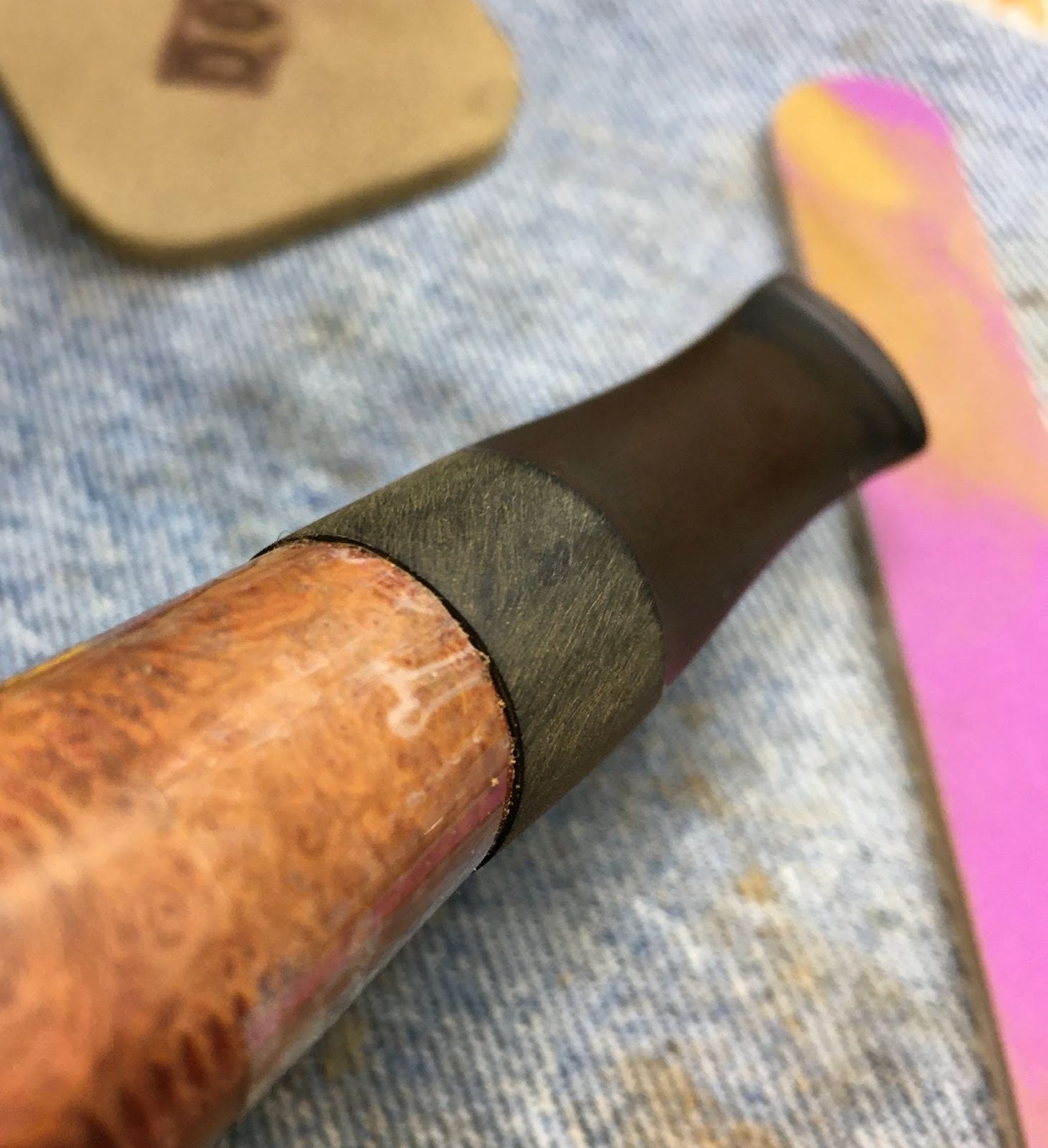
The small flat file was again used to smooth the fill and reshape the button and an emery board for getting the angle of the button right.. Ahh, much better.
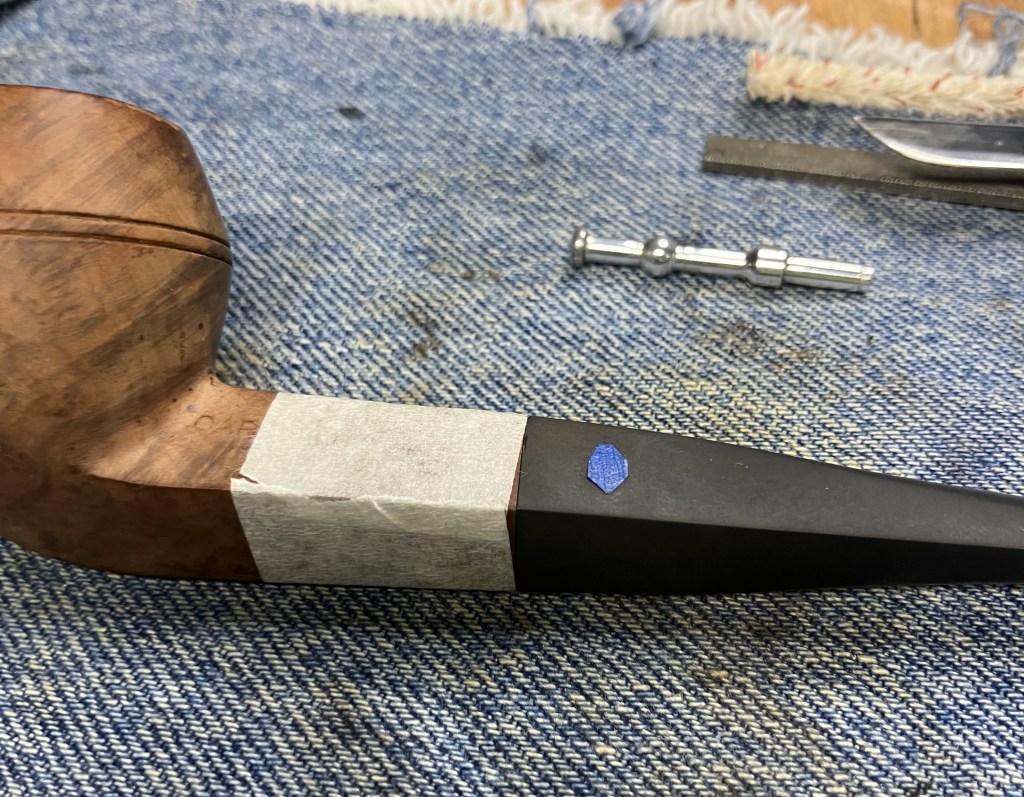
In preparation of the stem sanding, I covered the stem logo with a small piece of painters tape.
The shank was also masked off to keep the briar stamps from the evils of sanding.
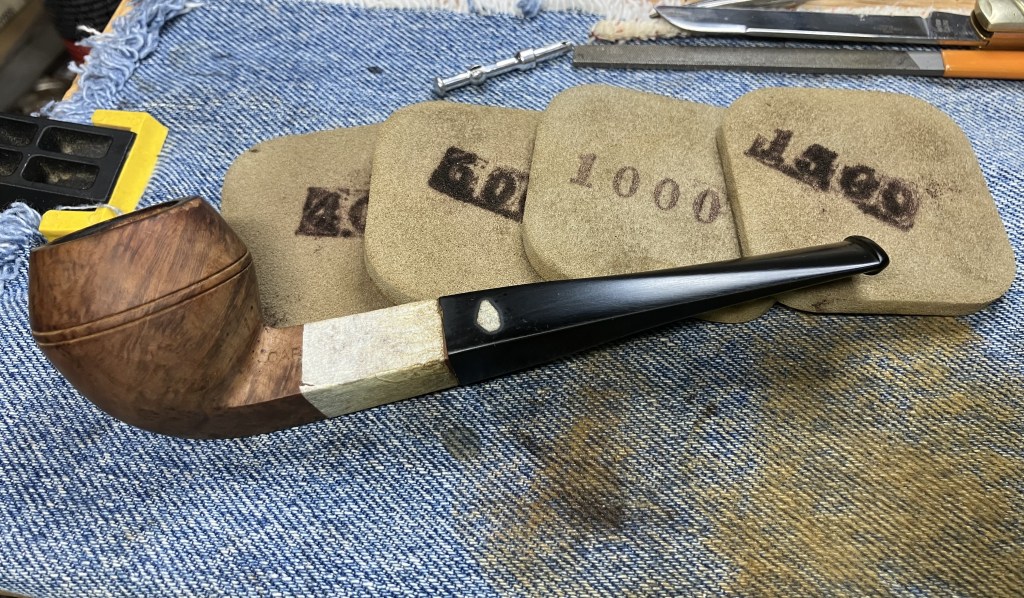
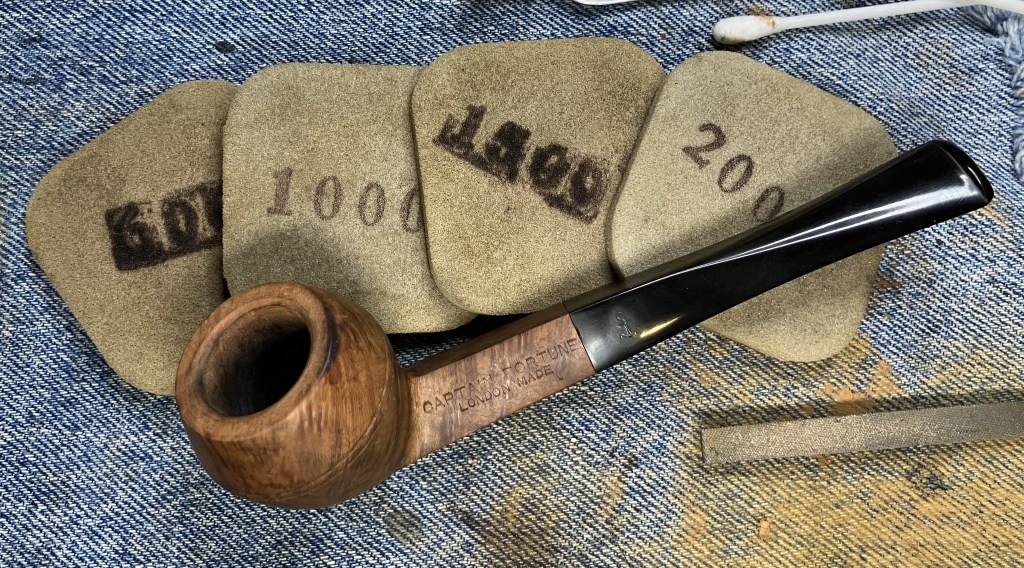
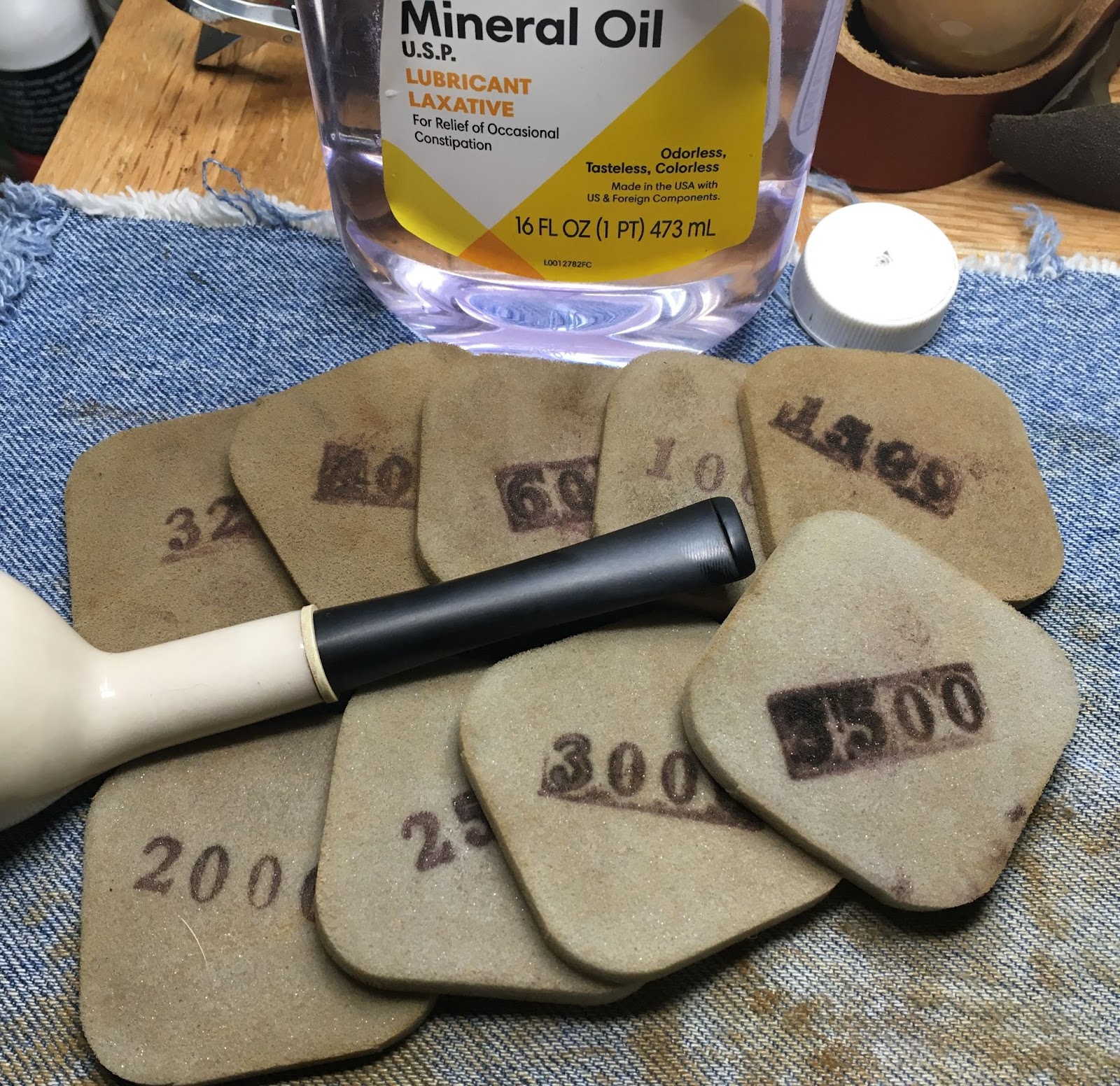
The sanding was done with a series of sanding sponges in grits of 400-1500. Between each sponge the stem was rubbed with mineral oil and wiped with a paper towel. Yeah, the stem logo protector had to be replaced more than once.
The sanding continued with sanding sponges 2000-3500. The oiling and wiping were continued as well.
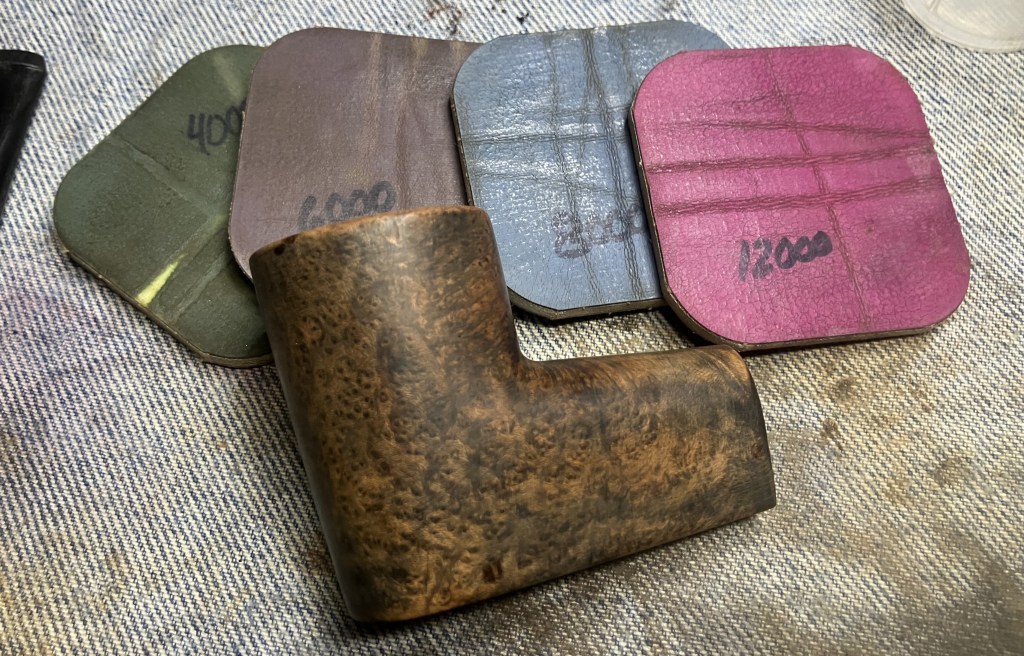
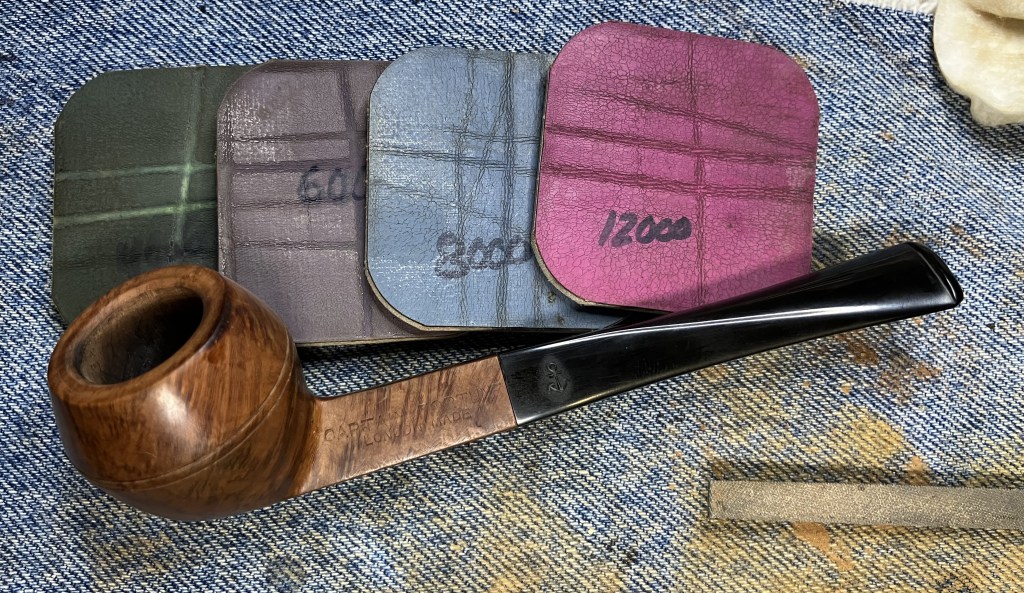
The next step in sanding/polishing the stem was a series of micro-mesh pads 4000-12000. After the 4000 pad, I removed the masking tape from the logo and cleaned the logo with alcohol.
The 4000-12000 micro-meshing continued. After each pad, I rubbed the stem with Obsidian Oil and wiped the stem with a paper towel.
The stem was looking very good. I now turned to the stummel. There were no areas which required filling but there was a damaged rim to address. The inner front of the rim was charred from a flame and the outer rear was damaged from dottle knocking. I planned on addressing these with a three pronged attack:
Topping the rim.
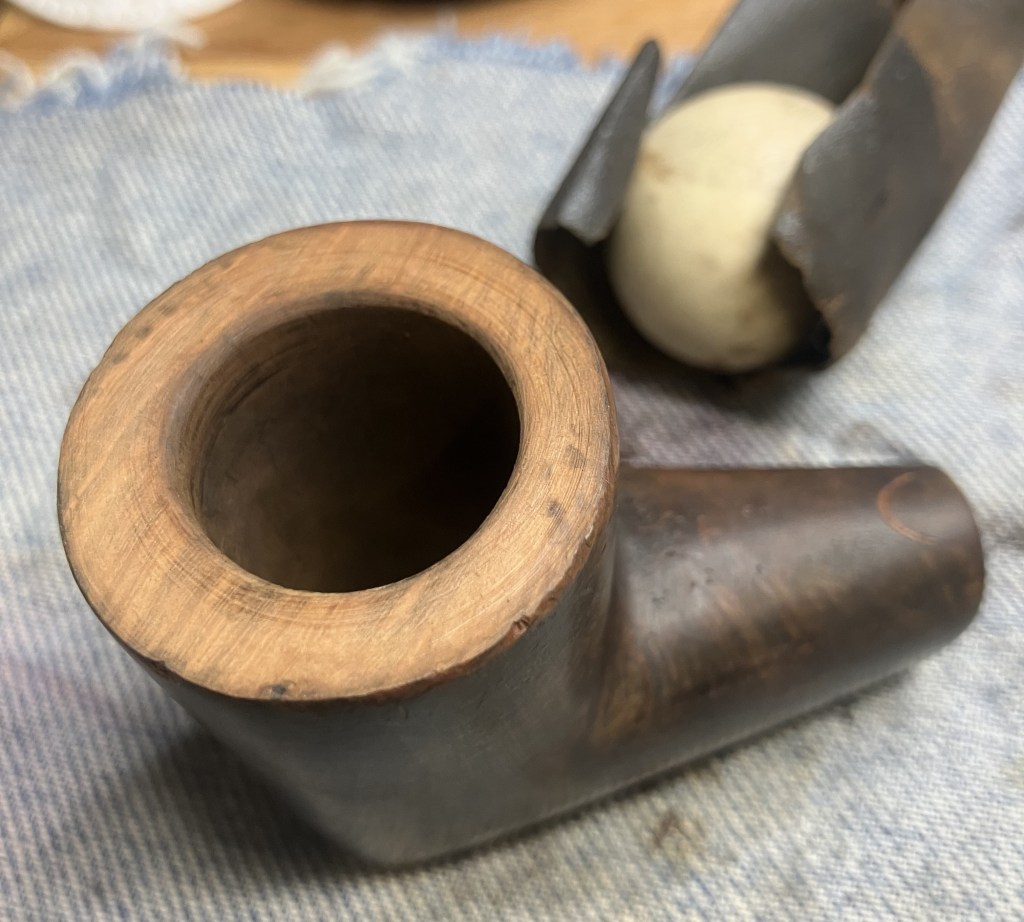
Using a wooden ball and sandpaper to establish an inner rim bevel, and
Use CA and briardust to build up the damaged outer rim.
Here you can see how the triploid plan is progressing.
And a close-up of the outer rim reconstruction.
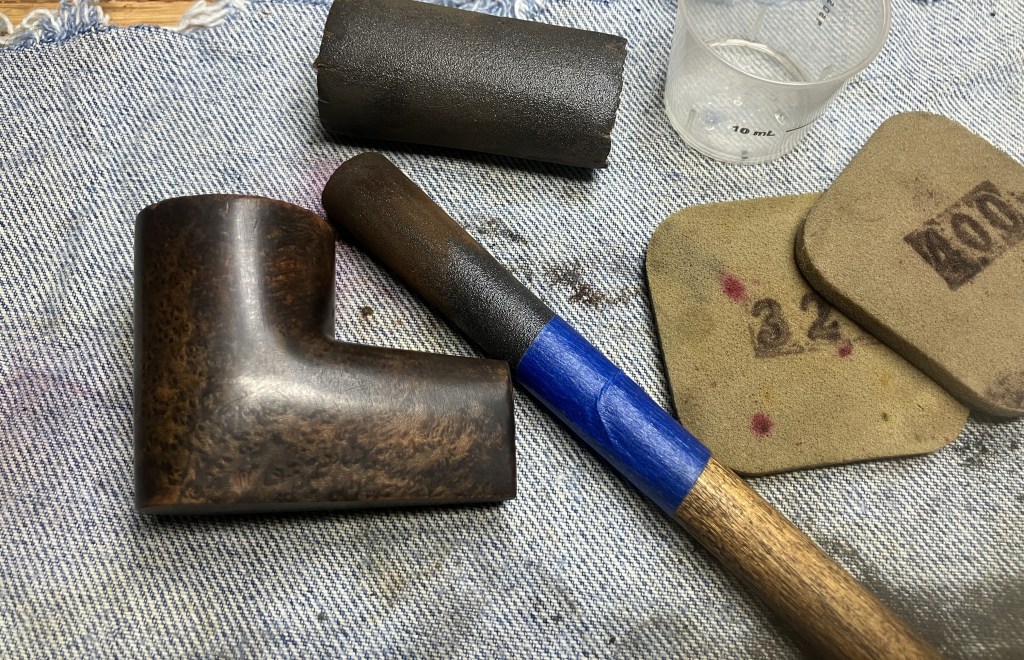
Time to sand the stummel. I used a series of sanding sponges here as well. O didn’t mask the shank as the stamping covered the whole length. What I did instead was not sand it. The sanding was only done on the bowl. Between sponges I wiped the sanding debris from the stummel with a make-up pad dipped in alcohol.
The final sanding was done with sponges 2500-3500 with the same wiping as earlier.
The briar was finally micro-meshed with pads 4000-12000. Between each pad I continued to wipe with the alcoholic make-up pad.
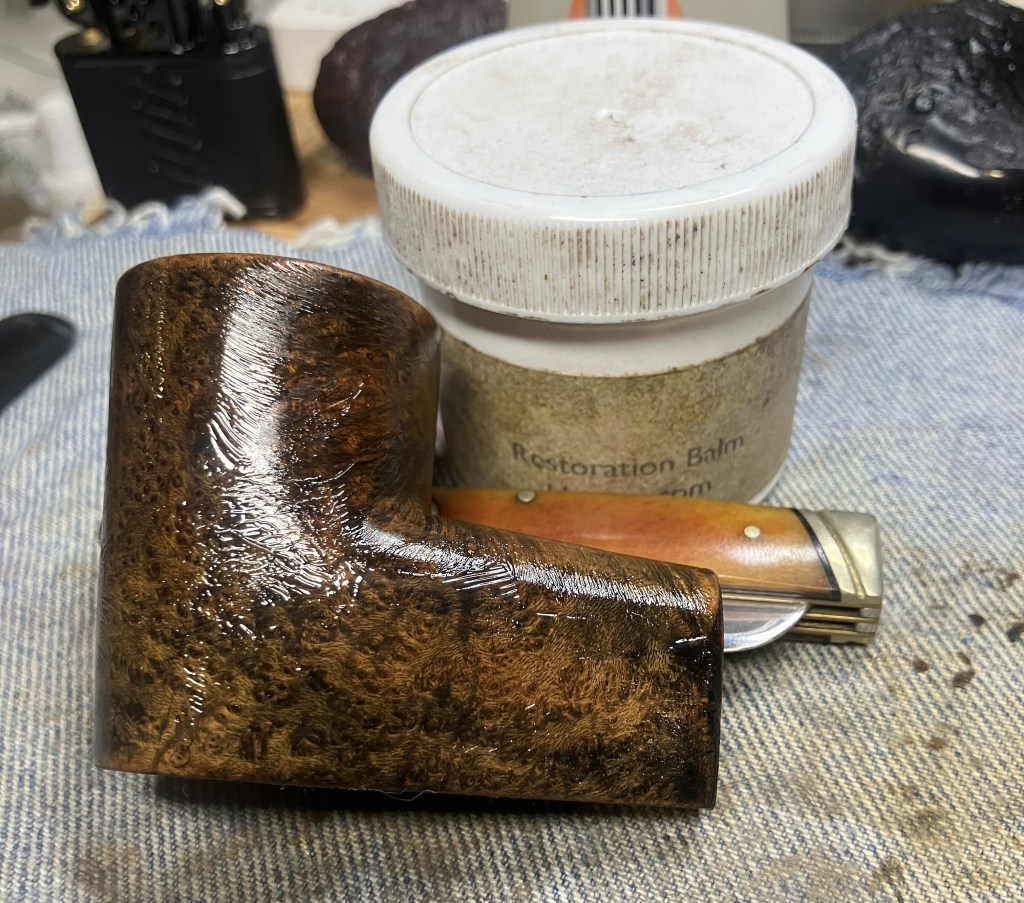
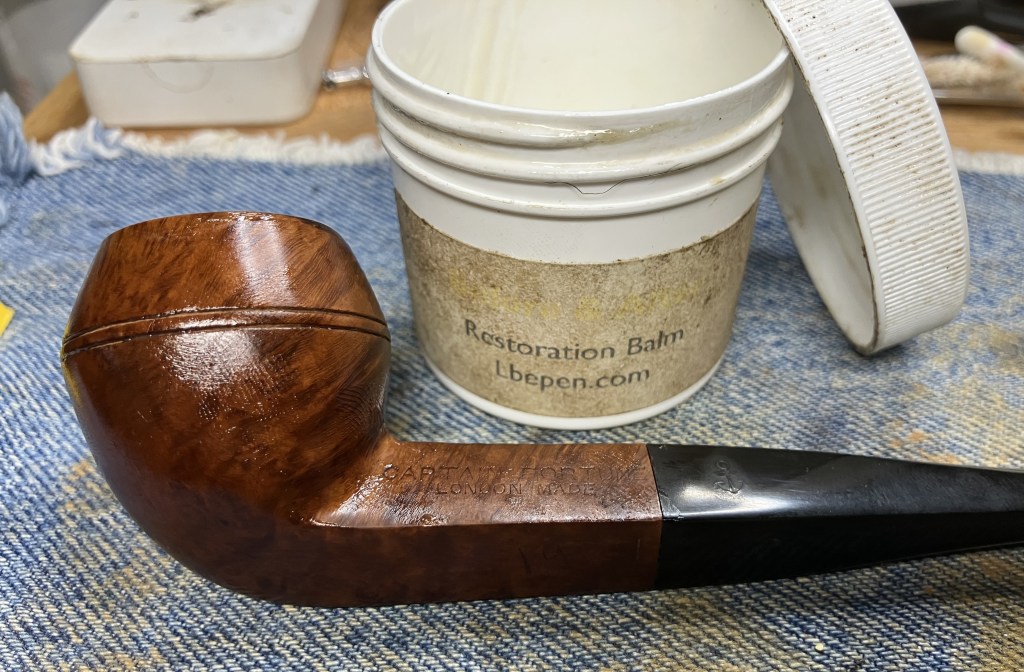
The stummel was then coated with Before and After Restoration Balm. This is another great product and since I gave a shout-out to Briarville, I feel I owe one to Mark Hoover as well. Restoration Balm can be found here: Restoration Balm | La Belle Epoque
I waited about 30 minutes for the balm to do its magic before wiping the excess away using an inside out athletic sock.
The pipe was then taken to the buffer where it received several coats of carnauba wax.
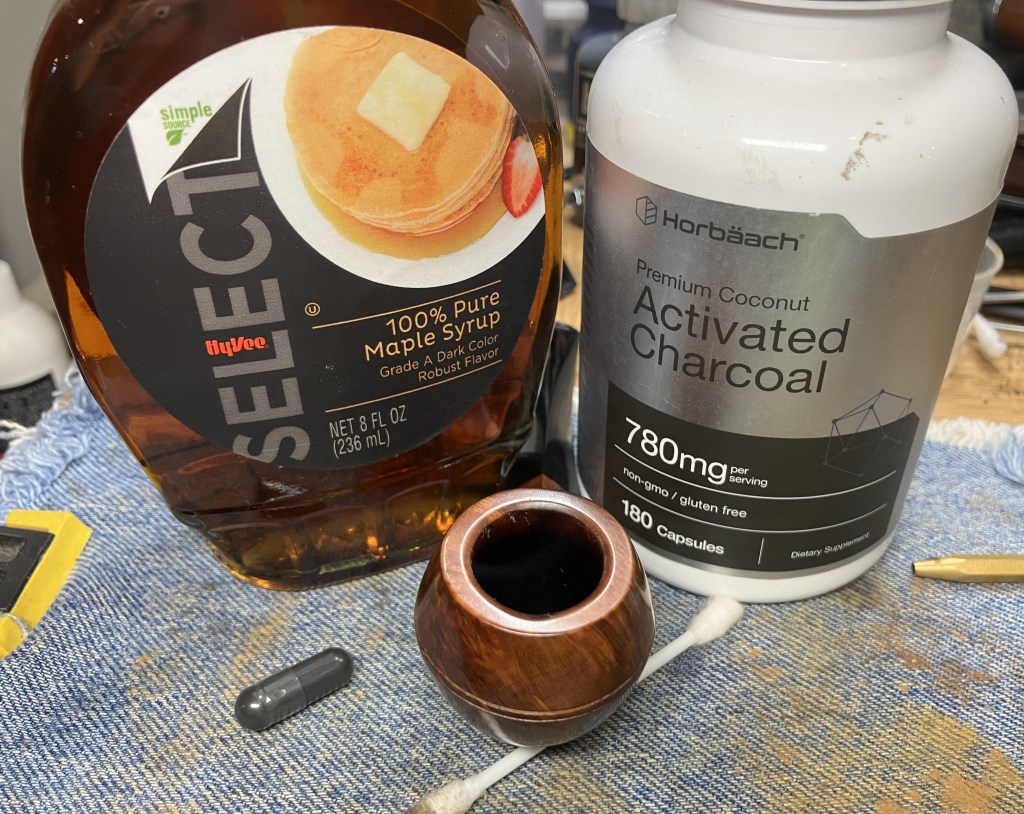
The final step was to hand buff the pipe with a microfiber polishing cloth. I then took the pipe to the photography table for the “finished” photos. Upon seeing that I forgot to do the bowl coating I immediately went back to the workbench. DOH! I used a cotton swab to apply a light coat of pure maple syrup to the interior of the tobacco chamber.
I then plugged the airway with a pipe cleaner and dumped about ½ of an activated charcoal capsule into the chamber. The rim was covered with a piece of painter’s tape. The stummel was then vigorously shaken for about a minute. The tape and pipe cleaner were removed then the stem reinserted and given a puff of air to clean excess carbon from the chamber.
The final touch was to hand buff the entire pipe with a microfiber polishing cloth, AGAIN.
This pipe turned out beautifully. I am sure Rudy would agree. I decided to leave the etched name and date because it told a bit of history about the pipe. I doubt any one named Rudy will buy this pretty Captain Fortune but, you never know. The briar has lovely grain and a rich color. The stem polished up beautifully and I think the repair will hold and enable years of faithful use. The dimensions of this Captain Fortune Bulldog are:
Length: 5.60 in./ 142.24 mm.
Weight: 1.02 oz./ 28.92 g.
Bowl Height: 1.64 in./ 41.66 mm.
Chamber Depth: 1.42 in./ 36.07 mm.
Chamber Diameter: 0.72 in./ 18.29 mm.
Outside Diameter: 1.43 in./ 36.32 mm.
I do hope that you have found something here useful to your own pipe care, maintenance or restorations. If you like this sort of thing, please click the like and subscribe buttons. Thank you for reading the ramblings of an old pipe lover.
Loading…
Below are some photos of the finished John Redman Captain Fortune Bulldog.
Yeah, those first two photos were taken before I realized that I had not done the bowl coating.
The above photo was also taken before the bowl coating was done.
Yeah, metal pipes intrigue me. I don’t have many and frequently smoke even fewer. There is just something about them that makes me think of George Jettson, space age polymers and TANG. Although this pipe dates back farther than the 1960s space age, more on that in the background. Last winter I got a wild hair (sorry, American idiom meaning spontaneous enthusiasm) and decided that I needed to work on metal pipes. Like a typical ADHD gerbil (another idiom meaning, I have too short of an attention span), I lost interest after acquiring several in-need–restoration Kirstens and a bag of a dozen metal pipes that I purchased from Steve Laug (reborpipes.com). I sharpened my very dull metal polishing skill with some encouraging words and over the phone instruction from Doug Bisbee (dkmetalpipes.com/Estate Vintage Metal Tobacco Pipe Restoration & Sales). A couple of restorations later I had moved on to other projects and interests.
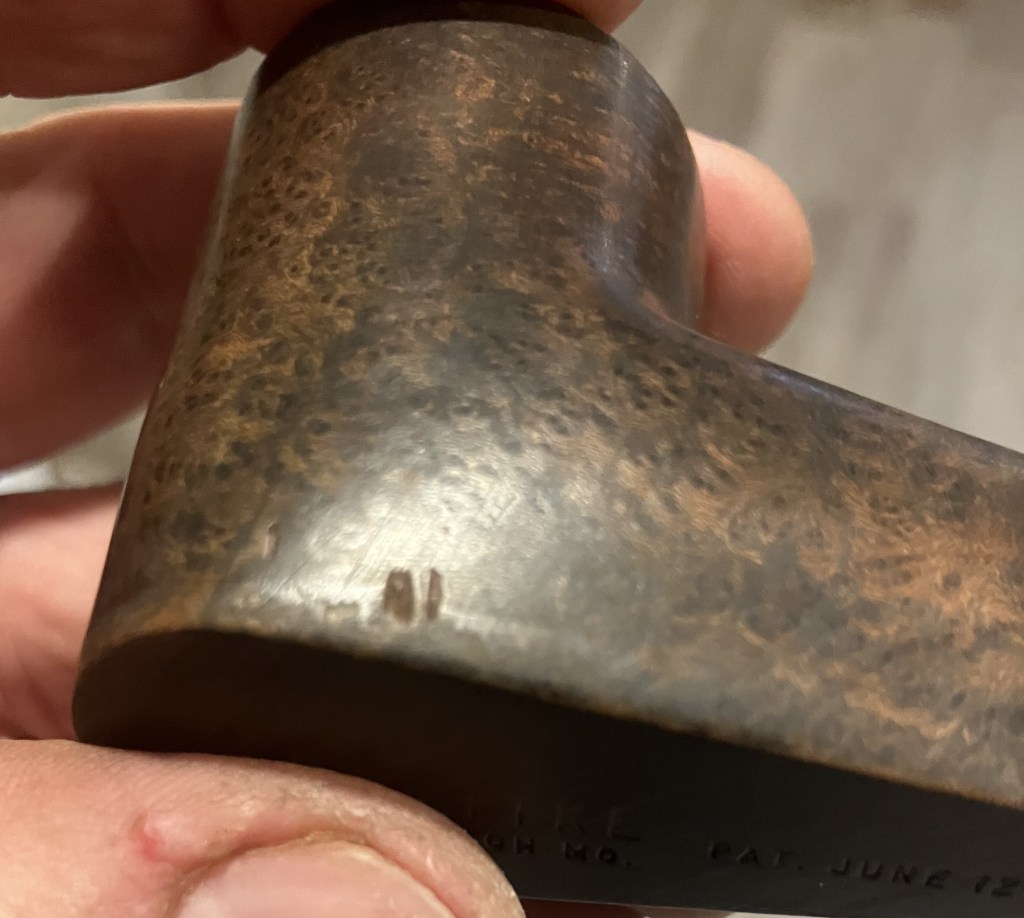
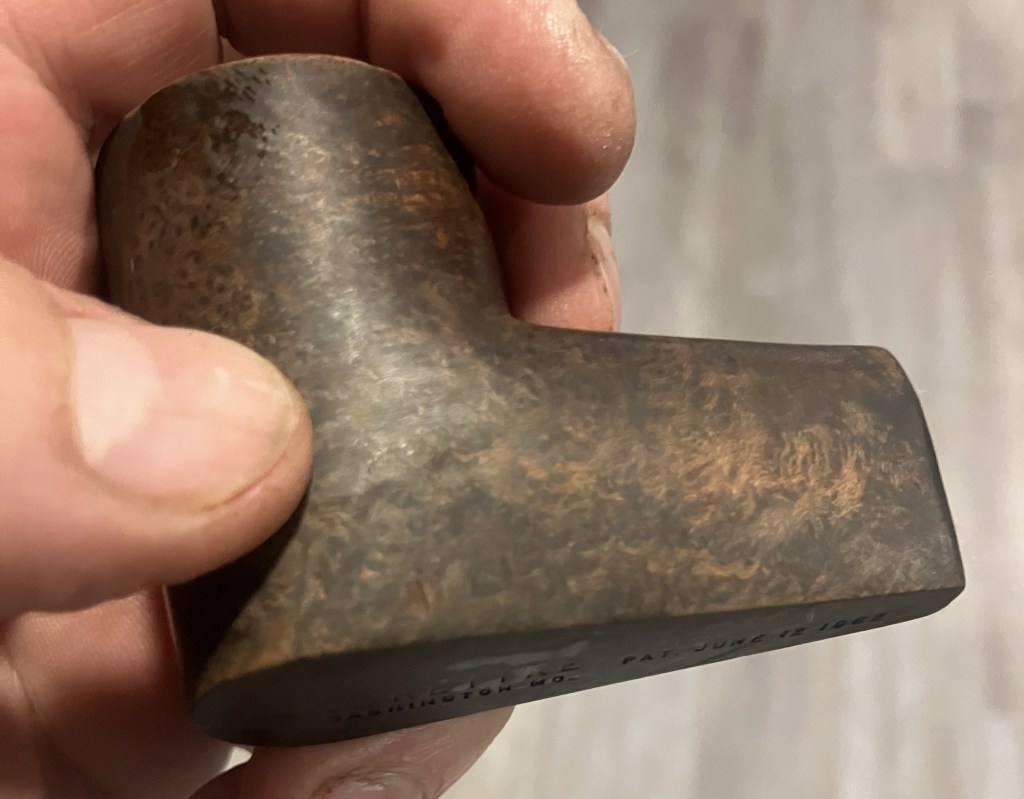
For some reason this pipe yelled out to me from a box on the shelf and demanded that I move it to the front of the queue. The pipe was one that I’d received from Steve Laug. It looked dingy and oxidized but I thought that it showed promise. On the bottom of the pipe was stamped Design by Curtis in a cursive script over PAT. PEND. Below are some photos I took prior to working on the pipe.
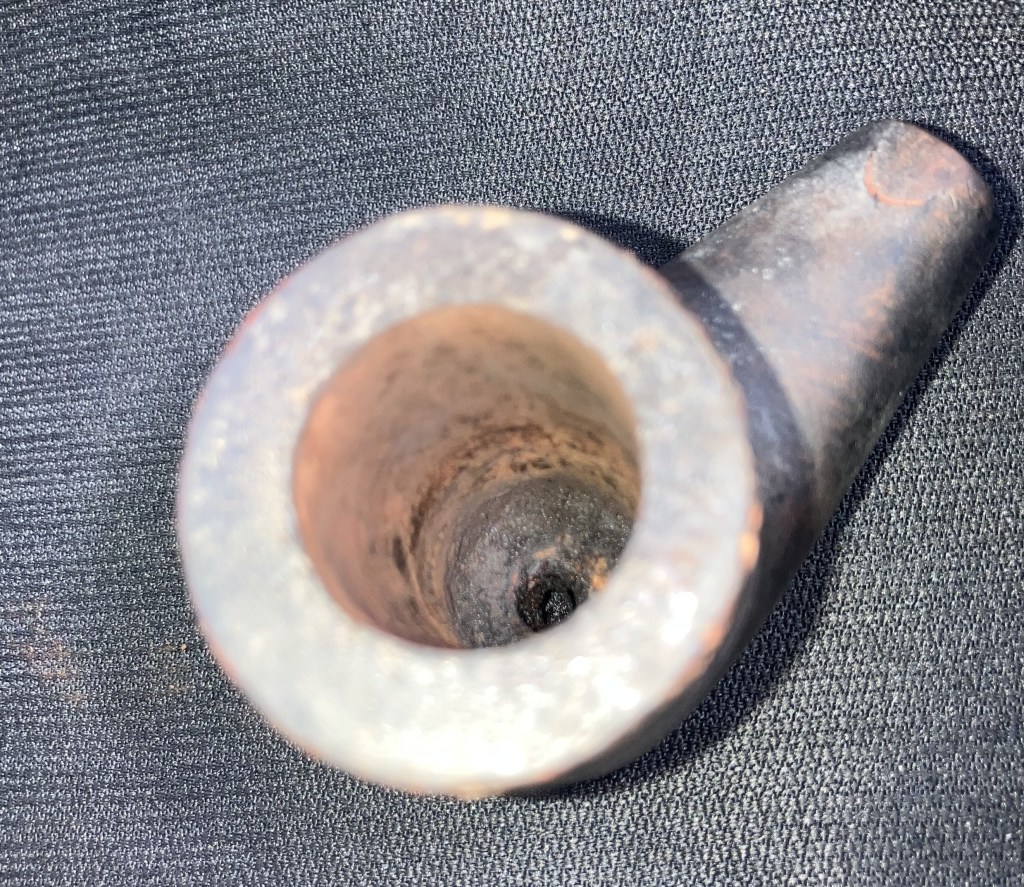
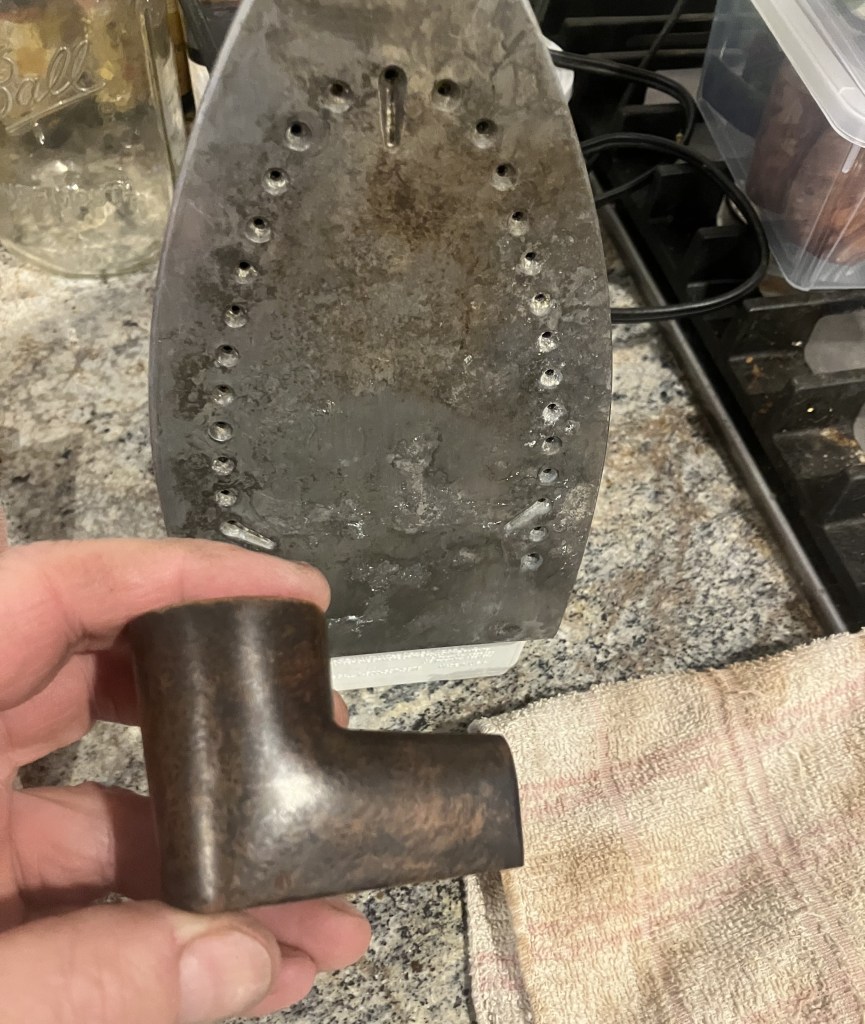
The aluminum was oxidized. So much so that I actually rubbed the pipe with a dry towel before photographing it on the black fabric. I didn’t want to get white aluminum oxide all over the fabric. The internals showed signs of dried hard smoking residue. I was sure that the pipe should disassemble more than I did in the above photos but the residue had stuck some parts together. The stem had tooth chatter top and bottom with a couple of deeper dents. This looked like it would be a great project allowing me to stay in the basement workshop and avoid the heat of August.
Background
The previously mentioned Doug Bisbee not only runs dk Metal Pipes but also is the manager or administrator of SMOKING METAL TOBACCO PIPE COLLECTORS & FANATICS. This is a repository of an immense collection of metal tobacco smoking pipes. It is also my “go-to” source whenever I want to learn anything about a metal pipe. According to the Smoking Metal site,
“The Curtis Custom-Built Pipe Model 100
Manufactured by Curtis Industries of 1120 East 222nd Street, Cleveland 17, Ohio. First seen around 1946
The actually markings are �Design by Curtis PAT .PEND. �.
The bowl insert appears to be briar, despite having only had many examples am still unable to get the bowl apart, I am loathe to risk damage. The top plate does revolve but whether it is a screw attachment or a push fit cannot yet be ascertained
The interior of the stem is more complicated, taking an inline filter inside the tube. The shape of the end plug makes it more than interesting to undo. On many examples this part is the piece most damaged by pliers
With so many threads in the �gunk� part of the pipe it can be a problem to clean.
25 Dec 1945 US patent # D143257 Inventor Howard Abrams, University Heights, Ohio” (CURTIS)
The smokingmetal site also had a photo of an old Curtis pamphlet. Though a bit difficult to read it is an interesting source of information from the origins of the company.
Inventor Howard Abrams applied for the patent on September 10, 1945 and received the patent, astonishingly quickly on Decemper 25 1945. A Google patent search resulted in the following:
With my search providing the above information and a definitive date I turned to the restoration.
The Restoration
As usual the pipe made its way to a cleaned denim piece at the workbench.
I started with cleaning the chassis. I do not know if that is the proper term for the main body of this pipe as Howard Abrams failed to leave us a labeled diagram of the parts of his innovation. Perhaps that is how he got it approved so quickly. I could not get the conical endcap to loosen at all during the cleaning so I let it soak in the 99% ethyl alcohol.
I call this stem assembly. The end of the assembly did come off, let’s call it the nozzle. The stem will accept a Medico filter if 0.58 inches or 15 mm of the filter is cut off.
The stem nozzle was also soaked in ethyl alcohol while I cleaned the stem with cotton swabs and bristle pipe cleaners dipped in alcohol.
The aluminum of the stem would be buffed with white compound along with the rest of the aluminum eventually
The stem’s bite zone had significant tooth dents on both the top and bottom along with the typical chatter. The top dent was deeper and small.
The bottom dent was broader but shallower.
Both bite zones were filed with a small flat file then sanded with a 320 grit sanding sponge.
The sanding debris was cleaned off with a cotton swab dipped in ethyl alcohol. A small drop of black rubberized cyanoacrylate was placed on each depression.
Both drops were allowed to cure and harden on their own.
While that was curing, I turned to the rim. It just needed some scrubbing. The little bit of lava was moistened with saliva and rubbed with a paper towel. Then I realized that I could use the alcohol freely since there wasn’t a finish to protect .
Tada, not perfect but far better.
The bottom of the bowl required several cotton swabs and more ethyl alcohol. It was pretty gunked up with smoking residue and tar.
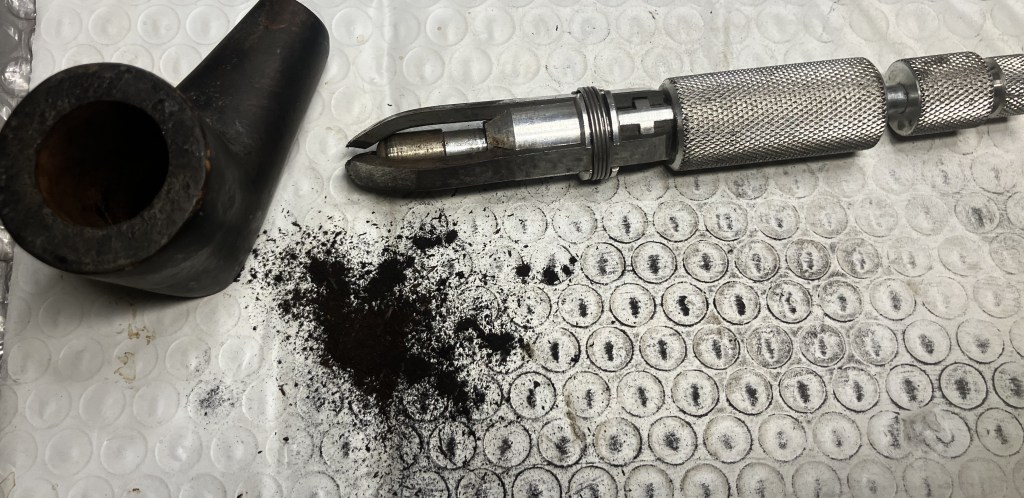
I used the PipNet with the #2 blades to ream the tobacco chamber. It was a narrow bowl and had a surprisingly flat bottom. The General triangular scraper with its tip ground off with a grinder helped return the chamber to briar. At least I thought it was briar. Sanding the chamber walls with 320 sandpaper wrapped around a wood dowel confirmed that the wood had the color of briar. The sanding also revealed no signs of heat damage. This was not surprising considering how well I imagined the pipe would remove heat via the conductive aluminum.
I took all of the aluminum parts to the buffer and polished the metal using white buffing compound on the flannel wheel dedicated to buffing this the white compound. I neglected to photograph any of this process partly out of the embarrassment caused by the oxymoronic black colored white compound wheel and partially/mostly because I forgot to. At this stage in a restoration I find it very helpful to go fishing during the half hour before and after sunset. This vital break allowed the CA the curing time it needed and me a break from sitting on my lazy butt.
Later that night, I returned to the now hardened CA to file it smooth with a small flat file and sand the fill with 320, 400 and 600 grit sanding sponges. The fill looked good.
The above process was repeated with the bottom fill.
The stem was coated with mineral oil and I went to bed.
The following day, I returned to the workbench and sanded the stem with a series of sanding pads from 320-3500 grits. Between each sponge the stem was rubbed with mineral oil and wiped with a dry paper towel.
The nicely polished aluminum of the stem was masked out of habit. I took it to the buffer and the oxymoronic black white compound wheel. Feel free to ask, “why did you mask the aluminum?” Because of habit and the fact that I’m not too bright. Anyway, the stem was buffed and looked very nice. Well, not so nice in the photo below but after the buffing compound was removed, it really did look good.
After the buffing compound was wiped from the stem, I unwrapped the tape and wiped the whole pipe with a cotton ball dipped in ethyl alcohol. The pipe was then returned to the buffer for several coats of carnauba wax. The final step was a hand buffing with a micromesh polishing cloth.
I have to say that this pipe looks stunning in person. My ability to capture the polished surface of the pipe with my camera is mediocre at best. This pipe will certainly turn heads if smoked out in public. The aluminum polished up very nicely. Yes, there were a couple of places where the aluminum was pitted by oxidation and these are visible. The stem also polished very nicely and is an amazing contrast and accent to the aluminum. Here the CA repairs are only discernable upon very close inspection. I admit to being unable to free the conical endcap from the grip of the smoking residue. I will continue to soak the chassis in alcohol hoping this will eventually release the threads. Doug Bisbee said to soak it for a week and try again. The dimensions of this Design by Curtis are:
Length: 6.42 in./ 163.07 mm.
Weight: 1.65 oz./ 46.78 g.
Bowl Height: Attached to chassis 1.97 in./ 50.04 mm. Separated 1.42 in./ 36.07 mm.
Chamber Depth: 1.03 in./ 26.16 mm.
Chamber Diameter: 0.61 in./ 15.50 mm.
Outside Diameter: 1.48 in./ 37.60 mm.
I do hope that you have found something here useful to your own pipe care, maintenance or restorations. If you like this sort of thing, please click the like and subscribe buttons. Thank you for reading the ramblings of an old pipe lover.
Loading…
Below are some photos of the finished Design by Curtis.
I’ve put a few bits in my mouth which were designed for denture wearers. Usually these are uncomfortable for me and my complete natural teeth. Heck, I’ve never even had a cavity. I know, hard to believe but true. I did try the bit of this Brigham and was surprised how good it actually felt. I am again getting ahead of myself. This restoration is of a 202 Brigham Two Dot Billiard pipe. It was another pipe that came from an estate lot. It was not the target specimen of the lot but more just a member of a group and subsequently got neglected in a box until I rediscovered it over the years later. I do not keep good records of when various pipes were purchased or from where. That may be a 2026 New Year’s resolution which I’ll likely forget to ever make much less abide by. Anyway, the pipe was stamped 202 (rather haphazardly on its bottom) to the right appears to be a double stamping of MADE IN CANADA, in a straight line over or under a more clear Brigham over CANADA. The photos show this more clearly than my description. Below are photos of the pipe prior to work being done:
The pipe had obviously been a well loved and well smoked pipe. The tooth chatter and oxidation of the stem proved that. The amount of lava on the rim also was an indicator of the use this pipe had experienced. The tobacco chamber had been well maintained and looked fairly clear of a thick cake. This told me the previous owner liked a cleaned chamber and judging by the lack of any deep groves cut into the chamber they also had used appropriate tools to keep the chamber clean. The aluminum of the Brigham system was mostly free of oxidation externally and generally clean on the inside as well. This looked like it would by a straightforward restoration of a classic Brigham pipe.
Background
I admit that being my lazy self, I did a search on pipephil.eu for Brigham logos, knowing full well that this is a Brigham pipe.
(Brigham — Pipes : Logos & Markings) The pipephil page had entries for the 1-6 dot pipes as well as some additional specialty pipes. The two shapes from the “Two dot” entry appeared to have a “2” as their prefix.
I stopped being quite so lazy and got out my Brigham Pipe – A Century of Canadian Briar book to look for the 202 shape. Hmm, there was no 202 but there was an 02 Billiard offered since a 1939 Brigham brochure (Lemon, Charles. Brigham Pipe – A Century of Canadian Briar. Copywell, Woodbridge ON. Second Printing, October 2023. Page 17). My conclusion is that the Two dot Brigham is thus stamped 202. A three dot Brighan with an 02 Billiard shape would be stamped 302. Now, enough guessing. I decided to re-read the book.
The ultimate source of information on Brigham pipes is Charles Lemon, the author of Brigham Pipes – A Century of Canadian Briar. This wonderful book is available from Mr. Lemon on his website, Books, from smokingpipes.com (Brigham Pipes – A Century of Canadian Briar | Smokingpipes) if you need to increase the total of your purchase to get the ever popular free shipping, and other various sources. I am unsure about Canadian immigration rules but I think this book should be required reading for prospective immigrants to Canada, especially if they are pipe smokers.
I could go on and quote Charles Lemon’s book extensively but that would require me to do so much typing and I have said it before and likely will say it again, I am a proud Generation-X slacker. Copy and Paste is so much easier. I will say that Lemon’s work is outstanding and it was a pleasure to read and in my case re-read, since old slacker minds apparently don’t hold as much information as they should. The re-reading was done to remind me how the shape numbering system works and to find references to the dental button. This elusive detail was not found and remembered from the first reading and failed to be found on the second round. I resorted to emailing Charles Lemon from the “contact” button on his website, www.DadsPipes.com. Mr. Lemon responded quickly to my request about information concerning the dental button of this pipe. I did include photographs of the pipe, stampings and button in my groveling email which also included a misspelling of the work “bok”. Yeah, it was supposed to say “book”, darn slackers…
Taking apparent pity on my groveling and lack of ability to spell, general ignorance about Brigham pipes, or maybe because he just a great guy, Charles Lemon replied with the following:
“Your pipe dates to the 1980s, and I suspect from the early 1980s. The 02 shape represents Brigham’s smallest Billiard, a shape that fell out of favour in later years as pipes became larger overall.
I don’t have any specific information about Brigham’s use of dental bits but I do know that Brigham offered a choice of stem shapes to clients when they ordered a pipe, dating to at least the 1960s. I suspect that your 202 is either one of the last of the optional stem offerings or a custom request. With the factory attached to the main retail outlet at the time, Brigham had an amount of flexibility to accommodate this sort of request if they chose to.
Hope that helps, It’s not a definitive answer, I know, but it is in keeping with how the company operated at the time. For what it’s worth, I have a small number of dental bits in the shop if you’re interested.” (Charles Lemon personal email)
Wow, is all I could say. Well, I did reply and say more than “wow”. There was also a thank you involved and probably some additional groveling.
That email response provided a pretty definitive date and explanation of the dental bit.
The Restoration
The restoration should have been a rather simple affair and as usual it started with a laundered denim piece on the workbench. Well, the stem got to sit on the denim at least.
I started to clean the stem airway with a bristle pipe cleaner dipped in 99% ethyl alcohol. It was a tight fit at the slot then it became much easier after a tiny “tick” was heard. “Oh crap”, was probably the next sound heard. I had chipped the vulcanite at the slot with my rambunctious behavior. At least that is what my mom always said after I broke something, “Stop being rambunctious!” Hmm, why didn’t she yell that before I broke something? The chip was tiny and fit back together very nicely so I set it aside where it would be safe.
I continued on filing the tooth chatter and smoothing the area above the button. Two small files, one flat the other a tapered ½ round. The rounded file fit the rounding of the underside of the dental button nicely. These areas were also sanded with a 320 sanding sponge as I went.
I then proceeded to clean the stem, with less rambunctiocity. Wow, spell check didn’t say that wasn’t a word.
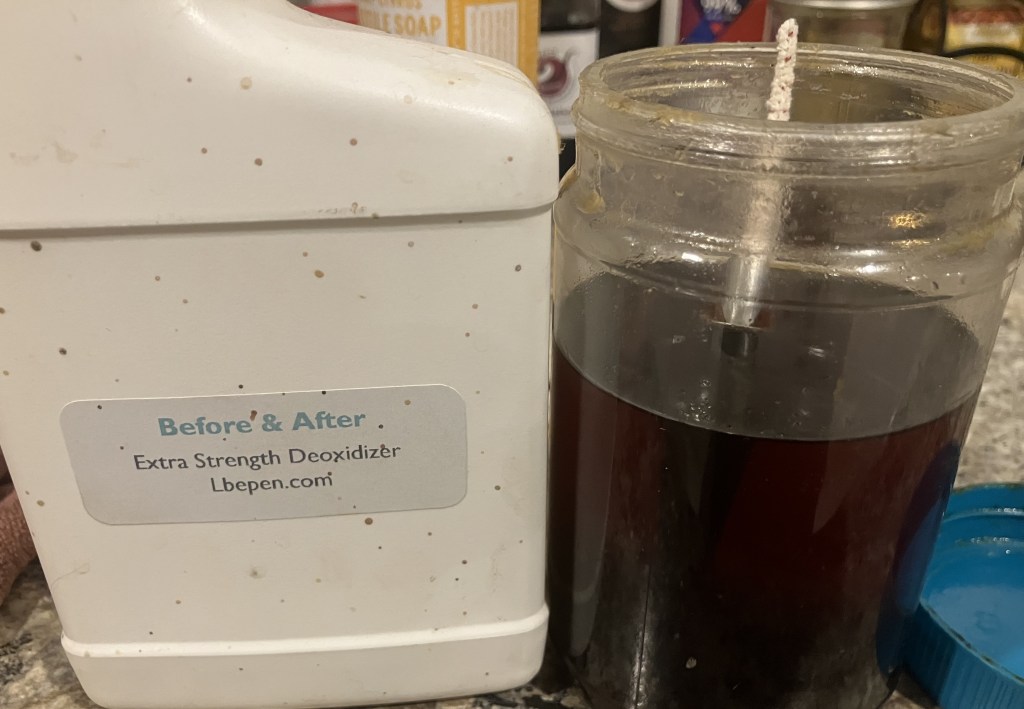
The stem was allowed to soak in Before and After Extra Strength Deoxidizer. It went in on a Sunday late afternoon. I had to attend a funeral for a cousin in northeast Iowa so it sat in the deoxidizer for about 30 hours.
Upon returning to the wilds of southeast Nebraska, I took up the restoration the next night. If you look carefully at the below photo you can see the chip from the stem propping the pipe up. Apparently that was the safe stop to keep the chip. I cleaned out the shank with a shank brush, cotton swabs and bristle pipe cleaners all dipped in 99% ethyl alcohol. If you are wondering about the purple on the cotton swabs it is probably potassium permanganate (KMnO4). Here is a quote from a chemical supplier who still sells KMnO4 “Potassium Permanganate is a dark purple solid. Dissolving 1 ounce in a pint of water is used to stain woods a pleasant brown. The Potassium Permanganate decomposes on contact with the wood and leaves a brown residue that stains the wood. If the color is too dark it can be lightened by washing the wood with a strong solution of hypo. The brown color imparted to fairly woods will gradually fade when exposed to direct sunlight. Mix only enough solution to do the job at hand as the solution on long standing will lose its effectiveness. Use it with caution as it is a strong oxidizer.” (POTASSIUM PERMANGANATE | WoodFinishing Enterprises)
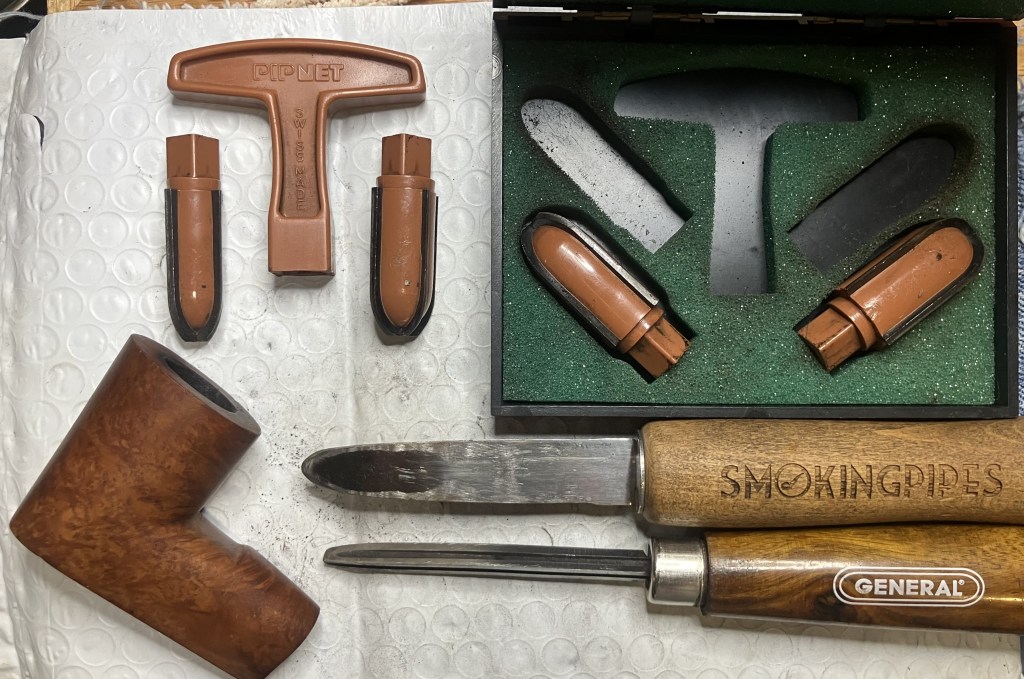
Next came the assembling of the ream team.
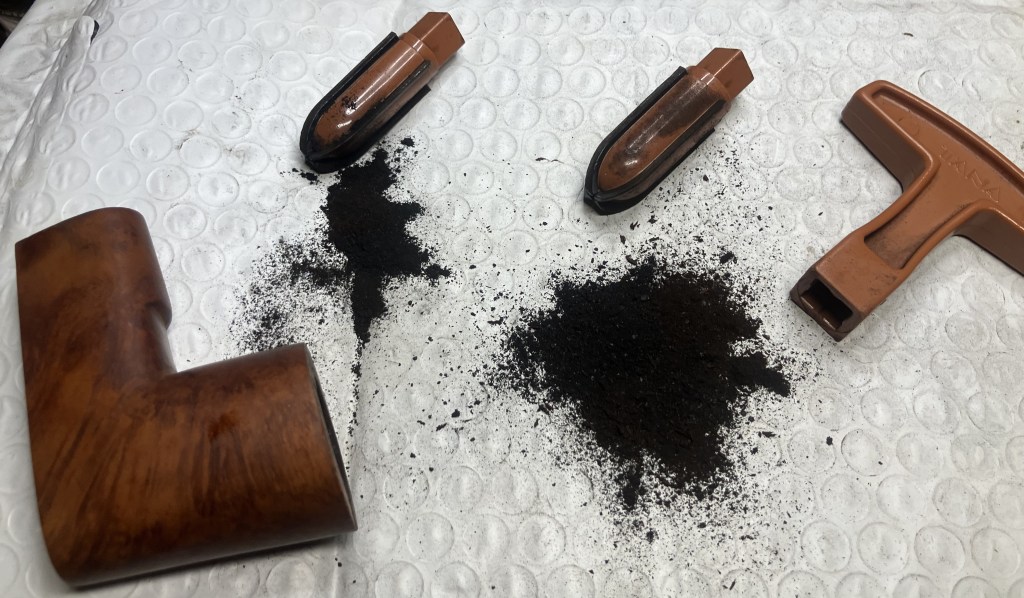
The PipNet with its #1 and #2 blades did most of the work.
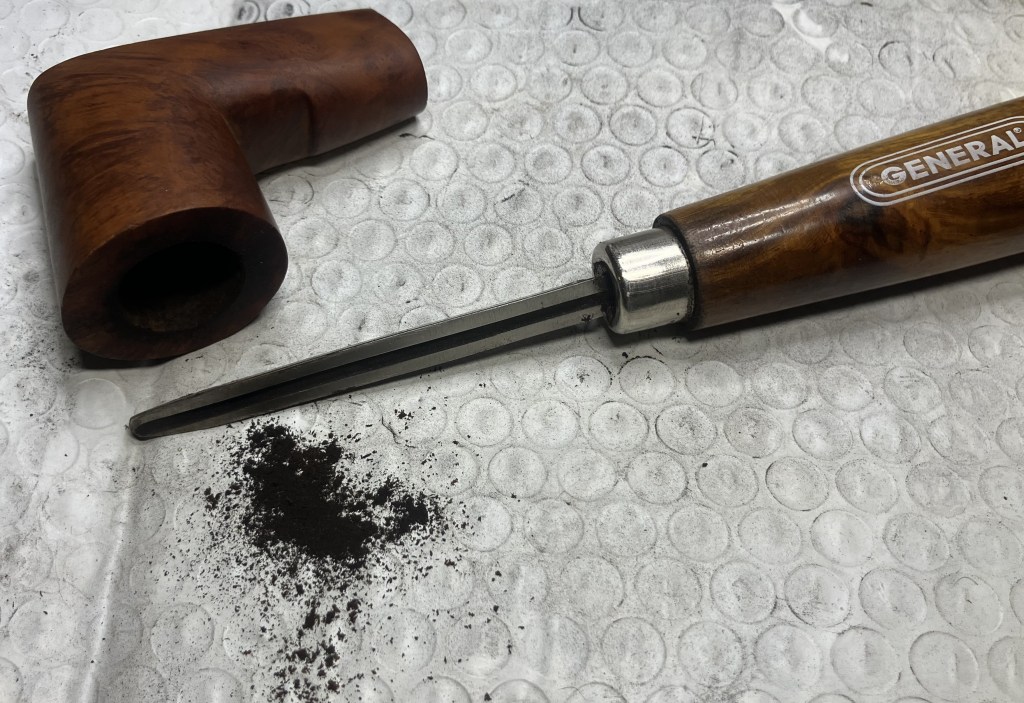
The Smokingpipes Low Country reamer and the General triangular scraper were used to touch-up the tobacco chamber.
The reamed chamber looked very good and showed no signs of any heat damage.
I sanded the interior of the chamber with 220 sandpaper wrapped around a wood dowel followed by 320 sandpaper wrapped around a Sharpie marker.
The bare briar indeed was free from any damage.
The rim would hopefully be also free of damage under the layer of smoking residue, aka lava.
The lava was moistened with saliva and gently scraped with a sharp pocket knife.
The stummel was then taken to the sink for a scrub with undiluted Murphy Oil Soap and a nylon brush. The soap was rinsed with warm water and the stummel dried with a cotton hand towel.
Back at the workbench, I wiped the stummel with an alcohol wetted cotton ball. Some color came off the pipe. I did not want to change the look of this pipe by removing and rebuilding the finish.
I gave the stummel a coating of Before and After Restoration Balm and set it aside to work its magic overnight. Hey look, that little ship is still there. Safe and sound.
After the funeral, still the next day though, I returned to working on the pipe. I saw a small black fleck on my denim and threw it into the trash. Stupid little black flecks. I then wiped the remaining Before and After Restoration Balm off of the stummel using an inside out athletic sock.
I retrieved the stem from the Before and After Extra Strength Deoxidizer. I’m just going to call it deox from here on. Nothing personal to Mark Hoover, but that is just too much to type. I placed the still wet with deox solution on my favorite coarse shop rag. The deox on the aluminum had foamed up, presumably a reaction of oxidized aluminum to the deox solution.
I vigorously rubbed the vulcanite with the coarse gag. This absorbed excess deox and abraded away some of the oxidized rubber. Actually a lot of the oxidized rubber.
Back at the workbench, I cleaned the interior of the stem with several thick pipe cleaners then coated the stem inside and out, with Before and After Hard Rubber Balm (HRB, henceforth). This is another great product from Mark Hoover. I like it best as a preservative on a finished stem to combat oxidation but it works well on a stem fresh out of deox too.
The deox had left a mark of the aluminum of the Brigham system. The cleaner shiny aluminum clashed with the more dull original aluminum.
I hand buffed this using Before and After Fine Polish on a paper towel. Tada, much better.
I looked over the tooth chatter and cleaned the HRB from the bite zone with alcohol on a cotton swab. I was prepping the area for a small drop of black cyanoacrylate (CA, super glue) to fill the depression.
It was about here that I realized the little black fleck that I threw away was the chip from the button. “Oh crap!”, may have been spoken. The poor little chip had evaded trouble by staying in its safe place for a couple days before some rambunctious oaf displaced it.
Hmm, how hard could it be to find a tiny black fleck in the trash bin of… a guy who dumps lots of black powdery debris… in the trash bin. Oh crap.
I set out a piece of scrap packing paper and went through the trash, shaking the bigger pieces to dislodge a small black fleck. Eventually I dumped the reaming debris onto the paper, got down on my less than flat belly and started sifting through the black powder searching for a fleck.
Hah! Victory. I actually found the little bugger. By the way, if you think that it’s easy being this dumb, you would be mistaken. It takes years of training and classes in rambuctiocty from the local community college.
And it still fits.
The wound was cleaned with alcohol in preparation of the regluing. I thought about drilling and reinforcing the chip with a 2 mm brass pin but the rough surface of the break and the contours of the fit seemed like they would provide good support on all three sides.
I used a plastic lid cut-out inserted into the slot to keep the CA from being rambunctious. Yeah, I’m going to see how many times I can use that word.
The glue of choice was This rubberized CA from Bob Smith Industries. It was getting a bit old and wasn’t as thin as it used to be but it coated the contact surfaces well. A drop of the CA was placed on the disposable pipette bulb then applied to the stem with a fly tying bodkin.
Once that CA had set, I applied a thinner black CA to fill the seams.
Once the thinner CA set, I applied a bead of the first black CA to the edge of the button to address the rounding of that edge by previous tooth wear and tear.
Once all the CA had cured, I again filed the CA with the two files used earlier then started the sanding with a series of sanding sponges. Between each sponge I rubbed the stem with mineral oil then wiped it with a paper towel.
I was still not happy with the seam of the glueing so I sanded that additionally with 400 grit sandpaper wrapped around the handle of an Exacto knife. I kept my rambunctious nature in check and did not skewer myself with the blade. Yeah, it would have been smart to remove the blade but, it is me we’re talking about here… I then polished the stem with new micro-mesh pads in grits of 4000-12000.
To avoid having another pipe cleaner chipped button incident, I used a cut-off bit in the Dremel rotary tool which was a fraction of a mm thicker than the original slot. This widened the slot enough to pass a pipe cleaner, even bristled, more easily. The slot was polished with a thin folded piece of 400 grit sandpaper.
The pipe was then taken to the buffer for several coats of carnauba wax. This was then hand buffed with a microfiber polishing cloth.
I do hope that you had fun reading about the trials and tribulations of not being the sharpest tack in the pack. I will continue making mistakes and documenting them in hopes that you can learn from them in a less painful fashion than I. This Brigham was actually a fun little pipe to work on. The fact that it was a non-typical version with a dental stem made it more interesting to me. Thank you again Charles Lemon for the insights into Brigham pipes. The pipe itself is a lovely example of a two dot Brigham. The rustication provides an attractive and comfortable bit of briar and the stem though lacking the robustitude to weather a rambunctious restorer still turned out very nicely. The dimensions of this Brigham 202 are:
Length: 6.49 in./ 164.87 mm.
Weight: 1.33 oz./ 37.06 g.
Bowl Height: 1.72 in./ 43.69 mm.
Chamber Depth: 1.41 in./ 35.81 mm.
Chamber Diameter: 0.72 in./ 18.29 mm.
Outside Diameter: 1.30 in./ 33.02 mm.
I do hope that you have found something here useful to your own pipe care, maintenance or restorations. If you like this sort of thing, please click the like and subscribe buttons. Thank you for reading the ramblings of an old pipe lover.
Loading…
Below are some photos of the finished Brigham 202 with a dental stem.
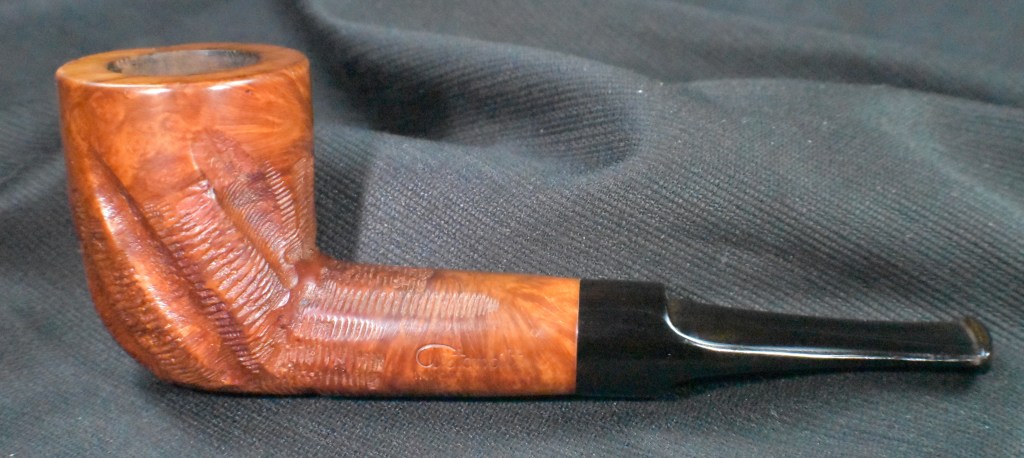
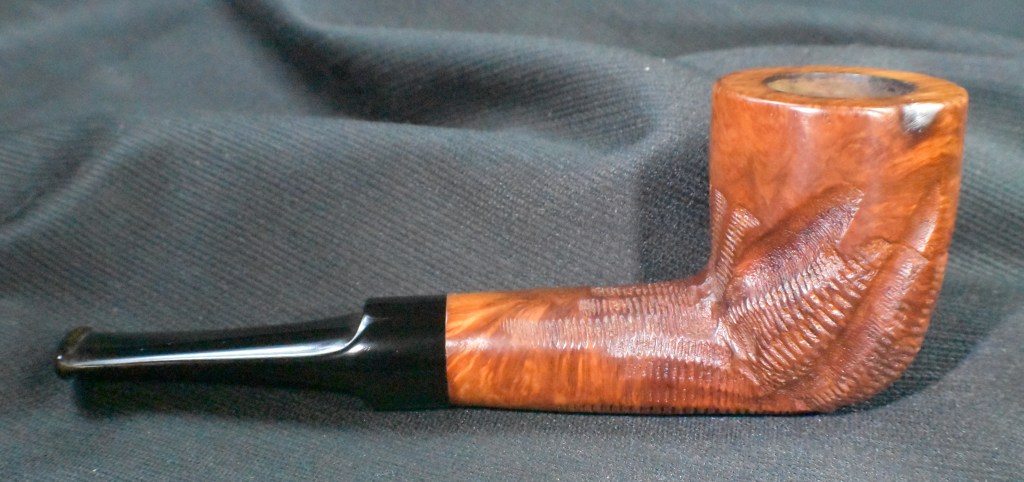
The best man in my wedding is an artist. The creativity that artists have is an innate ability to create beauty from nearly anything. I was always amazed by this superpower. When I first saw this Micoli pipe I thought, “that carver is an artist, how in the world did he come up with that?” I merely have the ability to repair the toll of time on things of beauty and a sense of practicality. Though this Micoli pipe is an incredible pipe to look at, the carvings do not meet my sense of practicality. Aesthetic beauty and useful practicality are often at odds and this pipe strikes me as an example of that conflict. For whatever reason; desire to work on a Micoli pipe, infatuation with a truly artistic creation or “dang, that’s cool”, I had to have this pipe when I saw it on eBay. After the winning of the auction the waiting for arrival began. Five days seemed to go more slowly than usual, perhaps I have discovered a remedy for aging? The relatively short trip from Saint Charles, Illinois to the wilds of southeast Nebraska was done and below is what the pipe looked like upon its arrival. The only stampings were a signature style “Micoli” over “Fre…” I could not make-out the last letters of the lower word.
I wasn’t and still am not sure if the stem is intended to be a reverse tenon push stem or a threaded tenon. Maybe the artist designed it to be either or. The pipe looked to be in better condition than the eBay photos indicated. Minimal oxidation of the stem, good news. A nice polish to the smooth sections, I do hope that is just a very thick carnauba wax… A slight cake in the bowl, more good news. This looked like an “easy button” restoration.
“Micoli or “Mic” as he is called by family and friends, has aquired the reputation of being one of the best American pipe makers. He is appreciated by the most prominent of collectors. Educated in the arts, He started this adventure in 1968. His craftsmanship and artistry were dedicated to over twenty years of full time pipe making, with no two alike. In the last thirty years plus he has been partially retired and limits carving to a few pipes a month. He has continued sculpting animals and other subjects fom brair and other rare woods.
That woud make chronological sense, I was born in 1966 and if he started carving in/after college he’d be about 79. Yeah, math works. The site has photographs of a lot of Micoli carved pipes. These were fun to look through though I did not find one similar to the pipe in hand. That is not too surprising since no two pipes look alike and the various styles are a veritable kaleidoscope of shapes.
For further information I checked pipephil.eu. Here I found the following quote and images:
“Artisan: Robert Eugene (Mic) Burns carved pipes at least from the early 1970’s. Last news about him dates from November 2001. His son Ryan Burns stated in a forum his father is still (2009) very much alive and is in excellent health.
The deeply Dremmel carved pipes are typical of R. Burns’ work.
The final search was at pipedia.org, where the below was taken along with several photographs. Hmm, it sounds remarkably like his own website. Darn these lazy writers… Oh wait, I’m one of them.
“Micoli or “Mic” as he is called by family and friends, has acquired the reputation of being one of the best American pipe makers. He is appreciated by the most prominent of collectors. Educated in the arts, He started this adventure in 1968. His craftsmanship and artistry were dedicated to over twenty years of full time pipe making, with no two alike. In the last twenty years plus he has been partially retired and limits carving to a few pipes a month. He has continued sculpting animals and other subjects from brair and other rare woods. Micoli is now 72 years old.
The signature of Burns’ work is the specific way of rustication he worked out using a Dremel power tool. (The Dremel had been introduced to pipemaking by Teddy Knudsen.)
Burns / Micoli also made the E. Oslo pipes. These can be considered his entry-level pipes as he did not carve these from scratch but rather purchased run-of-the-mill standard shapes from Italian and English pipe makers, such as Savinelli and Comoy’s, and dremeled his signature magic on them. The pipe shown was very likely a Savinelli 111 KS.”
I took the pipe parts to the workbench and gave them a cleaned denim piece.
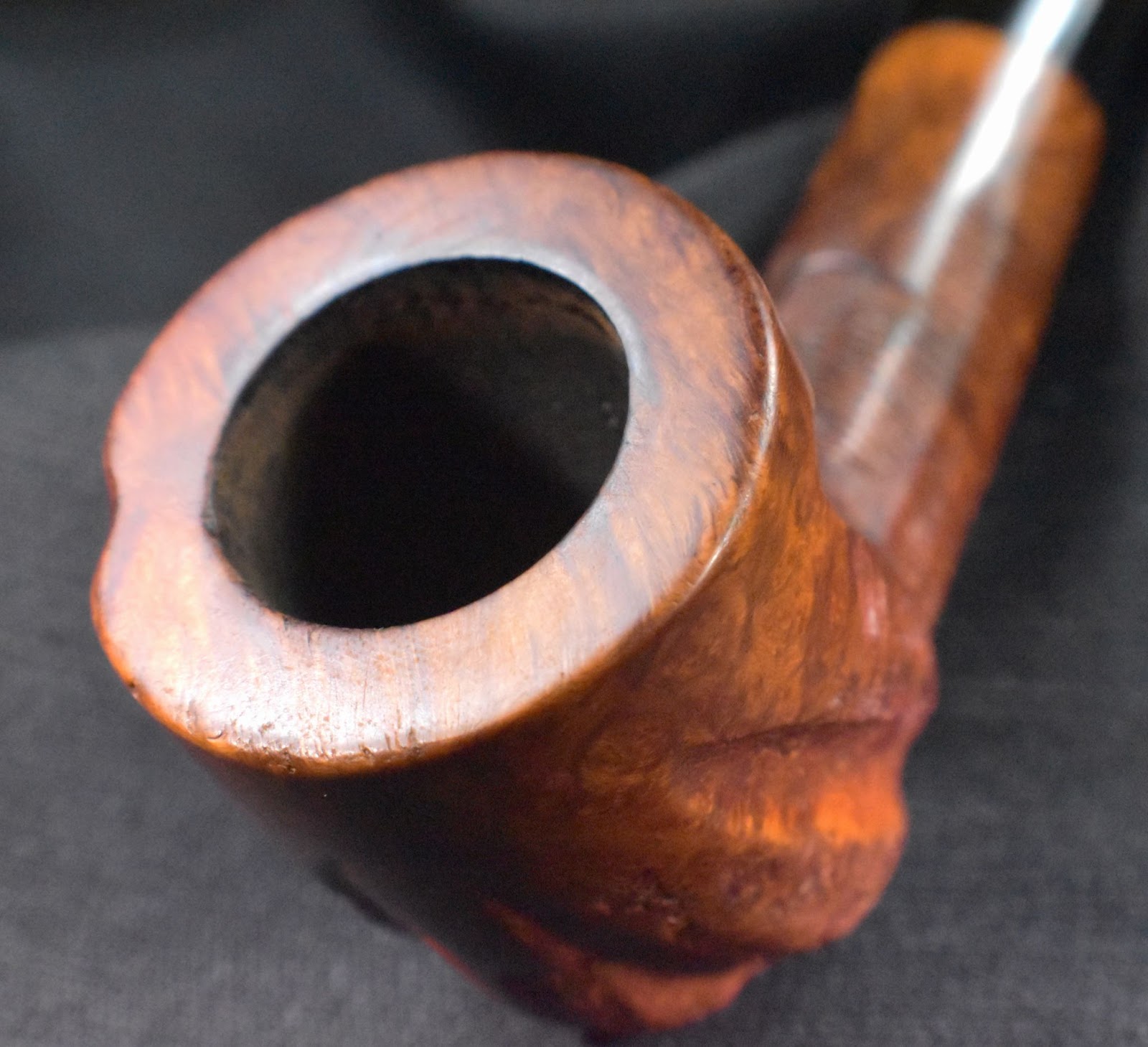
Looking over the pipe with a more critical eye, I again inspected the tobacco chamber. I hoped that the darkened rim was just a deposit of lava and that there was no charred wood beneath.
I reattached the stem and tried the draw. Yikes! There was barely any airflow. I pulled the stem and tried it. The stem was clear. I looked into the mortise.
I heard Jed Clampitt saying, “What in tarnation?” in my mind. I grabbed a thin forceps and grabbed at the obstruction. A wadded up abraded piece of plastic came out. It looked as if someone had been trying to get it out for some time and had scratched and pushed the piece of plastic into the airway. “Odd”, I thought.
The air way was now open and had a normal draw.
The ream team was gathered.
The PipNet #3 and #4 blades got used but not much. The wide bowl of this pipe was cleaned out with a little help from both the Smokingpipes Low Country reamer and the General triangular scraper.
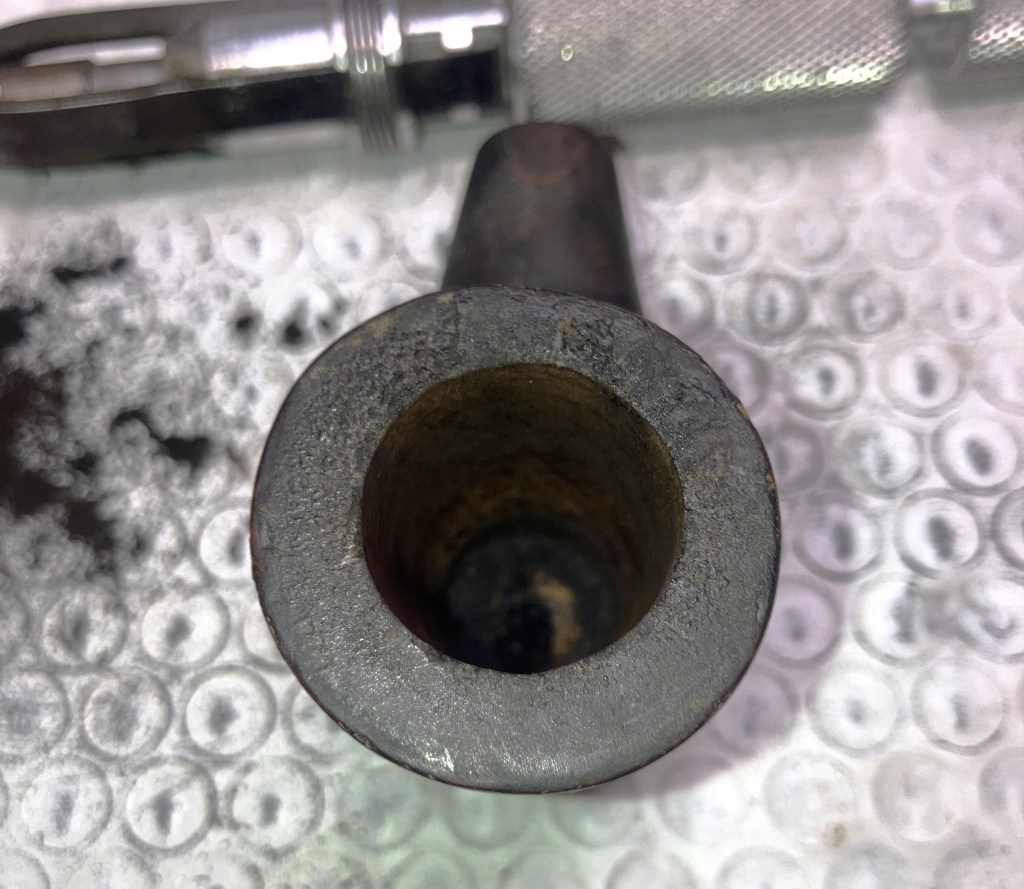
Below is the condition of the reamed tobacco chamber.
I sanded the interior of the chamber with 320 sandpaper wrapped around a wood dowel. The briar showed no signs of heat damage.
I ran an alcohol dipped pipe cleaning into the shank and it went straight in but not into the bowl. Hmm, that is odd. “What is this little depression in the tobacco chamber and why is it wet?”
And why are there two airways? Those two pipe cleaners were not going through the same hole.
Here you can see two pipe cleaners in the bowl. Well, one complete pipe cleaner and the emerging tip of the second.
The correct airway was a bit difficult to get a pipe cleaner into with the Delrin tenon screwed into place. I bent the tip of the pipe cleaner downward and it would go through.
Below you can see a slightly bent pipe cleaner going through the airway.
It is kind of hard to make out in the photo below but if you use your imagination you can see two airways.
I used a length of aluminum tube which was 0.13 inches in outside diameter to go through the drillings. This was done so I could envision what in the heck was going on inside this shank. It was weird, there were two airways. One was only accessible if the Delrin tenon was removed. This one angled down from the shank-end and to the bottom of the tobacco chamber. The other drilling was straight inline with the Delrin tenon if it was screwed in place.
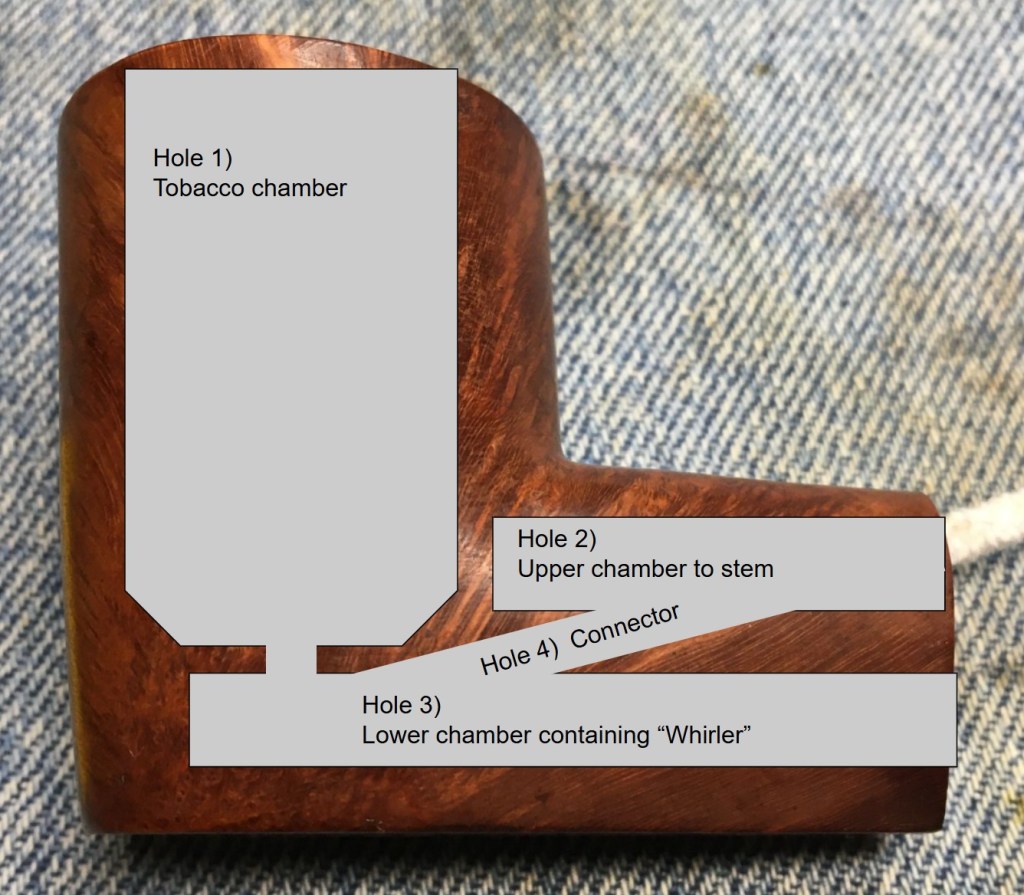
The below three photos with overlaid diagrams are representations of what I think the airway was like and how I thought repairs might proceed.
The first diagram is how the carver drilled the stummel. The angle is not precise nor probably to scale but for visualization purposes it works.
This second diagram shows what was done to the stummel by a previous owner. The angle here would follow the straight line entrance of a pipe cleaner or drill bit inserted through the threaded reverse tenon if it were screwed into the shank.
This photo shows the stummel with the threaded Delrin reverse tenon fitting.
This last diagram attempts to show my idea of a repair. I thought that I could use a disposable pipette to deliver J-B Weld epoxy and fill the incorrectly drilled hole, shown in dark gray, into the existing upper drilling. This would fill the hole and seal off the incorrect airway. The epoxy is inert and heat resistant. I would sand any epoxy that extruded into the tobacco chamber. This seemed like a grand idea if I could get the thick viscous epoxy to flow enough to use a pipette to deliver it into the hole.
For this plan to work the epoxy would have to be drawn up into a disposable pipette. I had two types of pipettes on hand, one with a larger diameter tip and one that was smaller. I thought the larger would work. If it did not, I figured I could cut the tip back a little and make the opening wider.
I needed to be careful not to get any epoxy onto the threads or into the correct airway. I made a tool to clear the correct airway of any stray epoxy by plugging the end of a 0.14 inch, outside diameter brass tube with a cotton swab.
I snipped off the extra cotton and hardened it with a drop of thin cyanoacrylate (CA). Once hard I sanded the CA hardened cotton smooth.
I had a plan now to see if the pipette would be able to deliver the epoxy. I measured out the epoxy.
Then mixed the two parts for 30 seconds as per instructions.
The moment of truth, would the plan work or force a “Plan-B” into effect? Success. The epoxy did flow up into the pipette. Very slowly and probably only for about 5 minutes but it was working.
Using the bright workbench lights I was able to see into the mortise of the shank, insert the pipette into the hole and deliver some of the epoxy. This was repeated a few times before the epoxy became too thick to be drawn into the pipette. The below photo shows the wet epoxy filled hole at the 10:00-11:00 position.
I checked the correct airway with the “brass correct airway clearing tool” (I wonder if there is a market for these?). It came through clean and epoxy free.
Next I cleaned the threads of the epoxy which I had carefully and purposely spilled using acetone on a cotton swab. Okay, that isn’t true. I did not purposely spill anything.
I set the stummel in a pipe holder and let the epoxy set-up for about 20 minutes. This was done so the epoxy would not flow out of the hole. Gravity can, on occasion, be your friend.
Once the epoxy was set-up, I held the stummel up to the light so that I could see light coming through the correct airway. Again, success. I thought that I had better quit. This many successful outcomes usually indicates a major FAIL in the near future. The pipe was set aside for 12+ hours giving the epoxy time to cure completely.
The next day I sanded the spot where epoxy had come through the hole into the tobacco chamber. I thought that I might have to use a bowl coating to cover this slight imperfection.
I also disassembled the “brass correct airway clearing tool” by dipping the tip in acetone and pulling the cotton swab with a pliers. Weird how my marketing team has not gotten back to me about the prospects of a nationwide campaign for “brass correct airway clearing tools”. O, yeah, I forgot, I don’t have a marketing team.
It was time to get this restoration back on track. The whole “easy button” theme had been severely violated. The stem was cleaned with ethyl alcohol dipped pipe cleaners and cotton swabs. All one each of them. You can tell I am not used to clean pipes.
The stummel was taken to the sink for a scrubbing with undiluted Murphy Oil Soap and a nylon brush. The soap was rinsed with warm water and the stummel dried with a cotton hand towel.
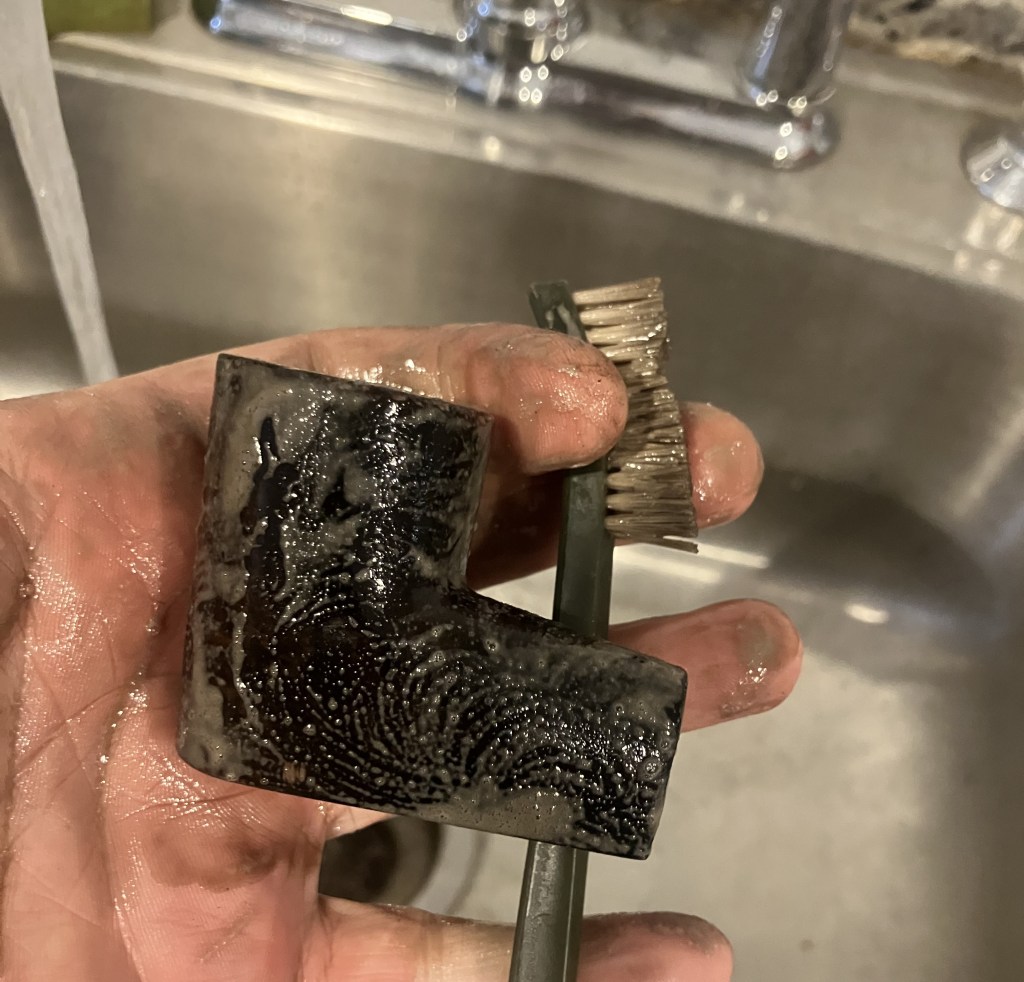
Back at the workbench the stummel was wiped with a cotton ball dipped in 99% ethyl alcohol. Very little color came off on the cotton indicating that the stummel was free of any finish or wax.
I was very happy to see that the rim had not been charred much by use and that the lava coating the surface was mostly removed.
The stummel was sanded with a series of sanding sponges from 400-3500 grit. Between each sponge the briar was wiped with an alcohol dampened cotton ball to remove sanding debris.
The stem was also sanded with a series of sanding sponges. Between sponges the stem was rubbed with mineral oil and wiped with a paper towel.
The stem and stummel were worked with micro-mesh pads 4000-12000. I don’t know why there was no photograph documenting the micro-meshing of the stummel. Perhaps the photography team is off cavorting with the marketing team.
The stummel was then given a coating of Before and After Restoration Balm while the stem was coated with Before and After Hard Rubber Balm. Both the stem and stummel were then abandoned because the fishing team needed a guide.
Okay, there isn’t really a fishing team but there was fishing. The next day I wiped the remaining Before and After balms from the pipe with an inside out athletic sock.
I wanted to give the smooth parts of this pipe a nice coating of carnauba wax but I did not want the wax to gum-up the carvings. My solution was to mask off the carvings with masking tape.
The smooth shiny parts received their carnauba coatings and they looked marvelous.
The last steps were to remove the masking tape and to hand buff the pipe with a microfiber polishing cloth. That made the shinies even shinier.
This Micoli was a treat to work on. Sure, the whole repair of a second airway was a pain but I learned that epoxy can be applied via a disposable pipette. Besides, I think the repair was a fun challenge and keeps my old brain working on problems that need solving. The grain on this Micoli is nearly flawless. Perhaps he carved away flaws but I do not think that was why he carved like he did. I think the artist was just being an artist and I got to share in that process. The stem polished-up beautifully. There is one tiny metal inclusion in the vulcanite that is reminiscent of the recycled rubber from wartime pipes. Overall the pipe is a whimsical adventure of flowing lines. I am not sure if this piece will enter my personal collection or if it will go on to another owner. I’ll just have to see if someone reaches out to me about purchasing it. Pipes like politicians are nearly all for sale. The dimensions of this Micoli are:
Length: 6.08 in./ 154.43 mm.
Weight: 1.43 oz./ 40.54 g.
Bowl Height: 1.87 in./ 47.50 mm.
Chamber Depth: 1.43 in./ 36.32 mm.
Chamber Diameter: 0.88 in./ 22.35 mm.
Outside Diameter: 1.54 in./ 39.12 mm.
I do hope that you have found something here useful to your own pipe care, maintenance or restorations. If you like this sort of thing, please click the like and subscribe buttons. Thank you for reading the ramblings of an old pipe lover.
Loading…
Below are some photos of the finished Israeli Bent Billiard.
Yeah, I still don’t know what that second word is. I did email The carver via his website but have not heard back.
This is the third, though not likely final, restoration of a pipe for the Real American Pipe Smokers (RAPS) Facebook (FB) group. This pipe was sent to me by a fellow member who had asked if I’d be willing to restore some pipes to be given away to RAPS members. I love to work on pipes that I find interesting and doing so for a good cause is even better. The three pipes arrived and were indeed interesting.
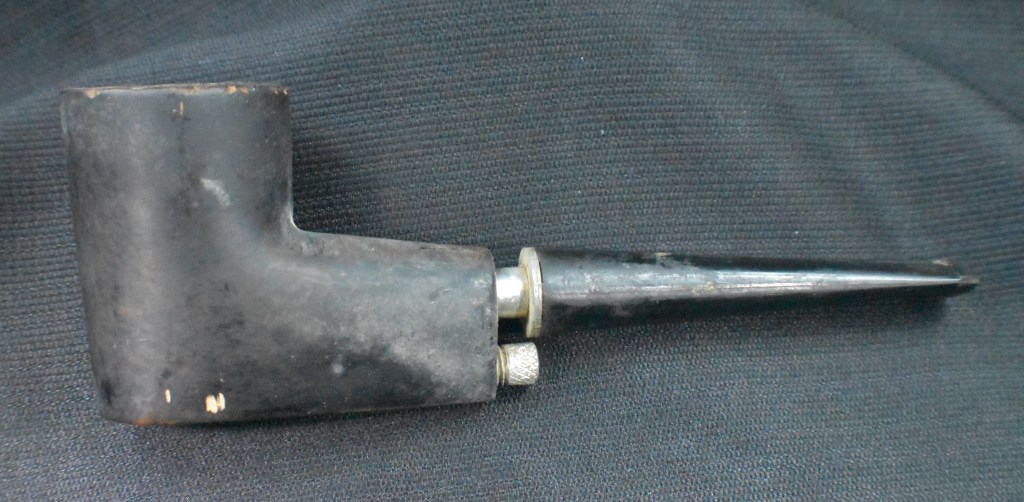
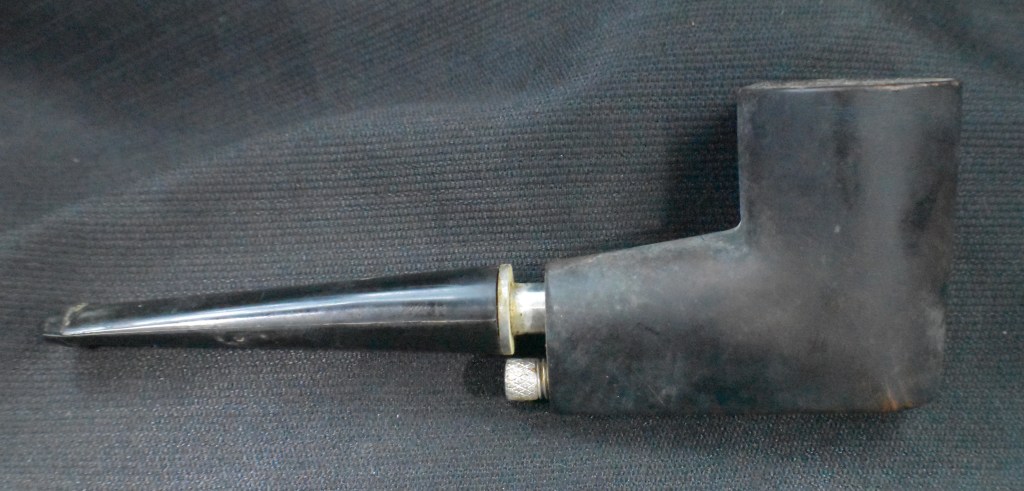
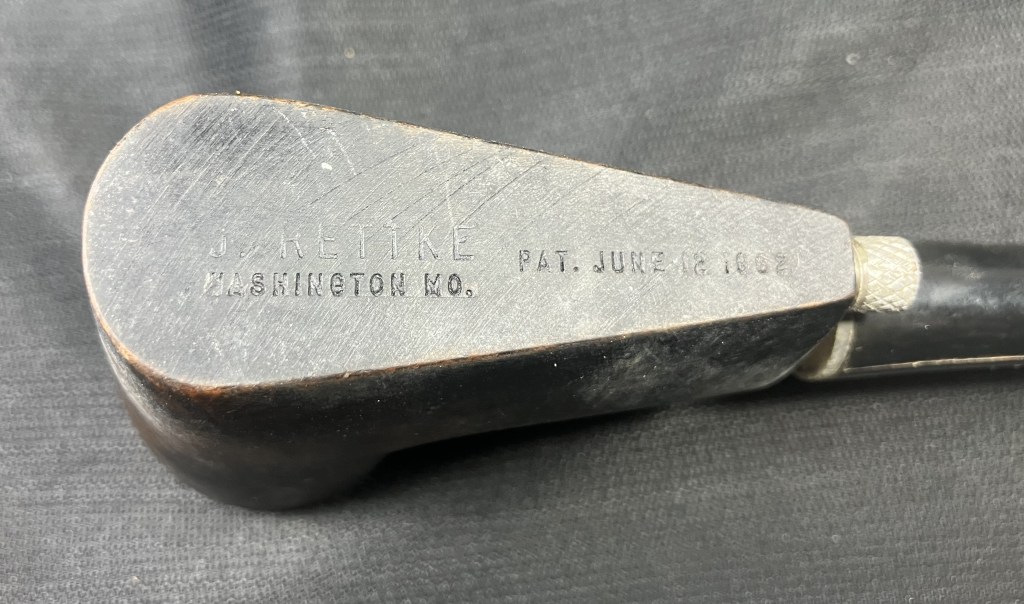
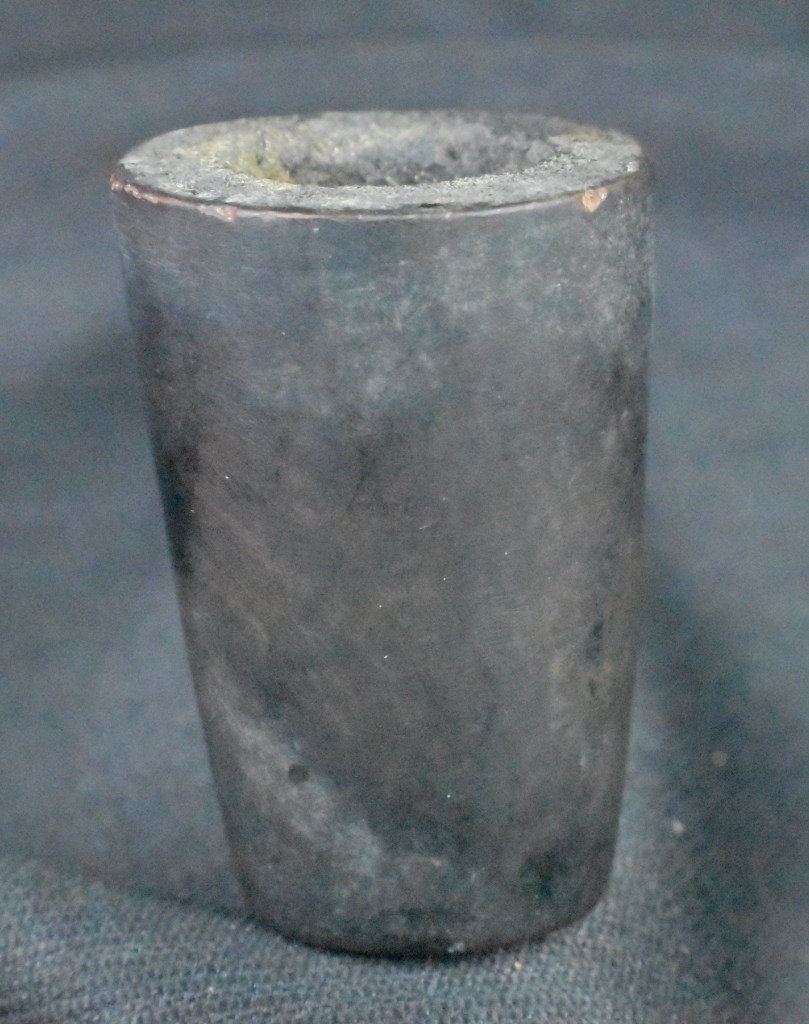
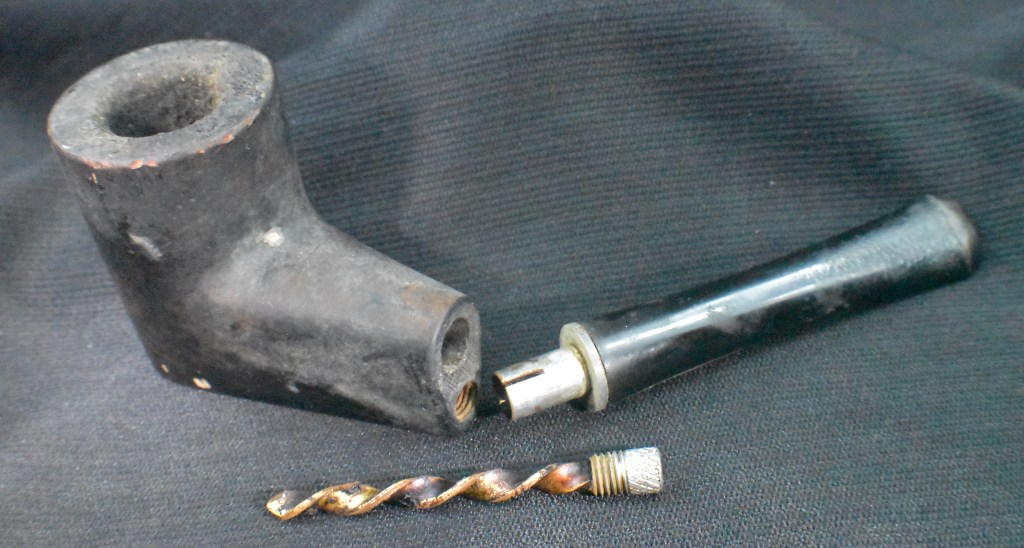
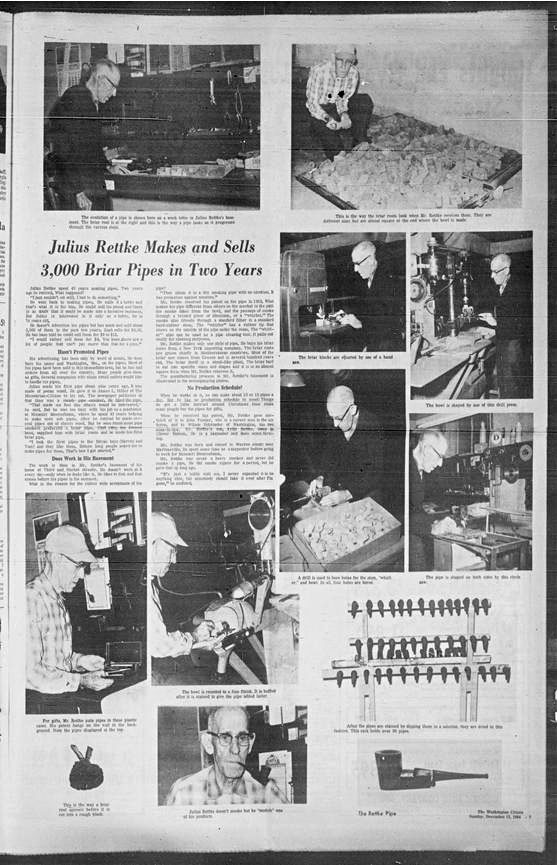
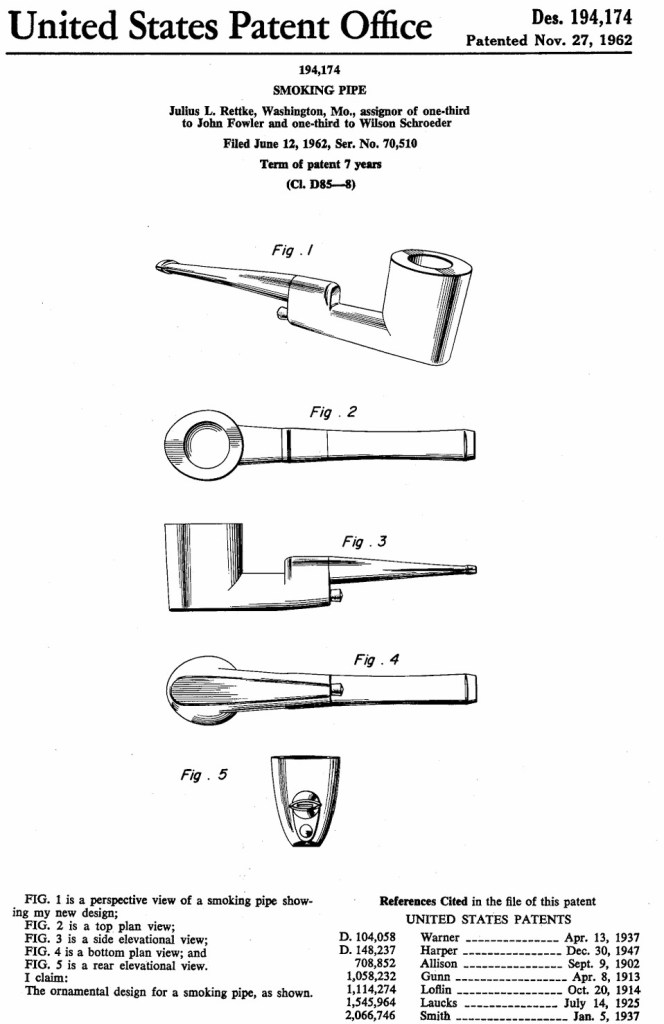
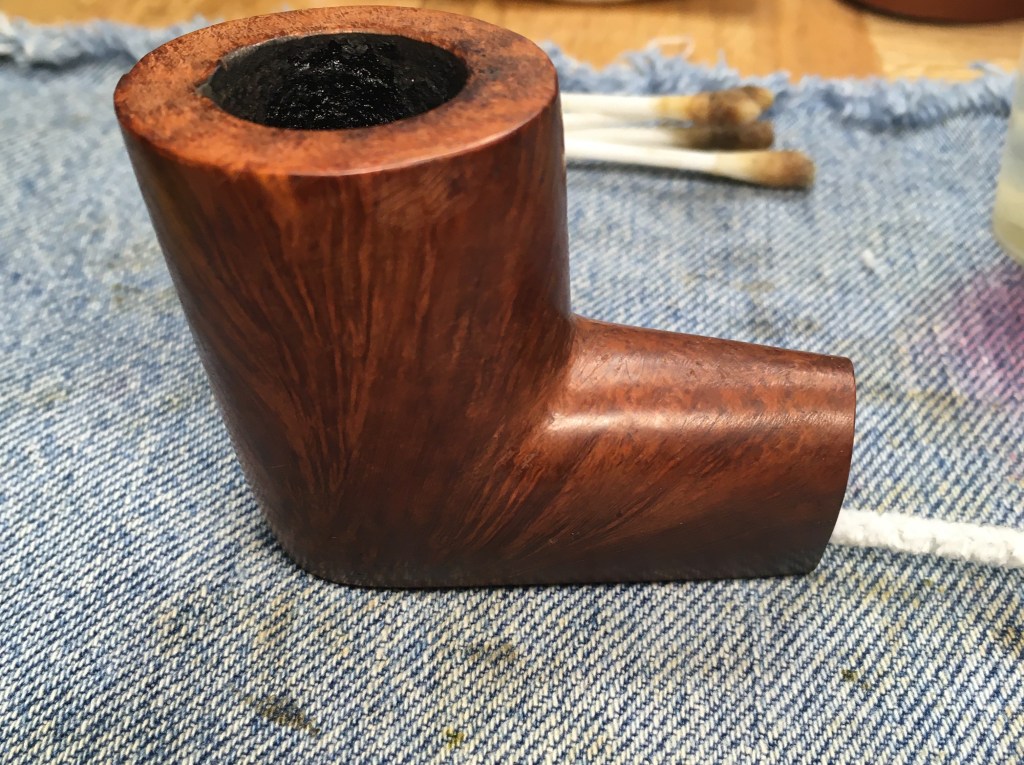
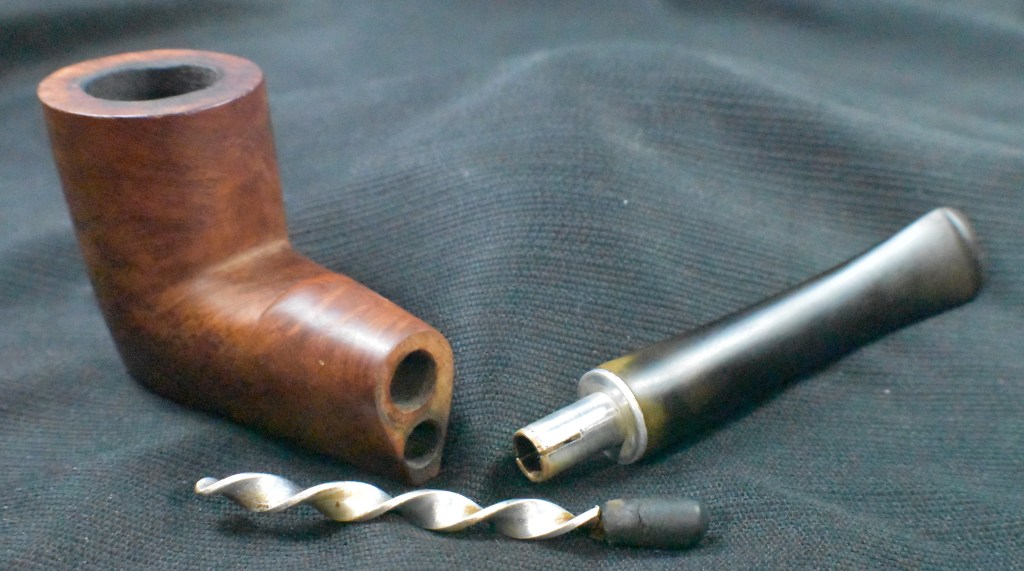
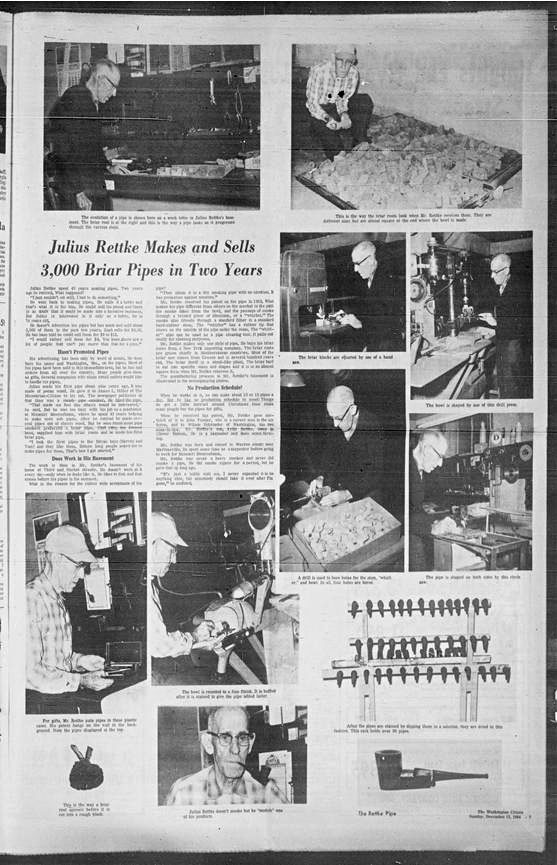
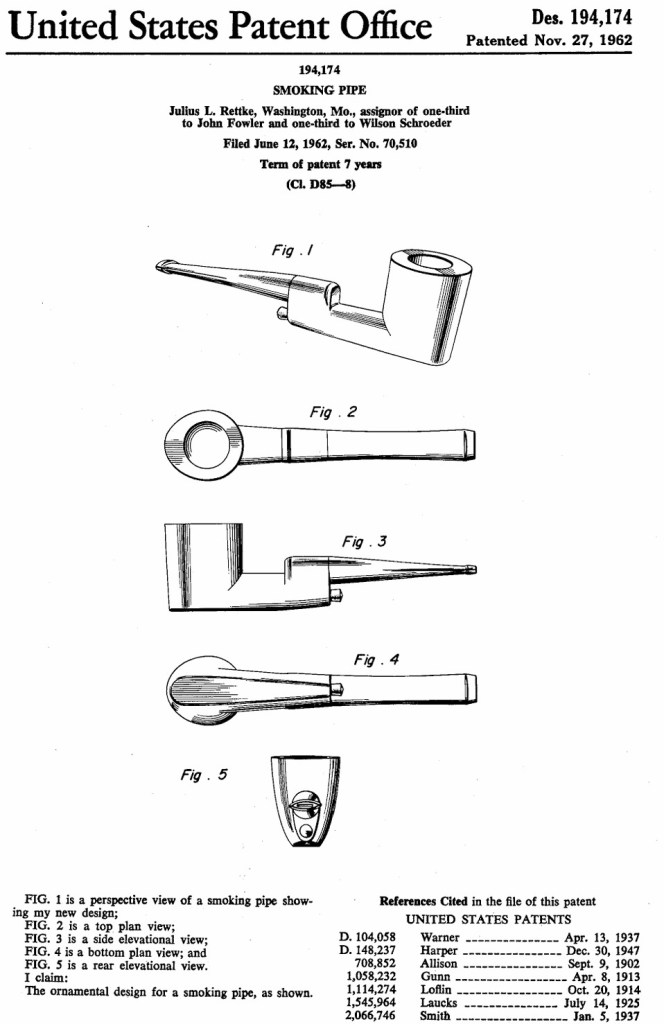
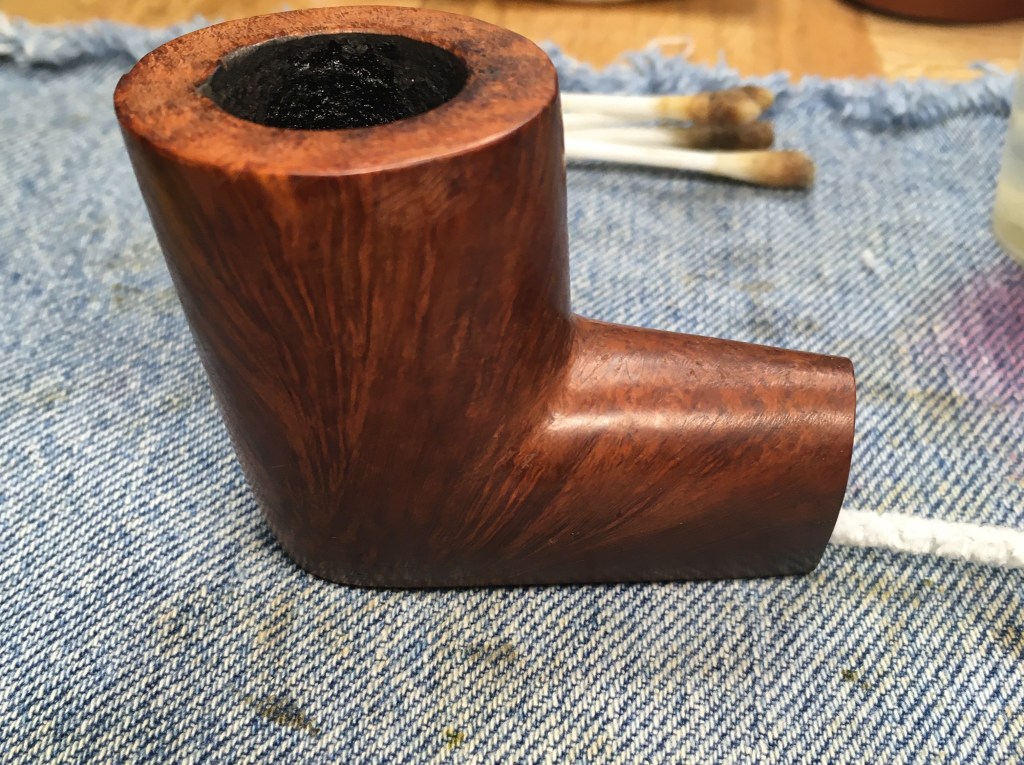
The top and bottom pipes were blogged about last week and were a Porcelain Apple and a J. Rettke, Feel free to click those names for links to the respective restorations. The final pipe is a large bent billiard with a chimney-like bowl. The only identifying stamp of the pipe was ISRAEL on the underside of the shank. Below are some photos of the pipe before I began work on it.
The stem had been chewed on a great deal this normally would indicate a pipe that had been smoked a great deal. However the tobacco chamber appeared fairly cake free. The rim did have a layer of lava and the rim edges showed signs of being knocked against hard rough surfaces. Perhaps I had come across a heavily smoked pipe which had been owned by someone who appreciated a clean pipe? There was also a dreaded clear coat finish on this pipe which would have to go. I know, my job is to restore, but I have a disdain for heavy clear coat finishes. The stem did look salvageable and I hadn’t restored one that was this chewed up for a while. Oh, the things I consider fun… I was worried about the ISRAEL stamp surviving the finish removal. Oftentimes the stamping is done on top of the clear coat and the briar below does not preserve the stamp very well.
Background
The number of Israeli pipe making companies is pretty easy to count, one. According to pipedia.org:
“Not much is known about Israel’s sole pipe factory though it’s reported to have operated quite successfully on international markets.
Beside the brand “Shalom” the mainstay brand was Alpha – especially well known in the USA. Alpha was popular for a range of fresh and unusual shapes. Series (afaik): Caprice (s), Citation (s), Classic (b), Pedestal (s), Regent, Region (b), Rex (s). (1)
(1) (b) = blasted, (s) = smooth
Alpha also produced at least one of its Citation forms for Carey’s “Magic Inch” series.
Mentioned in context with Shalom Pipe Factory was a Danish pipemaker named ‘Muki Liebermann’, who later lived and worked in the USA. Muki is known for his unique briar bending technique and his original shapes that gave inspiration to many of the most praised Danish pipemakers.
Also at the bottom of the pipedia.org entry is a blurb about other Israeli brands. It is not clear that these are lines which Shalom produced or if they are separate companies. I assume that they are Shalom lines.
“Other brands from Israel:
Andersen
Burl King (Best known for their Danish-looking “thumbhole” pipes with plateau tops.)
Fader (Presumably for Fader’s Tobacco Shop, Baltimore. Also known: Fader – Made In Denmark.)
As usual the pipe got herself a cleaned denim piece, more for the protection of the workbench than for the pipe’s comfort.
I decided to work on the stem first as I thought it would require the most effort. The top was lightly chewed but had pretty significant calcium deposits.
The bottom side was really chomped on and would need to have black cyanoacrylate (CA, super glue) built up and then reshaped.
I started with a cleaning of the stem with bristle pipe cleaners dipped in 99% ethyl alcohol.
The calcium deposits were scraped off with a sharp pocket knife.
The top and bottom were then filed with a small flat file to remove most of the teeth marks.
Rubberized black CA was used to build up material in the indentation on the bottom surface and button.
The built-up material was filed flat.
Additional black CA was added to allow for smoothing the underside of the stem.
This built-up area was then filed smooth and blended with the existing stem.
The whole area was sanded to check the blending of the vulcanite to the CA seams. It did not look bad. I had not started on the button as of yet.
To better blend the seams I applied a coating of thin CA. This penetrates any tiny crack of seams and would further blend the two materials with finer grade sanding.
The stem was sanded with a series of sanding sponges from grits 400-3500. Between each sponge I rubbed the stem with mineral oil and wiped it with a paper towel. The last thing I did, at this stage, was to apply a coating of Mark Hoover’s Before and After Hard Rubber Balm. Mark sent me this product to try and I think it does a very nice job at preserving a polished stem and keeping oxidation at bay during normal pipe smoking.
I turned my attention to the stummel. The reaming tools were gathered and included the PipNet, Smokingpipes Low Country Reamer and the General triangular scraper.
All three tools were used and the Kleen-Reem reamer was pulled into the fray because of the bowl depth and slightly conical boring.
The rim looked like it had suffered frequent hard knocks on concrete or stone surfaces. This roughened rim also had a coating of lava. Scraping lava from a flat surface is pretty easy but scraping lava from a rough surface is a different matter.
I tried to use the traditional scraping method of using saliva to moisten and soften the lava then scrape it with a sharp pocket knife. With the surface being as rough as it was, I met with limited success.
Normally a light topping of the rim would be done with 320 sandpaper but this rim was rounded and dented. Due to the very deep bowl, I decided that there was plenty of briar there and filing the rim would be a faster was to smooth the surface.
One smoothed with a flat file I topped the rim with 320 followed by 400 grit sandpaper.
The shank was then cleaned with several bristle pipe cleaners and cotton swabs dipped in 99% ethyl alcohol.
Next up was the scrubbing of the stummel with a nylon brush and undiluted Murphy Oil Soap. The soap was rinsed with warm water and the stummel dried with a cotton hand towel.
I wiped the stummel with a cotton ball wetted with ethyl alcohol. The alcohol has no effect on the clear coat. Bah. In the next couple of photos you can see where the finish had been worn off the briar.
Since the ethyl didn’t affect the finish, I tried acetone. It did soften the finish but very slowly and with a great deal of work. I decided to give the whole stummel a bath in acetone. The old jar was not large enough so I had to make use of a wide mouth pint jar acetone bath.
I let the stummel soak for over an hour in the acetone before removing it. Apologies for the poor focus. I’d blame the nitrile glove but I was only wearing one. There was still a lot of finish remaining on the briar. I thought, “why the heck did they apply the finish so thick?”
The good news was that the soaking made the old fills easy to remove. Well, easy if I moved quickly before the acetone evaporated.
There were several deep pits in the briar.
The pits were pretty evenly distributed over the whole stummel and as I said, deep.
At least they didn’t use the bright pink fill that you often find on old pipes. Below are a few of the remnants of fill material.
I sanded the remaining finish from the briar using sanding sponges that I usually never would use on a pipe, 180 and 280 grit. The little 320 sanding sponge just couldn’t cut through the thick hard finish. You can also see the depth of the pits on the shank in the below photo.
Eventually the stummel was sanded with 320 and 40 grit sanding sponges and the fills were refilled with briar dust and brown CA. I could have sworn that I photographed the filling of the pits but I failed to.
I also sanded the interior of the tobacco chamber and discovered some pits there as well. Imperfections in a chamber like this can cause the briar to burn and smolder with the tobacco. That extra surface area is something I wanted to eliminate.
I mixed up a small batch of black J-B Weld epoxy to press into the pits within the tobacco chamber. I used the mini popsicle stick as an applicator to “squeegee” the epoxy into the pits.
After the epoxy had dried for 24 hours I would sand away the excess.
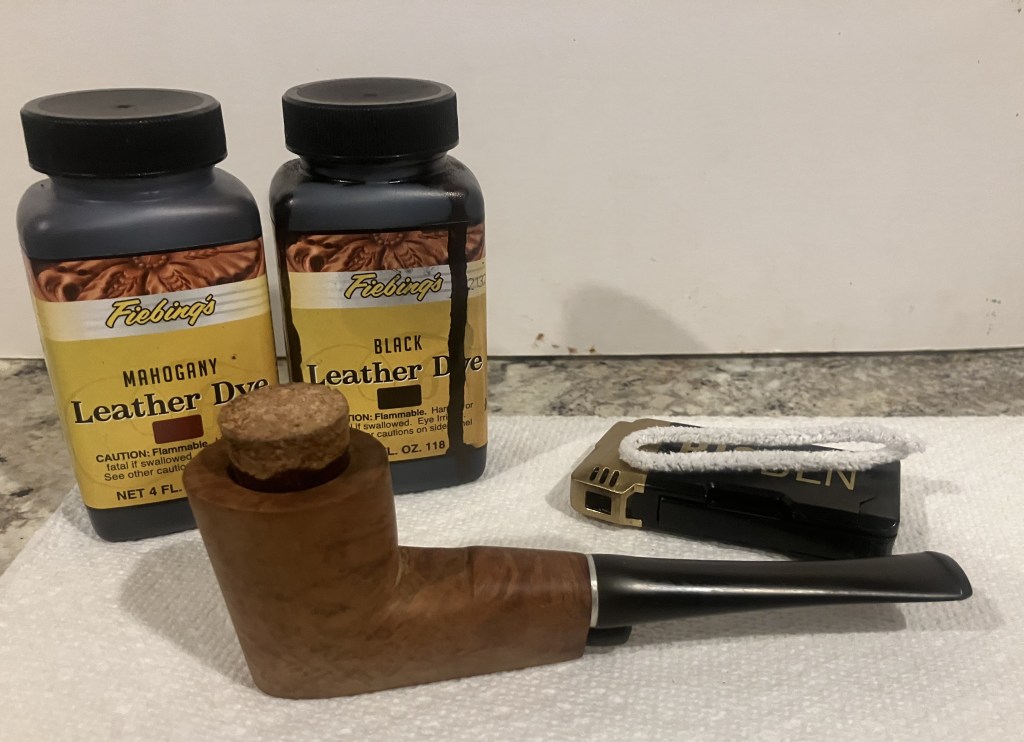
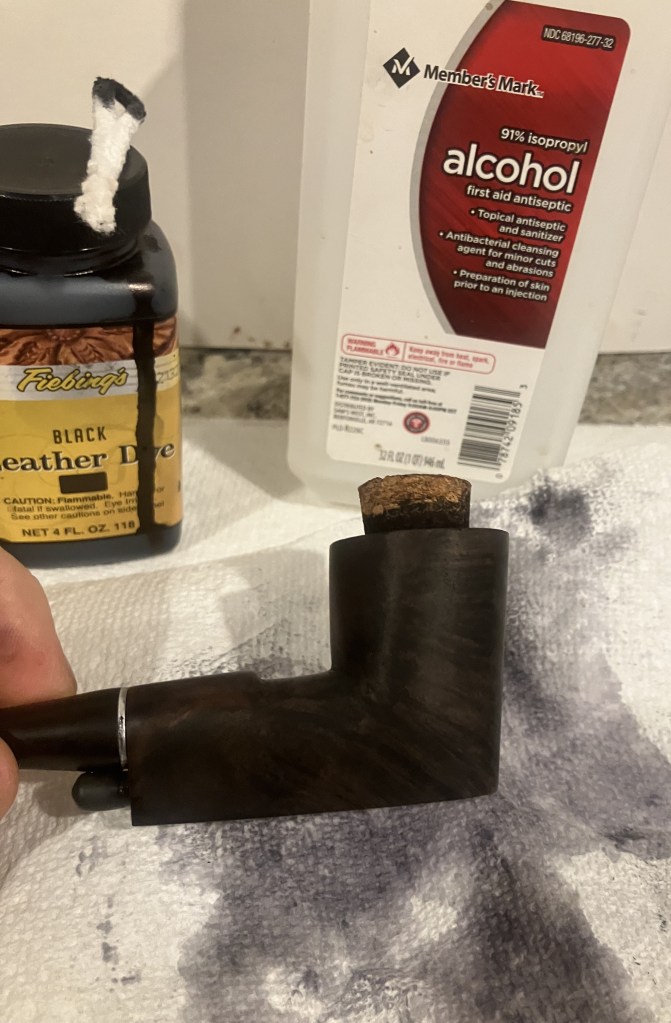
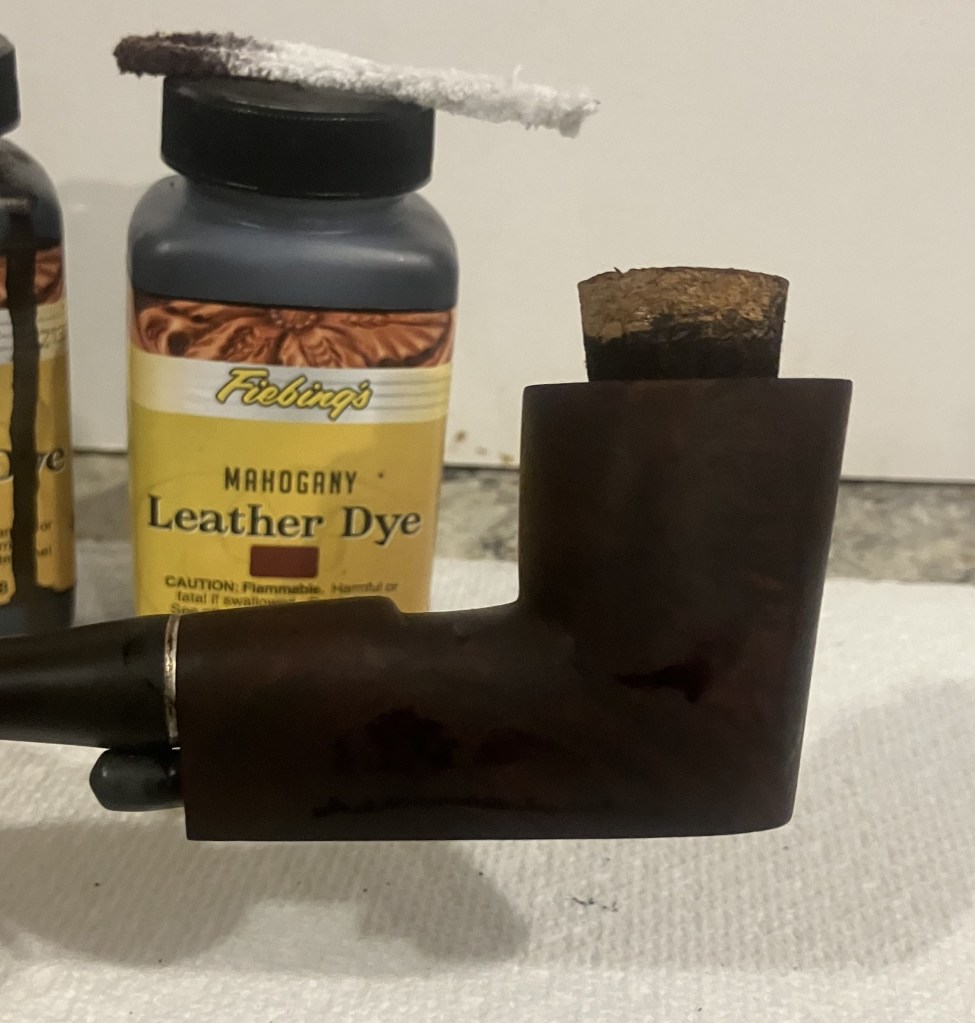
With the epoxy hardening I turned my attention to redoing the color scheme of the pipe. The plan was to use a base coat of black Fiebing’s Leather Dye. This would be buffed and lightly sanded, dying the softer grained briar black while removing the outer surface of the harder, less susceptible briar. Next a coating of Mahogany, again lightly sanded and finally a top coat of orange. The goal was to have a pipe with dark grain highlighted with an orange mahogany. It worked well in my imagination and it should conceal all those dark spots that were the new fills.
The first step, black Fiebing’s looked as expected.
After buffing with a rouge buffing compound and wiping with ethyl alcohol cotton balls the black had indeed penetrated the softer grain.
A light sanding brought out the lighter grained areas more to my liking.
Next came the mahogany dye.
Below is the mahogany after a light sanding and alcohol pad wipe.
Finally the orange top coat.
I discovered why the Israelis had applied such a thick clear coat to this stummel while I was sanding it. The briar was extremely soft and very difficult to work with. Sanding would remove one scratch and create two more. I decided that maybe a couple coats of Danish Oil would help to toughen the briar.
Below you can see how I hung the stummel on a vice for drying. I applied three coats of Danish oil to the pipe and the stummel looked like it had never even seen a drop of Danish oil. Good lord this briar was a pain to work with.
The final steps to the restoration included a trip to the buffer for several coats of carnauba was and a hand buffing with a microfiber polishing cloth. It was at this point that I realized how completely unhappy I was to have forgotten to bend the stem to what I thought was a better bend.
I used a heat gun to heat the stem until it was pliable. I then bent the stem to have a more attractive and more comfortable shape.
The stem before the bending:
And, after the bend:
Of course the heating and bending of the vulcanite ruined the finish of the fill work that I had done to the stem. That was all resanded, a touch of thin CA, and some more sanding then rebuffed. This then led to a rewaxing and re-hand-buffing. Oh, for the love of transparency! I could have left all my mistakes out but then I’d feel dirty or something…
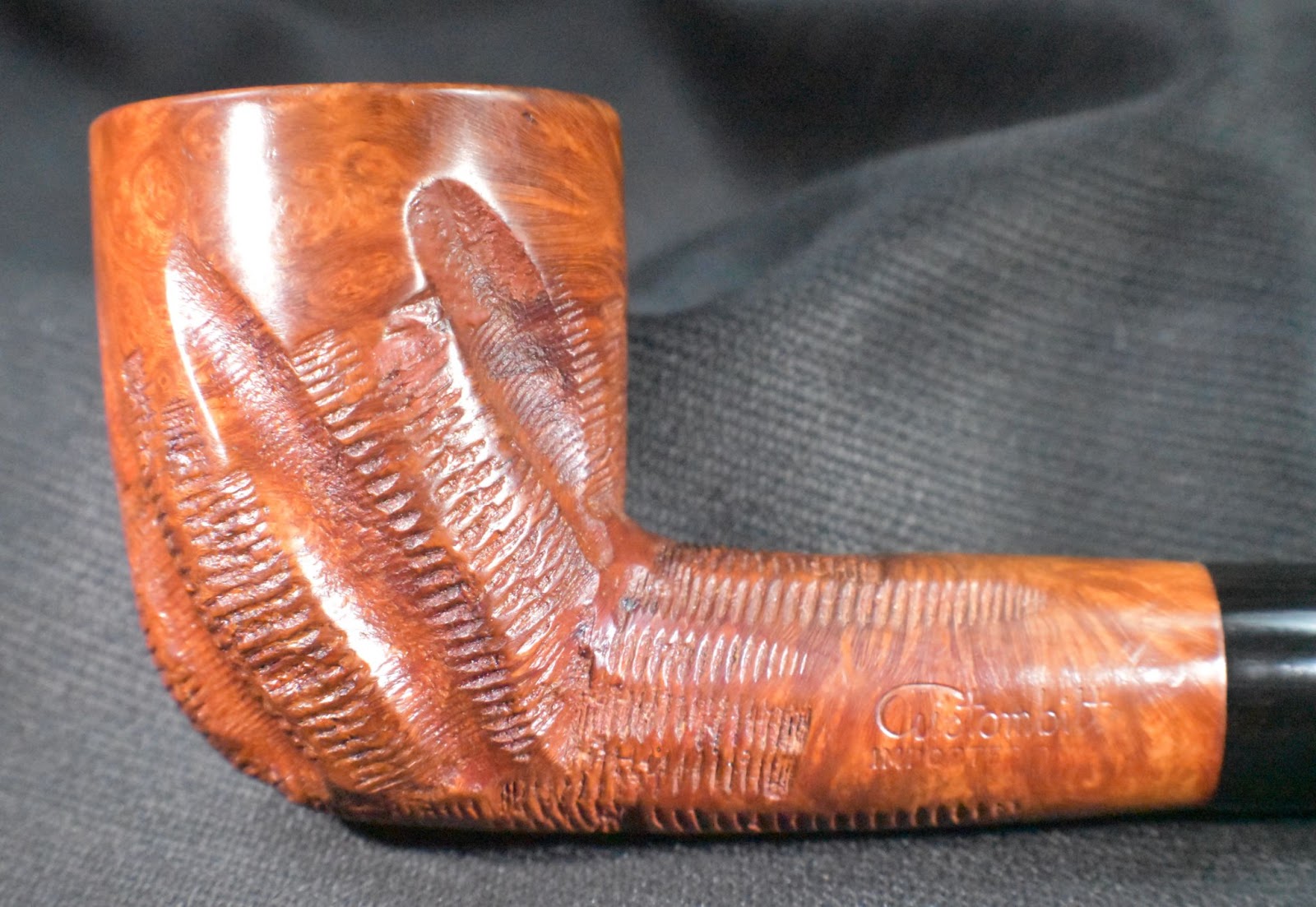
I think that the briar used in this Israeli pipe was the same or similar to the briar used by Robert Marxman, in other words it is Algerian briar. This briar is known to be a great smoking briar but is also known to be very difficult to work with due to the very soft nature of the wood. Think about the heavily rusticated pipes of Marxsman or the Custom-bilts. Those carving techniques were utilized to conceal the soft and imperfect grains of those pipes. Though they are renowned as great smokers, this pipe has the same cinnamon-cardamomscent as my Marxmans. The difficulties in trying to get this pipe to have a flawless smooth surface was difficult and I completely understand the Israeli’s use of a heavy masking clear coat. In the end I think that I did maintain the color scheme of the original pipe though I did lose the stamping, ISRAEL. The stem is another problem area. This vulcanite just would not lend itself to the high gloss sheen that I strive for. Overall I am sure this pipe will provide a great smoking experience but it does not have the aesthetic that I would be proud of. I guess I should be happy by giving this undoubtedly a “basket pipe” a new lease on life and provide its next owner with a good quality pipe.
The dimensions of the Israeli Bent Billiard are:
Length: 5.64 in./ 138.18 mm.
Weight: 2.10 oz./ 42.24 g.
Bowl Height: 2.35 in./ 49.02 mm.
Chamber Depth: 2.09 in./ 38.35 mm.
Chamber Diameter: 0.73 in./ 18.54 mm.
Outside Diameter: 1.57 in./ 34.54 mm.
I do hope that you have found something here useful to your own pipe care, maintenance or restorations. If you like this sort of thing, please click the like and subscribe buttons. Thank you for reading the ramblings of an old pipe lover.
Loading…
Below are some photos of the finished Israeli Bent Billiard.
I included the next two photos to show what the finished tobacco chamber fills looked like after the sanding.
In February of 2024 I joined the Facebook (FB) group Real American Pipe Smokers. I found my first post in that group, below:
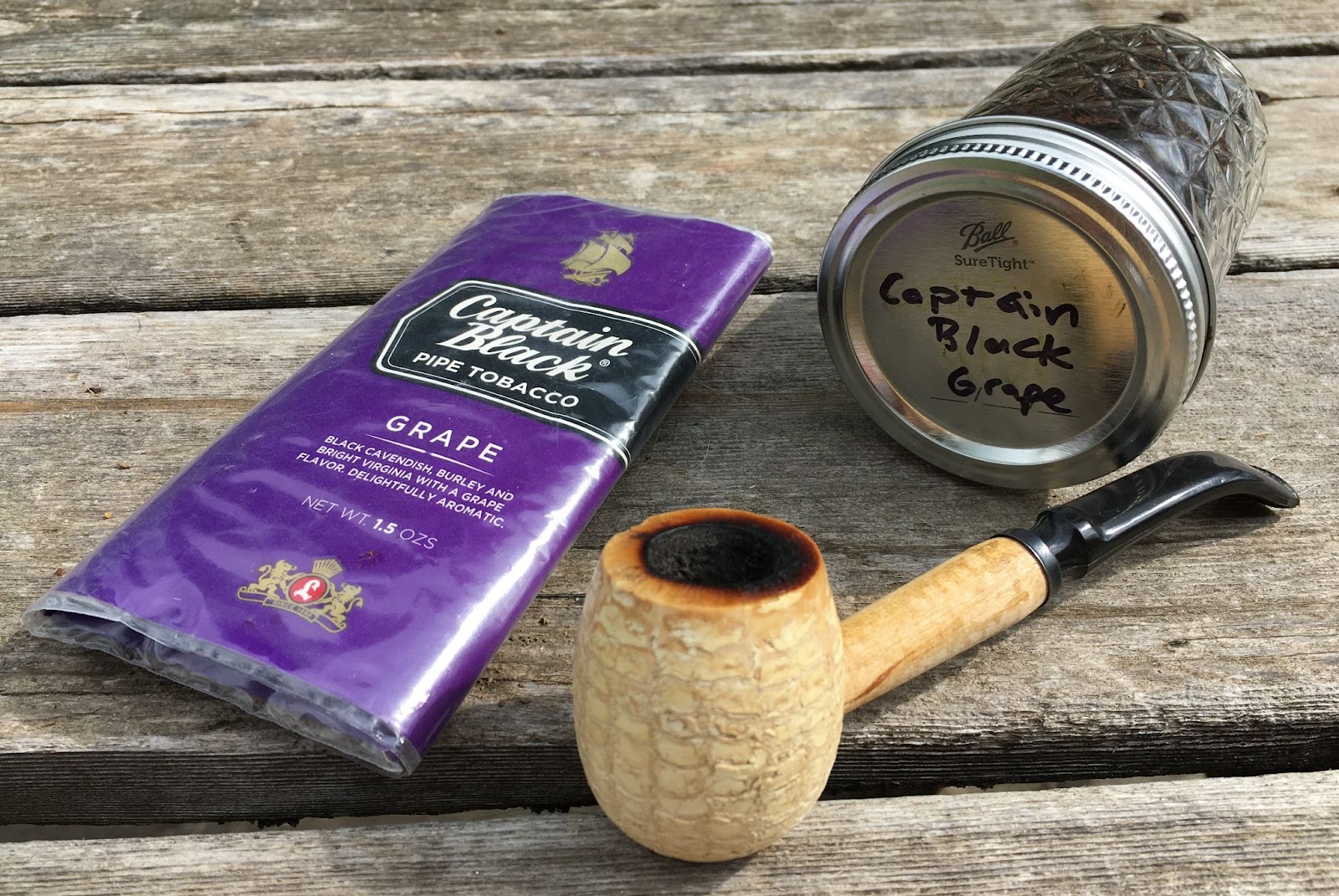
I have found in this group a unique group of about 1,600 folks that are open to others and even accept pipe smokers who like Captain Black Grape. Yeah, I know, crazy right. Oh, by the way, I have a jar of Captain Black Grape and a dedicated MM cob for that aromatic delight. The members are everything someone like me is looking for in a FB group, a bunch of friendly, funny, knowledgeable, giving individuals who put up with my nonsense.
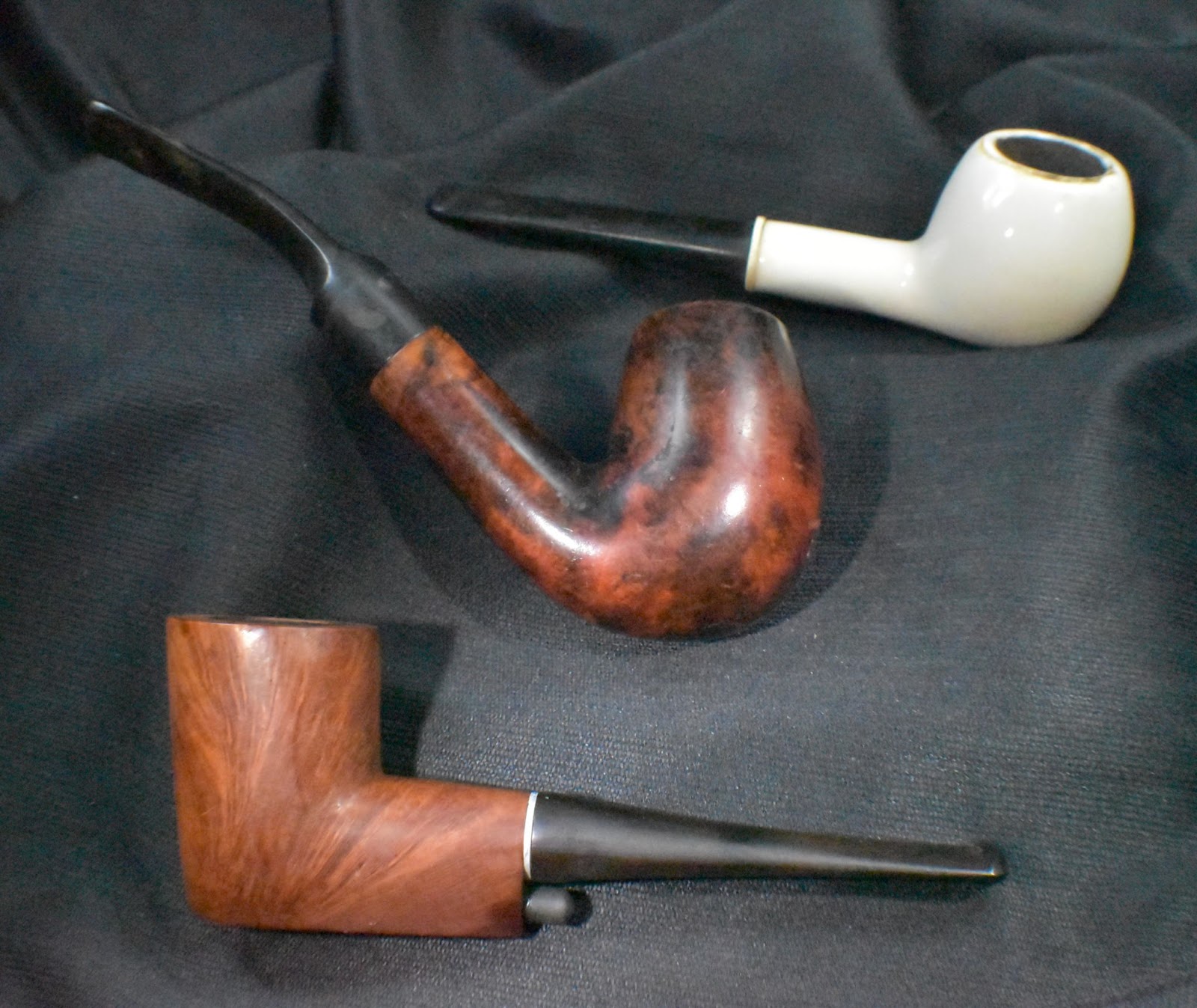
Anyway, I have been part of a cabal within the group who has been giving away some of the pipes I have restored and various other items like tobacco, tampers, rare bourbon samples, etc… I was recently asked if I would be interested in restoring three pipes, donated by another member, which we could in turn give away to group members. I said, “Sure”. So the next three restorations will be those pipes. Here is a photo taken of the three:
The first pipe I decided to work on was the porcelain apple, thus the title and subject of this posting. Below are some photos of the pipe before I did anything with it.
This restoration looked to be more of a cleaning and stem polishing than a true restoration. Some work would have to be done to improve the fit of the cork tenon. Other than that there was not a lot that the pipe needed.
Background
There really isn’t much I can say about this pipe without a whole bunch of imaginative conjecture. This pipe has no identifying stamps or marks. If I had to venture a guess, I’d say this pipe was made in Europe post WWII to 1980. I have included some links for those interested in porcelain in general and a couple more specific to pipes below.
The pipe began on the workbench with a cleaned denim piece.
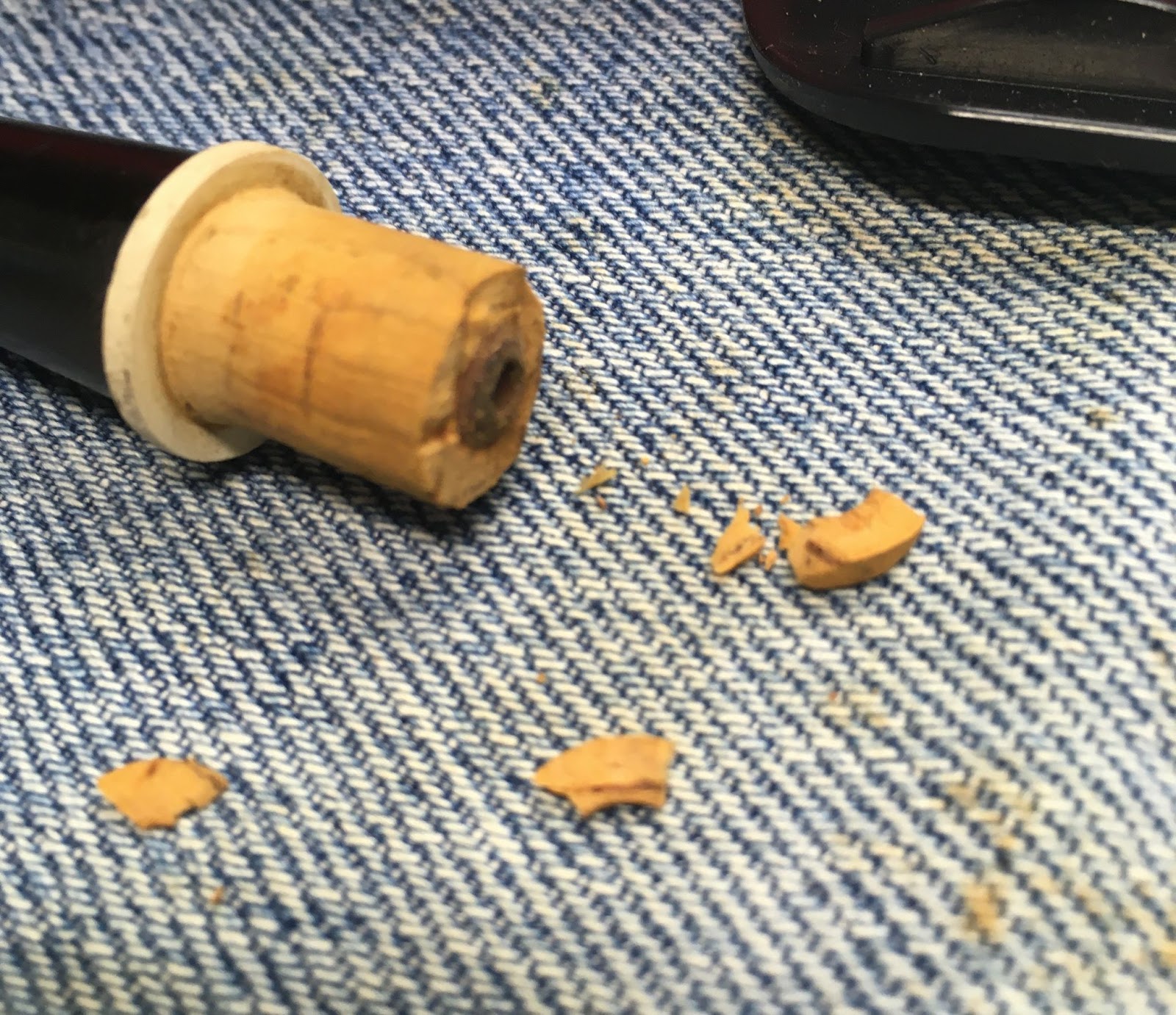
An Exacto knife kit was broken out for a little bit of cork trimming.
The cork tenon had a rough and unsightly end. This would need to be trimmed and sanded.
The cork proved to be very dry and brittle leading me to think that it was probably at least 50 years old.
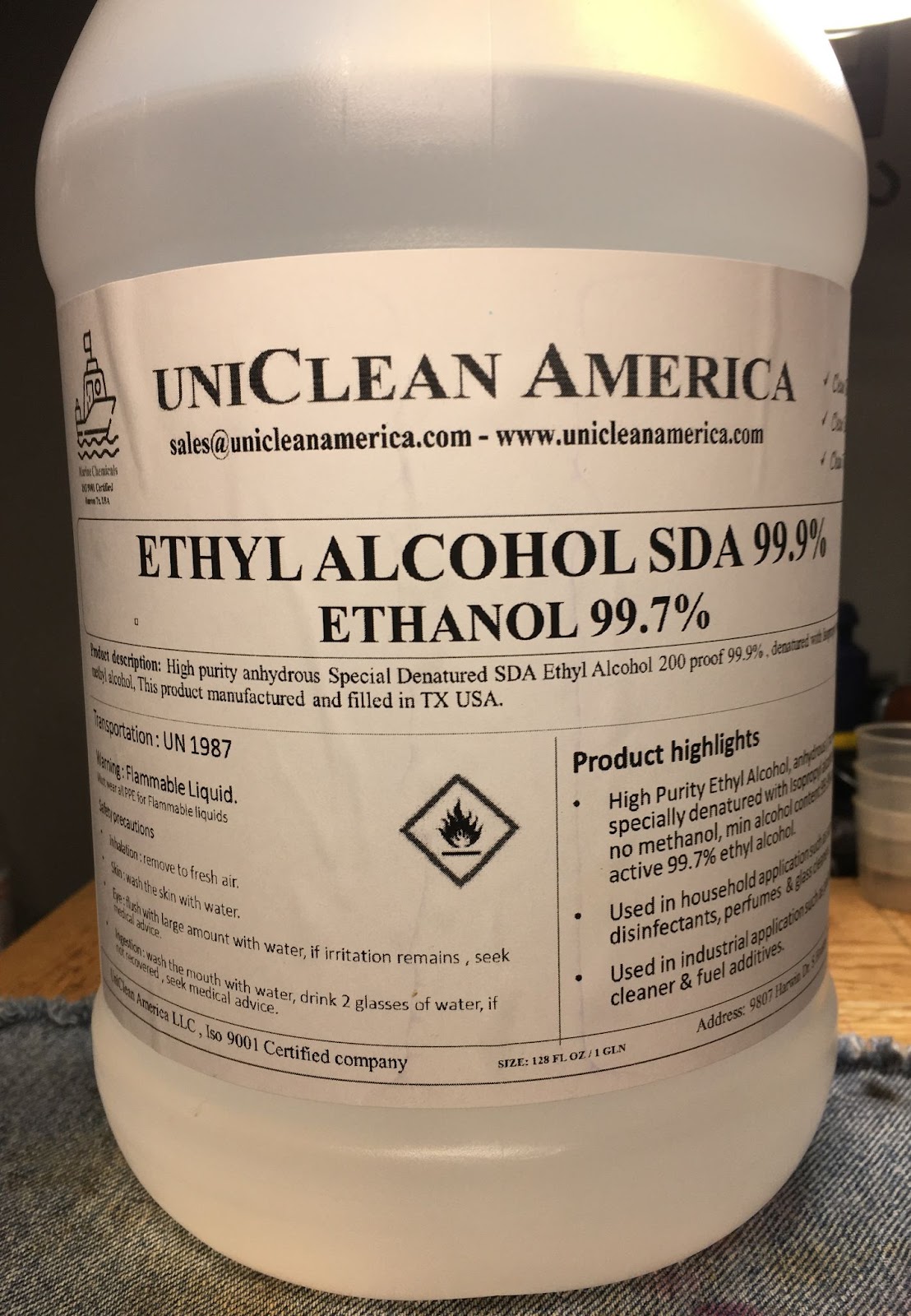
With the cork trimmed and sanded, I cleaned out the stem using bristle pipe cleaners and 99% ethyl alcohol. I had been using 95% ethyl and recently switched to this product.
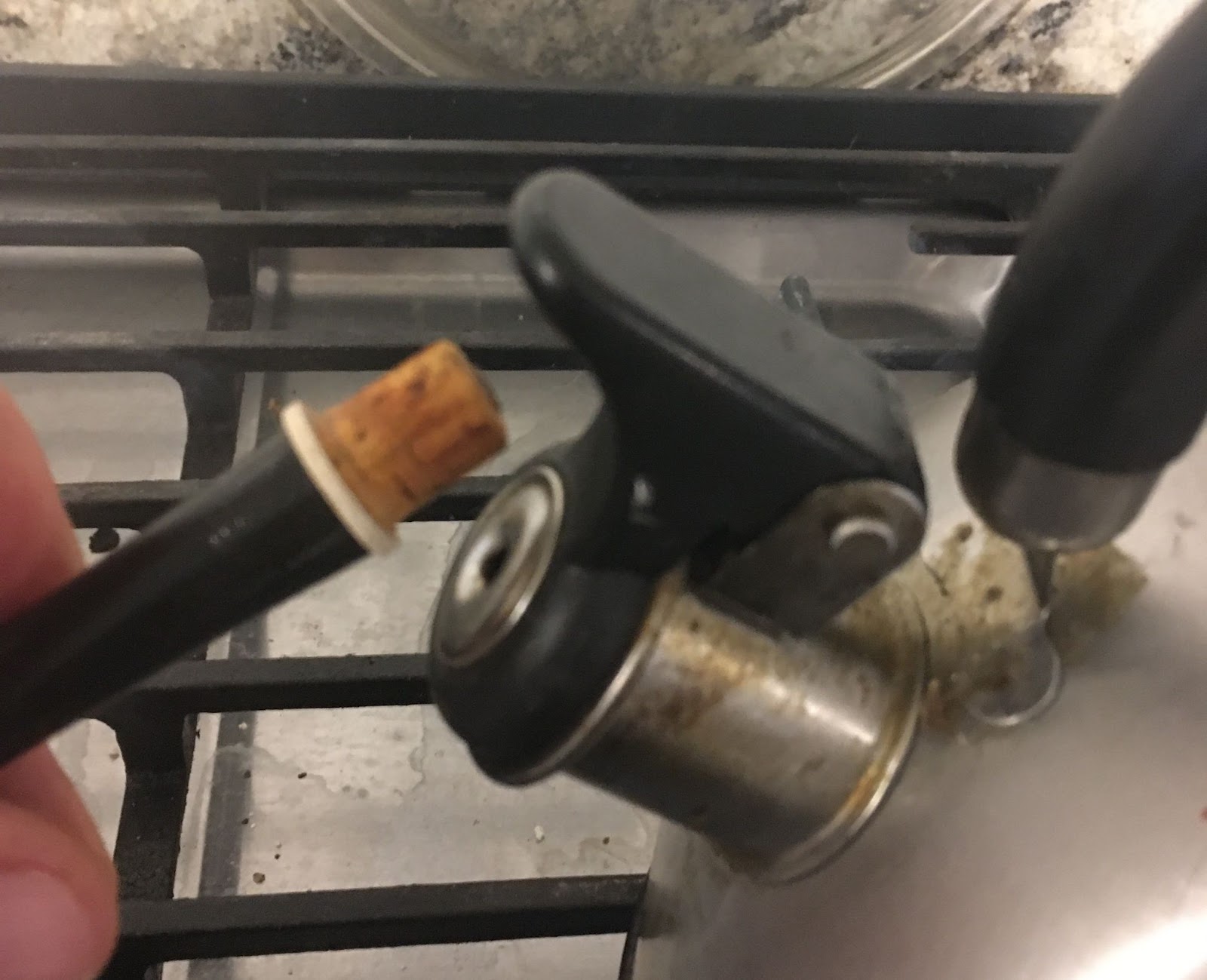
To address the dryness of the cork I got out the trusty old tea kettle and started some water on the stove.
The cork was steamed for about 5 minutes. This is precisely the amount of time it takes for the kettle’s whistle to become so annoying that you have to stop or become patient at Homicidal Acres Home for the Mentally Unstable.
I then rubbed some petroleum jelly onto the cork to hopefully preserve the now swollen cork. This did greatly improve the fit of the stem to the stummel.
Next came the reaming of the tobacco chamber. Porcelain is a hard material but in my mind, it is also brittle. I’ve never broken a porcelain pipe during cleaning but I have only worked with one other so my experience was rather limited. I chose to treat it more like a meerschaum pipe and only used the Smokingpipes Low Country reaming knife to scrape the chamber.
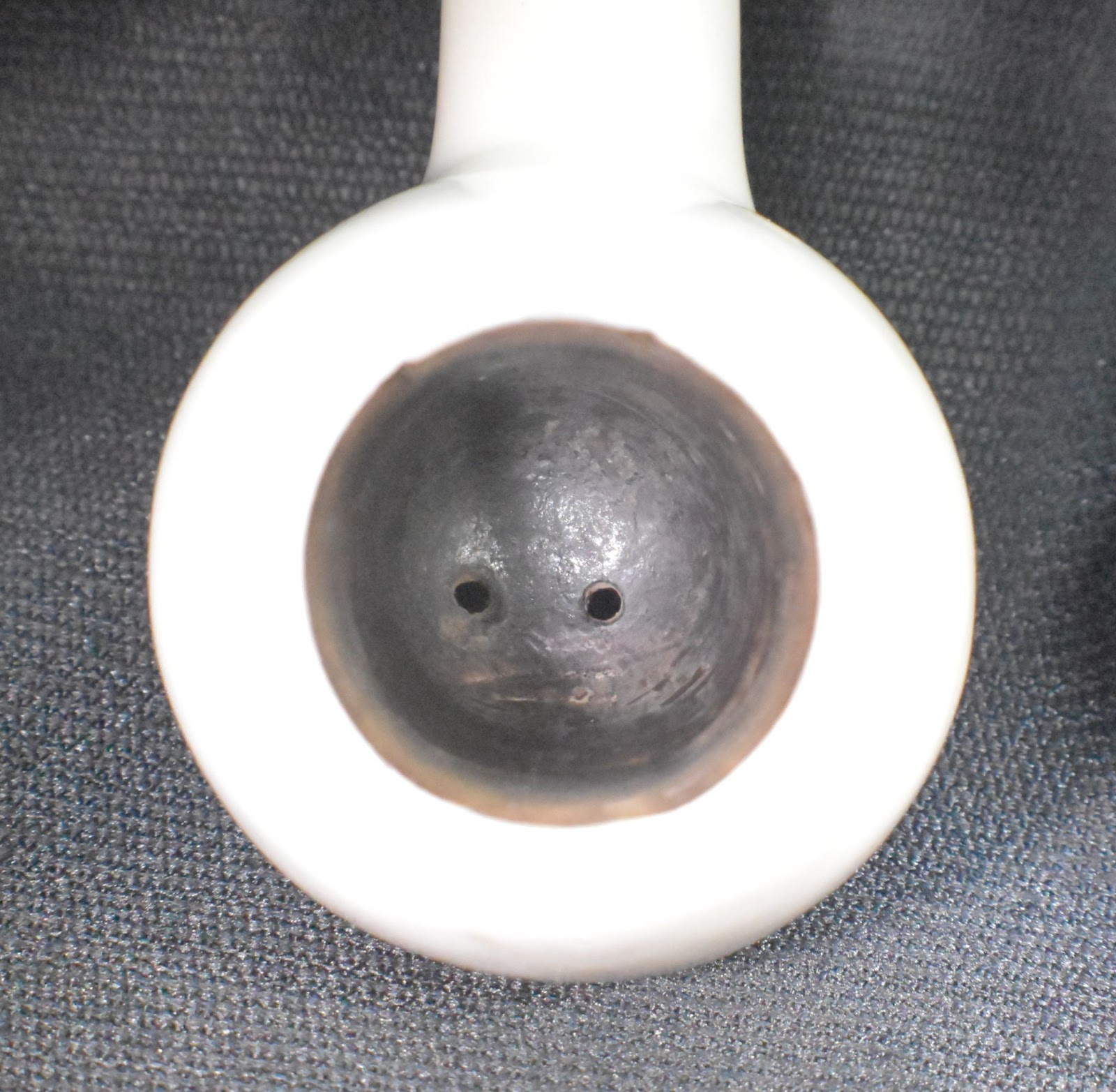
A small amount of cake had been deposited within the chamber.
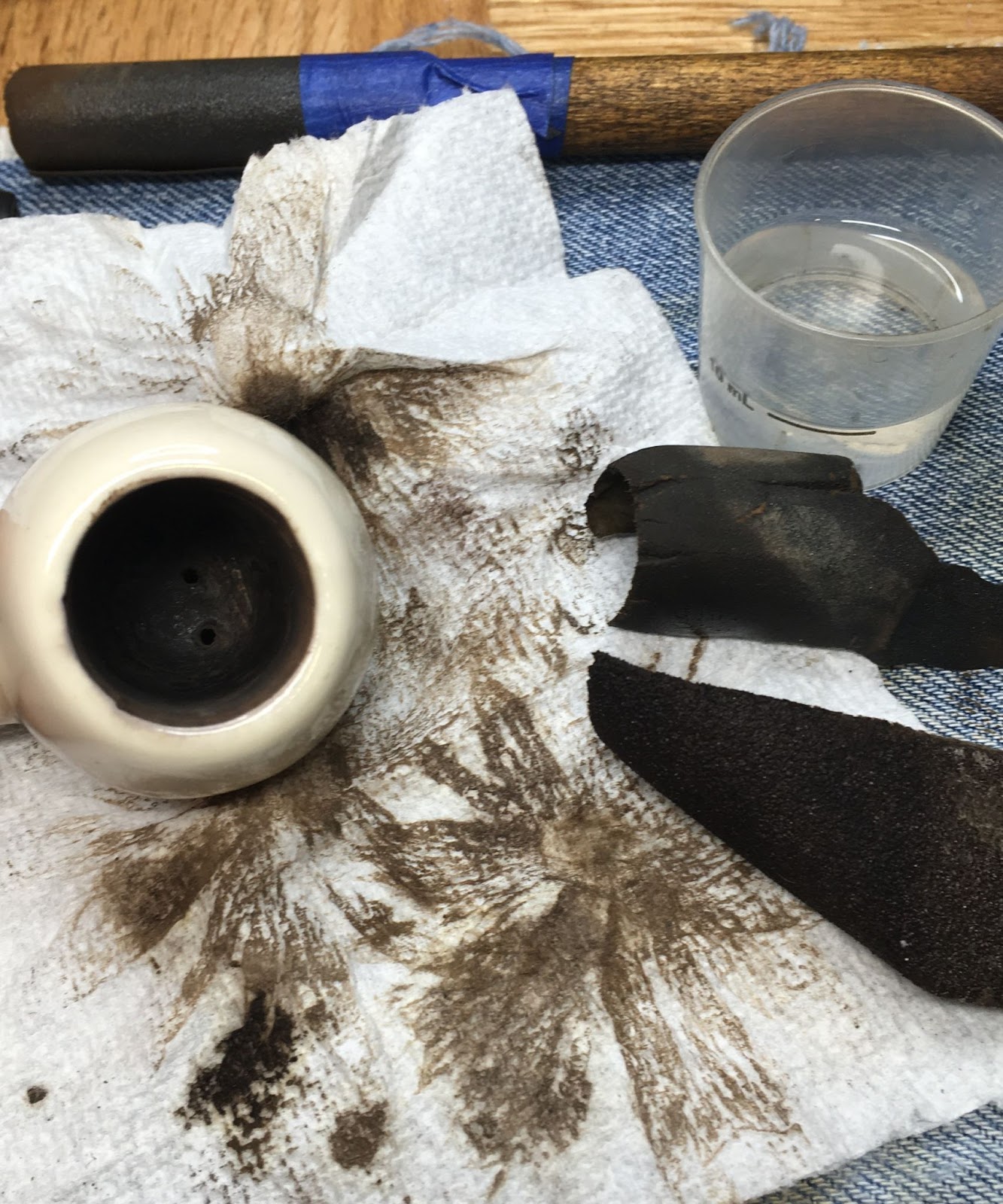
Alcohol dipped cotton swabs removed the smaller particles and more soluble cake remnants.
I used 3200 sandpaper wrapped around a wood dowel and a piece of sandpaper wetted with alcohol to sand the interior of the tobacco chamber.
And some more sanding. The carbon cake seemed to be well on its way to becoming diamond.
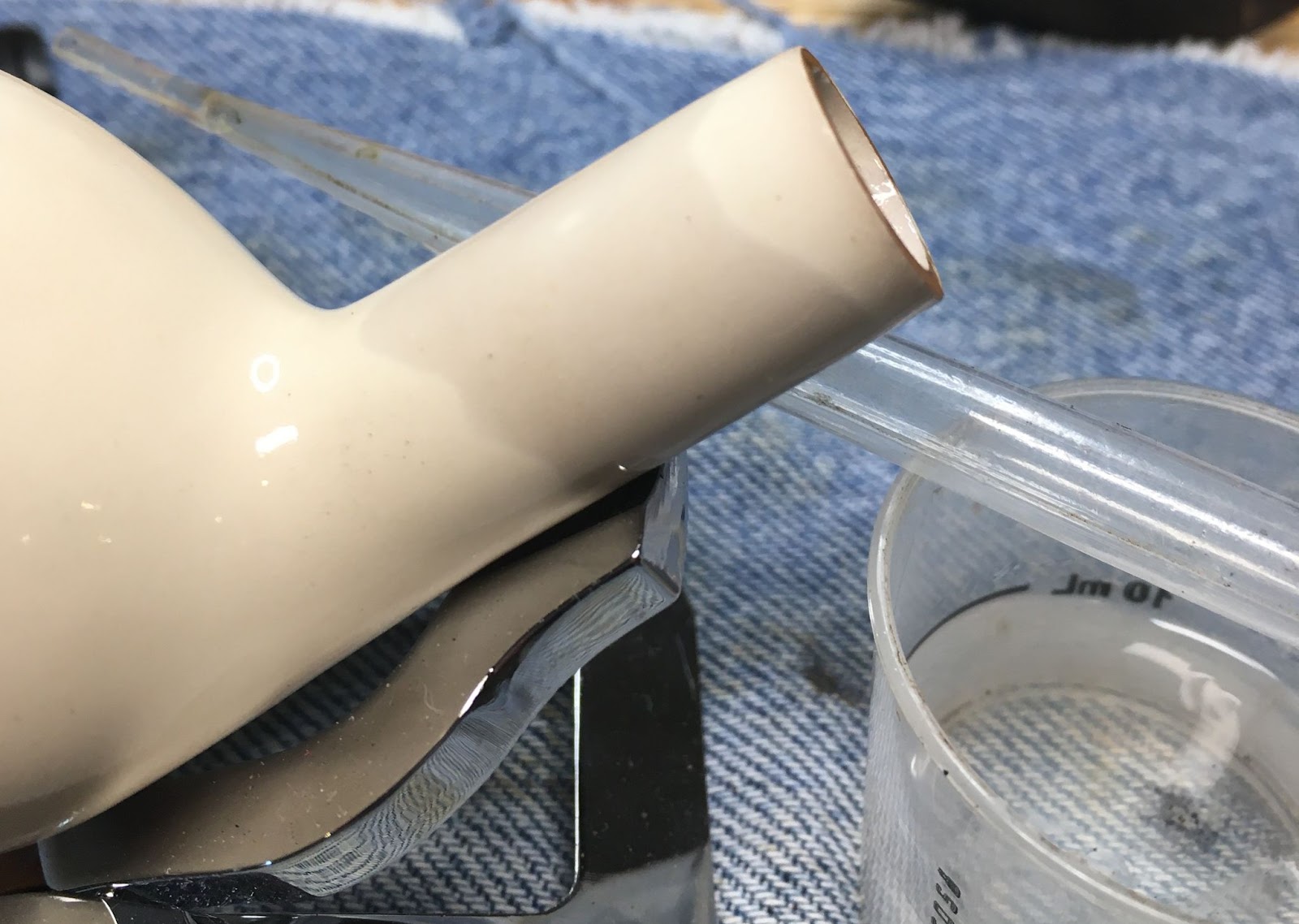
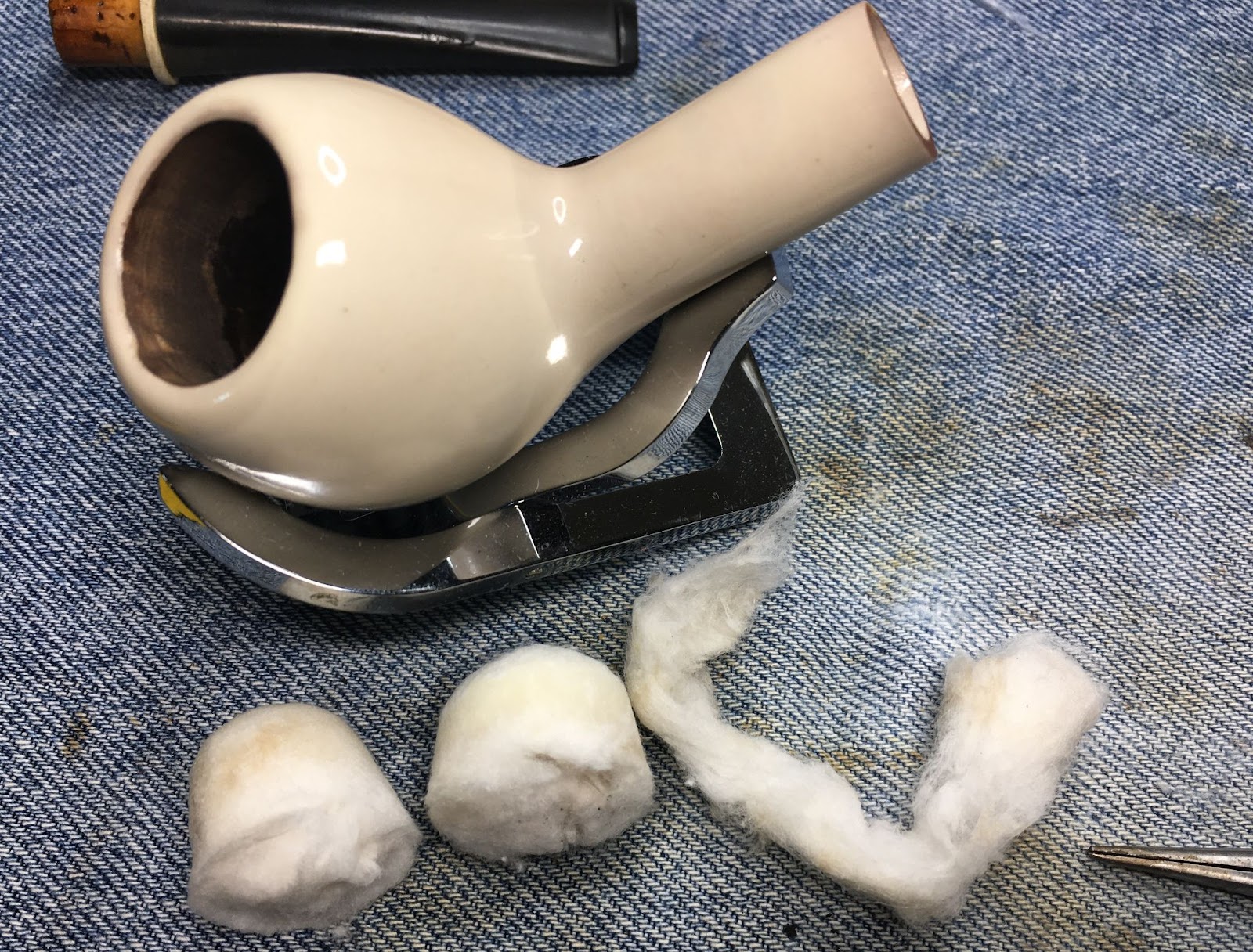
I eventually called it quits on the sanding and thought that perhaps a cotton stuffing and alcohol soak treatment might soften the remaining cake and remove any residual “old tobacco” aroma.
The tobacco chamber and shank were stuffed with cotton and then saturated with the 99% ethyl alcohol.
The unglazed porcelain of the shank began to discolor from the alcohol. I did not think this would be permanent with the evaporation of the alcohol.
I compared my other example of a porcelain pipe to this pipe. I was struck by the color difference. My bent pipe has been smoked numerous times and it has taken on a very nice creamed coffee color. It was originally a bright white as well. The apple had obviously been smoked but had not experienced the same coloring.
After allowing the alcohol to work its magic overnight, I removed the now dry cotton. As you can see in the photo below very little smoking residue was absorbed by the cotton. The discoloration on the shank had also disappeared.
I turned my attention to the stem. I filed the tooth chatter with a small flat file and lightly sanded the bite zone with a 320 grit sanding sponge.
The stem was then worked with sanding sponges from 320-3500 grits. Between each sponge I rubbed the stem with mineral oil and wiped it with a paper towel.
The stem was then worked with micro-mesh pads in grits of 4000-12000. Between these pads I rubbed the stem with Obsidian Oil and wiped with a paper towel.
I rubbed a coating of Before and After Hard Rubber Balm onto the stem and let it sit overnight.
The next day the pipe was taken to the buffer where I applied several coats of carnauba wax to the stem and stummel. The final step was to hand buff the pipe with a microfiber polishing cloth.
I think the porcelain pipe is a unique piece of our hobby and history. I only have a single example of my own and I have mixed feelings about it. I do like how mine has colored over time, taking on a creamed coffee color. I do worry about the fragility of the porcelain and my tendency to drop things. This porcelain apple is a wonderful shape and size. The exterior is a brilliant glossy white. The tobacco chamber interior has discolored and I suppose that I could have been more aggressive with the restoration but I did not want to damage the porcelain. My inexperience with this material kept me from “tough love” during the chamber restoration. The expansion of the cork tenon worked well and the stem polished up very nicely. The black and white of the piece is truly eye-catching. The double holes at the bottom of the tobacco chamber provide an exceptionally smooth draw and I am sure that this pipe will treat its new owner with years of contemplative relaxation. The dimensions of the Porcelain apple are:
Length: 5.78 in./ 146.81 mm.
Weight: 1.45 oz./ 41.11 g.
Bowl Height: 1.64 in./ 41.66 mm.
Chamber Depth: 1.17 in./ 29.72 mm.
Chamber Diameter: 0.77 in./ 19.56 mm.
Outside Diameter: 1.62 in./ 41.15 mm.
I do hope that you have found something here useful to your own pipe care, maintenance or restorations. If you like this sort of thing, please click the like and subscribe buttons. Thank you for reading the ramblings of an old pipe lover.
Loading…
Below are some photos of the finished Porcelain apple.
I suppose some people dream about finding an original unsmoked CUstom-bilt pipe in an antique shop with a price of $5 hung delicately from a tag on a string. That sounds to me more like a nightmare. Well, the $5 would be okay, I guess but finding a Custombilt that didn’t need to have hours of work done sounds terrible. They are fun pipes to work on and I am a restorer. Sure, I am self-proclaimed lazy and like to work on an easy restoration on occasion but still, it is a restoration. Bringing an abused greatly loved pipe back to life so that it can be greatly loved some more is what I look forward to. And today’s restoration was just that. This Custombilt had been smoked quite heavily in its day. A three tier wedding cake had nothing on the cake in this pipe’s bowl. This pipe came as part of a trio, 2 Custobilts and a third “look-alike” back in March. This pipe wears a Custombilt, all one word no hyphen, over IMPORTED BRIAR stamped on the left shank. No other stamps were found. Below are some photos taken prior to work being done on the pipe.
Now, you may think this looks like a nightmare. For me, the stuff dreams are made of. The pipe would need a replacement stem. Remember when I said this was part of a trio? The other Custombilt in the trio was a stem donor. I am still not sure if that pipe can be saved but it certainly can donate its saddle stem for this recipient. The bowl would definitely need a good reaming. Here is to not finding any charring in that well used tobacco chamber. The rim was quite lava encrusted, probably concealing a charred rim. Some people call me a pessimist, I call myself a realistic optimist – always expecting the worst thus avoiding the horror of disappointment.
Background
Back on January 2, 2025 I did a blog on a Custom-Bilt pipe. Below you will find the “Background” information from that restoration. Being a proud Generation X slacker type, I will include it here rather than try to come up with something original.
“The standard starting point for researching a pipe typically includes pipedia.org. The query of Tracy Mincer, originator of Custom-Bilt, will take you to this brief entry:
“Tracy Mincer started the original Custom-Bilt pipe company in 1934. In 1946, the name was changed to Custombilt after Mincer began an association with Eugene J. Rich, Inc. There were some big changes in advertising and distribution. The slogan “AS INDIVIDUAL AS A THUMBPRINT” began at this time as well.
In the early 1950’s, Tracy Mincer developed severe financial problems that caused him to stop making the Custombilt, and he lost the name. n 1952, Mincer began a new pipe, The Doodler, that due to the holes in the bowl had to made primarily in a billiard type shape in three sizes. In the early 1950s, National Briar was turning the bowls for Mincer. Based upon the documentation, it appears that Mincer made the pipe until the mid 1960s, when National Briar Pipe Co., Inc. began making and selling the Doodler.
Mincer died in 1964. Based upon the information provided, Mincer seemed to always have money, production, distribution and other problems. Mincer was probably a terrific craftsman but a very poor businessman and administrator. To me, Mincer sounds like your typical small business entrepreneur who always knew what was right and if you disagreed¼problems. Mincer always seemed to be on the brink of going out of business, not meeting payroll and so on.
Claude Stuart purchased the Tracy Mincer Pipe Company and began making pipes using the Tracy Mincer stamp. Stuart finished nearly all the pipes produced, mostly carved and textured bowls and the occasional straight grain. Claude made the Tracy Mincer Pipe Company a moderate success. Stuart became ill and in 1990 The Tracey Mincer Pipe Company went out of business. Currently, Jim Tedesco owns the Tracy Mincer name.
These interesting examples bellow are pipes made with the Tracy Mincer stamp. If you any additional information about these pipes, or can otherwise add to the history of this interesting pipe man, please add it here, or send it to sethile.pipes@gmail.com, and we can add it for you.” (Mincer – Pipedia).
There is a book written by William E. Unger, Jr.,Ph.D titled “As Individual As A Thumbprint”: The Custom-Bilt Pipe Story. This book appears to be self published by Dr. Unger at The Graphic Touch, of Columbus, Ohio. Printed in 2001 and bound with a black plastic spiral, the book states that the entire contents are “All rights reserved…without permission in writing from the author”. Dr. Unger passed away January 1, 2013 (obituary: https://www.legacy.com/us/obituaries/dispatch/name/william-unger-obituary?id=12197453) and the book is no longer in print. This unfortunately means that I will not be including any quotes from the book. We’ll see how I get around that, I guess. I got lucky and purchased a copy from eBay for under $30 (with shipping) earlier this year, after watching several copies sell for what I considered astronomical prices. The book is a remarkable piece of work and is the definitive history of the Custom-Bilt pipe. The research that Dr. Unger put into getting the story correct is amazing. Fortunately there were several past employees, friends and relatives associated with Tracy Miller and the company that were able to give interviews and explanations to the inner workings of the company.
In regards to the stamps on the pipe in hand, I will speak to what I have found in Unger’s book, without quoting any of it. The first thing that needs clarification is the Custom-Bilt vs. Custombilt name. I’ll paraphrase William Unger here, the first stamps used by Tracy Mincer were “Custom-Bilt”. These were used from 1938-1946 definitively and less definitively prior to 1938. You could, perhaps, find reference to this in the book on page 91. There, I think that should give me legitimacy and keep any lawyers at bay. Next we examine the IMPORTED BRIAR stamp on the bottom of the pipe. Unger states that he has inspected a large number of Custom-bilt pipes and that about ½ of them do not have this stamp. He declares that he is at a loss to explain either their absence or presence This lack of explanation might be seen towards the bottom of page 114. The final stamp on this Custom-Bilt is the geometric circle stamped on the shank. Certainly these stamps have some utilitarian meaning. Nope. Unger declares that he is not able to explain any system where shapes such as circles, triangles, stars, rectangles, half moons or even trapezoids have any systematic meaning. This may or may not be seen on the top of page 114.
Pipephil.eu does allow quotations with proper referencing and shows nice examples of the above-mentioned geometric stamps.
Regarding this pipe, I looked at the stamp diagrams from Unger’s book and matched this pipe with stamps from the Wally Frank years. This would date this pipe to 1974-1987 and most likely put production at the Weber factory in New Jersey.
The Restoration
The pipe made the 20 foot trip from the photos table to the bench and received a cleaned piece of denim.
I reexamined the cellophane tape spacer in the mortise.
I had no plans of attempting to salvage that mouthpiece and that tape had to go. I removed it with gentle pressure and forceps.
The old adhesive gave way and the tape was removed in a single piece.
The reaming tools were gathered. I planned on using the PipNet blades in sequential order from smallest to largest with each one removing a layer of the overabundant cake.
The first blades did a fine job. It was here that I decided that I wanted to know how much cake was actually present.
I started pouring the removed cake into an empty snus container for weighing at the end of the reaming.
The 2nd blade also did a fine job.
With the results deposited into the plastic cup.
Of course the 3rd blade came next and performed valiantly.
I was accumulating quite the pile of cake.
Finally the fourth blade, the poor fourth and often unused blade that infrequently is not needed, got his chance to shine.
There it was the collection of all four PipNet blade’s work.
I took it up to the electronic balance and was surprised to see 0.22 ounces or 6.24 grams of cake. Dang near a quarter ounce. I wondered, “how much tobacco did that take?”
Back to work. The tobacco chamber was sanded with 32 sandpaper wrapped around a wood dowel. The chamber looked good but…
On both the left and right sides of the interior front of the chamber there were signs of “spider web” cracks from excessive heat.
The spider webbing was light and superficial. That thick layer of cake had protected the briar quite well. I did think that a good bowl coating would be in order at the end of this restoration.
Next came the scraping of the rim. The lava was moistened with saliva and allowed to sit for a few moments while I put away all the reaming tools. I then used a sharp pocket knife to carefully scrape the lava from the rim. There was one large char area at the 8:00 position on the outside edge of the rim. This was likely due to a lighter.
The shank cleaning was next and after the condition of the tobacco chamber, I had visions of using boxes of cotton swabs and liters of alcohol. I used a couple of alcohol dipped cotton swabs to moisten the residues in the airway and ran the Kleen-Reem shank drill through the airway. It brought out a good deal of crusty yuck. Additional scraping was done with a dental scraper.
I then used a nylon shank brush dipped in alcohol. You can see from the photo below that this started out very dirty. Folded bristle pipe cleaners along with more cotton swabs and a good dose of ethyl alcohol helped clear the filth Within a few scrubbings the airway was cleaned.
The stummel was then taken to the sink for a scrub with undiluted Murphy Oil Soap and a nylon brush. The soap was rinsed with warm water and dried with a cotton hand towel.
Back at the workbench the stummel was wiped with a cotton ball wetted with 95% ethyl alcohol.
The rim looked much better than it did but would require a light topping with 320 then 400 grits sandpaper.
The charred spot on the outer rim was scraped with a sharp pocket knife then sanded with a 400 grit sanding sponge.
The rim was topped with 320 and 400 grit sandpaper laid flat on a countertop.
It was time to find a donor. Fortunately this CustomBilt arrived with another. This other had a saddle stem and a crack through the bowl on both the front and back. I have tried to reduce and compress these cracks to no avail. I have pretty much set the cracked CustomBilt aside and think about potential fixes now and again. The stem from the cracked pipe seemed like a near perfect fit to the Custom Bilt at hand.
I realized that the original stem was a taper and this replacement was a saddle stem but they were both CustomBilts of the same era.
The fit of the donor stem was slightly larger than the shank of the original pipe.
Since I know of no way to increase the diameter of a shank, I do know how to reduce the diameter of a vulcanite stem.
First things first. I had to snug up the tenon so that it was a nice solid fit to the mortise. I decided to do this by thickening the tenon with black cyanoacrylate (CA, super glue). A thin bead of black CA was added to the tenon
I used a curved dental scraper to evenly spread the CA over the tenon.
The wet CA was spritzed with a CA drying accelerator then sanded with a 400 grit sanding sponge. The new fit was very good.
With the stem securely attached to the stummel I could start the shaping of the stem. I wrapped the shank in masking tape to protect it from the activities with the file. The tape had to be replaced several times to keep the shank covered.
Eventually I stopped filing and started smoothing the stem with emery boards for finger nail filing.
To make the seam even better fit, I use Scotch tape as it is even thinner than the masking tape.
Eventually I removed the tape altogether and sanded the shank and the stem in unison. This worked because there was no rustications or stampings on the end of the shank. I had little fear of blending the briar from the old finish to the new. The stummel and stem were worked with a series of sanding sponges from 320-3500 grits. Between each sponge the stummel was wiped with a cotton ball moistened with alcohol. The stem was rubbed with mineral oil and wiped with a paper towel between sponges.
The stummel was given a coating of Before and After Restoration Balm applied with a soft bristle toothbrush and allowed to sit for 20 minutes
The excess balm was wiped from the stummel using an inside out athletic sock.
The shank and stem were buffed using white buffing compound on the buffer. Next, several coats of carnauba wax were applied to the pipe. The final step was another hand buff with the microfiber polishing cloth then a return to the photography table for the finished pipe photo shoot.
I realize that I changed the appearance of this pipe quite a bit by replacing a taper stem with a saddle stem but I feel that since they were both original CustomBilt stems it was more acceptable.The notch on the rim doesn’t detract from the appearance and almost looks like it is supposed to be there. The rustications cleaned up very nicely and look great with the freshly sanded smooth portions. The replacement stem also polished up very well and it looks good with the stummel. I think this restoration was a great success and will allow some new owner to make and have many memories of their own with this wonderful old pipe. The dimensions of the now saddle stem CustonBilt are:
Length: 5.65 in./ 143.51 mm.
Weight: 1.79 oz./ 50.75 g.
Bowl Height: 2.09 in./ 53.09 mm.
Chamber Depth: 1.71 in./ 39.88 mm.
Chamber Diameter: 0.88 in./ 22.35 mm.
Outside Diameter: 1.56 in./ 39.62 mm.
I do hope that you have found something here useful to your own pipe care, maintenance or restorations. If you like this sort of thing, please click the like and subscribe buttons. Thank you for reading the ramblings of an old pipe lover.
I’ve probably used this line before and will likely use it again, “An apple a day keeps the doctor away.” Yeah, I know those pesky docs are not likely referring to the wonderful apple shape of a pipe but I am. This lovely apple is a French made Earl of Essex. I have no idea when it arrived nor where it came from though it has been waiting for some attention for well over six months. I was looking for a restoration where I could just relax and kind of let my mind wander and hands work on muscle memory. This pipe looked like the perfect project. The pipe had EARL OF ESSEX stamped clearly on the left shank with ALGERIAN BRIAR over FRANCE on the right shank. The lower part of FRANCE was faint due to a slightly misplaced stamp, so I thought. The band read 12K over GOLDPLATE. Finally the stem had a circle logo pressed into the rubber. This circle appeared to have a light yellow or white (stained with age) paint in the depression of the stamp. Below are some photographs taken prior to working on the pipe.
Even through the dirt and grime I could make out a lovely contrast stain. The pipe looked like it had not been used too heavily, indicated by the lack of cake in the tobacco chamber and general cleanliness of the stinger. The stem was not oxidized and showed no signs of teeth marks. There were several old fills that were either failing or were never done very well. The 12K gold plate was worn on the edges yet I thought it might buff out nicely.
Background
I would love to tell you that there was a wonderful amount of information about this pipe maker and date of production. Alas, all I could find is a couple of pictures from pipephil.eu.
The stamping of the top pipe from pipephil.eu was a definite match to the stamping on the pipe in hand. The part that bothered me was the stem logo. Both of the images above had crowns on their stem logos. The top photo is even described as having “12K Goldplate” on the band. Now I could imagine a heavily used pipe needing to have a stem replaced and the new stem could have a circle logo on it rather than a crown. This is certainly a possibility. This pipe had not been heavily used. The term barely used would be more appropriate. I highly doubt this is a replacement stem. As for the age of this pipe, I cannot be certain but a couple of world events can be used for guessing the production years.
During World War 2 the briar from Algeria was not available nor was the aluminum.
The Algerian civil war waged from 1954-1962. During that time briar harvest and exports were non-existent.
This would indicate that the pipe was either produced pre-WWII or sometime after the French Algerian war.
The Restoration
The Earl of Essex made it to the workbench and a denim piece after the photo shoot.
The ream team was gathered.
PipNet with #2 size blades did the majority of the work with the Smokingpipes Low Country reamer doing some clean-up.
I sanded the tobacco chamber with 320 sandpaper wrapped around a wood dowel and with my ring finger. The chamber looked great with no signs of any damage from heat.
The rim had some light lava deposits.
I moistened the lava with saliva and scraped the rim with a sharp pocket knife. The rim was then wiped with a make-up pad dipped in alcohol.
The shank cleaning was uneventful and reinforced my belief that this pipe had not seen a great deal of use. The airway was cleaned using cotton swabs and folded bristle pipe cleaners both dripped in 95% ethyl alcohol.
The stem cleaning was equally easy. The first pipe cleaner was stained with residue but subsequent cleaners eliminated the tars quickly.
The stem was lightly sanded with a 400 grit sanding sponge to remove any wax and surface oxidation before the stem was submerged in Briarville Pipe Stem Oxidation Remover.
I hung the stem in the solution using a pipe cleaner inserted into the stinger. It didn’t want the aluminum stinger in the solution. The stem remained in the bath for about 4 hours.
While the stem was soaking, I turned back to the stummel and gave it a scrub with undiluted Murphy Oil Soap and a nylon brush. The soap was rinsed with warm water and the stummel dried with a cotton hand towel.
The stummel still felt like it had wax remaining on the surface. I used a couple of make-up pads dipped in 95% ethyl alcohol to wipe the surface. This worked at removing the was and some of the black stain.
All the scrubbing made the old fills soft and easy to pick free from the briar.
There were several larger and smaller fills that would need cyanoacrylate (CA, super glue) and briar dust.
My brown CA is starting to get a bit thick. This is good and bad. Good because it stays where you place it bad because it leaves little strings of CA, like melted mozzarella. Anyway, the brown CA was placed into the pits with a fly tying bodkin. A small scoop of briar dust was then placed on the dab CA. Pressing the briar dust into the wet CA fills the pit.
This method does have a tendency to leave a CA-briar dust crust on the pressing finger. No really, it’s CA and briar dust and not that I’ve been picking snuff boogers…
The above fill method had to be repeated in a couple of the larger pits. Eventually a dab of either brown CA or thin CA was used as a top coat for the fills.
Once filled a small flat file was used to smooth the new fill then they were sanded with a 400 grit sanding sponge.
With the fill finished, I wanted to see what I could do with the gold plated band. I first tried Cape Cod Metal Polishing Cloths. I like this product for how well it works on silver and the smell is absolutely amazing.
It helped but the gold plate on the edges were worn through the thin layer of gold. I think the underlying metal was copper. Yeah, it was still pretty but lacked the luster of the gold.
The stamps and band were taped over with painters tape for their protection.
Better safe than sorry, eh?
The stummel was sanded with a series of sanding sponges from 400-2500 grit. Between each sponge the stummel was wiped with a make-up pad moistened with alcohol to remove sanding debris.
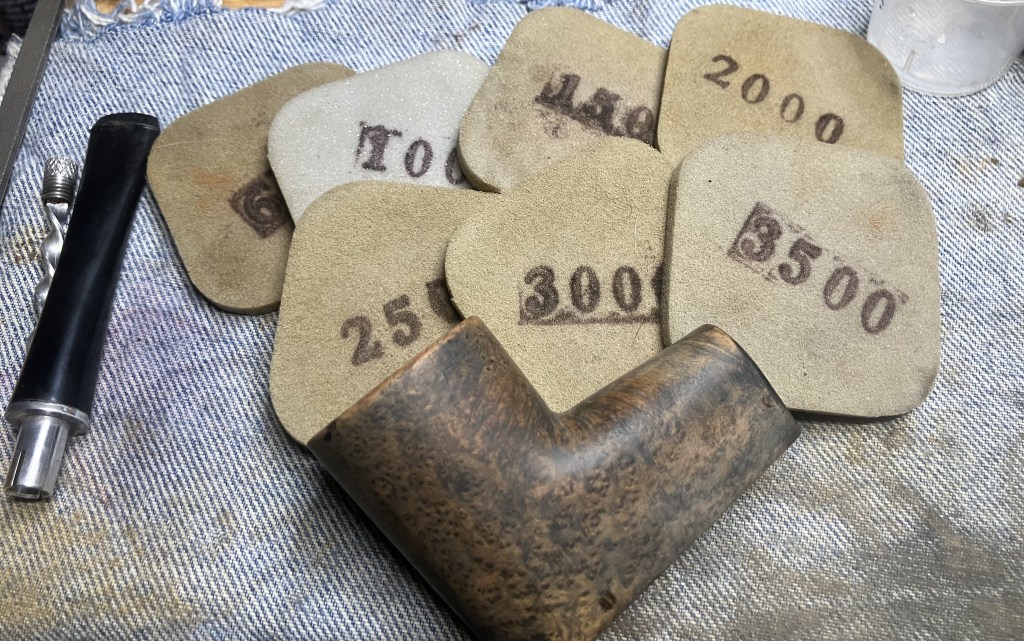
The stummel was then worked with micro-mesh pads 4000-12000 with wipings between pads as with the sponges.
I then gave the stummel a coating of Before and After Restoration Balm. This magic elixir was allowed to work its magic for 20 minutes before being wiped off.
For the wiping off of excess balm I used an inside out athletic sock.
Once the stem had soaked for the allotted time it was removed and vigorously rubbed with a coarse shop rag. Quite a bit of oxidized rubber came off onto the rag.
The logo stamp remained well defined. Apologies for the poor focus.
This stem did appear very grainy with tiny pores on the surface.
I cleaned the logo stamp with alcohol on a cotton swab and covered it with a painters tape mask.
Then covered the band with painters tape as well.
I sanded the stem with a series of sanding sponges from 320-1500 oiling the stem with mineral oil and wiping it between sponges. This tends to clog the sanding surface of the sponges quickly.
Pleased with the results from the first several sponges, I continued with the finer grits to 3500. Again oiling and wiping the stem between sponges.
I removed the mask from the logo and micro-meshed the stem with 4000-12000 micro-mesh pads. Between these pads I oiled the stem with Obsidian Oil and wiped it with a paper towel.
For the final stem polishing I used a blue buffing compound to polish the stem.
I was not sure of the original color of the paint in the logo but thought that a gold would accentuate the gold band. I opted to use Gold Leaf Rub’nBuff. This product settles into stamped surfaces nicely and provides a great gold color.
The wax was applied to the indentations with a fly tying bodkin and hand buffed with a soft cotton cloth.
The last bit of polishing was done with the buffer applying carnauba wax.
The final step was another hand buff with the microfiber polishing cloth.
This very pretty apple is now ready for a new owner. I think the pipe looks very good. The contrast stain from the factory was preserved. The gold band now looks better but the oxidation or worn-off gold plating could not be improved any more. The stem restored exceptionally well and really accentuates the contrast stain of the briar. Overall I was very pleased with the restoration. The dimensions of the Earl of Essex Apple are:
Length: 5.89 in./ 149.61 mm.
Weight: 1.57 oz./ 44.51 g.
Bowl Height: 1.79 in./ 45.47 mm.
Chamber Depth: 1.45 in./ 36.83 mm.
Chamber Diameter: 0.73 in./ 18.54 mm.
Outside Diameter: 1.51 in./ 38.35 mm.
I do hope that you have found something here useful to your own pipe care, maintenance or restorations. If you like this sort of thing, please click the like and subscribe buttons. Thank you for reading the ramblings of an old pipe lover.
Loading…
Below are some photos of the finished Earl of Essex Apple.
The next contestant on the program comes to us from Denmark and goes by the name, “Frasorteret”. This pipe was part of an estate lot that looked interesting from the initial photograph. I picked it up back in January of this year.
The pipes upon arrival were even more interesting than the photo indicated. This will be the second pipe of the lot that I’ve worked on. The first was the S. Johnson (the long shanked chimney, above) which was a very fun project. I had done a few Danish pipes this year and this shapely Danish damselle caught my eye. He pipe was stamped FRASORTERET over HAND MADE over IN over DENMARK over US. Below are some photographs of the pipe prior to working on her.
Yikes! Well first, it seems to need a stem. The shank spacer or ferrule is quite oxidized so that’ll require some problem solving. Then there is that monstrous fill on the back left. The typical reaming and cleaning will be done as well. Not an easy restoration but it should make for an interesting pipe.
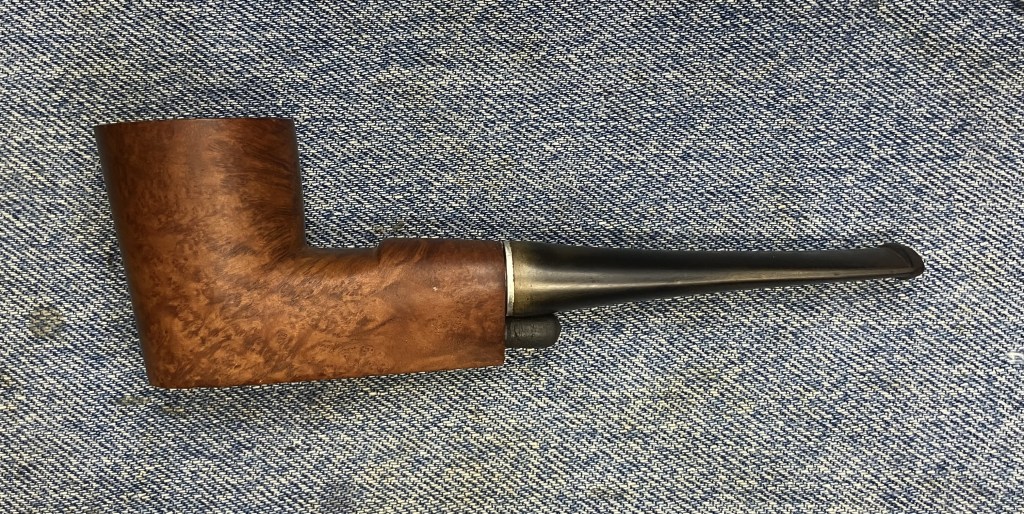
Background
I have restored a Frasorteret before but it was long before I started blogging about restorations. Here are the left and right sides of that pipe:
I thought I needed to have more than one Freehand pipe and that one struck my fancy. Here we are 3 or more years later and again I thought I needed to have more Freehand pipes. With the first Frasorteret I assumed the carved areas were for artistic expression and for great hand feel.
I researched Frasorteret first at pipephil.eu and found the following.
(Fr-Fz — Pipes : Logos & Markings). Preben Holm was a name that I had heard of though I admit to not being very familiar with his work or history. The next search on Frasorteret was on pipedia.org. I found the next sentence interesting because in my mind the Danes didn’t produce lower quality pieces of anything.
“The Frasorteret line of pipes were made by Preben Holm and were nearly identical to his normal line of pipes but for fills and pits and the like. The pipes were stamped “Frasorteret Made in Denmark.” (Frasorteret – Pipedia)
Hmm, apparently my preconceived notions about European craftsmanship is as flawed as this briar. The pipe in hand certainly had “fills and pits and the like.” Pits the size of Luxemburg.
I continued with the pipedia.org entry and found the below in the words of Preben Holm himself, I’ll include it in its entirety.
“The Story of my Firm
by Preben Holm
Already at an early age I became interested in pipes and in pipesmoking. After school I worked as an errand-boy in my father’s shop which was a provision shop with 3 departments, one dealing with pipes and tobacco, one dealing with wine, and another one selling magazines and cigarettes etc. When starting as an errand-boy I was 12-13 years old, and it did not last any length of time before the pipe department roused my curiosity, and it was there I spent my time when there were no goods to be delivered. My father was somewhat mean, and he only paid me a sixth of what I could earn somewhere else, but this, I think, was very sound. On the other hand I earned a lot of good tips, and this money I saved carefully and deposited it in the bank. Though at that time I did not know what I should save the money for it proved to be very important later on, because this became my “initial capital” in the pipetrade.
Early Preben Holm (Late 1960’s?) Courtesy, Dennis Dreyer Collection
My father was altogether a very wise man, and one of the things he did, and which I appreciate to-day, was to prohibit the smoking of cigarettes, but on the other hand he did not mind my smoking the pipe already at the age of 13 – 14. When I was 14 years old I got tired of going to school, very much to everybody’s amazement, as it was considered a matter of course that I should study in order to acquire a superior education. However, I was very tired of school, and therefore I asked my father to be allowed to leave the school. No doubt he was rather disappointed, but he did not want to force me into anything, and we agreed that I should begin a commercial training in his business. It was, especially to begin with, a mixed job as some hours each day I still worked as an errand-boy at the same time receiving a good training within the retail trade. Part of that education was that I had to go to a commercial school where I, no doubt, learned things by which I benefited later on.
The wine department I found very exciting, and I began to read thick books about wine, especially red wine, however, it was still the pipe department in which I was most interested. I was myself a very active pipesmoker, and both the pipes and the tobacco interested me very much, and it was not long before I practically was in charge of the pipe-department. I found that very exciting, and already at the age of 14 I managed the purchase of pipes and tobacco. Most likely I was not always popular with the sellers of pipes who considered me too critical, but I thought that necessary in order to live up to the confidence our customers of pipes gradually placed in me.
I remember that my father considered me to be a bit crazy when I began to buy tobacco for myself that was three times the price of the common Danish made quality, but I really thought that it was worth the money. Before long I also made my father accept the idea to include a very large selection of the better tobaccos, most of them made in England, into our assortment, and it did not take a long time before we had one of the largest selections in Copenhagen.
It is not allowed in Denmark to sell tobacco by weight, but I had the idea that the customers should have a chance to see what they were buying. Therefore I wrote a big book describing in it each single brand, attaching a small plastic bag of the tobacco. It was a great success. There also belonged a small repair shop to the pipe department, and very soon I took over the repairs.
In the meantime I had grown 15 years old, and my interest in pipes increases more and more. During some time an elderly gentleman, who himself made hand-carved pipes, had visited the shop and wanted to sell the pipes. Of course I was very fascinated by him. After I had talked with him a few times he asked me whether I had any money. I had after all my saved tips-money in total 1.400,00kr., and he said that this would be sufficient to buy the necessary machinery so that I could start making my own pipes. He was very helpful with he purchase of machines, and he made also the special tools that were required. I was allowed to mount the machines in a small room in my father’s cellar.
The room was only 1/2 m2 (13 1/2 square feet), and conditions were thus rather limited. The first Bruyere-blocks I bought from that nice gentleman, and I was now ready to start my own experiments. That was done after working-hours in my father’s shop, and I experimented in my small work-shop until 11:30 p.m. Then I had to finish, because I had to get up and open my father’s shop the next morning. On June 5th, 1963 11 days before my 16th birthday, the moment had come when I sold the first pipes to my father for sale in his shop. I then approached the big pipe shop Pipe-Dan that is situated in the city of Copenhagen, and that sells a lot to the tourists.
Pipe-Dan believed in a chance for the pipes I made, and he was prepared to buy 20 – 30 pipes each week. He was to judge the pipes and fix the prices. Now I became very busy and got some friends to come and help me in the evenings for a reasonable payment. I then taught them the more rough work so I myself got more time to occupy myself with the molding and finishing. In that way a couple of years went by, and one fine day I had finished my commercial education. I was now able to devote myself to the manufacture of pipes all day long as well as during the evenings and weekends. 18 years old I employed my first journeyman, and we made gradually 50 – 60 pipes a week which I continued mainly to sell to Pipe-Dan.
Then came the time when I had to serve my time as a soldier. I kept my journeyman who in the meantime had become quite skilful, and for the rest I went the long way home from the barracks every time there was an opportunity. I had now got a larger and better work-shop, but that did cost money and, as already mentioned, Pipe-Dan fixed the prices of the pipes, and the tendency was, I suppose, the more pipes we made the lower the prices. One day during my military service I realized that I was unable to keep my journeyman, and therefore had to sack him. That was not very pleasant.
One day while making the rather traditional hand-carved pipes as we had to in order to come by some money, I took a fancy to make something completely untraditional at that time. From the very beginning I had only worked with the finest Bruyere that could be provided, and on the whole it all had very pretty grain patterns, and that gave me the idea to try something novel. Contrary to what was done so far I started to form some of the pipes according to the grain pattern, and out of this I got some quite particular models. Thus having experimented a little while I had a very smart specimen, at least I thought so. At that time I received about 30,00kr. for a pipe from Pipe-Dan, and I remember that I first went and showed my father this special pipe. He was very impressed, but when I told him that I wanted to go to Pipe-Dan and ask 500,00 kr. for it he seemed not really to believe me. Anyway, I did it. Pipe-Dan studied the pipe and said. “By Jove, it is nice to see something novel”. He paid the 500,00 kr. and told me that I was welcome to make some more of them. However, there was naturally a limited market for pipes at such a price, and it was not long before he could not buy any more of them. Anyway, I continued to make them in addition to the ordinary hand-carved ones. I began also to let the raw bark-top be part of the design.
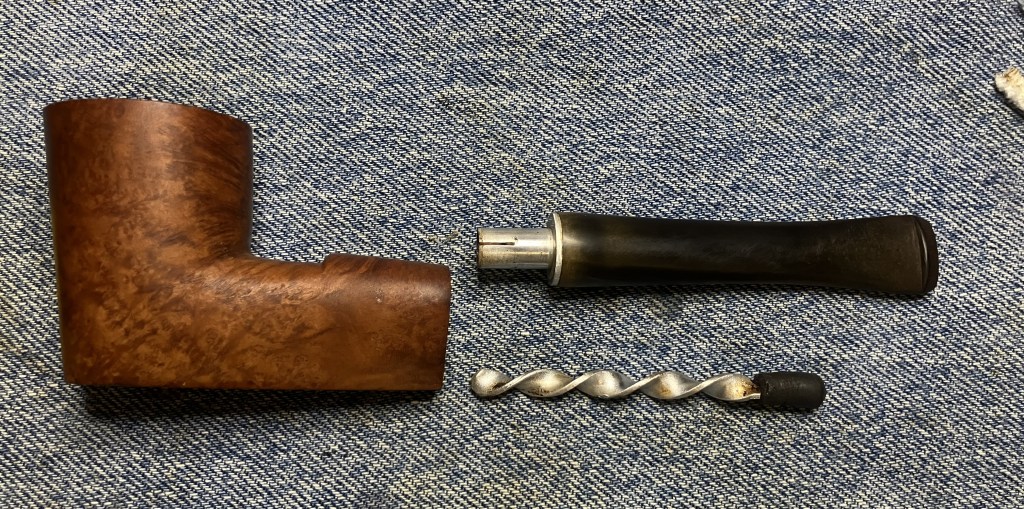
Courtesy, Doug Valitchka
When I was called up for military service I had 18 pieces of these pipes which I was unable to sell. Therefore I left them in my father’s shop. One day when I returned home there was big news. An American, called Lon Schwartz had been calling. Lon Schwartz was making a purchase trip for his retail shop in St. Thomas, the Virgin Islands, USA. When he saw the 18 pipes he was very enthusiastic about them and bought them on the spot, placing at the same time orders for everything I could make against being entrusted with the monopoly in the entire U.S.A. When my military service came to an end there was a lot to do. I could now afford to engage a journeyman, and very soon another one, and gradually we established quite a nice production.
I then got the idea that it would be fun to see where all the pipes were sold, and therefore I decided to travel to St. Thomas. St.Thomas is indeed a tourist island, visited by tourists from all over America, and it was these tourists who bought my pipes in Lon Schwartz’ shop. During my first visit I stayed in the shop for 2-3 weeks and had ample opportunities of talking with pipe-smokers from everywhere in America. That really gave me a lot of impulse. Then I returned home and continued working with the new inspiration. That was repeated 3 times within the first year’s cooperation with Lon. I could simply not have had any better starting point, because the taste changes quite a lot from one place in the U.S.A. to another, but here came, as mentioned, pipe-smokers from all the States. It was wonderful to feel how something one oneself enjoyed making really was accepted.” (Holm, Preben – Pipedia)
The Restoration
The poor stemless stummel made its way to the workbench and a cleaned denim piece.
The reaming tools were gathered.
PipeNet blades #2 and #3 did most of the work with the General triangular scraper just doing a bit of clean-up.
The reamed tobacco chamber looked good but sanding would tell the tale better.
The sanding of the chamber showed briar in great condition and no signs of heat damage.
The shank cleaning was done with bristle pipe cleaners, cotton swabs and a nylon shank brush. All of these were frequently dipped in 95% ethyl alcohol. There was some scraping done with a dental scraper but due to the narrow draft hole this was rather ineffective.
Once the shank was cleaned I took the stummel to the sink for a scrubbing with undiluted Murphys Oil Soap and a brass brush. The soap was rinsed with warm water and the stummel dried with a cotton hand towel.
The large fill, yeah I said LARGE, har the old fill material picked out with a fly tying bodkin. This was the largest fill I think I had ever seen. What to do about it filled my head.
I thought about my other Frasorteret and the quote from pipedia.org, “but for fills and pits and the like.” (Frasorteret – Pipedia).
I wondered if those carvings were not just there for artistic expression but instead, there to remove flawed briar. I thought that I could carve away the pit, smoothing the briar to make an artistic smooth thumb hold on this pipe.
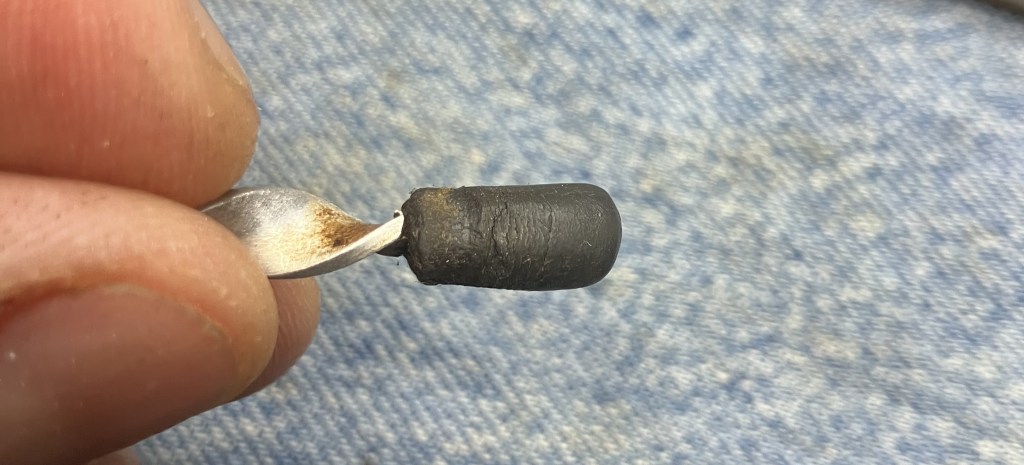
I got out a carving bit and equipped it onto the Dremel rotary tool.
I have a whole set of the carving bits and had only used one or two of them.
I carved and smoothed the flawed briar expanding the carving and removing the jagged edges of the pit. I did expose more pits as I went. You can see two more dark spots in the photo below, one high right and the other low left.
I tried to make the carving feel good for my thumb.
I feared that I had removed too much material but I had tried to only remove the pitted briar.
The carfing was then smoothed with sanding sponges. The shank extension was sanded during this time as well. I did not think that I could not use either the Before and After Extra Strength Deoxidizer or the Briarville Pipe Stem Oxidation Remover on the vulcanite shank extension without staining the briar of the shank. Instead I wrapped the shank briar with masking tape and sanded the vulcanite with a series of sanding sponges from 320-3500 grits. Between each sponge the briar was wiped with an alcohol wetted make-up pad and the vulcanite was rubbed with mineral oil and wiped with a paper towel.
I measured the mortise diameter with a micrometer.
Looking through my stock of potential replacement stems I came across one that looked about right for this pipe. The tenon was slightly larger than the mortise.
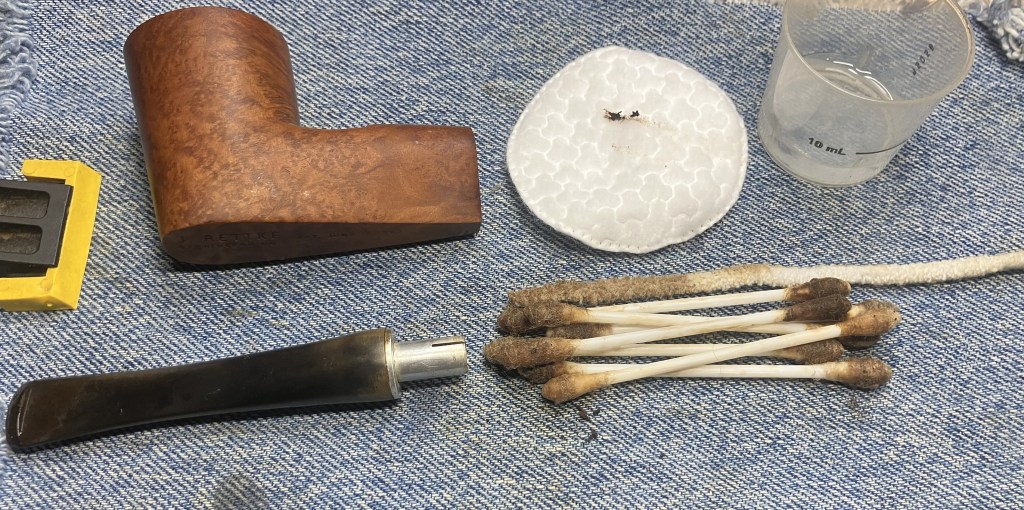
I sanded with an emery board and sanding sponges to reduce the tenon diameter.
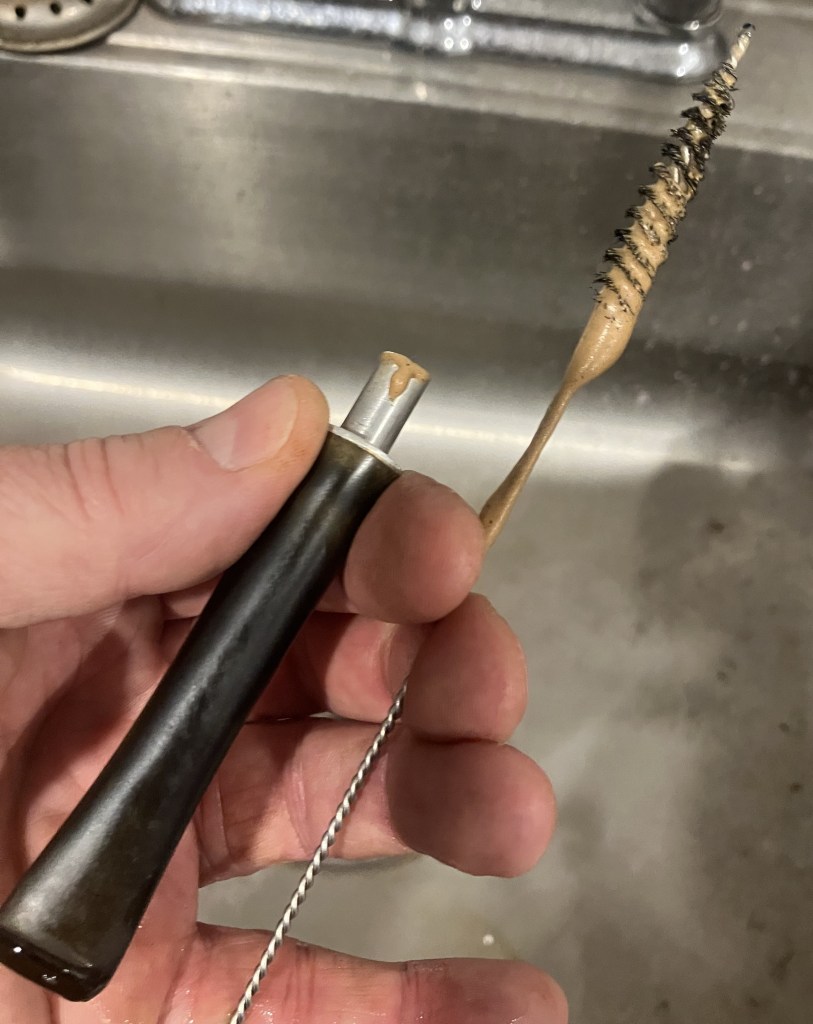
Below you can see how the new stem looked once the tenon was fitted to the Frasorteret.
After the shank extension was sanded and the stem fitted, I took the stummel to the buffer for a polish with rouge compound.
The vulcanite looked pretty darn good. I proceeded to give it a couple of coats of carnauba wax while I was at the buffer.
I also waxed the new stem after giving it a light buff.
The stummel received a liberal coating of Before and After Restoration Balm applied with a baby tooth brush. The briar was allowed to sit, soaking in the goodness of the balm, for 30 minutes.
An athletic sock, inside out, was used to remove and hand buff the excess Restoration Balm from the stummel.
The pipe was in the home stretch and really looked good.
I opted to go with Renaissance Micro-Crystalline Wax as the final coating for the briar as the rustications were a bit too deep for carnauba waxing. The Renaissance wax was applied with a cleaned baby toothbrush.
The stummel was hand buffed with a soft cotton cloth. The waxing and hand buffing was repeated for a second coat..
I decided to go with a bowl coating for no reason other than aesthetics and to make my fingers sticky. I used 100% pure maple syrup to lightly coat the tobacco chamber.
A capsule of activated charcoal was opened and dumped into the chamber.
I covered the opening to the chamber with painters tape and plugged the draft hole with a pipe cleaner.
The stummel was then shaken vigorously, rotated and tapped with a wood block several times to evenly disperse the charcoal powder. The tape was removed and the excess charcoal dumped. I removed the pipe cleaner and gave the mouthpiece a hard blow to clear any remaining loose dust.
The final step was a hand buffing with a microfiber polishing cloth further improving the shine.
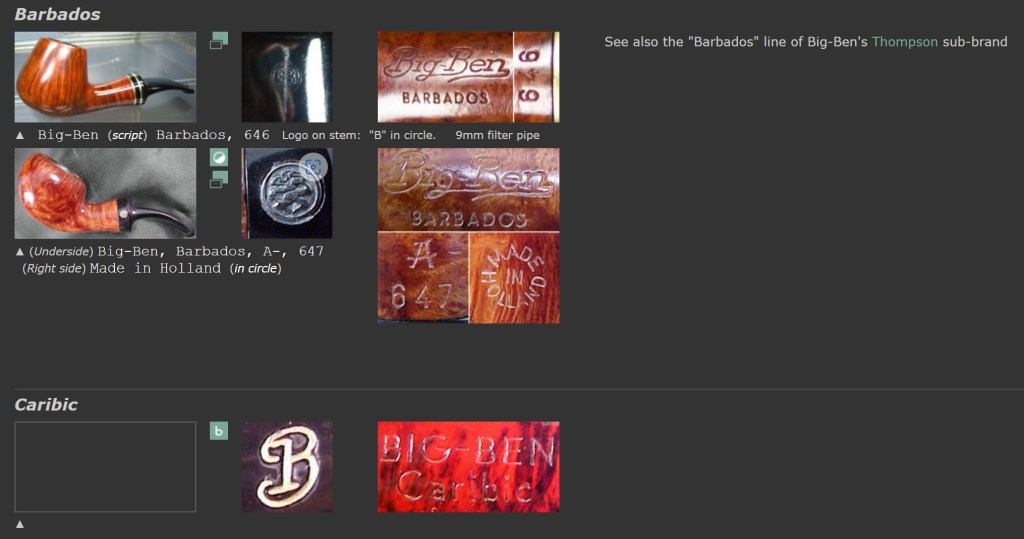
This Frasorteret freehand is a beautiful pipe for both the eyes and the hand. Well left hand, anyway. For those who hold a pipe with their right hand while smoking, sorry. The pipe is both too heavy and too long to be a comfortable chencher. Overall I am pleased with how my attempt to mask the heavily pitted surface turned out. I’ll be the first to admit that I do not like thin walled pipes and I did have to thin the wall significantly to remove the enormous pit present. The replacement stem looks like it was meant for this pipe and it matched the existing vulcanite shank extension very well. Overall I am happy with how this one turned out especially for my first try at carving like this. The dimensions of the Frasorteret Freehand are:
Length: 7.15 in./ 181.61 mm.
Weight: 2.53 oz./ 71.73 g.
Bowl Height: 2.17 in./ 55.12 mm.
Chamber Depth: 1.95 in./ 49.53 mm.
Chamber Diameter: 0.89 in./ 22.61 mm.
Outside Diameter: 2.22 in./ 56.39 mm.
I do hope that you have found something here useful to your own pipe care, maintenance or restorations. If you like this sort of thing, please click the like and subscribe buttons. Thank you for reading the ramblings of an old pipe lover.
Loading…
Below are some photos of the finished Frasorteret Freehand.