Photographed and written by
John M. Young

It’s a Dublin… It’s Poker… It’s Super Pipe! Yeah, it sounds way cooler in the original form – It’s a Bird… It’s a Plane… It’s Superman. I have to admit I wasn’t quite sure what to call this Man pipe when it arrived. I asked my German pipe expert, Sascha Mertens, via Facebook messenger what he’d call it. His reply was classic Sascha, “Dublin, accidentally! Planned as a poker! Nice pipe.” He included an artistically modified photo that I sent him and even signed it: 
The pipe itself was part of an estate lot purchased in September from Calgary Alberta, Canada. It included 11 other pipes I recognized this one from the photo below:

The male symbol could even be clearly made out. It is always fun to pick up a lot from somewhere other than the States as locally available pipes in one location are rare and exotic in another location. This lot had a couple of pipes with Canadian country of manufacture (COM) stamps. Stick around and I’m sure they will make appearances in upcoming blogs. The pipe has the male symbol and ISLE OF MAN stamped on the stem. The meerschaum remains free of any marks indicating its origin. Below are some photographs of the pipe prior to any work done.


This looked to be an easy relaxing restoration. The meerschaum was in great shape. Yeah, the stem was oxidized and looked as if someone thought they might improve the appearance by trying to give it a nice suntan by storing it in direct sunlight. Besides, I had wanted to work on a Man meerschaum for some time.
Background
From previous research on several European meerschaum pipes I recalled that this line was a product of Laxey Pipes. I refreshed my memory with a revisit on pipedia.org. Below, I have included that entry.
“Laxey Pipes Ltd. resided in a historical 19th century four-storey Man stone building at The Quay, Old Laxey, Isle of Man, which thankfully has been preserved.
The company specialised in the production of meerschaum pipes using the Meerschaum mined by the Tanganyika Meerschaum Corporation in the Amboseli basin in Tanganyika (since 1964 part of the United Republic of Tanzania).
Please note: you may often find names like “Manx Pipes Ltd.”, “Man Pipe Co.” and others more, but there is no indication of another Isle of Man pipe producer other than Laxey Pipe Ltd. at any time!
Laxey Pipes Ltd. marketed own brands like “Manxpipe”, “Manxman”, “Manxland” e.c. Names like “John Bull”, “White Knight” (unwaxed), “Domino” (black, or lined) indicated some shapes / colours of Laxey’s own series. The stems either showed the astronomical sign for “male” or “man” (circle + arrow), or the crest of the Isle of Man, the 3-legged X in a circle. Manxpipes and Laxey’s other brands were available through pipe retailers in general, but also were sold (mainly) to tourists through their own shop in Laxey.” (Laxey Pipes Ltd. – Pipedia)

(File:Manx.jpg – Pipedia). I love the stone work of this old building and can’t help thinking, “watch that first step, it’s a doozy”, regarding the step from the pier to the boat at low tide.
My next search was of pipephil.eu. Here I was able to find logos from other Man pipes, reaffirming the family heritage.

I find it interesting that African meerschaum was used. In a couple of previous blogs, I discussed the history of meerschaum or sepiolite mining in the Amboseli region of Tanzania (links: https://wordpress.com/post/scimansays1787.com/7350 and https://wordpress.com/post/scimansays1787.com/7485). Meerschaum from this region is not considered to be as high quality as the meerschaum of Turkey and is usually left rusticated and frequently stained or “painted”. I put painted in quotes as I am unsure of how or with what Laxey coated the stummels of their pipes.
Further research came across a forum post in pipesmokersdens.com by a member named Siv. They state the following in their post:
“Laxey Pipes Limited was established in the mid-1960s on the Isle of Man to manufacture various decorative smoking pipes, based in a historically important 19th century four-storey building on the quay in the east coastal village of Laxey. The building was erected in 1866 by Richard Rowe (c.1823-1886), Captain of the Laxey Mines, as an additional grain store for the Laxey Glen Flour Mill. The building was also used as a storage facility for other material, such as coal and corn, and it was utilised as a base for community meetings and events. The property had several owners before the Isle of Man Government acquired it in the 1960s and leased it to the pipe factory. Other company names such as Manx Pipes Ltd and Man Pipe Co. have been noted but no other pipe producer was active during this time, thus all names must have fallen under the Laxey Pipes Ltd umbrella.
The company specialised in the manufacturing of meerschaum pipes using the mineral meerschaum (sepiolite) mined by the Tanganyika Meerschaum Corporation, situated in the Amboseli basin, Tanganyika (now the United Republic of Tanzania). Meerschaum is a soft white clay mineral, mainly found in Turkey with large deposits also found in Tanganyika, Africa. Meerschaum is a popular material for pipes because its properties allow it to be carved into finely detailed and decorative shapes. It is also porous by nature and can draw moisture and tobacco tar into the stone. Another organic material used by Laxey Pipes Ltd for its smoking pipes was briar wood. Briar is a type of wood that is native to Africa and is abundant the Ethiopian Highlands, the Ruwenzori Mountains and the Cameroon Mountains. It is a particularly good material to use for pipes because it has a natural resistance to fire and it has an ability to absorb any moisture.
Laxey Pipes Ltd produced and marketed their own pipe brands such as ‘Manxpipe’, ‘Manxman’ and ‘Manxland’. Other pipe names indicated various shapes and colours of the Laxey pipe series, for example ‘White Knight’ (unwaxed) and ‘Domino’ (black or lined). The Laxey brands were sold through general pipe retailers but they were also sold through the company’s shop on its Isle of Man premises. Laxey Pipes Ltd also produced meer bowls (the compartment where the tobacco goes in the pipe) for pipe brands such as Peterson, Barling and Nørding from the 1960s until 2001.
As the company entered the 1990s and early 2000s the supply of meer from East Africa was becoming increasingly difficult; Kenya and Tanzania had been extensively mined and places like Somalia was inaccessible due to civil war. The last Laxey meers were traded in May 2001 but the company continued making briar pipes. Changing attitudes to smoking led to a general decline in popularity of pipe smoking. The company closed its doors indefinitely in June 2002.” (https://pipesmokersdens.com/threads/man-pipes-laxey-pipes-ltd-isle-of-man.17931/)
Siv also provides photos of of their Man pipe along with photos of the brochure accompanying the pipe.


(photos: https://pipesmokersdens.com/threads/man-pipes-laxey-pipes-ltd-isle-of-man.17931/)
According to Mark Irwin, “By ‘78 Peterson had bought the Isle of Man company and moved its operations to their Dublin factory.” (Irwin, Mark (2018). The Peterson Pipe (1st ed. 2nd printing). Briar Books Press. p.308). Using the above information, I estimate this pipe to have been made on the Isle of Man between the 1960s-1978. Siv’s pamphlet provided great information about the shape – 62/2, unfortunately no descriptor though. I guess I’m stuck with Sascha’s “Accidental Dublin”.
The Restoration
The restoration began with a clean denim piece for both the protection of the pipe and the workbench top.

THe reaming tools included only the General triangular scraper, the Smokingpipes Low Country reamer and the 220 sandpaper wrapped dowel. The PipNet and Kleen-Reem were not employed for fear their torque would be detrimental to the meerschaum.

The reaming was uneventful due to the light cake build-up within the tobacco chamber.

After a light sanding I scrubbed the chamber with a few cotton swabs dipped in 95% ethyl alcohol.

Before cleaning the shank, I looked close at the mortise. There appeared to be an insert of some plastic.

I remembered the pamphlet Siv, the pipesmokersdens.com forum contributor, provided.These little things never cease to amaze me.I had no idea that pipe makers in the 1960s-1970 were in the habit of using Delrin or Delrin-like mounts for meerschaum pipes.

THe airway of the shank was cleaned out using alcohol dipped bristle pipe cleaners. I think the vast majority of the black that was staining the pipe cleaners was excess black dye or stain used in the production of the pipe and not accumulated filth from smoking.

The stem was cleaned next. It was only slightly dirty and only required a couple of alcohol dipped pipe cleaners. This further reaffirmed my conclusion to the black from the shank cleaning was dye.

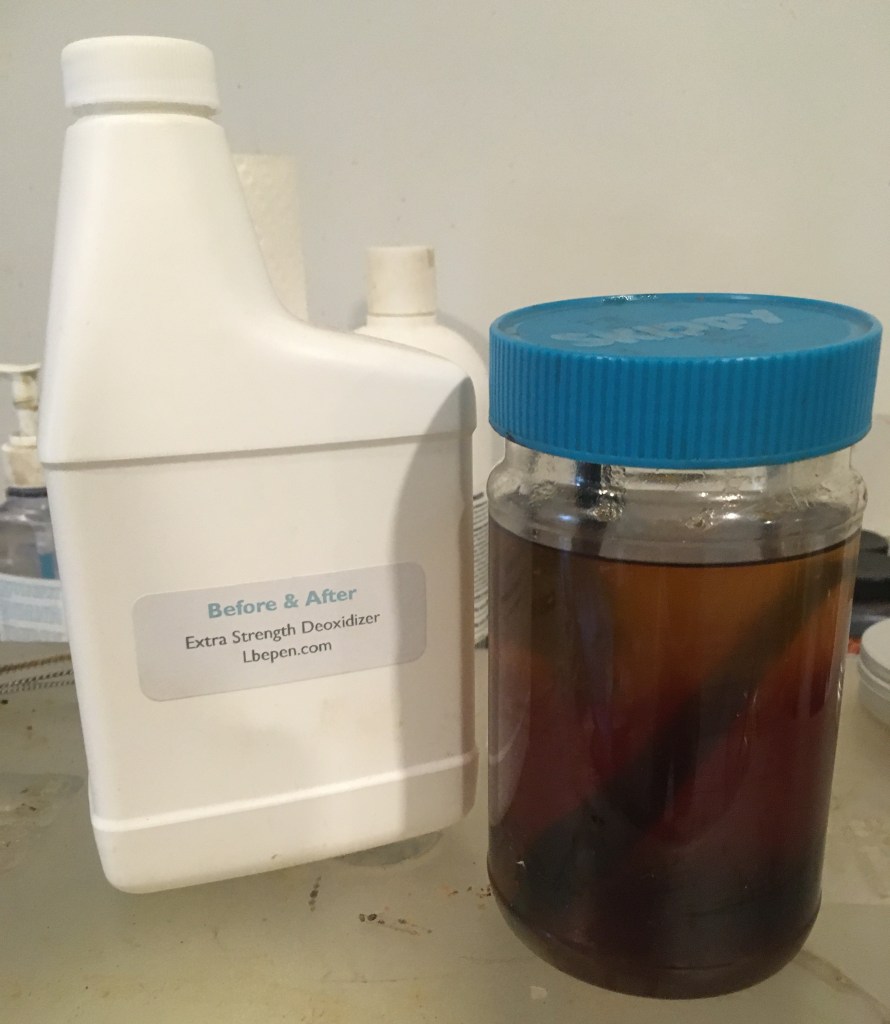
The stem was lightly buffed with 0000 steel wool to remove the surface oxidation in preparation for a dip in the Before and After Extra Strength Deoxidizer (lovingly referred to as deox). A pipe cleaner was inserted into the tenon to act as a hanger while in the solution.

I left the stem in deox overnight as it was heavily oxidized. The next day I removed the stem and allowed it to drip excess deoxidizer back into the jar.

After the drip dry I placed the stem on a coarse shop rag. I like these rags because the rough texture and open weave absorb the remaining solution and lightly abrade the softened oxidized rubber from the stem.

After hand buffing with the shop rag, you can see the amount of oxidized rubber which was removed.

Even though the stem was looking nicely black I had the feeling that there was additional scrubbing in my future. I used Soft Scrub on make-up pads to further scrub and remove the oxidation.

A lot of make-up pads.

Eventually the color left on the pads was lightened. I checked the condition of the logo. Frequently in cases of severe oxidation logos can suffer or be nearly eliminated. Yay, the loge was still there!

The stem was oiled with mineral oil and allied to soak in the oil for a few minutes. I am not sure if this is necessary or not but it does provide a nice little break for one to go upstairs and get some lunch.

I covered the logo and the COM stamps with small pieces of Scotch tape to protect them from the sanding. The stem was then sanded with a series of sanding sponges from 400-3500 grit. Between each sponge the stem was rubbed with additional mineral oil and wiped with a paper towel.

At this point I wanted to repaint the stem logo. I prepped the area by cleaning it with a cotton swab dipped in alcohol. I used a water based acrylic modeling paint for the paint.

The paint was applied with a fly tying bodkin to the stamp. THis paint dries quickly.

THe surface was scraped with a rigid plastic card to remove the excess paint without cleaning out the grooves. I could not get the paint to stay in the top left of the male symbol even after a couple more attempts.

The stem was then worked with micro-mesh pads 4000-12000. Between each of these pads the stem was rubbed with Obsidian Oil and wiped with a paper towel.

THe stem was then polished with Before and After Fine followed by the Extra Fine polish. Both were hand buffed with a soft cotton cloth.

THe pipe was then taken to the buffer for a few coats of carnauba wax. The final step was a hand buffing with a microfiber polishing cloth to raise the shine further.
Overall I find this Man Sculpted Black Meerschaum Dublin to be a lovely pipe. I continue to adore the shape. I do find that the shape is almost hard to view though. The high gloss finish and the sculpted edges make it hard for me to accurately determine them. Once in hand things become far more clear. Though the handling of the pipe is intriguing in itself, the pipe is unnaturally light weight. Almost alarmingly so. This too could be illusionary due to the stark black color making me think that it should feel more substantial. The removal of the oxidation revealed a very nice flat saddle stem which matches the gloss black of the pipe very well. The dimensions of the Man Sculpted Black Meerschaum Dublin are:
- Length: 5.68 in./ 144.27 mm.
- Weight: 1.20 oz./ 34.02 g.
- Bowl Height: 1.91 in./ 48.51 mm.
- Chamber Depth: 1.47 in./ 37.34 mm.
- Chamber Diameter: 0.75 in./ 19.05 mm.
- Outside Diameter: 1.36 in./ 34.54 mm.
I do hope that you have found something here useful to your own pipe care, maintenance or restorations. If you like this sort of thing, please click the like and subscribe buttons. Thank you for reading the ramblings of an old pipe lover.
Below are some photos of the finished Man Sculpted Black Meerschaum Dublin.


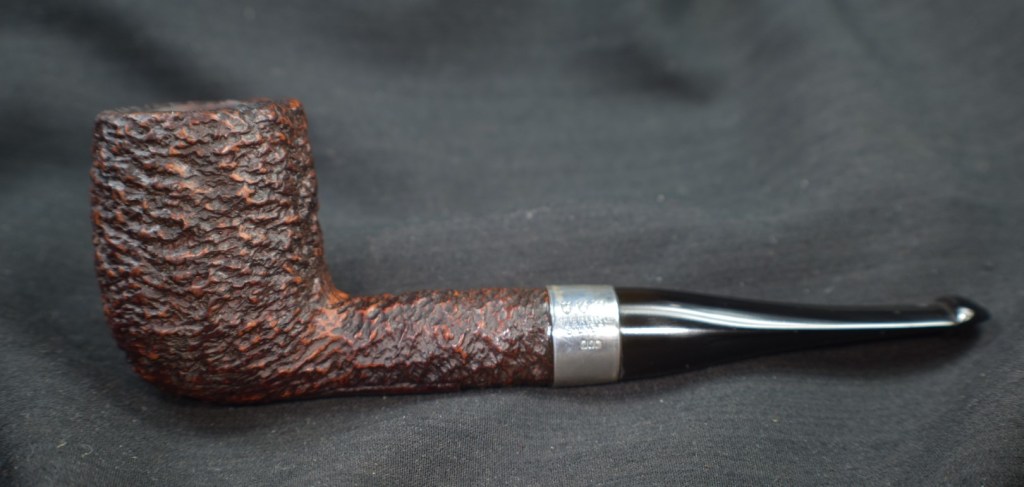


 The “Donegal Rocky” (in quotation marks), released in 1945 or so, was Kapp & Peterson’s first rusticated line. Not that K&P hadn’t rusticated pipes previously, they just that they hadn’t devoted an entire line to rustication. And they were apparently proud of it, because they gave it a sterling mount along with a black finish and white-stamped P on the mouthpiece.
 It was part of K&P’s “Product Line,” what I call gateway pipes and others might call an entry-level pipe, as you can see in this shape chart from the 1945 catalog. Like the Shamrock (European version) and “K,” it was originally a fishtail line.

 It’s worth remarking concerning the removable stinger. This spike-ended aluminum tube is easily removed, leaving the P-Lip mouthpiece strictly a graduated-bore regulation affair.


 Now an argument could be made for either an e, c or o. Respective dates would be 1972, 1970 and 1980. The o would move the pipe closer to the black/brown stain age range of 1981 as mentioned in the Mark Irwin blog above.




 NebraskaPeteGeek
