Proof positive that I have turned away from restoring pipes from the 1940s. Okay restoration may be too strong of a word for this entry. I can’t be certain that this pipe ever saw a flame. It is a lovely example of the craftsmanship that Dr Grabow is capable of. This beauty was part of an estate lot from Norman Park, Georgia, USA via an eBay auction. The pipe was not stamped with The name Dr Grabo yet it wears the Dr Grabow logo on the stem. The only stamp is COLLECTOR over 2002. Below are some photos of the Collector 2002 as it looked upon arrival.
I’m not sure if that is the original filter. It came that way though.
I always find it funny to find an unsmoked or seldom smoked pipe that has tooth dents or chatter.
Background
Dr Grabow has a long and well documented history, in general. This line, unfortunately, is not part of that “general”. In an earlier blog of mine, I briefly detailed this history. I will include that summary here:
“In one of my very first blogs I wrote about the restoration of an MLC pipe. “The stamp that I could not make out on my pipe was the MLC. This stands for Mary Linkman & Company. This is the same company formed by Louis B. Linkman, the originator of Dr. Grabow pipes. In 1898 Linkman and August Fisher started a small business making pipes. The business grew and, “in 1907 M. Linkman & Company was incorporated with Louis B. Linkman as president, August Fisher, vice-president…” (https://pipedia.org/wiki/M._Linkman_%26_Co.). If you would like to see a very early blog about the MLC Hell Maria here is that link.
So, two youngsters started up a pipe making company at the turn of the last century. It doesn’t end there, friends. I wrote the following in a blog about another Linkman’s pipe: “ “BACK IN 1898, two ambitious young men reached the momentous decision to go into business for themselves. They were Louis B. Linkman and August Fisher. From the time they were in knee pants they had worked for a pipe jobber in the mid-west.” (https://pipedia.org/wiki/M._Linkman_%26_Co.). These two young entrepreneurs were joined by a third, “Anton Burger, who had also been employed by a pipe jobber in the mid-west, approached them and was taken in as a partner. M. Linkman & Company proceeded as a partnership; the business developed rapidly through the untiring efforts of these men in producing quality pipes and rendering good service to their customers.” (https://pipedia.org/wiki/M._Linkman_%26_Co.). The company eventually
came to be known as Dr Grabow.”
According to Tobaccopipes.com “The birth of the Dr Grabow smoking pipe is simple enough. It started off when Dr Grabow himself and his acquaintance Dr Linkman regularly visited the local pharmacist at Brown’s Drug Store in Lincoln Park Chicago. Dr Linkman was on the lookout for a doctor’s name to Christian an innovative line of pipes in order to mellow out the smoking apparel’s smoggy image. He asked Dr Grabow to allow him to use his name to which he agreed and the name has stuck since then. Linkman continued to manufacture his Dr Grabow pipes until 1953.
The earliest of these exclusive pipes were stamped both with Linkman’s and Dr Grabow. They included a propeller emblem that was white in color at the top of the mouthpiece. Linkman’s pipes are also stamped with their own four digit code. This code indicates their model and shape. For example, the PRE – 1944 model names included the “Special”, “Supreme” and “Deluxe” versions of Dr Grabow’s pipes.
I have frequently said things like, “I ain’t too bright but…” or “I may have been born at night but, it wasn’t last night” regarding my own intelligence. With that in mind, I can pretty assuredly surmise that this pipe is from Dr Grabow’s Sparta, North Carolina factory and was made in 2002.
The Restoration
Okay, not a real restoration, more like a refreshment. Although that makes me think it needs a cocktail umbrella or something sticking out of the bowl though.
I did ream out the bowl as it was rough with what I assume was a lumpy bowl coating.
Below you can see a couple of the lumps I was referring to. The tobacco chamber was sanded smooth with 220 sandpaper wrapped around a wood dowel.
I cleaned the airway of the shank with cotton swabs and folded bristle pipe cleaners dipped in 95% ethyl alcohol.
The stummel was scrubbed with undiluted Murphy Oil Soap and a nylon scrub brush to remove 22 years of dust. The soap was rinsed with warm water and dried with a cotton hand towel.
Before polishing the brass band I first taped the stem with painters tape. This was to keep the metal polish from the plastic of the stem. I always enjoyed polishing the brass on my JROTC uniform back in high school. Though this Cape Cod Metal Polish smells far better than the Brasso of 40 years ago. The brass band polished up very nicely.
The stem was cleaned out using cotton swabs & bristle pipe cleaners with 95% ethyl alcohol.
I’m not sure how an unsmoked pipe can get teeth marks but they do. I used a small flat file to smooth the area behind the button on both top and bottom. The filed surface was then sanded with a 400 grit sanding sponge.
The stem was sanded with a series of sanding sponges from 600-3500 grit. I was a bit nervous about achieving a factory like finish on this plastic stem but continued and hoped for the best.
The stem was micro-meshed with 4000-12000 pads. Between each pad I applied a small drop of Obsidian Oil. The stem was looking great, no need for my earlier worries.
I removed the painters tape and used Before and After Fine polish hand buffed with a soft cotton cloth. I buffed both the brass band and the plastic of the stem.
Before and After Extra Fine Polish followed the Fine Polish.
The pipe was then taken to the buffer for several coats of carnauba wax from the buffer. The rustications on this pipe were not very deep so I figured that buffing carnauba would be OK and it appeared like I was correct. The final step prior to photographing the finished pipe was a hand buffing with a microfiber polishing cloth.
I have to admit that I am not the biggest fan of Dr Grabow pipes. I mean, I love the Westbrooks and the old Linkmans that I have. I find that the Dr Grabow filters are a bit too constricting for my taste. The factory finishes that come with many Dr Grabow pipes are high gloss clear coats which is something that I do not prefer and many of the carved or rusticated versions look cartoon-like. However, this Collector 2002 is a beautiful pipe. I still do not like the draw with a filter inserted but without the filter it is wide open and very nice. The finish is a nice light sandblast which shows off the briar grain beautifully. The stain is a bit dark for me but it works well with the brass band. The stem is polished exceptionally well and has a gorgeous high gloss. Overall this is a darn good looking and feeling pipe which Dr Grabow should be proud of. The dimensions of this Dr Grabow Collector 2002 Billiard are:
Length: 5.92 in./ 150.39 mm.
Weight: 1.43 oz./ 40.80 g.
Bowl Height: 1.76 in./ 44.70 mm.
Chamber Depth: 1.39 in./ 35.31 mm.
Chamber Diameter: 0.75 in./ 19.05 mm.
Outside Diameter: 1.35 in./ 34.29 mm.
I do hope that you have found something here useful to your own pipe care, maintenance or restorations. If you like this sort of thing, please click the like and subscribe buttons. Thank you for reading the ramblings of an old pipe lover.
Loading…
Below are some photos of the finished Dr Grabow Collector 2002 Billiard.
I didn’t call this a restoration because the pipe was unfired when it arrived. Unfired and yet the shank was cracked. Perhaps that is why it had remained unfired. The world may never know. As much as I love a good mystery, I love a good banding project more so, that is what I did.
I am not going to do my usual before and after photo spread with this one since the befores would look so much like the afters it would waste vital electrons. I will however still do the “Background”. One other thing I think I need to clarify: You can purchase bands made specifically for pipe repairs from Vermont Freehand here are their home and bands links (https://vermontfreehand.com/) and (https://vermontfreehand.com/bands-caps-rings/). They have individual bands and assortments ranging from 10mm-25mm in 0.5mm increments. If your time is worth money then this is probably a far better solution than what I am doing with this blog. I like to fashion repairs with what I have available. I am a firearms shooter and reloader, this makes a wide range of brass cylinders, in the form of spent cartridges, available to me. My son-in-law is a plumber thus I have a variety of copper to use. His brother is a machinist thus making an entire machine shop available with a darn good machinist. These may or may not be things available to most people.
Background
Raskassa is a name without much information. Pipedia.org will tell you the following: “There were no results matching the query.” Not terribly helpful. Pipephil.eu has a bit more on “Raskassa” but not much.
I find the above quote interesting. Otto Sevic has an entry in pipedia.org which contains the following in its entirety: “Mars pipe: According to Wilczak & Colwell in their book titled “Who Made That Pipe?” Mars was manufactured by Otto Sevic in the United States, and dates to 1930. This makes sense if the patent date stamped thereon is July 6, 1926. The side of the pipe is marked: “MARS, PAT. 7.6.26” indicating the design was patented on July 6, 1926. The patent was apparently for a filtering system built into the base of the bowl. The pipe has a chamber built on the bottom of the bowl which is accessed through a black Bakelite cap. Inside is an aluminum chamber to catch moisture coming from the bowl. From the bowl bottom is a tube extending into the chamber and ending there a little above the cap. The cap appears to have an absorbent material like cotton or paper to absorb the moisture. And then through the shank is another aluminum tube which is ported into the shank and the stem is mounted with a normal tenon mount.”
Example and details, courtesy Doug Valitchka
(https://pipedia.org/wiki/Mars). This pipe does not strike me as a pipe produced before the Second World War. The other sentence indicates the pipe pictured on pipephil.eu site is made of Mountain Laurel. That wood was only utilized during the war years and proved to be less than ideal for pipes and was phased out fairly rapidly after the war. The rustication and staining of this pipe make the determination of the wood difficult to impossible.
Another mention of “Raskassa” is made by Steve Laug of repornpipes.com with his restorations of several Malaga Ras Kassa or Malaga Raskassa pipes. Both spellings are used. In a previous blog of a Malaga Apple , I wrote the following:
“Piedia.org has a nice history of Malaga pipes. I will include the text here in its entirety:
“The Malaga Pipe Company was founded circa 1939 by George Khoubesser, (b.1892 d.1971), and located in Royal Oak, Michigan at 1406 East Eleven Mile road. The second generation owner’s name was Emmanuel Khoubesser (b. 1942 d. 1981), who everyone knew him as “Manny”. He was a big jovial man that was easy to converse with, always had a smile and a good joke to tell his very loyal customers. He had the ability to befriend anyone within minutes. The small store was packed with curious customers every Saturday morning looking for the latest design made earlier in the week. He also carried a full line of custom mixed tobaccos that you could sample and an array tobaccos in tins.
I was first introduced to him in 1969. I remember him taking me in the back to show me each step involved in pipe making. He was very serious about the quality of the product he sold and would never sell a flawed pipe, even if it was very minor. My step father purchased several of his pipes and really enjoyed them. He once said he’s never found a better pipe (his words).
Manny passed away in 1981 and his wife and oldest children took over the business. Malaga closed in 1999 after 60 years in business. The building still exists on Eleven mile, looking almost like it did back then, but now houses the Michigan Toy Soldier Company. I would think the pipes Manny produced are now more valuable than ever. If you happen across one of these pipes, you’ll know a little bit more about it’s rich history. Enjoy!”
Now, this pipe does not bear the MALAGA stamping nor is it of a quality associated with Malaga pipes, much less the highest quality produced by that maker. So the question remains, “Who made this pipe?” Malaga stamps are of a block style print
I did not have any nickel plated brass of an appropriate diameter to use for a band. I did have a length of stainless steel that would suffice. I had never thought to make a band of stainless steel so that idea in itself was interesting. I measured the thickness of the band and got out the pipe cutter. The cutting of pipe is pretty much the same no matter the stock to cut. The stainless was far harder than brass or copper but the same procedure.
Slipping the band over the tenon and inserting the stem partially let me imagine or visualize a completed pipe. Not bad but I couldn’t help but wonder what a copper band would look like instead. So, I cut one of those too.
Oh, I liked the copper much better.
The next step was to file the end of the shank to fit the new band. This is a long meticulous and rather tedious process. I wanted the band to be very tight, compressing the cracked shank and providing a good fit of the tenon in the mortise. I was not too worried about a perfect finish of the band to the non-filed shank. The rusticated stained shank could easily blend and conceal any poor-fitting with a little bit of black epoxy from the gluing of the band to the shank.
The proper fit was finally achieved and the band was glued and tapped into place on the shank. The glue used was J.B. Weld black epoxy. Extra epoxy was used as a fill around the gaps between the band and the unfiled shank. The next day the epoxy had cured and was hard enough to file. I wrapped the stem with painters tape to protect it from filing.
The overflow of black epoxy was filed flush with the shank and stem.
The joint was lightly sanded with a 400 grit sanding sponge and touched-up with a black Touch-up marker.
The stem tape was removed and the shank was taped to protect it from the sanding and polishing of the band. The band was sanded with the 2000-3500 sanding sponges then with the 4000-12000 micromesh pads.
For a wax I went with Renaissance Micro-Crystalline Wax applied with a baby toothbrush.
The wax was then hand buffed with a shoe shine brush.
Then the stummel was hand polished with a soft cotton terry cloth.
The stem was buffed with white diamond compound on the buffer then waxed with several coats of carnauba wax.
This banding project turned out very nicely. In the final photo you cannot make out the crack at all. The pipe has a unique rustication pattern which feels great in my hand. The black stain with the copper band gives it an elegant appearance in contrast to the rustic nature of the pipe. The stem needed little work and polished up well. Overall this is a lovely pipe that is amazingly light and should make for a grand smoker.
The dimensions of this Raskassa Pot with a beautiful copper band are:
Length: 5.61 in./ 142.49 mm.
Weight: 0.99 oz./ 28.00g.
Bowl Height: 1.66 in./ 42.16 mm.
Chamber Depth: 1.45 in./ 36.83 mm.
Chamber Diameter: 0.85 in./ 21.59 mm.
Outside Diameter: 1.45 in./ 36.83 mm.
I do hope that you have found something here useful to your own pipe care, maintenance or restorations. If you like this sort of thing, please click the like and subscribe buttons. Thank you for reading the ramblings of an old pipe lover.
Below are some photos of the finished Raskasss Pot.
Yep, it’s another Peterson. What do you expect from a guy that is also known as NebraksaPeteGeek? This pipe only had to cross the Missouri River to get here. The seller was from just east of Council Bluffs Iowa. I didn’t notice until the tracking said I could expect the pipe to arrive in two days. That’s when I looked at the seller’s location. I felt kind of dumb. Well maybe, dumber. I could have picked the pipe up on the way to visit my sister, east of Council Bluffs and finagle a free dinner out of the trip. Oh well, postal workers need posts just like dogs need head pats and I need more pipes to restore. Everybody is a winner.
The 306 was actually a shape which I did not own. The final 300 shape of the series void is no longer a void. The best part is that the pipe is a sitter and doesn’t really require a slot in a pipe rack. It can just sit in the cabinet next to the rack and look majestic and self-sufficient. This 306 bore the following stamps all immediately below the nickel collar on the left shank: Peterson (arched in the traditional script) over OF DUBLIN (also arched) over SYSTEM over STANDARD 306. The nickel ferrule dome was stamped with the expected K&P over PETERSON. Since this is a standard there were no hallmarks. Below are some photos of the 306 prior to it being worked on.
The briar was in great shape. A little bit of cake in the bowl and a smidge of lava overflowed onto the rim. The stem had seen some chomping and wore the scars. Looking at the indentations it appeared the chomper clenched on his right. Either way, those would need repairs. The whole restoration looked like it would be a relaxing endeavor.
Background
If you have been following this blog for a length of time you know I have done a few Peterson restorations in the past. If you are new here, welcome and I’ve done a few Peterson restorations in the past. I’m not going to go on and on about the history of the oldest continually operating pipe manufacturer in the world and arguably the best. I will however lead you to The Peterson Pipe book. Mark Irwin and Gary Marlburg’s book is a must read for a Pete Geek.
As a summary of the 306,, I am quoting the Peterson.ie site below. I figured that since this pipe is currently in production why not let the makers speak for themselves.
“About the Shape
Combining the sturdy stability of a Poker with convenient jaw-hanging balance, our flat-bottomed Oom Paul is a versatile design, able to sit stably on a desk or be easily clenched in the teeth. Its bold, muscular proportions resonate with our iconic House Style.”
“About the Series
Our flagship line, the System Standard stamp first appeared in 1945, but the entry-level design has been a staple in our catalogues since Charles Peterson secured his final patent in 1898. Designed to provide a cooler, drier smoke, each pipe features a deep reservoir within the shank to collect excess moisture; a graduated bore mouthpiece that funnels the smoke and allows moisture to collect within the reservoir; a sturdy nickel military mount, which allows the pipe to be broken down and cleaned without damage or warping; and our patented P-Lip bit, which draws the smoke upward, thus reducing tongue bite. While the P-Lip bit is the traditional choice, we also offer System Standard pipes with fishtail stems. Available here in the traditional walnut stain of the Smooth finish.”
“About the Range
In 1890, after 15 years of handling and repairing pipes while working for the Kapps, Charles Peterson secured a patent in his own name, titled “A certain new and useful improvement in Tobacco-Pipes,” which introduced a unique system comprised of a higher draft hole and a moisture reservoir bored into the shank and transition of a briar pipe. Over the next eight years, Charles continued to refine his System, applying for and securing patents for a graduated bore mouthpiece (1891), and a unique button design known today as the P-Lip (1894-1898). Designed to wick moisture away from the smoke, reduce tongue bite, and increase the longevity of the pipe, Peterson’s complete System patent sparked a tradition of innovation, one we continue to uphold to this day. The System Pipe is the invisible source behind our unique House Style: our pipes’ muscular shanks and transitions, tubular profile, and generous bends. Our overall shaping style has a distinctly antique form because it has remained largely unchanged for over 120 years.
In our System range, you’ll find a variety of shapes in myriad finishes, each featuring Charles Peterson’s groundbreaking improvements in the realm of tobacco pipes. Whether you’re looking for your first pipe or to enhance a robust collection, here you’ll find numerous options to suit any taste, all backed by our legacy of craftsmanship.”
Now, I would never think to tell Peterson how to do their business nor how to engage in marketing but the above blurb “About The Shape” is lacking a certain bit which I find necessary. According to Irwin and Marlberg, “System shapes 304/20FB De Luxe and 306/11FB created by Paddy Larrigan and introduced in 1992” (Irwin, Mark and Malmberg, Gary (2018). The Peterson Pipe The Story of Kapp & Peterson, First edition, second printing 2021. Briar Books Press, Canada. p215). Paddy Larrigan was a third generation Peterson factory worker who was also responsible for the Dunmore line of pipes. His footprint in the history of Peterson should be glossed over. For more information on the Peterson Dunmore line check out my last Dunmore blog: https://wordpress.com/post/scimansays1787.com/6410. That means that this pipe’s origin story could have begun as early as 1992. The Standard line of pipes are difficult to date as they do not have any defining characteristics like hallmarks of silver mounted pipes. I did check the current stampings to see if they offered any notable changes and they appear the same today as this pipe’s stamps.
In typical “me” fashion I began with a laundered denim piece. I cannot use the term clean as the stains from previous restorations are taking a toll on that term.
The reaming crew was called forth.
The PipNet with the #2 blades did most of the work clearing the cake from the tobacco chamber. Further scraping was done with both the Smokingpipes Low Country reaming knife and the General triangular scraper. The interior of the chamber was then sanded with 220 sandpaper wrapped around a wood dowel.
The interior of the tobacco chamber had some charring and heat damage. This was scraped and sanded as smooth as possible without drastically changing the interior shape. The damage was not severe nor very deep. I thought the best remediation would be a bowl coating and the end of the restoration.
The stem was next on the schedule. I place it into a fresh solution of Oxiclean and water. And allowed it to soak for 2 hours.
I returned attention to the stummel and took it to the sink for a scrubbing with undiluted Murphy Oil Soap and a nylon scrub brush. The soap was rinsed with warm water and the stummel was dried with a cotton hand towel.
Back at the workbench the stummel looked more clean but there remained some areas with more “shine” than others. I wiped the stummel with a make-up pad dipped in 95% ethyl alcohol. This worked at removing the shine and left the stummel looking more like flat unfinished briar.
The stamps were covered with painters tape to protect them from the upcoming sanding.
The shank and reservoir were then cleaned out with many cotton swabs, folded bristle pipe cleaners, a shank british and scrapings with a dental scraper. The Peterson System does work very well but when neglected it is far from an easy thing to clean.
The stummel was then sanded with a series of sanding sponges with grits of 320-3500. Between each sponge the stummel was wiped with a make-up pad wetted with 95% ethyl alcohol.
The stem was removed from the Oxiclean solution and scrubbed with a couple of Soft Scrub cleanser treated make-up pads. A good deal of oxidized material came off but not as much as I was expecting.
The airway was cleaned with cotton swabs and bristle pipe cleaners dipped in ethyl alcohol. I could still see brown oxidized vulcanite on the stem and decided to give it a dip in the Before and After Extra Strength Deoxidizer. I inserted a pipe cleaner into the P-lip to act as a hanger in the Deoxidizer.
Below, the stem entered the Deoxidizer and was left overnight.
The following morning I removed the stem and allowed it to drip excess solution back into the jar.
The stummel had been sanded. Now it was time for the micro-mesh pads. I micro-meshed the stummel with the 4000-12000 pads. Again between each pad I wiped the stummel with a make-up moistened with ethyl alcohol.
The stummel then received a coating of Before and After Restoration Balm and was allowed to sit for as long as it took for the stem repair, sanding and micro-meshing.
Back to the drip dried stem. I used a coarse shop rag to wipe/scrub the remaining Deoxidizer from the stem. The air way had 2 pipe cleaners run through it to remove the solution.
At last the stem was looking brilliantly black. A bit pitted but the pits were black too.
I again used Soft Scrub cleanser on make-up pads on the stem. Much less oxidized rubber came off. The inside of the tenon and airway were again cleaned making sure that any remaining Deoxidizer was removed.
I sanded the Chomped areas with a 600 grit sanding sponge to ensure fresh vulcanite to work with. By “work with”, I mean to fill with black cyanoacrylate (CA, super glue). Below you can see the button top and bottom areas to repair.
The CA I was using has carbon and rubber in the formula making the fills more vulcanite-like. In other words, rubberizing the CA rather than the more hard and brittle black CA I used last winter. Small dabs of CA were placed onto the indentations.
The wet CA was then spritzed with a CA drying accelerator. This cures the CA in seconds as the accelerator evaporates.
The cured CA was then filed level with the surrounding vulcanite. The dark spots in the photo below indicate areas where additional CA needs to accumulate. I use several small applications rather than one large one.
The same for the bottom side of the stem.
Eventually with additional applications and filings the stem was sanded smooth.
With the fills completed the whole stem was sanded with the series of sanding sponges 400-3500. Between each sponge I applied a fingertip of mineral oil to the stem, rubbed it in and wiped the stem with a dry paper towel.
After the sanding the stem was micro-meshed with the 4000-12000 pads. Between each pad I applied a small drop of Obsidian Oil to the stem, rubbed it in and wiped with a paper towel.
The stem was polished using Before and After Fine Polish rubbed with a soft cotton cloth.
The Fine Polish was followed by the Before and After Extra Fine Polish with the same cloth.
The stummel was wiped of the Restoration Balm with an inside out athletic sock.
The pipe was then taken to the buffer for several coats of carnauba wax. This is where my forgetfulness comes to light. I photographed the “finished” pipe at this time. Upon completing the photo shoot, I realized that I still needed to coat the bowl. Darn old people… I was out of pure maple syrup but I did have a jar of German organic honey, a gift from a Europe traveling niece. I lightly coated the inside of the bowl with honey. I then plugged the draft hole with a pipe cleaner. I used half a capsule of carbon powder poured into the bowl, covered the rim with my hand and shook the stummel for several seconds. I ended up with a very nice circle of carbon powder on the thick part of my thumb and a well coated tobacco chamber. That is the last photo in the “finished” section below.
That is it, the relaxing restoration of a Peterson System Standard 306. I am very pleased with how well this Pete looks. At least on the outside. As with any damaged interior I will have to smoke it and monitor it closely. I can say that the inaugural smoke was with a lightly packed Five Brothers shag cut Burley. I didn’t want to scrape any of the coating off so a very soft cut tobacco was used. Everything went as planned, the honey baked in nicely with the carbon powder and it appears to be on its way to a solid carbon coating. Back to the restoration. The vulcanite was rid of the oxidation and it looks great. The briar with its bird’s eyes on the left and flame grain on the right are beautiful. I am sure this pipe will continue to be used many times while contemplating my next restoration. The dimensions of this Peterson System Standard 306 are:
Length: 6.63 in./ 168.28 mm.
Weight: 2.08 oz./ 59.20 g.
Bowl Height: 1.91 in./ 48.51 mm.
Chamber Depth: 1.61 in./ 40.89 mm.
Chamber Diameter: 0.77 in./ 19.56 mm.
Outside Diameter: 1.46 in./ 37.08 mm.
I do hope that you have found something here useful to your own pipe care, maintenance or restorations. If you like this sort of thing, please click the like and subscribe buttons. Thank you for reading the ramblings of an old pipe lover.
Below are some photos of the finished Peterson System Standard 306.
Back in the 1990s I worked with a fellow teacher and Nebraska Air Guard F4 pilot who often said, “Better lucky than good, any day.” That phrase has stuck with me over the years and applies to so very many daily occurrences. The acquisition of this pipe for instance. It was part of a lot of 12 pipes. The other 12 were nothing to be too excited about; Yello-Boles, Dr Grabows, a split seam leather Longchamp, etc… and what appeared to be a Peterson Meerschaum hiding in the background ashamed at it’s lot in life. The photos of the lot were as usual, less than perfect yet, I knew what I thought I was seeing. I was sure that someone else would see the same thing and the lot would sell quickly. It didn’t. The auction closed with no sale and was relisted. I cannot remember how many times this relisting occurred. I finally couldn’t take the thought of a Peterson meerschaum going unloved and messaged the seller with an offer. The auction was not set as a “Make Best Offer” but I figured it was worth a shot. The seller messaged me back saying that he reduced the price to my offer. Well, that was easy.
Needless to say, after a few days of waiting the package arrived here in the wilds of southeast Nebraska. The anticipation was palpable as I tore through the packaging. I eventually unwrapped a P-lip stem with the unmistakable P stamped clearly. I knew it! Next the stummel emerged from it’s protective tissue paper. The seller knew how to package and ship pipes and not just for dramatic effect. The stem and stummel were reunited and I saw my latest prize. As typical, the only stamp was the Peterson stem logo but the shape was unmistakable a 120 Dublin. Below are some photos of the pipe prior to doing any work on it.
Background
Earlier this year I restored a Peterson meerschaum 406 Prince. I will use a good deal of the “Background” from that blog here again:
I included a few links concerning the history of Peterson pipes. I will include those here also. “For a great history Mark Irwin and Gary Marlburg’s book is a must read for a Pete Geek.
For the history of Peterson Meerschaums I will mainly be citing Irwin and Marlberg’s The Peterson Pipe book. Peterson has a long history of meerschaum pipe making dating back to the 1870s (Irwin, 2018 p. 15). At the time when Charles Peterson began working for the Kapp brothers in Dublin, meerschaum was the old traditional material while briar was a new innovation destined to become more popular in the next century. It was with briar that Charles Peterson created his original patents for the reservoir in 1890 and for the graduated-bore mouthpiece with what we call the “Patent-Lip” (P-Lip) today, in 1894. 1893 was the year that Charles Peterson and Henry Kapp bought out the shares of Christian Kapp of the Family business, which the brothers had run together. “Christian was evidently not happy with this arrangement and disliked Dublin. He trained to become a doctor, and on 12 June 1893 he sold his share of the business to his brother and Charles Peterson” (Irwin, 2018 p. 48). The Kapp & Peterson company was born and the Peterson System has continued for over 130 years.
Now obviously the lovely Peterson meerschaum pipe in hand is not something made at the turn of the century. According to Irwin and Malmberg, “ In 1968, Peterson returned to making block-meerschaum pipes after forty years. They had made block meerschaums in all Patent Systems and many Classic Range shapes from 1896 until about 1929. The scarcity and rising cost of amber, fragility of meerschaum and popularity of briar all contributed to the end of meerschaum production.” (Irwin, 2018 p. 158). The authors go on to state that, “These Republic-era meerschaums were first made in partnership with Manxman Pipes, Ltd., on the Isle of Man, a company Peterson bought outright in the early 1970’s (Irwin, 2018 p. 158).
I am not quite sure how the purchase of Manxman pipes worked. Manxman was an apparent subsidiary of Laxey Pipes Ltd. According to pipedia.org:
“Laxey Pipes Ltd. resided in a historical 19th century four-storey Man stone building at The Quay, Old Laxey, Isle of Man, which thankfully has been preserved.
The company specialised in the production of meerschaum pipes using the Meerschaum mined by the Tanganyika Meerschaum Corporation in the Amboseli basin in Tanganyika (since 1964 part of the United Republic of Tanzania).
Please note: you may often find names like “Manx Pipes Ltd.”, “Man Pipe Co.” and others more, but there is no indication of another Isle of Man pipe producer other than Laxey Pipe Ltd. at any time!
Laxey Pipes Ltd. marketed own brands like “Manxpipe”, “Manxman”, “Manxland” e.c. Names like “John Bull”, “White Knight” (unwaxed), “Domino” (black, or lined) indicated some shapes / colours of Laxey’s own series. The stems either showed the astronomical sign for “male” or “man” (circle + arrow), or the crest of the Isle of Man, the 3-legged X in a circle. Manxpipes and Laxey’s other brands were available through pipe retailers in general, but also were sold (mainly) to tourists through their own shop in Laxey.
Furthermore Laxey Pipes Ltd. manufactured the meer bowls for Peterson, Barling, Nørding and others from the later 1960’s until 2001. Man Pipe e.g. was a brand distibuted by Comoy’s. The bowls usually showed no nomenclature indicating the orderer. “Genuine Block Meerschaum” was engraved frequently. Often, just the stems were different, while bowls were the same.
Supply of meerschaum from East Africa run out (Kenya / Tanzania exhausted, Somalia inaccessible), and thus the last Laxey meers were supplied to trade in May, 2001. Laxey Pipes Ltd. tried to survive continuing with briar pipes – mainly in the Danish style -, but to no success. It closed down business in July, 2002.”
As for the age of this 120 Dublin, the first documented 120 shape I found in The Peterson Pipe book was on the 1947 shape chart (Irwin, 2018 pp. 156-157). During the Free State Era ( 1922-1937 the Dublin looking shape had an R413 number. The Patent Pipes from 1890-1921 had a Dublin-esque shape named the “Kaffir” and did not have shape numbers (Irwin, 2018 p. 122, 124).
In the “A New Leaf” meerschaum brochure from 1968 there appear photos of the Peterson meerschaums offered (Irwin, 2018 p. 105). The 120 shape is represented however the stem/shank joint is very flush and smooth with a continuous taper. This 120 has a rounded shank end at the stem shank joint. The 1975 catalog photos show meerschaum pipes with stem/shank joints like this pipe (Irwin, 2018 p. 164, 166). This leads me to believe that this Peterson Meerschaum was made in the mid1970s-early 1980s.
The Restoration
Like I usually do, I began with a clean denim piece to work on.
My old Oxiclean solution was getting discolored and was not smelling very good so a new solution was made. 1 ½ tablespoons of Oxiclean powder in about 500 ml of tap water.
The stem of the Peterson was placed in the solution for a soak in the oxy.
Reaming with a reaming tool like the PipNet is not recommended for meerschaum due to it’s brittle nature and the torque generated with a tool like the PipNet would probably not be a good thing. Instead I used the Smokingpipes Low Country reaming knife and the General triangular scraper. The tip of the General had been ground from the original sharp point to a more rounded tip with a grinding wheel. A wood dowel wrapped in 220 sandpaper joined in.
The scraping did not produce a great deal of removed cake but it did clear the tobacco chamber.
When cleaning the rim I noticed what appeared to be filled cracks. I saw no evidence that these cracks joined together and actually represented a large piece of the pipe that had been broken off and later repaired. Though looking at the outer stummel surface the finish is smoothed (without rustication) between the two cracks. The area between the crack also looked thinner than the rest of the stummel. I think this was evidence of a repair by a previous owner or an attempt by the factory to salvage a flawed stummel. Either way the stummel looked and felt structurally sound.
Scraping the tobacco chamber was difficult as the cake was very hard and held firmly to the walls of the chamber. Sanding was slow and exposed fresh meerschaum at the rim of the chamber.
After the chamber was sanded I scrubbed the stummel with warm water and a medium toothbrush. The traditional Murphy Oil Soap was not used, only warm water. The water and toothbrush did appear to remove some of the accumulated grime making the stummel look a bit more clean than previously.
To unify the staining of the pipe’s rim, I used furniture touch-up stain markers.
I started with black around the rim.
I then used the mahogany immediately below the black. Sorry about the blurriness of the photo.
After the stain had dried a few minutes I used a make-up pad wetted with 95% ethyl alcohol to blend the two lines of stain together. Below you can see the results of my blending.
The stem was removed from the oxi bath after 2 hours and was wiped vigorously with a dry cotton make-up pad. A good deal of oxidized vulcanite was removed.
I cleaned the shank airway with folded over bristle pipe cleaners, a nylon shank brush and cotton swabs dipped in 95% ethyl alcohol.
The stem was then scrubbed with Soft Scrub cleanser applied to make-up pads. After scrubbing I applied a layer of mineral oil to the stem.
The airway of the stem was cleaned with bristle pipe cleaners dipped in 95% ethyl alcohol.
The pipe sat neglected for a whole day due to the incredibly busy schedule of a retired slacker, I mean teacher. When I returned to work on the stem I wiped the excess mineral oil and lightly sanded with the 320 sanding sponge.
There were a few deep dents in the stem that would require filling with black cyanoacrylate (CA, super glue). Small drops of CA were placed onto each of the dents.
The CA was then spritzed with a CA drying accelerator. This allows the CA to cure almost instantly.
The cured CA was then lightly filed with a small flat file. This removes the top of the CA fill, getting it smooth with the surrounding vulcanite.
The new fill was then sanded with 320 and 400 grit sanding sponges. The logo was covered with a piece of painters tape to protect the logo from further sanding. The stem was then sanded with a series of sanding sponges from 600-3500. Between each sponge the stem was rubbed with a dab of mineral oil by fingertip and wiped with a dry paper towel.
The flaws on the surface of the rim were filled with a different black CA. The product I use for the stem is “rubberized”. I wanted a hader CA fill for the rim so I used a non-rubberized black CA. I placed a drop of the black CA on the bottom of an upside down medicine cup. I dabbed a fly tying bodkin into the drop to get some CA onto the bodkin then applied it to the flaws. This allowed me to have precise placement of the CA limiting the sanding of excess CA fill.
I allowed the CA to cure on its own without any accelerator. This was a slow process with a good deal of waiting between applications. Once cured, I very lightly sanded the rim with a 400 and 600 sanding sponge to remove the excess CA.
Several applications and sandings later I was pleased with the result. You can see that the sanding was very light leaving most of the previously dyed rim black or, mostly so.
The rim was then re-dyed with the black stain touch-up marker. And allowed to dry.
The finished rim has imperfections which I purposely left. I thought that a pristine smooth finish would look out of place with the rustication of the stummel.
Next I cleaned the logo of any Obsidian Oil with a cotton swab dipped in 95% ethyl alcohol.
Using white acrylic model paint and a fine detail paint brush I applied white paint to the logo. This acrylic paint is water based and dries quickly.
The 4000 grit micro-mesh dam was used to remove the excess white paint.
I worked the stem with micro-mesh pads 4000-12000. Between each pad I applied a small drop of Obsidian Oil, rubbed it onto the stem and wiped with a dry paper towel.
Before and After Fine Polish was used with a soft cotton cloth on the stem to increase the level of polish.
The Fine Polish was followed with Before and After Extra Fine Polish applied and hand buffed with the same soft cotton cloth.
To finish the stummel I needed to prepare for a beeswax coating. I gathered the heat gun, canning jar with beeswax & brush, a catch tin for wax drips and a shallow pan with water. The pan and water help to heat/melt the wax and keep it melted while I work.
The canning jar with beeswax was placed into the water in the pad and the stove lit. The boiling water will melt the wax.
WHile I was waiting for the wax to liquify, I waxed the Peterson stem at the buffer with carnauba wax.
The hot water bath melted the wax. I heated the stummel with the heat gut. I have to admit I was a bit worried about heating the mortise and tenon too much.
With the stummel hot and the beeswax melted I started painting the liquid wax onto the stummel. I painted the top 1.3 and the entirety of the shank. As I painted the accumulating wax was cooling making a lumpy looking mess.
The heat gun was again turned on and the stummel was rotated in all directions in the flow of hot air. The wax remelted and flowed over the surface of the stummel. I herded the wax around with the paint brush to make sure that everything was getting it’s fair share of melted wax. The excess wax drips were accumulating in the catch tin.
With every part of the stummel well coated with hot liquid wax I used a paper towel to absorb the remaining excess wax from the stummel.
The pipe was hot to the touch so I laced it onto the workbench to cool.
There you have it, the restoration of a Peterson Meerschaum 120 Dublin. This old girl turned out pretty well. I still wonder what happened to the Dublin Darling from the Isle of Man regarding the cracks in the bowl. I believe that the whole rear of the bowl was chipped out at some time and repaired with a pretty darn good glue job. The crack seems can kind of be made out in the photo below of the back/shank side of the pipe. Whatever happened she should continue being a grand little pipe for many years. The fresh beeswax looks good and the stem polished up very well. The dimensions of this 120 Dublin are:
Length: 6.00 in./ 152.40 mm.
Weight: 1.28 oz./ 36.50 g.
Bowl Height: 1.71 in./ 43.43 mm.
Chamber Depth: 1.47 in./ 37.34 mm.
Chamber Diameter: 0.74 in./ 18.80 mm.
Outside Diameter: 1.33 in./ 33.53 mm.
I do hope that you have found something here useful to your own pipe care, maintenance or restorations. If you like this sort of thing, please click the like and subscribe buttons. Thank you for reading the ramblings of an old pipe lover.
Below are some photos of the finished Peterson Meerschaum 120 Dublin.
SilverKing a name that everyone has heard of and associates with … Umm, what? Haven’t heard of em, eh? Well neither had I but it is still a darn fine looking piece of briar. And it’s made in France, maybe. Okay, I am reaching for some enthusiasm . This lovely old billiard was one of six pipes that I won from ebay back in June of this year from Hollywood, Florida. The target of my desire was the Peterson meerschaum (2nd from the right) which was hiding amongst these pipes as seen in the photo below. I have restored all but one of the lot. As a matter of fact, the Barclay Rex was sold right after the restoration blog was published. I will add links to the restorations of the others for those who might be interested: Canted Dublin, Barclay Rex, Telford’s Canadian, Peterson meerschaum. The finished pipes look far better than their below photo.
Back to the subject at hand, this lovely Silverking billiard. The pipe was stamped with SILVERKING over SYNCHROMATIC on the left shank and ALGERIAN BRIAR over FRANCE on the right shank. The stem has a crown stamped logo and the silver band is stamped EP within a diamond and three Hallmarks (middle and stem-ward worn to illegible). Below are photos of the Silverking billiard prior to working on it.
This looked to be a straightforward restoration with no glaring difficulties. There were a few deep fills to be made to the briar, a slightly overclocked stem and the missing stinger but other than that a nice relaxing afternoon in the basement avoiding the heat of mid-summer.
Background
I would love to be able to tell a good story about the trials and tribulations of the Silverking pipe factory but alas, there is scant information concerning this maker. If you have any additional information, please feel free to leave it or links in the comments. All I could find is the following from pipephil.eu:
(Si-Siq — Pipes: Logos & Markings (pipephil.eu)). Referring to the “?” at the top right of the screenshot below, I am not sure why there is a question about the country of manufacture (COM) of this pipe as it is clearly stamped MADE IN FRANCE or in the case of my Silverking FRANCE. “Made in France” is also stated in the text above.
I looked at the “Otherline from this factory” links and they are included here:
Not much to work with. A quick search on pipdedia.org resulted in the following quote,
“This is probably not a brand but rather the name of a line of an unknown french factory.
Other line from this factory: Big Ben Reputation , Gold King”(Silverking – Pipedia).
It looked like pipedia.org got their information from pipephil.eu as well.
Now we can assume a bit of information about the date of production. Algeria had been a source of briar from the mid to late 1800s and into the early 1900s. During the years of World War Two briar production was severely limited. After the war briar production returned. Algeria was a French colony and like many colonies during the mid 20th Century, experienced a wave of anticolonialism. The French attempted to squelt this anticolonialism leading to the Algerian war of independence from 1954-1962. During this time Briar production from Algeria was greatly reduced. According to the Wikipedia.com article fatalities of the conflict were, “between 400,000 and 1,500,000 Algerians,[40][24][22] 25,600 French soldiers,[15]: 538 and 6,000 Europeans.” (https://en.wikipedia.org/wiki/Algerian_War).
Well that about sums up all I know about this old pipe. It was made in France of Algerian Briar. Most likely between the second world war and 1954.
The Restoration
As typical this restoration began with a relatively clean denim piece as a work surface.
The reaming tools were gathered and included the Scotte Stainless Steel reamer rather than the traditional PiNet reamer due to the narrow tobacco chamber and the fact that my PiNet #1 blade suffered a catastrophic failure. The Scotte did a fine job and only required a small amount of scraping with the Smokingpipes Low Country Reaming knife and the General triangular scraper.
After the reaming the chamber was sanded with 320 sandpaper wrapped around a wood dowel. No heat damage was observed in the chamber.
The shank cleaning was done with 95% ethyl alcohol, a nylon shank brush, bristle pipe cleaners and cotton swabs.
After the shank was cleaned I turned my attention to the stem. Here the ethyl alcohol and bristle pipe cleaners were used to clean the airway of the stem.
The rim of this old French billiard had definite lava accumulations. This was softened with saliva and scraped with a sharp pocket knife.
The scraped rim looked better but would require a good scrubbing.
Seque to the scrubbing. The stummel was taken to the sink for a scrubbing with undiluted Murphy Oil Soap and a medium toothbrush. The soap was rinsed with warm water and the stummel was dried with a cotton dish towel.
Back at the workbench the stummel appeared to have most of the finish removed during the scrubbing. The briar looked dull and flat except in a few areas where some finish remained.
An 95% ethyl alcohol wetted make-up pad was used to scrub the stummel. A good deal of color came off the stummel. This indicated that wax, finish and stain were being removed.
A second alcohol wipe yielded more color.
To make sure no coatings remained a wipe with a make-up pad with acetone was used. This time only a little bit of stain was present on the pad.
All of the scrubbing and wiping allowed me to see the pits and damage to the stummel. These would require a fill of brown cyanoacrylate (CA, super glue) and briar dust.
The gouges received a small drop of CA applied with a fly tying bodkin. While the CA was still wet I scooped a small amount of briar dust with a dental scraper and placed the dust on the wet CA. This was then pressed into the wet CA in the depressions..
The briar dust causes the CA to cure almost instantly so once the dust is placed, pressing had to occur immediately. The excess dust was brushed off with a brass brush.
The new fill was filed with a flat diamond needle file to remove and smooth the fill then was sanded with a 400 grit sanding sponge.
In deeper fills this process was repeated until the fill was complete. The completed fills appear much darker than the surrounding briar. The light spots seen below are slight depressions with dry briar dust from sanding in them. A final coat of clear thin CA was applied to the dry spots and they were sanded with a dusty 400 grit sanding sponge. The dust was incorporated into the slight depression with the clear thin CA to fill the last of the low spots.
The above procedure was used to fill pits of the shank.
And the heel of the stummel.
To conceal the fills and to add contrast to the briar grain, I decided to contrast dye this stummel. Black Fiebing’s Leather Dye was chosen for this. The duct tape wrapped fishing bobber acts as a plug to keep dye out of the tobacco chamber and as a handle. The folded pipe cleaner is the applicator for the dye while the lighter provides a flame when burning off the alcohol solvent of the dye fixing it to the briar. Notice that I used painters tape to cover the stamps. This is done to keep the dye from penetrating the briar on the stamp. Were that area to become darkly dyed, extra sanding/buffing would have reduced the stamps.
Below is the black dyed stummel, still wet with Fiebing’s Leather Dye.
I wiped off the remaining damp dye with a paper towel. This also removed my painters tape stamp protectors. Here you can see that the stamped area received less dye thus reducing the amount of sanding/buffing that the stamp will be exposed to.
The blackened stummel was taken to the buffer where rouge buffing compound was used to buff away the router black dyed briar. The results looked good but I wanted the stummel to be lighter overall in color.
To further lighten the briar I lightly sanded the stummel with 320 and 400 grit sanding sponges. This removed more of the black dyed briar. When I was happy with the shade, I sanded the stummel with a series of sanding sponges 600-3500 grits and wiped the stummel with an alcohol dampened make-up pad between each sponge..
I turned my attention to the stem. The slightly over-clocked stem could have been adjusted a couple of different ways; by heating the aluminum threads until the rubber softened and then turning the aluminum slightly or to add a bead of black cyanoacrylate to the end of the stem. I chose the later as the overclocking was so slight. Here I sanded the stem from about its middle to the button with 320 and 400 grit sanding sponges.
I then used Soft Scrub cleanser on make-up pads to scrub the entire stem. The pads became very dark with oxidized stem material. I was uncertain as to the material used with this stem. Normally oxidized vulcanite yields a brown color on the make-up pad. This was nearly black. I coated the stem with mineral oil and allowed it to sit for 30 minutes. After the sitting, the stem looked black with no signs of a brown oxidized stem.
The stem was then sanded with a sequence of sanding sponges from 600-3500 grit. I did cover the stem logo with a small piece of painters tape to protect it from the sanding. Between each sponge I rubbed mineral oil onto the stem with my fingertip and wiped the stem with a paper towel.
After the sanding sponges the stem was polished with 4000-12000 micro-mesh pads. Between each pad I applied a drop of Obsidian Oil to the stem, rubbed it in with a fingertip and wiped the stem with a paper towel.
After micro-meshing the stem, I cleaned the logo area with a cotton swab dipped in alcohol to remove any oil.
I then used Silver Leaf Rub’nBuff on the logo. The silver was worked into the stamped logo, allowed to dry for a couple minutes and buffed with a paper towel to remove the excess. I know, the pipephil.eu information said that the Silverking used white on the logo but I thought that silver would look a touch more classy.
The stummel was micro-meshed in a similar fashion except without the Obsidian oil. Here I wiped the stummel with an alcohol dampened make-up pad between pads.
The stummel was given a coat of Before and After Restoration Balm and allowed to sit for 20 minutes. I failed to photo this step. After 20 minutes the Restoration Balm was wiped off with an inside out athletic sock. I failed to photo that as well. The final step was to take the pipe to the buffer for several coats of carnauba wax.
This pipe turned out very well. I really like how the contrast staining brought out the differences in the grain. It made the bird’s eyes stand out much better than I hoped it would. The stem polished up well. I still do not know exactly what the stem material is but it looks good and didn’t turn my lips black when I sampled the draw of the pipe. I do wish the stinger was intact though the draw is very nice without it. I am sure this will be a nice smoking pipe for someone who loves a long billiards. With it’s relatively tall and narrow tobacco chamber I expect it would make a fine Virginia or Virginia Perique blend pipe. The dimensions of this French beauty are:
Length: 6.34 in./ 161.04 mm.
Weight: 1.38 oz./ 39.30 g.
Bowl Height: 1.83 in./ 46.48 mm.
Chamber Depth: 1.53 in./ 38.86 mm.
Chamber Diameter: 0.69 in./ 17.53 mm.
Outside Diameter: 1.46 in./ 37.08 mm.
I do hope that you have found something here useful to your own pipe care, maintenance or restorations. If you like this sort of thing, please click the like and subscribe buttons. Thank you for reading the ramblings of an old pipe lover.
Below are some photos of the finished Silverking Synchromatic billiard.
This is something that you don’t see everyday: An original unfired early 1900s Frank Dublin pipe with a nickel plated band, horn stem and threaded bone reverse tenon. This pipe was part of an eclectic estate lot which contained a couple of old pipes in unsmoked condition. This was the first of that lot I have tackled. The stamps on this pipe read, Frank (in a cursive script) over ITALIAN BRIAR. There is no shape number. The band is stamped with three five pointed stars over 3 faux hallmarks (an anchor, a star and a walking figure with a bird-like head) over NICKEL PLATED. Judging by the horn stem with an orific style button and the bone tenon, I am guessing this pipe was made prior to 1920.
Below are some photos of the Frank Dublin prior to it receiving any work:
Okay, this is more of a clean-up than a full restoration since the pipe has never been smoked. And, yes, keeping to the original aesthetic is usually paramount to a restoration but, I am pretty sure that there is briar grain under that stain that needs to see the light of day. The finish will be removed. The stem sanded and polished and the whole thing made beautiful. All without having to clear the yuck from a shank – YAY!
Background
The name Frank refers to Sam Frank Sr. who started building a pipe empire in 1900. I will let the article for pipdia.org explain this, “In the year 1900 Sam Frank Sr. started his own business, selling pipes and other tobacco items. His original office was located at 20 W. 17th Street, NYC. He was also closely associated with the sales staff of Wm. DeMuth & Co., selling their line of pipes. It was at this time that Mr. Frank first met Ferdinand Feuerbach and formed what would be a lifelong friendship. Mr. Feuerbach started working for the DeMuth company in 1897 and by 1903 had become the production manager. In 1919, when Mr. Frank needed an experienced pipe man to run his pipe factory, located at 168 Southern Blvd., in the Bronx, he persuaded his old friend Ferdinand to join him. Mr. Feuerbach is credited with developing DeMuth’s popular Royal DeMuth and Hesson Guard Milano pipelines. In 1922, when S. M. Frank purchased the Manhattan Briar Pipe Co. the company incorporated. In 1933, the paper Medico filter was introduced along with the Medico brand line of pipes. The Medico filter is the “original” and most absorbent paper filter on the market that is recognized by pipe smokers world-wide. Filtered pipe smoking, a debatable issue among pipe smokers, reduces tars and nicotine in the smoke stream to make a “safer” smoke.” (S. M. Frank & Co. – Pipedia) (italics are mine)
As for the year that this ppe was produced, I found an article on S.M. Frank which states, “The earliest recorded location of the S. M. Frank pipe factory was 292 Ave. B in Manhattan in 1903. This was their factory until the late 1910s, when they moved to 168 Southern Blvd. in the Bronx.” (https://www.14to42.net/21street.html) The above quote from pipedia.org mentions that Frank, “In 1919, when Mr. Frank needed an experienced pipe man to run his pipe factory” (S. M. Frank & Co. – Pipedia). These two pieces of information indicate that the Frank pipe factory was established in 1903 and produced pipes through 1919 and beyond. Judging by the orific style stem of this pipe, I am assuming that it was made in the Frank factory located in the Bronx of New York City. Steve Laug, of rebornpipes.com, discusses the orific button in depth (https://rebornpipes.com/2013/05/17/whatever-happened-to-the-orific-button/). In this post he notes that pipes with orific buttons in his collection date from 1850s-1912. Personally I do not think that I have ever seen an orific button on any pipe from later than 1920. This reinforces my claim that this Frank Dublin was made prior to 1920. More specifically between 1903 and 1919.
The Restoration
As typical with my restorations, I began with a clean denim piece. No tar stains from this old girl. There would be a bit of black sanding dust though.
The annoying sticker and its old adhesive would have to go.
The sticker was scraped free and the stubborn adhesive removed with 95% ethyl alcohol on a cotton swab.
The stummel was taken to the sink for a scrubbing with Murphy Oil Soap and a medium toothbrush. The Murphy’s removed the century worth of dirt and grime and was rinsed with warm water. The stummel was dried with a cotton dish towel and returned to the workbench.
The stummel looked much better and I could see briar grain peeking through the layers of stain.
I first tried 95% ethyl alcohol on a make-up pad to free the briar.
Next, I tried acetone on a make-up pad.. The chemical solvents made advances on removing the finish and more grain was apparent.
I resorted to physical rather than chemical removal and was rewarded with a lovely contrast stained piece of briar. The stummel was sanded with a 320 grit sanding sponge, removing the outer layer of black stained wood.
Another wipe with acetone on a make-up pad removed yet more stain.
The rim was lightly topped with 400 grit sandpaper laid flat on a countertop. I did not have to sand away dents of ding, just the stained briar.
Next I started sanding the stem. I first wrapped the nickel plated band with painters tape to protect it from the sanding. I then used a series of sanding sponges from 600-3500 grits. Between each sponge I wiped the stem with a make-up pad wetted with alcohol. The stem was looking very good after the sanding.
The stummel sanding revealed an old fill at the front of the stummel. The old fill material was picked out with a fly tying bodkin. The new fill was made with brown cyanoacrylate (CA, super glue) and briar dust.
I placed a drop of brown CA into the depression then scooped up a small mound of briar dust with a dental scraper. The briar dust was placed onto the wet CA and pressed into the pit. The CA cures very quickly with the dust and allows sanding within seconds. The new fill was brushed off with a brass brush to remove the excess briar dust then the new fill was sanded with a 400 grit sanding sponge. This was a large fill and it required repeated applications of CA and briar dust.
The stamps on the shank were covered with painters tape and the band was retaped for their protection. The stummel was then sanded with the series of sanding sponges from 600-3500. Between each sponge I wiped the stummel with a make-up pad wetted with alcohol.
The protective tape was removed and the stem and stummel were micro-meshed with pads 4000-12000. Again, between each pad I wiped the stummel with a make-up pad wetted with alcohol.
The entire pipe was given a coat of Before and After Restoration Balm. The balm was allowed to soak into the stem and stummel for 20 minutes.
The Restoration Balm was wiped off with an inside out athletic sock, revealing the beautiful old briar.
To raise the shine on the stem I hand polished it using Before and After Fine Polish on a soft cotton cloth.
The Fine Polish was followed by Before and After Extra Fine Polish, again hand polished with a soft cloth.
The Frank Dublin was then taken to the buffer for several coats of carnauba wax.
This was a nice relaxing restoration which turned out wonderfully. The previous stain did a fine job of staining the briar and when sanded allowed a beautiful contrast stain. The horn stem has aged very well and was fortunately never attacked by beetles. I have to admit that the feel of a horn stem is not bad on the teeth. I think a non-orific button would make it even more comfortable. The coloring of the horn is a feature that I appreciate the most. I am sure that this pipe will find its way to its next steward who may take it into the next century.
The dimensions of this unfired darling are:
Length: 5.68 in./ 144.27 mm.
Weight: 1.13 oz./ 32.20 g.
Bowl Height: 1.85 in./ 46.99 mm.
Chamber Depth: 1.48 in./ 37.59 mm.
Chamber Diameter: 0.76 in./ 19.30 mm.
Outside Diameter: 1.30 in./ 33.02 mm.
I do hope that you have found something here useful to your own pipe care, maintenance or restorations. If you like this sort of thing, please click the like and subscribe buttons. Thank you for reading the ramblings of an old pipe lover.
Below are some photos of the finished Frank Dublin.
I just can’t stop myself from working on those darn 1940s pipes. This little gem is one of those World War II Mediterranean briar substitutes. Kind of like a substitute teacher, they try but just are not the same as the regular version. I’ll get to more detail on that in the Background section, below. I have restored a handful of Trapwell pipes over the years
and found them to be exceptional smokers. They all share the same system for cooling the smoke and condensing out steam. It is this system that makes them good smokers but also a bit troublesome to clean. The subject of this blog is a large apple that has seen some tough handling. The pipe was purchased through eBay and was not part of an estate lot, just a single pipe. After a journey from Union Dale, Pennsylvania to the wilds of southeast Nebraska the old girl arrived. Below are some photos of this Trapwell as she appeared prior to any work.
I am not all that familiar with pipe care practices in different parts of the country. Apparently in Pennsylvania, pipes are frequently placed into cages with hyperactive irate badgers. I could be wrong on this but it would explain the numerous gouges, scratches, dings, dents and other surface scars that the Trapwell had. There were also signs that the pipe was smoked in between badger treatments and perhaps tumble drying sessions with the previous owner’s rock collection. There was a definite lava accumulation on the rim and some caking within the tobacco chamber. The stem and band had marks along their length that indicated that the badgers of Pennsylvania have acquired the use of pliers. These tool marks indicated to me that the stem was probably quite stuck in the shank (It was). The stem also had a bit of tooth chatter which would have to be repaired. Overall, it looked like a fairly straight forward restoration (It wasn’t).
Background
To have an understanding of Trapwell, we have to look into their origin story. No, there are no radioactive spiders but it is still a good story. “Henry Leonard & Thomas, Inc. (HLT) was founded in Ozone Park, Queens, New York by Henry J. Lavietes and two partners on May 31, 1938. The company patented a stem design for pipes and cigarette holders designed by Henry on March 9, 1943. Henry was the son of David Lavietes, who moved to Sparta, North Carolina in the early 1940s to purchase laurel and rhododendron burl to ship back to his son and HLT. Lavietes decided to stay in Sparta and founded the D&P Pipe Works with his other son Paul, originally as a 15 person operation. David Lavietes was the inventor of the Ajustomatic feature incorporated into Dr. Grabow pipes even today.
In 1944, the trademark for the Royalton filter well was granted to HLT. Soon after, however, Henry Lavietes closed the New York operation with little warning and moved the entire production to Sparta, North Carolina. At this time in addition to the Royalton line, HLT was making many other lines of pipes.
In 1953, HLT acquired all assets and equipment of the Dr. Grabow company of Chicago, Illinois, and began production of Grabow and Hollycourt pipes. At the same time, they acquired the Continental Briar Company, owner of the Royal Duke, Duke of Dundee, and Honeydew pipe brands still evident in the common use of the word “Duke” to name Grabow pipes.
On October 21, 1969, United States Tobacco company, owners of the Mastercraft brand, announced that it had acquired HLT. It still ran as a separate company until 1985, however, when Sparta Pipes, Mastercraft and HLT were merged into Sparta Industries, Inc.
While, even after this time, the HLT brand was sold to Lane, and later, in 2006 to International Pipes & Assessories, the current owners, IPAL continues to make and sell the Royalton pipe with the original HLT logo as part of the Grabow line.” (Henry Leonard & Thomas Inc. – Pipedia) (Italics are mine)
So we have David Levietas and son, Paul, setting up a North American briar harvesting venture in North Carolina. All of this due to the Nazis waging war on Europe and shutting down exportation of the pipemans’ favorite wood – briar. That dynamic duo was D&P Pipeworks.
“Trapwell pipes marked with “World’s best briar” are made of Mountain Laurel (Kalmia latifolia) a species from the Ericaceae family.
The brand was made by D & P Pipe Works, owned by D. P. Levitas and located in Sparta, Alleghany County, North Carolina close to the population of Mountain Laurel in the area. Later, this company changed its name to Sparta Pipe Works and still later to Sparta Industries.
There were at least three pipe brands made from the Mountain Laurel: Trapwell, Breezewood and Custombilt.” (Trapwell – Pipedia)
David Levietas, as previously mentioned was the inventor of the “Ajustomatic”. He also was the inventor of the Trapwell system. The below diagram from the original US patent 2,262,159 was screenshot from the PDF. This PDF can be found here: US2262159A – Smoker’s pipe – Google Patents for those interested in the original.
It is this feature that makes the Trapwell pipe what it is – a fine smoking tool.
The Restoration
This restoration began with me attempting to unscrew the stem from the shank of the pipe. This unscrewing actually removed the aluminum mortise from the shank. This was not an intended part of David Levietas’ design. From the photos above you can see the following images:
The photo on the right is what is supposed to happen when unscrewing the stem. Using a pliers with the jaws wrapped in painters tape, as to not mar the stem nor aluminum, I was able to unscrew the two aluminum threaded parts. I would have to reinsert and glue the mortise section back into the shank. This comes later in the restoration.
I set out cleaning the threads of the tenon by soaking the threads in 95% ethyl alcohol. The threads were then scrubbed with a brass brush dipped in the alcohol. This cleaned any residual tars and removed most of the oxidized aluminum.
The shank piece of aluminum was larger and required a larger medicine cup for soaking. It also required more alcohol. I opted to use 91% isopropyl alcohol for this larger amount. Yeah, I’m cheap. Isopropyl is far less expensive than ethyl. That extra carbon and two hydrogens of the isopropyl must reduce both the effectiveness of it as a solvent and the cost. It still worked to clean the aluminum along with cotton swabs and bristle pipe cleaners.
The stem was cleaned out with 95% ethyl alcohol and bristle pipe cleaners.
With the insides clean it was time to address the exterior. I lightly sanded the stem with a 320 and 400 sanding sponge. I then painted the tooth chatter with a lighter in hopes of raising the dents.
The sanding and flame painting helped with the tooth chatter but were unable to do much to the pliers scars. These would require filling with black cyanoacrylate (CA, super glue).
I switched tasks to the stummel. Yeah, ADHD isn’t just for kids. I gathered the reaming tools and started working on the tobacco chamber. This was a relatively narrow chamber and would not fit my PipNet Reaming tool since I had broken the smallest size blades for it. The Scotte Stainless Steel reamer would suffice.
Looking down into the chamber I couldn’t see any damage from heat. It still needed additional scraping and sanding but still the Mountain Laurel appeared to be heat resistant. Not the badger claw marks through the lava.
Next the stummel was taken to the sink. Here it was scrubbed with undiluted Murphy Oil Soap and a medium toothbrush. The soap was rinsed with warm water and then the stummel was dried with a cotton hand towel.
Back at the workbench you can see the grain of the Mountain Laurel. It is different from briar and lacks the bird’s eyes. I can’t say that it is unattractive, just different.
I wiped the surface with a make-up pad dipped in 95% ethyl alcohol to remove any wax and or finish from the stummel. I got some color on the pad. It looked more like a stain than a finish.
The stummel was then sanded with a 320 and a 400 grit sanding sponge.
The rim needed topping to address the dents and dings on the surface. This was done with a piece of 320 sandpaper laid flat on a countertop. I used a circular pattern with rotations of the stummel in my hand every 3-4 circles. This process was repeated with 400 grit sandpaper.
In preparation of a contrast dye, I taped the stamps to keep them from being as heavily dyed as the stummel. The tape was cut in irregular patterns to avoid the blocky appearance when finished.
I planned to use a mixture of ⅓ black to ⅔ dark brown Fiebing’s Leather Dye.
The dye was measured out with a disposable pipette and mixed in a medicine cup. It was then applied to the stummel using a bent pipe cleaner as an applicator. The wet dye was flamed with a lighter to burn off the alcohol solvent of the dye.
The stummel was then rinsed with 91% isopropyl alcohol over the sink.
Excess dye was wiped from the stummel with a paper towel. The protective tape also came off during the wiping but it had done its job.
Back at the workbench the stummel was wiped with a couple of make-up pads dipped in 95% ethyl alcohol. I was not sure how the Mountain Laurel would take the dye as I had never dyed Mountain Laurel before. The softer portions of the wood absorbed the dye very well while the harder grain seemed to repel the dye to some extent. This looked to give the wood a very interesting pattern.
I then tried to sand off the outermost black dyed layer of wood. It was here that I realized how woefully inadequate my previous sanding had been. The badger claw marks were everywhere. Stupid badger.
After thinking about how to deal with the scratches and dents for what seemed like hours, I thought, “try steaming them out”. I plugged in the iron, set it to high, wetted a washcloth and donned a left glove. I wrapped the washcloth around the stummel and proceeded to roll it over the hot iron. I would have taken pictures of this process had I more than the two hands.
The results of the steaming were better but still required far more sanding. And yes, it’s a kevlar glove, I clean fish down at this sink on occasion.
Okay, back to sanding. Lots of sanding. And then some more sanding.
Finally I was wondering if I had done so much sanding that the contrast dye had been completely removed. Out of curiosity I grabbed the Before and After Restoration Balm and gave the stummel a coating. I waited 15 minutes for the balm to do what it does – magic. Many of the dents and scratches seemed to have disappeared.
There were a couple of dents that were too much for even the wonders of Restoration Balm. These would have to be filled with brown CA and briar dust. Now that I write that I realize I should have used Mountain Laurel dust. I certainly had enough.
The new fills were filed with a flat needle file then smoothed with 400 sandpaper.
I must have left stummel mode and entered CA fill mode. I started filling the tooling and tooth dents on the stem. Here I used black CA and spritzed it with a CA drying accelerator.
These areas were again filed flat with a flat needle file then smoothed using a 400 grit sanding sponge.
For a final finish I applied a light top coat of thin clear CA. This CA flows more easily and filled any small depressions that remained. Once cured the areas were filed and sanded as above.
The wood of the shank was taped with painters tape and the stem was sanded using a series of sanding sponges from 400-1500. Between each sponge I dabbed mineral oil onto the stem, rubbed it in with my fingertip and wiped the stem with a paper towel.
The above was repeated with the 2000-3500 sanding sponges.
The stummel got new tape over the stamps. Then was sanded sith the sanding sponges 1000-3500. Between sponges I wiped the wood with a make-up pad moistened with alcohol.
The tape was removed and the adhesive wiped off with alcohol. The pipe was then polished with the micro-mesh pads 4000-12000. The stummel was wiped with alcohol on a make-up pad between pads. The stem received a drop of Obsidian Oil, rubbed onto the vulcanite and a wipe with a dry paper towel.
Once finished with the micro-meshing I pulled the aluminum shank insert out. Cleaned the hole and the aluminum with a cotton swab dipped in alcohol then applied a light coat of white all purpose glue to the toothed end of the aluminum and reinserted it into the shank. I adjusted the bit while the glue was wet. The joint where the two pieces meet was wiped with a paper towel and a bit of alcohol. The pipe was then taken to the buffer for several coats of carnauba wax.
This Trapwell Apple turned out far better than I thought it would. During the restoration I still had my doubts as to how it would look finished. It is truly a stunning pipe. Some of the scratches are still evident but the Mountain Laurel nearly has a glow to it. In sunlight it is remarkable. The contrast dye did far better than I hoped it would, even after all my post-dye sanding. The stem polished up nicely as well. There remain some deep scratches in the aluminum but removing them would probably alter the straight smooth shank to stem junction. Overall I am very pleased at how this pipe turned out. The dimensions of this beauty are:
Length: 6.11 in./ 155.19 mm.
Weight: 1.34 oz./ 38.00g.
Bowl Height: 1.47 in./ 37.34 mm.
Chamber Depth: 1.26 in./ 32.00 mm.
Chamber Diameter: 0.68 in./ 17.27 mm.
Outside Diameter: 1.56 in./ 39.62 mm.
I do hope that you have found something here useful to your own pipe care, maintenance or restorations. If you like this sort of thing, please click the like and subscribe buttons. Thank you for reading the ramblings of an old pipe lover.
Below are some photos of the finished Trapwell Large Apple.
Just when you thought I had moved on from my fascination with pipes from the 1940s I throw another one at you. I had been watching the auctions for a Ken after reading about them in the 1946-1948 Pipe Lovers Magazines for several months. The difficulty was in finding one that had an intact condenser apparatus and was in the price range I found acceptable. Complicated and delicate are two words that come to mind for the contraption within the stem.
Well, as you can see I found one that fit both of my criterion. This pipe was originally purchased on June 8 of 2024. When the box arrived my excitement was quickly dashed due to the wrong pipe was sent by the seller. eBay messages were exchanged and the incorrect pipe was returned to the seller. At this point I thought my search would have to start all over. Fortunately the recipient of the Ken pipe returned his incorrect shipment quickly. The seller was able to repost the Ken and I was able to purchase it again. I felt a little bad for the seller as he had to pay for the return shipping but was glad he made it right with us buyers. The correct pipe eventually arrived and waited in the queue for it’s spot on the workbench. Here is what the Ken looked like upon arrival.
Background
I’ll start with what drew me to want to restore a Ken in the first place, a full page ad from Pipe Lovers magazine January 1946:
I especially loved the “Smokers’ Guild of America”, rather than the company name. There is a union that I could support.
Here is a larger version of the Ken schematic diagram from Popular Mechanics 1946:
“KEN Brand Pipes are made by Prim Associates of America out of Chicago, Ill. The design is unique and somewhat complex and has a patent by Otto Turinsky.[1] This patent was applied for in Dec. 1939 and granted in May 1941, Pat No 2,242,805. An ad in Popular Mechanics from 1946 shows the pipe costing $3.50 and shows Six Key features of the Ken Pipe along with a Money Back Guarantee! Stem is Lucite and the interior chamber contains various technical features to remove tar, moisture, burnt tongue and remove impurities.” (KEN – Pipedia)
I searched through Google patents, advanced search and found the original patent from Otto Turinsky:
(1498380862798272946-02242805 (storage.googleapis.com)). Perhaps Otto Turinsky was either very attorney averse or so innovatively clever as to make a device that rivals could not or would not try to copy thus freeing himself from all the trouble brought about by patent infringement litigation.
With only the smallest bit of conjecture I can safely say that the Ken in hand is a pipe made in Chicago, Illinois between the dates of December 30 1939, when the patent was applied for, and May 20 1941, when the patent application was granted. That was a tough time to start production of a new line of pipes as World War Two would have nearly eliminated the supply of briar from the Mediterranean.
The Restoration
I broke from usual and began cleaning without a clean denim piece for a work surface. I guess I was just excited to work on this pipe after waiting so many months to finally have one. The stem of the Ken had a scar from a battle with a cigarette, probably from a seedy bar down by the river.
The interior of the stem was truly tar and yuck infested. That should look like yellow acrylic rather than a black painted ceiling.
The patent diagram refers to the rounded cylinder as the “cup”. The cup was a black caked mess and needed into an alcohol bath, stat. Yeah, borrowing terms from hospital emergency room lingo makes me feel cool.
The stem was not accepting of the 95% ethyl alcohol so cleaning had to be done with something else. I used Castille soap diluted with water to soften the old smoking deposits within the stem.
The contraption’s tar was softening with the alcohol. I took it to the sink where I could scrub it with additional alcohol without making a mess of the workbench.
The aluminum was scrubbed with a nylon brush dipped in alcohol. The tar was relinquishing its grip on the old aluminum.
I eventually could see that the cup was just slid onto an aluminum tube coming out of the shank. I carefully slid the cup off and allowed it to soak further. In the 95% ethyl alcohol.
Every few minutes I removed the cup and tried cleaning inside the cup and the exterior. As you can see the alcohol was darkening from the soaking and scrubbing.
The aluminum cup was delicate feeling. I did not want to exert very much pressure on it or it’s flanges. I used pipe cleaners and cotton swabs with about ½ of their cotton removed to scrub the inside of the cum.
The inside of the cup was finally cleaned.
The exterior remained difficul to clean and was stained. This surface required a bit more of an abrasive cleaning. I lightly scrubbed it with 0000 steel wool dipped in the alcohol.
After soakin the stem’s interior was scraped with a dental scraper and scrubbed with various scrubbing tools; bristle pipe cleaners, small tube brushes, cotton swabs, a fy tying bodkin, etc… Actually almost anything I could fit into the stem was used to try to separate the tar from the plastic.
After the interior was looking better I used an emory board to flatten the cigarette burn. I then applied a thin coating of clear Thin Cyanoacrylate (CA, super glue) to the depression in the center of the cigarette scar. I was afrain to speed the drying of the CA as the CA drying accelerator that I use reacts less than favorably to acrylic. I allowed the CA to dry at it’s own pace and smoothed the new material. I had to reapply several times to get the depression filled.
The stummel was prepped for reaming and the tools were gathered. The tobacco chamber war a bit too narrow for the PipNet #2 blade and the #1 blade remained broken. Apparently it will not heal itself and return to work.
The reaming was done mainly with the Scotte Stainless Steel Reamer Tool, scraping with both the General Triangular scraper the the Smokingpipes Low Country Knife was also done. The chamber was sanded with 220 sandpaper wrapped around a wood dowel. The chamber was taken to bare brian and no damage from heat was observed.
The stummel was then taken to the sink. There it was scrubbed with undiluted Murphy Oil Soap and a medium toothbrush. The soap was rinsed with warm water and the stummel dried with a cotton dish towel.
Returning to the workbench the stummels was wiped with 95% ethyl alcohol on a make-up pad. Some color came off on the pad indicating that there had remained wax and/or finish remaining on the briar.
The rim was moistened with saliva and scraped with a sharp pocket knife.
I decided to give this stem an alcohol/cotton treatment as it still smelled of old tobacco residue and tar. Cotton was stuffed into the bowl and shank. Alcohol was added by a disposable pipette, approximately 10 ml. The alcohol was allowed to sit overnight to work on removing the remaining residue.
The next day the cotton in the chamber appeared as the photo below shows.
Finally the stem and stummel looked fairly clean.
The stamps were covered with painters tape to protect them during sanding.
The sanding of the stem used sanding sponges 1000-3500. The stem was wiped off with a make-up pad moistened with water between each sponge.
The sanding of the stummel was done with the same sanding sponges only from 600-3500. Between each sponge the stummel was wiped off with a make-up pad moistened with 95% ethyl alcohol.
Th stem and stummel were worked with 4000-12000 micro-mesh pads. The stummel wiped with the alcohol wetted pad while the stem was wiped with a water wetted make-up pad.
The stummel then received a coating of Before and After Restoration Balm and was allowed to sit for 30 minutes.
After 30 minutes the excess Restoration Balm was hand buffed to remove the excess using an inside out athletic sock.
The pipe was then taken to the buffer fr several coats of carnauba wax.
I Though the pipe was finished yet there were still two things which bothered me slightly. Number one was the “KEN” stamp on the top of the stem. It needed something. I decided to repaint the stamp with silver Rub’nBuff.
The second thing that I found bothersome was that the stem had a slight looseness that I didn’t like. I thought that it would probably go away after the first smoke but what if I didn’t smoke this pipe? I decided to give the stem a touch of beeswax upon the tenon of the shank. This stem is actually a reverse mortise/tenon with the mortise being the stem and the tenon is the shank.
Molten beeswax was applied with a small paintbrush and allowed to cool.
The wax was then cut away using the Low Country Knife. The tenon was then rubbed with a cotton cloth to smooth and wipe away additional excess.
Here is the stem with new paint and a tight fitting stem. There, I was finally happy with it.
Well, I can mark off another 1940 pipe from the list of pipes that I wanted to restore. In all seriousness this Ken Billiard turned out better than I expected it to. The yellow stem had me worried. I’ve seen photos of red, blue and black stems. I think a red or blue would be easier to restore as the transparency of the stem would be less noticeable and the black would be easy mode. This one looks pretty good with the yellow accenting the yellow tones in the briar quite nicely. The nickel band looks good with the silver Rub’nBuff. The internals cleaned up well and I learned about how this aluminum contraption is designed and how it’s supposed to work. That was something that had really intrigued me about these pipes. I have very mixed feelings about smoking this old pipe. I want to know how the whole thing works but I’m not looking forward to cleaning it all out again. Oh, you know I’ll smoke it. The dimensions of the Ken PAT. APLD. SE areas follows:
Length: 5.72 in./ 145.29 mm.
Weight: 1.05 oz./ 30.00 g.
Bowl Height: 1.66 in./ 42.16 mm.
Chamber Depth: 1.34in./ 34.04 mm.
Chamber Diameter: 0.74 in./ 18.80 mm.
Outside Diameter: 1.30 in./ 33.02 mm.
I do hope that you have found something here useful to your own pipe care, maintenance or restorations. If you like this sort of thing, please click the like and subscribe buttons. Thank you for reading the ramblings of an old pipe lover.
Below are some photos of the finished Ken Pat. Apld. 1350 SE.
The Peterson System Pipes are a well known feature of pipe smokers and pipe collectors worldwide. They were originally designed and patented by Charles Peterson while working for the Kapp Brothers in 1890, 1894 and a third in 1898. In 1894 Charles Peterson and Henry Kapp bought out the shares of Christian Kapp of the Family business, which the brothers had run together.
Most pipe-people are familiar with the Peterson System pipes of the bent variety. Fewer folks know about the Straight System pipes. I am not sure of the reason for this. One can occasionally come across a Straight System pipe on eBay as an estate pipe though new specimens can be found as older stock in pipe shops in the UK. Shops like The Black Swan (https://www.thebackyshop.co.uk/) and Miss morans (https://missmoran.co.uk/) show that they have Peterson System 31s in stock yet when I try to order to order one I get the following messages,
Just when you think that everyone wants your money you find that due to unknown reasons the above companies cannot deliver to the US from the UK. This brings me to where this pipe came from. It was an estate pipe from eBay and made the journey from Cedar Park, Texas to the wilds of southeast Nebraska in June 2024. The pipe is a lovely smooth finished Peterson 31 and sports the following stamps PETERSON”S over SYSTEM (arched) on the left side and MADE IN THE over REPUBLIC over IRELAND and 31 on the right side. The below photos of the Peterson 31 show its condition upon arrival.
This Peterson 31 arrived without the aluminum tenon extension which is a vital part of it being a true “Peterson System” pipe. Fortunately I have been accumulating extra extensions from Smokingpipes.eu for this very situation.
I would like to say that I am a genius but I know better. I am just someone who plans for the worst to avoid disappointment. This looked to be a very stress free restoration. The pipe was in great shape with the stummel needing minimal cleaning and only a couple of fills. The stem was not severely oxidized and looked like all it needed was a bit of sanding, polish and a new chimney. That is what the Peterson factory workers call the aluminum tenon extension.
Background
The history of Kapp and Peterson (K&P) is long and eventful. In the past couple of weeks I have restored and blogged about several Peterson pipes. I previously wrote the following and it is still relevant: “For a great history Mark Irwin and Gary Marlburg’s book is a must read for a Pete Geek.
As for the specific background on the straight system pipes and this Peterson 31, I will be using the The Peterson Pipe book. According to Mark Irwin and Gary Malmberg,
“The only straight System pipe in current production is the little shape 31 billiard. This was not always the case. Charles Peterson offered four straight Patent Systems in the 1896 catalog: a billiard, a straight-sided, a heel bowl and a bulldog. To these were added three half-bents in the same shapes. Each of the straights was offered in four sizes; the half-bents in one or two sizes each. By the 1906 catalog the half-bents had disappeared, and the original four straight Patents were reduced to two sizes each, making for four shapes and eight pipes.
The straight Systems were produced at least through the mid-1920s, as some of them appear in a Phillip Weiss & Söhne trifold brochure from that era. There is no indication of a straight System in the ‘37 Peterson catalog, and since ‘45 only shape 31 has routinely appeared in the catalogs. The 120 and 87 apple appeared at some point before ‘63, but are only documented in an Associated Imports brochure from ‘76.
The contemporary pipe smoker may also run across a straight 1890-1990 Patent System Commemorative on the estate market. This elongated, short stack billiard was actually a new design and not a reproduction.
The demise of the straight System is a bit of a mystery, because while its smoking properties and maintenance issues vary a bit from the best System, it works at least as well, if not better. As a cutaway demonstrator from the 1896 catalog reveals, the design of the straight System depends on the bore running under the tobacco chamber, necessitating a shallow-bowl geometry. In the case of the System 31, the bowl typically runs 18.5 mm wide by 26 mm deep (0.695 in. by 1.02 in.). But even the large-bowled Patent System Commemorative only has a chamber depth of 34 mm (1.34 in.). The small chamber of these pipes probably accounts for their disappearance, although they are excellent for especially strong or flavorful tobaccos like Gawith’s 1792 Flake, a dark-fired powerful virginia with tonquin flavoring.
Cleaning a straight System is also more complicated than the bent System, as the bore is really a small calabash chamber, not a reservoir, with the aluminum-tenon extension going down the center of its length and extending under the draft hole. After use, a straight System’s chamber should be swabbed out with a tissue twist, followed by a fluffy cleaner with its tip dipped in isopropyl or Everclear. This must be done carefully to avoid spilling the alcohol on the outside of the bowl and possibly damaging the stain. It is probably not necessary to clean it with alcohol after every smoke, but the straight System is extremely susceptible to ghosting.
The draft hole in the straight Systems is larger than in the bent Systems, going through the bottom of the bowl down into the chamber beneath it. This design requires a bit of vigilance to insure the draft hole doesn’t get clogged up or swollen with carbon-cake. The use of a bristle cleaner is therefore a good idea after each smoke.
As for the smoking qualities, the straight System smokes drier than the best System and could be argued to be the drest smoking briar pipe ever made – which may or may not be a good thing, according to each pipeman’s taste. The size and shape of the bore, as some pipe smokers have noticed concerning today’s artisan reverse-calabash briars, promotes the ghosting of tobacco flavors if bothe the chimney and the chamber aren’t cleaned on a regular basis. Many pipe smokers devote a single style of tobaccos (english, virginia, aromatic) to specific pipes in their rotation to avoid this kind of problem, and it’s a good rule to follow with the straight System as well. (The Peterson Pipe The Story of Kapp & Peterson, First edition, second printing 2021. Briar Books Press, Canada. Pp. 264-265)
It must be mentioned that Irwin and Malmberg wrote that in 2018. Since the original publication the Peterson System 31, the last straight System pipe, had been discontinued. This means that the only way you can now have a 31 of your own is to find either new old stock (NOS) from a dealer or to find one on the estate market. How old is the little darling I have in hand? I cannot say. I do have 4 31s and regretfully, I can say little about any of them. I can attest to them being wonderful smoking little pipes. Regarding their age I can only say that the upper left pipe in the photo below is very recent as it has an acrylic stem and was made shortly prior to the discontinuation of the line – approximately 2020.
The Restoration
This little billiard was worthy of a clean denim piece and it got one.
The reaming tools were gathered. No PipNet for this reaming due to the fact that the #1 PipNet blades suffered a break several months ago. So the Scotte Stainless Steel Reamer Tool stepped up as a replacement along with the Smokingpipes Low Country Reamer. The tobacco chamber also received a sanding with 220 sandpaper wrapped around a wood dowel to take it down to bare briar. There was no heat damage observed in the chamber.
The shank’s airway was then cleaned using many cotton swabs dipped in 95% ethyl alcohol, a dental scraper, a nylon shank brush and pipe cleaners doubled over.
With the airway cleaned it was time for the exterior of the stummel to be scrubbed. Murphy Oil Soap was used undiluted with a medium bristle toothbrush. The soap was rinsed with warm water and the stummel dried with a cotton hand towel.
Back at the workbench the stummel was wiped with a make-up pad dipped in 95% ethyl alcohol. As you can see very little old wax and stain were removed.
There were 3 pits which I scraped the old fill material from to prepare them for new fill material. The new fills would be done with brown cyanoacrylate (CA, super glue) and briar dust.
A small drop of brown CA was applied to the pits using a fly tying bodkin. A small scoop of briar dust was then pressed into the CA filled pit.
The excess briar dust was brushed away and the new fill was smoothed with a flat needle file then sanded with a 320 grit sanding sponge. In areas where additional fill was needed a second small drop of CA was added onto the new fill and then was sanded with the sanding sponge. The sanding sponge provided the briar dust this time. The stummel was further smoothed using the 400 sanding sponge.
In preparation for sanding the stamps were taped with painters tape for their protection. I like to use irregular cuts of tape to avoid the “censored” box look, to the area under the tape.
The stummel was then sanded using a series of sanding sponges from 600-3500 grit. In between each sponge the stummel was wiped with a make-up pad wetted with 95% ethyl alcohol.
The protective tape was removed and the stamp areas were wiped with alcohol to remove any residual adhesive from the tape. The stummel was then micro-meshed with pads 4000-12000. Again between the pads I wiped the stummel sith the alcohol and make-up pad.
The stummel was given a liberal coat of Before and After Restoration Balm and allowed to sit while I worked on the stem.
The stem cleaning was a breeze compared to the shank and only required a couple of alcohol dipped bristle pipe cleaners.
The exterior of the stem was given a light sanding with a 400 grit sanding sponge.
I then used SoftScrub on a couple of make-up pads to scrub the stem in an attempt to remove any oxidation on the vulcanite.
The stem was then sanded with a series of sanding sponges 600-3500. There was no P logo on this stem thus no need to protect it with painters tape. Between sponges wiped the sanding dust from the stem by using my finger tip dipped in mineral oil, rubbed on the stem then wiped with a dry paper towel.
The stem was then micro-meshed with the 4000-12000 pads. Between each pad I applied a small drop of Obsidian Oil, rubbed that in and wiped the stem with a dry paper towel.
The stem was then polished by hand buffing Before and After Fine Polish with a soft cotton cloth.
The polishing was completed with Before and After Extra Fine Polish as with the Fine Polish.
The excess Restoration Balm was wiped from the stummel using an inside out athletic sock.
The pipe was then taken to the buffer where it received several coats of carnauba wax.
This was the fourth Peterson System 31 billiard that I have had the pleasure of restoring. As with the others the most trying task was the cleaning of the shank. The chamber within the shank is what makes these little pipes such amazing smokers but it does require a bit of extra work keeping it clean. Something that all previous owners had not been as serious about doing. The briar on this 31 is lovely and typical of Peterson pipes. The vulcanite polished very nicely and accents the briar very well. The nickel ferrule gives the pipe that classical Pterson look. The dimensions of the Peterson System 31 are as follows:
Length: 5.65 in./ 143.51 mm.
Weight: 1.20 oz./ 34.20 g.
Bowl Height: 1.70 in./ 43.18 mm.
Chamber Depth: 1.02 in./ 26.00 mm.
Chamber Diameter: 0.71 in./ 18.03 mm.
Outside Diameter: 1.27 in./ 32.26 mm.
I do hope that you have found something here useful to your own pipe care, maintenance or restorations. If you like this sort of thing, please click the like and subscribe buttons. Thank you for reading the ramblings of an old pipe lover and admitted Pete Geek.
Below are some photos of the finished Peterson System 31 Billiard.
I had never had a Peterson Donegal pipe prior to the arrival of this 106. I know, crazy right? I mean the Donegal Rocky has been a staple of the Peterson line since 1945. I love the look of the texture with it’s craggy appearance and contrast stained briar. I could not speak to the “feel in the hand” until I actually laid hands on this pipe. Let me say, it is very nice. My neglect of the line was not due to purposeful malice, just an unwillingness to spend as much money as the pipes were commanding. Also, the fact that rustication has changed dramatically over the years. I’ll get into that more in the “Background” but let’s just say the “pineapple” years were not pretty. This rustication is what I think of when I think Donegal Rocky.
This pipe is stamped Peterson’s (the top portion of this stamp is weak) over “DONEGAL” ROCKY. Offset to the left is 106 with MADE IN THE over REPUBLIC over OF IRELAND to the right side of the stamping area. The stem was a very tight fit upon arrival from Brooksville, Florida. Maybe the humidity of that southern state was the cause. Below are some photos of the pipe upon arrival. Well, not quite as “upon arrival”. When the pipe arrived the stem was very much stuck in the mortise. A visit to my freezer for an hour allowed me to extract the stem easily. Once warmed it was a very tight fit. I did not completely reinsert the stem into the shank for fear of damaging the pipe.
The pipe looked like it was generally in good shape. The stem was heavily oxidized and had a pattern to the oxidation that I found amusing. As if the previous smoker had antioxidant saliva. The stummel was dirty with about 50 years worth of grime. The tobacco chamber was well caked but not to excess, just definitely smoked. The rim had a fair amount of lava, again indicative of a well used and loved pipe. This looked like a nice straight forward restoration.
Background
I recently restored a Peterson Dunmore 606 Pot and wrote the following in that blog: “As much as I love the history of the Kapp and Peterson company and Peterson pipes, I will not get into that other than give you resources to read the history for yourself. I will delve into the Dunmore, or Dunmoor line of pipes at greater depth.
For a great history Mark Irwin and Gary Marlburg’s book is a must read for a Pete Geek.
Now to the stuff regarding this pipe: A Peterson Dunmore. I refer to Mark Irwin again here and his blog, Peterson Pipe Notes. I can wholeheartedly recommend the free at
I will include the text here in its entirety but recommend the link for the photos. This is used with permission of the author (thank you Mark).”
The above holds true for this blog as well except take out the “Dunmore” and add “Donegal Rock” in it’s place.
Once again I use Mark Irwin’s Peterson Pipe Notes as a primary source for this pipe. His Blog “148. The “Rocky” History of the Donegal Line” (https://petersonpipenotes.org/tag/peterson-donegal-rocky/) is a wonderful explanation of how the line originated and changed over the years. I include it here in it’s entirety, with permission of the author (personal email).
I recently acquired for study an amazing NOS (new/old stock) Donegal Rocky 01s with its box, sleeve and brochure. Hallmarked with a Celtic lower-case n for 1979, it’s a first-year release of this marvelous ‘short dutch’ bowl shape and convenient reason to take a look back at the long history of Peterson’s iconic “Donegal Rocky” line.
The “Donegal Rocky” (in quotation marks), released in 1945 or so, was Kapp & Peterson’s first rusticated line. Not that K&P hadn’t rusticated pipes previously, they just that they hadn’t devoted an entire line to rustication. And they were apparently proud of it, because they gave it a sterling mount along with a black finish and white-stamped P on the mouthpiece.
It was part of K&P’s “Product Line,” what I call gateway pipes and others might call an entry-level pipe, as you can see in this shape chart from the 1945 catalog. Like the Shamrock (European version) and “K,” it was originally a fishtail line.
For nearly thirty years, from 1947 until 1975, the line continued uninterrupted, black rusticated finish with fishtail mouthpiece and sterling band.
from the 1976 Associated Imports Point-of-Sale Brochure
Then in 1976, just a year out from their Centennial celebration, Peterson (in an expansive mood) pushed the Donegal up a notch, giving the line a P-Lip. The 1976 engraving doesn’t show it, but you can just glimpse a new, deeper rustication in the (still black) 1978 Associated Imports chart:
This rustication was done by a carver in Dublin, Paddy Larrigan told me this past June in Sallynoggin. The artisan did all of Peterson’s fantastic rustications from the period: the classic “Pebble Rustics,” the early Sherlock Holmes rustics, the Bond Street of Oxford Premier Systems, and the sterling-band P-Lip Donegals.
And that’s where this 1979 01s comes in handy, because we can see with much greater clarity the rustication as well as the details of a “Donegal Rocky” at its pinnacle of engineering and finish:
It’s worth remarking concerning the removable stinger. This spike-ended aluminum tube is easily removed, leaving the P-Lip mouthpiece strictly a graduated-bore regulation affair.
If I were more dedicated, I’d smoke this pipe a few dozen times with and without the stinger and give you a report on what purpose it serves. I wonder if the craftsmen at the factory installed the stinger to approximate the effect of the older bone tenon extensions routinely attached to Classic Range Dublin & London, Classic and Premier lines? With or without the stinger, the pipe smoker should enjoy the benefits of the “Sub-System,” which I talk about at length in The Peterson Pipe. As it is, I’ll leave that to someone else, and happily report their findings.*
Here’s the COM stamp, showing Peterson’s love of quotation marks (seen also in the “SPORTS” line) as well as a closer look at the stain and rustication technique:
Sometime between 1978 and 1980 the sterling band was dropped to a nickel band and the P-Lip abandoned in favor of the Donegal’s traditional fishtail, all of which may (or may not) indicate a lessening in the quality of the rustication.
Seen above from the 1981 Mark Twain brochure, the sterling band resurfaced, this time with the line’s first change in stain color to what some of us have in our rotations or remember: the contrast brown over black (seen in the dutch 339 hallmarked for ’81 below). The catalogs indicate some fluctuation from sterling to nickel bands on through the Late Republic era (1969-90) into the Dublin era (1991-2018), with the sterling being used (as happens so often with Peterson lines) in conjunction with a P-Lip in the 1997 catalog, but also in that year available with a nickel band and fishtail.
The dublin 120 seen above is from ’94, and as you can see, while the rustication technique is nearly identical to that of the ’81 dutch billiard, the stain color has changed for a third time to burgundy-over-black, which seems to have been the standard during most of the early Dublin era.
Sometime near the beginning of this century the Donegal was down-graded again to its original “Product” or gateway status by a nickel band and fishtail mouthpiece as seen in this B7, and while the stain remains the same, it looks less craggy:
Things would grow steadily worse in the following years, however, as the gawdawful pineapple rustication took hold, so that by around 2010 the Donegal was reduced to the etchings seen on this B39:
With the return of in-house rustication earlier this year, things are looking up for the Donegal, at least just a little, as you can see in this current 80s:
The finish and the rustication are, so nearly as I can tell, identical with that used on current rusticated SH pipes, so that’s something, right? I don’t think I’d call it a Rocky anymore, but at least it still has a vulcanite mouthpiece, a plus.
As for the future of the line—or the name—I couldn’t hazard any guesses. In the ideal Peterson of my imagination, the line would assume the craggiest crags, sharp textures and brilliant obsidian finish of the last batch of Rosslare Rusticated pipes, along with—of course—a vulcanite P-Lip. In the meantime, just to have it around, as one of the bedrock Peterson lines for almost 75 years, will do.
According to Mark’s well documented history of the Donegal Rocky line this pipe shouldn’t have the contrast stained black/brown that I see as that didn’t come about until the later 1970s. I emailed Mark asking him what he thought about my restoration of this pipe and at publication I have not heard back. I assume he and his wife are shipping out the most recent Peterson Pipe Notes pipe stand, so I understand his busy schedule. That is if my interpretation of the worn silver hallmark is correct.
The silver hallmark that I see on this pipe is a lowercase e as seen in this photograph:
Now an argument could be made for either an e, c or o. Respective dates would be 1972, 1970 and 1980. The o would move the pipe closer to the black/brown stain age range of 1981 as mentioned in the Mark Irwin blog above.
The Restoration
The restoration began as normal with a clean denim piece. I then started work on the stem.
The first job was to buff the stem with 0000 steel wool to remove the hard shiny oxidized coating.
This allowed the OxyClean solution easier and faster action at softening the oxidation. The stem was left to soak in the Oxy for an hour or so.
Next came the reaming and the reaming tools were gathered.
The lion’s share of the work was done with the PipNet reaming tool with its #2 and #3 blades. This cake was very hard and dry and the tobacco chamber size was a very tight fit for the #3 blade so scraping was required to allow easier reaming with the PipNet.
Eventually the chamber looked mostly cake free.
I was pretty sure that I should be receiving some sort of tax subsidy for the carbon sequestration I would be responsible for by sending this pile to a landfill.
Upon sanding the tobacco chamber I discovered that the cake had not protected the chamber as well as I would have thought that the previous owner was a puffing madman. The inside of the chamber had light spiderwebs due to heat damage both to the left and right front. Further sanding made it so that I could not feel anh roughness but I could still see the spiderwebs. A quick message and photos were sent to Steve Laug for a bit of advice. I wasn’t sure that this would need a waterglass, J.B.Weld of just a bowl coating. Steve got back to me quickly and said a bowl coating would probably be sufficient.
I proceeded to the scrubbing. This was done with undiluted Murphy Oil Soap and a medium toothbrush.
After the exterior was scrubbed I used a bit of Dawn dish soap with a nylon shank brush to see how bad the airway of the shank was. It was pretty bad. The stummel was thoroughly rinsed inside and out with warm water and dried with a cotton hand towel.
Back at the workbench I poured 3-4 ml of 95% ethyl alcohol into the bowl and allowed it to flow into the shank. I scrubbed with a nylon shank brush and the alcohol then poured the alcohol into a medicine cup. Yeah, there may be North American megafauna stuck in that tar pit.
I scraped the airway with a dental scraper to remove as much of the tar as I could get out. Repeated alcohol and shank brush scrubbings yielded more dissolved tar.
Eventually the airway was cleaned and the smell of old smoking residue disappeared.
The stem was retrieved from the Oxy and I began cleaning it with SoftScrub on make-up pads.
It eventually was rid of the majority of the oxidation at least from the button. Which was the area I needed to work on. The button area was filed and sanded with a 320 grit sanding sponge.
I moved on to a 400 and 600 grit sponge to further smooth the stem surface. There would need to be some filling of dents with black cyanoacrylate (CA, super glue).
The CA was applied then spritzed with a CA drying accelerator. The quickly cured CA was then filed and sanded with the above mentioned sanding sponges.
This was repeated until the fills were smooth.
With the button reshaped and filled I cleaned the airwair of the stem. The previous owner did apparently use a pipe cleaner through the stem as it was not nearly as fouled as the shank had been.
Next came the polishing of the silver. I used a Cape Cod Metal Polishing Cloth on the silver band. I love the smell of this product and it works well too.
The silver had a respectable shine but there appeared to be a film of surface flaw to the finish. I figured that I would spend more time with that later.
There was little to do with the stummel other than to clean it thoroughly. I used a baby toothbrush to work Before and After Restoration Balm into all of the craggy texture and let the balm work it’s magic.
I prepped the shank by wrapping it in painters tape to avoid stray sanding. The stem was sanded with a series of sanding sponges from 1000-3500. In between each sponge I dabbed a finger tip’s worth of mineral oil onto the stem and rubber it in. I then wiped the stem with a dry paper towel.
After about 20-30 minutes the Restoration Balm was wiped from the stummel using an inside out athletic sock.
I wasn’t sure which wax to use on such a wonderfully rough textured stummel. I opted to use the Decatur Pipe Shield No-Buff Wax. I cleaned the Restoration Balm from the baby toothbrush with 95% ethyl alcohol. I used the baby toothbrush to work the Decatur wax into the crags and let it dry for the recommended 10-20 minutes, as per the instructions on the label.
I then took the stummel to the buffer and swapped out the carnauba waxing wheel for a clean flannel wheel. I used the clean wheel to buff the N0-Buff wax. Yeah, I know…
Now to review: The stem before.
The stem after I had worked on it. There remained a serious amount of discoloration on the tenon end. This stubborn stuff required a less chemically subtle approach.
I went with a dip into the Before and After Extra Strength Deoxidizer. A pipe cleaner was inserted into the button end of the stem to suspend it from the jar top. I allowed the stem to soak in the solution for 2 hours.
After the 2 hours I removed the stem from the solution and let the excess solution drip back into the jar.
With the stem all drip dried, well not really dry, I wiped the stem with a coarse shop rag and ran several pipe cleaners through the airway. I then micro-meshed the stem with a series of 4000-12000 pads. Between each pad I applied a small drop of Obsidian Oil to the stem, rubbed it in with my finger tip and wiped the stem with a dry paper towel. I failed to photograph the micro-meshing. Darn old people.
The stem looked much better. If you can’t wait to see it, feel free to jump down a bit.
The spider webbing heat damage still needed to be addressed. I retrieved the maple syrup and applied a big drop to my finger tip. I rubbed this onto the surface of the tobacco chamber.
I then opened up a capsule of activated charcoal. I dumped the charcoal into the chamber, placed my palm over the rim and egan shaking the stummel distributing the charcoal powder and covering the sticky syrup. You can see the charcoal also left a very symmetrical spot on my palm. Having forgotten to plug the airway with a pipe cleaner I also got a nice coating of carbon powder all over the shank’s airway. Yay, more shank cleaning.
Below are the photos of the bowl coating.
I would say that my first Peterson Donegal Rocky restoration was a success. I think it turned out very well. I like the craggy appearance and feel of the pipe. The shape is a favorite of mine.The brown and black contrast stain was left intact and I think it still works . I was quite happy with the oxidation removal from the stem and the black vulcanite polished up nicely. The silverband looks as if it has experienced some trouble and I cannot get it to look bright and well, silver all around. I am sure this will be a great smoking pipe but will have to wait a couple of days for the coat coating to thoroughly dry. The dimensions of the Peterson Donegal Rocky 106 Billiard are as follows:
Length: 5.95 in./ 151.13 mm.
Weight: 1.54 oz./ 43.60 g.
Bowl Height: 1.96 in./ 49.78 mm.
Chamber Depth: 1.70 in./ 43.18 mm.
Chamber Diameter: 0.83 in./ 20.8 mm.
Outside Diameter: 1.58 in./ 40.13 mm.
I do hope that you have found something here useful to your own pipe care, maintenance or restorations. If you like this sort of thing, please click the like and subscribe buttons. Thank you for reading the ramblings of an old pipe lover.
Below are some photos of the finished Peterson Donegal Rocky 106 Billiard.
Some of the above “finished” photos were taken slightly out of sequence. Example: the bowl coating was added after some of the shots.


 and the Otto Sevic pipes do appear to have the same style of stamp.


 (
(


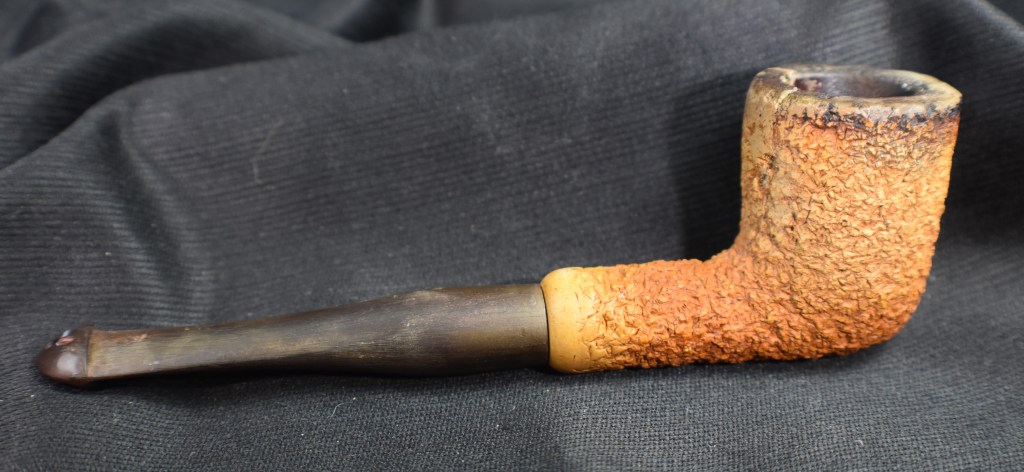


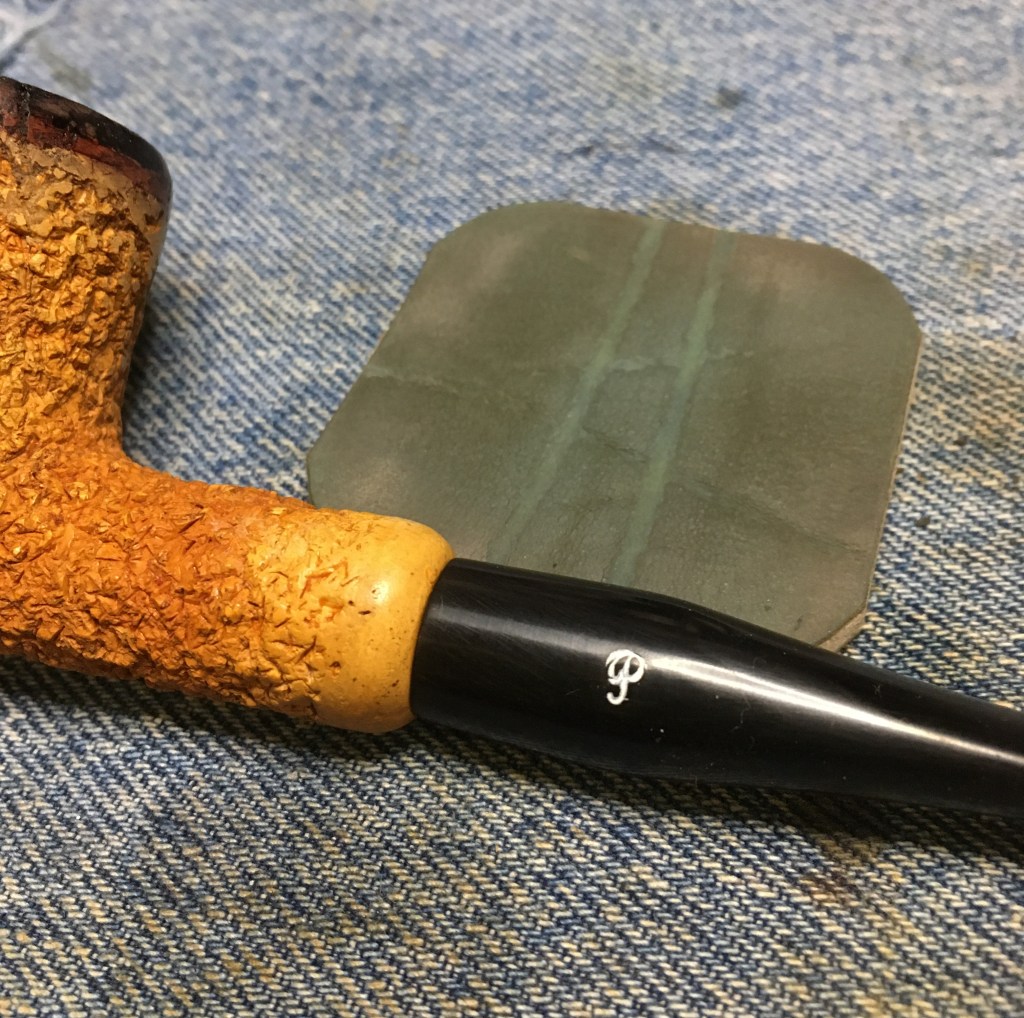


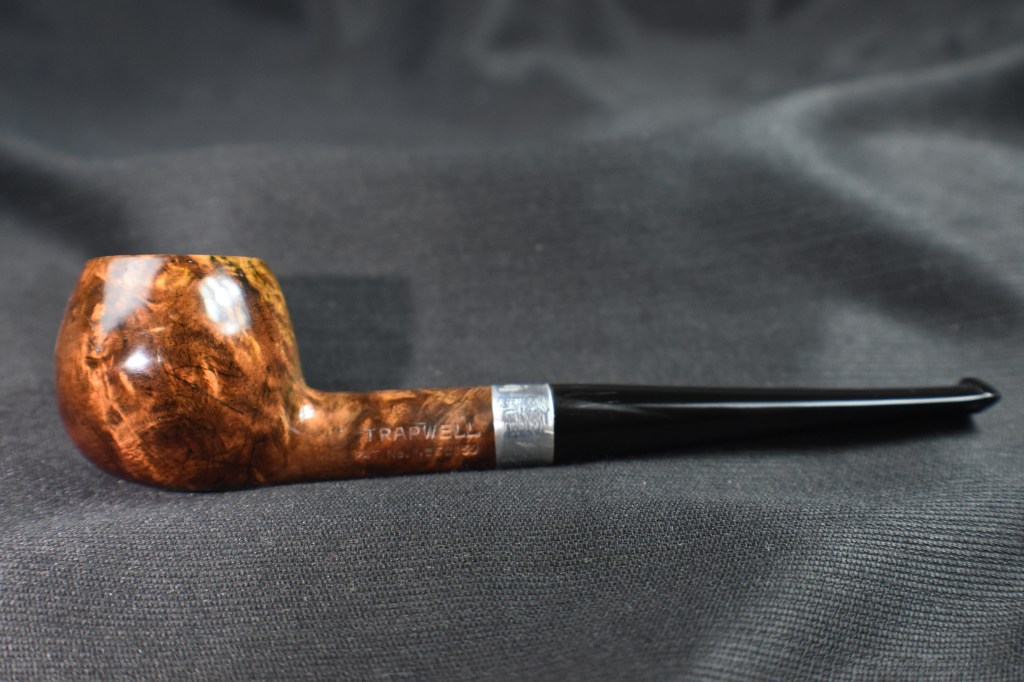


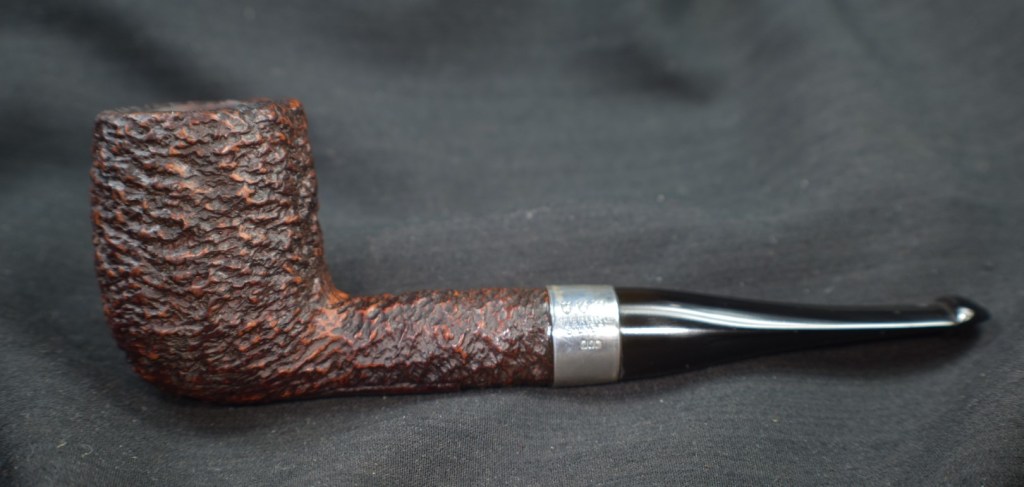


 The “Donegal Rocky” (in quotation marks), released in 1945 or so, was Kapp & Peterson’s first rusticated line. Not that K&P hadn’t rusticated pipes previously, they just that they hadn’t devoted an entire line to rustication. And they were apparently proud of it, because they gave it a sterling mount along with a black finish and white-stamped P on the mouthpiece.
 It was part of K&P’s “Product Line,” what I call gateway pipes and others might call an entry-level pipe, as you can see in this shape chart from the 1945 catalog. Like the Shamrock (European version) and “K,” it was originally a fishtail line.

 It’s worth remarking concerning the removable stinger. This spike-ended aluminum tube is easily removed, leaving the P-Lip mouthpiece strictly a graduated-bore regulation affair.


 Now an argument could be made for either an e, c or o. Respective dates would be 1972, 1970 and 1980. The o would move the pipe closer to the black/brown stain age range of 1981 as mentioned in the Mark Irwin blog above.


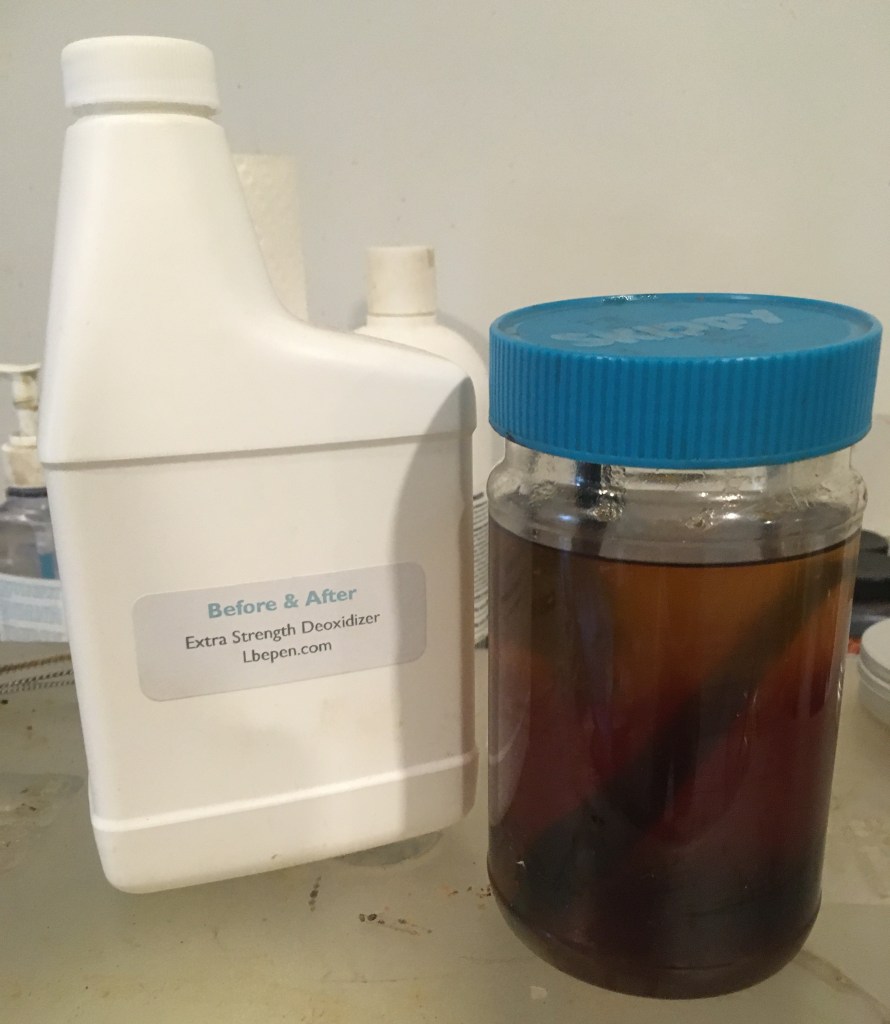


 NebraskaPeteGeek
