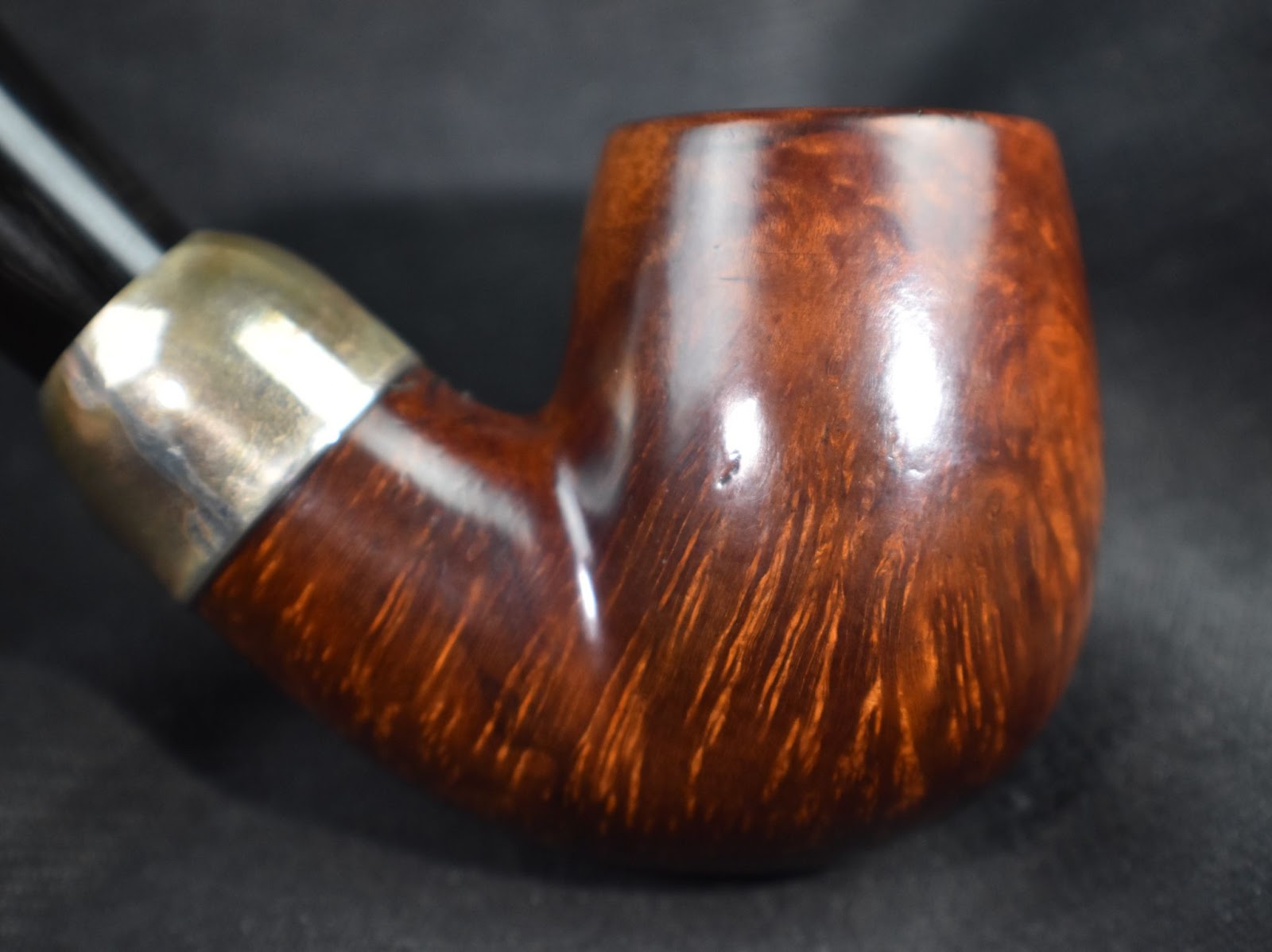
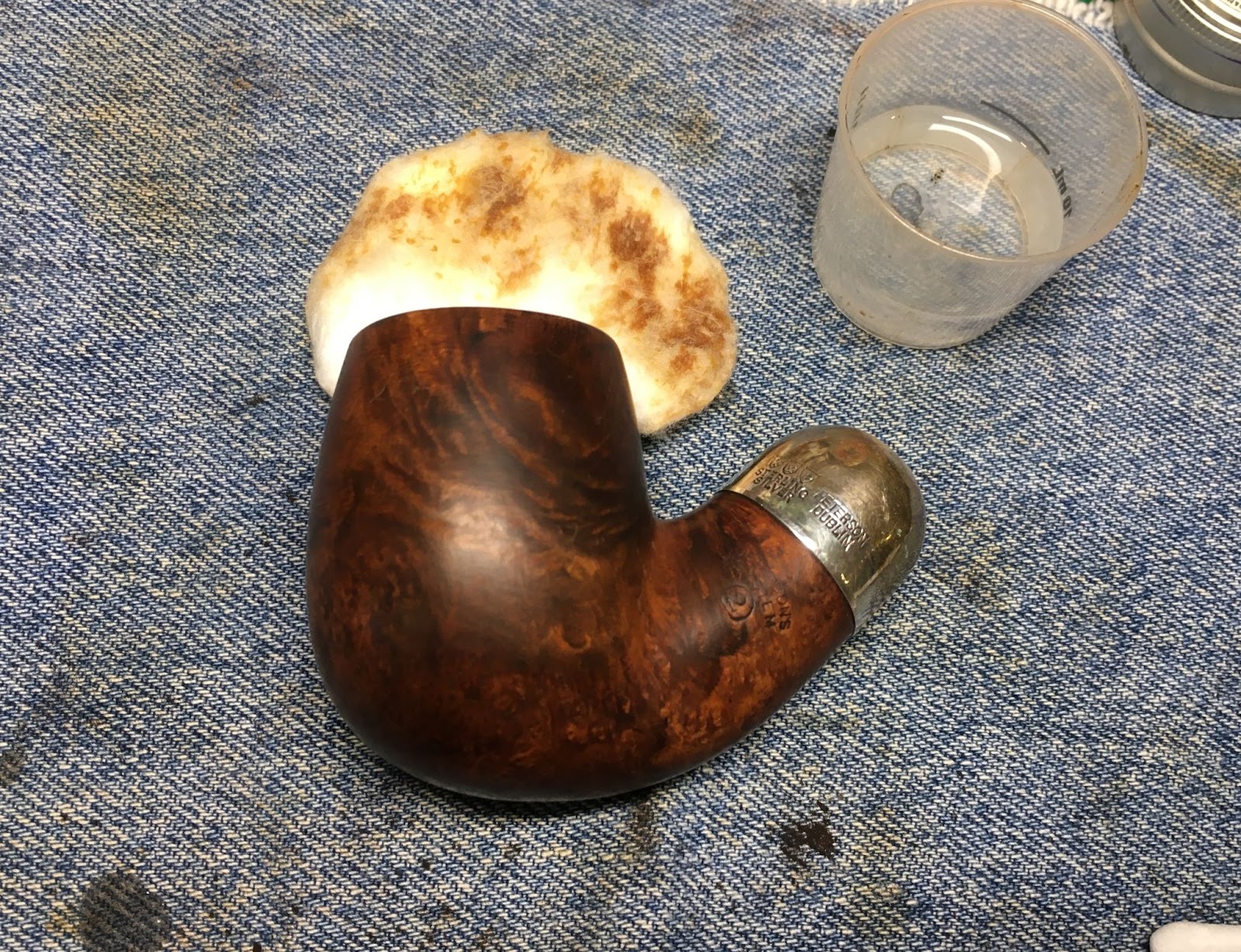
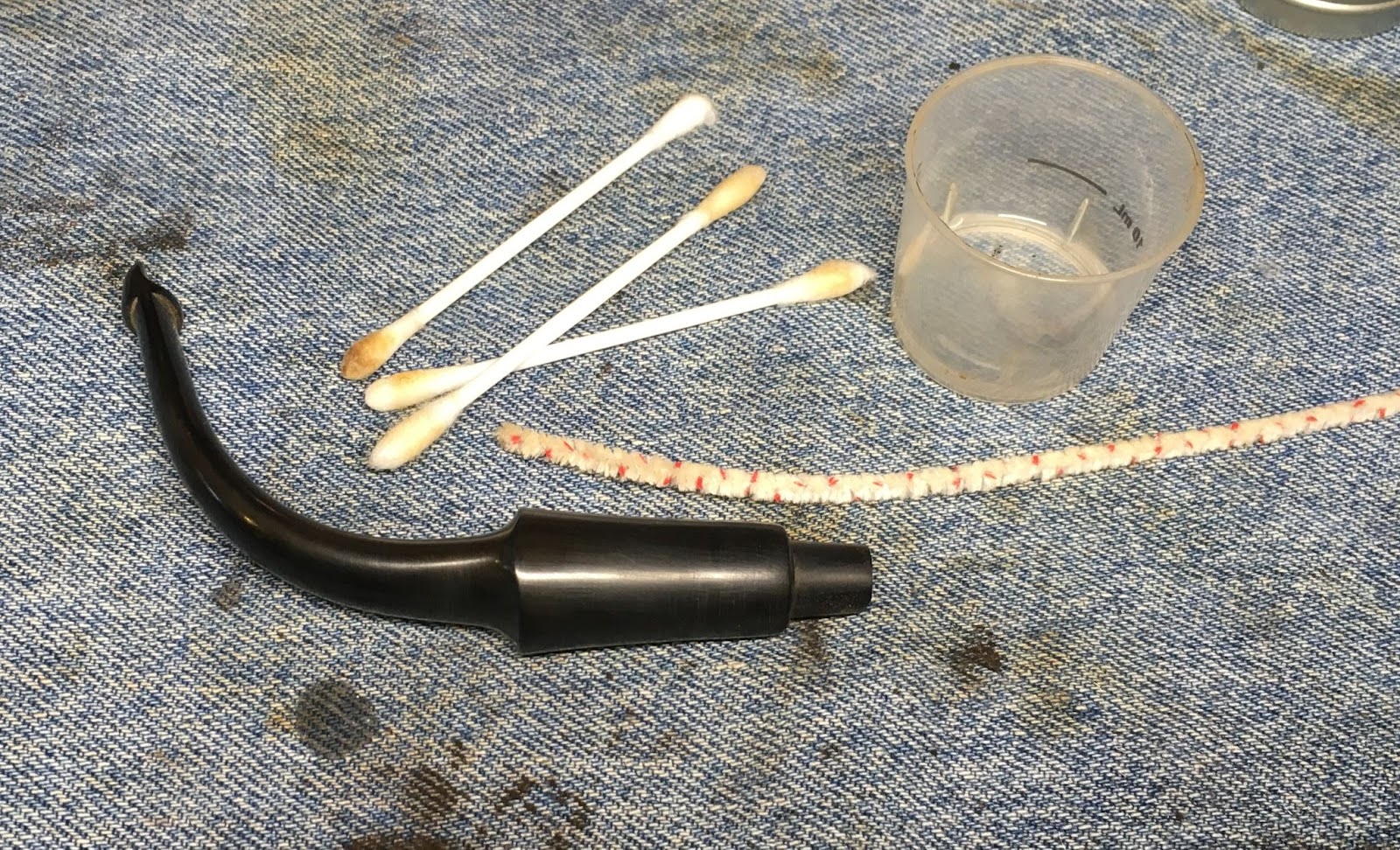
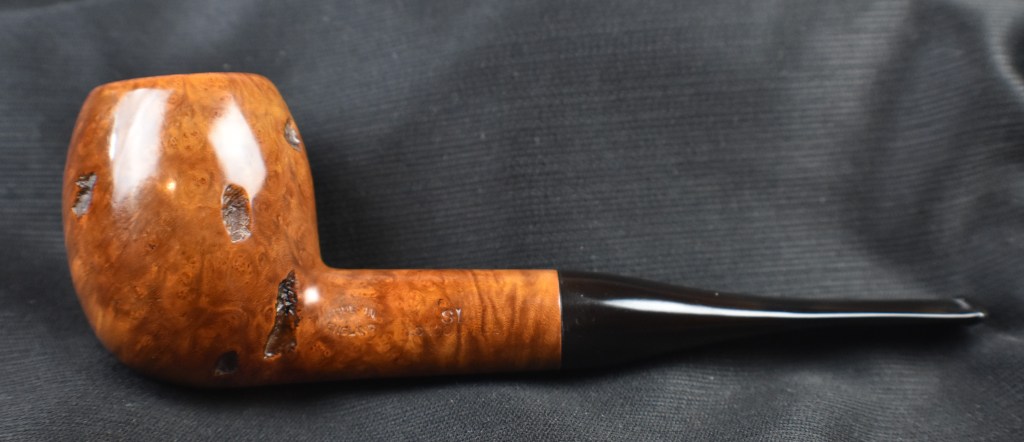
I remember an old advertisement for Camel cigarettes where the main actor walks a mile for a Camel cigarette. That commercial was made about thirty years after this pipe while the advertisement campaign by Camel was actually started in 1920. (https://tobacco-img.stanford.edu/wp-content/uploads/2020/03/06212512/camel_creativehistory.pdf) I still associate camels with tobacco. If you have followed my blog for any time you have seen me restore several Marxman pipes. I admit to being a Marxman fanboy. Having read about and seen images of Robert Marx’s figural pipes I knew I wanted to have one in hand. That is where this camel enters the story. I saw the photo from the eBay listing:
Background
As I said earlier, I have restored several Marxman pipes this year. I will link a couple which I think did a fair job at documenting the company history: Marxman Jumbo and Marxman Mel~O for those who are interested in reading about this amazing company.
Back to the pipe in hand, The eBay listing photo was not a great photo and the others were no better.
I could tell, kind of, that this was a similar camel from the 1950 Marxman catalog.
Image above is from pipedia.org circa 1950s catalog. Now, I know that the above image is not stellar quality but I think the camel in hand looks to be of better quality than the quality of the carved pipe in the catalog image. There seems to be a great difference in the carving quality of some of the Marxman carved figural pipes which I have seen photos of. I can’t help but wonder if the figurals from the early 1940s were of a higher quality than those of the 1950s. Allow me to show a couple of screen captures from Etsy and eBay of recent auctions to make this point.
The first two images below appear to be rather good quality carvings and I realize that image quality plays a major role in assessing the apparent quality of a piece.
While the next two images show carvings of a lower quality or lesser detail:
All of the pipes are listed as “Marxman” but stampings of the shank can only be verified on the Ubangy Male and the parrot pipes.
MasterCraft purchased Marxman in 1953 and started importing pipes from France and Italy. These foreign made Marxman pipes do not have the “magic” of the Marxmans made in New York. I cannot quantify the magic and I do have a French made Marxman spigot that is a truly wonderful smoking pipe but there is just something missing from the Marxmans after the sale to Mastercraft.
The Restoration
The Camel got itself a nice soft piece of denim to rest upon.
The first stem was the reaming of the tobacco chamber.
The very deep tobacco chamber. The Kleen-Reem was used for this due to its reach. The chamber was also scraped with the Smokingpipes Low Country reaming knife and sanded with 220 sandpaper wrapped around a wood dowel.
The stummel was then taken to the sink for a scrub with undiluted Murphy Oil Soap and a nylon scrub brush. The soap was rinsed with warm water and the stummel dried with a cotton hand towel.
Back at the workbench the briar was looking better without the years of accumulated dirt and grime. Fortunately it did not smell like a wet camel.
There was still some lava present in the carvings on the rim. I cleaned this with 95% ethyl alcohol and a brass brush.
I failed to photograph the cleaning of the shank. I guess I was so excited to be working on a Marxman figural that I lost myself in the task.
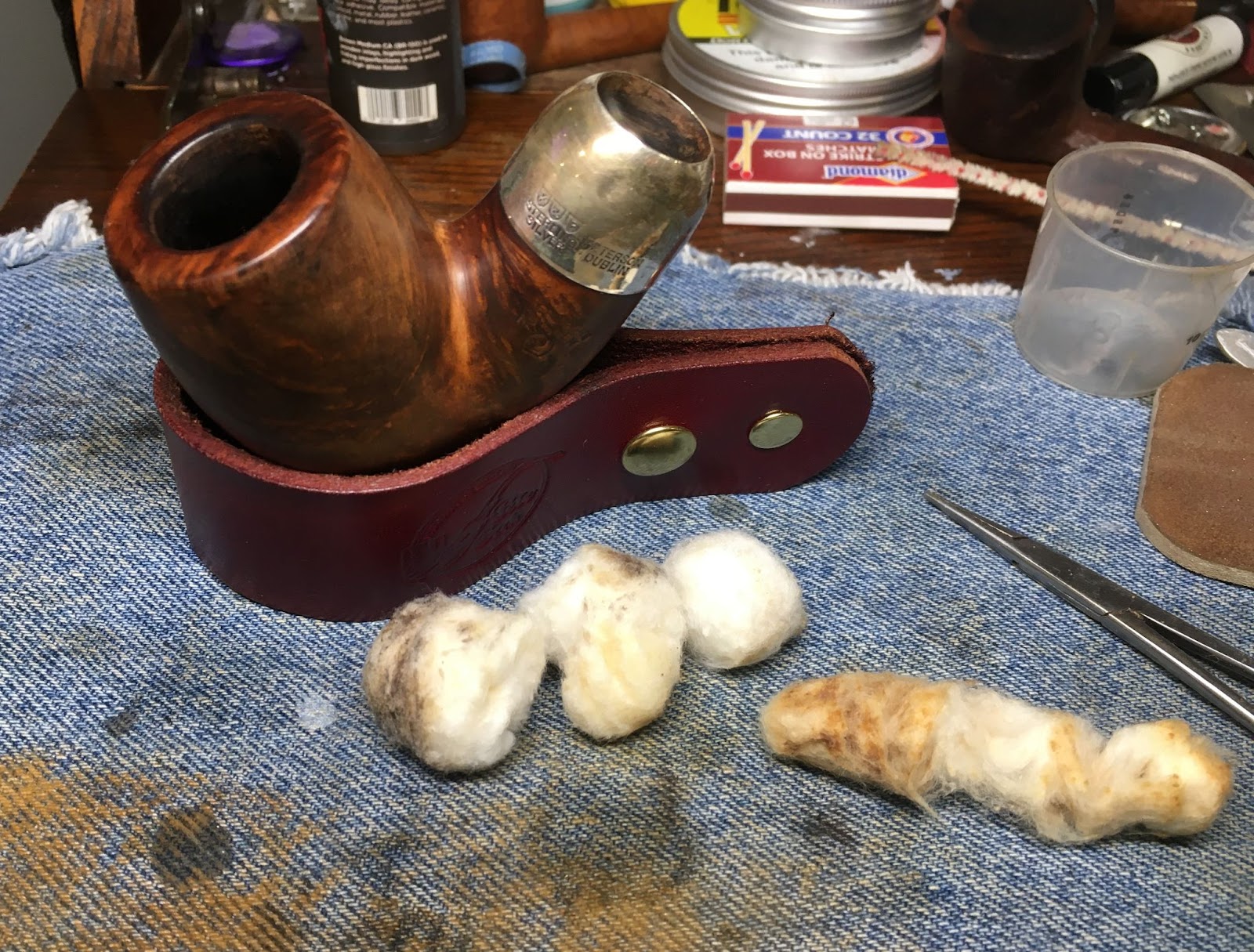
I did regain my composure while cleaning the stem. This was done with 95% ethyl alcohol and bristle pipe cleaners. You can see from the pipe cleaners, in the photo below, that the stem was in need of a cleaning. I assure you that the shank was also quite dirty and required many scrubbings with a nylon shank brush, alcohol dipped cotton swabs and folded pipe cleaners.
The stem exterior was in far better shape than the interior. It had slight tooth chatter but no deep dents.
I filed the tooth chatter with a small flat file on both the top and bottom of the stem.
I wrapped the shank in painters tape to protect it during the sanding. Oh, below you can see how the lava cleaned up from the rim too. Sorry for not photographing that cleaning.
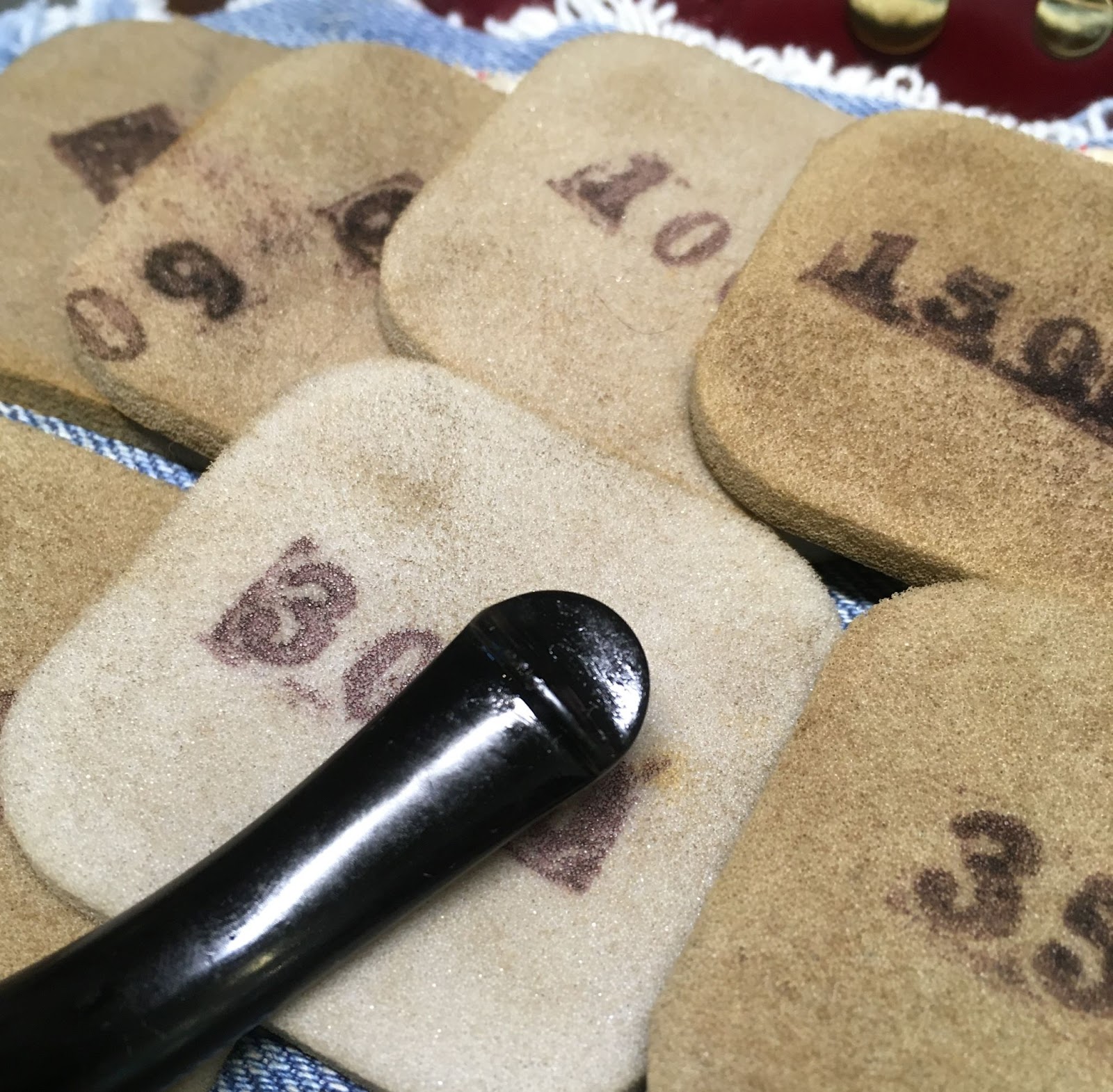
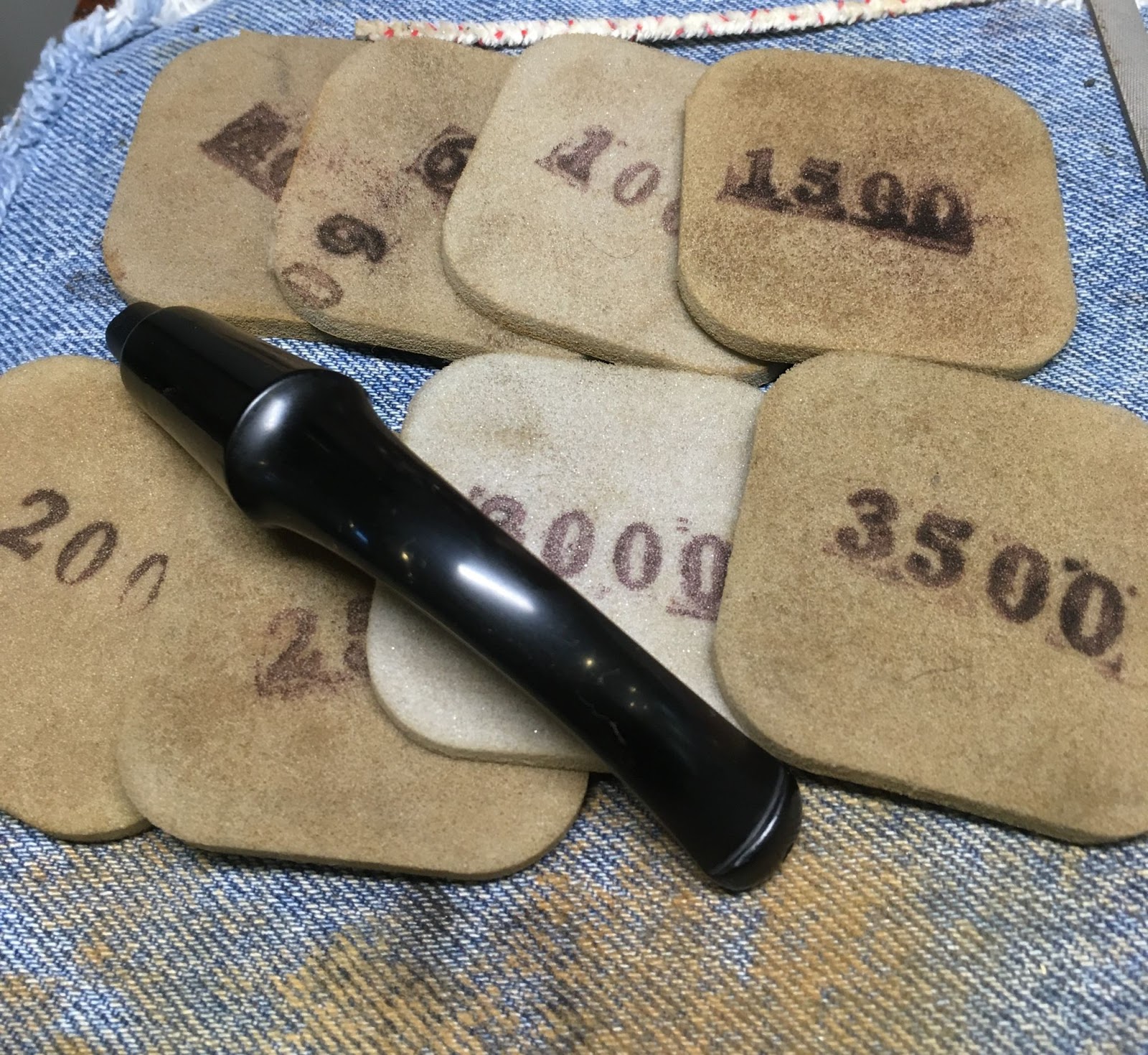
The stem was sanded with a series of sanding sponges from 400-3500 grit. Between each sponge I rubbed the stem with mineral oil and wiped it with a paper towel.
The stem was then worked with micro-mesh pads from 4000-12000. Between each pad the stem was rubbed with Obsidian Oil and wiped with a paper towel.
The stummel had a coating of Before and After Restoration Balm rubbed into the carvings by a baby toothbrush.
The Restoration Balm was allowed to work it’s magic for 20 minutes. It was then vigorously hand buffed with an inside out athletic sock to remove the excess balm.
I cleaned the baby toothbrush by dipping it into 95% ethyl alcohol and rubbing the brush on the denim piece. This was repeated several times to remove all of the Restoration Balm on the brush bristles. I then used the baby toothbrush to apply Renaissance Micro-Crystalline Wax to the stummel. I buffed the stummel with a shoeshine brush then with a fluffy microfiber polishing cloth.
The pipe was taken to the buffer where I applied several coats of carnauba wax to the stem and to the smooth heel where the briar was stamped. I did not apply carnauba to the carved surfaces of the stummel. The stem was hand buffed with the microfiber polishing cloth to further raise the level of shine.
There you have it, the 1940s Marxman Camel restoration. Although I am sure my oldest granddaughter will declare this is a llama not a camel. She has a thing for llamas and rearranging the pipes in my pipe racks. I am very pleased with how this restoration turned out. I’d always wanted to lay hands on a Marxman figural and this one was a beauty. The briar looks great, cleaned and conditioned. The stem polished-up wonderfully and together they are quite stunning. Filling the entire cavernous bowl would provide lengthy smoke. I am thinking at least a couple of hours. Certainly enough time to walk a mile.
The dimensions of this Marxman Jumbo C are:
Length: 6.08 in./ 154.65 mm.
Weight: 2.67 oz./ 75.60g.
Bowl Height: 3.5 in./ 80.00 mm.
Chamber Depth: 2.24 in./ 57.00 mm.
Chamber Diameter: 0.79 in./ 20.07 mm.
Outside Diameter: 1.57 in./ 39.88 mm.
I do hope that you have found something here useful to your own pipe care, maintenance or restorations. If you like this sort of thing, please click the like and subscribe buttons. Thank you for reading the ramblings of an old pipe lover.
Loading…
Below are some photos of the finished Marxman Camel.
Geometry, design and art are not things that I have ever been trained in. Sure, I took an art history class in college and loved it but that could have been just for the nude women. I was 19 years old after all and in 1985 the internet was not a source of said nudies. Back to the aesthetics of pipes; panel shapes with their flats and curves draw me to them. I cannot explain why, perhaps it is like they are providing some order to the chaos of fire and smoke or, maybe they just look cool. Whatever the case may be, this panel caught my eye and the stamped name on the shank made me laugh. SMOKES STOGIES SNUFF AND STUFF. I made several assumptions here; the stamp referred to a tobacconist shop, the “SMOKES” referred to cigarettes, the “STOGIES” to cigars, “SNUFF” the nasal variety not the films and “STUFF” the catchall category. I definitely wanted to visit that shop as I am a snuff taker/pipe smoker who has not seen snuff in a brick and mortar establishment in more years than I can remember. I am not sure where this pipe came from. It was most likely part of an estate lot. My record keeping is poor at best and the secretary continues to not come to work. This is probably due to the fact that I’ve never hired one. The below photos are of the Smokes Stogies Snuff and Stuff pipe prior to working on it.
So many issues. The glaring ones are; the cloudy clear coat, oxidized stem, hole in stem and the tobacco still in the bowl. Well one of those will be easy to fix.
Whew, that’s a relief.
Background
I think it is safe to say that Smokes Stogies Snuff and Stuff is not the original maker of this pipe. A quick internet search did not produce the tobacco shop that I had imagined. I envisioned a castle-like structure with old world charm nestled in the historic section of an old New England town. Then I found this matchbook. Anchorage Alaska! That completely edited imagined scene. Now I envisioned rustic sea-side tobacconist along a wharf with a fleet of fishing boats moored. Instead of a wooden cigar-store Indian statue there was a haggard sea captain with a pipe, wooden leg and a harpoon in hand. Oh, the vivid mental images were running wild.
Alas there matey, little could be found of this tobacco shop. Fortunately there were the names of the proprietors on the mathbook – Mike Plipton and Wades Osborne. There was also the address. Hmm, Penney’s Mall didn’t sound like it fit my wharf scene and a search 412 W. 6th Avenue, Penney’s Mall Anchorage Alaska 99501 completely ruined my imagined scene. The below photo is of the Anchorage JCPenney. Not a fishing boat to be seen.
I then searched out Anchorage tobacco shops currently in business, hoping to find someone who knew of or about Smokes Stogies Snuff & Stuff or the proprietors. One of the shops that I contacted, via their website, was G&P Fine Tobaccos Limited (https://gptobacco.com/). I received the following email reply:
“Our shop started in the late 60’s and we know of this shop.
It was a small shop in the JC Penney’s mall in the mid 80’s and was very short lived according to our shop oracle (who starting working our group of shops in the early 80’s).
They were in business for about 2 years and abruptly closed
Ill let you know if he remembers more. Ill be meeting with him again soon
Best regards,” (personal communication, email)
A second avenue of research led me to the Alaska Pipe Club Facebook page. I posted an inquiry and a few photos of this pipe and asked if any group members had additional information. I received a few replies from kind and knowledgeable Alaskans.
From G&P / Tobacco Cache this morning: Our retired guys chimed in this morning with some history. It was a shop that formed in the mid 80’s in the penny’s mall. They recall it being in business for a couple years aprox 2- years then it abruptly closed. Hurriedly for some reason that no one recalls. No records exist on it aside from advertisements such as the match covers. Nice find. Always cool to discover shop stamped pipes. We have collected a few from the earliest Tobacco Cache and Pipe and Pouch FAIRBANKS, but haven’t seen much other. Happy collecting.” (Facebook, Alaska Pipe Club group chat)
Well, the approximate date of the pipe seemed quite certain now who made it was inquisition. Unfortunately, there was no shape number stamped on the pipe. I had restored a Telford’s Canadian pipe earlier this year. Telford’s is a tobacco shop outside of San Francisco, California. In talking to the Owner, he told me that the pipe I was restoring was made by Comoy’s and stamped by them for sale in his shop. I started looking at Comoy’s shapes for a panel billiard with a square stem. According to pipedia.org Comoy’s did produce such a pipe but there was no photograph or image to confirm the exact shape or the number of panels.
I posted my proposed manufacturer in the Alaska Pipe Club group and received the comment that Kaywoodie also made a very similar panel shape. The reply is below:
John M. Young it certainly looks like a GBD. I collect GBD’s and love them. Panels are super rare to fine. Also note that Kaywoodie made panels like that (identical shape) as well as GBD
I searched the Kaywoodie shapes and found a match from their 1968-69 catalog. Kaywoodie No. 44 Octagon Apple did appear to have the correct shape but it lacked the saddle stem and did not list the square shank.
Based on my limited searching I think it is a fairly safe assumption that the Smokes Stogies Snuff & Stuff pipe was produced by GBD in the mid 1980s.
The Restoration
As usual the pipe received a clean denim piece as a work surface.
I cleaned out the stem which surprisingly, was quite clean. 95% ethyl alcohol and bristle pipe cleaners were used and the stem was lightly sanded to remove the surface oxidation.
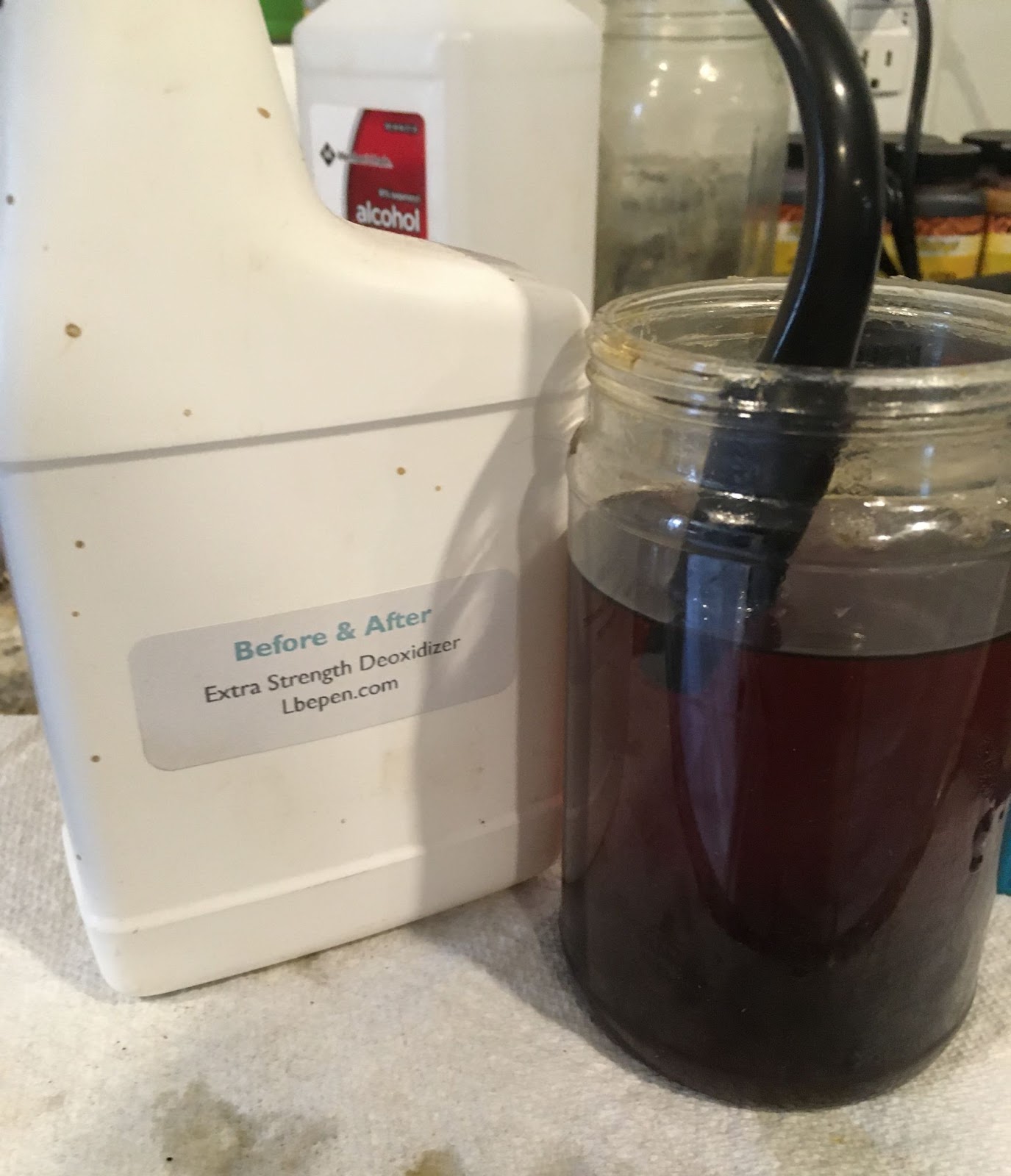
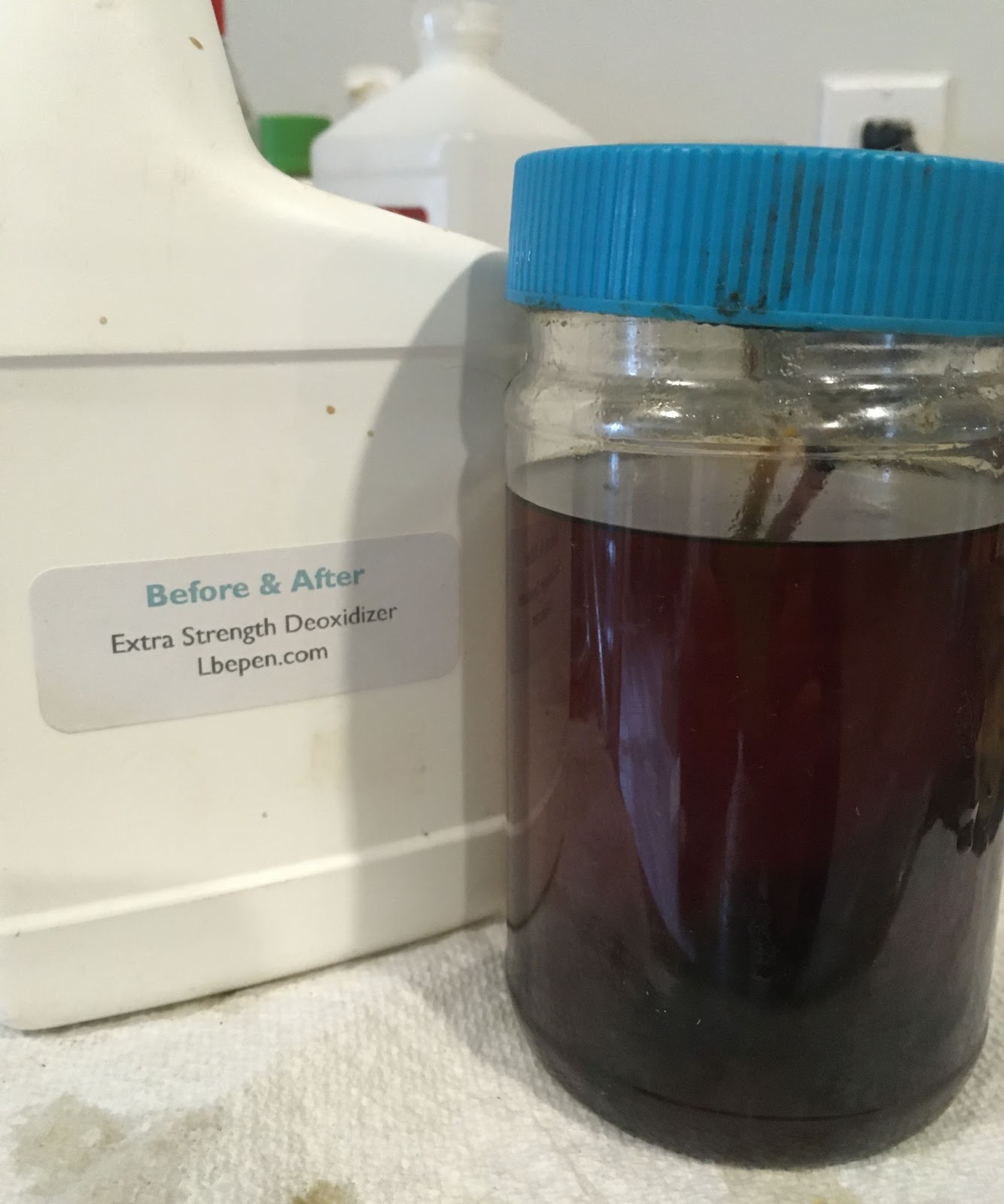
Next, a pipe cleaner was inserted into the tenon to act as a hanger for the stem as it was submerged into Before and After Extra Strength Deoxidizer.
The stem in the solution for 3 hours.
I hoped that the clear coat on the stummel was a shellac which would be easily removed with 95% ethyl alcohol. I tested this with alcohol on a make-up pad. It was not. This was not surprising since the pipe was of a more recent make. Though being lazy, I had hoped.
The reaming tools were assembled: Kleen-Reem, Smokingpipes Low Country reaming knife, General triangular scraper and a wood dowel wrapped with 220 sandpaper.
The Kleen-Reem did the majority of the work in removing the cake from the tobacco chamber. Minimal scraping was needed. I then sanded the interior to bare briar and saw no sign of any damage from heat to the chamber.
The stummel was scrubbed with undiluted Murphy Oil Soap and a medium stiff toothbrush. The soap was rinsed with warm water and the stummel dried with a cotton dish towel.
Since the clear coat was not soluble with alcohol I opted to soak the whole stummel in acetone to remove the finish.
The stummel wanted to float higher in the acetone than I like so an empty brass pistol cartridge (brass band doner) was used to weigh it down.
30 minutes later the stummel was removed and wiped with a make-up pad wetted with acetone. The finish had been removed but so had a good deal of the Smokes Stogies Snuff & Stuff stamp. I have found that some manufacturers will stamp on top of the clear coat rather than stamping the briar then applying the clear coat. This is more often done on lesser quality pipes. In these cases removal of the finish will also remove the stamping.
While the yuck, also known as smoking residue, was still soft from the acetone bath, I worked on removing it from the shank. This was done with a nylon shank brush, cotton swabs, bristle pipe cleaners and 95% ethyl alcohol.
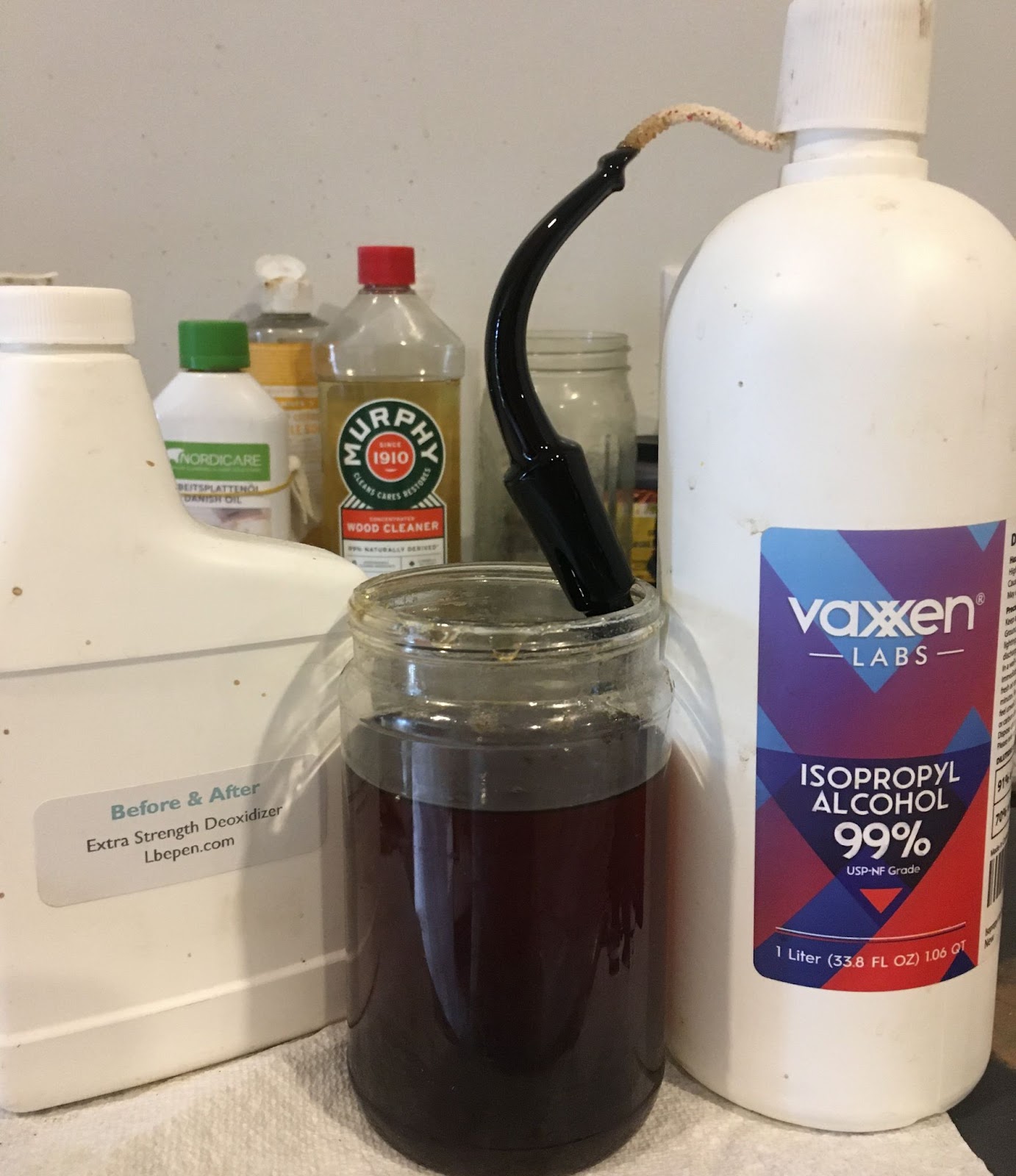
The stem was removed from the Deoxidizer (deox) and allowed to drip the excess solution back into the jar. The not yet patented Deoxidizer Drip-O-Matic consists of the pipe cleaner hanger wedged into the lid of a taller bottle.
After dripping, the stem was vigorously rubbed with a coarse shop rage to absorb the remaining solution and to abbrade some of the loosened oxidation.
Below you can see the oxidation that was removed with the shop rag.
The stem was looking much better though slightly pitted by losing the oxidized rubber.
I then used several make-up pads with Soft Scrub cleanser to further rid the stem of oxidized rubber.
The stem was reattached to the stummel to preserve the joint where the two pieces meet. I then lightly sanded with a 400 and 600 grit sanding sponge. This prepared the stem for the rebuilding of material lost to tooth/biting damage.
I roughened the area that was to be rebuilt with 80 grit sandpaper.
A piece of a plastic lid was cut to act as a dam to stop the black cyanoacrylate (CA, super glue) from building up in the airway. The plastic dam was wrapped in several coats of cheap Scotch tape to add to its thickness. The good 3M tape does not work as well as the cheap stuff at resisting the CA and the CA drying accelerator used to speed the curing of the CA.
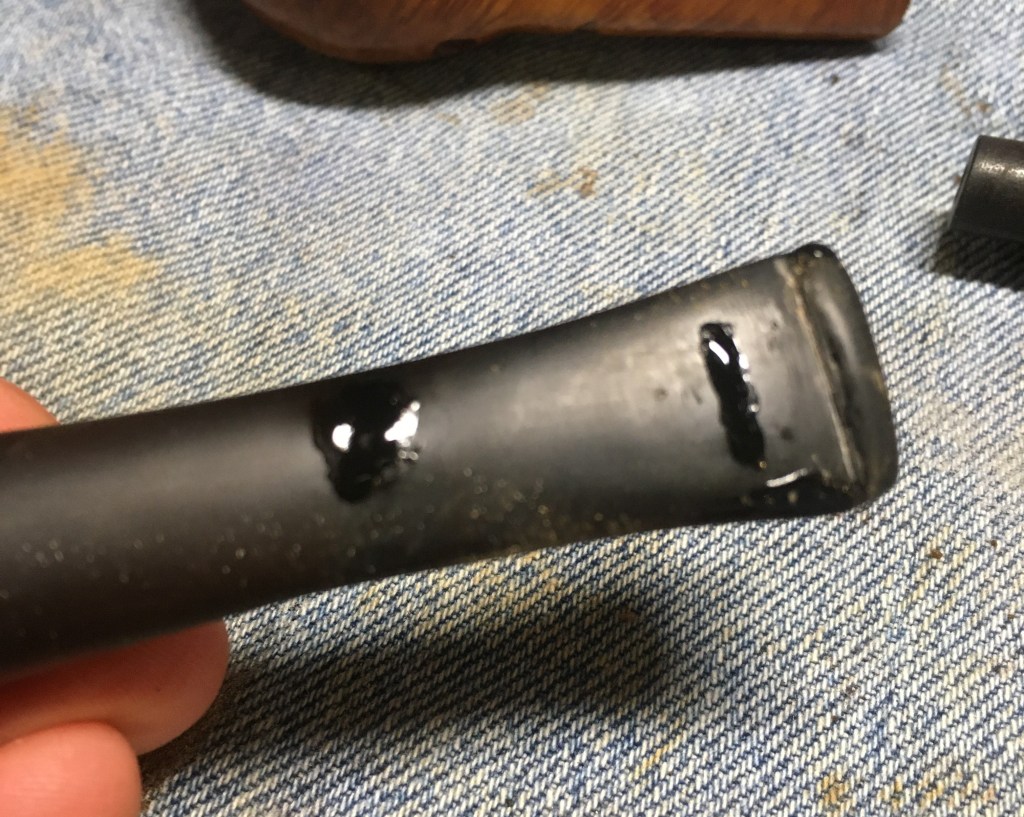
With the dam inserted into the mouthpiece, black CA was layered onto the button area. This CA was then spritzed with a drying accelerator. Several thin coats are preferred over one thick coating as the accelerator does not penetrate into a thick layer.
Below, you can see how the deeper dents were filled before the area was covered.
The new CA patch was then filed, smoothing the surface. Sanding sponges further smooth and remove the lines from filing.
The shiny spots on the photo below indicate places where additional CA needed to be applied and material built up.
This process was repeated until the damage was no longer obvious.
I wanted to give the stummel a little bit of a contrast stain to bring out the briar grain.
The stummel was pre-heated with a heat gun to open the pores of the briar. A duct-tape wrapped fishing bobber was inserted into the tobacco chamber to keep dye from entering. Most folks use a wine bottle cork for this but I’ve found that not drinking severely limits the availability of wine bottle corks.
The black Fiebing’s Leather Dye was applied with a folded pipe cleaner and flamed with a lighter.
The stummel was then wiped with a paper towel to remove excess dye.
I then took the stummel to the buffer where the new black dye was buffed from the surface of the pipe with rouge compound. Below you can see one panel buffed. The dye penetrates the softer grained briar more than the harder grains. When buffed off this contrast accentuates the grain.
The stem and stummel were then sanded with a series of sanding sponges from 400-3500. Between each sponge the stummel was wiped with a make-up pad dipped in alcohol. The Stem was rubbed with mineral oil and wiped with a paper towel.
The pipe was then worked with micro-mesh pads 4000-12000. Between pads the stummel was wiped with a make-up pad dipped in alcohol. The Stem was rubbed with Obsidian Oil and wiped with a paper towel.
The stummel was given a coating of Before and After Restoration Balm and allowed to sit for 20 minutes.
The Restoration Balm was wiped from the stummel using an inside out athletic sock.
The pipe was then taken to the buffer where it was given several coats of carnauba wax. The final step was hand buffin the pipe with a microfiber polishing cloth to further raise the level of shine.
I would like to thank the folks at G&P Fine Tobacco Limited (https://gptobacco.com/) and the Alaska Pipe Club for assisting with the research for this restoration. If you are ever in Anchorage please pay G&P Fine Tobacco Limited a visit. I think this piece of tobacciana known as, Smokes Stogies Snuff & Stuff paneled, square shank, saddle stem billiard turned out quite well. I was sad to see the stamp not make it through the finish removal completely intact. It is still legible but not with ease. The stem reconstruction turned out well and the contrast dye looks very nice and accentuates the briar grain. The dimensions of this Smokes Stogies Snuff & Stuff paneled, square shank, saddle stem billiard are:
Length: 5.53 in./ 140,46 mm.
Weight: 1.53 oz./ 43.70g.
Bowl Height: 2.09 in./ 53.09 mm.
Chamber Depth: 1.60 in./ 40.64 mm.
Chamber Diameter: 0.73 in./ 18.54 mm.
Outside Diameter: 1.41 in./ 35.81 mm.
I do hope that you have found something here useful to your own pipe care, maintenance or restorations. If you like this sort of thing, please click the like and subscribe buttons. Thank you for reading the ramblings of an old pipe lover.
Loading…
Below are some photos of the finished Smokes Stogies Snuff & Stuff paneled, square shank, saddle stem billiard.
It must be my four years of physical geography/geology undergraduate training that drew me to this pipe. It looks like a rock sample on a stick but I fell in love with it at first sight, scars and all. I remember seeing various examples with various natural rock-like shapes online but this one called to me. The funny part of this story is that I had just seen Steve Laug post in a Facebook group about a great antique store that he came across. I commented something about how the local antique stores in town really needed to “up their game” regarding old tobacco pipes and whined about how the local shops might have a Willard that looks as if it was last cleaned by placing it in a garbage disposal. Yeah, I was a bit jealous. The next day I made my way into town to pay taxes on the house and truck. While there I swung into one of the antique shops and asked if they had any old pipes. Out came the box. Low and behold, there was this Kiko. I was amazed, there were also two Willards that had last been cleaned not with a garbage disposal but with a technique involving chains and a gravel road – not sure how that one works. I don’t think the proprietor of the shop had any idea about the value of the Kiko. His mother was working the counter that day and we had a very nice conversation about meerschaum and how it really was a rock. I left her enlightened and with some cash as I returned home with a Kiko and new stickers on my license plates. When I got home I was able to examine the pipe more thoroughly and in a less excited state. There were no carvings or stamps on the stummel. The stem had the Kiko Elephant near the shank on the left and along the bottom was stamped TANGANYIKA. Below are some photos of the Kiko as it appeared prior to any work.
I’m not sure what the scars on the lower end of both sides were from. I can’t figure why you’d need to squeeze a meerschaum stummel with a channel lock pliers but that is what it looks like happened. The stem was oxidized suggesting that it was indeed vulcanite and had accompanied a previous owner on many a clenching expedition. This was going to be an interesting restoration. The first question: Do I re-carve the damaged spots and make the re-carvings blend with the original or, Do I patch the holes? Either pursuit was a novel idea for me. Research was required.
Background
The first step that I took in researching this pipe was to look up the logo at pipephil.eu. There I found the following:
Turning to pipedi.org for some history of Kiko led to the following entry:
“Kiko, meaning “pipe” in Swahili-Kiswahili to English translation, is probably the best known of the various brands listed below. In East Africa Meerschaum is found in Tanganyika, once known as German East Africa, and since 1964 part of the United Republic of Tanzania. The main deposit comes from the Amboseli basin surrounding the Lake Amboseli. Tanganyika Meerschaum is normally stained in shades of brown, black and yellow, and is considered to be inferior to Meerschaum from Turkey. Eventhough, the raw material is mined by the Tanganyika Meerschaum Corporation and to a large extent used for pipemaking. Uncounted pipemakers throughout the world were supplied with Amboseli Meerschaum, preferentially used for Meerschaum lined briars or leather-clad pipes. In Tanganyika the Kilimanjaro Pipe Company Ltd.” (Kiko – Pipedia)
And, more specifically the Caveman line of Kiko pipes.
“Caveman Fashioned from a piece of natural meerschaum.Every pipe is unique and – is in fact a geological specimen over a million years old.Attractively boxed.” (Kiko – Pipedia)
A second entry at pipedia.org discusses the Tanganyika Meerschaum Corporation in greater detail.
“From Pipes, Artisans and Trademarks, by José Manuel Lopes
Tanganyika Meerschaum Corporation is a company that formed in 1955 by Kenyan businessmen from Nairobi after the discovery of a meerschaum mine relatively close to the surface on Kilimanjaro. The meerschaum is tougher, less porous, and cheaper than the Turkish variety. Another mine was soon discovered in Sinya, in the famous Amboseli Game Park.
To give more depth to the meerschaum story here is a quick lesson in geography.
Lake Amboseli is a rainy season body of water along the shared border of Kenya and Tanzania, northwest of Mount Kilimanjaro. The straight white line on the image below is that border. Sinya refers to the Sinya Mine (https://www.mindat.org/loc-266724.html).
Zooming in on the south western shore of the temporary Lake Amboseli you can actually make out the excavations of the old mining activities. On the below image from google maps; pits, tailing piles, roads etc… can be discerned.
It appears that little to no mining is done at the site today. Several sources say that the meerschaum deposit were close to the surface, not very large and were played out
With all of that information in mind and assuming that the TANGANYIKA stamp on the stem is referring to the country of manufacture (COM) this pipe was made not after 1962.
The Restoration
As I said earlier, I had some research to do regarding how to patch meerschaum. Oh yeah, I decided to patch the damaged area rather than try my hand at carving the meerschaum. The first site I visited was that of Troy W. of Baccypipes (https://baccypipes.wordpress.com/author/troynov1965/). He had a unique “Old Time Meer Lining Repair Method On a Kaywoodie Shellcraft #5651” post describing the use of finely ground chalk and egg white. This patch was described for repairing a meerschaum bowl lining but I figured that it could be used for meerschaum in general. Here is the link to that blog post. A second blog post that I read was by Dal Stanton, published at rebornpipes.com, describing another meerschaum lining repair. That post can be found here. I frequently message Dal about various pipe related issues or the weather in Colorado. I asked him how the repair on the pipe he had done was holding up with use. His restoration was done as a commission for Paresh Deshpande. Paresh has also done restorations at rebornpipes.com (Here is an example by Paresh). Dal messaged Paresh and in very short order replied to me,
“I have heard of no failures! The concoction is pretty sturdy and a great way to salvage Meers.
Dal
I’ll ask Paresh for a report.
Dal
From Paresh:
Hey Dal,
The repairs have held up perfectly well and the pipe is still providing me hours of great smoke. Do say Hi to John for me.” (Dal Santon, personal communication)
That provided the confidence boost that I needed. Egg whites and powdered chalk, who would have thought that would be the solution (pun intended – though it is actually more of a mixture than a solution) to this restoration?
On the next trip into town I stopped by a local dollar store and purchased chalk. The trip was actually for groceries so eggs were already on the list. Returning home I set to work following Troy W.’s procedure. Troy used the handle of a screw driver, apparently he didn’t own a mortar and pestle either. I started with a breaker bar rather than a screwdriver.
The breaker bar worked well but the end was rather small in diameter. I looked in the garage for a larger caliber tool.
A small sledge hammer head with a broken handle seemed like the perfect choice. I don’t recommend that you break off the handle of your small sledge in order to reproduce this procedure. I’m sure the handle would not provide a significant source of error.
The hammer was washed and dried and put to work.
A point of reinforcement here, Troy mentions to finely grind the chalk and when you have it ground then grind it some more. I concur and can state that I did not follow this advice as well as I should have. You really want the chalk to be powdered. Not mostly powdered with some small pieces, like mine was. I am sure that a mortar and pestle is the proper tool for this endeavor and were I still an active science teacher I would have borrowed one from the lab. Drats, foiled again by life choices.
The chalk was mixed with egg white. I added chalk until I had a mixture that was like “soft peaks” when whipping cream. The damaged spots appeared to have plenty of rough surface to enable the mixture to adhere to. I did wipe the surrounding smooth surface with alcohol to remove any surface wax that might not allow the mixture to stick.
The mixture was applied and allowed to dry for 4 hours. I also wanted to test a spot of the mixture to see how I could stain it in order to blend the patch with the existing meerschaum. I placed a small blob on a scrap of cardboard and set it aside to dry. I put the unused mixture in an airtight container and refrigerated it.
Once dry the patch felt “chalky”. I don’t know what I was expecting, perhaps more “dried eggy”. The numerous air bubbles had also left pours that I was not happy with. You can see the bubble very distinctly on the dried test blob.
Hmm, I think I needed more chalk in my mixture to make it less liquid and more like putty. I added more chalk. I lightly sanded the dried patch in preparation for a second application.
This 2nd application was applied to both sides simultaneously. The mix was thick enough that It would not drip, had no air bubbles and I could work it more like a putty. “Living and learning” might become my new life motto.
I let this application dry for about 30 minutes then tried to add some texture to it in an attempt to match the existing texture.
Time to test this blob. I thought that I would cover ½ the blob with beeswax to see how the wax colored the patch then try painting the other half with a green tea I was drinking to see how that changed the color.
The first part of the plan worked as planned. ½ the blob was painted with hot beeswax.
The plan went bad when I used the heat gun to melt the beeswax and allow the excess to drip off. It did drip down but the force of the hot air also pushed the remelted wax up onto the unwaxed portion of the ½. Oh well, my plans frequently have difficulties with reality.
There was a slight yellowing of the patch with the application of the beeswax. This was good but not quite the color change I wanted. The texture also changed significantly. The blob was no longer chalky, it was much more like the meerschaum. I think the term in meerschaumy.
I smoothed the mostly dried patch with 400 wet/dry sandpaper and tried the green tea stain. The tea immediately resoftened the patch. Hmm, – note to self, dry time seems important. The tea did seem to color the patch successfully. I set the stummel aside to completely dry and harden, overnight, in this case.
The next day, I began melting the beeswax. I have decided that I really need one of those electric candle maker wax heating pots. Until I do get one I will continue with this system I devised: An aluminum pan with water, a small canning jar with beeswax and a stove top. I like the hot water bath because I can’t overheat the wax getting it to its flashpoint and once the wax is melted I can turn off the flame and the hot water will keep the wax liquid for several minutes.
I heated the stummel with the heat gun preparing it for the wax that I would be painting it with. I painted the entire stummel with melted beeswax. I was amazed at how much wax the meerschaum absorbed. Nearly none of the was applied dripped into the catch tin.
I started working on the stem. The tooth chatter was filed and the stem sanded to remove the hardened oxidized surface.
The stem was then placed into Before and After Extra Strength Deoxidizer (deox). Due to the long stem the jar had to be sealed and placed at an angle to allow the stem to be fully submerged.
Several hours later the stem was removed and allowed to drip excess solution back into the jar.
I used a coarse shop rag to wipe and hand buff the remaining solution from the stem.
The coarse material of the rag both absorbs the solution and acts as an abrasive to remove the newly softened oxidation. The dark residue can be readily seen in the photo below.
The stem was then scrubbed with Soft Scrub cleanser on make-up pads.
At this point I used painters tape to mask the logo and stamp then sanded the stem with sanding sponges in grits of 400-3500. Between sponges I rubbed the stem with mineral oil and wiped it with a clean dry paper towel. I failed to photograph this so I guess you will just have to believe me.
Before moving on to micro-meshing the stem I wanted to repaint the logo and try to paint the TANGANYIKA stamp.
The letters were faint and proved to to take well to the painting. I didn’t see any evidence that they ever had been painted so this was not a great loss. The elephant had been slightly degraded with the removal of the oxidation but remained accepting of the paint. The stem was then polished with micro-mesh pads 4000-12000. Between each pad the stem was rubbed with Obsidian Oil and wiped with a paper towel.
The stem was taken to the buffer for a final buff with Blue Diamond compound. The stem then received several coats of carnauba wax. The stummel was not waxed with carnauba since it had just received fresh beeswax.
This was a fun restoration. It did not turn out as well as I had hoped. The patched spots on the damaged meerschaum are actually quite an eyesore but I learned many things about working with meerschaum. This pipe is not one that will be offered for sale unless someone really wants it.The meerschaum remains a rugged thing of beauty to me even with the blemishes. The stem cleaned and polished nicely and provides a strangely satisfying contrast to the stummel. I was glad that the logo and stamps were preserved. I am also looking forward to another Kiko restoration, hopefully one without the deep scars that this pipe had. The dimensions of this Kiko Caveman are:
Length: 6.83 in./ 173.50 mm.
Weight: 1.34 oz./ 37.40 g.
Bowl Height: 2.33 in./ 59.18 mm.
Chamber Depth: 1.61 in./ 40.89 mm.
Chamber Diameter: 0.72 in./ 18.29 mm.
Outside Diameter: 2.00 in./ 50.68 mm.in line with shank
1.64 in. / 40.18 mm. Perpendicular to shank
I do hope that you have found something here useful to your own pipe care, maintenance or restorations. If you like this sort of thing, please click the like and subscribe buttons. Thank you for reading the ramblings of an old pipe lover.
Loading…
Below are some photos of the finished Kiko Caveman.
Troy W.’s
Chalk and egg white meerschaum bowl lining repair.
Being asked to restore a family heirloom is a flattering and frightening request. Flattered because the owner of the piece thinks highly of your ability to restore the item yet frightening because ethos is a one of a kind item that carries significant personal meaning. In this case personal and historical family meaning as well.
Background
Earlier this month I was contacted via email by a gentleman who had seen a link to my blog on Mark Irwin’s Peterson Pipe Notes. Below is an excerpt from an early email:
“I’m wondering if you do restoration work for others as well as for yourself?
I have an old Peterson System pipe that had belonged to my father’s Uncle, Richard McNamara. He would have bought the pipe while stationed in Northern Ireland as a technician with Lockheed Aircraft. He died unexpectedly in 1943 while still in Northern Ireland.
I intend to pass the pipe along to my nephew. I had sent it to Peterson’s for their assessment to date it and to clean it up a bit. I received a nice note from Glen Whelan, who set the pipe in the 1930’s/1940’s.
So, if you do restorations of this sort, I be happy to have you restore this pipe.”
I asked if it was possible to see some photos of the pipe in question to assess what I would recommend for the restoration. The following five photos were sent by the owner.
The pipe looked to be in very good condition. I replied,
“That is a beauty. I am assuming the Peterson boys told you that the pipe was probably from 1937-1945ish. That would be my guess anyway. Here is what I see that you may want to have restored:
The stem – Looks great. There are some very small scratches around the ferrule. Micro-meshing and a white diamond buff should make it like new.
The Cap – I saw a couple of small dents. The cap can be removed and the dents pressed/tapped out. Then polished and reglued into the original position.
The Stummel – The dings from contact with a rough surface can be 1) filled with cyanoacrylate and briar dust. This will smooth them but will also make for dark spots where each dent is. Or, 2) The dents can be steamed to see if the briar can rebound back. This may lessen the dent but probably not remove it.
The Internals – a general cleaning and yuck removal. “Yuck” is a highly technical restoration term referring to smoking residue. When in abundance, it can be called “yucky”.”
The owner replied,
“Thanks, it is a nice pipe with a special heritage.
All I got from Peterson’s was that it was from the 1930/40’s. But from further investigation I have learned that the 1937-1945 span is correct. Now, I’m assuming that my Uncle bought the pipe new as he was in Northern Ireland from about 1939 to 1943. I have photos of his travels to Dublin, so I’ll further my assumption that he bought it from Peterson’s.
Anyway, i agree with your suggestions about the stem and cap. I saw some crud around the button and the dents on the cap. As for the Stummel, I think I’d just as soon leave the dents as they are. After all, as far as I am aware, only my uncle Richard and I have used the pipe in it’s 80ish years, so, in my mind, it adds a touch of being authentic with continuity. The internals will need a cleaning. I don’t have the pipe in front of me now, it’s packed away in my pipe bin in our RV basement. I’ll pull it out in a day or two and check the bowl etc., but I don’t think it’s too bad.”
We agreed on the work to be done and arranged for shipping. A few days later the pipe arrived and was photographed prior to any work.
Though there was no sign of a shape number stamp, I think this is a 307 shape.
“The 307 is an original Patent bent billiard-shape, shown in the 1896 catalog as shape 9. It has retained its original shape number in the De Luxe version, but was issued in the 1937 catalog as the 307 (2nd quality) / 357 (3rd quality). Since then, it has also appeared as the 9S and 9B (De Luxe), Dunmore System 78 (1978-1983), and the Classic Range 9BC (1940s-1950s) / XL90 (1980s-Present). The 9B dating from the 1940s-1960s (the De Luxe System with a tapered rather than saddle bit) is rarely seen on the estate market. There have been changes in the shape since the 1960s, all toward less “cheeking,” making earlier versions, when available, preferable to those wishing to get back to the first, classic iteration of the shape.” (https://petersonpipenotes.org/146-a-guide-to-system-shapes-1896-2019-part-1-the-300-shape-group/). The 1937 issue of the SYSTEM 2 coincides precisely with the provenance of the pipe.
When I first received the pipe I thought that something had gone wrong like the wrong pipe was shipped. There were no dents on the left side of the stummel. Adding further to my confusion, which is pretty easy to do by the way, was the stem. A Peterson System 2 should have a bone tenon extension or “chimney”, as the Peterson factory folks call them. This tenon was smooth, without threads, and looked to be about 9mm. A closer examination of the pipe and comparison to the photos indicated that it was the same pipe pipe from the initial photos based on briar grain patterns. I could make out well done fills where the dents were supposed to be and there were slight bumps in a newly acquired finish. The finish looked like a lacquer and stain combo which had been sprayed on or maybe a lacquer sprayed onto a still damp stain. It also looked like the stem had received some of the lacquer then had been buffed with carnauba wax.
I emailed the owner with my questions. While awaiting a response I began working on the pipe.
The Restoration
As usual the pipe was taken to the workbench where it was placed on a relatively clean denim piece.
Next the tobacco chamber was reamed using the PipNet and #2 blades. The General triangular scraper and Smokingpipes Low Country Reamers also saw limited action. The chamber was then sanded with 220 sandpaper wrapped around a wood dowel. The sanding resulted in seeing the condition of the briar within the chamber which showed no signs of any damage from excessive heating or charring.
The stummel was then taken to the sink for a scrubbing with Murphy Oil Soap with a nylon scrub brush. The soap was rinsed with warm water and the stummel dried with a cotton hand towel.
Back at the workbench the stummel was wiped with a make-up pad dipped in 95% ethyl alcohol. This removed a good deal of color. Apparently the pipe had received a clear coat of some kind and a recent dye or stain. I could not believe that this was the original stain from the 1930’s or early 1940.
The stem was cleaned out with bristle pipe cleaners and ethyl alcohol and showed that the pipe was being well cared for and cleaned after use.
Oxidation, however, does not care how well a pipe is cared for and attacks at every chance it gets. This stem showed signs of oxidation though not very severe. I decided to remove the oxidation with Before and After Extra Strength Deoxidizer. The stem had a pipe cleaner inserted into the mouthpiece to act as a hanger and entered the deoxidizer solution.
During the reaming, I noticed an off smell from the removed cake. It was not a foul smell, just a slightly sour hint. I decided to give the stummel an alcohol treatment to remove any traces of old smoking and tobacco residue. I packed the tobacco chamber and shank with cotton and filled the respective volumes with 95% ethyl alcohol. The stummel was propped up to allow the alcohol levels to remain level while filled.
The below photo is after two hours of the alcohol treatment. The shank was discoloring far more than the tobacco chamber.
During this waiting time I was able to check emails. Yeah I know, a phone can be used to check emails but I’m old and stubborn. Phones are for calling, texting and photos. Typing is done on a computer. Anyway, the owner had gotten back to me regarding my questions about the condition of the pipe. He had said that he had sent the pipe to Peterson in Dublin.
“Perhaps the boys at Peterson’s did more than I realized. Good on them.”
“I just checked the box in which the pipe was returned from Peterson’s and the extra stem they sent does not match the curvature of the stem in my pictures. So, the stem you have is likely the original.
As for the 9mm part, perhaps that allowed for a bone extension rather a filter, but it’s just a guess.”
The timeline was making sense to my old brain now:
1) Original photos were taken.
2) The pipe was sent to Peterson’s in Dublin. While there the stummel fills were done and a new finish was applied.
3)The pipe was sent to me.
The tenon still was giving me confusion. There were no threads for a bone extension. I knew that Peterson did have a line of Filter pipes which were described in the 1947 catalog but this pipe pre-dated that by several years. I emailed the owner that I’d like to reachout to Mark Irwin for his thoughts. The owner agreed.
Below is the correspondence between me and Mark Irwin:
Subject: Hate to bother you
Hi Mark,
You know those four words in the subject line are going to be followed by “but…” right?
I got a commission to restore an old Pete for a gentleman whose granduncle picked it up while stationed in northern Ireland around 1940, just prior to his unexpected passing in 1943. I figured the pipe was from 1937-1945. My question is why in the world does it have what appears to be a 9mm (though it is smaller than 9mm) filter type stem? There are no threads for a bone tenon. Any idea or just rack it up to “it’s probably a replacement stem”.
“Hey John,
My best guess is that this pipe was drilled for a “Good Health” K&P 6mm filter. You can see a photo of the filter box in the identification guide at the back of the big Pete book, as these still sometimes appear on eBay. Try measuring it with your micrometer and seeing if you think a 6mm would fit!” (Mark Irwin, personal email)
Another potential piece of the puzzle – The stem appeared to have been drilled for one of the early GOOD HEALTH stems. Since it was already a Peterson System 2, today’s equivalent of a “Deluxe”, it was also not stamped as a GOOD HEALTH though it did receive a GOOD HEALTH stem. I notified the owner and he was pleased with the new information.
Time to get back to work. After 3 hours the stem was removed from deox. That is my term for the Before and After Extra Strength Deoxidizing solution. Kind of a play on the idea of detoxification or detox used for drug and alcohol abuse patients in rehab. The stem was hung by its pipe cleaner on a tall bottle and allowed to drip excess solution back into the jar.
After dripping, I hand buffed the stem with a coarse shop rag. The coarse material both absorbs the excess solution and helps abbrade some of the oxidized rubber from the stem.
The next step was to scrub the stem with Soft Scrub applied to make-up pads. This mild abrasive cleanser further removes oxidized surface material from the stem.
After the Soft Scrub scrub, that’s just fun to say, the stem was worked with a series of sanding sponges from 400-3500 grits. Between each sponge I rubbed the stem with mineral oils and wiped it with a clean dry paper towel.
The sanding was followed by micro-meshing with pads 4000-12000. Between each of the pads the stem was rubbed with Obsidian Oil and wiped with a paper towel.
At this point the stummel was still having the yuck removed the the ethyl alcohol as it slowly evaporated pulling the yuck from the briar and depositing it in the cotton. That continued overnight. In the morning I removed the cotton. It had done a fine job at removing any trace of smell from the tobacco chamber, reservoir and shank.
The stummel was then worked with micro-mesh pads from 2400-12000. The 2400 pad removed the finish which can be seen wiped onto the denim and on the two alcohol dampened make-up pads in the photo below. Between each pad the stummel was wiped with a make-up pad for removing debris from the micro-meshing.
After the micro-meshing the stummel received a coat of Before and After Restoration Balm and was allowed to sit for 20 minutes.
After 20 minutes the balm was wiped from the stummel using an inside out athletic sock.
The briar of the shank was covered with painters tape to protect the wood and the silver ferrule was lightly polished with the micro-mesh pads. After the peds I polished the silver with Before and After Fine and Extra Fine Polish. I failed to photograph the earlier steps of this process but did capture the final step.
The stem and stummel were taken to the buffer where they were buffed with Blue Diamond Polishing compound on a flannel wheel. Reunited with the stummel, both then received several coats of carnauba wax. The pipe was finally hand buffed with a microfiber polishing cloth to further raise the shine.
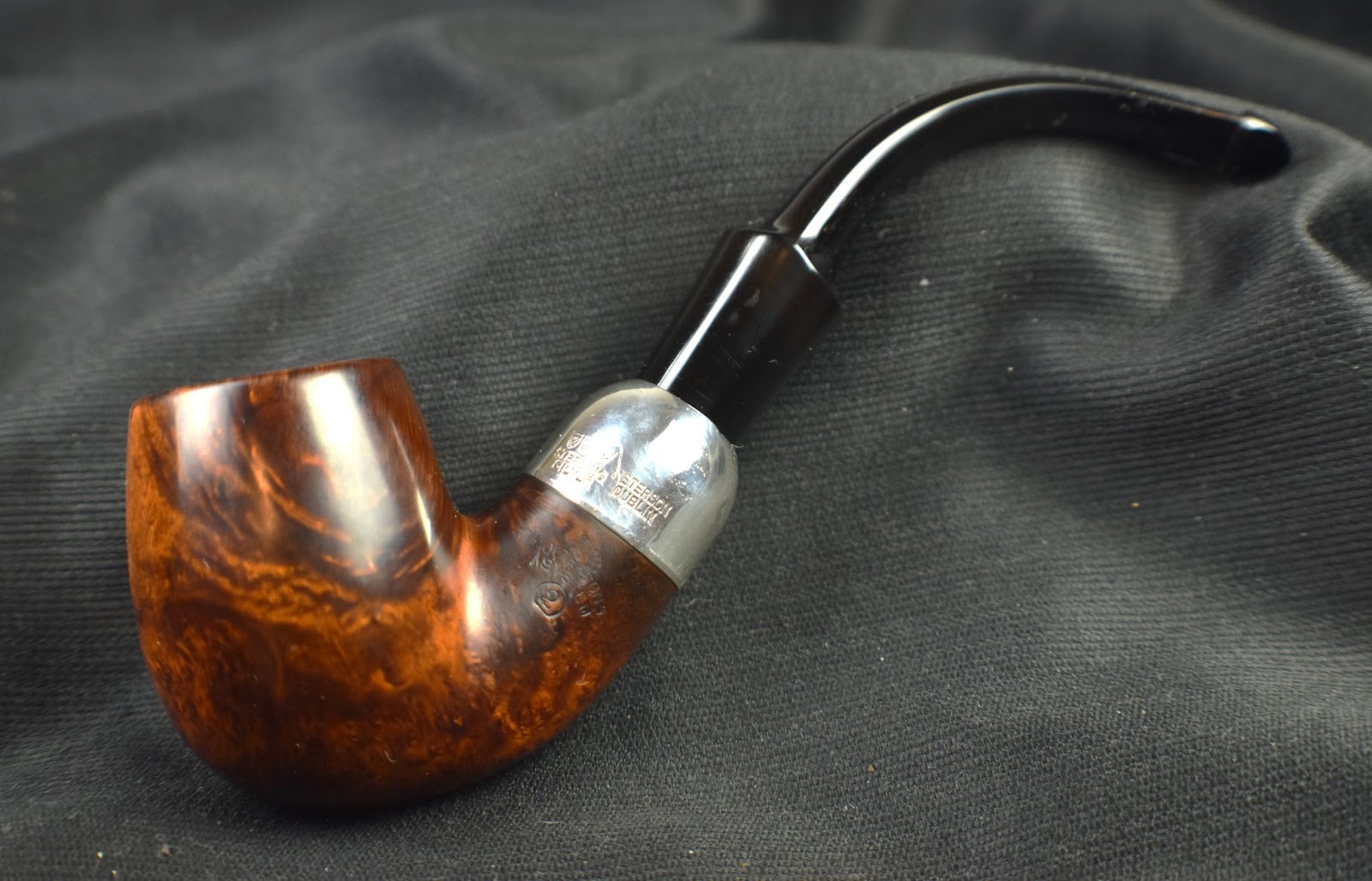
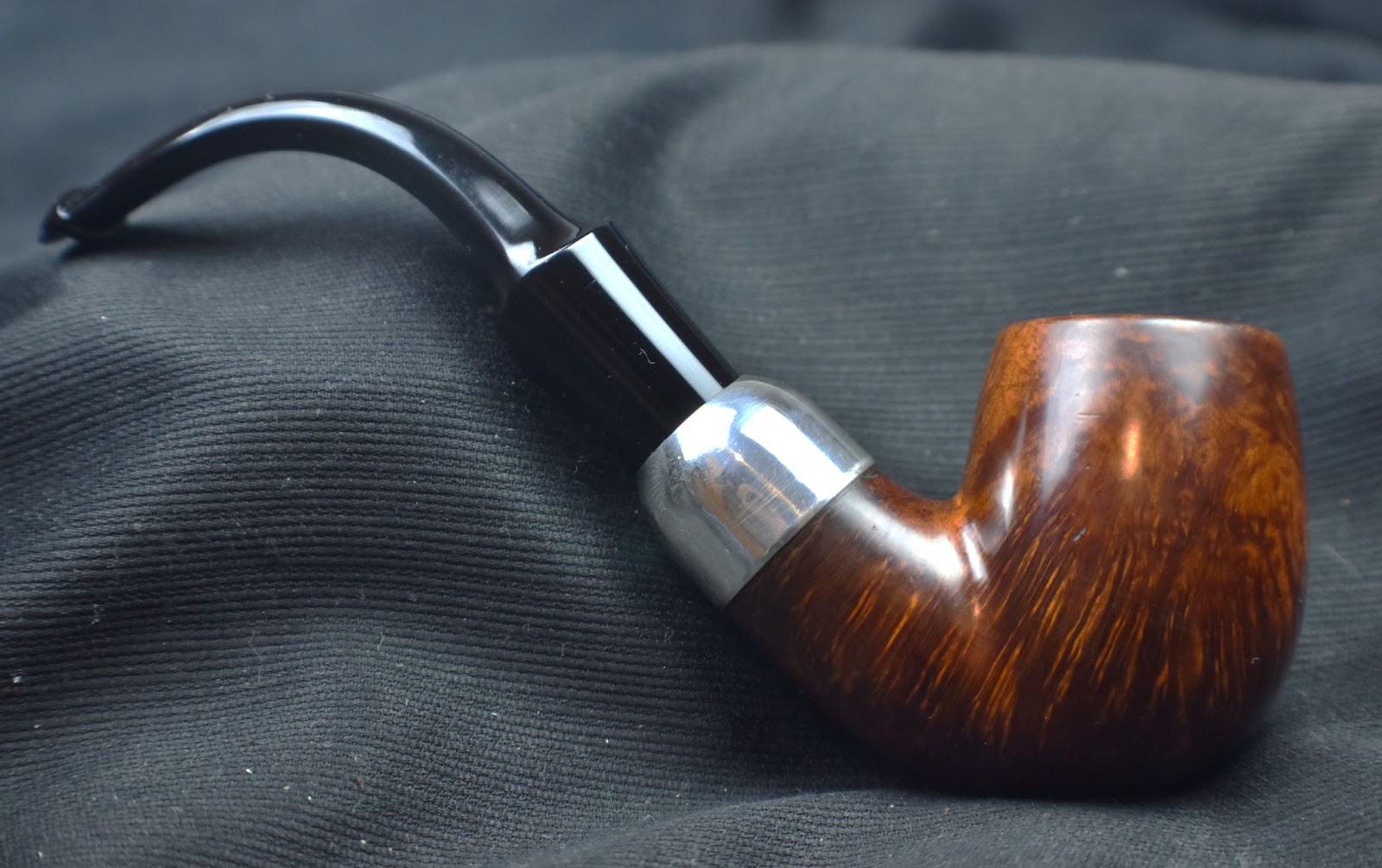
I can’t say what my favorite part of this restoration was. The pipe was a beautiful example of Irish craftsmanship by Peterson. The family history and the story of the great uncle were the things that I always wish I could know about these old pipes. The mysterious details of the pipe stem and the path that the pipe took, both geographically and through time, to get to me were a fun exploration. The happiness and gratitude of the owner upon receiving the restored piped was also fulfilling. Being honored and trusted to work on a family heirloom is daunting but exciting. All of these were part of this restoration and all of them were unique and unforgettable. The pipe turned out beautifully. I don’t mean to speak disparagingly about the clean-up that the Peterson crew did. Their fills were impressive but a custom hand polishing and finish is something that a manufacturing shop cannot take the time to do. I failed to mention in the above blog that I could not remove the silver ferrule. I tried seeping both ethyl alcohol and acetone into the glue to loosen it. I tried heating with a heat gun and even speaking softly and gently but I could not get the silver to budge. In the end I emailed the owner and admitted failure. He was understanding and we both agreed that the dents added to the history of the pipe.
I do hope that you have found something here useful to your own pipe care, maintenance or restorations. If you like this sort of thing, please click the like and subscribe buttons. Thank you for reading the ramblings of an old pipe lover.
Below are some photos of the finished Peterson System 2.
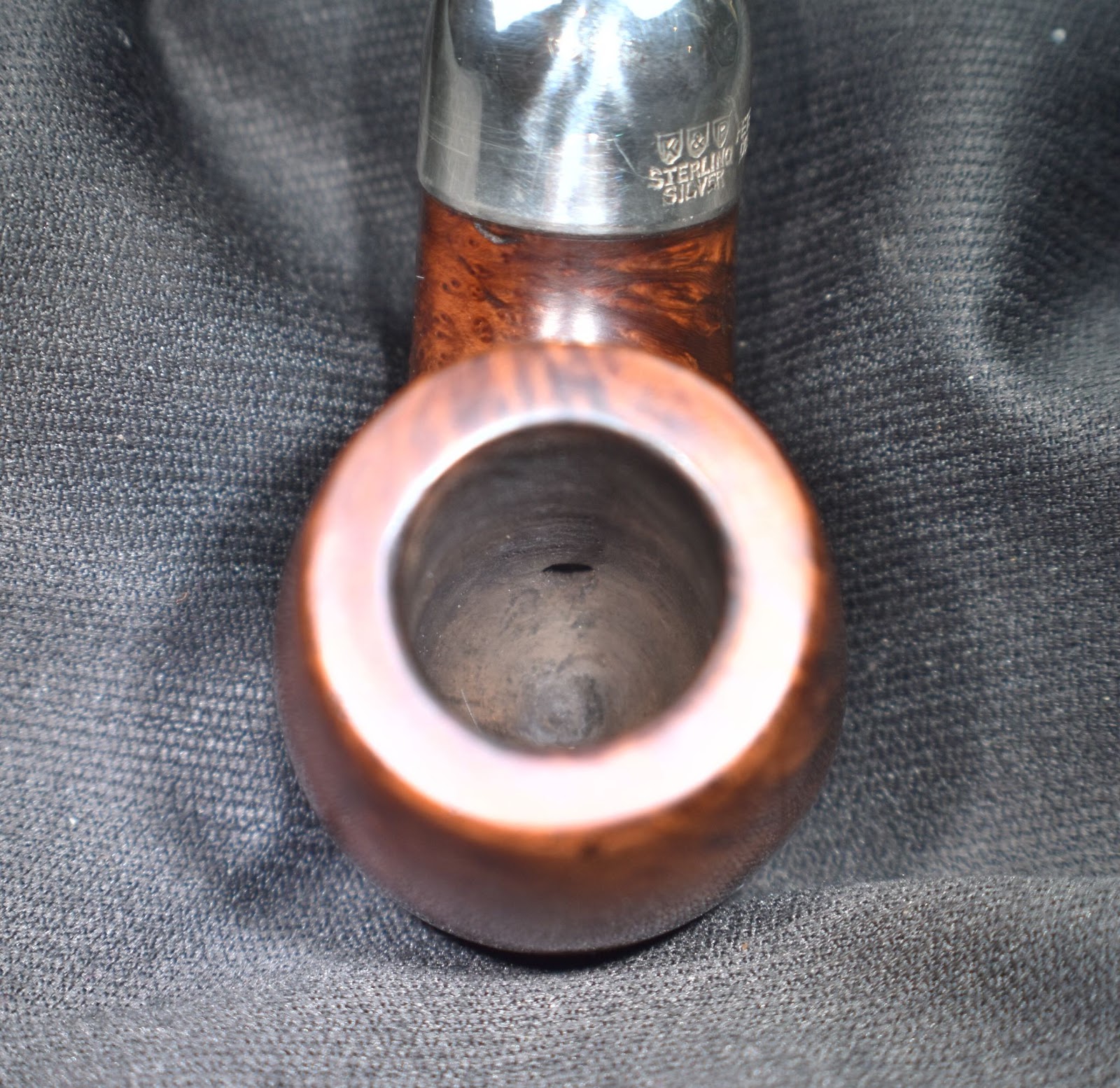
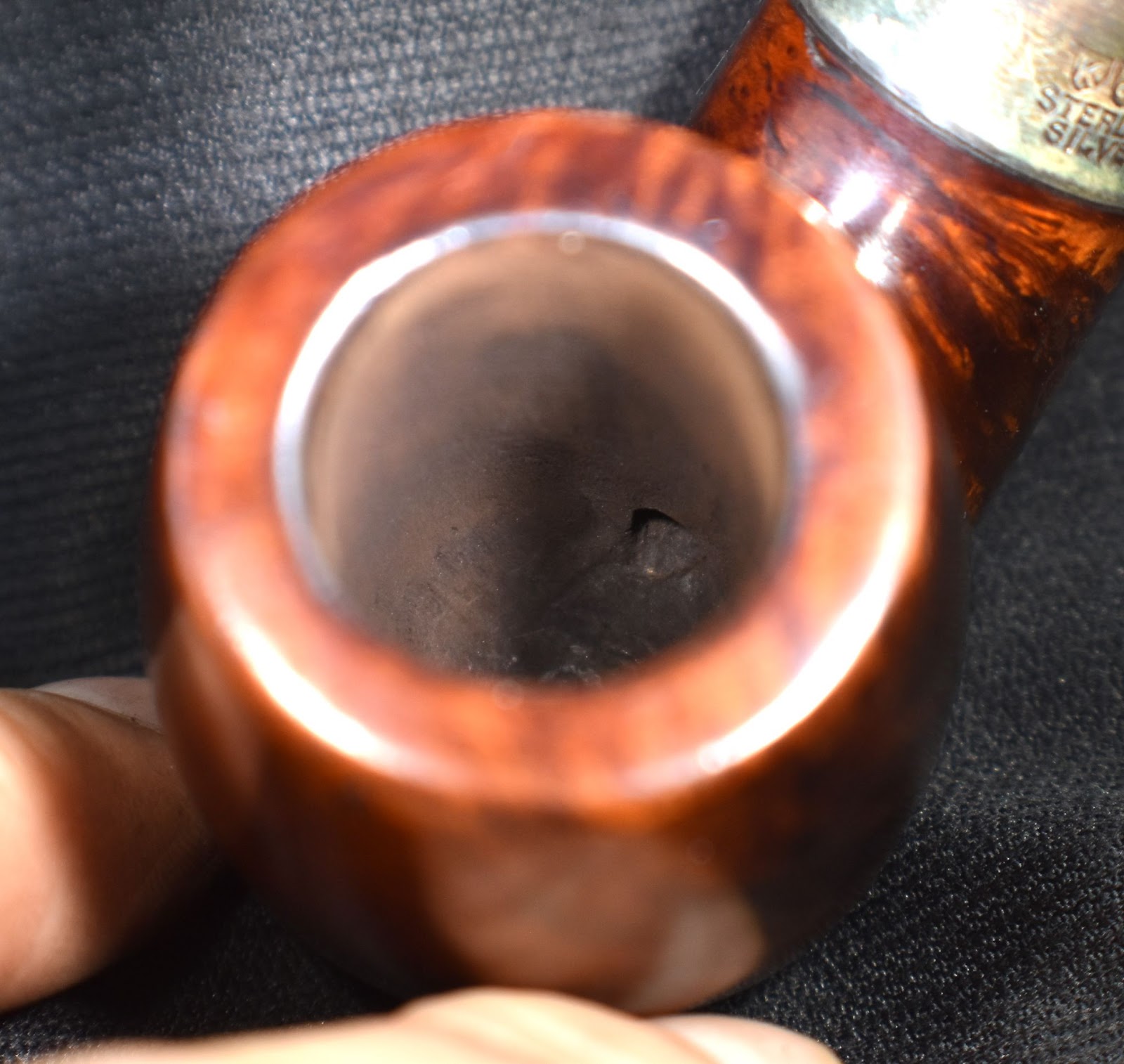
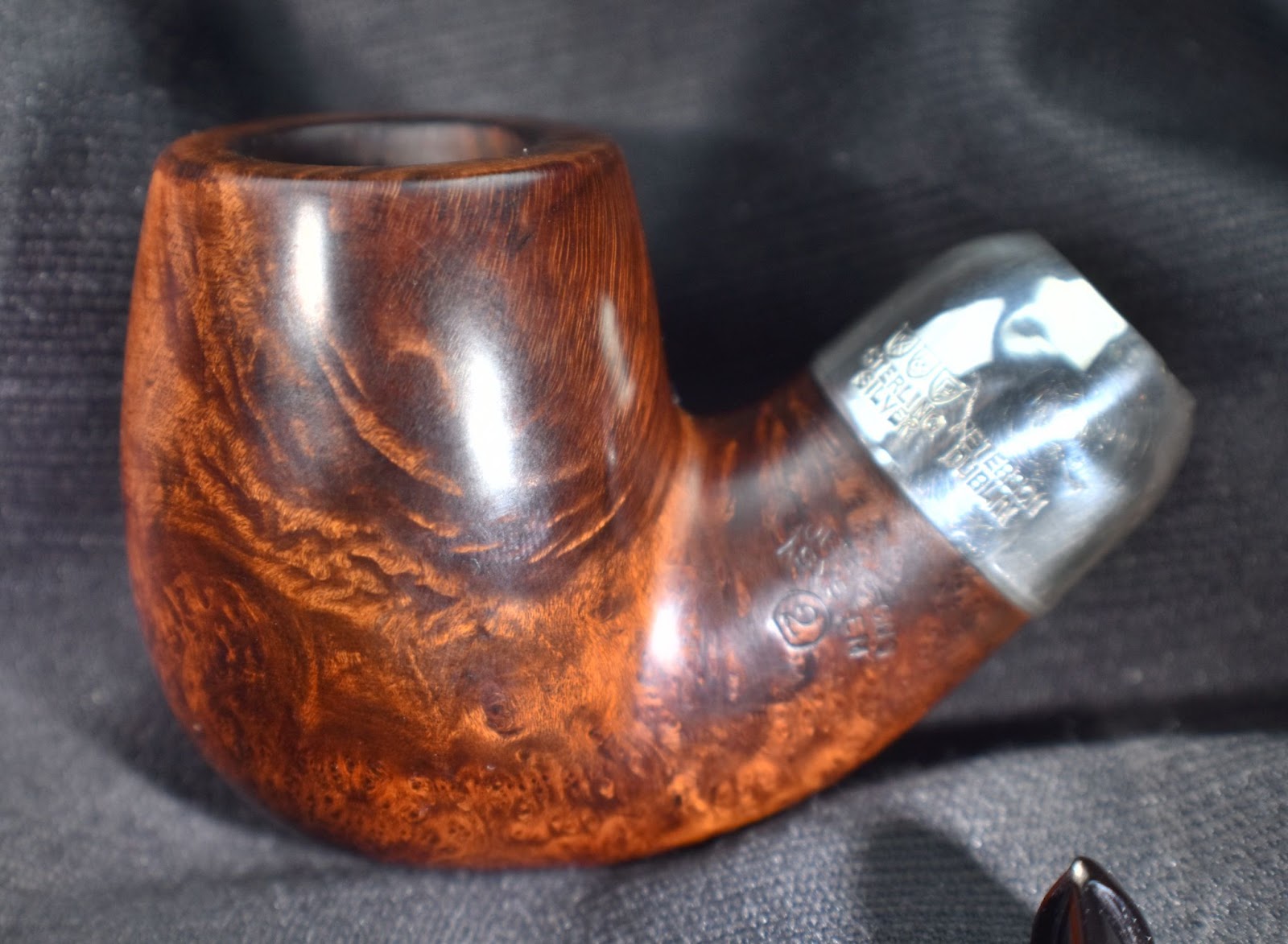
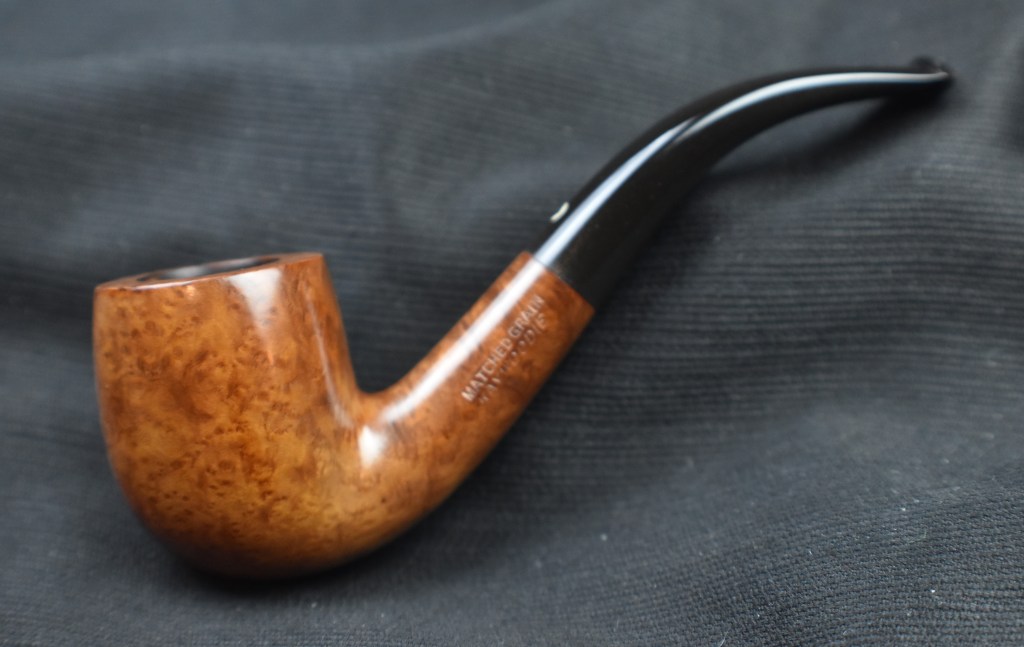
Oh to have both of the pipes in this matched pair. I don’t mean to complain as this was part of an estate lot where I was targeting a single pipe. The target was a Peterson meerschaum Dublin 120. This pipe was just an innocent bystander caught up in the crazed Peterson Pipe Acquisition Disorder (PPAD) that wreaks havoc on my life occasionally. If you are curious regarding the meerschaum pipe here is the link to that restoration. Below is a screenshot from the original eBay listing back on August 4 of 2024. There was a second Kaywoodie but a White Briar is no Matched Grain.
The lot came from Rockmart, Georgia and did have several interesting pipes. Below are some photos of the Matched Grain prior to working on it.
“Free tobacco with the purchase of one chomped on Kaywoodie.” I don’t think that advertising campaign will catch on.
The stummel needed almost nothing except the general lava cleaning, reaming and cleaning, the stem on the other hand… You may have noticed that the stem immediately behind the button had been filed. I did that before I took the above photos. I was thinking about how to reinforce the button for its reconstruction. So in full transparency, there was a little bit of work done to the pipe prior to the above photos.
Background
I am using pipedia.org’s Collector’s Guide to Kaywoodie Pipes to tell the history of the company and the Matched Grain lines as they are far better at it than this lazy writer. “According to Hacker (1), the firm of Kaufmann Bros. & Bondy (KB&B) began producing the Kaywoodie (2) Pipe in 1915. Hacker notes that:
“The company was originally started in 1851 in New York by two brothers named Kaufmann, who sold meerschaums and clays that a third :brother sent them from Vienna. Business thrived and in 1854 the Kaufmanns took in a partner named Bondy. … The three partners retired :in 1898, but their relatives continued on with the firm, which had begun to manufacture their own briar pipes under the KB&B trademark. :In 1915 the Kaywoodie brand was created as a marketing umbrella for a new briar pipe which the KB&B company introduced. …”‘
The “marketing umbrella” mentioned by Hacker included lower grade Kaywoodies that were later marketed under the “Yello-Bole” name. (According to a 1948 Yello-Bole catalog, “Yello-Boles have been on the market since 1933. About 25 millions of these pipes have been sold”). Hacker concludes his history of Kaywoodie Pipes by noting that:
“The KB&B briar pipe brand existed from 1900 until just after World War I (with some overlapping with the Kaywoodie from 1915 — 1917), :and collectors refer to the KB&B as a Kaywoodie transition pipe. During the early years of the 20th century a number of filter systems :were designed by the KB&B firm and incorporated into their Kaywoodie Pipes under the names of Synchro-Stem and Kaywoodie Drinkless3 :filters. During the late 1920’s and throughout the 30’s the Kaywoodie became a highly respected pipe in spite of its filter system (which :was popular among many smokers of the era) primarily due to the fine quality of the straight grain and the flame grain models. :Unfortunately, the hard-to-get-briar years of World War II marked the decline of the Kaywoodie Pipe, a plummet from which it has never :recovered as far as collectors are concerned….”
The pre-Kaywoodie KB&B pipes were marked on the shank with a cloverleaf around KB&B. Some early Kaywoodies had this same marking on the shank, but the practice was dropped some time prior to 1936. Yello-Boles also had KBB in the leaf on the shanks, but did not have the ampersand found on Kaywoodies.
Early (pre-1936) Kaywoodies had an “elongated” white cloverleaf on the bit, a large fitment, and four-digit shape numbers. The 1936 catalog shows a larger, “fuller” leaf, but lists two-digit shape numbers. Sometime between 1936 and 1947, the better pipes were marked on the bits with a black cloverleaf in a white circle. The white cloverleaf continued on the lesser pipes. However, this was not a consistent convention, as pipes of the same grade could have either type of leaf.
The S.M. Frank Co. now owns the Kaywoodie name, but no longer makes pipes. However, Italian made “drugstore” grade Kaywoodies are still being marketed in this country. These Italian-made Kaywoodies have a “whiteoutline” cloverleaf logo.
Pipedia Editor’s Note: Thankfully, Kaywoodies are again being made in the U.S. ”
The Kaywoodie shape 10 has remained very consistent in catalogs since if first appeared in the 1936 catalog as appears from the Collector’s Guide yo Kaywoodie Pipes:
The below Kaywoodie Lines and their dates are clipped from the Guide and are a compilation:
“THE 1947 KAYWOODIE LINE OF PIPES
The Matched Grain first appears in the 1947 catalog. According to the Collector’s Guide or Kaywoodie Pipes: “In addition to these individual pipes, the 1947 catalog shows two- and seven-pipe matched grain sets(5).
Two-Pipe Matched Grain Setb: $25.00
Seven-Pipe Matched Grain Setc: $125.00”
“THE 1955 KAYWOODIE LINE OF PIPES
The line-up of pipes in the 1955 catalog (Table 3) was more extensive than in previous years. The catalog presented an expanded line of meerschaum pipes and introduced a 4-pipe set of Matched Grain Pipes, as well as several pipes with “special features”.”
Matched Grain Set (4-Pipes): $50.00
Matched Grain Set (7-Pipes): $125.00”
“THE 1968-69 KAYWOODIE LINE OF PIPES
In addition to the two-, five-, and seven-pipe Matched Grain pipe sets listed in Table 4, the 1968-69 catalog introduced the Presentation Pipe. The catalog states that in “Every 8 or 10 thousand briar blocks, we come across a single piece that is as near to perfection as briar can get. This rare find is set aside and turned over to a master pipe craftsman. He lovingly sees this precious briar through each step, until it takes shape as one of the rarest pipes in the century.” The Presentation Pipe was packaged in a walnut grain, velvet lined, leather case. (See Section 3.5 for description of other Kaywoodie Presentation Pipes).”
Matched Grain Sets:
2 Pipesa: $75.00
5 Pipes: $175.00
7 Pipesa: $250.00”
“Presentation Collection. “The most illustrious collection of pipes ever assembled – the Kaywoodie Presentation Collection. It presents a set of 28 Kaywoodie Matched Grain Pipes . . . pipes as perfectly, flawlessly, magnificently matched as a string of rare Oriental pearls. Over 500,000 blocks of pristine briar must be sorted to find just one such matched collection; hence no more than 12 sets can be produced in any one year. Hand fashioned from tapered bit to burnished bowl, every pipe in this Collection becomes a prized possession. A Carved Headbriar [see note concerning “carved heads” in the discussion of Heirloom pipes, Section 3.4], a Calabash and a Meerschaum complete this Collection of 31 pipes. This precious ensemble is housed in a custom-designed walnut cabinet of distinguished elegance. It contains a tobacco humidor and a handy compartment for pipe smoking utensils. A brass plate, engraved with the recipient’s name, personalizes the presentation” (Price: $2500). The Presentation Collection did not appear in the 1955 catalog, but was apparently introduced shortly thereafter. A “brief” article in the September 17, 1956 issue of Newsweek supports this contention. The article, entitled “Pipe Dream”, contains a photo of the Presentation Collection, which is described as the “costliest pipe set ever marketed in the U.S.” (Lowndes notes that a small (undated) WWII era catalog showed the Presentation Collection in a smaller cabinet with legs that sold for $1000.)”
From all of the above we can be assured that this pipe was indeed part of a set. Most likely it was one of a pair of pipes made between 1947 and 1969. Its companion piece or pieces are lost to time thus reducing the value and importance but not the beauty of the selected briar and the craftsmanship that went into this pipe.
The Restoration
In the beginning there was clean denim. Kind of a Genesis vibe to the resurrection of this lovely pipe.
I started with the stem. It was lightly sanded with a 600 grit sanding sponge to remove the hardened oxidation and surface grime.
Next, the stem had a pipe cleaner inserted into the tenon to act as a hanger and it was submerged into the jar of Before and After Extra Strength Deoxidizer. Here it sat for 4 hours.
The stummel was exorcized of the remnant tobacco.
The ream team was gathered and included the PiNet, Smokingpipes Low Country reaming knife, General triangular scraper and wood dowel wrapped in 220 sandpaper.
The reaming was quickly completed and the bowl sanded to bare briar. This revealed no damage to the interior of the tobacco chamber.
The rim was moistened with saliva and gently scraped with a sharp pocket knife.
The scraped rim looked mostly free of any charring.
I tried a scrub with 95% ethyl alcohol on a make-up pad to assess the finish on the briar. The pad turned a yellow brown indicating that the finish was susceptible to ethyl alcohol.
I took the stummel to the sink for a scrub with undiluted Murphy Oil Soap and a nylon scrub brush. The soap lather turned a yellow brown color with scrubbing. This was rinsed with warm water and the stummel dried with a cotton dish towel.
Back at the workbench the stummel was wiped with a make-up pad with 95% ethyl alcohol and more of the finish was removed. The result was a finish-free stummel with lovely grain.
Next came the shank cleaning. This was done with folded bristle pipe cleaners and cotton swabs both dipped in the ethyl alcohol.
I lightly topped the rim to remove the dottle knocking scars and the light charring on the rim. 220 and 400 grit sandpaper were used.
Below you can see the rim after the topping.
I was anxious to see the briar grain and applied a coat of Before and After Restoration Balm before I sanded or micro-meshed the briar. I know patience is a virtue but I couldn’t wait.
The stem was removed from the Deoxidizer solution after four hours. It was allowed to drip a good deal of the excess solution back into the jar.
My normal coarse shop rags were both in the laundry so an old bathroom face towel was used to buff away the remaining Deoxidizer solution. I’ll see if the oxidized vulcanite is effective at staining white cotton face towels. The stem on the other hand was looking much better.
The stem was cleaned with bristle pipe cleaners and 95% ethyl alcohol.
Make-up pads with Soft Scrub cleanser were used to further remove any remaining surface oxidation.
The below photo shows a clean black stem with quite a bit of pitting from the deoxidizing of the vulcanite. The stem had been oiled with mineral oil to prevent further oxidation.
For the moment you’ve all been waiting for: “How the heck is that stem going to be salvaged?” My imagined plan was to file immediately behind the button and glue two brass pins across the gap. These pins would provide a scaffold for the building up of cyanoacrylate (CA, super glue) and black JB Weld Epoxy. The pins would be completely encased in CA and Epoxy and not be seen while providing rigidity for any future chomping. The thickened rebuilt zone would be the “new button” The old button end would be filed off, shortening the stem by a couple of millimeters. This plan worked brilliantly in my damaged brain but how would it fare in reality? I wasn’t sure but I knew that I’d have a heck of a hard time finding a perfect replacement stem so, this seemed like the best remedy.
Two brass pins were measured and cut to span the gap. The first pin was glued into place using black CA. I allowed the CA to cure on its own and did not use a CA drying accelerator.
I wanted to work on the stem, one side at a time and be able to access the airway to sand and smooth the airway if needed. I made a dam from a piece of plastic lid and thickened the plastic with several layers of Scotch tape. This would be inserted into the airway to prevent the CA and Epoxy from entering where I did not want it.
With the dam inserted I was ready to start layering reinforcements of black CA.
The black CA was applied using a fly tying bodkin. Unfortunately the black CA was slightly transparent. This is why I thought that I would also have to use the JB Weld epoxy. Imagine the brass pin inside the new button and the old button, that you see below, as being filed off.
Below the CA was allowed to cure and the dam removed. Everything was going according to the plan.
After the CA had cured I cut an emery board nail file to fit into the airway. I used this to smooth the interior of the airway. Below is an early photo of the smoothing. You can see that the brass pin is completely encased in CA.
The process was then repeated for the opposite side with the placement of the second pin.
Black CA was used to fill around and encapsulate the brass pin.
To build up material around the new button I used black JB Weld with the addition of very finely ground carbon powder. I wanted to make sure that the epoxy was not even slightly transparent. I emptied a capsule of carbon into the mortar and used the pestle to grind it into a very fine powder.
The two part epoxy was mixed and a small amount of ground carbon powder was added. To keep the epoxy from fouling the airway another plastic dam was used. This time I coated the surface of the dam with Vaseline petroleum jelly to keep the epoxy from adhering to the dam.
The JB Weld label says the product sets up in 15 minutes. I think they meant to say 15 hours. It does set up to the point that it stops flowing in 15 minutes but I usually give the epoxy at least 24 hours before I try to file or sand it.
The next day, I mixed a second batch of epoxy as with the first batch. This was applied to the bottom side of the stem. I propped up the pipe as shown in the photo below.
The below photo shows how the first application of the epoxy looked after 24 hours.
Here is the second application cured for 24 hours.
This photo shows the two applications in profile.
The button was filed to reshape it. Below is the top view of the reshaping.
The bottom view of the reshaping.
Profile of the reshaping.
I taped the shank off to protect it, with masking tape, then sanded the stem with a series of sanding sponges in grits 320-3500. Between each sponge I rubbed the stem with mineral oil and wiped it with a paper towel.
The stem was then micro-meshed with 4000-12000 pads. Between each pad I rubbed the stem with Obsidian Oil and wiped it with a paper towel.
The stummel was worked with micro-mesh pads 3200-12000. Between each pad I wiped the stummel with a make=up pad dipped in 95% ethyl alcohol.
The pipe was taken to the buffer for several coats of carnauba wax. The final step was to hand buff the Matched Grain with a microfiber polishing cloth.
This beautiful Matched Grain Kaywoodie will unfortunately and most likely never again see it’s mate. It’s beauty will have to be appreciated on it’s merits alone. I think the pipe turned out very nicely. The briar is exceptional with outstanding grain and free of any pits or flaws. The stem reconstruction actually went as I imagined it would. That comes as a welcome shock to me. More times than not my imagined plans are dealt a rude awakening by reality. The dimensions of this Matched Grain 10 Bent Billiard are:
Length: 4.90 in./ 124.46 mm.
Weight: 1.28 oz./ 36.30g.
Bowl Height: 1.72 in./ 43.69 mm.
Chamber Depth: 1.47 in./ 37.39 mm.
Chamber Diameter: 0.72 in./ 18.03 mm.
Outside Diameter: 1.39 in./ 35.31 mm.
I do hope that you have found something here useful to your own pipe care, maintenance or restorations. If you like this sort of thing, please click the like and subscribe buttons. Thank you for reading the ramblings of an old pipe lover.
Loading…
Below are some photos of the finished Matched Grain 10 Bent Billiard.
The stereotypic pipe that most people think of when envisioning Sherlock Holmes would most likely be a calabash. The above bent beauty would likely fit that image, with its flowing curves and old fashioned mouthpiece. Once again reality interferes with our perception, according to https://www.visitportsmouth.co.uk/conan-doyle/sherlock-holmes, who states “Our aim is to publicise the Conan Doyle Collection locally and internationally. To do this, we attend and create local events and work with other partners on projects to promote access and to the Collection.”, “It’s common to see Sherlock Holmes with a Calabash Pipe (similar to the one at the bottom), but that was a choice made for the stage. In the books Sherlock Holmes smoked briar, clay and cherrywood pipes but none were specifically explained so it is unclear exactly what he smoked.” (https://www.visitportsmouth.co.uk/conan-doyle/you-dont-know-sherlock-holmes-yet/cabinet-of-curiosities/three-pipes#:~:text=In%20the%20books%20Sherlock%20Holmes,unclear%20exactly%20what%20he%20smoked..). Nevertheless, in the minds of the public Holmes smoked a calabash.
This lovely Holmes stereotype was purchased from a seller in Racine, Wisconsin who was kind enough to accept my offered payment. The pipe bears the following stamps, all on the left shank: SEA-DOG in a flowing arched script over REGD over MADE IN FRANCE. The Sea-Dog sports an unmarked stem with an orific button. Below are some photos of the pipe as it appeared prior to having any work done.
For its age, the pipe was in great condition. The bowl had moderate cake and the rim had considerable lava deposits. The condition of the rim remained concealed underneath the lava. There were a few fills, dents and dings. The stem looked remarkably free from oxidation. This indicated that the pipe had been stored away from any light. I was expecting a nice break from a rather difficult previous restoration.
Background
I will differ from the description of a Calabash shape to the experts at St. Claude,
“The Calabash pipe shape is one of the most sophisticated and refined shape that exists. Most of the time associated with the image of the detective Sherlock Holmes, the Calabash pipe distinguishes itself by its really pronounced bent silhouette and its imposing bowl. At the beginning, the real “gourd calabash” pipe (also called “Calebasse”), was made from an African squash, with a removable bowl made out of meerschaum (positioned against a cork joint) and an amber stem. Smokers greatly appreciate this kind of conception because the tasting experience is, according to some people, unbeatable. Indeed, the smoke arrives in mouth cooled down and dry thanks to the large settling chamber on the inside of the bowl of the pipe. This empty space allows the smoke to cool down (and therefore to get smoother) before being aspirated by the smoker. Nowadays, pipe makers create Calebass pipes from more traditional materials (like briar for the main part and acrylic for the stem). Therefore, we can find pipes essentially made with briar that copy the iconic calabash silhouette (it is the case for a lot of brands like Peterson, Ser Jacopo, Stanwell, Butz-Choquin…). More rarely, it is possible to find pipes called “reverse Calabash”. On the same principle, a huge cooling chamber will disrupt the smoke on the inside of the pipe to return it to you smooth and cooled!” (https://www.pipeshop-saintclaude.com/calabash-262)
The term “sea-dog” obviously hails from maritime regions far from my local landlocked home of Nebraska.
“sea-dog (n.)
1590s, “harbor seal,” from sea + dog (n.). Also “pirate” (1650s). Meaning “old seaman, sailor who has been long afloat” is attested by 1823. In Middle English sea-hound was used of the walrus and the beaver.” (https://www.etymonline.com/word/sea-dog#:~:text=1590s%2C%20%22harbor%20seal%2C%22,the%20walrus%20and%20the%20beaver.) Beavers on the other hand are a very familiar critter in these parts. Now pertaining to this pipe pipe I am pretty sure that the sea-dog anime refers to the “old seaman or sailor” though I have seen rustications that reminded me of the gnawing habits of beavers.
This particular pipe is very likely from the following, “Sea Dog was one of many brands owned by the Oppenheimer Pipe group, apparently made in France, likely by Marechal Ruchon & Cie. as evidenced on page 34 of the Circa 1950s Oppenheimer Pipes Catalog”. (Sea-Dog – Pipedia). The date 1950 struck me as far too recent of a date for a mouthpiece like that of the Sea-Dof in hand. I am not familiar with orific buttons occurring after about 1920. Further searching of pipedia.org led e to the next entry concerning Marechal Ruchon & Cie.,
“Marechal Ruchon & Cie. was a company owned by Auguste Marechal and Ferdinand Ruchon (“& Cie” is the french equivalent of “& Co”) which owned the GBD brand from the end of the 19th century until 1902 when they sold Marechal, Ruchon & Cie. to Oppenheimer Pipe, which in turn changed the name of the company to Marechal, Ruchon & Co., Ltd.. Upon the creation of Cadogan, however, the brand was no more, remembered only in the name of the GBD Marcee pipes made until just after the Second World War.” (Marechal Ruchon & Cie. – Pipedia)
So to cloud the history a bit further we have GBD owned by Marechal Ruchon & Cie. who then sold it to Oppenheimer in 1903. Pipephil has a truly brain bending flowchart of the mergers and acquisitions of the Oppenheimer group throughout the early 1900s. There appears to be a great deal of motion and changes in ownership of companies at this time.
Again I return to pipedia for a synapses of some of these events,
“Cadogan Investments Limited is a subsidiary of A. Oppenheimer & Co. Limited. It was formed by Oppenheimer Pipe in 1920 as a holding company for its many recent acquisitions, including BBB, Loewe & Co., two pipe factories in Saint-Claude and others. It continued to acquire pipe brands and makers for decades, adding GBD and others to their marquee.
Both companies are currently located at 20 Vanguard Way, Shoeburyness, Essex, SS3 9RA. A storefront operates out of the same location selling pipes and smokers accessories under the name Cadogan Gifts, and also sells a wide variety of other items. Cadogan currently holds, among others, the trademarks for Dr. Plumb’s, Irwin’s, Comoy’s, BBB, GBD, Loewe & Co., Medico, Orlik, and Ropp.” (Cadogan – Pipedia)
That puts this pipe as made in France prior to the demise of Marechal, Ruchon & Co., Ltd. in 1920. This is supported by the button type, orific. I am not familiar with buttons of this type in pipes made after the early 1920s.
The Restoration
I was hoping that the restoration would be far less confusing than the above company lineage.
For some reason I began cleaning out the stem of the Sea-Dog. This was done with 95% ethyl alcohol and bristle pipe cleaners. The stem was remarkably clean inside, a nice surprise.
The reaming gear was gathered.
The PipNet was once again the workhorse of the process. The scrapers were used for the finishing touches then the chamber was sanded with 320 sandpaper wrapped around a wood dowel. No scorching nor heat damage was observed.
The rim was a mess with lave deposits. This was softened with saliva then scraped using a sharp pocket knife. I realize sharp can be a subjective term so, let me explain. My high school dropout father worked his way through college, after a stint in the Army, a GED (general education diploma) and the G.I. Bill, at a packing plant in Waterloo, Iowa. There, he was a ham cutter. Needless to say, every knife in our house was very sharp. I was taught at an early age how to sharpen and maintain a sharp knife and have not been without one in my pocket since I was 5 years old. By the way, dad ended up with a PhD and not in knife sharpening.
How the rim looked after the scraping.
Next was a scrub with undiluted Murphy Oil Soap and a nylon scrub brush. The decades of grime and soap were rinsed away with warm water and stummel dried with a cotton hand towel.
The shank cleaning was carried out next in hopes that water from the rinse would have slightly softened the yuck (the technical term for smoking residue in an airway) within. Apparently a little Peterson Premiere 51 needed to photobomb this shot or it was used to prop up the Sea-Dog and its crazy bendy shape. The shank of this bent beauty proved to be not too dirty, slightly worse than the stem but still surprisingly clean. The curves made the junction with the tobacco chamber a little challenging with very short scrub strokes with pipe cleaners.
The stummel was wiped off with 95% ethyl alcohol on a make-up pad and the fills, of which there were many, were picked clean of their old fill material.
In the photo below you can see a large flake of the old fill material which was picked from the fill on the shank. .
The photo attempts to show the inner rim damage from doddle knocking or cage fighting medieval armored combatants.
Taking a break from the sitting and picking led me to submerge the stem in a bath of Before and After Extra Strength Deoxidizer. The pipe cleaner inserted into the tenon acted as a hanger.
Returning to the workbench the process of filling all of those recently excavated fills resumed using brown cyanoacrylate (CA, super glue) and in most cases CA and briar dust. The fill on the shank proceeded without any briar dust. When the briar dust combines with the CA it makes for a quality fill that can take years of abuse, it also cures very rapidly and allows one to keep working without the need of excessive drying or curing time. Unfortunately, the subsequent fill is very dark and can be conspicuous. I thought that the fill on the shank of the Sea-Dog was too large and would look awkward. Instead, I filled the depression with brown CA and let it cure on its own. I applied two additional coats of brown CA to fill in the voids. Each of these took approximately 20 minutes of curing time when I was not able to do anything with the pipe.
I thought I made the right call. You could still see the briar grain through the CA and it appeared far more natural than a dark scab of a fill.
The rim was kind of a mess. There was one deep gouge, seen at the 2:00 position below, dents and dings around the inside rim and outside rim. To keep the classic Dublin shape with nice sharp edges and a flat top, I had to do a good deal of reconstruction with CA and briar dust. I laid down a bead of CA with the fly tying bodkin and pressed the still wet CA into the tray of briar dust. The dust would quickly cure the CA and for a hard fill. I would then brush the excess dust back into the tray with a brass brush. The new fill was then topped. The whole process was repeated until the surface was filled and smooth.
For the fills on the sides of the stummel a similar procedure was used. Except rather than pressing the wet CA into briar dust the dust was applied and pressed into the wet CA.
Now comes the issue with CA and briar dust fills – they are dark in color. On the sides they can blend in with the briar grain but on the rim they can appear as scorched charred spots and look less than appealing.
To address this I planned to give the stummel a contrast dye using black Fiebing’s Leather Dye. The black dye would be absorbed more into the soft grained briar and less in the harder grains. When the surface is abraded off, either by buffing with rouge compound or sanding, the softer grains retain more black dye making the grain stand out and concealing the CA fills. To avoid sanding the stamps and losing their detail I covered the stamp with an irregular piece of painters tape. This is not meant to protect the stamp from sanding but to keep it from becoming dyed and then requiring buffing or sanding to remove the dye.
Okay, maybe I felt a little bit apprehensive about dying and wanted to think about it moreso, I stalled and retrieved the stem from the deox. Using the high tech patented Drip-Dry-O-Matic the stem was allowed to drip excess solution back into the jar.
After dripping, the stem was hand buffed with a coarse shop rag to absorb the excess solution and to abbrade some of the loosened oxidation.
Below you can see the oxidized rubber which came off with the rubbing.
The tooth chatter was filed with a small flat file.
Filing on both top and bottom was followed with sanding the 320 and 400 grit sanding sponges. The stem was then coated with mineral oil and allied to sit while I dyed the stummel.
My composure and confidence regained, I gathered the dye kit: The black Fiebing’s Leather Dye, a folded pipe cleaner (applicator), a dust tape wrapped fishing bobber (Plug for keeping dye from the tobacco chamber) and a lighter.
The stummel was dyed with the black Fiebing’s and flamed to set the dye and evaporate the alcohol solvent. The stummel rinsed with 99% isopropyl alcohol over the sink and wiped with a paper towel then returned to the workbench. Below, you can see how the tape kept the black dye from the stamp which kept me from having to sand the stamp area, thus preserving the stamp.
The stummel was wiped with a make-up pad dipped in 95% ethyl alcohol to remove any remaining dye. The stummel was then taken to the buffer and buffed with rouge compound and a flannel wheel to remove the outer layer of dyed briar. Below you can see how the softer grained briar absorbed more black dye while the harder briar did not.
I wanted the stummel to have a lighter shade of brown while keeping some of the darker grain so I sanded with a 400 grit sanding sponge. That was the color I was after.
Below you can see how the rim looked after the dye and some of the black removed.
The stem and stummel were reunited with sanding of both pieces done together. The sanding was done with a sequence of sanding sponges from 400-3500 grit. Between sponges the stummel was wiped with a make-up pad moistened with ethyl alcohol while the stem was rubbed with mineral oil and wiped with a paper towel.
The pipe was worked with micro-mesh pads in grits 4000-12000. Again between each pad the stem and stummel were wiped as above except Obsidian Oil was used in place of mineral oil.
The stem was coated with Before and After Restoration Balm and allowed to sit for 20 minutes.
After 20 minutes the balm was wiped and hand buffed using an inside out athletic sock.
I’m not sure why I did this next step, maybe because I bought the stuff and have rarely used it. I used a gun cleaning patch to apply a very light layer of Danish Oil to the stummel.The gun cleaning patch was used because it is a lint free material. I followed the label instructions and allowed the oil to “harden” for 9-12 hours.
It may not have served much purpose but it sure was pretty.
The next morning I returned to the Sea-Dog. I took it to the buffer and applied several coats of carnauba wax with a flannel wheel. The pipe was hand buffed with a microfiber polishing cloth and the final photos can speak for themselves.
It is official, I really like the calabash shape. There is just something about it that says, “I am how pipes should look.” Yeah, I know they don’t talk but you know what I mean. This Sea-Dog is a grand old testament to pipe makers’ generations lost. The sweeping curves and graceful flow beckon me to fill the bowl, slow down, relax and enjoy a moment of contemplation. This is called, “sitting on your butt doing nothing” by some people. The best part of their attitude is that there remains far more tobacco for us to enjoy. I think this Sea-Dog restored very nicely. The numerous fills are not too noticeable with the contrast dye. The stem polished up beautifully and provides an excellent contrast while complimenting the briar grain. The old fashioned orific button can interestingly be directed into one’s mouth with subtle changes to the alignment with the shank. A slight twist can send the smoke into a new direction.
The dimensions of this Sea-Dog Calabash are kind of strange to measure but here they are:
Length: 5.53 in./ 140,46 mm.
Weight: 1.53 oz./ 43.70g.
Bowl Height: 2.09 in./ 53.09 mm.
Chamber Depth: 1.60 in./ 40.64 mm.
Chamber Diameter: 0.73 in./ 18.54 mm.
Outside Diameter: 1.41 in./ 35.81 mm.
I do hope that you have found something here useful to your own pipe care, maintenance or restorations. If you like this sort of thing, please click the like and subscribe buttons. Thank you for reading the ramblings of an old pipe lover.
Loading…
Below are some photos of the finished Sea-Dog Calabash.
The term”big” doesn’t do this pipe justice. Giant, gargantuan, enormous all seem more fitting. I remember opening the package when it arrived in the mail. I’m pretty sure I said, “good Lord, that’s big.” Have I mentioned that “big” doesn’t do this pipe justice? For such a large pipe it felt remarkably good in my hand, then again, I am a fan of the apple shape. This pipe wore the stamps: MADE IN over ENGLAND in an oval to the left, SL over LONDON MADE all on the left shank. The right shank sported the stampings 52G while the stem bore an Old English script S on a shield. Below are some photos of the pipe prior to work being done.
Background
The stem logo on this pipe says, “I’m a Sasieni”. Well at least a Sasieni’s second…
That is where I started, with Sasieni. Joel Sasieni began building the company in London, England in 1919. I will let Stephen P. Smith, in his pipedia.com entry explain,
“In his book, “The Ultimate Pipe Book”, Richard Carleton Hacker writes American pipe collectors “seem to be more preoccupied with ’smokable’ brand names, of which the most collectible are Dunhill, Barling, Sasieni, and Charatan.” Theodore Justin Gage, the former publisher of the much missed “The Compleat Smoker”, called Sasieni pipes a “fascinating collectible, …representing all that is good about classic English pipe making.” And for good reason: the pipes made by the Sasieni company between the years 1919 and 1979 rank among the very best the London pipe industry had to offer. They featured superb wood, flawless bowls, outstanding smoking qualities, and a styling that was uniquely theirs.
Yet for all that, Sasieni’s are among the most underrated pipes on the collectible market, usually selling for far below their real worth. In this, they offer the astute collector a genuine opportunity, whether he or she is looking for a pipe with potential for appreciation, or simply a great pipe at a reasonable price.
However, in order for the collector to capitalize on this, it is vitally important to realize the Sasieni company changed hands on two occasions, and each owner had different priorities and agendas. Not surprisingly, this was reflected in the quality of the pipes made during these different times. All bore the Sasieni name, and yet they were very different pipes.
It is possible to divide the Sasieni history into three eras, similar to Barling. In fact, throughout this article, I will be referring to “Pre-Transition, Transition, and Post-Transition” Sasieni’s. While this may raise a few eyebrows, I believe it will become clear these classifications are actually quite appropriate.
Therefore, it will also become clear a collector must be able to distinguish between Sasieni’s of different eras, as it is mainly the family made pieces made between 1919 and 1979 which are truly desirable to collectors. The dual purposes of this article, then, are to trace the history of the Sasieni pipe, and to enable collectors to judge, with a reasonable degree of certainty, when the Sasieni in question was made.
A Brief History of the Sasieni Company
There is a great deal of mystery surrounding the Sasieni pipe, owing largely to the fact there is such a paucity of written information about them, as is the case with many collectible pipes. Even the name of the founder has been subject to debate. One respected source says the founder was named “Joel” Sasieni. Another equally respected source says with equal certainty the name was “Joseph” Sasieni. (A third, rather less reliable source once told me “Joel” and “Joseph” were brothers, but I think we can safely dismiss that.) An old Sasieni catalog which I came maddeningly identifies the founder as “J. Sasieni”. However, some research at the U. S. Patent Office conclusively shows that his first name was Joel.
Joel Sasieni apprenticed at Charatan, and moved on to Dunhill, where he eventually rose the position of factory manager. Many men would have been perfectly satisfied with such a position, but not Mr. Sasieni. He opened up his own factory in 1919, believing he could improve on some of Dunhill’s methods. Mr. Sasieni was, if nothing else, an optimist.
Things did not go smoothly for the new firm. The factory burned down almost immediately. Apparently undaunted, Mr. Sasieni simply rebuilt the factory and carried on.” (Sasieni – Pipedia)
Steven Smith’s writing goes on and is well done and informative. I highly recommend reading it if you are a burgeoning Sasieni fan or just interested.
As for this pipe, I could find no reference to the SL stamping. I assumed the 52G was a shape number and indeed a Sasieni shape chart from pipedia.org lists the 52 as a “Hurlington” and matches the shape of this pipe beautifully. I am assuming that the 52G is the Hurlington in a giant form.
Another Sasieni shape chart states that Sasieni has “160 SHAPES”.
(File:SasieniShapes.jpg – Pipedia). 160 is a remarkable number of shapes for a manufacturer to keep track of much less the carvers employed making those shapes. Remember, this was all long before a quick google search to remind oneself of the dimensions of a particular shape.
The Restoration
The Sasieni found its way to the workbench and a cleanish denim piece. The stem was a very tight fit after the photo shoot. I did not force it back into place as that’s where I planned to start with this restoration, anyway.
The calcium deposits on the stem were heavy and combined with the also heavy oxidation made for a rather ugly mess. I started by scraping the surface from the stem with a sharp pocket knife.
Once scraped, I buffed the stem with 0000 steel wool.
The airway was cleared of the tars and yuk which had taken up residence there. A good many bristle pipe cleaners and 95% ethyl alcohol were used to clean the airway.
With the inside and outsides cleaned, it was time for the stem to go into deox. That is my term of endearment for Before and After Extra Strength Deoxidizer. I thought this stem would require at least 4 hours of chemical love.
I turned my attention to the stummel. The reaming tools were assembled with the PipNet’s #2 and #3 blades getting used.
The reaming was done mainly with the PipNet.
The Smokingpipes Low Country reaming knife and the General triangular scraper. When the scraping was done the tobacco chamber was sanded to bare briar with 320 sandpaper wrapped around a wood dowel.
The lava on the rim was moistened with saliva and scraped with a sharp pocket knife.
The stummel was then scrubbed with undiluted Murphy Oil Soap and a nylon scrub brush. You can see the grime in the bristle of the brush, below. The soap was rinsed with warm water and the stummel dried with a cotton hand towel.
The Airway of the shank was equally as dirty as the stem’s. I used the Kleen-Reem shank drill tool to drill out the airway. That seemed to have done a great job at scraping. I still used the dental scraper along with several scrubs with the shank brush, bristle pipe cleaners and cotton swabs but the drill removed a large amount of tar from the airway.
The stamps were covered with painters tape to preserve their detail during the sanding.
The stummel was sanded with a series of sanding sponges from 400-3000 grit. Between each sponge I wiped the stummel with a make-up pad moistened with alcohol.
The final sanding sponge was the 3500 grit. This one was allowed to sand under the tape.
The stummel was then worked with micro-mesh pads 4000-12000 grit. Again between each pad I wiped the stummel with alcohol on a make-up pad.
The stummel received a coat of Before and After Restoration Balm and was allowed to sit for 20 minutes.
After 20 minutes the remaining balm was wiped with an inside out athletic sock.
After two hours I removed the stem and used the patented Deox Drip-Under-Matic Mechanical irrigation and Egress System (DDUMMIES) to drip dry the stem.
The stem was wiped with a coarse shop rag. This allows for the excess solution to be absorbed and abbrades some of the oxidized vulcanite at the same time.
The stem’s color looked much better but the wear of the stem and the removal of oxidation showed a much reduced stem. The button had been smoothed almost to oblivion. This was going to take some time to rebuild.
I first painted the stem with a butane light hoping to have the vulcanite rebound a little bit and reduce the tooth dents. This provided minimal effect. The stem was then painted with a coat of black cyanoacrylate (CA, super glue from the end of the button to about 1 ½ inches or 4 cm.
The CA was spritzed with a CA drying accelerator. This speeds the curing time to nearly immediate but does leave a roughened surface.
The rough surface was filed. The low spots remained more glossy and would require additional applications of black CA.
The second application still had some low spots but they were becoming smaller and fewer.
Finally I was down to only two spots for reapplication on both the top and bottom.
The final CA spots were smoothed with the small file and 400 sanding sponge.
The button received its final shaping and shaping.
Unfortunately the faint stem logo was lost with the exposure to the Before and After Extra Strength Deoxidizer Strength.
The stem was sanded with a series of sanding sponges with grits of 400-3500. Between each sponge the stem was rubbed with mineral oil and wiped with a dry paper towel.
The stem was further polished with 4000-1200o micro-mesh pads. I neglected to photograph this process but can state that between the pads the stem was rubbed with Obsidian Oil and wiped with a dry paper towel. The final polishing was done at the buffer with White diamond buffing compound and a clean flannel wheel. The pipe received several coats of carnauba wax with the buffer. A hand buffing with a microfiber polishing cloth was done to further raise the shine of the briar and vulcanite.
I have to admit that this Sasieni Hurington looks very impressive just by the nature of its size. The pipe feels great in the hand which is good, because there is no way that it is comfortable to clench for more than a few seconds. Its length and mass prove to be a physical feat of power lighting which would test the most capable jaw musculature. The briar looks beautiful with the rusticated spots concealing flaws in the piece while adding character. The stem turned out very nicely with hardly any sign of the reconstruction which was done to repair the aged and worn vulcanite. Overall it is a remarkable pipe which, the term “big” hardly does it justice, in case you had forgotten. The dimensions of this Sasieni SL 52G Hurlington are:
Length: 7.36 in./ 186.94 mm.
Weight: 2.48 oz./ 70.30g.
Bowl Height: 2.21 in./ 56.13 mm.
Chamber Depth: 1.77 in./ 44.96 mm.
Chamber Diameter: 0.82 in./ 20,82 mm.
Outside Diameter: 1.80 in./ 46.37 mm.
I do hope that you have found something here useful to your own pipe care, maintenance or restorations. If you like this sort of thing, please click the like and subscribe buttons. Thank you for reading the ramblings of an old pipe lover.
Loading…
Below are some photos of the finished Sasieni SL 52G Hurlington.
When I first saw photos of an Aristocob I was intrigued. My view then shifted to unnecessary and gimmicky as I became more enamored with new and old corn cob pipes. Still, the intrigue remained. The price of these pipes also played a part in my general lack of interest in acquiring and restoring one. I then read about the lack of availability of replacement interior corn cob replacement bowls. That was a real strike against the pipe, in my opinion. A pipe which required a disposable part that was no longer produced made me question the lasting qualities of these pipes. I remember looking through auctions for replacement bowls. When available, a 3 pack of replacement bowls was nearly the price of an Aristocob pipe. Which I thought was already rather high. Then one day I won an auction for an estate lot and surprise surprise, there was a new box of 3 unused Aristocob bowls. That meant that I would HAVE to purchase an Aristocob pipe. The completionist character flaw was rearing it’s ugly head and winning.
Well, two years or so later, I finally found an adequately priced Aristocob in need of restoration and probably in need of a fresh corn cob bowl. The auction was won and the pipe made a journey from Brooksville, Florida to southeast Nebraska. There are no stampings on the pipe nor on the stem. The only item which had any nomenclature was a stained Medico filter which resided in the shaft/stem of the pipe. Below are some photographs of the pipe as it appeared upon arrival.
I was reminded of the old Wendy’s restaurant commercial “Where’s the beef?” except I was thinking “Where’s the briar?” Yeah, if you got that reference, you are old and American. Anyway, I wasn’t sure exactly how to proceed with a wood-free pipe. I guess clean everything, buff the metal, sand the stem (that part was familiar) and see how it all looks when finished.
Background
As I disassembled the pipe I was first concerned with ridding the pipe of the dry crusty smoking residues and tar. As I cleared that away I was impressed with the quality of work and the amazing design of this pipe. My initial intrigue became more appreciation as I was able to examine the details that J.W. Zarikta, the inventor, incorporated it into the design. Little things like; the rubber o-ring seating the stem in the shank, the reservoir beneath the bowl allowing condensed water to pool below the bowl keeping it from absorbing the liquid, the slight air space around the con cob bowl allowing expansion and the fins of the aluminum stummel acting to radiate heat while allowing the handler of the pipe not to touch a overly hot pipe. The words “brilliant” and “genius” came to mind. Then the engineering and machining that impressed me as well. The casting of the aluminum was good with no noticeable pits and the only seams, from casting, were observed along the middle above the shank and between the cooling fins.
According to smokingmetal.co.uk,
“The ARISTOCOB is an American made system pipe with corn cob bowl inserts.
Originally the AL-COB CORPORATION out of Grand Haven, Michigan, which later became ARISTOCOB INCORPORATED from Caledonia,Michigan. Later still they were bought out by Missouri Meerschaum Company
Apparently available in the first place in a plastic case containing one pipe, 2 replacement corn cob bowl inserts and instructions for use
The cob inserts were made for some time by The Missouri Meerschaum Company, manufacturer of corn cob pipes in Washington, MO. The box shown is their box. They made the inserts from the early 1970’s until 1983. They are no longer available from that source but do appear on ebay at times
The top of the vaned bowl outer unscrews to enable easy replacement of the bowl insert. An inline filter can be used in the stem.
The mouthpiece has been seen in two version, with and without an �O� ring
Using the above dates it is a safe assumption that this pipe was made between 1966 and the early 1970s in Caledonia, Michigan. The box of replacement bowls were of the original make as well marked with the Caledonia, Michigan location indicating that they were from prior to the purchase of the Missouri Meerschaum Company.
The Restoration
This restoration began with a clean denim piece on the work surface.
The pipe was disassembled with the rim going into a 95% ethyl alcohol bath and the bowl chamber filled with enough ethyl alcohol to cover the smoking residue.
I allowed the aluminum to soak for 20 minutes to soften the tars. The chamber, shank and rim were then cleaned using cotton swabs and a light rubbing with 0000 steel wool both wetted with ethyl alcohol. With the aluminum parts cleaned of their crusty tar I took the stummel to the buffer where I buffed it with a flannel wheel and rouge buffing compound.
Back at the workbench I wiped the buffing compound away with make-up pads dipped in ethyl alcohol.
The aluminum had returned to a lovely shine.
The stem was made from a nylon, I think, that was similar to the black plastic stems of Missouri Meerschaum (MM) corn cob pipes. I was leery of filing and sanding the plastic, fearing that I would not be able to restore the original luster. I decided to file and sand it anyway as I wanted to remove the tooth chatter and couldn’t think of another way to do that.
I then cleaned out the airway of the stem using cotton swab and bristle pipe cleaners dipped in 95% ethyl alcohol.
The light filing and sanding appeared to work well to remove the tooth chatter. Now would sanding allow a fine finish? The answer was yes. The sequence of sanding sponges from 400-3500 worked well to remove the chatter and restore the stem to a like new condition. To better hold the stem during sanding I inserted it into the stummel and wrapped the shank with painters tape to protect the aluminum.
To further polish the stem I micro-meshed it with 4000-12000 pads. Between the pads I applied a small drop of Obsidian Oil which was rubbed onto the stem then wiped with a dry paper towel. Below you can see the taped shank.
The stem was then hand buffed with Before and After Fine Polish on a soft cotton cloth.
The Fine Polish was followed by Before and After Extra Fine Polish with the same cloth.
The tape was removed and the entire pipe was buffed with white buffing compound at the buffer. After the compound was cleaned and wiped away using make-up pads and ethyl alcohol the pipe received several coats of carnauba wax applied with the buffer.
Looking at the finished pipe I wondered why in the world it took me so long to restore one of these remarkable and attractive old pieces of ingenuity. The design and manufacturing was a testament of the grand idea that this pipe imbues and is a testament of inventiveness. I also cannot help but think an easy fix to the problem of not being able to get additional corn cob replacement bowls would be to custom make a meerschaum bowl. I know this would violate the whole “cob” of the “Aristocob” concept but it would be a cool upgrade. The dimensions of this Aristocob are:
Length: 5.48 in./ 139.19 mm.
Weight: 1.35 oz./ 38.40 g.
Bowl Height: 1.68 in./ 42.67 mm.
Chamber Depth: 1.11 in./ 28.19 mm.
Chamber Diameter: 0.63 in./ 16.00 mm.
Outside Diameter: 1.38 in./ 35.05 mm.
I do hope that you have found something here useful to your own pipe care, maintenance or restorations. If you like this sort of thing, please click the like and subscribe buttons. Thank you for reading the ramblings of an old pipe lover.
Here is a pipe which I had my doubts about ever possessing. I first saw the eBay auction in the spring of 2023, I think. The price was more than I was willing to spend but I was intrigued by the shape. The pipe was never sold and was relisted. This went on for numerous cycles. I eventually started making offers to the seller which met with no reply nor counter offer from the seller. I thought that I must be just offering too little to warrant a response. Well, long story shortened, after over a year of this the seller agreed to my offer and I received the pipe in July of 2024. I guess this proves that something is only worth what someone is willing to pay.
When the pipe arrived I was amazed at the detail which the photos failed to show. The stem had a matching bell shape and crack. The front of the pipe had the 1776 and 1976 pressed into the meerschaum as well as the crack. The bottom of the pipe had a stylized clapper or the “hanging ringer thingy”. Unfortunately there was no maker’s mark indicating who carved this piece of American history. Below are some photos before I began work on the pipe.
The most notable issues were the lava on the rim and the tooth dents on the top and bottom of the stem. The photos don’t show the dents well but they were there and annoying.
Background
1976 was a time, which I remember as nostalgic and optimistic. There were continuous celebrations of the 200 year birth of the nation. Lots of fireworks displays, parades and advertising all in support of the bicentennial year of our founding. From Saturday morning cartoons (yeah, that was about the only time we got them) to the minting of bicentennial coins, nationalism and patriotism were on full display. Apparently this also made its way to meerschaum pipes. I was able to find a couple of examples of Liberty Bell meerschaum pipes but none matched the shape or style of this piece.
With nothing to really work with I reached out to the meerschaum experts in a Facebook group I am part of. I posted photos of the Liberty Bell and said that I thought it to be from 1976 and asked if anyone could provide any additional information. Unfortunately, I did not get a response by anyone to further clarify the potential origin of this pipe.
The Restoration
I am preparing myself for some new workbench protective pieces of cloth. As this summer closes out I will be retiring a couple of pairs of cargo shorts thus I’ll be entering a new phase of workbench protection. Until then I’ll just have to deal with these rather stained denim pieces.
The below photo shows the rim of the Liberty Bell and it’s slightly lava encrustation.
Cotton swaps dipped in 95% ethyl alcohol were used to clear away this lava. I didn’t want to wear away the rustications of the carvings so a light touch was employed.
My unfamiliarity with meerschaum led me to not cleaning as thoroughly as I probably could have. My fear was that I’d overdo the cleaning and smooth the surface of the meerschaum.
The stem was cleaned with bristle pipe cleaners dipped in ethyl alcohol.
I scrubbed the stummel with warm water and a medium stiff toothbrush. The stummel was dried with a cotton hand towel and looked better than it did prior to the cleaning.
I found myself washing my hands constantly during work on the meerschaum. I did not want to have my grubby finger leaving marks on the pipe.
The two photos below show the tooth indentations better than the initial photos.
These dents needed to be filled with thin clear cyanoacrylate (CA, super glue) applied with a fly tying bodkin. If you are wondering, the CA bottle is glued to the card to make spilling less likely.
I started with the bottom side of the stem. The thin CA flows very readily and fills the surface imperfections well.
I spritzed the wet CA with a CA drying accelerator. This makes the CA cure almost instantly and gives it a rough surface texture.
The rough CA was filed with a small flat file to smooth the fill and blend it with the surrounding acrylic stem.
The fill was then sanded with a 400 grit sanding sponge.
The process was repeated for the top of the stem. Below shows the application of the CA to the dents.
Again the wet CA was spritzed with drying accelerator.
Filing and sanding of the fills was done and they were far less noticeable than before.
The stem was then sanded with a series of sanding sponges from 400-3500 grit. Between each sponge I wiped the stem with a water dampened paper towel to remove sanding debris.
After the sanding I used micro-mesh pads in grits 4000-12000 for further polishing the stem. Between these pads I applied a small drip of Obsidian Oil and wiped it with a paper towel. The fills were nearly invisible.
Top view of the micro-meshed stem.
Bottom view of the stem.
I used a double boiler type set-up to melt the beeswax. The wax sat in a small glass jar placed in a pan of boiling water. The tin to the left of the pan was used to catch the drips of wax during application and as the meerschum is heated with the heat gun.
I prepared the meerschaum for waxing by heating it with a heat gun.
The meerschaum was then covered with hot liquid wax via a paintbrush.
The meerschaum was then heated with the heat gun again and the remelted wax allowed it to drip from the pipe into the tin. The photo of this step was so blurred by me moving too much to be useful. The final step was using a paper towel to absorb any excess wax from the still hot stummel. I put on a kevlar glove here not for protection from being cut but because that was the only glove at hand. This sink and counter are used for cleaning fish on occasion, thus the kevlar glove.
The pipe was taken to the buffer where the stem received several coats of carnauba wax. The stummel did not receive any carnauba as it just got fresh beeswax.
The fresh beeswax darkened the meerschaum slightly and gave it a richer color. I am very pleased with how well the fills on the stem came out. The cyanoacrylate blended in with the swirling amble to make nearly perfect fixes. I do wonder if I should have used the brown CA instead then I wonder if I’m just being too critical. The rim also bothers me slightly with the darkening of the rustications with a touch of old lava. The original Liberty Bell did not have a rusticated dome so maybe I should have smoothed this one and completely eliminated the crevasses and their blackened grooves. Oh well, none of these petty grievances detract much from this old pipe and I can attest to it being a grand smoker. The dimensions of this Liberty Bell meerschaum are:
Length: 7.16 in./ 181.86 mm.
Weight: 1.79 oz./ 51.00 g.
Bowl Height: 2.15 in./ 54.61 mm.
Chamber Depth: 1.57 in./ 39.88 mm.
Chamber Diameter: 0.81 in./ 20.57 mm.
Outside Diameter: 1.33 in./ 33.78 mm. (at the shank)
1.86 in./ 47.24 mm. (at the flared bottom)
I do hope that you have found something here useful to your own pipe care, maintenance or restorations. If you like this sort of thing, please click the like and subscribe buttons. Thank you for reading the ramblings of an old pipe lover.
Loading…
Below are some photos of the finished Liberty Bell meerschaum pipe.
This is the fourth pipe in my briar free stage apparently. I have to say that I am looking forward to returning to work on briar pipes. The meerschaums are fun but their frequent lack of a documented heritage leaves me wanting and since I mainly do this for entertainment and relaxation the absence of a feeling of completion doesn’t sit well with me. I know what you are thinking, ‘quit complaining and get on with it.’ You are correct. Besides, the next pipe in the queue is another meerschaum.
This adorable little darling was purchased to allow me to work on a few novel traits. First, an amber stem, second an orific bit and third meerschaum. The threaded bone tenon was a bonus. The pipe came with a fitted case which had a distinctive mildew smell. The leather exterior of the case had almost completely deteriorated with only a few scraps remaining. What was left was paper thin and very brittle to the touch. The interior of the case had remnants of a velvet-like green lining which was also severely deteriorated by age. Inside the lining could be made out and read REAL MEERSCHAUM. The pipe had no markings. Below are photos of the case and pipe prior to any work done.
The joining where the shank met the stem was in remarkably good alignment and showed only a slight “overclocking”.
In all honesty, I was pretty sure that I would screw up major parts of this restoration. I was ready to do so and call any errors on my part inexperience. Then I thought that would do a disservice to the legacy of the old pipe and merely be an excuse for mistakes. I searched Steve Laug’s rebornpipes.com for meerschaum restorations and read several. The handful of meerschaum restorations which I had done all were rusticated pipes. This would be the first smooth meerschaum that I’d tackled. Everything about it seemed fragile; the disintegrating case, the amber stem, the bone tenon and the delicate smooth meerschaum stummel. So here goes, good or bad, I’ll show you all what I did.
Background
This is an easy one. There, done. Really, I have nothing to go one. I tried searching for “REAL MEERSCHAUM” marked cases – no matches. Most of the cases are actually marked”Genuine Meerschaum” so, I thought I might get lucky with the “Real” but, no. I guess we can talk about the orific bit quickly. Mouthpieces with orific bits seem to have gone out of favor by 1920 and were replaced with the slot which we are all more familiar with. Steve Laug wrote a great blog on the demise of the orific button and I’ll link to it here.
Judging by the case, the amber stem and the orific button, I think I can safely say that this pipe is from before 1920 and most likely carved in Europe.
The Restoration
Dirty little pipe on a clean piece of denim.
The reaming was done with scrapers and sandpaper only. Twisting reamers are considered too aggressive for meerschaums due to their potential torque.
The Scraping was slower than normal as I was trying to be careful of the meerschaum. I am still developing a feel for the amount of pressure which can be used. Also the sound. Briar has a squeak, to my ears, that is different from the sound of a scraper on cake. I have not had enough experience reaming meerschaum to have developed an “ear” for it. I know, practice, practice, practice.
The reamed bowl before the sanding.
After the reaming, I started cleaning the airway. How something so short could have enough tar to take down a saber-tooth cat I’m not sure. Many bristle pipe cleaners and cotton swabs dipped in 95% ethyl alcohol later the airway was clean.
It was a bit difficult for me not to grab the Murphy Oil Soap when cleaning a stummel. I didn’t. The stummel was scrubbed with only warm water and a medium bristle toothbrush.
I forgot to mention that I lightly sanded the rim while I was sanding the tobacco chamber. This was done in an attempt to remove the lava which had formed over the rim.
I didn’t want to take away too much of the surface meerschaum as I thought that a ring of fresh mineral would look ridiculous with the rest of the colored meerschaum.
Below is the scrubbed stummel, left and right.
With the stummel cleaned I turned my attention to the stem. Fortunately it was nowhere near as dirty as the shank had been. Alcohol dipped bristle pipe cleaners made short work of this. The bone tenon was slightly overclocked when tightened. I added a very light coat of thin clean cyanoacrylate (CA, super glue) to the threads of the bone tenon. I hoped that this slight increase in their thickness would be enough to reduce the overclocking.
The stem immediately behind the button had teeth dents both above and below. These were filled by first lightly sanding the amber to provide additional surface area for the CA to adhere to. The dents each received a small drop of CA. You can see the damaged button in the photo below. I will come back to how I repaired it.
The CA was spritzed with a CA drying accelerator. This cured the CA as it evaporated. The newly cured CA was then filed and sanded smooth and blended with the existing amber.
The CA added to the bone tenon had cured without the use of an accelerator and allowed for a correct alignment of the stem with the shank. Better lucky than good, any day. I then used a series of micro-mesh pads from 1500-2400 wetted with a couple drops of water. The micro-mesh pads 3200-12000 were used dry. Between each pad I wiped the pipe off with a paper towel moistened with water.
It was time to give the small Bulldog a fresh coat of beeswax. The kit that I used is illustrated with a photo from a previous meerschaum waxing. I place beeswax in a small glass jar and place the jar in a pan with water. The boiling water melted the wax and allowed me more time to apply the liquid wax. It is kind of like a double boiler and a hot water bath. The working surface has a heat gun and an empty tin to collect wax drippings. The wax is moved close to the work surface hopefully keeping my dripping to a minimum as I apply the wax to the stummel with a paintbrush.
As the wax was melting I heated the stummel with the heat gun.
Below is the boiling water melting the beeswax.
Once the entire stummel was “painted” with wax, I used the heat gun to remelt the wax. The dripping wax was collected in the tin. As I was melting the wax from the pipe I was also spreading it around with the paintbrush to ensure complete coverage.
Once the wax had either been absorbed by the meerschaum or had dripped into the tin, I put on the nearest glove and wiped the stummel with a dry paper towel. The glove was a necessary part as the stummel was very hot.
The color of the meerschaum had softened and took on a more warm golden hue.
Now, back to that button repair, I promised you.
Great idea: Use a toothpick wrapped in Scotch tape as a plug for the airway. The CA shouldn’t stick to the tape.
I inserted the toothpick, good thing this is an orific button.
I then used a fly tying bodkin as a dropper for brown CA. The brown CA was filled in around the toothpick. I used a medium CA rather than a thin formulation. It took a couple of applications to fill the broken voids.
The CA was allowed to cure on its own rather than using a drying accelerator.
After the CA had cured I removed the toothpick, pretty sure that my great idea would work but still cautious.
Success! I used a round diamond rat-tail file to smooth the interior of the airway. The button was reshaped using a flat file and sandpaper.
A sub-par photograph. I guess you will either have to wait for the “finished” photos or jump down to them.
Ugg, the case. I am sure that it once had a leather covering. That was long gone. I think all that remained was a papier mache shell. At least I think that is what it was made of.
There was also at one time a wooden frame around the case. Below you can still see a couple of flakes of old leather, the blackish paper tin stuff.
Enter great idea number two: Coat the whole exterior with sodium silicate, also known as water glass. That should act as an adhesive which would penetrate the papier mache and better hold it together. It would do the same for the wood frame. In my imagination this worked wonderfully. I removed the disintegrating flaking leather and started painting the exterior of the case.
I worked. I was not happy with the color though. It didn’t look like my imagination at all.
Well, I was rather committed at this point. I continued and painted the edges as well.
Great idea number three: Lightly sand the case, dye it with Fiebing’s black leather dye then give it a coat of black shoe polish. I know it didn’t have any leather but, It sounded good to me.
The case was sanded then dyed black. I did not flame the dye. My imagination told me that was a really bad idea. For once I listened.
The case was allowed to dry for an hour then I applied the black shoe polish with a cotton swab. Once applied, I used a shoe shine brush to buff the shoe polish.
The pipe was taken to the buffer where the stem received several coats of carnauba wax. The stummel did not receive any carnauba as it just got fresh beeswax.
Yeah, it is still a beaten, battered, scared, little bulldog but it is a cute little beaten, battered, scared bulldog. I am not sure if sanding would have removed all of the scratches. If the pipe had been that severely sanded, it most likely would not have any color of a developed meerschaum pipe. I am okay with the scars and think they show that this old pipe has stories which would probably amaze all of us if only it could tell them.The repairs to the amber stem turned out very well. The brown CA is a near perfect match to the color of the amber. The dimensions of this Small Amber Stem Meerschaum Bulldog are:
Length: 4.51 in./ 181.86 mm.
Weight: 0.82 oz./ 23.40 g.
Bowl Height: 1.63 in./ 54.61 mm.
Chamber Depth: 1.05 in./ 39.88 mm.
Chamber Diameter: 0.70 in./ 20.57 mm.
Outside Diameter: 1.40 in./ 33.78 mm.
I do hope that you have found something here useful to your own pipe care, maintenance or restorations. If you like this sort of thing, please click the like and subscribe buttons. Thank you for reading the ramblings of an old pipe lover.
Loading…
Below are some photos of the finished Small Amber Stem Meerschaum Bulldog.