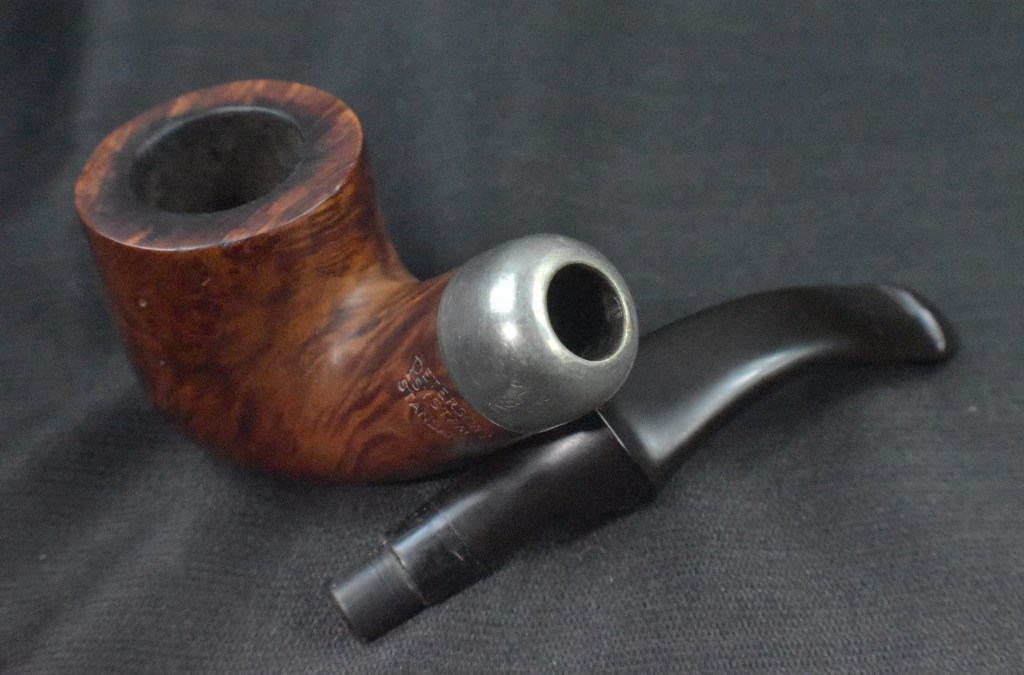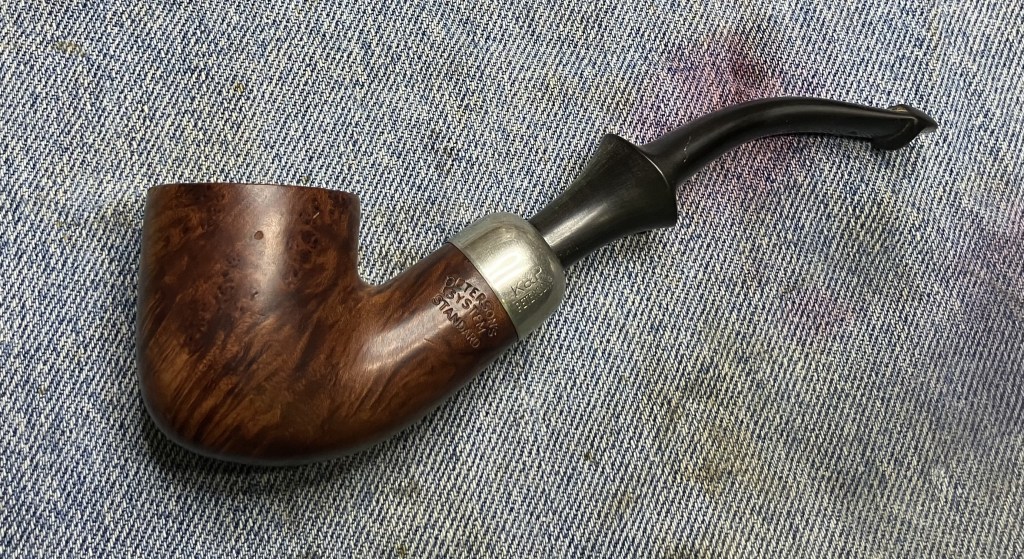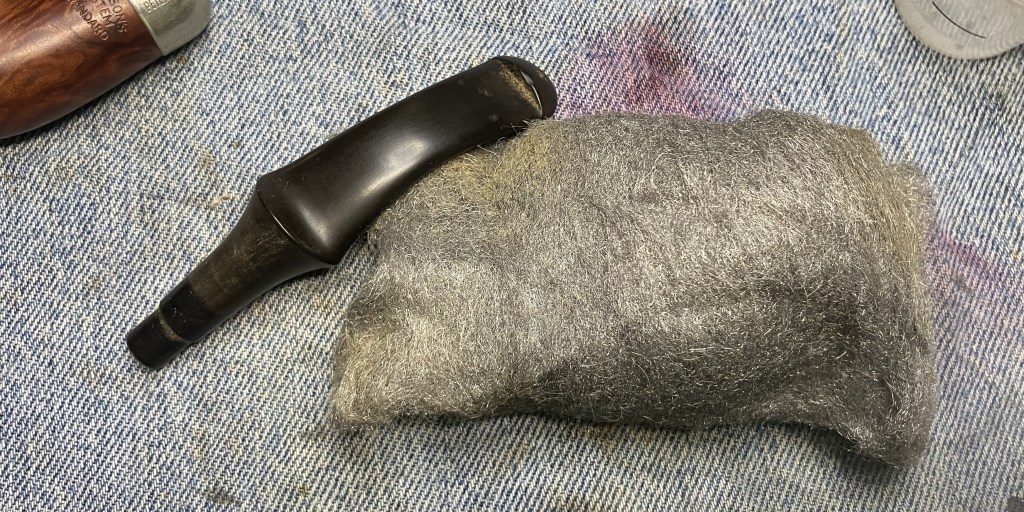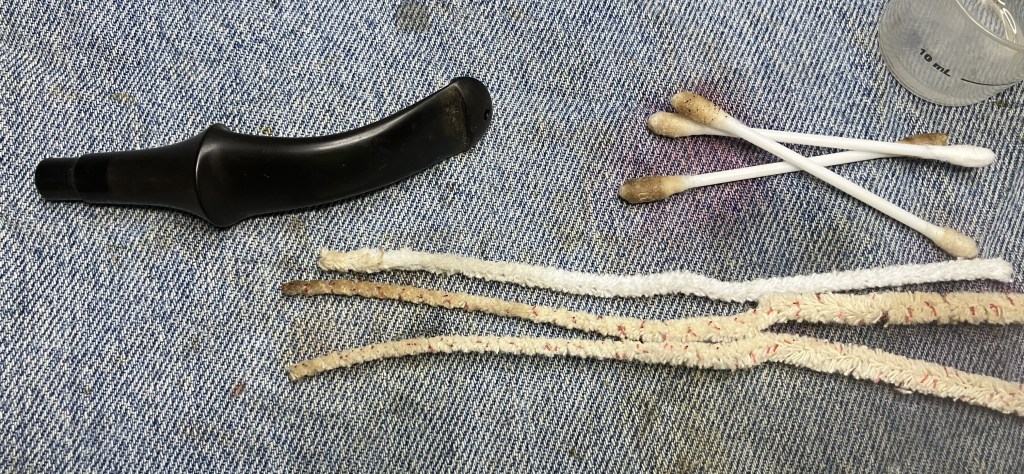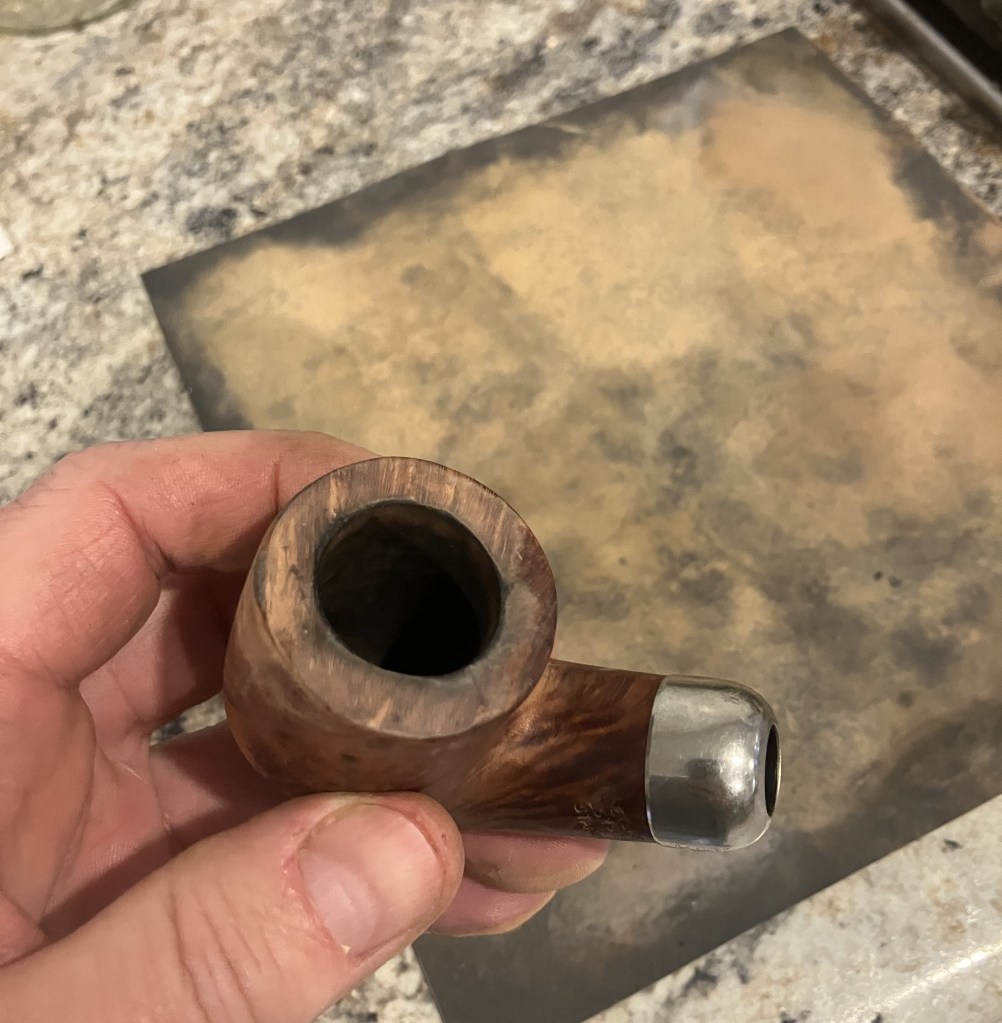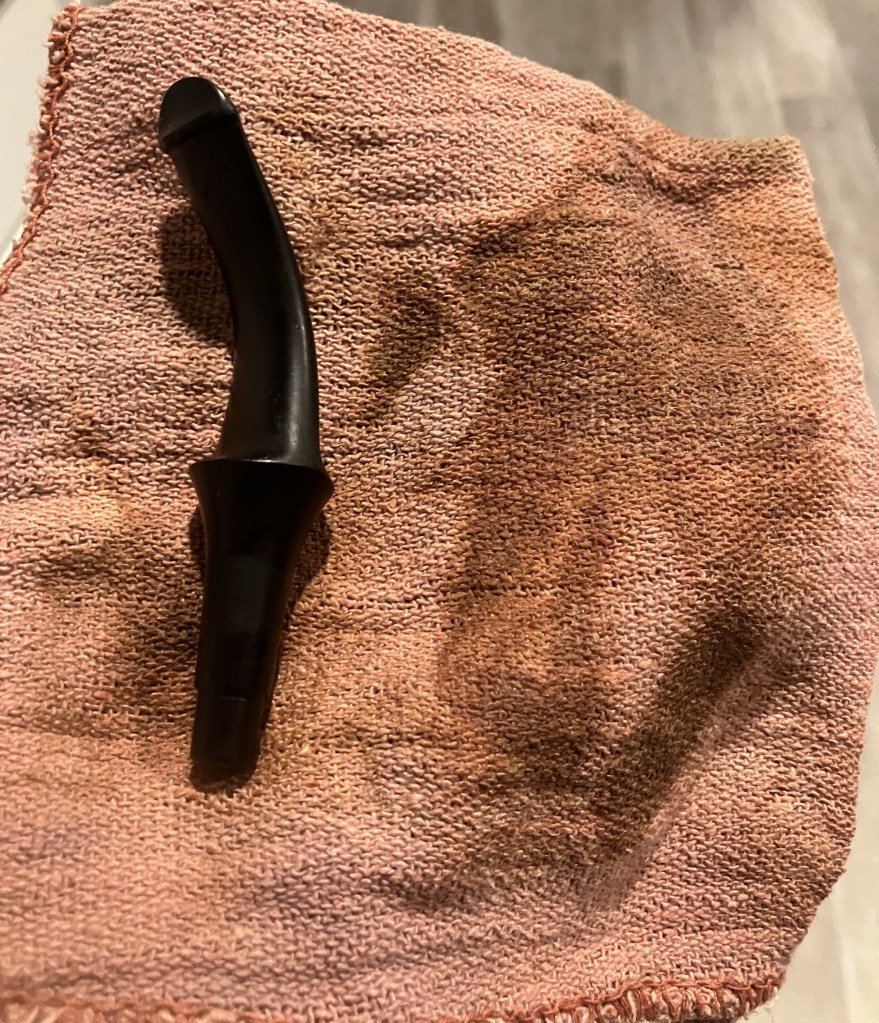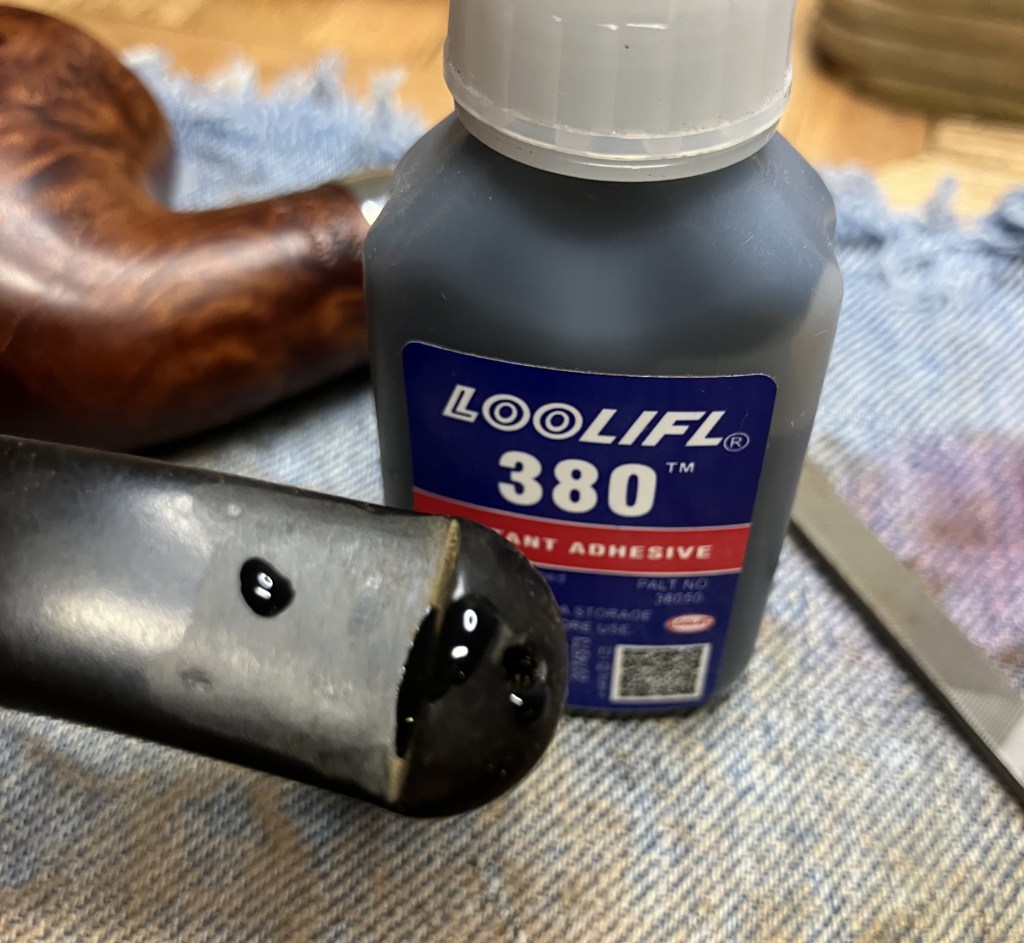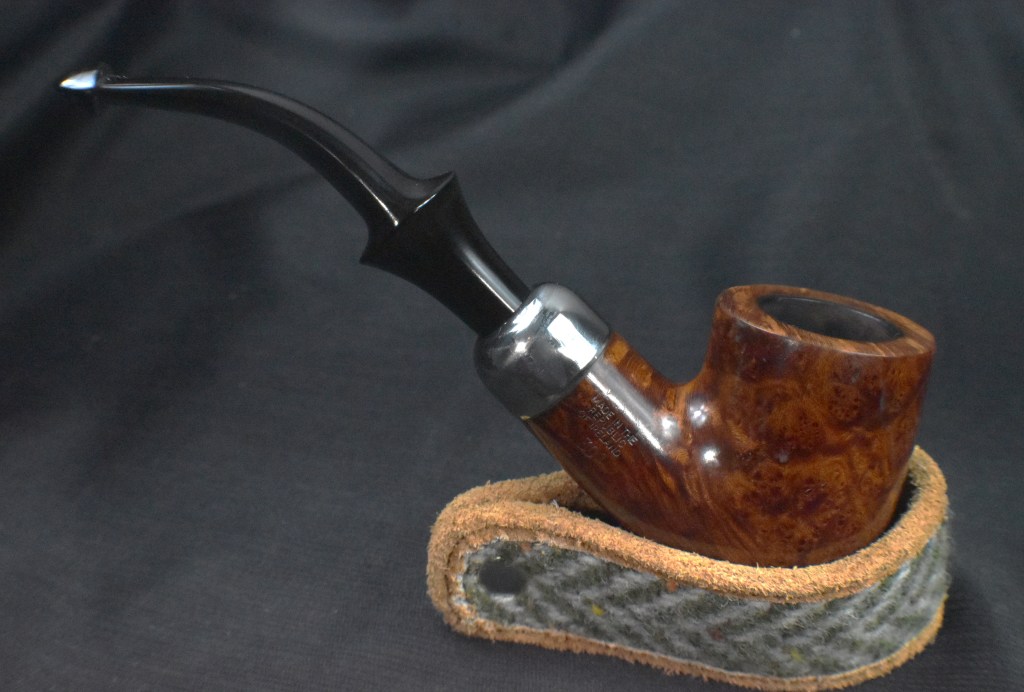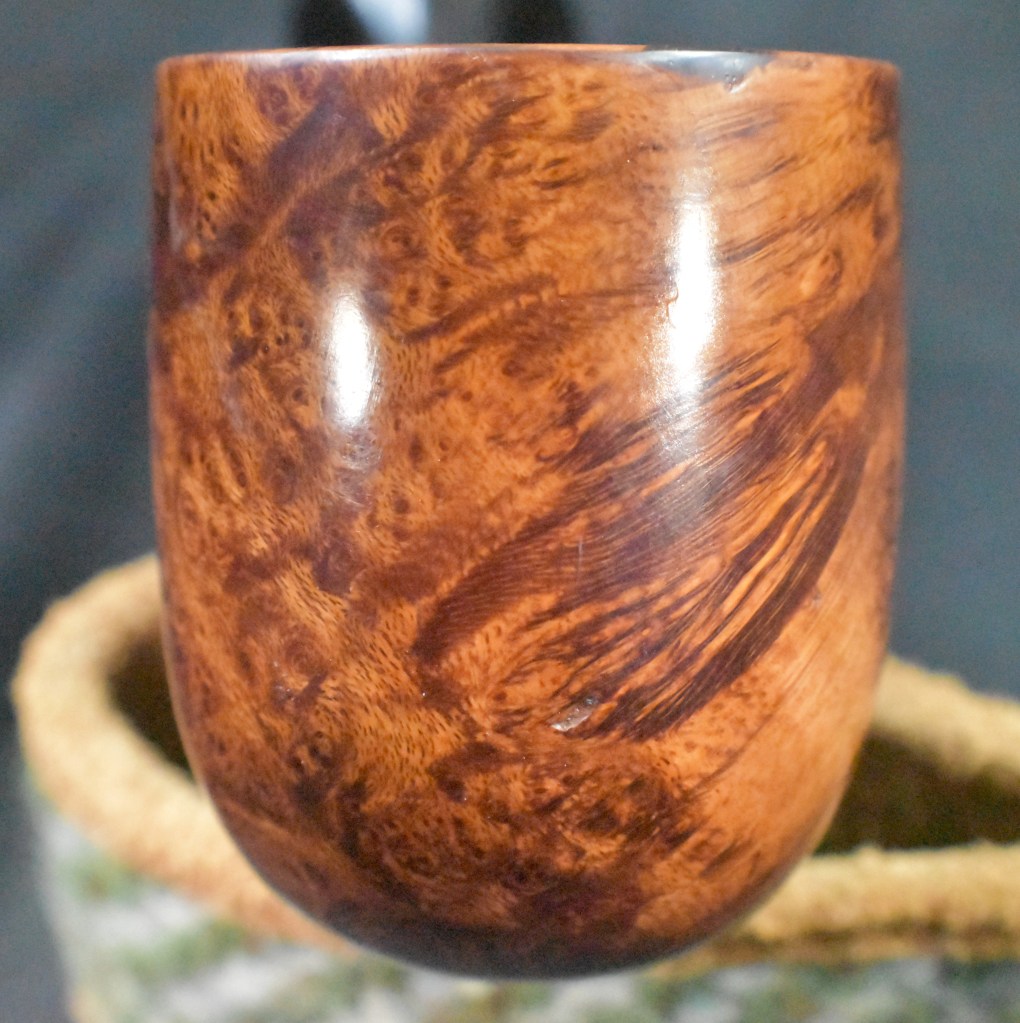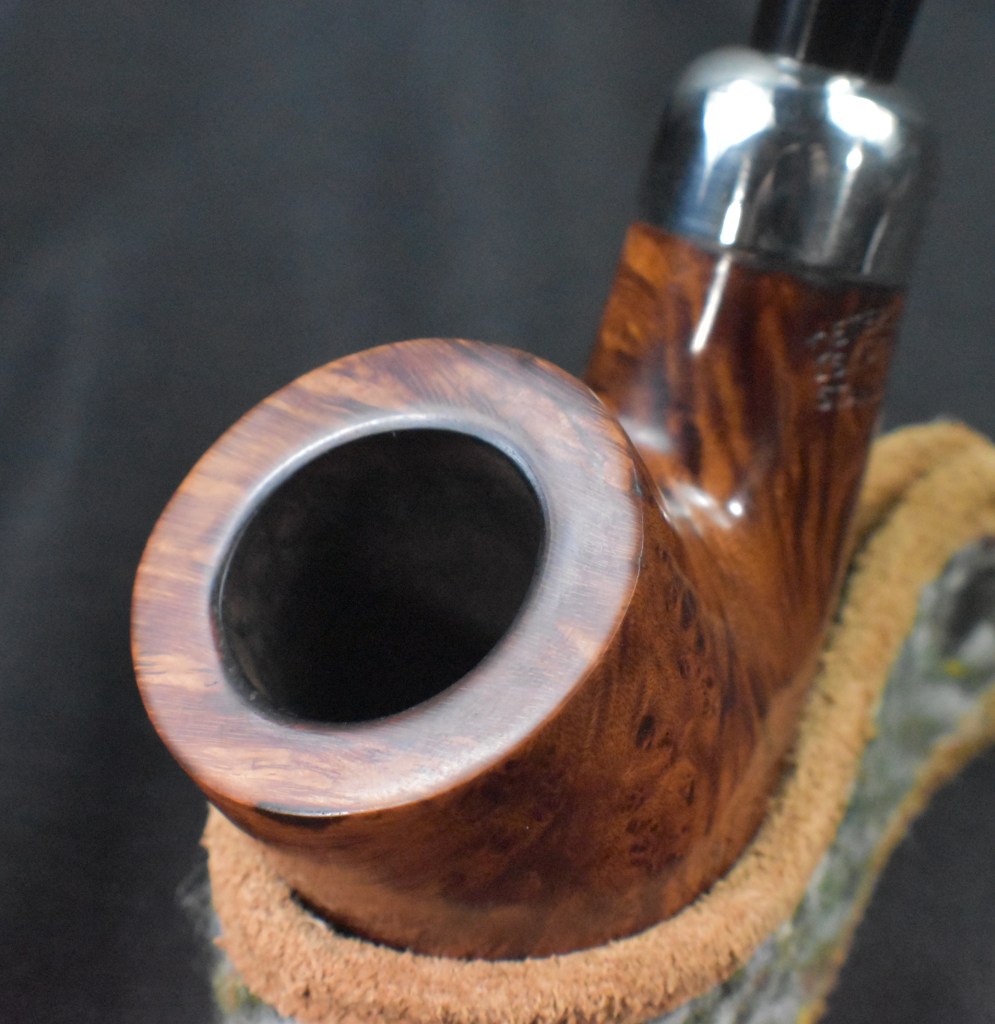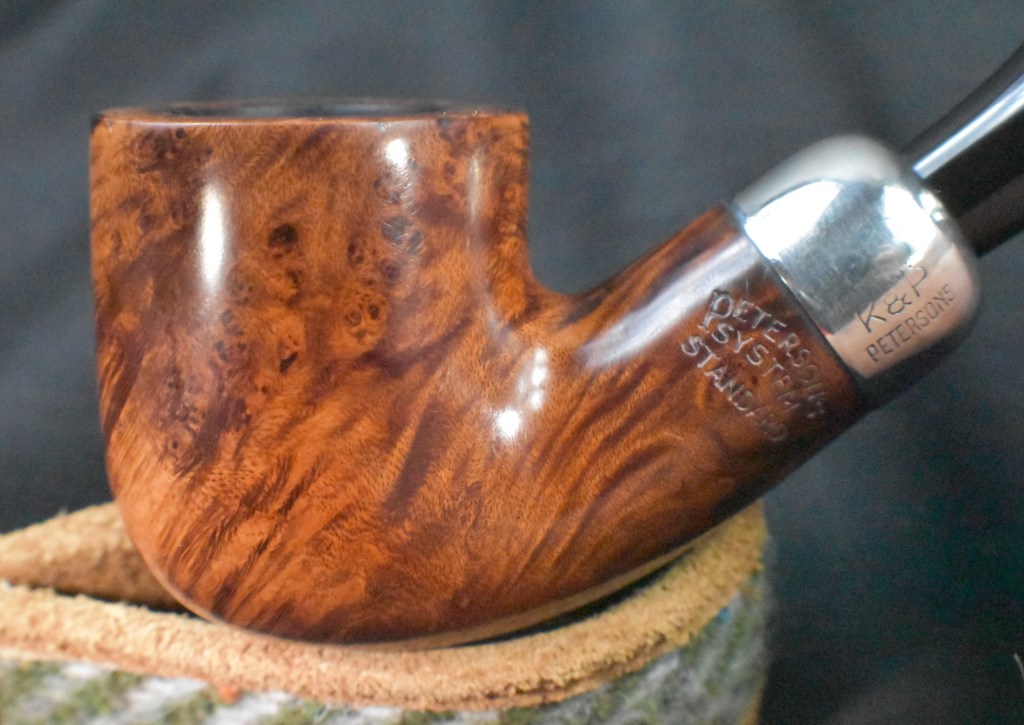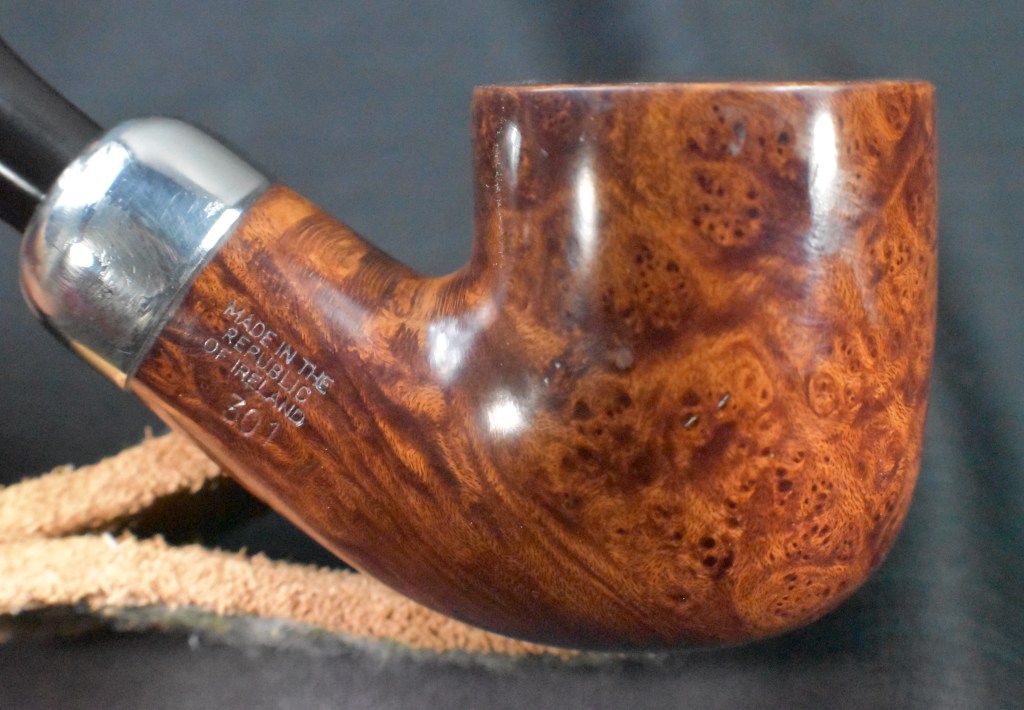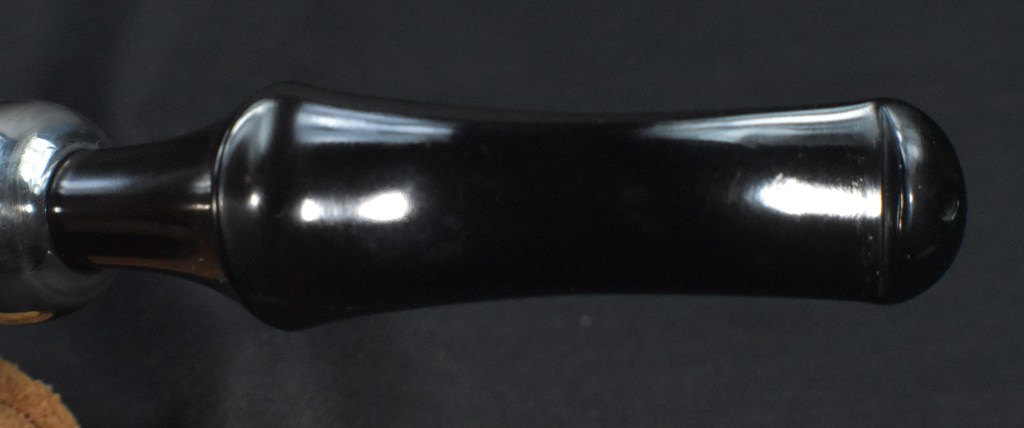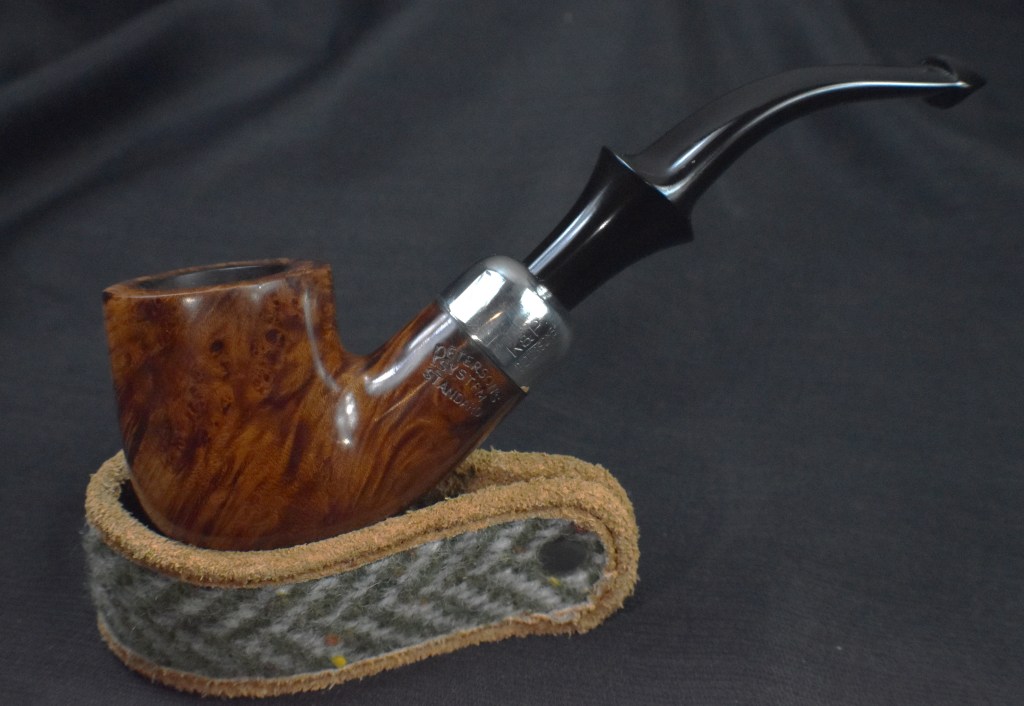
It seems like I haven’t worked on a Peterson pipe for a while but, that’s not true. I did that Captain Pete commission just a couple of weeks ago. Oh well, I’ll use my newly created meme anyway:
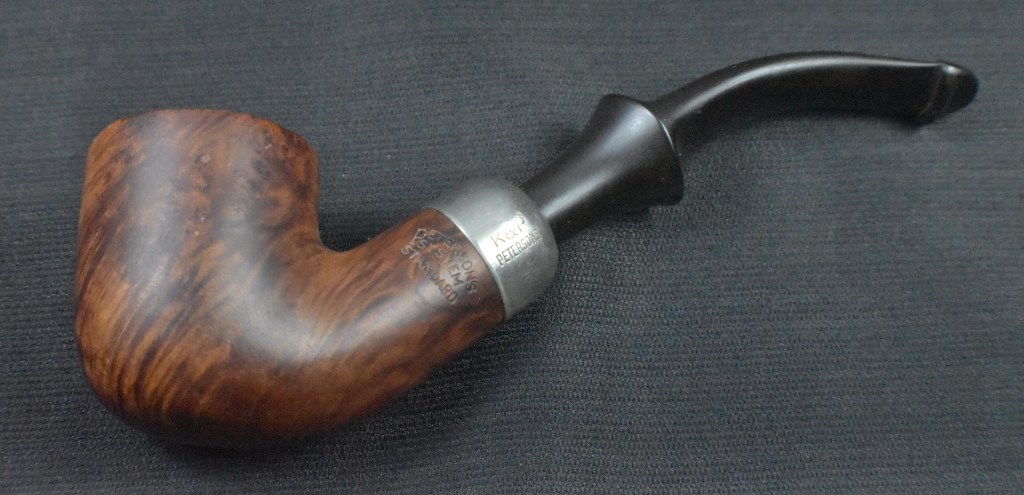
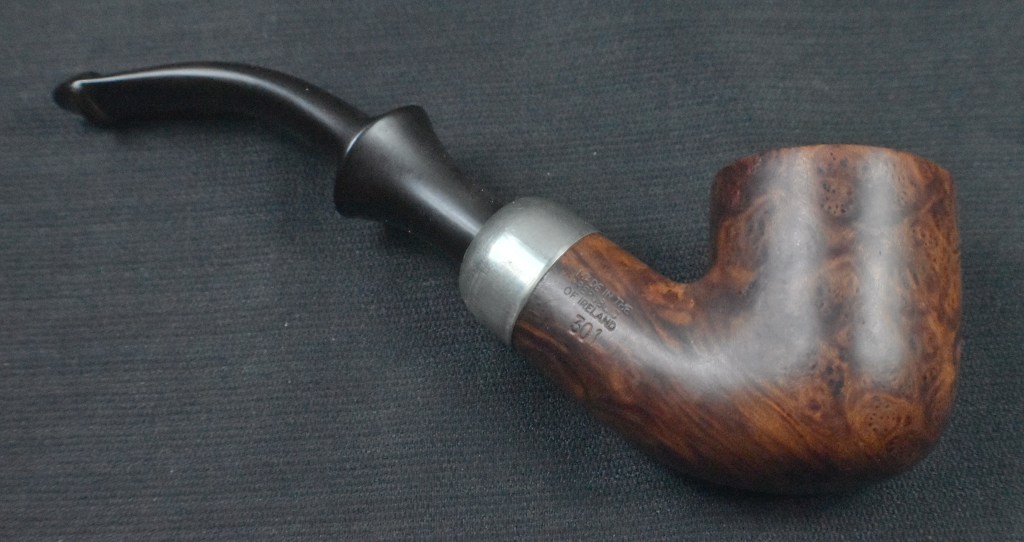
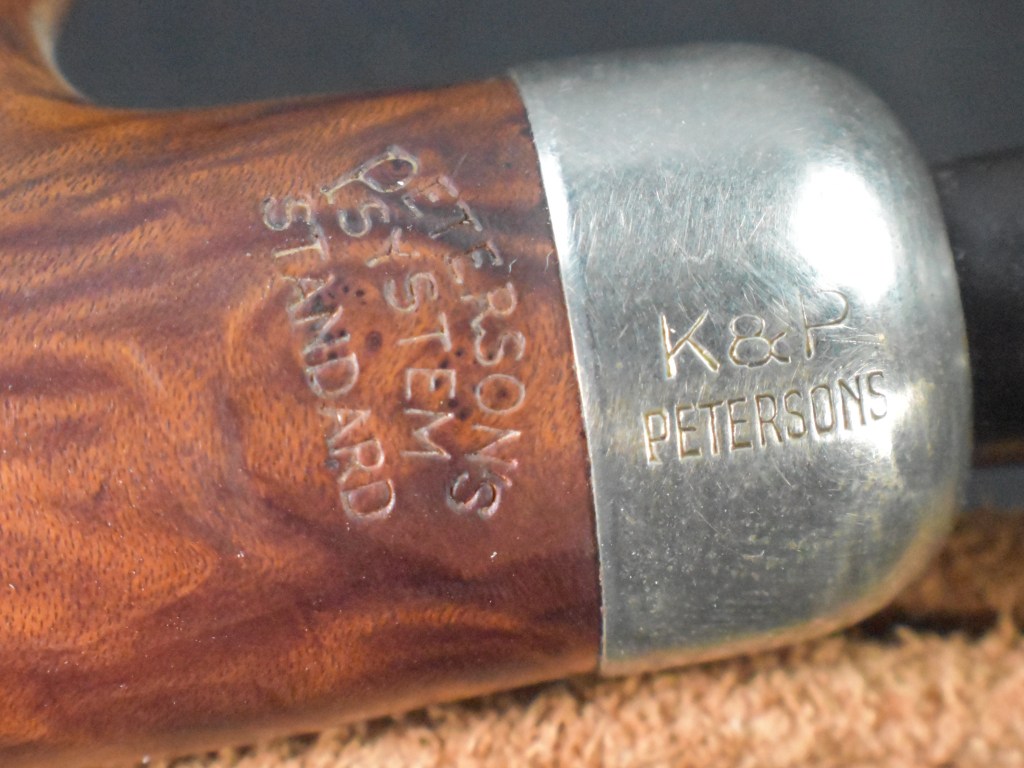
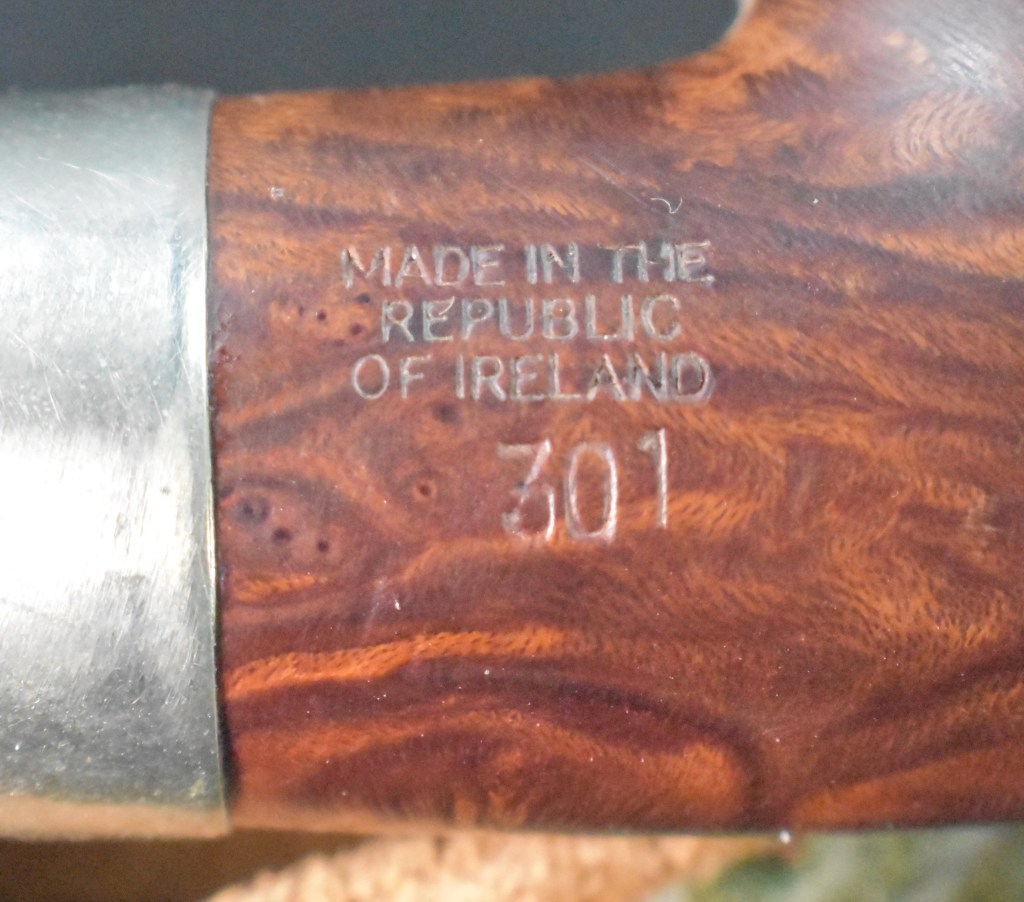
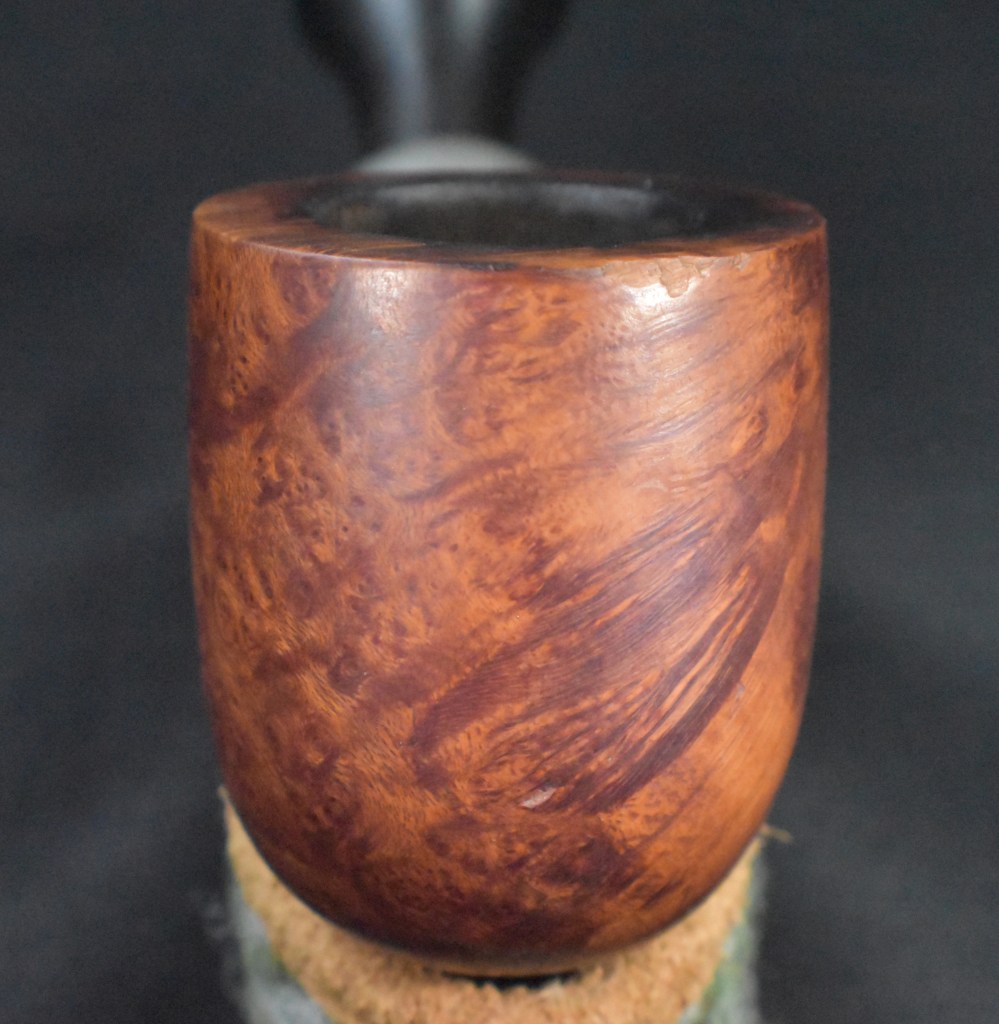
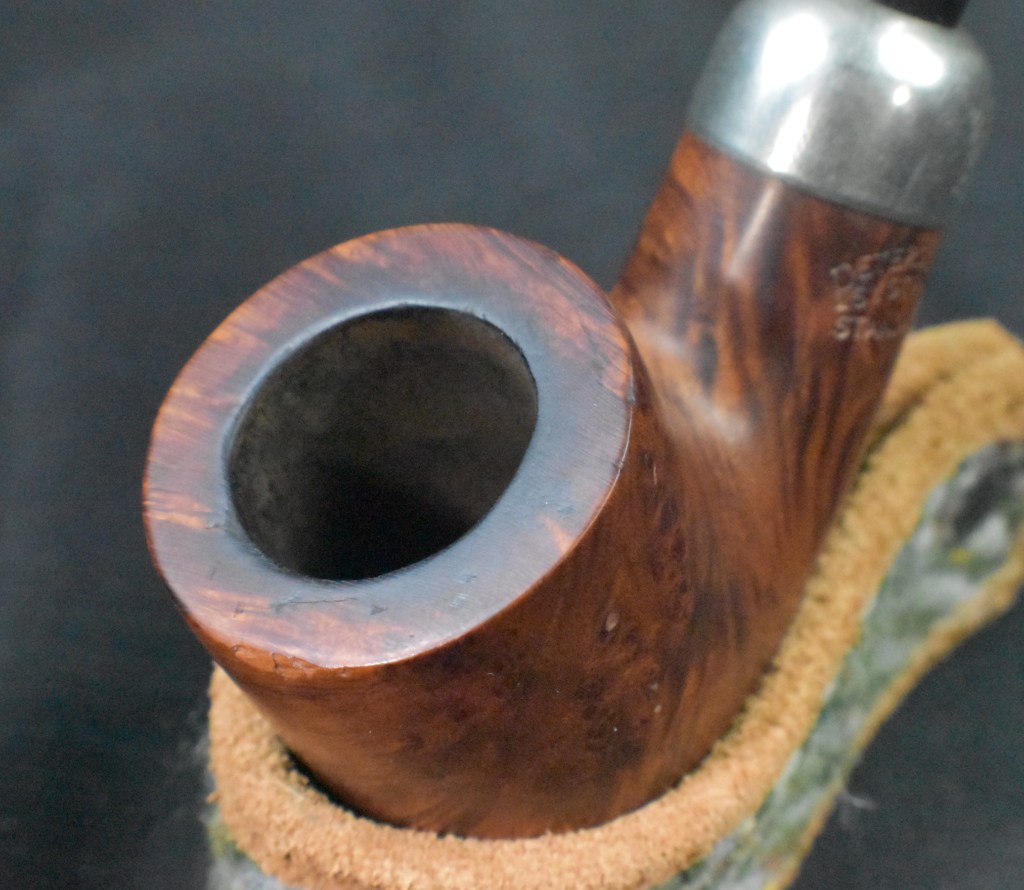
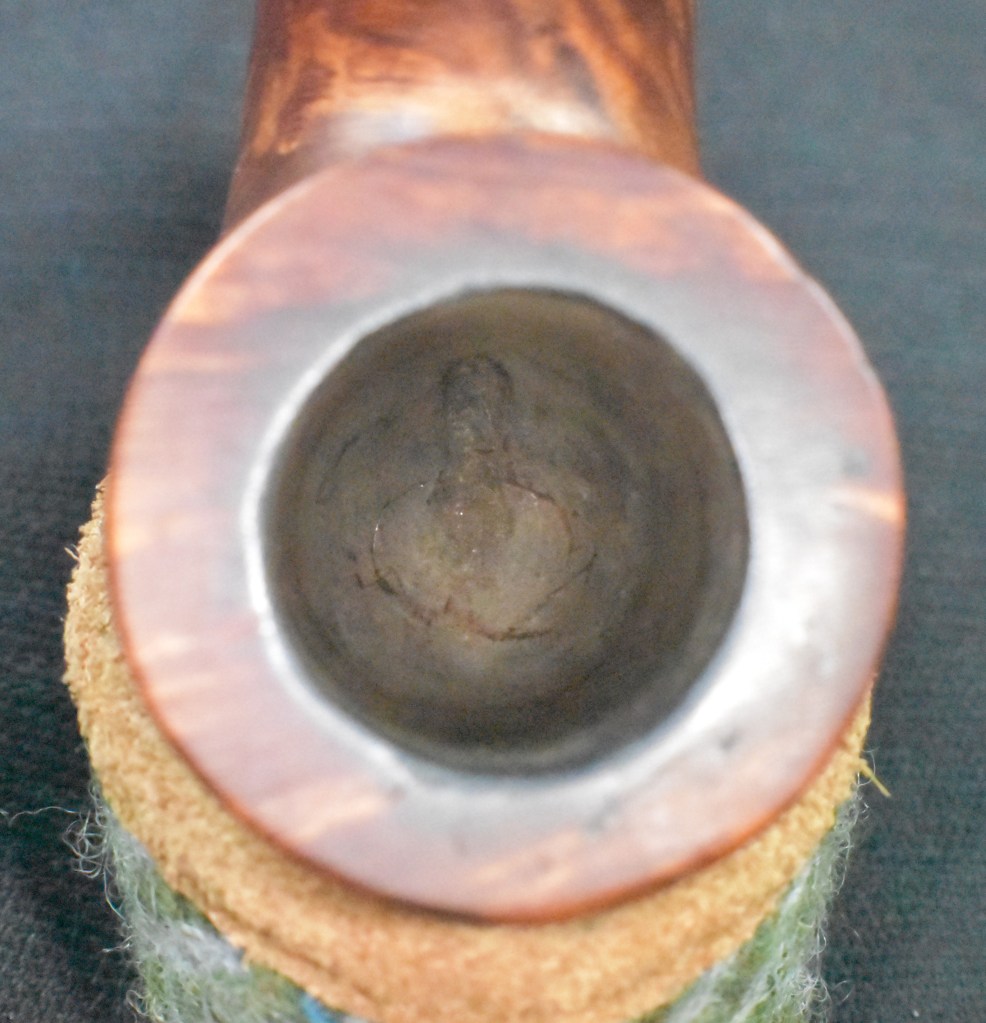
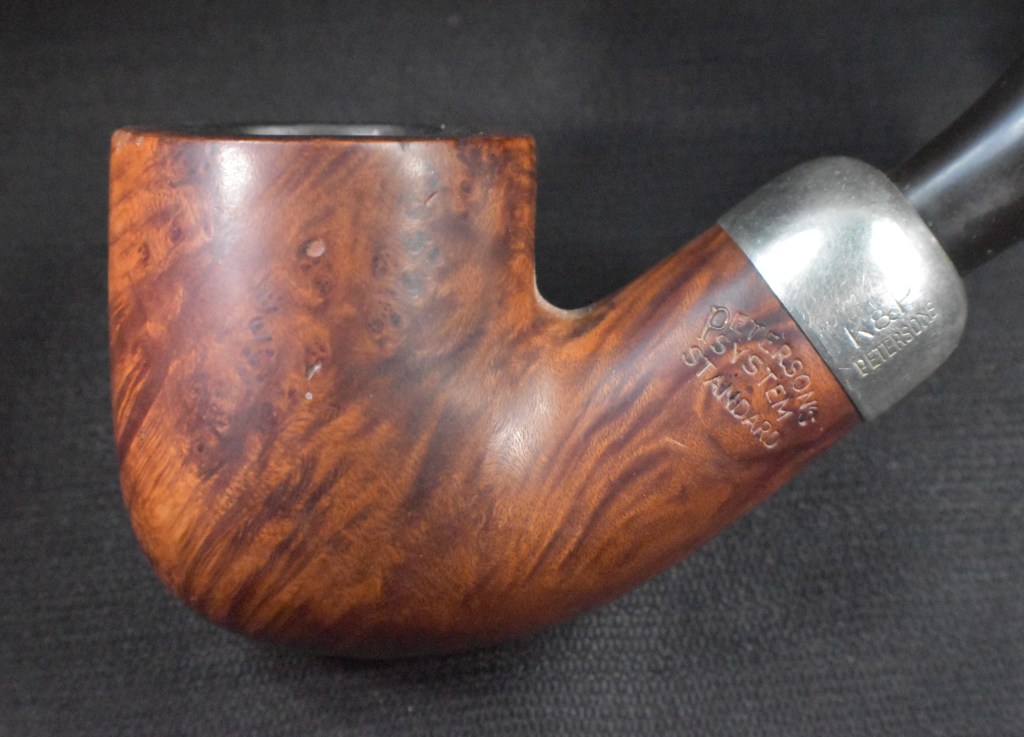
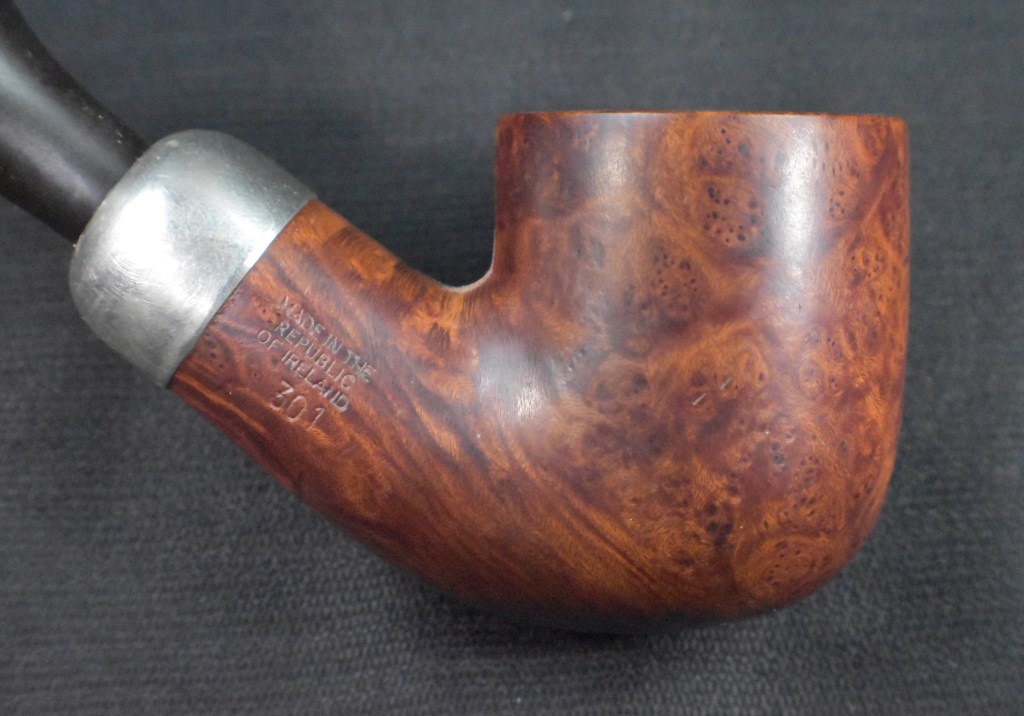
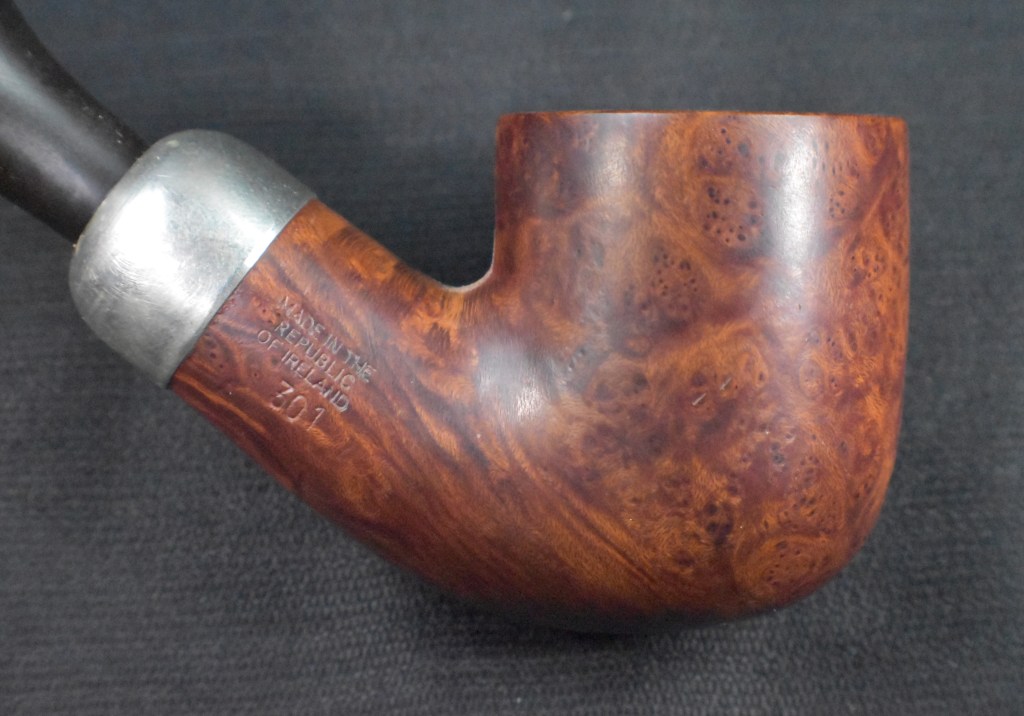
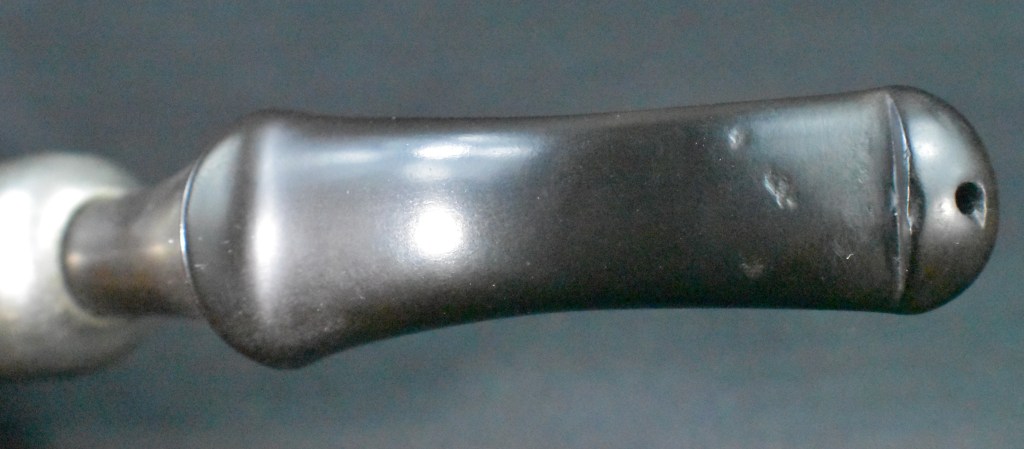
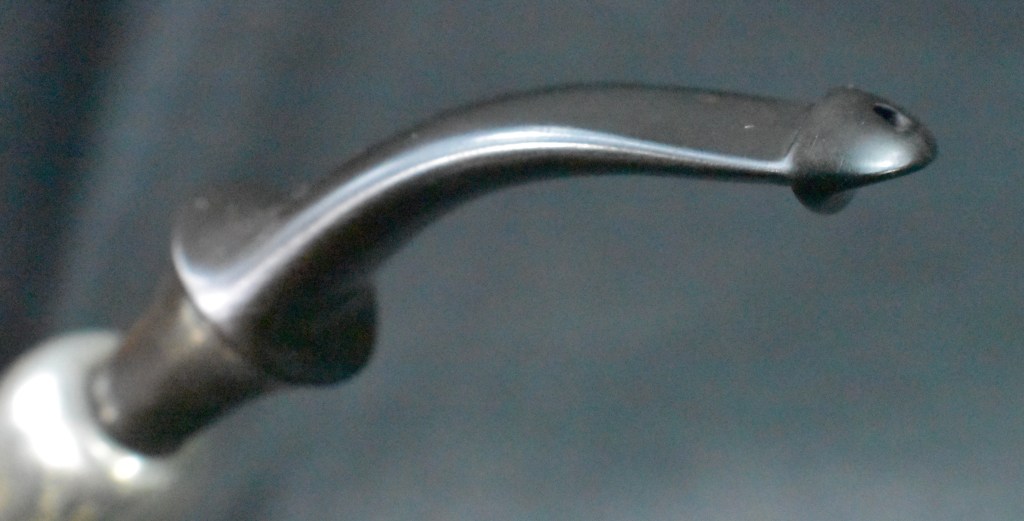
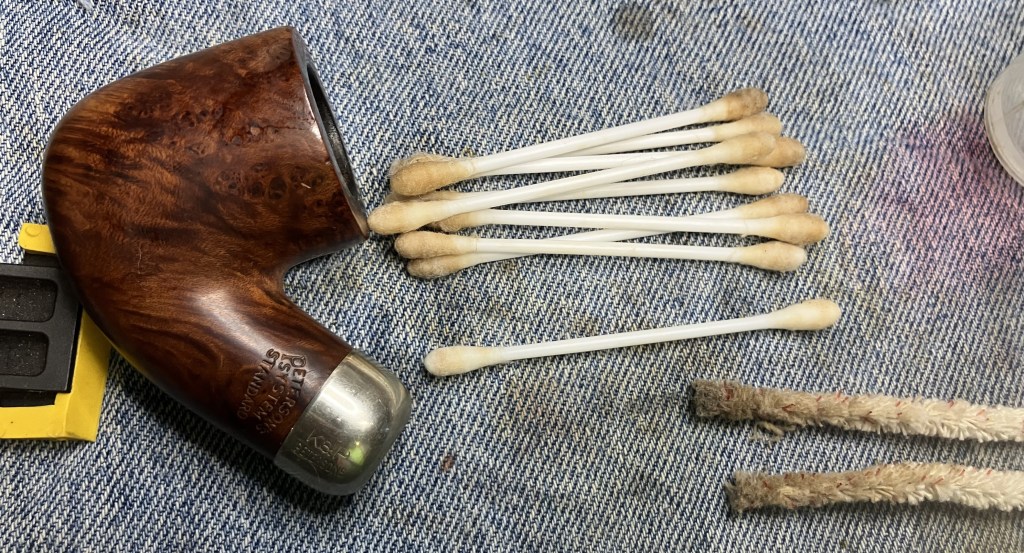
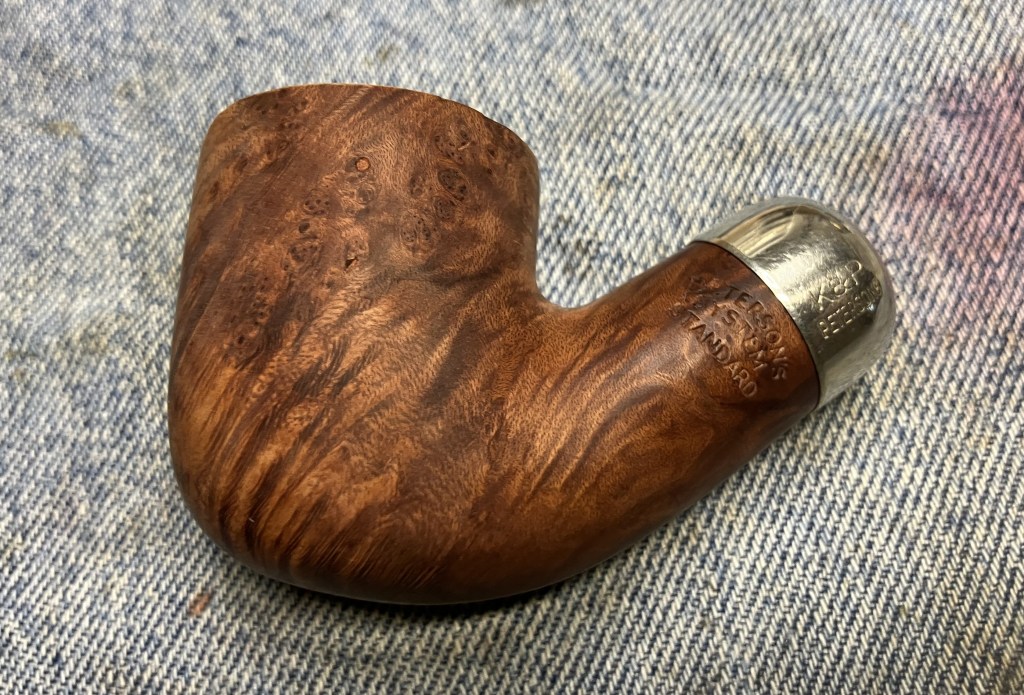
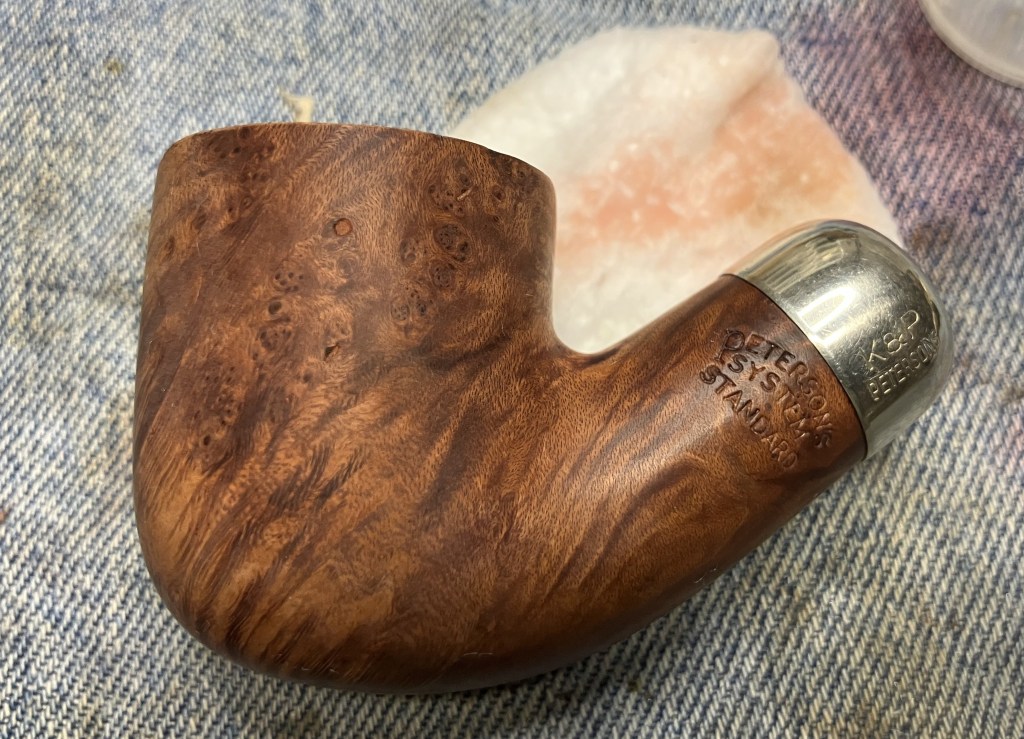
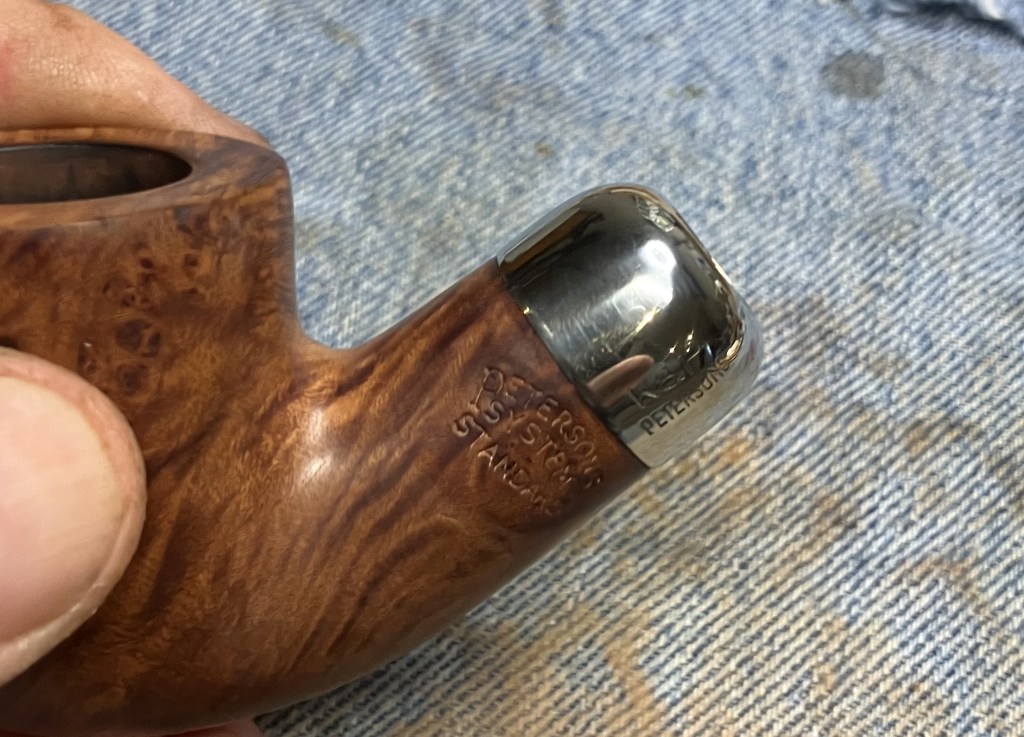
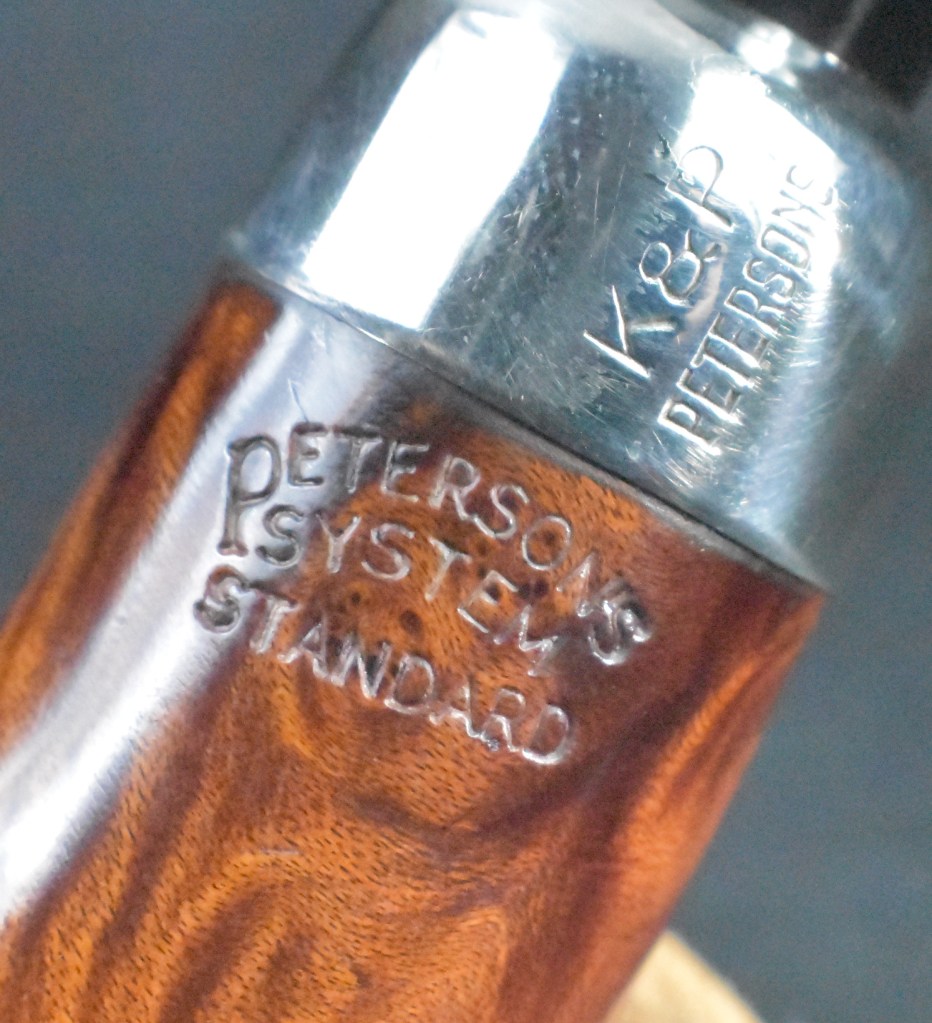
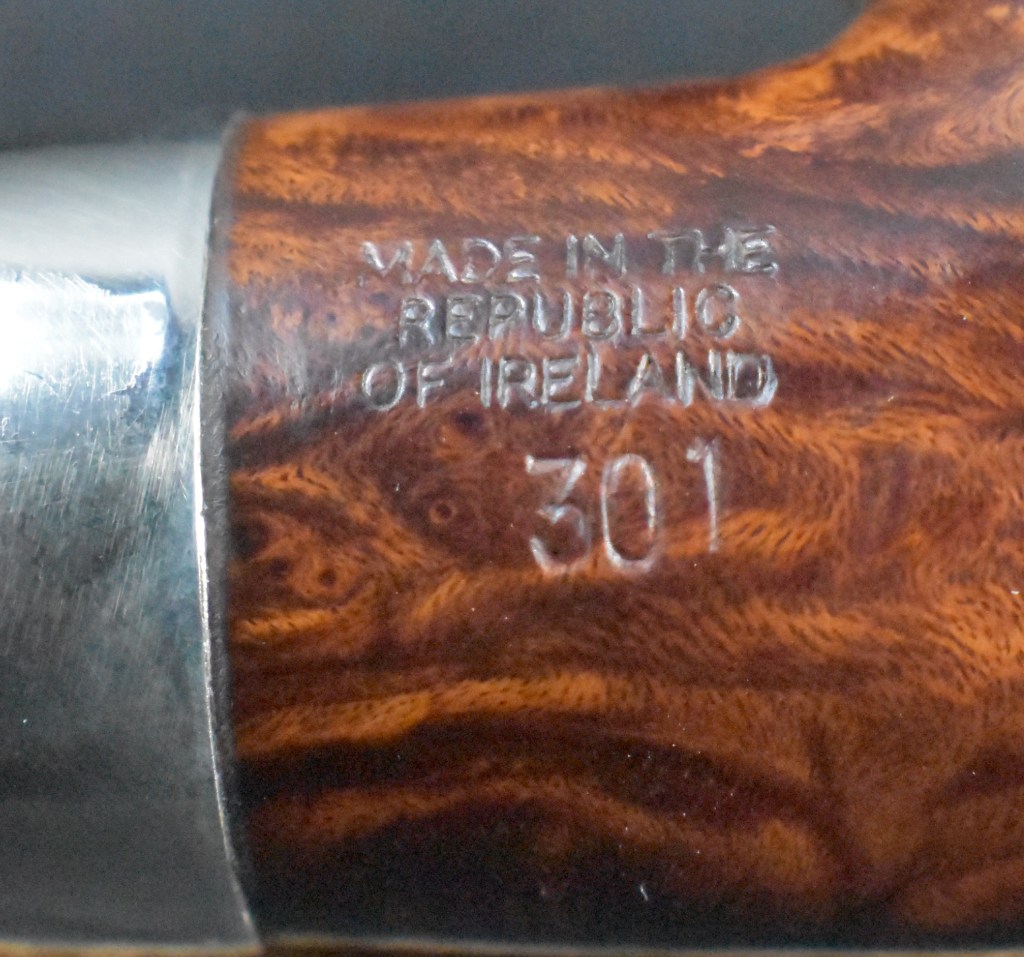
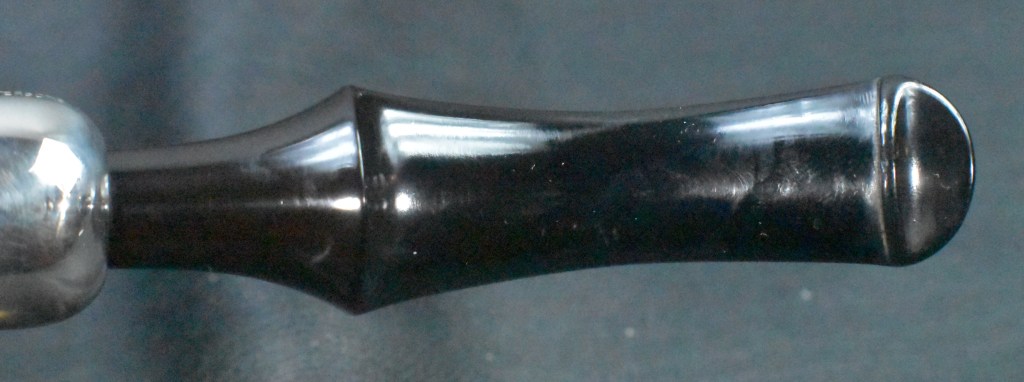
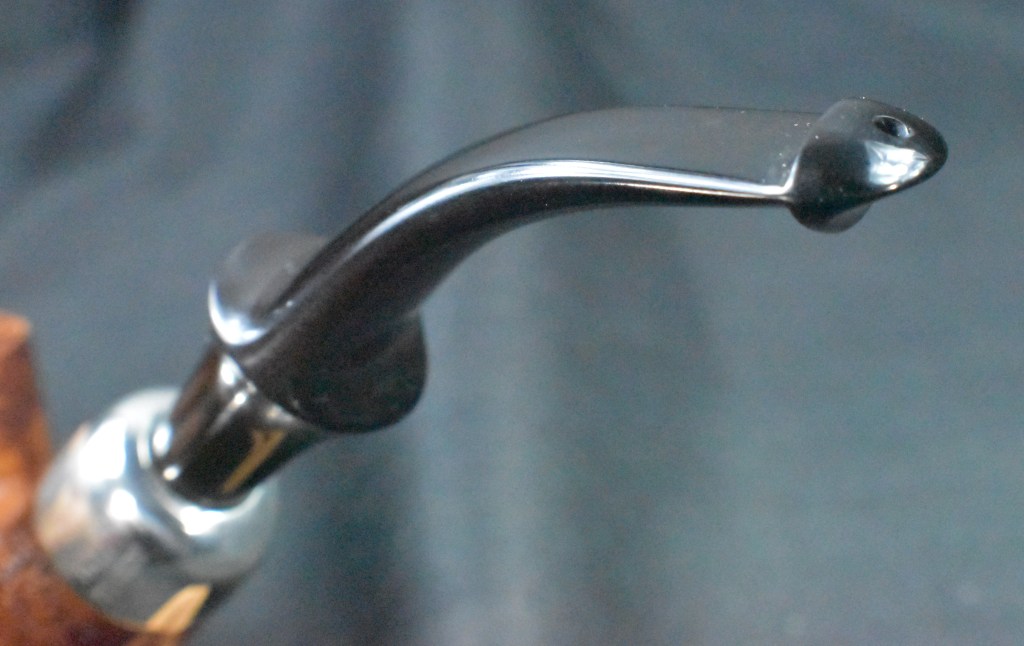
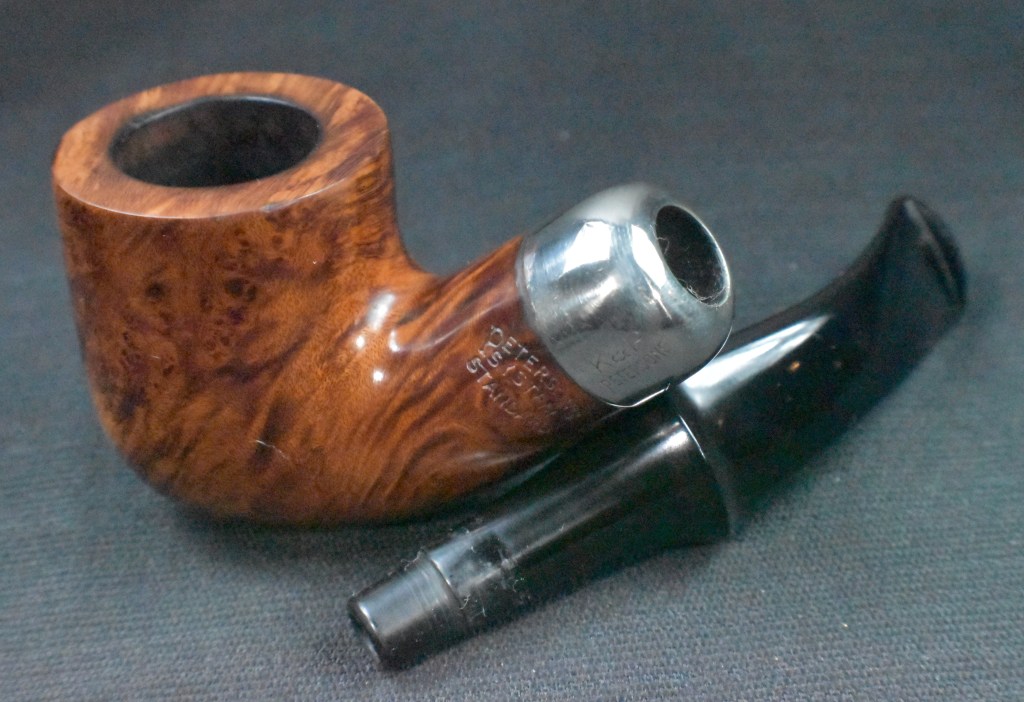
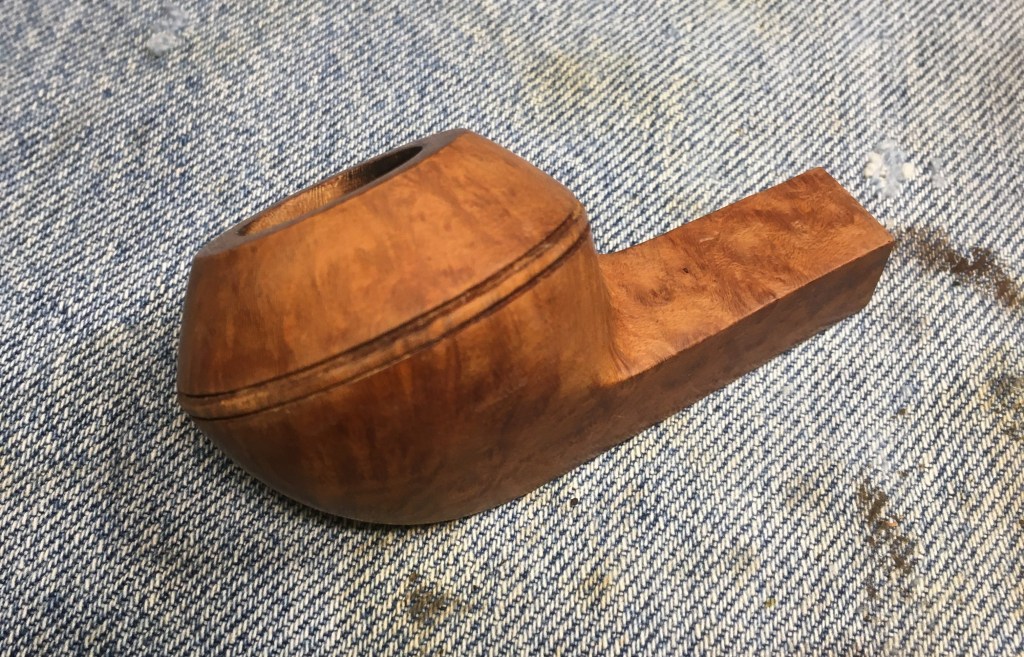
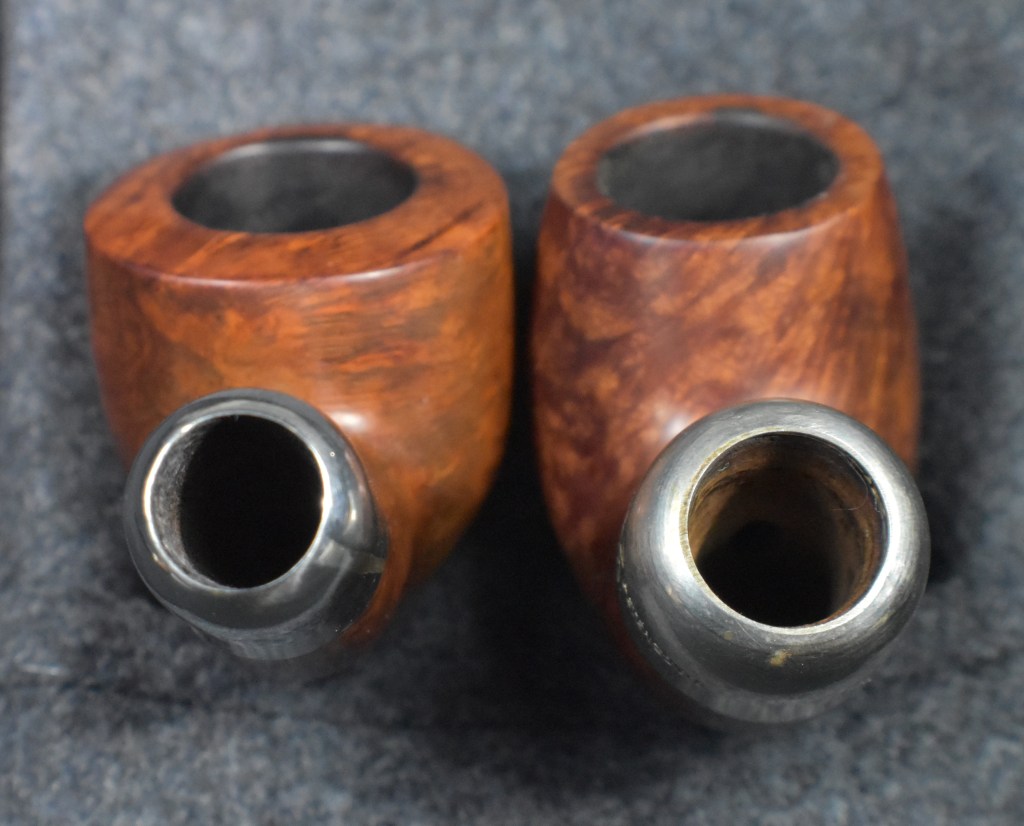
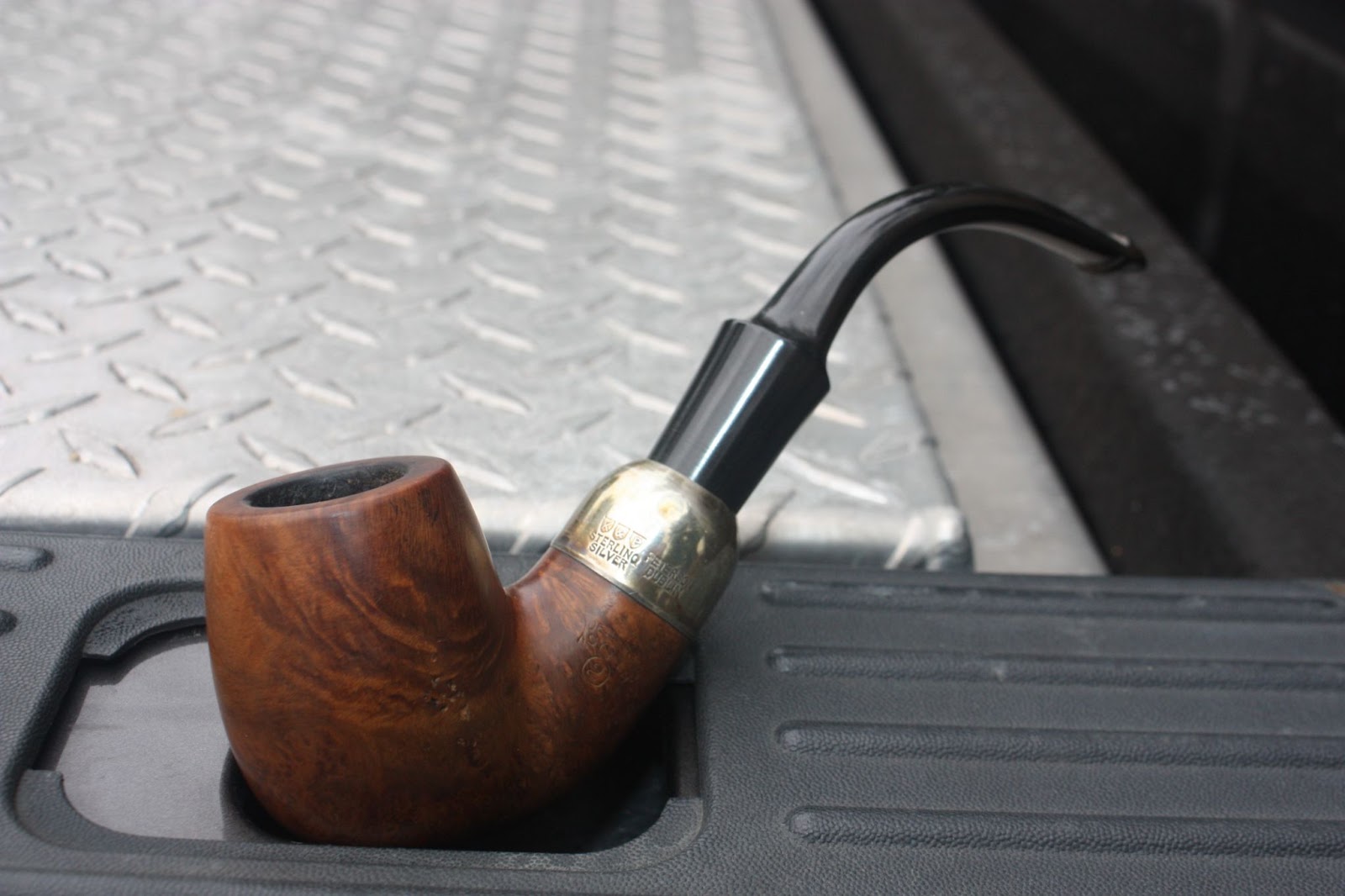
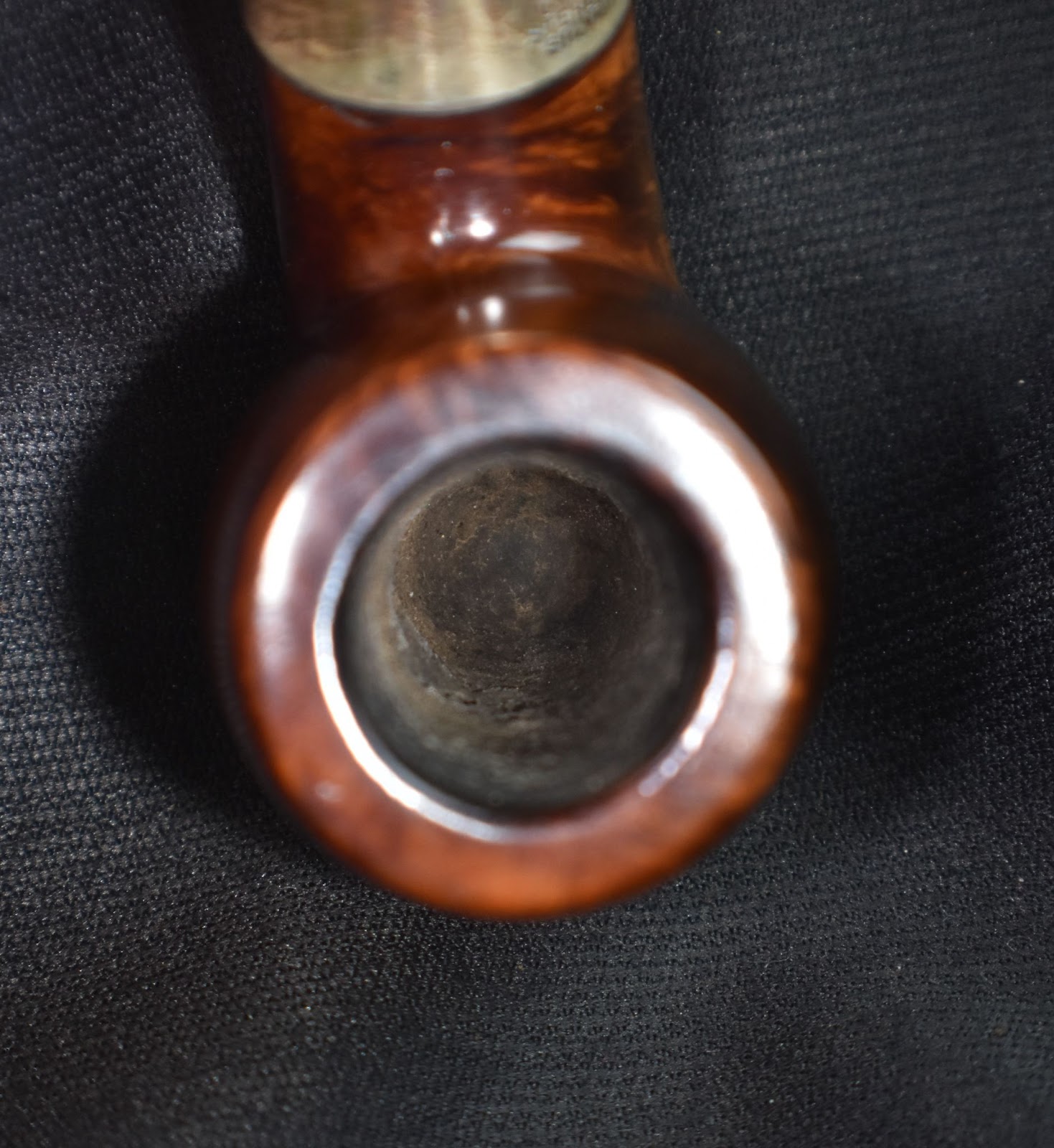
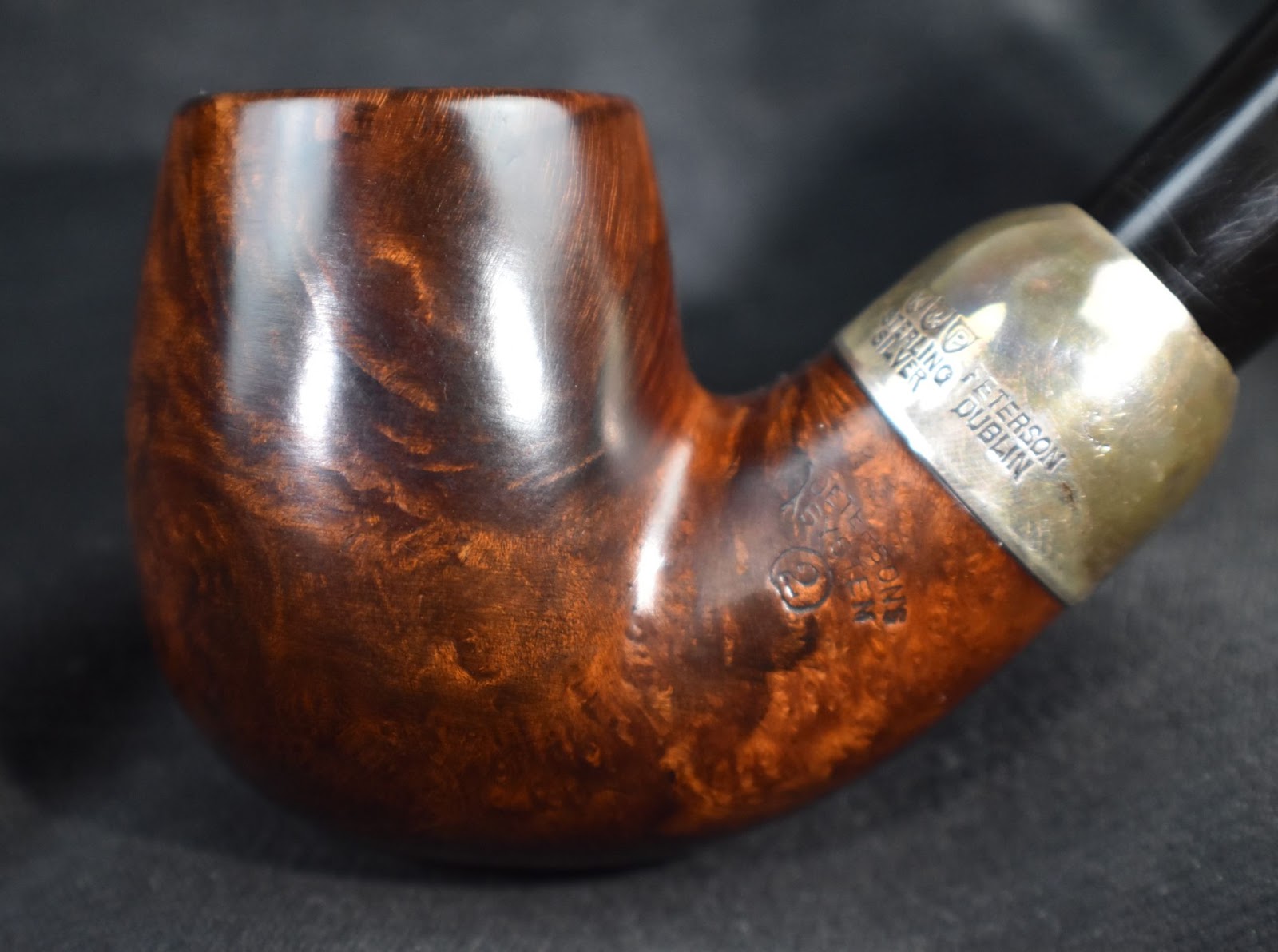
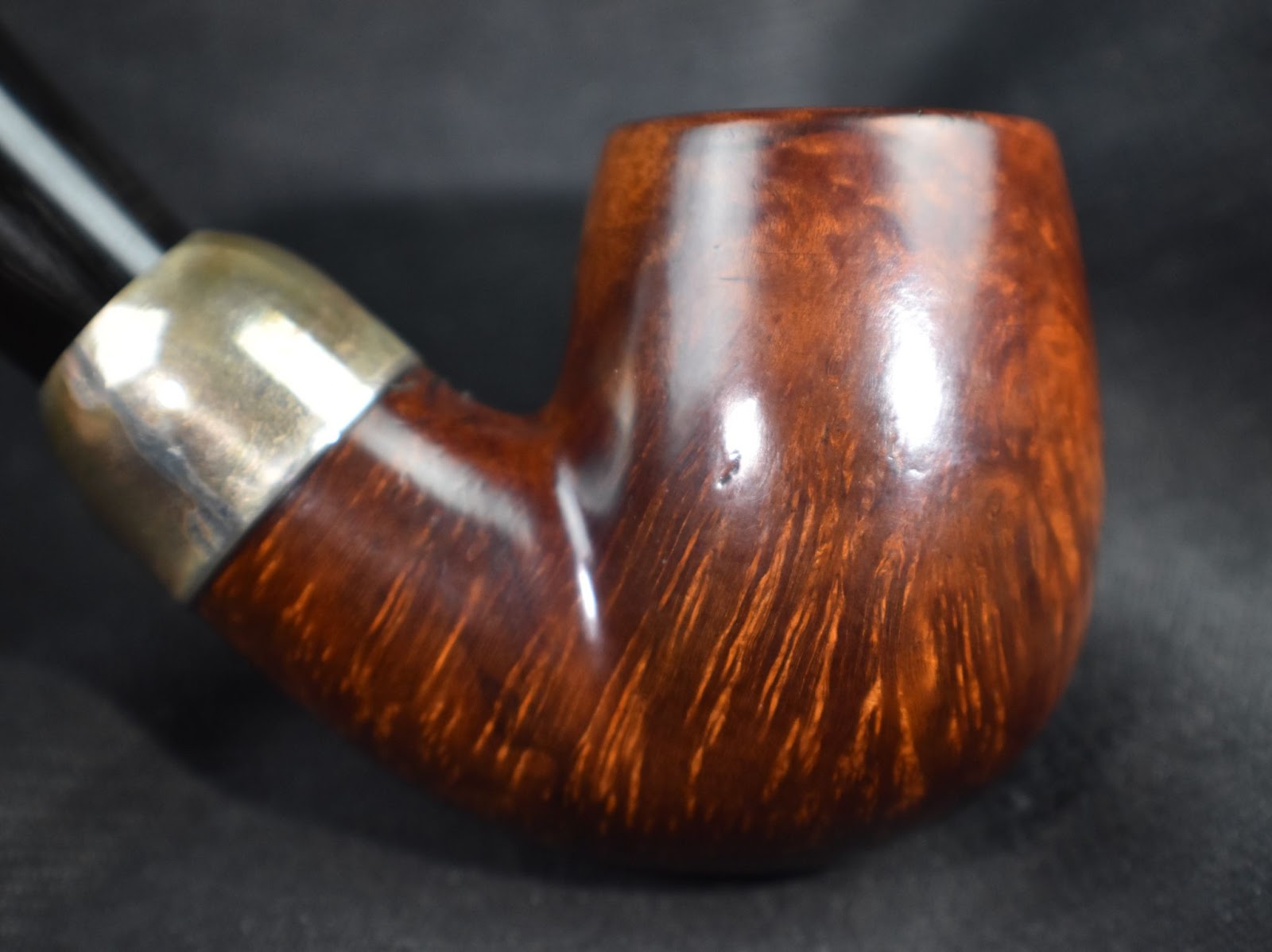
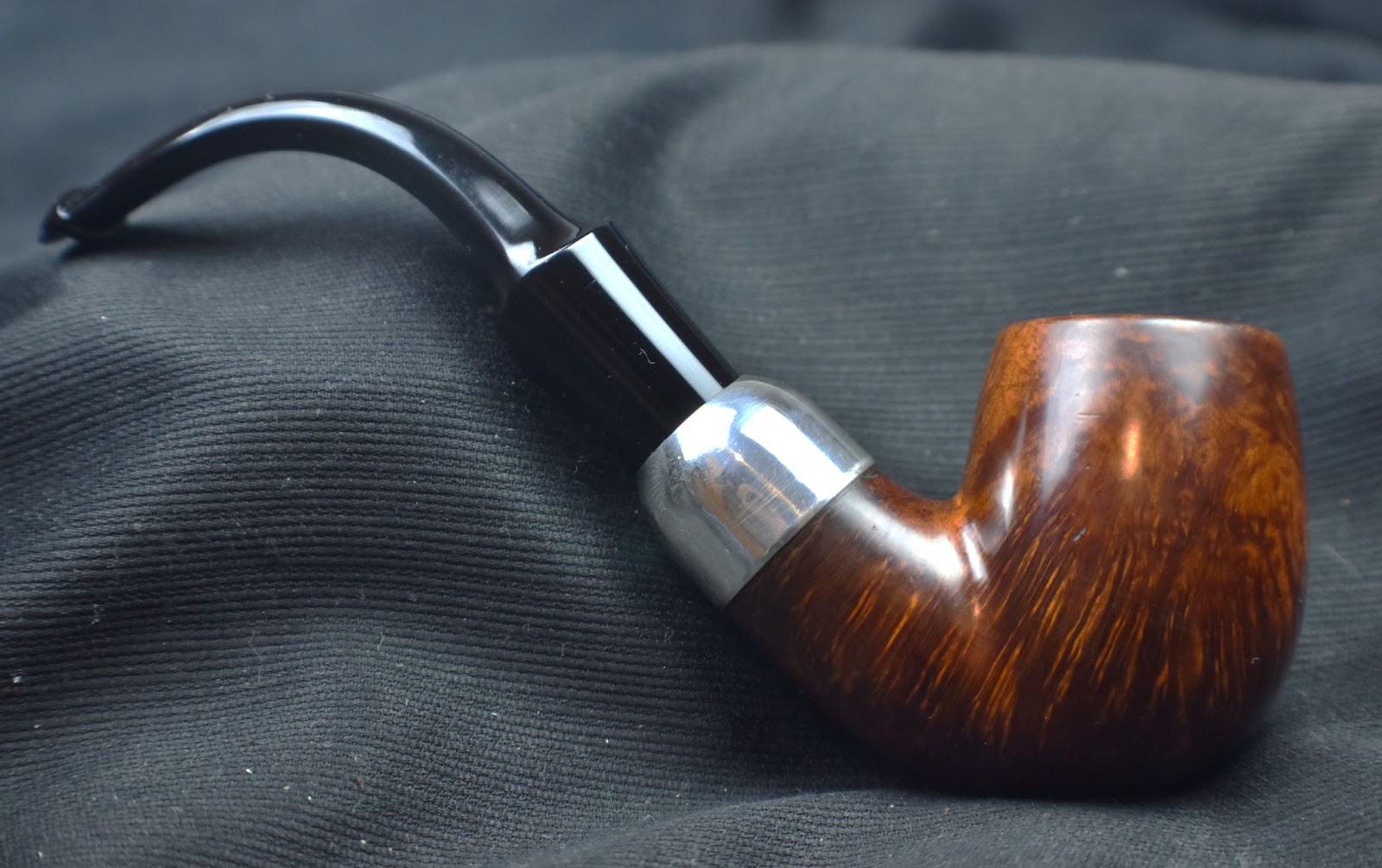
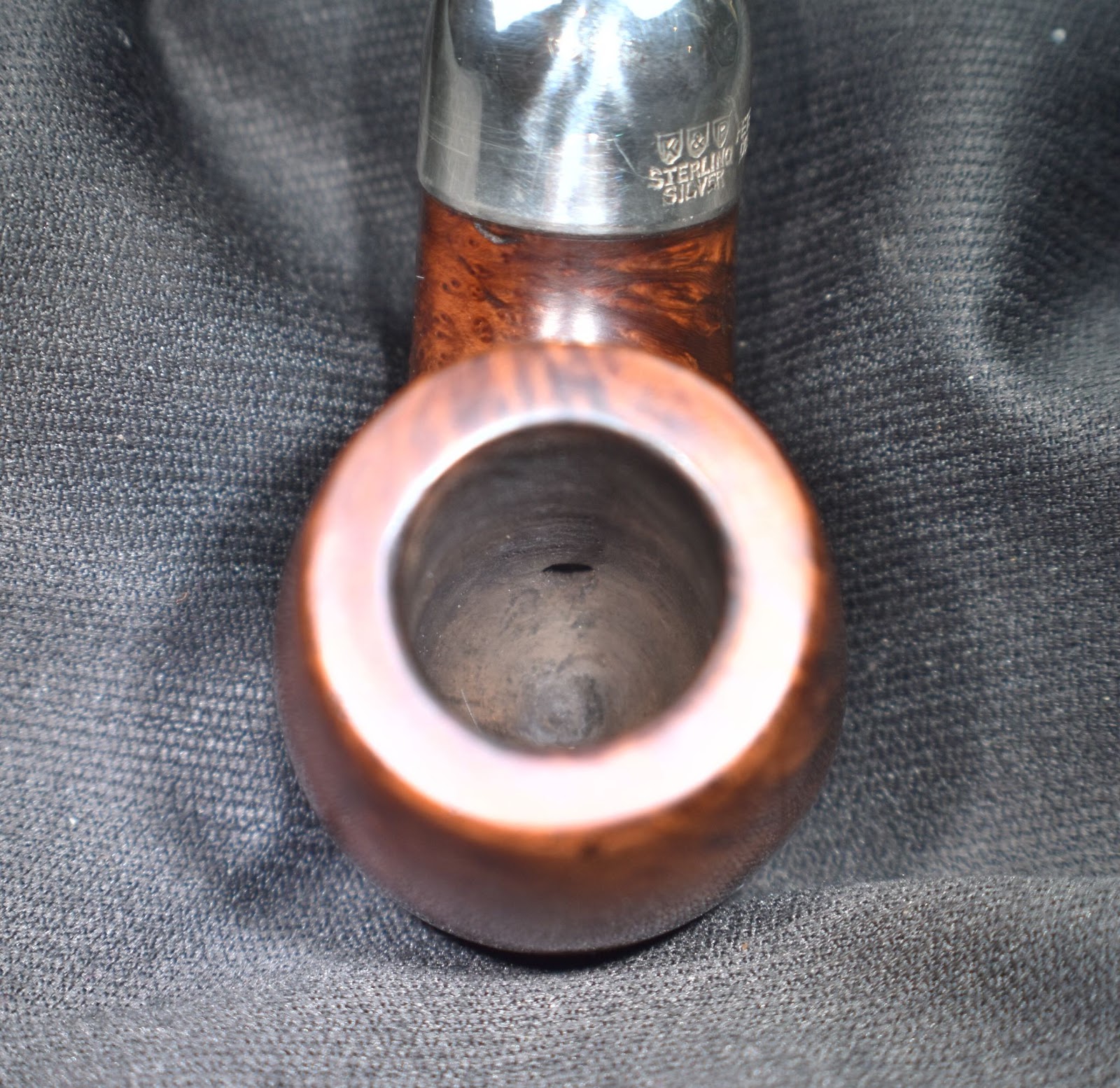
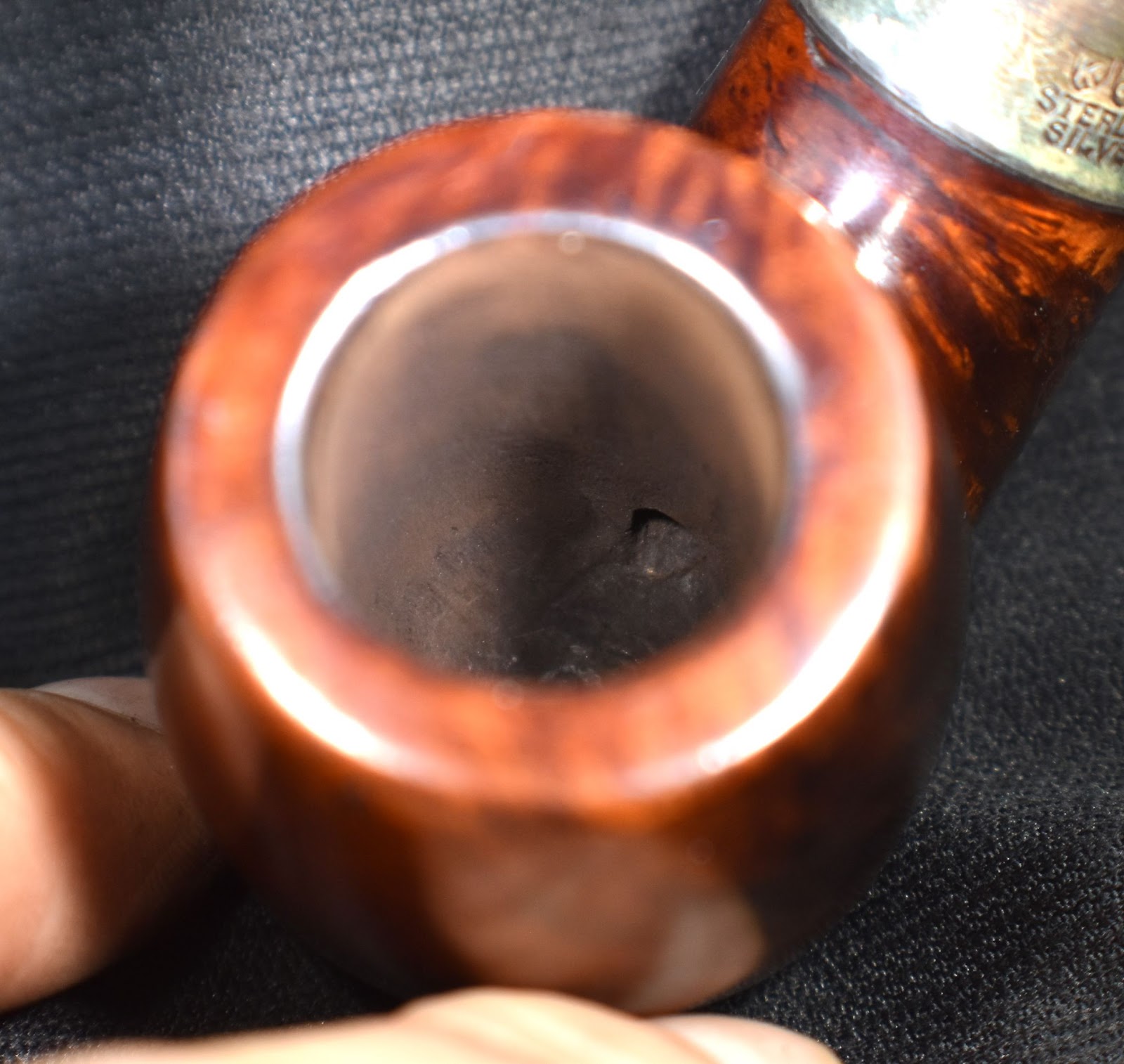
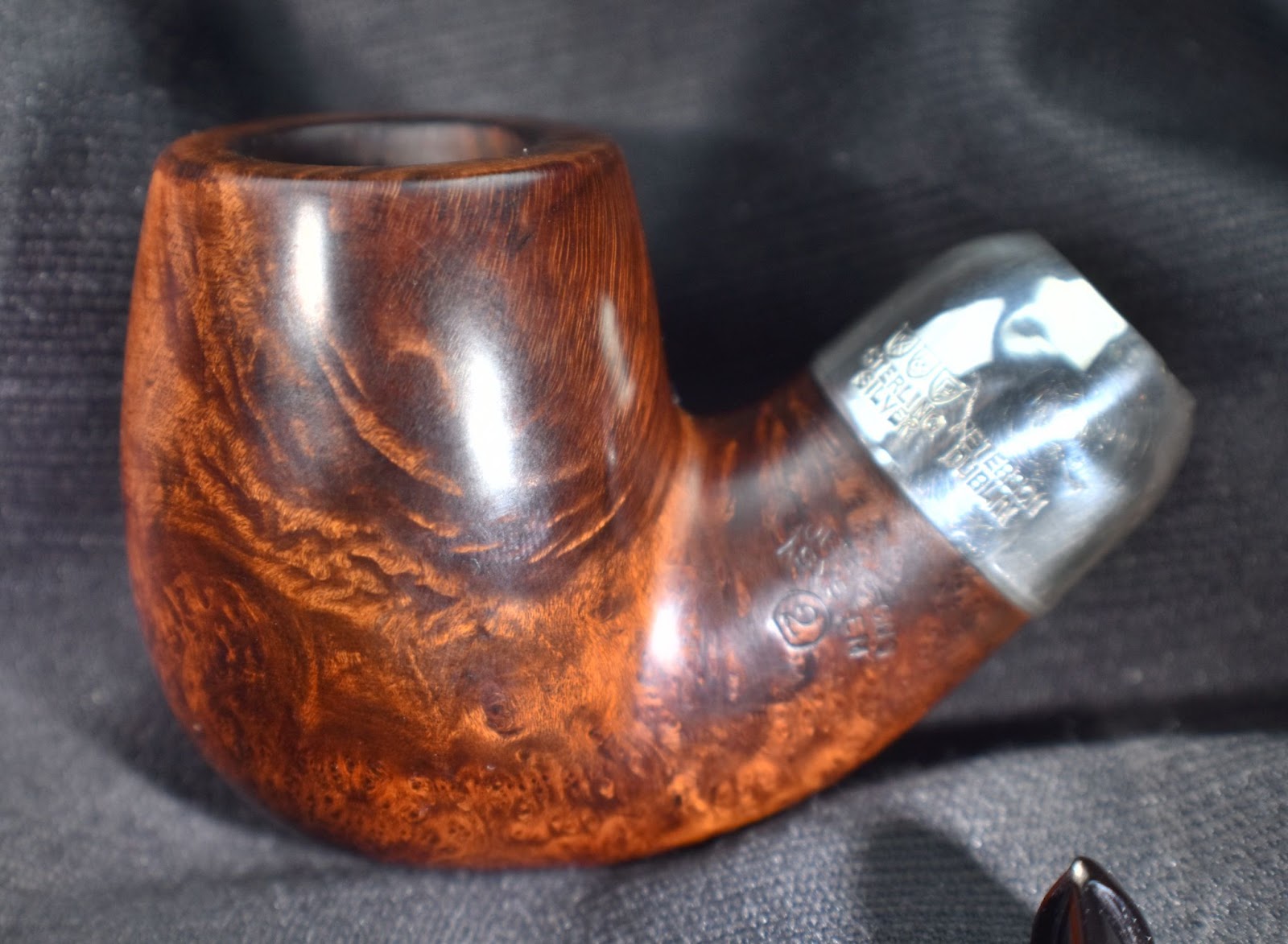
This restoration is on a Peterson I have never worked with a Kapp-Royal bent pot 01. This beauty was spotted on eBay back in April of 2025. I remember when I wouldn’t pay more than $45 dollars for a Peterson pipe. Then Inflatron (the inflation monster) attacked like Godzilla. Sadly this Irish lass was a bit more than the $45 but all things considered it was still reasonable. The stampings are all clear and read as follows: Peterson’s over “KAPP-ROYAL” on the left shank, with MADE IN THE over REPUBLIC over IRELAND, offset 01, on the right shank. Below are some photograph taken prior to work on the pipe.
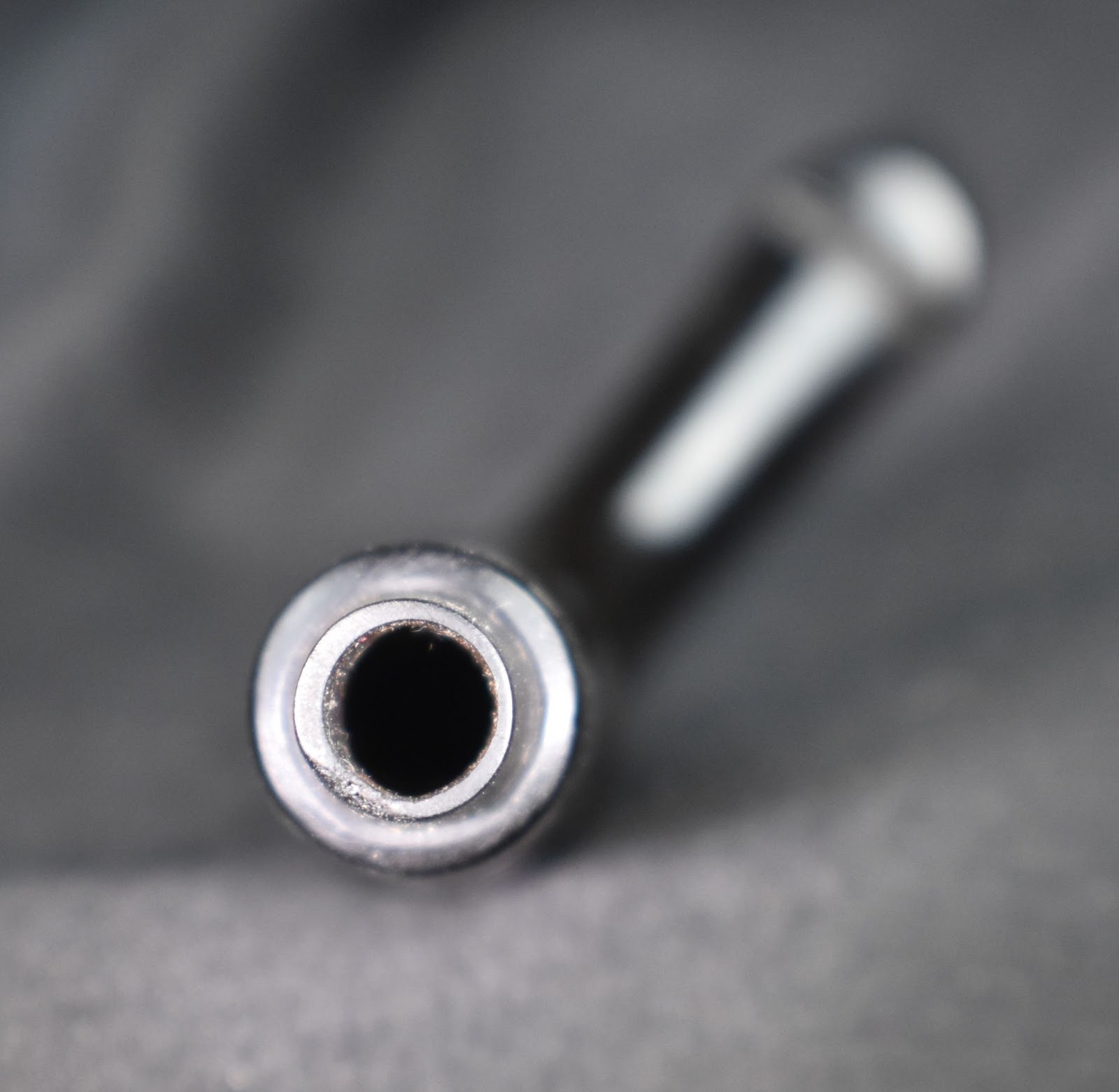
The Kapp-Royal was in very good condition. The stem had light oxidation and no tooth chater, to speak of. The briar looked very nice with fine birdseye’s on both flanks. The gap where the stem met the stummel was an annoyance which would have to be addressed. Other than a few minor fills and some sanding/polish this beauty would be ready for a new owner in no time.
Background
For the first three pieces of Peterson history I turned to the official Peterson website. Here, I chose quotes from the general history of Peterson, the “Classic” shape range, and the 01 shape in particular:
As the oldest continuously operating briar pipe factory in the world, we at Peterson have a certain tradition to uphold, a legacy of craftsmanship dating back over 150 years. Whether you’re browsing for your very first pipe or are a seasoned collector in search of a rare gem, know that every pipe in our catalogue carries with it that same preservation of tradition. A Peterson pipe isn’t just a utilitarian tool; it’s a piece of history you can carry with you in your travels, a faithful companion to accompany you through all that life offers. (Peterson.ie: Pipes)
One of our most popular shapes, our signature take on the bent Pot enhances the inherently muscular design with a broad, squat bowl and extra-sturdy proportions through the shank and transition, as well as an elegant quarter bend. (Peterson Pipes: Army Filter Heritage (01) Fishtail (9mm))
Since our inception, we’ve offered a range of specific tiers suited to our customers’ tastes and price requirements. Our Classic range represents non-System pipes crafted for the Everyman, unique and timeless designs that capture our House Style and quality craftsmanship at a price any smoker can enjoy. Rather than relegating production to one or two lines, we offer a variety of styles, shapes, and finishes among these entry-level series, including traditional navy mounts (flush-fitting stems), P-Lip mouthpieces, and army mounts. (Peterson.ie: Classic Pipes)
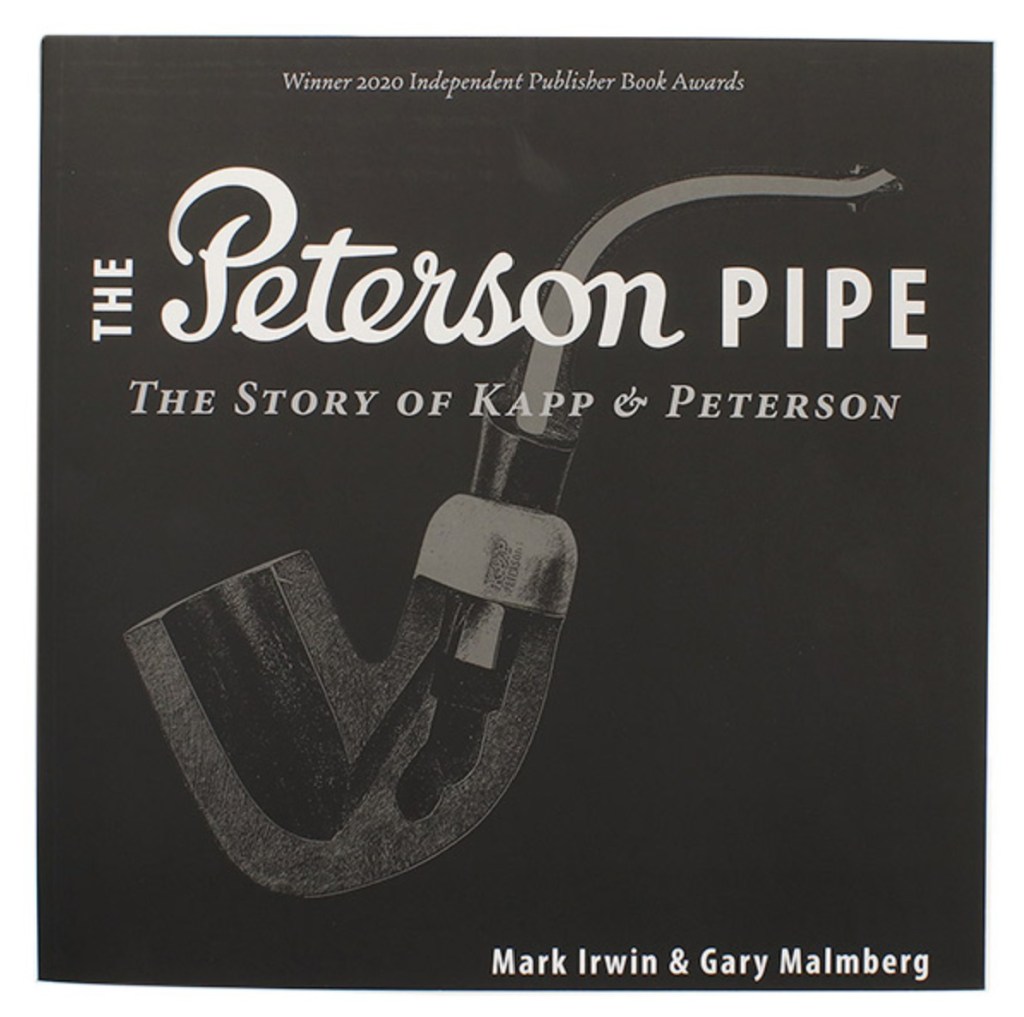
Next I looked into the big The Peterson Pipe book (Irwin, Mark and Malmberg, Gary (2018). The Peterson Pipe The Story of Kapp & Peterson, First edition, second printing 2021. Briar Books Press, Canada.) for a more specific account of the Kapp-Royal line.
“Kapp-Royal (1969. 1976-79, c. 1988, 2004-) First appearance as a line introduced 1969. In 1976-79 Iwan Ries catalog offering identical with non-System Dunmore line. Second appearance the late eighties as a high-grade Italian-market line with briar band inset into mouthpiece. From c. 2004, Italian line available in the US as high grade, orange finish, sterling band, amber-colored acrylic fish-tail stem or sometimes vulcanite, embedded aluminum P.” (Irwin and Malmberg p. 306)
According to the above description by Irwin and Malmberg, this pipe is likely a Kapp-Royal from the “c. 1988” period and made in the Dublin factory.
The Restoration
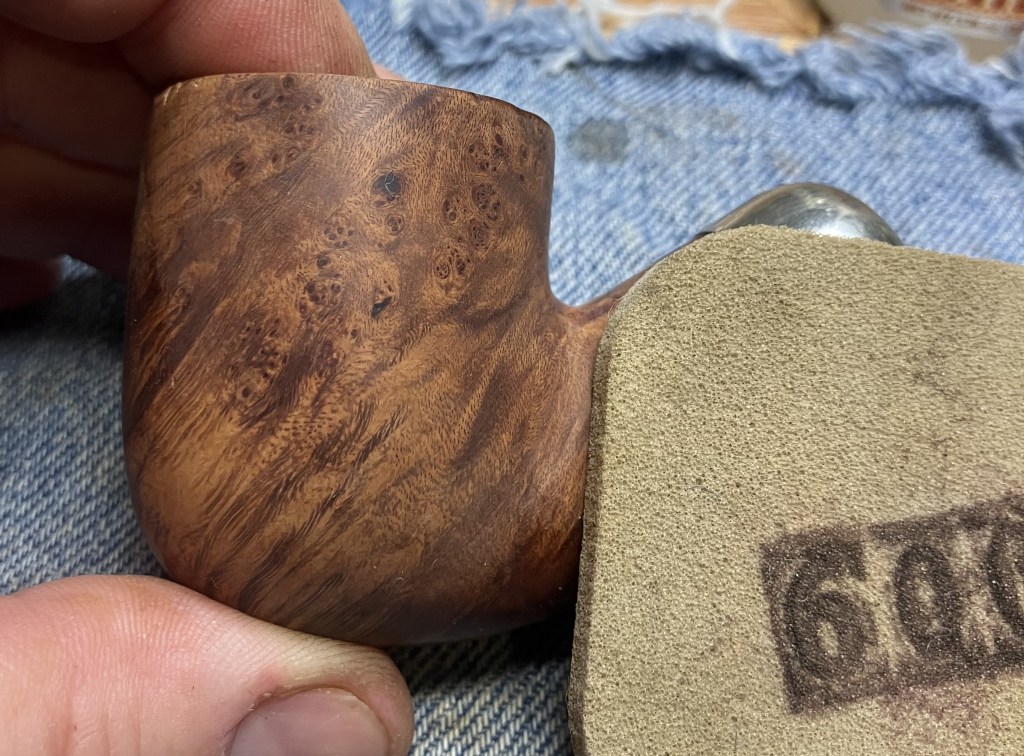
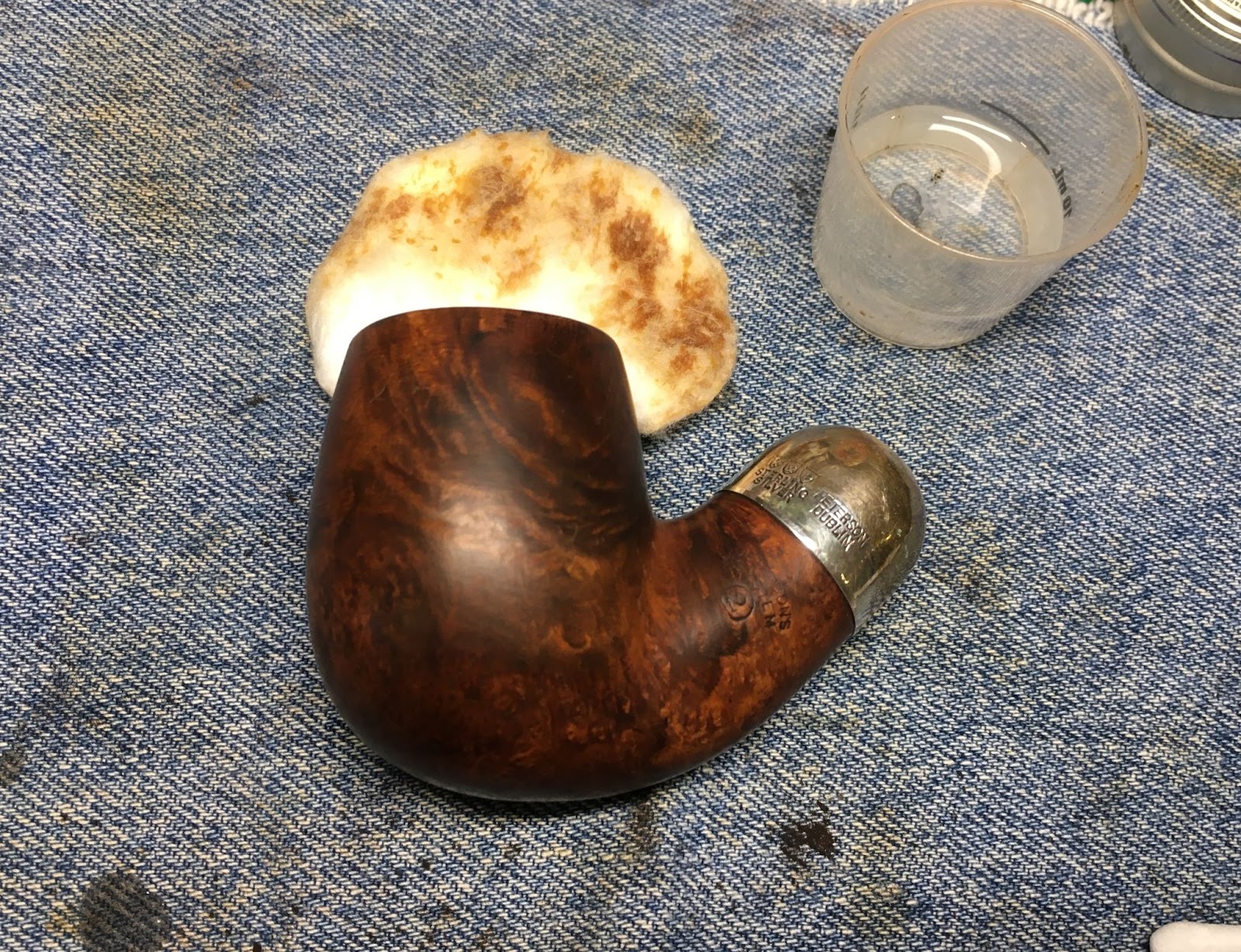
The Kapp-Royal made its way to the workbench after the “Before” photo shoot. Here it received a cleaned denim piece and a more thorough examination.
Below you can see that gap I was referring to earlier. I couldn’t see an obstruction to a tight fit but there certainly was one.
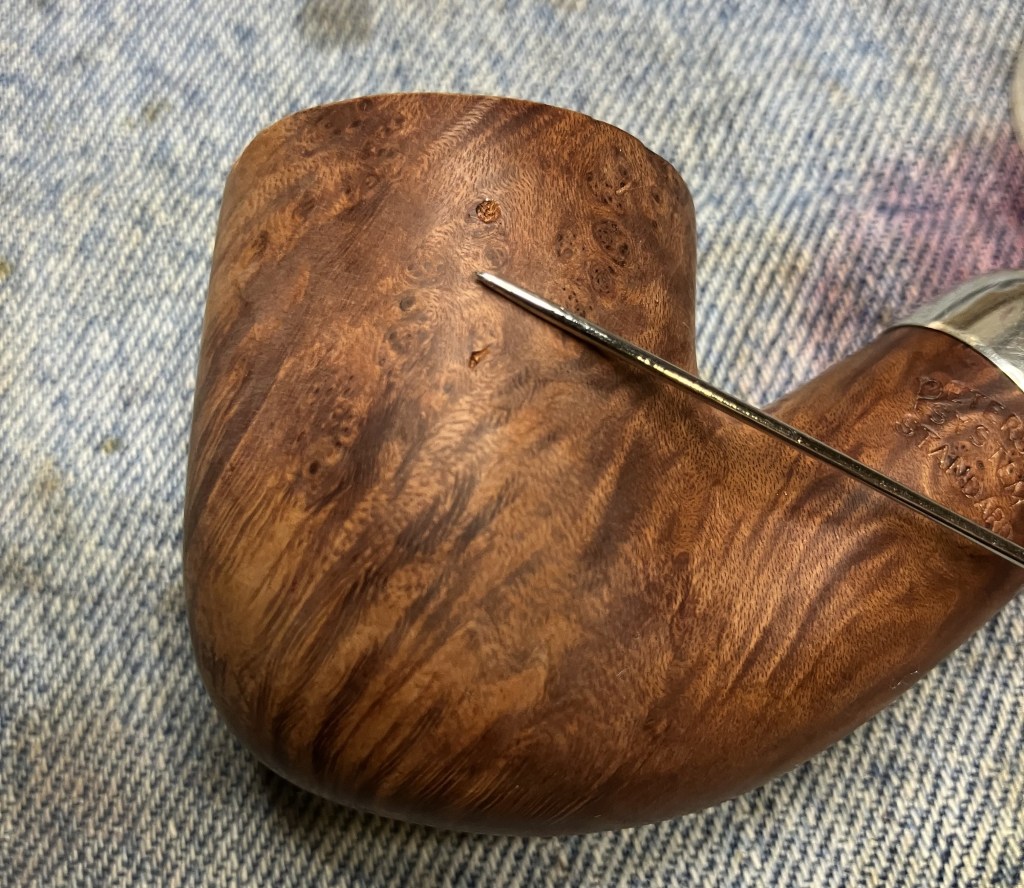
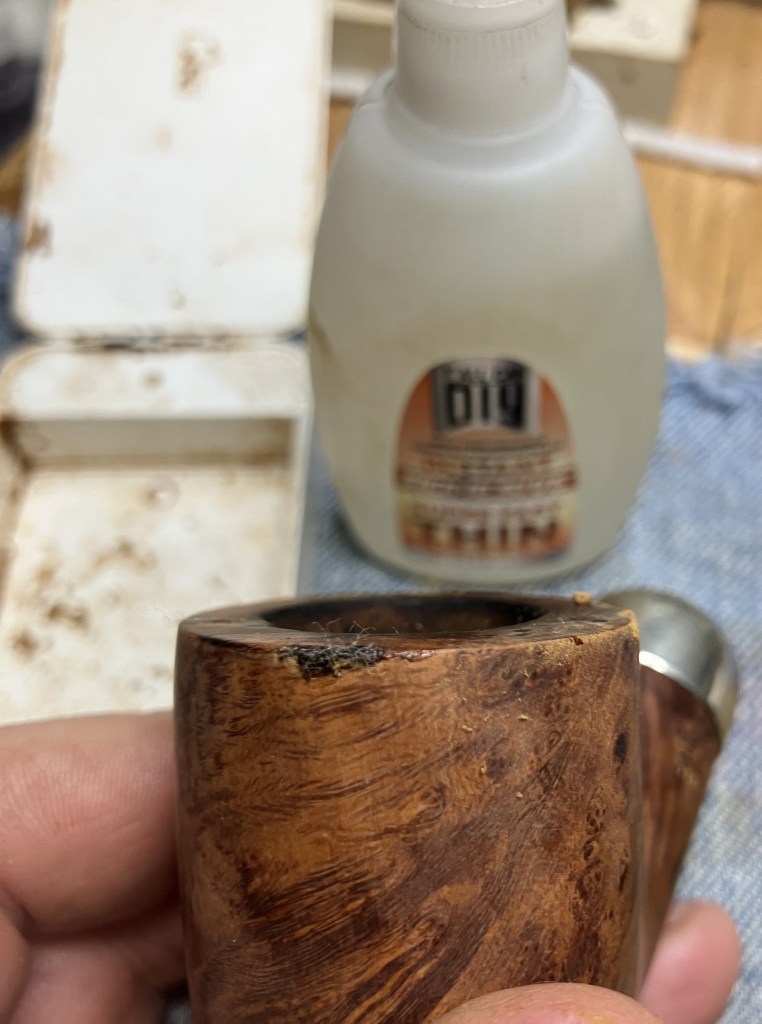
The original fills had failed and would need fixing. Fortunately they were a distance away from the stamps.
Another old fill was located on the heel.
The reservoir, well not really a reservoir since this is a Classic 01 and not a System pipe, was surprisingly dirty. That could definitely be the culprit for the ill fitting stem.
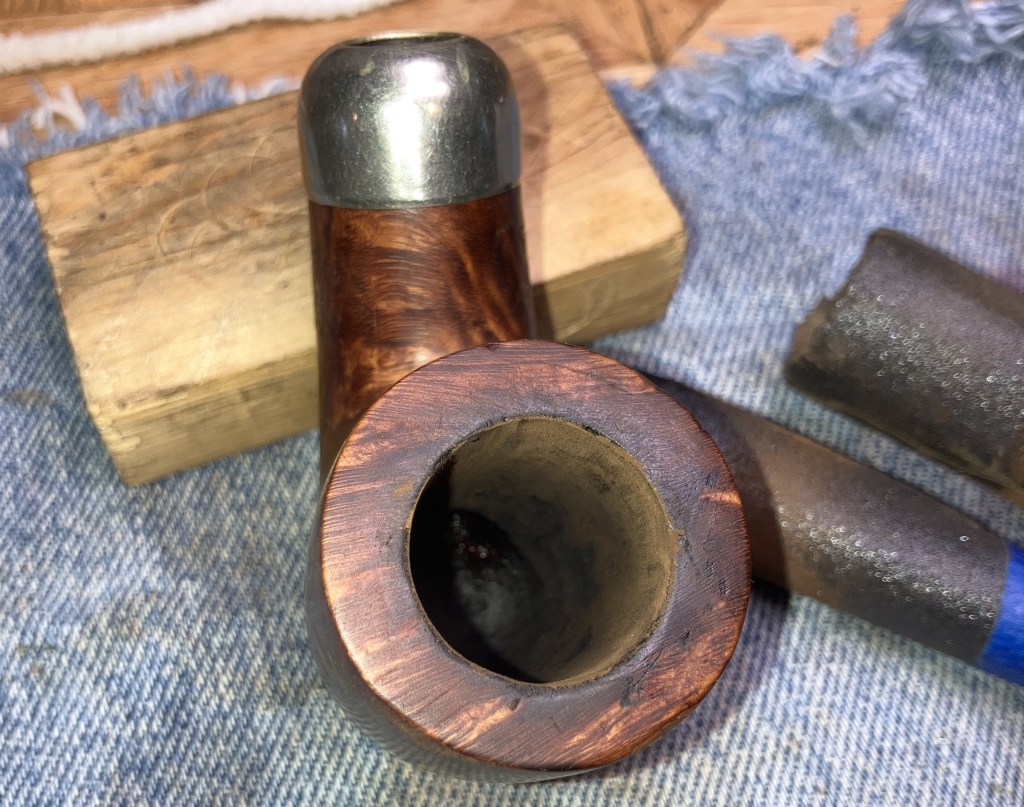
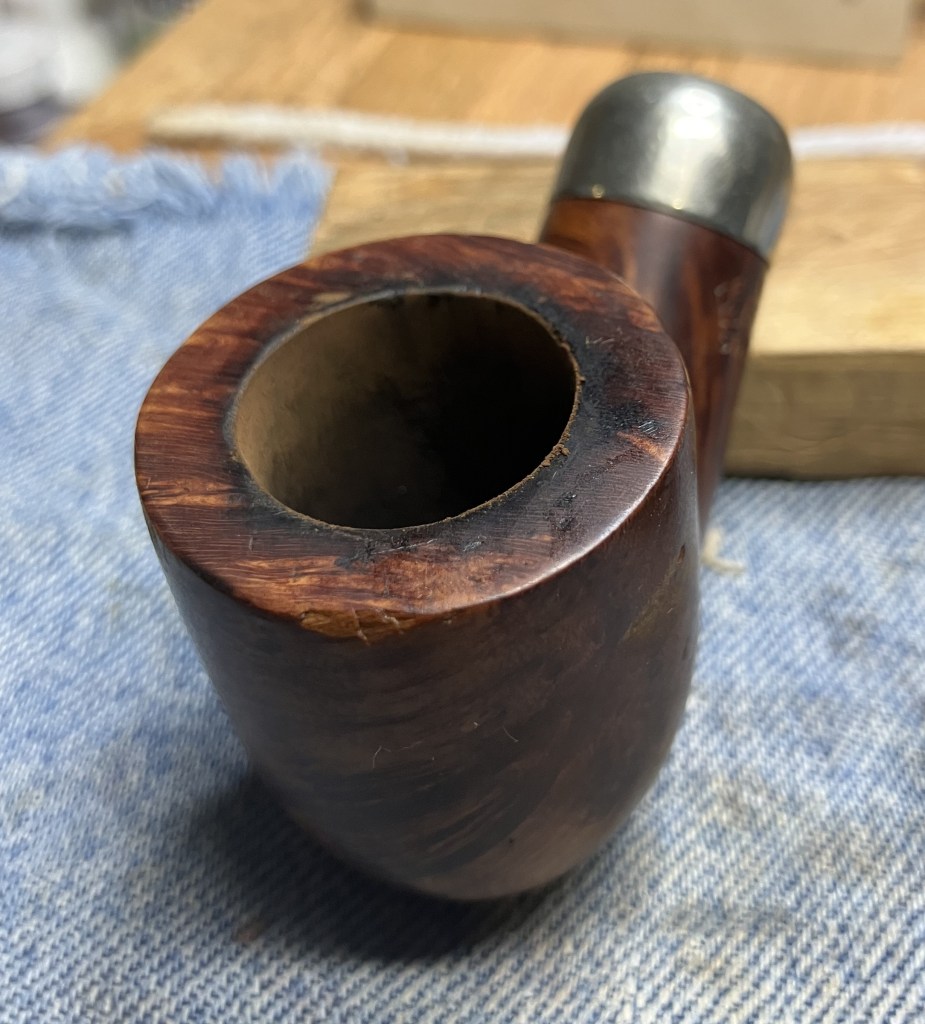
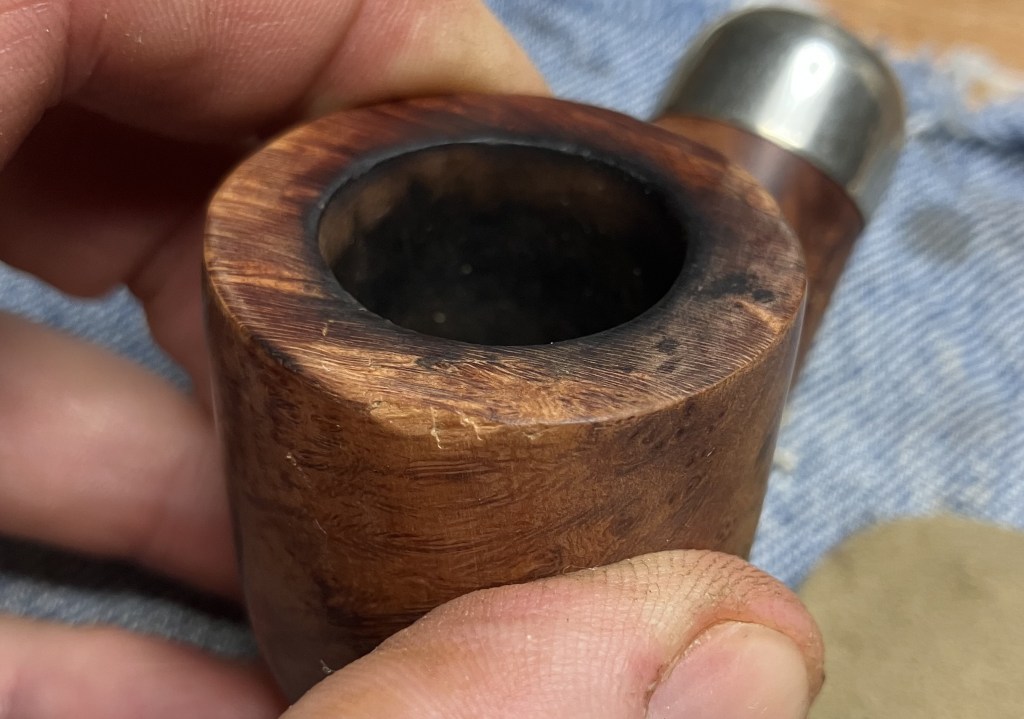
The tobacco chamber looked very clean. I could even make out the chuck marks from the Peterson factory. How could a chamber this clean have a shank that is fouled so badly?
Below is another shot of the chamber prior to work done. It had obviously received some scraping by the marks at the bottom of the chamber yet the rim looked pristine.
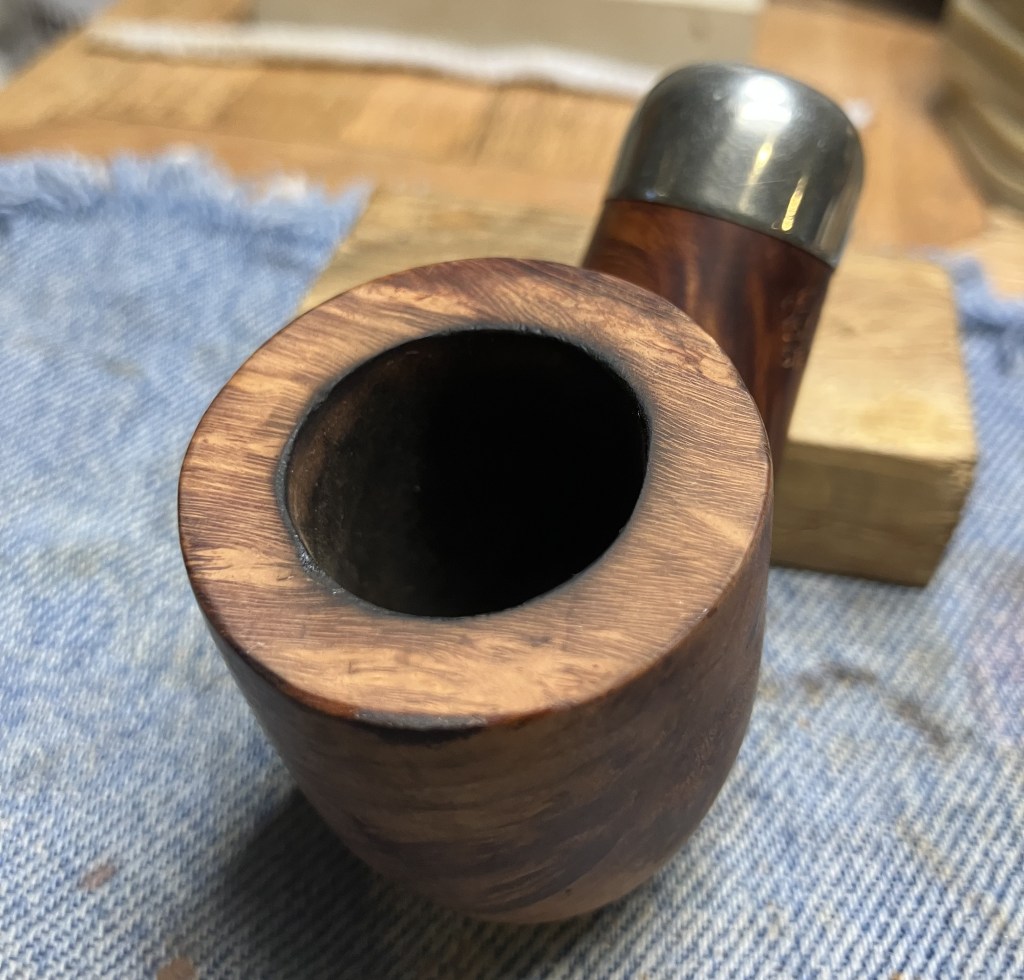
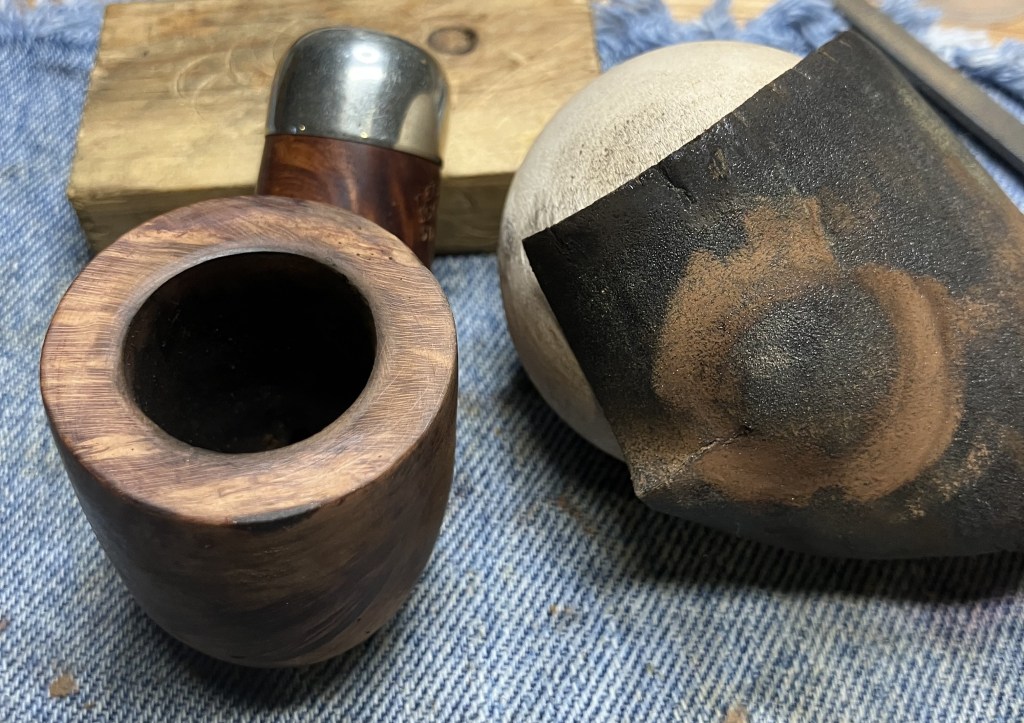
I figured there was no reason to ream this tobacco chamber so proceeded directly to sanding it. I could see no damage to the chamber other than the scraping marks at the bottom of the chember.
The shank cleaning was far more difficult. Here I used the following techniques: Nylon shank brush scrubbing with alcohol present, Folded bristle pipe cleaners dipped in alcohol, cotton swabs dipped in alcohol and dental scraper scraping.
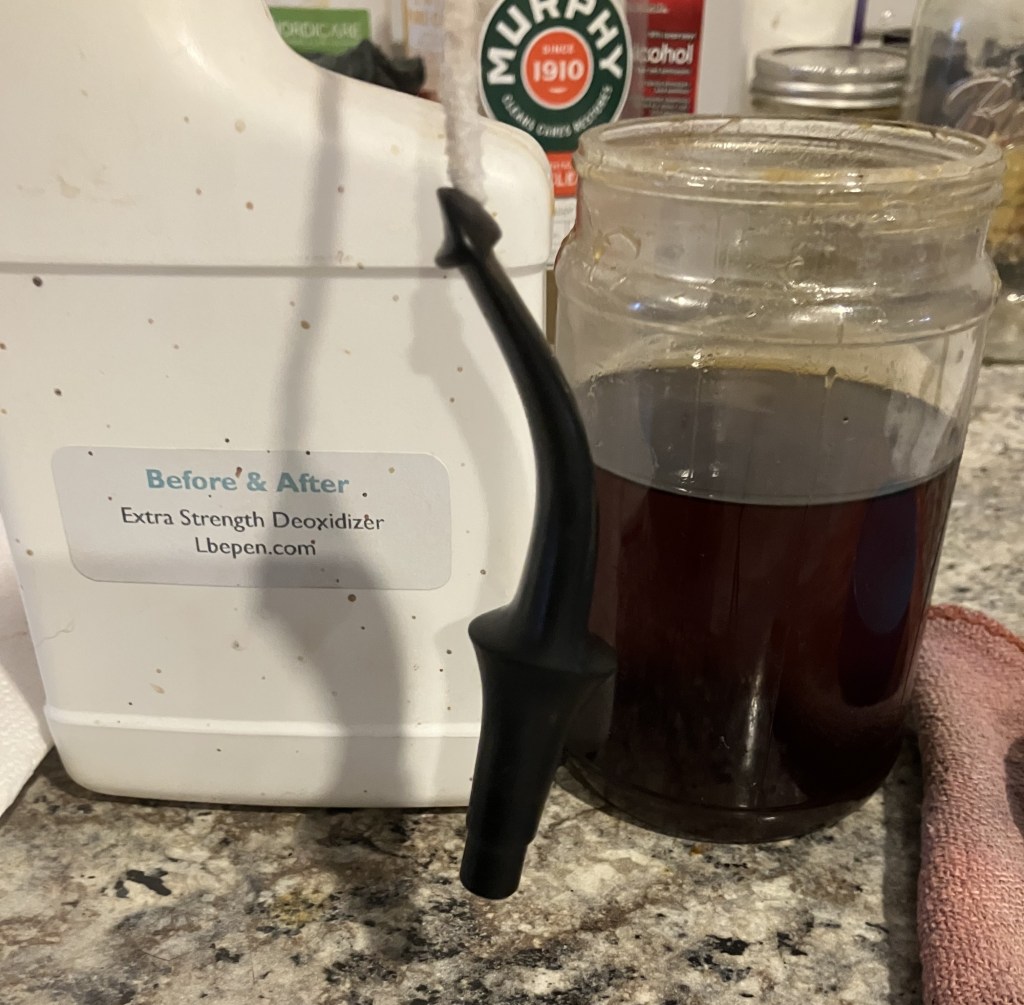
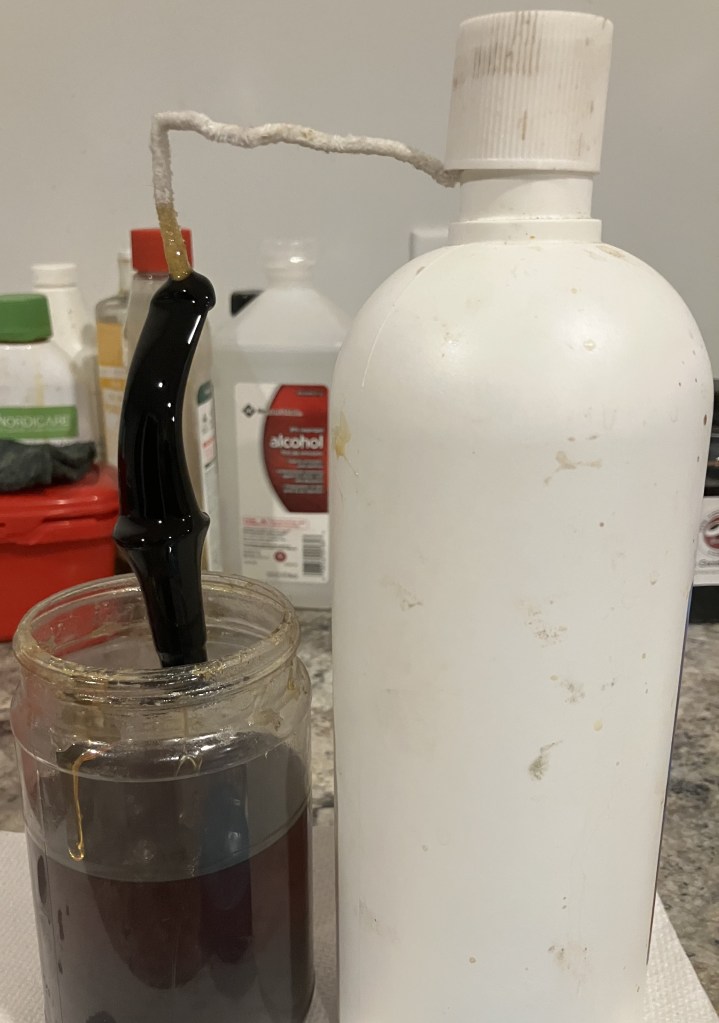
The stem was, like the tobacco chamber, surprisingly clean requiring only a couple bristle pipe cleaners wetted with alcohol. The stem did not need to be treated with either Before and After Extra Strength Deoxidizer or Briarville Pipe Stem Oxidation Remover. I thought sanding/polishing would suffice. I did apply a coating of mineral oil to the stem though.
The stummel made its way to the sink for a scrub with undiluted Murphy Oil Soap and a nylon brush. The soap was rinsed with warm water and dried with a cotton hand towel.
Back at the workbench the stummel was wiped with a make-up pad wetted with 95% ethyl alcohol. Very little color came off indicating that the stummel was clean.
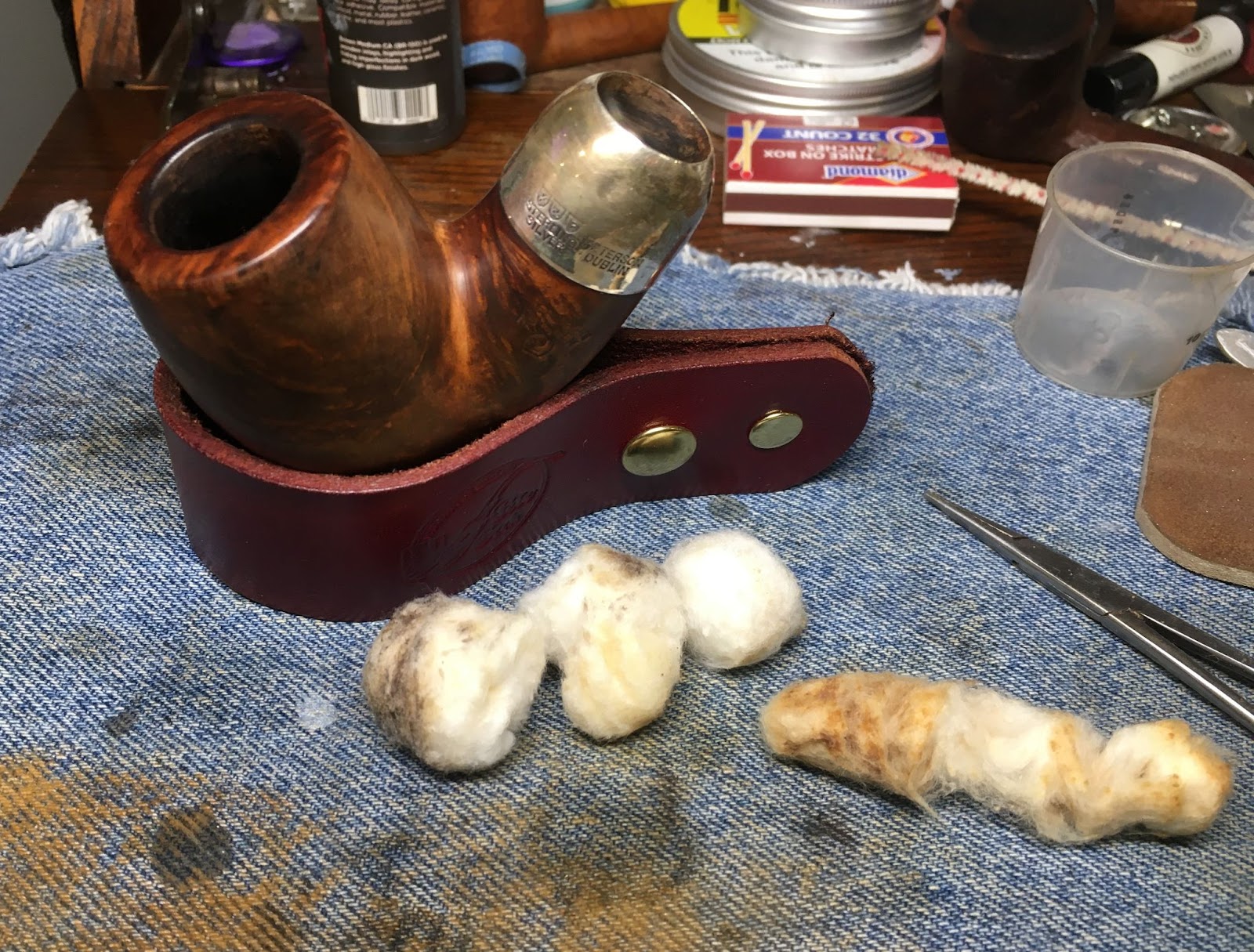
The disturbingly dirty shank bothered me so, I decided to give it an overnight cotton-alcohol treatment. The bowl was stuffed with cotton balls while the airway was stuffed with more cotton.
The cotton was saturated with 95% ethyl alcohol until no additional alcohol could be absorbed with a disposable pipette.
The next day the cotton was removed.
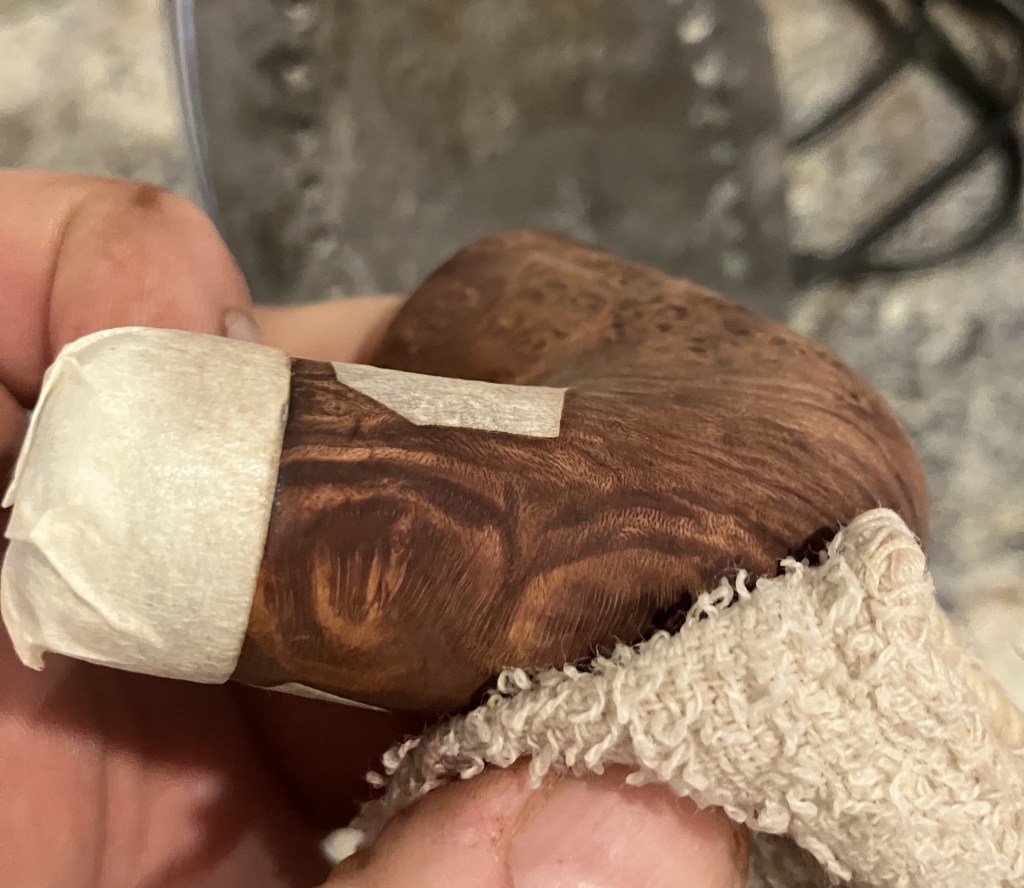
The logo area was de-oiled with alcohol on a cotton swab. Yeah, I tried to mask it without de-oiling at first – unsuccess!
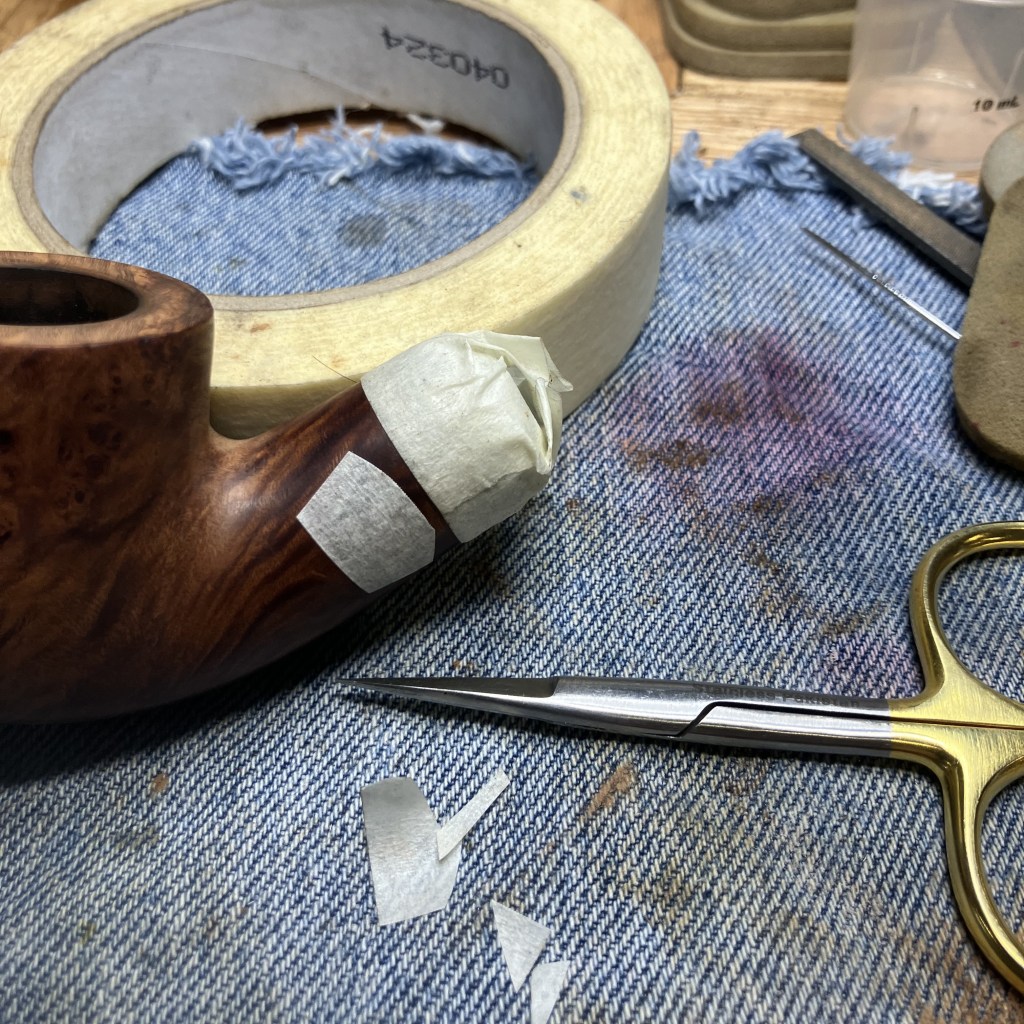
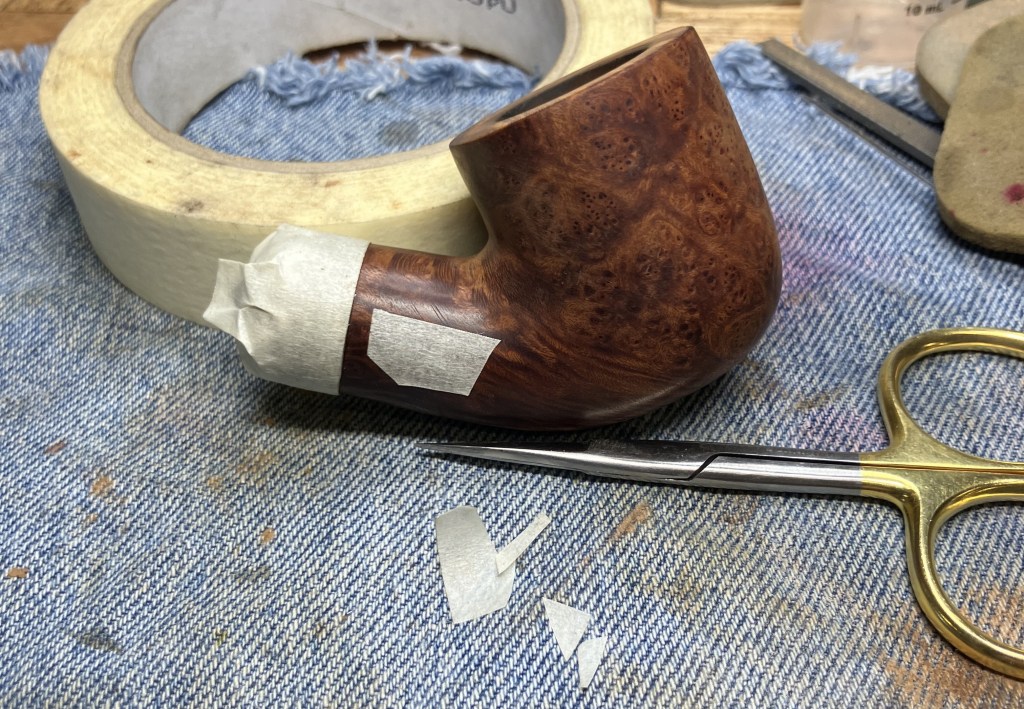
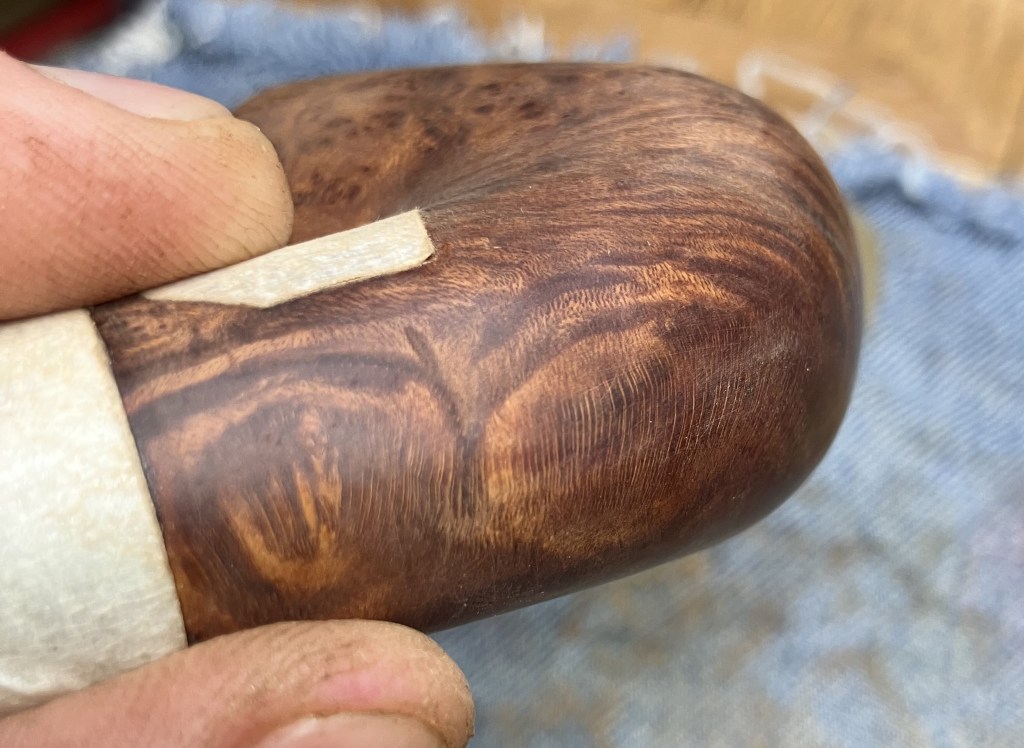
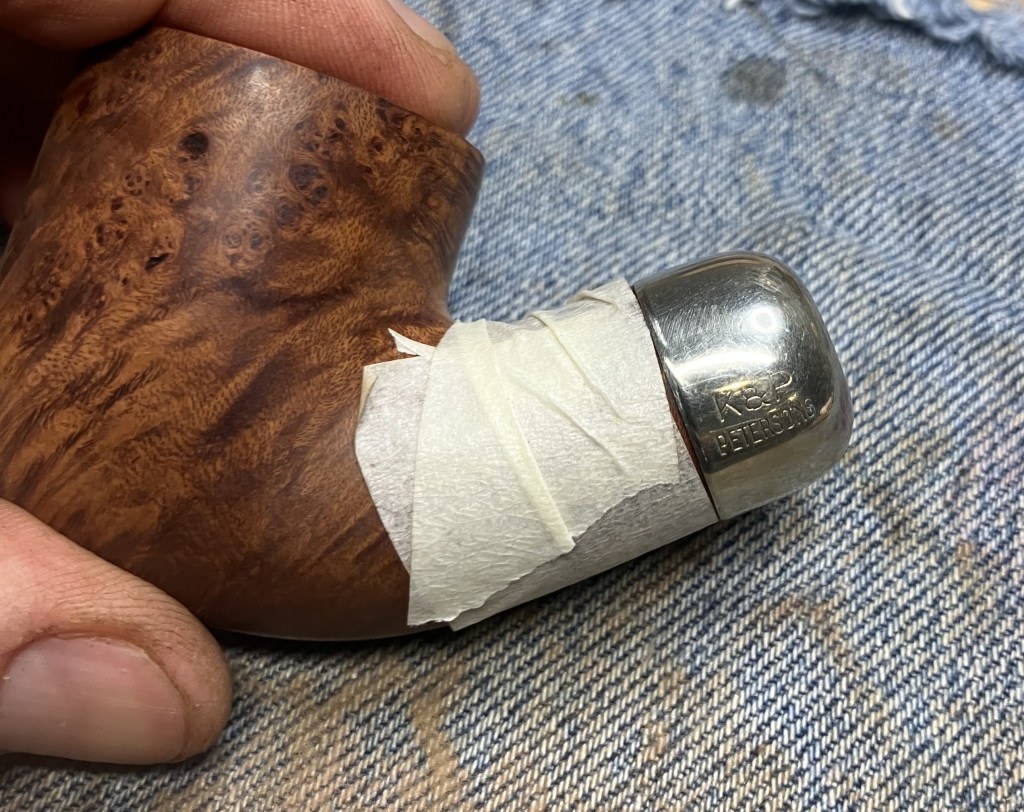
The stamps and logo were masked with painters tape to protect them from the upcoming sanding.
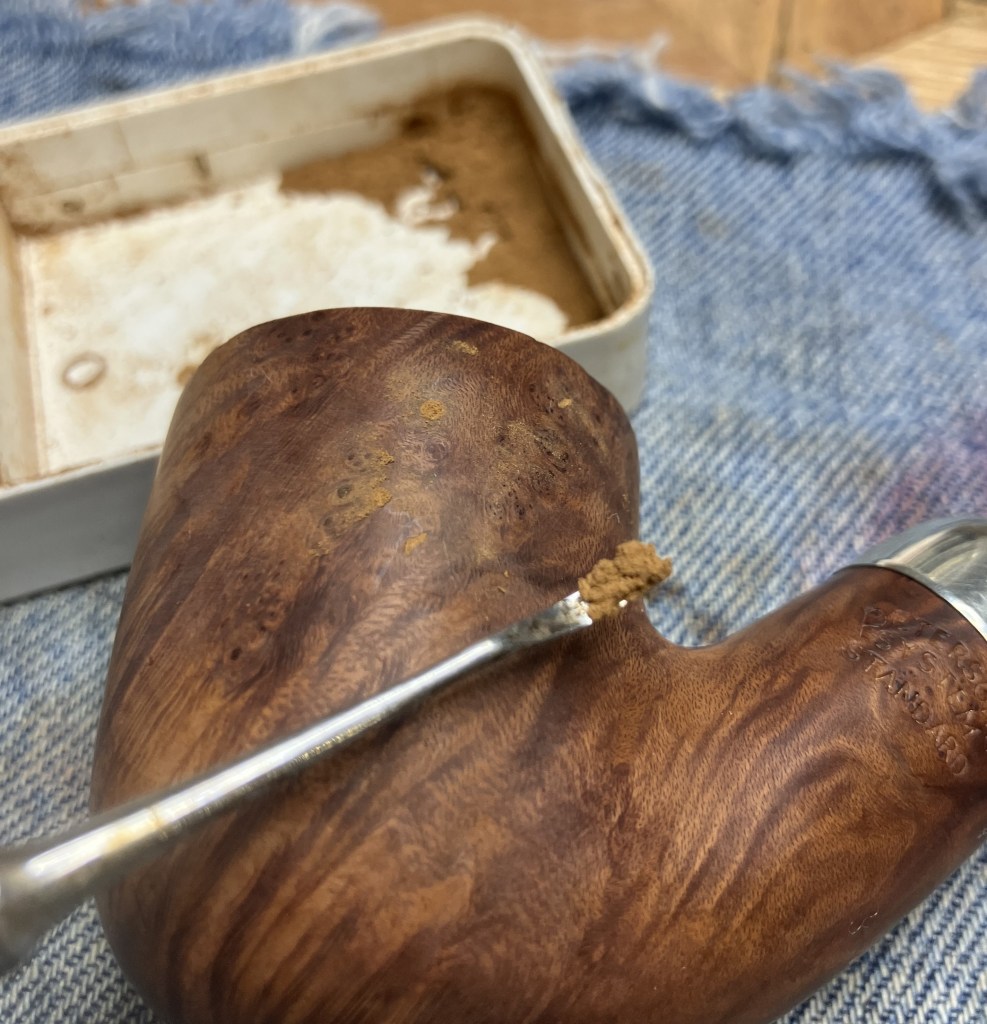
The fills were redone using a dab of brown cyanoacrylate (CA, super glue) applied with a fly tying bodkin. Briar dust was then pressed onto and into the wet CA. A quick dab of additional CA was applied to the top of the new fill.
The new fills were filed with a small flat file and smoothed with a 400 grit sanding sponge.
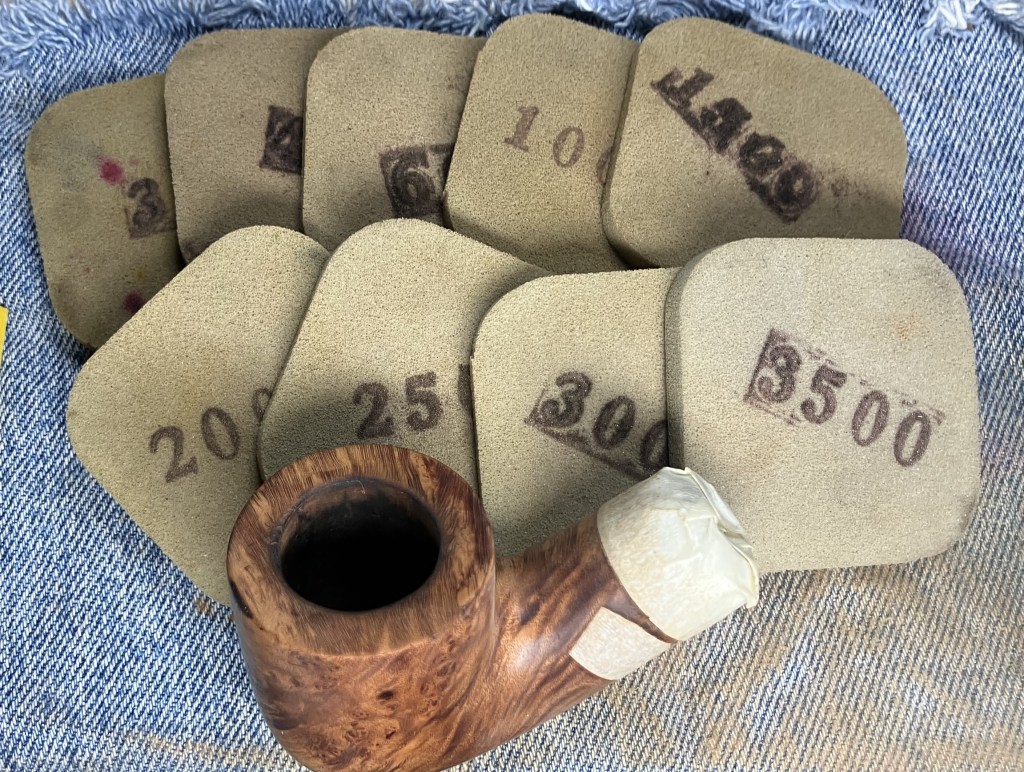
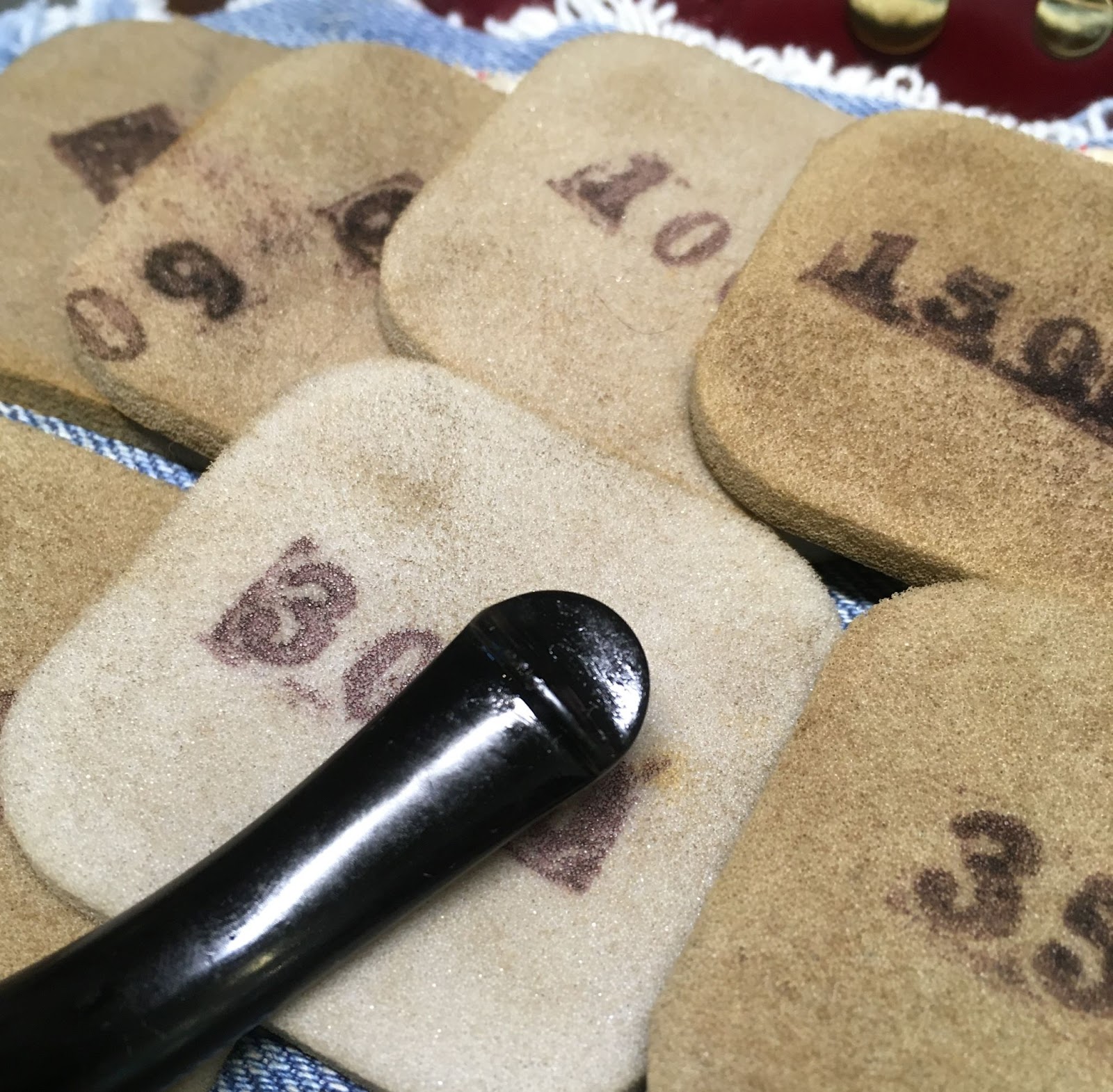
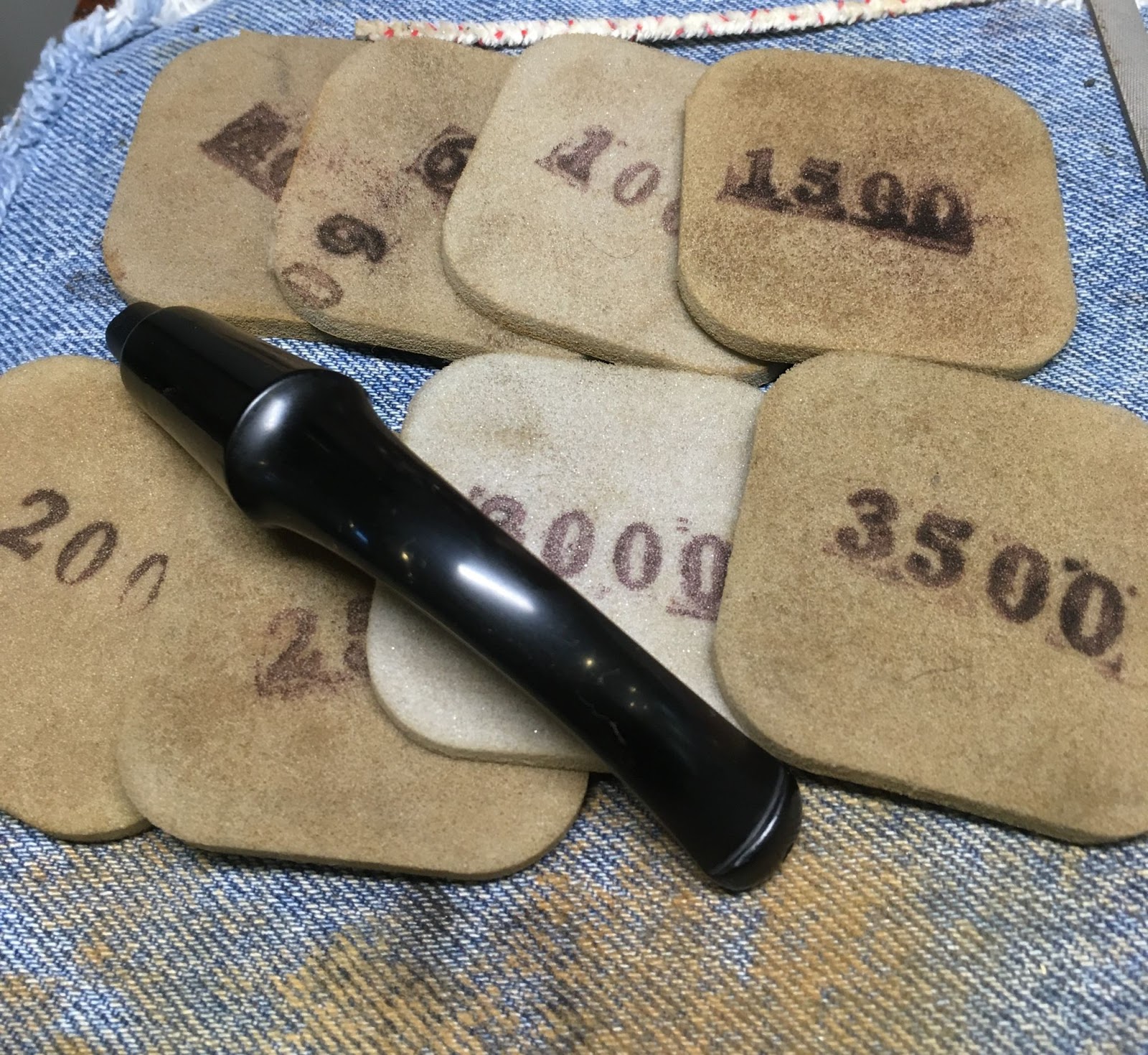
The pipe was then worked with a series of sanding sponges from 400-3500 grits. The stummel was wiped with a make-up pad wetted with alcohol between each sponge. The stem was rubbed with mineral oil and wiped with a paper towel between each sponge.
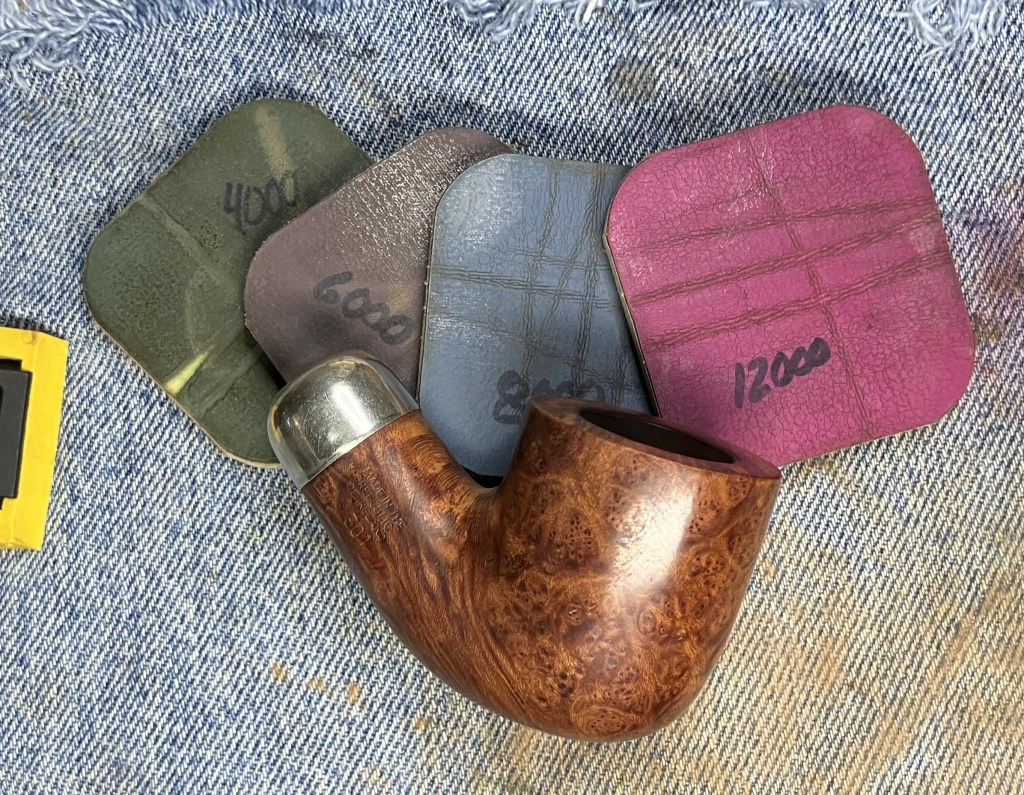
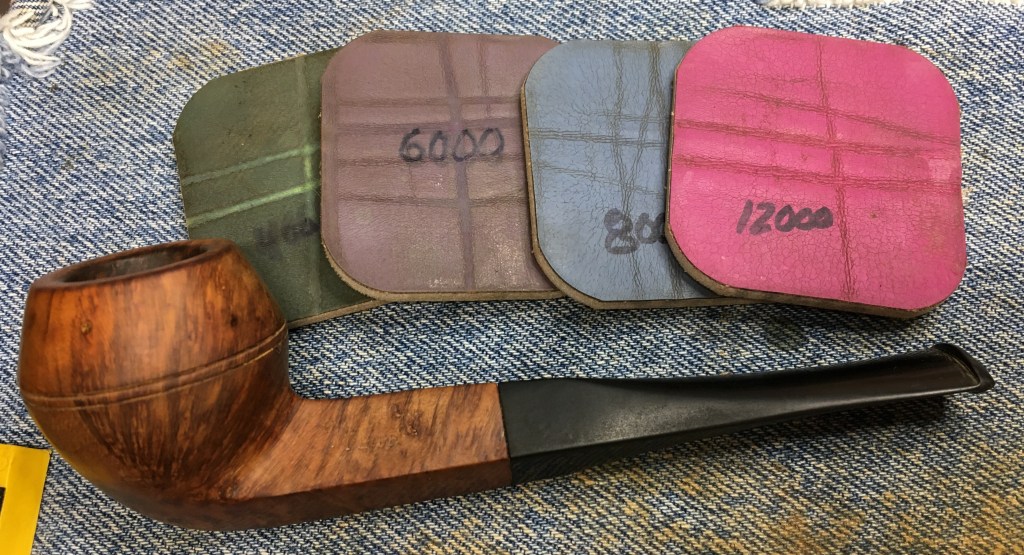
I then worked the pipe with 4000-12000 grit micro-mesh pads. Between each pad I repeated the above wiping except Obsidian Oil was used in place of mineral oil.
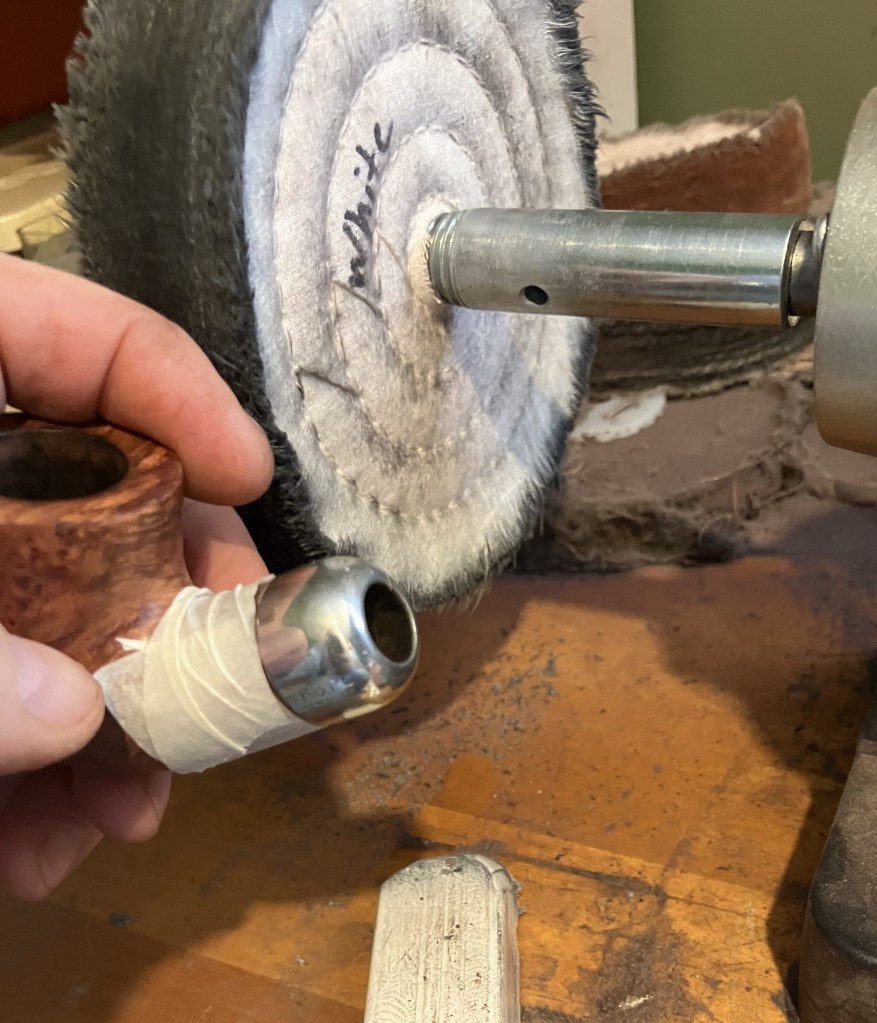
The pipe was then buffed with white buffing compound at the buffer.
The remaining buffing compound was removed with hand buffing and a rag then wiped with a make-up pad wetted with alcohol. The stummel then received a coat of Before and After Restoration Balm and was allowed to sit for 15 minutes.
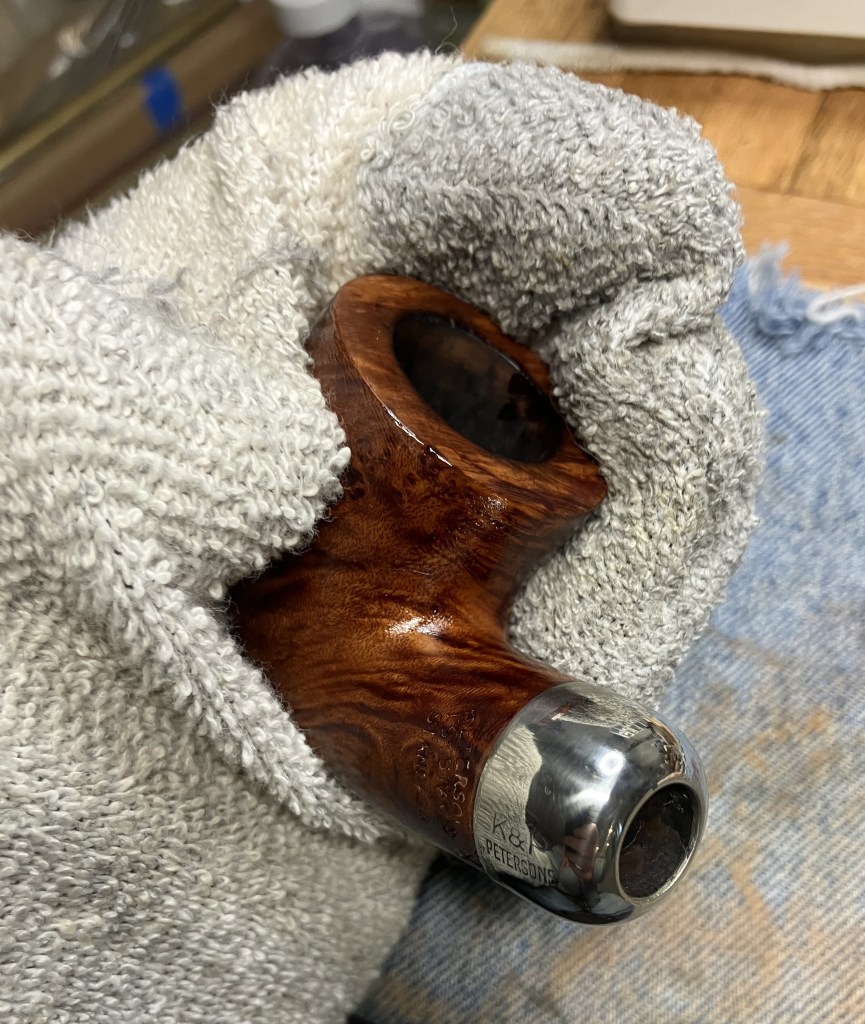
The excess Restoration Balm was wiped from the stummel with an inside out athletic sock.
The stem logo was again cleaned with alcohol and a cotton swab.
To re-do the gold logo, I used Gold Leaf Rub’nBuff applied with a fly tying bodkin.
The excess gold leaf was wiped away with a paper towel.
The stem was then polished with Before and After Fine Polish followed by their Extra Fine Polish. Both were applied and hand buffed using a soft cotton cloth.
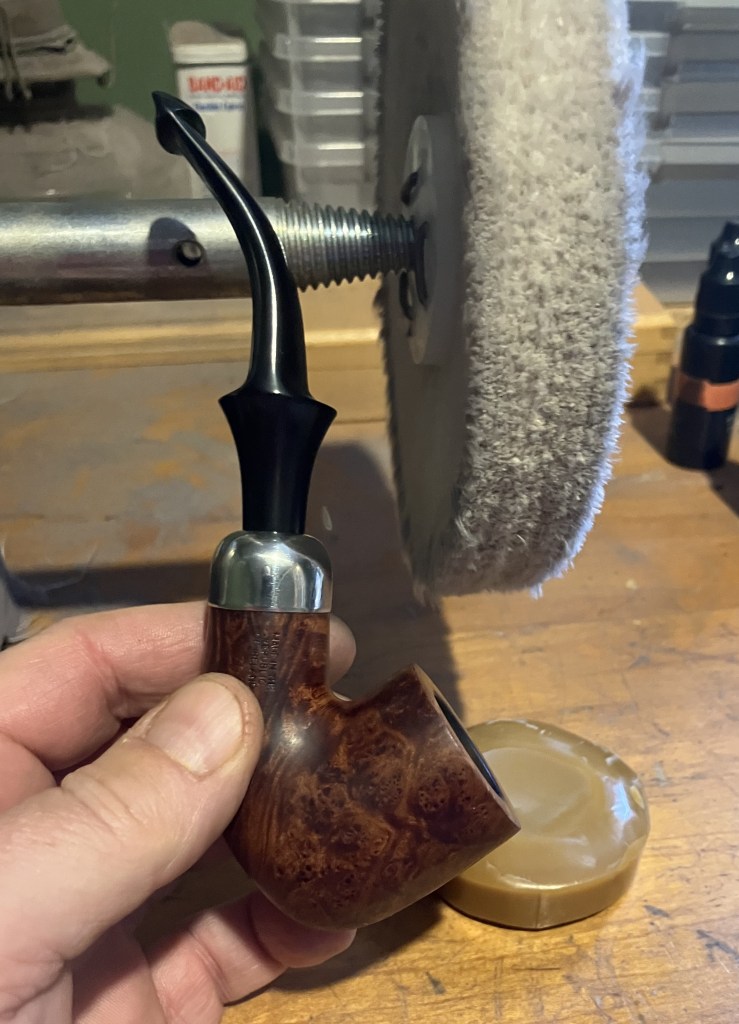
The pipe then received several coats of carnauba wax at the buffer.
The final step was another hand buff with the microfiber polishing cloth then off to the final photo shoot.
I don’t think I’ll ever tire of working on Peterson pipes. This pipe started out not needing much but in the end it is absolutely beautiful. The bird’s eyes on both sides are gorgeous. The vulcanite stem polished very nicely and with that briar band looks amazing. I have nothing against the 01 shape, it is just not my favorite but this pipe could change my mind on that. The hand feel and balance while clenching is very comfortable. The dimensions of the Peterson Kapp-Royal 01 Bent Pot are:
Length: 5.56 in./ 141.22 mm.
Weight: 1.74 oz./ 49.33 g.
Bowl Height: 1.79 in./ 45.47 mm.
Chamber Depth: 1.57 in./ 39.88 mm.
Chamber Diameter: 0.84 in./ 21.34 mm.
Outside Diameter: 1.44 in./ 36.57 mm.
I do hope that you have found something here useful to your own pipe care, maintenance or restorations. If you like this sort of thing, please click the like and subscribe buttons. Thank you for reading the ramblings of an old pipe lover.
Loading…
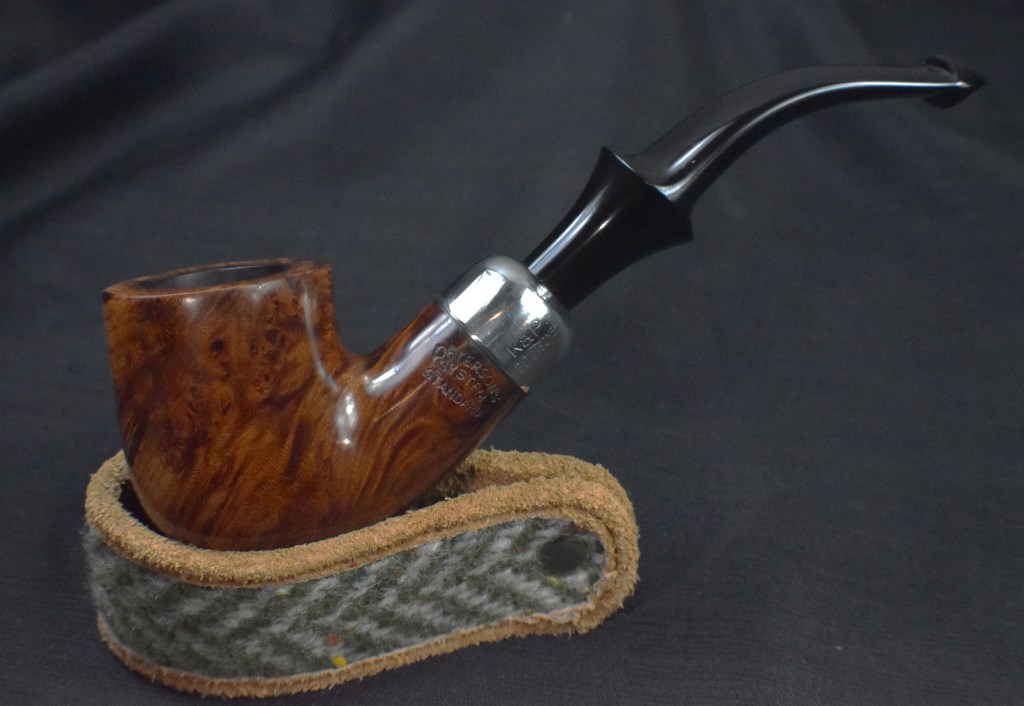
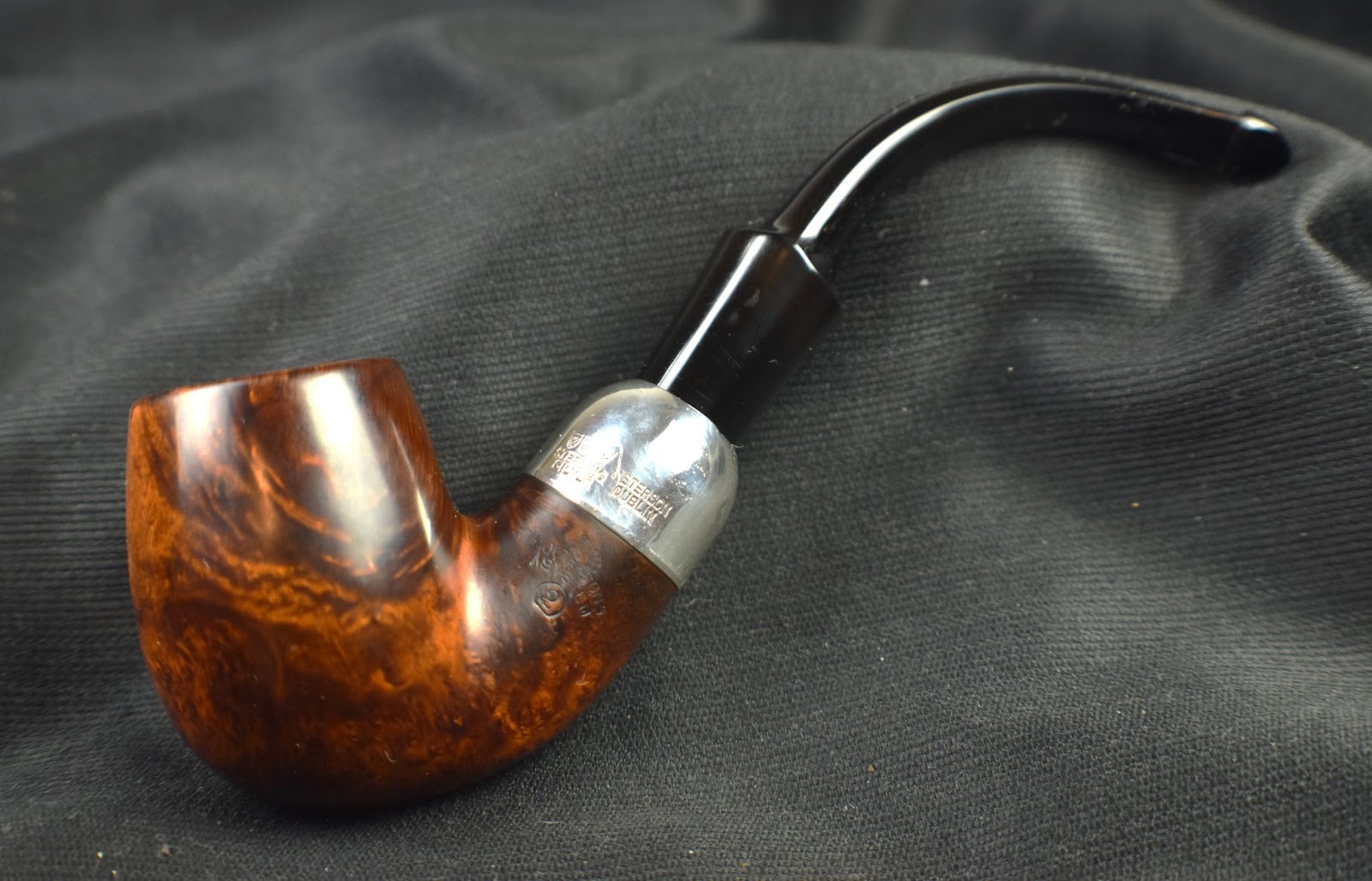
Below are some photos of the finished Peterson Kapp-Royal 01 Bent Pot.
I always feel humbled when someone reaches out to me to restore an old pipe. I should say I’m humbled and nervous. It is an honor to be asked but there is always the nagging feeling or insecurity of damaging someone’s favorite pipe or worse a family heirloom. Today’s restoration emphasizes that very well. The pipe was made by Peterson, I think everyone knows my feelings toward Peterson pipes. If not, the handle Nebraska Pete Geek may give you a clue. This example was a Captain Pete, an all time favorite line. The owner reached out to me via email and lives only about 25 miles away. Crazy small world, eh? The Owner, let’s call him William to protect his identity (or less dramatic, privacy) had subjected himself to reading one of my restoration blogs. The poor guy survived the ordeal and still wanted me to take a look at this pipe. Descriptions and photos were sent and I gave an estimate of what I thought I could do for the old Captain Pete. A few weeks later the pip arrived in the mail. Below are some photos I took before starting work on the pipe.
The old Captain had seen some years in the service of a pipe smoker. The most obvious issues were the pits where the old fills had failed. The stem showed signs of oxidation and a bit of chomping. Structurally the pipe was solid and in good shape the restoration would be more aesthetic. William had said that he would like the stamping preserved as much as possible. This would be a challenge due to the faint stamps, in general and specifically for the fills on the left shank amidst the stamps.
Background
I blogged about a Captain Pete back on December 31, 2023. You can see that restoration HERE, if you are interested. That was about the second month of my blogging. Anyway, I wrote the following:
“Peterson pipes have a long and storied history which is rich and fascinating. I highly recommend the book The Peterson Pipe, by authors Mark Irwin and Gary Malmberg as well as a reading of pipedia.com’s Peterson pages. According to Mark Irwin and Gary Malmberg, the Captain Pete:
“This line’s name was derived from the nickname of Charles Peterson, known affectionately as “Captain Peterson.” The first issue, c. 1940-62, was in a smooth finish produced for Rogers Imports with a white stamped P inside C, or a circled P on the mouthpiece. CAPTAIN over PETE on shank, and a MADE IN IRELAND in a circle. English made versions show CAPTAIN over PETE on shank or “CAPTAIN PETERSON” and A PETERSON PRODUCT over MADE IN ENGLAND or LONDON MADE over ENGLAND. The second issue (1998-), features an XL bowl with Sherlock Holmes shapes and compact stems, in rustic or combination of smooth and rustic, with a nickel band between two narrow brass bands.” (Irwin and Malmberg p.295)”
(A Peterson Captain Pete Restoration – NebraskaPeteGeek) I apparently was not concerned with notating Irwin and Malmberg’s work correctly so I will make amends and do that here, (Irwin, Mark and Malmberg, Gary (2018). The Peterson Pipe The Story of Kapp & Peterson, First edition, second printing 2021. Briar Books Press, Canada.).
This Captain Pete was certainly a first issue dating from 1940-62 made in Ireland.
The Restoration
As usual after the initial photo shoot the pipe made it to the workbench and a clean piece of denim.
The first thing I did was to use a fly tying bodkin too scratch the old wax from the beading around the bowl.
Next the ream team was assembled. There didn’t appear to be a tremendous cake build up but the pipe had obviously been smoked.
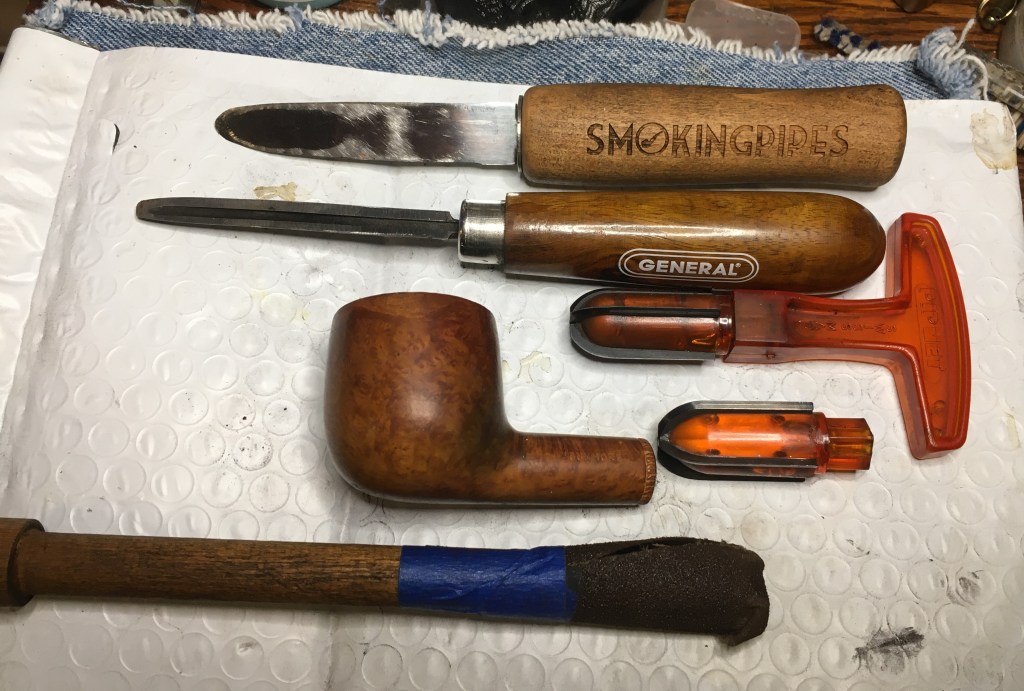
The #2 blades of the PipNet did the majority of the reaming with both the Smokingpipes Low Country reamer and the General triangular scraper used for clean-up.
The shank was dirty but considering the amount of cake present I thought the previous owner had used pipe cleaners on a daily regular basis. The dental scraper was used to scrape the airway and did not produce as much tar as I was expecting.
Overall the shank cleaned out well with only alcohol dipped cotton swabs.
The stem also cleaned up fairly quickly with bristle pipe cleaners dipped in 95% ethyl alcohol.
After a light sanding of the stem with a 320 grit sanding sponge I tried to paint the tooth dents with a flame from a lighter. This helped raise the vulcanite a little bit.
The stem was then placed in a bath of Briarville’s Pipe Stem Oxidation Remover and let sit overnight.
I continued working on the stummel. Below is a photo of the rim with a light lava coating in places.
I moistened the rim with saliva to soften the lava. The rim was then scraped with a sharp pocket knife.
I used a round polyvinyl chloride (PVC) end cap wrapped in 320 sandpaper to re-establish a good bevel on the inner rim.
The stummel was then scrubbed with undiluted Murphy Oil Soap and a nylon brush. The soap was rinsed with warm water and the stummel dried with a cotton hand towel.
BAck at the workbench, the stummel was looking clean.
I gave the surface a wipe with a make-up pad dipped in 95% ethyl alcohol . Little color came off the pipe indicating that there was no wax or finish remaining on the stummel. The alcohol also helped soften the old fills allowing me to remove as much of the fill material as possible. With the stem in the oxidation remover and the stummel drying, I called it quits for the night.
The next day I removed the stem from the Briarville solution and wiped it with a coarse shop rag. This absorbed the excess solution and removed some of the oxidized vulcanite.
There remained some brown oxidation on the surface. I could not make out the stem logo that had been stamped 60+ years ago but could see the circle and imagined the P within.
The below photo shows two of the most exasperating details of this restoration: How to preserve the remaining stamps while bringing the stamped material back to life. I needed some serious thinking for this one.
I tried spot cleaning the remnant stem logo with Briarville Pipe Stem Oxidation Remover on a cotton swab. I was not impressed with the results.
Maybe if I do it some more… Still not impressed.
OK, more thinking time while I worked on repairing old fills. This was done by placing a small dab of brown cyanoacrylate (CA, super glue) into the pits using a fly tying bodkin.
More CA in pits.
A small scoop of briar dust was then pressed into the wet CA. This causes the CA to cure nearly immediately.
The rough top of the new fills were filed off with a small flat file. The fills then got another dab of brown CA to top-off the new fills. This was allowed to cure over about an hour.
The cured CA/briar dust fills were then filed smooth with a small flat or ½ round file
When finished I realized that I wasn’t finished and that I’d missed two fills. DOH! Repeating the above process except this time I ran a paper business card through the lower bead groove to remove excess CA before pressing the briar dust in and scraping the groove with a fly tying bodkin before the CA briar dust could cure.
The spot treatment of the logo area with Briarville Pipe Stem Oxidation Remover was less satisfactory than I hoped. Perhaps my solution is losing potency due to the number of stems that I have bathed in the juice? I turned to a tried and true method of removing the oxidation, SOFT Scrub on a make-up pad.
The stem was rubbed with a heavy coat of mineral oil and allowed to sit for a few minutes before I wiped the excess off with a paper towel.
Next would be the sanding. To protect those faint stamps I covered them with painters tape. The pipe was then sanded with a series of sanding sponges from grits 320-3500. Between each sponge the stummel was wiped with a make-up pad wetted with 95% ethyl alcohol. The stem was rubbed with mineral oil then wiped with a paper towel.
After the sanding sponges I worked the pipe with micro-mesh pads 4000-12000. The wiping between pads was repeated as with the sanding sponges but between pads I used Obsidian Oil rather than mineral oil.
The stummel was given a liberal coating of Before and After Restoration Balm and allowed to sit for 30 minutes.
An inside out athletic sock was used to hand buff away the remaining balm.
The pipe was then taken to the buffer for several coats of carnauba wax.
After the waxing I used a fly tying bodkin to clear the beading grooves of excess wax.
The pipe was hand buffed with a microfiber polishing cloth to raise the shine.
I gave this old Pete a bowl coating not because the tobacco chamber had any damage but because the owner had requested it and it gave me a little more time with the old Captain Pete. I used 100% maple syrup and activated charcoal powder.
The airway was plugged with a cotton swab. Another cotton swab was used to paint the chamber with a light coating of syrup. The capsule was dumped into the chamber and sealed off with painters tape over the rim. The stummel was then shaken vigorously for over a minute to evenly distribute the charcoal powder.
The tape was removed and the powder dumped.
The final step was another hand buff with the microfiber polishing cloth then off to the final photo shoot.
It is always fun to work on a Peterson pipe and working on someone else’s Peterson is like catch and release fishing. Although in all honesty, my days of collecting Peterson pipes are pretty much over. I am releasing more than I am catching today. This old pipe was a fun challenge. Yeah, I couldn’t restore it to how it looked when it came out of the factory in Dublin. The stampings and logos were just too worn and those two pits by the stamps were just taunting me to obliterate the Stamps. In the end I am happy with how the pipe turned out. The overall finish is superior to how it would have looked coming out of the factory. I do not want to be critical of Peterson but they typically only sand a pipe to 400 grit. I am pretty certain that the owner will be as happy with the pipe as I am. The dimensions of the Peterson Captain Pete bulldog are:
Length: 5.70 in./ 43.18 mm.
Weight: 1.21 oz./ 34.30 g.
Bowl Height: 1.80 in./ 45.72 mm.
Chamber Depth: 1.50 in./ 38.10 mm.
Chamber Diameter: 0.72 in./ 18.29 mm.
Outside Diameter: 1.51 in./ 38.35 mm.
I do hope that you have found something here useful to your own pipe care, maintenance or restorations. If you like this sort of thing, please click the like and subscribe buttons. Thank you for reading the ramblings of an old pipe lover.
Loading…
Below are some photos of the finished Peterson Captain Pete 155 bulldog.
I think this totally counts as a Peterson. Given the poor darling didn’t make the quality assurance cut to the “big leagues” but the 02 shape is more of a rarity for Pete Geeks. I remember three years ago when I started to get more serious about restoring old pipes, that you could pick up a Peterson System Standard on the estate market for around $45. Over the past few years this has increased significantly. Perhaps another indicator of inflation or maybe just a growing interest in our beloved hobby. When I saw this pipe on eBay, I knew I had to try for it. I was surprised that I won the auction and soon had the Irish Lassie in hand. Below are a few photos or the pipe prior to any work done.
From what I could see the issues with this pipe’s briar were only cosmetic and would be dealt with accordingly. The pipe looked like it had only been smoked a few times. I think I could imagine why that button was horrible. It felt thick and chunky, like something made of Legos. Clenching that would be like getting X-rays at the dentist.
Background
I cannot begin to describe the history nor impact of the Peterson pipe company. I can tell you what I think is the best source of information on the subjects and that is Mark Irwin and Gary Malmberg’s book, The Peterson Pipe The Story of Kapp & Peterson. According to the authors,Peterson’s seconds are as follows,
“Seconds Peterson seconds are pipes of all shapes with briar flaws deemed unacceptable for ordinary models and sold at reduced prices, sometimes unstained, fit with fishtail or round button mouthpieces. Since the early 1990s they have only been available in Ireland. Occasionally they are described in Peterson catalogs under different names, and documented specimens have various stampings. In roughly chronological order these include:
Stamped arched KAPP & over straight PETERSON”S over arched DUMMIES An early specimen preserved at the Peterson museum with this stamp has a round-button mouthpiece.
IRISH FREE STATE stamp (1922-37) COM stamp with no brand or model name. Documented with or without nickel bands.
System Reject (1968-) Noted first in the Price List for January 1968 as being available in all six system shapes. Also found in the ‘80 Peterson-Glass Price List.
Erica System Reject (1987-98)Noted in two US distributor catalogs. Fishtail mouthpiece, unstamped nickel band, with COM of MADE IN THE over REP. IRELAND or with no COM.
Irish Seconds (1982-98) Classic Range shapes stamped with no brand name , fishtail mouthpiece, in unstained, black rustic or dark brown finishes, no band. (Irwin, Mark and Malmberg, Gary (2018). The Peterson Pipe The Story of Kapp & Peterson, First edition, second printing 2021. Briar Books Press, Canada. p312).
Mark also writes a weekly blog titled Peterson Pipe Notes. If you have not already subscribed I highly recommend it. It will be one of the best $0 purchases you can make and is a vault of information on all things Peterson and various other topics. I am not just saying that because Mark has posted a few of my restorations either. His blog concerning the Irish Seconds is very well researched, written and can be found here: https://petersonpipenotes.org/tag/irish-seconds/.
Now for the Oom Paul shape. Here I’ll let Mark sing the praises of the history of the shape and the Peterson pipes of note:
So, when was this particular Peterson Oon Paul made? I really didn’t know. The 1976 catalog mention might be useful but it precedes the use of the IRISH SECONDS stamp by 16 years. I reached out to Mark Irwin and provided him with photos. Here is what he had to say, “This appears to me to be the 1988 Dublin Millennium edition. That would fit with the IRISH SECONDS stamp and the shank bend. The IS would have been sold in Ireland, almost entirely, but perhaps some escaped their island prison. We can confirm that with a quick measurement of the chamber diameter and the bowl diameter if you like, but I’m 99% positive.” (Mark Irwin, personal email). I replied to Mark by sending him the dimensions. His reply to those was, “That’s it!” This concltudes the search, in my book. THis is a 1988 Dublin Millennium edition Peterson 02 that didn’t meet the quality standards of Peterson and was thus labeled an Irish Seconds by the good folks in Dublin Ireland.
The Restoration
The restoration began with a clean denim piece for workbench protection.
Augh, the terrible button would be the first issue addressed with this pipe.
Apparently the previous owner tried to customize the button using their teeth and jaw power.
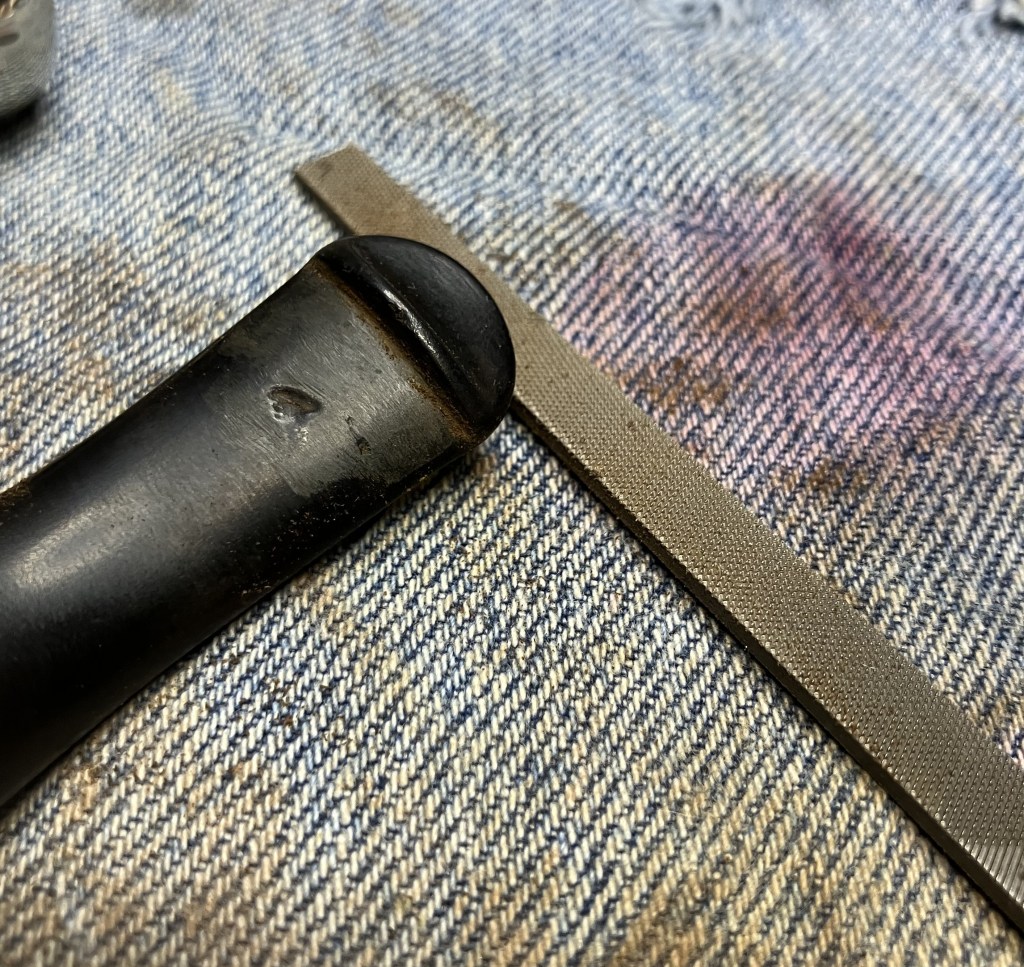
Impressive as their chomping was, I thought a file would be a better tool than my teeth.
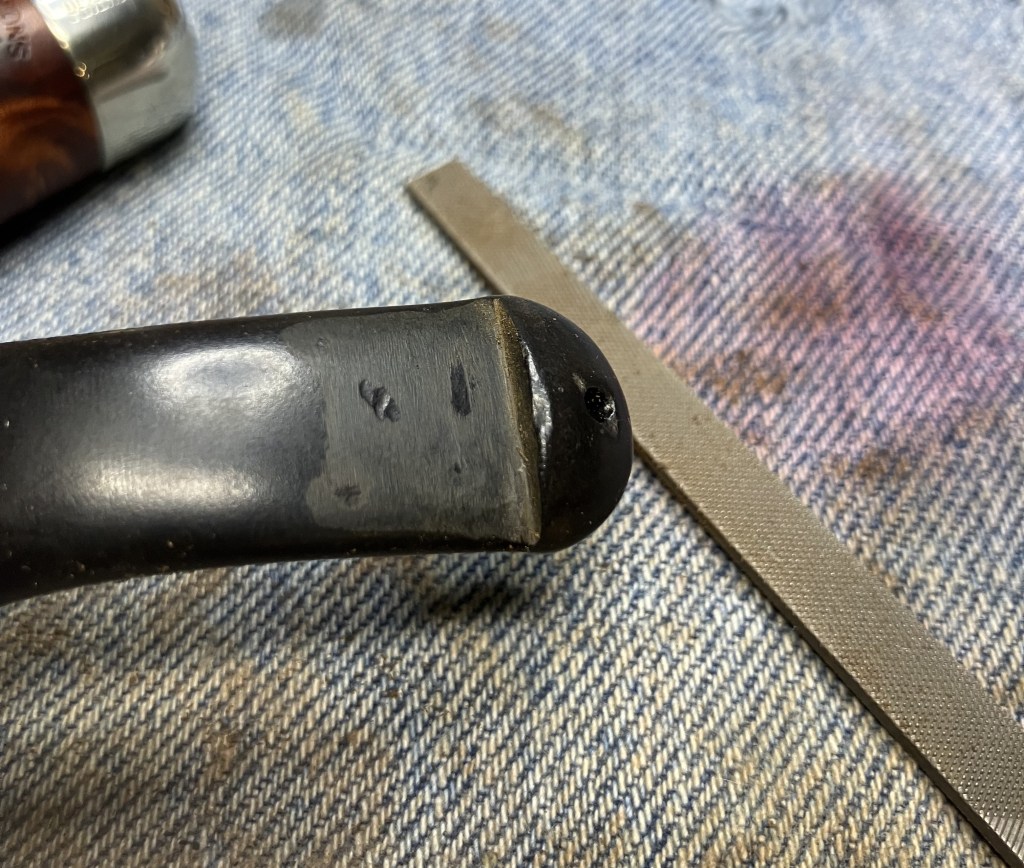
I used large and small flat files to reduce the size of the button and soften the edges.
Below are photos of the top and bottom after filing.
An emery board, for filing fingernails was also used for more final shaping.
The shank was then taped using panthers tape to protect it from the stem sanding. The stem was initially sanded with a 320 grit sanding sponge.
Airway cleaning was done with bristle pipe cleaners dipped in 95% ethyl alcohol.
The stemm was then placed in Briarville Pipe Stem Oxidation Remover (deox) and allowed to sit overnight.
I turned my attention to reaming the stummel. I gathered the ream team: PipNet with #2 blades, General triangular scraper (with the tip ground round) and the Smokingpipes Low Country reaming knife.
This pipe had not been heavily smoked so the reaming was quickly handled.
Below is a photo of the reamed tobacco chamber.
The chamber was sanded with 320 sandpaper wrapped around a wood dowel. The sanded chamber showed no signs of any damage from heat save the small charred spot on the rim.
A better view of the sanded tobacco chamber can be seen below.
The stummel was taken to the sink for a scrub with undiluted Murphy Oil Soap and a nylon brush. The soap was rinsed with warm water and the stummel dried with a cotton hand towel.
I believe this to below photo best describes why this pipe was considered to be an Irish Seconds, the number of flaws leading to fills in the briar. I counted 11 on the left side alone. The old fill was picked from the briar using a fly tying bodkin.
The front only had two spots to pick then fill.
The right side with its birdseyes also had a couple of spots.
The rim had fills and a couple of cosmetic cracks. These were not deep structural cracks.
I used brown cyanoacrylate (CA, super glue) placed into the pits. I then pressed briar dust into the wet CA. This new fill sets up quickly. The excess briar dust was brushed off using a wire brush.
The same process was used on the other fills.
Once cured the new fills were filed with a small flat file to smooth them.
This was repeated on each side.
The fills of the cosmetic cracks on the rim were done with brown CA alone, no briar dust though, briar dust was used in filing the pits. The entire stummel was then lightly sanded with 320 and 400 grit sanding sponges taking care to avoid the stamps on either side of the shank.
The next day I removed the stem from the Briarville deox.
The Briarville solution evaporates quickly. While still wet I vigorously rubbed the stummel with a coarse shop rag to remove some of the softened oxidized vulcanite.
Back at the workbench the oxidized vulcanite was easily seen as a buff colored coating on the stem.
The stem also showed another aspect of Irish Seconds that I’ve not seen in Peterson pipes, poor finish sanding of a stem. I could still see the marks from the molding of the stem.
The fit of the stem to shank was very good with a fine tight fit and no gaps.
I again taped the shank, this time with masking tape. Masking tape is thinner and is less likely to produce a step from the stem to the shank.
The stem was sanded using a series of sanding sponges from 320-3500. Between each sponge the stem was rubbed with mineral oil and wiped with a paper towel.
I masked the stampings on both sides of the shank with masking tape.
The stummel was then sanded with a series of sanding sponges from 32-3500. Between each sponge the stummel was wiped with a make-up pad wetted with alcohol to remove sanding debris.
The tasking tape was removed and the adhesive wiped clean with alcohol. The pipe was then worked with micro-mesh pads 4000-12000. Again the stummel was wiped with an alcoholic make-up pad (I think that’s funny).
The stem was rubbed with Obsidian Oil and wiped with a paper towel between micro-mesh pads.
I coated the stummel with Before and After Restoration Balm and allowed it to do what it does for 20 minutes. The excess balm was wiped from the stummel using an inside out athletic sock.
The pipe was then taken to the buffer where it received several coats of carnauba wax.
The final step was a hand buffing with a microfiber polishing cloth further deepening the shine.
This not so typical Peterson shape, I mean, Irish Second, turned out very nicely. The fills are far less noticeable and the stem far more comfortable than when I started. Weight of the pipe is inconsequential hanging from the lower jaw and it would be an exceptional clencher. I was very happy with how well the stem turned out. The high gloss black looks outstanding with the more natural Briar and the briar grain, though not fantastic, is quite lovely. This old pipe may never win a beauty contest but it will serve very well as a useful pipe in someone’s rotation. The dimensions of the Irish Seconds Oom Paul are:
Length: 6.00 in./ 152.40 mm.
Weight: 2.39 oz./ 67.76 g.
Bowl Height: 2.25 in./ 57.15 mm.
Chamber Depth: 1.95 in./ 49.53 mm.
Chamber Diameter: 0.74 in./ 18.80 mm.
Outside Diameter: 1.38 in./ 35.05 mm.
I do hope that you have found something here useful to your own pipe care, maintenance or restorations. If you like this sort of thing, please click the like and subscribe buttons. Thank you for reading the ramblings of an old pipe lover.
Loading…
Below are some photos of the finished Irish Seconds Oom Paul.
You know when you see something and the little voice in your head says, “Wait! There’s something peculiar about that”? That is exactly what happened when I was perusing eBay and saw this pipe. I can’t recall if it was the photo or the header, “James J Fox Made in Dublin Ireland Pipe” that caught my eye but one of them gave me a temporary case of whiplash. Now, we all know what a pipe made in Dublin actually means but what is this James J Fox stamp? A distant relative of Wileward Ethelbert Coyote, perhaps? (Wile E. Coyote for those non-cartoon-culture savvy). Even with less than stellar photographs, I knew I had to lay hands on this lass. The button was clicked, money sent and the pipe arrived. Well, it was a bit slower than that but you get the idea. Upon arrival, I got a good look at the stampings. Top left, Fox over Special in a flowing script. This one was faint, not worn, just faint. The top right shank had MADE IN DUBLIN over IRELAND. Again the stamp was faint but only in the middle top portion. Almost as if the stamp was not flat. The final stamp was on the lower left face of the shank and it read, JAMES J FOX over DUBLIN LONDON. The photos below show the pipe as it appeared before any work was done.
This looked like it would be a straightforward restoration with no real obstacles. Yeah, the stem was oxidized and there was some weird stain on the front left of the bowl but the stem fit was great and the rim indicated that the previous owner took care of this pipe or hadn’t used it extensively.
Background
I went directly to the James J. Fox website as the start of the background search. Here it states the following:
“We have been trading in fine tobacco and smokers’ accessories from 19 St James’s Street since 1787 and our customers have included discriminating smokers from all walks of life – from commoners to kings. Among them have been Sir Winston Churchill, Oscar Wilde, British and Foreign Royalty, the officer’s mess of famous British regiments, and the leading lights of the stage, film, sport, tv, radio, music and literature.
Our world famous tobacco business started with Robert Lewis, who began trading fine tobacco in St James’s Street in 1787. James J Fox was formed in Dublin in 1881 and opened its first tobacco shop in London in 1947. Fox acquired the business of Robert Lewis on 14 September 1992, uniting two of the most respected names in the cigar world. Both companies now trade as JJ Fox (St James’s) Ltd and run the cigar departments of Harrods and Selfridges.” and about their founder,Frederic James Fox (1913-1990) “Born in 1913, Frederic (Freddie) was the fourth of five children and the youngest of James Fox’s three sons.He found himself in charge of the family business, a single cigar shop on Dublin’s Grafton Street, after the untimely death of his two brothers. Stanley Fox was shot dead by armed thieves thought to be members of the IRA in 1926, while Ronald (Biffy) was missing in action over the Dutch coast in 1942 during an RAF mine laying mission. Freddie, not content with just one shop, took the business from strength to strength. He established a successful import and wholesale business in Ireland alongside the world’s first Duty Free outlet which expanded the retail cigar business into London. He developed numerous brands including Punch Nectares, Bolivar Amado, Hoyo Royal Hunt and La Corona Policromia, and established the Astor Tobacco Company. His enterprising nature also saw Freddie acquire and develop a successful import and wholesale business in the Channel Islands; and he oversaw the origin of the business’s entry into the property markets, developing several high profile office buildings in St Helier, Jersey including Sir Walter Raleigh House on the Esplanade. Freddie Fox died in 1990. He is still sorely missed by his family, friends and colleagues from the cigar industry. Were he to be asked to comment on his career achievements, he might say :
For a far more complete history of the James J, Fox shops and their history I will refer to Mark Irwi’s Peterson Pipe Notes blog, 157. The James Fox – Peterson Small Batch Lines: An Interview with Yiorgos Manesis (157. The James Fox – Peterson Small Batch Lines: An Interview with Yiorgos Manesis – Peterson Pipe Notes). Yiorgos Manesis says in Irwins blog, “They used to make their own pipes here, a small factory for a few years. It didn’t last long, and only two or three people worked there. I don’t know if they were turning bowls, or just getting bowls and finishing them here. They were involved in all parts of the tobacco business—they were making pipes, hand-blending their own pipe tobaccos. And Freddie Fox, who was Robert and Stuart Fox’s [the 5th generation owners] grandfather, was a very intelligent, savvy man.” (157. The James Fox – Peterson Small Batch Lines: An Interview with Yiorgos Manesis – Peterson Pipe Notes). Now is this pipe one of those made by Fox?
I sent some photos to Mark Irwin asking him what he thought of this pipe soon after it arrived. His response was, “Boy oh boy! Isn’t this COOL? Does it look like the Peterson 493 shape to you? It pretty much does to me. These James Fox / Peterson pipes are really scarce. Yes, please let me know when you run the blog post, as I want to point everyone out to it as well as include at least one of these photos to help them get to your blog.” (Mark Irwin, personal email). I cannot say that I was terribly familiar with the 493 shape so that is where I went hunting.
Mark’s Peterson Pipe Notes provided me with two wonderful posts describing the development of Peterson’s bulldog shapes. Blogs 388 (1891-1919) and 390 (1920-1947) detail the development of shaps during the years in parentheses.
“Two years after hostilities ended and bringing our survey of the IFS and Éire eras to its conclusion is the fullest flowering of bulldogs in K&P’s history, before or since: the distributor’s catalog c. 1947. Three squat bulldogs, the 493, 494 and 495, all reintroducing the “Cad” name. The 170 / 175 and 150 /155 don’t appear to be different shapes, but merely different stems—one saddle, one bent.”
(https://petersonpipenotes.org/390-a-visual-history-of-petersons-bulldog-shapes-part-2-from-the-end-of-the-patent-through-the-irish-free-state-and-eire-eras/ highlight added by me). In examining the James J. Fox and comparing it to the 493 from the diagram above the shape looked very similar. Mark appeared correct but one thing which struck me was the saddle stem. The 493 looks to have a saddle that tapers slightly from the shank towards the button.This narrowing is completely absent in the Fox Special, if anything the Fos pipe has a reverse taper. Using my micrometer I checked the width at the shank, 0.72 (18.4 mm) inches and at the opposite end of the saddle, .74 inches (18.8 mm). This is far from definitive proof that the pipe was made in the short lived James J. Fox shop but it does make me say, “Hmmm.”
Though lacking a shape number, the Fox Special must be regarded with some suspicion. Mark thought it looked like a Peterson 493, and I concur with estimated measurements from the shape charts the dimensions do fit nicely. The 493 shape existed through the 1970s as evidenced in a chart and description, “This shape chart from Associated Imports point-of-sale brochure leUS pipe smokers know what shapes they might expect in non-System pipes. Note several rare, currently sought-after shapes by collectors: the XL02, XL999, XL493s, 124 and 120F.” on page 170 of The Peterson Pipe The Story of Kapp Peterson (Irwin, Mark and Malmberg, Gary. Briar Works Press. 2018, First Edition, second printing 2021. Printed in Canada).
So, we are left with little but supposition, assumptions and conjecture, three great words, but hardly a definitive date of birth nor maker for this lovely pipe. Ath the end of this blog I show the measured dimensions of the Fox Special. If you compare the dimensions of this pipe to the listing of a Peterson 493 from smokingpipes.com there remains little doubt of this pipe’s heritage.
The Restoration
As usual the pipe was introduced to the workbench with a cleaned denim piece. I say cleaned because though laundered, stains aplenty remained.
I began with a quick prep of the stem for a bath in Briarville’s Pipe Stem Oxidation Remover. This product was sent to me by Richard Messineo of Briarville to try. Again I wish to thank Richard for the chance to test this product. The stem was lightly sanded with a 400 grit sanding sponge.
I then cleaned the airway with bristle pipe cleaners dipped in 95% ethyl alcohol.
The stem was submerged in the Briarville solution. The label instructions say 2-24 hours. I allowed this stem 13 hours of exposure.
In the meantime I began reaming the tobacco chamber.The tools of choice were the PipNet, Smoingpipes Low Country Reamer and the General triangular scraper (with the tip ground round).
The number 3 blades of the PipNet did the lion’s share of the work with the General coming in for clean-up.
The tobacco chamber was sanded with 220 sandpaper scraped around a wood dowel. The chamber appeared free of any heat damage or charring.
Next came the cleaning of the airway. This was done with numerous cotton swabs and bristle pipe cleaners both dipped in 95% ethyl alcohol as well as some scraping with a dental scraper.
The stummel was taken to the sink for a scrubbing with undiluted Murphy Oil Soap and a nylon brush. The soap was rinsed with warm water and the stummel dried with a cotton hand towel.
Back at the workbench the stummel looked better but the stain at the front right remained.
A wipe with 95% ethyl alcohol on amake-up pad removed a bit of color, probably old wax and stain.
The stain persisted.
As a remede, I thought maybe oxalic acid would bleach the stain.
I used a saturated solution of oxalic acid applied with a cotton swab on the stain. The swab assumed an orangish color.
After the oxalic acid had sat for 30 minutes I returned the stummel to the sink for another scrub with Murphy Oil Soap. I figured the basic nature of the soap and copious rinsing would neutralize the acid and rinse any remnants. Once dry the stummel appeared as below. The stain was vanquished.
The next day I returned to the stem. The Briarville Pipe Stem Oxidation Remover is getting darker in color. I am not sure how many stems this product is able to treat. I think this was number 3 or 4.
The stem was removed and was vigorously rubbed with a coarse shop rag. Below you can see that some of the oxidized vulcanite was removed onto the rag.
The stem looked much better.
I scrubbed the stem with Soft Scrub cleanser on make-up pads to remove more of the oxidized vulcanite.
The stem was then coated with another product, Before and After Hard Rubber Balm. This product was sent to me from Mark Hoover to try. Thank you, Mark. I really like this balm for treating vulcanite stems after they have been restored. It is more viscous than Obsidian Oil and I think it lasts longer than Obsidian Oil in protecting polished stems.
In preparing the stummel for sanding, I covered the stampings with masking tape. I prefer to cut slightly irregular pieces of tape for this as they do not give as blocky a look to the unsanded areas under the tape.
The stummel and stem were united during the sanding to avoid rounding the joint between the two materials at their seam. The sanding was done with a series of sanding sponges in grits of 400-3500. Between each sponge the briar was wiped with a make-up pad dipped in alcohol to remove sanding debris. The stem was rubbed with mineral oil and wiped with a dry paper towel between sponges.
The tape was removed and the pipe micro-meshed with pads 4000-12000. The above between pad wiping was done as with the sanding except I used Obsidian Oil rather than mineral oil.
The stem was polished with Before and After Fine followed by Extra Fine Polish.
Each was applied by finger then hand buffed using a soft cotton cloth.
The stummel was then covered with a liberal coat of Before and After Restoration Balm. I let the balm work its magic for 20 minutes.
The excess balm was hand buffed with an inside out athletic sock to remove it and reveal the revived briar grain.
The pipe was then taken to the buffer for several coats of carnauba wax. I used a fly tying bodkin to remove the xa deposits from the beading around the rim. The final step was a hand buffing with a microfiber polishing cloth further deepening the shine.
I think this Fox Special turned out very well. This stained spot and stem were the two areas I was most concerned about, both turned out exceptionally well. The high gloss black vulcanite really accentuates and contrasts the briar grain. The condition of the rim makes the pipe look like it is a brand new specimen rather than a restored old beauty. The stampings, though faint, can all be made out and add to the mystery of this pipe provenance. Peterson product or not, it is a beautiful Irish Lass.
The dimensions of the James J. Fox, Fox Special are:
I do hope that you have found something here useful to your own pipe care, maintenance or restorations. If you like this sort of thing, please click the like and subscribe buttons. Thank you for reading the ramblings of an old pipe lover.
Loading…
Below are some photos of the finished Royal Guard 522.
I have always thought that rooting for the underdog was an American characteristic. This is probably a very flawed thought as I am an American and the vast majority of my life experiences are with other Americans. Given, I taught English as a Second Language (ESL) science in a large urban school and had students from many different countries. The fact remains that most of my life was spent with American culture and Americans. Well, it turns out that psychologists have studied this rooting for the underdog and actually have theories for it. One article I read, Decision Affect Theory: Emotional Reactions to the Outcomes of Risky Options, by Barbara A. Mellers, Alan Schwartz, Katty Ho and Ilana Ritov found that;
“Emotional responses also depend on probabilities and unobtained outcomes. Unexpected outcomes have greater emotional impact than expected outcomes” (https://www.jstor.org/stable/40063228). So what does all this nonsense have to do with a pipe? The subject of this restoration is a terribly beaten up Peterson Donegal Rocky which I thought to be barely salvageable. In other words, this poor Pete was a major underdog. Below are some photos of the Donegal Rocky prior to work done:
I think you can see what I mean by an underdog. This pipe was a mess. The rim was severely charred and had extensive lava deposits on the remaining rim. There also appeared to be lava on the mortise. The rustications were filled with dirt and grime. The tobacco chamber still had tobacco in its cake constricted chamber. The stem was oxidized, calcium deposited and chewed on. The stem also wouldn’t correctly seat. All of these factors made me consider just depositing the old pipe in the trash then I thought why not root for the underdog and see what I could do with what I had.
Background
In a previous restoration blog I used the following: “As much as I love the history of the Kapp and Peterson company and Peterson pipes, I will not get into that other than give you resources to read the history for yourself. I will delve into the Dunmore, or Dunmoor line of pipes at greater depth.
For a great history Mark Irwin and Gary Marlburg’s book is a must read for a Pete Geek.
Now to the stuff regarding this pipe: A Peterson Dunmore. I refer to Mark Irwin again here and his blog, Peterson Pipe Notes. I can wholeheartedly recommend the free at
https://petersonpipenotes.org/ Yes, you will get emails but only for things like the weekly blog post and occasional Peterson pipe drops (like the Peterson Pipe Notes Pipe of the Year) or offers for cool Pete Geek merchandise.
I recently acquired for study an amazing NOS (new/old stock) Donegal Rocky 01s with its box, sleeve and brochure. Hallmarked with a Celtic lower-case n for 1979, it’s a first-year release of this marvelous ‘short dutch’ bowl shape and convenient reason to take a look back at the long history of Peterson’s iconic “Donegal Rocky” line.
The “Donegal Rocky” (in quotation marks), released in 1945 or so, was Kapp & Peterson’s first rusticated line. Not that K&P hadn’t rusticated pipes previously, they just that they hadn’t devoted an entire line to rustication. And they were apparently proud of it, because they gave it a sterling mount along with a black finish and white-stamped P on the mouthpiece.
It was part of K&P’s “Product Line,” what I call gateway pipes and others might call an entry-level pipe, as you can see in this shape chart from the 1945 catalog. Like the Shamrock (European version) and “K,” it was originally a fishtail line.
For nearly thirty years, from 1947 until 1975, the line continued uninterrupted, black rusticated finish with fishtail mouthpiece and sterling band.
from the 1976 Associated Imports Point-of-Sale Brochure
Then in 1976, just a year out from their Centennial celebration, Peterson (in an expansive mood) pushed the Donegal up a notch, giving the line a P-Lip. The 1976 engraving doesn’t show it, but you can just glimpse a new, deeper rustication in the (still black) 1978 Associated Imports chart:
This rustication was done by a carver in Dublin, Paddy Larrigan told me this past June in Sallynoggin. The artisan did all of Peterson’s fantastic rustications from the period: the classic “Pebble Rustics,” the early Sherlock Holmes rustics, the Bond Street of Oxford Premier Systems, and the sterling-band P-Lip Donegals.
And that’s where this 1979 01s comes in handy, because we can see with much greater clarity the rustication as well as the details of a “Donegal Rocky” at its pinnacle of engineering and finish:
It’s worth remarking concerning the removable stinger. This spike-ended aluminum tube is easily removed, leaving the P-Lip mouthpiece strictly a graduated-bore regulation affair.
If I were more dedicated, I’d smoke this pipe a few dozen times with and without the stinger and give you a report on what purpose it serves. I wonder if the craftsmen at the factory installed the stinger to approximate the effect of the older bone tenon extensions routinely attached to Classic Range Dublin & London, Classic and Premier lines? With or without the stinger, the pipe smoker should enjoy the benefits of the “Sub-System,” which I talk about at length in The Peterson Pipe. As it is, I’ll leave that to someone else, and happily report their findings.*
Here’s the COM stamp, showing Peterson’s love of quotation marks (seen also in the “SPORTS” line) as well as a closer look at the stain and rustication technique:
Sometime between 1978 and 1980 the sterling band was dropped to a nickel band and the P-Lip abandoned in favor of the Donegal’s traditional fishtail, all of which may (or may not) indicate a lessening in the quality of the rustication.
Seen above from the 1981 Mark Twain brochure, the sterling band resurfaced, this time with the line’s first change in stain color to what some of us have in our rotations or remember: the contrast brown over black (seen in the dutch 339 hallmarked for ’81 below). The catalogs indicate some fluctuation from sterling to nickel bands on through the Late Republic era (1969-90) into the Dublin era (1991-2018), with the sterling being used (as happens so often with Peterson lines) in conjunction with a P-Lip in the 1997 catalog, but also in that year available with a nickel band and fishtail.
The dublin 120 seen above is from ’94, and as you can see, while the rustication technique is nearly identical to that of the ’81 dutch billiard, the stain color has changed for a third time to burgundy-over-black, which seems to have been the standard during most of the early Dublin era.
Sometime near the beginning of this century the Donegal was down-graded again to its original “Product” or gateway status by a nickel band and fishtail mouthpiece as seen in this B7, and while the stain remains the same, it looks less craggy:
Things would grow steadily worse in the following years, however, as the gawdawful pineapple rustication took hold, so that by around 2010 the Donegal was reduced to the etchings seen on this B39:
With the return of in-house rustication earlier this year, things are looking up for the Donegal, at least just a little, as you can see in this current 80s:
The finish and the rustication are, so nearly as I can tell, identical with that used on current rusticated SH pipes, so that’s something, right? I don’t think I’d call it a Rocky anymore, but at least it still has a vulcanite mouthpiece, a plus.
As for the future of the line—or the name—I couldn’t hazard any guesses. In the ideal Peterson of my imagination, the line would assume the craggiest crags, sharp textures and brilliant obsidian finish of the last batch of Rosslare Rusticated pipes, along with—of course—a vulcanite P-Lip. In the meantime, just to have it around, as one of the bedrock Peterson lines for almost 75 years, will do.
Thanks go out to Mark again. Now, as for this Donegal Rock; the rustication and the color fit the late 1990s-2010, pre-”gawdawful pineapple” phase. The quote describing it best is “Sometime near the beginning of this century the Donegal was down-graded again to its original “Product” or gateway status by a nickel band and fishtail mouthpiece as seen in this B7, and while the stain remains the same, it looks less craggy:” This included the burgundy-over-black dye, the nickel band and the fishtail mouthpiece. The rustication is difficult to describe due to the worn nature of the pipe but it is definitely of a hand carved nature and not that of machine made look. Overall, I guesstimate this pipe to be from the 1990s-early 2000s. This makes it a more recent pipe but one that has seen a great amount of use and abuse.
The Restoration
Vivid mental images of how this pipe might turn out filled my head as I placed it on the clean denim piece.
I began with an initial sanding of the stem to remove the surface oxidation. TO maintain the crisp edges of the stem I wanted to keep it attached so the shank was wrapped in masking tape, protecting it from the sanding.
Once sanded, I removed the stem and examined the tenon. The below photo doesn’t do the layer of grime justice. The tenon was encrusted with smoking residue and tar.
I used a sharp pocket knife to scrape the end of the tenon and started cleaning it with a 95% ethyl alcohol dipped bristle pipe cleaner.
Several additional alcohol dipped pipe cleaners and a good deal of nylon brush scrubbing the stem airway was clean.
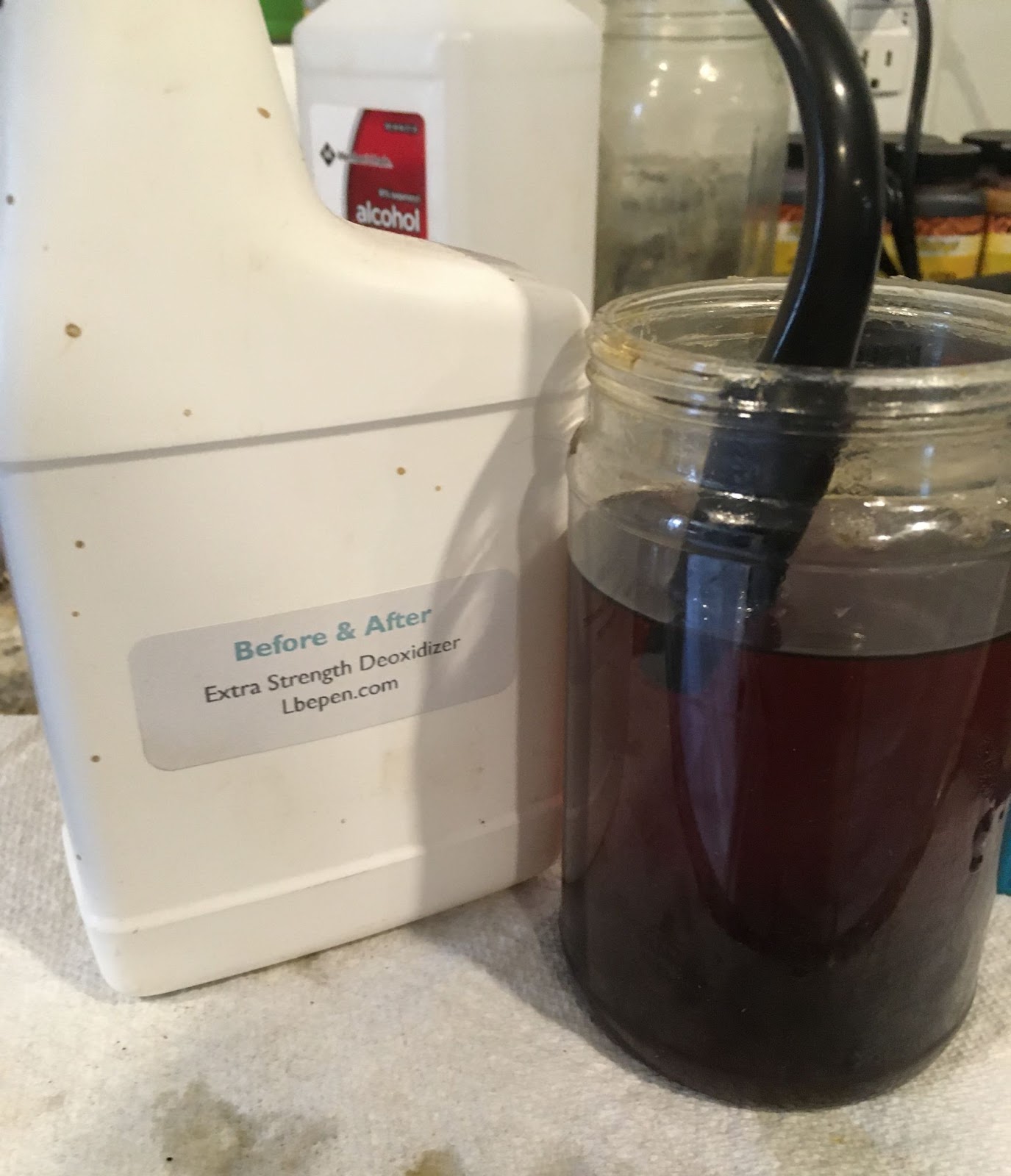
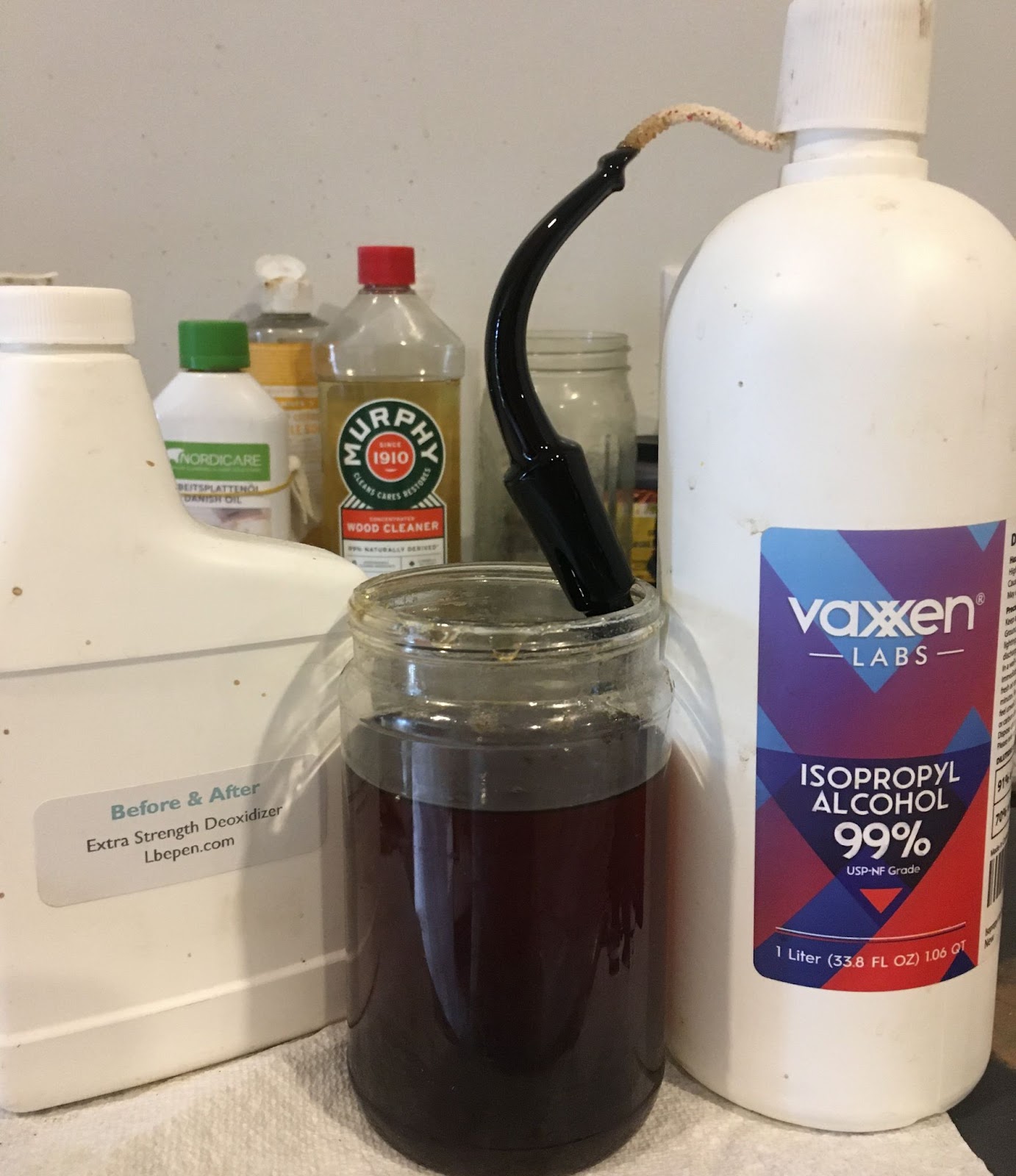
A pipe cleaner was inserted into the tenon to act as a hanger suspending the stem in Before and After Extra Strength Deoxidizer (lovingly referred to as deox).
The edge of the mortise was as crusty as the tenon had been. I have seen thick lava deposits on a rim but not on a rim this bad before. I softened the crust with saliva and let it soak for a couple of minutes and scraped the surface with a sharp pocket knife.
I gathered the reaming kit; PipNet, Smokingpipes Low Country Reamer and General triangular scraper.
I initially thought that one the #2 and #3 blades of the PipNet would be needed. Wrong. The #4 blade was also put to work.
After the #4 blade there was still scraping to be done with the General.
The tobacco chamber was sanded with 220 sandpaper to bare briar. There was some slight charring of the interior of the chamber. This was not severe and I thought that a bowl coating would suffice to protect the briar.
Next came the shank cleaning. I began with scraping the walls of the mortise with a dental scraper. The scrapings were thick and filled with cotton fluff from pipe cleaners. Well, I assumed that was the source of the cotton even though this pipe looked like it had never seen a cleaning nor a pipe cleaner.
The stummel was taken to the sink for a scrub with undiluted Murphy Oil Soap and a nylon scrub brush. The amount of grime scrubbed from the stummel was impressive. The soap was rinsed with warm water and the stumel dried with a cotton hand towel.
Looking at the freshly scrubbed and dried stummel I could see quite a bit of grime remaining on the mortise, within the rustications and on the rim. Another scrubbing was done with undiluted Murphy’s and a brass brush. The rinsing and drying were done as before.
Back at the workbench the stummel was wiped with a make-up pad dipped in 95% ethyl alcohol. The alcohol lifted a red dye from the briar.
The scrubbing revealed the damage to the rim much more clearly.
Possible remedies came to mind. Plan A – was to cut a wedge of briar from another pipe. I had one of nearly equal chamber diameter.
This idea would glue the edge onto the existing rim, fill the seams with cyanoacrylate and briar dust, shape the wedge to match the lines of the 999 shape, carve the new briar to match the pattern of the existing briar then dye the stummel. This plan would produce a finished product that was a true restoration. The plan was also drought with issues. My greatest concern was with the gluing of new briar to the old briar. I thought that I could pin this briar patch in place to make it more secure. This plan sounded like it would take many hours of tedious work, though fun.
Plan B – cut the rim on both sides to match. This would give the stummel a forward canted look. The new rim would require re-texturing. This plan also completely changes the original shape of the pipe and would make this a salvage rather than a restoration. This plan would only take a fraction of the time of the previous plan as well.
I went with Plan B. If this worked it would produce a fine working pipe, one that would be perfect for knocking around while changing the oil in the truck, fishing or doing yard work and I’m lazy.
I used a Dremel with an abrasive sided cutoff wheel to cut the non-charred side of the stummel.
I tried to match both sides and used the abrasive side of the wheel to flatten the rim.
This did accentuate the out-of-round tobacco chamber. I then started cleaning the shank with numerous cotton swabs dipped in ethyl alcohol and more scraping with the dental scraper.
The draft hole was scrubbed with a nylon brush and numerous bristle pipe cleaners.
The tars of the airway were persistent and I thought maybe an alcohol cotton treatment would better soften and remove them. The tobacco chamber and shank were stuffed with cotton and 95% ethyl alcohol was added with a pipette until the cotton was saturated.
Below is a photo of the saturated cotton. This was allowed to evaporate overnight. As the alcohol evaporated it would hopefully dissolve some of the tar and deposit it into the cotton thus removing it from the walls of the airway.
The stem sat in deox for 4 hours. I removed the stem and allowed it to drip some of the excess solution back into the jar.
Below you can see the stem on a coarse cotton shop rag.
The shop rag was used to vigorously rub the remaining solution from the stem. This rubbing removed the solution and a good deal of oxidized vulcanite.
I then scrubbed the stem with several cotton make-up pads sprinkled with Soft Scrub cleanser. The below photo shows a general progression of reduced oxidized rubber removal. The stem looked much better. I had talked to Doug Bisbee of dk Metal Pipes (https://www.dkmetalpipes.com/dkmetalpipe) earlier in the week. Doug does amazing work restoring Kirsten pipes. We discussed how he restores the vulcanite stems using only a buffer rather than the sanding and micro-meshing that I had always used. I thought this would be a good time to attempt a similar technique with my existing equipment. Doug uses Airway buffing wheels rather than the felt wheels I have. I have not invested in these wheels yet but am considering trying them out. An issue is that I would need to get a new ¾-1 horsepower variable speed buffer as well as the wheels to properly use them.
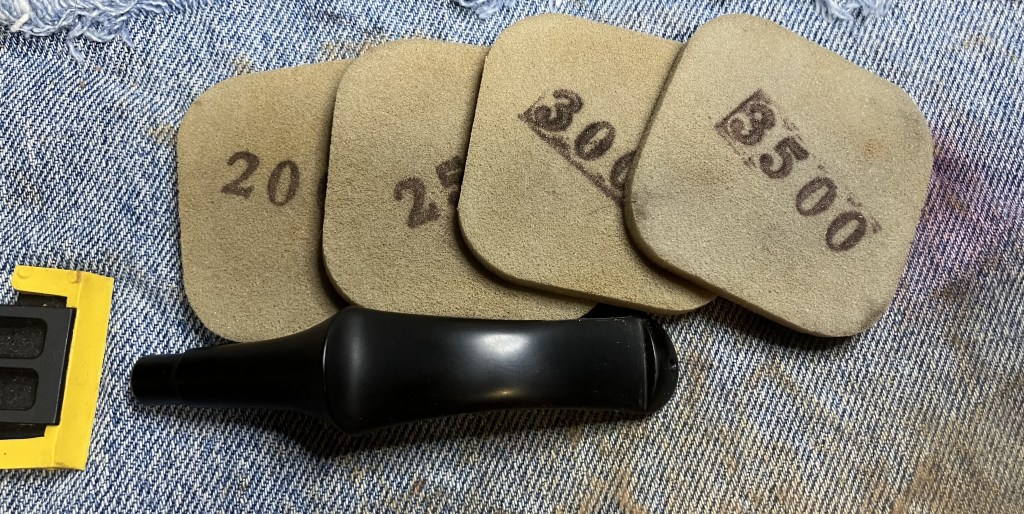
Using what I already have I worked the stem with my buffer and the red abrasive.
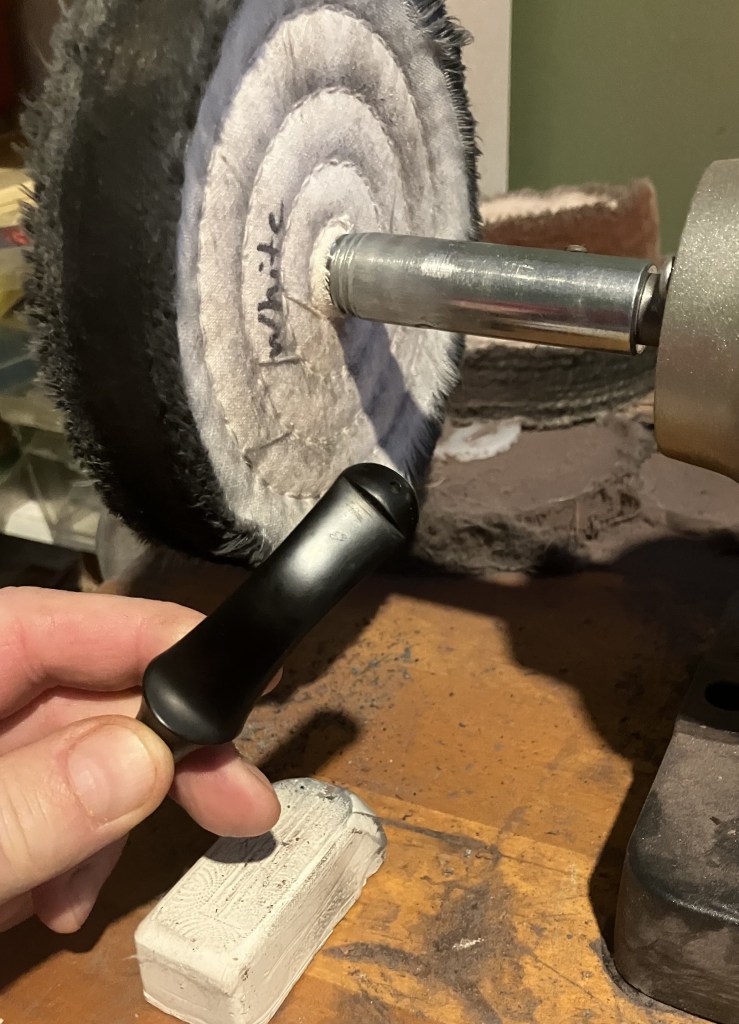
I followed this with the white compound on the dedicated white wheel and produced a nice finish on the stem.
The next morning I returned to the stummel. The cotton was stained with smoking residue removed from the briar.
The cotton was removed and I continued cleaning the airway/mortise with alcohol dipped cotton swabs. This process started out similarly to the day before but quickly improved dramatically. The discoloration of the cotton swabs below show that the remaining tars were much more easily removed after the alcohol and cotton treatment.
The bristle pipe cleaners in the draft hole showed a similar result.
I used a couple different carving bits in the Dremel rotary tool to get the texture to match the Donegal Rocky rustication.
It was time to try matching the Peterson dye. I thought that I would start with a black undercoat topped with a dark red. Fiebing’s Leather Dye was the product of choice. Folded pipe cleaners acted as my applicators while a wine cork wrapped in several coats of masking tape provided a plug to keep the dye from the tobacco chamber and a handle.
The black Fiebing’s was applied and flamed with a lighter.
The black was wiped with a paper towel and allowed to dry for about 10 minutes. It was then taken to the buffer and buffed from the highspots.
The remaining buffing compound was wiped from the stummel using an alcohol wetted make-up pad. Below is a photo of the black dyed , buffed and wiped stummel.
Next, the stummel was dyed with the dark red Fiebing’s.
This was flamed and allowed to dry for an hour.
The pipe was starting to look more finished.
I wrapped the shank with masking tape to protect it during the nickel band polishing. The band was polished at the buffer with white compound.
The stem looked good but I wanted it to really look good. I hand buffed it with Before and After Fine Polish on a soft cotton rag.
The Fine Polish was followed by the Before and After Extra Fine Polish buffed by hand with the same but a clean spot with the same soft cotton cloth.
For the bowl coating I used maple syrup applied with my fingertip to the interior of the bowl. Before starting a thick pipe cleaner was inserted into the draft hole to keep the syrup and carbon out of the hole. Once the syrup was applied I opened a capsule of carbon powder and dumped it into the bowl. The bowl was covered with a 2 inch wide piece of painters tape and shaken vigorously for several seconds to distribute the carbon powder.
The tape was removed and the remaining powder dumped. Below is a photo of the new bowl coating.
The bowl coating would take a couple days to dry completely. The rustications of this pipe were worn fairly smooth with use. This allowed me to use the buffer to apply several coats of carnauba wax to the stummel and to the stem. The final step was to hand buff the pipe with a microfiber polishing cloth.
This is not my first Peterson Donegal Rocky restoration but it was the first time I attempted a white background for the before and after photos. I am still learning camera settings and photo editing for the white. Feel free to comment on background preferences. As for the pipe, I think it turned out about as well as it could have. I like the craggy appearance and feel of the pipe and the rim re-rustication. The 999 shape is a favorite of mine. The burgundy and black contrast stain does come close to matching the original dye and I think it still works . I was quite happy with the oxidation removal from the stem and the black vulcanite polished up nicely. The nickel band looks bright and well polished. I am sure this will be a great smoking pipe but will have to wait a couple of days for the coat coating to thoroughly dry. The dimensions of the Peterson Donegal Rocky 999 areas follows:
Length: 5.66 in./ 143.76 mm.
Weight: 1.58 oz./ 44.79 g.
Bowl Height: 1.42 in./ 36.07 mm.
Chamber Depth: 1.17 in./ 29.72 mm.
Chamber Diameter: 0.90 in./ 22.86 mm.
Outside Diameter: 1.65 in./ 41.91 mm.
I do hope that you have found something here useful to your own pipe care, maintenance or restorations. If you like this sort of thing, please click the like and subscribe buttons. Thank you for reading the ramblings of an old pipe lover.
Loading…
Below are some photos of the finished Peterson Donegal Rocky 999.
Christmas is in the rearview mirror and fading away quickly. This pipe made me think of the 1964 Rudolph the Red-Nosed Reindeer and the Isle of Misfit Toys or, in this case Misfit Pipes. I couldn’t tell for sure what the model was because it had been, shortened? The size was smaller in shape, more like a Peterson System Standard 314 or 317. Looking at the stampings I was a bit surprised to see a faint PETERSON’s arched over an even more faint DUBLIN with a definitive 3. The opposite side had the real flummoxer: There, a 3000 appeared to be stamped.
Below are some photos of the Peterson 3000 before work was done. There are more than usual to document the poor condition.
“Doctor Young to the ER stat!” Wait a minute, I have no cool title like that and can’t claim one. My dad had a PhD, not me. “Medic!”, okay, I can work with that. This pipe was certainly in need of some kind of intervention. The oxidation on the stem looked terminal. The stummel looked as if it had been shortened with a chainsaw or some other homicidal garden implement. The shank had two cracks under the ferrule that small children could fall into. The cake in the bowl would be enough to serve a medium sized wedding party. The lava flow on the rim made Mount Kilauea look wimpy. Even without all my excessively dramatic exaggeration, the pipe was one hurting unit. This would not be one of those relaxing restorations.
Background
For those who would like more information on Peterson pipes, I’ll start with a bit I have said before:
“For a great history Mark Irwin and Gary Marlburg’s book is a must read for a Pete Geek.
Now for the pipe in hand. PETERSON over Dublin 3 indicates this is an older pipe. According to Irwin,
“3RD Quality or Third Grade (the later Standard System) was issued with a “3” stamped under the Patent stampand a domed-nickel mount. Like the 2nd Quality, it was only available with the AB- or A-molded mouthpieces.
The numbers on the 2nd and 3rd Quality pipes would appear either within a small circle or not, and would continue well into the 1930s.” (Irwin, Mark and Malmberg, Gary (2018). The Peterson Pipe The Story of Kapp & Peterson, First edition, second printing 2021. Briar Books Press, Canada. p. 119).
In a personal email with Mark Irwin concerning this pipe, I sent him these three photos and asked him “What have I got?”
His response was the following: “Doesn’t that 2nd number look like an “8” to you? But a “3800”? Nothing I can think of. Notice it’s a Grade 3—after the “Peterson’s /over/Dublin3”. That in itself is unusual, along with the nickel-mount marks. Notice also how very long the ferrule is. And the “B” or tapered stem. The Grade 3 in that “Dublin3” with everything else leads me to believe this is a very early pipe—easily IFS or maybe EIRE.” (Irwin, personal communication).
To clarify some of the Pete Geek-speak:
*Mouthpiece or stem staples of Peterson pipes as from the 1937 catalog. I believe Mark meant the AB stem.
*IFS stands for Irish Free State. This was a country of manufacture (COM) stamp used from 1922-1937.
*ERIE was a COM stamp used from 1938-1948.
Staying with the stem in an attempt to gain a better grasp of the approximate date of manufacture I focused on the tenon. Notice in the photo from the 1937 catalog, above, that the end of the tenon has a distinct taper. This was a feature of Charles Peterson’s initial design.
Irwin states the following in the same Peterson Pipe Notes entry with photos, “The first change in the molded vulcanite System mouthpieces apparently occurred later on in the Éire era, as documented by this unsmoked mouthpiece which can be accurately dated to 1937–45:”
(https://petersonpipenotes.org/tag/peterson-system-mouthpiece/). Notice the distinct step down from the push fit taper to the end of the tenon. The taper is no longer present. This is the same style of tenon as the Peterson Dublin 3 3000 pipe in hand. The below photo is of the 3000’s tenon.
Using the dates from the stem information the pipe could be dated from 1938 to present. Considering the stamping information stating that the Dublin 3 was used “Well into the 30s” that would eliminate from 1940-present. These two pieces together make for an argument that the pip is from the late 1930s. It also would coincide with Mark Irwin’s observation, “easily IFS or maybe EIRE.”
The 3000 worn by this pipe is an anomaly. Even if my interpretation were to be changed to Mark Irwin’s observation of a 3800, it would still not match any pipe in Peterson’s production history. When comparing this pipe to contemporary Petersons in my collection the much narrower shank of the 3000 is obvious.
Above are a COM England 317 (top left), a System 0 (top right)with no shape number but it’s a 317 and the 3000.
Above are a Peterson System 0 and the 3000. Notice the narrow shank of the 3000.
The bowl dimensions are nearly identical to the 317 or a 12 ½ that I have. The shank is narrow to the point that it would be nigh impossible for this pipe to have been drilled as a System pipe at all.
Guess what. It is not drilled as a System pipe. That does explain the absence of the PATENT under the PETERSON’S stamp, doesn’t it?
So, there we have it. An 87 year old Mysterious Peterson Dublin 3000. I wish I could say, “I’m glad that’s settled”. I can’t nor can I explain why the top quarter inch was cut from the stummel. At least that one I can imagine was due to a severely charred top. The shape, however, is a mystery.
The Restoration
The beginning is always so easy. Lay down a freshly laundered piece of denim. That was about the last easy thing that this pipe allowed for.
Okay, another exaggeration, the collar came off pretty easily.
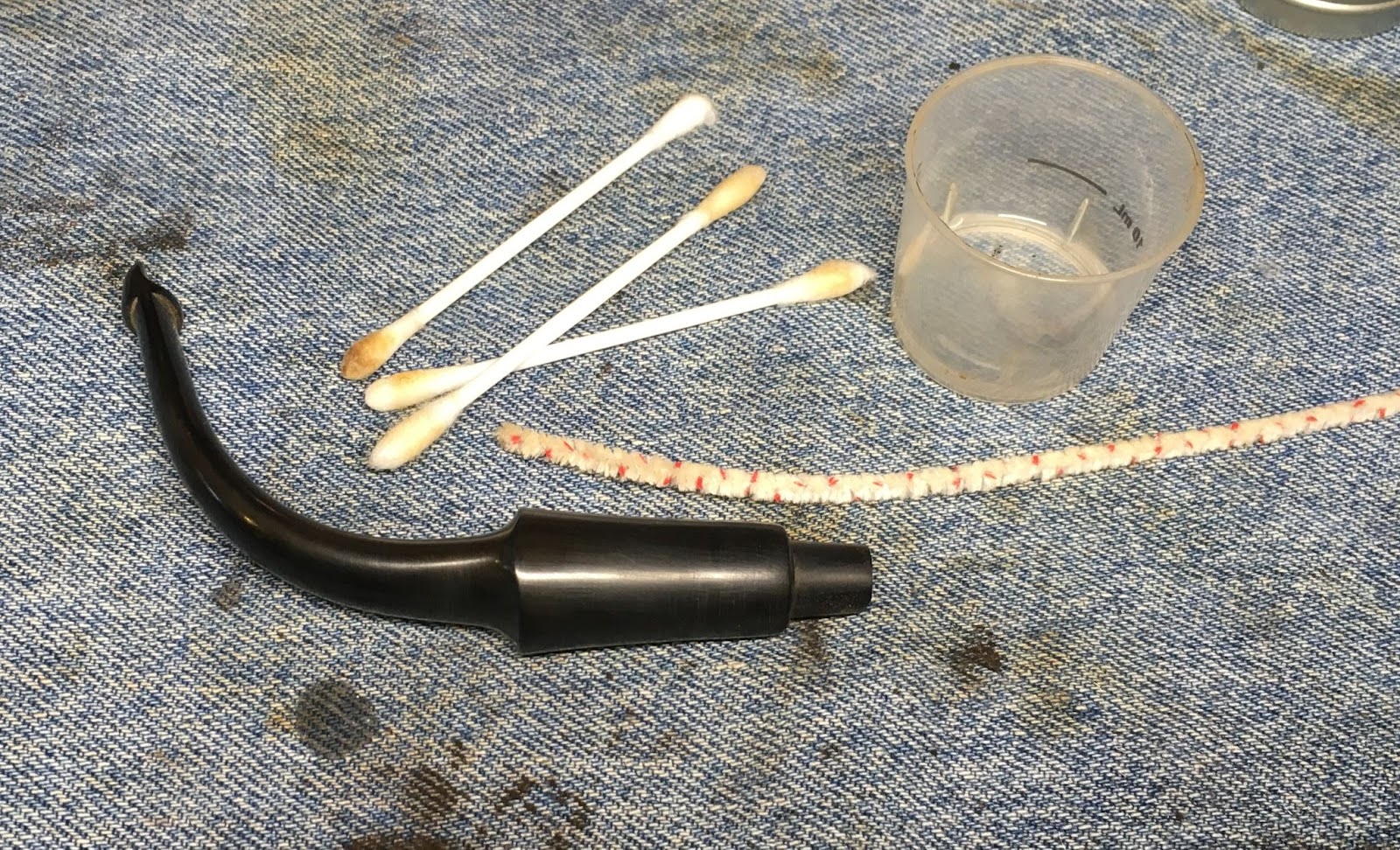
The collar was placed in a medicine cup and covered with 95% ethyl alcohol. The airway of the stem then received numerous tapered bristle pipe cleaners dipped in the alcohol. The photo shows a nice progression from not-so-clean to much better.
The exterior of the stem was then worked over with 0000 steel wool in preparation of the imminent deoxidation bath.
I used Before and After Extra Strength Deoxidizer (deox) to soften the oxidized exterior of the stem. A Pipe cleaner was inserted into the tenon to act as a hanger to suspend the stem in the solution.
For the condition of this stem, I thought that 4 hours, minimum, would be required.
The collar was removed from the ethyl alcohol. I tried to clean the hardened glue with a cotton swab from the inside of the collar. I think the alcohol just made the glue angry. I then placed it into another cup and covered it with acetone.
The stummel was next up. The reaming tools were assembled. The PipNet, General triangular scraper, Smokingpipes Low Country Reamer and the 220 sandpaper wrapped wood dowel were readied.
The PipNet with #2 blades did the majority of the work.
The bowl, however, was the sizes of the 2 and 3 blades. The #2 blades did great until it couldn’t reach across the bowl. The #3 was just too big.
This required scraping with the General and Smokingpipes blades.
The tobacco chamber was sanded with the 220 sandpaper on a stick. The chamber appeared free of any damage. This surprised me a bit. I thought that surely a pipe used as much as this would have some damage.
It did have plenty of over damage though. I moistened the lava with saliva, Then scraped some of the glue from the shank end while the saliva soaked a bit. The rim was then scraped with a sharp pocket knife.
I tried running the Kleen-Reem shank drill through the draft hole from the shank into the tobacco chamber but it was too large in diameter. Instead I used a 3/32 inch drill bit. This removed some of the accumulated smoking residue. While looking down the mortise I was struck by the complete lack of a reservoir. This was certainly not drilled as a Peterson System pipe.
I used several tapered bristle pipe cleaners to further clean the draft hole first the narrow tips then the thicker ends. The shank itself was not cleaned at this time. All that was just from the draft hole leading to the wider bored shank/mortise.
I took the stummel to the sink for a scrub with undiluted Murphy Oil Soap and a nylon brush. In the photo below the filthy nature of the stummel came bee gauged. The soap was rinsed with warm water and the stummel dried with a cotton hand towel.
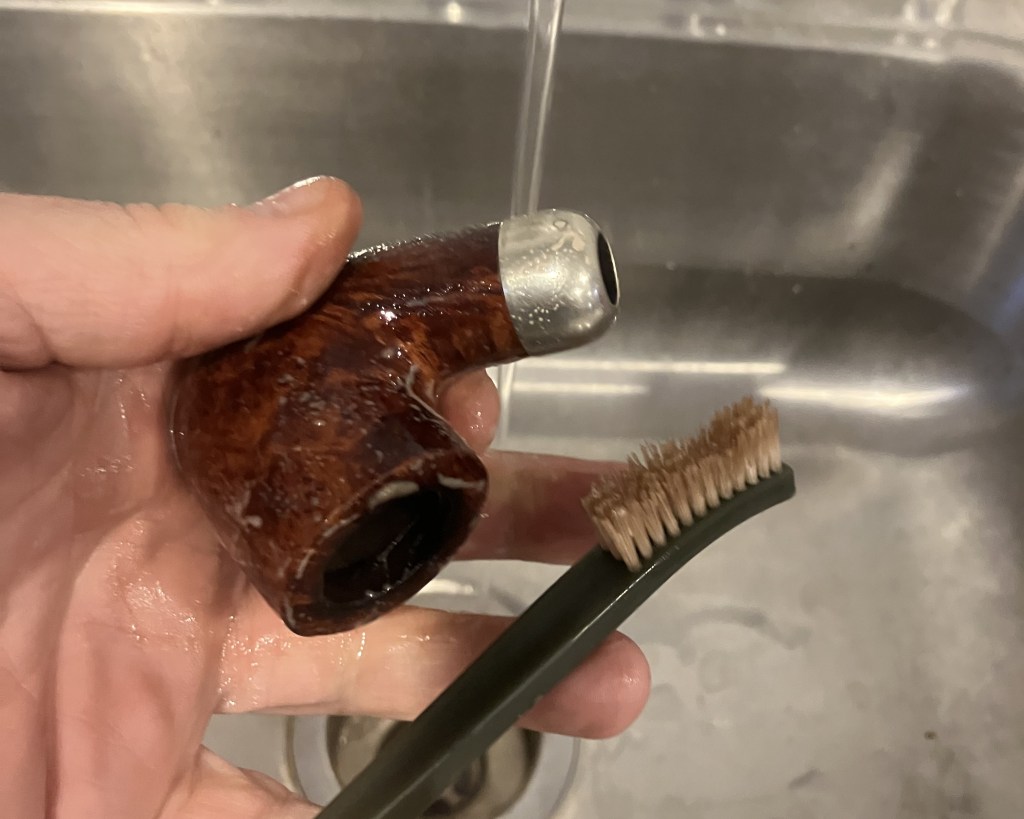
A second scrubbing with undiluted Murphy’s and the nylon brush were done and still more grime was removed. The stummel was rinsed and dried a second time. Notice the brush color in the two photos – it is the same brush.
Back at the workbench the stummel was looking clearer. I wiped it with a make-up pad dipped in 95% ethyl alcohol.
The glue on the shank end resisted the alcohol so a second make-up pad was wetted with acetone. The stummel was wiped and additional time spent on cleaning the shank end.
It was time to work on the shank, proper. “Yikes!”, came to mind after the first couple of cotton swabs dipped in alcohol. The shank was scraped with a dental scraper and scrubbed with more cotton swabs. I concluded with, “this shank is going to need a cotton and alcohol treatment” to help soften the smoking residues in there.
I switched gears and started to file the rim top to minimize the cut-off marks where the bowl top had been removed. A large and small file were used to accomplish this. I stopped at about where the below photo shows out of not wanting to remove any more bowl height.
To address the shank cracks, I knew I needed to drill holes at their terminal end to keep the cracks from progressing. I used a 2 mm drill bit for this.
Terminal hole one.
Terminal hole 2.
I needed a medicine cup to set the stummel on while the cotton alcohol treatment was doing its thing so, I removed the collar from its cup. The acetone had softened the remaining glue nicely.
The tobacco chamber, draft hole and shank were stuffed with cotton. I used a disposable pipette to add about 10 ml of 95% ethyl alcohol to the bowl and shank.
Alcohol was added until the cotton was saturated. The alcohol would evaporate overnight and hopefully pull a large amount of the smoking resiue with it depositing it into the cotton.
After about 4 hours the stem was removed from the Before and After deox and allowed to drip excess solution back into the jar.
I used a coarse shop rag to vigorously rub the stem, absorbing the remaining solution and removing some of the oxidized vulcanite.
At the workbench the stem was further scrubbed with several make-up pds sprinkled with Soft Scrub cleanser. The amount of oxidized material they were removing was amazing.
Even after all the scrubbing and cleanser, the stem looked as if little had been done to it. Back into deox. I left the stem in there overnight
The following day, I again removed the stem from deox. Back onto the coarse shop rag.
More vigorous rubbing produced a stained shop rag. Well the oxidized material is coming off, I thought.
At the workbench another round of Soft Scrub drizzled make-up pads did their thing and removed more of the oxidized vulcanite.
The cramping hands needed a break so I removed the cotton from the stummel. It came out stained with tar and yuck.
The cleaning of the shank went much better after the cotton and alcohol treatment.
It was time to reconstruct, fill the cracks and re-glue the collar. I opted to use JB Weld 2 part epoxy for this task. The epoxy was mixed according to product directions. The glue was applied to the crack filling them then additional glue spread around the shank end. The collar was slipped into position. Acetone dipped cotton swabs were used to wipe away any excess epoxy.
To keep the epoxy in the cracks I applied a thin coating of petroleum jelly to the tenon. This was inserted into the mortise and forced the epoxy to stay where I wanted it.
After about 30 minutes of curingI began to work on filling the flaws or pits on the stummel. Along the rim, I used brown cyanoacrylate (CA, super glue) to fill the shallow depressions. This was spritzed with a CA drying accelerator.
The pits on the stummel were deeper and required CA and briar dust. The CA was applied into the pit with a fly tying bodkin and briar dust was pressed into the wet CA. The fills were then filed with a small flat file then sanded with a 400 grit sanding sponge.
The stamps on both sides of the stummel were covered with masking tape to protect them from sanding. The stem and stummel were sanded with a sequence of sanding sponges from 400-3500. Between each sponge I wiped the stummel with a make-up pad dampened with alcohol. The stem was rubbed with mineral oil and wiped with a paper towel.
The stem and stummel were then worked with micro-mesh pads in grits of 4000-12000. Again the stummel was wiped with an alcohol wetted make-up pad between micro-mesh pads while the stem was rubbed with Obsidian Oil and wiped with a paper towel.
The stem was then polished with Before and After Fine and Extra Fine Polish on a soft cotton cloth.
The stummel was coated with Before and After Restoration Balm and allowed to sit overnight. This is longer than I would normally allow but it was time for bed.
The next day, the Restoration Balm was wiped from the stummel using an inside out athletic sock.
The pipe was taken to the buffer for several coats of carnauba wax.
After waxing the pipe was hand polished with a microfiber polishing cloth.
I still do not know what to think of this Peterson Dublin 3 3000. I Feel funny calling it a 3000 as that never appears to be something that Peterson made yet, here is it. It is not a System pipe though it’s shaped like one and has a P-lip yet, here it is. It is not intact, as it is missing what I think is about ¼ inch of top yet, here it is. It has a collar like nothing I’ve ever seen yet, here it is. I can say that it is a pretty little pipe and I much prefer the AB taper stem over the saddle. I guess I’ll just have to keep it and take it fishing once global warming eliminates the hard water situation brought on by winter.
The dimensions of the Peterson 3000 (?) are:
Length: 5.33 in./ 135.38 mm.
Weight: 1.10 oz./ 31.19 g.
Bowl Height: 1.43 in./ 36.32 mm.
Chamber Depth: 1.08 in./ 27.43 mm.
Chamber Diameter: 0.60 in./ 17.53 mm. (Conically bored diameter is at the top)
Outside Diameter: 1.32 in./ 33.53 mm.
I do hope that you have found something here useful to your own pipe care, maintenance or restorations. If you like this sort of thing, please click the like and subscribe buttons. Thank you for reading the ramblings of an old pipe lover.
Loading…
Below are some photos of the finished Peterson 3000 (if that is what it really is) pipe.
I was not really pleased with the level of polish on the collar so it went back under the buffer with some white jeweler’s rouge, which is really a silly name as it is white not rouge. Anyway here is what it looked like after the extra buffing:
This blog was originally posted on 12/01/2024 on Mark Irwin’s Peterson Pipe Notes 432. It is reposted here as part of my ongoing saga. It appears here with permission of the author, me. Also, this pipe is not available for sale.
There are a few searches that I run on eBay frequently and Peterson Dunmore pipes are one of them. When I first saw this rusticated rascal I thought about my budget and decided to give it a go. The recent prices for estate pipes have been volatile to say the least. I’ve watched auctions increase in price significantly over the past several years, sometimes going for far more than what I think something is worth and other times nowhere near the item’s value, in my mind. This one would have been a hard pass 3 years ago but with inflation it fell within acceptable limits. Besides, it was gorgeous. The auction was won and after a Midwest adventure from Deerfield, Illinois to the wilds of southeast Nebraska it was home. The pipe came with what I thought was the original box and ephemera. At least that what they looked like in the eBay listing:
The box looked correct in style for the early 1970s. Upon examination I saw the following:
Well, this sure as heck is not a 313 and it certainly is not smooth. I messaged the seller explaining my disappointment. They sounded sincere in their explanation that the pipe arrived to them in this box and that they did not intend to mislead. I call this a learning moment for myself and was reminded to avoid getting caught up in emotion. I nevertheless provided very objective and honest feedback on eBay regarding the seller’s inaccurate item description. Live and learn, I guess.
Below are some photos of the pipe prior to doing any work on it. I also photographed the pamphlet and pipe sock and include those below as well.
Background
On June 25, 2024 I posted a blog about the restoration of a Peterson Dunmore 606. Being a proud Generation X member, also known as a total slacker, I will include the background from that post in its near entirety (Original post: Peterson Dunmore 606 Pot).
“As much as I love the history of the Kapp and Peterson company and Peterson pipes, I will not get into that other than give you resources to read the history for yourself. I will delve into the Dunmore, or Dunmoor line of pipes at greater depth.
For a great history Mark Irwin and Gary Marlburg’s book is a must read for a Pete Geek.
Now to the stuff regarding this pipe: A Peterson Dunmore. I refer to Mark Irwin again here and his blog, Peterson Pipe Notes. I can wholeheartedly recommend the free at
I will include the text here in its entirety but recommend the link for the photos. This is used with permission of the author (thank you Mark).
“226. Documenting the Dunmore System and Classic Lines
Milos “Mike” Bera at PipesPens&More.com on eBay recently wrote me to say that he’d run across two examples of a Peterson Dunmore Classic line he’d never seen before—a higher-grade line with a briar-in-brass sandwich band. As I thought they were not only gorgeous but undocumented, the time seemed right to take a look back at the history of the Dunmore System and Classic lines.
I’ve been a fan of the Dunmore lines since I first saw them through the case back in the late 1980s and had to have one, a fat-bottom 72 (the 302 equivalent). Like everyone else, I thought there was some kind of mistake—“Where’s the nickel mount?” I remember asking. But the Dunmore System set out to be something a little different, yet within the classic Kapp & Peterson house style.
The line originated in collaboration with Iwan Reis in 1971. How it came about is anyone’s guess at this point. Chuck Levi, the man who more than any other was responsible for bringing the great Danish artisan pipes to the US, was working with the creative minds at K&P to bring something new to the IRC catalog, and this was one of about a dozen K&P lines that debuted as exclusives in the Iwan Reis catalogs of that era.
The concept was to modernize the System pipe by removing what was perceived as the old-fashioned nickel mount. And old-fashioned it was—if you look at pipe catalogs from the 1940s on through most of the rest of the 20th century, nickel ferrules and even bands were almost non-existent. K&P was virtually the only hold out, using sterling bands on the Sterling Silver Classic line and on the Premier & De Luxe Systems. A bead was then carved around the stummel at the mortise end. As you can see from the IRC detail, sometimes the contrast stain made the beads stand out, and sometimes not.
But there were two more ingredients to the original Dunmore aesthetic which can be seen the photo below. Paddy Larrigan, K&P’s master-craftsman, was always striving to push the envelope in pipe engineering, and one of the things he dearly loved was a pipe that would sit, so he shaved off the bottom of the shank to allow the Dunmore System to sit on its shank and button, which gives it its uniqueness in the catalog. The downside of this is that I am not convinced that all the Dunmore reservoirs, being slightly smaller than the traditional System, are quite as effective.
The third distinguishing mark of the original Dunmore lines is the stem. Both the System and Classic versions utilized the wide-shoulder “Comfort Lip,” with a painted gold P on the stem. This doubtless helps the System sit as well as giving it a more muscular visual balance, strength being a long-standing concept in the design language of the company. While it gives the illusion of being an army “push” mount, of course it isn’t, but is a traditional tenon-mortise or “navy mount” as the old hands at K&P used to call it.
The 1971 IRC catalog description reads, “dunmoor briar IRC ’71 modern system without sterling band, natural $12.00.” This intentional misspelling of “Dunmore” would persist through subsequent IRC catalogs, the copy-writer evidently under the spell of e.e. cummings and favoring an English flavor to his pipes. The name, like almost all K&P line names, is taken from the Irish landscape, in this case the town in County Galway famous for Dunmore Castle.
The 1975 Orange Catalog shows the initial Dunmore System release was in only seven shapes:
This was later expanded to include both the original bent dublin shape 5 (75) and XL5 (XL75) and the replacement calabash shape 5 and XL5. The remaining “new” System shapes were also added to the Dunmore lineup, the 01 becoming the Dunmore 73, the 02 the 70 and the 03 the 76. The fact that the 304 and 306 “setters” introduced in 1984 never entered the Dunmore System lineup adds the probability that the line had been discontinued by then.
The smooth Dunmore System features a light brown natural finish, sometimes occurring with broad flames, as can be seen in these photos of an unsmoked 77 System:
The rusticated version of the Dunmore System seems to have been finished in at least two techniques or versions. Neither is as deep as the Pebble Rustic finish but they still feel very therapeutic under thumb and finger.
Even when we were beginning our research on the Peterson book (due out in reprint later this year), most Pete fans had no idea there was also a Dunmore Classics line featuring the same beading at the mortise and wide Comfort Lip mouthpiece. Documentary proof was found in the rare 1978-79 Peterson-Glass catalog:
The Dunmore System and Classic Lines from the 1978-79 Peterson-Glass Catalog
I don’t know whether the Dunmore Classics was a short-lived line or whether it was primarily available in Europe, but it almost never appears on the estate market here in the US. As you can see from the catalog and the 406 pictured above, the same aesthetic was followed for the Classic line—light brown, nearly natural, higher-quality smooth bowl (or dark rustic) and faux army mount with gold-painted P, wide saddle and P-Lip stem. Only the Dunmore System, as far as I have been able to document, had the flattened stummel allowing it to set.
I have always hoped to run across an unsmoked rustic Dunmore System with the dark contrast stains seen in the Peterson-Glass catalog. I wonder if this finish actually went into production, because the ones I’ve seen all look more-or-less like the XL75 shown above.
The original Dunmore lines seemed to have been dropped at about the time the company went through its worst redundancy in 1984, as there are no more traces of it in the company’s ephemera from 1983 on. I remember the proprietor of my B&M, Cavalier Pipe & Tobacco in Barracks Road Shopping Center in Charlottesville, telling me when I bought my shape 73 Dunmore that the line was out of production, so I’d better get it if I wanted it (don’t you miss high-pressure salesmen?)—and that would have been 1986 or ’87.
The second iteration of the Dunmore Classics line is that recently discovered by Mike at PipesPens&More on eBay. I would tentatively date it to c. 1995, well after K&P had gotten on its feet again and was doing some new and fascinating things. It seems to belong with three other briar adornment lines from the same period: Paddy Larrigan’s Briar in a Circle Systems and the Galway and Kapp-Royal higher-grade lines with their wonderful inset briar rings.
Mike’s Dunmore Classics line is certainly on a par, from the two examples he’s found, with the Galway and Kapp Royal briars and maybe better, although probably not as fine as the Briar in a Circle Systems. Take a closer look at this 80S, which Mike sold within 24 hours of posting it on eBay:
The last Dunmore Classics line made a brief appearance in the Dublin era’s second decade, somewhere in the 2000s, probably around 2005 or so. Jim Lilley’s old blog site made a reference to them, and I remember seeing them for sale at internet shops.
I know it appeared well before I got interested in writing the Peterson book, because I don’t have any internet images of it in my files. These photos of the B5 and B11 give a good idea of what the line was like, although it appears to have begun in a higher range and then slipped to a lower.
Updated Identification Guide
Dunmore (1971–c. 1984; c. 1995; 2006–2010) Appeared in 1971 as Iwan Reis & Co. exclusive line “Dunmoor,” Premier-grade unmounted System in smooth natural or rustic dark chocolate contrast in all shapes, with beading at the shank, faux wide-saddle P-Lip with gold paint P. Documented in Associated Imports catalog from 1973. Classic Range line from 1978 with same faux army mount and finishes. Second scarce Classic Range line, c. 1990, higher-grade smooth bowl with brass sandwich and briar band, P-Lip. A third Classic Range line, 2006–2010, mid-grade, featured standard and some B shapes, with beading around bowl instead of shank-face, for European market.
From the above documentation I think that I can safely assume that this Dunsmore 79 is of the original 1971-1978 time period.
Interesting side note here: In the above Mark Irwin says, “I have always hoped to run across an unsmoked rustic Dunmore System with the dark contrast stains seen in the Peterson-Glass catalog. I wonder if this finish actually went into production, because the ones I’ve seen all look more-or-less like the XL75 shown above.“ I emailed Mark and asked him if the Dunmore 79 in hand was what he was looking for. I included some of the before and after photos from this restoration. He replied, “Yup, that’s it!!” (Mark Irwin, personal email).
The Restoration
As boringly typical of my restorations, I began with a clean denim piece to protect the work surface. Yeah, I know, the term “clean” doesn’t really describe the stained denim.
The new to me PipNet came out and I had high hopes that it would be useful. The standard ream team consisting of the Smoking pipes Low Country reamer, General triangular scraper and 220 sandpaper wrapped wood dowel were along for clean-up duties. Low and behold the Dunmore 79 had precisely the wrong size bowl for either the #1 or #2 PipNet blades.
With the #1 blades too small and the #2 blades too large, plan B was put in motion. The adjustable Kleen-Reem tool was called in to remove the minimal cake in the tobacco chamber. The other two reamers were used then the chamber was sanded with the 220 on a stick. Once down to the bare briar I could see that there was no damage to the briar and that this pipe looked like it had only been smoked a hand-full of times.
Next was the cleaning of the shank. Typically with Peterson System pipes this can be a chore. Owners frequently fail to clean out the reservoir after a smoke which creates rather difficult tar deposits. This pipe’s tar was quickly removed and revealed the stain used at the Peterson factory. A surprisingly reddish-pink stain at that.
The stummel was taken to the sink for a scrub. Murphy Oil Soap and a nylon scrub brush were used to remove the age and grime from the stummel. Once scrubbed the soap was rinsed with warm water and the stummel dried with a cotton hand towel.
Back at the workbench the stummel received a wiping with a make-up pad dipped in 95% ethyl alcohol. The alcohol removed a bit more of the reddish-pink stain
The stem was the next victim of my cleaning activities. I used both bristle and fluffy pipe cleaners dipped in 95% ethyl alcohol to remove the slight smoking residue in the airway.
The stummel was given a coat of Before and After Restoration Balm and allowed to sit for about 30 minutes.
During this time I taped over the stem logo with a piece of Scotch tape. The stem was in very good condition and did not have a heavy layer of oxidation. There were some tooth marks near the button and those were filed and sanded with 320 then 400 grit sanding sponges.
The stummel was wiped with an inside out athletic sock to remove the excess Restoration Balm.
At this stage I couldn’t help but admire the beauty of the rustication and contrast staining of the Peterson workmen. I wondered if Paddy Larrigan himself had a hand in the crafting of this piece.
The stem was sanded with a series of sanding sponges in grits of 320-3500. Between each sponge I rubbed the stem with mineral oil and wiped it with a paper towel to remove sanding debris.
I then taped the shank with painters tape to protect it from the buffing I was about to do. The stem was mounted to the stummel as a handle and buffed with Red Rouge compound (I remain confused as to why the product had both “Red” and “Rouge” on the label).
The stem was then worked with micro-mesh pads in grits of 3600-12000. Between each of the pads I rubbed the stem with Obsidian Oil and wiped it with a paper towel.
The stem was polished with both Before and After Fine Polish and Extra Fine Polish. These polishes were applied with a fingertip and hand buffed with a soft cotton rag.
The next step in the stem restoration was to pick out the old gold paint and to re-do the logo with Rub’nBuff Gold Leaf. The old gold was picked out using a fly tying bodkin then scrubbed with 95% ethyl alcohol on a cotton swab.
The new gold leaf was applied with the tip of the bodkin and allowed to dry.
The excess gold was scraped from the logo with my fingernail and hand buffed with a paper towel. I applied two coats. The photo below is after the first but before the second.
The stummel was given a coating of Renaissance Micro-Crystalline Wax applied with a baby toothbrush. This was allowed to dry for a few minutes then hand buffed with a clean cotton terry cloth towel.
The stem returned to the buffer for several coats of carnauba wax.
The final stem was to hand buff the pipe with a microfiber polishing cloth.
This Peterson Dunmore System 79 Rustic has returned to the world in all of it’s original glory. The 309 shape, 79 in the Dunmore line, is a favorite of mine and I can’t help wondering why it was ever discontinued. The contrast stain on this pipe is lovely with the reddish highlights and the dark brown-black in the rustications. The stem polished up very nicely and contrasted the smooth shank-end briar in a unique and subtle way. The flat heel of the pipe does provide it with a “sitting” platform though not a terribly stable one. Fortunately Nebraska is not prone to earthquakes and I no longer have any little ones in the house to provide anthropogenic tremors. The dimensions of the Dunmore 79 are:
Length: 6.31 in./ 160.27 mm.
Weight: 1.80 oz./ 51.03 g.
Bowl Height: 2.09 in./ 53.09 mm.
Chamber Depth: 1.62 in./ 41.15 mm.
Chamber Diameter: 0.76 in./19.30 mm.
Outside Diameter: 1.26 in./ 32.00 mm.
I do hope that you have found something here useful to your own pipe care, maintenance or restorations. If you like this sort of thing, please click the like and subscribe buttons. Thank you for reading the ramblings of an old pipe lover.
Loading…
Below are some photos of the finished Peterson Dunmore System 79 Rustic.
Being asked to restore a family heirloom is a flattering and frightening request. Flattered because the owner of the piece thinks highly of your ability to restore the item yet frightening because ethos is a one of a kind item that carries significant personal meaning. In this case personal and historical family meaning as well.
Background
Earlier this month I was contacted via email by a gentleman who had seen a link to my blog on Mark Irwin’s Peterson Pipe Notes. Below is an excerpt from an early email:
“I’m wondering if you do restoration work for others as well as for yourself?
I have an old Peterson System pipe that had belonged to my father’s Uncle, Richard McNamara. He would have bought the pipe while stationed in Northern Ireland as a technician with Lockheed Aircraft. He died unexpectedly in 1943 while still in Northern Ireland.
I intend to pass the pipe along to my nephew. I had sent it to Peterson’s for their assessment to date it and to clean it up a bit. I received a nice note from Glen Whelan, who set the pipe in the 1930’s/1940’s.
So, if you do restorations of this sort, I be happy to have you restore this pipe.”
I asked if it was possible to see some photos of the pipe in question to assess what I would recommend for the restoration. The following five photos were sent by the owner.
The pipe looked to be in very good condition. I replied,
“That is a beauty. I am assuming the Peterson boys told you that the pipe was probably from 1937-1945ish. That would be my guess anyway. Here is what I see that you may want to have restored:
The stem – Looks great. There are some very small scratches around the ferrule. Micro-meshing and a white diamond buff should make it like new.
The Cap – I saw a couple of small dents. The cap can be removed and the dents pressed/tapped out. Then polished and reglued into the original position.
The Stummel – The dings from contact with a rough surface can be 1) filled with cyanoacrylate and briar dust. This will smooth them but will also make for dark spots where each dent is. Or, 2) The dents can be steamed to see if the briar can rebound back. This may lessen the dent but probably not remove it.
The Internals – a general cleaning and yuck removal. “Yuck” is a highly technical restoration term referring to smoking residue. When in abundance, it can be called “yucky”.”
The owner replied,
“Thanks, it is a nice pipe with a special heritage.
All I got from Peterson’s was that it was from the 1930/40’s. But from further investigation I have learned that the 1937-1945 span is correct. Now, I’m assuming that my Uncle bought the pipe new as he was in Northern Ireland from about 1939 to 1943. I have photos of his travels to Dublin, so I’ll further my assumption that he bought it from Peterson’s.
Anyway, i agree with your suggestions about the stem and cap. I saw some crud around the button and the dents on the cap. As for the Stummel, I think I’d just as soon leave the dents as they are. After all, as far as I am aware, only my uncle Richard and I have used the pipe in it’s 80ish years, so, in my mind, it adds a touch of being authentic with continuity. The internals will need a cleaning. I don’t have the pipe in front of me now, it’s packed away in my pipe bin in our RV basement. I’ll pull it out in a day or two and check the bowl etc., but I don’t think it’s too bad.”
We agreed on the work to be done and arranged for shipping. A few days later the pipe arrived and was photographed prior to any work.
Though there was no sign of a shape number stamp, I think this is a 307 shape.
“The 307 is an original Patent bent billiard-shape, shown in the 1896 catalog as shape 9. It has retained its original shape number in the De Luxe version, but was issued in the 1937 catalog as the 307 (2nd quality) / 357 (3rd quality). Since then, it has also appeared as the 9S and 9B (De Luxe), Dunmore System 78 (1978-1983), and the Classic Range 9BC (1940s-1950s) / XL90 (1980s-Present). The 9B dating from the 1940s-1960s (the De Luxe System with a tapered rather than saddle bit) is rarely seen on the estate market. There have been changes in the shape since the 1960s, all toward less “cheeking,” making earlier versions, when available, preferable to those wishing to get back to the first, classic iteration of the shape.” (https://petersonpipenotes.org/146-a-guide-to-system-shapes-1896-2019-part-1-the-300-shape-group/). The 1937 issue of the SYSTEM 2 coincides precisely with the provenance of the pipe.
When I first received the pipe I thought that something had gone wrong like the wrong pipe was shipped. There were no dents on the left side of the stummel. Adding further to my confusion, which is pretty easy to do by the way, was the stem. A Peterson System 2 should have a bone tenon extension or “chimney”, as the Peterson factory folks call them. This tenon was smooth, without threads, and looked to be about 9mm. A closer examination of the pipe and comparison to the photos indicated that it was the same pipe pipe from the initial photos based on briar grain patterns. I could make out well done fills where the dents were supposed to be and there were slight bumps in a newly acquired finish. The finish looked like a lacquer and stain combo which had been sprayed on or maybe a lacquer sprayed onto a still damp stain. It also looked like the stem had received some of the lacquer then had been buffed with carnauba wax.
I emailed the owner with my questions. While awaiting a response I began working on the pipe.
The Restoration
As usual the pipe was taken to the workbench where it was placed on a relatively clean denim piece.
Next the tobacco chamber was reamed using the PipNet and #2 blades. The General triangular scraper and Smokingpipes Low Country Reamers also saw limited action. The chamber was then sanded with 220 sandpaper wrapped around a wood dowel. The sanding resulted in seeing the condition of the briar within the chamber which showed no signs of any damage from excessive heating or charring.
The stummel was then taken to the sink for a scrubbing with Murphy Oil Soap with a nylon scrub brush. The soap was rinsed with warm water and the stummel dried with a cotton hand towel.
Back at the workbench the stummel was wiped with a make-up pad dipped in 95% ethyl alcohol. This removed a good deal of color. Apparently the pipe had received a clear coat of some kind and a recent dye or stain. I could not believe that this was the original stain from the 1930’s or early 1940.
The stem was cleaned out with bristle pipe cleaners and ethyl alcohol and showed that the pipe was being well cared for and cleaned after use.
Oxidation, however, does not care how well a pipe is cared for and attacks at every chance it gets. This stem showed signs of oxidation though not very severe. I decided to remove the oxidation with Before and After Extra Strength Deoxidizer. The stem had a pipe cleaner inserted into the mouthpiece to act as a hanger and entered the deoxidizer solution.
During the reaming, I noticed an off smell from the removed cake. It was not a foul smell, just a slightly sour hint. I decided to give the stummel an alcohol treatment to remove any traces of old smoking and tobacco residue. I packed the tobacco chamber and shank with cotton and filled the respective volumes with 95% ethyl alcohol. The stummel was propped up to allow the alcohol levels to remain level while filled.
The below photo is after two hours of the alcohol treatment. The shank was discoloring far more than the tobacco chamber.
During this waiting time I was able to check emails. Yeah I know, a phone can be used to check emails but I’m old and stubborn. Phones are for calling, texting and photos. Typing is done on a computer. Anyway, the owner had gotten back to me regarding my questions about the condition of the pipe. He had said that he had sent the pipe to Peterson in Dublin.
“Perhaps the boys at Peterson’s did more than I realized. Good on them.”
“I just checked the box in which the pipe was returned from Peterson’s and the extra stem they sent does not match the curvature of the stem in my pictures. So, the stem you have is likely the original.
As for the 9mm part, perhaps that allowed for a bone extension rather a filter, but it’s just a guess.”
The timeline was making sense to my old brain now:
1) Original photos were taken.
2) The pipe was sent to Peterson’s in Dublin. While there the stummel fills were done and a new finish was applied.
3)The pipe was sent to me.
The tenon still was giving me confusion. There were no threads for a bone extension. I knew that Peterson did have a line of Filter pipes which were described in the 1947 catalog but this pipe pre-dated that by several years. I emailed the owner that I’d like to reachout to Mark Irwin for his thoughts. The owner agreed.
Below is the correspondence between me and Mark Irwin:
Subject: Hate to bother you
Hi Mark,
You know those four words in the subject line are going to be followed by “but…” right?
I got a commission to restore an old Pete for a gentleman whose granduncle picked it up while stationed in northern Ireland around 1940, just prior to his unexpected passing in 1943. I figured the pipe was from 1937-1945. My question is why in the world does it have what appears to be a 9mm (though it is smaller than 9mm) filter type stem? There are no threads for a bone tenon. Any idea or just rack it up to “it’s probably a replacement stem”.
“Hey John,
My best guess is that this pipe was drilled for a “Good Health” K&P 6mm filter. You can see a photo of the filter box in the identification guide at the back of the big Pete book, as these still sometimes appear on eBay. Try measuring it with your micrometer and seeing if you think a 6mm would fit!” (Mark Irwin, personal email)
Another potential piece of the puzzle – The stem appeared to have been drilled for one of the early GOOD HEALTH stems. Since it was already a Peterson System 2, today’s equivalent of a “Deluxe”, it was also not stamped as a GOOD HEALTH though it did receive a GOOD HEALTH stem. I notified the owner and he was pleased with the new information.
Time to get back to work. After 3 hours the stem was removed from deox. That is my term for the Before and After Extra Strength Deoxidizing solution. Kind of a play on the idea of detoxification or detox used for drug and alcohol abuse patients in rehab. The stem was hung by its pipe cleaner on a tall bottle and allowed to drip excess solution back into the jar.
After dripping, I hand buffed the stem with a coarse shop rag. The coarse material both absorbs the excess solution and helps abbrade some of the oxidized rubber from the stem.
The next step was to scrub the stem with Soft Scrub applied to make-up pads. This mild abrasive cleanser further removes oxidized surface material from the stem.
After the Soft Scrub scrub, that’s just fun to say, the stem was worked with a series of sanding sponges from 400-3500 grits. Between each sponge I rubbed the stem with mineral oils and wiped it with a clean dry paper towel.
The sanding was followed by micro-meshing with pads 4000-12000. Between each of the pads the stem was rubbed with Obsidian Oil and wiped with a paper towel.
At this point the stummel was still having the yuck removed the the ethyl alcohol as it slowly evaporated pulling the yuck from the briar and depositing it in the cotton. That continued overnight. In the morning I removed the cotton. It had done a fine job at removing any trace of smell from the tobacco chamber, reservoir and shank.
The stummel was then worked with micro-mesh pads from 2400-12000. The 2400 pad removed the finish which can be seen wiped onto the denim and on the two alcohol dampened make-up pads in the photo below. Between each pad the stummel was wiped with a make-up pad for removing debris from the micro-meshing.
After the micro-meshing the stummel received a coat of Before and After Restoration Balm and was allowed to sit for 20 minutes.
After 20 minutes the balm was wiped from the stummel using an inside out athletic sock.
The briar of the shank was covered with painters tape to protect the wood and the silver ferrule was lightly polished with the micro-mesh pads. After the peds I polished the silver with Before and After Fine and Extra Fine Polish. I failed to photograph the earlier steps of this process but did capture the final step.
The stem and stummel were taken to the buffer where they were buffed with Blue Diamond Polishing compound on a flannel wheel. Reunited with the stummel, both then received several coats of carnauba wax. The pipe was finally hand buffed with a microfiber polishing cloth to further raise the shine.
I can’t say what my favorite part of this restoration was. The pipe was a beautiful example of Irish craftsmanship by Peterson. The family history and the story of the great uncle were the things that I always wish I could know about these old pipes. The mysterious details of the pipe stem and the path that the pipe took, both geographically and through time, to get to me were a fun exploration. The happiness and gratitude of the owner upon receiving the restored piped was also fulfilling. Being honored and trusted to work on a family heirloom is daunting but exciting. All of these were part of this restoration and all of them were unique and unforgettable. The pipe turned out beautifully. I don’t mean to speak disparagingly about the clean-up that the Peterson crew did. Their fills were impressive but a custom hand polishing and finish is something that a manufacturing shop cannot take the time to do. I failed to mention in the above blog that I could not remove the silver ferrule. I tried seeping both ethyl alcohol and acetone into the glue to loosen it. I tried heating with a heat gun and even speaking softly and gently but I could not get the silver to budge. In the end I emailed the owner and admitted failure. He was understanding and we both agreed that the dents added to the history of the pipe.
I do hope that you have found something here useful to your own pipe care, maintenance or restorations. If you like this sort of thing, please click the like and subscribe buttons. Thank you for reading the ramblings of an old pipe lover.
Below are some photos of the finished Peterson System 2.
My Peterson Pipe Acquisition Disorder (PPAD) has come out of remittance and I have experienced an attack. Then again it was fully expected. I can’t run around with a name like NebraskaPeteGeek and not have full blown PPAD at least semiannually. The lovely 606 in the photo above did not arrive like that. It was spotted at an auction on eBay a couple of weeks ago. I couldn’t believe my eyes at first. A Peterson Dunmore with a shape other than the 300 System shape was very interesting. I’ll get more into that in the “Background” below.
This pipe has Peterson’s over “DUNMORE” on the left, the Peterson P on the stem and MADE IN THE over REPUBLIC over OF IRELAND and 606 on the right. There is also a beaded edge at the shank end, a characteristic of the Dunmore line. When the pipe arrived it appeared in the photos below.
Background
As much as I love the history of the Kapp and Peterson company and Peterson pipes, I will not get into that other than give you resources to read the history for yourself. I will delve into the Dunmore, or Dunmoor line of pipes at greater depth.
For a great history Mark Irwin and Gary Marlburg’s book is a must read for a Pete Geek.
Now to the stuff regarding this pipe: A Peterson Dunmore. I refer to Mark Irwin again here and his blog, Peterson Pipe Notes. I can wholeheartedly recommend the free at
I will include the text here in it’s entirety but recommend the link for the photos. This is used with permission of the author (thank you Mark).
“226. Documenting the Dunmore System and Classic Lines
Milos “Mike” Bera at PipesPens&More.com on eBay recently wrote me to say that he’d run across two examples of a Peterson Dunmore Classic line he’d never seen before—a higher-grade line with a briar-in-brass sandwich band. As I thought they were not only gorgeous but undocumented, the time seemed right to take a look back at the history of the Dunmore System and Classic lines.
I’ve been a fan of the Dunmore lines since I first saw them through the case back in the late 1980s and had to have one, a fat-bottom 72 (the 302 equivalent). Like everyone else, I thought there was some kind of mistake—“Where’s the nickel mount?” I remember asking. But the Dunmore System set out to be something a little different, yet within the classic Kapp & Peterson house style.
The line originated in collaboration with Iwan Reis in 1971. How it came about is anyone’s guess at this point. Chuck Levi, the man who more than any other was responsible for bringing the great Danish artisan pipes to the US, was working with the creative minds at K&P to bring something new to the IRC catalog, and this was one of about a dozen K&P lines that debuted as exclusives in the Iwan Reis catalogs of that era.
The concept was to modernize the System pipe by removing what was perceived as the old-fashioned nickel mount. And old-fashioned it was—if you look at pipe catalogs from the 1940s on through most of the rest of the 20th century, nickel ferrules and even bands were almost non-existent. K&P was virtually the only hold out, using sterling bands on the Sterling Silver Classic line and on the Premier & De Luxe Systems. A bead was then carved around the stummel at the mortise end. As you can see from the IRC detail, sometimes the contrast stain made the beads stand out, and sometimes not.
But there were two more ingredients to the original Dunmore aesthetic which can be seen the photo below. Paddy Larrigan, K&P’s master-craftsman, was always striving to push the envelope in pipe engineering, and one of the things he dearly loved was a pipe that would sit, so he shaved off the bottom of the shank to allow the Dunmore System to sit on its shank and button, which gives it its uniqueness in the catalog. The downside of this is that I am not convinced that all the Dunmore reservoirs, being slightly smaller than the traditional System, are quite as effective.
The third distinguishing mark of the original Dunmore lines is the stem. Both the System and Classic versions utilized the wide-shoulder “Comfort Lip,” with a painted gold P on the stem. This doubtless helps the System sit as well as giving it a more muscular visual balance, strength being a long-standing concept in the design language of the company. While it gives the illusion of being an army “push” mount, of course it isn’t, but is a traditional tenon-mortise or “navy mount” as the old hands at K&P used to call it.
The 1971 IRC catalog description reads, “dunmoor briar IRC ’71 modern system without sterling band, natural $12.00.” This intentional misspelling of “Dunmore” would persist through subsequent IRC catalogs, the copy-writer evidently under the spell of e.e. cummings and favoring an English flavor to his pipes. The name, like almost all K&P line names, is taken from the Irish landscape, in this case the town in County Galway famous for Dunmore Castle.
The 1975 Orange Catalog shows the initial Dunmore System release was in only seven shapes:
This was later expanded to include both the original bent dublin shape 5 (75) and XL5 (XL75) and the replacement calabash shape 5 and XL5. The remaining “new” System shapes were also added to the Dunmore lineup, the 01 becoming the Dunmore 73, the 02 the 70 and the 03 the 76. The fact that the 304 and 306 “setters” introduced in 1984 never entered the Dunmore System lineup adds the probability that the line had been discontinued by then.
The smooth Dunmore System features a light brown natural finish, sometimes occurring with broad flames, as can be seen in these photos of an unsmoked 77 System:
The rusticated version of the Dunmore System seems to have been finished in at least two techniques or versions. Neither is as deep as the Pebble Rustic finish but they still feel very therapeutic under thumb and finger.
Even when we were beginning our research on the Peterson book (due out in reprint later this year), most Pete fans had no idea there was also a Dunmore Classics line featuring the same beading at the mortise and wide Comfort Lip mouthpiece. Documentary proof was found in the rare 1978-79 Peterson-Glass catalog:
The Dunmore System and Classic Lines from the 1978-79 Peterson-Glass Catalog
I don’t know whether the Dunmore Classics was a short-lived line or whether it was primarily available in Europe, but it almost never appears on the estate market here in the US. As you can see from the catalog and the 406 pictured above, the same aesthetic was followed for the Classic line—light brown, nearly natural, higher-quality smooth bowl (or dark rustic) and faux army mount with gold-painted P, wide saddle and P-Lip stem. Only the Dunmore System, as far as I have been able to document, had the flattened stummel allowing it to set.
I have always hoped to run across an unsmoked rustic Dunmore System with the dark contrast stains seen in the Peterson-Glass catalog. I wonder if this finish actually went into production, because the ones I’ve seen all look more-or-less like the XL75 shown above.
The original Dunmore lines seemed to have been dropped at about the time the company went through its worst redundancy in 1984, as there are no more traces of it in the company’s ephemera from 1983 on. I remember the proprietor of my B&M, Cavalier Pipe & Tobacco in Barracks Road Shopping Center in Charlottesville, telling me when I bought my shape 73 Dunmore that the line was out of production, so I’d better get it if I wanted it (don’t you miss high-pressure salesmen?)—and that would have been 1986 or ’87.
The second iteration of the Dunmore Classics line is that recently discovered by Mike at PipesPens&More on eBay. I would tentatively date it to c. 1995, well after K&P had gotten on its feet again and was doing some new and fascinating things. It seems to belong with three other briar adornment lines from the same period: Paddy Larrigan’s Briar in a Circle Systems and the Galway and Kapp-Royal higher-grade lines with their wonderful inset briar rings.
Mike’s Dunmore Classics line is certainly on a par, from the two examples he’s found, with the Galway and Kapp Royal briars and maybe better, although probably not as fine as the Briar in a Circle Systems. Take a closer look at this 80S, which Mike sold within 24 hours of posting it on eBay:
The last Dunmore Classics line made a brief appearance in the Dublin era’s second decade, somewhere in the 2000s, probably around 2005 or so. Jim Lilley’s old blog site made a reference to them, and I remember seeing them for sale at internet shops.
I know it appeared well before I got interested in writing the Peterson book, because I don’t have any internet images of it in my files. These photos of the B5 and B11 give a good idea of what the line was like, although it appears to have begun in a higher range and then slipped to a lower.
Updated Identification Guide
Dunmore (1971–c. 1984; c. 1995; 2006–2010) Appeared in 1971 as Iwan Reis & Co. exclusive line “Dunmoor,” Premier-grade unmounted System in smooth natural or rustic dark chocolate contrast in all shapes, with beading at the shank, faux wide-saddle P-Lip with gold paint P. Documented in Associated Imports catalog from 1973. Classic Range line from 1978 with same faux army mount and finishes. Second scarce Classic Range line, c. 1990, higher-grade smooth bowl with brass sandwich and briar band, P-Lip. A third Classic Range line, 2006–2010, mid-grade, featured standard and some B shapes, with beading around bowl instead of shank-face, for European market.
With that information at hand I can date this Peterson Dunmore with a good deal of certainty. The 606 shape is of the “Classic Range line” thus from 1978-1984. A mere 6 year window.
The Restoration
There is a clean denim piece for a work surface so, it must be time to start another project.
The stem was the part of this that needed the most attention and it went into the OxyClean solution first.
The reaming tools were gathered. The PipNet with its #2 and #3 blades for this nice wide chamber would see some action.
The reaming started easy with the PipNet and the #2 blades. The the #3 blades were a tight fit and required some scraping with both scrapers to allow it access to the tobacco chamber. Eventually the chamber was reamed and sanded with 220 sandpaper wrapped around a wood dowel. I finish sanded with 320 sandpaper and my finger. The chamber looked great with no signs of any damage.
The chamber may look good but the rim was lava encrusted.
Saliva and a sharp knife were used to scrape the rim.
The stummel then made its way to the sink for a scrub with undiluted Murphy Oil Soap and a medium bristle toothbrush. The soap was rinsed with warm water and the stummel dried with a cotton hand towel.
Returning to the workbench the stummel looked much better.
A quick wipe with a make-up pad dipped in 95% ethyl alcohol to make sure there was no remaining wax or finish remaining was done. This produced some color on the pad but I think it was just dirty old wax and maybe a bit of stain.
I did see a few pits that would require filling with cyanoacrylate (CA, super glue) and briar dust.
I turned my attention to cleaning out the airway within the shank. I used a couple of alcohol soaked cotton swabs to soften the old smoking residues in the airway. I then poured 3-4 ml of 95% ethyl alcohol into the bowl and allowed it to flow into but not through the shank. I used a nylon shank brush to scrub the airway with the alcohol. The alcohol was poured into a medicine cup to assess the dirtiness of the airway. Not bad but still quite a bit of cleaning and repealed alcohol scrubs. Oh yeah, folded bristle pipe cleaners were also used to scrub with. Numerous more cotton swabs, folded pipe cleaners and a few ml of ethyl alcohol later the shank was clean.
The stem came out of the Oxy bath and was vigorously wiped with a dry make-up pad. The pad was heavily stained with oxidized rubber.
Several more make-up pads with SoftScrub were used to try to remove the stubborn oxidation. Adjectives other than “stubborn” may have been uttered during this process.
I oiled the stem and left it for 24 hours. The next day I returned and used SoftScrub again to remove the oil. Well, more than oil came off.
Back into the Oxy bath went the stem. It was there for another hour.
I turned my attention to filling the pits. A small drop of brown CA was applied to the pit and a small scoop of briar dust was then placed onto the wet CA and pressed into the pit. The excess briar dust was brushed off with a bristle pipe cleaner. This was repeated for each of the fills. The CA and briar dust set-up very quickly and were filed with a flat needle file then sanded with a 400 grit sanding sponge.
The stummel was then sanded with a series of sanding sponges from 600-3500 grit, in sequence. Between each sponge the stummel was wiped with an alcohol moistened make-up pad.
The stummel was then worked with a series of micro-mesh pads 4000-12000 grit. Between each pad the stummel was wiped with a make-up pad dipped in alcohol.
The stummel then was coated with Before and After Restoration Balm and allowed to sit for 30 minutes.
The stem was retrieved from the Oxy bath for the second time. And wiped with a dry make-up pad. This time much less oxidized rubber came off of the stem.
The stem was sanded with a series of sanding sponges from 600-3500. Between sponges I would rub a small drop of mineral oil onto the stem and wipe it with a paper towel. This was followed by the micro-mesh pads 4000-12000. Between the pads I applied a drop of Obsidian Oil to the stem, rubbed it onto the surface and wiped with a paper towel. I failed to photograph any of the stem sanding and micro-meshing, sorry if you were looking forward to that.
The stummel was wiped clean of any remaining Restoration Balm with an inside out athletic sock.
I debated showing this next step as it was a mistake. Since I am rather adept at making mistakes I thought I’d show you what not to do. I thought the Peterson P logo on the stem should be repainted in white. I cleaned the surface with a cotton swab and 95% ethyl alcohol and gave it a coating of white acrylic model paint.
While the paint was still slightly pliable I scraped the high spots of the logo with a plastic card and wiped away any paint from around the logo.
I then proceeded to wax the pipe with the buffer and carnauba wax and do the “finished” photographs. It wasn’t until I was refreshing my memory and writing the background section that I came across the “P-Lip with gold paint P” from Mark Irwin’s Peterson Pipe Notes dunmore description. Well the white P just wouldn’t do. Back to the workbench, I recleaned the white acrylic paint from the logo using the ethyl alcohol and a cotton swab.
I then made an applicator for the gold Rub’nBuff from the plastic tube of a cotton swab. I cut one end from the tube, heated the plastic with a lighter and flattened the hot plastic with a knife blade.
I used scissors to cut the flattened plastic into a micro-spatula type device.
The gold Rub’nBuff was applied with the plastic tool. The excess gold was wiped onto the denim. I let the gold Rub’nBuff dry for a minute of two and used the tool to scrape away the excess gold from around the logo. The area was then hand buffed with a soft cotton cloth.
There, that’s more like it and correct. Living and learning. I hope my mistakes help you to avoid making some of your own.
The pipe went back to the buffer for a touch-up re-waxing with carnauba. Then back to taking the real finished photos.
Overall this Peterson Dunmore 606 Pot turned out pretty well. I have to admit to not being happy with the finish of the stem. The oxidation was deep into the vulcanite. Even after the Oxy baths, SoftScrub and sanding it can still be seen. Given under normal light conditions the stem looks fine, bright light makes the oxidation stand out. I did not want to use the Before and After Deoxidizing solution for fear of losing the logo. That may be the only way to address the issue short of sanding the entire stem and losing the logo to that. This will be a personal pipe for the time being. Unless someone really wants it and makes me an offer I can’t refuse. The briar of the 606 is lovely, showing off Peterson’s Premier-grade and I was able to keep the original stain without altering it. Of the areas that I filled I think only one was a flaw in the briar and the others were dings from use. The very nature of the Dunmore non-System shape is a rarity and a pretty rarity at that. The dimensions of the Peterson Dunmore 606 Pot are:
Length: 6.21 in./ 157.73 mm.
Weight: 1.44 oz./ 41.00 g.
Bowl Height: 1.65 in./ 41.91 mm.
Chamber Depth: 1.36 in./ 34.54 mm.
Chamber Diameter: 0.82 in./ 20.83 mm.
Outside Diameter: 1.58 in./ 40.13 mm.
I do hope that you have found something here useful to your own pipe care, maintenance or restorations. If you like this sort of thing, please click the like and subscribe buttons. Thank you for reading the ramblings of an old pipe lover.
Below are some photos of the finished Peterson Dunmore 606 Pot.
Oops, there is a finished photo showing the white logo. Darn lazy, I say.
There’s another white logo. Why do you keep reading stuff by this guy?
Well, my Peterson Pipe Acquisition Disorder (PPAD) has once again come out of remission. I didn’t think that self medicating and meditation via fishing would keep it at bay for very long and I was correct. Go me! How could I say no to this little darling when it appeared with a buy now price less than ½ that of a new spigot. As soon as I got the notification I looked and clicked the “hello PPAD button”.
The pipe shipped quickly after an excruciating 3 day long posting time by the seller. I know, they were building anticipation, right? Don’t they realize the importance of immediate gratification to a poor soul suffering a terrible PPAD episode? Within a week the Peterson Spigot made it from North Hollywood, California to the wilds of southeast Nebraska. Below are some photos of the pipe as it appeared prior to any work.
Yeah, it has the potential to be a real looker and another yeah, it has a green tint towards the bottom. I’ve never experienced a Peterson with a clear coat quite like this. It will have to go. There is a lava outcrop on the rim flowing over the edges. The tobacco chamber needs a good reaming and inspection. The shank and stem look disgusting, um, I mean well used. But that grain is gorgeous.
Peterson Background
For a complete history of the Peterson Pipe I cannot even begin to do justice to the subject. Mark Irwin and the late Gary Malmberg have done a wonderful job with this in their book, image and purchase link below.
For the history of this pipe I will start here with a quote from smokingpipes.com describing the 86 Spigot pipe:
“Peterson: Green Spigot (87) Fishtail Tobacco Pipe
Product Number: 002-029-114391
Peterson’s “87” is a straight Apple in classic Peterson style, with a bit of extra heft to its shank relative to the bowl and a tapered stem that keeps things balanced throughout. It’s still a robust, hearty smoker, that has no problem upholding the marque’s characteristically bold style and features a bowl that is capacious enough to thoroughly enjoy your favorite tobacco, yet small enough so that it doesn’t require a major time commitment.
Along with their signature shaping style, Peterson of Dublin is renowned for their silverwork. The journey of becoming a Peterson silversmith requires years of training and personal mentorship from the factory’s senior craftsmen, and the superlative results testify to such a demanding, lengthy process — each worker having engineered his own mandrel to the extent that every metal accoutrement made is imprinted with the subtle, personal style of the one who machined it. Peterson’s Spigot line was created in 1977, after discovering an old Peterson catalog from 1906 that pictured pipes with spigot mounts, and the series is among the best at showcasing the Irish marque’s signature silver treatment, fitting sterling silver around both the shank end and stem base in a spigot-mount arrangement. The construction provides further reinforcement and durability and highlights even more sterling silver than would be used for a standard military mount. Presented here in the Green finish, the flashy, regal metal is paired to Peterson’s signature emerald stain for a unique, distinctly Irish take on the dress pipe aesthetic.
Pipedia.org discussed the spigots in general. “Gold & Silver Spigots: The Peterson Spigot is characterised by a gold or sterling silver covering on the tapered end of the mouthpiece which complements the sterling silver band of the pipe. The Spigot style evolved from the practice of soldiers in earlier centuries who repaired broken pipes by sliding a used cartridge case over the shank and reinserting the mouthpiece. In this unique spigot finished pipe, Peterson craftsmanship perfect the union of finest quality briar and precious metals. The silver or gold is spun to shape and then fitted to the pipe.
These are amongst the most attractive and collectable pipes in the Peterson range of pipe issues. They just ooze quality. Prices start at around $200 and rise to $800 for the Gold versions.” (https://pipedia.org/wiki/Peterson)
The image to the left is a screen clip of the PPN-Hallmark-Chart. While the photo below is the hallmark of this pipe.
This dates the 87 Spigot in the Year of Our Lord 2012.
The Restoration
As usual the work surface received a cleanish denim piece.
I started with a make-up pad dipped in acetone to see if the finish was susceptible to acetone. I hoped so. I was not. The acetone did remove the lava from the rime nicely as can be seen on the pad below.
As I was considering options for removing the clear coat I began working on reaming the tobacco chamber. The tools were assembled; PipNet with #2 blades, General triangular scraper, 320 sandpaper wrapped wood dowel and the 320 sandpaper wrapped Sharpie marker.
The reaming and sanding of the chamber went well and revealed a tobacco chamber with no damage.
Still pondering the finish removal, I started cleaning the airway of the shank. Scraping with a dental scraper, numerous cotton swabs, bristle pipe cleaners and a good amount of 95% ethyl alcohol later the airway was clean.
Still thinking about finish removal, I started cleaning the stem. Again the ethyl alcohol and bristle pipe cleaners came to use.
The acrylic stem needed minimal exterior work. I sanded it with 1000-3500 sanding sponges then polished it with micro-mesh pads 4000-12000.
During the above cleaning I decided to try physical removal of the finish over chemical removal. Great care would have to be taken around the stamps but how hard could this finish really be, right? I started sanding the finish on one side of the stummel. Good Lord the stuff was hard. Impervious, adamantine, diamond coated, were terms that came to mind. I changed my mind after about 20 minutes of sanding and barely making a dent in the finish. This was a job for modern chemistry.
A couple of years ago I purchased a very cool used pipe rack for my son-in-law. It needed to be stripped and refinished. During my college days I spent one summer stripping and refinishing school gym floors. We used methylene chlorine and it would eat its way through polyurethane finish in minutes. It was also highly toxic and probably an environmental menace. I wondered what products had been developed more recently for stripping finishes. I settled on a non-toxic product called Max Strip Paint and Varnish Stripper.
It worked quite well on the pipe rack and seemed to live up to the non-toxic reputation. The pipe rack also turned out amazingly well and was a great Christmas present. I reread the toxicity information and decided that it should be okay for use with pipes.
Application of stripper 1. It seemed much thinner than I remembered it. Hmm, perhaps reading the directions is a good idea.
Oh yeah, shake the container well. That made it much thicker, like I remembered. The stummel was coated with a thick coating of the stripper and set bowl down in a disposable plastic dish.
After 12 hours I wiped the stripper from the stummel using paper towels and rinsed it under a stream of water while scrubbing with a Scotch Brite pad. The side where I had sanded the finish looked better than the rest of the stummel but none of it looked stripped. I took it out into the sunlight for a better look and photos. The scratches that can be seen were from the Scotch Brite pad.
The shiny areas of remaining finish were evident.
The stripper did manage to eat it’s way through the disposable plastic dish.
Read those instructions again. OK, it says to “scrape” the stripper and old finish from the surface. I also used glass this time as a tray to catch the excess stripper.
Application 2.
After 2 hours I scraped the stripper with a sharp kitchen paring knife. This worked much better.
You can see the stripes where my scraping wasn’t well aligned. I tried sanding with a 320 sanding sponge. The stummel still had a layer of the clear coat that the sandpaper would barely touch. The dust came off as a white powder or as a pastel green powder indicative of finish, not the reddish brown of briar.
After the scraping the stummel was again rinsed with copious running water and further Scotch Brite scrubbing.
Application 3. Freshly sharpened knife and dental scraper at the ready. I allowed the stripper to do it’s thing for an hour then scraped the stripper from the stummel. Again I rinsed with water and scrubbed with the Scotch Brite pad.
The stummel looked better but still not free of the clear coat of stain. I decided to try an acetone wipe to see what would happen. To my surprise the make-up pad wetted with acetone came away with a good deal of green. It was as if the stripper had softened the finish and it was now susceptible to acetone. Yay!
I got out the acetone jar and submerged the stummel into the solvent.
The stummel was allowed to soak in the acetone for one hour. I then removed it with nitrile gloved hands. The green was gone along with the finish. I won!
Another make-up pad wetted with clean acetone and very little color came off the stummel.
I lightly sanded the stummel with the 320 sanding sponge. There were still some areas where the sandpaper would not “cut” as with briar but these quickly sanded away. The below two photos are again outside in sunlight.
The beautiful brain was still there but all of the previous dye/stain had been removed. This required a rebuilding of dye to emphasize the grain I’d seen before. I made a difficult decision to not use green. I knew this would violate the “restore” part of restoration but this was going to be a personal use pipe rather than a resale so keeping it original was not as high on the list of priorities. I also feared the fading of the new green requiring another refinishing.
The lack of finish also made several pits very noticeable. These were filled with brown cyanoacrylate (CA, super glue) and briar dust. The old fill material was picked from the stummel using a fly tying bodkin. A small drop of brown CA was then applied to the pits and briar dust was pressed into the wet CA. The new fills were filed with a flat needle file and smoothed with a 320 sandpaper sponge. Where needed a second application of CA was used and sanded allowing the sanding to provide the briar dust.
Additional sanding of the stummel required that the stamps be protected with a layer of painters tape.
The stummel was then sanded with the 400 sanding sponge. The stummel was nor ready to have the briar grain reemphasized. I used a black Fiebing’s Leather dye as a base for contrast dying.
The black dye was applied with a folded pipe cleaner and flamed with a disposable lighter to burn off the alcohol and set the dye to the briar.
I then rinsed the stummel with 70% isopropyl alcohol over the sink to remove some excess dye.
Back at the workbench the stummel was wiped with several make-up pads wetted with 95% ethyl alcohol to remove the black dye from the surface.
Next came the sanding of the stummel to remove the outer layer of dyed briar. The sanding continued from the 400-3500 sanding sponges. Between each sponge the stummel was wiped with a make-up pad wetted with ethyl alcohol.
To restore a bit of the original color to the stummel I used a “wash” of 95% ethyl alcohol with orange Fiebing’s Leather dye mixed at about 3:1 (3 parts alcohol to one part orange).
The stummel was then micro-meshed using the 4000-12000 pads. Between each pad the stummel was wiped with a make-up pad lightly wetted with ethyl alcohol.
The stummel was then coated with Before and After Restoration Balm and allowed to sit for 30 minutes.
30 minutes later the excess Restoration Balm was wiped away using an inside out athletic sock. There’s that grain I had been waiting to see.
The pipe was then taken to the puffer to receive several coats of carnauba wax applied with the buffer.
I am pretty happy with the restoration of this Peterson 87 Spigot. It is a shape that I love and I only have one other spigot. The spigot system is very handy as well as classy looking. This one was certainly challenging to remove the dreaded clear coat. I lament the loss in clarity of the stamps but that is the price paid to be rid of the clear coat. The contrast dying came out well as did the color of the finished Spigot. The minor dents in the silverwork were not repairable by me but it does save me the trouble of having to dent them myself, I guess. I am becoming more and more a fan of acrylic stems. Their ease of maintenance is nice and I really don’t find their hardness to be an issue. The dimensions of this 87 Spigot are:
Length: 6.09 in./ 154.69 mm.
Weight: 1.47 oz./ 41.8 g.
Bowl Height: 1.77 in./ 44.96 mm.
Chamber Depth: 1.42 in./ 36.07 mm.
Chamber Diameter: 0.73 in./ 18.54 mm.
Outside Diameter: 1.47 in./ 37.34 mm.
I do hope that you have found something here useful to your own pipe care, maintenance or restorations. If you like this sort of thing, please click the like and subscribe buttons. Thank you for reading the ramblings of an old pipe lover.
Below are some photos of the finished Peterson 87 Spigot
Yeah, the stampings did take a beating from all the stripper, dying and sanding.