
Photographed and written by
John M. Young
Well here I go again on another Custom-Bilt crusade. I’m not sure why the Custom-Bilt pipes have such a following. They are good smoking pipes and are uniquely carved but there has to be more to it than just that. There were numerous pipes made during and after World War Two which are arguably better made with better quality materials. Perhaps it is in part due to the writing of William E. Unger, Jr., Ph.D. His well written book, “Individual as a Thumbprint” The Custom Built Pipe Story is very well researched and provides a great deal of information about the maker, Tracy Mincer and the company Custom-Bilt. Perhaps it is this personal history which draws collectors to the pipes setting them apart from other impersonal brands of factory made pipes. For whatever reason, I was drawn to this Listing. The fact that I won the auction for less than $12 had nothing to

do with it… Okay, that is a load of bologna sausage (BS), I’m admittedly a tightwad. I had purchased from this seller previously and was quite happy with this purchase. The pipe made its way from Kentville, Nova Scotia to the wilds of southeast Nebraska and into my hot little hands. Below are some photos of the pipe before any work was done.


The stummel looked to be in good condition. The stem was the issue and was probably what caused the bidding to be favorable to my bidding. It was severely oxidized and had a large hole in the button. I remained hopeful that I could repair the stem or fit a suitable replacement. Either way this old pipe was not destined for the dustbin, it would live for another generation of pipe tobacco lovers.
Background
Being a proud member of Generation X and prone to the slackard description that accompanies my generation, I will include the background from a previous Custom-Bilt restoration. You can find that one here.
“The standard starting point for researching a pipe typically includes pipedia.org. The query of Tracy Mincer, originator of Custom-Bilt, will take you to this brief entry:
“Tracy Mincer started the original Custom-Bilt pipe company in 1934. In 1946, the name was changed to Custombilt after Mincer began an association with Eugene J. Rich, Inc. There were some big changes in advertising and distribution. The slogan “AS INDIVIDUAL AS A THUMBPRINT” began at this time as well.
In the early 1950’s, Tracy Mincer developed severe financial problems that caused him to stop making the Custombilt, and he lost the name. n 1952, Mincer began a new pipe, The Doodler, that due to the holes in the bowl had to made primarily in a billiard type shape in three sizes. In the early 1950s, National Briar was turning the bowls for Mincer. Based upon the documentation, it appears that Mincer made the pipe until the mid 1960s, when National Briar Pipe Co., Inc. began making and selling the Doodler.
Mincer died in 1964. Based upon the information provided, Mincer seemed to always have money, production, distribution and other problems. Mincer was probably a terrific craftsman but a very poor businessman and administrator. To me, Mincer sounds like your typical small business entrepreneur who always knew what was right and if you disagreed¼problems. Mincer always seemed to be on the brink of going out of business, not meeting payroll and so on.
Claude Stuart purchased the Tracy Mincer Pipe Company and began making pipes using the Tracy Mincer stamp. Stuart finished nearly all the pipes produced, mostly carved and textured bowls and the occasional straight grain. Claude made the Tracy Mincer Pipe Company a moderate success. Stuart became ill and in 1990 The Tracey Mincer Pipe Company went out of business. Currently, Jim Tedesco owns the Tracy Mincer name.
These interesting examples bellow are pipes made with the Tracy Mincer stamp. If you any additional information about these pipes, or can otherwise add to the history of this interesting pipe man, please add it here, or send it to sethile.pipes@gmail.com, and we can add it for you.” (Mincer – Pipedia).
There is a book written by William E. Unger, Jr.,Ph.D titled “As Individual As A Thumbprint”: The Custom-Bilt Pipe Story. This book appears to be self published by Dr. Unger at The Graphic Touch, of Columbus, Ohio. Printed in 2001 and bound with a black plastic spiral, the book states that the entire contents are “All rights reserved…without permission in writing from the author”. Dr. Unger passed away January 1, 2013 (obituary: https://www.legacy.com/us/obituaries/dispatch/name/william-unger-obituary?id=12197453) and the book is no longer in print. This unfortunately means that I will not be including any quotes from the book. We’ll see how I get around that, I guess. I got lucky and purchased a copy from eBay for under $30 (with shipping) earlier this year, after watching several copies sell for what I considered astronomical prices. The book is a remarkable piece of work and is the definitive history of the Custom-Bilt pipe. The research that Dr. Unger put into getting the story correct is amazing. Fortunately there were several past employees, friends and relatives associated with Tracy Miller and the company that were able to give interviews and explanations to the inner workings of the company.
In regards to the stamps on the pipe in hand, I will speak to what I have found in Unger’s book, without quoting any of it. The first thing that needs clarification is the Custom-Bilt vs. Custombilt name. I’ll paraphrase William Unger here, the first stamps used by Tracy Mincer were “Custom-Bilt”. These were used from 1938-1946 definitively and less definitively prior to 1938. You could, perhaps, find reference to this in the book on page 91. There, I think that should give me legitimacy and keep any lawyers at bay. Next we examine the IMPORTED BRIAR stamp on the bottom of the pipe. Unger states that he has inspected a large number of Custom-bilt pipes and that about ½ of them do not have this stamp. He declares that he is at a loss to explain either their absence or presence This lack of explanation might be seen towards the bottom of page 114. The final stamp on this Custom-Bilt is the geometric circle stamped on the shank. Certainly these stamps have some utilitarian meaning. Nope. Unger declares that he is not able to explain any system where shapes such as circles, triangles, stars, rectangles, half moons or even trapezoids have any systematic meaning. This may or may not be seen on the top of page 114.
Pipephil.eu does allow quotations with proper referencing and shows nice examples of the above-mentioned geometric stamps.

(Cos-Cz — Pipes : Logos & Markings)” (Young, John M.. https://scimansays1787.com/2025/01/02/a-custom-bilt-circle-stamped-restoration/)
Regarding the specific pipe of this restoration, I believe it to be one of the Custom-Bilts made between 1938-46 due to the “Custom-Bilt” stamping. I cannot discern any IMPORTED BRIAR stamp nor any geometric shape.
The Restoration
As usual the pipe went from the photo table to the workbench and received a clean denim piece.

The stem was the place where I decided to start. Mainly because it was the part that would need the most work. The stem was cleaned with bristle pipe cleaners dipped in 95% ethyl alcohol.

The stem was lightly sanded with a 320 grit sanding sponge.

Next, the stem was submerged inBriarville’s Pipe Stem Oxidation Remover. This would be a real test for the relatively new-to-me solution.

I placed a pipe cleaner in the tenon for easy removal.

I left the stem in the Briarville oxidation remover overnight. The next day the stem was removed.

A vigorous rubbing with a coarse shop rag removed some of the oxidized vulcanite and can be seen on the rag below.

Back at the workbench the stem looked far better.

I wanted the stem and stummel intact during sanding to keep the joint where the two pieces met nice and unrounded. To do this I wrapped the shank with painters tape.

In the photo below you can see where I wiped the sanding debris from the sponge onto the denim. Notice the color difference. The lighter colored debris was from the stem before the Briarville solution whereas the darker debris on the sponge is from after the solution.

I sanded the button zone with the 320 grit sponge. This was to roughen the stem for better adhesion of the epoxy and cyanoacrylate (CA) that I planned to use to rebuild the button.

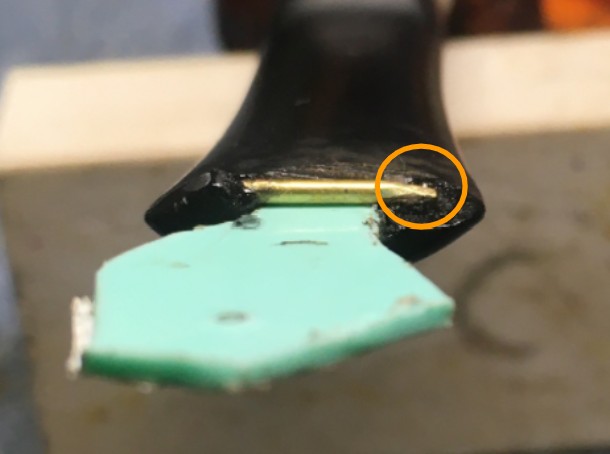
Below is a photo of my idea: I wanted to use the slot cutting bit with a Dremel rotary tool to cut a slot into the button. I would then cut a piece of 2 mm brass rod/pin to span the broken piece of the stem. This pin would be held in place by black epoxy resin. The epoxy would also be used to fill in the void.

Below is a slightly different view of the dremel bit.

Below is how I imagined the placement of the pin in regards to the button.

I used the Dremel to cut a groove in the button.

The same cut from the side.

The pin was cut with pliers and the ends of the pin were filed to a taper. This pin was set into the groove.

Below a view of the button from the front with the pin in place. Sorry about the poor focus.

JB Weld was the black epoxy that I used because that was the product I had on hand.
To keep the epoxy only in the areas where I wanted it, I used a “dam”.. This dam was a piece of plastic lid cut to fit the stem. The dam was coated with petroleum jelly to keep the epoxy from adhering to it. I laid a bead of epoxy in the groove and placed the pin into the epoxy. Additional epoxy was added to the top of the pin and to the hole. The dam provided a floor for the epoxy to rest on. The JB Weld sets up within 15 minutes so I was able to allow it to firm up and then add additional epoxy before the whole mix became unworkable.

Below you can see the rebuild button on new epoxy, the filled hole and the incorporated pin.

After about 30 minutes I removed the dam.

The pin was completely encased in epoxy. My idea was that this would provide the rigidity needed to withstand a significant bite while retaining the correct shape.

The epoxy had solidified enough to hold its shape yet was soft enough to allow me to cut the excess off with a sharp knife.

I allowed the epoxy to sit and harden for 24 hours. I know the packaging says an hour but I wanted it hard enough to sand and work with a file.

The top and bottom were filed. I applied black CA to the top of the epoxy patch in an attempt to blend the repair better to the original stem and to build-up the button. Once cured this was again filed and sanded smooth.

Below you can see the scar from the repair during the sanding.

Here is a view of the slot. I used a Vermont Freehand slot tool (https://vermontfreehand.com/product/slot-funneling-tools/) to smooth the stem’s airway and sanded the airway.


The stem was sanded with a series of sanding sponges from grits 320-3500. Between each sponge I rubbed Obsidian Oil onto the stem and wiped it with a paper towel.

Once sanded I took the stem to the buffer and worked it with rouge compound on the rouge wheel.

I repeated the buffing using white buffing compound on the dedicated white wheel.

The stem looked good in the sunlight.

This was now two days into the restoration. Far more than usual and I still had not started work on the stummel. I gathered the reaming kit.

The tobacco chamber was surprisingly well kept. The PipNet’s #2 and #3 blades removed the majority of the cake only requiring a little bit of clean-up scraping with the General triangular scraper.

The airway on the shank was far less well kept. I swear the camera didn’t even want to witness the tar deposits. Okay, I did a crappy job photographing it but you can see the amount of scraping and the yuck that was removed.

The shank was nowhere near finished and I decided to switch gears and maybe soften things up with warm water. The Exterior of the stummel was about as dirty as the airway. I scrubbed the stummel with undiluted Murphy Oil Soap and a brash brush.

The soap was rinsed with warm water and the stummel dried with a cotton hand towel. The stummel still looked dirty, especially in the grooves. I repeated the Murphy Oil Soap scrub 2 more times with a nylon brush.

Back at the workbench I scrubbed the stummel again using the nylon brush and 95% ethyl alcohol then wiped the stummel with a make-up pad and more alcohol.

Okay, back to the airway. I wanted to see if a cotton-alcohol treatment would help dissolve some of the tar in the airway. The bowl and shank were packed with cotton.

About 10 ml of 95% ethyl alcohol was added to the cotton with a disposable pipette. The cotton was saturated with alcohol. The plan was to let this sit overnight.

Time to go fishing.

After fishing the cotton and alcohol had done a little bit of tar removal but things were still damp.


I decided to apply a coating of Before and After Restoration Balm and let that sit overnight as well.

The next morning the cotton alcohol treatment looked like the below two photos.


The Before and After Restoration Balm was hand buffed with an inside out athletic sock.

With the excess balm removed I next removed the cotton from the stummel.

The cotton and alcohol had done a good job at softening and removing the tars. I repeated some of the scraping, to little avail, and continued scrubbing with cotton swabs and a shank brush both dipped in alcohol.

The pipe was reassembled and taken to the buffer for several coats of carnauba wax. Because the carvings were not deep nor too jagged I thought that carnauba would not build up too badly in the grooves.

The final step was a hand buffing with a microfiber polishing cloth further deepening the shine.
Another Lovely thick walled Custom-Bilt is ready for many more years of use. The rusticated briar cleaned up well and really looked good after the Before and After Restoration Balm worked its magic. The stem repair worked quite nicely and left a hardly noticeable scar. The oxidation removal was not perfect leaving some areas of brown smudgeness. This can only be seen under very bright light. I was glad that the stem was salvaged and made strong again with the brass pin incorporation. The stamping did remain legible though here a bright light is an asset, at least for my old eyes. The old cigarette burn on the shank was left alone as I did not want to sand and alter the carvings on the shank. This will be a battle scar or a symbol of character. The dimensions of the Custom-Bilt Taper Stem are:
Length: 5.99 in./ 152.15 mm.
Weight: 1.73 oz./ 49.05 g.
Bowl Height: 1.97 in./ 50.04 mm.
Chamber Depth: 1.59 in./ 40.39 mm.
Chamber Diameter: 0.79 in./ 20.07 mm.
Outside Diameter: 1.64 in./ 41.66 mm.
I do hope that you have found something here useful to your own pipe care, maintenance or restorations. If you like this sort of thing, please click the like and subscribe buttons. Thank you for reading the ramblings of an old pipe lover.
Below are some photos of the finished Custom-Bilt Taper Stem.




 NebraskaPeteGeek