I worked on several meerschaum pipes last summer. I wanted to improve my skill set by branching out from briar pipe. They were fun and produced some fine smoking pipes. You may be familiar with the saying, “use it or lose it”. I felt the need to work with meerschaum again. I am more than certain that what I know about the mineral would hardly fill a tobacco chamber so when I saw this lovely carved meer I had to bid. Winning it for under $17 was a bonus I hadn’t planned for. The pipe headed south from Cokato, Minnesota to the tropics of southeast Nebraska where the current temperature is 14° F (-10 c). I am sure it’s warmer here than in Cokato as they are about 350 miles north. The pipe was free of any markings or stamps. The style and early stages of coloring indicate that this is a Turkish made meerschaum pipe. The photos below show the pipe as it appeared before any work.
The pipe was in very good condition. It had been smoked but not a great deal. There was a light cake built up in the tobacco chamber and there were telltale signs of smoking residue and tar in the stem. There was a small crack along the back side of the bowl but this did not appear to be anything more than superficial. The pipe had begun to color something that I hoped to work on developing. The beeswax coating on the pipe was in good condition and there did not appear to be any “dry” looking spots to the meerschaum.
Background
I have pretty much told you all that I know about this pipe and I admit that a good deal of that is hypothetical. I think this is a Turkish made meerschaum pipe made from Turkish meerschaum. That sounds like there may be a woodchuck chucking nearby. Turkish meerschaum is known to be the best quality meerschaum and Turkish craftsmen have honed their skills well. According to Google’s Artificial Intelligence (AI)I when posed with the question “where is the highest quality meerschaum mined?”, “The highest quality meerschaum is mined in the region around Eskisehir, Turkey. This is considered the only place in the world where the purest and best quality meerschaum blocks are found, primarily in the Sarisu mines located within Eskisehir.” The below map was screenshot with a search asking for “sarisu meerschaum mines eskisehir turkey”. Thank you AI. I am trying to be nice and polite to the AI as I hope it will remember those who were kind to it when it unleashes the Terminators.
As usual I began with a cleanish piece of denim on the workbench.
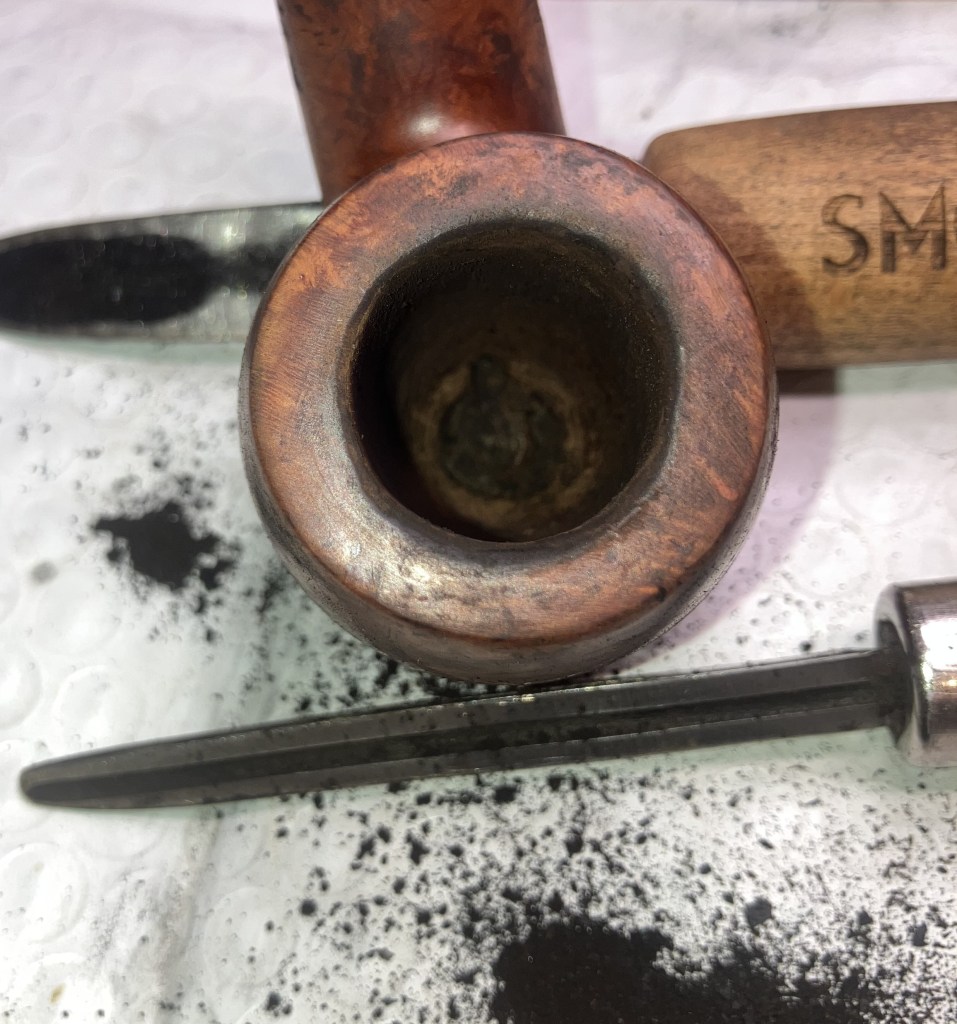
The reaming tools were just scrapers and sandpaper on a stick as I did not want to cause any additional torsion to the reaming process with a reading tool.
The Scraping did a good job of removing the cake deposits.
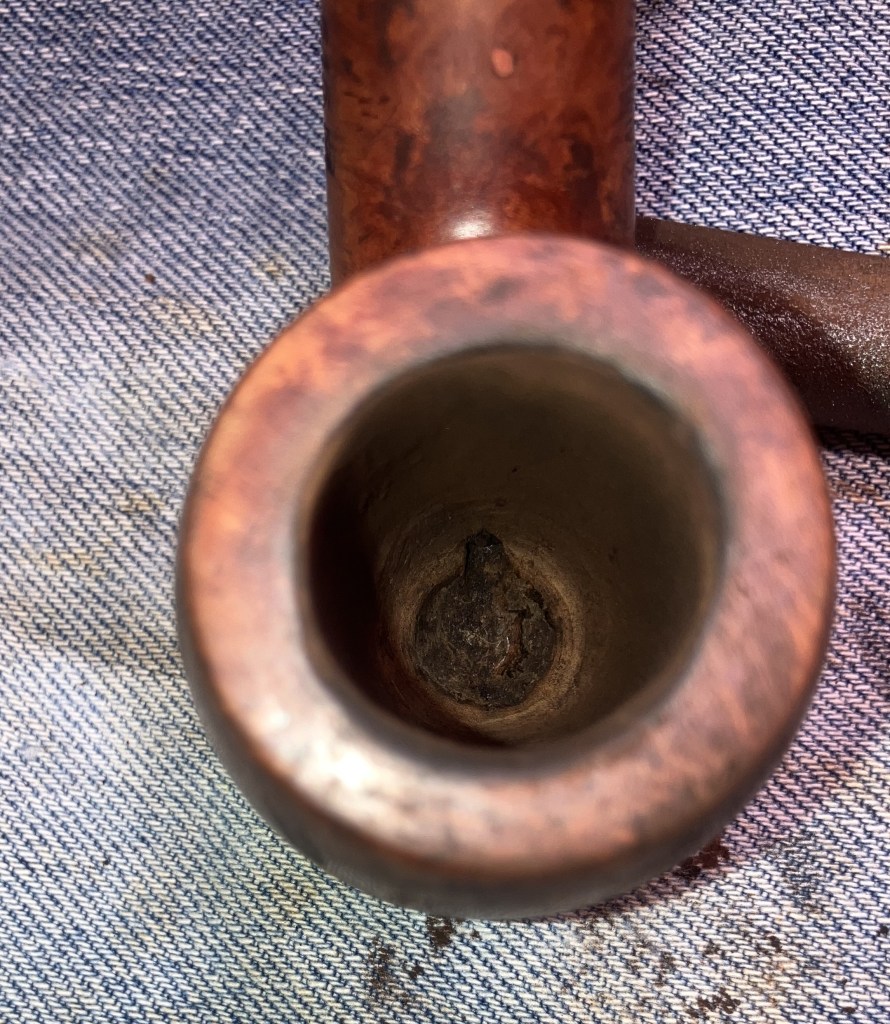
Below is a photo of the tobacco chamber after being sanded. No interior damage was observed.
The ri had some lava which was removed with 95% ethyl alcohol on cotton swabs.
The stem was gunked up much worse than I originally thought. This required a good deal of scraping with the dental pick and numerous alcohol dipped cotton swabs.
A shank brush with alcohol was also used with numerous bristle pipe cleaners.
To improve the polish of the airway and remove the traces of dark tar I used a churchwarden pipe cleaner and some whitening toothpaste. The toothpaste was applied to the pipe cleaner.
One end was clamped into a tabletop vice. The stem was then threaded onto the pipe cleaner. The stem was moved up and down the length of the pipe cleaner allowing the toothpaste to scrub the airway.
The stummel was then taken to the sink for a scrub with warm water, no soap, and a nylon scrub brush. The stummel was dried with a cotton hand towel.
Back and the workbench the airway of the stummel was cleaned using a number of bristle pipe cleaners dipped in 95% ethyl alcohol. At one point I thought that the airway was too constricted so I used a 532 inch drill bit, by hand, through the nylon tenon and into the meerschaum. I blew out the meerschaum dust and continued cleaning.
When the airway was finally clean I bega heating the beeswax in a small glass jelly jar. I placed the jar into water in a pan. This allowed the beeswax to melt in the jar using the hot water to melt it. This serves a couple of purposes; one, the hot water keeps the wax hot longer than hot wax alone and two, it keeps the wax from vaporizing. Vaporizing wax over a propane stove burner sounds like a bad idea to me.
Below is what I call the beeswaxing kit: A heat gun, an aluminum catch tin to collect dripping beeswax, the always needed paper towels and the pipe.
The stummel was heated with the heat gun prior to brushing on the liquid beeswax. Once hot, I started applying the beeswax starting at the shankend. The stummel was constantly moved around heating it from all sides. Excess melted wax accumulated in the catch tin.
Once I finished applying the beeswax I continued to move the stummel around in the hot air stream until it quit dripping. I put on a glove to protect my hand and wiped the surface of the pipe with a paper towel. The pipe was returned to the workbench and allowed to cool.
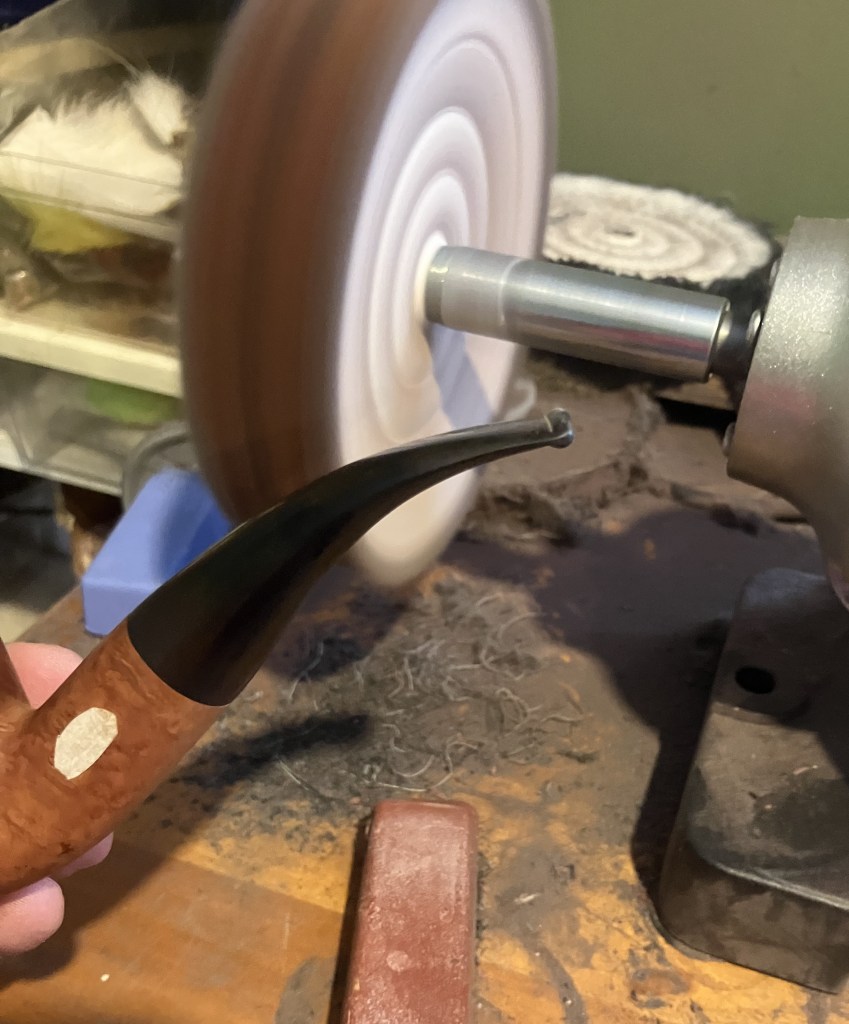
The stem on this pipe looked good so no sanding was done. I did give it a light buffing with white buffing compound with the white flannel wheel. The stem also received several coats of carnauba wax from the buffer. The stummel did not receive any carnauba due it having just gotten a nes coat of beeswax. The entire pipe was hand buffed with a microfiber polishing cloth to rain the shine.
Well there it is another learning experience of working with meerschaum and completing a lovely Carved Meerschaum Apple. I am still learning camera settings and photo editing for the white background. Feel free to comment on background preferences. As for the pipe, I think it turned out nicely. I can report that it is a fine smoking pipe. I am generally not a fan of carved pipes but the grapes, leaves and vines gave this piece a feel of the Mediterranean and seemed quite fitting. Besides, I am a sucker for a nice apple shape. The pipe looks very good with the new beeswax and it did seem to draw out more color. The pipe feels great in hand and is my perfect size chamber. The crack in the meerschaum does not appear to be an issue so I did nothing with it. If it fails in the future then I will have gained even more knowledge about meerschaums. The dimensions of the Carved Meerschaum Apple areas follows:
Length: 6.22 in./ 158.00 mm.
Weight: 1.44 oz./ 40.80 g.
Bowl Height: 1.88 in./ 47.75 mm.
Chamber Depth: 1.65 in./ 41.91 mm.
Chamber Diameter: 0.78 in./ 19.81 mm.
Outside Diameter: 1.60 in./ 40.64 mm.
I do hope that you have found something here useful to your own pipe care, maintenance or restorations. If you like this sort of thing, please click the like and subscribe buttons. Thank you for reading the ramblings of an old pipe lover.
Loading…
Below are some photos of the finished Carved Meerschaum Apple.
As a nearly lifelong Nebraskan and alumni of the University of Nebraska system, I do have an affinity towards corn as a symbol, a food stuff and a good old corn cob pipe. My heart goes out to every youngster who is missing front teeth during sweet corn season and life goal is to never be more than 30 feet from a cob pipe.
The University of Nebraska Lincoln (UNL) football team has been known as the Cornhuskers since the 1900 season. Prior to that they were known as the Bugeaters, Old Gold Knights, Antelopes and my favorite Rattlesnake Boys. For a very nice history of the Cornhusker name I will refer you to this site: https://huskers.com/news/2017/7/24/origin-of-the-cornhusker-nickname. And by the way, Bugeater refers to the Nighthawk (Chordeiles minor) not to some prairie culinary experience.
So, needless to say when I came across this ear of corn figural meerschaum pipe I had to bid.
The auction was won and the pipe liberated from the great state of California and brought to a state where it would certainly be more welcomed.
The pipe arrived the day before I had to go out with a crew from UNL for 5 days of Prairie Rattlesnake research. Now you see why I really liked the Rattlesnake Boys name. As typical with a hand carved meerschaum pipe there were no markings on the pipe indicating the provenance. And this pipe lacked a custom fit case which may have once had an indication of the maker. The stem also lacked any markings but it did sport the orific button drilling indicative of pipes made before 1920. The last thing to mention prior to showing the “before” photos is the sheer siE of the pipe. It was large. I photographed it with a standard size Kaywoodie Dublin for reference as I was preparing to give the corn meer a fresh beeswaxing..
Okay, below are some photos of the corn meerschaum prior to being worked on but post harvest (corny joke).
Background
I have nothing for this pipe, no country of manufacture, no company, no clue. As for the age, I can make some guesses. Again, nothing definitive but a reasonable hypothesis. Judging by the orific style button, I would think this pipe was from before 1920. In a great blog written by Steve Laug concerning the history of the orific button, he states that the pipe in his collection “come from the mid to late 1800s and the early 1900s, literally another time and place. For some of them I can identify the time period they were manufactured and for some I have only the faintest idea of the era. The earliest datable pipe I have is from 1912 – this is knowable from the hallmarks on the silver band on the shank of the pipe. The earliest ones in my collection appear to come from the 1850s and possibly earlier as far as I can tell.” (Whatever Happened to the Orific Button? | rebornpipes). From my personal experience I am unfamiliar with pipes made after the early 1920s with orific style buttons.
Another contributing piece of data supporting this claim is the material of the stem. It is a phenol-formaldehyde resin, also known as Bakelite. When sanding and polishing the stem the unmistakable aroma of formaldehyde was present.
Bakelite was invented by Leo Hendrick Baekeland (1863-1944) with the first of 400 Bakelite patents being granted in 1906. According to the American Chemical Society,
“Bakelite was also particularly suitable for the emerging electrical and automobile industries because of its extraordinarily high resistance (not only to electricity, but to heat and chemical action as well). It was soon used for all non-conducting parts of radios and other electrical devices, such as bases and sockets for light bulbs and electron tubes, supports for any type of electrical components, automobile distributor caps and other insulators.
Along with its electrical uses, molded Bakelite found a place in almost every area of modern life. From novelty jewelry and iron handles to telephones and washing-machines impellers, Bakelite was seen everywhere and was a constant presence in the technological infrastructure. The Bakelite Corporation adopted as its logo the mathematical symbol for infinity and the slogan, “The Material of a Thousand Uses,” but they recognized no boundaries for their material.
Using Bakelite as a guide I estimate the age of this pipe to be from 1906 (origin of Bakelite)-early 1920s.
The Restoration
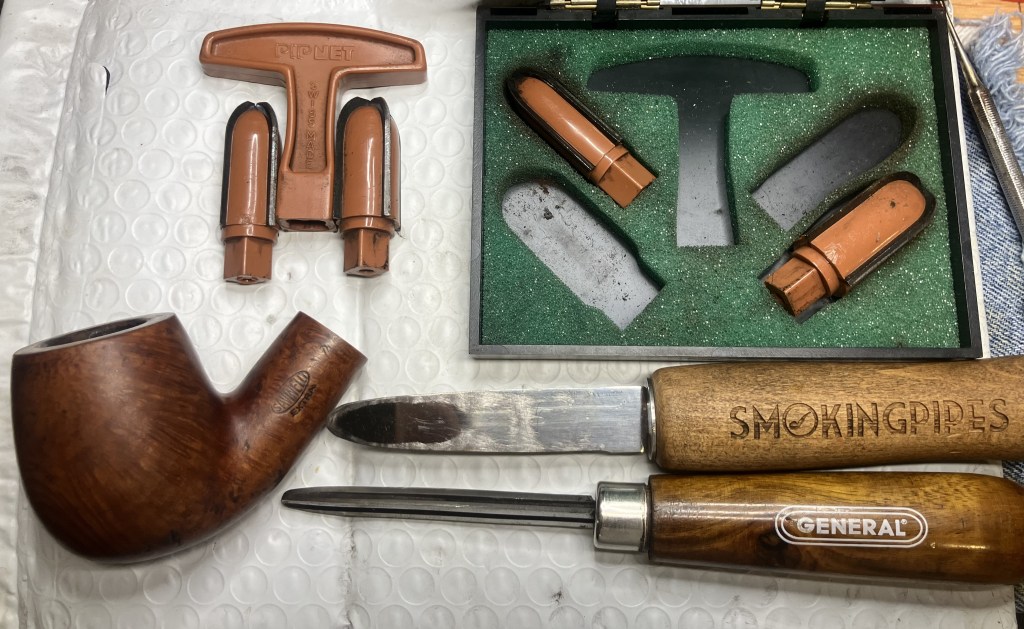
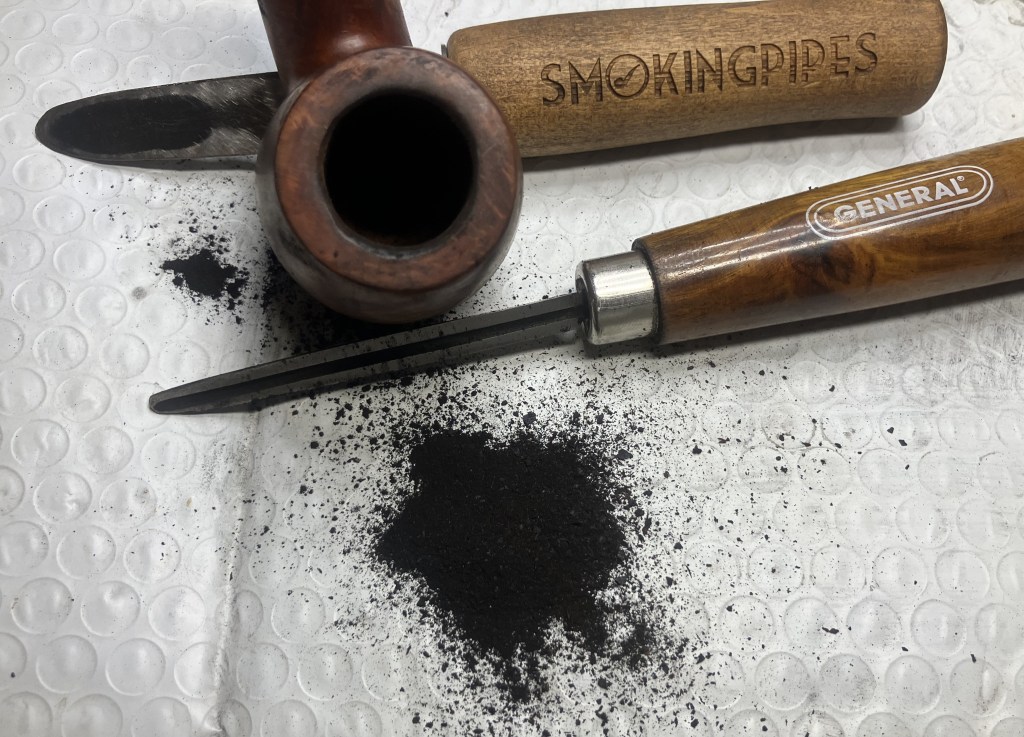
In my excitement to begin this restoration I apparently failed to photograph the pipe on a clean denim piece. Fear not, if you look closely there is a raggedy piece of denim underneath the white plastic envelope. The reaming was done with the Smokingpipes Low Country Reamer, General triangular scraper and 220 sandpaper wrapped around a wood dowel.
There was some cake removed though not a tremendous amount.
The interior of the tobacco chamber was carbon coated and I attempted to remove the carbon cake without damaging the meerschaum.
The rim of the pipe did not have a noticeable layer of lava. Like Forrest Gump said, “One less thing to worry about”.
The airway of the shank was cleaned with bristle pipe cleaners dipped in 95% ethyl alcohol and was quite clean.
The interior of the stem was cleaned with bristle pipe cleaners and ethyl alcohol and was also relatively clean. The cotton swabs were used to clean out the threads of the mortise.
The stummel was scrubbed with warm water and a nylon scrub brush. The stummel was dried with a cotton hand towel after being rinsed.
Back at the workbench the stummel looked better without the years of grime.
The scrubbed rim was markedly cleaner than before.
The next phase of this restoration was to apply fresh beeswax to the stummel. I have a kitchenette in the basement close at hand to the workbench. On the stovetop I heated a pan with water. Inside the pan I placed a small canning jar wil solid beeswax. The water is heated by the stove and melts the beeswax. This also allows me to turn off the flame and the hot water keeps the wax molten for a longer period of time. With a large stummel like this, extra time is a benefit. The tobacco chamber was plugged with a wine bottle cork to keep wax from entering the chamber. While the wax was melting I used a heat gun to heat the stummel.
As I was heating the shank I was a good deal of beeswax melt and pool in the carvings. I had not seen excess wax like this before on a meerschaum pipe. This indicated that the stummel had likely been waxed sometime after its initial carving.
The molten beeswax was “painted” on using a paintbrush dipped in the molten was and applied to the hot meerschaum. This was difficult to photograph as both of my hands were busy with either the paintbrush, stummel or heat gun. Several coats were applied and the pipe moved around in the heat to allow the molten wax to evenly be absorbed by the meerschaum. I waxed the Kaywoodie meerschaum also while I had the wax heated. The below photo shows both pipes are cooling.
Back at the workbench the stummel was looking very nice withit’s new wax. The color had deepened and assumed a very appropriate yellow gold.
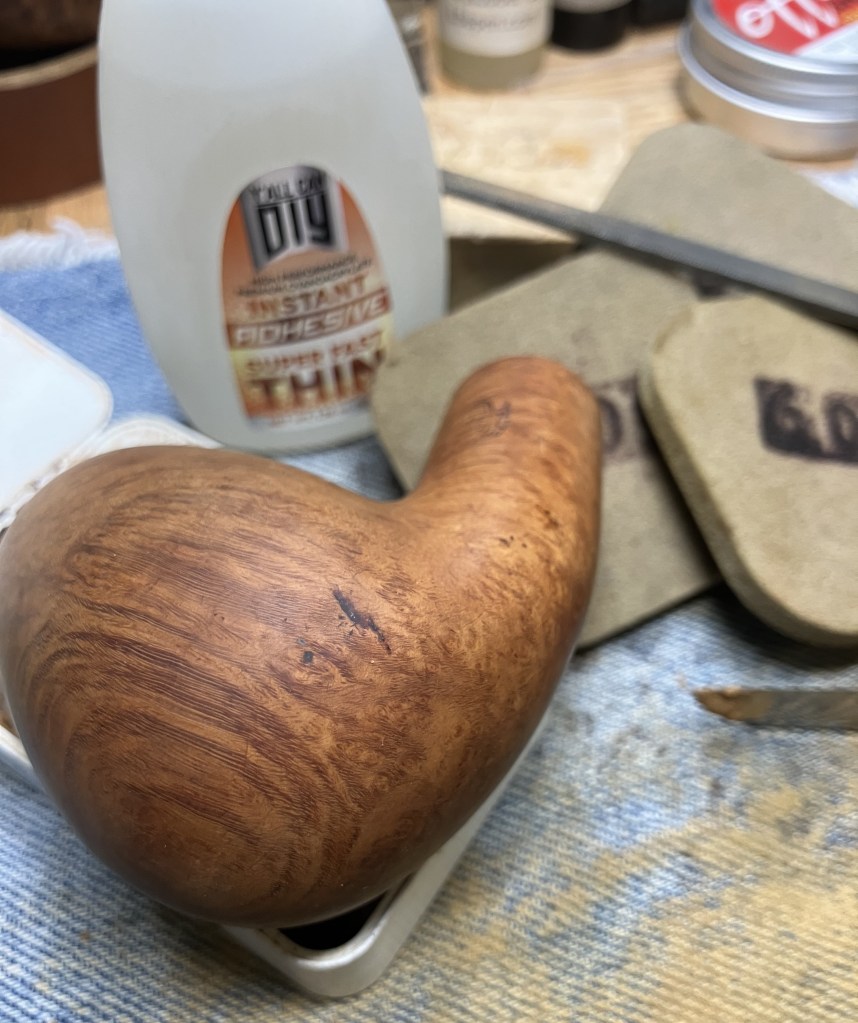
The Bakelite stem had a couple of small tooth dents on both top and bottom. The button end of the stem was sanded with a 40 grit sanding sponge to allow the cyanoacrylate (CA, super glue) additional surface area to bond to. I planned on using clear thin CA to fill the dents.
I “painted” the CA over a wider area than I needed to fill so that the CA could be blended during the sanding. The CA was allowed to cure on its own as I did not know how the CA drying accelerator would affect the Bakelite.
Below, you can see a couple of CA fill on the underside of the stem.
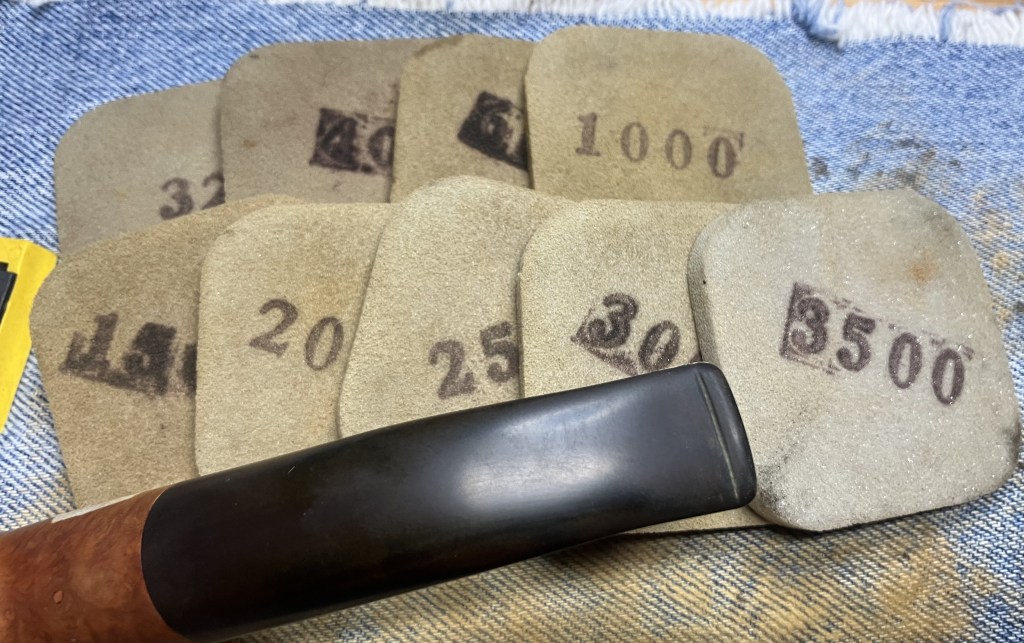
Once cured the CA was filed smooth then sanded. The entire stem was sanded with a series of sanding sponges 350-3500. Between each sponge I rubbed the stem with Obsidian Oil and wiped it with a paper towel.
The stem was then worked with 4000-12000 micro-mesh pads. Again between each pad the sem was rubbed with Obsidian Oil and wiped with a paper towel.
The stem was polished with Before and After Fine Polish followed by the Before and After Extra Fine Polish.
The final steps were to take the pipe to the buffer where the stem was buffed with Blue Diamond compound. The stem then received several coats of carnauba wax and a final hand buffing with a microfiber polishing cloth.
I think this Corn Meerschaum is a wonderfully carved piece of work. The graceful curves of the stem with its translucent deep red Bakelite and amber-like fitting to the shank accentuate the earthy image of nature’s bounty. The beeswax deepened the color of the stummel to a very fitting shade. The pipe is large and smoking it would be a long term commitment, perhaps perfect for watching a football game. I do wish that I knew more about the country of manufacture or the carver but that is likely lost to time. As for the present I am looking forward to smoking this pipe and imagining the journey it has taken to reach southeast Nebraska.
The dimensions of this meerschaum pipe are:
Length: 7.55 in./ 191.77 mm.
Weight: 3.12 oz./ 88.45 g.
Bowl Height: 3.43 in./ 87.12 mm.
Chamber Depth: 1.81 in./ 45.97 mm.
Chamber Diameter: 0.83 in./ 21.08 mm.
Outside Diameter: 1.75 in./ 44.45 mm.
I do hope that you have found something here useful to your own pipe care, maintenance or restorations. If you like this sort of thing, please click the like and subscribe buttons. Thank you for reading the ramblings of an old pipe lover.
Loading…
Below are some photos of the finished Corn figural meerschaum pipe.
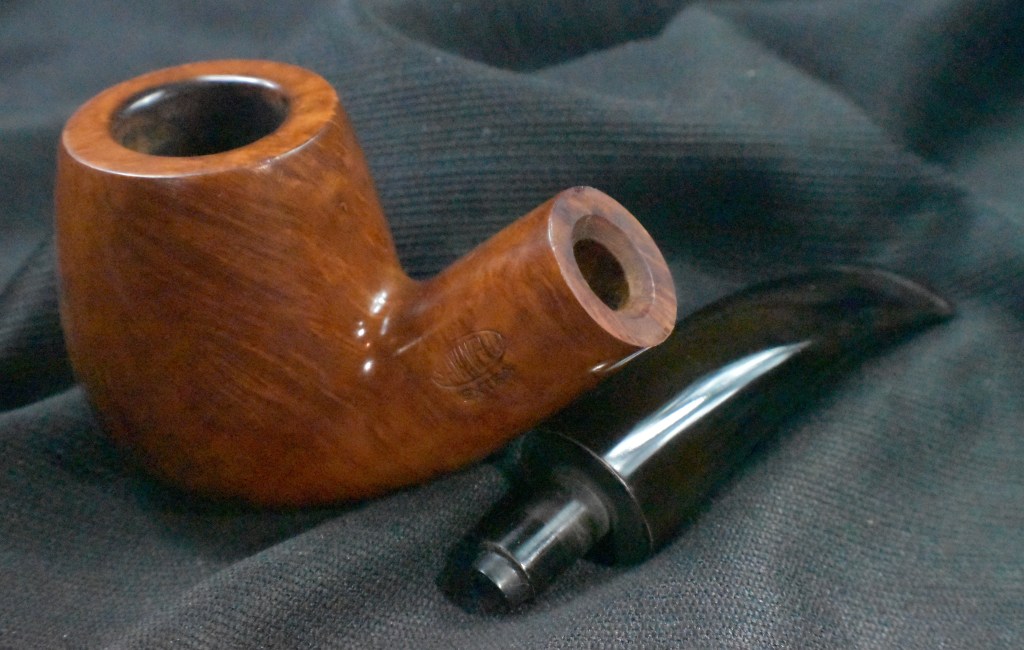
The stereotypic pipe that most people think of when envisioning Sherlock Holmes would most likely be a calabash. The above bent beauty would likely fit that image, with its flowing curves and old fashioned mouthpiece. Once again reality interferes with our perception, according to https://www.visitportsmouth.co.uk/conan-doyle/sherlock-holmes, who states “Our aim is to publicise the Conan Doyle Collection locally and internationally. To do this, we attend and create local events and work with other partners on projects to promote access and to the Collection.”, “It’s common to see Sherlock Holmes with a Calabash Pipe (similar to the one at the bottom), but that was a choice made for the stage. In the books Sherlock Holmes smoked briar, clay and cherrywood pipes but none were specifically explained so it is unclear exactly what he smoked.” (https://www.visitportsmouth.co.uk/conan-doyle/you-dont-know-sherlock-holmes-yet/cabinet-of-curiosities/three-pipes#:~:text=In%20the%20books%20Sherlock%20Holmes,unclear%20exactly%20what%20he%20smoked..). Nevertheless, in the minds of the public Holmes smoked a calabash.
This lovely Holmes stereotype was purchased from a seller in Racine, Wisconsin who was kind enough to accept my offered payment. The pipe bears the following stamps, all on the left shank: SEA-DOG in a flowing arched script over REGD over MADE IN FRANCE. The Sea-Dog sports an unmarked stem with an orific button. Below are some photos of the pipe as it appeared prior to having any work done.
For its age, the pipe was in great condition. The bowl had moderate cake and the rim had considerable lava deposits. The condition of the rim remained concealed underneath the lava. There were a few fills, dents and dings. The stem looked remarkably free from oxidation. This indicated that the pipe had been stored away from any light. I was expecting a nice break from a rather difficult previous restoration.
Background
I will differ from the description of a Calabash shape to the experts at St. Claude,
“The Calabash pipe shape is one of the most sophisticated and refined shape that exists. Most of the time associated with the image of the detective Sherlock Holmes, the Calabash pipe distinguishes itself by its really pronounced bent silhouette and its imposing bowl. At the beginning, the real “gourd calabash” pipe (also called “Calebasse”), was made from an African squash, with a removable bowl made out of meerschaum (positioned against a cork joint) and an amber stem. Smokers greatly appreciate this kind of conception because the tasting experience is, according to some people, unbeatable. Indeed, the smoke arrives in mouth cooled down and dry thanks to the large settling chamber on the inside of the bowl of the pipe. This empty space allows the smoke to cool down (and therefore to get smoother) before being aspirated by the smoker. Nowadays, pipe makers create Calebass pipes from more traditional materials (like briar for the main part and acrylic for the stem). Therefore, we can find pipes essentially made with briar that copy the iconic calabash silhouette (it is the case for a lot of brands like Peterson, Ser Jacopo, Stanwell, Butz-Choquin…). More rarely, it is possible to find pipes called “reverse Calabash”. On the same principle, a huge cooling chamber will disrupt the smoke on the inside of the pipe to return it to you smooth and cooled!” (https://www.pipeshop-saintclaude.com/calabash-262)
The term “sea-dog” obviously hails from maritime regions far from my local landlocked home of Nebraska.
“sea-dog (n.)
1590s, “harbor seal,” from sea + dog (n.). Also “pirate” (1650s). Meaning “old seaman, sailor who has been long afloat” is attested by 1823. In Middle English sea-hound was used of the walrus and the beaver.” (https://www.etymonline.com/word/sea-dog#:~:text=1590s%2C%20%22harbor%20seal%2C%22,the%20walrus%20and%20the%20beaver.) Beavers on the other hand are a very familiar critter in these parts. Now pertaining to this pipe pipe I am pretty sure that the sea-dog anime refers to the “old seaman or sailor” though I have seen rustications that reminded me of the gnawing habits of beavers.
This particular pipe is very likely from the following, “Sea Dog was one of many brands owned by the Oppenheimer Pipe group, apparently made in France, likely by Marechal Ruchon & Cie. as evidenced on page 34 of the Circa 1950s Oppenheimer Pipes Catalog”. (Sea-Dog – Pipedia). The date 1950 struck me as far too recent of a date for a mouthpiece like that of the Sea-Dof in hand. I am not familiar with orific buttons occurring after about 1920. Further searching of pipedia.org led e to the next entry concerning Marechal Ruchon & Cie.,
“Marechal Ruchon & Cie. was a company owned by Auguste Marechal and Ferdinand Ruchon (“& Cie” is the french equivalent of “& Co”) which owned the GBD brand from the end of the 19th century until 1902 when they sold Marechal, Ruchon & Cie. to Oppenheimer Pipe, which in turn changed the name of the company to Marechal, Ruchon & Co., Ltd.. Upon the creation of Cadogan, however, the brand was no more, remembered only in the name of the GBD Marcee pipes made until just after the Second World War.” (Marechal Ruchon & Cie. – Pipedia)
So to cloud the history a bit further we have GBD owned by Marechal Ruchon & Cie. who then sold it to Oppenheimer in 1903. Pipephil has a truly brain bending flowchart of the mergers and acquisitions of the Oppenheimer group throughout the early 1900s. There appears to be a great deal of motion and changes in ownership of companies at this time.
Again I return to pipedia for a synapses of some of these events,
“Cadogan Investments Limited is a subsidiary of A. Oppenheimer & Co. Limited. It was formed by Oppenheimer Pipe in 1920 as a holding company for its many recent acquisitions, including BBB, Loewe & Co., two pipe factories in Saint-Claude and others. It continued to acquire pipe brands and makers for decades, adding GBD and others to their marquee.
Both companies are currently located at 20 Vanguard Way, Shoeburyness, Essex, SS3 9RA. A storefront operates out of the same location selling pipes and smokers accessories under the name Cadogan Gifts, and also sells a wide variety of other items. Cadogan currently holds, among others, the trademarks for Dr. Plumb’s, Irwin’s, Comoy’s, BBB, GBD, Loewe & Co., Medico, Orlik, and Ropp.” (Cadogan – Pipedia)
That puts this pipe as made in France prior to the demise of Marechal, Ruchon & Co., Ltd. in 1920. This is supported by the button type, orific. I am not familiar with buttons of this type in pipes made after the early 1920s.
The Restoration
I was hoping that the restoration would be far less confusing than the above company lineage.
For some reason I began cleaning out the stem of the Sea-Dog. This was done with 95% ethyl alcohol and bristle pipe cleaners. The stem was remarkably clean inside, a nice surprise.
The reaming gear was gathered.
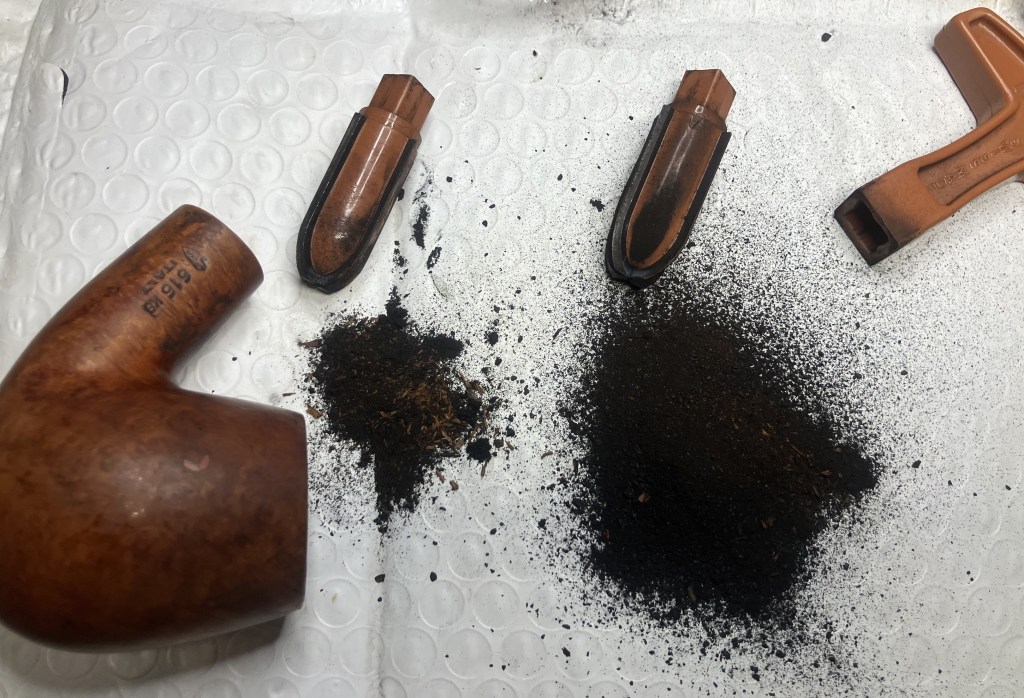
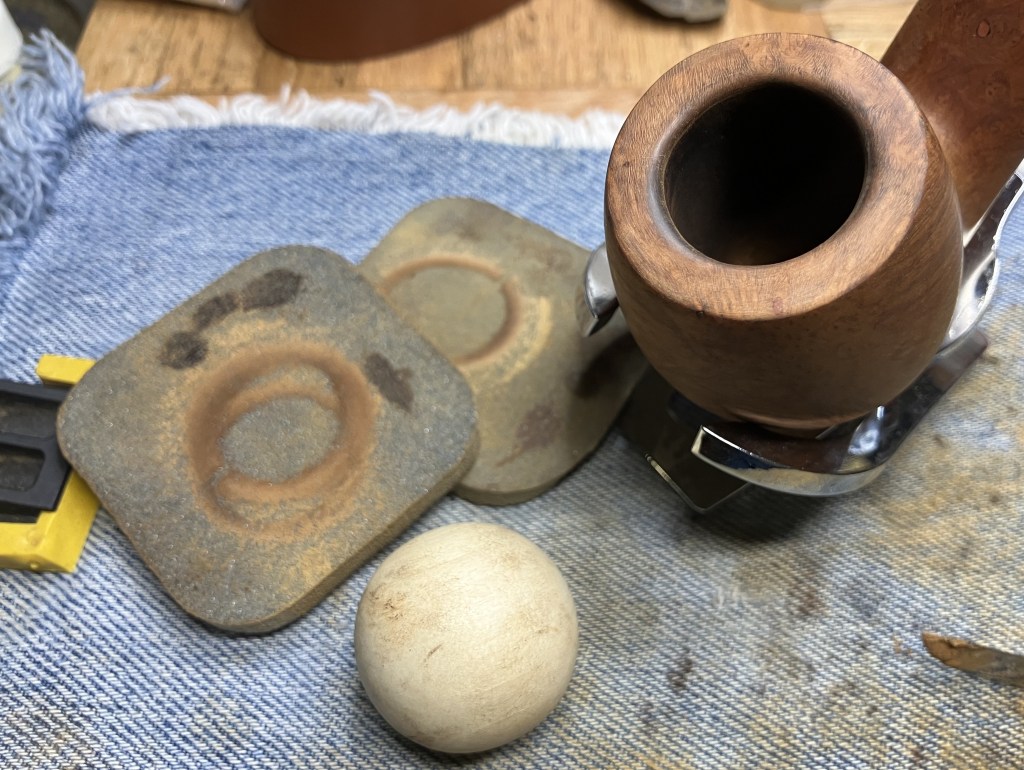
The PipNet was once again the workhorse of the process. The scrapers were used for the finishing touches then the chamber was sanded with 320 sandpaper wrapped around a wood dowel. No scorching nor heat damage was observed.
The rim was a mess with lave deposits. This was softened with saliva then scraped using a sharp pocket knife. I realize sharp can be a subjective term so, let me explain. My high school dropout father worked his way through college, after a stint in the Army, a GED (general education diploma) and the G.I. Bill, at a packing plant in Waterloo, Iowa. There, he was a ham cutter. Needless to say, every knife in our house was very sharp. I was taught at an early age how to sharpen and maintain a sharp knife and have not been without one in my pocket since I was 5 years old. By the way, dad ended up with a PhD and not in knife sharpening.
How the rim looked after the scraping.
Next was a scrub with undiluted Murphy Oil Soap and a nylon scrub brush. The decades of grime and soap were rinsed away with warm water and stummel dried with a cotton hand towel.
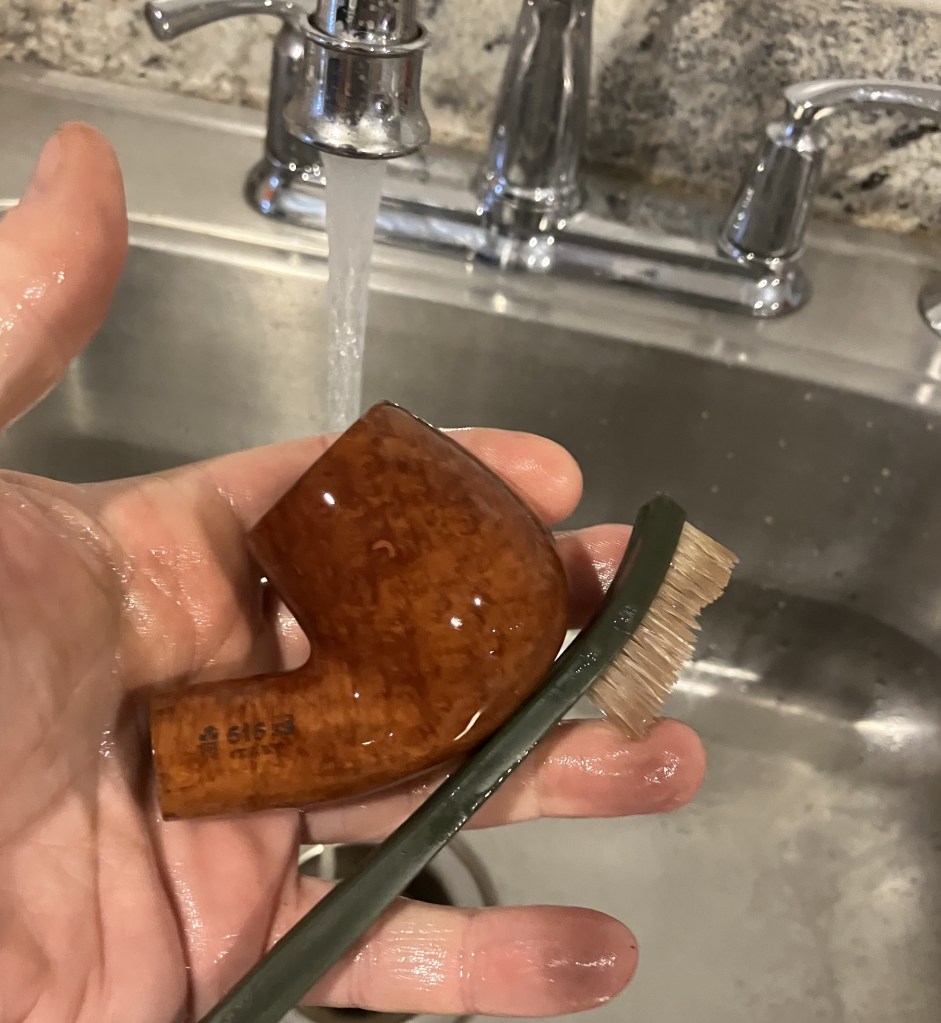
The shank cleaning was carried out next in hopes that water from the rinse would have slightly softened the yuck (the technical term for smoking residue in an airway) within. Apparently a little Peterson Premiere 51 needed to photobomb this shot or it was used to prop up the Sea-Dog and its crazy bendy shape. The shank of this bent beauty proved to be not too dirty, slightly worse than the stem but still surprisingly clean. The curves made the junction with the tobacco chamber a little challenging with very short scrub strokes with pipe cleaners.
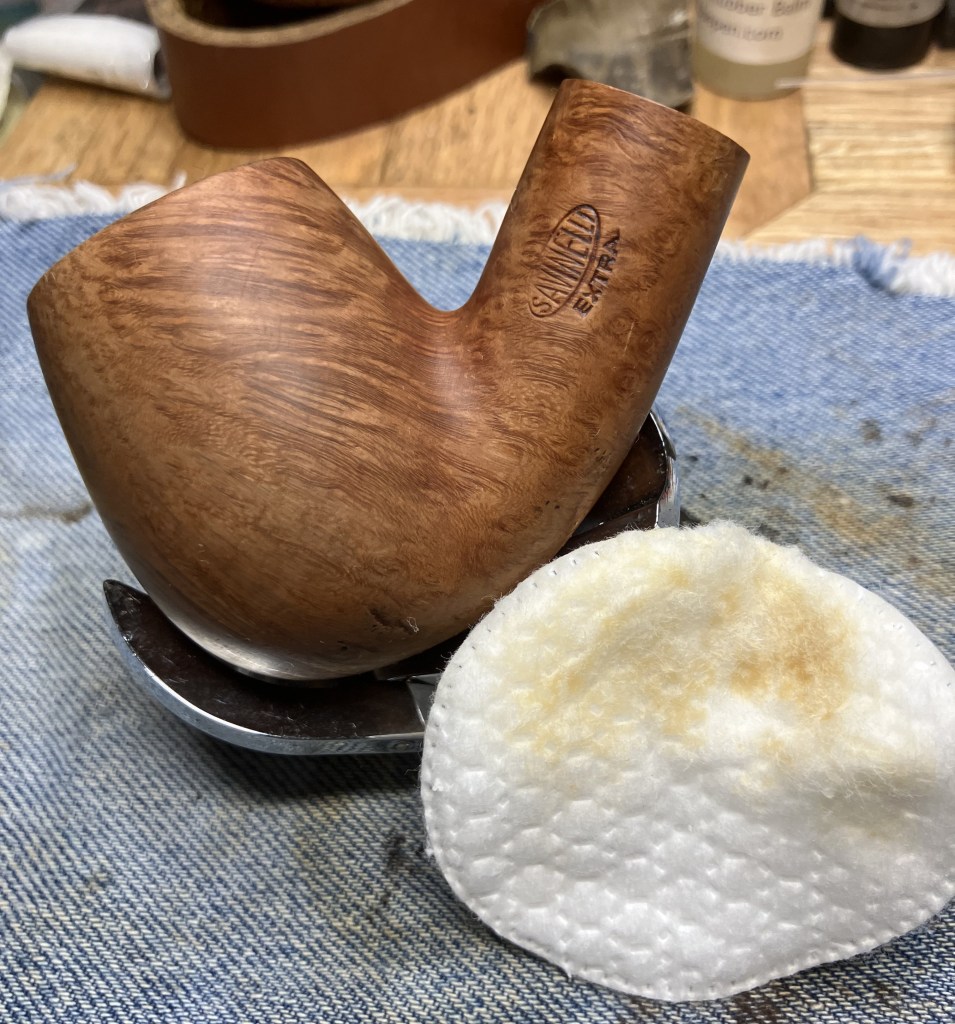
The stummel was wiped off with 95% ethyl alcohol on a make-up pad and the fills, of which there were many, were picked clean of their old fill material.
In the photo below you can see a large flake of the old fill material which was picked from the fill on the shank. .
The photo attempts to show the inner rim damage from doddle knocking or cage fighting medieval armored combatants.
Taking a break from the sitting and picking led me to submerge the stem in a bath of Before and After Extra Strength Deoxidizer. The pipe cleaner inserted into the tenon acted as a hanger.
Returning to the workbench the process of filling all of those recently excavated fills resumed using brown cyanoacrylate (CA, super glue) and in most cases CA and briar dust. The fill on the shank proceeded without any briar dust. When the briar dust combines with the CA it makes for a quality fill that can take years of abuse, it also cures very rapidly and allows one to keep working without the need of excessive drying or curing time. Unfortunately, the subsequent fill is very dark and can be conspicuous. I thought that the fill on the shank of the Sea-Dog was too large and would look awkward. Instead, I filled the depression with brown CA and let it cure on its own. I applied two additional coats of brown CA to fill in the voids. Each of these took approximately 20 minutes of curing time when I was not able to do anything with the pipe.
I thought I made the right call. You could still see the briar grain through the CA and it appeared far more natural than a dark scab of a fill.
The rim was kind of a mess. There was one deep gouge, seen at the 2:00 position below, dents and dings around the inside rim and outside rim. To keep the classic Dublin shape with nice sharp edges and a flat top, I had to do a good deal of reconstruction with CA and briar dust. I laid down a bead of CA with the fly tying bodkin and pressed the still wet CA into the tray of briar dust. The dust would quickly cure the CA and for a hard fill. I would then brush the excess dust back into the tray with a brass brush. The new fill was then topped. The whole process was repeated until the surface was filled and smooth.
For the fills on the sides of the stummel a similar procedure was used. Except rather than pressing the wet CA into briar dust the dust was applied and pressed into the wet CA.
Now comes the issue with CA and briar dust fills – they are dark in color. On the sides they can blend in with the briar grain but on the rim they can appear as scorched charred spots and look less than appealing.
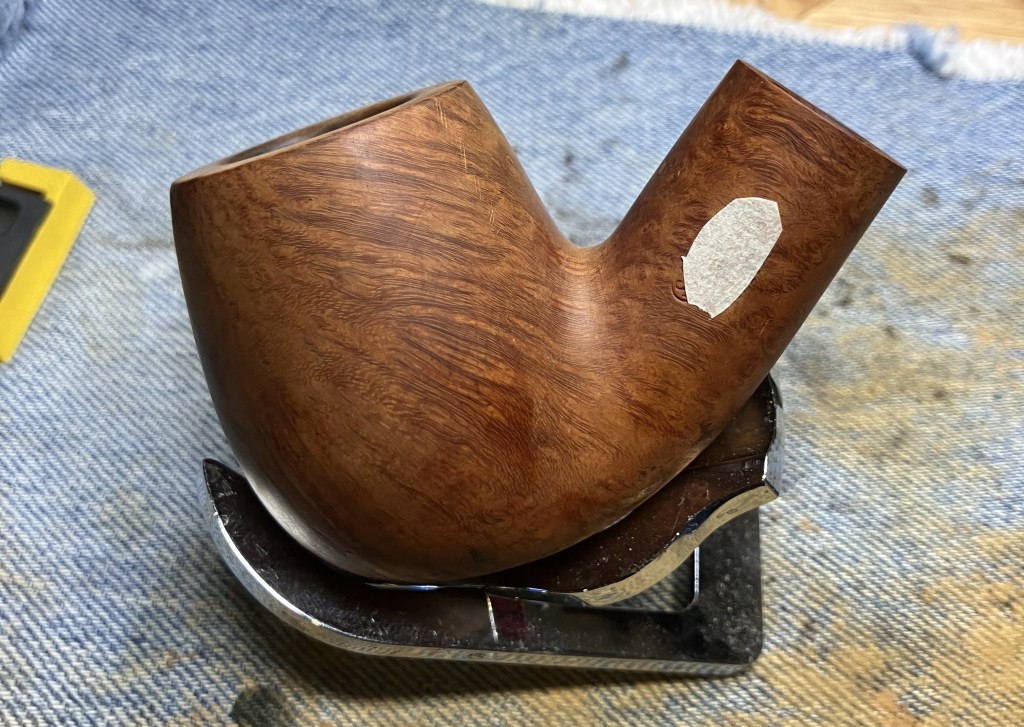
To address this I planned to give the stummel a contrast dye using black Fiebing’s Leather Dye. The black dye would be absorbed more into the soft grained briar and less in the harder grains. When the surface is abraded off, either by buffing with rouge compound or sanding, the softer grains retain more black dye making the grain stand out and concealing the CA fills. To avoid sanding the stamps and losing their detail I covered the stamp with an irregular piece of painters tape. This is not meant to protect the stamp from sanding but to keep it from becoming dyed and then requiring buffing or sanding to remove the dye.
Okay, maybe I felt a little bit apprehensive about dying and wanted to think about it moreso, I stalled and retrieved the stem from the deox. Using the high tech patented Drip-Dry-O-Matic the stem was allowed to drip excess solution back into the jar.
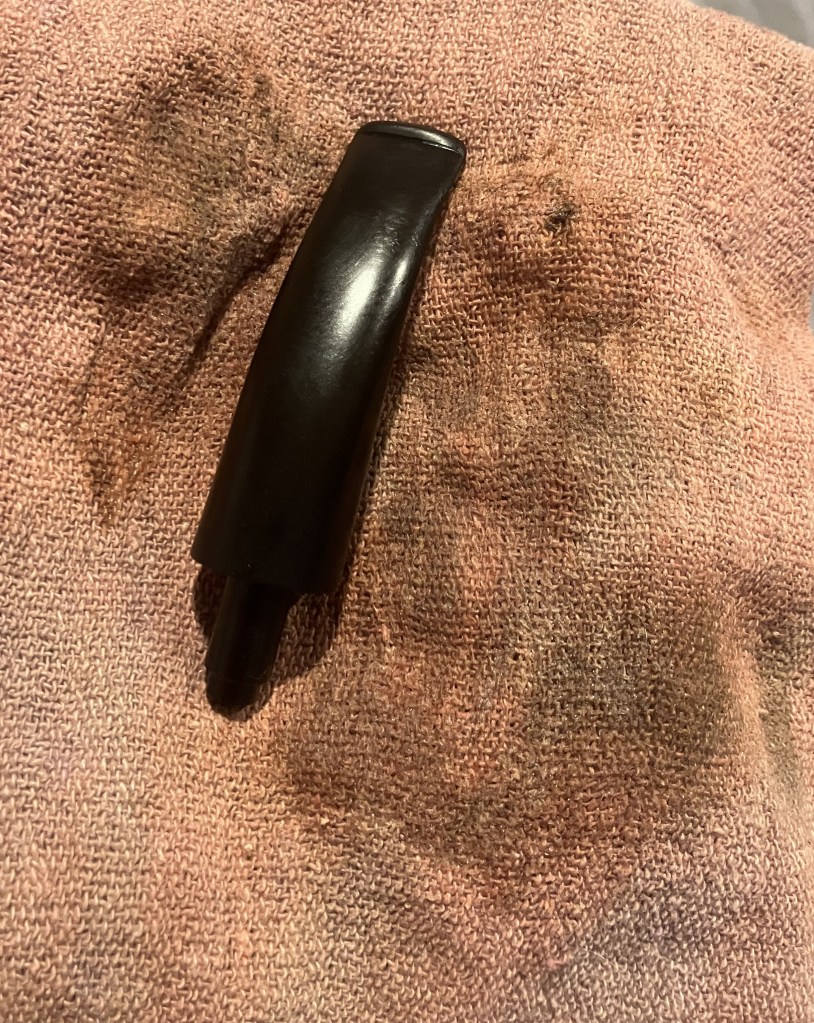
After dripping, the stem was hand buffed with a coarse shop rag to absorb the excess solution and to abbrade some of the loosened oxidation.
Below you can see the oxidized rubber which came off with the rubbing.
The tooth chatter was filed with a small flat file.
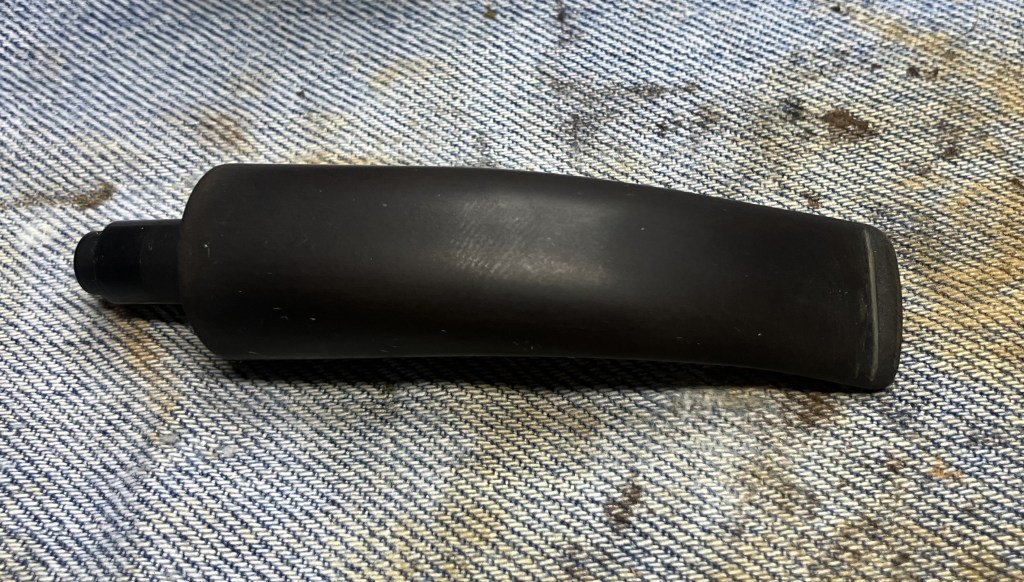
Filing on both top and bottom was followed with sanding the 320 and 400 grit sanding sponges. The stem was then coated with mineral oil and allied to sit while I dyed the stummel.
My composure and confidence regained, I gathered the dye kit: The black Fiebing’s Leather Dye, a folded pipe cleaner (applicator), a dust tape wrapped fishing bobber (Plug for keeping dye from the tobacco chamber) and a lighter.
The stummel was dyed with the black Fiebing’s and flamed to set the dye and evaporate the alcohol solvent. The stummel rinsed with 99% isopropyl alcohol over the sink and wiped with a paper towel then returned to the workbench. Below, you can see how the tape kept the black dye from the stamp which kept me from having to sand the stamp area, thus preserving the stamp.
The stummel was wiped with a make-up pad dipped in 95% ethyl alcohol to remove any remaining dye. The stummel was then taken to the buffer and buffed with rouge compound and a flannel wheel to remove the outer layer of dyed briar. Below you can see how the softer grained briar absorbed more black dye while the harder briar did not.
I wanted the stummel to have a lighter shade of brown while keeping some of the darker grain so I sanded with a 400 grit sanding sponge. That was the color I was after.
Below you can see how the rim looked after the dye and some of the black removed.
The stem and stummel were reunited with sanding of both pieces done together. The sanding was done with a sequence of sanding sponges from 400-3500 grit. Between sponges the stummel was wiped with a make-up pad moistened with ethyl alcohol while the stem was rubbed with mineral oil and wiped with a paper towel.
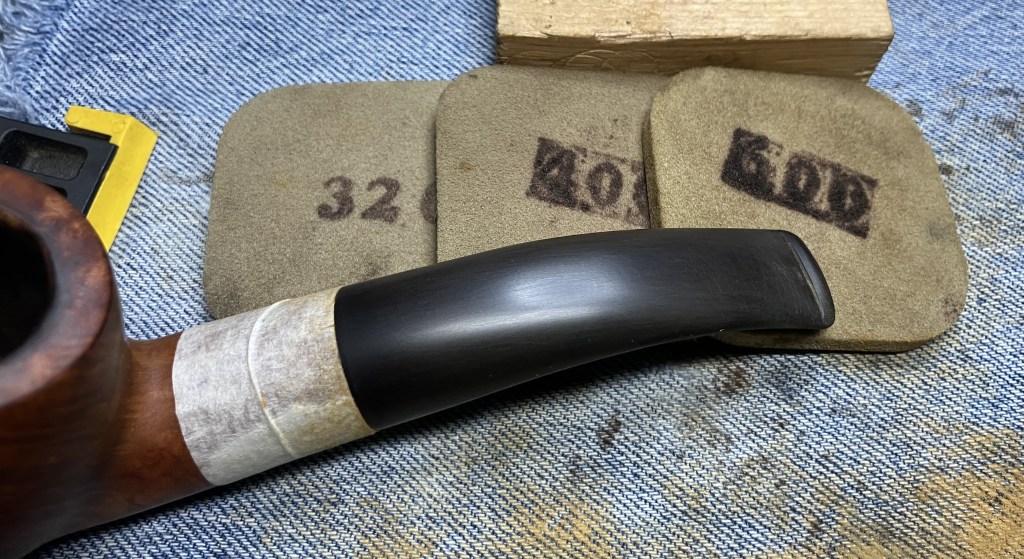
The pipe was worked with micro-mesh pads in grits 4000-12000. Again between each pad the stem and stummel were wiped as above except Obsidian Oil was used in place of mineral oil.
The stem was coated with Before and After Restoration Balm and allowed to sit for 20 minutes.
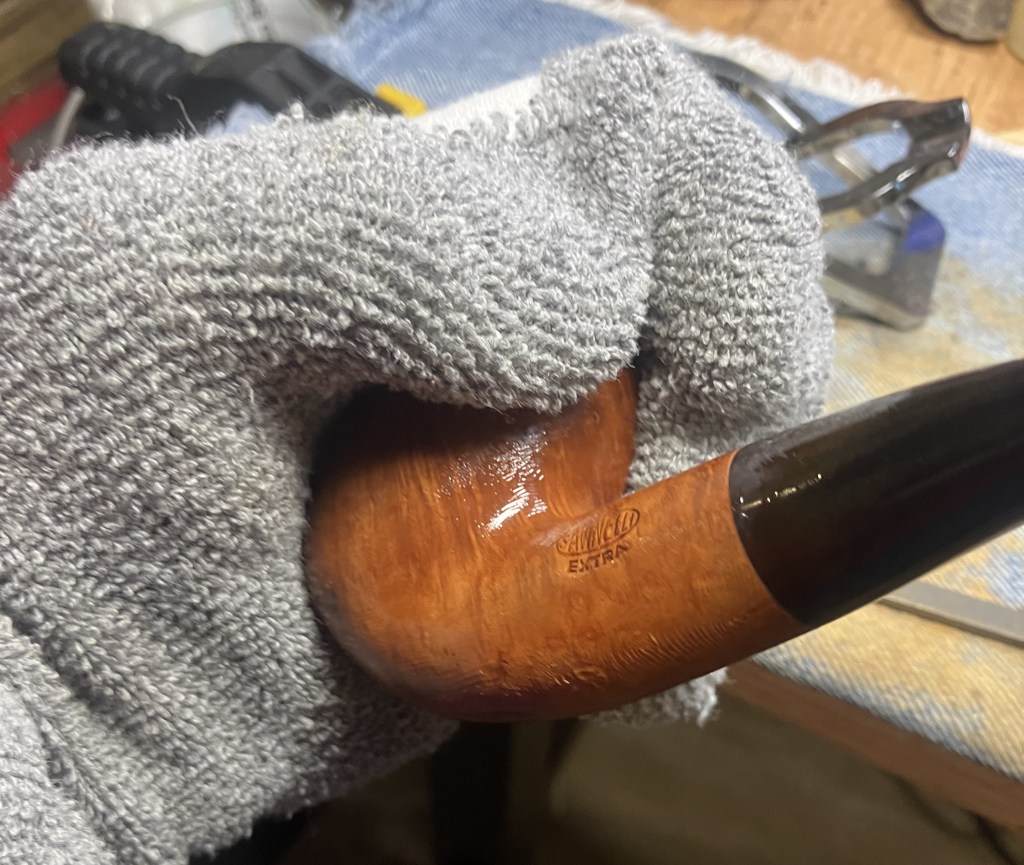
After 20 minutes the balm was wiped and hand buffed using an inside out athletic sock.
I’m not sure why I did this next step, maybe because I bought the stuff and have rarely used it. I used a gun cleaning patch to apply a very light layer of Danish Oil to the stummel.The gun cleaning patch was used because it is a lint free material. I followed the label instructions and allowed the oil to “harden” for 9-12 hours.
It may not have served much purpose but it sure was pretty.
The next morning I returned to the Sea-Dog. I took it to the buffer and applied several coats of carnauba wax with a flannel wheel. The pipe was hand buffed with a microfiber polishing cloth and the final photos can speak for themselves.
It is official, I really like the calabash shape. There is just something about it that says, “I am how pipes should look.” Yeah, I know they don’t talk but you know what I mean. This Sea-Dog is a grand old testament to pipe makers’ generations lost. The sweeping curves and graceful flow beckon me to fill the bowl, slow down, relax and enjoy a moment of contemplation. This is called, “sitting on your butt doing nothing” by some people. The best part of their attitude is that there remains far more tobacco for us to enjoy. I think this Sea-Dog restored very nicely. The numerous fills are not too noticeable with the contrast dye. The stem polished up beautifully and provides an excellent contrast while complimenting the briar grain. The old fashioned orific button can interestingly be directed into one’s mouth with subtle changes to the alignment with the shank. A slight twist can send the smoke into a new direction.
The dimensions of this Sea-Dog Calabash are kind of strange to measure but here they are:
Length: 5.53 in./ 140,46 mm.
Weight: 1.53 oz./ 43.70g.
Bowl Height: 2.09 in./ 53.09 mm.
Chamber Depth: 1.60 in./ 40.64 mm.
Chamber Diameter: 0.73 in./ 18.54 mm.
Outside Diameter: 1.41 in./ 35.81 mm.
I do hope that you have found something here useful to your own pipe care, maintenance or restorations. If you like this sort of thing, please click the like and subscribe buttons. Thank you for reading the ramblings of an old pipe lover.
Loading…
Below are some photos of the finished Sea-Dog Calabash.
Here is a pipe which I had my doubts about ever possessing. I first saw the eBay auction in the spring of 2023, I think. The price was more than I was willing to spend but I was intrigued by the shape. The pipe was never sold and was relisted. This went on for numerous cycles. I eventually started making offers to the seller which met with no reply nor counter offer from the seller. I thought that I must be just offering too little to warrant a response. Well, long story shortened, after over a year of this the seller agreed to my offer and I received the pipe in July of 2024. I guess this proves that something is only worth what someone is willing to pay.
When the pipe arrived I was amazed at the detail which the photos failed to show. The stem had a matching bell shape and crack. The front of the pipe had the 1776 and 1976 pressed into the meerschaum as well as the crack. The bottom of the pipe had a stylized clapper or the “hanging ringer thingy”. Unfortunately there was no maker’s mark indicating who carved this piece of American history. Below are some photos before I began work on the pipe.
The most notable issues were the lava on the rim and the tooth dents on the top and bottom of the stem. The photos don’t show the dents well but they were there and annoying.
Background
1976 was a time, which I remember as nostalgic and optimistic. There were continuous celebrations of the 200 year birth of the nation. Lots of fireworks displays, parades and advertising all in support of the bicentennial year of our founding. From Saturday morning cartoons (yeah, that was about the only time we got them) to the minting of bicentennial coins, nationalism and patriotism were on full display. Apparently this also made its way to meerschaum pipes. I was able to find a couple of examples of Liberty Bell meerschaum pipes but none matched the shape or style of this piece.
With nothing to really work with I reached out to the meerschaum experts in a Facebook group I am part of. I posted photos of the Liberty Bell and said that I thought it to be from 1976 and asked if anyone could provide any additional information. Unfortunately, I did not get a response by anyone to further clarify the potential origin of this pipe.
The Restoration
I am preparing myself for some new workbench protective pieces of cloth. As this summer closes out I will be retiring a couple of pairs of cargo shorts thus I’ll be entering a new phase of workbench protection. Until then I’ll just have to deal with these rather stained denim pieces.
The below photo shows the rim of the Liberty Bell and it’s slightly lava encrustation.
Cotton swaps dipped in 95% ethyl alcohol were used to clear away this lava. I didn’t want to wear away the rustications of the carvings so a light touch was employed.
My unfamiliarity with meerschaum led me to not cleaning as thoroughly as I probably could have. My fear was that I’d overdo the cleaning and smooth the surface of the meerschaum.
The stem was cleaned with bristle pipe cleaners dipped in ethyl alcohol.
I scrubbed the stummel with warm water and a medium stiff toothbrush. The stummel was dried with a cotton hand towel and looked better than it did prior to the cleaning.
I found myself washing my hands constantly during work on the meerschaum. I did not want to have my grubby finger leaving marks on the pipe.
The two photos below show the tooth indentations better than the initial photos.
These dents needed to be filled with thin clear cyanoacrylate (CA, super glue) applied with a fly tying bodkin. If you are wondering, the CA bottle is glued to the card to make spilling less likely.
I started with the bottom side of the stem. The thin CA flows very readily and fills the surface imperfections well.
I spritzed the wet CA with a CA drying accelerator. This makes the CA cure almost instantly and gives it a rough surface texture.
The rough CA was filed with a small flat file to smooth the fill and blend it with the surrounding acrylic stem.
The fill was then sanded with a 400 grit sanding sponge.
The process was repeated for the top of the stem. Below shows the application of the CA to the dents.
Again the wet CA was spritzed with drying accelerator.
Filing and sanding of the fills was done and they were far less noticeable than before.
The stem was then sanded with a series of sanding sponges from 400-3500 grit. Between each sponge I wiped the stem with a water dampened paper towel to remove sanding debris.
After the sanding I used micro-mesh pads in grits 4000-12000 for further polishing the stem. Between these pads I applied a small drip of Obsidian Oil and wiped it with a paper towel. The fills were nearly invisible.
Top view of the micro-meshed stem.
Bottom view of the stem.
I used a double boiler type set-up to melt the beeswax. The wax sat in a small glass jar placed in a pan of boiling water. The tin to the left of the pan was used to catch the drips of wax during application and as the meerschum is heated with the heat gun.
I prepared the meerschaum for waxing by heating it with a heat gun.
The meerschaum was then covered with hot liquid wax via a paintbrush.
The meerschaum was then heated with the heat gun again and the remelted wax allowed it to drip from the pipe into the tin. The photo of this step was so blurred by me moving too much to be useful. The final step was using a paper towel to absorb any excess wax from the still hot stummel. I put on a kevlar glove here not for protection from being cut but because that was the only glove at hand. This sink and counter are used for cleaning fish on occasion, thus the kevlar glove.
The pipe was taken to the buffer where the stem received several coats of carnauba wax. The stummel did not receive any carnauba as it just got fresh beeswax.
The fresh beeswax darkened the meerschaum slightly and gave it a richer color. I am very pleased with how well the fills on the stem came out. The cyanoacrylate blended in with the swirling amble to make nearly perfect fixes. I do wonder if I should have used the brown CA instead then I wonder if I’m just being too critical. The rim also bothers me slightly with the darkening of the rustications with a touch of old lava. The original Liberty Bell did not have a rusticated dome so maybe I should have smoothed this one and completely eliminated the crevasses and their blackened grooves. Oh well, none of these petty grievances detract much from this old pipe and I can attest to it being a grand smoker. The dimensions of this Liberty Bell meerschaum are:
Length: 7.16 in./ 181.86 mm.
Weight: 1.79 oz./ 51.00 g.
Bowl Height: 2.15 in./ 54.61 mm.
Chamber Depth: 1.57 in./ 39.88 mm.
Chamber Diameter: 0.81 in./ 20.57 mm.
Outside Diameter: 1.33 in./ 33.78 mm. (at the shank)
1.86 in./ 47.24 mm. (at the flared bottom)
I do hope that you have found something here useful to your own pipe care, maintenance or restorations. If you like this sort of thing, please click the like and subscribe buttons. Thank you for reading the ramblings of an old pipe lover.
Loading…
Below are some photos of the finished Liberty Bell meerschaum pipe.
This is the fourth pipe in my briar free stage apparently. I have to say that I am looking forward to returning to work on briar pipes. The meerschaums are fun but their frequent lack of a documented heritage leaves me wanting and since I mainly do this for entertainment and relaxation the absence of a feeling of completion doesn’t sit well with me. I know what you are thinking, ‘quit complaining and get on with it.’ You are correct. Besides, the next pipe in the queue is another meerschaum.
This adorable little darling was purchased to allow me to work on a few novel traits. First, an amber stem, second an orific bit and third meerschaum. The threaded bone tenon was a bonus. The pipe came with a fitted case which had a distinctive mildew smell. The leather exterior of the case had almost completely deteriorated with only a few scraps remaining. What was left was paper thin and very brittle to the touch. The interior of the case had remnants of a velvet-like green lining which was also severely deteriorated by age. Inside the lining could be made out and read REAL MEERSCHAUM. The pipe had no markings. Below are photos of the case and pipe prior to any work done.
The joining where the shank met the stem was in remarkably good alignment and showed only a slight “overclocking”.
In all honesty, I was pretty sure that I would screw up major parts of this restoration. I was ready to do so and call any errors on my part inexperience. Then I thought that would do a disservice to the legacy of the old pipe and merely be an excuse for mistakes. I searched Steve Laug’s rebornpipes.com for meerschaum restorations and read several. The handful of meerschaum restorations which I had done all were rusticated pipes. This would be the first smooth meerschaum that I’d tackled. Everything about it seemed fragile; the disintegrating case, the amber stem, the bone tenon and the delicate smooth meerschaum stummel. So here goes, good or bad, I’ll show you all what I did.
Background
This is an easy one. There, done. Really, I have nothing to go one. I tried searching for “REAL MEERSCHAUM” marked cases – no matches. Most of the cases are actually marked”Genuine Meerschaum” so, I thought I might get lucky with the “Real” but, no. I guess we can talk about the orific bit quickly. Mouthpieces with orific bits seem to have gone out of favor by 1920 and were replaced with the slot which we are all more familiar with. Steve Laug wrote a great blog on the demise of the orific button and I’ll link to it here.
Judging by the case, the amber stem and the orific button, I think I can safely say that this pipe is from before 1920 and most likely carved in Europe.
The Restoration
Dirty little pipe on a clean piece of denim.
The reaming was done with scrapers and sandpaper only. Twisting reamers are considered too aggressive for meerschaums due to their potential torque.
The Scraping was slower than normal as I was trying to be careful of the meerschaum. I am still developing a feel for the amount of pressure which can be used. Also the sound. Briar has a squeak, to my ears, that is different from the sound of a scraper on cake. I have not had enough experience reaming meerschaum to have developed an “ear” for it. I know, practice, practice, practice.
The reamed bowl before the sanding.
After the reaming, I started cleaning the airway. How something so short could have enough tar to take down a saber-tooth cat I’m not sure. Many bristle pipe cleaners and cotton swabs dipped in 95% ethyl alcohol later the airway was clean.
It was a bit difficult for me not to grab the Murphy Oil Soap when cleaning a stummel. I didn’t. The stummel was scrubbed with only warm water and a medium bristle toothbrush.
I forgot to mention that I lightly sanded the rim while I was sanding the tobacco chamber. This was done in an attempt to remove the lava which had formed over the rim.
I didn’t want to take away too much of the surface meerschaum as I thought that a ring of fresh mineral would look ridiculous with the rest of the colored meerschaum.
Below is the scrubbed stummel, left and right.
With the stummel cleaned I turned my attention to the stem. Fortunately it was nowhere near as dirty as the shank had been. Alcohol dipped bristle pipe cleaners made short work of this. The bone tenon was slightly overclocked when tightened. I added a very light coat of thin clean cyanoacrylate (CA, super glue) to the threads of the bone tenon. I hoped that this slight increase in their thickness would be enough to reduce the overclocking.
The stem immediately behind the button had teeth dents both above and below. These were filled by first lightly sanding the amber to provide additional surface area for the CA to adhere to. The dents each received a small drop of CA. You can see the damaged button in the photo below. I will come back to how I repaired it.
The CA was spritzed with a CA drying accelerator. This cured the CA as it evaporated. The newly cured CA was then filed and sanded smooth and blended with the existing amber.
The CA added to the bone tenon had cured without the use of an accelerator and allowed for a correct alignment of the stem with the shank. Better lucky than good, any day. I then used a series of micro-mesh pads from 1500-2400 wetted with a couple drops of water. The micro-mesh pads 3200-12000 were used dry. Between each pad I wiped the pipe off with a paper towel moistened with water.
It was time to give the small Bulldog a fresh coat of beeswax. The kit that I used is illustrated with a photo from a previous meerschaum waxing. I place beeswax in a small glass jar and place the jar in a pan with water. The boiling water melted the wax and allowed me more time to apply the liquid wax. It is kind of like a double boiler and a hot water bath. The working surface has a heat gun and an empty tin to collect wax drippings. The wax is moved close to the work surface hopefully keeping my dripping to a minimum as I apply the wax to the stummel with a paintbrush.
As the wax was melting I heated the stummel with the heat gun.
Below is the boiling water melting the beeswax.
Once the entire stummel was “painted” with wax, I used the heat gun to remelt the wax. The dripping wax was collected in the tin. As I was melting the wax from the pipe I was also spreading it around with the paintbrush to ensure complete coverage.
Once the wax had either been absorbed by the meerschaum or had dripped into the tin, I put on the nearest glove and wiped the stummel with a dry paper towel. The glove was a necessary part as the stummel was very hot.
The color of the meerschaum had softened and took on a more warm golden hue.
Now, back to that button repair, I promised you.
Great idea: Use a toothpick wrapped in Scotch tape as a plug for the airway. The CA shouldn’t stick to the tape.
I inserted the toothpick, good thing this is an orific button.
I then used a fly tying bodkin as a dropper for brown CA. The brown CA was filled in around the toothpick. I used a medium CA rather than a thin formulation. It took a couple of applications to fill the broken voids.
The CA was allowed to cure on its own rather than using a drying accelerator.
After the CA had cured I removed the toothpick, pretty sure that my great idea would work but still cautious.
Success! I used a round diamond rat-tail file to smooth the interior of the airway. The button was reshaped using a flat file and sandpaper.
A sub-par photograph. I guess you will either have to wait for the “finished” photos or jump down to them.
Ugg, the case. I am sure that it once had a leather covering. That was long gone. I think all that remained was a papier mache shell. At least I think that is what it was made of.
There was also at one time a wooden frame around the case. Below you can still see a couple of flakes of old leather, the blackish paper tin stuff.
Enter great idea number two: Coat the whole exterior with sodium silicate, also known as water glass. That should act as an adhesive which would penetrate the papier mache and better hold it together. It would do the same for the wood frame. In my imagination this worked wonderfully. I removed the disintegrating flaking leather and started painting the exterior of the case.
I worked. I was not happy with the color though. It didn’t look like my imagination at all.
Well, I was rather committed at this point. I continued and painted the edges as well.
Great idea number three: Lightly sand the case, dye it with Fiebing’s black leather dye then give it a coat of black shoe polish. I know it didn’t have any leather but, It sounded good to me.
The case was sanded then dyed black. I did not flame the dye. My imagination told me that was a really bad idea. For once I listened.
The case was allowed to dry for an hour then I applied the black shoe polish with a cotton swab. Once applied, I used a shoe shine brush to buff the shoe polish.
The pipe was taken to the buffer where the stem received several coats of carnauba wax. The stummel did not receive any carnauba as it just got fresh beeswax.
Yeah, it is still a beaten, battered, scared, little bulldog but it is a cute little beaten, battered, scared bulldog. I am not sure if sanding would have removed all of the scratches. If the pipe had been that severely sanded, it most likely would not have any color of a developed meerschaum pipe. I am okay with the scars and think they show that this old pipe has stories which would probably amaze all of us if only it could tell them.The repairs to the amber stem turned out very well. The brown CA is a near perfect match to the color of the amber. The dimensions of this Small Amber Stem Meerschaum Bulldog are:
Length: 4.51 in./ 181.86 mm.
Weight: 0.82 oz./ 23.40 g.
Bowl Height: 1.63 in./ 54.61 mm.
Chamber Depth: 1.05 in./ 39.88 mm.
Chamber Diameter: 0.70 in./ 20.57 mm.
Outside Diameter: 1.40 in./ 33.78 mm.
I do hope that you have found something here useful to your own pipe care, maintenance or restorations. If you like this sort of thing, please click the like and subscribe buttons. Thank you for reading the ramblings of an old pipe lover.
Loading…
Below are some photos of the finished Small Amber Stem Meerschaum Bulldog.
The Jima pipe is one of those things that when you see one you just want to have one. They look so cool and 1960 futuristic. I am pretty sure if Captain James T. Kirk smoked a pipe on Star Trek. It would have been a Jima. Even the advertisements had a Bohr model-esque image:
(Jima – Pipedia). But like all things mainly fashioned in one’s imagination reality enters the picture. I recently succumbed to the Juima bug. Searching through the eBay auctions I found what looked to be a good example and a reasonable price, $25, and I decided that I had to have it. The wait for it to arrive from Hudson, Florida was tolerable with me imagining shooting space aliens while puffing happily with my restored Jima between my teeth.
When the Jima arrived, I have to say I was impressed with the look of the pipe and the condition which it was in. It looked as though it had only been smoked a few times. The feel of the pipe was much different than I had imagined. It felt like the whole thing was made of plastic. I had a chat with Steve Laug recently about Jima and his quote struck me as very insightful and funny. He said, “I have done a few Jimas and they always feel like kids bubble pipes” (Laug,Steve, personal communication) That is exactly what this Jima felt like, a toy pipe. I tried disassembling it, thinking that the bowl should unscrew. It didn’t. Or maybe the mouthpiece slip off, nope. I finally visited smokingmetal.co.uk and discovered the following:
“A plated metal frame holding the mouthpiece, an internal metal filter and the outer bowl of various colours of plastic. The bowl appears to be a ceramic material, which I have not managed to remove.
To access the filter, the barrel ( various patterns) of the inner stem is unscrewed on some models, or simply slid back on others
Mouthpiece of plastic and stamped JIMA on top and �Brevete France & Etranger� �Modele Depose Made in France�
Also available as GARLAND with the Brevet France etc stampings
Since acquiring the Garland which has all text in English, realise the bowl is not intended to be removed by the users. However it seems politric to leave it here lest other try to remove their ceramic bowl Overall Length: 144 m/m” (http://www.smokingmetal.co.uk/pipe.php?page=159).
Now I know this introduction has bled over into the “Background” portion of this blog but, I am trying to show the sequence of events as they occurred. I’ll get back on track. Here are some photos of the Jima and it’s condition upon arrival.
This is another of those restorations which really isn’t much of a restoration. Sure, the stem needs a bit of chatter removal and the parts need cleaning but, that is really about all there was to it.
Background
The Alexandria Library of pipes, also known as pipedia.org, has the following to say about Jima:
“An innovative system pipe, the “Jima” (for export also known under the name “Garland” and to a lesser extent in the Netherlands) was a pipe with a silver-plated or gold-plated steel metal frame, connecting a plastic mouthpiece to a plastic outer shell that housed the pipe bowl. This plastic pipe came in a few different colors, black and ivory being the most popular and later various mottled pastel shades showing depressing sales. While the housing was made of hard plastic, the bowl proper was made of a pressed white clay which has been mistaken for meerschaum or sepiolite. The bowl was made detachable by using a screw in fitting which could be loosened or tightened using an Allen key. The fittings on both the bowl and evaporator (stinger) used a plastic compression gasket to keep tar and moisture from seeping out and air from leaking in.
The “Jima” was equipped with an innovative filter design previously unemployed which made it an unforgettable part of the system pipe revolution that began in 1880 with the increasing popularity of new, moist aromatic tobaccos. In the “Jima” was found a filter which was made of spiral wound (sometimes double wound) “electrostatic” metal wire dubbed the “filtres serpentins helicoidaux”. It was said that the electrostatic properties of this filter caused the tars and residues to cling more readily to the filter medium. It is more likely that the extreme turbulence produced by this system caused particles of tar to fall and moisture to condensate as the smoke cooled rapidly. In this instance the evaporator worked to great effect relative to the amount of tar and moisture which accumulated in the stem.
To access the filter, the stem (plastic and in other iterations metal) can be unscrewed, by use of a spring system, or simply slid back, tilted downward and finally pulled off. In nearly every instance the words “Breveté France & Etranger” or “Modèle Deposé Made in France” can be found on the underside of the mouthpiece near the stem.
French brand created in the 1960s by Mayeux, which had a very modern look. This modern look was emphasized by the manufacturer in the promotion material. The slogan speaks of “la pipe de l’an 2000” or “The pipe of the year 2000” . The factory was sold to Chapel Frés, which became part of the Berrod-Regad group in 1987. The Jima pipe is no longer made.”(Jima – Pipedia)(I added the italics)
The above entry also contains numerous photos of Jima pipes in various colors. The one photo that makes me sad is the photo of the “filtres serpentins helicoidaux” or metal filter. This pipe did not come with the original filter. The other thing which I wished that this pipe had is the screw allowing for the disassembly of the bowl from the pipe. That too is not something common to this Jima.
The third site that I checked for background on Jima was pipephil.eu. Here there is a single entry with three links. The left top two links are to other pipe makers associated
with Jima. The “More infos here” link takes you to the smokingmetal.co.uk site for Jima. The final link, “The Chapel Freres & Cie factory” delivers you to a page which shows the building housing the factory. This building now is quite literally housing.
This all leads me to say with some certainty that this Jima was made in France in the 1970s.
The Restoration
The Jima started out with a clean denim piece, like usual.
Since most of the required work on this pipe appeared to be on the stem, that is where I began. I used a wood block to raise the stem slightly to allow a more curved action when filing. I lightly filed the tooth chatter with a small flat file.
The filed surface was then sanded with a 320 grit sanding sponge. You can see on the photo below that the stem stamps were covered with painters tape for protection.
The sanding was done to both the top and bottom sides.
The stem was then sanded with a series of sanding sponges from 320-3500 grits.
The stem was polished with micro-mesh pads 4000-12000.
I failed to photograph the buffing of the plastic stummel with the buffer and white diamond compound. You are not really missing much as there wasn’t much to do.
The Jima’s shank, for lack of a better word, was removed by sliding it towards the mouthpiece then tilting it downward and sliding it off. This tube was cleaned with cotton swabs dipped in 95% ethyl alcohol.
The two short airways were cleaned with bristle pipe cleaners again dipped in ethyl alcohol.
The bowl was cleaned out with cotton swabs and, you guessed it – ethyl alcohol.
The pipe was reassembled and taken to the buffer for a couple of coats of carnauba wax then a hand buffing with a microfiber polishing cloth.
The best part about this restoration is that I can mark it off the list of pipes to restore. I can’t say that I was terribly impressed with the Jima. I mean yeah, they look very cool but the plastic-like feel just did not appeal to me. It is also true that I never smoked the pipe. It may completely redeem itself with a bowl of tobacco. The amber plastic is very pretty and the gold accents it remarkably. The amber looking stem brings the whole pipe together in a very attractive way and I still admit that I love the aesthetics of the pipe. The design and engineering also are of great quality, The o-rings seal beautifully even with their age and the finish of the pipe is good. I do not like the slight gap around the gold rim and the amber plastic of the stummel but I am sure that is there to allow expansion and contraction of the two plastics and the ceramic bowl. I just can’t get over how it feels in my hand. Perhaps this makes me tactile-ist. A new word I am claiming in reference to being snobbish and elitist regarding the feeling of things. The dimensions of this Jima are:
Length: 5.68 in./ 144.27 mm.
Weight: 1.35 oz./ 38.30 g.
Bowl Height: 1.61 in./ 40.89 mm.
Chamber Depth: 1.31 in./ 33.27 mm.
Chamber Diameter: 0.70 in./ 17.78 mm.
Outside Diameter: 1.48 in./ 37.59 mm.
I do hope that you have found something here useful to your own pipe care, maintenance or restorations. If you like this sort of thing, please click the like and subscribe buttons. Thank you for reading the ramblings of an old pipe lover.