
Photographed and written by
John M. Young
It must be my four years of physical geography/geology undergraduate training that drew me to this pipe. It looks like a rock sample on a stick but I fell in love with it at first sight, scars and all. I remember seeing various examples with various natural rock-like shapes online but this one called to me. The funny part of this story is that I had just seen Steve Laug post in a Facebook group about a great antique store that he came across. I commented something about how the local antique stores in town really needed to “up their game” regarding old tobacco pipes and whined about how the local shops might have a Willard that looks as if it was last cleaned by placing it in a garbage disposal. Yeah, I was a bit jealous. The next day I made my way into town to pay taxes on the house and truck. While there I swung into one of the antique shops and asked if they had any old pipes. Out came the box. Low and behold, there was this Kiko. I was amazed, there were also two Willards that had last been cleaned not with a garbage disposal but with a technique involving chains and a gravel road – not sure how that one works. I don’t think the proprietor of the shop had any idea about the value of the Kiko. His mother was working the counter that day and we had a very nice conversation about meerschaum and how it really was a rock. I left her enlightened and with some cash as I returned home with a Kiko and new stickers on my license plates. When I got home I was able to examine the pipe more thoroughly and in a less excited state. There were no carvings or stamps on the stummel. The stem had the Kiko Elephant near the shank on the left and along the bottom was stamped TANGANYIKA. Below are some photos of the Kiko as it appeared prior to any work.


I’m not sure what the scars on the lower end of both sides were from. I can’t figure why you’d need to squeeze a meerschaum stummel with a channel lock pliers but that is what it looks like happened. The stem was oxidized suggesting that it was indeed vulcanite and had accompanied a previous owner on many a clenching expedition. This was going to be an interesting restoration. The first question: Do I re-carve the damaged spots and make the re-carvings blend with the original or, Do I patch the holes? Either pursuit was a novel idea for me. Research was required.
Background
The first step that I took in researching this pipe was to look up the logo at pipephil.eu. There I found the following:

(Ki-Km — Pipes : Logos & Markings (pipephil.eu))
Turning to pipedi.org for some history of Kiko led to the following entry:
“Kiko, meaning “pipe” in Swahili-Kiswahili to English translation, is probably the best known of the various brands listed below. In East Africa Meerschaum is found in Tanganyika, once known as German East Africa, and since 1964 part of the United Republic of Tanzania. The main deposit comes from the Amboseli basin surrounding the Lake Amboseli. Tanganyika Meerschaum is normally stained in shades of brown, black and yellow, and is considered to be inferior to Meerschaum from Turkey. Eventhough, the raw material is mined by the Tanganyika Meerschaum Corporation and to a large extent used for pipemaking. Uncounted pipemakers throughout the world were supplied with Amboseli Meerschaum, preferentially used for Meerschaum lined briars or leather-clad pipes. In Tanganyika the Kilimanjaro Pipe Company Ltd.” (Kiko – Pipedia)
And, more specifically the Caveman line of Kiko pipes.
- “Caveman Fashioned from a piece of natural meerschaum.Every pipe is unique and – is in fact a geological specimen over a million years old.Attractively boxed.” (Kiko – Pipedia)
A second entry at pipedia.org discusses the Tanganyika Meerschaum Corporation in greater detail.
“From Pipes, Artisans and Trademarks, by José Manuel Lopes
Tanganyika Meerschaum Corporation is a company that formed in 1955 by Kenyan businessmen from Nairobi after the discovery of a meerschaum mine relatively close to the surface on Kilimanjaro. The meerschaum is tougher, less porous, and cheaper than the Turkish variety. Another mine was soon discovered in Sinya, in the famous Amboseli Game Park.
The company, previously based in Arusha (Tanzania), became an associate of a Belgium firm, but closed some years after. It produced the Caveman, Countryman, Kiko, Killimanjaro, Sportsman, Townsman, and Wiga brands. It maintained a link with GBD for the making of the GBD Block Meerschaum series, and after its closure, the English firms, London Meerschaum and Manx Pipes (Manx Meerschaum) continued producing with African meerschaum.” (Tanganyika Meerschaum Corporation – Pipedia)
To give more depth to the meerschaum story here is a quick lesson in geography.

Lake Amboseli is a rainy season body of water along the shared border of Kenya and Tanzania, northwest of Mount Kilimanjaro. The straight white line on the image below is that border. Sinya refers to the Sinya Mine (https://www.mindat.org/loc-266724.html).

Zooming in on the south western shore of the temporary Lake Amboseli you can actually make out the excavations of the old mining activities. On the below image from google maps; pits, tailing piles, roads etc… can be discerned.

It appears that little to no mining is done at the site today. Several sources say that the meerschaum deposit were close to the surface, not very large and were played out
Super fast history lesson:
Before World War I, Tanganyika formed part of the German colony of German East Africa. It was gradually occupied by forces from the British Empire and Belgian Congo during the East Africa Campaign, although German resistance continued until 1918. After this, the League of Nations formalised control of the area by the UK, who renamed it “Tanganyika”. The UK held Tanganyika as a League of Nations mandate until the end of World War II after which it was held as a United Nations trust territory. In 1961, Tanganyika gained its independence from the UK as Tanganyika, joining the Commonwealth. It became a republic a year later. Tanganyika now forms part of the modern-day sovereign state of Tanzania. (https://en.wikipedia.org/wiki/Tanganyika_Territory)
With all of that information in mind and assuming that the TANGANYIKA stamp on the stem is referring to the country of manufacture (COM) this pipe was made not after 1962.
The Restoration
As I said earlier, I had some research to do regarding how to patch meerschaum. Oh yeah, I decided to patch the damaged area rather than try my hand at carving the meerschaum. The first site I visited was that of Troy W. of Baccypipes (https://baccypipes.wordpress.com/author/troynov1965/). He had a unique “Old Time Meer Lining Repair Method On a Kaywoodie Shellcraft #5651” post describing the use of finely ground chalk and egg white. This patch was described for repairing a meerschaum bowl lining but I figured that it could be used for meerschaum in general. Here is the link to that blog post. A second blog post that I read was by Dal Stanton, published at rebornpipes.com, describing another meerschaum lining repair. That post can be found here. I frequently message Dal about various pipe related issues or the weather in Colorado. I asked him how the repair on the pipe he had done was holding up with use. His restoration was done as a commission for Paresh Deshpande. Paresh has also done restorations at rebornpipes.com (Here is an example by Paresh). Dal messaged Paresh and in very short order replied to me,
“I have heard of no failures! The concoction is pretty sturdy and a great way to salvage Meers.
Dal

I’ll ask Paresh for a report.
Dal

From Paresh:
Hey Dal,
The repairs have held up perfectly well and the pipe is still providing me hours of great smoke. Do say Hi to John for me.” (Dal Santon, personal communication)
That provided the confidence boost that I needed. Egg whites and powdered chalk, who would have thought that would be the solution (pun intended – though it is actually more of a mixture than a solution) to this restoration?
On the next trip into town I stopped by a local dollar store and purchased chalk. The trip was actually for groceries so eggs were already on the list. Returning home I set to work following Troy W.’s procedure. Troy used the handle of a screw driver, apparently he didn’t own a mortar and pestle either. I started with a breaker bar rather than a screwdriver.

The breaker bar worked well but the end was rather small in diameter. I looked in the garage for a larger caliber tool.

A small sledge hammer head with a broken handle seemed like the perfect choice. I don’t recommend that you break off the handle of your small sledge in order to reproduce this procedure. I’m sure the handle would not provide a significant source of error.

The hammer was washed and dried and put to work.

A point of reinforcement here, Troy mentions to finely grind the chalk and when you have it ground then grind it some more. I concur and can state that I did not follow this advice as well as I should have. You really want the chalk to be powdered. Not mostly powdered with some small pieces, like mine was. I am sure that a mortar and pestle is the proper tool for this endeavor and were I still an active science teacher I would have borrowed one from the lab. Drats, foiled again by life choices.
The chalk was mixed with egg white. I added chalk until I had a mixture that was like “soft peaks” when whipping cream. The damaged spots appeared to have plenty of rough surface to enable the mixture to adhere to. I did wipe the surrounding smooth surface with alcohol to remove any surface wax that might not allow the mixture to stick.

The mixture was applied and allowed to dry for 4 hours. I also wanted to test a spot of the mixture to see how I could stain it in order to blend the patch with the existing meerschaum. I placed a small blob on a scrap of cardboard and set it aside to dry. I put the unused mixture in an airtight container and refrigerated it.

Once dry the patch felt “chalky”. I don’t know what I was expecting, perhaps more “dried eggy”. The numerous air bubbles had also left pours that I was not happy with. You can see the bubble very distinctly on the dried test blob.

Hmm, I think I needed more chalk in my mixture to make it less liquid and more like putty. I added more chalk. I lightly sanded the dried patch in preparation for a second application.

This 2nd application was applied to both sides simultaneously. The mix was thick enough that It would not drip, had no air bubbles and I could work it more like a putty. “Living and learning” might become my new life motto.

I let this application dry for about 30 minutes then tried to add some texture to it in an attempt to match the existing texture.

Time to test this blob. I thought that I would cover ½ the blob with beeswax to see how the wax colored the patch then try painting the other half with a green tea I was drinking to see how that changed the color.
The first part of the plan worked as planned. ½ the blob was painted with hot beeswax.

The plan went bad when I used the heat gun to melt the beeswax and allow the excess to drip off. It did drip down but the force of the hot air also pushed the remelted wax up onto the unwaxed portion of the ½. Oh well, my plans frequently have difficulties with reality.

There was a slight yellowing of the patch with the application of the beeswax. This was good but not quite the color change I wanted. The texture also changed significantly. The blob was no longer chalky, it was much more like the meerschaum. I think the term in meerschaumy.

I smoothed the mostly dried patch with 400 wet/dry sandpaper and tried the green tea stain. The tea immediately resoftened the patch. Hmm, – note to self, dry time seems important. The tea did seem to color the patch successfully. I set the stummel aside to completely dry and harden, overnight, in this case.

The next day, I began melting the beeswax. I have decided that I really need one of those electric candle maker wax heating pots. Until I do get one I will continue with this system I devised: An aluminum pan with water, a small canning jar with beeswax and a stove top. I like the hot water bath because I can’t overheat the wax getting it to its flashpoint and once the wax is melted I can turn off the flame and the hot water will keep the wax liquid for several minutes.

I heated the stummel with the heat gun preparing it for the wax that I would be painting it with. I painted the entire stummel with melted beeswax. I was amazed at how much wax the meerschaum absorbed. Nearly none of the was applied dripped into the catch tin.

I started working on the stem. The tooth chatter was filed and the stem sanded to remove the hardened oxidized surface.

The stem was then placed into Before and After Extra Strength Deoxidizer (deox). Due to the long stem the jar had to be sealed and placed at an angle to allow the stem to be fully submerged.

Several hours later the stem was removed and allowed to drip excess solution back into the jar.

I used a coarse shop rag to wipe and hand buff the remaining solution from the stem.

The coarse material of the rag both absorbs the solution and acts as an abrasive to remove the newly softened oxidation. The dark residue can be readily seen in the photo below.

The stem was then scrubbed with Soft Scrub cleanser on make-up pads.

At this point I used painters tape to mask the logo and stamp then sanded the stem with sanding sponges in grits of 400-3500. Between sponges I rubbed the stem with mineral oil and wiped it with a clean dry paper towel. I failed to photograph this so I guess you will just have to believe me.
Before moving on to micro-meshing the stem I wanted to repaint the logo and try to paint the TANGANYIKA stamp.
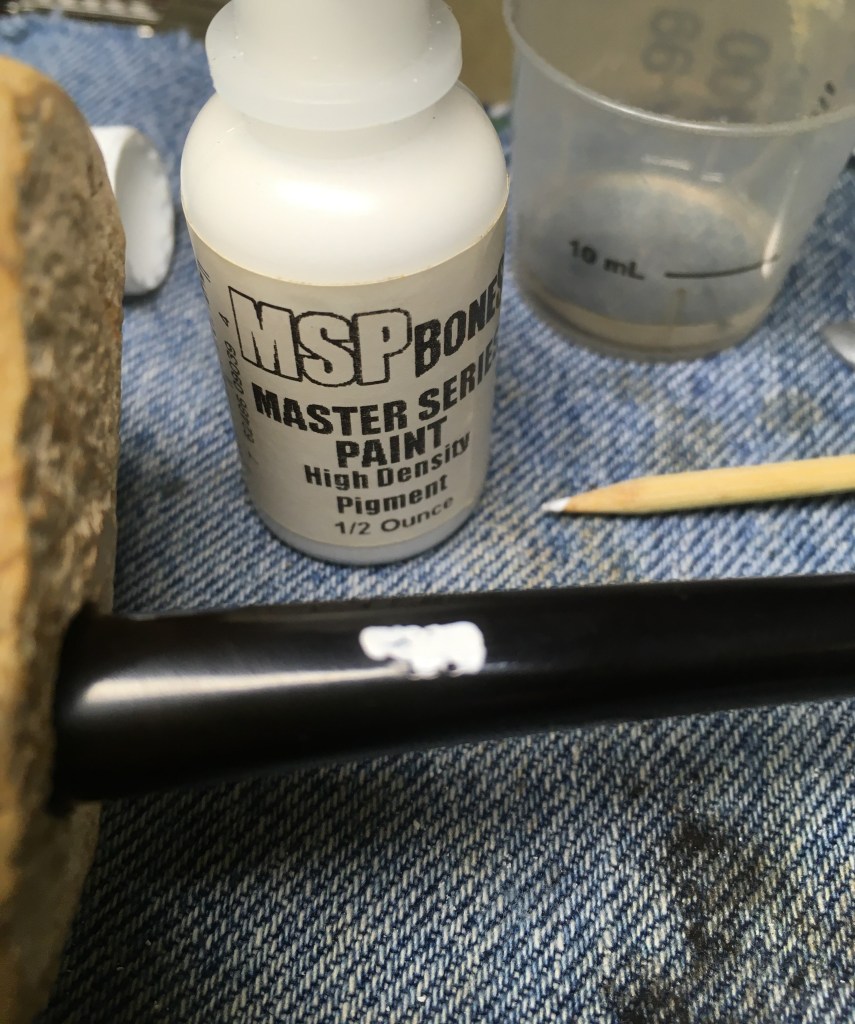

The letters were faint and proved to to take well to the painting. I didn’t see any evidence that they ever had been painted so this was not a great loss. The elephant had been slightly degraded with the removal of the oxidation but remained accepting of the paint. The stem was then polished with micro-mesh pads 4000-12000. Between each pad the stem was rubbed with Obsidian Oil and wiped with a paper towel.

The stem was taken to the buffer for a final buff with Blue Diamond compound. The stem then received several coats of carnauba wax. The stummel was not waxed with carnauba since it had just received fresh beeswax.
This was a fun restoration. It did not turn out as well as I had hoped. The patched spots on the damaged meerschaum are actually quite an eyesore but I learned many things about working with meerschaum. This pipe is not one that will be offered for sale unless someone really wants it.The meerschaum remains a rugged thing of beauty to me even with the blemishes. The stem cleaned and polished nicely and provides a strangely satisfying contrast to the stummel. I was glad that the logo and stamps were preserved. I am also looking forward to another Kiko restoration, hopefully one without the deep scars that this pipe had. The dimensions of this Kiko Caveman are:
- Length: 6.83 in./ 173.50 mm.
- Weight: 1.34 oz./ 37.40 g.
- Bowl Height: 2.33 in./ 59.18 mm.
- Chamber Depth: 1.61 in./ 40.89 mm.
- Chamber Diameter: 0.72 in./ 18.29 mm.
- Outside Diameter: 2.00 in./ 50.68 mm.in line with shank
1.64 in. / 40.18 mm. Perpendicular to shank
I do hope that you have found something here useful to your own pipe care, maintenance or restorations. If you like this sort of thing, please click the like and subscribe buttons. Thank you for reading the ramblings of an old pipe lover.
Below are some photos of the finished Kiko Caveman.


Troy W.’s
Chalk and egg white meerschaum bowl lining repair.
Dal Stanton’s meerschaum bowl lining repair.
 NebraskaPeteGeek